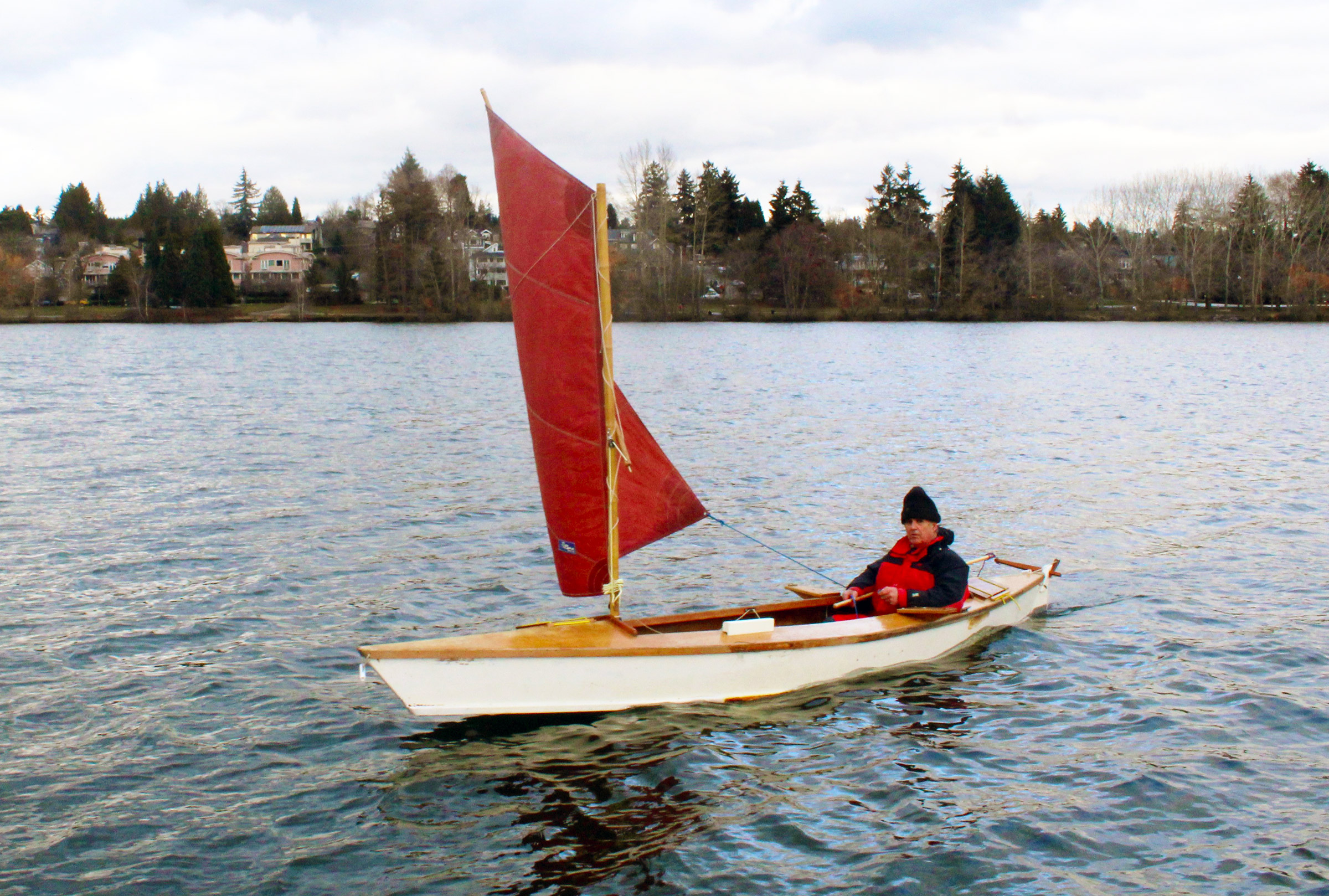
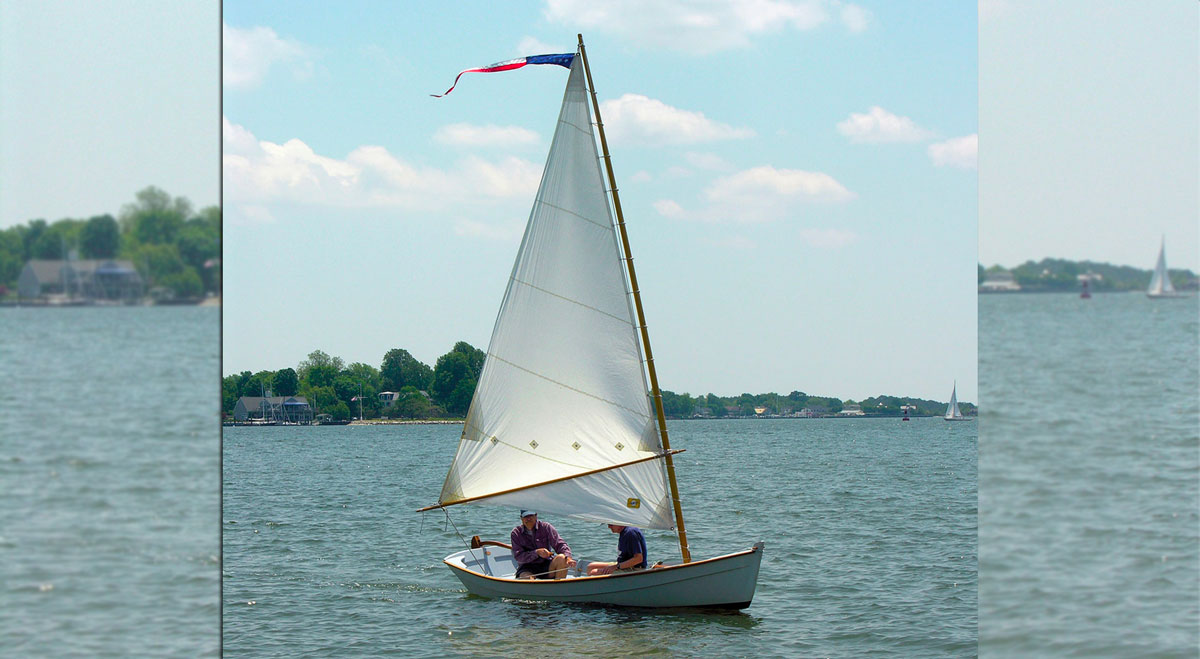
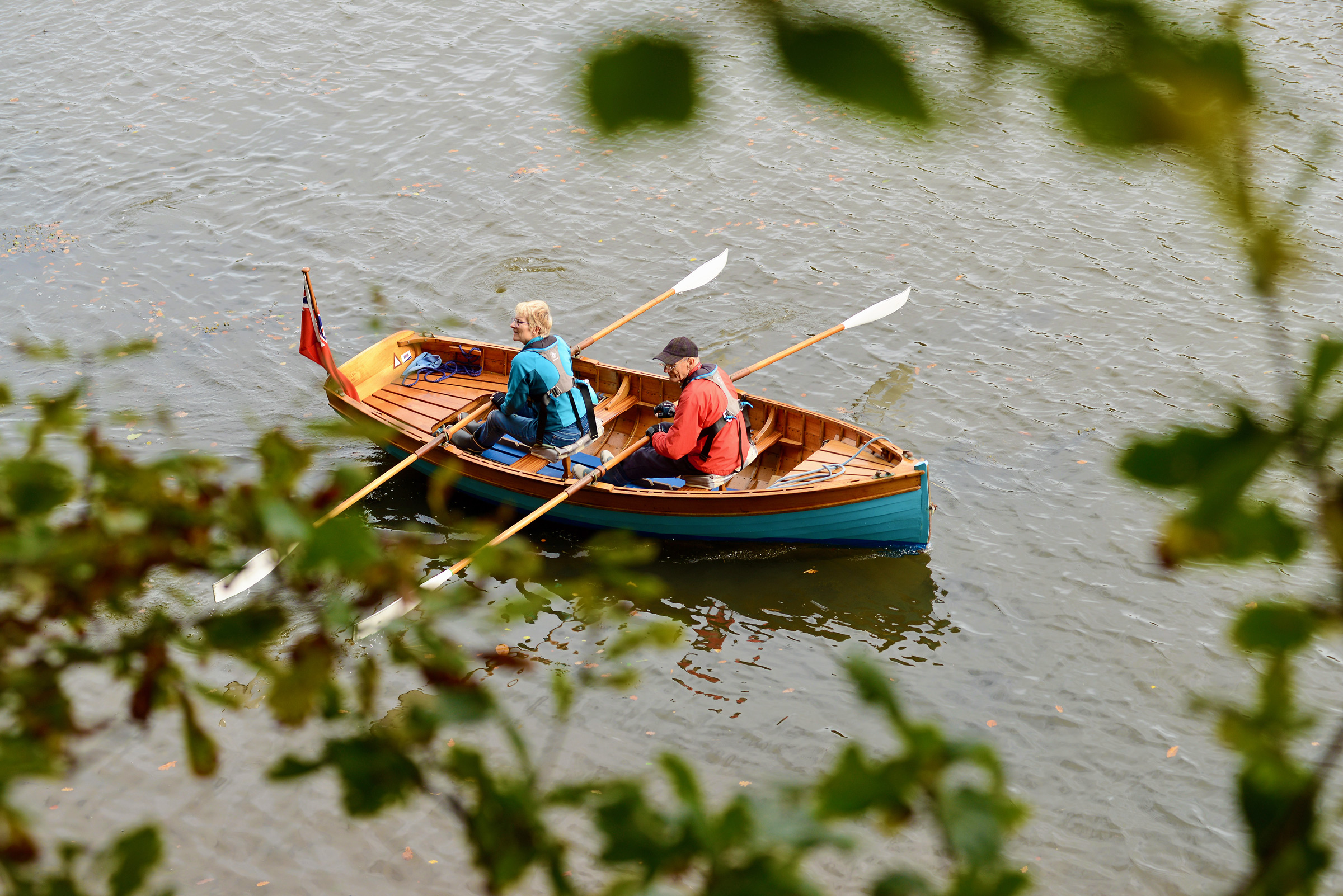
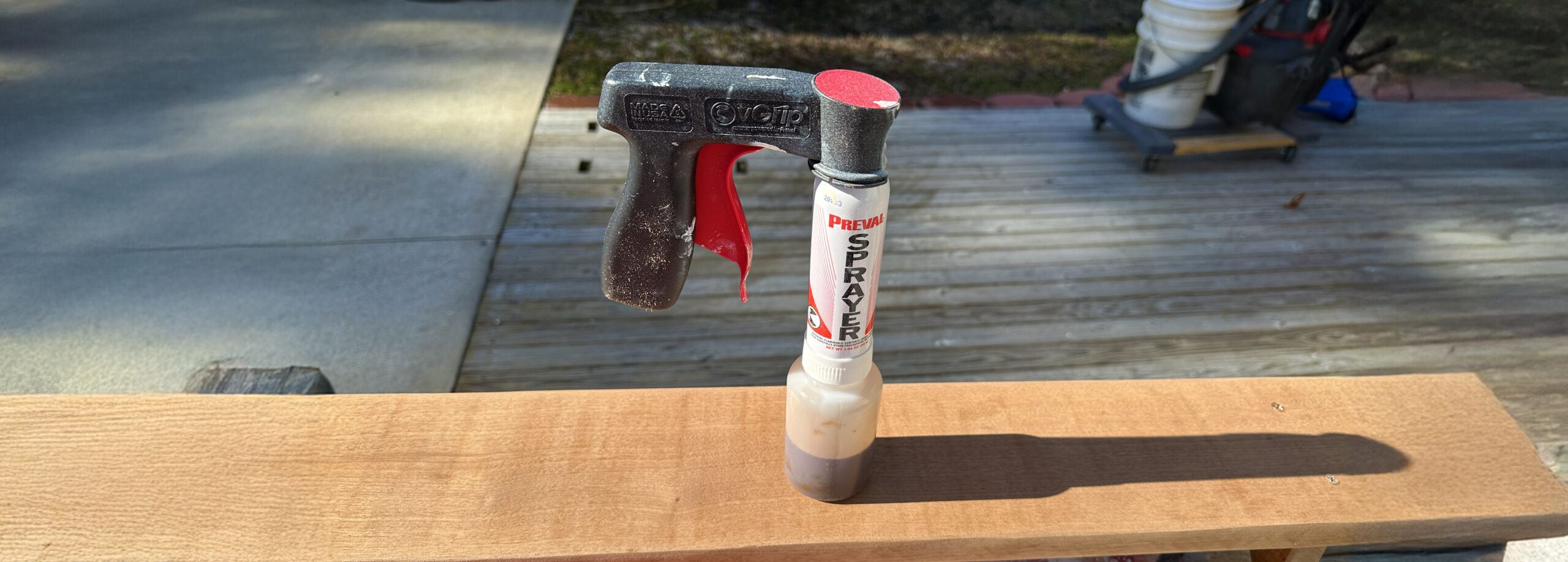
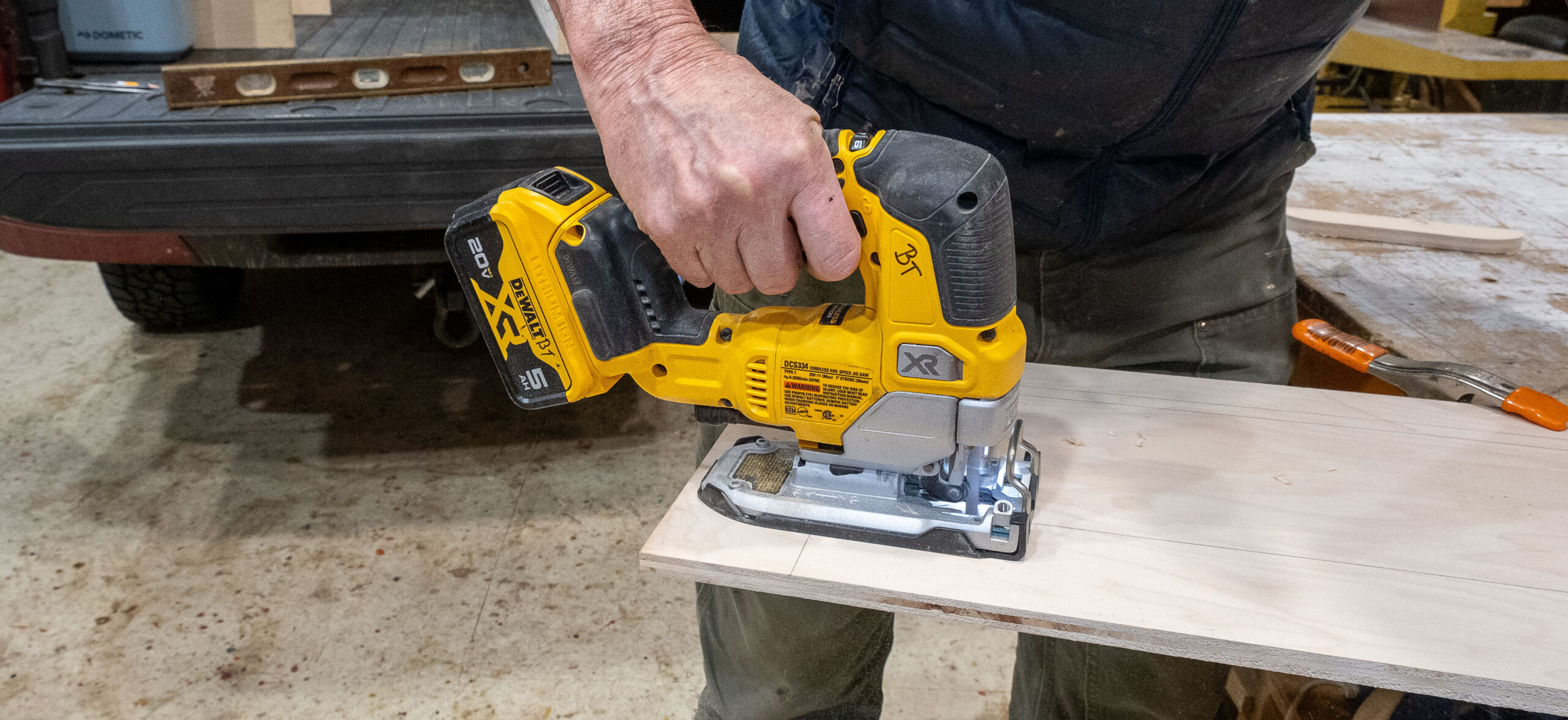
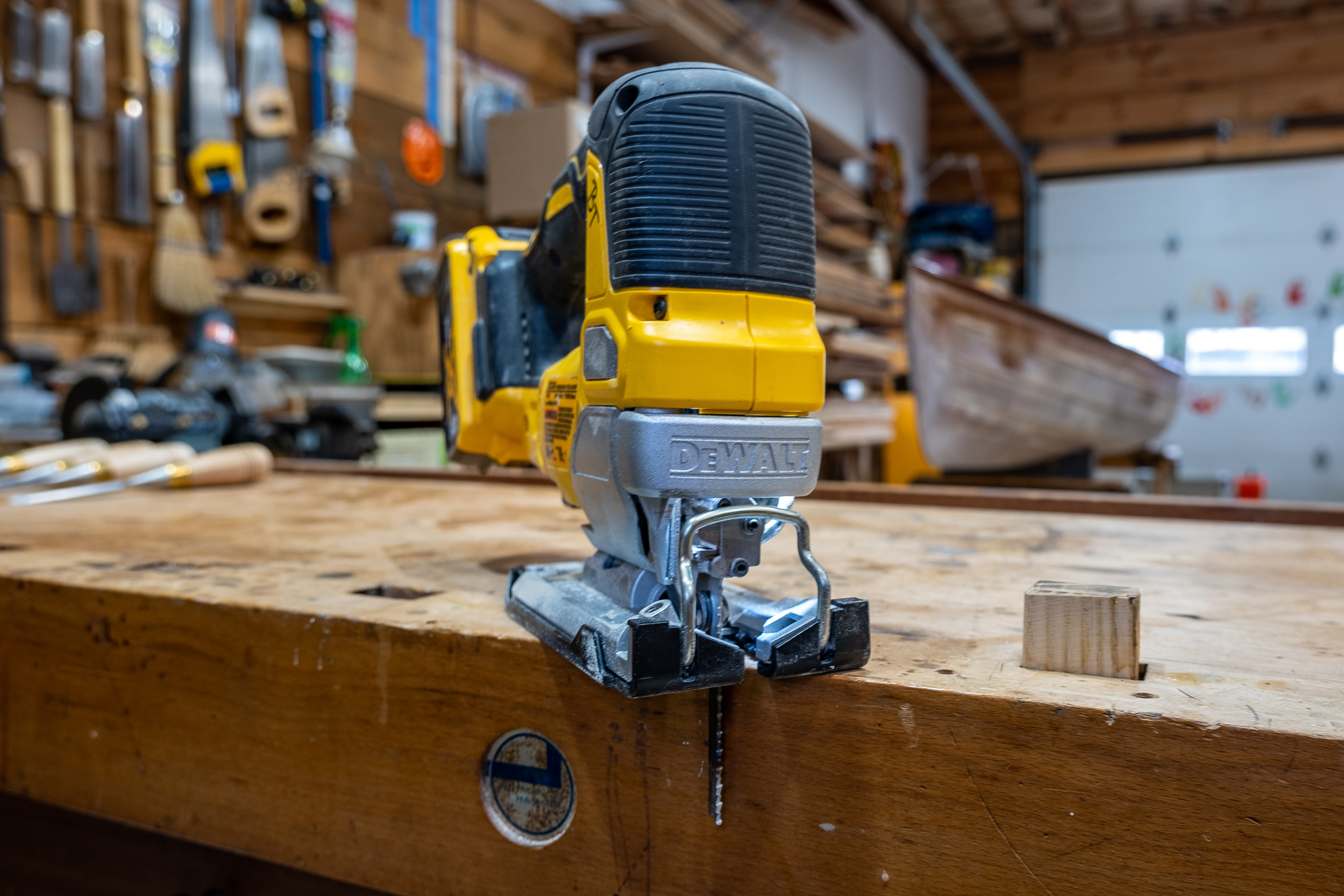
Gerald Trumpp, a retired automotive engineer from the upper Rhine valley in southern Germany, is a canoeist. For 30 years, he has owned an Old Town Scout canoe that he has paddled on local waters and across the border on French rivers. Sometimes he ventures out alone; sometimes he is joined by his wife, Petra, and their dog, Dipa. Before 2017, he had never built a boat—he’d thought about it, but never put those thoughts into actions. Then, in a boatbuilding class in Berlin, he built a stitch-and-glue canoe and was hooked.
As retirement approached, Gerald dreamed of building a bigger boat and cruising down the Danube. In 2020, still seeking boatbuilding experience, he bought a Chesapeake Light Craft Northeaster Dory kit. Within a week, he recalls, he had the boat stitched together. “The kit was precise, and it was nice to build,” but it would be three more months before it was finished. “We wanted it clear-finished inside and out, and that took a lot of sanding.”
Photographs by or courtesy of Gerald Trumpp
The Chesapeake Light Craft Northeaster Dory was the first boat Gerald built at home, and was the boat in which he and Petra learned to sail.
When Covid shut everything down and Gerald himself suffered some health issues, the “big river plans” were shelved. Instead, he decided to install a sailing rig on the dory and learn to sail. “Near Baden-Baden, where we live, there’s a little lake with a sailing club,” he says. “As a canoeist, the thought of doing anything on so small a lake—just 1 sq km in size—was ridiculous, but the people were nice, and the area is beautiful. The members were all dinghy sailors with more-or-less modern boats—420s, 470s, Lasers, some German class boats. But there was one woman who had a Mirror dinghy, and she was very glad to welcome another wooden-boat guy!”
Gerald installed the CLC original sloop rig in the dory, and he and Petra launched the boat on a cold day in March, when the lake’s water temperature was 5°C (41°F) and the wind was blowing a steady Force 4. They lacked experience, and the outing, says Gerald, “nearly ended in disaster. We were driven helplessly downwind, and it was only thanks to Petra’s balancing skills that we didn’t capsize when I turned onto a beam reach.” Shocked and discouraged, they managed to get to shore and lower the mast. A “friendly observer” lent them a paddle, and they made it back to the ramp. “Suddenly,” says Gerald, “the lake was not ridiculously small…it was a beast trying to kill us!”
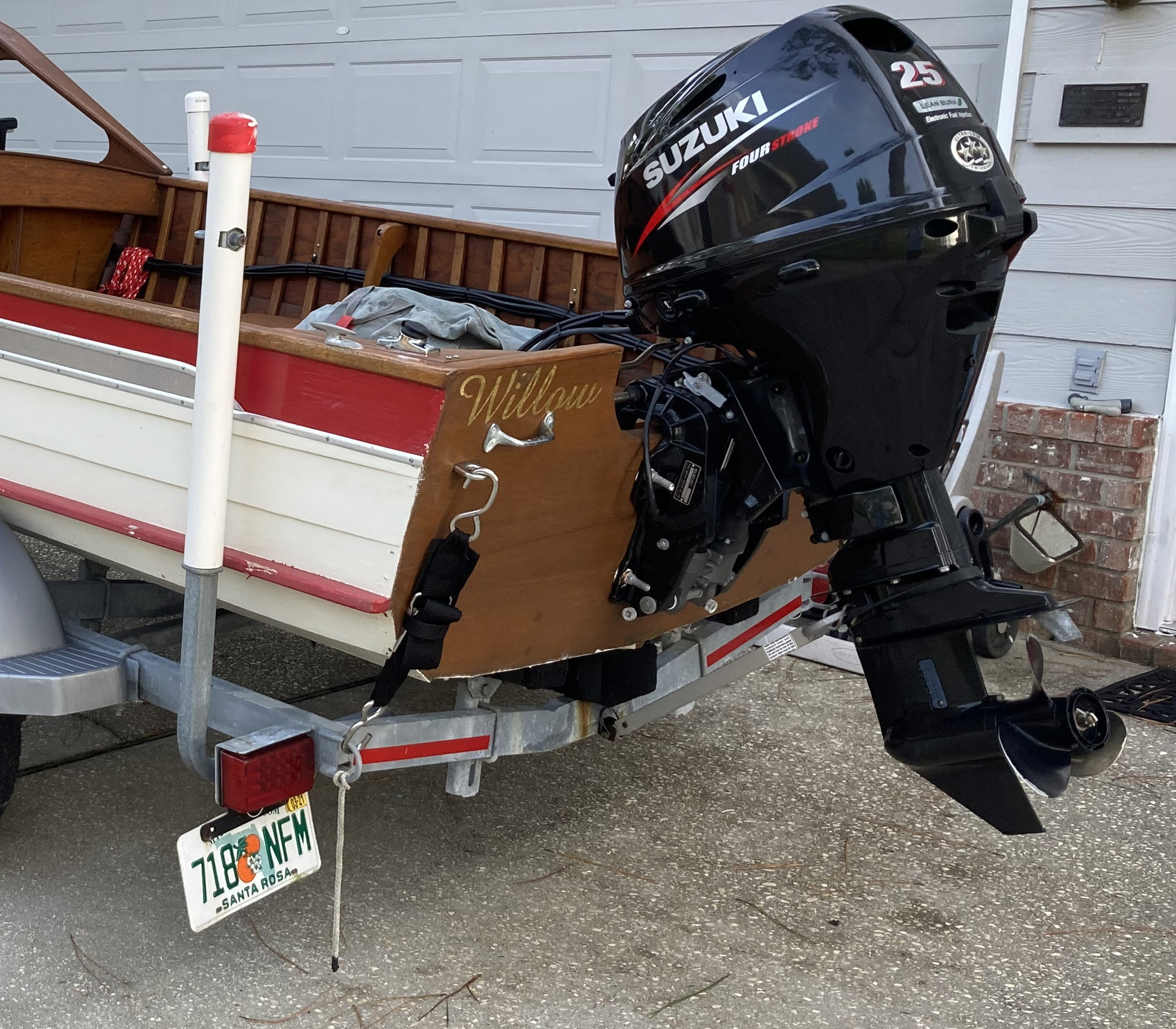
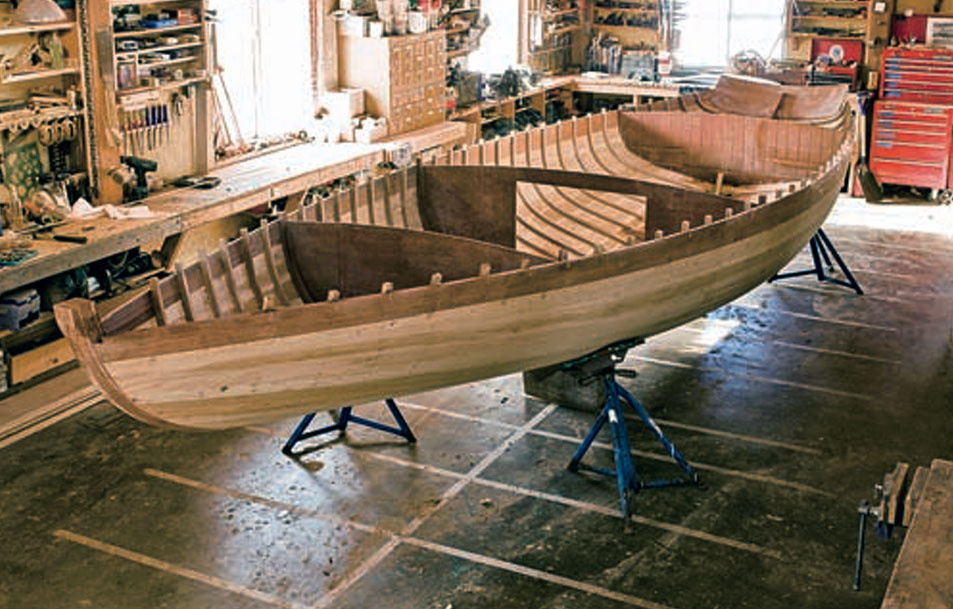
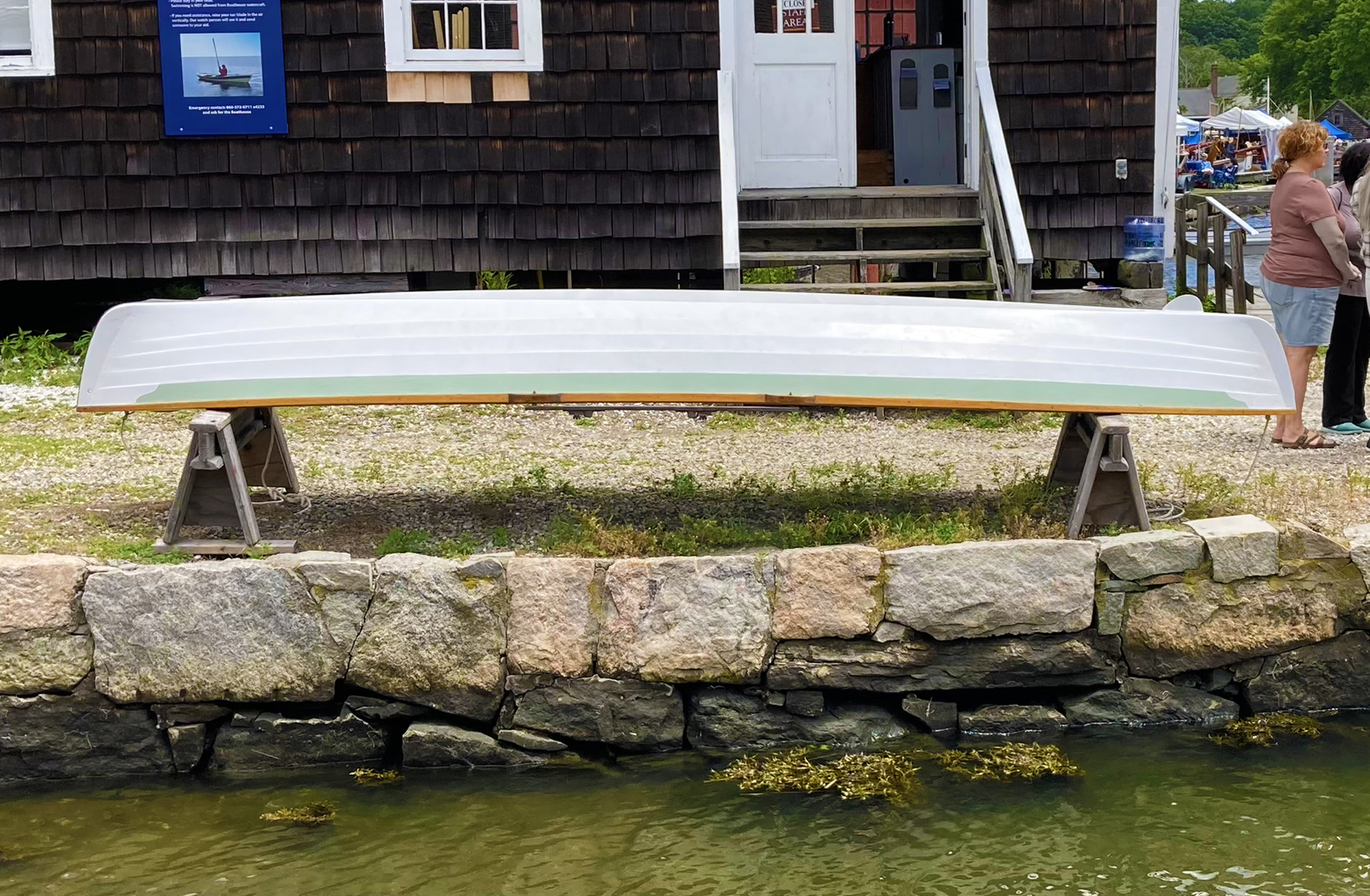
Gerald’s building space—between the back wall of the house and the garden shed—was extremely tight. It was not until after the hull was finished and he was able to move the project to the front of the house that Gerald discovered the hull was twisted. He was able to correct the error with tie-down straps and the installation of a second plywood bottom.
That same day, Gerald bought an old 420 from the club. “I thought it would be easier if we had the same boat and equipment that the other members had, but after just two outings in the 420, we went back to the dory…plastic boats just aren’t my cup of tea. After that, it was trial and error. Sometimes I was on my own, sometimes the ever-tolerant and trusting Petra came with me, sometimes even Dipa, our 8-kg terrier, came along. And we did it, we learned to sail.”
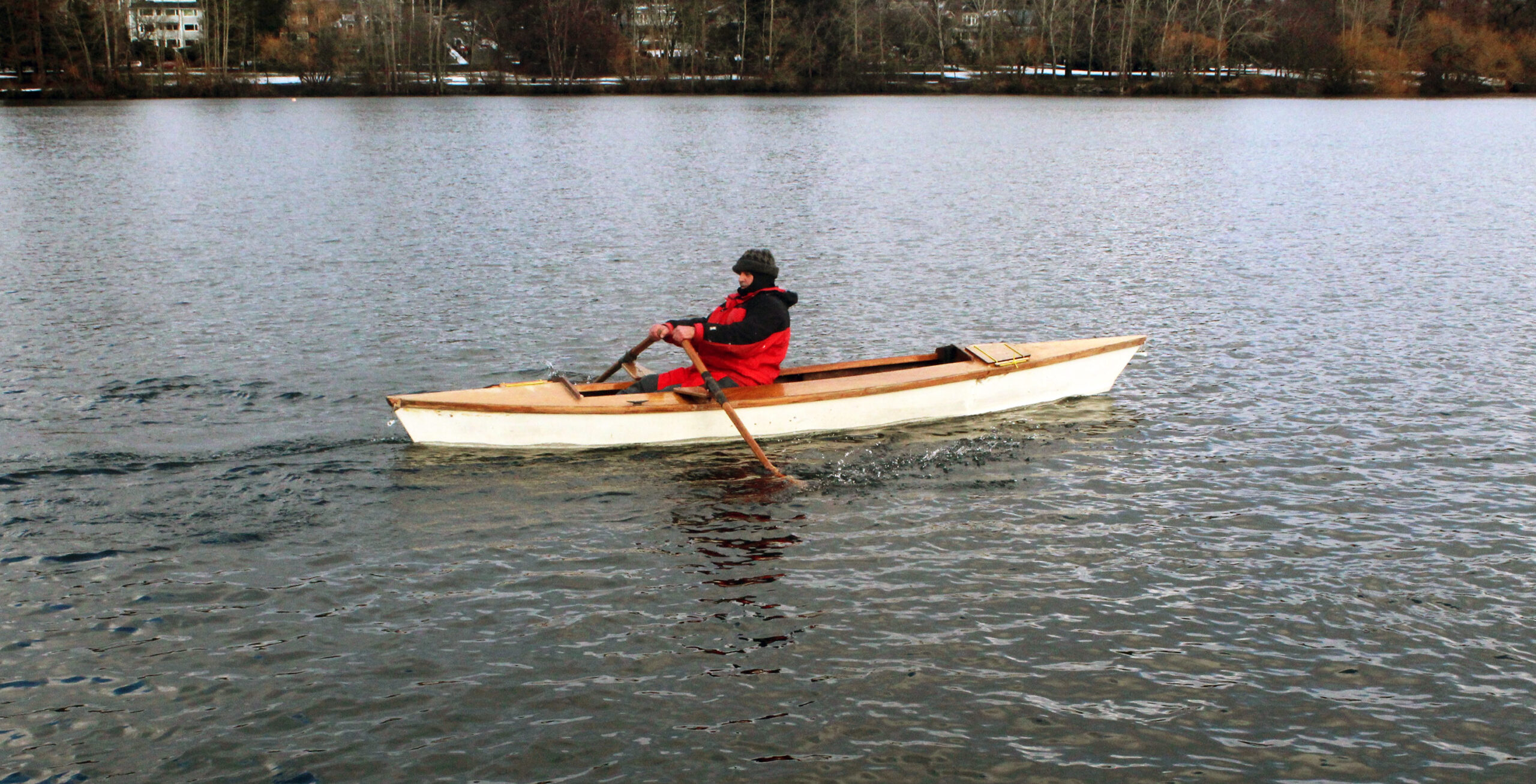
As their experience grew, so did the realization that the dory was not the ideal boat for their needs. “It’s a perfect rowboat,” says Gerald. “Fast, light, stable in waves, but because of its narrow waterline beam, under sail it’s tippy. And it wasn’t great for Dipa…there was no shade for her, and she’d often overheat in her life vest. Added to that, when we did some capsize drills, we found that I couldn’t get back aboard and bail because of the limited flotation. It wasn’t a big deal on a small lake, but even so, the thought of all three of us floundering in cold water wasn’t ideal.”
They discussed various ways to modify the dory, but Gerald at last decided to build a new boat; one that would have more initial stability, space for four people, some shade for Dipa, and be fast—“faster than the already-fast dory and, more importantly, faster than the Lasers!”
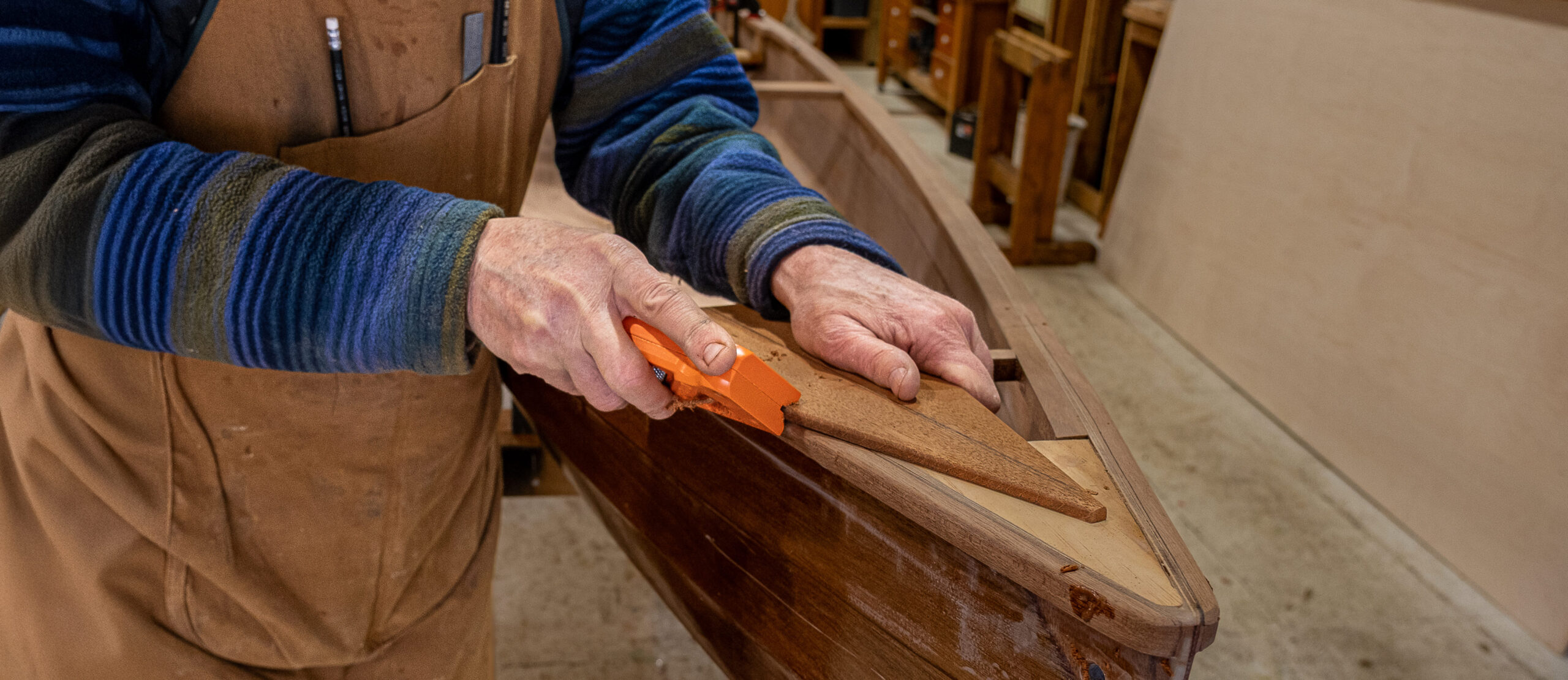
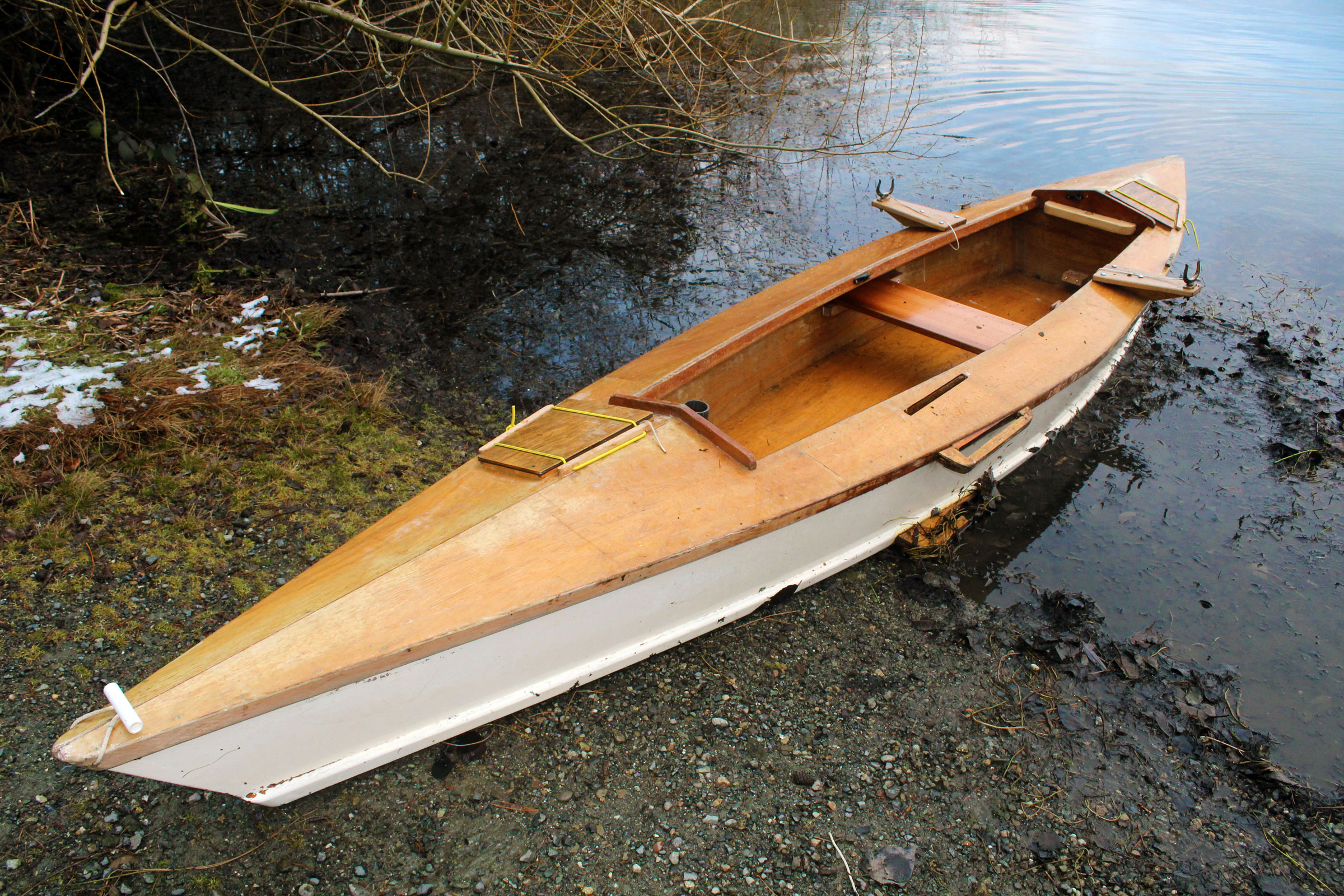
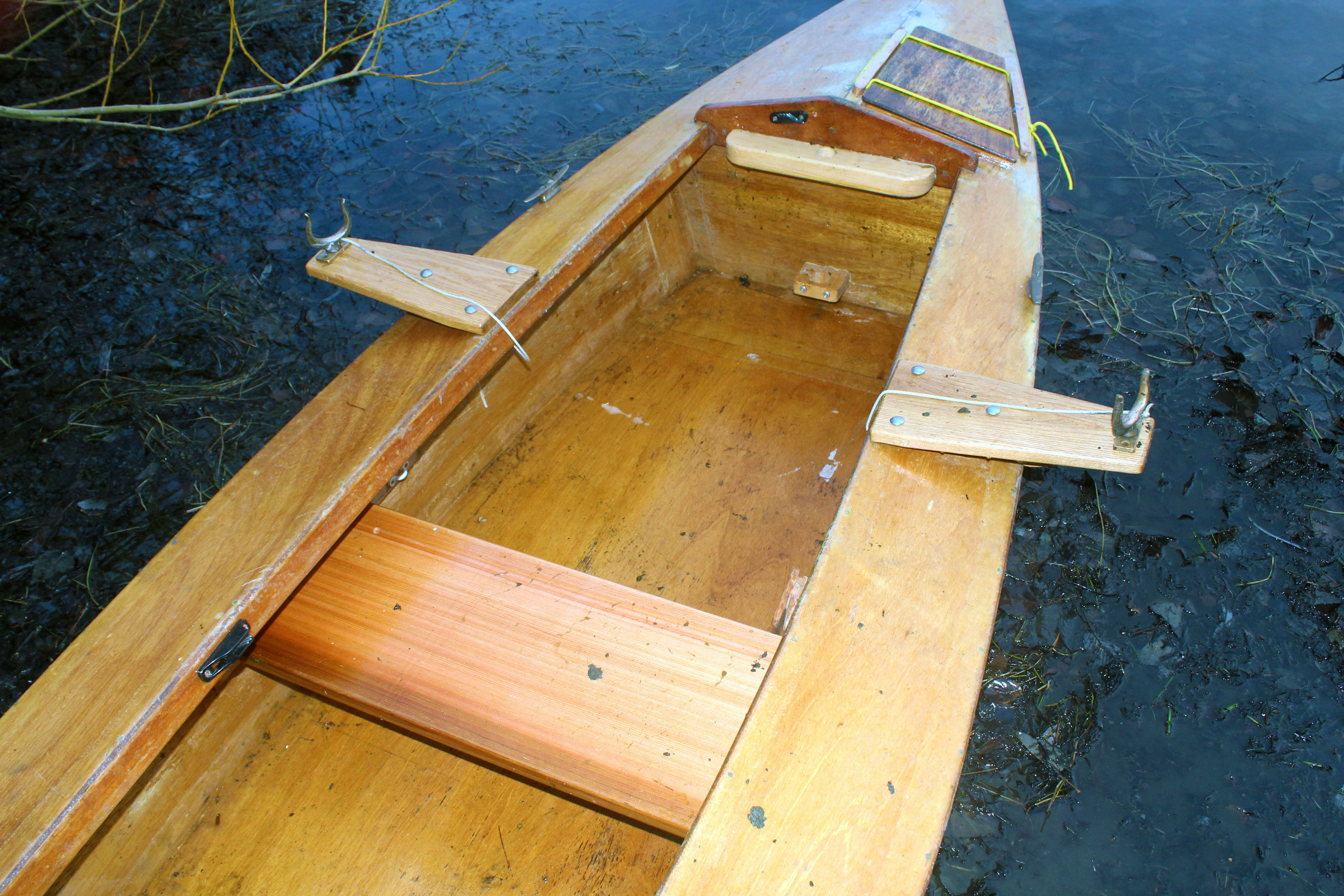
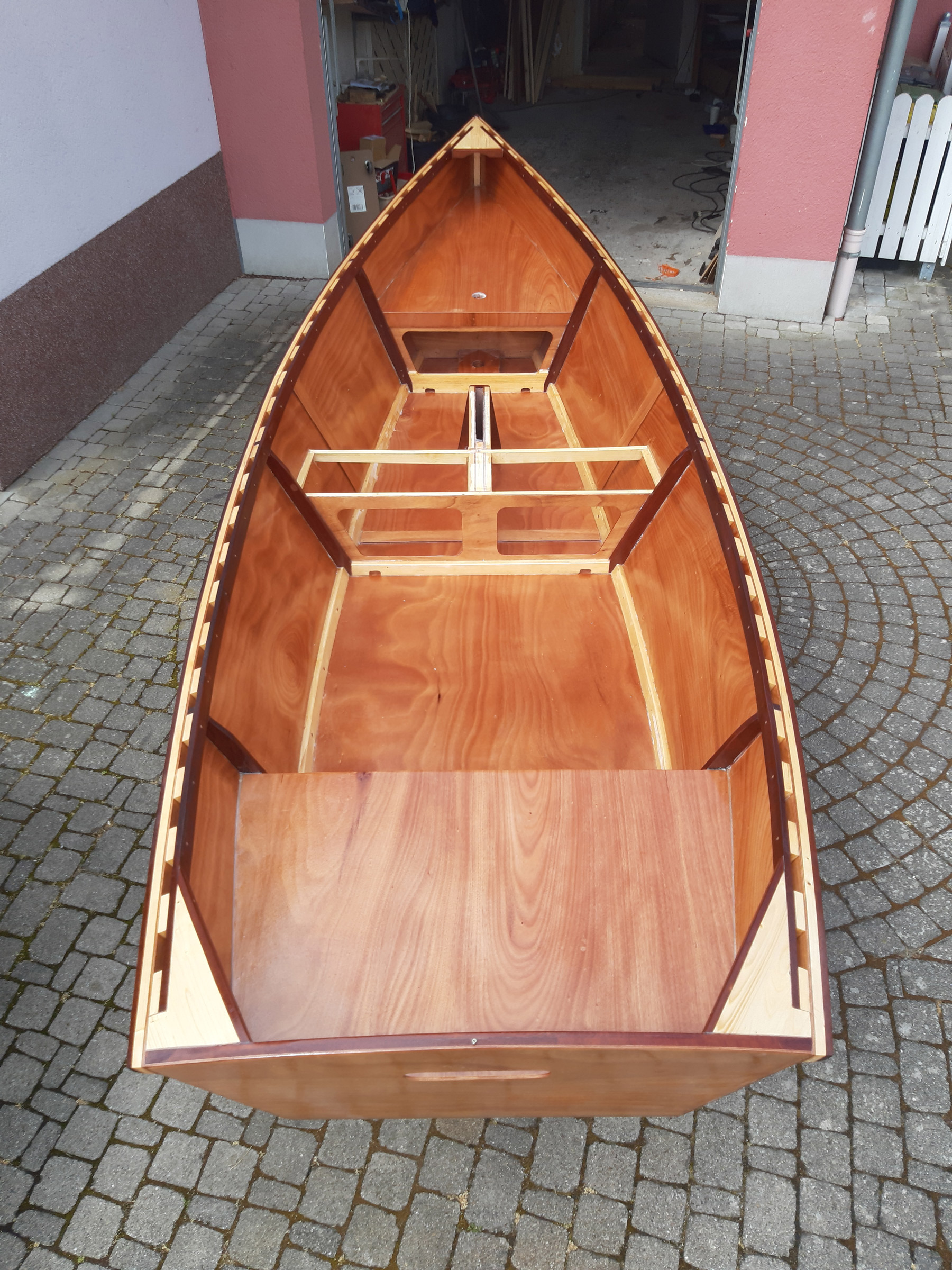
Knowing he would varnish the boat inside and out, Gerald spent a lot of time sanding, and paid close attention to his use of meranti and contrasting softwoods.
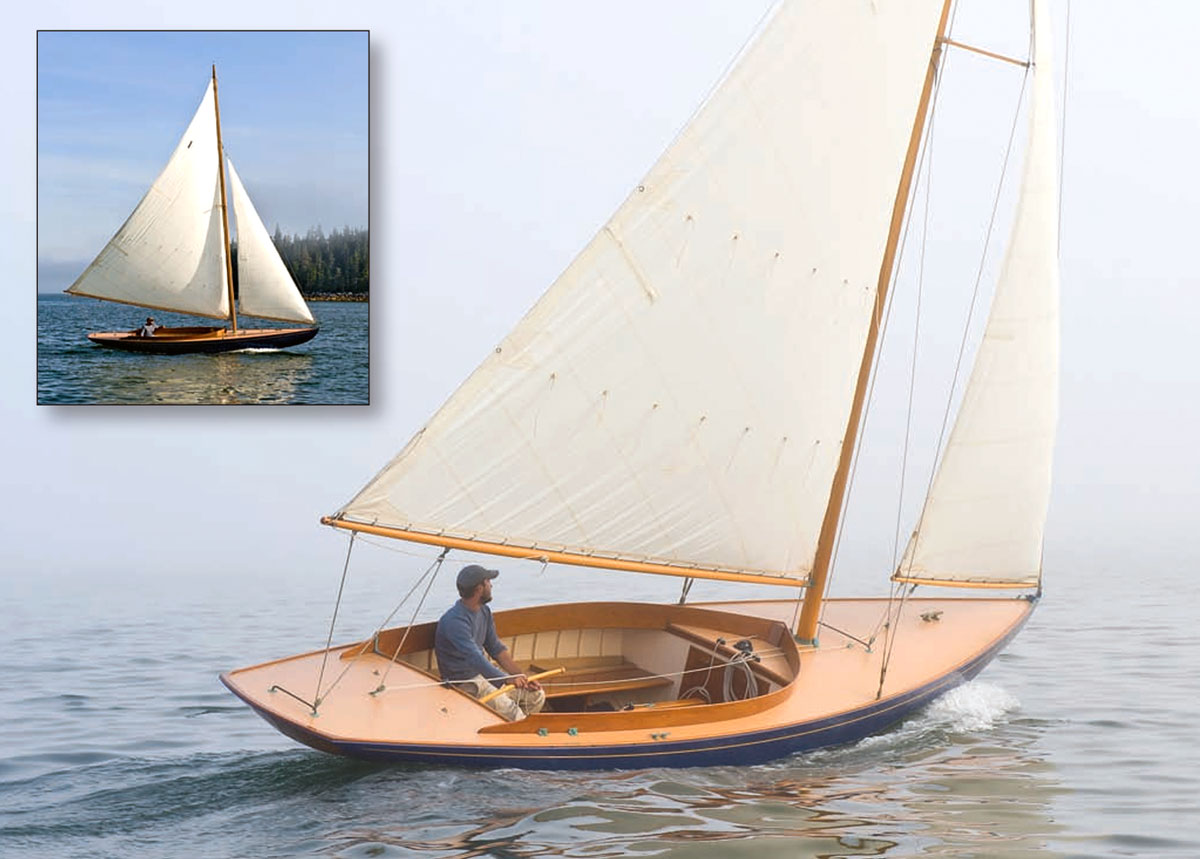
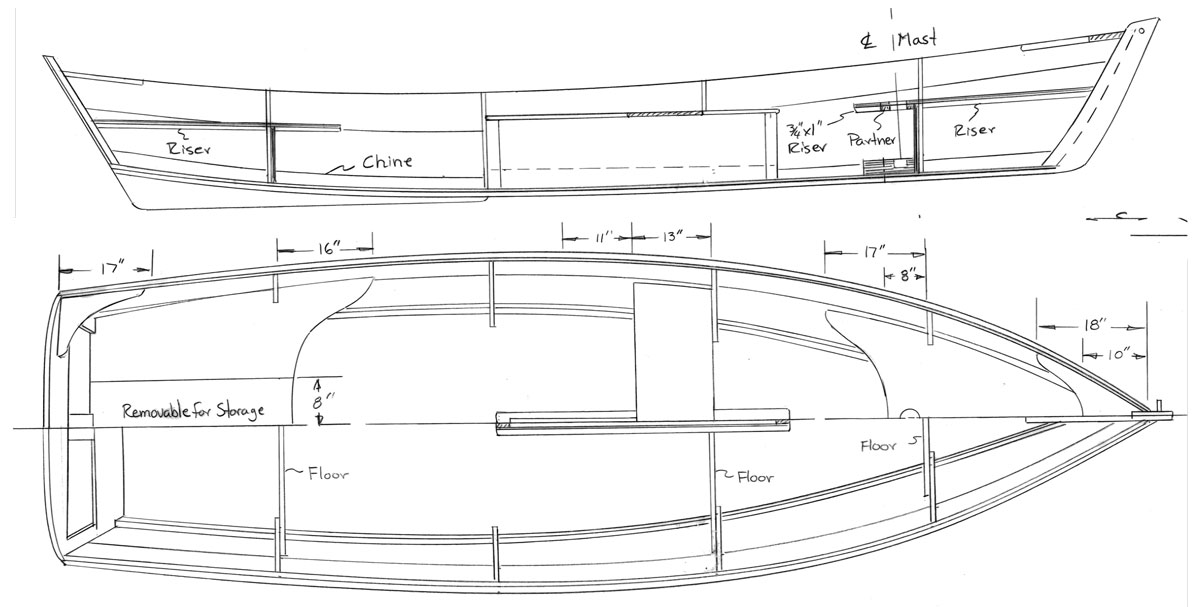
The search for the perfect boat was defined not only by performance but also the need to keep things light. “We looked at CLC’s Southwester Dory and Lighthouse Tender, John Welsford’s Scamp, and François Vivier’s Silmaril,” says Gerald, “but none of them was quite right. We have to launch by hand at the club, and I suffer from bronchial asthma so can’t pull a heavy boat over the grass. In the end we settled on the 15′ 6″ Goat Island Skiff. It didn’t quite fit my romantic picture of a wooden boat, and in Germany flat-bottomed skiffs aren’t common, but it was known to be fast, big enough for four people, stable, and relatively light at about 60 or 70kg. And there’s a great community of owners around the world, led by the designer, Michael Storer.”
Gerald bought the plans. Finding the eight sheets of 6mm marine plywood for the hull was, he says, easy enough, but for the solid wood components, Storer recommended knot-free wood such as western red cedar, Paulownia, Douglas fir, and various hardwoods in dimensions that, Gerald discovered, are not common in Germany. Frustrated, he decided he would mill his own lumber at home and, over the next few weeks, toured home-improvement stores near and far in search of knot-free wood of between 1.5m and 2m length. No one, he says, seemed to notice “the strange guy who spent half an hour examining roofing battens only to leave with just three or four.”
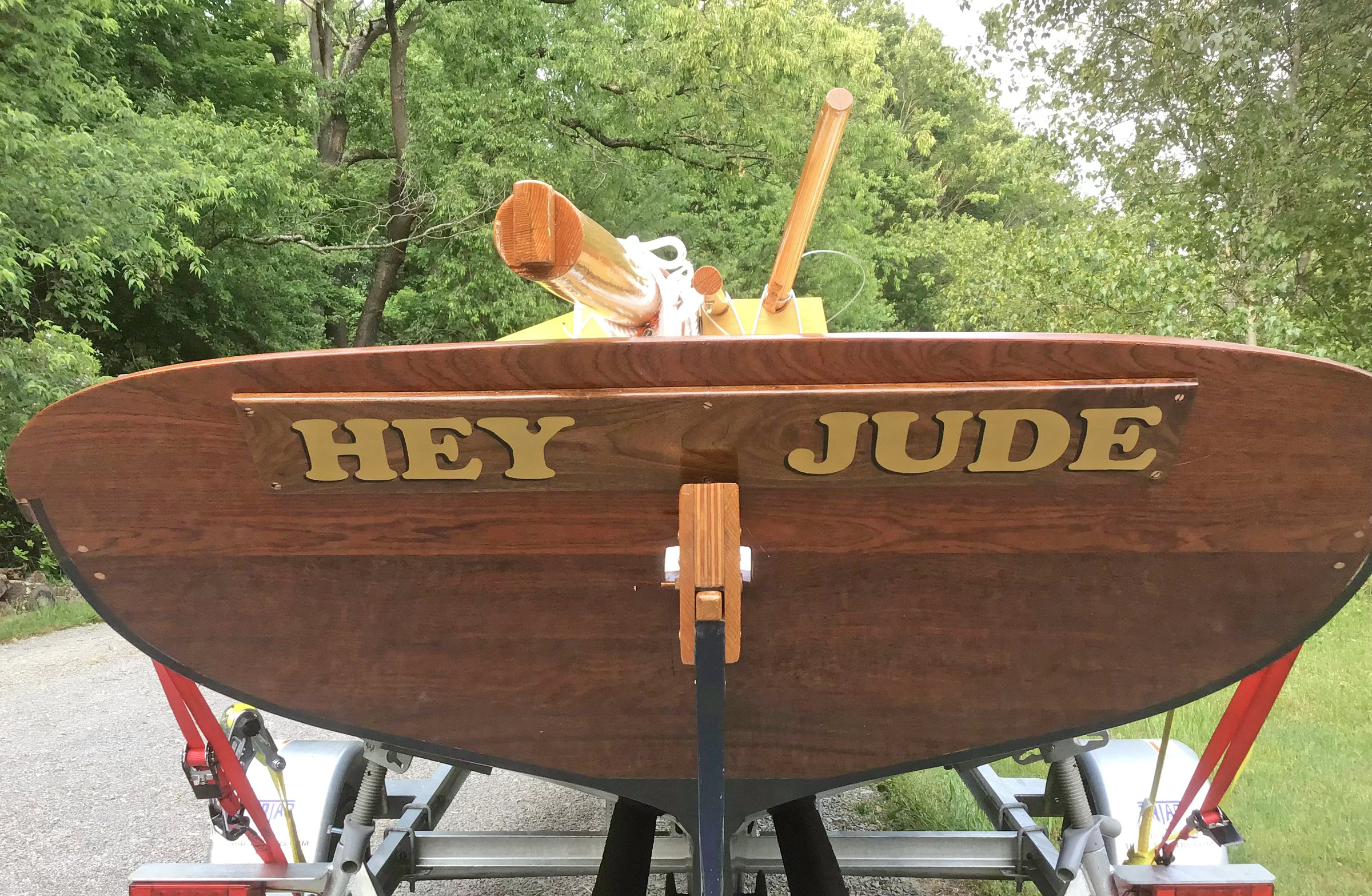
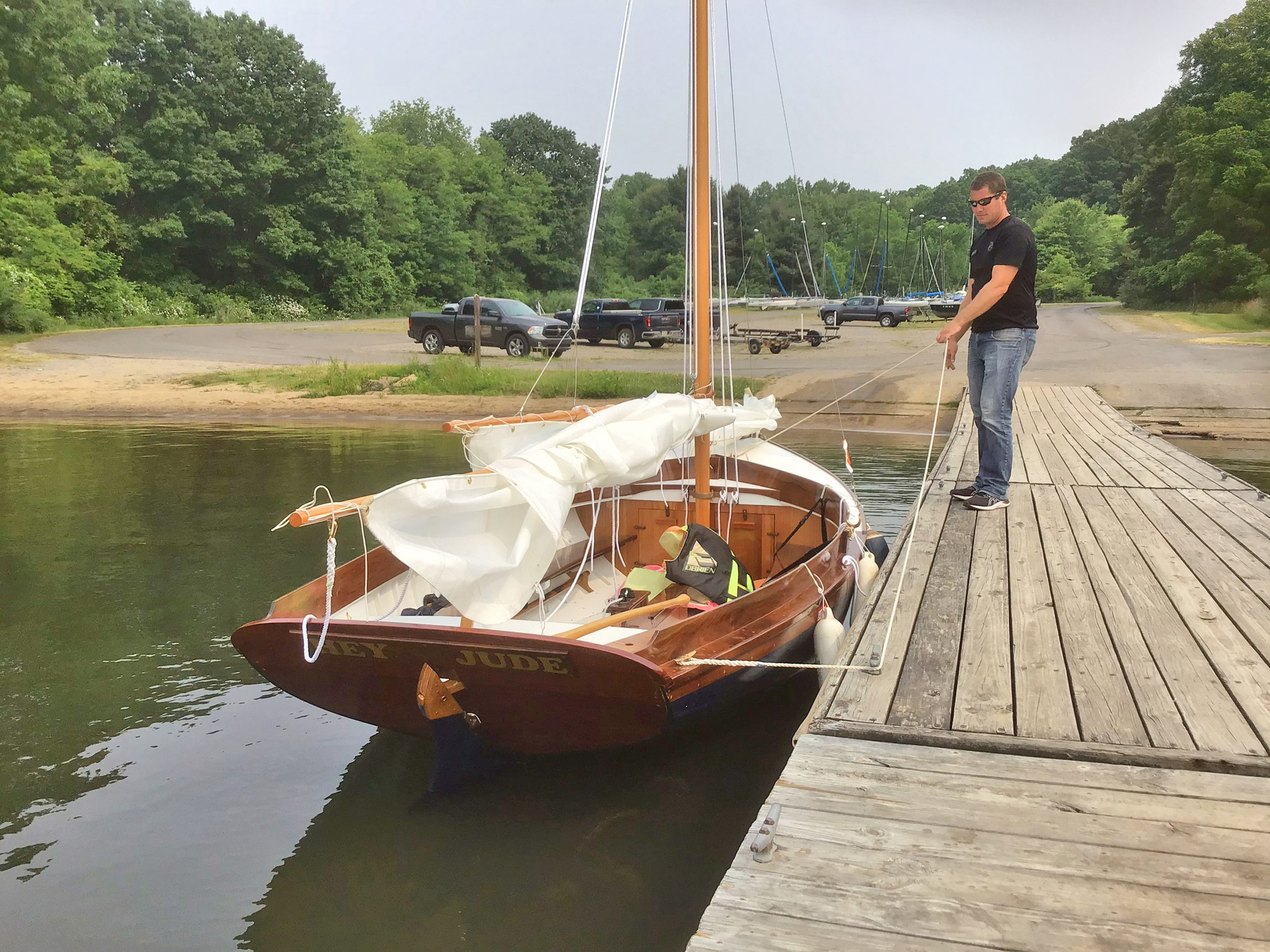
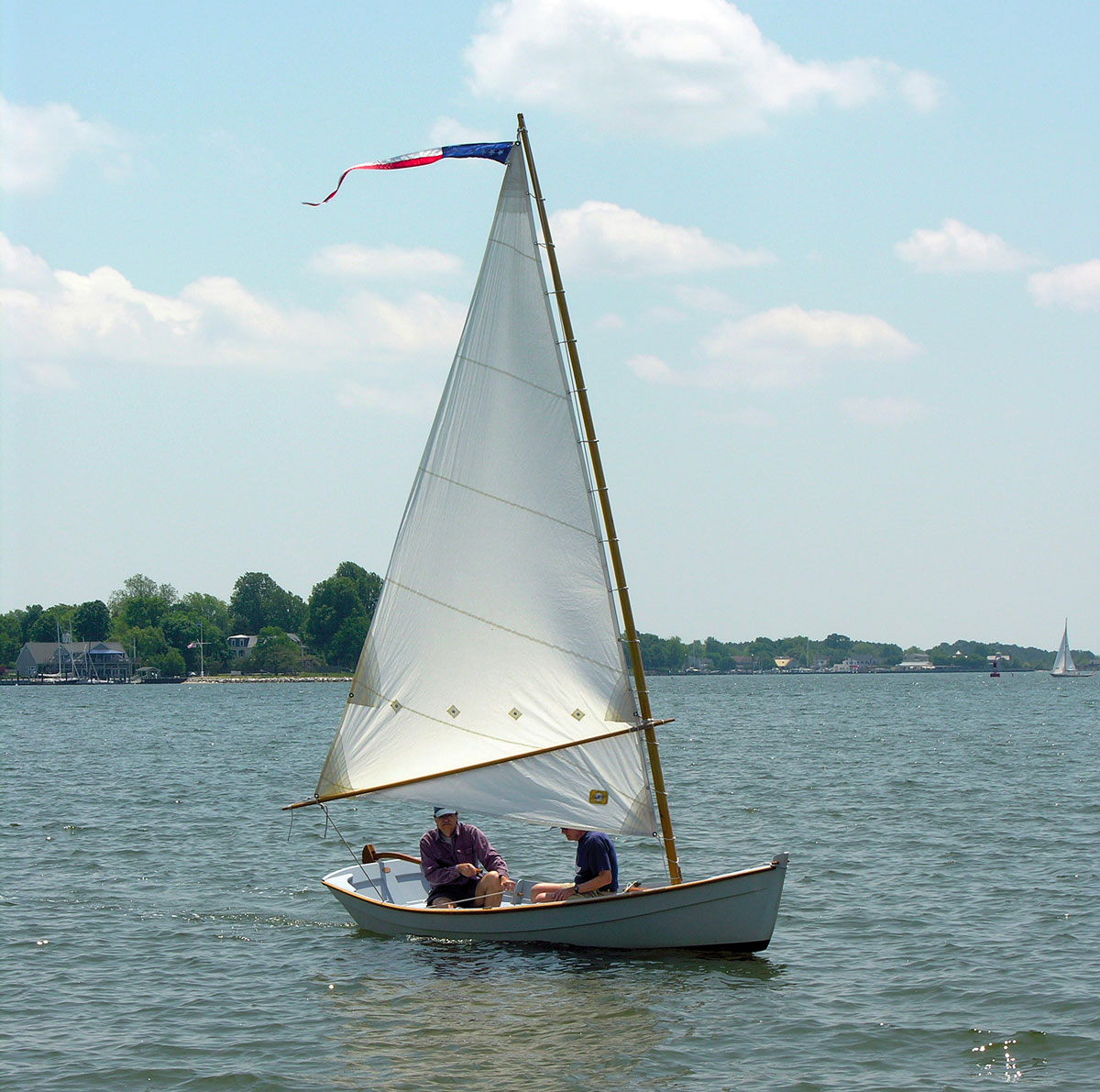
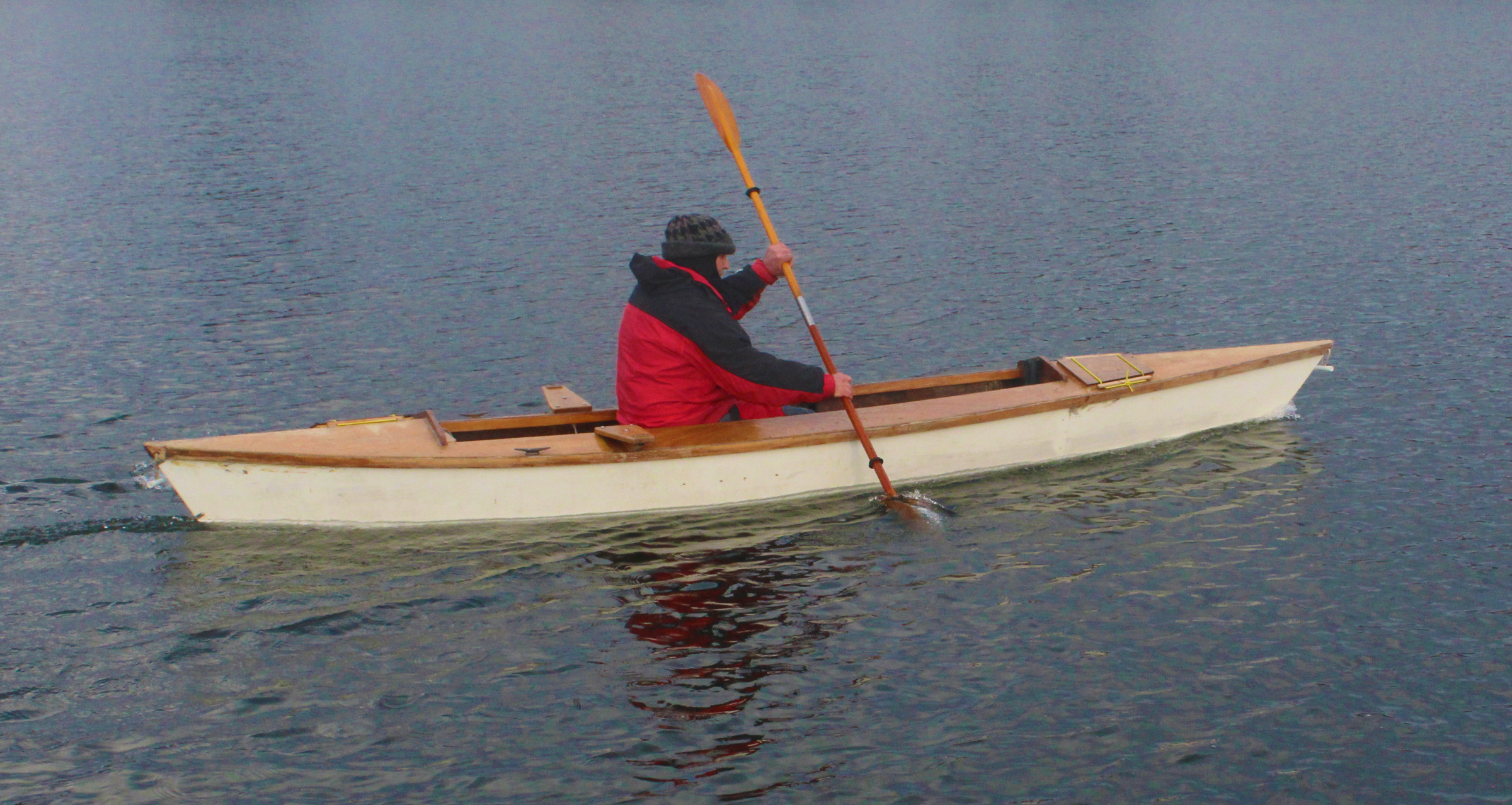
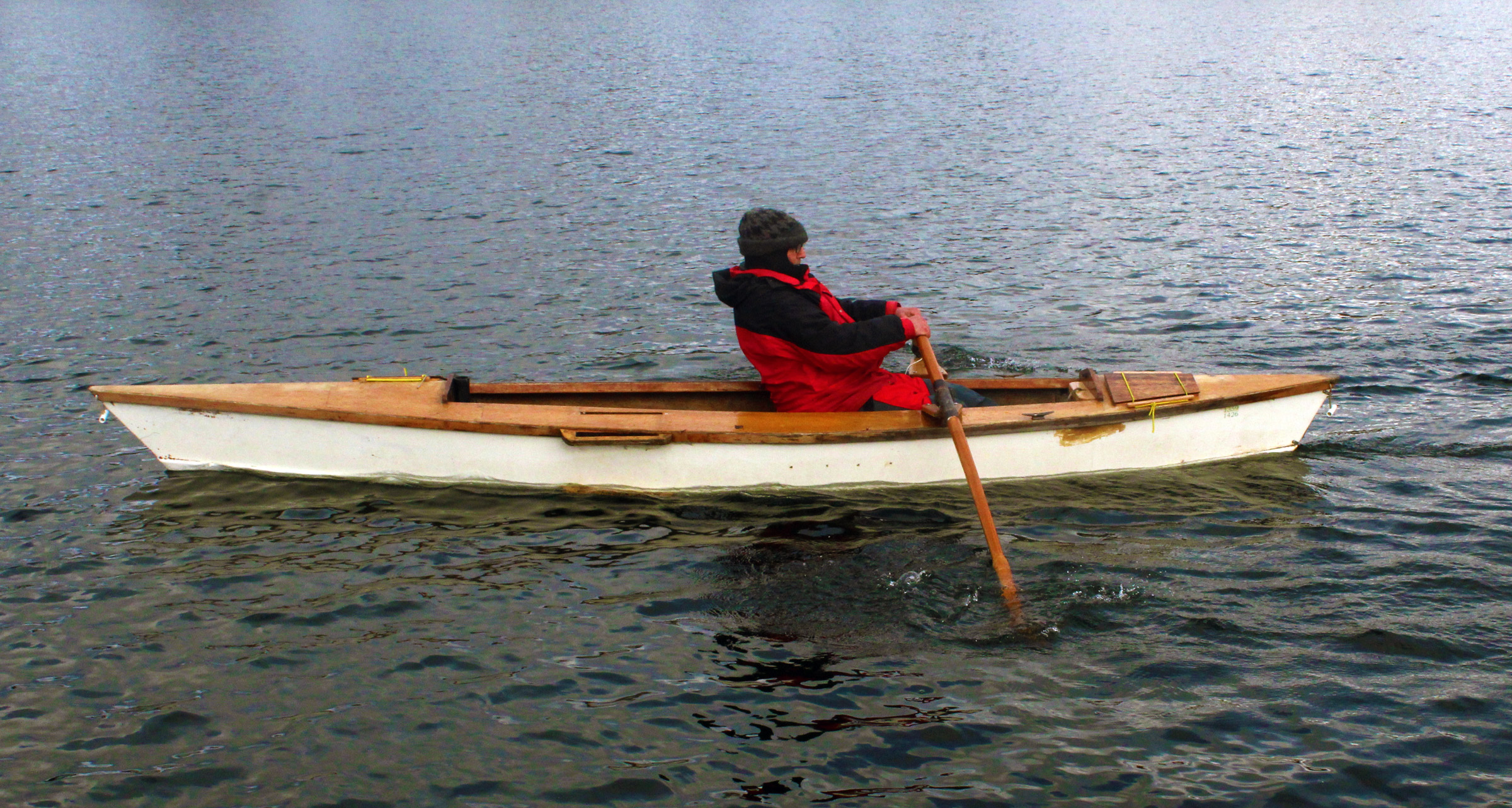
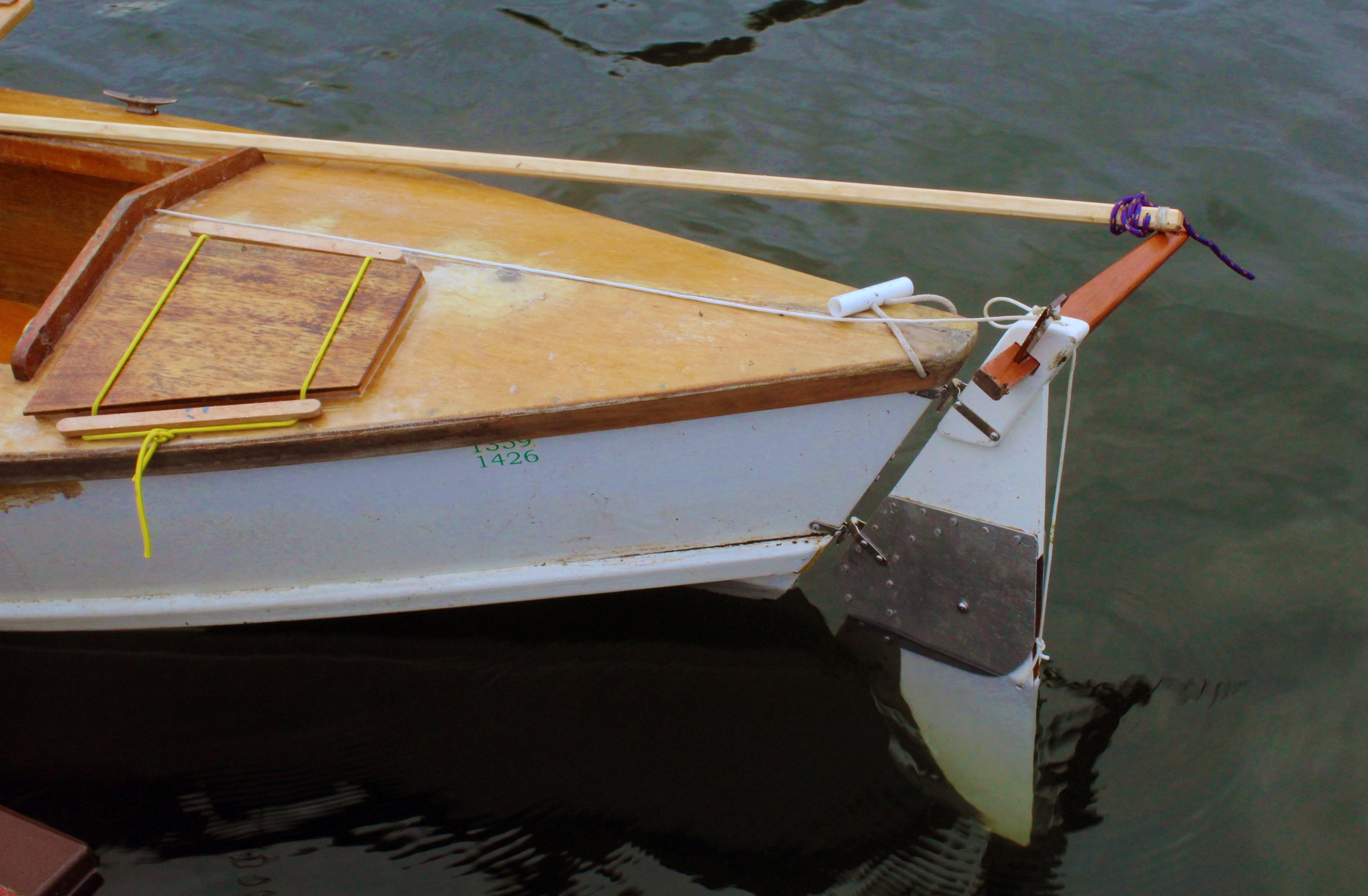
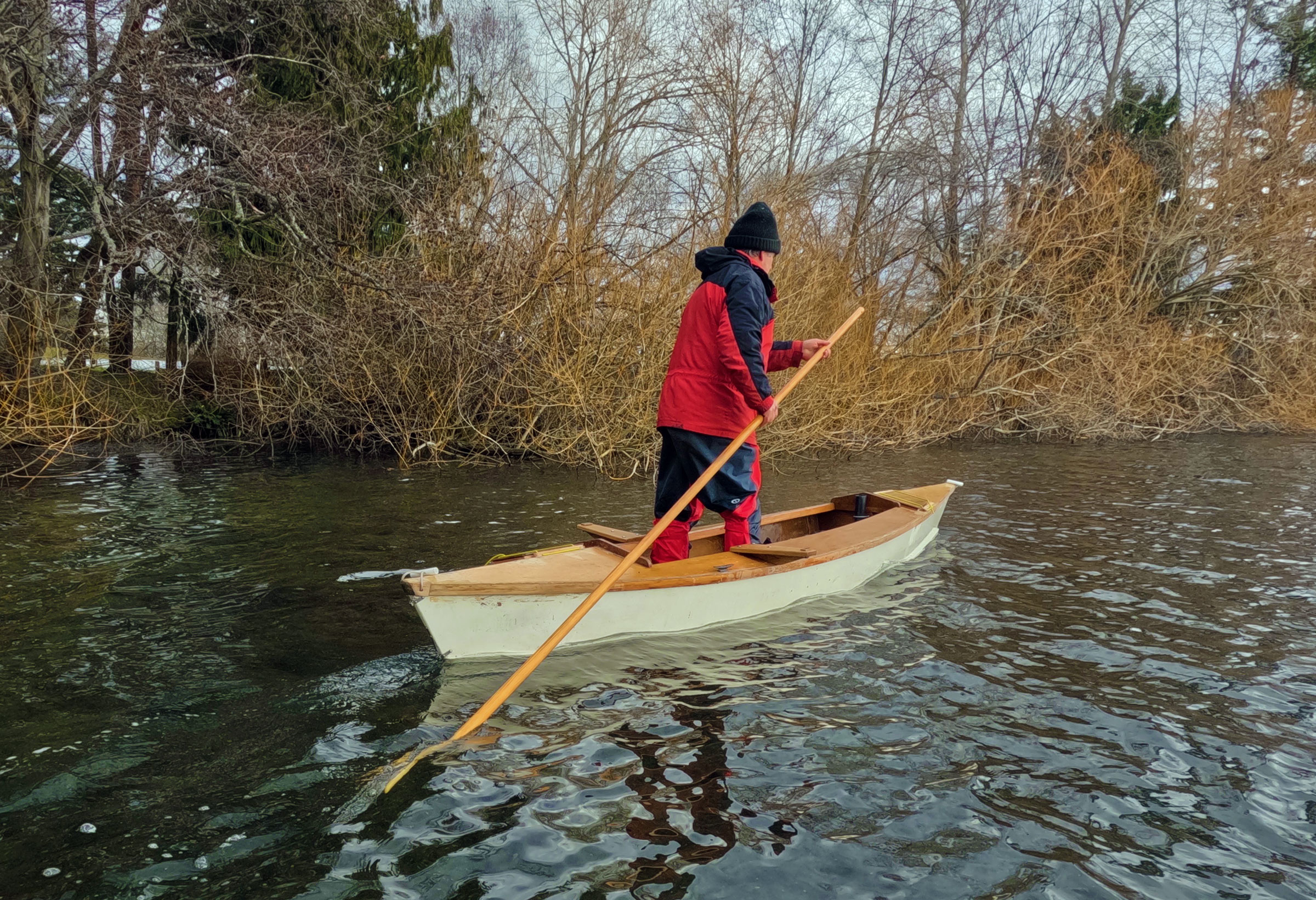
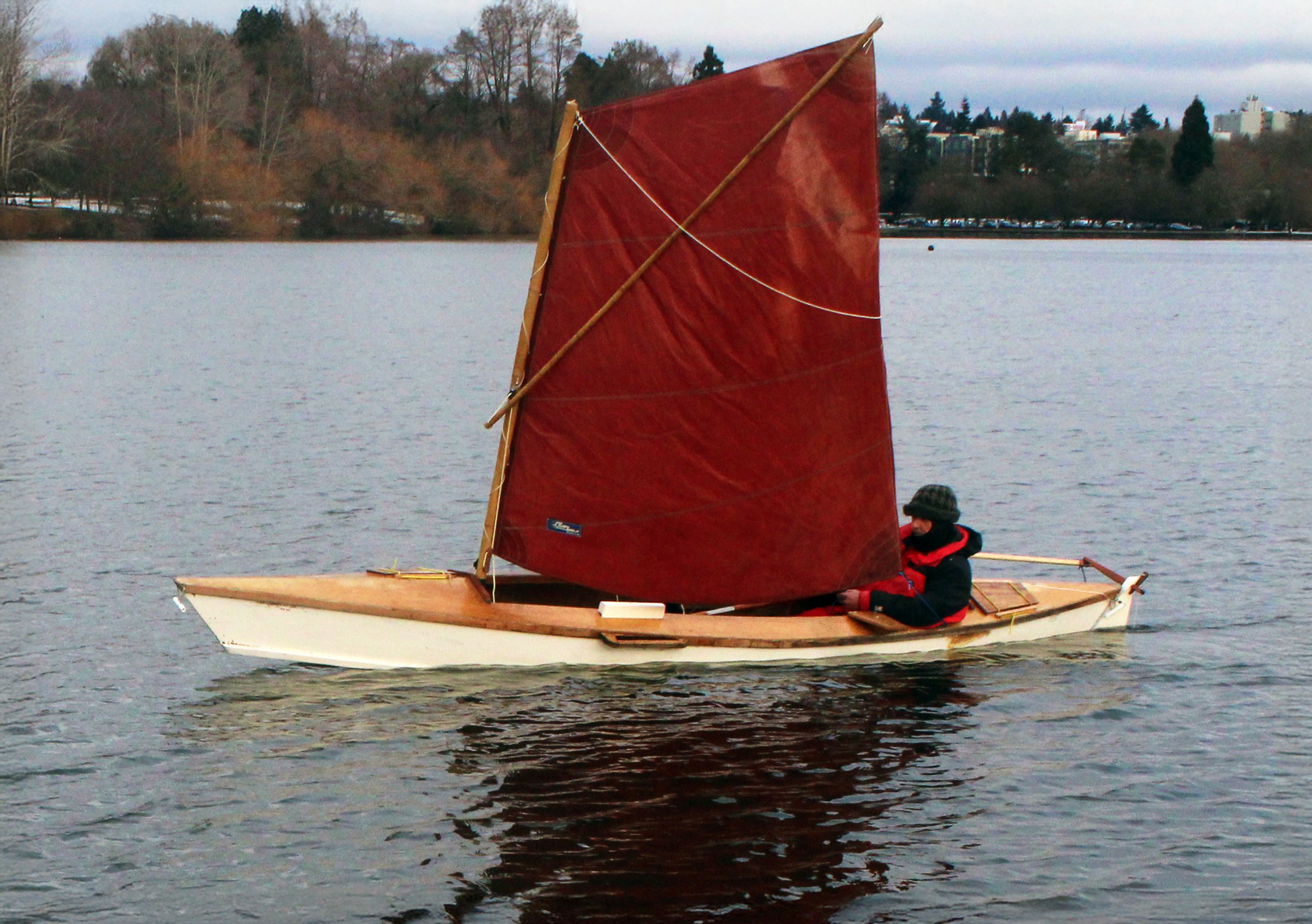
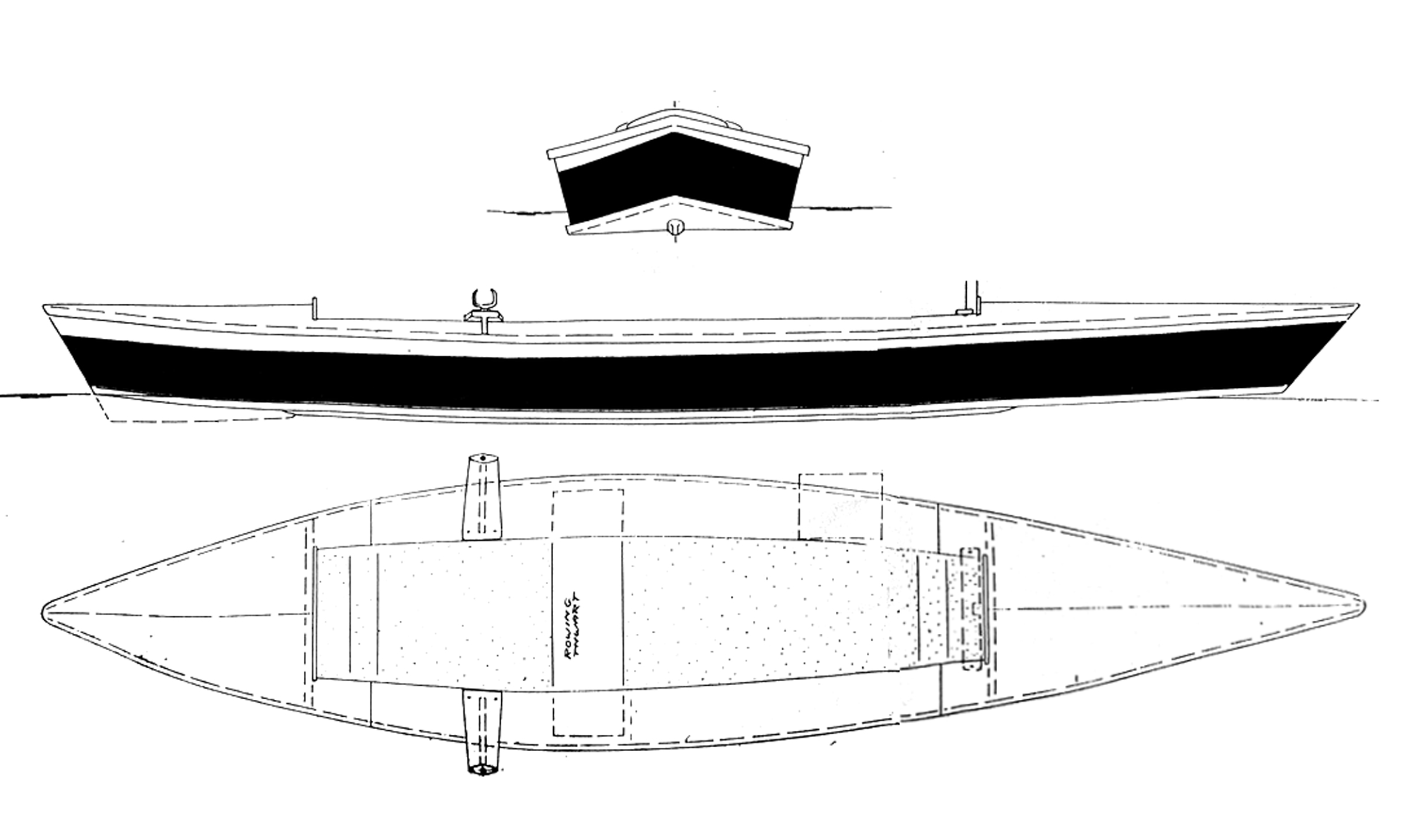
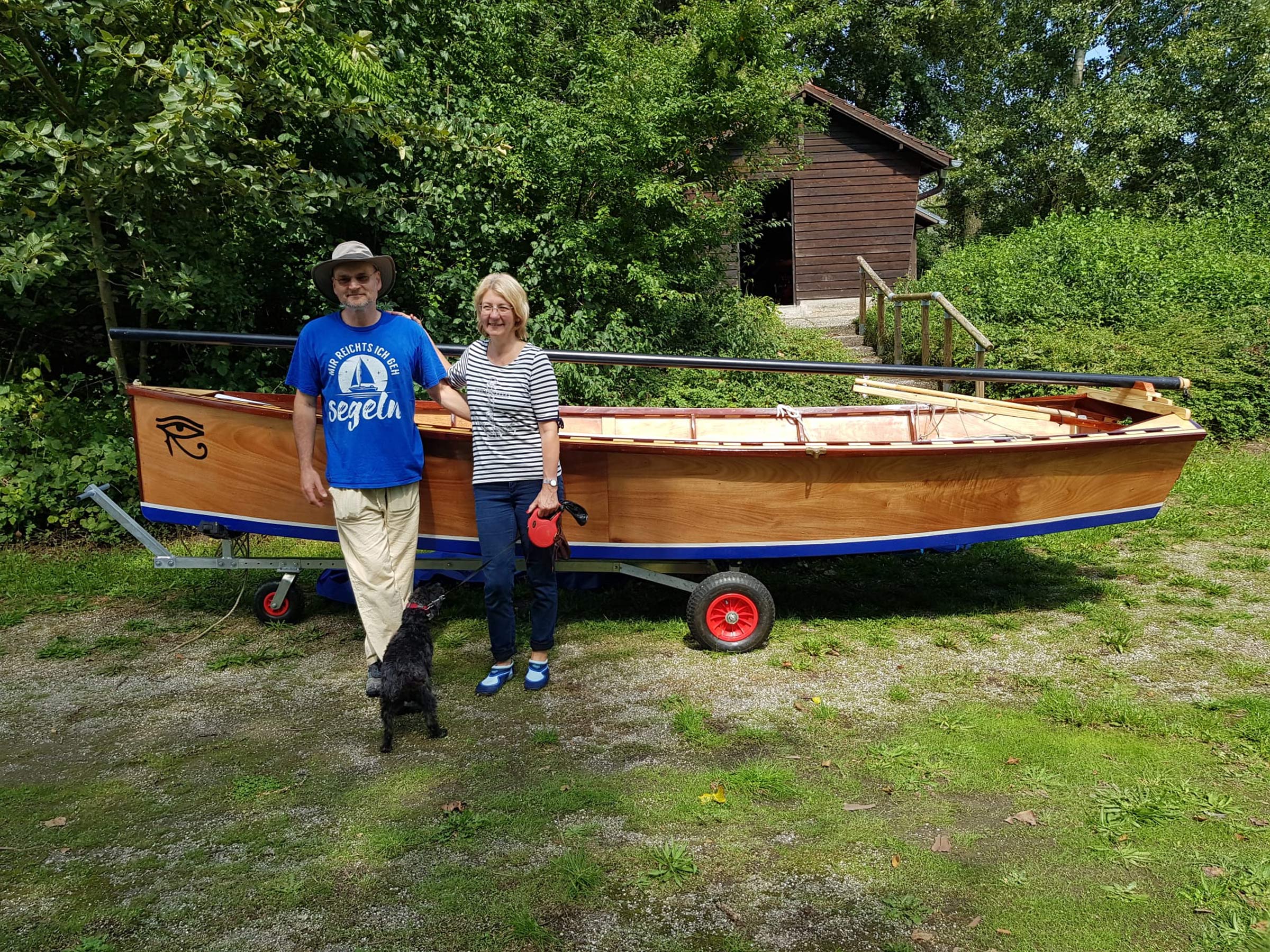
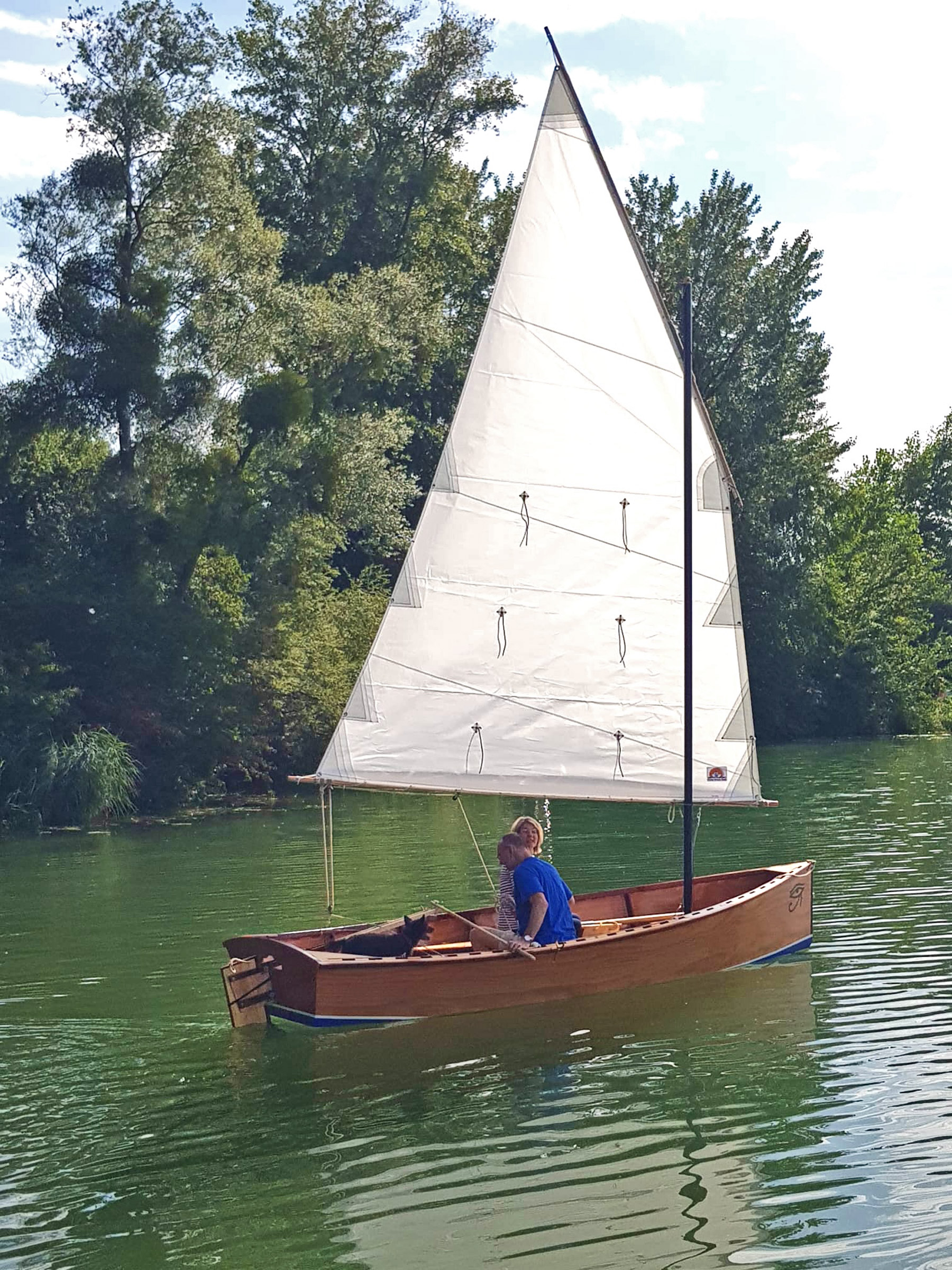
Club members came out in strength to welcome the new wooden boat to their community. GAISSL stands out from the other members’ mostly fiberglass sailing dinghies, but from the day of her launching she has been adopted as the club mascot, loved and admired by all.
Then, at the club one day, Gerald was recounting his problems in finding suitable wood when one of the other members spoke up. “He had just replaced a meranti entrance door and offered to give me the old one.” For the next four weeks Gerald worked outside, milling the wood into suitable dimensions for the boat’s frames, stem, chine logs, foils, daggerboard, and rudder.
Working with Storer’s instruction manual, Gerald had no problem cutting out the plywood panels but found the framing more complicated than he’d anticipated. “Every panel is framed by battens that have to be beveled in one or even two directions,” he says, “and that was hard. Storer recommends epoxy-coating the panels before assembly, but I decided to do that at the end. When I built the dory, it seemed a great way to cover some of my mistakes. Building the Goat would have been easier if I’d had more space and if the floor of my workshop hadn’t been uneven. When the boat came out visibly twisted, I was destroyed.”
Gerald laminated the daggerboard and the rudder using a combination of softwood and meranti. The contrasting colors were aesthetically pleasing and, by using the hardwood for the edge pieces, Gerald was able to add strength to areas of vulnerability.
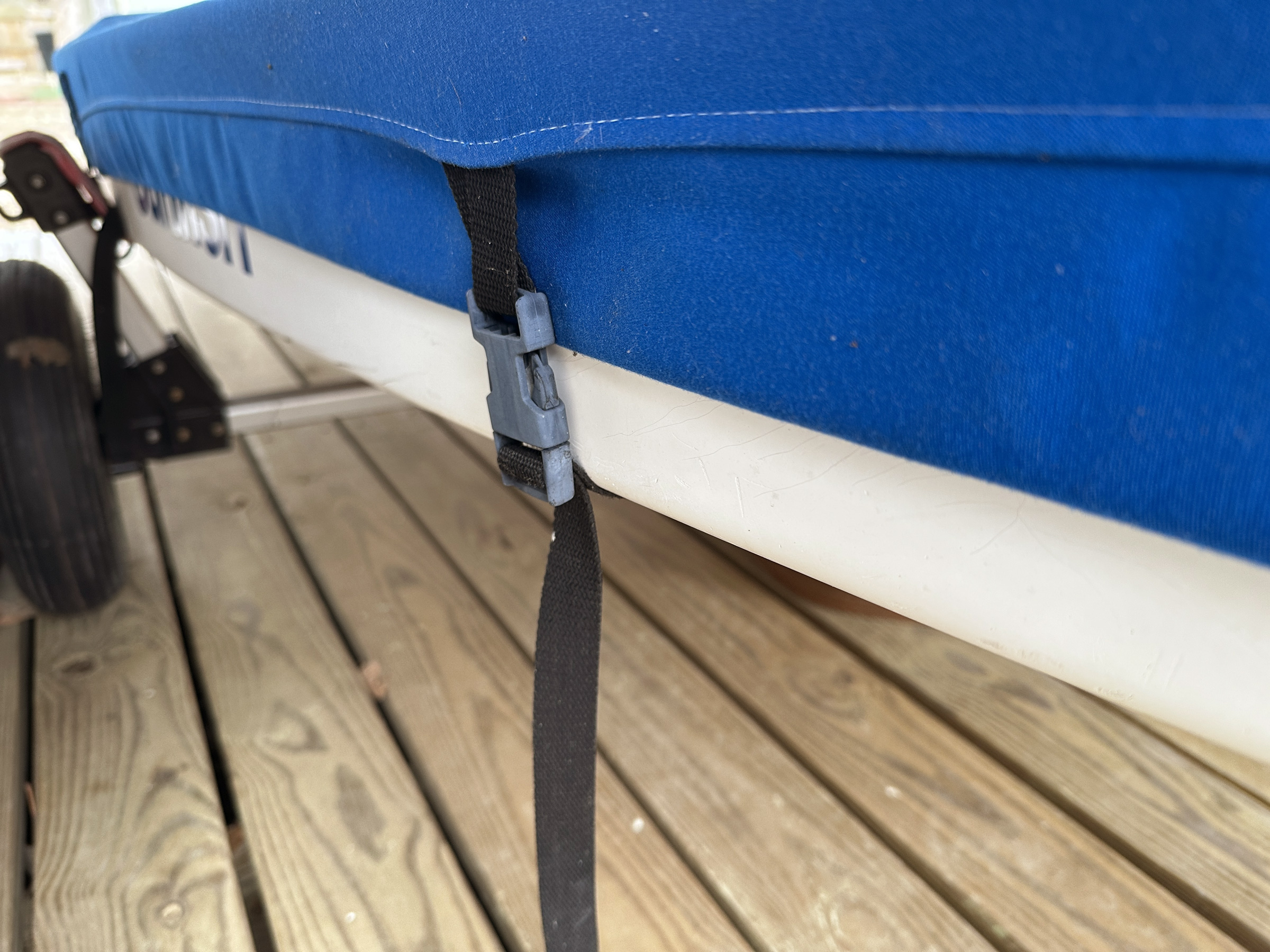
Not one to give up easily, Gerald sought to solve the problem. “I had already planned to install a second bottom—6mm is thin when you’re launching and recovering with a dolly all the time. So, I brought the hull into shape using tension straps, laid down the second bottom—also of 6mm marine plywood—glued it, temporarily screwed it, and kept my fingers crossed. It worked! I wasn’t worried about the slightly visible screw holes—they’d be covered by bottom paint—I was just happy to have a boat that was the right shape.”
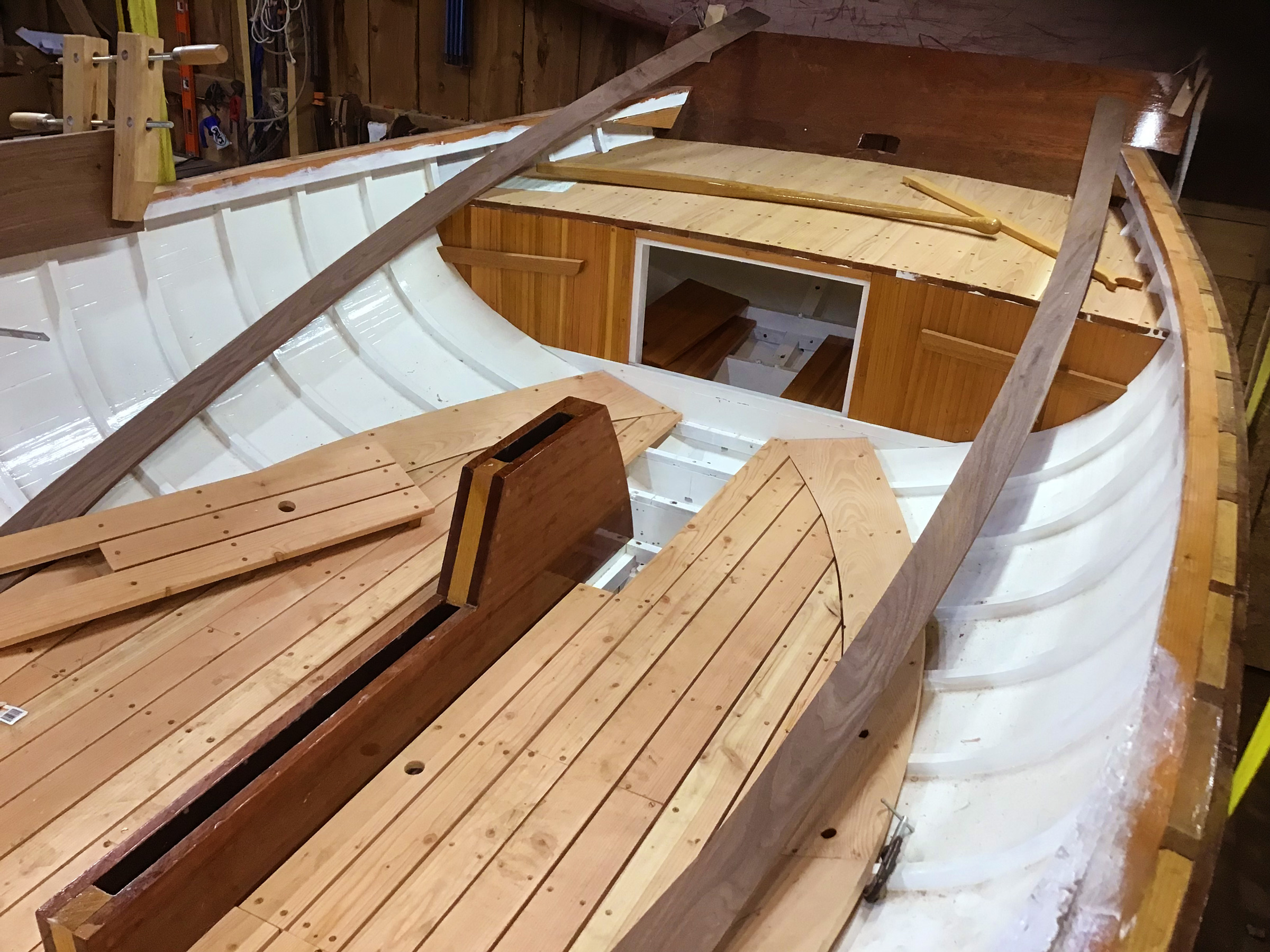
After that, Gerald says, things progressed smoothly. He used a mix of the deep-red-brown meranti and some lighter-colored spruce to laminate the rudder and daggerboard, and to fashion the thwarts, breasthook, and gunwales. He bought a lugsail and a carbon-fiber mast both to keep the weight down and because he was mindful of the ongoing threat of wood dust to his lungs, and after six months the skiff was ready to launch.
GAISSL was launched at the sailing club of which Gerald is now vice president. He was joined for the big day by his wife, Petra, and their dog Dipa.
“We named her GAISSL (spelled Gaißl in the dialect of southern Germany, and meaning ‘Little Goat’). Our maiden voyage was in light winds—which was good as the 9.7 sq m sail is a lot bigger than the Dory’s 6.3 sq m.” But Gerald and Petra have since sailed GAISSL in a variety of conditions. “She’s fast and relatively stable—we can stand up and change places, lower the sail, reef it, and raise it again, all while we’re afloat. And the capsize drill was positive, although the freeboard is high, so to climb back aboard we use a looped rope as a stern ladder. Even Dipa enjoys the skiff—she can get under the center thwart for shade and in mid summer we rig a canopy for her under the tiller.”
GAISSL’s maiden voyage was on a day of light breezes, warmth, and calm water—a far cry from Gerald and Petra’s first sail in their Northeaster Dory, when the lake’s water temperature had been just 41°F and there had been a Force 4 wind.
The club has adopted GAISSL as a kind of mascot. “She was the club’s ‘eyecatcher’ at a local exposition in 2024, and we used her to take kids out on the water.” In the year since launching Gerald has sailed GAISSL on a mountain lake in the Black Forest, and on another lake in eastern France. “We have several plans for 2025—voyages to different lakes in France and northern Italy,” he says. “GAISSL will be perfect for those.” And as for the Lasers? The jury is still out. Gerald says that in a Force 2 or 3 he can overhaul them, but the true contest will be decided on the lake this summer.
Jenny Bennett is editor of Small Boats.
For more on the Northeaster Dory, read Matthew P. Murphy’s review, The Northeaster Dory, and for the Goat Island Skiff, read Ben Fuller’s review, The Goat Island Skiff.
For plans and more information about the Goat Island Skiff, visit Storerboatplans.com.
Do you have a boat with an interesting story? Please email us. We’d like to hear about it and share it with other Small Boats readers.
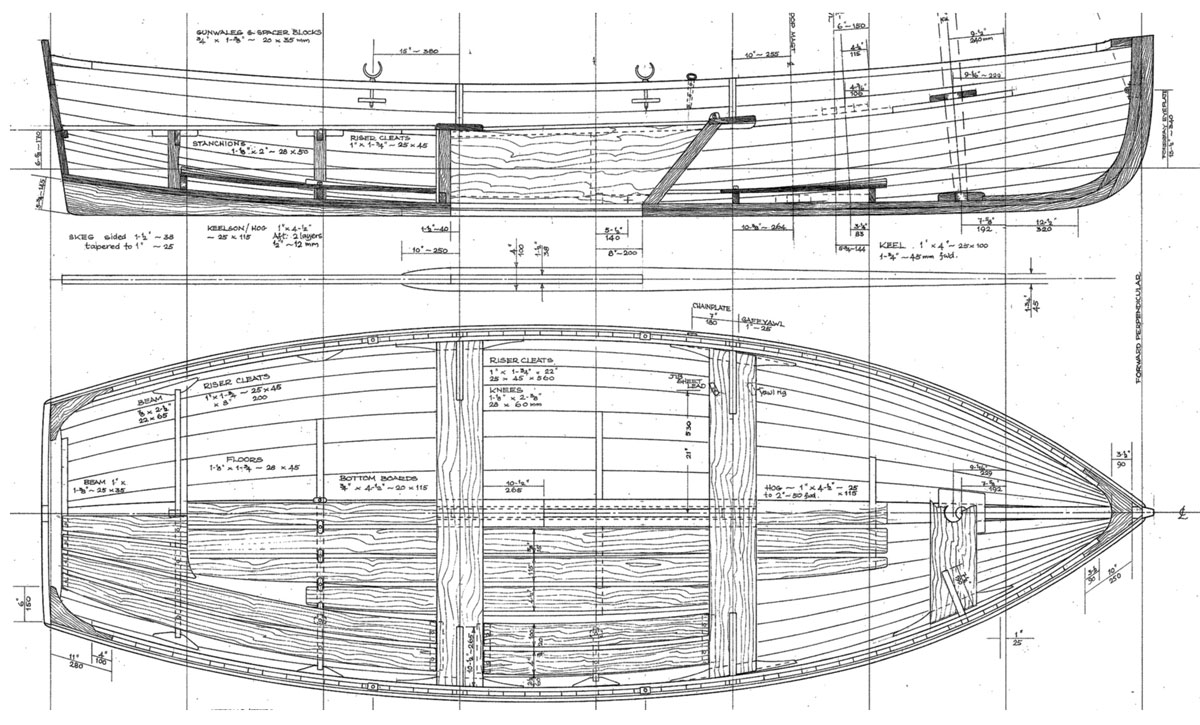
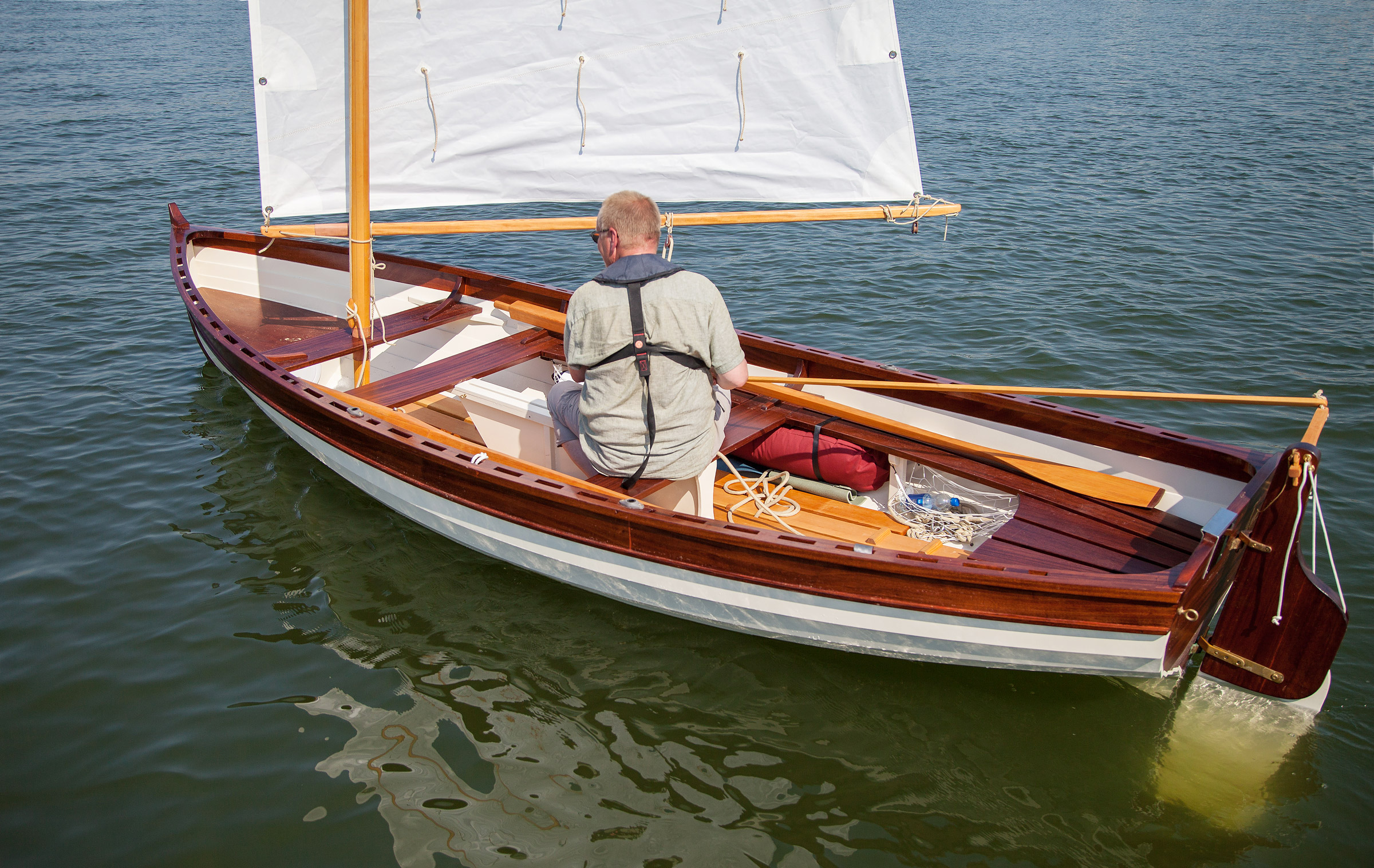
Penny Fee is a classic British wherry reinterpreted for glued-lapstrake construction—or, as her designer Iain Oughtred would say, clinker. This building method is well-suited to amateur construction—materials are easily obtainable, arcane boatbuilding techniques such as steam-bending frames are not required, and the final product is both beautiful to behold and easy to own. Because plywood lends dimensional stability to the planking, there’s no worry of planks shrinking, swelling, or splitting, which may make a difference to you as she won’t have the need for the “taking up” (allowing planks to swell until it no longer takes on water) period customary with boats of solid wood.
While the sweeping plank lines of a classic lapstrake boat are clearly in evidence, another advantage of the glued, frameless building technique lies in its clean interior—initial finishing and periodic maintenance are greatly eased by the absence of internal framing. Finally, the boat is somewhat lighter in weight than her traditionally-built sister would be, easing trailering and moving around on land.
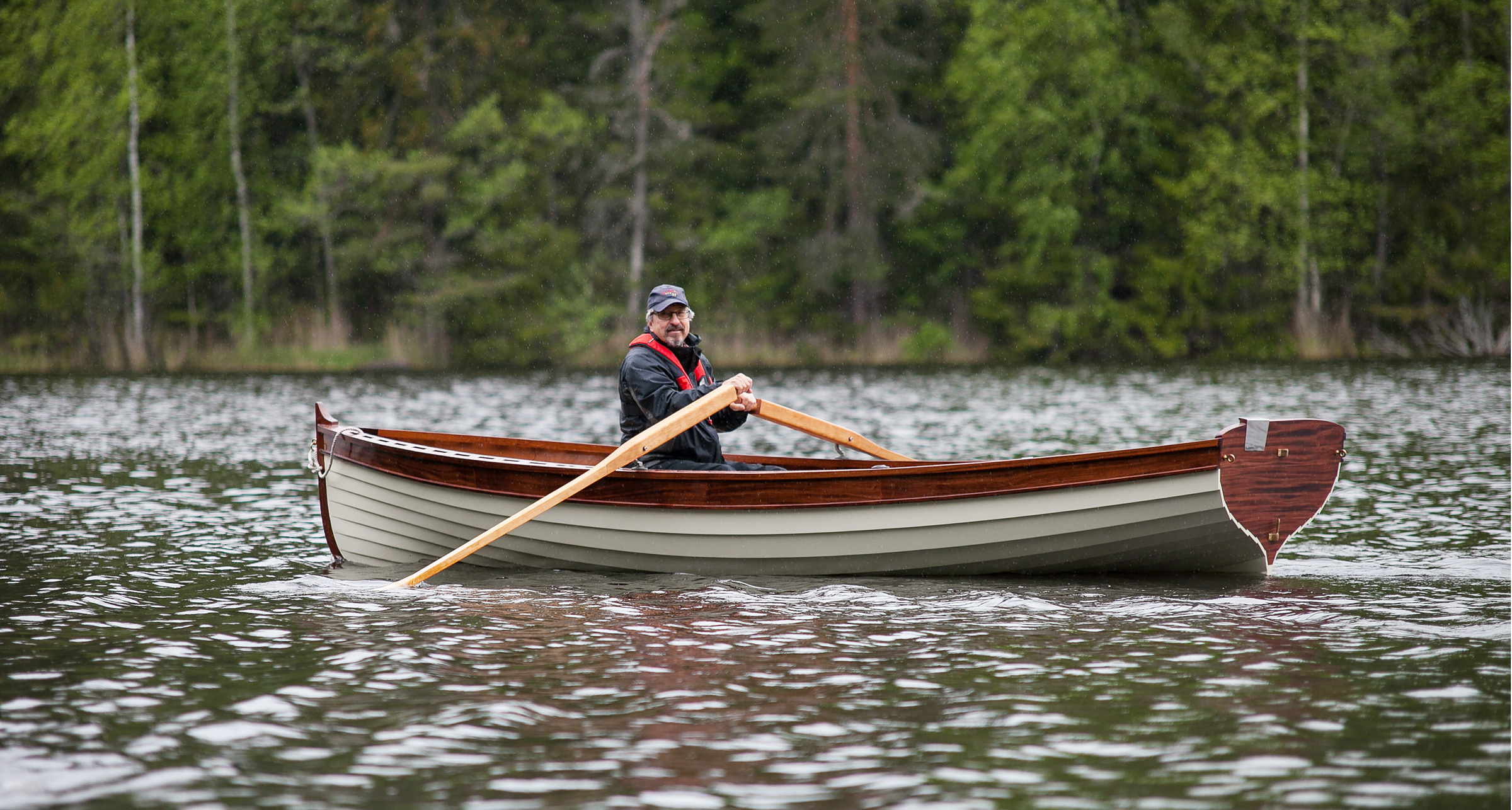
Penny Fee’s dead-straight keel and hollow bow will make her track very well under oar or sail. She is thus best suited for longer passages than for poking about in crowded harbors. She’ll reward those who love to row with her long waterline and easy shape—the first to mitigate pitching as weights shift, the second to reduce resistance—and she is long enough to comfortably accommodate a pair of rowers.
Under sail Penny Fee displays sufficient beam for good sail-carrying ability and her roomy side seats allow creature comfort while keeping her on her feet. Oughtred shows four rigs, with one, two, or three sails, in both gaff and lug styles. She is truly a multi-purpose boat; while Oughtred’s portfolio includes boats better optimized for sailing, Penny Fee both sails and rows very well.
Oughtred’s deep knowledge as a boatbuilder shows in these beautifully hand-drafted plans for the 15′11″ Penny Fee. Eight sheets display a wealth of detail, including full-sized patterns for station molds, stem, transom, rudder, and centerboard. Traditional rigging details, too, are exquisitely drawn.
15′ 11″ Penny Fee Design Plan Details
DESCRIPTION
Hull type: Round-bottomed, transom-sterned
Rig: Gaff and lug options, with and without yawl rigs
Construction: Glued-lapstrake plywood
Phil Bolger’s Martha Jane design has character. After building mine, I loved settling back into the corner of her big, deep cockpit and looking up at that beautiful 200-sq-ft tanbark balance-lug sail as it worked us to windward—which it accomplished amazingly well at about 50 degrees off the wind. The boat is also very dry and comfortable. I remember the first time I saw a Martha Jane on the water: I was sailing a Sea Pearl 21—a relatively seaworthy open camp cruiser—and hanging on by my fingernails, while the skipper of the nearby Martha Jane was standing up drinking a cup of coffee.
Some people say that the late Mr. Bolger’s designs are an acquired taste. Perhaps that’s true, but there is an inherent beauty about this particular boat. The proportions are right, and there is no extraneous detail. The design is a tremendous study in economy and in form following function.
Brian Hunsaker
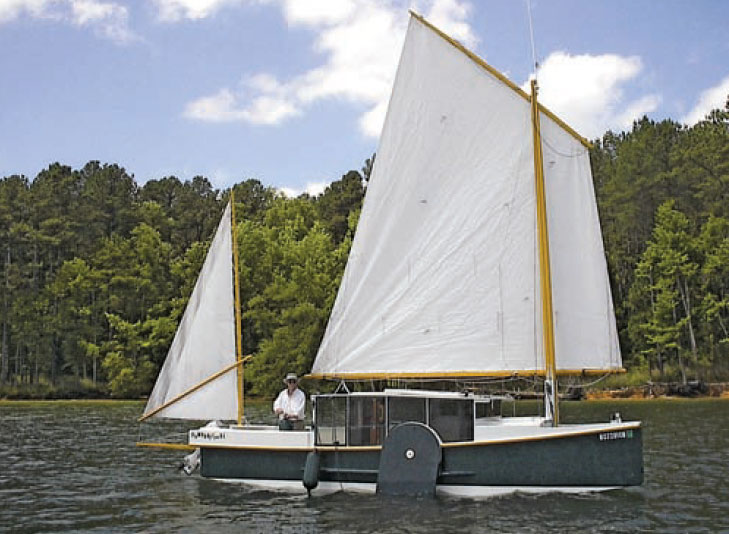
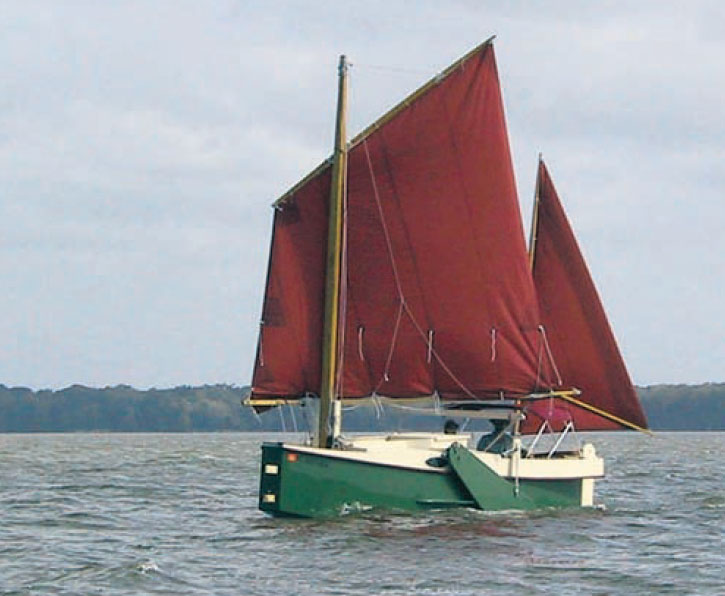
The Phil Bolger–designed sharpie-yawl Martha Jane is a big, simple, well-performing boat. She has good seakeeping ability, and can also be poled up into shallow creeks.
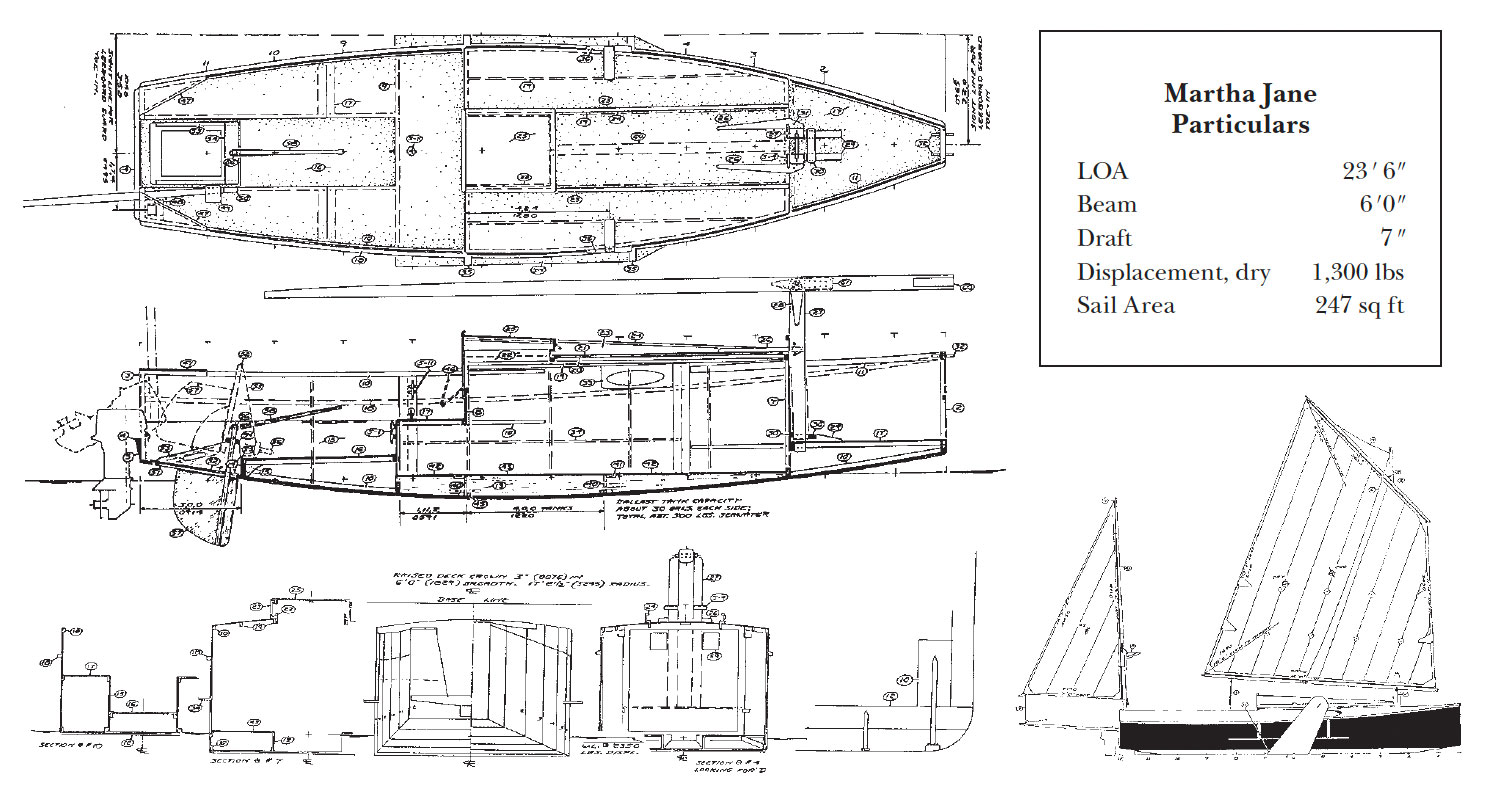
This is a big small boat at 23′6″ LOA. It is built of plywood that is either scarfed or butted into 24′ long pieces. I used butt joints, reinforcing them with fiberglass cloth and epoxy resin, which has proven to be strong. Construction is straightforward, and it begins upside-down: The sides are attached either at the bow transom or the stern and then bent around temporary frames and two permanent bulkheads. Two layers of 1⁄2″ plywood cover the bottom.
Interior chine logs join the sides to the bottom, but additional strength comes from a sheathing of fiberglass and epoxy, as well as from additional ’glass tape at the chines. I used extra ’glass on the forward portion of her bottom since I would be beaching this boat and sailing in extreme shallow water. Turning the hull over to work on the interior was surprisingly simple: a couple of friends and carefully placed lines, and over she went.
“She amazes onlookers with her unique box-shaped sides and cut-off bow. She also amazes people with her sailing ability.”
Martha Jane is a cat-yawl—a delightful self-tending rig. The mizzen furls around its mast for storage. (Builders might consider sheathing the mizzenmast step in ’glass cloth set in epoxy and finished off with high-density filler, since this spar will be rotated in place for furling and unfurling the sail.) The mainmast hinges on a tabernacle and is simple to raise. In ten minutes, we’re ready to launch.
The mainsail is of the balance-lug variety, and its sheet is best belayed on a swiveling cam cleat on the center of the bridge deck. The balance lug is self-vanging, and I love its simplicity, power, and beauty. The sail is big enough to require lazyjacks to make furling manageable. I added a boom gallows, too, and it’s a breeze to drop the main into the lazyjacks and then lower it onto the gallows. Coming home, I usually have the sail lowered and tucked into its cover before arriving at the ramp, and sometimes I even lower the mast onto the gallows before arriving at my destination.
Mike Stockstill
Bolger later drew an optional high house, similar to that of his Birdwatcher design, that allows for exceptional visibility from the shelter of the cabin. Owner Mike Stockstill uses this boat mostly for motoring.
The boat has leeboards, and I love them. If you have never sailed with leeboards, you might be amazed at their effectiveness. They provide excellent lateral resistance even in very shallow areas; I could sail to wind- ward in 18″ of water. The boards never jam. Big and heavy, they are ballasted with lead and pivot on simple rope hinges. There is absolutely no need to investigate or invest in any kind of metal hardware. I employ the sides of the gallows for a three-part purchase to make raising the leeboards a simple task, and belay their lifting tackle to a cam cleat on the rail.
Because Martha Jane was meant to be trailered, she was originally ballasted with 500 lbs of water stowed in tanks beneath the berths. To improve stability, Bolger later revised this, adding 500 lbs of additional ballast in the form of a steel plate on the bottom. It seemed to me, and still does, that a steel plate on the bottom of this boat complicates her otherwise simple construction.
Originally, I had reservations about water being stowed inside my plywood boat. Many Martha Janes have used this system successfully, but perhaps my location in the tropics, where wood rots in the blink of an eye, made me hesitate. I had my drill bit up against the chine and was ready to drill the hole, but I couldn’t pull the trigger. I decided to put lead shot into the ballast tanks beneath the berths instead. I figured that the greatest strain on my towing vehicle would be pulling the boat up the ramp and out of the water, fully ballasted. If my car could pull it up the ramp, it could easily pull it down the interstate. I’ve never regretted the decision to go with the full 1,000 lbs of solid ballast.
Concerned about the boat’s stability, Bolger added sponsons to the design. With these, and with the extra ballast, she became a powerful and awesome sailer. When hit by a gust, she would lower her shoulder, slowly gather speed, and just keep going while others were fighting to stay upright.
Steve Anderson
The original Martha Jane design was drawn with a standard trunk cabin. Author Anderson built this boat, and painted it green; a subsequent owner painted it white.
Other optional modifications included dual shallowdraft rudders and a high house. I added the rudders, and they’re a tremendous improvement over the original “trapdoor” design. The original rudder design was a traditional rudder on a rudderpost mounted through a “trap door” on the cockpit sole. The trap door was hinged, enabling it to kick up. I seem to recall that Mr. Bolger once said that the design of that trap-door rudder entailed excruciating intellectual effort—but he admitted that the new dual rudders offered superior virtues. They draw no more than the hull itself and with bottom plates provide excellent grip and control.
I find it very aggravating to have a shallow-draft hull negated by a traditional rudder drawing 2′ and becoming unwieldy when partially raised. The dual rudders operate flawlessly. The high house is surrounded by glass, much like Bolger’s Birdwatcher design, and gives the “new” Martha Janes standing headroom with an awesome view all around. The raised high house also contributes to even greater stability, though there’s a penalty in increased windage.
Martha Jane, like all sharpies, will pound if motored into a chop or sailed upright. Sharpies need to heel to feel good and sail well. It doesn’t take much of a heel before she begins to slice through the water on her chine rather than pound on her bottom. Sleeping in a sharpie can be a bit noisy, because the water wants to lap beneath that rockered bottom (the bow stands proud of the water). Small waves against the vertical sides make noise as well. On the other hand, with such shallow draft it’s not difficult to pull into a very sheltered cove or even motor or pole up a creek or stream to a very quiet and secluded spot. I remember once running aground upon a sandbar. We simply backwinded the main, spinning Martha Jane around on her rockered bottom and sailed off in a new direction. What fun!
Martha Jane’s flat sections suggest a propensity to pound in a chop, but a slight angle of heel will introduce a chine to the waves, smoothing the ride. Designer Phil Bolger wrote about the design in his book Boats with an Open Mind (International Marine, 1994).
The cabin has the feel of a gymnasium. Two berths run the length of it with sitting headroom. Filler boards create a V-berth, which is roughly queen-sized. One could build interior furniture, but there is a certain virtue in keeping the interior simple and open for camp-cruising with a camp stove and Porta-Potti. It’s a big step down from the companionway into the cabin; a cooler bungeed into place makes breaks up the distance. A simple ladder could also be installed.
The bow well is a great place to ride. I have many fond memories of standing there with someone else at the helm—or leading the sheets forward so I could stand in the well and steer the boat by sail adjustments. The well also provides a secure place for handling the anchor or fishing. Two openings in the bow transom form steps for climbing aboard.
Martha Jane is a delight. She amazes onlookers with her unique box-shaped sides and cut-off bow. She also amazes people with her sailing ability. I have never been disappointed.
Plans for Martha Jane were available from Phil Bolger and Friends in Gloucester, MA, USA, but unfortunately Phil passed away in 2009.
Check Out These Other Bolger Designs!
Blackbird– A striking outboard cruiser design finished by Bolger
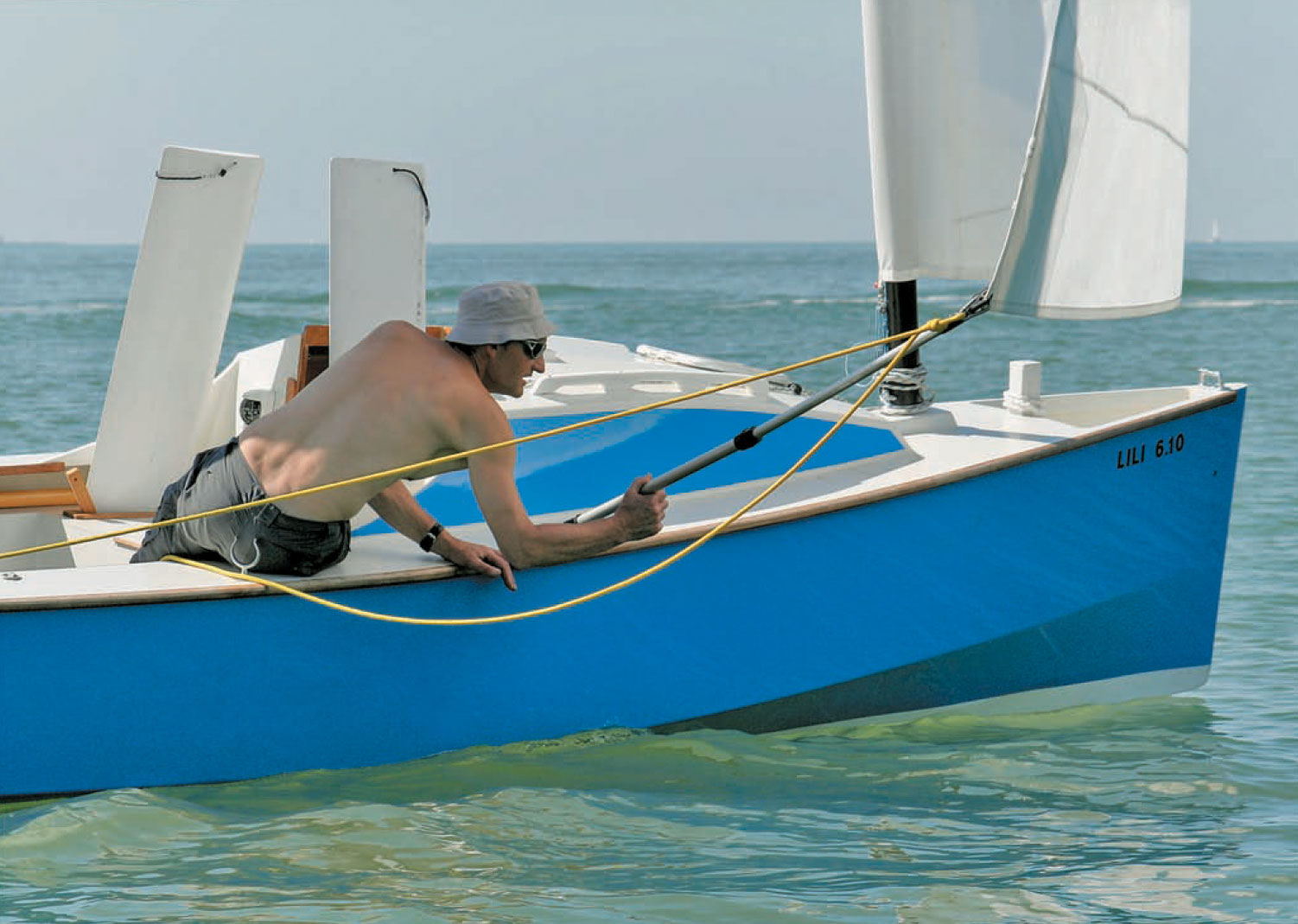
The combination of a waterline length of 20′ and a low wetted surface area make Lili 6.10 a very good performer in light airs. For this downwind leg, both daggerboard-style leeboards are raised to decrease drag.
For 30 years, Gilles Montaubin of St. Maixent de Beugné, France, has been designing boats powered solely by sail and oars, all of them sharing much the same spirit: a combination of apparent simplicity and true efficiency. Lili 6.10 is the most recent illustration of this very unassuming man’s outlook on sailboat design.
His views are informed by performance sailing, which for Montaubin originally sprang from his experience sailing with his father, an enthusiastic racing sailor. Far from the inspiration of traditional workboats of the French coastline, his work in this vein has resulted in a large family of contemporary “trekking” sailboats, all winners of various international “Raids”—PETIT JEAN in Portugal, LILI in Scotland, WABI in Finland, and PETITELISA in Sweden, all designs which take their names from the first boats built to them. These designs all have in common a similar hull shape, with a very fine waterline entry and a long flat run. They also share the same plywood-epoxy construction method, using two or three chines reinforced by ’glass-and-epoxy fillets, making the hulls not only light in weight but also easy and relatively cheap to build.
All of Montaubin’s designs have water ballast systems, and all of the hulls achieve lift to windward by using foil-shaped daggerboards or asymmetrical leeboards. Such simplicity carries through to the rig, as well. Montaubin makes his masts freestanding, allowing them to be rotated easily, quickly furling a sail by rolling it up around the mast.
Heavily tested in use, all these features contribute to seaworthiness, whether sailing hard to windward off a rocky shore or rowing in choppy seas. The furling system not only allows fine adjustment to match the ever-changing wind conditions of coastal or inland waters but also allows sail balance to be very finely tuned according to the wind speed. Water ballast increases not only a boat’s stability under sail but her inertia under oars, yet it can be easily drained so that it adds no weight when trailering, an important feature on a boat meant to be easily transported.
Jean-Yves Poirier
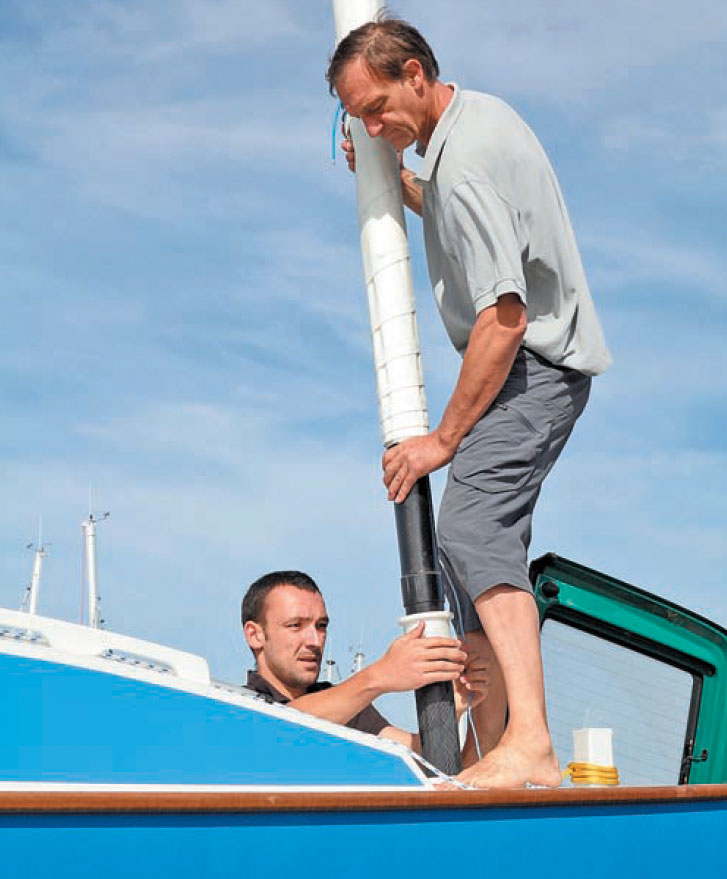
The free-standing carbon-fiber masts rotate to furl the sails quickly and easily. This makes light work of stepping and unstepping the masts—sails and all.
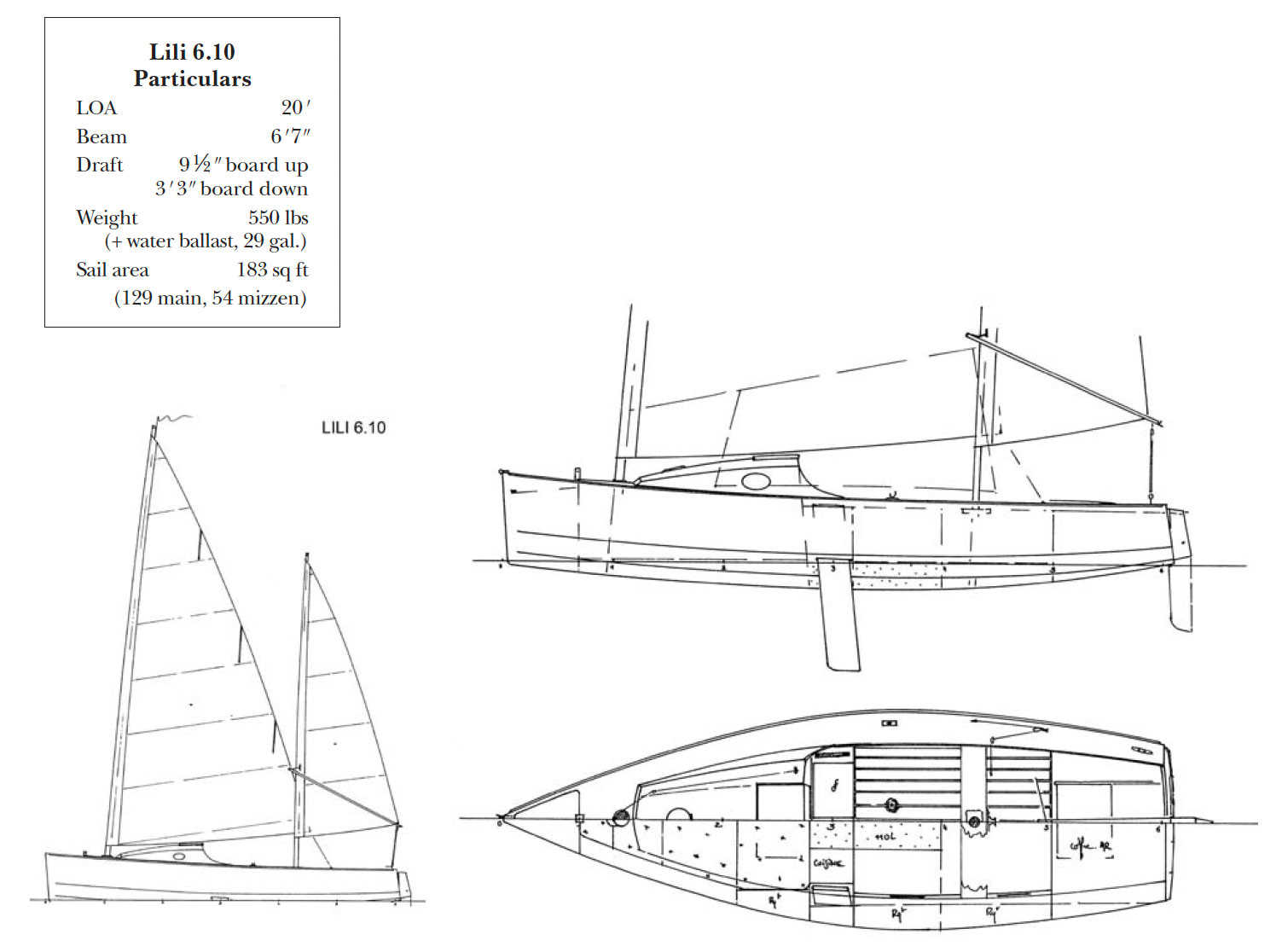
“Lili 6.10 marshals all my thoughts about coastal trekking onboard small boats,” Montaubin says. “She has the slender hull of Wabi, with a double chine and a narrow sole. Waterline beam has been kept low enough (5′3″) to make her rowing speed as high as possible, without compromising static stability and sailing stiffness.”
The cuddy cabin is 7′ 3″ long, with headroom of 3′ 3″, making it large enough for two people to find shelter for sleeping or even sitting up. Her simple comfort will easily accommodate a camp-cruise of a few days’ duration. In addition, the boat has two large watertight lockers, one under the companionway for cooking equipment and food storage and another aft for navigational gear. On both sides of the cockpit, additional stowage spaces accommodate smaller items, such as fenders and lines.
Jean-Yves Poirier
The cockpit drains into a well situated in the area of the mizzen mast step, whence the water can be pumped overboard.
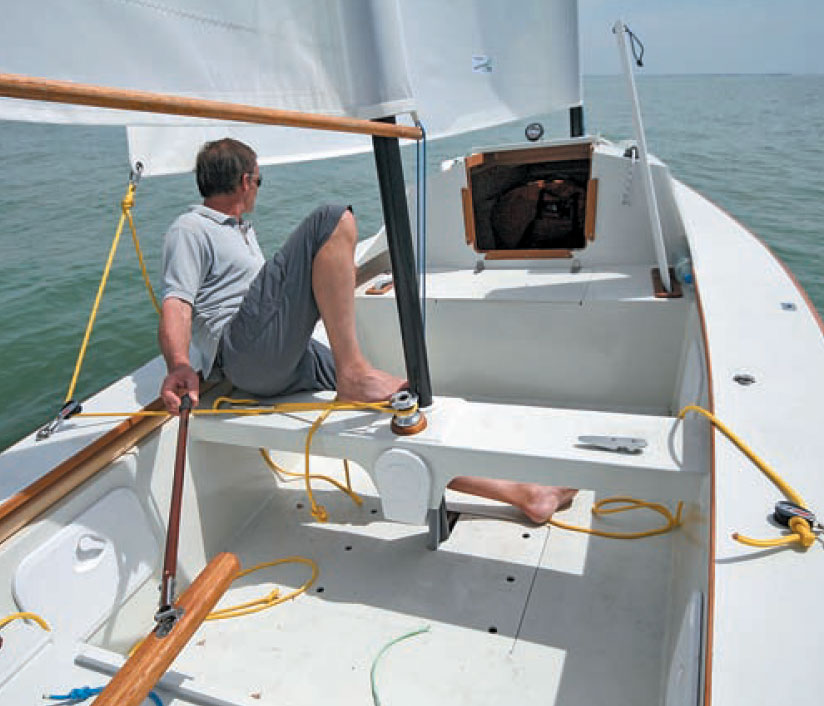
For overnighting, the cockpit, which is 7′ 7″ long, can be sheltered by simply hanging a tent or awning. The original owner of the boat planned to sail mostly solo, so the designer decided to place the mizzen in a “more forward than usual” position. This avoids the necessity of having to ship a boomkin, but the mast partner required to support the unstayed mizzen also separates the cockpit into two sections. This partner also supports the mainsheet winch and cleat—honoring another of the owner’s requests. Montaubin is experimenting with an alternative cockpit layout, with a pyramidal standing foot to support the mast without a partner.
At the price of having a short carbon-fiber boomkin to receive the mizzen sheet, one could also step the mizzenmast 2′ farther aft, where it could be supported against the aft bulkhead, which could easily distribute bending loads to the boat’s structure. Such a move would also entail shifting the leeboards aft by 2″. This would completely clear the cockpit space, making the boat very comfortable under sail and also under oars, since two oarsmen could find plenty of room to row together.
As built, the boat’s cockpit sole is almost exactly at the level of the waterline, and around the mizzen mast step a draining well and bilge pump help to clear water out of the cockpit. The aftermost area is too low for the cockpit to be fully self-draining, however—a problem that would easily be solved by raising the sole by 2″ or so.
Jean-Yves Poirier
Though divided by the mizzen mast partner, the cockpit offers plenty of space. The oars, which are her sole auxiliary power, stow neatly just under the side decks.
Oars are very cleverly stored on both sides under covering boards that run from the companionway bulkhead to the transom. There is enough room on each side to store a pair of 10′ oars (two per crew), but longer sweeps (one oar per crew) could also be stored the same way, with handles slightly protruding beyond the
transom.
The water ballast consists of two independent compartments of 14.5 gallons each. The system is straightforward to use: you only need to open the hatch fitted on the cockpit sole and pull out the drain plug in the bottom panel. When enough water has flowed into the compartment so that the boat is on its load waterline, the drain is plugged again. After hauling the boat out on a trailer, pull the plug again to drain the water.
As wind and sea conditions change while you’re afloat, you can reduce ballast by using the bilge pump to pump some of the ballast water overboard. This is a simple and very effective system, but after sailing in salt water the compartments should be flushed with fresh water to keep them sweet, and if you’ve been sailing in fresh water you must take great care to avoid transporting invasive plant species by discharging the water ballast only where it came from and cleaning the tanks thoroughly.
Jean-Yves Poirier
Gilles Montaubin, at the helm, designs light, simple boats with excellent performance under sail, with Raid events in mind. The accommodations are spartan, but adequate for adventuresome sailors.
On the water, Lili 6.10 is very easy to steer and light on the helm. Her low weight, low freeboard, and long waterline help to keep her speed well above the average of her sail-and-oar competitors. Her initial hull stability is high, so the crew can move around on board readily—but take care when handling the anchor at its dedicated trunk in the foredeck, since limited buoyancy in that area is the price paid for having a very fine forefoot. As the boat heels under sail, her upper chine submerges quickly and increases her stiffness. With the head of the sails spilling wind automatically as she heels in squalls, her stability is very high and gives a great feeling of security. In stronger breezes, the sails are easily reefed by rotating the carbon-fiber mast tubes, which are 2 3⁄8″ in diameter for the main and 2 1⁄4″ for the mizzen. Because the center of effort moves forward substantially when the sails are furled this way, the small mizzen sail comes into its own to balance the sail plan rather than provide power.
A pair of asymmetric leeboards, which angle toward the centerline, or “pinch,” by 4 degrees—a technique unknown to conventional sloops—help upwind sailing performance without overtrimming. Instead of leading the sheets more or less to the centerline, this leeboard angle is of primary importance in getting the most from a cat-ketch or cat-yawl. Trimming the traveler to the centerline is the best way to slow this boat down and add leeway.
Closehauled, she can point quite high, but, as with any sailing dinghy, keeping her off the wind a bit is better than pinching. Whether running, reaching, or sailing closehauled, the tiller stays light and responsive. When used alone, the mizzen can even be trimmed by hand to sail backwards in tight corners. When rowing with a single oar, one leeboard can be slightly lowered to keep the hull on track, especially with wind abeam. Her hollow entrance helps to maintain a good turn of speed under oars, even in choppy seas.
Lili 6.10 is an able boat for two to cruise in complete independence for a few days in a lifestyle as simple and inexpensive as the boat is to build and use, and she can easily be towed to the next shore for the next exploration. This very homogenous sail-and-oar trekker opens new recreation grounds to the “sailing in the wild” lover who sleeps in the minds of all of us.
Gilles Montaubin, Chantier Mer, “La Robinerie.”
Gilles Montaubin
Plywood hull construction is a hallmark of Gilles Montaubin’s style. The simplicity and minimalism of the hull are mirrored in her rig, which has a minimum of fittings. The inexpensive nature of the boat, however, doesn’t imply a lack of sophistication or performance: Montaubin’s designs have placed first in a number of Raid-style races in Europe. Leeboards set up like daggerboards and vertical leech battens in the mainsail to facilitate furling by rolling the sail up in the mast are among the pragmatic but effective elements of his design philosophy.
Is there a boat you’d like to know more about? Have you built one that you think other Small Boats readers would enjoy? Please email us your suggestions.
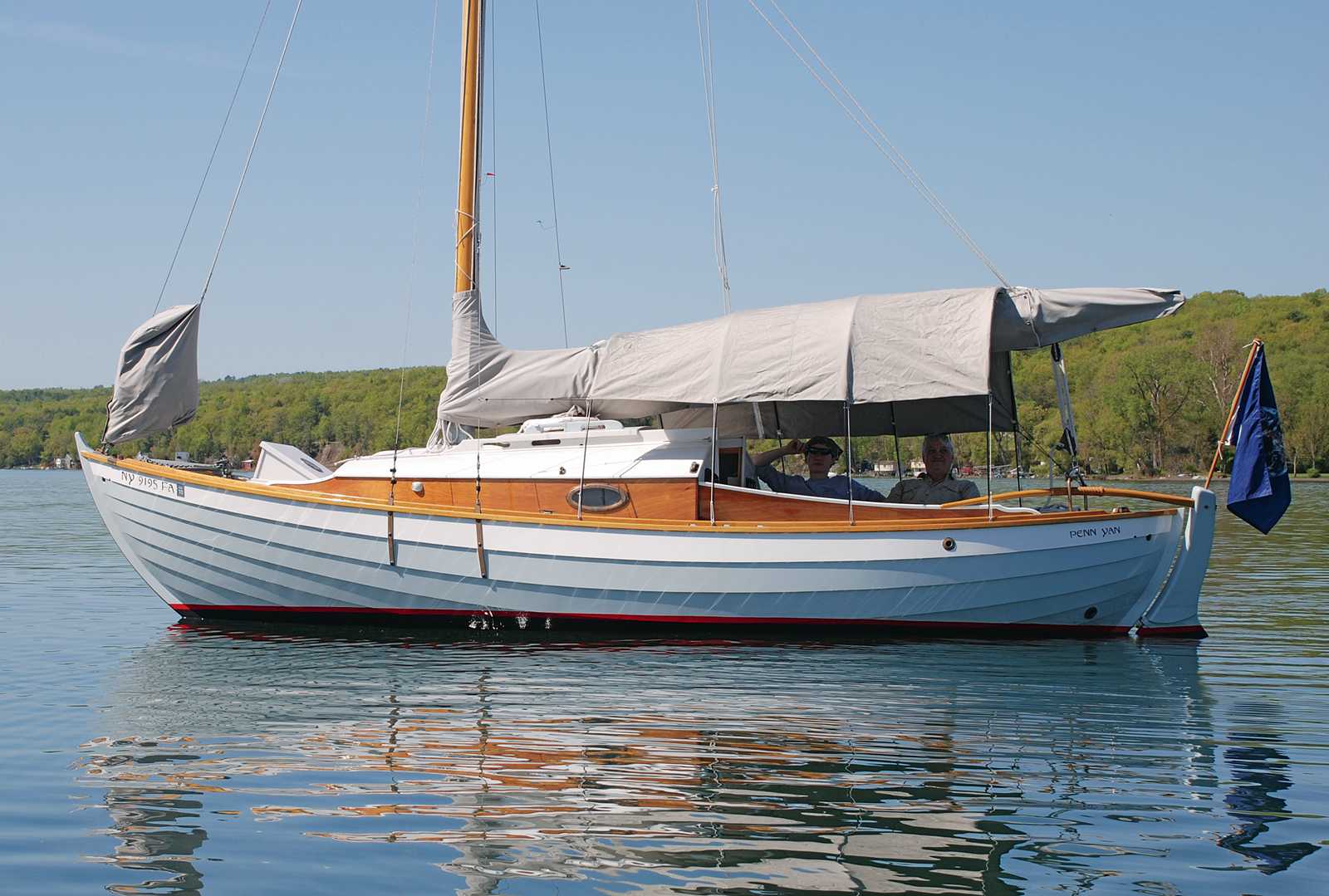
This trailerable cruiser, drawn by Iain Oughtred, shows a subtle blend of Scandinavian characteristics. The strong sheer and very buoyant hull of the faering are combined with the low cabin of larger boats, such as the Tumlare and Cohoe. Rather than being a smaller version of these cruisers, this 22-footer is more what faering builders might produce if they wanted cruising accommodations.
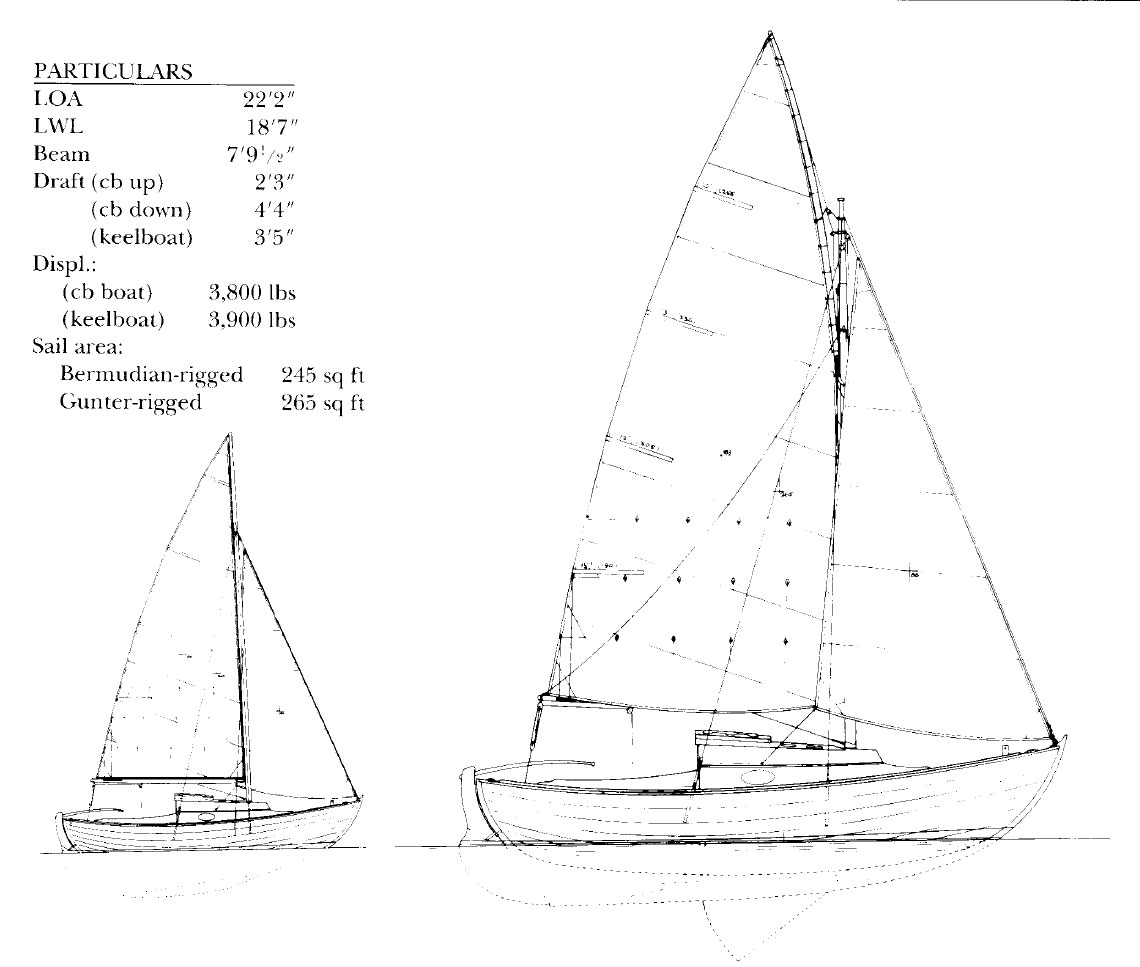
Designer Iain Oughtred as drawn several options for Grey Seal: a jib-headed mainsail, a gunter mainsail, a full-keel hull, and a keel-centerboard hull.
Originally, Iain designed the keel/ centerboard model to allow for easier trailering and broadened cruising grounds. But, realizing that many builders will prefer a deeper boat, he added the full-keeled version. Much to our pleasure, it looks rather like a small double-ended Folkboat.
The construction is suitable for amateur builders with some experience-or considerable patience and determination. Building techniques are essentially the same as for Iain’s Acorn skiffs (the Acorn 13 and the Acorn 17): epoxy-glued plywood planks on laminated frames and backbone. With proper care, these boats should last a long time.
Grey Seal’s glued plywood-lapstrake hull construction is clean, light, strong, and quite elegant.
Three basic layouts are shown, and combinations or variations of these are quite possible. A crew of two adults is ideal-two adults and two children represent, we think, the reasonable maximum.
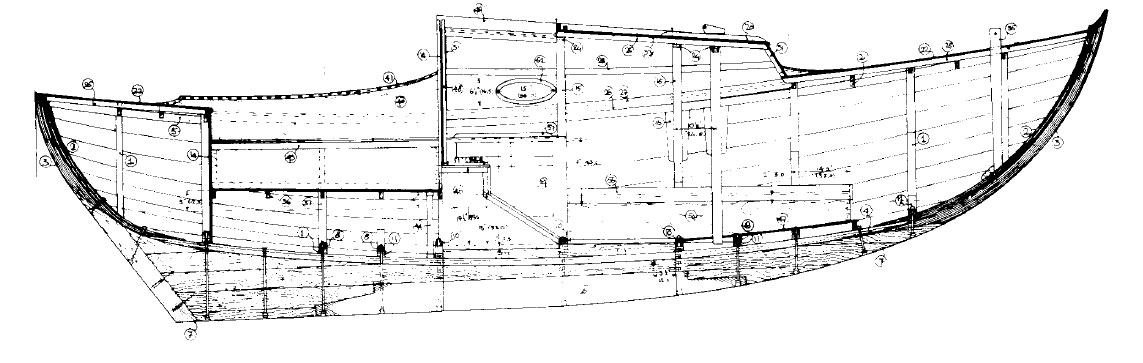
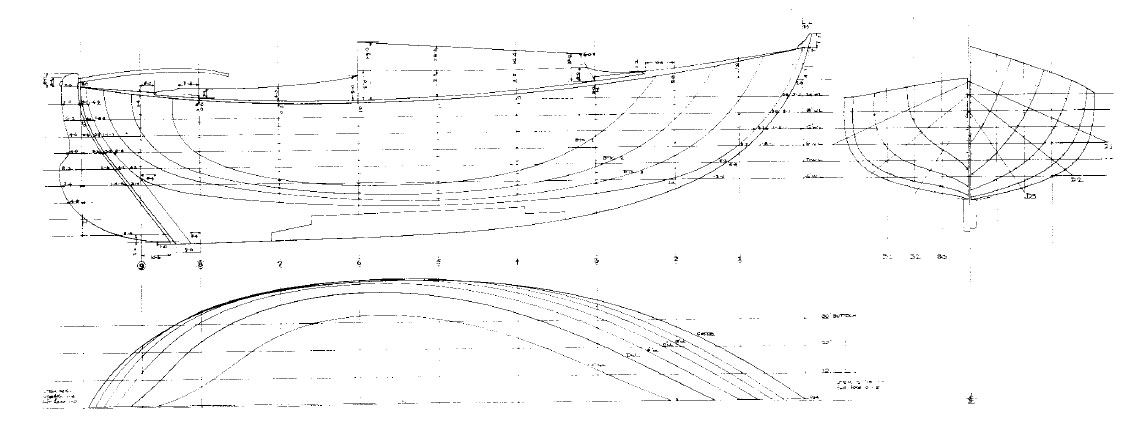
The Grey Seal design drawings (12 sheets) show details of deep-keeled and shoal-draft versions, and two rig options gunter and jib-headed. Construction is well detailed, and Iain includes the critically important plank layout for the builder. Several construction elements are shown full scale. Owing to possible variations, interior joinery and engine installation are not drawn with great detail.
Line drawing for the keel-centerboard hull option.
Grey Seal is a light, truly trailerable, cruiser. Although she goes together in contemporary fashion, she displays strong traditional character. WoodenBoat Plan No. 91 $275.00
Grey Seal arrangement and layout drawing.
22′2″ Grey Seal Design Plan Details
DESCRIPTION
Hull type: Round-bottomed, outside-ballasted keel or keel/cb boat
Rig: Bermudian or gunter-rigged sloop
Construction: Lapstrake plywood over laminated frames
Headroom/cabin (between beams): About 4′6″
BUILDING DATA
Skill needed: Intermediate to advanced
Lofting required: Yes
Alternative construction: Traditional plank on frame, strip, cold-molded
PLANS DATA
No. of sheets: 12
Level of detail: Above average
Cost per set: $215.00
WB Plan No. 91
Grey Seal Completed Images
Photo by Geoff Kerr
Grey Seal is a comfortable pocket cruiser. Her double-ended shape, strong sheer, and lapstrake planking hearken to her Scandinavian influence. Glued lapstrake construction makes her accessible to the home builder.
Photo by Geoff Kerr
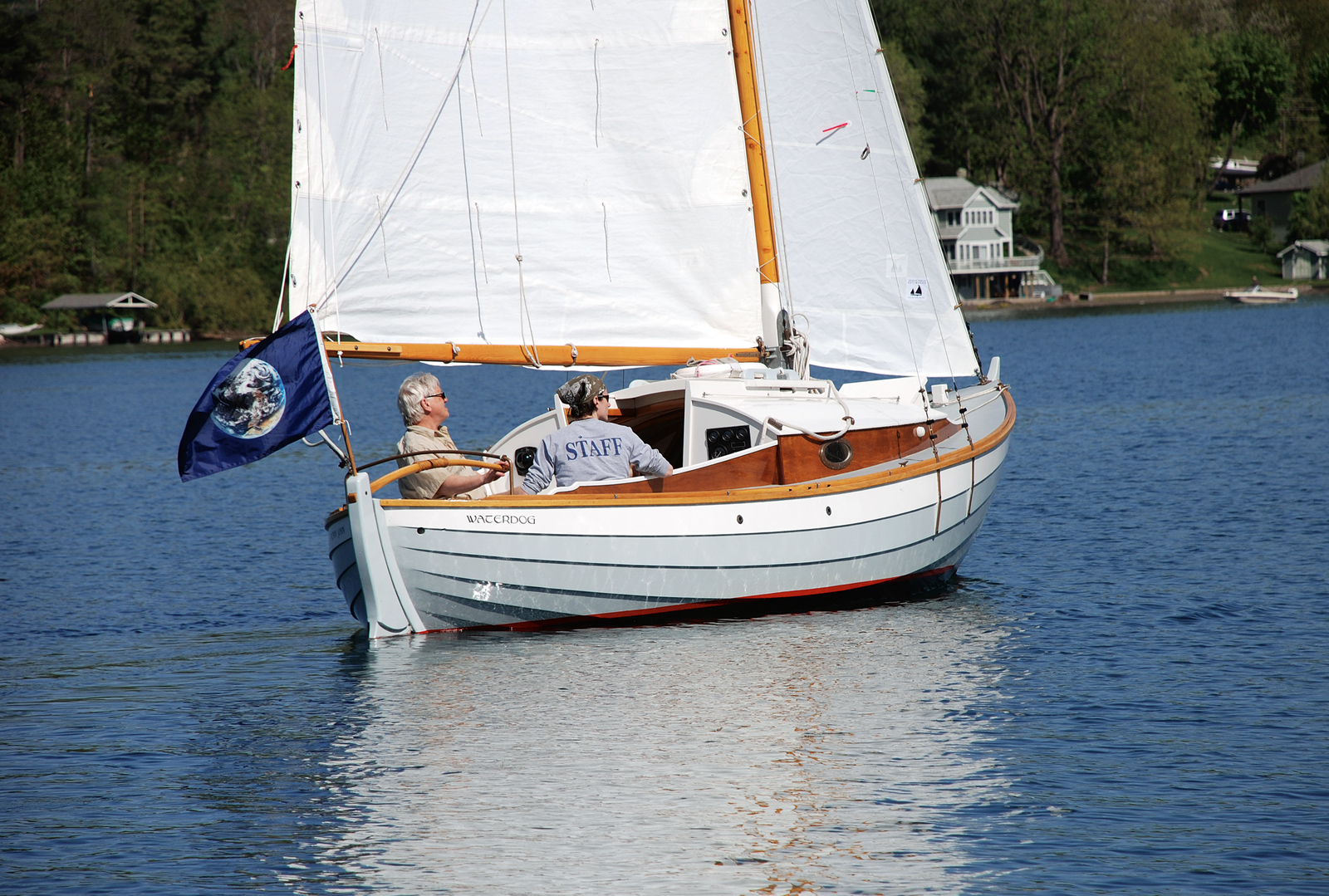
House sides flow forward, past the cabin. Looking aft, the coaming also flows beyond its border. These extensions provide good toeholds, and their varnished surfaces lead the eye to a thoughtful interplay between painted surfaces, which contribute to WATERDOG’s stunning profile. A bright toerail completes the picture.
When Kent and Audrey Lewis sent their review of the Drascombe Dabber for this issue, it took me right back to growing up on the River Yealm in Devon, England, and summer days going to the beach by boat, often on a Drascombe Lugger owned by family friends. I didn’t think about it at the time, but now I recognize how perfectly suited the Lugger was to ferrying kids and dogs to be offloaded at the beach; to say nothing of bringing them home tired, wet, and sandy. Nor did I take note of just how many Drascombes of all sorts sat on moorings in the river. In hindsight, their presence is unsurprising: the Drascombe designer, John Watkinson, lived and worked beside the Yealm for many years.
Photographs courtesy of Douglas Elliott
John Watkinson at the helm of the 15′ speedboat he designed in the early 1960s; a young Douglas Elliott was along for the ride. Checking the engines during the sea trials was Eric Gynn.
I mentioned my connection with the Yealm to Kent, and he put me in touch with Douglas Elliott who had known John Watkinson personally. Before I knew it, Douglas was sharing with me a history that had unfolded on my own childhood doorstep.
John Elliott working on the Drascombe Lugger, REESKIP. John and Douglas Elliott would build more than 200 of the wooden yawls before John’s untimely death in 1980.
John Watkinson had owned the boatyard at Bridgend on the Yealm since shortly after World War II and had built a range of small wooden lapstrake boats. But in the early 1960s, customers were being lured by production fiberglass boats and, for a small yard like Watkinson’s, the pressure of the new competition was unprecedented. He decided to expand the yard’s range. Douglas, whose brother John worked at the yard at the time, remembers that Watkinson “designed a 15′ clinker-built motor launch of mahogany on oak ribs. It combined the rugged lines and seakeeping qualities of traditional West Country craft. It was powered by twin marinized Triumph TR3 sports-car engines, each 100-hp. It was very quick! But it was also economical and functional.” By 1964, Douglas says, the yard was building in wood and plywood, employing lapstrake, carvel, and strip-plank construction. They were doing well, but it was then that Watkinson decided to sell the yard and work full-time at design. That decision would lead to the building of the prototype Drascombe Lugger in 1965.
Douglas Elliott clamping the gunwale on REESKIP. Douglas worked alongside his brother, helping to build all the Drascombe boats that came from their yard. REESKIP was built for two Dutch sisters. When she was sold on to a new owner, she was renamed ELLIOTT in honor of John Elliott.
Douglas joined his brother at the boatyard shortly after Watkinson left, but recalls that “when he sold up, Watkinson moved to a farm in the middle of Dartmoor called ‘Drascombe Barton.’ The name was from the old English Dras for mud, and Combe for hollow; so really, Watkinson called his boat the Muddy Hollow Lugger! He designed it for his own family: a small trailerable boat that could be singlehanded and would sail well. And Kate, his wife, asked that she be able to step ashore dry shod and that there be no boom to crack skulls. The prototype had a dipping-lug mainsail and a sprit mizzen, and it sailed well. But Watkinson found the dipping lug a handful, so he altered the rig to a boomless gunter yawl. He built the first production boat up at the farm in 1967 and I was sent to load it onto a trailer and drive it up to the London Boat Show the following January. We sold it within 20 minutes of the show opening and before the show closed, we had orders for a dozen more.”
The almost-completed prototype Drascombe Scaith in the Elliott yard in Yealmbridge, Devon, England.
Despite Watkinson’s love of wood and the success of the first boat, within a year Honnor Marine of Totnes, Devon, was building the Lugger in ’glass under license. John and Douglas Elliott went out on their own and Watkinson gave them exclusive rights to build the Luggers in wood. They would go on to build other boats in the Drascombe range, including the Longboat and Longboat Cruiser, the Skiff, the Peterboats (in three different lengths), the Scaith (of which Douglas built 13 before Watkinson altered the design and it became the Drascombe Peterboat 4.5m), and the Mule 4.5m (a one-off variation of the Peterboat 4.5m but with a transom rather than canoe stern). All the boats were custom-built, and by 1979 the brothers had built 200 Luggers and were taking orders a year in advance. But the following year, on July 4, John Elliott died of a heart attack while at work in the boatyard, and Douglas wound up the business shortly afterwards.
John Watkinson in the prototype Scaith preparing to fend off from the wall at Bridgend Quay, site of his old boatyard.
John Watkinson returned to the village of Noss Mayo on the River Yealm in the 1980s and lived there until his death in 1997. After John died, Douglas Elliott went to work for Terry Erskine Yachts where, in 1980, he built a Peterboat 4.5m. From there he went to Marine Projects (now Princess Yachts) in Plymouth. “They built fiberglass boats, and I didn’t like GRP at all, so I moved on and retrained as a telephone engineer.” Now in his late 70s he still lives in Plymouth and still takes on boat repair work when he gets the chance. “I’ve remained involved in boats, particularly Drascombes. I bought back the original Scaith, FOOTLOOSE, and sailed her for several years before I reluctantly had to sell her. But I still work on people’s boats, I’m just a bit slower these days.”
The prototype Drascombe Scaith sailing in a stiff breeze in the mouth of the River Yealm with its designer, John Watkinson, at the helm. Douglas Elliott built 13 Scaiths before Watkinson tweaked the design and developed it into the Peterboat 4.5m, which Douglas describes as “a very similar-looking boat from a distance, but a bit fuller aft and a bit finer forward.”
Wooden Drascombes are still built in limited numbers, but the fiberglass versions continue to be popular. To date, there are more than 6,000 Drascombes worldwide.
With many thanks to Douglas Elliott for sharing his memories and to Kent Lewis for the introduction.
For more on the Drascombe Dabber, read Kent and Audrey Lewis’s review.
Read about a cruising Drascombe in Douglas Elliott’s story of LEGOLAS.
We didn’t need another boat, we have an even dozen—mostly small boats, kayaks, and canoes—and yet at the Overland Expo Show in Flagstaff, Arizona, right out in front of the booth run by Kokopelli, makers of a range of inflatable paddleboards and packrafts, sat our next kayak. I should explain that my wife and I are small-boat sailors, canoeists, and kayakers; we also travel in a camper van I’ve built out. On our van trips the focus tends to be hiking and cycling, but in the places we explore there are often wonderful opportunities to get out on the water. The mountain lakes of Maine and New Hampshire, the marshes and tidal rivers behind the Outer Banks of North Carolina and Assateague Island, Maryland and Virginia, are all examples of the waters we’ve camped next to but not paddled.
Photographs by the author
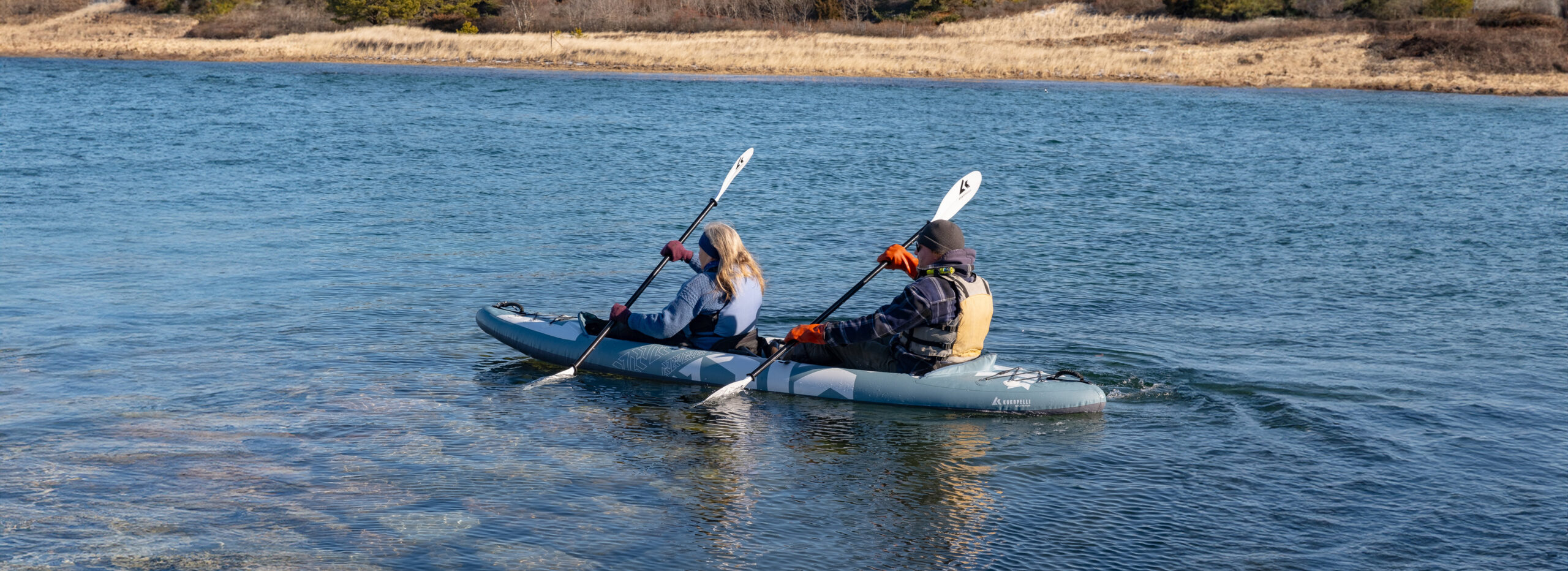
Kokopelli’s Platte-Plus kayak packs into a bag measuring 33″ × 23″ × 12″. Fully loaded (without personal gear) the pack weighs 54 lbs and is well balanced for carrying short distances. Two built-in wheels allow the pack to roll over smoother surfaces.
If the primary goal of a van trip is hiking or cycling, we tend to leave the boats at home. We did experiment with a Klepper Aerius, a folding wood-and-fabric kayak, and while it’s proven to be one of our favorite boats, it’s just too big to store in the van’s “garage”—the rear storage space beneath the berth—and drying it after use but before we disassemble and store it is a little too time consuming. But, we both agreed, a boat tucked out of the way, ready to paddle when the mood strikes and then easily stowed away again… that would be a nice addition to our kit.
The Kokopelli Platte-Plus inflatable kayak looked promising. We stopped to chat with the vendor and to take a closer look. Before long we were writing a check.
While designed to carry the kayak and its specific accessories, which include the seats, a pump, and two paddles, the Platte-Plus backpack has space for personal items such as a couple of inflatable PFDs, a backup pump, and even some 20-liter dry bags. The seat backs have pockets that are useful on the water but can also keep small bits of gear from getting lost in the shuffle.
The boat is a tandem, which was important to us. But more than that, it has versatility: I’m 6′ 3″ and my wife is 5′ 4″, and the system of hook-and-loop tracks that holds the two seats in place allows us to position them so we can both paddle comfortably for hours. It’s also easy to remove one of the seats and reposition the remaining one so the boat can be paddled solo.
The backpack that comes with the boat measures 33″ × 23″ × 12″ and holds the hull and drop-stitched removable floor, seats, foot braces, a pump, repair kit, and two sectional paddles, all of which come as standard equipment with the boat. There’s also room to fit in a second pump, several 20-liter dry bags, bow and stern lines, and two inflatable life vests. The pack’s shoulder straps and hip belt make it practical to carry the boat short distances, and it is also fitted with two small wheels that make it easy to move across smooth ground. The total weight of the full kit without the personal extras is 54 lbs. Once the kayak is fully inflated and rigged, there is space to stuff the empty bag in the stern, should you wish to take it with you.
The 220cm (7′ 3″) unfeathered paddles break down into four pieces and fit neatly in the pack. They’re good paddles, and it’s nice that they are included.
The drop-stitch floor is separate from the side pontoons and is inflated to a higher pressure—6 psi rather than 2 psi. It can be removed from the boat but can also be inflated, deflated, and stored in place.
Kokopelli is a Colorado-based company founded in 2012, although most of their products are made in Asia. The overall quality of the boat, seat design, and fittings is very high. The material of both the hull and floor is a rugged, 1,000-denier reinforced polyvinyl chloride (PVC), which I’m confident will stand up to thoughtful use. Having a removable floor is helpful when drying the boat for storage, makes repairs easier, and effectively doubles the bottom thickness. I seldom feel the need to take the floor section out as the boat can be inflated, deflated, and stored with it in place.
The weight capacity of the Platte-Plus is 430 lbs. Its overall length is just over 12′ 3″ and the maximum beam is 34″; I measured the internal width between the hull chambers to be a minimum of 12″ at the aft end of the cockpit and 16″ at the maximum beam. The hull has enough rocker that the bow rides slightly out of the water. The floor is textured and has deep longitudinal ridges in the main cockpit area. There is real boat shape to the hull and I was pleased to hear that typical kayak chortle sound from the bow on our first paddle. The cockpit is 7′ 9″ long, and the forward paddler has some additional leg room—7″ or 8″—beneath the foredeck, with enough foot room beneath the soft deck for the average paddler. The total weight of the boat with seats and foot braces is 32 lbs.
Each seat has four adjustable straps that can be anchored to a choice of D-rings, giving plenty of variability to accommodate crews of different sizes. The unfeathered paddles break down into four pieces for storing in the bag and come as standard equipment.
We have found the seats to be comfortable—high enough to offer good back support and with plenty of options to customize the fit—and with the 12 D-rings on the hull and four adjustable straps on each seat there seems to be infinite adjustability. It took a few outings to dial in the best seat arrangement for both solo and tandem paddling. I did add short loops of line to the carabiners that clip the foot braces in place, which effectively lengthens the spacing.
In addition to the 12 D-rings for the seats and foot braces, there are 14 D-rings for attaching gear to the deck, as well as both bow and stern bungee cords. The inflated and rigged boat is easy to move thanks to the four carrying handles—one at each end and a pair amidships. There are also hook-and-loop paddle keepers and four fittings in the floor that can be opened to act as scuppers in rough water—we have not yet needed them.
The Platte-Plus performs well as a tandem or solo kayak. With only one paddler there is ample space in which to carry gear for solo overnight trips.
The boat comes with two skegs that attach using the same keyed system common to most stand-up paddleboards. The aft skeg is necessary for tracking and adds about 8″ to the boat’s draft. The forward skeg is optional and not needed for tandem paddling. When solo paddling, strong strokes do tend to swing the bow from side to side and the front skeg mostly prevents this, but I don’t feel the added draft and inconvenience justify the small improvement in performance—in a boat that’s only 12′ long, it’s expected that some adjustments in paddle strokes will need to be made.
Our boat shipped with a hand pump that has a pressure gauge, and we also bought an optional small rechargeable-battery pump. We use the battery pump to do most of the inflating, but once the chambers are almost full, we switch to the more powerful hand pump. With this pump we finish inflating the chambers and dial in the pressure—6.0 psi for the floor and 2.0 psi for the side tubes.
For tandem paddling the seat positions can be adjusted to accommodate paddlers of quite different sizes and leg length. The unfeathered paddles are of good quality and stiff, despite coming apart into four pieces for storing in the bag.
Throughout the boat, the fittings are well designed and intuitive to use. Working at a relaxed pace a solo paddler can assemble the Platte-Plus, from bag to rigged boat, in less than 10 minutes. It takes a similar length of time to derig and store the boat—once you learn how to fold the hull, everything fits easily back into the pack. The hand pump has two outlets: one for inflating the hull and one for pulling air out of the hull to ensure it folds nice and flat. Importantly—especially if the boat is to be used for short outings and then stored away—the Platte-Plus hull can be dried quickly, and even if stored wet for a few days the PVC material will not be harmed.
When we bought the Platte-Plus, and knowing that I would be reviewing it, my working title for an article was “The Worst Boat We Own,” since I honestly did not have very high expectations for an inflatable kayak. But our first paddle in DUCKY (as we affectionately now call our Platte-Plus) was a sunset outing on Moosehead Lake in Maine and with our very first paddle strokes I knew there was nothing “worst” about this boat. It’s proven to be a fine tandem kayak and an even better solo kayak. For our van trips and short outings, it’s the ideal boat, and I believe we’ll log many miles paddling it together and solo on day trips and even overnight solo outings.
Bill Thomas has been a custom woodworker, designer, boatbuilder, and teacher for more than 40 years. He’s also a Maine Guide and has taught sea kayaking in Maine and other locations. He lives and works in South Berwick, Maine.
Is there a boat you’d like to know more about? Have you built one that you think other Small Boats readers would enjoy? Please email us your suggestions.
The Biscayne’s light but strong hull and rig, combined with some outside ballast, make her perform better than most boats of her size.
Whether designed as an AMERICA’s Cup defender or the tender for it, each of N.G. Herreshoff’s yachts was very carefully thought through, and then critically examined. The comparatively simple skiff presented here is no exception. After studying the fleet of these for their first season, Herreshoff commented, “They have proved a great success, being safe, fast, and able, and they handle beautifully.” A dozen of these skiffs were built in 1925 for the Adirondack School, which had a station at Coconut Grove.
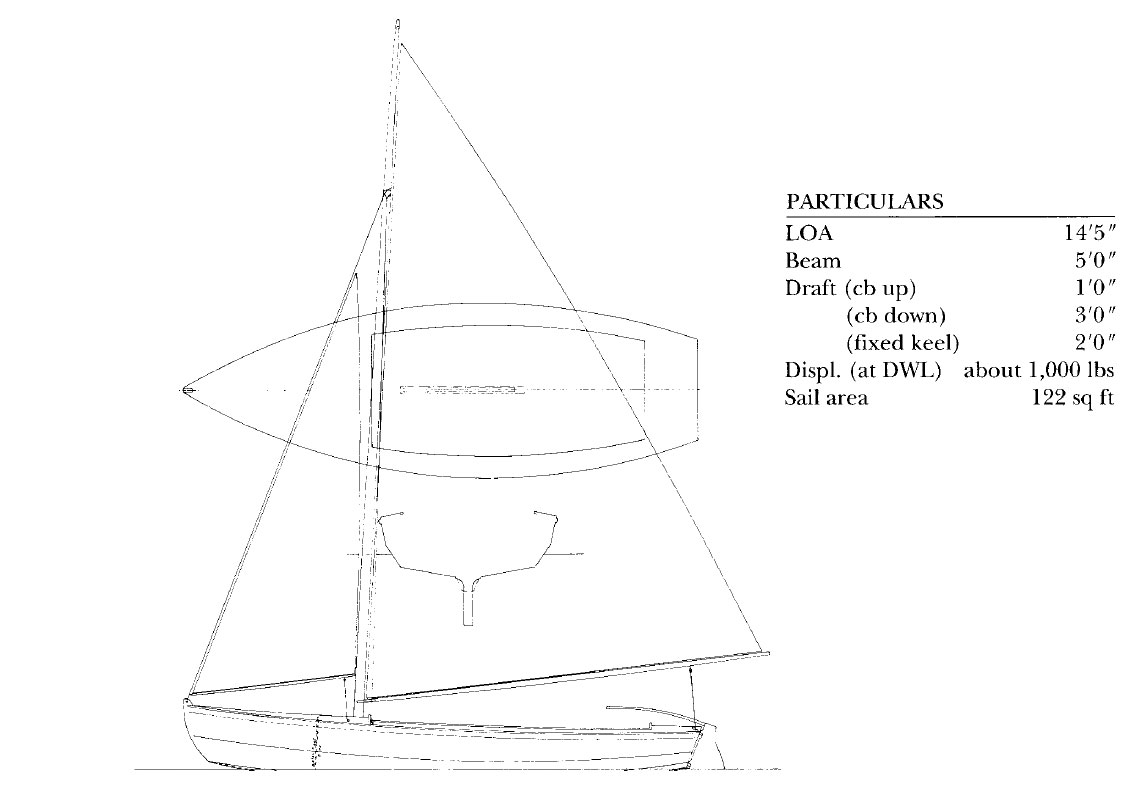
Originally intended for the shoal Florida waters for which the design is named, this 14-footer is offered in two versions: a shallow-draft, keel-and-centerboard combination, or a deep-draft fixed iron keel. The second version is the easier of the two to build, and better to windward, but the original model will float in a mere foot of water, and, of course, be handier to trailer. In addition to the keel options there are some interesting construction features that put this boat a cut above anything like it-but still within reach of the skills of an amateur builder.
The Hart Nautical Collections, M.I.T. Museum
Keel and rudder.
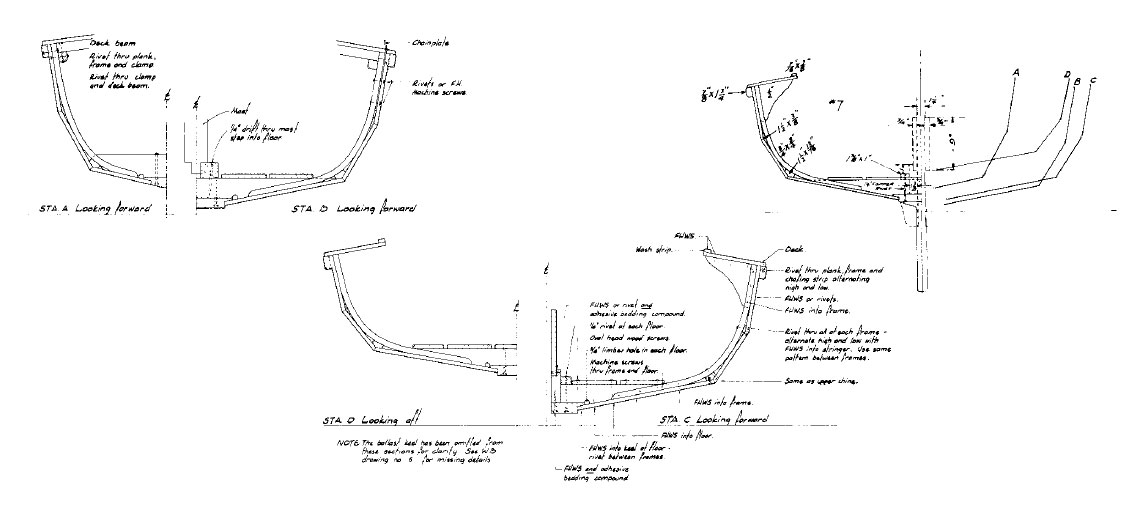
The Herreshoffs were noted for strong construction using light scantlings. The Biscayne Bay boat has a double-chined hull planked with solid wood and timbered with steam-bent half frames (that is, the frames stop short of the keel where they connect with floor timbers). This knuckled hull looks better than a singlechined, V-bottomed hull of plywood construction, and behaves more like a round-bottomed boat when heeled.
Beneath the foredeck is a watertight compartment: side decks and cockpit sole accommodate the crew. So there are no seats or hatches to build, and the boat has reserve buoyancy in the unlikely event of a capsize. The rudder profile is unusual, but its construction is not—this shape increases directional stability without exceeding the boat’s minimum draft.
The Hart Nautical Collections, M.I.T. Museum
The Biscayne Bay’s construction sections show 1/2″ plank thickness, but 1/4″ plywood can be used. Floor-to-frame and knee-to-frame fastenings can be eliminated—as can the breasthook bolt.
Because the Herreshoffs preferred to custom cast much of the hardware for their yachts, drawings are supplied for this boat’s original fittings—if the builder is so inclined to make or obtain castings. Alternatively, stock hardware can be substituted, as indicated in the plans.
This sailing skiff will make a fine building project and an excellent day boat when done. She has the added distinction of having been designed by the best. Six sheets of plans for the Biscayne Bay Sailing Skiff design—two of which were developed as supplements by WoodenBoat—show construction and offsets, keel and rudder details, spar details, sail plan, sails, rigging, fittings, ballast keel, stem details, hull sections, and boom crotch. WoodenBoat Plan No. 66. $75.00.
The Hart Nautical Collections, M.I.T. Museum
She is an unusually fine boat, and one that can be built easily by careful woodworkers.
14′ 5″ Biscayne Bay Sailing Skiff Design Plan Details
BUILDING DATA
Skill needed: Intermediate
Lofting required: Optional
Alternative construction: Plywood
PLANS DATA
No. of sheets: 6
Level of detail: Above average
Cost per set: $75.00
WB Plan No. 66
Completed Biscayne Bay Skiff Images
More Herreshoff Designs
Nathanael G. Herreshoff designed some of the most iconic small boats on the water today. Here are a few more designs for you to consider for your next project.
The Drascombe Dabber was designed by John Watkinson around 1970 when Honnor Marine, builders of the fiberglass Drascombe Lugger, requested a smaller version of that enormously popular boat. Watkinson based the resulting Dabber, a 15′ 6″ yawl, on his slippery 19′ double-ended Peterboat. With little prep time before an upcoming boat show, Watkinson shortened the Peterboat design by 4′, swapped its canoe stern for a transom, and sent the lines along to Honnor Marine. The first fiberglass hull was created just in time for the show. It was well received, and full production began around 1972. The boats continue to be produced in England, and to date more than 900 Dabbers have been built, with many shipped abroad.
When introduced, the Dabber was described as a “top quality GRP [fiberglass] polyester resin long life hull built to specifications approved by the Ship & Boat Builders’ National Federation, with genuine teak trim.” In 2016, we restored a 1978 Dabber, and the fiberglass was in great shape, despite having received no care for decades. After a $75 rinse at the carwash to remove pounds of oak leaves and acorns, the hull showed little sign of wear except for a small portion of wood rot in the keel and bilge runners, which were designed with ease of replacement in mind. Also impressive was the quality of the marine-grade stainless-steel rigging and oiled teak used for the tiller, rudder, thwarts, rubrails, and centerboard trunk. The original Terylene tanbark sails and cordage were still serviceable. The varnished spars were select Douglas fir, and the centerboard was galvanized mild steel—all in reasonable shape. On early Dabbers, expanded polystyrene foam blocks in the bow, beneath the side benches, and in the stern compartment provided enough buoyancy to keep the boat and crew afloat when swamped, but not enough to float the boat sufficiently high for the crew to bail it out. Some owners would stuff a sponge or towel into the centerboard trunk opening to slow the ingress of water. Newer Dabbers have additional flotation in the bow, sides, and stern, and a redesigned centerboard in which the lifting arm is angled to extend out of the top of the trunk rather than the forward face.
Gijs van Kemenade
With its pivoting centerboard and relatively flat bottom the Drascombe Dabber is easy to trailer, launch, and recover. The two rowing thwarts are both removable.
As with the earlier and larger Lugger, the Dabber offers the choice of adventure by sail, oar, or motor. The yawl rig is set low on short spars, and while originally a gunter or sprit rig was available, most Dabbers now sport a standing lug mainsail, some with a boom. The multiple sail choices of jib, main, and/or mizzen along with the low sail plan contribute to the Dabber’s stability and desirability as a coastal boat. Thanks to the use of both a bowsprit and a boomkin, the sail plan is spread out to both the bow and stern, freeing up as much space as possible within the boat. Indeed, the Dabber has as much, if not more, open space on the floorboards as the Lugger. The spacing of the sails relative to the keel helps drive crisp handling and reduces rudder force when well-trimmed. The sail plan stretches the Dabber from an overall length of 15′ 6″ to a sparred length of 23′ 7″, demanding alert attention from a skipper and crew when sailing in a tight anchorage.
Some Dabber owners have flown small spinnakers with good results, and one common upgrade is a roller-furling jib. If a furler is installed, the forestay can be replaced by a wire stay within the jib luff, and a bobstay is added to balance forces on the bowsprit.
Kent Lewis
The lockers are the ideal location for an anchor, sponge, and other items that are needed on a regular basis but do not need to be kept dry. The removable forward thwart sits in locators molded into the side benches.
The Dabber has a towing weight of 1,100 lbs and is easily trailered, especially on a tilt trailer, which facilitates launching and recovering; on a regular trailer, the hull is rugged enough to be moved on bunks and rollers. Rigging is easily accomplished by one person in well under 30 minutes. The mainmast steps easily, and the bowsprit and boomkin simply slide into place and are held by the tension of the forestay and mizzen sheet. Often, we will wait until the boat is in the water before we set up the boomkin and mizzen to avoid bumping into them or catching them on land objects. Because we are both righthanded we rig the mainsail’s yard to the port side of the mast so that the halyard comes down to the starboard belaying pin where we have good access when raising and lowering the sail. We added a quick-release snapshackle on the end of the parrel, so we can easily move the lowered yard and mainsail off to the side when we’re rowing.
The long, straight keel and well-veed stern contribute to responsive steering at low speeds, and the tucked stern helps to push the stern wave aft and keep the small rudder covered when heeled at higher speeds. The rudder’s wetted surface area is small but adequate, although some care must be taken to avoid excessive heel and crew weight too far forward.
Gijs van Kemenade
The underwater shape and pivoting centerboard and rudder blade make the Drascombe Dabber an ideal beaching boat, as it will sit almost upright while drying out. The Dabber’s wood trim, varnished spars, and tanbark sails add a touch of tradition. When the sails are furled, the lug-yawl rig leaves the cockpit uncluttered.
When rowing, the Dabber’s wineglass transom, relatively light 585-lb hull weight, and 13′ 7″ waterline combine to make an easily driven hull. There are two rowing stations. For the aft rowing station there are various configurations: no thwart (the rower is seated on the centerboard trunk), a fixed thwart that rests on the aft end of the centerboard trunk, and a removable thwart that rests in brackets below the side benches. The forward thwart, just aft of the mainmast, is removable to give easy access to the bow and forward side-bench storage. A pair of 8′ oars can be stowed on the cockpit sole or on deck, out of the way forward.
Storage space is generous. There is a large cuddy locker aft, some open stowage (which can be enclosed with hatch covers) below the bench seats, and limited space below the removable floorboards. While the side lockers are well protected, none of the stowage is watertight and the bung for the bilge drain is in the open aft locker.
Dick Pizer
On some Dabbers owners have made minor alterations such as moving the forestay to the outboard end of the bowsprit and adding a bobstay, and replacing the straight tiller with an arced version to give better clearance of the outboard when it is raised. The original arrangement for the mainsheet (as seen here) is to lead it through a block on the tiller so that both sheet and tiller can be easily held in one hand.
When motoring, a short-shaft 2- to 4-hp outboard will easily push the Dabber to hull speed. The outboard is set in a well to port. It is hung on a wooden bracket, and when lowered, the propeller shaft is forward of the rudder. When not in use, the motor can be tilted up to reduce drag; in the raised position, the propeller is above the arc of the rudder blade. The outboard well is roomy enough that steering can be from the motor itself, but it can also be set in a fixed position so that the rudder can be used. For best directional stability and maneuverability, the centerboard is lowered slightly when motoring. The standard Dabber tiller is straight, and in most under-power operations there is no need for the helm to be pushed hard over. However, if this does become necessary, the tiller must be lifted slightly to pass above the motor. To avoid this, a curved tiller has become a common modification.
The cockpit of the Dabber offers plenty of space for two adults, and lines are placed so that it is also easy to sail singlehanded. The boat’s volume is sufficient to carry up to four people, but when sailing this does lead to some crowding, especially when reaching for sheets and halyards. The mainsheet traditionally runs to a block mounted on the tiller so that both the sheet and the tiller can be managed with one hand, freeing the other hand to tend to the jib- or mizzen sheets. However, many owners have changed this, choosing instead to lead the sheet directly to hand from a block on a stern-mounted traveler. There are no cleats for the mainsheet, but nearby docking cleats below the side benches can be used to take a turn and thus relieve some pressure while keeping it easy to let free.
Gijs van Kemenade
For the singlehanded sailor, all the sheets are readily to hand, although care must be taken when coming about as the jibsheet at the clew of the sail can get hung up on the forestay.
The jibsheets run through fairleads mounted on the side benches to cam cleats and are easy to manage, although when tacking the sheet attachment at the jib clew can snag on the forestay. A short, small-diameter piece of PVC pipe wrapped around the forestay and a sharp tack helps to keep the clew from getting fouled. The mizzen sheet runs from the boomkin through a fairlead mounted on the mizzenmast, and down to a jam cleat on the after deck; we have found that once the sail is set, we can forget about it, easing the sheet only when running or if sailing closehauled in high winds when the sail can introduce too much weather helm. In high winds, the Dabber sails best with just the mainsail, while the jib and mizzen are both stowed. With just the jib and mizzen set, the boat is well-balanced, but with little sail area the arrangement is primarily good for maintaining directional stability while slowly picnic-drifting.
It is always fun to read old advertising brochures and see how well a boat has lived up to its marketing hype. In an ad from the 1970s the Dabber was described thus: “The attractive and seaworthy little Dabber is also tough enough for serious inshore fishing from tidal beaches.” Almost 50 years on, our Dabber has, indeed, proven tough enough for the fresh afternoon breezes along the Florida Gulf Coast and for excursions from our tidal beaches in Virginia. It sails well and brings us home safely and securely through wind and wave—a small but great boat for messing about on lakes, rivers, and inshore coastal areas.
Audrey and KentLewis mess about in Drascombes as well as a private fleet of small boats in the Tidewater Virginia region, southside of the James River. Since 2013, they have logged their adventures at smallboatrestoration.blogspot.com., where they have also published pictures of their Dabber restoration.
Is there a boat you’d like to know more about? Have you built one that you think other Small Boats readers would enjoy? Please email us your suggestions.
I was in the middle of Washington State’s Lake Roosevelt when the wind and waves built to a crescendo, overpowering my tiny skiff. Although the lake is 133 miles long it’s rarely more than a mile wide, but a 100-lb, 11′ 6″ flatiron skiff has its limits. The lugsail was already reefed down to 45 sq ft and when the gust hit, I let the sheet fly just to keep the boat upright. The “gust” didn’t go away, the wind had risen to about Force 6 with an 8-mile fetch, and the waves were growing to match. I was hove-to, abeam the wind and waves, the sail broad off, the boom dipping into the water now and then as the boat rolled from side to side and surged up and down in the waves.
I was out in the big bay near Hunters Campground. It is my favorite cruising area. From Hunters there are undeveloped shorelines stretching some 50 miles both north and south, with hidden coves, dramatic sand bluffs, clean, fresh water, surprisingly few people, and endless opportunities to beach a small boat and pitch a tent. High summer can be broiling hot, and I prefer the cooler early and late seasons. It was now mid-October, and this would be my last trip of the year. My bigger boats were already in storage, but my little skiff—a Summer Breeze designed by David Beede—is always the first out and last to be put away. It was ready and waiting when the weatherman forecast one last warm, fine weekend of the year.
Photographs by the author
In the big bay off Hunters Campground, I put in a reef. To the north, peering under the sail, I could see the entrance to the Nez Perce canyon (here in the center distance) and the beach where I would eventually land for the night in the cleft of the bluffs to the left of Nez Perce.
A small sail-and-oar boat is my preference for shoreline exploration and simply messing about, and that was my goal for the weekend. My initial plan had been to head south, maybe all the way to Enterprise, a boat-in campground at the mouth of Oh-Ra-Pac-En creek about 7 miles away. It is an area of white sand beaches and shallow, sun-warmed water, a favorite destination of motorboat campers during the peak season, but at this time of year it would be deserted.
The day had dawned cold and drizzly so I delayed my departure from home until the sun broke through the clouds and it looked like I might have a chance at good weather. When I arrived at Hunters about noon it was partly sunny and warm. Out in the lake, the winds looked light. It didn’t take me long to launch the boat and stow my dry bags of food, spare clothing, and camping gear, but by the time I was done, the wind had picked up from the south and across the bay whitecaps gleamed in the sun. Winds can be fickle on Lake Roosevelt, but often there is a northerly in the morning, a calm at midday, and a strong southerly in the afternoon. I was launching just in time for the strong south wind. I have learned the hard way to keep my little flatiron out of a chop. Just north of Hunters, the lake makes a dogleg to the east, which offers some shelter from the worst of the south wind, so I left the ramp and headed north.
Roger Siebert
.
The boat swept away from the dock. The water was dark blue, the sky above bright blue with streaming white clouds. Before I knew it, the ramp was a mile behind me. I angled out and across to the western shore where dark green pine-clad hills rose up from the lake, Soon, the wind built behind me and I realized the boat was starting to surf. My skiff carries a 63-sq-ft poly-tarp standing lug with a sprit boom angled to hold the clew down and keep the sail from twisting. Downwind the boat is stable, but we were soon skimming along at an exhilarating but scary speed. In a small boat that’s low to the water it’s hard to judge true speed, but I estimate we were doing 6 knots. David Beede has written that he’s hit a GPS-measured 7.5 knots in his Summer Breeze “quite a few times.” I had always been skeptical; now, not so much.
I landed on the beach that would be my home for the night, with a view down the lake facing south. The wind was still blowing hard, although you wouldn’t know it from my pictures.
I sped a few miles north along the western shore, mostly downwind, sometimes on a broad reach. Water streamed up the leeboard, topping the gunwale; small waves broke around me, and I was getting wet. I was still in control but I’m a conservative sailor, so when I spotted a small beach curving in between rocky shores I shifted my weight aft and ran the boat up onto it at speed. Having a cheap boat and not minding if the bottom gets scratched up a little can be liberating.
To me, beach-bumming is an important part of cruising. While I decided whether to stay or not, I left the boat where it was and inspected the beach for any treasures before settling down, my back against a driftwood log, to eat lunch and consider my options. With the strong south wind, I could probably make it all the way to Gifford, some 20 miles north. There were plenty of spots along the way on the western shore where I could camp and catch the morning sunlight—an important consideration when nights are freezing. It would be an exciting run. The trouble would be getting back south again. If this wind persisted, it might take two days of beating and rowing to windward. I had plenty of food and the following day was forecast fair, but after that there was the threat of snow or cold driving rain, day and night. I didn’t want to be out in that; it would probably be best to stay within easy reach of the launch ramp. Besides, Hunters is an interesting area to explore and at this time of year was practically deserted. Then, as I sat and pondered, the wind eased. Maybe I could work my way south after all.
I climbed to the top of the bluff above my campsite. The deer trail was so steep that at times I was climbing on all fours. The waves that had seemed so large when I was out in the middle of the bay looked like mere ripples from my high vantage point.
I stowed my gear, reefed the sail, and set off beating southward. The water was surprisingly smooth, and the wind soon died to a gentle breeze. After making little headway for 10 or 15 minutes, I decided to shake out the reef. I headed the boat into the wind, caught the boom, and unclipped the sheet from its end. Then I scooted forward, sat on the rowing box facing the mast, let the snotter go, and set the boom down in the bottom of the boat. Now came the tricky part: releasing the downhaul while holding the end in my teeth to keep the sail tamed, then lowering the halyard and bundling the sail into the boat as the yard came down. I’ve been doing this for eight years now and only once have I smacked my head with the yard. With the sail safely in the boat I set about untying the reefpoints and the downhaul, but the downhaul knot wouldn’t budge. It had jammed tight. I worried at the knot for a minute or two, resisting the urge to use my teeth or a knife and wondering all the while why I couldn’t bring myself to buy a clip for this connection. At last, I had it; I raised the sail and lifted my head to survey my surroundings: in the time it had taken me to reset the sail, I had lost all ground and was once more just off my lunch beach.
From the top of the bluff Lake Roosevelt opened up before me and I could see all the way down to Enterprise where the lake turns to the west. The knee-deep grass that covered the summit was tinder dry.
With full sail and a moderate wind, I made good speed, but it still took me an hour and a half to tack back to the ramp—three times as long as the trip down. I continued on, beyond the ramp, following the eastern shore, and tried to round a point south of the campground but the wind was too strong, so I fell back into its lee. From the relative calm, I scanned the water out in the middle of the lake. There were no whitecaps so I figured the true wind couldn’t be that strong, it was merely being funneled around the point. I would put in a reef, sneak around the headland, and gunkhole my way south along the more sheltered eastern shore. I dropped the sail into the boat once more and tied in the reef. Under reduced sail, the skiff isn’t quite as weatherly, so I bore off a couple of degrees to keep her moving well, and made longer tacks away from shore and out into the bay. Which is how I came to be out in the middle of the lake when the fickle wind really picked up again.
I sat hove-to, waiting for the wind to steady and figuring out what to do. Perhaps, if I were careful, I could sail in this. I hauled in the sheet, the boat sprang ahead, a wave slapped the side, and a good 5 gallons sloshed in over the gunwale. I released the sheet. In the bottom of the boat, the water soaked into my pants and, not for the first time, I envied people with seats in their boats. I bailed most of the water, then half-heartedly sponged at the rest—there’d be more, maybe much more, real soon. At least it was a warm day. Even the water felt warm, although it was supposedly only about 62° at that time of year. I wondered what would happen if I capsized. Would the boat turn turtle or lay on her side and be easy to right? I had plenty of flotation and a bailer strapped in, but I knew she’d come up completely swamped. Would I have to get the sail down before she’d right? I regretted that I’d never practiced a capsize recovery in this boat.
On the small rock-strewn beach, I was lucky to find a flat spot above the driftwood pile where I could pitch my tent. With no tides to contend with, I could just pull the boat up out of the water and know it would be safe.
I was being blown downwind toward some cliffs with no beach at their base. I needed to angle west to line up for a cleft in the bluffs where I knew there was a little pebble beach. I tweaked in the sheet just a little and pulled the tiller over to windward, then let the sheet all the way out. The sail blew out over the bow and the boat turned downwind. I knelt facing the stern and watched the marching waves; I had one hand on the tiller, the other on the sheet. The sail, flying ahead, kept the boat pointed downwind. Behind us, the waves rolled right up the 12″-high transom, but not one broke in on us and hardly any water came aboard. When there was a break in the waves, I pulled the sheet in just a little and angled the boat westward.
Twenty minutes later I’d made it to shore. It wasn’t much of a beach, a 50′-long crescent, more pebble than sand, filled with driftwood 10’ above the water’s edge. Behind the beach, a narrow brush-choked gorge led up into the forested hills. The wind blew right up the cleft, but there was a partially sheltered flat spot among the jumble of driftwood where I could pitch my tent. It would even catch the morning sunlight. All in all, it was not a bad place to be cast away.
On the second morning the lake was like glass. The difference from the previous day could not have been more marked. As I rowed toward the western canyon, I was looking over the stern at the big cove at the mouth of the Nez Perce canyon.
After setting up camp, I followed a deer trail up to the top of the eastern bluff. The trail skirted the edge of the ponderosa pine forest and in places was so steep I had to bend double and pull myself up by grasping clumps of the thick, dry, prairie grass. I kept well away from the sheer edge. These cliffs are nothing but sand and are unstable. Several times I’ve seen huge chunks collapse into the lake, like ice calving off a glacier. Such falls are the cause of all the fine beaches, but it’s a foolish person who camps beneath a sand cliff. I puffed my way to the top, a hundred feet or more above the lake, and was amazed by the panoramic view: the whole expanse of the bay lay open to the south, 8 miles to Enterprise where the lake turns west. The summit was covered in thick, knee-deep grass that gave way to open forest—all bone dry; there’d be no campfire tonight. I stood in the wind, watching the tiny ripples marching up the dark lake…in a small boat, those ripples had been anything but “tiny.” I could see no sign of human life in any direction. The night would be dark, with very few lights on the horizon.
Back at my camp on the beach, I sat comfortably against a log with my back to the lake and the wind and wrote in my journal while dinner cooked: Madras lentils, cheese, tomatoes from the garden, biscuits I’d made the day before, and a pot of tea. Before snuffing out the Trangia stove I filled a plastic bottle with hot water and slid it into my down sleeping bag—there’d be no cold feet tonight; I’m getting soft in my old age. As the sun went down, the temperature dropped precipitously but it did stay above freezing that night. By full dark I was snuggled in bed, listening to the wind as it ruffled the tent, and read by candlelight until I drifted off.
Deep in the western canyon (later identified on a map as Ferry Gulch) on the morning of my second day, I turned toward the lake and admired the sheer, unbroken bluff, its ponderosa pines clinging precariously to the edge.
The sun woke me at 7 a.m. but I dozed while I let the day warm up and didn’t leave my cocoon for another hour. The morning was still and warm, the sky the purest topaz blue with a few high, wispy clouds; the lake a sparkling, translucent turquoise mirror without a breath of wind. After breakfast I went for a swim and even the water seemed warmer than it should at that time of year. I took my time breaking camp—I was in no hurry to leave. With no wind, I would have to row. I unshipped the rudder, tied the leeboard up, lashed each oar to its tholepin, and rolled the spars into the sail, setting the bundle to one side sticking over the bow so that it would not interfere with my rowing.
Beyond the bluffs at either end of the beach were fjord-like flooded canyons. I’d spied them on past trips but had never explored them. They were narrow with little room to maneuver; with a following breeze I could sail in but would probably have to row back out. This glassy-calm morning gave me the perfect opportunity to explore them. I set out for the western canyon, less than half a mile away, rowing close to shore. The tall sand cliffs loomed above as I rowed through the clear shallows just off the beach.
As I rowed up Nez Perce canyon, I could see the holes that swallows had carved out of the sand bluffs to make their nests. The layers of sediment—that create the dramatic stripes and ripples in the bluffs—were deposited during the last ice age.
The canyon cut into the bluffs for about half a mile. One side was a sheer, unbroken cliff; the other sloped down to the water more gradually. A tiny creek, not quite dry, trickled into the very end of it. About halfway up the inlet there had been a landslide on the eastern slope and about half an acre of hillside had slumped into the water forming a small, brush-grown island where I landed to explore. The shore was soft, and I sank in, ankle deep, before belatedly removing my shoes. The center of the island rose about 6′ above the lake and was thick with brush and small pine trees. It might be possible to carve out a hidden campsite there, but I didn’t tarry; I was eager to be on my way.
I rowed back out into the lake and turned east, paralleling the shore a few hundred yards off. The day was now so warm that I took off my shirt. The lake was as still as an undisturbed mirror, but it had turned a deep blue, reflecting the sky and forested hillsides. Near the beach I had camped on, I stopped rowing, letting the oars trail in the water as I drifted and took a break, drinking tea from a Thermos. There was not another boat to be seen, no wakes or wind disturbed the lake. I soaked up the warmth and silence, marveling at the difference from the day before.
At the head of the canyon the way was blocked by the narrowing of the stream and some fallen trees. I could hear the roar of falling water, so I decided to explore farther up the creek on foot.
Half a mile farther east, the canyon of the Nez Perce Creek opened up. There is a sheltered cove at its mouth, large enough for a dozen trailerable boats to anchor, with a crescent beach of fine sand shaded by a ring of willows and ponderosa. In peak season, especially on weekends, the beach is often lined with motorboats, and sprouts tents, dogs, people, and even volleyball nets. Today, it was deserted save for two bald eagles standing at the water’s edge, unmoving sentinels. I rowed in along the western side of the fjord, landing occasionally on the muddy shore to get a closer look at the exposed strata in the low cliffs or to gather trash and add it to the growing pile in the bow of the skiff. About a mile in, the canyon narrowed to no more than 40 yards across before opening out into a sheltered bay large enough to anchor several boats in. At the head of the bay was a low promontory with a good campsite—flat, wide, dry, and open to the sun—but sadly it is accessible by a dirt road and was littered with broken furniture, trash, cartridge casings, and liquor bottles.
In peak season the crescent beach at the mouth of the Nez Perce Canyon is a popular spot. But this weekend, it was deserted—I had it to myself.
The channel continued past the promontory, still deep enough that I could not see the bottom, but now no more than 40′ wide. After a few hundred yards it shoaled and became so narrow between marshy banks that I shipped the oars and stood to pole the boat against an unexpected current. Finally, the creek was blocked by fallen trees, but just beyond I could see it tumbling down from the hills and hear the rush of cascading water. I poled back out and landed on the low, wide, marshy west bank. I bushwhacked my way back to the head of the creek and found falling water pouring down in a series of cataracts, through pools and over ledges long carved into the basalt bedrock. I cupped my hand to catch some as it fell—it was cold and tasted deliciously pure.
From the beach at the mouth of the Nez Perce I could see the shore where I had camped for the night. Shortly after I took this picture the wind picked up and I was forced to row, rather than sail, back to Hunters.
Reluctantly I returned to the boat. The south wind had risen while I’d been exploring the canyon, and it was now funneling in between the high fjord sides. Rowing against it was tough but after half an hour of hard pulling I made it to the cove at the mouth of the canyon and landed for a late lunch. Out on the lake, the wind had freshened but was still less than yesterday’s near gale. The direction was in my favor: all I had to do was raise sail—maybe reefed—tack out around the end of the fjord, and I’d be on a close reach for the ramp a mile or so away.
I lingered in the sun-filled cove, went for one last swim, collected trash, and relaxed.
Suddenly the wind rose to a shriek and slammed like an explosion into the wooded ridge whipping the trees above the cove. I hurried out to the exposed end of the beach and was stung by sand and grit blown off the bluff and swirling down into my face. Within minutes, just as suddenly as it had started, the tempest subsided but the wind held at a steady Force 6. There was no way I could set sail now, I was wind-bound. I considered staying where I was until the wind calmed in the evening or next morning. I still had plenty of food, and it would be a good excuse to extend my trip another day. But I was more or less expected home that night; the fine spell of weather was sure to come to an end and, besides, it was just a little wind…if I couldn’t sail, I’d row.
Back at the ramp, my small boat safely loaded onto my small car, I took one last look across the lake. I was ready to head home but knew I’d be back next season.
I walked down to the boat and unstepped the mast, stowed it with the bundled spars, and made sure everything was shipshape. I put on shoes, a wool shirt, and windbreaker, strapped on my PFD and shoved off. I fought my way out of the mouth of the cove into the lake. Time and again I was brought to a standstill by the wind and waves, the spray whipping up over the bow. Once I was clear of the land and far enough out that I wouldn’t be blown back onto the cliffs, I turned the bow to the east and rowed with determination. The boat plunged and rolled in the chop, but few waves were breaking and little water slopped in. After a few hundred yards, I was in a more sheltered area, somewhat protected by the point to the south of Hunters. I paused to straighten my back, roll out my shoulders, and strip off the PFD and windbreaker. But I couldn’t stop rowing long; I was being blown down-lake. I picked up the oars again and leaned into the work. It took me 45 minutes of almost constant rowing, but I made it to the ramp, more exhilarated than tired.
As evening fell, I drove home slowly with my elbow resting on the open window; I still couldn’t get enough of the crisp fall air. It had been an exciting couple of days. Sailing forces me to slow down and live in the moment…and what a glorious moment it had been.
Bob Van Putten and his wife live off-grid deep in the Washington mountains in a straw-bale cottage they built for themselves more than 20 years ago. He is a self-employed systems integration technician specializing in smaller municipal water and wastewater systems. Small boats and being close to the water provide him with dynamic engagement with the real, natural world and force him to live in the moment and continually renew his interest in life.
A wind vane is a useful tool on a small sailboat. This example is designed for easy removal and storage when the mast is lowered; has only a few parts that can typically be purchased at a local DIY or hardware store; is fun to make; and can be personalized to add character, featuring your boat’s name, your family name, or any design of your choosing.
Wind Vane Materials
40mm* length of 10mm-diameter brass rod
1,000mm length of 2mm-diameter brass wire
350mm of 5mm brass rod
200mm × 500mm (or longer) uncoated ripstop nylon fabric, approximately 40g/sq m
1mm-thick brass or stainless-steel sheet large enough to cut one 90mm x 20mm piece and one 45mm × 20mm piece
2 M3 grub screws
2 stainless-steel wood screws
Tools for cutting, drilling, soldering, and shaping
*For U.S./Imperial measurements, see “How to Make a Brass-Frame Wind Vane in the U.S.” below.
Step 1: Prepare the Drilling Jig and Brass Rod Pieces
Cut the 10mm brass rod into three pieces: one 20mm-long piece for the head; and two 10mm-long pieces for the counterweight and stopper.
Create a drilling jig using a 10mm drill bit to drill down through a sacrificial block of wood. A saw kerf along the grain across the hole will provide slack for inserting each piece of brass rod and flexibility for clamping it. Hold the block secure in a vise.
Using the jig, drill centered holes in each of the three pieces of brass rod as follows:
In the head, use a 6mm drill bit to make a 15mm-deep blind hole. Then, using a 2mm bit drill make a through-hole across the top of the rod for the 2mm brass wire that forms the frame of the wind vane. Wire diameter can vary in different batches, but I had no problem using 2mm wire and a 2mm drill; it was a perfect match. However, if the fit is too loose or tight, you can adjust by switching drill bits.
With a 5mm drill bit, drill through the stopper, end to end. (As with the 2mm drill, 5mm was perfect for the 5mm brass rod.) In the side of the stopper, drill a 2.5mm pilot hole for a grub screw. I use a cordless drill/screwdriver for tapping—it’s easier and quicker than using a tap wrench to cut threads by hand. Thread the hole with an M3 tap.
With a 2mm drill bit, drill all the way through the counterweight, from end to end. Drill and tap the counterweight for an M3 grub screw as you did for the stopper.
(If you are unable to find grub screws, use M3 stainless-steel screws, cut off the head with a hacksaw and make a groove for the screwdriver. Make sure to burnish the cut edges to keep them from damaging the nylon flag.)
Step 2: Shape the Brass Axle and Wire
Bend the brass wire to the required shape using the measurements shown in Figure 3. Do not forget to slide the head and counterweight onto the wire before making the bends. Using a pair of round-nosed pliers, create the loop that will hold the axle, first practicing on a piece of sample wire; you will have a short offcut suitable for this once you have cut the wire to length. Bend the wire through 90° to bring it up to the top. Connect it with a loop and solder the connection. I used a 25W pencil soldering iron and solder with a very low melting point; the Sn60/Pb40 solder wire used for electronics has a melting point of around 360°F, well below the 600°F temperature that will anneal brass and soften it. I made sure the solder filled all the gaps in the joint, from both sides, and cleaned up afterwards with file and sandpaper.
Step 3: Fit the Axle
Ensure that the head is aligned perpendicular above the axle loop (see Fig. 4). Secure it by tapping a center punch or nail set on its top to pinch the 2mm wire inside.
File a sharp cone point into the top end of the axle. This point will sit centered in the dimple of the head’s blind hole.
Hacksaw a shallow groove around the axle 10mm from the bottom. The spring will push the axle to the side in the mount to engage the hole at the bottom.
Feed the axle through the loop, slide the stopper over the end, and set the point into the head. Tighten the grub screw in the stopper to set it just above the axle loop—you want the axle to stay engaged with the head but not sit against the wire below the vane.
Step 4: Create the Mounting
Cut the 1mm-thick brass sheet into two pieces: the mount (90mm × 20mm) and the spring (45mm × 20mm).
Drill a 5.5mm-diameter hole 10mm from each of the mount’s ends and two more holes (suitable for the mounting screws of your choice) 30mm from each end. Round the mount’s ends with tin snips and bend them to a 90° angle between the pairs of holes. Drill a 4mm-diameter hole in the spring 10mm from one end. Leave this end square and round off the other end. Shape the spring in the vise so it will gently press against the axle to keep it secure.
Step 5: Prepare the Banner
Test the fabric marker on the ripstop nylon before cutting a piece for the banner—if the marker’s dye bleeds, you may not get crisp edges to the letters. Cut a piece of fabric long enough to fit your design, and at one end leave an extra 15mm on the end and along the top edge to overlap the wire frame (see Fig. 4).
With the waterproof and UV-resistant fabric marker, draw your design onto both sides of the banner, placing a pre-printed template beneath for guidance.
Sew the fabric to the wire frame.
To balance the vane, hold the axle horizontally in a vise and slide the counterweight to the point where the vane frame balances horizontally. Tighten the counterweight grub screw.
Step 6: Final Assembly
Install the mount with its spring just below the top of your mast using stainless-steel round-head wood screws. Feed the axle into the mount from above until the spring snaps into the axle’s groove to hold it in place. Step the mast and watch the wind vane turn to indicate the wind direction.
Sebastian Schröder lives near Leipzig in southeast Germany and sails in the nearby lakes of Neuseenland as well as farther away in the Baltic Sea. His homemade wind vane can be seen in action in his article on the Blekinseka.
How to Make a Brass-Frame Wind Vane in the U.S.
Notes by Christopher Cunningham
To make this wind vane in the U.S., I had to find imperial equivalents of the metric sizes Sebastian used in Germany and cited in his article. Here are the materials I used.
Wire: 3⁄32″ × 36″
Axle: 3⁄16″ × 12″ (1 3⁄4″ shorter than Sebastian’s 350mm, but 12″ is a standard length and long enough for the purpose without having to buy additional length)
Head: 3⁄8″ × 7⁄8″
Stopper and Counterweight: 3⁄8″ × 3⁄8″
Mount: 0.032″ × 3⁄4″ × 3 1⁄2″
Spring: 0.032″ × 3⁄4″ × 1 3⁄4″
Grub screws: 1⁄4″ × 10-32Sebastian found that the 2mm wire would fit into a hole drilled by a 2mm bit and that the 5mm axle would fit the hole in the stopper drilled by a 5mm bit. However, when I drilled a 3⁄32″ hole for the 3⁄32″ wire and a 3⁄16″ hole for the 3⁄16″ axle, that wasn’t the case. I measured the brass rods with a digital caliper and found both were a few thousandths oversized. I have a set of numbered drill bits that have very small increments between sizes and found that a #41 bit was a good fit for the 3⁄32″ wire and a #10 bit fit the 3⁄16″ axle.
Photographs Christopher Cunningham
An alternative way to drill a hole through the center of a cylinder is to turn the cylinder rather than the bit. Here, the 3⁄8″ brass rod used for the head is in the drill-press chuck and the drill bit is held stationary in a drill-press vise; the blue tape indicates the depth of the blind hole. To center the bit in the vise, put it upside-down in the chuck and lower it into the vise. Tighten the vise on the shank end of the bit and then clamp the vise to the table. Loosen the chuck, raise it, and insert the brass rod. When drilling the hole through the counterweight, you can keep the slender drill bit from wandering off-center by setting the bit as short as needed to drill the hole. That short length will be stiffer and more likely to stay on target.
The head has an oversized 7⁄32″ hole to reduce friction on the 3⁄16″ axle; it’s 5⁄8″ deep.
To drill a centered hole in the side of a cylinder, use a wooden V-block. To check that the block is centered, lower the bit into the apex of the groove. When drilling through metal, bits tend to grab as they emerge through the bottom side, making it dangerous to hold the workpiece by hand. Here, the 3⁄8″ rod is held securely in the V-block by a scrap of flat-bar and a drill-press-table clamp.
For the 10-32 grub screws, I drilled a 5⁄32″ pilot hole; a #21 bit will also work. The taps I have taper to a point that extends beyond the teeth that cut the threads. For the stopper and the counterweight, I had to drill the pilot hole all the way through to make room for that point. I tapped threads all the way through, from one side to the other, and inserted grub screws from each side.
It’s easy to make a sharp, centered point on the axle by using a drill to turn the brass rod against a spinning sanding disc.
To lock the head in place on the wire, I used a small nail set to press a dimple into the 3⁄8″ rod, pinching the 3⁄32″ wire inside of it. The dimple can be pressed into either the side or the top of the head; I chose the side as it was easier to hold the vane steady on the workbench.
I’m accustomed to using silver solder to join pieces of brass, but the high temperature required for silver solder will anneal the brass. I wanted the brass to retain its stiffness so decided not to use solder. The loop in the wire at the bottom of the frame didn’t require any solder, but at the top of the frame I needed something to keep the wire from slipping out of place. I roughed up the horizontal wire in way of the loop, squeezed the loop tight, and applied a few drops of cyanoacrylate glue.
Balancing the assembled vane so that it rests level ensures it won’t twist on its axle when it’s installed upright on a boat’s mast. Here, in order to offset the lightweight fabric banner, the counterweight is positioned close to the bottom of the vane’s leading edge. For a heavier banner, the weight would be positioned higher up the leading edge, farther from the axle.
In lieu of sewing the flag, I used permanent double-stick fabric tape.
The tail of the wind vane will fly clear of a jib-headed mainsail but may drape over the head of, say, a spritsail or lugsail if the mast does not extend high enough above the throat of the sail. The banner doesn’t need to be long to work—even the rectangle supported by the frame is sufficient—so, before finalizing the design and length of the banner, consider how much space there is above the sail.
Christopher Cunningham is Small Boats’ editor-at-large.
You can share your tips and tricks of the trade with other Small Boats readers by sending us an email.
Having spent my life sailing and working on boats, I know how important it is to have reliable gear—especially lighting. So, when my dad raved about the Omni 2K Work Light from NEBO, I had to try it for myself.
This past weekend, I dove into some projects on my newly acquired 1959 Gulfstream 30. Its Beta 20 marine diesel engine has been idle for 15 years, so we pulled the starter and alternator for cleaning. Working in tight spaces with low light is always tough, and it seemed like a good test for the Omni 2K.
Photographs by the author
The handles of the NEBO light rotate to provide a stable stand on uneven surfaces. The two lamps can swing through 360° and, because they act independently from one another, can be set up to shine in different directions.
The Omni 2K is cordless and features two lamps that can be angled independently, allowing you to direct the light with precision. Like most work lights, it can be used hands free: its handles, which are magnetized on their long end and have non-slip rubber-coated corners, can be used to hang the 8-oz light, or can be hinged open to create a stable stand. The light can be opened flat, folded in half, or set anywhere in between. Its compact design makes it easy to store; it measures 4 3⁄4″ × 6 1⁄4″ × 1 7⁄8″ when folded and 8 3⁄8″ × 6 1⁄4″ × 1 7⁄16″ when opened flat.
All of the Omni 2K’s corners are protected by non-slip rubber coatings. When folded away for storage, the lamps are protected while the power bank, charging port, and power/charge status lights—located on the back of one of the two lamps—are all still accessible.
Each of the Omni 2K lamps has three settings—high, low, and red LED. At the high setting, with both lamps on (2,000 lumens), the beam distance is 230′ and the light can run continuously for 1.3 hours; switching off one lamp reduces the lumens to 1,100 and the distance to 164′ but increases the run time to 2 hours. On the low setting, both lamps combine to give 250 lumens and 5.5 hours run time, while a single lamp gives 150 lumens and 9 hours run time. When adjusting the lighting, the lamp cycles through the various white-light settings, but when powering up, it will switch directly to the last setting used. The red-light mode can be switched on without cycling through the white lights in order to preserve night vision. The red light has two settings: constant, which can run for 11 hours; and flashing, which can run for 20 hours.
The Omni 2K comes with a USB-C charging cable and can be fully recharged in about 2 hours with a 2-amp charging block. The light can also serve as a portable power bank with which to charge other devices.
Being able to hold the NEBO Omni 2K and direct the light in more than one direction at a time makes it the ideal tool for illuminating awkward and tight spaces such as a boat’s engine compartment.
The light is water- and impact-resistant—it has an IPX 4 rating and a 1m drop rating—and its minimum expected lifetime is 50,000 hours; it comes with a one-year warranty.
The NEBO Omni 2K would be a great addition to anyone’s toolkit. Its combination of brightness, durability, and battery life coupled with the easy hands-free operation makes it ideal for the boat, the workshop, and anywhere in between.
Jasmine Thomas, WoodenBoat Publications’ editorial assistant, grew up on boats and in her dad’s workshop on the coast of Maine. She has worked in the Maine Windjammer Association fleet as mate on MARY DAY and ANGELIQUE and has both her 100-ton Near Coastal USCG license and STCW certification. She is renovating a 1959 Gulfstream 30 on which she’ll be offering picnic charters and sharing the magic of sailing the Maine coast this summer.
Capt. R.D. “Pete” Culler designed this 24′ outboard-powered launch in lengths ranging from 15′ to 30′; Bill Perkins adapted the construction and cabin design for his particular purposes, and built this example.
Bill Perkins is a tall, soft-spoken man with an easy Southern grace. The man knows boats, so when he needed one to transport supplies and people from the Atlantic coast of Georgia to his old family house on Cumberland Island, he looked around pretty hard before settling on Pete Culler’s 24′ Fast Outboard Launch. Capt. Culler designed a whole series of these boats, ranging from 16′ to 30′, all with that signature Culler sheer and stem, and all based upon the design and construction practices of the old Chesapeake Bay working skiffs.
The boats of this series were drawn, as their name implies, with outboard power in mind. This is an important distinction: For long-term reliability and economy, I prefer an inboard diesel on a boat this size, but if your particular situation calls for convenience, shallow draft, and a better power-to-weight ratio than an inboard diesel affords, it is hard to beat a modern four-stroke outboard. Boats must be designed for where the weight will be concentrated, though, and to simply slap a big, heavy outboard motor on the stern of a boat intended to carry an inboard engine amidships is bad form. Considering that this series of boats has such a traditional pedigree, being designed from the outset for outboards makes these launches distinctive.
Culler’s plans call for conventional plank-on-frame Chesapeake construction: caulked herringbone bottom planking, and massive backbone pieces and transom. But Bill’s needs dictated that he come up with something different: OTTER is stored in a shed, and her hull is supported by just two rails—though, with the boat’s 425-lb motor hanging from the stern, Bill requested a ground-floor berth “so I could support the transom with blocks.” The boat is transported by forklift from the shed to water, and this requires additional strength. “I made a conversion,” said Bill, “to glued-up construction that has proven itself over the past few years in rough water and rough handling ashore.”
Bill began construction by setting up the molds on 3′ centers, and then placed topside frames at 18″ on center. Structural plywood bulkheads, thick floor timbers, and a robust keel help hold the shape.
The bottom is composed of a 1″ × 4″ Western red cedar herringbone-pattern inner layer, and 1⁄2″ fir plywood — laid as diagonal plank opposite to the first layer — on the outside. Bill reports that, working forward from the stern in this high-chined hull, the twist required in the cross planking becomes unworkable in about the forward third of the boat as the chine curves up. From there the planks are gotten out of thicker stock, with the required twist planed in before bringing them down to the correct thickness (an electric plane is a key tool)—a process covered in Howard Chapelle’s Boatbuilding and in various writings of Pete Culler. “The amount of shape this technique produces in the bow is surprising,” says Bill. “I think aspiring builders might like to know about this alternative to sheet ply.”
Starting from the stern, the second bottom layer was laid down in epoxy on an opposing diagonal to the raked herringbone first layer, so the after two-thirds of the bottom is double-diagonal construction until the required twist in the planking again becomes too much. The remaining forward portion was then cold-molded in two 1⁄4″ layers, the laminates glued and stapled to the faired first layer. The finished interior shows the traditional herringbone planking. The cedar bottom is sheathed in two layers of Xynol on the outside and one layer of 6-oz ’glass on the inside so the inner face of the planking may be finished bright. “I watch carefully for deflection or damage of the planking,” says Bill of the boat’s rugged treatment and equally rugged construction, “but can see no problem. The boat has never made a sound when being handled by the forklift.”
Corky Gallo
OTTER, Bill Perkins’s Culler launch, displays her nimble handling (left). Perkins beefed up OTTER’s hull construction to accommodate the rigors of dry-stack storage and forklift transport (right).
OTTER’s topsides are of 5⁄8″ glued-lap okoume plywood—an effort to keep weight low in the boat. No lap bevels are required for this hull shape, though gains must be cut at the bow and stern. The sheerstake was hung with the boat right-side up. “When it was dry-fit to my liking,” say Bill, “I followed a note on the drawing and twisted the aft end a bit to produce some tumblehome there. This looked good, so, again following Culler’s note, I cut a flat in the transom to receive the sheerstrake, then twisted 1 1/2″ over the 3′ from the last mold. It adds a nice bit of shape to the quarters.”
OTTER’s hull is fair. I got the chance to see the boat picked from its storage rack and launched, and can also vouch for the strength of Bill’s construction. It is a startling thing to see the boat, stern-to on the huge forklift with over half of its length hanging there unsupported, being trundled to the dock. These are demanding conditions, indeed. I also appreciate Bill’s efforts to remain loyal to the herringbone, or so-called “file” bottom planking, despite his need for a tight, glued construction. That bright planking inside the cabin just looks right.
“…shallow draft, impeccable manners off plane, and an imperceptible shift onto plane.”
Bill designed and built the cabin and interior, and got the proportions and details dead-on, to my eye. The only aesthetic complaint I can make is that the 115-hp engine appears a bit oversized to me. But that’s an aesthetic bias. Bill has a 15-mile commute in the boat, often with it heavily loaded. His feeling is that the extra speed he can get in the right conditions justifies the engine choice. In different circumstances, I think the boat would be perfectly happy with a 70-hp engine, maybe even less. That should be plenty to drive the boat on plane, and its proportions would be much better.
Reading Bill’s description of the construction and scantlings of OTTER, the reader will not be surprised to learn that this boat feels big, solid, and substantial on the water. She handles waves and chop well. Although like any planing hull she will slap in the right conditions, there is never any impression of fragility. The trade-off for that slight tendency to pound is shallow draft, impeccable manners off plane, and an imperceptible shift onto plane.
As a displacement boat, OTTER has a comfortable motion and good speed, and is easily controlled — even with the extra weight of that big motor. Cutting some of that excess weight in the stern would only improve the fine low-speed manners of the boat. Bill took her up to her 30-knot maximum speed for me, and while zipping through marshes was thrilling and I can certainly see the advantages of top speed on his long commute, I think I am most impressed with the boat just pooting around at idle. In my opinion, far too many powerboat designers seem to be completely unconcerned with the low-speed performance of their boats, while my experience leads me to believe that low speed is more important than top speed. Judging by OTTER’s behavior, I suspect Pete Culler felt the same.
The bays and estuaries of the east coast of Georgia are famous, or infamous, for oysters, strong tidal flows, and the tendency to develop a heavy, short, wicked chop in the right conditions. To be successful here, boats need shallow draft and fine entries. That Chesapeake style of bow with the thick staves planed to shape allows for a much sharper entry than sheet ply would, which let Culler leave the stem a little less raked, and improves the boat’s ability to breast that chop, especially running into the backs of the waves. She didn’t display any tendency to root or broach.
I’ve never spent any time on the Chesapeake Bay, but judging by how well Pete Culler’s design adapts to Bill Perkins’s stomping grounds, I’d suspect that the conditions there must be mighty similar to those in Georgia. In any event, the compromises that Culler chose to make in designing OTTER and those that Bill made in building her have resulted in a wonderfully successful marriage of boat and conditions. Bill still has his molds, and I got the distinct impression that he would love the opportunity to refine his methods, if there is anyone out there who feels the need for a similar set of compromises.
OTTER Particulars
R.D. "Pete" Culler
OTTER’s lines and cross-planked, or so-called file-bottom, construction are endemic to Chesapeake Bay; designer Culler popularized this form and construction technique in New England. This drawing shows Culler’s addition of a “Rhode Island box” shelter to the original design.
Plans for this launch — and other designs by Capt. Pete Culler — are available from Mystic Seaport, 75 Greenmanville Ave., P.O. Box 6000, Mystic, CT 06355–0990; 860–572–5315
Some of my most memorable and exciting sailing, rowing, and paddling outings have been in the “off season” when the water is cold and the spray is flying. What has made those outings thrilling—rather than worrisome and risky—has been a dry suit. After 35 years of enjoying the comfort and margin of safety they provide, I’m now on my third suit, a Quadra by Mustang Survival.
The Quadra is made of MarineSpec BP, a three-layer fabric that is both waterproof and breathable. The outer layer, which is tightly woven and abrasion-resistant, is of UV-resistant 70D nylon; the middle layer is a polyurethane membrane that keeps liquid water out and lets water vapor generated by the wearer pass through; and the inner layer is a nylon tricot. (I did some homespun testing of the fabric’s characteristics in my review of Mustang’s Taku jacket.) On the outer layer of the suit, added patches of 500D Cordura protect high-wear areas: on the back from waist to knees and on the front from just above the knees to above the ankles. The seams are all centered on and flattened by nylon tricot seam tape that is fused on the inside of the suit. There are no gaps in the edges of the tape anywhere. The sewing is flawless, and with the use of a 12× magnifying glass, I counted 16 stitches per inch.
Photographs by the author
The Quadra, by Mustang Survival, is a well-made dry suit with all the essentials needed to extend the boating season into the colder months.
The Quadra has integral socks that keep the feet warm and dry, while latex gaskets seal the suit at the wrists and neck. The wrist gaskets are protected by cuffs. While many of the Quadra’s features are familiar and common to other dry suits I’ve owned, there are several that are new to me. The waist belt is a real belt—1 1⁄2″ webbing with a ladder-lock buckle—which is a great improvement on the bungee and spring-loaded toggle of my previous suits. I’ll often take off the top of a dry suit to cool down or take a break from the gaskets, but a bungee drawstring isn’t enough to hold the suit around my waist; I’ve had to resort to tying the sleeves tightly together to keep the suit in place. The Quadra’s belt, set in a sleeve sewn into the suit, can be cinched tight to do that job by itself. Another new feature is the addition of Velcro straps to cinch the legs tight at the knees. They fasten just above the calves and keep the suit from feeling sloppy around the legs.
The entry zipper’s slider has a toggle that makes it easy to operate even with cold hands. The webbing belt can be cinched up tight to keep the Quadra in place whether it is fully on or with the top pulled down to cool off.
The zipper, too, is different from the metal-toothed zippers on my previous suits. The Quadra has a YKK Aquaseal zipper with plastic teeth and a different way of sealing. While a metal zipper presses its tapes together face to face outside of the teeth, the Aquaseal butts its tapes together edge to edge within the teeth. Metal zippers are protected by storm flaps, but the Aquaseal zipper, evidently, doesn’t need the extra layer of protection. The Aquaseal slider has a T-grip on the toggle making it easier to operate. I’m confident that the plastic teeth won’t react badly to saltwater exposure making the slider harder to pull over time, and because I always have a hard time keeping track of the zipper lube that the metal teeth require, the Quadra will save me time while suiting up for an outing.
It’s good practice to wear a dry suit for a while before trimming the gaskets to get a more comfortable fit. They’ll stretch a bit with use, and trimming them early will result in a too-loose fit later. However, during the breaking-in phase, it can be difficult to get in and out of the untrimmed gaskets and usually they come to rest folded back or rolled up, making them even tighter. A tip I picked up from sea kayakers in the San Francisco Bay area solves the problem: personal lubricant, formulated to be compatible with latex, makes getting into the gaskets much easier. A bit applied to the skin is all it takes.
Velcro straps below the knees can be cinched up to keep the legs of the suit from feeling sloppy and to keep the Cordura knee patches in the right locations.
In my December and January sea trials—rowing, sailing, paddling, and stand-up paddling—the Quadra kept me comfortable and dry. I like to remove the air trapped in the suit to reduce its bulk, so I wade into the water and crouch down to shoulder level while holding the neck gasket slightly open. This is also a good way to check for leaks before embarking on an outing. The Quadra gave me a full range of motion and stayed where it should whether I was scrambling aboard a SUP or paddling it.
With wool and fleece insulating layers under the dry suit and a neoprene hood to keep me warm, I could float on my back, fully supported by the air remaining in the suit—it’s more comfortable than any bed.
Mustang promotes the Quadra in an unusual way: “Heading out for a good time, not a long time?” I asked their PR representative about the emphasis on “shorter-duration adventures” and learned that it was the company’s way of addressing the absence of a relief zipper. Those zippers would add to the cost of the Quadra, so they’ve been left out for economy’s sake, not for a lack of ambition on the part of Mustang’s customers. I’d be content using the Quadra for “a long time.”
The Quadra is a beautifully made dry suit that does its job faultlessly. Used wisely, it can add a measure of comfort and safety to boating when the water and weather get cold.
Christopher Cunningham is Small Boats’ editor-at-large.
When Dick Vermeulen was six years old, his parents bought an 8′ wooden sailing pram and signed him up for lessons. It sowed a seed that would grow through the rest of his life. “My parents had a cottage at Green Pond in northern New Jersey. We summered there from 1951 to 1961. It was idyllic. Our cottage was a five-minute walk from the lake and there were kids everywhere.” Once he had learned to sail, Dick says, “I spent most of my weekdays out sailing and exploring the lake. The feeling of the power of the wind in your sheet hand, the little twitches on the tiller when changing course…I had total independence to go anywhere I wanted.”
On weekends at Green Pond, there were sailing races and Dick won some in his pram, but when he was 10 his father bought a Sailfish and “racing got more competitive and was open to adults. My father and I would wax the bottom of the Sailfish before each race. I weighed about 70 lbs at the time and the heavier adults could never keep up in the lake’s light winds, nor get up on plane when the wind increased.”
Photographs by Dick Vermeulen
Dick’s first Pygmy kayak was the Osprey Standard, a popular kayak among paddlers of all experience levels. He built it in 2011 and still paddles it off the coast of Maine. Its cambered deck suits his size-13 feet.
By the time Dick graduated college in 1970, boats were firmly in his blood. He had earned a degree in mechanical engineering, but in 1973 he and his wife, Lynn, moved to Maine and Dick went to work as a joiner at Luke’s Boatyard in East Boothbay. Within six years, the young couple had built a house and a shop, and Dick was making and selling kitchen cabinets. But, he says, with two children and a third on the way, “it was time to get a real job.”
For the next 12 years, Dick worked as a project manager in commercial construction—until, in 1991, “in a weak moment, Lynn gave me the okay to start building boats for, hopefully, a living.”
The Osprey Standard was followed by an Osprey Double. More than 4′ longer than the Standard, Dick built it so his wife, Lynn, could go paddling with him. Both kayaks were built of stitch-and-glue okoume plywood.
Dick established Maine Cat where, for almost 30 years, he was responsible for the design and build of a range of high-performance composite sail-and-power catamarans from 30′ to 47′. In 2005, his Maine Cat 41 was awarded “Best Boat of the Year” by Cruising World. “It was,” Dick says, “very satisfying to have my company build these boats to my design, but it did little to satisfy my longing to build my own boat.”
Which is why, even before his retirement in 2020, Dick started building boats at home—a whole bunch of small boats, including a Chesapeake Light Craft Skerry built from a kit; a Joel White 9′ 6″ Nutshell Pram dinghy, which was his first glued-lapstrake build working from plans; and a couple of Pygmy Osprey kayaks.
When Dick built the outrigger for his Osprey Double, he worked from instructions in the Chesapeake Light Craft sailing rig manual. The two bulkheads in each of the amas were extended above the deck to provide connection plates for the amas.
He started on the single Pygmy Osprey in 2011. “The kids,” Dick says, “were out of the house, and it was time for me to build a boat for myself that could achieve 5 knots—if you push it—under human power. I figured that sitting with your butt below the waterline and a spray skirt around your waist while pushing through 2–3′ ocean waves would demand some attention and be hard to match for getting the adrenaline going.” He chose the Osprey because the cambered deck panels would allow ample room for his size-13 feet and, with a 24″ beam, it offered good stability for an inexperienced kayaker paddling the lower reaches of Maine’s St. George River and the coastal waters around Port Clyde.
The Osprey did not disappoint. Since building it 14 years ago, Dick has paddled extensively along the Maine coast, most recently cruising from Spruce Head to Birch Island, crossing Muscle Ridge Channel, some 3.5 miles of open water. Inspired by the Osprey Standard, three years after building it Dick decided to build the tandem version. “I built it to share with Lynn. She’s not a sailor and even though she’s put up with my many sailboats, she’s not comfortable when the wind starts to blow and things start tipping and getting exciting—she’s pretty sure we’re all going to end up in the water, and swimming is right up there with sailing as an activity to be avoided.”
Fully assembled, the finished rig took up a good deal of the workshop space. Dick installed 1⁄4″-thick neoprene pads under the aka flanges to protect the varnished deck.
Like the solo, the build of the Osprey Double went smoothly. Dick again worked with plans rather than a kit. “I’m an engineer,” he says. “To me, looking at a set of plans is almost better than reading a great book. And I’m always asking questions: Why did the designer choose that detail? How can I fabricate that part so it’s easy to install and will look like it was born there with as little of the glue line showing as possible. I’m not looking at how fast I can build; I’m enjoying the build.”
He built the stitch-and-glue tandem out of 6mm okoume plywood and finished it with six coats of Pettit gloss varnish on the deck and three coats of Pettit Matterhorn White EZPoxy on the hull. The only modification he made was to enlarge the cockpit opening so that it was easier “for long legs and big feet to enter and exit the boat.” And, like the solo before it, the tandem was a success. For a while, Lynn enjoyed going afloat with him, but then the engineer in Dick raised his head. What if he built a couple of outriggers and converted the kayak to sail? Looking for plans online, he landed at Chesapeake Light Craft and found their instructions for converting a kayak to sail. He bought the manual and set about building his own rig.
Wanting to carry the kayak and rig down to the water in sections, Dick epoxied support flanges to the akas but did not permanently attach them to either the amas or the kayak. Instead, he bolted the akas to the vertical mounting plates on the amas and tied them to through-bolted eye straps on the deck of the kayak. He built full interior bulkheads below the straps to take the loads. The upper mast partner is through-bolted and glued to the forward face of the aka but is not fastened to the hull.
He laminated a jig for the curvy 10′-long akas from clear 2 × 8 spruce ripped down to 1⁄4″ strips. He made each aka 2″ high by 1 5⁄8″ wide. The CLC-designed amas are 10′ long by 10″ maximum beam, and 9″ depth. Dick added 2′ to the length in the hope that it would give the amas more buoyancy when going to windward in a breeze. He realized later, he says, that he should have also increased the depth to “really keep the boat on her feet.”
Next, he constructed the amas of stitch-and-glue 4mm okoume plywood panels with 6-oz fiberglass inside and out, creating the aka connection tabs by extending the amas’ 9mm interior bulkheads—also reinforced with 6-oz fiberglass and epoxy—above the deck. He constructed the single leeboard out of two layers of 9mm okoume and attached it to the aft face of the port forward aka with a 1⁄4″ bolt supported by 2 1⁄2″ × 2 1⁄2″ × 1⁄2″-thick aluminum angle brackets, bolted through the aka 16″ from the centerline. When all was assembled the finished boat had a maximum beam of 11′ 4″. Finally, and with a nod to his work with high-performance sailboats at Maine Cat, he bought a tapered 18′ 6″ carbon-fiber mast from Forte Carbon in Connecticut, and a 3.8-oz carbon-laminate 75-sq-ft sail with three reefs from Pope Sails in Rockland, Maine.
The sail’s halyard and downhaul prevent the mast from jumping out of the maststep. The forward passenger has a clear view, unimpeded by any rigging or sail, but is at risk from spray when the kayak is sailing at speed in even the smallest chop.
The converted Osprey sails well in winds of less than 12 knots, Dick says, “but when the breeze comes up going to windward the amas don’t have enough buoyancy to keep the wetted surface to a minimum, and she develops a heavy weather helm. Off the wind she’s a rocket ship and a blast if you don’t mind the spray. I had hoped I’d be able to reef the sail while underway, but it’s not possible to get out of the cockpit, move forward, and keep the boat head to wind in order to bring the sail down—if the bow falls off the wind a hair, the luff tape binds in the bolt-rope track so the sail can’t be lowered.” As for the steering, Dick says, “I’d never sailed a boat with a push-pull tiller before, but the only issues I had were how to control the kick-up rudder from the cockpit 8’ forward of the rudder. I ended up using a bolt with rubber washers inside the rudder cheeks with a large threaded knob so that it could be tensioned just enough to stay down when sailing but swing up when going ashore. I could lower the rudder in a couple of feet of water and then hop into the cockpit. There was quite the learning curve before I got it right, and I had some exciting times steering with my kayak paddle while looking for a spot where I could land to readjust the tension. Thank goodness the rudder was easy to remove…it was often back in the shop getting the leading edge faired and reglassed.”
The kayak ghosts along in even the lightest of breezes, but when the wind picks up it flies, especially downwind.
Sadly, but perhaps inevitably, Lynn is not a fan of the sailing development. “She was in the forward cockpit and got the worst of the cold spray that’s kicked up by the forward aka kissing the tops of the waves. Needless to say, after her first sail on the outrigger she was done.”
This winter Dick’s building a 16′ Calendar Islands Yawl. He hopes at last to share his love of sailing with Lynn, but if he can’t, he says, he’ll build a second pair of oars and be happy that they’re out together on the water.
Jenny Bennett is editor of Small Boats.
Do you have a boat with an interesting story? Please email us. We’d like to hear about it and share it with other Small Boats readers.
The two boats featured in our profiles this month could not be more different: the Gorran Haven crabber, a 16′ yawl built to traditional working-boat lines; and the Optimist Dinghy, a spritsail pram just 7′ 9″ in length. Yet, despite their clear differences these two boats have something in common: they have withstood the passage of time.
In the Maine Maritime Museum in Bath, Maine, among exhibits that tell the stories of the region’s early maritime and later shipbuilding history, there are two original boats that, like the crabber and Optimist, have survived while countless others of their types have vanished without a trace. The 14′ 7″ Rangeley Lakes guideboat, built by Charles W. Barrett in around 1915, is one of a style that first emerged in Maine’s Rangeley Lakes region in 1869, designed and built for fly-fishing. Flat-bottomed and shallow-drafted, with their maximum beam carried well into the ends, the type was roomy enough to accommodate a sportsman and his guide, stable enough for one or both men to stand up in their endeavor to hook and net fish, and shallow enough to maneuver through shoal waters. In its original form, the Barrett guideboat would have been double-ended, but sometime after 1930 it was modified to accommodate an outboard motor. Indeed, so successful was the type that as outboards became more popular, later models were simply adapted and built with transom sterns. Even though guideboats were designed and built with utility in mind, there is beauty in this example’s functionality, the closely spaced frames and narrow, carefully lined-off planks accentuating a sweeping sheer that rises to the high straight stem. Rangeley Lakes guideboats are still in use in parts of Maine, and new examples are built every year.
Photographs by the author
When built, c.1915, this Rangeley Lakes guideboat was a double-ender. Despite the alteration to a transom stern made after 1930, presumably to accommodate an outboard motor, the boat retains its sweeping lines, accentuated by the carefully lined-off narrow planks.
The guideboat is not the oldest boat in the museum. That distinction goes to a Wabanaki birchbark canoe, thought to have been built around 1745. Its bark has been carbon-dated to between 1729 and 1780, likely establishing it as the oldest birchbark canoe anywhere in the world. The construction of the canoe, from harvesting the bark to fashioning the wooden pegs used as fastenings, to shaping the frames and splitting and shaving the spruce roots used to bind the gunwales and tie in the bark, would have taken hundreds of hours. But even more remarkable than the labor required is the beauty of the workmanship, the care seen in precise measurements repeated over and over and mirrored end to end and side to side.
Despite the vast differences in age, and the materials and tools used, the guideboat and the canoe share a distinct quality: beauty. For those taking more than a passing glance, beauty is evident in the boats’ fair curves, their symmetry, and the uniformity in their details from bow to sterns. Is it beauty, then, that has given them both longevity far beyond the purpose for which each was built to serve?
The Wabanaki canoe, on loan to the Maine Maritime Museum from Pejepscot History Center in Brunswick, Maine, is thought to have been built around the middle of the 18th century. Its length would have been between 19’ and 20’ overall but now, missing one of its ends, it measures 17’ 6”. Construction details such as wide ribs, edge-to-edge planking, and significant tumblehome were typical of Wabanaki-made canoes. The method of attaching the thwarts to the gunwales is unusual—commonly the thwarts would have been mortised into the gunwale, but here they are inserted into controlled splits. Conservation work on the canoe was carried out by Steve Cayard, a non-native builder who has worked with native communities to revive birch-bark canoe building.
The Gorran Haven crabber traces its story back 150 years to a sloping Cornish beach once busy with working fishermen. Like the canoe and the guideboat, the crabbers were not built to last for decades; indeed, most had short lives. Nor were they built to be beautiful. Yet, with their long shallow keels, raked transoms, slender ends, and balanced rigs they were undeniably pleasing to the eye, well beyond what their use required. The new crabbers being built today in Cornwall, U.K., continue in that pursuit of beauty.
But what of the Optimist Dinghy? There are few who would describe the Optimist as beautiful. Indeed, even its designer, Clark Mills, described it as looking “kinda funny.” And yet the Optimist has not only survived since its creation in 1947, it has thrived—growing from a simple plywood pram sailed by a bunch of kids in Florida to a still-simple fiberglass dinghy that has been sailed by millions of kids around the world. It has done so not because it is a beautiful boat, but because it serves its purpose exceptionally well. And while it may seem that its utility has won the day, perhaps its beauty is in the experience it offers and the lifelong memories it can create.
The small village of Gorran Haven lies on the south coast of Cornwall, U.K., and has an east-facing drying harbor partly protected by a seawall. Gorran Haven crabbers, the traditional working craft of the harbor, were small boats, usually between 16′ and 18′ long. They were worked by two men, or a man and a boy, and even singlehanded at times, for both crabbing and conventional fishing. They were typically straight-stemmed, with a long keel with much less draft forward to suit the slope of the Gorran Haven beach, hollow waterlines, maximum beam just aft of amidships, and a steeply raked wineglass transom. According to a mid-Victorian letter quoted by Cornish historian James Whetter, “The crab boats of St Gorran Haven are superior to any of the kind in the country, perhaps in the world.”
Debbie Purser, co-founder of Classic Sailing in St. Mawes, Cornwall, for several years has owned the 17′ Gorran Haven crabber OUTDOOR GIRL, a 2008 replica of ELLEN, built in 1882 by Dick Pill in Gorran Haven. ELLEN was reputed to be the fastest Gorran Haven crabber ever built and is now owned by the Cornish Maritime Trust. Debbie uses OUTDOOR GIRL commercially, taking guests on sailing and wild-camping trips—complementing the charters she offers on her 44′ LOD pilot cutter TALLULAH. When she decided that a second crabber, to be named WILD BOY, would be a welcome addition to Classic Sailing’s fleet, she was inspired to build a replica of CUCKOO, built by John Pill in 1881.
Photographs by the author
The seams in the traditionally planked carvel hull were caulked with linseed putty and red lead. The jib is hanked to the forestay with traditional bronze spring-clip hanks, and the forestay is shackled to the stemhead while the two shrouds are attached with simple lashings.
In his book Spritsails and Lugsails, naval architect and maritime historian John Leather described the CUCKOO as being “16′ 5″ long × 5′ 9″ beam by 2′ 6″ moulded depth, [with] a plumb stem and small, well-raked transom. She was undecked, built for rowing as well as sailing, with well rounded sections and steep rise of floor, which resulted in very fine waterlines at the ends […] Although centreboards were not used, the [crabbers] went well to windward due to the sharp bottom and large staysail though they needed reefing early in freshening winds.” The original CUCKOO no longer exists, but her lines were taken some years ago by Philip J. Oke and are now kept at the National Maritime Museum at Greenwich. They were also published in Inshore Craft—Traditional Working Vessels of the British Isles, by Basil Greenhill and Julian Mannering.
Debbie took the idea of building a new CUCKOO to Mike Broome, course tutor at the Boat Building Academy (BBA) in Lyme Regis, U.K., who says he “tweaked the lines to produce a fair set of lines and offsets,” and digitized them.
A second crabber is under construction at the Boat Building Academy. In this second build the planking is of yellow cedar and additional, larger frames were fitted to give the hull better strength. In all other details the two hulls are the same. The long keel, with its depth astern acting like a skeg, gives the boat good directional stability with minimal draft. The foot of the rudder is angled up from the keel so that it will not touch bottom if the boat is grounded.
Construction started with the full-sized lofting and building the molds. Then came the backbone—keel, hog, inner and outer stem, and sternpost, as well as knees for the stem and sternpost; all in solid sapele—which was set right-side up on a temporary framework a couple of feet off the ground. The seven molds and the 1 1⁄4″-thick oak transom were fixed to the centerline, the former temporarily, and the latter permanently at an angle of 29° off the vertical. Ribbands were temporarily fixed to the outer edges of the transom, molds, and stem, and then the frames—7⁄8″ × 5⁄8″ at 8″ centers—were steam-bent inside the ribbands. (After WILD BOY was finished and taken home to sit on a beach supported by legs, a handful of the frames broke; in a subsequent build of a second Gorran Haven crabber at the BBA, the frames were sized up to 7⁄8″ × 3⁄4″ centered at 6 3⁄16″.)
With the frame complete, work began on the carvel planking. The sheerstrake was fashioned of oak, for its extra strength and resistance to wear, while the rest of the boat was planked in Siberian larch. There are 11 planks per side, with an additional stealer plank immediately above the garboard in the aft 7′ of the hull. The planks were cut from 10″-wide boards and, other than the garboards and stealers, all had to be scarfed and steamed to take the curves and twists at the bow and stern. The finished thickness of the planking is 5⁄8″, but to allow for the backing-out of the interior face of the planks, particularly at the turn of the bilge, some had to come from 7⁄8″ stock. The planking process started with the garboards and then the sheerstrakes. Thereafter, planks were fitted alternately—up and down—finishing each side with a shutter plank. The V-shaped seams—created by the beveling of the plank edges—were caulked with linseed putty and red lead.
The build process continued with the fit-out of the hull. Nine 1 1⁄4″-thick oak floors were fitted with their top edges level so they could also act as bearers for the sapele sole boards. The risers for the four 1″ oak thwarts are 2″ × 1″ oak. The aft thwart serves as a helm seat; forward of that is a removable rowing thwart, then the mast thwart, and finally a thwart in the bow for strength. The oak inwales and outwales are both 1 1⁄2″ x 1 1⁄4″ with a 4″-wide × 1⁄2″-thick oak cap with two scarf joints. The rudder is of 1 1⁄2″-thick solid oak, its blade made up of four biscuit-jointed pieces.
For the singlehanded sailor, the yawl rig with jib can seem daunting at first, but Debbie has her crabber set up so that all the running lines are close to hand. If the mizzen sail is sheeted in, it will act as a steadying sail, holding the boat up to the wind and allowing the crew to go forward to raise or lower the other sails.
The CUCKOO drawings in Inshore Craft do not include details for a rig other than showing short stumps to indicate the two mast positions, so Mike drew a spritsail-lug rig similar to the rig on OUTDOOR GIRL. All the spars are solid Douglas fir, with the 3 1⁄2″-diameter mainmast made from two pieces assembled longitudinally with opposing grain for stability. All the spars fit easily inside the boat except for the mainmast, which lays atop the boat from stem to rudderstock. While it is possible for a tall, strong person to step the mainmast singlehandedly, it is much easier for two people. Once the mast is upright, the bronze gate in the mast thwart holds it steady so that the shrouds can be lashed to the shroud plates; the forestay is shackled to a stemhead fitting. The mizzenmast and bumkin can both be easily stepped and rigged by one person.
On the day that Debbie and I went for a sail the winds were very light, but she was able to tell me about her experiences of sailing the boat. “She goes to windward amazingly well considering she hasn’t got a centerboard or [deep] keel,” Debbie said. “She points better than some other boats with centerboards, although in strong winds she makes a bit of leeway, and when tacking it is often necessary to back the jib to make sure the bow gets through the wind. We once managed to do 7 knots on a reach in quite a lot of wind with two people on board.”
There is plenty of room on board for a crew of three (or more if they are prepared to be close to each other) but the boat is also set up for singlehanded sailing, which Debbie takes advantage of quite often. The rotating jam cleats for the jibsheets are positioned so the helmsperson can reach them, and there is a bungee dampening system for the tiller so that Debbie can move forward to drop or hoist the sails; the bungees also can center the helm while she is rowing. In stronger winds—around 15 knots or more—she has found that she cannot hike out enough to make much difference to the heel and that the boat does make a bit of leeway as a result.
The crabber’s traditional pedigree is instantly recognizable from the wineglass transom to the capped gunwales, wooden thole and belaying pins, wooden blocks and spars.
Debbie has two rows of reefpoints in WILD BOY’s mainsail but finds that deploying the second reef is impractical as the bottom of the sprit is then too low and would need to be replaced by a shorter sprit. Nor has she found that brailing up the leech is practical as “there is still a lot of sail up. But it is great in no wind when you just want to get it out of the way to row.” (Because of its limited use, Debbie doesn’t always rig up the brailing line, especially if she’s going out for a short sail.) Although the boat weighs about half a ton with ballast and a crew of two on board, Debbie finds it surprisingly easy to row in light winds, and says that with the deep skeg aft, it tracks well. On one occasion, she comfortably rowed the crabber for about a mile in a flat calm.
Although Debbie has found it handy to be able to sail off a beach with just the jib and mizzen raised and then to hoist the mainsail when under way, she says that the overall performance with just those two smaller sails isn’t very good, especially to windward, “but it works [if I’m] taking inexperienced sailors out in a blow and [don’t want] to scare them.” With a draft of about 8″ forward and 15″ aft, Debbie particularly likes the ease with which the boat can be taken into a beach to offload gear, and she has found it relatively easy to get the boat on and off a trailer.
In light airs and with the sails trimmed, the crabber tracks well and, at times, will sail itself.
While clearly suited to day-sailing, the removable middle thwart and absence of a centerboard also means that the crabber offers plenty of space for overnight accommodation, when the sprit can be set up between the two masts as a ridgepole for a cockpit tent. There is no enclosed storage space or built-in flotation, but a foredeck could be added forward of the mainmast and buoyancy bags could be attached on the underside of the fixed thwarts.
With plenty of capacity for people and expedition gear, the Gorran Haven crabber is well suited to coastal exploration. The hull is seaworthy and can easily be trailered, and the traditional construction—while not for the inexperienced builder—isn’t particularly complicated.
Nigel Sharp is a lifelong sailor and a freelance marine writer and photographer. He spent 35 years in managerial roles in the boatbuilding and repair industry and has logged thousands of miles in boats big and small, from schooners to dinghies.
Digital plans for the Gorran Haven Crabber are available from Mike Broome for £165.
Both Inshore Craft: Traditional Working Vessels of the British Isles and Spritsails and Lugsails are available used from multiple book dealers; Inshore Craft is also available as a Kindle from Amazon.
In August 1947, Cliff McKay Jr. was 12 years old and living in Clearwater, Florida. He and his friends spent most of their free time in and on the water, swimming, playing in rowboats, and fishing. For a year and a half, he had also been sailing after being invited by a couple of young men to sail on their Snipe. As the sailing bug took hold, Cliff’s father, Major Clifford A. McKay, had an idea. “Dad wanted every kid in Clearwater to have the fun and excitement I was having,” says Cliff. “He decided we needed to come up with a boat that would cost no more than $50 and get local merchants to sponsor them. It would lead to kids gaining independence, responsibility, and self-confidence.”
Major McKay took his idea to the Clearwater Optimist Club, a newly formed branch of Optimist International, a youth service association founded in 1919. “Dad was a promoter, in a good way: he could take an idea and make it happen, and everyone would be happy.” And McKay didn’t think small. At his first meeting with the Optimist club, he not only proposed the sailboat but suggested it could lead to “a sailboat competition for Juniors leading to a national competition or regatta in Clearwater.” The members asked McKay to find a designer. He went straight to Clark Mills, a local boatbuilder known to all as “Clarkie.”
Courtesy of Cliff McKay Jr.
In 1947, Cliff McKay Jr., then aged 12, sea-trialed the prototype Optimist pram in Clearwater, Florida, and declared it to be “really great.”
McKay’s design brief for Mills was for a boat that could be built from two sheets of 4 × 8 plywood, use a bedsheet for a sail, and cost no more than $50. “Dad was no sailor, and Clarkie told me later that he talked Dad out of the bedsheet,” says Cliff, “but it may have given him the idea for the shape of the sail.” Writing of the experience many years later, Mills said it took him a couple of nights to come up with the design. “I drew lots of sailboats,” he wrote. “The problem […] was the price. Every time I had a nice little sailing skiff drawn, it figured out [to] too much cost. I finally cut the bow off, making it a butt-headed pram.”
In less than a week Mills had built a prototype. “I hauled it down to Haven Street Dock in Clearwater,” he said, “and Cliff McKay Jr. got in and took off in about a 20-mph breeze. He scooted out into the bay on the wind, off the wind, across, and then reached back to the dock. He landed saying, ‘That was really great!’”
Cliff recalls, “It was lively and accelerated smartly as the sail filled. It turned sharply when I put the tiller over. The bow didn’t dig in. It seemed to lift and skip across the water. The low sprit rig and generous beam gave it good stability. It was fun and easy to sail. The Snipe I’d been sailing was challenging, but the pram responded more quickly and was more fun.”
McKay and Mills took the boat to the next Optimist Club meeting. Fifteen sponsors signed up that night and the number was quickly doubled. In November 1947, the first official race was held with a fleet of eight competing off the Clearwater Yacht Club basin. By the following spring the club was hosting weekly races for boys and girls.
Jenny Bennett
Today’s International Optimist Dinghy has a sail shape modified from the original, is typically built of fiberglass, and rigged with aluminum spars, but the boat is still instantly recognizable as Clark Mills’s Optimist pram.
By 1949, there were more than 30 Optimist Prams. Then disaster struck. On the night of April 20, the old fish processing factory behind the yacht club, which had long served as the boat-storage shed, burned down; 29 of the prams were lost. Cliff says, “the fun and excitement of a year and a half vanished overnight. When the ashes cooled a few days later, I poked around looking for metal fittings from my boat. All I found were melted blobs.”
What might have been a tragedy was perhaps the savior of the Optimist class. The local radio newscaster ran a piece asking listeners to come forward to sponsor new boats. “In less than two hours,” Cliff recalls, “generous merchants and friends had pledged funds for 43 new boats, and $5,000 in building materials.”
News of the fire and the community response spread, and the Optimist Pram spread with it. According to Cliff, within seven years there were more than 1,000 Optimists racing in Florida. The class also grew quickly in Europe when, in 1954, Axel Damgaard took one of the prams to Denmark, made some modifications—most noticeably to the sail shape—and promoted it locally as the Optimist Dinghy. By 1965, the International Optimist Dinghy Association (IODA) had been founded with Austria, Denmark, Finland, Great Britain, Norway, Sweden, and the U.S. being the first members, joined shortly by West Germany and Rhodesia (today’s Zimbabwe). The first World Championships were held in the U.S. in 1966—less than 20 years after McKay had presented his idea in Clearwater.
Jenny Bennett
The early prams carried no additional flotation, but when fiberglass models were introduced, some were built with buoyancy tanks. Today’s standardized boats carry three buoyancy bags—two forward and one in the stern.
The Optimist Dinghy is a phenomenon in the sailing world. This simple sprit-rigged 8′ pram is thought to be the most numerous one-design boat ever. More than 100 national sailing associations belong to the IODA, and in 2000, 59 nations took part in the World Championships—believed to be a record for any Class Championship. It has been the starter boat for millions of children around the world and continues to be the most popular of all kids’ sail-training dinghies. And, while there are currently more than 150,000 registered boats, it is believed that well over 400,000 have been built.
As designed by Clark Mills, the Optimist Pram could not have been simpler: 7′ 8″ long, 3′ 8″ wide with a slight rocker to the underwater shape, transom bow and stern, a daggerboard, a rudder and tiller, mast, sprit, and boom, all of which fit within the length of the boat, and a 35-sq-ft sail. Maximum draft, with the daggerboard down, was 2′ 6″. There were no thwarts but a single frame aft of the daggerboard trunk, and a mast bench 11″ aft of the bow transom provided athwartship stiffness. Longitudinally, a 3⁄4″ × 3 1⁄2″ keel, along with chine logs, inwales, and two stringers either side of the keel, all 3⁄4″ × 1 1⁄2″, provided strength.
Until the late 1960s the dinghies were built exclusively in plywood, but in 1970 the IODA officially approved the manufacture of a fiberglass hull provided it was not “inferior to a wooden boat in regard to safety, strength, and buoyancy.” Multiple variations appeared on the scene around the world and while the IODA made numerous attempts to standardize the weight and number of laminates of the fiberglass hulls, the struggle to retain control of construction and design plagued the association for years. Wooden boats continued to be competitive, but among training programs, the fiberglass hulls quickly gained popularity for their affordability and apparent indestructability.
Jenny Bennett
The one-design rules lead to large fleets of nearly identical boats. Variations are essentially limited to boat names and color of buoyancy bags and sail numbers.
In 1983, the IODA took a stand and announced that in order to create and protect a truly one-design class, the technical committee had chosen “a single-walled hull with a double bottom.” The official design was based on the “Winner Optimist” developed by Henning Wind, a Danish competitive sailor turned small-boat manufacturer, and introduced buoyancy with two bags placed either side in the forward half of the boat, and a third against the stern transom.
Within a decade the wooden boats had been surpassed and in today’s global fleets there remain few wooden hulls, and none take part in the competitive circuit. Today’s boats are, however, little changed from Mills’s Optimists. Overall length has grown by 1″, the draft has increased by 3″, and the sail shape has changed to include more roach requiring two battens—the sail area is still officially 35 sq ft. But the boat remains instantly recognizable as the pram from Clearwater. “My wife and I have visited harbors across the world,” says Cliff, “and there they are. You can’t miss them. We cruised into Madeira and almost the first thing I saw when we went ashore was a rack of Optimist Dinghies. One time we came into Miami and there was an Optimist regatta underway. There were so many dinghies, you couldn’t even see the shore.”
For Cliff, the appeal of the boat was always about its performance. “From that first day,” he says, “I was impressed by how quickly it responded and how lively it was. And it’s pretty stable—that sprit rig keeps the center of effort low, and the beam is almost half the length of the boat. I don’t think I ever capsized a pram when I wasn’t intending to. Sailing at a young age,” he continues, “is a little scary at first, but once you get accustomed to it, it’s unique. It’s multifaceted: wind, current, strategy, and everything’s changing constantly. Optimists have allowed millions of children to experience the challenge and fun of that.”
Laura Harrington
As sailors grow in experience and confidence, the Optimist continues to challenge. Hadden Brinegar, 13, has been sailing Optimists since she was 9, and was on Team USA in the Optimist class at Nieuwpoortweek 2024 in Belgium. She says she loves Optis “because I’m forced to be independent and rely on my own instincts and decisions. If something goes wrong or you have a bad day, you have no one to blame but yourself. But if you win, you get 100% of the glory!”
For today’s young sailors, not much has changed since the early days. The boats weigh just 77 lbs and children as young as six or seven working together can wheel a boat down a modest ramp and launch it without adult assistance. Rigging the boat is kept as simple as possible, and the setup brings a level of independence unfamiliar in most childhood activities; children rig their own fleets, helping each other where needed, the more experienced directing the less so, often with little or no adult supervision. Pushing off from a ramp or dock, a skipper will be seen, typically head down, making final adjustments, even while pulling in the mainsheet so that the little boat picks up speed, heels, and skims away across the water.
Daphne Walsh, Maine State Optimist champion in 2021 and 2022, has an obvious affection for the boat. “They’re really fun,” she says, “especially when the wind picks up. For taller kids in light airs they’re tough, and when you’re young in a boat by yourself it can be scary, but it’s good.” Now an instructor, Walsh also loves them as a teaching boat. Just about anyone, she says, can sail an Optimist: they’re simple, stable, and quick to respond, so kids pick up the basics fast. But as a sailor becomes more proficient, the boat becomes more challenging. “There’s so much to teach,” she says; “there’s rigging techniques, tuning, balance, trim…you can really get down to the nitty-gritty with an Opti.”
Jenny Bennett
The stability and responsiveness of the Optimist dinghy combine to make it a reliable boat for sail training. Children learn by doing simple drills like follow-the-leader or tacking “on the whistle,” and by sailing in fleets of mixed ages and abilities, newcomers learn by watching and copying their more experienced peers.
The worldwide success of his concept went largely unnoticed by Major McKay but, says Cliff Jr., “he was just so happy to see the kids all getting the opportunity to sail.” Occasionally the universal appeal would be hard to ignore. “During the Munich Olympics,” Cliff recalls, “they had a parade of tall ships. And swarming around them were 400 Optimist Dinghies. I was watching it on TV and called Dad to make sure he saw it. That was a special moment for us to share.”
Clark Mills once told Cliff Jr. that his famous design “looked kinda funny, but it sailed real good.” For nearly 75 years, Mills’s contribution to sailing has been much praised, yet he always maintained he was just the guy that Major McKay came to with an idea. It was an idea that not only introduced millions of children to sailing but also spawned many of sailing’s top competitors: at the 2012 Olympics it was recorded that 80% of skippers across the eight classes were former Optimist sailors.
Clark Mills, inducted into the National Sailing Hall of Fame in 2017, once described the Optimist as looking like a horse trough. Daphne Walsh likens it to a bathtub, but surely no other small boat has introduced more people to the joys of sailing than the Optimist Dinghy.
The original Optimist pram as drawn by Clark Mills.
The modern one-design International Optimist Dinghy
With thanks to Cliff McKay Jr. for his memories, and to Michael Jones who provided a wealth of historical background.
In the U.S. a McLaughlin Optimist club racer starts at $3,835. Secondhand boats can be found for less than $1,000. For more information about the Optimist class, visit the International Optimist Dinghy Association.Plans are available from multiple sources including the IODA;ODTPlans, who offer full plans with instruction booklet and drawings for the auxiliary jig and temporary frames;andthe Cleveland Amateur Boatbuilding and Boating Society (CABBS), offering plans for amateur building redrawn from plans published in the 1950s.
The water was glassy calm as SCHERZO slid off her trailer into a muddy low tide in Porpoise Bay at the head of Sechelt Inlet on British Columbia’s Sunshine Coast, an 85-mile stretch of mainland northwest of Vancouver. With Howe Sound to the southeast, Desolation Sound to the northwest, Georgia Strait to the west, and the rugged Coast Range mountains to the north and east, the Sunshine Coast is essentially an island. It is bisected by Sechelt Inlet, a narrow body of water that extends 18 1⁄2 nautical miles south from Jervis Inlet to Porpoise Bay and the town of Sechelt, on the traditional and ancestral lands of the Sechelt (shíshálh) First Nation. At its widest point the inlet is just over 1 nautical mile across, more than 900′ deep, and framed by richly forested mountains rising to 4,000′ on either side. Just south of the inlet’s mouth are the Skookumchuck Narrows, and south of the narrows are the Sechelt Rapids, locally referred to as the Skookumchuck (“strong water” in the Chinook trade language) or, simply, the Chuck. Four times a day, 200-billion gallons of water pour through the Chuck reaching speeds of 17 knots, making it one of the fastest tidal rapids in the world. The rapids, 16 nautical miles to the north of us, were to be the first destination in our four-day trip.
Alex Johnson
Porpoise Bay is a busy seaplane hub. We launched near one of the floats but were careful to avoid the designated take-off and landing area when we left the harbor.
SCHERZO is a 14′ by 6′ Pacific power dory. I built her in my back yard in Santa Cruz, California, between 2010 and 2015. Her flat-bottomed plywood hull, sheathed in two layers of fiberglass cloth and epoxy, is built to the Seneca design by the late Jeff Spira. I designed her interior around a 14″-diameter wooden ship’s wheel that I found in an antique shop on Long Island, New York. She is outfitted for day cruising with a helm-seat cooler, an Anchor Buddy and 100′ bow line for beaching, waterproof USB charging ports for an iPad, a waterproof caddy for paper charts, nav lights in case we stay out too late, and 15 gallons of gasoline—good for about 15 hours of cruising. Powered by a 20-hp Yamaha outboard, with three adults sitting amidships, she cruises at an easy 10 knots at 5,200 rpm.
I had timed our departure from Porpoise Bay to arrive at the Skookumchuck at or near slack water at about 7 that evening. We had plenty of time to get there. I had been joined for the adventure by Alex Johnson, an engineer highly capable in all things mechanical and electrical, and his wife, Allison Gong, a marine biologist, published nature photographer, and college professor who was eager to see what was living beneath the surface of Sechelt Inlet’s chilly waters.
Roger Siebert
.
Away from the launch ramp, we idled our way through 20 or 30 anchored boats, many of them with failing paint, rust-stained hulls, and tangled rigging. Porpoise Bay is a water aerodrome, with five scheduled incoming and outgoing flights daily plus sightseeing tours and the occasional private seaplane. We steered to the west of Poise Island to avoid the designated landing and take-off area on the east side, but there was no air traffic as we motored out and the morning was still and quiet.
Past the island I throttled up to cruising speed. The forested hillsides to either side of us were dotted with summer cabins, year-round homes, and even a couple of small marinas. But as we motored beyond the settlement of Tuwanek, some 4 nautical miles down the inlet, all signs of human encroachment disappeared, the mountainsides grew steeper, and we found ourselves gliding between high dark-green walls of cedar and Douglas fir that loomed over the sea. The mountains that frame Sechelt Inlet rise straight up from the water. Except where the shoreline is interrupted by steep granite bluffs, the trees grow so close to the water’s edge that overhanging branches touch the surface at high tide and at low create a perfectly straight line paralleling the water. Ahead of us, for as far as we could see, point after point of land reached into the inlet from both sides.
Allison Gong
Our first stop was at Kunechin Point. The weather was perfect: little wind, clear skies directly overhead, and balmy temperatures. Everywhere in Sechelt Inlet the waters are crystal clear, which makes coming ashore easier as you can see the shoals and hazards.
Passing Nine Mile Point to starboard, we motored across the mouth of Salmon Inlet, headed for Kunechin Point. It was getting on for lunchtime and the chart showed a provincial campsite here. Kunechin Point is a granite outcropping, perhaps 100′ across, extending out 100′ from the edge of the forest, its top about 40′ above the water. Its rocky dome hosts a few scraggly trees, lichen, moss, and some patches of tall grass. From the picnic table, the views up Salmon Inlet and across to the Kunechin Islets are breathtaking. The campsite is a water-access-only provincial park. Sometimes such parks have dinghy docks, but at Kunechin Point there was no such amenity.
On the east side of the point, a small cove with a beach barely 50′ across afforded a good landing spot, and we decided to beach and then anchor SCHERZO off with the Anchor Buddy. Like many beaches on this coast, this one was covered with large shingle and sharp rocks, many the size of grapefruit, some as large as a volleyball, all of which, below the tideline, bristled with giant jagged barnacles.
Allison Gong
As we left Kunechin Point we passed some seals basking in the sun. Only the pup seemed interested in us.
A 50′ walk across the sharp rubble brought us to a granite ledge about 2′ high against which several 1′-and 2′-diameter logs had been strewn by winter storms. Fifty years ago, I would have danced across the tangled logs like a mountain goat, but today I envisioned myself lying between them with a broken leg, so I chose each footstep with great care. Once off the beach we followed a 2′-wide trail along uneven, moss-covered granite for 100′ or so, climbing up to a point where we ate lunch overlooking the inlet. Except for an aluminum workboat that skimmed lightly across the still water leaving a long sugar-white wake, and a seaplane flying noisily down the inlet, there was not another soul in sight.
The overcast sky that had umbrellaed our morning had slowly given way to a blue sky with patches of cloud sitting over the mountains but rarely directly above us. The air was calm and pleasantly warm.
Back in the boat after lunch, we went a short way up Salmon Inlet but, ever mindful of our need to be at the Chuck by 7 p.m., we soon turned back to continue our northward journey. We passed Kunechin Point where a harbor seal pup was resting with its mother and other seals lounged on the rocks.
Murray Walker
We went through the Tzoonie Narrows on a gentle flood tide. Water marks on the rocks revealed that some of the trees’ lowest branches must be resting on or even under the water at extreme high tides.
We turned north into Sechelt Inlet for the 5-nautical-mile run up to the Tzoonie Narrows where the channel is reduced to 280′ and modest tidal currents of up to 4 knots occur. We landed briefly at Tzoonie Narrows Provincial Park, a disused logging site, now a water-access-only wilderness campground below mountainsides where verdant new growth conceals decades-old logging scars. Back on the boat we motored out into the narrows, cut the motor, and allowed the flood tide to carry us a half mile up Narrows Inlet. All was quiet, save for the gentle swish of the moving water.
Before long we were again heading back to Sechelt. I studied the chart; there was one rock that I had to avoid. I soon saw it: a 2′-high rock, visible between us and the shore. We were well clear. Then, at the last moment, I realized I was wrong…the charted rock was dead ahead, beneath the water, evidenced only by the gentle turbulence on the surface. I swung the helm, and we passed by unharmed, disaster averted just in time.
We were early for slack water at the Skookumchuck, so we nipped across the inlet to Doriston where, on an uncharacteristically level few acres, there had once been a year-round community of three or four families who made a living from fishing, logging, boatbuilding, and growing vegetables. Gunnar Gjerdin, once known as the Mayor of Doriston, had arrived here from Sweden in 1924, at age 10, with his parents and two siblings. He never left, living in the same house until his death in 2003. His only connection with the outside world was on his occasional runs through the Skookumchuck to Egmont, the village on the other side of the rapids, to pick up mail and provisions. Doriston remains private property, so we did not land. Scattered across a wide, green lawn there were half a dozen houses, some clapboard, some shingle, some bright with new paint, some unpainted, most with green metal roofs. Two docks were tucked behind a low tree-covered breakwater, and there was an old boathouse with a launching rail. There was no sign of life.
Murray Walker
As we neared the Skookumchuck heading north, we took our time to get a sense for the flow of water. Even though we were nearly at slack tide, we could make out swirls and eddies on the surface.
It was just after 6 p.m. and the time had come to head to the Chuck, about 15 minutes away. We anticipated navigable water for about 30 minutes on either side of high tide. About a quarter mile south of the rapids, with the Sechelt Islets light in view, we stopped the boat, got a sense of the water’s flow, and reviewed our course on the chart one more time. We would steer to the west of Sechelt Islets but keep clear of Roland Point, which can be deadly on the flood. The current was still flowing toward us and the surface of the water was laced with lively swirls, but there were no serious whirlpools or whitewater.
At 6:25 I put SCHERZO’s motor in gear and moved cautiously ahead. We were alone in the gap: there were no visible obstacles ahead of us, no other boats, no one on the rocks on either side. I clutched the steering wheel and braced myself for the current. There was a slight pull to the left, toward Roland Point, but I kept close to Sechelt Islets, and we passed through more easily than I’d expected. The GPS readout showed that we were cruising at 10 knots through the water but making 7 knots over the ground. By 6:35 p.m. we were through and zipping away into the warm summer evening. In a few short minutes we had reached Egmont, our final destination for the day. We tied up to the dock below our rental cabin and, saving the exploration of the village for another day, settled in for the night.
The morning dawned mild and still under a mostly overcast sky with promising patches of blue. Alex and I headed out to explore Hotham Sound. We passed the tree-covered Captain Island on its east side and from there it was an easy run across the lower reaches of Jervis Inlet, where the water is more than 2,100′ deep, some of the deepest water on the coast.
Murray Walker
We saw several sites like this abandoned log dump in Hotham Sound, where dirt roads, created during times of commercial logging, came right to the water’s edge so that logs could be rolled directly into the sound.
Until the middle of the last century, several families made their homes year-round along the wooded shoreline of Hotham Sound or lived in floating cabins tied into protected bays tucked along its 16 miles of shoreline. Dotting the verges of the sound are alluvial fans, where creeks flowing out of valleys have built up rocky beaches. They provided ideal locations for logging operations, and some still hold scattered remnants from that era: a rusting piece of machinery near the trees, a length of heavy cable thrusting out of the ground. As we passed by, we spotted several logging roads that emerged from the woods and ended abruptly in bulkheads where logs could be rolled into the salt chuck for sorting and booming. The trucks and logs are gone, for now. As Alex and I motored by, the only signs of human life we saw were two boats tucked into a tiny cove.
Along the east side of the sound, we stopped at Freil Falls, also known as Harmony Falls. A narrow stream flowing out of Freil Lake at the top of the mountain cascades down a vertical rock face for about 1,000′ to a ledge where the water is redirected toward the ocean. From there it falls a final 450′ to a tree-covered flat at sea level. We brought the boat close inshore and cut the motor. We could hear the muffled sound of the falls but could see no sign of them—they were hidden somewhere among the trees.
Murray Walker
In Jervis Inlet we came within a few hundred yards of a group of humpback whales breaching, rounding out, and fluke-diving. We killed the motor and stayed to watch for about 30 minutes.
Soon we were passing the Harmony Islands Marine Park, a cluster of three tree-covered islands, each about 50′ high, that parallels the eastern mainland shore of Hotham Sound for about a mile. At high tide the northernmost island becomes two islands as the rocky isthmus between them disappears under water. There are no public facilities on the islands and no good landing sites except a parcel of private property where there are some buildings and a dock. However, for cruisers on their way up Jervis Inlet to Princess Louisa Inlet the islands offer a convenient overnight anchorage.
Just beyond the Harmony Islands, on the mainland shore, was a rocky beach where we pulled in for lunch. As we ate, we watched the sculpins darting in the crystal-clear waters and saw purple sea stars wrapped around oysters.
After a slow circle around the shores of Hotham Sound we set our course back across the calm waters of Jervis Inlet, aiming for Agnew Passage on the west side of Captain Island. Misty-white whale spouts appeared off the starboard bow barely a quarter mile away. As we drew closer, several humpbacks, in two or three groups, leapt and dove. One lay on its back slapping its pectoral fins forcefully against the water’s surface. Captivated, we killed the motor to watch and listen for almost 30 minutes.
Allison Gong
Allison introduced us to marine wildlife that we might otherwise have missed. These two hooded nudibranchs (photographed at night) were crawling on algae beneath the Egmont dock.
We arrived back in Egmont in time to hike the 2½-mile forest trail to the Skookumchuck’s south viewing area at Roland Point where the trail descends right to the water’s edge. Our timing was perfect, the current was running at more than 11 knots. A dozen or so kayakers were riding the 5′ standing waves created by the rush of water pressing against the shore. In mid-channel a powerboat was pushing its way steadily against the current and through the rapids.
That evening we ran the boat a mile down the inlet to the Backeddy Marina for dinner at the Backeddy Pub, on the edge of Skookumchuck Narrows. We returned in the near dark and, back at our cabin, took our flashlights out to the dock to view the sea life clinging to the submerged surfaces of the float and piles. When Alex stirred the water vigorously with a paddle, a bright cloud of bioluminescence lit up the blackness.
Murray Walker
A kayaker rides the standing wave in the Skookumchuck at full flood.
We had big plans for our third day, so we got an early start. Our first goal was Pender Harbour, 15 nautical miles south down Agamemnon Channel, between the Sechelt Peninsula and Nelson Island. Hidden behind a narrow entrance, Pender Harbour is a 3-mile-long inlet that boasts 40 miles of coastline with multiple bays and islands. Its shoreline is a riot of docks, boathouses, primitive summer cabins, fancy new summer homes, multiple marinas, a public dock, a grocery store, and a fuel dock.
The morning was gray with a suggestion of rain. Our run down Agamemnon Channel was chilly and calm, but as we neared the south end of the channel, we encountered a few raindrops and a light southerly chop coming toward us.
At Pender Harbour we topped up our fuel at one of the marinas and found lunch at a local eatery.
The morning’s threatened rain did not materialize, and as we left Pender Harbour for Ballet Bay, 10 1⁄2 nautical miles up the west side of Nelson Island, the sky was brighter. But the light southerly chop had built to a moderate southerly slop, so for a more sheltered route, we decided to retrace our route up Agamemnon Channel, and then around the top of Nelson Island, through the ¼-mile-wide Telescope Passage, between Hardy Island and Nelson Island, across Blind Bay, and finally sneak into Ballet Bay through its narrow, reef-bound eastern entrance. By the time we arrived, the overcast sky had become mostly clear.
Murray Walker
Ballet Bay is a popular anchorage for cruisers as it is well-protected in most weather conditions. Thanks to the Anchor Buddy we were able to bring SCHERZO into the granite ledges and step ashore dry-shod.
Ballet Bay is really a bay within a bay. A cluster of rocky islets on the south side of Blind Bay creates a body of water a half-nautical-mile-long, that lies roughly east–west with narrow entrances at either end. It is well-protected in any weather and is a popular anchorage for cruisers heading up the coast; on this day there were eight or ten boats anchored. There is no settlement or public dock, just a few fancy summer homes with high-performance powerboats and an occasional float plane tied to the private docks, and plenty of No Trespassing signs.
Ballet Bay was named by longtime residents Harry and Midge Thomas in honor of their daughter, Audree, who had a successful career as a professional ballerina under the stage name Anna Istomina. The Thomases’ cabin, now 80 years old, still stands on the western point of the bay. We anchored SCHERZO and climbed up a rocky promontory to photograph the two bronze plaques mounted in memory of Harry and Midge, and Audree.
Leaving Ballet Bay by the west entrance, we squinted into the afternoon sun to see a tugboat pulling a boom of logs. We crossed Blind Bay to the western end of Hardy Island, where a bend to the south creates a bay on its east side, about a half nautical mile across, with several small coves within it—Hardy Island Marine Park. Multiple stern-tie rings have been set into the granite shoreline, and it is a favored anchorage among larger cruisers. We had the bay to ourselves and found a tranquil spot between Hardy and Musket islands where a granite outcropping supported a few skinny trees, some salal bushes, and sparse dry grass. The water was clear and the color of emeralds. We dropped the anchor with the Anchor Buddy as its rode and tied SCHERZO’s bow to a log. We went ashore and, for a half hour or so, Allison and I sat and enjoyed the quiet and beauty while the more adventurous Alex, taking advantage of the low tide, clambered across the exposed rocky isthmus to Musket Island. Too soon it was time to begin our journey back to Egmont.
Allison Gong
As we made our way south on our last day, we stopped briefly and anchored SCHERZO off Halfway Beach, across the inlet from the mouth of Salmon Inlet.
The tugboat we had seen before our stop had also turned into Blind Bay, and as we headed east across the bay, we were surprised to see an active logging operation on the southeast corner of Hardy Island. We retraced our way through Telescope Passage, along the south shore of Jervis Inlet and through Agnew Passage to Egmont in still air and warm rays of the evening sun.
For our last day we would again pass through the Skookumchuck. Slack water was around 1:30 p.m. so we had the morning free to stroll around Egmont.
The village is home to a few hundred year-round residents whose houses are scattered among the trees along a mile of shoreline on the west side of Skookumchuck Narrows. Most of the commercial activity is centered around Secret Bay where there is a small marina, a general store, one or two marine businesses, and a government dock. Red-painted federal government docks were built along the British Columbia Coast at the beginning of the 20th century and today are reminders of a time when these remote places relied on steamship services for all their transportation needs. While most of the docks on the Sunshine Coast are now administered by local authorities, the dock at Egmont is an exception, wearing its red paint proudly.
At 12:30 p.m. we were back in SCHERZO and headed for the Chuck. The tide was changing from ebb to flood, so we would once more be going against the current. The tidal range was larger today and there was more surface turbulence when we started through the rapids, but there were still no whirlpools or overfalls, and despite the force of the current against us, we passed through safely.
Murray Walker
For our final run south from Halfway Beach, back to Porpoise Bay, the water remained smooth, the sky blue. It was a fitting end to the trip.
A short distance farther on we dropped the anchor close to the steep shoreline and ate lunch in the boat. Beneath us, for about 6′ down through the clear water, we could see an abundance of underwater plants and animals, including fat, white-spotted, purple sea cucumbers, clinging to the rocks.
Underway again, we cruised up the inlet in tranquil water under a blue sky. We stopped briefly at Halfway Beach Provincial Park, another former logging site taken over by the B.C. government to be used as a water-access-only campground, but we had a ferry to catch and couldn’t dally. We ran up the last few miles to Porpoise Bay, pulled SCHERZO out of the water and onto her trailer, and parked her at a nearby marina. I was already looking forward to my planned return in a few days with my grandchildren.
Murray Walker is a native of Vancouver, British Columbia, who spent much of his early life up on the B.C. coast. He has lived in Santa Cruz, California, since 1986 and is retired from a nearly 40-year career teaching music in high school. He and his wife, Carol, think about returning to Vancouver but, says Murray, “There is always that Vancouver weather!”
If you have an interesting story to tell about your adventures with a small boat, please email us a brief outline and a few photos.
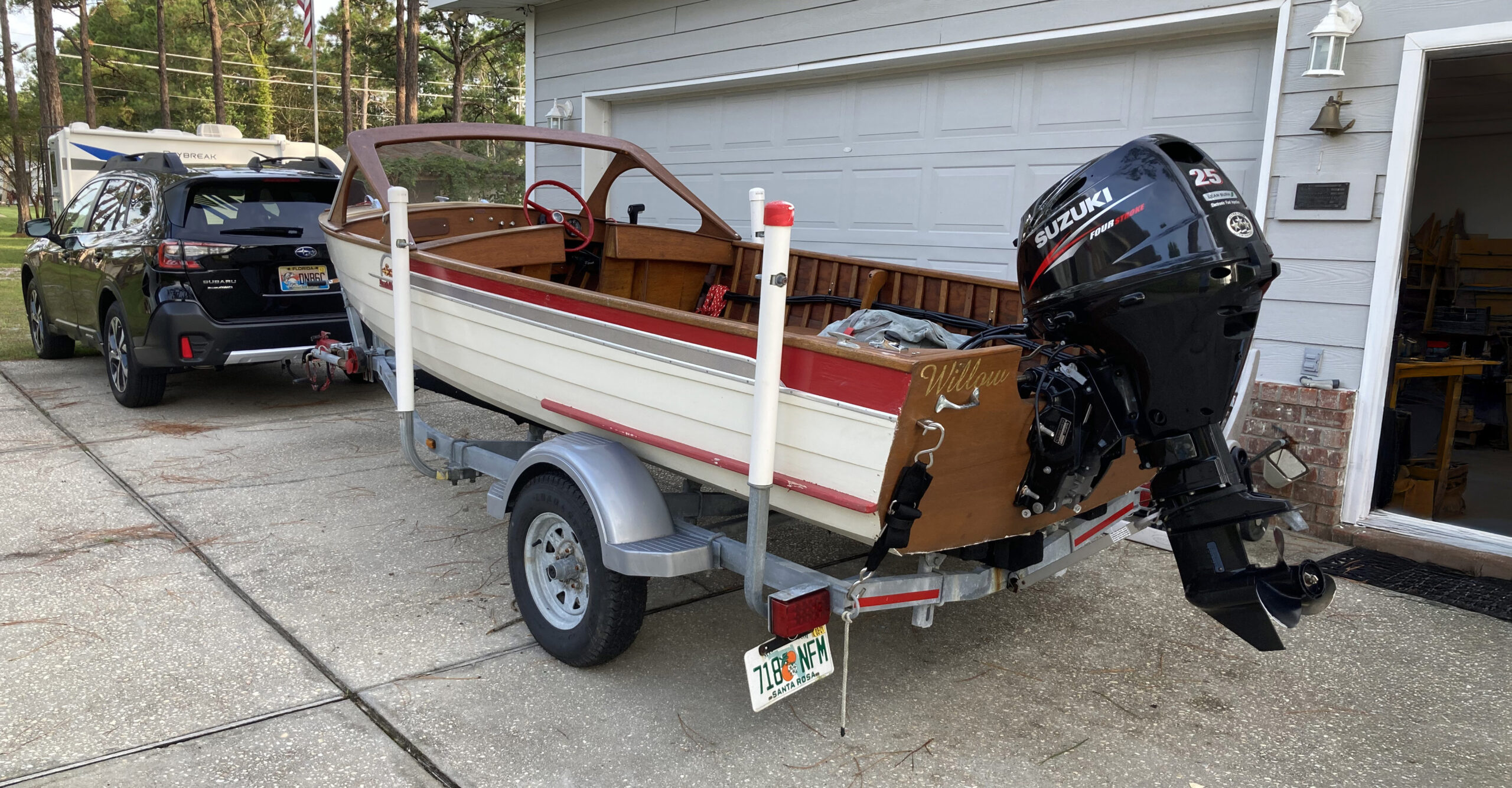
It’s a natural impulse to protect our boats when they sit idle through the winter. We may not have the same affection for the trailers they rest on, but they also need attention while they wait for spring. Their tires, especially, benefit from protection from outdoor exposure.
Photographs by the author
Any jack can lift a trailer carrying a small boat, but some jacks are not well suited to the work. A bottle jack (left) has a small base that’s prone to tipping. A floor jack (center) is more stable but doesn’t lend itself to being blocked up to get its arm within reach of the trailer, and the pivoting motion of the lifting arm makes the bearing pad prone to slipping out of place. The farm jack (right) has an exceptional range of adjustment and can quickly be set to contact a trailer frame before lifting begins. The upper clamp jaw can be removed to provide more clearance between the jack and the load.
Boat trailer tires don’t typically wear out. They don’t get anywhere near the same miles as a car or truck, and the time they spend out on the road doesn’t shorten their life, but rather, prolongs it: While on the road, a tire flexes, distributing the oils and other chemical compounds that are mixed into its rubber to keep it flexible and to protect it from ozone and ultraviolet light.
There are different degrees of protection for trailer tires. First is to get them up off the ground by elevating the trailer. Contact with moisture in pavement or soil can lead to dry rot in a tire’s rubber, and weight can create bulges in the sidewalls and flat spots in the tread.
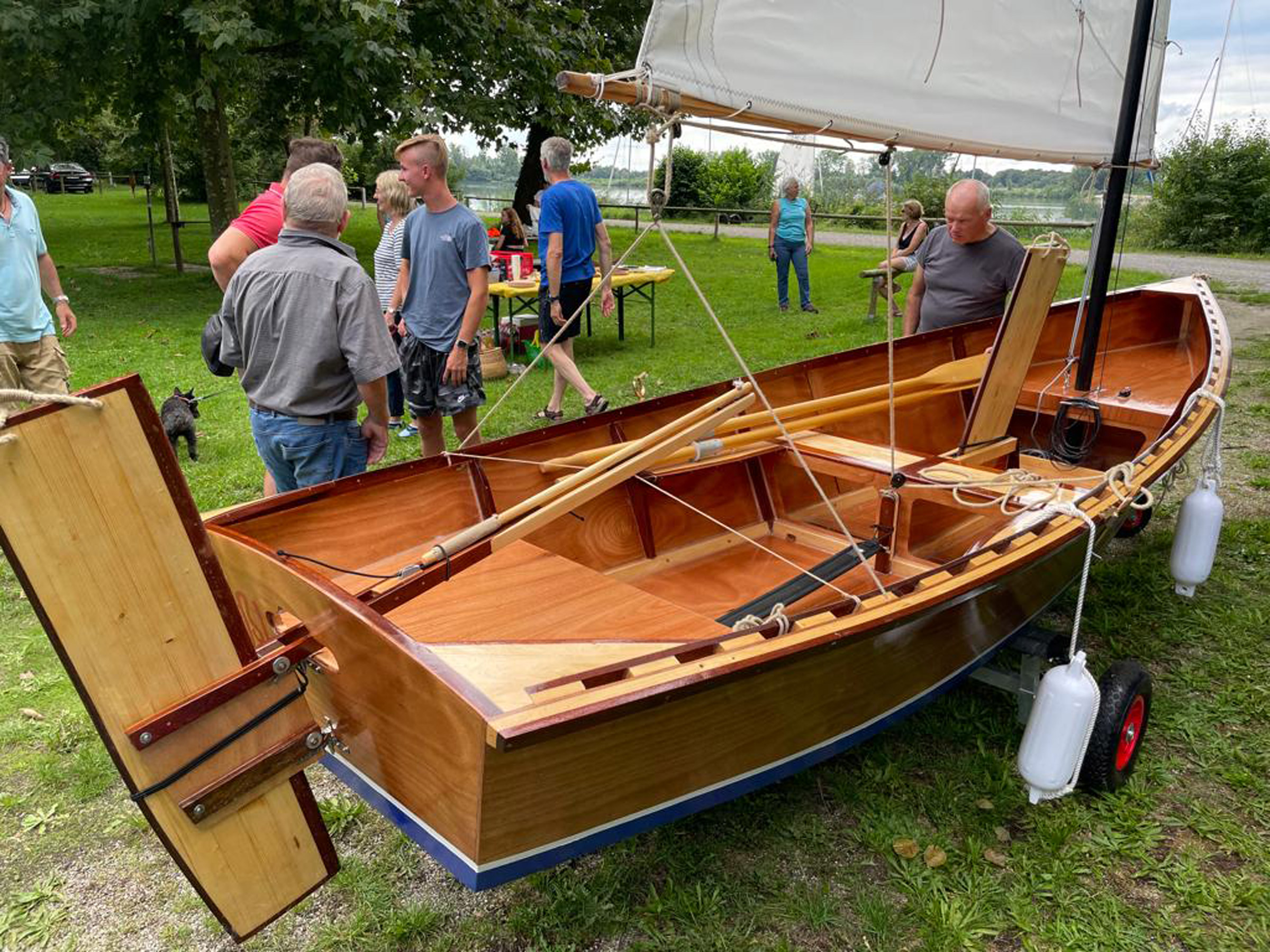
A short jackstand set under the axle can hold the tire off the ground. While the jackstand is much easier to use than a stack of cinder blocks and timbers, working while under the trailer poses an element of risk that is best avoided by using jackstands that you can set beneath the trailer frame without having to crawl under it. Note the wooden shim used to keep the stand plumb on the sloped pavement and the chocks to prevent the wheel from rolling if the trailer drops.
Lifting a loaded trailer requires a jack. I started with a hydraulic bottle jack, but it only had a 3″ lift, hardly enough to raise the frame as high as I needed—as you lift a trailer, both the leaf springs and the tires decompress, effectively lowering the tires to the ground even as you’re raising the trailer. To use the jack, I had to crawl under the trailer to set it on blocks—for extra height—under the axle. After doing the lift, a precarious job at best, I dragged an assortment of blocks beneath the axle to support it so that I could remove the jack.
If the wheel is left on the trailer, a bag can be slipped over the elevated tire. To cinch the open end of the bag over the axle, tie a bowline in a length of cord. Hold the bowline on the right side of the tire and the cord on the left, then slip the cord over and behind the wheel. Circle the bowline end 360° clockwise around the tire while holding the other end stationary, paying out cord as it wraps around the axle. Slip the cord, or a bight of it, from the left through the bowline on the right, draw tight, and secure with a couple of half hitches. The red farm jack here is a 33″ version.
I switched to a floor jack, which has a long handle so I can operate it without crawling under the trailer. It has a 10″ lift but most of that range is needed just to get up to the axle, so it was not much better than the bottle jack. The arm of the floor jack pivots as it lifts and often slipped out of place. Both jacks made the chore of lifting the trailer unpleasant and risky.
The best points for lifting my largest trailer are at its back end, but they are inaccessible in its confined parking place. I trimmed a short length of 4×4 to fit inside one of the trailer’s crossbeams to provide a lifting point with clearance for the farm jack.
A farm jack makes the job much easier, safer, and faster. They’re inexpensive and come in a range of sizes. I found that a 33″ version is more than tall enough for all my trailers. With a farm jack I can quickly slide the ratcheting runner assembly under the bottom side of the trailer frame and then pump the handle to make the lift, all without crawling under the trailer. The runner’s ratchet is reversible so the trailer can be lowered with good control. However, once the pressure is off the runner, it drops to the base. I learned to keep a hand on the jack when that happens to keep it from falling over.
Taking the wheel off the trailer is the best way to protect the tire during the winter. With the wheels and tires removed, the adjustable jackstands supporting the trailer frame can be set to their lowest position for maximum stability.
Once the trailer is raised, you need to keep it raised. In the past, my trailer has overwintered on stacks of concrete and wood, but I’ve now replaced those with ratcheting jackstands. They are rated for 2 tons and their height is adjustable. If the trailer is on soft ground, I put the stands on a plywood base for a firmer footing; on my sloped driveway, I use shims to plumb the stands. Even with this finessing, setting up the stands is much easier than piling up the old cinder blocks and lumber offcuts.
With the trailer and tires elevated, you can add further protection by covering each tire with a purpose-made plastic bag and tightly sealing its opening around the axle (and the spare’s mount). This will reduce the effects of sunlight and precipitation and again slow the evaporation of the tires’ oils and antiozonants.
After the wheels have been removed, a heavy-duty plastic bag, secured to the axle with a zip tie, protects the hub and bearing from rain and snow.
A final measure is to remove the wheels, clean and dry the tires, including the spare, and store them indoors where they can be protected from temperature fluctuations and cold. Removing the wheels also provides an opportunity to inspect the wheel bearings and repack them if necessary.
Even with indoor storage, putting each clean, dry tire in a tightly sealed bag is a good anti-aging measure to take. However, when storing inside, caution is needed: tire rubber is adversely affected by ozone, and my local tire store advises keeping the tires away from “generators, compressors, furnaces, switches, sump pumps, and central vacuum cleaners”; the list could also include woodshop power tools, as their brushed motors can create the sparks that generate ozone.
After taking them off the trailer, I wrapped each of the tires in bags and used a compact electric air pump to pull air out of the bags before tying them closed with a cord. To elevate the stack of tires I made a plywood stand of interlocking rectangles and a disc to support the wheel just inside its rim.
Bagged tires can be stacked for storage. Be sure that they are inflated to their recommended pressure. To keep the bottom tire off the cold concrete floor, I made simple plywood stands to support the tires; if you have the space, you can also use a wooden pallet.
As the next boating season approaches, I’ll be eager to get my trailered boats back on the water. The farm jack and the jackstands will ease the transition, and the well-cared-for tires will have lots of life in them and give me peace of mind on the highway.
Get your boat ready for winter storage
Keeping your boat trailer ready for spring is great practice, but you need to protect what it carries, too. From storing gear to covering your investment, follow these winter boat storage tips. A little effort now means fewer repairs and a faster launch in the spring.
Christopher Cunningham is Small Boats’ editor-at-large.
Farm jacks and jackstands are available from a wide variety of hardware and automotive retailers. I bought a 48″ jack from a local auto-parts store for $95, and the 33″ version online for $69. Jackstands, sold in pairs, cost around $30. I bought a package of eight Wheel Connect tire storage bags for $16. There are 55-gallon contractor trash bags that have the same 38″ width to fit tires with a diameter-plus-width of less than 37″.
You can share your tips and tricks of the trade with other Small Boats readers by sending us an email.
From time to time the mighty internet advertising algorithms deliver, presenting me with something I never knew existed but immediately know I must have. Somehow, a few weeks ago, those algorithms found out that in the distant past I was a surfer and that then, as now, I owned neoprene garments, which have to be dried after use. Most of those garments can be carried in a gear bag, even when damp, but booties, if simply tossed into a bag or car when just removed from your feet, will smell really foul. The odor is truly horrible, and lingers long after the offending items have been removed.
Photographs by the author
The C-Monsta is available in orange or gray. The sturdy molded plastic hanger is strong enough to support up to 55 lbs, with dedicated stands for drying gloves and booties, and a crossbar for draping larger items. At either end of the crossbar, the hook can be used to hang miscellaneous gear.
I have always been pretty careful to keep wet-and-worn booties away from my nose by leaving them in my kayak up on the roof rack or putting them into the back of the pickup truck. Once home, I rinse the booties and the rest of my neoprene gear in fresh water as soon as possible. Then there is the challenge of how to dry them out. Wetsuits need to be hung to dry, which is relatively straightforward with a clothes hanger and a washing line, although you do need a wide coat hanger to avoid distorting the shoulders. But booties and gloves need to have their openings facing down to drain and dry, otherwise they collapse in on themselves, trapping the moisture, which slows the drying…and leads to that delightful smell!
Enter the C-Monsta. Designed by a Scottish surfer and marketed to fellow surfers, the C-Monsta is an all-in-one hanger for booties, gloves, and wetsuit. When it first popped up in my internet feed I immediately thought, “paddling gear.” And, as it was modestly priced, I bought one.
It is better for neoprene wetsuits to be draped over a crossbar for drying rather than suspended by their shoulders. The bootie and glove posts not only hold the items upside down for better draining, but also prevent them from collapsing in on themselves and thereby trapping moisture inside. The hanging strap offers height adjustment and allows the hanger to twist so that it can be hung in a doorway.
When I unpacked the C-Monsta, I was impressed by the sturdy plastic—I had owned something similar decades ago, but the plastic had quickly broken down and failed. The molded projections off the top of the C-Monsta are shaped for airing and drying booties and gloves upside down, the crossbar is designed to take a draped wetsuit, and at each end of the bar is another hook for hanging miscellaneous items. The manufacturers say that the hanger can hold up to 25kg (approximately 55 lbs), and I quickly saw that I could use it to dry other bits of kit: I can hang my PFD and my kayak’s spray skirt, and those extra hooks are just right for the lanyards of a radio and a handheld GPS, or a hat. The diameter and opening of the hanger’s hook are large enough to fit over a basement cold-water pipe as well as a clothesline, and the strap between the hook and the hanger is height adjustable and allows the hanger to twist so that it can be hung from a door frame.
During paddling season, I keep a dunk tank of fresh water next to my kayak storage rack so that everything salty can go straight in and get rinsed off. Next to that is the clothesline on which, come spring, will now be my C-Monsta.
Ben Fuller, curator emeritus of the Penobscot Marine Museum in Searsport, Maine, has been messing about in small boats for a very long time. He is owned by a dozen or more boats: kayaks, canoes, a skiff, a ducker, and a sail-and-oar boat.
The C-Monsta V2 hanger is available from C-Monsta. Priced at $35 plus shipping and tax, it’s available in either gray or orange. In the U.K. there is also a limited-edition sage-green version made from recycled ocean plastic recovered from U.K. shores, priced at £40 including shipping.
Is there a product that might be useful for boatbuilding, cruising, or shore-side camping that you’d like us to review? Please email your suggestions.
Boats are the stuff that dreams are made of—sometimes of dreams recaptured, in places unexpected. Such is the case with the Sea Knight, a graceful 17′ retro cabin cruiser, a boat that Bill White claims, “anyone comfortable with basic tools can build in the space of a two-car garage.” He completed his boat in less than two years with a materials cost of approximately $6,000.
For Bill, the Sea Knight’s creation was truly a dream reborn and rebuilt. He had once owned, loved, and lost a nearly identical boat back in the ’60s: a 1956 Scottie Craft cruiser. While towing the boat on a trailer, a nasty jolt from a sneaky bad patch of roadway “hammered a trailer roller through the hull,” Bill said. She sank upon launching at a local boat ramp. This painful image would remain with him and, in 2008, become the catalyst for his looking for a way to replace her. Bill would fill the void by completing the Sea Knight, a design first featured in Popular Mechanics magazine in 1957 and now offered by Glen-L.
Chuck Black
With a 17′ length overall (LOA) and a 7′ 2″ beam, the Glen-L Sea Knight is ideal for trailering. She has plenty of freeboard and a modified 30-degree V-hull capable of high-speed planing and dealing with moderate seas. She packs in a lot in a small amount of space.
I got my first glimpse of the Sea Knight after driving inland from the South Carolina coast. Bill’s adopted hometown of Edgefield is in the middle of the state near Lake Strom Thurmond, a huge reservoir with 1,200 miles of shoreline. As I made my way to their house, Bill and his wife, Hazeline, greeted me heartily. There in the driveway sat the Sea Knight—her fresh paint glistening. A little kissing cousin to the Chris-Craft cabin cruisers of the late 1950s, she brought back memories of my own youth.
The Sea Knight has attractive ’57-vintage curves. The design buzzword of that period was “streamlining.” At the time, the nation was fascinated with the curves and fins found on rockets, and these were emulated and applied to boats as well as cars.
While Glen-L’s plans for the Sea Knight are comprehensive, not every builder will be able to attain the standard seen here. Bill is a professional restorer of vintage cars, a skill he learned from his father. His remarkable workmanship is evident in the Sea Knight’s construction and finish.
As we started to walk around her, I noticed that she has lights mounted in recessed, sealed housings on both sides that are reminiscent of car headlights from the 1950s. Bill had recycled them from another boat. I was also grabbed by the polished aluminum bow rail and chromed brass deck fittings. He had acquired these via eBay.
Bill’s finishwork throughout the Sea Knight is ultra-smooth. To achieve it he used a professional automotive paint sprayer to apply a two-part polyurethane enamel of white and light yellow in a two-tone, curved pattern. He prefers a two-part automotive polyurethane because he feels that it has the same integrity as marine enamels while being less expensive.
The light yellow finish that continues on to the deck and cabintop looks just like textured paint—but isn’t. Based on his years of experience with autos, Bill tinted a spray-on material called Raptor Liner, which is similar to a pickup truck bed liner. The result is a thin coating that appears as a painted surface, yet has incredible wear and traction characteristics.
Chuck Black
The modest cabin has 4′ 7″ of headroom. It can sleep two in comfort or provide quick refuge from a squall. Like many amenities on board, the helmsman’s chair is compact and easy to stow.
The cabin is topped with a beautiful mahogany wind-shield. The windowpanes, including those of the sliding windows on the cabinhouse sides, are of Plexiglas. Aft of each of these two windows is a Sea Knight nameplate. Bill carefully researched the proper font for the stylized letters to ensure they were appropriate to the period, then cut the nameplates from ¼″ aluminum plate. This extraordinary finishwork suggests an equally well-built hull structure and interior—and I was hungry for a look below. While Bill outfitted the boat with a lot of personal accoutrements, he stuck to the plans when building the hull.
After putting together the strongback and frame setup, he cut hull and cabin panels from 4′ × 8′ sheets of 3⁄8″ meranti marine plywood, and the bulkheads from 3⁄4″ sheets of the same material. All of the pan-els were secured to their bulkheads with stainless-steel screws and strengthened with epoxy fillets. The entire hull was then sheathed inside and out with epoxy and fiberglass for waterproofing and added strength. This results in a hull that is extremely strong and relatively light, at 700 lbs gross weight.
When it came to outfitting the interior, the plans provided good guidance but left room for Bill’s imagination. The plans call for bunks that provide room for storage below. Bill made the bunk cushions himself. Glen-L claims that it is possible to install a small head and galley stove as well, but Bill believes they would have really cramped the cabin. He decided against both appliances, but if this were my boat, I think I would add a portable stove and portapotti.
Chuck Black
The helm is decked out in period gauges, switches, signage and chrome, much of it found through Internet searches.
In the cockpit, Bill installed a chromed steering wheel, and a mahogany panel for the instruments and chromed pull switches with their engraved black-and-white labels. There’s also a chromed gear shift and throttle lever.
At the aft end of the cockpit there is plenty of storage space on each side of the motorwell for the outboard. Bill told me that the Sea Knight was capable of utilizing a range of outboards from 20 hp on up to 85; he has a selection of outboards to run on the Sea Knight. For our ride on the lake he chose a 1972 Homelite 85, which he had rebuilt himself.
Sea Knight’s arrangement plan shows a large cockpit (relative to her size) with the helm to port and a folding table to starboard and a minimal overnight cabin below. Her outboard profile is reminiscent of automobile styling from the 1950s.
Lake Strom Thurmond, where we launched Bill’s Sea Knight, is part of a waterway that runs from the northern border of South Carolina all the way south to the Savannah River, which terminates at the Atlantic Ocean at the South Carolina–Georgia border.
We launched the Sea Knight from her trailer at one of the lake’s many yacht clubs and found ourselves in a haven of runabouts and houseboats, nearly all of them fiber-glass. Viewing a wooden boat launching in these parts is a rare sight and a real treat to the locals, too.
On my test ride, the Sea Knight quickly got up on plane. The boat is capable and feels stable—even in tight turns. On a straight course at half throttle she cruised comfortably at 20 knots. At full throttle she skimmed the surface at 40. She is equipped with a 10-gallon built-in fuel tank to help her go the distance.
The Sea Knight is a success, being a stylish pocket cabin cruiser for inland waters. She is an affordable, nimble, and eye-pleasing weekender. Her plans are comprehensive, making her relatively simple to build. All in all, she’s a great craft for family adventures, or, as Bill might say, she’s “the stuff that dreams are made of.”
Plans for the Sea Knight are available from Glen-L Marine: 562–630–6258.
Check Out These Other Glen-L Boat Profiles
From powerboats like the Sea Knight to a handsome daysailer, here are a few other boats from Glen-L profiled by Small Boats.
Glen-L Utility: Classic 1950s style in a boat that’s simple to build, a joy to use
Is there a boat you’d like to know more about? Have you built one that you think other Small Boats readers would enjoy? Please email us your suggestions.
We get thirsty when we are out on the water, and have tried more than a few drinking mugs and bottles over the years. Our current favorite is RTIC’s 20-oz Road Trip Travel Mug.
We came across the mug while browsing online in The WoodenBoat Store. We were looking for something with a handle, both to hold onto and as a way to secure the mug to the boat or a bag. We ordered two. With a capacity of 20 oz, the mug seemed a good compromise between hydration needs and weight for our short trips (especially when hiking rather than boating). The mug stands 8 1⁄4″ tall and has an untapered diameter of 4 1⁄2″, which fits a standard cupholder. The handle stands out from the mug by 1 1⁄2″, is 4″ top to bottom, and the space between the mug and the inside of the handle is 1″. It is 7⁄8″ wide and the inner edges are rounded, all of which adds up to a comfortable, secure grip— even for larger hands. The outer shell is 18/8 stainless steel with a powder-coat finish. Both mug and lid are BPA-free.
We have had the mugs for a year and have used them extensively. They have consistently kept hot drinks hot through a morning sail, and cold drinks cold through a long hot day. They have stood up well, and the outside finish on each is neither chipped nor worn.
Photographs by the author
One of our two much-loved original RTIC travel mugs with the WoodenBoat logo. The rugged quality that has kept those mugs looking like new after a year of hard use is one of the reasons we decided to order new ones.
Pleased with the 2023 RTIC mugs and wanting to add to our collection, I recently decided to buy a new mug for Audrey in her favorite color and with her initials on the outside. Before ordering, we were made aware that RTIC had recently changed the internal lining of the mug from the stainless-steel of our originals to a ceramic liner, which RTIC says “prevents altered or metallic taste and smell, so drinks taste better and it’s easy to clean.” The company does caution that metallic straws and utensils should not be used as they can scrape the ceramic. Undeterred, I ordered a mug.
We were happy to find that, with the exception of the ceramic liner, the new mug is essentially the same as our beloved originals. The double-walled vacuum-sealed construction greatly reduces heat transference in either direction. We have tested the mug with both hot and cold drinks and have found that after an hour a hot drink is still too hot to drink, and in cold drinks remnants of ice cubes remain after 24 hours. Even after drinks have been standing in the mug for several hours, they have tasted good. The inside corners of the handle are less sharp than on the original, which has made an already-comfortable handle even more so. And a new silicone “coaster” base prevents the mug from sliding on a smooth surface. The powder-coat exterior of the mug resists condensation and gets neither hot nor cold to the touch.
The new RTIC travel mug is the same as the original in all essentials except for the interior, which has a ceramic liner rather than the original metal. The mug comes in a range of colors and can be personalized; for Audrey’s we chose Dusty Rose with her initials.
The translucent cap can be screwed on from two locations in the cup’s threaded circumference, so the handle and flip tab are user-friendly for both left- and right-handed drinkers. The lid’s seal is tight and, while this does mean a little effort is required to open the flip tab, we’ve detected no leaks or movement in the lid, even when we’ve filled the mug and inverted it.
The mug comes in a 16-oz or 20-oz size and in a wide range of colors—Skipper’s, seen here, is “Dusty Rose”—and RTIC offers personalization both front and back for a nominal cost. When I can decide on the color, I’ll doubtless be ordering another for myself.
Audrey and Kent Lewis stay hydrated while messing about in the Tidewater Region of Virginia. Their adventures are logged at smallboatrestoration.blogspot.com.
The RTIC Road Trip Travel Mug is available from RTIC for $16.99 (16 oz) and $19.99 (20 oz); personalization starts at $4.99. The new-style 20-oz RTIC is also available with the WoodenBoat logo from The WoodenBoat Store (the original version is available in limited colors).
Is there a product that might be useful for boatbuilding, cruising, or shore-side camping that you’d like us to review? Please email your suggestions.
The Newfound Rangeley is a strip-planked interpretation of a well-known western Maine guideboat.
The Rangeley Lakes boat, adapted for modern wood-strip construction by Newfound Woodworks, is ideal for fixed-seat recreational rowing. It moves easily through the water thanks to its slender bow and tapered stern, and its generously flared hull amidships lends great stability. The historical use of this boat was for sport fishing, where standing up in the boat was a common practice. In the decades before reliable outboard-motor power, builders of these boats developed a design that performed exceptionally well under oar power and had the stability that customers demanded. Newfound Woodworks has preserved the essential performance qualities of the original Rangeleys while allowing the 21st-century builder to achieve the smoothly rounded contours characteristic of a wood-strip boat.
The classic Rangeley Lakes boat was lapstrake planked on light bent frames. John Gardner, widely regarded as the dean of American small craft, describes the Rangeley’s history and construction in detail in his book Building Classic Small Craft. His narrative is entertaining and informative, and prospective builders who want to re-create the Rangeley Lakes boat in its lapstrake form will enjoy his chapter on the type. Historically, the construction of these boats was fairly standardized and simple. For builders unfamiliar with spiling planks for lap joints, or who just prefer the look of a wood-strip hull, Newfound’s wood-strip/epoxy adaptation offers a sound and easily maintained alternative.
Michael Vermouth was helping a friend renovate his family’s camp in the Rangeley Lakes region during the winter of 1989–90 when the pair discovered an old boat that had been left outside under snow. The bottom of the boat had been hogged by then, and advanced decay was evident. The relic was soaked through and through, and weighed about 200 lbs. However, Michael, a cedar-strip canoe builder, was intrigued by the fine lines of this boat: It had clearly been a high-quality rowing boat in its day. He wondered if it could be reproduced in wood-strip form. With the permission of his friend’s family, he hauled it back to his shop for further inspection.
Upon perusing Building Classic Small Craft and other books, Michael determined that he had the remains of a Rangeley Lakes boat. The old boat was too misshapen to have its lines taken, so Michael approached boat designer Tony Dias to adapt the offsets in Gardner’s book for wood-strip construction. He then built a wood-strip prototype of the Rangeley from those plans. It proved to be a joy to row, and Michael was convinced that this wood-strip edition would be perfect for recreational use.
Today, Michael Vermouth is the proprietor of Newfound Woodworks, which supplies plans, kits, materials, tools, and instructions for the wood-strip boat builder. The company offers plans for a variety of boats, including a nice selection of rowing craft. Several years ago, when he converted his production process from hand-cutting to CNC, Michael and his staff went back to John Gardner’s original offsets and started from scratch to create a digital file of the lines. In the process Newfound developed digital plans for a several models of Rangeley boats: a 15-footer, a 16 1⁄2-footer, and a 17-footer. Most have a transom stern, but a double-ender is available. The 17′ model is 2″ wider than the 15′ and 16 1⁄2′ models—which are each 46″ in beam. Aside from being refaired (checked for accuracy and corrected as needed), Newfound’s Rangeley lines are faithful to those found in Gardner’s book.
The Newfound Woodworks
Newfound Woodworks offers its Rangeleys in three lengths: 15′, 16′ 6″, and 17′. The company also offers a 17′ double-ender.
Building a Newfound Rangeley Boat
Newfound offers a variety of options to those desiring a Rangeley Boat—or any of its fleet of small craft. You can simply purchase the plans ($110), and build from scratch; you can purchase the CNC-cut molds ($250) and mill your own strips, and buy your own fiberglass, epoxy, and hardware; or you can purchase a complete kit ($2,695) containing everything you need.
Twenty years ago, when I began working on my first boat, I was a rather tentative builder. I was quickly hooked, though, and continued building wood-strip canoes, trying a different design with each new project. Eventually, I began displaying my work at shows and woodcraft demonstrations. Back then, there were few strip-built rowboats at the events I attended. I wondered about their absence, because it was obvious to me that this method of construction would be suitable for just about any small, lightweight craft. Later on, when a couple of wood-strip rowboat plans appeared on the market, I noticed the shapely lines of the Rangeley Lakes boat. Thinking that this was an especially pretty boat, I contacted Michael at The Newfound Wood- works, and settled on the 15′ model.
I started building my Rangeley Lakes boat in October 2004, and completed it, except for the last coats of varnish, a year later. I named my boat CRYSTAL EMBER for the way she glows on the water in low-angle light. A pair of 7 1⁄2′ spruce oars from Shaw & Tenney finished her off perfectly.
Although some folks are able to build strip boats in a couple of months, mine took longer because I worked intermittently on the project. I used CNC-cut stations from Newfound Woodworks. They came with clamping grooves milled into the edges, which eliminated the need for blemish-inducing staples. For those who plan to paint their strip boat, I recommend stapling because it is a much faster way to assemble the hull over the mold.
I sawed my own strips from salvaged wood. About two-thirds of the strips were cut from cedar tongue-and-groove siding salvaged from a building in Olympia, Washington. About one-third of the strips were cut from a cedar log found drifting in the Columbia River. I made feature strips for the hull sides using cedar scraps left over from earlier boat projects. CRYSTAL EMBER’s transom is built of marine plywood sandwiched between 1⁄4″-thick pieces of cherry. The outwales are ash, which is renowned for its strength and abrasion resistance. I chose cherry for the inwales, deck, quarter knees, and oarlock blocks. The seats and seat risers are of Douglas-fir.
.
The hull is sheathed in 6-oz fiberglass cloth, which is standard for a boat of this size. Two lengths of cloth were overlapped by 6″ on each side of the flat plank on the bottom of the hull, inside and out. This provides greater strength where it is most needed. The decorative feature strips on the hull of my boat have a band of 4-oz fiberglass cloth bonded to the inside surface for reinforcement.
Rangeley boats are fast, responsive, and stable; thus they are well suited to pleasure rowing. They can handle choppy water, and in fact are appreciated on their native lakes for safely negotiating storm-tossed waters when unanticipated weather rolls in. I am very impressed with my Rangeley Lakes boat, and although I originally thought I might enjoy the boat for a while and then maybe offer it for sale, I would have a very difficult time letting such a fine boat go.
Although the 15′ Rangeley is a fairly small, light boat, it is too broad-beamed for most people to load by hand onto the top of a vehicle without risking injury to the boat or themselves. I transport mine using a lightweight aluminum trailer or a boat cart. Also, despite the design’s flat transom, the fine stern that contributes so much to the excellent rowing qualities of the boat make it unsuitable for supporting a lot of weight back there. The transom can accept a lightweight motor; I would recommend a small electric one, with a long tiller that allows the operator to sit on the middle seat. If too much weight is moved into the boat’s fine bow, the Rangeley may capsize. Finally, it would be good to see foot braces added as an optional feature in the plans for the Rangeley, as braces really improve the oarsman’s ability to apply power.
The outstanding performance and beauty of Newfound’s Rangeley boat has reaffirmed the place of this design as the quintessential sportfishing and pleasure-rowing boat. With Newfound’s support in the form of detailed building instructions (including videos) for the amateur builder, as well as materials and tools, the Rangeley design should have great appeal to a strip-boat builder in search of a fine rowboat.
FOPA: A Reader Built Rangeley
Need some inspiration before building your own Newfound Rangeley boat? Read about FOPA, a Rangeley lake boat built by one of our readers.
Order plans for the Newfound Rangeley from Newfound Woodworks, Inc., 67 Danforth Brook Rd., Bristol, NH 03222; 603–744–6872.
Is there a boat you’d like to know more about? Have you built one that you think other Small Boats readers would enjoy? Please email us your suggestions.
In 1960, John Conrad of Sacramento, California, built an 8′ Paddle Wheel Boat from plans published in Mechanix Illustrated. The boat was described as “a barrel of fun for the kids and you can build it for less than $35.” He built it for his grandchildren, and they used it for many years on lakes and rivers around the Sacramento area. One of those grandchildren, Davi Rodrigues, who has just turned 70, held on to the memories of that boat and all the outings he and his siblings, cousins, and friends enjoyed in it, and “always missed it.”
The magazine that started it all: Davi’s grandfather, John Conrad, used this March 1960 issue of Mechanix Illustrated to build the family’s original Paddle Wheel Boat. Six decades later, Davi referred to the same magazine when he built his updated version, GUAM ROSE.
John Conrad died in 2002 at the age of 100. “My siblings and I owed him and my grandmother a lot. They were very stable, and full of old-world knowledge, which they taught us. I traveled a lot with them, hunting, fishing, and foraging in several western states, British Columbia, the Yukon, and Alaska. I learned woodworking from him, and other crafting from her.” Among his grandfather’s belongings Davi found the original plans for the Paddle Wheel Boat. “They were drawn up by Hal Kelly, who has several old boat plans floating around the internet, but the paddle-wheeler isn’t among them, so I’m happy my grandfather kept a lot of things.” Davi held on to the plans and 20 years later decided to build his own paddle-wheel boat.
Davi is not a boatbuilder, but he is a woodworker and a maker. “I’m always building things. The past few years it’s been sheds—three for us and one for each of our two kids. I also built a lot of planters. I try to use space carefully, so some of the planters are built up off the ground and we use the space below to store firewood. One planter is 8′ high built on top of a compost bin. Water from the planter drains down to keep the compost moist.” He also mills much of his own wood and stores planks for later use. Recently he built a solar kiln to speed up the wood seasoning.
Photographs by Davi Rodrigues
The two side panels and the center frame have the same dimensions and bottom curve. Davi was able to clamp them together and plane all three at the same time.
For Davi, the paddle-wheel boat was a straightforward project. It is, essentially, a shallow rectangular box with a rockered bottom, a center longitudinal frame that adds strength and supports the crankshaft for the wheels, and two seat platforms, one at either end. “It’s 8′ long by 4′ wide, and I built it of okoume plywood on pine.” The hull is 11 1⁄2″ deep amidship, decreasing to 7″ in the ends. The original plans called for the side panels and framing to be of 3⁄4″ cedar, spruce, or mahogany, and the bottom panel to be a single 8′ × 4′ sheet of 1⁄4″ exterior plywood. “I used 3⁄8″ exterior plywood salvaged from an old walk-in box refrigerator for the paddle-wheel faces, and the seat platforms where I also added two low-cost stadium seats. For the side panels, frames, and paddle scoops I used 15⁄16″ yellow pine that I’d milled from a tree that was felled in front of a neighbor’s property, and for the paddle-wheel center gussets that house the crankshaft, I used some oak that I’d milled from a tree that came down in a recent windstorm on another neighbor’s property. I did buy a single sheet of ¼″ okoume plywood for the bottom…it was one of the few things in the project that I bought new.”
The sides and ends come together in right-angled joints, which Davi epoxied and through-fasted with marine-grade bronze screws.
The connection with Davi’s grandfather didn’t stop with the plans. “I used several tools that my grandfather had used when he built the first one: his old router, his tablesaw dado stack, his antique hand planes, and his ancient stick welder. I also used my own Shopsmith, which is an extremely versatile piece of equipment, especially if you’re strapped for space. Reviewing the pictures in Mechanix Illustrated, it looks like that’s what was used in Hal Kelly’s shop when he wrote the article.”
Davi fashioned the cranks from ½” black iron pipe, threaded together and welded at the joints. He cut the pedals from some scrap polypropylene cutting board, drilled through to accept the crankshaft, and then drilled grease holes so that he can keep the pedals well-lubricated and rotating smoothly.
Davi didn’t exactly replicate his grandfather’s boat. The original version, as designed by Kelly, included hand-cranked paddles—ideal for accommodating crew of varying ages and sizes—but Davi decided he wanted pedaled propulsion. “I’m much older now, and appreciate the upright, slightly reclined, position for leisurely cruising as opposed to being bent over for the trip.” He built the crankshafts of 1⁄2″ black-iron pipe assembled with 1⁄2″ elbow joints welded at the threads. Through the wheel hubs and center gussets he fit 3⁄4″ pipe into which the 1⁄2″ crankshaft would slide, to be held in place by a keeper pin. “I wanted the wheels to be easily removed and installed—you don’t want to be fidgeting with hardware while you’re standing on rocks or in mud surrounded by other boaters wanting access to the ramp.” However, the external and internal diameters of the two pipes didn’t quite fit, and he had to sand the interior face of the larger pipe to get them to slide into one another. He fashioned the foot pedals out of “some scrap white polypropylene cutting board material with tiny holes drilled through for applying grease, and some scrap angle iron for the crank’s mounting hardware.”
Having changed the propulsion system from hand to pedal cranks, Davi also added some inexpensive stadium seats for the operators.
Finally, he fashioned a simple helm, using more 1⁄2″ pipe for the tiller and scrap pine and metal for the rudder. “The paddle cranks can work together or independently (by removing the keeper pin that connects them) so you can steer by pedaling both wheels separately, but if there’s only one person aboard, you can work with one wheel and the rudder.”
Davi applied two coats of epoxy to the hull, and after construction was completed, he finished everything with two coats of marine topside paint.
The carrying handles—two on each end—are featured in the original design and greatly assist when moving the boat around on land. For transporting the boat in his pickup, Davi takes the paddle wheels off by removing the locking pins that hold them in place on the crankshaft.
The build took Davi a while, but only because, he says, “I worked on it sporadically, as time permitted. Sometimes it would go fast, other times I just did a little cutting and stopped.” But by the end of June 2024, the boat was ready to go. Davi had decided on the name, GUAM ROSE. “My wife, Elaine, is Chamorro, a native of the Northern Marianas Islands, in particular Guam. She’s tolerated my boat habits since we met in 1984. I remember her tucked below in the cabin of our 18′ sailboat with our firstborn son, then aged two, pounding to weather in a blow in Tomales Bay. GUAM ROSE (I got the name from the rice Elaine likes) seemed to fit the current need for a relaxing boat outing in comfort. She likes it.”
Elaine Rodrigues
For a touch of glamor and to provide some shade for the pedalers, Davi—seen here sporting his grandfather’s cap—installed a flagpole holder for an umbrella. He also made a rudder out of some scrap pine, and a simple tiller out of ½” black iron pipe.
Together, Davi and Elaine took GUAM ROSE to Lake Natoma, east of Sacramento, for the grand launching. “We chose it because there’s a 5-mph speed limit so it’s quiet. We loaded the boat into the back of the pickup [Davi estimates the boat weighs around 100 lbs or less and that the paddles, which are disconnected for transportation, add another 20 lbs], and offloaded it with no fuss. We were underway in minutes and were soon paddling effortlessly across the lake. The alteration from hand to foot propulsion did change the weight distribution slightly as you have a tendency to lean back when pedaling, but I’m in the process of making new seats, which will help with that.”
On their first outing, Davi and Elaine sat back and enjoyed the ride. “Many people took an interest, asked questions, gave compliments, and we even had a lot of thumbs-up from passers-by in kayaks or on paddleboards.” And Davi brought his grandfather’s memory along with them: “I wore his ancient captain’s cap, as he always did when he was piloting his boats.”
Jenny Bennett is editor of Small Boats.
Do you have a boat with an interesting story? Please email us. We’d like to hear about it and share it with other Small Boats readers.
Continue Reading - Enter your email to log in or subscribe
New to Small Boats? Create a free account to get our weekly emails and two free articles each month.
Time to upgrade!
You've read all of your free content for the month. Upgrade to a paid subscription for unlimited access.