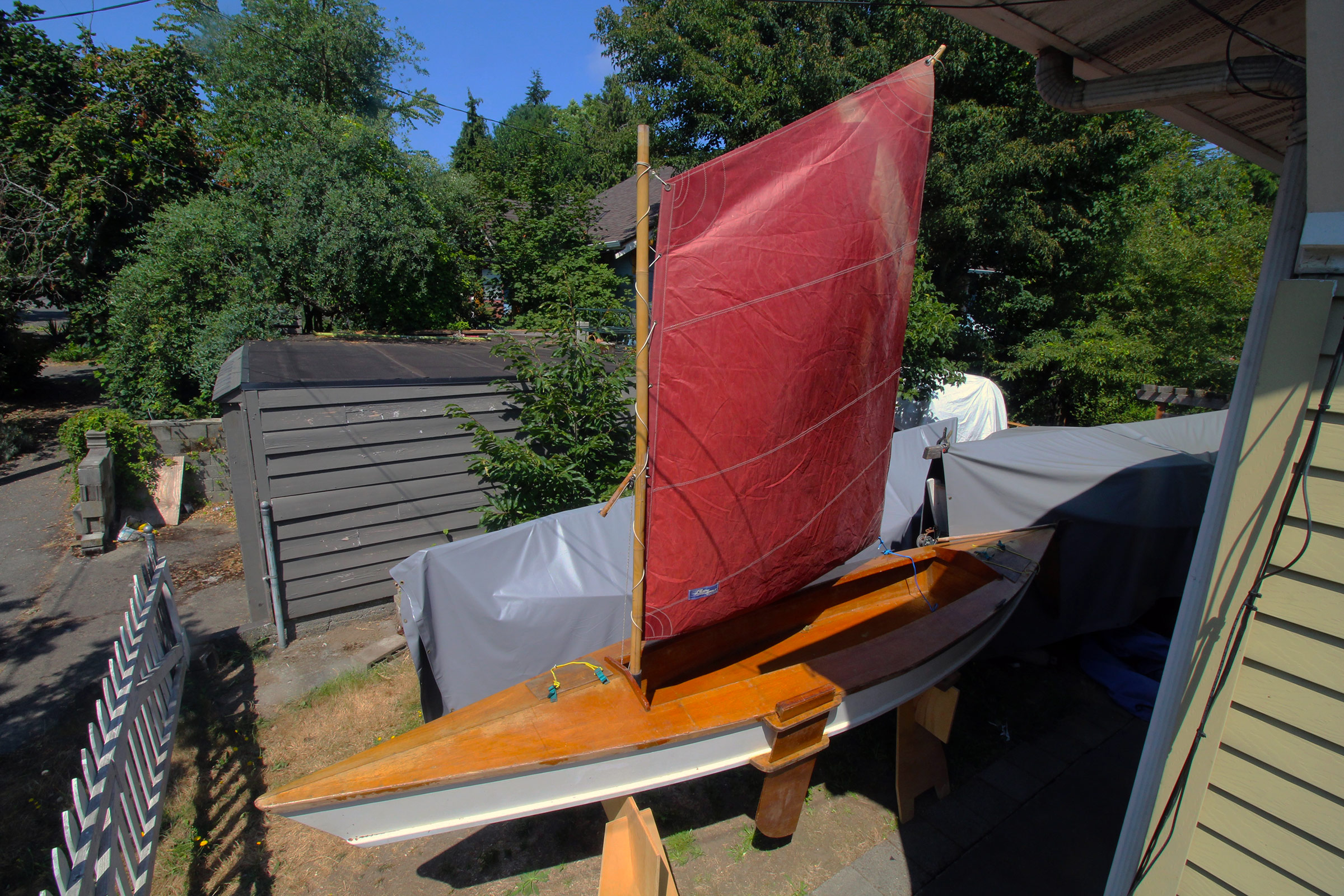
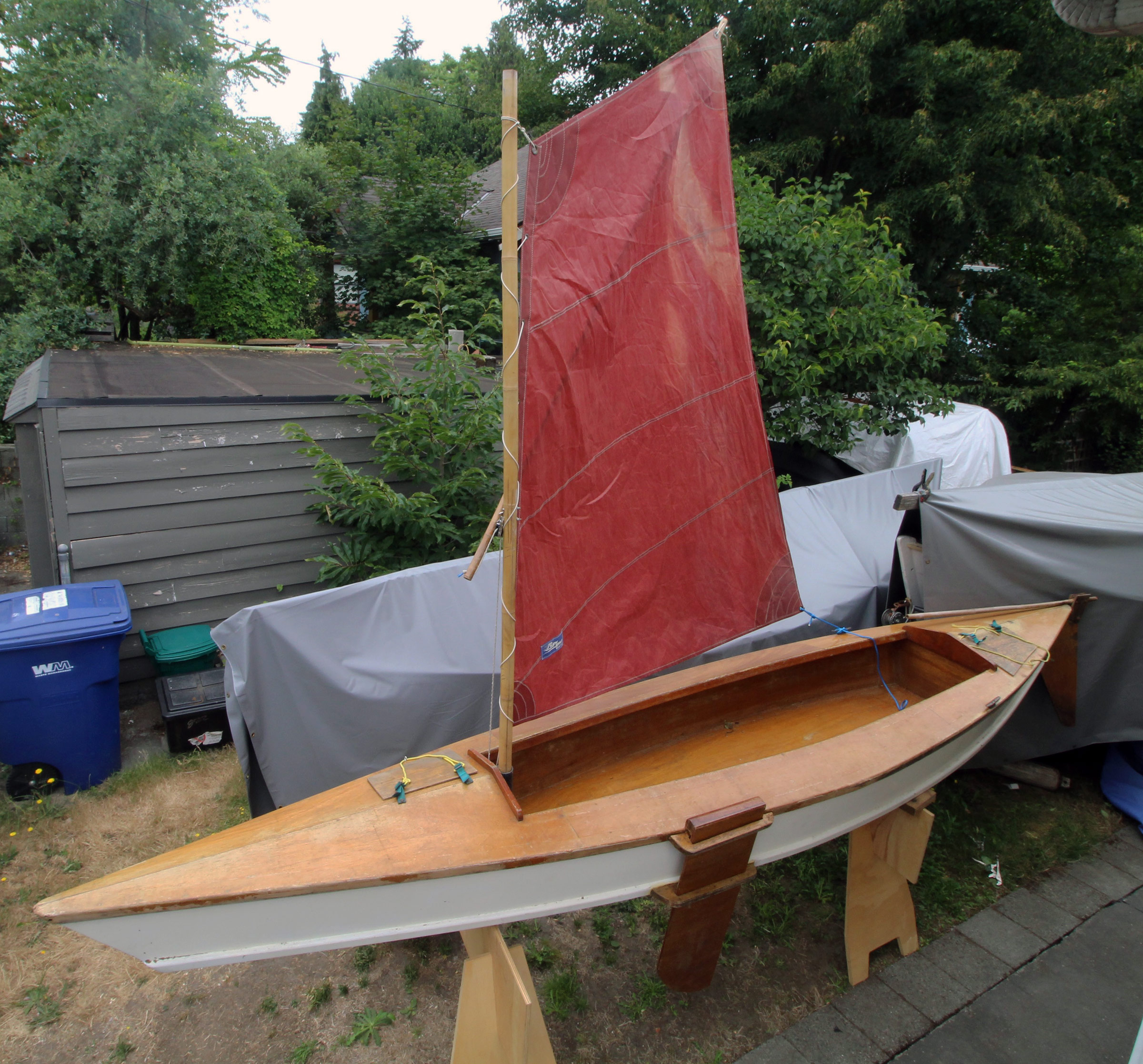
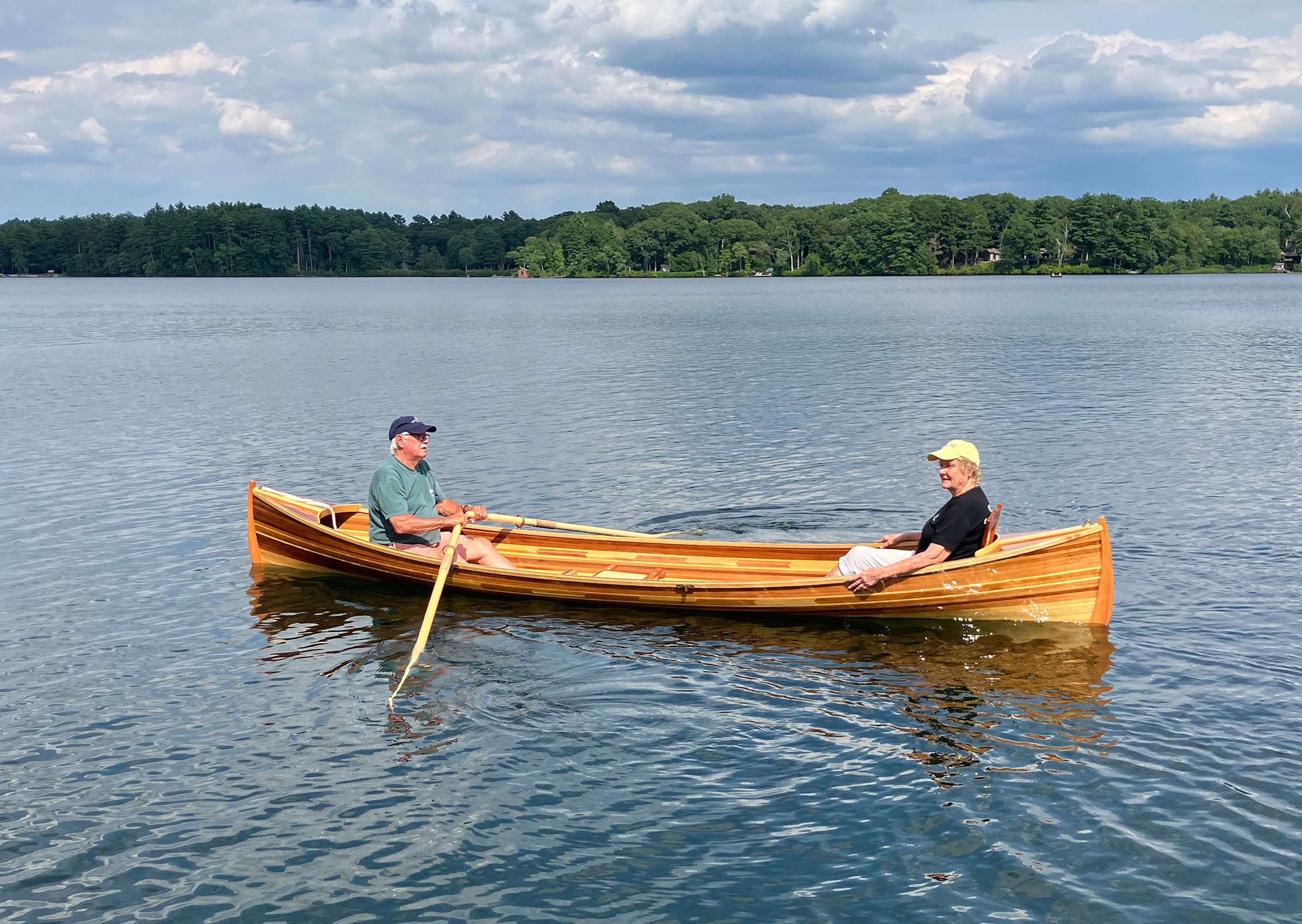
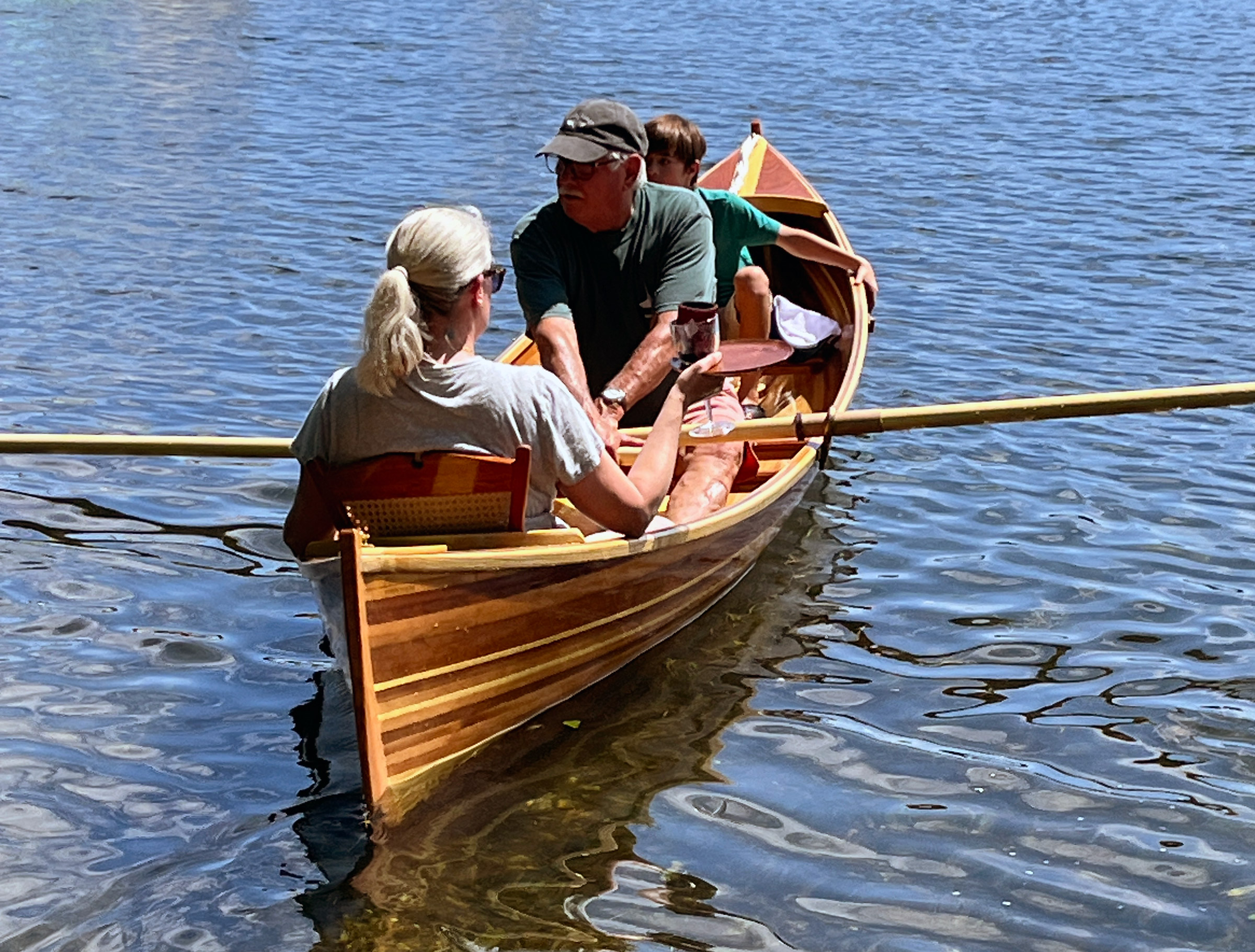
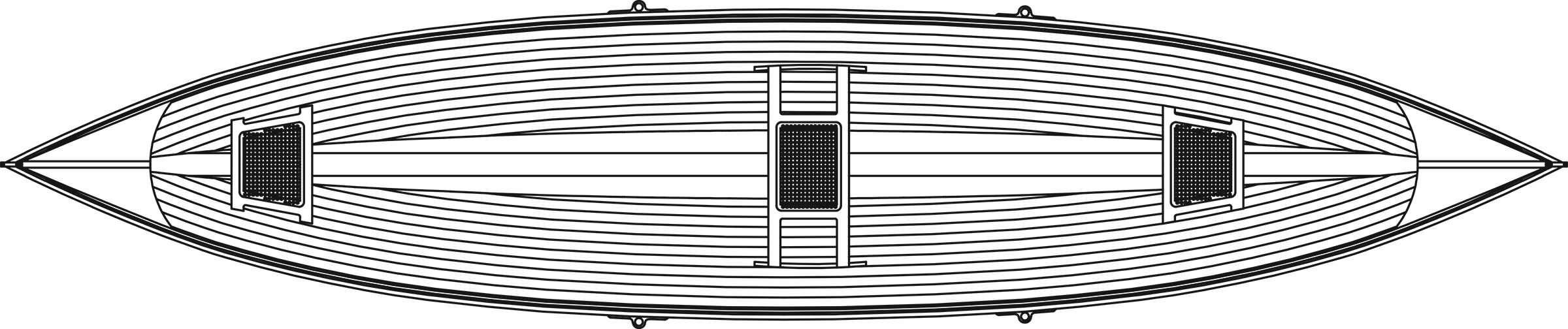
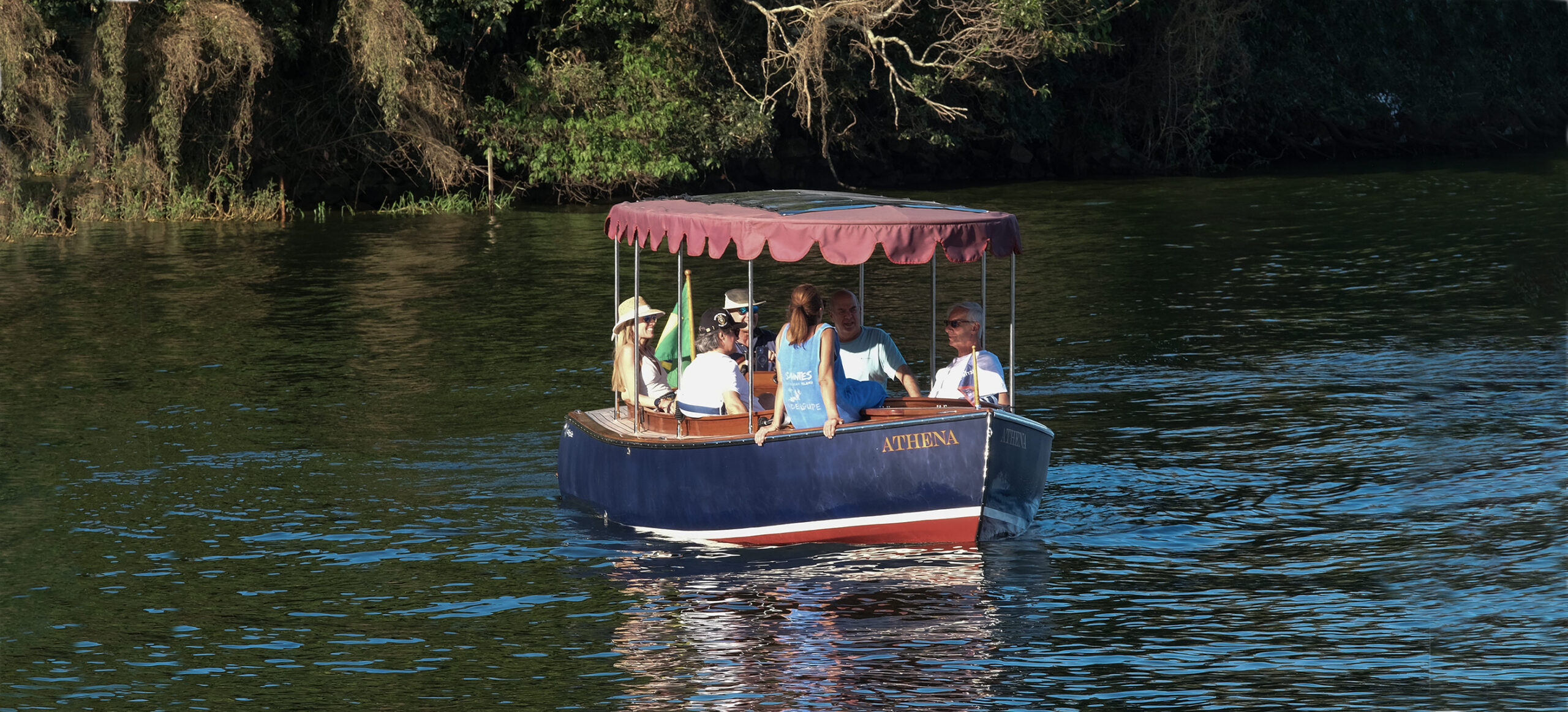
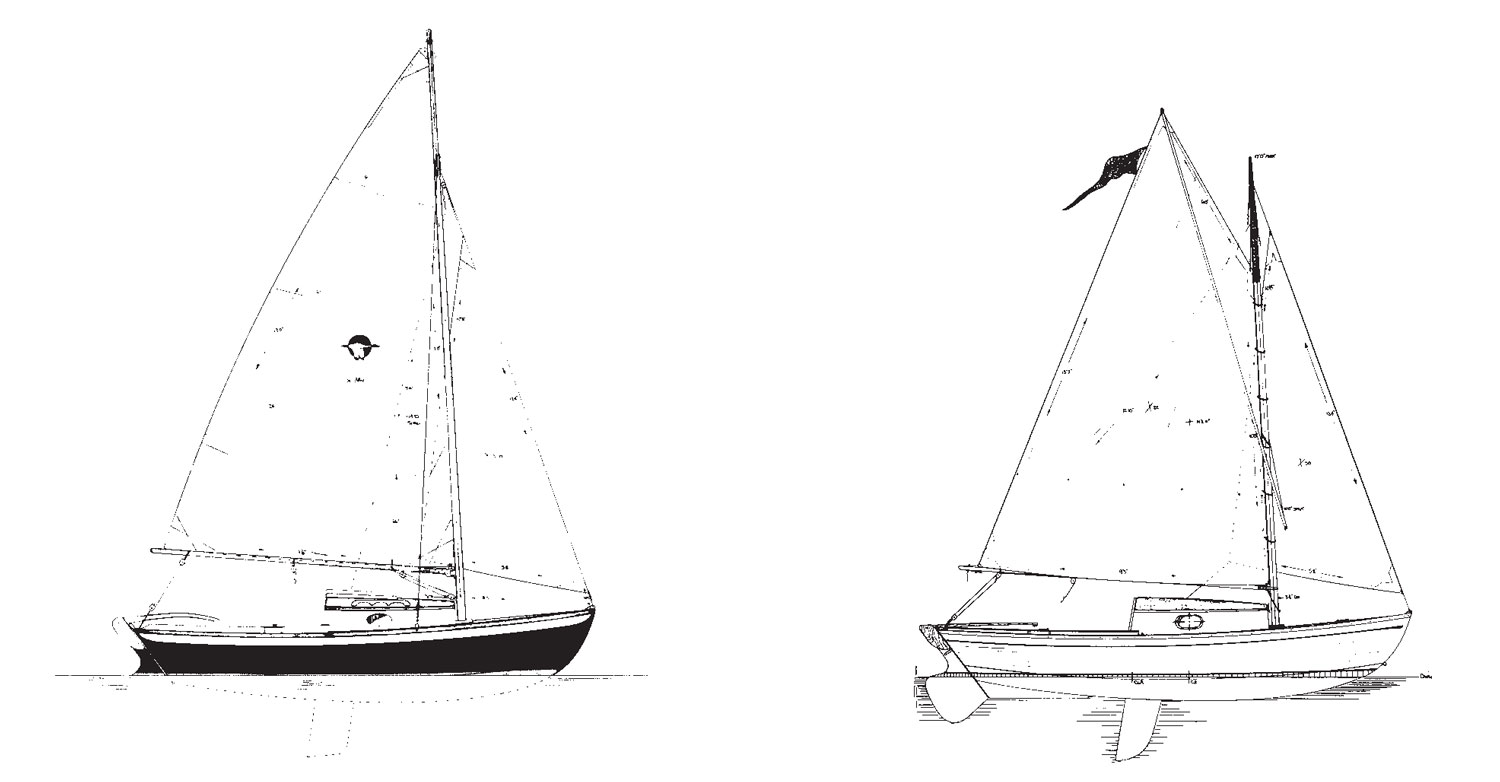
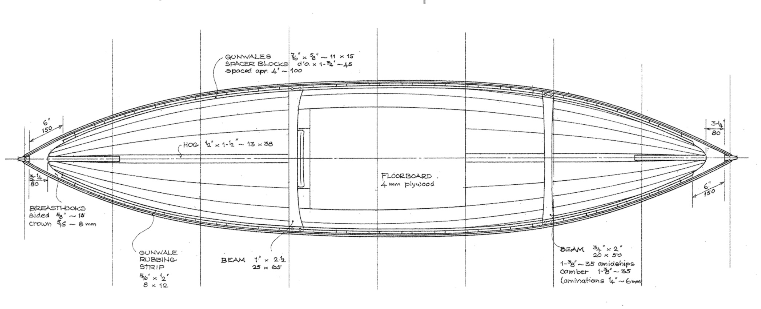
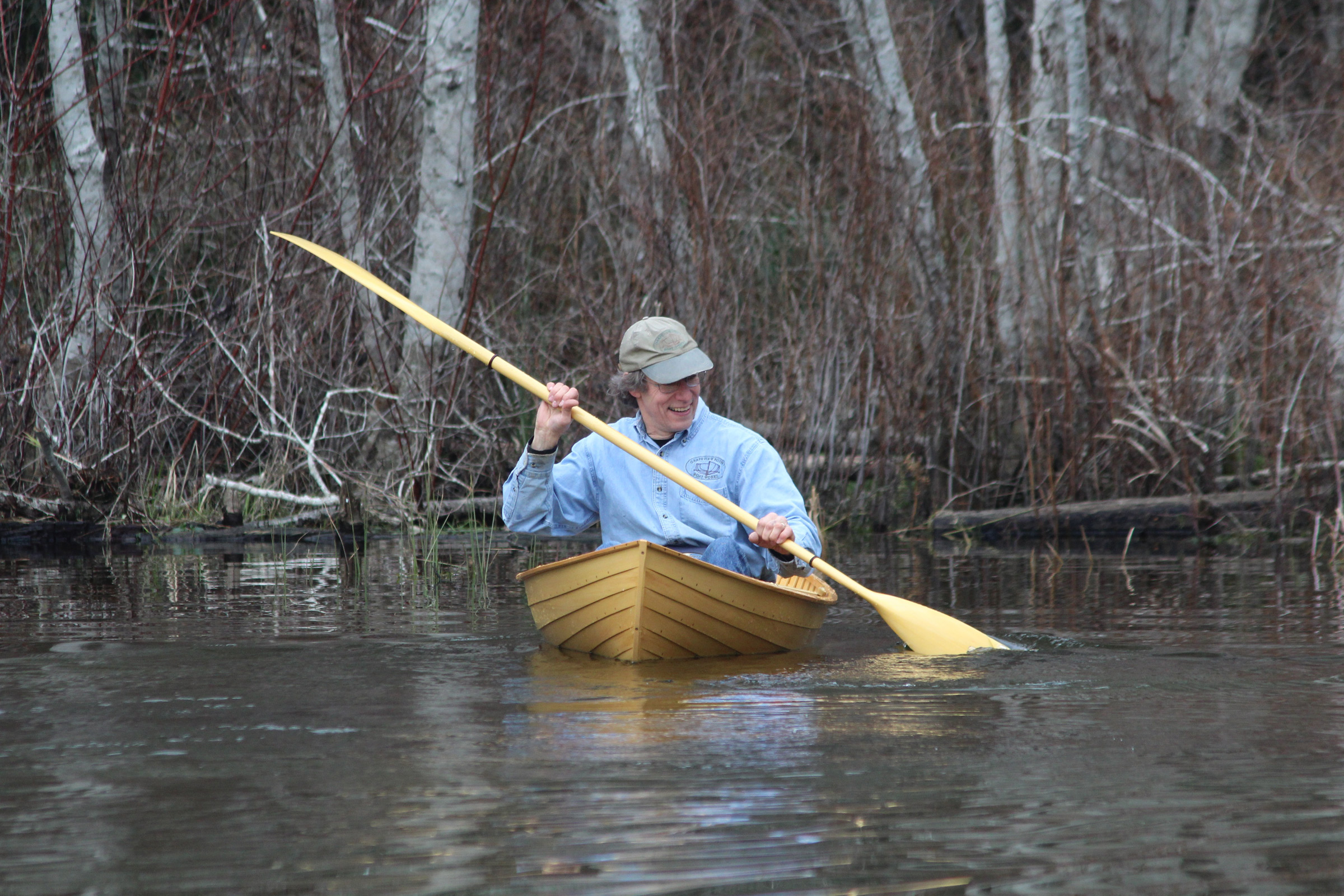
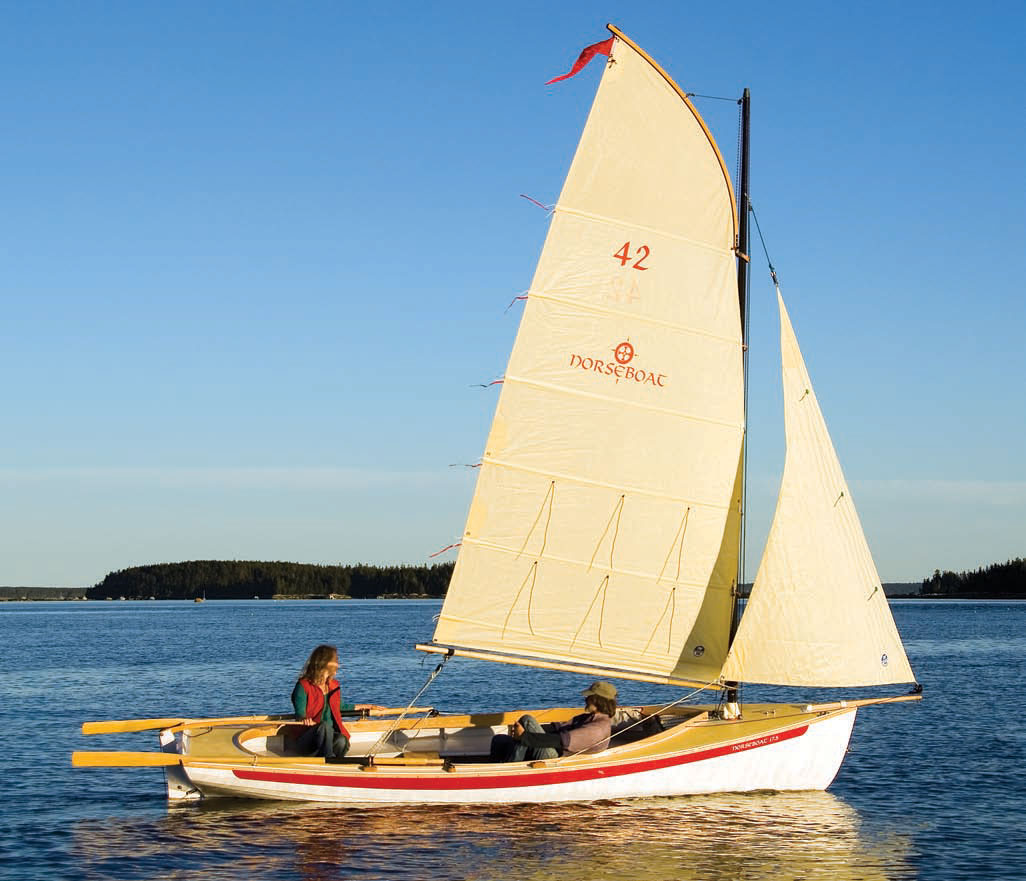
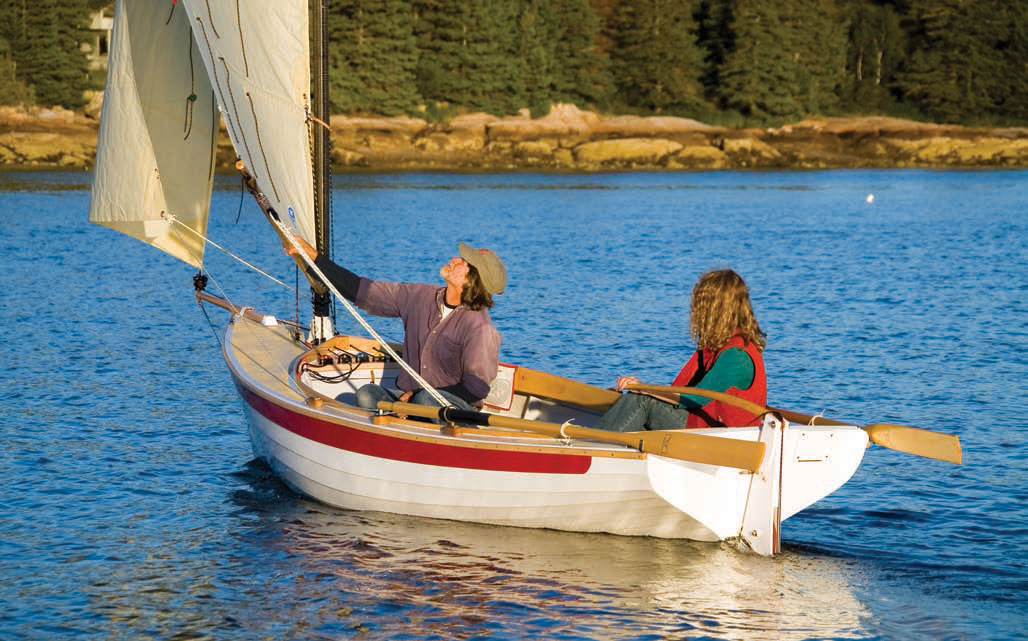
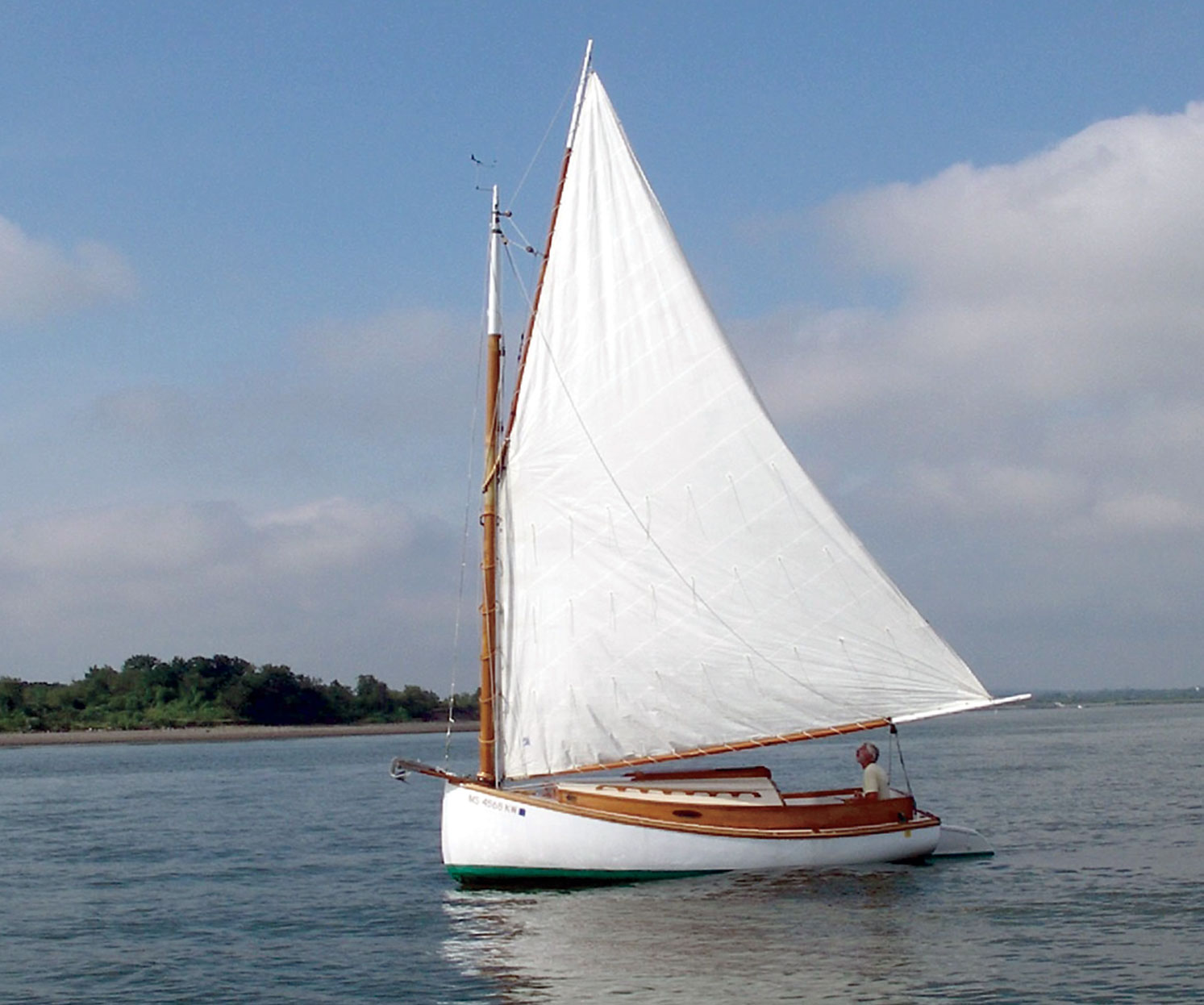
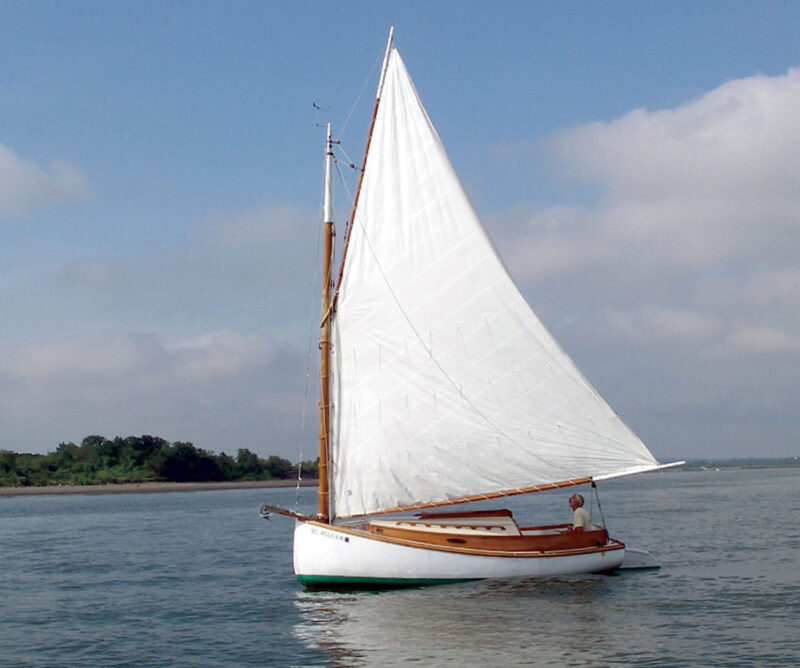
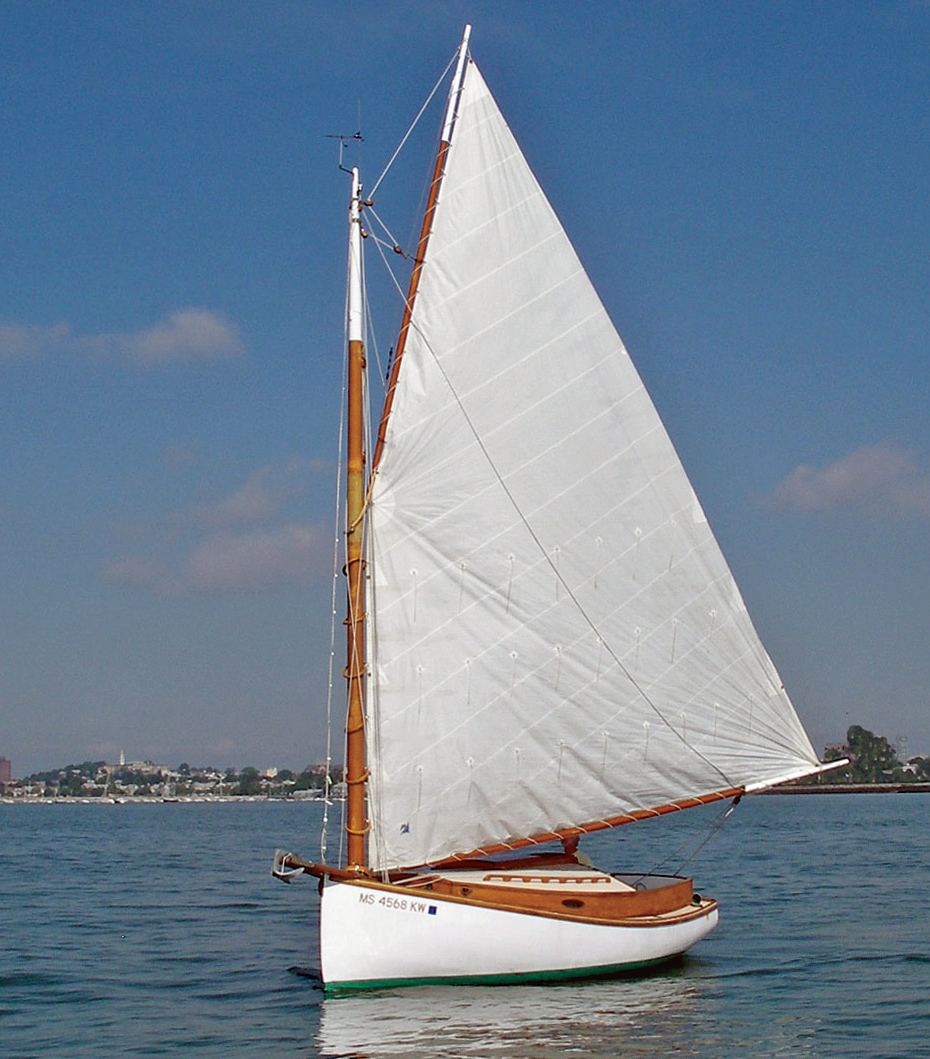
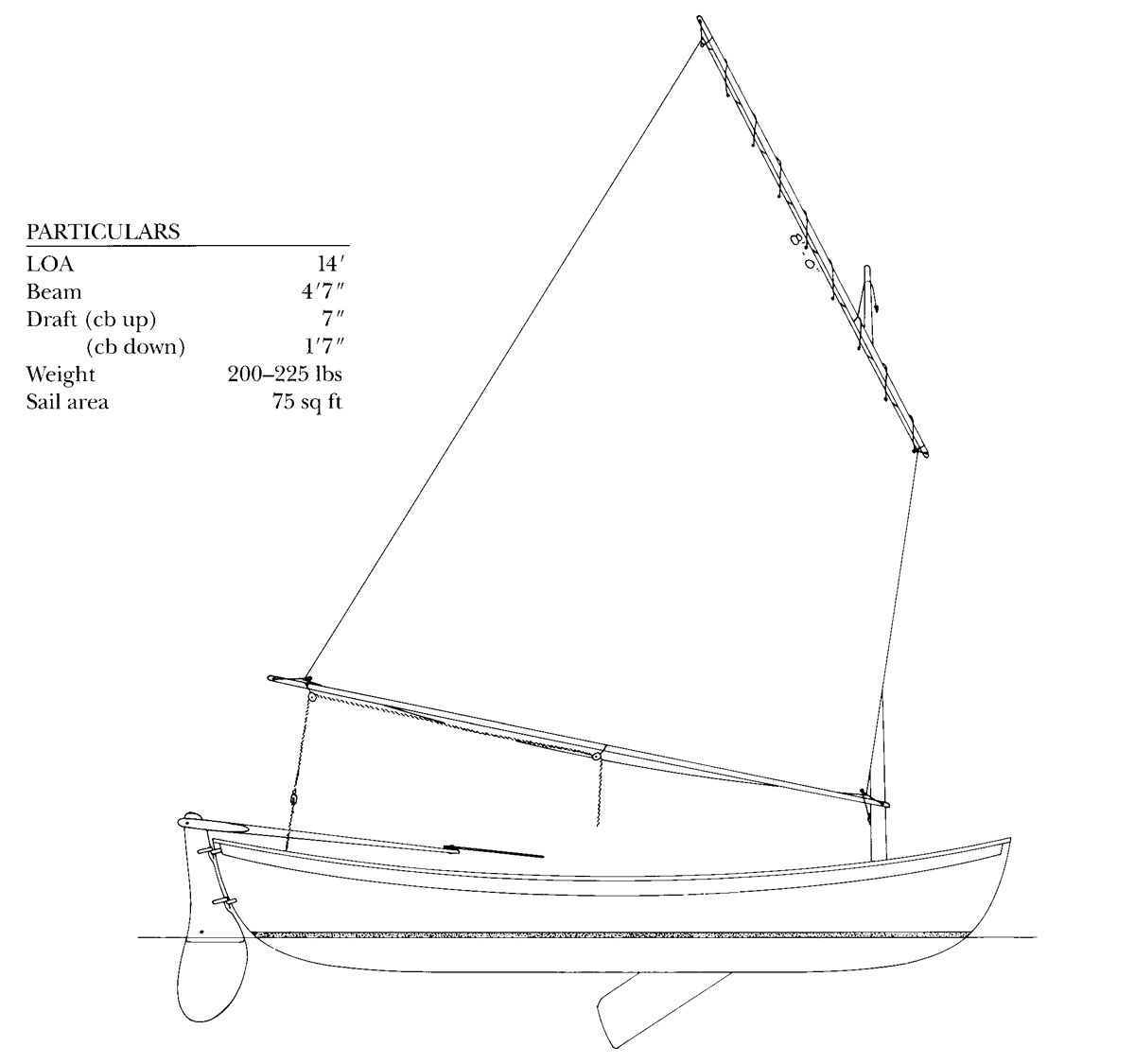
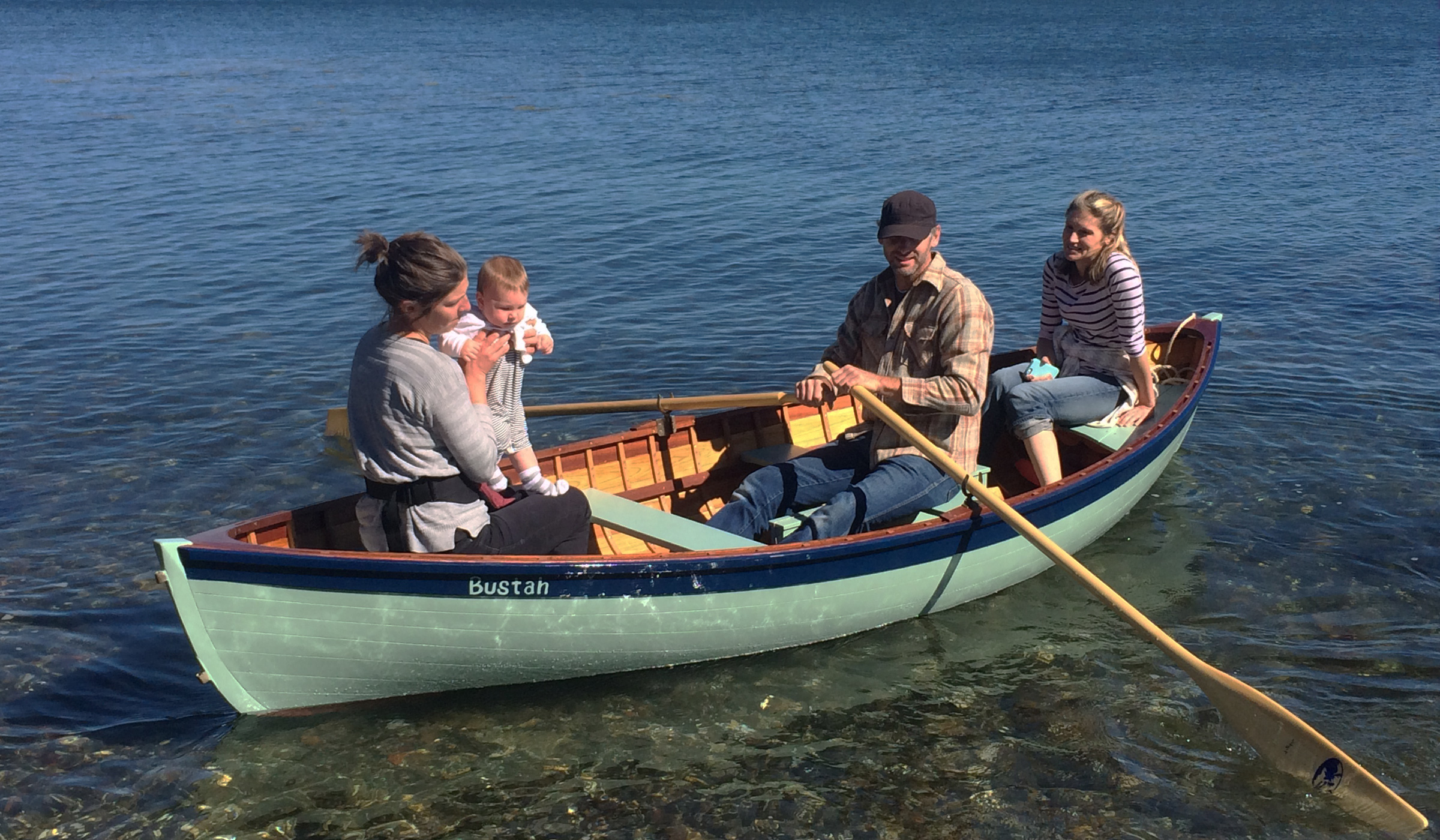
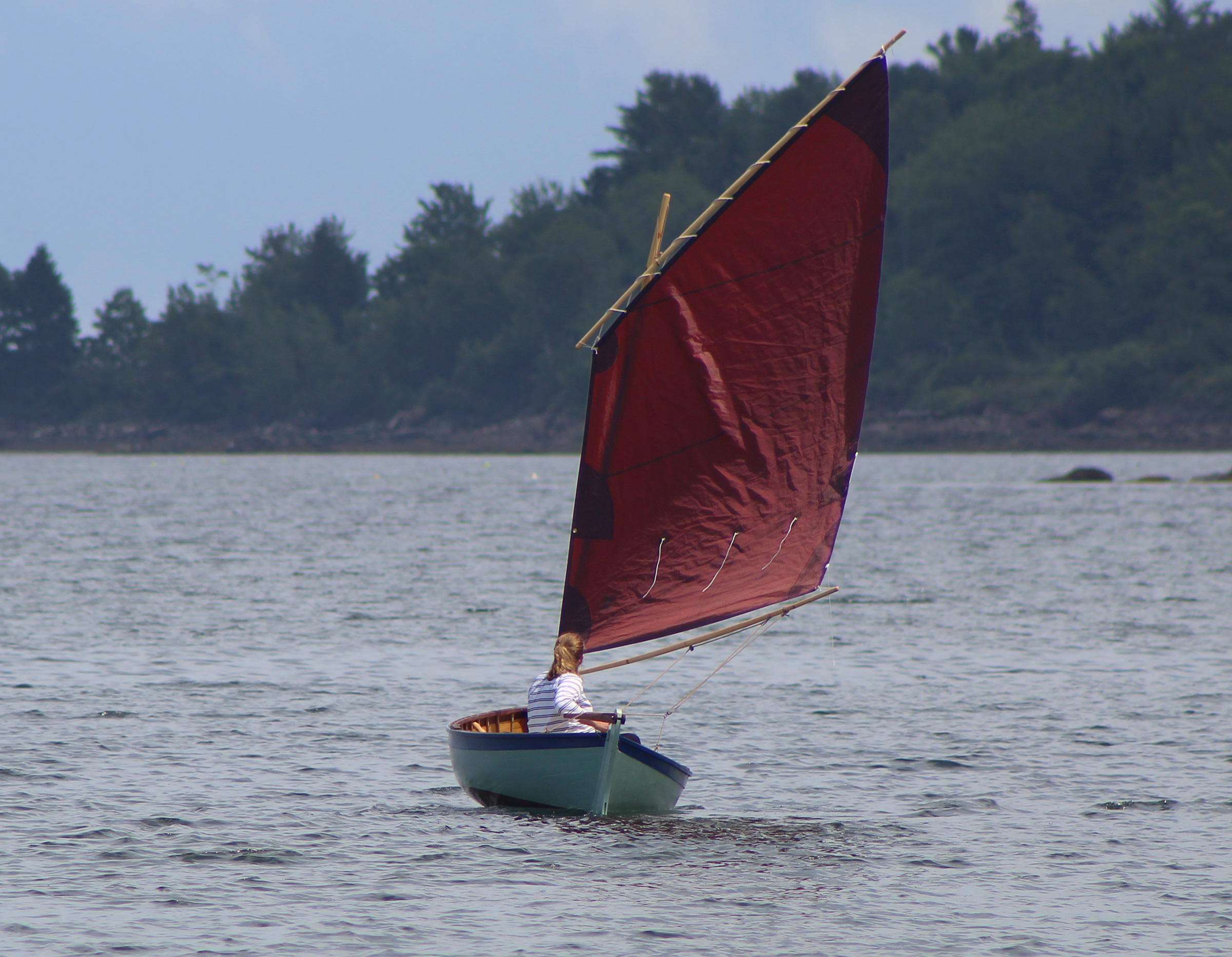
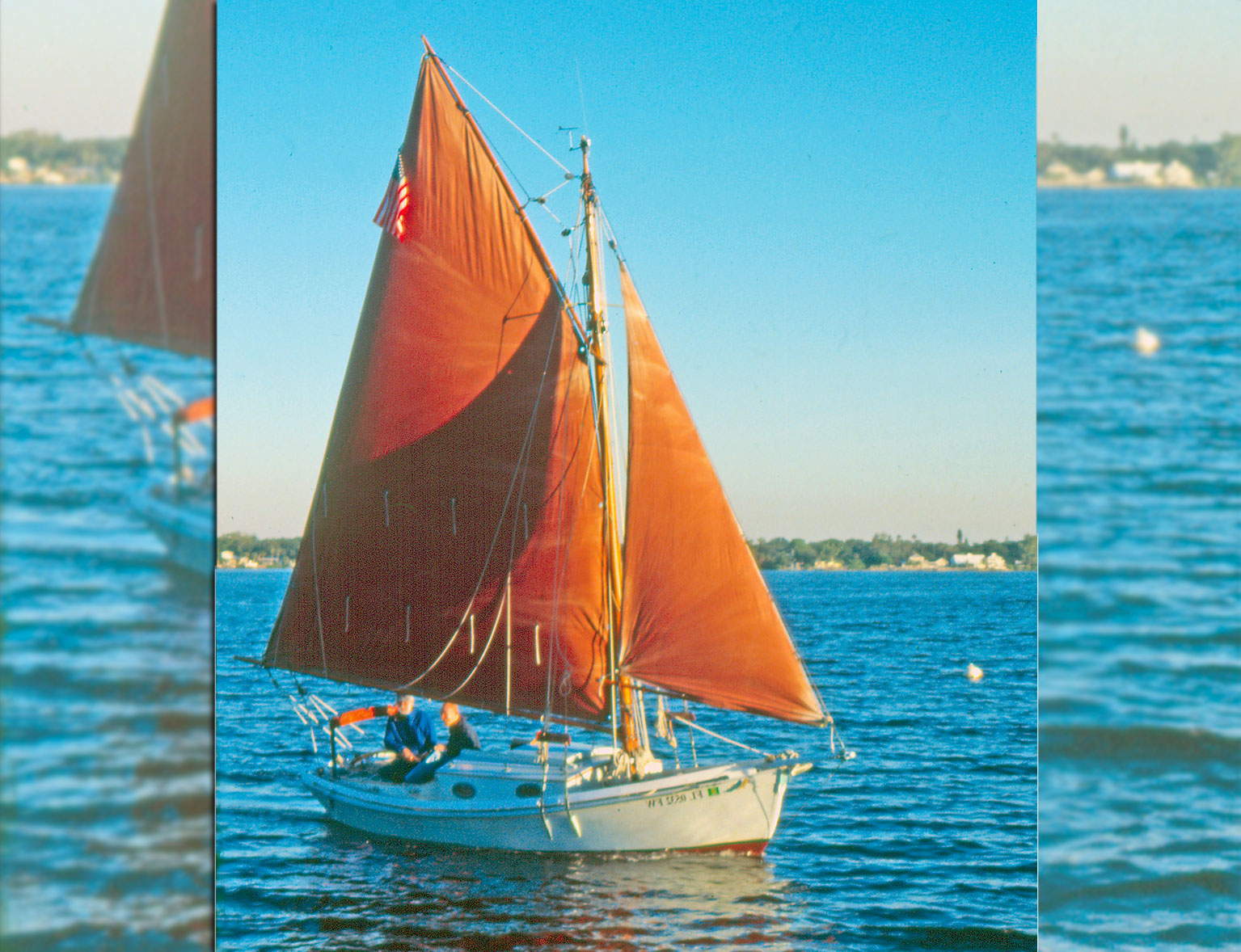
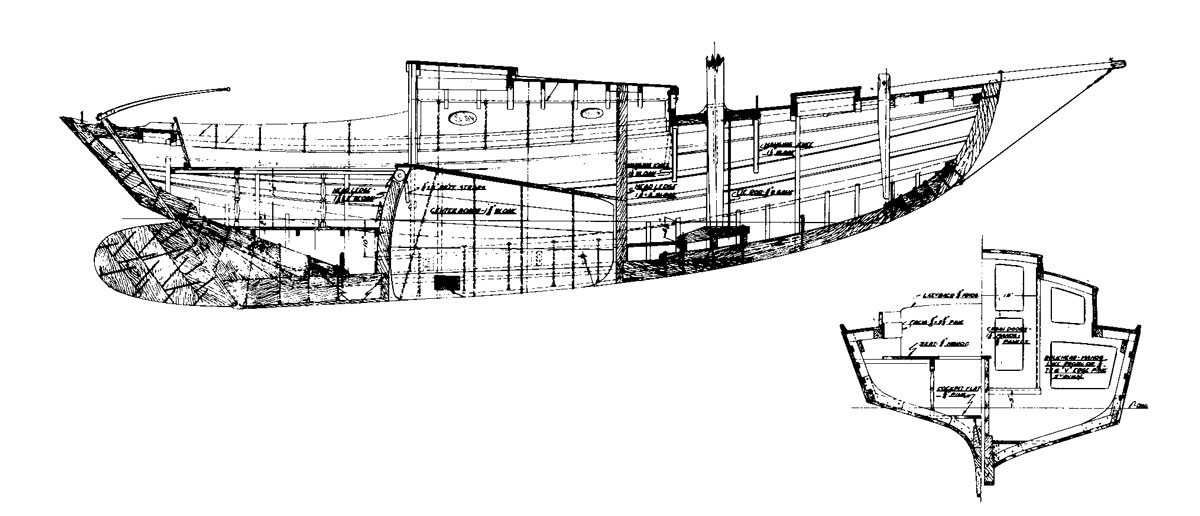
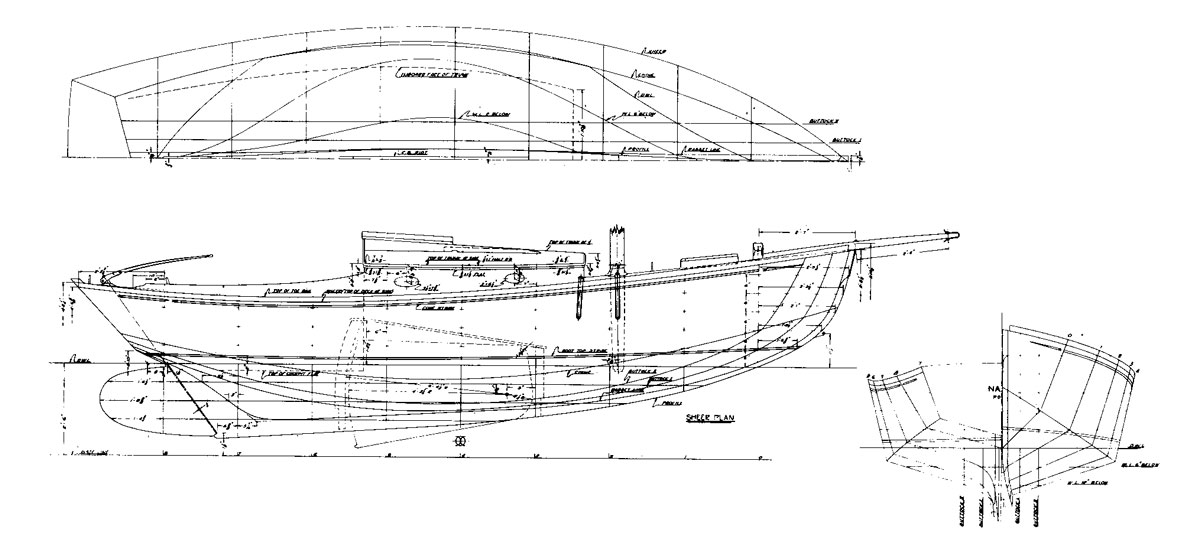
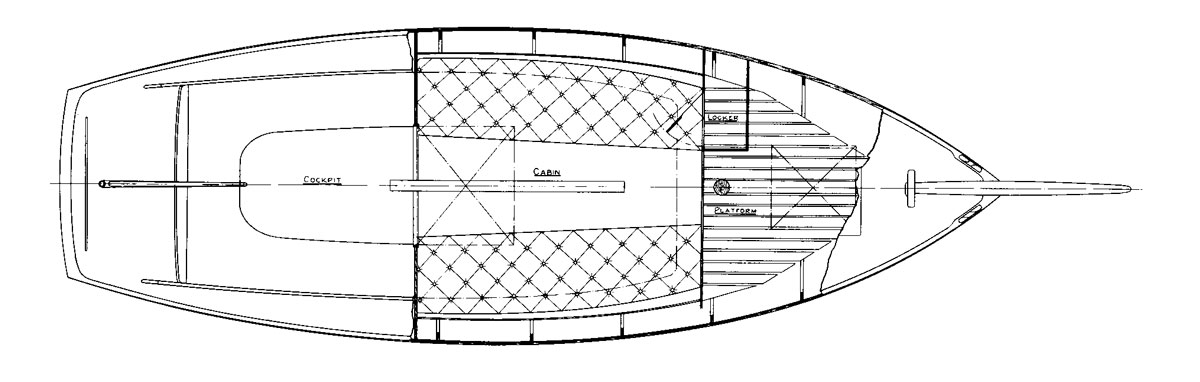
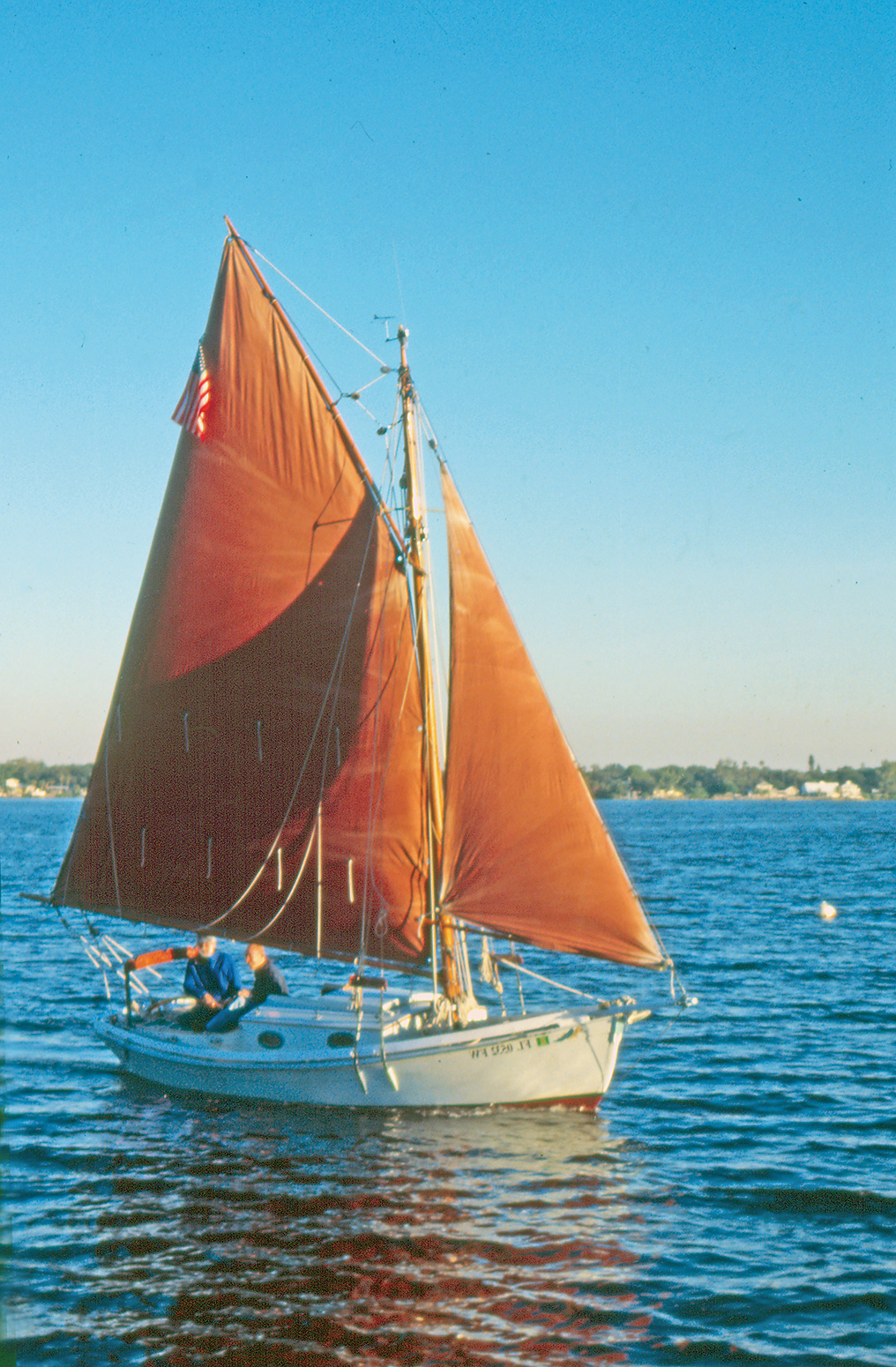
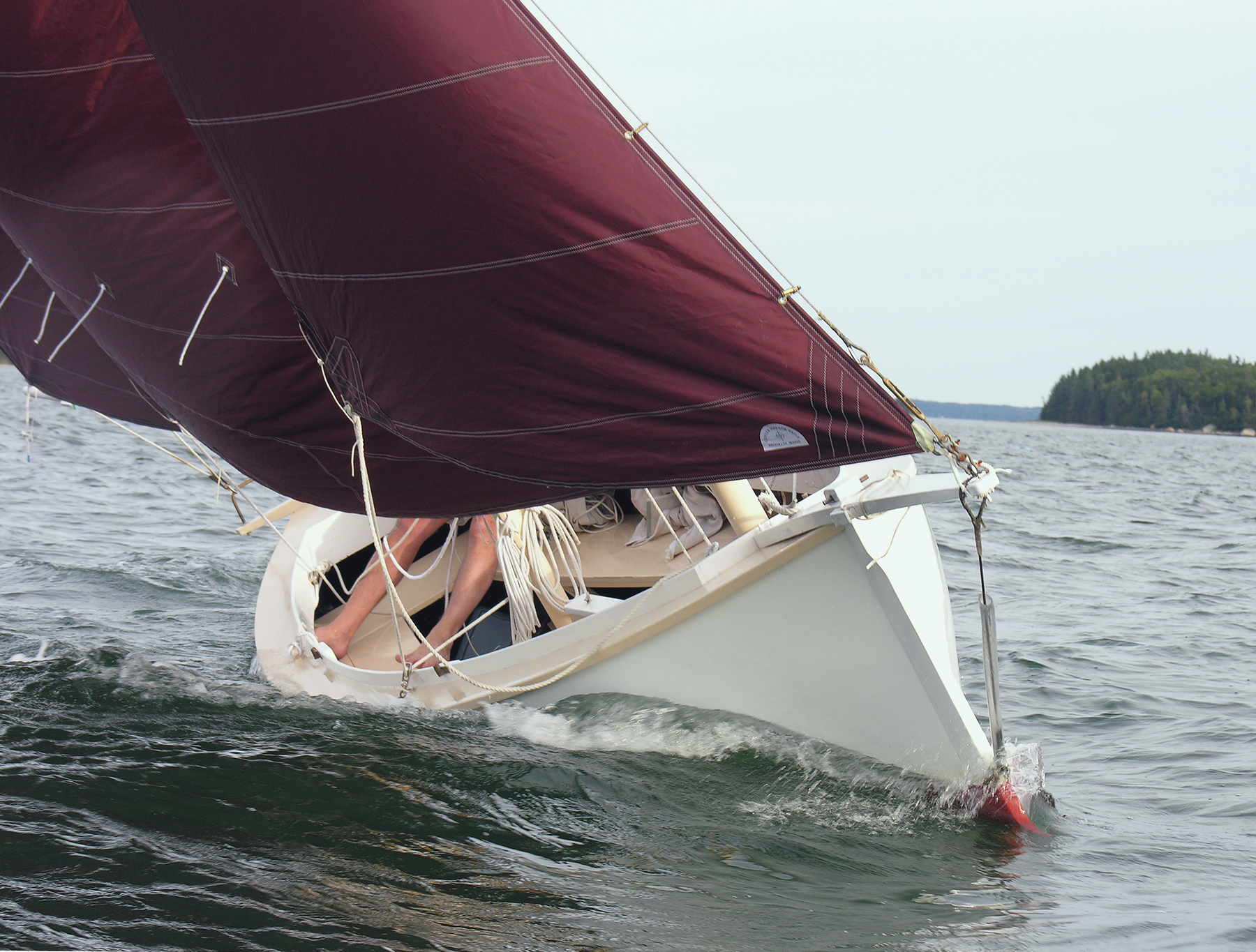
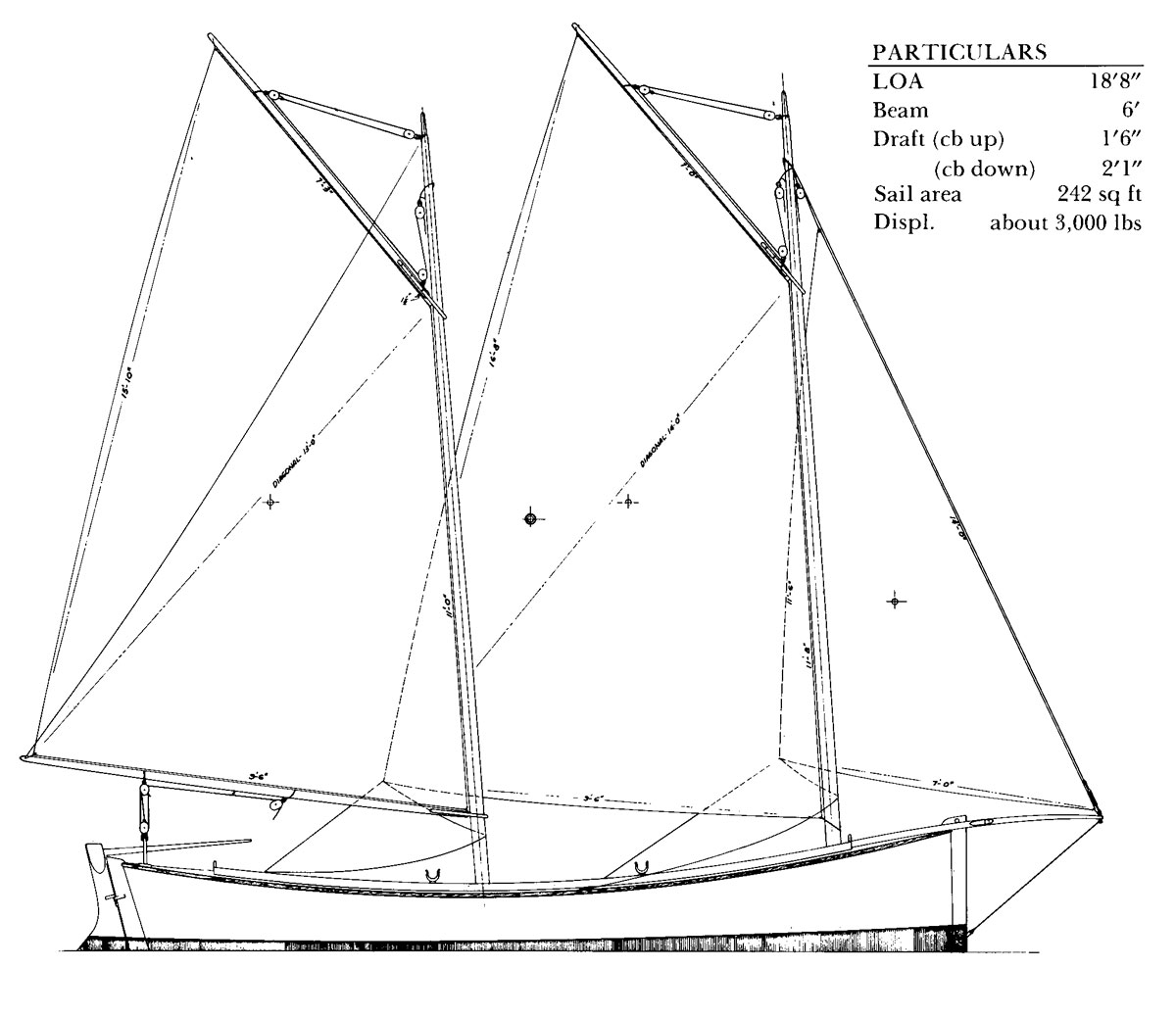
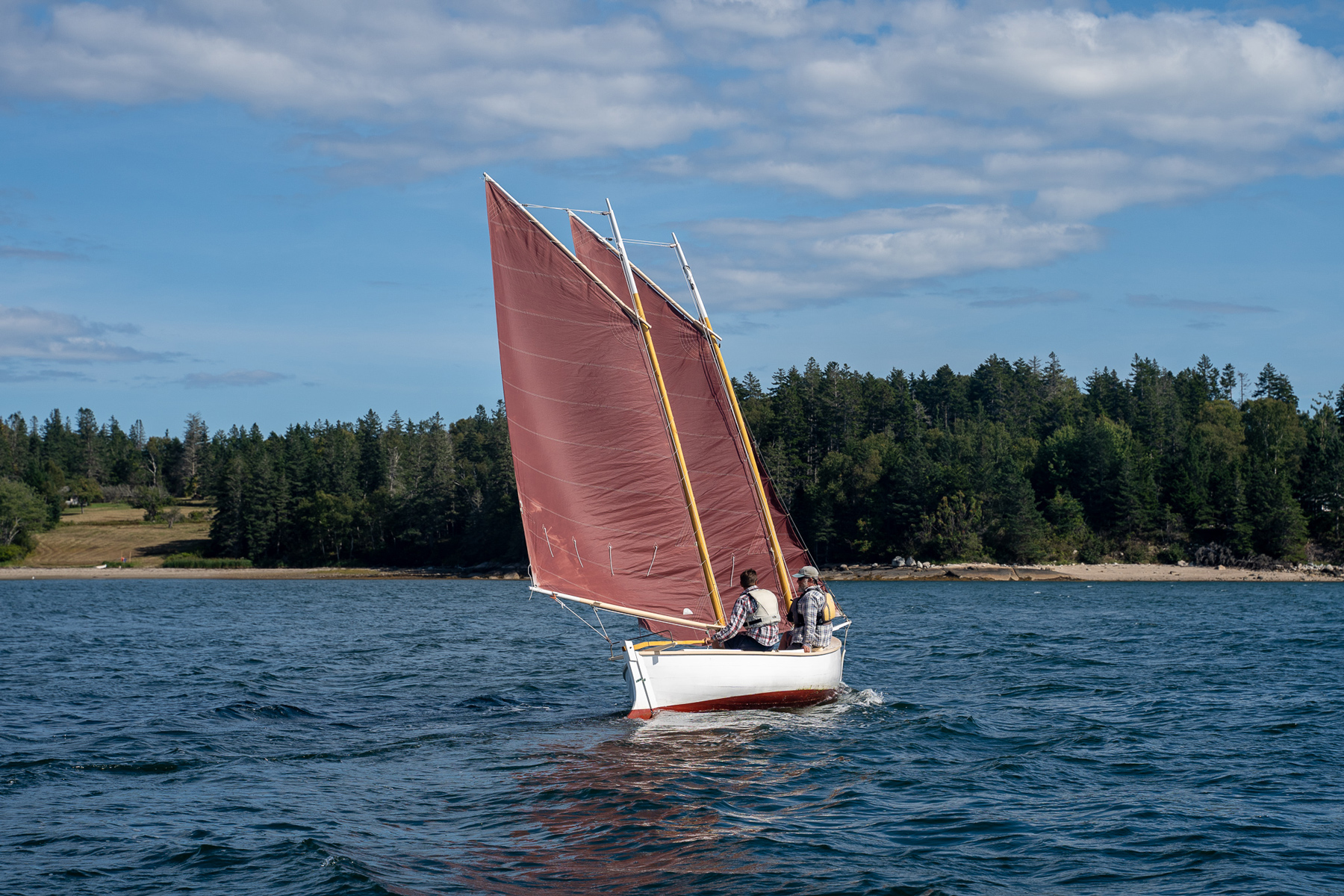
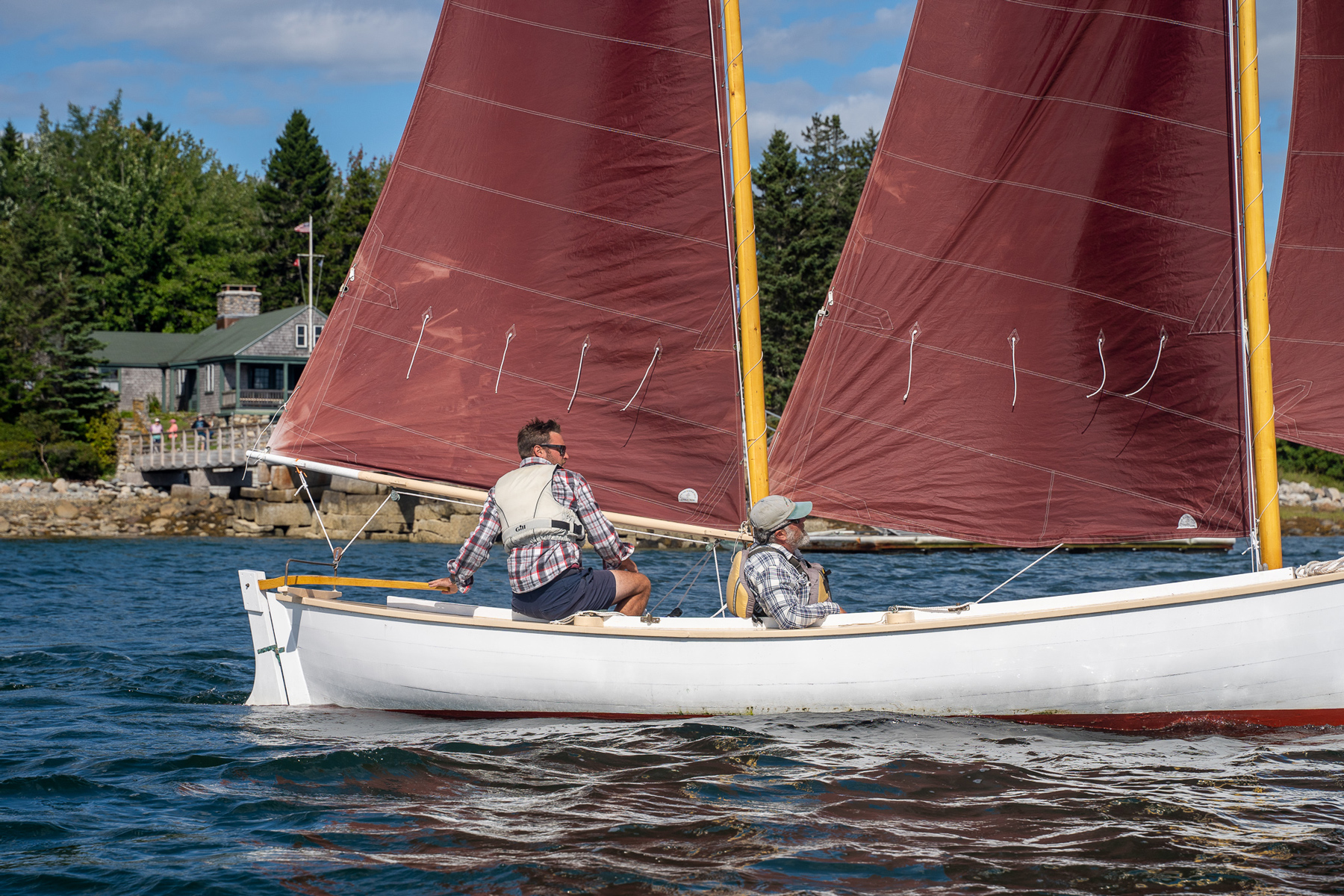
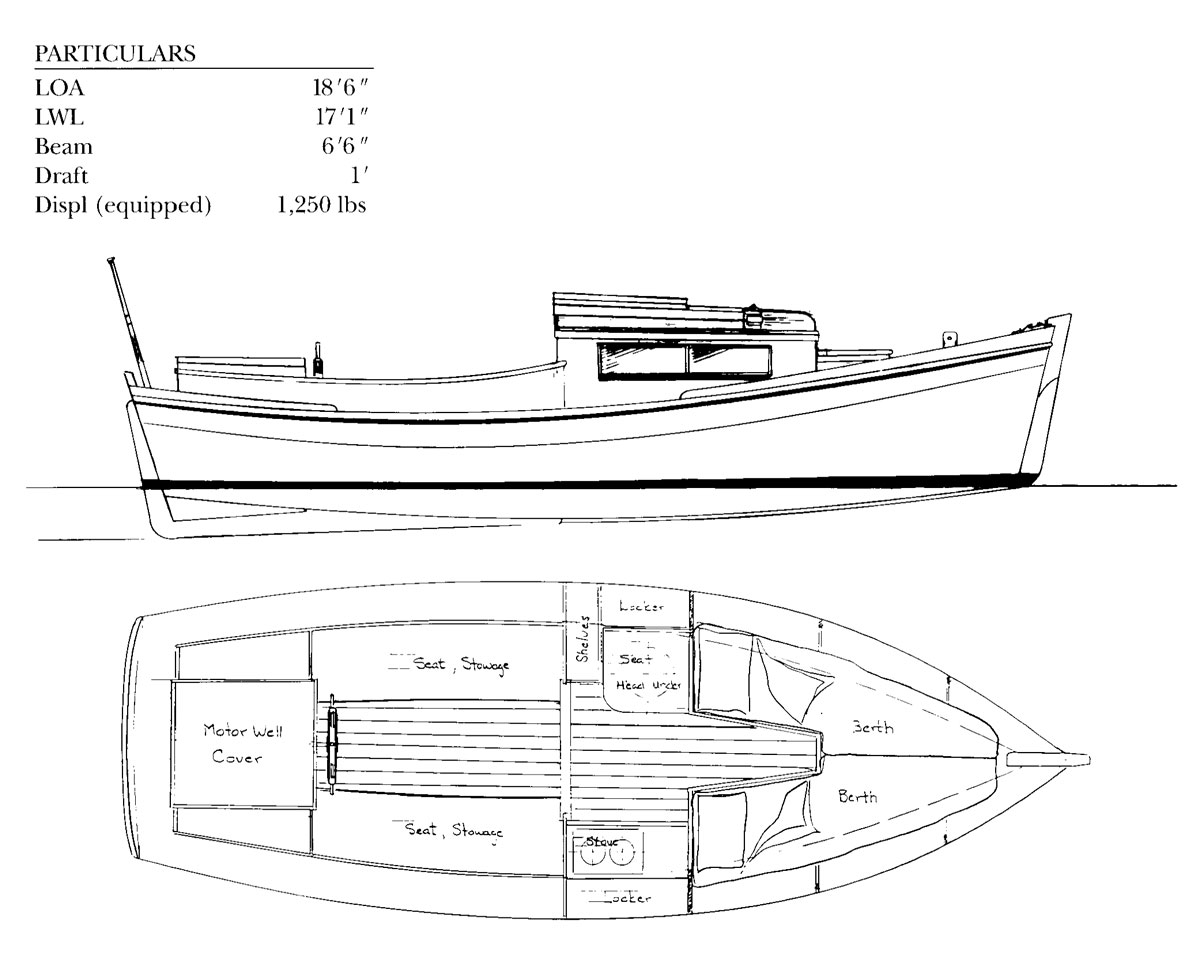
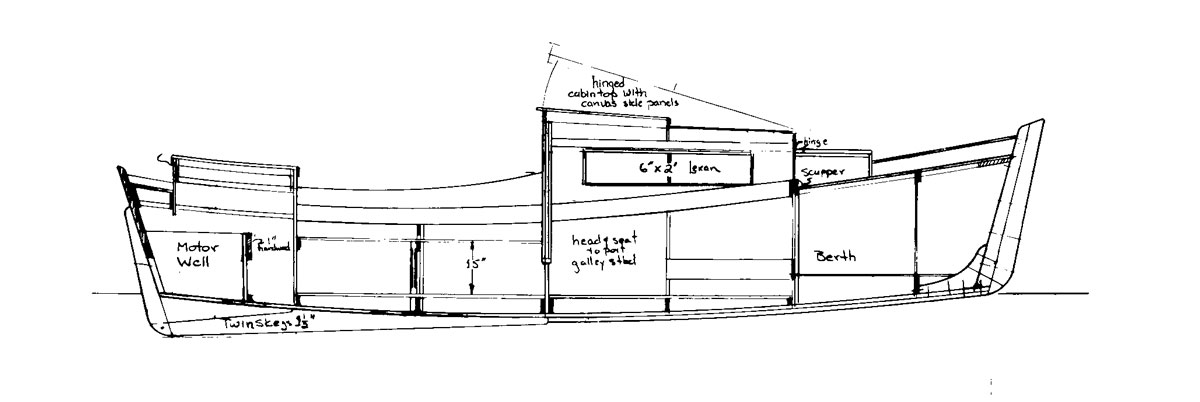
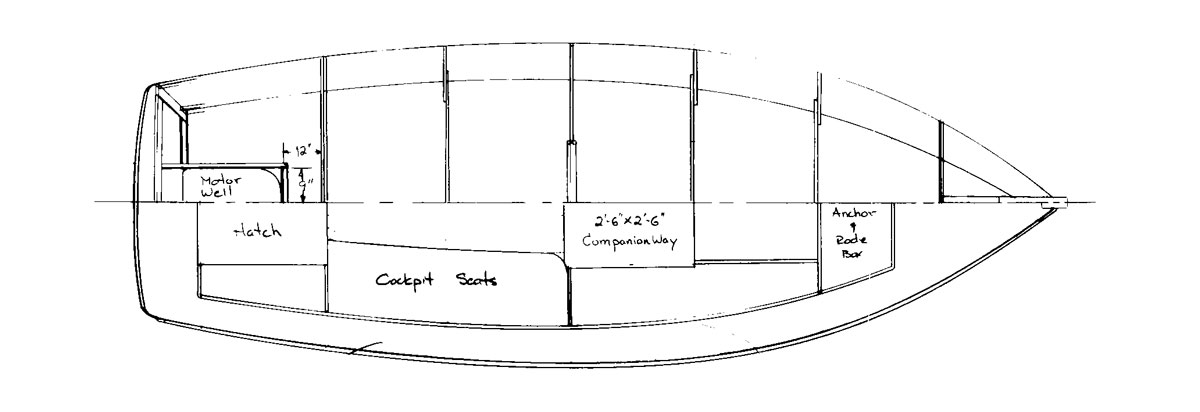
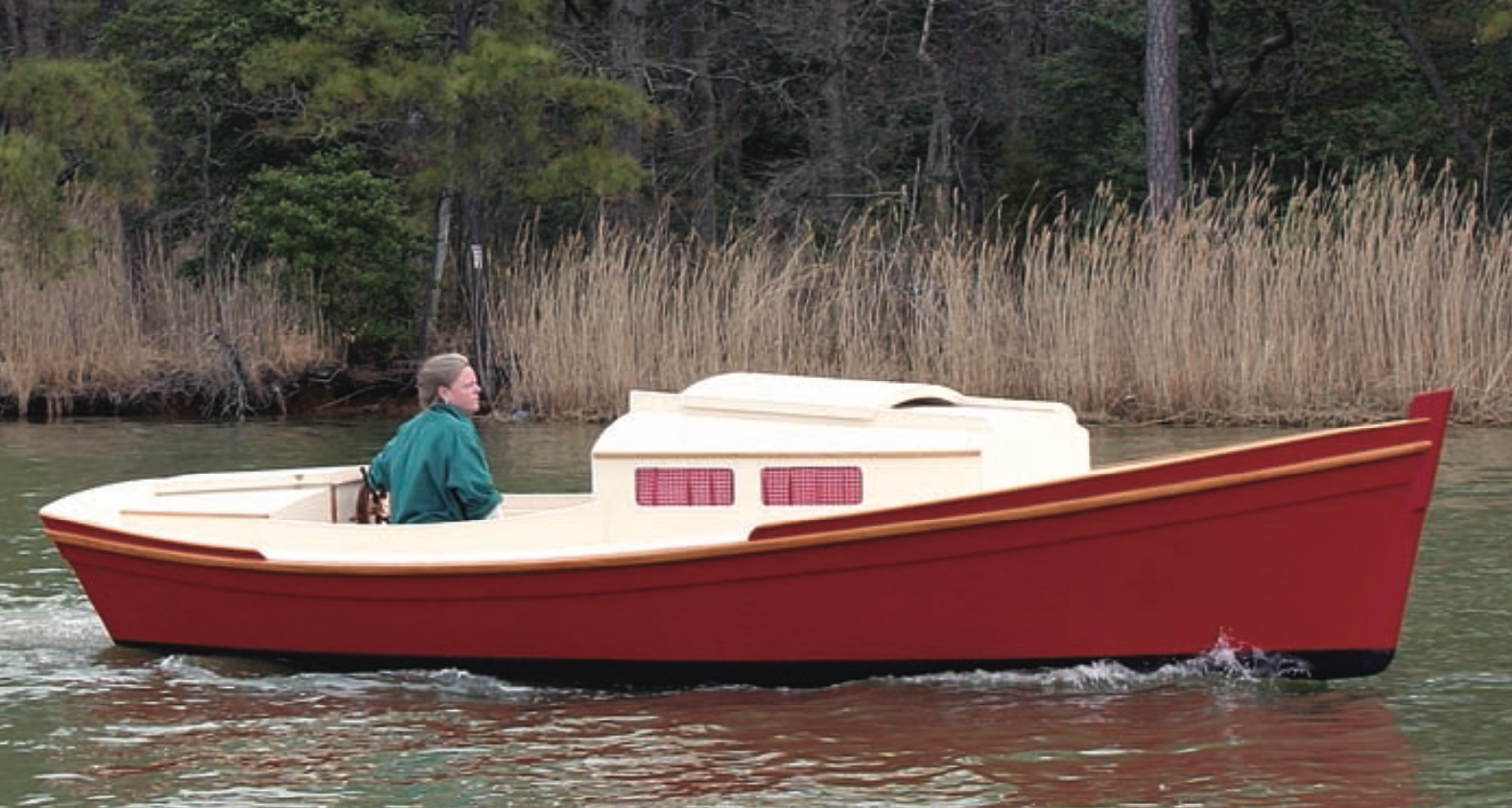
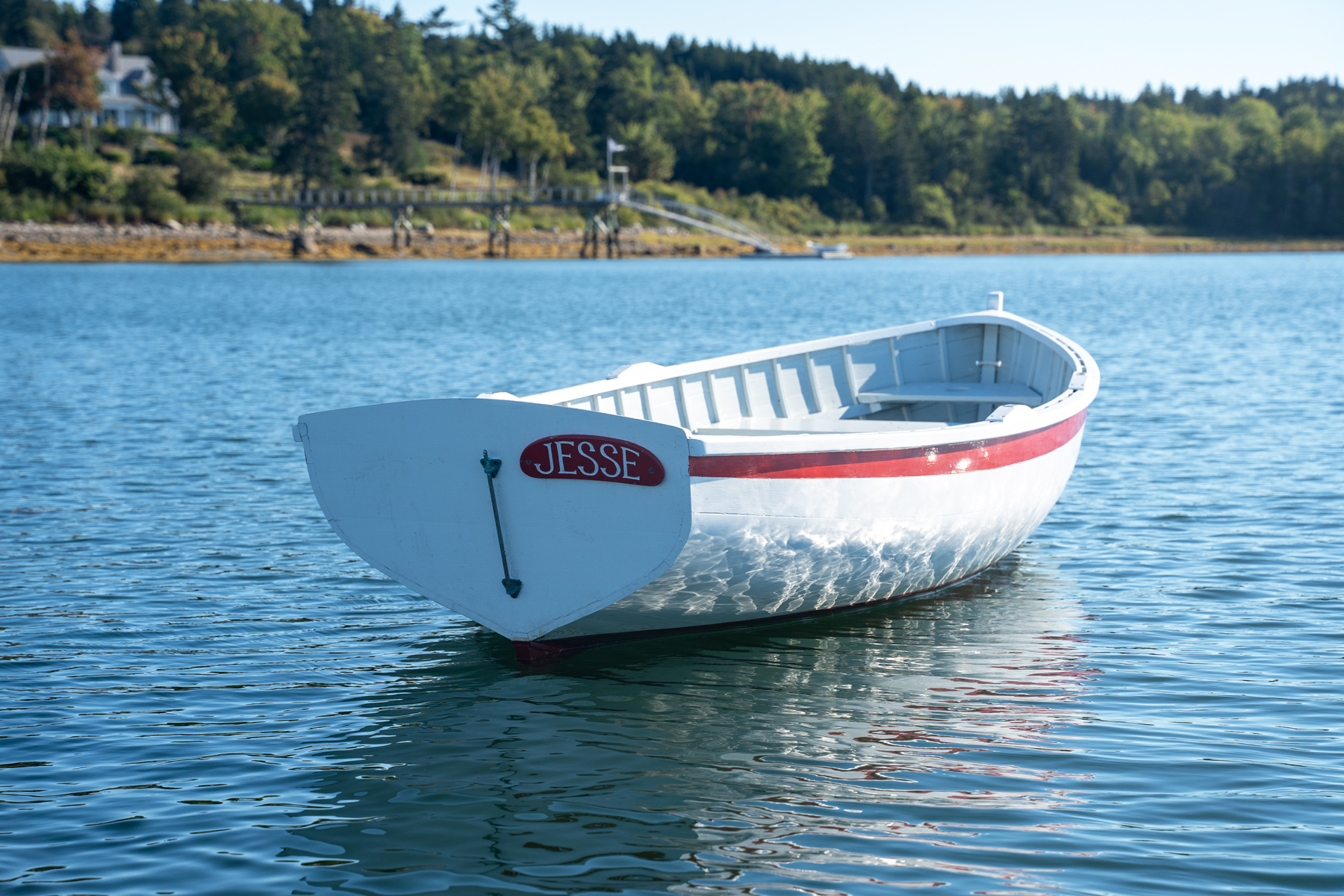
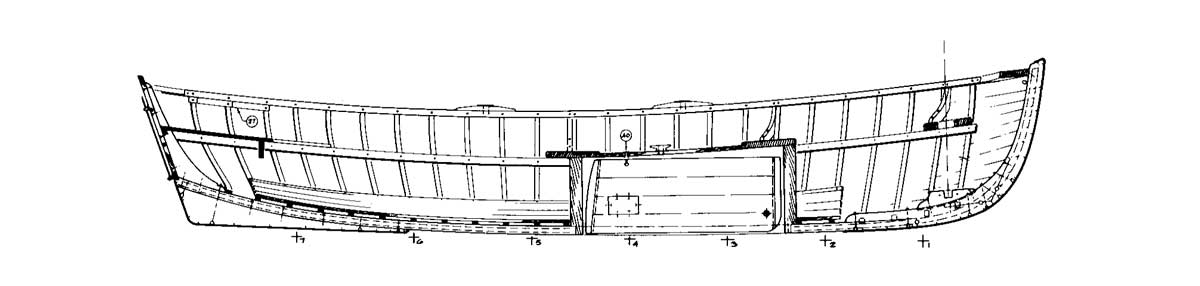
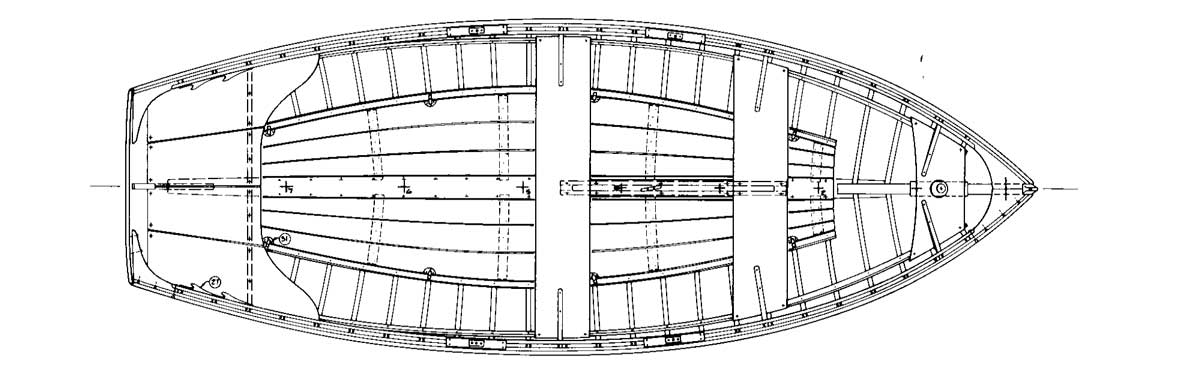
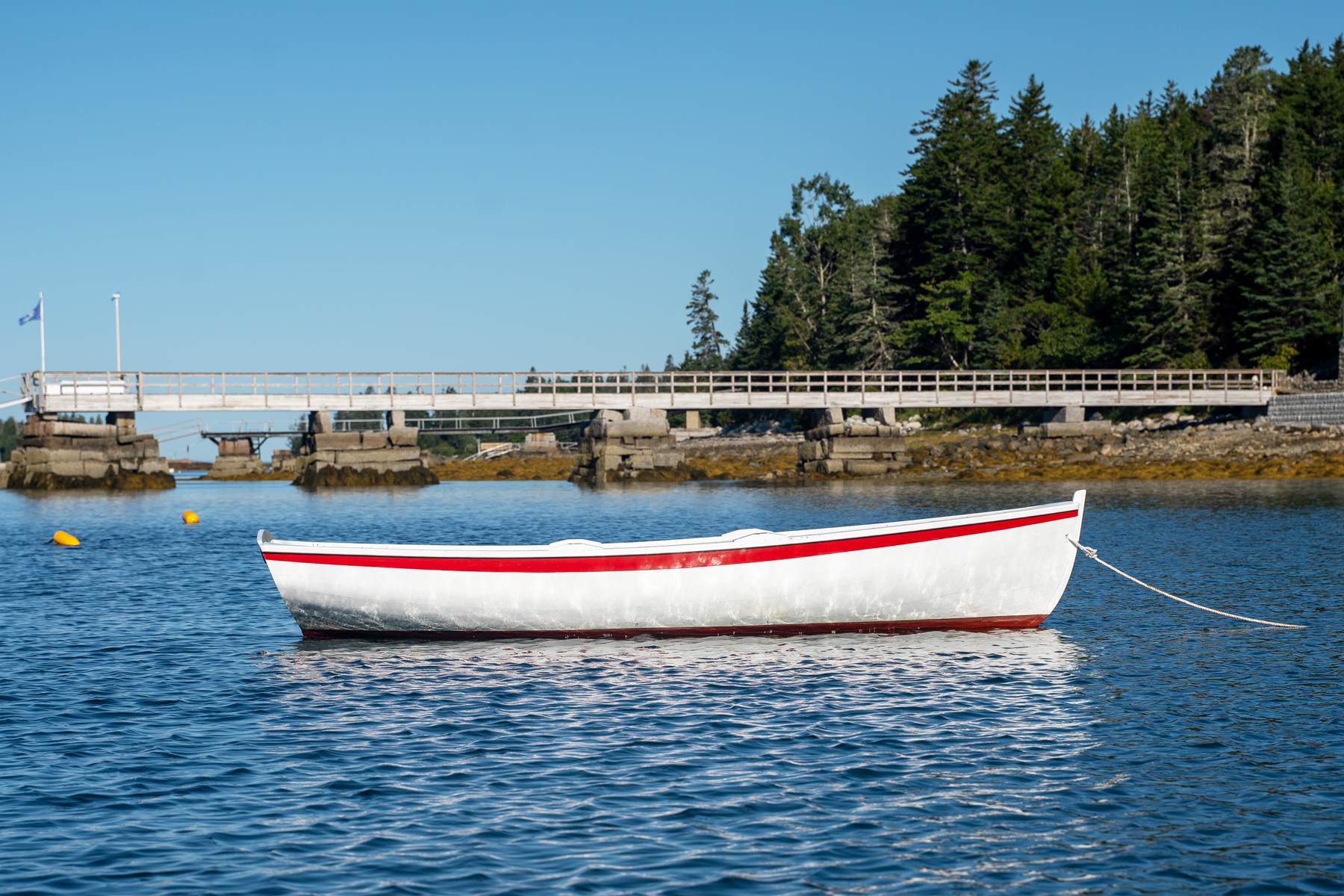
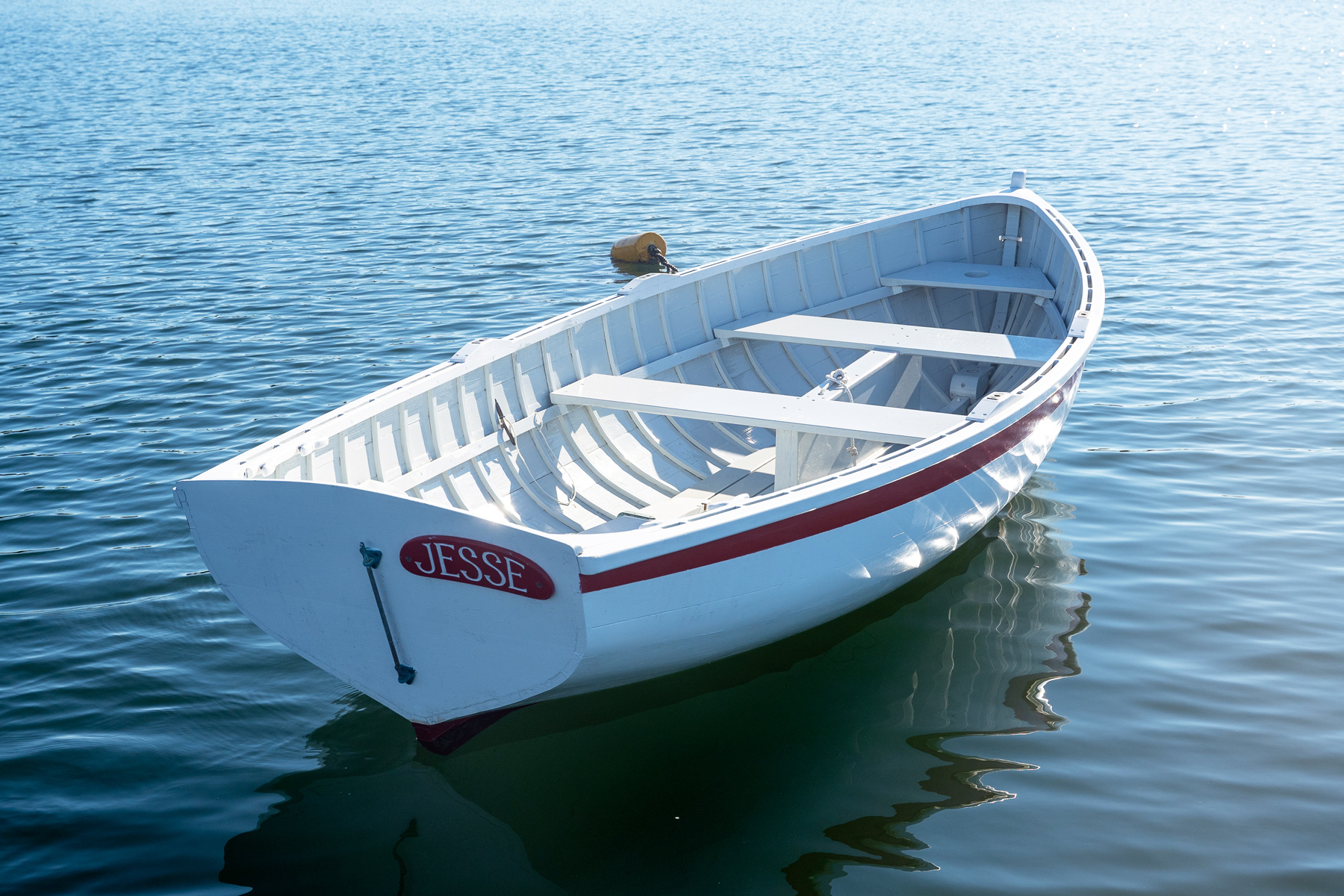
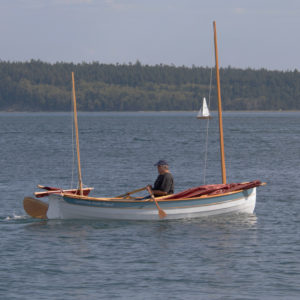
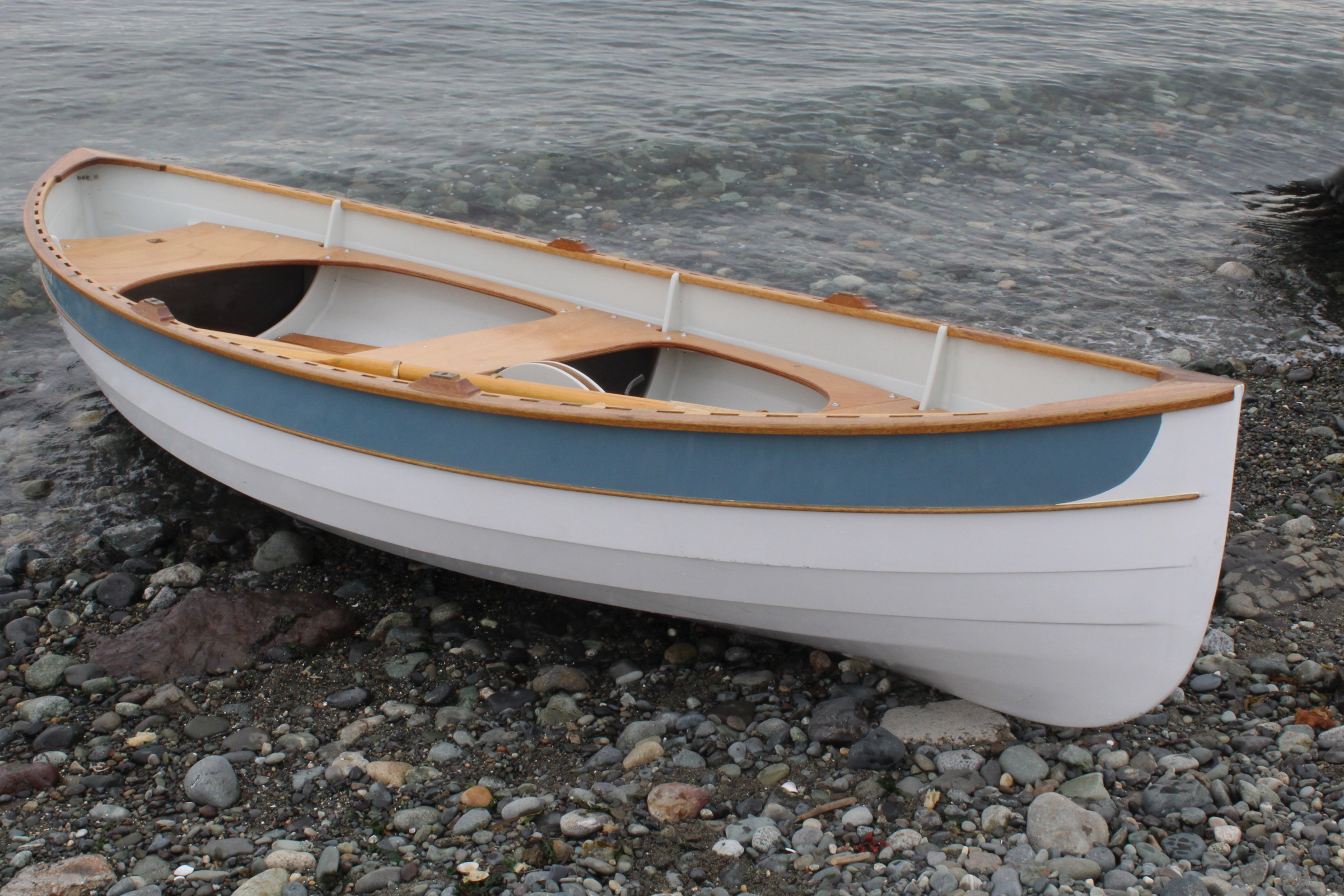
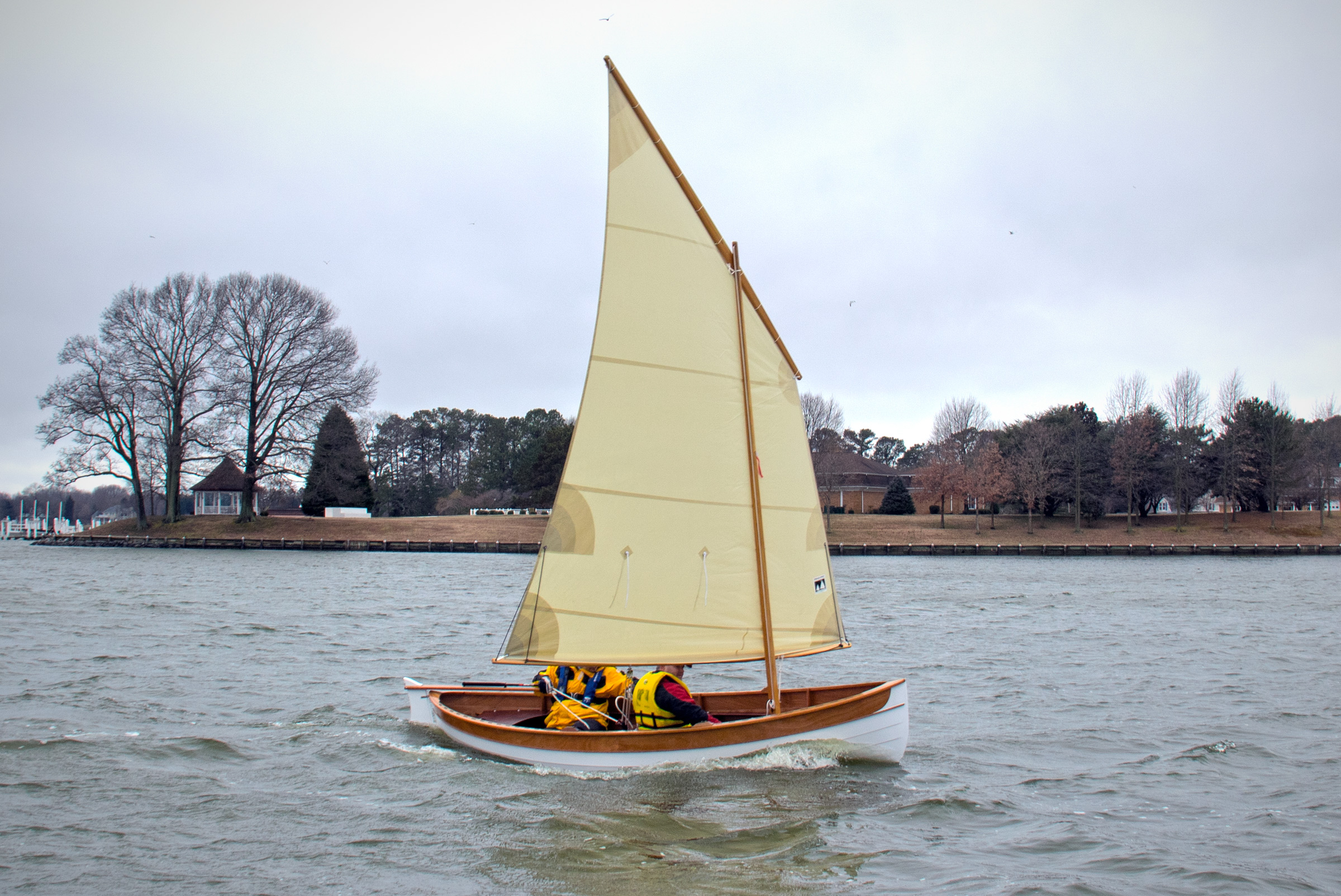
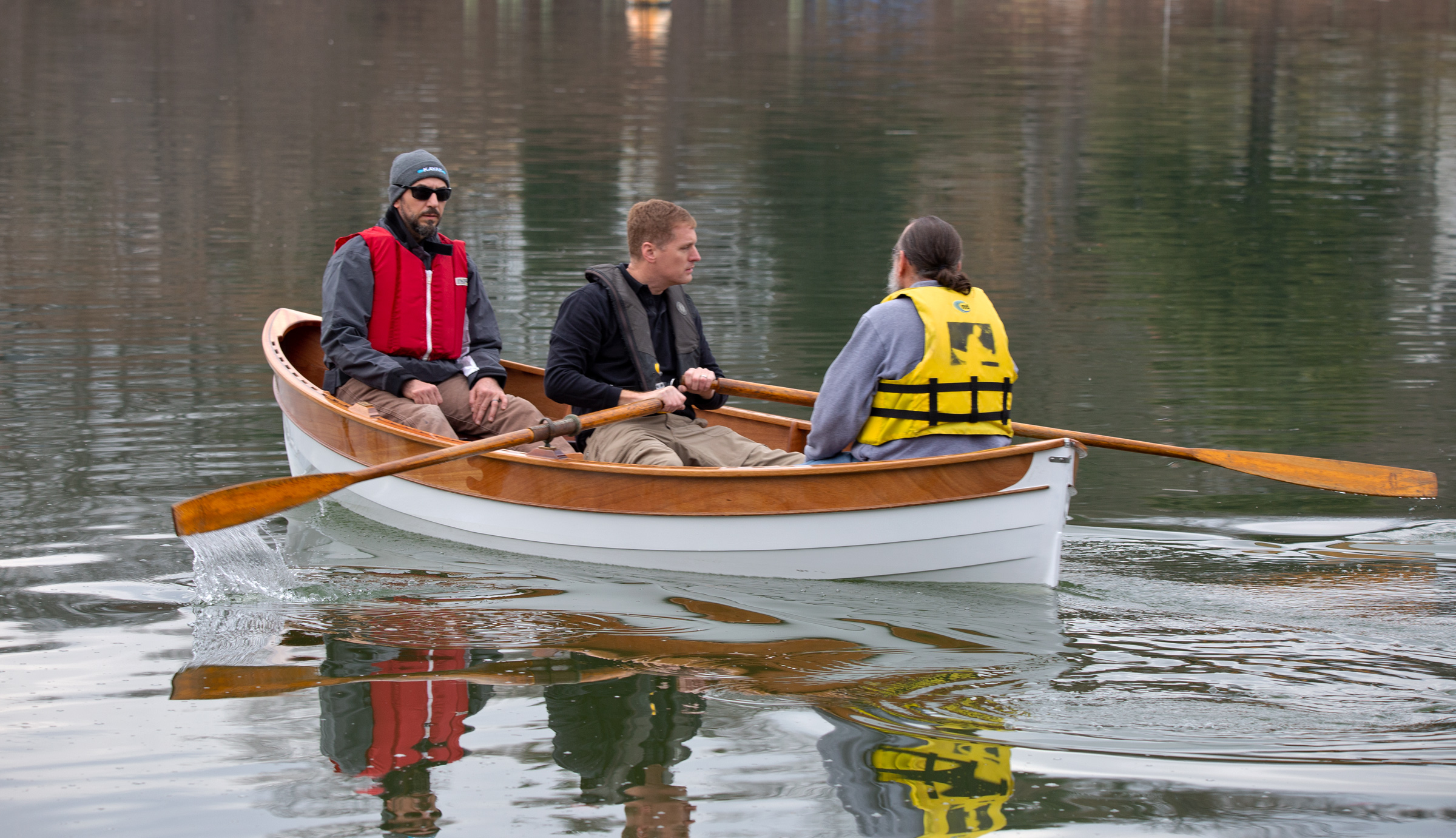
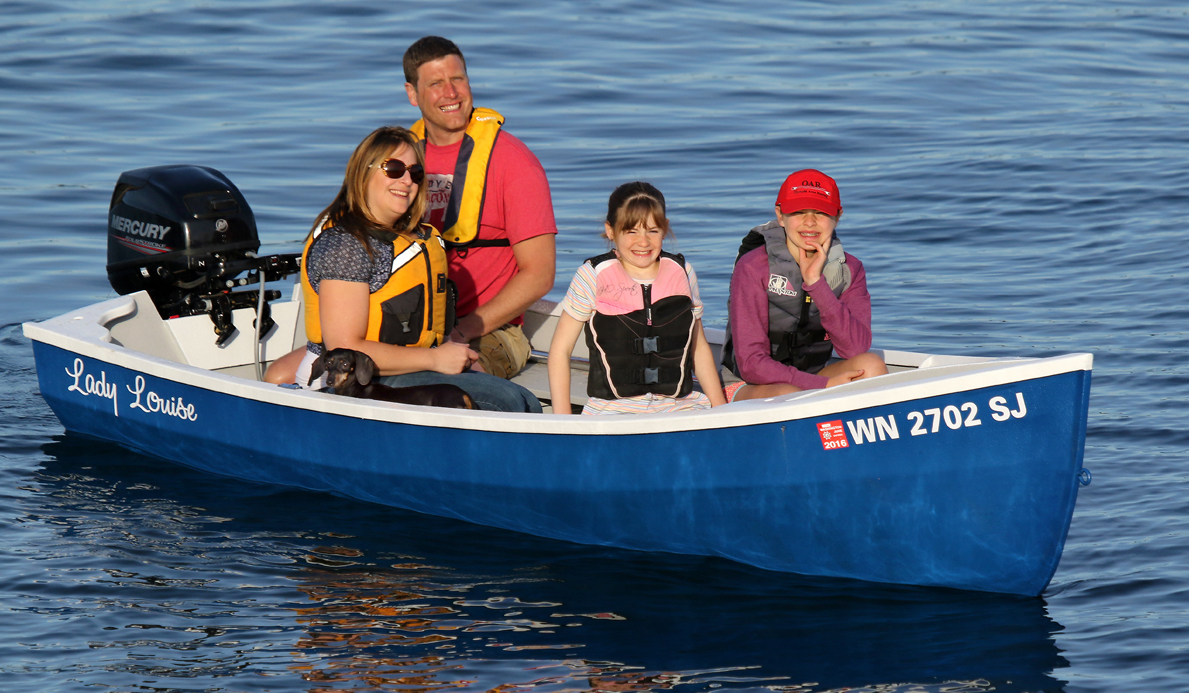
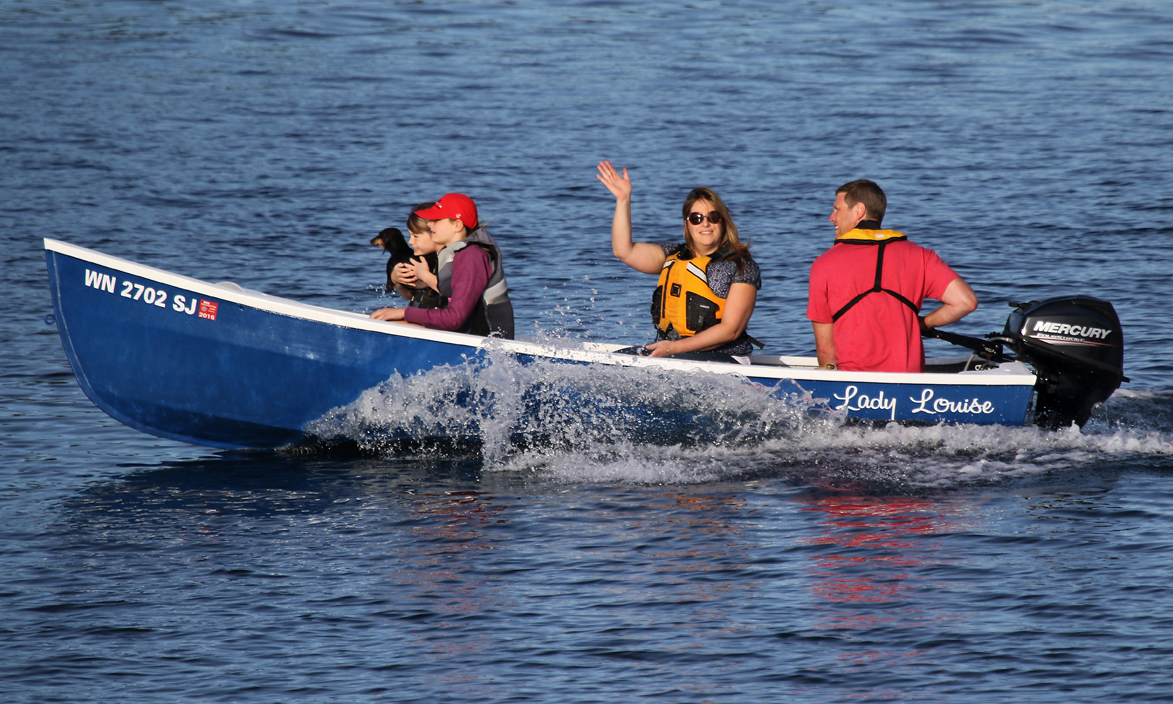
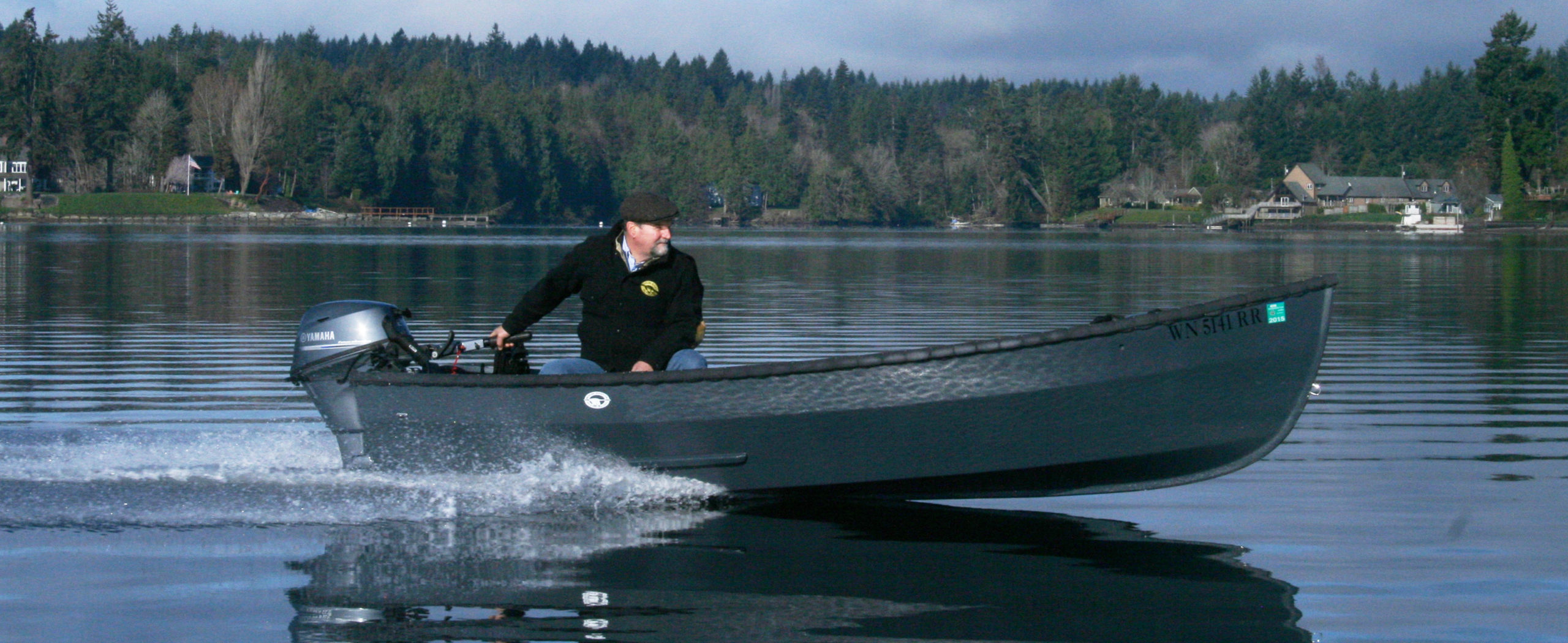
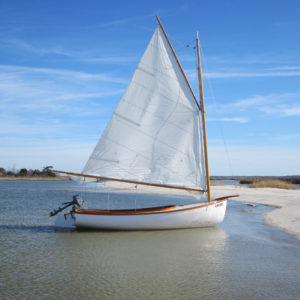
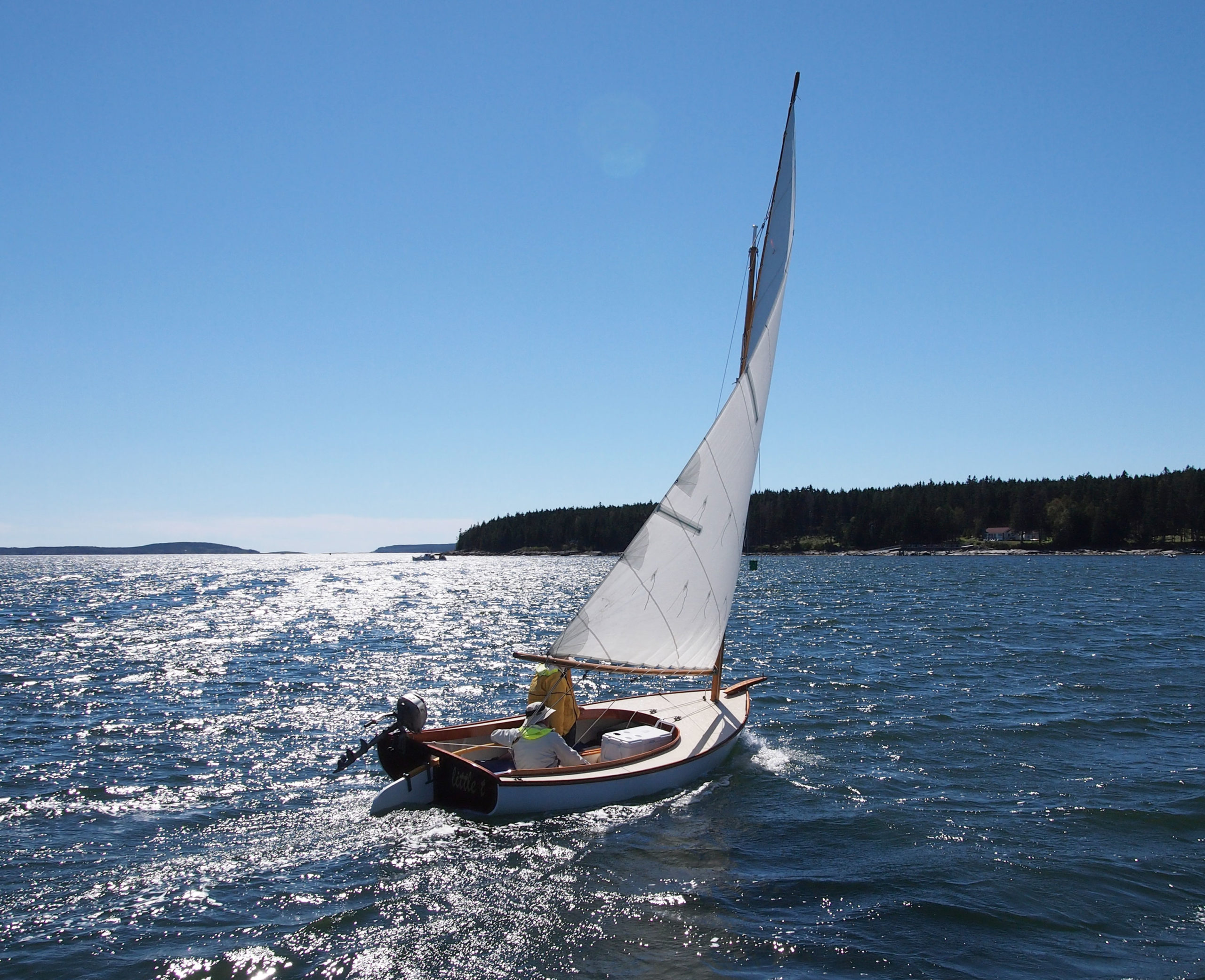
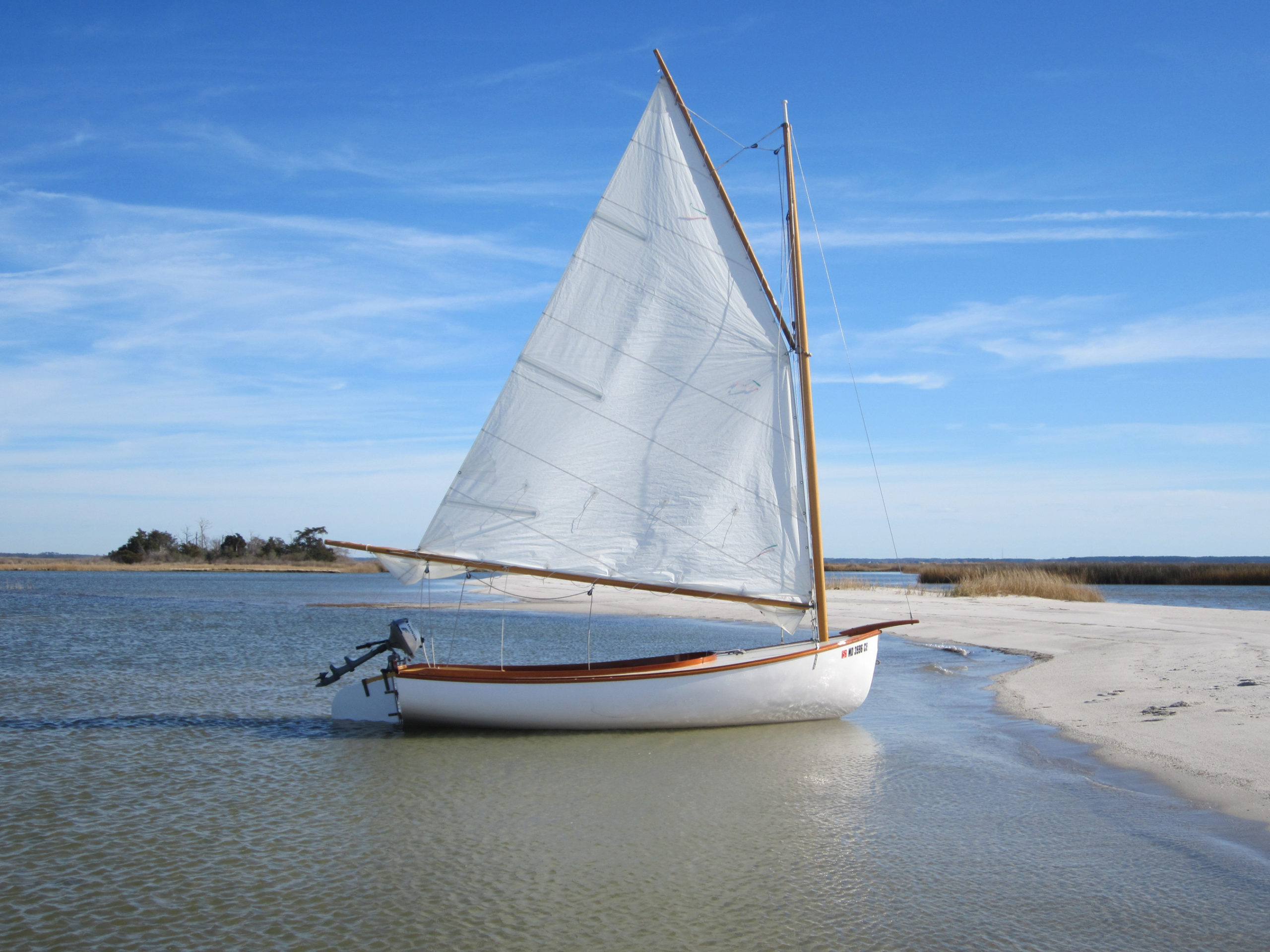
This classic view of a Marblehead gunning dory shows the type as it was originally intended to be used. The boat, a copy of REPUBLICAN, shows her elegant sheer and lovely stern.
John Gardner wrote about Will Chamberlain’s Marblehead gunning dories for several magazines and books. Each version revealed a little more about the boat’s history and qualities. Designed for gunning the ledges for sea ducks during New England’s early winter, the Marblehead gunning dory had to be rugged. It also had to be lightweight, so that once you had rowed out to where the ducks were, you could pull the boat onto the ledges.
The boat that originally captured John Gardner’s attention was sitting on Marblehead’s Barnegat beach in 1942. Built by Will Chamberlain, it was the “ultimate dory,” in Gardner’s view, a boat that for “rough water ability, easy performance under oars, respectable speed and capacity, capped by handsome appearance…is one of a kind.” My personal experience, along with that of others who know the boat well, hasn’t proven otherwise.
As a young(er) boatbuilder, I pored over Gardner’s drawings and text. When I first tried to build boats “professionally” on my own, the Marblehead gunning dory was nearly the first boat I built. When Gardner’s book Wooden Boats to Build and Use came out in 1996 and I saw the 17-footer, I felt I had found the right version of the boat. That boat, REPUBLICAN, had been built by Capt. Gerald Smith to lines drawn by his good friend Walter Wales, who later built INDEPENDENT, an 18′ version. Both of these boats are in active use almost 50 and 40 years after they were built.
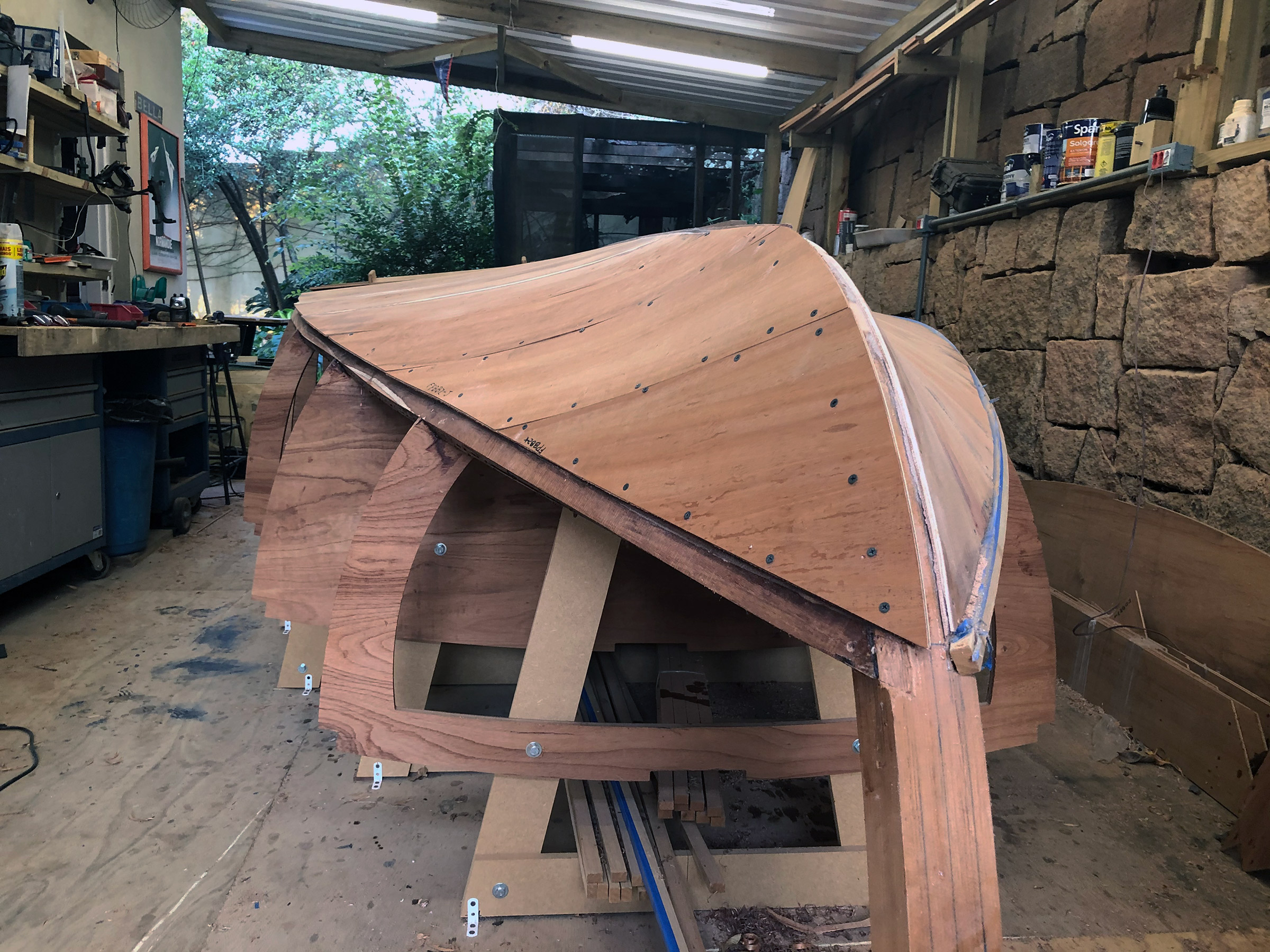
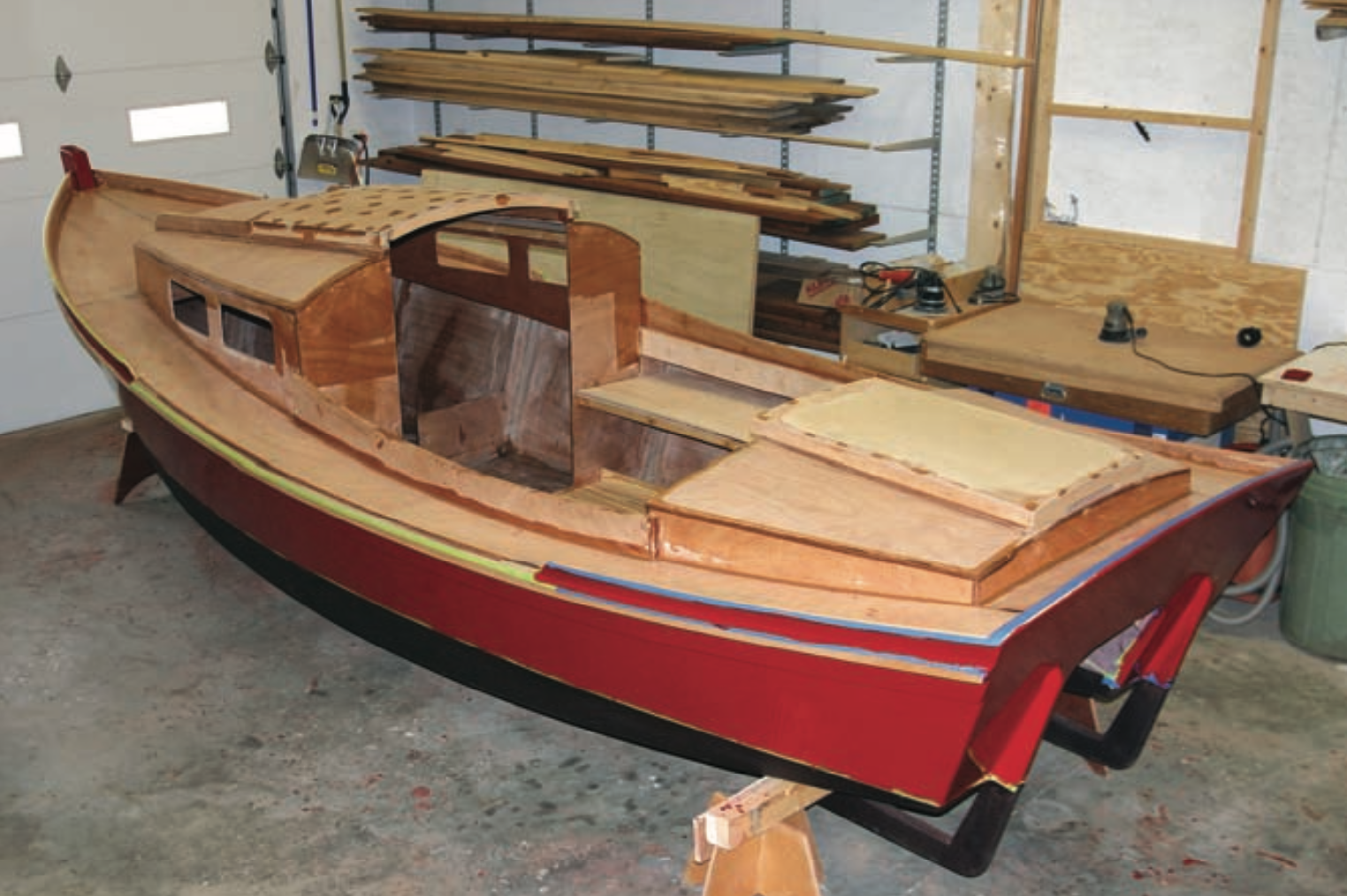
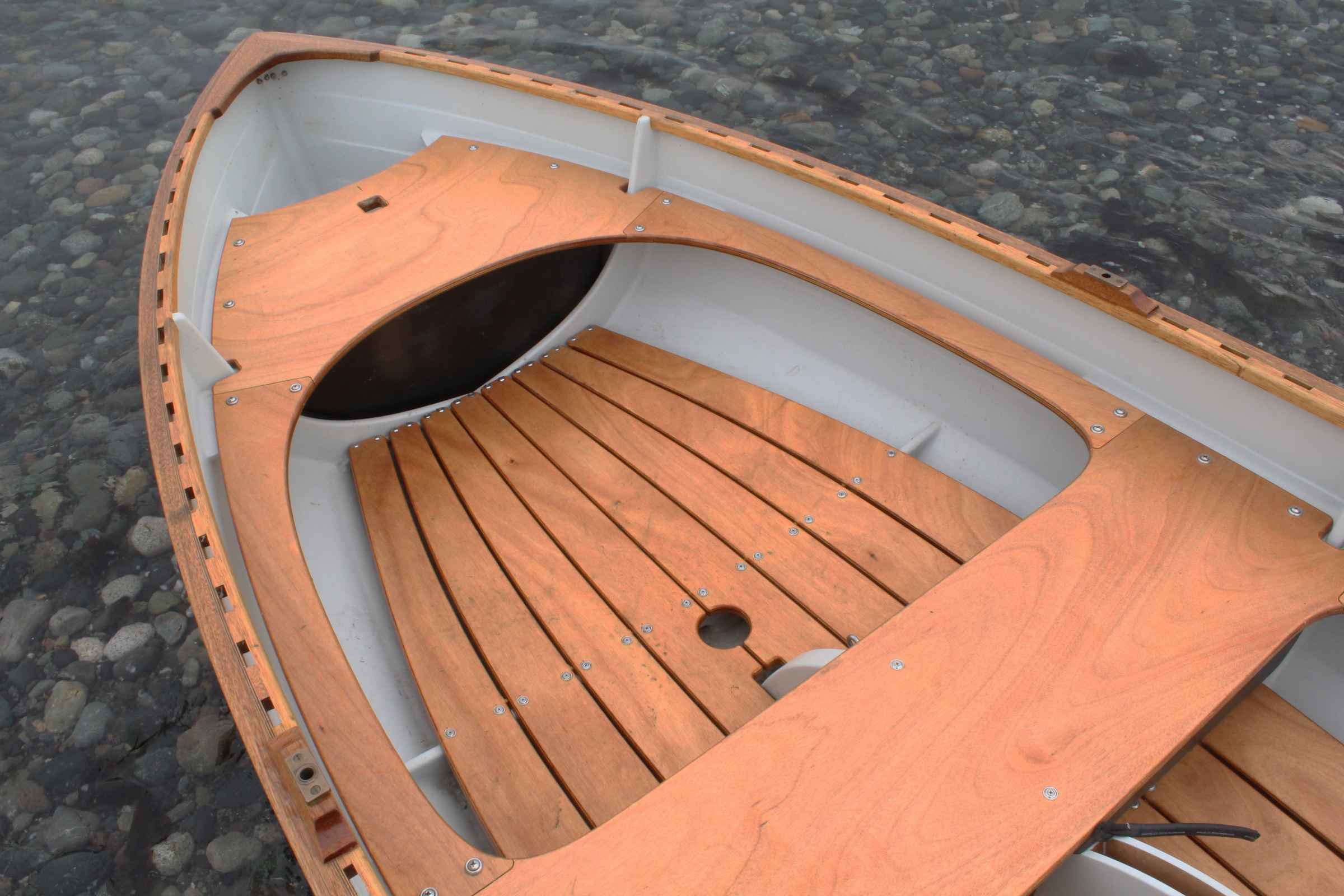
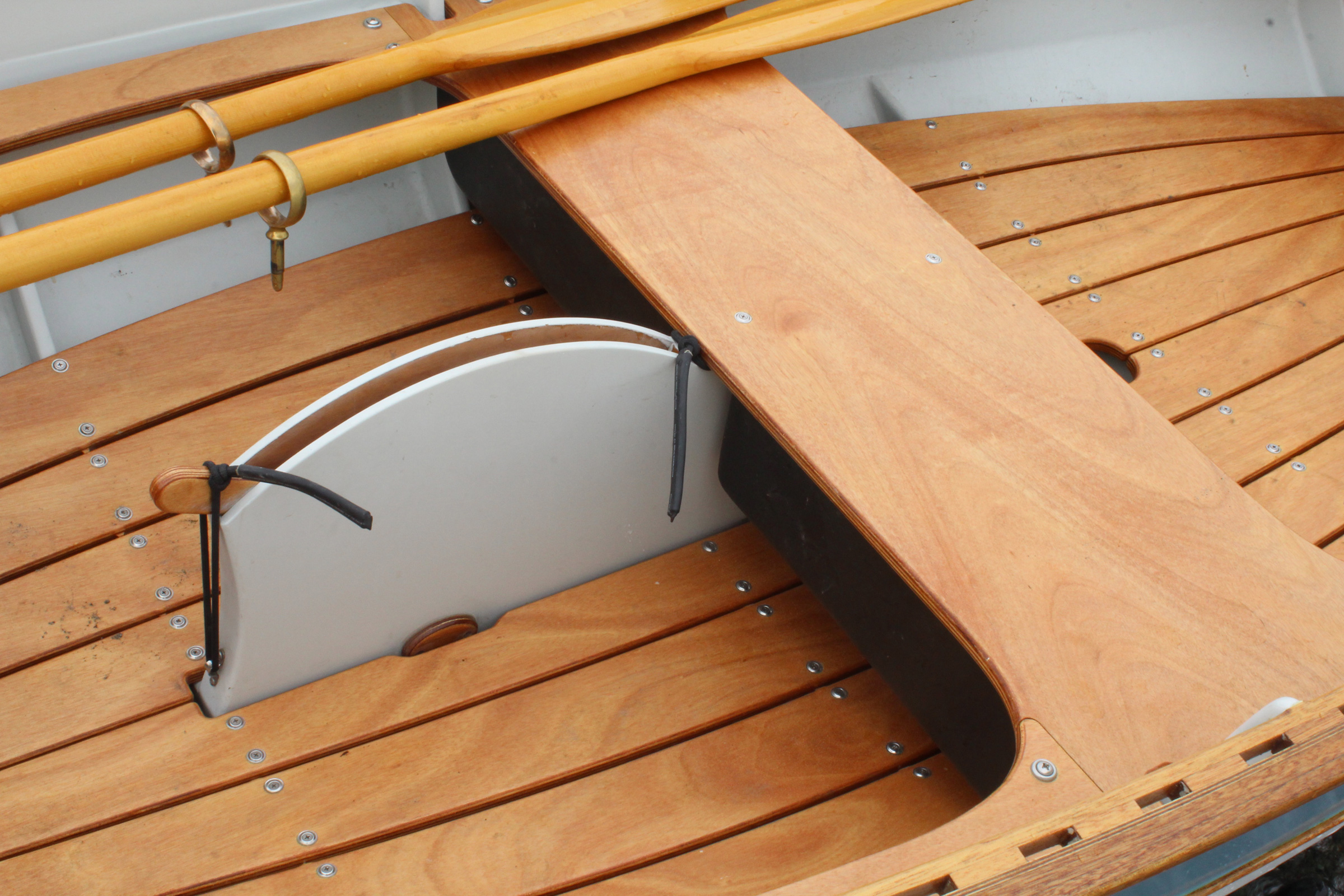
I run the Alexander Seaport Foundation in Alexandria, Virginia. In 1998, we built a glued-lapstrake plywood rowing version of the boat, from setup through getting the boat ready for paint, as part of one of our weeklong classes. The combination of dory design and plywood construction allows it to be built simply and quickly. With an extra wide garboard, it takes only three strakes per side. The frames on our boat are laminated Douglas-fir overlapped at the center, just like the original boat’s “grown” frames. The frames also serve as the building molds. It’s a boat that almost builds itself.
When Walter Rissmeyer called a few months later, I knew this was the boat for his project, Potomac Adventure. Walter worked for the local public TV and radio entity. He and producer partner Joe Brunzak had planned to travel the entire length of the Potomac River. The first 100 miles, from the Fairfax Stone, in western Maryland, to Washington, D.C., were to be done on bicycle. Then they planned to canoe the 10 miles from D.C. to Alexandria. The remaining 100 or so miles were going to be accomplished by a more substantial boat.
South of Washington, the Potomac just gets wider and wider. It’s shallow and is prone to nasty storms with vicious chop. It’s also tidal, even up by Alexandria, where the water is still fresh.
To take advantage of the winds and tides, Walter and Joe needed a boat that could either be rowed or sailed. They needed a boat that could carry all their gear for a weeklong trip, and one that was big enough for them to sleep in, if necessary. Most important, they needed a boat that could stand up to the weather that would probably come their way. They ended up with our dory, which they named BEANS AND CORNBREAD.
The first leg of the dory trip from Alexandria to Quantico, Virginia (about 20 miles), proved that the boat rows well. When I talked to Walter Rissmeyer about his trip, nine years later, he and I both remembered the same story about the boat’s seaworthiness. The day after leaving Quantico, they had to make the largest bend in the river, located above the Route 301 bridge. It’s a several mile fetch. The wind was blowing over 15 knots and right on their nose. It took Walter and Joe most of the day, taking turns rowing, to work their way to the bend. Halfway there, they noticed that they were being overtaken by something that looked like a mini Loch Ness monster swimming in the water. It turned out to be a deer. The deer reached shore before the boat. Not to be outdone by a deer, Walter and Joe set sail. The wind came on their beam and they covered a distance equal to that they had just rowed—in under an hour.
The next day it blew even harder. When Walter and Joe rowed into a marina at the end of that day, the folks in a 20′ center-console outboard couldn’t believe that they had been out on the river.
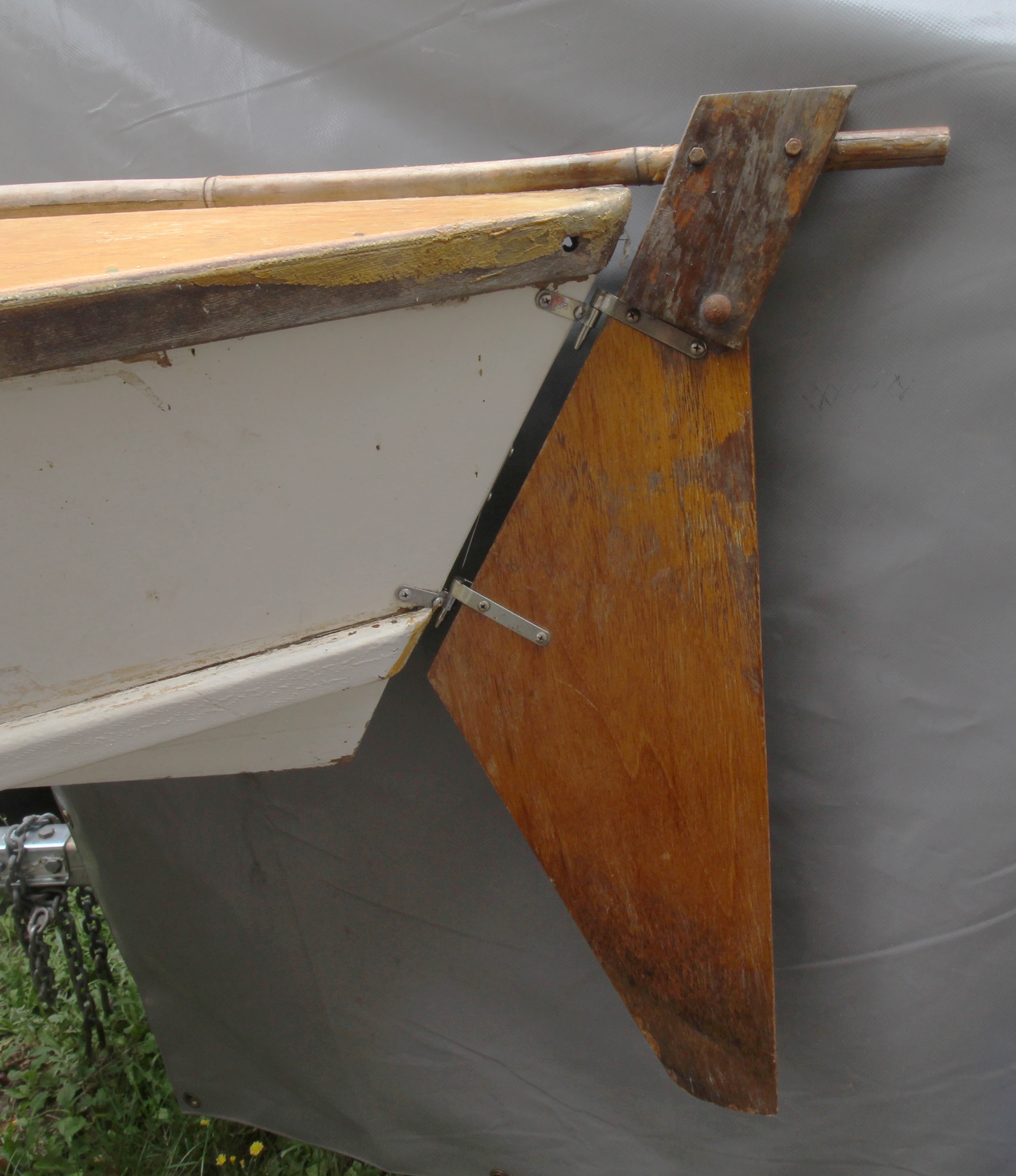
We had built BEANS AND CORNBREAD as a rowboat, but it needed to sail too. We didn’t use Walter Wales’s rig as shown in Wooden Boats to Build and Use. Instead, we put a 55-sq-ft Chesapeake sprit rig into her because that’s what we happened to have lying around. We used a Scandinavian push-pull tiller to steer. With this rig, a long pole pushes, or pulls, a short, one-armed yoke that’s attached to the top of the rudder. It was a last-minute deal, typical of “on-demand boatbuilding.” Walter and Joe had to finish building the oars for that trip down to Quantico.
Jack Crawford
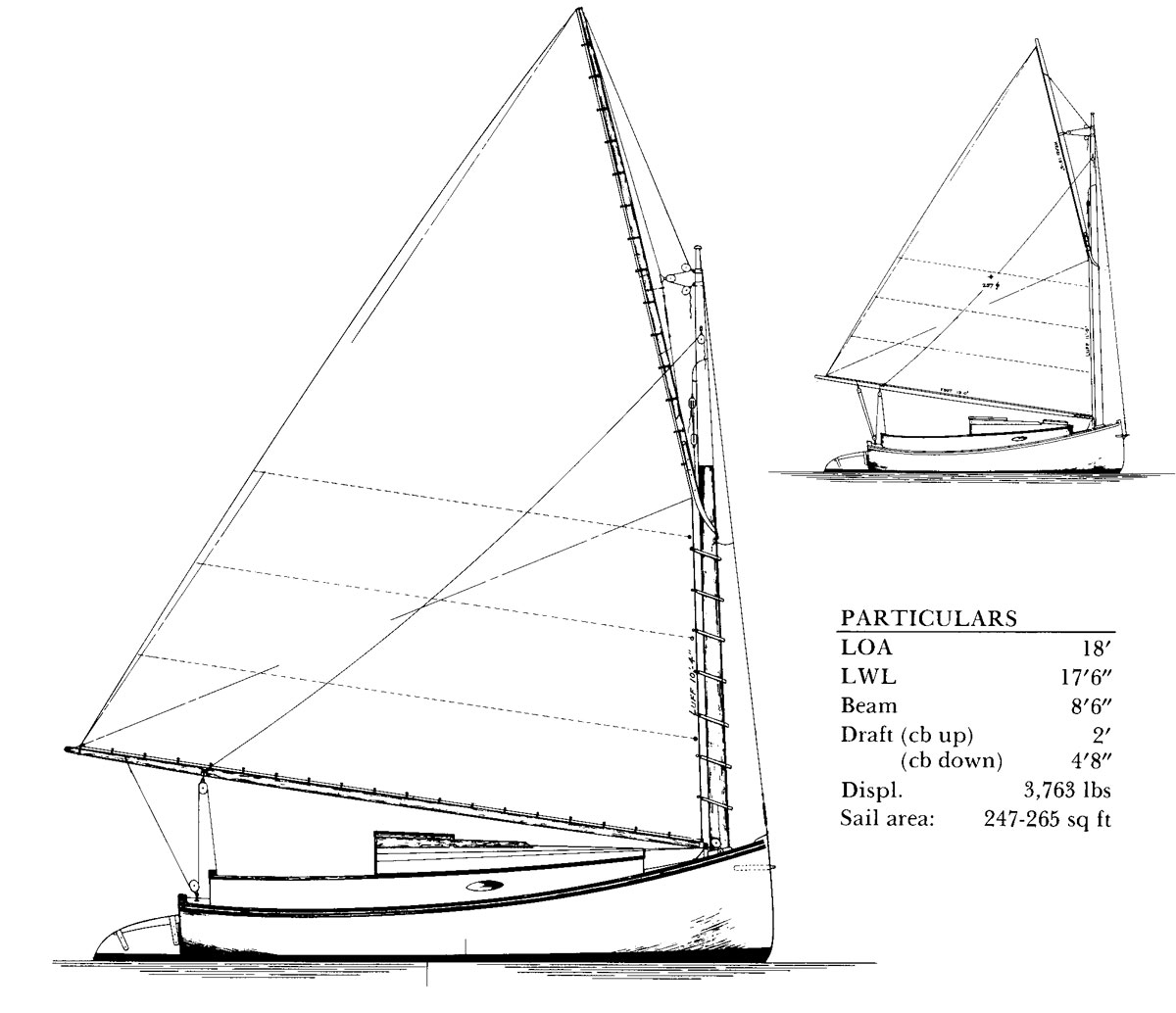
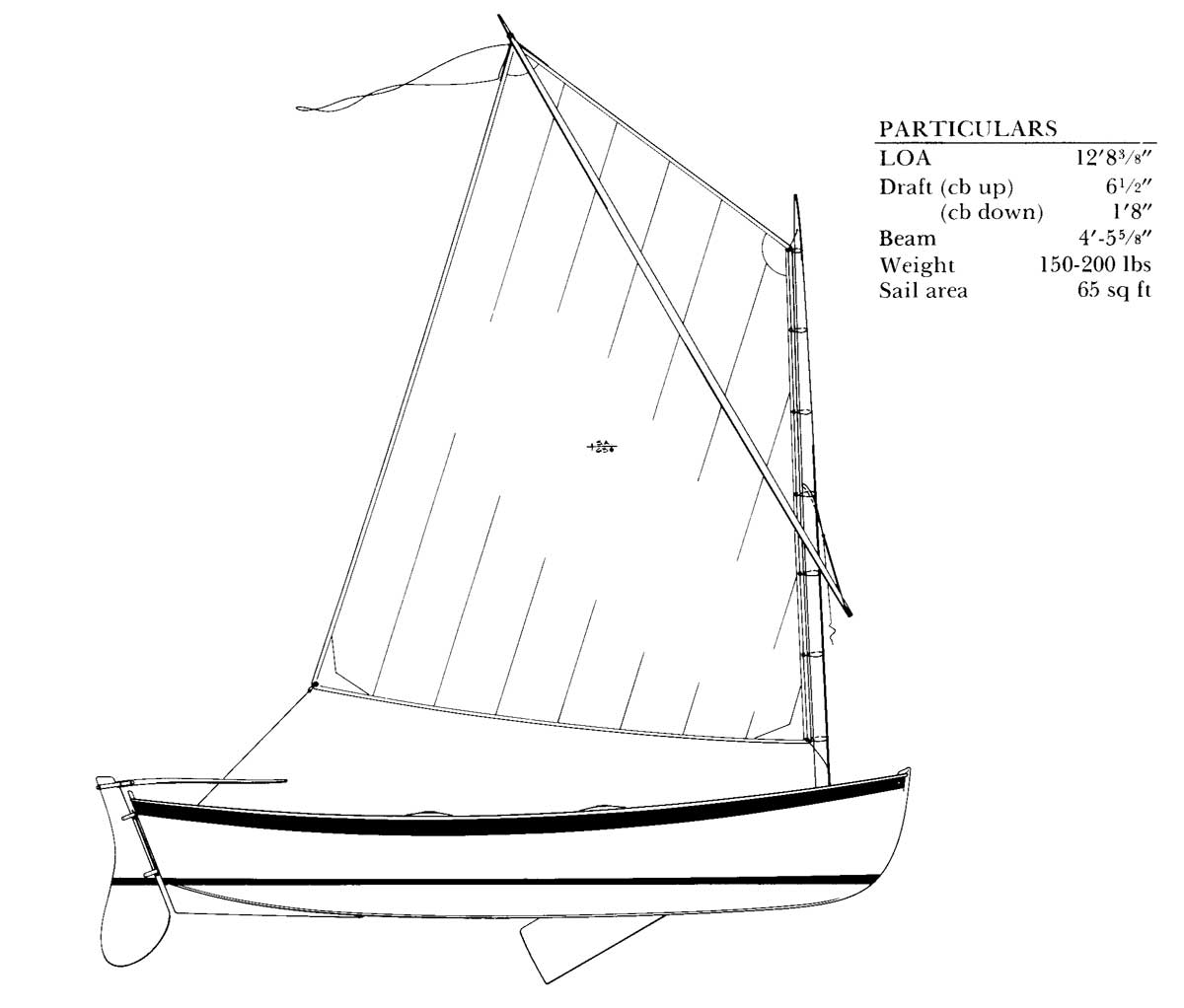
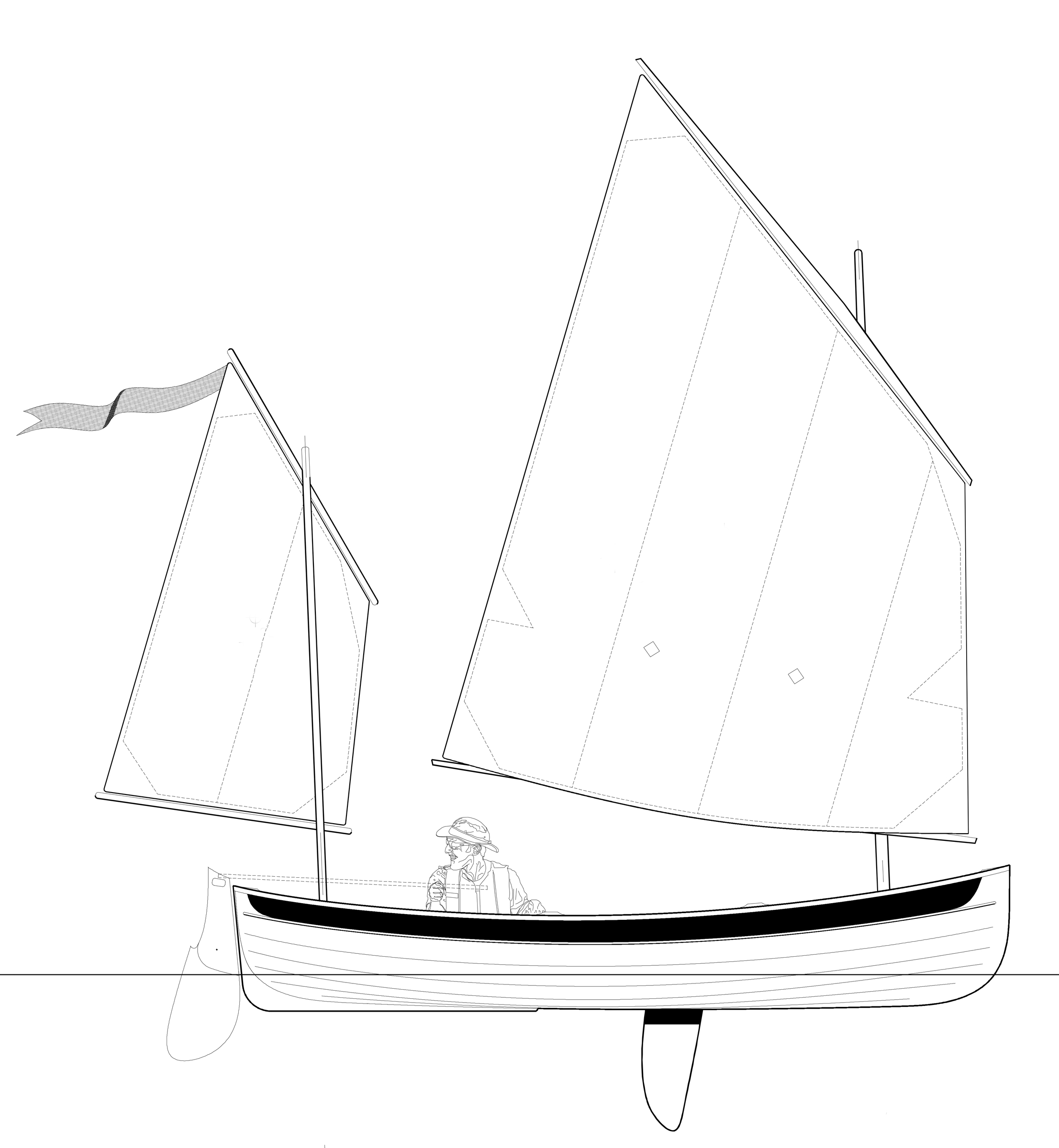
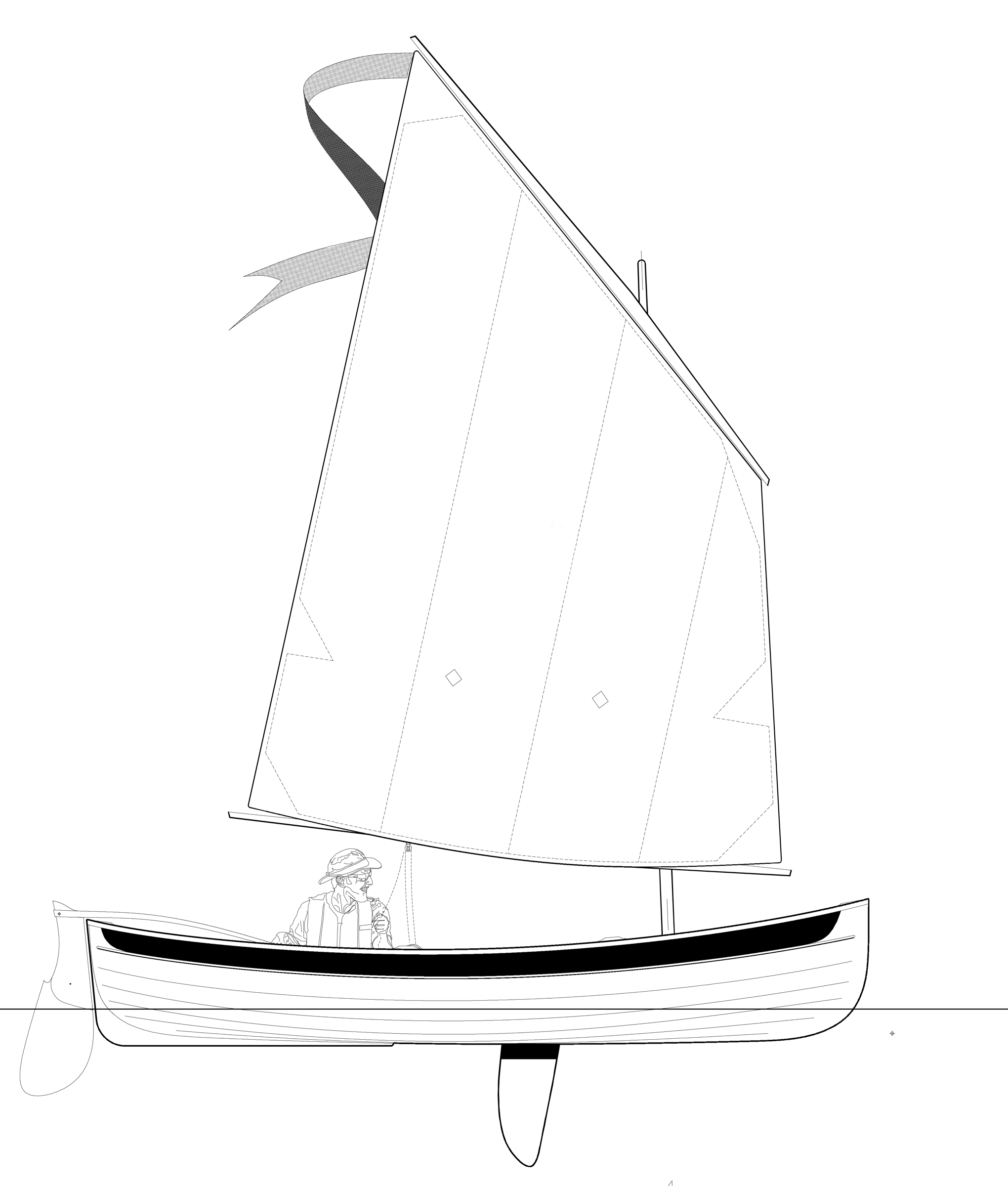
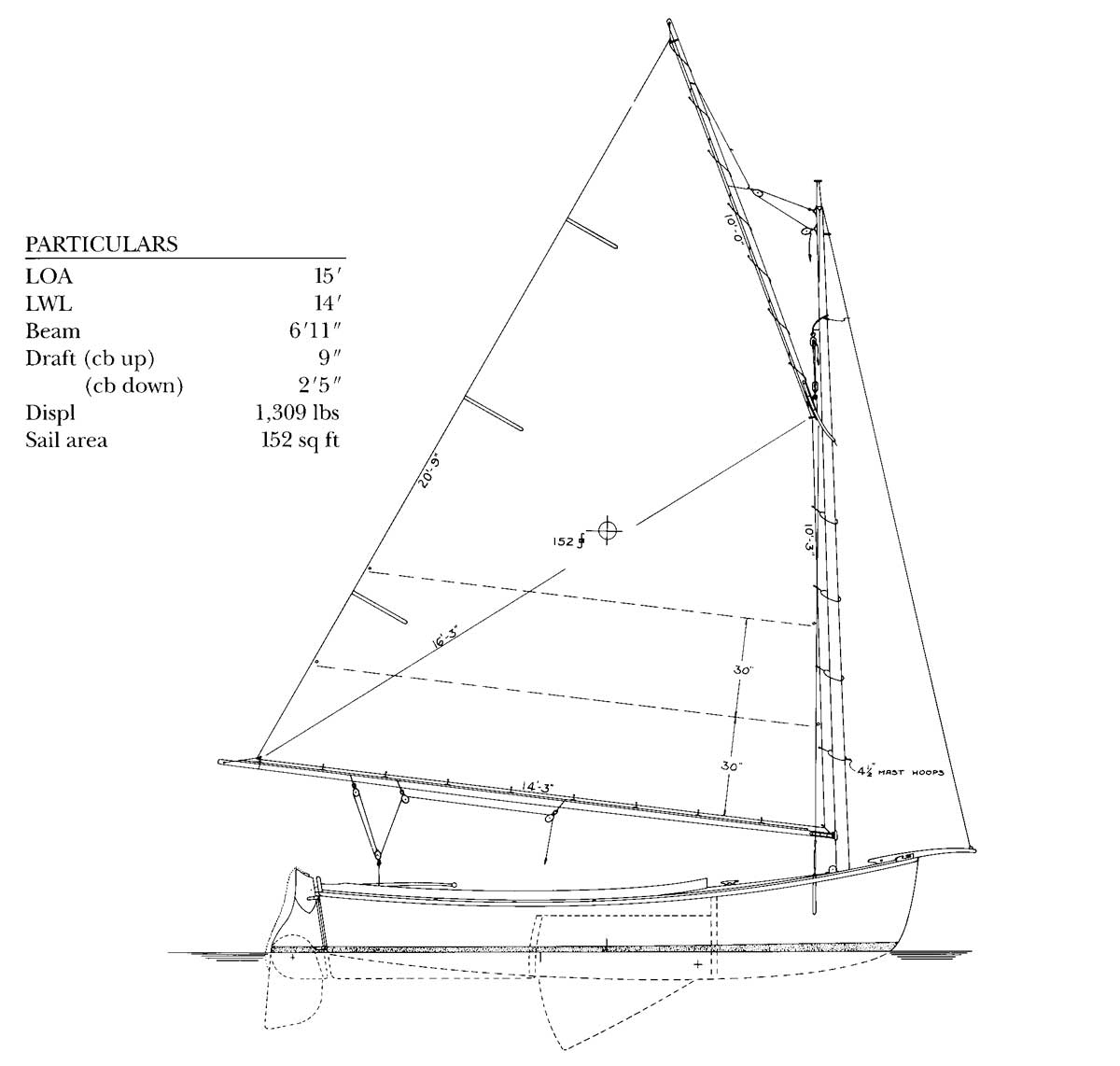
Under sail, the Marblehead gunning dory is both fast and responsive. Although this version shows a rudder being used, generally they were steered with an oar over the lee rail. The spritsail rig shown provides fast sailing in light airs. The old gunners would have used a much smaller “leg-o’mutton” sail to help them along in the winter when “gunning the ledges.”
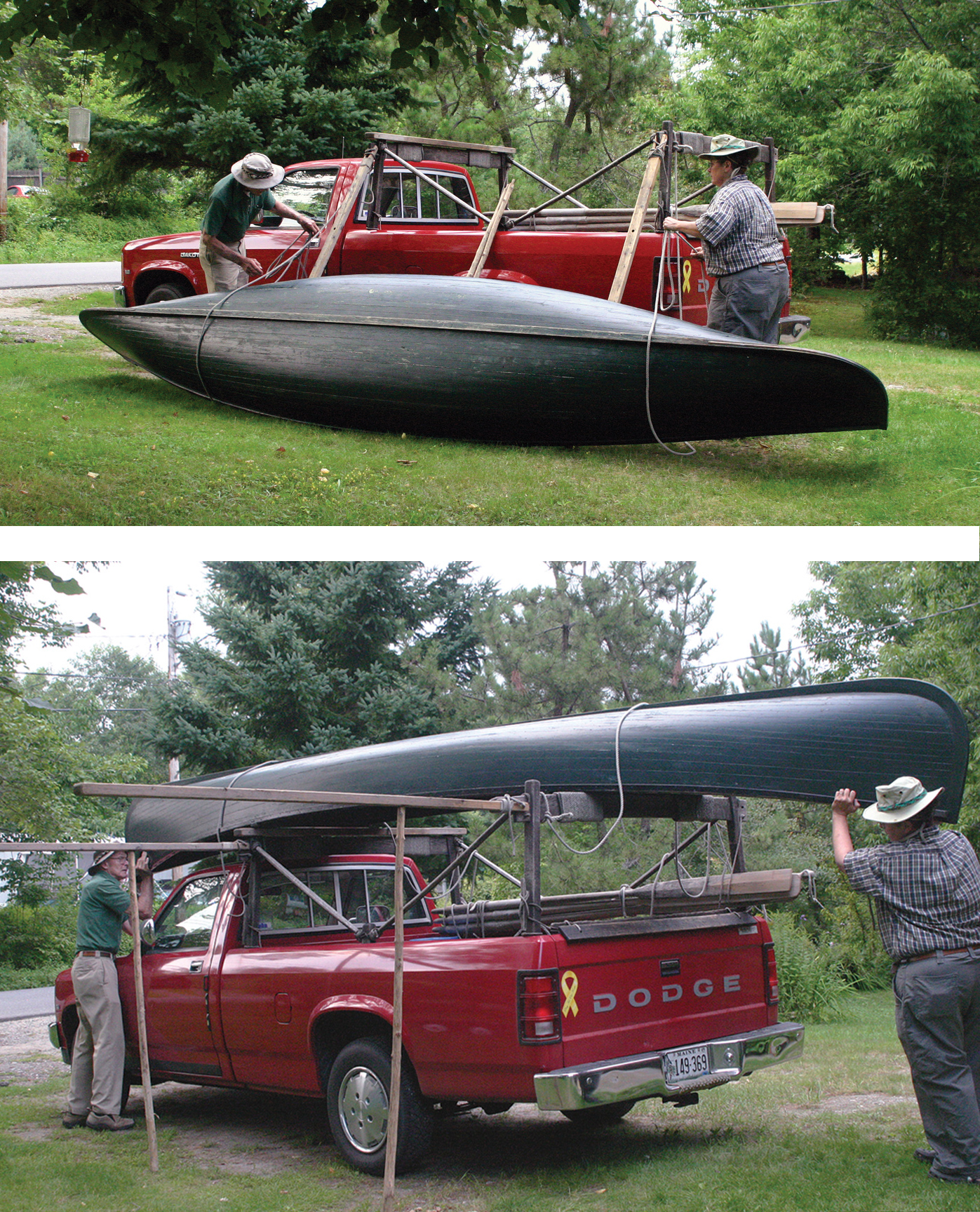
The return trip demonstrated a little-known feature of the design (and for safety’s sake, it probably should remain that way). In a pinch, the boat can be cartopped on a small car. Walter called me when they had reached Point Lookout at the mouth of the river. I had offered to pick him up, but for some reason I didn’t have a trailer available. Roof rack extensions on my trusty Geo Prism did the trick. It looked strange, but the rig worked. It only became slightly unstable when Walter, Joe, and all their gear got out of the car. Once I dropped them off, I had to take the turns a bit slower….
Walter and Joe’s experience proved the boat’s worth as a camp-cruiser. It built friendships and relationships. Walter and Joe are now partners in an Emmy Award– winning video production company. After the trip, Walter liked BEANS AND CORNBREAD so much he took her home.
I’ve gotten to know one more of these boats. This one came into my shop when its owner, Steve Jones, a naval architect and wooden boat aficionado, moved to the area and started volunteering at the Seaport Foundation. It turns out that Steve’s boat is the old INDEPENDENT (now renamed ALLELUHIA)— the boat that Walter Wales built in 1970 and the one shown in John Gardner’s last book. Wales built the boat traditionally, in Marblehead, using Gerald Smith’s set of original Chamberlain molds. He lengthened her to 18′ (Gerald Smith built REPUBLICAN at 17′ because that was the length of his available planking stock). INDEPENDENT was originally used for her designed purpose, to go gunning on the ledges around Marblehead. He reports that he put in a daggerboard so that he could say he could sail her. He also used her for occasional overnight camping trips.
After Wales gave up hunting, he donated INDEPENDENT to Bobby Ives, that wonderful minister who runs The Carpenter’s Boatshop in Pemaquid, Maine. Bobby used the boat as transport for his ministerial duties out to the islands in Muscongus Bay. Then, in 2005, INDEPENDENT came to Steve Jones.
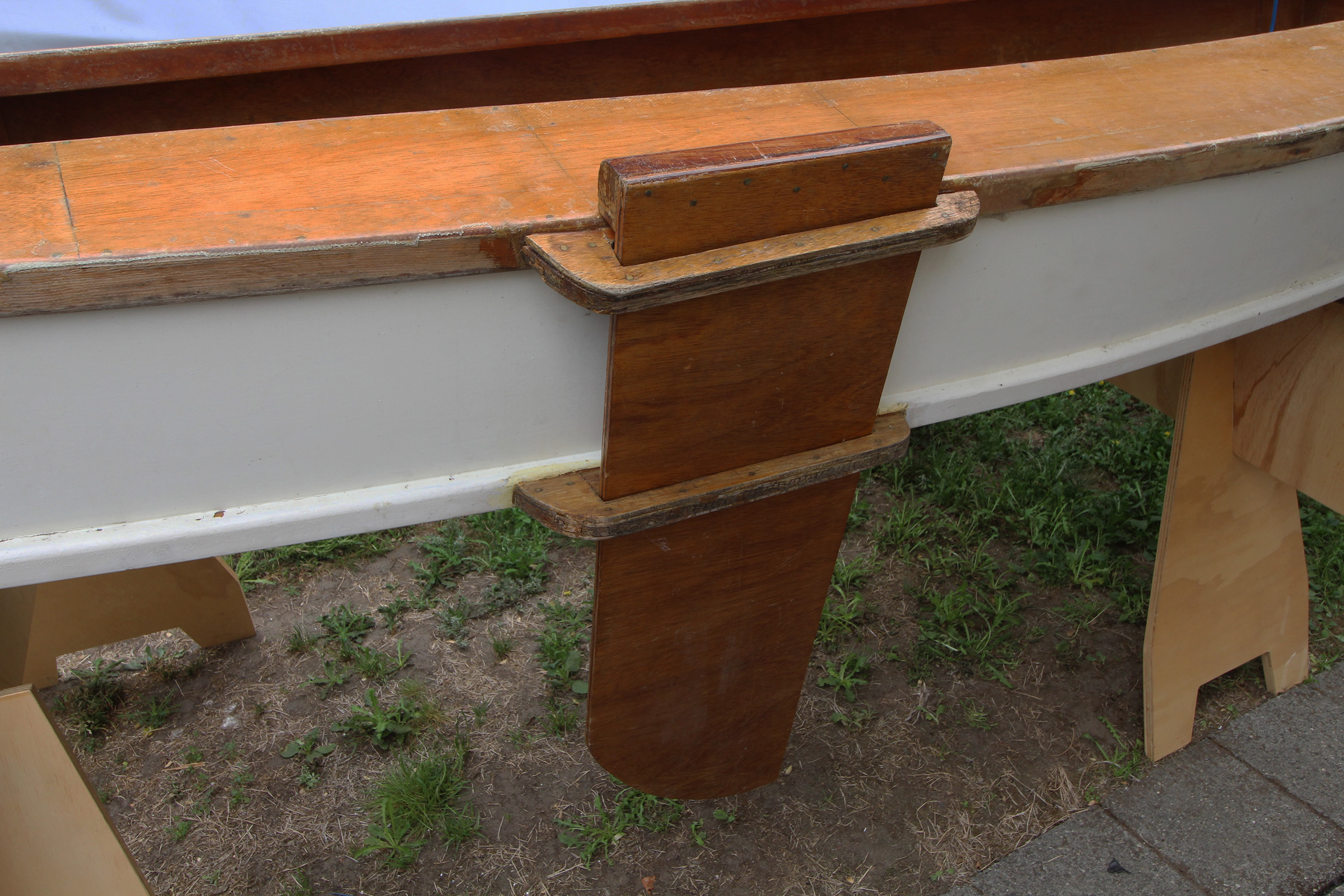
Steve uses the boat year round and, so far, only for day trips. Most folks would row the Marblehead gunning dory more than they’d sail it. This isn’t a boat that’s going to beat to windward against a Lightning. If you want to head straight into the wind, use the oars. Walter Rissmeyer feels that he was able to point up to 45 degrees under sail. Steve Jones doesn’t like to sail any closer than 90 degrees to the wind. A lot depends on how the boat is rigged and what the centerboard and rudder look like.
Everyone I know who is familiar with the Marblehead gunning dory loves it. It certainly seems to be, as John Gardner says, the “ultimate embodiment of that perfection of form and function attained by traditional small craft in the final years of the 19th century.” When summing up his trip in BEANS AND CORNBREAD, Walter Rissmeyer said, “The boat swam. It didn’t pound, or slap. It swam through the water.” That’s a pretty good recommendation for any boat.
Plans for the Marblehead gunning dory are found in John Gardner’s book, Wooden Boats to Build and Use (Mystic Seaport Museum, 1996).
Walter Wales
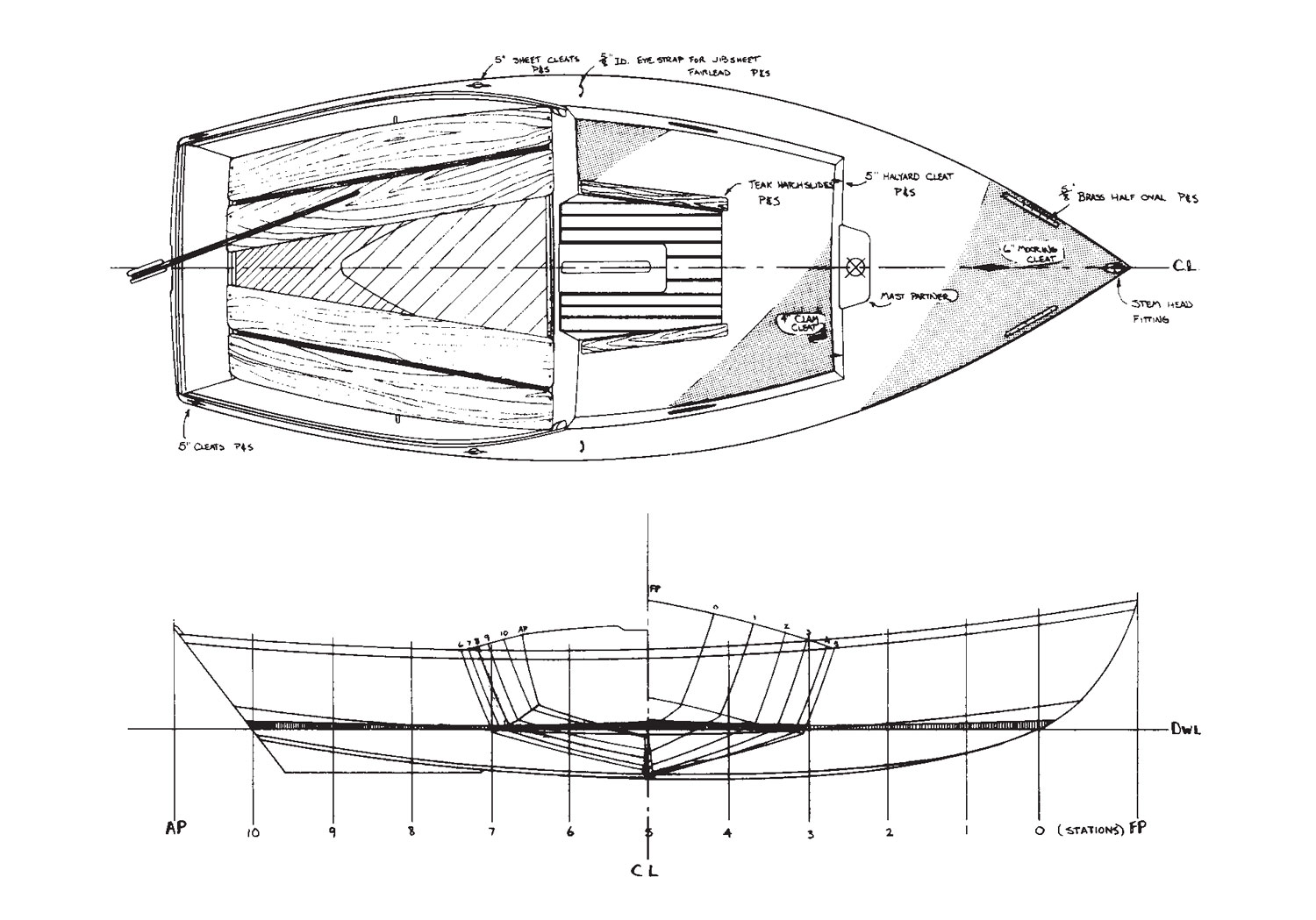
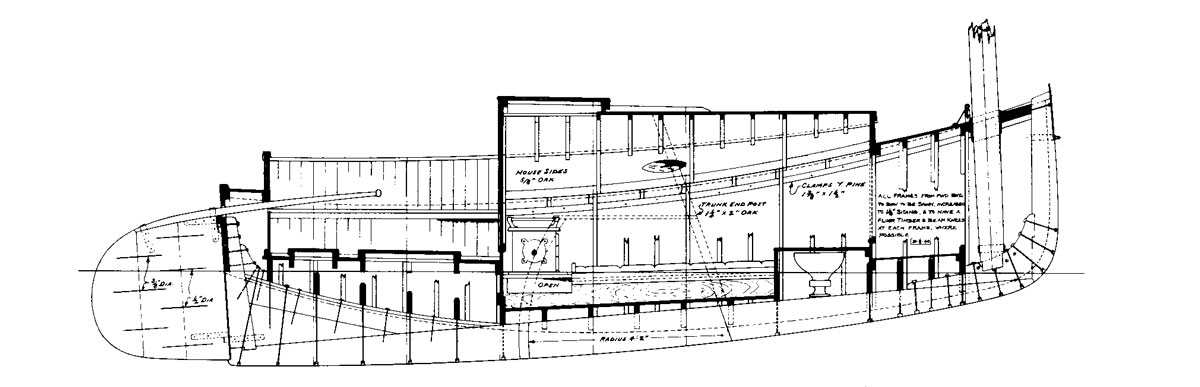
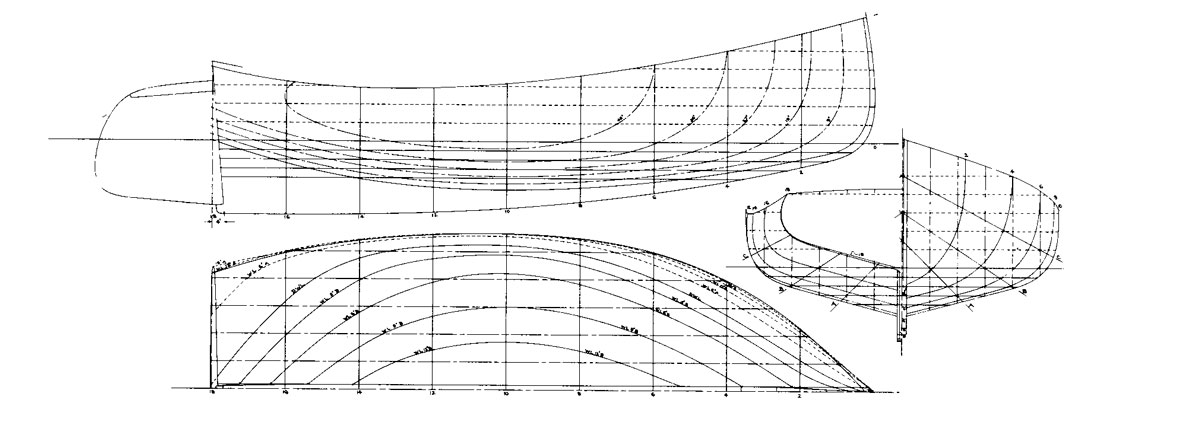
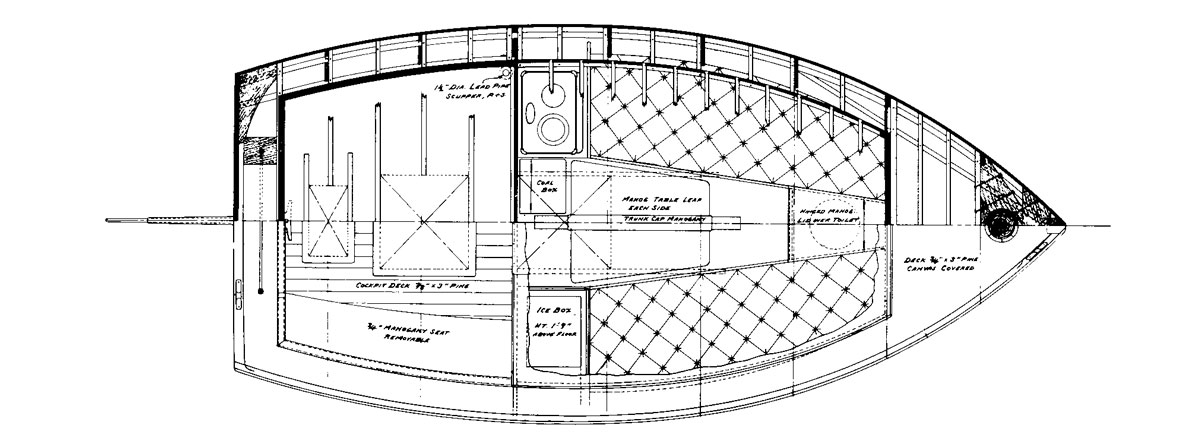
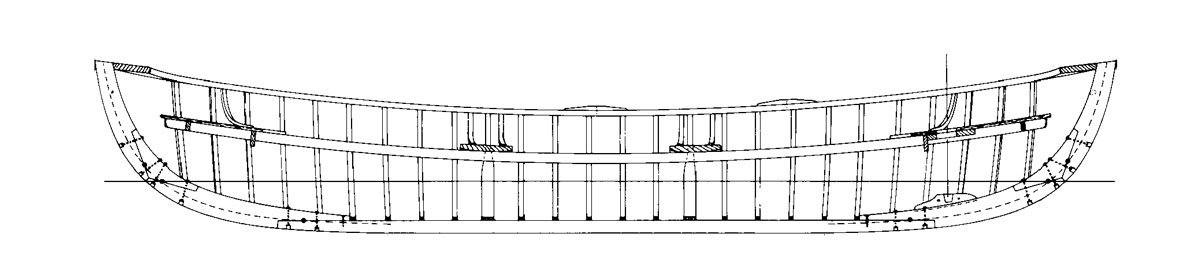
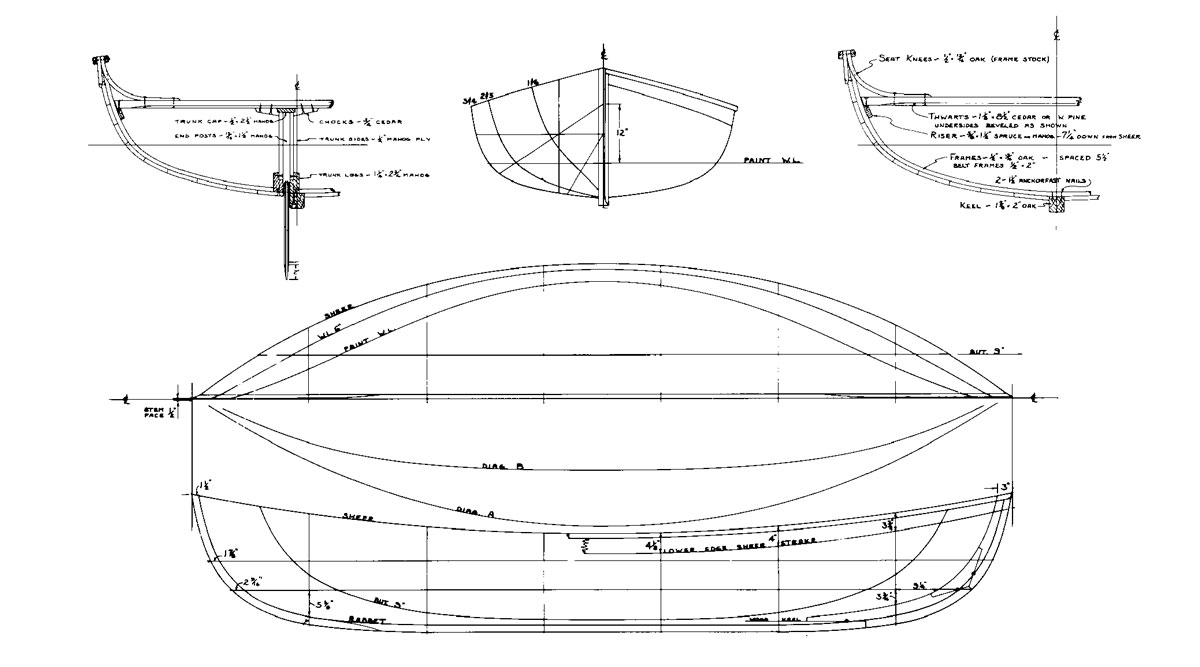
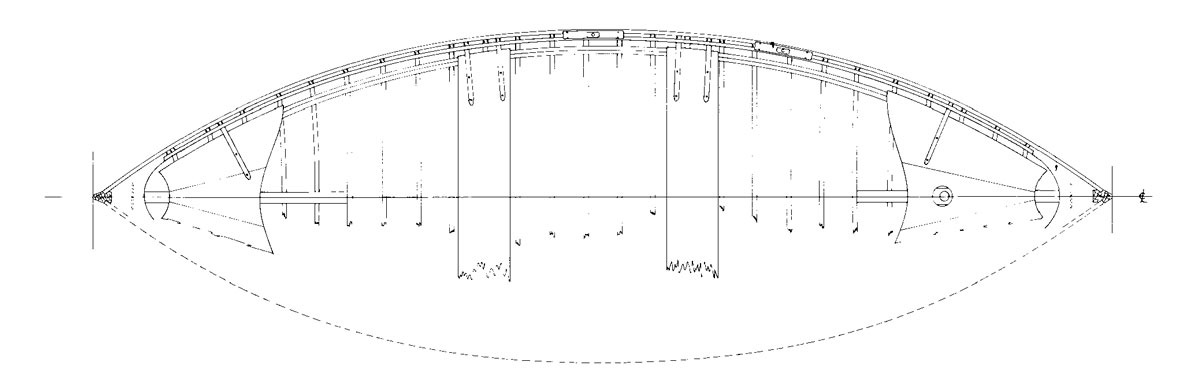
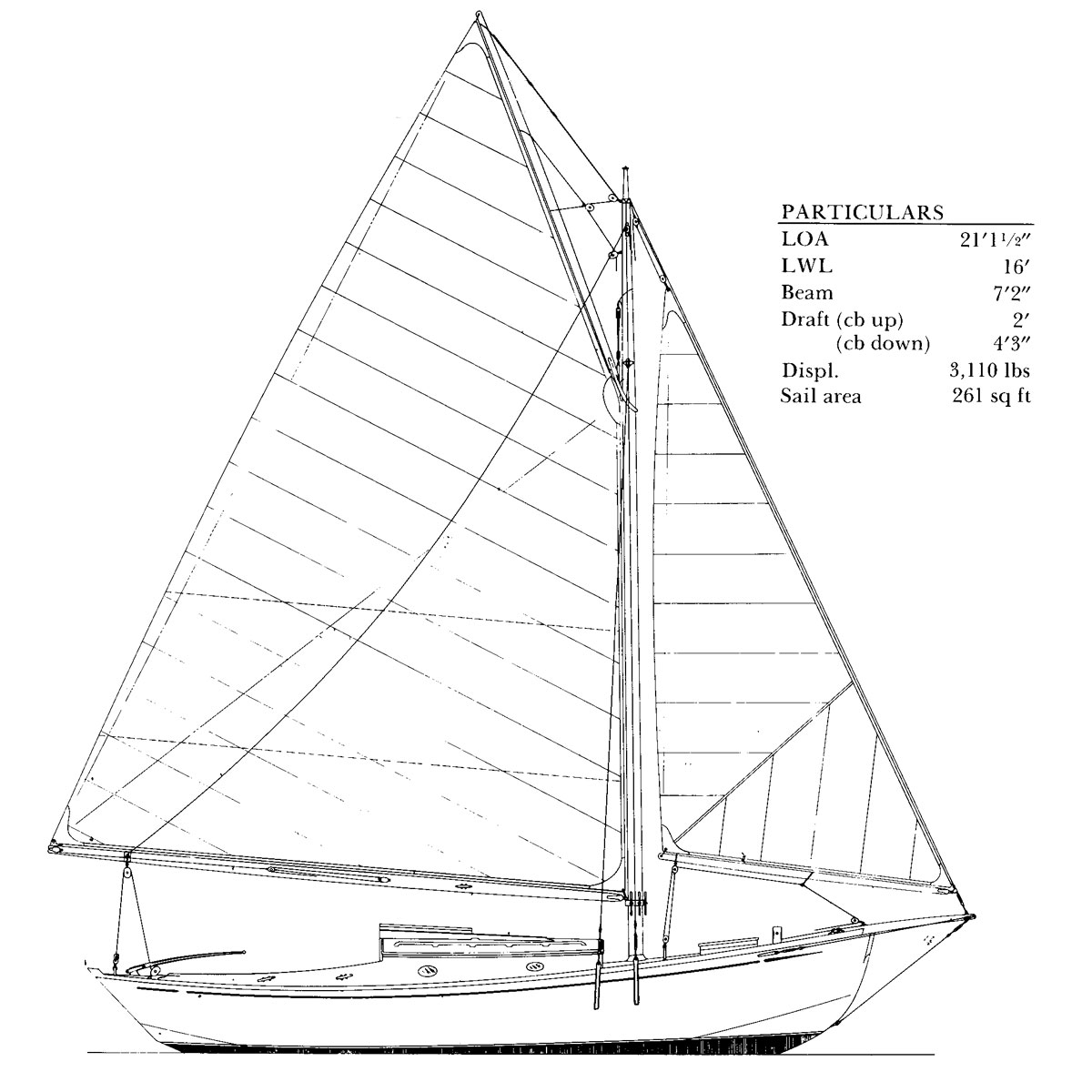
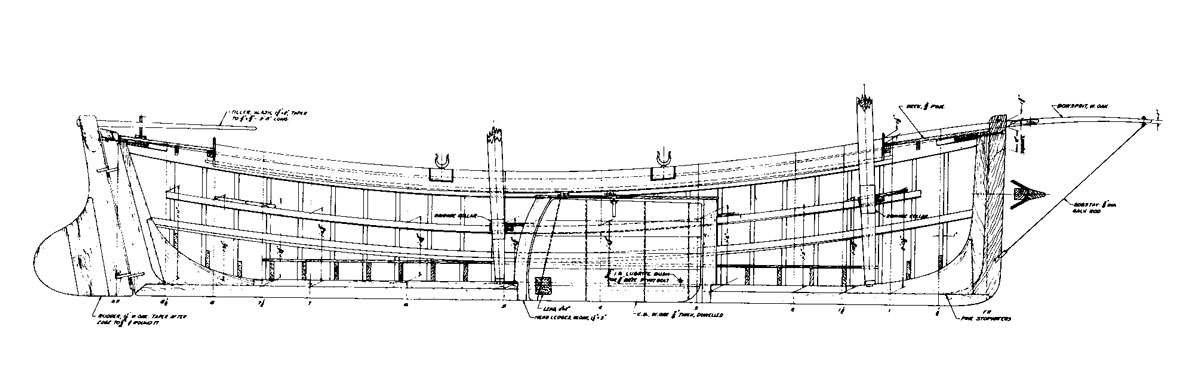
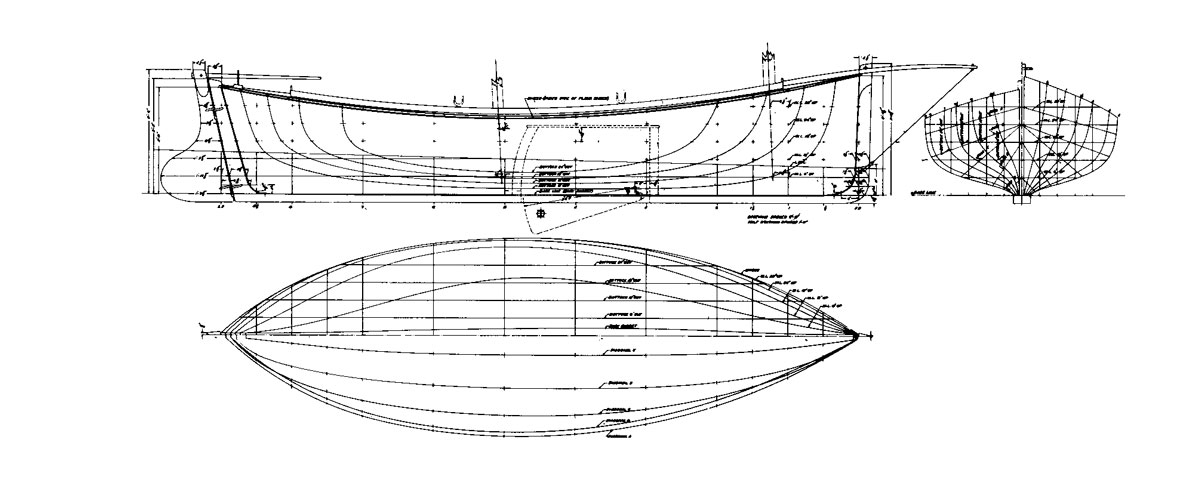
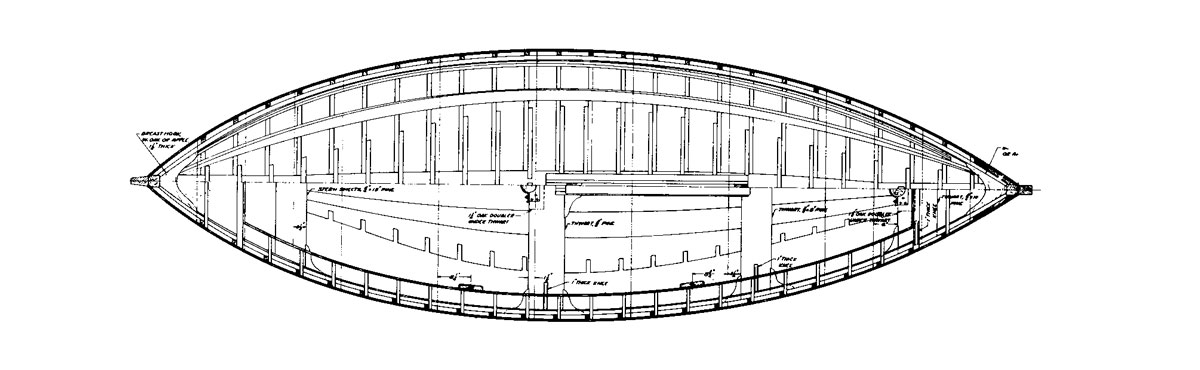
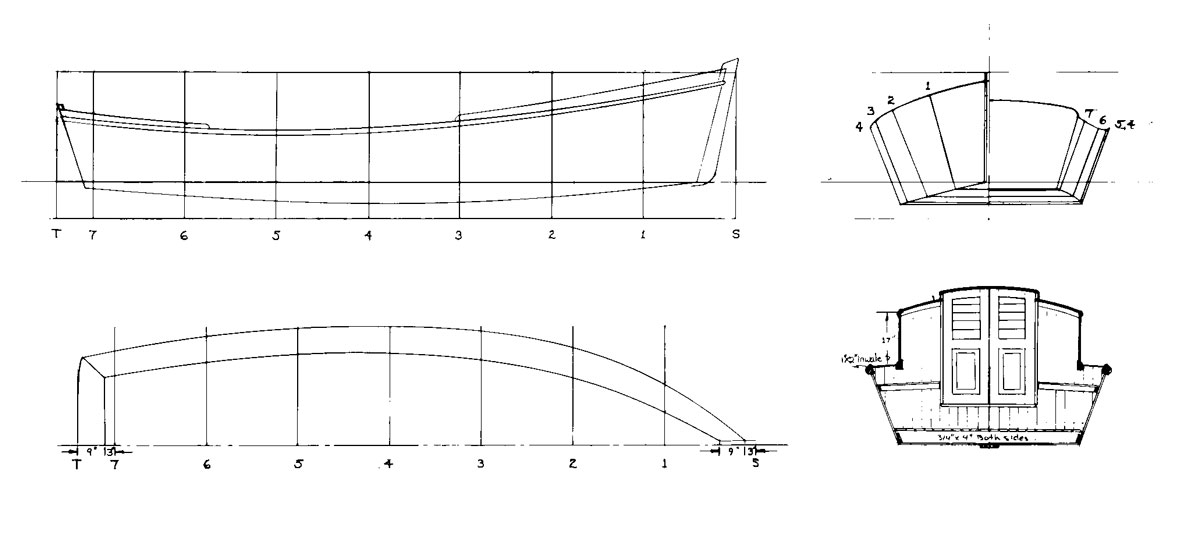
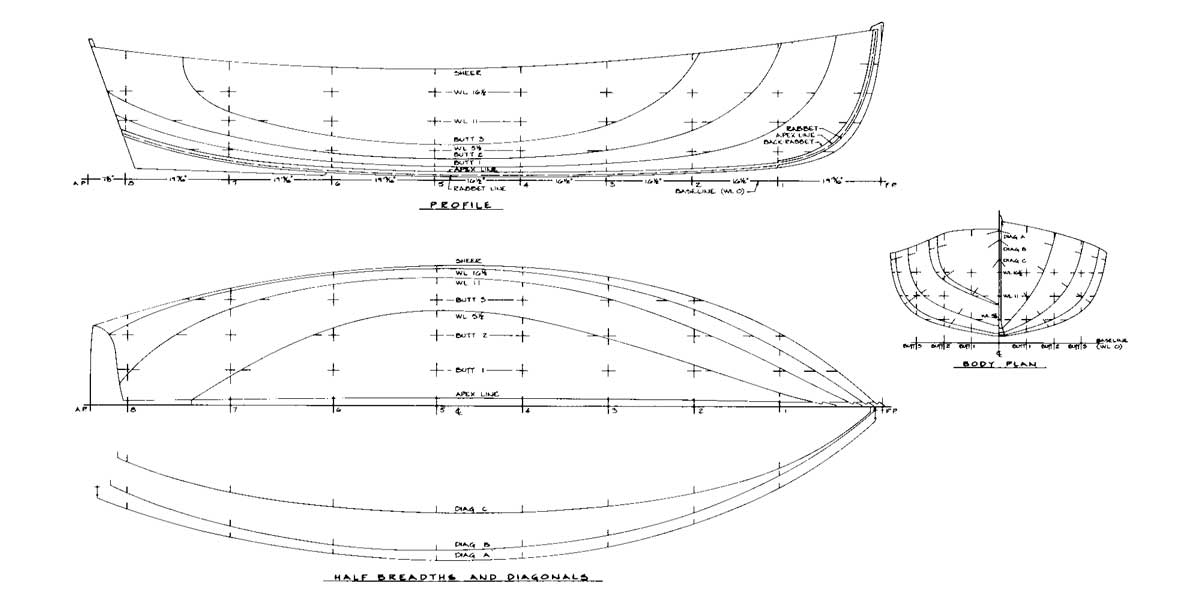
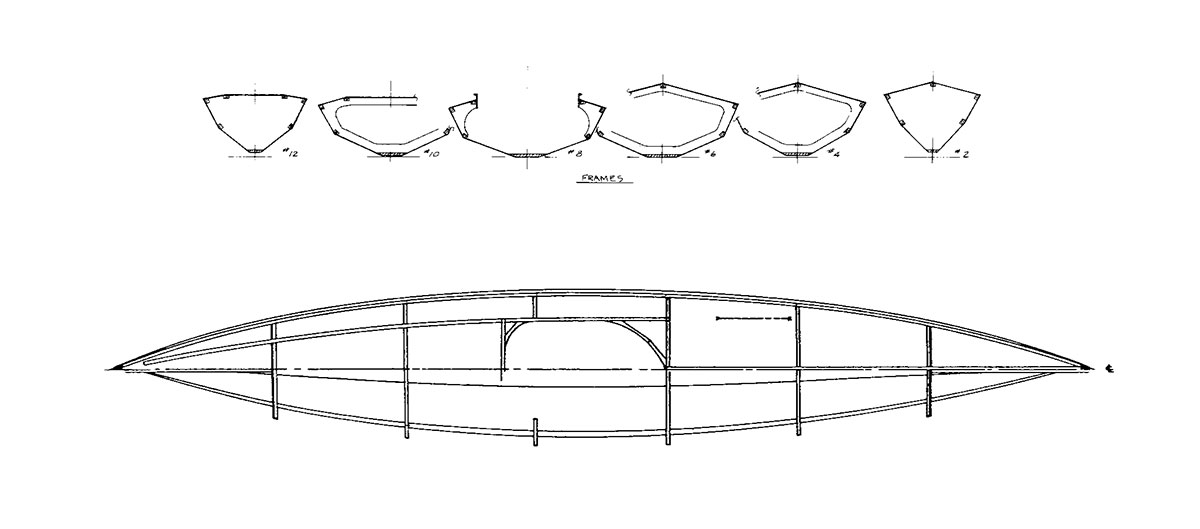
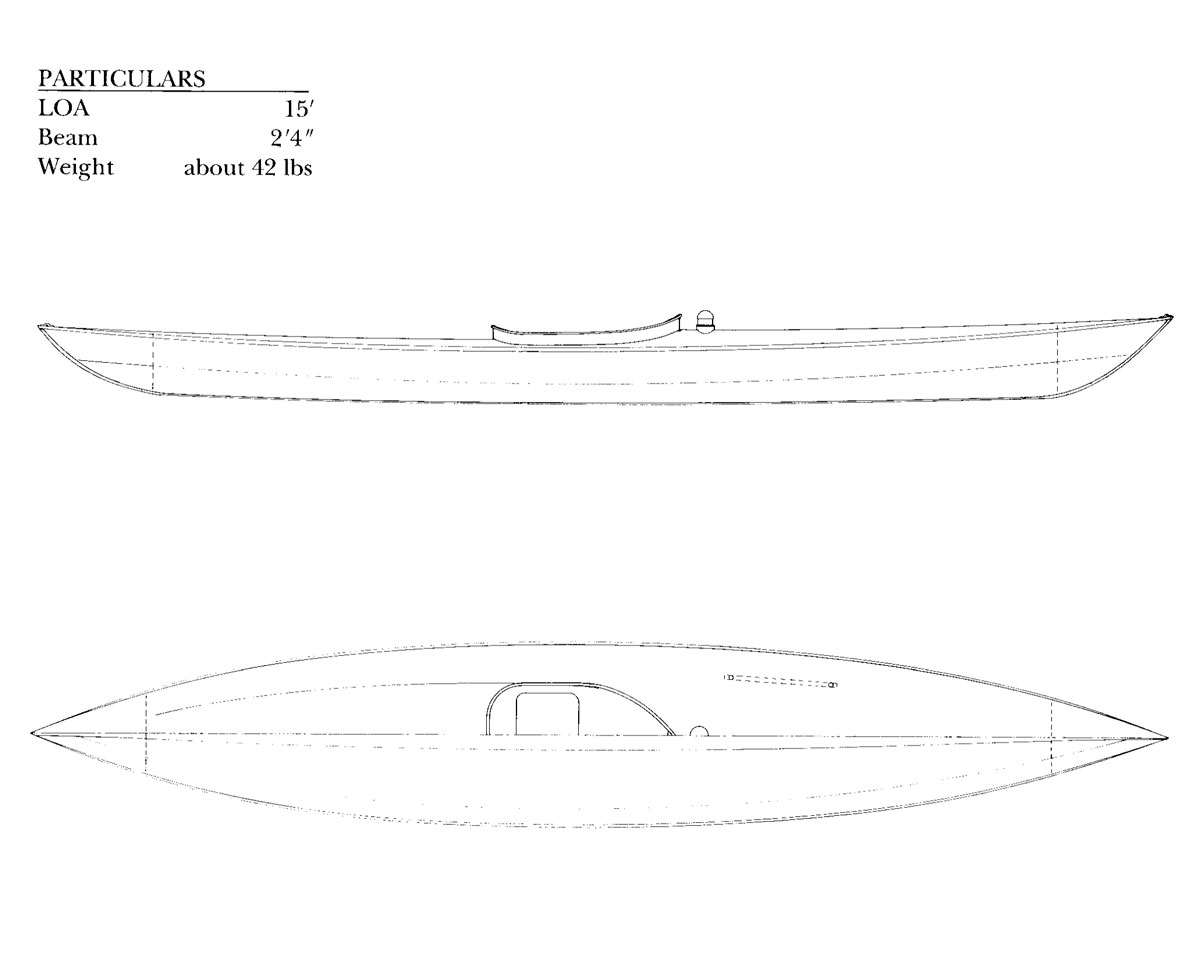
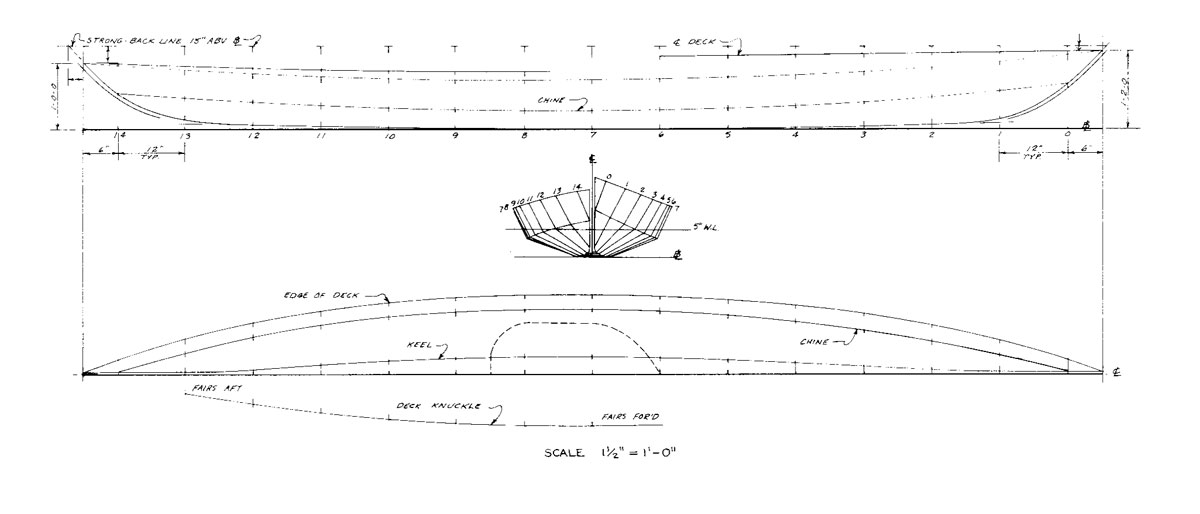
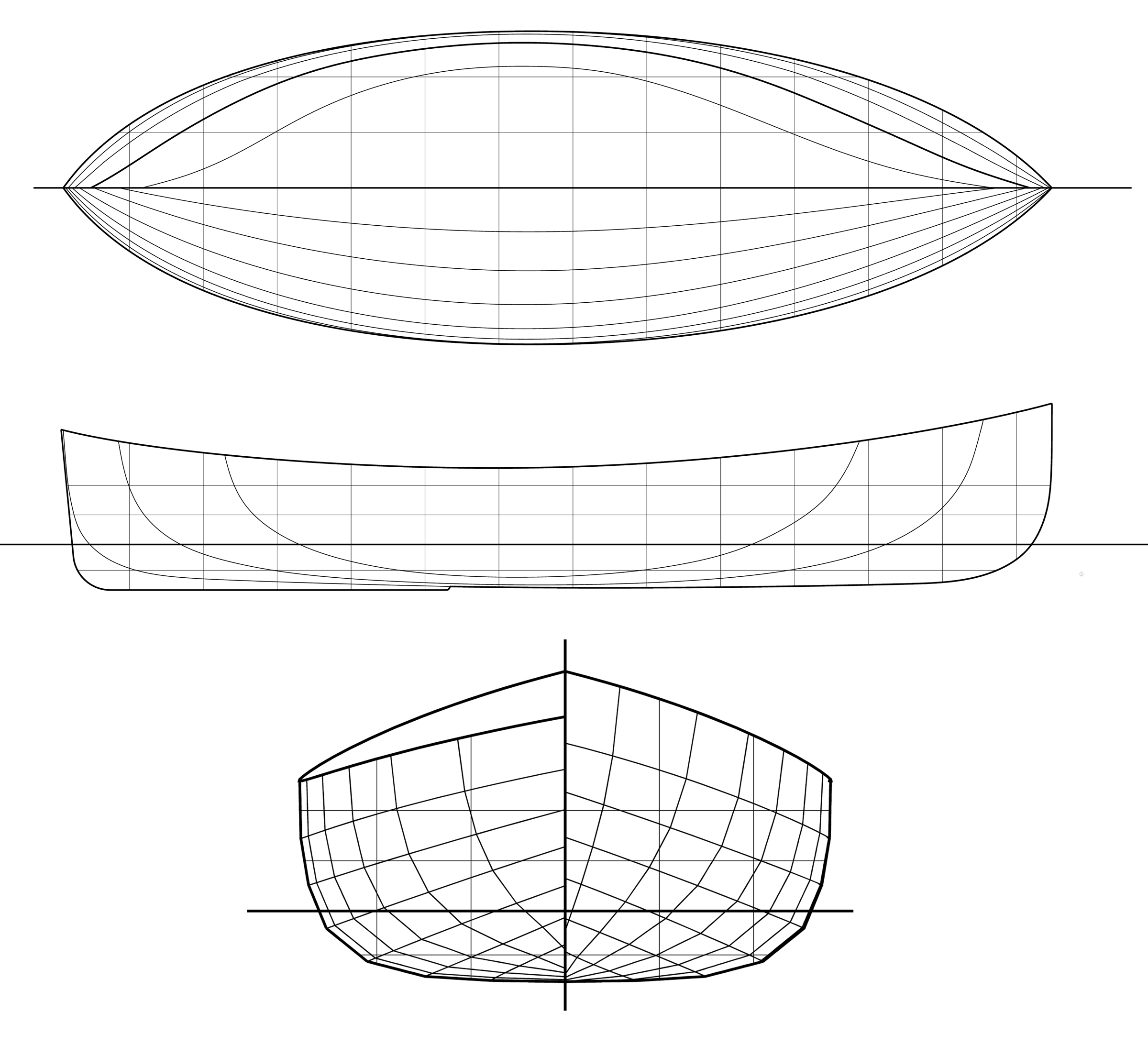
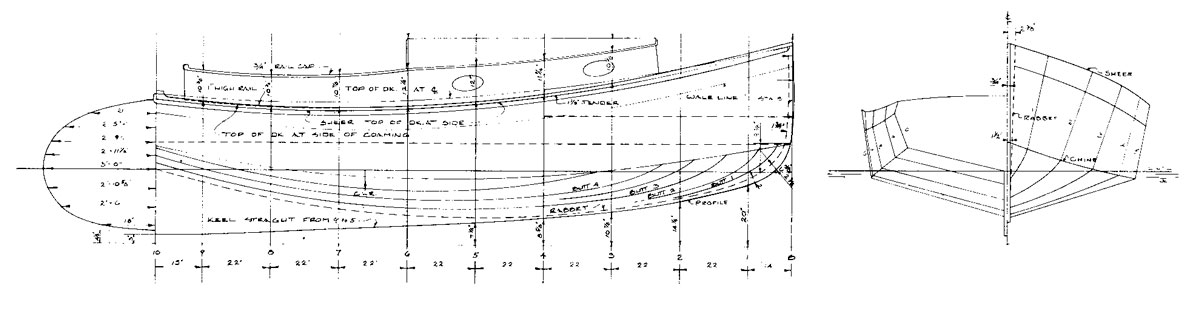
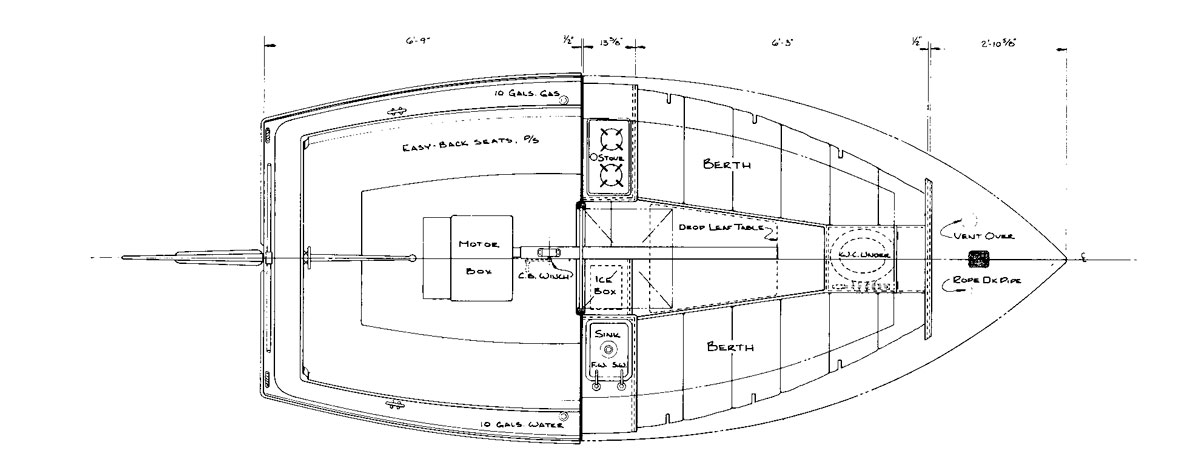
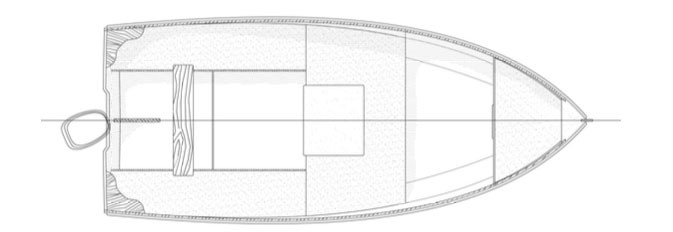
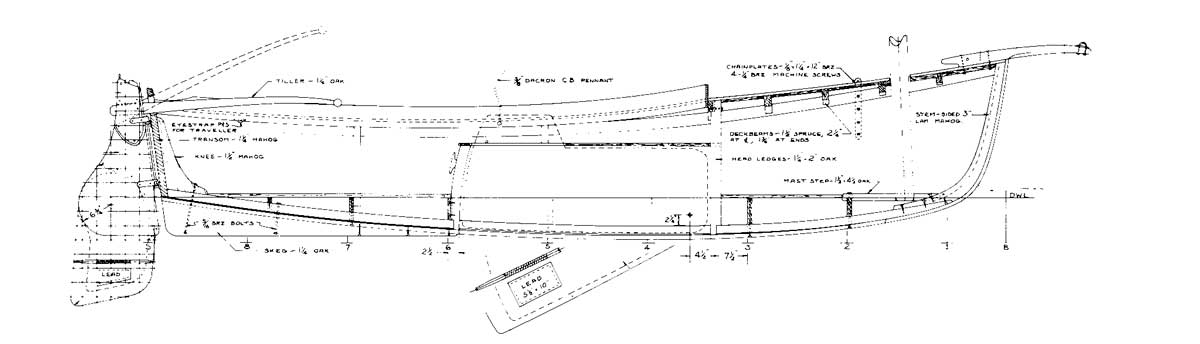
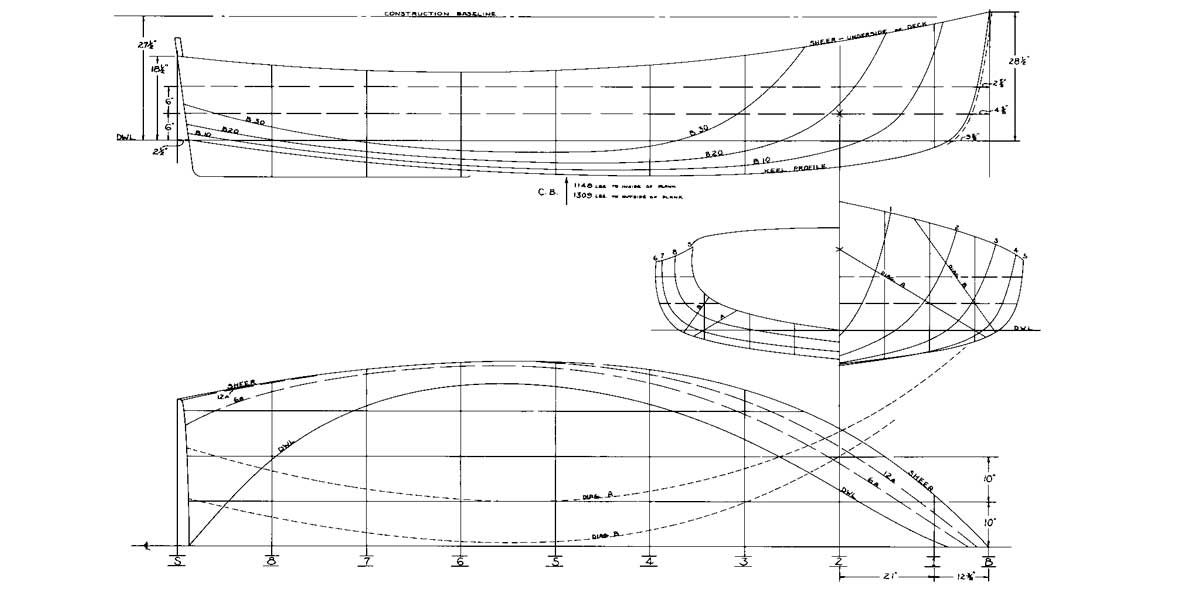
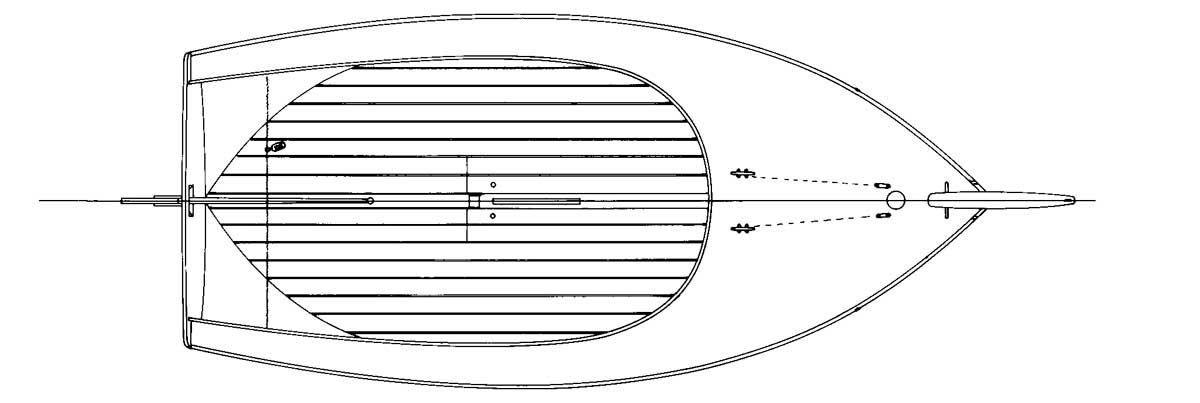
The lines of the REPUBLICAN indicate why John Gardner called the Marblehead gunning dory “the Queen of all Dories.” The sweeping sheer, balanced ends, narrow bottom, and almost round sides combine to produce a boat that is fast under oars, seakindly, and lovely to look at.
Is there a boat you’d like to know more about? Have you built one that you think other Small Boats readers would enjoy? Please email us your suggestions.
When Dan, a Small Boats reader, left Seattle three years ago to relocate in the Midwest, he had to leave behind the pirogue he’d built, so he gave it to his friend Phil. The boat needed some work, but Phil wasn’t equipped with the tools and the boatbuilding skills needed to put it in good shape and for the past year the pirogue sat unused in a fenced-in storage lot near a launch ramp on the west shore of Lake Washington.
When Phil’s interest turned to larger boats, he decided to let the pirogue go. He turned to Dan for advice, and Dan emailed me asking for help finding someone who might be interested in having it. The 16′ Bolger-designed pirogue hasn’t yet been reviewed in Small Boats, so I suggested I could take it off Phil’s hands, write it up, and then find a new home for it.
I met with Phil at the lot, and after we took the cover off the pirogue, I gave it a quick look. It was much older than I’d expected. I didn’t know at the time that Dan built the boat in 1995. Although it was showing its age, I knew I could, as I had intended, launch it for sea trials and photos, write the review, and then pass it along to someone else. Phil and I lifted the pirogue on to my roof rack and I brought it home.
I put the pirogue in the back yard in the only spot left for another boat. Under the gray tarps are my gunning dory and Caledonia Yawl.
The boat has been in the back yard for almost a month now and the more times I looked at, sat in it, and raised its mast and spritsail, the more callous my plan felt. It didn’t seem right to use the boat only to get rid of it as soon as I no longer needed it. Phil Bolger had put his best efforts into the design, Dan had put his into its construction, and I felt I owed it to them to put mine into its restoration.
The plywood fittings for the leeboard haven’t held up well with age. I’ll likely remove them and build a trunk inboard.
I set the pirogue on sawhorses where I could better see what work needed to be done. The plywood brackets that would hold the leeboard were delaminating and I could replace them or, I thought, do without them, as other pirogue builders had done, and install an off-center daggerboard trunk under the side deck. The rudder had been designed with a yoke and tiller ropes, a system I’ve tried with other boats and have mixed feelings about. Dan preferred a tiller and had equipped the rudder with one made of a short length of bamboo. I imagined a Norwegian tiller like the one on my Caledonia Yawl would be a good match for the boat.
I plan to replace Dan’s bamboo tiller with a Norwegian tiller and I’ll convert the rudder blade from fixed to pivoting for easier launching and landing.
Having my thoughts drift to the work I wanted to do on the pirogue brought me back to something I’d enjoyed every time I built a new boat for myself: an engaging and active state of mind given over to problem-solving and visualizing in three dimensions.
After a day’s rain had leaked through the tarp I’d put over the pirogue, I flipped the boat upside down to keep it from gathering water again. The next sunny day, seeing the roughed-up paint on the hull, I felt compelled to bring the random-orbit sander out of the basement shop and start sanding. I never used to like that work much. After building a boat, sanding was a barrier to getting afloat, and there were far too many times that it had to be done between bare wood and topcoat. But with the pirogue, I might need to sand only once, and I could easily do that without my patience wearing thin. My left hand trailed the sander held in my right hand, feeling the irregularities on the paint’s surface lose their edges with each pass. My fingertips could sense the progress that my eyes could not. The dust from the sander turned my hands a white like the skin of a Japanese Butoh dancer, ghostly in rice powder.
The outwales were mottled black and pewter-gray where the varnish had worn away, and a jaundice yellow where it had not. A paint scraper couldn’t get through the discolored wood fast enough, so I took a palm plane to it. A few strokes uncovered the honey-colored Douglas fir, still redolent with its warm lemony fragrance after being hidden for almost three decades. On the starboard side, the forward section of the gunwale had a particularly tight grain, with rings so fine I needed a magnifying lens to count them. In the 1 ½″-wide outwale there were 56 rings, many almost invisibly thin. I looked forward to having the venerable wood finished bright again.
When I brought the pirogue home, I had intended to use it only for the review and then give it away. I hadn’t anticipated that having to do some work on it would lead to the reawakening of the senses and the stirring of imagination that had drawn me into boatbuilding in the late ’70s. It has been three years since I’ve had a boatbuilding project, and while I enjoy using the boats I have, I can fully appreciate them only when I get them afloat. A boat that I can work on at home is one that can pleasantly occupy my thoughts and my time every day. I’ll get much more from the pirogue than I put into it. And when it comes time to part with it, I’ll be able to take as much pride in the pirogue as Phil Bolger did in designing it and Dan did in building it. The boat deserves no less.
The Pirogue at its beginning
Old photographs courtesy of Dan
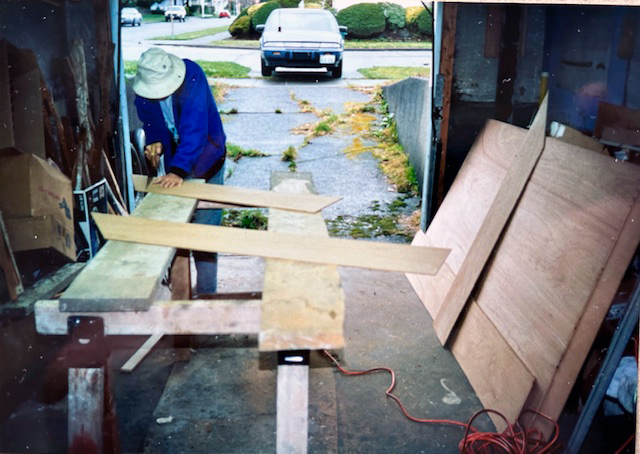
In the spring of 1995, the pirogue came together in the one-car garage of Dan’s bungalow home, located north of downtown Seattle. His friend and co-builder David, here in his Tilley Endurable hat, is working on the boat’s side panels.
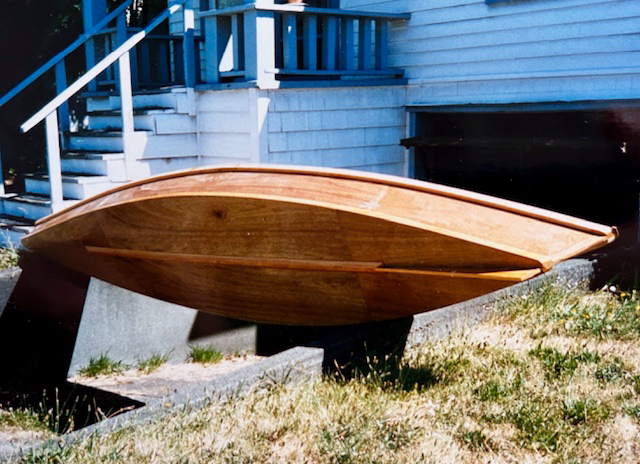
Brought out of the garage, the finished hull awaits outfitting for sailing.
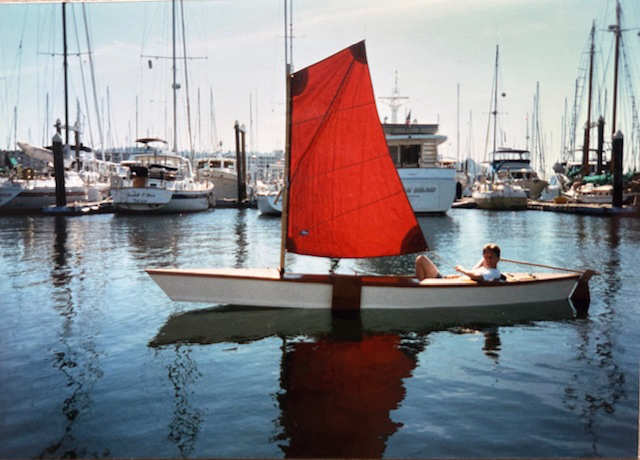
In 1997, Dan sailed the pirogue in light air in Seattle’s Shilshole Bay Marina. He had the tanbark sail made locally by Rush Sails, a small company no longer in business.
If you’ve been around dinghy-sailing a while, there is a better-than-average chance that you’ve come across the venerable Sunfish (or have mistaken one of its many imitators for a Sunfish). Audrey has been messing about with Sunfish since 1982, and she first capsized one with me onboard in 1984. Through the years we’ve spent many memorable hours sailing this simple boat and have had immeasurable fun restoring old and well-used, even abused basket-case boats.
The Sunfish, a direct descendant of the 1945 Sailfish, was the creation of ALCORT Sailboats, founded by Alex Bryan and Cortlandt Heniger. A hollow-bodied wooden “sit-on” sailboat, the Sailfish was featured in LIFE magazine’s 1949 article “World’s Wettest, Sportiest Boat.” It went through various iterations and in 1952, the designers at ALCORT, with considerable input from Aileen Shields Bryan, introduced a new iteration they called the Sunfish. Aileen was considered one of the best female sailors of the day, having won the 1948 Adams Cup—the Women’s National Sailing Championship—as well as the Atlantic and 210 class championships. She recommended adding a small cockpit as a foot well for more comfort, and widening the hull by 12″ for more stability. Since 1952 the Sunfish has been in continuous production and by 2013, more than 500,000 had been built and sailed in over 50 countries.
Kent Lewis
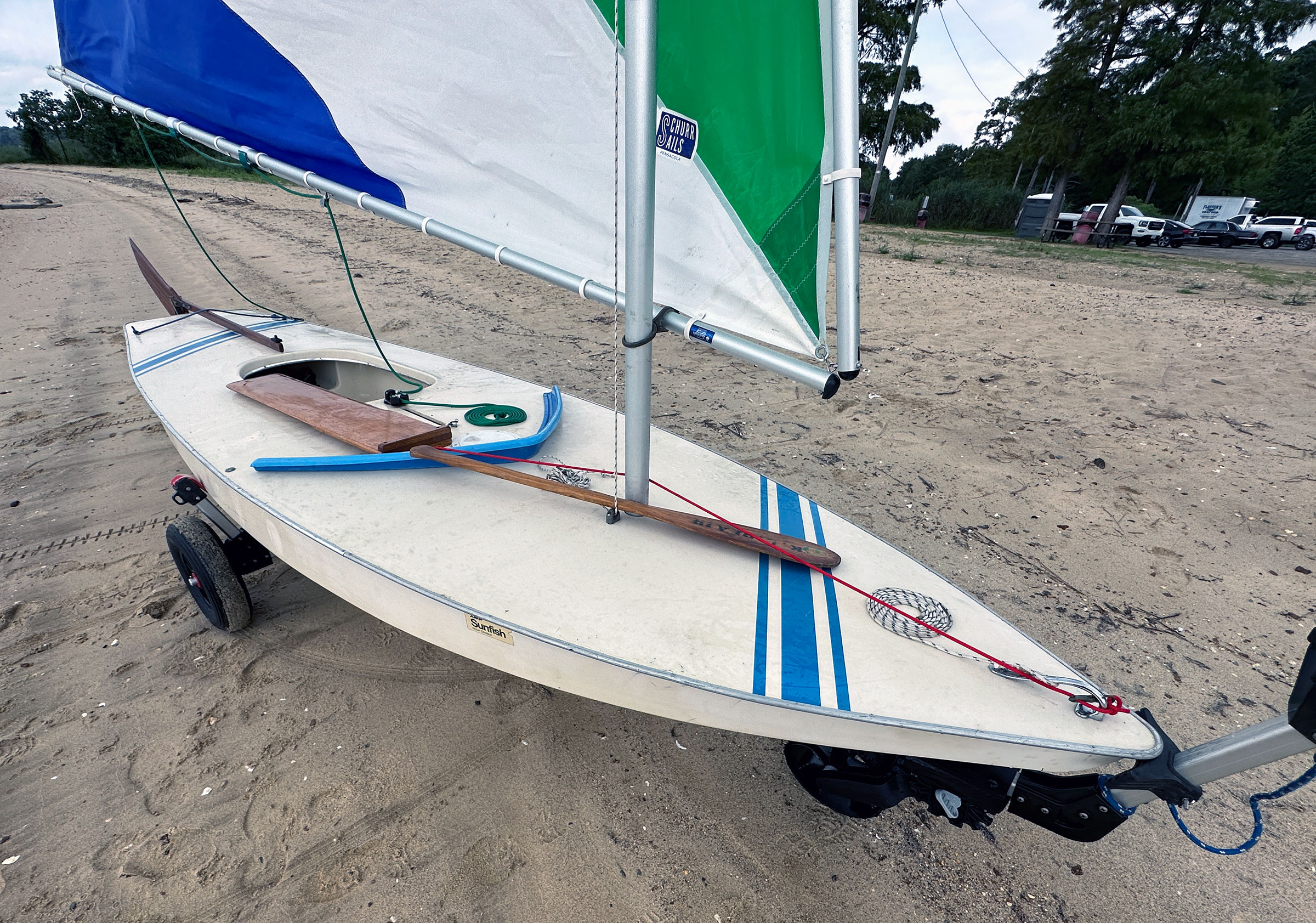
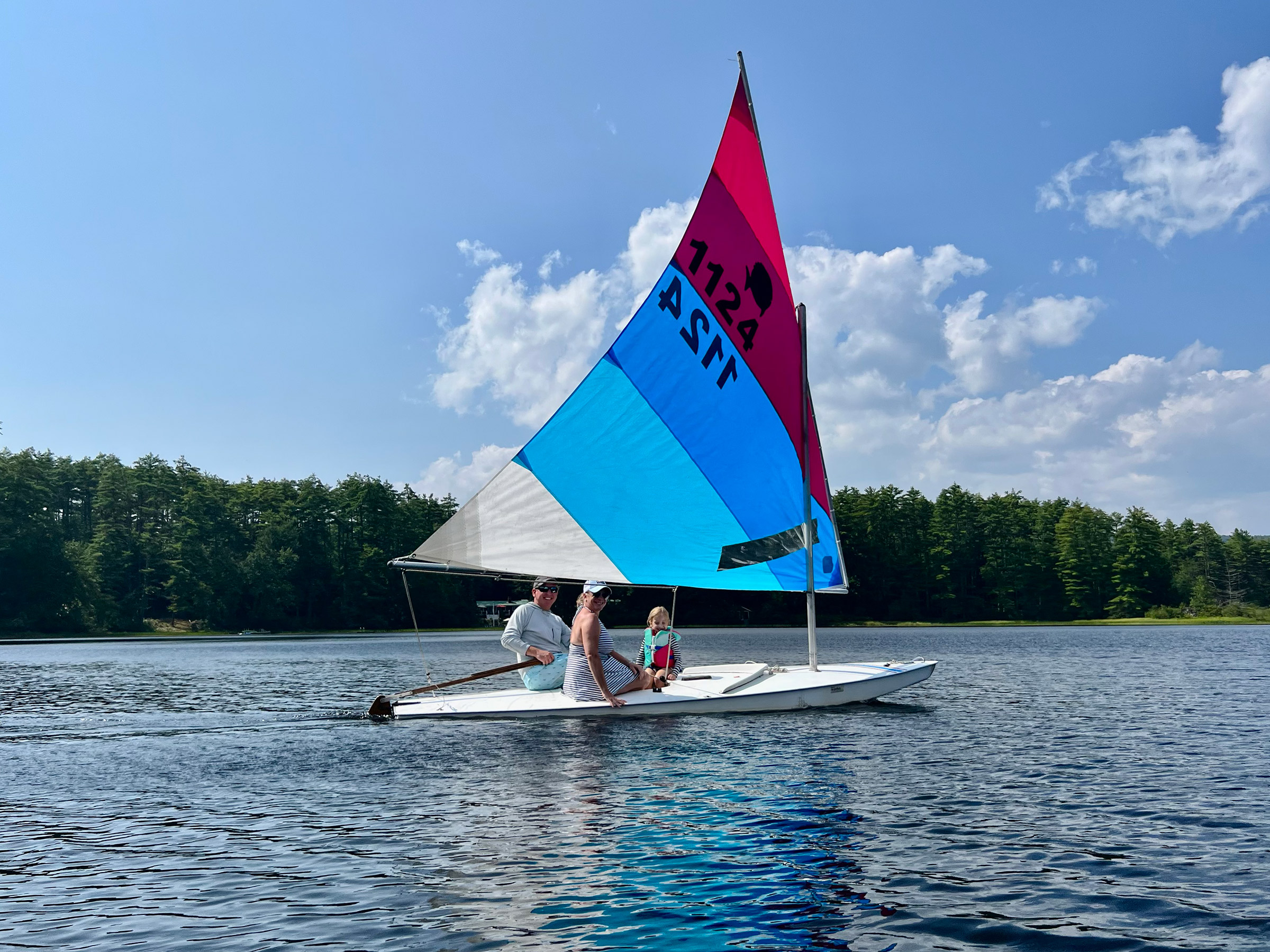
While owing much to its predecessor, the Sunfish is more boat than board. The beam was increased by 12″ to improve stability and a footwell and splashboards were added. The sail is no longer laced to the spars and now attached with clip rings.
Between 1952 and the mid-1960s, the Sunfish was built in plywood and kits were available. We acquired hull number 13 of the pre-production boats and restored it in 2013. Based on the emerging popularity of fiberglass construction in the late 1950s, ALCORT produced the first fiberglass Sunfish in 1960. It was immensely popular for recreational sailors as well as one-design racers, so popular that it was inducted into the American Sailboat Hall of Fame in 1995.
The Sunfish is a medium-sized hard-chined pontoon-hull dinghy with a length of 13′ 9″ and a 4′ 1″ beam. Draft with the daggerboard down is 2′ 11″ and the modern-day hull weighs 120 lbs. (The ALCORT hulls of the 1960s were built a little stouter, with hull weights of 139 lbs.) Crew capacity is 500 lbs and there is just enough room for two adults. The optimal weight for a solo sailor is up to 190 lbs.
Kent Lewis
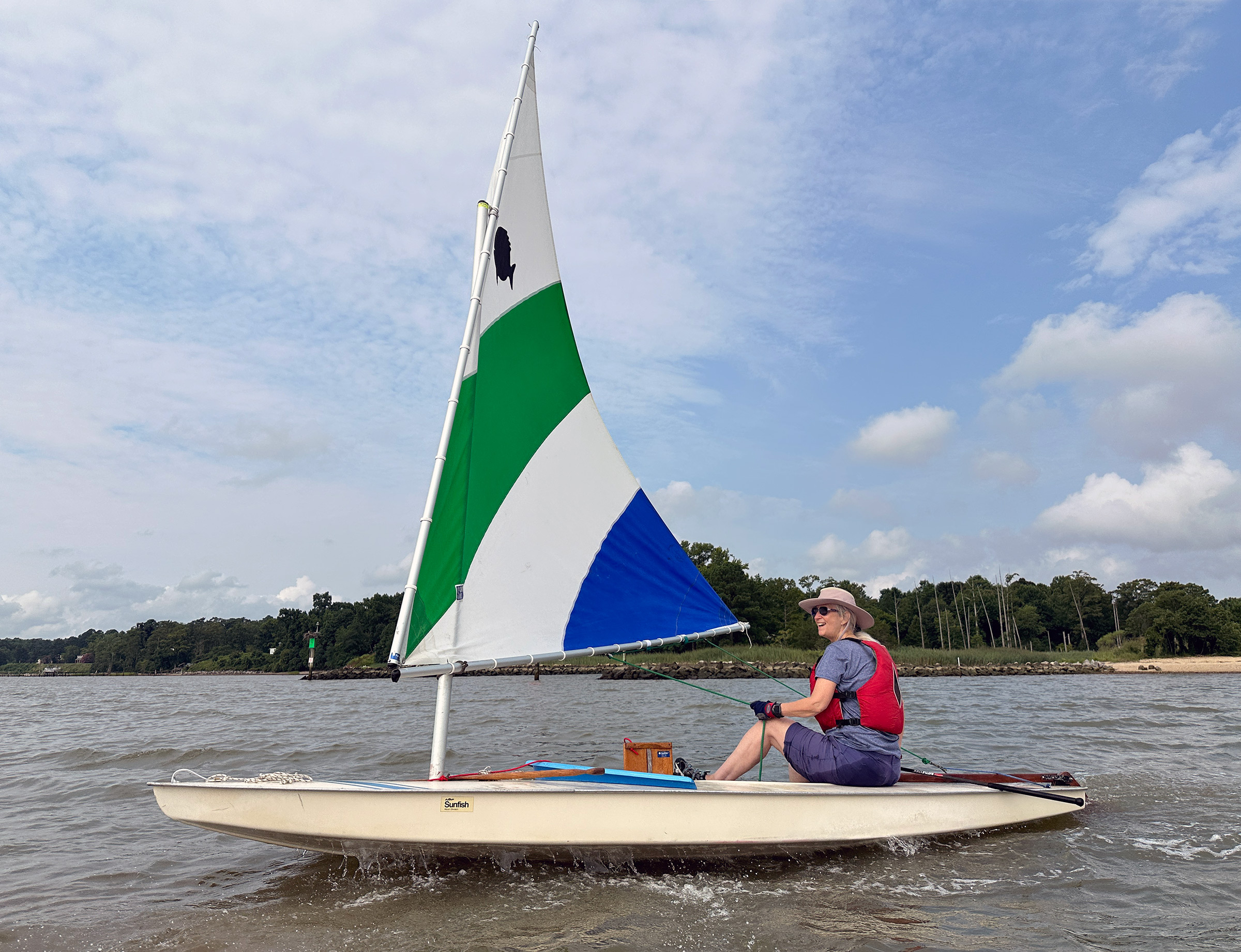
Despite the raised freeboard and the splashboard forward of the footwell, the Sunfish is still a wet boat, making it more popular in areas with warmer water.
The virtually unsinkable pontoon hull of most fiberglass Sunfish contains six closed-cell expanded-polystyrene blocks—three in the bow and three in the stern—which structurally tie the hull to the deck. The 2″-wide blocks are held in place by marine-grade foam, which provides additional flotation. If you consider buying an old Sunfish, it is wise to make sure that the internal foam is not waterlogged (by weighing it) or detached (by pounding lightly on the deck and hull with your hand to tell if it feels and sounds solid). Recent Sunfish have internal plastic air bladders for flotation.
New boats can be ordered with either a mahogany or Fiber Reinforced Polymer (FRP) rudder and daggerboard. Whether choosing the classic look of wood or the stronger FRP material, the 44″-long daggerboard and foil-shaped rudder offer excellent control on all points of sail. The daggerboards have increased in length through the years from 31″ on the early wooden hulls to 39″ for the fiberglass boats, and then 44″ for the latest racing daggerboard. The newest daggerboards are foil-shaped. Rudder design has also evolved: from a round blade to a spoon tip to the angular blade shape that has been in use since 1971, when the rudder system was changed from the patented rudder-releasing mechanism made in bronze by Wilcox & Crittenden to an aluminum gudgeon, pintle, and spring design. The new system allows the sailor to raise or lower the rudder while seated in the cockpit, and the rudder will also easily kick up by itself for beaching or if an underwater obstacle is struck.
Audrey Lewis
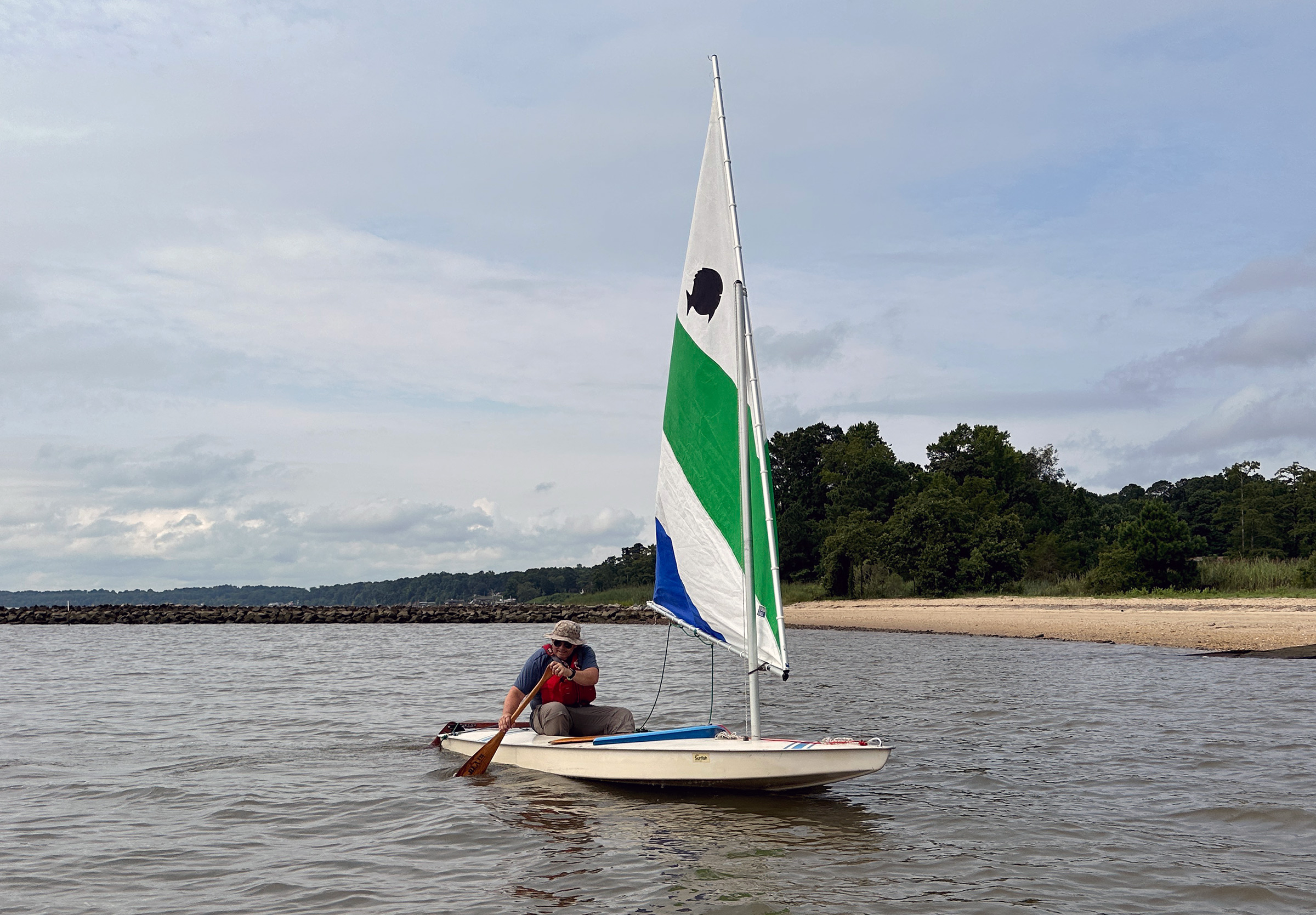
When becalmed, the Sunfish is easily paddled. If alone and using a single-blade paddle, a sailor can hold the helm over with their body and thus maintain directional stability while keeping both hands free. When the paddle is not needed, it can be stowed on the foredeck, held in place with its grip on the splashboard, the shaft between the halyard and the mast, and the blade beneath a line stretched taut across the deck from the bow.
The 75-sq-ft lateen rig sail with its single sheet, and a basic tiller and extension—one string and one stick—are all that is needed for a day of sailing. The spars are made of anodized T 6061 aluminum, with the 13′ 9″ booms being held aloft by a 10’ aluminum deck-stepped mast. The sail was originally lashed to the booms with cord but now has plastic sail clips that look like shower curtain rings. The original sails were cut from cotton by Old Town, but when Dacron debuted, Ratsey & Lapthorn became the sailmaker of choice introducing a little extra draft into the foot of the original flat five-panel sail. Since 1979 Sunfish sails have been made by North Sails. Sail controls for the recreational rig include outhauls for the upper and lower booms. For the racing rig, there are extra lines run to the lower boom that control a cunningham to adjust the luff tension and another line to control the foot tension. With this rig, all skill levels, from beginner to expert, can go out and have a great time on the boat.
Sunfish have been built by several manufacturers with most of the boats from the 1970s through the early 1980s produced by ALCORT, a division of AMF, one of the largest American recreational equipment companies. During the peak of AMF/ALCORT’s production as many as 60 Sunfish a day were leaving the factory in Waterbury, Connecticut. The manufacturer of the boats since 2007 has been Laser Performance, with hulls now built in Portugal after stints in the UK and a short period in China.
Elizabeth Belden Handler
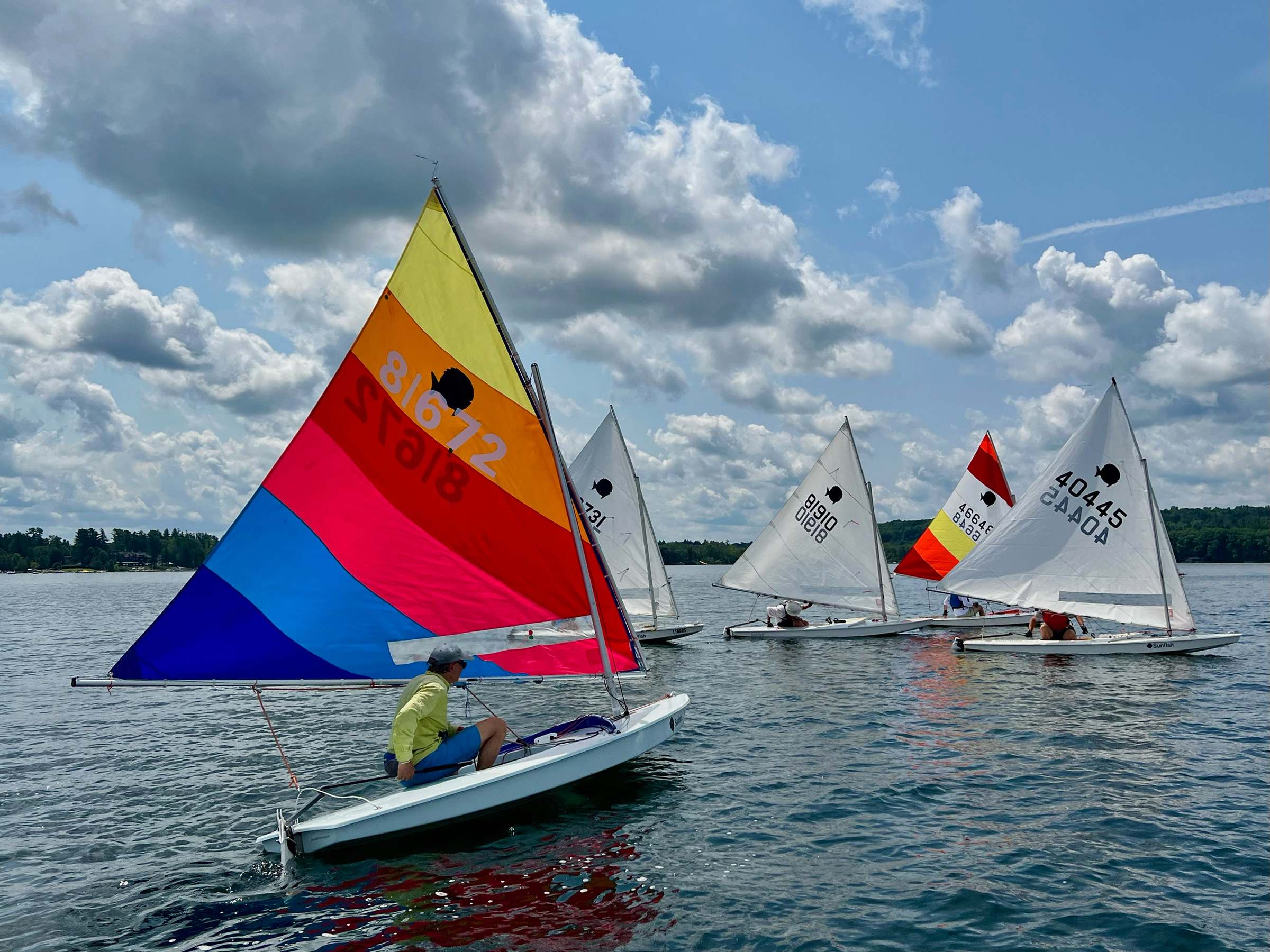
More than 500,000 Sunfish have been built and regattas are popular around the world. The regatta pictured here was hosted in July 2024 by Willow Bank Yacht Club on Cazenovia Lake in New York. A one-day regatta of five races, it welcomed all classes of “legal” Sunfish.
Along with the rudder system change in 1971, a storage cubby was added under the aft end of the cockpit, and around the same time, the DePersia Venturi bailer went from aluminum to plastic construction, a welcome change from the earlier version, which was susceptible to corrosion. The bailer allows the cockpit to self-drain when the boat is making even just a few knots of headway, and closes off with an internal float ball or plug inserted from inside the cockpit. The foredeck has a bow handle; newer hulls with their rolled gunwales are easier to handle on the beach. The original tillers were wooden, usually cut from ash, while modern tillers are aluminum, either straight or wishbone style. The original Sunfish had no sheet fairleads; then a small open fairlead was added to the cockpit lip—the “sheet hook”—and in the 1980s a swivel cam cleat was introduced. Today’s boats usually sport a ratchet block on a stand-up spring set just ahead of the cockpit. Another upgrade was the addition of a hiking strap mounted close to the cockpit floor.
Our current fleet includes the 1953 wooden hull, a 1965 ALCORT, and two AMF boats from 1981 and 1982. They all sail wonderfully, and we appreciate even the older hulls, which weigh a few more pounds but are resistant to oil-canning and can take a beating about as well as the thicker fiberglass construction of the ALCORT Sunfish. The sail hoists easily with one halyard that passes through a deck block or bullseye fairlead to a horn cleat, while the sheet runs from a bridle spanning the aft deck, through two boom blocks and back down to the cockpit.
Launching requires pointing the bow into the wind, pushing the rudder down, and shoving off. After getting settled on the cockpit edge, the daggerboard goes down a bit, and the sailor falls off and sheets in. Skipper Audrey likes to put her boat on the chine and hike out, while other folks prefer to sail flat. The boat tacks smoothly and, with the tiller over just shy of the deck edge, carries enough speed to avoid getting caught in irons. On a run, the daggerboard can be raised, and it will usually stay in place on its own, but the latest trick is to run a bungee from the bow handle back to the daggerboard to cant the board in the trunk and hold it in the selected spot. The bungee or a line should always be used to tether the daggerboard to the hull to keep it from going astray in a capsize—you stand on the daggerboard to right the hull.
Richard Staples
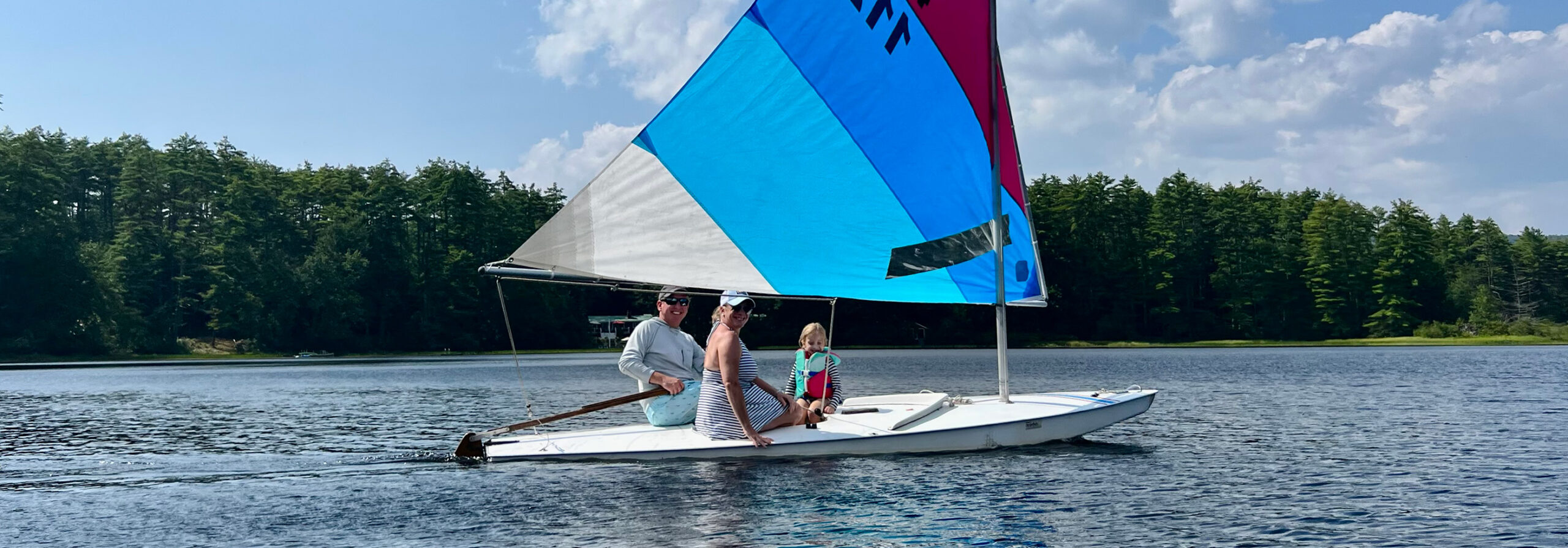
On a calm warm day, the Sunfish is a fun boat for a family outing. In winds over 15 knots however, the boat can be a handful and more suited to a crew of one or two experienced sailors.
Sunfish behave admirably up to around 15 knots of wind; above that people and parts start breaking, and only a few of our most experienced racer friends tempt the more challenging conditions. If the wind dies, put the rudder down and the Sunfish will paddle well with a single-blade paddle or kayak paddle. We’ve even used a Sunfish as a stand-up-paddle platform—very stable but also heavy. The boat is quick to rig, which maximizes time on the water. While a Sunfish and its spars are cartoppable, lately we have been using our utility trailer and dolly.
New Sunfish are produced by Laser Performance and shipped worldwide. Used examples are available in many areas. Look for a relatively clean boat with minimal hull damage and dry, intact foam innards. The spars should be straight. New and used sails, rudders, and daggerboards can be tracked down through dealers or on various social-media platforms. All the parts are interchangeable on the fiberglass fleet with the exception of the old versus new rudder systems. Resale value is high, so you can’t go wrong with a moderately priced, ready-to-sail Sunfish.
With our Sunfish we have found a hobby, fun, and friendship while breathing new life into numerous classics. What comes free with every Sunfish, whether new or used, is a welcoming global community of Sunfish Sailors.
Kent and Audrey Lewis have been messing about with Sunfish for decades and are experts at basket-case restorations. Knowledge gleaned from dozens of restorations is compiled in The Sunfish Owner’s Manual and logged at Small Boat Restoration.
The Sunfish Recreational, manufactured by Laser Performance, sells for $5,950 and the Sunfish Race with race sail and additional control lines sells for $6,150.
The Sunfish Forum is a good source for further information.
Is there a boat you’d like to know more about? Have you built one that you think other Small Boats readers would enjoy? Please email us your suggestions.
I’ve built five boats, and all were truly rewarding projects. The first was an 8′ pram that I built to my own plans in about a week. Having done a lot of carpentry, I knew how to use woodworking tools, but I really didn’t have a clue about boatbuilding. The second and third boats were skiffs, an 8-footer and a 12-footer, and I paid more attention to detail as I refined my skills. I built the fourth boat, a cedar-strip Rangeley 15, from a Newfound Woodworks kit, and my latest build is another kit from the same company: the 16′ 2″ Adirondack Guideboat, based on a design by Warren Cole.
Adirondack guideboats were designed and built beginning in the 1840s for guides to take their wealthy clients fishing in the lakes and streams of New York state’s Adirondack Mountains. Guides rowed these boats from the forward seat while the client sat in the stern and cast a fly rod.
Sarah Vincenzo
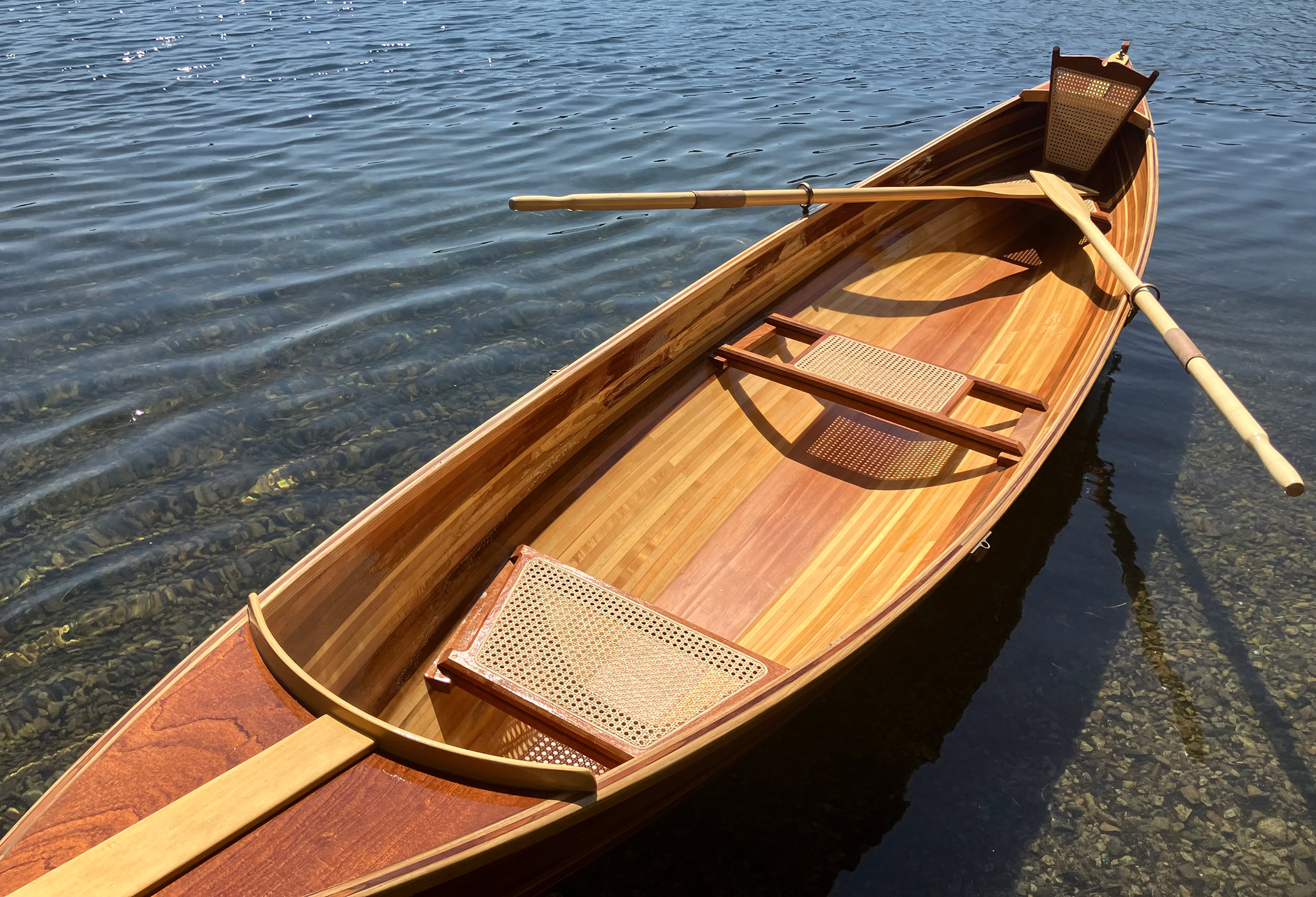
One of the benefits of strip-plank construction is the uncluttered interior. I chose to buy the optional cane seats from Newfound Woodworks; the seats add that final touch of old-world class to the boat.
After building boats from plans, where I had to find sources for all the materials, I concluded that building from a kit (especially one from Newfound Woodworks) was the way to go. The kit came with almost everything I would need to build the boat. It included all the wood, the molds, epoxy, fiberglass, varnish, brushes, rollers, plastic trowels, hardware, and even latex gloves. The only items I had to purchase were sandpaper and vinegar (for epoxy cleanup). When I had built my Newfound Woodworks Rangely 15, I had ordered a pre-kit, which includes a book and DVD about building cedar-strip boats as well as a DVD on fiberglassing, and these I had hung on to. They are very informative, and I would recommend them to any first-time strip-plank builder. And, whenever I had questions that I couldn’t answer with the instructional materials on hand, Alan and Rose of Newfound Woodworks were extremely responsive.
The cove-and-bead cedar strips and wood for the gunwales arrived in a crate about 10″ × 12″ × 16′, which doubles as a strongback to support the molds.
The building process is straightforward and begins with making two sets of legs to hold and level the strongback. The molds are fastened perpendicular to the strongback, and then cedar-stripping the hull can begin. The strips, with Titebond III glue applied to the edges, can be either stapled or clamped together. The forms are made with a groove paralleling the perimeter of the mold for clamping if that is your choice. While there are some who find the staple holes unattractive, I preferred the staple approach because I could staple and glue as many rows as I liked without having to take the time to apply the clamps and wait for the glue to dry before removing them.
Abby Fiske
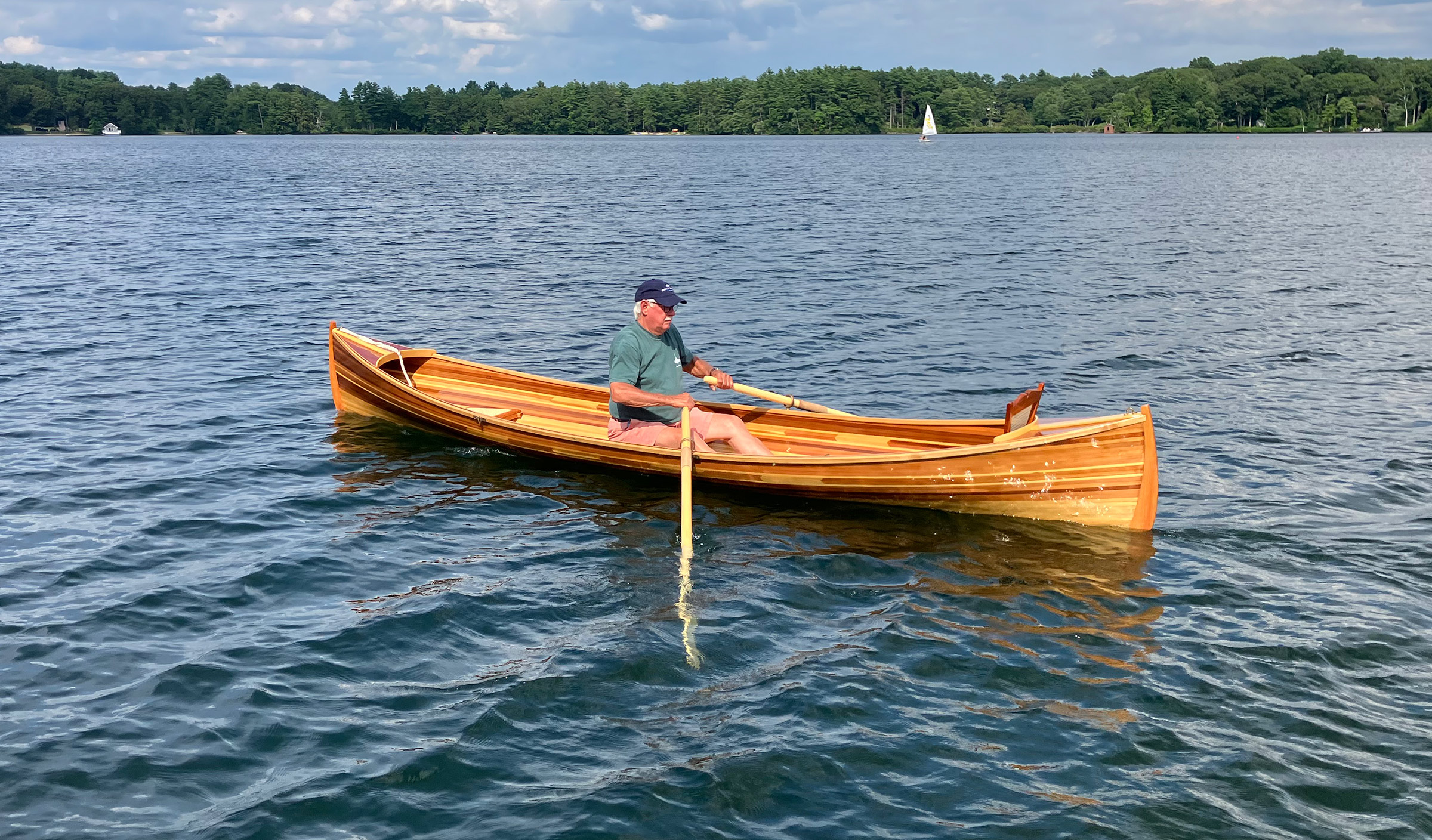
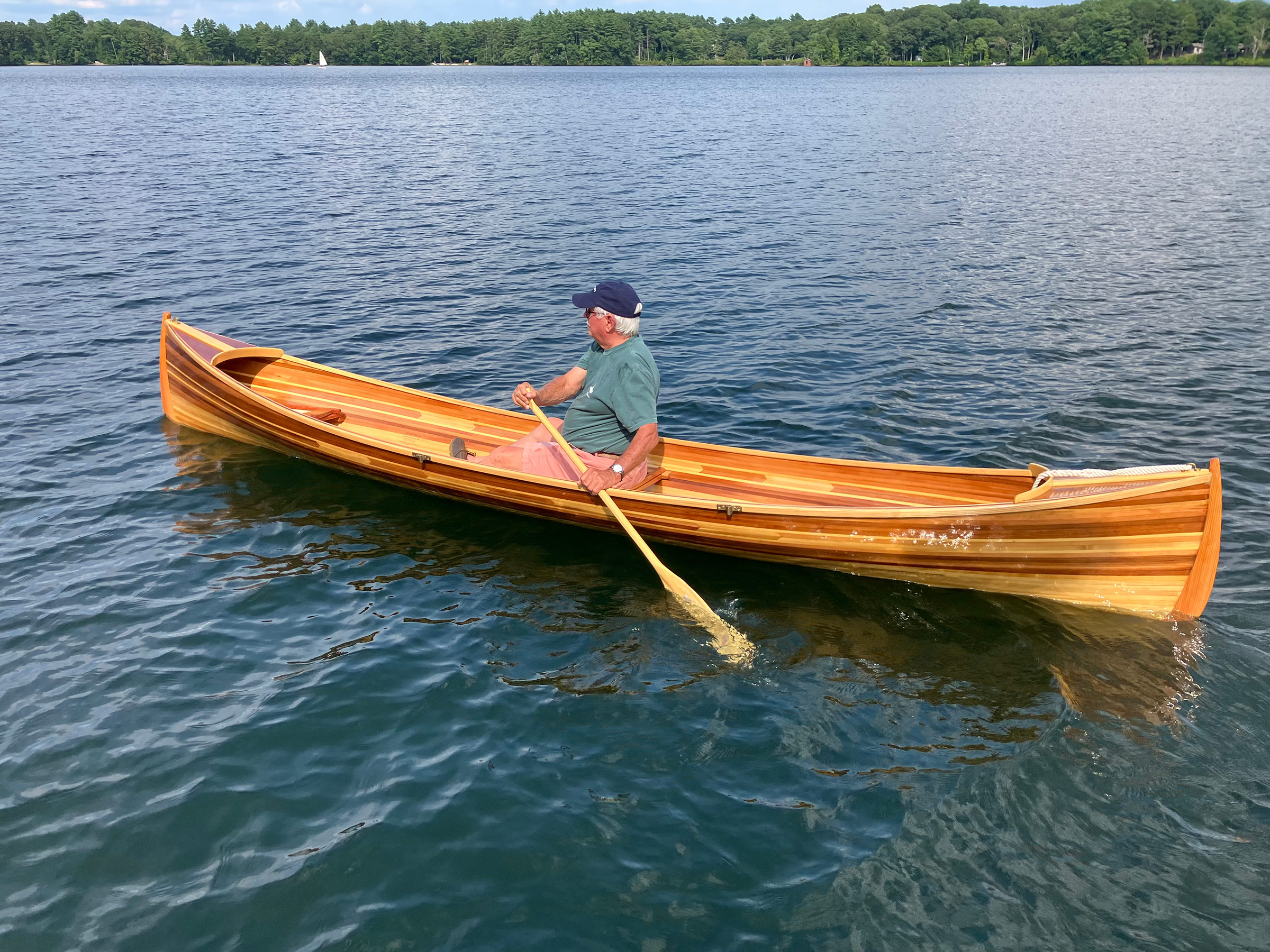
Although the Guideboat is designed to be rowed, I can paddle it canoe-style and it performs well.
The stripping process continued until the forms were covered. Then I had to pull the nearly 1,000 staples. I found that an old-fashioned nail-pulling/end-cutting tool is perfect for the job. As it grabs the staple and then rolls it out there is little or no gouging of the wood. With all the staples removed, I could pop the boat off the frames and start sanding and smoothing the hull prior to coating with epoxy, and then fiberglass and epoxy.
Once you have finished the fiberglassing and applied many coats of varnish, you are ready to flip the hull right-side up and start the same process on the interior before fitting the gunwales, decks, and seats. I estimate that I spent 300 to 350 hours over five months from start to finish on the build.
The Guideboat weighs only 65 to 70 lbs and is easy for me, at 76 years old, to load on the rack and tailgate of my pickup truck. It is designed with three seats: a bow seat, a stern seat with backrest, and a ’midship seat. All three and the backrest (purchased as an optional set) are caned, as many of the seats in the early Adirondack boats were—very comfortable, and attractive.
Abby Fiske
The cedar strips from Newfound Woodworks ranged in color from light gold to dark mahogany. I made the most of the variety to create symmetrical patterning in the hull, which I knew I would leave bright-finished. I bought standard 8′ oars but would recommend 7′. The Guideboat rows smoothly, feels stable, and I can comfortably maintain a 4-mph pace.
I used the formula from Shaw and Tenney to determine the length of the oars from the span of the ’midship oarlocks. It called for 7′ 8″ oars. Since I often overlap oar handles while rowing, I bought 8′ stock oars. After rowing the Guideboat with them several times I would recommend going with 7′ oars.
Designed as a boat used for fishing with the guide doing most of the work, it is very stable. To me it feels as stable as or better than a wide, general-purpose canoe. Although designed for two, it can easily carry three people. It rows beautifully, tracks well, is easy to turn, and I can comfortably maintain 4 mph. I have not had it out in choppy conditions, but it does handle well in a light to moderate breeze.
Robert Conkey
This is how the original guideboats would have been used: the guide rowing from the bow seat while the client sat in the stern. The cane backrest in the stern provides the passenger with an added measure of comfort.
While the Guideboat is meant to be rowed, it is also well suited to paddling like a canoe, either solo from the middle thwart or tandem from the end thwarts. It’s a good way to explore narrow waterways when looking forward is an advantage and the oars are an impediment.
I have thoroughly enjoyed being out in this boat and would recommend it to beginning as well as more experienced rowers. It will be a fine boat for all those wanting to get out on ponds, lakes, and streams.
Karen Naughton
The Guideboat rows well with three people on board. The lighter passenger should be in the bow for the best boat trim.
I’m not alone in highly recommending a Newfound Woodworks kit. I entered my Adirondack Guideboat in the 2024 WoodenBoat Show at Mystic, Connecticut, and was amazed by the number of folks who stopped by to tell me they, too, had built one of Newfound Woodworks boats and were also very happy with the outcome.
So, buy the kit, build the Guideboat, and have fun rowing.
Steve Petty resides in Sherborn, Massachusetts, a small town west of Boston with access to the Charles River and Farm Pond. He grew up rowing and sailing and canoeing on both the river and the pond. He spent many summers on the North Channel of Lake Huron where boating was a necessity since camps were only accessible from the water. In the early 1980s, he, his wife, and two children motored their Albin Trawler from Cos Cob, Connecticut, to Lake Huron via rivers, canals, and lakes. Steve is an experienced carpenter and has been involved in timber framing for 50 years.
Is there a boat you’d like to know more about? Have you built one that you think other Small Boats readers would enjoy? Please email us your suggestions.
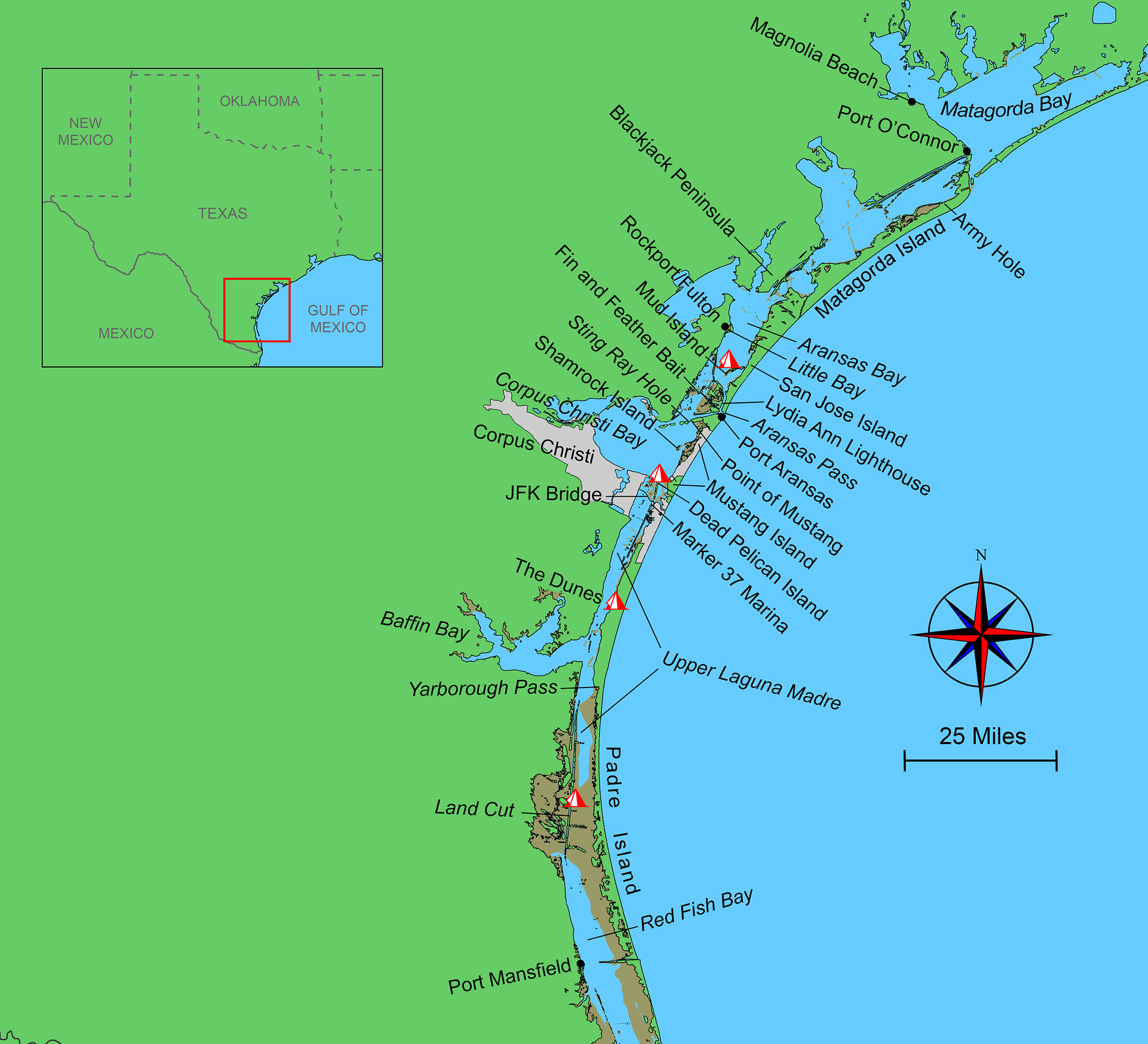
I cast off in Port Mansfield, Texas, a little before 9 a.m. on a muggy June morning under mostly clear skies and a light, variable breeze. The Texas 200 is an annual run of scores of boats, most of them under 20′ and many homemade, through the bays and cuts between the southern Texas mainland and its barrier islands. It was my second time participating. I’d completed the roughly 200-mile course in 2017 (see “The Texas 200: A trial by water”). Although the winds in this part of Texas at this time of year can range from dead calm to powerful squalls, the event’s timing typically avoids the last of the winter northers and the first of the summer hurricanes, and the norm is moderate-to-stiff winds on the quarter or beam for the entire 200 or so miles.
When I cleared Port Mansfield, the wind in Red Fish Bay remained light but became steady from astern. A scattering of cumulus clouds hung just above the horizon. It was already hot, but the breeze coming across the water was refreshing. The water gurgled against the hull and trailed away in a flat, weak wake. Half a dozen other sails dotted the offing ahead, and two boats astern still worked their way out through the fluky breezes in the harbor.
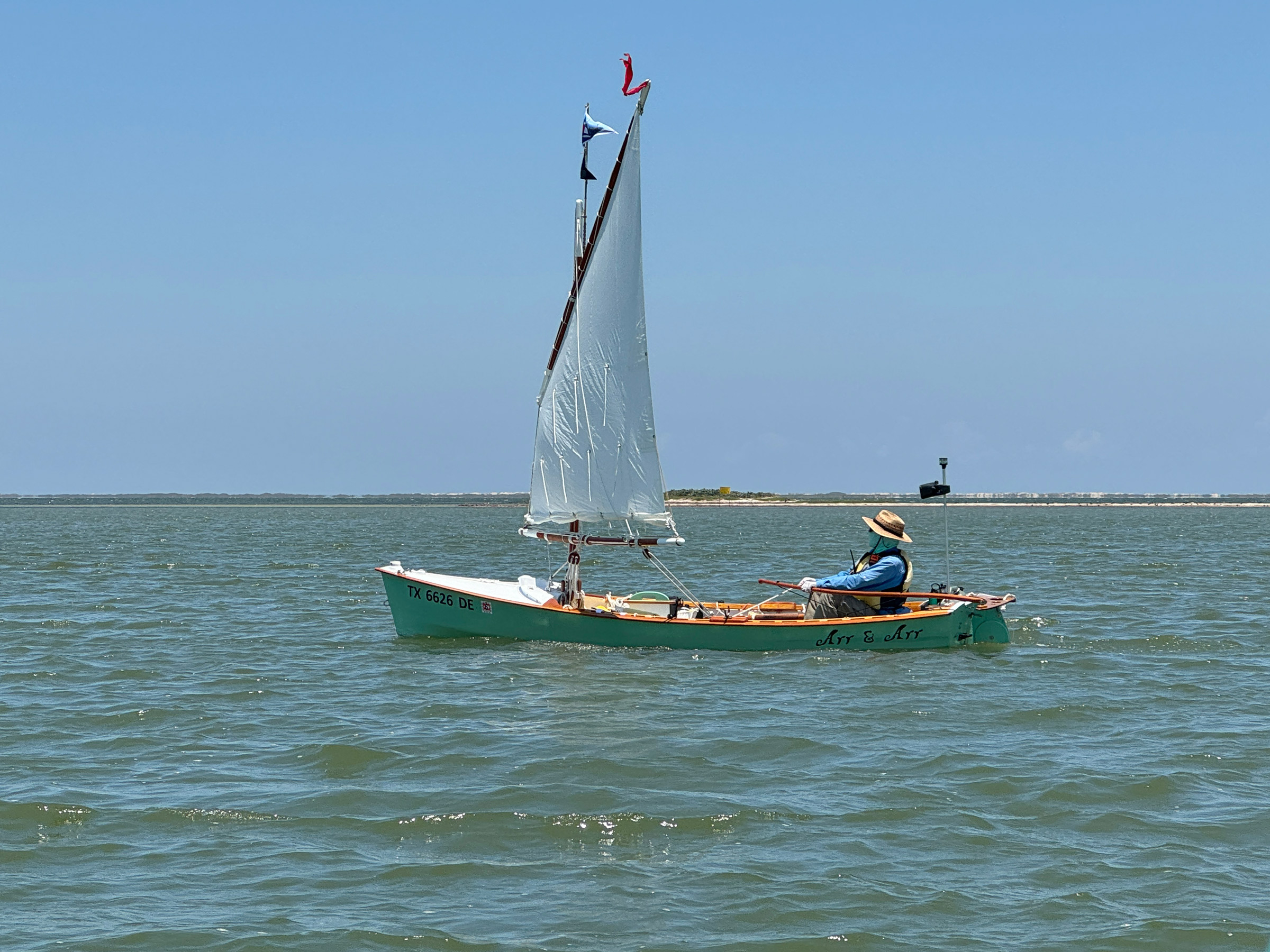
ARR & ARR, my homemade Flint, a 14′ 10″ skiff designed by Ross Lillistone, was loaded far more lightly than she had been in 2017, and with the modifications I had made to the boat and rig since then, including the addition of buoyancy bags, and my gained experience in these waters, I was confident that we’d make it to the finish at Magnolia Beach.
Roger Siebert
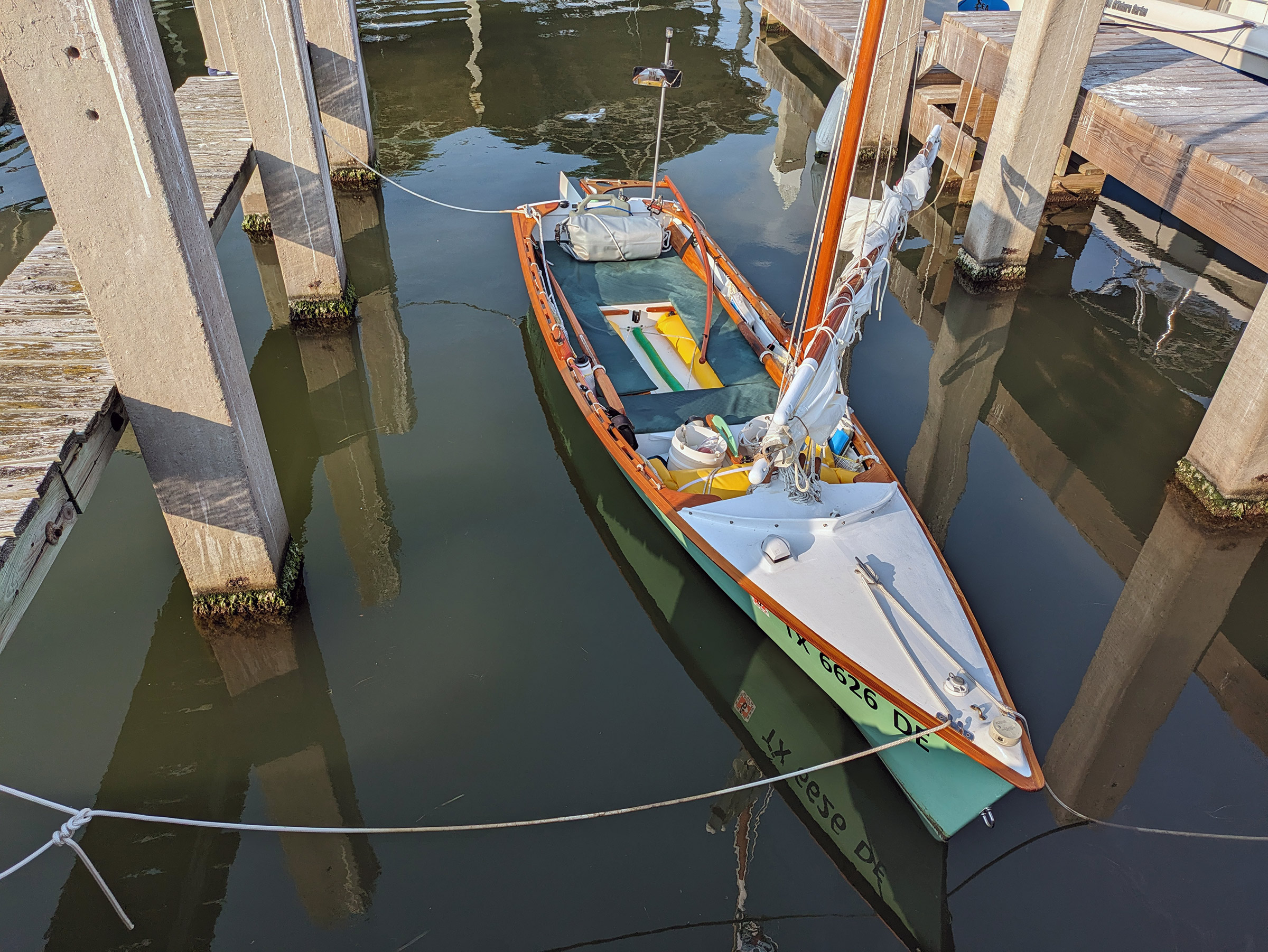
ARR & ARR lies tied up in her slip in Port Mansfield on the morning of Day 1 of the Texas 200. Other than a dry bag, the 3-gallon jug of drinking water lashed in the sternsheets, and the gear necessary for working the boat, everything is stowed inside the buoyancy compartments. Buoyancy bags fill the spaces beneath the side benches and in the forward part of the cockpit, and a rowing mirror is fastened high on the stern light pole.
The wind was forecast to increase through the afternoon, so I had prepared my homemade sea anchor—a 2-gallon plastic bucket with a few holes in the bottom and a rope bridle—by fastening its rode to the foredeck cleat and running it back through the bow chock and into the cockpit where I could easily reach it. If I needed to reef the sail, I could drop the sea anchor and it would hold the boat head-to wind and waves.
Despite the forecast, within half an hour, the breeze had fallen away almost entirely. The sail flogged and the sheet dipped to within inches of the water’s surface. Long swaths of floating seagrass streaked away across the water until they vanished into the glare of the shimmering mirror-like bay. I tired of pulling up and resetting the daggerboard and rudder blade every time they became fouled with grass, so I raised the board until I estimated only its curved lower leading edge was exposed, then pulled the rudder blade up to 45 degrees so that it would cast the grass off astern on its own. I lay to leeward in the sternsheets, my legs stretched out on the side bench, and let gravity put a belly in the sail. ARR & ARR moved a little faster, but so little that I wrote it off as imagination. But, speed or no speed, at least I was able to let the boat tend to herself.
I could have moved faster under oars, but spring had been particularly busy at work, and I had fallen out of rowing shape. The forecast for the coming week promised calms for every morning, and I wouldn’t be able to row multiple hours for five straight mornings. I wanted to save my best rowing for day four, the day on which I’d need to cover the most miles, 42 nautical miles from Camp Three at Mud Island to Camp Four at Army Hole, and for which the current forecast was calling for the least amount of wind.
After only 15 more minutes of creeping along under sail, the sun’s heat felt suffocating, with my long sleeves, long pants, black neoprene booties, safety harness, PFD, and neck gaiter pulled up over my nose and ears, so I sat up, staying on the boat’s leeward side to keep shape in the sail, and tried to fit myself entirely within the shadow of my wide-brimmed straw hat.
A nearly opaque softball-sized white cannonball jellyfish swam past, easily outpacing me, its bell pumping rhythmically, each pulse bunching its short, thick fringe of stingers.
Roger Siebert
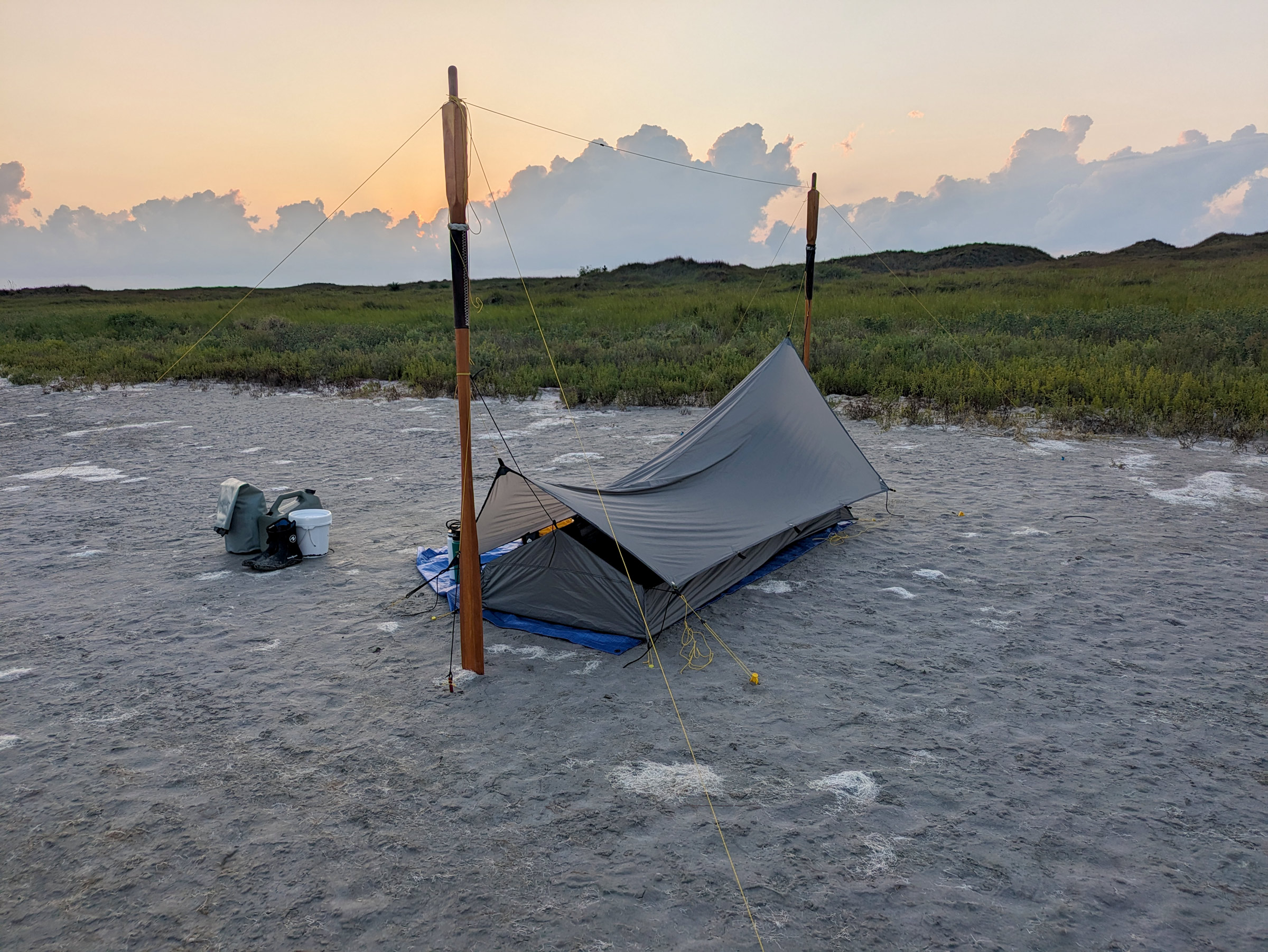
Sunrise on Day 2 at Camp 1 in the Land Cut and my tent was looking good. The ultralight net bivy has solid panels at the head and foot that, together with the fly, give the occupant privacy, but at the expense of airflow. A small tarp, folded in half, served as a footprint for the tent and, spread out, provided a convenient base on which to handle gear while keeping it out of the sand and mud.
Over the handheld VHF clipped to my PFD, the Coast Guard warned small craft to take shelter everywhere from Port O’Connor—some 150 miles away and close to the end of the Texas 200—to Corpus Christi—at almost the midway point of the route. Powerful thunderstorms were building all along that stretch of the coast. Over the next 30 minutes the cumulus clouds in the northern sky grew and coalesced into a single thick, dark cover dumping a dense curtain of rain. I was still roughly 50 miles from Corpus Christi, and I hoped the clouds were gentler outlying cells and not part of the main line of storms.
The clouds and rain grew closer, and the boats a mile or more ahead turned almost in unison to starboard, their sails instantly changing from lazy, sunlit bellies into frenzied, thrashing sheets, some visibly shrinking into smaller and smaller versions of themselves as, I assumed, their skippers made swift use of their roller furling.
I tossed the bucket sea anchor overboard and slacked the downhaul and halyard to reef. In the time it took to pull in and tie my tack reef line to its cleat on the boom, the wind had accelerated from 5 knots to 35, and within seconds the glassy bay had been whipped up into a steep chop of 2′ to 3′ waves. The wind jerked the boom and clew reef line from my hands. The wind was more than all three reefs could handle. I dropped all sail, pulled the yard and boom into the cockpit, dragged the remaining belly of the sail in from the bay, and bent to the oars. All I could hope for was to keep the bow pointed toward the waves.
Within minutes the waves were more than 3′ high, steep, and breaking at their tops. The rode pulled taut, the dragging bucket just visible as a pale green cylinder beneath the waves. It was holding us into the wind and waves better than I had expected, and a single pull on one oar or the other corrected the yaw from the steeper waves. I had only tried the bucket sea anchor once before, in relatively gentle conditions in my local lake months earlier. Now, in this far stronger wind, its performance was far more impressive.
Five or six miles dead astern lay Port Mansfield, a tiny stretch of one- and two-story buildings still cast in sunlight. In my rowing mirror, a narrow band of blue sky appeared on the horizon beyond the storm clouds. This would be short-lived, and I had plenty of room to drift downwind. All I had to do was focus on the pattern of the waves and my oar strokes.
Roger Siebert
.
Ten minutes later, a whooshing roar grew behind me. A breaking wave gushed out from the gunwales, lifting ARR & ARR above a trough nearly 4′ below. The bow pitched downward and jarred into it, but I felt no spray on my back. Another wave broke beneath us, and a third. Sets of three breaking waves almost 4′ tall every few minutes became the norm. Less than 1⁄2″ of water lay in the cockpit. I was grateful for this little boat’s sheer and flared-V bow, and for the years I had had familiarizing myself with her abilities. If I had been loaded as heavily as I had been in 2017, with no sea anchor and little experience, I would likely have swamped or capsized.
Some 45 minutes later, the bucket dragged deeper beneath the surface, its color more green than white and its shape less defined. The winds weakened, and eventually the waves waned.
The sun returned in all its overwhelming oppressiveness. Other boats in the area tentatively set sail again. Cathy and Chris’s Highlander yawl, SAMUEL VIMES, which had ridden out the squall under mizzen alone about 1⁄4 mile northeast of me, made headway again under full sail. I set a double reef and pulled in the bucket sea anchor but made no significant headway. I shook out one of the reefs, but still made little headway. I set full sail and made only 1 or 2 knots. The waves were still settling, but the wind had fallen away to a mere breath. After the waves finally faded away to match the lack of wind, it was as if nothing had happened.
By late afternoon, the wind had risen again, but without the storms, reaching only 15 knots with gusts to 20. At the northern end of Red Fish Bay, what had been low dunes and shrubbery, barely discernable on the horizon, closed in until becoming only a 100-yard gap between stretches of mudflats punctuated with a few beaches backed with saltwater-tolerant succulents. I had entered the Land Cut.
The flat water and stiff wind were tempting. I sat on the windward gunwale and hooked my feet beneath ARR & ARR’s hiking strap. I didn’t intend to hike out, but I wanted to be ready, just in case. Since my difficulties in 2017, when I had capsized doing this exact thing, I had modified my sheet-lead from a three-to-one purchase to two-to-one so that I could spill wind more rapidly, and with the boat less heavily laden this year, she was altogether more responsive.
Bob Rambo
I approached Baffin Bay with ARR & ARR under a single reef, passed by the last of the spoil islands, and entered open water to reach all the way to Padre Island. With neither bimini nor other means of providing shade, I covered myself from head toe to avoid getting a severe sunburn during my five days under the harsh Texas summer sun.
I sailed past SAMUEL VIMES. Cathy and Chris had pulled up on a narrow beach and were tucking a reef into their main. I should probably have joined them but, thinking that the first night’s camp was close, I decided instead to keep spilling air when necessary. I had another 6 miles to go, and I was exhausted by the time I finally beached ARR & ARR in a stretch of mud along with the 50 or so other boats that had made it to the first camp out of the 70 that had launched. The others had either turned back or been rescued.
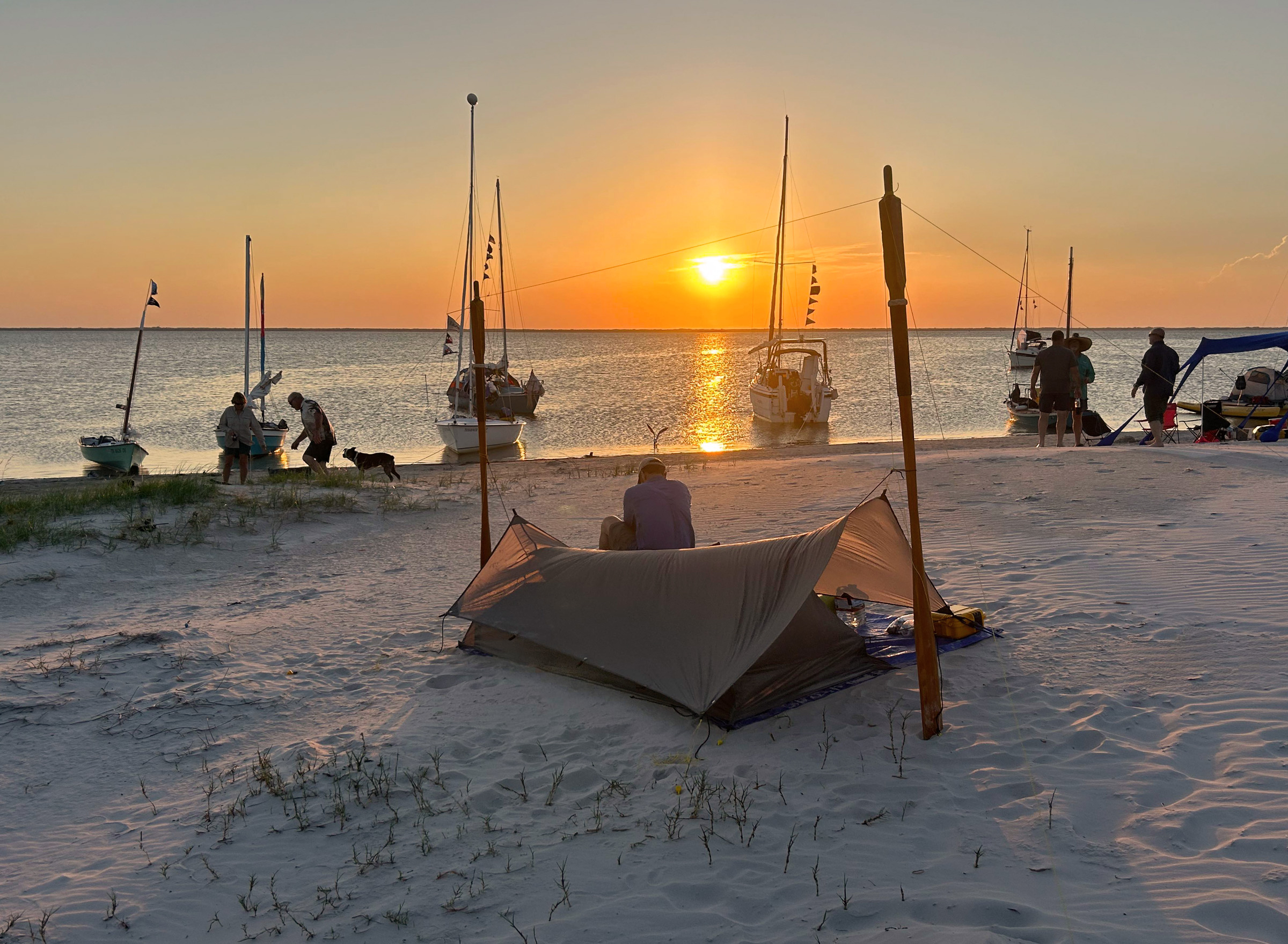
After 10 hours of baking under the searing sun, battling a windstorm, and struggling over-canvased in a stiff breeze, I was so tired that I didn’t want to eat, but I knew I needed to. While I set up camp, I nibbled on precooked tuna, rehydrated rice, and a dense, flat piece of bread. The starches made me want more water, which was also a good thing. My one-person ultralight bivy was still new to me and I was experimenting with the setup. Designed for backpacking, it came without poles, relying instead on a camper having trekking poles. On the boat I would normally have had at least a boathook and possibly other poles such as my push-pole, but I had left these behind to reduce my gear and weight and, instead, had decided to use my oars for tent poles. I set the blades on the dense sand and strung stretched guylines and a central line between them. Then, with the oars upright, I strung the bivy tent between them.
Only one boat had landed farther north than I had, and its skipper and two teenaged crew were securing their boat and setting up camp. The rest of the boats lay stretched out to the south in what seemed a never-ending forest of masts. The smell of the loamy, mucky mix of the tidal flats drove home just how remote this camp was.
By the time my shelter was ready, the sun had set. But there was little change in the temperature. Inside the bivy it was still unbearably hot so, after changing into dry clothes, I stayed outside in the night for another hour, tending to camp chores, and writing in my journal. Finally, at around 10, the tent became bearable and with a slight breeze wafting through and the sound of the water gently lapping at the beach just yards from my camp, I fell asleep.
I rose when my watch showed 4:30. The waxing crescent moon had set well before midnight, and with my phone turned off to save power and the bivy’s fly blocking my view of the stars, the watch was my only way of knowing that first light was near.
It took me far too long to break camp. It was only my second time using the oars for poles and I had been rather too zealous with the number of lines and hitches. By the time I had everything down and packed away, three hours had passed.
I topped off my water bottles from my nearly-full 3-gallon jug and added an electrolyte mixture to one. I drank a cup of instant coffee and ate granola with raisins, pecan pieces, and rehydrated powdered milk, devouring it all within minutes.
Roger Siebert
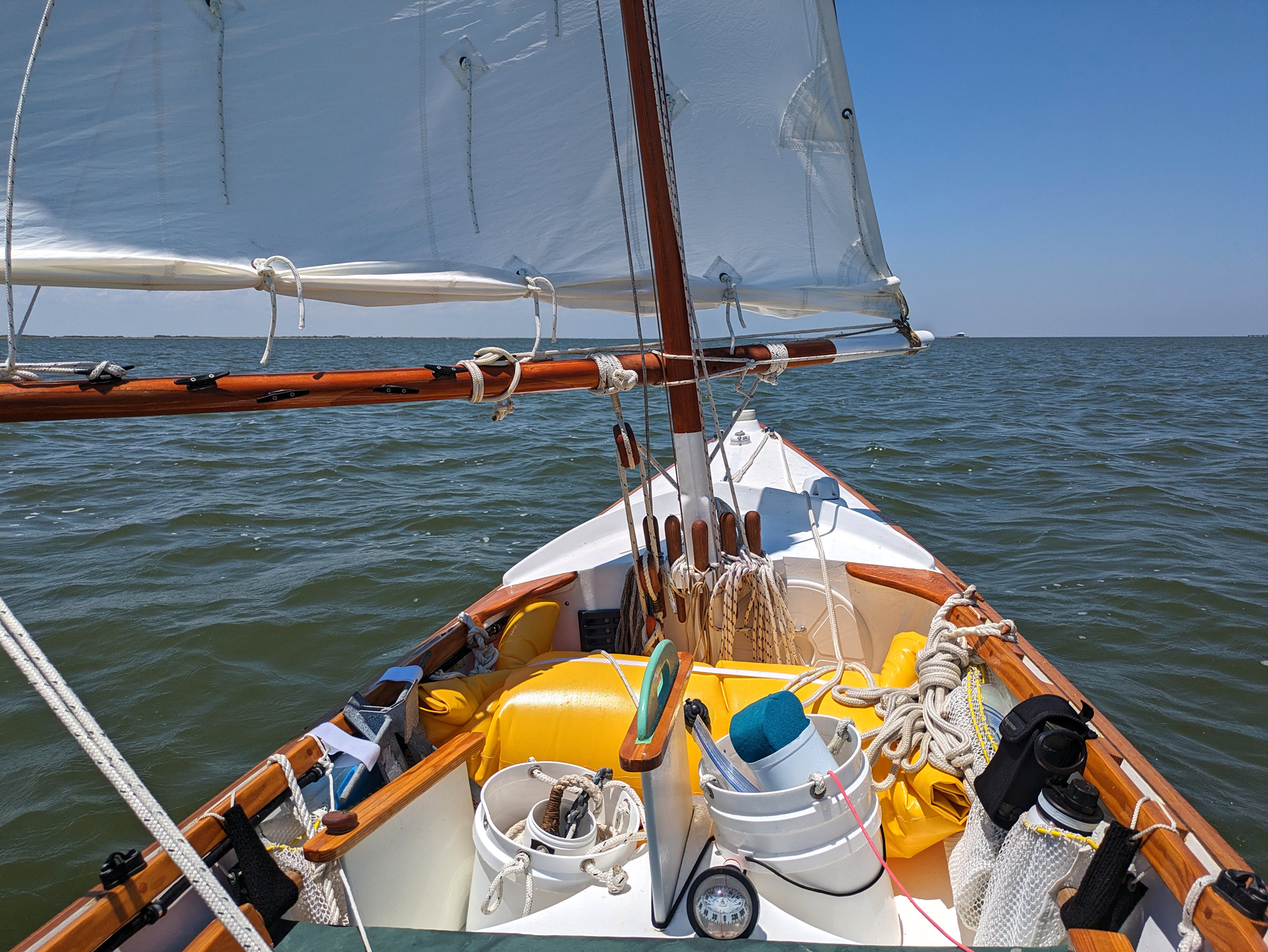
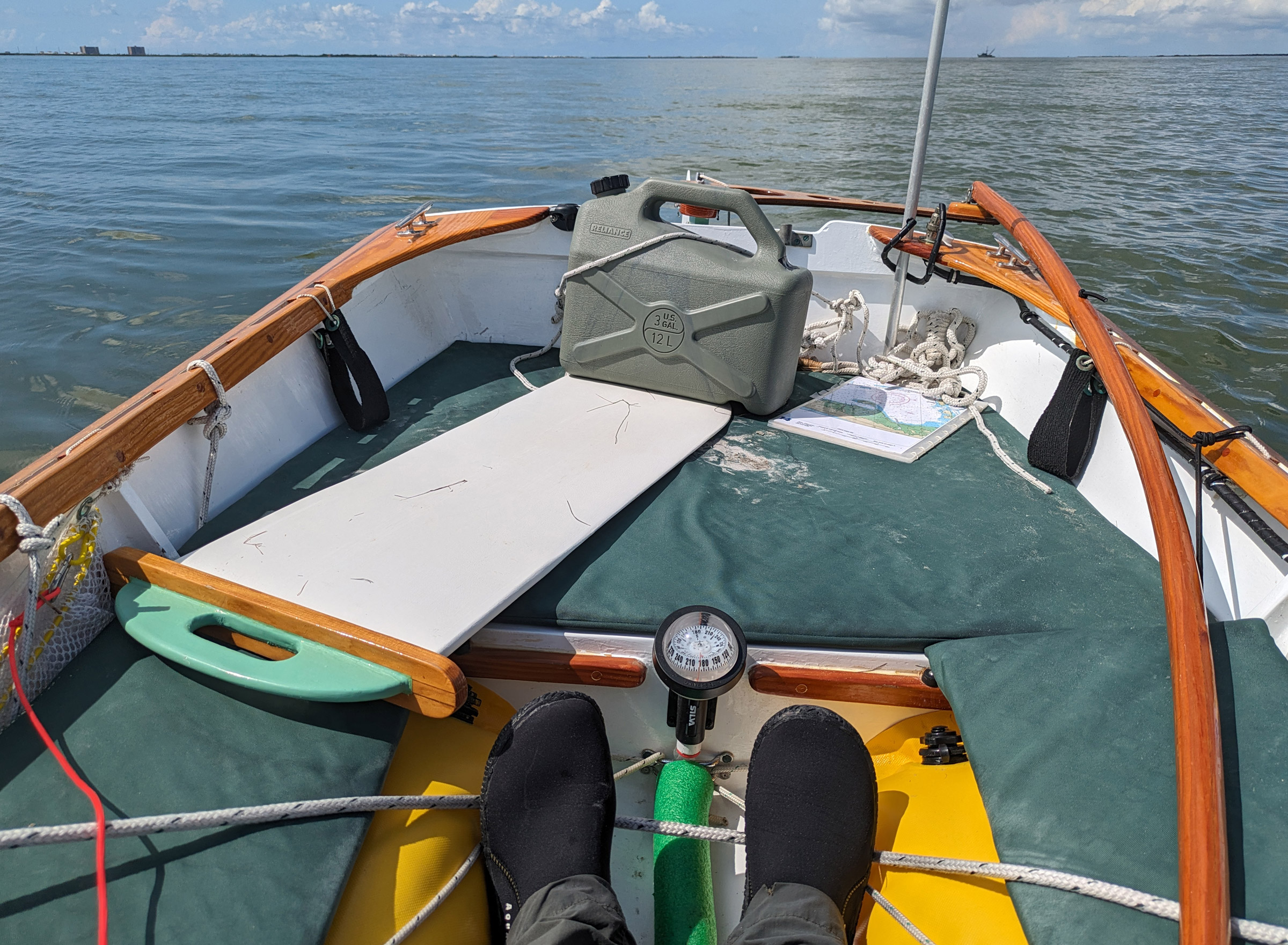
ARR & ARR’s forward cockpit area—shown here on the approach to Baffin Bay—accommodated, to port, a 2-gallon bucket holding the anchor rode, its 100′ of three-strand nylon line coiled around a central tube, which itself holds 8′ of chain. The anchor was secured to the port inwale with two hook-and-loop straps. To starboard was another 2-gallon bucket for serious bailing, and inside of it, my 2-gallon-bucket sea anchor with its rope bridle, and a smaller bailer and sponge. A large yellow buoyancy bag filled the remaining forward cockpit space. Net pockets hanging beneath the inwales held everything else from water bottles to cell phone. Critical gear such as the phone and a monocular were also tethered to the boat.
I made a final sweep of the campsite and spotted an 18″ boat fender lying in the glasswort, beach daisies, and other undergrowth about 5 yards above the edge of the beach. The fender’s ridged, once-white surface was soiled gray-brown. I stepped tentatively through the sprawling knee-high greenery—watching out for rattlesnakes—plucked it out of the scrub and brought it back to the boat. I washed it in the Land Cut and stowed it on board.
I set off from the beach, one of the last to do so. The morning was more torturous even than the first. The air was still, the water like glass. I had little hope of catching up with my fellow voyagers. But, again, I was reluctant to row. It was only about 30 miles to the second camp and there were many hours ahead of me. So, as I had done the day before, I lay back and waited for the breeze.
Before long the thin seat cushions had become uncomfortable, and I pulled out the rowing seat cushion. In time that, too, became uncomfortable and I lay back in the sternsheets, one leg stretched out on either side bench and one hand propping up my head so that I could keep an eye on the still-glassy water and the few other boats that had launched almost as late as I had. Nothing seemed to move. My hat shaded my face, but the sun baked the rest of me.
Eventually the heat became too much, and I sat up again. A pool of sweat, the size of a manhole cover, lay in the spot I had just left. My clothes were soaked. The air did not move.
I dropped sail, swapped the daggerboard for the rowing slot plug, pulled up the rudder blade, and rowed. The apparent breeze on the back of my neck felt refreshing. I passed three boats, and it felt good to be in control of forward motion again.
Ahead of me a pier reached out from a spoil island. At its end stood a tan-painted fishing shack with a low-pitched A-frame metal roof. All around it, roseate spoonbills perched on top of the pilings, up on the rails, and picked their way along the pier and down in the shallow waters beneath, their pink plumage standing out in the stark sunlight against the surrounding muted colors.
Eventually the breeze began to fill in. I shipped the oars and raised sail. By the time I had everything set and the lines tidied up, two of the three boats I had rowed by had sailed past me again.
The wind built steadily as I sailed on toward Baffin Bay. The close banks of the Land Cut gave way to low, irregularly spaced spoil islands about 200 yards to my starboard and, to my port, an unobstructed view to the mainland—a low, uneven line dotted with wind turbines. Then the spoil islands were behind me, and I was left with a 2-mile stretch of open water to the east, the far horizon a thin line of green punctuated by the stark whiteness of low dunes. Somewhere along that line, I knew, was Yarborough Pass, a landing spot I had camped at a couple of years before, but I was too far away to make out the campground’s shade shelters.
Will Robertson
As the sun set on Day 2, I set up camp at the Dunes. Although parts of Padre Island are occupied by condominiums, campgrounds, and miles of beach open to four-wheel-drive vehicles, much of it is a fragile ecosystem, so a leave-no-trace philosophy is a must. As long as we packed everything out and walked only on sand, one afternoon’s wind would erase all evidence of our having been there.
I caught up with SANDPIPER, a Compac Sun Cat with Bob and Lisa aboard. They had a reef tucked in and before I sailed out into the bay, I, too, took in a single reef. We sailed together across the open water: above, the sky was blue, with stretches of cumulus clouds far away above the horizon; below, the blue-gray water was traced with lines of brown revealing how shallow these waters were. The wind had freshened still more, and we shouldered through the waves, tossing foam aside as we drove into the crests and out of the troughs.
I had crossed the bay three times in previous years, but despite my experience I drifted north of the channel and the daggerboard dragged me to a stop before I got back on course.
At the far side of Baffin Bay, I rounded marker 125, where the Intracoastal Waterway (ICW) made a slight turn to the right as it left the bay behind. The wind remained fresh and, while gradually closing on Padre Island (the 130-mile-long low barrier island that separates Laguna Madre from the Gulf of Mexico), the water had waned to mostly 1′ to 2′ rolling waves. A barge was approaching from the north, and I sailed to starboard of the marked channel to stay out of its way. My daggerboard dragged me to a halt again. As the barge went on by, I pulled the board up and sailed back into the channel and the barge’s wake.
The barge cut the corner around marker 125, its path arcing across the entire football-field width of the channel, and I was glad I had stayed out of its way.
After another 3 miles, the water outside of the channel to the east opened up to a good 4′ depth most of the way to Padre Island. SANDPIPER and ARR & ARR parted ways, and I headed up as close to the wind as I could to get into the shelter of the island and reached along in the lee of its grass-knitted dunes to the second night’s camp. SANDPIPER sailed on a reach on what I assumed was a more direct route.
I landed within a cluster of 15 to 20 boats pulled up on the sandy shore beneath dunes the height of two- and even three-story houses. SANDPIPER was still well out in the Upper Laguna Madre, and I wondered that they had not turned to come in. Will and Jennifer, on COSMO CAT, a Hobie 14, explained that we were not, in fact, at the Flats, the official campsite. We were, instead, at the Dunes. Buddy, sailing GROS BEC, his modified Sweet Pea, joined us. No one, he said, with any sense passes by the Dunes; it was one of his favorite places on this coast.
I later learned that my accidental stop turned out to be fortuitous—at the official camp there was insufficient dry ground even for the remaining fleet, and they all had to find alternative spots. The Dunes, meantime, provided ample dry space and the fine-grained sand felt cool between my toes despite the heat. The other sailors and I climbed one of the tallest dunes to watch the sunset. To the east, shadows crept up through dunes. I was exhausted as I trudged down the dune and tidied up my camp.
I had launched at Port Mansfield with a little over 2 gallons in my 3-gallon water jug lashed in the sternsheets, a backup gallon jug stored in the forward compartment, and three 1-liter bottles stuffed into net pockets in the cockpit. I expected to use about a gallon per day and planned to refill at the halfway point near Corpus Christi. My goal had been to save weight wherever I could—I had even lost 10 lbs in the two months before the trip. But sitting in an open boat with neither wind nor shade, covered from head to toe with clothing and gear, I had been sweating like a soaker hose and consuming 2 gallons per day—even while trying to conserve. Yet still I was constantly thirsty.
Roger Siebert
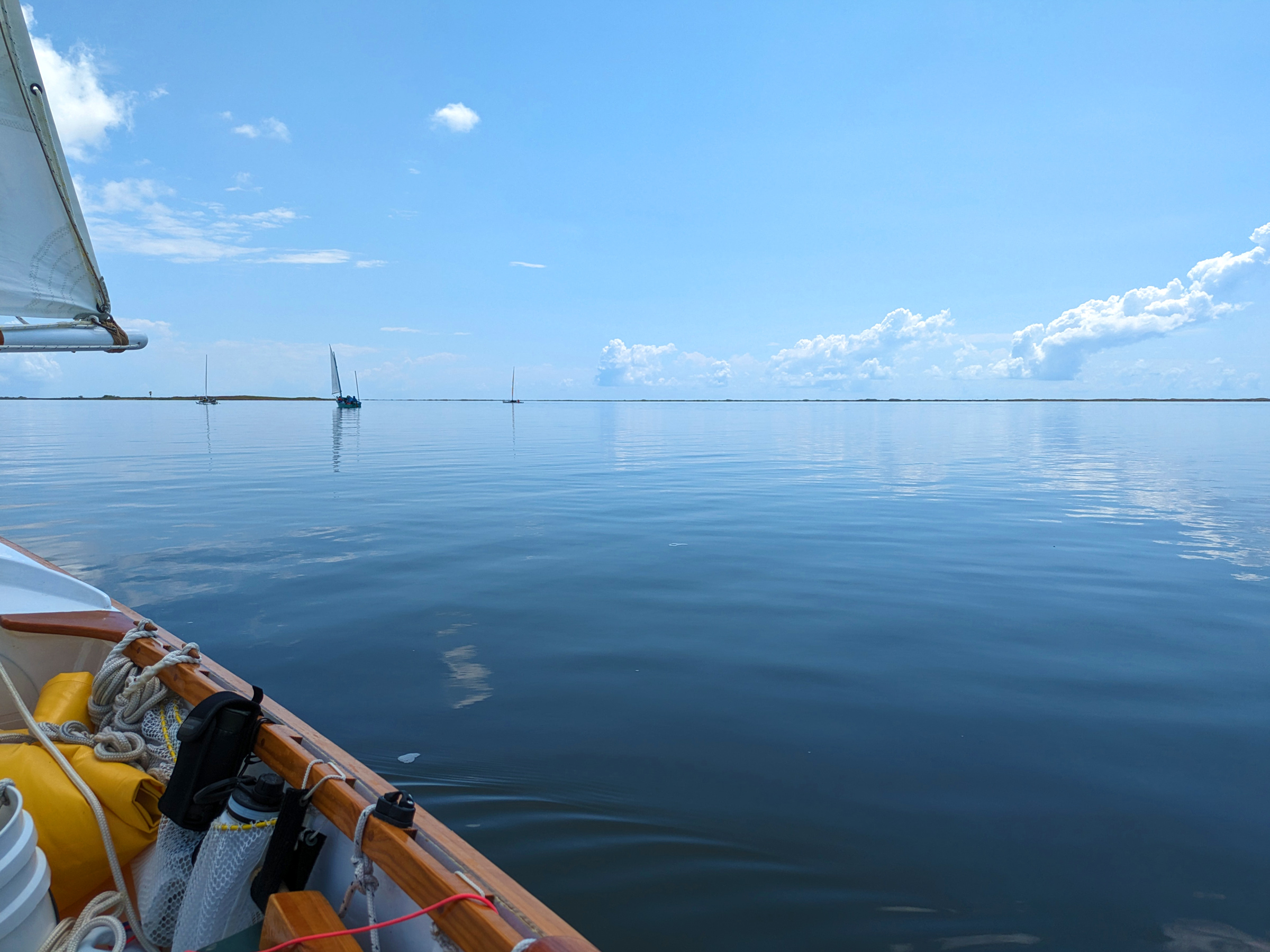
As I set off from the Dunes on the morning of Day 3 it was into a mirror-flat sea. Between a quarter and half of the fleet had outboards and these were put to good use, their skippers offering tows to those of us who had no such auxiliary power. A dozen or so skippers declined the help and rowed or paddled. I don’t consider myself a purist—ARR & ARR has some stainless fittings, a satellite tracker, double-braided poly line, and a Dyneema yard parrel—but I nonetheless do enjoy the challenge of making way under only sail and oar, as long as I don’t compromise safety. Pictured here are a few boats with skippers of similar mindsets, on waters that test patience but also offer opportunity for reflection, both literally and figuratively.
The main jug and all three bottles were empty, so I pulled out my emergency gallon, chugged down half a dozen gulps, refilled one water bottle to sip from overnight, and poured a cup in the freezer bag with the evening’s dehydrated meal. I gauged the water remaining in the jug, needing a cup for breakfast, more if I wanted coffee. After flossing that evening and swirling water around in my mouth, I drank the wash instead of spitting it out. I did spit out my first toothpaste rinse but swallowed the second.
The next morning, I awoke tired and thirsty. I had breakfast, broke camp, loaded the boat, drank the last of my water, and shoved off. I was only a half day from Marker 37 Marina at Corpus Christi, so my situation was one of only discomfort and not yet an emergency.
When the morning doldrums set in, I left the sail up and rowed. After an hour of rowing, the wind began to fill in. In less than a minute I had stowed the oars, pushed down the rudder blade, and sheeted in the sail.
At 2 p.m., I reached Marker 37 Marina, dropped sail and rowed around to its landward side, my oars touching bottom several times. I tied up on that side anyway, near the end of the pier, and walked into the marina complex where I found an outdoor freshwater shower and rinsed off. At a convenience store on the pier, I bought an electrolyte drink and quickly downed it. I filled my 3-gallon jug, the 1-gallon emergency jug, and all three water bottles. Before returning to the boat, I rinsed off under the shower again and drained an ice-cold bottled water. I was ready to tackle this cruise again.
I cast off, and with the wind fresh and directly from astern, I sailed on a run under the JFK Bridge, holding a steady course leaving no room for doubt about my intentions for skippers of the few powerboats that shot past. Some 75′ overhead, tires of the vehicles crossing the bridge clacked across the expansion joints.
The deep-water channel beyond the bridge was edged to the east by an almost-continuous chain of spoil islands, their white-sand-and-shell shores topped by grasses and scrub. The deep water ran straight south to north from the bridge to Corpus Christi Bay, and I ran downwind under full sail at 5 knots, water gushing from ARR & ARR’s bow. A double-decker tourist boat approached from astern, and I hugged the right edge of the channel to let it pass. Its starboard decks were crowded with people looking in my direction, and I realized the crew were using my boat as a tourist photo op. It must, indeed, have been a sight: a tiny boat with a traditional rig sailing along, gushing foam, with two burgees flying from a pigstick at the masthead, and a 5′-long red pennant streaming from the yard’s peak.
A wide, black thundercloud was growing over Corpus Christi Bay. There was no blue sky beneath it nor a clear anvil shape at its top by which I might have gauged its direction of travel. There were only broad stretches of dark cumulonimbus clouds reaching out toward me. I soon realized that the anvil was pointed at me—the thunderstorm was coming my way.
I wanted to avoid a repetition of my Red Fish Bay experience in Corpus Christi Bay, so I looked for a place to anchor. The chart showed a small channel cutting through the spoil islands less than a mile ahead. If I could get there before the storm caught me, it looked like I would be protected from all directions.
Roger Siebert
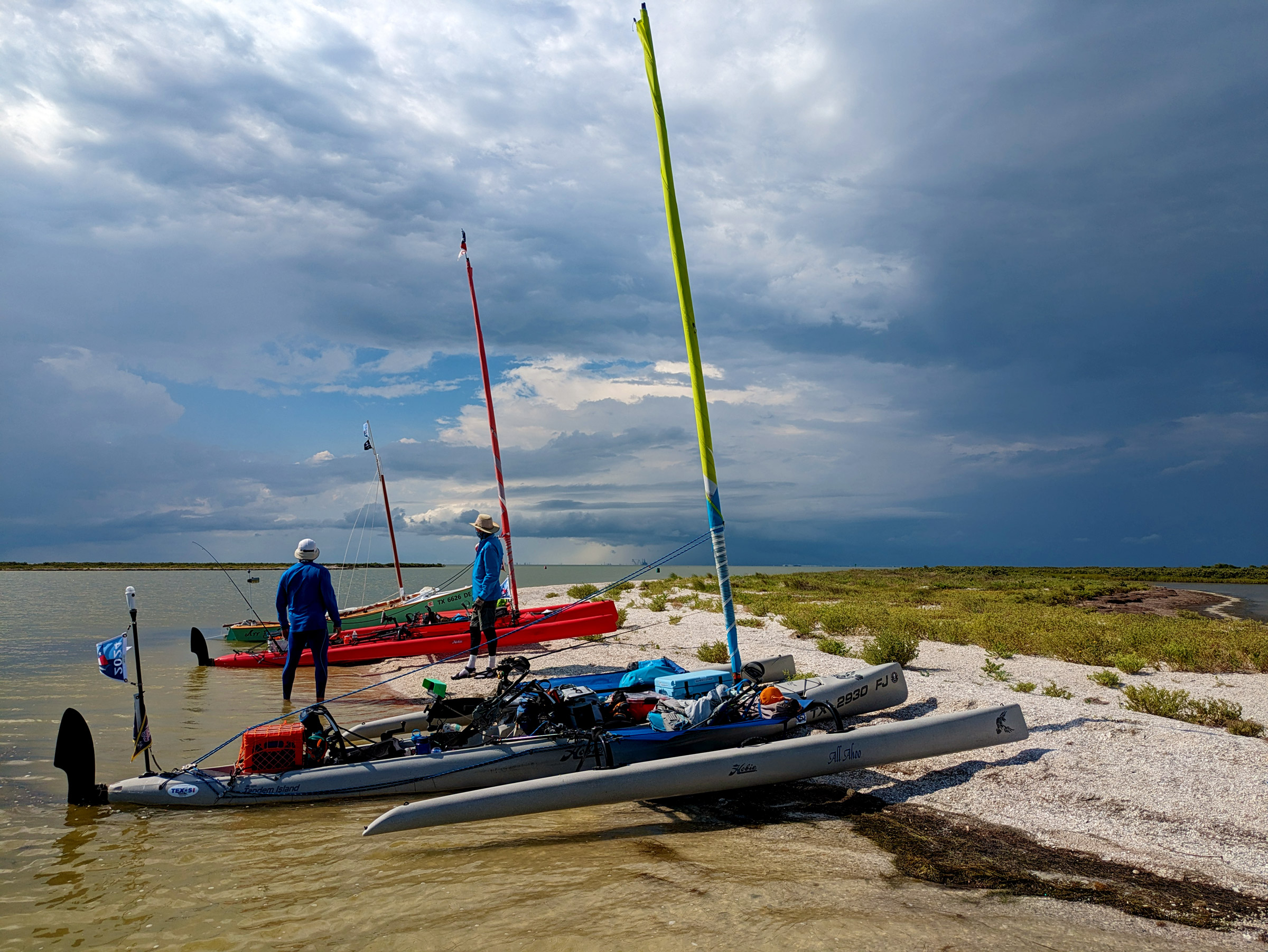
At Dead Pelican Island, Andrew (left) and Will stand between their trimarans, ALL AHOO (foreground) and OOKPIK, watching the thunderclouds forming over Corpus Christi Bay, which lies just beyond the islands visible to the left of the picture. These and other spoil islands were formed when the Intracoastal Waterway—which passes from left to right between Dead Pelican and the far spoil island—was dredged. A few of the channel’s navigational-aid buoys can be seen in the central distance. ARR & ARR lies beached beyond the two multi-hulls.
I drew near. On the far side of the small channel there appeared to be a beach. Pulling the boat onto shore would be even better than anchoring. I got closer and saw that there were two kayak trimarans already there. Company. Better still.
I got up as much speed as I could, turned ARR & ARR toward the beach, and when I was about 15 yards offshore, I pulled up the daggerboard and let the sail luff. The two trimaran skippers stood ready to catch me, but ARR & ARR came to a graceful hissing stop all on her own. I stepped out and set my anchor about 15′ up the beach.
The wind grew stronger, the sky blacker. Expecting rain, Will, skipper of the pedal-and-sail Hobie Tandem Island OOKPIK, suggested setting up camp immediately. I pitched my bivy across the wind, deciding it would be better to lose the cooling breeze but keep the rain out. I staked the fly’s windward edge tight against the ground. The wind pressed it into a concave scoop, but the rain never came. The thunderstorm blew itself out, but by then not enough daylight remained to tackle Corpus Christi Bay. Instead, I sat and chatted with Will and with Andrew, skipper of the other Hobie Tandem Island, ALL AHOO. They shared anchovy-stuffed olives, pan-seared Gouda cheese, salami, and homegrown cherry tomatoes in a vinaigrette dressing.
As the evening light waned, nighthawks called overhead, their cries like suddenly overloaded drags on fishing reels, and we retired to our tents. The wind stayed strong and pressed the fly against me inside the bivy. I was tired, though, and being hydrated once again, looked forward to the rest.
In the morning, Will and Andrew loaded their boats and set off on their way back toward the JFK Bridge. They had decided to pull out of the event, their knees having had their fill of pedaling through the last three mornings. It took me another hour to break camp and load ARR & ARR, but by the time I left, Will and Andrew were still in sight. It was yet another doldrums morning.
Being now so far behind the rest of the fleet and on my own, I no longer needed to save my best rowing for farther along the route. So, I rubbed anti-chafe balm across my armpits and changed into a long-sleeved UV-blocking shirt, a pair of poly-spandex-mix rowing shorts, and my clean convertible pants. The pants were normally snug, but now they settled a full 2″ beneath my waist, an indication of just how much weight I’d lost. I pulled a belt from my bag and snugged the pants in place.
The water stirred in tiny ripples. For two hours I sailed at about 2 knots, until I reached Shamrock Island, where gulls, terns, and egrets jostled above and crowded the beach and filled the air with a cacophony of calls.
The wind died. The heat was relentless. I had covered just half of Corpus Christi Bay, was exhausted, and hadn’t even rowed yet. There were 4 miles of bay yet ahead of me, followed by another 4 miles up the ship channel to Port Aransas, and another 6 miles to Mud Island, where the rest of the fleet had presumably stopped the night before. I readied the boat for rowing and decided to drop out at Port Aransas.
After a couple of hours of rowing, my hands and rear were sore. I had averaged little more than 1 knot. On my local lake, I can average 3 knots for hours on end including water breaks. But here I was exhausted and had taken so many breaks.
Roger Siebert
I left Shamrock Island under oars, having pulled the daggerboard out and inserted the rowing plug into its slot. I had mounted a bracket on the sternsheets just aft of my feet so I could move the hand-held bulkhead-mounted compass aft when rowing. It wasn’t a rowing compass, so I had to add 180 degrees to the reading to determine my heading. For a foot brace I tied a length of braided line between the inwales, and to keep the rudder centered I fastened the push-pull tiller with shock cord to the inwale, which also prevented the extension from swinging around and dragging behind the boat. My primary means of navigation was a NOAA chart booklet that I downloaded, printed, laminated, and bound. By this stage in the voyage, I had organized my gear so that it mostly fit inside the buoyancy compartments. The 3-gallon can of drinking water was lashed to the transom.
I pulled off my gloves so that my grip would pressure different parts of my hands and slid my pants down to my upper thighs, where they would still block the sun and I’d have only my seamless rowing shorts between me and the seat pad. I was pain-free again and rowed on for another hour and a half, until I reached Point of Mustang at the northwest tip of Mustang Island.
I beached the boat on the south side of the point’s hook so that the wakes of freighters and barges passing through the channel on the other side wouldn’t toss it around. After I dropped my PFD and harness in the boat, I plopped in the water. It was warm but refreshing. I poured water over my head and face. I stood up, completely soaked, and the slight breeze felt cool on my skin.
I spent nearly an hour at the point, psyching myself up for the possibility of a 4-mile row up the channel to Port Aransas Harbor. I floated in the bay, drank water and snacked, and stood in ankle-deep water to let the growing breeze cool me off.
By the time I was ready to leave, the breeze had become steady and strong. I decided to sail instead of row and began to think I might continue past Port Aransas after all.
A steady stream of tankers, spaced at about 20-minute intervals, powered down the channel from the Gulf. I stayed mainly on the southern side of the channel, tacking between it and the shoreline, heading into the channel only after a tanker had passed so I could attack its wake with my bow.
After four tankers had passed, the channel ahead appeared clear, but a fifth tanker approached from the opposite direction. I used the same tactic, staying close into shore, allowing the tanker to pass and then, just as I was about to tack out to meet its wake, I heard a hissing roar to starboard. Just 30 yards away, a 4′ wave breaking along the shore was barreling down on me. I turned hard to port just in time to come stern-to the wave. In the seconds before it reached me it settled into a swell—I had apparently reached deeper water.
When the tankers and barges were gone, I had the channel to myself. Ahead, the water churned in flat splashing pools 10- to 20-yards across, disturbed by schools of feeding fish. Stark black-and-white terns with forked tails spun above the churning pools, and dove within a fraction of an inch of the water’s surface, but none were leaving with fish; they must have been feeding on the insects that had attracted the fish.
I was making good time and set my course to cross the paths of the Port Aransas ferries in a single tack. They paused in their 1⁄4-mile crossings until I was clear. I turned to port and fell off on a broad reach, leaving Port Aransas behind.
For the first 4 miles or so, the channel from Port Aransas—past the Lydia Ann Lighthouse and toward Mud Island—cuts through shoals. Within the first mile, I passed a line of barges tied along the edge of the channel across from the lighthouse. The tug that had been closing on me during my approach to Port Aransas came around the point and continued down the channel, gaining on me quickly.
Brian Graham
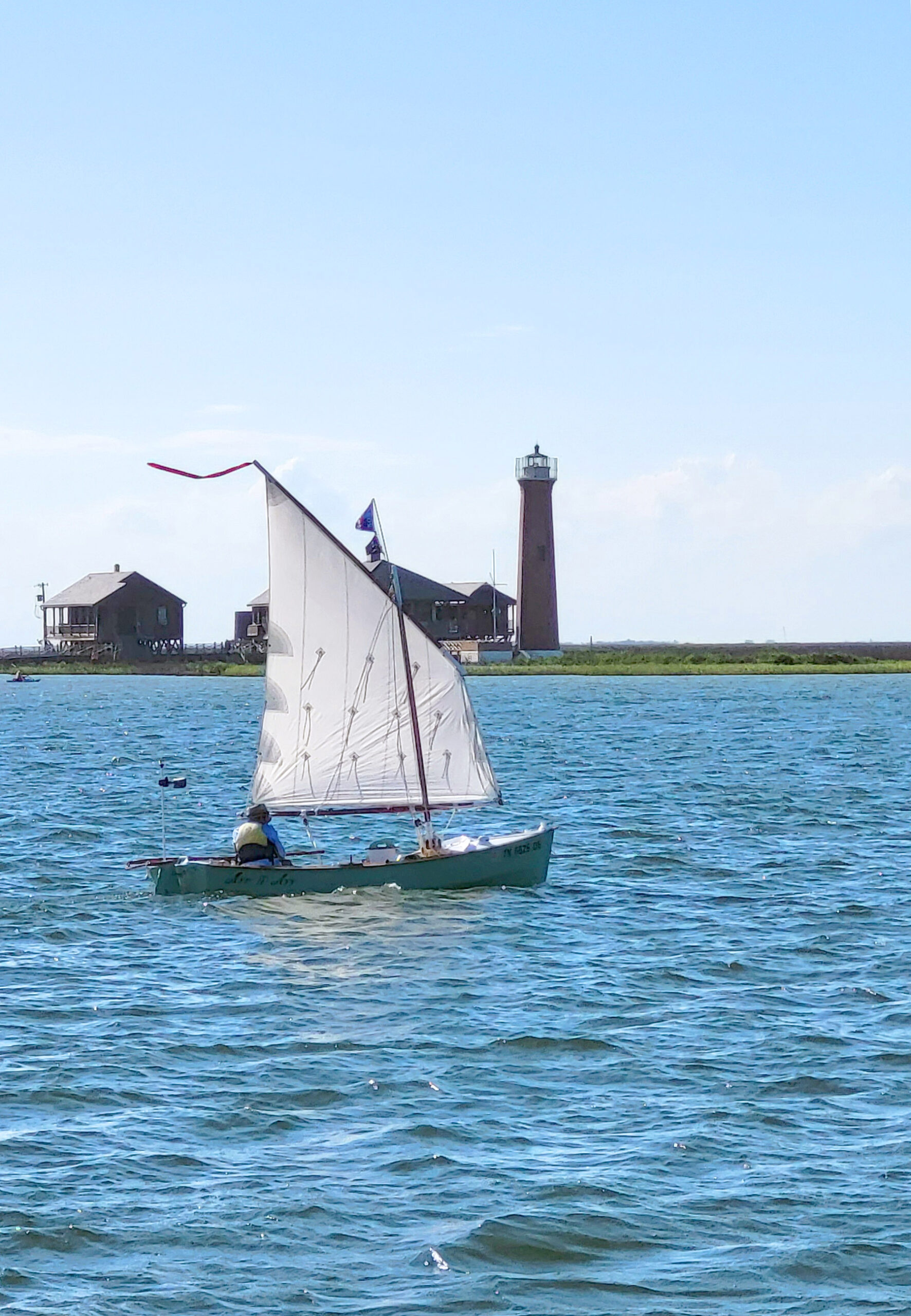
With the land around the Intracoastal Waterway so low and flat, any prominent building becomes a useful navigational aid. We sailed past the Lydia Ann Lighthouse, down the channel of the same name, leaving Port Aransas about a mile behind and heading toward Mud Island. Previously called the Aransas Pass Light Station, the lighthouse was deactivated in 1952 after the shifting sands of San Jose and Mustang islands pushed the Aransas Pass south by more than a mile over the course of a century. The lighthouse and its surrounding structures are currently maintained as a historic site.
I pulled the daggerboard up halfway and moved to the west side of the channel. I had grounded there on past trips, and as expected, touched bottom again. I pulled the daggerboard up the rest of the way, got moving again, put the board back down, grounded, pulled out the board, moved, grounded, pulled up, again and again.
Another tug approached from the north. As the two drew near each other they slowed and, moving at a snail’s pace, took an excruciatingly long time to pass each other and me. When they were gone, I was free to sail back into the channel and run with the wind. It was wonderful sailing with the late evening light casting the water in tones of blue gray. As ARR & ARR charged across rolling waves I steered with both hands on the tiller, on the edge of control. The wake was all foam. It was exhilarating and I was filled with more energy than the morning’s doldrums had drained.
As I passed the southern tip of Mud Island, I pushed the daggerboard down and headed up on a close reach. In the lee of the island, the waves subsided, though the wind stayed strong, coming as it did across the island’s waist-high mangroves. A narrow beach of sand and bleached shells was mottled by malty brown wrack. Expecting shallows even a hundred yards out, I raised the daggerboard 12″, pointed up to a close haul, and aimed for the landing I had picked out.
About 30 yards off the beach, the rudder blade bumped and scraped. I pulled the daggerboard and shoved it into the sternsheets. I continued on a close haul but slid as much to leeward as I sailed forward.
What had been almost flat water between me and the island suddenly erupted into a churning wave barely a yard from the boat: redfish, spooked at the last minute by my approaching boat.
I had raised the rudder blade as much as I could without losing steerage, but in the end, it was the keel that stopped the boat, grinding into the sand and patches of seagrass. I stepped out into just 6″ of water, grabbed the bowline, and pulled the boat toward shore. The roiling fish stayed with me, preceding my every step and only scattering off to either side when I was within three steps of shore.
The low sun cast both water and island in an orange glow and a scant half-moon hung high in the sky. The air was cooler than on any of the three previous evenings. I felt good—tired and hungry but relaxed and accomplished. Everything had turned out perfectly after having spent a couple of evenings in the company of likeminded people and now alone on an island in a warm bay on a summer evening. Although I was leaving the Texas 200, it felt exactly right to be where I was and to have arrived when I did. I felt no need to reach the official finish line. My finish line was governed by time: It was Thursday, and I had to be at work on Tuesday; I had reserved Sunday and Monday for cleanup and rest.
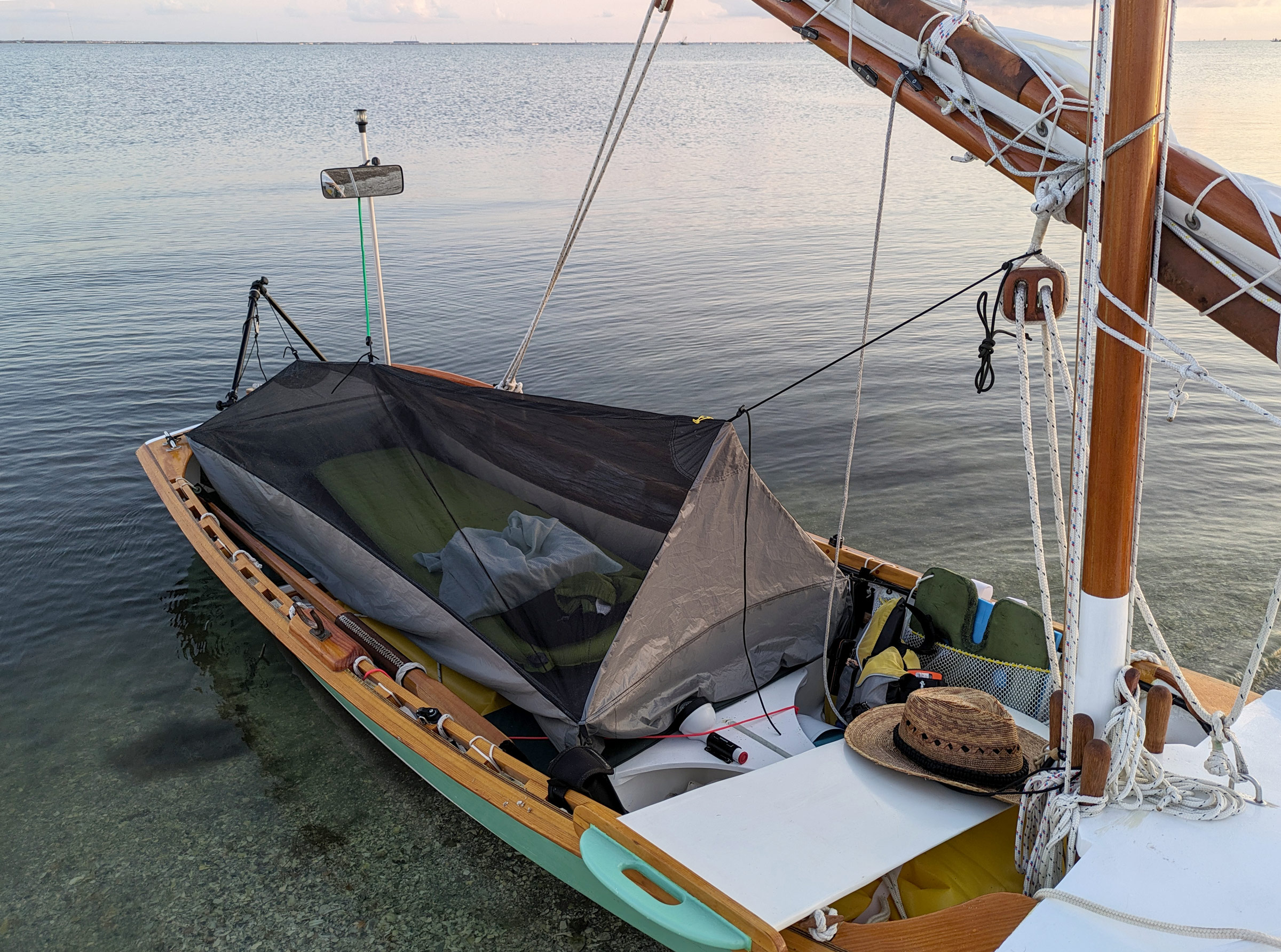
I wanted only to eat and settle into the boat to sleep, but I had spotted some brackish pools barely 20 yards from where I’d landed and knew that I’d be attacked by mosquitoes after midnight. I pulled ARR & ARR farther onto shore, and with the keel settled in the furrow it had plowed, the boat was steady and upright. I slid the side seats into the middle of the cockpit and set up the mesh bivy in the boat, tying its lines to the mast, the stern light pole, and a camera boom set in the sternsheets. I was done in half the time it would have taken to set the bivy up onshore with the oars as poles.
Roger Siebert
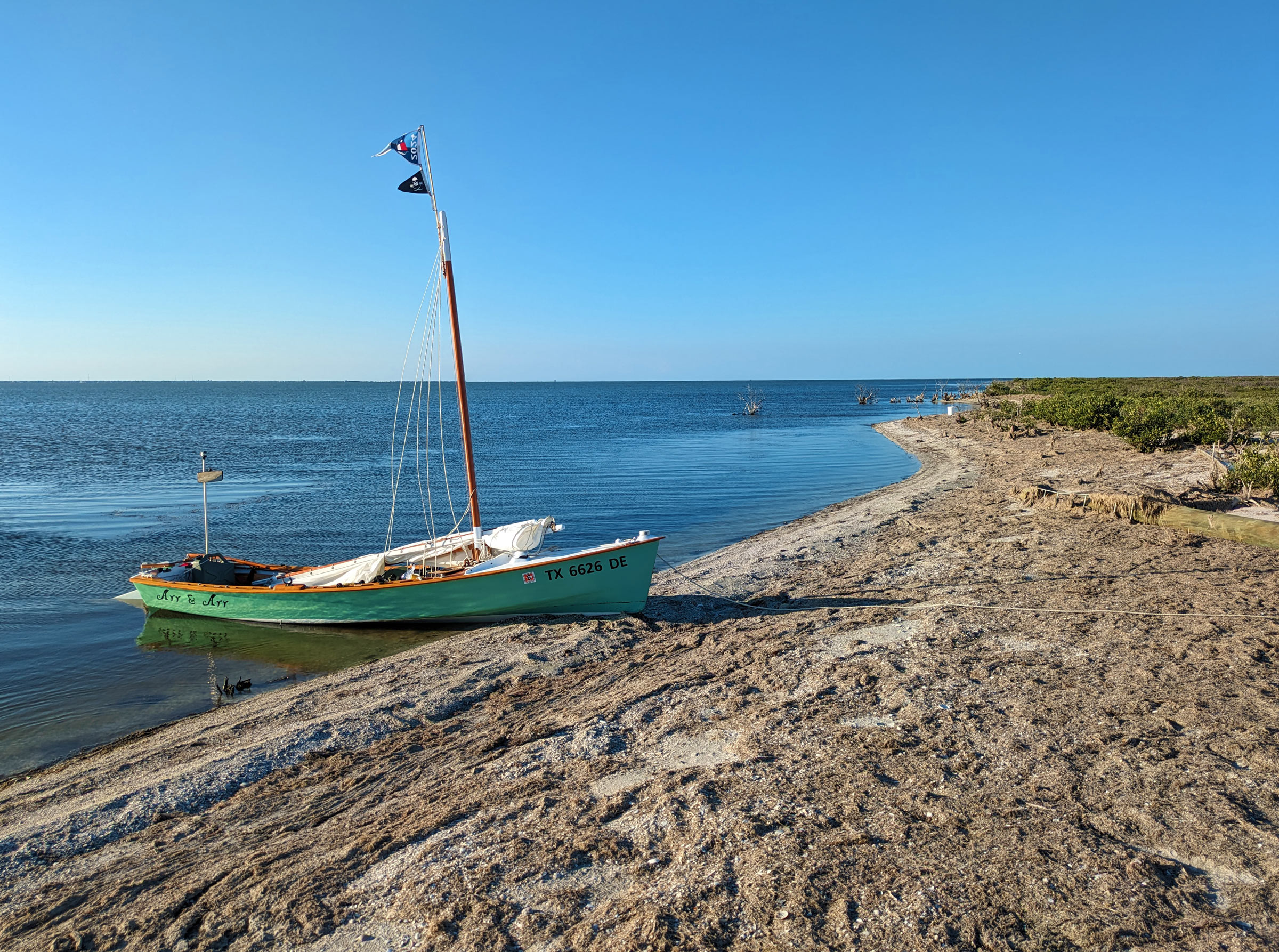
I beached ARR & ARR for the night on the leeward side of Mud Island and set her anchor on the inland side of a washed-up piling, being careful to lay the chain part of the rode over the piling to avoid chafing the nylon rode. In the far distance the mainland was just visible on the horizon and with the late hour the wind and water had stilled. Moments like this draw me to the Texas coast again and again.
To make space for my sleeping arrangements, I laid the folded tarp on shore as a base for everything that needed to come off the boat: water jug and bottles, bucket head, camping dry bag, and electronics and recharging gear. As the sun set and the moon rose, the nighthawks took to the skies. There was no wind and the netting stayed in place above me, catching the moonlight and casting mesmerizing multi-colored moiré patterns over my head. The slight night breeze was refreshing, and I fell right to sleep.
Packing in the morning was also quicker without the oar setup, and I was able to take advantage of the gentle, early-morning breeze. There were still 60 miles to go to get to my car and trailer. It was Friday, the official finish. I might be able to make it on Saturday, but it would be tight. I needed to replenish my water supply, so I steered across the mouth of Aransas Bay to Rockport instead of through the bays and cuts toward Army Hole, which had been the official campsite for the previous night. I sailed beneath the cumulus-dotted blue sky on the gently rippling blue-green water. It was a slow but pleasant sail. Another cannonball jellyfish, this one the size of a large grapefruit or small melon, appeared alongside the boat, but this time I was the one moving faster.
The wind was favorable for sailing into Little Bay at Rockport through its southern channel, so I didn’t switch to oars until I was well inside where buildings blocked much of the wind. None of the marinas in the harbor had any indication that they were anything other than private until I came to a building no bigger than a two-car garage that advertised boat rentals. I rowed close, and a man asked if he could help me. I told him I was looking for a marina where I could top off my drinking water and recharge my power packs. He said he only rented boats but that I was welcome to use his hose. I did so, thanked him, and asked where such a marina might be. A few miles south, he said, or a mile or so north, in Fulton. I didn’t want to backtrack, so I opted for north. The chart indicated a low fixed bridge spanning the 20-yard-wide channel at the north end of Little Bay, and the man wasn’t sure my mast would clear, even with the sail and yard lowered. I unstepped the mast and set off rowing. I passed beneath the bridge, which would indeed have been too low for my mast, and I was in Aransas Bay again.
I had drinking water now and the boat’s battery was still fully charged, and although I would have welcomed a cold drink and a sandwich, I had food aboard to last a couple of days. I continued rowing out into the bay until I had enough sea room to set my rig back up and proceeded on my way under sail.
I had to work upwind to make it back into Aransas Bay far enough to get around Blackjack Peninsula, 7 miles to the north-northwest. It was a beautiful day, though, with light green water—almost luminous—and enough wind to drive ARR & ARR at nearly hull speed. I made good headway, but by 3 p.m. the channel markers were still tiny on the horizon. Even if I followed the ICW to Matagorda Bay instead of going through the cuts and islands, I wasn’t going to make it to the event’s finish at Magnolia Beach on Saturday unless I sailed at night. It wasn’t an option. I had running lights but didn’t have the experience to be safe, especially as exhausted as I was.
I needed to pull out while there were still Texas 200 volunteers taking calls. If I called on Sunday, two days after the official finish, a volunteer would probably still offer a ride, but it would surely not have been in their plans.
Roger Siebert
The net bivy fit neatly inside ARR & ARR, the height of its waterproof bathtub bottom almost exactly matching the height of the gunwales above the seats. I entered through the head. The foam pillow inside the bivy could compress to the size of a softball to fit in a stuff sack.
I fell off, jibed around, and sailed back on a run toward the marina in Fulton. Huge powerboats and red and green markers atop pilings made it easy to spot at a distance without the aid of charts or electronics. ARR & ARR surfed down the waves with wide fans of foam. Before long, the conditions were too much. The wind and waves tried to broach my boat, so I headed up, set a reef, and continued the run downwind. It was still too much. I barely maintained control even with both hands on the tiller. I headed up again, set a second reef, and continued toward the marina breakwater.
ARR & ARR still surfed down each wave, but the force on the tiller was now manageable. Water roared away from her bow and gunwales, and I kept her pointed at the harbor’s entrance. When I reached the breakwater, I turned to starboard into its shelter. The wind stayed strong, but the water was flat inside. I sailed the full length of the harbor but saw no signs of a marina where I could rent a slip. I came about and worked my way back toward the breakwater’s entrance. A few workers had watched me come in. Two of them sat in the shade at a bait shop on the waterfront. I dropped sail and rowed to them.
“Hello,” I said. “Do you know where I can tie up for a few hours, maybe overnight?”
One pointed to an empty spot on one of the docks.
“Twenty dollars if overnight,” he said.
I said, “That’s fine. Thank you.”
“You were really moving out there,” he said. And with that, both men rose and walked around to where he had pointed.
“I’m John,” he said, as he took my stern line and tied it to one of the dock’s cleats. The other man tied my bowline to another.
John, looking at my PFD with its VHF radio, dive knife, and satellite tracker, said, “You have all the safety gear, for sure.”
“Yes,” I said as I climbed onto the dock. “You guys are really life-savers.”
On my cell phone, I called Sharon, one of the Texas 200 volunteers. It would be an hour before she would arrive so I tidied up the boat, pulled out what I wanted to take with me, and secured the rest. John and his friend had to leave and their place was taken by another man who arrived by car and came over to ask what I and my little pile of gear were about. I told him about John and our deal. He nodded, gave me a beer, and joined me to chat about boats (me) and surfing (him).
Sharon and Ziggy arrived and reunited me with my car and trailer in Magnolia Beach, but by the time I got back to Fulton it was evening, and I was too exhausted to drive back to Austin and home, so I got a hotel room.
Roger Siebert
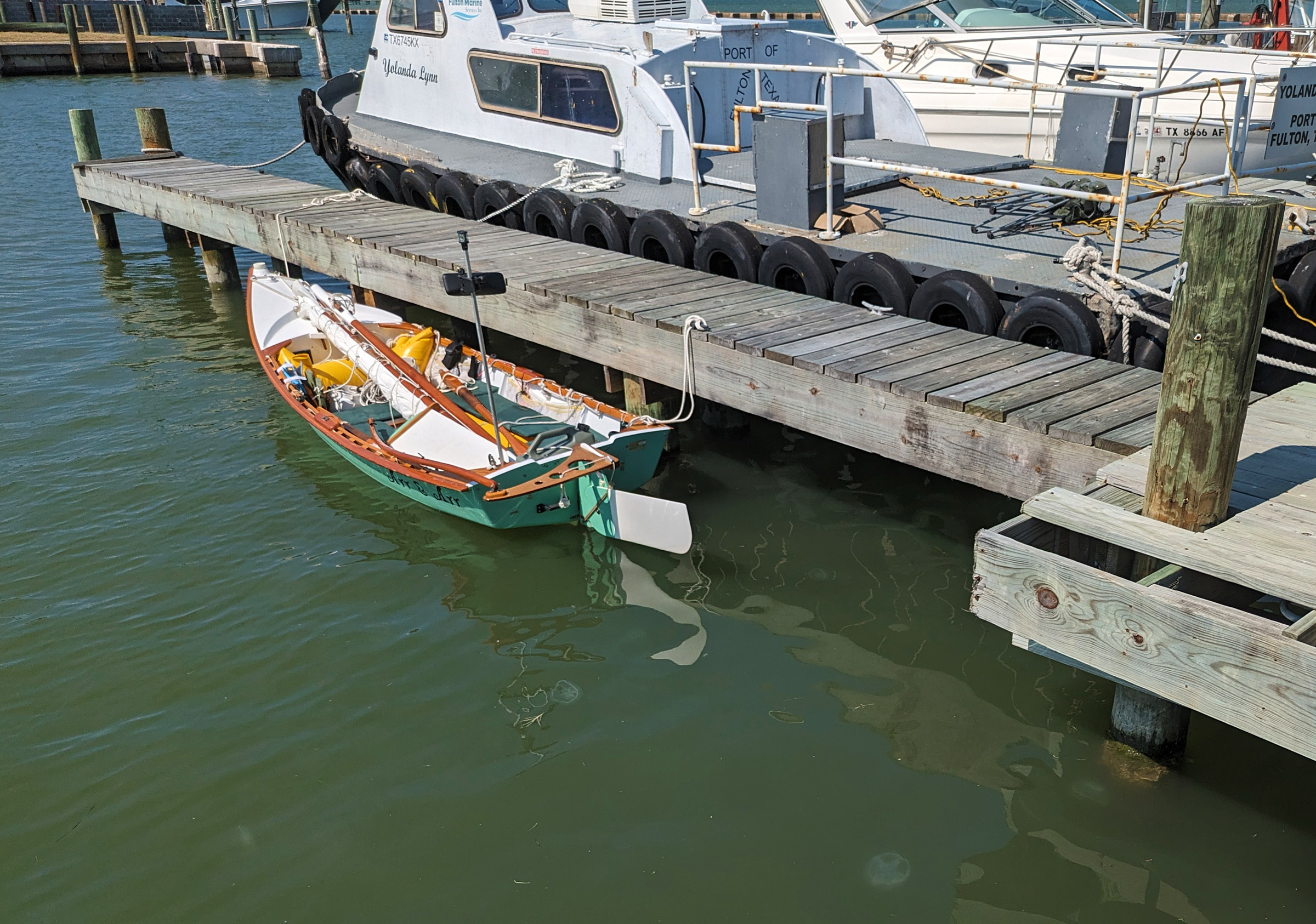
Before I left ARR & ARR to go back and retrieve the trailer, I de-rigged her, removed the daggerboard, and raised the rudder so that she was all ready to pull out. I locked the compass, VHF radio, satellite tracker, and other valuables out of sight for the night, but was unconcerned—the docks were on the other side of a locked security gate and ARR & ARR was in the company of boats worth many thousands of dollars more than her.
The following morning, I pulled the boat out at the adjacent ramp where the water was thick with moon jellyfish, their flat transparent bells showing opaque four-leaf-clover shapes in their centers. I found John lying in a hammock in the shade of the bait shop’s shelter and thanked him again for the help he and his friend had offered. He shook my hand and wished me well.
It had been a wonderful five days, challenging me and my boat, and allowing me to meet all sorts of people that made the venture worthwhile. But I also had time by myself on this perfect stretch of coast: sheltered, often gentle, occasionally unpredictable, and typically uncrowded. I would be back—better prepared, more experienced, and open to whatever the Texas coast would share with me next time.
Roger Siebert is an editor in Austin, Texas. He rows and sails ARR & ARR on local lakes, and has trailered her to a few of his favorite places on the Florida coast.
If you have an interesting story to tell about your adventures with a small boat, please email us a brief outline and a few photos.
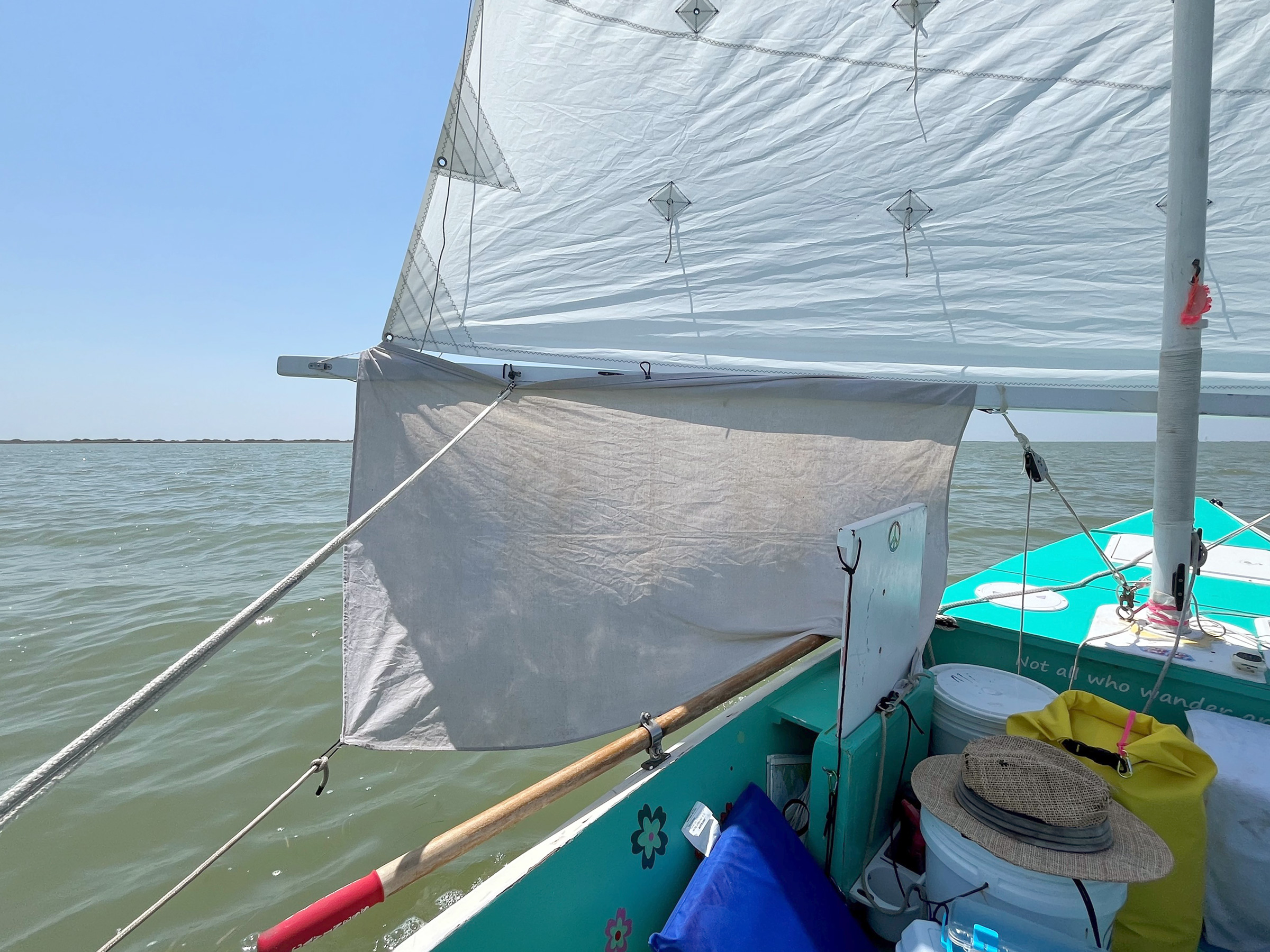
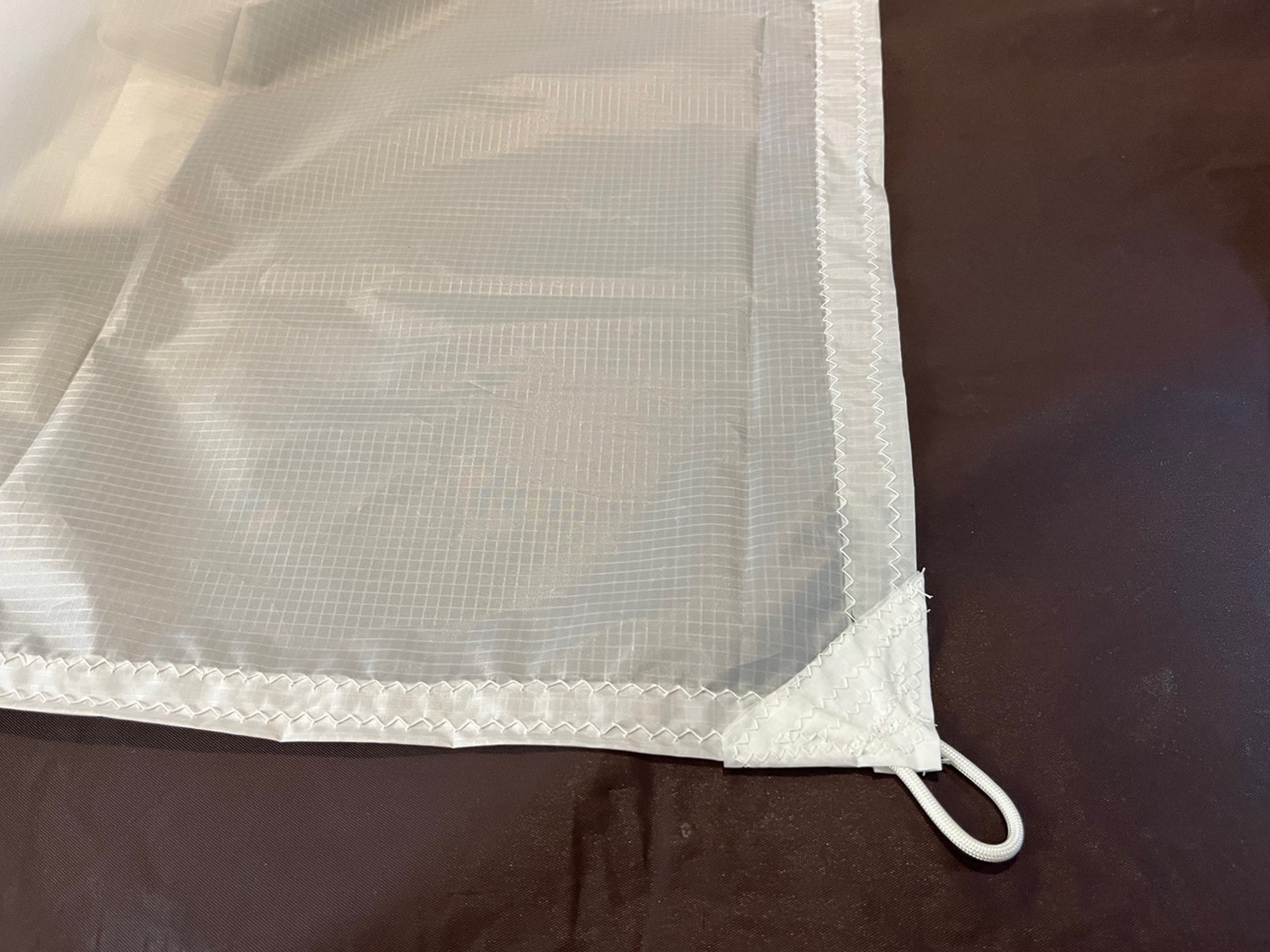
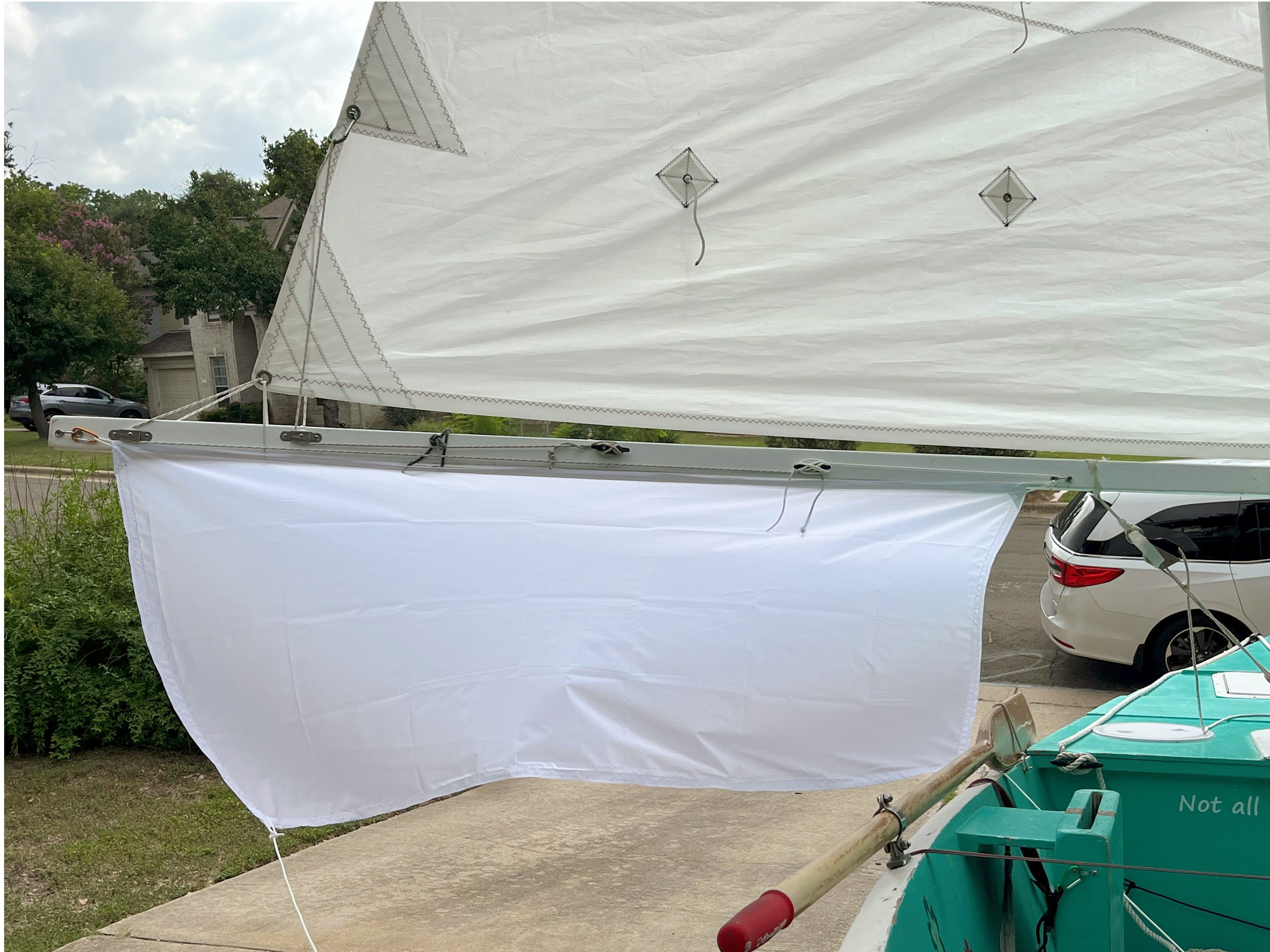
In the days of square-riggers, water-sails were common. Deployed below the boom, they were used in light air when sailing off the wind, on a broad reach, or a dead run. Today, they’re largely forgotten.
My experience with water-sails started when I was on a multi-day camp-cruising trip about five years ago, and had a long downwind leg to sail one morning in very light air. I had just packed up my tent along with the 6′ × 3′ piece of poly tarp that I use as a ground cloth. While sailing along in the light air, it occurred to me that the rectangular tarp would fit perfectly below the boom and sit right above the water’s surface, giving me about 25 percent more sail area. I used the grommets in the two top corners to secure this makeshift sail under the boom and attached a line to each of the two bottom corner grommets so that I could sheet-in the tarp. The increase in boat speed was immediately noticeable, and I’ve had good success with similar makeshift water-sails on several trips since then.
Photographs by the author
My first water-sail was a makeshift arrangement that utilized a 6’ x 3’ ground cloth I had on board during a camp-cruising trip. I tied it around the boom and fastened a sheet to the outboard lower corner. It wasn’t the best-looking sail but when set it noticeably increased my speed on a calm morning.
When the need arose for a water-sail during the 2024 Texas 200, I improvised another one from a piece of canvas that I had on board. After the success of that most recent makeshift water-sail, I decided it was time to make a proper one for my 15′ 6″ Bolger Featherwind.
I purchased a piece of coated ripstop nylon and cut it to 74″ × 32″ with sharp scissors. I sewed simple 1″ single-fold hems, held by two rows of zigzag stitching, one row over the cut edge, to give me a final sail size of 72″ × 30″. Your boat’s rig will determine the size of sail for your boat.
In the new purpose-built water-sail I kept things simple, using paracord sewn into the reinforced corners rather than grommets. It was a similar setup to the groundsheet with which I had previously improvised.
I decided against installing grommets in the corners, and instead sewed loops of paracord under triangular reinforcement patches in each of the four corners.
The finished simple rectangle adds about 15 sq ft of sail area to my boat’s 76-sq-ft balanced lugsail, fills most of the space under the boom and outboard from the hull, and rides about 6″ or 8″ above the water.
I added a stainless-steel pad-eye at the end of the boom, just past the clew of my mainsail, so that I can attach the outer upper corner of the water-sail with a small carabiner. For the inboard upper corner, I added another pad-eye to the boom, about 3″ past the end of the water-sail; I tied a small length of paracord to the loop and ran it through that pad-eye to the outhaul’s cleat, thus avoiding the need to install another cleat.
When needed, the water-sail is easily rigged up. The outboard upper corner is fastened with a carabiner to a pad-eye, while the inboard corner has a line that leads through a pad-eye purchase and back to the mainsail’s clew-outhaul cleat. This simple arrangement allows me easily to tension the head of the watersail along the boom. The two lower corners are controlled by a sheet and tack tie-down.
At the bottom of the water-sail, I attached a length of paracord to each corner. The outer corner is where I’ll do most sheeting for the water-sail. The other corner is adjacent to the gunwale, and its control line simply needs to be fastened somewhere just inboard of the gunwale to keep it from blowing out or forward.
If you have ever been sailing in extremely light air and wished that you could quickly deploy some additional sail area to help move your boat along just a little bit faster, you should consider making a water-sail.
Matt Schiemer has been sailing for nearly 45 years in a range of boats from sailing dinghies to 50′ keelboats. He started sailing as a young boy on the coastal bays of New Jersey and has since sailed on lakes, rivers, and bays as well as a handful of the world’s oceans and seas. He lives in Austin, Texas, and sails regularly on Lake Travis and the Texas Gulf Coast.
You can share your tips and tricks of the trade with other Small Boats readers by sending us an email.
The teak floorboards in my Caledonia Yawl have served me well since I launched the boat in 2005, but, like me, they’ve grown much grayer over the past 19 years. I’ve accepted that change of color for myself, but I thought it would be worth trying to restore my floorboards to their youthful appearance.
Photographs by the author
After 19 years, my Caledonia Yawl’s teak floorboards had lost the glow of their original color. I had wiped them down once with boiled linseed oil, but that only picked up the black of shoe soles and smeared it on the wood.
I had seen how well Snappy Boat Care’s treatment had brought the brilliant color back to a weathered teak outdoor table and bought the two-part kit of Teak-Nu to remove the gray and a bottle of Snappy Teak-Nu Sealer to restore the color.
The Formula #1 component of Teak-Nu, applied with the supplied scrub brush, removes the weathered surface of the teak. The floorboards are kept wet throughout the process of using both Formula #1 and Formula #2.
Formula #1 is a solution of sodium hydroxide, an alkali commonly known as lye or caustic soda and a common ingredient in cleaning products. The instructions on the bottle include warnings about contact with the solution so I wore gloves and safety goggles and did the application outdoors. Given the age of my floorboards, I used Formula #1 full strength. Teak in better shape than mine could use a 1:1 dilution. After wetting the floorboards with fresh water, scrubbing the solution on the wood with the included stiff-bristled brush turned the teak black and the solution thickened with the removal of the deteriorated wood on the surface.
Formula #2 neutralizes what’s left of Formula #1 after it’s rinsed off. Any black that remains needs only a bit more formula and brushing.
After a fresh-water rinse, I followed the same procedure scrubbing Formula #2 on. Its solution of hydrochloric acid neutralizes the alkaline #1 and removes the black from the teak. (The reaction of the acid with the sodium hydroxide forms sodium hydroxide—ordinary salt—and water.) After a fresh-water rinse, the floorboards had most of their color back, but several areas remained black. A bit more scrubbing with #2 cleaned them up.
After the teak has dried it has “that freshly sanded look” (at left) and the application of Teak-Nu Marine Teak Oil restores the color (right).
While the color was fully restored after the final rinse, once the floorboards had dried overnight, the teak turned a very pale tan color, what Snappy calls “that freshly sanded look.” To bring the warm color back to stay, the teak needs to be oiled and for that, Snappy has Teak-Nu Marine Teak Oil, a tung-oil polymer formula. A foam brush turned out to the best means of applying the oil as it laid down a uniform coat on the floorboards’ top surfaces and squeezed easily into the gaps between the slats to coat the edges. After sitting for 5 minutes, the oil needs to be wiped down with a rag. After the floorboards dried overnight, they had a few pale spots, but a second lighter application of oil brought the color up to stay.
Restoring the color of the teak didn’t take much time, little more than an hour spread over two days, and was well worth the effort.
Set back in place in the cockpit, the restored floorboards have the color that had disappeared so long ago that I’d forgotten how much it contributed to the appearance of the boat. And the larger of the two floorboards, raised from the bottom of the boat to serve as my dinner table, now gleams with the colors of amber and polished bronze and I don’t have to hide it with a tablecloth.
The Teak-Nu products were easy to use and lived up to my expectations. I have three more floorboard panels in the bow of the yawl. I have more than enough in the 32-oz bottles of Formulas #1 and #2 to restore them, and plenty of the Marine Teak Oil to bring them up to the same like-new appearance. As the instructions recommend, I’ll apply fresh coats to all the floorboards at the first signs of weathering to keep them a pleasure to look at.
Christopher Cunningham is the editor of Small Boats.
When we go boating, Audrey and I are rarely without hats to keep the sun off our heads and protect us from the occasional rain shower. As a lifelong sailor, Audrey has quite a collection of hats. She recently added the Tilley LTM6 Airflo Sun Hat to her collection and it has quickly become her favorite.
The Tilley company was founded by Alex Tilley in 1980. Tilley was a sailor who couldn’t find a hat to his liking, so he designed one to protect against sun and rain and to stay put during a blow. The cotton-duck Tilley became popular with both sailors and other adventurers.
Christopher Cunningham
This original Tilley Endurable is 30 years old and still under warranty. The label sewn in the crown notes that the hat will be “replaced free if it wears out. (Yes, put it in your will.)”
The LTM6 Airflo is one of the latest evolutions of the original design. As with other Tilley headwear, the hat has UPF 50+ sun protection and a nicely sized brim to protect Skipper from the sun. The brim and crown of the LTM6 have been reduced slightly and given more shape than the original Tilley. The brim measures 2 1⁄2″ on the sides and 3 1⁄2″ on the front and back, and has a stiffener inside the circumference of the brim to help hold the desired shape. The side crown height measurement is 4″, creating a slightly lower profile that is well suited to sailing in a stiff breeze and ducking the boom. The crown also has an oval shape that is narrower in the front, which creates a more natural and comfortable fit. These design elements combine to make a hat that is a better fit for Skipper than her original Tilley.
Photographs by the author
The fabric and design of the LTM6 Airflo combine to make a hat suited to both sun and rain. Made from recycled nylon with a water-repellent coating, it keeps the head dry in a rain storm, while the mesh around the crown prevents overheating on a sunny day.
The LTM6 is made from 100 percent recycled nylon treated with a PFC-free polyurethane water-repellent coating. The hat weighs 4 oz and has a 3⁄4″ band of mesh around the top of the crown that provides excellent ventilation to the top of the head. Another welcome feature is a small Velcro pocket on the inside top of the crown where small items, such as cash or a small cool pack, can be stashed.
The hat has a lower profile and is more form-fitting than the original Tilley. With a strap that can be worn beneath the chin or at the back of the head it stays put in most wind conditions.
The hat is held securely in place by a strap that is adjusted with slip knots. The continuous cord can be placed under the chin or the back of the head, so that the hat stays put in wind from all directions. If the strap isn’t needed, it can be easily tucked away inside the Velcro pocket or tightened so that it does not droop down. One other use for the strap could be to tie up the sides of the hat. For her hat, Skipper chose a soft mauve color, which is dark enough on the underside of the brim to soften the sun’s glare/reflected from the water. There are two color selections for women and eight for men.
The LTM6 hats are washable, and more importantly, buoyant. Like the original Tilley, they are guaranteed for life. This guarantee, along with excellent customer service and a piece of gear that does the job and looks good doing it, make the Tilley LTM6 a sun hat to consider.
Audrey (Skipper) and Kent Lewis log their maritime adventures at Small Boat Restoration, always wearing hats.
The LTM6 Airflo Sun Hats for men and for women are available from Tilley for $99.
Is there a product that might be useful for boatbuilding, cruising, or shore-side camping that you’d like us to review? Please email your suggestions.
Oliver Ilg’s journey to wooden boat building has been neither straight nor obvious. Leaving university in Brazil with a degree in physics (which he later augmented with an MBA), he was hired as a product engineer for a German car manufacturer. Four years later, he moved to another German car company in Brazil where he worked first as assistant to the general manager, and later as director of sales and marketing for the firm’s luxury cars. In his late 20s he was involved in building a 53′ steel yacht for his father, but it was not until his 40s that he left cars behind and became fully immersed in a nautical world.
In 2003, Oliver founded Sterling Yachts, building “modern classic fast trawler cruisers for the U.S. market.” The company adopted automotive-manufacturing techniques, outsourcing components and bringing them together in a proprietary assembly line. Within five years, says Oliver, Sterling Yachts had shifted its geographical focus and become a top player in the local market, introducing innovative craft like the Sterling Legend 28, the first Brazilian diesel/electric hybrid leisure motorboat.
Photographs by Oliver Ilg
Oliver built his backyard workshop between his house and an old stone wall. He left the ends open for ventilation but when it comes time to paint or varnish, he can close them off with retractable vinyl curtains. The workshop’s roof is steel panels while the floor is construction-grade plywood.
But, in the midst of all the gleaming chrome, shining gelcoats, and high-tech production lines, Oliver indulged himself in his own projects—“small wooden boats that I built after hours at the shipyard.” It started, he says, with a flat-bottomed rowing skiff, loosely based on the Catraia workboat of northern Portugal. “I built it of plywood and epoxy for a friend.”
Following the success of that first build in 2010, he constructed several small boats over the years, but when Sterling Yachts evolved into a custom-yachts project-management firm and ceased physical operations, the shipyard closed, and Oliver was without a workspace. He had a choice, he says: stop building his beloved “woodies” or find an alternative shop. He went home to his own backyard.
The bottom of the hull is marine plywood laid on the diagonal. In the after sections Oliver used two layers of 9mm plywood, but forward, where the curves are tighter, he used three layers of 6mm.
Oliver lives in Campinas, a city in the state of São Paulo in southeast Brazil. Campinas lies on the Tropic of Capricorn 90 miles inland from the country’s Atlantic coast and, Oliver says, has “relentless sun.” If he was going to continue boatbuilding, he needed a covered shop with plenty of ventilation and natural cooling. He chose a spot between a stone wall and his house. “Shielded by insulated steel roofing and sturdy plywood flooring, I left it open at both ends but installed retractable vinyl curtains to keep out the rain and to stop any dust flying around when I’m painting. I equipped the shop with basic woodworking and high-end power tools—a tablesaw, thickness planer, miter saw, bandsaw—and various handheld tools. I’m particularly proud of my hand planes, which I maintain with great care. I call the shop my Sterling Maker Space.”
With the hull construction complete, Oliver applied the bottom paint before turning the boat over. The topsides are strip-planked cedar coated in fiberglass and epoxy. The transom (which he left bright-finished) is teak.
Oliver’s first at-home build was a 16′ Duck Trap Wherry, designed by Walt Simmons of Lincolnville, Maine. “She was built using modern methods—epoxy, plywood, fiberglass—but she’s classic in appearance…altogether more elegant than my first project,” Oliver says. But his most recent build has been his most ambitious to date.
As construction continued on the now-upright hull, Oliver took his time to check the ergonomics of his interior-layout design. Here he is seen figuring out the exact position for the chemical toilet, which would be concealed beneath the foredeck.
He had in his possession a Vetus EP2200 electric motor, and it sparked the idea of building a customized harbor launch. He collaborated with Walt Simmons and together they altered the plans for the Duck Trap Launch to fit Oliver’s vision. Construction would closely follow the Duck Trap original, but propulsion would move from an outboard engine with center console to the inboard electric Vetus motor. The depth of the keel would be increased to protect the gear and rudder, the overall length would be stretched by 3′ to 20′, and the interior would be redesigned. In the original design the steering position was centrally located, but Oliver was keen to maximize passenger space and comfort in his launch so moved the console aft, leaving plenty of seating space forward for four passengers and maintaining seating for two more either side of the helmsperson. He also added an awning that provides shade along the entire length of the cockpit and offers a platform for an array of solar panels.
Oliver designed the cockpit with “comfort” in mind. The wrap-around seating forward and in the stern can, he says, accommodate seven people but the optimum is a party of four. To starboard is the galley, to port, beneath the step provided for easy access on and off the boat, is concealed an icebox and bar.
Oliver added his own touches of style and comfort to the launch’s interior. The motor and well-vented lead-acid traction batteries (AGM batteries are hard to source in Brazil and LiFePO batteries, which he would have preferred, were too expensive) are centrally located beneath the cabin sole for optimal weight distribution. This freed up the space that would have been occupied by the 25-hp outboard-engine well, and which Oliver has converted into a storage locker and a placement for a hot-and-cold shower. It also houses the hydraulic steering cylinder. Up forward there is more storage under the foredeck where, as well as the anchor and lines that would typically be housed here, there is a chemical toilet. Wrap-around benches in both the bow and stern conceal more storage, and amidships, Oliver has found space for a 60-qt icebox and bar to port, a sink with hot and cold water, a stone countertop, a chinaware locker, and a gas camping stove to starboard. “A morning coffee is never a missed pleasure,” he says.
The combination of laid natural teak with varnished mahogany and marine plywood offset by highly-polished stainless-steel fittings creates a high-end look and feel. The galley has a ceramic-coated granite countertop with stainless-steel sink and hot and cold water. There is a propane-gas stove and barbecue (seen here mounted on deck) that are stowed away when not in use, and a dedicated cabinet for chinaware.
The construction of ATHENA, named for the Greek goddess, would take Oliver three-and-a-half years, and as he puts it, “consume 1,500 man-hours.” He converted the paper plans from Simmons to CAD files which he then outsourced to a “trusted workshop where they converted them into CNC-machined parts,” but otherwise Oliver worked alone, with occasional hands-on assistance and constant encouragement from his mother, Eva, and his partner, Luciana Bacchi. “I adhered closely to the Duck Trap construction,” he says. “The bottom is 18mm cedar plywood, and the topsides are strip-planked cedar covered in an outer layer of fiberglass and epoxy and painted matte midnight blue. I crafted the deck from solid laid teak over plywood. I like the timeless elegance it brings.”
Pepe Melega
ATHENA has proved popular with family and friends and, even with six people on board, is not crowded. Gentle trips on one of the local man-made lakes, have become social events and such scenes as this, says Oliver, are ATHENA’s “typical mission.”
Where Oliver’s background in high-end cars came to the fore was in the finish and, most particularly, in the interior, which he says, combines comfort with functionality, but with an attention to detail that exudes luxury. The cabinetry is a mix of marine ply and solid wood with inset stainless-steel latches and hinges. The teak-laid decks follow intricate patterns. The caprail atop the solid teak cockpit coaming is Brazilian cedar. LED lighting concealed at the base of the benches provides a warm and intriguing illumination at night. On the teak transom, beneath 15 coats of varnish, ATHENA is spelled out in midnight-blue-outlined gold leaf, applied by Oliver, who “had to master the skill because there are so few artisans in Brazil capable of gold-leafing.”
ATHENA was launched early in 2024, but Oliver still has more to do. He plans to build an “enclosure beneath the canopy to give more protection from the elements, and to make overnight or weekend trips more comfortable. In the bow, the table already lowers down to the height of the wrap-around benches so that it can convert into a double bed, making extended trips possible.”
Pepe Melega
With just himself and partner Luciana onboard, Oliver says ATHENA is more than comfortable, and with the electric motor she cruises easily and quietly so they can enjoy the peace of the lakes. He still plans to build an enclosing structure beneath the canopy so they can go for overnight or weekend trips.
ATHENA has, Oliver says, more than lived up to his expectations. “She’s perfect for gunkholing in the calm bays of several man-made lakes around Campinas. And when she’s not in the water, she sits on a custom-built trailer in the front yard, always ready for the next adventure.”
Jenny Bennett is managing editor of Small Boats.
Do you have a boat with an interesting story? Please email us. We’d like to hear about it and share it with other Small Boats readers.
The Nancy’s China design is a marriage of the big and the small. It’s the biggest boat you can fit in a garage and the smallest boat you would want to sleep on. It’s the biggest boat you might pull with a Volkswagen van or equivalent low-powered four-banger, displacing less than 800 lbs, but it’s fit for some pretty big water, with a sailing rig that easily spills excess wind and a slug of ballast to help hold you upright. It’s sufficiently romantic, too: salty, wooden, pretty, but built with the modern stitch-and-glue method that designer Sam Devlin of Olympia, Washington, has taken to far greater lengths during the past 30 years.
Dave Wagner
At only 15′ 2″ of overall length, Sam Devlin’s Nancy’s China design is meant to live comfortably on a trailer. Dave Wagner of Georgia showed how even a small boat can be fitted out as a proper yacht.
Necessity was the mother of this invention. Devlin lost contracts to build three larger sailboats when then-President Ronald Reagan froze the Federal Reserve. His customers couldn’t get loans to finance their boats, so Devlin designed a smaller, more spare boat that could be bought with cash. Soon after, First Lady Nancy Reagan paid several thousand dollars for each setting of new White House china, igniting a storm of controversy. The cost of just one place setting would pay for one of Devlin’s boats, inspiring the name Nancy’s China.
The 15′ 2″-long boat’s simplicity is typified by its sprit rig, a centuries-old throwback used by Mediterranean merchants and the fisherman in Ernest Hemingway’s The Old Man and the Sea. A long spar runs from the mast near the tack to the peak of the four-sided sail, transferring forces high on the sail to the lower part of the mast and helping to eliminate the need for shrouds. In really big wind, the sprit can be unshipped and the sail “scandalized” as a sort of emergency reefing system.
The sprit rig also lends itself to relatively easy trailer-sailing. You step the mast—which some might find a bit on the heavy and ungainly side—unfurl the sail, attach the mainsheet, and you’re good to launch. Once on the water, you can rig the halyard and then the sprit and the “snotter” line that controls its lower end, and you’re ready to sail. A weighted daggerboard in a trunk is another simplification, with the happy benefit of making this a potential beach cruiser. Oars serve as auxiliary power. Or, a mere 2-hp outboard on a transom bracket will get the boat to hull speed in calm conditions.
The boat’s simplicity extends to its construction. No building molds are required; the boat essentially shapes itself as the builder cuts and wires together the side and bottom panels and transom. The tools list calls for little more than what most homeowners already have on hand, plus a suite of epoxy supplies and an electric sander.
Dave Wagner
Hard-chine construction lends itself to plywood stitch-and-glue construction, which is the method designer Sam Devlin uses exclusively, on boats up to 45′ long. Dave Wagner set up his building form on casters so the entire boat could be easily moved.
Which is not to say this would be an easy boat to build. Dave Wagner, who may have the most tricked-out Nancy’s China ever built, spent 720 hours over more than two years building his boat. Devlin’s $85 construction plans include nine pages of drawings and a 28-page narrative. Devlin doesn’t presume you are a boatbuilder, but he does expect customers to be somewhat self-sufficient and willing to solve problems as they emerge.
“When they’re done with the approach that we use,” he says, “they’re boatbuilders.”
Would-be builders seeking an overview of the stitch-and-glue technique can read the book Devlin’s Boat Building or watch the basic technique in the video “Wooden Boatbuilding” with Sam Devlin.
I sailed a Nancy’s China for several years and it did a fine job of staving off the urge to get a larger, more complicated, and more expensive craft. I’d bought it used and a bit worn, and it turned out to be Nancy’s China No. 1. Inspired as the steward of a quasi-historic vessel, I ended up repainting every surface, replacing the seats with mahogany and doing a variety of odd jobs that, on a larger wooden boat, can become one’s sole occupation. But this is a wooden boat you can work on and sail, which I did quite regularly on Seattle’s Lake Washington.
In a way, the boat is a great template upon which to personalize a boat with minor and not-so-minor modifications. I ran the hauling part of the snotter, which is the line controlling the sprit’s tension, back to the cockpit, so I could tweak the sail’s draft—or fullness—without having to venture forward. I attached a brailing line (see WoodenBoat No. 165), which let me furl the sail up against the mast in a matter of seconds. I painted the hull green and the deck and house Bristol beige. She was a right proper beauty of a boat.
Leaning back on my oiled mahogany planks, I started seeing the boat as half-craft, half-furniture—a floating living room that was pleasant to look at and be in. I decided to call it WHIM in honor of the boat’s slight and free spirit, and the line from Ralph Waldo Emerson’s essay “Self-Reliance:” “I would write on the lintels of the something because it feels right, because it is beautiful, because it offers up visions of leaving town and work in order to fish and float like Huck Finn or spend a gusty day sprawled on the coaming like the carefree boys sailing the sprit-rigged catboat in Winslow Homer’s Breezing Up.
The Nancy’s China comes in an open, daysailer version, but I liked the original deckhouse version. It holds a lot of gear, including a portable toilet and camping supplies, and two people can sleep quite comfortably on each side of the daggerboard trunk. The house also gives the appearance of a proper pocket cruiser capable of taking one to new gunkholes, coves, and beaches far from home.
Dave Wagner
You won’t find many 15’2″ LOA boats that have interior lights, storage racks, bronze portlights, clock, barometer—and even a 4″ color television set—all of which personalize a design for a builder like Dave Wagner.
WHIM can accommodate a crew of two adults and four kids but is just as easy to sail singlehanded. I found that I could stand in the hatchway and run the halyards, or I could stand on the little foredeck to safely raise sail and hop back to the tiller. In light wind, I would steer from leeward, reducing the wetted surface, holding the sail shape, and getting my head close to the water as it swept by the neatly curved rail.
The boat’s working jib is a bit wimpy for the light airs around Puget Sound, but a genoa adds speed and serves as a gennaker with the help of a boathook in the skipper’s spare hand. In bigger wind, the boat, steadied by 285 lbs of ballast, would stiffen up before my heart reached my throat. The flat bottom can pound in rough water; but this can be solved by heeling to where the hard chine creates a V-shape that more gently parts the waves.
To windward, the boat is wanting, owing largely to the way the sail twists away from the wind at the top of the sprit. A marconi rig is likely a better close-hauled performer and one of myriad sail plan variations that would work with this design. Indeed, I regularly sailed past a gaff-rigged version moored on Lake Washington, and Devlin’s web site features five versions of the sail plan, including an aluminum-masted marconi rig and another with a deck-stepped, carbon-fiber mast. Roller furling, bronze port lights, a self-bailing cockpit—heck, even radar—are all optional, but the boat’s charm remains its simple elegance, which I spent many a moment admiring on the dock or from across the garage.
Looking at the curve of its sheer and imagining how it would follow the line of the trough it would soon be making, I sensed for the first time the fondness that makes some owners inordinately attached to their boats. And I’ve seen it in the people who streamed by to admire WHIM at the Lake Union Wooden Boat Festival at The Center for Wooden Boats in Seattle. The boat sat dwarfed by almost every other boat on the dock, but one afternoon I saw an older gentleman looking at it from a little distance. For the longest time he just stared and smiled, and I think we shared the same thought: it’s a small boat, but a boat only has to be big enough to hold a dream.
Nancy’s China Particulars
LOA: 15 1/2′
Beam: 6′
Draft:
Board up: 10″
Board down: 6’9″
Weight: 800 lbs.
Devlin Designing Boat Builders
Rig alternatives include a marconi sloop (left) and a similar rig with a sprit-rigged main (right).
Devlin Designing Boat Builders
Sam Devlin of Devlin Designing Boat Builders, Olympia, Washington, designed Nancy’s China as the smallest imaginable pocket cruiser.
More information on Nancy’s China and other Devlin boats can be found at Devlin Designing Boat Builders, 2424 Gravelly Beach Loop Rd. N.W., Olympia, WA 98502; 360–866–0164.
Enjoy These Other Designs by Sam Devlin
Whether by oar, sail, or motor, Sam Devlin has designed and built dreamboats for countless small boat enthusiasts. Here are a few other Devlin designs we’ve profiled.
Is there a boat you’d like to know more about? Have you built one that you think other Small Boats readers would enjoy? Please email us your suggestions.
Little boats are…well…little. By my definition, they can be towed by four-cylinder cars and ride on trailers without brakes. They are usually less than 400 lbs and often are powered by only wind, muscle, or both. The smallest ones can be placed on roof racks and carried atop a car. They are the types of boats that don’t force you to get rid of one because you want to get another. Little boats can accumulate.
My friend Peter Duff once observed that I had 100′ of skiffs. Two hundred feet is more like it, I suspect. I had 16 boats at last count, and have been fortunate enough to never have to get rid of any. Because they are small, each has its own feel in the water, providing a different kind of boat experience. My boats range from a state-of-the-art high-tech sailing canoe to a pine tar-finished traditional Norwegian double-ender. In addition to forcing me to develop on-the-water skills, my fleet of small craft has made me develop skills in organizing, storing, and transporting boats. The following is some of what I’ve learned from years of living with little boats.
Photo by Matthew P. Murphy
Author Ben Fuller stands with a fraction of the fleet at last summer’s Small Reach Regatta. “With small boats comes stuff,” he says. Knowing how to organize and transport that stuff is the key to living with little boats.
Boat Storage Solutions
When not in use, my boats live mostly on land rather than on moorings or at docks. They get tucked into the tops of garages, onto racks outside, and stored on trailers.
Keeping boats out of the sun, rain, and snow is critical to long life and low maintenance. A shelter can be as simple as a tarp tied over the boat, but a tarp takes time to get on and off. It’s better to store a boat under a solid roof.
1. Joe’s shed
When I first started down the traditional-boat path, I was in the Chesapeake Bay region and met Joe Liener, a retired master builder from the Philadelphia Naval Yard. He had built several small boats, and his boat shed itself was a small wonder. It was a simple pole building just big enough for a couple of skiffs to hang in it about 3′ off the ground. The end of the shed served as a spar and oar locker. The shed also had a winch for hoisting boats aloft.
Joe had run a pipe through the upper portion of the building from end to end, along the centerline. One end of the pipe stuck out the building, and here a crank could be fitted. There was a pair of cables attached to the pipe that ran down and through sheaves in the ends of two 4′, 2″ x 4″ hoisting beams. Each cable ended in a ring. To hoist a boat, the boat was rolled into place on a cart. The 2 x 4 beams went under the boat and the ends hooked onto the rings. Joe then cranked and the boat would rise. When the boat was high enough, slings went under it and were hooked up to the building’s collar ties. The beam was then unhooked and readied for a second boat to be hoisted up into the other side of the building, or just left in place for lowering.
2. Instant Garages
Today there are a number of companies that make instant garages. These structures make great boat shelters. A boat and trailer can be rolled into them. Smaller boats can get tucked on the ground on rollers behind and alongside, and there is room left for garden tools. (A dirt floor is kind to traditional boats but can make rolling a little difficult.) With slings and wooden strongbacks a couple of kayaks or spars can be slung from the roof. I don’t know how long the roofs last. Mine, which is out of the sun, is going 10 years now. While these are “temporary” shelters, they may require building permits. Check with your local authorities.
3. Your Home Garage
Real garages are ideal for small-boat storage, even if they also have to house cars. Most of them have enough height for boats—sometimes surprisingly large boats—to go above the vehicles.
Slings can be used to hold most boats. I have used everything from pot warp to padded webbing, depending on the boat. I like to use a screw-eye on one side and a hook on the other. For a canoe or kayak, the far loop stays fixed and the one toward the door gets unhooked from a low step-stool. To place the boat on a car, one end of the hull is lowered to the roof rack and then slid out of the other loop. If you need to get the boat lower, for maintenance or repair, you can do this procedure with sawhorses rather than roof racks.
Harken is now making a nice set of blocks and jam cleats for hoisting little boats off roof racks (visit www.hoister.com for details).
For heavy loads and general utility, I made a boat hoist from a trailer winch. Its line leads from the winch up to the peak of the garage, and then down to a ring. Two lines attached to this rig each lead to a strongback with a bolt at its center. Attached to this bolt is a turning block; the line leads through this block and then dead-ends, creating a 2:1 purchase. There are two such purchases—one at either end of the boat—so, the entire load is lifted by a 4:1 purchase. The hauling part goes from the garage’s peak to the winch through fairleads on the wall. The winch is mounted to a stud on the garage wall.
The lifting procedure is simple: The boat goes under the strongbacks. Slings (mine are old seat-belt webbing) are slung under the strongbacks and around the boat. Then you crank on the winch, and a couple of hundred pounds of boat head for the ceiling. I have set mine up to handle a couple of boats with carabiners on the hoisting end so I can switch the winch from one boat to the other. Each has its own strongback. Do use safety lines with this after you get the boat up. Cleverly placed, these can help distribute the weight, which is important for a traditional boat. The safety lines can be padded with carpet.
Photo by Ben Fuller
The author’s garage. He owns 16 boats (at last count) and many of these live aloft in this structure. They are hoisted there by means of a trailer winch adapted to the purpose.
Boat Storage Is Where You Find It
Other storage spots can be found, depending on your ingenuity. I have hung boats upside down under decks, which can keep a remarkable amount of sun and rain off them. I have racks built onto deck support posts. I once had no garage but did have a screen porch with a high ceiling where boats were hung. And when I lived in an apartment I built a rack that ran over a couch for a couple of kayaks—the functional equivalent of an upper bunk.
Building Your Own Boat Storage
The thing about renting boat storage is it can be quite expensive from season to season. You might think about think about building your own as a more economic solution. If you have the room on your property, here are three indoor boat storage solutions you might want to consider.
Storing Boat Gear
With boats comes stuff: anchors, electronics, life jackets, oars, paddles, spars, navigation gear, and coolers. Then there is gear needed to move boats on land: tie-down lines, rollers, padding, chafing gear. Depending on one’s neatness quotient, sometimes it is difficult to keep this gear in order and ready for instant use. No matter how many boats you own, an organized system of on-land storage is imperative.
Using not much more than furring strips, you can make racks by nailing pieces to the studs inside an unfinished garage. They can be horizontal or vertical. Horizontal racks can handle oars and spars that are longer than the height in the garage. Mount them high enough so other stuff can go underneath. In my garage it’s easier to go vertically. Oars go handle-down and are leaned up in the bays between the studs in a corner. Rudders often fit right in between studs. My long oars go right at the gable ends where there is space between the garage ceiling and the rafters. For really long stuff, I can find diagonal space at the end of the garage or use horizontal racks or slings.
For paddles you can nail a pair of 1 x 2s (furring strips) to both sides of a stud and use them as a hanging rack. Paddles then hang on the shoulders. To keep them from turning, a third 1×2 is nailed at the level of the lower blade. Softwood 1 x 2s also work very well to hang PFDs, loops of line, and anchor or other gear bags.
Traditional sails tend to stay on spars. They get lashed on and stay on the spars during the season. Some have lots of small lines attached, like reefpoints, sheets, and halyards. For trailering and storage, a long, loose, slippery bag works well so that you don’t have to tie things up in a tight bundle.
Those of us who live in rural areas have to deal with mice. I brought a sail in to the sailmaker once, and all I said was that it had been moused. He laughed and said how big were the holes? Mice are really fond of sails for bedding. The best defense seems to be to hang sails in bags or bundles. Mice seem reluctant to go down thin lines. Squirrels are not, so a second line of defense, a tightly closed bag, seems to also be in order. If sails are too big and heavy to hang, tightly sealed plastic bags with mothballs may help.
Photos by Matthew P. Murphy
With boats comes stuff. These two photographs show portions of the storage system at WoodenBoat School in Brooklin, Maine. Each small boat has its own gear case, and these are “shelved” library style. Oars live on purpose-built racks, and are color-coded by length. Each pair has its own symbol emblazoned on the blades, for quick matching.
Boat Transport
Trailers and Roof Racks
A glance at any marine supply catalog will tell you that there is a lot of good trailer gear on the market. It is mostly aimed at outboards, boats that typically are shorter for their beam and weight than traditional oar and sail boats. Small non-motorized boats can easily be 17′ long yet weigh a tenth of similar-length outboard-powered craft. Trailer modifications are in order for such boats.
On and Off the Trailer
Big boats live on trailers or in the water. Small boats, however, are often owned by people with more boats than trailers. Trailers must be shared, so boats must be moved. The rules of this are simple: Never lift what you can roll or hoist, and never lift more than about 70 lbs.
Small boats are easily rolled on and off trailers. PVC pipe provides a ready durable, inexpensive source for rollers. Let’s assume your boat is on the ground on rollers and needs to get onto a trailer. Back the trailer up to the boat’s stem, and hook up the winch cable. Lift the trailer tongue or, if you have one of the older-style break-back trailers, lower the rear. Then start cranking in. If the trailer end is under the stem, you’ll find that the trailer rolls itself under the boat. After the boat hits the balance point, the tongue comes down and you crank it in the rest of the way.
To reverse, lay out the pipe rollers behind the trailer, then chock the wheels. Start pulling the boat off onto the pipe rollers. At some point you’ll need to ease the stem down onto the pipes.
Photo by Matthew P. Murphy
Many hands make light work. Carpeted bunks are generally kinder than rollers to the bottoms of small wooden boats. They distribute the weight more evenly, thus minimizing the risk of hull deformation during transport.
Trailer Selection
Small-boat trailers are usually at the bottom of the weight-capacity range. If you get one that is too big, the springs can be too stiff. But make sure that you get one with a long-enough tongue to take small unpowered boats. A 200–300-lb Whitehall or dory can be 18′ long, much longer than the equivalent small outboard boat.
There is a new family of aluminum trailers that have appeared on the market in the last few years with aluminum bolt-together frames. Trailex is perhaps the best known of these, and it is light enough to be used as beach dolly. A newcomer, catering especially to the canoe/kayak market, is the Rack and Roll which uses common factory roof-rack bars and accessories to support the boats.
A flatbed trailer like those for snowmobiles can carry a couple of small boats side by side, and be used for other jobs when not boat toting.
There are arguments about bunks versus rollers. Rollers make loading and unloading easy and are really good for heavy boats. But most small boats don’t need them and can live happily on carpeted bunks. I like to use the roller hardware down the centerline of most trailers to mount a bunk that provides full keel support; this is especially useful for flat plank keels. I can spring the forward end a little to conform to the boat’s “rocker,” or longitudinal bottom curvature. To make it easier to slide a boat off, toss a bucket of water at the keel before launching. If you use the trailer for multiple boats, you may need to move the winch stanchion. Mark the trailer to make it easy to adjust and keep those bolts, as well as bolts used for adjustable bunks, well lubricated. I leave a roller at the very end of the trailer adjusted at just below bunk height to help the boat on and off.
Shorter masts can go on roof racks, but for longer ones I like to put a V-bracket on an extension that is fitted onto the winch post; a second post is mounted via pintles to the rudder gudgeons. The horizontal mast, lying on these posts, then becomes a ridgepole for a cover.
Of course, any boat that is carried right-side up is fitted with a nice threaded drain plug (and there is a spare plug in your parts kit).
Double-Decking a Trailer
Double-decking creates a two-story trailer. I like to double-deck my trailers for a number of reasons. The main one is to carry more boats, but the cross bars that support the upper deck are also a good place to carry a dolly, oars, and rigs. The stanchions are a great place to mount lights, and there is the added bonus of being able to see the trailer if there is no boat on it. I have also found the stanchions useful in supporting boats that have plank-on-edge keels without using bunks under the bilges.
I make mine by starting with 44s as a base and for stanchions. You can get nice galvanized hardware to make the joints. You will need cross braces and diagonal braces; the cross bars are 2 x 4s on edge and must be through-bolted to the posts after half-lapping the posts. The height should be enough so that the bars don’t need to come off for most of the boats that you are loading. Bars can be removed and replaced as long as they clear the boat amidships. If you don’t want to build an upper deck, you can buy one. Seitech makes multiple-boat aluminum racks that bolt together and fit on your trailer of choice.
The main disadvantage to double-decking is that you are limited in beam to the spread of the posts. Also, the cross-bracing restricts leaning into the boat. I have thought about building gear-carrying boxes for daggerboards and rudders in between the stanchions, but so far have not. I have used the stanchions to mount sides for a temporary box trailer.
Photo by Matthew P. Murphy
Double-bunking a trailer. Author Fuller secures a Delaware ducker and its associated gear on his modified trailer. The lower bunk carries the boat; the upper bunk is free for another boat or, in this case, two dollies and a rig.
Trailer Balance and Maintenance
No matter the trailer, you need to check tongue weight. If the weight isn’t enough, the trailer can fishtail. If it’s too much, the tow vehicle’s suspension and trailer hitch can be in jeopardy. For little boats, 50–75 lbs seems about right—just about all you want to lift onto a hitch ball. For years I said that I didn’t need a third wheel at the tongue. Life is much better now that I have one, but those wheels only roll well on hard-packed dirt or blacktop. A length of line affixed to the trailer tongue to help lift and tow it by hand saves your back. If the tongue weight is too much, you can move the trailer axle. Most factory trailers are set up on the assumption that there is an engine in the boat’s stern. Small sailing and rowing boats have their centers of gravity amidships.
Trailers need maintenance. Small-boat owners can usually keep their wheel bearings out of the water, which will substantially reduce problems. To do this, sometimes wading is needed; I try not to go deeper than my knee boots. Systems like the spring-loaded grease fittings called “Bearing Buddies” help keep the bearings greased. They are designed to prevent hot bearings from sucking in cool water. But best is not to have the problem. Of course, a grease gun, extra grease, a scissor jack, and a spare tire are part of your kit.
Trailer lights are always a problem. Mounting them high on the posts of a double-deck rig helps keep them working, but even then mice can get to the wiring harness which is usually neatly run inside the trailer tubing. The first time this happened to me, I restrung a new harness. The second time I taped the wiring harness to the outside of the trailer frame and let mice have free run of the trailer tubing. A lighting board hung on the boat transom is another good solution.
Some states have rules that say how long a load can extend aft of a trailer’s lights. You may need a flag or in extreme cases need to make a light bar that goes onto the boat, something required in Europe. The light bar has the added advantage of electrics that never get near the water.
Hand Dollies
A beach dolly makes it easier to get boats on and off trailers and much easier to launch in places where trailers and cars can’t go. These are common among one-design sailboat racers. To load the trailer, you roll the boat up to the trailer, lift the stem onto the rear roller or bunk, hitch up the winch, and crank. Or, if the boat is light, just push it on. In Europe, beach dollies are often integrated into trailers, so that the dolly gets slid onto the trailer with the boat on it. Hand dollies or beach dollies are really useful in shallow water when you have to submerge the dolly to get the boat on and you may be a ways out in the water.
The largest line of boat dollies in the United States is produced by Seitech. They use aluminum extrusions held together with proprietary hardware. They also make a nice line of wheels with durable plastic roller bearings. Seitech’s wheels are removable, making it possible to tie the dolly to a roof rack or turn it upside down and lash it to a boat being trailered.
Lightweight aluminum trailers like those made by Trailex for boats less than 250 lbs can also be used as hand dollies. Canoe and kayak dollies are made by a number of companies. They are commonly of the kind that strap onto the bottom of the boat. Look for those with wide tires for sand and rough trails, and be sure they have non-corroding parts. Plastic wheels and bearings are good, as these will be immersed. Some of these dollies can be broken down so they’ll fit into the hatches of a kayak.
Making Your Own Dolly
Dollies can be home-made. The frame can be galvanized iron or heavy-gauge aluminum conduit, or PVC pipe. Wheels can be made from plywood using worn-out small airplane tires or bought from Seitech—whose hubs have nice, corrosion-free plastic bearings. Making wheels means cutting out plywood discs fitted to the inside diameter of what ever tire you find and then a wider one with a lip to catch the tire. Two sets are needed for each wheel, and these are bolted together. The tires need inner tubes. Drain holes will make it possible to get rid of water that seeps in between the tube and tire.
A dolly’s bunks can be cut to fit a particular shape, have a simple V that catches the boat’s keel, or be a webbing strap. Simplest may be to make the after bunk of two 2x0s or 2x12s sawn to shape, then glued together. Drill holes in the lower corners to take whatever frame stock you want to use. Then glue and screw the two together after cutting a bevel on each piece so you have a nice V-shaped groove for a piece of aluminum tube for an axle. Or if you are using Seitech wheels, you can use their stub axles. These axles get some screws in them to fasten them into the groove. The bunk is then carpeted with indoor-outdoor carpet of the variety used on trailer bunks.
For a forward bunk, I usually fasten a couple of wedge-shaped pieces of wood onto a board and then U-bolt or lash it to the dolly.
I have seen dollies made from recycled baby carriages and bicycle and garden cart wheels. These have the disadvantage that they are subject to rust, but can be had at virtually no cost.
Photo by Matthew P. Murphy
A home-made beach cart. It’s assembled from off-the-shelf wheels, electrical conduit, and pipe insulation.
Cartopping
The neatest and most ambitious cartopping rig I ever saw was a setup where a small catamaran was being roof-racked on a van and the owner could get it on and off by himself. This was sometime in the 1980s, and the owner had made “hull carriers” that hung down from the 2 4 rack so that when the boat was up there, hull on each side of the van, the door had just clearance to open. The after one had rollers. To load, he rolled his cat on a pair of dollies close to the rear. He then lifted the bows up and rolled the boat so the bows were resting on the rack rollers. Then he walked to the stern and pushed.
Recently I saw a Mazda Miata rigged out with a rack to carry a kayak. The owner had light U-brackets made that were set up to fasten to the towing eyes on the car’s underbody. A bar joined them, adding rigidity. The kayak went on the cross bars of the U-brackets.
But you don’t have to go to those extents. Manufacturers have plenty of products that purportedly make it easier. Indeed, these are engineered systems based on a set of bars. Specialty items attached to these bars make for easy and safe carrying of kayaks, canoes, and other small boats—either on their bottoms (in the case of kayaks) or upside down (in the case of canoes and small boats).
On and Off the Roof
At the local put-in the other day, I watched a couple struggle to get their canoe loaded on top of their SUV. The SUV was too long and high to let the couple press the boat high enough to get it onto the racks. They had to worry it onto their racks, which is not a nice way to end a pleasant paddle. Recently coming back from a 10-mile race and paddle, getting my 45-lb kayak to my roof racks would have hurt. But I had design help. The bow of my boat went onto the after rack, the stern on the ground. Picking up the stern and shoving was about all I could manage.
The goal of any loading system is to let one or two people easily load boats weighing up to 150 lbs or so—and letting one person load what they can carry but perhaps not lift onto a high rack. Your objective is to only lift one end of the boat at a time and then slide or roll it onto the rack.
Possibly the simplest way, if your rear rack is far enough aft that you can get the boat’s bow on it, is sliding the rack through a piece of PVC pipe before you put it together, to act as a roller. For loading and unloading you put one end of the boat on it, roll it on, then slide it out of the way when the boat is up.
My friends Susan and Sam Manning have thought more about do-it-yourself loading methods than most of us. They have a nice wooden truck rack. Using holes and the right length of line, they’ve lashed a couple of long beams to each bar, creating an inclined plane to the ground. Their canoe rolls up next to it on a converted baby buggy. They can then parbuckle with rope or lift each bar up, working together to raise the canoe and then slide it onto the racks. For unloading, the long beams have legs that can be lowered.
Photos by Karen Wales
A back-saving truck rack. In the first photo, the canoe rests on diagonal beams; these beams articulate on the secure wooden truck rack. In the middle photo, Sam Manning is about to raise the diagonal beams to horizontal, and prop them in that position with sticks. In the final photo, the canoe, now at altitude, is simply slid into place on the truck rack, and secured.
Car Selection
Modern aerodynamic cars are not roof-rack friendly. Rack makers have worked hard to accommodate them, but there is nothing as easy as the old gutters. The earliest gutter-mounted racks that I used were Quick and Easys that fastened to a 24—not friendly to the wind, but they were easy on and off. These cars had nice steel bumpers around which tie-down lines could go, or you could drill holes and put in eyebolts. Sometime in the early 1990s the gutterless car and truck made these obsolete.
The racks that work with the gutterless cars need precise siting and adjustment, and hence they tend to remain mounted on vehicles—which is not necessarily good for door gaskets. Some of the newer utility-style vehicles have factory-built-in racks. These should be checked carefully for load specifications, as cosmetic racks won’t do at interstate speeds. The best ones I have seen are the fore-and-aft racks which let you then use a relatively easily removable cross bar.
Dedicated roof-rackers look for older cars. The square box pre-aero Volvo wagons let you put a rack right at the after end of the car, letting almost anything be easily slid up from the ground. My early-’90s Saab 900 works the same way. A 17′ boat can rest on the ground with its bow on the roof rack and not contact the rear hatch.
SUVs are difficult. The lift is high, no matter what you do. In my old age I find that getting 60–70 lbs up to SUV height is hard. Hence I prefer vehicles whose racks come to shoulder height.
Roof-rackers also look for pickup trucks. A rack at the rear and one forward on the cargo bed can easily be put into place. They can range from heavy-duty lumber carriers with extensions over the cab to 2 4s bolted together. Here in Maine, we sometimes see wooden racks that are works of art with steam-bent braces. Those with camper backs can set up roof racks with the aft rack close enough to the rear to slide boats up. Mine has a hard tonneau cover, and that proved a problem to find thin plates to go under the tonneau onto which to mount the racks. Some people with camper backs also use these plates. When I found a rack and plates from Oak Orchard Canoe, I got only one rack and slid it forward so that the cover goes up as high as possible, and then I have a bar on the cab. The single rack is positioned so that I can slide a boat up on it after resting the end on the ground. The forward one is set so that a 17′ boat drops on it neatly when it hits the balance points. A rack on the cab used to be a problem for the boats but is less so now that truck frames don’t move much.
Tying Down on Modern Cars
Tying down is another challenge. One can tie to the rack, which works pretty well. Loads should be tied to the vehicle fore and aft as well, something I don’t do for short slow distances but should. The problem is finding an attachment point in a universe of plastic fairings and crumple zones. Thinking about this before buying is good. Look for vehicles that have towing eyes under the bumpers. A trailer hitch can work as a good tie-down point in the rear.
You can also make what rock climbers call chocks. These are knotted pieces of webbing that can go into holes and be captured by rear doors or hoods and trunks. Most vehicles have holes in the sheet metal at the lips of hoods and trunks. A knotted or toggled piece of webbing can go into the hole, leaving a loop hanging out. When the hood or trunk is closed (if the load is short), you could get some paint chafe, so soft webbing is good.
The Rear Cantilever
You can also make a frame that extends the range of your racks to the rear of the vehicle. A roller on the end lets you slide a boat up. Thule has one now for kayaks that is a metal frame onto which pads and bunks are clamped with a roller at the end. Fittings allow you to pull it back, and slide the boat up. Then you can slide the frame forward so that it bridges the roof racks nicely.
Oak Orchard Canoe, , in upstate New York has another solution to sliding boats up from the rear. They have a roller mounted on a metal bracket, and the bracket is thin enough to fit between the top of the cargo door and the roof. You open the door, insert the roller, then close the door. You then have a roller where you need it. They have a number of other hardware items to make loading and carrying easier that work with the racks of the main suppliers.
Thule has also developed a kayak lift system with a rack that extends out and down from your roof rack. You set the boat on it, tie it down to J saddles, and then a couple of hydraulic cylinders help you lift it up and slide it into place. It’s an award-winning design and an ingenious feat of engineering. And it’s expensive.
Or is it? I know at least one person who attributes a chronic back problem to poor body mechanics while lifting and dragging boats. The expense of two surgeries— both in lost work time and the operations themselves—are far greater than carefully engineered trailers and roof racks. If you’re to live well with small boats, it’s good insurance to invest thought and/or money into storage and transportation systems. You’ll save your boats. You’ll save your relationships. And you’ll save your back.
Nessmuk (pen name of George Washington Sears) wrote “the light, single canoe with double-bladed paddle is bound to soon become a leading, if not the leading, feature in summer recreation” in his 1888 classic camping tome Woodcraft. While diminutive canoes paddled in the manner of kayaks may not be the latest summer craze, their charm hasn’t waned. Iain Oughtred’s Stickleback is his version of the Nessmuk line of canoes built by the Rushton Canoe Company in 1880s. At 10’8″ it is only 2″ longer than its ancestor, but has the same beam (27″) and roughly the same weight (20 lbs.).
Particulars and drawings for half-decked version
The Stickleback is meant for glued-lap plywood construction, with only two thwarts and a floorboard required to brace the 4mm plywood planking. The five sheets of drawings include full-sized patterns for the seven molds, drawn with five strakes and marked for an optional seven-strake version. The forms could also be used to cold-mold or strip-build the hull, though with a longer build time and the loss of some very sweetly lined planking laps.
Being as small as it is, the Stickleback is not a one-size-fits-all canoe. Oughtred offers three optional station spacings to stretch the length to 10’2″, 11’2″, or 11’6″.
Plans
The plans include details for building a decked Stickleback with a 5’3″-long cockpit. The addition of two 4mm bulkheads and 2mm decking would add minimal weight and provide dry storage compartments and flotation for safety’s sake.
The double-bladed paddle described in the plans is appropriate for a canoe in the Nessmuk style. The drawings and dimensions provided should be guidance enough for shaping the blades. Making the paddle, as simple as that is, will be the most complex part of the Stickleback project. Get both the canoe and the paddle started at the same time and you can work on the paddle during the otherwise idle times while epoxy is curing on the canoe.
Plans
No lofting is required and basic woodworking skills should suffice. The Stickleback building plans include five sheets of drawings and 16 pages of instructions and notes from the designer.
Completed 10’8″ Stickleback Canoe Images
At its designed waterline, the Stickleback draws 4-1/4″, and with 220 lbs aboard, it needs not quite 6″ of water to float free of the bottom.
Tom Regan
While speed isn’t going to be a strong point for any canoe under 11′ long, the Stickleback can move smartly, track well, and maintain its stability when pushed hard.
The double-bladed paddle described in the plans is 8′ long and has a blade 21″ by 6″. A 1-1/4″ copper tube is indicated as a means of joining the two halves feathered left or right or unfeathered, not as a take-apart paddle. In the one-piece feathered version that Tom, pictured here, built the two halves are permanently scarfed together.
My hackles rose several years ago when I first caught sight of a NorseBoat, shining there across a well-manicured boat-show lawn. As a genial fellow exhibitor, I introduced myself to the owner and complimented him on his glossy showboat with all those strings and gadgets.
Benjamin Mendlowitz
The 17’6″ NorseBoat is daysailer/camp-cruiser with a surprising range of abilities. The boat sails well, and there is ample storage for camping gear. There’s also sleeping space for two well-acquainted passengers.
As a wooden-boat builder showing a competing design, I then retreated to my traditional cave and dismissed the NorseBoat’s glistening attributes under the all-damning epithet “fiberglass.” Oh, how times change, at least for those of us willing to evolve. With five or so more years of small-boat building and cruising experience under my keel, I have now happily taken a look at the newly minted wooden kit version of the NorseBoat.
This boat requires more study time per foot than most small craft. Besides an attractive hull and an unusual sail plan, she has more bells, whistles, and unexpected features than a 1970s conversion van—certainly more than any boat in her class. What is that class? Well, perhaps we’ll call it the small camp-cruiser, intended to give two compatible adventurers seaworthy transportation for themselves and a few days’ worth of gear, with a bit of shelter and comfort thrown in.
Imagine luxury sea kayaking without the paddling or the schlepping of gear and boats up and down the beach. Imagine exploring Cape Lookout, the Apostle Islands, or the Maine Island Trail, the Keys, the Bahamas or Baja…
Designer Chuck Paine and NorseBoat president Kevin Jeffrey have collaborated on a lovely, traditional-looking hull, perhaps a little leaner than most. Her pedigree makes reference to New Jersey beach skiffs and English day boats. She’s a lapstrake daysailer, decked fore and aft, with side decks and a modest coaming. A pair of thwarts joining continuous side benches and stern sheets complete the interior. You might well daysail six people.
The high-aspect, pivoting centerboard and kick-up rudder imply her capabilities, and the lockers under her decks and benches hint at purpose, but none of these show her hand. For this, you must rig her up. This sleeper of a hull carries a radically nontraditional rig. She’s a jib-headed catboat, or a cat sloop, or something, with a fully battened gaff main set loose-footed on the boom.
The peculiarities, or perhaps better said, “distinctions” of this beautifully conceived and executed rig are legion: a two-piece carbon-fiber mast, unstayed; a fascinating curved gaff; a roller-furling jib; multiple mainsheet/traveler positions in the cockpit with a sliding strap on the boom; color-coded running rigging with matching deck hardware; the quite forward mast position and short mainsail foot which combine to allow the skipper to sail in apparent boomless luxury. This unconventional marriage of hull and rig has engendered a really fine sailing boat. She’s handy, responsive, quick, and very close-winded.
The jib is far more than the amusement I suspected it to be; it contributes significant power. The boat was noticeably slower on the wind when the jib was furled. Conditions on my trial sails didn’t warrant reefing, but she was well set up for quick and convenient reefing, and the full battens would contribute to manageable furling. NorseBoat’s savvy attention to detail becomes more apparent when considering the livability of the hull. Jeffrey has either experienced or cleverly anticipated the many travails of the small-boat cruiser.
Benjamin Mendlowitz
A two-piece, unstayed carbon-fiber mast, along with a roller-furling headsail, mean minimal setup time for the NorseBoat. She can be trailered to just about anywhere and set up quickly for a camping expedition.
Storage is ample in the form of both closed lockers under the decks and open bays under the side benches. Pack in a few dry bags and stuff sacks, and all your gear has a home. Shelter has been provided in the form of a bimini aft (on a 17′ boat!) and a dodger forward, and both can be rigged while sailing. At anchor or on the beach the two combine with a zipon tent to make living aboard a dry, warm, and bug-free idyll.
So where do we sleep? Stowable filler boards drop in to bridge the thwarts and side benches, creating a sleeping flat of a size that will seem more than reasonable to companions willing to share a two-person tent, with the added luxury of a contiguous sheltered living space in the sternsheets. Further thoughtful details abound. Particularly keen are the brackets mounted on the transom that allow the oars in their sockets to be swung aft and lashed outboard, out of the cockpit and out of the way.
Subjective impressions? NorseBoat is perfectly stable in that hard-to-characterize small-boat way. She’s initially tender; where you stand and sit matters, but she is not going to turn over at the beach or mooring. I stood on the foredeck under sail in light winds with no great need of artistry or athleticism. Rumor has it that one can stand on the side decks as well.
She is billed as a sailing and rowing boat. She can, indeed, be rowed, but she is not a fine pulling boat. She’s far too heavy for that, especially when you imagine her loaded for her intended purpose. She rows reasonably, but not fast. If you’re becalmed and on a schedule (silly you…), I suppose you might make a passage under oars, especially rowing double. Fortunately, she is such a fine sailer that the oars will be mostly harbor auxiliaries. I certainly cannot imagine complicating her life or yours with an outboard motor.
While on the subject of oars, that clever storage setup is great for nights at anchor, but not while under sail. A skipper scrambling to sit up to trim a heeling boat will find herself perched on a rather stressed oar loom rather than the washboard, testing spruce, bracket, and bum. The wooden mast hoops appear anachronistic on a fully battened sail, especially on the carbon spar. Maybe it’s just the mixed media catching my eye, but the hoops seemed oversized and allowed a large range of motion in the luff of the sail relative to the mast. The main needed to be coaxed to the lee side of the mast after tacking, like many other fully battened rigs.
Finally, that distinctive curved gaff is… mesmerizing. It strikes a magnificently natural line when viewed from the helm, organic, fair and powerful. When viewed from ashore, however, or from a passing boat, it looks merely unusual. I cannot decide if it doesn’t look right just because it is different, because the mast is so far forward, or perhaps because it just isn’t quite right. No need to quibble, I suppose.
Courtesy NorseBoat
NorseBoats can be purchased at various level of completion. This one is a production fiberglass model. The boat carries an outboard motor—a complication that many camper-sailors will want to avoid, as the boat is easily propelled by oars that stow on the side decks.
One of the greatest fascinations with the NorseBoat has to be that it is available as a kit, as well as partially or completely assembled. It is certainly the most capable and complete camp-cruising kit package I know of. The demo boat I sampled was beautifully put together by Dagley’s Boats, the Nova Scotia shop producing the kits. Materials and hardware were well selected, and methods and techniques were logical and appropriate.
Certain caveats must be offered, though. The kit manual and DVD were unavailable in time for this review. With the complexity of this project, the quality of those instructions will be critical, especially with an $80-per-hour meter running on the customer support phone. Boaters and builders tempted by this great boat will need to shop deliberately. Carefully read and consider the specifications and pricing. Hull components, sailing rig, oars, and accessories are priced and packaged in various combinations and options. I don’t suspect that there is any intention to mislead, but the marketing copy merits fine analysis to understand what you are getting for how much.
And yes, Virginia, some boatbuilders dare to try to make a living. Don’t be shocked that the price of a kit is more than the cost of five sheets of plywood. There are a variety of small wooden boat designs that serve as very able camp-cruisers. Graham Byrnes’s Core Sound boats, Iain Oughtred’s Caledonia and Ness Yawls, and Arch Davis’s Penobscots are a few successful ones that come to mind. Sailors interested in such boats can build them, or have them built, then spend time (some of it amusing and pleasurable indeed) designing, fabricating, and rigging all of the comforts that will make a campcruising adventure a pleasure.
The NorseBoat is a complete, well-conceived, and well-executed package that will save all that time and trouble. Let’s get one and go play boats!
NorseBoat Particulars
LOA: 17′ 6″
Beam: 5′ 2″
Draft: 9″/3′ 1″
Displacement: 530 lbs
Max. load: 1,090 lbs
Sail area: Main: 105 sq.ft., Jib: 34 sq.ft.
NorseBoat’s sail plan is distinguished by a curved wooden gaff.
The accommodations are enclosed by a sloping tent, which provides considerable headroom aft.
For sleeping, short boards fill in the spaces between the seats and thwarts; these boards stow out of the way when not in use.
For information on kits and finished NorseBoats, contact NorseBoat Limited, RR 1, 241 Point Prim Rd., Belfast, Prince Edward Island C0A 1A0, Canada; 902–659–2790, Email: [email protected].
For more small camp-cruiser boats check out these articles:
Is there a boat you’d like to know more about? Have you built one that you think other Small Boats readers would enjoy? Please email us your suggestions.
If your taste runs more to the traditional, and if your building skills are correspondingly more advanced, this 18-footer by Fenwick Williams might be worth considering. She’s only slightly larger than the Wittholz catboat (WoodenBoat Plan No. 48) and has about the same cabin arrangement; however, her hull is carvel planked and round bilged—shaped just like the old-time cats that Cape Cod builders were noted for.
Designed in 1931 at the height of the Great Depression, Williams’ first catboat was intended as an inexpensive craft for people who couldn’t afford larger boats.
Williams, who first drew this boat in 1931 for himself and has added to and improved her since, had the amateur builder very much in mind. The drawings show a sawn frame at every station; these take the place of, and save having to build the usual temporary hull molds. Added later, in between each pair of these sawn station frames, are a couple of conventional steam-bent frames. To eliminate steam-bending elsewhere, the cabin sides and coamings are shown with corner posts, perhaps giving a less graceful appearance than the traditional oval shape, but making those assemblies easier to build.
The boat features a single gaff sail with its mast stepped forward.
The original sail area was 247 sq ft, and if you want her rigged conservatively, this is probably the best size. In later modifications, Williams increased the sail area a little; there are sail plans for both 257 sq ft and 265 sq ft. There are also drawings for a shorter oval-shaped cabin with matching oval coaming, an outside ballast keel, conventional all-bent frames, and an inboard engine.
Plans call for carvel planking and solid backbone timbers.
This beautiful and traditional Cape Cod catboat from the dean of catboat designers, with her shallow draft, stiffness under sail, and overall roominess, could be just the cruiser you’re looking for.
Arrangement plan
The set of plans for the Williams Catboat comes in 11 sheets including: four sail plans, lines, offsets, construction, outboard profile, cabin construction and sections, and keel model. WB Plan No. 56. $125.00.
Plan 56
DESCRIPTION
Hull type: Round-bottomed, centerboard catboat w/optional keel
Rig: Gaff cat
Construction: Carvel planked over sawn and steamed frames
Headroom/cabin (between beams): About 4′
PERFORMANCE
* Suitable for: Somewhat protected waters
* Intended capacity: 4-6 daysailing, 2 cruising
Trailerable: Yes; permit required
Propulsion: Sail w/auxiliary Speed (knots): 2-6
BUILDING DATA:
Skill needed: Advanced Lofting required: Yes
Alternative construction: Cold-molded, strip
PLANS DATA
No. of sheets: 11
Level of detail: Above average
Cost per set: $125.00
WB Plan No. 56
Completed 18′ Williams Catboat Images
F. Marshall Bauer
Some of the catboat’s traditional characteristics are the single gaff sail with its mast stepped well forward, cat’s-eye (elliptically shaped) portholes in the cabin sides, and a barn-door rudder.
Photo by F. Marshall Bauer
Ghosting along on a starboard tack, LYDIA shows Fenwick Williams’s saucy sheerline to good advantage. The green bottom, without a boot-top, is reminiscent of old-time yachts.
Peapods, which evolved as inshore working boats, were seen all along the Maine coast at the turn of the century. Used for lobstering, clamming, and all kinds of waterfront work, the original boats were usually 14′ to 16′ long and a bit flatter-floored and straighter-sided than most recreational peapods you’ll see today. This made them burdensome and stiff, but even heavily loaded they would row easily. And seaworthy! A good peapod was comfortable in conditions that would make you wish you were close to shore were you in another type of boat.
The Maine Coast Peapod is a design for traditional plank-on-frame construction.
Joel White’s lovely Maine Coast Peapod incorporates the best of these traditional properties. She will carry a big load and row easily, and is as seaworthy as a small open frames, all fastened together with good, honest bronze and copper. While not simple to build, this would be a great first project for someone interested in learning traditional boatbuilding techniques. She’ll be as fun to build as to use and when you step aboard your finished pod, you’ll know you’ve got a real boat under you-stable and solid.
Profile view
The standard lug rig, while not traditional for peapods, provides plenty of low-cost power. It is easy to make and sail; and the spars stow completely within the boat when not in use. The mast is unstayed-no standing rigging to kink, tangle, or snap. As a bonus, this boat can be rigged to sail in about two minutes.
Boatbuilders with moderate carpentry skills should handle the carvel planking construction well.
Plans for the Maine Coast Peapod consist of four sheets: lines, construction, lug rig sail plan, and full-sized patterns for molds, stems, and belt frames. No lofting is required. WoodenBoat Plan No. 94, $60.00.
The boat is designed to carry a lug rig with a boom, yard, and 12′ mast.
According to Nelson Zimmer, this little centerboard sloop, designed in 1946, has drawn inquiries throughout the years-an indication of her wide appeal.
Zimmer Gaff Sloop plans call for carvel planking construction over sawn frames.
Though only 21′ overall, the V-bottomed sloop has many of the features of a real deepwater vessel: a strong sheer, a bold stem profile, a well-proportioned cabin trunk, and a high-peaked gaff sail plan. The hull is beamy, with a very short aft overhang ending in a counter stern. Handling her would be very easy. Both her mainsail and jib are self-tending, and there are no running backstays to worry about. She should be reasonably fast and quite stable, with a sturdy oak backbone and 750 pounds of inside ballast. The boat displaces 3,100 pounds.
The five sheets of plans include drawings of above-average detail.
The five sheets of plans are very carefully detailed, and construction is straightforward and well-thought out. She has sawn frames at each station, around which the hull is set up and planked. Intermediate frames reinforce the bottom planking, while the topside seams are backed up with full-length fore-and-aft battens. Her hull is strengthened by a full set of lodging and hanging knees-unusual to see in so small a boat.
With hard-chined sections and sawn frames, you won’t need a steambox.
Below, simplicity is the theme. There are two settee berths, a single built-in locker, and a large platform forward for gear stowage, to which a large hatch in the foredeck gives easy access. An outboard engine is optional.
The cabin has about 3’7″ of headroom between the beams.
This strong, sprightly little sloop is best suited to daysailing and camping/cruising.
Included in the Zimmer Gaff Sloop design plans are a special “Spar and Fitting Details” sheet (see WoodenBoat No. 58) and a complete rigging and block list of 60 items. WB Plan No. 44. $75.00.
Zimmer Gaff Sloop Design Highlights
DESCRIPTION
Hull type: V-bottomed, centerboard
Rig: Gaff sloop
Construction: Carvel planking over sawn frames
Headroom/cabin (between beams): About 3’7″
Featured in Design Section: WB No. 58
This boat is an historically accurate 18′ version of the well-known, reputed Mackinaw boat, a sailing and rowing shallop type that was popular on Lakes Michigan and Superior in the late 1800s. The originals, which ran 26′ or more, were known for their speed and seakeeping abilities, and this smaller version should exhibit many of the same endearing qualities.
Construction of Zimmer’s Mackinaw is straightforward plank-on-frame. Other building methods seem appropriate: lapstrake (traditional or glued), strip-plank composite, or cold-molded.
Designed by Nelson Zimmer, the Mackinaw Boat has a LOA of 18′ 8″, a 6′ beam, and draws 1′ 6″ with her centerboard raised. Her shoal draft will enable her to poke about in shallow waters and ground out at her mooring at low tide without trouble.
The traditional plank-on-frame construction will satisfy experienced hands and teach newcomers.
Her spars and gear are simple and inexpensive. An unusual detail is the main and mizzen halyards’ arrangement, combining peak and throat into one line for each sail. Oars serve as auxiliary power. Being long-keeled, she won’t tack very quickly, but with the right breeze, she’ll provide a good turn of speed. This roomy, shoal-draft boat will give a good account of herself in a broad range of wind and sea conditions, and with a variety of loads. She could be trailered, or simply hauled up on the beach for winter.
The 27′ late-19th century Mackinaw (drawn by Howard Chapelle from a half model) influenced designer Nelson Zimmer.
The plans for the Mackinaw Boat show good detail, and an experienced amateur or a professional would be able to build her. Although she is best suited for carvel planking, some similar boats have been built lapstrake. We recommend white cedar and oak, but red cedar, yellow cedar, or western fir would be alternative choices. The denser woods such as hard mahogany should be avoided.
Set the station molds perpendicular to the keel, and bend in the frames with the same orientation.
Further information is available in WB No. 45, WB No. 23 in the “Tidings” and “Designs” sections, and in Howard Chapelle’s American Small Sailing Craft. (This last reference is for the original.) WB Plan No. 14. $60.00.
Mackinaw Boat Plan Highlights
DESCRIPTION
Hull type: Round-bottomed double-ender with centerboard
Rig: Gaff ketch
Construction: Carvel planked over steamed frames Featured in Design Section: WB No. 23
PERFORMANCE
* Suitable for: Somewhat protected waters
* Intended capacity: 3-5
* See page 112 for further information.
Trailerable: Yes
Propulsion: Sail, oars, outboard Speed (knots): 3-5
BUILDING DATA
Skill needed: Intermediate to advanced
Lofting required: Yes
*Alternative construction: Lapstrake, strip, or cold-molded
PLANS DATA
No. of sheets: 3
Level of detail: Average
Cost per set: $60.00
WB Plan No. 14
Completed 18’8” Mackinaw Boat Images
Photo by Matthew P. Murphy
This 18’ Mackinaw will sail in a range of conditions, though the first reef must be taken early. The reef nettles seen flying here are on the mainsail; they’re the last of four options, before dousing everything and proceeding under bare poles.
Being long-keeled, she won’t tack very quickly, but with the right breeze, she’ll provide a good turn of speed.
The plank-on-frame construction features Northern White Cedar planking and White Oak for the keel, frames, and centerboard trunk.
Inspired by an old Howard Chapelle design (see WB No. 82, page 114), Karl Stambaugh demonstrates that we need not mimic the short, fat, and inefficient stock outboard cruisers of the 1950s.
Redwing provides pleasant, airy accommodations for her crew and for the engine. A Chesapeake-style sunshade can be rigged over the cockpit.
Redwing’s nicely proportioned hull will be easily driven at moderate speeds in more or less protected waters. Although 5 hp will do the job, a 10-hp, four-cycle outboard would be a nearly perfect (if somewhat expensive) match. Quiet, dependable, and economical of fuel, these motors are loved by all who own them. To reduce noise, Stambaugh drew an insulated motorwell. We suspect you’ll hear the hiss of the bow wave during lulls in conversation. As with all motorwells, you should provide adequate ventilation and check that the well’s dimensions will permit your motor to tilt up fully.
Inboard profile
Unlike the traditional skiff construction specified by Chapelle, Stambaugh calls for sheet plywood and epoxy. Short of being holed, a hull built to these plans has no excuse for leaking a single drop, ever-a desirable characteristic, as bilgewater in flat-bottomed boats soon invades the accommodations. And Redwing’s plywood hull can live happily on a trailer.
Profile and body plan
Stambaugh’s drawings are filled with worthwhile details. For example, he shows a drip groove routed into the bottom of the rubrails. Gravity and surface tension will cause water flowing from the deck to drop from the rails at the groove rather than running down, and staining, the topsides.
Arrangement plan
Because of her relative silence and sharp control, the Redwing outboard skiff will be welcome in most any harbor. But we see her as in the evocative sketch on the title page of this book: pressing far upstream past the cattails.
Redwing design plans contain four sheets, including the arrangement plan, hull lines and offsets, and construction drawings. WB Plan No. 108, $70.00.
DESCRIPTION
Hull type: Flat-bottomed
Construction: Plywood planking over sawn frames
Headroom/cabin (between beams): About 3′ 6″
PERFORMANCE
* Suitable for: Protected waters
* Intended capacity: 1-4 day tripping, 2 cruising
Trailerable: Yes
Propulsion: 5-10 hp outboard engine
Speed (knots): Up to 6
BUILDING DATA
Skill needed: Intermediate
Lofting required: Yes
* Alternative construction: None
PLANS DATA
No. of sheets: 4
Level of detail: Average
Cost per set: $70.00
WB Plan No. 108
Completed Outboard Skiff Cruiser, Redwing Images
Photo by Bill Thomas
Designer Stambaugh estimates the materials cost for a Redwing 18 at about $5,000 (not including power). This figure assumes high-quality materials and finish.
Photo by Bill Thomas
The motor lives in an enclosed box, and is nearly silent. Cruising speed is about 6-9 knots, depending on choice of power.
Photo by Bill Thomas
At only 850 lbs, Redwing is of an ideal weight to tow behind an average car. But she’s also capacious, and will carry a couple and their gear on an expedition.
These plans have evolved from some modifications made by Joel White and WoodenBoat on the design of a Herreshoff Columbia model lapstrake dinghy now in the collection of Mystic Seaport Museum. Plans for the original 11 ½′ version were published in Building the Herreshoff Dinghy by Barry Thomas and were the basis for this 10% enlargement.
Spencer Lincoln
Particulars
Because lapstrake boats are vulnerable to plank damage when used as beach boats on rocky Maine shores, it was decided to go to smooth-planked carvel construction, with the plank thickness increased from 3/8″ to 1/2″. A pivoted centerboard was adapted so that the board could strike bottom without harm to itself or the trunk. A single boomless sprit rig gave the boat shorter spars and gave the crew less aggravation.
Spencer Lincoln
Line drawing
The plans for the Catspaw Dinghy are very detailed and include full-size mold patterns which, if used with the building instructions contained in WB Nos. 26, 27, and 28, should make this lovely round-bottomed boat easy to build for an amateur. Full-size patterns for the stem, transom, rudder, and station molds are included with the lines, offsets, construction plan, and sail plan. Lofting is not required. If one is determined to build a round-bottomed boat, this could make an ideal first one.
Spencer Lincoln
Profile, body plan, and half breadths and diagonals.
WoodenBoat’s Catspaw Dinghy carries three people in comfort; more can be accommodated if conditions are calm. Two people can carry her for short distances, as in loading on a truck or trailer, or lifting up and down a beach. She’s a good all-around boat, rows easily, sails well, and tracks well when towed. Although we are not enthusiastic about the idea, she could be powered by a small outboard. She is very seaworthy. Check out this installment of our Aboard Small Boats video series to catch the Catspaw Dinghy in action. WB Plan No. 12. $60.00.
Spencer Lincoln
Top view
Additional Reading
Need more detailed steps for building your Catspaw Dinghy? Purchase a print or digital copy of How to Build the Catspaw Dinghy from the WoodenBoat Store. This overview manual includes 32 pages of step-by-step instructions with plenty of detailed steps and black-and-white construction photos.
Plan 12
DESCRIPTION
Hull type: Round-bottomed, transom stern, centerboarder
Rig: Spritsail
Construction: Carvel planked over steamed frames
PERFORMANCE
* Suitable for: Protected waters
* Intended capacity: 3-4
Trailerable: Yes
Propulsion: Sails, oars, outboard
Speed (knots): 2-4
BUILDING DATA
Skill needed: Intermediate
Lofting required: No
* Alternative construction: Lapstrake or strip
Helpful WB issues: WB Nos. 26-28, or monograph
PLANS DATA
No. of sheets: 6
Level of detail: Extreme
Cost per set: $60.00
WB Plan No. 12
Completed Catspaw Dinghy Images
Joel White’s Catspaw Dinghy is an adaptation of Nathanael Herreshoff’s Columbia Dinghy.
JESSE performs best under fairly sizable oars — 7½′ or better—and has two rowing stations.
Drawn by a professional designer for his own use, Tursiops is a most personal and versatile craft. Properly handled, she can cross incredibly wild water, find a placid pond, and leave the tranquility untouched.
Tursiops combines moderate speed with comforting behavior.
She’s wide at her rail (28″) — most American touring kayaks carry about 24″ beam, and many British boats are 22″ or less. This relatively great beam takes little from her top speed and practically nothing from her touring pace, but it makes Eskimo rolling more difficult. The point is that she won’t capsize easily — and if she does go over, “wet rescues” will be easier than for narrow boats. In any case, her beam and nicely shaped ends give her gentle manners — there’s no treachery in this kayak.
Construction Profile
Designer Mike Alford describes the criteria that led to Tursiops’ creation: “My goal was to get across four or five miles of open water from the mainland to a string of uninhabited barrier islands. I needed to carry a fair amount of camera gear and a day’s rations. Any number of boats might seem satisfactory for this purpose, but the catch was that I didn’t want to stake a boat out or worry about tide stranding, vandalism, or motor theft. A sea kayak offered all the mobility and rough-water survivability called for, and had the advantage that it could stow unobtrusively under a bush.”
The Alford Sea Kayak can be Eskimo rolled, but not easily.
Tursiops’ graceful lines belie her simple construction — she has one of the prettiest sheet-plywood hulls we’ve seen. Alford has done a nice job of working the transition from the peaked foredeck to the flat (for securing gear) afterdeck-often an awkward area in similar designs.
Frames and bottom construction drawings.
This friendly kayak might be a nearly perfect “impulse boat.” She’ll ride happily on top of your car waiting to explore a stream running unnoticed under a highway bridge, and she’ll tackle open water with equal enthusiasm.
Plans for the Alford Sea Kayak include four sheets of drawings that show lines, offsets, construction, profile and deck arrangement, and include patterns and templates. WB Plan No. 85. $45.00.
Plan 85
DESCRIPTION
Hull type: V-bottomed
Construction: Plywood over web frames
PERFORMANCE
* Suitable for: Protected waters
* Intended capacity: 1
Trailerable: Cartop
Propulsion: Double-paddle
Speed (knots): 4-5 1/2
BUILDING DATA
Skill needed: Basic to intermediate
Lofting required: Yes
* Alternative construction: None
PLANS DATA
No. of sheets: 4
Level of detail: Above average Cost per set: $45.00
WB Plan No. 85
I grew up with a peapod. It was 6″ long and my father had whittled it, probably before I was born. It was one of the many models he had made that taught me to appreciate the beauty of the forms of boats. I was especially fond of this delicate double-ender, but despite having built real boats for decades now, I never built a peapod. I very much liked the type, but I was unwilling to tackle the challenge of carvel planking. So, when I saw the John Harris–designed Lighthouse Tender Peapod from Chesapeake Light Craft (CLC), I was eager to row and sail this adaptation of the classic type, updated to easy-to-build plywood construction.
Christopher Cunningham
The plywood adaptation of the peapod has a combination of lapped planks on the upper strakes the edge-joined planks on the lower strakes. The smoother bottom is easier to cover with fiberglass and less vulnerable to abrasion.
John had taken his inspiration from a working peapod built in around 1886 in Washington County, Maine. It was the same peapod I had been drawn to in American Small Sailing Craft. Author Howard Chapelle notes that particular peapod was, when the lines were taken off in 1937, the last of its kind ever built Its type was used for lobstering near Jonesport up to about 1938. John’s Lighthouse Tender Peapod has a shape very similar to the original working boat; the chief differences in the new boat are a sternpost that is nearly vertical rather than raked, and the absence of a keel, which allows his boat to sit upright on the beach.
The boat, built from a kit, is 13′ 5″ long with a beam of 52″, and is a combination of CLC’s LapStitch construction and standard stitch-and-glue. The three upper strakes are LapStitch, with overlapping edges, which cast shadows that highlight the curves of the hull. The lower three strakes are edge-joined, making it easier to apply fiberglass to the bottom and avoid the vulnerability of proud plank laps. The combination of different seam types isn’t as visually jarring as it might sound. I didn’t notice it until I crawled under the boat while it was resting in slings.
Christopher Cunningham
The thwarts are joined by plywood side pieces that aren’t intended as benches, but rather as part of a system that stiffens the hull for sailing. A block of flotation foam, painted black, hides in the shadow under the bow seat.
The seating arrangement includes stern sheets, a center thwart, and a seat forward that incorporates a mast partner at both its aft and forward edges. The three seats are made contiguous by narrow extensions that are somewhere between side benches and lodging knees. The combined structure, bolted together, gives the hull the stiffness to resist the torsion created by sailing forces. The plywood pieces are not glued to the hull, so they can all be removed for refinishing when the time comes.
Fixed underneath the seats are blocks of foam for flotation. The foam is painted with a flexible coating that resists chipping and wear. The coating is black and surprisingly inconspicuous in the shadows cast by the seats. The floorboards are fastened to the frames with stainless-steel screws and finishing washers so they too can be removed for maintenance. Aft of the centerboard trunk is an opening in the floorboards for a bilge pump.
Christopher Cunningham
The lever that operates the centerboard has loops of bungees to hold it in position. Note the black flotation blocks under the thwart.
The centerboard is braced by the center thwart and extends forward from it with an open slot for the lever that raises and lowers the board. Bungee loops slip over the lever to hold the board in position with some give if it strikes an obstruction while the boat is under sail. The rudder has a kick-up blade with a bolt and a star knob that adjusts the friction that holds the blade down or up. The skeg extends about 6″ abaft of the after stem before it curves upward. It allows the gudgeons to line up vertically, so the rudder is easy to attach while the boat is afloat and is more effective for steering than a rudder that pivots on an angled axis. The rudderstock has a fixed arm extending to starboard for a Norwegian tiller that reaches around the mizzenmast. I’d prefer a removable arm to make the rudder more compact when stowed, though that arrangement is more complex to build and would have to be much heavier. A cord connects the tiller and the arm, providing a very simple, flexible joint, which is kept from getting sloppy by tensioning the cord in a clam cleat at the forward end of the tiller.
Christopher Cunningham
The rudder stock has a fixed arm for the attachment of a Norwegian tiller, which works around the mizzen.
The spars are all rectangular in section with rounded corners. They’re tapered to minimize weight and achieve a pleasing appearance. The mainmast is laminated with three pieces of fir, and the mizzen is a single piece of spruce. In the kit they arrive with precut scarfs ready to be glued together. The main is a balance lug sail, loose-footed, and has an area of 73 sq ft. The mizzen is also a balance lugsail with its foot laced to the boom and has an area of 22 sq ft. The Peapod has an optional rig, a cat-rigged balance lug with an area of 79 sq ft.
Christopher Cunningham
The Peapod is a nimble boat under oar power and a pleasure to take out for a quick, uncomplicated outing.
When I stepped aboard the Peapod while it was afloat just off a cobble beach, its stability was readily apparent. I could lunge over the side and move about with ease. Sitting on the end of the center thwart, I rested my shoulders on the gunwale to look over the rail and still had plenty of support and freeboard. It was easy to imagine pulling a crab trap up over the side. My first task to get ready for sail was to lower the rudder blade. Leaning over stern, wrapped around the mizzen to reach the blade, was a further test of the double-ender’s stability. In a boat with a transom there would be some beam at the stern to support my weight off center, so I was surprised the Peapod didn’t mind having its tail end twisted.
Chesapeake Light Craft
For rowing through the lulls, the sails are easily dropped out of the way and the rudder blade retracted to clear the water.
With a fluky wind blowing at 12 knots and gusting to 15, I set out with the full main and mizzen set, just right for the conditions. For stiffer breezes, the first reef is to remove the mizzen and move the main from its forward position aft about 15″to its other step. The second reef is made by pulling the main about 24″ down to the boom in a traditional slab reef, which is made easy by the reefing lines on the luff and leech and three reefpoints. On a reach, the Peapod made 4 3/4 knots in 1-1/2′ wind-driven waves and rolling freighter wakes. The Peapod was quite lively and bobbed like a cork. The bow rose quickly and I never saw any spray, let alone have any come aboard. And I didn’t see any water sloshing up out of the open top of the centerboard trunk.
Chesapeake Light Craft
The yawl sail plan offers a total sail area of 95 sq ft.
The bow rounded up smartly with the helm a-lee for tacking, and then slowly crept across the eye of the wind; it didn’t get caught in irons, but I took to backing the main to snap it across. The Peapod did well to windward and in gusts resisted heeling quickly, giving me plenty of time to react by easing the sheet or rounding up.
I only sailed the Peapod solo, and for the gusty conditions I was most comfortable kneeling in the bottom rather than sliding across the center thwart. There was plenty of room for two more people. The full ends would give the additional crew room to move athwartships and shift weight to windward.
Chesapeake Light Craft
There is an optional sail plan for a lone 79 sq ft mainsail. With no mizzen in the way, a common tiller can be used.
For rowing, with both sails and spars resting in the hull and the rudder blade cocked up, the Peapod performed well. The retracted rudder barely touched the water so it didn’t drag or interfere with tracking or turning. The skeg gave the boat good directional stability without hindering maneuvering. The boat scooted along at 3 knots with a lazy effort, held 4 knots at an aerobic exercise pace, and did 4-1/2 knots in a short sprint. The Peapod has two rowing stations, one for rowing solo or with two passengers, and the other, about 32″ farther forward, for rowing with a single passenger in the stern. With three men aboard, the hull still shows two-and-a-half strakes above the water. There is plenty of freeboard. Chesapeake light Craft set the capacity at 650 lbs.
Chesapeake Light Craft
With three men aboard, the Peapod sits nicely on its lines and has plenty of freeboard.
With the Lighthouse Tender Peapod, Chesapeake Light Craft has brought a modern construction that is easy, inexpensive, and light to a traditional form that isn’t within reach of a beginning boatbuilder or well suited for recreational pursuits. It has the pleasing shape of its predecessor and the simplicity and ease provided by modern construction.
Christopher Cunningham is the editor of Small Boats Magazine.
Lighthouse Tender Peapod Particulars
[table]
Length/13′ 5″
Beam/52″
Hull weight/160 lbs
Draft, rowing/6″
Draft, sailing/30″
Sail area/95 sq ft
Maximum payload/650 lbs
[/table]
Kits for the Lighthouse Tender Peapod will be available from Chesapeake Light Craft sometime in February, 2020.
Is there a boat you’d like to know more about? Have you built one that you think other Small Boats Magazine readers would enjoy? Please email us!
No doubt about it, a catboat has more room for her length than almost any other boat. And here is about the smallest possible catboat you’ll find with real cruising accommodations for two. Inside her cabin, there’s sitting headroom above her two V-berths and a toilet between them, a stove aft on one side, and a sink and icebox aft on the other. Still, her cockpit is huge — six or seven adults can be comfortably seated for daysailing. If you’re most interested in seaworthiness, build the version with the self-bailing cockpit which, incidentally, has a big hatch for stowing the outboard auxiliary; if it’s shelter and a backrest you’re after, there’s a deep cockpit option.
Particulars
Options, in fact, abound on these drawings. There’s a plan for a fixed outside ballast keel rather than a centerboard; there are drawings for a rabbeted mahogany wale strake at the sheer, a plan for anchor-handling bowsprit and one for the installation of an inboard engine. You can fit her with either of the two rigs that are shown — gaff or marconi.
Inboard Profile
Like her smaller sister, Corvus, this 17-footer is designed to be easily and efficiently built. She is set up on her nine sawn frames, then planked and decked with 3/8″ plywood. She’s also designed with trailering in mind — her beam was kept under the 8′ limit, she won’t dry out in the sun and then leak when you launch her, and she’s very easy to rig and get underway. She’d be a wonderful boat for taking overland to distant waters.
Sheer and Body Plans
Plans for the Wittholz Catboat come in 11 sheets, including outboard profile, sail plan (with spar and rigging details and bowsprit arrangement), lines and offsets (with or without mahogany sheerstrake), construction, keel construction details and plan for open cockpit model. WB Plan No. 48. $90.00.
PLANS DATA
No. of sheets: 11
Level of detail: Above average
Cost per set: $90.00
WB Plan No. 48
Completed Wittholz Catboat Images
Monte Copeland
The keel version of the catboat has its greatest draft 13-1/2′ back from the stem, so it can be brought fairly close to shore. The bundled boom and gaff have been hiked up by the peak halyard to provide more headroom in the cockpit.
Sheila Harnett
The 220-square-foot sail here is held to the mast by hoops and lashed to the gaff and boom. The plans not using sail track along the boom.
It’s hard to find plans for a sliding-seat rowing craft that strikes a happy balance between an out-and-out high performance craft and a traditional Whitehall-type pulling boat that has been fitted with small outriggers and a seat that slides. To fill this void, WoodenBoat arranged with Joel White to sell the plans for such a “compromise” boat of his design — and it’s indeed a beauty.
Dave Dillion
Particulars
The Bangor Packet was designed with fun, exercise, and improved stability in mind — not to mention classic good looks. With a beam of 2′, she is proportionally wider than the usual shell or single scull, giving her noticeably more stability and allowing the rower to sit lower down inside the boat, rather than on top of it. As you can judge for yourself from looking at the plans, she still has nice long lines for speed, yet with some flare to her sections up forward and a graceful sheer, she is both better-looking and more seaworthy than the average competition boat.
Dave Dillion
Plans
Construction is cold-molded for light weight and strength. The hull is built upside down with three layers of 1/16″ red-cedar veneer glued to each other over a building jig. The stems are of laminated strips of 1/8″ Sitka spruce. A light plywood deck is fitted for seaworthiness, but is removable, being bedded rather than glued to the hull, and attached with oval-headed screws whose heads are left exposed. For cleaning and painting the interior every few years, you simply take off the deck. Weight of the finished hull is 55 pounds; the sliding seat and outrigger assemblies boost the total outfitted weight to about 70 pounds.
Dave Dillion
Plans
The first few boats were built over a trap-type jig made of the usual station molds with 3/4 x l” pine ribbands let into them and spaced about 1 ½” apart. This is still the easiest setup for building one or two boats, but it means that temporary staples have to be driven in abundance to hold each layer in place while the glue dries.
A solid building form is now used; while this is more time-consuming to make, it allows vacuum-bagging of all three layers at one time and eliminates the need for most of the stapling. It greatly decreases the production time. The 9’9″ racing oars really move her along, and there is usually a waiting line at her builder’s float to get aboard and try the fun. Being so close to the water, the feeling of speed is quite extraordinary.
Dave Dillion
Line Drawings
Plans for the Bangor Packet Rowing Wherry consist of five sheets, and include lines and offsets, outboard profile and deck plan, construction plan, and full-size loftings of stem and sternposts. WB Plan No. 36. $60.00.
Completed 20′ Bangor Packet Rowing Wherry Image
Lightweight and reasonably seaworthy, the Bangor Packet Rowing Wherry features a sliding seat and outriggers.
Sam Devlin designed the 13′ Candlefish skiff for a woodsman who wanted to haul it to Alaska’s Far North on his truck’s roof rack. That limited the boat’s size, but not its versatility. The hull form was inspired by the pangas that Devlin admired during his stays in Mexico. Like the pangas, the Candlefish has a high bow to cut through sloppy seas and a narrow beam to get the best speed and fuel economy from a small outboard.
Candlefish Particulars
The construction, typical of Devlin boats, is stitch-and-glue plywood. The interior of the hull is braced by three bulkheads. The two amidships support a broad seating area and enclose a voluminous compartment where the fuel tank sits and where gear can be kept dry and safely locked up. The forward bulkhead provides access to more storage and isolates a recessed foredeck from the rest of the boat. You can haul up a muddy anchor, chain, and rode, pile it on the deck, and pour a bucket of water over it, and the mess drains out through scuppers. A plank seat for the helmsman spans the cockpit between two side benches; a half frame underneath it strengthens the aft third of the hull.
Construction
The transom will take an outboard of 6 to 25 hp. With 20-hp at the stern, the Candlefish will speed a solo operator along at over 20 knots, and at 17 knots with a passenger aboard. The boat carves turns smartly and with its narrow beam it banks into them like an airplane. With a load of 1,300 lbs, the Candlefish won’t be moving quite so fast but it will still have over a foot of freeboard even at the lowest point on the sheer.
Open version
For a 13’4″ skiff the Candlefish 13 has more than its fair share of potential. You won’t have any trouble figuring out what it can do for you. If you need a bigger boat, Sam drew up two larger versions: the Candlefish 16 and the Candlefish 18. The Candlefish 16 can be built with an interior like that of the 13, or with just side benches for seating and an open cockpit without the central storage compartment. The Candlefish 18 adds a pair of plywood longitudinal bulkheads to brace the bottom and provide additional enclosed storage compartments. Plans for the Candlefish 13, Candlefish 16 and Candlefish 18 include detailed scaled drawings and offsets for the transom, bulkheads, and planks.
PERFORMANCE
Suitable for semi-protected waters
Intended capacity: 1-4
Trailerable
Propulsion: Outboard 5–20-hp (13′), up to 30-hp (16′), and up to 70-hp (18′)
BUILDING DATA
Skill needed: Beginner to intermediate
Lofting required: No
PLANS DATA
No. of sheets: 7 (13′), 9 (16′), 10 (18′)
Supplemental information: No
Level of Detail: Above average
Plans Format: Print or Digital
Cost per set: $85 (13′), $85 (16′), $155 (18′)
Related Publications: Devlin’s Boatbuilding Manual
Catboat owners tend to be a pretty devoted bunch and will seldom countenance any disparaging remarks on the type. There are some good reasons for their affection. Foot for foot, it would be hard to find a bigger boat than a catboat.
The great beam that provides all that room makes a catboat sail on her feet-having lunch while sailing is not such a scramble. For those who enjoy relaxed sailing rather than fiddling with lines, a catboat’s single, self-tending sail will be just the thing. And then there are submerged rocks and ledges to be avoided and, here too, the catboat excels, for with such shallow draft you can usually see an underwater obstruction before there is any threat.
Joel White’s long experience with small catboats shows in the Marsh Cat’s lines. With slightly less beam and a bit more bow overhang than many of her type, she will display good manners to go along with her good looks. Her cold-molded construction results in a light, tight hull that is well suited to trailering.
White’s six sheets of plans leave little guesswork for the beginner, and they include many touches that would make an old salt nod with approval. Since there are no reverse curves in her hull sections, planking veneers should go on without a fuss. This will not be a quick boat to build, but she’ll be long lasting and relatively low in maintenance requirements.
The six-sheet set of plans for the Marsh Cat Catboat includes: lines, full-sized patterns (for molds, stem, and expanded transom-no lofting needed), construction, sail and spar plans, lumber and fastening list, full-sized hardware drawings, and even directions for making ballast bags. WB Plan No. 95, $90.00.
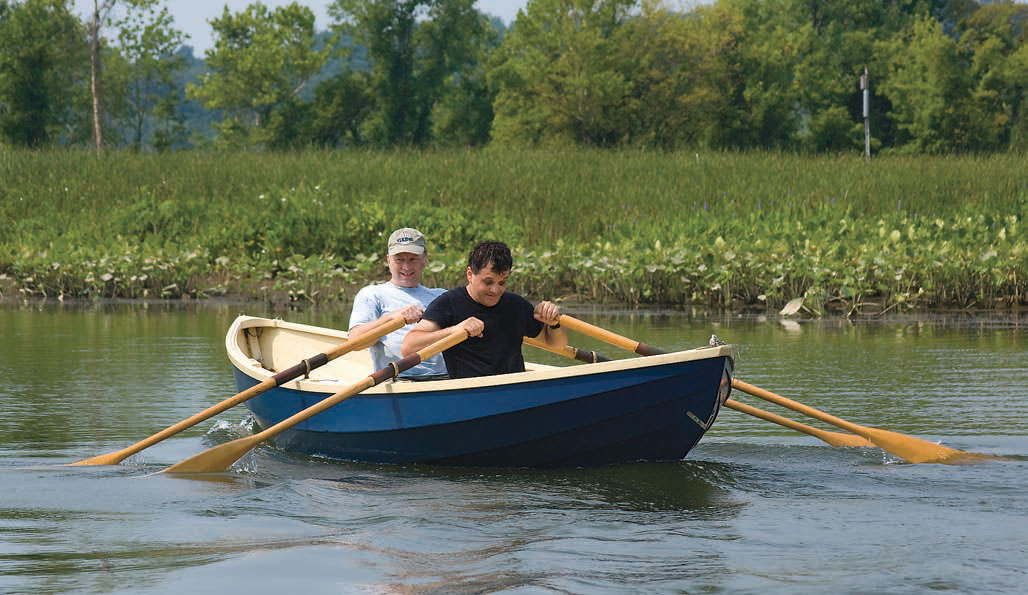 Jack Crawford
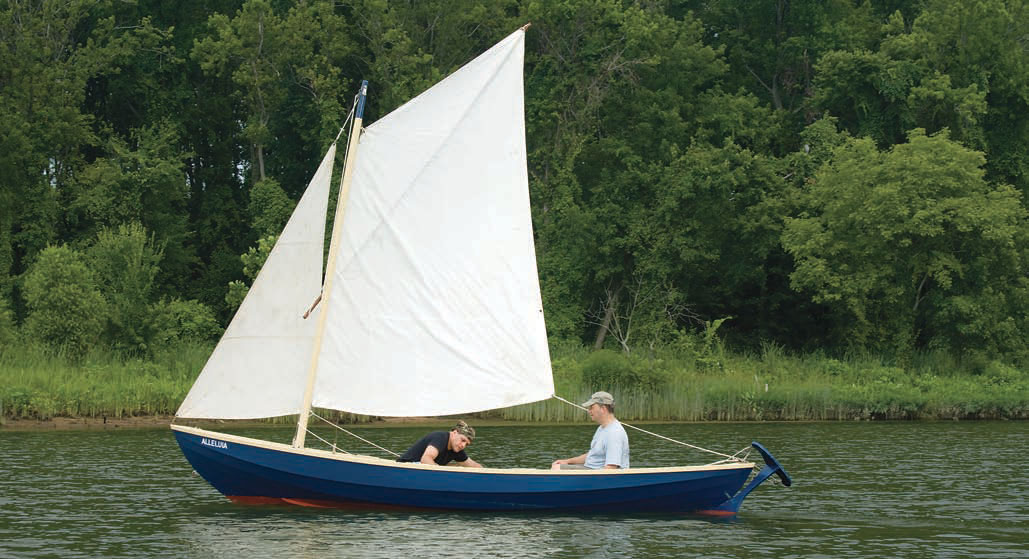 Jack Crawford
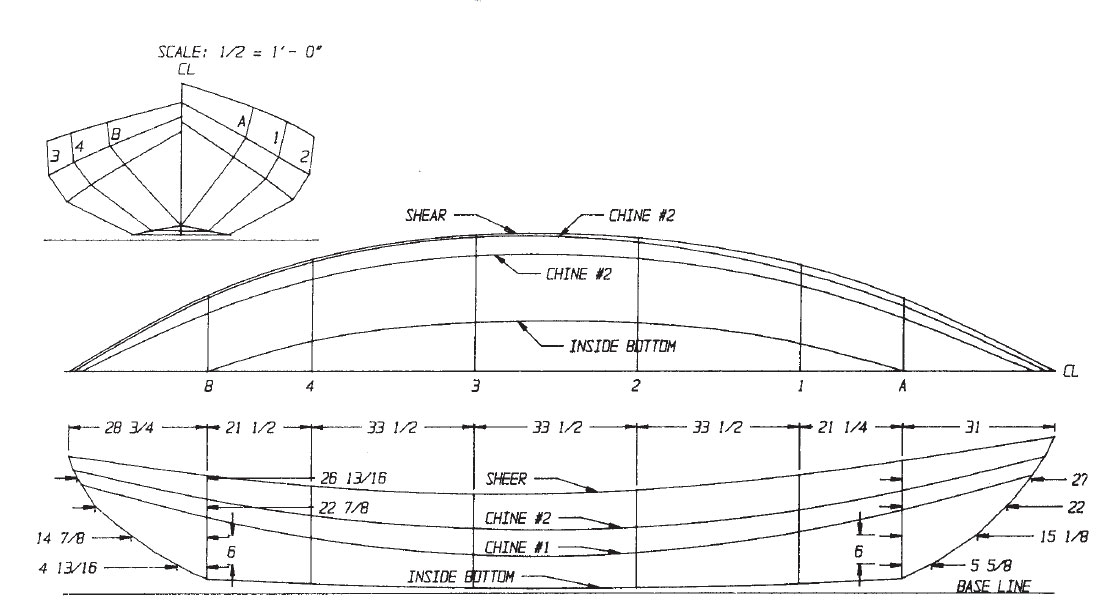 Walter Wales