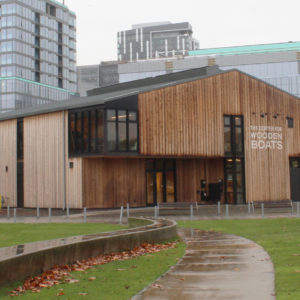
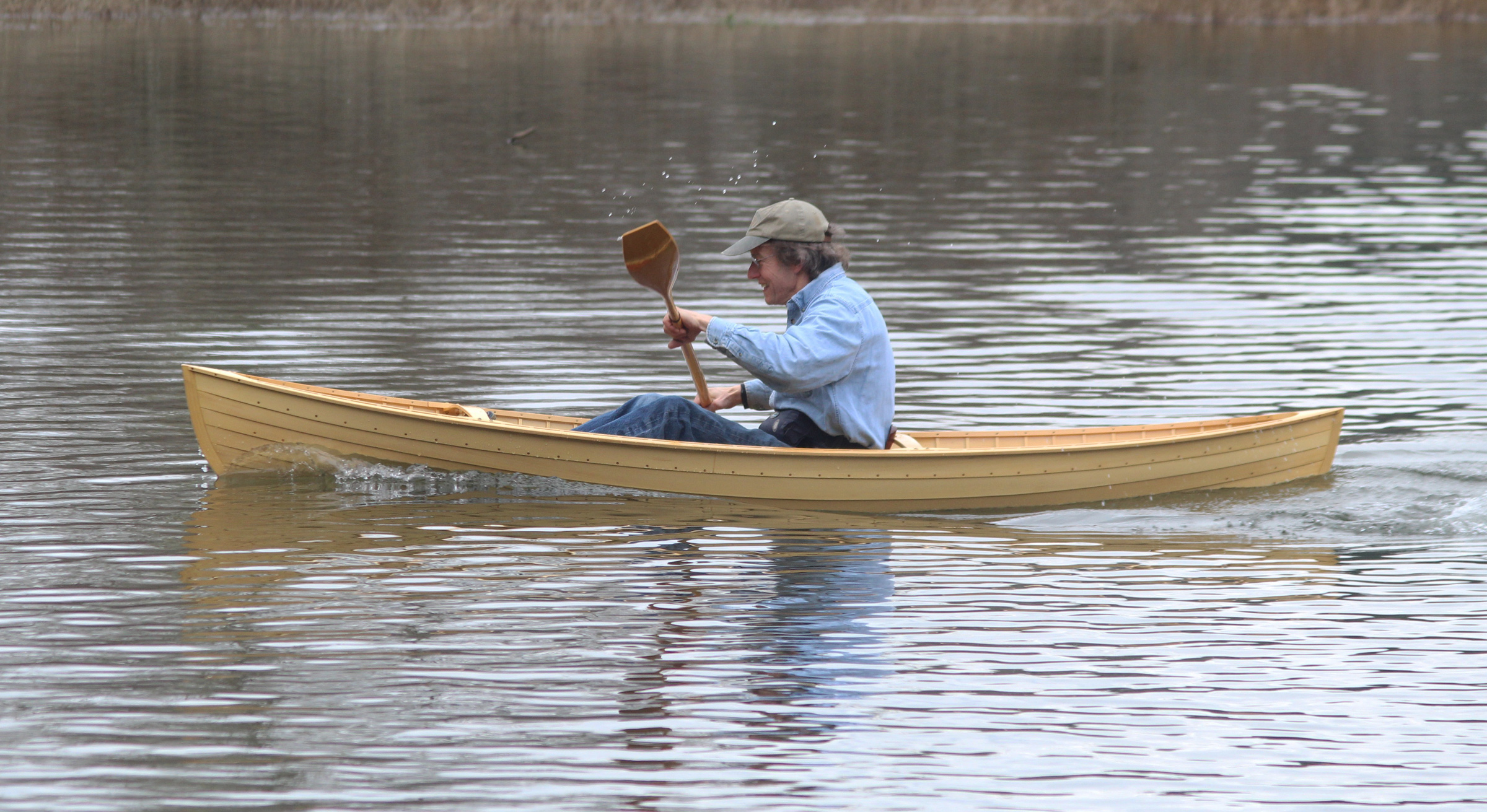
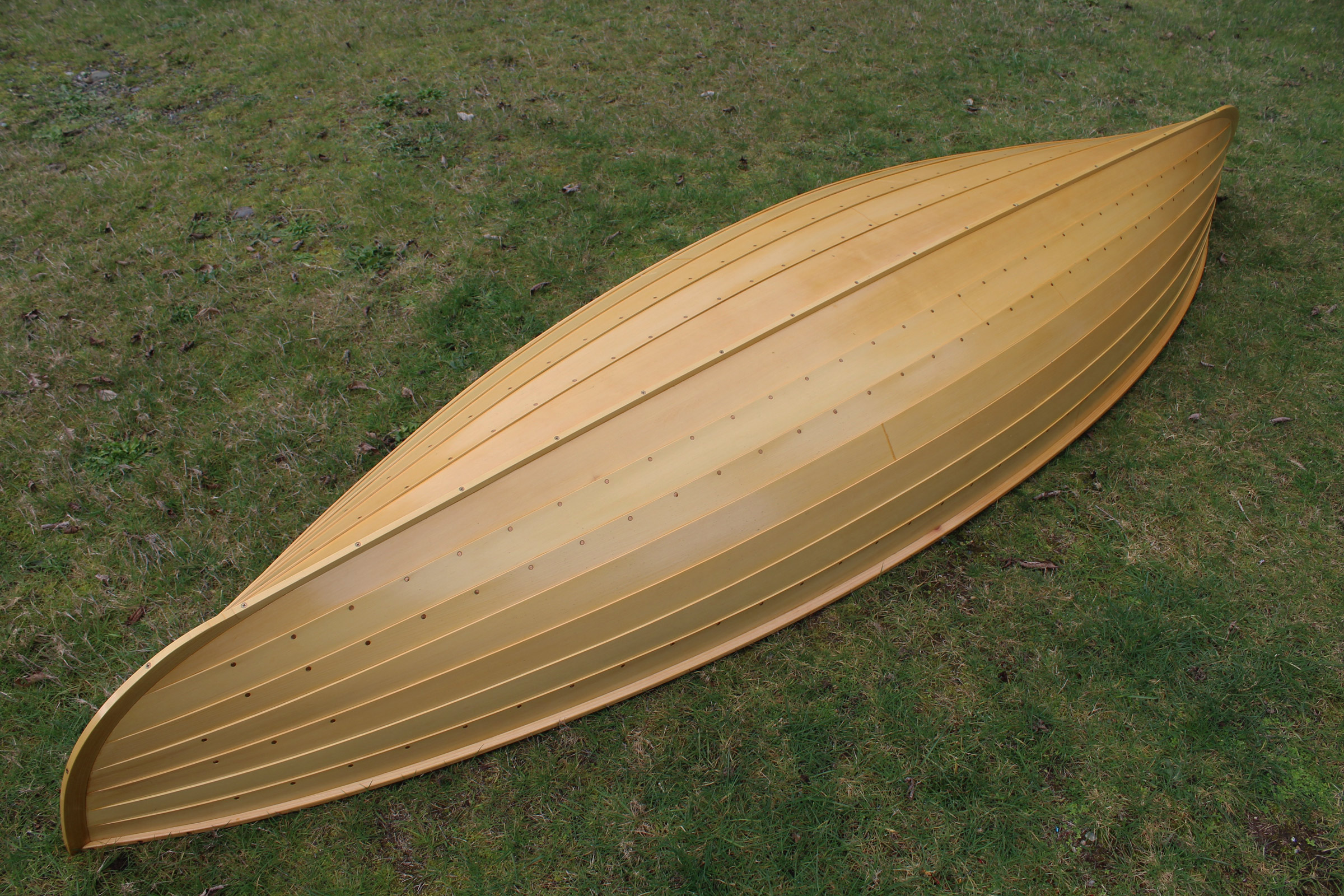
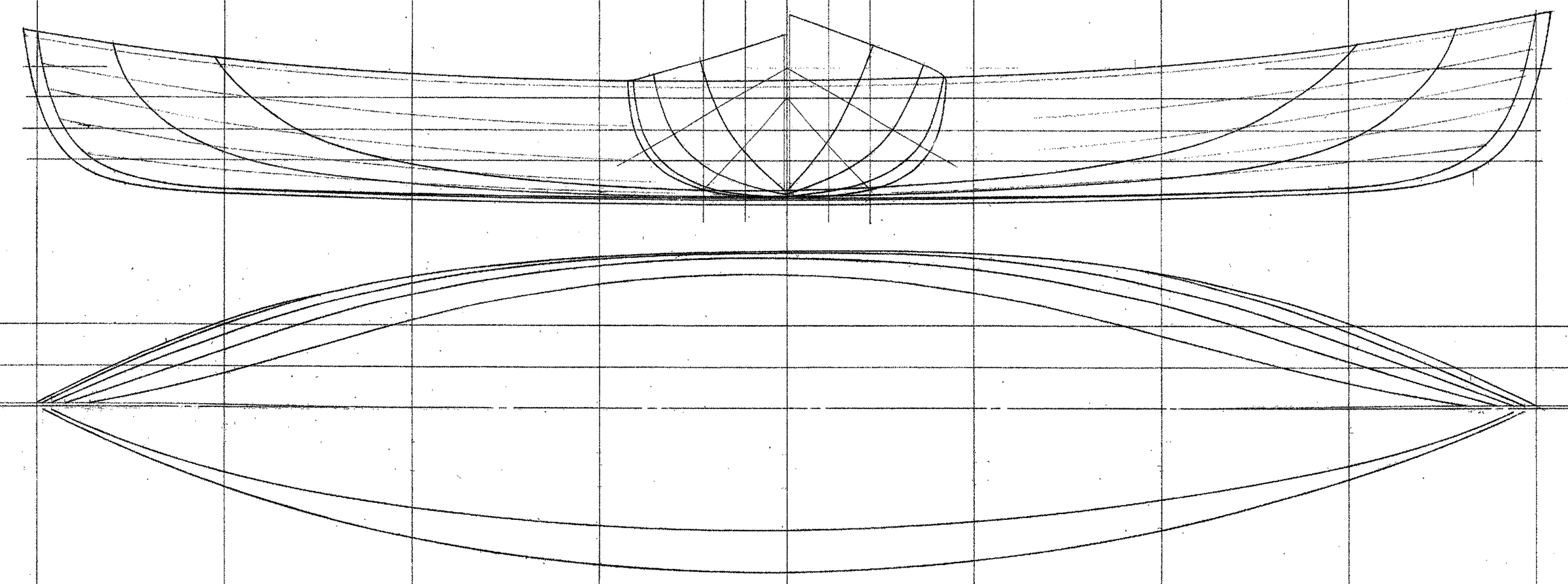
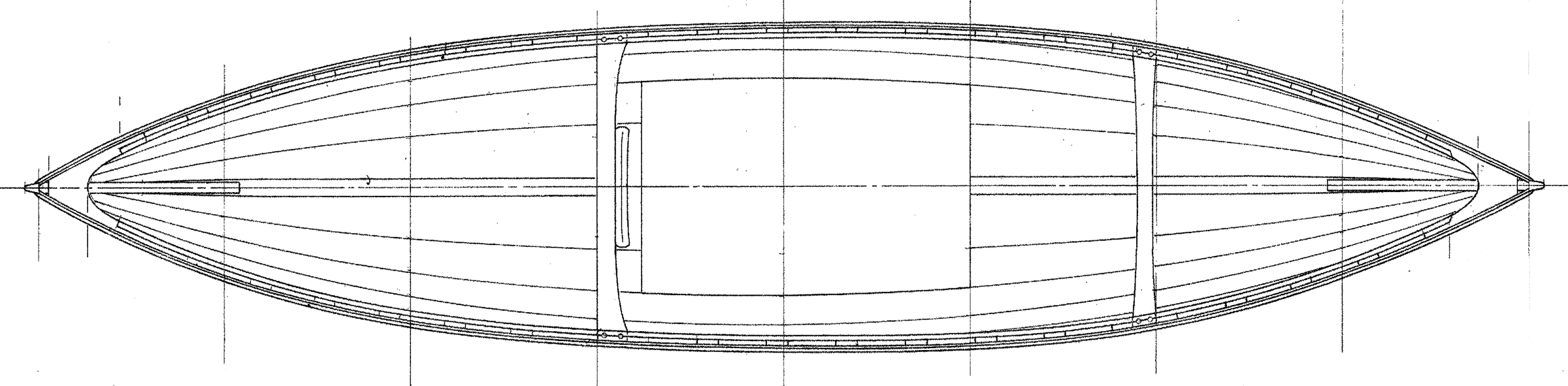
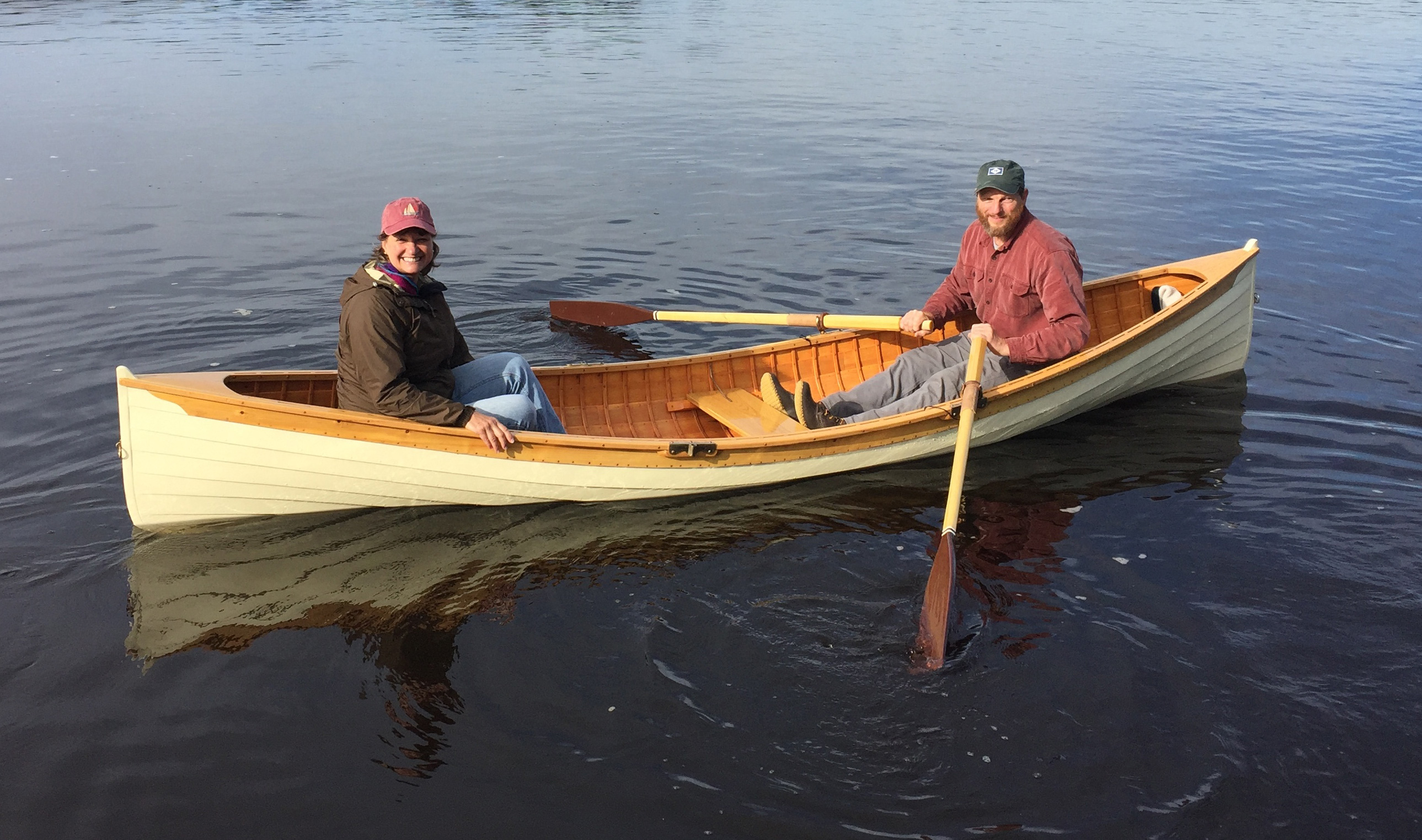
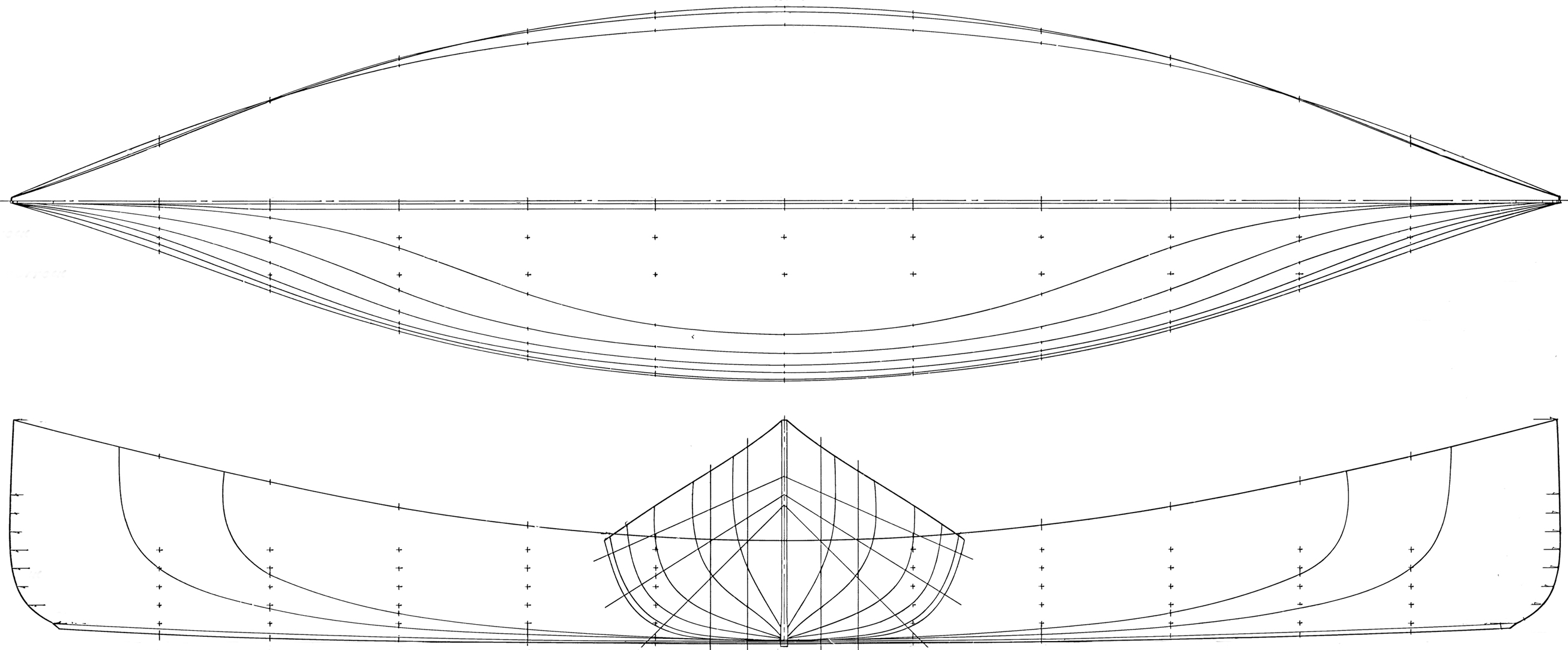
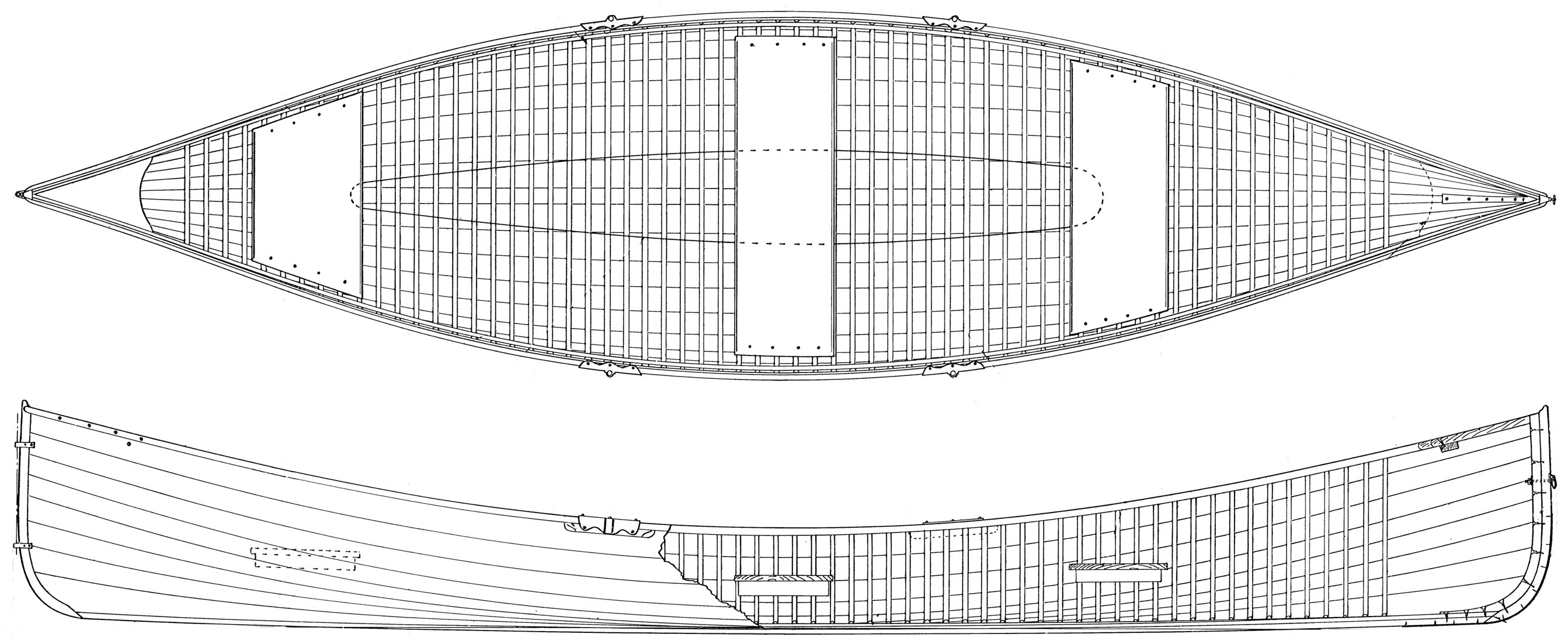
In 1968, Dick and Colleen Wagner began renting Whitebear skiffs and other small wooden boats from the watery “back yard” of their floating home on Seattle’s Lake Union. They had been collecting boats for years, and while running a livery would help pay the bills, their motivation was to foster in others an appreciation for wooden boats. In 1976, with the help of like-minded friends, the Wagners established The Center for Wooden Boats (CWB) on the south end of Lake Union. It has been housed in two floating buildings: one with offices upstairs and a gift and book shop and meeting room on the main level, the other housing the shop where the fleet of boats for oar, sail, and paddle is maintained.
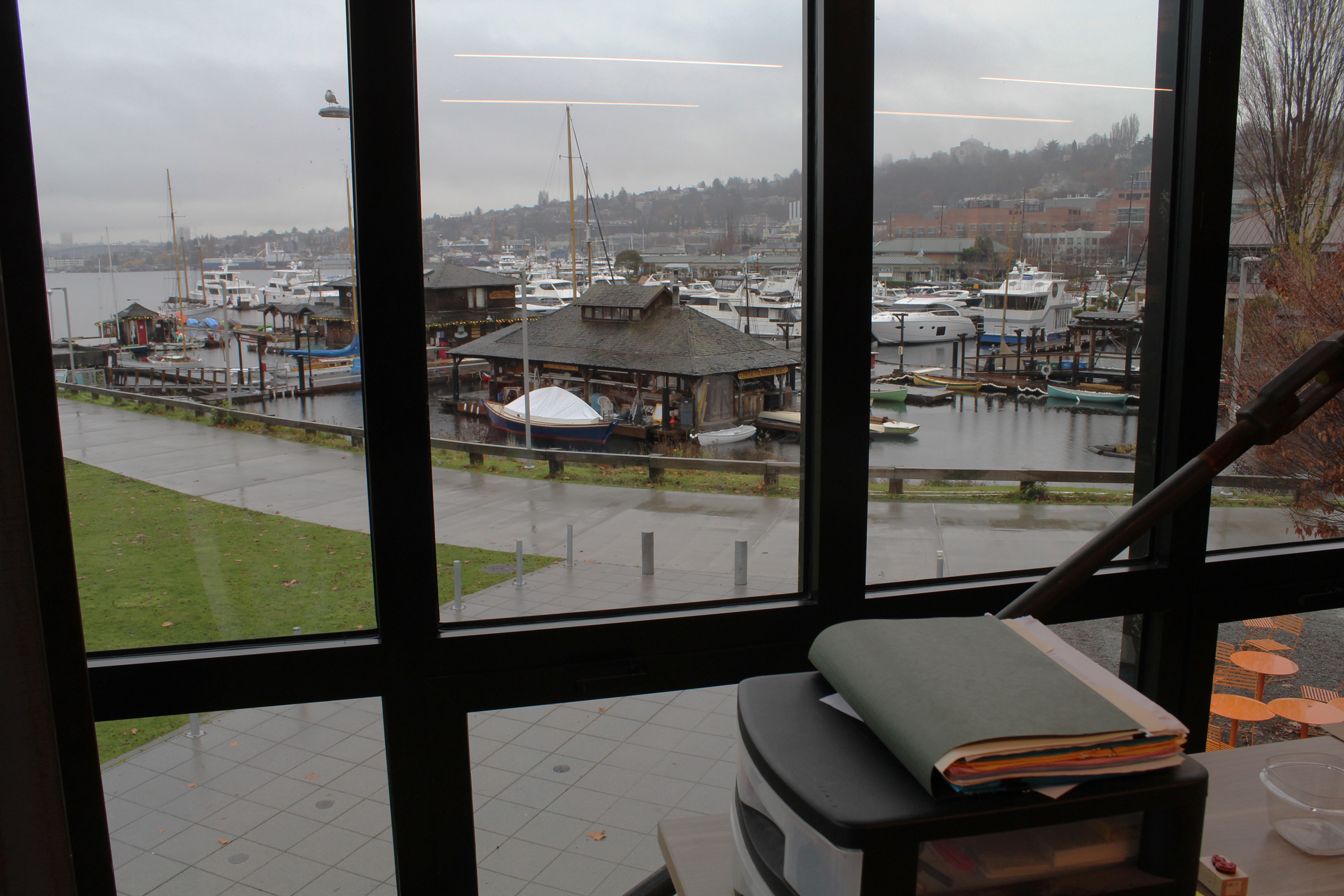
Windows on the south side of the WEC building provide a view of the old boatshop, nearest, and CWB. At the far left, Lake Union extends to the north.
In 2012, CWB opened a second facility, an old warehouse on the north end of the lake, that would serve as a workshop and place to store its collection of old and historically significant boats. While it’s a useful extension of the facilities, the workshop is 2-1/2 miles from the Center and has no access to the water.
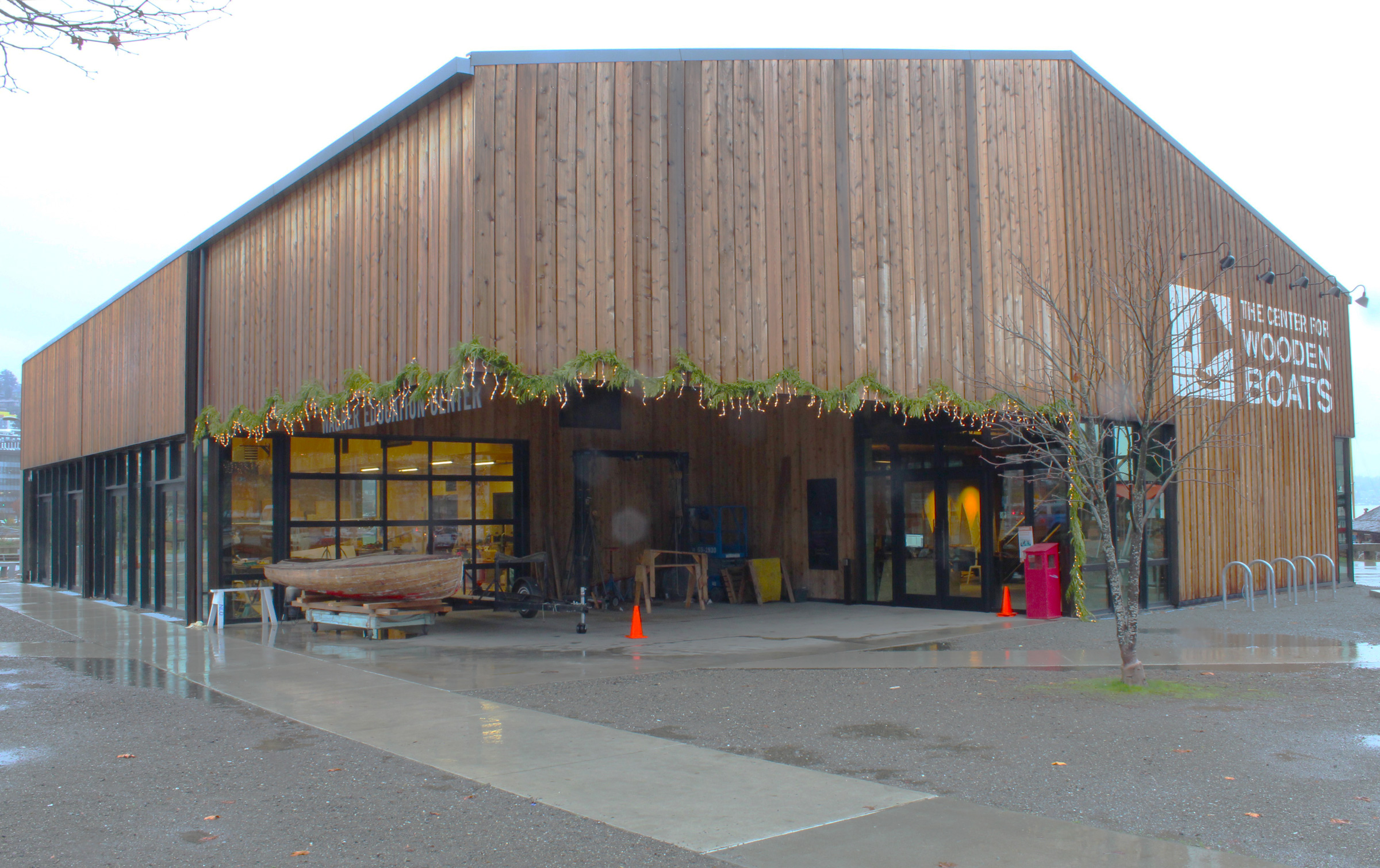
A corner of the main floor is open for projects that can be done outside during fair weather.
In January 2016, on a parcel of land on the lake shore right next to CWB, Dick and Colleen broke ground for the Wagner Education Center (WEC). The new building hasn’t yet had its formal opening, but the staff has moved into the new office space and the boatshop is up and running.
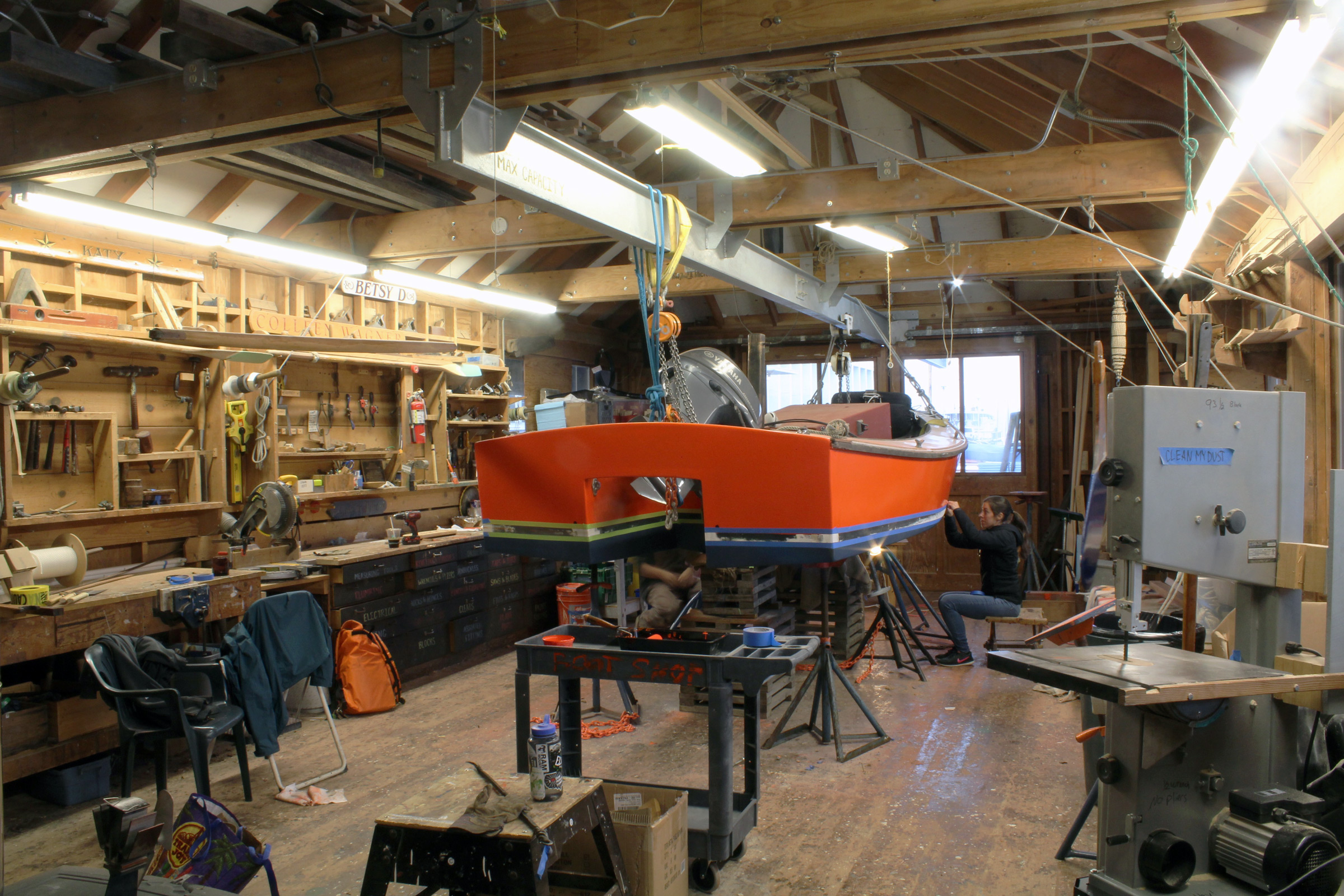
The new boatshop is up and running with new construction, refinishing, and repair all going on at the same time.
Josh Anderson, the lead boatwright (and an SBM contributor), gave me a tour. The building has over 9,000 sq ft on its two floors, tripling the space CWB has to work with. The walls are a bit of fir-plywood heaven. Over 700 sheets of it were prefinished by volunteers, edges gently rounded and faces given a clear finish. The floor upstairs is cork; on the main level it is concrete, except for the boatshop. There, two layers of 1-1/2″ plywood have been recessed and are flush with the concrete floor. The plywood is kinder to tools accidentally dropped and provides an easily renewed surface when the top layer is worn out. The combined 3″ thickness of plywood is a good base for boatbuilding forms that need to be screwed down. The boatshop occupies the south side of the building and floor-to-ceiling windows wrap around its three sides, providing not only plenty of natural light, but also a view in from the sidewalks outside. When the summer daylight gets too bright and too hot, exterior panels on vertical tracks can be lowered by winches inside to cover the windows.
Funding obtained for the WEC included a generous budget for new tools. The shop was even given a gift of old hand tools collected by a CWB member.
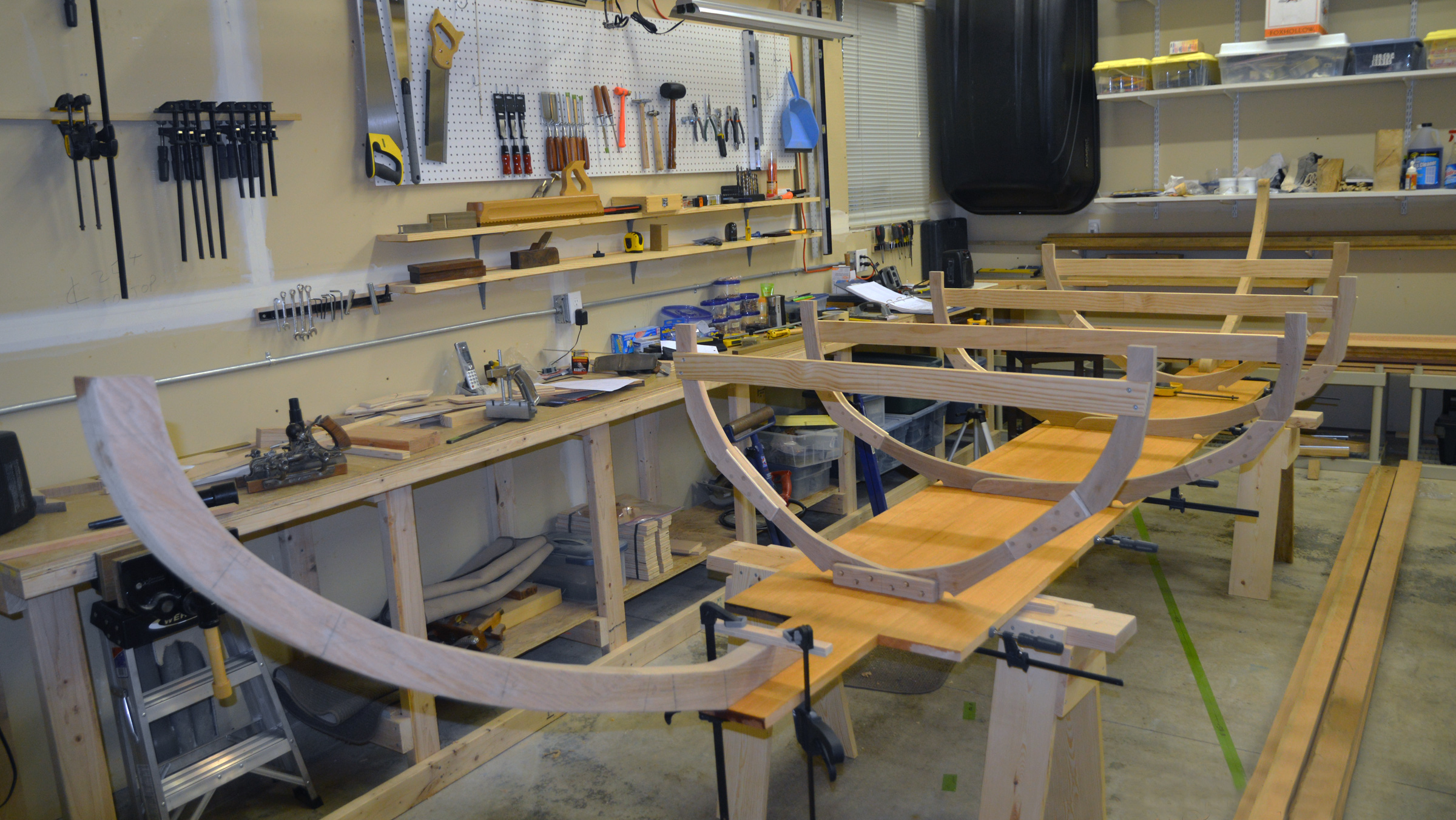
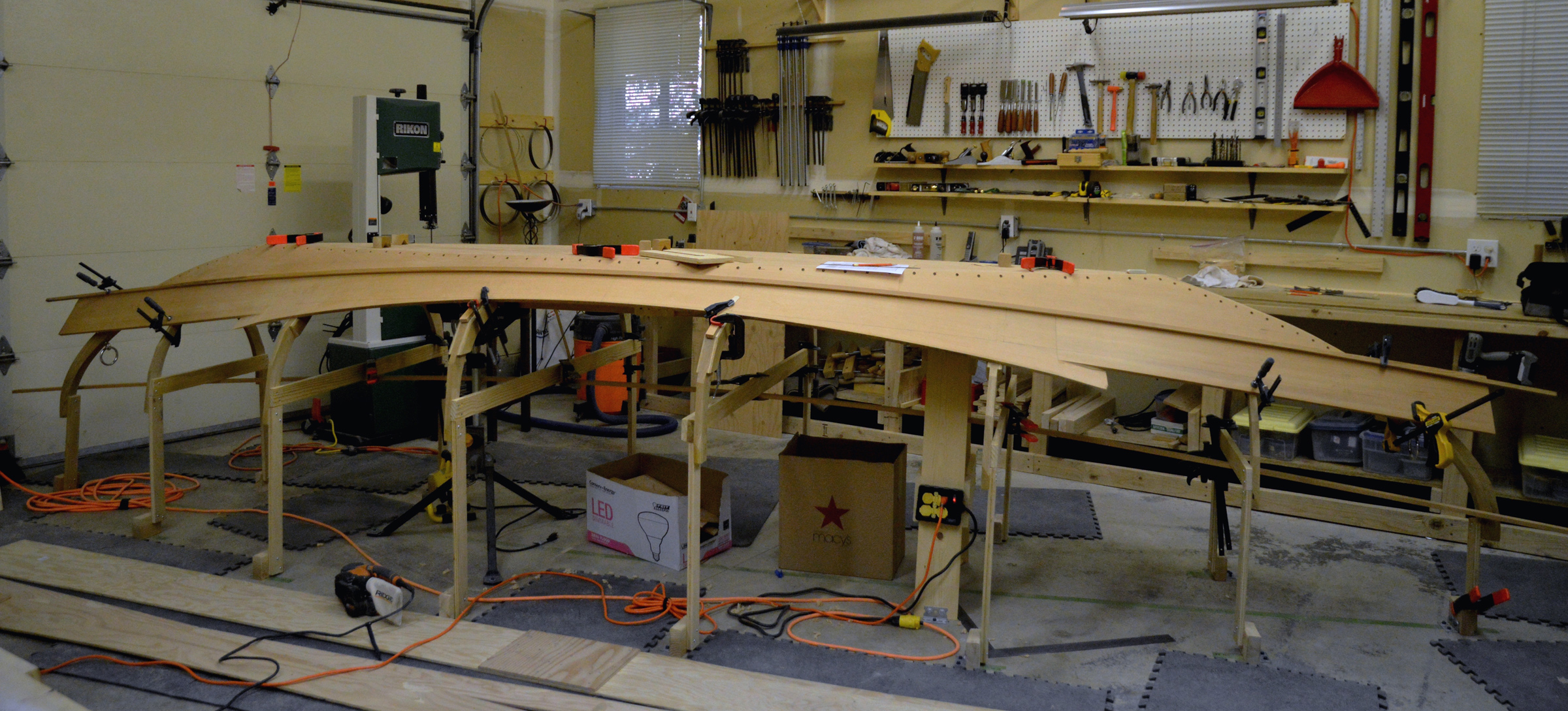
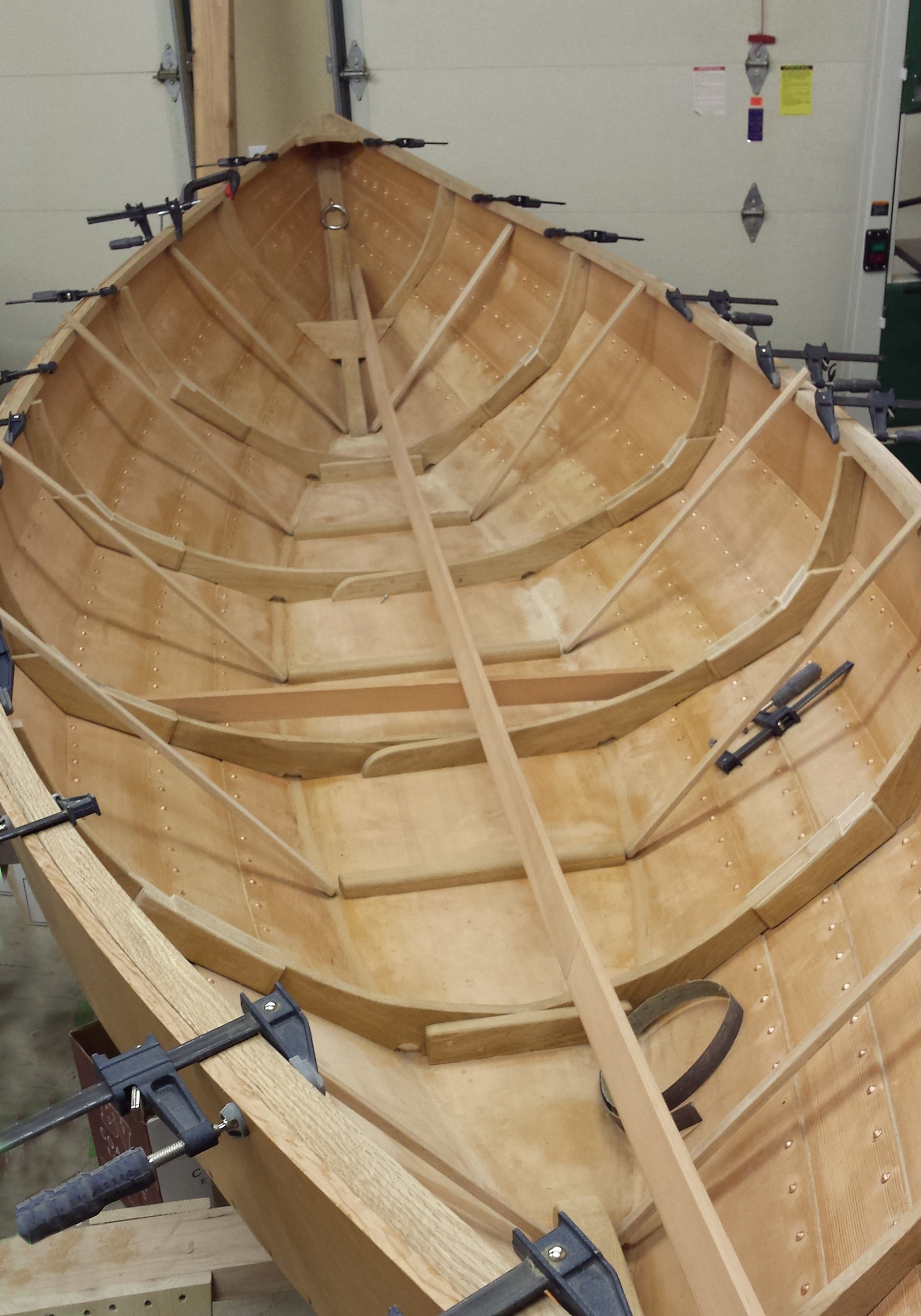
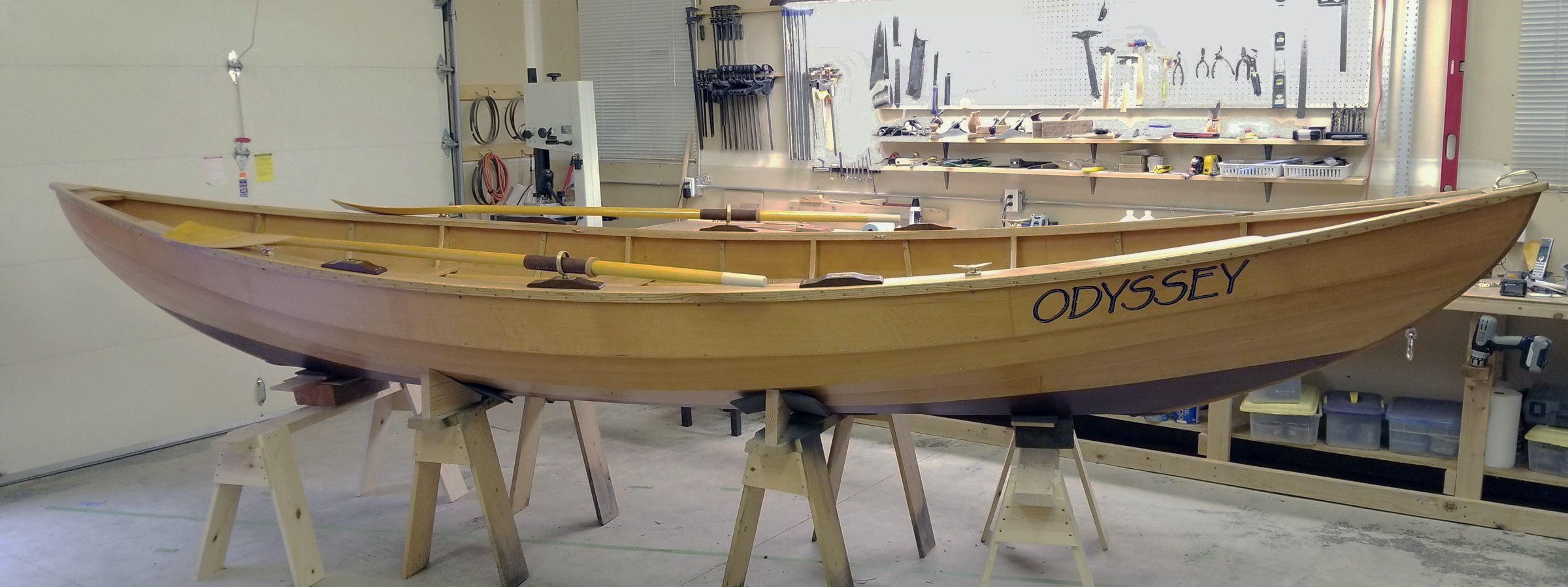
When I visited, there were three boats in the shop: a Blanchard Knockabout in for repairs, a 15’ Catboat Class being built to plans drawn in 1920, and a peapod awaiting refinishing. There was still room left over for at least two more small boats. On the north side of the shop there are small rooms for tools, supplies, and Josh’s office. He built his desk from leftover bits of 2″-thick, tight-grained western red cedar.
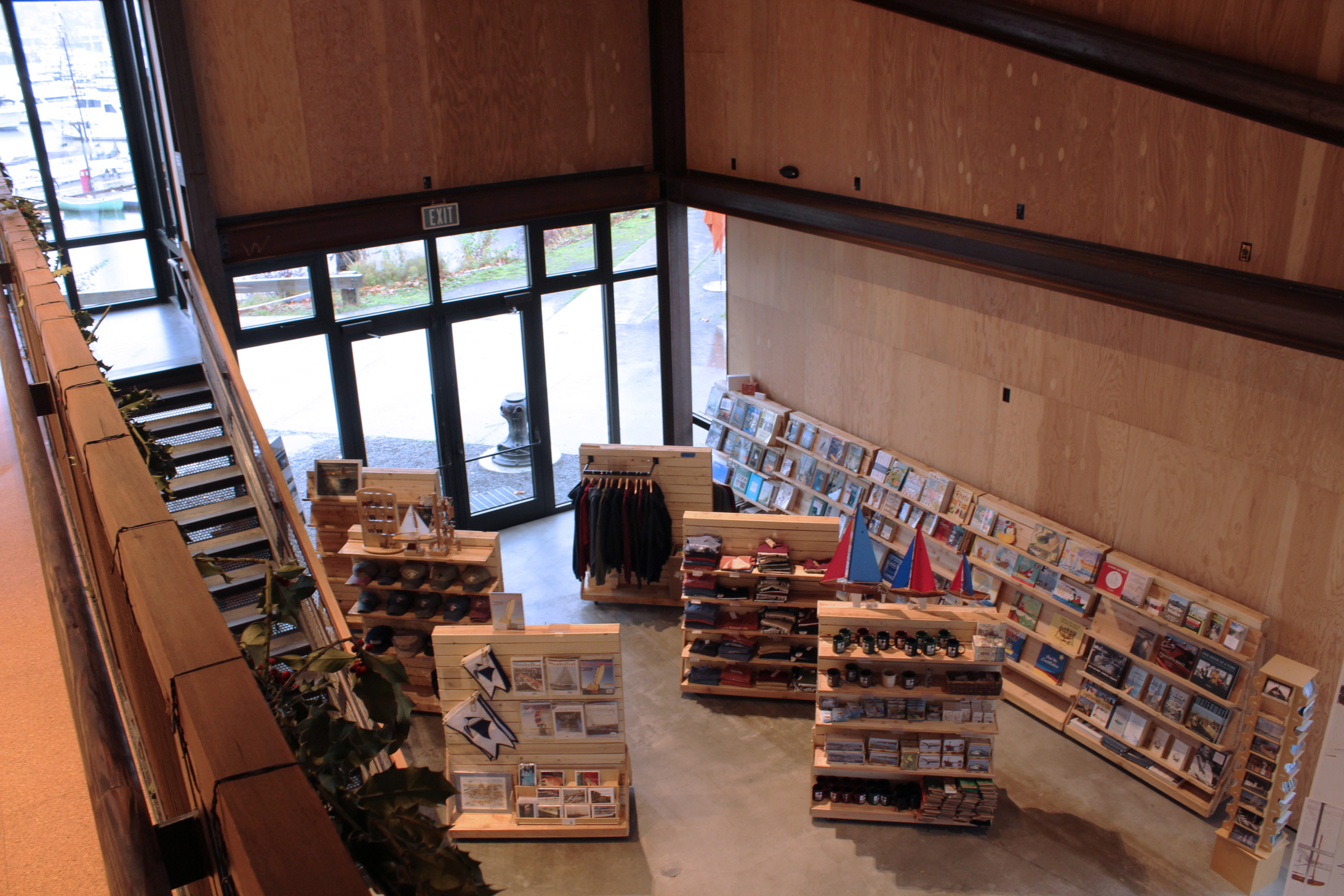
At the main entrance, there is a shop carrying a wide selection of books and magazines, including Small Boats 2019 in the the upper right-hand corner of the rack bearing the CWB burgees. The stairway at left is made with treads cut from the keel timbers of WAWONA.
The flight of stairs rising from the gift shop and bookstore at the main entrance has treads made from wood taken from the keel timbers of WAWONA, a three-masted schooner launched in 1897. At 166′, she was the largest of her type ever built. She served the first half of her life carrying lumber between ports in Puget Sound and California, the second half fishing the Aleutian Islands. In her retirement she rested alongside the Center for Wooden Boats until she was dismantled in 2009. Josh spent months plugging the old bolt holes, ebonizing the wood, and fitting the treads to stairway’s steel framework. The handrails were milled from lumber salvaged from a World-War-II minesweeper that came to rest at the Lake Union Dry Dock, a half-mile from CWB.
To provide a point of reference, here’s the old boatshop. A lot of boats have been built and repaired here, but there’s only room for one at a time.
When the WEC has its formal opening early in 2019, it will already be well into the mission embarked upon by Dick and Colleen a half century ago: preserving maritime history and passing on traditional boatbuilding and boat-handling skills.
Long before the fine sand and exquisite light of St. Ives were discovered by artists and tourists, the small town on the north coast of Cornwall was a thriving fishing center. At its peak, 300 fishing boats were moored cheek by jowl inside its picturesque harbor and millions of fish were landed, salted, and then exported all over Europe. Each of these boats had a tender and, as the tide went out, each tender had to settle on the sand until it was refloated by the incoming tide, twice a day, every day. Most days, the boats were given a good beating by the notorious ground sea that runs into the harbor, and on bad days they often got swamped and filled with sand. It’s a particular kind of punishment that requires a certain type of boat, as retired physician Scott Bowring discovered.
“When I started sailing in St. Ives 12 years ago, I wanted a boat to keep in the harbor, so I had a 10′6″ Lily-class dinghy built for me by Ashley Butler in Dartmouth,” Scott says. “ZEPHYR is a lovely boat, and I’ve had loads of fun on her, but she was too lightly built for the conditions in St. Ives, and at the end of every season, a couple of ribs would be broken. I realized I needed something stronger for the conditions here.”
Photographs by the author
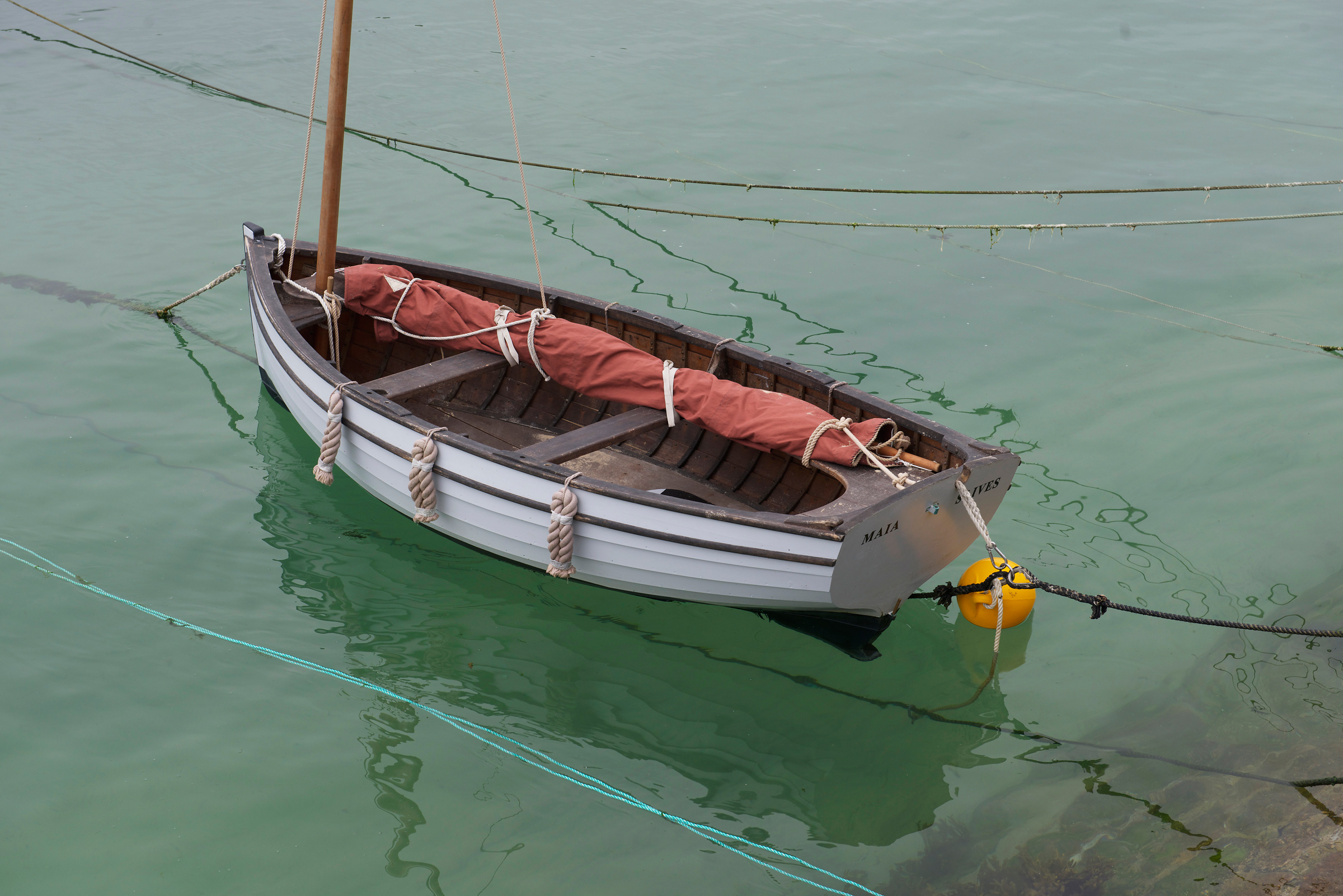
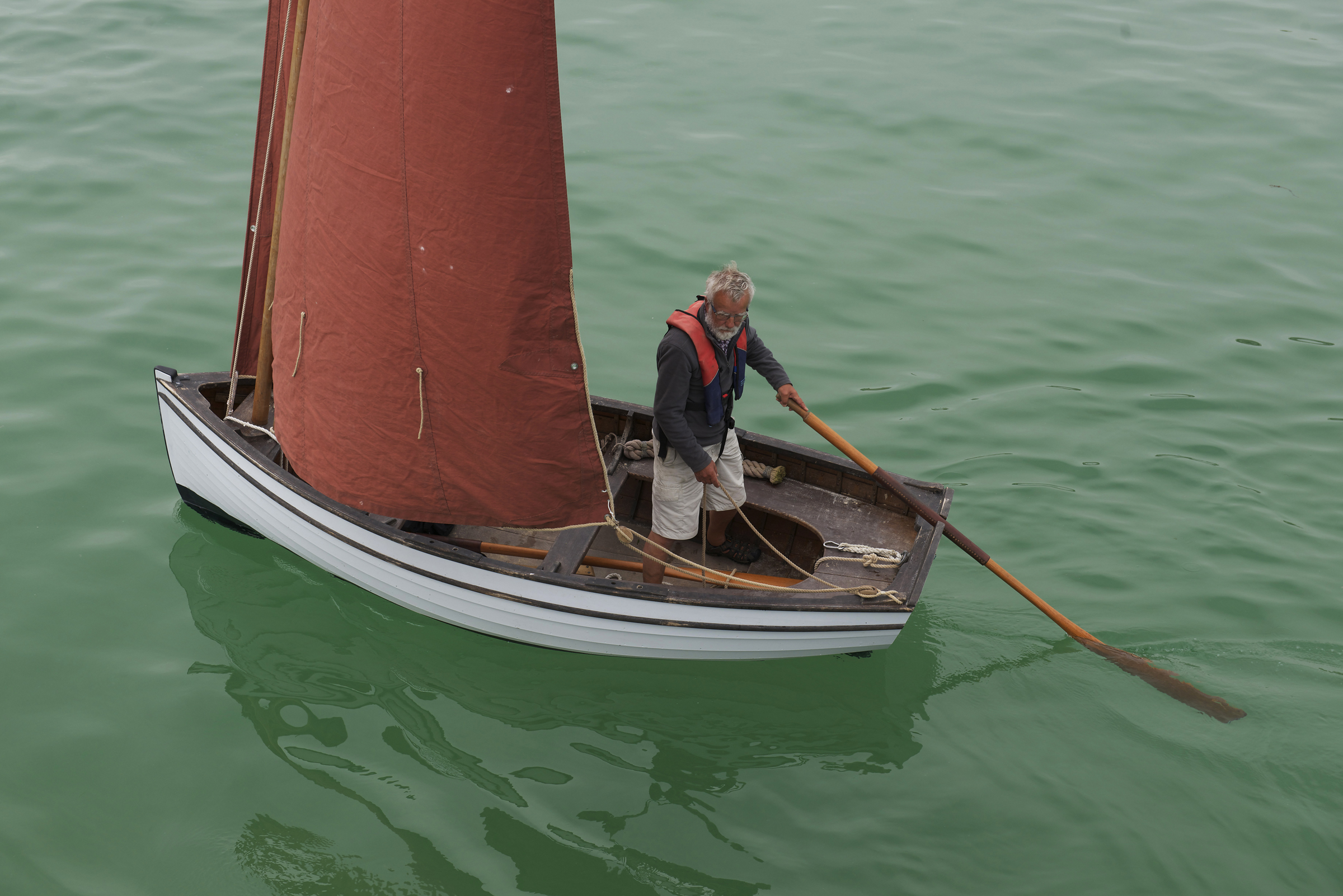
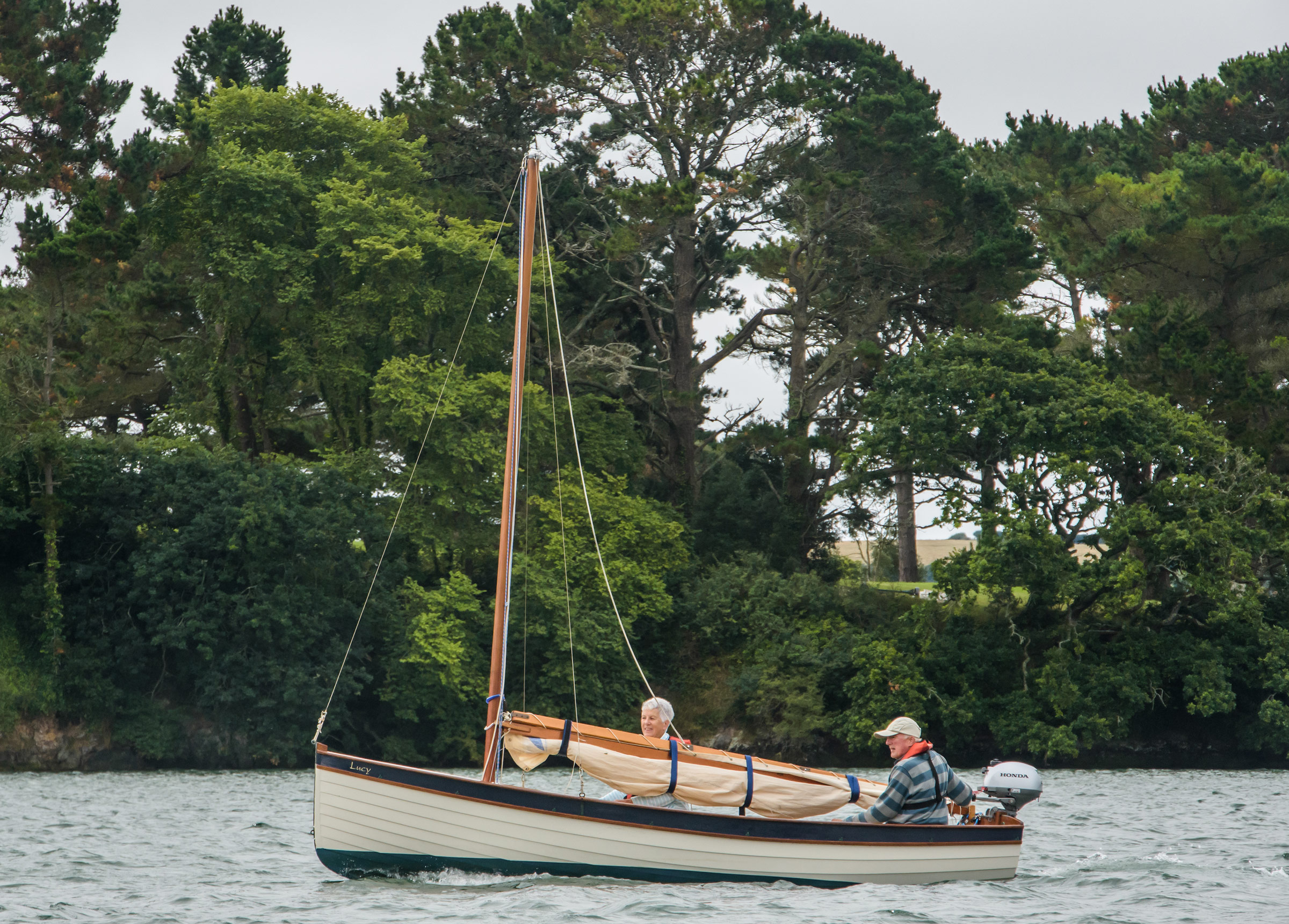
The mainsail, rolled around its yard, fits neatly to one side and below the level of the gunwales, leaving the center free for a rower and a passenger or two.
Scott is a member of the St. Ives Jumbo Association which keeps two 20’ Jumbos, replicas of Victorian fishing luggers, built by Jonny Nance, in the harbor. The starting point for that project was a 13′ rowing punt based on a set of lines Jonny’s father took from a traditional fisherman’s tender in 1975. Unlike the streamlined punts from more sheltered ports such as Falmouth on the south coast of Cornwall, the St. Ives punt was short and stout, heavily built to survive the challenging conditions of St Ives harbor. But could it be made to sail?
To find out, Scott teamed up with fellow Jumbo sailor Pete Lee and asked Jonny to design a sailing version of his father’s punt. The boat they specified had to be smaller and lighter than the rowing punt with a standing lug rig which would stand a trashing. It needed to be stable, so you could stand on the gunwale without tipping over, and withstand the abuse of various feral grandchildren. They didn’t want a centerboard, as the boat would be sitting on the beach at St. Ives—plus they wanted fewer moving parts for kids to get their fingers jammed. And the boat had to be pretty.
“It was an interesting challenge, given that the traditional punt was primarily for landing fish and had to be capable of carrying the maximum weight in the minimum amount of water!” says Jonny. “I modified the rowing punt lines to make the boat as sailable as possible. I raised the deadrise a little, so it’s not so flat bottomed; the sailing punt’s keel projects about 3″ below the garboard, whereas the rowing punt only has 2″. The sailing punt also has a much more elegant run aft and finer entry. Little things, to make a sailboat shape without diverting too much from the punt type that she is.”
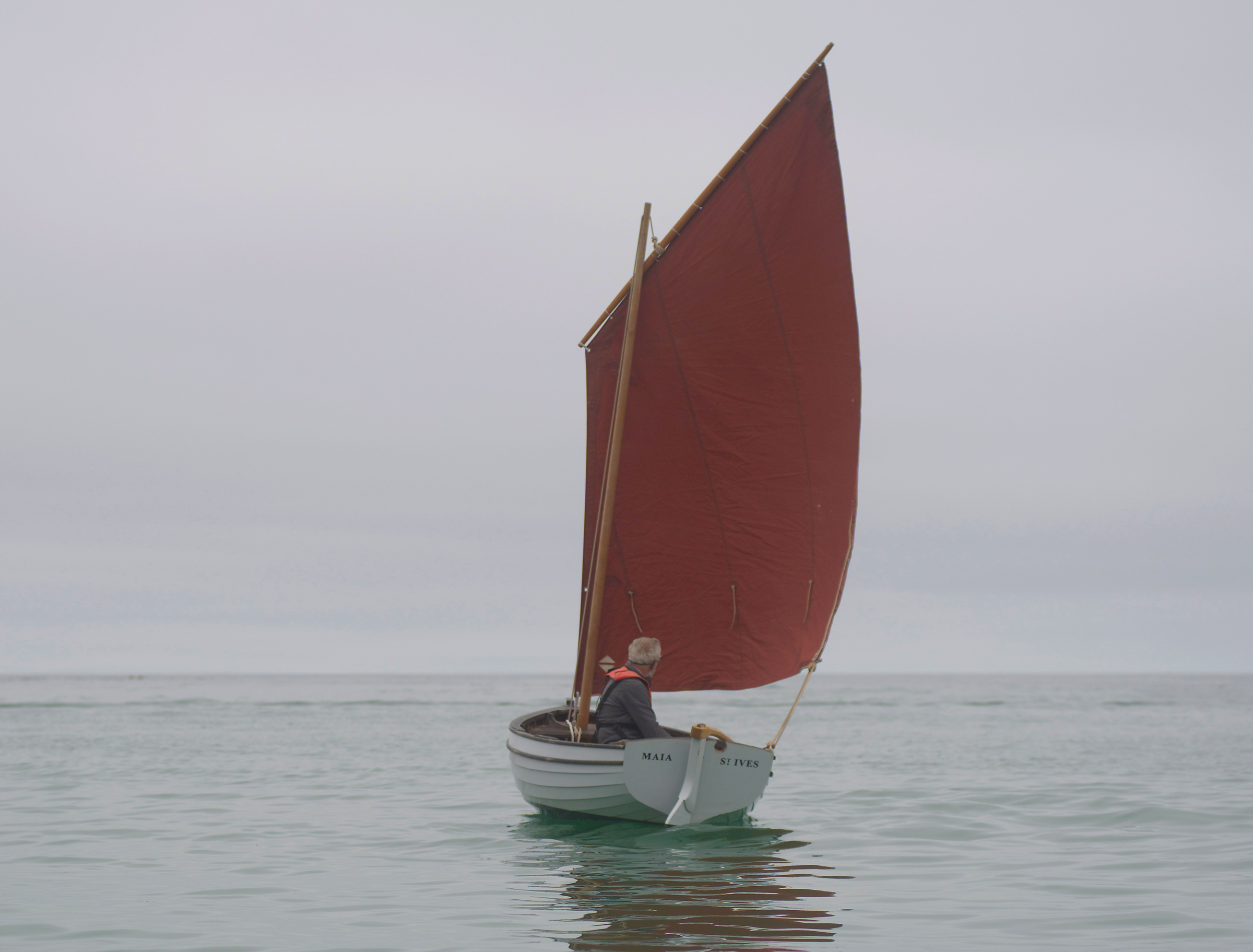
Jonny built the first St. Ives sailing punt for Pete in 2014, followed by a second boat (with a slightly taller mast) for Scott in 2015. Good-quality larch wasn’t available for the planking, so Jonny built both boats of Douglas-fir on oak ribs, fastened with copper rivets. The inside was fitted with oak thwarts and grown oak knees, all sealed with a mix of Stockholm tar, linseed oil, and turpentine, which quickly turns black with age. Scott named his punt MAIA, in part after Saint Ia of Cornwall who, according to legend, sailed to St. Ives from Ireland on a leaf, and in part after one of the Pleiades, Maia, from Greek mythology.
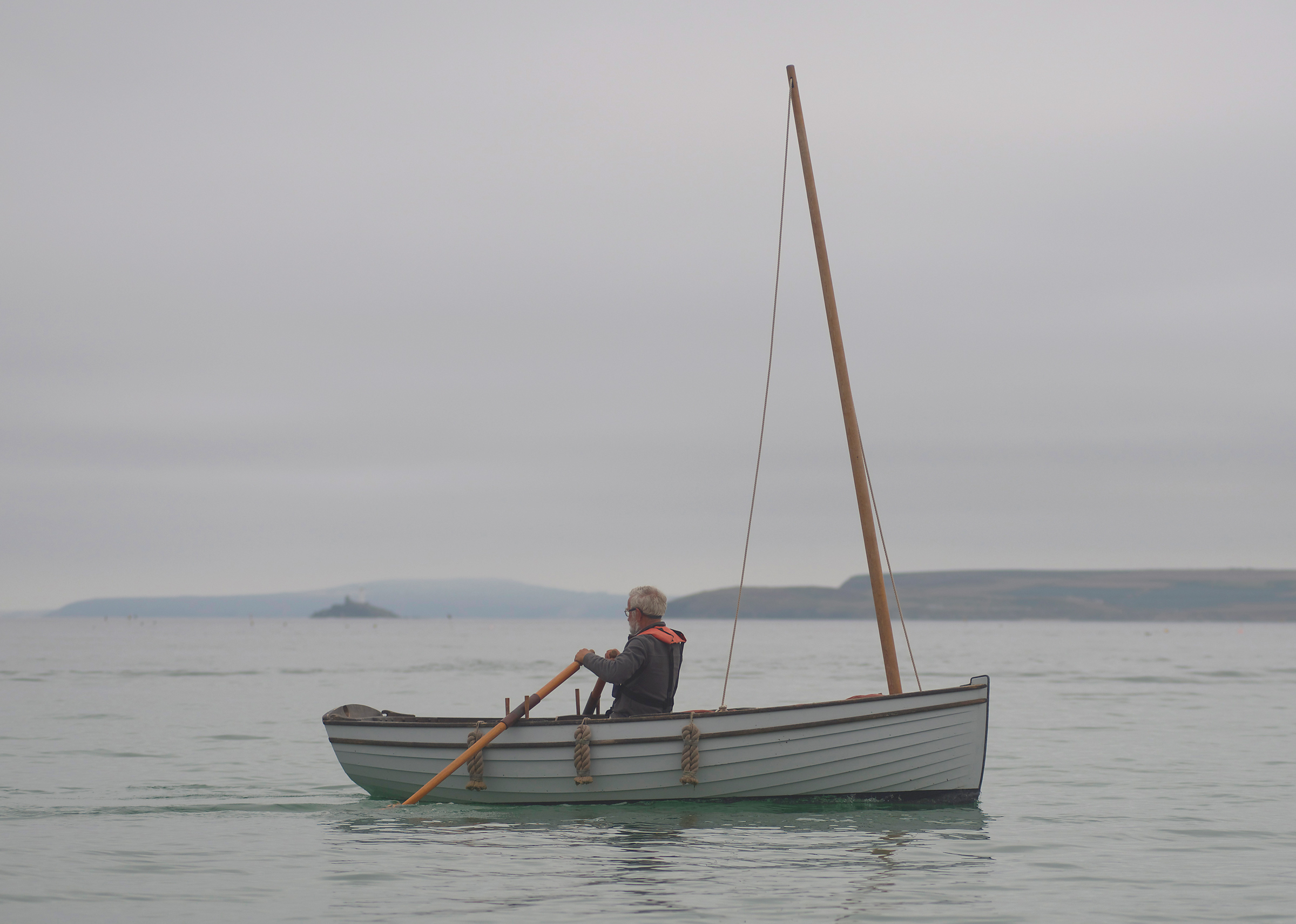
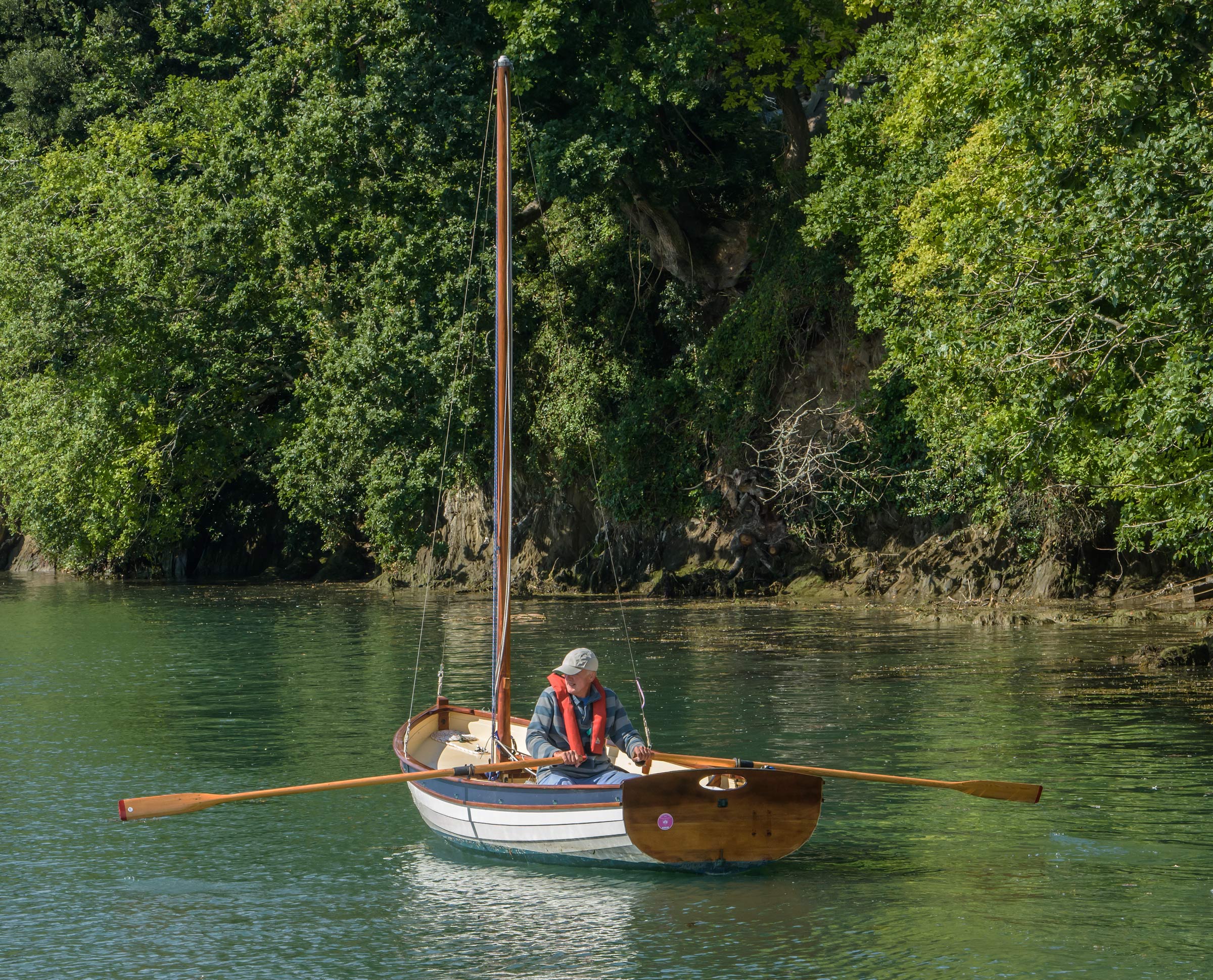
The St. Ives here has two rowing stations rigged with removable tholepins. The oars, as is customary for double tholes, are without collars, requiring a bit more skill from the rower than oars with collars used in oarlocks.
It was glassy calm and cloudy when I arrived in St. Ives to sail MAIA, so we made the most of the weather by first testing the boat in rowing mode. The St. Ives punt has two rowing stations, both fitted with tholepins rather than rowlocks. I’m not a usually great fan of this arrangement, which I suspect is usually used for aesthetic rather than practical reasons, but I have to admit I hardly noticed the difference on this occasion.
With her beamy, burdensome hull, the punt is not best suited to long-distance rowing, though it carries its way well enough and you would happily row home if you had to. In practice, though, I suspect the oars are mostly used to get her in and out of harbor. The Jumbo crews are keen scullers, and the transom has been fitted with a sculling notch, set off-center so it can be used with the rudder and tiller in place.
The rudder isn’t in place at the moment, but if it were, it wouldn’t interfere with sculling because the notch in the transom is set to port. The notch is circular with an opening at the top wide enough to accept the throat of the oar, but too narrow to let the leathers slip through. The arrangement keeps the oar from slipping free, handy when sculling or when using the oar as a stand-in for the rudder, as seen here.
“Sculling was the principal means of propelling a punt in crowded fishing harbors, as it was seldom possible to row,” says Jonny. “So sculling isn’t just a quirky revivalist fad. It remains a very useful skill and is frequently the most appropriate option.”
While we were trying out the oars, Scott’s other boat, ZEPHYR, turned up, and I jumped aboard to take some photos of Scott rowing and sailing his punt. The simple standing-lug rig, with its stayless mast, is extremely easy to raise and lower—one reason it was so popular with fishermen—and within a couple of minutes the boat was under way.
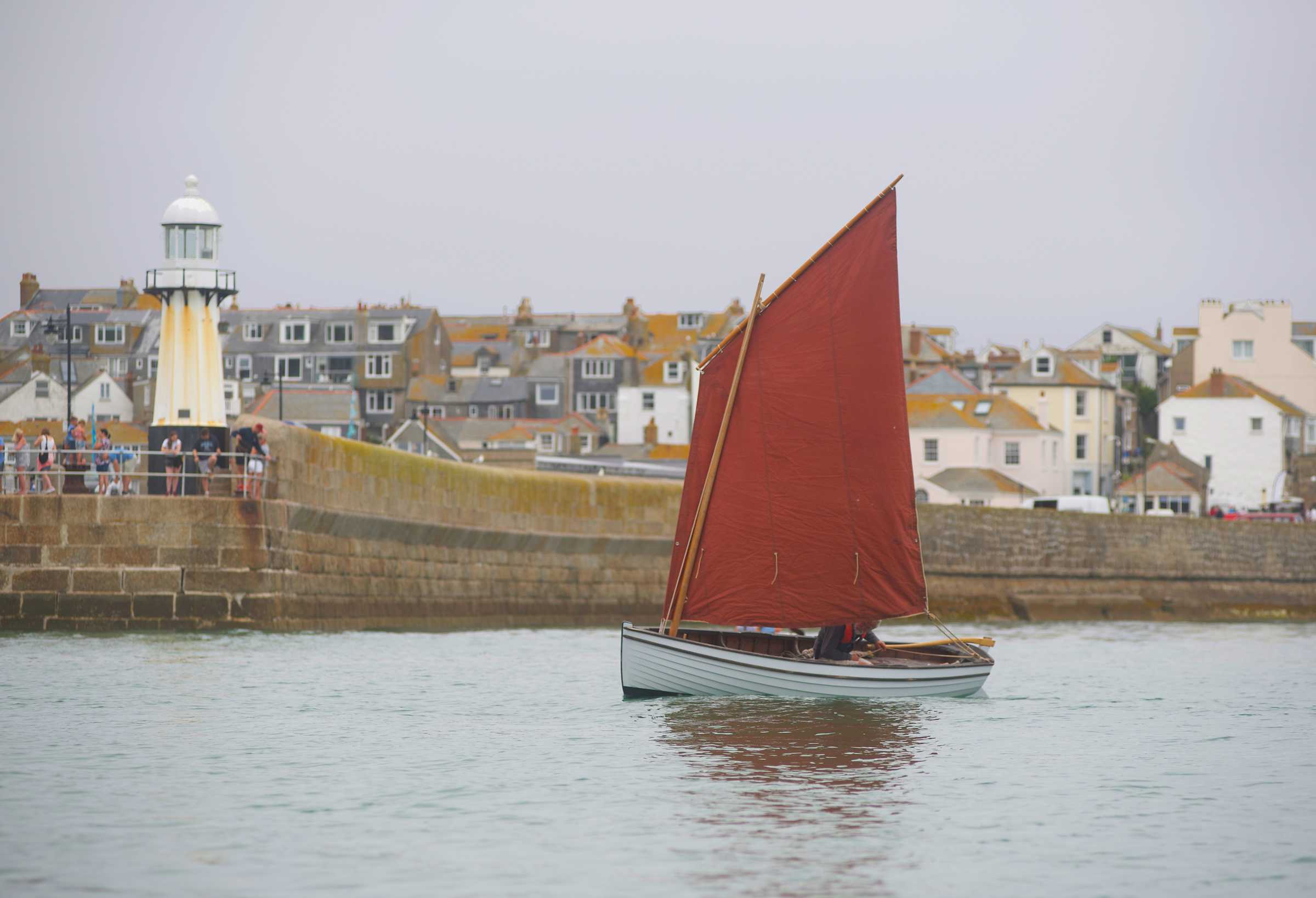
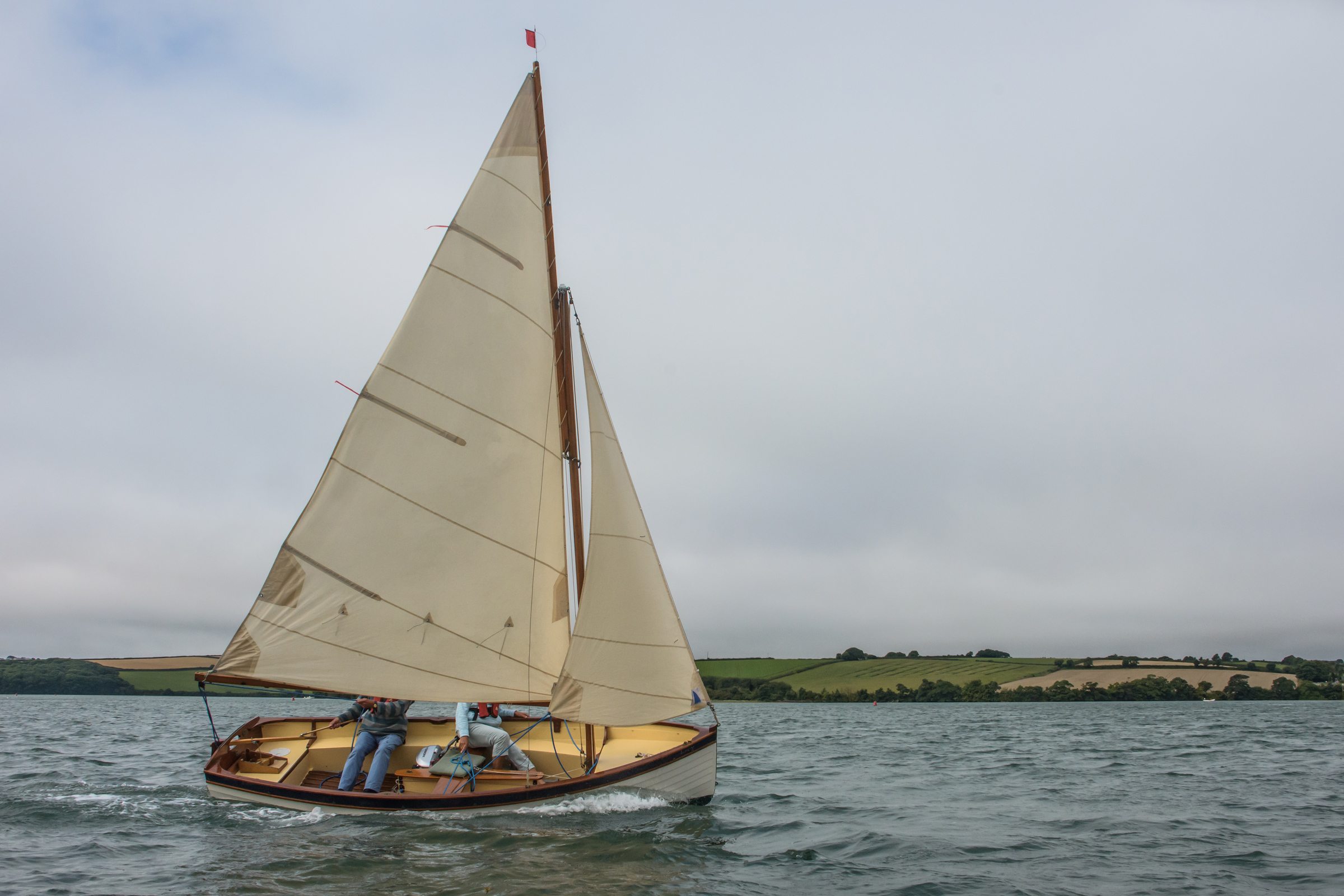
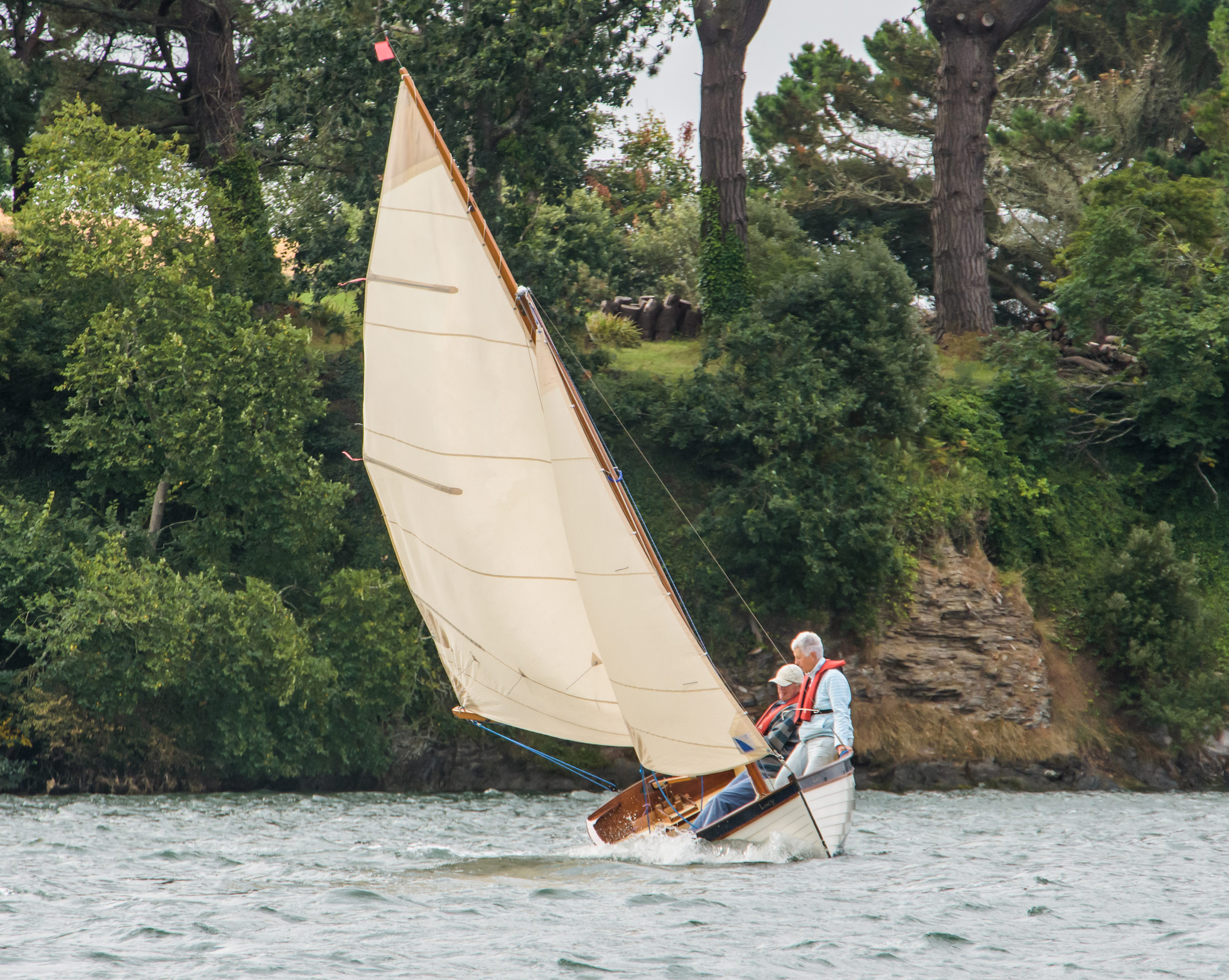
I feared the St. Ives punt might be a bit sluggish under sail, but it soon proved me wrong. Even before the surface of the water had been ruffled by the breeze, it managed to catch a breath of wind and, as if by magic, sailed away purposefully over a glassy sea, before the natural order was restored and a few ripples appeared below the bow. Even then, as a feeble wind blew hesitantly across the bay, it seemed to keep its way and made steady headway almost regardless of the wind.
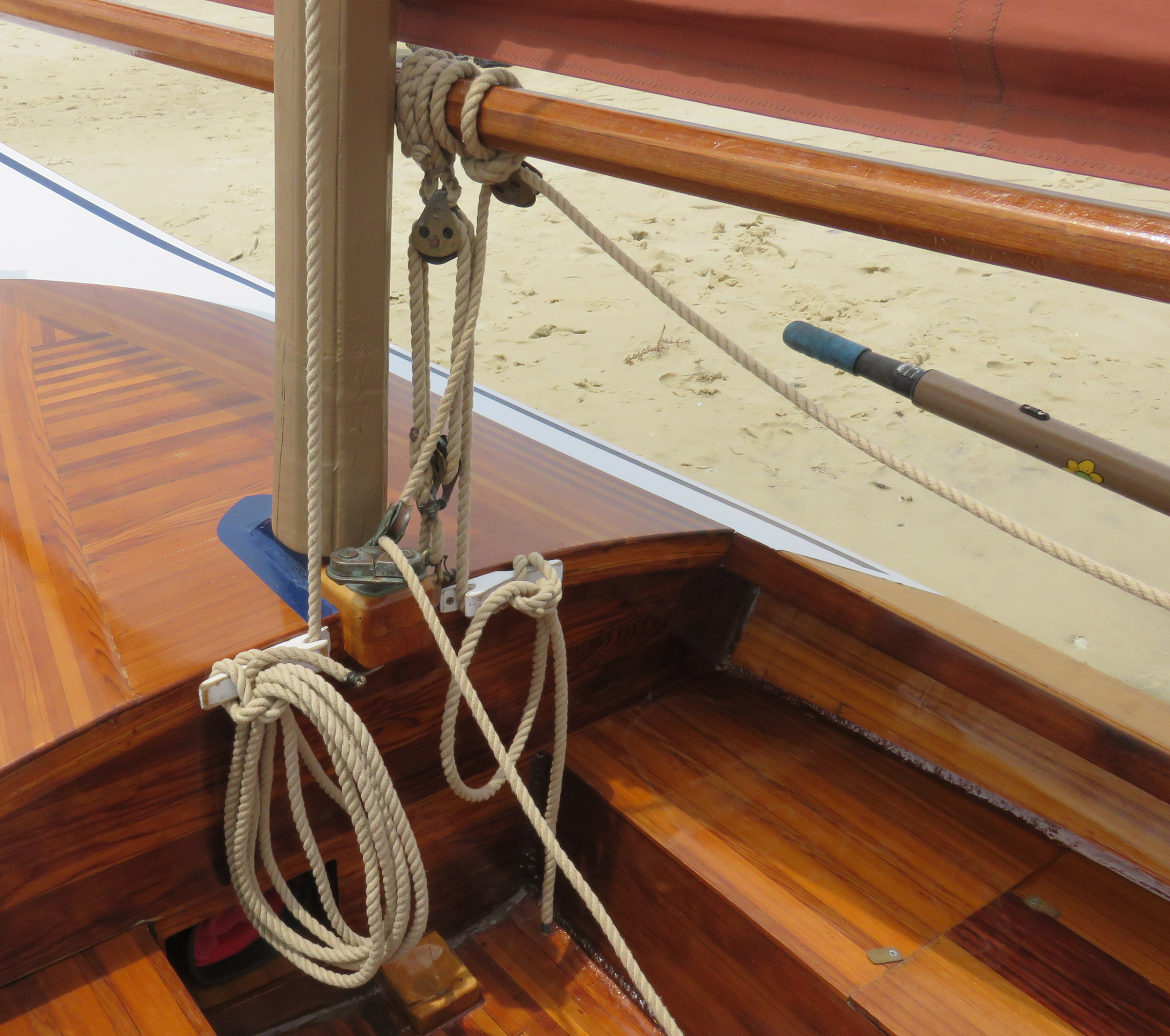
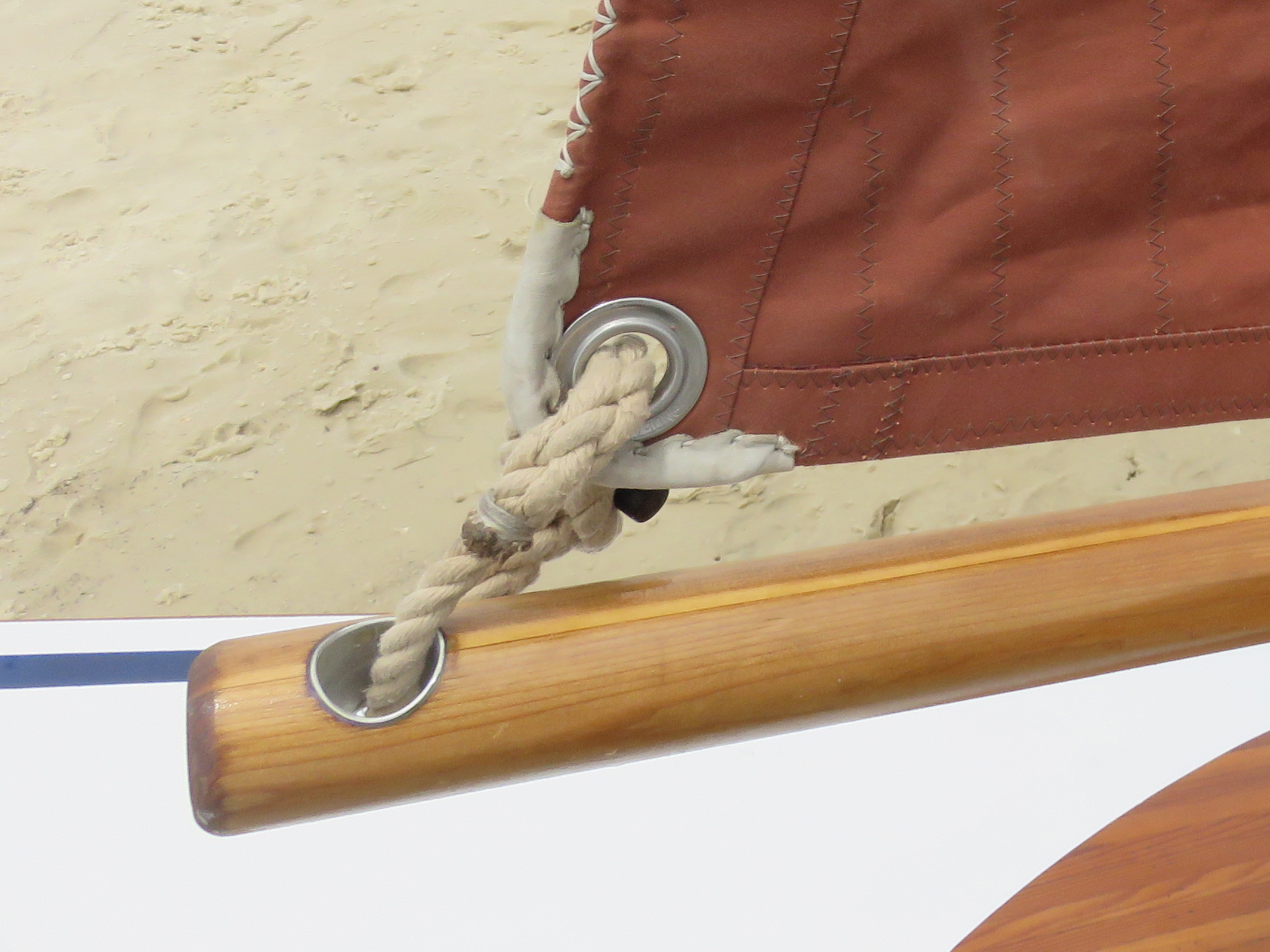
The loose-footed lugsail makes setting sail as simple as it can be. The mainsheet runs through a rope-stropped block with an eye that slips over thumb cleats, one on either quarter, close to the transom. A second block at the clew gives the skipper a 2:1 advantage.
The punt kept up its uncanny ways after I climbed on board to join Pete, and we headed out past Bamaluz Point toward the open sea. A strong current was setting us to the west, with just a puff of wind from the southwest, yet as we turned around and headed back to St. Ives, the punt slipped along as if pulled forward by an invisible line. Of course, by then we were on a broad reach, and I suspect it would have been a very different matter if we’d had to tack to windward, not the St. Ives punt’s strong point.
One unusual feature in an otherwise quite standard lug rig is the sheeting arrangement, which runs through a single block with a line which is looped over a thumb cleat on the leeward rail. When the boat comes about, the block is simply unhitched and hooked onto the opposite cleat. I wondered if a rope horse wouldn’t make life easier, but Scott told me he had tried that and the current arrangement worked better. It certainly seemed the optimum position for the sheet to be in, judging by how well the sail set, though I had my doubts about how handy it would be in really windy weather.
The calm conditions combined with a strong current made it hard to judge the boat’s true sailing performance during our short outing. But certainly the absence of a deep keel or centerboard will affect the punt’s windward performance, though her builder insists that, providing you sail the boat full and by (not sheeting her in too tight) it performs very well. Indeed, he suggests the sailing St. Ives punts make very good training boats for the bigger Jumbos, teaching sailors how to manage a heavy boat with only a shallow keel to resist leeway.
“There’s nothing to stop the boat going sideways,” says Jonny. “And if you sheet too hard when tacking, it will just go sideways. So, you’ve got to get way on first. As soon as you’ve got momentum, it heads up fine, and there’s no question of not being able to make it to weather.”
Lacking a centerboard, the punt doesn’t take well to being sheeted in too hard when working to windward.
The proof of a boat is in her sailing, and MAIA certainly showed the St. Ives punt is no slouch by winning the small boat class at the Looe Luggers Regatta, in open water and against several other bigger boats, just a couple of weeks after she was launched in 2015. The following year, she won the Prettiest Boat award in her class at the Falmouth Classics regatta, proving that even a hardy St. Ives lass can win the hearts of those South Coast yachties.
So confident is Scott in the St. Ives punt’s seagoing abilities that he and his wife are planning to take MAIA gunkholing around the U.K., starting with an Old Gaffers Association rally on the Isle of Wight and then heading up to Scotland to explore the lochs. And it’s this use as an expedition boat that might give the boat a greater purpose. Not everyone wants to keep a boat on a mooring in a tidal harbor that dries at low tide, but more and more people are discovering the pleasures of dinghy cruising and coastal sailing in small boats. Although the St. Ives sailing punt is small, it’s certainly sturdy and would cope with some dirty weather.
For now, MAIA is doing a very good job moored off the jetty at St. Ives, going up and down with every tide, weathering the relentless ground sea just as her forebears did, and without breaking a single rib so far. Watching her sailing in her native waters, surprisingly nimble despite her sturdy construction, I can’t help feeling that a bigger future awaits her beyond St. Ives, beyond the Isle of Wight, and beyond Scotland even. This traditional, local design, reborn for modern times, deserves to travel the world.
Nic Compton is a freelance writer and photographer based in Devon, England. He has written about boats and the sea for 24 years and has published 14 nautical books, including a biography of the designer Iain Oughtred. He currently sails a 14’ Nigel Irens skiff and a 26’ Chuck Paine sloop.
I live in an area where there are a lot of quiet sloughs, little lakes, and slow-moving rivers, but there are only a few launch ramps. With my trailered boats I have been going to the same four places for decades and feel cut off from all the opportunities the region has to offer. I can cartop my canoe, but it’s too heavy to carry and requires a cart, and my kayaks are all long enough to be awkward to carry and not well suited for narrow winding streams and half-acre ponds. Iain Oughtred’s Stickleback may be among the smallest of small boats, but I wouldn’t regard its diminutive size as a limitation. On the contrary, it would be just the right boat to overcome the limitations of all of my larger vessels.
Photographs and video by the author
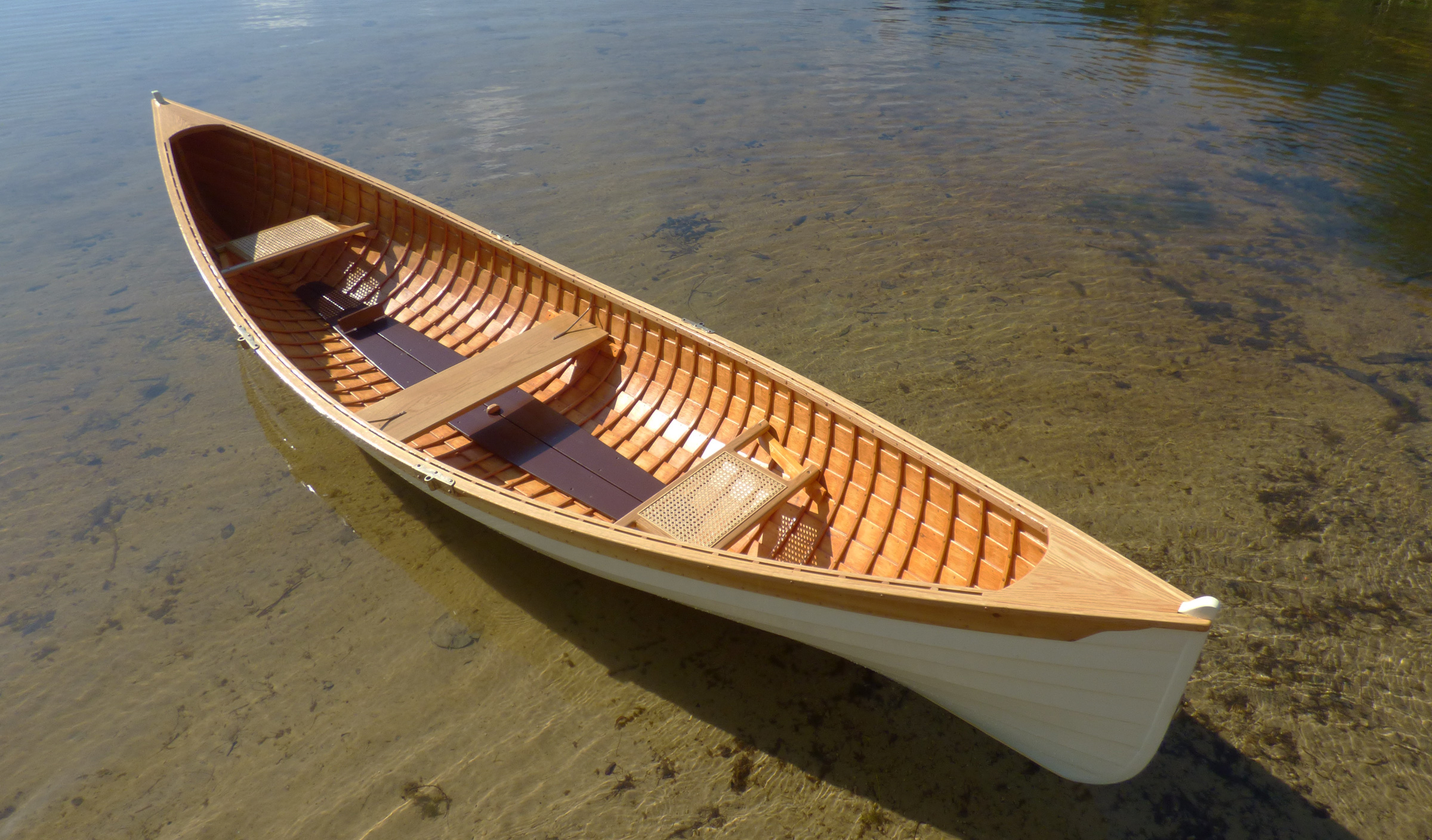
The 37 steam-bent frames give a traditionally planked hull the look and appeal of the double-paddle canoes of the 19th century. Glued-plywood lapstrake construction has the advantage of a more easily maintained interior.
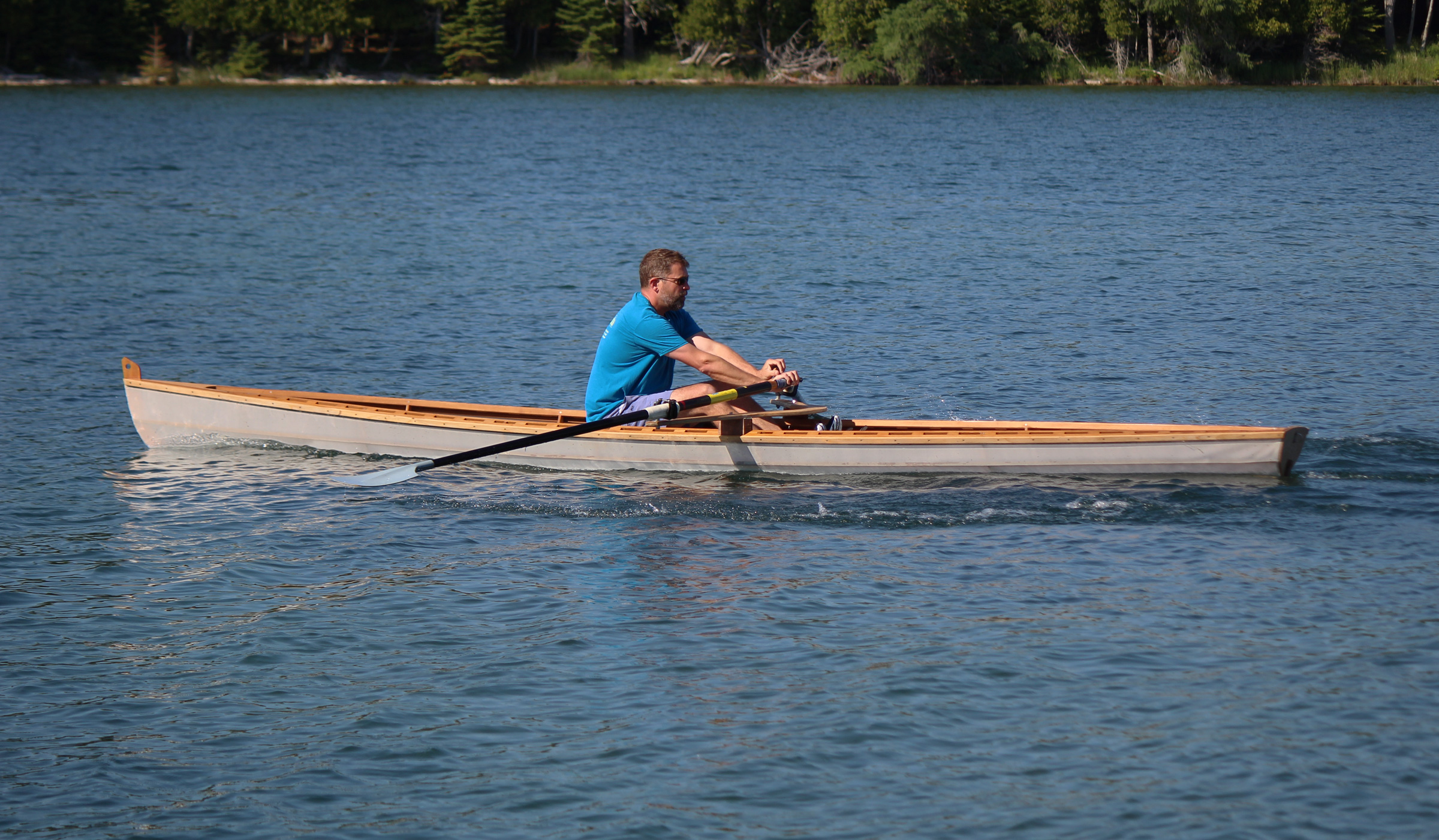
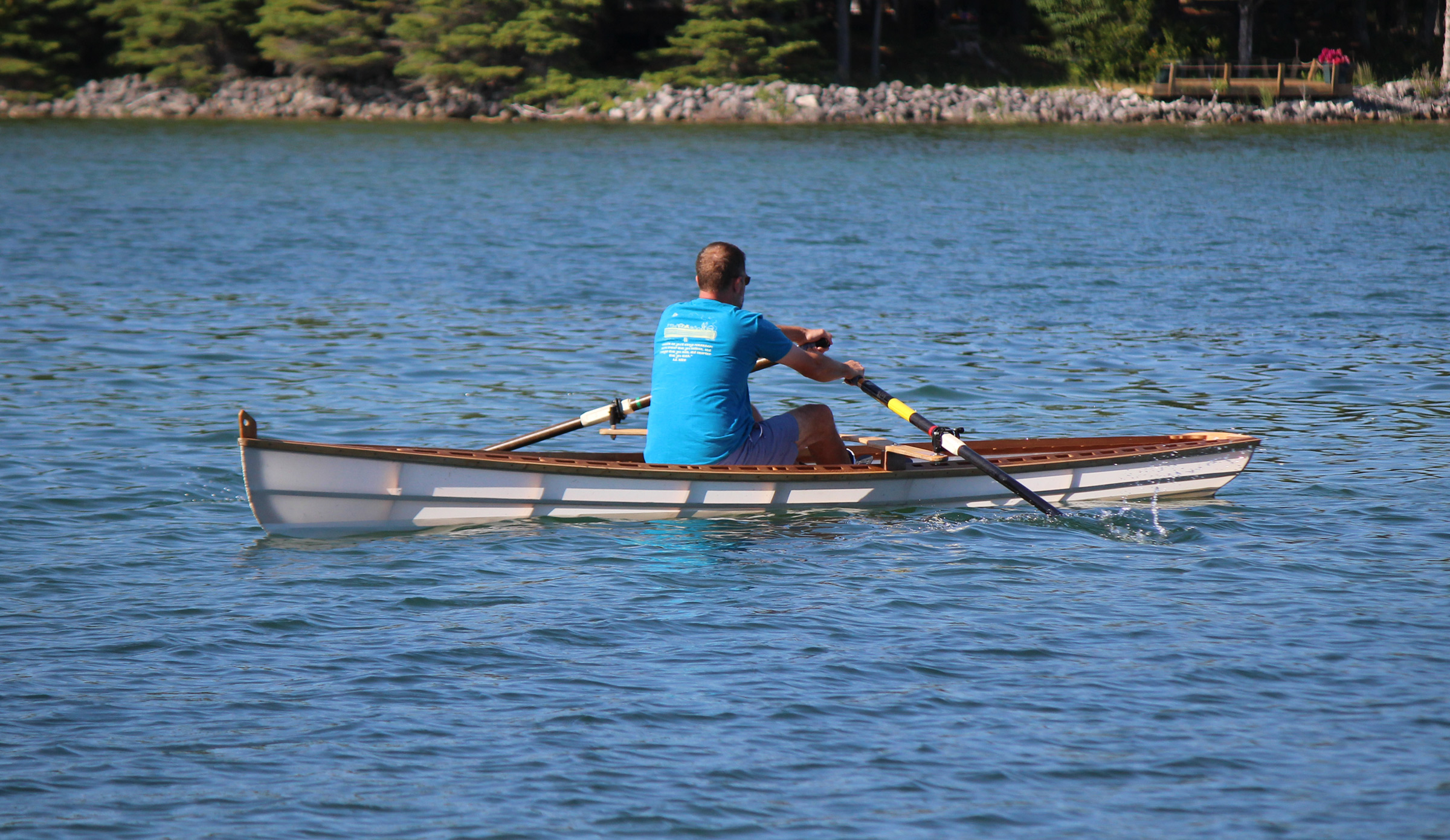
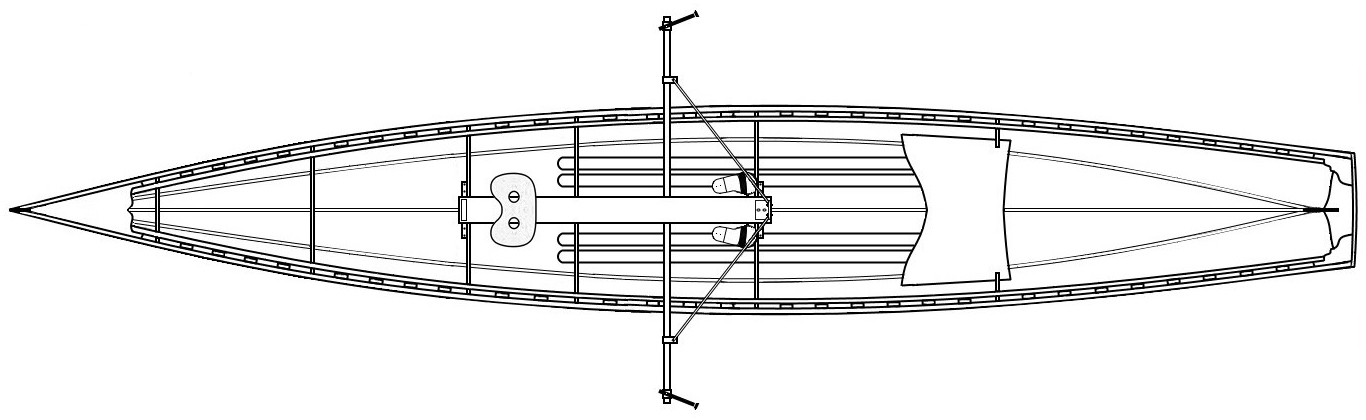
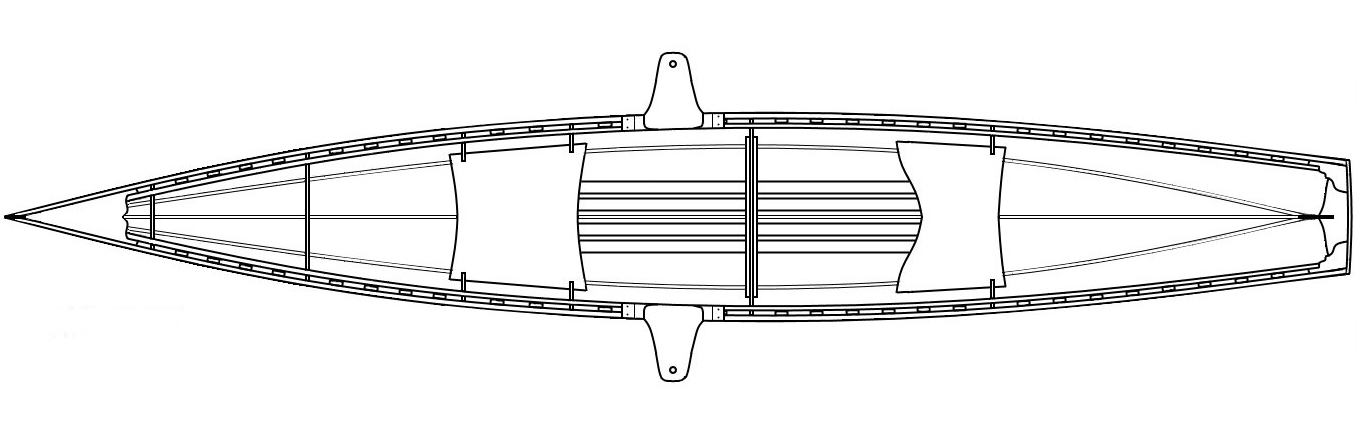
The 10′ 8″ Stickleback is the shortest of the four canoes in Oughtred’s catalog. The plans include five sheets of drawings and a “plans supplement” that has 14 pages of general instructions for the construction of his canoes, dinghies, and Acorn skiffs. While there is adequate information in the supplement for building the Stickleback, Oughtred’s 174-page Clinker Plywood Boatbuilding Manual has more drawings and lots of photographs that first-time builders will find quite useful. The Stickleback drawings provide both imperial and metric figures, and while offsets are included, there are full-sized patterns for the seven molds and the two stems, so you can skip bending over a lofting and tweaking fairing battens. There are also full-sized patterns for the breasthooks, deckbeams, side-deck knees, and backrest as well as measured scale drawings and full-size plan and profile patterns for an 8′ spoon-bladed paddle.
The double-bladed paddle described in the plans is 8′ long and has a blade 21″ by 6″. A 1-1/4″ copper tube is suggested as a means of joining the two halves—feathered left, right, or unfeathered— but not as a take-apart paddle. In the one-piece feathered version that Tom, pictured here, built, the two halves are permanently scarfed together.
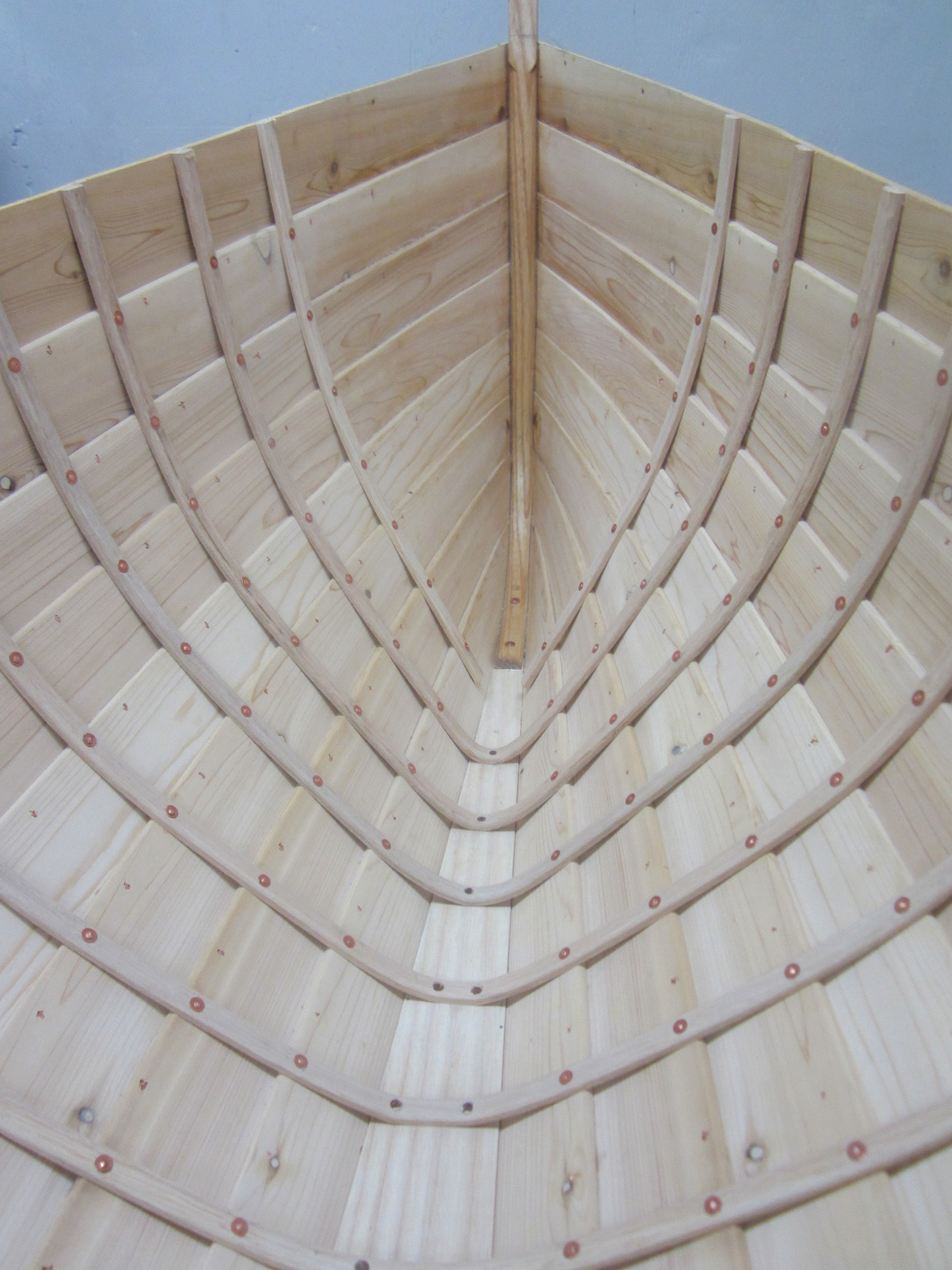
Oughtred offers a number of options in the plans. The alternate station spacings he suggests can make the canoe 10′ 2″, 10′ 8″ (standard), 11′ 2″, or 11′ 6″. The Stickleback can be built as an open canoe with open gunwales or as a decked canoe with sealed compartments in the ends. The compartment bulkheads lie on the same stations as the temporary molds, so you’d use 4mm marine plywood as the molds for stations #2 and #6 and epoxy them to the planking. Hatches in the bulkheads would provide access for dry storage spaces. The patterns for the molds are marked for planking the hull with five strakes for glued-lap plywood or seven strakes for plank-on-frame construction, but don’t provide scantlings for frames and planks. The Stickleback shown here was built in the traditional manner by Tom Regan of Grapeview Point Boat Works in Allyn, Washington. He took the 3″ frame spacing from Rushton’s description of the 10′ 6″ Nessmuk canoe in his 1903 catalog: “Ribs, very light and spaced 3″.” Rushton’s legendary SAIRY GAMP has 5⁄32″ × 7⁄16″ frames, and were likely red elm, as with his other canoes. Tom made his frames 3⁄16″ × 3⁄8″ so he could edge-set them a bit easier if required. He had milled up white oak frames, scrapped them because the were too heavy, and ultimately used Alaska yellow cedar.
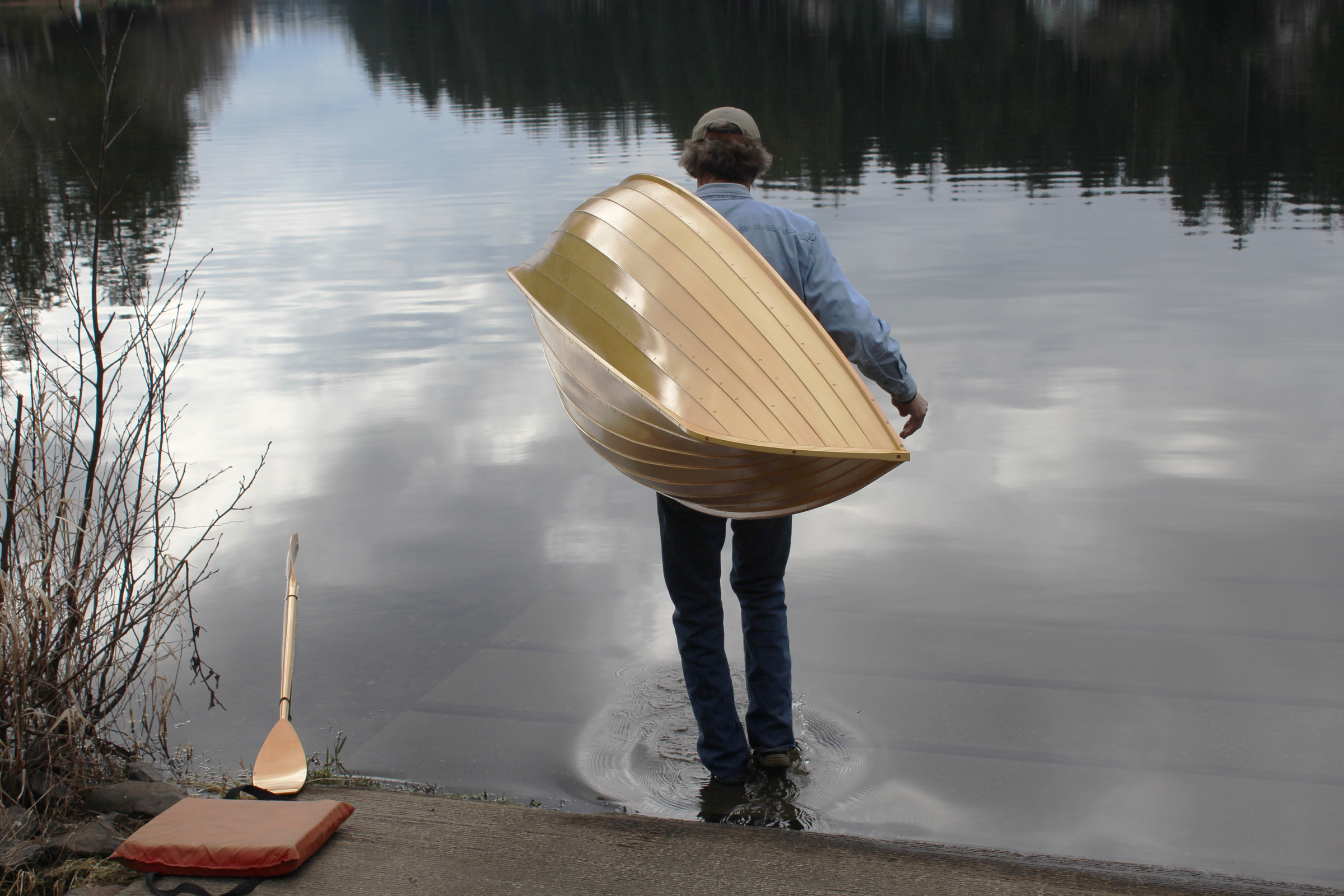
Weighing less than 20 lbs, a Stickleback is an easy carry.
The plywood version of the canoe is meant to have a floor of 3 or 4mm plywood spanning the keelson, garboards, and first broadstrake. Glued in place, it will stiffen the hull under the paddler and provide a little elevation to keep the seating area dry. The open space between the hull and the floor is not sealed off at the ends of the floor, so care should be taken to have those inaccessible surfaces well sealed with epoxy before assembly and hosed out after paddling to avoid accumulations of sand and leaves. The backrest in the drawings is 11″ wide, 2 3⁄4″ from top to bottom, cut with a curve for comfort and fixed to a laminated arched deckbeam at station #5. Another deckbeam, shown installed just aft of station #2, serves as a foot rest. Its position could be altered to best suit the leg length of the paddler.
At its designed waterline, the Stickleback draws 4-1/4″, and with 220 lbs aboard, it needs not quite 6″ of water to float free of the bottom.
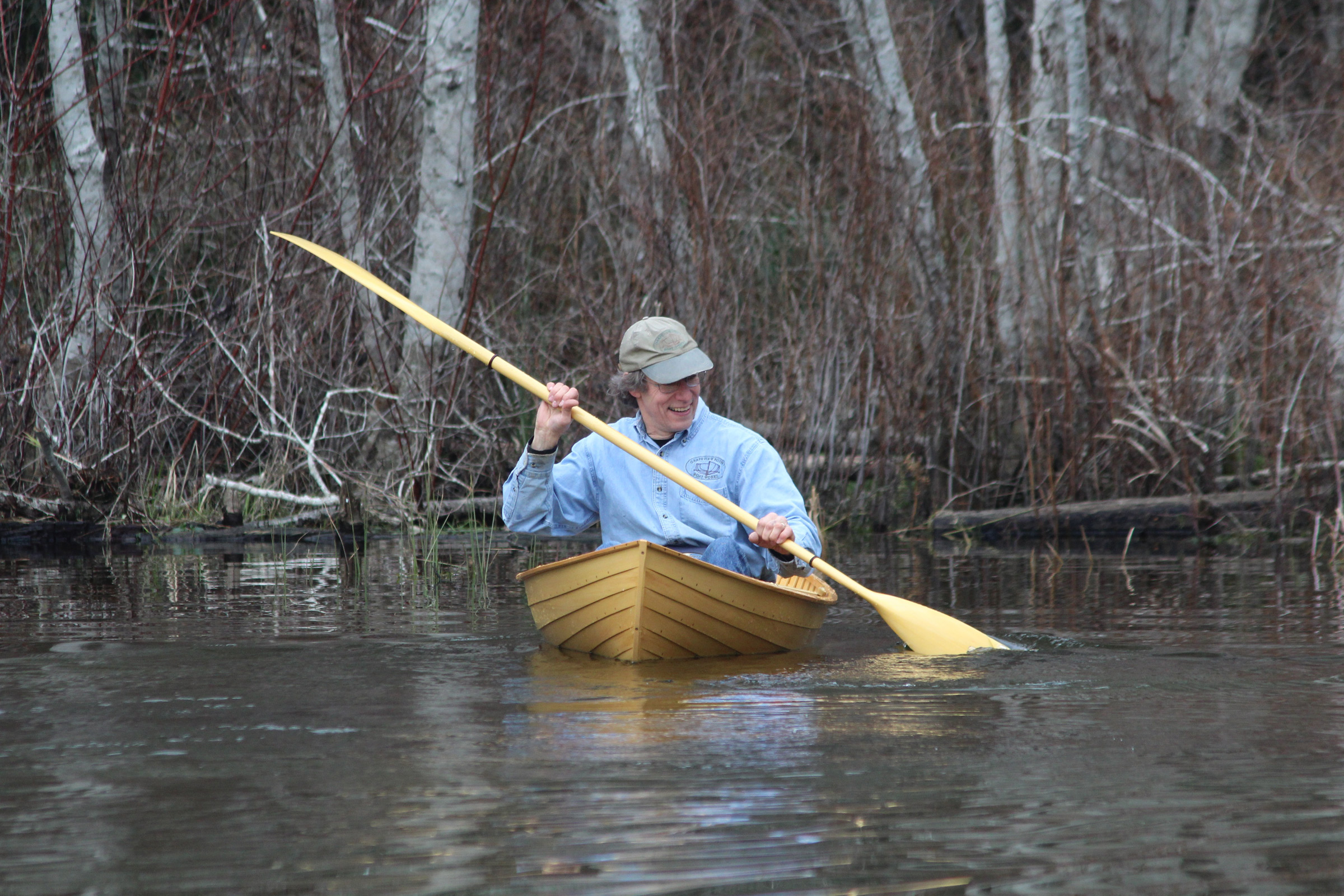
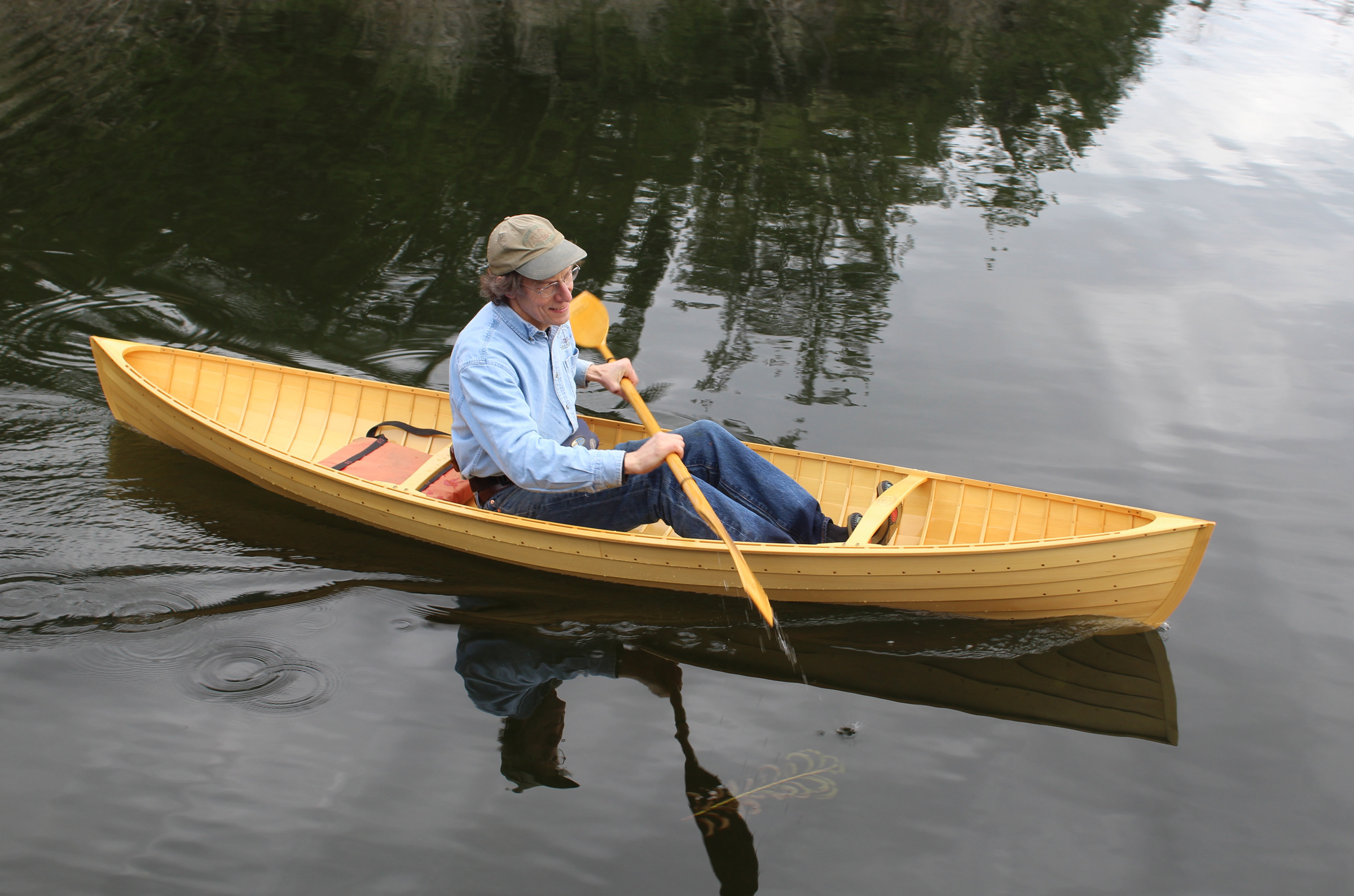
Tom’s Stickleback was made of Sitka spruce and Alaska yellow cedar; it weighs a mere 18 lbs; 2 lbs under the 20 lbs Oughtred indicates for the plywood version. Either makes for an easy carry. With a removable carrying yoke spanning the gunwales amidships, I wouldn’t balk at carrying it a mile or more if there were a jewel of a hidden lake to be paddled.
The gunwales amidships are low and close in, well out of the way of a relaxed stroke.
Getting aboard the canoe is a bit dicey. Tom sets a foot on the floorboards, holds the gunwales, and sits down quickly as he brings the other leg aboard. That leaves his weight up high for a moment, and the canoe gets rather twitchy, but he has yet to take a dip at the launch. I straddled the bow and sat down on the floorboards just aft of the forward thwart, then brought both legs in at the same time as I slid back into paddling position. That kept my weight low and the canoe stable as I got aboard, but the method requires legs long enough to bend around the gunwales. Both my method and Tom’s were meant to preserve the varnish. If that weren’t a concern, I would use a method that’s common with kayakers: Put the boat afloat parallel to the shore, set the paddle across the deck/gunwales with one blade extended shoreward and resting on the land. Then the paddle can take your weight and stabilize the boat as you drop into the seat.
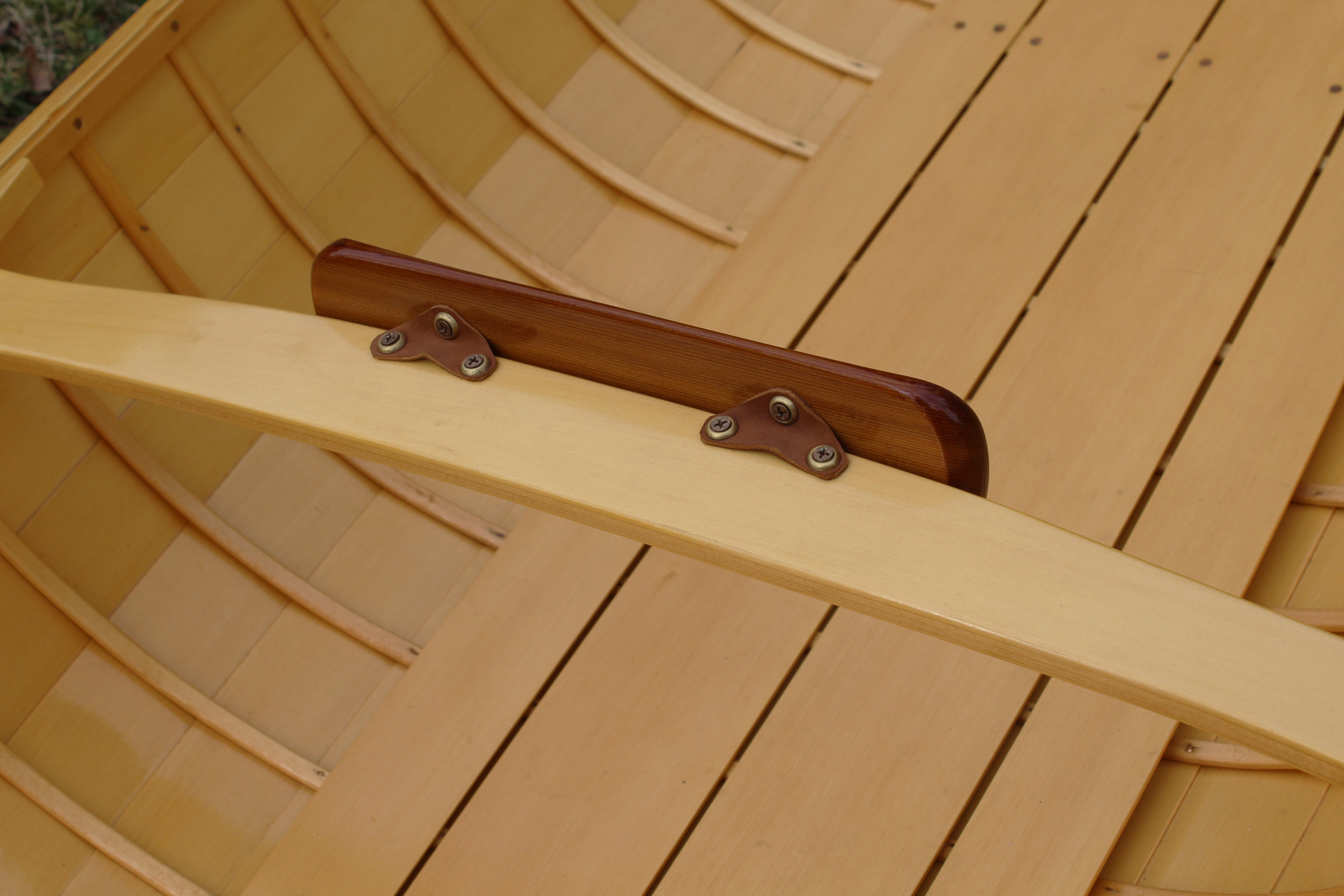
While the plans call for a backrest fixed to the arched thwart, leather hinges assure you get the broadest area of support and have no edge pressing against you.
Once I had planted myself on the floorboards, I was quite comfortable and stable. Tom had mounted the backrest with leather hinges instead of gluing it, so it settled flat against my back. The toes of my size 13 feet were high enough above the floorboards to get a solid purchase on the thwart that serves as a footrest, though with my leg length I would have prefer having the thwart about 2″ farther forward.
Running between 3 and 4 knots, the canoe can cover ground quickly and provide good exercise.
My 220 lbs was as much as the canoe could handle comfortably. One of the longer versions made by increasing the station spacing would have been better scaled to me. I had about 5″ of freeboard and if I leaned to the side I could get water to lap over the gunwale. The canoe felt stable for as far as I could lean it without swamping. Tom, at about 150 lbs, had around 6″ of freeboard, and while it might seem that he’d be able to take on rougher water than I, the boat isn’t meant for venturing out in wind and waves. The lake we paddled for my trials was only 150 yards wide and well protected, an environment well suited to the Stickleback.
Like the Rushton lapstrake canoes that preceded it, the Stickleback is designed for use with a double-bladed paddle. I did most of my trials with a double-bladed paddle, but I had no trouble paddling on one side, as I would with a canoe paddle, incorporating a ruddering finish to my stroke. I wasn’t sitting high enough to paddle with the J-stroke used by canoeists. A single-bladed paddle would make a reasonable spare to carry aboard.
The 27″ beam, located at about hip level, doesn’t get the least bit in the way of paddling. As I’d expected, the Stickleback was quite nimble and fun to maneuver through tight turns. I was limited by freeboard to only a modest degree of edging, but even that was enough to quicken the turns and keep the canoe carving around between strokes.
The bow yawed noticeably at slow speeds, but in general the canoe stayed on course without veering to one side, a good indication that the backrest is at the right position, putting the paddler’s weight just aft of center and pressing the stern down slightly deeper than the bow.
Tom Regan
While speed isn’t going to be a strong point for any canoe under 11′ long, the Stickleback can move smartly, track well, and maintain its stability when pushed hard.
I was surprised by how fast the Stickleback felt. Sitting low on the water exaggerates the sensation of speed, but the canoe turned in a respectable set of numbers on the GPS. It responded to relaxed paddling with a speed of 3 knots, and to an aerobic exercise pace with a speed of 4 knots. When I put in an all-out effort, I could sprint at 4 3⁄4 knots; the GPS registered a momentary peak of 5 knots. At that speed, the bow throws a wake like a miniature PT boat.
While this version looks like strictly traditional construction, there are a couple of significant differences. The planking laps are epoxied, so there are no copper clench nails between frames. The nails visible here are fastened to only a few locations on the frames and elsewhere the frames float. When the yellow cedar planking absorbs water and swells slightly, the planks can move away from the frames rather than strain at fastenings and tear at the laps.
While the traditionally built and bright-finished yellow-cedar Stickleback that I paddled is a strikingly beautiful work of boatbuilding, a glued lapstrake plywood version, painted, with a few accents of brightwork, would lend itself to going paddling often and taking the knocks and scrapes that come with exploring new backwaters. And with its curves accented by the planking laps, the Stickleback would still be a pleasure to look at.
Christopher Cunningham is the editor of Small Boats.
Stickleback Particulars
Length: 10′8″
Beam: 27″
Draft at DWL: 4 1⁄4″
Freeboard at DWL: 7″
Weight: 20 lbs
Open canoe option
Decked option
Plans for the Stickleback are available from The WoodenBoat Store for $105. Thanks to Tom Regan of Grapeview Point Boat Works for his help with this article. Is there a boat you’d like to know more about? Have you built one that you think other Small Boats readers would enjoy? Please email us!
Snags and sudden shifts in the current came out of nowhere as we dodged left and right around dangerous gravel bars that shot water back and forth across the river. The shantyboat shook as the skegs bumped across rocky shoals. I didn’t want to think about what this was doing to the wooden hull.
I was at the helm, white knuckles on the wheel. “Freddie,” our 30-hp Mercury outboard, was trimmed barely in the water to keep the prop off the rocks, running at full throttle for a measure of control. My shipmate Benzy was at the bow urgently calling out hazards and depth; Hazel, the ship’s hound, cowered under the table. I was sure we would end up deeply stuck, if not seriously damaged or sunk. The river rocketed through a single twisted channel and took us along with it, slaloming the clunky shantyboat hard left and then hard right shooting us through a series of rock bars and snags, their jagged teeth raking either side of the hull.
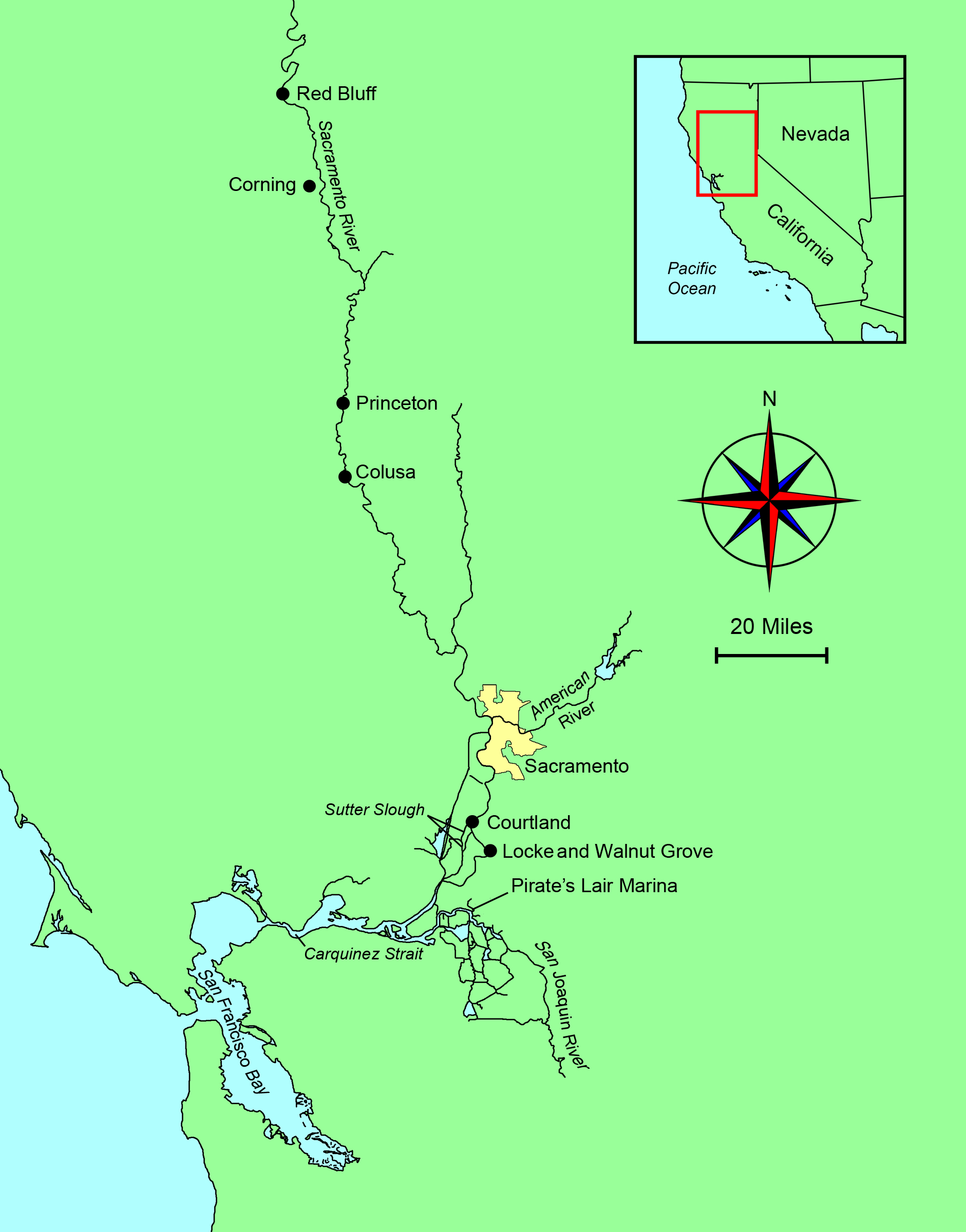
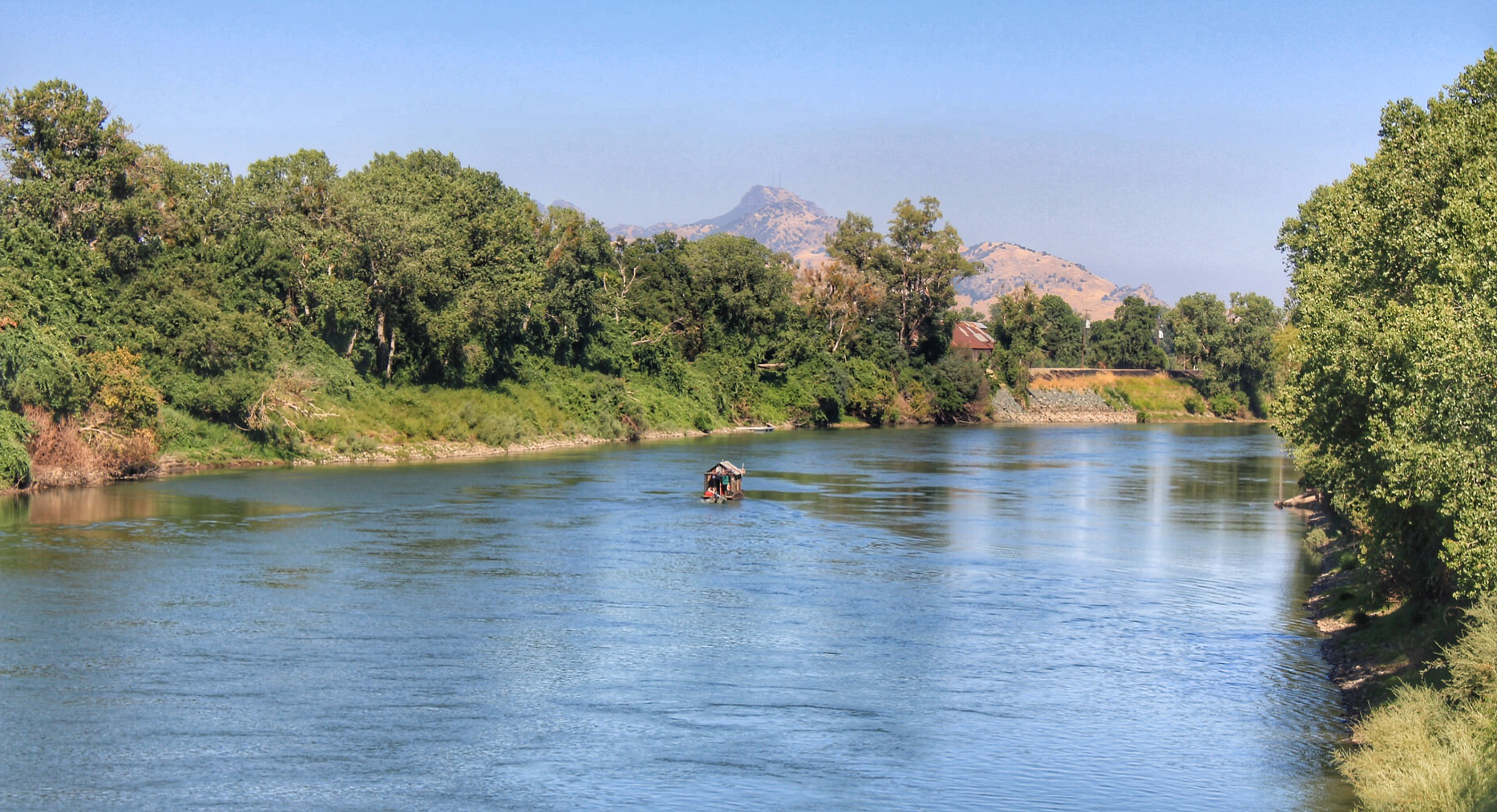
This stretch of California’s Sacramento River was the sketchiest bit of boating I’ve done in a thousand miles and ten years of sketchy boating. We were shooting the Upper Sacramento River in a rustic wooden barge-bottomed houseboat. It was a boxy behemoth that had no place on this section of the river where sleek jet boats fly over the shallows.
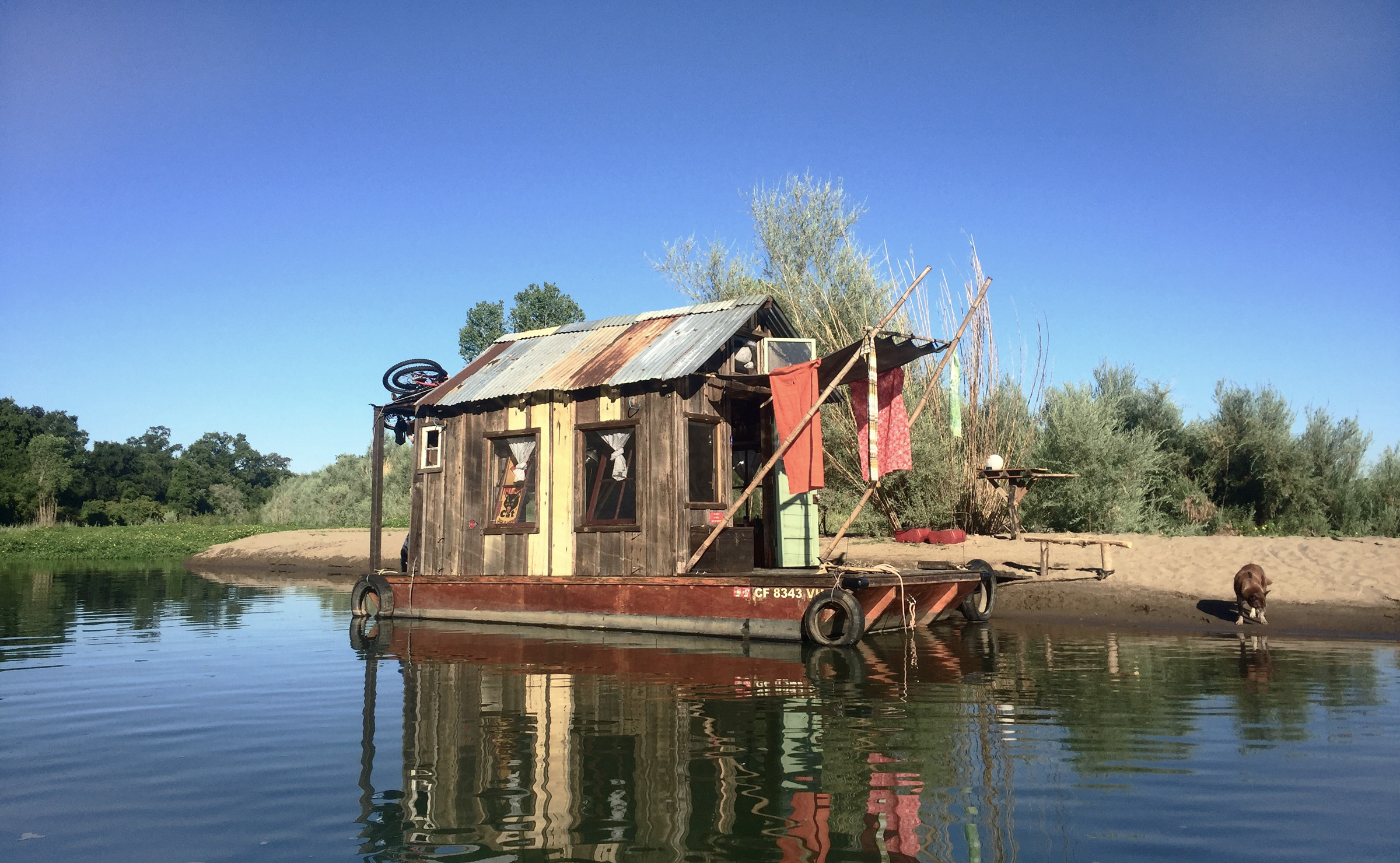
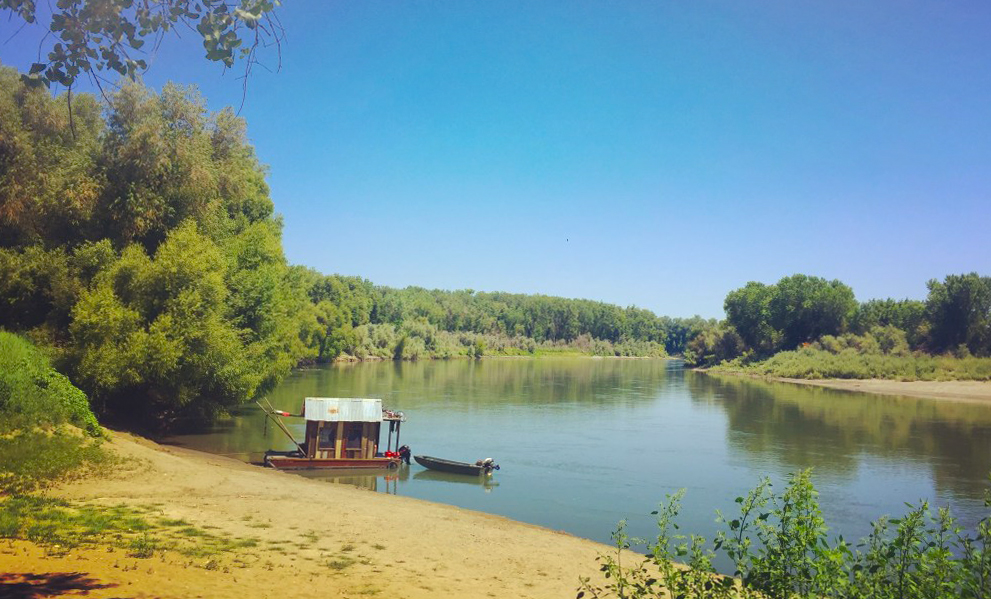
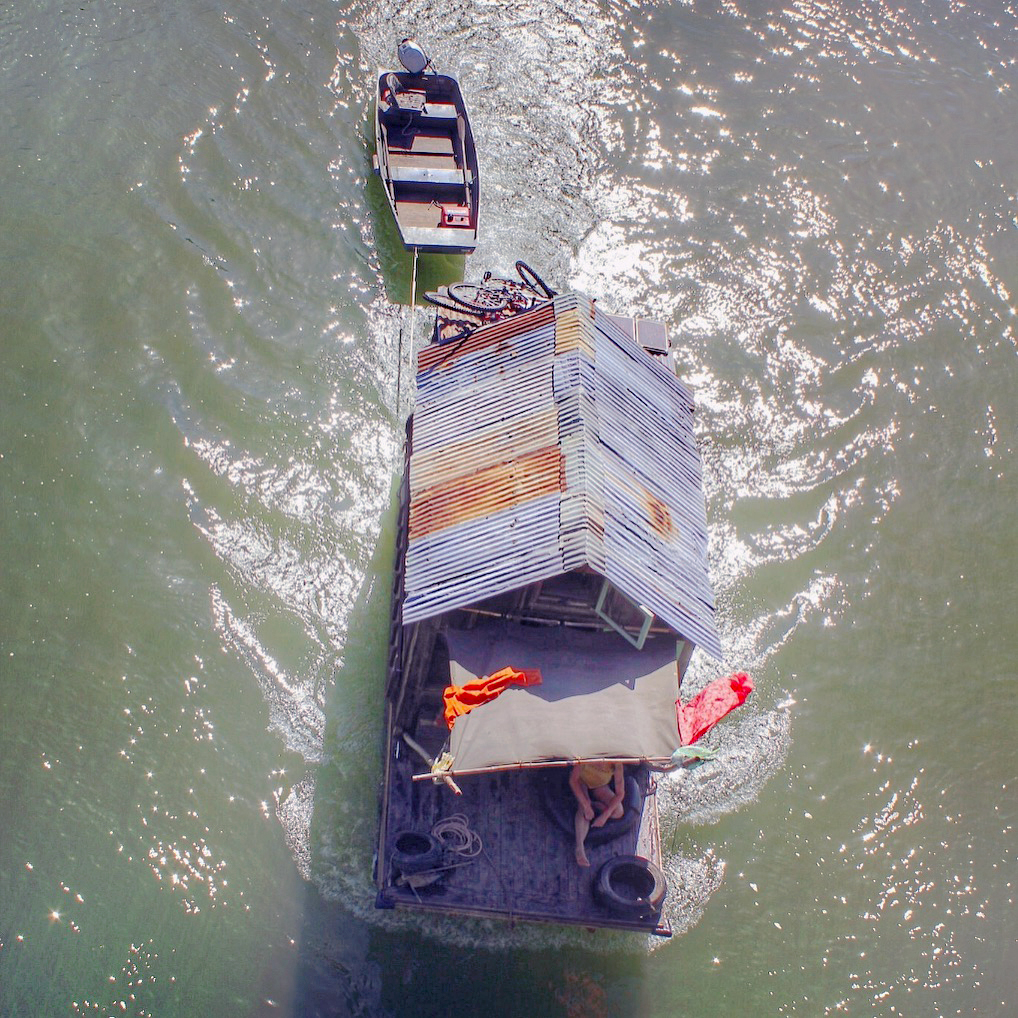
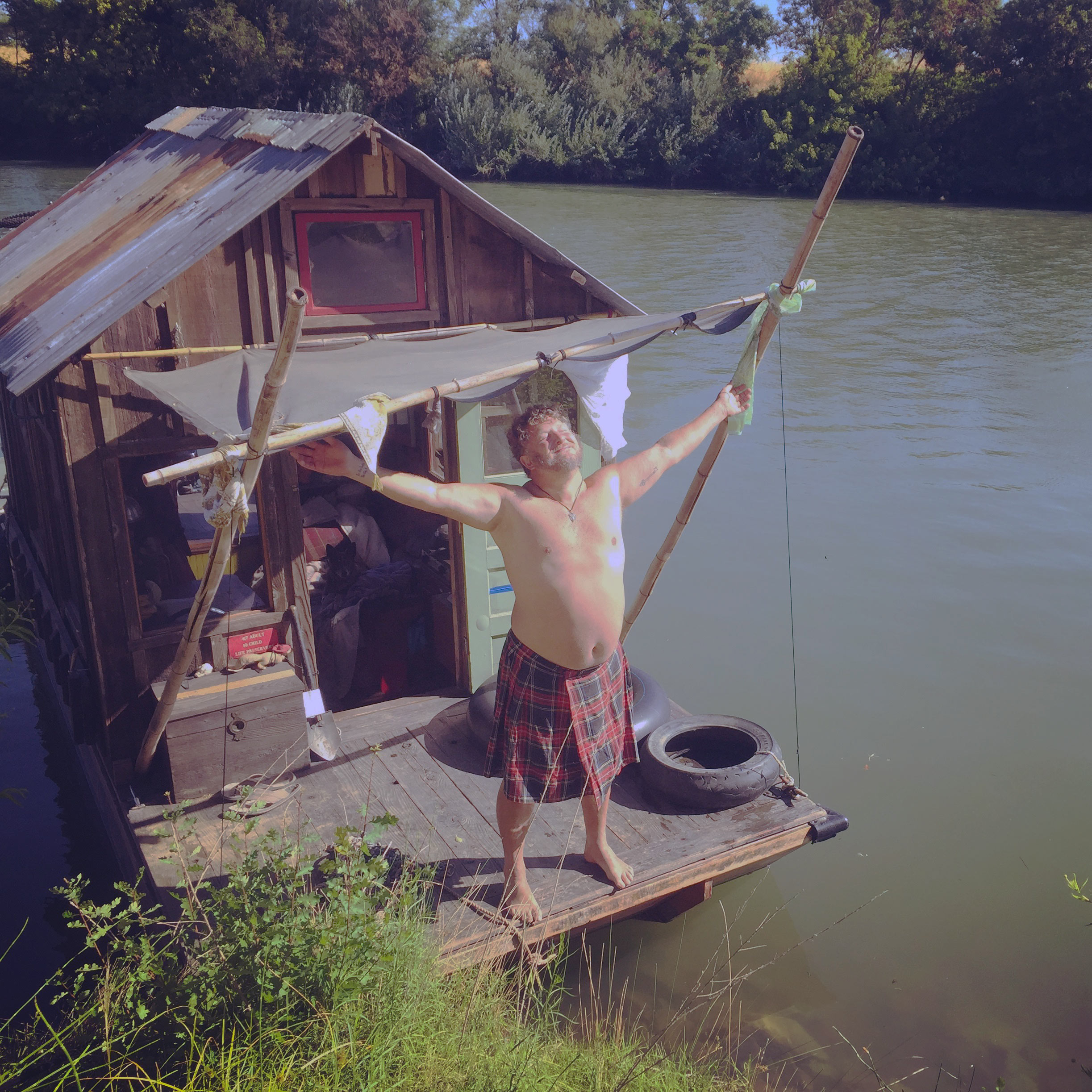
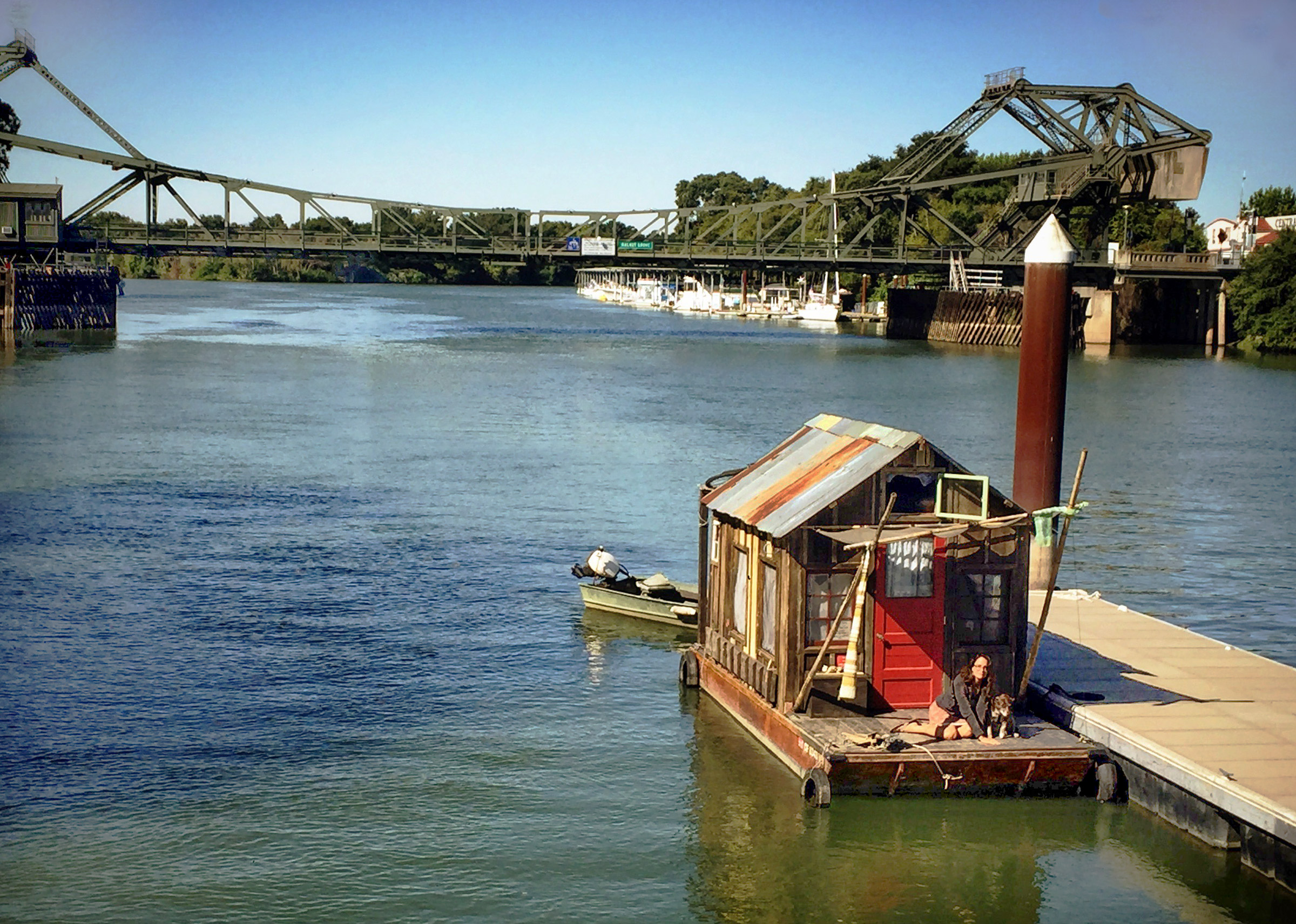
Our re-creation of a historic shantyboat was similar to those that used to dot the banks in every river town on the continent through the early 20th century, the kind of houseboat built by workers and vagabonds who needed to live on the cheap. In that tradition, we built our shantyboat by hand, from the wooden skegs to the gable roof, using mostly reclaimed materials.
Redwood from a 100-year-old chicken coop, corrugated tin from an old outhouse, and single-pane windows pulled out of old houses contribute to a houseboat that looks like it floated out of a history book.
Where we started, the river had just barely come out of the rugged northern California mountains. The water comes from the depths of the Shasta Dam and is very brisk, warming as it meanders under the Valley sun.
Photographs by and courtesy of Wes Modes except where noted
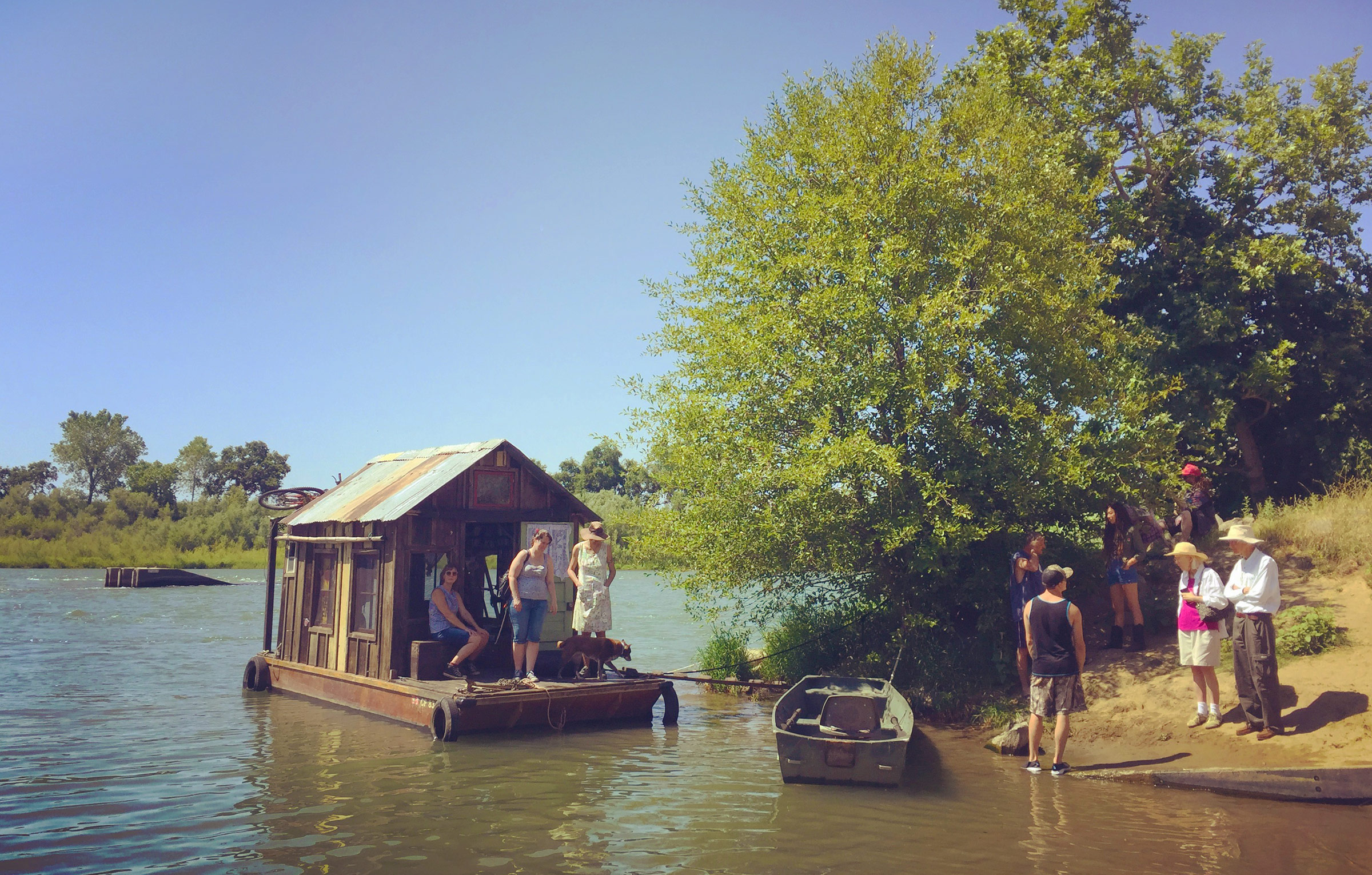
Our departure from Red Bluff was delayed by repairs to our outboard motor. Word about our stay near the ramp got out and we had a lot of visitors.
At the ramp in Red Bluff, just downriver from a now-decommissioned diversion dam, the river was really moving. We got to know this ramp well as we stayed there for two days trying to diagnose why our brand-new Merc motor wasn’t running. This delay was quietly frustrating Sara who collected audio of our repeated failure to start the motor and our colorful cursing. When we finally found Dave, the mechanic, he spent a few minutes and said, “You got water in your gas, chief.” It was an inauspicious start to a month-long journey.
When we launched, many people who know the river suggested we’d never make it, including the Fish & Game people and a series of fisherfolk. On the other hand, Dave and the local sheriff had more confidence in us. They told us the river was hairy but doable. Despite the naysayers, they were right.
It wasn’t all white-knuckle boating. Punctuated by these long moments of sheer terror and intense vigilance, we idled away the days in long floats of serene relaxation and contentment on the Upper Sacramento. As we floated south, the river slowed and took its time down the long Central Valley.
Though there are monotonous fields and orchards for miles on either side, the river corridor is wide and surprisingly wild. Birdsong formed the soundtrack of our days. Crickets filled the night, interrupted by the rustling of critters in the riverside jungle.
Having spent the night near the town of Corning, about 25 miles downriver from Red Bluff, we got ready to get underway again.
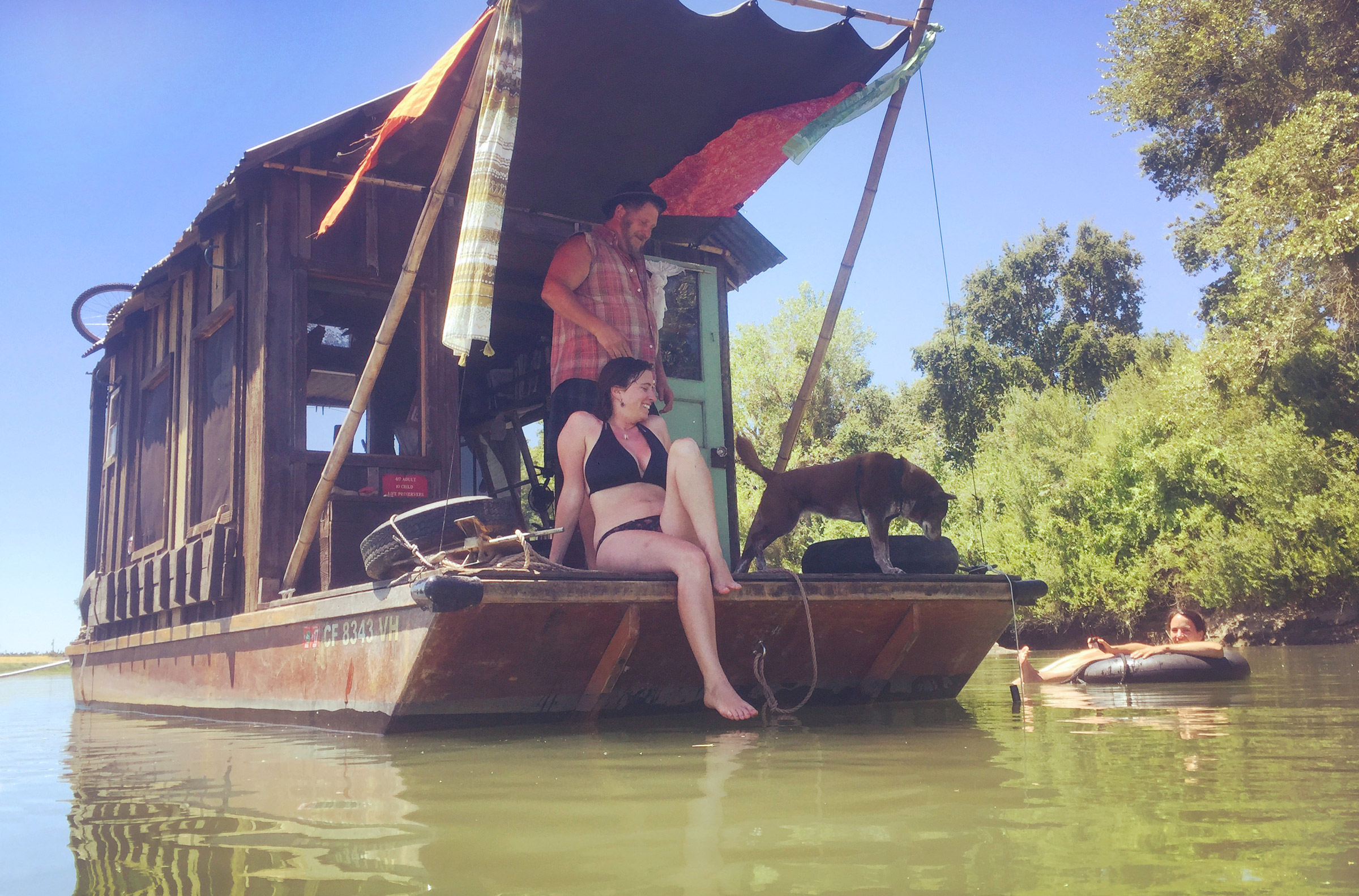
For a tiny rustic floating cabin, the boat is well-appointed. The barge hull is 20′ x 8′ with a 10′-long cabin. We have a small but cozy galley with lots of stores and running water, a big table for work and play, a leather couch largely dominated by the ship’s hound Hazel, a comfy sleeping loft, and a library of river history, art books, and trashy novels.
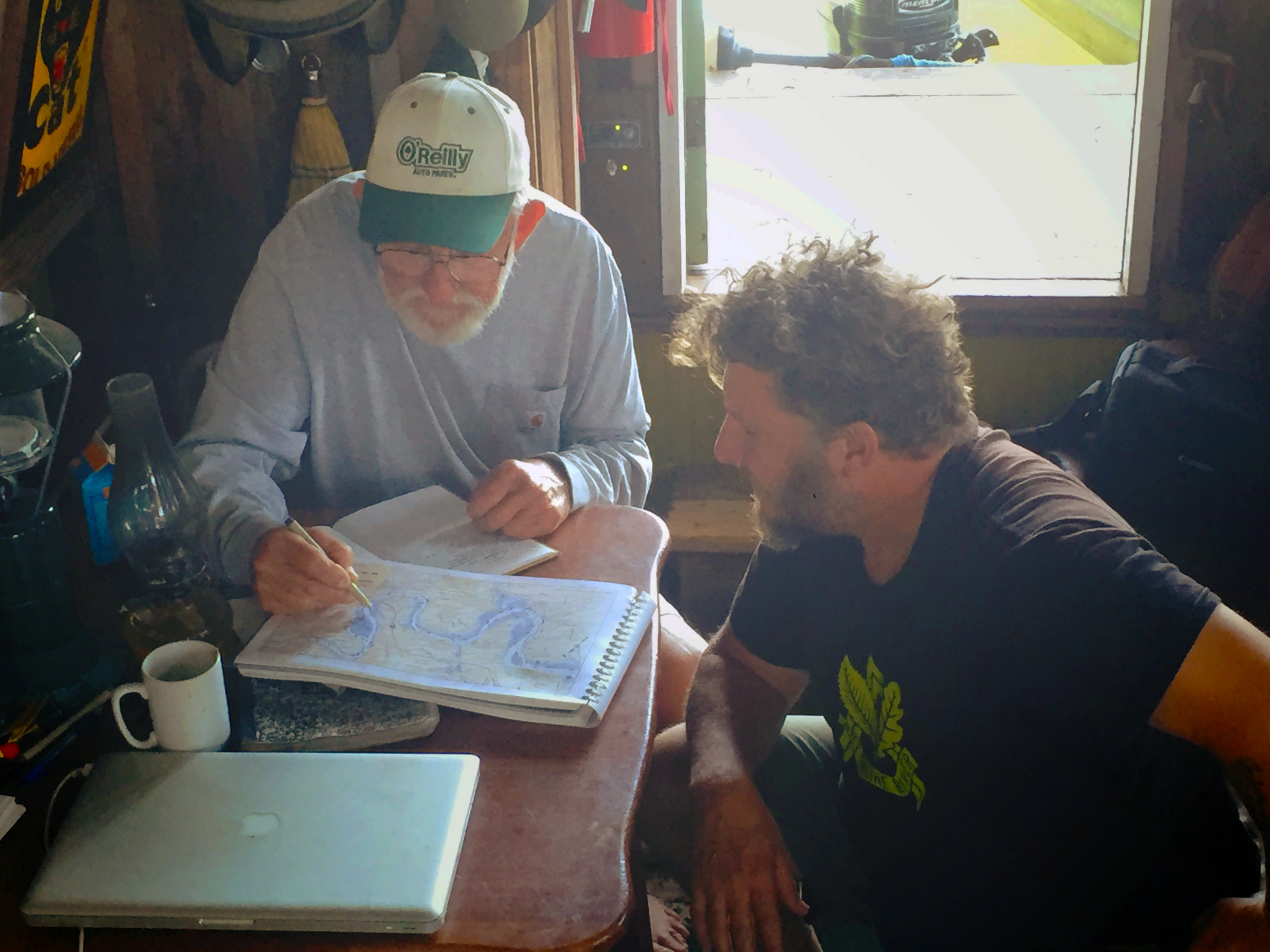
The visitors we welcomed aboard often gave us a wealth of local knowledge that we could add to our charts. We interviewed many of them to get their stories about life on the river.
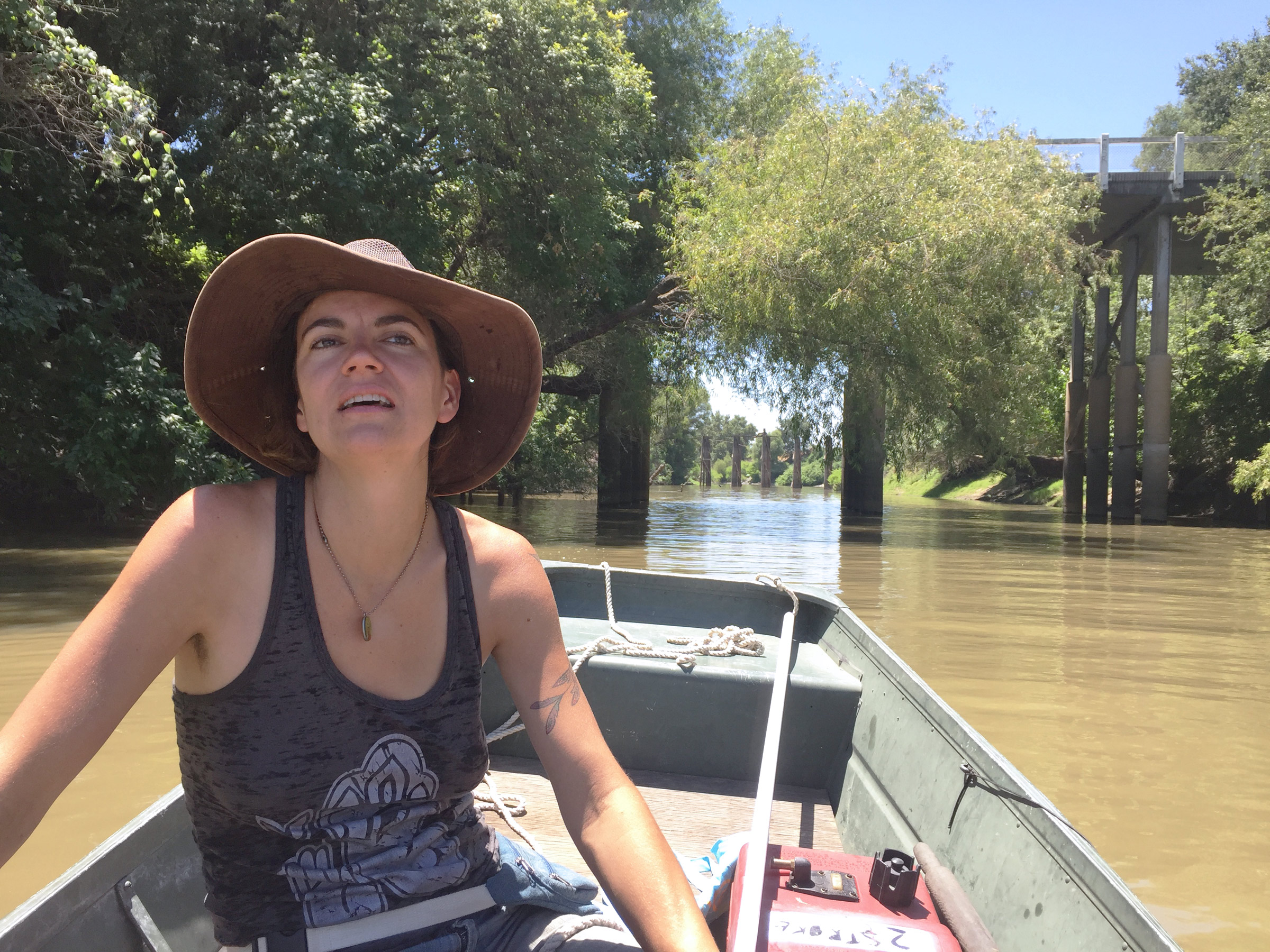
I’m an artist by trade, and life aboard the shantyboat is part of my work for A Secret History of American River People, a project to collect the personal stories of river people. Every summer since 2014, I float down a major American river and talk to hundreds of people about vanishing river culture. Despite the dramatic moments on the shantyboat, we have plenty of time between piloting the boat and doing the oral history work of the project.
Roger Siebert
.
After our days on the sketchiest portion of the Sacramento, we beached the boat at a pleasant sandy spot. We were not too far from a small town whose sleepy streets hide behind an impenetrable jungle and a sizable levee. “I’d kill someone for a sandwich,” Benzy said. So, we hiked into town on what I dubbed the Dustiest Road in America, winding through thick forest, picking blackberries and helping ourselves to grapefruit from a tree’s overhanging branches. After a sad little sandwich at Princeton’s tiny bodega, we headed back with 20 lbs of ice for our little cooler. “And for cocktails!” Benzy said.
A guy named Mike overtook us and offered us a dusty pickup-truck tailgate ride back to the river. This old fella lives happily in this tiny forgotten river town and goes down to the river every day with his dog, Gus. Mike is one of a vanishing breed of river people.
We whiled away the rest of the day with the tart bite of ice-cold gin and tonic, a meditative hour with a cigar, a float in an inner tube to cool off, a good book in the sun that turned into an afternoon nap, and a simple dinner. Jeremiah, another member of our crew, was meeting us in Princeton that night. “I brought a few things,” he said, gesturing at his mountain of supplies and gear. We got a ride from Mike down the long, dusty road to the shantyboat. We celebrated Jeremiah’s arrival with bourbon and cards late into the night.
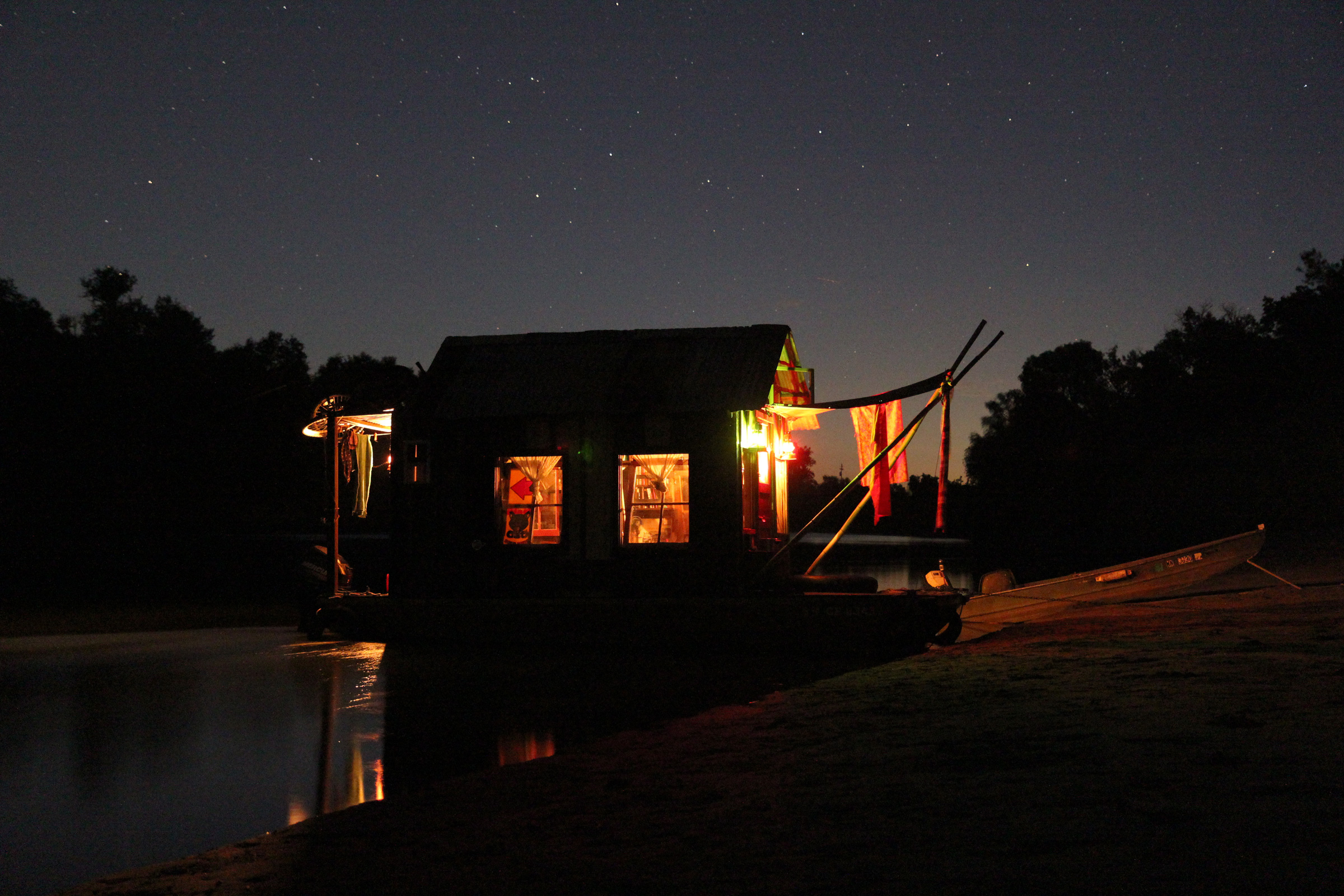
With the skiff pulled ashore and the shantyboat tethered to the banks, our home for the night is bathed in the warm glow of kerosene lanterns.
In the morning, Jeremiah, always one to take care of the hard work first, insisted we do a water run. Jeremiah and I hiked to the road, foraging for water to refill our freshwater tanks—two long trips carrying two heavy, 5-gallon containers. While we were gone, Benzy picked a bucket of blackberries for a pie.
Mike arrived for an interview with a local friend, Al, an avid gardener, who gave us a huge bounty from his garden: fresh tomatoes, onion, cucumber, and squash. I am always surprised by the generosity of strangers when we are on the river.
People give us rides into town and loan us cars. They let us do our laundry and take hot showers. They bring us fresh fruit and vegetables, home-baked bread, books and articles, beer, and, of course, they share their stories.
I talked to Mike about his living in the little town of Princeton, population 400, his love of fishing and hunting, and his passion for the river. We talked for a couple hours, with Al chiming in with unsolicited comments and details that Mike had missed.
Mike set Benzy up for fishing with minnows and showed her how to bait a hook for striper. She spent the next several hours working along the bank. “Y’all like craydads?” Mike asked, “You know, crayfish? Like little lobsters?”
“Never had ’em,” said Benzy, “but hell, yeah.” Mike presented us with a whole trap-full of crawdads pulled from a secret spot in the river.
It was getting on dusk when Benzy yelled out that she thought she had a fish. She fought it to the bank and wrestled it in, a hefty 18″ striper. So, we capped off our long day of work and play with surprising bounty, a huge meal prepared in our tiny galley, and devoured around our little table: fresh fish, boiled crayfish, and blackberry pie right out of our janky, collapsible stove-top oven.
After a few rounds of cards, we tumbled into our racks. For Jeremiah, it was a sleeping bag on the deck under mosquito netting. Benzy and I retired to the loft in the gable of the cabin, up under the tin roof, rocked to sleep by the gentle motion of the river.
The next day, accompanied by the sublime aromas of good strong coffee, sautéed onions, garlic, and potatoes, we headed back out onto the wild river. We let the shantyboat drift quietly downriver, slowly turning in the swirling current. We listened to birds and watched the rugged landscape drift slowly by, always keeping one eye on the river for what it might throw at us next.
Mike Garofalo
The town of Colusa is all but hidden by the levee that separates it from the river. Two water towers at the edge of town, towering above the trees, mark the best place to come ashore.
Over the next week, we left the wild river behind and Jeremiah left us to return to work. We were nearing Colusa, one of the few towns of any size on our journey. It was a chance to resupply, do our laundry, and a bit of maintenance on the boat.
The electrical system under the rear deck was giving us problems. Like an RV, the boat has two batteries, one for starting the motor and one for powering a few lights, charging phones, and other stuff. But unlike an RV, all the wiring was homemade and cobbled together over the years. The house battery wasn’t charging and I wanted to know why. So as Benzy made margaritas and floated in the tube, reading, I spent an afternoon under the rear deck sweating and swearing. In the end, the problem was the battery itself, which we replaced in Colusa.
With our aluminum johnboat, Benzy and I could leave the shantyboat on the river and make quick explorations of out-of-the way backwaters.
A TV news crew found us on the beach in Colusa and wanted to know about our boat and the project. The reporter stood onshore with the shantyboat in the background and made the inevitable Huck Finn comparison. We offered to take them out for a spin in the shantyboat and they made us do stupid tricks for the camera for an hour or so. Drop the anchor. Haul up the anchor. Repeat. I was reasonably sure the landlubber cameraman stumbling through the boat was going to end up in the river with his $10,000 broadcast camera. We were exhausted and relieved when the TV crew stepped ashore.
A guy who’d been following our travels loaned us an old pickup truck, so we had a chance to regain our land legs and cruise town in the evening, Credence Clearwater Revival blasting from the cassette stuck in the player. We stopped by a local watering hole, The Sportsmen, where locals were running amok on an otherwise quiet Tuesday night, dancing on the bar and loading up the jukebox with Tom Petty and the Heartbreakers.
Mike Garofalo
Leaving Colusa, we caught glimpses of the Sutter Buttes, the remains of a single ancient volcano that are now known as the World’s Smallest Mountain Range.
After Colusa, the jungle shores gave way to rocky revetments, beyond which golden fields and dusty orchards extended into the hazy distance. For the first time on our trip, there were other people on the river, pleasure boats and families out for a dip on a hot summer day. Some boaters were curious about the shantyboat and zoomed dangerously close to us, throwing up a huge wake with their deep-V hulls.
The barge-bottom of the shantyboat is extremely stable as boats go, but big waves can still knock things about and break our teacups. With just a foot of freeboard, water comes over our deck easily. Each time it happens, we note, with anger, that neither etiquette, caution, nor good sense are requisite for buying a big, fast, expensive boat. We are very grateful to the boaters who slow for our little craft.
We found a rope swing from an overhanging tree on the inside of a slow river bend. We brought the shantyboat in to shore and took time for a leisurely lunch of tuna melt with Al’s fresh tomato. Against our mother’s advice we swam right after lunch, and the rope swing shot us off the high bank over the river to splash down in deep water. If we didn’t swim ashore quickly, we’d end up downriver with the current.
The mid-river scenery offered less variety, but afforded us opportunities to quietly drift downstream and even bob alongside the boat on a blazing afternoon. Benzy continued to fish from the boat with limited success. Along with more houses on the riverfront, we started seeing abandoned piers and docks…old boats sitting on the muddy bottom or high and dry on the banks. We were intrigued by these. What was their story? Where had they been? Who did they ferry? Why were they left to rot or rust? We would never know.
As we passed the mouth of the American River, Sacramento appeared with its Old Town district along the river. Suddenly, here we were in the Big City. The historic riverside section looked exactly as it had in 1890, if they sold taffy and Sacramento Kings T-shirts in the 19th century. Though chock-a-block with tourists, it still had its charms. There were several brilliant museums, including a well-known railroad museum, good restaurants, and lots of places to check out. Benzy and I were two river hobos out on the town.
That first night, we tied up at a dock under the Tower Bridge. Settling in for the evening, we played cards and read a book aloud, and then turned in, but soon the crazy began with party boats pulling up to the dock with fireworks, loud music, and people wandering the dock. It was a Sacramento Old Town Dock Rave. There was a knock on the shantyboat in the middle of the night. Who could that be? It was a sweet guy who followed our journey and had taken his boat upriver from who-knows-where to find us and welcome us to the area. Deep in the night, we were startled awake by the sound of something large and heavy crashing down from the deck of the bridge and slamming against the pilings.
Mike Garofalo
The rusty corrugated roof might give the impression that our shantyboat came from an earlier generation, but it was built from reclaimed materials and had a patina of age even before it was first launched. On the roof over the stern deck are the bicycles we use to get around on land.
In the morning, we motored up the American River to see if we could find a quiet place to catch up on our sleep. A local park at the confluence of the American and Sac rivers is a popular place. Locals wade and frolic well out into the shallow water. Anglers anchor offshore with lines crisscrossing. We wove our way through the chaos. The waters of the American River are clearer and bluer than the muddy Sacramento, and since they come from melting snow in the Sierras, they’re colder too. Apparently, it is also a summer hangout for yachters. We discovered clumps of big boats rafted together full of partiers. There was a long line of boats rafted together gunwale-to-gunwale nearly across the whole river, an imposing yacht wall blasting Joe Walsh. Our shantyboat coming slowly upriver, looking for all the world like a floating chicken coop, did not fail to impress. We waved as the whole floating party appeared to check us out and politely declined offers to join the Yacht Wall.
Farther upriver, it was quieter. We were still in town, but the riverbanks were given over to wild and overgrown county parks. Oaks, willows, and cottonwoods shaded the banks. Thickets of elderberry and blackberries lined paths through the woods. There were folks squatting in little camps among the trees. Local kids were fishing, both young anglers with pro rigs and kids with makeshift strings tied to cane poles straight out of Huck Finn. We found a quiet bank in the sun, dropped a line in the water as well, and made coffee and breakfast of potatoes and cheesy grits.
We were near a rustic train bridge over the river and every few hours a freight train would woot over the bridge. We bathed in the river, Benzy played the banjo, and Hazel hunted ground squirrels tunneling in the bank. A couple putted by in a little boat and beached downriver. The fellow was sweeping a metal detector over the sandy bank. I talked to him for a bit.
Clyde was a treasure hunter and amateur archaeologist. He told us that he spends his free time on the shores of the American and Sacramento rivers hunting up treasures: old Chinese pottery and ceramic ware, metal bits and bobs from the Gold Rush era, and lots of bottles. “I have over a thousand bottles,” he said. “I’ve found every color—deep brown, cobalt blue, even old bottles that used to be clear, turned pink and purple by the sun.” In the short time I’d been watching him, he’d detected and dug up an old coin, an unidentified broken piece of speckled ceramic, and several rusty pieces of old iron. Clyde gave us the curious junk he didn’t want and we added it to our collection of odd river artifacts.
Another evening on the American River, we camped near a fellow in a neat compound a short walk from the shore. He was alternately sunbathing and organizing his camp. I had heard about the homeless camps along the American River north of town and was curious. The man’s name was Bar and he’d lived along the river for most of the last ten years. He shared a camp with another man who was getting on in years and needed Bar’s help. The local police knew Bar took care of the area and kept the “young bucks” out of trouble, so they told him that if he kept his camp clean they’d leave him alone. I sat down for a formal interview with Bar. His dark skin and bright eyes glowed handsomely in the sunset light.
He told me that about half of the folks who camped at the river were homeless because they struggled with mental illness or addiction, meth and alcohol being the most common. Bar himself had struggled with substances in the past and was clean now. “I feel for those people, but I don’t want to hang around them,” he said.
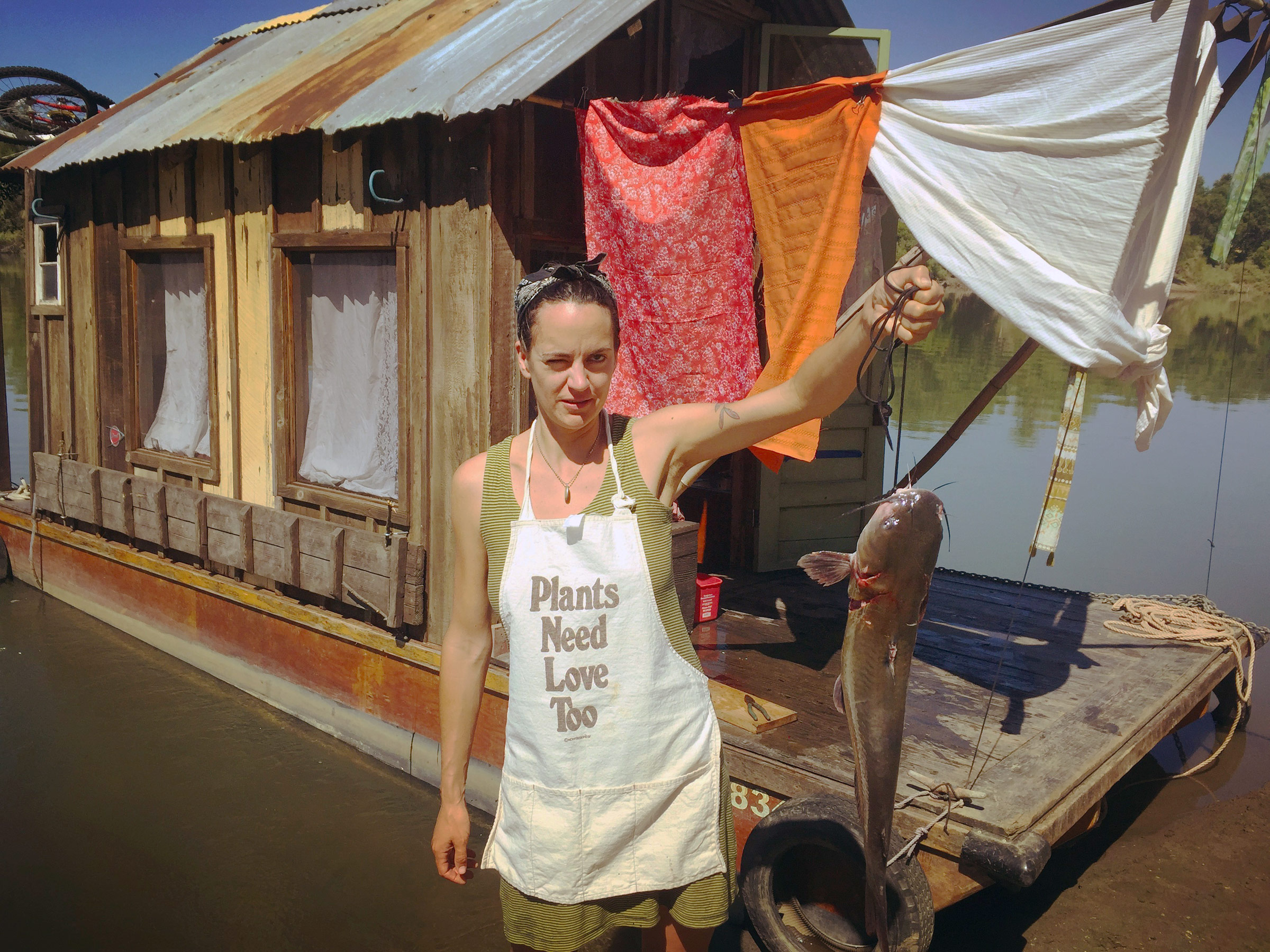
Benzy quickly took to fishing and got quite good at it. This 24″ catfish made a tasty and ample meal at dinnertime.
After our talk and some urging, Bar came over for a fish dinner at the shantyboat. He looked around and said, “Exactly right. You folks know how to live! Someday I’m gonna get myself something just like this.” Bar was a good neighbor, and we were sorry to say goodbye as we made way. I heard later that the cops had completely cleared out the camps along the river.
While we were in Sacramento, we exhibited the Secret History project with the Sacramento History Museum while docked along the Old Town waterfront below Joe’s Crab Shack. Hundreds of people braved the heat and came by to tour the boat and share their own river stories. One musician sat down with our banjo and played us a few old-timey tunes. Among the folks who found us there were a water-quality expert, a historian giving history tours of Sacramento, and a professional house restorer who offered to fix a cracked pane on the shantyboat and show us around town. Later, I interviewed these folks.
We needed to make one more stop in town to do a few interviews, and so Mark Miller, our new friend and window restorer, took us around to get groceries and ice. We stopped at Sacramento’s municipal marina where an apologetic attendant charged us an outrageous price to tie up for the night on an uncovered dock with no water and no electricity. Were we not so tired, we would have turned around to head back upriver to another marina.
Before we’d even had our coffee the next morning, we heard yelling. “Hey! Hey!” A lady was leaning out over the balcony of the swanky harbormaster’s office yelling, “Hey! This isn’t a public dock! You can’t just tie up there!” She was pointing at us. “You can’t tie up there,” she yelled.
From time to time, we’ve dealt with this kind of thing. We’ve had dockmasters say to our face, “You know, that’s not going to be welcome in any marina,” gesturing dismissively at our rustic boat. Fortunately, that’s the exception, not the rule. Most of the time, when marina staff discover our project and what we are doing, they refuse to let us pay.
This marina had lost our paperwork, and the woman working the office that morning thought we were squatting. We are certainly not above that, but we’d already paid too much for too little, and this lack of hospitality was over the top. We were still grumbling about it days later, joking in a screechy voice every time we docked, “Hey! You can’t tie up there!”
We were relieved to be out of the city. We had left the California capital, and the character of the river changed again. We had officially entered the Sacramento Delta, and we could feel it. The air smelled sharp and salty. The river got wide and sluggish and veered off into a maze of channels and sloughs. The sloughs had a different texture than that of the river. It was clear we were in a channel with rock revetment and high levees. A thin scrim of trees fringed the levee. At night it was ghostly and surreal.
We spotted old houseboats that we considered shantyboats, people living quiet lives—or at least weekends away—floating in unobtrusive corners of a forgotten slough. We never met anyone on these shantyboats and so we never learned their stories.
There were a good number of little marinas south of Sacramento that were little more than a few docks out in the river. Some looked posh, filled with big shiny yachts, and others looked forgotten by time. We stopped at one of the latter and found a collection of old houseboats and a legitimate shantyboat with a classic arched roof. The people aboard it said they’d had their boat in the marina for nearly a decade.
A cool swim was a welcome relief on a hot day at anchor. We had to keep a close eye on the river. If we weren’t careful and strayed from the still backwaters we could get swept downstream by the current.
We stopped for a swim and a walk along a levee in Sutter Slough where we discovered that the interior of the island was an endless expanse of pear orchards. We felt obligated to pick a bag of pears as part of our research. Hazel was relieved to stretch her legs on land, and picked up no less than nine ticks. Were all the slough islands infested? We were horrified, but didn’t encounter the bugs elsewhere.
I welcomed the rising sun after a quiet night on Sutter Slough. Kilts are well suited to summer travel aboard the shantyboat.
We heard that the nearby town of Courtland was having their annual Pear Festival, but small and large boats occupied every inch of available space on their public docks, most appearing not to have moved for decades. We attempted a tricky beach landing between trees in a brisk breeze. I was piloting and Benzy was trying to fend off hazards and set an anchor on shore at the same time. I got the shantyboat in an awkward position, and a big branch punched right through a kitchen window pane. We gave up on Courtland and headed downriver feeling stupid.
Our first stop on our Sacramento Delta tour was the town of Locke, a tiny town founded by Chinese who had helped build the railroad, then the delta levees, and finally worked as farm labor. This town retains its original rustic character and Chinese influence. Back in the day, Locke was a haven for bootlegging, gambling, and prostitution. An easy ride from Sacramento, it was where state politicians met to work out shady deals and let off steam. To be sure, it looks the same as it did in 1915 due to a century of neglect and poverty, a Byzantine net of historic preservation laws, and cooperative and occasionally conflicting ownership.
Mark came down from Sac to meet us for lunch. He immediately got to work on our broken window as well as ones that had been busted and covered for years. He introduced us to some of the folks in Locke, non-Chinese folks who’d befriended some of the original Chinese families and lived there for decades. My interviews included a photographer and oral historian who’d written a book about Locke.
As a Chinese community, Locke faces challenges. As the older generation of Chinese people die and younger generations move out of town, there are fewer and fewer Chinese people in Locke. The community viewed non-Chinese residents like Mark’s friends with suspicion until they slowly gained the trust of the community. Unfortunately, I never made a connection with any of the few Chinese families still living in Locke.
Docked near us was COMPASS ROSE, a former torpedo retriever, now a Sea Scout vessel with a crew of young mariners. Mark told us that he’d served in the Sea Scouts as a kid and plied the waters of the delta. Boy Scouts who reach high school can become either Eagle Scouts or Sea Scouts. The Sea Scouts are co-ed, a factor that helped Mark decide to join. He told us hilarious stories about his skipper, a hard-drinking Vietnam Vet and their ancient World War II ship. The crew of the Compass Rose gave us a tour of their ship from pilot house to engine room. We felt a warm kinship to these kids and all the nautical traditions they were steeped in.
Walnut Grove is 27 miles from the mouth of the Sacramento. This public dock is a good place to stop—it’s right across the street from a pizzeria, an ice-cream shop, and the cafe where we had breakfast.
Out on the river, the channels got wider and the reaches longer. The shantyboat was getting beat up by waves whipped up by the afternoon winds. Water sloshed over our decks, but our recently installed knee-knockers prevented waves from entering the door of the cabin. The tall shantyboat with its gable roof is a giant clumsy sail in a good wind. We resolved to get on the water earlier in the morning, but the call of a leisurely breakfast and several cups of coffee were always stronger than our sense of self-preservation.
Rather than brave the vicious winds of the Carquinez Strait to the San Francisco Bay, we opted to explore more of the Delta.
We chose a favorable wind and, from the Sacramento River, through a long cut, motored upriver on the San Joaquín. Vast reaches, long tidal flats, and insubstantial tidal islands covered in tule grass barely poking up above the water at high tide, gave the impression of a drowned world. With huge container ships moving both up and down river, we stayed out of the channel but the marshy levees afforded scant shelter from the wind. We couldn’t trust our NOAA maps. We were afraid we’d motor over an inundated island and stave in our hull on an old submerged fencepost. We were driving principally by instruments, navigating by compass, watching the depths on our electronic charts.
We stopped at a haphazard floating dock near some tumbledown fishing shacks to give Hazel a moment ashore and let us stretch our legs. On our short walk, the tide turned, putting us up-current from a menacing row of pilings and making getting under way more perilous than we expected. I started Freddie, and Benzy released the stern line. The moment she cast off the bow line and stepped aboard, I gunned Freddie before wind and tide could cast us into the jagged pilings.
We re-entered the maze of sloughs and silted-up cuts. This was the true delta, dotted with ancient marinas, secret coves, and endless tracts of tule-lined water.
Eleven hundred square miles of constantly fluctuating tidal and wind-blown wilderness. Our month-long journey had begun at the southern end of the Cascade Range, took us through California’s Great Central Valley, through the vast Sacramento and San Joaquin Delta, and brought us nearly to the sea; now it was time to bring an end to it. Consulting our maps, we liked the sound of Pirate’s Lair Marina just off the San Joaquin River. We spent a long afternoon carefully picking between tule islands and sprinting across long reaches, and landed at the palm-lined, green grass shores of Pirate’s Lair just in time for cocktail hour.
Wes Modes is a California artist focused on social practice, sculpture, performance, and new media work. A Secret History of American River People is an art and history project, conducted over a series of epic river voyages, that gathers and presents the oral histories of people who live and work on major American rivers from the deck of a re-created 1940s-era shantyboat.
If you have an interesting story to tell about your adventures with a small boat, please email us a brief outline and a few photos.
A common ball-peen can be tiring for the user and, if it has a head that is too heavy, it can buckle a rivet’s shaft within the wood pieces it’s joining. Tom DeVries made riveting hammers to do a tedious job more effectively.
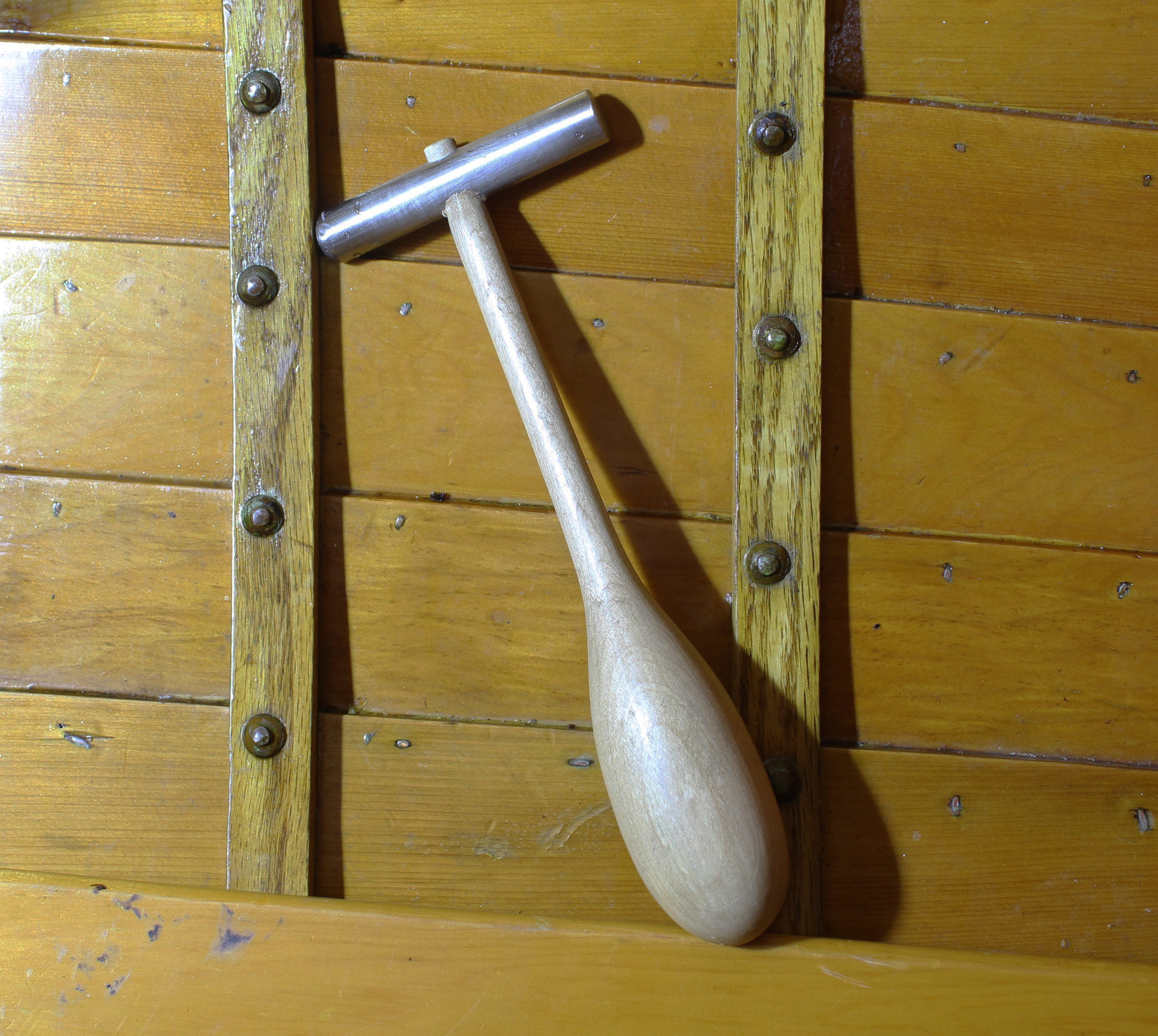
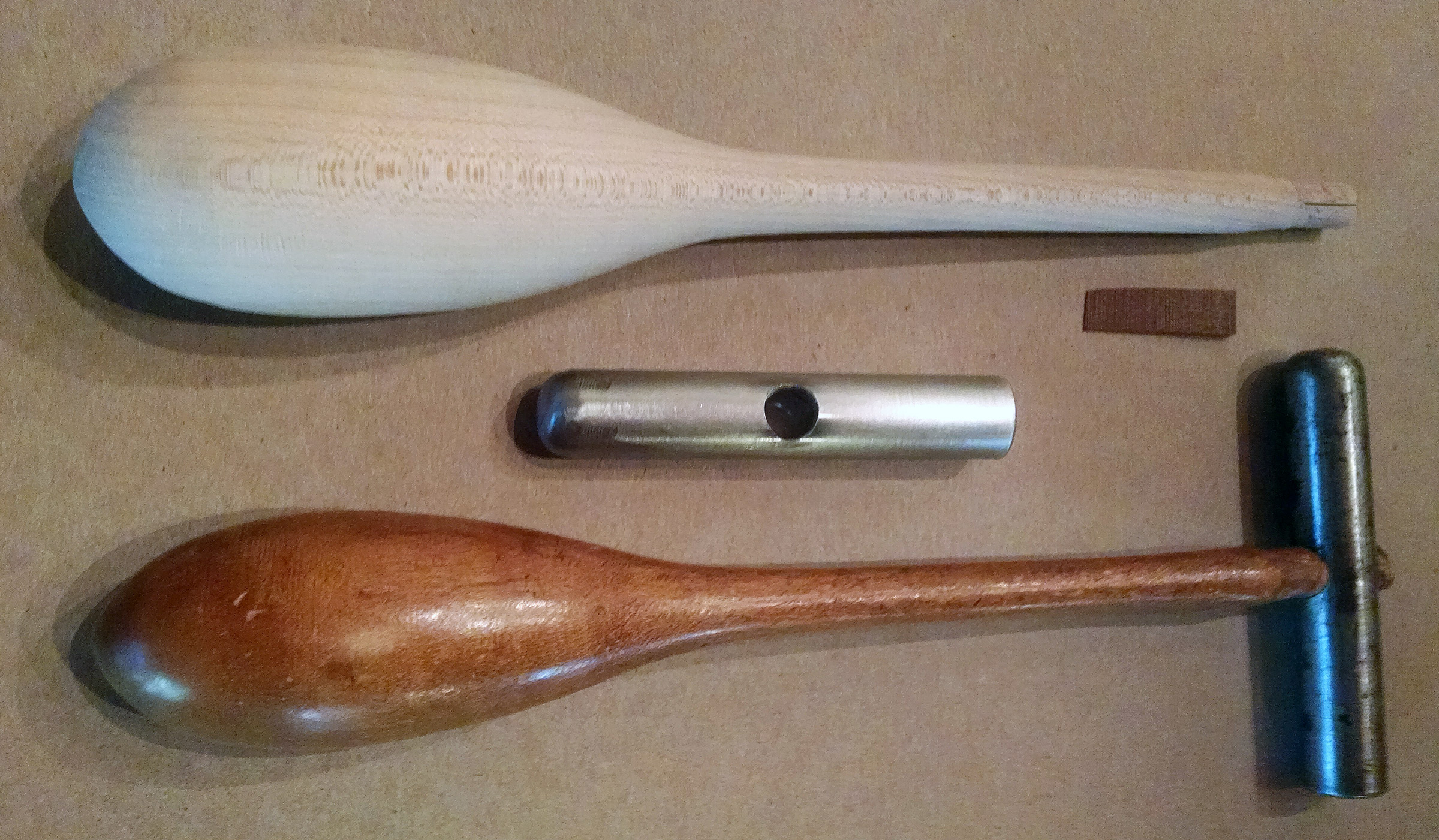
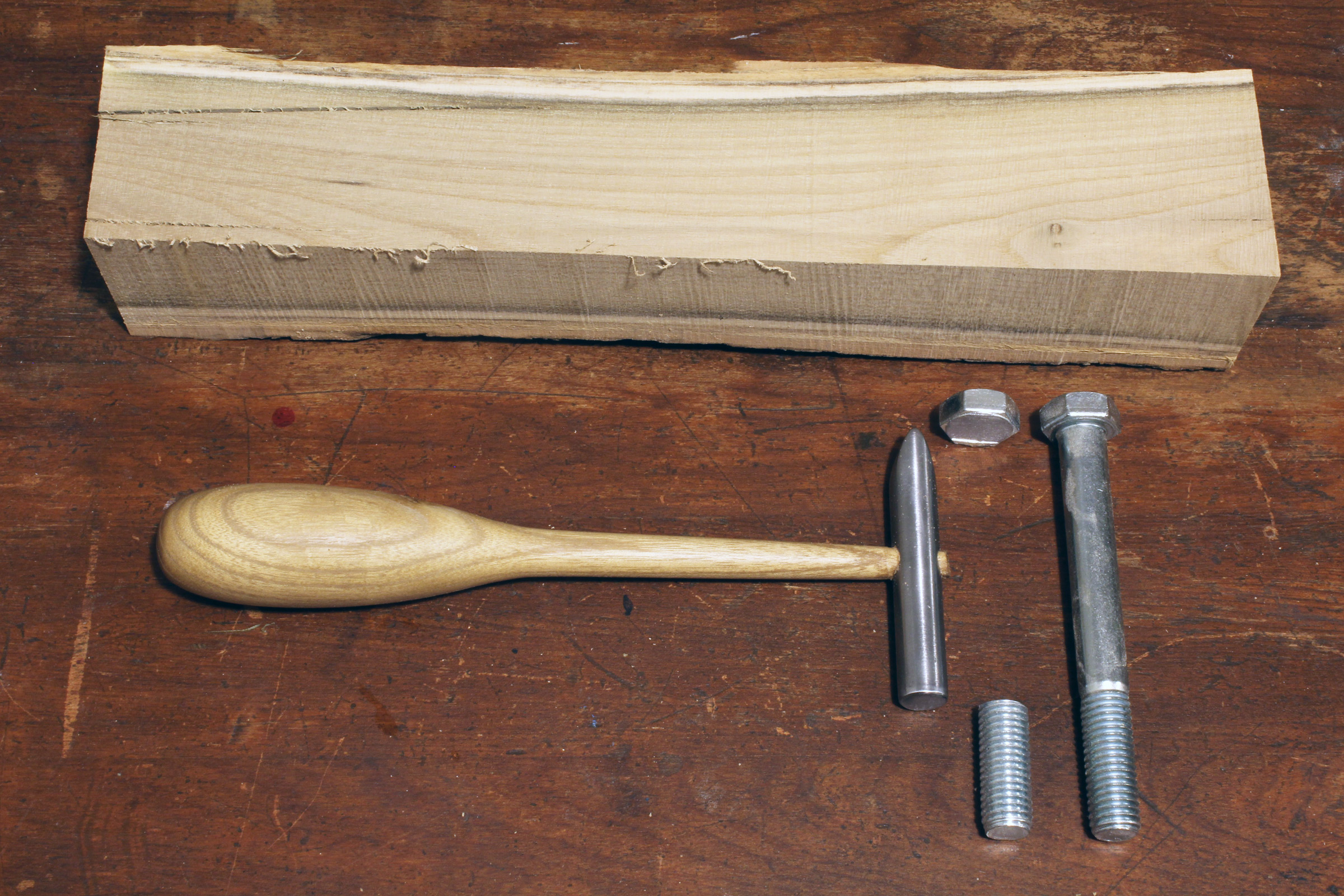
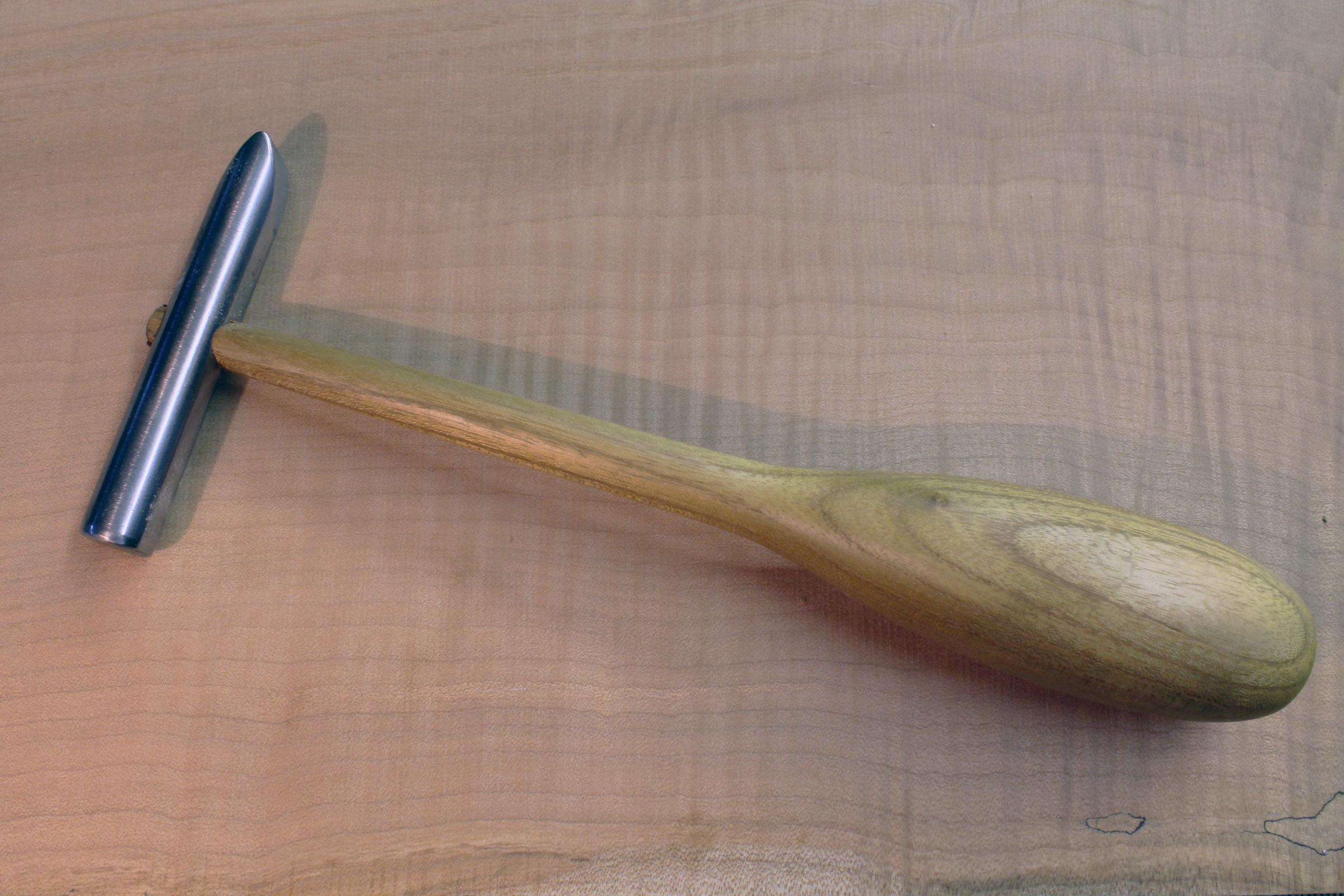
To do good work you need good tools. Some tools you can’t readily find in a store, and a proper riveting hammer is one of them. Happily, it’s not hard to make your own fine hammer. Rivet hammers come with cross-peen or ball-peen heads. This hammer’s head is fashioned from 5/8″ stainless-steel rod, the handle is turned from a 12″ chunk of 1-3/4″ square maple, and the wedge that flares the handle in the head is a sliver of ironwood.
Tom DeVries
The bulbous handles on these shop-made riveting hammers are a feature common to chasing hammers, which are used to emboss sheet metal. Their handles are shaped to ease the fatigue of lightly tapping chasing punches for hours on end, a task similar to peening copper rivet heads.
Work the metal head first. I start by drilling a 3/16″ pilot hole for the handle. Make a dimple with a center punch to keep the bit from wandering and clamp the rod to the drill press table.
Make adjustments as necessary to keep the bit straight and vertical. Follow the pilot hole with a 3/8″ bit. Next, round the end of the rod with a grinding disc on an angle grinder and smooth with a file and/or 80-grit sandpaper. Then, with a cutting disc in the grinder, cut the rod to length and finish off the flat side of the head. Remember that the steel gets hot after drilling, grinding, and especially cutting.
Tom DeVries
The author’s sketch provides dimensions for the hammer’s handle, head, and wedge.
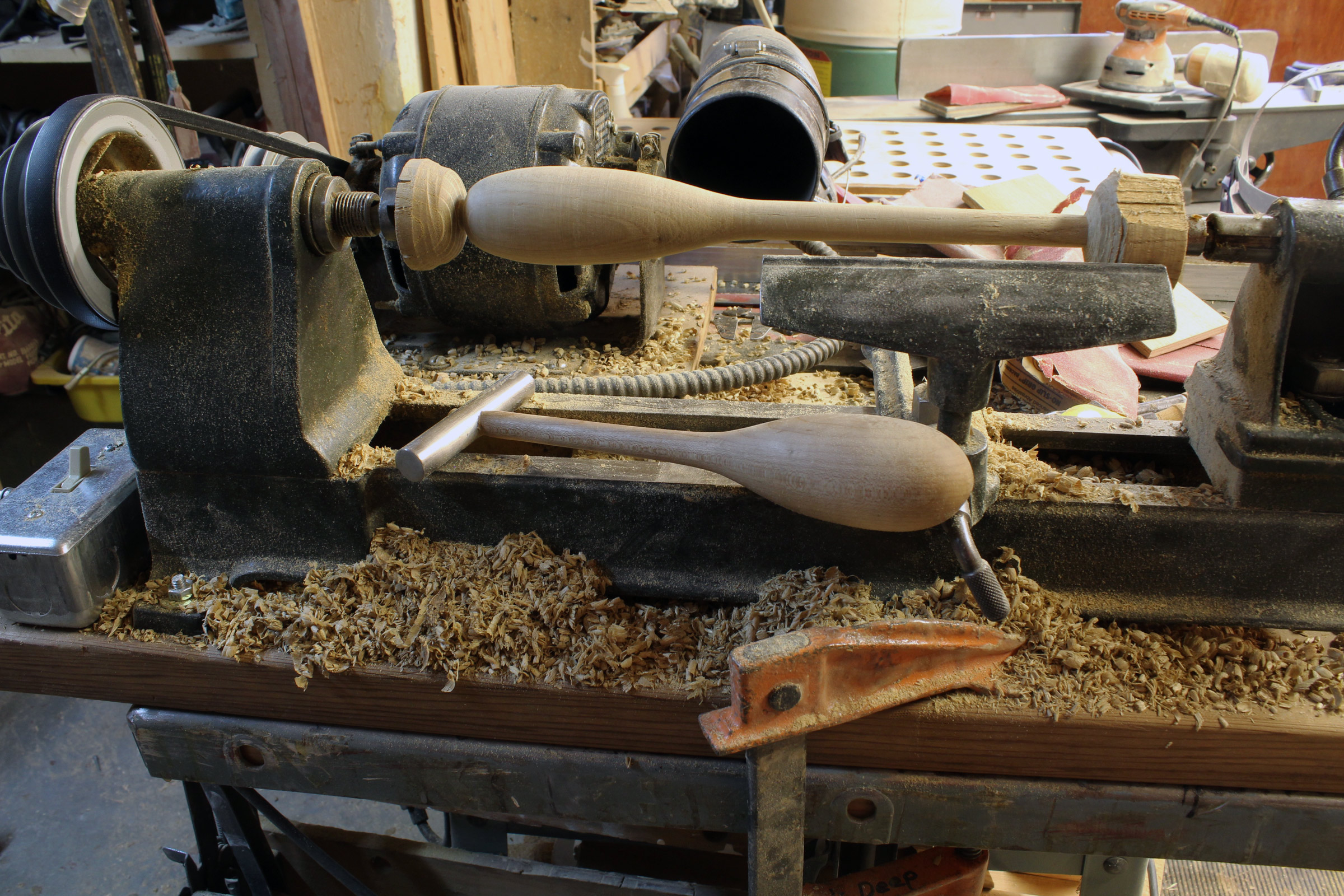
I used a lathe to turn the hard-maple handle. Hickory, oak, and ash are also suitable. Commonly, riveting hammers have slightly contoured straight handles, but the one I use has the bulbous handle of a chasing hammer, another type of metalworking hammer that does its work with light, repeated strikes. As the neck of the handle is pencil-thin for flexibility, a tight, straight grain is essential. The pencil-thin shaft of a ball-peen hammer I made 25 years ago has set thousands of copper rivets and will easily outlast me. Though I turned my handle on a lathe, you could do a fine job sawing out a blank and shaping with chisel, spokeshave, and files. Hammer handles are like chicken soup—there are a lot of recipes that make really good soup.
Using a fine-kerf saw, cut a slot parallel with the grain for the wedge. Finally, choose a wedge from maple, hickory, or a dense tropical wood. Oak and ash tend to crumble or split.
Fine-tune the fit of the handle and gently get the wedge and hammer head started. Orient the handle so the grain runs parallel to the head. Rest the assembly head down, straddling two wood blocks or an open vise, and tap the bottom of the handle with a mallet to start seating the head. Flip the hammer head-up and tap in the wedge a bit. Continue this upside-down, right-side-up tapping, gradually increasing the power of your blows, until the head is solidly seated. Trim the handle and wedge proud of the head.
As the drier air of winter descends, you may need to set the wedge a bit deeper. It’s good to have the option. Finish the wooden handle however you like. I use a mix of tung oil, varnish, and turpentine and occasionally rub on a coat of wax.
My hammer weighs just 7 oz. Copper rivets require light tapping to head them without distorting their shanks, and a small, light hammer is the best tool for the job. About 20 or 30 raps with the ball-peen flares a 14-gauge rivet, and a few final taps with the flat end seats and smooths the mushroomed head.
Tom DeVries and his wife Tina live in New Braintree, Massachusetts. Now that both of their kids are off to college, he spends more time in Beyond Yukon Boat and Oar, his woodworking shop, and imagines that away he and Tina will be spending more time together fishing, paddling, and sailing in little boats. In years gone by, Tom has pirogued on the Congo, canoed on the Yukon, fished commercially in Alaska, and sailed his skipjack on the Chesapeake.
Editor’s Notes:
Christopher Cunningham
For the hammer head, I cut the ends off a 5-1/2″ x 5/8″ bolt that I bought for a couple of dollars at a hardware store. That left me with a 3-1/2″ tempered steel rod. The bolt had a zinc plating, so I sanded that off with a belt sander equipped with a 150-grit belt. The wood I used was a locust windfall I gathered a few years ago. Chasing hammers often have handles made from fruitwoods.
Christopher Cunningham
Using Tom’s sketch and one of his hammers as a guide, I turned a handle with bulbous grip that is slightly longer and skinnier than Tom’s. I wanted to have two different shapes so I could explore my preference.
Christopher Cunningham
For my first hammer, I made a cross-peen head instead of a ball-peen. It’s better suited to small projects that I can rotate underneath the hammer to spread the impacts evenly. A ball-peen has the advantage working in a boat because the hammer can be used in whatever orientation is most convenient.
You can share your tips and tricks of the trade with other Small Boats Monthly readers by sending us an email.
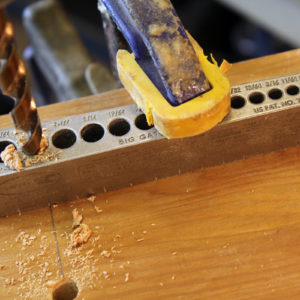
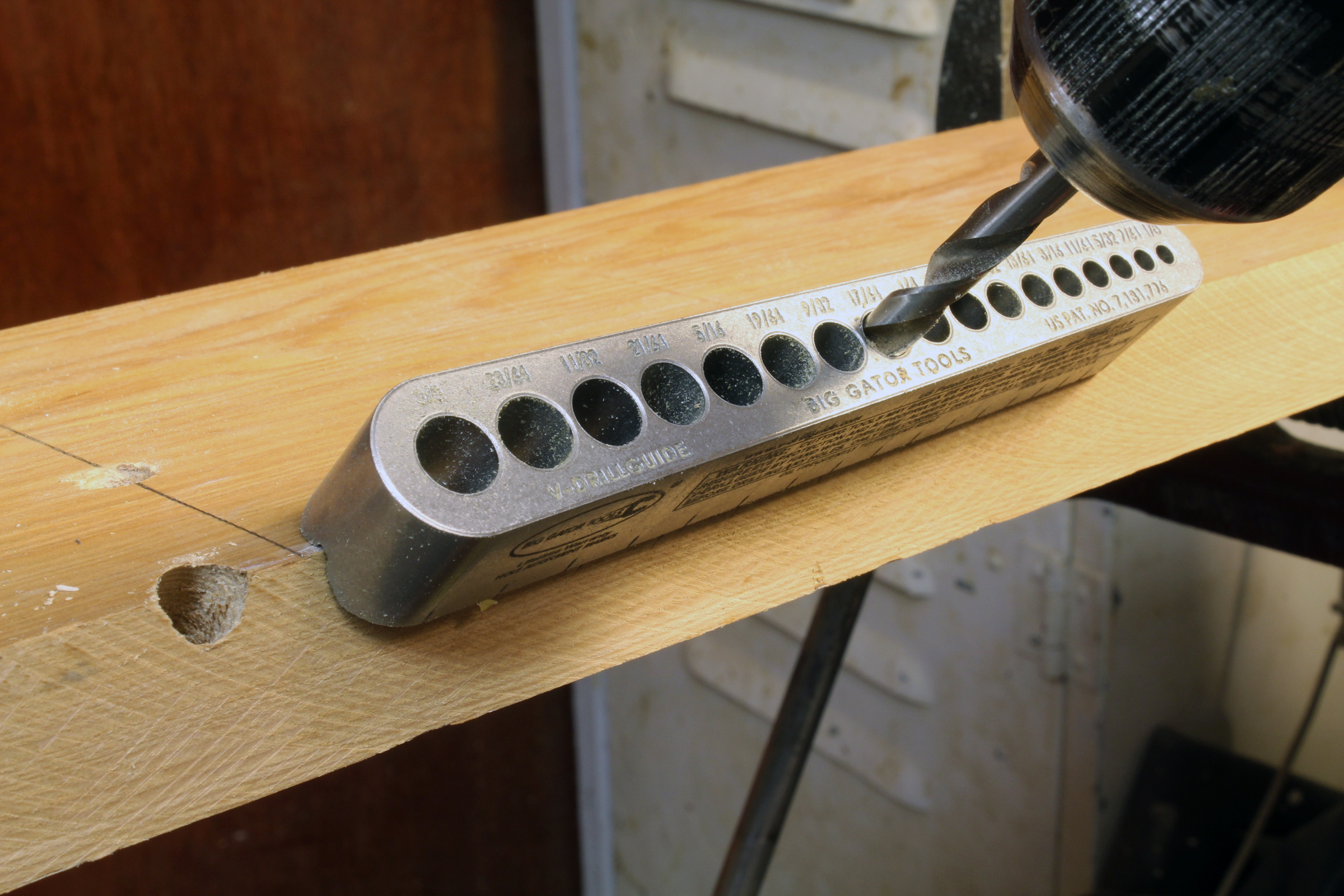
The tempered-steel guide has holes precisely sized to allow bits to spin freely and without wobbling.
I can count on my drill press to drill holes square to the workpiece, but there’s a limit to the size of what I can put on its table. I have a device that attaches to a hand-held electric drill; it has a round base, two vertical steel rods, and a chuck-equipped slider that’s guided by the rods. It works, but it’s cumbersome to use, and often too bulky for the jobs I need it to do. I’ve made a lot of wooden guide blocks on my drill press, but they get chewed up quickly with use and become less accurate as the hole I’ve drilled in each of them widens.
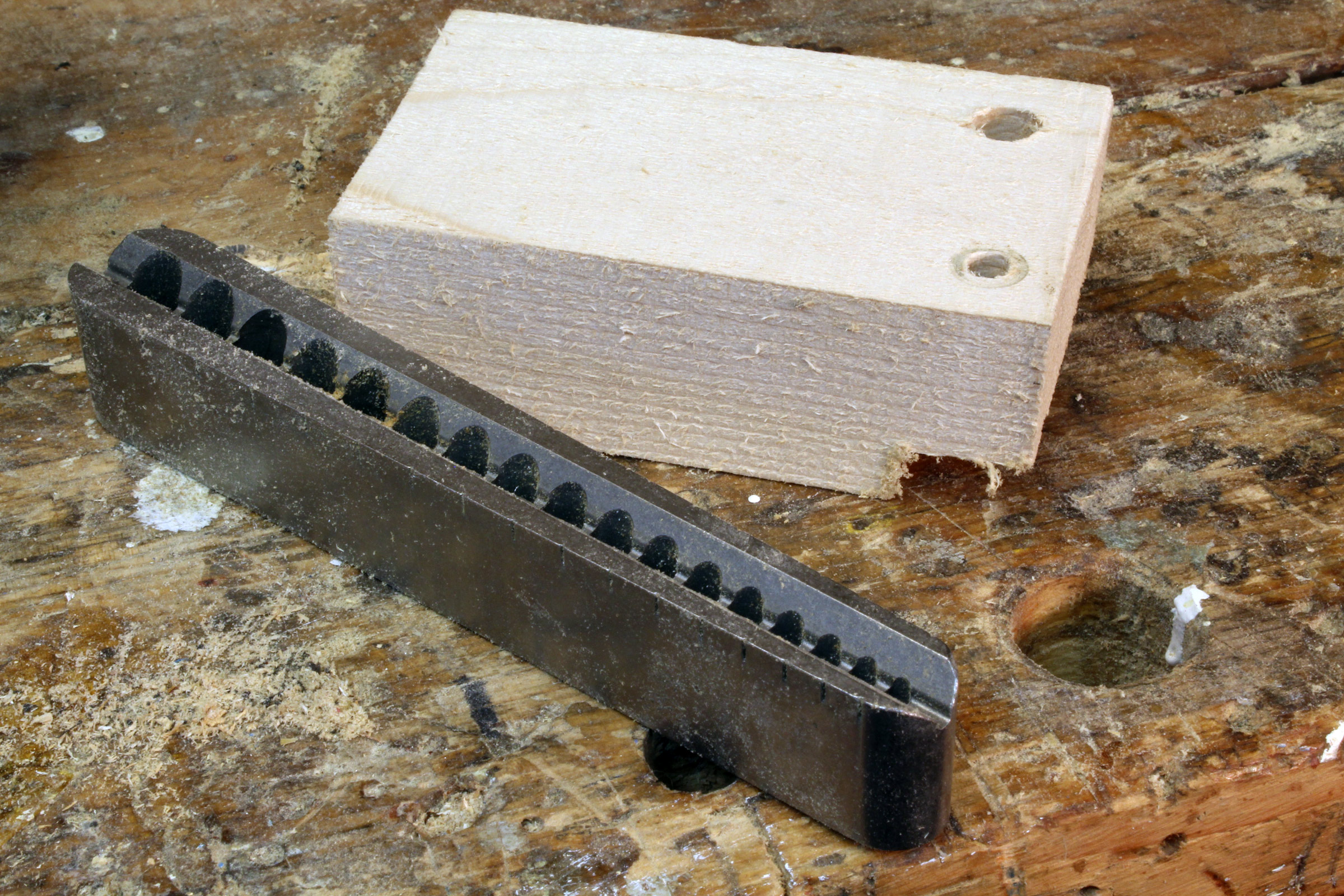
The groove on the bottom straddles corners and cylinders to align the guide. The wooden guide here is one I made before buying the V-DrillGuide. Having served its purpose—drilling a single hole for a lag bolt—it’s on its way to the fireplace.
The day before after I happened upon the V-DrillGuide on the web, I had made a wooden block guide for drilling a pilot hole for a lag bolt to support a bathroom shelf I’d made. That guide was, like all the others that preceded it, destined for the pile of wood scraps that would go into the fireplace on a cold evening. The V-DrillGuide looked like a much longer-lasting tool.
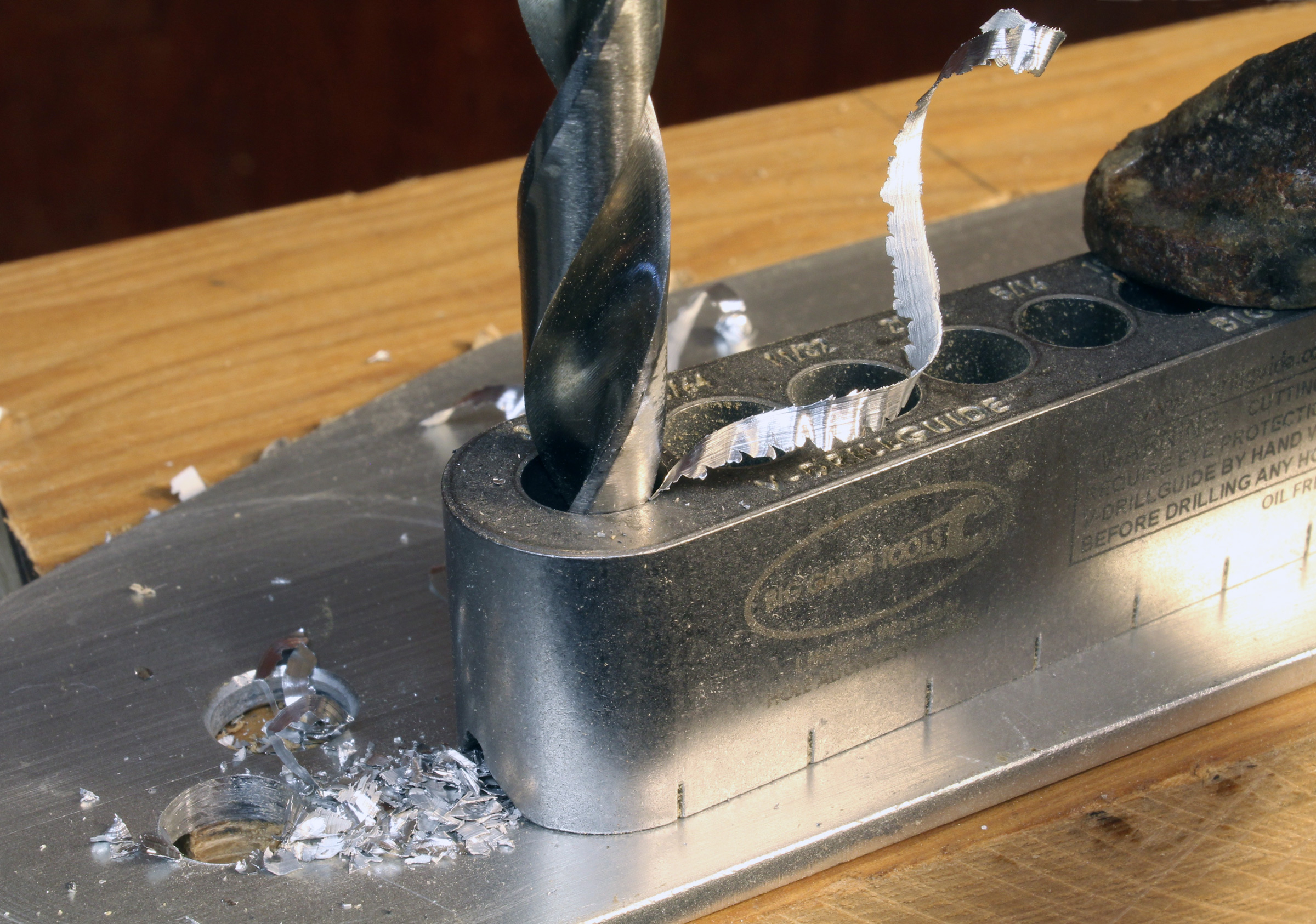
It comes in several sizes for both metric and imperial drills. I bought the 1/8″ to 3/8″ tool with 17 holes in 1/64″ increments. It’s made of steel that’s heat-treated for durability. I tried drilling a hole in it with an 1/8” bit and its tip just skated across the surface leaving only a faint scratch that is barely visible and almost undetectable to the touch.
Clamped to a flat surface, the guide keeps the bit on target. The hashmarks on the bottom edge of the guide are aids to placement.
The guide is 5-1/2″ long and 3/4″ wide at the largest hole. The markings are imprinted so they’ll never wear away. Even the fine print on the side is etched into the steel to make it permanent. Those instructions note: “Never hold the V-DrillGuide by hand when drilling—Always clamp V-DrillGuide securely before drilling any holes.”
The smaller bits, up to 1/4″, quickly bore into wood and stabilize themselves so with them I’m comfortable holding the guide by hand and the results are fine. Larger bits cause the guide to wobble as their tips start to get buried. I’ve achieved good results by locating the bit on the mark, getting the hole started, and then setting the bit up with the guide.
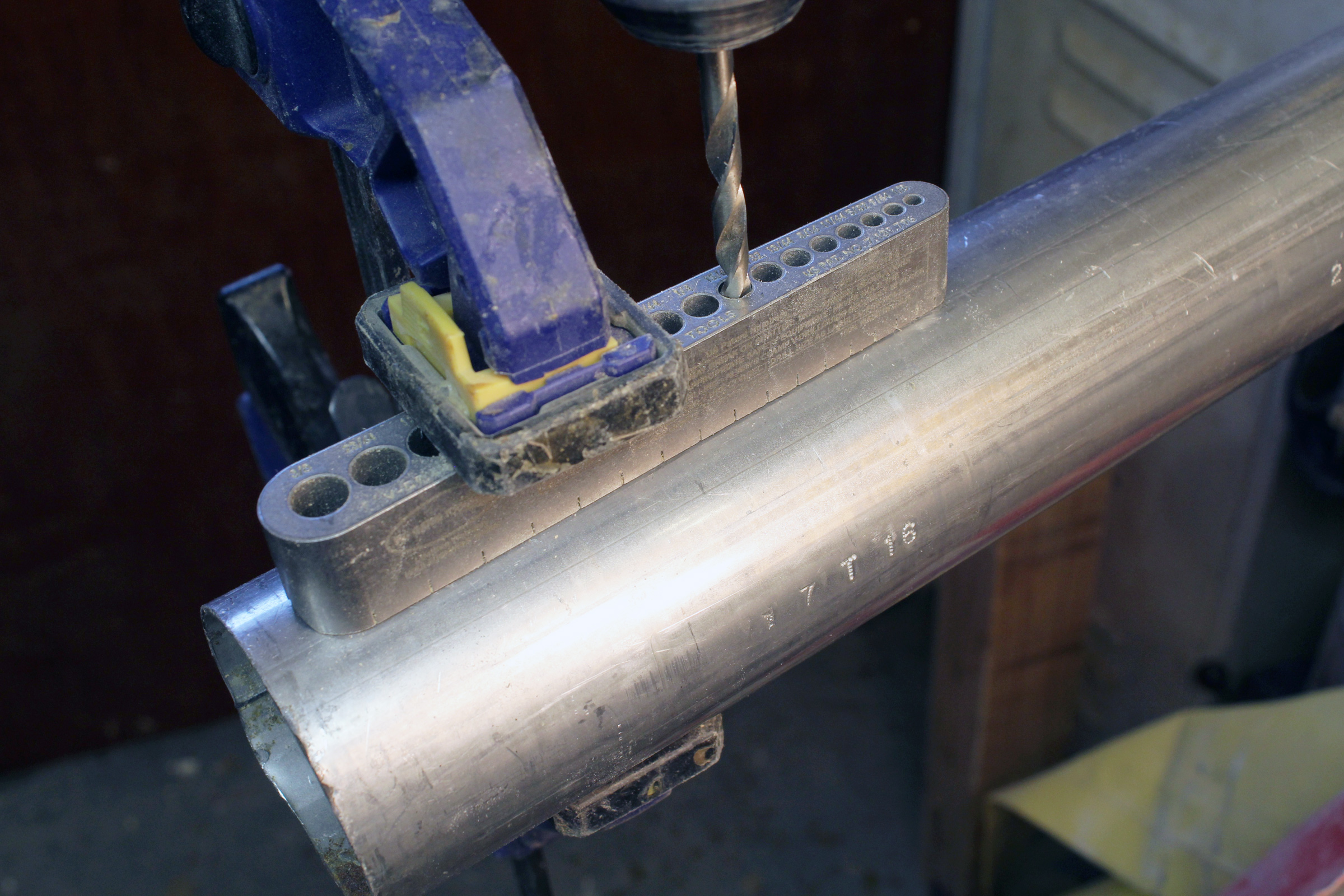
Even though the grove on the bottom is not quite 3/8″ wide, it aligns the guide perfectly when clamped to this 2-1/2″ pipe.
The V-notch on the bottom is about 3/8″ wide and parallel sided so the guide is self-aligning on round objects. Pipes and dowels lend themselves to clamping so that’s the best way to proceed. I was surprised that the narrow notch worked so well on 2-1/2″ pipe. Clamping the guide put it in perfect alignment.
Clamping the guide to the edge of a wide board would require special arrangements for a clamp, but the guide is steady enough on corners to be held by hand.
The groove fits right-angled corners, and with square stock, clamping is easy. Wide boards are awkward to clamp, but holding the guide by hand is enough to make it quite steady, even with a 3/8″ bit. I can’t think of a time when I needed to drill into a corner, but if the task ever comes up, I’ll be ready for it.
The guide is also useful for sizing drill bits. Even if the jaws of my drill chucks haven’t smeared the size markings on a bit, they’re hard to read. Finding the hole that fits on the V-DrillGuide is a quick way to sort a bunch of loose bits.
The packaging for the V-DrillGuide has the red “As seen on TV” logo; I might have found my way to the tool sooner, but I cut my cable and got rid of my TV years ago. I’m happy to have it in my toolbox now. Better late than never.
Christopher Cunningham is the editor of Small Boats Monthly.
To get the best from our small boats we like to keep them shipshape. We often beach launch and have sand and water to clean up after returning to shore, so to make the chore easier we bought a Porter Cable Cordless 20V Max 2-Gallon Wet/Dry Vac. It does a great job, and we have been pleasantly surprised with many other jobs that it takes care of in our shop and home.
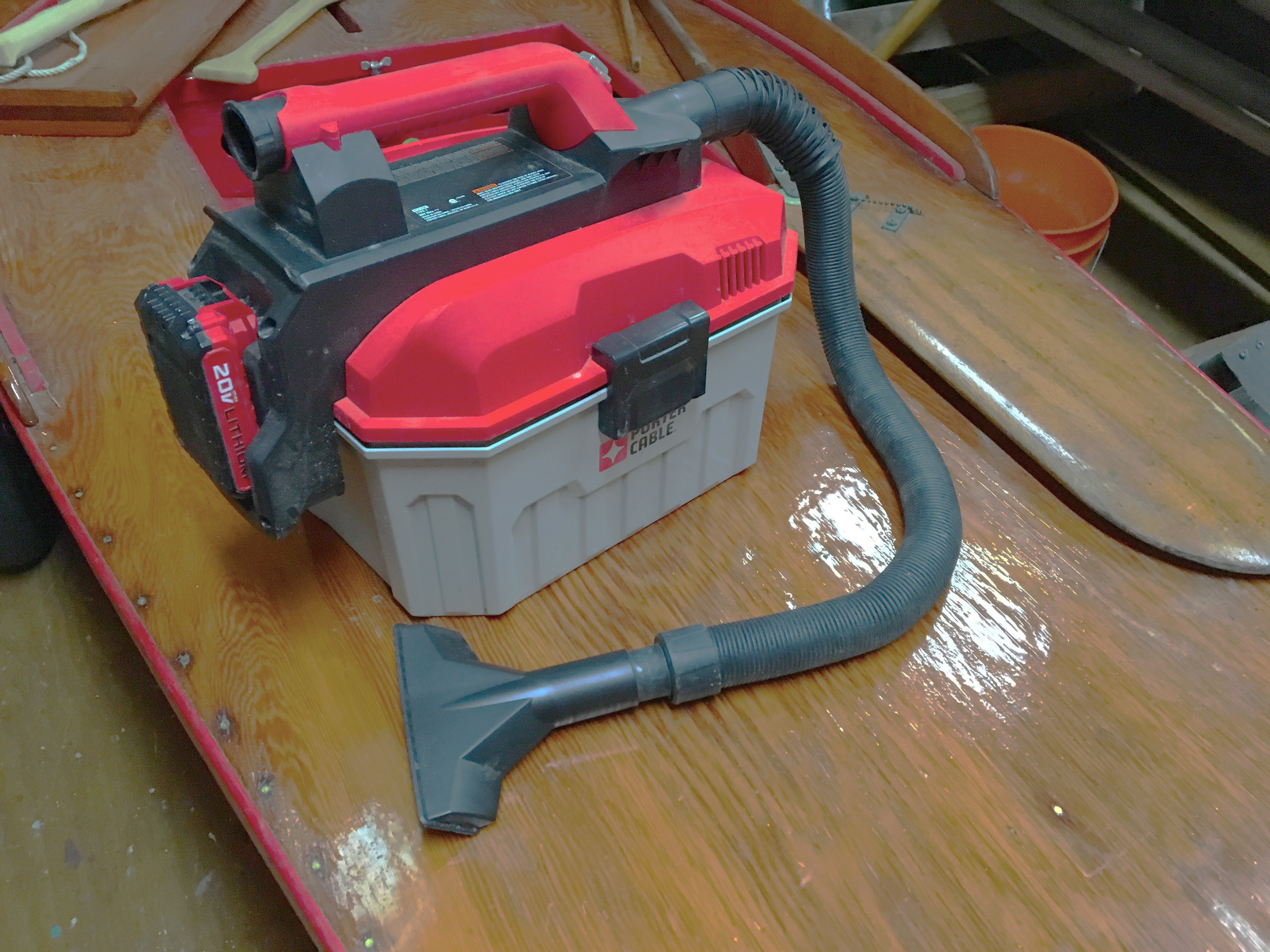
The vacuum weighs just 7-1/4 lbs (without battery) and is very portable. The 7′8″ hose is sturdy and flexible, and wraps neatly around the power head when not in use. A crevice tool stores in the power head and a wide-nozzle tool stores on the side of the tank. The battery clips into the end of the power head.
Kent and Audrey Lewis
The vacuum carries a crevice nozzle in the handle and a battery on one end of the case. When not in use, the wide nozzle here clips into a recess in the other end and the hose snaps into hollows around the whole case.
One of our favorite uses for the Vac is cleaning up sanding dust left over from fairing a hull. It can also collect dust when its hose is attached to our random-orbit sander. With the hose switched to the exhaust port, we use the Vac as a blower to get debris out of bilges or to test the Sunfish sailboats that we restore for air leaks.
You can quickly convert the Vac from dry mode to wet by unlocking the two latches on the power head, removing the large, washable air filter, and replacing the head. The 34-cubic-feet-per-minute suction makes quick work of the bilgewater in our Penobscot 14; it will fill the tank in a couple of minutes.
The vacuum is quieter than a regular shop vac, and its small size makes it easy to store and to move between our different saws. There is no bag to dump, so it’s quick to empty. The 1-1/4″ hose will fit common vacuum accessories; a soft brush head is a good addition to the provided attachments.
The 20V lithium-ion battery and charger have to be purchased separately. We bought two 1.5-Ah batteries; they have about 20 minutes of run time and take 40 minutes to charge. The charger has LED lights to indicate charge status and overload protection so batteries can stay in the charger indefinitely. Larger 2-Ah and 4-Ah batteries with longer run times are available, and they all work with other Porter Cable 20V tools. The battery power is our favorite feature—no electrical cords around wet boats! We liked the Vac so much in the shop that we bought a second one for the house to do small jobs such as cleaning stairs and dewatering air-conditioner drains.
Kent and Audrey have a small fleet of boats, canoes, and kayaks to maintain after spending time on their home waters in Florida. They log their adventures on their blog Small Boat Restoration.
The Max 2-Gallon Wet/Dry Vac is available from various retailers. Prices vary widely, from $49.99 to about $79.99. Batteries and charger, which power a number of Porter Cable cordless tools, must be purchased separately.
Is there a product that might be useful for boatbuilding, cruising or shore-side camping that you’d like us to review? Please email your suggestions.
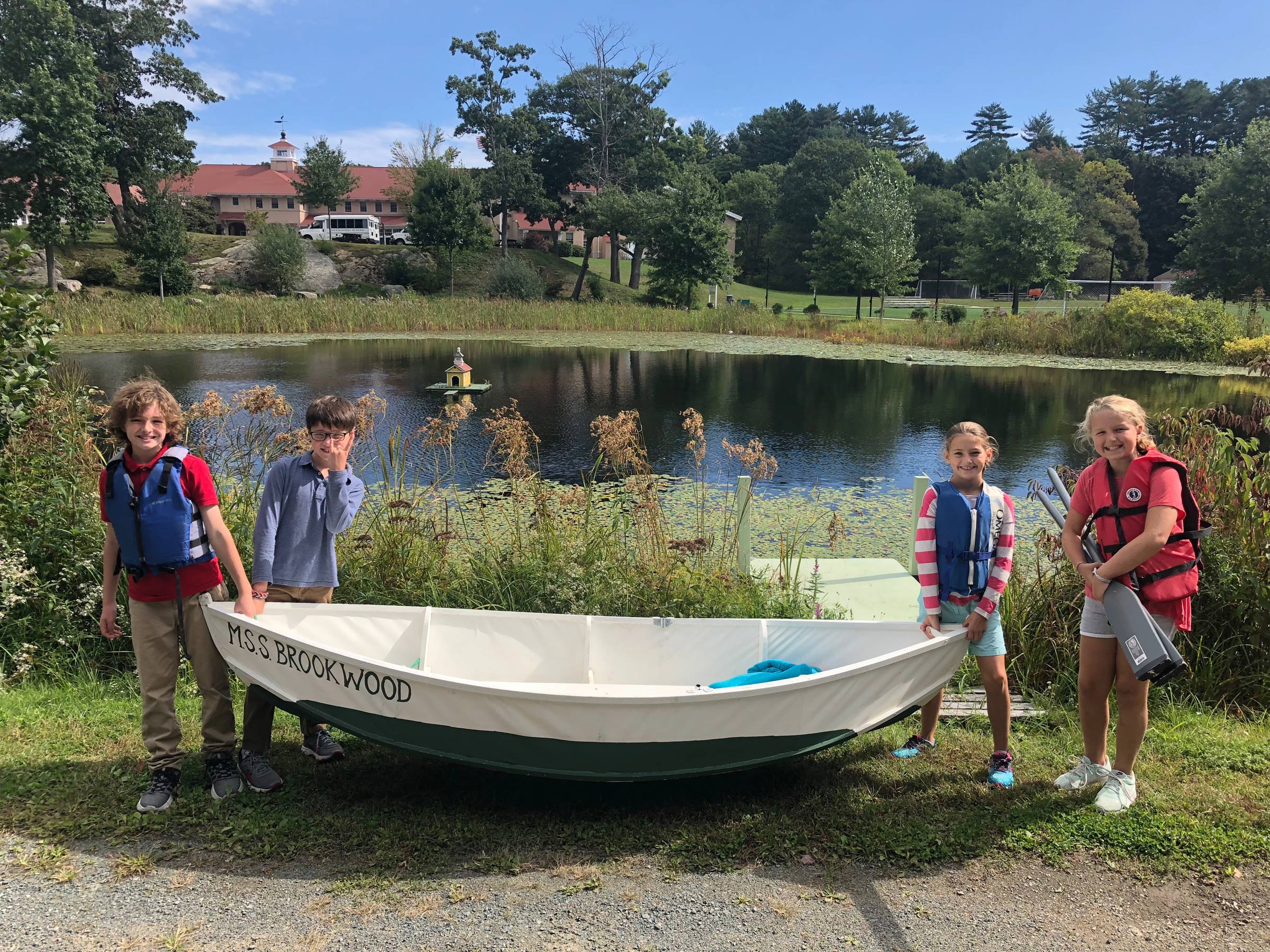
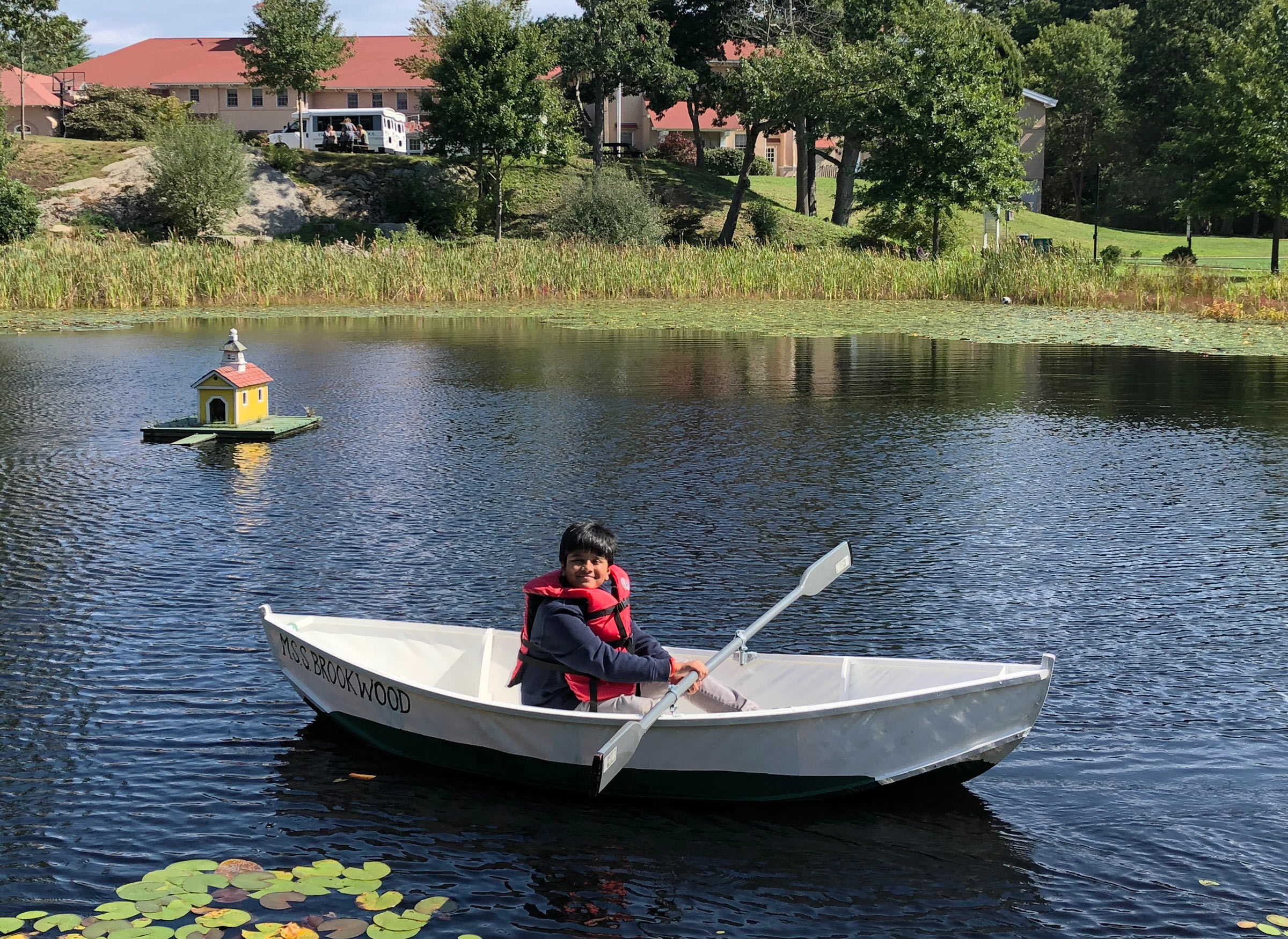
Middle schoolers have the privilege of taking MSS BROOKWOOD out rowing on Cutler Pond on the edge of the school grounds.
Halfway between Swampscott and Gloucester on the Massachusetts North Shore is Brookwood, a private school serving students from pre-kindergarten to the eighth grade. Located in an area with a rich maritime history, it was, perhaps, inevitable that boatbuilding would work its way into the school’s curriculum. The idea had been floating around the school’s faculty for a few years and when one of the school’s classrooms was scheduled to be vacant during the 2015/2016 school year, the space was available for a workshop.
Sven Holch and his fellow fourth- and fifth-grade teachers took the opportunity to introduce 90 students to “design thinking and project-based learning” under the guise of hands-on boatbuilding. The students were divided into nine “watches” with maritime names like Stellwagen, after the Stellwagen Bank fishing grounds. Every week, each watch would gather in the Boatyard, as the classroom had been named, ready to do some boatbuilding.
The design chosen for the build was the 9′ canvas-on-frame double-ended tender designed and built by Ned MacIntosh back in the 1940s when he and his wife were living aboard their Atkin cutter STAR CREST in Panamanian waters. The boat caught on among other cruisers, especially after Ned added a sailing rig. Soon there was a fleet of about 20 of them. When STAR CREST returned home to New Hampshire Ned made more of these lightweight tenders. Maynard Bray, an author of many books on boatbuilding and a frequent contributor to WoodenBoat, saw the tender, took a liking to it, and measured one of them to create drawings to work from to build one for himself. His plans were the starting point for the Brookwood project.
Boatbuilding was new territory not only for the students but also for some of the teachers who participated in the project. “We’re all starting from ground zero,” said Sven. “Building a boat together is the perfect place to practice not knowing anything. We’re using the boatbuilding project as a way to teach about learning styles—metacognition. The kids can think about their thinking at this age.”
From the very beginning, the students kept journals documenting their progress:
“Today I learned about a stern. At first I thought that it was the front of the boat but I learned that it was the back of a boat.”
“Today I also built replicas of the boat. They were nine inches. We had to scarf the stringers. We had to cover it with paper. And use popsicle sticks to make seats.”
The hands-on project gave student real-world connections to academic studies. “The math, science and classic STEM curricula tie to the project in numerous ways,” Sven noted, “including but not limited to displacement, angles, scale, joinery, characteristics of water, measurement and more.”
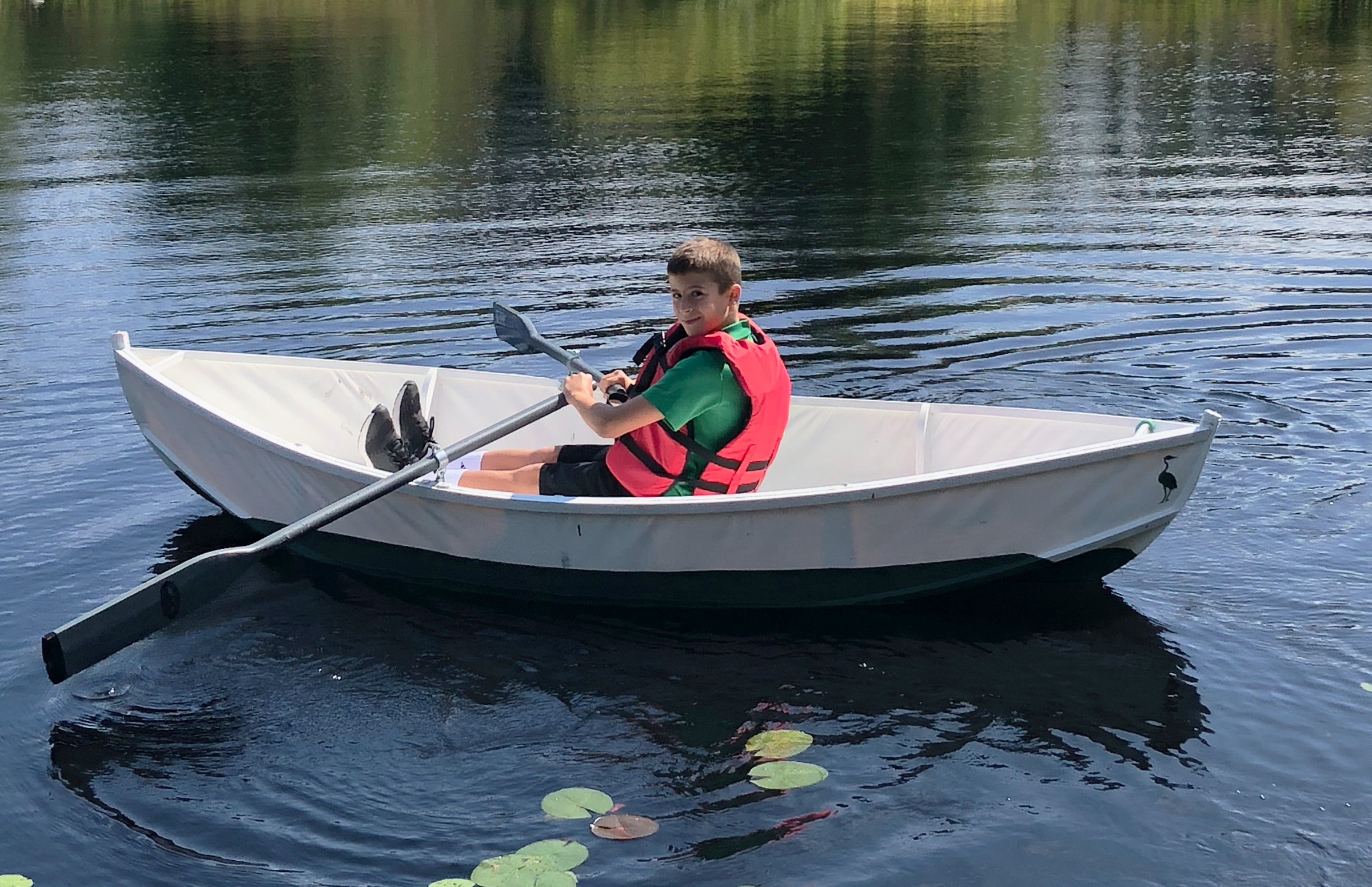
The canvas boat has held up well for the three years it has been used by students to practice rowing on the school’s pond.
The boat was launched on Cutler Pond, situated between the school and its soccer fields, and christened MSS BROOKWOOD in a ceremony led by Head of School Laura Caron, made Admiral of the fleet for the occasion. The MSS stands for Middle School Ship. Students took turns rowing around a duck-sized schoolhouse—complete with a Brookwood-style cupola—that floats in the middle of the pond. Rowing became the next learning opportunity after the boatbuilding.
The boat’s bow bears the heron from the school’s logo. The pond is a good habitat for herons, so the school chose it as its symbol when the school was founded in 1956. This version is now “old school,” as the logo was updated this summer.
Since its launching, MSS BROOKWOOD continues to rule the pond unchallenged and hasn’t leaked a drop.
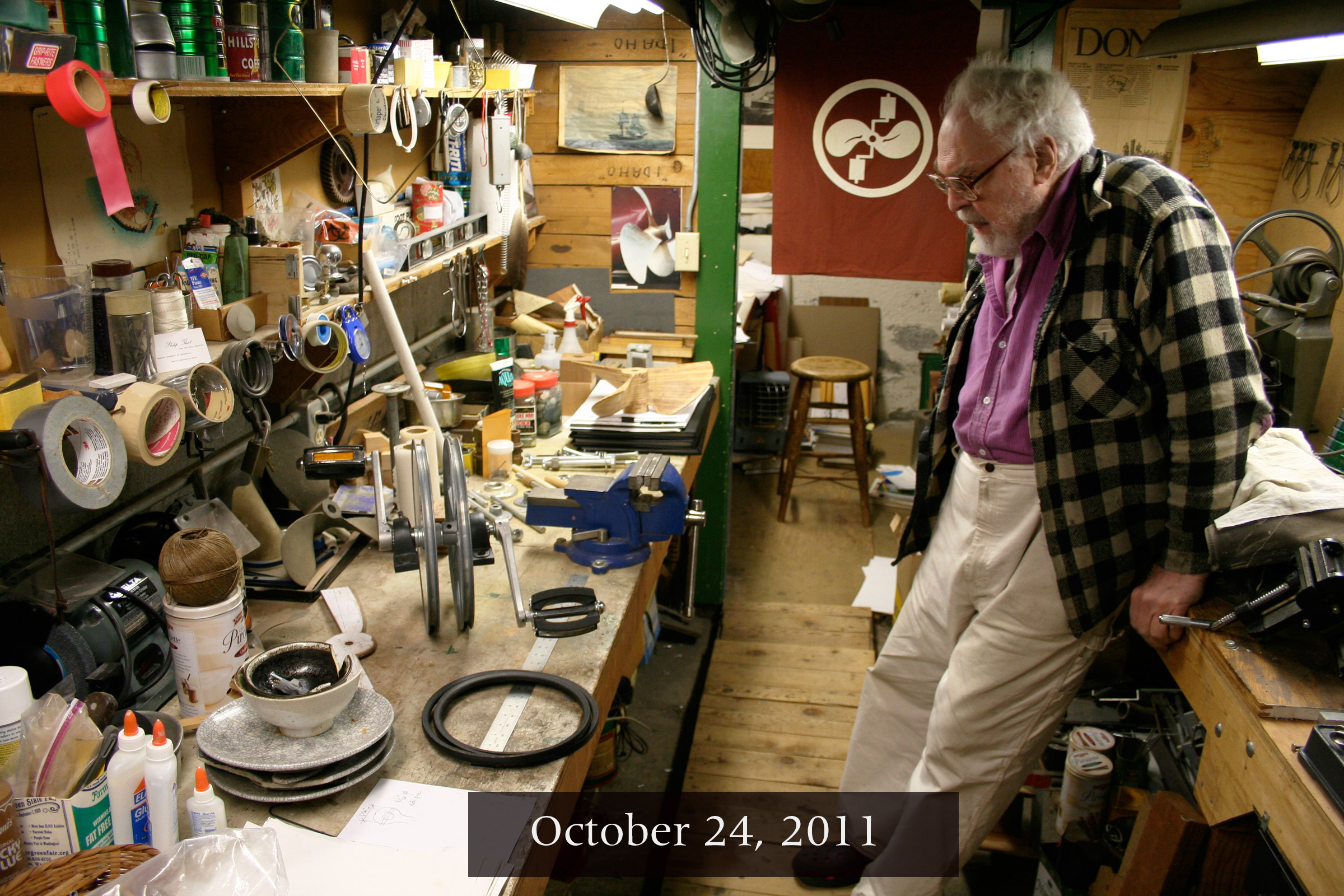
I first met Phil Thiel in 2009. My son Nate had just graduated from high school and was eager to build a boat, so we decided upon Phil’s 18′6″ Escargot canal boat. We paid a visit to him at his home, only a half dozen miles from ours, and he led us to his basement shop where he had his stock of plans, all stored in cardboard tubes. Over that summer, I coached Nate and his friend Bobby through the build and kept Phil up to date with the progress.
I continued to keep in touch with him after BONZO, a slightly modified Escargot, was launched in October. Phil was ill, with no hope of recovery, so I visited with increasing frequency, offering to help in any way I could; I had several of his plans sets scanned so they’d more easily made available. I had lost my father suddenly the year before, so I knew how important my remaining time with Phil would be. When I was offered this job, working with WoodenBoat as the editor of Small Boats Monthly, I knew how happy that my father would have been for me, but he was gone. I told Phil, and I got the smile I needed from him.
I was with Phil, his family, and a few friends when he passed away on the evening of May 10, 2014. Since then I have had the privilege of visiting Phil’s shop and have kept in touch with his family—wife Midori and children Kenji, Tamiko, and Kiko. It is with their kindness that I can share a few glimpses of my absent friend.
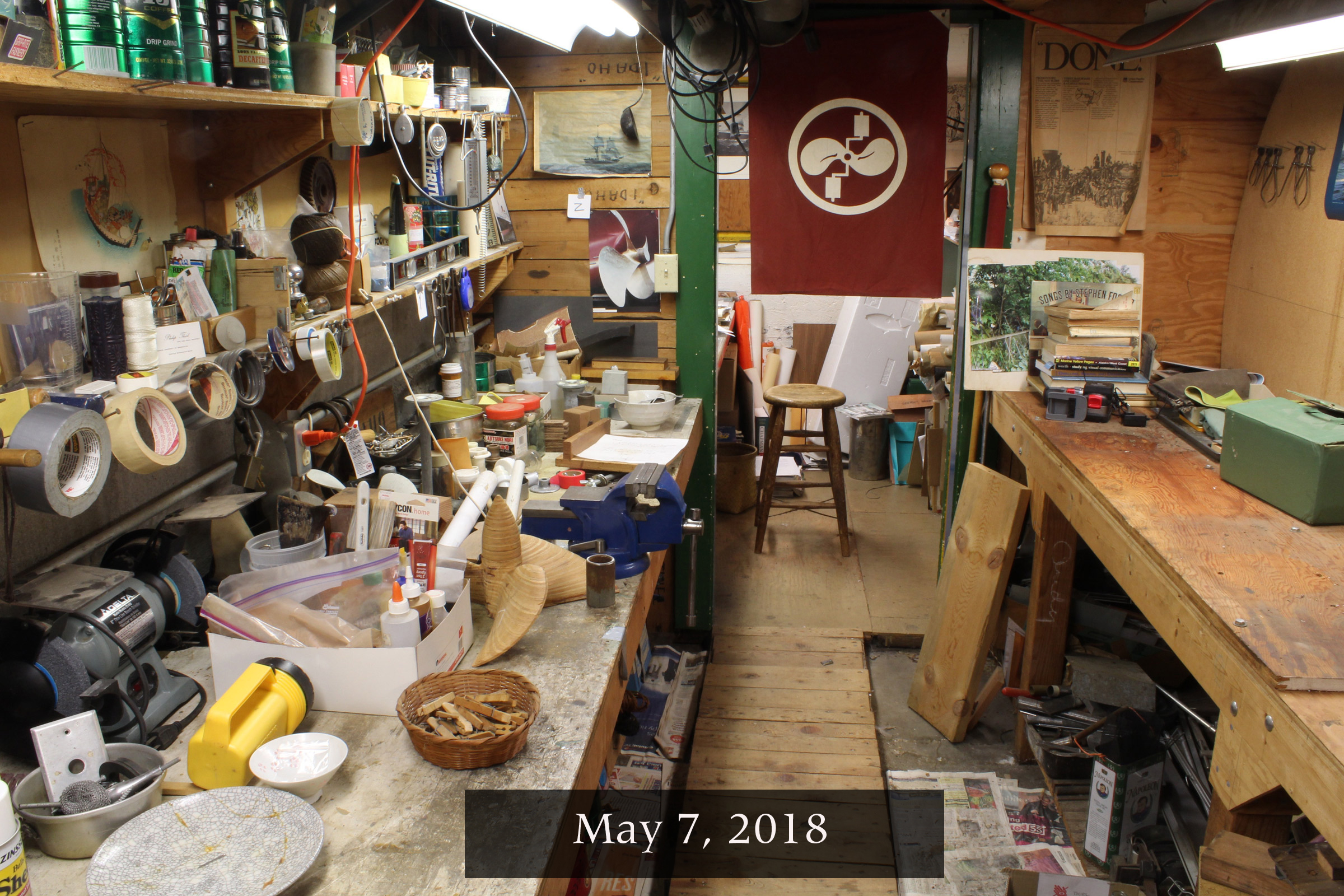
You could say Phil’s shop is “organically” organized. His tools and materials aren’t separated into categories, they’re intertwined like the roots of a tree, and the juxtapositions—waxed paper, an old brass scale, and a padlock, or tarred marline, a trailer ball, and toothpicks—have an engaging, even poetic quality. Over his home’s front door, there is a sentence, one of many written in all caps in white chalk on the dark exposed ceiling beams, that reads: “A LOT OF WHAT I DO GROWS OUT OF WHAT I’M DOING.” The shop fosters that sense of unexpected possibilities and is fertile ground for the imagination.
Phil bought this machinist’s lathe, used, on November 24, 1987. It’s a South Bend C9-10JR, manufactured in South Bend, Indiana. Its original owner purchased it in 1949. The headstock needed some work and a few parts were missing, so Phil wrote to the manufacturer on January 9, 1988, beginning with: “Ladies and Gentlemen, I have recently achieved a life-long ambition and at age 67, a few weeks before retirement from teaching, acquired a South Bend Lathe.” The motor, here hidden from view, delivers power to the lathe with a flat leather belt, seen on a three-step pulley.
For woodturning projects there is a small lathe driven by a motor mounted underneath the workbench. Here, it has a sanding disc attached to the headstock and a wooden table on the tool rest. His daughters have fond childhood memories of spending time in their father’s shop using this lathe.
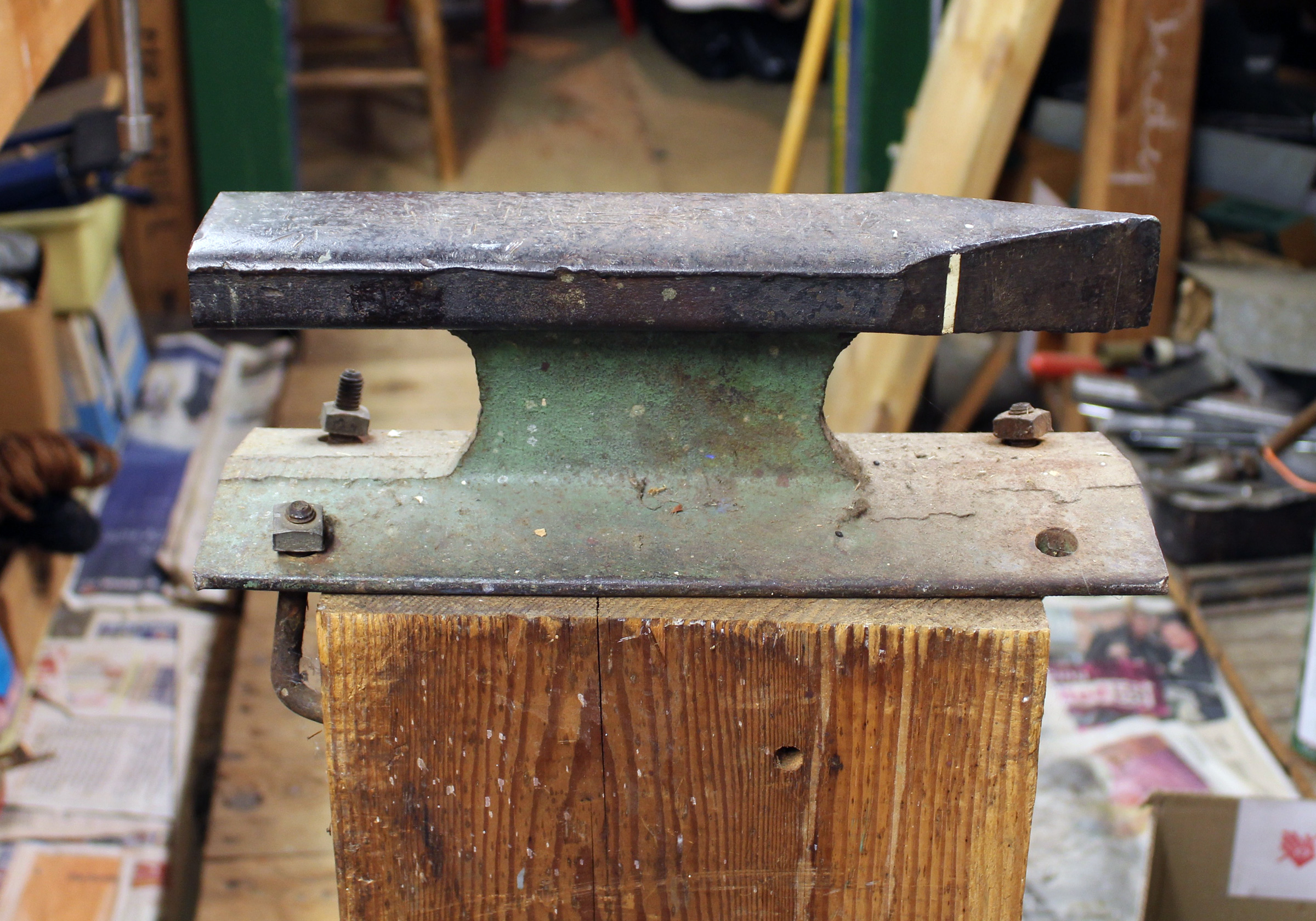
The anvil was made from a section of railroad track and fastened to a short timber. It was portable and could be set on the basement’s concrete floor rather than a workbench, which would bounce and rattle everything else on the bench top.
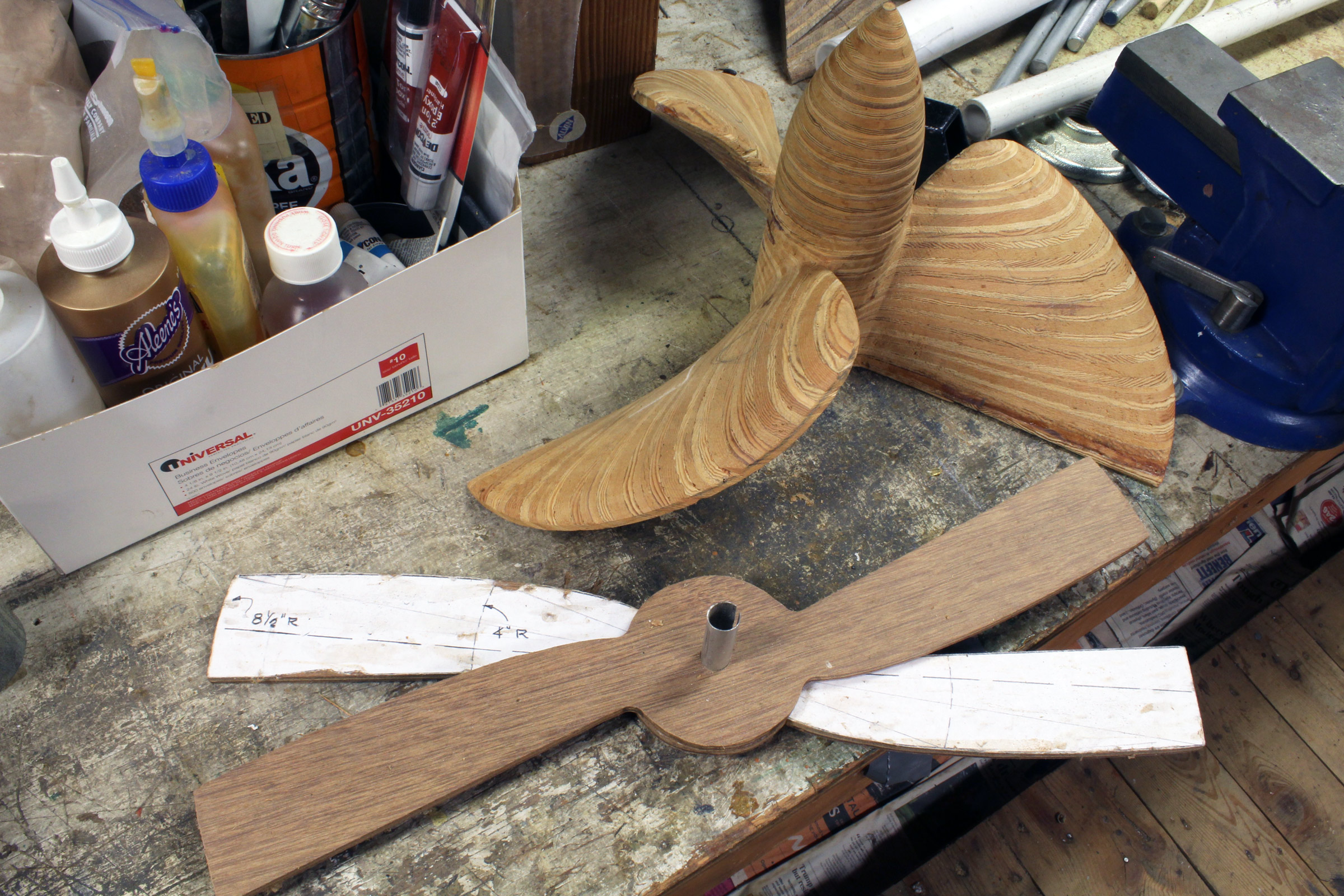
The pedal drive in Phil’s Sanpram required a propeller specifically designed for modest power and a peddler doing about 60 rpm, so Phil designed a wooden prop of stacked plywood. The pattern for the plywood rests on the workbench. Stair-stepping the pieces according to the marks on the paper pattern creates the proper pitch. The long cone on the finished prop reduces drag.
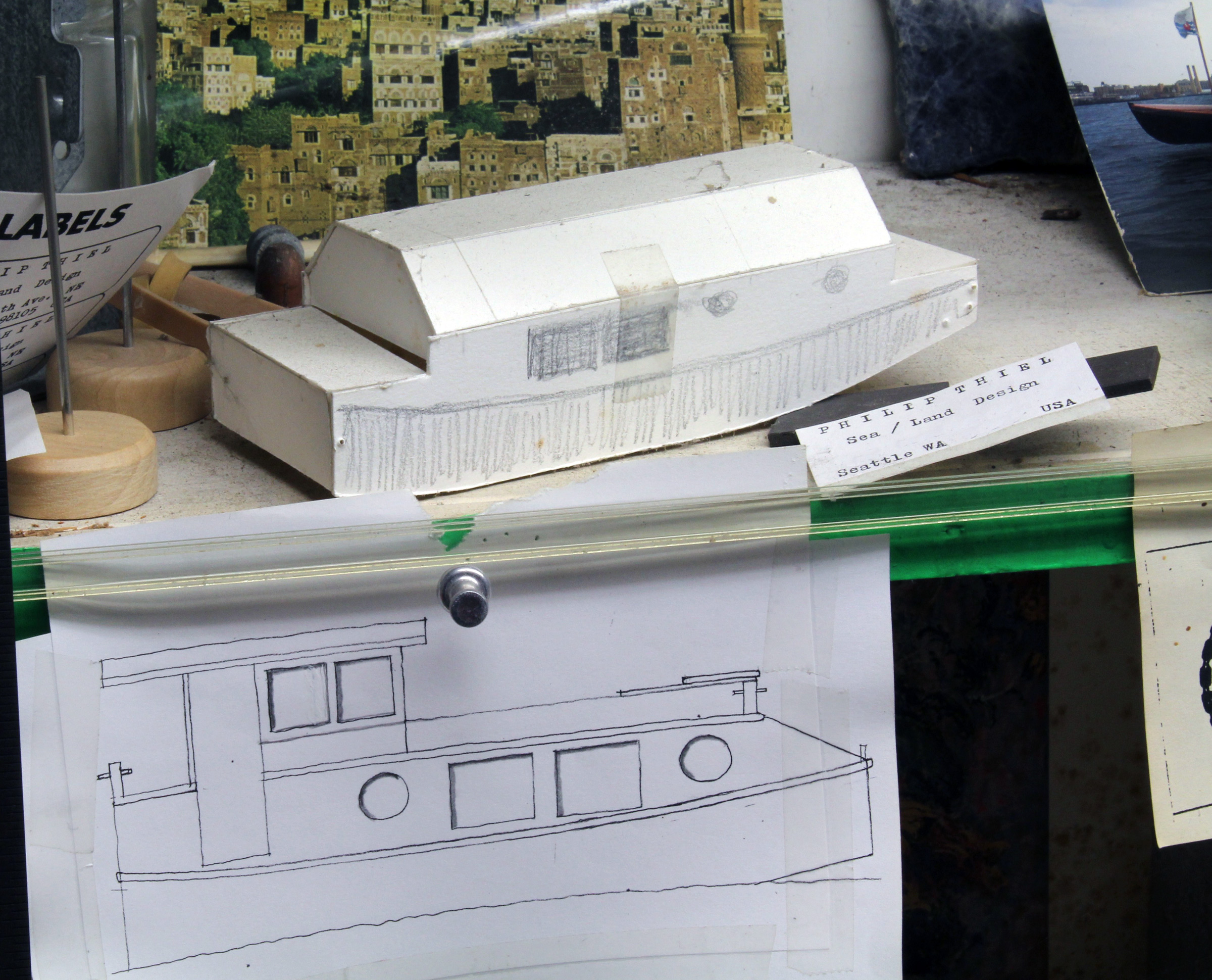
Phil made a lot of paper models as he developed his designs. This one appears to be the 22’9″ Joliboat. He used a similar angled roof as an option to provide more headroom in the L’Ark version of the Escargot. The drawing below is a freehand sketch of the 22’9″ Friendship.
Phil kept busy right up to his last days. This is his desk as he left it. I haven’t been able to figure out what his last drawing was about.
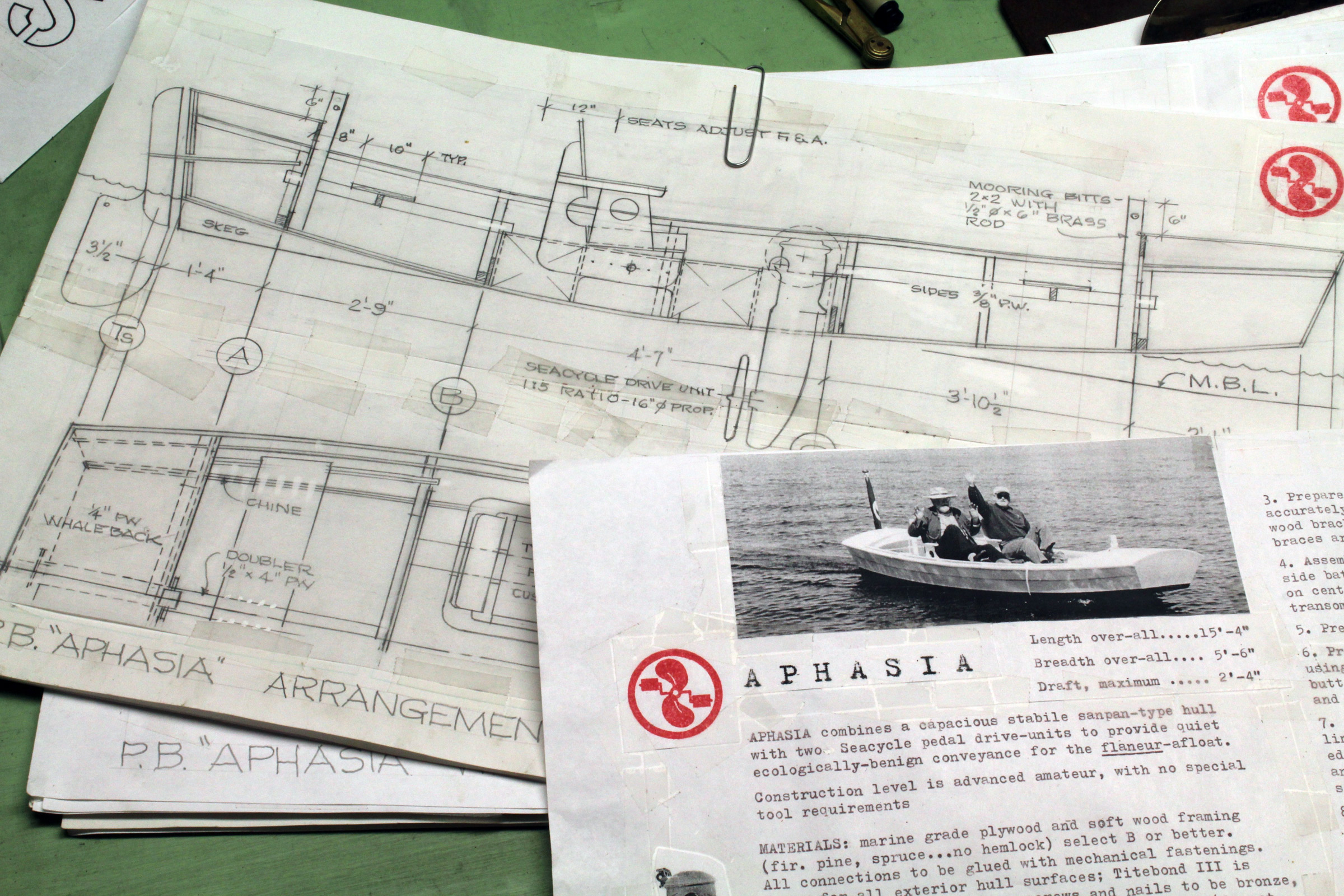
For all his technical prowess, Phil never went digital with his work. He did all of his drawings by hand, inked them flawlessly, and then taped pieces together to make masters to be photocopied. The year before he passed away, I took the originals drawings for his small wooden boats to a copy shop and scanned them. The digital files will assure the survival of his work and make his boats more easily and widely available. The red stamp has a propeller and bicycle pedals joined and set inside a circle. It’s an indication of Phil’s interest in Japanese culture. In Japan, a Kamon is a symbol of one’s clan and has been used since the 12th century. It’s like a European family crest but with a broader set of relationships. Designs in circles are a common form of Kamon. Phil had another circular symbol—a snail, set on ripples of water, with SERENDIPITY written in an arc to complete the circle. His serendipitous snail is a reminder to go slow while boating and to leave yourself open to chance.
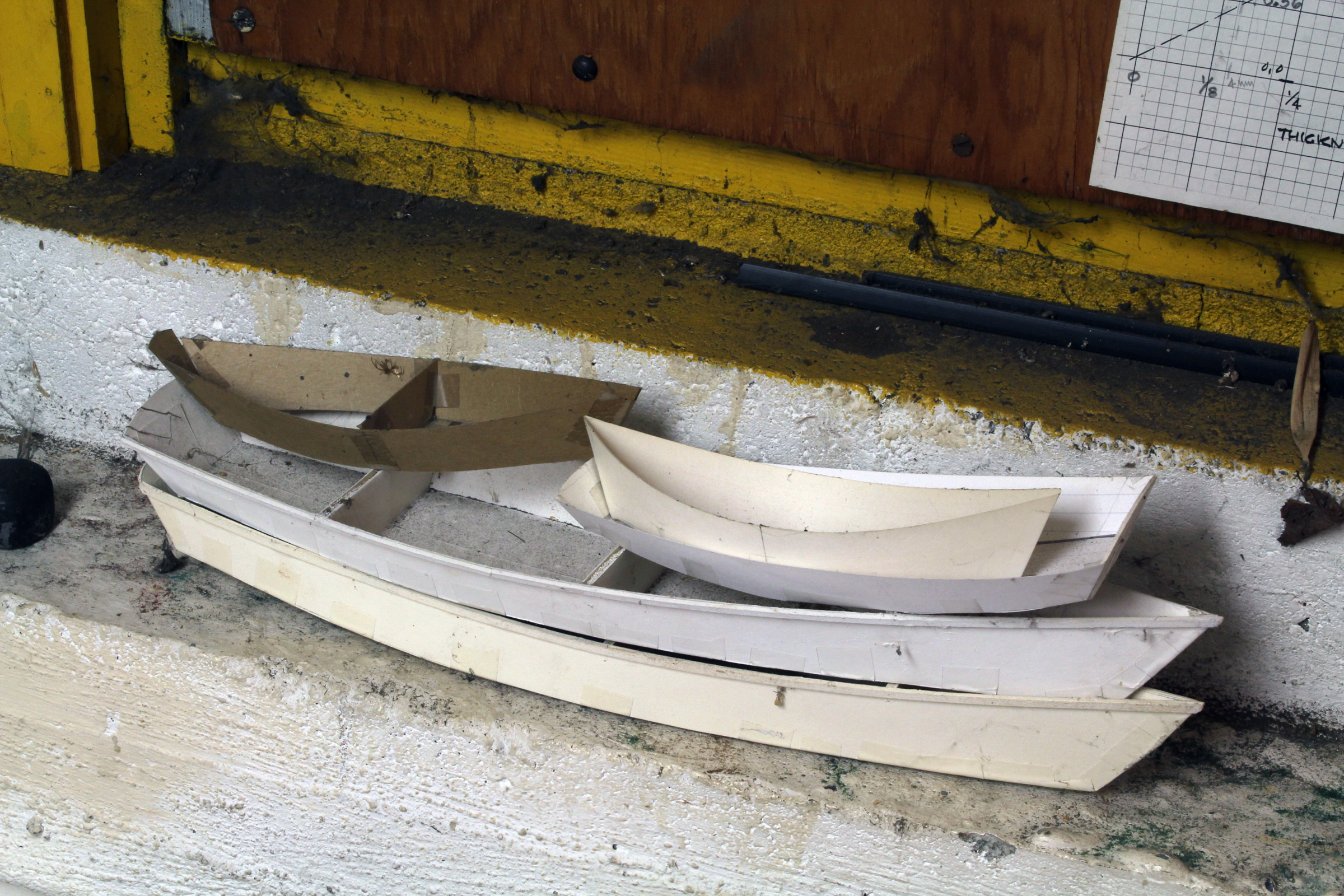
Sitting on ledge near the drafting table is a stack of paper models: a tombstone-transom dory at left and a double ender sitting in a pram at right. The two long models at the bottom are for the 15′ 7″ Skiffcycle, one of the smallest of Phil’s “pedal-powered boats for the flâneur-afloat” and designed for a commercial Sea-Cycle drive. Phil’s graph plotting boat speed and pedal rpm shows the Skiffcycle reaching 5 1/2 mph, though Phil, a flâneur himself, wouldn’t dream of rushing about at such a pace, missing all of the sights, sounds, and scents to be taken in at a more leisurely pace. On at least one occasion, he furrowed his brow when I told him I usually paddled my kayak at 6 mph.
Models for the 15′ 4″ Aphasia (left), designed in 2006, and the 12′ 4″ Sanpram, designed in 2011, are resting on drawings for the Escargot. The Center for Wooden Boats in Seattle has had the first-built Aphasia in its rental fleet for many years and it’s the most popular boat in the fleet. It is equipped with two Sea-Cycle pedal drives, making the boat extremely maneuverable. With one drive pedaled forward and the other in reverse, it can spin around in its own length. The Sea Cycle drives are expensive, so for the Sanpram, Phil designed a drive for the do-it-yourselfer. Bicycle pedals and cranks turn large pulleys and V-belts transfer the power to a small pulley and an idler on the propeller shaft. The propeller is made of stacked plywood, like the one on his workbench.
Phil kept the tools he treasured most in a locked file cabinet. This is the first time the drawer has been opened since his passing. In the wooden box to the left is a proportional divider. To its right are two dial opisometers, or curvimeters, for measuring lengths long curved lines. I don’t know what the three devices with handles are. The black one to the right, made by Nikkor, has a lens that provides a fisheye view. The two with wooden handles are Phil’s home-made versions using wide-angle door viewers for lenses. The leather case at the bottom holds one of many slide rules.
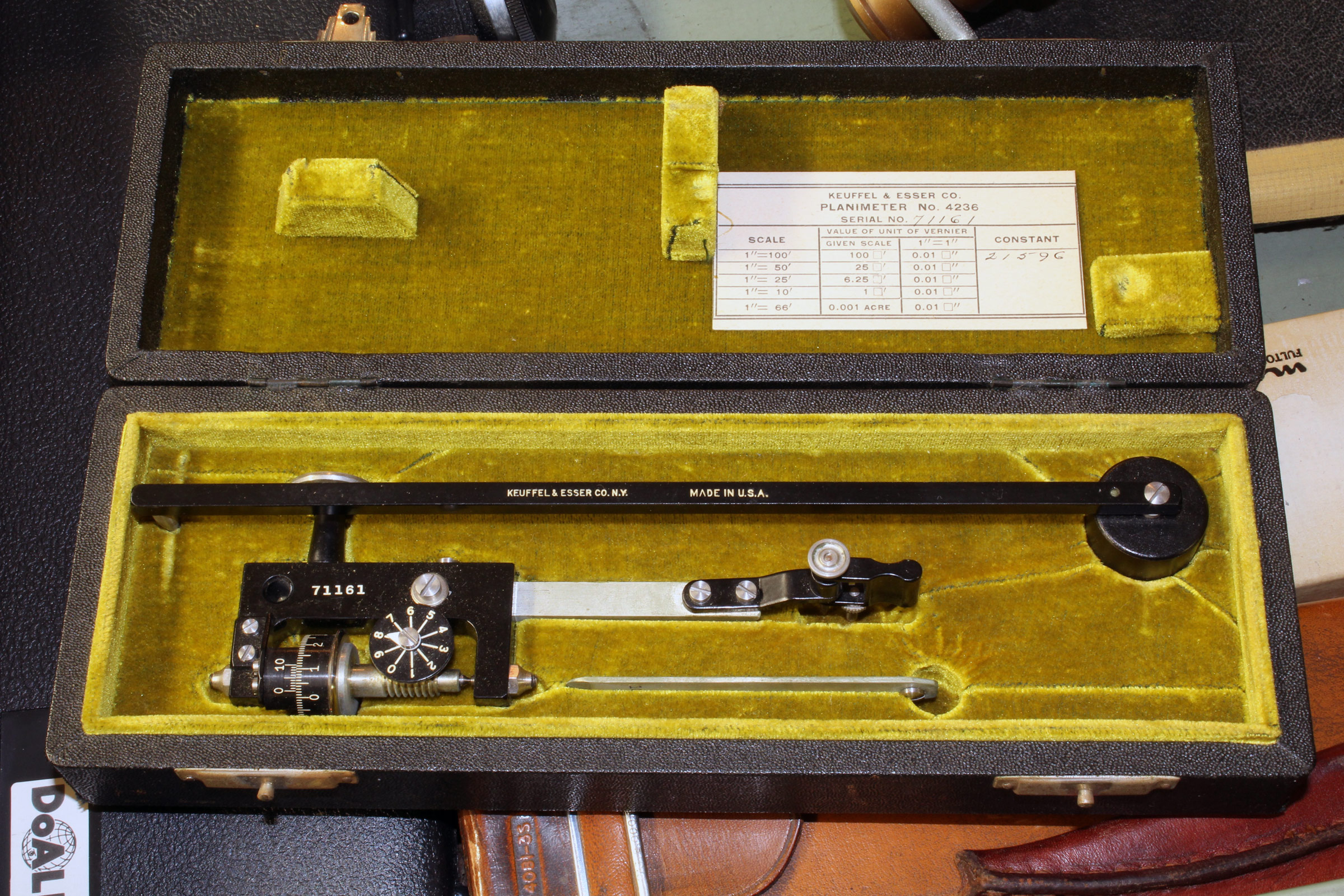
I only knew what this was because I have one was passed down from my grandfather, a civil engineer. It’s a polar planimeter used to measure the area of shapes on a drawing. The top arm has a pin with a weighted disk to hold it in place. The other arm has a pointer that is used to trace the shape’s perimeter. The cylinder on the lower left has a polished steel wheel that both rolls and slides as the pointer moves. By some miracle, the area shows on the scale when the outline is complete. The planimeter can be used in boat design, for example, to measure the areas of hull cross sections.
This second model of the Aphasia was Phil’s most recent development of the design and did away with the expensive Sea-Cycle drives, adopting instead the DIY system of the Sanpram. I found the remains of two moths in the cockpit, the only passengers to ever get aboard the redesigned boat.
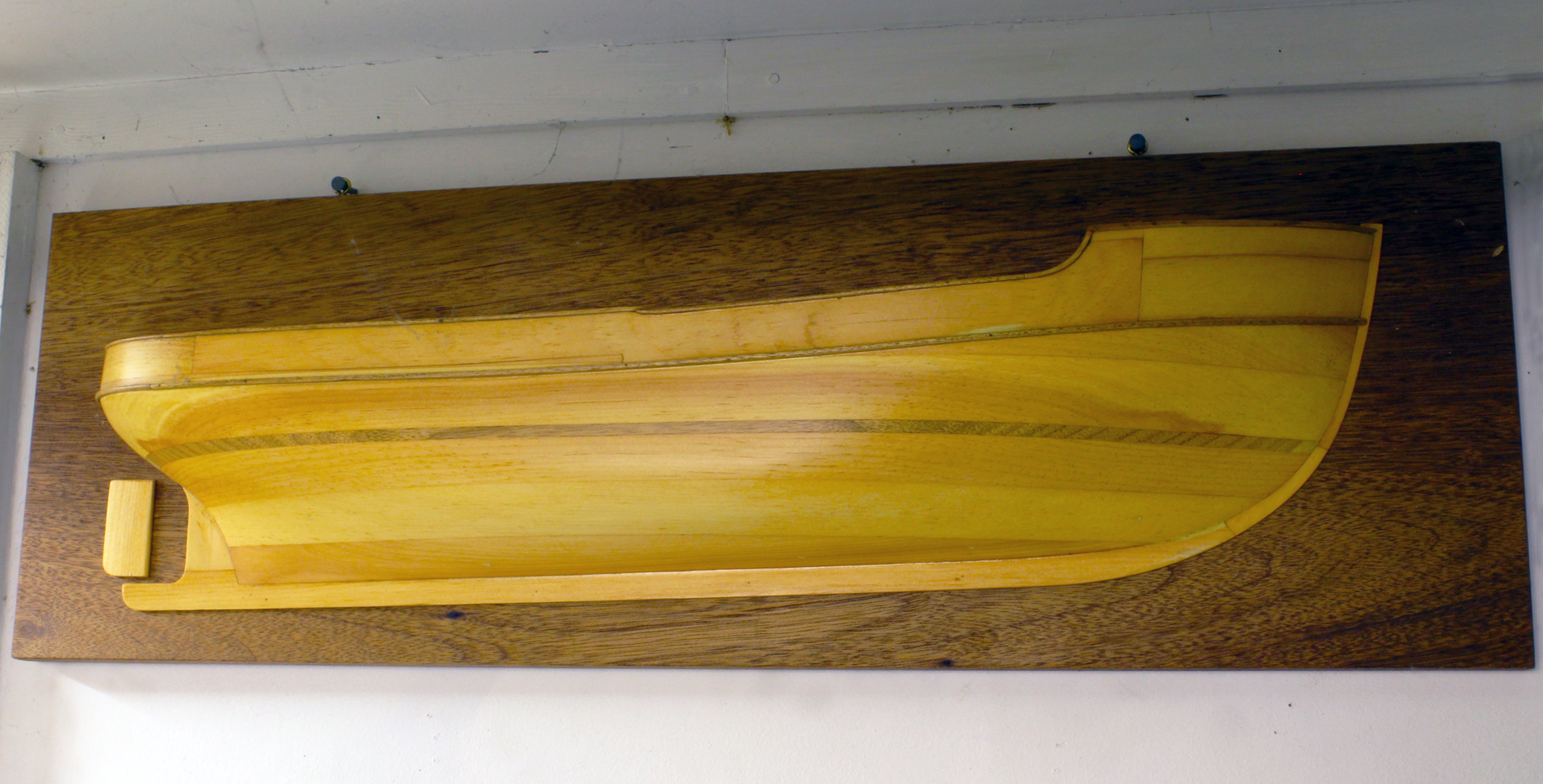
There are no markings in this half hull. Phil did some work designing commercial vessels and this may be one of them. It hangs in a room adjoining the shop, a windowless room lined with bookshelves.
Among the models in the shop is a steel passenger ship of unknown origin (Identified by a reader as the SS Tacoma. See Clayton Wright’s comments below.) and a freighter with a nesting barge. As I recall from my conversations with Phil, he designed the freighter while working as a naval architect. The idea was to create a system where cargo carried by two different means did not have to be reloaded. It’s like the freight trains that carry trailers or containers that are also hauled by truck or by ship. A barge used for inland waters could be floated aboard this purpose-built sea-going vessel.
Phil did a lot of international travel and has bookshelves full of photo albums and file cabinets full of slides. His interest in boats of all kinds is evident in his photographs.
Hidden in the library was this painting. On the back is written in Phil’s hand: “Philip Thiel, late ’40s, early ’50s while student at M.I.T.” His oils were applied quite thickly, giving the painting rich texture. I knew he could draw well, but this was the first indication I’d had that Phil was, among everything else, a talented painter with an exceptional feel for color and free-flowing forms. It was a side of him that I discovered only after he was gone.
Henry Rushton, of Canton, New York, was a preeminent boatbuilder in the late 19th and early 20th centuries. Living and working between the St. Lawrence River and the Adirondack wilderness, and his skill in designing, building, and marketing small boats allowed him a long career. Rushton may be best remembered today for his lightweight cedar canoes. His Wee Lassie is still a popular hull design built in all manner of methods. Maybe less well known these days are his pulling boats. According to Atwood Manley in Rushton and His Times in American Canoeing, rowing craft accounted for the bulk of his trade.
Photographs by the author
In the original boat, the planks were clench-nailed to the frames through the laps. Here they are riveted. A single copper clench nail secures the laps between frames. These planks have glued scarfs; the drawings show plank sections joined by scarf joints set in varnish and held with clenched 1/2″ copper tacks.
The Ruston 109 is an old-fashioned guideboat type combining lightness, good looks, and easy rowing. It’s a double-ender with nearly plumb stems, a lapstrake hull, and sweeping sheer. The boat is 14′3″ long with a beam of 39-1/4″. Many of Rushton’s pulling boats were offered as rowing/sailing combinations with a compact folding centerboard and a rudder with a yoke and steering lines. The plans for the 109 show no accommodation for sailing but do offer a rudder design. No doubt the fashion of the late 1800s allowed a fellow to pull hard on the oars, not seeing where he was going, while his amiable companion pulled the ropes.
My wife, Tina, and I have long enjoyed fishing the lakes, bays, and rivers of the mid-Atlantic states and northeastern U.S together. We’ve spent many fine days afloat in an aged, lumpy, chopped-off canoe that’s as slow as a slug. Last winter, with my shop idle, I decided to upgrade our fleet by building a spry fishing boat for two that we could also enjoy rowing solo. Anything much longer than 14′ would not fit in my work space. I’d never built anything with a transom, and I like the looks of double-ended craft. Happily, I came across Ben Fuller’s 87 Boat Designs: A Catalog of Small Boat Plans from Mystic Seaport’s Collection and found, on pages 56 and 57, a Rangeley Lakes Boat and the A.L. ROTCH, Rushton’s 109. I had an affinity for the Rushton; as a boy, I spent summer vacations with my family at a camp on a lake not far from where J. Henry plied his trade.
The plans for the Model 109 come from Mystic Seaport on three sheets: lines, offsets, and construction details. The hull is symmetrical fore and aft, so lofting half of the boat is all that’s required, though to ensure fair curves I did run my battens beyond the middle station. While lofting, I changed the vertical keel to a 4″ plank. The Rangeley Lake boat is built this way, and I had read that Rushton’s sailing canoes called for red-oak plank keels. I might one day want to add a folding centerboard and sail rig, but am now heeding the advice of Mr. Fuller that this would be “more successful in a longer and wider model.”
The plans call for all of three thwarts to be 5/8″ oak, like the center thwart here, but the cane seats, meant for a canoe, are lighter and more comfortable.
Station spacing on the plans is 14”. I set up five molds 28” apart, with two stem-end molds 68” from the center mold. I got out the 13′3-1/4″ keel from 4/4 ash and worked the rabbet. The plans indicate a steam-bent, two-piece stem, but I laminated them with ash strips and made two bending forms so I could glue them both up in one day. The stem-keel marriage was bedded with 3M 5200 and riveted. The backbone was then attached to the molds, and the stems plumbed and secured for building the hull upside down.
I began planking by spiling a pattern for the garboard, keeping an eye on the plans for plank width. Each plank has one scarf, as my northern white cedar stock ran mostly 8’ to 10’. After the garboards were bedded and screwed in, the rest of the planking continued. I fastened the 1/4″ planking with 5/8″ clench nails, being mindful of the spacing of the ribs, which would be installed later. I beveled the stems as I went, first clamping planks to the molds at their lining marks and filing for fit. Planks were bedded and screwed at the stems. There are eight strakes, and the sheer is especially shapely.
The center thwart can serve as a stretcher when the boat is rowed from the forward station.
With planking complete, I cut the plank ends flush with the inner stems and then bedded and attached the outer stems. After plugging the countersunk screws, I turned the hull upright for planking. The plans call for clench-nailed 1/2″ x 1/4″ half-round elm ribs spaced 2-1/4″ on center. In Appendix B of Atwood Manley’s book there is a detailed description of the method Rushton’s crew used in framing. One held a specially grooved backing iron while another quickly hammered home the clench nails in the short time the rib remained pliable from steaming. Because I generally work alone, I’m more comfortable riveting frames. I can bend, clamp, and screw steamed ribs to the keel while they remain supple and return after they’ve hardened for riveting through the planks. I spaced 9/16″ x 1/4″ rectangular white oak ribs 3-1/2″ apart and fastened with 14-gauge rivets. The flat face of the frame gives a solid landing for the burr, and the heavier scantling allows a wider spacing while retaining strength and minimizing weight.
The breasthook (“deck” in canoe nomenclature) and rails are of white oak. The rails I attached as a set, fastening one end of the outer rail with screws through the planking and into the breasthook, and then setting the inwale in place and clamping all together following the sheer sweep. I placed 10-gauge rivets through every other frame. The remaining frames were fastened through the inner rail with ring nails. The thwarts were placed according to plan: white oak for the center and cane seats for the bow and stern. As work progressed, I sealed and primed where appropriate.
The depth amidships is 11″ and the stems rising 13″ above that, giving the sheer a deep and dramatic curve.
The bronze oarlock sockets are patterned on Rushton’s original design and made by Bob Lavertue, proprietor of the Springfield Fan Centerboard Company. He does fine reproductions of many Rushton accessories and owns a Rushton-built Iowa. I enjoyed making the brass mooring-ring assembly shown on the plans and also cold-hammered and bent some 3/8″ bronze rod for center thwart stiffeners. After finishing the removable floorboards, I fashioned an adjustable foot brace as depicted in Rushton’s Rowboats and Canoes: The 1903 Catalog In Perspective, by William Crowley, and made 6’6″ spruce oars.
To get our boat to the water, I made some trailer modifications to cushion the lightweight hull. Tina and I can easily place the Rushton on and off the trailer and carry it where we want. Trailering the boat also makes it easy when I launch solo at a boat ramp. It’s a bit overweight to manhandle alone but can certainly be cartopped. For long road trips I would prefer the boat riding on top to having it on a trailer getting peppered with gravel kicked up by the truck.
Getting aboard the Rushton is a lot like getting into our old canoe, though with its flat bottom, the 109 is steadier. Still, we generally board while holding the gunwales and make sure to plant our feet on the narrow floorboards, keeping our weight centered. Pushing offshore, the wide keel takes the grind instead of the planks. There are two sets of oarlocks. The center station is for rowing solo. Rowing from the bow balances the boat nicely with a passenger in the stern.
With these two adults aboard, the Rushton 109 sits in perfect trim.
You sit low in this boat. There hull amidships is only 11-½” deep between the floorboards and top of the gunwales, and the center thwart sits just 5-3/4″ above the floorboards. With the dramatically curved sheer, the oarlocks are far enough aft from the middle to have some extra elevation to give plenty of room for the rowing stroke with your legs straight out. I am 6’ tall and comfortably row solo at a steady pace with my heels planted on the foot brace. Tracking is superb in this light, fine-entry double-ender. A few short strokes get you going, and then it’s easy to maintain a rate that’s faster than walking speed.
With two aboard, rowing from the bow, I’ve found that the center thwart is ideally placed for bracing my feet. The 109 responds to the added weight favorably, carrying beyond a boat length with each stroke. And it’s a nimble craft. I can turn the boat 360 degrees from a standstill with nine pulling and backing strokes. The aft seat is 7-½” above the floorboards, and Tina reports that it is quite comfortable for an afternoon cruise, though the tight quarters in the stern make an all-day fishing trip feel a little bit cramped.
One day, I took two young neighbors out for a row in the Rushton. There was plenty of room for the three of us on board while we poked about looking at lily pads and little fish. I imagined myself at a camp in the North Woods, sitting in the stern seat, with my dad rowing and brother in the bow with a coffee can of worms between us and our fishing poles restlessly waiting for a strike. The Rushton 109 is that kind of a boat.
Tom Devries and his wife Tina live in New Braintree, Massachusetts. Now that both of their kids are off to college, Tom DeVries spends more time in Beyond Yukon Boat and Oar, his woodworking shop, and imagines that away he and Tina will be spending more time together fishing, paddling, and sailing in little boats. In years gone by, Tom has pirogued on the Congo, canoed on the Yukon, fished commercially in Alaska, and sailed his skipjack on the Chesapeake.
Plans for the Ruston’s Pulling Boat Model 109 come as a set of three pages and include lines, offsets, sail plan, and construction details. They are available from Mystic Seaport for $75.
Is there a boat you’d like to know more about? Have you built one that you think other Small Boats Monthly readers would enjoy? Please email us!
It was still dark when I woke, and all of Calvert Island and the anchorage it surrounded were eerily still. I shifted my weight and GAMINE moved with me. We were still afloat. Above the gunwales, the faint light of early dawn had just separated the sky from the silhouettes of the forested hills. I drifted in and out of sleep for another hour and when I sat up, beads of dew trickled off my bivi bag. With RAINBOW gone (read about RAINBOW in Part I), I was alone in Pruth Bay, a cruciform inlet with three half-mile-long coves at the head of its entrance to the east. I was cold and rowing would be the quickest way to warm myself, so I prepared to get underway before breakfast. As I reeled the anchor in, the rattle of the chain against the gunwale echoed across the bay.
Photographs by the author
Ward Channel was quite still and GAMINE’s wake was the only thing disturbing the water. I couldn’t bring myself to row fast any more than I’d break into a run in a cathedral.
The 4-mile row to the north end of Calvert Island brought me to Hakai Pass, its waters rising and falling with the ocean swell as gently as the chest of someone still asleep. I made the crossing in about an hour and entered Ward Channel, a 1-1/2-mile-long alley just a few hundred yards wide. The swell diminished and the black water along the shore mirrored the band of gray rock beneath the trees; the closer to shore I rowed, the harder it was to distinguish the presence of water from emptiness. A raven flew by dozens of yards away; I could hear the faint crinoline rustle of its feathers.
I entered Fitz Hugh Sound where it was about 5 miles across to the mainland shore, and felt the beginnings of a southerly breeze. It filled in, pleating the water a darker blue, and I raised the mast and set sail in the first following wind I’d had in two weeks. I was making fair progress with the main and jib set, but I thought I could do better by raising the light nylon boom tent as a spinnaker. I had threaded the end of a halyard through the webbing loops on one end of the tarp when I heard the hollow rush of a whale’s exhalation.
Forty feet to port, a long, low streak of black broke the water’s surface. A low knuckled fin, traveling the length of the streak before submerging, identified the whale as a humpback. I pulled the tarp aloft and it bellied forward opposite the main. The wind continued to freshen and GAMINE churned northward, making quick work of Fitz Hugh.
Roger Siebert
.
I turned west into Lama Passage. There the wind was against me, but I felt strong even rowing 5 miles against the chop to Canal Bight, a twin-lobed cove on the north side of the pass. I’d covered more than 33 miles since leaving Calvert, but I’d sailed most of the way and had had a long break from rowing with my stay at Port Hardy and sailing with RAINBOW. I put GAMINE ashore to cook dinner and thought I’d spend the night at anchor, but the bight was not protected from southerlies. There were two nooks tucked around corners that would be safe if the wind came up during the night, but both would dry out with the early- morning low tide. The air was still and to the west the warming amber tones of sunset silhouetted the lacy fringe of tree line that surrounded me.
It was almost 9 p.m., but only 5 miles lay between me and Bella Bella. The tide would carry me northward and the gibbous moon, gleaming in the indigo sky to the east, would light the way. I rowed around Twilight Point, appropriately, at twilight and as I turned north the moon’s reflection splintered in the ripples of my wake. A seiner, southbound, slowed and came alongside; the skipper, having seen my light, asked if I was okay. I replied, “Yes, thanks, I’m doing great.”
When I reached Bella Bella, I tied up at the end of one of the two docks, hiding beneath the ramp to the pier a dozen feet above. I thought I’d be safe there, tucked out of the way, but after I had rearranged the boat for sleeping, a group of teenagers, judging by the sound of their voices, tromped down the ramp. Two of the boys among them were there to have a fight; the rest came to watch. All the shouting and goading was making me a bit anxious, so I quietly packed up, slipped my lines, and rowed away through the pilings beneath the pier.
A few dozen yards to the south, I found a mooring buoy and gambled that the owner wouldn’t be needing it that night. Dew was beading up on the boat and my gear, but I warmed up as soon as I was in my sleeping bag. The fights on the dock were still going on and I heard another similar commotion to the north. Around midnight the waterfront lapsed into silence and I was able to sleep until 4 a.m., when there was yelling and swearing again coming from the pier.
At daybreak, Bella Bella was at peace as a man in a red-and-black plaid coat rowed a diminutive plastic dinghy out to one of the fishing boats moored near GAMINE. I said good morning and introduced myself; he returned the greeting, identified himself as Kelvin, and invited me to come ashore for a cup of coffee. He rowed over to pick me up, but when I stepped aboard the dinghy, which was full of holes, it started filling with water. I tied a long line to it so he could go ashore first and I could pull the dinghy back out for my turn.
Kelvin’s house, built on slender stilts over the intertidal, was a short walk along a weathered boardwalk with several planks missing. His living room was well kept, with shag carpet and dark paneled walls, decorated with only a framed photograph of a young girl—his daughter—and a painting of Jesus. As we sat at the kitchen table with a plate of homemade bread his wife had made that morning, the washing machine, running just outside of the kitchen, went into a spin cycle and the whole house shook as if an earthquake had rumbled under Bella Bella.
The southerly that had helped me get to Bella Bella brought clouds, and when I left it began to rain. I sailed under the boom-tent spinnaker to Seaforth Channel. Visibility in the rain and mist was poor, but I was always able to steer clear of fishing boats and cruise ships and make out the landfalls along the north side of the channel. GAMINE was moving well, but sitting in the stern, inactive, I was getting chilled. My nylon rain jacket was saturated with rainwater and pressed heavily against my back and shoulders. The cold seeped through, at first numbing my hands and arms, then making me shudder. I lowered the rig, set the oars between the tholes, and began to row, waiting for the exertion to warm me.
Port Blackney wasn’t the refuge I’d expected it would be. GAMINE is tethered at the far left and somewhere behind the thick wall of trees there is an old log cabin being consumed by the rainforest.
After 3 miles under oars I turned north-northeast into Reid Passage, a 170-yard-wide channel separating Cecilia Island from the mainland peninsula it parallels. At the north end of the passage was a place marked on my charts as Port Blackney. I expected to find a harbor of some sort where I take shelter and warm up. What I found there, nearly invisible in the dark woods along the south side of the cove, was a one-room cabin, its log walls cinder-black with decay and its roof swaybacked under a thick layer of moss and duff fallen from the cedar trees that loomed over it.
My hands showed the effects of spending 10 hours in the rain. My sense of touch was quite dulled, and in the evening I had to dry the skin over my camp stove before I could use my hands less clumsily.
Worried that the cabin might yet appeal to bears or wolves, I resumed rowing along the mainland shore and made my way to Mathieson Channel. I had covered about 25 nautical miles when I pulled into Tom Bay to anchor for the night. It had been raining the entire time I’d been underway, and my hands had been wet for 10 hours. My palms were as rough and almost as white as raw cauliflower. Every fingerprint ridge was in high relief, and where rowing had peeled away a layer of skin there were craters surrounded by ragged edges. I could scarcely feel anything with my fingers, and I fumbled with the tarp, getting it stretched over the cockpit. Before I cooked dinner, I held my hands above the stove until the heat rising from its blue flame brought them back to normal.
The ride up Mathieson Channel went quickly with a benevolent tailwind, though the rain and gloom were dragging me down.
In the morning I woke well before sunrise as the first light was sifting through the fog and drizzle. I was under way at 5 a.m., dreading another day of being cold and wet, but again needing to get moving to warm up. There was a good following wind in Mathieson Channel, strong enough that I set only the mainsail to drive GAMINE north the 7 miles to Jackson Passage. Flanked by 1,000’-high ridges, the nearly 6-mile-long east–west passage spans not quite a half mile in a few places, but most of it is just a few hundred yards wide.
After I’d been rained on for the best part of two days, the mist began to lift over Jackson Passage. During the trip, I took very few photos of myself from a distance. The camera’s self timer gave me only 10 seconds to get into the frame and running across seaweed-covered rocks in this little cove off the passage was flirting with injuries I could ill afford.
There was no wind in the steep-sided landscape, so I brailed the main and rowed. Cedar trees, growing thick just above the water, had their lowest boughs evenly trimmed by the tides, like an orchard grazed by deer. The rain had stopped, and the water was dark and as smooth as oil. While the sky was still overcast, far to the west, beyond the end of the passage, the sun had reached through an unseen gap in the ceiling, setting the overlapping ridges of Swindle Island aglow and dappling them with the shadows of clouds.
When I entered the channel that led to the village of Klemtu, I found a cove that seemed to be where fishing boats past their usefulness were left to die.
When I emerged from Jackson Passage there was a westerly on Finlayson Channel, so I dropped the bundled mast, mainsail, and sprit and began rowing across to Swindle. In mid-channel I passed a blue plastic tarp floating at the water’s surface. Thinking it would help me get through another spell of rain more comfortably, I fished it out of the water and tucked it away.
Klemtu was a small native village, home to about 200 people and accessible only by boat. Running in front of the houses at left and toward the white building at right is an elevated boardwalk that served as the main street.
Klemtu was a small village with a single row of white clapboard houses arrayed along the curve of the shoreline, and a boardwalk set on pilings over the intertidal zone and serving as the village’s main arterial. I stopped long enough to buy some apples and cookies at the grocery store, and was underway again at 3 p.m.
In the late afternoon a northwesterly arose briefly, staying only long enough to sweep the dull gray overcast. With the sky cleared and the air stilled, I kept rowing well into the evening. The moon rose above Sarah Island and lit my way along Tolmie Channel to a narrow inlet on Princess Royal Island. About 200 yards in, I stopped rowing and GAMINE slowly drifted backwards in what had to be the outward-flowing current of a river. I could hear fish jumping and guessed that salmon were heading to the river to spawn.
It had been a very long day—I’d covered 33 nautical miles since leaving Tom Bay—and I needed a good night’s sleep, but when I settled into my sleeping bag it was still wet from the rain two days ago. It took a long time to get warm, and I kept worrying that GAMINE would drag anchor and drift into the traffic in Tolmie Channel. The repeated knocks of salmon running into GAMINE’s hull made it that much harder to get to sleep.
I did nod off eventually and slept so soundly that I missed my alarm in the morning. When I woke I could still hear the salmon on the move, but instead of splashing, they were making a swishing sound like an oar blade pulled only half submerged. Then a sharp rap of wood against rock shook the boat. I bolted upright and saw the water was only inches deep; the salmon barely had enough to cover their backs. I was surrounded by fins. I got dressed quickly in the chilly morning air, hauled the anchor aboard, and let GAMINE drift into deeper water.
I’d rowed only about 4 miles to the north when several packs of 10 to 15 southbound commercial trollers rushed by, pushing piles of white foam at their bows. I took some wakes bow-on and rowed through them, but others were so high and steep that I had to lunge for the stern sheets to raise the bow enough to keep from spearing through them.
I stopped to stretch my legs at Swanson Bay on the mainland side of Graham Reach. There had been a pulp mill there, built around 1900. All that was left were a towering square brick chimney and the ruins of two concrete buildings, one with a pair of squirrel-cage fans 8’ in diameter at the base of rusted metal bars five stories high.
Marked on my chart was the point where the tides meet behind Princess Royal Island, and I rowed toward it from Swanson with the last of the flood, anticipating the ebb would carry me the remaining 10 miles to Butedale. But a northwesterly wind had given the flood tide flowing in from the north end of the island enough momentum to continue flowing south during the ebb. With wind and current against me, I had a long hard pull to get to Butedale.
I hiked to Butedale Lake on the steep boardwalk built alongside the wooden pipe supplying water to the generator that provides electricity to all of the buildings. A wrapping of wire kept the tarred staves from bursting under the pressure.
Tucked in a 1/3-mile-wide cove and built up against the steep slope of Princess Royal Island, Butedale was built as a cannery and was in operation for three decades before being shut down in ’50s. When I arrived, almost all of the buildings for fish processing and the residences for the workers were empty, but the general store, a two-story white clapboard building at the top of the ramp angling up from the dock, was still open for business. Dan, the man running the store, was a Seattlite like me, and he had just bought Butedale, all 72 acres along with the houses, the dining hall, a bunkhouse, the fish-packing buildings, and the hydroelectric plant. I bought an ice cream sandwich from him, and he invited me to spend the night in the bunkhouse.
I brought my gear up from GAMINE, took a long, hot shower in the bunkhouse, and made myself at home in the dining hall. I was the only one in the building, but the steam radiators were keeping it warm and the air was redolent with the aromas of old wood, paint, and linoleum. I didn’t need to use my camp stove for cooking, as I had a working institutional kitchen at my disposal.
I woke in the bunkhouse clean, dry, and well rested. A southeaster had moved in during the night, bringing rain. I was in no hurry to leave and the tide wouldn’t be in my favor until midday, so I took a walk around the village. Lights were on everywhere, even in the unoccupied worker houses. The turbine driving the electrical generator was always spinning, driven by water from Butedale Lake descending through a tarred wood-and-wire pipe 3′ in diameter. To keep the turbine at a safe rate there had to be a constant load on the generator from the electrical grid.
At noon, I left Butedale and rowed into a confusion of chop as two sets of waves were met at right angles to each other and bounced off the shore’s near-vertical slabs of bare rock. In Fraser Reach, a 12-mile-long furrow between ridges on either side rising from the water in uninterrupted slopes as high as 4,000 feet, the wind picked up, so I set the main and jib. GAMINE took off down the channel. Rain was seeping through leaks in my foulweather gear, so I wrapped myself in the blue tarp that I’d picked up in Finlayson Channel.
As I was settling in on the stern sheets, an errant gust slipped in behind the main. I ducked under the boom as it slammed across, but the sheet snapped tight across the back of my neck and pinned me on the now leeward side. Wrapped in the slippery wet tarp, I couldn’t get much traction and had to scramble to get my weight to windward. I managed to get to the high side before any water could come pouring over the rail; when I got GAMINE settled on the new tack, she made great speed, and the white-veil waterfalls draped over the steep flanks of Princess Royal Island raced by.
I rounded Kingcome Point at the intersection of Fraser Reach and McKay Reach and coasted into the island’s lee. A 1-mile row brought me into a cove that would be protected as long as the wind didn’t swing around to the north. It was only 5:30 p.m. and I had covered just 15 miles, a short day. The fog had lifted, the water was silky-smooth for as far as I could see, and although I had fallen into the habit of making miles whenever I could, the next safe haven was a long way off. A mooring buoy in the cove would simplify settling in for the night and set aside my anxiety about dragging anchor, so I settled in my nest on the floorboards dry, warm, and happy.
In the wee hours of the morning, I was awakened by a dull thud that shook the boat. A drifting log had struck GAMINE and stuck, balanced across her stem. It took several hard pushes with an oar to slip it free.
The gap in the hills ahead is the entrance to Grenville Channel, a 45-mile-long corridor that funnels winds and tides.
I got up at 4:30 and was under way at 5:00 under clear skies and on calm seas. I rowed with the tides in my favor and made good speed covering the 20 miles from McKay Reach and across Wright Sound. Two miles into Grenville Channel, a 45-mile-long ice-age-plowed trench between Pitt Island and the mainland, I was feeling fatigued and pulled into a narrow notch in the north shore to wait out the worst of the ebb; it would reach speeds upwards of 5 knots and make progress impossible. It didn’t take long for gnats to find me at anchor. I wrapped some netting around my head, pulled my bivi bag over the rest of me, wrote an early journal entry, and eventually lay down for a nap.
Waiting out an adverse tide on Grenville Channel, I had to wrap up in a piece of netting to keep the bugs off my face while I wrote in my journal. In cool weather I dressed in wool: heavy socks, Army surplus pants that I had turned into knickers for backpacking, a long-sleeved shirt, and a Cowichan knit hat that I’d found half buried in the intertidal sand on a Puget Sound beach.
When I woke an hour or two later, the backs of my hands were dotted with pinhead beads of blood and GAMINE was crowned with erratically circling gnats. I rowed out of the inlet as fast as I could, swinging at the bugs tucked into my slipstream. It took a mile of hard rowing to leave them all behind.
I’d been getting used to the fatigue—rowing was just what I did every day, often all day—and my hands had toughened up, but my mind was feeling the wear and worry of the travel, especially in the long channels where anchorages were scarce and adverse currents and winds were a daily struggle. September was just a few days away, and the crests of the ridges and peaks that surround the Inside Passage were now being dusted with snow. In another week I could cross the U.S. border, but as appealing as it might have been to say I had rowed to Alaska, as a goal, it had become meaningless. The scope of my concern was much narrower and more practical. Keeping warm and getting safely from one anchorage to the next were the only things that mattered.
Nettle Basin, in the farthest reach of Lowe Inlet, is quite remote but I found lots of good company there. The couple cruising with the St. Pierre dory (left) was quite generous. They brought me aboard for breakfast and before they left they gave me three big Dungeness crabs they’d caught.
I rowed another dozen miles along Grenville, and in the mid-afternoon I entered Lowe Inlet, a 1/4-mile-wide gap in the 2,000′ ridge on the north side of the channel. Two miles into Lowe, I came to Nettle Basin, where a waterfall tumbled out of a valley in the farthest reach of the inlet. The top of Verney Falls was nearly level with the band of blackened rocks that separated the forest from the intertidal, and, with a spring high tide, the falls would be no more than tongue of dark jade water slipping quietly into the inlet.
The tide was rising when I arrived at Lowe Inlet and salmon were gathering in Nettle Basin, waiting for the peak of the tide before attempting to swim up the waterfall.
I beached the boat, carefully picked my way across the rock slope, and sat down at the edge of the falls. I had seen salmon surfacing at the base of the falls when I had approached with GAMINE, and suddenly dozens of them were darting out of the water in low arcs above the rush of whitewater, flexing their tails rapidly even though airborne. They had been waiting for the peak of the tide to help them get past the falls to their spawning grounds farther inland. Some of the salmon, attacking the falls on my side, flew by inches from my boots.
I sat watching salmon at Verney Falls for the best part of an hour. As I was doing research for this article, I found a photograph of the waterfall showing a black bear waiting to catch a fish at the very spot where I had been sitting with my back to the woods.
Nettle Basin was a popular anchorage for working vessels and pleasure craft. GAMINE, by far the smallest boat there, drew a lot of interest and generosity. A couple aboard a St. Pierre dory gave me two slabs of salmon that I cooked for dinner; the skipper of the tug LADY JODY let me spend the night in the fo’c’s’le. In the morning I was invited aboard the dory for breakfast and given three Dungeness crabs. A woman aboard a motor cruiser handed me some cookies and a banana, and a family of nine Tsimshian First Nations people invited me to join them for a beach picnic of spareribs and crab cooked over a campfire.
That second night in Nettle Basin was quite still, and rather than get ready to sleep, I started rowing out of the inlet, planning to take advantage of the nighttime tides in Grenville Channel. I rowed about a mile and had misgivings about spending the night underway; I and turned around and spent the night at the anchorage.
When I woke the next morning, black flies had found me. They were as big as raisins and their bites were quite painful. I had to wait until noon for the tides, so I pulled the bivi bag over my head while I had breakfast in bed.
I shared Grenville Channel with yachts, fishing boats, and cruise ships such as PACIFIC PRINCESS, featured in the TV series “The Love Boat.” After stardom, she got caught up in a drug smuggling ring in the Mediterranean and was ultimately scrapped in 2014.
I reentered Grenville Channel and rode the ebb tide, sailing wing-on-wing in a moderate wind. For hours I sat on one of my 5-gallon paint buckets with one hand on the tiller; I passed Klewnuggit Inlet, 11 miles along, where I got my first glimpse of the end of Grenville Channel, still some 20 miles away. I stopped in Kumealon Inlet on the north side of the channel after covering 25 miles. The anchorage was deep and the tides were running 15’ between high and low, so I asked a couple aboard a sailboat already anchored there if I could spend the night with a long painter tied to their stern, assuring them I’d be on my way at dawn. They agreed, and I made preparations aboard GAMINE for cooking dinner. I boiled the three Nettle Bay Dungeness crabs, one at a time, and ate all of them, picking them clean in 45 minutes. For dessert I had a peanut butter sandwich and two bowls of cereal.
I cast off from the sailboat at 6:00 a.m. and rowed back out to Grenville Channel. It was still early in the morning when a southeasterly funneled between the steep mountain slopes flanking it. I set sail and GAMINE again made good speed with the main and jib set wing-and-wing. The wind stiffened, making it harder to steer against the turning force of the mainsail. At the mouth of Grenville, just as I drew abreast of Gibson Island, the wind caromed off the island got behind the main; I saw the leech curl and dove for the floorboards as the boom slammed over to port. The sprit had crossed forward of the mast, raising the foot of the sail and pulling the boom jaws off the mast. Nothing had broken, and the self-scandalized sail reduced its area by at least a third and made it easier to steer.
I turned into the lee on the north side of the island to put things back to rights. I rowed the patch of slick water to a beach of rocks the size of bowling balls. After I put the boom jaws back on the mast and removed the sprit, I folded the mainsail from clew to throat, making it a low triangle with less than half the area. The next landfall, Porcher Island, was obscured from sight by the rain and low clouds, but I saw few whitecaps outside of Gibson’s lee, so it appeared that the wind had moderated.
I pushed off and drifted slowly out of the lee. A hundred yards out, the wind slammed into the sails and they turned as rigid as if they’d been made of steel. The mast bowed and GAMINE accelerated out from under me, rolling me into the stern. Both sheets were cleated on the centerboard trunk and now out of reach; I dared not go forward to reduce sail or round up to the wind, fearing the dory would pitchpole or capsize. GAMINE climbed up the backs of waves and stuck her bow out over the maws of deep troughs before dropping into them. There was no wallowing in the troughs pausing for following seas to lift the stern. GAMINE was outrunning the waves. After surfing the face of one wave, she just plowed into the next. As the bow drove forward into the back of a wave, I pushed myself tight against of the crown of the transom to keep the boat from being swallowed by the berms of green water raised up on either side.
The mainsail was set to port, and even though it was a fraction of its full size, it still overpowered the jib, set to starboard. I had to push the tiller with both hands to keep the main from shoving the bow into a broach and a capsize. My arms and shoulders burned with the effort. Water around the dory rushed by in a blur that I could not bring into focus. I stole glances at the chart only to find that the part of Porcher Island I was headed for ran along a fold in the chart where the paper that had worn away. I had no choice but to aim straight at the land and accept that I might be driven against an abrupt rocky shore. Even that, I reasoned, gave me much better odds than a capsize mid-passage.
Beneath the stern sheets was the orange bag that contained a survival suit; I visualized grabbing it if I capsized. GAMINE plowed into one wave so sharp that it couldn’t support the weight of the boat amidships and poured water in over the gunwales. Gusts tore the tops off the waves, streaking them with spume. The rain and spray that hit my face stung so painfully that I had to stop looking aft to protect my eyes.
In spite of the speed, the dory skiff never broke loose on plane. If that had happened, the rudder, only as deep as the skeg, would have lost its grip and I’d have surely capsized. Water was boiling up astern, covering the transom nearly up to the gunwales and completely burying the rudder blade.
As I quickly closed on the land ahead, I saw a deep recess in the shoreline. It was dead ahead, but with each gust GAMINE veered to starboard, pushing my course toward the rocks on the east side of the gap. If I inched carefully back to port, I risked a jibe that I feared would, at the very least, break the mast.
Racing into the gap, GAMINE tore through a kelp bed without the least indication of slowing down. Kelp hammered against the bottom and the ends of wrist-thick stalks cut by the centerboard flailed up through the frothy white wake. The band of bare gray rock at the edge of the passage streaked by scarcely more than a boat length away.
After the crossing, GAMINE rests in Kelp Passage. With the sprit removed, the main is much smaller, but I’d have been better off running under bare poles, better still waiting for a better day.
The wind, weakened by its collision with the land, eased and GAMINE slowed. A quarter mile into the narrow gap I’d chanced upon—Kelp Passage, separating Porcher Island from Lewis Island—I turned to starboard into a 100-yard-wide cove. The sails and sheets went slack, and the dory coasted to a stop with the bow nudged against the shore. I stepped over the side and felt the cool, comforting squeeze of the mud around my boots.
I made it ashore in one piece but I was deeply shaken by the crossing from Gibson Island. The decision had been made for me; it was time to bring an end to this voyage and go home.
It was only 10:00 a.m., but I was certainly done for the day. The tide was nearing low slack. I left GAMINE where I’d come ashore and let the water slip out from under her. I dropped the rig, set up the boom tent, and heated a bowl of soup for an early lunch.
My accommodations were spartan at best. I slept on the floorboards with my legs tucked alongside the centerboard trunk. To roll over, I had to pull my legs back, lift them over the thwart, and tuck them on the other side of the trunk. All that required waking up. Here in Kelp Passage, the tide is rising as my last night of the voyage approaches.
I spent most of the day aboard the boat, and once she was afloat, she kited back and forth at the end of the anchor rode. The wind was blowing unabated and howling in the trees surrounding the cove. Tide would rise more than 20′ from the low and would lift me out of the lee, so in the afternoon I rowed deeper into the passage and anchored in larger cove better sheltered from the wind.
I spent the rest of the day aboard the boat tidying up, eating, and resting. At dusk, as I was settling in for night, the falling tide set GAMINE gently on a muddy plain. Grounded, I’d sleep well and be afloat in the morning. I awoke just before midnight and looked out from under the boom tent. The gibbous moon, just four days past full, was illuminating the landscape; as far as I could see, there was no water anywhere in the passage.
To the south, the islands were being swallowed up by fog.
When I woke, GAMINE was afloat and the air was still. I packed up and left in a hurry, not wanting to waste good rowing weather. As I headed north, Kelp Passage broadened and became Chismore Passage. Clear of Chismore’s north end, I set a course across Arthur Passage toward Smith Island, 4 miles away to the northeast. To the south, islands were turning pale and then disappearing as they were being enveloped by an approaching fog bank.
The horizon had disappeared behind a chalky haze, and when two pilot whales rose in tandem, their hooked black dorsals were the only marks on a dimensionless amalgam of sea and sky.
GAMINE’s bow is aimed at Alaska, hidden in distant fog bank beyond the gap between the northernmost islands of British Columbia. It would remain out of reach.
I rowed hard as fog wrapped around the south end of Smith Island and veered north by degrees, completing the crossing just before losing sight of the island. I crossed to Lelu Island and found my way along its western shore blocked by a sandbar that had been uncovered by the low tide. The bar stretched all the way to Kitson Island, a full mile to the southwest.
Prince Rupert is a busy port and I didn’t know where I’d be able to come ashore. In the midst of all of the oversized commercial facilities, I found the Prince Rupert Rowing and Yacht Club. I was welcomed there and allowed to stay for several days while I made arrangements to take GAMINE back home.
After I rounded Kitson, the fog cleared, and to the north I could see the last of the islands on the British Columbia coast stretched out along the horizon; beyond them lay Alaska. As close as I’d come to it, the weather had made it clear that it was time to stop. As I made my way to the port city of Prince Rupert, the sun broke through a ceiling of clouds the color of tarnished silver. I rowed the last 7 miles bathed in sunlight.
Epilogue
Wanting it to be over
I took this picture of myself during a break from rowing Grenville Channel. Thinking that I’d look back on this experience in a few years with fondness, I wanted to have something to remind me how difficult it was and how often I was either wet, cold, tired, hungry or all four.
After 31 days, having travelled over 700 miles aboard GAMINE and almost 100 miles with RAINBOW, I was relieved to be in Prince Rupert and on my way home. I hitched a ride back to Seattle; GAMINE came along on top of the van. I never did another cruise aboard her and eventually sold her.
I spent several days in Prince Rupert waiting for a ride back home to Seattle. No longer burdened by cruising, GAMINE and I both felt a bit lighter.
For a while I gave up on cruising, but when I saw maps of other inland waterways, the same stirring that had compelled me to build and sail GAMINE came over me. Between 1982 and 1987 I built three more boats for three more inland cruises. The first of those cruises was longer—2,500 miles over the course of 4 ½ months— and the one that followed was more challenging—2,400 miles in 2-1/2 months in the middle of winter. Eventually I returned to the Inside Passage and made it to Alaska.
During all those cruises I never came up with a good answer to the question—”Why?”— posed to me by young Bergie while I was aboard GAMINE in Nanaimo. I had no goal, at least not one that I could find within me, let alone express. To be sure, I had many memorable experiences, but they took on meaning only in retrospect and even the sum of them couldn’t account for whatever it was the kept me coming back to travel by boat. If I had known what I was looking for, I might have taken the quickest path to it and, having achieved it, set out for something else. When I was looking at maps of the British Columbia coast I must have seen the convoluted course of the Inside Passage not merely as a waterway leading north, but as a path I could follow to explore what I was capable of and perhaps discover something about myself.
Christopher Cunningham is the editor of Small Boats Monthly.
If you have an interesting story to tell about your adventures with a small boat, please email us a brief outline and a few photos.
When I retired, my wife and I decided to move from the middle of Wales to Modbury, a town in Devon, England, just 4 miles from the coast; the prospect of a move and more time on the water with my family encouraged me to look for a slightly roomier dayboat than my 14′ 6″ Oughtred-designed Whilly Boat. I spent many happy hours studying designs from France, America, Australia, and, of course, nearer home here in the U.K.
I became increasingly interested in the work of the British naval architect Andrew Wolstenholme. Two of his lapstrake plywood dinghies, the 11′ Coot and the 12′ Mallard, really caught my attention. Both were already very popular owing to their lovely lines and excellent performance under sail. I approached Andrew to persuade him to design a bigger dinghy for estuary use in Devon. The boat needed to be light enough for easy trailering but big enough to take care of itself on a mooring for the summer months. Andrew agreed and produced a set of plans for a new 15′ gunter-rigged dayboat, the Swallow.
photographs by Mike Wynne-Powell
Airtight chambers along the boat’s entire perimeter give the hull stiffness and ample buoyancy in the event of a capsize.
The lines of the Swallow seemed to offer an ideal compromise of lightness, speed, and roominess. The plans are suitable for skilled amateurs, as there are no step-by-step instructions or patterns for planks. Lofting isn’t required—full-sized patterns for the molds and transom are provided with the plans—but the hull must be lined off and the plank shapes spiled. When I realized each sheer plank might have to be scarfed together from three pieces of plywood, I asked Andrew to reduce the overall length to allow for two 8′ lengths of ply, joined by 10-to-1 scarfs, to have sufficient length for the sheer planks. Andrew agreed, and the dinghy became 14′ 6″. The straight stem and slightly raked heart-shaped transom, coupled with epoxy-glued planking, give the Swallow a very traditional appearance.
Fairing the planking lines on a new design is quite time-consuming, and I spent many hours peering at a batten laid over the hull while I tried to visualize how the boat would look when turned the right way up. The plank widths were worked out for the stem, ‘midship mold, and transom. The marks for other molds were determined by laying a batten through the known points and then marking the remaining points where the batten intersected with the molds.
Throughout the planking process, the 13 molds kept the lightweight 6mm marine plywood fair. I sometimes used up to 30 plywood U-shaped, wedged clamps to hold each new plank in place until the epoxy hardened—they have the reach to get around the plank, cost next to nothing, and are lighter than metal clamps, whose weight could distort the planks. Each plank has a 20mm-wide beveled edge which provides ample gluing surface for the subsequent plank.
The Swallow has 10 strakes, making 20 planks to cut, trim, and bevel before fitting. The backbone is a substantial keelson in khaya laminated to a sapele keel. The 7/8” sapele transom is faceted rather than curved, so each plank end can lie on a flat beveled surface for a perfect fit. The gunwales and inwales are substantial, with three laminations of sapele sandwiching the sheer plank.
The Swallow carries a gunter main with an area of 94 sq ft and a jib with 29 sq ft.
The interior layout is simple and comfortable, with the aft seat at the same height as the side benches, making it relatively easy to slide from one position to another inside the boat. The foredeck is above the bench level, but well below the sheer, and supported at its aft edge by a 12mm ply bulkhead. A large hatch on the bulkhead gives access to the watertight storage area under the deck. I stow the jib there, along with fenders and clothing. The rear compartment is accessed through two small hatches mounted on the bench and is used for stowing cordage, a chart, outboard motor parts, and safety equipment.
A pair of longitudinal buoyancy chambers span the bulkheads in the bow and stern and are fitted with removable hatches for ventilation and access. These chambers greatly increase the rigidity of the hull and comply with the EU Recreational Craft Directive regulations on safety. A pair of 7/8″ sapele knees at each bulkhead and at the center thwart secure the gunwales strongly to the hull. The centerboard case is topped by a 6″-wide 1/2″ plank, forming an additional perch in the middle of the boat. A 3’-deep swinging centerboard was fabricated from edge-glued sapele and carefully worked into an efficient foil from the plans. A 3” lead disc, epoxied in, provides some slight negative buoyancy. The nicely profiled kick-up rudder, offered in the plans as a full-sized pattern, is controlled by an uphaul and downhaul. The tiller projects from the rudderhead through an elliptical hole in the transom.
The boat carries a gunter rig, and the spars for the tall mainsail stow within the length of the boat. The mast is supported by two shrouds and a forestay. The plans call for a mast set in a tabernacle, but I opted for a strong bronze hinge. In raising the main, the yard is pulled tightly and parallel to the mast, in effect acting as a Bermudan rig. During windier conditions, the yard can be lowered about 18″ for attaching the main halyard with a quick-release pin to a second, higher slot on the yard when the sail is reefed.
Shrouds to the masthead support the rig when the Swallow is sailed hard.
Under sail, the Swallow is very responsive and light on the helm. The underwater profile of its hull not only gives a good turn of speed but the well-rounded shape, with a beam of 5′ 6″, is very stable when being boarded or sailed. There is room enough for up to four adults; with an agile crew of two aboard, the Swallow can be sailed very fast under full sail. On the Salcombe estuary in Devon, in a wind of Force 3 to 4, my wife Linda and I managed to keep completely dry despite the choppy conditions.
When sailing single-handed, the helmsman is provided with the main halyard and centerboard adjustment to the starboard of the centerboard trunk. A boom downhaul, with a 2-to-1 gun tackle to tighten the luff, leads to a cam cleat on the port side of the trunk. The Swallow sails wonderfully under main alone when going solo. I have experimented with leading the mainsheet to a block anchored on the centerboard trunk, but prefer handling the mainsheet as it comes from the boom end in the present arrangement. A kicking strap could be added to prevent the boom lifting, but I prefer less clutter. In recent years, I have fitted an auto ratchet block on the end of the boom to take the load in windy conditions. The mainsheet is led from the boom end around a block attached to a 2′ traveler on the transom.
With a beam of 5′ 6″, the Swallow needs long oars. The pair here are 9’6″.
The Swallow has a single rowing station at the center thwart and, with 9′ 6″ oars, rows with ease, but I stopped carrying oars some years ago and use an outboard for auxiliary power. I stow a Honda 2.3 outboard on the port side horizontally under the center thwart over a wooden block that protects the larch floor boards. To use the motor, a special two-piece plywood mounting fits over the transom, covering the hole for the tiller and protecting the mainsheet traveler. The outboard is then quickly clamped on the centerline and can be used in minutes. The motor powers the boat so easily that I rarely get to half-throttle.
With the rudder removed, the Swallow will take a small outboard for auxiliary power. Half throttle is all it takes to get the boat up to speed.
Over the past 14 years, I have appreciated and enjoyed Andrew Wolstenholme’s timeless design for the Swallow—a traditional-looking dinghy which could happily sail in the lightest airs. I had originally wanted a dayboat that was roomy with easy lines and ideal for exploring the estuaries of South Devon, but I got that and so much more.
Nick Hanbury was a cartographic surveyor with Ordnance Survey, Great Britain’s mapping agency, and spent all his working life making maps. In 1992, he joined John Kerr at his boatyard in West Wales for a week and was introduced to concepts of lapstrake building. In 1997, Nick’s Whilly Boat won the Amateur Shipwright Award at the Wooden Boat Show at Greenwich. His Swallow, christened LUCY, went to the Boat Show at Beale Park in 2004 and won 3rd overall and special prize for Best Constructed Boat. He is grateful to Linda for her support during these projects. He’ll be happy to share more about his building and sailing experience through correspondence directed to [email protected].
Swallow Particulars
[table]
Length/14′ 6″
Beam/5′ 6″
Draft, board up/7.5″
Draft, board down/3′ 9″
Sail area, main/94 sq ft
Sail area, jib/29 sq ft
[/table]
Plans for the Swallow are available from Wolstenholme Yacht Design for £125 ($162 USD) for e-mailed PDF files, and printed for an additional £20 ($26 USD) plus shipping.
Is there a boat you’d like to know more about? Have you built one that you think other Small Boats Monthly readers would enjoy? Please email us!
The Skipper and I launch our small sail-and-oar boats from our beach and dock, and coming and going we have to negotiate several obstacles. With the boathook we may pole off the beach, fend off from our beach groins, or push off the dock. We’ll also paddle to and from the dock and in and out of the wind shadow created by the shoreside trees. We like to carry as little gear as possible when sailing, so we created a combination paddle and boathook, which we call a “padook.”
Photographs by the authors
The blade of a Greenland paddle is narrow enough to provide a good grip when using the boat hook, but has plenty of area for power when used for paddling.
We liked the bronze boathook that we ordered from The WoodenBoat Store and attached it to a wooden shovel handle. Handle and hook together measured 5′, a length that worked well for our Penobscot 14; it had a good reach length and was easy to store and use, so we set that as the length for the padook. We bought another bronze hook and made a new shaft with a paddle blade shaped like that of a traditional Greenland paddle.
We both prefer using Greenland paddles for kayaking; used properly, the long, narrow blades have a powerful stroke and are very well suited for sculling techniques. The slender blades, unlike those of conventional paddles, are sized to provide a good grip in the hand and would also make the padook a little easier to stow aboard our small boat.
We started with a piece of white pine, trimmed it for finished overall length of 5′, and tapered the shaft end to fit in the boathook socket. The bronze hook is secured with two silicon-bronze wood screws. The wooden paddle part measures 1-3/8″ diameter at the hook end, transitions to a 1-1/8″ by 1-3/8″ oval at the paddle throat, and flares to 2-5/8” wide at the paddle tip. The blade is 34” long, tapers to 1/8″ at the edges, and has a center chord that tapers from the 1-3/8″ thickness at the throat to the 1/8″ tip. The edges have shoulders where they meet the loom, and for paddling this provides a good grip that’s easily oriented by touch in the dark, as well as a secure handhold when we have to pull hard with the hook.
As it is with Greenland paddles, the padook works best when the blade is moving slightly edgewise through the water. It will flutter when pulled hard straight back, but still provide power. Think of it as the blade of an airplane propeller instead of a plank on a paddle-wheel. The blade is very well suited for sculling; we can provide a constant pull and avoid having to pull the blade out of the water. Coming back home we use the hook end of the padook to fend off the dock and grab dock cleats.
With the boat hook weighting one end of the padook, the blade rises above the water making it easier to see and to retrieve.
Like a proper boathook, the padook floats vertically—the weight of the hook pulls the loom down; 16″ of the blade sticks up above the surface, much easier to see and grab than a boathook that floats flat. The padook also aligns with our goal of having boating gear that serves multiple purposes. Maneuvering a boat around a dock usually requires a paddle and a boathook, and we like having a single device in hand that takes the place of both.
Audrey “Skipper” Lewis and “Clark” Kent Lewis enjoy small boating along the bays and rivers of Florida’s Emerald Coast. Their adventures can be followed on their small boat restoration blog.
Editor’s notes:
I was intrigued by the Lewis’ padook and decided to build one for myself. It was an easy and familiar shop project—I’ve made several Greenland paddles in the past and described the process in a book I wrote, Building the Greenland Kayak. Here’s how I went about making my padook:
Photos and video below by Christopher Cunningham
The fir that I used was a 2×3 (1-1/2″ x 2-1/2″) so I glued pieces to the sides to get the 3-1/2″ blade width I felt was a good fit for my hands. If I’d started with a 2×4, the additional wood wouldn’t be required.
At the throat, I marked the inboard end of the blade for a 2″ width. The 1-1/8″ width of the loom marked here, with the full 1-1/2″ thickness of the 2×3, creates an oval loom that is a comfortable and secure fit in the hand and aligns the strongest dimension parallel with the direction of pull when paddling.
At the hook-end of the shaft, I marked the tapered of the loom out to 1-1/2″ to match the outside diameter of the hook’s socket.
After cutting to the outline of the loom and blade, I marked the loom with an eight-siding gauge and drew parallel lines for a 3/8″ thickness at the blade edge.
The tapered thickness of the blade is marked for cutting the bulk of the wood away on the bandsaw. The marks at the end are a bit wide of the blade width markings to avoid unintentionally sawing away too much wood.
The faces of the blade are planed to to a taper from the 1 1/2″ loom to the 3/8″ tip.
The loom is cut to the eight-siding-gauge marks and the blade has a rolling bevel between the centerline marking the spine and the parallel lines at the edges. The rolling bevel is best worked with a spokeshave and with small planes held on a diagonal to shorten the area of contact with the wood.
Spoon-bottom planes can work the hollows between the center ridges and the edges. The tool resting on the blade is a Japanese wooden plane; beneath the blade is an old Stanley palm plane.
A 3″ sanding drum (see review, January 2018) chucked in a cordless drill had a good shape for hollowing the blade between the edges and the center spine.
I measured depth of the hook socket and used that dimension to mark a shallow kerf for the shaft’s shoulder. To get the right taper, I scribbled pencil marks inside the hook socket, then twisted it over the shaft. Pencil lead would transfer to the high spots where I needed to remove more wood.
The finished shoulders are rounded and sanded smooth. They provide a good grip and at night indicate the orientation of the blade.
I made a padook with some straight-grained Douglas-fir. After the initial shaping it had too much buoyancy for the hook and floated flat. I puzzled over what to do to get it to go vertical. Trimming wood on the hook end would reduce buoyancy and eventually let the hook sink, and trimming the top of the blade would reduce the weight holding it flat on the water. It seemed that shaving both the shaft and the blade would do the trick. I trimmed everything down and the second float test worked. Kent and Audrey used white pine, a wood less dense than Douglas-fir and got about 16” of blade above the water. I got about 12” of my padook blade showing, using the same hook as they did.
You can share your tips and tricks of the trade with other Small Boats Monthly readers by sending us an email.
Cooking at anchor aboard a small sail-and-oar boat can be a challenge. Some make dedicated boxes to hold their stove, fuel, and cooking utensils, and while they may be convenient, finding a place to stow them can be difficult, especially in a boat already crowded with gear for a long trip. In my boat, FIRE-DRAKE, my critical gear goes through 9″-diameter hatches into the watertight compartments, so a galley box is out.
photo and video by the author
With the pot locked on the stove and a folding tripod base clipped to the fuel tank, the Jetboil system behaves itself while cooking at anchor with the boat rocking.
Jetboil’s Flash Cooking System is pot, stove, and fuel all in one tidy package that stows easily. Since acquiring mine a couple of years ago, I use it for 99 percent of my cooking. It is very quick to boil water and simmers well enough for the meals I make with it. My cooked meals are generally simple: porridge in the morning and dried pasta or rice for the evening meal, with soup occasionally.
The pot is a 1-liter aluminum cylinder with nonstick coating and a base that connects it to the burner. It has a neoprene insulating sleeve to retain heat and a webbing handle so you don’t need a pot gripper. Welded to the bottom of the can is a corrugated aluminum heat exchanger that greatly increases the efficiency of the heat transfer from the flame to the pot, so much so that the flame doesn’t melt the neoprene. The burner has a built-in piezoelectric lighter; its isobutane fuel canisters are available in 100g, 230g, and 450g. The insulating sleeve has a window with an indicator that changes color as the water comes to a boil. It works, but you can hear when the water boils.
Disassembled, the stand, burner, and a 100g fuel canister all fit neatly inside the pot, kept in by a silicone lid. There is also a plastic measuring cup that fits on the bottom to protect the burner.
Assembled, it looks a little unstable, but having the stove and pot connected make cooking much less precarious, and a fold-out base with sticky feet, snapped to the fuel canister, steadies the stove. If you fill the Jetboil to no more than the recommended fill line (500ml, or 2 cups) it seems to be adequate for the normal motion of an anchored boat. I did accidentally kick mine once and partially knock it over, but that is a risk with any stove used in confined quarters.
It only takes about 50 seconds to assemble the stove and get the flame lit. Then in just over 3 minutes, 2 cups of water will come to a boil.
For most of my meals I boil the water, add the ingredients, partially cook it at reduced heat, then shut the stove down, put an additional stove insulating cap (made for another stove but it fits the Jetboil Flash nicely) over the top, and let it finish cooking. The method saves fuel, and the extra insulation keeps the food hotter. By turning the stove off before cooking is complete, a 100g canister will last about a week.
Should you want to cook anything in a pan, Jetboil makes a pot support that fits on the burner assembly.
I’ve used the Jetboil Flash for over 80 cruising days now, and it has performed flawlessly every time.
Alex Zimmerman is a semi-retired mechanical technologist and former executive. His first boat was an abandoned Chestnut canoe that he fixed up as a teenager and paddled on the waterways of eastern Manitoba and northwestern Ontario. He started his professional career as a maritime engineer in the Canadian Navy, and that triggered his interest in sailing. He didn’t get back into boatbuilding until he moved back to Vancouver Island in the ’90s, where he built a number of sea kayaks that he used to explore the coast. He built his first sail-and-oar boat in the early 2000s and completed his most recent one in 2016. He says he can stop building boats anytime.
The Flash Cooking System is available from Jetboil for $99.99 and from many outdoor retailers.
Is there a product that might be useful for boatbuilding, cruising or shore-side camping that you’d like us to review? Please email your suggestions.
Modern double-braid line, with its shiny white weave and colored tracers, isn’t a good match for the subtle earth-tone elements of a traditionally built vessel. For SOLVI, with her bright-finished cedar and her bronze hardware, we wanted a low-stretch, smooth-running twisted line that had the aesthetics of a traditional hemp cordage and the strength of synthetic line, but without the slippery plastic feel.
Photographs by the author
The P.O.S.H. line splices well, coils neatly, and looks right on a wooden boat.
After some Internet searching we came across P.O.S.H. (Portside Out, Starboard Home) manufactured by Langman Ropes. It has a soft feel that’s easy on the hands and a natural-looking tan color that looks right with our boat’s bright-finished wood. The three- or four-strand polyester twisted line that is UV-stabilized, pre-stretched, and made with spun yarns rather than filament yarns—think knitting yarn versus monofilament fishing line. The spun and twisted polyester yarns in P.O.S.H. are not as stable as filaments, therefore in order to meet the grade set by modern double braids they must go through the additional processes of heating and stretching to lower their elongation under load. The line then reaches a mere 2 percent stretch at 20 percent load of its breaking strength. This is better than New England Rope’s classic Sta-Set double-braid, which has a 3.5 percent stretch under the same load.
P.O.S.H. has good resistance to abrasion and chemicals, and its strength is not diminished when wet. We find its handling characteristics when wet are well above the typical double-braid; because it’s less slippery, it requires less grip strength. The spun yarns are not as strong as filaments—10mm P.O.S.H. has a 3,500-lb breaking strength versus 4,400-lb for double-braid—but the line is well suited to uses aboard small boats, and the aesthetics and the comfortable feel make for a worthwhile compromise.
The strands keep their shape when spliced; the cut end can be melted with a hot knife to prevent fraying below the whipping.
Aside from the intended use as running rigging, P.O.S.H. lends itself to decorative knots and ropework. What I like most about this line is the ease with which it splices. All of our sail controls—outhaul, reefpoints, halyard—are done with simple spliced toggle shackles, and all of our blocks are attached to the boat with spliced loops. Splicing P.O.S.H. line requires no special tools and is something that can be done quickly and easily. When untwisted for splicing, the three strands resist unraveling, allowing for a tight and tidy splice. With a little practice I found that I could even neglect taping the strand tips and, if necessary, could easily retwist the strands or even the line itself. The soft shackles we make take the place of metal shackles, which can clang around and scratch a carefully laid finish and can be dangerous when whipped around by the wind. A little pleasant work with P.O.S.H. reduces these risks and saves money while also producing fittings that look just right on our lug-rigged boat.
After more than 1,000 miles of sailing with this line for every piece of running rigging on the boat, we had no problems or complaints. It held up well to both fresh- and saltwater conditions, constant sunlight, and the chafe of everyday use.
Danielle Kreusch grew up in Salt Lake City, Utah and spent a lot of time hiking and camping in the mountains. After moving to Florida to finish her BA in Psychology and Child Development, Danielle met Kyle Hawkins, who took her sailing on their third date. Their Mississippi River trip was their first small-boat excursion, and they have both fallen in love with the idea of continuing to travel in small boats.
The first time Harvey Hamel retired as a contracts director for a Fortune 500 engineering and construction firm, he designed and oversaw the construction of the house he and his wife Leslie now live in. That was in 1999. The following year he went back to work with the same firm and then retired again in 2013. In the fall of that year he went to Port Townsend, Washington, less than an hour’s drive from his home in Kingston, for the annual Wooden Boat Festival. He had done some woodworking and had always been intrigued by the complexity of wooden boat construction. Seeing all of the traditionally built boats at the festival got him thinking that he might try his hand at boatbuilding. Before heading home, he bought a used copy of John Gardner’s Building Classic Small Craft.
Photographs by Harvey and Leslie Hamel
To make it easier to assemble the plank sections, Harvey built a long worktable along one wall of the garage.
Leafing through the pages of the book was all it took for him to get hooked on the idea of building a boat. It would be the perfect retirement project. Leslie was the daughter of a Coast Guard captain and moved frequently while growing up, but spent many of her summers at the family beach house on Camano Island, plying the waters there in a dory. She had fond memories of it, so Harvey decided he’d build a dory. He bought Gardner’s The Dory Book and was drawn to the chapter on the Chamberlain gunning dory.
Prior to cutting the bottom to shape, Harvey set the frames and stems in place to make sure everything fit the outline he’d cut.
Harvey spent a few months poring over The Dory Book, soaking up the 71 pages of Chapter 5, and buying tools, hardware, and lumber. Gardner supplies detailed drawings of the dory’s frames, and since the six frames and the stems were the only building forms required, lofting wasn’t necessary. Except for a 1 5⁄8″ height difference the stems are identical, and the three frames forward are identical with the three frames aft, so Harvey only had to make one pattern for the stems and three for the frames. In anticipation of the work on the planks, he made a 19′ workbench along one wall of the garage.
With the garboards in place, a three-piece blank for the broad strake, scarfed and glued, was set on the forms to get the marks for its sheer-side edge.
Finding suitable lumber at an affordable price wasn’t an easy task. After searching for several months, he came across a Craigslist ad for white oak and clear, old-growth vertical-grain Douglas-fir, which had been properly stickered and stored in a warehouse in Lake Stevens, Washington, for 15 years. Harvey bought seven 20′-long 2×12s of the old-growth fir, two 12′ lengths of 2×8, and four 20′ lengths of 1×4 oak. Harvey milled the oak on his 12″ planer for sawn frames, bent frames, stems, inwales, outwales, breast hooks, and false stems. He sent the fir to Edensaw in Port Townsend to be resawn into 1⁄2″ planking stock and 1″ boards for the bottom and thwarts.
With the hull complete, the gunning dory is ready for the interior accoutrements.
Harvey also bought some old planes, some new planes, a 14″ bandsaw, and what would become a steady stream of clamps. Sawdust and shavings first fell on February 20, 2014, when blades and boards came together to produce the three-plank bottom. Harvey worked largely alone, sussing out each step in the construction by watching YouTube videos, reading blogs, and studying boatbuilding books. Progress on the uphill side of the learning curve was slow, and the project dragged out for months, then years. The stream of friends and relatives who visited the shop slowed to a trickle; they gave up asking when the boat would be finished.
Four years in the making, ODYSSEY is finished and ready for the water.
Each boatbuilding mystery that Harvey had to solve led to what he called a “sabbatical,” and then he’d eventually find a solution and return to the project. In December 2015, he had finished the planking, a significant milestone, but after he flipped the hull right-side up to work on the interior he was confronted with a whole new set of challenges: steam-bending frames, fitting the two breasthooks, and springing in risers, inwales, and outwales. Overwhelmed, he took a prolonged leave of absence. It came to an abrupt end one night in June 2016, when he bolted awake at 2 a.m. hearing a voice in his head shouting, “Just build it or burn it!” That morning he got back to work on the boat.
On a cool October afternoon, Harvey takes to the oars and glides gracefully into retirement.
As the project neared the end of its fourth year, it became clear that it would come to a successful completion and the boat was going to need a name. Leslie, mindful of the long and transformative journey Harvey had made to turn a stack of lumber into an elegant boat, came up with ODYSSEY.
At the end of the project Harvey began to feel his efforts had breathed life into lumber, screws, rivets, and varnish and in spite of all of the difficulties, the build had been the best way to begin his retirement. It had kept him healthy in mind, body, and spirit. His only regret was that he hadn’t started building boats 60 years earlier.
This time he has decided he’ll stay retired.
Have you recently launched a boat? Please email us. We’d like to hear about it and share your story with other Small Boats Monthly readers.
In my tweens my father let me play with a model steam engine that my grandfather had built, so I was told, from a Stuart Turner kit from England. I’d occasionally take the engine, its boiler, a small crescent wrench, a box of matches, and a handful of black licorice and set up on the concrete patio in the back of the house.
Stuart steam engine models date back to 1898. I’d guess that my grandfather’s is now about 90 years old. It doesn’t have a lot of hours on it and still runs smoothly.
After removing the pressure-release valve I could trickle water into its fitting until the water showing the gauge on the front of the boiler was almost to the top of the glass tube. I’d replace the valve, then fire the boiler with either an alcohol burner that Dad bought for it, a can of Sterno, or wood scraps. I preferred wood for the glowing golden flames at the mouth of the fire chamber and the plume of smoke issuing from the chimney.
The model is powered by a copper boiler secured to the plywood base over a circle of fire-proof jeweler’s soldering board.
As the pressure built, some of the fittings on the boiler would begin to hiss and spit. The whistle on the top of the boiler was my only means of checking the pressure. It would lisp when the pressure was just beginning to build, and with good head of steam, it would scream shrilly when it was time to open the valve to send steam to the engine. The brass flywheel might’ve also needed a bit of a nudge to get it spinning.
The engine never propelled anything, but it was pleasure enough just to watch it and listen to it—I’d sit by it eating licorice until the water level in the gauge dropped to the bottom and it was time to extinguish the fire.
When John Leyde invited me to take a run in a steam-powered boat up the Ebey Slough from Marysville, a half hour north of Seattle, I was eager to watch a steam engine put to use. John helped a friend build ATNA, an Adirondack guideboat that was featured in our January 2018 issue.
The propane burner in the boiler has not yet built up a head of steam, and all’s quiet.
The steam launch E. SCOTT HAMMOND is just one of the many boats John has built. Its lines were inspired by a Karl Stambaugh cruiser that John scaled down to half for an electric launch, then stretched to 18’ for the HAMMOND, launched in 2009, which was initially diesel powered and then converted to steam on 2016. The switch was one John was destined to make; his father worked with a logging crew in the Washington forests and ran a steam donkey, a powerful seething machine with a tall boiler and a powerful winch, all mounted on a pair of hip-high log skids.
courtesy of John Leyde
John’s father, Ralph, here sits on the winch drum of the steam donkey he operated. Grandfather Leo is behind him, and John’s uncles, Paul and Glenn Leyde, are in shirtsleeves standing in front of one of the log skids. The donkey was behind hauled between work sites where it was to be set on the ground, resting on the skids.
The engine for the HAMMOND was built in 2004 by a steam buff in Oregon. It has a 2-1/2″ bore with a 3″ stroke, making it a 241 cc engine, although it’s not just the top of the cylinder that does the work. The piston gets pushed by steam from above and below.
John’s steam engine pushes the HAMMOND along at about 4 knots.
The piston is lubricated not by oil, but by water condensed from the steam flowing into the cylinder, and the water is recycled in the hot well beneath the boiler where it will be turned into steam again. It is possible to use oil to lubricate the cylinder, but the water to be recycled gets contaminated with oil. John tried an oil-lubrication system once, and to filter the water before it reached the hot well, he ran it through a homemade filter: pantyhose filled with hair clippings from his local barber shop.
The boiler is propane fired, so there’s no smoke coming out of the stack. There are two propane tanks secured under the foredeck. With two tanks, John can switch as one becomes cold, even icing up, and interrupting the delivery of fuel as it is consumes at about 1-1/2 gallons per hour. There is a freshwater tank under the HAMMOND’s aft deck, and the water it supplies goes through a heat exchanger warmed by the engine’s exhaust to make the boiler more economical in the amount of fuel it consumes to create steam.
A bronze 16×20 propeller pushes the HAMMOND along at about 4 knots. It’s a good thing that she doesn’t go much faster, because John spends about half of his time tending the engine, checking the boiler, and going forward to check on the propane tanks. “Never take a date out on a steamboat,” he said, “you’d just be ignoring someone.” I took the initiative to keep an eye on our course up the serpentine bends of the slough, and often reached across the cockpit to turn the wheel, mounted on the portside coaming. I too let a lot of shoreline slip by without notice. Watching a steam engine is very much like staring into a campfire: it’s soothing, almost mesmerizing.
I’ve been using a very reliable 2.5-hp outboard for a dozen years, and as happy as I have been with it, I don’t really take pleasure in it because it doesn’t make for good company. With two of the boats we use it on, I’ve abandoned its tiller and put some distance between the helm and the motor so I don’t have to put up with its constant thrumming and quivering. John’s steam engine is a much better companion, soft-spoken and more open—it doesn’t hide behind a cowling and an engine block.
I’ve often thought I’d make a model launch scaled for the Stuart Turner engine, but while I might enjoy seeing the boat underway, I’d miss watching the workings of the engine.
It is hard to capture the feeling of a good pulling boat, but perhaps the best way to sum it up is to say that some boats just glide and will cover great distances on the water with seemingly no effort at all. A few pulls are all that are needed to reveal a well-designed wherry. With the skin-on-frame Ruth, Dave Gentry has created an interesting adaptation of a classic rowing wherry that captures that elusive quality of glide.
The Ruth, with its fabric skin, and well-thought-out, easily built wooden frame, keeps the weight down to around 45 lbs, light enough for this 18-footer to be singlehandedly cartopped with ease. Gentry’s plans are a complete, well-illustrated, easy-to-follow, and include paper templates for the plywood frames.
The structure for the Ruth is a combination of plywood and lightweight western red cedar stringers. The 1/2″ marine-plywood stem, frames, and transom are notched for the full-length strips that bend from bow to stern and give shape to the wherry. Joining frames to stringers takes only a bit of thickened epoxy and stainless-steel screws. Even the most inexperienced builder with basic tools can have a frame built in just a few hours. The plywood breasthook and various supporting knees are laid out in the paper templates as well. They are essential strengthening elements and relatively simple to add with a bit of beveling and finesse.
The fabric skin goes on with a combination of stainless-steel staples and only a bit of handiwork with needle and thread. The plans recommend 8-oz polyester. Nylon durability is well regarded among the skin-on-frame kayak builders; Gentry mentions it as an acceptable alternative with a precaution that it does not heat-shrink as well as polyester.
A good pneumatic or electric stapler makes short work of the hundreds of staples that a fix the skin along the entire gunwale, but a hand stapler would also adequately do the job, albeit with a bit of fatigue at the end of the day. An extra set of hands for the skinning step is helpful. You can do the job solo, keeping the skin in proper alignment with push-pins straight along the keelson. The addition of the gunwale later on hides the staples, but care should be taken to set them consistently at a depth that holds and doesn’t cut or pull the cloth askew at each staple.
Jim Dumser
The author’s Ruth is rigged with a home-built rowing rig for solo rowing and is without floorboards and a seat for a passenger. A false transom covers the edges of the fabric skin for a tidier appearance.
The skin wraps around the transom and particular care should be taken to do a neat job with the folds and the copper nails; they will be visible when the boat is completed. On my build, I first used upholstery tacks as a decorative touch, but they didn’t hold well, and the folded fabric edge wasn’t as tidy as I’d hoped. I decided to hide the fabric and the staples with a false transom of 1/8″ plywood. It added very little weight and looks tidy.
The only stitching required for the skin is at the bow. Even for the uninitiated, this short section can be accomplished rather easily. In addition to the supplied directions, helpful video tutorials are available online. Since polyester can easily unravel once cut, the edges need to be heat-sealed. If you don’t have a hot knife specifically made for the task, a flat cutting tip on a soldering gun works like a charm.
After the skin is attached to the frame, the gentle use of an iron will remove wrinkles and pull the skin taut. The polyester fabric needs to be sealed to become fully waterproof and the instructions call for oil-based paint or varnish. Inexpensive latex porch/floor paint, a favorite of many skin-on-frame builders, seems to hold up well, and can always be touched up or recoated. Marine topside paints, aside from being more expensive, are hard when fully cured and don’t seem to fare well applied to a flexible fabric surface.
Kyla Dumser
The length and enough fullness in the ends keep the Ruth in trim as the rower’s weight shifts back and forth on a sliding seat.
Once the skin is on, the rubrail and skeg round out a finished hull. Although the skeg is attached with screws through the skin, no leaks have developed and reinforcement by way of a short piece of brass fixed along the trailing edge of the skeg and the transom has proven ample support.
The plans detail an interior layout that consists of a rowing station and passenger seats. Designer Dave Gentry opted to rig his own Ruth with a fixed seat with simple outriggers as laid out in the original plans, a good option if you’re building on a limited budget. Fixed-seat rowing will require a pair of locks and simple plywood outriggers attached to the gunwales. A pair of 7′ to 7′ 6″ oars are a good fit.
The plans also include guidance on installing sliding-seat rowing units. I equipped my Ruth with a custom-built sliding seat rig that was designed around plans and a hardware kit ($299) from Colin Angus. Ready-made drop-in rigs like the Piantedosi ($595) have been successfully employed by many Ruth builders.
Kyla Dumser
The author has been able to bring the Ruth up to 6 knots in a short sprint and can hold 4 to 5 knots at a sustainable effort.
My Ruth weighs 55 lbs with the addition of the built-in rowing rig. The boat is very comfortable on flat water and can take on a bit of chop. I can easily sustain a cruising speed of 4 to 5 knots using a 9’6” pair of carbon-fiber hatchet-blade sculls. Top speed for me is a little better than 6 knots, but the extra effort to sustain the sprint seems hard to justify when rowing for pleasure.
Getting aboard is not difficult, but care does need to be taken about foot placement to protect the skin. The plans detail lightly constructed floor boards for a fixed seat; I omitted them because they would have interfered with the placement of the sliding-seat rig.
I usually launch in shallow water and get aboard by sitting on the seat first and then swinging my legs into the boat. Under way, the stability is very good and the Ruth provides a dry ride even when things become a little rough. The craft’s light weight lets me come up to speed very quickly in just a few strokes and the sharp bow ensures that I can maintain speed even in modest chop. The skeg assures that hull will track well underway and yet allows for reasonable maneuvering in tight quarters.
Kyla Dumser
While this Ruth isn’t equipped with a seat for a passenger, the reserve buoyancy created by the transom will support the additional weight without putting the hull well out of trim.
The greater freeboard of the wherry design, compared to a traditional scull, does lend itself to a little fight in a crosswind, but weathercocking is not excessive and easily corrected. At 18′, the Ruth does an admirable job avoiding the tendency of shorter craft to hobby horse as a rower’s weight shifts fore and aft with the sliding seat. I built my Ruth for solo outings and didn’t install the passenger seat.
The 8-oz polyester skin specified in the plans might make one wonder about its long-term durability. There isn’t much between the rower and the water, but after three years the skin is still in good shape and has no tears or punctures. In the plans, Gentry mentions the option of adding a skim coat of a polyurethane adhesive along areas where abrasion is likely. The challenge is to keep it thin enough not to bubble up while curing, but, when successful, it provides an additional measure of security.
Dave Gentry’s capable Ruth is a winner. Few homebuilt boats will get you on the water as quickly and as inexpensively. The simple construction method, plainly written guide, and complete plans ensure that even a first-time builder will succeed.
Jim Dumser is a husband, father, teacher, and boatbuilder who is lucky to have had the opportunity to share the art and love of boats with his daughters and his students for the past decade. Building boats is the natural extension of his time spent starting and teaching the Wood Arts program at North Carolina’s Community School of Davidson where students have built a number of boats from canoes to a St. Ayles Skiff.
Ruth Particulars
[table]
Length/18’
Beam/33”
Weight/45 lbs
Maximum capacity/375 lbs
[/table]
Plans ($65 for paper, $55 for digital) and kits ($500) for the Ruth are available from Gentry Custom Boats.
Update: The Gentry website seems to be down. Duckworks has plans for the Ruth. 7/14/22
Is there a boat you’d like to know more about? Have you built one that you think other Small Boats Monthly readers would enjoy? Please email us!
Sam Devlin’s boat designs always major in strength, practicality, and versatility. But Sam is an artist, a complicated, self-contradicting, cigar-smoking romantic, and frequently he can’t help himself: He draws a boat that’s as unapologetically cute as it is strong. This describes the Winter Wren, one of his older designs (the earliest example dates from 1980), and the one that lured me down a life-changing path a decade back.
I had already built a smaller and simpler Devlin boat, the 13′ 6″ Zephyr daysailer, a project that seemed plenty challenging at the time. The Winter Wren, while employing the same stitch-and-glue composite construction that I’d begun to get comfortable with, added the complications of cabin, outboard motor, electrical system, much more structure, and vastly more rigging. Listen, this rig is stout. One day I was scrutinizing a 24′ production sloop whose owner was embarking on a bluewater cruise to Hawaii, and I noted that the much smaller Winter Wren’s standing rigging was far more robust. This gave me a warm feeling.
Lawrence W. Cheek
The Winter Wren II will take an outboard between 2 and 4 hp. The transom motor-mount cutout—the author’s design and not in the plans—does allow about 15 degrees some swiveling in each direction, which is used in concert with the rudder for maneuvering inside marinas.
The original Winter Wren, still available in Devlin’s plans catalog, is a full-keel gaff-rigger measuring 18′ 8″ on deck, 22′ 7″ overall, with a 6′ 10″ beam. The Winter Wren II wears the same dimensions except for a 7′ beam, and it substitutes a daggerboard for the full keel. Both versions weigh about 1,800 lbs and carry 685 lbs of lead ballast, all lodged internally. Plans for the latter include both marconi and gaff sail plans, either measuring 176 sq ft. I chose to build the gaff daggerboard Winter Wren II with visions of trailer excursions to sailing destinations around the Pacific Northwest. I now know that was unrealistic. The Winter Wren II is too big and complicated to serve routinely as a trailer-sailer: it takes me 2 hours to wrangle the rig up or down; plus, I’ve learned that I hate trailering. If I had it to do over, I’d opt for the full-keel outfit, which is stiffer under sail and enjoys more unencumbered cabin space.
Although it’s one of Devlin’s older, hand-drawn designs, the Winter Wren II is now available as a CNC-cut hull kit. If you build from scratch you’ll have to scarf plywood sheets, loft the hull panels, and craft your own building jig. While some of this is fun, a kit offers advantages in precision and saves considerable time. Either way, this design teeters on the cusp of being a reasonable first build for the amateur: maybe so for someone with substantial woodworking and some sailing experience; probably not for the woodshop rookie. I had built a pair of kayaks and the Zephyr daysailer, so I was moderately confident starting out—and I still came to spend many nights awake at 2 a.m., questioning my judgment and competence. In an effort to drown the doubts, midway through construction I named the boat NIL DESPERANDUM, “Nothing to Worry About.” It did not help.
Dennis Ryerson
The Winter Wren II’s sail area of 176 sq ft is good for light summer breezes, and the entirely feasible addition of a topsail would make it even better.
I made a couple of changes in the design—one practical, one aesthetic. I sacrificed some storage to build in 14 cu ft of positive flotation, equaling about 900 lbs of saltwater. I’ve never even approached capsize, but in a worst-case scenario, I’m confident NIL DESPERANDUM would stay afloat. I also wanted to invite more daylight inside, so I built competing cabin side mockups with Devlin’s one and my two portlights and photographed each on the boat. I emailed the photos to eleven friends, all either sailors or architects. Eight voted for the two-light version, so I felt I had authorization, though I didn’t ask Sam.
The plans don’t call for a ceiling (a wooden liner around the inner hull), but I felt it would make the cabin visually warmer, so I built one of 1⁄8″-thick vertical-grain fir planks screwed to battens epoxied to the hull. It was worth the effort. Even with just 43″ maximum sitting headroom, the cabin is a pleasant place to hang out. The Winter Wren II’s main drawback as a minimalist cruiser is that storage space is likewise minimal. On the several multi-day cruises I’ve taken with my wife or a friend, we’ve stashed our accumulations on the V-berth during the day but had to shuttle some of them out to the cockpit when sleeping time arrived. Even if deploying sail covers over the banished goods, this tends to be a soggy solution.
Lawrence W. Cheek
Everything falls easily to hand in the cockpit for singlehanding: all lines, the tiller, and motor controls. A folding plywood boarding ladder stashes under the starboard coaming and side deck.
The most difficult aspects of the construction, looking back, were the hull fairing after the ’glassing—long, tedious, and ultimately imperfect; I have since discovered the blessings of System Three’s Quikfair—and the rigging. I had no experience with rigging, and I was determined to bring all sail control lines into the cockpit, which added complication. I took camera and notebook to marinas in Seattle and Port Townsend, haunted the docks, and studied. Helpful reassurance came from a friend who’s a retired professor of physics and a sailor. “The loads on a rig like the Winter Wren’s are so small that almost anything you do will work,” he said. He was right.
The Winter Wren II splits accommodation space between cabin and cockpit perfectly. The 6′ 6″ cockpit seats welcome four adults for daysailing, and are tolerable for sleeping if you carry a boom tent (we’ve accomplished two-day cruises with three aboard). There’s a bridge deck 16″ deep with storage underneath for a porta-potty and quick-access miscellany such as tools and first-aid kit. The footwell is too deep for self-draining, so an automatic bilge pump or a cockpit cover is essential. My only ergonomic criticism is that the cockpit is slightly too wide for comfortable tiller management; a short-armed helmsperson can’t quite lounge back on the coaming and hold the tiller on center. Curving the aft side decks in 2″ more would solve the problem.
Summer sailing in Puget Sound asks for boats that are satisfying in light air, and the Winter Wren complies. It starts sailing with 3 knots of poke, feels alive in 5, and can make her official hull speed of 5.3 knots on a close reach with about 8 knots of breeze. I reef at around 10 knots of wind when the boat is beginning to feel a bit harried. I have a second row of reefpoints on the mainsail but no longer use them; the Winter Wren doesn’t seem to like a double-reefed main. What works best is to take the first reef at 10, roll up the jib at 15, and start heading for home if it seems likely to rise much further.
Lawrence W. Cheek
The Winter Wren’s cabin acreage is mostly given to the V-berth, which is punctuated with the mast compression post, a 1″ steel tube dressed up with a mahogany sheath. The daggerboard case, slightly offset to starboard, bisects the rest of the available space.
Like any self-respecting gaffer, the Winter Wren II resists being ordered tight to the wind, like a distinguished dinner guest being asked to do the dishes. It tacks in 100 degrees and makes rather gradual progress if you have an actual destination from which the wind is huffing directly at your nose. One strategy in such cases is to fire up the outboard—I have a 4-hp four-stroke, which is adequate—and run it quietly just above idle, which will tighten up the close-haul vector by 4 or 5 degrees. In compensation for its windward reluctance, the rig is an efficient delight on a broad or beam reach, or even a downwind run. In light air, I love to clip a preventer line to the boom and sit out front on the cabin roof, poling out the jib with the boathook for a wing-and-wing configuration. It’s so peaceful out there.
The great joy of the Winter Wren is its responsiveness. Every nuance of change in air or water conditions translates into some sensation transmitted directly through the tiller, sail controls, or seat of pants. There are no filtering mechanisms such as winches between controls and fingers, so every input has a tangible effect that you not only see but also feel. Tiller touch is light; when you find the groove there’s barely a fingertip’s worth of weather helm. You’ll frequently choreograph the crew to change sides, sometimes during a tack, and tinker constantly with the mainsail shape by playing the peak halyard, outhaul, and mainsheet. For me, this is what sailing is about: savoring the multi-sensory array of interactions between natural environment and machine, and learning to gracefully negotiate among them. On days when conditions are reasonable for small boats, the Winter Wren feels like an extension of your body, an organic being in itself.
Dennis Ryerson
The rig has its complications—four halyards and five stays—but the 20′ mast pivots on a bolt in a tall and beefy tabernacle, which makes it reasonably easy to raise and lower. NIL DESPERANDUM’s solid spruce mast weighs 40 lbs, but hollow birdsmouth construction would save about 15 lbs.
Devlin’s shop will cheerfully build you a Wren if you ask. I have a copy of the January 1984 Small Boat Journal in which a Devlin-built Winter Wren was the cover story, and it then carried a base price of $10,980. I hardly have to add that today’s bill would be several times that, which is why few pocket cruisers are being professionally custom-built now. I spent about $20,000 for parts and materials to build NIL DESPERANDUM in 3,000 hours over three years from 2008 to 2011, including motor, sails, covers, and cabin cushions. In heartless economic terms, that makes no sense—I could have bought a used production pocket cruiser in good condition for half that.
Some paragraphs ago I wrote that NIL DESPERANDUM had lured me into a life change. I have built two boats since, one smaller, one larger, and I am now more boatbuilder than writer, my previous lifelong profession. This is my career now, regardless of the fact that it consumes income rather than generating it. But building boats, like owning them, is never about heartless economy.
Lawrence W. Cheek is a journalist, frequent contributor to WoodenBoat magazine, and serial boatbuilder. He lives on Whidbey Island, Washington, and since 2002 he has built two kayaks, three sailboats, and currently is at work on a fourth: 21′ 3″ Song Wren, a Sam Devlin–designed gaff cutter.
Winter Wren II Particulars
Length on deck: 18′ 8″
LOA: 22′ 7″
Beam: 7′ 1″
Draft, board up: 1′ 1″
Draft, board down: /3′ 6″
Outboard power: 2 to 4 hp
Displacement: 1800lbs
Sail area: 176 sq ft
Maximum load: 1,250 lbs
When I set out from Mukilteo, Washington, late in July of 1980, the wind was light, barely ruffling the silvery expanse of Possession Sound. I set all sail—the sprit-rigged main, the jib and flying jib, topsail and jib-topsail—but no one would think of GAMINE as a topsail cutter. She was just a 14′ dory skiff, the first wooden boat I had ever built. Aside from her broad plywood garboards, she was traditionally built, with western red cedar planks on both sawn and steam-bent white oak frames. While I’d been day-sailing her for about a year and adding sails one by one until there was no room for more, I’d never done an overnight cruise in any small boat. Now I was headed north to sail the Inside Passage with no particular destination. There was no telling how far I’d get.
photographs by the author and from his collection
Moments before setting out from Mukilteo, GAMINE sits ready with all sails ready to catch what little breeze there was.
Stepping aboard, I kicked aside the tangled tail ends of sheets and halyards, and jammed my boots between the gear-filled 5-gallon plastic paint buckets that took up most of the space in the cockpit. I bore away on starboard tack and set the bowsprit over the low, thickly wooded shores of Whidbey Island. Halfway across Possession Sound I began to wonder how I was going to come about. There were seven sheets to tend to and too much clutter in the way to shift my weight across the crowded cockpit.
I gave up on the idea and just held my course until I’d run the dory up on Whidbey’s gravelly eastern flank. I brought the topmast down, and with it the topsail and jib topsail, made some more room for myself in the cockpit, and pushed off on port tack. After a two-mile crossing to Hat Island, I took an afternoon break on a beach fronting a row of single-story summer homes. The wind had been building, so I set out with just the main and jib, and beat across to Whidbey again, came about, and sailed for the south end of Camano Island, two miles to the northeast. I was soon on a beach beneath the headland’s steep, 300′-high bluff.
I would have been content to call it a day there, but because the high tide line was right up against the slope there’d be no room to camp. I’d have to make the crossing back to Whidbey. The last tack took me through the wind funneling between the two islands. Spray flew up from the bow, and as GAMINE heeled sharply with the puffs, water poured in over the lee rail. The topmast got loose and was dragged half overboard. I tucked into the lee of the marina at Langley, relieved to be out of the wind and off the water.
With the skiff pulled up on the narrow strip of sand, I set up housekeeping on the pale gray driftwood at the top of the beach. Dinner, it appeared, was not destined to bring order and comfort to the day. After I’d diced onions and russet potatoes, I discovered my camp stove was missing the piece that held the fuel line to the gas flask. I had a pair of pliers in my tool kit and found a nail that I could bend to make a replacement part. The stove, the one I used for winter backpacking, was good for melting snow, but terrible at sautéing. It took just a minute or two to turn the onions brown and gelatinous and char the potatoes, leaving them as crisp as apples on the inside.
I intended to camp on the beach and anchor the boat by means of a long loop of line run through a block attached to the anchor float. It was a method I’d seen described in a boating magazine with a tidy illustration of a boat hauled out to anchor, like laundry on a clothesline. The 200′ of 1/4″ twisted polypropylene I’d bought for the loop was the least expensive rope I could find, but it wouldn’t relax, and 90 minutes of trying to duplicate the drawing in the three dimensions of water, sand, and darkness left me with a wild scribble of yellow rope and emerald-green seaweed. I pulled the mess out of the water and dropped it dripping into the bow to sit until morning, when I would have more light and the wits to untangle it. I’d have to sleep at anchor; in the dark I gathered up the gear I’d brought ashore—goring the top of my foot on the jagged broken end of a driftwood branch in the process.
I sculled the dory off the beach and dropped the anchor. Before I turned in for the night, I used my bleach-bottle bailer to scoop up the water that had come aboard during the day and when I emptied it over the side, the water glowed a bright blue. I dipped an oar in the water, swept it side to side, and the bioluminescence lit it up like a propane flame.
Despite all of the time and effort I devoted to GAMINE’s sailing rig, I’d spend most of my time rowing.
The morning that followed my inauspicious shakedown was mercifully uneventful. The air was still and the water was flat. The sun had but one unbroken reflection, a small bright disk that skimmed the surface of the water alongside of the dory as I rowed. My bare legs began to feel the sting of the sun, so I covered them with my chart. After a stop for groceries at Utsalady, on the north end of Camano, I saw a southerly wind had darkened Skagit Bay to the north, so I raised the topmast and set sail. Beyond the glassy lee of the island, the wind filled the sails and the topmast bent forward. The tide was with me, too, and GAMINE sped toward the Swinhomish Channel. I scanned the land ahead looking for the entrance and saw only a rock jetty. Just when I thought I’d have to steer west to parallel the rocks, I saw a gap. It was only 10’ wide and water was pouring through it. I steered for the middle and the current spat GAMINE out on the other side. The wind skipped over the hills guarding the waterway, so I dropped the sails and took to the oars. The current was running about 3 knots, so there wasn’t much work to do.
As I rowed out of the north end of the channel, the colors of the sunset left in their order: red and orange first, lavender and indigo last. A full moon illuminated Padilla Bay in monochrome and spilled its mercurial light in a streak upon the water.
The tide was falling when I pulled GAMINE on a broad tide flat outside of the Anacortes marina. I set my alarm to wake me before the morning’s flood would lift GAMINE from the slick carpet of seaweed around her. I’d had a long row and fell quickly asleep.
At 2:30 a.m., the din of an unmufflered car engine woke me. The grass on the crest of the bank above the beach shone green as the roar grew louder and the bright circles of the car’s headlights popped above the crest and blinked out, leaving only the glint of the moon in the chrome grill-work. The doors opened, and the figures of six teenage boys arrayed themselves along the bank.
I waited for the inevitable.
“Look, there’s a boat!”
“No way, man. It’s a rock.”
I tried to look more like a rock.
“It’s a boat. Let’s take it for a ride.”
The six scrambled down the bank and stumbled across the slick rocks. When they were just a few yards away I sat up in the stern. The rising of my mummy-bag-wrapped figure brought them to a quick stop.
“What are you doin’ here?”
“Trying to get some sleep.” They lined up around the gunwales, three to port three to starboard. They asked about my row and looked over the equipment in the boat.
“You alone?”
“Yes.” The boat was too small to lie about the size of the crew.
“Well that’s cool” said one of them. Then he told the others, “Let’s let him get some sleep.” Five walked away from the boat. The sixth, standing unsteadily over the port tholepins, stared at me. He turned and called after the others.
“Let’s kill him! Hey you guys, let’s kill him!”
The five ignored him, scrambled up the bank, and ducked into the car.
“Aw, come on, let’s at least throw some rocks at him.” The sixth finally returned to the car. Its engine blared and the roar echoed from the flanks of Cap Sante; the car disappeared, leaving a cloud of dust that glowed red in the shine of its taillights. I did not slide back down into the dory but sat in the stern with my eye on the shore. I waited for the tide.
I was afloat at 4:30 a.m. and eager to get away, even though dawn was still a long way off and the air was quite chilly. With my sleeping bag cinched up under my armpits, jacket over that, and a paper grocery bag for a hat—I couldn’t find my real hat—I started rowing. I couldn’t pull hard because my fingers were quite tender from the previous day’s row. The north end of Anacortes was crowded with shipyards, marinas, and commercial vessels but I found a gentle slope of sand where I could come ashore. I jogged into town to shop for breakfast and a roll of first-aid tape. Before I shoved off I put wraps of tape, two dozen of them, around my fingers and thumbs.
Roger Siebert
.
I left Anacortes on the ebb tide, headed for the San Juan Islands. The southwest wind was pushing a fog bank around the distant forested summits of the archipelago, so I took a more northerly course toward Thatcher Pass to avoid the fog, but I had misjudged the strength of the ebb. The tidal exchange was not great, but the flood tide pushes 130 miles up into the far end of the Strait of Georgia, and all that water has to strain back through the San Juans. Crossing Bellingham Channel and Rosario Strait pushed me south much faster than I could compensate for the drift. I cleated the sheets to keep the sails pulling and began rowing to avoid getting swept into the fog. For the last two miles I was rowing due north as hard as I could, straight into the current, with the oars dully hammering my cadence against the oak thole pins. When I reached Thatcher Pass I tucked into a small cove to catch my breath before heading west again.
Well protected from wind and tides, my passage through the middle of the San Juans went smoothly. I made my last stop in the archipelago at Reid Harbor, and tied up on the Stuart Island State Park dock. With a bit of time on my hands before crossing into Canada, I went through my gear and left two of my 5-gallon buckets, filled with things I could live without and that campers would be glad to have, at the top of the stairs leading down to the dock.
I left Reid Harbor at 6:30 the next morning, rowed the mile and a half east to its mouth, turned west, and then set sail for Sydney, British Columbia, due west. I had a fair wind and GAMINE cut a wake of white froth across Haro Strait at slack tide. The nine-mile crossing slipped easily by and by 9:30 I’d cleared customs and began working my way north through the Canadian Gulf Islands.
I spent the rest of the day sailing, and after eight hours underway I reached Wallace Island, a 2-1/2 mile long sliver just 300 yards wide. The visit was a bit of a pilgrimage: my parents had honeymooned on the island in 1949.
Above the boulder-strewn shores, the trunks and limbs of madrona trees were rough with rust-red bark peeling back in curls to reveal a pea-green inner layer. A 50-yard-wide gap in the southwest side of Wallace opened to a well-protected cove elongated parallel to the island’s axis. I tied GAMINE at the dock and introduced myself to the young couple serving as caretakers. When I told them about my parents’ visit to the island they walked me to the cabin that was customarily rented to honeymooners. It was surrounded by radiant orange calendula and pale purple mallow in bloom.
That night, under a dark moonless sky, I lay belly down on the dock and peered into the water. It was filled with pin-pricks of cool blue light in pulsating rings—thimble-sized jellyfish invisible but for their bioluminescent fringes.
Bergie, the youngest of the crew aboard the yawl SVENSK, asked me why I was cruising in such a small boat. Three decades later I heard from him; he had taken to cruising small boats and answered his own question.
At the end of my first week I arrived in Nanaimo. The harbor at Newcastle Island was crowded with cabin cruisers and sailboats and the only small boats around were either stuck like limpets to the transoms of cruisers or propelled by small outboard motors that sounded like long-winded Bronx cheers. I docked next to a sleek yawl that hailed from Washington’s Bainbridge Island and from its rail two small boys and their parents watched me fuss with my gear as I answered their questions. The father translated for his youngest boy, Bergie:
“This man has come just as far as we have and he’s rowed all that way in that little boat.”
“Why?” Bergie asked, his eyes fixed upon me. I was suddenly mute. Bergie’s mother, sensing the awkward silence, filled in the blank:
“Oh, Bergie, he’s doing it because he enjoys it.” Enjoyment hadn’t immediately come to my mind. I thought of the bits of tape I had to wrap around the pads of my fingers every morning to protect them from the sting of holding the oars, and of my new habit of easing myself onto the rowing thwart, as if I were lowering myself into a tub of painfully hot water, to bring on the itch and tingle of salt-pickled skin by tolerable degrees. I thought of charred potatoes.
The next morning the yawl and I left the harbor at the same time. Bergie was wrapped in his mother’s arms as his father raised the spinnaker to catch the northwest wind for the voyage home. Driving in the opposite direction, to windward, GAMINE spat froth as she bit into the waves on the edge of the Strait of Georgia. I rowed with the hiss of the cold wind raking my ears and hearing the echo of “Why?”
The northwesterly brought clear, cool air and the foothills of British Columbia mainland and crests of the Coast Range, dappled white with glaciers and snowfields, appeared deceptively close, just perched on the horizon, despite the 20-mile breadth of the Strait. I turned east to make the crossing.
I set a course for Smuggler Cove, as far north as I could point on the mainland on a single port tack. I had the main, jib, and flying jib set and made good speed. The strait was lumpy but not choppy so I didn’t take a lot of spray over the bow. It was good sailing but after a while it became wearing. I was stuck at the helm, keeping my weight to windward and stretching to reach the tiller hour after hour. I finished the crossing with daylight to spare, but I was exhausted.
I slipped through the 25-yard wide, rock-strewn entrance to Smuggler Cove and rowed a few hundred yards south among the score of larger boats already anchored there. They all had stern lines to shore to keep them from swinging at anchor, so I had to pull ashore to set up one for GAMINE. I grabbed the tortured coil of polypropylene rope and tried to back an end through the mess enough times to tease out a length long enough to be of use. A woman on a cabin cruiser had been watching me with her binoculars and my exhaustion and frustration must have been evident. She rowed her tender over and invited me to join her and her husband for a bowl of hot chowder. I followed her, and tied up GAMINE alongside. The chowder was excellent and the use of their boat’s bridge for the night’s accommodation was just what I needed.
Al and Ada Priest
I stopped in Madeira to visit some lifelong friends from my home town, but reluctant to miss the good sailing breeze that day, I stopped only briefly. About my green sails: I had taken Peter Culler’s advice to sew my sails of cotton boat drill and treat them with Cuprinol, a copper-based preservative. I never liked the color. It made my sails look like I’d cut them from old canvas tarps.
The wind shifted overnight and when I left Smuggler Cove I had a southwesterly in my favor. I headed up the mainland coast on a broad reach, making a brief stop in Madeira Park, and when I got back out on the open water of the Strait of Georgia, the wind was out of the southeast and strengthening. With the boom crutch serving as a whisker pole to spread the jib wide, GAMINE ran briskly, wing on wing. Waves were beginning to crest and, as they lifted the stern, GAMINE shot forward, plowing up two curls of green water that rose amidships and fell away in hissing white froth.
Log booms made the cove at Stillwater an especially quiet anchorage. On the north side of the cove is a hydro power plant built in the 1920s. The tall structure above it is a surge tower that regulates the water pressure in the 1-1/2-mile-long pipeline from Lois Lake to the power plant.
At Stillwater I tucked into a quiet cove that was crowded with rafts of logs waiting to be towed to sawmills. The shore was rocky and steep-sided so I tied GAMINE alongside one of the log booms, securing the bow and stern lines to the rusty cables binding the bark-bare logs together. I set up my kitchen and began cooking a piece of salmon given to me by my hosts at Smuggler Cove. There was enough to feed four, but I had no trouble downing it all.
My stay at Stillwater was how I’d imagined I’d spend my evenings—good food, a little music—but the steel strings on the guitar rusted and I rarely had time to play it.
I spent the night in the boat, slept well, and woke to a flat calm. I left the mast up, hoping I’d find a breeze, and headed out under oars at 6:30. I rowed along the coast for about 20 miles before heading west across the top of the Strait of Georgia. The air was still and stifling, the sunlight stinging on my bare shoulders and back. My hands, fortunately, had finally toughened up and the once-tender skin was now hardened with calluses.
The Straight of Georgia flattened for the afternoon that I crossed from the mainland to Mitlenatch Island.
I had rowed the four-mile length of Savary Island when a breeze filled in from the south, dappling the strait with dark cat’s paws of wind-scratched water. I set sail and headed toward Mitlenatch Island, some five miles distant, a dingy grey smear on a horizon between a sparkling sea and a luminous bank of cumulus clouds. The wind came around behind GAMINE and I eased the sheets and let her run. As she caught up with the wind, the air around me grew oppressively hot.
I left the mainland at 6:30 and rowed in a flat calm for 8 1/2 hours, covering 26 miles before the wind piped up and let me sail the remaining 5 miles to Mitlenatch Island.
Mitlenatch is a First Nations—Coast Salish—word meaning “calm water,” an appropriate name, as the island is where the tides wrapping around the ends of Vancouver Island meet without creating any currents. The water just rises and falls. North of Mitlenatch the ebbs, not the floods would be in my favor. Another native name for the island is Mahkweelayla: “The closer you get the farther away it appears.” It seemed that way to me in my long crossing to it.
The only company I had on Mitlenatch, aside from the birds, seals and sea lions, was an ornithologist who was doing research on ravens, or, as he put it, “plumbing the depths of the corvine brain.”
After spending the night at anchor, I left Mitlenatch at 5 a.m. Even at that early hour it was too rough for rowing, but I was eager to reach Campbell River, a town on Vancouver Island, to resupply. Gamine shook and rattled as she bulled into the waves and white fans of spray shot out from the rails. Every drop into a deep trough brought me to a stop. With the oars clawing at the water, I could feel the sluggishness of 600 lbs of boat and cargo. In my left hand there was a gritty sensation of my palm delaminating, epidermis sliding over dermis as if there were a layer of sand between them.
I set my course a bit off the wind to ease the pitching into the troughs, but the diagonal approach just made the dory roll too. As I tired, I found it difficult to sit upright and the gyrations of the boat worked my spine like a whip, snapping my head in all directions. The roll of the gunwales pried the blades of the oars from the water in the middle of the stroke and drove the handles into my kneecaps on the recovery. I screamed at the boat: “Move, dammit!”
After four hours making that miserable eight-mile crossing, I reached Willow Point, where I pulled the dory on to a malodorous mud flat. The anger I had felt on the water turned to shame. My fight against the weather had been an even match, but while I had been at my limit, the weather was only mildly foul. I was lucky that making myself miserable was the worst that had happened to me.
For the next six hours the tide would be in flood, and the current against me, but I was eager to get to Campbell River in time to buy supplies and get out of town well before dark. I got aboard and rowed close to shore, taking advantage of the back eddies as I worked my way north.
Seymour Narrows can be a dangerous spot for any boat the the current is at its peak. I came through in the early stages of the ebb and was eased into the north end of Discovery Passage.
After my shopping expedition, I rowed six miles on an ebb that swirled around Race Point and accelerated GAMINE through Seymour Narrows, a 3-mile-long, 1/3 mile-wide bottleneck where currents can reach 15 knots. Though I was tired and my hands still burned from the morning row, I was drawn into the narrow corridor between steep cedared slopes. It was the Inside Passage as I had imagined it: long avenues of water where the tides ran like shuttles beneath the stone and snow architecture of the mountains. The sun lingered above the crest of the ridge to the west and its amber light set GAMINE’s cedar planking aglow.
At dusk I pulled into Elk Bay, well shy of Chatham Point at the north end of Discovery Channel, and secured the dory alongside a log boom on the south end of the bay. As I was crawling into my sleeping bag a cruise ship passed by, a silhouette perforated with rows of bright portholes. I pictured myself on the other side of one of the portholes looking across the water toward GAMINE. Even in daylight, the dory would be too small to be noticed. For the first time on this voyage I felt lonely. Long after the ship had passed, its wake rolled gently beneath the boat and hissed along the gravel beach.
Just after midnight, I was shaken out of sleep by the pounding of GAMINE against the log boom. A cold northerly had furrowed the south side of the bay and I had to move to the north side to get into the new lee. Without getting entirely out of the sleeping bag I let slip the loops of line that held the dory to the logs and positioned myself on the thwart to row. As soon as I got GAMINE moving, luminescent spray from the bow shot out like tracers and spotted the waves with pale glowing bull’s-eyes. The wake was a path of light above the curved silhouette of the transom.
It was too dark to see how close I was to north shore; I rowed until I heard the squeak of salt grass against the hull at the north edge of the bay. Letting the boat drift, I sounded with the anchor until I had two fathoms under the hull, enough to keep me afloat until the alarm clock would rouse me to relocate before the morning low tide.
Having slept through my alarm, I was stranded on the tide flats. Here I’ve dragged GAMINE to the water’s edge and she rests at the far left. I’m standing where I was stranded, gathering gear to shuttle across the mud until it was all back aboard.
At dawn the boat was quite still and I felt well rested, but when I rolled over to catch a bit more sleep before the alarm sounded, the boat didn’t rock. I sat up and looked over the rail. The water was 70 yards away and GAMINE was firmly planted in the middle of an oyster bed. I glanced at the clock and saw that the alarm had been shut off. I must have hit it and fallen back asleep.
I set the floorboards across the mud and the sharp-edged oyster shells and piled my gear upon them. With the boat empty, I lifted the bow and the hull rose from the mud with a sound like the last of a milkshake sucked up a straw. With the painter tied in a harness around my shoulders, I leaned forward in the shin-deep mud and headed for the still-receding water. On eel grass GAMINE slipped along nicely, but on oysters she moved slowly, leaving a trail speckled white with bottom paint and crushed shells.
Getting the boat to the water was the easy part. The tide was still falling and I raced back and forth ferrying gear. With every load I dropped into the boat, I had to move it back out to get it afloat once again. A dozen sprints back and forth across the flats got everything aboard and left my legs bloodied and muddy. Sweat trickled down my face as I began rowing the 3-1/2 miles to Chatham Point.
The tide had turned and the west-flowing flood in Johnstone Strait was working against a stiff easterly. Waves were coming from all directions and crossing, making pointy crests like rasp teeth. I wasn’t able to make much progress rowing so I retreated to small cove west of Chatham to wait for a break in the conditions.
Figuring that I’d be stuck for hours, I threw a handline over the side to try my luck at fishing. After a half hour or so had passed, I heard an odd hollow, almost metallic whooshing sound behind me and turned around to see what appeared to be a length of black plastic pipe, slowly rising and falling in the water. I guessed the noise was the rush of air in and out of a steel tank submerged beneath the pipe. Whatever it was, it seemed to be drifting with the current as it was quickly closing in on me. I pulled the fishing line in and took a few strokes to get out of the way. It disappeared beneath the waves and when it surfaced it was just 20 yards from me. It suddenly veered and what I thought was a pipe broadened into the tall black scimitar of an orca’s dorsal fin. I grabbed my camera and searched through the viewfinder for the whales next rising, and a mere boat-length away I saw a slick, black dome breaking the surface and approaching the boat. An electric surge of adrenalin rushed up from my core and made my scalp tingle. I snapped the shutter and lowered the camera into my lap to face whatever was going to happen to me. I stared unblinking at the black shape, now only 5’ away, and noticed it didn’t have a blowhole. It had treads and whitewalls. People say their encounters with whales are profound, even life changing. It might have been that way for me if I’d been able to distinguish mine from drifting through an aquatic junk yard.
After my “close encounter,” with this orca, its dorsal fin visible in the center, touching the horizon, left me and headed west along Johnstone Strait.
At the peak of the flood, the current raced by the point I’d taken refuge behind at about seven knots. A line of a dozen seagulls rode it as disinterestedly as people borne by an airport’s moving walkway while GAMINE’s hull resonated with the sound of rocks tumbling past underwater.
Trapped by an adverse flood tide, I took refuge among the kelp in a quiet cove as seagulls raced by riding the current.
When the tide turned in my favor, I worked my way west along Johnstone Strait to Kelsey Bay. I left GAMINE in the harbor, ran a mile and a half along a dirt road to a grocery store, and hitched a ride back with a bag full of food. Another boat, the 72′ RAINBOW, arrived in the marina and docked near GAMINE. The skipper, Wayne, told me she was built as a racing 12-Meter and retired as a training vessel, re-rigged as a ketch. He and his complement of Sea Scouts were soon on their way again, sailing north along the Inside Passage headed for the Queen Charlotte Islands.
RAINBOW left Kelsey Bay ahead of me and I expected I’d never see her again.
I was eager to get to smaller, tamer channels and crossed Johnstone bound for Port Harvey, the bay between East and West Cracroft Islands. My chart showed a narrow passage between them that would lead to the cluster of small islands in the Broughten Archipelago. I rowed to the north side of Johnstone and there I was overtaken by a tug pulling a log raft that carried an enclosure made of poles and plywood. As the raft went by, I saw a big brown bull inside the enclosure. The tug was headed for Port Harvey, so I raced to the raft and tucked into its broad churning wake. As I had hoped, the water trailing the ends of the logs was creating a back eddy; I set GAMINE’s bow on one of the logs and the backwash held it there.
The bull this raft was carrying was making the rounds doing doing stud service at settlements scattered along the Inside Passage.
When we reached Port Harvey, the tug came to a stop and I rowed to the notch separating the forested hills of the Cracrofts. I found no passage there, and the brush growing in the valley made it clear that if there was once a waterway there, the land is now above the reach of the tides. So much for the 2-1/2-mile free ride. I had to row out of Port Harvey then round East Cracroft to get to Minstral Island. I arrived at 10 p.m., exhausted, and yet I was underway again at 5:30 a.m.
The weather was fair and calm when the sun rose, so I got an early start leaving Mistral Island.
The settlement on Turnour Island was unoccupied, but many of the buildings remained standing amid the encroaching underbrush.
At Mamalilikulla, the settlement on Village Island, this totem pole was standing and beauty of its carvings was undiminished by age and weather.
The smaller waterways west of Minstral did offer easier going, but I was tired and finding it increasingly difficult to stay at the oars. I made brief stops at unoccupied native villages on Turnour and Village islands and called it a day at Swanson Island after rowing about 20 miles. After a two-hour struggle with the polypropylene rope clothesline system, I managed to get GAMINE set at anchor.
GAMINE rested placidly in a Swanson Island cove, but I was feeling the strain of the travel and not feeling so peaceful.
Sleeping ashore turned out to be a mistake as the mosquitoes found me at sundown. I pulled the bivibag over my head and managed to fall asleep. In the middle of the night I woke up and felt myself rocking. I peeked out and saw water all around me. I starred intently at the flood surrounding me and I couldn’t understand what was happening. I reached out to touch the water and what I felt was not water but grass. The hallucination disturbed me, but I was too tired to stay awake.
When I woke in the morning, I was hemmed in by fog. GAMINE had been set on the rocks by the falling tide. I decided to head home. I’d had enough.
When I left Swanson Island I made crossings only when I could see the island I was heading for.
I left Swanson hopping from island to island when the fog lifted enough for me to make out the next landfall. On Malcolm Island I stopped in the village of Sointula and stocked up on food and fresh water. I called home and talked to my parents before heading back to the boat to spend a quiet night sleeping under a rack draped with drying gill nets.
Port Hardy was home to a large fishing fleet. I was considering bringing an end to my voyage here, but chance encounters led to continuing.
The 25-mile row from Malcolm Island to Part Hardy was my first experience rowing in ocean swells. The gentle rise and fall was a pleasant sensation and a welcome break from the battle against wind-driven chop.
In Port Hardy I was still uncertain about whether I would continue north. Whatever I decided to do, I’d need more money so I called my parents to arrange a wire transfer. I visited the town’s hardware store and while I was browsing I overheard a man asking the clerk for the Evergreen Cruising Guide, the book of charts I’d been using. When the clerk was attending to another customer, I whispered to the man: “Wanna buy a used Guide?” He and I then left the store together. His name was Don; I rowed him in GAMINE to his boat. Instead of taking cash for the guide I took Don’s charts for the B.C. waters to the north of Port Hardy. The deal tipped the balance toward continuing my voyage north. When we were rowing through the harbor, Don had pointed to RAINBOW, so when I left him, I rowed alongside her. Wayne recognized me and invited me aboard for dinner.
I had lightened the skiff by putting a lot of my gear aboard the ketch and leaving some of GAMINE’s in the stern to keep her bow riding high under tow.
Wayne and I spent the following day wandering Port Hardy. He asked me about my plans and I said I was considering continuing north, though I was worried about rounding Cape Caution, a rare stretch of the Inside Passage that is fully exposed to the Pacific Ocean. Wayne invited me to come along aboard RAINBOW to the Queen Charlotte Islands. I jumped at the opportunity.
I was worried about GAMINE towing well pulled by her bow eye, so I made a bridle for her that was anchored to the tholes and risers and pulled tight to hold the towline low on the stem. That kept her bow riding high.
GAMINE was in tow, skipping wildly at the end of her tether as RAINBOW sailed out into Queen Charlotte Sound. The beat to windward was into a steep 10’ swell that pitched the 72-footer and churned the crew’s stomachs. The skipper, the first mate, and I took turns at the helm while some of the scouts, who can be forgiven for their ignorance of naval etiquette, one after another hung their heads over the windward rail and painted the white topsides with their breakfast. The first mate set a proper example by losing his meal to leeward.
I took shifts at the helm as RAINBOW charged through 10′ swells.
With RAINBOW exceeding 10 knots, GAMINE leapt over the wind waves but survived the crossing of Queen Charlotte Strait.
The strong wind tore RAINBOW’s mainsail and bowed her forestay.
We raced along at a steady 11 knots as RAINBOW’s bow dove into waves sending green water 6′ up into the genoa. The peak of the main developed a tear that quickly worked its way from leech to luff. Wayne made the decision to bear away from the Queen Charlottes and head northeast into the shelter of the Inside Passage. We anchored in the right-angle intersection of two half-mile wide channels separating Calvert Island from Hecate Island.
With the rough passage across Queen Charlotte Sound and past Cape Caution behind us, RAINBOW reached a calm refuge at Calvert Island.
It took the rest of the day and most of the next for the crew to repair the mainsail. The lost time meant they’d have to turn away from the Charlottes and return to Victoria, RAINBOW’s home port. That night I reloaded the dory and at twilight got back aboard and said goodbye to the crew as RAINBOW set out under power to take advantage of the midnight calm.
With RAINBOW gone and the stars masked by a black veil of clouds, the emptiness of the darkness and silence surrounded me. I looked over the side of the boat hoping to see the bright constellations of bioluminescence, but the water was invisibly dark. I aimed my flashlight over the side and its beam fell upon countless large yellow polka dots. The boat was surrounded by jellyfish that looked like yolks and whites spilled from eggs as big as basketballs. As far as the beam of my flashlight could reach, the bay was cobblestoned with their undulating domes. Afloat on the unstirred makings of an immense omelet, I settled into my sleeping bag, cradled on a living sea.
When Kyle and I decided to build our own boat to take on a trip down the Mississippi River, we decided to make, rather than buy, as many of the bits and pieces as possible to save money and make the build and journey on the boat even more meaningful. We needed five blocks for SØLVI’s sailing rig and looked to see what was available on the market. Traditional bronze blocks were beautiful but heavy and expensive. High-tech blocks for dinghy racing, made of stainless steel and fiber-reinforced plastic, were light and smooth-running, but expensive and not in keeping with the classic look we wanted. Our research led us to L. Francis Herreshoff’s Common Sense of Yacht Design, where we found drawings of blocks that we could adapt to meet our requirements.
While Herreshoff called for cast bronze sheaves, we decided to buy Harken’s Delrin ball-bearing sheaves. They are strong, smooth-running, and affordable. We ordered six—one for a prototype and spare—sized for 3/8″ line. The sheaves cost $10.99 apiece (less expensive sheaves, without ball bearings, are available in nylon or bronze from Duckworks). We purchased a 12″ x 12″ sheet of 0.062″ naval brass (C464) for $54 (and needed only half of it; a high silicon-bronze—C655—would also work), 36” of 1/4” bronze rod for $18, and a package of 100 bronze cotter pins for $5.
Danielle Kreusch
The paper pattern has small holes to locate the position of the holes to be drilled in the cheek plate. The straight portion of the pattern needs to be long enough to assure there will be enough clearance for the line.
Herreshoff made his blocks with two flat cheek plates joined to a third piece of bronze; we’d make both plates in one piece, bent to fit around the sheaves. The bend would have to provide enough clearance for the 3/8″ line to run freely. Rather than use the expensive bronze to get the right dimensions for creating a pattern, we used a piece of 1/16″ aluminum flat-bar to determine the distance needed between bend and the sheave axle. Our bending jig for the flat-bar, as well as for the plates we’d bend later, was a scrap of oak a bit over 1/2″ in thickness to match the sheave and with one end a half-round.
The bronze will spring back after it has been shaped to the jig and must be finished by hand. The fit isn’t critical as it would be with a simple, non-ball-bearing sheave. With the Harken sheave the cheek plates can be squeezed tight against its round inner circle; the outer ring will still spin freely.
After making a pattern on stiff paper, we went to work on the cheek plates, tracing the pattern in fine-point marker and cutting the line carefully. Cutting bronze sheet with a jig saw requires some care to keep the blade from binding in the tight turns and deforming the metal; any damage was easily fixed with a hammer. We then made the four holes in each cheek with a cordless drill; three 3/8″ holes were to make blocks lighter and more aesthetically pleasing, one 1/4″ hole was for the sheave axle. This prototype proved perfectly serviceable, and we went to work on the rest.
Danielle Kreusch
Homemade blocks met our goals for weight, affordability, and a classic look. The two blocks at the left share a single axle, creating a double block.
We decided that spending $14 on a new metal-cutting blade for our bandsaw was a good investment in the project; while not a necessity, it was more efficient than using the jigsaw. We smoothed the edges of the bronze sheet with a disc sander, something that could also be accomplished with files. After bending the cheek plates on the jig, we installed the sheaves with 1/4″ naval bronze rod axles, held in place with cotter pins on the ends.
We had intended to use bronze shackles with the blocks, as Herreshoff did, but decided they would add unnecessary weight and expense. We ended up splicing loops of line to the blocks or lashing them in place.
Our blocks were just half the cost of cast bronze blocks, and were not only lighter but also smoother rolling. After over 1,000 miles of sailing and use, we found the blocks to be durable and attractive.
Danielle Kreusch grew up in Salt Lake City, Utah and spent a lot of time hiking and camping in the mountains. After moving to Florida to finish her BA in Psychology and Child Development, Danielle met Kyle Hawkins, who took her sailing on their third date. Their Mississippi River trip was their first small-boat excursion, and they have both fallen in love with the idea of continuing to travel in small boats.
You can share your tips and tricks of the trade with other Small Boats Monthly readers by sending us an email.
My wife and I are rowers who train on Lake Union in the heart of Seattle, Washington. This urban lake is often a chaotic dance of human-powered craft, sailboats, powerboats, and floatplanes. Having to turn around to look over the bow is disruptive to our rowing rhythm and makes it difficult to see directly ahead. Even with a bicycle mirror it is hard to keep track of everything that is going on around us.
Bill Bowden
The author used optional mounts: the monitor mount instead of the rail mount for the monitor and the tall mount (for better visibility over the bow) for the camera instead of the flush mount.
When I discovered Hyndsight Vision Systems online, I purchased two of their Cruz wireless camera systems. The system is composed of a monitor, camera, two antennas, two chargers, a monitor mount, camera mount, cleaning cloth, and manual, all packed in a custom-fit foam-lined case. There is a range of optional accessories for mounting; we added the tall mounts so the cameras sit high enough to see over the cockpit splashguard.
The monitor and camera have robust housings with a nicely textured finish that provides a good grip even when wet. The mounts are well designed and easily adapt to fit different boats. The monitor screen is simple with few icons: mirrored or normal viewing, signal strength, battery levels of monitor and camera (once paired), and a screen brightness level that’s visible only when changing the setting. Five buttons across the bottom access all of the functions.
Hyndsight claims a operating range of 1,760′ between camera and monitor; the best I observed was a distance of 1,500’, more than enough for my uses. The manual states that a full battery charge on both units will provide 4 to 5 hours continuous use. This did not disappoint; my test showed 5 hours to signal loss. Interestingly the camera battery-level indicator displayed no bars after 2 hours and turned red after 3-1/4 hours, but the camera continued on for another 1 hour, 45 minutes. The monitor and camera will float and are rated IP65, water-resistant; the manufacturer notes: “They can withstand short term, accidental submersion up to 2′ and are not recommended for underwater use.” While both units do float, they don’t have much reserve buoyancy, and if they go in the drink with any kind of additional attachments they would sink. A tether would then be in order. I checked the camera for submersion, holding it about 12″ deep for 10 minutes, and found no signs of leaking.
The system is simple and easy to use, and the only setup is an initial pairing of camera and monitor. On a really sunny day, it loses contrast but is still usable. With a little overcast or clouds the monitor is bright and easy to see. The ability to mirror the image is really nice, so what you see on one side of the monitor is the side the object is on.
Bill Bowden
The author tried both the tight-angle camera (its image shown on the monitor on the left), which is standard with the Cruz kit, but opted for the standard-angle camera (image shown on the monitor on the right).
Hyndsight makes three cameras: a tight-angle (23º), a standard-angle (45º), and a wide-angle (95º). The Cruz comes with the tight-angle camera, Hyndsight’s recommended camera for rowing. For rowing on a river or someplace not as busy as Lake Union, it would be an excellent choice. Hyndsight kindly sent us a standard-angle camera to try, and my wife and I agree that it gives us a much better view ahead. You can request either the tight- or standard-angle when ordering the Cruz system; Hyndsight advises against using the wide-angle for rowing.
Hyndsight Vision Systems
The Cruz kit comes with a flush mount for the camera. If the suction-cup base isn’t appropriate for a particular installation, other mounts are available.
While we use the Cruz system for rowing, it could be useful for lots of things: backing a trailer, hitching up to a trailer, monitoring a load in a trailer, or watching a child in the backseat. We cartop our 32′ double shell on our 16′-long car; there is a lot of boat behind me that I can’t see while I’m driving, and the Cruz can fill in that blind spot. It is a joy to use and has become part of our standard rowing kit.
Bill Bowden is a Mechanical Engineer living in Seattle. Rowing keeps him fit, connects him to the water, and has led to friendships around the world.
Last month, when Tropical Storm Gordon was drawing near our home in the Florida Panhandle, we went shopping for a few additional flashlights and happened upon the AR-Tech LED Flashlight + Lantern by Life Gear. We bought two, and they have turned out to be great additions to our boating adventure kit. Lightweight and battery friendly, the AR-Tech is packed with useful features.
Kent and Audrey Lewis
If the flashlight gets dropped overboard, it will float and automatically start flashing the red light in its handle.
The flashlight is 7.8″ long and weighs in at a very light 6.25 oz. The body of the flashlight is water resistant and impact-rated for a drop from 1 meter. A flange on the front end keeps the flashlight from rolling and has two holes for a lanyard. The flashlight’s LED puts out 100 lumens, sufficient illumination for walking our dock and shoreline, or to find items in and around our boat. The beam will also illuminate objects 50′ away and can be seen from several hundred yards.
The translucent handle is a 50-lumen lantern that provides all-around, softly diffused light; very handy for sorting through gear prior to a dawn launch or when tending to camp duties before turning in during an overnight cruise. The handle can also glow red, good for illuminating a boat without compromising our night vision. One button cycles through the AR-Tech’s five functions, which, in addition to the lantern and flashlight functions, include a red flasher and flashlight plus the flasher.
SBM
The inner workings, removed by unscrewing the flashlight’s bezel, hold three AA batteries. The two bright dots on the black housing are the electrical contacts that activate the red flashing light when submerged. Holding the flashlight under a bathtub’s shower didn’t activate the red light, but If it does happen to go on, pushing the button turns the light off.
The flashlight and lantern use energy-efficient Light-Emitting Diode (LED) technology, and three AA batteries provide 20 hours of lighting. After one hour, the light will automatically turn off to help conserve battery life.
The AR-Tech won’t sink, floats horizontally, and rides half out of the water if dropped into the drink. If the flashlight goes overboard at night, it will be easy to find. Two electrical contacts sense the contact with water and automatically turn on the red flasher with water contact. This function could be a lifesaver in a capsize, leading the rescuers to a swimmer.
For our adventures in small boats, we need lightweight, multifunctional gear. The AR-Tech flashlight has a price that comes under $11, including batteries, and helps us see and be seen.
Audrey and Kent Lewis maintain a fleet of small boats and enjoy messing about in the Florida Panhandle’s bays and bayous. They chronicle their adventures on their blog.
The AR-Tech Flashlight + Lantern is sold at many major retailers.
Is there a product that might be useful for boatbuilding, cruising or shore-side camping that you’d like us to review? Please email your suggestions.
Patrick MacQueen of Hancock, New Hampshire, got a great package deal on an aged 12′ aluminum skiff, Evinrude outboard, and trailer. He counted his $500 as well spent: “Aluminum boats are rugged and have great utility,” he wrote, “but they sure can be ugly.” The interior was painted gray with black and white flecks, and the exterior was chalky with oxidation. Decals, cracked and peeling, identified the outboard skiff as a MirroCraft.
Patrick MacQueen photographs
The old aluminum boat wasn’t much to look at but still had plenty of life left in it.
The Mirro Aluminum Company got its start in Manitowoc, Wisconsin, making kitchen cookware—aluminum pots and pans—and in 1956, confident that their experience making stove-top vessels that could keep water in, decided to manufacture boats that could keep water out.
The first steps in the transformation of the MirroCraft were a paint job and the addition of a faux sheer strake in ash.
Patrick, approaching retirement and seeing boatbuilding would fill the leisure hours he’d have ahead of him, thought the skiff would be a good winter project and decided to do much more than put a new finish on the still serviceable hull. He pulled out the factory-installed aluminum seats. They were covered in mahogany-brown vinyl, and as unpleasant to sit on as they were to look at. They’d be replaced with warm, bright-finished cedar thwarts. After giving the boat a three-tone paint job, Patrick add faux sheerstrakes of varnished ash. The skiff’s flat sheerline made it possible to get the nearly straight planks out in one piece from long ash boards.
The core of the wheel is aluminum salvaged from the original seats after they were removed.
Earlier in the boat’s life, it’s likely that the skipper sat in the stern, steering the with outboard’s tiller, and with all that weight aft, the bow would have been well out of the water. Patrick decided to improve the trim by moving the helm forward so he could pilot the boat from the center thwart. He decked the boat, creating two cockpits separated by the dashboard. The deck’s 3/16″ plywood substrate was gussied up with strips of cedar, an ash coaming, and a mahogany rail.
Cedar decks, trimmed in ash and mahogany, completed the transformation.
The original thwarts that Patrick removed didn’t go to waste. He used the aluminum for the wheel and trimmed it with maple and walnut. More bits of the aluminum were pressed into service as the thwart-mounted throttle and shifter.
BUTTERFLY, all dressed up, now gets admiring looks, which had never come her way in her previous life.
The name BUTTERFLY graces the transom, appropriately, and the transformed skiff has been on just about every lake within a 30-mile radius of Patrick’s home. That’s a lot of lakes, and a lot of people have seen and admired the boat, never guessing that its ancestors were pots and pans.
Have you recently launched a boat? Please email us. We’d like to hear about it and share your story with other Small Boats Monthly readers.
It’s September and the boating season here in Seattle is just about over. And I’m ready. It’s not that I’ll stop boating, but the seasonal boaters will.
I row and paddle year-round along the city’s ship canal. There’s a 7-knot, no-wake zone all along its 7-1/2-mile length, and during the summer, especially on weekends, the canal sees a lot of pleasure-boat traffic, the majority of it power boats. Most abide by the limit and trail a rolling corrugated fan of waves. If I’m paddling my kayak and taking an oncoming boat’s wake head on, I’m through in a few strokes without breaking cadence. The wake of an overtaking boat, moving along the canal about two knots faster than I’m paddling, stays with me longer and each passing crest nudges my bow toward the concrete and riprap banks of the canal. A series of sweep strokes on the shore side keeps my kayak’s delicate hull, a thin four-layer laminate of mahogany veneer, from getting stove in.
Just beyond this boat’s bow there is a big sign alongside the canal that reads: “Watch your wake. Wish everybody did.”
Some power boats, designed to go fast, drag big wakes even at 7 knots. The first half dozen waves astern may even be cresting, so I’ll bring the kayak to a stop and angle the bow to the oncoming waves to keep from getting drenched. Taking the waves over the stern may require bracing with the paddle to keep from getting capsized. Faced with these wakes, stand-up paddlers, canoeists, kayakers, rowers, and scullers, all brace for impact. In some parts of the canal it’s a one-two punch when the wake bounces off concrete walls. All of this drama plays out well after the wake-throwing skipper has passed by and has gone on his way in blissful ignorance of the ill-will generated by his passing.
I grew up rowing and sailing, not motoring. In a rowboat. the view is over the stern; you have to look over your shoulder to see what’s ahead. Most of the boats I’ve sailed have had tillers, not wheels, so I’m usually seated sideways with as good a view astern as forward. With either kind of boat, speed is not an option for avoiding an approaching threat, whether it’s a squall, a freighter, a ferry, or a powerboat. I learned at an early age to scan all 360 degrees of the horizon. That might not have happened if powerboats had been my introduction to boating.
This boat is typical of the summer traffic on Seattle’s ship canal. At around 7 knots, the stern sits deep in the water and creates a wake that forces the many kayakers, canoeists, stand-up paddlers, and rowers sharing the canal to break rhythm and steer through.
In most of the powerboats I meet on the canal there is a helm very much like the driver’s side of a car with a forward-facing seat, a steering wheel, a windshield, and a dashboard. But there are no rear-view mirrors on the boats. If speed is on your side and you have the right of way over any vessel passing you, there’s not much to compel a skipper to make a habit of glancing over the stern for their own safety, let alone that of others. This summer, only one skipper looked back to see how I was faring as his wake caught up to me. He had, as you might expect, slowed down and moved toward the far side of the canal as he had passed by me.
While not dragging much of a wake here in the canal, on Puget Sound a boat like this can raise a tall, steep wake that will toss a small boat around.
I credit small boats with teaching me a lot of valuable lessons: patience, because destinations are not quickly reached, perseverance, because sea miles are often hard won, humility, because small boats are vulnerable, and equanimity, because the wind and waves may demand it. It’s that last one, equanimity, that I try to draw upon when a wake on the canal washes over my deck and my bow slews toward the rocks, or when the cresting waves of a passing of a speeding cabin cruiser slap the wind out of my sails. It’s all too easy to dwell on what might be instead of what is, but there is nothing I can do to make negligent skippers more mindful any more than I can improve bad weather, and I haven’t been doing so well when it comes to equanimity on the canal. Next May, when Opening Day signals the start of next year’s boating season, I’ll have another opportunity to practice.
Continue Reading - Enter your email to log in or subscribe
New to Small Boats? Create a free account to get our weekly emails and two free articles each month.
Time to upgrade!
You've read all of your free content for the month. Upgrade to a paid subscription for unlimited access.