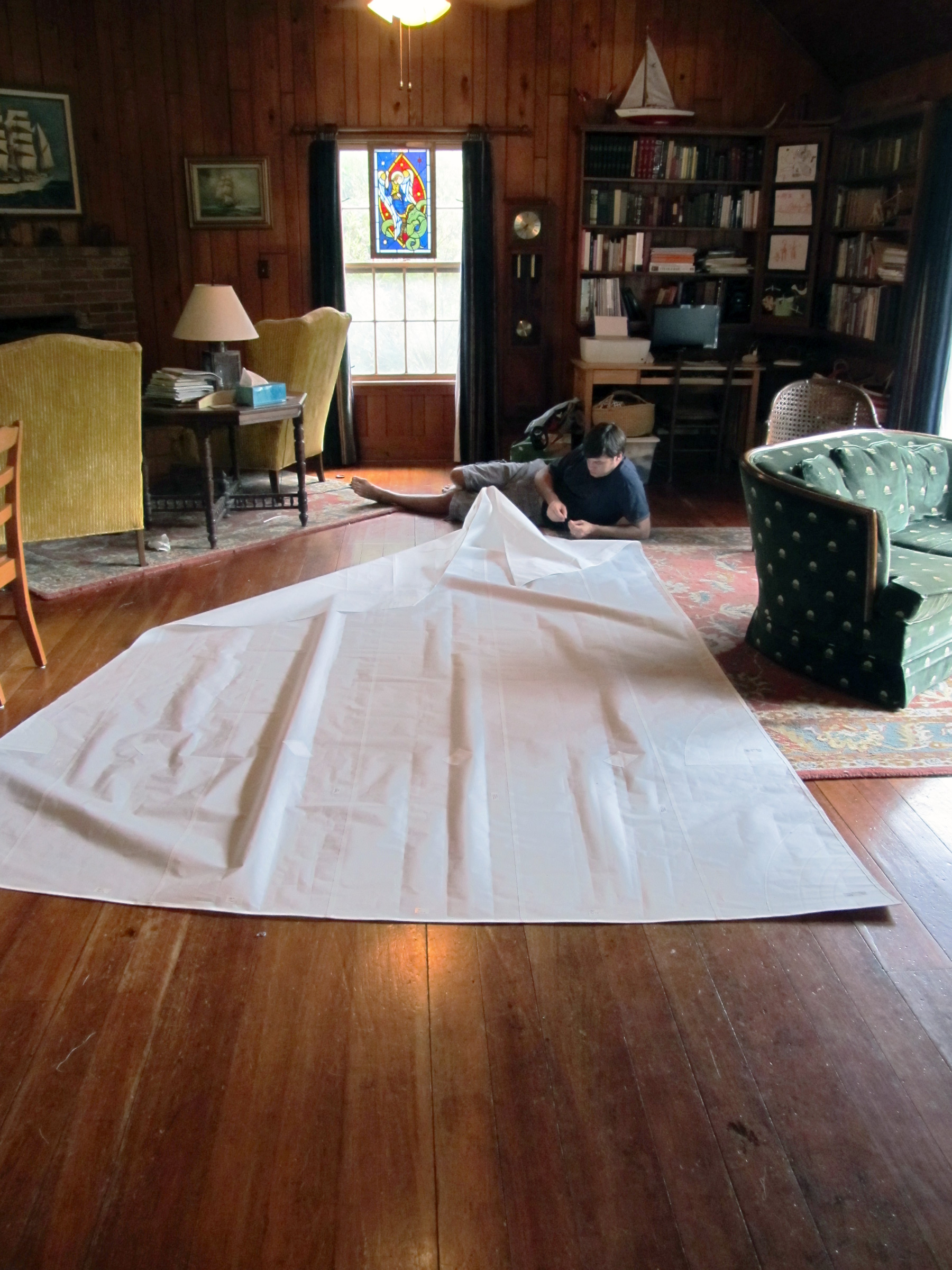
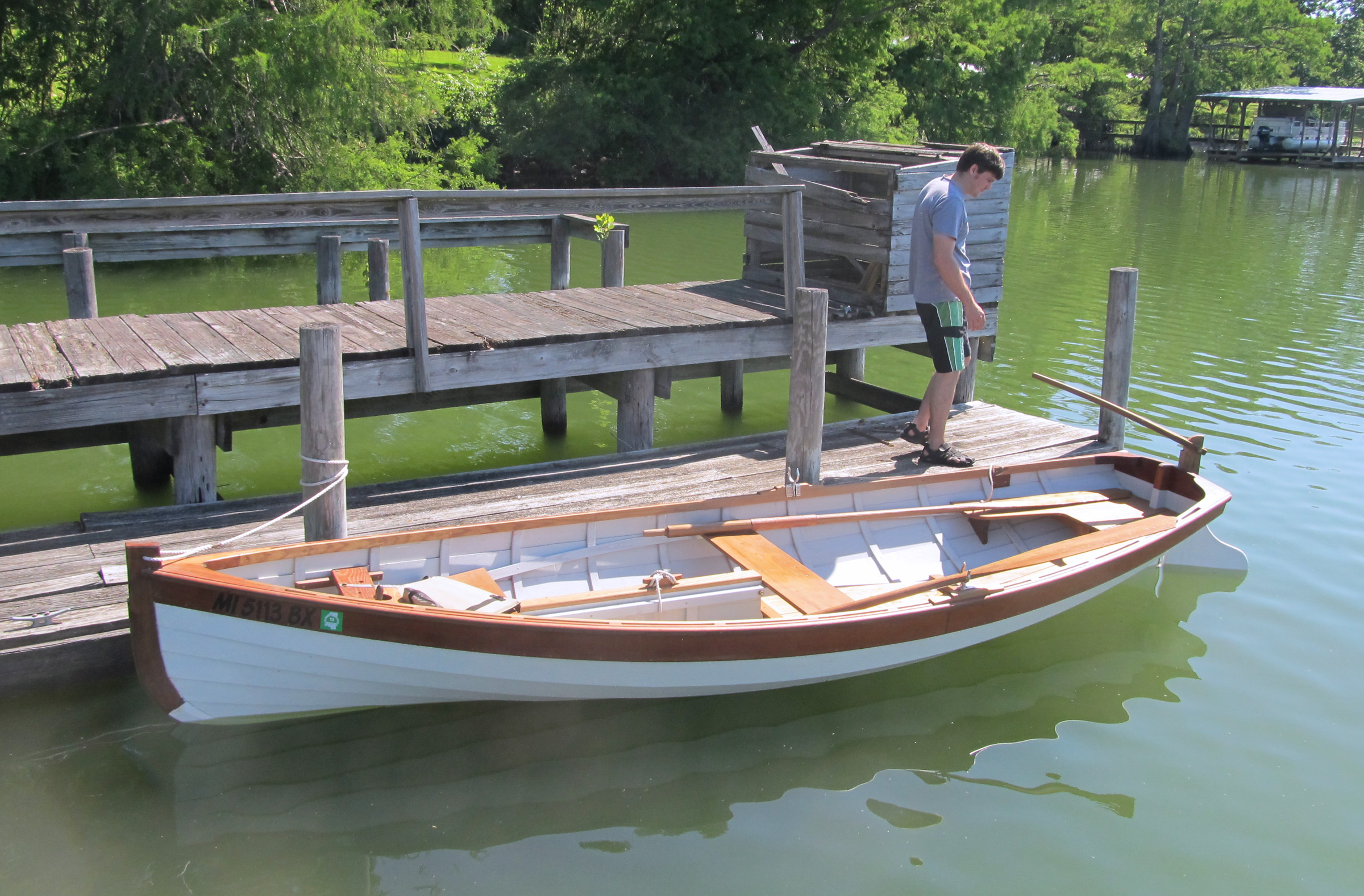
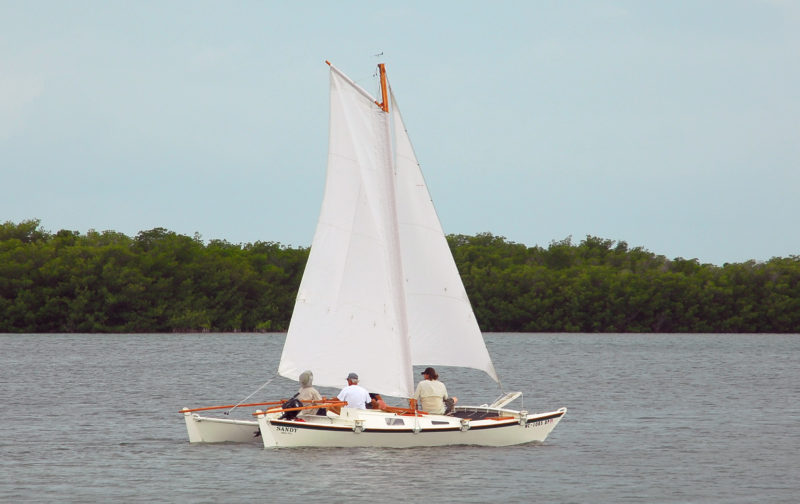
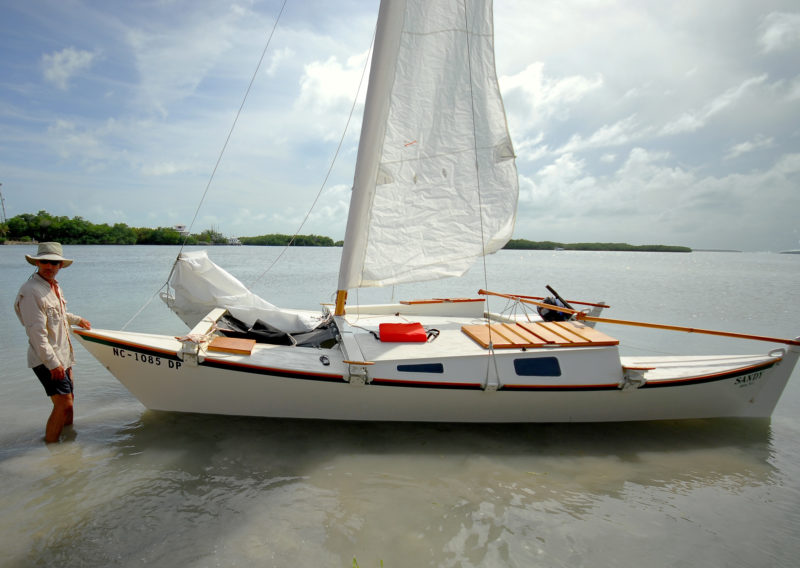
James Wharram’s Polynesian catamaran designs have inspired countless backyard boatbuilders with dreams of ocean voyaging to exotic tropical destinations. Starting with the simple 23’ TANGAROA, aboard which he completed the first catamaran crossing of the Atlantic in 1955–56, the cruising-sized vessels in his range of plans have an impressive safety record due to their conservative design parameters. Seaworthiness is the number-one priority in his designs.
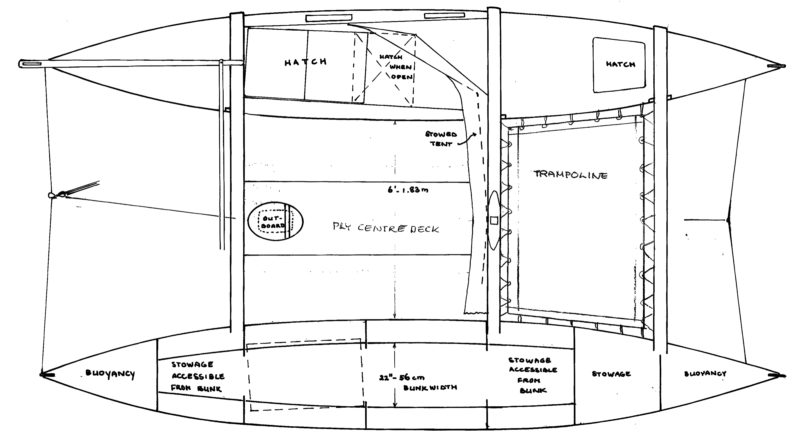
While ocean-voyaging catamarans have been the main focus of Wharram’s design work, his plans catalog includes a few smaller boats suitable beach cruising. The Tiki 21 that was recently profiled here in Small Boats Monthly crosses the line between the two pursuits but is still a bigger boat than many people want to build or trailer. The Hitia 17 and the Hitia 14 are based on the same hull shape and design concepts as the Tiki 21 and her larger sisters, but the Hitias are open boats. They are lighter, simpler, and less expensive to build, while retaining the sailing characteristics and performance of the cruisers. While the smaller Hitia 14 is strictly a daysailer, the Hitia 17, with its dry-storage holds and kayak-style cockpits, features real camp-cruising capability for sailors who don’t mind roughing it a bit.
Omar Rashash
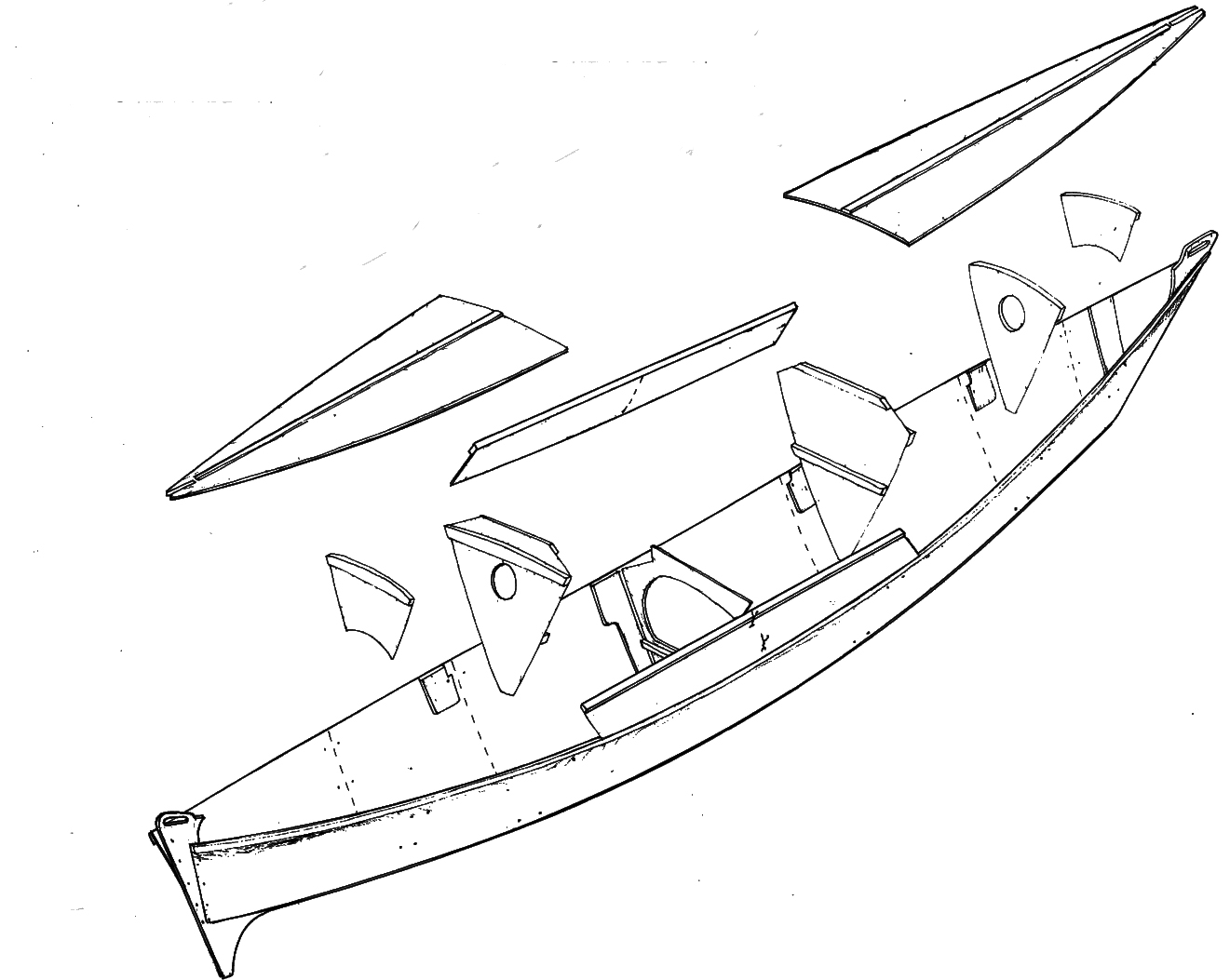
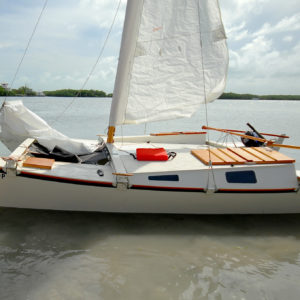
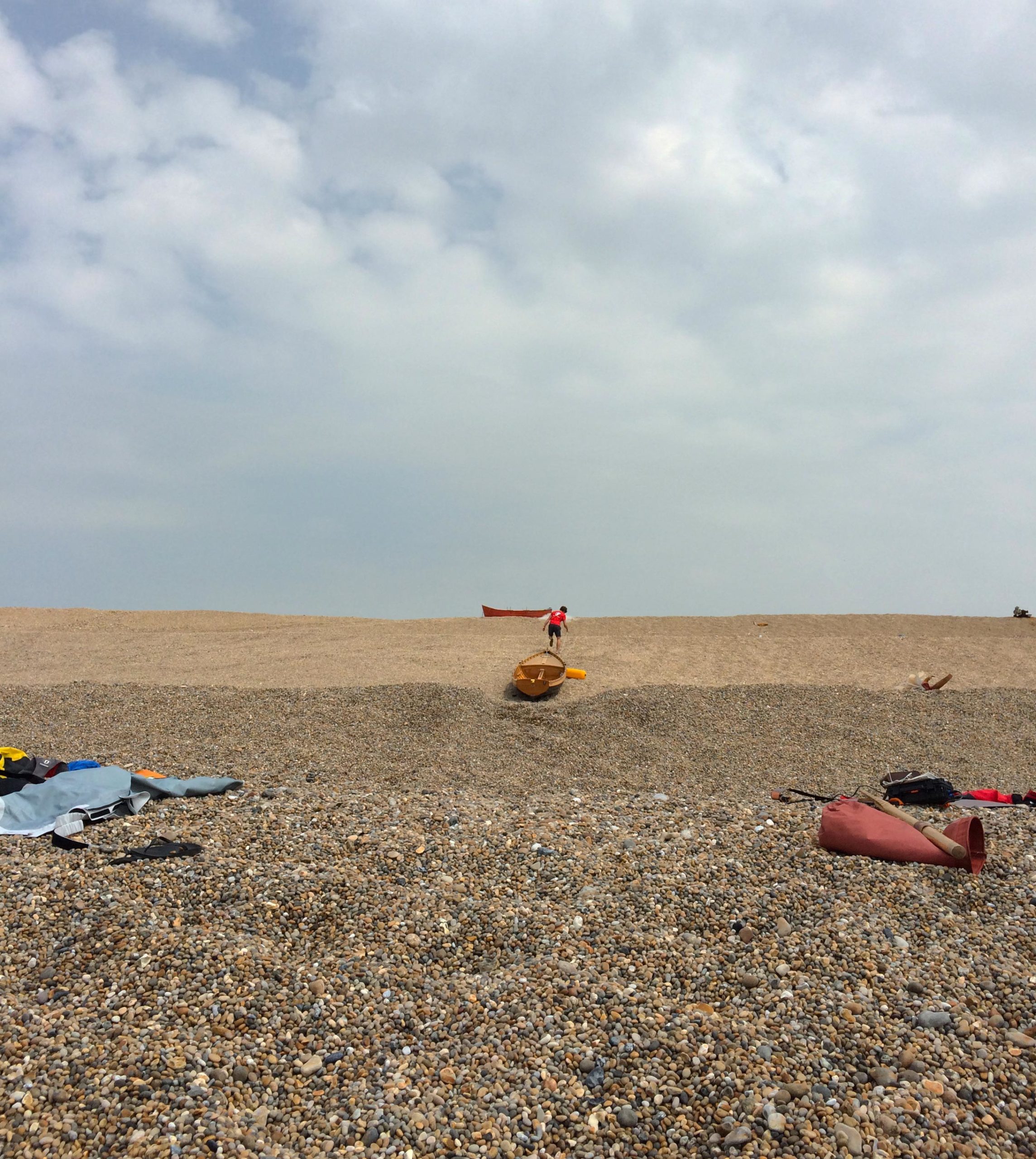
Taken apart for transport, the pieces of the Hitia 17 are light enough to be carried to the beach.
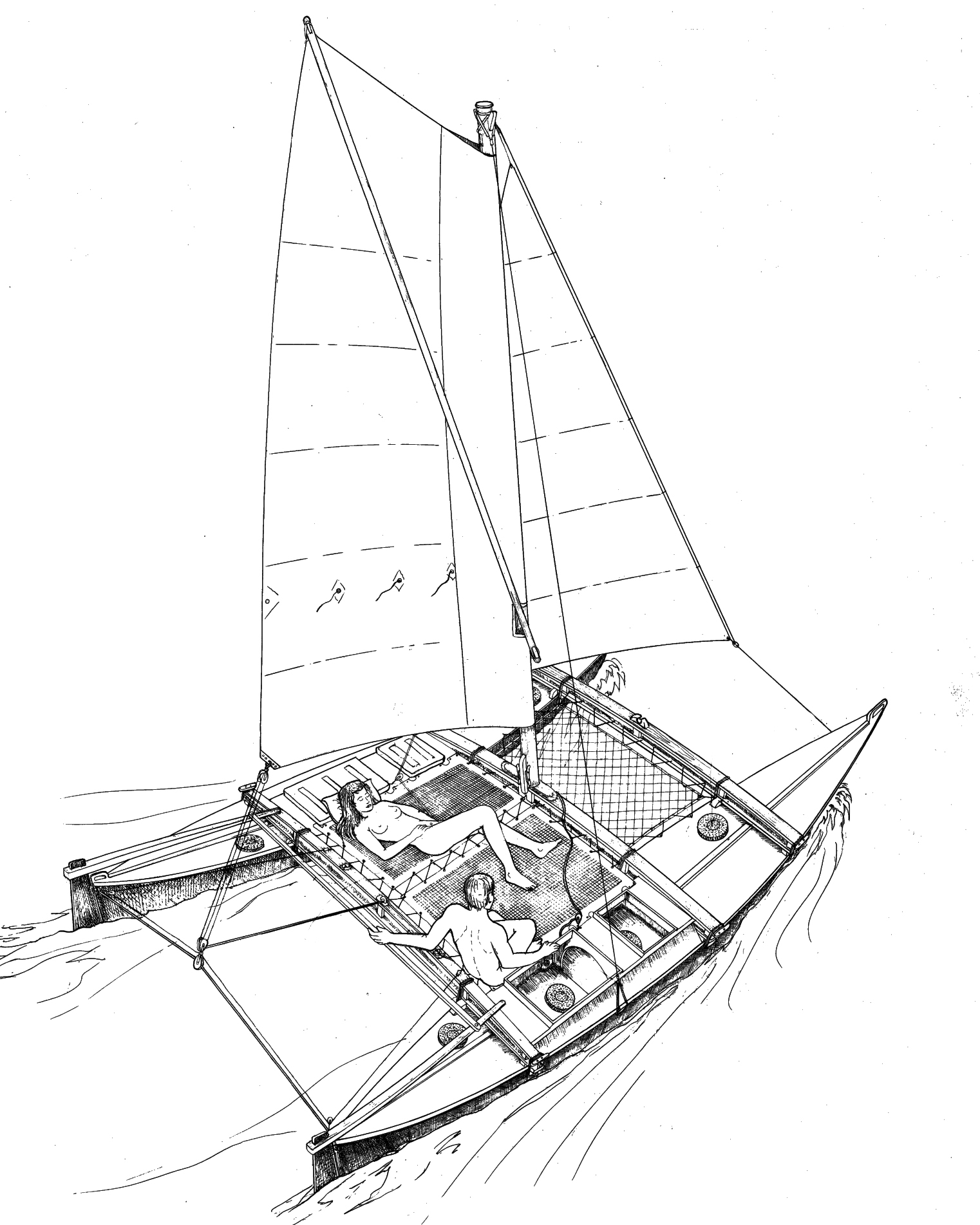
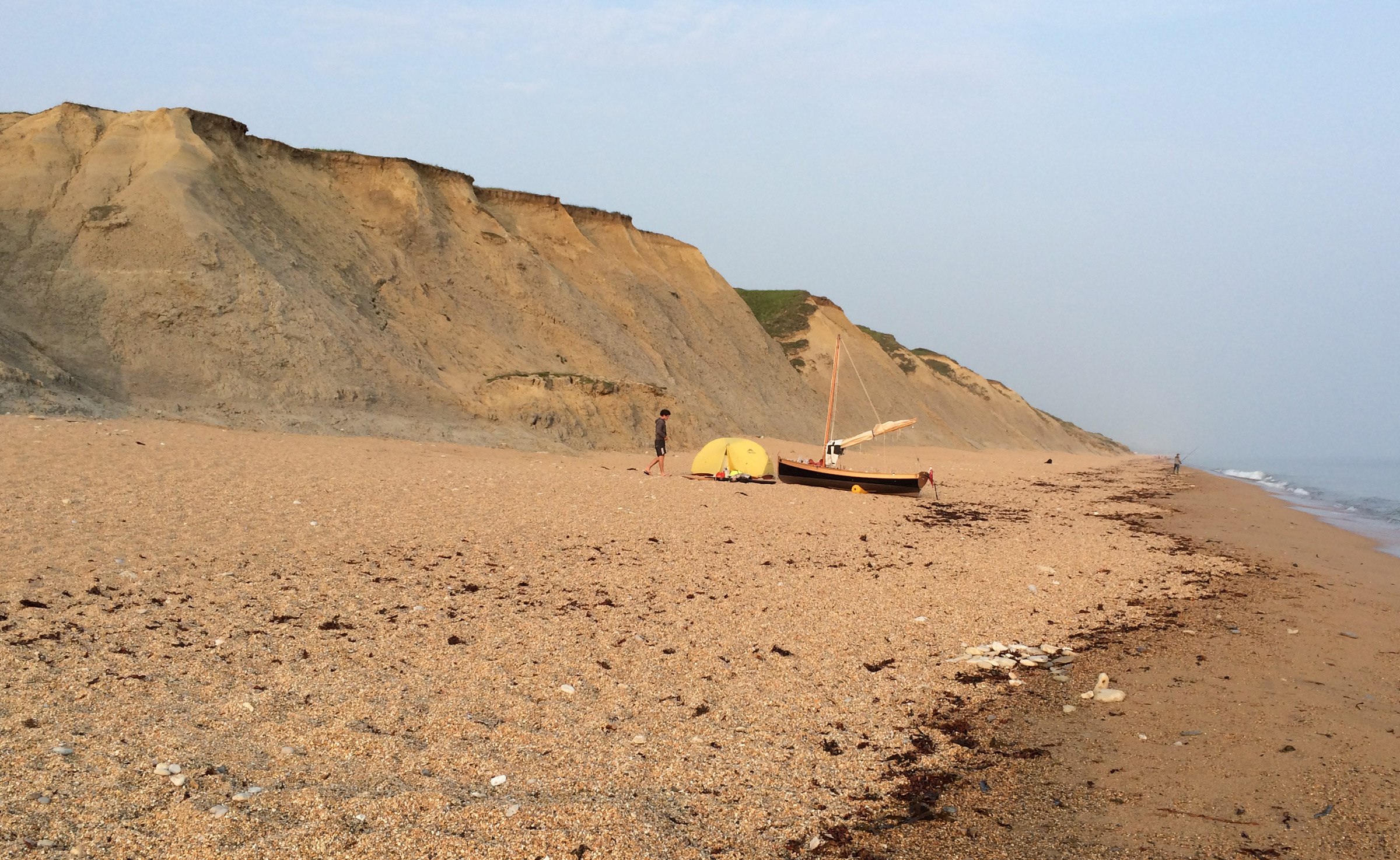
In 1997, I chose the Hitia 17 as my first sailboat build. After many years of sea kayaking and building various kayaks and canoes, I wanted to sail to the same kinds of places I could paddle craft, but I wanted to carry more stuff, and make occasional open-water crossings at faster speeds. The Hitia 17 fit the bill, and the double-canoe design appealed to my prior experiences with seaworthy small boats. It draws only 12″, is easily beachable, and could accommodate a companion or two. It offers the possibility of camping aboard if necessary—a real plus in places like Florida’s mangrove swamps where there are no campsites.
Like all Wharram catamarans, the Hitia 17 is designed for plywood construction, and the assembly method is straightforward stitch-and-glue with epoxy-fillets, taped joints, and fiberglass sheathing. The project calls for eight sheets of 1/4″ plywood and one sheet of 5/8″, as well as some straight-grained fir or spruce lumber for stringers, crossbeam parts, and mast laminates.
Omar Rashash
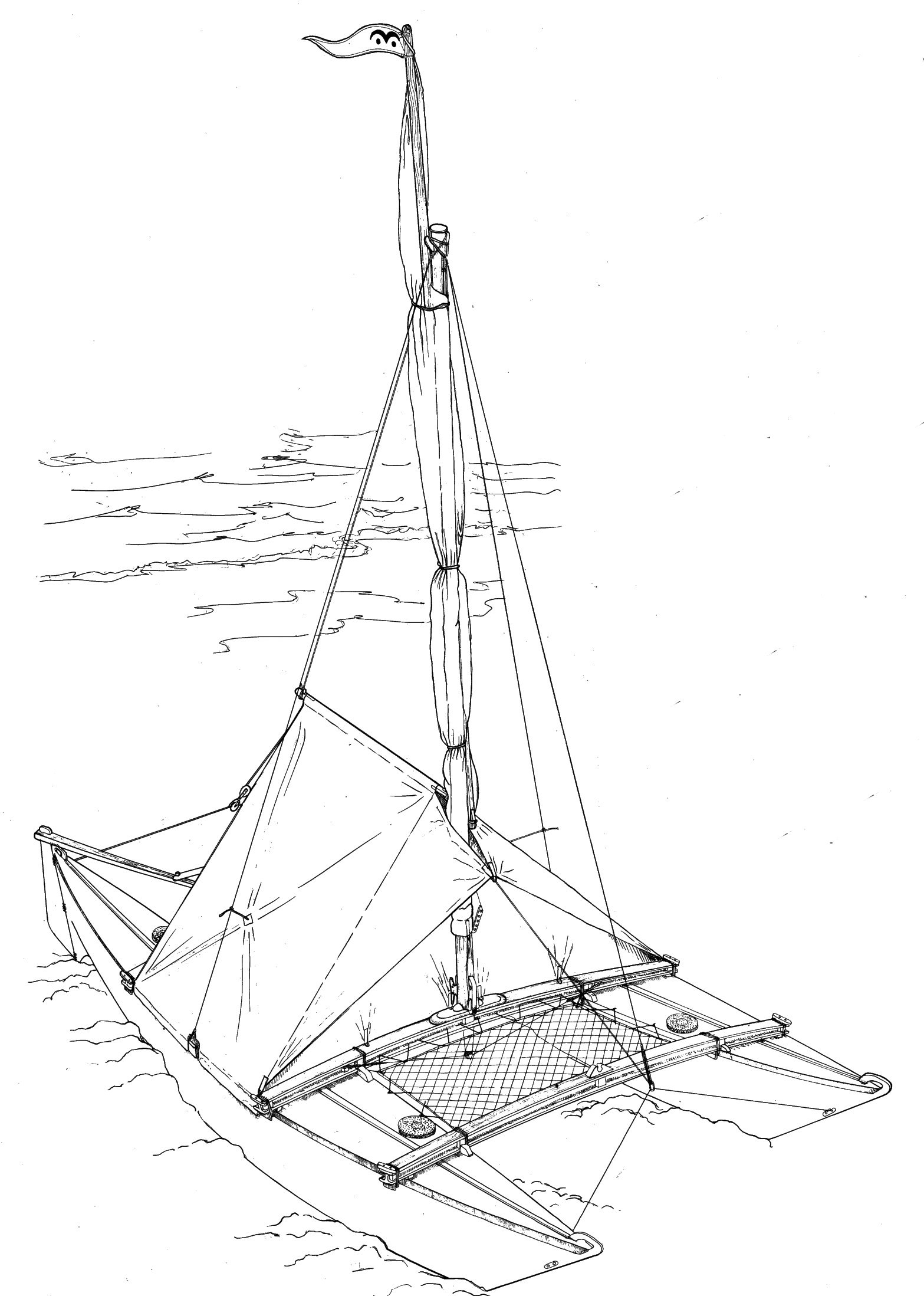
The two hulls and three crossbeams are assembled with lashings instead of hardware. With experience, the assembly time can be cut down to under an hour.
Building the Hitia 17 doesn’t require an large shop, because each hull is only 2′ wide and weighs about 90 lbs. They can be built one at a time under a minimal shelter, on one side of a garage, or, as some builders have done, even inside an apartment or house, as the hulls are slim enough to fit through standard doors, and everything can be moved outdoors and assembled in the back yard. The design book states that the build will take about 250 hours, but most builders take a bit longer if they’re shy on experience and tools or if they simply want better-than-average craftsmanship and finish. I built my Hitia 17 over the course of about seven months of spare-time work, and the result was everything I’d hoped for.
As with the larger Wharram cats, the components and rig of the Hitia 17 are designed to eliminate the need to purchase a lot of expensive marine hardware. The hulls are connected to the three crossbeams with low-stretch rope lashings, and the rudders are laced to the sterns with rope hinges that are both elegant and effective. The tillers lock onto the rudderposts with no metal hardware, and the mast is secured into its step with a wooden key built onto middle crossbeam Even chainplates and mast tangs are unnecessary, as the shrouds and stays are tensioned with lanyards anchored to flat wooden cleats at the sheer at one end and looped over hounds at the masthead on the other.
Barbara Davis
This Hitia 17 carries Wharram’s gaff wingsail main, with a luff sleeve for better airflow around the mast.
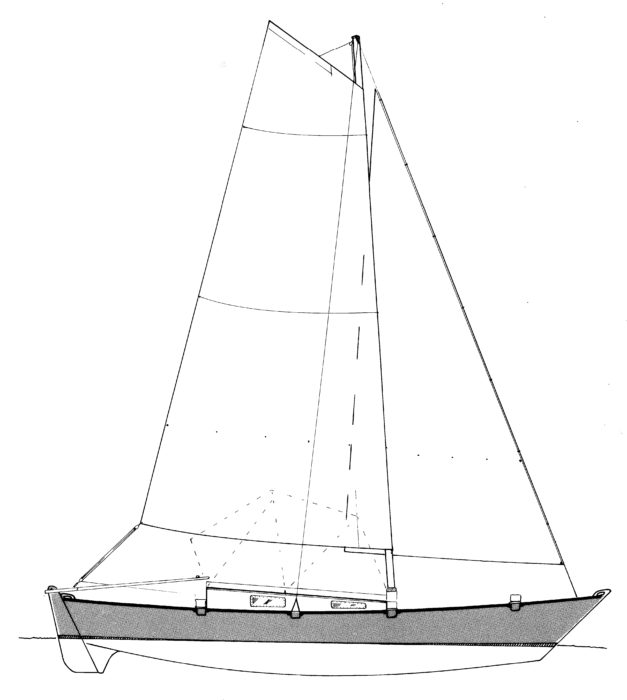
When I built my Hitia 17, the sail plan differed from that of the Tiki designs in that it had a sprit rather than the short gaff rig of the standard Wharram wingsail. The sprit has the advantage of simplicity—one less halyard to bother with—and the sail can be brailed around the mast with the sprit in place, but in strong winds, the sprit has to be taken down. It tends to get in the way because it is as long as the boat. Now the Hitia 17 plans include the option for the gaff wingsail, and having sailed the larger Tikis with that rig, I would recommend it as it is easier to reef and offers more adjustment to the shape of the main.
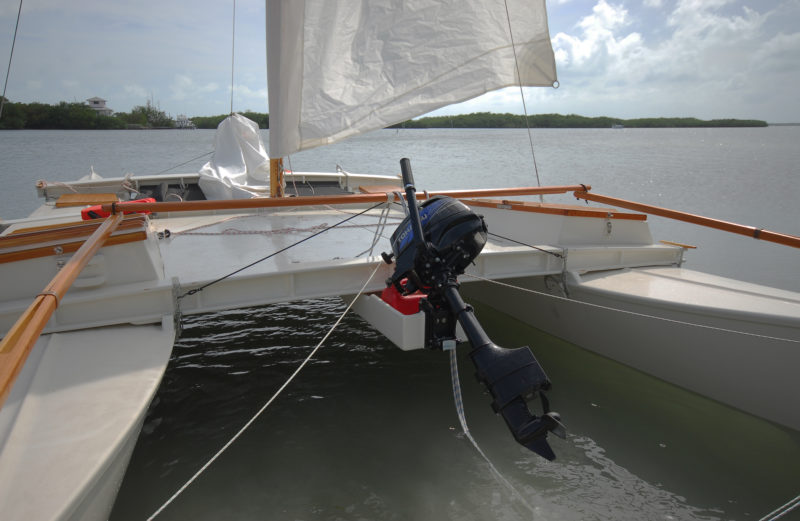
There is no mention of an auxiliary outboard in the building plans, and it’s certainly not necessary, as the boat can be paddled, but I added a motor mount on the aft beam and fitted a 3-hp Evinrude that often came in handy during extended periods of calm on the Gulf of Mexico. The cost of building my own Hitia 17, including the sails, outboard, and a new trailer I modified for it, came in at just under $6,000, which seemed very reasonable for such a capable catamaran.
Unlike the larger Tiki 21 and Tiki 26, the Hitia 17 doesn’t require an elaborate folding trailer, but unlike many beach cats of similar length, it is too beamy at 10’11” to transport fully assembled. Wharram was uncompromising in keeping to the overall beam-to-length ratio of his proven ocean voyagers, and wouldn’t reduce the beam to 8’6”, the maximum width allowed for trailering. But since the hulls are light enough for two people to easily carry or one person to maneuver around with a two-wheeled cart, almost any trailer can carry separated hulls to the water. They could even be cartopped, although with the beams and mast to carry as well, it would require a large and quite substantial rack capable of handling a 300-lb load.
I went to a little more trouble than necessary when fitting out my trailer, because I wanted to be able to assemble and launch the boat fully loaded boat by myself in one go. To accomplish this, I made two removable beams fitted with cradles to hold the hulls at sailing width. Upon arrival at the boat ramp, I secure these in place and then lift the hulls, one end at a time, into the cradles and then lash on the crossbeams and step the mast. With practice, I got my launching time down to just over half an hour.
Barbara Davis
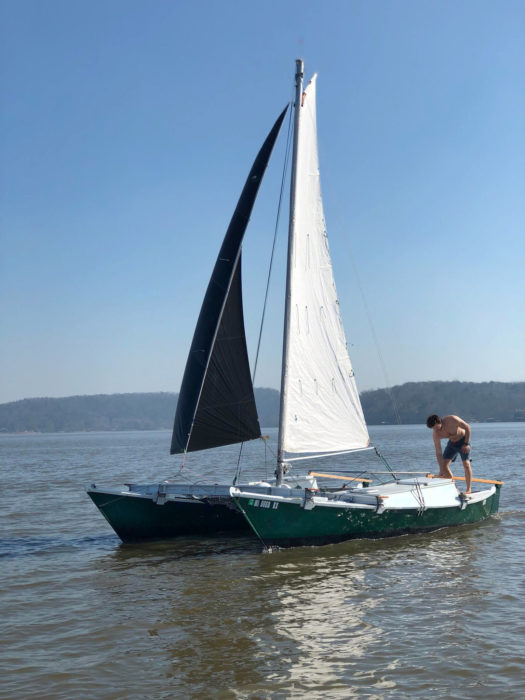
The mast rests on a crossbeam and is supported by a single shroud to each side.
The Hitia 17 is a forgiving catamaran to sail compared to most beach cats of similar length. With its generous beam and just 160 sq ft of sail area, it is a stable platform that can handle a wide variety of conditions. That’s not to say that it won’t capsize with carelessness, but it is far less likely to than the typical, more racing-oriented catamarans in that size range. Even with its conservative sail plan and relatively low rig, the Hitia 17 is still quite capable of exciting performance in the right conditions. I often clock over 10 knots, even with the hulls weighed down with camping gear. Tacking and jibing are reliable and effortless, and windward ability is certainly acceptable for a multihull designed for cruising rather than racing.
The absence of daggerboards, centerboards, or leeboards somewhat limits the Hitia’s pointing ability, but is a great asset for exploring thin water that most sailboats can’t reach. Drawing only 12”, the deep-V hulls can be sailed right up onto the beach, then easily pushed back off again. On sandy beaches I could even sail in through a moderate surf break and land, just as I did in my kayaks. The rudders and the integral skegs are no deeper than the keels, making it safe to let the boat dry out at low tide. Owners who plan to beach the boat on a regular basis can easily add Kevlar strips or other reinforcements along the keels.
Scott Williams
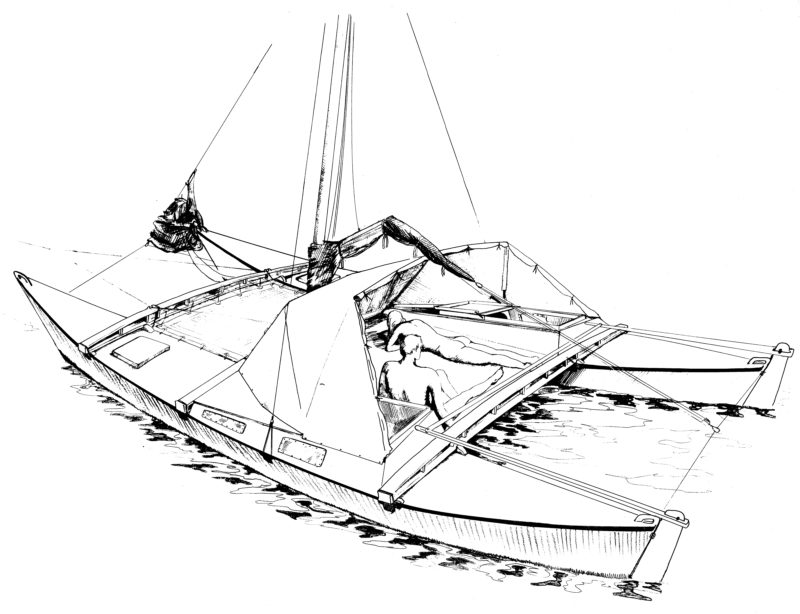
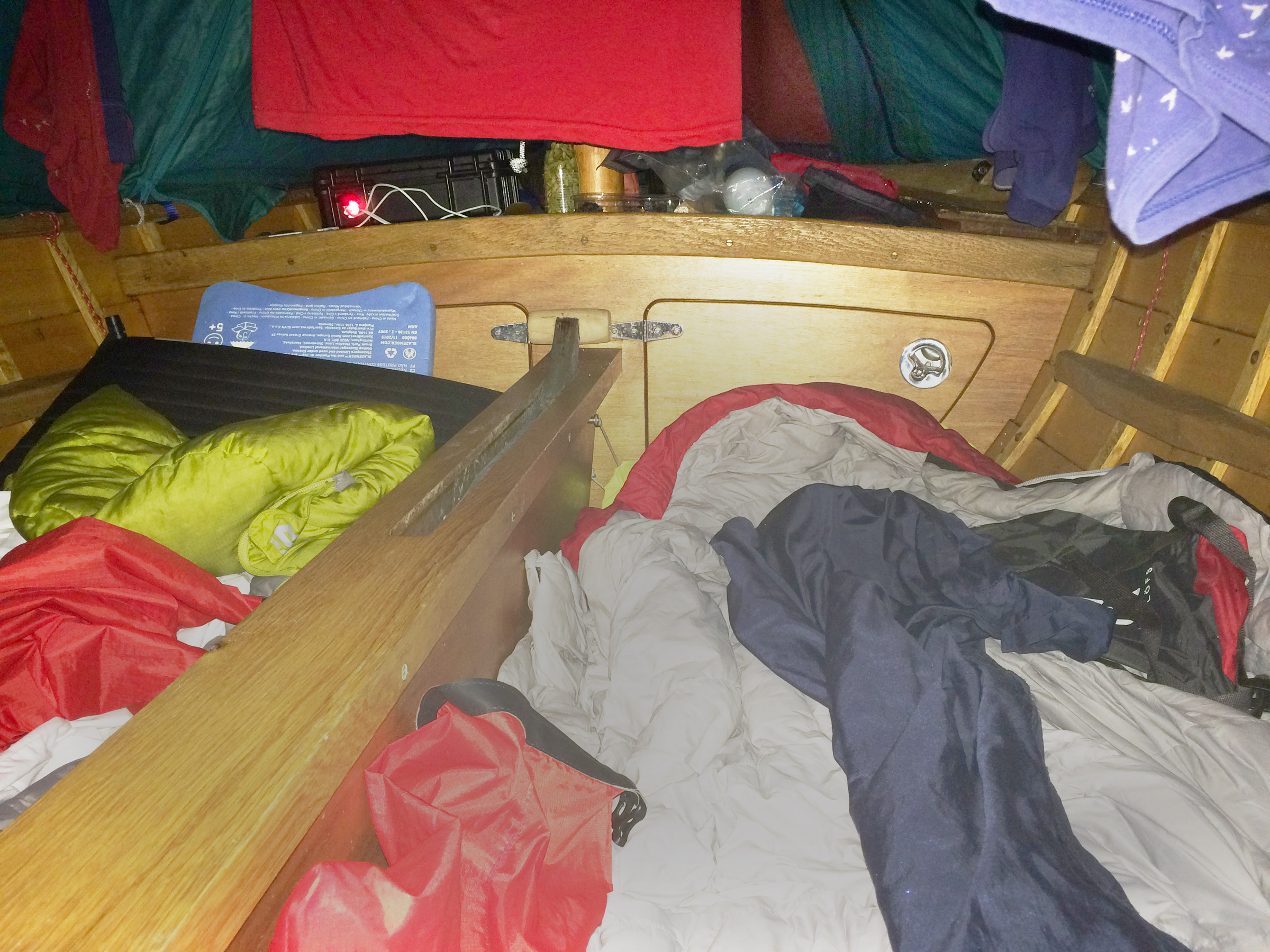
The area between the aft and middle crossbeam is large enough to accommodate a backpacking tent for overnights at anchor. On a trip to St. Vincent Island in Appalachicola Bay, the author camped on the deck and use the front trampoline for a porch, a galley, and storage.
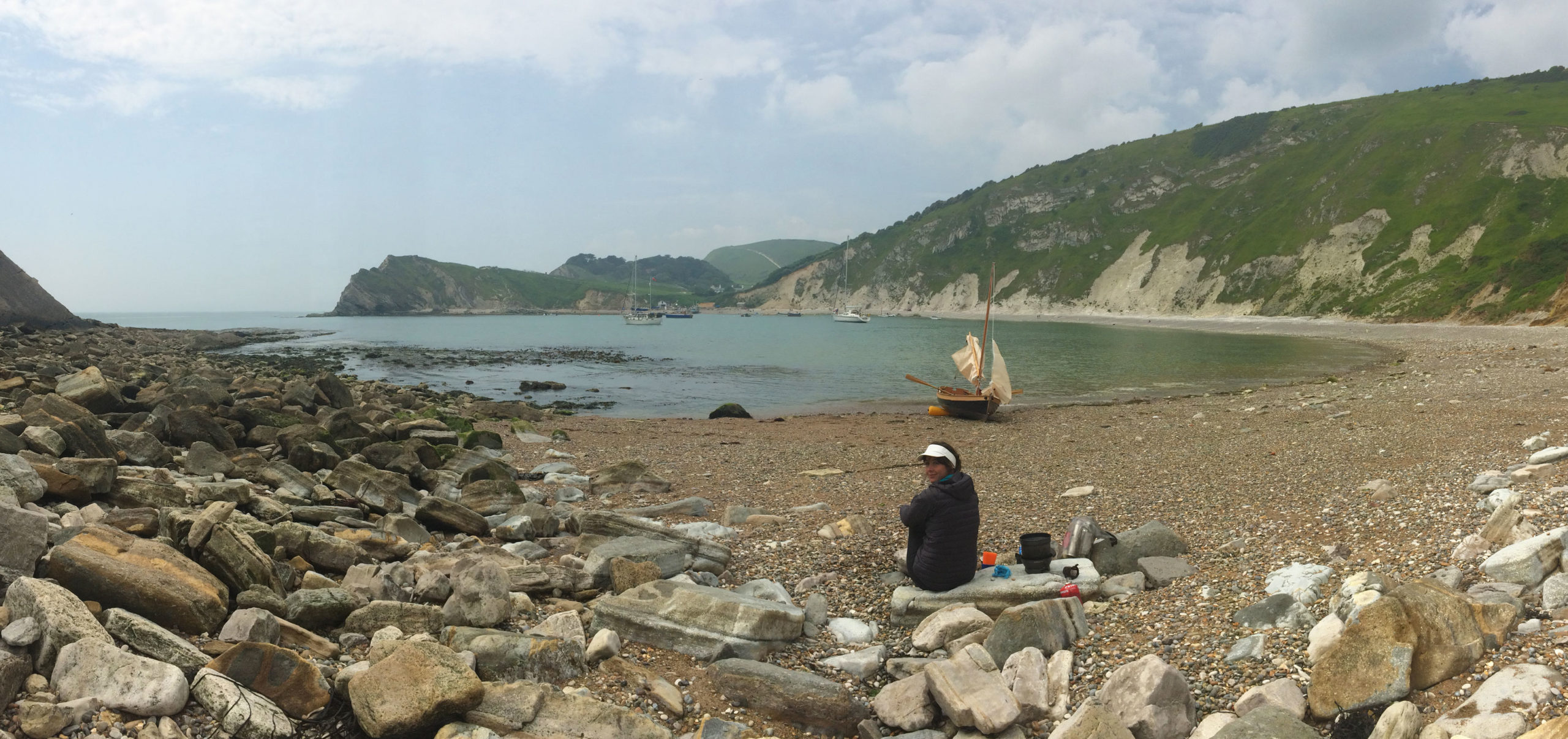
I did several multi-day camp-cruising trips with the Hitia 17 to various barrier islands off the coasts of Florida and Mississippi. The little catamaran performed well whether I was sailing solo or with a companion. I frequently anchored out and pitched a small backpacking tent on the trampoline between the hulls, an arrangement that worked well in calm conditions. There is, however, little room to move about with the tent taking up most of the deck space, so I sometimes found it easier to camp ashore, especially when I had a companion with me.
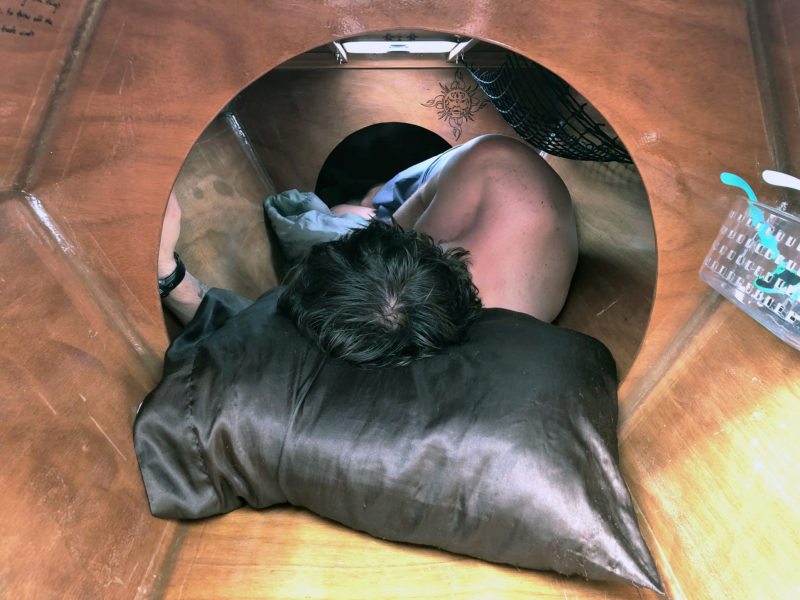
The flaring deep-V hulls give all Wharram catamarans excellent load-carrying capability for their size, and the Hitia 17 is no exception. Each hull has watertight bulkheads that segment the hull into four dry-storage compartments. Forward of the mast crossbeam, each hull has a large hold accessed through waterproof deck hatches. The plans suggest to either make wooden hatches and coamings or to purchase rubber kayak hatches. I bought a pair of large oval VCP kayak hatches for my own boat, as the foredecks can take a lot of water and spray in rough conditions. In the ’midships section between the beams, each hull has a compartment, accessible through two large hatches, to sit in kayak-style, or to use as foot wells when seated on deck. Spaces beneath these compartments offer extra dry storage for smaller items that will fit through 6” deck plates. Even when loaded with equipment and supplies for a crew of two for several days, there is room to stow lightweight, compact gear securely belowdecks.
All of these features with the ease and low cost of building your own make the Wharram Hitia 17 an attractive package for adventurous sailors wanting to do some extended coastal exploring on a safe and comfortable multihull platform.
Scott B. Williams began his small-boat adventures exploring the creeks and barrier islands by canoe and kayak in his home state of Mississippi. His fascination with the potential of these simple boats led him to longer solo journeys in the Caribbean and down the Mississippi River, which he first wrote about in the pages of Sea Kayaker magazine in the early 1990s. Combining a passion for woodworking with his interest in boats led him into wooden boatbuilding and yacht carpentry while he continued writing about his adventures. He has since written 22 books (and counting), many of them survival and adventure novels which draw on his paddling, boatbuilding, and sailing experiences. Scott can be contacted through his website.
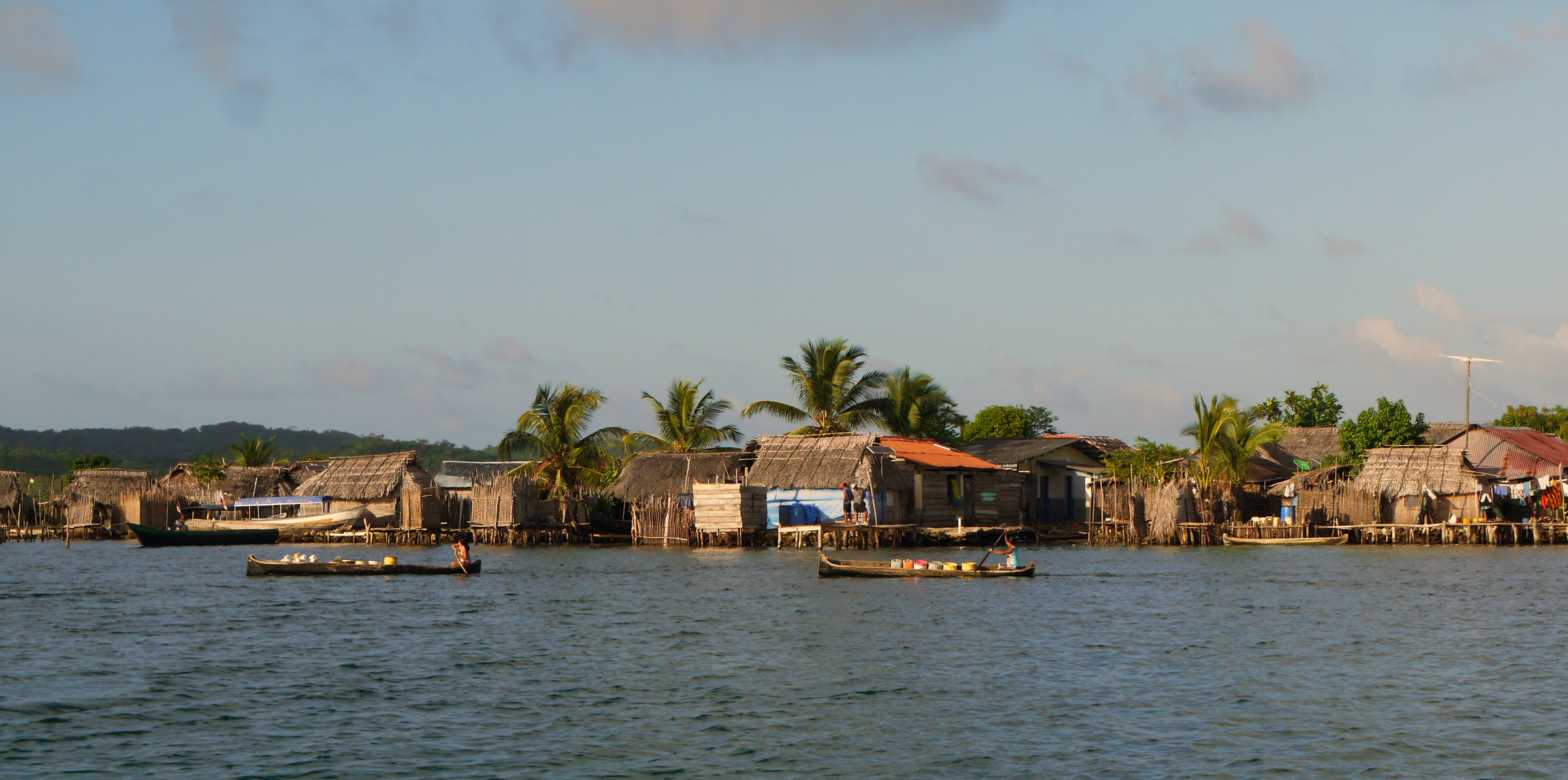
From the moment I first sailed the waters of Panama’s Archipelago de San Blas in 2011, I have been fascinated by the sleek and colorful dugout canoes, called ulus, built and sailed by the Guna. At dawn’s first light, they set out from villages on small coral islands off Panama’s Caribbean coast to go to the rainforest on the mainland to farm, gather water, and get supplies for their island homes.
The Guna are indigenous Central American people who were driven from the mainland by Spanish Conquistadors, warring indigenous groups, mosquitoes, and other dangerous animals of central Panama. They have inhabited this stretch of the coast for hundreds of years and prefer to call their homeland Guna Yala, Land of the Guna—and dislike “San Blas,” the name given the islands by the Spaniards long ago.
While the islands are part of Panama’s territory, the people have political autonomy over their land, and they fiercely protect their culture by passing traditions to the next generations. The Guna have been building ulus the same way since they populated these waters, and they still rely on them for their livelihood. Kids as young as three and four years old already know how to paddle, having imitated the older kids who spend most of their time on the water, and they’ll often have child-sized rigs for practicing sailing.
Photographs by the author
Guna women regularly paddle ulus to Rio Torti on the mainland to collect potable water from the river and gather vegetables grown in their gardens on the mainland.
Ulus are very familiar to the numerous cruisers that visit these beautiful islands. Guna villagers will often pull their ulus alongside yachts to sell lobsters, crabs, and other seafood or their finely appliquéd pictographs called molas, in exchange for things like a cold drink, the use of a hammer, or charging a cellphone.
I was working on a charter boat in Guna Yala when I had the opportunity to sail an ulu. Dino, the boat’s first mate, is a local and arranged for me to rent his cousin’s ulu for a sailing and fishing trip. Unfortunately, the wind was very light and we caught nothing on the line, but the images of that beautifully shaped and painted canoe gliding above shallow coral reefs and piercing waves were carved into my memory.
It was that same year in Guna Yala that I first met my wife, Kate. We daydreamed about getting an ulu and sailing it along the coast all the way down to Colombia, but life took another turn and we ended up in New England instead and bought TRANQUILITY, a 53-year-old 29′ fiberglass sailboat. Over the next three years we undertook a complete restoration of the boat, while also working to fund a cruising adventure. With TRANQUILITY back in voyaging mode, we started a trip south through the Bahamas and headed back to Panama and Guna Yala. I was looking forward to seeing ulus sailing again.
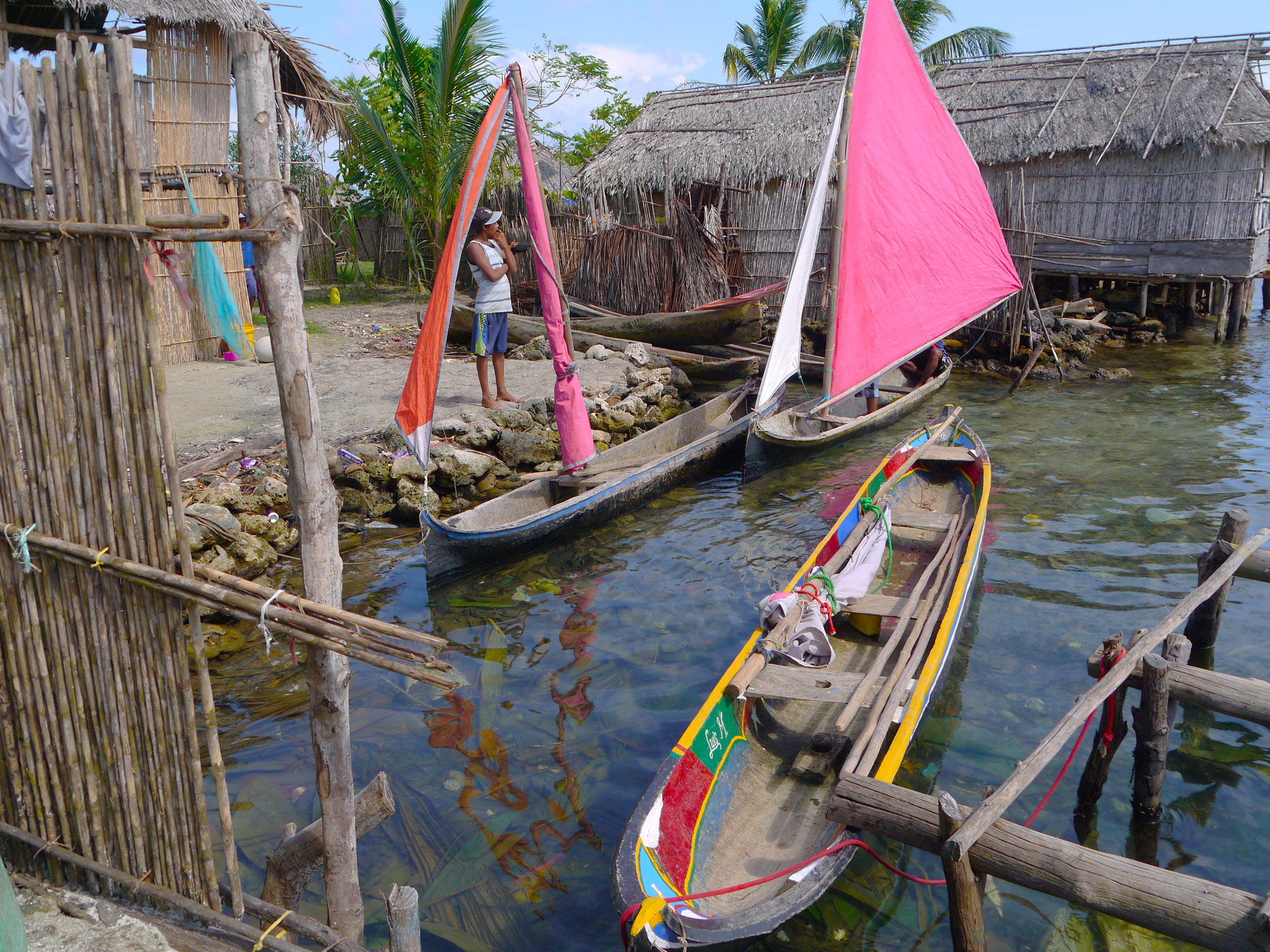
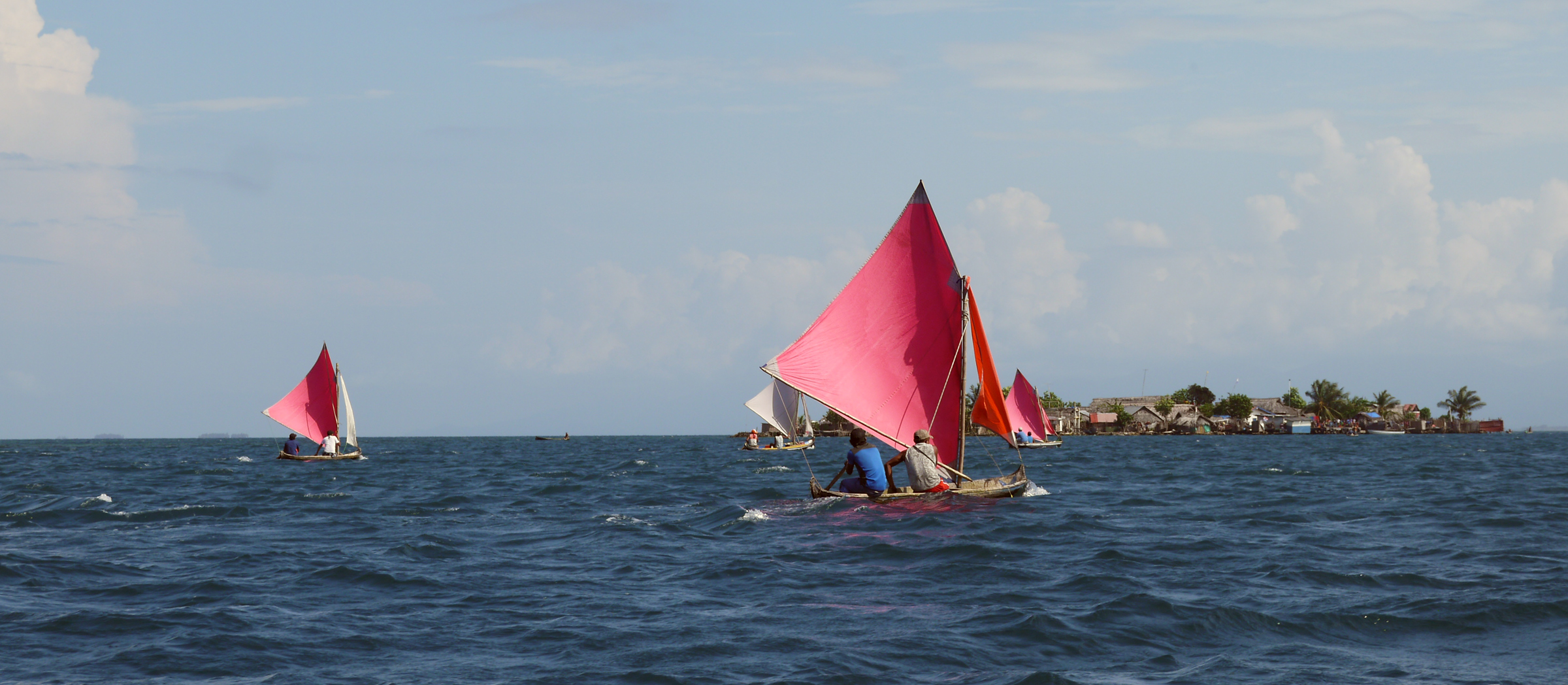
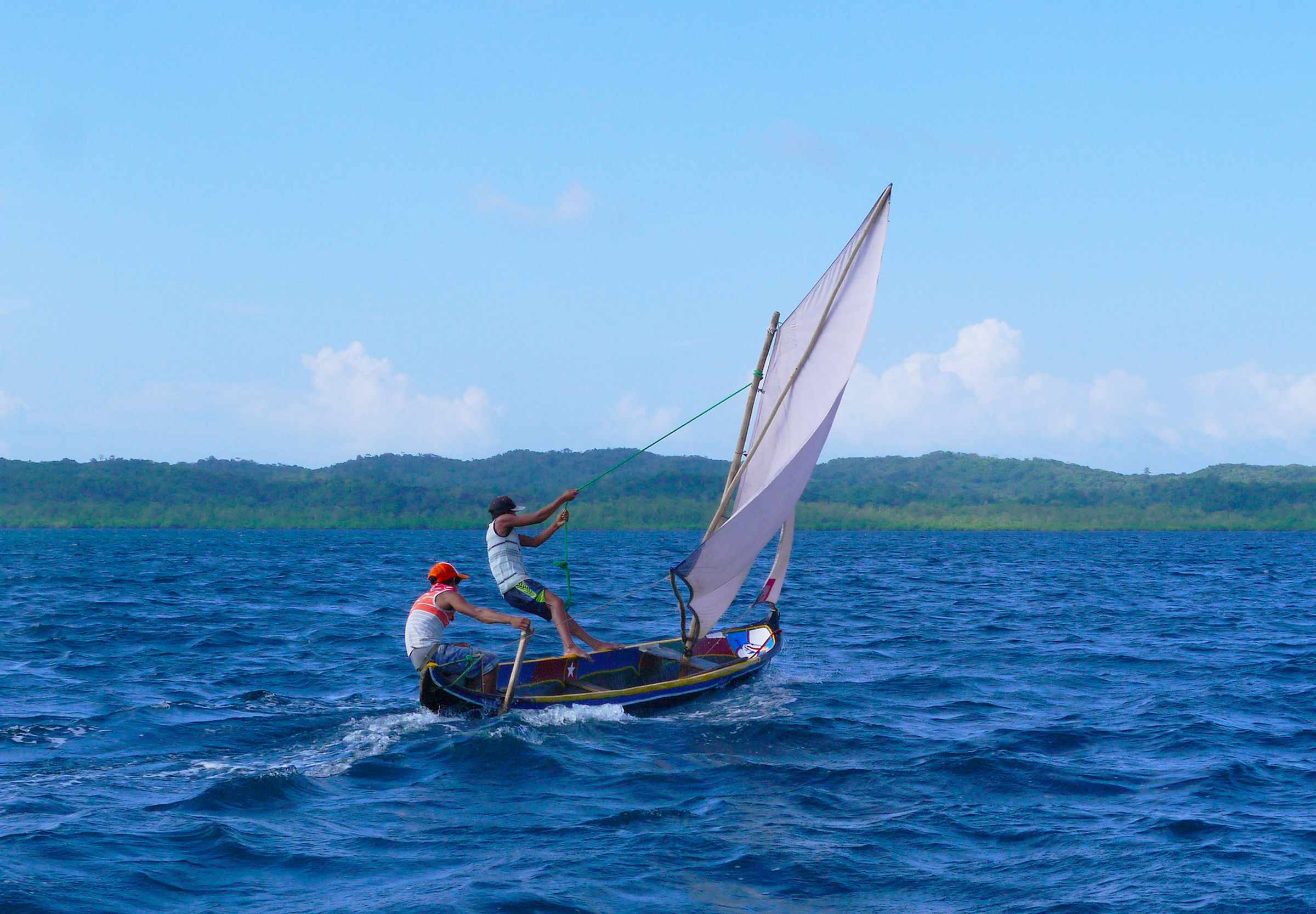
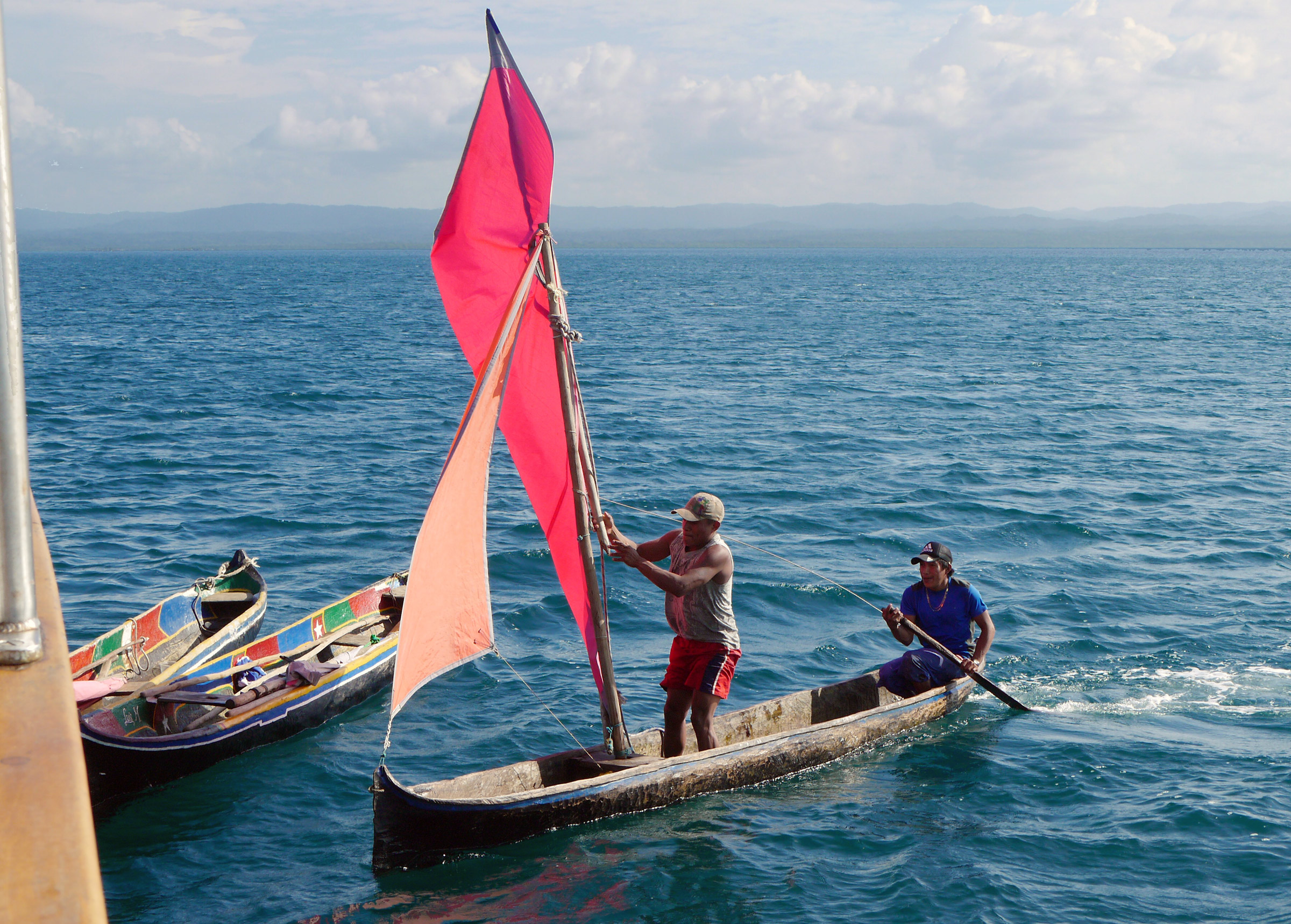
Ulus carry a spritsail rig. The sprit that supports the peak is a rough-hewn spar, and the mainsail is attached with a loose foot to a sprit boom then sheeted to a becket run through a hole in the sternpost. The sheet is tied with a simple knot when the helmsman is holding a steady course, but held with the free hand for frequent trimming. A small jib is set flying from the stem to the masthead. Sails are made out of just about anything on hand, from bedsheets to plastic tarps. Ulus can sail to weather with just their carved skeg under the water.
The ulus have very simple sailing rigs. Any Guna can get ready to sail in about one minute.
The Guna had never sailed for competition until visiting yachties inevitably brought their sport-sailing mentality with them, and before long, ulu races became a point of cultural exchange between transients and locals. The most recent race, which took place in January 2018, was held at Islas Robeson, a group of seven small islands tucked in the Gulf of San Blas. This westernmost archipelago is known to the Guna as Tadarguanet, “Where the sun sets.” Kate and I had never visited here, and this race was a good excuse to explore another part of Guna Yala. We approached the area after a gorgeous three-hour sail in flat seas, tacking between reefs and low-lying islands.
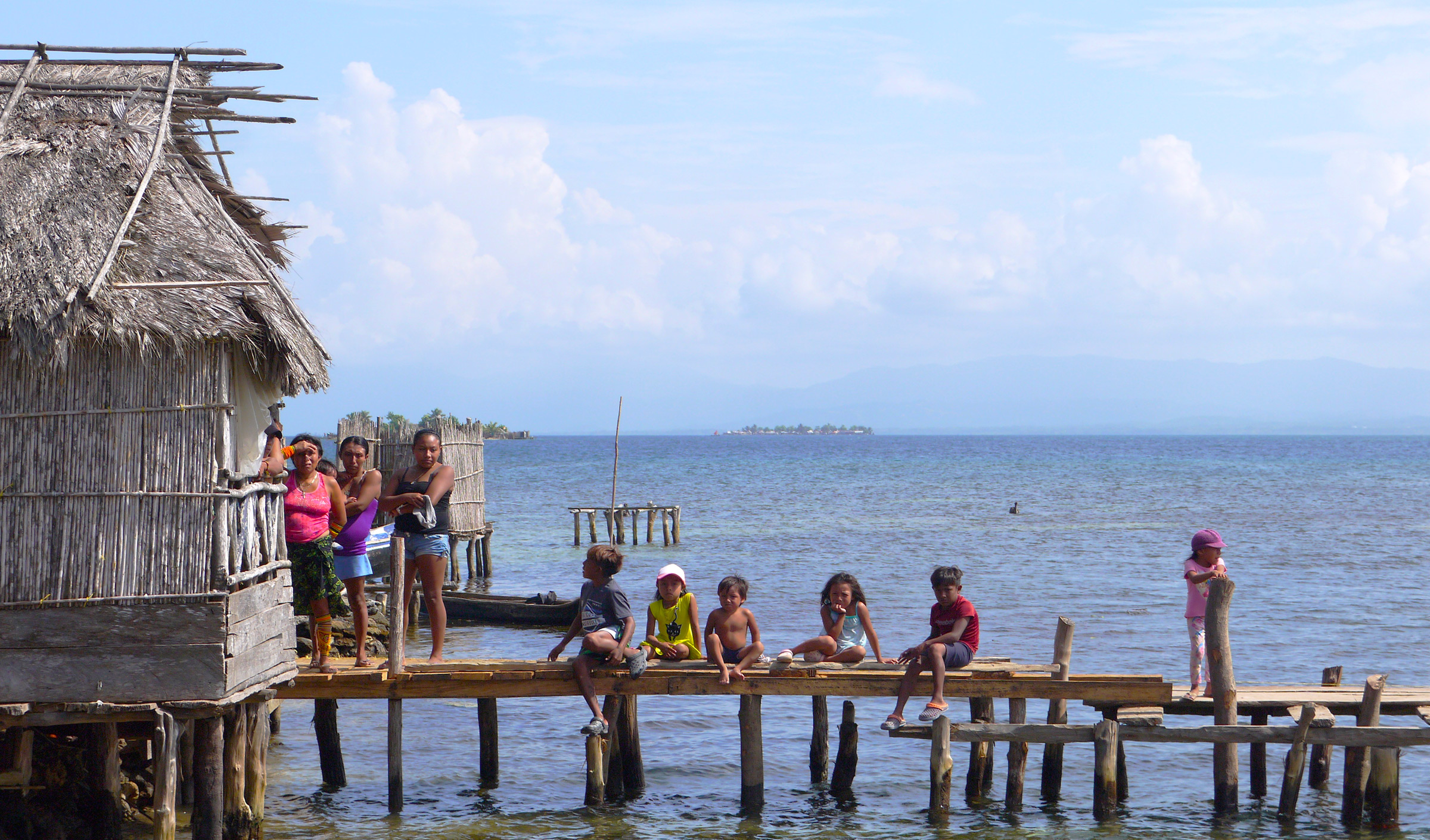
Tupsuit Dummat is fringed with wooden docks. Almost all of the structures on the inhabited islands are built of poles, bamboo, and fronds brought by ulu from the mainland.
We anchored TRANQUILITY just south of the main island, also known as Ailitupu or Isla Gerti. Like most of the inhabited islands of Guna Yala, it is close to the mainland, the source for food that grows in the forests and for fresh water from the rivers. Tupsuit Dummat is scarcely large enough to fit a football field, and the village is packed tight with low buildings and fringed with wooden docks that extend from sandy paths, backyards, and pocket gardens.
Kate and I made our way to the building that houses a school, a community center, and a store. It is the only cement structure on the island; all of the rest are made from poles and fronds gathered from the mainland forest. As small as the island is, it was easy to get lost among the finely woven bamboo fences and walls that enclose the compounds of extended families. In the center of the island is a shared kitchen where a fire is always lit. A few trees rise above the weathered thatched roofs and ajì chili peppers, hibiscus flowers and plants used in traditional medicine grow in what little open space there is.
Even with my modest 5′7″ height, I had to duck many times to avoid eaves and awnings, and to pass through tiny doors. The Guna, with an average height just under 5′, are among the shortest people on Earth, second only to the Pygmies of Africa. I felt like a giant among them.
A few older women came ahead offering molas and other handicrafts. Only Guna who had traveled to the Panamanian mainland or further for work spoke Spanish or English. Others that grew up in Guna Yala only spoke their language, which they refer to, in Spanish, as dialecto. The kids saluted each other with few words in Spanish, sometimes English that they practice in school, before continuing laughing and chatting in dialecto. Men and children wore shorts and T-shirts while women wore the traditional clothing: colorful fabric wrapped around their waists as skirts, floral blouses with mola panels sewn on front and back, and beaded bracelets that covered most of their legs and arms with geometric patterns. Some had a gold nose ring.
Back at the dock, looking across the anchorage, Kate and I admired the ulus’ rippled wakes and silent passage, allowing conversation between ulus or between the boats and land, without raised voices. While we usually saw men sailing, women go together on separate ulus to the river on the mainland to fill bottles, buckets, and jerry cans with fresh water—it was their time to be alone and have personal conversations.
Soon after settling ourselves in the anchorage and getting to know our surroundings, an ulu approached TRANQUILITY and the lone paddler introduced himself as Justino, this year’s ulu race organizer. He was wearing a baseball cap and sunglasses, and when he smiled, two gold teeth, one bearing the letter J, gleamed. Kate complimented him on the gold and he replied, “Do you like it? I have a dentist friend in Panama City. He did it for me.” He spoke a little English but switched to Spanish when he realized that we both spoke Spanish.
Justino connected us to the American owners of ALLIANCE, a beautiful steel schooner with three masts that towered above the smaller vessels in the anchorage. They were helping him put the event together by getting on the radio and inviting cruisers from the more popular areas of the archipelago. Justino was gathering donations to put together a cash prize for the race, and we were happy to contribute. After we said our goodbyes to Justino, he paddled to a neighboring cruiser in the anchorage, drumming up more support.
On the day of the race, the start was postponed a couple of times as Justino waited for more entrants to arrive and for stronger winds. It has been an unusual January; the northeasterly tradewinds that usually blow steadily during the winter season had yet to arrive. When he spotted another yacht sailing toward the islands, he delayed the start yet again, hoping the new arrivals would provide a bigger audience and more prize donations. The delay made it possible for me to help Mr. Raul, a man with small, dark eyes and fluent Spanish, who showed up at the side of TRANQUILITY paddling a ulu and carrying an inverter wrapped in a plastic bag. He politely asked if I could help fix it. It didn’t take me long to replace a fuse, crimp proper ring connectors for the battery cables, and test the inverter on TRANQUILITY’s batteries. We passed the rest of the morning translating words from Spanish to Guna to English over Italian coffee.
Raul stopped by our boat many times during our stay in the anchorage. Like him, other Tupsuit Dummat villagers introduced themselves politely before asking for favors or offering fish, yucca root, and other delicacies from their gardens. A group of kids—boys and girls from age two to age nine—showed up one day paddling an ulu. We invited them to come aboard, and after a little we realized that they intended to occupy our boat for the rest of the day. Communication was difficult because they spoke little Spanish and we spoke little of dialecto, but with a bit of patience and ample use of gestures, we started to understand each other, especially when I took out hooks and fishing lines and Kate produced paper, pencils, and crayons.
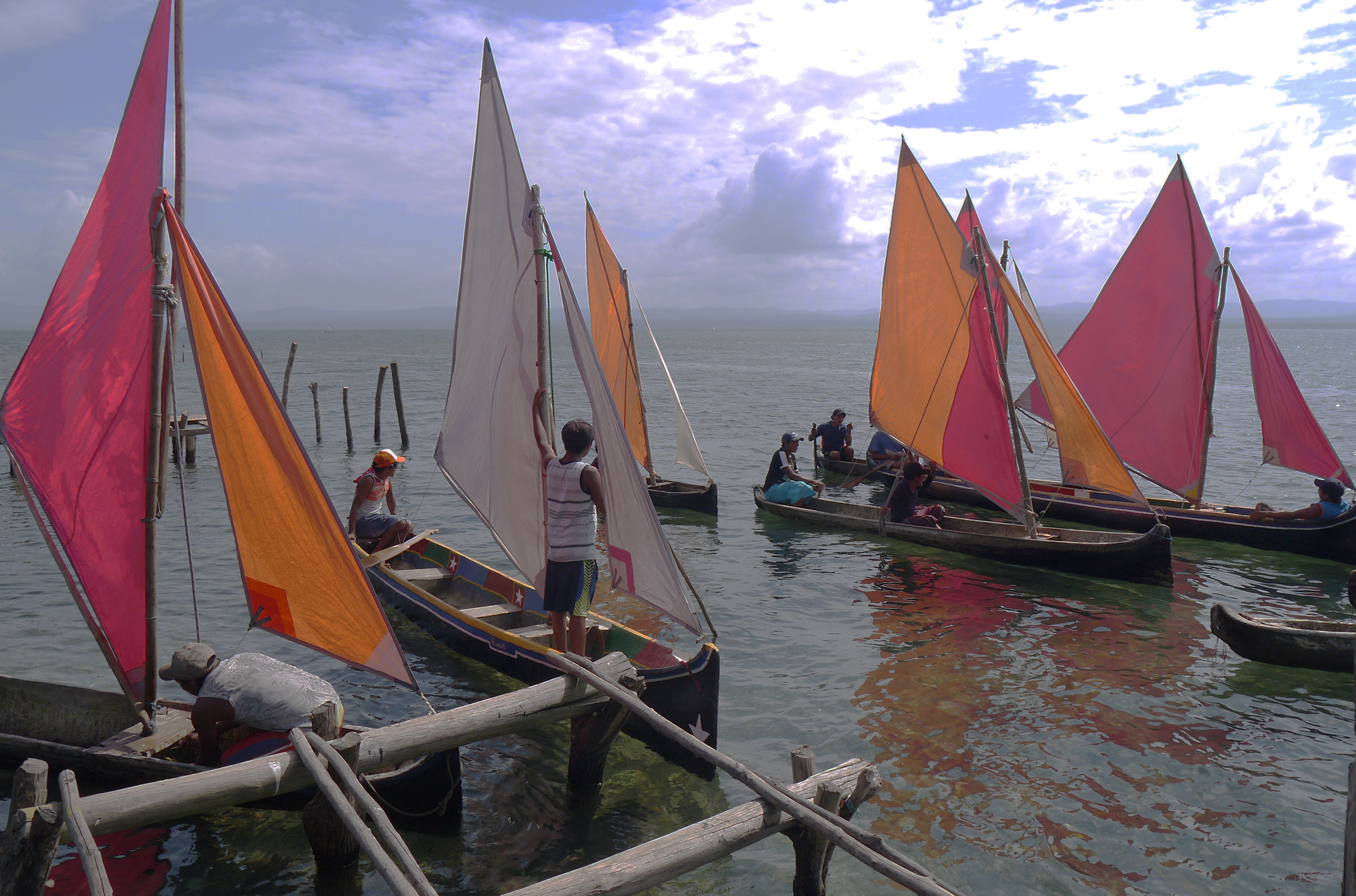
Ulu crews maneuvered in close quarters just moments before a whistle signaled the start of the race.
Finally, at 1 p.m., we all gathered at the main dock near Justino’s home. A few curious Gunas were watching the preparation, eyeing the ulus tied to the docks and the crews preparing for the race. The racing ulus that gathered for this regatta were equipped with what looked like remnants of orange and purple nylon sails from cruising yachts, recut for mainsails and jibs. After some exchanges between Justino and one of the crews in their native language, we saw them roll the mainsail and jib around the mast and quickly step a new mast with a different rig. As Justino explained, in the interest of a fair race, they were making sure everybody was using roughly the same mast and sail size. Everything else about the ulus, including their waterline length and the equipment carried on board, was hardly standard, making it a weird one-design race.
The ulu in the foreground was having trouble with its jib sheet as the fleet sailed toward Ubicandup. The rigging is often made of cheap, thin polypropylene cordage that doesn’t stand up long to the UV damage of tropical sunlight.
Justino blew a whistle, and the race was on. The ulu crews hurried to clear the docks, paddling to turn the boats, then easing the sheets to catch the tailwinds down to Ubicandup (Isla Nellie), the first marker of the course. Kate and I joined the ALLIANCE crew on their outboard-powered tender to follow the race. By the time we were all aboard and left the dock, the ulus were surprisingly far ahead of us. The shallow-draft canoes glided over coral heads and sandbanks as their crews picked the most direct course. We had to weave through unfamiliar reefs, reducing speed and lifting the outboard over obstructions. We eventually got back into the action, just in time to see the ulus go around the first marker.
Each helmsmen maneuvered using a large paddle, or cammi, and trimmed the mainsail. The single crewman aboard each ulu bailed, tended the jibsheets, and hiked out, standing on the gunwale and pulling a line tied high on the mast. At every tack, each helmsman paddled the ulus through the turns until the bow crossed the wind and settled on the new course. While the ulus were rounding the mark, the dozens of Ubicandup villagers who had gathered on the docks to watch the ulus ran the 50 yards through the village to the other side of the island to follow the beginning of the upwind leg that started as soon as the boats cleared the southern tip of the Ubicandup.
This ulu jockeyed for the lead over the first half of the race but came in second. Here they were pressing hard during the upwind leg in pursuit of the leaders.
The next marker was almost 2 miles to the northwest, back to the island of Ailitupu, which they had again to leave to port before heading for the bow of ALLIANCE, the finish line. One dugout got in trouble when they took on too much water, and the helmsman had to head into the wind while his crew bailed frantically with a small gourd bowl. Another ulu had trouble with a parted jibsheet, but was soon back in the race with the frayed ends knotted together. Another crew was wrestling with a mast that had come out of its step and was leaning precariously forward; the crewman struggled with it but was able to restep it while the mainsail was fully powered.
The winning crew sailed their ulu across the finish line under ALLIANCE’s bowsprit. A good two minutes passed before the second-place ulu arrived.
Eventually all the problems were resolved on the fly. All six boats came in close to Ubicandup at the turn, but then the fleet spread out on the upwind leg. The lead changed hands between the two fastest boats with almost every tack. When one ulu finally pulled well ahead, we returned to ALLIANCE to watch the finish. Only four boats completed the race, crossing in front of ALLIANCE’s bowsprit to the cheers of the spectators. Two boats never arrived, but no one was worried about them. It was, apparently, safe to assume that they had gone home as they passed close by their island, or had decided to go fishing. The official race results listed them as no aqui, not here.
The ulu that finished in third place came alongside the two ulus that preceded it for the celebration and awards ceremony aboard ALLIANCE.
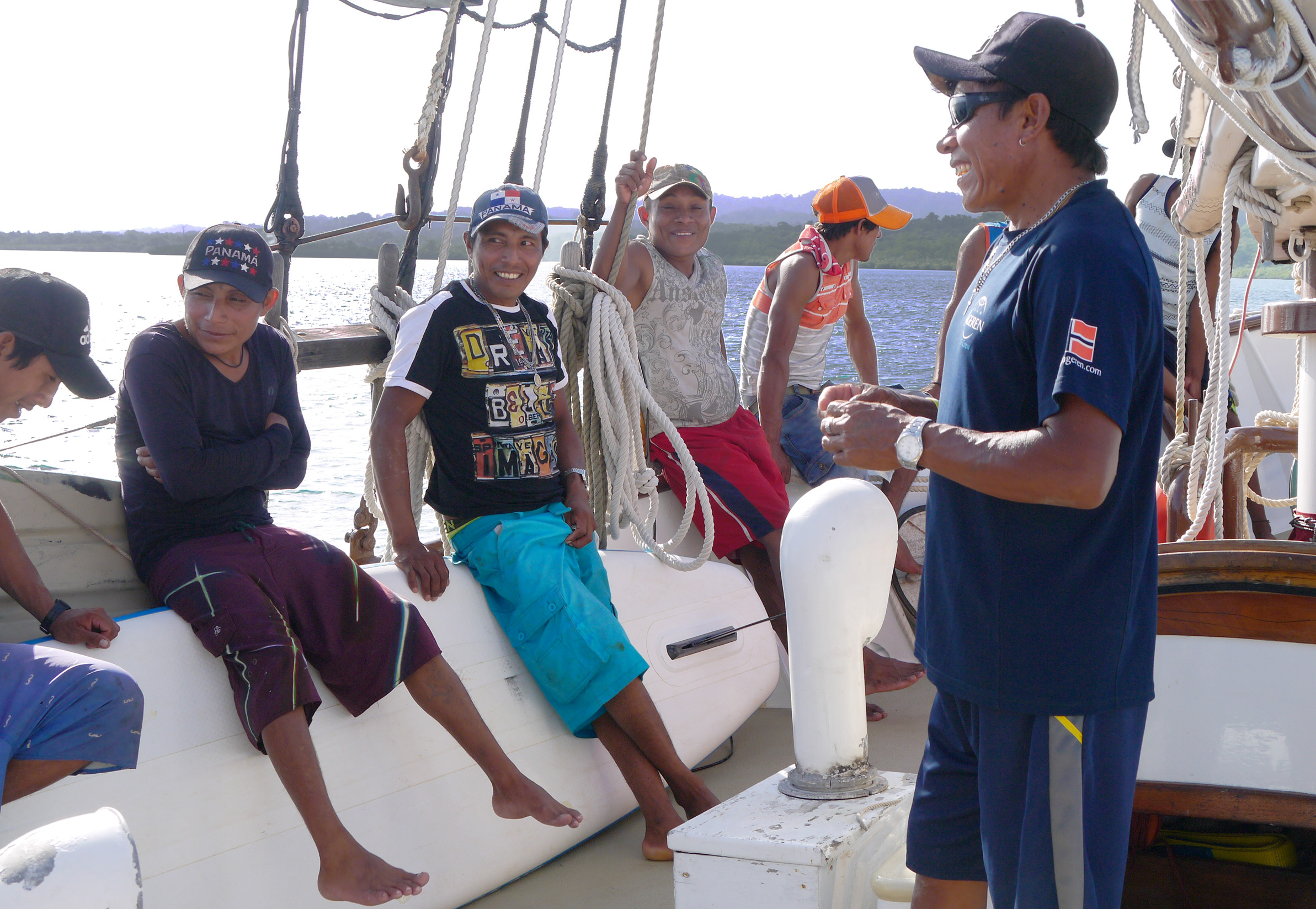
The award ceremony took place on the ample deck of the schooner, where ulu sailors and gringos shared freshly baked cookies. Justino and the owners of the schooner awarded the cash prizes, and the normally shy Guna crews seemed happy to accept the attention of the cameras.
After the race Justino (right) shared a laugh with the race crews. Smiles came easily to everyone we met in Guna Yala.
That evening I helped Justino with troubleshooting his home electrical system. A 100W solar panel charges a single deep-cycle battery that powers an inverter and LED lights that hang from the crossbeams of his home’s thatched roof. Electrical power is very important for Justino—he is one of the few villagers who owns a flat-screen TV. He often invites his friends over to watch movies that he has collected on USB flash drives from cruisers who visit Guna Yala. His house has also a big gas range with an oven that his family uses to bake bread that they then sell from the window.
During the following days I toured many other Guna homes in my new role of solar-power doctor, with my waterproof bag filled with a multimeter, electrical parts, connectors, and cables. Cruisers often contribute to the locals by offering technical help and donating or swapping used gear, which can be vital for them. I was happy that my basic electrical skills were very useful to the increasingly more technological Guna.
Only in recent years have the islanders had lights on during the night. They used to go to bed very early because the nights were truly dark. They awoke at 4 a.m. without the need for an alarm clock. Solar-power equipment has been provided through a government grant for rural areas, and now the daily habits of the Guna are changing. They keep their cell phones charged, enjoy watching TV, and listen to music.
I asked Justino one day if I could see somebody building an ulu. He got back to me with Joselino, a farmer who had stopped to our boat a couple of days earlier to talk about his farm. Joselino was building a new ulu from one of the trees in his property. The best hardwood in the rainforest for ulus is mahogany, but some trees are better than others. He had found a good one, with wood that could make his ulu last for more than 20 years.
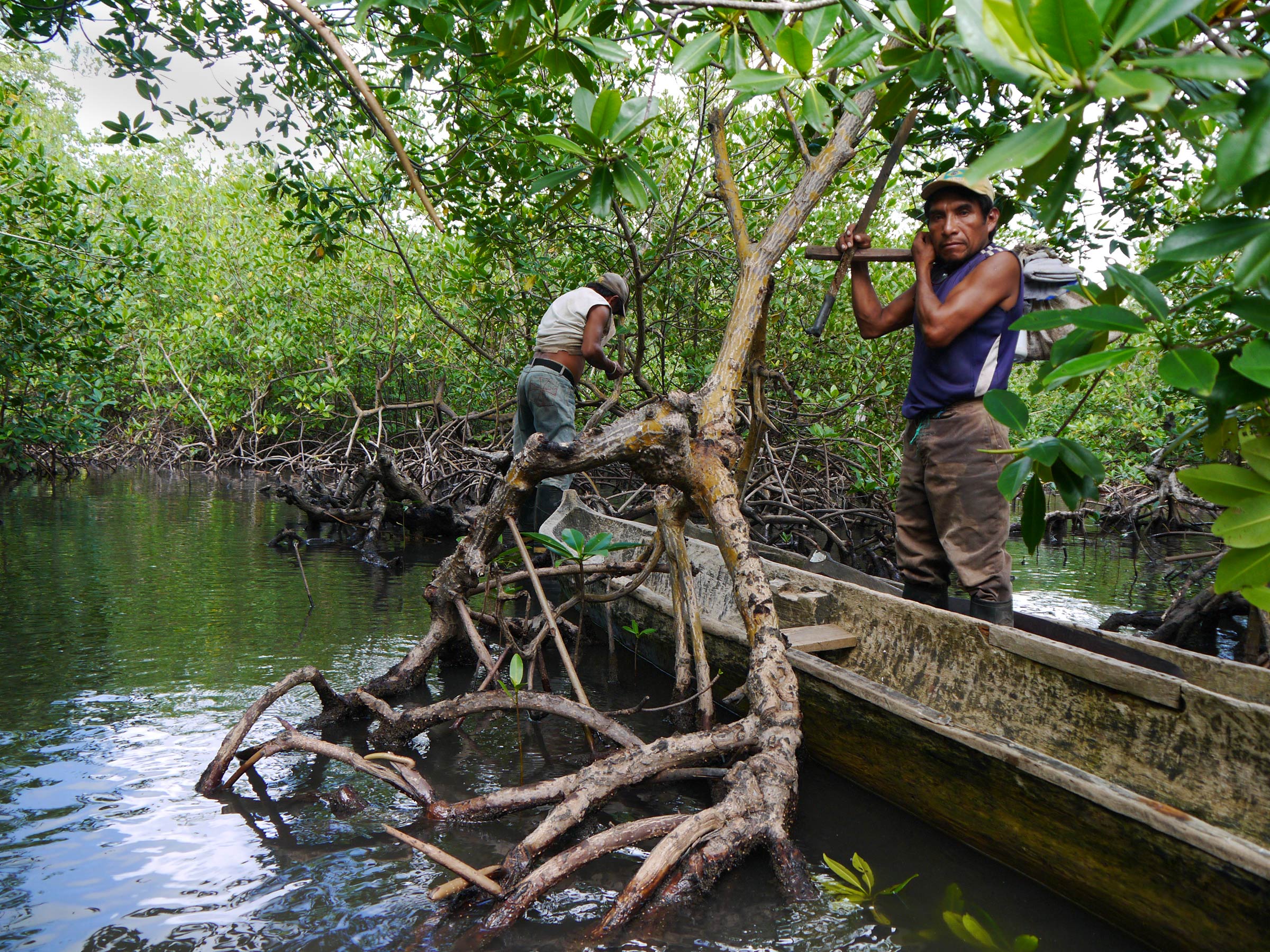
Joselino (foreground) and Justino secured their ulus to the roots of the mangroves and were ready to step ashore and walk through mud and forest trails to the building site of Joselino’s ulu.
Justino and Joselino showed up alongside TRANQUILITY one morning, each paddling an ulu, ready to take me to Joselino’s project. I followed them in my dinghy and rowed for maybe half a mile to a narrow entrance in the mangroves. We left the boats, donned rubber boots, and walked inland through the soft mud. Beyond the mangroves, the ground became more solid as we climbed steep hills of red earth through the old-growth jungle. I was not nearly as adept at making my way through the underbrush as Justino and Joselino; they were soon just two dots in the splash of green of the tropical rainforest.
They stopped to wait for me and pointed out which plants I should not touch. Among the most dangerous are palmettos with razor-blade edges, and a poisonous sort of spiny liana. Joselino balanced his axe on his shoulder; a small plastic bag hanging from it carried matches, cigarettes, and a jar of water. It was all he needed for several hours of work in the jungle. Justino did not appear to carry anything at all for himself.
More than once I felt the squishy sensation of my feet sliding in place on the wet soles of the rubber boots as I tried to keep the pace while climbing a near-vertical mud slide. My two Guna companions seemed not to know fatigue, thirst, or hunger. If they did, kept it well hidden. At every stretch of the trail, Joselino would point out the expanse of his property, and how he was planning to grow bananas on one side of the path, yucca and plantain on the other, but he was, unfortunately, too busy to do it himself. Imagining the amount of work, done without the aid of animals or machines in that harsh environment, made me think how impossible the task seemed, but the Guna have been doing this type of work for centuries.
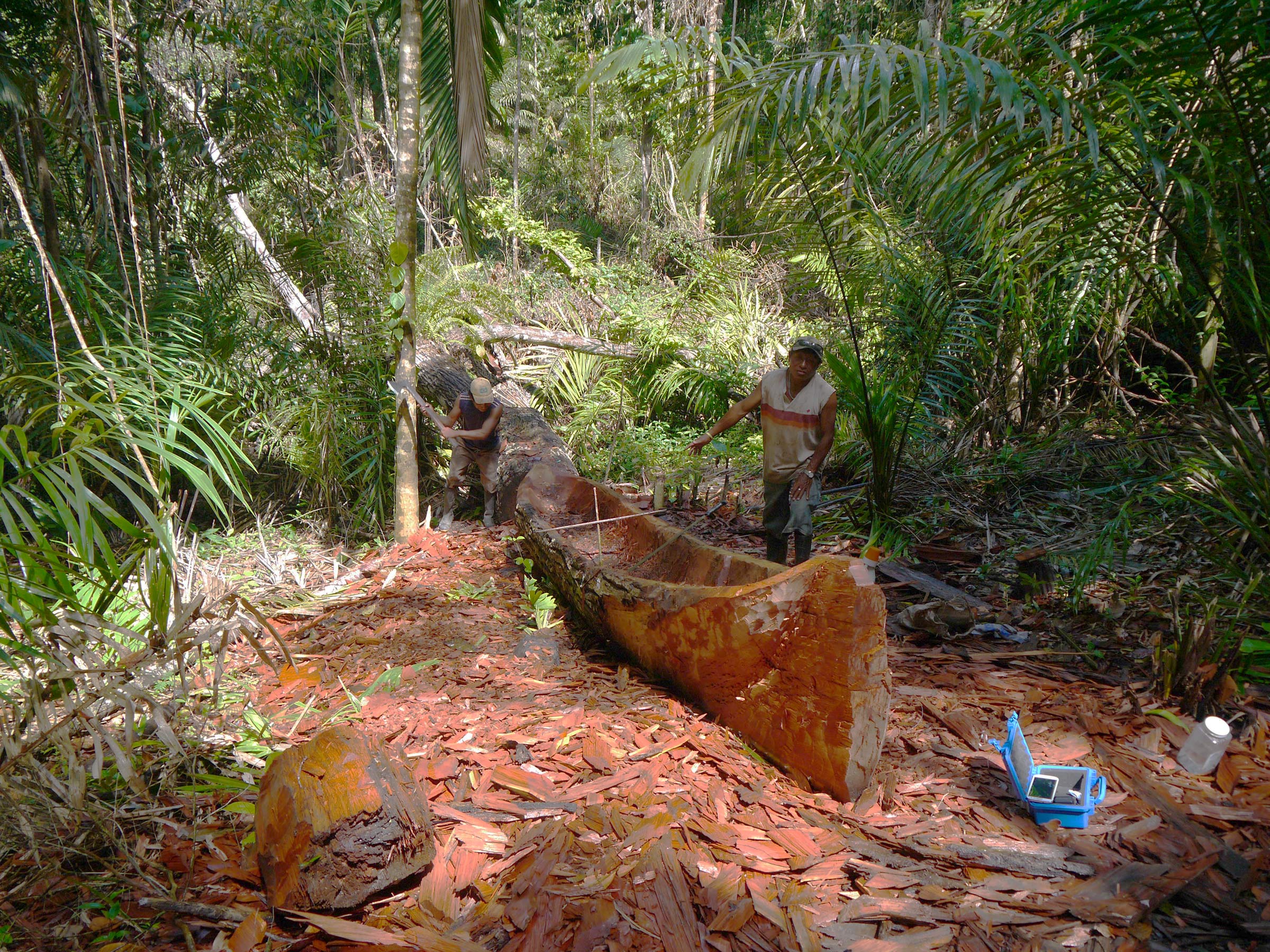
Joselino worked the sides of the canoe with his ax. He could build an impressive vessel from a tree trunk using only very simple tools.
After walking for 40 minutes, we reached the tree that Joselino had felled. He had already spent three long months alone working it with his axe. The rough shape of a canoe had emerged, surrounded by mahogany wood chips. Joselino immediately got to work carving out the interior of the hull. His skill quickly became evident when I took a turn at the axe, and was quickly embarrassed by my clumsiness, although my guides were happy to see me eager to try. “Now you know more than most of the Guna!” they told me.
The log was already well on its way to becoming a canoe, but there was still a lot of wood to carve before it reached a good balance of strength and an easily managed weight.
Joselino would work in the forest until the ulu is close to its final shape and light enough to be carried by a party of people through the jungle all the way to the water. He was already planning to open another trail for that purpose, longer than the one we had hiked, but with a gentler grade to facilitate carrying the heavy canoe down to the water. He would have to ask for the help of his fellow islanders that day, favors that he would have to repay someday either with cash or with labor. They said that the day the ulu would be brought from the land to the ocean there would be a big party, almost like a celebration for the birth of a child.
Once the ulu reaches the island, it will be kept in the water for few days to get rid of insects and pests, then pulled out to dry for the final finishing and painting. Joselino promised me that we would go sailing and fishing on his ulu on my next visit to the islands. During our stay in Guna Yala, Kate and I were captivated by the tranquil atmosphere of the islands and the generosity of the people we met. We prepared to leave and sail TRANQUILITY up the coast to Costa Arriba for some maintenance, happy to have had the chance to witness such special events involving beautiful sailing craft and their amazing crews.
Fabio is currently in Panama with Kate, living aboard their Columbia 29. They are getting ready for longer sailing routes in the Pacific. For Fabio, boats are both a professional career and a passion, a form of expression and a means to explore wonderful habitats.
If you have an interesting story to tell about your adventures with a small boat, please email us a brief outline and a few photos.
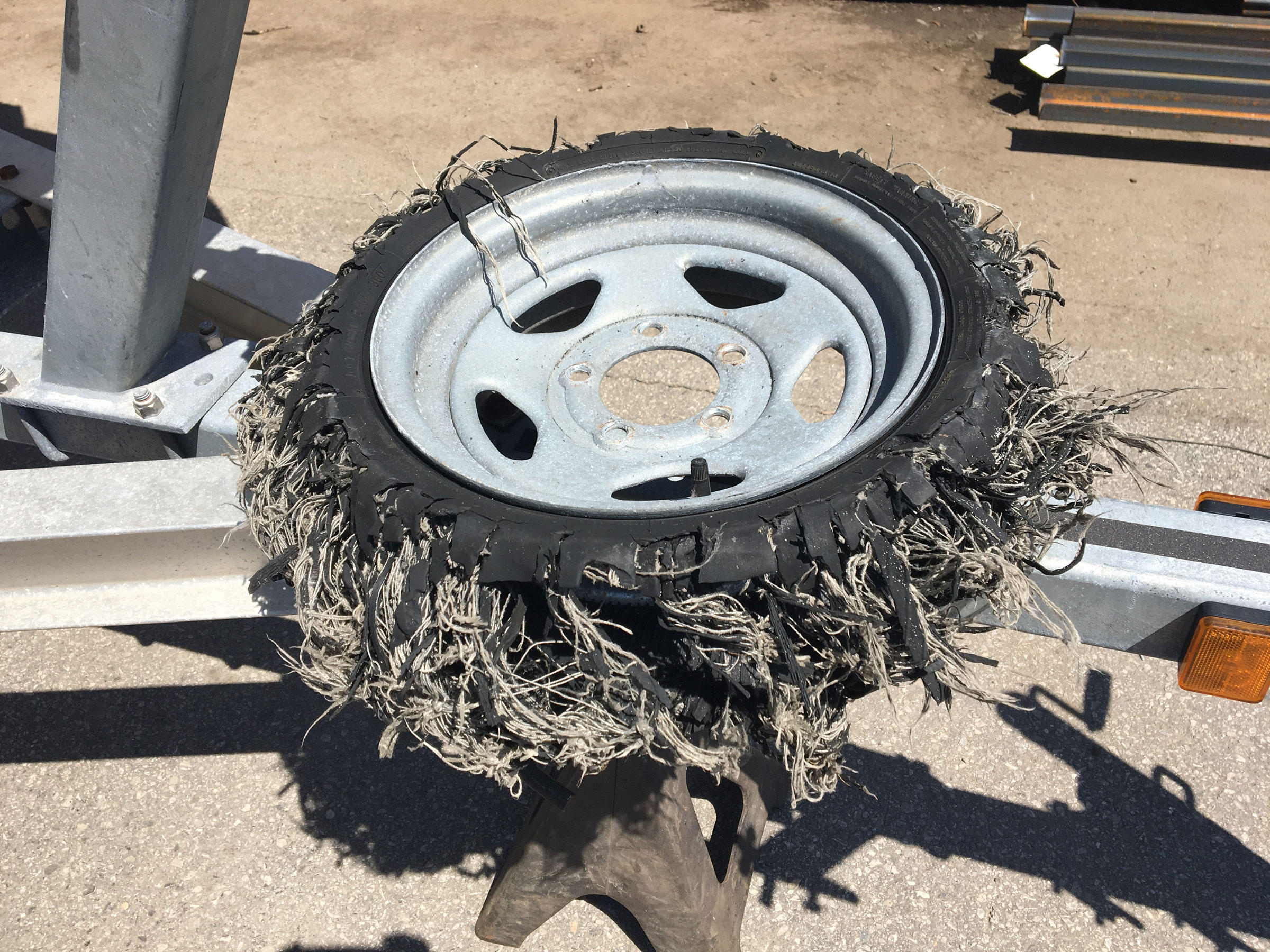
This trailer’s spare tire looks brand new—it still has all of the little rubber “hairs” left by the the mold that created it—but the codes molded into the sidewall indicate it is 16 years old. It needs to be replaced.
It’s easy to take trailer tires for granted—they don’t log many miles and don’t usually show much wear—but they deserve more attention than a glance to see if they look like they have enough air in them.
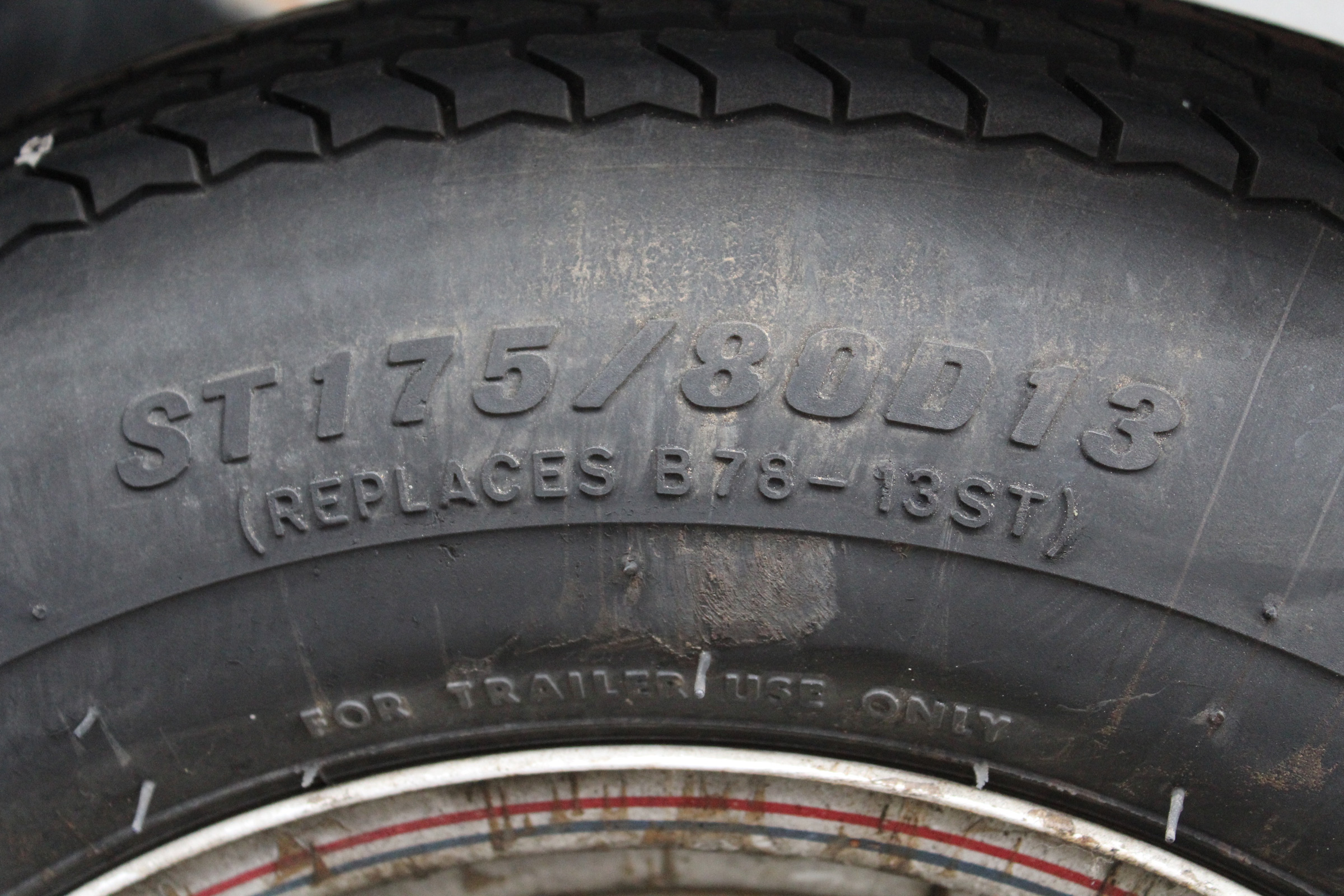
Imprinted on every tire is a lot of useful information on its size, type, load range, pressure, and date of manufacture. All trailer tires are marked with ST—Special Trailer— and they are not at all like vehicle tires. Trailer tires have strengthened sidewalls that keep the trailer from swaying in turns and allow them to carry the often very heavy combined weight of trailer and its load.
SBM photograph
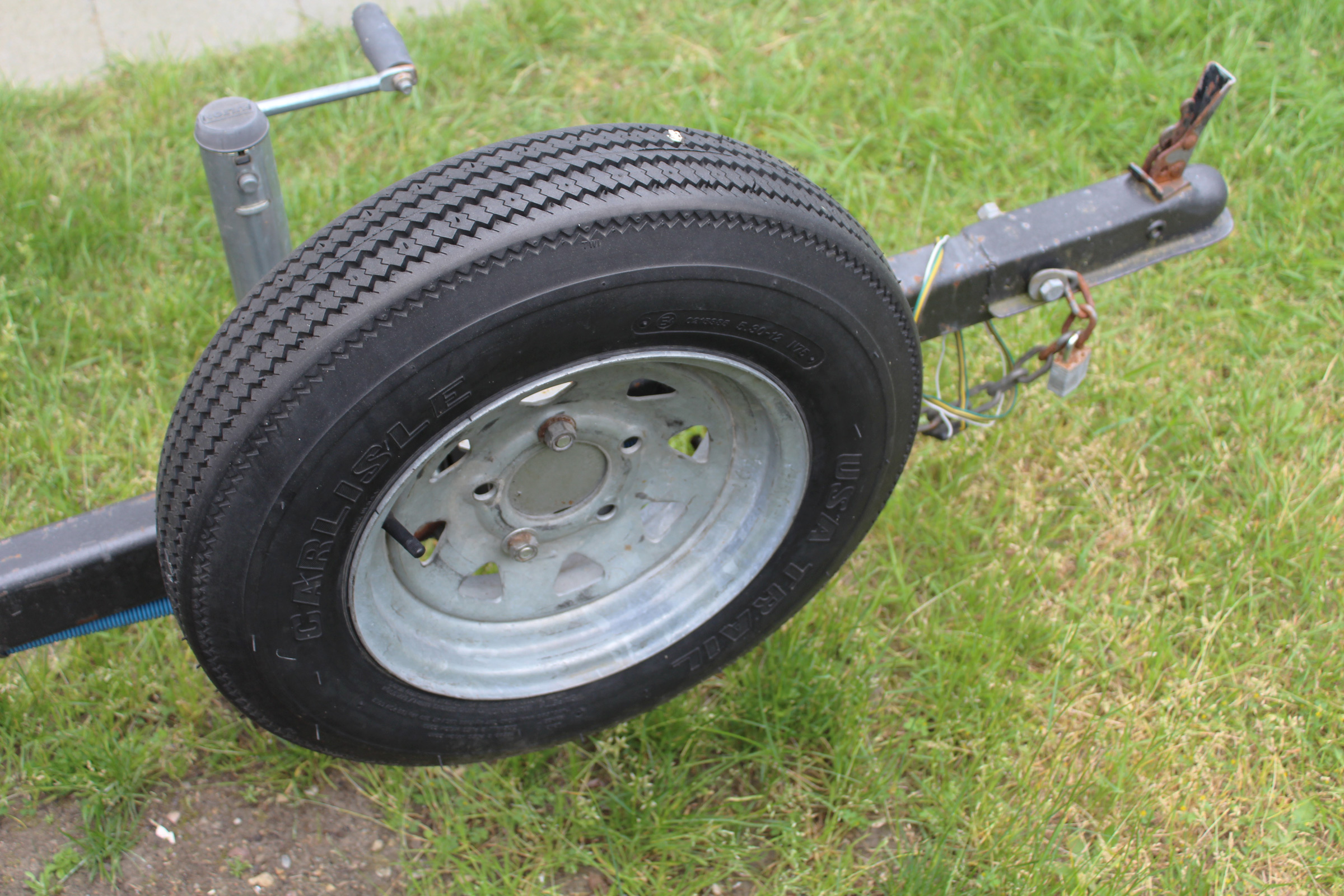
Like all trailer tires, this tire is marked ST for Special Trailer. It is 175mm (6.9”) wide at its widest point and 80% as tall, 140mm (5.5”), from wheel rim to tread. It has diagonal fiber plies—D—and fits a 13” rim.
In the string of numbers indicating the size of the tire, there is a letter—B or R—for bias or radial plies. You may also see a D for diagonal, but its construction is the same as a bias-ply tire. For short trips, bias-ply tires are suitable; our trailer guru Eddie recommends radial tires for long road trips—they can carry more weight and don’t generate as much heat.
SBM photograph
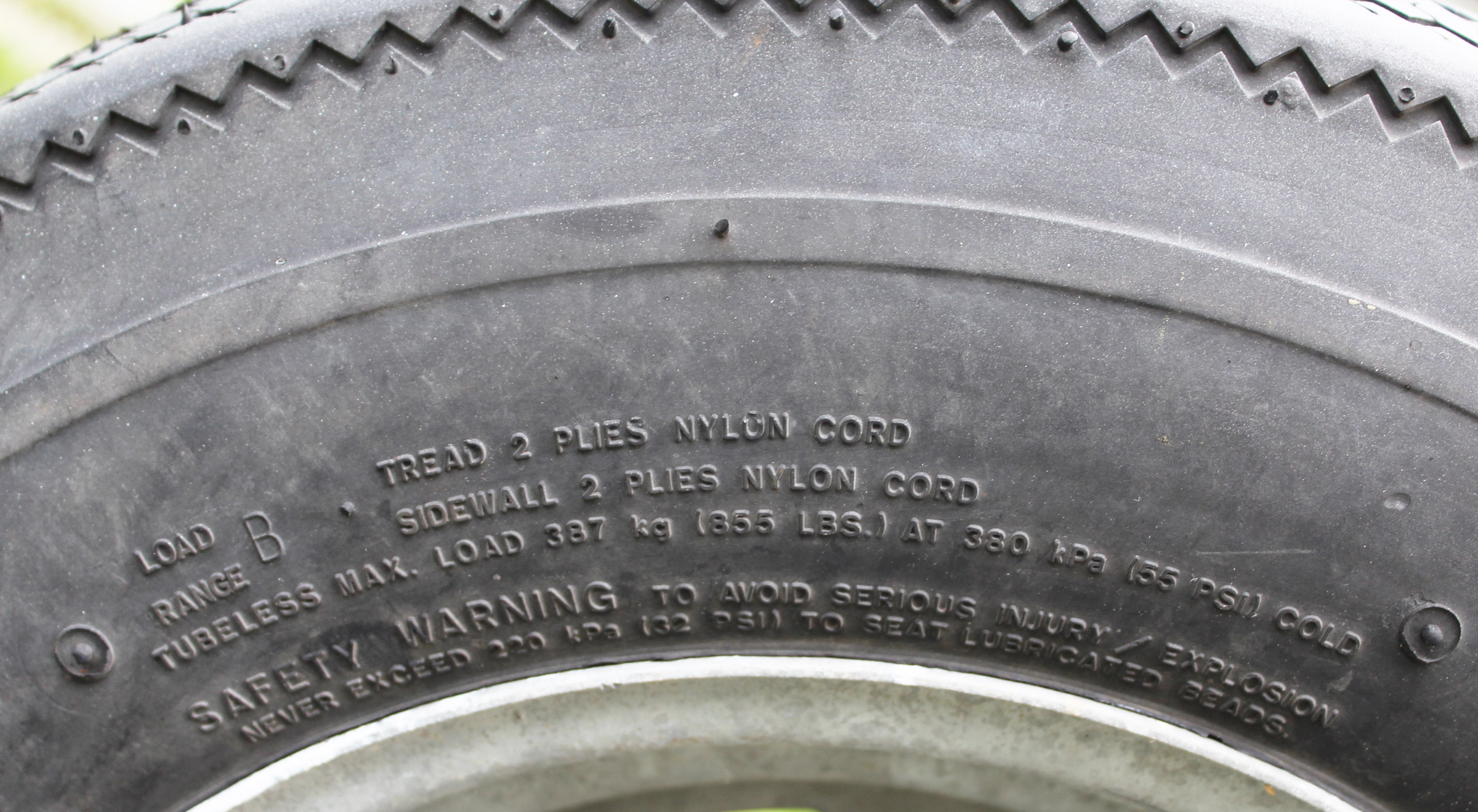
This Load Range B tire gives the actual number of tread and sidewall plies instead of the cotton-ply equivalent. The text also provides a maximum load (per tire) of 855 lbs and a maximum cold inflation pressure of 55 PSI. The maximum pressure should be used even if the load carried is less than the maximum weight (per tire)indicated.
A load range is designated in letters B through F. The letters indicate a ply rating based on the number of plies, from 4 to 12, when they were made of cotton. Today’s tires are made of stronger fibers, usually nylon, and they achieve the same rating with fewer plies. A tire with a higher load rating will have stronger sidewalls, carry a heavier load, and run cooler. Most trailers have B or C. While the letters are an indication of how much weight a tire can carry and its maximum inflation pressure, you can find the weight and the pressure indicated in smaller print on the sidewall.
Because trailer tires have very stiff sidewalls, they may not appear to need air as your vehicle’s tires do; for the most accurate reading, use a gauge and take the pressure of the tires while cold. It is important to keep tires inflated to the maximum pressure indicated on the sidewall, even if the load on the tire (weight of the trailer, boat, and gear divided by the number of tires) is less than the maximum load indicated. This minimizes sidewall flexing, which in turn reduces the heat buildup that can lead to its failure. On a hot day or after the tires have warmed up on the highway, the pressure will rise by only 2 percent for every 10 degrees and the tires are built to accommodate that extra pressure. Don’t lose the valve-stem cap while you’re checking the pressure or inflating the tire—it protects the valve core from grit that will cause it to leak.
While car tires will also have ratings for speed, the U.S. Department of Transportation (DOT) tests and rates all ST tires (with rare exceptions) for 65 mph, close to maximum speed on our modern highways. With a trailer in tow, we drive a little slower and load extra gear in the tow vehicle instead of in the boat.
SBM photograph
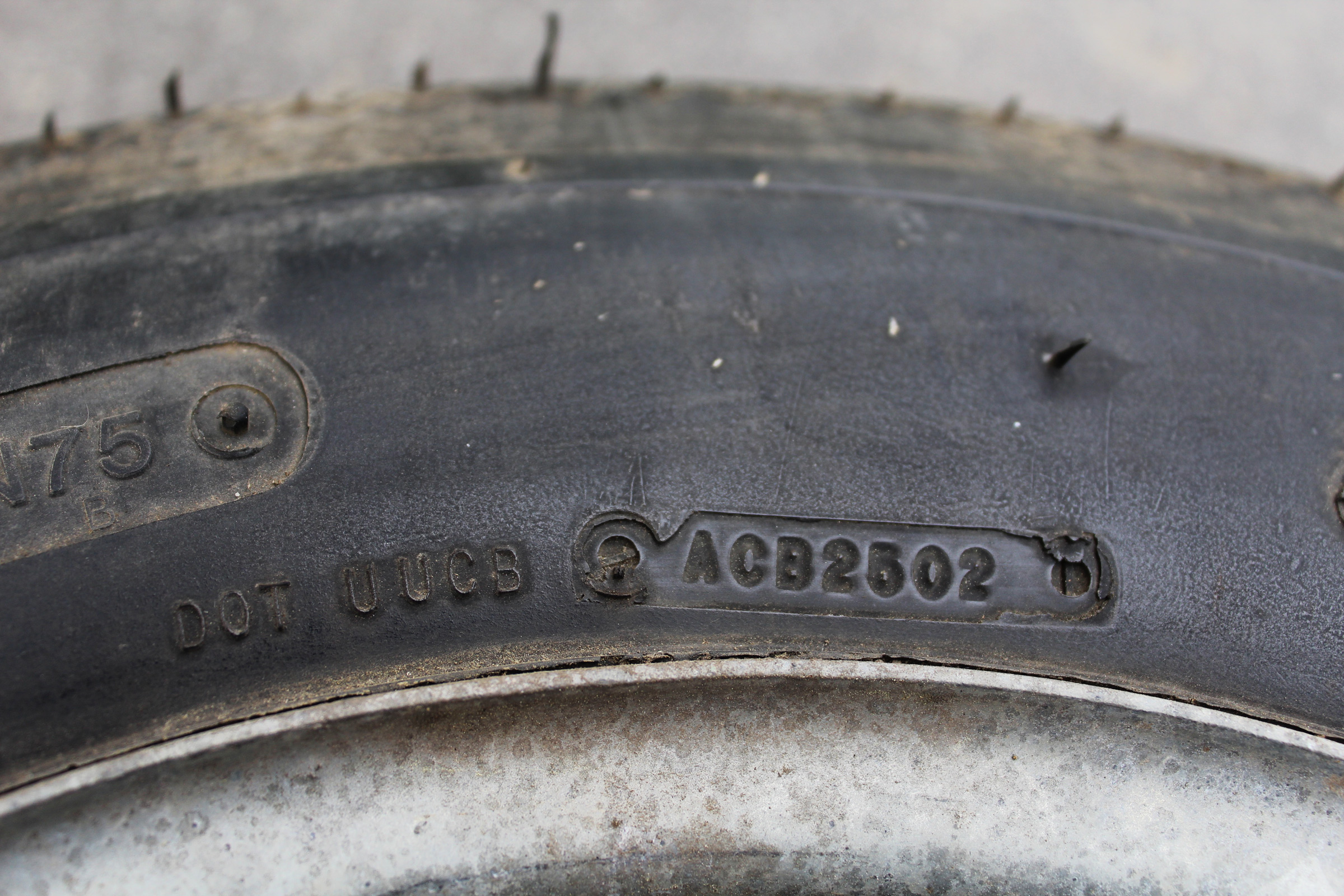
Of all the letters and numbers in the Department of Transportation (DOT) code, the last four are the most important. Here, “2502” indicates the tire was manufactured in the 25th week of 2002.
On the side of the tire there is a four-digit number that indicates when the tire was made, with the first two numbers being the week of the year and the last two numbers being the year. Age is both the most important aspect of tire safety and perhaps the most overlooked. A tire may have plenty of tread, but that doesn’t help us determine how much life it has left. Tires age with exposure to air—rubber oxidizes and loses flexibility, even as a tire sits unused. UV rays from the sun and moisture from ground will accelerate the degradation. While you can’t prevent the aging, you slow it by covering the tires and parking the trailer on a paved driveway or on concrete pavers or planks set on soil.
SBM photograph
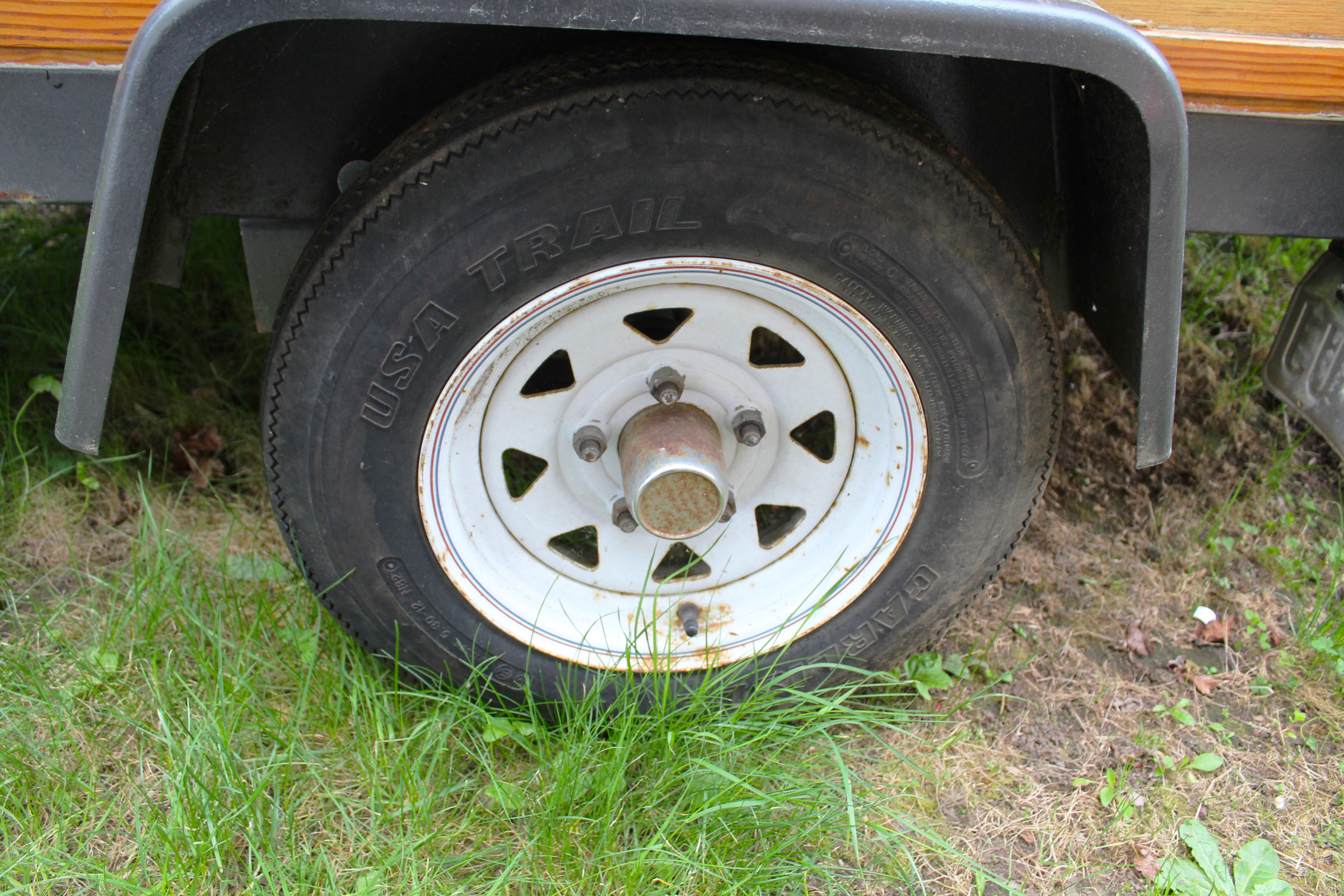
If the only spot you have for your trailer is in the back yard, roll the tires up on concrete pavers to keep the moisture in the grass and soil from hastening the degradation of the rubber.
Most trailer tires will age out long before they wear out. Our trailer guru Eddie recommends replacing tires around the five-year mark; studies by the National Highway Traffic Safety Administration indicate tires are no longer safe once they reach six years.
Kent and Audrey Lewis
This tire was one of 3 on a dual-axle trailer that went south in a hurry. Fortunately, the boat survived and the failure of the tires didn’t lead to an accident. The tires were 14 years old.
When you buy new tires, they should be the same size as those that were installed by the manufacturer. If you bought the trailer used, don’t assume that its tires are the right ones, a previous owner may have put on cheaper tires to save money.
SBM photograph
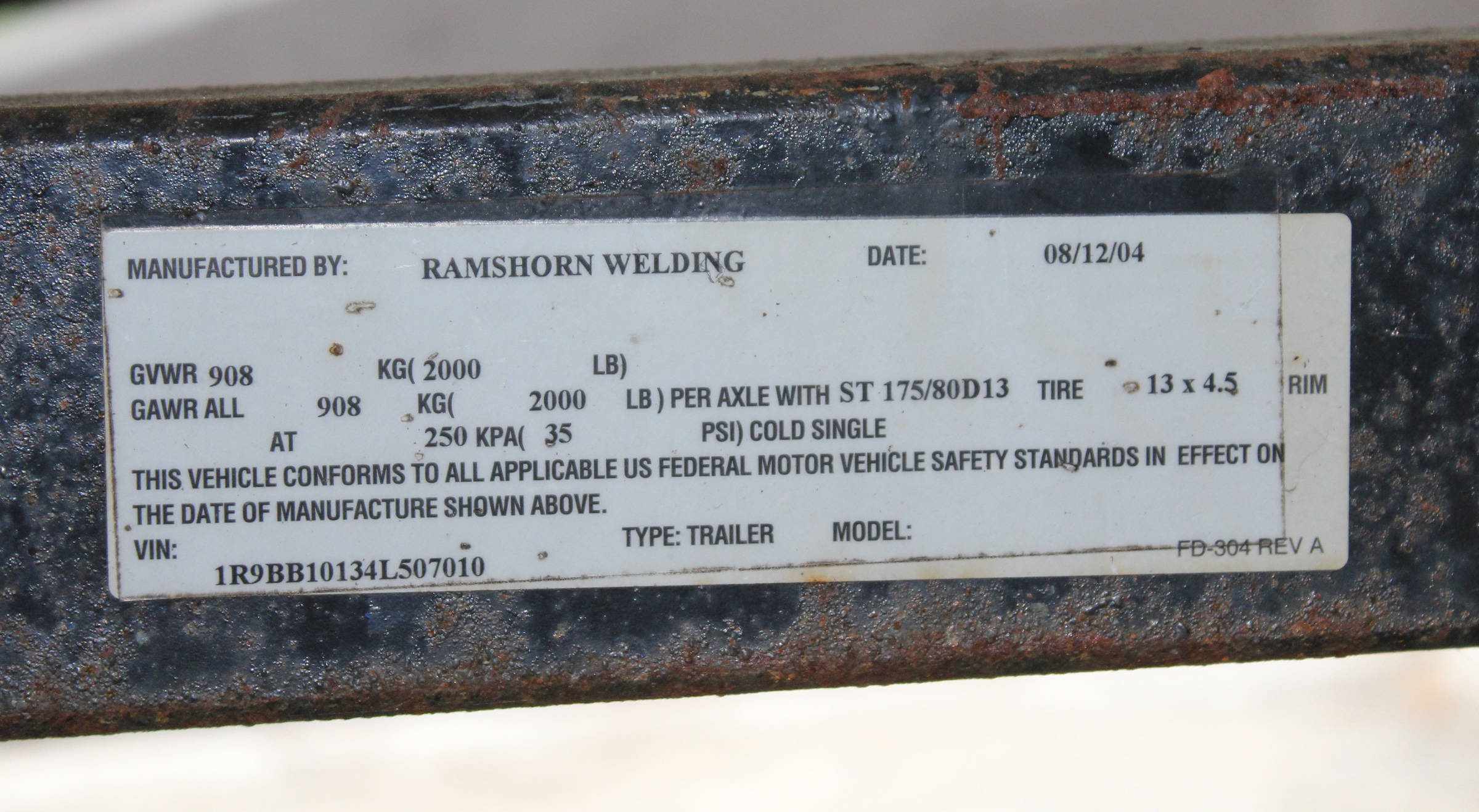
The label on the trailer will note, among other things, the recommended tire size. This trailer takes ST 175/80D13 tires.
Check your trailer’s loading decal or consult the manufacturer. If you have tires with a B load rating, consider upgrading to C. And before you have the new tires installed, check their date code to make sure that they actually are new.
It’s easy to take tires for granted, but if we take care of them, they’ll take care of our trailers and our boats.
Lewis family trailers have seen the Gulf, Pacific, Atlantic, and the Great Lakes. The longest pull was 1,449 miles from Corpus Christi, Texas, to Oceanside, California, with our Drascombe Lugger. The current fleet of five trailers carries boats ranging from 130 to 900 lbs.
You can share your tricks of the trade with other Small Boats Monthly readers by sending us an email.
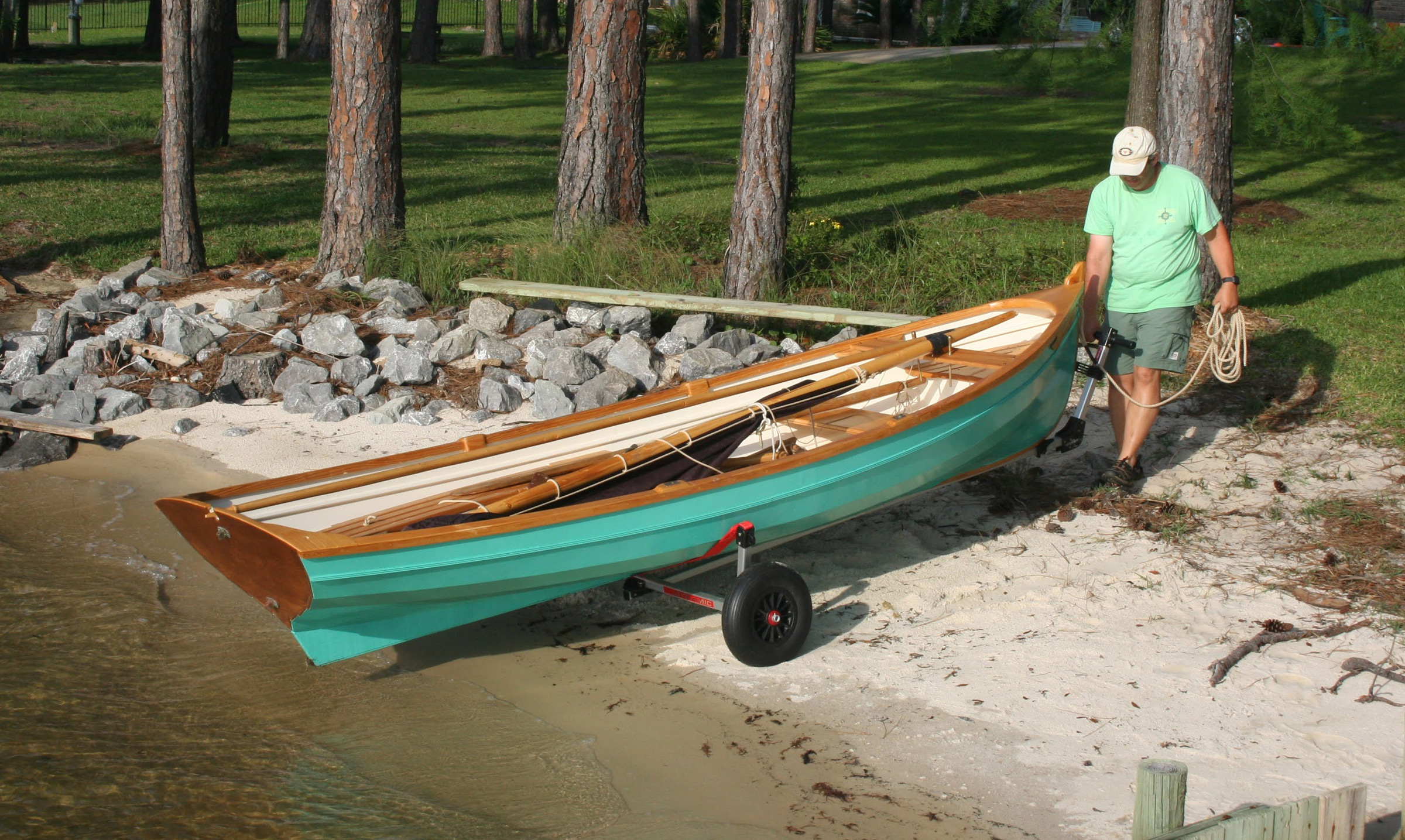
A dolly opens up access to the water in areas without launching ramps.
We have spent years moving small boats around, and for us, dollies are indispensable for boat storage, transport, launch, and recovery. They reduce dependence on paved launch ramps and open up new areas to explore, especially for adventurers with larger boats that carry a crew of three or four. And the less effort it takes to move a boat, the more often you’re likely to use it.
We first used dollies about 20 years ago, after years of toting around a 140-lb Sunfish. Life immediately became easier when we could roll our boats to and from storage, load them on and off trailers, move them to the beach, and launch and recover from the dolly. Because we did not dunk our trailers so often, they lasted longer. Dollies also reduced the number of scrapes and gouges on the hull, as well as the amount of labor required for repairs. We now own six lightweight dollies that are easy to store when not needed.
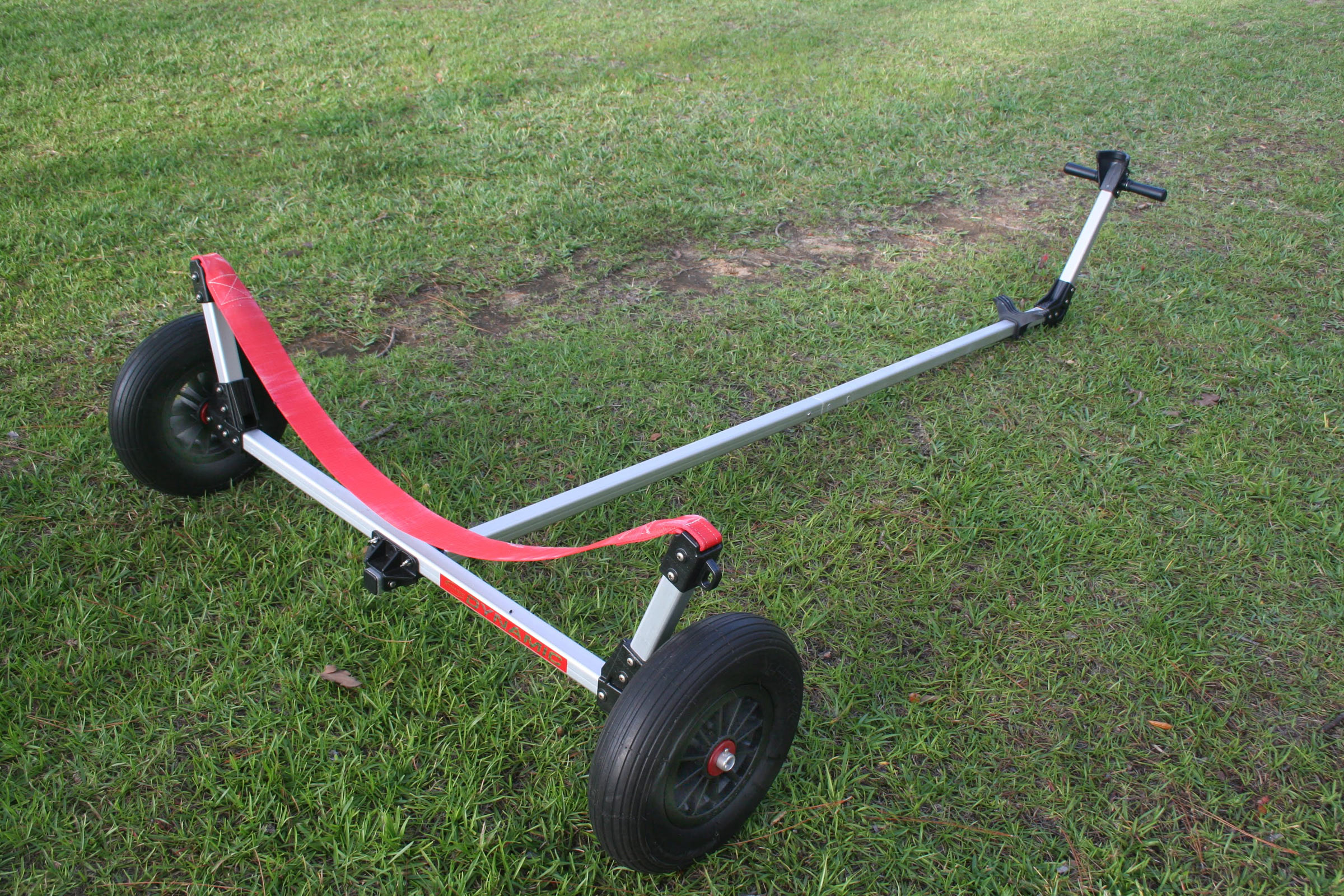
For storage and transport to and from the water, a Dynamic Dolly can be easily taken apart to separate the axle, tongue, and wheels.
Dollies from Dynamic Dollies and Racks are made of marine-grade parts. The initial assembly of the kit takes less than 30 minutes and requires only a screwdriver; the plastic fittings are molded with hexagonal recesses to hold the stop nuts, so a wrench is not required. The stainless hardware, the UV-protected plastic, and 1-1/2″-square, anodized aluminum components have proven durable and maintenance free.
The Dynamic’s noncorrosive wheel hubs roll on Delrin ball bearings so our boats travel easily over our yard and slightly sloped beach with firm sand. The 16” x 4” pneumatic tires have inner tubes and do not deflate over time as fast as non-tube tires. The air pressure can be reduced to increase footprint for soft sand, and while wider 18″ x 9-1/2″ tires can be purchased as an option, we prefer the standard tire for the resulting overall narrower width of the dolly. A quick rinse with fresh water is all the dolly gets after a dunk in the salty bay. For more convenient transport or storage, the dolly breaks down into five parts by pressing three quick-release buttons and removing two bolts with wing nuts.
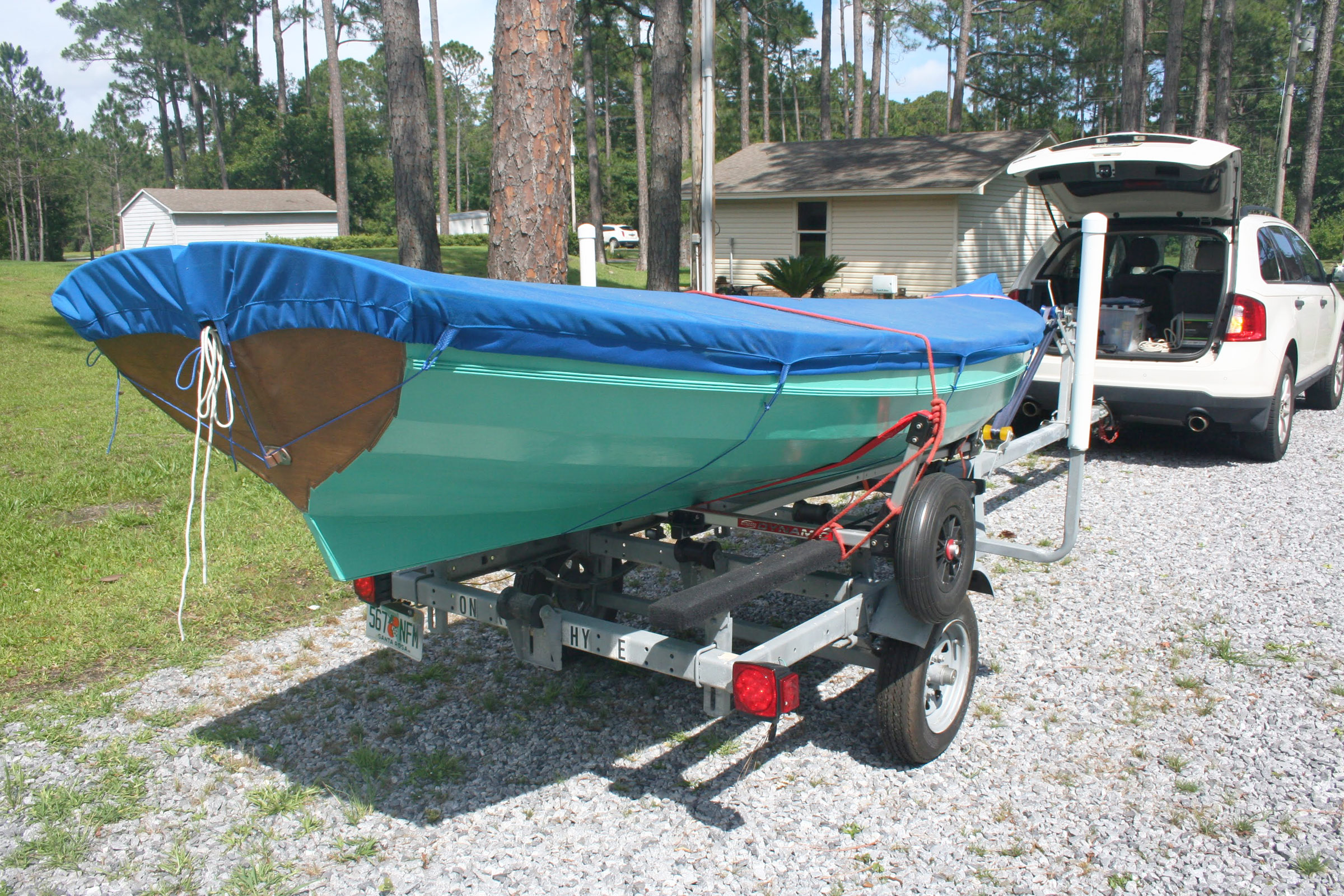
A boat and its dolly can ride on a trailer for the drive to the beach, and dragged off for the walk to the water. This dolly rests its axle on the trailer’s bunks. Some trailers can be modified with supports to cradle the dolly’s wheels.
The Dynamic product line is built in the USA and can carry boats as large as the Thistle or 13′ Boston Whaler. The bulk of their dolly business is with owners of Sunfish, Lasers, and Optimists. Dollies are built specifically for each type, which ensures proper load balance, hull protection, and conveniently spaced tie-down points. If your boat doesn’t appear on the company’s list of standard dollies, they’ll design one to fit.
We see dollies as a great way to optimize access to soft launch areas while protecting our boats. We can roll our boat to our favorite launch spot, and the crew is a lot happier along the way!
Audrey and Kent Lewis live on Florida’s Emerald Coast and enjoy small-boat sailing, restoration, and boatbuilding when she’s not designing costumes and when he’s not flying. Their fleet includes several fiberglass Sunfish, a wooden Sailfish, wooden Sunfish, a Catfish catamaran, an O’Day daysailer, a Drascombe Lugger, and a Drascombe Dabber. They have also rescued and fostered over 30 boats since 2011. Some people describe them as “boat-struck.” They document their boating pursuits in their blog.
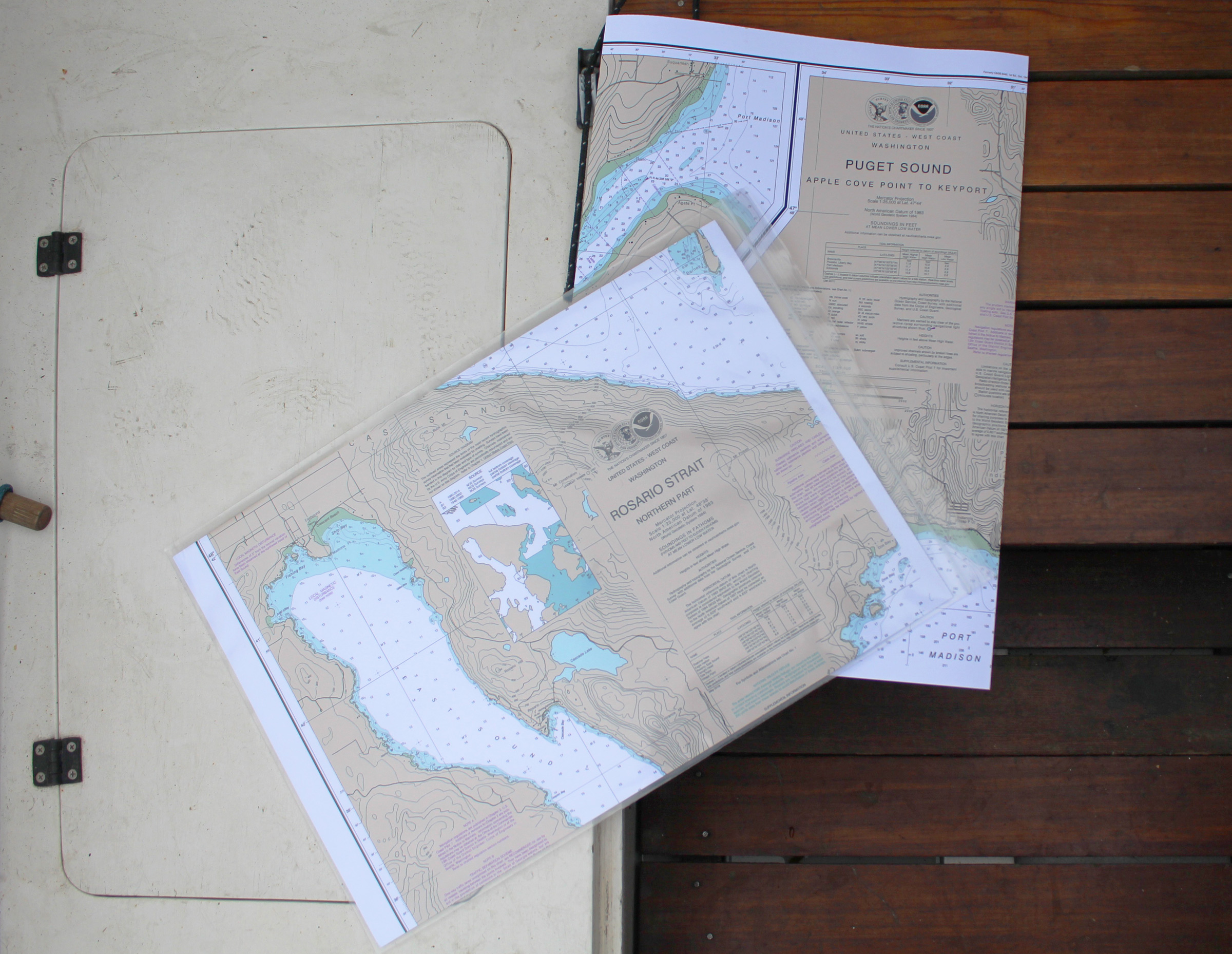
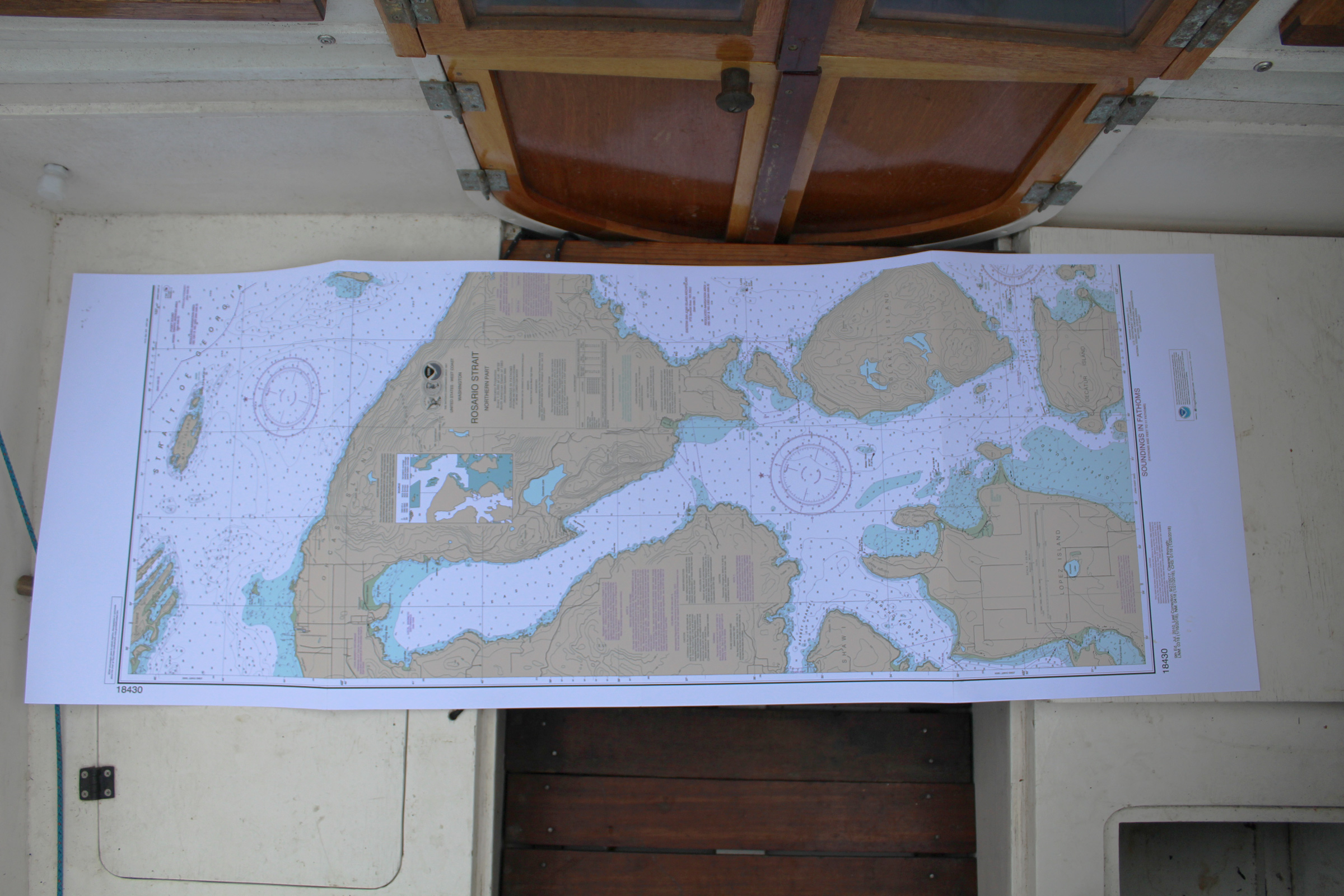
Frugal Navigator’s Small Craft version of NOAA charts comes folded to fit a waterproof chart case.
I still have the charts that my father and grandfather used when they were sailing out of Marblehead, Massachusetts. I don’t use them, of course—they’re over 50 years old and I live on the country’s other coast, 2,500 miles away. I’ve also kept my father’s charts of our local waters on Puget Sound, and every chart I used going up the Inside Passage.
While my fondness for old charts may be somewhat sentimental, I still find paper charts useful even though there are some very sophisticated electronic alternatives. If I were traveling the Inside Passage or the Intracoastal Waterway again, electronic charts would have a clear advantage in lower cost and bulk, but my cruising grounds are limited in range, so I don’t need many charts to cover the area. The screen on my handheld GPS is less than half the size of a credit card, and while it can zoom in and out, it can’t give me the big picture and the details all at once in the way that a chart can. And on a sunny day I can rarely see through the glare on the screen.
In the fall of 2013, the National Oceanic and Atmospheric Administration (NOAA) announced that the federal government would bring an end to the lithographic charts that it had been printing since 1862. Printed charts did not cease to exist the following spring when the presses stopped, but their production was taken over by NOAA-certified, on-demand printers. Initially there were only two sources of charts, a source of frustration at the time, but that number has grown to 25.
I obtained charts of my main cruising grounds—central Puget Sound (18446) and northeast San Juan Islands (18340)—from Frugal Navigator. These charts can be printed to replicate the NOAA charts and shipped rolled, but I ordered the Small Craft Charts. They’ve been configured for easy use in the large SealLine map case, the kind commonly carried aboard kayaks and small boats. The printing is two-sided, so you don’t have to struggle with a large, awkward sheet. If you’re about to sail off the edge of the chart, you can pinch your position and the location under your thumb will be near your forefinger on the other side—the area along the edge is duplicated on both sides.
Printed on both sides of the sheet, the Small Craft chart is half the size of a traditional one-sided chart and more easily managed.
The paper is much heavier than the paper that had been used for the NOAA charts, so it is easier to slide into a waterproof case. Frugal Navigator mails the charts with a 6mm zip-lock bag that provides some protection from water and wear if you don’t need a map case with attachment points to secure on deck. The company website notes that the charts are printed on “water-resistant paper.” I wet a portion of the chart repeatedly and each time it dried out the paper was only slightly buckled, but otherwise as good as new. The ink didn’t bleed or smear when rubbed. Immersing the paper for several hours did ultimately soften the paper and made it susceptible to tearing. The paper has a good tooth for making notes with pencil or ball-point pen, even when wet. Erasing pencil marks will get them faint enough to write over, but they won’t disappear completely.
In all, these new charts are a noticeable improvement over their predecessors. I’m glad that charts are still available with the same appearance, up-to-date information, and better paper. They’ll be as useful while cruising as they are welcome in my archives.
Christopher Cunningham is the editor of Small Boats Monthly.
A standard chart from FrugalNavigator , printed on one side and rolled, costs $15.95; the Small Craft version, printed both sides and folded, $21.95. You can find a list of printers, their offerings, and their contact information on the NOAA website. Frugal Navigator offers a free 8-1/2” x 11” sample chart.
Is there a product that might be useful for boatbuilding, cruising or shore-side camping that you’d like us to review? Please email your suggestions.
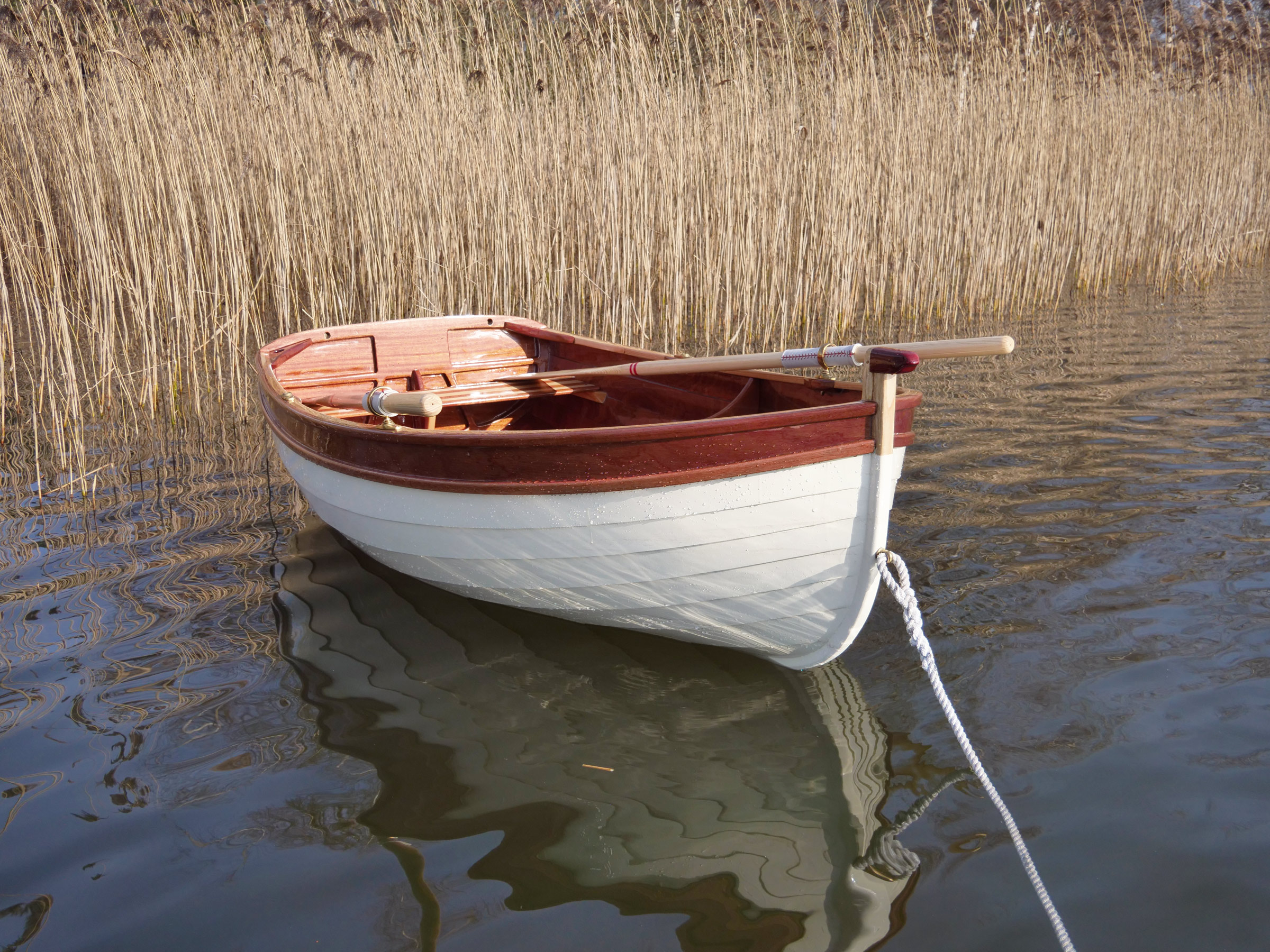
The dinghy sits lightly on the water but has enough volume to carry a complement of three. The horizontal projection at the stem head provides a handhold for pulling the tender up on the mothership’s deck.
Ernst Glas takes his family on summer cruises on the Baltic Sea aboard RONDINE, a 43′ sloop his father built in the early ’90s. He’d had a rather disagreeable tender for the yacht, too heavy to haul up on deck and powered with a rather unreliable two-stroke outboard that required “a lot of begging and praying.” He sold the tender, but his young son Tristan missed the boat and pleaded with his father for a new dinghy.
Ernst struck a deal with Tristan: they would get a new dinghy, but they would do as Grandfather did and build it of wood, themselves. Tristan agreed, on the condition that the dinghy would have a motor. The two went looking for a design, something easily rowed and capable of taking an outboard. Ernst was drawn to prams, but Tristan insisted that a fast boat must have a sharp bow.
Photographs courtesy of the Glas family
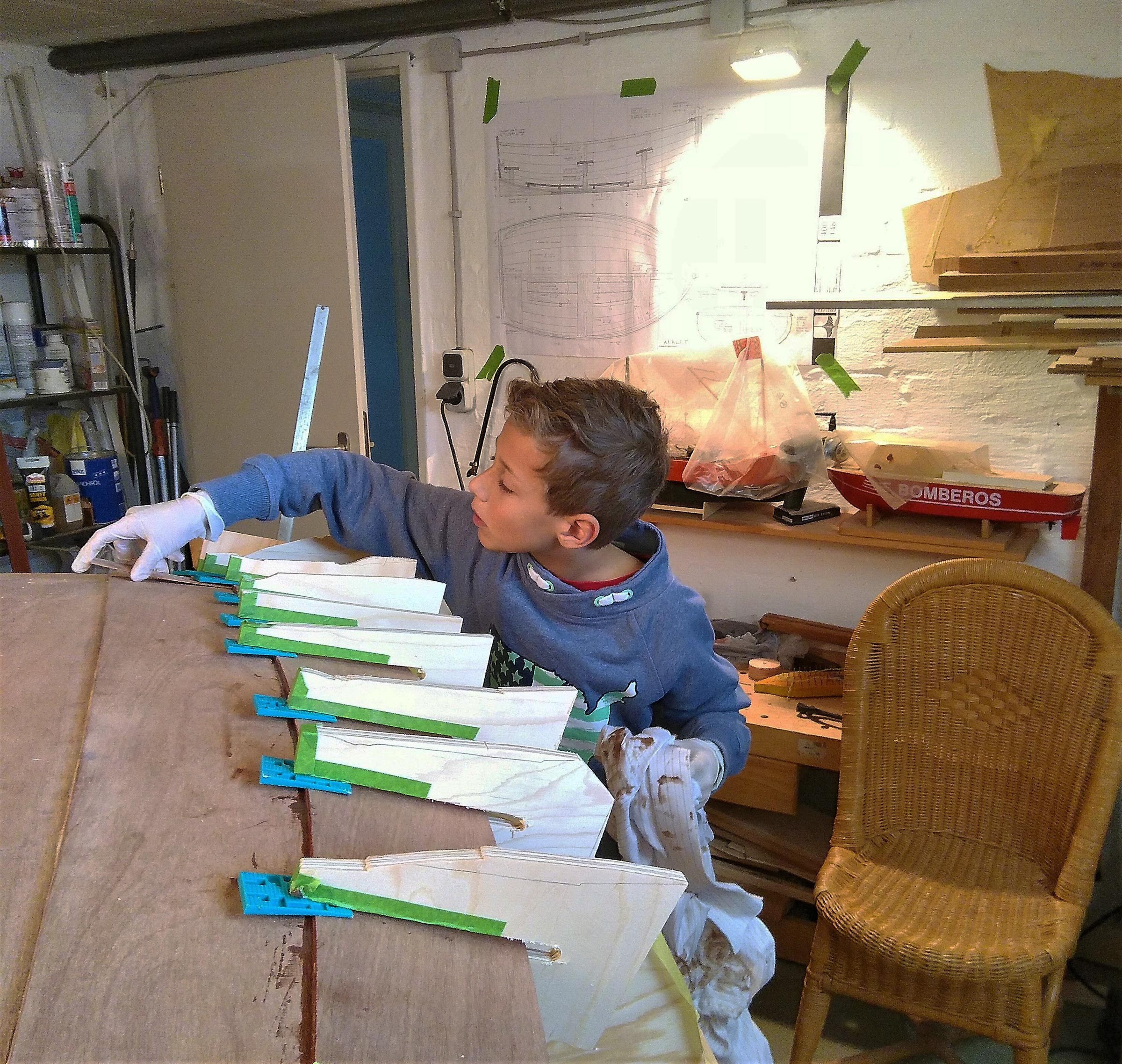
Tristan often pitched in on the construction. Here he’s cleaning up excess thickened epoxy after a plank has been secured in place with homemade plywood clamps and wedges.
They settled on Iain Oughtred’s 7’ 2” Auklet. Its 3′ 11″ beam and full-bodied hull would be able to carry the family of three and their gear to and from RONDINE, and its glued-plywood lapstrake construction, bringing the dinghy’s weight to just 50 lbs, would make it easy enough to pull up on the sloop’s foredeck.
The plans arrived at the end of the summer of 2017, and Ernst and Tristan had agreed to start the construction that fall, after the summer sailing season. But, “when the plans arrived,” noted Ernst, “something strange happened to us. Something forced us to start immediately.” Ernst ordered 4mm mahogany plywood for the planking and ash lumber for the longitudinals. He already had some 3cm mahogany, leftovers from work on RONDINE, that would make a nice transom.
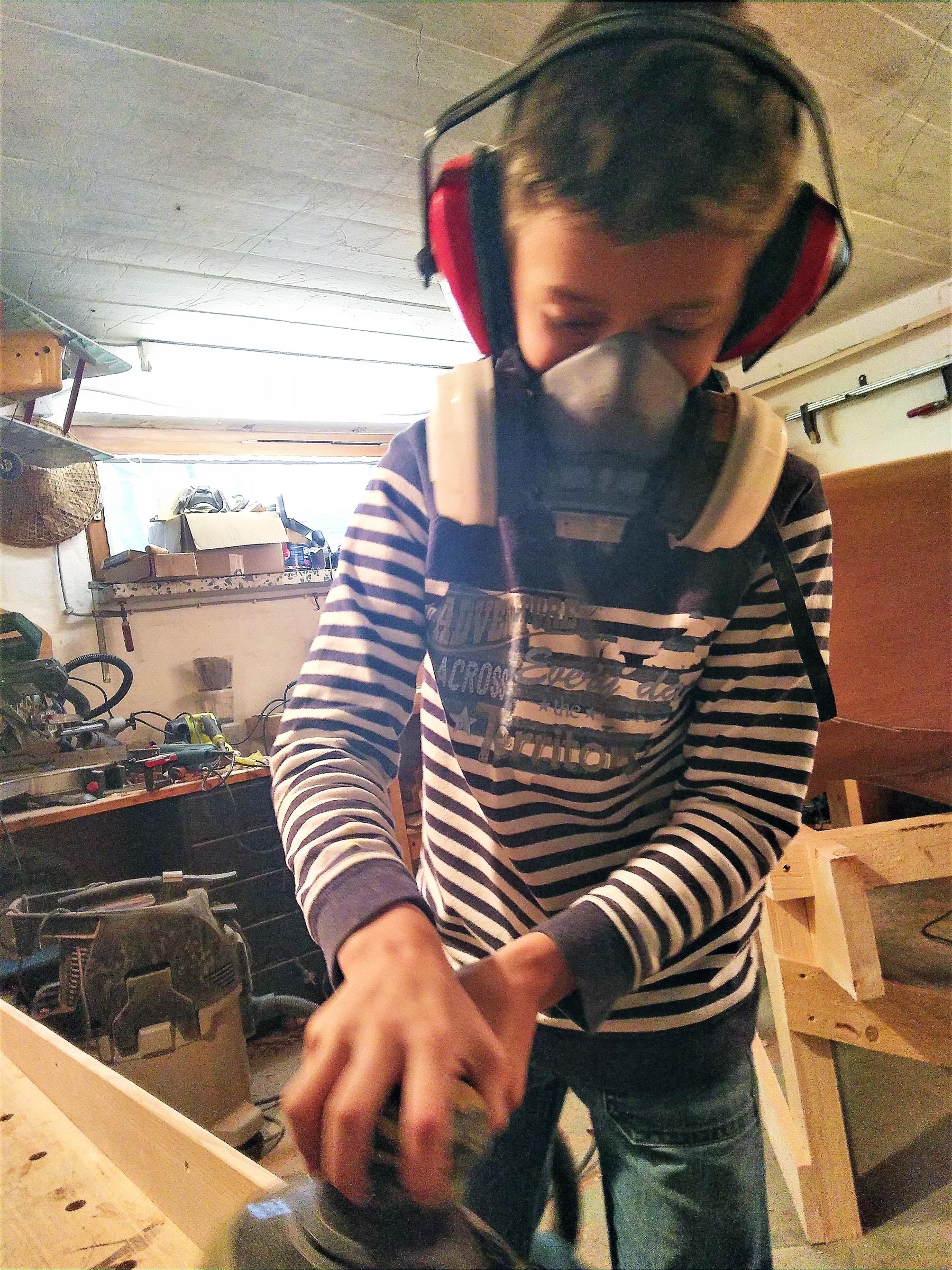
Sanding can be a tedious chore, but Tristan suited up and did his fair share.
The glued-lapstrake method was new to Ernst, but “all in all it was not so difficult, because every small step is quite easy if given enough time.” The vicissitudes of life had made 2017 a particularly challenging year for Ernst, but working in his small workshop, sometimes with his son, sometimes alone with only classical music from company, had a curative effect. “I tried to do everything very slowly, to concentrate on each small step and find a kind of center for me in the music, the wood, and the tools. These were lucky hours.”
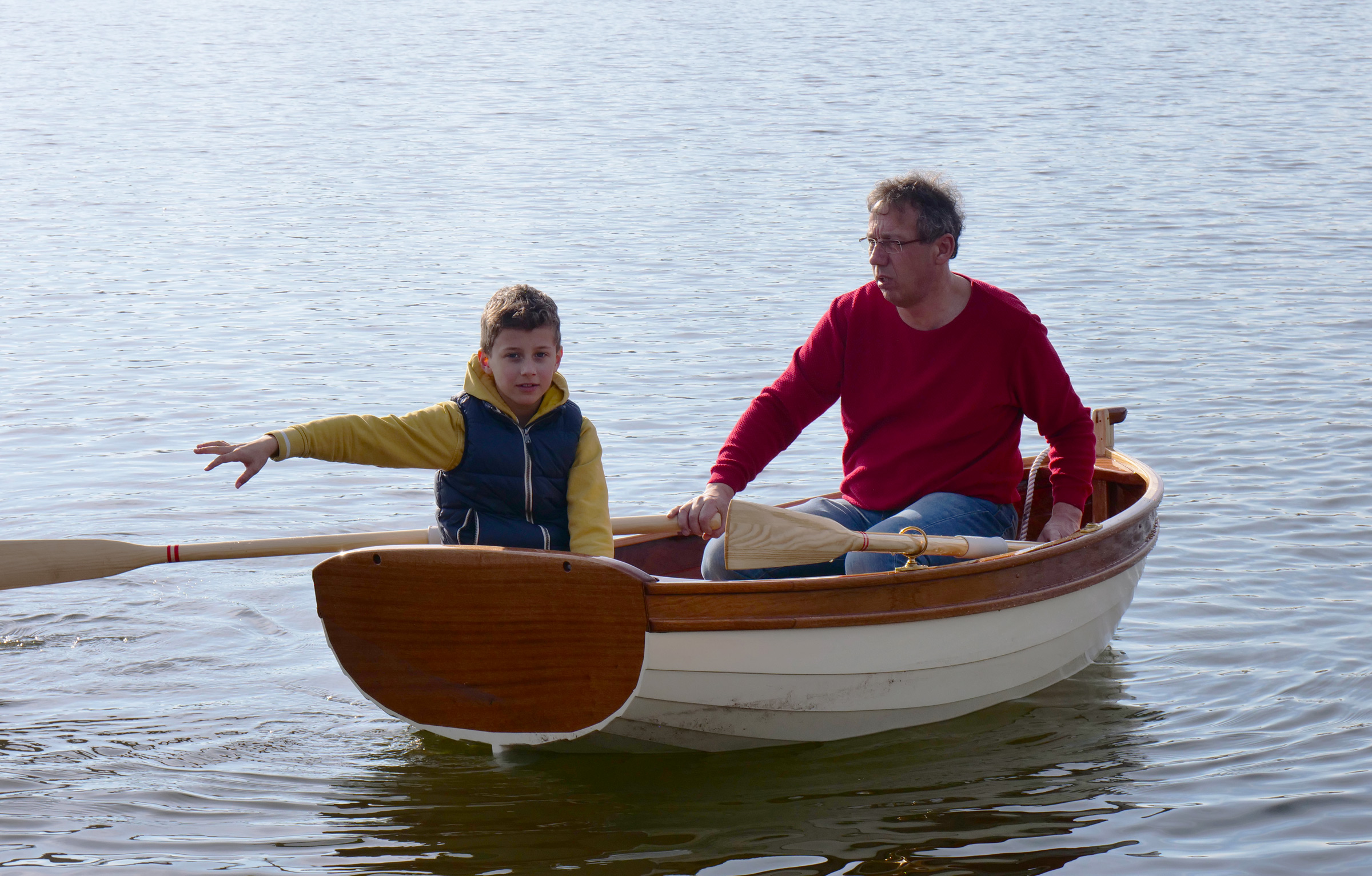
Father Ernst and son Tristan take the Auklet out for a spin under oars.
Ernst and Tristan finished the dinghy in February, “quite proud about our work.” A warm spell in early March cleared the ice from the small lake near their village and they launched their Auklet. Ernst found the dinghy easy to row and fast for its length. A few weeks later they returned to the lake with an electric outboard. Tristan took the helm and the two motored around the whole lake.
The Auklet is an worthy tender to RONDINE, the 43′ sloop built by Ernst’s father.
The Auklet that Ernst and Tristan built now rests on the foredeck of the boat Grandfather built, ready for the sailing journeys of the coming summer. It has yet to be christened but it already has its place in the hearts of a father and a son. It can wait for a name.
Have you recently launched a boat? Please email us. We’d like to hear about it and share your story with other Small Boats Monthly readers.
In 1975, I moved to Newmarket, New Hampshire, and got my first full-time job working in a cabinet shop that was housed in an extension of a 100-year-old barn. The weight of the shop’s roof was spreading the walls and we needed to get a tie-rod to pull them back together. Steel rod was easy enough to find and have threaded, but we needed a big turnbuckle.
Two of us went to the hardware store in town to see if we could find one there. It was not a hardware store you’d recognize today—it had as much used stuff as new. The building was an aged white-clapboard telescope house with creaky wooden floors. We found the proprietor sitting by a hot barrel stove in a threadbare easy chair. We told him what we were looking for, and without a word he got up and led us through the maze of aisles to one of the building’s extremities. In the middle of the aisle he pushed some stuff out of the way and uncovered a turnbuckle that was about 24″ long, exactly what we needed. “They were for cinching up big wooden water tanks,” he said. “Not much call for them now.” I expect that place is long gone.
When I moved back home to Seattle and began building boats in 1978, there were three shops where I could buy new and used hardware and tools. There’s only one left now and its days are numbered. Hardwick’s Hardware was established in 1932 in the midst of the Great Depression by the current owner’s grandfather. The store has been in its current location since 1938. It’s a single-story building being engulfed by the construction of new, much taller buildings all around it.
Towering buildings like the one that looms behind Hardwick’s will eventually eradicate neighborhood businesses that have been a part of Seattle’s University District for many decades.
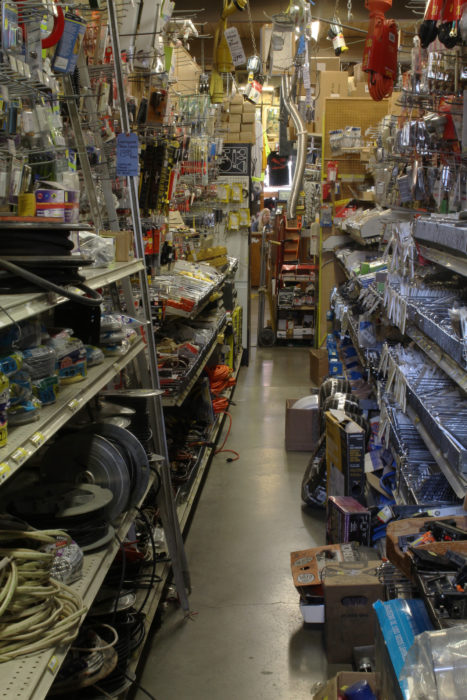
Inside Hardwick’s, the aisles are so narrow that you have to turn sideways to shuffle past anyone else in the aisle. No one seems to mind; no one is in a rush to get through the store. Even when I have in hand whatever I came for, I won’t make a beeline for the registers as I do in any other store. There some narrow passageways between aisles, some blind corners that lead to dead ends, and so many interesting things lining the shelves that by the time I get to the end of an aisle it is easy to forget where I am and where I was headed.
I’m happy to wander the aisles, looking at tools or hardware that I’ve never heard of. On my latest trip to Hardwick’s, for example, I discovered paper drills, barrel bung hole drills, duckbill pliers for upholsterers, grozing pliers for glaziers, plier wrenches, scythe nibs, and taper gauges.
When the chuck key that came with my 20-year-old drill press took a walk after staying where it belonged for almost two decades, I went looking for a replacement. The big-box store had some keys, all the wrong size, and all in plastic clam-shell packaging so I couldn’t try them. At the local chain hardware store I fared no better. I found the right key online at a supplier of replacement tool parts. It cost $11.11 for the key and $11.45 for shipping—pretty steep for a chuck key.
I called Hardwick’s and learned they had a drawer full of keys. I’d been going there for since the ’70s and hadn’t noticed it. I took the chuck with me and was led to a drawer that must have once been used for index cards, set at about shin height. There was a pile of used keys inside and I found six that fit my chuck. I bought three: one in original condition for $1.95, one with a handle with a steel rod welded in place for $1.00, and one with half a handle for 50 cents.
The aisles are narrow and often cluttered, but the slower you go, the more you see.
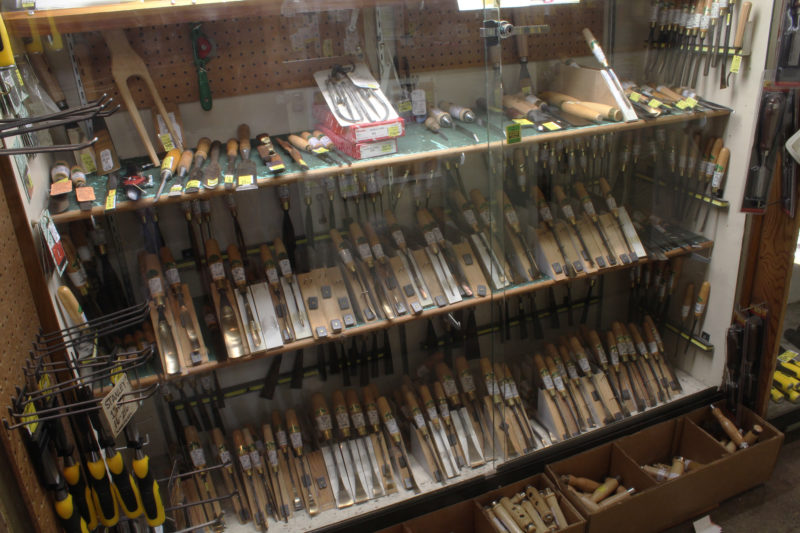
Woodcarvers will find scores of chisels.
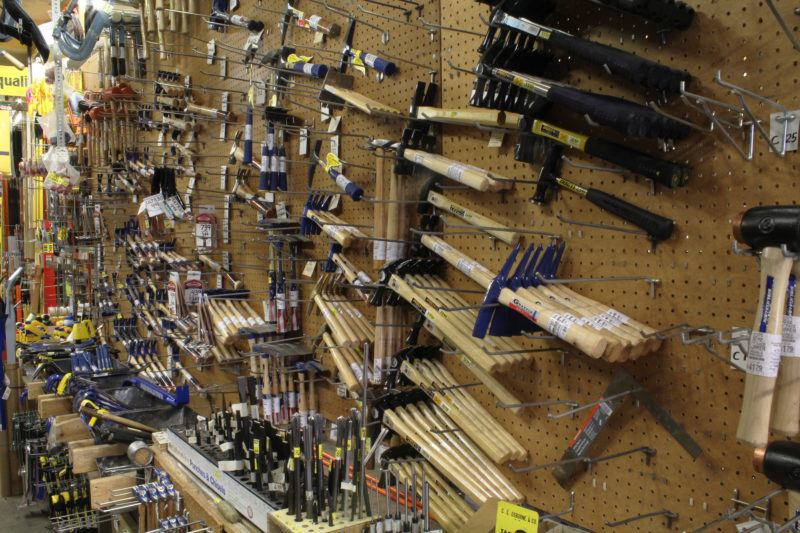
The hammer wall has something for every trade.
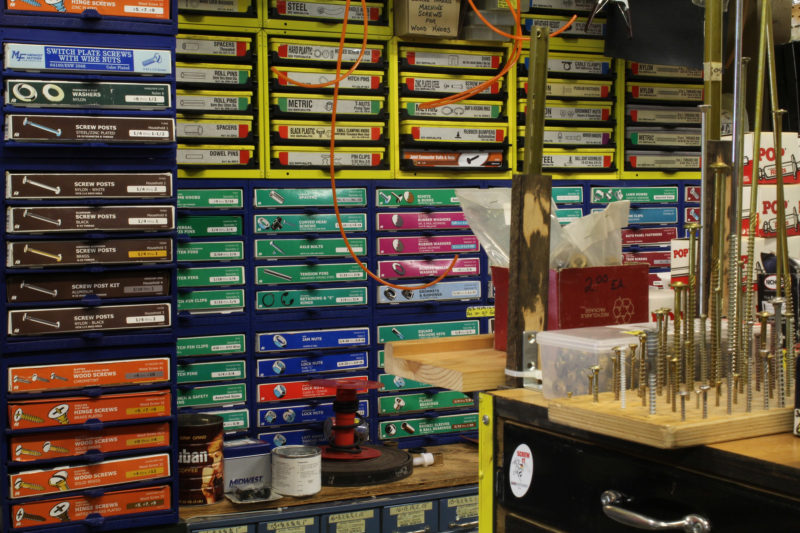
My local hardware store has only a few of these cases, and none of the unusual parts here. Lawn mower throttle hardware? Tail nuts? Ball-joint assemblies? They’re here.
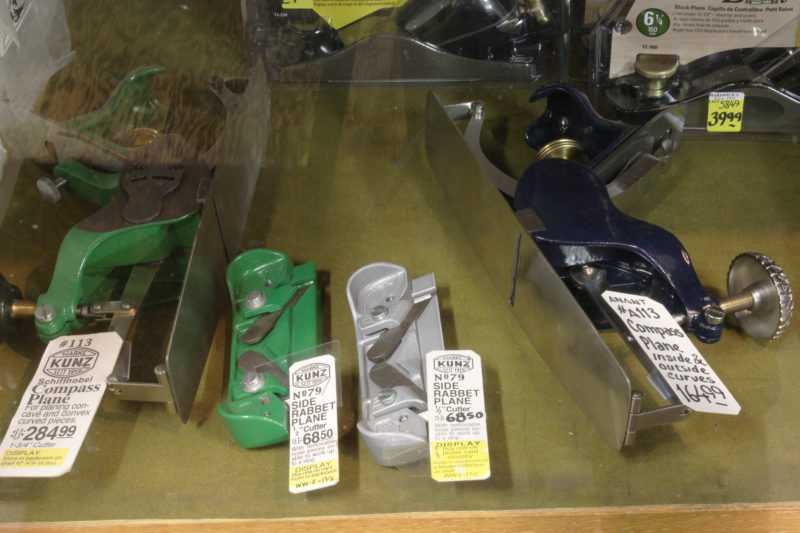
Not everyone needs a compass plane, but Hardwick’s is willing to stock items that may sit on the shelves for years, waiting for the customers who need them.
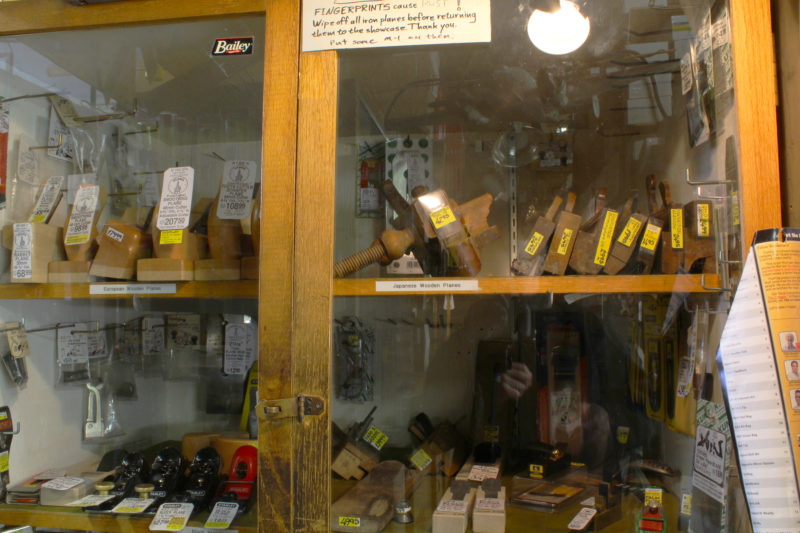
Old and new wooden planes, Japanese planes, and American Stanley plans and parts…
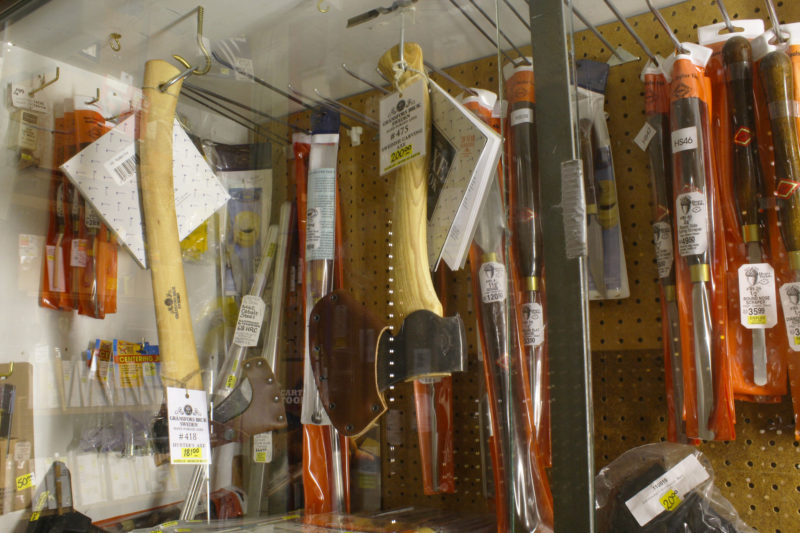
…Swedish hatchets and English lathe tools.
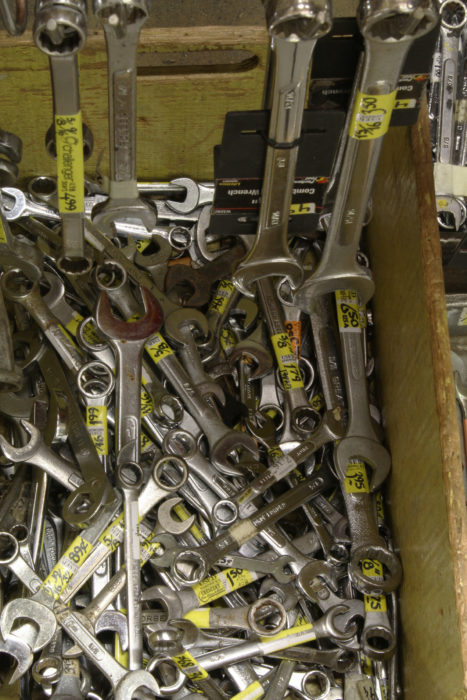
There are boxes full of combination wrenches at very affordable prices.
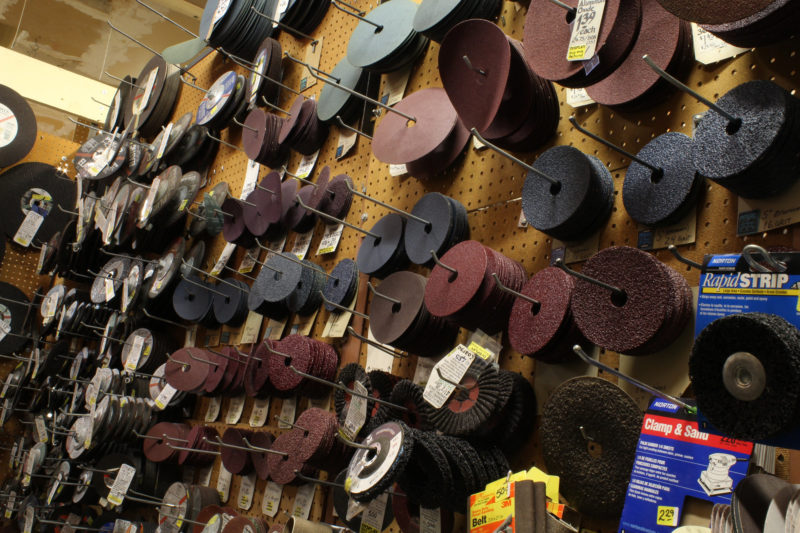
There is a wide array of resin fiber discs, with many specifically for working stainless steel, and grinder cut-off wheels especially for aluminum.
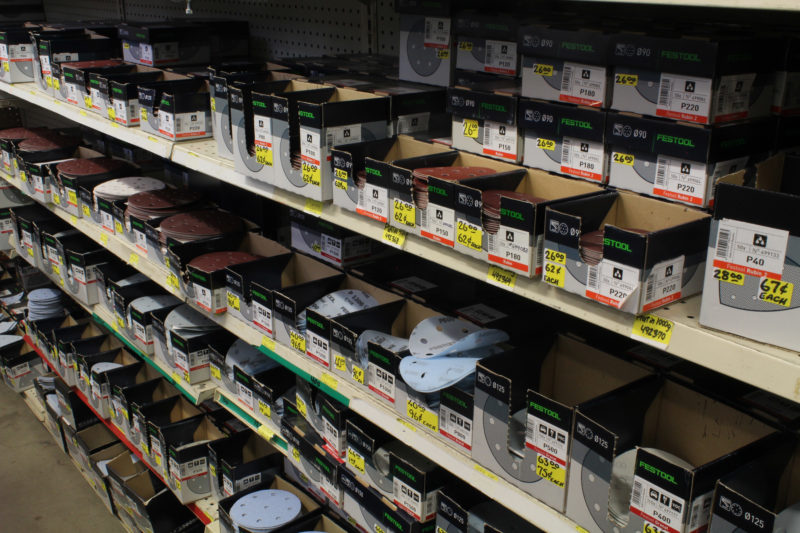
A side of one aisle has sanding discs that you can buy individually or by the box. There are a lot of products that you can buy without the annoying plastic clamshell packaging that is so common elsewhere.
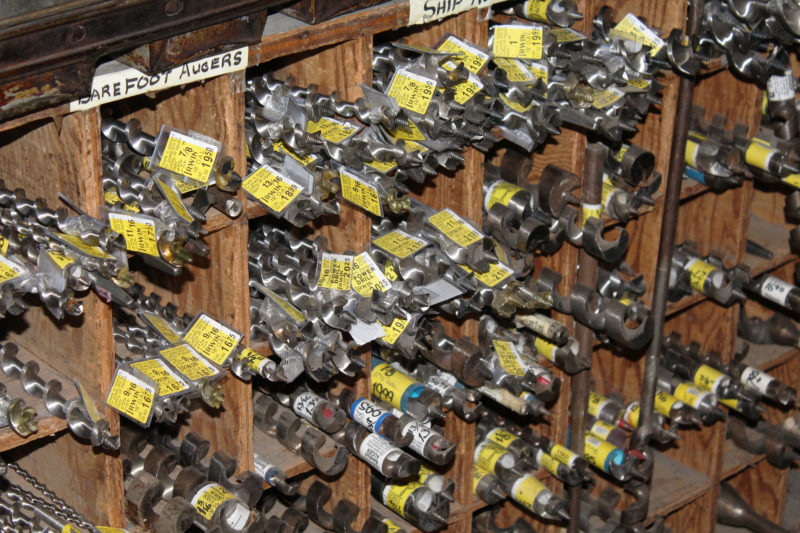
This cabinet has 18″-long Irwin, barefoot, and ship augers. This photo captures only a small part of the stock of augers.
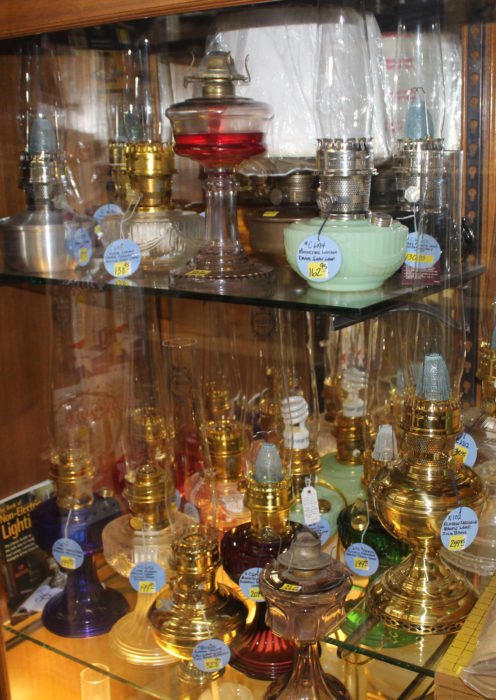
I spent a few years living of the grid and relied on kerosene lanterns like these.
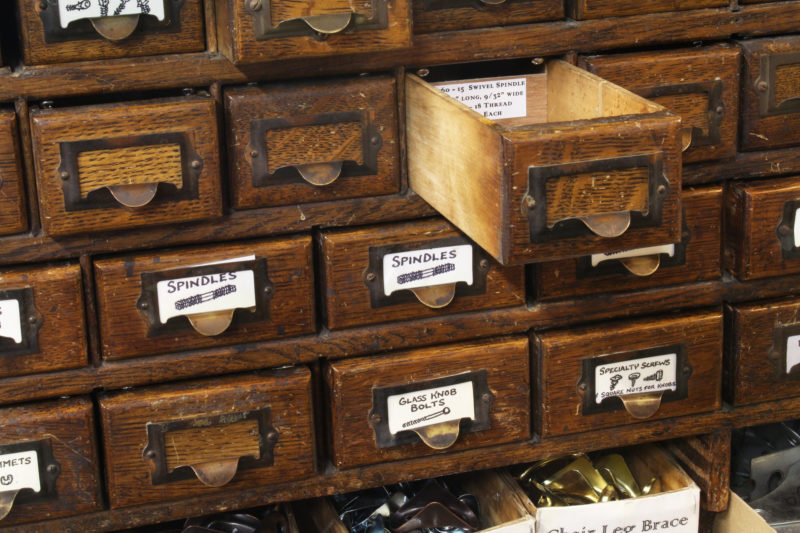
One cabinet is full of hardware for chairs. Even the drawers without labels hold parts.
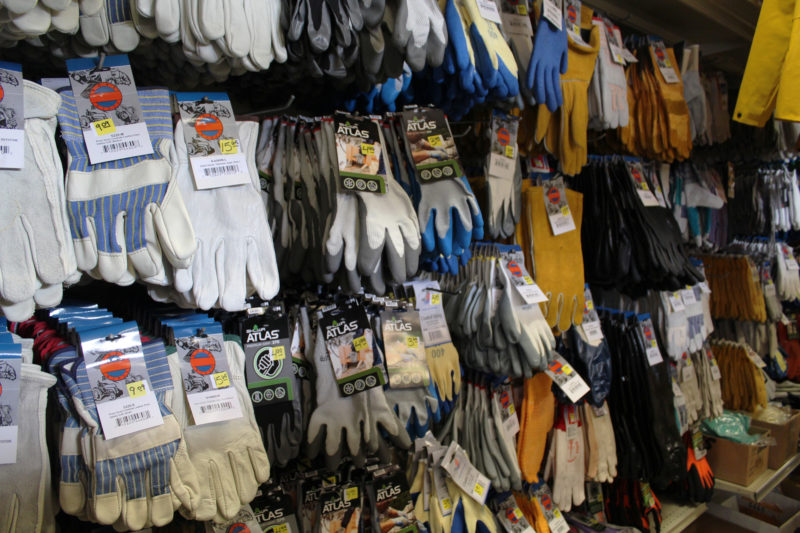
Half an aisle is devoted to gloves.
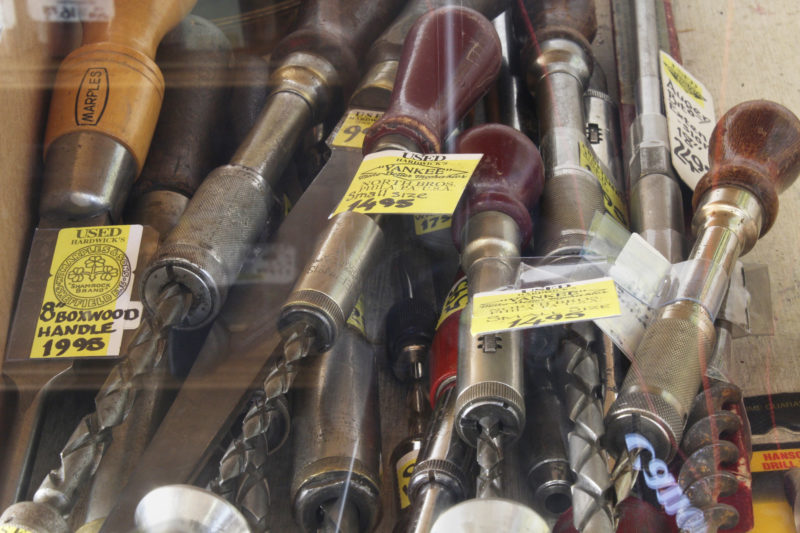
If you didn’t inherit a Yankee spiral screwdriver from your father as I did, you can find this classic at Hardwick’s.
Property taxes for the land that Hardwick’s sits on have quadrupled in the past five years. And since the city decided last year to change the zoning code to allow buildings up to 240′ tall, high above the prior cap of 65’, taxes will go up even more, even faster. Before the owner can hand the reins over to his son—the fourth generation of Hardwicks—he will have to move the store and Seattle will be poorer for driving it out of the city. It may be a year before the Hardwicks sell their land and close their doors. If you’re in town, drop by. It’s as much a museum as it is a store.
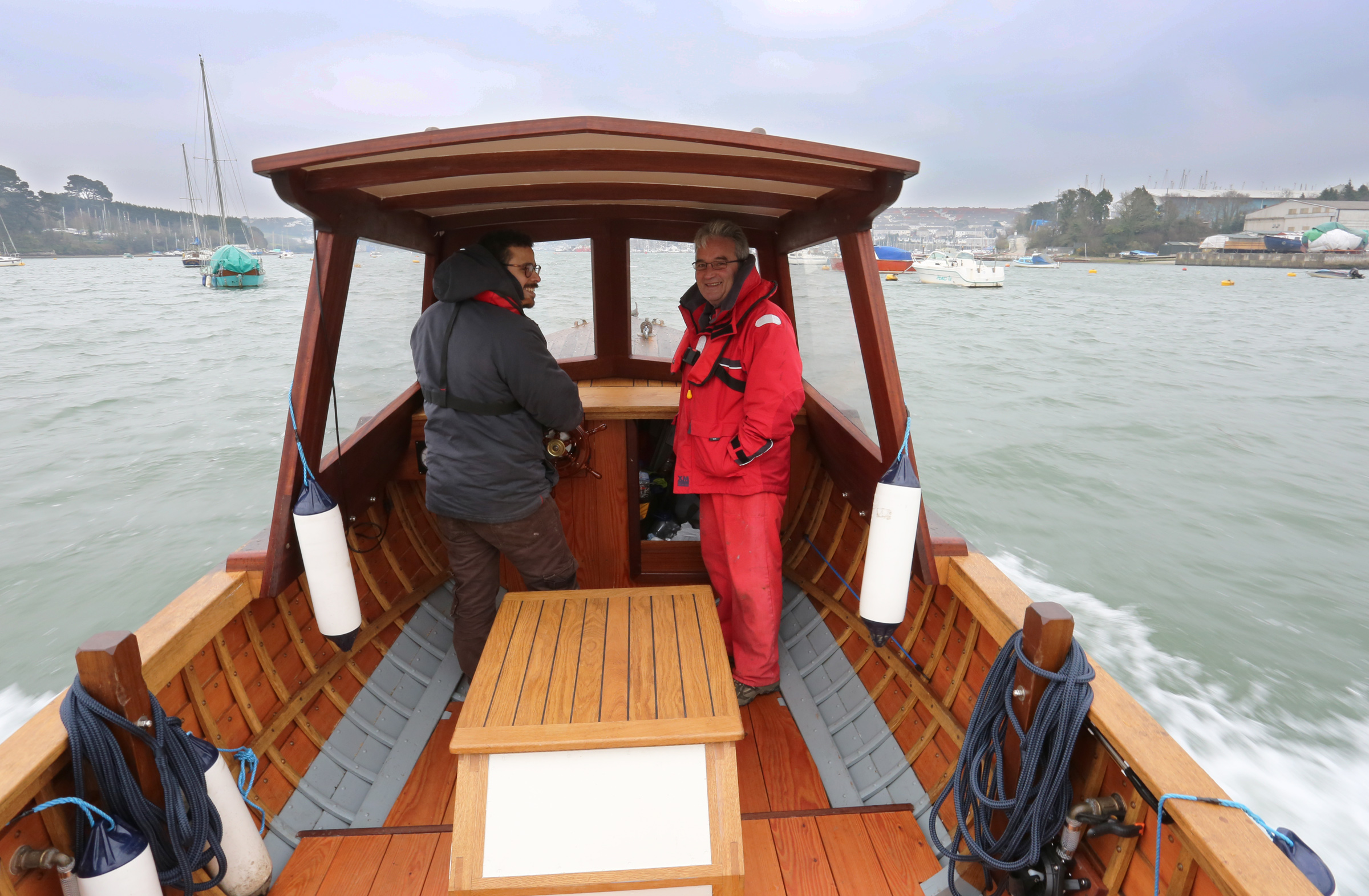
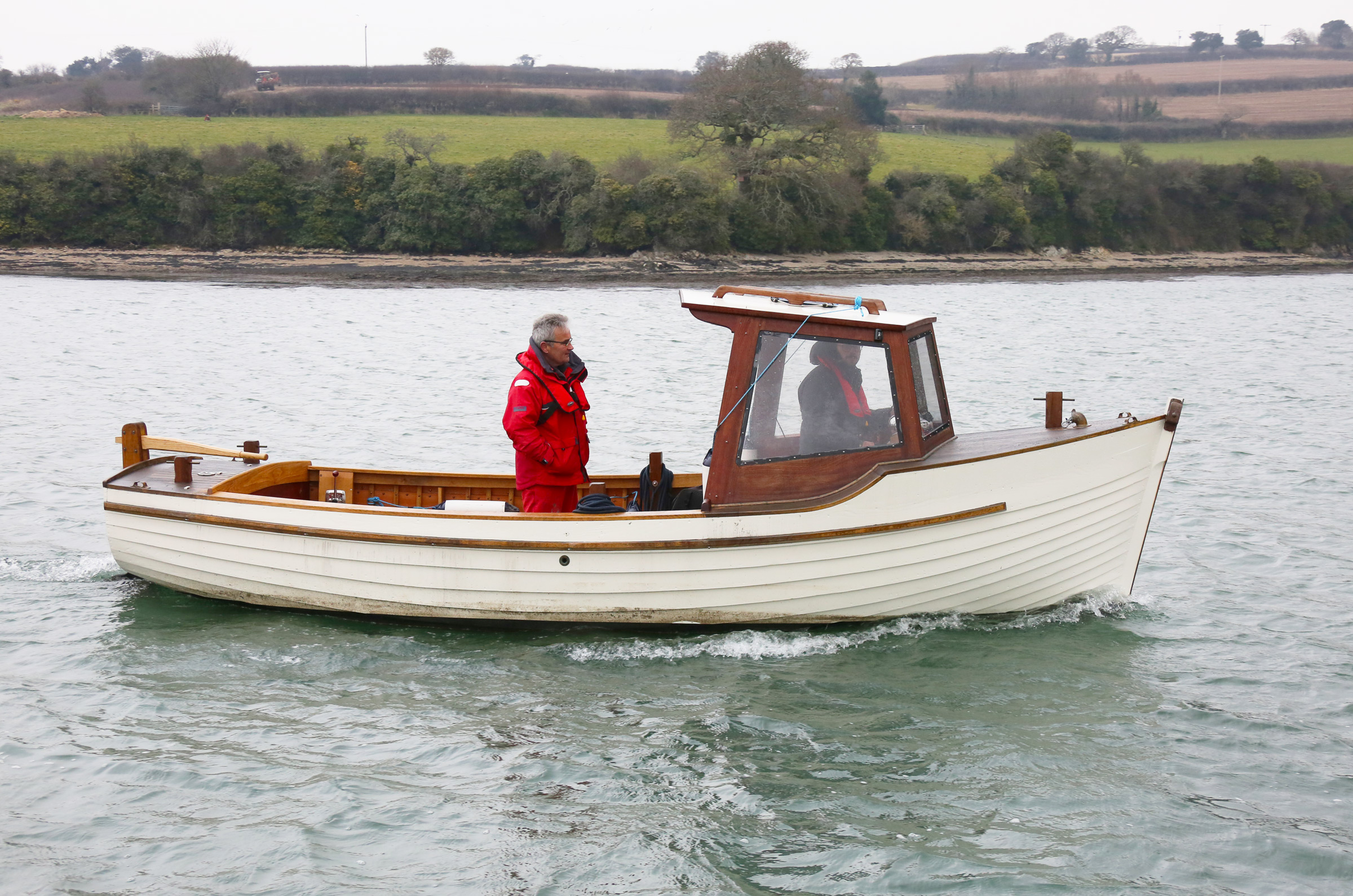
Bryn Morgan has spent all his working life at sea, but until now he had never had a boat of his own. For many years he had his eye on an 18′ Plymouth Pilot, a fiberglass production boat with lines based on a 1930s pilot vessel that operated out of Teignmouth in Devon, on the south coast of England. But when his son-in-law, Adrian St. Aubyn, a Venezuelan with Cornish ancestry, enrolled at the Lyme Regis Boat Building Academy in 2015, he realized there might be a better opportunity.
Six years earlier, another student at the Academy, Alasdair Grant, had built STEADFAST, a 16′5″ version of a 15′3″ Beer Beach boat called WILD DUCK. Beer is a village located in the middle of the Lyme Bay coast, and the boats built there had evolved over many years and came in various shapes and sizes, all seaworthy enough to cope with the exposed coastline of south Devon and durable enough to be hauled up the steep, heavily pebbled beach there. WILD DUCK was built in 1963 for crabbing and bareboat charter, and she was still on Beer Beach when Alasdair and his classmates took the lines off her.
When Bryn saw photographs of STEADFAST, he fell in love with her and started talking to Adrian about building something similar while he was at the Academy. Bryn wanted something bigger than WILD DUCK, around 21′ but the administrators were concerned that would be too big to complete in the time available. They settled on 19′ with a raised foredeck and wheelhouse, agreeing that STEADFAST’s lines were a perfect starting point.
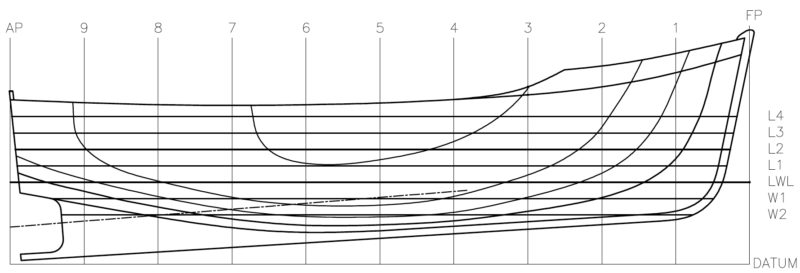
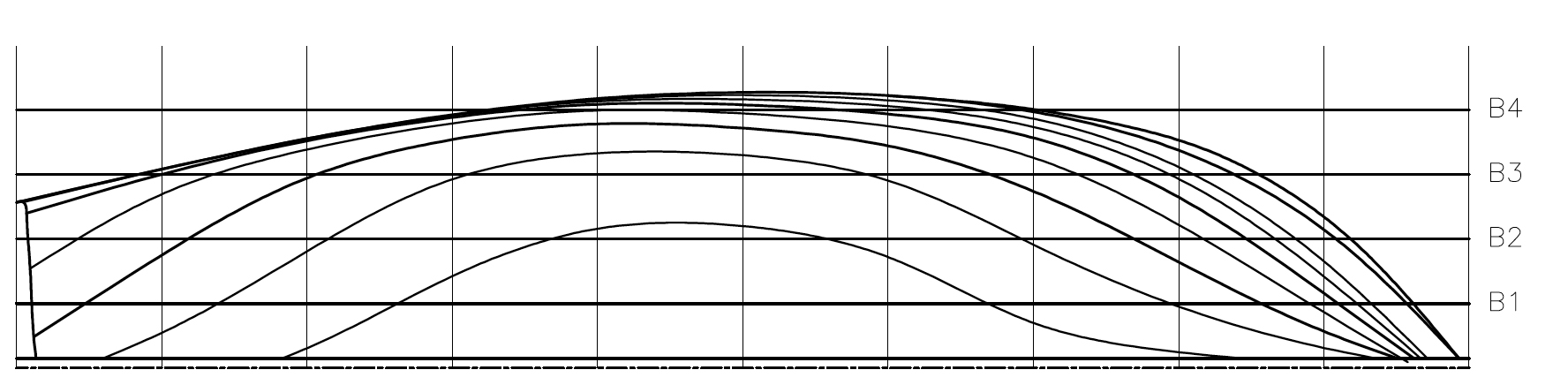
Adrian took STEADFAST’s table of offsets, put it into AutoCAD, and scaled it up to the desired 19′ with all other dimensions increased proportionally. He then faired the lines on a full-sized lofting and adjusted the offsets.
photographs by the author
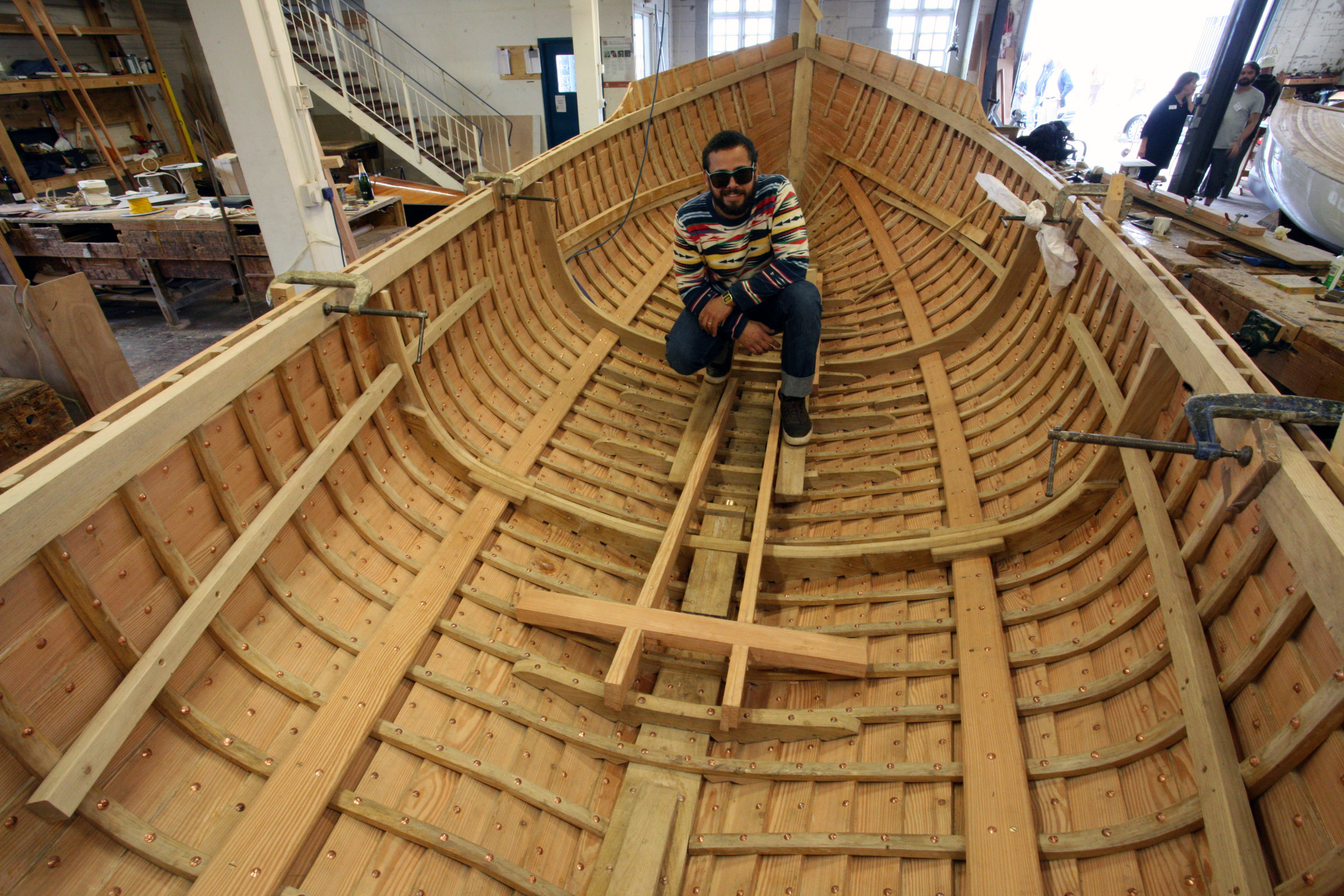
Builder Adrian St. Aubyn perched on the engine mounts to enjoy his handiwork.
Construction began with an all-oak backbone. The stem was laminated from 18 pieces of 5/32” veneer; the 5-1/2″ x 2” hog and 2-3/4″ square keel were both laminated from two pieces; and the deadwood, made up of 14 pieces, incorporated a swelling through which the stern tube would be bored. An extension from the deadwood’s lower edge provided an attachment point for the bottom rudder pintle. All the pieces were joined with epoxy and copper and bronze fastenings.
Adrian cut rabbets in the hog and keel for the garboard, and in the stem for the hood ends of all the planks. The whole assembly was then erected on a temporary structure about 2′ off the workshop floor, and the top of the stem was secured to an overhead beam.
The 2-1/4″ stern knee and 1-1/4″ oak transom were then fitted, and then the nine temporary molds were set up at their stations and secured to the overhead beam. Sixteen ribbands were laid along the length of the boat so that the position of the top edge of each plank could be determined and then marked on the molds, transom, and stem. When the ribbands were removed, it was time to fit the 3/4” larch lapstrake planking.
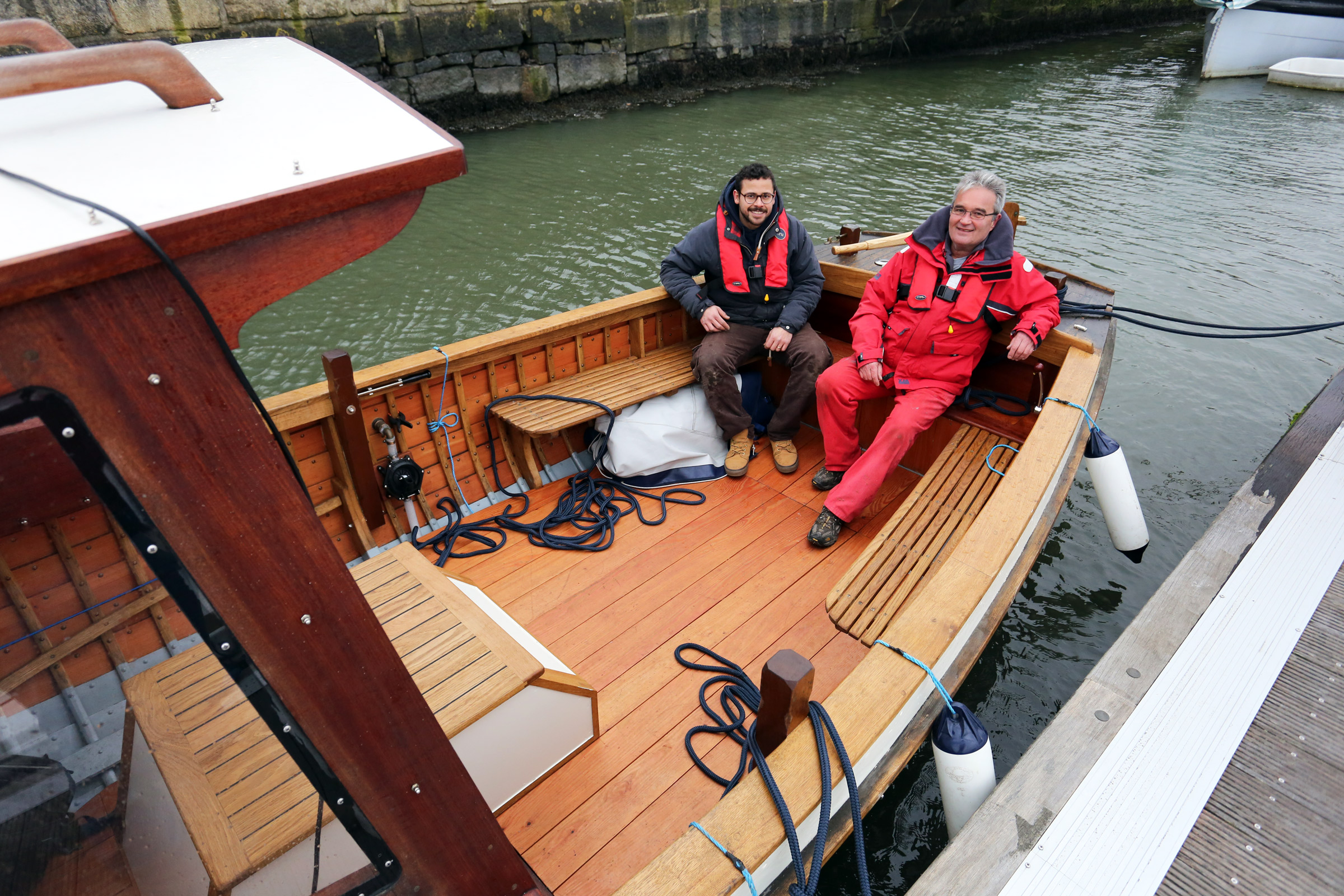
The builder, left, and owner Bryn Morgan make themselves comfortable in the sternsheets. The throttle used while steering with the tiller is just below Bryn’s left hand.
The garboard plank—8″ wide at its widest point—was taken a little further up the stem than initially lined with the ribbands to induce more taper and lift to the forward ends of the other planks for a more pleasing profile. As soon as this was fitted, the gains, known locally as geralds, were cut at each end of the top of the garboard to allow the next plank to finish flush with the outer part of the stem and transom.
From there the remaining 14 strakes were fitted. They all had to be steamed at their ends to cope with the twist, and most had a scarf joint in them. In each case, the lands were bedded with an oil-based mastic and then fastened with copper clench nails while the ends were epoxied and screwed to the stem and transom.
The 1-1/4″ x 5/8″ oak frames were then steamed and fit between the molds on 6” centers. Almost all of these were continuous from sheer to sheer, but the forward-most five were fitted in separate halves on each side. The molds were then removed after two braces were temporarily laid across the hull to retain its shape, and the remaining frames were fitted. The sheer forward was then extended upward for the raised foredeck by fitting an extra plank flush with the sheerstrake and supported by an extra 10 short frames.
The motor housing conceals a 14-hp two-cylinder Yanmar diesel.
Adrian fit the internal structure: the 4-5/8″ x 1” oak beam shelf, the 3-3/4″ x 7/8″ larch bilge stringer, the 1-1/2″ x 1-1/8″ oak risers (the aft parts of which would support the side seats), and five 1-3/8″-thick laminated oak floors. Two sawn frames, 1″ thick and averaging 3″ deep, are joggled with limbers above every lap and doubled up from about the riser downward to stiffen up the open part of the boat. The 3-1/2″-thick engine beds span the sawn frames.
After the 1-1/2″ x 2″ oak deckbeams were fitted forward and aft, an oak laid deck with no plywood subdeck was fitted over them. The oak railcap, running the length of the boat between the decks, is 4-5/8″ x 1″. The wheelhouse is made up of 1 ¾”-thick solid sapele sides and front, with 1-7/8″ x 1-5/8″ roof beams, covered by 3/4″ ply and a layer of ’glass and epoxy.
The four 3″-square mooring posts were made of reclaimed wood that had been Falmouth docks. They were the only pieces of wood on the boat for which no money changed hands, but Adrian described them as “priceless, because they belong to this place,” referring to ELLY ROSE’s home port. That was where Bryn, Adrian, and I met up for a sea trial on ELLY ROSE on a blustery winter’s day.
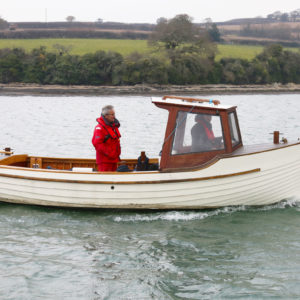
Cruising speed with the 14-hp diesel is around 5.5 knots.
With Adrian at the helm, we maneuvered our way out of a tricky berth and then motored down the Penryn River. The Yanmar 14-hp two-cylinder diesel gave us 5.2 knots at the cruising rpm of 2,500, and 5.6 knots at 3,000, but the Force 6 headwind was clearly having a significant effect on the sizable wheelhouse. So we turned around and found that going downwind, she went a little faster: 5.4 knots and 5.9 knots at the respective rpm. Not surprisingly, her turning circle was also affected by the conditions. While it was about three boat-lengths (at 2,500 rpm) turning into the wind, it was little more than half that turning away from it.
Bryn and Adrian told me that they had decided to fit the engine in the deepest part of the boat without calculating the effect on the center of gravity. When the boat was launched, they found that she was bow-down and difficult to steer, especially when in reverse. The prop was too close to the surface and not really biting properly. They put around 575 lbs of lead ballast aft, which seems to have done the trick—I found her easy to steer in both directions. They have in mind moving the engine aft at some point in the future.
The rudder can be operated at the tiller or by a wheel in the pilothouse. A hydraulic piston mounted under the aft deck is connected to a bolt through the rudder stock that extends through a slot high on the transom.
There are two steering positions: a wheel in the wheelhouse (especially welcome on that very cold day!) and a tiller aft. Both have gear and throttle controls, and it is a simple matter to make sure one is in neutral before assuming command at the other station. A valve in the aft locker disconnects the hydraulic wheel steering to allow the tiller to be used. I am 6’ tall and, although I could stand in the wheelhouse, I had to stoop a little to get a clear view forward. I also had to stoop at the tiller to get a view through the wheelhouse windows. Bryn is 5′8″ and has no trouble in that respect, and neither of us did when sitting on the engine box forward or on the seats adjacent to the tiller.
Bryn and Adrian had been farther out to sea than we went that day, and Bryn said he was delighted with ELLY ROSE’s seakeeping qualities, especially when punching her way through the waves in a more exposed stretch of water.
Bryn is very much looking forward to using ELLY ROSE during his impending retirement. He plans to use her for fishing, hauling crab pots, picnicking, and visiting secluded beaches accessible only by boat. She will, I am sure, be perfect in all those roles.
Nigel Sharp is a lifelong sailor and a freelance marine writer and photographer. He spent 35 years in managerial roles in the boat building and repair industry and has logged thousands of miles in boats big and small, from dinghies to schooners.
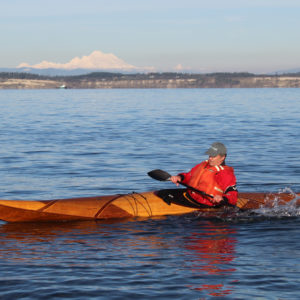
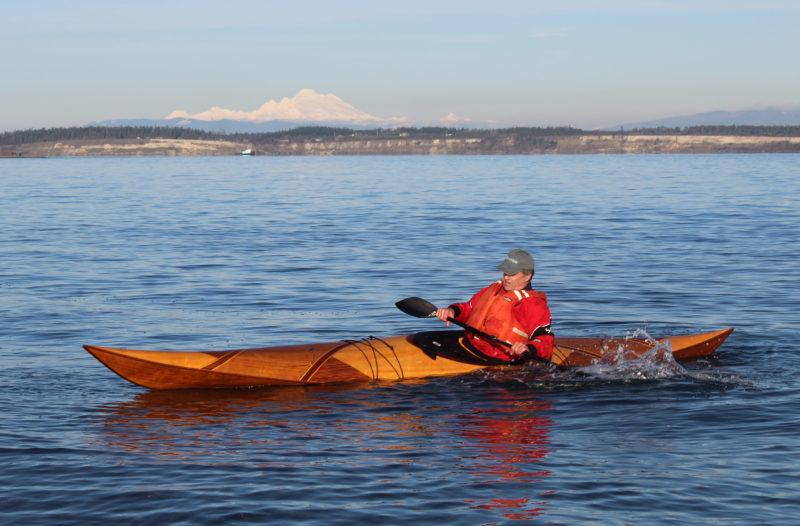
I graduated from college with a degree in art, so when I took up boatbuilding a few years later the transition came naturally. There is something quite sculptural about hulls and oars, spars and sails. Joe Greenley of Redfish Kayaks has doubtless made the same connection. While he is well known for his artistry with strip-building, the kayaks he has designed are more than canvases for designs in red cedar, mahogany, walnut and Alaska yellow cedar. They’re good kayaks. Joe’s Spring Run is a general-purpose kayak with an overall length of 16′9″, a waterline length of 14′10″, and a beam of 23-7/8″ and 22-1/2″ at the waterline. It weighs an easy-to-shoulder 36 lbs. The cove-and-bead strips are 3/16″ x 5/8″, slightly smaller than the more commonly used 1/4″ x 3/4″ strips, which may account for the more refined look of all Redfish kayaks.
The strips are applied without staples, leaving the kayak free of trout-speckle bands that would spoil the aesthetics. The fits between strips are tight enough that the glue lines are invisible, and the strips are placed in the same order they were cut from the stock, making it look as though construction was from broad panels cut from a single board. The exterior is ’glassed, but you’d be hard-pressed to find any evidence of it. The interior is finished with ‘glass cloth as well, transparent but with its weave’s texture left proud. The bulkheads are cedar-strip panels, ’glassed in place.
Christopher Cunningham
A webbing tab is all that’s needed to release the hatch cover. The webbing deck-line anchor (lower left) is strong and unobtrusive.
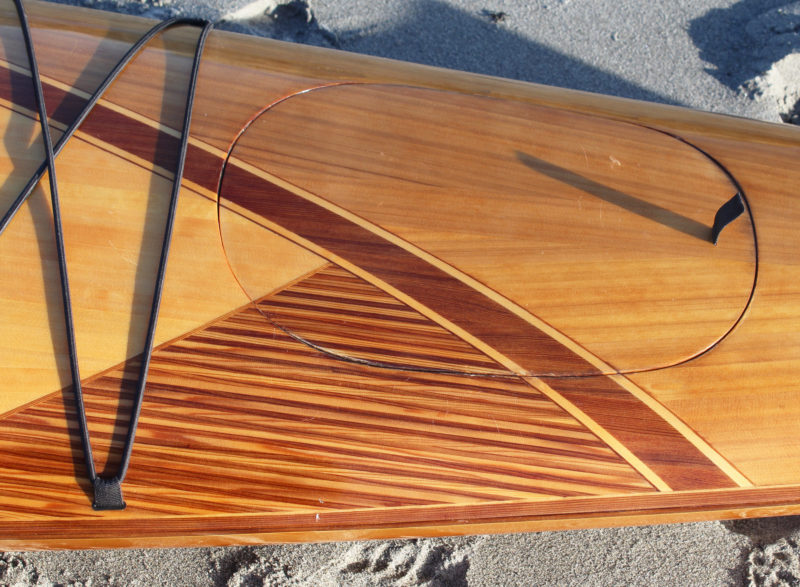
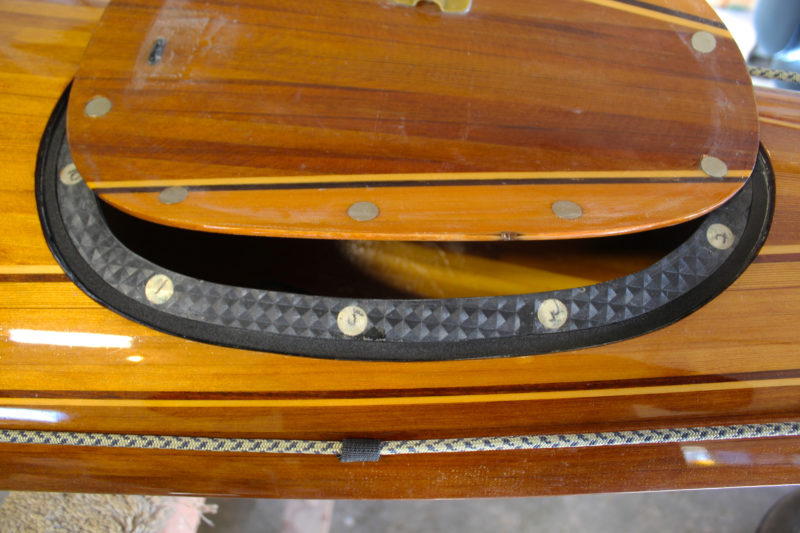
The deck bungees are anchored with discreet webbing loops set in neat ovals of black epoxy. They’re much less obtrusive than plastic pad-eyes, and they’re easy on the limbs when crawling over the deck during self-rescues. The hatch covers have nothing crossing over them to hold them in place. There is only a webbing tab on each cover to remove it. The Spring Run I paddled had an earlier version of the closure system, which employed cleats on the underside of the lid and bungees to hold the lids tight. The latest models of Redfish kayaks use neodymium rare-earth magnets to pull the covers tight against a perimeter gasket to create a tight seal.
Christopher Cunningham
The hatch covers are held down with magnets that are powerful enough to keep the covers in place and create a watertight seal against the neoprene gasket.
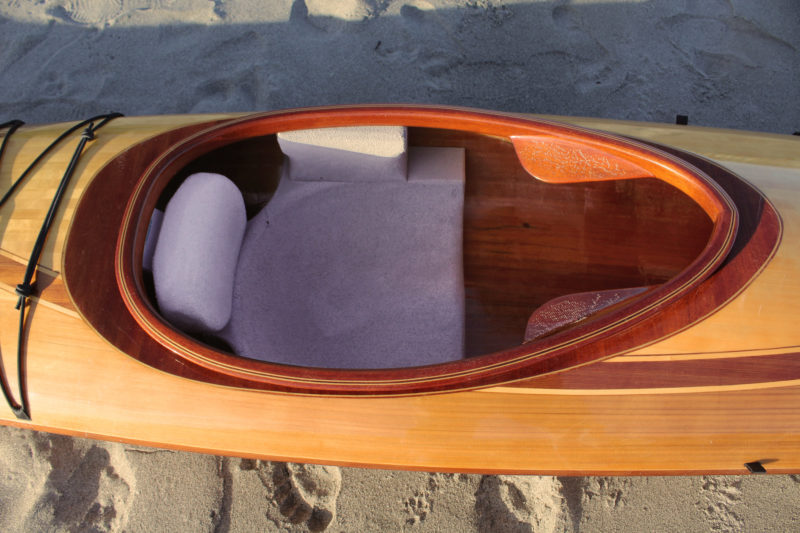
The cockpit is just barely long enough for me to drop into seat and then bring my feet in. I’m 6′ tall; it’s more practical for me to sit on the aft deck and slide in feet-first.
The seat is far from an off-the-shelf, one-size-fits-all model. It’s removable, sculpted from closed-cell foam, and includes hip bracing and a backrest. There’s an integral foam pillar at the back of the seat that is cut slightly taller than the space for it under the aft deck. Compressing the pillar while pushing it under the deck locks the seat in place. The hip braces are also oversized; a hard push locks them in place when they curve up the inner sides of the cockpit. The seat showed no signs of slipping out of place during all the rolls and wet exits I did.
Christopher Cunningham
The carved closed-cell foam seat is very comfortable and assures a solid, non-slip connection with the kayak.
The foam also offers excellent insulation from the cold, providing a comforting, toasty warmth. Additionally, the volume of foam in the seat limits how much water can get into the cockpit in the event of a capsize or wet exit and provides a substantial amount of flotation. Its carved surfaces have a slightly fuzzy texture that contributes to the solid connection with the kayak. The combination of the deep contours and the grippy texture provides excellent support and comfort for the long haul, and effortless control of the kayak when it’s necessary.
The foot braces are the standard Keepers model, solid and easily adjusted. The thigh braces are mahogany flanges incorporated in the cockpit coaming. They have no padding, but I didn’t feel the need for any.
The primary stability is very good. I could sit comfortably with my hands off the paddle and fiddle with the GPS while taking notes without feeling the least bit twitchy. The secondary stability is solid, providing reassuring resistance that makes it easy to hold the kayak on edge for more effective turning.
The hull tracks well, and I had no trouble holding on course, regardless of speed. It also has very good maneuverability when I set the hull on edge to lift the ends to offer less resistance to the lateral motion in a turn. Sweep strokes brought the bow around and once the hull started carving, it maintained the turning between strokes.
Ed Emswiler
The Spring Run’s good secondary stability supports edging maneuvers.
The Spring Run has a fine, overhanging stern—not the sort of configuration that takes well to supporting a rudder, and it’s just as well, as there’s more than enough maneuverability without an added appendage spoiling the look of the kayak and adding little to its performance. There was no wind during the afternoon I had the Spring Run out on the water, so I can’t comment on weathercocking, though the kayak’s good response to edging and sweep strokes should make it easy to counter a moderate degree of weathercocking, if any were to occur.
At a relaxed pace I could easily maintain 4-1/4 knots, GPS measured in still water—a brisk cruising pace. With a bit more effort, but still at a sustainable aerobic pace, the Spring Run held 5-1/2 knots, and in an all-out sprint I could push the kayak to a peak of 6-1/2 knots. For a waterline of just under 15’, those are good numbers. At top speed the Spring Run maintained its trim and I never felt I was pushing it uphill.
The secure fit in the cockpit provided by the seat and the thigh, hip, and foot braces made rolling the Spring Run a snap. My hips stayed centered and my thighs stayed locked in, so when I snapped my hips the hull snapped around too. The softness of the foam and the gentle contours of the thigh braces meant I could roll without feeling any pressure points on my legs.
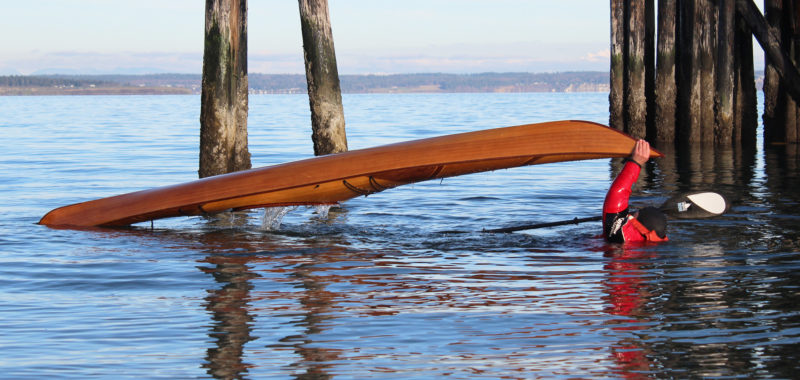
My self-rescue drills with the Spring Run went well. After capsizing, I had no trouble getting out of the cockpit during wet exits. In kayaks with a looser fit and a larger cockpit opening, I might fall out without having to do anything to exit, but with the Spring Run I had to move my knees to the center of the cockpit to get clear of the thigh braces and then push the back of the coaming past my hips. Then, even with the snug, form-fitting shape of the seat, it was not at all difficult to slip out.
Ed Emswiler
The kayak’s light weight makes is easy to lift the bow and drain the water that gets into the cockpit during a wet exit.
After a wet exit, the bow was light enough to lift easily with one hand so I could let the water drain from the cockpit and then roll the kayak upright. To re-enter, I could pull myself up and onto the aft deck. There’s a bit of height there, good for cargo space in the aft compartment, but that adds to the effort required to get aboard, chest down on the deck. But with a good kick and a strong pull, I got aboard with the first effort. Moving aft a bit will force the stern down, which can help if you’re having trouble. After straddling the aft deck and bracing with my paddle extended to one side, I scooted forward and dropped into the seat. It was a tight squeeze getting my legs in—with size-13 feet it may take a bit more effort for me than for others—but I was able to get both legs in and locked back under the thigh braces. This maneuver is commonly done with a float on one blade of the paddle and the other blade tucked under the deck lines, but the Spring Run had enough stability for me to hold the outrigged paddle by hand and brace without the float.
The reenter-and-roll self-rescue was a cinch. Holding the kayak floating on edge and leaning it slightly toward me, I could easily thread my legs into the cockpit, pull my backside into the seat, and, locked in once again, roll upright. That maneuver, of course, scoops up a bit of water because the cockpit opening isn’t covered by the spray skirt. But not so much water got aboard that the kayak felt unstable. The foam seat can take some credit for that.
The particular Spring Run I paddled was 20 years old and has served as a demo boat for much of its life. It isn’t as shiny as a new Redfish kayak, but otherwise, it seemed no worse for the wear. Even the bottom was unscarred. The ’glass and cedar have proved to be quite durable.
The Spring Run is a lively performer as a day boat, has enough stability for fishing and photography, and has enough cargo space for multi-day cruising. When you’re not out paddling it, the fine workmanship and the decorative touches make it something you might want to hang in your living room.
Christopher Cunningham is the editor of Small Boats Monthly.
Spring Run Particulars
[table]
Length/16′9″
Waterline length/14′10″
Beam/23.9″
Waterline beam/22.5″
Weight/36 lbs
[/table]
The Spring Run is available from Redfish Kayaks as plans ($85), a kit ($1695), a DIY workshop at Redfish in Port Townsend, Washington ($900 to $4,500), and as finished kayak (starting at $8,000).
Is there a boat you’d like to know more about? Have you built one that you think other Small Boats Monthly readers would enjoy? Please email us!
Peter Knape was once stuck behind an office desk in a soulless building in the business district of Arnhem in Holland. Year after year, his demanding career had sapped both his time and energy. He longed for a quiet life with freedom, and independence. He realized his destiny was in his own hands, and that he only had to muster the courage to make a break.
He took a vacation and traveled to northern Finland where he hired a small boat and set off on a long journey, one that took him far beyond the Arctic Circle to an area that’s almost uninhabited. Life aboard the boat was uncomplicated; it was exactly what he had been yearning for.
It was 1977 when Peter began looking for a boat of his own, and while on another vacation touring England by motorcycle, he made his way to Totnes in Devon, England, where Honnor Marine was building fiberglass Drascombe boats. He had decided a Drascombe Longboat could be adapted to suit the life he wanted to live, but in his discussions with Luke Churchouse, owner of the boatshop, it became apparent that a company geared for production ’glass boats wouldn’t be able to deliver the degree of customization that he required.
Peter was still convinced that a Drascombe would be the ideal boat for him, so Luke suggested a visit with my brother John and me at our boatyard at Yealmbridge. We had been involved with wooden Drascombes from their beginning, and we had the only license to build them of wood. Every Drascombe we built had been customized for each client, so we were in a good position to meet his requirements.
John and I were working when we saw a motorcycle drive up, the rider dismounted, and then came into the workshop. Peter introduced himself, explained his requirements, and asked for our opinions and advice. We answered his questions and then recommended he pay a visit to Ken Duxbury and his wife Brenda at Rock in Cornwall. Ken, who died in 2016, was a prolific writer and a very experienced sailor. He owned LUGWORM, a wooden Drascombe Lugger that featured in many of his writings and books. We felt Ken and Brenda could provide Peter with valuable advice gained from their own extensive voyages in a Drascombe, so after we telephoned Ken to provide the introduction, Peter set off on his motorcycle to meet them.
Peter Knape
Peter provided the Elliott brothers with detailed drawings and notes for the modified Drascombe Longboat that he wanted them to build.
A few weeks later, a letter arrived in the mail. It began with “Do you remember a Dutchman in blue-black leather who visited you?” Of course we did! Peter wrote about his visit to Ken and Brenda and how they had welcomed him, taken him out in LUGWORM for a sail and a row, and given great advice with enthusiastic encouragement. The visit had fired up his ambition and clarified what was achievable. He now wished to order a highly customized Drascombe Longboat Cruiser from us. He included some drawings to show us the modifications he had in mind.
Before we began building Peter’s boat we had long discussion with him about what would and wouldn’t work, and together we came to a clear understanding of the boat we’d build. A bond of understanding and trust had developed between us. During construction, Peter traveled by motorcycle from his home in Holland, a journey of around 900 miles each way, no less than three times, and even brought his partner Elly Jansen for one of those trips.
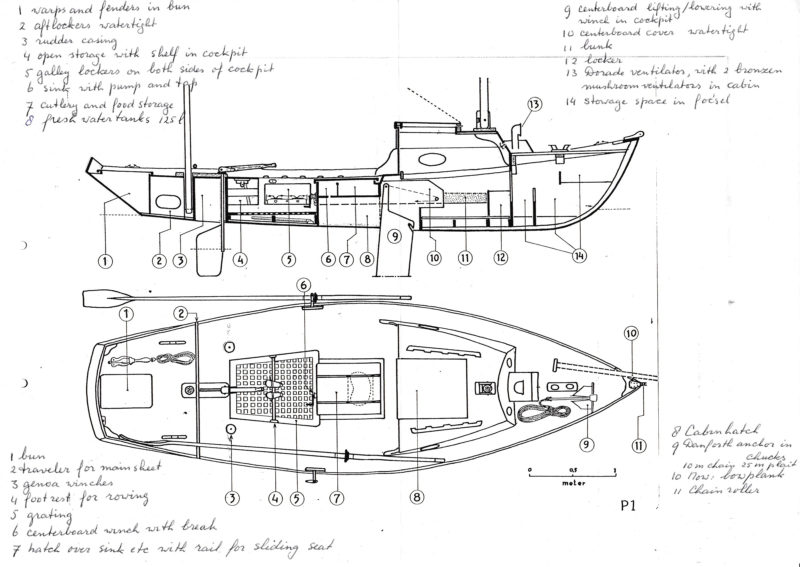
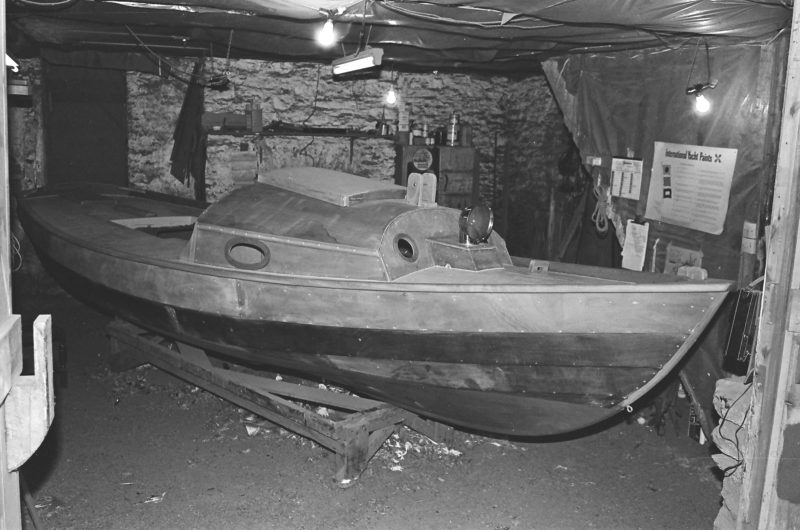
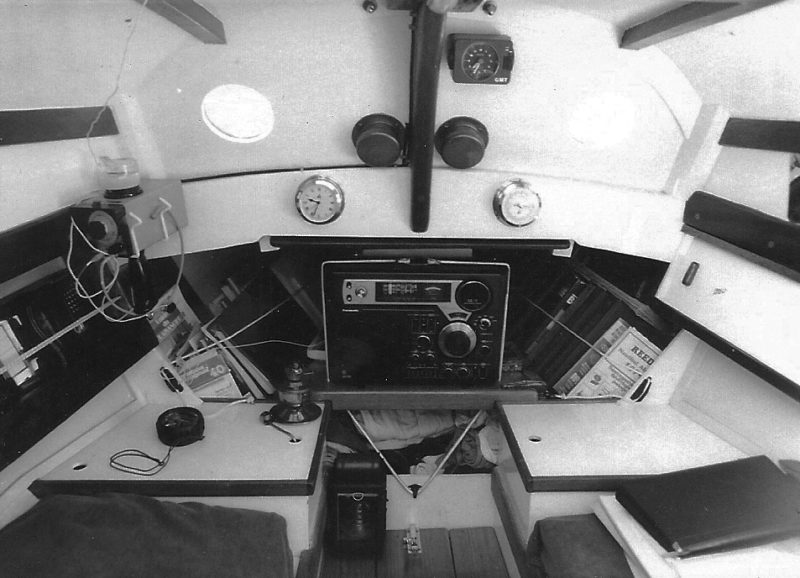
LEGOLAS would be radically different from any of the other Drascombes we’d built. It would be a cruising home. The cabin would be shorter than the standard length, and the hull would to appear normal from the outside, but the internal frames, bulkheads, and decks were designed higher to give more room for living and as much storage space as possible.
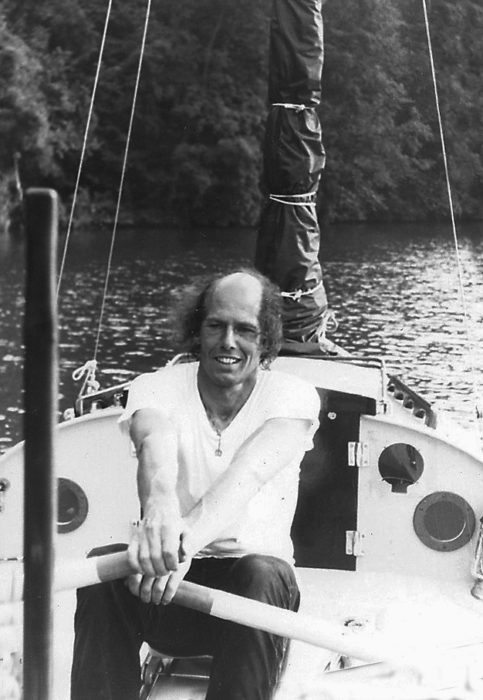
A sliding seat and long sweeps would be the means of propulsion when not sailing; there would be no outboard-motor well as on other Drascombes because, as Peter put it, “outboard motors are noisy, smelly, and guzzle very expensive fuel.” A hinged cabin hatch and a large dorade ventilator would catch the breeze and make the cabin more comfortable for sleeping in hot weather.
Douglas Elliott
LEGOLAS was built here in the Elliotts’ shop and delivered nearly finished, leaving some custom woodworking, varnish, and paint for Peter and Elly to do at their home in the Netherlands.
The manner of building LEGOLAS was the same we used for all of our other wooden Drascombes. The hull is built of high-quality 9mm marine plywood. The frames, bulkheads, centerboard case, and rudder trunk are of 12mm marine plywood. Kiln-dried iroko hardwood is used for floors, gunwales, frame doublers, and stem laminates. The decks were 6mm marine plywood, and the masts and spars were made from Columbian pine or Douglas-fir.
The forward bulkhead, ’midship frames, aft bulkhead, transom, centerplate case, and rudder trunk were all reinforced with hardwood or plywood doublers, and were assembled prior to fastening on the building jig. The rudder trunk was glued and fastened to the aft bulkhead and transom, and the centerboard case was glued and fastened to the ’midship frames. The components are all temporarily secured to the building jig. The hull was built upside down, and the frames are tied together by an inwale, the keelson, and inner stem.
Phenolic resin glues were used throughout the boat, but the frames for LEGOLAS were very different from the standard design, and so the build was about to become an experiment in adaption and innovation given Peter’s very specific requirements for this boat that was to become his home. We planked the hull up to the third strake, and before adding the sheer, we faired and finished the bottom, released the hull from the building jig, and flipped the hull.
This is the point where LEGOLAS started to differ quite significantly from other Drascombes. It’s not an open boat; it has a sheer-level deck instead of benches set even with the lower edge of the sheerstrake. We made a recess in the deck as a footwell for the sliding-seat rowing rig, not something you see on many traditional-looking 21′6″ sailing boats. LEGOLAS would be so high-sided afloat that Peter would have to use a pair of 12′ oars (normally meant to be used one per rower for racing) instead of the 9’ sculls a single rower would ordinarily use.
We dry-fit all of the plywood decking, then removed it to allow access to the interior for painting. We also painted the undersides of the decking before gluing and fastening the panels down. John and I then finished the hull by installing the sheerstrake and the transom return.
We paid particular attention to the fit and finish of the coach roof. The interior woodwork would be visible when Peter was below, and we didn’t want flaws in the joinery. The coach roof had to be strong too, because the front would be fitted with a tabernacle and have to transmit the thrust of the mainmast down to a reinforced forward bulkhead.
With the woodwork completed, we covered the decks in a 16-oz woven roving fiberglass cloth bonded with epoxy resin, which gives extra stiffness to the 6mm marine plywood decking and a durable non-slip finish.
During construction, our overriding aim was always to stay as true to Peter’s vision as possible. I believe we managed to achieve that quite well, because he requested very few alterations. The rig we supplied was a “smack rig,” which consists of a gunter main, a gunter mizzen, a jib, and a flying jib on a bowsprit.
This photograph and those that follow courtesy of Peter Knape and Elly Jansen
The modified cabin and raised deck on LEGOLAS provided more spacious accommodations than the standard Longboat Cruiser.
In March of 1979, Peter took delivery of the Drascombe Longboat Cruiser we built for him. It was unpainted and had all of the main storage spaces, but the small details surrounding storage and odds and ends were left for him work out. This was to save money, but only in part. There’s no substitute for sitting in the boat and making final decisions for yourself. Peter and Elly finished the boat in Holland and christened it LEGOLAS after an elven character in J.R.R. Tolkein’s The Lord of the Rings.
With LEGOLAS finally ready for launching after completion of the painting and multitude of odd jobs, Peter decided that it was time to move aboard and begin to travel. He sold all of his property, stepped aboard just outside of Arnhem with enough money to live simply for a year to a year-and-a-half, and on September 17, 1979, he departed in a general southerly direction on the River Meuse.
His upstream voyage on the Meuse, some 400 miles long, was against a steady 1-knot current. He sailed when he could, and when the wind dropped he brought his rowing rig into action or simply found a quiet spot to anchor and enjoy the solitude. The farther south he traveled, the less wind there was, so rowing became more of a regular duty until reaching Namur, Belgium, a city where the rocks on either side of the river reach around 100′ high, shadowing the wind altogether.
Peter rowed much of the route from the Netherlands to the south of France. Here LEGOLAS is on the Meuse River in Belgium. 1979
A little farther on, near the French border, he lowered the masts to clear the very low bridges, some as low as 11′, so rowing continued to be the everyday exercise and somewhat of a struggle against the never-abating current. It was exhausting work, and discouraging with the knowledge that winter was not far off. But the weather remained unseasonably beautiful for weeks on end.
When Peter thought he’d rowed far enough for a day, he’d pick a suitable stopping place and cook a four-course meal. Rowing burns up energy, so good food was essential, as was rest; this combination of fresh air and healthy living ensured a good night’s sleep, often as much as 9 or 10 hours. Peter was feeling fitter and healthier day by day, exactly what he had wished would happen. It raised his spirits and affirmed his decision to live life aboard a small boat.
Roger Siebert
.
In October, the nights got noticeably colder, and there was a thin sheet of ice on the water every morning in the canal running along the valley at the base of the Vosges mountains. Then it started to rain, making rowing difficult because his hands became soft with the constant drenching. But his journey along the rivers and canals of northeast France continued, every day he went some 15km and through several locks, and Peter arrived at the town of Epinal. Situated 1,000′ above sea level, it was not just the geological peak of the voyage south to the Mediterranean, but a psychological peak. He would no longer have to fight against a current, but could ride with it. His daily distance gradually increased and the weather didn’t get any colder as he progressed southward. Although the rain persisted all the way to Lyon, he had a tent that could be quickly erected over the cabin and cockpit to keep everything dry. A bottle filled with hot water kept him warm whether he was in the cockpit or in his sleeping bag.
The River Saone was flooding, which sometimes made the rowing difficult, but it offered silence and solitude, beautiful scenery, welcoming towns and villages, and safe places to stop overnight.
The Saone delivered him to the Rhône, an impressive river with long straight canals, but it offered few overnight refuges. The distances between good anchorages dictated his schedule, and he often had to stop sooner than he wanted, or worse, he had to continue rowing much longer than he intended. The towns along the river catered to commercial traffic and large boats, so it was also a difficult place to even go ashore to shop for the supplies he needed.
At Avignon, just 55 miles upstream from the Mediterranean Sea, the local rowing club welcomed Peter, wanting to know all about his boat and his journey. They treated him as an honored guest, provided hot showers, hosted him for dinner, and even arranged for a newspaper interview. He was grateful for the hospitality but not interested in the interview. He was making the journey for himself, but his hosts were so kind, it would have been rude to refuse, so he acquiesced.
After the rest at Avignon, Peter left the Rhône and Petit Rhône behind to follow the long-deserted and little-used canals that coursed their way west straight into the Mistral, a northwesterly wind that made rowing impossible much of the time, so he resigned himself to the role of a barge-mule. He harnessed himself to LEGOLAS with a long line, and took to the tow paths, walking for many miles along the route.
On Étang de Thau, a 9-mile-long, 2-mile-wide lagoon, he was surprised by a Force-9 Mistral. Sailing precariously under a reefed main only, he was unable to sail to windward because he had not finished the boat’s rigging. He had put that job off while traveling the canals and rivers, expecting there wouldn’t be much sailing until he reached the Mediterranean. It was a decision that he regretted, as it resulted in a very unpleasant night on the lake. The upside was that LEGOLAS showed her ability during the storm, and it reinforced his confidence in her.
Peter takes to the oars at Sète, near Étang de Thau on the southern coast of France, after a stop to repair the rudder. 1979
At the west end of the lagoon, Peter entered the sheltered water of the Canal du Midi and, just a few hundred yards in, found a hospitable winter berth at the Le Glénans sailing school. It was New Year’s Eve, 1979, and after 100 days aboard LEGOLAS, Peter was fitter, healthier, and felt a very youthful 45 years old. It was the first time in his life that he’d spent three months on his own, and had time to think and evaluate his life. He decided, “I will not return to the circus of over-organised society from which I now feel escaped.” That resolution laid the foundation for an extensive cruise. While in the Canal du Midi, he completed the rigging and got LEGOLAS ready for the long sea voyage that was to follow.
When the spring of 1980 arrived, Peter took LEGOLAS out into the Mediterranean for the first time. It turned out to be very uneventful debut, with only 4 miles sailed in about 8 hours, thanks to the flat, calm conditions that sometimes occur there. Peter traveled east along the French coast and sometimes the sea was mirror calm; other times a screaming mistral tested his seamanship to the limit. Rarely did he have any decent sailing conditions. Rowing the unsheltered waters turned out to be quite impossible; in all but the slightest swell he was unable to keep the oar handles from colliding with his knees. Sculling over the stern was good propulsion, but only for short distances or when steering into harbor berths. Peter passed the mouth of the Rhône river and the cities of Marseille and Toulon before leaving the coast and sailing southeast for Corsica.
The 100-mile passage took four days. The first two days were dead calm, and while Peter enjoyed beautiful peaceful nights under clear, starry skies, he had to stay vigilant for the ever-present danger of passing ships. He didn’t get much sleep. On the second night, he watched a brightly lit ferry pass by in the distance, and it seemed to jump along the horizon with each blink of his eyes. Each blink was, in reality, a minutes-long sleep. On the third night the moon was obscured by big clouds and a southeasterly rose rapidly to a Force 7 blow. Peter had no option but to stream a sea anchor from the bow to ride out the storm that night. The storm was followed by a beam-on mistral which hurried LEGOLAS along under shortened sail to Calvi on Corsica’s northwest coast.
Peter, after his solo crossing from France, sailed the coast of Corsica under full sail. 1980
Sheltered coves along the island coast provided anchorages for the night, and Peter enjoyed the benefits of peace and quiet. With the good food and abundant water supplies that he carried aboard LEGOLAS made it an easy and inexpensive way to live. When he reached the southern tip of Corsica, he stayed for a while in the fjord-like harbor of Bonifacio. Elly joined him there for what was to be a few weeks holiday, but discovered, as Peter did, that life onboard agreed with her. She never left. The two sailed across the Strait of Bonafacio, the 7-mile gap between Corsica and Sardinia. They had planned to continue south and make the 112-mile crossing of the Mediterranean to Tunisia, but the weather had deteriorated as summer came to a close.
Elly joined Peter at Villasimius, a coastal village on the south end of Sardinia. 1981
They hibernated in the south of Sardinia, and by springtime, their funds were rapidly diminishing. Peter took various jobs to bring in a little money. Repairing wooden boats and old engines for the local fishermen brought in a little income—they too had little money—but in his free time Peter found he had a talent for drawing and painting with watercolor. The tourists at the marinas and harbors provided a ready market for his art, and they paid well.
Soon Peter had enough money to buy a secondhand outboard motor. He had been against having an outboard at the beginning of his adventure, but he was now responsible for Elly’s safety. And the unreliable wind often made planning ahead impossible. They needed to be sure that they could find a place to spend the winter and find jobs. Where most Drascombes have a motorwell, Peter had a gear locker, so he mounted a bracket on the transom to carry the outboard motor.
LEGOLAS lines up on the northern entrance of the Corinth Canal. Nero, the Roman emperor, took a few swings of a pickax in 67 A.D. to begin the digging of the canal, but the project wasn’t successfully taken on until 1881. In 1893, the 300′-deep cut opened the shortcut through Greece.
Peter and Elly sailed and rowed the 155-nautical-mile crossing from Sardinia to Sicily in five days. With two aboard, they could schedule watches and stay alert during the night. They then cruised aboard LEGOLAS some 1500 miles along the sheltered coastline of Italy to Greece, arriving at the island of Rhodes just before Christmas. A few days later they found work on a big charter boat, varnishing brightwork under the warm Mediterranean sun. They worked for the charter company until spring and resumed their wandering by sailing to the coast of Turkey and then making the 36-mile crossing to Cyprus.
Rising above LEGOLAS are ruins near the village of Lindos, on Rhodes, the largest of Greece’s Dodecanese islands. August, 1982
They rounded the island’s west end and stopped at Larnaca on the southern coast for the coming winter. It was a good decision: the people living in the land of Bacchus and Aphrodite were relaxed and friendly, and work was easy to find. Peter and Elly lived comfortably aboard LEGOLAS. They decided to enlarge the rig to make better progress in the weak winds that they had so often encountered. Peter built a new mast that was 4’ taller, and a local sailmaker made a 90-sq-ft light-weather genoa. Flown high from the masthead, it was a great success.
While on Cyprus, LEGOLAS got a new taller mast and a light-weather genoa to improve sailing in light air. Note the pop-top cabin roof.
After Cyprus, Peter and Elly headed LEGOLAS west again, and the following year roamed the sea around Turkey. When they came ashore for the winter, they rented a house on the beach and pulled LEGOLAS ashore in a mandarin grove next to the house. Having a bigger roof over their heads was a good choice, as it turned out to be a very wet winter. They took advantage of the space and store all their gear in their temporary villa while they repainted the boat’s interior.
Peter and Elly came ashore at Kastilllorizo, a tiny Greek island 75 miles due east of Rhodes, but just a mile and a half off the coast of Turkey. 1982
In the spring, they started sailing early and toured the many Greek islands just west of Turkey. The Dodecanese archipelago offered some of the most interesting places to visit—the 12 large islands and the scores of islets scattered among them offer secluded coves, inviting beaches, and everything from prehistoric cave dwellings to cathedrals and castles.
The voyage from Turkey to Elba on Italy’s northwest coast proved to be the most difficult sailing during the whole eight years of their Mediterranean tour. After rounding the toe of Italy’s boot, LEGOLAS struggled against the prevailing westerly and north winds, and was slowed by both the short chop and the flat calms of the Tyrrhenian Sea. Peter and Elly tried sailing at night to make use of the predictable northeasterly offshore wind, but it would usually die in the middle of the night as the temperature dropped. Then the lulls made it difficult to get to an anchorage. Italy’s west coast is beautiful, but offers little in the way of shelter for a small boat. The sailing was very demanding, and after around six months of being on the move almost daily, the couple stopped frequently to keep morale high. Upon reaching the island of Elba they chose Portoferraio as the best port to spend winter.
Peter and Elly take a break at Ibizia, the westernmost of the Balearic Islands, 47 miles off the Spain’s mainland coast. 1986
In the spring of 1987, the cruise continued to France, Spain, and the Balearic Islands. Peter and Elly enjoyed their adventures in the Mediterranean aboard LEGOLAS and were planning to continue through the Straights of Gibraltar, the Gulf of Cadiz, and on to Portugal. However, fate took a hand in Elba when Peter lifted too heavy a weight and injured his back. His recovery while still aboard LEGOLAS took four long months, during which he couldn’t sail or work. Gradually he was able to take a few short sails, as long as he avoided lifting and bending over. The biggest problem was getting in and out of the bunk in the small cabin. There was only sitting headroom, and standing up meant painful stooping. He and Elly had to make a difficult decision. Giving up sailing and the freedom it offered wasn’t an option, so they pointed LEGOLAS toward Holland and to sell her and buy a bigger boat, one with headroom and more living space. Finding work to fund the major change would be easier in Holland.
Soon after they set their course northward through France, their old and unreliable outboard motor succumbed to the very salty water of the Mediterranean; parts of it just crumbled into the sea. They had enough money to buy a new engine, a quiet four-stroke 5-hp that sipped fuel, vastly different from the old, rackety 6-hp two-stroke that gulped gas at an alarming rate and spewed a trail of blue smoke—so at least some of their journey home would be easier on the ears and wallet.
With her rig down, LEGOLAS motors north along France’s Canal de l’Est, bound for home in the Netherlands. 1987
Sailing upstream on the Rhône was an exercise in patience—fast-flowing water under bridges and in canals approaching locks almost brought LEGOLAS to a dead stop at times—but they arrived quickly enough at Lyon and from there, the journey north along the chain of rivers and canals was quite pleasant. They enjoyed good food and lovely summer weather; the peace and quiet of the River Saone and the Canal de l’Est (now known as the Canal de la Meuse) turned the final part of their adventure into a relaxing holiday.
Peter had expected to be cruising for a year to a year and a half, but LEGOLAS finally returned by water to Arnhem, Holland, on September 14, 1987, just three days shy of an even eight years of cruising, having logged more than 9,000 miles.
Peter Knape sold LEGOLAS in 1989 to Johannes Jonkers Nieboer. He painted her Navy-ship gray, and together with his partner Roos Goverde from Utrecht, sailed her until 1992. Roos took sole ownership of LEGOLAS in 2001, and life changes left LEGOLAS sitting on a trailer in a covered barn since then. She is not being sailed, but she has not been forgotten.
Douglas Elliot lives in Plymouth, England, where he and Susan, his wife of nearly 48 years, raised three daughters. In 1968, working with John Watkinson at Kelly and Hall’s boatyard in Devon, England UK, Doug delivered the first production wooden Drascombe Lugger to the London Earls Court Boatshow. The boat sold within 20 minutes of the show’s opening. Two years later Doug’s brother John was granted the license to build Drascombes in wood. Doug joined him in building the custom Drascombes until John’s unexpected death at the age of 47 in 1980. Doug built a Drascombe Peterboat 4.5 meter under license from John Watkinson. It was the last Drascombe he built. He owns the Drascombe Scaith FOOTLOOSE, a boat he built for John Weller in 1978 but bought back a few years ago. Now 70 years old, he keeps his hand in with a few repair or modification jobs from time to time, and maintains a keen interest in boats, wooden Drascombes in particular. He regularly contributes to The Drascombe Association website forum and the DAN magazine, as well as the Dutch Drascombe Owners website the NKDE, and has occasionally written articles for boating magazines.
Afterword: Peter Knape passed away on January 22, 2022 with Elly at his side.
If you have an interesting story to tell about your adventures with a small boat, please email us a brief outline and a few photos.
The padded case has enough buoyant foam padding to keep the battery afloat if it is dropped overboard.
The EP Carry is the second generation of an electric outboard developed and manufactured by PropEle Electric Boat Motors in North Bend, Washington. It is designed specifically for small boats and weighs just 14.4 lbs, making it an easy, one-hand lift. The battery, in its case, weighs 6.3 lbs and will float if dropped overboard. The whole package—motor, battery, charger, and carry bag—weighs 22.3 lbs, and is compact enough that I can easily sling it over my shoulder with the bag’s adjustable carry strap and have both hands free to carry whatever else I need to take aboard.
The light weight of the motor is not just an easy carry to and from the dinghy, it’s an advantage when putting the motor on the transom and taking it off. I could sit close to the center of the boat and lift the motor with an outstretched arm, an advantage in the small boats the motor was designed for. When approaching shore, a pull of the tiler is all it takes to tilt the lower unit out of the water. You don’t have to move aft to get a hand on the motor.
The bevel gears driving the prop are lubricated by water that circulates through an opening in the lower unit.
The prop’s high-aspect-ratio blades make it look more like a model airplane propeller than an outboard motor prop. The skinny blades didn’t come as a surprise to me. One of the pedal-driven boats I tried many years ago used an actual model-airplane prop, and it was exceptionally effective. The EP Carry’s prop turns at around 550 rpm, less when laboring to push a stubby hull with a lot of drag, and more when running with a sleek hull. Compare that to the 5,500 rpm of my 2.5-hp four-stroke outboard. The lower speed warrants a longer, narrower prop, just as a slow-moving sailplane needs wings that are long and narrow while a jet fighter needs wings that are short and wide.
The motor cocks up by simply pulling on the tiller. A push drops the prop back into the water. The EP Carry was a good match for this 7′ 9″ Eastport Pram.
The throttle is built into the ball at the end of the tiller. It has a detent in the off position; full ahead is 60-degree rotation clockwise, full astern 30 degrees counterclockwise. It takes a light touch to operate, so I found it best to steer holding onto the tiller shaft with three fingers while operating the throttle with thumb and forefinger. When I used the EP Carry on a Chesapeake Light Craft Eastport pram, I recorded a top speed of 3-1/3 knots going forward and 1-3/4 knots in reverse.
The EP Carry’s light weight makes it a good match for a small boat, though it was a white-knuckle ride on my folding coracle.
I also mounted the EP Carry on my folding tender, FAERIE, a coracle-like boat only 4-1/2′ long. It’s meant to be propelled with a single paddle, which provides plenty of power as well as a much-needed measure of stability for the little boat. I mounted the EP Carry on the stern with a bit of trepidation—a sharp turn might twist FAERIE out from under me. I made no sudden moves with the tiller or the throttle, and all was well. With the motor running at full tilt, we made a solid 2-1/2 knots and the blunt bow was throwing a wake I’d never seen before.
With a motor mount hastily sawn from a 4×4, I could test the motor on my lapstrake canoe. The speed was good; steering would have been better with a rudder or the motor located farther aft.
While the company is focusing their attention on the dinghy market, and perhaps rightly so, I thought I’d see what the EP Carry could do on my 18′8″ decked lapstrake canoe. Clamped to a mount on the port side, the motor made the canoe list a bit before I got aboard, but its weight wasn’t noticeable once I took my seat. As with the coracle, the canoe would roll with the motor turned and the thrust coming from below the hull. I didn’t bring the canoe’s foot-controlled rudder with me, but I think that it would be a good partner for the motor. It would take care of the steering, and the motor could just provide power. The canoe’s top speed under the EP Carry was between 4.5 and 4.6 knots.
The company’s website notes that the battery will power the EP Carry at full throttle for one hour. As a test, I ran the motor wide open in a recycling bin filled with water and made short videos at roughly 10-minute increments. At the one-hour mark the motor was still churning vigorously with no apparent decline in power. Five minutes later I heard the pitch drop and the motor quickly slowed and came to a stop. I checked the videos and compared the sound of the motor at the start and at the 60-minute mark. There was a slight drop in pitch, just a major third on a musical scale. The motor has an electronic power regulation system that keeps the power output quite steady throughout the discharge cycle of the battery.
While I had the motor in the recycling bin, I tested its electronic prop protection, a stand-in for the shear pin in gas outboards to prevent serious damage when the prop strikes a solid object. I poked a 2×6 at the prop, and the blades whacked away at it. Only when I pushed the board in firmly did I force the prop to stop. The motor went silent; there were no sounds or smells of wiring or circuit boards burning it up. As soon as I pulled the board out, the prop resumed spinning. I repeated the test multiple times at various speeds with the same result. The board was scarred and nicked, but the prop showed no signs of damage.
When it’s time to put the motor away, one only needs to disconnect the battery and rotate the tiller so it pivots around to lie parallel to the shaft. The motor and the battery fit in a bag that is easier to carry than a pair of oars. At home, plug the charger into an outlet and the battery. A charge takes about five hours.
If you have a small boat and want to take break from rowing or forgo the noise, nuisance, and fuel cost of a gas outboard, the EP Carry is a good way to go.
Christopher Cunningham is the editor of Small Boats Monthly.
The end flaps close off the ends of the HouseFly, sealing the cockpit against cold and wet weather.
When Kyle and I built SOLVI, a 20′ open sail-and-oar boat to take down the Mississippi River, we had plans for an elaborate boom tent, but, as many boat projects seem to go, we ran low on time and money and we had to scale back. I spent hours looking online for an affordable product that would work as a boom tent. When I came across the ENO HouseFly rain tarp, I decided it was worth a try. It exceeded our expectations and was so versatile that we took the custom-made boom tent off our to-do list.
The HouseFly is made of 30-denier silicone-impregnated nylon with a completely waterproof polyurethane coating—we took shelter under the tarp in many torrential downpours during our three-month voyage and we didn’t experience any drips. It is 10′8″ x 8′10″ inches when opened, but packs down into a 5.5″ x 11″ stuff sack that’s easy to store in our boat’s lockers. Designed as a rain fly for hammocks, it has a feature a simple tarp does not: overlapping doors on both ends. They provide both privacy and complete coverage from the elements, and in warm weather they can be rolled up and secured with the attached straps and buckles to let cooling breezes flow through. All the corners and the tops have lines attached with LineLoc brand fasteners for fast and secure tensioning, allowing us to quickly set up the tarp in a variety of situations.
For a boat without a mizzen mast, a simple crutch serves to support the aft end of the fly. Overlapping flaps serve as an entryway to the cockpit.
The Housefly is meant to be stretched between two trees, but we set it over the boat with one line from the mast to the peak at one end of the fly, and another line from the other peak over a crutch at the stern and tied off to a rudder gudgeon. We connect the lines at the corners of each end of the tarp together and pass those loops over the ends of the boat and pull them under the boat. With the walls wrapped over and outside of the gunwales, stretched taut, all of the rainwater that hits the tarp runs off outside of the boat. On cooler nights or during rain storms, we close the “doors” on both sides and enjoy all-around protection from the elements. The tarp can keep wind and rain out, but mosquitoes eventually make their way in, not in swarms, but in numbers enough to be annoying. When we spend the night at anchor in the mosquito-filled mangroves, we attach a mosquito net inside with clothes pins.
The HouseFly can also provide shelter from the sun while camping on a beach.
We spent a majority of our Mississippi River trip camping on shore, and even though we had a tent, we used our HouseFly almost every day. We often stopped for the day while the sun was still shining bright, so we set up the HouseFly as a sun shade. Using sticks found on the beach or SOLVI’s mast, we would prop the tarp up and then use small sticks to stake it down, providing a spacious shaded area for our chairs and cooking setup. Toward the end of our journey we spent a lot of nights sleeping ashore with just the tarp over us. A couple times we just cowboy-camped on the sand and draped it over our sleeping bag for warmth and protection from dew.
The HouseFly is readily adaptable to many open boats without making any modifications to the tarp. It is durable, versatile, and a great ready-made boom tent for SOLVI. After three months of constant use and another six months of moderate use, the rain tarp has shown no signs of wear and is still one of our most valued pieces of gear for small boat trips.
Danielle Kreusch grew up in Salt Lake City, Utah and spent a lot of time hiking and camping in the mountains. After moving to Florida to finish her BA in Psychology and Child Development, Danielle met Kyle Hawkins, who took her sailing on their third date. For the last few years they’ve been living aboard their 35’ Ben Bow cutter and cruise with it whenever possible. Their Mississippi River trip was their first small-boat excursion, and they have both fallen in love with the idea of continuing to travel in small boats.
This group of students at De Bootbouwschool in the Netherlands built the school’s 114th boat— and its seventh Catherine.
Bert van Baar runs De Bootbouwschool (The Boatbuilding School) in an old navy yard in Den Helden, a canal-laced city on the coast of the Netherlands. The boats he and his students have built over the 20 years since the school’s founding are mostly traditional, open, lapstrake boats for oar and sail, though not, as you might expect, inspired by Dutch designs. Bert has a fondness for what he calls “the American Style,” and among his favorites is the Catherine design, the boat detailed in Richard Kolin’s book, Building Catherine: a 14-foot pulling boat in the Whitehall tradition. Bert describes the Catherine as “sleek, tender, and gracious, and builds like a miracle.”
Like its predecessors, this Catherine took shape over the course of a nine-day class.
The first Catherine to come out of the school’s shop was built in 2007, and was the 77th student-built boat. During the nine-day class the students finished everything but the floorboards, a project that was left to the student who won the raffle to take the boat home. The sixth Catherine, christened ANNA by the retired doctor who won his class’s raffle, was planked in oak, making her heavy but tough. Bert has used mahogany too and has looked, without success, for white pine that’s suitable for planking, but most often uses western red cedar.
Original Whitehalls usually carried sprit rigs, author Rich Kolin opted for the standing lug rig in his book about building the Catherine, and ANNA carries a balanced lug.
Students often wonder why such a soft wood is used to plank the boat, and Bert explains “that it works so easily, and once the boat is finished and you know how much effort went into her building, you sail her very carefully!” Riveting the laps takes a light touch to avoid burying the heads too deeply into the cedar, but the students are eager to learn and soon grew accustomed to the demands of the work.
Catherine #6, christened ANNA, was planked with oak.
Bert works closely with the students for the first few days of the class, then gradually steps back, letting them take the lead. For this most recent Catherine, the students, ranging in age from 42 to 63 and by trade from a carpenter to a flight controller, were eager to finish the boat. They worked hard and had completed everything but the last two floorboards.
The most recent Catherine was planked with western red cedar.
Bert offered them a chance to take the boat out for a row on the canal just outside the shop, but the group had given all they had to the construction, and settled for coffee and cake. They agreed to have a reunion in Friesland when Gerrit, the carpenter and winner of the raffle, had the boat ready to be christened.
With sail-and-oar boats it’s common to use the rudder while sailing and remove it, retract it, or let it trail, idle, while rowing. There are times when a rudder can be an asset while you’re at the oars.
The Gokstad faering I built for a 1,000-mile row up the Inside Passage of British Columbia and Alaska was a very well-mannered boat, but with two of us rowing I often found myself pulling harder on one side to maintain a straight course. It’s all too easy to assume it’s the other rower who’s making the corrections necessary, but leveling accusations against a partner isn’t good for crew morale. I made a small rudder especially for rowing and connected its tiller with two lines to a footboard tiller. That kept the peace aboard the boat and allowed both of us to row each in our own way without quarreling about someone putting uneven pressure on the oars.
The plywood plate turned out to be awkward to operate and there was little need for keeping it at a fixed angle with the pressure of my feet.
Rowing in a crosswind can also require working at the oars to hold a course. I like to row my Whitehall from the aft rowing station—I prefer the stretcher I’ve rigged there and the absence of a thwart over my shins, the problem I have at the center rowing station. With my weight aft, the bow rides high and is prone to falling off in a crosswind; I have to pull harder on the leeward oar. I already had a footboard on the stretcher, so rigging it with a foot-controlled tiller was easy. A new tiller line, a pair of pulleys, two bits of wood, and a bolt were all it took. I’ve rigged the steering system with a yoke on the rudderhead, but it would be just as easy to attach the lines to a tiller.
A simple stick as the tiller is easier to operate and allows the rudder to swing freely until a course correction is required.
Initially I used a plywood plate for the “tiller” so the pressure of my feet would keep it from shifting. The idea was to hold the rudder at a bit of an angle to counter weathercocking but steering with it was a bit awkward because I had to take the pressure off both feet to move the plate. And rowing in wind and waves required only momentary angling of the rudder to make course corrections. Most of the time I didn’t need to steer and the rudder could trail freely. The new version of the system uses an ash stick and is much easier to operate.
A rudder will add a bit of drag but won’t slow you down as much as putting most of your effort on one side of the boat. Many years ago, I was leading a race in a kayak that had a rudder. To keep drag to a minimum I hadn’t deployed the rudder. That worked to my advantage for most of the course where the wind was on the nose. The last hundred yards of the course were across the wind, but I didn’t want to pause to deploy it and lose ground to the kayaker trailing me. I fought the weathercocking by paddling hard on the windward side. It gave the advantage to the other competitor, who had his rudder deployed, and he beat me to the finish line.
The Whitehall has always been a pleasure to row since I built it in 1983, but the recent adding stretchers, a forward-view mirror, a sliding seat, and now stretcher steering are all improvements that I wish I’d made a long time ago.
There is something magical about the classic styling of decked runabouts that ushers us back to an earlier, more elegant era. Obtaining a genuine classic isn’t going to be in the cards for everyone, but there is an alternative that blends their style with modern affordable construction and just the right amount of whimsy. The Runabout 14 (RB14) designed by Jacques Mertens-Goossens of Bateau.com is one such craft.
Jacques has been building and designing boats for most of his life. Schooled in Belgium in yacht design, he has created a considerable stable of boat designs. He was an early adopter of CAD, and Bateau.com quickly made the transition to CNC-cut kits so Jacques could spend more time designing boats while the team at the shop manages the business of cutting kits, supplying materials, and supporting backyard builders.
Jim Dumser
Kerfs in the aft ends of the side panels make the compound curves at the stern possible.
The RB14 would look right at home in a 1950s DIY magazine, and in fact that is exactly where Jacques found some of the inspiration for the design. At only 14′ long, the RB14 will never be mistaken for a restoration of a grand runabout that regularly wins awards at wooden boat shows, but it is no slouch in the looks department. The tumblehome stern, faux planked decks, and broad covering boards will turn heads at the ramp and get a thumbs-up from motorists on the highway.
My 13-year-old daughter Kyla and I built an RB14 boat for her since “boatbuilding with dad” has become a recent tradition in our family. She had some hands-on experience helping her older sister, Hannah, build a Jericho Bay Skiff, but when we needed a bit of help we found ample guidance in Bateau’s tutorials, active forum of knowledgeable builders, and the designer himself.
Jim Dumser
The battery and fuel tank (visible here ahead of the foot well) are carried forward to help maintain good trim.
Plans are available, but we opted to order the hull kit. It includes temporary MDF molds and all of the permanent parts in BS 1088 okoume plywood. Each piece is CNC-cut with tabs to hold it in place on the plywood sheet; a little work with a thin, flexible pull saw frees them. Frames have tabs holding their centers which are left in place to give the frame rigidity during the early phase of construction. Long pieces for the side and bottom have puzzle-piece joints for quick and accurate alignment.
Construction is of stitch-and-glue plywood, assembled with the hull upside down. Permanent plywood stringers are incorporated into the molds, providing a rigid structure that exhibits little flex when the plywood panels that form the hull are bent around it.
The sides take on compound curves as they approach the transom—very difficult to achieve using 9mm-thick plywood—so the directions call for cutting parallel kerfs of varying lengths, in effect turning the aft half of the panel into six strakes. They get fastened to the curved edges of the transom and the kerfs are later filled; the facets created by the planks will be transformed into smooth curves in the course of sanding and applying ’glass and fairing compound. The sweet lines of the RB14 are proof that plywood can achieve the look that more traditional techniques provide. Builders working from plans are provided with the option of cutting the transom straight-sided and forgoing the kerfs in the hull sides.
Kyla Dumser
The RB14 carves through turns without skidding. It’s very shallow-V hull is meant for smooth water.
The plans include options for a single or twin cockpit. The twin arrangement is asking a lot of so short a boat, and some might find it a bit restrictive. Builders of larger stature may want to opt for the single cockpit design as it offers more generous legroom.
The decks and cockpit offer the chance to show off woodworking skills and a bit of creativity since more of the decision making is left up to the builder. The kit includes all the parts necessary for the hull, and extra plywood is included for the decks; anticipating that builders will have different requirements for a comfortable fit in the cockpit and the layout of the deck, the plywood for the deck isn’t cut to shape. The plans offer renderings and suggested dimensions and then leave it to the builder to create a custom fit. Although a kit, this boat might be, as the RB14 web page notes, a bit of a reach for the first-time builder.
Decking can be planked traditionally over frames and caulked, or built with a variety of modern techniques. Some Bateau.com builders have vacuum-bagged strips of veneer over plywood on runabout decks. Others have cut plywood strips, then assembled them with colored epoxy filling the seams in lieu of caulk. Kyla chose to rout shallow parallel grooves in the 9mm mahogany plywood decking and fill them to achieve the look of classic runabouts. Regardless of the method, bright-finished wood decking, from either a traditional or a modern approach, is a fitting homage to the designs of a bygone era. It’s a lot more work than painting, but well worth the effort.
Kyla Dumser
With a 25-hp outboard providing power, the RB14 can reach a speed of 30 mph.
Safety is built into the boat with a fully draining motorwell. The standard transom, with a cut for an outboard with a 15″ shaft, keeps the weight down low and doesn’t compromise stability. The literature that comes with the kit includes instructions for adding the proper amount of foam to keep the boat afloat if it is swamped. The hull isn’t deep enough to have room for an elevated self-bailing sole like those found in most larger, modern designs these days, but a good bilge pump will keep her plenty dry at the dock, and her fully ’glassed hull is able to live on a trailer trouble-free while out of the water.
The distribution of weight in a small craft is always an issue to maximize performance, and the RB14 is no exception. The hull is largely left open below decks, so it is possible to fine-tune the trim after finishing and launching the boat. If you opt for an outboard on the larger side of the 10- to 35-hp spectrum, you might want to shift some weight forward to help bring the bow down. Placing the battery and fuel tank ahead of the cockpit helped ensure our First Mate sits on its correct waterline at rest and pops out of the hole quickly when climbing on plane. The dual cockpit design makes achieving proper trim more of a challenge, because passenger weight will play a considerably larger role.
We power the RB14 with a four-stroke 25-hp Suzuki outboard and with its light plywood construction, the boat gets on plane without sending the bow to the sky at the start and with nearly flat sections aft, it will plane easily while this modest-sized outboard sips fuel. With the motor at about 4,200 rpm the RB14 skims across the water very smoothly; cruising speed with two aboard is right at 20 mph. As the rpms climb, so too does the thrill with such a small boat. At 5,800 rpm, with two aboard, the speed is right up at 30 mph, and although not a white-knuckle ride, no one is left disappointed. The windscreen is appreciated and does improve the social aspect of an outing, allowing conversation without having to shout.
An external keel strip ensures that tracking is more than sufficient to put the pilot at ease; carving turns at speed is comfortable. Even at maximum rpms, the RB14 carves a smooth turn and hardly skids. On a plane, the boat is nice and dry with just a hint of spray when larger wakes are encountered. There is a nicely balanced feel to the handling, even at low speeds, making docking a pleasure. Bateau.com notes: “It’s an old-fashioned V hull that ends up with almost no deadrise: fast, but not designed for anything other than good weather.” We can confirm that the ride is a little bumpy at speed in a chop. No surprises here.
The Runabout 14 is a lightweight, trailer-friendly design that even a small car can pull. It offers strong performance in a small package, coupled with an aesthetic that warms the heart and harkens back to an earlier era when families made the time to go for sunset cruises and perhaps stopped off for a visit at a neighbor’s dock along the way. The RB14 appeals especially to those who enjoy the option to go fast, but are willing to slow down and enjoy life at a more genteel pace.
A word of warning: Don’t take the boat to a crowded launch ramp unless you have the time to answer a myriad of questions and receive a few pats on the back. Boats like the RB14 have a way of attracting attention of the best kind, usually from like-minded people, who just might want to be your new best friends.
Jim Dumser is a husband, father, teacher, and boatbuilder who is lucky to have had the opportunity to share the art and love of boats with his daughters and his students for the past decade. Building boats is the natural extension of his time spent starting and teaching the Wood Arts program at North Carolina’s Community School of Davidson where students have built a number of craft from canoes to a St. Ayles Skiff.
Runabout 14 Particulars
Length: 14′
Beam: 4′9″
Hull weight: 160 to 200 lbs
Displacement: 730 lbs
Draft: 5″
Power: 10- to 35-hp outboard
Shaft length: 15″ or 20″
The Bateau.com website is no longer available.
Is there a boat you’d like to know more about? Have you built one that you think other Small Boats Monthly readers would enjoy? Please email us!
The crackle and pop that mangroves make on a falling tide has faded astern, and the sounds of wind and open water surround me. I’m reclined aboard a Ross Lillistone First Mate, embarked upon another Friday-evening solo micro-cruise, to Outer Newry Island, just off Australia’s Queensland coast, the kind of outing the boat is admirably suited for. Rigging it is a quick, one-person job, and I was on the water minutes after arriving at the ramp. I have a brisk breeze for a quick passage, and in barely an hour I’ll be tucked in behind the island to enjoy the last of the daylight, a rising full moon, and a comfy night’s sleep. An easy dawn sail (or more likely, row) will get me home before the family has stirred much beyond breakfast. These brief overnight getaways give me the feeling I’ve been on a proper trip, and I still have most of the weekend ahead.
Of the various sailboats I’ve owned over the years—the largest a 26′ Folkboat and the smallest a lovely 11-1/2′ Bolger Cartopper—the 15′ First Mate is by far the most versatile. For me, it has been the answer to the Goldilocks Equation: not too large, not too small, just right, The younger sister of Ross Lillistone’s Phoenix III, it has the same interior and the same rigs, but has been adapted from glued-lap plywood to a stitch-and-glue, taped-seam construction that is robust, elegant, and easy to build.
The search for a boat to build, which ultimately led me to the First Mate, started with a list of requirements. The boat had to have straightforward construction that is quick and economical. At the launch ramp it had to be quick and easy to rig, launch, and retrieve singlehandedly. Afloat, it had to be, above all, a rewarding boat to sail, but also a pleasant and capable rowing boat serving as a comfortable cruiser able to look after itself and the crew. And I required, of course, elegant good looks. In the First Mate, Ross achieved all of this in spades.
Ian Hamilton
The cockpit’s removable side benches can be pushed to the center to serve as a sleeping platform; an extra pair would make a broader surface. A line keeping the yard and boom from swinging has taken up residence in the motor well.
The plans for the DIY-builder are brilliant. They include 30 pages of scale drawings, showing all of the various pieces, including sails and spars for the three sailing rigs: a sprit sloop with an 81-sq-ft main and a 23-sq-ft jib, a balance lug with 76-sq-ft main, and a Bermudian sloop with a 67-sq-ft main and a 22-sq-ft jib. An illustrated manual provides 70 pages of detailed, step-by-step instructions.
Ross built my First Mate. Originally, he only wanted to go as far as cutting out the hull panels to check the expansions before releasing the plans to the public, but then just kept going and finished the boat for me. He drilled holes 4” apart for the cable ties and only needed to use a fraction of them as the panels came together so easily. No lofting or strongback is required. He thinks the project took about 250 gently paced hours of his time, including spars. There are many detailed construction photos in the First Mate gallery on the Lillistone website.
The First Mate is quite small for her length, with slender lines to address the rowing part of the equation. Some folks who are used to beamier boats may think her tender, but I don’t. She is a fine daysailer for two; three would be okay, though I haven’t tried it. For me, First Mate is primarily a solo boat, and is set up accordingly. I’ve read about lengthy cruises aboard the smaller Phoenix III design, with two sleeping aboard using the same accommodations that the First Mate offers. They must have been cozy.
What I like best about the First Mate are the many small details. Let’s start at the stern and work our way forward. The outboard well is a beauty. It’s small, self-draining, and puts the outboard on the transom where it should be. No messing with a bracket. A 2-hp outboard is more than sufficient.
The cockpit is completely uncluttered, except for the twin self-bailers, which don’t get in the way and are worth their weight in gold. Only a few store-bought fittings are required for the rig, yet all the necessary controls are there. I sail sitting on the bottom (there are no floorboards), leaning against the sides of the hull. It may be counterintuitive, but resting against the turn of the bilge is far more comfortable for my aging bones than sitting on a thwart. Even in a strong wind, I haven’t needed to hike out. The plans detail a pair of movable side seats that rest on cleats mounted on the thwart and stern seat edges. I stow them aft, lying across the stern seat (they are the only things in the boat, other than myself, which aren’t tied in), and I usually only use them as my sleeping platform, or to sit on slightly offset from center while cooking my dinner. With additional pieces, you can make the sleeping platform as wide as you wish.
Ian Hamilton
The author prefers stowing the side benches and sitting on the bottom of the boat with the hull sides as his backrest.
Moving forward, we come to the centerboard trunk, which has a shape similar to those in traditional sailing dories. The lowered aft portion accommodates a thwart for a rowing station and the taller portion forward houses a broad upper half of the centerboard, which provides more lateral resistance and fills more of the slot when deployed, reducing drag and fluttering. This arrangement caused the only disagreement Ross and I had over the design of the boat: I wanted to mount the compass on the angled aft edge of the case, right where he put the cam cleat for the centerboard. I would have preferred a weighted board lowered with a lanyard, but Ross turned out to be right. The rigid rod effectively solves the problem of grit jamming the board, and more importantly, indicates how deep the board is set. I had been in the habit of sailing with the centerboard either fully up or fully down, but now I make fine adjustments, and my sailing has consequently improved. I mounted the compass on a board held in position with bungee cord so I can move it to one side if I’m on a very long tack, or I can place it on the aft seat to serve as a rowing compass.
The forward end of the trunk is braced by a half bulkhead that also serves as a “bin” to organize cruising gear. I particularly like the arrangement for stepping the mast. The hollow mast is light and short, and even my sadly arthritic hands have no problem raising it into position. Standing beside the trailer, I lift the mast to the vertical, drop the heel in the step, and hold it in the partners with one hand while lashing it in place with the other. Securing the mast with a lashing is easy and bombproof and avoids the need for a rattly gate.
Splashboards top the foredeck to keep water out of the cockpit. Under the foredeck is a 6.45-cu-ft flotation compartment. Together with the 5.72-cu-ft aft flotation compartment, the First Mate has 755 lbs of buoyancy in fresh water, 779 lbs in salt water. Both of the airtight compartments fore and aft have small access ports, but I leave the compartments empty and the ports sealed while I’m out cruising. The buoyancy of the hollow mast and yard keep the boat from turning turtle after a capsize. The built-in flotation gives me great confidence in open water.
My requirement for a boat with pleasant rowing ability has certainly been met. Under oars, the First Mate is easy to move and balances well in wind from any direction. I happily leave the rig at home to use her as a fishing and crabbing boat, and enjoy trolling as I row. For solo rowing, the boat trims properly and performs well. With three aboard, maintaining trim is easy as the two passengers can sit in the ends, but rowing with two aboard poses a problem for trim if the passenger takes a seat forward or aft. Ross trimmed the First Mate with me sitting on the bottom at his feet while he happily rowed it 6 nm on the Clarence River. If I were going to carry a crowd, I would ship the oars, fire up the outboard, and be done with it.
The First Mate makes a fine launch with an old 3-hp Johnson I have. Since the engine sits on the transom and the aft deck is quite narrow, getting to it from the aft seat to raise and lower it is easy. For steering, I prefer to lock the motor with the steering friction adjuster, and steer with the boat’s tiller. It’s long enough to let me sit forward to trim the boat. It’s a bit quieter too. While it is possible to hit the prop with the rudder, I’d have to try pretty hard. When sitting on the port side seat, the tiller stops at my ribs before the rudder hits the prop. If sitting farther forward, you would need really long arms to push the tiller far enough.
In calm conditions, the motor, running barely above idle, easily gets the First Mate up to hull speed. When our kids were using the Phoenix III as a fishing launch, they would leave the sailing rig and the rudder at home and steer with the outboard’s tiller from the aft seat. They found that flat out, she runs a good bit faster than they might have expected. (No…I don’t know how fast!)
Ross Lillistone
The balance lug rig is the smallest and simplest of the three rigs detailed in the plans, and is a good choice for windy coastal waters.
The Central Queensland coast is windy, so I opted for the smallest of the three rigs, a balance lug of 76 sq ft. I am no racing sailor—some might say I’m not any sort of sailor—but over the years I have managed to sail most of the Queensland coast and have only drowned a little bit. Overall, I’m extremely happy with the rig and the handling of First Mate. It’s fast, responsive, dry, points up nicely, and requires little effort to sail well. The First Mate moves along fine in light air, but really shines when it blows.
On my second day out in the new boat, I caught the edge of a thunderstorm while sailing on a large freshwater reservoir. I hadn’t yet set the rig up for reefing, so I should’ve dumped the rig. With a balance lug, the whole thing will instantly and reliably lower in any conditions, so I should have dropped the sail. But I didn’t, and off we went, skittering away, depowering in the gusts, with rain pouring off the foot of the sail, to be sucked away by the self-bailers. I stayed in control, didn’t ship any water, and was very glad to have been on a lake and not the open sea. I may not have gotten off so easily with a larger, more complex rig. Guess what I fitted up the next day? Haven’t needed to use that reef since!
Ross Lillistone
This crew of three has also opted to sail without the side benches, using the side decks instead as seating.
For cruising, I have ample space for all the gear I need. My panic bag stows securely on the aft seat. My overnight gear and galley equipment live in waterproof duffels on the port side of the centerboard trunk. Eventually, I’ll build the galley box shown on the plans. It is designed to stow neatly under the thwart. Anchors stow to starboard and water bottles fit in the forward bin either side of the mast. This arrangement gives me room to scramble up the starboard side to deal with mast, sail and anchor.
I prefer sleeping aboard: there’s nothing to cart ashore, I can bug out at a moment’s notice, and crocodiles are more likely to leave me alone than if I am sleeping on the beach. On my full-moon trips, the tides are typically 20′. A low tide would leave a lot of exposed sand. I often arrive near the bottom of the tide and anchor way out on the flats.
Compared with the sleeping accommodations aboard my little cartopper, the First Mate seems commodious. That’s not saying a lot, but there is plenty of room for one. I haven’t constructed any sort of fancy tent, so my setup is pretty basic, but I have a place to sit, a place for my little camp stove, and a place to sleep in comfort.
I have yet to make an extended passage in this boat, but, based on my experience with her so far, and bearing in mind some very successful cruises undertaken in Phoenix III, I am confident that she’ll do very well under both sail and oars. I should be shortly taking her on a decently long and exposed trip up to the famous Whitsunday Passage, but life keeps getting in the way. Until then, thank goodness for Friday micro-cruises.
Ian Hamilton is a recently retired teacher living in Mackay, Queensland, who was born into a family of surf lifesavers and fishermen. He built his first boat, a tin canoe, as a kid up in the Torres Straits, and consequently learned to swim well. Since then he has always owned a selection of paddle, oar, sail, and power craft in various and sometimes quite isolated parts of Queensland. He is currently operating a Bolger Sharpshooter and a Lillistone First Mate.
"It all started as a pile of boards.” I wrote that in the third grade as the first sentence of a story about a small scow, all of 42″ long, that Dad and I built together when I was eight years old. It was as good a start as any, even now for this tale about the building of CURLEW, a 16′ Whitehall, and the history that an old, eccentric family in the hills of Mississippi has had with building wooden boats far from the sea.
CURLEW began as I was making the transition from teaching school to becoming a musician and caretaker for the family land here just north of Vicksburg, Mississippi. The large tract of land has been in the family since my great-great-grandfather, Benson Blake, settled here in the 1830s. Once a grand sweep of woods and farmland, it is much reduced, but six generations later, we Blakes are still here.
My desire to build a boat such as CURLEW would never have gotten anywhere if I had not had the good fortune to have my father, Daniel Blake, also living at the family place. He has built a string of wooden boats over the years, and it is never too difficult to talk him into another one. I started with several design requirements for my boat: It must be round-bottomed, trailerable, big enough for four adults, and it must sail. We pondered the classics and after much wrangling, we had settled on the 14’ New York Whitehall on page 197 of H.I. Chapelle’s American Small Sailing Craft, but it was a bit small and had no sail. The 16’ Boston Ship Chandler’s Whitehall on the next page seemed a bit narrow in beam for what I wanted, so we went back the New York Whitehall, stretched it to 15’11”, then added a centerboard and a sprit rig similar to the Boston Whitehalls. We also decided on lapstrake planking rather than carvel because it is stronger, lighter, and we wouldn’t have to wait for the seams to take up.
Blake family archives
My great-grandfather’s boat, VIOLETTA, sailed out of Pass Christian and was a favorite of the family. Family lore is that the boat is a New York Sloop and that it’s not likely that he built the boat. The burgee for the Pass Christian Yacht Club flies from the forestay.
I don’t know how far back my family’s connection with boats goes, but I know as soon as he was able, Benson Blake bought a second house in Pass Christian on Mississippi’s Gulf coast. The city established the first yacht club in the South in 1849 and preceded only by New York in the whole United States. When the club opened, Benson already had a house nearby, and he visited whenever he could. We don’t know what boats he owned or sailed, but his children grew up steeped in boats. When they were older they sailed the family sloop, VIOLETTA.
The wood that would become CURLEW was grown, sawn, and air-dried here on our land. We wait patiently for trees to die or show signs of disease, then harvest them and drag them to be cut on the small family mill. We cut mostly sassafras and walnut, but we also cut a mix of locust, cherry, ash, poplar, and others. I was telling someone from farther north that we build boats out of sassafras and he looked at me as if I were insane. That may well be, but sassafras is a great, moderately rot-resistant wood. In some parts of the country it doesn’t grow beyond the size and shape of a shrub, but here it can grow up to 24” in diameter, with 40’ of length until the first branch.
Blake family archives
This 50”circular-saw mill cut much of Dad’s lumber. We now have a bandsaw mill; it’s not nearly so scary.
Our current sawmill is a light, relatively safe bandsaw mill, but the circular-saw mill that cut most of the lumber for my father’s boats sticks out in my memory. His 1942, John Deere Model A tractor sat popping about 50’ from the mill, and a long, twisted flat belt connected the tractor’s flywheel to the mill, powering the 50″-diameter circular blade. The carriage and the setworks holding the log would fly down the track when my uncle, riding the carriage, pulled the lever and engaged the drive mechanism. The blade whined as it cut through the logs and boards fell off on rollers that were then neatly stacked in piles ready to be moved to the shed for drying and storage. Milling was a beautiful sight. A spinning 50″ blade is a rightfully terrifying thing, and the pile of sawdust it could make in a day’s work was enormous. The bandsaw mill is practical, but much less interesting.
Blake family archives
Dad built this little car for me and when I was about 15. He and I built this skiff, OTTER, with lumberyard pine. My cousins, a few of them seen here, were usually part of our boating adventures. Those are iron wagon wheels on the trailer. It was not meant for high-speed travel.
It is fortunate that we grow our own trees and cut our own lumber because we are always building something—little houses, furniture, airplanes, homemade cars, musical instruments, and whatever other oddity strikes us—and we don’t have to worry about the cost of lumber. There’s always a good supply of it, stickered in the old stable. We have actually been paid to build some things for other people, but for the most part we build for building’s sake. It is just a bug that bites us now and again. My work as a musician was more flexible than as a teacher and when I found myself with some free time—which is all it takes for a Blake to start building a boat—a good supply of air-dried boat lumber was already at hand.
Although a fair share of boats here have been built by eye, Dad and I decided to loft full-size as it makes things simpler in the long run. The Whitehall would be just a hair shorter than 16’, so two pieces of cheap, thin plywood were all we needed to do the lofting. We laid two sheets of doorskin end-to-end on the shop floor, tacked them down, and got to work drawing from Chapelle’s table of offsets on our stretched station spacing. Offsets are not always the key to a fair hull; even someone as highly regarded as Chapelle occasionally gets a number in the wrong place, so we were careful to stand back, eye the battens, and let them have the final say. It was a tedious process and seemed to take longer than it should, but it allowed me to hope that my first boat would not blemish the family reputation.
Blake family archives
My great-great-grandfather, Benson Blake, seems to have been nudged his son Daniel Warren Blake toward an appreciation for boats when he was very young. Although the boat young Daniel posed in for this photograph wasn’t real, Benson’s influence has extended through five generations.
My great-grandfather, Daniel Warren Blake, would no doubt have done a better job with the lofting than I did. I have seen his thesis from Cornell, where he majored in steam engineering. His precise hand-drawn design for a triple-expansion marine steam engine was a beautiful work of art. He was a real adventurer and led an exciting life. His boyhood time on VIOLETTA was just the beginning of his voyages. In 1898, during the Spanish-American War, he saw action while serving aboard the USRC MANNING, a 205’ converted revenue cutter. Soon afterward, he joined the Marines and sailed on the second USS MAINE, a 394’ battleship, relieved the garrison at Peking during the Boxer Rebellion, fought the Moro insurrection in the Philippines, crossed the equator several times, rounded both Cape Horn and Cape of Good Hope, and took pictures of his travels along the way. He left a big legacy, and Blakes have been bouncing around in his shadow ever since. He kept a shop at his house in Pass Christian and built small boats to be used in the waters there. The workbench and tools that he used are now in my shop and played a role CURLEW’s construction.
Julia Blake
Dad and I set the molds on the backbone while it was still resting on the lofting.
Having finished lofting, Dad and I came to one of the more difficult parts of building CURLEW: her stem. Chapelle’s drawings called for a rabbeted stem. A false stem could certainly look just as good and wouldn’t require the fuss of fitting the plank ends, but I decided to do it as Chapelle’s drew it. In our stockpile of lumber we found both a piece of walnut that had a sweep of grain that matched the curve of the stem down to the waterline and a walnut knee with which to make the sharp turn at the forefoot. We scarfed the two together, carefully took the bevel markings off the lofting, and carved the stem rabbet by chisel to the proper depth and bevel from garboard to sheerstrake. When finished we bolted the stem to the black locust keel plank.
At its widest point the keel is almost 9″ across, wide enough for the boat to sit upright on the beach without resting on the laps at the turn of the bilge. We have a lot of black locust on the land, and the family, Dad particularly, has always used it for keels, cleats, frames, and even planking on larger boats. It’s is a great wood anywhere we need a tough, long-lasting and rot-resistant wood.
The New York Whitehall has a beautiful wineglass stern that can show off a beautiful piece of wood. I found an 18″-wide slab of walnut my father cut years ago on the circular-saw mill that I could use to make the entire transom in a single piece. It came from a large, branchy walnut that grew in a pasture on the land. It had died some 30 years before and was subsequently cut into lumber. The trunk was not long, perhaps 6’, but its circumference was such that it had to be split before it could be cut with the 50″ circular blade. I did not have a piece of locust both wide and thick enough to make a rabbeted keel. Some of Chapelle’s designs seem to show a simple butt joint where the garboard meets the keel. In those cases, Dad often treated that seam alone like a carvel design and drove cotton roving, but I wanted a dry boat that could be trailered without having to wait for any seams to take up. So we used a wide piece of juniper to make a keel batten over the plank keel, effectively creating a rabbeted keel.
Julia Blake
Dad sits in the “moaning chair” contemplating the battens sprung along the sheer. The boys, meanwhile, took a more active approach and hit things with hammers.
We would build the boat right-side up, as my father built his boats, as many of them were too big to flip. It’s also easier to inspect the fairness of the hull. The six temporary molds we built out of ash, blown over in a big wind some years before, and set them up on the stem, keel and stern. It was time for planking up.
Dad and I did the planking with 3/8″ sassafras. We rarely cut boards over 14’, so we scarfed them at a ratio of 12:1 using resorcinol. Though that particular adhesive is getting hard to find, we were able to order some from the U.K. My father has always preferred it to epoxy, though others find it finicky. I have used both for various projects and have had great luck with it. It cleans up with water—certainly easier to clean up than epoxy—and I have never had a joint fail. I can’t say the same of my experience with epoxy.
Julia Blake
At the turn of the bilge, there is less twist at the stem and the planking only gets easier from this point on.
I was afraid the garboard would need steaming, as the twist was significant and the forefoot hollow, but with a little training, the sassafras bent easily. After the garboards, twist and hollow in the rest of the strakes diminished, and the rest of the planking went pretty quickly. The planks were fastened with 1-1/8″ copper clout nails from D.B. Gurney’s, a Massachusetts company that has been making copper and brass tacks since 1825. The changing bevel as each plank met the next was a bit tricky, but each mold provided a reference for the angle of the bevel. The laps became shiplapped as they met the bow and stern, courtesy of a rabbet plane that belonged to my great-grandfather.
Julia Blake
She looks like a boat! This was a good opportunity to put a first coat of paint on the inside before the frames went in. The boys look at the fully planked hull with approval. On the ceiling above them are rows of Mason jars holding miscellaneous fastenings.
The sheerstrake is of black cherry that came from a fine tree that blew over on my wife’s grandfather’s land a decade ago, and was 7/16″ instead of 3/8″. A slightly heavier sheerstrake looks good, especially with a molded bottom edge, and adds a bit of extra stiffness at the gunwale. The cherry I found harder to work with than the sassafras, locust, or walnut. The surface planer, a 12″ Parks from 1948, tried to pull the small burls right out of the plank, and the grain was contrary in many places, even as I tried to scrape it, but in spite of the difficulties it posed it ended up giving a nice mid-tone contrast to the other woods used. Dad and I anchored the planks ends, stem and stern, with Monel Anchorfast nails with the little anchor on every head.
For as long as I can remember, all of the fastenings in the shop have been stored in glass Mason jars with their lids screwed to the rafters. It is an easy and convenient way to store them, and you can see what they are without having to take them down. This is where I found the old Monel nails. They must have been kicking around for decades in the shop, courtesy of my boatbuilding ancestors.
Blake family archives
Grandfather Daniel bought this boat surplus between the World Wars. Here it lies grounded in the mud up a tributary of the Mississippi. We have all had our share of misadventures.
Another tradition that dates back to my great-grandfather, Daniel Warren Blake, is building boats here on the land and sailing them down the Mississippi River to the Gulf of Mexico. He and his brother, Henry, built a boat here in the late 1880s and sailed to the Pass Christian house on the coast. This tradition has made for many adventures…and a lot of discomfort and danger for the subsequent generations who have taken up this practice.
Blake family archives
Grandfather Daniel and his friend Waverly prepare to head downriver in I HOPE. With the powerful searchlight on the bow, they could travel at night.
My grandfather took I HOPE, the motor dory he built, down the river in the late ’30s. Fortunately, he had a Nadler two-cycle inboard engine for power. Or perhaps not so fortunately, as the Nadler has no real throttle or reverse. You reduce throttle with the spark advance. It burns the same amount of fuel no matter where the “throttle” is set. To reverse you allow it to almost die, wait for the flywheel to kick back, move the spark advance, and it will start turning backwards—sometimes. My father, my uncle, and I have made this trip as well with various misadventures along the way. We have all made it through alive, but towboats, sandbars, and sudden squalls have made for hair-raising adventures.
Frances Blake Perkins
THELMA TUGGARD was powered by two electric sewing-machine motors and was thus one of the few “twin screws” the family owned. Grandfather Daniel Carmichael Blake built the boat, but my uncle Henry was the undisputed captain.
I am not sure if my great-grandfather dreamed of building boats while he traveled the world, but my grandfather, Daniel Carmichael Blake, certainly did. He did a brief stint in the Merchant Marine in the early ’40s and then was in the Army for the rest of World War II. He was stationed in India, and I got the impression that he spent the whole time there dreaming of boats. He converted the top of a building in Calcutta to an experimental test basin and sent models, tied to a weight that was dropped over the edge of the building, ripping along a trough of water. There were so many people in Calcutta that there was always a crowd of people at the bottom of the building waiting to pass the weight back up to him. I have several of William Atkins’s books with inscriptions in the front that read “D.C. Blake, Calcutta, 1945.” How he bought them in India, I do not know, but he could not wait to get home and start building boats again.
Julia Blake
Dad and I worked side-by-side to rivet the steam bent-frames to the plank laps.
Planking complete, it was time for the steam-bent frames. I did not have fond memories of steamboxes. When I was a child I stuck my hand in one, despite many warnings from my dad and uncles, and learned a painful lesson that stuck with me. I found a piece of triple-wall stainless-steel stovepipe in the garage and an empty Christmas cookie tin. My father figured out what else I’d need, came up with a radiator hose, a crawfish boiler, and a piece of water pipe, and the steamer was ready in about an hour. He has a knack for seeing and creating simple solutions.
Frances Blake Perkins
Dad started building boats early and did sea trials in the old swimming pool.
My father, Daniel Blake, has built around two dozen boats over the years, and he has made the customary trip down the river more frequently than any other member of the family. Three times he has braved the mosquitoes, tugboats, and rain to get to the Gulf of Mexico. His original destination was far out into the blue, perhaps inspired during his years in the Navy yearning for the freedom to do as he pleased, or perhaps by his uncle Paul Nones, who had twice crossed the Atlantic in his 40’ sailboat.
Frances Blake Perkins
We do all our debugging in this little local cypress-lined oxbow lake. We can safely say Dad’s MERRY SAVAGE was the only Block Island boat to ever be in that lake. The boat’s name was a play on the name of Benson’s second wife, Mary Savage Conner.
Frances Blake Perkins
BOGLE, a 34’ Galway Hooker that Dad built, was moored in the Yazoo swamp before its big trip down the Mississippi River. From this voyage we have his diary, which chronicles, in detail, the miseries suffered by the participants.
Blake family archives
BOGLE went down the Mississippi River and sailed in Gulf of Mexico bluewater for a few days and ended up in Gulf Shores, Alabama. A few months later Dad sold her and she went to Mystic, Connecticut. She was owned by a dentist for many years until he got too old to sail anymore. In the mid 1990s, he called Dad and had to fight back tears to tell him how much the boat had meant to him. We don’t know where BOGLE is now.
The Florida panhandle was as far as Dad got in his own boats. Bradley, one of my uncles, went along with Dad downriver on his second voyage and kept a log. Much of it reads like this: “Day 6, it is still raining. There is no wind. The others maintain an attempt at optimism, but it is clear that they are beginning to go insane.”
Blake family archives
The 31’ MERRY SAVAGE II is a boat Dad designed and built. In 1991, he took me with him aboard her for a trip down the Mississippi River. Dad eventually pulled the bilge keels off.
I went down the river on one of Dad’s voyages when I was nine. Two things stick in my mind about the Mississippi. First, towboats throw an unbelievable wake behind them as they head up against the current. The second is a memory of my father using a champagne cork leftover from the launching party to fix the sailboat’s auxiliary Volvo diesel after it died mid-river. My poor mom was along on that trip as well, and she spent most of the time terrified. The family cat that came along was terrified, too. In fact, during a particularly bad squall it got on deck and bit Dad on the foot as he was attempting to navigate a particularly nasty channel. We docked in Apalachicola, Florida, and that was the end of the voyage. The cat and Mom were glad to set foot ashore again and we stayed in Apalachicola for 10 years.
Blake family archives
JUBILEE was Dad’s first steel-hulled boat; her superstructure is juniper. He built her in our backyard in Apalachicola, Florida. A neighbor complained, but the zoning guys were fisherman and said boatbuilding was not listed on the books as something you couldn’t do in town. So it all worked out.
It wasn’t long after that dad got his 100-ton license and took a job sailing GOVERNOR STONE, a 63’, 1877 schooner for charter voyages. Soon after, he decided to go into business for himself and built a 50’ paddle-wheeler to take his own tours out on the river.There were several other boats he built in Apalachicola—a Sharptown barge, a houseboat, and two skiffs for me.
Blake family archives
Dad built the 50’ JUBILEE to take passengers out. She was powered by a four-cylinder Palmer gasoline that my grandfather bought new about 1950.
Mom and Dad returned to the family land in the early 2000s, and I returned a few years later. There were work, school, and more practical matters to attend to first, but eventually Dad and I found ourselves once again working together in the old shop on a boat, my Whitehall.
We wrangled over whether to use locust or sassafras for the frames, and decided to try sassafras, and so milled a slightly wider frame to make up for its relative lack of stiffness compared to locust. Coming straight out of the cobbled-together steambox, the frames bent in beautifully. Dad and I fixed the frames in place with copper rivets. I found copper nails and roves stored in the mason jars overhead, and after falling into a rhythm, we made short work of the fastening the frames. I did have to crawl inside the boat for the hard to reach rivets, but mostly we stood side by side. I would drill, drive, and peen; Dad would back. I made the centerboard of locust with heavy galvanized spikes “driven awry,” our way of saying driven at random angles, to hold it together. I cut a rectangular hole in the board, drove nails around the perimeter leaving the heads protruding, and poured 10 lbs of molten lead directly into the locust without ill effect on the wood. We made the floors of walnut, scuppered them, and held them in place with Anchorfast Monels driven through the laps and stainless-steel carriage bolts going clear through keel, batten, and floor.
There is a small stack in the corner of the stable where we keep various bent pieces of wood cut specifically for knees and breasthooks. I dug through this pile and found some walnut quarter knees, cut from forked limbs, and used them to connect the transom to the sheerstrake. There wasn’t a crook with an acute angle to serve as a breasthook, so I made it in two pieces. Two through-bolts passed each other inside this piece, one binding the two pieces of the breasthook together and the other binding it to the stem.
Julia Blake
There is a lot of sitting, staring, and thinking that goes into building boats. Our thoughts and conversations often wandered, but sometimes we’d get around to the boat in question. Here, the end is in sight.
About the time we had inwales, risers, and seats installed, my wife and our two boys grew much more excited about the boat. The closer it got to completion, the more often they visited the shop. I was glad to have their company and to see their interest in the boat. My appreciation and understanding of wood, boats, and tools began when I was their age watching my father at work. My boys must learn about boats if they are to be the next generation to build and sail them. I needed my wife to be interested too. She knows how to sew and I was hoping she would help me make the sail. I made the mast step and partners of locust, with heavy silicon-bronze carriage bolts securing the step in place, and rivets anchoring the partners firmly in place about 2’ aft of the stem. For large rivets we often use old pennies as roves. Those minted prior to 1982 are 97 percent copper. (Those minted in 1982 and after are copper-plated zinc and are unsuitable.) The pennies work great and they are cheaper than roves of the same size.
Julia Blake
With the seats and centerboard case in, Andrew and Patrick anxiously wonder when the boat will finally get in the water.
I didn’t have to work very hard making a mast. As I was looking in the shop rafters one day to see what boatbuilding supplies were there, I found a 12’ spar from a boat that had been built and sold 50 years before.
Julia Blake
The boat is ready for its debugging period in the local oxbow. Patrick is ready to step the mast.
Pete Culler was a big fan of the spritsail and I thought his reasoning behind it was sound. It is a simple rig, easy to set up, and the gear can stow in the boat without hanging over when not in use. This is an advantage in a boat that will often be rowed. With a spritsail, it is important that the mast be able to freely rotate in the step and partners, so I collared the bottom of the spar (and also where the partners met the mast) in copper, then rounded and greased the butt end. The mast was nearly complete.
Julia Blake
I put the sail together in the living room. It was over 100 degrees outside, so the house’s air conditioning was a life saver.
My wife did agree to help with the sail. We thought about starting from scratch, but settled on sewing up a kit. That made quick work of the project and, one cheap sewing machine later (I had to replace it after the multiple layers of heavy sailcloth took their toll), the sail was complete. I made some nice 8’ oars out of sassafras, and ordered locks, cleats, and any other paraphernalia I could not find in the storage bins at the family shop.
Julia Blake
I often launch CURLEW without the sailing rig. A wind map of the United States puts us in a dead zone, an inland Doldrums. Our winds in northern Mississippi are fickle at best, so rowing is a more likely proposition than sailing. I am teaching the older son to row and the younger will get a chance soon. There is a lot of splashing and very little traction with the oars so far.
CURLEW was in the water a few dozen times over the following fall and winter. There were bugs to be worked out, the rigging and maststep had to be changed somewhat, the centerboard needed adjustment, there was a pinhole leak in the centerboard trunk, but in May we had an official launching party on Lake Bruin in Louisiana. The wind was feeble and the weather hot, but CURLEW rowed like a dream.
Carol Lutken
If we had some wind, I’d happily sail off into the sunset with my boys and my wife Julia.
You truly own the things you build, and yet I don’t own this boat. I am just a link in a chain. The land that grew the trees came from my great-great-grandfather, the tools and traditions started with my great-grandfather and continued with my grandfather. I couldn’t have built the boat without my father’s help and experience; the legacy belongs to my sons. The shop is idle now and looks lonely. It’s time to build another boat. This time, perhaps it’ll be a motor launch for those days when the wind doesn’t blow and it is too hot to row? Maybe a boat that I can take my boys on that voyage down the Mississippi River? A good stack of lumber is already laid by. It all starts with a pile of boards.
Nicholas Blake lives on his family land in Mississippi with his wife and two boys. When he is not playing music, he is building something in his shop or at his forge, wandering in the woods, messing about in boats, or fostering his family’s penchant for eccentricity.
If you have an interesting story to tell about your adventures with a small boat, please email us a brief outline and a few photos.
The original stands would have been nailed down, but with my shop’s concrete floor I resorted to weights to keep the stands steady.
Last year I was watching old newsreels on British Pathé’s website and found one filmed in 1950 at the Eton College Boathouse on the River Thames. It was an interesting glimpse of craftsmen working on racing shells and oars, but at first I missed a hidden gem. A few months ago, I watched the film more closely when a friend who’d also seen the newsreel asked me about the work stand the oarmaker was using.
A three-legged stand that supported the blade-end of the oar was clearly visible, but there were no clear shots of what was at the other end. Watching the oarmaker, identified as Len Ferne, I was puzzled by the way he kept moving the oar off the top of the stand, lowering it a few inches to one side, occasionally rotating it, and putting back on top. It could have been interpreted as a nervous tic, but I was pretty sure there had to be a good reason for it.
One shot offered a glimpse of what appears to be the leg of a second stand. I guessed that was supporting the oar handle. The oar blade was cantilevered beyond the support, but it stayed put even with Len planing as vigorously, so something had to be holding the loom down. In another shot, Len did his “nervous tic” twice and both times the loom of the oar come to an abrupt stop in the same place, confirming that there was something fixed over the loom. Len had to give a noticeable tug to get the throat back on the stand, so putting a slight bend in the oar was what held it in position. Brilliant.
I’ve made a fair number of oars for myself and other rowers, and after watching Len work, it was clear that I’d been wasting a lot of time clamping oars to my workbench. Before I made another pair, I had to duplicate the Eton system.
The two longest legs have a half-lap joint cut at 50 degrees. The working leg (center) has a shallow mortice for a tenon on the third leg (right); it’s half lap is on the other side. A single bolt holds everything together.
The project required four 8′ 2x4s, three for the stands and one for a post that would anchor a block to press down on the loom. I cut the legs 42″ long with 65-degree angles at both ends. (I would make the working leg about 45″ long if I were to make another stand.) On the tablesaw I made half-laps centered 32″ from the bottom end at 50 degrees. The third legs have a 50-degree bevel at the top, a 65-degree bevel at the bottom. Before drilling the hole for a single bolt to hold all three legs together, I cut a shallow mortise and tenon to ensure that the third leg doesn’t rotate out of position.
I cut the vertical post just a fraction of an inch longer than the floor-to-ceiling space and tapped it in with a mallet until it jammed in tight (that part of the ceiling, being under my front porch, is concrete).
I’m certain the stands in the Eton boathouse were fastened to the floor. My concrete shop floor didn’t allow that, and I couldn’t afford to dedicate so much space to a single purpose, so I used loops of line to suspend some heavy weights on the stands.
A block of soft red cedar, clamped to a vertical post, provides the downward pressure on the loom. The penciled line on the post indicates the block’s position when it was resting on the unbent oar.
To work the oar blade, its handle end goes in the V of the stand that is set on the back side of the post. That stand should be set so the part of the loom where the leathers will be is even with the post. The throat of the oar then rests for a moment on the top of a leg on the other stand. For the block that gets clamped to the post I used a piece of 1-1/2″ red cedar. It is a soft wood that is less apt to damage the oar. I set the cedar block on top of the oar and marked the post along the top of the block. With the throat of the oar then lowered into the V, I clamped the block about 1/2″ below the mark. When I lifted the throat out of the V, there was the enough pressure to keep the oar firmly in place while being worked, and yet it’s not difficult to lift it to switch its position.
The top of the working leg has a groove to keep the oar from slipping off. If I’d made this leg a few inches longer, I would have more clearance over the top of the other leg when I use a drawknife.
I quickly discovered three things that weren’t working well when I was shaping a glued-up blank for an oar. First, I had cut the top ends of the legs square, and the resulting edge of the leg, as it sits at an angle to the floor, creased the wood at the throat of the blade. I checked the film and saw that the tops were cut parallel to the floor to avoid that damage, so I used a carbide cup on my grinder to flatten the tops. Second, I had made both legs the same length, but discovered the one not supporting the throat interfered with using the drawknife. Another look at the film showed the idle leg was cut shorter; I did the same to my stands, leaving enough length for the V between the legs cradle the oar handle. And third, the oar throat occasionally slipped off the stand. I had noticed in the film that the top of the working leg had a hollow, and I had attributed that to wear, but the groove is intentional and resists lateral pressure on the oar.
Once I got the details right, the stands were a pleasure to use and made the work go ever so much faster than it had with clamps. I could work on both sides of the oar, and shifting it required only one hand—I didn’t even have to put a tool down. Flipping the oar end for end allows work on the whole oar. The system would work for small spars, too.
Having a good pair of oars can make a world of difference in your experience of rowing, and the Eton oar stands can make just such a difference in your experience of making those oars. I’ll be mining newsreels for more gems.
Christopher Cunningham is the editor of Small Boats Monthly. He made his first pair of oars in 1978 and has made oars for all of his boats and for a few other rowers.
You can share your tricks of the trade with other Small Boats Monthly readers by sending us an email.
When we’re camp-cruising, anything that requires electrical power can pose some questions: How can I charge my phone, camera, or iPod? Did I bring enough batteries for my flashlight or headlamp? Solar panels are quickly becoming more compact and efficient, and provide some intriguing solutions. Kyle and I used a pair of inflatable solar-charged lanterns during our three-month Mississippi River trip. They proved to be reliable and durable, and we used them every single night both around camp and in the tent.
There are two popular brands of inflatable lanterns: Luci and LuminAID. These inflatable lanterns have some common features: they float and are waterproof (rated IP67, submersible to 1 meter for 30 minutes), compact for storage, and self-supporting when in use. The diffuse light they create is ideal for cooking, working on a boat, or playing games in a tent—a great advantage over the small beam of light created by a flashlight or headlamp. The latest models of inflatable lanterns have the ability to top-up batteries on electronic devices via a USB port. The lanterns we used on the Mississippi were Luci Original Outdoor 2.0s without USB ports for charging themselves or other devices, so we recently added two new lanterns with charging ports: a Luci Pro Series Outdoor 2.0 and a LuminAID PackLite Max 2-in-1 Phone Charger.
Photographs by the author
We’ve been using the LuminAID Packlight (upper left), the Luci Pro Series Outdoor 2.0 (upper right), and the Luci Outdoor 2.0 (bottom, deflated and showing LEDs).
Luci’s Pro Series Outdoor 2.0, like the Original Outdoor 2.0, is a 5″-diameter, 4.25″-tall cylinder. It weighs 5.5 oz and when deflated is a compact 5″ x 1.5″ disc. The lantern has four modes—high (150 lumens, twice as bright as the Original), medium, low, and flashing—as well as a four-LED indicator that displays battery level. The inflatable PVC cylinder provides great diffusion for the 10 warm-white LEDs. The two-way USB port charges the lantern’s battery in just two hours. When away from home, the built-in solar panel will, according to the manufacturer, fully charge a depleted battery in 14 hours of direct sunlight. In Florida at this time of year the sun isn’t shining in clear skies; I left the Luci out for a couple of partly cloudy days and that worked to top off the charge. When the lantern was fully charged and in direct sunlight, it topped up my smartphone battery from 50 to 100 percent in two hours and the battery level went down from four to one indicator lights. On the river, we found that our Original 2.0 always had a useful charge as long as we remembered to set it out every day or two for a couple hours in the sun.
The LuminAID PackLite Max 2-in-1 Phone Charger is a 6” cube when inflated. It weighs 8.5 oz and measures 6″ x 6″ x 1″ when collapsed. The lantern has five light settings: turbo (150 lumens), high, medium, low, and flashing. The material is PVC-free and made from thermoplastic polyurethane (TPU) which is translucent, providing notable diffusion of its eight LED lights. As with the Luci lantern, LuminAID states theirs will charge in 14 hours of direct sunlight or one to two hours via USB port. The LuminAID PackLite Max Phone Charger topped up my smartphone battery from 50 to 100 percent in two hours and lost three of its four battery-level indicator lights when in direct sunlight.
Both the LuminAID PackLite Max Phone Charger and the Luci Pro Series: Outdoor 2.0 have handles that snap open and closed, making it easy to hang them from trees, on a boat mast or boom, or on a stick propped up over the camp fire. When using our inflatable lantern inside our boom-tent, we use a line tied fore and aft to hang the light above us. Their warm light is diffused evenly, creating a broad illuminated area that makes it easy to cook, play games, and read. All three lights we own are lightweight and compact, allowing easy storage in small lockers or bags.
The lanterns all provide a broad area of diffuse white light.
During our three-month river trip, we always kept our lights easily accessible so that we would remember to leave them out to charge while we traveled during the day. Sometimes when it was calm and warm, we would row late into the evening, two Luci lights hung around the boat or camp allowed us to easily cook while afloat and set up our tent in the dark. Occasionally we would use the lantern as a 360-degree white anchor light. Now that the newer Luci Pro Series and LuminAID PackLite Max lights have batteries with higher capacities (both at 2,000 mAh, 50 hours on low, twice that of the Original), they could easily be used as a weekend anchor light without much need of sunlight or additional batteries.
Kyle and I have been impressed with the performance of all three inflatable lanterns. They have proven to be both durable and reliable, and we find them a very useful addition to our camp-cruising gear. They brighten our campsites and our tent, and the two new models provide a very effective means of charging our electronics.
Danielle Kreusch grew up in Salt Lake City, Utah and spent a lot of time hiking and camping in the mountains. After moving to Florida to finish her BA in Psychology and Child Development, Danielle met Kyle Hawkins, who took her sailing on their third date. For the last few years they’ve been living aboard their 35’ Ben Bow cutter and cruise with it whenever possible. Their Mississippi River trip was their first small-boat excursion, and they have both fallen in love with the idea of continuing to travel in small boats.
I have been competing in open-water rowing with a traditional boat and a fixed seat for over 20 years, and several years ago I had the opportunity to row and compete in boats with sliding seats. I really enjoyed the increased speed and total body workout, so when I learned about the Poseidon sliding-seat system from Puuvenepiste in Finland, I was eager to have it installed in my 18′ Merrimack Screamer, LE BARON ROUGE. The boat was built by Doug Scott, a New Hampshire boatbuilder, using traditional construction techniques. It has a narrow flat bottom and four wide strakes on alternating sawn and steam-bent frames. I use the boat for open-water rowing races and was drawn to the Poseidon rig as a way to improve the boat’s performance without significantly altering its character.
Craig Robinson
The author’s 18′ rowing boat has a double Poseidon rig installed. Each of the rig’s rails spans both stations so the stretchers and seats can be rearranged to set the boat up with a solo rowing station amidships.
The rig is dramatically different from other drop-in sliding seat systems, which usually include outriggers that have a wide span between the oarlocks (around 62”) designed to accommodate standard 9’ racing sculls. There are no outriggers included with the Poseidon. Instead, it is meant to be used with existing gunwale-mounted oarlocks. On a boat with a typical 4′ beam you can use ordinary oars 8′ to 8-1/2′ long.
I brought my boat to Rodger Swanson, a distributor for Puuvenepiste, and he installed the system with only a few minor modifications. The installation of the two 7/8”-diameter stainless-steel rails requires some custom-built supports. This particular installation would need three wooden supports for the rails: one secured to the boat’s risers, one spanning a frame, and one set on the floorboard. The adjustable aluminum foot stretchers were then positioned in the appropriate locations relative to the oarlocks. My stretchers require a wrench to adjust their position.
Ruud van Veelen
Cam locks offer a quick, no-tool adjustment of the stretcher.
The current units include a cam system, making footrest location changes much quicker, and easy to make while on the water. The sliding seat has grooved wheels that align themselves on the rails. The top is plywood and will require a pad or a contoured seat added by the user.
Craig Robinson
The seats are supplied without pads. Those are left to the rower to select to suit individual preferences.
The Merrimack Screamer was built with three oarlock positions for fixed-thwart rowing either as a single or a double, but most of the time it has been rowed as a double. With the Poseidon rig installed, a short test row made it apparent that some adjustments were needed to optimize both the trim and the spacing between the two rowing stations. The position of the foot stretchers can easily be adjusted to accommodate the different leg lengths and to convert from a double to a single rower, but we noticed that the bow was going too deep at the finish of the stroke when our weight was well forward at the release. Moving one set of oarlocks and repositioning the rails farther aft improved trim. Those were rather minor changes, and the system has not required any maintenance or adjustments since.
If you decide to convert your boat from fixed seat to sliding seat, there are a few factors to consider. Setting the Poseidon rig on top of a boat’s thwarts will put the rower too high, so they’ll need to be removed. If the thwarts serve as part of the structure of the boat, then you may need to add cross braces below the rails to reinforce the frames and maintain the shape of the hull. The Merrimack Screamer’s thwarts were resting on the risers, and so weren’t bracing the frames. In fact, the supports secured to the risers and across a frame made the boat stronger than it had been with the removable thwarts.
Ruud van Veelen
This Finnish racing churchboat is outfitted with 14 Neptune rowing stations, a version of the Poseidon system with floorboard-mounted stretchers.
A sliding-seat system takes up more room than a thwart. The Merrimack Screamer’s 18′ length was a comfortable fit for two fixed-thwart rowing stations, but had just barely enough room for two sliding-seat stations. The shifting of body weight on a sliding seat is more likely to cause a boat to porpoise with each stroke, so the hull needs to have enough length to stay close to level through the rowing cycle.
The Poseidon system has worked out well for LE BARON ROUGE. The sliding seats allow us to use our legs to both lengthen strokes and increase power. For the same level of effort we’d put in using fixed thwarts, the sliding seats make the boat about a knot faster. Several years ago, I entered the Minot’s Light Roundabout, a 4.5-mile, open-water rowing race, rowing the Merrimack Screamer as a sliding-seat single. There were high winds and waves, and had it not been for the sliding seat advantage, I might have turned back. Instead, I finished in third place and came in ahead of two ocean-rowing shells.
It’s no surprise that long ago, competitive rowing adopted the sliding seat to enable use of the leg muscles; 60 percent of human muscle mass is located below the waist. The Poseidon rig takes advantage of that power and maintains the look and feel of a traditional boat. If you’re ready to make the switch to a sliding seat, it’s well worth considering.
Craig Robinson lives in Hingham, Massachusetts, and began rowing at a young age in an 8′ pram. He now enjoys rowing year round with the Hull Lifesaving Museum Maritime Program. In recent years, he and his rowing partner, John Struzziery, have placed well with the regional open-water races.
The Poseidon sliding seat is manufactured by Puuvenepiste in Finland and distributed in the US by the Swanson Boat Company (the Swanson web site is being updated and will be fully operational in mid-April) and Duckworks. The Poseidon single is $695.00 USD and the double $1,095.00, plus shipping.
Is there a product that might be useful for boatbuilding, cruising or shore-side camping that you’d like us to review? Please email your suggestions.
At its headwaters, the narrow stream of the Mississippi twists and turns through a maze of wetlands and bogs. Checking the current’s effect on underwater plants helped Barb and Gene stay with the main channel, avoiding costly wrong turns.
Harold “Hal” Hoops of Green Bay, Wisconsin, loved boats and dreamed that he’d one day build one. Then a stroke confined him to a wheelchair. His daughter, Barb, a divorced mother of a young son at the time, often drove the 140 miles from her home in Waukesha to visit her dad and mom. During one visit she noticed Hal browsing the ads in the back of the latest issue of WoodenBoat. He paused at the Pygmy Boats ad and said, “I always wanted to build one of these, but there’s not much point anymore.”
Fortunately, where Hal saw regret, Barb saw opportunity. She envisioned a family project that she, her father, and her son, Eric, could enjoy. They placed an order for an Osprey Double kayak kit and began the project on a work table built for the height of Hal’s wheelchair, finding what time they could together in Hal’s basement. The project went slowly and while the kayak was still in the works, Barb remarried and her husband Gene joined the project. The extra pair of hands made the work go faster, but there was still much to be done when Hal fell ill and passed away in April, 2010 at the age of 80.
Gene patrolled the deck looking for drips before the last coat of varnish began to dry.
Barb, Eric, and Gene brought the unfinished kayak home to Waukesha to complete it. At the launching, they dedicated the boat to Hal’s memory and christened her KUPENDANA, Swahili for “Love one another.” After their first outing, Gene suggested paddling the Mississippi River—all of it—from its source in northern Minnesota to the Gulf of Mexico. Even though Eric was now in college and Barb was retired from teaching, she had trouble embracing the idea. But then, during a Sunday sermon, Barb and Gene were both inspired to incorporate an element of service to the communities along the route. They would make their river travel a manifestation of kupendana. Barb and Gene dehydrated food, mixed ingredients for meals, gathered equipment, and made contact with service organizations along the 2,000-mile route they had planned for their 6-month voyage.
They embarked from Lake Itasca, the source of the Mississippi River, and paddled the stream’s serpentine path northward toward Canada for 60 river miles before turning south, bound for the Gulf. During their first 10 days on the river, they had seven days of rain, capsized twice, and encountered a granite boulder which punched a hole in the kayak’s hull.
Bald eagles were plentiful in Minnesota, Wisconsin, and Iowa. Juveniles remain a mottled dark brown color for four to five years before developing their characteristic white heads and tails.
But life on the Mississippi was not without its upside; people along the river helped them through the rough patches and there was no shortage of beauty in the landscape. In the wilderness surrounding the Upper Mississippi, the Geigers enjoyed the company of muskrats, turtles, deer, and innumerable birds. They made stops in towns along the way and took part in projects with Habitat for Humanity, Ronald McDonald House, and the Salvation Army, as well as a number of homeless shelters and food banks.
Their original plan was to descend the entire length of the Mississippi River, but concerned about the volume of barge traffic on the Lower Mississippi, they turned onto the Ohio River at the southern extremity of Illinois and paddled some 40-plus miles upstream to the mouth of the Tennessee River at Paducah, Kentucky. They continued working their way upstream to the Tenn-Tom Canal, traveling through a series of 11 locks in the course of its 236 miles. The last leg of their voyage, the Mobile River, delivered them to the Gulf of Mexico.
As approaching evening tinges the horizon with gold, Gene enjoys our final paddle. We had reached the Gulf of Mexico.
KUPENDANA not only fulfilled Hal’s dream of building a kayak and the couple’s inspiration to serve the riverside communities, it gave Barb a story to tell. She has written a memoir about the kayak trip titled Paddle for a Purpose, scheduled for release on April 3, 2018. It will be available through a link on her web site and all profits will be donated to charity—kupendana.
Kinship of Morrison County, an organization in Little Falls, Minnesota, provides adult mentors for children of single-parent families. Gene and Barb helped with a canoeing, bicycling, and hiking triathlon, then gave a presentation about their kayak trip and the rewards of service to others.
After helping insulate a house that would be a home for a family of nine, Barb put up drywall at a Habitat-for-Humanity build in Crystal, Minnesota.
South of the Twin Cities, locks replace portages and a deep channel assures safe passage for larger commercial and recreational vessels. Barge tows like this one became a common sight.
South of Dubuque, Iowa, a couple new friends accepted an invitation to paddle along for a day and provided rare photos of both Barb and Gene in the kayak together.
Sand islands in the rivers provided free and solitary campsites.
The Chain of Rocks Canal bypasses a treacherous set of rapids just north of St. Louis. The lock at the bottom of the canal opens up to this view of America’s Gateway City and its arch.
Formed in the 1940s by Kentucky Dam to the north and Pickwick Dam to the south, the 180-mile-long sportsman’s paradise known as Kentucky Lake was the demise of many small towns that were flooded by its creation. The top two floors of the Danville Mill, once a six-story grain mill on the dry ground, are a stark reminder of the reservoir’s cost.
Gene pulled KUPENDANA over an unexpected shallow sand bar between two of the islands in Kentucky Lake.
Bollards on tracks float up and down with the water level in the deep drops of the locks in the Tennessee-Tombigbee Waterway. Most vessels loop a line around the top of the bollard, but Gene could only get a fingertip grip on it.
The Tenn-Tom Waterway cuts a route straight through the twists and bends of the old Tombigbee River. Side streams and oxbows provided opportunities for secluded breaks.
Have you recently launched a boat? Please email us. We’d like to hear about it and share your story with other Small Boats Monthly readers.
My earliest memories of sailing date back to the 1950s when I was growing up in Edmonds, Washington, a small town on the shores of Puget Sound. I was in first or second grade then, too young to appreciate the boat that my father brought home. He had seen it languishing alongside a barn somewhere in one of the rural areas outside of Edmonds, bought it, and went to work putting it back in usable condition.
Christopher Cunningham
The Amphi-craft, christened PRIM, belongs to the Herreshoff Marine Museum in Bristol, Rhode Island, and is on display at the T.F. Green Airport in Providence. It was built about the same time as my father’s boat and has many of the features I remember.
Evelyn Ansel / Herreshoff Marine Museum
The builder’s plate is stamped with Herreshoff’s number identifying the boat. PRIM bears #1276, recorded in the company records as the first Amphi-craft built. The dents in the wood at the top of the transom indicate the boat had been used with an outboard, as it was designed to be.
The boat was a Herreshoff Amphi-craft, designed in 1935 by Sidney Herreshoff, Captain Nat’s eldest son. Dad had always been enamored of wooden boats. He grew up in Lowell, Massachusetts, and summered in Marblehead where he frequently sailed, MOLLY MAY, his father’s cutter and drove the harbor launch taking yachtsmen to and from their boats at anchor. He had also visited L. Francis Herreshoff, Sidney’s brother, in the Herreshoff Castle on the hill above the harbor. To find a Herreshoff dinghy on the West Coast must have seemed like kismet to Dad, and although he was supporting a family of five on a teacher’s salary, I think he would have paid anything to have it.
courtesy of the Herreshoff Marine Museum / America's Cup Hall of Fame
This Amphi-craft here isn’t riding on the trailer designed for it. The car towing it appears to be a 1934 Ford Cabriolet Convertible Coupe, Roadster.
Courtesy of the Herreshoff Marine Museum / America's Cup Hall of Fame
Most of the Amphi-craft built were delivered with a custom trailer and canvas cover at a cost of $560. An outboard added $55 to the pricetag.
Only 17 of the 13′ lapstrake dinghies were ever built, according to a registry of Herreshoff vessels, and two of them were shipped to Everett, Washington, a half-hour drive from Edmonds. So the Herreshoff number of Dad’s boat must have been either #1305, sold to O.C. Schwenck, or #1306, sold to Stearns Marine.
The boat still had the trailer that had been built for it by the Herreshoff shop. It had an oak frame and was equipped with spoked wheels and ducktail fenders built by the Indian Motorcycle company. The boat sat on the trailer with the stern on the hitch end of the trailer and the bow at the tail end. Dad thought that launching and recovery with the bow facing the chop was a lot easier than with the transom getting slapped by the waves.
Christopher Cunningham
The wheels and fenders provided by the Indian Motorcycle company gave the trailer a classy look.
The sheerstrakes were as much decorative molding as they were planking. Where you would expect to find a half-round sheer guard nailed to the sheer plank, that shape was carved into the mahogany plank, flowing in a smooth continuous curve from top to bottom. The mast was in two parts and stowed aboard the boat for trailering. Between the upper and lower halves was a scarf joint that had two stainless-steel bands that kept the blunt ends where they belonged.
Evelyn Ansel / Herreshoff Marine Museum
Tension on the stays that supported the wishbone boom kept the mast’s two pieces locked in the scarf joint.
The mast was held at the partners with a latched metal gate that closed behind the mast with a reassuring thunk. There were two wire stays that ran from the masthead to a point on the mast just above the partners. They kept the mast in one piece, allowed it to rotate, and supported the forward end of a simple wishbone boom. The boom made the sail self-vanging and gave it enough room to take an uninterrupted curve .
Christopher Cunningham
The lever that operated the centerboard used friction to hold the board down when it was in use. The pivoting latch was used on PRIM, but my father’s boat had a fixed latch that the lever snapped into.
The centerboard had a mahogany lever on the starboard side of the trunk that Dad let me operate. When the board was down I could sit on the trunk cap because there wasn’t any hardware on top of it and there were no holes to squirt water. A slotted cleat on the transom held the blades of the oars when they were tucked out of the way under the port side deck for sailing. Details like these impress me now that I know something about boats, but back then I didn’t think there was anything special about them. The Amphi-craft was just a boat, and it was it how I thought all boats were supposed to be.
Cunningham family collection
Dad’s Amphi-craft, CALYPSO, was a welcome addition to the back yard. I’m at the stern, my older sister Laurie is at left, and my younger sister Ellyn is peeking out over the foredeck as she often did while sailing with Dad. We don’t recall who’s behind the mast.
I remember Mom going out with Dad once, and only once, for a short ride in the Amphi-craft. It must have been the first time Dad launched the boat after restoring it, because all five of us—Mom, Dad, my two sisters, and I—went to the beach, and not all of us could go sailing at the same time. So it’s likely that the boat was christened on that outing. The Amphi-craft was named CALYPSO, the same as the title of a Harry Belafonte record album that came out in 1956, the one with Belafonte in a green shirt against a red background. It was one of the few records my parents owned and must have been a favorite. My two sisters and I would have been waiting on the beach while Dad took Mom out first. They weren’t on the water long. The boat had probably been out of the water for years, and the copper-fastened cedar planks needed some time to soak up enough moisture to close the laps and keep the boat dry. I don’t know how much water had come aboard; it wouldn’t have been alarming to Dad, who had grown up around boats, but it would have been to Mom, who was born and raised in the desert town of Ely, Nevada. I’m sure that she demanded in no uncertain terms to be put ashore. It was the last time I ever saw her aboard one of Dad’s sailboats.
My younger sister, Ellyn, recalls “When I went sailing with Dad in the Amphi-craft, it was always just the two of us. I was 5 or 6 years old and we would set sail just south of the Edmonds ferry dock. Sometimes the water was fairly calm but other times it would get choppy and I’d get scared. I crawled up under the foredeck to stay safe, but Dad told me to peek out over the bow so I could the see the waves as they came so I could ride them out. That made it a lot more fun, like a roller coaster, and I wasn’t afraid any more. Dad would get the sail full and the boat would sometimes lean over so that the water would just start coming over the gunwale, but I was always happy being with Dad and never worried that boat would capsize.”
The times I remember sailing aboard the Amphi-craft, the wind was always up. Dad preferred charging through the chop to lolling about in the lifeless air of a sunny summer day. Spray was always coming over the bow. When I got cold, I’d crawl past the mast, like Ellyn did, and take shelter under the foredeck. That tiny space resonated with the sound of water tearing across the laps.
Dad often sailed alone aboard CALYPSO and would venture well out into Puget Sound. On one outing, he wanted to see how well the boat would sail on a reach with the centerboard retracted. A gust capsized him. Puget Sound is never warm; the water temperature never gets much above 50 degrees. Dad, swimming around CALYPSO, was busy gathering up all the bits of equipment that had gone adrift when a cabin cruiser came alongside. The skipper, Dad told us that evening, leaned out of a cabin window and said in a thick Russian accent, “You know you can only live 15 minutes in that water.” That’s not quite right—you’d only be incapacitated in 15 minutes, but as good as dead without a rescue. Dad was lucky the man had seen him go over. This was the only capsize I recall hearing about, but Ellyn remembers Dad often coming home from solo outings soaking wet.
I don’t know what became of the Amphi-craft. One day it was gone—Dad must have sold it. I never saw it again, but I have to believe it left a mark on me that hasn’t been slowly and inexorably erased by time, as memories of the boat have been. The sound of a lapstrake boat in the waves is as beautiful to me as any music; the fragrance of cedar, oak, and varnish are as alluring as any perfume. And what did I find in my father as he sat in the stern with one hand on the sheet and the other on the tiller, taking a face-full of cold spray with every wave that shattered against CALYPSO’s flanks? I doubt he would have ever passed off the experience of sailing a small boat as mere fun or excitement. I know now that magic would be closer to the truth.
The best-known boats of the Adirondack region of northern New York are, of course, the Adirondack guideboats—sleek, lightly built double-enders with tumblehome stems. Designed to reach some of the smaller, less accessible lakes, they were developed to be carried as much as they were to be rowed.
Not everyone drawn to the Adirondacks needed a boat that was easily portaged. Lake George, second only in size to Lake Champlain, is 32 miles long and up to 3 miles wide. Set apart from the network of lakes that gave rise to the guideboat, it produced another type of boat, called, naturally, a Lake George boat. This is a lapstrake pulling boat, very much like a Whitehall, but lacks the wineglass transom. Light construction and a trace of tumblehome in the stem hint at the influence of the Adirondack guideboat. WINONA, a Lake George boat built around 1911 by Jared Bartlett of Sabbath Bay Point on the western shore of the lake, is now in the Mystic Seaport collection. Her lines were taken off in 1983.
Tom Regan of Grapeview Point Boat Works wanted to build a fast rowing boat and took an interest in WINONA; he decided to make a version of the boat for his home waters on the tidal fringes of Washington’s Puget Sound. He began the process by making a 1:8-scale half model to get the shape of the boat he wanted. He would narrow the beam from 50″ to 45″, diminish the width of the transom, and forgo the tumblehome stem for one with a bit of rake to keep the boat a bit drier in a chop.
Photographs by the author
The Ebb first took shape as a half model. Wires were bent around it to transfer the sections to drawings for further development.
In 2015, Tom built the first, and as yet only, Ebb for his own use. Like WINONA, it is lightly built and weighed just 85 lbs before the paint went on. The paints and hardware contribute about 15 lbs to the finished boat. WINONA was planked with 1/4″ white cedar and framed with 3/8″ x 5/8″ oak on 5″ centers. The Ebb’s planks are 4mm okoume marine plywood from Joubert, and the steam-bent frames are 5/16″ x 5/8″ Alaska yellow cedar on 6″ centers.
No hardwoods were used in the Ebb: Alaska yellow cedar served for everything but the thwarts and floorboards, which are of Western red cedar. The departures from WINONA’s composition helped Tom meet his target for the Ebb’s weight—light enough to load singlehanded on his truck’s rack. A replica of WINONA built under Regan’s guidance at the Gig Harbor BoatShop, a nonprofit dedicated to preserving working-waterfront traditions, incorporated hardwoods that WINONA had, and finished up at 165 lbs.
The steam-bent knees are light in weight and adequate for a boat that is meant for rowing and not subject to the racking forces of sailing.
I’m used to seeing a lot of fastenings punctuating the frames and laps—which tears up both sandpaper and knuckles during finishing and refinishing—but there are just a few rows of roves visible on the frames at the sheerstrake and just above the floorboards. Ebb’s construction is glued-lap plywood with steam-bent frames, and rivets were used only where required to hold the hull’s shape. The smooth surfaces will make refinishing a much more pleasant task.
The tall back rest slips in place and has a cleat that bears on the inner face of the transom.
I rowed the Ebb on two separate occasions. The first was at Port Townsend and required carrying the boat across a rough shore with large rocks to avoid and orange-sized rocks that made for unsteady footing. Tom and I were able to carry the Ebb to the water to launch it but we had a third person help carry the boat back ashore when I returned and it was much easier. The second outing was on the little inlet by Tom’s boatshop. The two of us could easily lift the boat onto a dolly; it’s wheelable solo, so one could do a dolly launch singlehanded.
While WINONA had a touch of tumblehome in its stem, a common feature of Adirondack guideboats, Ebb’s stem is angled forward.
The soft bilges made the Ebb feel just a little bit wobbly when I stepped aboard, but the boat steadied itself when I got myself seated. I could lean over the gunwale and look straight down past it to the water without any fretting that the boat was going to roll out from under me. With a passenger in the stern setting the hull deeper in the water, the Ebb was quite steady.
The Ebb has three rowing stations. The placement of the forward and aft stations favors generous spacing between rowers rather than keeping the ends light.
WINONA had two thwarts and seating in the bow and stern. With two rowing stations, she could be rowed solo from the amidships thwart, or rowed from the forward thwart with a passenger in the stern. Tom added a third thwart; the Ebb can be rowed solo from the middle thwart and tandem from the other two thwarts. The thwarts are 32″ apart, plenty of room to allow a pair of rowers, one on the aft thwart and the other on the forward thwart, to get out of synch without clashing oar blades. Tom suggests three kids might enjoy rowing the Ebb as a triple without overburdening it. The spacing of the thwarts also provided excellent foot bracing (at least for me, at 6′ tall, with size-13 feet) at the middle and forward stations.
The Ebb’s planks are evenly and beautifully lined off. The sheer strake caries its guards and the outwales without looking pinched at the stem.
A pull or two on the oars, and the Ebb was quickly moving at a good clip. The long, ample skeg kept the boat from wandering so I didn’t have to keep watch over the stern to keep my course. There was a light breeze, about 8 knots, and it had no detectable effect on the Ebb’s ability to stay on track across the wind, even when I let the boat coast. The Ebb, consequently, isn’t a quick turner. It took 14 strokes, pulling one oar, backing the other, to do a 360, a few more than other pulling boats.
An ample skeg keeps the Ebb in line.
While the Ebb is easily moved under oars, its light weight made measuring its speed difficult. Weighing well under half my weight, the Ebb followed Newton’s Third Law of Motion with élan. It had an equal and opposite reaction to the swing of my torso back and forth, speeding up as I swung aft during the recovery and slowing down as I heaved toward the bow during the drive. You might not feel the effect while rowing unless you paid close attention to the water curdling astern, but a GPS certainly notices it. The numbers to the right of the decimal point never settled down.
It takes very little effort to get keep Ebb moving in excess of 4 knots.
Rowing solo and averaging the speeds of several runs in opposite directions in a current-free cove, I easily made 4-1/2 knots with lazy pace. I could back the Ebb at 3-1/2 knots, not bad considering I didn’t have my feet locked down. Ramping up to a sustainable aerobic effort rowing forward, I held 4-3/4 knots; in short sprints I made an average top speed of 5 knots. Tom hopped aboard and sat in the stern; I shifted to the forward rowing station. He could make a better reading of the GPS than I could rowing solo, and surprisingly he came up with an averaged top speed of 5 knots.
Susanne Regan
With two aboard, the Ebb maintains its proper trim and keeps its transom above the waterline.
To see how fast the Ebb should be by the numbers, I started by taking measurements on Tom’s drawing. The waterline length from cutwater to the trailing edge of the skeg was 15′ at a 7″ draft. The theoretical hull speed (√WL x 1.34) based on that length is just under 5.2 knots, a bit more than my sea trials demonstrated. But that waterline length includes 11″ of skeg, which is just an appendage and doesn’t contribute to the length of the hull form. Taking the measurement to the rabbet gave a waterline length of 14′1″ and a theoretical hull speed just a tick over 5 knots. That was a good match for my speed trials.
There wasn’t anything unusual about pushing the Ebb up to its top speed; what I found interesting was the 1/2-knot difference between speed at a relaxed pace and the speed at full effort. I’m used to seeing a span about three times that. In another lightweight pulling boat I rowed recently, the Drake Race Boat, the speeds I recorded were, respectively, 3-3/4, 5, and 6 knots. As the name of that boat suggests, the top speeds were the ones that mattered to the designer. The bottom number is more pertinent to a wider range of rowers. I suspect Tom minimized the surface area of the hull to give it better speed at the low end. If you’re out for a relaxing day’s row, wouldn’t it be appropriate to have a hull that is efficient at slow speeds and gives you the best return on your investment of effort?
Tom would make a few tweaks to the Ebb for any subsequent builds. A smaller skeg, for instance, would improve maneuverability without giving up much tracking ability. The only change I’d request would be to make the floorboards a bit sturdier—I weigh enough more than Tom to put him on the high side of a playground teeter-totter, so I’d hate to come down hard with a heel on a floorboard between frames and spoil a day’s outing. Everything else suited me just fine. The Ebb was a treat for the eyes and a pleasure to row, meeting Tom‘s goal to design “a fast pulling boat with a traditional appearance, but built as lightly as reasonable without sacrificing aesthetics.”
Christopher Cunningham is the editor of Small Boats Monthly.
Ebb Particulars
[table]
Length/15′9″
Beam/45″
Draft/7″
Weight/approx.100 lbs
Capacity/3 adults
[/table]
Update, November 2022: The Ebb is no longer available as a finished boat from Grapeview Point Boat Works. No plans are available.
Is there a boat you’d like to know more about? Have you built one that you think other Small Boats Monthly readers would enjoy? Please email us!
James Wharram is a multihull pioneer who has been sailing and designing exceptionally seaworthy catamarans since the 1950s. For his first voyage, he built, TANGAROA, a 23’ catamaran and sailed her from the U.K. to the Caribbean with Jutta Schulze-Rhonhof and Ruth Merseburger, both from Germany. While in the Caribbean he became a father, and the boat mothered a growing colony of teredo worms. With a strong desire to sail home, Wharram built a 40-footer and did the first North Atlantic crossing by catamaran. His designs are based on firsthand experience, regularly updated and improved, and have a safety record that is hard to beat.
I built his Tiki 21, which is designed as an easily built, trailerable coastal cruiser for adventurous folks who don’t mind bearing a small amount of discomfort to be rewarded with a boat which is in harmony with the sea. The plans are highly detailed and provide illustrations for almost every step of the process. The plans include a materials list, down to the last fitting, and an epoxy technique manual depicting everything from laminating to fairing. The plans call for 18 sheets of 1/4″ marine plywood and one sheet of 3/4″. My Tiki 21, BETO, took around 10 or 12 gallons of epoxy and a good helping of mahogany and Douglas-fir.
Dale Duke
While the Tiki’s main is designed to be sailed with a loose foot, the author finds an easily mounted, aluminum sprit boom provides improved performance in light air.
The hulls are built using the stitch-and-glue method, making it a fairly quick build, even for the first-time builder, though practicing with some scraps of plywood and epoxy is recommended for beginners.
Construction starts with forming the hull panels and stitching them together, then moves on to installing bulkheads and bunks and fitting the decks and cabintops. After the hulls are complete, just three beams, two tillers and rudders, and a wooden mast remain as the last major projects. For BETO, I chose an aluminum mast—a 22′ length of 4″ aluminum tubing with a 1/8″ wall thickness, as recommended in the plans. I chose aluminum over wood in hopes of a lighter mast that would require less maintenance and be easier to raise when rigging.
The Tiki 21’s most controversial feature is, perhaps, the use of lashings, rather than conventional marine hardware, to hold the amas and akas (hulls and cross beams) together. Wharram believes that the lashings allow for shock absorption and decrease shock loads at the joints. Each wrap of the five loops has a 2,800-lb breaking strength. The lashings are frapped so tightly that small movements between structural members are unnoticeable. The lashing system is proven by both Wharram cats and the well-traveled Polynesian voyaging canoes of the Pacific.
Scott Williams
The Tiki 21 plans include a motor mount set within the perimeter of the deck. The pod added to this boat frees up deck space and includes a place for the gas tank. The cross beams, or akas, are stitch-and-glue I-beams.
The Tiki 21 was designed to be assembled on a beach at low tide and to float away when the sea returns. It has a 14″ draft, and each hull weighs in right under 200 lbs when completed. For our negligible tidal range and for freshwater sailing, I chose to build a trailer with telescoping sides that allow the hulls to be expanded outward for boat assembly before being backed down the ramp. We currently sail BETO on a small lake, so it rests on the trailer between outings.
When we want a taste of salt water, we unlash the beams and slide the hulls together for a package that is a little wider than my small Toyota truck. I can assemble the boat by myself in two hours and disassemble it in an hour. This is pretty fast to be on the water, and a helper could easily bring this time down as the lashings and frappings are the most time-consuming tasks. Some Tiki sailors have had good luck with ratchet straps and nylon webbing when trailering to daysail. I wouldn’t recommend ratchets in lieu of lashings for venturing offshore, however.
Scott Williams
The Tiki 21 was designed with cruising accommodations for two, but there is room for more on deck. The catamaran has a carrying capacity of a half ton.
So how does the Tiki 21 sail? I’m a former racing catamaran sailor whose friends all sail go-fast boats, and I think it sails like a dream! The rig is a Wharram “Wing” sail that keeps the center of gravity low and the power high. The sail is modeled after a high-aspect Dutch gaff rig, using a short gaff at the peak and an elongated luff pocket that envelops the mast and minimizes turbulent airflow. This unique arrangement offers performance similar to modern rotating masts and square-top mainsails without all of the moving parts.
Scott Williams
The mainsail is sewn with a luff sleeve for a smother flow of air around the mast. The jib and main halyards run along the mast inside the sleeve. This Tiki 21 was built by Rick Hueschen of North Carolina.
Unlike older Wharram designs, the Tiki 21 has a power-to-weight ratio that can get one in trouble if the wind pipes up. In light air, however, it is slightly undercanvased, and a drifter works wonders. The deep-V hulls have hardly any noticeable leeway if sails are trimmed correctly, and can tack in light and heavy air even sailing just the main.
The rudders are lashed to the sternposts and skegs and do not extend below beneath them, so the Tiki can’t turn on a dime in tight quarters. However, when sailing, it tracks like it is on rails. I sail upwind all the time in up to 20 knots with just a bungee crossed over the tiller. The Tiki is superbly well balanced and will sail along happily with proper trim. To windward we have seen 7 knots with the wind at 50 degrees true, falling down to around 5 knots at 40 degrees true. Off the wind, BETO has clocked 15 knots while power-reaching with no noticeable lifting of the windward hull (check my video). For normal cruising, we reef the main and jib in 15 knots to keep dry on deck and fully in control while still making 8 to 10 knots on a reach. For sails, we carry a main with three reefs, a jib with one reef, a nylon drifter, an asymmetric spinnaker, and a storm jib. I have an outboard, but I learned to sail on a 22’ engineless racing sloop, so I have plenty of patience when the wind dies, preferring not to deal with a nasty outboard and volatile gasoline. Using a stand-up paddle, I can move the Tiki all day at 3 knots in flat water, and with a second paddler it’s even faster.
Dale Duke
While each hull provides room for a narrow berth, the deck provides more spacious accommodations when equipped with a canopy or a free-standing tent.
For coastal cruising on a small catamaran, one can really not find a better-suited vessel than the Tiki 21. The accommodations inside each hull provide a 12′-long bunk that is 2′ wide; the hulls span 3-1/2′ at the sheer. Our sleeping accommodations are often a two-person tent set on deck, or my girlfriend and I can get cuddly and sleep in one hull if needed. All of the bunks are above the waterline, and under them are the bilges, which provide loads of storage. The load capacity is listed as 1,000 lbs. The bows and sterns all have watertight flotation chambers. The anchor locker doubles as another flotation chamber. The Tiki 21 has six bulkheads in each small hull, making it a strong little boat. Resting between the akas is a plywood deck measuring 6′ x 7′ that never moves far from level when under sail. For my own preference I built a slatted cedar deck instead of a solid plywood one, and it has since been approved by the Wharram Design team.
Rory McDougall sailed his modified Tiki 21, COOKING FAT, around the world in the early 1990s, and until just recently he held the record for sailing the smallest catamaran in a circumnavigation. He experienced gales pushing waves up to 30′, and his boat suffered little damage. In 2010, McDougall sailed in the Jester Challenge, a single-handed transatlantic race for boats between 20′ and 30′, and came in second after 34 days under way, just a few hours after a larger monohull. When in storms, McDougall goes on his sea anchor and reports that the Tiki rides very happily and calmly. In his first gale on sea anchor, he even felt so relaxed that he tied a jibsheet around himself and jumped overboard to swim the swells!
The stories of COOKING FAT’s performance convinced me that a Tiki 21 would easily manage any conditions I’d be likely to encounter. If you’re looking for a small and easily managed coastal cruising catamaran to build, then I couldn’t recommend the Tiki 21 highly enough. In fact, it is my favorite boat I have ever sailed. For an adventurous couple with goals of gunkholing and cruising the coast, this vessel is simply what dreams are made of. The estimated building time is around 400 hours. I spread my time over about a year and a half and spent roughly $10,000. For my time and effort I got an outrageously capable, fast, safe, and well-mannered cruiser and daysailer.
Brad Ingram lives in Birmingham, Alabama, and enjoys sailing, running ultramarathons, and climbing. He spent eight years in 20th Special Forces Group on a small Intelligence team, and he’s now going to nursing school as a civilian. He plans to travel while working as a nurse, making it easy to spend a significant amount of the year traveling in the mountains or at sea. Among all of his recreational pursuits, sailing occupies the lion’s share of his enthusiasm and interest. He mostly enjoys small boat cruises and small, raid-type multihulls. He has a passion for simple, traditional vessels and enjoys sailing sport boats as well.
When my husband Mat and I set off from Sidmouth, England, our destination was the Mediterranean, roughly 870 miles (1,400km) south. We planned to reach it through the inland waterways of France. We had two months off work and arranged for friends to meet us with the boat trailer in the port of Sète on August 5, 2017, to bring us home. We estimated we’d need to row at least six hours every day to make it. With just weeks to go before we planned to depart, Mat finished our boat, DUNLIN. The lapstrake dinghy, 13′ 7″ long with a 4′ 6″ beam, was the first boat he’d built and is based on a traditional workboat designed for both rowing and sailing with a gaff sloop rig.
As our families waved goodbye from Sidmouth beach, we clumsily zigzagged east along the English Channel coast, unable to row in a straight line. We had only rowed DUNLIN together for the first time a few days previously and we weren’t helped by a poor distribution of gear that had disrupted the proper trim. That morning we’d stuffed the tiny lockers with camping gear, a gas stove, a solar panel, some clothes, and emergency canned food, all inside waterproof bags. Stowed under our seats were water bottles, inflatable rollers, and swimming floats, which made cheap, compact fenders.
Roger Siebert
.
With one oar each, we kept practicing in different positions until we settled on Mat to starboard on the aft thwart and me to port on the forward thwart. We eventually learned to keep our strokes rhythmically consistent to row in a straight line. With Mat setting the pace, I had to ensure the blade of my oar would catch the water to start the stroke at exactly the right moment. We counted aloud together, aiming for a long reach and fluid movement. We kept the retractable rudder out of the water while we rowed.
We planned to row as far east as possible before having to put DUNLIN on a ferry for crossing the Channel to France. We had wanted to make it to France ourselves by oar or sail, but found out this would be illegal since the French classified DUNLIN as an “unorthodox vessel” and not permitted to make the crossing
For the first few days along the south coast of Devon and Dorset there was not a breath of wind, so we rowed until we saw somewhere to stop then set up camp on the beach.
photographs by Polly and Mat Hilton
At Hive Beach, near Burton Bradstock, Dorset, we used our inflatable boat rollers to push DUNLIN up the beach. We pitched the tent and cooked canned macaroni and cheese on our multi-fuel stove. There weren’t many people on the beach, just us and a few fishermen.
We slept well on Hive Beach, Dorset, and awoke at 6:30 a.m. to a perfectly still day. The sun was warm; there was no chill in the air despite the early hour. We launched DUNLIN and rowed more harmoniously than before as we gained practice, gliding through the glassy sea. We had soon shed layers and felt warm in T-shirts.
We were heading east along the south coast approaching Chesil Beach, an 18-mile-long pebble ridge reaching 40’ high and 175 yards wide. By 7:30 a.m. a Force-3 wind had picked up, rain fell, and we threw on waterproofs and we beat up wind, bashing through gray waves, searching for a spot to land on Chesil beach. Mat had decided we would drag up over the bar of the mountainous shingle beach, sail up through the shallow fleet lagoon behind it, then sneak under the low bridge into Portland Harbour to ensure we could reach a safe place to sleep for the night, instead of wasting hours waiting for the right conditions to go around Portland Bill, a rocky point notorious for its ferocious tidal race.
We emptied DUNLIN to reduce the weight before we started heaving her up over Chesil Beach, a pebble and shingle tombolo that connects the Isle of Portland to the mainland. We did the portage to avoid having to face the turbulent waters at Portland Bill at the isle’s southern extremity. We found a shovel to dig holes in the pebbles to bury the anchor and used a makeshift block-and-tackle pulley system to ease the load as we dragged the boat up the beach.
From our position on the water, the landing on Chesil Beach appeared as a vertical, rock solid wall, a few feet high, that we would collide with head-on—not a soft landing. As we sailed closer, it became no less intimidating, so just before we reached it I clumsily hauled myself over the side to avoid collision while Mat landed on the not-quite-vertical ledge.
We spent the next three hours dragging and pushing our quarter-of-a-ton, solid wood boat up and over the steep pebble ridge. We blew up our inflatable boat rollers, and Mat rigged up a block-and-tackle system using the sheets, pulleys, and the anchor. We even found a shovel on the beach, which helped us bury the anchor. The clouds and wind had disappeared and the sun beat down on us again while we slowly, with exhausting effort, pushed DUNLIN 40’ up the steep mound of pebbles. By the time we reached the top we had run out of water to drink and were parched.
Sliding the boat down to the lagoon was easy, and we were soon sailing through the shallows toward what we prayed would be somewhere we could get some water. We landed on a little muddy beach and walked up to a stately Georgian Manor Hotel, where we filled our bottles and gorged on afternoon tea under the shade of a calico umbrella.
We had a lovely sail around Durdle Door, a hammerhead peninsula on the Dorset coast, and arrived here at Lulworth Cove. Mat’s parents would arrive the following day with DUNLIN’s trailer and drive us to the ferry that would take us across the English Channel. We camped on the beach opposite the village of West Lulworth, expecting to have a quiet stay, but an Army firing range was active through much of the night and made too much noise for us to sleep.
The next day we rowed and sailed to Lulworth Cove, a quarter-mile wide natural harbor, where we rendezvoused with Mat’s parents, Gill and Dave, who drove us, with DUNLIN on the trailer, to the ferry landing at Newhaven.
After the four-hour crossing of the English Channel, the ferry dropped us in France at Dieppe. Gill and Dave drove us to Saint-Valery-sur-Somme, a village at the head of the Baie de la Somme where we found the first spot we could launch into the canalized river. It was flooded and fast-flowing. We had to fight against the current and made painfully slow progress rowing as hard as we could.
After a few hours’ rowing we made it to Abbeville, made a right turn, and headed to our first lock. Floodwater spilled violently over the gates. There was no lock keeper around. A local explained in broken English that the locks were closed because of flooding. We rowed back to the river up a dead-end toward the town center and docked against a towering old ship’s wall. A rusty ladder gave access to the street. It was getting dark, and this was no place for putting up the little tent we’d slept in on the beaches, so we pulled out the boat tent.
Our sleeping arrangements aboard DUNLIN under the boat tent were quite snug but we usually slept well. Mat made all of the thwarts removable so that we could take them out at night and lie on either side of the centerboard. We both had inflatable sleeping pads and good sleeping bags, which we stored in waterproof bags in the lockers during the day. There was no space for pillows. Clothes that got wet in the rain would hang overnight above us.
In the days before our departure Mat had raided his parent’s attic, where he found an ancient tent and set to it with scissors and a sewing machine. He reshaped it to fit snugly over the top of DUNLIN, with the poles hooking into clips he attached to the gunwales, and with Velcro doors at both ends. The mast had to be in place to put it up, so Mat would balance precariously on the tiny foredeck while I directed the foot of the mast into the step. With the cockpit covered, we settled into our coffin-like beds in the bilges, which were surprisingly comfortable once inside a sleeping bag on a pad.
When we woke from the first sleep aboard DUNLIN we heard the hiss of rain outside. We headed to Abbeville tourist office with Mat’s parents, who had slept in their campervan, knowing they would need to help us get past the flooded locks.
We were told we’d have to row back to Saint-Valery-sur-Somme where we had launched DUNLIN the previous day. Though it was disheartening to go back over previously covered ground, it was a rapid passage aided by the flow of floodwater. The four of us hauled DUNLIN out on to the trailer, drove upstream past the closed locks to the village of Long, 11 miles to the southeast, and launched where the canal was open.
Gill and Dave headed home with the trailer.
Mat and I spent the next week rowing 80 miles against the strong current of the Somme. I slathered my hands in Gurney Goo—a parting gift from my mum—which helped keep blisters away.
At the slightest hint of wind, Mat would hustle to put down his oars, grab the mast (which lay between us while we rowed), and teeter on the foredeck trying to put it in place, then unpack the sails and rigging from the lockers, and get everything ready to sail, while I took both oars and rowed alone against the current.
The wind was always too short-lived to make any progress under sail. The waterway was lined with trees, which allowed the occasional gust but sheltered us from most wind. We would pick up our oars again and row with the sails up and I’d bang the back of my head on the mast at the end of every stroke until we took it all down again.
When we reached Péronne, the pastoral, serpentine Somme joined the canal du Nord, a busy, often arrow-straight, 59-mile-long commercial waterway carrying hundreds of péniches—huge commercial barges, some weighing thousands of tons. It was our only route to the Med; the way to the alternative route via the Canal de Saint Quentin was closed, and in need of restoration.
Each new canal had a new type of lock to get used to. This is one of the smaller locks on the waterways in the north. On one series of locks you’re accompanied by a youngster on a moped, usually a female student, who rides along the towpath and works the locks ahead of you. This was a luxury.
Violent thunderstorms and heavy rain began to arrive daily. On a supply run to a grocery store in Noyon we saw newspaper headlines: “Storms & heavy rain batter continent,” “More than 330,000 lightning strikes hit Europe in just eight hours,” “Extreme lightning strikes, killing and seriously injuring dozens of people.”
We spent the next 12 days dodging thunderstorms, rowing 120 miles southward on a network of canals: Canal du Nord, Canal de l’Oise à l’Aisne, Canal lateral l’Oise a l’Aisne, Canal de l’Aisne à la Marne, and Canal lateral à la Marne.
Near Saint-Christ-Briost, on the Canal du Nord, we spotted a place we could moor just as tar-black storm clouds darkened the sky. We hastily erected our little yellow tent under a tree on sharp gravel, dotted with dog crap and brown puddles. We dived into the tent as sheets of heavy rain hit the canvas; the noise was so intense we were shouting to hear one another despite being huddled like two Antarctic penguins trying to keep warm. A violent crack of thunder pierced the air around us at the same time that lightning flashed, so intense it burned your eyes before they clamped shut. I flinched every time, certain that lightning so close couldn’t miss us. We huddled for an hour while fierce thunder clapped every few minutes. When the rain eased, we carried on.
We were careful not to get in the way of barges. When big ones overtook us, we could surf the bow waves which sped us forward. On narrow straits, barges approaching from the opposite way pulled the water ahead of them and dragged us toward the wake coming off the bow. We had to row hard to avoid collision.
At the 1200-yard-long Panneterie Tunnel on the Canal du Nord, we had to wait our turn while a commercial barge emerged heading in the opposite direction. Many of the tunnels in France are too narrow to allow boats traveling in opposite directions to pass by each other; lock keepers who control a traffic-light system at both ends of the tunnel. It was always a little nerve wracking waiting for a green light to give us the go ahead, since our guide book told us that boats without engines would not be allowed through. But, as we’d hoped, we were given the green light to pass through all four of the tunnels along our route.
The Canal du Nord has no accommodations for pleasure boats, so finding a suitable camp for the night wasn’t easy. The first night we rowed until it was too dark to continue, searching for a suitable place to stop. Sleeping in the boat wouldn’t be safe, as the wake from any passing barge could capsize us while we slept. At about 9 p.m. we had put on headlamps, devised a way to secure the boat to the canal bank using an anchor attached to the bow line, and then tried to decide where to put the tent. The bank sloped toward the canal, then dropped 2′ straight down to the water. Between the canal and a stagnant swamp, humming with insects, on the opposite side, there was even ground about 6′ wide, just enough space to pitch our tent, but tire tracks running along it suggested it was occasionally used as a road. It was dark and drizzling and we were hungry. We put up the tent on the slope, on the edge of the canal, overlapping the tire tracks as little as possible.
We warmed canned dauphinoise potatoes on the camp stove, then turned in and fidgeted on the sloping ground in our sleeping bags until exhaustion forced us to sleep. A few hours later I was awakened abruptly staring straight into the glow of two headlights that illuminated the yellow canvas of our tent as they sped toward us. I thought we were about to be run over, trapped inside the two zipped doors of our tent with no time to escape. I let out a terrified scream that tore through Mat. Still half asleep, he leapt up out of his sleeping bag, wildly thrashing about as if trying to tear his way out of the tent. We were inches from the water’s edge, on the brink of toppling in. My fear of falling into the canal while zipped inside the tent surpassed that of being run over. I yelled at Mat, “Wake up! Wake up!”
The car inched past us just as Mat awoke from his sleepwalking state. He had snapped a tent pole and now the canvas was sagging. The sound of drizzle pattered on the tent and at 3 a.m. we quietly packed up our things and re-pitched our tent on a hummock in the swamp in a dense cloud of insects that swarmed and glowed in the light of our headlamps.
We had not intended to camp here on the Canal de l’Oise à l’Aisne, but its locks are remote-controlled and won’t allow pleasure boats through after 6 pm. We missed getting through the lock (where I was standing to take this photo) by seconds after rowing as hard and fast as we possibly could for the previous hour. We didn’t reach the place with showers or toilets we were aiming for, but this spot was beautiful.
We rowed as fast and long as we could on the Canal du Nord and covered the roughly 27 miles to the Canal de l’Oise à l’Aisne in under three days. After that we usually found places to moor at night. Occasionally we made it to towns on the river with toilets, showers, and Wi-Fi.
We rowed into the Champagne region of northern France, where the murky green-brown water we’d become accustomed to became a translucent, chalky blue. We could see shoals of fish dart and dive to avoid our oars. So far we had passed through over 30 locks, all lifting us higher into the French countryside. We began to see the surrounding hills; a neat patchwork of vineyards, dotted with chateaux.
The Canal de L’Aisne à la Marne carried us up 24 more locks on its 36-mile (58km) length from Berry-au-Bac to Condé-sur-Marne and through the centers of beautiful old cities like Reims and Chalons-en-Champagne. We bought fresh food from bustling markets piled high with brightly colored fruit and vegetables. We explored narrow streets and ate lunch in shaded parks. But sleeping aboard the boat near a city center had its drawbacks. In St-Dizier we were awakened repeatedly by drunks. At around 2 a.m. someone cast off our bowline while we were asleep and we were awakened only when DUNLIN crashed into the quay, tearing a fender. The following morning the lack of sleep didn’t help as we tried to row through thick weeds in the canal. The plants clung to the bow with an enormous dead weight that dragged us to a near halt; it hung in long strands over our oars as we tried to heave them out of the water.
We docked DUNLIN in Châlons-en-Champagne, a city 90 miles due east of Paris. We were able to pass under several low bridges and get right to the city center. It had been raining, so we got the boat tent up as soon as we arrived to give the sleeping area a chance to dry.
We climbed through 71 locks to the summit of the 140-mile-long Canal entre Champagne et Bourgogne. Every day we’d row for nine hours, three of which were spent sitting in locks. They lifted us to an elevation of 1,115’ above sea level, where we arrived at the 134-year-old, 3-mile-long Balesmes Tunnel, near the town of Langres.
We had read that only motor-driven vessels were allowed to pass through tunnels, which were controlled by a traffic-light system. To our relief, we had already been allowed to pass through one such tunnel, so with fingers crossed again we put on our life jackets, switched on our tiny navigation lights, and waited for the red light ahead to turn green…and waited some more. There was no alternative to the tunnel.
Twenty minutes later as we began to lose hope, a double-length péniche came squeezing out of the tunnel, like toothpaste from a tube. We watched as it glided slowly past us. When we looked at the traffic light again we had a green!
The shade of the tunnel was a relief from the heat outside, cold slimy drips fell on us from the ceiling, it was pitch black— no light at the end. When we entered, our boat should have triggered a sensor that turned the lights along the ceiling on, but being so small we’d failed to trigger them. We rummaged around for our headlamps.
About halfway through the tunnel we began to hear the low rumble of a distant engine and smell faint diesel fumes. We were counting aloud to keep our rowing strokes in time, after a month rowing all day, every day we could row in a perfectly straight line. We were both reluctant to disrupt our smooth progress by acknowledging that it smelled and sounded like a péniche was coming toward us. The rumble of the engine grew louder. Just as we thought we would choke on the fumes, we could make out a pale glow at the end of the tunnel. As we rowed closer we could see a maintenance barge but it was only partially obstructing the view out and we’d have room to row around it. We burst past into the hot, bright day and breathed a simultaneous breath of fresh air and sigh of relief. The barge had not been about to motor into the tunnel; it was parked at the entrance, working on reconstructing the façade.
Mat stood on the wall of one of the many small locks we transited while I descended aboard DUNLIN. Dealing with the locks in such a small boat was very easy compared to being in a big, heavy barge, as we could easily hold ourselves in position holding on to the ladders built in to the walls.
With the tunnel behind us we began the downhill leg of the journey. Just 43 more locks until we reached the river flowing to the sea. The remainder of this canal was a series of automated locks. I ran along the bank while Mat rowed so I could manually trigger the sensors that opened and closed the locks because DUNLIN wasn’t substantial enough to trigger them. It was a great relief to be running instead of rowing through the French countryside, passing golden fields dotted with straw bales and white Charolais cows, and picking sweet wild cherries along the way to feast on while we were waiting at the locks.
At the end of the canal we reached the Petite Saone, then the Saone, a wide, open river bustling with rental boats. After weeks of traveling straight, narrow, stagnant canals the feeling of space and fresh water was extremely refreshing. The wind could reach the water, and for the first time since we’d arrived in France, we could sail! We zoomed with ease at twice the speed we had been rowing. It was glorious, but we had to keep an eye out for giant river cruise ships, 360’ long and three stories high, charging up and down the river with their onboard swimming pools and cinemas.
We found this bucolic camping spot on the banks of the Canal Latéral à la Marne, which we joined at Condé-sur-Marne and left at Vitry-le-François, where it joins the Canal entre Champagne et Borgogne. This canal featured very long, straight, relatively uninteresting sections. We passed many péniches that use this route to transport goods from Vitry-le-François to Paris.
We sailed more than we rowed on the 130-mile length of the Saone, sometimes covering over 25 miles a day. The next river, the Rhône, wouldn’t be so accommodating; we had been warned and read that DUNLIN would not be permitted in the locks and on much of the river’s length because we didn’t have an engine. It wasn’t possible to lift DUNLIN past the locks, but we could still make it to the Petite Rhône where we would row out to the sea, if we could find a boat with an engine that was willing to raft DUNLIN alongside to get us past both the locks and through long sections designated as dérivations, on which we were not permitted alone.
A couple of days previously, ashore in Lyon, we had a met Malté and Aladino, two friendly Swiss guys, who were motoring their 30’ sailboat, JULIETTE, to the Med as quickly so they could to sail in Sardinia for the summer. We pulled up onto a slipway at the edge of the Rhône just upriver from the first lock and kept watch over the wide stretch of water. We knew they would pass eventually, and just a couple of hours later we caught sight of JULIETTE. We waved and shouted, leaping about madly to get their attention from 200′ away. Aladino and Malté steered over to us and said they were happy to have us aboard with DUNLIN rafted through the locks and in tow along the dérivations.
Rowing through the French countryside, we were aiming for the village of Froncles, and a halte fluviale (river stop) that accommodates boaters. Our waterway map indicated it had hot showers. It was just under 20 miles away along the river but we were making slow progress fighting with weeds that tangle our oars for much of that distance. I hopped out on to the bank for a moment to stretch my legs while Mat continued rowing.
Being aboard JULIETTE was good fun but after three long days motoring 150 miles we couldn’t wait to be back aboard DUNLIN, sailing and rowing as we’d planned. Motoring felt like cheating.
With just one more lock on the Rhône separating us from the wild, shallow Petit Rhône, the western arm of the Rhône Delta, Aladino and Malté cast us off. All the motoring put us ahead of schedule, so we decided to row up the arm of the Rhône that leads to the center of the historic city of Avignon. The current was flowing fast, so we tucked into an eddy that helped us make our way upstream. We rowed under the world-famous bridge, the Pont d’Avignon, then spent a day wandering within the city walls and doing chores. The next day, we sailed downstream from Avignon with just the jib on a strong mistral wind for over 10 miles, steering well clear of an 850’ cargo ship and carefully navigating its bow wave.
Just downriver from the bustling medieval town of Verdun-sur-le-Doubs, we took shelter under a tree to wait for a storm to pass. DUNLIN sat tied to the bank of the Petite Saone at the edge of a cow pasture. A strong wind was blowing directly against us but the river here was too narrow and too shallow at the edges to tack to weather. We could have taken to the oars, but in the muggy heat we’d get wetter rowing in rain gear than sitting in a thunderstorm, so waiting for the rain to blow over was the best option.
We stopped at a little river port run by a memorable ex–fighter pilot named Olivér. We also met Roger and Mary, a retired Australian couple, who were heading south the following day on their barge. A plan was formed. The next morning, we set sail toward the lock where Roger and Mary caught up with us just before we reached it. They threw us a line. We rafted alongside their 50′ barge without stopping, then climbed aboard. They let Mat take the helm for a while, while I kept an eye on DUNLIN, then reclined on their sofa reading the paper. Mary prepared lunch which we enjoyed while waiting for the lock to open. We passed through smoothly, said thanks and farewell, and jumped back aboard DUNLIN. We had passed through the 202nd and final lock of our journey.
We kept to the right bank and entered the distributary of Petit Rhône. It felt wild and secluded and it was good to be rowing again. It was much narrower than the Rhône and flowing slowly, just a third the speed of the Rhône. We found an idyllic little sandbank to set up camp and lit a fire for cooking and keeping mosquitoes away.
We awoke full of excitement, knowing that roughly less than 30 miles downstream the river spilled into the Mediterranean Sea. Mat relit our campfire and cooked omelets for breakfast while I packed away the camping equipment. After wolfing down omelets, which tasted a lot like wood smoke, we pushed DUNLIN off the sand, jumped in, and continued rowing downstream. There was not a single cloud in the radiant blue sky and the riverbanks, dense with trees, were alive with birdsong.
We rowed hard for 18 miles, with the heat of the Mediterranean sun building. By 1 p.m. we were desperate to find shade and replenish our energy stores. There were no convenient places to stop along the banks, so we grabbed an overhanging branch and tied our bowline to it, then dropped a stern anchor to keep us from swinging under low branches. We refueled on stale baguette and bottled water that had become hot in the sun and tasted strongly of plastic.
When we were ready to get under way again and tried pulling up the anchor, it was stuck. Mat dove in and I watched him swim down until his feet disappeared in to the murky water. He untangled the anchor from roots on the riverbed and we set off toward the Camargue, a marshy lowland island separated from the mainland only by the two slender branches of the Rhône. The river began to widen and groups of tourists paddled past in brightly colored kayaks.
We found perfect sailing conditions on the south-flowing Saone River in east-central France. With the oars are stowed we sailled goose-winged downstream.
Soon after we’d had lunch, a strong breeze picked up, causing a loud rustling in the trees and carrying the smells of hot sand and seawater. Instead of continuing to row directly in to it, we hurriedly stowed the oars, hoisted the sails, and began tacking into the sea breeze. The Mediterranean felt close. DUNLIN was heeling at an unnerving angle, so we leaned out over the windward gunwale as we pushed our way onward. The outhaul block on the boom suddenly came loose and the main flapped wildly. We quickly took down both sails, grabbed the oars, and resumed rowing. After another hour of rowing against the wind, we arrived at vast open plains where wild, white horses and black bulls wandered among grasses, and pink flamingoes on stilt-like legs waded in shallow ponds. Reaching the wetlands of the Camargue felt like rowing into a new continent and promised we were close to the sea.
We rowed around a couple of big meanders, past a charging 60′ paddle cruiser, with a foaming white wake spreading out from its bow, and all of a sudden we could see the sea. The prospect of rowing out into saltwater swell and open sea now seemed a little daunting. For me, a slight panic crept in, but we rowed on, pausing to take in that surreal moment when we were out in the sea looking back up the river. We’d come out at the other end of France! We made it to the Med! The sun was just beginning to sink from view and a pink hue lay along the horizon. We took turns to dive off the boat. The seawater was shockingly cold compared to the warmth of the river we’d become accustomed to bathing and swimming in. When we got back aboard we could feel the salt clinging to our skin.
We had been underway for 52 days since leaving Sidmouth—I had not dared to believe we would actually make it to the Mediterranean. We looked in both directions along the coastline for sign of ports, rechecked our chart, then rowed a mile east through the small, rolling swell to Saintes-Maries-De-La-Mer for the night. We rowed in to Port Gardian, a marina on the west side of the town, and looked for an open spot along the docks among the huge white yachts. The staff didn’t know what to do with us and our tiny wooden boat, they had us move three times before deciding on a place we could stay. Mat rummaged in the locker and pulled out the bottle of champagne we’d bought a month earlier, which we had stowed away for this very moment.
Polly Hilton lives in Devon and founded Find & Foster, a small fine cider company. She has always loved being in and on the water and she kayaked growing up, but was not interested in boats before Mat built DUNLIN and had never sailed before meeting Mat. She has become a keen rower since the trip through France.
If you have an interesting story to tell about your adventures with a small boat, please email us a brief outline and a few photos.
Continue Reading - Enter your email to log in or subscribe
New to Small Boats? Create a free account to get our weekly emails and two free articles each month.
Time to upgrade!
You've read all of your free content for the month. Upgrade to a paid subscription for unlimited access.
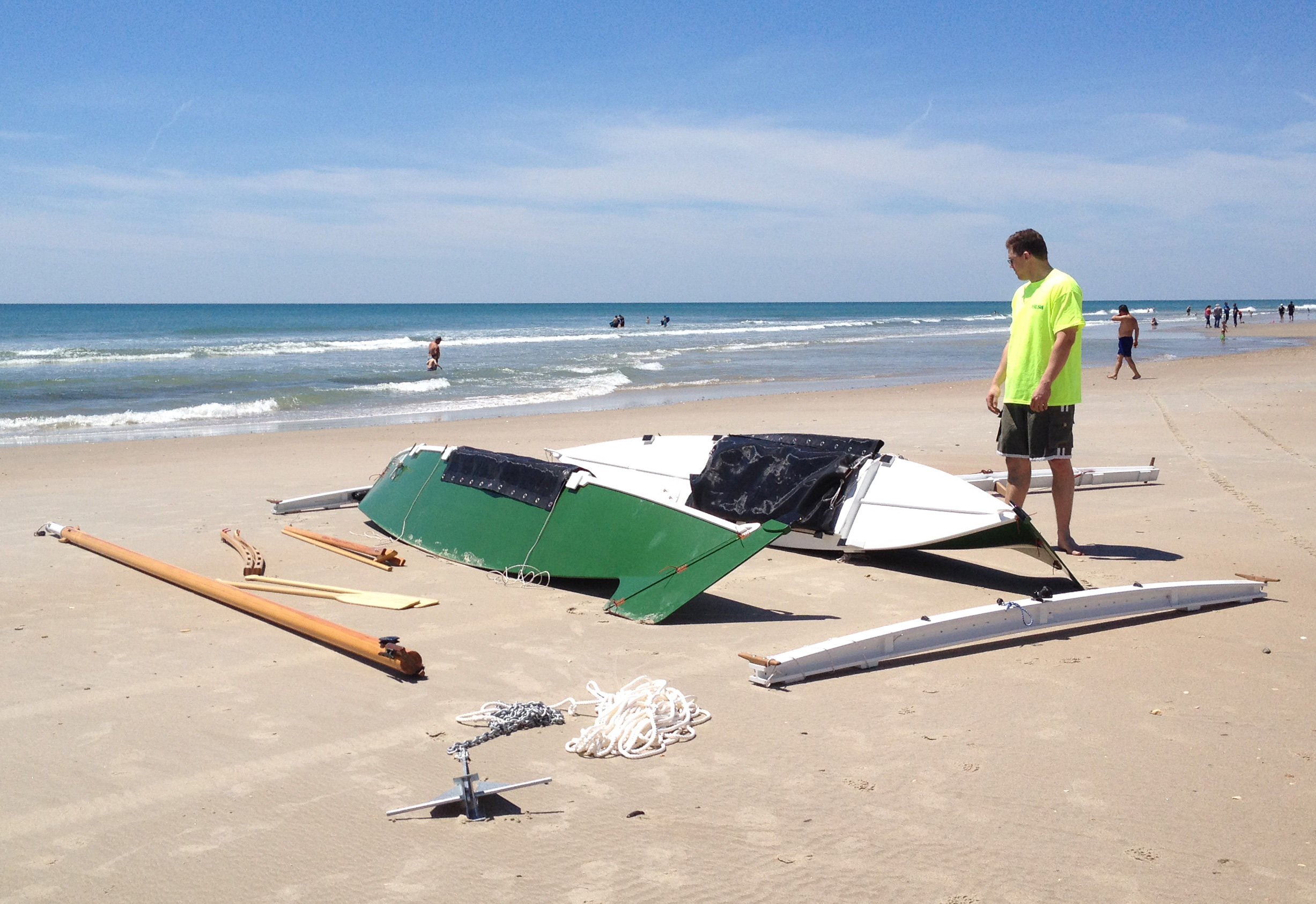 Omar Rashash
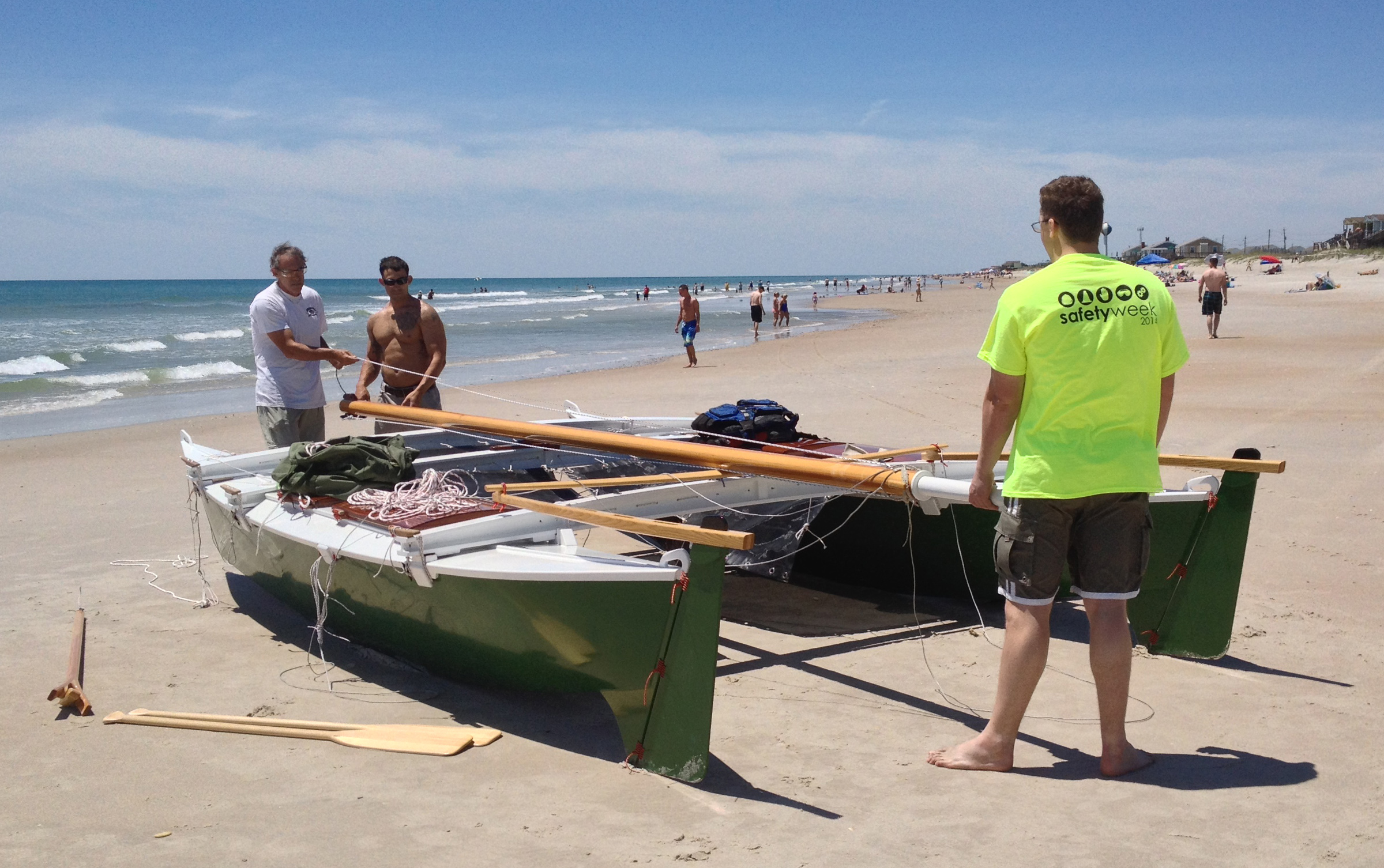 Omar Rashash
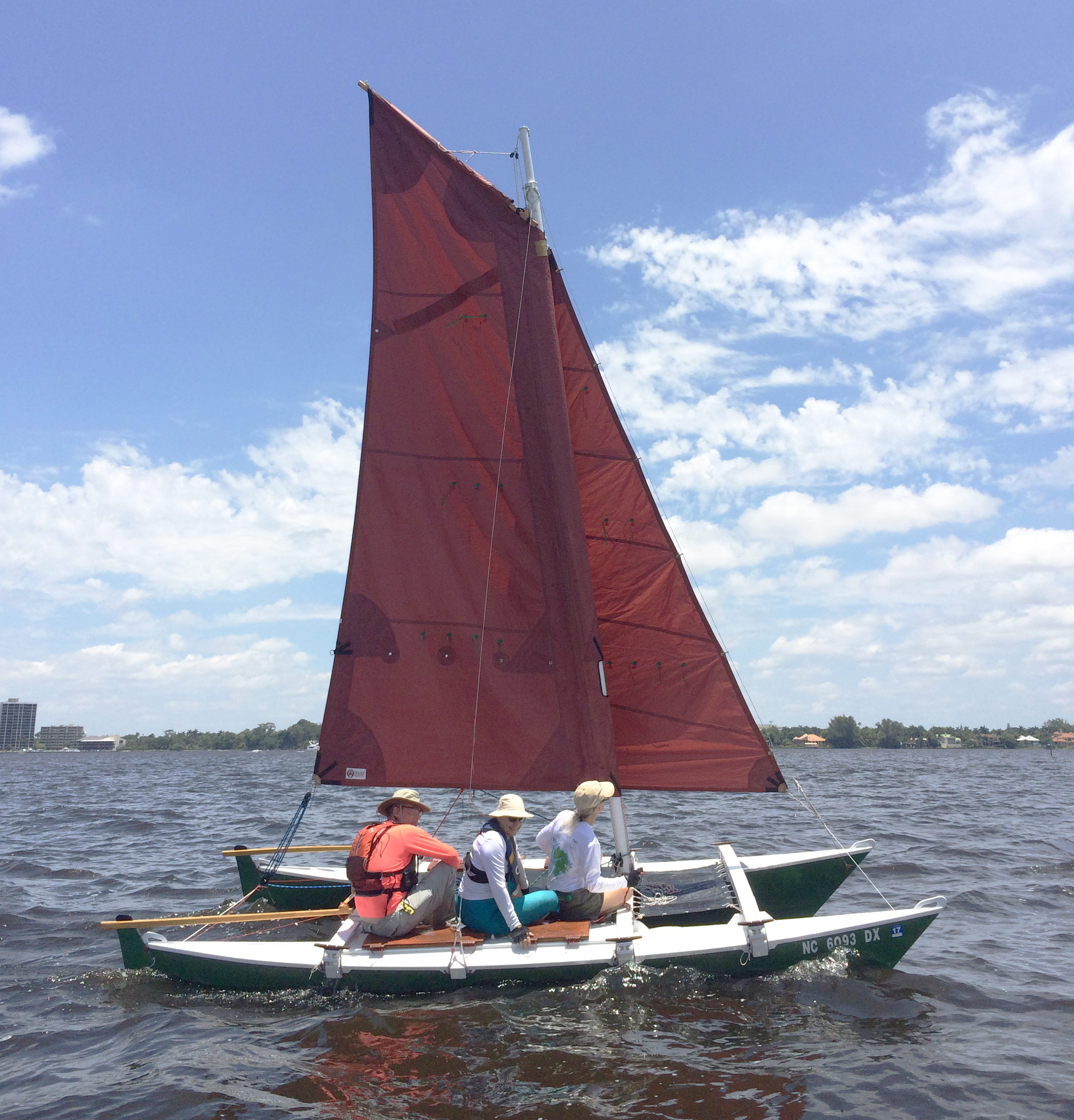 Barbara Davis
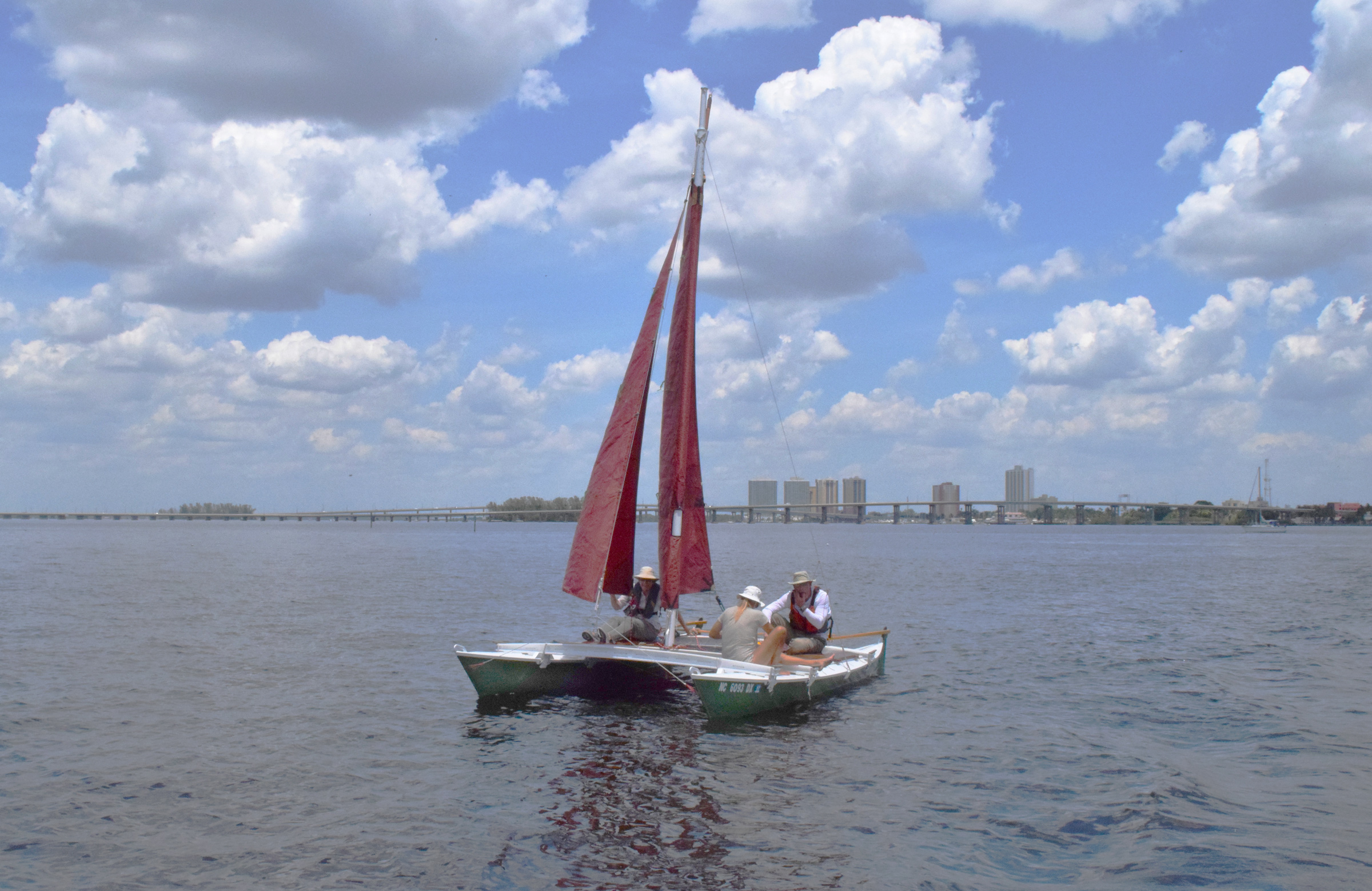 Barbara Davis
 Scott Williams