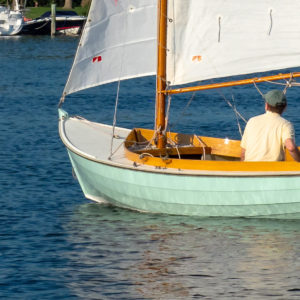
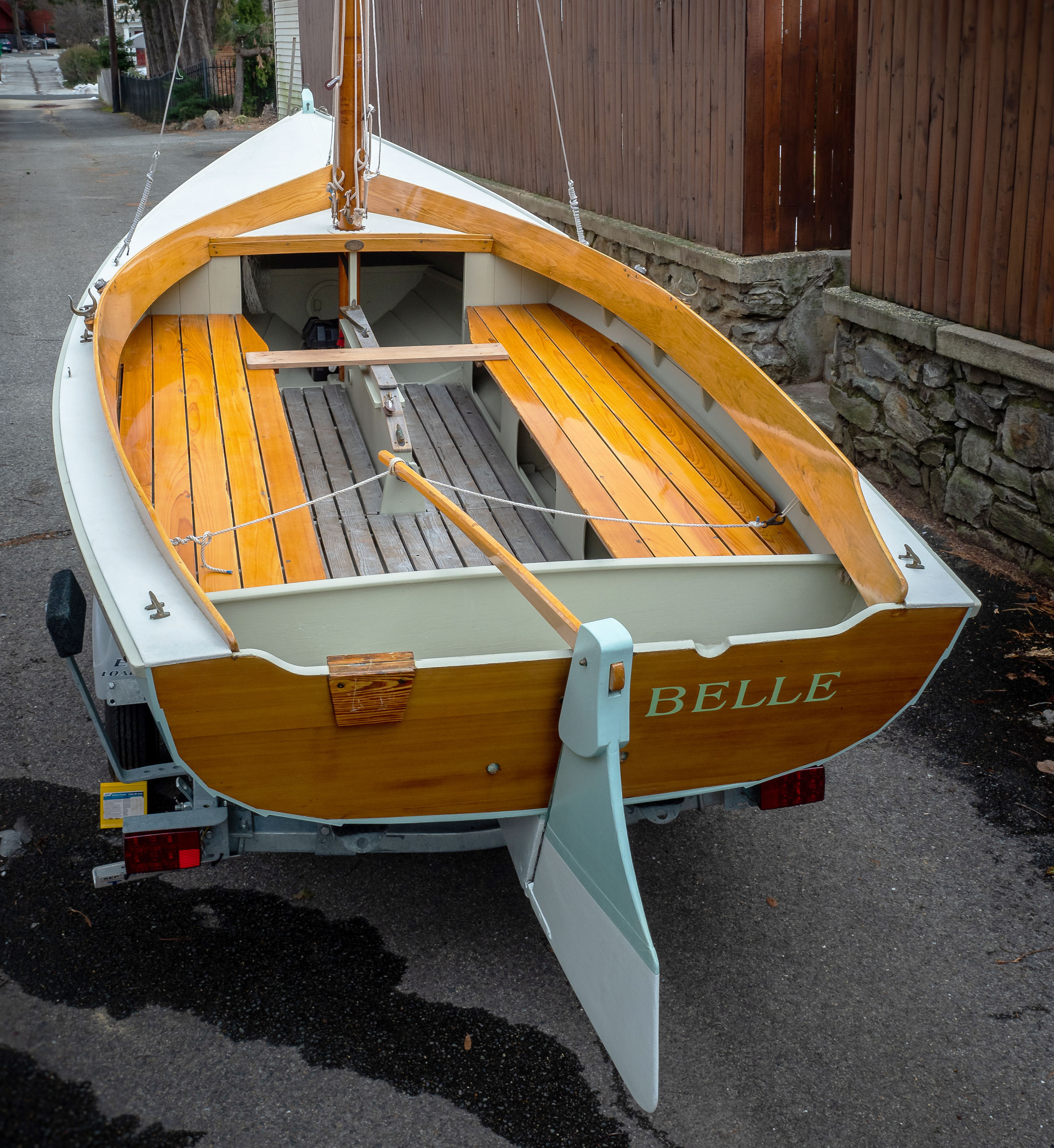
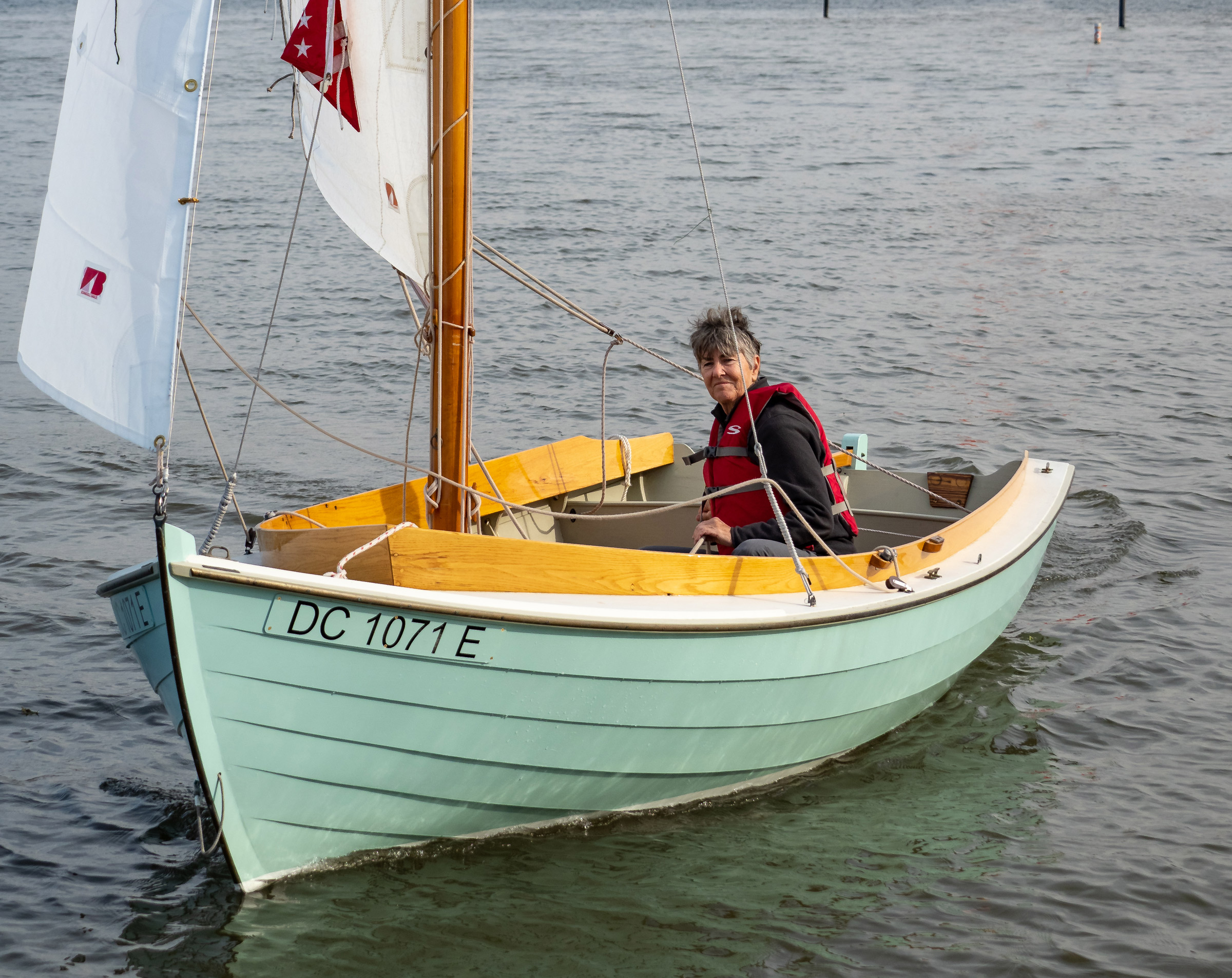
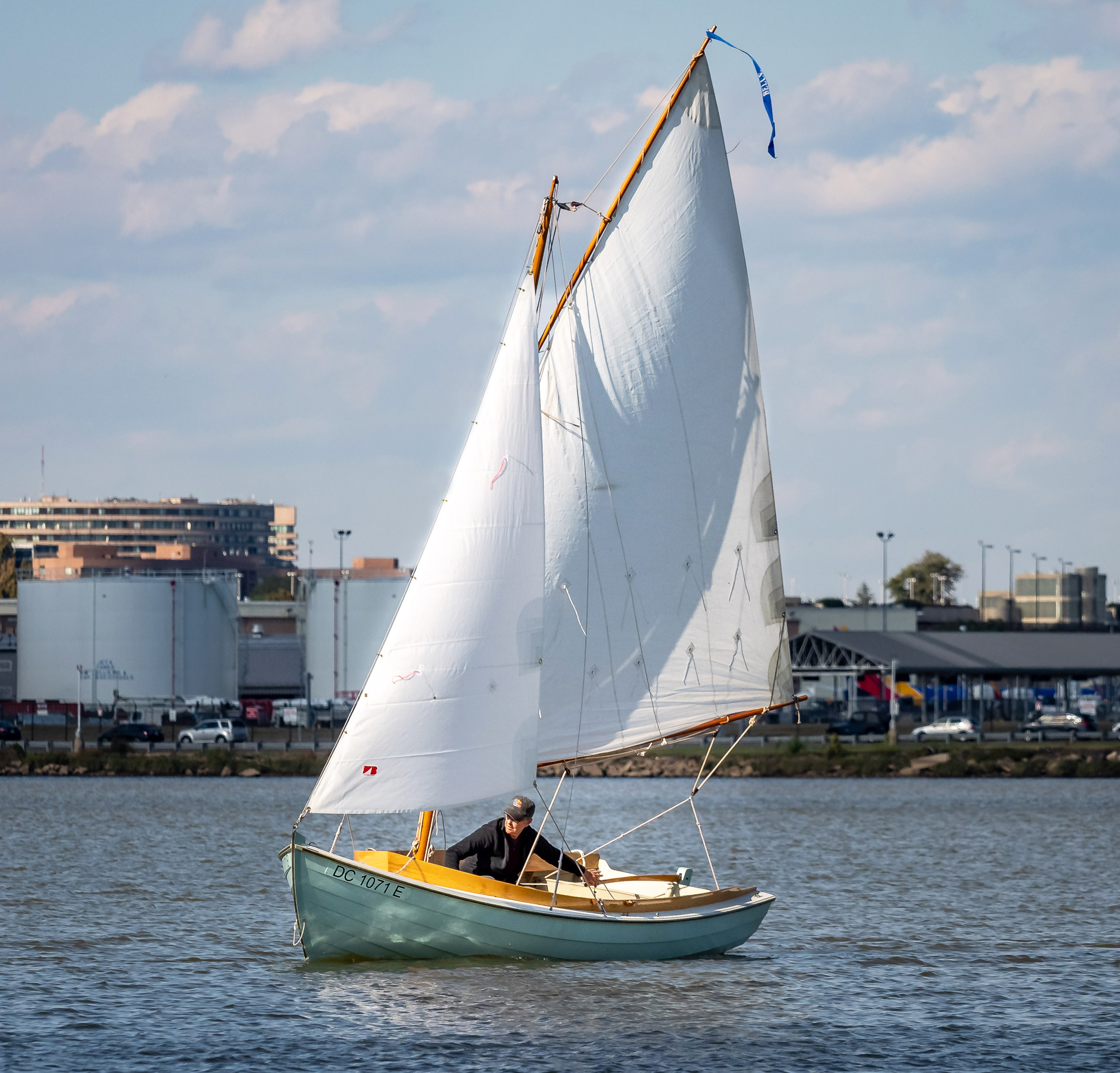
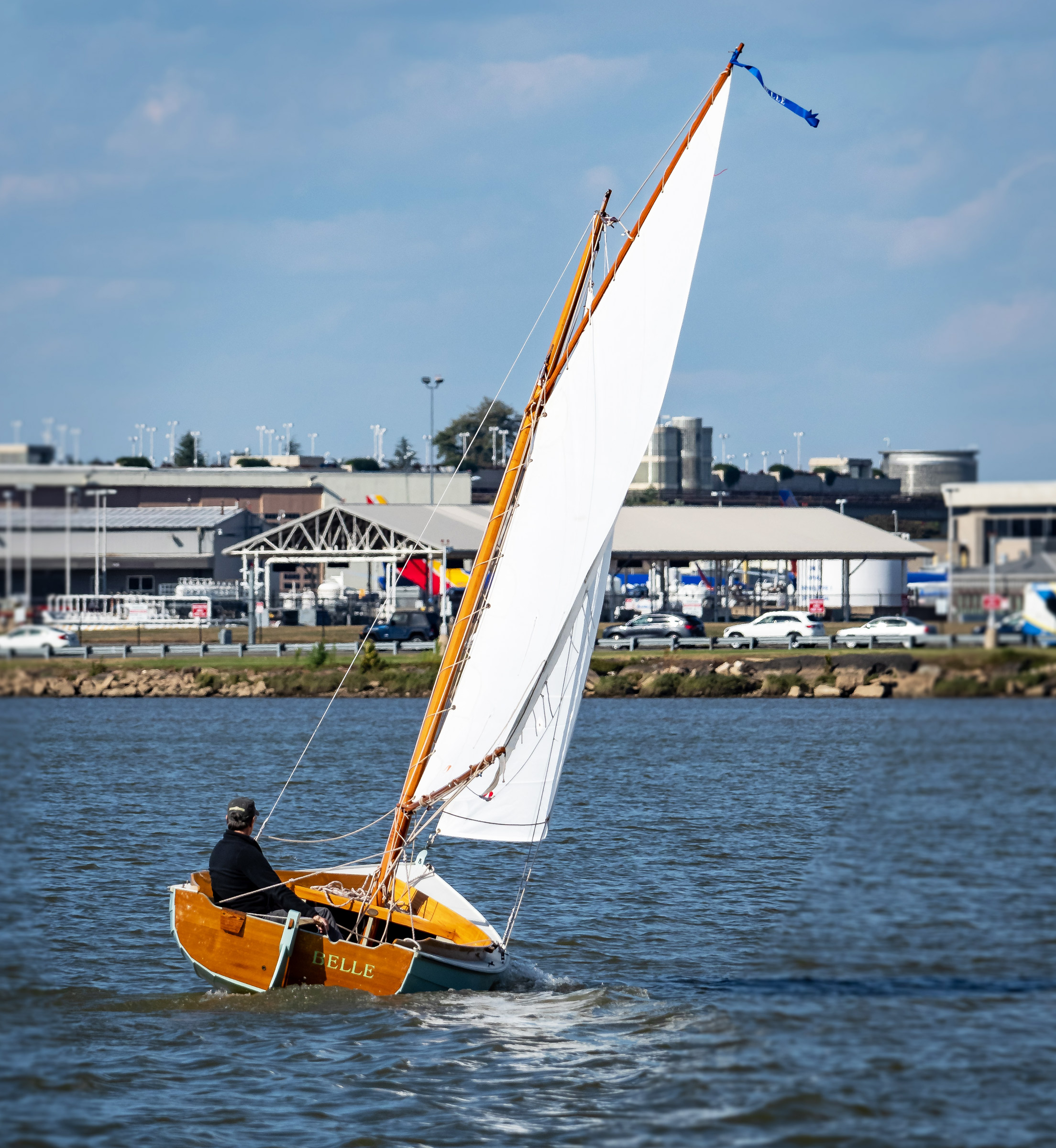
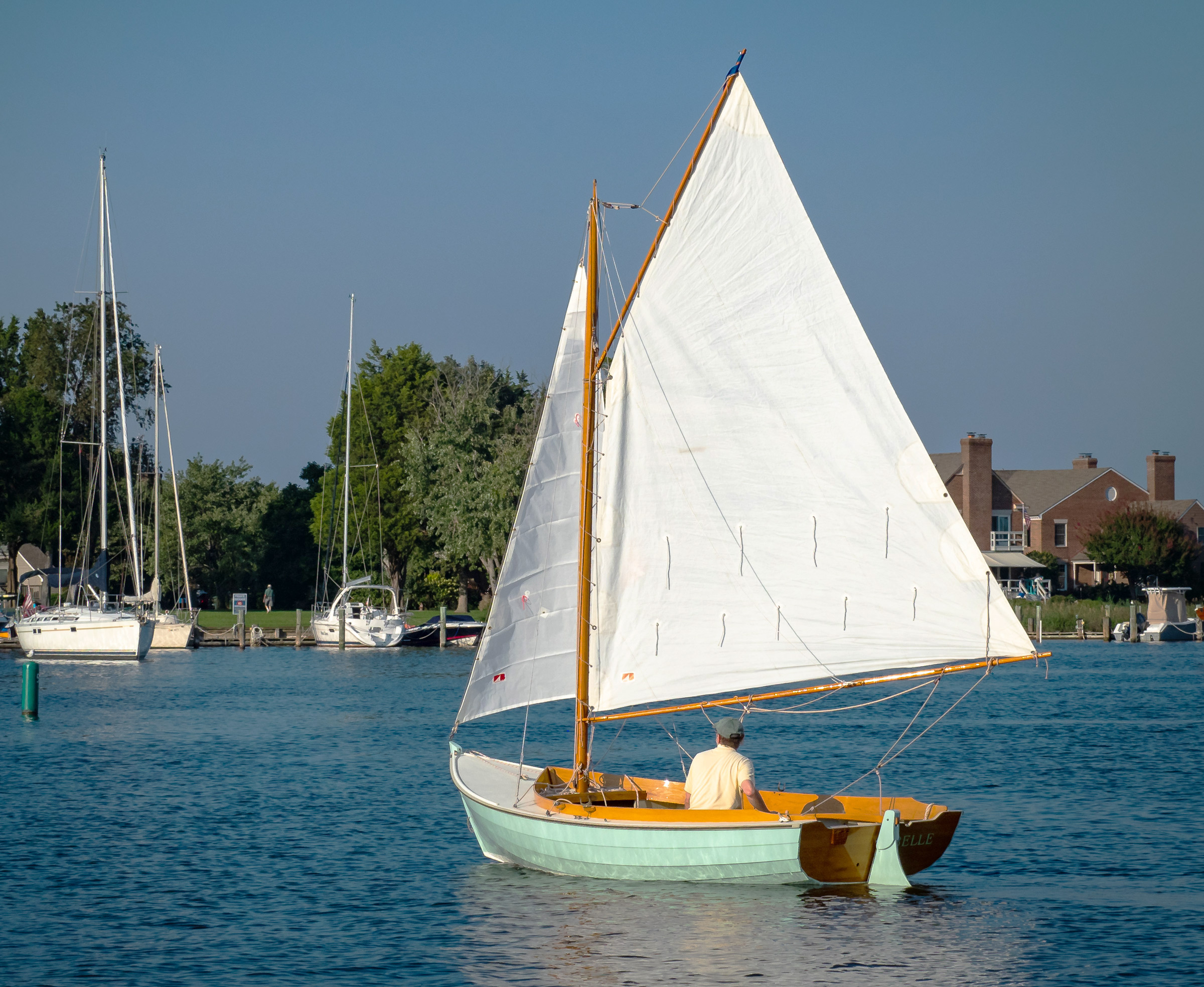
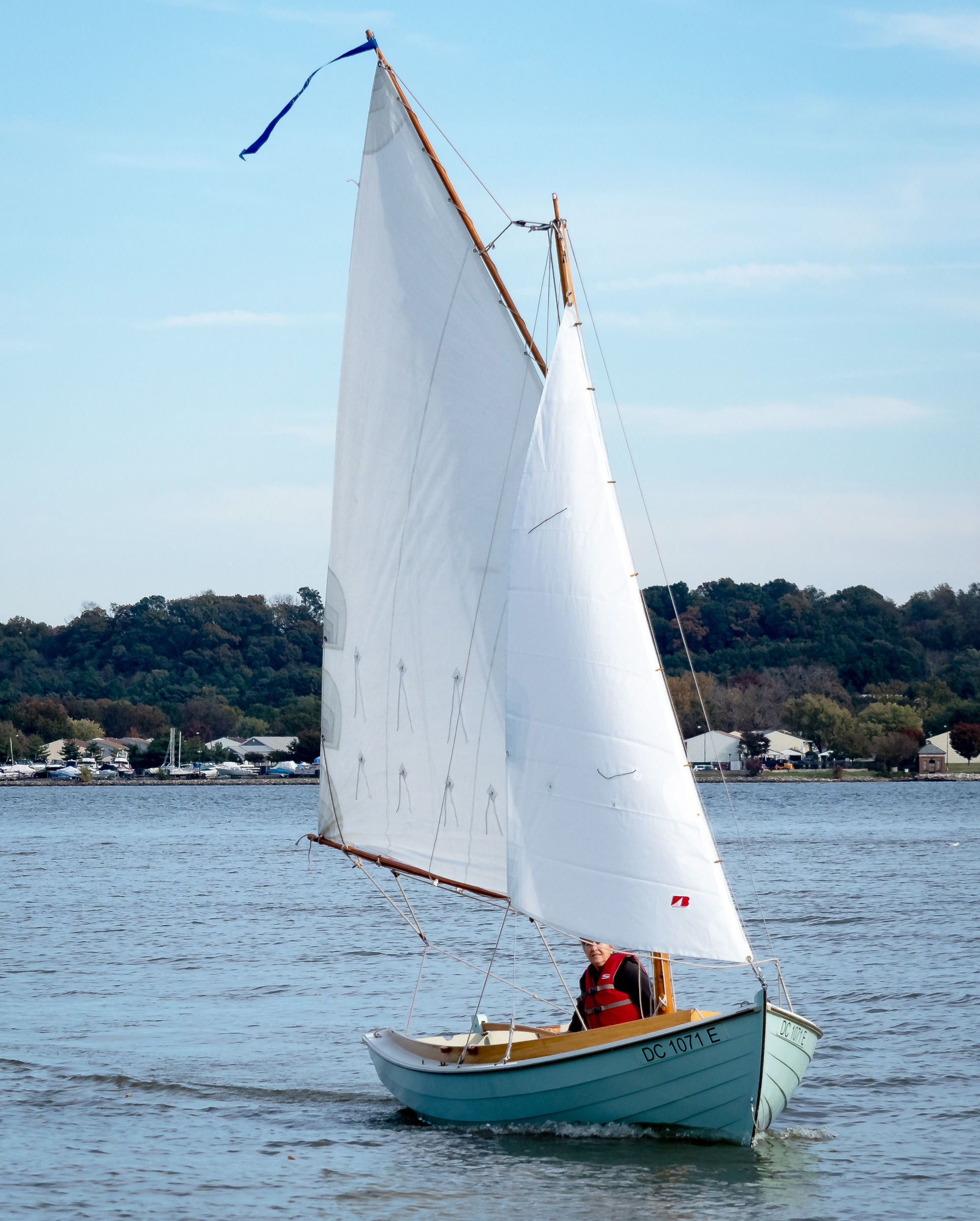
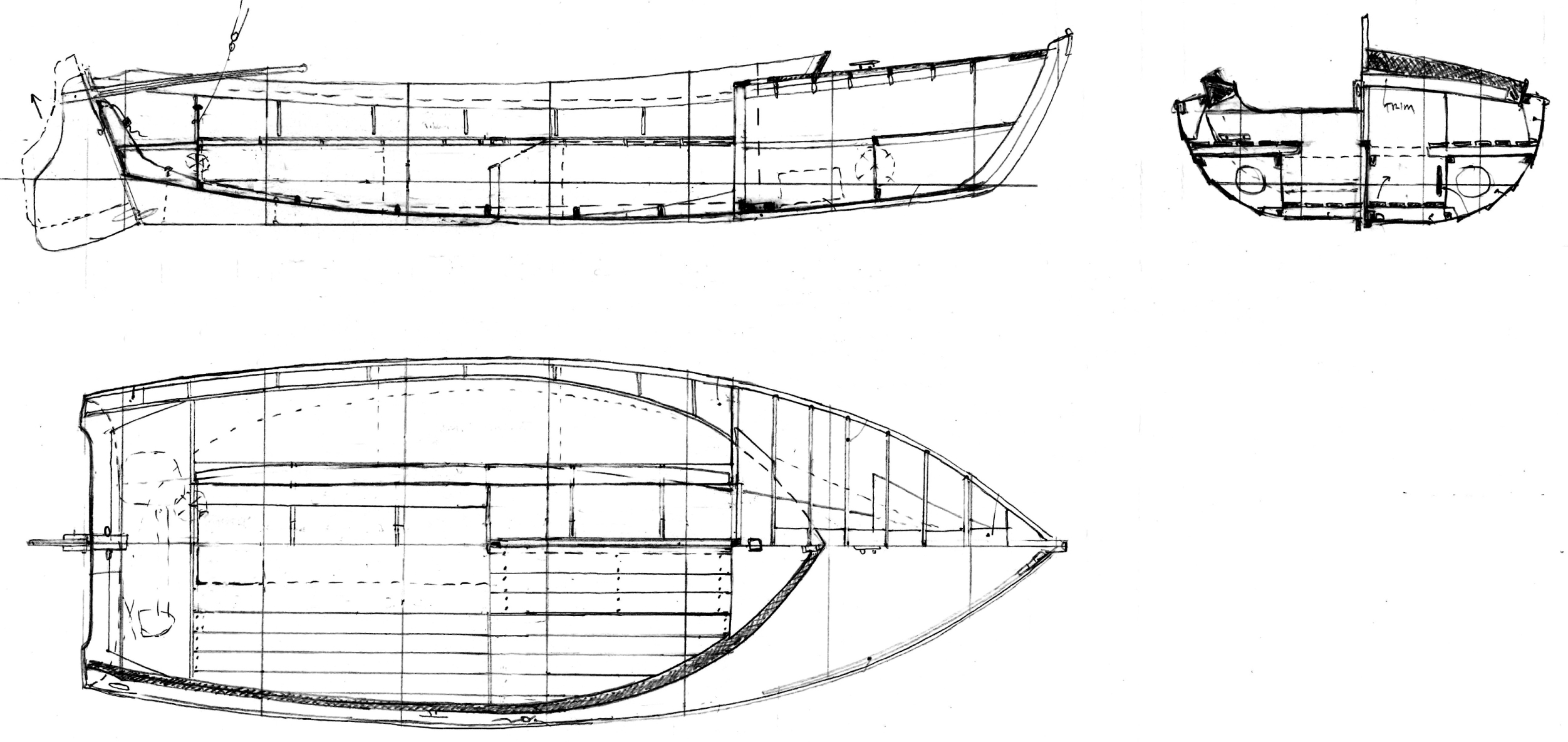
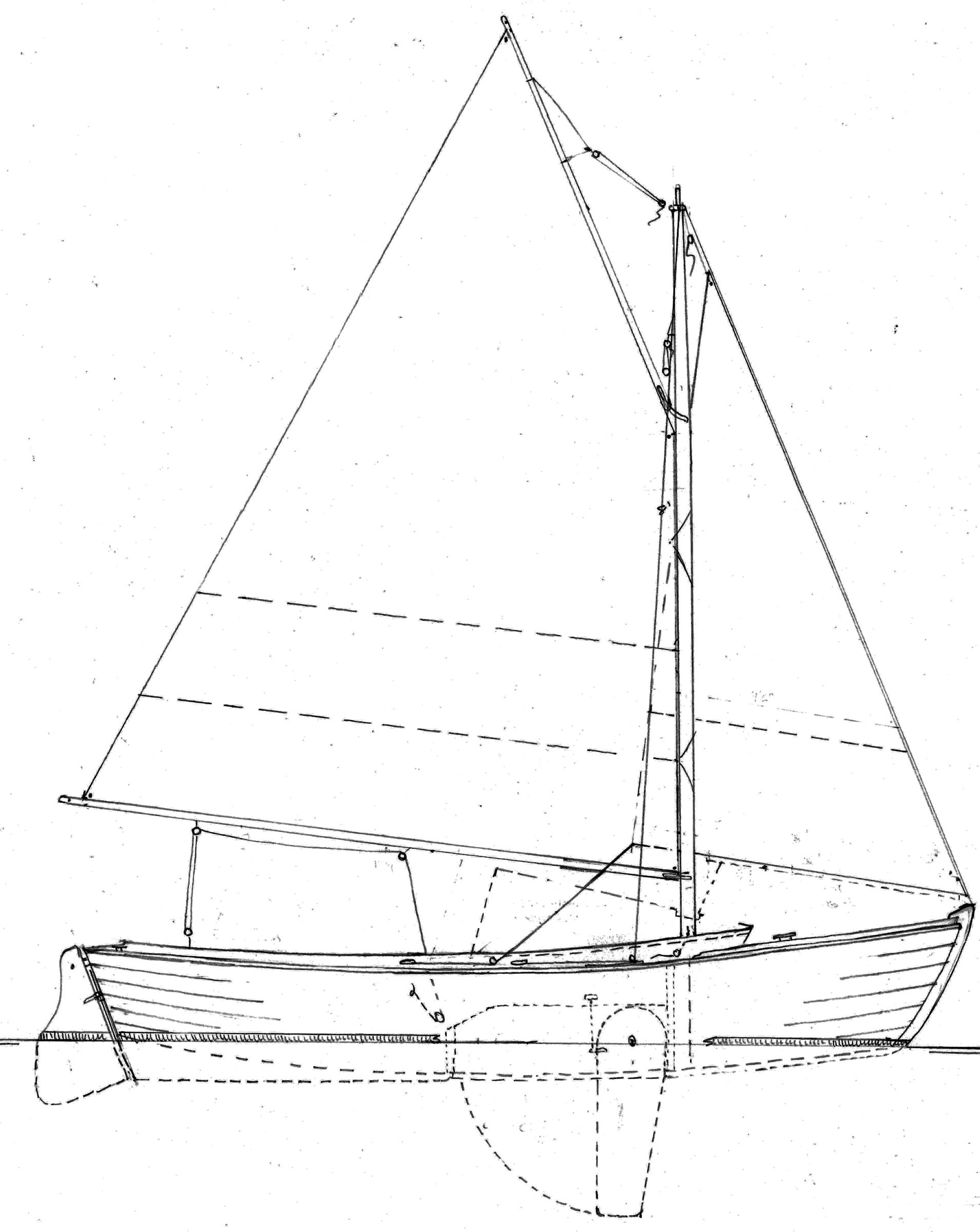
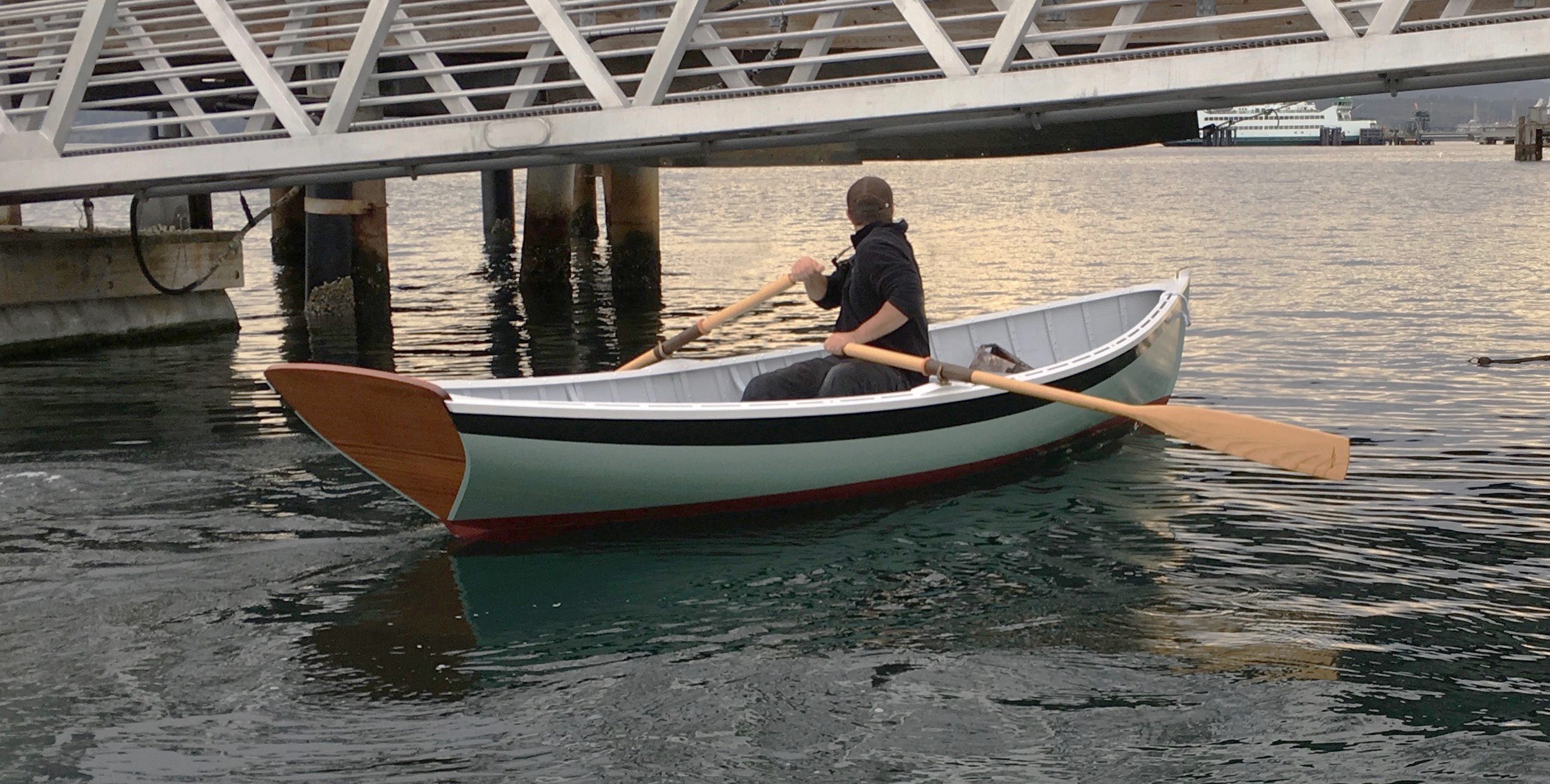
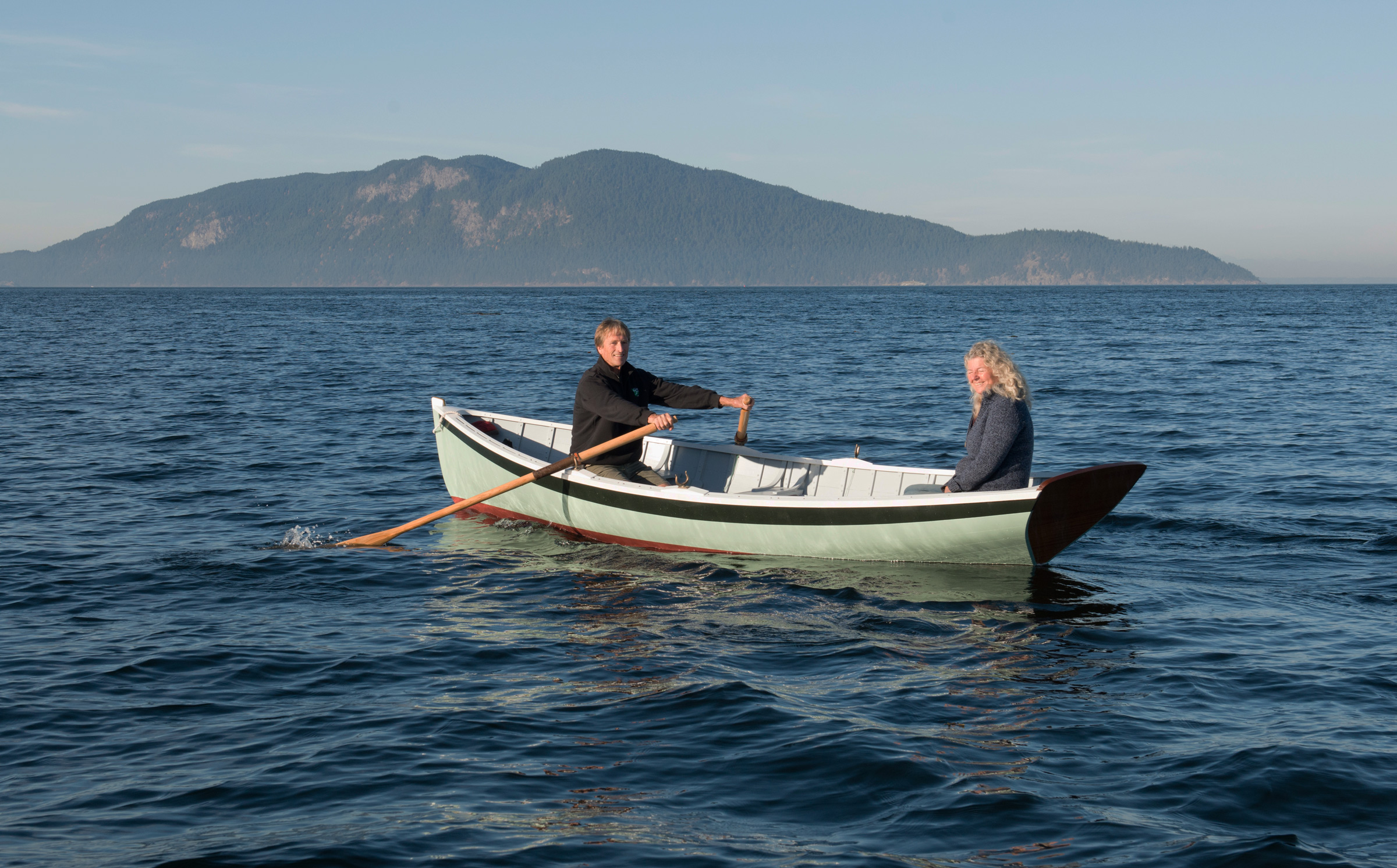
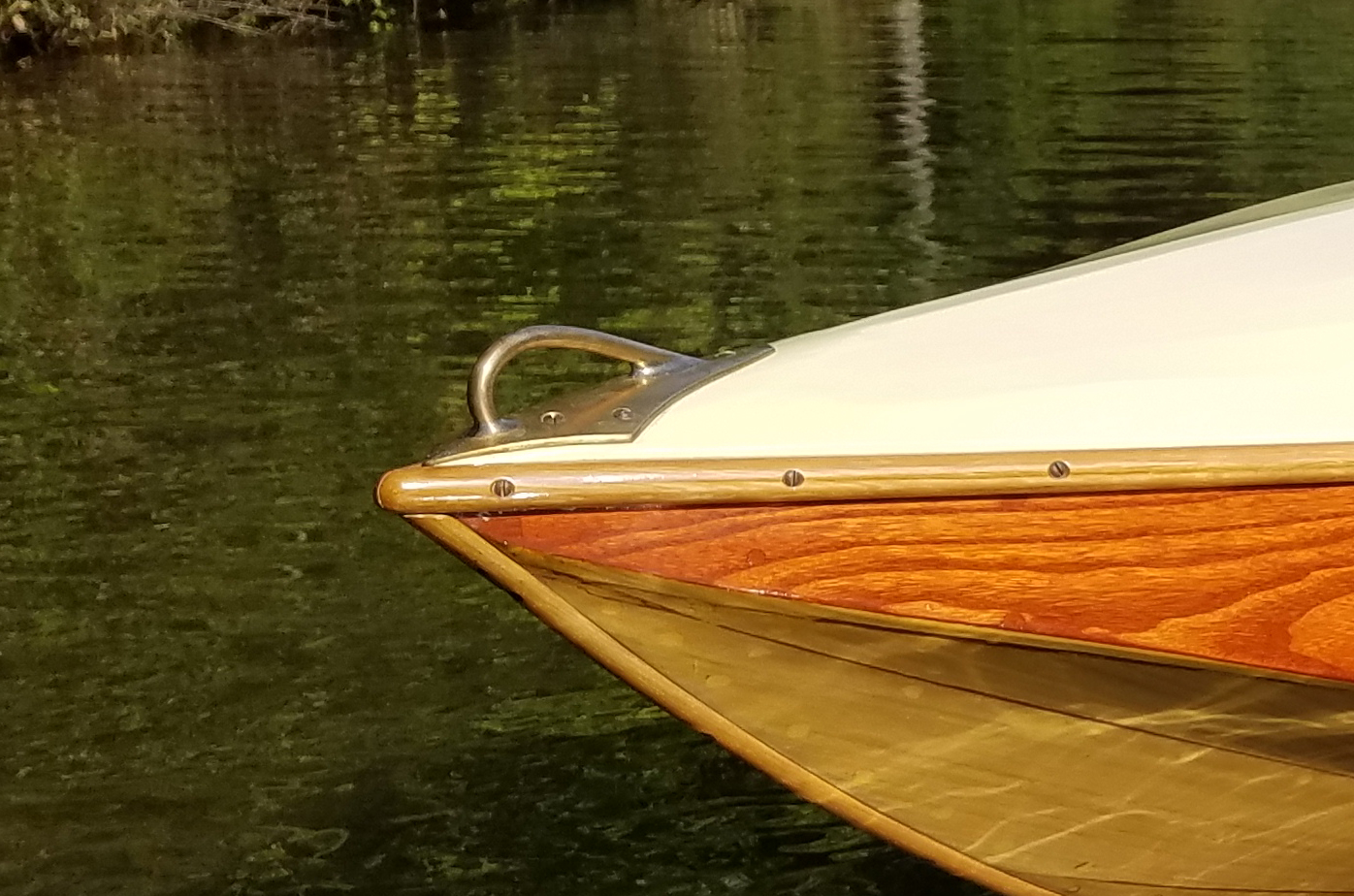
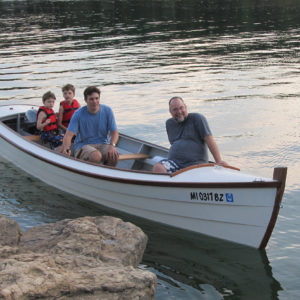
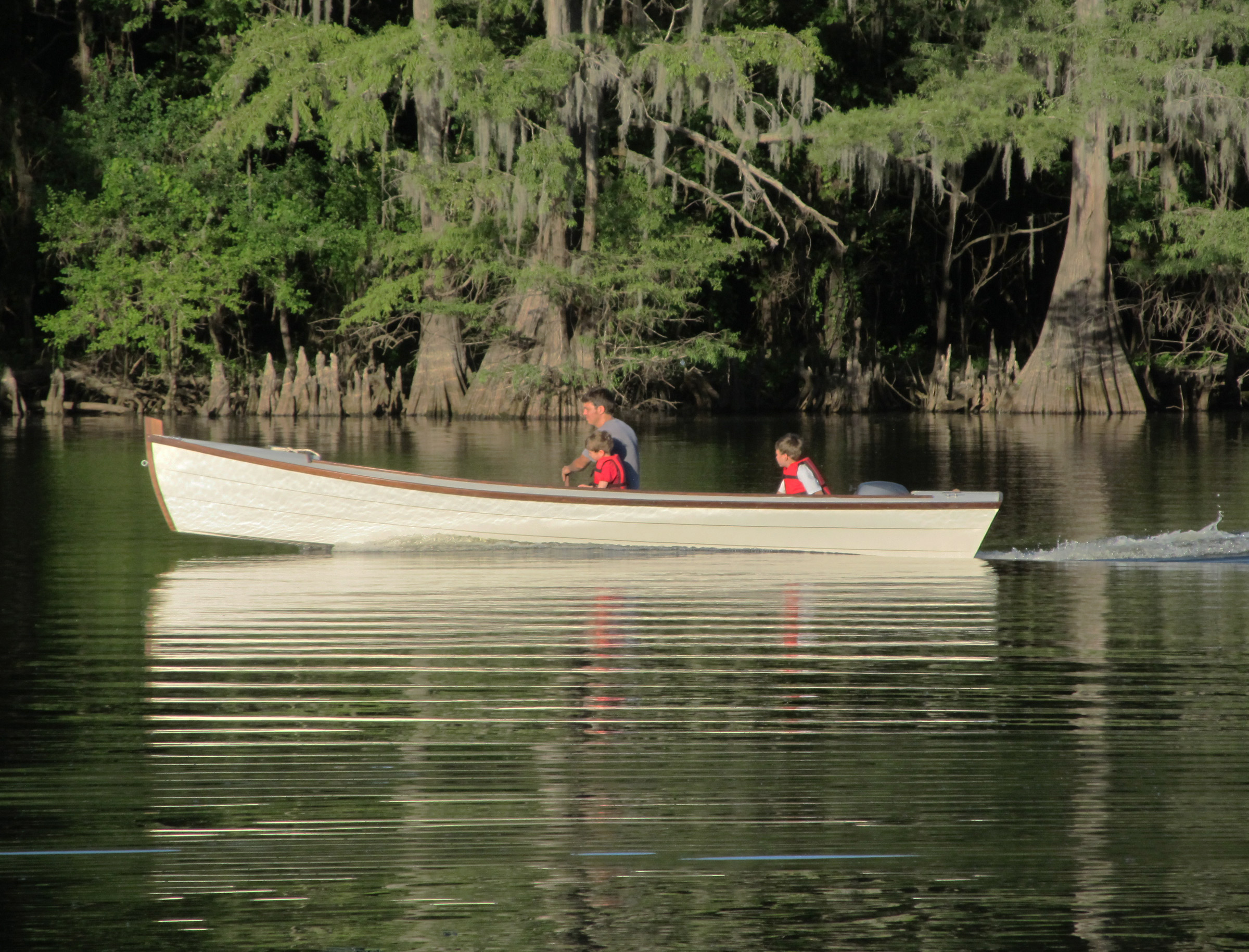
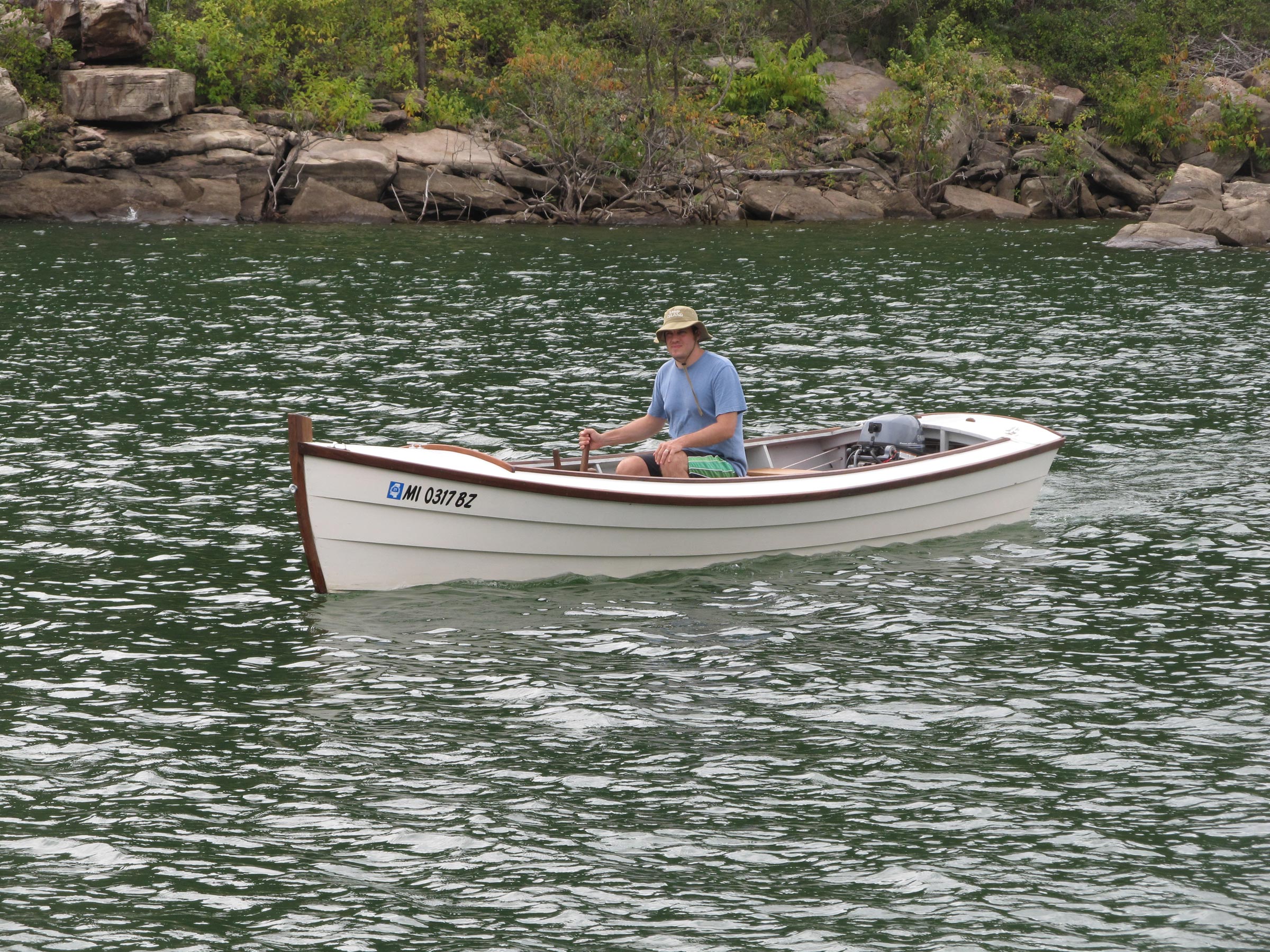
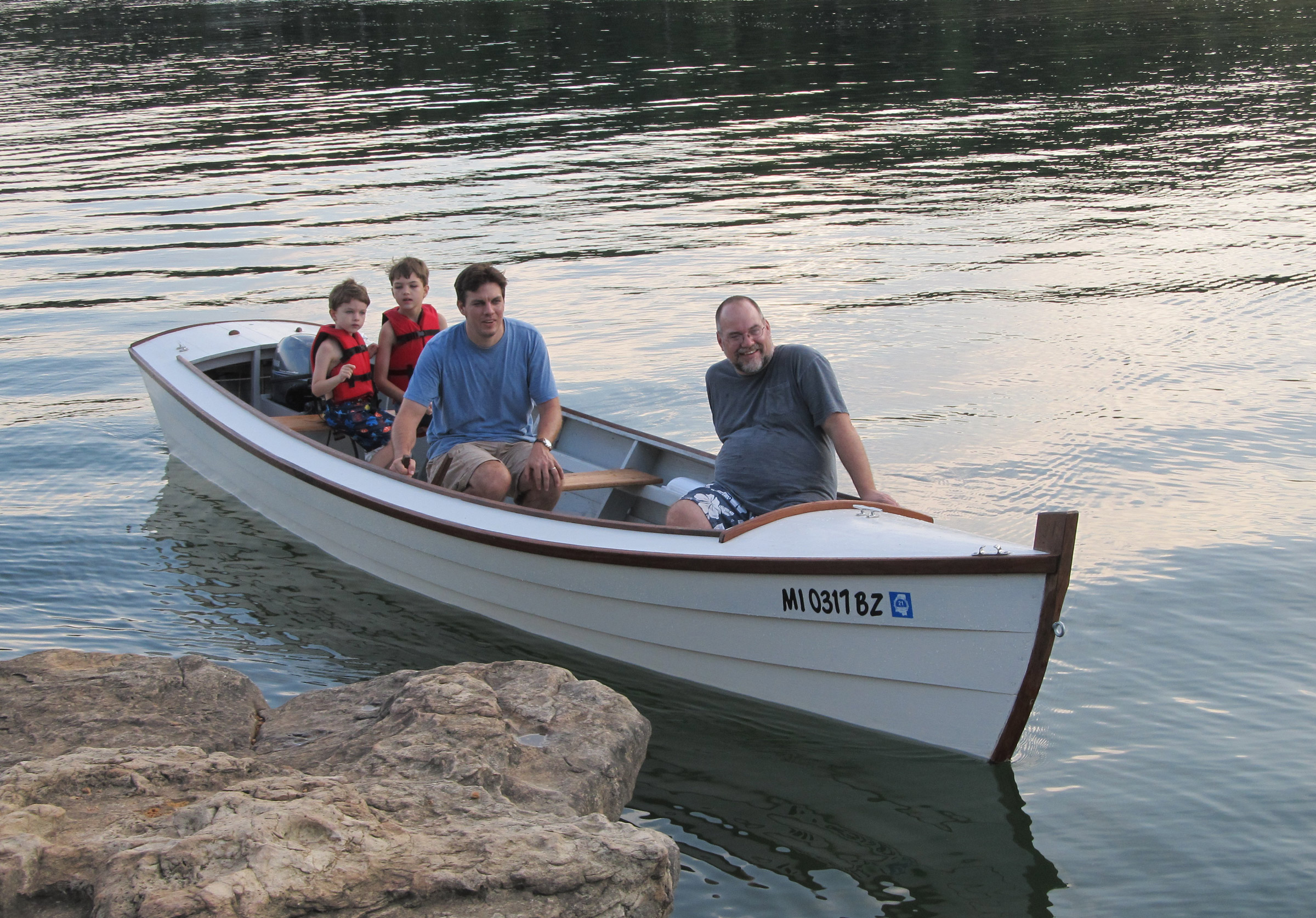
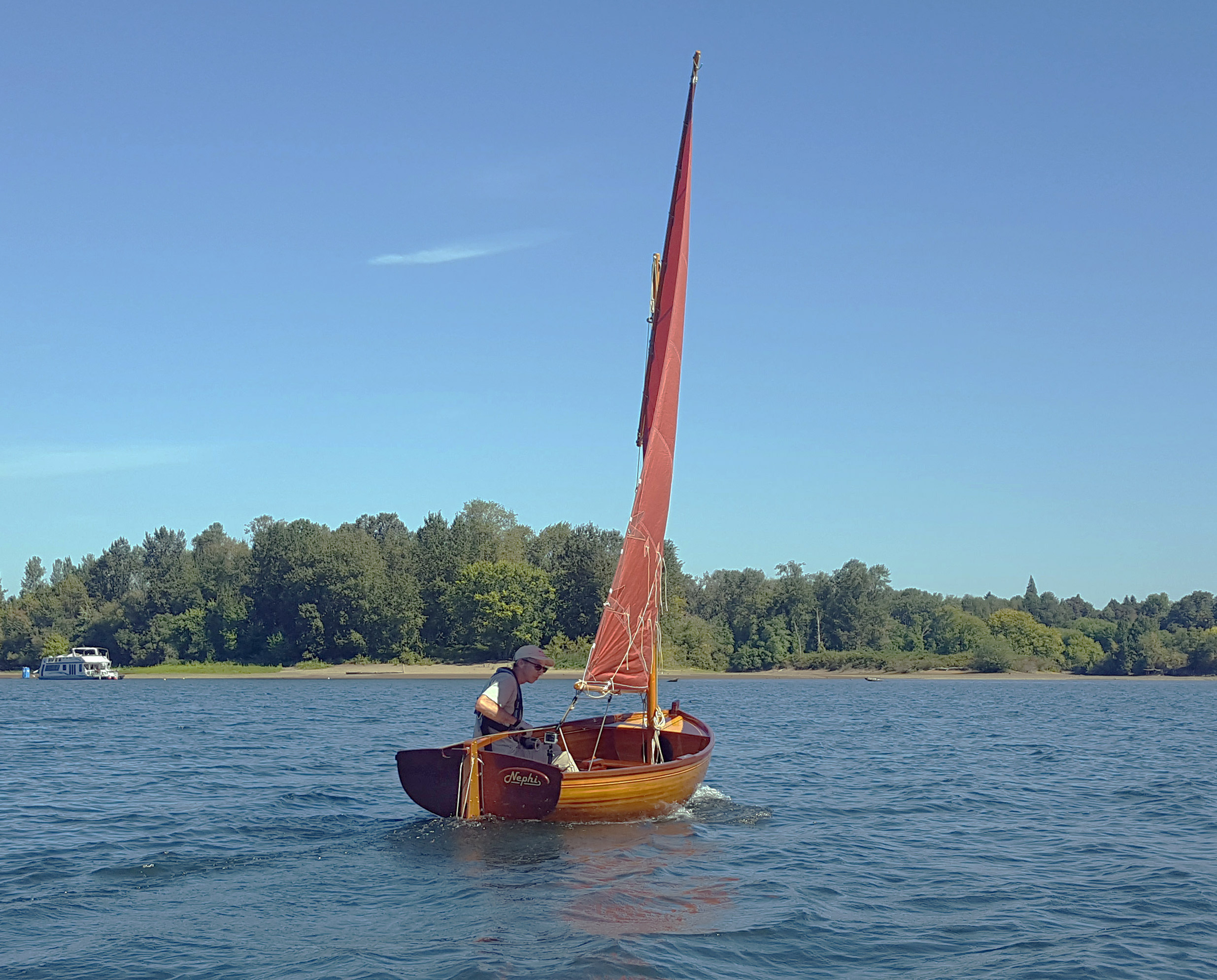
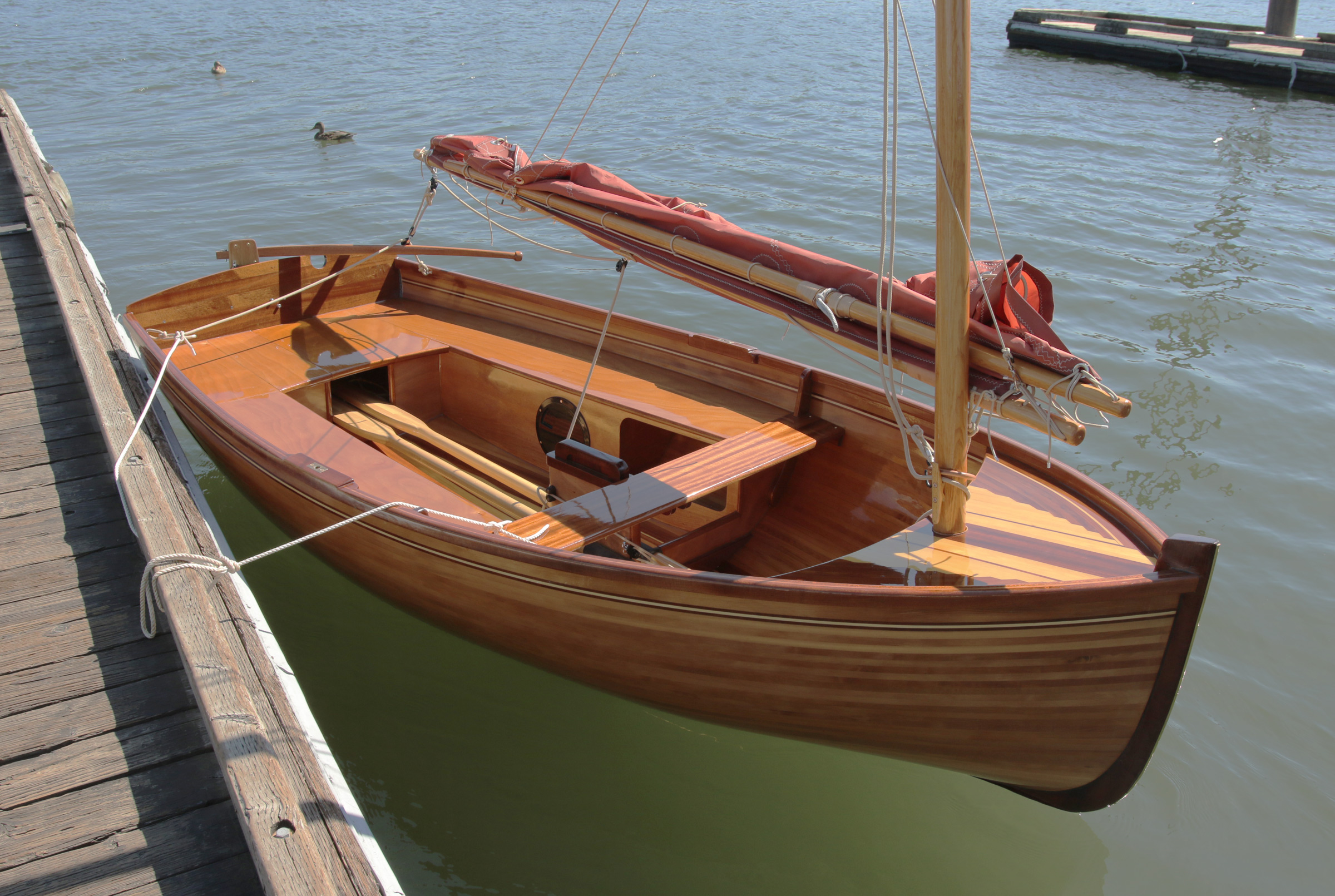
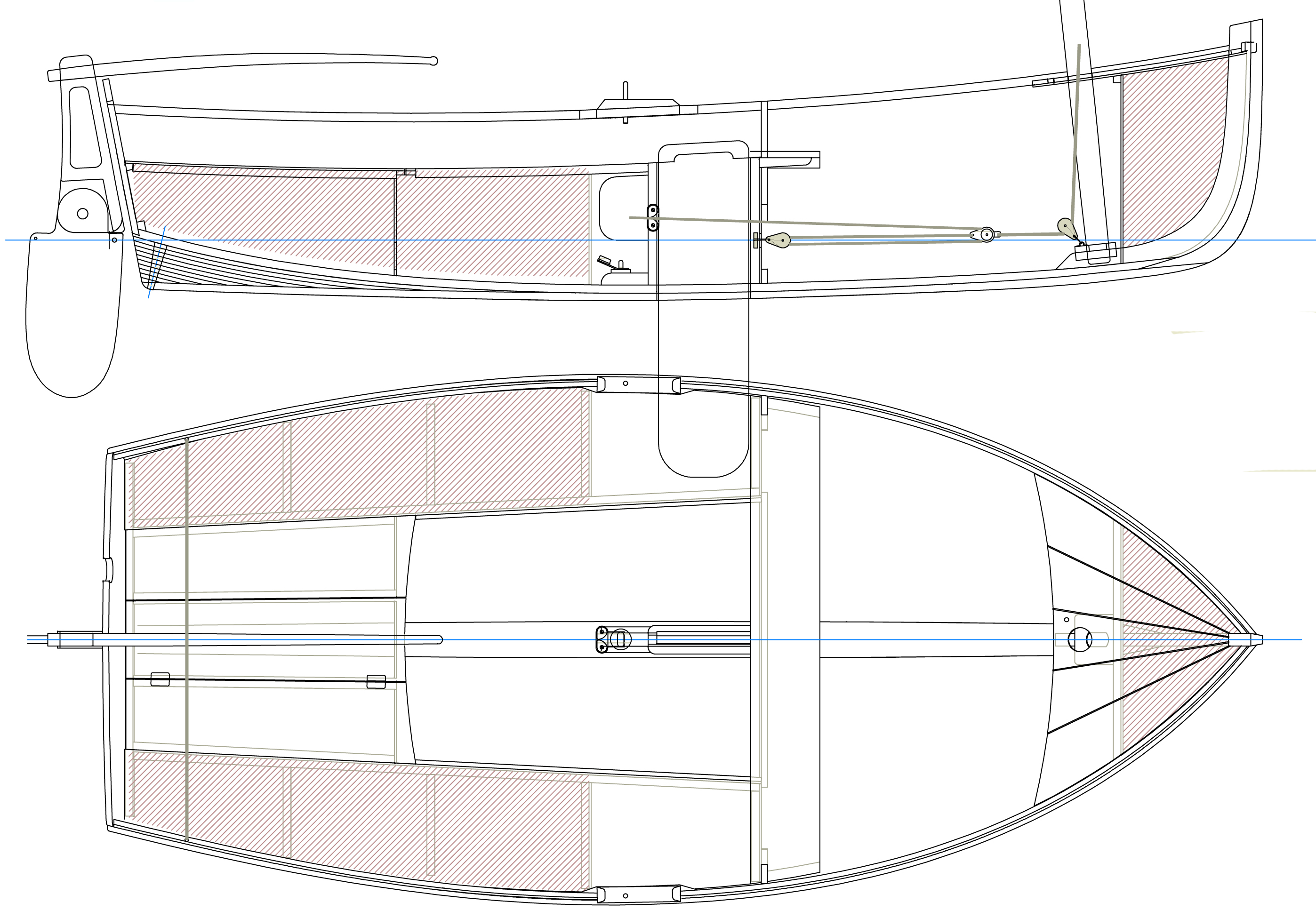
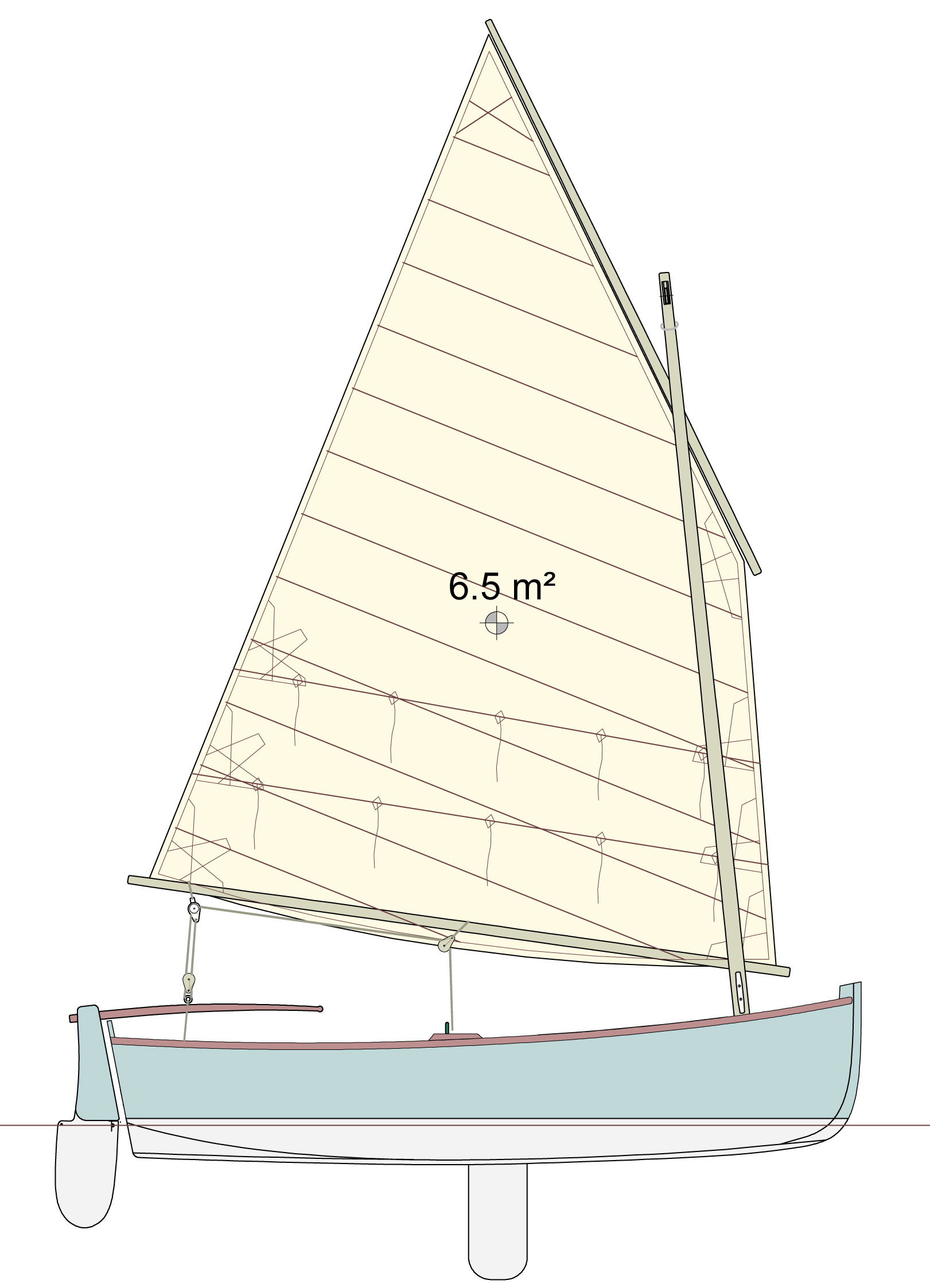
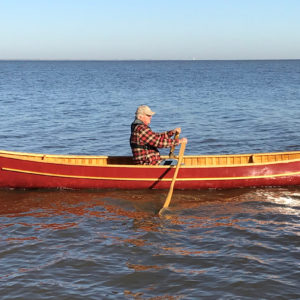
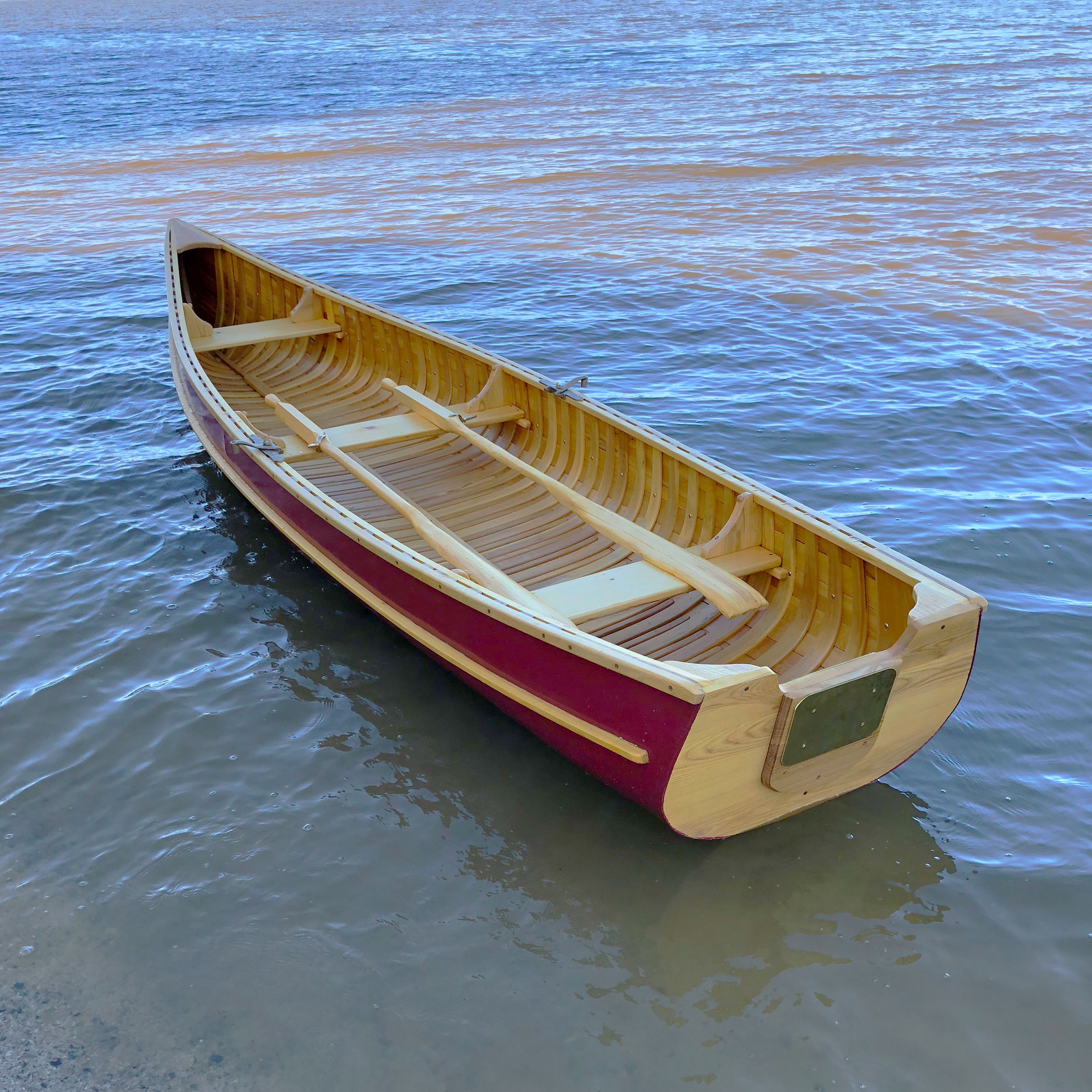
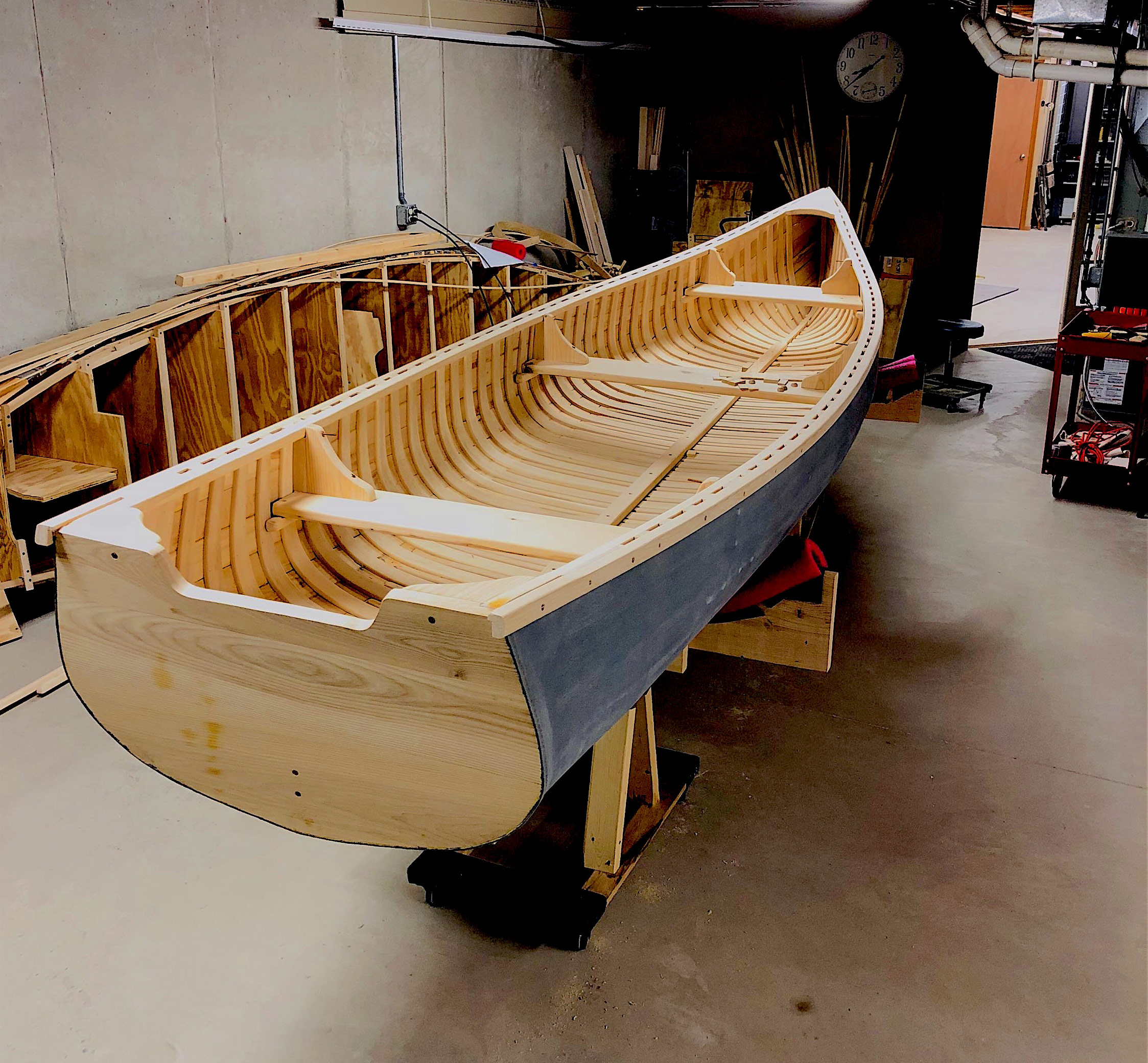
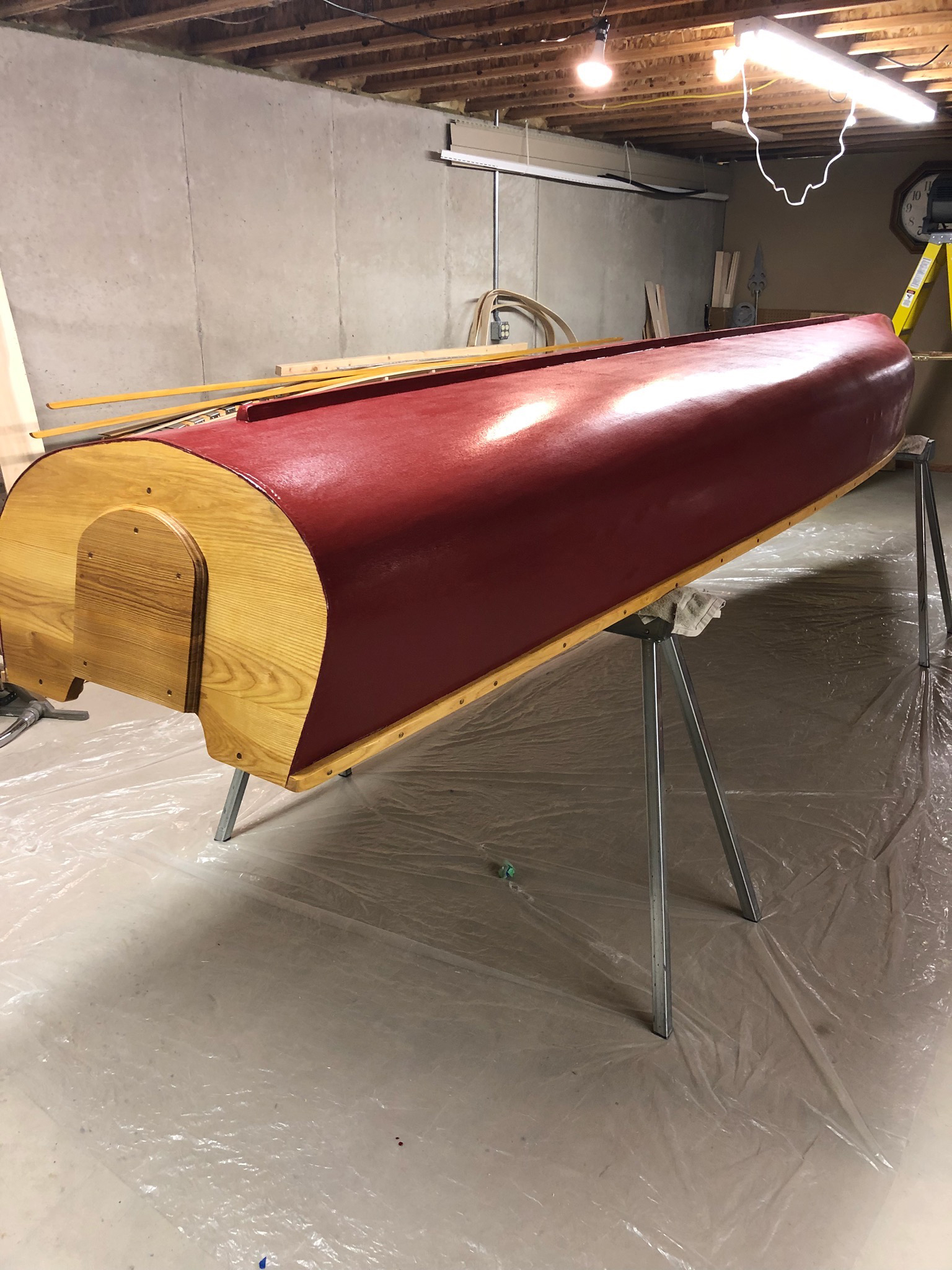
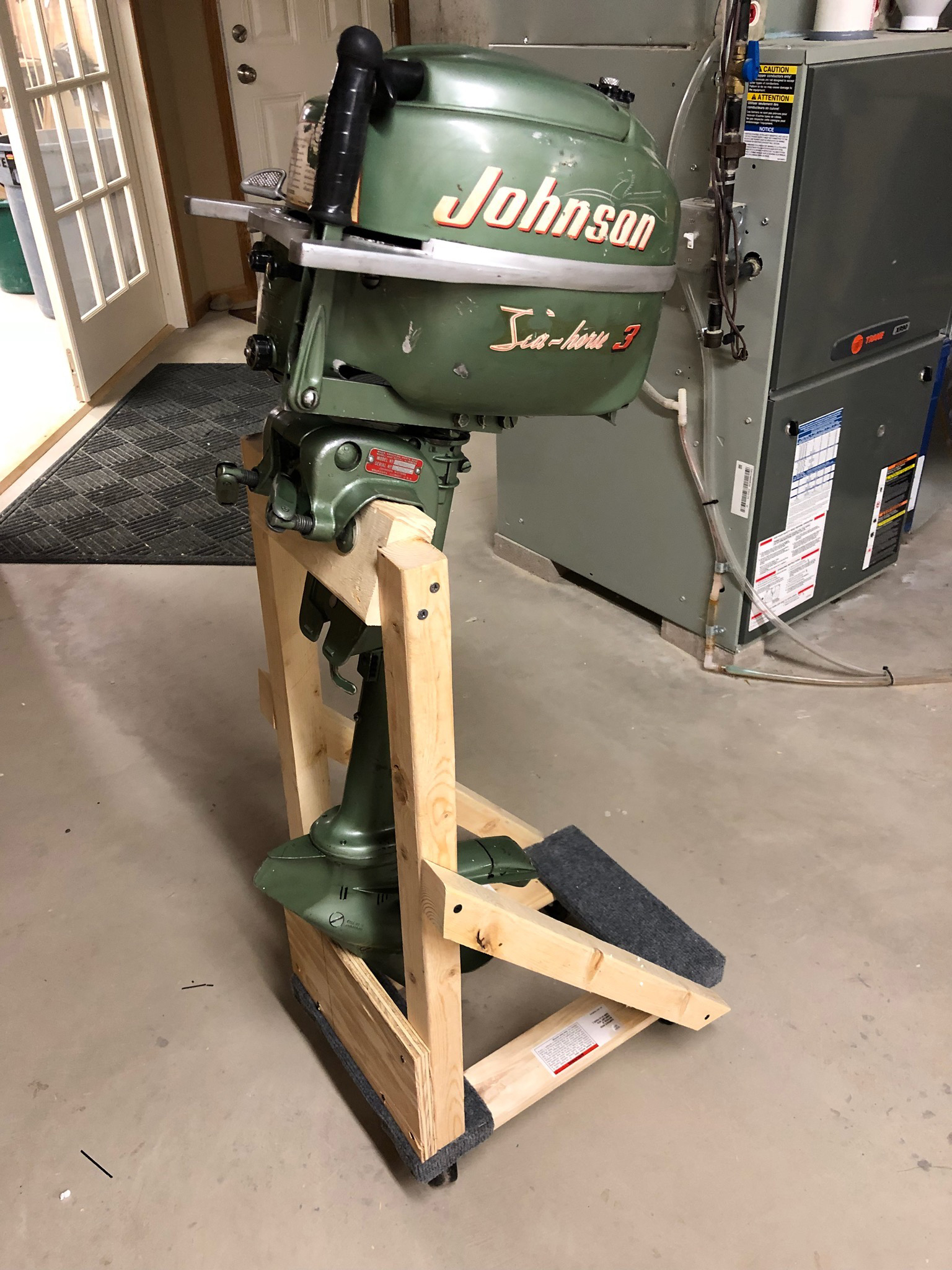
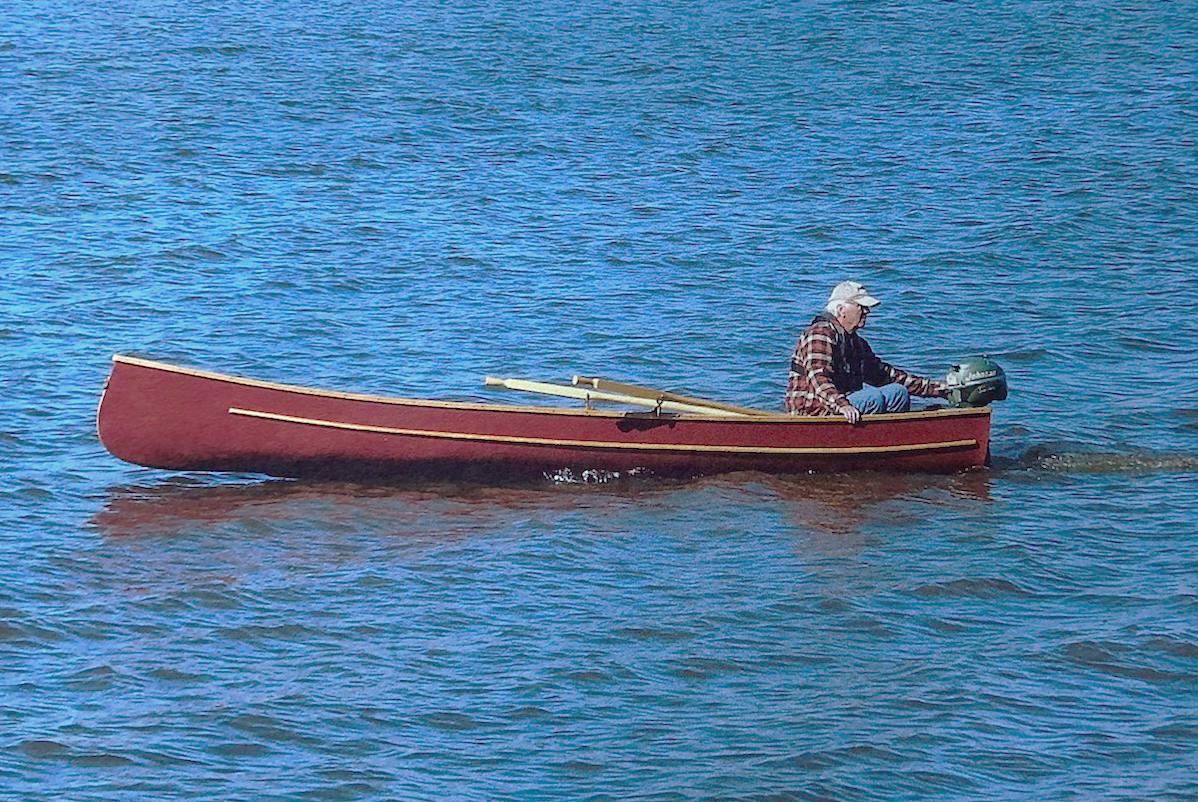
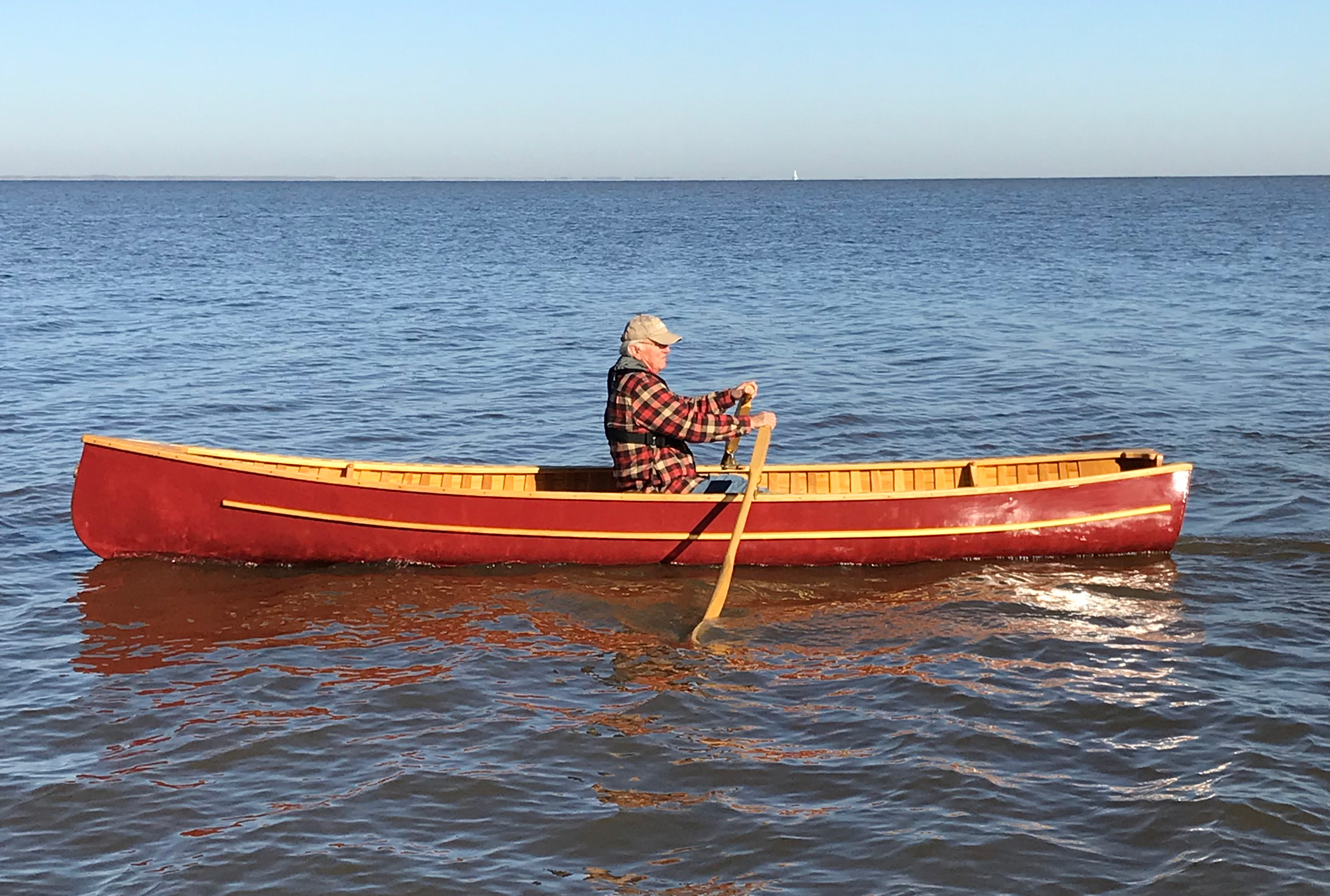
In profile, CHIPS bears a strong resemblance to the Herreshoff 12-1/2, one of the boats that inspired Carl’s Block Island 19 design.
Carl Kaufmann, at 92, likes to keep busy. He has a workshop at both of his homes, one on Block Island, Rhode Island, and the other in Mystic, Connecticut, and has built boats ranging from a 34-lb cedar racing shell to a 12-ton, 40′ yawl. If that weren’t enough to fill his days, he makes beautiful mandolins and guitars, 15 so far, and regards himself as a between a beginning and an intermediate luthier. He’s drawn more to building instruments than playing them: “After years of trying—well, maybe not trying very hard—all I can do,” he writes, “is stumble through ‘Me and Bobby McGee’ and ‘Don’t Think Twice.’”
These two guitars and the mandolin are examples of Carl’s skills as a luthier.
The list of boats Carl has built from scratch includes the Sparkman & Stephens yawl, three Graeme King rowing shells, a Butler and Hamlin 26’ centerboard sloop, an 11-1/2′ Alden X dinghy, an 11′ 2″ Shellback dinghy, a 14′ Atkin skiff, and an 8′ pram of his own design. He built a plywood pram and a 17′ Thistle-class sloop from kits. Ownership of the boats has been shared among his son, Eric, two grandchildren, and a great-grandchild—she’s only three, but her skiff is ready whenever she’s ready to row.
There was a place in the family fleet for a daysailer, and Carl considered building to an existing design. He looked at the Herreshoff 12-1/2, but it was too small and perhaps not as fast as he had in mind for his new boat. He also considered Herreshoff’s 21′ Fish Boat and Chuck Paine’s 21′ Pisces, but these were keel boats and Carl preferred something not quite so deep. He kept looking around at other designs, but nothing quite felt right, so he decided to draw his own design. Although he had made his career in journalism, his education was in naval architecture and marine engineering. So, he drew up his Block Island 19, a centerboarder with an overall length of 19′, a waterline length of 15′, a beam of over 7′, and a draft of just 2′ with the board up. An 1,100-lb lead keel would bring the boat weight up to 2,500 lbs, “an extremely light boat,” he notes, for its type, more substantial than a 12-1/2 but substantially lighter than the Fish Boat or Pisces. For the rig he drew a generous gaff mainsail and a small self-tending jib on a traveler. For construction, carvel and lapstrake—either traditional riveted seams or glued plywood—were options, but Carl settled on a three-layer composite hull.
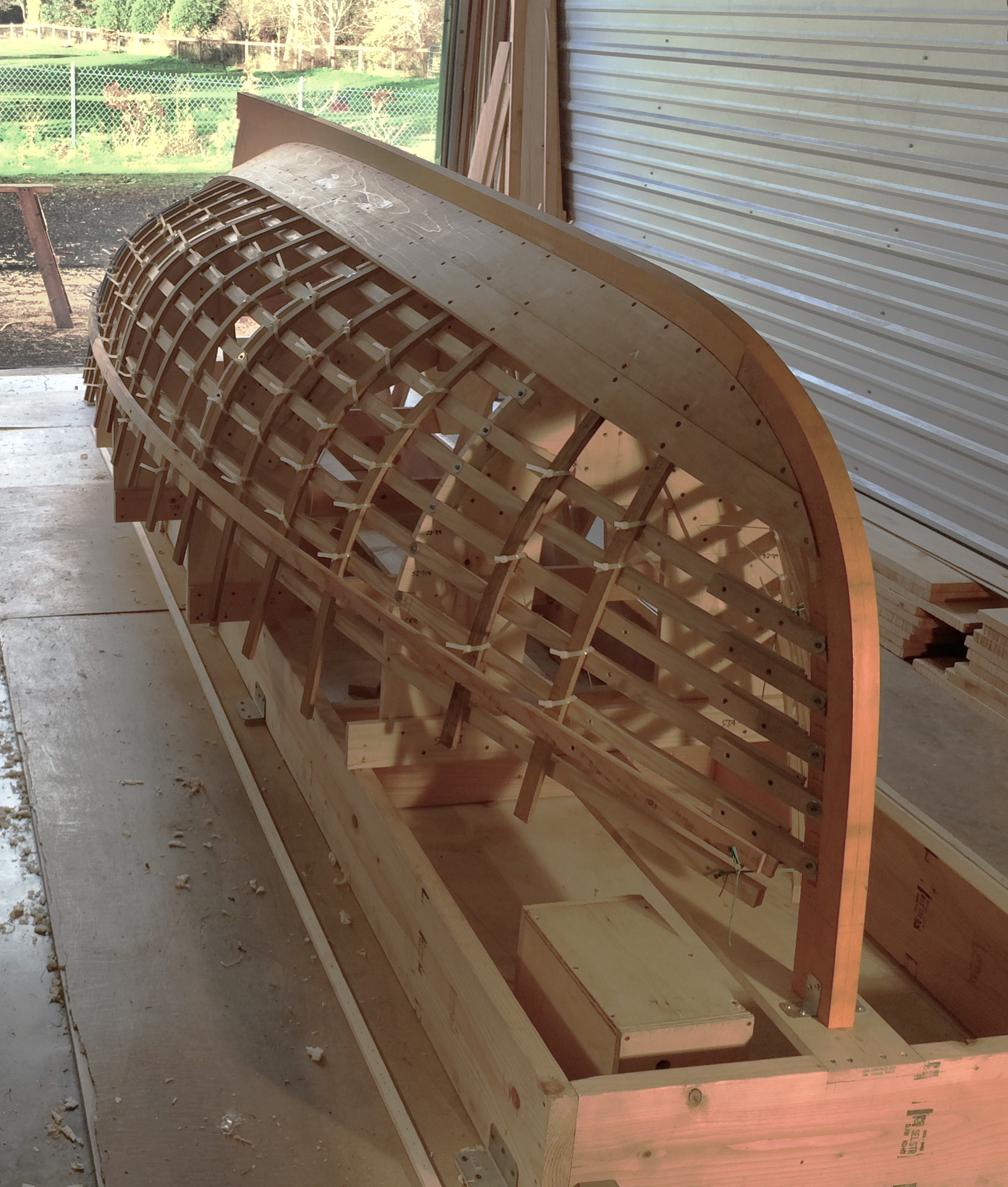
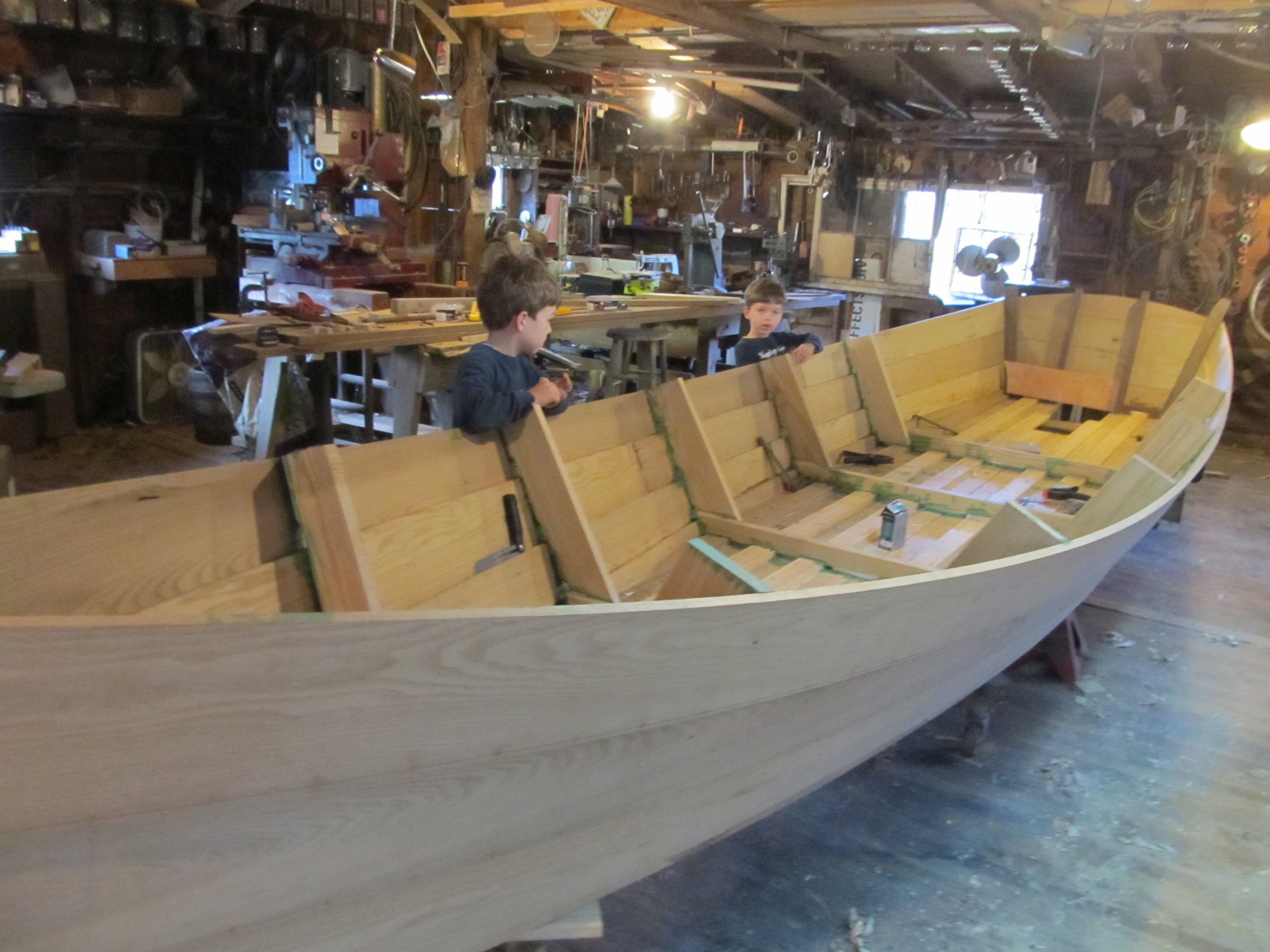
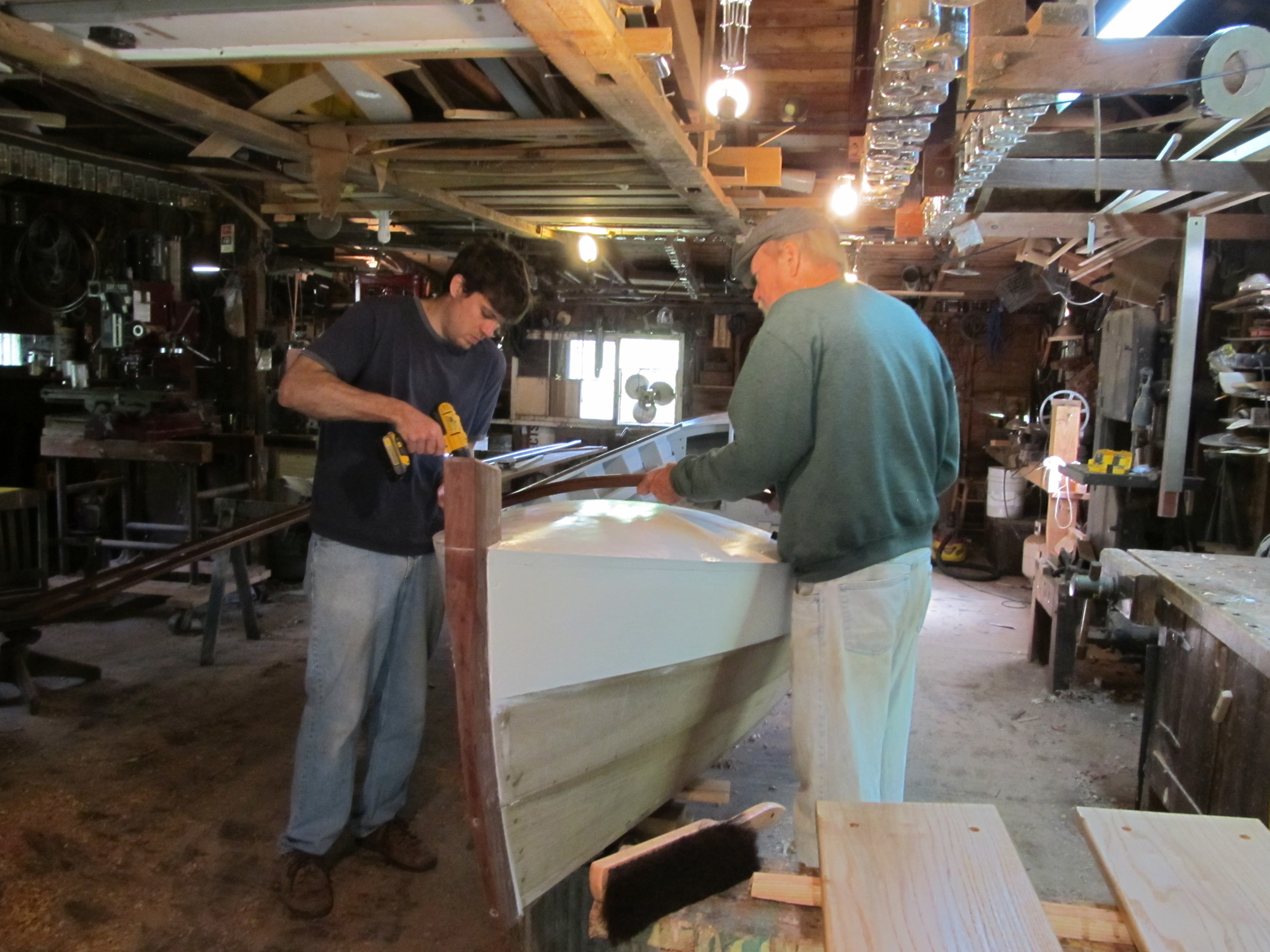
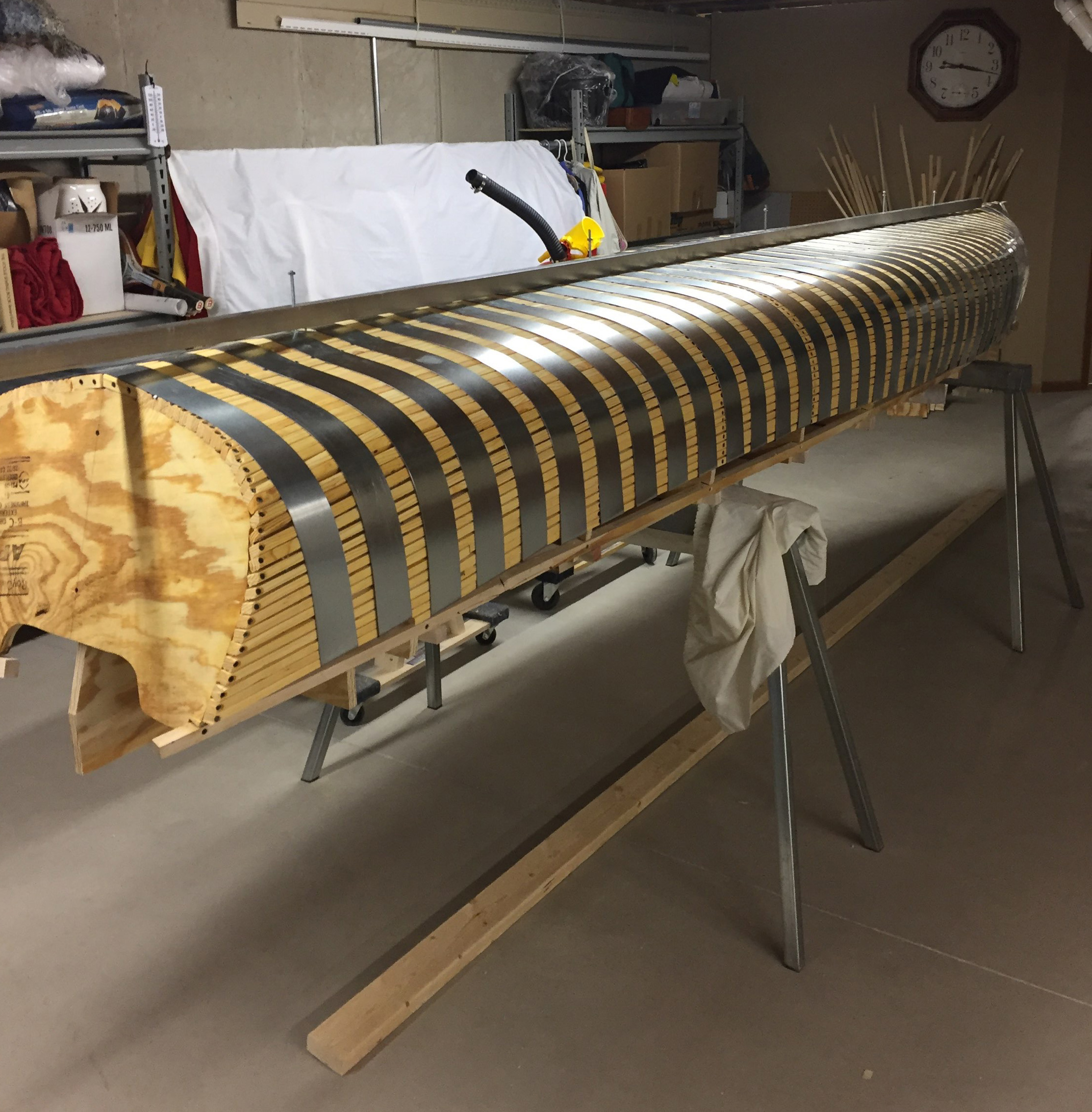
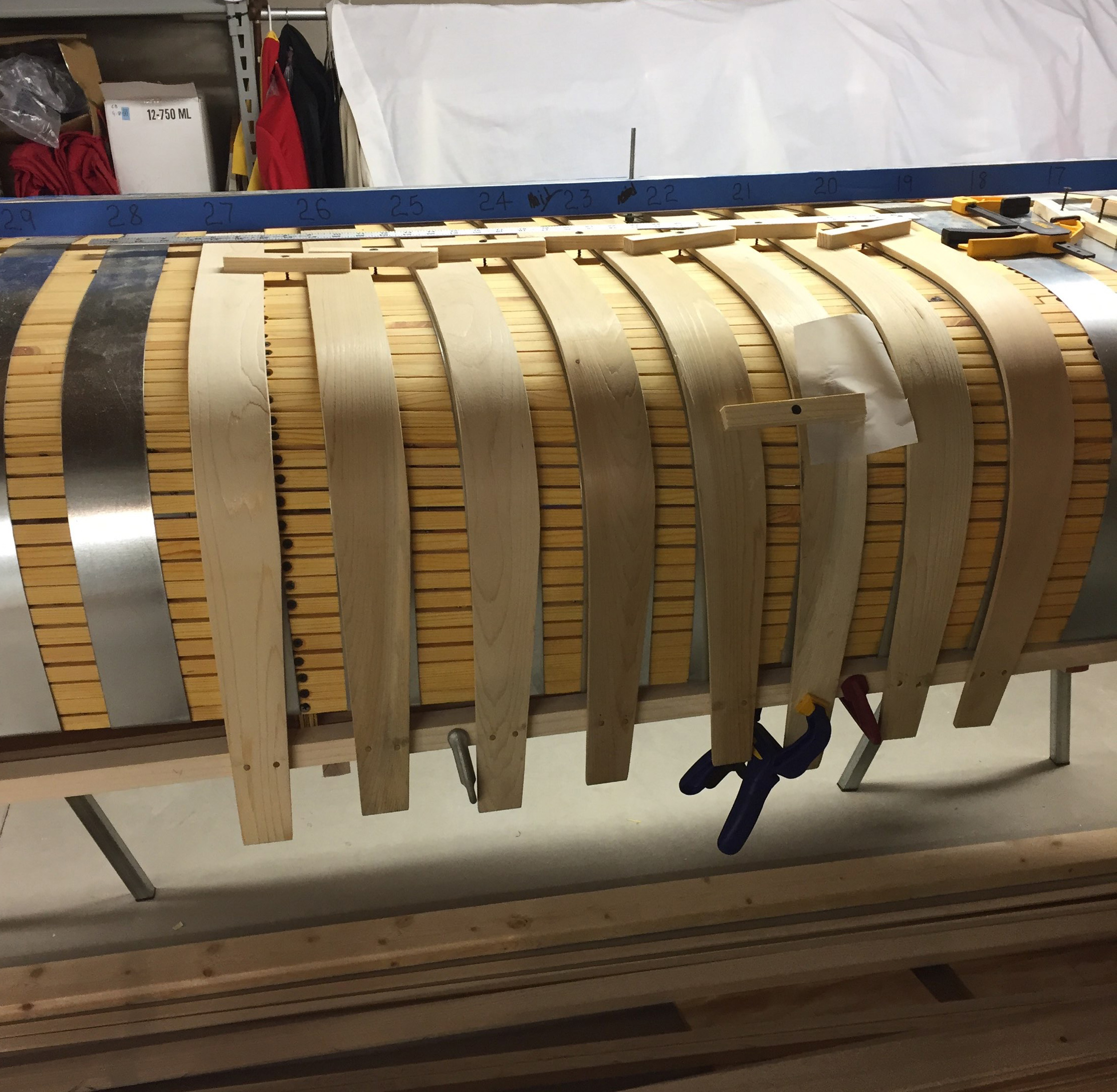
With the drawings finished, Carl began construction. He built the hull on ten 1″-thick molds, a structure strong enough to allow him to raise it and the hull with a chain hoist when planking was finished and turn it right-side up. The steam-bent frames were wrapped hot around the molds, which were undersized to accommodate the frame stock. The first layer of planking was 5/8″ cedar strips, nailed and edge-glued with Aerodux resorcinol, an update to the pre-epoxy standard. Like its predecessor, it is quite tenacious and even boil-proof, but is more forgiving of small gaps in the seams between planks.
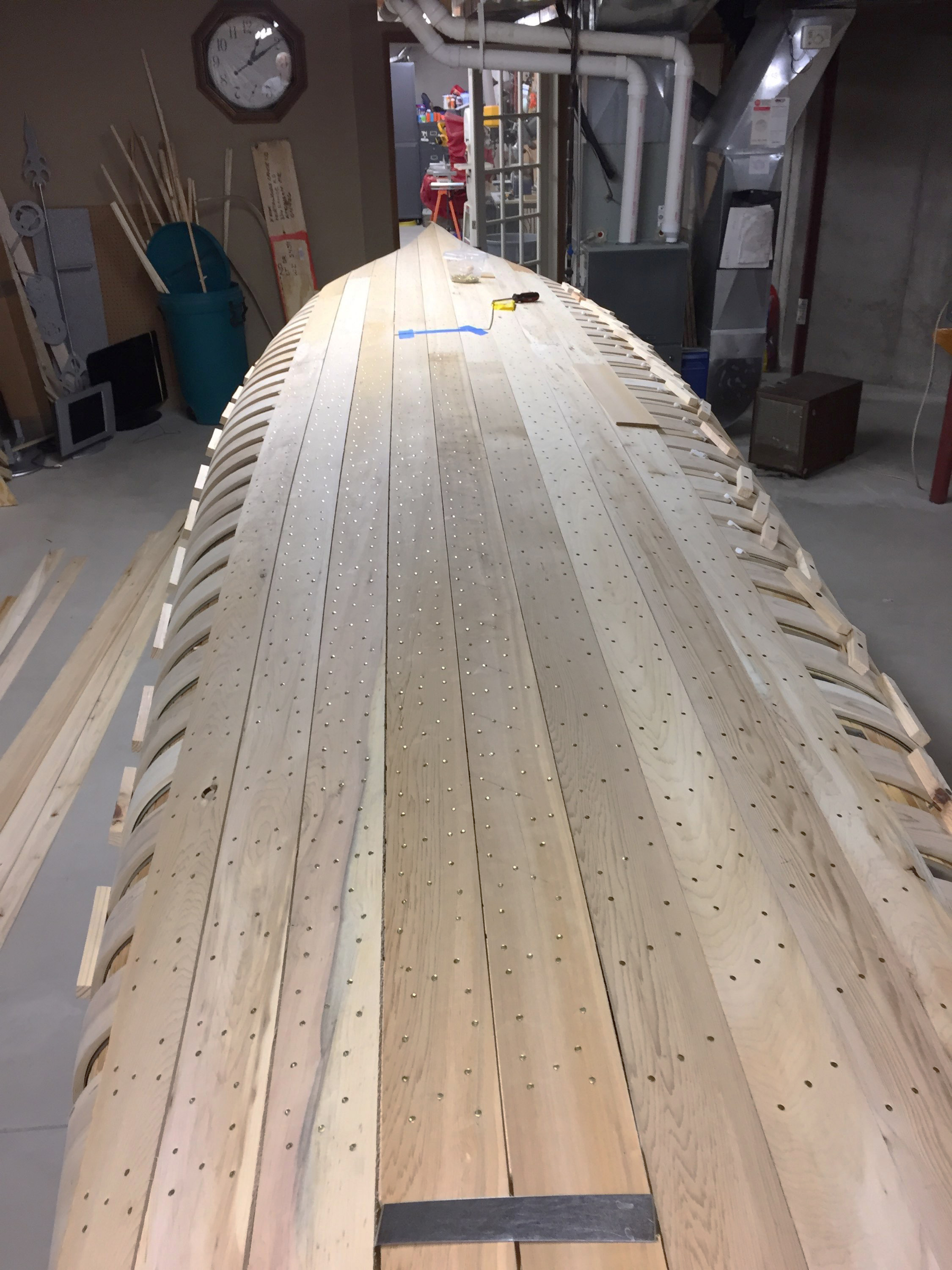
Prior to painting, the inner layer of strip planks was evident. The two additional layers of diagonal planking made up the full thickness of the hull, almost 7/8″.
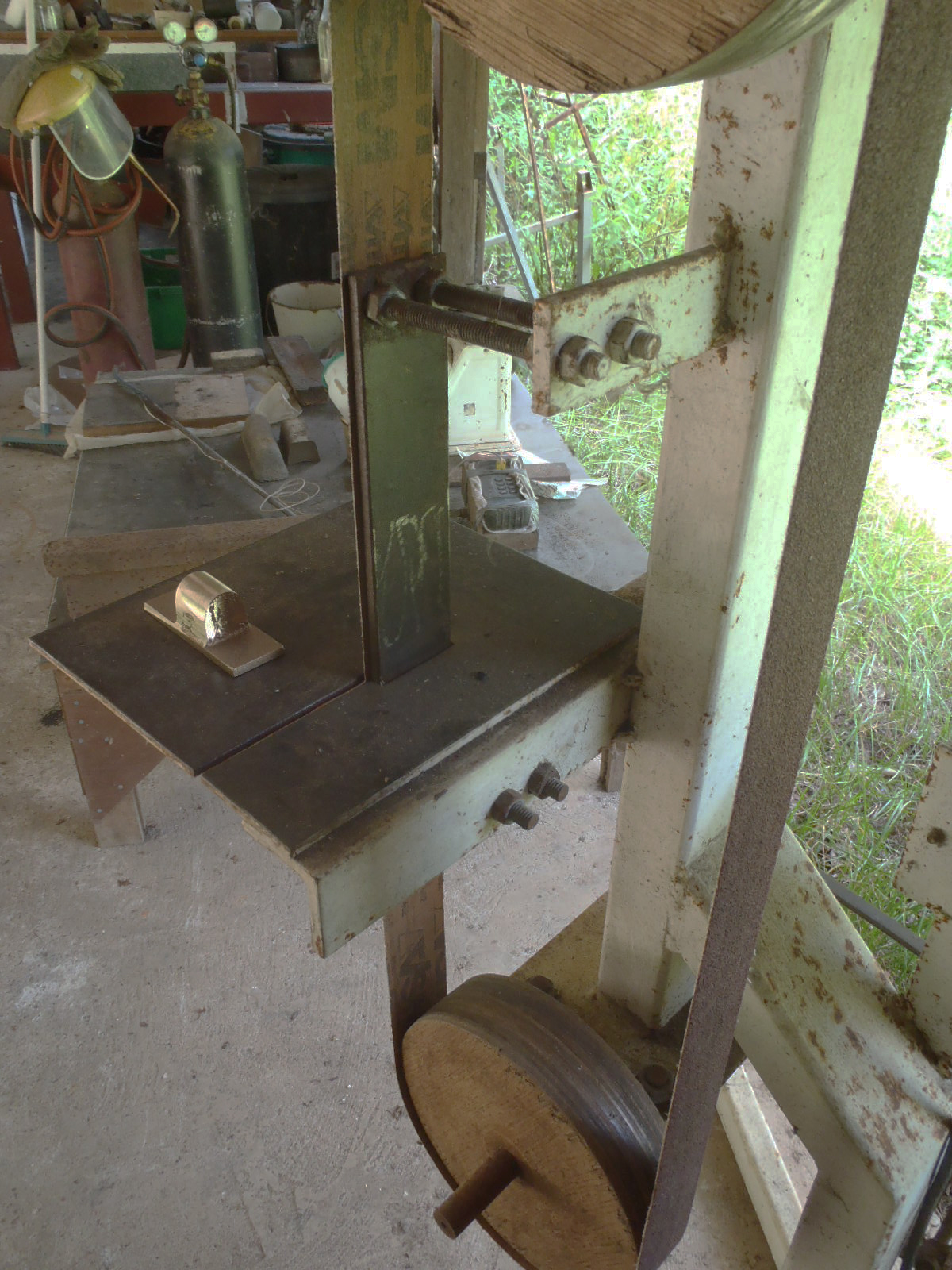
About 70 strip planks went into each side of the hull for that first layer, and after it was sanded smooth and fair, Carl applied two layers of thin cedrela, a variety of mahogany also known as Spanish cedar. The planks, just shy of 1/8″ thick, were not rotary-cut as plywood veneers are, but quarter-sawn from timbers by a horizontal bandsaw mill. The stock was 12″ wide or more, so Carl cut it into strips 3″ to 5″ wide, spiled them, and applied the two layers at opposing 45-degree angles. Nylon staples, driven by an air gun and set just below the surface of the mahogany planks, held the planks while the epoxy cured and then remained in the hull. The planks weren’t required to take a reverse curve to fair into the keel, so the staples were enough to push the cedrela tight to the form.
The completed hull was leak-proof, light, and so stiff that it required few ribs to strengthen it. The exterior surface was quite smooth after the last layer of planks went on and required very little sanding prior to rolling the hull upright.
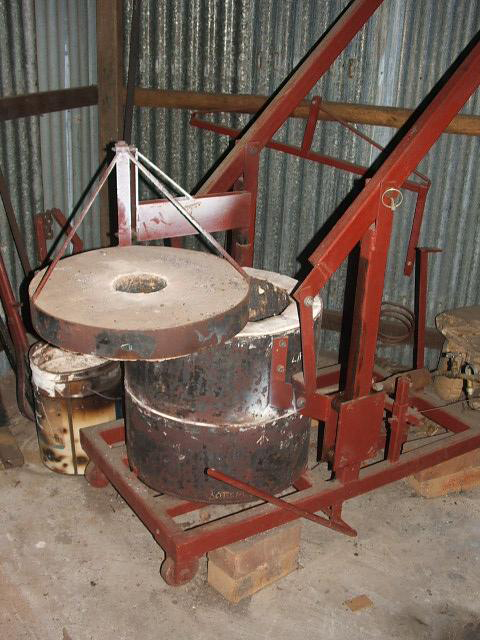
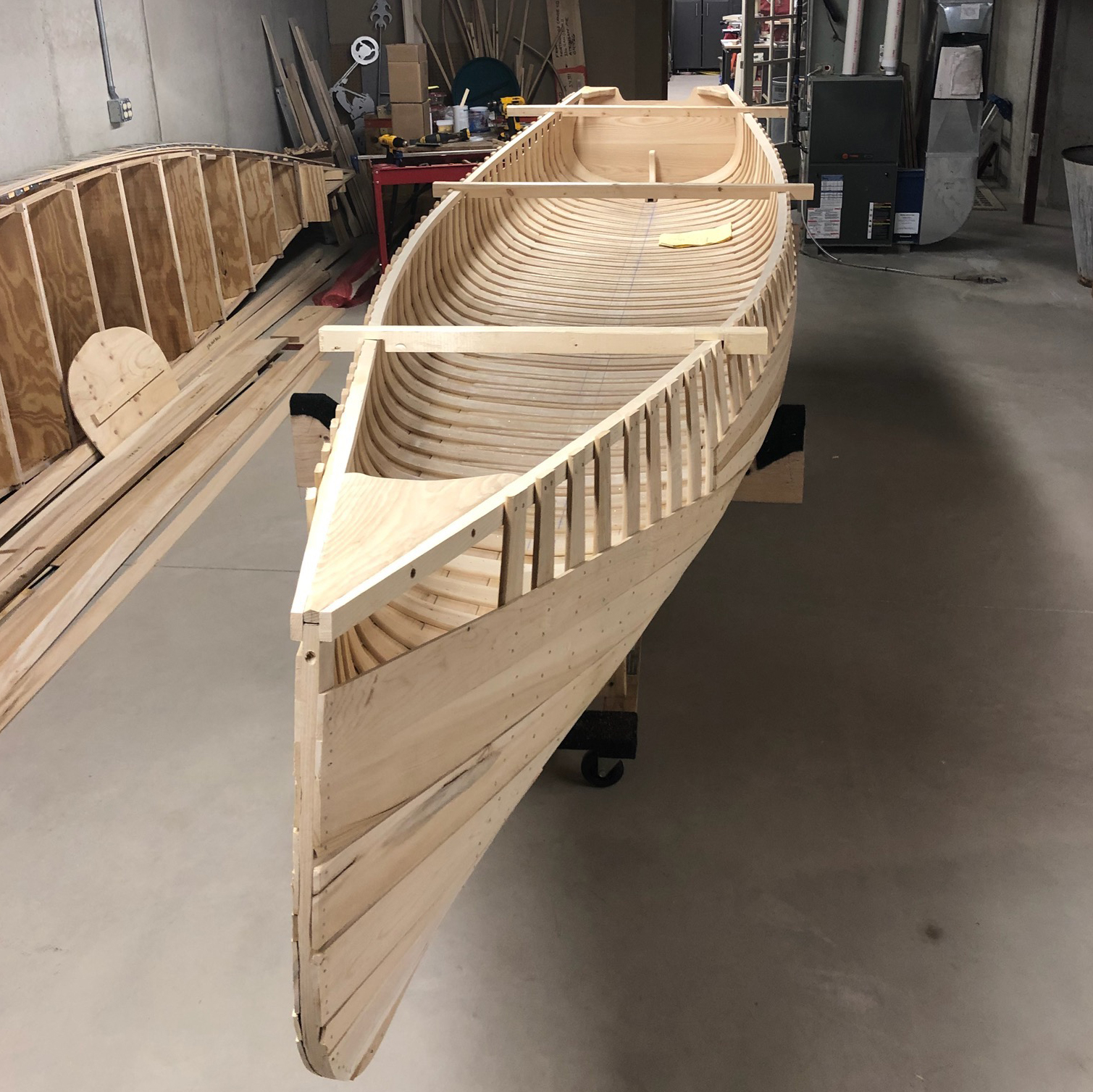
Carl had the lead keel cast—in a mold he made—by a Connecticut boatyard with a foundry. It has a slot for the centerboard and was connected to the hull’s oak keel, without any deadwood in between, by bronze bolts that run through the heavy oak floor timbers.
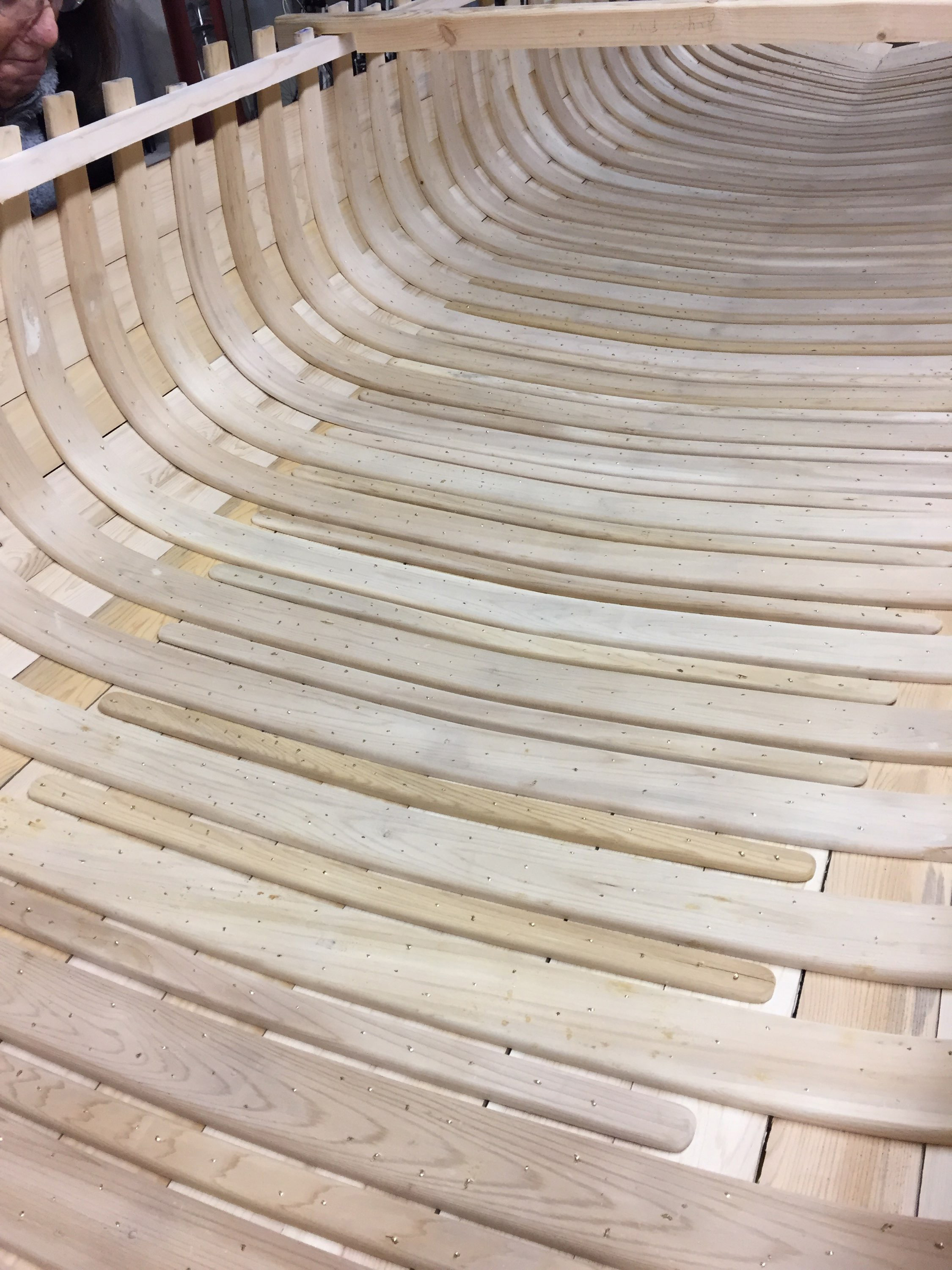
The hull’s three layers of planking required minimal framing.
The interior work—installing floors, framing, and bulkheads—was all pretty straightforward, but the deck framing was more difficult. Like any large open-cockpit boat like CHIPS, it requires a lot of carlins and half beams, and the shelf and sheer clamp need to be sturdy because the load on the deck is not supported by an inherently strong arched beam spanning from sheer to sheer.
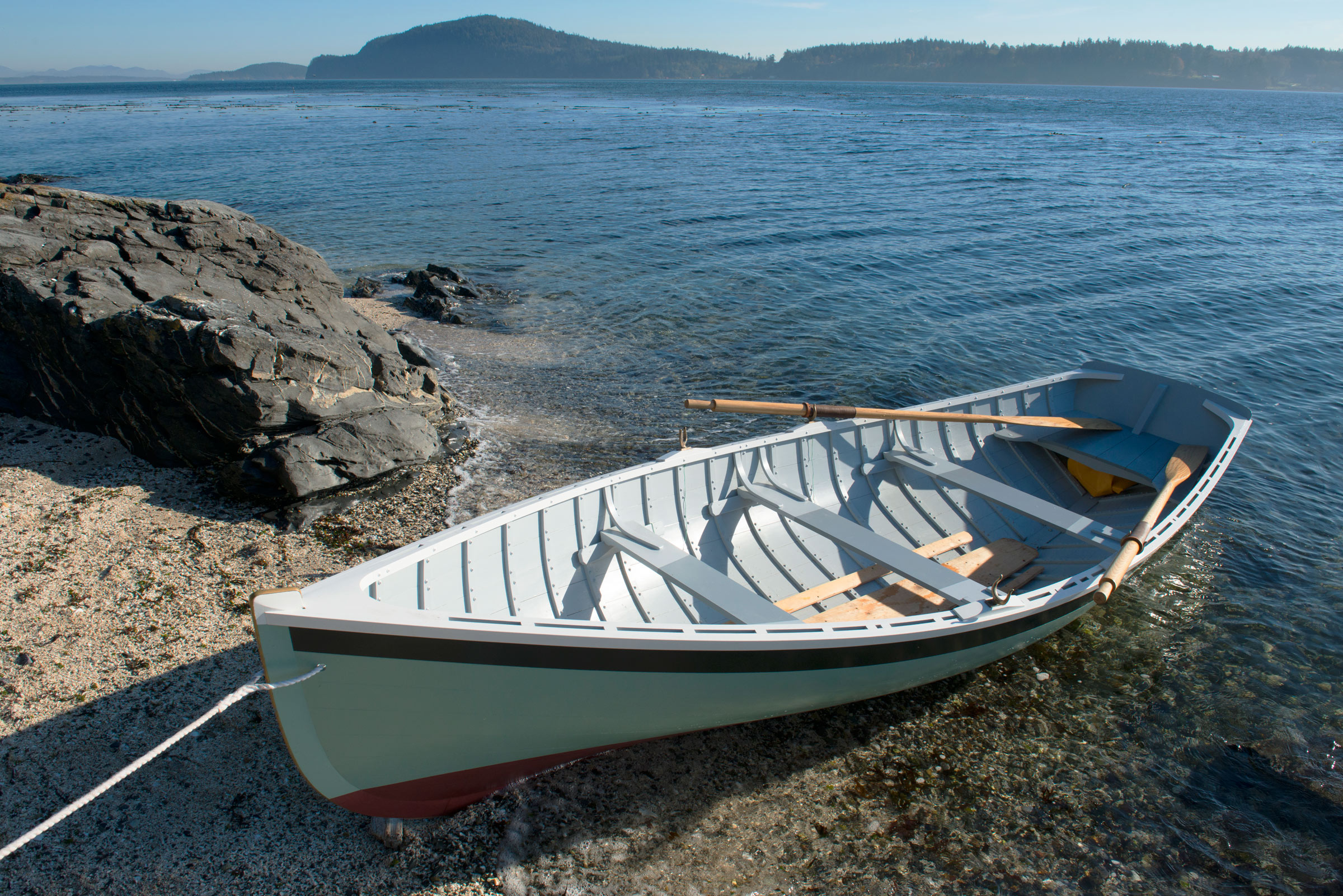
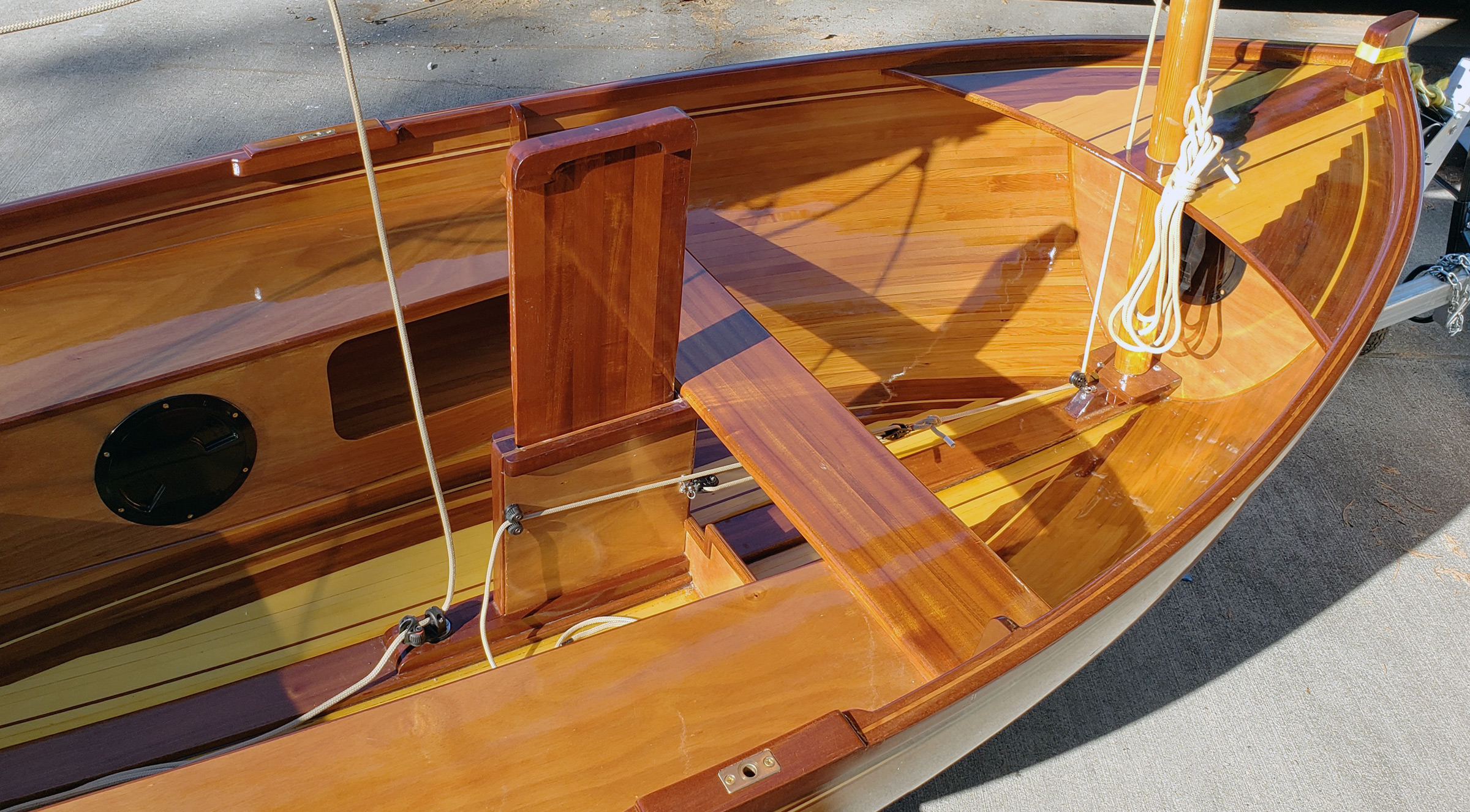
The coamings were designed to serve as comfortable backrests so they were steam-bent over a jig with crosspieces cut with 5-degree slopes.
The coamings posed an interesting challenge. Carl had some beautiful, broad South American mahogany, wood that demanded a bright finish, so it had to be handled carefully every step of the way. The 9″- to 10″-wide coamings would meet at a point forward and be angled outward at 5 degrees to serve as comfortable backrests for people sitting on the boat’s side benches. Carl decided to make each full-length half of the coaming in two 3/8″-thick layers.
He started with a doorskin pattern and a bending jig, which had cross pieces angled at 5 degrees to meet at a peak in the middle. He steamed the shaped mahogany pieces, applied them to the jig, and left them to cool. After they had dried, he installed them in the boat, and when everything fit properly, he removed the four pieces, applied epoxy to the interior surfaces of each pair, and reinstalled them to cure in place. He could then remove them to do any finish work required before permanently installing them. The coamings alone took somewhere between 50 to 75 hours of Carl’s time.
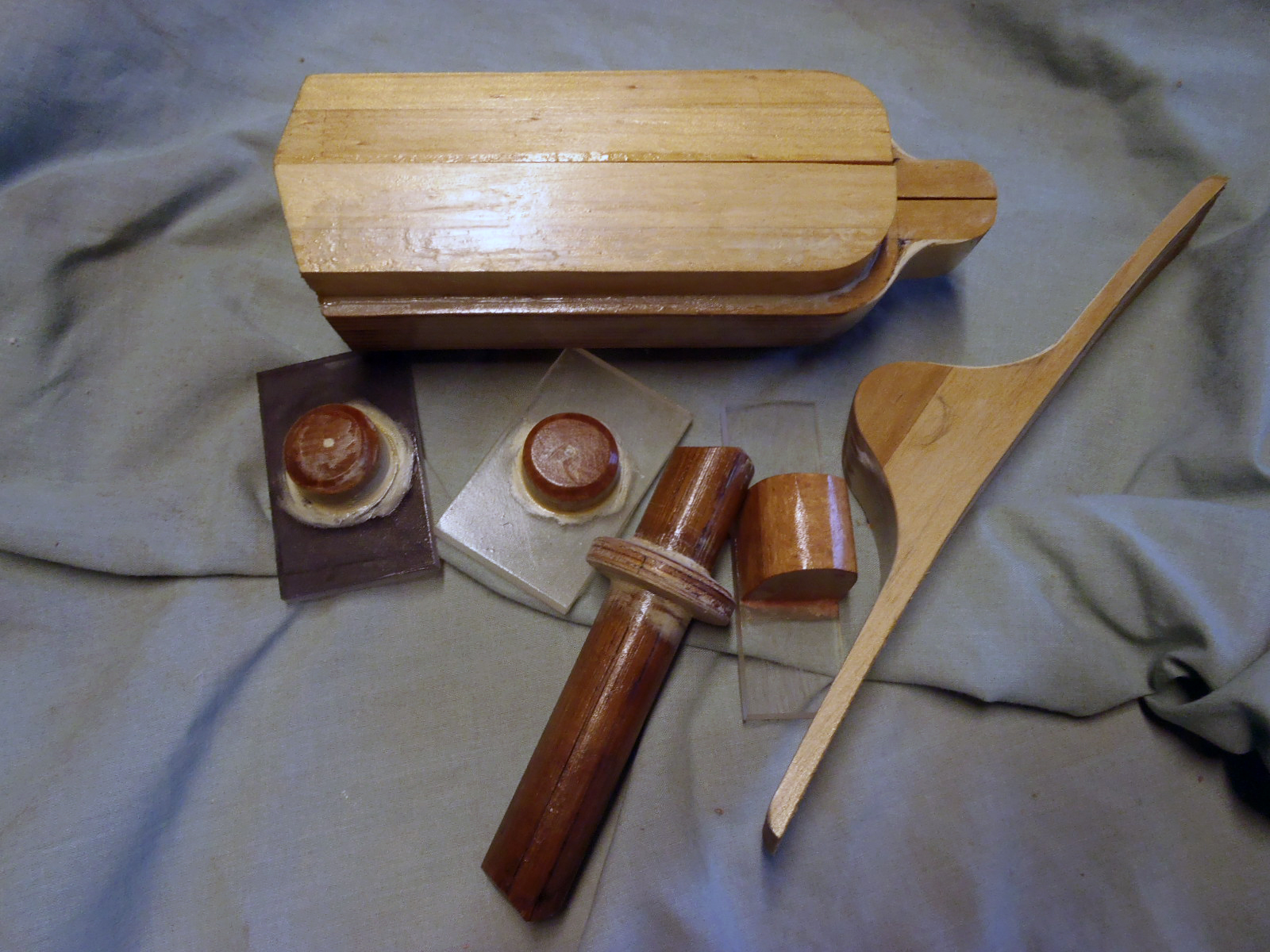
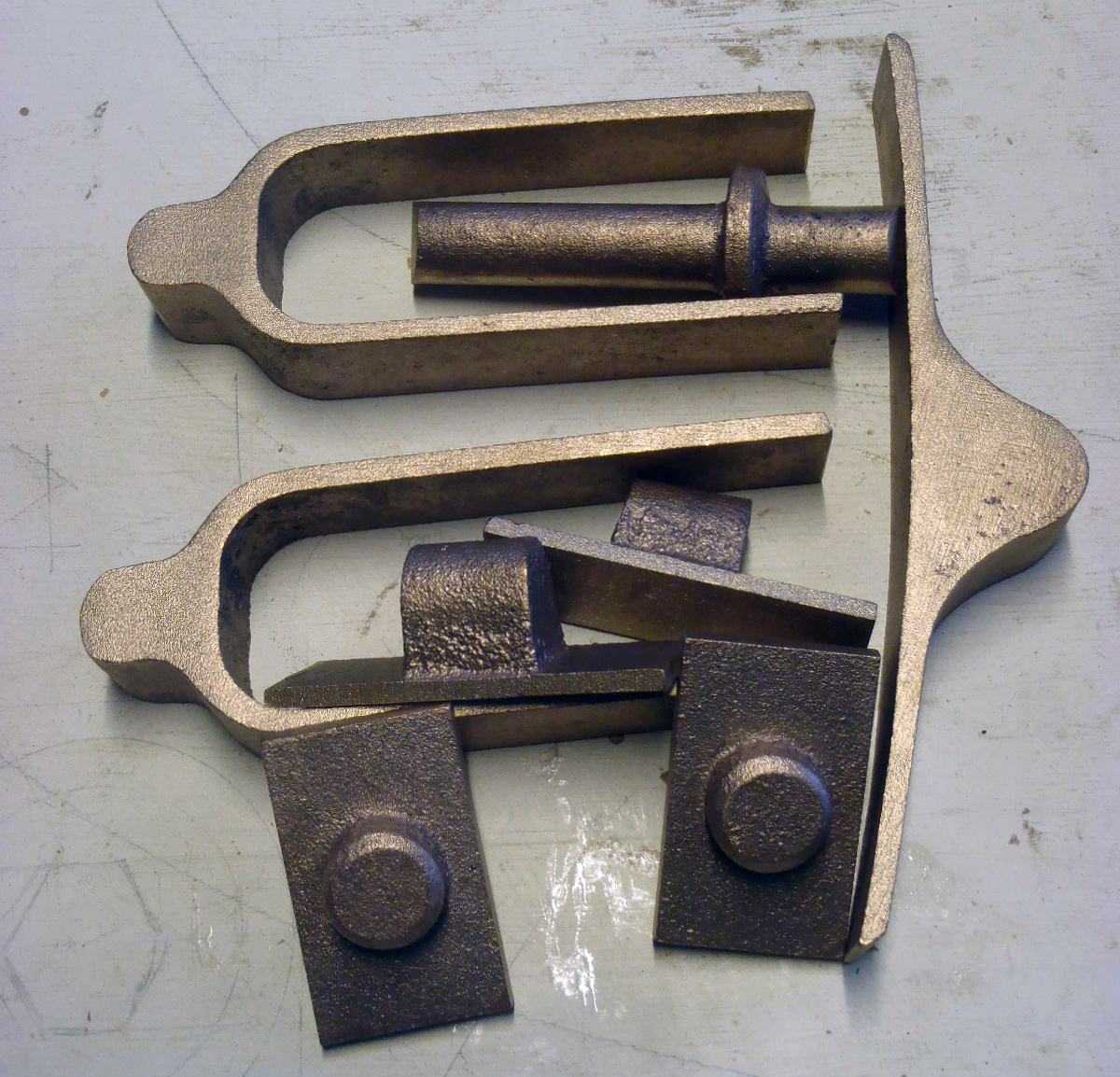
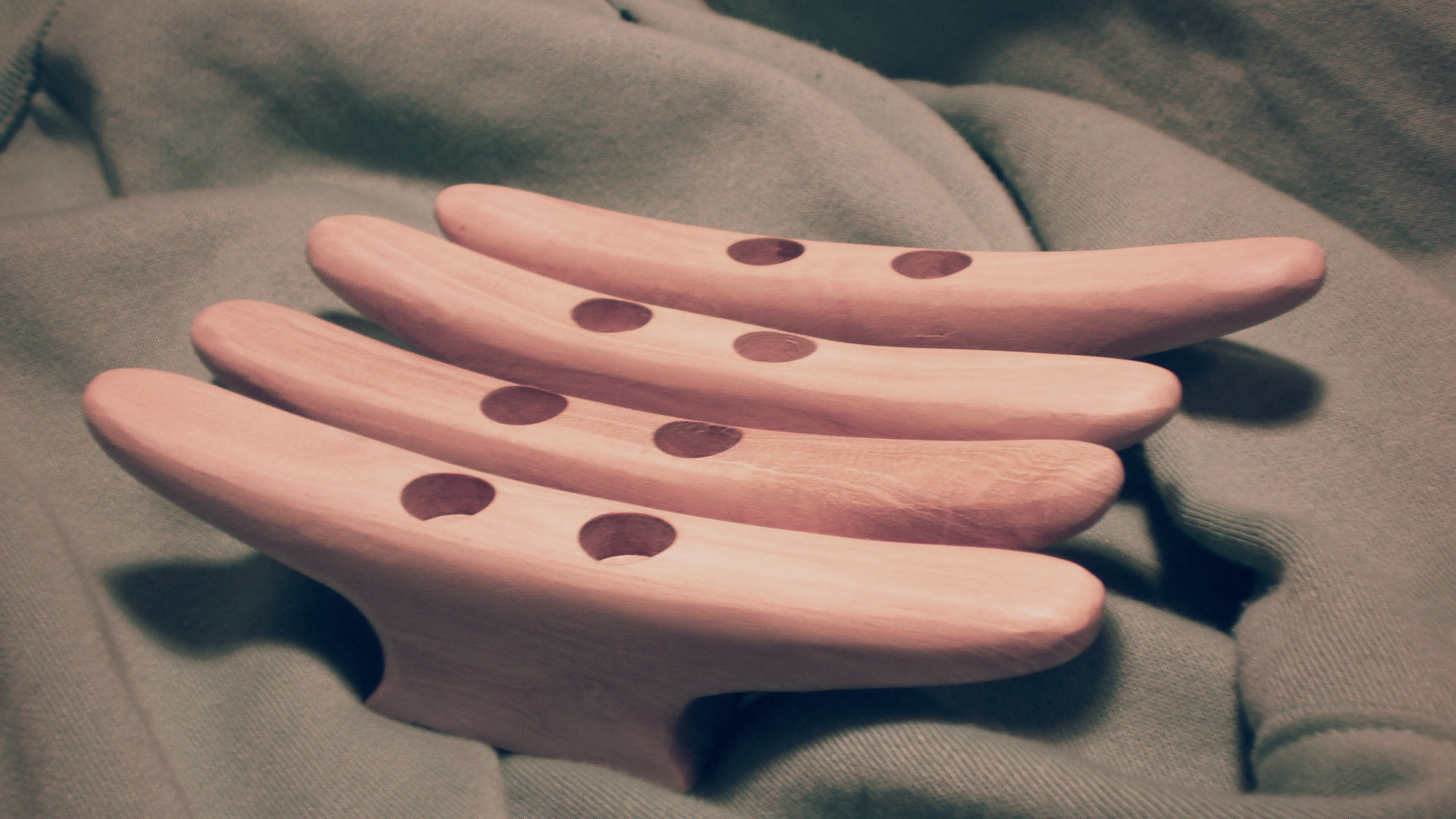
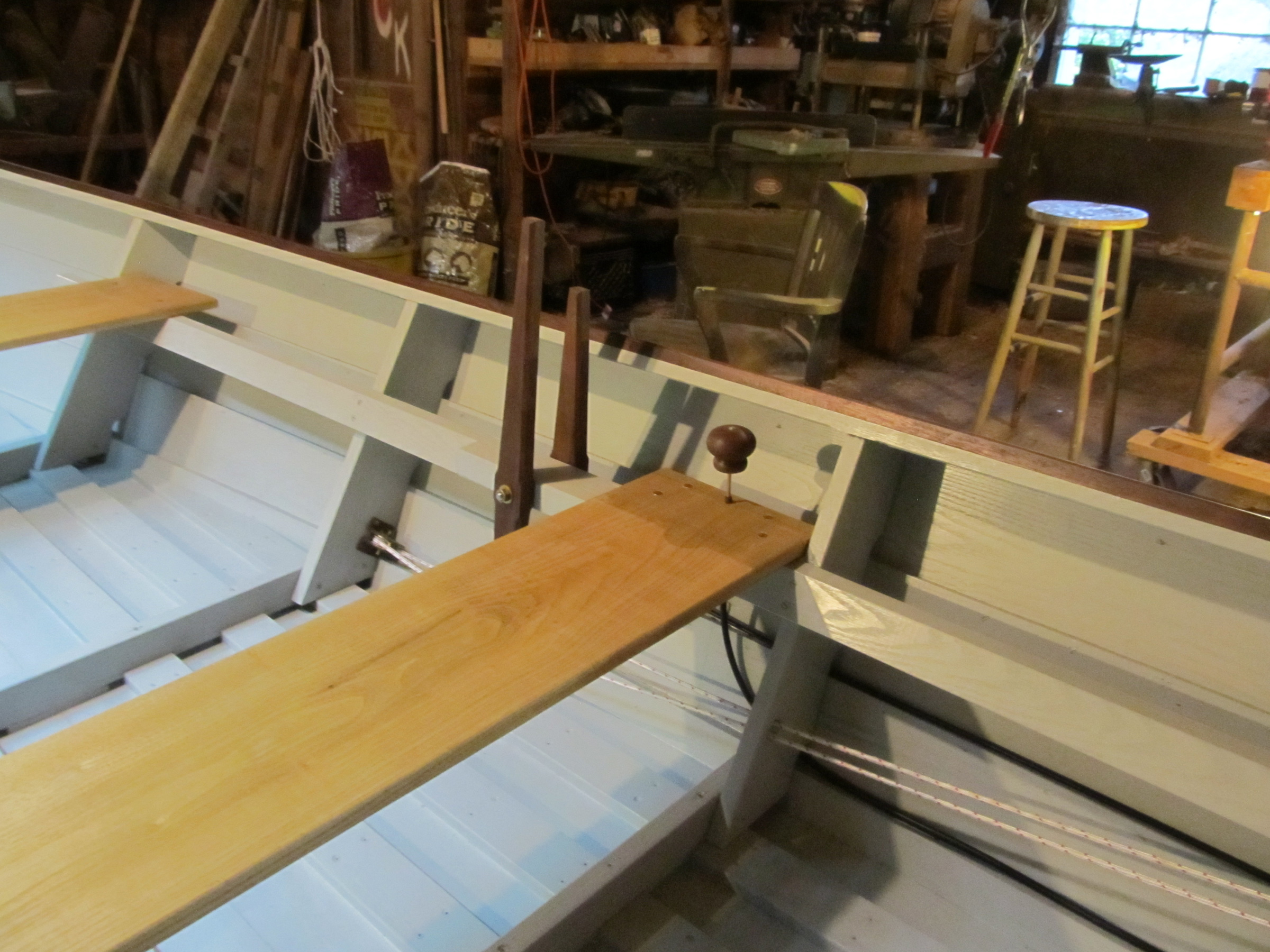
CHIPS has plywood decks, sealed with epoxy prior to installation, and covered with Dynel everywhere but the foredeck, where Carl used canvas because Dynel wide enough to cover the foredeck in one piece wasn’t available. Carl used some of his South American mahogany for the seats, to be bright-finished, of course, and tried his hand at wood-turning to make supports for them. Some of CHIPS’s bronze hardware was cast from patterns Carl made, and he got a Mystic Seaport rigger to teach him how to splice wire so he could make his own standing rigging.
Carl made the mast hollow to save weight. He used this same bird’s-mouth construction for the gaff and jib boom.
The mast is made of Douglas-fir, and the gaff and jibboom are Sitka spruce, all made hollow with bird’s-mouth construction. The boom is a box beam, made from Sitka spruce salvaged from a much larger box-beam boom that had been abandoned at a shipyard. The boom is relatively heavy compared to the other spars, but Carl likes to have a bit of weight pulling the foot of the sail down. It tensions the leech and keeps the gaff from falling off the wind.
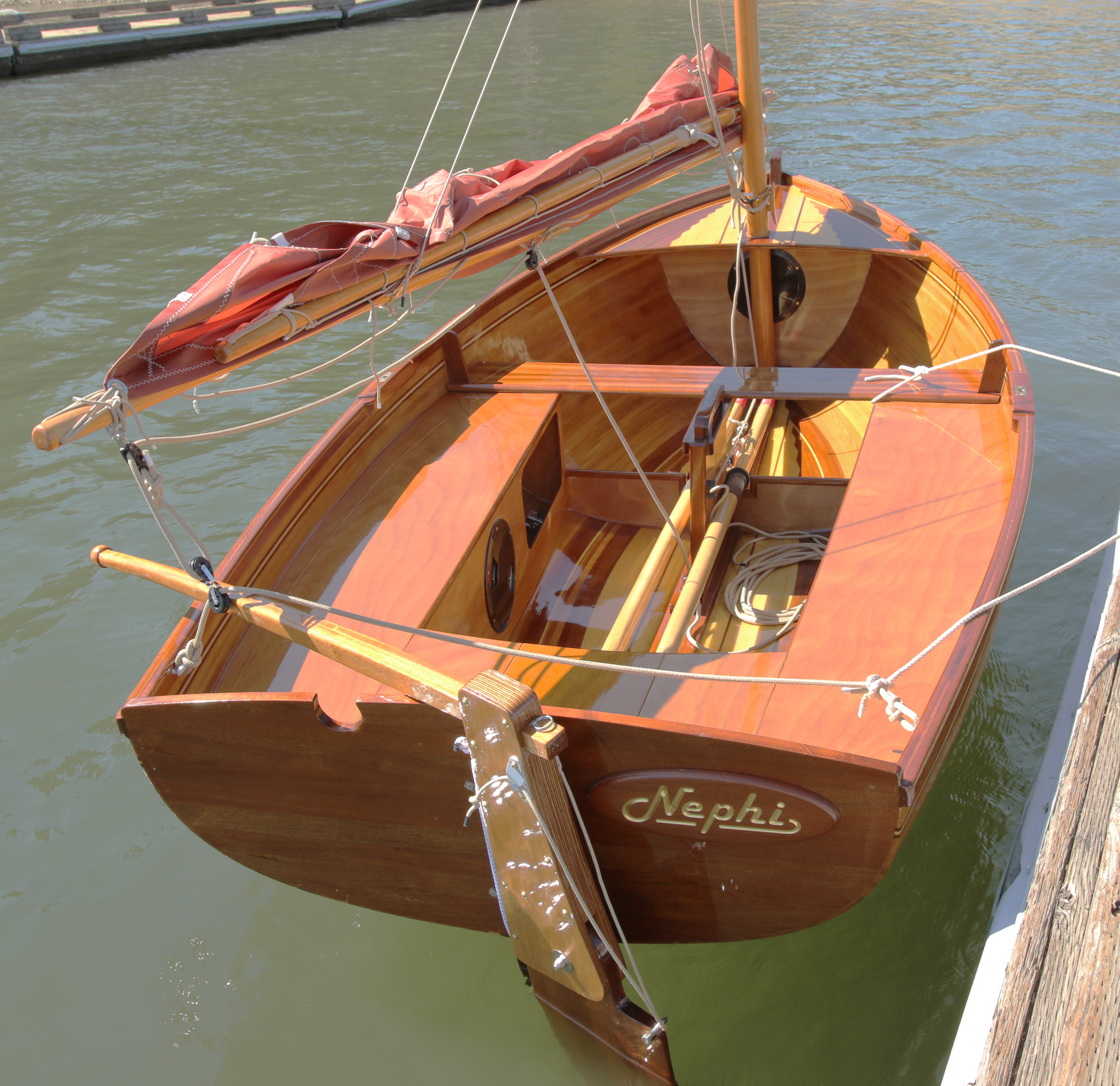
Carl didn’t build the boat with accommodations for an outboard, so for auxiliary power, he uses a single long oar. With the oar set in one of the two oarlocks, he rows on one side, facing forward and standing. Steering with the tiller between his knees, he makes about 2 knots. The generous sail area can take advantage of very light breezes, so he has yet to row very far.
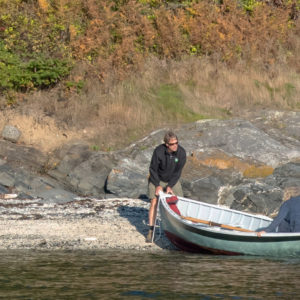
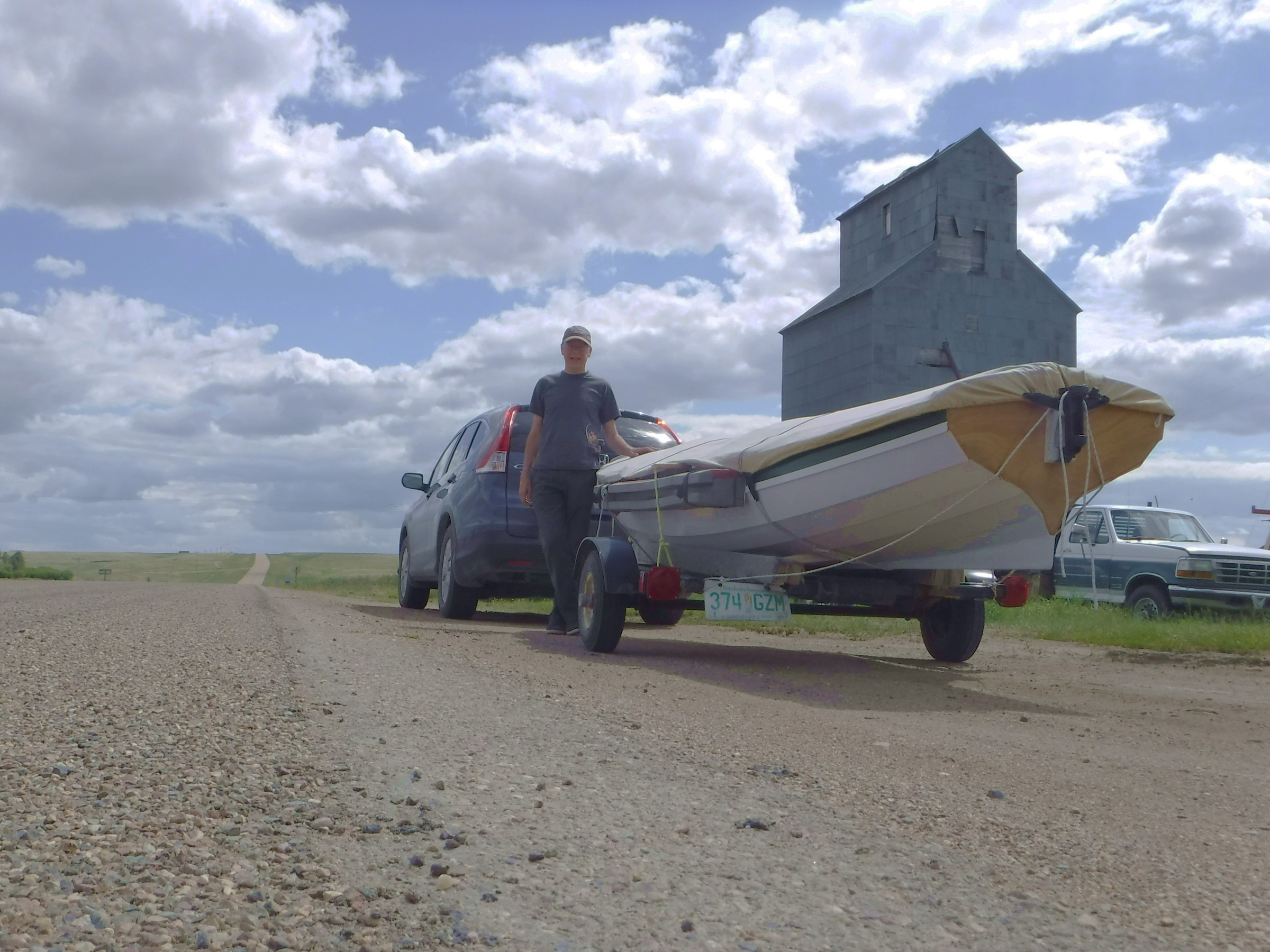
Sitting on her trailer, CHIPS shows her modest draft.
CHIPS has a few sailing seasons to her credit now, and Carl can imagine a few tweaks he’d make. He’s giving some thought to adding a side mount for an electric outboard. While under sail, the motor and bracket would stow in the bilge. CHIPS has a light weather helm and a longer centerboard case located farther aft would help, but that’s a project for a second Block Island 19. Giving CHIPS a small bowsprit would achieve the same end, but the weather helm isn’t so much of a problem that moving the sail area forward is really necessary. Carl has mused about an alternate rig, marconi instead of gaff. Downwind speed would suffer a bit, upwind speed would improve—perhaps a wash in a day’s sail, but an interesting experiment that would require no change to the boat beyond switching the spars, shrouds, and forestay.
The forward ends of the coamings support the roof of the cuddy.
Musings aside, Carl has been pleased with CHIPS. She performs well, and the high-peaked gaff makes her quite weatherly for a gaffer. Downwind, CHIPS is “extremely fast,” says Carl; “you pull up the centerboard and that big mainsail really goes.” Carl made CHIPS’s run a bit flat rather than full so she isn’t dragging a big quarter wave that would slow her down. Off the wind, she has kept pace with 420 Class Dinghies—up until they get enough wind to put them on plane. “She’s dry, easy to handle, and she snap-tacks in a jiffy. We couldn’t be more pleased with her performance in choppy weather; when she’s properly set up, she sails herself.”
Carl took pride in CHIPS’s connection to her Block Island birthplace and had her sails made by an island sailmaker.
If Carl enjoys building boats a wee bit more than sailing and rowing them, just as he prefers making guitars to playing them, there’s a good chance he’ll find a reason to build another. Come winter, when the fleet is hauled out, he’ll have to have something to keep him busy.
Have you recently launched a boat? Please email us. We’d like to hear about it and share your story with other Small Boats Monthly readers.
If you spend a lot of time in a boat you can’t help but notice how fascinating water can be whether it is in constant motion or utterly still and all but invisible. There are some things that water can do that you don’t often see. I recently came across a YouTube video about an unusual phenomenon: a spike wave. The description with the video notes: “Gav and Dan go to an ocean simulator to film a wave that does not occur anywhere in nature….” That may be true of the perfectly formed three-story-tall spike wave created by a sophisticated test tank at the FlowWave Ocean Energy Research Facility at the University of Edinburgh in Scotland, but spike waves do exist. I’ve kayaked with them shooting up all around me.
There is a smaller version of the spike wave that you’ll see every time it rains. A raindrop falling into a puddle will punch a depression into the surface of the puddle, and when the water rushes back to fill the void, a spout of water will rise briefly from the center. That little geyser is called a Worthington jet. It often happens so quickly that you don’t get a good look at it, but on occasion the size and speed of the raindrop will create a larger, more persistent jet.
I made a pinhole in a paper cup and let drops fall into a soup bowl full of water.
The impact of the drop creates a depression rimmed with a crown of smaller droplets. This is the beginning of the splash.
The rebound of the depression caused by the falling drop creates a miniature spike wave called a Worthington jet.
I had spent a rainy night on Wheeling Island, just across the Ohio River’s main channel from Wheeling, West Virginia. When I got underway the following morning, the air was still and the river was flat and disturbed only by fat, heavy raindrops. The brown river water was tattooed with expanding concentric rings of tiny ripples and where each drop fell a crystalline column of water nearly 2″ tall and almost 1/4″ in diameter. Covered with them, the river was a tidy, shimmering, lawn of glass.
While a Worthington jet relies on a falling droplet to form a circular rebounding wave, the enormous spike wave at the FloWave test tank was produced by 168 wave-generating paddles around the tank’s circumference all pulsing simultaneously. That’s not something that has an equivalent in nature, but if enough waves come from several different directions to meet at a single point, there can be a spike wave.
On the crossing to Koločep, Zeljko (center), Radovan (right), and I had only a swell from the southeast to contend with.
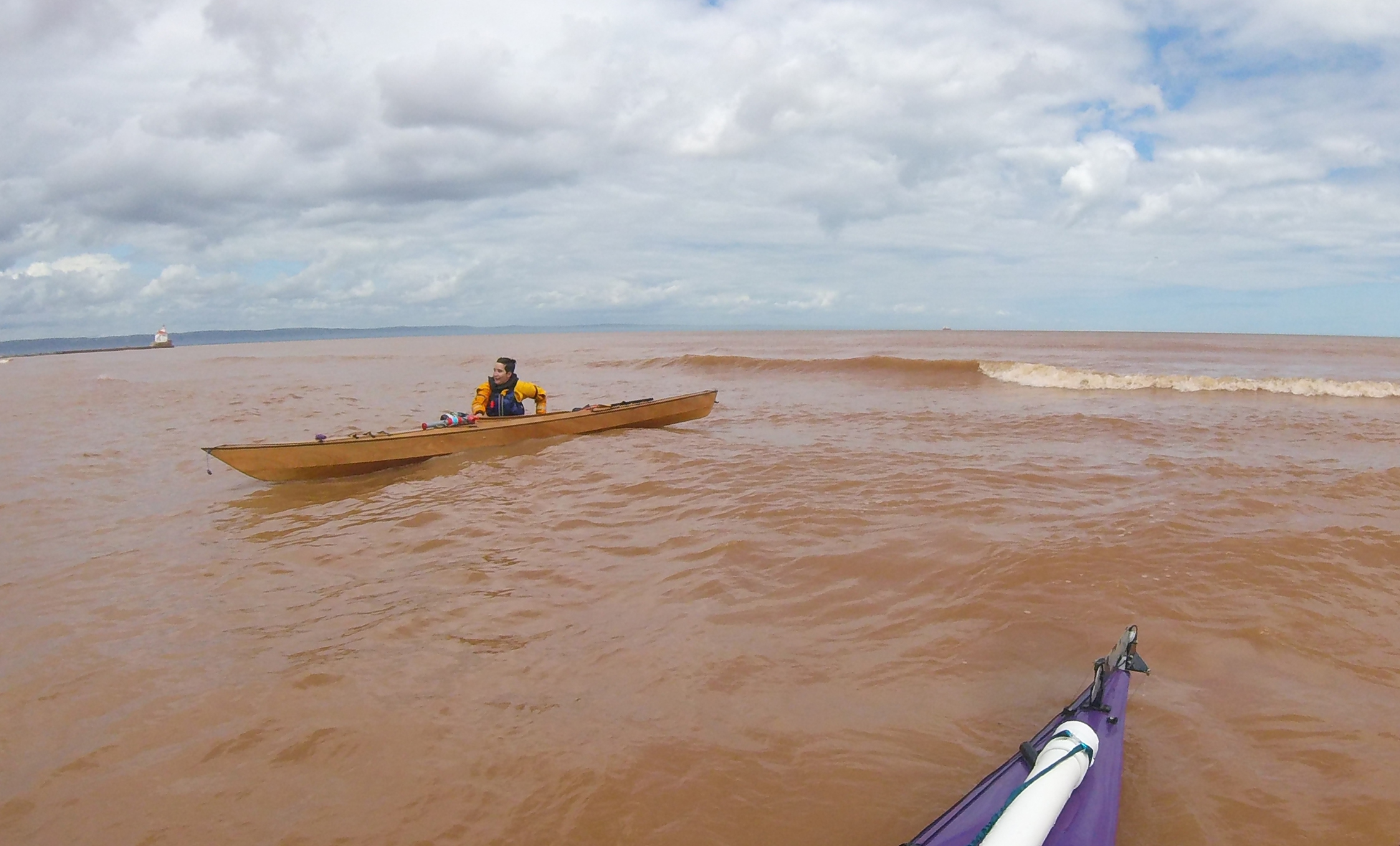
In 2005, Zeljko Kelemen had invited me to do some sea kayaking among the Elafiti Islands on Croatia’s Adriatic coast. Zeljko and I set out with Radovan, my guide and translator, from Zaton, a village 3 miles north of Dubrovnik, and made the 1-1/2-mile crossing to the island of Koločep in a 10′ swell from the southeast and 20 knots of wind. Zelkjko landed on the island, and Radovan and I continued toward Bezdanj Point, the island’s blunt and rocky southern extremity.
As we approached Bezdanj Point (far left), Radovan and I began to feel the effects of a second set of waves coming from the southwest.
Beyond the point we paddled into a southwest swell that we had been shielded from on the other side of the island. The swells slapped into the 100′-high dun-colored cliffs on Koločep’s west coast, climbed up their sheer faces, and slipped back into a mile-wide open bay like water sloshing in a bathtub. Reflected waves came at us from all angles, and my kayak was swinging like a marble rolled in a mixing bowl. When I was in the troughs, surrounded by curved walls of water on all sides, even the cliffs, just 100 yards to starboard, vanished behind wave after wave. From the crests, I saw a throbbing sawtooth sea tearing at the horizon.
The shapes moving across the surface could hardly be called waves. There were no discernible patterns, only random mounds and hollows that changed so quickly that the water couldn’t keep pace. Waves heaved upward in tall steep-sided pyramids that turned into ropey fathom-tall columns of silvery water suspended for a moment in midair. Spike waves. When they fell, they slipped downward, intact for a moment, and then disintegrated into white froth.
FloWave Ocean Energy Facility, The University of Edinburgh
When all of the wave-generating paddles on the circumference of the tank act in unison, the tank can create a spike wave that will shoot up to the ceiling.
The quad-spike wave (1 minute, 20 seconds into the video) generated at FloWave was very much like what I paddled through. I asked the senior experimental operator at FloWave about those spike waves occurring in nature. He replied: “I’m afraid I don’t know much about where spike waves occur in nature. However, if you have waves from different directions combining (perhaps due to reflected waves), I could see it being feasible that this would produce spike-like waves due to localized areas of very steep waves, especially in choppy conditions.”
My backyard wave tank
I made a quick-and-dirty wave tank to see if I could generate spike waves. For one series of trials I made a wall of concrete pavers in an eyeballed parabola. For other trials I removed the concrete and pivoted the walls to the top and right to make waves. With waves coming in two directions and rebounding in the two opposing directions, I was able to create lots imperfect spike waves and one perfect spike wave. It rose up straight and symmetrical about 15″. It caught me by surprise and I didn’t have the camera recording at the time. Below are some of the waves I did capture on video.
I wish I had taken photos of the spike waves I paddled among in Croatia, but it was all I could do to keep my kayak right-side up and my breakfast down. I’d like to see those waves again, but I hope not to be in a boat when I do. I’d rather row through a flat plain of Worthington jets.
For anyone interested in seaworthy small boats for cruising or daysailing, John Welsford’s designs are hard to beat. There are several elements that combine to create what I think of as a typical Welsford boat: a narrow flat bottom, lapstrake sides over sawn plywood frames, high volume with generous freeboard, half-decked with sealed chambers for built-in buoyancy, rugged construction, and an appealing, pugnacious character inspired in part by the traditional small boats of Great Britain and northern Europe. There are few double-enders in his design catalog, despite their popularity among home builders, and that makes the Sei (pronounced “say”—named after a species of baleen whale) a welcome addition.
John’s impression of today’s popular double-ended rowing and sailing boats around a 15′ size, wasn’t entirely positive. He thought the type could have more stability, be less prone to pitching, and perform better under oars and sail. As he does with many of his designs, John looked to traditional hull forms for inspiration.
Photographs by the author
The 76-sq-ft lug sail provides ample power for sailing in very light breezes.
His research led him to southern Norway’s Hardangerfjord region, where small, beamy double-enders were used for inshore fishing and general transportation. Historical photos of these Hardangerfjord boats served as a starting point, but the Sei is a modern design. “The Hardangerfjord boats look quite similar,” Welsford says, “but the Sei is lighter by at least 50 percent, and slightly wider—a sailing boat that will row rather than a rowing boat that will sail.”
Like many of Welsford’s small-boat designs, the Sei combines a relatively narrow and flat bottom panel with three strakes of glued lapstrake planks over 1/4″-plywood frames. The hull is built upright on a simple waist-high jig, a feature that will be appreciated by anyone who has ever crawled under a boat to clean up dripping epoxy while planking. Unlike other popular Welsford designs like Walkabout and Pathfinder, the Sei doesn’t use permanent stringers along each plank edge—the plank laps themselves produce adequate strength and stiffness, as well as a lighter boat.
With so little structure, the Sei would be a straightforward, relatively simple build well within reach of first-time builders who are willing to learn as they go. Dimensioned drawings are provided for most of the boat’s components, so lofting isn’t required. The plans provide full-sized templates for the rudder and daggerboard, which have foil sections designed to produce good hydrodynamics.
While the Sei is not a cartopper, the hull is light enough that I could easily pull it by myself onto a dock, or slip it back into the water. The light lapstrake hull has internal structures—sealed buoyancy chambers fore and aft, rowing thwart, daggerboard case, and mast partner—that provide additional stiffness. I had been wanting to sail a Sei ever since I watched a video clip of the little double-ender on YouTube. In it, John is at the helm, seated low in the boat with the tiller over his shoulder, weight well back for optimal trim, and the Sei is running easily downwind. The balance lugsail, a rig featured in many of John’s small boats, is sheeted square to the hull to catch the following wind, and the boat is moving well and passes another lug-rigged boat, a Welsford-designed Saturday Night Special, on a parallel course. The SNS is fast and designed specifically for speed off the wind; it’ll start to plane in anything much above 10 knots of breeze. But in the conditions captured in the video, the Sei is easing ahead of it. There isn’t enough wind for the SNS to really get up and go, but still, I thought, the Sei might be worth a look. I paid a visit to John in New Zealand not long afterward, and got my chance to try it out.
Designer John Welsford, seen here at the oars, rows several hours every week for exercise. He designed the Sei to row well not only for auxiliary power, but for pleasant outings when the sailing rig is left ashore.
The Sei is an excellent performer under oars. I spent a morning rowing up a tidal estuary, slipping along with barely any effort. The tide was dropping, leaving the edges of the river shallow enough in places that the blades of the oars were hitting the bottom on each stroke, but that was no challenge to the Sei’s 6″ draft. With the mast, rig, and rudder left behind, the boat was well under 200 lbs. I felt like I was riding a windblown leaf. The Sei is nimble and quick for easy maneuvering—pull one oar and it spins 180 degrees—and yet it tracks well, thanks to the keel and skeg. The ergonomics are well suited to long rows. The rowing thwart is positioned for proper fore-and-aft trim and is high enough to be comfortable seating. I could have gone on rowing all day.
With its flat bottom and wide beam, the Sei was stable enough in flat water for me to stand up in and move around with reasonable care. That’s a big asset for cruising, where long days aboard may be required. And with no transom, the boat shouldn’t drag too much with a passenger in the stern seat. Plans call for 8′ 6″ oars, which will move the boat efficiently and still stow aboard without much fuss.
The Sei carries its beam well aft, which, combined with the fine entry, creates a noticeable fore-and-aft asymmetry. “When sailing a small boat, the crew weight tends to be aft of ’midships,” Welsford says, “so it pays to have the boat’s center of buoyancy in the right place to support this weight. This gives a very fine entry and a fatter stern, which much reduces pitching while sailing upwind, and also makes the boat more stable.” And, with the beam much narrower at the waterline than at the gunwale, the center of buoyancy moves very rapidly as the boat heels, quickly increasing the resistance to further heeling. Despite the Sei’s flat bottom, the fine entry minimizes pounding, and thanks to “some trickery with the rocker” as John explains it, the boat leaves hardly any wake—a sure sign of a slippery hull.
The daggerboard, seen here partially raised for less drag on a downwind run, is within easy reach of the sailor and its short case doesn’t overly compromise the seating area.
Of course, any lightweight unballasted boat can be capsized, even one with as much inherent stability as the Sei. In his capsize testing, John confirmed that the sealed buoyancy compartments in the bow and stern will keep the boat afloat, while foam blocks strapped under the rowing thwart provide enough additional lift to make the Sei easily recoverable from a knockdown, even in conditions likely to cause a capsize in the first place. The boat’s buoyant wooden mast and yard prevent turtling—another advantage of the balance lug rig.
I didn’t have the chance to take the Sei out cruising, but I did manage to wrangle a couple of hours at the helm under sail. With the unstayed mast and simple balance lug rig, setup time was minimal. Ten minutes after backing the trailer down the launch ramp and sliding the boat into the water—a task made easy by the flat bottom—the boat was ready to sail.
Sitting in the bottom of the boat is comfortable and provides a good view forward under the boom.
John went out first and sailed a few laps through the many boats moored nearby, jibing and tacking quickly in the narrow waterway. When it was my turn, I shoved off into knee-deep water, hopped aboard, and settled in with the sheet in one hand, tiller in the other. The boat was moving almost before I sheeted in. In just a few seconds the water was deep enough to lower the daggerboard and drop the rudder completely.
The mooring field was tight, and my attempt to avoid it by edging along the river’s edge ended abruptly when the daggerboard struck the sandy bottom and brought the boat to a grinding halt. No problem—I simply pulled the board halfway up, let the boat slide free, and headed back toward deeper water. Negotiating the obstacle course of moored boats proved simple, too, despite fickle winds that brought sudden gusts from all directions. The Sei slalomed nimbly through the moorings, tacking and jibing reliably, and accelerating quickly. With just a hint of weather helm, a light touch on the tiller was enough to steer by, even in the gusts.
In such a small, light boat, the helmsman should sit on the bottom to keep weight low and centered. I found this perfectly comfortable, leaning back against the hull, and with the boom safely overhead, visibility was excellent. With no long centerboard trunk to get in the way, it was easy to switch sides at each tack. Though I normally prefer a pivoting board, the daggerboard, with its shorter trunk, is definitely the most workable option for the crew.
The Sei has a fine entry and its greatest beam is aft of center where it can better support the weight of the crew.
As with all of my favorite small boats, the Sei’s controls—halyard, downhaul, sheet, and tiller—are simple. The balance lug rig relies on a powerful downhaul to maintain luff tension, and as a result, the Sei’s 76-sq-ft lugsail is largely self-vanging. It’s safe and controlled when jibing, and easy to reef. For a small sail-and-oar boat, I wouldn’t want any other rig.
Like all double-enders, of course, the Sei is small for its length compared to a transom-sterned boat. While it’d be comfortable to take a passenger or two while rowing, and the hull could easily handle the weight, a Sei would quickly start to feel crowded under sail. While you might be able to fit someone else in now and then, I’d prefer a bigger boat if hauling passengers were a priority. It’s as a solo boat that the Sei really shines. You could easily haul enough gear for a week or two of solo camp cruising.
All too soon I had to head back to the ramp, but I’d seen enough to know that the Sei was a worthy addition to the John Welsford design catalog. Simple and lightweight, good-looking and well-proportioned, easy to launch and recover, quick to rig, a joy under oars, and a delight to sail, this is a boat that ticks all the right boxes. With a boat like the Sei, there’d be no excuse not to get out on the water, even if it’s only for an hour or two. If the 10 minutes required for rigging is too much, grab some oars and leave the rig behind. If you have more time, load the Sei up for a week on the water. Either way, you can’t go wrong.
Tom Pamperin is a freelance writer who lives in northwestern Wisconsin. He spends his summers cruising small boats throughout Wisconsin, the North Channel, and along the Texas coast. He is a frequent contributor to Small Boats Monthly and WoodenBoat.
In 2011, in anticipation of retiring after a career as a research engineer, I decided I’d build wooden rowing skiff. I wanted a boat with traditional lines—particularly one with a vertical stem and a wineglass transom—and an easily driven hull, so the waterline would have to be longer than 12′. The 17′ Whitehall I found in the catalog of designs from Glen-L was just what I wanted.
I ordered the plans, and the package I received included full-sized patterns for the molds, transom, stem, breasthook, and knees for the transom and thwarts. A table of offsets is provided, but the full-sized patterns make the offsets and lofting unnecessary. The 1/8-scale drawings show the plan and overall profile, keel profile, construction details, and lines.
For transferring the drawings to the wooden stock, I ordered carbon transfer paper from Glen L. I recommend asking Glen-L for rolled drawings, otherwise you’ll receive folded drawings. The creases in the patterns made it difficult for me to obtain precise sectional shapes. The carbon paper came with a good tip: Coat the inside of the station forms with white paint before transferring the section drawings. This way the builder always knows what controls the complex curves of the Whitehall design.
Joe Titlow
Glen-L advises against lengthening the Whitehall from its designed 16′ 11″, but approves shortening it 10 percent to 15′ 3″ by reducing the mold spacing.
The Whitehall is composed of 120 planking strips bent cold over molds. The instructions suggest the hull can be stripped with hardwoods (Honduras or Philippine mahogany) or softwoods (western red cedar or Sitka spruce). The plans estimate a mahogany Whitehall will weigh about 350 lbs. My boat, STELLA, has a cedar hull with spruce trim and weighs slightly over 200 lbs. A light skiff has many advantages. It can accelerate more quickly, go faster, and be more responsive—all of that adds to the fun. At launch sites it is easy getting the Whitehall on and off the trailer, and two can easily carry it.
The instructions note that the builder can choose to use traditional glues, such as resorcinol or marine epoxy. This is just an indication of the bygone era when the instructions were written. Marine epoxies are today’s obvious choice.
I cut my planking stock from 24′-long 2×14 cedar boards. The strip construction for the Whitehall differs from the method widely used for canoes and kayaks. The strips are thicker and glued together with epoxy rather than carpenter’s glue, giving the hull greater strength, resistance to water, and durability. I put a resaw blade on my bandsaw and made 1/2″ x 3/4″ strips. The Glen-L instructions briefly discuss the option of milling bead-and-cove planking strips. Based on my experience, this is an essential step. Unlike flat-edged strips, the mated beads and coves almost snap into place, aligning themselves and closing the gaps. While you can buy bead-and-cove strips ready-made, the cost of the size of strips required for the Whitehall was prohibitive. I used a shaper to mill 5/16″-radius bead and cove profiles.
SBM
The Whitehall was designed for fixed-thwart rowing, but its long waterline and easily driven hull make a sliding seat a fitting addition.
The instructions mention the option of covering the completed planked hull with fiberglass cloth; I found additional advice in The Gougeon Brothers on Boat Construction. I applied 4-oz cloth with five coats of epoxy inside and out, resulting in a composite structure with a bending strength that is many times that of the cedar alone and abrasion resistance for trailering and landing on gravel beaches. The Glen-L plans recommend painting the hull, and while marine enamels will do the job, the beauty of the wood is lost. I finished my Whitehall bright, protecting the epoxy with a high-grade marine varnish.
During construction I did some things differently than called for in the plans, but I do not see these changes as fixes for shortcomings in design. I believe the aim was to keep things simple to encourage amateur boatbuilders to take on the project. Here are the refinements I made, none of them essential, and all mean more work.
Joe Titlow
Even when lightly loaded, the Whitehall gives up very little waterline length.
I chose to do the strip-planking according to what the Gougeon company calls the “Master Plank Method.” It starts with the first strip laid on the midpoint between the sheer and the centerline of most of the molds (running fair across those nearest the bow) and results in a hull with the run and grain of the planks emphasizing the sheerline, which is only important with a bright-finished hull. It looks great, particularly in the bow and stern areas.
The planking strips near the keel have to run straight, so I did a “Gougeon Double Run,” which meant switching to strips applied parallel to the keel and making the transition between the two areas along a fair curve. [Editor’s note: The strips closest to the keel take quite a twist from ’midships out to each end. While the author worked all of the strips cold, steaming the ends, or wrapping them with rags and pouring boiling water over them, would help the ends come home with less strain.]
Ray Putt
The Whitehall’s long straight keel is about 3″ deep and assures straight tracking. At speed here, very little wake is showing at the bow, an indication of the boat’s fine entry.
The Glen-L design shows eight laminated thwart knees 3/4″ thick. I made several knees to this design and while they were strong enough, they looked undersized on a 17′ skiff. I ultimately made the thwart knees, transom knees, and breasthook all 1″ thick, a small refinement, perhaps, but one that looks right aboard the Whitehall.
The instructions mention foot stretchers; while they’re important to a powerful stroke, I had in mind from the beginning adding a sliding seat. To support the tracks, I installed two parallel beams, secured under the three rowing-station thwarts and notched to sit flush with their tops. The beams also support the tracks for the racing-shell stretchers. This enhancement with the foot stretchers is essential for getting the maximum performance with the sliding seat.
Ray Putt
As with most rowing boats with wineglass transoms, the stern is depressed with a passenger in the stern sheets and the rower amidships and coming up to the catch. Even so, the bow remains low and the hull is not badly out of trim.
I launched STELLA in August 2015. Between receipt of the Glen-L plans and first launch, I spent 1,500 hours on the project, more than half of that fairing, ’glassing, sanding, and varnishing. I spent $10,448 on the materials to build the boat.
When I pulled on the oars the first time, I was amazed and delighted with the performance of the Glen-L design. The Whitehall is easily driven, runs straight, and is stable, although initially tender. A solo rower (or sculler, more properly) can easily sustain 4 knots. The Whitehall has a beam of 4′ 6″, appropriate for oars 8′ to 9′ long. Mine are 8′ 6″. For tandem fixed-thwart rowing the stretchers are removed and then two rowers can sit on the thwarts between the tracks. It’s lots of fun with two pulling, and there’s plenty of distance between the fore and aft rowing stations to avoid a clash of blades. I have seen pictures of other 17′ Whitehalls rowed with three at the oars, so it’s possible, though we haven’t tried it. It comes down to a question of elbows and knees.
Glen-L notes that the Whitehall can carry six; we’ve only had four adults aboard in reasonable comfort and safety, but there is room for two more.
Now that we have the Whitehall, members of my family would rather row than walk on the beach, a sure sign of a good design. The boat is not too big to use as a dinghy for a larger vessel, or too small to provide a workable platform for scuba diving and snorkeling.
The light weight of my Whitehall makes it easy to move off and on the trailer. The stock trailer I bought and modified for the boat weighs about 300 lbs, so the load is an easy tow with my Mini Cooper Sport. The month following the launch of the Whitehall, christened STELLA, my wife and I trailered the boat 1,300 miles from southern California to the Wooden Boat Festival in Port Townsend, Washington. We were delighted with the positive reception the boat received by attendees and by rowing aficionados in particular. We’ve made the trip three more times since then. The Glen-L Whitehall is a great boat and a real crowd pleaser.
Joe Titlow is a retired research engineer, working primarily in the aerospace industry. Besides building small boats, he constructs small buildings and furniture for his wife, two daughters, and grandchildren. Joe has owned and raced a 27′ Soling sailboat for many years, and he has been a member of the San Francisco Yacht Club for 40 years. Throughout his career he has maintained a professional interest in the dynamics of sailing vessels.
Whitehall Particulars
[table]
Length/16′ 11″
Beam/4′ 6″
Hull depth forward/2′ 6″
Hull depth amidships/1′ 10″
Hull depth aft/2′ 2″
Weight/ about 350 lbs
Displacement at 9″ waterline, four aboard with average weight of 150 lbs/945 lbs
In a clearing rain and soft mist LITTLE JOY slid through calm water to the middle of the Mississippi River, about 2 miles below Lock and Dam #1 in Minneapolis, the highest navigable on the Mississippi River. The river, here at Hidden Falls, is only 100 yards wide, clear and cold, with a gentle but steady flow. With a smile for my wife Xiaole, who was seated comfortably in the stern, I put my back into it, rowed out to mid-river, and caught the current that flows south to the Gulf of Mexico.
Photographs by Xiaole and David Hudson
After a 1,100 mile road trip from Philadelphia, we put in a Hidden Falls Park on the southern fringe of Minneapolis. The river was hardly looking like the Mighty Mississippi I’d imagined.
Our plan, well my plan, was to row/sail down the entire 1,800 miles of the Mississippi River in a 17′ dory I built in my backyard. Xiaole (pronounced Shihow-luh) wore a bulky, bright orange PFD. She is not the strongest swimmer, and we debated whether she should even come along. We eventually settled on having her come along for just the first week.
After just 3 miles of rowing, the tall office buildings of St. Paul appeared around a bend in the river, rising right along the eastern bank. Steel barges, 35′ wide and 200′ long, were tied on both sides of the river. A towboat just as big, with twin exhaust stacks and a square bow, idled next to them.
As we approached the first of the four bridges in downtown St. Paul, the river was quiet and we were at ease. Beyond the fourth bridge, the traffic of tows and barges would demand our close attention.
We moved with caution and worked our way past the barges and towboat. Two narrow channels ran underneath two successive bridges. A towboat underway now and pushing two barges passed us in the left channel. More barges and towboats slipped by as we put downtown St. Paul behind us.
Downstream from the city, the banks became heavily tree lined, and we made our way between small wooded islands and past the mouths of numerous back channels. A pair of bald eagles, perched high on a leafless tree, peered down on us. This was more like it, but what wasn’t more like it were the pleasure boats. It was Labor Day Sunday and they were out in force, enjoying the last weekend of summer. There were cruisers and houseboats, pontoon boats and jet skis, and even some I would call yachts. The one thing they had in common were motors and speed. Pulling with our oars at 3 mph, we felt we did not belong.
We took a break on a muddy beach just below St. Paul. This section of the river is quite narrow and crowded with tows.
Camping spots were plentiful among the islands and wooded shores, but unfortunately, the good ones were occupied with the pleasure boaters spending the night on the river. We finally managed to find a small grassy spot on a point of land, set up the tent, and eat some noodles with the last of the evening’s light. We had gone less than 22 miles on our first day, far less than I’d planned, but I was satisfied. We were off. Soon after we zipped the tent door shut, I fell asleep, exhausted.
We pushed off by 7 a.m. the next morning and rowed into a side channel warmed by the newly risen sun. The pleasure boaters were all still asleep and we had the river to ourselves. Several flocks of white pelicans flew low overhead, their white bodies bright against the blue sky. A turtle, balanced on a log, basked in the morning sun, then slid into the river as we drew near. An immature bald eagle, big but lacking the white head, flew past as another sat high in trees and surveyed the river.
Roger Siebert
.
We rejoined the main channel after passing through Baldwin Lake as the pleasure boaters began to wake up and head home. Roaring engines followed by 2′-high wakes would make me break my rowing rhythm. I would turn LITTLE JOY square to the waves and ride them out. Eventually, at the sound of the engines, my chest would tighten.
It rained on and off throughout the afternoon, but we made 35 miles and called it a day at Prescott, Wisconsin. Heavy rains were expected that night and through the next day so we left LITTLE JOY at a small marina, free of charge, and walked to the only motel in town. I was happy with the mileage, but I was exhausted and the motorboats added a new level of anxiety. “Are we too old for this?” I asked my wife. “We are not too old,” she said with a reassuring smile.
Not far from Prescott, Xiaole sought a little cover on a mid-river island during a violent summer storm. After the first three days, we encountered little rain.
The clouds were dark and heavy the next morning, and we set out in a light rain. We decided to make a run for a casino resort about 11 miles away. We could hole up there for the night when the storm came through. Right away the rains increased and got so heavy we pulled ashore and stood under the trees. A′’-long northern water snake slowly emerged from the trees, slinked onto the sand, and lay there near our feet.
We rowed off the river into Sturgeon Lake, tied up at the Casino marina, and spent the afternoon and night warm and dry in a hotel room as we watched the rain come down in torrents. It rained over 5” overnight and in the morning, the gear we left in LITTLE JOY floated in 8” of bilgewater. I started to bail.
The sky, now a brilliant blue, shimmered off the clear surface of the river. Still at the oars, my wife not yet ready to take a turn, I rowed easily down the middle of the river. There were no pleasure boats, no whining outboard motors. The Tuesday after Labor Day brought peace and quiet.
I enjoyed the warmth of the summer sun on my back and the company of my wife as we wound our way mile after mile downriver to Lake Pepin. At 20 miles long and 2 miles wide, it’s the largest lake on the river. The north wind that had brought clear skies was hard from the north, straight down the lake.
LITTLE JOY has a simple lug sail. I had sailed before: exactly three times, in light wind, and not competently.
Lake Pepin was big enough to try a little sailing. It was fun, fast, and exciting. Unfortunately, I was new to sailing and my sailing skills weren’t up to the task. This was the first and only time I tried sailing on the river. The bluffs all around were a common sight from Minnesota down to Iowa.
I hoisted the sail and pulled in the mainsheet. Off we went straight down wind. I squatted low on the middle thwart and Xiaole hung on tight in the stern as we flew over choppy waves down the middle of the lake. With growing confidence but ample anxiety, I guided LITTLE JOY 10 miles and aimed for a small point of land jutting out just north of Lake City. I hit it perfectly…by which I mean I hit it. The rocky beach was being pounded by small waves and, combined with the strong wind, bashed my boat against the rocks. I got Xiaole out of the boat and safe on land.
The campground was actually a half mile upwind. I took the sail down and worked my way back by pulling the boat along the shore and by rowing. Hok-Si-La Campground was empty, and we set up camp protected from the wind by the trees lining the edge of the beach. The exposed sandstone of the 400’ bluffs on the far side of the lake glowed in the warm light of the setting sun. As the wind died down, Xiaole and I ate noodles and eggs and watched the stars come out over the lake.
Xiaole used the paddle to contribute to our downriver progress. It wasn’t very effective so she didn’t use it often but enjoyed paddling when she did.
The next day we reached the south end of the lake, rowed along the 1/4-mile-wide river to Wabasha, and spent the night on a sandy beach 6 miles downstream from town.
The next day was leisurely, spent entirely on the river, covering 26 miles and ending camped on the tip of an island shaped like a crooked finger pointing upstream. We were on the river early the next day. Winona was just 3 miles away, and we left without breakfast.
Five miles upriver from Winona, Fountain City is typical of many river towns, nestled under the bluffs and stretched out along the river.
The current was moving 3 mph as we approached Winona, so I rowed LITTLE JOY to the shore just upstream from the dock. Xiaole was ready with a line. Approaching the cement dock, I spun around and pointed the bow upstream as we got close. The current carried us past as Xiaole threw the line around an oversize steel cleat and tied us off.
As we set out for town, I had my heart set on pancakes. After a search of the main street, we came up empty. We settled for an artsy coffee house, and I had to content myself with an enormous cinnamon bun and a cup of coffee. After days of noodles and fried eggs gritty with sand, this would have to do.
Great white cliffs begin at the confluence of the Illinois River and the Mississippi at Grafton, Illinois, and run 10 miles down toward Alton, Illinois. The Great River Road, a National Scenic Highway, was my companion on and off and runs right below the cliffs here.
Xiaole’s leg of the trip was over and she caught a bus to head back home. I walked back to the river alone. Fifteen miles downriver, I pulled ashore and made camp on an island directly across from Great River Bluffs State Park. Sitting alone on the sandy beach, I dined on fried chicken and cold iced tea from the resupply I did in Winona. Steep tree-covered bluffs rose before me topped by two 500’ peaks, the highest 200′ of each were sheer, exposed rock faces of dolomite. The cliffs run on both sides of the river, north and south, for dozens of miles; they closed in on the river as night fell.
Rising with the sun I stretched and let out a moan. My back was stiff. I’m 55 years old and a stiff lower back is nothing new. To add to that, four months ago, I separated a rib swinging a golf club and I wasn’t sure it was completely healed.
I took a break in a spot of shade to give my back a much-needed stretch. This beach was exceptional though not uncommon for a camping spot. Minnesota and Wisconsin both provide, free of charge, sandy open beaches for camping and day use. This would change as I got to the states farther south.
The two-man backpacking tent I set up on the beach is barely big enough for one person and a few overnight items, so I left most gear outside or on the boat. Packing up was easy except for the stooping to set up and tear down the tent—my back made it slow work.
I rowed in silence. With Xiaole gone, the aft seat was now empty, and beyond it is an expansive view of where I had just been.
I had rearranged the gear to trim the boat and stowed the sail away for good—the river was too dangerous for my sailing skills. I frequently looked over my shoulders, left then right, looking for obstacles. There were plenty. Fallen leaf-bare branches, uprooted stumps, and even entire trees floated past. Channel buoys, concrete channel markers, wing dams, river-wide dams, and bridges all stood immovable and the river wrapped around them.
It was a dangerous game to play, but I passed through this spillway and underneath the massive pivoting gate. Looking upstream, as here, it is easy to see the drop to the downstream side of the dam, but when I approached a spillway from the upstream side it was hard to determine the water level on the far side. It could have been a dangerous 6’ drop. The water level was very high because of the heavy rains in the upper Midwest, so many dams had the gates raised to let the river flow through unimpeded.
I was lost in the routine, daydreaming, when Bang! I was thrown forward then back, whiplashed and jolted. A shamrock-green steel buoy, as round as an oil drum and rising higher than my head went by in slow motion, scraping along the gunwale. I quickly headed to shore to inspect the damage.
Other than a small dent on the bow and a long green paint smear on the port gunwale, LITTLE JOY was fine. I, however, grumbled to myself for allowing such a potentially dangerous thing to happen. The Mississippi River, starting at the Gulf of Mexico all the way up to Minneapolis, is dotted with hundreds of red and green channel markers. Looking over the stern I’d see the wake left by LITTLE JOY’s passage through the water, and it was easy to forget the water itself is moving. Buoys, while they’re fixed to the bottom, appear to be charging upriver like submarines with only their sails showing. I had hit one head on, but it felt like it had run into me.
I passed the Effigy Mounds National Monument, where hidden in the woods are earthen mounds in various animal forms built by native people in the first millennium.
After nine days on the river I’d traveled 172 river miles and crossed the border from Minnesota into Iowa. That was only on the right bank—I still had Wisconsin on the left bank—but still, it was reassurance that I was getting somewhere.
Marquette, Iowa, is a village of only a few hundred people that lies in the shadow of one of the 130 bridges that span the Mississippi. After rowing under the bridge, I pulled up to a floating wooden dock where I met a man with a bushy blond mustache, cargo shorts, and high-top work boots. He gave me dock space, a giant cup of coffee, and pointed me to a place I could finally get a pancake breakfast.
Back on the river, I had a view of the bridge that carries US-18 across the river. Its single powder-blue steel arch stretching high above the deck for the roadway blended in with the cloudless sky behind it. Beneath the bridge I got a glimpse of a tow heading downriver toward me.
The bridges spanning the river come in many shapes and sizes and include many old, low railroad bridges that have a lift or a swing section that has to be moved to allow bigger boats to pass. This more modern highway bridge at Marquette is prettier than most. The tow seen here under the bridge would soon pass close by.
On the Upper Mississippi a “tow,” as it’s called, usually consists of a towboat and a set of barges, three abreast and five end-to-end that are cabled together into a rectangular raft. Each barge is 200′ by 35′, so a 15-barge tow with a 200′ towboat is 1,200′ long. I learned that the thousands of tons of cargo a tow carries is equivalent to a railroad train 3 miles long or a convoy of trucks 35 miles long.
The towboat, its two diesel engines whining, steered under the bridge close to the Iowa side following the marked channel. When it was a mile away, I moved tight to the Iowa shore knowing the tow would be back in the middle of the river when it passed. Ten yards from shore I sat and waited. The water along the shore was emerald green, covered by duckweed; round leaves no larger than 1/4″ floated on the surface in large mats, extending unbroken for hundreds of feet.
The bank at the river’s edge rose sharply about 10′ above me to a railroad. I heard a distant rumble and within minutes a freight train roared toward me. The engineer leaned out of the cab window of the red Canadian Pacific locomotive. Our eyes met and I waved. He gave me two short blasts of the horn as the train thundered by.
Just then the tow reached me, and its 100′-wide three-barge bow pushed the river out of its way with blunt brute force. I waved to the pilothouse high above the deck. No one waved back. I turned LITTLE JOY, moved away from the shore, and headed straight into the churning wake. LITTLE JOY rode over the waves with ease.
Tows passed me up to three times a day. They were going both upstream and down, and I kept an eye on the ones coming upstream, behind my back, even though once spotted there was plenty of time to get out of the way.
The next day I rowed 27 miles and stopped at a charmless county park at Mud Lake on the Iowa side of the river. I tied LITTLE JOY next to a concrete boat ramp. I stood, stretched my back and walked to a campsite under some large shade trees in easy view of the ramp. Still stiff from the day’s row, I hobbled around the end of an 8′ white panel fence separating the marina from the campground to see about keeping LITTLE JOY there for the night and maybe getting a hot meal.
This was the best camping spot in Illinois. I normally didn’t pull LITTLE JOY completely out of the water but the earlier waves forced me too here. My high-class bumpers are made from blue pool noodles.
I hadn’t shaved or washed my clothes for two weeks and could hardly stand up straight as I crossed the paved parking lot to the marina. I must have looked more indigent than adventurous, and I wasn’t surprised when a pickup truck came through a tall chain-link gate and stopped. “Can I help you find something?” said a fit man wearing a golf shirt and neatly groomed hair. “The restaurant?” I said. “Yeah that’s closed. I thought I would save you the trouble,” he told me as he waited for me to leave. I could see that everything was closed up but I stood there for an extra-long moment before turning around and hobbling back.
High water sometime made finding a suitable campsite difficult. This narrow beach by the water’s edge ended up being one of my favorites. The beer can and others were left by a previous occupant. Some people just don’t get it. Overall the places where I camped were clean and free of litter.
In the morning, I crawled out of my tent, relieved myself on the marina’s white fence, and as I zipped up I heard over my shoulder, “Hey is that your boat?” I nodded. “You can’t leave it there,” said a man in jeans and a forest-green ranger shirt. I explained that the man from the marina hadn’t been very friendly, and soon the ranger and I were having a friendly conversation about my trip. “That’s a really beautiful boat,” he said, then told me that kayaks and canoes stop here once in a while making the trip but he’s never seen a rowboat here.
He mentioned, more than once, that he thinks about doing a trip like mine, but work and family and…you know. I’d had that longing look before and it always made me grateful I’d had the opportunity. I wondered if the ranger would ever pursue his own adventures.
The first night I spent on a sandbar, I was camped barely 2’ above the water line and hoped the river wouldn’t rise while I slept. Lock and Dam #20 is downstream in the distance.
Four days out of Winona, I reached Guttenberg, named by the German immigrants who settled there in the 19th century. I opted for a night off the river at a cozy riverfront inn. I had not had a day’s rest since I started two weeks ago, so I stopped in Dubuque and got a hotel room. Two nights on a hotel bed helped my back some, and I was ready to get back on the river. I made my way another 17 miles the next day and spent the night on an Illinois island near Wise Lake. The following day I rowed towards Sabula, Iowa, the only Mississippi River town situated on a mid-river island.
“Where you headed?” asked a shirtless man with a ginger mustache and straw hat. He was at the helm of a well-maintained, well-appointed pontoon boat. Three other people were sitting comfortably under a huge bimini top. I was envious. It had reached 90 degrees Fahrenheit the past three days and the heat was sapping my strength. “Need a place to stay? Maybe a shower?” he asked. Within minutes LITTLE JOY was tied to his boat and I climbed aboard. We made the 5-mile trip downriver past Savanna on the left bank and Sabula on the right to their home.
“Is being towed going to bother you?” The skipper’s wife, Dee, asked as she offered me an ice-cold beer and a soft seat under the shade. “Yes, it will. Very much,” I replied downing the beer. Dave, behind the wheel, said, “It’s all part of the adventure.” He told me that he and his brother canoed the Mississippi a few years back starting in Lake Itasca and ending 800-plus miles later, right back at his home on the river.
The shower, laundry, air conditioning, pizza, beer, and a comfortable bed were small pleasures that I enjoyed all the more for having gone so long without them. While the only offer I took to stay overnight was made by Dave and Dee, there were others who extended invitations. Five third-shift workers from a local Nestle plant arrived at my island beach, their beach, actually, at 7:30 on a Friday morning to throw a Frisbee and have a beer after work. One offered his home to me if I stopped on my way by the next day. Pleasure boaters, townspeople, fellow river travelers offered me water, beer, food, a car ride or even a tow. Many just asked about my general well-being…almost always prefaced by “You’re doing this alone?”
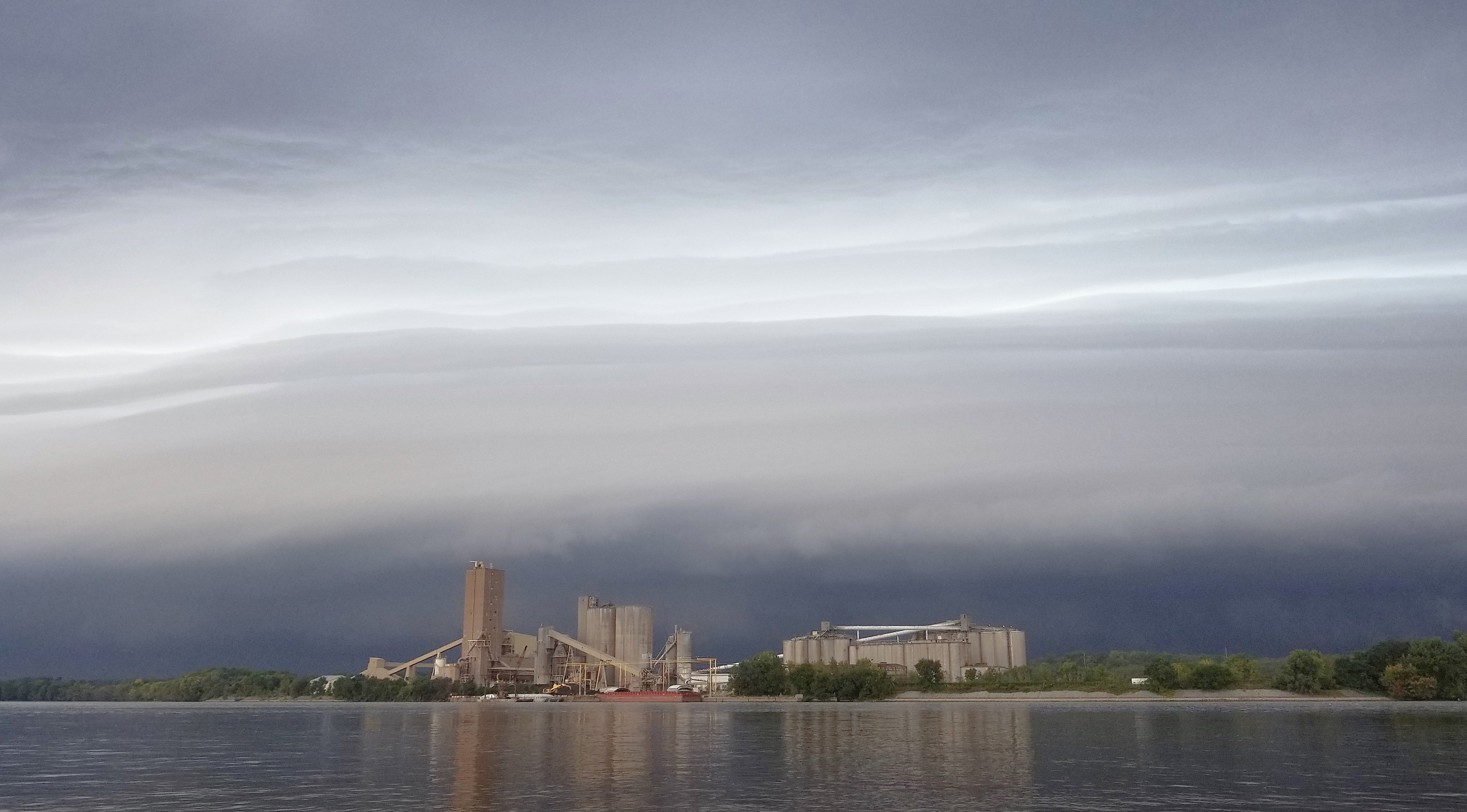
Industrial complexes like this one were a common sight whether for agriculture, coal, stone, etc. Barges are pulled alongside, filled, and then sent down river. I was fascinated by the undulating white clouds being pushed by the coming storm, but not so fascinated by the violent but brief storm they brought. I took shelter on the leeward side of a tiny island.
The days passed and I rowed 25 to 30 miles a day. I passed Davenport without stopping. I passed Muscatine, once the pearl button capital of the world, past Oquawka, Nauvoo, and Keokuk, but stopped for the night in Hannibal, Missouri, to enjoy the hometown of Mark Twain. I had passed through 20 of the 27 locks and accompanying dams of the upper Mississippi. They are part of the 9’ channel project to allow commercial navigation all the way to St. Paul.
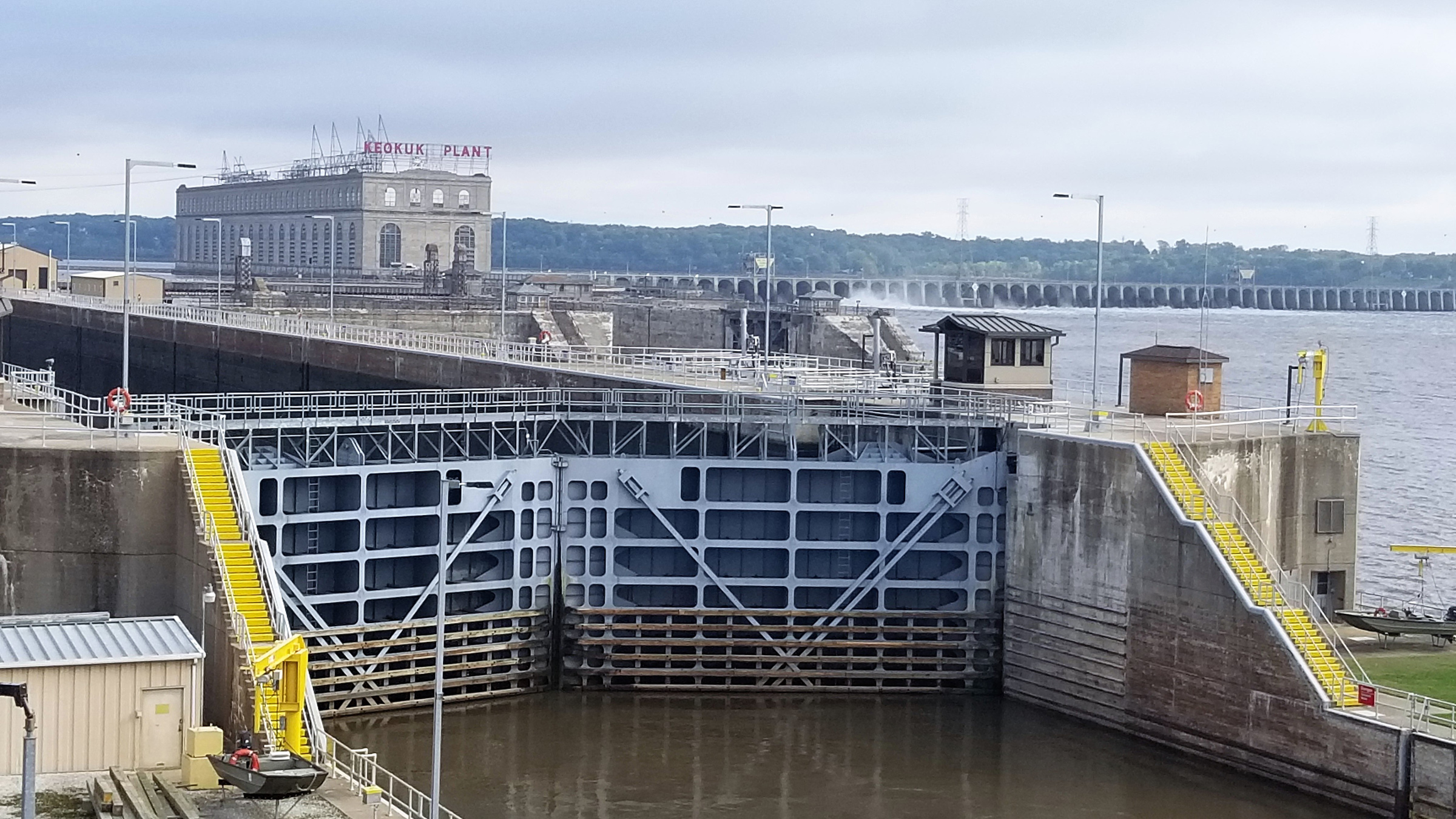
The Lock and Dam #19 at Keokuk is one of three dams that produce electricity. At the time it was built in 1913, its powerhouse was the largest in the world. I stayed well clear of spillway and took the lock; it lowered me 28’, the biggest drop of the trip.
In the morning, I rowed to a mid-river island a few miles downstream from Hannibal. My back was killing me and I couldn’t sit comfortably in the boat. I pulled LITTLE JOY ashore and stretched out on a small sandy beach, warming myself in the sun. My back had been bothering me again for several days, and the miles I had been making were less than I’d hoped for. I began to rethink my plan to reach the Gulf of Mexico.
A towboat chugged by the island pushing a 1,000′ tow. It was only a couple miles to Lock and Dam 22. I knew by the time I got there, the lock would be tied up for a couple of hours as the raft was separated divided into halves and passed through the 600′ lock in two operations. It would be a long wait for my turn.
When I approached the lock, the tow that had passed me was waiting at the entrance; I studied the 3,000′-wide dam, a long, dark line that stretched from the Illinois side out well past the middle of the river. Tight against the Missouri side were the concrete structures of the lock, and between them and the dam was a spillway with 13 bays, each spanned by steel-plate arches above gates that control the flow of the river.
This tow, bound upriver, is pushing a load of rock, probably for a riverside town’s levee.
I lingered above the lock for 20 minutes, but grew tired of waiting. I cinched my PFD and crossed the river upstream from the lock side over to the dam. The water level was high, and I thought I could maybe haul the boat over the dam.
The dam at its lowest point was still showing 2′ above the water, and about 7′ down to the water on the other side. I could not drag the boat over it. I surveyed the spillway. I had rowed LITTLE JOY through two spillways back upstream on the Mississippi, each time knowing it was a stupid idea. The river, a half mile wide above the dam, squeezes through a spillway less than a quarter mile wide, and waves and swirling eddies roar furiously through the gaps. An abandoned barge was wedged cockeyed in one bay, and branches and snags were piled up in others. I took it as a warning and decided to cross back over and just wait my turn at the lock.
I cinched my PFD even tighter and rowed upriver. I managed to travel a few hundred yards, then aimed at a spot just above the lock entrance. The river rushed past and picked up speed as it funneled toward the spillway. I pulled hard, angling the bow upstream. I passed by the openings of the spillway, and when I reached the protection of the lock wall I paused, caught my breath, and called the lockmaster on my VHF radio.
“Lock and Dam No. 22, this is southbound rowboat. I’d like to lock through.”
“Okay skipper, we’ll try to get you through after the southbound tow,” he replied.
When the upstream gates opened for me, I went in. LITTLE JOY floated alone in the middle of the enormous 600′-long, 110′-wide chamber like a toy in a bathtub. Rough, age-worn concrete walls 20′ high and two sets of matching battleship-gray steel gates sealed me in. The water began to drain.
“Hey!” came a voice from atop the wall. “You better have a plan when you leave. There is a 3-by-5 tow waiting to come through.” I had seen the 15-barge raft out in the channel on the downstream side of the dam when I rowed past the spillway crossing to the lock; I wasn’t concerned.
The downstream gates opened, revealing a 15′-high wall of steel blocking my exit—the blunt overhanging bows of the three lead barges. The deckhands on the tow yelled something and laughed. Unsure if the tow was moving, I pulled hard for a small opening between the concrete wall and the steel side of a barge. It was just wide enough for me to pass through.
I shot out into the churning water below the spillway. The towboat fired up its engines and began to move into the lock. I caught my breath, laughed with relief, and let the current carry me. The river, again half a mile wide, swirled lazily. Low, green, tree-covered bluffs ran along both shores. A bald eagle soared low along the treetops. There was not another boat in sight; astern, the dam slowly disappeared behind a bend in the river.
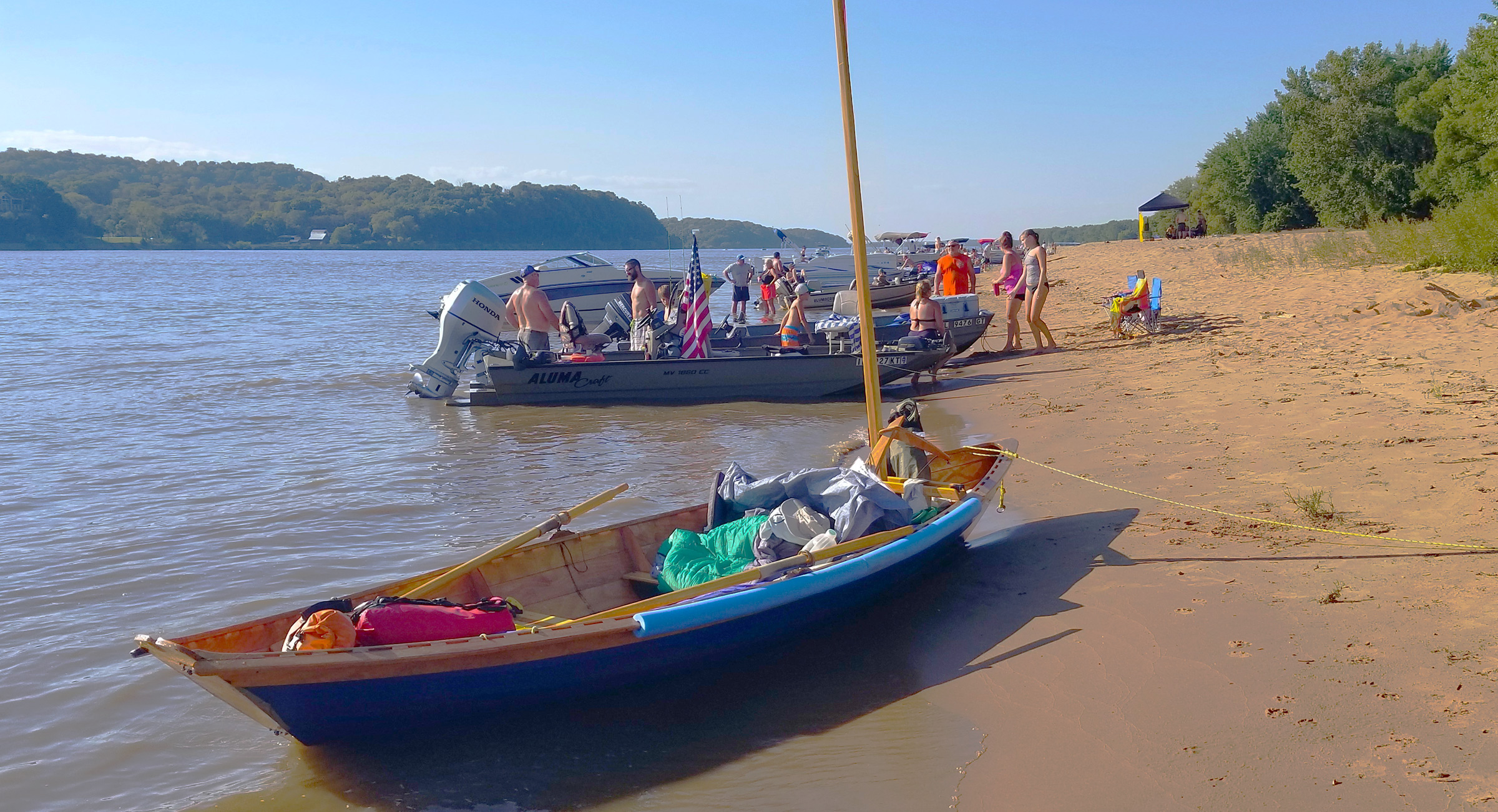
One of the largest beaches I saw in Illinois stretched several hundred yards with almost every foot of shoreline occupied on a beautiful Sunday afternoon. The question most often asked here was: “Hey, doesn’t that have a motor?”
A few miles more downriver I heard the growl of outboard engines. It was a sunny, hot Sunday in late September and weekenders were back out. I had reached St. Louis’s sphere of affluence. I had also reached a decision. I would stop in St. Louis and the end of the trip. My back pain was unbearable and I feared the lower Mississippi would prove to be even harder going.
I stopped in the late afternoon at large sand bar where other boaters were set up for a day on the beach. As the sun neared the western riverbank, they began to leave to make their way back to their marinas. As I set up camp, one of the last of the boaters, a woman in a one-piece bathing suit, came over. She was followed by three men with round bellies and a touch of sunburn. We had the usual conversation, they admired my boat, which made me stand a little straighter, then offered me a big bag of ice, a luxury I gratefully accepted.
“Do you have an anchor?” one guy asked.
“Nope. I’ll just pull it up.”
“Better anchor it. A barge will come by and wash it away.”
“Hope the critters won’t get you.”
“You know, if you set up over there, nobody will mess with you.”
I smiled. “Nah. Nobody will mess with me.” I was hairy and shaggy, dirty and smelly, hungry and lean. Nah, nobody would mess with me.
The marina at Alton, Illinois, is just upriver from St. Louis. The last lock and dam on the river, 1.5 miles downstream, was in view and another 5 miles from the lock, around the next bend was the confluence with the great Missouri River. The marina was full of fancy sail and power boats. The harbormaster gave me a small space for a large fee so I could leave LITTLE JOY for three days and a well-deserved rest, while I retrieved my truck and trailer from Minneapolis. Before heading to the airport, I walked along the St. Louis riverfront where the Gateway Arch, the symbol of St. Louis, stood glistening in the light of the setting sun. I climbed up to the walkway of the Eads Bridge, the same bridge that I crossed two summers ago on a cross-country bicycle ride. The same place where I saw the Mississippi for the first time. I walked out to the middle of the bridge. The river stretched south in a long, wide ribbon and glistened in the setting sun. I looked down. The river was no longer green, but brown with Missouri River mud and swirling around the gray stone pier below. Now doubled in volume, the Mississippi River from there flows unimpeded by dams for 1,200 miles to the Gulf of Mexico.
As cars flashed by on the other side of a low cement barrier just a few feet away from me, I raised my arms and let out a yell, “Yeahhh!” I did not complete what I set out to do, but I covered 650 river miles in 30 days. It was more than enough; I could go home.
David Hudson is a happy corporate refugee. As a teenager, he spent countless summer days rowing a 10′ aluminum pram around a small New Jersey lake. Later he cruised the Atlantic and Mediterranean atop the deck of a U.S. Naval helicopter carrier. Downsizing since the Navy, he has spent time exploring the rivers and lakes of New Jersey, New York and Ontario in a canoe. Putting his woodworking skills to a test, he built his 17′ dory, LITTLE JOY, and can be found, along with his wife Xiaole, rowing it up and down the Schuylkill River outside of Philadelphia.
If you have an interesting story to tell about your adventures with a small boat, please email us a brief outline and a few photos.
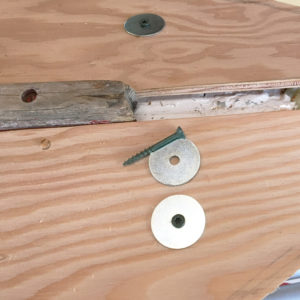
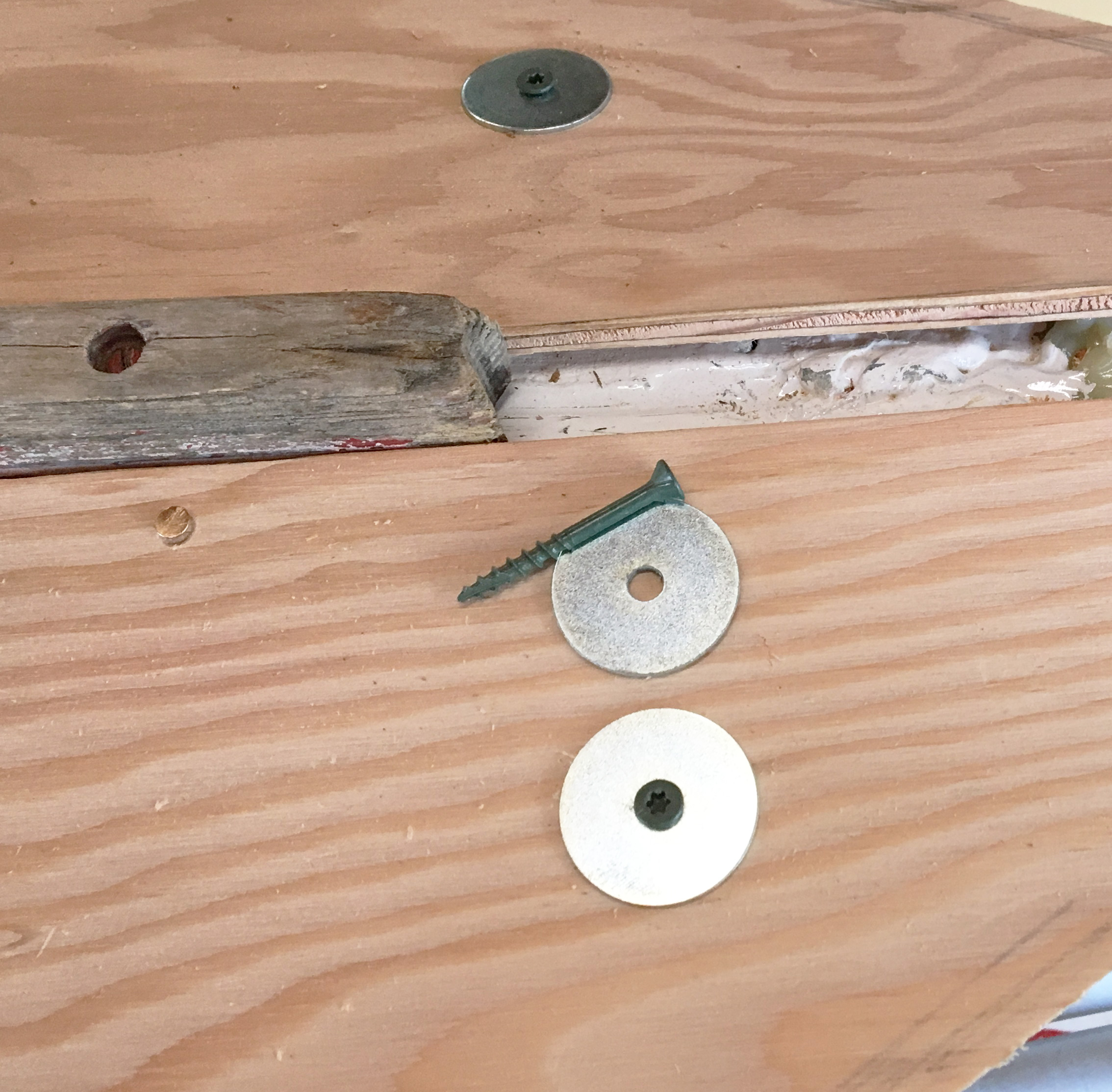
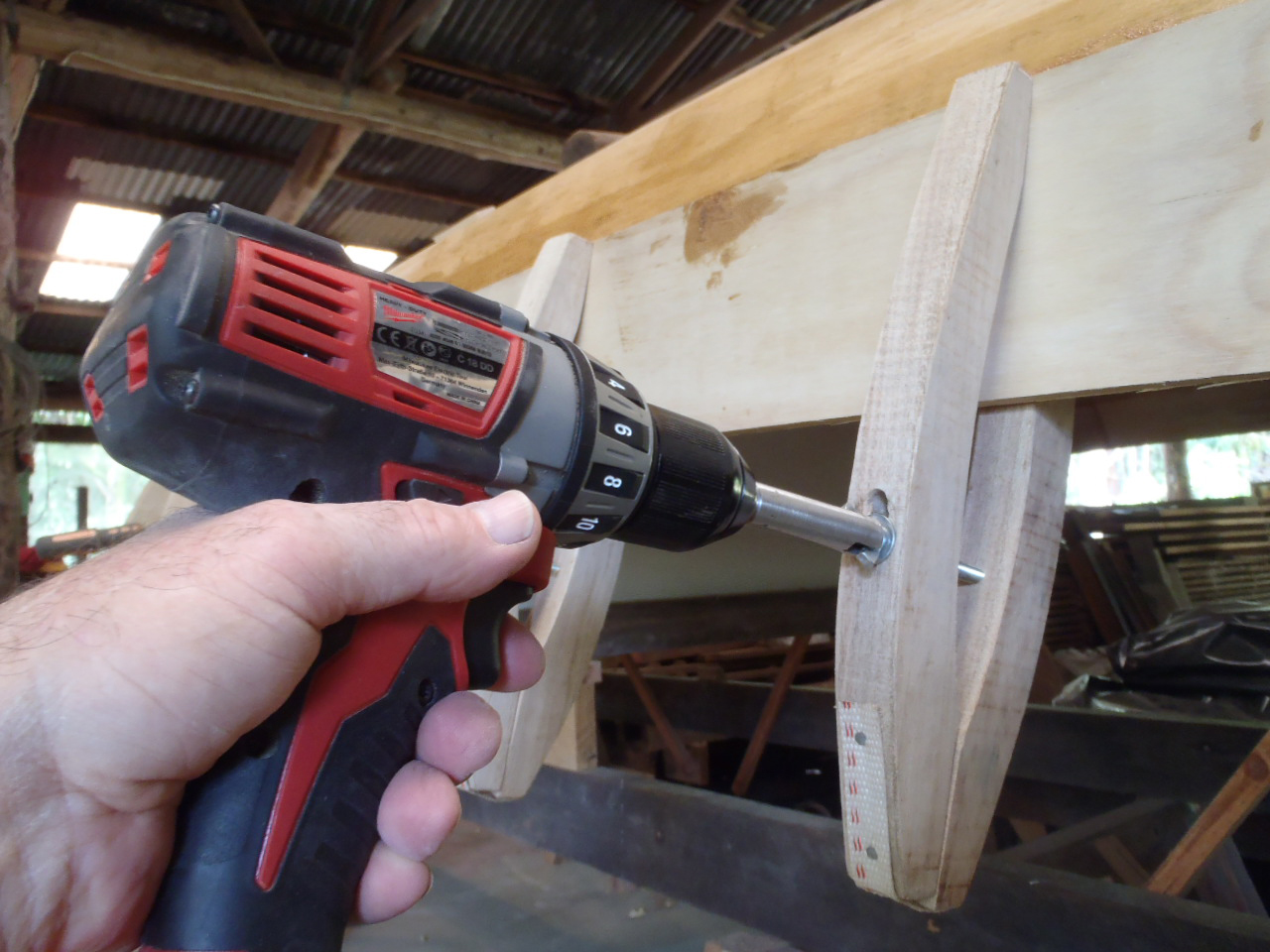
Screws can hold work pieces together in areas where clamps can’t reach, and fender washers spread the pressure over a wide area, minimizing the damage to the wood and helping prevent splits in lumber.
In our shop we have a lot of tools that have come to good use when working on wooden boats. One of the least conspicuous is a pile of small zinc-plated fender washers.
With oversize diameters and small holes, fender washers were developed for working on automobile fenders where the sheet metal would be distorted when pressed by smaller washers. I can’t remember where we came across the idea to use them in working on wooden boats, but I am glad that we did. We often encounter tasks that are beyond the reach of clamps, and a fender washer and a screw can pull parts together, like bending a plank into position on a frame, stem, or transom.
Peter Sibley
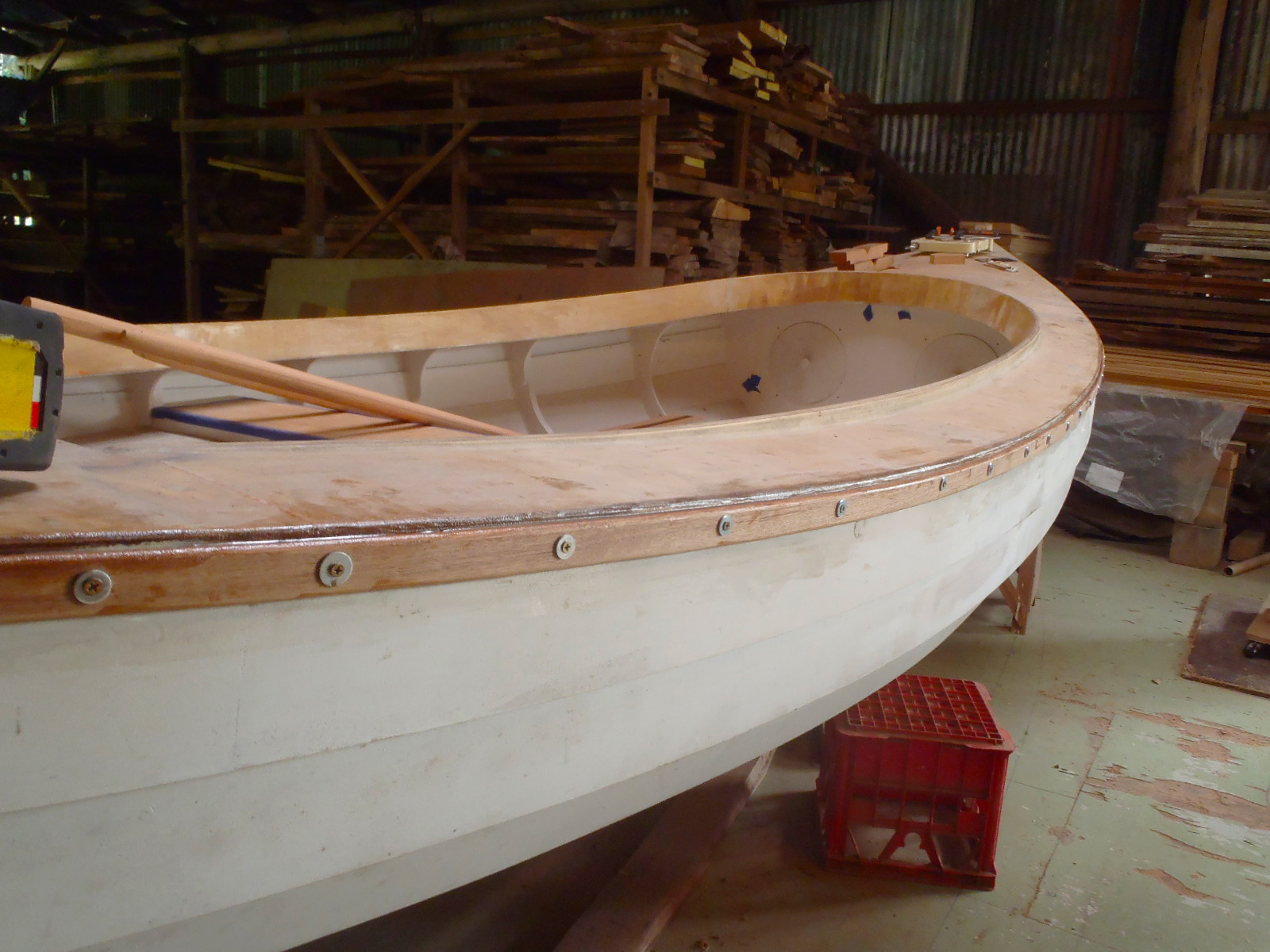
Bar clamps might reach across the side decks to secure the sheer guard for gluing, but screws and fender washers are a more economical approach, less expensive even than stainless or bronze screws that would be left in place after the glue cures.
We’ve tried to close gaps between pieces using the wood screws that will be the permanent fastenings, but found that method fraught with problems. The heads of wood screws can bury themselves, damaging the workpiece and then becoming difficult to remove without lifting and splintering the top fibers of wood. And the conical underside of a flat-head screw can act as wedge and split a plank end. The finer threads of silicon-bronze or marine stainless-steel screws may not bite as well into softer wood, and while those screws can be used to hold parts together, they’re not well suited to closing gaps. A screwdriver can also cam out of the slot in a softer bronze screw head, requiring replacement of the damaged screw. To avoid these problems, we use fender washers with drywall or deck screws as temporary fastenings while we drill for and install the permanent fastenings.
Peter Sibley
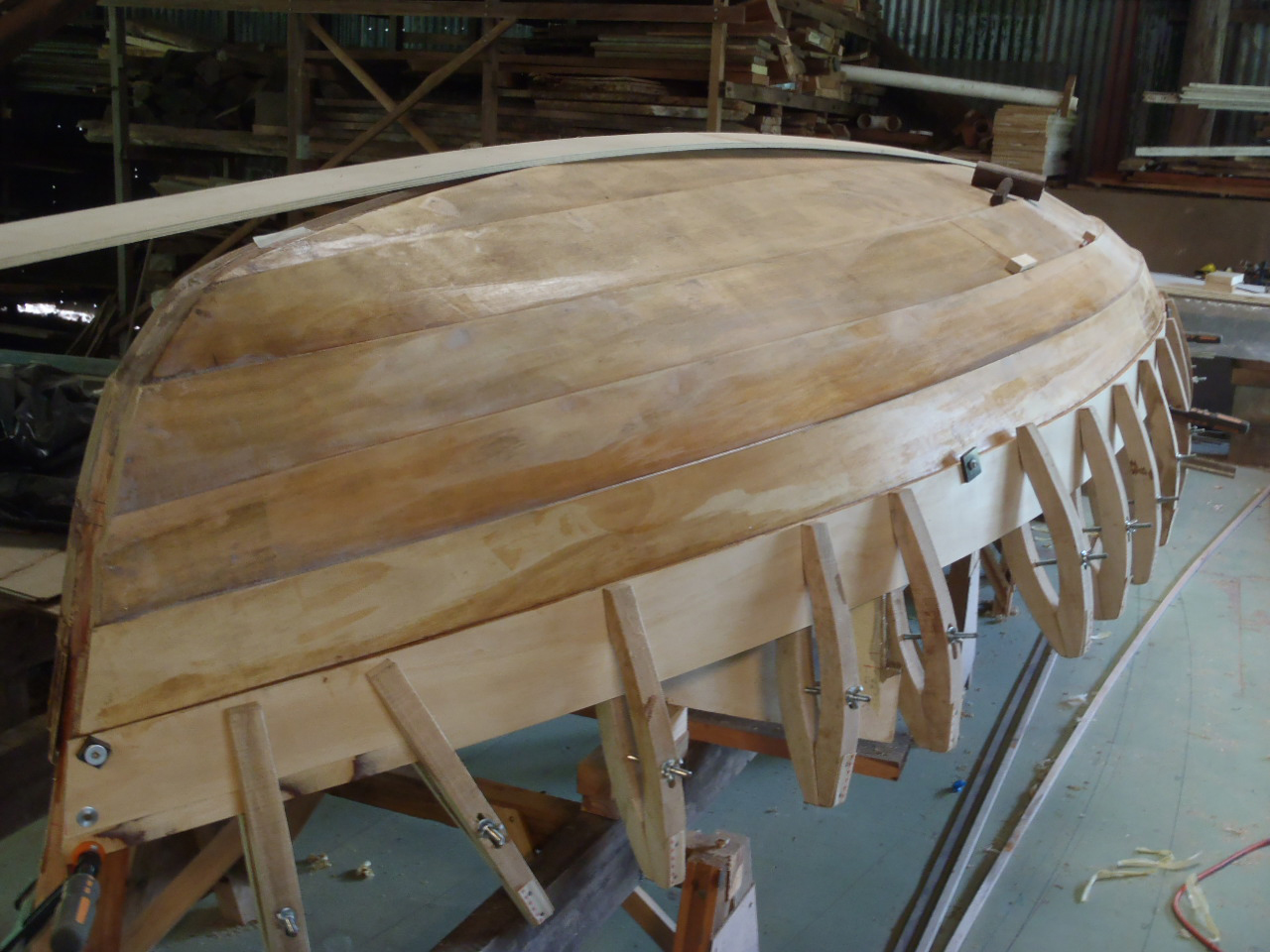
Screws and fender washers are especially useful holding the hood ends of plywood planks to the stem while epoxy cures.
Fender washers are especially useful when working with softer hardwoods. We once needed to pull a cypress plank tight to a frame during a repair and first tried using a single silicon-bronze wood screw, but the screw buried itself under the surface, did not have enough bite to pull the plank, and stripped out of the frame. We then tried using several bronze wood screws to distribute the load but ended up shearing some of them, and nothing is more fun than dealing with half a screw in a frame while the plank is not pulled tight. When we switched to a fender washer and a deck screw we fared much better. A deck screw’s star-drive head has an exceptionally secure hold on the driver bit, and the longer, coarser threads of the deck screw bit right into the frames and pulled the plank tight. Once the cypress plank was properly positioned and the permanent fastenings were installed, we removed the deck screw and used that hole for another permanent fastening. In some cases, we’d fill the hole with thickened epoxy or a wooden plug.
Peter Sibley
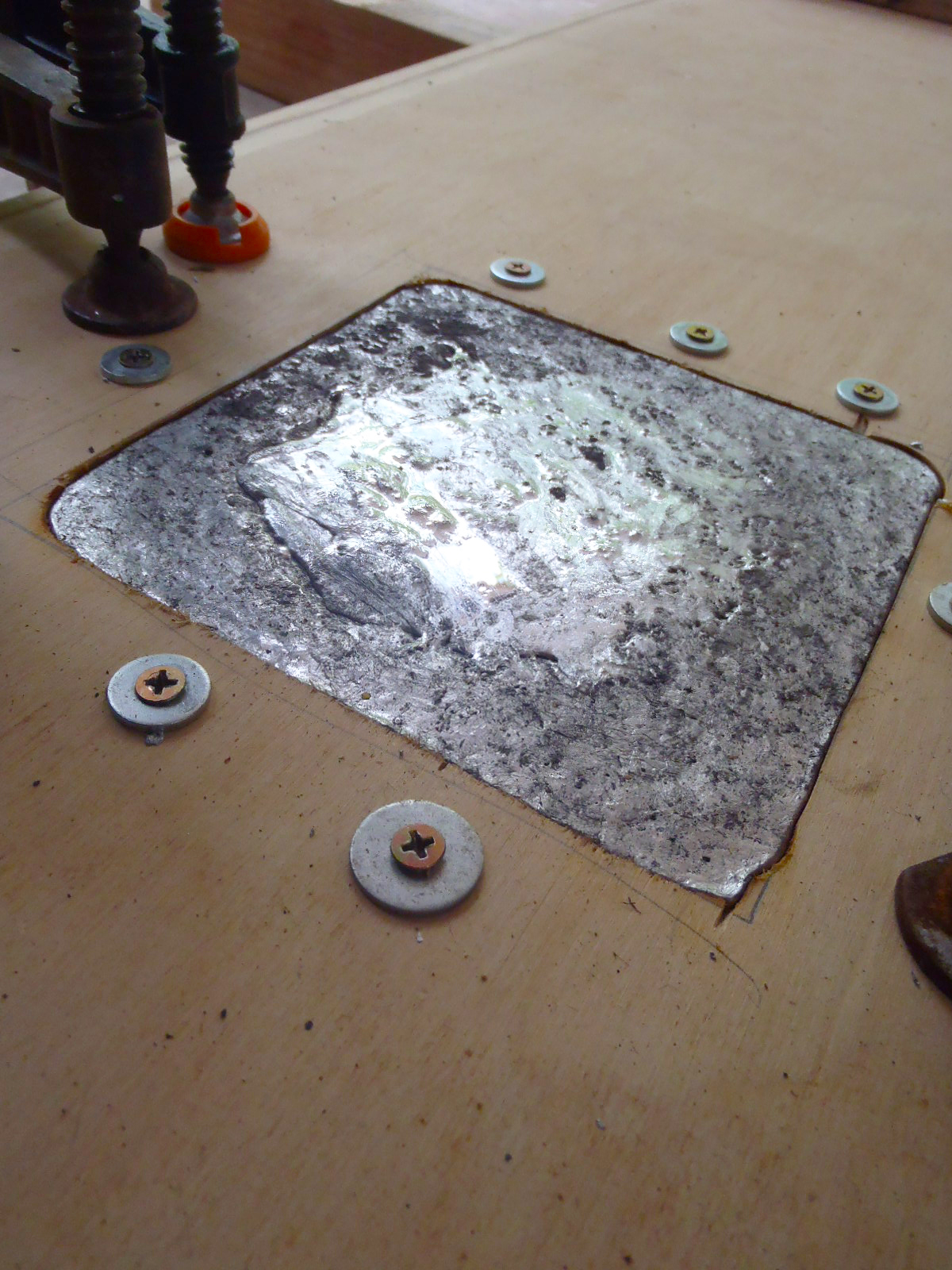
Screws and washers kept molten lead from seeping between layers of plywood for a centerboard that will later be epoxied together and sheathed with fiberglass.
We also use fender washers when working with plywood panels. The washers prevent damaging the layers of ply while the panel is being shaped to the molds and fastened. Without the washer, the screw head might crush the multiple thin layers of plywood, either leaving a lot of damage to finish, or even compromising the integrity of the panel. A rough-cut panel can be left on a mold for a few days to help preset a bend, making final installation easier. If the plywood is reluctant to make a bend you can help it along by covering it with towels, pouring boiling water over them, then covering it all with plastic sheeting to hold the heat. Use zinc-plated or stainless-steel washers—plain steel will stain the wood black.
A fender washer and a screw don’t cost much, under 50 cents for the pair, and a handful of them can get you through jobs where clamps can’t be used or you don’t have enough of them.
Kent and Audrey Lewis used quite a few fender washers during the restoration of their 1880s Mississippi River Skiff BARBASHELA and their 1950s Alcort Sailfish ZSA ZSA. More information on their continuing adventures can be found on their blog Small Boat Restoration. www.smallboatrestoration.blogspot.com
You can share your tips and tricks of the trade with other Small Boats Monthly readers by sending us an email.
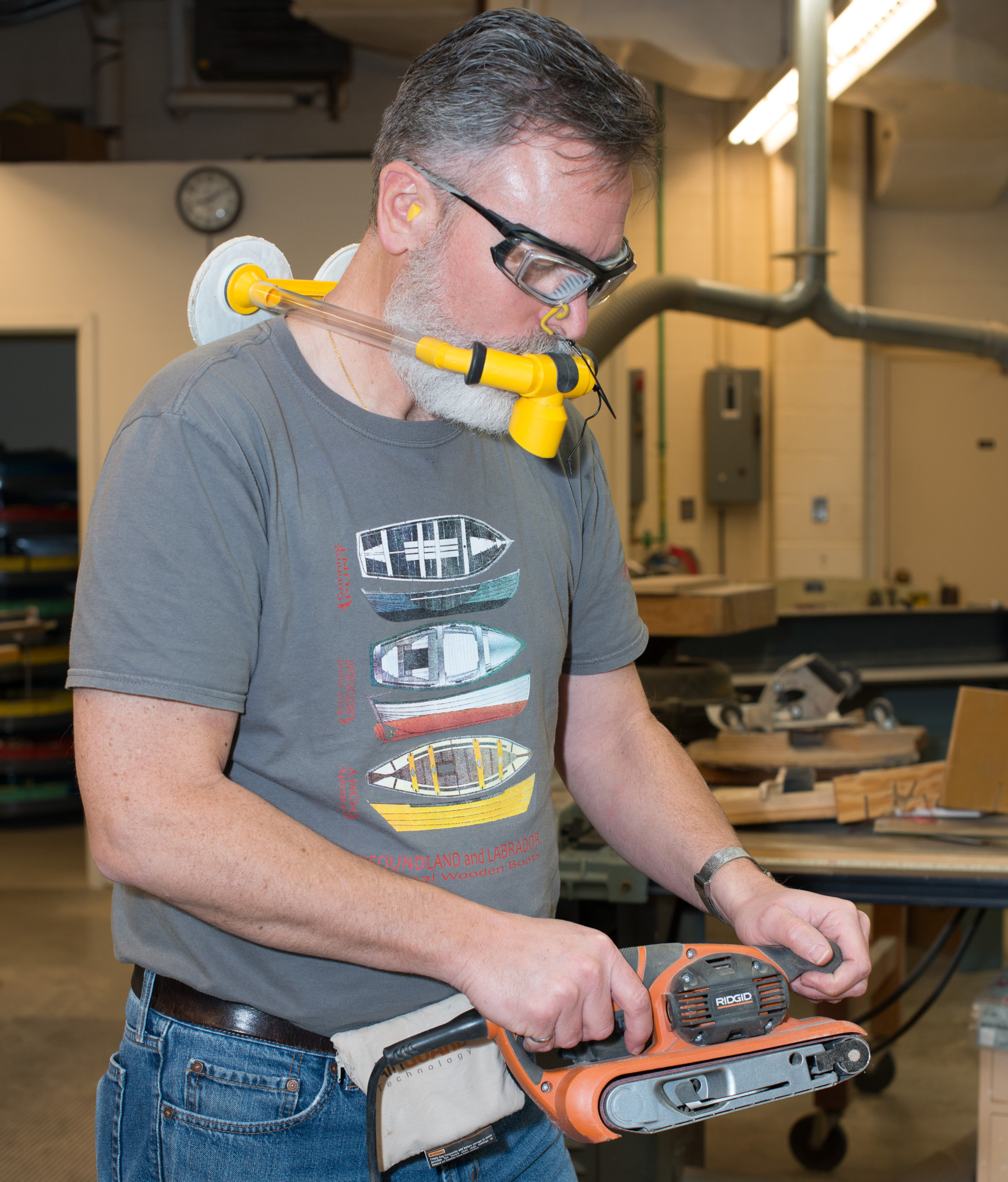
Having the filters behind the user keeps them farther from the tool so the don’t have to deal with the worst of the dust.
Until I tried the Resp-O-Rator by Duxterity of Graham, North Carolina, I’d been using disposable dust masks and traditional respirators for years, but with my full beard, they didn’t seal properly against my face. My nose-blow tissue test always showed that I’ve been inhaling a bunch of dust. On top of that, I use prescription safety glasses, and both dust masks and my half-face respirator caused my glasses to fog up and ride high, so I often chose what I thought was the lesser of two evils—inhaling dust instead of risking an eye injury—and skipped the mask.
Some guys grease their beards with Vaseline to get a good seal with a respirator, but my beard is long enough that I just can’t grease it up enough for a proper seal. When I did try, the Vaseline inevitably migrated to my hands, tools, and whatever I was working on, and the mask became a slithery mess. Even with a shorter beard, I wasn’t going to go to that trouble for a quick, it’ll-only-take-a-second job.
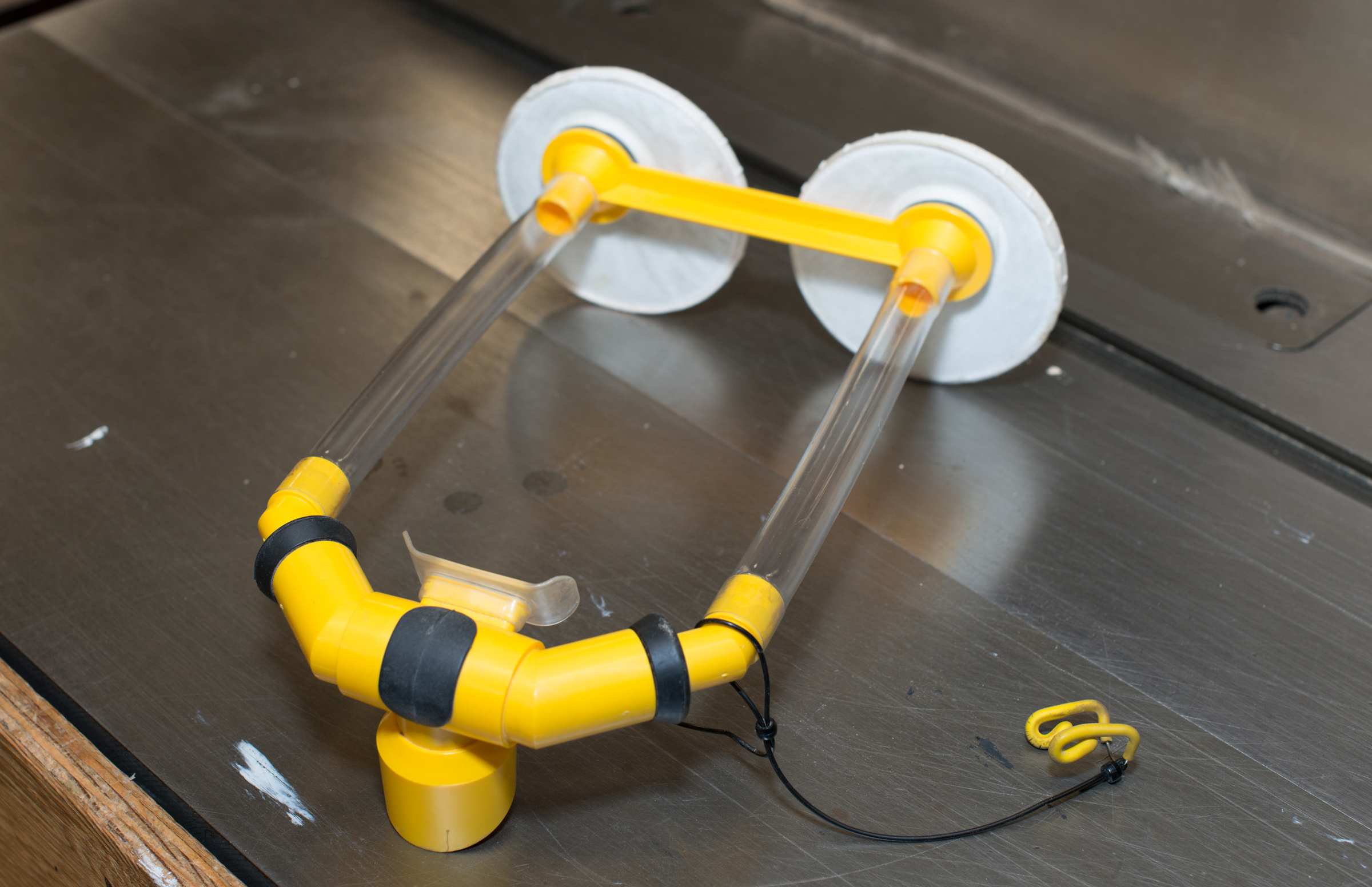
The Resp-O-Rator, an odd-looking device with twin snorkels connected to disposable dust filters, isn’t compromised by a beard. The mouthpiece goes between lips and teeth, and the attached clip clamps your nostrils shut. To assemble it, a quick push and twist attaches the 4-1/8″-diameter filters to the tubes, and it’s ready to put on by removing one of the tubes from the mouthpiece, wrapping it around your neck, and reconnecting it.
Mike Franz
Inside the fixture equipped with the mouthpiece there are valves that keep the air-intake tubes free of exhaled breath.
Since my lips make the seal with the mouthpiece, I don’t need to worry about getting a proper seal against my beard. My safety glasses don’t fog or ride up. When I release the mouthpiece, the whole thing drops, completely hands-free, taking the nose clip off with it, and the Resp-O-Rator hangs comfortably around my neck where I can just let it ride until I need it again. With one hand, I can pop the mouthpiece back in and install the nose clip in less than 5 seconds, and I’m ready to go again.
The mouthpiece includes one-way valves to make sure you are not just rebreathing exhaled carbon dioxide. About the only downside is that condensation does occasionally drip from the downward-facing exhaust port. The large, replaceable HEPA filters pull air through both front and back faces, so it’s easy to draw air in through them. Their filtering efficiency is listed as over 99.97 percent, [removing particulate] down to 0.3 micron in diameter for a respirator rating of 100. The common disposable dust masks with two elastic straps are rated 95, or 95 percent of particles of at least 0.3 micron—assuming they have good contact to the face. The Resp-O-Rator is not suitable for filtrating aerosols, volatile organics, or particulates that contain oil, but neither are disposable dust masks.
If you are sporting a full beard, there’s a pretty good chance you aren’t getting a proper seal even with a certified mask, and for those without beards, you may find the Resp-o-Rator gives you a better seal than a dust mask’s elastics and metal nose clip. And on a hot day, not having half of your face in a wet rubber respirator can be a welcome relief. The Resp-O-Rator works well with glasses, and it’s comfortable and convenient enough to let it hang around your neck ready to be used instead of sitting on the shelf. When I’m in my shop, I’m always wearing my safety glasses and when I’m about to start creating dust, my Resp-O-Rator is the first thing I reach for.
Geoff Coley of Medicine Hat, Alberta, is a mechanical engineer whose first cedar-strip canoe was followed by a cradle boat for his first child. That was in the early 1990s; he is now working on boat No. 7 and dreaming about building a double garage so No. 8 can be just a wee bit bigger.
The Resp-O-Rator by Duxterity is available from Duckworks for $42.50 and from online retailers.
Is there a product that might be useful for boatbuilding, cruising or shore-side camping that you’d like us to review? Please email your suggestions.
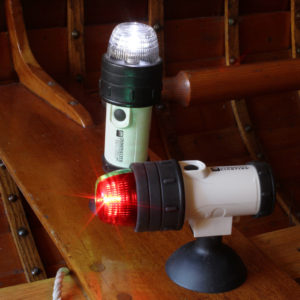
The lights come with suction cups, as seen here, or with clamps.
Small-boat cruisers rarely travel at night intentionally, but sometimes we get caught out late or we need a predawn start to catch a favorable tide, like I did while rounding British Columbia’s Cape Caution last year. Between sunset and sunrise, we need navigation lights to comply with Coast Guard regulations and to ensure we are seen by other boaters. As our boats rarely have a built-in power supply, portable, battery-powered lights are a good solution.
There are a number of configurations that meet the regulations for unpowered boats under 20′, but for several years I have used two lights, a bow light and a stern light, from Innovative Lighting in Iowa. They are built with a molded body protected with shock-resistant neoprene; one light has a combined red and green lens and the other has a white lens. Their LEDs are powered by four AA batteries. They can be bought with either a screw-clamp mount or a suction-cup mount. I have the clamp mounts and clamp the bow light to the top part of my stem right forward. The stern light has an 18” pole with a clamp on the bottom, which I fasten to my transom. With both clamps, I use additional pads of nonskid material to provide extra grip and protect finish.
SBM
This suction-cup version of the bow light holds well to the arched-but-smooth varnished surface of this Whitehall’s breasthook. A tether secured to the treaded insert at the back of the light’s case provides security if the suction cup loses its grip. In testing, this light was left on for 80 continuous hours. At the end of that run, the intensity of the light had grown dim, but at 72 hours it was still clearly visible at 1/4 mile.
I made two modifications to fit the lights to my boat, FIRE-DRAKE. The bow light clamp, from the factory, is a parallel to the light, so if I were to apply the clamp to the sides of the stem head, the light would point to one side, rather than forward. To solve the problem and put the light at a right angle to the clamp, I filed a shallow notch in the housing and refastened the clamp bracket. The white light for the stern shines 360 degrees, which meets the requirements for powerboats and anchoring, but 135-degree visibility is required for sailboats and rowboats. I made a mask of Gorilla tape to cover the forward two-thirds of the lens, which isn’t elegant, but does the job and preserves my night vision when rowing.
The lights feel robust and have an O-ring that waterproofs the assembly where the lens screws onto the one-piece battery compartment. The push-button power switch has a soft rubber cover. The clamps are powder-coated aluminum U-channels with a fine-threaded coated steel screw and end pad.
To me, the lights appear at least as bright as built-in 12V powered lights, but I don’t have independent confirmation from other boaters how far they can be seen. I also don’t know how long the batteries will actually last, and the manufacturer makes no claims, but I have used them for an entire night a couple of times. I suspect that the life is likely in the dozens of hours at least, possibly hundreds.
The lights are rain-proof, but I discovered, accidentally, that if submerged in seawater for too long, the waterproofing does not keep the water out and the innards can corrode. It’s a good practice to take the batteries out of devices you won’t be using for an extended period, lest they leak and cause corrosion. I now keep the lights in a dedicated dry bag until I need them and take the batteries out between cruises. Having eliminated these operator errors, the Innovative Lighting units have been reliable.
Alex Zimmerman is a semi-retired mechanical technologist and former executive. His first boat was an abandoned Chestnut canoe that he fixed up as a teenager and paddled on the waterways of eastern Manitoba and northwestern Ontario. He started his professional career as a maritime engineer in the Canadian Navy, and that triggered his interest in sailing. He didn’t get back into boatbuilding until he moved back to Vancouver Island in the ’90s, where he built a number of sea kayaks that he used to explore the coast. He built his first sail-and-oar boat in the early 2000s and completed his most recent one in 2016. He says he can stop building boats anytime.
The running lights are available from Innovative Lighting for $31.98 each and from marine and online retailers for as low as $26.22.
Is there a product that might be useful for boatbuilding, cruising or shore-side camping that you’d like us to review? Please email your suggestions.
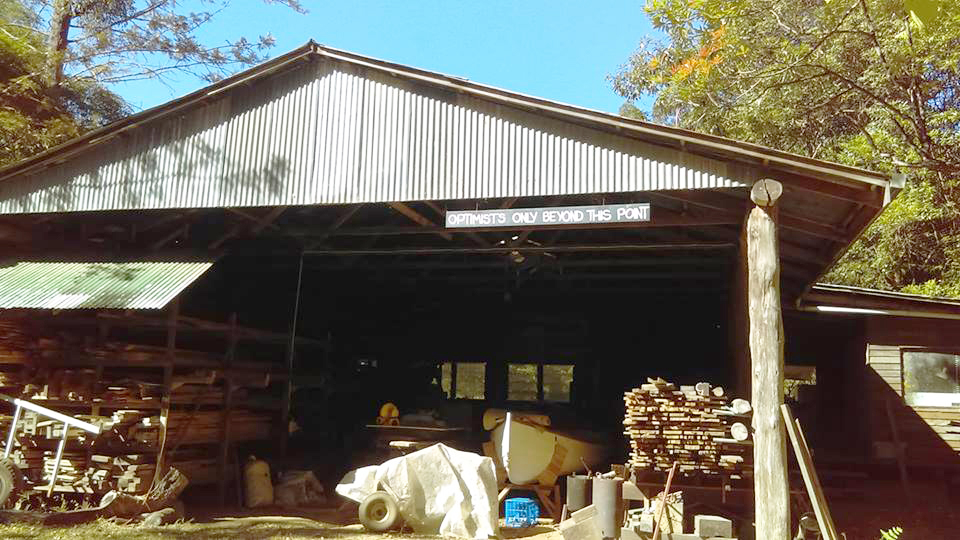
Peter stands behinds JIM, its sails newly raised and sitting on the trailer he built. Above him is the sign on his shop that reads: “Optimists only beyond this point.”
Peter Sibley and his wife Carole live in Murwllumbah, New South Wales, a dozen miles from Australia’s east coast, 19 miles if you go by boat down the Tweed River. Peter had set out to build a French pilot cutter that he had redesigned with the help of the late yacht designer Ed Burnett of Devon, England.
Wanting to do as much of the work as possible in his own shop, he started with logs, and that required some special equipment. He had once run a sawmill business, and for transporting logs, he had designed a gantry crane that he mounted on a flatbed truck; once he had the logs at his shop, he slabbed them with a horizontal bandsaw mill that he’d built, complete with hydraulic controls. To make his own bronze hardware for the cutter, he set up a separate foundry with a large furnace and made his own wooden patterns.
Peter had laid the keel for the cutter and was fully invested in the project when he had to bring it to a sudden and unexpected stop. One of his daughters was taken ill, and he and Carole devoted themselves to the care of their daughter and her children.
Peter still had bits of free time to devote to boatbuilding, but he needed to scale back. He shelved the cutter project and tossed around various designs as alternatives on the Woodenboat Forum, where over the past 18 years he has made over 74,000 posts and was recently elected BROTM, Bilge Rat of the Month, by his friends who inhabit The Bilge, the forum’s no-holds-barred venue. Peter didn’t find anything that was just right, so he commissioned Antonio Diaz to create a new design, the 24′ Kathleen Gee, a stout-looking little yawl drawn in the tradition of the small coastal cruisers by C.P. Kunhardt, author of Small Yachts: Their Design and Construction.
Life’s demands, as they often do, grew and occupied more of Peter’s time, and the Kathleen Gee, with a displacement of 10,000 lbs, was too ambitious a project to take on. He looked for an even smaller boat and found himself drawn to the lug-rigged yawls popular among camp-cruisers. He ultimately settled on an 18′ 4″ canoe-yawl, Jim, designed by Paul Fisher of Selway Fisher in Melksham, England. It was designed for stitch-and-glue plywood construction, but Peter preferred the more traditional look of lapstrake, so Paul advised building the design in glued lapstrake and drew up a lug sail in place of the gunter mizzen.
Duncan Gibbs
With a crew of friends aboard, Peter takes JIM’s helm for the boat’s first sail.
Peter began work on his Jim in 2012. He put his pattern-making skills to use and had bronze rudder and stem hardware cast from wooden patterns he’d made specifically for the boat.
As 2015 drew to a close, Peter had nearly finished the build, but the project was brought to a sudden halt. Peter was given a diagnosis of an aggressive brain cancer in its final stage. He had surgery on the tumor, but not all of it could be removed. Peter received a dose of chemotherapy and radiation, but his prognosis was grim. He was given six months to live.
A sign hanging in the front of Peter’s boatshop reads: “Optimists only beyond this point.” Peter applies that directive not only to his boatbuilding, but also to living. Six months came and went. Peter needed a trailer for the canoe-yawl. None of the commercial trailers available would have been a good fit for the boat’s pronounced rocker or the hull’s wineglass cross-sections aft, and Peter wasn’t going to settle for something that didn’t meet his high standards he sets for himself and his work. He built a trailer, from scratch. Late last year, three years after his diagnosis, an MRI revealed that the tumor had grown again and was inoperable. Another round of chemo and radiation was administered, but another MRI in January showed the tumor hadn’t been stopped by the treatment.
Duncan Gibbs
On her launch day, Peter’s canoe yawl performed beautifully and looked right. The Jim was originally drawn with a leg-o’-mutton mizzen, but the lug mizzen provides a more pleasing pairing.
After such a long struggle, to get the boat so close to the finish line and fail wasn’t an option, so two old boatbuilding friends, Nick White from Conrad Blocks and Keith Davis from Pelican Slipway, came down from Brisbane to Northern New South Wales and readied Jim for a preemptive launch. There were some cleats that had yet to be installed and the deck was ’glassed but not painted, otherwise Peter’s Jim was ready to sail. On February 13, a group of his friends gathered to rig, launch, and take Peter, now very weak, for the maiden voyage of JIM. Peter said, “The process of building was really enjoyable!” In spite of his condition he was clearly enjoying the sailing too. He had an enormous grin when he was grasping the tiller and commanding his little ship.
Duncan Gibbs
Peter Sibley, craftsman
In a recent post to the forum, Peter wrote: “I suppose it’s to be expected…. The end story after a life of reasonably high energy and the ability to do most of what I wanted to achieve. The medicos have made it plain there is no way back from a glioblastoma, they don’t go away. I’m disappointed that the game is up, but I’m 69 so can’t really complain. Here was NEXT BOAT, someone should build her!”
With gratitude for the example Peter set by his devotion to boatbuilding and to family.
Thanks to Peter’s friend, Duncan Gibbs, for his help with this story.
Editor’s note, May 28, 2019: We received word that Peter passed away on this day.
Peter’s Shops
Peter Sibley
The foundry has its own building, set apart from the wood-filled main shop.
Peter Sibley
The foundry’s furnace sits on a mobile frame that has a swing arm for the lid and a device to lift the furnace’s top half for easier loading.
Peter Sibley
The hardware for the boat started as wooden patterns to be molded in sand and cast in bronze.
Peter Sibley
The rough castings were ready for smoothing, drilling, and polishing.
Peter Sibley
For smoothing bronze castings, Peter uses a linisher/belt grinder that he built with plywood wheels.
Peter Sibley
After smoothing this gudgeon on his linisher, Peter drilled holes for the bolts. The next step was to push this shop-made broach, as it’s called, through the holes to make them square and hold the heads of carriage bolts.
Peter Sibley
After the broach has done its job, the hole is ready for carriage bolts.
Peter Sibley
The finished fitting for the bow painter is a strong and elegant piece of hardware.
Peter Sibley
The boatbuilding shed is filled with lumber Peter milled with his horizontal bandsaw.
Peter Sibley
When he was running a sawmill business, Peter made this gantry crane to pull logs up on his flatbed truck.
Peter Sibley
The bandsaw mill Peter built has hydraulic controls for easy operation.
Peter Sibley
The Jim nears completion. The table saw on the boat’s starboard side was mobile to make it easy to orient it for crosscutting or ripping.
Peter Sibley
The table saw is supported by four ball bearings that ride in slots on top of a wooden frame fitted with casters. A threaded rod, spun by a drill as needed, pulls the machine, and the bearings ride up the slopes cut in the slots, lifting the table saw from the floor.
Peter Sibley
Peter’s homemade planking clamps are tightened with wing nuts on bolts. To spin and tighten the wing nuts quickly, he put a slot in a piece of steel tube to straddle the wings and put a rod in the tube’s other end to fit a cordless drill.
Peter Sibley
The cleats for the canoe yawl were beautifully sculpted.
Carole Sibley
Peter’s friends are bonded together by something stronger than epoxy. From left to right: Gary Pick, Bruce Moffatt, Duncan Gibbs, Peter, and Tom Weiss
I was in my early teens when I bought a propane torch. I just wanted to burn things, but my father found it useful for more constructive uses, like making a case for drill bits. He always had racing shells in the garage, repairing them for crews in the Pacific Northwest, and the torch came in handy for making replacements for missing stretcher bolts. He’d file a small flat on a brass washer and set it in the slot of a brass machine screw, slip a 1″ length of copper pipe over the screw threads, and solder everything together with paste flux and lead-wire solder.
Dad used my propane torch to make this drill-bit case from a short piece of brass tubing. It rattled around in his tool box for nearly a half century and the bottom, soldered with lead, finally fell off. With a new bottom silver-soldered on, it’s good for at least another 50 years.
This is my replica of the stretcher bolts that my dad was making when he was repairing racing shells back in the ’60s.
When I built my first boat, a dory skiff, I didn’t consider making any metal fittings. I bought bronze pintles and gudgeons for the rudder but opted for oak tholepins over oarlocks and made all of the cleats out of hardwood. A few years later, a cruising canoe I was building needed a rudder, so I made one out of a discarded aluminum street sign, bent in a vise and pop-riveted together.
I made this aluminum rudder for the cruising canoe I built in 1983. The rudder held up pretty well, but the canoe, made of laminated paper—in the spirit of Nathaniel Bishop’s Voyage of the Paper Canoe—required constant repairs to keep it afloat during a 2,500-mile retracing of Bishop’s voyage.
Another one of my earlier metalsmithing projects was a stove box for my MSR model G stove. Made of aluminum sheet, brass hinges, and pop rivets, it contained and protected the flame, held the pot, and kept the fuel bottle secure on the outside of the box. The lid had wings that could serve as a wind break to keep the pot warm. The box made it possible to have hot lunches while underway, a great improvement in the quality of life aboard an open boat in unpleasant weather.
It wasn’t until I moved to Washington, D.C. and landed a job at the Smithsonian Institution that I learned I could do more with metal. I was hired by the National Museum of African Art as an exhibits specialist, part of the crew making display cases and installing artifacts. For a few weeks I assisted contract workers brought in to make mounts to support the objects that would be put display. They used brass rod and flat-bar, annealing it to make it pliable and joining pieces with silver solder with an air-acetylene torch. I learned a lot watching them work, and after they left I did much of the mount-making for the museum.
The museum staged an exhibition of the work of sculptor Sokari Douglas Camp and filled the main gallery with her life-sized metal figures. Many of them were motorized: a dancer stomped his feet, a small girl clapped her hands, and a boat stroked with six oars. During the last stages of the installation, one of the sculptures failed, and Sokari asked me to weld the broken part. I’d never worked with an oxy-acetylene torch, so to be on the safe side, I wheeled the museum’s welding rig outdoors to the loading dock, read the instruction manual, and made the repair without setting the museum on fire.
These brass rudder fittings for my lapstrake canoe were silver-soldered in 1988.
While I was working for the Smithsonian, I was living in a home just outside of D.C. and building a tandem decked canoe in the basement. It is said, “To a man with a hammer, everything looks like a nail,” and with my access to the museum’s metal shop, all of the fittings I needed for the canoe looked like metalsmithing projects. I made gudgeons for the rudder, a grab handle for the bow, and pad-eyes for the anchoring the sailing rig.
The handle on the bow of the canoe had to be silver-soldered in stages, as not all of the joints could be worked at the same time. The first joints were soldered with hard silver solder so they wouldn’t melt when the brass was heated for the second set of joints and soldered with medium solder with a lower melting point. The last joints were done with easy solder with a still lower melting point. The tube at the front is for a staff to fly my family’s private signal.
When I left D.C. in the late ’80s and returned to Seattle, I made a soldering station around an air-acetylene torch a friend I’d built a boat for had once used to make jewelry. I got a job making mounts for the Seattle Art Museum and continued making hardware for boats I built and for making simple tools.
The brass gudgeons on HESPERIA’s transom have a patina of verdigris, just like the Statue of Liberty. The projecting part is made up of two layers of brass soldered together for strength and to reduce wear. I made these fittings in 2011.
HESPERIA’s rudder had matching gudgeons instead of pintles. Brass loses some of its temper when heated for soldering and a projecting pin would not likely have adequate stiffness. A brass rod, heated only on one end to bend it, runs through all four gudgeons. I mounted the rudder gudgeons here on the the rudder’s forward edge, and through-bolted it to nuts inserted in the mortices. My plan was to fill the mortices with oak plugs, but I never got around to it.
To make a tool for reefing seams, I heat the tang of a file until it is cherry red and then bend it into a hook. A grinder and belt sander shape and sharpen the point.
In 2007, an elderly friend of mine passed away and his family wanted to find good homes for some of his tools. I was given his oxy-acetylene welding equipment. I didn’t do anything with it until my son and his friend built BONZO, a 19’ Escargot canal boat, and we decided it needed a wood-burning stove for winter outings. I scanned the web for small stoves and found some meant for using in canvas wall tents, but they were expensive and too large for the space we had available in the boat. I had the torch and a large sheet of 1/16″ steel, so I decided to figure out gas welding.
Every angle that can be bent is a joint that doesn’t need to be welded. To make straight, tight bends, I made a sheet-metal brake, using the frame of an electric drain-pipe rooter as a base, a few pieces scavenged from a retired boat trailer, and odd bits of mild steel. Gas welding put it all together.
The weld I’d made for Sokari was only 1″ long, so I didn’t know that a long seam required tacking to keep pieces aligned. Consequently, some of the edges I welded are far from straight, but as things went wrong, I did more research and applied what I’d learned. In time I got the hang of heating the steel and feeding welding rod into the liquefied metal. When I ran out of the few rods I had, I straightened wire coat hangers and welded with them.
HESPERIA’s wood stove, shaped to fit in the cabin corner, was my second gas-welding project. The seams are not perfect, but much straighter, thanks to tack welds. A mica window in the door lets the firelight illuminate the cabin at night. The vertical pipes at left are parts of a heat exchanger that supplies the sink, set in the opposite corner, with hot water. The exchanger is made of copper pipes silver-soldered together. The cabin roof has been lowered here; it is raised while at anchor.
Gas welding turned out to be a great pleasure. Seen through the dark lens of welding goggles, the molten metal, like lava, glows and flows, leaving a trail of overlapping crescents. After making BONZO’s stove, I made two more, for my cruising garvey, HESPERIA, and my teardrop trailer.
A few years ago I bought a cheap arc welder. I’ve never been able to do even a spot weld with it—the rod just sticks to the metal—but I haven’t given up on it. Arc welding is just another challenge of metalsmithing. Like soldering and gas welding, it might just open up another world of possibilities.
There she was, Miss April in the 2015 Calendar of Wooden Boats. Benjamin Mendlowitz had photographed her at the golden hour, at anchor, with the water around her ever so slightly rippling. That was the first time I saw BELLE.
After 35 years of racing on Chesapeake Bay, I was looking to downsize from my 26′ racing and cruising sloop. My crew had grown older, and none of us were willing to do the foredeck duties while careening around the marks. I was looking for something a bit more manageable for one or two people. I always liked the lines of some classic gaff-rigged daysailers such as the Herreshoff 12-1/2 and its relatives, but I wanted something that was lighter and trailerable. At 16′— and with those looks—BELLE seemed to fit the bill.
After I saw the photograph in the calendar, I searched up BELLE and found that Dan Gonneau, the designer/builder, had written a blog post that was a stream-of-consciousness diary about his inspiration for exactly the kind of small boat I was looking for. It sketched out the big decisions, the tiny details, and the material choices that went into the boat, and the craftsmanship that infused her every plank, frame, and joint. Classic lines with a modern aesthetic—I was hooked!
Tom Sliter
The removable rowing thwart is shown here in place, spanning the centerboard trunk. A bulkhead just forward of the transom serves as a backrest and creates an out-of-the-way space for stowing an outboard. The 8′-long cockpit and berth-wide benches offer, with the addition of a boom tent, overnight accommodations.
Dan was working as a boat carpenter by day and thinking about his ideal small boat by night. Over the course of about two years at the D.N. Hylan yard (now named Hylan and Brown Boatbuilders) in Brooklin, Maine, Dan put pencil to paper—no CAD here!—and BELLE took shape. It wasn’t his first construction, but I think it’s his best.
His forethought shows in many ways. The cockpit, for instance, has 8’-long seats with usable storage space underneath, and the centerboard trunk is unobtrusive. The cockpit is functional but not cluttered, with everything you need and nothing you don’t. I’ve sailed with four adults on board and the boat performs well, maybe even better than when solo, and there’s still plenty of room and comfort. And a soft-sided cooler fits perfectly behind the trunk.
Tom Sliter
The steambent coamings give the boat a classic look and are set at an angle that provides a comfortable backrest.
Our BELLE, the first built to the design, has an attractive color scheme—light blue/green hull and an off-white Dynel deck. The interior has weathered Port Orford cedar floorboards and trunk cap with everything else painted gray-green. By limiting the brightwork to her red oak coamings, cypress/western red cedar cockpit seats, Douglas-fir spars, and not much else, the emphasis is on the boat’s clean, simple lines. It also means not too much varnishing in the spring.. BELLE’s whole is indeed more than the sum of her parts. The boat and trailer fit in the garage during the off-season, with a full 3/4″ to spare!
Its size means that you’re closer to the water— literally and figuratively. One of my first sails was in the fall and was a magnificent introduction to the pleasure of a small boat. I was gliding through flat water in a little creek where most trees had shed their leaves. As BELLE parted the patches of fallen leaves now grouped on the water, I could hear the slight rustle as they brushed against the underside of the lapstrake hull. Now that is getting back to nature and close to the environment, which is what I think of as the essence of small-boat sailing.
Tom Sliter
The hull, according to the designer, “has a hint of Cape Cod catboat in her, shallower and a bit beamier than a modern row/sail design without being anywhere near as extreme as a true Cape cat. The extra beam increases her initial stability.”
My wife, who is a self-described “happy passenger” on the 26-footer, has become enamored of BELLE; she finds it more inviting, less intimidating. The controls are within easy reach and are more easily managed. And while BELLE is sensitive to weight shifts, the 126 sq ft of sail, 6′4″ beam, and low center of gravity steady her well.
Rigging the boat is pretty straightforward. The 15′11″ mast is of hollow bird’s-mouth construction and weighs less than 20 lbs, so lifting it into the deck partners and setting it on the step presents no major difficulties. All halyards are cleated to the mast, which simplifies rigging. A wire forestay and two Dyneema side stays connect in less than a few minutes, and the mast is ready to accept the boom, gaff, and mainsail. The jibsheet jam cleats are set on chocks secured to the coaming.
Tom Sliter
The designer notes: “No ballast is required for this design, but if you sail solo a lot you might find 40 lbs or so of lead shot (or some such) tucked up in the bilge forward might help balance the helmsman’s weight aft. But this is strictly optional and should be investigated after launch, if at all. That said, this is an unballasted, partially decked boat, and she is best suited to protected or semi-protected waters.”
BELLE is a beauty to sail. Unballasted and weighing only about 550 lbs, she flies off the wind. And downwind, wing-and-wing, with the centerboard raised, she is a positive demon. Upwind, it’s been a learning experience for this old marconi-rig helmsman. The main has a relatively high peak and it seems sensitive to peak halyard tension. However, I’ve found that if I bring the peak up so that the leech is straight and then back off just a bit, BELLE exhibits good performance into the breeze. To help things further, I put a little bit of a foil shape on the centerboard which had originally been a flat panel made of two layers of 3/8″ plywood, rounded along both ends. I think the smoother flow helps her get a better bite to windward. And since she’s now on a trailer, I’ve replaced the bottom paint with a smooth enamel, which I’m sure gives her an all-around boost in performance.
BELLE’s broad garboards have no deadrise amidships, and that flat surface makes the boat easy to load on a trailer and should be good for pulling the boat up a beach on rollers (though I have yet to try that). It does contribute to a bit of slap on the bottom going upwind in a chop, but with a bit of heel the boat will cut through the water more like a V-shaped hull.
Debbie Sliter
The gaff sloop rig carries 92 sq ft of sail in the main and 32 sq ft in the jib.
BELLE has watertight compartments fore and aft. The bow compartment, occupying the space below the foredeck, is designed so that the bottom of the mast can fit snugly in the boat when trailering with the top nestled in the sculling notch in the transom. The boom and gaff fit securely on the cockpit floor. Beneath the seats there is ample storage space for fenders, lines, and gear. The storage isn’t waterproof—what can drain out through a limber can also come back in—but it’s very handy. To keep things dry, I use small gear hammocks under the foredeck.
The sculling notch in the transom, for those so disposed, is set off to starboard. The oarlocks are set in chocks on the coaming, and with the wide beam and high placement of the locks, 10′ oars would be required. Unfortunately, the ramp and dock I’m now using are not really amenable to such long oars and it can get a bit congested, especially when the two college sailing teams hit the water. So, I’m using paddles for maneuvering around the docks, which works pretty well for short distances.
Tom Sliter
A wire forestay and a pair of Dyneema side stays support the mast.
For longer distances, I need auxiliary propulsion. Fortunately, between the end of the cockpit and the transom (above the aft watertight compartment) is an open space designed to store a small outboard motor. Initially I thought that a 2– to 3-hp gas outboard would be about right, but further reflection on having a gas can aboard, combined with the smell and noise, brought me around to trying an electric trolling motor. The boat is actually designed with space and weight allowance for a battery under the foredeck, forward of the mast. I installed a 35-amp deep-cycle, lead-acid battery and used about 15′ of 8-gauge wire under the side decks with a master switch, quick disconnects on the battery end, and a heavy-duty connector to the motor. The motor is rated at 46 lbs thrust and moves the boat quite well at about three-quarters throttle. I can get just shy of 4 knots at full throttle. According to the motor’s manual, I should get about 45 minutes at full throttle and 2 hours or so at half throttle. This arrangement has worked well for a year. If I need more range, there is space for a second battery. One unexpected benefit is the tranquility that comes from nearly noiseless propulsion. You can almost forget that you’re under power.
BELLE attracts more than her share of acknowledgments on the water, on the trailer, and even in the garage. When you receive compliments from an admiring kayaker or fisherman, sailing a beautiful boat brings more benefits than just the satisfaction of wind and water.
Tom Sliter has been racing and cruising sailboats on the Chesapeake Bay and environs for the past 45 years. He insists that it’s the one thing that helped him retain his sanity during 35 years working on Capitol Hill. These days, Tom teaches sailing with DC Sail and is also a US Sailing race officer. His non-nautical time is spent as a member of a local fine art photography gallery. Tom’s wife Debbie notes that with BELLE around, the usual springtime scent of mulch in the garden has been replaced with the bouquet of varnish.
Belle Particulars
LOA: 16′
Beam: 6′ 2″
Draft: 9″
Hull weight: approx 550 lbs
Ballast: optional, 40–50 lbs in bilge
Sail area: 126 sq ft
Outboard: 2-hp gas or electric trolling motor
The Belle is available as a finished boat from Belle Boats, Shelter Island Heights, New York. Prices begin at $31,900.
Is there a boat you’d like to know more about? Have you built one that you think other Small Boats Monthly readers would enjoy? Please email us
Up the coast of Maine and just over the Canadian border lies Deer Island, New Brunswick. The island has a long-standing tradition of first-rate boatbuilding, and the late Lindon Parker did much to uphold it. In the 1940s he likely started with a half model that he had carved to design and build what is now known as the Parker Dinghy. “Dinghy” may not suggest the elegance of this boat, whose shape is clearly linked to the small working craft of the area. Powered by oar, and used, among other things, to tend herring weirs around Deer Island, they were typically carvel planked and had a moderate beam, relatively steep deadrise, and a generously raked transom. These elements produced a hull with the ample reserve buoyancy needed to tend the nets.
Plans for the Parker Dinghy are available from Harry Bryan, a wooden-boat builder in Letete, New Brunswick, one of two places with ferry service to Deer Island. He writes: “Deer Island was known for well-designed dinghies, when good performance was valued by local fishermen. A family from Colorado who summers on a small island off Deer Island bought one of Lindon Parker’s boats, and because they used it for only a week or two every year and stored it in a shed, it is in good condition and one of the last surviving Deer Island dinghies. We did some minor work on the boat in 2002, including removing 27 lbs of paint. Retired biologist and boatbuilder Mike Strong and I took the lines off the boat with a fundamentals class at WoodenBoat School. Mike went on to build the boat and I drew up the plans.”
Opening photograph by Steven Businger, above by Cyrus Dworsky
Builders on Deer Island favored carvel planking for small boats, but the Parker Dinghy could be easily be built with either traditional or plywood lapstrake planking.
The plans are a single 18″ × 23″ sheet with lines, offsets, construction drawings, and scantlings—all the information a boatbuilder with intermediate skills needs to build the boat, and nothing extra. There are no patterns included, so the boat requires lofting. The plans call for steam-bent frames and carvel planking typical of the small boats of the area, though one could certainly use lapstrake or glued-lap-plywood construction.
Having had my sights set on building a plank-on-frame rowboat in the 12′ to 16′ range, I was immediately sold on the Parker Dinghy when I saw her lines. I ordered the plans and set about lofting the boat and picking up all the patterns for the backbone and transom as well as building the five molds required. The plans call for woods all native to New Brunswick, a nod to the way Lindon Parker would have built them, and perhaps to Harry Bryan’s belief in using what’s around you. I was building this boat in the Pacific Northwest and had a different array of wood species to choose from. I found a nice piece of tight vertical-grain western larch for the keel, deadwood, and sternpost. Though it’s a softwood species, it is quite hard and rot-resistant.
Ferdi Businger
There are three thwarts in the dinghy, but only two are rowing stations. The boat was originally skippered by a solo rower, who took the center or forward thwart as boat trim required.
The one departure that I took from the construction plan was adding a keel batten to provide a solid backing for the garboards as well as a secure place to bed and fasten them. This can go a long way toward keeping that leak-prone seam watertight. As drawn, the rabbet in the keel would have been too shallow for most of its length to provide much of a landing for the garboards. The 3⁄4″ x 3″ keel batten was cut from western larch, bedded in 4200 and screwed to the top of the keel and deadwood at the apex line (the innermost corner of planking as it enters the rabbet). Joining the keel and keel batten at the apex line allowed me to rough out the bevels for the rabbet very easily while the two pieces were separate; it needed only small adjustments once it was time to plank.
In the construction plan, the stem is drawn as a natural crook running right down to the keel, joined by an overlapping stem knee. I wanted to stick with this detail if possible, as it is structurally superior if done right, and the process presented the intriguing challenge of finding a suitable piece of wood. It just so happened that a friend had recently been given a load of black locust branches from a blowdown, and was nice enough to let me bring my stem pattern over and have a look. I found a branch with just the right shape. If I hadn’t been able to obtain a natural crook I would have either laminated a piece to suit or I’d have assembled a stem, knee, and gripe as is commonly seen.
Lexi Heiser
The keel isn’t deep but it’s long, good for tracking but slowing the dinghy through tight turns in confined spaces.
I set up the molds on the strongback at a convenient working height, and proceeded to affix the backbone and transom to the setup. Building the boat upside down in this fashion puts accessibility and gravity on your side. I chose to line off the plank locations at this point, before installing the ribbands. The plans show eight planks per side, and that proved to be the right number with strakes neither too wide to accommodate the curvature of the boat, nor too narrow to be practical. Once the plank locations were lined off, I notched the ribbands into the molds, spacing the ribbands in between the planking marks so that they could remain in place as planks went on. With the ribbands set into the molds, the frames would be bent on the outside of the ribbands rather than the inside. This eased the process of bending the frames, as I could push them down around the ribbands instead of having to feed them inside the ribbands and pull them from the outside until I could secure them to the ribbands.
The 1⁄2″ × 1 1⁄4″ white-oak frames were steam-bent from rail to rail over the top of the keel batten for most of the boat; toward the ends of the hull, frames were installed in halves. I used zip ties to hold the frames to the ribbands temporarily, eliminating the need to put any unnecessary screw holes in them. Once this was complete, it was time to start planking.
Ferdi Businger
When traveling with a single passenger, the rower takes the forward station to achieve the best trim. The dinghy here is outfitted with oarlocks, but the original boat had tholepins.
The western red cedar that I acquired for planking stock wasn’t long enough to get planks out of single boards, so I elected to scarf two boards together to make up the length. A 12:1 scarf and a good marine-grade epoxy makes a very strong bond, and eliminates the work of fitting and fastening butt blocks which would have been required otherwise. The other advantage I found was that I was able to scarf the boards together on varying angles to accommodate the shape of the plank, and keep the grain running in the right direction as much as possible.
This boat planked up fairly easily, not having any real extreme shape to accommodate. However, here was enough twist leading into the stem that the hood ends of the garboards and the following several planks required steaming. I did the steaming in place with a polyethylene bag slipped over the first few feet of the plank and an electric steam generator. Specific plank-to-frame fastenings were not specified in the plans, so I used copper rivets for both because they are a reliablefastening and because the 1⁄2″-thick frames wouldn’t provide enough depth for screws to get good bite.
Once the planking was complete, I flipped the hull right-side up and finished off the rivets. Up until then the planks were held to the frames by the nails alone, now it was time to apply the roves, nip off the excess, and peen the cut ends.
The Parker Dinghy’s interior is finished off simply. There are three thwarts and the sternsheets. The ’midship and forward thwarts are the two rowing stations. They are set up not for two people to row together, but for one rower to choose a position to achieve proper trim when a passenger or load is carried. Though the plans show tholepins, I decided to go with common bronze oarlocks. Tholepins surely would have done the job just fine, but I prefer the solid connection of an oarlock in a socket, and think it looks a little nicer as well. I painted all surfaces with the exception of the transom, which is varnished on its outer face. The topside and interior paint is an alkyd enamel from George Kirby Jr. Paint Co., which looks good and provides great protection for the wood.
Ferdi Businger
With three aboard, the dinghy rests lightly on the water with only a bit of the transom immersed.
Rowing the Parker Dinghy is a wonderful experience. It’s refreshing to see a boat that is aimed purely at rowing, rather than one that has to function as a sailboat and motorboat as well. Without having to accommodate different modes of propulsion, it really excels at its intended purpose.
When rowed solo, the boat carries the rower at the ’midship rowing station; when carrying passengers in the sternsheets, the forward station is employed. With just one person aboard the boat it may feel a little tender; however, what it lacks in initial stability is made up for in secondary stability—the deeper you push the bilge in the water, the more stability you gain. With even just one other passenger aboard, the hull will settle down in the water and stiffen up considerably, a characteristic that harks back to the design’s net-tending roots.
The Parker Dinghy’s deep keel diminishes quick maneuverability but makes the boat track beautifully. A pair of 8′ oars keep it moving along nicely, and are suitable for either rowing station. The Parker Dinghy is a fairly large boat to be rowed by one person, but I have found that it gets up to speed quickly and carries its momentum well, requiring less effort from the rower once underway. In a chop and through large boat wakes it has proven to be dry, and really gives the feeling of a small boat that will keep you safe.
There are few, if any more enjoyable ways to explore a coastline than aboard a well-designed rowboat, and the Parker Dinghy is the perfect little craft for the purpose, whether going solo or loaded up with family and friends.
Cyrus Dworsky grew up lobster fishing out of Stonington, Maine, first with his father, and continuing on for much of his life. He’s always had a strong interest in boat building and boat design, as well as a love for the ocean and sailing. After living in the Pacific Northwest for several years and attending the Northwest School of Wooden Boatbuilding, he turned his focus more seriously toward boatbuilding, and has now moved back to Stonington. He currently has a 12’ yacht tender under construction.
Sometimes Lake Superior feels like an inland sea, and sometimes, just a lake. In this muddy campsite, hemmed in tight by pines, maples, and birches, it felt like the northern Wisconsin lakes that Sophie and I had canoed when we were growing up. Superior is usually separated from the forest by yards of stones or sand, but today a thin, pebbly beach only a few feet wide separated our little clearing from the roiling lake. Paddling along the shore, we had seen a narrow gap in the trees and suspected it might be a pathway to a campsite. Beneath the tangle of undergrowth, clayey ground had turned soupy with mud. We found a little cleared patch in the woods with a stone fire ring and a few stumps for sitting. A short pathway led from the clearing down to the water.
photographs by Uma Blanchard and Sophie Goeks
Sophie stretched out her back after the first day we had spent padding from breakfast until dinner. We bunked down here on a tiny spit of wooded land near the Brule River in Wisconsin. There was a rest area just through the trees, and we could hear cars occasionally whizzing by on the county road. This little beach’s wealth of firewood would have made a fantastic bonfire, but we intended to keep our presence under the radar.
This meager clearing was where we would have to weather the first big storm of our 1,200-mile circumnavigation of Lake Superior. Sophie Goeks and I, like idiots, had set out on May 25, 2016, from Little Sand Bay on Wisconsin’s Bayfield Peninsula, only a week or two after the ice had cleared. We had finished our final papers and exams in college during the early days of May before putting in. Now, 10 days into this journey, we prepared for the windy hail and rain storm the weather report said was coming our way. We pulled in around 10 a.m., just before the weather got nasty. We set the tent up in the middle of the scrubby clearing and ate a few handfuls of fatty nuts before crawling into our sleeping bags in our tent to try to get warm. Temperatures were in the low 40s, and it had been drizzling since we retired to our tent—I was chilled to my core.
I did a mid-morning slide onto a beach for break just outside of Port Wing, Wisconsin. The airy blue patches peering around the spring’s lurking thunderheads were a merciful break from May’s relentless thrashing.
From one of the dry bags Soph pulled out one of the half dozen novels we had in our library. It was a battered romance novel featuring chefs at competing Italian and French restaurants who inevitably fall in love, and predictably, spatulas fly. Soph and I traded off reading aloud in half-hour segments. It was our version of watching soaps all day.
Sophie waded her kayak, an Pygmy Arctic Tern 17 that she built for the trip, ahead of surf to a thin strip of beach at Wisconsin Point. It was the last Wisconsin beach we could land on before passing Superior Entry Light, here in the distance just above the kayak’s bow, and entering Minnesota. The reddish hue of the water is our last reminder that we were still in Wisconsin—where the clay soil dissolves into the water.
Around 2 p.m. we crawled out of the tent, Soph fired up the stove while I coaxed smoke from a smoldering pile of soggy sticks in the fire ring. With butter melting in the pan, Soph wrapped thick chunks of cheese and venison in tortillas and fried them in butter. I made peanut-butter and Nutella quesadillas to complement. Out in the cold, I had abandoned all of my nutritional standards. I knew we should have been eating a balanced diet with fibers, proteins, and complex carbs, not just fats, but it was body over mind, and my cravings had nothing to do with fruits or vegetables.
Superior Entry Lighthouse marked our first border crossing of the trip—it became ceremony that occasions such as these were celebrated with a Snickers bar. In the background, a ship prepares to finish a journey to Duluth across the treacherous middle of the lake.
We gorged ourselves, crawled into the tent only to emerge every two hours to repeat the process. I was so, so cold. I had only three pairs of wool socks to my name out here: one pair that I wore with my drysuit, now crusty with dried sweat, another one pair for wear around camp, and a pair I used only when I’m settled in the tent. But the day before, my camp socks had been so miserably wet and icy, I stepped outside wearing my tent socks and my soggy tennis shoes drenched them. The air was too cold and too humid to evaporate moisture; I resigned to my chilled and clammy state.
We went on like this for three days as the storm hovered over us. We had run out of books to read and had talked about everything under the cloud-blindered sun. We even wondered aloud why we hadn’t quit the trip even though it had been the least fun I have had in a long time. We decided that if we could just hang in for a month or so, things would get better, and we’d be able to carry on for the entire 1,200-mile circumnavigation of the lake.
Roger Siebert
.
Minnesota
Early in June, we forged along through the chilly weather. Leaving Wisconsin’s familiar, muddy ledges behind, we spent a harrowing day paddling past Duluth’s dozens of miles freeway-lined shore.
By the time we settled into Minnesota’s North Shore, the wild storms of the late spring had given way to kinder days. A day or two before reaching the northern outpost of Grand Marais, we slept easily in the crisp cold of a clear star-speckled sky. We woke at 5 a.m. to the beep of my watch alarm and before I pressed the button to turn it off, Sophie was already out of her sleeping bag and stuffing it into its compression sack. The long, loud hiss of air by my ear as she rolled and deflated her sleeping pad drove me out of my bed.
At nightfall on a cold Minnesota evening, we ate dinner while gazing across the lake at an ever-so-faint strip of land that was the Wisconsin shore we’d been traversing a week ago.
Dressed and busying herself outside, Sophie unrolled the tarp burrito that contains all of our kitchen equipment and “smellies.” I emerged to pack up my gear and take down our tent. Two weeks into the trip, we were a quick team. While she boiled water and unearthed our plastic sacks of oats, nuts, dried fruit, and brown sugar, and I piled all our gear near the water. By 5:25 a.m. we were sitting down for a breakfast of oatmeal and watching the newly risen sun’s rays grow brighter over the lake. A few dozen gulls squawked and wheeled above the treetops at the waters’ edge. With everyone else still slumbering, they were free to play. Breaking the silence, I said to Sophie, “I’ve never felt so in touch with birds, as being awake and near the water at this hour.”
In 20 minutes’ time we had packed our boats in exactly the way we did each morning. Every space inside my hatches was tightly packed with gear. A large nylon bag held neoprene gloves, sunscreen, and a woolen hat was attached to my front deck. On my stern deck a large Pelican case kept our camera safe, and a 3′ PVC tube strapped across my rear hatch cover held the rolled maps for the lake’s whole coast.
By 6 a.m. we were slipping across exceptionally glassy water, paddling in silence. The water felt frictionless. The shore was lined with cliffs, with homes perched on the ledges high above the water. At this hour, yards and decks were quiet, and there was no one to be seen. After an hour an intermittent breeze dragged dark patches across the silvery water. Soph and I were reluctant to break the silence, and kept to our routine of paddling fastest before taking our first snack break.
Massive, decadent homes—some surrounded by well-appointed lawns, hedges, and flower gardens, others nestled deep into the trees—dotted the shore, and while they were separated by enough land to give their residents privacy, there was nowhere we could get off the water without stepping in someone’s yard. We found one strip of beach along Highway 61 and paddled ashore for a break. We had our lunch on a park beach that was crawling with picnickers. There was no outhouse and I hadn’t found anywhere to duck out of sight, so by the time we got back to the kayaks I was doing a little bathroom jig.
The wind picked up, as it almost always did right after noon. It had become customary for us to get off the water by 2 p.m., and by 1 p.m. it was already clear we wouldn’t making much headway, so we began looking for a beach to hide ourselves away. After an hour of searching we rounded a steep point of land ragged with fissured rocks and found a little beach pushed up against between a 50’ sheer cliff and an equally high, steep wooded hill. It was the first spot with no vacation home in sight. While Soph held the kayaks, I scampered into the woods to relieve myself. After we carried our heavily loaded boats out of waves’ reach, I explored the crevices and overhangs under the cliff. Sophie scoped out the shore in the opposite direction.
We paddled into a quiet evening in the calm after the storm. The sunset against a speckled sky took our breath away as we drifted toward Grand Marais, Minnestota, to resupply. The distant, lumpy landscape casts a contemplative spell as we prepare for the rugged Canadian portion of our journey.
“Oh crap! There’s a staircase!” Sophie’s voice came from around the corner on the side of the beach backed against the wooded slope. I joined her at the base of the wooded slope and saw in dismay a steep, wooden staircase, nearly ladder-like, climbing up the slope. These treacherous staircases are common on the north shore where people build on properties looking out over the lake. Storms pound these stairs in the winter, and we had seen many smashed staircases splintered on the beach. Sophie and I climbed the stairs to ask permission to camp on the beach.
A climb that had us breathless led us to a striking modern house, hidden in the pines. It was built almost entirely of glass, and inside we saw tables and ceiling beams clearly made from reclaimed wood, sprawling marble countertops, and sculptural Scandinavian furniture. As we peered in to admire the deluxe interior, I noticed a squirrel perched on his hind legs on the deck staring in with us. With my wild hair and stinky armpits, I felt as if I were just another curious animal. Sophie and I checked the other side of the house and discovering faint tracks in a crushed gravel driveway. The residents were likely weekenders only, but to be on the safe side I left a note sharing the details of our journey and thanking them in advance for the privilege of spending the night on their beach.
We descended back to the lake level and began unpacking. From the after compartment I pulled out our 2-quart Dutch oven—still crusted with last night’s devil’s food cake—the hard little ball of my compressed sleeping bag, and the tent poles. I slid each arm through the handle-loops of a few dry bags, hooked fingers on a Nalgene-bottle loop and stuff-bag strings, and trudged up the rocky shore, placing each step with care to find solid footing. Sophie and I liked the challenge of carrying all of gear from the kayaks in a single load. Halfway up the beach, the bags on my left side start sliding off. I lifted my left arm and rushed toward the campsite, moving as fast as I could while battling to keep my hold on the pieces of gear piled on and hanging off my body.
After setting up camp, we kept out of sight in the woods until darkness, hoping that the homeowners wouldn’t come home and decide to walk down to the beach. Like many nights on this populated stretch, I never quite settled into a deep sleep during the night, waiting for morning to get away before our trespassing was noticed.
The North Shore, Canada
We left Minnesota behind on a humid, overcast day, and paddled up the Pigeon River, a muddy meander that separates Minnesota from Western Ontario’s inconspicuously similar wooded border. We made a short hike up to the highway, had our passports scanned, and carried on to the Canadian part of the trip.
My rugged kayak, a Perception Shadow, rested on the rocks at the only accessible stopping place during this late afternoon paddling along wild St. Ignace Island’s southwestern side. Spindly pines, lichen-spattered basalt, and clean, clear water were the norm in the north reaches of the lake.
“Sorry, Sophie! I broke the rule again!” Sophie paddled ahead of me and, intently focused on keeping her momentum against the gusts, ignored my apology. We both knew this wind was my fault. It came in walls, and ragged chop broke just over my kayak’s bow. Desperate for a moment’s rest, I set my paddle shaft across the pool of water sloshing across my spray skirt and leaned forward to steal a drink from the water reservoir on my deck. A solid gust caught the blades of my paddle and thrust the shaft against my gut and the swallow of water went right down my windpipe. I hacked it up with a few wracking coughs, and in those few seconds, I’d been pushed backward at least 15 yards. Sophie, a full 100 yards down shore, gestured emphatically toward a rock the size of a modest RV and whitewashed with guano. It looked like the only possibility to tuck into a lee and regroup.
We spent days sitting on the Canadian Pie Island waiting to do the 6-mile crossing of Thunder Bay to the majestic Sleeping Giant. It is said that that the formation looks like a giant sleeping on its back. Looking from right to left, we could see the outline of a head, followed by shoulders, down to a hip, bent knees, and feet. The formation rises over 1,800’ high, and even across 6 miles of water it is an imposing figure.
I strained toward it. The waves were pushing higher, lapping at the horizon and often obliterating Sophie from sight. With the passing of each peak, I sucked in a breath for the dizzying roller-coaster drop into the trough. Each of the steep-sided crests held my kayak in a moment of teeter-totter equilibrium with the ends suspended in the air before my bow smacked down with a force that vibrated through my legs and shot spray up into my face. When I reached the lee of the seagull-infested rock, the air was still but rank. On its windward side, the rock’s height stood 10’ above the water, with a sheer vertical face standing bold against the wind. Its leeward side pitched downward to the nearly flat shelf of rock which ended in a gentle slope into the water. Protected from the wind, I dragged my nearly swamped kayak ashore and plopped down on an ottoman-like rock next to Sophie. Bursts of wind cresting over the top of the windward side of the rock just skimmed the top of my head, tugging at locks of hair.
“When will you learn?” she sighed. If the old mariner’s superstition about commenting about fine weather is true, I was to blame for the wind we had been struggling against.
We’d had three days in a row of nearly tropical weather on Lake Superior with only a gentle breeze, just enough to cut the heat from a blazing sun unimpeded by clouds. The still water was unclouded and rocks 50’ beneath us radiated kaleidoscopic color. Ripples lapped against round basketball-sized cobbles piled on steep slopes. Those rocks at the water’s edge were milky white, speckled in gray, and black. Higher up pumpkin-colored lichen dotted the stones. We’d had a few days like this; it was easy to forget that headwinds, rain, and storms were possible; and soon after I had commented on the fair weather, “Well, this is just about as amazing as it could get.” What had been a light breeze became a stiff wind and the summer haze blurring the horizon turned into a thick slate-gray roll of clouds.
Cooking and eating good food allowed us to settle into life along the lake’s perimeter rather than hold our breath until it was over. We mixed warm water and flour to create thin dumpling wrappers, which we filled with spiced and sauced mixed vegetables and textured vegetable protein. We didn’t hold back on the oil.
The rock Sophie and I were sitting on lay at the midpoint of the mile-wide opening to a horseshoe-shaped bay. A quarter mile away, the spindly spruce and fir trees lining the bay were tightly huddled together in a forbidding palisade. The spaces between tree trunks would be too small to walk through let alone set up a tent. We’d have to land on the cobblestone beach that lay downwind of us and find a place to make camp. A wall of billowy thunderheads charged toward us; it was time to make a dash to shore and hunker down.
Superior was showing her wild side while we weathered a fantastic storm on Simpson Island.
With the wind and waves at our backs we made good speed surfing toward shore, even though we did as much work bracing to avoid broaching as we had while paddling. But reaching the beach buried in the bay appeared to be easy compared to the landing that was ahead. Soph and I perched 40′ offshore. About every four seconds a tall wave pounded the line of imposing rocks, washed up the beach, and receded. The thump of water on rock reverberated in my chest. I tried to coordinate the best landing procedure with Sophie, but the wind carried my words away. I shouted that I would go in first and then catch her as she approached. Swallowing my fear, I rode swells in, sharply inhaling each time they lifted my stern above my head. I landed with a thump on the rocks, bolted out of the cockpit, and dragged the kayak up the shore, a 40′ slope that resembled a rock slide.
We spent a night perched on an uneven rock plateau high above the water in Pukaskwa Provincial Park. With no beaches in sight we had clambered up the vertical and jagged rock pile. After passing items up one by one then slowly lifting empty boats up upon the rock, we pitched our tent on the least lumpy patch of rock.
I rushed back into the breaking waves. Chest-deep in froth, I felt my legs squeezed by the water. I gave Sophie two thumbs in the air. She reached forward with her paddle and surged forward. A wave hurled her straight for me and I darted to the right, threw myself over her front hatch. I grabbed her deck lines. While I steadied the kayak, she popped her spray skirt, and hopped out. Together we carried her kayak up the ankle-breaking cobbles.
With both boats safe from the waves, we climbed up the hill to scout a place for the night, and perhaps for a few days to come. I hopped from rock to rock, ever ready for those that might roll underfoot and make me fall. Tearing a ligament or cracking a bone would end the trip. At the top a nearly level plateau, lichen-splattered rocks spanned a few dozen yards to a forest of spindly trees. We made our kitchen in a spot with juniper bushes to shield us from the wind and a few trees to support a tarp over our heads. A few dozen yards from the kitchen, we found a patch of rocky ground for the tent. While I was stretching the kitchen tarp tight, Sophie began setting up the tent. Moments later she yelled, “The tent’s got me!” The wind had wrapped it flapping around her head and torso and then picked up the fly and sent it tumbling like a plastic bag blown down a city street. I ran after it and snagged it before it got away. I got Sophie untangled and the two of us got it set up. There was little sand or soil for staking it down, so we collected a few heavy rocks and tied the tent’s corners to them. With the wind now gusting at 30 knots, we took shelter under the wildly flapping tarp over the kitchen and hurriedly prepared a dinner of dried vegetable alphabet soup. Eager to escape the violence of the storm, we ate quickly and tightly wrapped our food bags and cooking equipment in a tarp and weighted the bundle down with rocks. Sophie ran for the tent ahead of me, and we plopped down on the hard, lumpy tent floor.
Goofing around in our little tent, we laughed until bedtime rolled around at 7:30 p.m., well before the sunset. We were joined by Kayaking Barbie, given to us by a dear kayaking friend. Though she could not join us, her Barbie, with plastic kayak, was with us the whole trip, sometimes shoved far up a bow hatch, sometimes bungeed proudly on a foredeck.
Over our heads, the dome of the tent was pressed sideways by the wind, and its wall edged toward Sophie’s head. Seeing the fabric quivering violently over her face I her I started to giggle; Sophie rolled over, laughing into the tent floor.
When we listened to the weather report on the radio, we heard: “Severe storm alert. Mariners seek cover. Squall warning. Winds gusting 45 to 55 knots.” We nestled into our sleeping bags and I spent the night drifting toward sleep, only to have cracks of thunder send adrenaline surging through me.
On a sunny bluebird day, the cliffs in in Ontario’s Lake Superior Provincial Park towered over Old Woman Bay. Gentle swells lapped at the wall of rock, making a rhythmic thunking sound.
I slept, on and off, for 16 hours that night, and Sophie and I stayed put, pinned down by the storm for two days. In the wee hours of the morning on the third day Sophie was awaken, perhaps by a sudden silence. She peeked out the tent door and saw a rippled lake. The weather report was for “winds light and variable, building to 15 knots northeast by 10 a.m.”
“Screw it,” Sophie said, “we’re going.” We packed in the dim predawn light and were back on the water, underway again, spooling miles along the Lake Superior coast.
The Upper Peninsula, Michigan
As the summer days ticked by, Sophie and I grew stronger. When the weather would allow, we’d do 30-mile days. The small, widely spaced communities and uncertainty of finding nutritious dried food at their stores meant we had to carry two to three weeks’ worth of food in our boats. With heightened metabolisms, our food disappeared quickly. With full bellies and ever lightening boats, we took advantage of the warm winds and made quick time back to the American border.
We made a sunrise departure along the St. Marys River, eager to leave gritty Sault Ste. Marie, just a few miles east, in our wake.
We rounded the corner at Sault Ste. Marie, crossing back into the U.S., and suddenly our months of traveling east into the morning sun were behind us. It was late July now, the weather had become hot, and the prevailing westward wind had begun, blowing into our faces all day long. The landscape had changed too, from sheer rock cliffs to endless sand dunes. The gentle slopes of the beaches were so gentle that we spent all day paddling 50′ offshore, floating above endless rippled sand with only inches of water between my rudder and the bottom. Mild wind in these extensive shallows meant dumping surf nearly every day and for the first time, our landings and launchings were determined by how manageable the shore break was.
We stopped to eat lunch while watching a lazy August storm roll by. An unusual layer of pebbles covered the hardened sand on this beach that has extended, uninterrupted, from Crisp Point Light on the Upper Peninsula of Michigan for days of paddling.
After we had rounded Whitefish Point, a dagger of land pressed into Lake Superior’s eastern neck, and we paddled far out from land where lurching rollers pushed us forward. In the morning, we had come ashore at Whitefish Point Lighthouse, making our first human contact in a week, and a few miles farther on decided we needed to stop for lunch. We assessed the miles of beach ahead. The beach ran as a 50’ flat before rising sharply into a grassy dune-wall that climbed steeply 30′ to what looked like open, sunny woods full of towering pines.
I looked for a stretch of shore where the shore break was less violent. The sun warmed my skin and the light wind carried the scent of pine. Sophie, bobbing next to me in the gently rolling waves, was smiling as her whimsical spiky hair danced in the breeze. On this beautiful summer day, the white churning surf skirting the edge of the beach reminded me of the tumbling water I loved to roll around in as a kid at the beach. I turned to my grinning paddling partner, “What the heck, I don’t think there’s really an ideal landing zone here, and sand is a gentler reception than the rocks we’re used to. Shall we go for it?”
Sophie cooked a sumptuous lunch of blueberry pancakes on our blissful “vacation” day on the Upper Peninsula of Michigan. Although she has scabs on her legs and sunburnt patches on her neck, she has a smile on her face.
I am usually the more conservative paddler, and conditions I would describe as gut-wrenching, Sophie calls a good time. Pleased by my unusually gung-ho attitude, she agreed and we approached our landing. It was fine until a few boat lengths from shore and my stern was kicked high and my bow was plowing into the sand. I ripped my spray skirt off the coaming, shimmied out of the cockpit, and rolled my body tightly out the side, landing hard on the sand beneath the swirling foam. I leapt up and hauled my boat to dry ground.
Sophie, about 100′ up the shore from me, was riding a wave in. As she got into shallow water, another wave hurled itself on her as she was slipping out of her cockpit. Soph and her kayak were tossed upward and dumped on the hard sand beneath the wash. She got to her feet and dragged her kayak out of the water.“
So, I guess we are sleeping here, huh?” Neither of us would dare venture back into that surf to leave anytime soon. Sophie, sitting on the sand, only grunted in reply, clearly hangry and annoyed by our circumstances. I set her up with a bag of pecans and raisins, and trudged up the high dune to scout the woods above.
As the sun set on our “vacation” day, the boats took a well-deserved rest. The surf that marooned us here had calmed down for the evening and stayed that way through the twilight hour. This was what we had come to know as the evening lull—a time each day when the lake seems to relax, the tension eases, and waves begin to lap, rather than slap, the shore.
Tall pines with sparse branches stood dozens of feet above me toward the sky, and the hard-packed sandy forest floor was carpeted with umber needles and dappled with sunlight. A broad open space was covered with low scrubby bush. Jackpot. Under each leaf hung clusters of dark little wild blueberries. Deeper in the forest I found fields of blueberry bushes. I sprinted back toward the lake, vaulted over the dune ledge, and tumbled down through the sand to tell Sophie about our home for the night.
All along the Michigan shore, these little blue zingers abounded. We ate them by the handful and made blueberry pancakes, blueberry scones, blueberry crumble, blueberry bread, blueberry cake, blueberry jam, and blueberry granola.
Sophie and I shuttled all of our gear up the dune-ledge, kayaks included, and set up our tent on a patch of bare ground nestled among blueberry bushes. I hoped that any bear in the area would find plenty of berries to eat without having to harvest those near us. Sitting by the edge of the bluff looking out over lapis lake waters, we made a lunch of blueberry-packed pancakes fried in butter. Under a cloudless sunny sky, cooled by a steady west wind, we lazily cleaned our plates and put a pot over our leftovers on the camp stove to fend off nosy chipmunks. I put on my wetsuit and Sophie retrieved a book before heading down to the beach. She sat down, curled her toes in the sand, and opened her book to read. As I headed to the water to play in the surf, she called after me, “Go easy or you’ll get a cramp!” For these three months, we had been each other’s family. We were best friends, sisters, and parents to each other.
When we returned to our camp, I tied my hammock between two broad-canopied pines, climbed in, and lost myself in a Barbara Kingsolver novel while the wind rocked my nest. Sophie disappeared into the blueberry bushes, re-emerging nearly an hour later with our dented tin pot full of blueberries. She set herself up in our kitchen, and with her sun-cracked hands, kneaded together chunks of butter, flour, oats, some baking powder, and sugar until she had a soft, sticky mound of dough. As she folded in the tart berries, the dough became streaked with purple berry juice.
Together we baked the scones in the Dutch oven over a little fire. In about two weeks, we would return to where we started, Little Sand Bay, completing an 86-day, 1,200-mile circumnavigation of Lake Superior. We’d leave this camp behind, but we’d have a lifetime to savor the memory of sharing sweet, fresh-baked scones at the edge of a lake that spans the horizon.
Uma Blanchard is a guidance counselor who works with high-achieving teens who will be the first in their family to go to college. As a Chicago resident, Lake Michigan is Uma’s new playground and she spends her weekends either teaching kayaking classes or out and about on her own Midwestern outdoor adventures. She is longing for the day when she has a garage, and is able to begin amassing a healthy collection of boats.
Sophie Goeks is a second-semester senior at Northern Michigan University, where she studies mathematics. She is spending her free time admiring the ice on Lake Superior and dreaming of new adventures when the weather warms. She hopes to spend some quality time in the Boundary Waters this coming summer, breaking in the canoe she is currently building.
If you have an interesting story to tell about your adventures with a small boat, please email us a brief outline and a few photos.
The transom U-bolts, wheel, and foredeck fittings added to the vintage look of the 10′ runabout.
While building a Crandall Midget Flyer 10’ runabout, from plans published in the January 1938 issue of Motor Boating, I wanted a bow handle, a foredeck fitting, and transom tie-down U-bolts that were appropriate to the period. I wasn’t able to find anything on the market, so I decided to make my own, and instead of shaping wood patterns and having a foundry sand-cast them, I would fabricate them myself with brazed brass and bronze. Another hobby of mine has been building fillet-brazed, lightweight steel bicycle frames, so I’d use some of the same techniques.
Important safety equipment includes a respirator to scrub vapors and fumes and goggles or glasses with Shade 3 lenses for protection from infra-red radiation.
By using a brazing alloy that would build up in fillets at the intersections, the resulting radiused transitions would have the appearance of custom-cast fittings. After some experimentation with different alloys, I found that Harris Safety-Silv 45% Silver Brazing alloy, purchased in a coil of 1/16” wire, produced a nice fillet with a golden color that is a good match for brass, though not quite so dark as bronze.
The brass parts of the small padeye are cleaned up, ready for assembly and brazing.
I started by making the bow handle from brass plate 1/8″ x 2″ x 24″ acquired from Hamilton Marine. The 3-1/2″ x 6″ base had to be shaped to fit the camber of the white oak breasthook under the fabric deck, so I hammer-formed the two halves of the plate over a curved section of heavy steel. To silver-braze the two halves together, I set them on a firebrick and coated all areas where the brazing was to occur with GFM Type U Silver Brazing Flux. I use a small Meco Midget oxy-acetylene torch, with the acetylene’s regulator set at 4 psi and the oxygen’s at 10–12 psi. These settings have worked well with other torches; the pressures are set with the valves opened slightly. After lighting the torch, starting with the acetylene, I bring up the oxygen and adjust it to get a gentle, quiet, neutral flame, just off-feather of the outer cone. It is important that the area for brazing is heated slowly so that the flux is not burnt or blackened. The flux will first turn to a chalky white and then, as it reaches the proper brazing temperature, it will become clear.
The bow handle, fully assembled and given generous fillets of Safety-Silv 45 brazing alloy, is ready to be cleaned, shaped, and polished. At right is the mini oxy-acetylene torch.
I hold the torch at a 45-degree angle pointed in the direction the work will progress and position the brazing alloy at an opposing 45-degree angle. A puddle is created when the brazing alloy comes in contact with the adequately heated metal; after creating the initial puddle, you dip the brazing alloy into the molten material–either the heated metal or the puddle of molten brazing material–as you travel along. Don’t try to melt the brazing alloy with the flame. Heat control is critical—apply only enough heat to melt the brazing alloy and not the brass. The part should also be positioned and repositioned so that there is always a valley for the molten material to flow into and create a radiused transition.
Cleaned up, the parts show the smooth transitions created by the fillets of brazing alloy.
When the brazing is finished, the residual flux will be a very hard, glassy coating that needs to be removed. Let the part cool to room temperature, then place it under a faucet of hot running water and scrub off the flux with a brass-wire brush. When the brazing was done I did some additional contouring and shaping to the base plate before fitting the curved handle.
The wheel began with spokes being brazed to a hub. The drawing shows the structure of the wooden rim.
I used 3/8” bronze rod for the curved handle. It was too rigid for my handheld tubing bender, a General #153, so I heated the rod with the torch to a dull red and bent it while it was still hot. The next step was to drill the holes in the base plate for the handle to fit into. Sheet brass really catches the flutes of the drill bit as it exits the back side, so use extra caution when drilling it.
The bow handle’s base plate is curved to fit the breasthook that lies beneath the stretched and painted canvas deck.
After inserting the handle into the holes in the base, I used the torch and flowed fillets in around the joints. The final profiling of the fillets can be accomplished by using a small round file, followed by 80- and 150-grit emery cloth and working through the various grits of sandpaper to 600-grit. Parts can be polished with a buffing wheel and buffing compound.
I also made a small deck fitting and transom tie-down U-bolts with 1/8″ brass plate and some 1/4” brass rod. The bolt ends were threaded to accept 1/4-20 bronze nuts.
Using a brazing allow to build fillets provides a way to create flowing transitions between joined pieces; the result, with practice, is elegant metalwork that can pass for cast without the investment of the equipment required for melting and pouring metal into molds.
Mark Kaufman is a technology and engineering education teacher at Garden Spot High School in New Holland, Pennsylvania. He has been fascinated with boats and boatbuilding since his childhood days of boating with his family on Pennsylvania’s Allegheny River. As a teenager he built his first boats, a wood-and-canvas Trailcraft canoe and a Minimost hydroplane. Over the years, many of his high-school students have built skin-on-frame Greenland- and Aleutian-style kayaks. Mark has also taught classes on building these types of kayaks at WoodenBoat School since 2010.
Editor’s note: For a simple method of fabricating parts with brazing alloy and silver solder, see the review of the Bernzomatic TS 8000 in this issue.
You can share your tips and tricks of the trade with other Small Boats Monthly readers by sending us an email.
A few years back, I was watching my carpenter friend fix the trim around a door. A section of it was rotten, and I imagined he would replace the entire piece, but instead he pulled out an amazing tool, made a plunge cut straight into the trim, and removed only the rotten section. The tool was an oscillating multi-tool, and I quickly started thinking of the potential uses for boatbuilding and repair.
The multi-tool has a side-to-side rotating blade that swings just 1.6 to 5 degrees at up to 23,000 oscillations per minute. Its speed can be controlled for different materials: slower for metals and faster for wood.
Kent Lewis
The DeWalt multi-tool has a variable-speed trigger switch and a quick-release device for a rapid, tool-free change of blades.
Blades for oscillating multi-tools tools come in different shapes and materials for use with metal, fiberglass, or wood. We found a semicircular blade handy for reefing out caulked or glued seams and also for scribing and trimming a bevel along plank edges. The plunge-cut of oscillating saw blades allow us to precisely remove areas of rot and neatly trim the surrounding wood for dutchman repairs.
If you’ve enjoyed using Japanese handsaws, there are multi-tool blades with teeth cut in the same way; they’re well suited for working with hardwoods.
The blades are small, have a small range of motion, and can be attached at different angles, so the tool can reach into tight spaces or around corners. For long, straight cuts a blade guide is a useful attachment; it can also be used as a depth stop.
What can you do with oscillating multi-tools?
We’ve used the oscillating multi-tool to put scarfs into planks, doing those repairs while the planks were still attached to the boat. With a blade designed to cut through wood and nails we can cut through fastenings in the laps between planks.
Oscillating multi-tools do more than cutting. Triangular sanding pads can do sanding in small spaces that other sanding tools can’t reach, even all the way into corners; scraper blades speed up paint and excess epoxy removal.
Kent Lewis
The built-in light comes in handy for working in tight, poorly lit spaces.
When we went shopping for a multi-tool we did our research and settled on DeWalt’s DWE315. It has a system that allows fast blade changes, without having to use a tool. We switch blades frequently when we work on seams and planks, and having to use a tool to change blades slows the work down and risks losing the fastening screw and washer. The DeWalt comes with a universal adapter, meaning we can use the full array of blades available, no matter which of the half-dozen fitting attachment configurations might have. We like the long 10′ cord and the LED work light on the tool. The DeWalt has a variable-speed control trigger—rather than a switch as on some other models—and continuous-on trigger lock. The powerful 3-amp motor has been up to all the jobs we’ve done with the tool.
The teeth of wood-cutting blades can get dulled quickly by some materials; a dull blade will cut slowly and may even begin to smoke. Ridge Carbide makes a blade sharpener that is a stack of fifteen 3″ metal-cutting discs, separated by 1/16″ rubber washers on a 3/8″ arbor. We put one on our electric drill to sharpen burned-up blades in minutes, saving the time and money that comes with a trip to buy new blades. With sharp teeth, the work is easier and goes much quicker.
Bosch, Dremel, Fein, Hitachi, Porter Cable, and Rockwell all manufacture oscillating multi-tools. You may find one of them that is a worthwhile addition in your shop.
Kent Lewis and his wife Audrey maintain a fleet of small boats in Northwest Florida. Current boat works projects include restoration of a wooden Sunfish and new build of a diamond-bottomed catboat. Their adventure blog is www.smallboatrestoration.blogspot.com.
The DeWalt DWE315 is available from several stores and online vendors. It comes as a kit with blades, accessories, and case for prices as low as $119.
Editor’s note:
I bought Dremel’s Multi-Max 6300 (superseded by the Multi-Max MM30) to diminish the misery of sanding the interior of my bright-finished lapstrake Whitehall. With its narrow strakes and closely spaced steam-bent frames, there were hundreds of index-card-sized patches of planking to sand, and I didn’t want to subject my fingertips and knuckles to that kind of torture. The Ryobi Detail Sander 1000 I’d bought a few years earlier turned out to be a disappointment; it rattled in my hand so badly that it was painful to use and all that wasted motion made for inefficient sanding.
Christopher Cunningham
My Dremel Multi-Max has proven useful for jobs around the house and with my little fleet of boats. With the sanding attachment, I use both ready-made sandpaper patches and homemade ones I cut from sanding discs. The two blades at right are universal blades with holes to fit most models of multi-tools.
With the Dremel I feel a slight bit of buzz in the tool, and the motion is almost entirely directed to whatever accessory is attached to it. It doesn’t have all of the features that the DeWalt 315 does. There is no light, no variable-speed trigger, and no quick-release system for the blades; it has an on-off switch and a dial for varying the speed. The attachments are secured with a bolt and washer. (I lost the washer and had to trim a bolt washer to replace it.) But the DeWalt tops out at 22,000 oscillations per minute through an arc of 1.6 degrees, while the Dremel peaks at 23,000 opm through 3.2 degrees, giving it faster sawing capabilities. The Dremel’s wider angle also makes for more aggressive sanding; the DeWalt may do finer work.
The Dremel’s triangular sanding pad came in quite handy for sanding the Whitehall. It has a hook-and-loop attachment for sandpaper (the Ryobi used adhesive sandpaper—a nuisance in my book) and I don’t often buy the expensive made-to-fit sandpaper, I just cut out triangles from the 5” discs that I buy in bulk for random-orbit sanders. With a bit of Velcro, a worn-out saw blade also makes a good sanding tool.
Christopher Cunningham
To get around having to stock and pay for the sandpaper pads for the Dremel’s sanding attachment, I covered a worn-out oscillating saw blade, bottom and top, with the hook part of self-adhesive, hook-and-loop fastening tape. For sandpaper, I cut rectangles from sanding disks, often disks that I’ve already used on a random-orbit sander. Their perimeters may be worn, but the centers still have some working life left in them.
The day before I wrote this, I installed a new kitchen counter and sink. The side panels of the cabinet underneath the sink prevented me from seeing, let alone reaching, the channels on the bottom of the sink’s flange that hold the clips that would secure the sink in place. With the Dremel I made plunge cuts in the tight space I had to work in and quickly removed the sections of 3/8” plywood that were in the way. No other hand tool or power tool could have done the job so easily. In earlier remodeling projects, I used the Dremel to trim the bottom ends of door trim prior to installing laminate flooring. While neither of these projects involved boats, they demonstrated the ability of an oscillating multi-tool to do quick work in cramped spaces and at inconvenient angles.
Is there a product that might be useful for boatbuilding, cruising or shore-side camping that you’d like us to review? Please email your suggestions.
Just last year I was hoping to write an article very much like Mark Kaufman’s on making custom hardware, and the approach I had in mind was to make the process and the equipment required more accessible. I happen to have acetylene torches, but they’re expensive and not common equipment in the workshops of amateur boatbuilders. I was hoping ordinary propane torches would provide the heat required for using the silver solder I’d been using for years. Silver solder, like the 45% silver brazing alloy Mark uses, creates a very strong and long-lasting bond and is easy to use. I tried using a single propane torch to solder two short pieces of 1/4″ x 1″ brass bar together without success, then I used two torches, and then two torches with the brass surrounded with fire bricks to retain the heat. I couldn’t get it hot enough to melt the solder and I gave up on writing the article.
photographs and video by the author
The yellow trigger turns the gas on and ignites it. Turning it clockwise a quarter turn locks it in the off position and depressing the silver-colored button above it locks it in the “on” position. The black knob on the opposite side controls the flow rate of the fuel.
When Mark’s article arrived, I was inspired to give it another try. I reread Harry Bryan’s article, “Silver Soldering: A straightforward technique for joining metals,” in WoodenBoat’s July/August 2010 issue. I followed his advice and bought Bernzomatic’s TS 8000 torch with a canister of MAP gas. (The article also mentioned Bernzomatic’s TS 4000—a similar torch without the trigger and at a lower cost, but it doesn’t deliver as much heat.)
The TS 8000 has some very nice features that are a great improvement over my ordinary propane torches. A finger trigger starts the gas flowing and ignites it with a piezo-electric spark. Releasing the trigger stops the flow of gas, extinguishing the flame. That’s safer and less wasteful than a propane torch, which has a valve to control the flow of gas. The TS 8000 has a valve for adjusting the rate of flow, but you don’t need to turn it to light or extinguish the flame. The trigger has a safety lock to prevent the torch from being turned on either inadvertently or by curious young hands. The trigger also has a “run-lock” button to keep the torch operating without having to keep your finger on the trigger. The cast-aluminum body of the torch provides a comfortable grip that’s more secure than holding a gas cylinder.
The TS 8000 will burn both propane and MAP-Pro gas (propylene)—the cylinders for both have the same threads. Propane burns at 3,600° (all temperatures in Fahrenheit) and MAP-Pro at 3,730°, just 3.6% hotter [This calculation of percentage isn’t appropriate. See Comments below. Ed.]. (Acetylene with oxygen, by the way, burns at 5,800° to 6,300°.) I have three grades of silver solder with different melting points: Hard at 1,425°, Medium at 1,390°, Easy at 1,325°. With those numbers, it seemed to me that a propane torch would have been adequate for silver soldering, but it’s not the temperature of the flame that makes silver solder melt and flow into a joint, it’s the temperature of the metal. While the flame is heating the workpiece, the workpiece is absorbing some heat but losing some to radiation, conduction, and convection. To get to the temperature at which a solder will flow, the torch has to deliver heat at a rate that exceeds that of the heat loss.
The TS 8000 delivers that heat. While the opening at the tip is about the same size as that of a small propane torch, the TS 8000 has a much larger flame. It’s also louder and the grip becomes very cold, both indications that it consumes fuel faster and delivers more heat.
Even with propane, the TS 8000 did very well with silver soldering. I could get a 1″ square of 1/4″ brass silver-soldered to a 5″ length of the same material using hard solder. That’s the cooler flame working the highest-temperature solder on a workpiece larger than what I usually make.
I did another test, heating 1″ lengths of 1/4″ copper rod. With a propane torch, the copper came up to a dull glow and maintained its shape with no signs of melting. The TS 8000, burning propane, melted the copper until it turned into a ball, and, when burning MAP-Pro, it turned the copper into a ball that must have been less viscous because it rolled off the fire brick.
After reading Mark’s article I bought some Safety-Silv 45. It has a solidus temperature (below which it is solid) of 1,225° and a liquidus point (above which it is liquid) of 1,370°. Acetylene with oxygen burns at 5,800° to 6,300°. I was pleasantly surprised to see the Stay-Silv flow quickly into the joint between two pieces of brass bar and then built up a fillet as I fed more of the brazing alloy into the joint. Capillary action pulled the liquid alloy up the sides of the vertical piece. I’ll be switching from silver solder to Safety-Silv 45 for my future boat-hardware projects.
I’ve been impressed with the features and the performance of the Bernzomatic TS 8000. It will do a wide range of projects that fall between a propane torch and an oxy-acetylene torch, and for most of my projects I’ll be able to use it with propane at one-third the cost of MAP-Pro gas.
Christopher Cunningham is the editor of Small Boats Monthly.
The Bernzomatic TS 8000 is available at many hardware stores and home-improvement centers and from online retailers. The torch alone can be purchased for about $45, or as a kit with a canister of MAP-Pro gas for about $55.
Some tips on silver soldering
The materials for silver soldering include silver-solder wire, a firebrick for a work surface, paste flux, and a torch. Here the TS 8000 is attached to a propane 1-lb bottle, the kind I use for some of my camp stoves. The more slender 14.1-oz propane bottles also work. The firebrick is very soft and it’s quite easy to saw of a bit of one end to serve as a backstop to reflect heat back to the work piece.
With the areas to be soldered well coated in flux, these pieces of brass are ready to be soldered. I use cross-locking tweezers on a third-hand base to hold parts—as flux melts, pieces tend to shift if they’re not kept in place.
When heating the parts to be soldered, the smaller piece will heat up faster, so aim the flame at the larger piece. When the metal is heated red-hot, it radiates a lot of infra-red rays, and it’s important to wear protective eyewear with a Shade 3 rating to block the infra-red and serve as safety glasses. A respirator is also required. The flux here has melted and looks like water drops. The tip of the solder wire will melt quickly when touched to the metal and flow into the joint between the pieces of brass.
This cooled gudgeon needs cleaning to remove glassy flux and black scale.
Rather than sand the newly soldered piece, you can use a pickling bath to remove the flux residue and black scale. The commercial product I used to use was probably sulfuric acid; lately I’ve been trying a less noxious bath. It’s 1 cup of white vinegar, a tablespoon of salt, and 1/2 cup of hydrogen peroxide. I use a Pyrex bowl and microwave the solution before using it, stopping shy of boiling. While the bath is not quite as effective as what I’d been using, it does make a good start on cleaning up after soldering or brazing.
This is a test piece of brass after soldering.
And this is after soaking in the pickling bath. The flux residue is gone and much of the blackened brass has been removed.
With a bit of sanding and buffing the new gudgeon is ready to go to work. Sanding with 220-grit and higher leaves an acceptable finish, but I like to use a cotton buffing wheel charged with emery for the finishing touches. It gives the metal a nice soft feel.
I hadn’t used silver solder on steel, so I thought I’d give it a try using the same flux, solder, and torch on a scrap of the 1/16″ sheet steel I used for my wood stoves. The result, shown here cleaned and polished, looked great.
To test the strength of the solder, I put the triangular piece of steel in a vice and used the other piece to pry the right-angle joint open. The silver solder held with no signs of failure.
Is there a product that might be useful for boatbuilding, cruising or shore-side camping that you’d like us to review? Please email your suggestions.
Boatbuilding is in Nick Blake’s blood. He’s the fifth generation of Blakes to build at least one boat since the Blakes settled in Mississippi in the 1830s. Not long after he launched his 16′ Whitehall, CURLEW, he began mulling over building another boat. He and an old high-school friend had chartered a boat to go fishing off the Gulf Coast. The trip rekindled his interest in fishing—in his teen years he’d fished the Florida coast in OTTER, a 16′ flatiron skiff that he and his father, Daniel, had built from pine boards. It was powered by a 5-hp Johnson outboard, which provided enough speed to get to and from the fishing ground faster and more reliably than sailing or rowing could. CURLEW wasn’t well suited to outboard power, so a new boat was in order.
photographs by Julia Blake
The bottom was planked fore-and-aft with seams backed up by battens.
Nick set his sights on a larger version of OTTER, long and slender, easily driven, capable of cruising at 10 knots while carrying 600 lbs. He enlisted his father, who had many more boats to his credit, to help design HERON, as the new boat would be called. The two spent the summer of 2017 studying flat-bottomed skiff designs for inspiration and borrowed elements from Pete Culler’s Long John and William Atkin’s Ration and XLNC. With the shape they wanted in mind, Nick and Daniel got to work, starting with a quarter-scale lofting of what would be a 20′6″ skiff.
HERON was built upside down, but instead of building the hull around molds supported on a ladder frame, the Blakes made the permanent frames long and fastened their ends to the shop floor. All of the lumber for the boat came from trees grown on their land and was sawn into flitches with their bandsaw mill. Most of the boat was sassafras; the shoe protecting the bottom was done with locust for its durability, and the stem and trim were walnut for its rich color.
Patrick and Andrew take a critical look at the work done by their elders.
The sides were done in lapstrake on jogged frames. The bottom was planked fore-and-aft with batten seams, as Atkin had indicated for his Ration. Nick and Daniel had done plywood and cross-planked bottoms with previous boats, and Nick remembered that OTTER, with her cross-planked bottom, leaked after spending time out of the water and he had to soak the boat for a few hours to get the seams closed up before launching. Plywood bottoms, of course, eliminated the seams, but would be best protected by fiberglass and epoxy, materials Nick preferred to avoid. The batten-seam construction promised a watertight, traditional hull.
Nick and Daniel install trim as the boat nears completion in the shop they share.
Nick also remembered that OTTER was never in good trim when he took her out alone. Without a passenger in the bow to counter his weight and that of the motor in its narrow stern, the boat would squat and lift the bow out of the water. A wider transom would have helped, but “fat transoms,” Nick says, “are a curse of outboard motorboats, and their owners for that matter.” HERON was built with a well to bring the motor’s weight forward. To use a narrow stern and keep the buoyancy surrounding the motor as high as possible, Nick built the slot aft of the well quite narrow, wide enough for the motor’s lower unit to kick up, but too slim to allow steering with the motor. A rudder built into the aft end of the well would take care of the steering. The rudderpost runs inside the transom and is capped with a quadrant that takes the steering lines.
The longer lever is a whipstaff for steering; the shorter one is the throttle. Coming up through the thwart is a knob for the shifter. The arrangement takes up much less space than a wheel mounted on a console.
Placing the helm at the center thwart moved the pilot’s weight forward, a second measure to keep the boat in trim. The steering lines from the rudder are connected to a whipstaff, a similar smaller lever controls the throttle, and a knob set in the thwart controls the shifter.
The rudder occupies the aft end of the motor well. This particular iteration didn’t work as expected. The sixth iteration did.
Nick and the boys get HERON up and running on the oxbow lake near their home.
All of the Blake-built boats get their first trials on a small oxbow lake near the family home. During HERON’s first outing, it quickly became clear that the rudder wasn’t up to the demands of the boat. The hard chines at the stern and the immersed edges in the motor-well were great for tracking, but they resisted turning. Nick tried a half dozen different rudder blades, varying both size and shape. The ones that worked best were the ones that extended the deepest, but that made them vulnerable to submerged objects. The solution was to make a long blade that could pivot over obstructions. The first one he tried had a lead weight to keep it extended, but when HERON was at speed, it would swing to horizontal and lose its grip on the water. The second relied on friction to hold it down. Two lock washers created enough spring-like compression on the blade to hold it down, even at speed, but allowed the blade to pivot. Soon after he equipped HERON with this version, Nick ran the boat over a submerged log, and both motor and rudder kicked up, neither damaged.
Hand on the whipstaff, Nick takes HERON out for a solo trial.
On a later outing, Nick, his wife, and sons Andrew and Patrick took HERON out on a backwater slough. All was going well as the boat motored along until fish started jumping around them. Two 10-lb grass carp leaped up out of the water and landed in the boat. Flopping wildly, they splattered mud, scales, and blood everywhere. Andrew, the younger son, wasn’t at all happy to have the uninvited guests aboard.
HERON kept busy with family and friends on a vacation stay on the shores of an Arkansas lake.
Nick, his wife, and their two sons took a vacation and trailered HERON to Greer’s Ferry Lake in Arkansas. Nick took the boat out for several trials: outings with his family and fishing trips with friends. When he was the only person aboard, HERON did almost 14 knots; with three adults aboard with fishing and picnic gear, she cruised at about 11 knots. At times, the wind kicked up a bit of a chop, but HERON’s narrow bottom didn’t pound against the waves. At the end of the vacation she had logged 5 hours of running time and had sipped only 3 gallons of fuel. She was, Nick concluded, “well behaved, made decent speed and was stable and burdensome—a worthy successor to OTTER.” And Andrew is happy to get aboard HERON as long as there are no carp.
Have you recently launched a boat? Please email us. We’d like to hear about it and share your story with other Small Boats Monthly readers.
My workshop is a one-car garage in the basement of my 91-year-old house. It’s a cramped and cluttered space, but I manage to get a lot done in it and I simply enjoy being there. Almost all of the time I spend in my shop I’m alone, but it’s far from being a lonely place. In the midst of my tools, I’m surrounded with reminders of people I’ve cared for. Every tool has some usefulness, but the ones that have stories to tell are the ones that I value most.
I have, of course, many of my late father’s tools, but there is one that stands above the others. It’s the Stanley No. 100 ½ round-bottom squirrel-tail plane he used for shaping the blades of racing sculls. He had dropped it on his shop’s concrete floor and the tail had broken off. It wasn’t a tool he could easily replace, so he asked our neighbor, Bob Clare, if it could be repaired.
Bob, who was known to many as “Scrap Iron,” owned the two houses across the street; he and his family lived in one and his shop occupied the other. Both back yards were filled with metal scrap, some heaped on the ground and some propped against racks and towering high overhead. Bob brazed the tail back onto the plane, and while it’s a bit crooked and the repair looks like it was made with gobs of drab gold clay, he saved the plane.
In that plane I see my father at work in the garage, surrounded by the racing shells he was repairing, and in the repair I see Bob with his grease-blackened hat cocked back on his head and hear his cackling laugh. His shop caught fire once, and when I saw the smoke, I ran over to help. When I arrived, he was dragging a metal cabinet out the front door. It was full of flammable solvents and he had put it right inside the door for just such an emergency. (I, of course, put my cabinet full of solvents and paints just inside the garage door that opens to my shop.)
Bob had already turned the water on for the garden hose, but there was no spray nozzle on it. I was trying to put the nozzle on, but, with the water running, I couldn’t get the threads engaged. Bob calmly took the hose, folded a kink in it to stop the flow, and screwed the nozzle on so I could douse the flames. That repair is all I have of him. If the Stanley 100 ½ ever disappeared, no other tool could ever fill that void.
From top to bottom: the drill press from my grandfather-in-law, my mother’s tape dispenser, the divider I bought second hand, a spring-loaded center punch from my departed friend Phil Thiel, my father’s Stanley plane, the saw my father used to cut driftwood logs for the split-cedar fencing around the house, and the metric ruler my grandfather used while he was a civil engineer.
My mother also has a presence in my shop and I am always reminded of her by the tape dispenser she used in the print shop Dad and I built for her in the back of the house. I also have the universal plane and the full set of blades that she bought at a yard sale. She thought it was worth taking a gamble to pay all of $5 for it, hoping I might have a use for it. I did, and cut the beads on my dory’s seat risers with it.
The smallest of my three drill presses is dedicated to stirring epoxy. It is covered with cured residues as if encrusted with coral, but every time I use it I’m reminded of my grandfather-in-law, Bob Altick. He liked to tinker, and once he made several ingenious pendulum letter scales for determining postage. In his late 70s his health was failing and he gave his tools to family members. I got the drill press. He died in 1988, but I’ve mixed a lot of epoxy since then and he’s never long from my thoughts.
Hanging on a pegboard is a 10” steel spring-joint divider, the very first tool I bought when I decided to build a boat and needed to tool up for lofting. I bought the divider in 1977 for $6 in a second-hand tool store. The two-story clapboard building the store occupied was torn down decades ago and replaced with a welding supply shop; it was torn down and replaced with a pumphouse for a sewer main. The divider has a brass ball on the end of the screw and a threaded brass knob for adjusting the span. The knob spins so freely that it’ll travel a full inch along the screw if I give it a good flick with my thumb. Every time I use it I can see my 24-year-old self, looking for a direction to take in life and finding one in boats.
Recent purchases, from left to right: an angle grinder, the 1×30 belt sander, and a biscuit-plate jointer. For all three of them, I paid just $106.
With the 1×30 belt sander I reviewed in this issue now sitting on my workbench, I’ve been thinking about the other tools in my shop that were just ordinary purchases. In spite of all I’ve accomplished with them, I don’t have the same connection to them as I have to the tools that have stories to tell. My 14” Delta bandsaw, for instance, has been an essential workhorse for me for 30 years, but I have no memory of where I bought it and I could easily replace it and not give it a second thought. On the other hand, I clearly remember when and where I found my old 10” Homecraft bandsaw: trout-speckled with rust, it was standing along the road I used to drive to work. It had a “Free” sign taped to it, so I stopped and loaded it into my car. Vic, the woman who put it there, is a friend of mine and the bandsaw had belonged to her father. There is only that one bandsaw with that story.
I eventually realized that the 1×30 belt sander did have a story to tell, but it was one I wasn’t paying attention to: its price. I had been pleased, at first, with the how little it cost, but began to wonder about all of the parts and labor that went into it for just $39.99. Manufacturing moves to places where labor is cheap and manufacturers there may not be required to protect them workers and pay them well. If that’s a tool’s story, I’d rather pay more and support manufacturers who take good care of their people. After all, the tools in my shop, however I came by them, are the company I keep.
SADIE is a Classic 17 that was built by Steve Hewins and his fellow students at the Boat Building Academy in Lyme Regis, U.K. Jacques Mertens designed the Classic 19, around 1990, for an amateur boatbuilder in Florida, and the 17 and 21 followed soon afterward. His company Bateau.com has now supplied a couple of hundred sets of Classic 17 plans around the world, and he thinks about 50 boats have been launched in the U.S. Mertens based the design on a classic hull shape that was common among outboard boats in the 1950s. Unlike today’s deep- to moderate-V hulls, the Classic 17 has a low, 10-degree deadrise, which requires less power to plane but will pound more as the sea builds up. All of the Classic-series boats were designed to go offshore in moderate conditions and make it home safely if the weather takes a turn for the worse.
Steve found that the PDF plans, supplied as an “instant download” by Bateau.com, were very comprehensive—there are even separate metric and imperial versions—and there was no need to loft the boat. There is detailed information regarding every plywood component, including offsets and a thoroughly thought-out nesting arrangement to ensure economical use of plywood. For SADIE it was decided that, as a useful exercise, the academy students would cut some of the parts would be cut by hand, and enter the data for others in a CAD program and have them CNC cut at the Architectural Association’s woodland site at nearby Hooke Park.
Photographs by the author
Sea trials with SADIE showed that trim improved when some of the passengers moved from the cockpit into the cuddy cabin.
Construction began by setting up a base frame consisting of two longitudinals and four cross braces, all in 8″ x 2″ softwood. The build requires ten sheets of 1⁄4″ plywood, ten of 3⁄8″, and three of 1⁄2″, all in standard 4′ × 8′ sheets. Steve chose to use Robbins Elite okoume plywood. In addition to the transom—made up of two layers of 3⁄8″ ply with an American walnut veneer on the outside—there are five 3⁄8″ plywood building molds that serve as permanent bulkheads and frames.
Each of these was set up and supported by two 2 × 4 softwood timbers fixed to the base frame, ensuring that it was plumb and accurately positioned. The transom is positioned at an angle by the motorwell sides. The two longitudinal stringers in the bottom of the boat, each in two layers of 3⁄8″ ply, were notched into the transom and the four aft molds. There is an optional fore-and-aft mold at the bow, but Steve decided that the bottom and side panels would come together accurately without it.
SADIE’s planking consists of a pair of bottom panels and two topside panels on each side, overlapped. The panels were made up with joined pieces of 1⁄4″ plywood to get the required length before it was fastened to the molds. The instructions call for butt joints backed by butt blocks, but Steve used a “welding” technique taught at Lyme Regis by boatbuilder Jack Chippendale some years ago. In this case, a bevel 3⁄16″ deep and 2 1⁄2″ wide was machined into each of the edges to be joined, and the two sharply beveled edges were brought together resulting in a 5″-wide triangular recess. The void was filled with epoxy and ’glassed until it was slightly proud (resembling a metal weld) and then sanded flush.
Compared to butts, these joints look tidier inside the boat and bend in a fair curve, avoiding the flat spots butt blocks can create. The bottom planks and lower topside planks were fitted, stitched, and taped to each other before being epoxied to the transom and fixed to the molds with temporary fiberglass tabs. The exterior faces of the plywood planking were covered in 450g biaxial cloth and epoxy. Then the upper topside planks were fitted, overlapping the lower topside planks by about 7″, providing a great deal of longitudinal stiffness. Covering the outside of this upper plank in ’glass is optional, and Steve chose not to do so.
The hull was faired and painted, and then a 1 1⁄2″ × 3⁄4″ piece of sapele, tapered toward the bow, was fitted along the outside of the chine for extra stiffness and to act as a spray rail.
When it was time to turn the hull over, the temporary fiberglass tabs were cut so that the hull could be lifted off the frames and bulkheads, turned, and lowered onto a close-fitting cradle. It took 10 students to do this, not because it was heavy, but because without the forms to keep its shape, the hull was very floppy and needed careful handling. The chines and centerline were epoxy filleted and taped before the inside was glassed with 450g biaxial cloth and epoxy. The ’glass layers on the inside and outside are structural; plywood as thin and flexible as 1⁄4″ may be used for planking.
After trimming the bulkheads, frames, and stringers to allow for the thickness of the newly-applied glass, they were installed permanently with epoxy fillets and fiberglass tape. The 1⁄2″ plywood cockpit sole was fitted, resting on the stringers and on timber cleats elsewhere, and the void below it was then filled with two-part expanding polyurethane foam.
The cuddy cabin was designed with cruising in in mind, and the drawings indicate sleeping arrangements for two. The arrangement here is unique to SADIE and intended for day use.
The plans offer two possible cockpit arrangements but also acknowledge the freedom builders have to plan a different layout. Both of the plan’s arrangements involve side seats, but Steve planned to use SADIE for fishing, and his more experienced fishing friends advised that it would be desirable to stand as close to the edge of the cockpit as possible. So, he fitted a seat across the stern under which the 6.6 US-gallon portable fuel tank and battery would fit.
The deck structure was made up of a beam shelf—kerfed where the bend was particularly pronounced in the forward sections—and carlin, both of 1″ × 1″ Douglas fir. Steve had doubts about the lack of any other structure for the foredeck, so he fitted a 5″ × 1″ Douglas-fir kingplank before laying the 1⁄4″ plywood decks. (His concerns persisted after SADIE was finished, and he planned to add deckbeams from underneath later.)
Steve strayed from the specified scantlings for the superstructure by increasing the coamings from 3⁄8″ to 5⁄8″ (he had some spare 1⁄4″ plywood, so he laminated this to the 3/8″), and by reducing the coach roof’s thickness from 3⁄8″ to 1⁄4″. He had found it too difficult to bend the thicker plywood with its slight compound curvature; the 1⁄4″ material would suffice because he didn’t expect to ever put any weight on the roof. Four 3⁄16″-thick acrylic windows with rubber gaskets were then fitted.
While the design called for two berths inside the cuddy, Steve doesn’t intend to sleep onboard, so he fitted a seat to starboard, and to port a stainless-steel-topped galley unit that will accommodate a camping stove.
SADIE was finished with natural wood in various places including a varnished khaya cap for the cockpit coaming, laminated in ten layers where it curves up at the aft end of the coach roof; uncoated iroko handrails; a 2″ × 3⁄4″ sapele rubbing strake, which had to be steamed over the forward 6′; and 3⁄8″-thick sapele linings along the hull sides in the cockpit. Some of the sapele was recycled from wood from a church, and coated in Deks Olje No 1.
SADIE’s topsides are finished in Epifanes two-part polyurethane gloss in custom-tinted “Stars and Stripes Blue,” below which there is a white Hempel boot-top and black Jotun Racing Antifouling. The decks, coamings, and inside are coated with Hempel’s Multicoat single-part paint, with Hempel’s Anti-Slip Pearls in the horizontal deck areas.
A 50-hp outboard was designer’s the original recommendation for power; many builders found a 60-hp motor works well. The transom is designed for a 20″ shaft, though modifying it for a different length wouldn’t be difficult.
The plans recommend a 50-hp outboard engine, but Steve noticed in the comprehensive Bateau.com forum that other Classic 17 builders had fitted 60-hp engines; the designer had approved that upgrade some time ago. Steve’s local engine supplier, Rob Perry Marine, had a Mercury 60-hp EFI four-stroke engine at a good price, so Steve went for that.
Steve had also read in the forum that someone had managed to get 32 knots out of a Classic 17, although that was with a lighter two-stroke engine. He hoped that he might get around 25 knots but “isn’t planning to gun it everywhere” and would generally prefer “a nice steady pace” on future trips mostly with his dog Sadie, after whom the boat is named, his girlfriend, and occasionally his parents.
A deadrise of about 45° at the forefoot cuts through chop; at the stern the deadrise flattens to 11° for stability’s sake.
On the day SADIE was launched, the wind was light and there was a slight chop off Lyme Regis. With five of us on board and the engine at 5,000 rpm, SADIE achieved a top speed of 21.9 knots. Steve’s concern that his aft seating arrangement might give too much bow-up trim was proven, and so two of his crew crouched in the cuddy to keep her level. The ride was a bit bumpier there than on the aft seat, so Steve plans to install some internal ballast forward.
The position of the wheel doesn’t give the helmsman room enough on the cockpit sole for a wide and stable stance, so the boat will soon be fitted with a bolted-down seat. The sole is above the waterline, so it is self-bailing.
He also plans to install a seat at the helm—and the three of us who took a turn at the wheel found standing to be slightly precarious. SADIE showed that she has a very tight turning circle: around 2 1⁄2 boat lengths at 13 knots and 1 1⁄2 boat lengths at 5 knots. In flat water, with the engine idling at 900 rpm, the boat moves along gently at just under 2 knots and is very directionally stable.
Steve was generally very impressed with the detail of the plans. “It all went together beautifully,” he said. “All credit to the designer. He has done a really good job to make sure you can build the boat relatively easily with minimal help.”
Nigel Sharp is a lifelong sailor and a freelance marine writer and photographer. He spent 35 years in managerial roles in the boat building and repair industry, and has logged thousands of miles in boats big and small, from dinghies to schooners.
Building a wooden boat had finally made its way to the top of my to-do list, and building a small one would be sufficient to satisfy that dream. At the time, we still had a 27′ trimaran and have since moved to a 35′ sloop, both wonderful sailing machines, but a sailing dinghy, capable of rowing, would provide a very different sailing experience. And, if light enough, we could potentially put it on top of our SUV and explore new waters. My son Tyler commented this would be a perfect new hobby for me combining two of my favorite interests: sailing and woodworking. I was eager to get started.
Inspired by the beauty and light weight of strip-built kayaks, I decided I’d use the same method for a sailing dinghy. I scoured the Internet but just couldn’t find a design that got me excited enough to invest a few hundred hours of my time. Then I found the Morbic 12 sail-and-oar dinghy, designed by the French naval architect, François Vivier.
I contacted François in the fall of 2016 to inquire if his Morbic 12, designed for lapstrake plywood, could be built with strip planks. He replied, “Yes, with some modification,” and asked me more about my requirements to make sure the Morbic 12 would meet my needs. After discussions on weight, cockpit arrangement, rowing ability, and rig, he decided a new design would be in order.We agreed to go forward with a Morbic 11 as a lightweight strip-built hull with a balanced lug rig, daggerboard, kick-up rudder, buoyancy compartments, and a bit of dry storage.
François delivered comprehensive plans with more than 60 pages including detailed drawings, a hydrostatic analysis, layouts and dimensions for lumber and plywood components, and assembly instructions filled with 3D color drawings. This would be my first boat build, so I was pleased with the clear instructions in English, and François was very responsive when answering the few questions I had along the way.
Lorena Brown
The 70-sq-ft lug sail performs well to windward, as evidenced by GPS tracks showing the Morbic 11 tacking through 90 degrees.
The recommendations for wood species were provided with several options. I used sapele for the stem, keel, and transom glued up with epoxy. These were attached to seven plywood stations on a temporary box frame. The plans do not include instructions for strip-planking, as there are plenty of books on the topic, and the creative decorative aspects are left to the builder. I used a combination of light and dark western red cedar and Alaska yellow cedar with accent strips of sapele and maple. Strip edges were beveled and edge-glued with Titebond II. I wanted to avoid staple and nail holes in the hull, so strips were held in place using hot glue, clamps, and Shurtape CP66, a stretchy and strong masking tape.
I had read plenty of warnings on how labor-intensive strip planking is; even so, I wondered what I had got myself into. Fitting a total of 220 strips was tedious work, but at least no steam was required for bending. I did resort to using a heat gun to coax some of the strips into shape on the deck, as the bends were tighter than on the hull.
After completing planking and adding the skeg and full-length keel, sanding began and the pay-off for building a strip-planked hull became apparent. The smooth-flowing lines on this boat are a thing of beauty.
Lorena Brown
The stern-sheets’ center panel is removable to allow the oars to be tucked under the center thwart and stored in the bottom of the boat. Magnets hold the panel in place.
After applying fiberglass and six coats of epoxy and sanding fair once again, I flipped the hull. The temporary stations were removed by slowly softening the hot glue with a heat gun until they could be wiggled out, without damage to any strips. I sanded and fiberglassed the interior, applying a second layer of cloth on the bottom for additional strength.
The bulkheads are of 6mm okoume plywood to save weight, and carefully fitted and filleted. There are three buoyancy compartments with access through 8″ deck plates for dry storage for wallet, keys, and other small items. I made very few changes to the design detailed in the plans, but I did move the bulkhead of the aft storage compartment back about 10″. The original placement is better for weight distribution while rowing with a passenger in the stern, but I thought I’d need a bit more for space for my feet while sailing, so sacrificed a bit of storage for it. As it turned out, I sail sitting farther forward and the original layout would have been fine.
The rudder case, built of laminated okoume plywood, is hollow to reduce weight and give access to the nuts that bolt gudgeons to the rudder. A specific brand and size of pintles and gudgeons are called for in the plans, and I could only find one source for them, at Classic Marine in the U.K. The kick-up rudder and tiller install securely on the hull in seconds and have a solid feel.
Lorena Brown
After the lugsail’s yard is hoisted, the halyard is cleated and the downhaul—a gun tackle with a 3-to-1 advantage and a cam cleat on the daggerboard trunk—tensions the sail.
The laminated Douglas-fir mast isn’t hollow, yet it is light enough for me to slip through the foredeck partner into the step. The step is keyed to prevent the mast from rotating. The yard has an adjustable attachment point to a mast traveler that I built and wrapped with leather. The halyard attaches to a ring on the mast traveler to raise the yard. A downhaul pulls the boom down and aft; raising the aft end of the boom gives the sail a nice, full shape without creases. The downhaul has blocks for additional purchase and a conveniently located cam cleat on the starboard side of the daggerboard case for downhaul adjustment. This makes for a super-easy 10-minute launch.
The plans do not call for lazyjacks, but I added some to keep the boom and yard from banging around on deck when the sail is in a lowered position. They are also helpful for reefing, which only takes a few minutes. To use my reefing system, I release the downhaul, lower the sail, tighten the new tack and clew to the boom by tying off a single reef line to the cleat to the center of boom, make fast the foot to the boom with the five reef lines on the sail, then raise sail again. There are two reefpoints, and this system has been proven on two outings in a little more than 15-knot winds.
I built my Morbic 11 in 540 hours, working on and off over 15 months. It certainly could be built in less time, but this was my first build and I was in no hurry to get it done. I joke (with some truth) that 200 of those hours were spent scratching my head. Woodworking is not my profession; my experience with it is mostly from high school, so the boat is clearly suitable for amateur builders.
Lorena Brown
A taut luff is the key to getting the best from a lugsail. Having a powerful downhaul that’s handy to the helmsman makes maintaining tension easy.
Like any dinghy, the Morbic 11 feels tender initially, but its 5′ beam stiffens up quickly and is amazingly stable. The boat accelerates quickly due to its light weight, and I regularly achieve speeds of 3 to 4 knots sailing to weather in anything more than about 8 knots of wind. I wondered how well the Morbic 11 would point with the balanced lug, and it exceeded my expectations. GPS tracks show nice 90-degree tacks upwind. We recorded a maximum speed exceeding 6 knots downwind—what a blast!
Sailing the Morbic 11 is a real kick, particularly when singlehanding. One day, sailing downwind in a blow, I suddenly caught a gust of over 20 knots that surprised me. I immediately eased the boom completely forward, over the bow, something that wouldn’t have been possible with a stayed mast, and then steered up to weather keeping the sail luffing with the wind the entire turn. Then, I dropped sail and rowed the short way into the marina, impressed that the Morbic 11 took care of me.
With two of us aboard, I’ll often take the helm and my crew will sit on the ’midship thwart facing aft and handle the mainsheet, shifting position to keep the boat at a proper heel and ducking under the boom as it comes across during a tack or jibe. With a small child joining us, their favorite spot is forward of the thwart, safely out of the way of control lines, with the mast or foredeck to hang onto as needed an unobstructed view forward.
Matthew Putegnat
With its light weight, the Morbic 11 comes up to speed easily. When sail is set, the oars stow neatly inboard.
When the wind dies, one can always row. The lazyjacks are slackened so that the boom and yard can be dropped all the way to the thwart, and the forward ends of the spars get tucked under the foredeck so they don’t get in the way. The 8′ oars, stowed either side of the daggerboard trunk, are easy to unstow after removing a magnet-held seat panel aft.
The Morbic 11 rows handily being a “classic” French sail-and-oar design. She tracks well due to the full-length keel, and is easily driven because of her light weight. There is a notch on the transom for sculling, but I haven’t learned to do that well yet. It does provide a convenient spot for the mast to lie into while trailering.
Lorena Brown
A loop of bungee holds the kick-up rudder blade down but lets it pivot over obstructions. A cord on the back side of the rudder stock runs through a shackle to make it easier to pull the blade up when approaching a beach. The sculling notch is offset to allow sculling while the rudder is in place.
Coasting onto a beach is no problem with a daggerboard that lifts right out and the kick-up rudder which stays in the raised position with a clam cleat. A full-length bronze band protects the keel.
The Morbic 11 is designed to take a small outboard, but in Oregon, where I live, that would require registration and unsightly numbers stuck on the hull, so I don’t plan to use a motor.
Many have commented to me that this boat, with all the pretty woodwork and varnish, belongs in my living room and not on the water, but that would be such a waste! It’s a wonderful sailboat, and we get much enjoyment from her the way she was designed to be—on the water.
Gary Brown, husband and father of five, is a family man and recently retired electrical engineer living in Aloha, Oregon. A boater all his life, he has owned sailboats the last 15 years, and loves to race. He kept a construction blog for Hull #1 of the Morbic 11. Gary is in the process of evaluating boat designs for his next build as he continues his woodworking hobby.
On the rusty old trailer behind my car was NEWT, a 15′ solar-powered micro cruiser that would be my little floating home for the coming week. NEWT had proven herself last summer during a month-long cruise through Washington’s Puget Sound, among cities, restaurants, museums, and crowds of luxury yachts. This year, I was looking forward to a much more solitary and rural river trip in the Missouri Breaks National Monument.
All photographs by the author
With NEWT in tow, I drove about 450 miles from my home in Saskatoon, Saskatchewan to get to the Missouri River. I stopped in Cadillac, a shadow of the boom times 80 years ago. Dilapidated buildings, wrecked cars, and an abandoned grain elevator slumber along a highway that runs from horizon to horizon through the yellow and green fields of grain. I was happy to get a tank of gas from the part-time station proprietor/farmer wearing a John Deere hat.
I arrived at Fort Benton, Montana, the usual starting place for drifting down the Missouri River, late in the evening. It was dark and raining hard as I pulled into the local campground. With NEWT still perched high on her trailer, I set up the cockpit tent, which was quickly soaked, and the interior soon became equally wet as I awkwardly crawled in over the gunwale with soggy clothing and muddy shoes. Getting things sorted out and arranged for the night was like playing Tetris in a leaky garbage can. As I drifted to sleep, I was hoping that the weather in the morning would be better.
When I woke up the sky was still gray and foreboding, but it was time to go. The squishy, wet cockpit tent made a gurgling noise as I rolled it up and shoved it into its sack. The car was dry and the fast-food breakfast was hot as I drove about 18 miles downriver to launch at Wood Bottom Campground. It had begun to rain again and the boat launch was quite uninviting—gray, muddy, and deserted.
Roger Siebert
.
NEWT would have made an odd sight—if there had been anyone to see—as I backed the trailer down the slippery ramp. My daughter and I had built the hull several years ago, a Chester Yawl kit from Chesapeake Light Craft. In preparation for my Puget Sound trip, I had modified it with arched decks fore and aft, leaving space for a small cockpit in the middle. The decks are covered with high-efficiency solar cells that can generate 400 watts, enough electricity for a customized trolling motor to drive the boat indefinitely at about 5 mph on sunny days. Lithium phosphate batteries provide about 4 hours cruising in reserve for cloudy days and early mornings. A small tent covers the cockpit to provide a small but cozy sleeping area.
I launched in the rain at the Wood Bottom Campground. When I returned at the end of the week, I found the road barricaded and the parking lot flooded. I just barely retrieved my car and trailer.
I slid the boat into the swampy water and parked the car and trailer in a corner away from the river, hoping that the favorable weather forecast for the rest of the week would prove accurate. The forecast for the river conditions, however, was not at all favorable. The ranger in the campground’s interpretive center warned me that the river flow, controlled by an upstream dam, was three times above normal for this time of year. This would cause very strong currents, water levels 3′ or 4′ above normal, and there would be plenty of debris in the water, everything from small grass and weed that would foul my propeller to huge tree trunks that could put a hole in my boat. The high water had brought the normally busy guiding and touring business to a standstill, and I would be all alone on the river for the week.
I waded into the turbid and swirling water, climbed into NEWT, and pushed off. The power of the current was immediately evident; before I could even get an oar in place, it pulled the boat toward the soggy and flooded shoreline. A few hard pushes got me out to the middle of the stream, and before I knew what was happening NEWT was swept under a bridge 3/4 mile downstream. As I flew by it, I caught a glimpse of hundreds of swallow’s nests—circular, muddy, smooth caves underneath the bridge.
After a few minutes, things settled down and I began to notice the landscape around the river. The banks were low, grassy, and dark green under the cloudy skies, backed by low rounded hills in the distance. The water was murky brown with small vortices visible throughout the entire surface. With my throttle set for cruising, I was heading downriver at about 10 mph. This was going to be a fast trip.
It was also going to be a wet one. Although I have a spray cover for the cockpit and decent waterproof gear, the rain was so heavy and steady that after just an hour I was wet and cold. My feet were still soggy from the launch, and every time I moved new rivulets of water would trickle down my back or neck. Water beaded on the solar panels. There would be no solar power today.
Fortunately, I have a cheap little electric hot-water heater in the boat. It’s so poorly made that I regard it as a fire starter, but it worked this time. Some hot tea and cheese crackers made life a little bit warmer and nicer. My mood was further improved by seeing a flock of great white pelicans, standing motionless, facing upstream, up to their bellies in the water a few yards downstream of a narrow muddy spit of an island stranded in the middle of the river. I wasn’t alone putting up with the rain.
With water above and water below, I cowered under my spray skirt trying to stay dry. I approached the Virgelle Ferry, here idle on the far bank, and passed beneath the overhead cable it travels along, just visible through the rain.
As the dark gray and green landscape flowed by I ducked under the spray skirt. NEWT’s dim interior was infused with an orange light filtering through the wet fabric. Every cubic inch not occupied by me was stuffed with food, water, and gear for a week. A very gentle whirring noise from the stern of the boat was the only indication that the boat was under power. In the turbulent current, a constant tending to the steering lines was required to keep the bow pointing downstream. Two hours of navigating got me to my first stop, Coal Bank Landing, a boat launch and campsite on the north shore of the river.
Steering around the half-submerged bushes straining to keep hold of their roots in the strong current, I made it to the launch area, the bow grating on the gravel boat ramp as NEWT came to rest. The mud squished around my already wet feet as I scrambled out of the boat. The surging river tugged at the boat, scraping it against the bank. The only place to moor was along a marshy, grassy bank adjacent to the boat ramp.
NEWT, buttoned up and protected from the river’s main current, would spend the night at Coal Bank Landing on her own.
The rain continued to drizzle down as I trudged up the gravel path, the sharp stones of the boat launch stinging my bare feet. At the top of the bank there was the new log-built camp station. When I opened the door, a warm dry waft of air wrapped around me, followed by a warm greeting from Casey, the campground host. Casey was tall and thin, with a grizzled face and granny glasses that made him look like an academic. A retired IBM hardware engineer, he was working the summer to get a free park pass for the fall season while staying in the riverside campground.
My five-star accommodation at Coal Bank Landing was a utility room that Casey, the camp steward, let me use for the night. The concrete floor, as hard and as cold as it was, made for a better accommodations than a soggy tent in the rain.
After talking about the rain and the flooding, he rescued me from what seemed to me the inevitable misery of another wet night. I could spend the night in the camp station, and while the hard floor surrounded by tools and supplies for the campground seemed a little industrial and exposed, it was nothing compared to the specter of a soggy night in the boat. I took him up on his offer. After I set my pad and sleeping bag, I crawled in and was lulled to sleep by the sound of a refrigerator rather than the rain on the tent I had been expecting.
After my night in the utility room at Coal Bank Landing I woke up and checked the extent of the rising river’s flooding, as well as the foggy morning I had ahead of me.
On waking the next morning, all I could see through the multi-pane window of the camp station was fog and mist. My little boat was a gray smudge at the bottom of the boat ramp, surrounded by half-downed trees and the gray river fading away toward an unseen far shore.
This was not the weather that had been forecast, but, rain or shine, it was time for breakfast. About three-quarters of the way through my steaming bowl of porridge the sun finally arrived, sending light streaming through the window. Suddenly the sky was bright blue, filled with puffy white clouds, and the water was at least a lighter shade of muddy brown. This was more like it. Time to go.
Casey waved from the shore as I headed out into the strong and swirling current. Motoring downstream, the landscape was looking much less like the flat, bald prairie lands that surround my home. The riverbanks transformed from low, green, and rolling to high, gray, and steep. Bone-white sandstone cliffs, rising straight up from the river, were scarred with meandering, dark rivulets descending into the chocolatey water below. Lone black and ochre granite spires appeared, each pushing up into the now clear deep blue sky. I let the boat drift and slowly spun with the current, providing me with an ever-changing panorama of geography laid bare by time, wind, and water. I was certainly not in Saskatchewan anymore.
Citadel Rock is a granite spire that rises above the softer sandstone that surrounds it. The churning brown water is littered with the debris that the rising river has plucked from its banks.
The current grew stronger as the river narrowed. NEWT, still just drifting with the current, was moving very fast, and I was soon approaching the region where I was hoping to stop for the night. A little bit before reaching the next campground, I noticed a small inlet on the right side of the river, not marked on the map. Some quick thinking and deft motoring got me through the strong current next to the narrow entrance, into a still backwater stream.
Just as I entered, I looked up and saw four deer standing on the bank, only 10′ away and staring down at me. I reached for the camera and, of course, scared them away. Disappointed, I proceeded up the inlet and found some consolation in a narrow stretch of water nestled between a low grassy meadow and steep rocky cliffs. It was so quiet and calm that I was suddenly aware of the low hum of the motor pushing me slowly along the nearby shore.
Tucking into a snug backwater inlet with snacks and a good book was a great way to spend an idle afternoon.
I moored up against the grassy bank and tied lines fore and aft to some half-drowned shrubs. Stepping ashore, I waded through the fresh green grass that poked up through the dusky brown mat of last year’s dried remains. In the distance, old black cottonwoods rose above the peak of the small island between the stream and the river. Across the narrow water was a high and jagged sandstone cliff, studded with protruding boulders and spindly trees clinging to cracks in the rock.
Homemade French bread with canned tuna and mustard was one of my favorite lunches. The scenery certainly helped make the meal fine cuisine.
I decided this would be a nice spot for the night. I had made such good time and arrived quite early in the day—about noon—so I had lunch, and did absolutely nothing for the entire afternoon. I reclined in NEWT, wiggled my feet in the water, and read my book.
When evening approached it was time to transform NEWT into her sleeping mode. Getting the boat ready for night is a bit of a chore. To lie down in the boat, I need to clear a space that is normally occupied by gear. Anything that can go on shore I put there, and everything else gets stuffed under the deck in the bow. I set up the tent (a backpacker’s tent less its floor) over the cockpit with the zippered door facing the shore. If it bodes rain I’ll add the rain fly.
Rain wasn’t threatening so the tent went up without the rainfly. The rock on the opposite bank provided a good way to keep tabs on the river’s water level.
Getting in from shore is kind of like crawling into a small cave and can be difficult if the bank is steep or muddy. Once inside, my head and torso are in the tent portion, and my legs stretch out under the deck into the stern between the batteries. I have pockets lining either side of the boat as a ready place for phones, tablets, chargers, granola bars, and my glasses. This particular evening promised to be dry, so I did not bother with the rain fly and snuggled in for a very quiet and peaceful night.
Across from a primitive but popular campground at Eagle Creek, white cliffs tower over the riverbanks.
I looked out of my tent after waking to find the shore 4′ away, rather than right next to the boat where I’d left it last night. Across the inlet, a rock that had been prominently above the surface last night was now awash. Overnight, the water level had risen about 2′. That was a little alarming. It looked like I was at the mercy of engineers at the dam upstream with their hands on the valve. Luckily, I had tied the boat firmly to trees on shore, so all was well.
After a breakfast cooked on the bank, it was time to go again. As I headed down the river, sometimes under power, sometimes drifting with the current, I came to the start of the continuous wall of sandstone cliffs, with large sculpted features appearing individually along the shore, poking up from dark green shrubbery. One of the most famous is “Hole in the Wall,” a sandstone cliff pierced through just beneath its peak, showing a small prick of light from a long way off.
I pulled ashore at Hole in the Wall, a pierced sandstone cliff set back from the river’s edge. I tried to climb to the cliff, but wasn’t able to scramble up the steep and crumbling slope.
Lewis and Clark, passing upriver here in May 1805, described the scene:
The hills and river cliffs which we passed today exhibit a most romantic appearance. The bluffs of the river rise to the hight of from 2 to 300 feet and in most places nearly perpendicular; they are formed of remarkable white sandstone which is sufficiently soft to give way readily to the impression of water…. The water in the course of time in descending from those hills and plains on either side of the river has trickled down the soft sand cliffs and worn it into a thousand grotesque figures, which with the help of a little imagination and an oblique view at a distance, are made to represent elegant ranges of lofty freestone buildings, having their parapets well stocked with statuary….
Settled comfortably in my boat, drinking tea and eating snacks, I watched the scenery go by. I got better at avoiding the weeds and large debris to keep my propeller clean and running efficiently. The flood was washing the manure left by grazing cattle on the banks down into the river. The ranger at the interpretive center had warned me not to drink or even filter the water for drinking. Looking at the murky brown water, I wasn’t about to try.
In the late afternoon of the third day I arrived at Flat Rock, an undeveloped camp along the south bank lined with a stand of cottonwood trees stretching along the river, many with branches arching out over the water. I’d been warned to avoid the big trees since they often drop dead limbs, so I chose a spot along the riverbank that was not directly underneath any large overhanging branches. Normally, there’s a broad, sandy flat here where it’s easy to beach a boat and camp, but the flooding put it all underwater.
I’m standing on the eponymous flat rock at Flat Rock; it’s normally surrounded by a sandy beach and used as a camping table, but was almost awash in the high water.
I nestled the boat in the inundated grass at the foot of a steep bank, and struggled to step out of the boat, grabbing at the scrub to keep from slipping into the water. I tied the bow and stern lines to trees high on the bank, and the current pressed the boat against the grassy shore. Downstream about 30 yards was a lone, flat rock that gives the place its name. Normally used as a dinner table by boaters, it was nearly awash. Pressed against its upstream side was a tangle of gray driftwood caught in the flood: broken tree trunks, planks, a fencepost, and mud-coated dead reeds. The sun was still high in the cloud-mottled sky and I welcomed the shade of the trees.
About 150 yards across the debris-filled river, tawny cliffs above bands of black and white rock rose high above the water’s edge. On this side of the river, there was little evidence of the camp: a disused fire pit, fallen branches, and overgrown cow paths dotted with manure that wound through the tall cottonwoods.
At Flat Rock, I had NEWT nestled against the shore, and hiding from drifting debris behind a small dam that I built to deflect the larger logs. That didn’t keep me from being rocked by the turbulent current during my stay that night.
Beyond the shade of the trees was a wide dry plain of grass and chest-high sagebrush that extended to the adjacent hills. The land is used by cattle ranchers, and while there once was a fence to keep the cows out of the camp, there’s little left of it now. I packed some water and snacks, then headed out for a hike to gain perspective from higher ground. After an hour of walking over the plain and up a dusty slope, the view was impressive, with the grassy hills and bare cliffs stretching upstream and down, the gray and green plain bordered by the long lush cottonwood grove next to the river.
As I walked back to the boat, a herd of cows with sooty black hides and red and yellow tags in their left ears trotted toward me. They did not seem happy with my presence. Normally, a yell and an arm-wave would scare cattle away, but not these. They continued to advance and I noticed a few of them looked like bulls. I was happy when I regained the cool, dark protection of the cottonwoods in the camp.
After I braved a herd of aggressive cattle, I had an expansive view of the river valley. My campsite is in the center, nestled among the cottonwood trees.
As the sun settled and the shadow of the ridge surrounding the river crept up the cliffs on the opposite bank, I set the tent up over the cockpit and settled in for the night. The turbulence of the flooded river gurgled along the hull and caused a surprising amount of rocking while I was trying to get to sleep. I eventually dozed off, but in the middle of the night I woke up to the sound of wind rushing through the cottonwood trees above. After such a hot day, a rising wind and storm was to be expected.
Poking my head out from the cockpit tent and looking up into the dark, windy night, I assured myself that I was not going to be crushed by a falling branch. The western horizon was blanketed in the black of the storm but the rest of the sky was clear and starry. As my eyes adjusted to the darkness, I could see the cliffs across the water glowing white in the starlight. There was, in spite of the storm, beauty all around me. It was time for some more sleep, so I crawled back into my little tent and listened to the wind with more contentment than concern.
In the morning, NEWT was still in camping mode as I got ready for the final run to the take-out at Judith Landing. The gentle slope of the bank here made it quite easy to get in and out of the boat, so I was able to get away quickly.
I woke to a calm and sunny morning, with the perspective again back to a friendly, bright river scene—the cliffs were the proper tawny gray and the sky was blue. It was a short hop to my final destination at Judith Landing, less than 10 miles downriver. It must have been a slow day at the campground, because both of the rangers there to greet me as I ran the boat ashore for the final time on the Missouri River. I grabbed some lunch and my phone, then trudged up the gravel slope to a picnic table nestled in a grassy spot at the top of the boat launch.
When I got to the end of the trip it occurred to me that I hadn’t taken my red sweater off the entire week. It was time for a shower.
As I sat having lunch and waiting for the shuttle to take me back to my launching point, my phone connected to a Wi-Fi signal emanating from the nearby camp house. It began to beep and boop just like R2-D2 of Star Wars. The isolation had come to an end, the trip was over, and it was time to head home.
Rick Retzlaff is an Engineer, professor, and entrepreneur living (sometimes frustratingly) in the landlocked center of the Canadian prairies. He has owned and sailed many boats, the smallest being NEWT, the largest a Beneteau 40 kept on the Canadian Great Lakes. He has recently left the academic world to develop high-performance solar panels, a pursuit sparked by the success of NEWT. He can be reached at [email protected].
If you have an interesting story to tell about your adventures with a small boat, please email us a brief outline and a few photos.
The larger screen is much easier to read than the screen of a handheld GPS. The box makes the unit self contained and portable. As with other marine GPS units, you can load it with waypoints, employ the man-overboard functions, and save tracks and routes. This unit also has inputs for engine diagnostics and wind instruments.
I’ve had a number of handheld marine GPS units for years, starting with a Garmin 12 in about 2000, where all you got was course, speed, and latitude/longitude. I currently have a Garmin GPSMAP 78sc. While these small units are great for kayaks and other small boats, I’ve looked enviously at the big screens in chart plotters on larger boats with 12-volt electrical systems but they’re not designed to be used on open boats.
I’ve been watching with interest the adoption of waterproof electronics by kayak anglers. The GPS units they usually use have 4” to 5” screens, are waterproof, and have waterproof cabling to connect to a waterproof box that contains a small 12-volt motorcycle battery. But these units are mounted to kayaks and aren’t meant to be removed from the boats for use on land or on other boats.
I considered using a tablet computer with a waterproof case and backup batteries, but I don’t need one for other uses besides navigation, and haven’t had great luck operating touch screens with a wet or gloved finger.
Lithium batteries now provide large capacities in small packages. Some entrepreneurs, fueled in part by a market created by stand-up paddleboards set up for fishing, are creating small waterproofed lithium batteries. I thought the new batteries would make it possible for me to create a portable GPS unit that I could use on my small sail-and-oar boats or on an outboard skiff.
I needed three pieces: a compact GPS unit with a 4″ to 5″ screen, a 12-volt lithium battery, and a watertight box to put them in. A NOQUA Pro Power 10ah battery is small enough to fit inside a 1050 Pelican box, which was big enough to accommodate the Garmin echoMAP 54cv GPS that I bought on sale last winter. There are other similarly priced GPS units aimed at the fishing market by SI-TEX, Lowrance, and Hummingbird. I’d be able to mount the GPS in the lid of the box and have enough room for the battery inside. Your battery and GPS selection will dictate your box size.
I trimmed some reinforcing ridges from the box with an oscillating tool and small saw blade; then, using the template that came with the GPS, I cut the hole for the unit and drilled holes for the four mounting bolts. I installed the GPS to read from the hinged side so I could angle it up in use. This only works with a horizontal display.
My unit had a wiring harness for both the battery and the included transducer for the fishfinder, and the NOQUA battery had an output cable with waterproof crimp-on marine butt connectors. Wired up, everything worked beautifully.
I’ve used it now for several months. A full charge on the battery lasts 20 hours. The echoMAP 54cv came with a transducer for the CHIRP sonar fishfinder, but I haven’t hooked up it up as I have to make a mount and I suspect that it will drain the battery faster. The box also has space to tuck the charger and the small strut.
The Pelican case has some small holes meant for padlocks but will fit a 1/4” dowel that holds the lid at angle for easy viewing. The components inside the box are all waterproof, so there’s no harm in having them exposed to the elements. A couple of 2’ hanks of parachute cord go into the case for lashing it into place.
I usually operate the unit with the box open, the lid propped up with a dowel to a good angle for viewing, and rely on the waterproofness of the GPS, battery, and waterproof connectors, so I was not concerned with keeping the Pelican box’s own waterproof integrity. The GPS’s mounting gasket allowed some leakage, and Aquaseal solved the problem; I didn’t seal the GPS to the case so I could remove it for servicing if needed. Closed, the box floats.
I’m happy with the result. I don’t have to grab the handheld GPS to see it. I can easily read the 5″ screen from a few feet away. The lithium battery lasts for several days’ use, a lot longer than the alkaline AAs on my handheld. The battery unit can also charge my phone using a USB cable and, if I were away from power for a long time, I could set it up for solar recharging. This stand-alone unit is quite convenient, and I use my new GPS box on many different boats.
Ben Fuller, curator of the Penobscot Marine Museum in Searsport, Maine, has been messing about in small boats for a very long time. He is owned by a dozen or more boats ranging from an International canoe to a faering.
You can share your tips and tricks of the trade with other Small Boats Monthly readers by sending us an email.
If you go boating alone, you may be fine once under way but occasionally wish you had someone to lend a hand at the launch ramp, especially when there’s unsettled weather. Several of our boats draw only a few inches of water and while they’re good for gunkholing skinny Florida waters, at the launch ramp even a little wind and chop can push them around and it can be a struggle moving them on or off the trailer.
Photographs by the authors
For power boats that carry their maximum beam well aft, the guide posts are best placed at the back of the trailer. All of our boats tuck in at the stern, so we attach guide posts closer to the middle of the trailer to center the boat as the bow comes home at the winch. The lights added to these posts supplement rather than replace the tail lights that are built into the trailer and, as required by law, illuminate the license plate.
When we moved to Florida a few years back, we noticed a lot of the boat trailers had guide posts, so we took the hint and added them to our trailer frames. The metal posts, clamped on either side of the trailer frame, center the boat during loading. The square metal tubing is usually covered with a 2″ PVC pipe to protect the boat from dings and abrasion. During solo launching and retrieving, the guide posts serve as a helping hand and reduce wrestling a boat to get it lined up with the trailer. I no longer have to wade out to the end of the trailer to swing the boat around. Our Drascombe Lugger was notorious for drifting sideways at the ramp, and now that we’ve added the guide posts I can row onto the trailer!
The guide posts are also handy visual targets that help us keep track of an empty trailer as we back it, especially when it disappears down the incline of the ramp and when it is submerged. Some of our boats have a very low profile that is well beneath the rear window, and guide posts help us keep track of the trailer in the rear-view mirror.
Guide posts are L-shaped and available in different widths and heights. Most are 40″ to 60″ high. They are simple to install—just attach them to the trailer frame with brackets and bolts provided, and set them between the uprights a distance about 2″ wider than the widest beam of the boat. Posts come in galvanized steel or aluminum; for bigger boats, steel is better able to sustain larger side loads.
For bells and whistles, rollers and bunks can be added to the vertical posts to get the best fit for different boats, and one can get a set of LED lights made to fit the PVC pipe covers. The lights can be used in place of or in addition to the trailer-mounted lights. Different kits are available to mount directly on top of the pipe or attach with a bracket. Having the turn signals, running, and brake lights raised makes them more visible than lights down low on a small trailer where they might be hidden under an overhanging stern.
For our double-decker trailers, we’ve bolted crossbars to the guide posts, but to make this trailer more easily convertible, we cut slots in the PVC-pipe covers and installed galvanized eye bolts in the guide posts. Lashing the crossbars takes just a few minutes. This works for light boats; bolted brackets are stronger and best for heavier loads on the upper deck.
When Audrey and I go boating together, we often load a pair of sailing dinghies, canoes, or kayaks on a double-stack trailer that we made by attaching a cross support between each pair of guide posts. Depending on the weight of the upper boat and the length of our trip to the launch, we have used aluminum crossbars or wood bunks for the cross supports. Our trailer guru, Eddie, says steel posts are required for a double-stack—aluminum posts will not handle fore-and-aft stress of acceleration and braking.
For easier launch and retrieval and hauling pods of small boats, check out trailer guide posts. You’ll get more out of your trailer.
Audrey “Skipper” Lewis and “Clark” Kent Lewis enjoy small boating along the bays and rivers of Florida’s Emerald Coast. Their adventures can be followed on their small boat restoration blog.
The authors purchased 60″ galvanized steel CE Smith Post-Style Guide-Ons from a trailer dealer. They’re available online for $105. A variety of guide posts and accessories are available from online retailers such as etrailer.
Is there a product that might be useful for boatbuilding, cruising or shore-side camping that you’d like us to review? Please email your suggestions.
The belts I’ve purchased for the sander range from 40- to 1000-grit. The belts are uncommon at hardware and home improvement stores, but readily available from online sources. They cost about $1.50 apiece when bought in multiples.
The 1″x30″ belt sander I bought recently filled a gap in my shop’s arsenal that I didn’t realize existed because I’d grown so accustomed to the limitations of the tools I have, particularly those I use for working with metal: a 6″ disc sander that has an aluminum plate that takes adhesive sanding discs, a bench grinder with a 30-grit and a 60-grit wheel for coarse work, a Makita blade sharpener, a couple of angle grinders, and a buffing wheel for polishing and honing. Changing grits is impractical on all but the angle grinders, and those are too aggressive for fine work.
The cover slips off for changing belts. The large drive wheel was out of round but easy enough to fix. The wheel at the back is mounted on a pivot; a spring pushing against he wheel tensions the sanding belt.
I’d done a bit of research before buying the 1×30 belt sander at one of the local Harbor Freight stores, so I wasn’t dismayed when I first turned it on and discovered it had a lot of vibration. The drive wheel was, as I expected, the main culprit; I’d seen some YouTube product reviews about that very problem. So I put a sharp beveled cutting edge on the end of a flat file as a quick stand-in for a lathe tool and ran the sander without a belt or the table in place. A horizontal ledge on the frame served as a tool rest while I carefully worked the wheel to true, which took care of the vibration.
I put a chisel edge on the tip of a file to use as a lathe tool to true the drive wheel. The ledge in the frame served as a tool rest.
It’s a more complicated process to true the smaller wheels, but they seemed to be fine as they were. The rest of the machine needed a bit of tweaking here and there—adjusting the backing plate and loosening the tensioning pulley’s pivot—but I was soon satisfied with the way it works. It’s small for a shop machine: 13-1/2″ tall, sitting on a 6-1/2″ by 8-3/4″ base, weighing just 12 lbs, portable and easy to store.
The sanding belt supplied with the machine had a lapped joint, and every time the it crossed the backing plate it slapped the workpiece away. I went online and ordered two sets of belts with butt joints. The tape backing the joints adds only a bit of thickness, and make a bit of a bump with every pass, but it’s not such great nuisance. My assortment of belts ranges from 60- to 1,000-grit and it takes only 20 seconds to change one for another. The guard over the top wheel comes off, then the side cover, and the belt slips off. With the spring-loaded tensioning wheel at the back pulled forward a bit, the next belt slips on. There’s a screw to hold the top guard in place, but I don’t bother with it.
The backing plate keeps the belt straight for working flat surfaces.
The backing plate is 2-1/2″ tall, and so the belt is without backing for the next 3″ to the top wheel. The tensioning wheel has a soft spring, so the upper part of the belt can curve around a workpiece, a nice feature if you’re working soft curves. The motor drives the belts at 3,260 feet per minute. With the right belt, that moves metal and wood quickly and quietly.
The unsupported portion of the belt works curved surfaces without leaving facets.
I first put the sander to good use when I made a riveting hammer to the instructions in Tom DeVries’ article in the December 2018 issue. I used it to take the zinc plating off of the bolt I used for the hammer head and then to refine and smooth the taper to the peen that I’d roughed in on the bench grinder. The locust I used for the hammer’s handle was quick to dull the cutting edge of the gouge I was using on the lathe, and with a quick sharpening with a 600-grit belt I was back in business. After I cut the handle from the rest of the locust stock, I used a 220-grit belt on the sander to smooth its end. Locust is quick to discolor if heat builds up when worked with power tools, but the belt sander didn’t leave any scorch marks.
When I use the finer belts for sharpening edge tools, the steel stays cool so the risk of losing temper is much less than it is with my bench grinder and disk sander. One of the assortments of sanding belts I ordered included a leather belt and a stick of buffing compound. It puts a high shine and a sharp edge on a blade.
One assortment of belts for sharpening included a leather strop and buffing compound. They finish the job of sharpening and put a high shine on metal.
The belt sander has been earning its keep ever since I got it tuned up. I’ve used it for shaping small pieces of wood for a model I’m building, cleaning up damaged threads on the ends of machine screws, sharpening the chisel that gets the dirty work of cleaning up cured epoxy, and putting crisp corners on the tip of a worn screwdriver. I’ve got space for the sander on one of the shelves in the shop, but I like having it on my workbench, ready to go to work.
Christopher Cunningham is the editor of Small Boats Monthly.
The 1×30 Belt Sander from Harbor Freight lists for $52.99; save 20% with Harbor Freight’s single-item coupon, found in most of their ads. There are similar tools from other manufacturers: Wen, Rikon, Grizzly, Powertec.
Is there a product that might be useful for boatbuilding, cruising or shore-side camping that you’d like us to review? Please email your suggestions.
Jon Wiegand once summed up what drew him to building boats: “Wooden boats are just classy.” While that may not always be true, his canoe proved that a good design in the hands of a skillful builder is sure to be a class act.
Jon Wiegand grew up in Iowa, not far from the Iowa Great Lakes, a chain of natural lakes in the northwest corner of the state. As “great lakes” go, they are rather small—the greatest of them is just shy of 9 square miles, so you could never be out of sight of land—but they had a big impact on Jon. His father used to take him fishing on the lakes closest to his home, and those outings fostered his fascination and love for wooden boats.
Photographs by Jon Wiegand
Bands of steel are placed where each rib will go and will turn the points of the canoe tacks that fasten the planking. What appears to be a keel will hold the ribs tight against the hull while they’re being bent.
Freshly steamed ribs are slipped under the bar above the centerline and wrapped around the steel bands. The cleats spanning pairs of ribs are screwed to the form to keep the ribs from arching upward.
When Jon had a family of his own, he did what those inexorably drawn to wooden boats often do: built boats for his children. The first was a 17′ strip-built canoe, a birthday present for his daughter. To be fair, he had to do something equally grand for his son, so he went right to work on a second strip-built canoe. It’s said that when you’re taking up something new, you should try it once to see what it’s like, and a second time to see if you like it. Jon decided he enjoyed boatbuilding, so he kept at it. His wife was boatless, so he gathered up supplies for a third project, this one a strip-built kayak.
Much of the planking can be applied with very little trimming to achieve a tight edge-to-edge fit, and because the planks will be covered with canvas, there’s no need for lining-off planks for appearance’s sake.
A move to the outskirts of the city of Green Bay, Wisconsin, interrupted Jon’s serial boatbuilding, but didn’t bring it to an end. The new home had ample room for a shop and its own sandy beach on Green Bay. The view from the living room offered more of a “great lake” feeling with the far shore of the bay just a slim line along the horizon. It was inevitable that Jon would soon feel the lure of another project to take advantage of the water at his doorstep.
After being lifted from the form, which is now leaning against the wall, the hull has temporary cross spalls to hold it in its proper shape. The last of the planking can now be applied.
He upped the ante considerably by deciding to build a wood-and-canvas canoe in the traditional manner. If you like to build things, it’s a good way to go: you get to double your fun (not to mention the time and expense) by building the form required and the canoe. Jon got his plans from Stewart River Boatworks in Knife River, Minnesota. The Fishdance model he chose is listed as a 15′ 6″ Sportboat. Named after a lake in the Boundary Waters Canoe Area of Minnesota, it’s a square-stern canoe with a beam of 43″, so it’s meant for rowing and motoring rather than paddling. With the bigger boat Jon would be better able to manage the wider waters of Green Bay in his backyard.
With the hull pulled off the form, you can see that all of the points of the canoe tacks are bent and well buried in the ribs.
The build started with the form that the canoe would be built around. It was very much like a strip-built boat shaped around a dozen plywood forms, only with thicker strips. The strips don’t need to be tightly fit to one another, but they do have to be fair from stem to transom. Wherever there was to be a steam-bent rib in the canoe, there was a metal strap on the form, which would turn the points of the clench nails that would eventually be driven through the canoe’s planks and its 44 ribs and 37 narrower half ribs.
The filler that’s used to smooth the canvas skin takes weeks to dry. Before it was applied, the canvas at the stern was trimmed, tucked under, and sealed with a bit of caulking before being tacked to the transom.
The canoe began to take shape when the ribs were steamed and bent over the form. Jon had never done steam-bending before, and was a bit daunted by the task. He did a lot of research online and built an insulated wooden steambox, bought a propane burner designed for deep-frying a turkey, and a turned a cleaned propane cylinder into a boiler. It didn’t take long for him to discover that steam-bending isn’t a great mystery, but rather, as he put it, “one of the most satisfying experiences” he had during the build.
With the filler finally dry, the canoe takes its final coatings of paint.
The planking followed. Working the thin stock was easy, and the gaps between the planks needed only to be snug, not airtight. Canoe tacks, over 1,500 of them, were driven through the planking and into the ribs. When the fine points of the brass tacks emerged and hit the steel bands on the form, they bent and turned back into the rib.
When the hull was finished, Jon stretched canvas over it, tacked it in place, and applied the filler, a traditional paint-like concoction that’s thickened with silica. It’s a messy job rubbing it into the canvas until the weave is filled and the skin has a smooth surface. Jon was forced to take a break from working on the canoe for the month it took the filler to dry.
A rare find: a 1953 outboard in mint condition.
A traditional square-stern canoe wouldn’t look right with a modern outboard, so Jon went on an extensive search for a vintage motor. He had the good fortune to locate a 1953, 3-hp Johnson Seahorse in mint condition. He and his wife bought it as a present to themselves on the occasion of their 50th wedding anniversary in August 2018.
The well-preserved 65-year-old outboard motor is a good match for Jon’s newly launched canoe.
Jon followed the advice of Spring River Boatworks and installed folding outrigger rowlocks. They each add 4″ to the span, allowing the use of longer oars for a more comfortable stroke.
The whole project took eight months. “It helps when you’re retired,” Jon notes. He launched the canoe on October 22, 2018, on Green Bay. It was a crisp fall day, the motor performed flawlessly, and the oars just came along for the ride. Jon didn’t have much time to enjoy the fruits of his labor, as Green Bay ices over in December. The canoe is in the garage, the outboard is in the basement, and Jon is mulling over his next project. He’s thinking lapstrake.
Have you recently launched a boat? Please email us. We’d like to hear about it and share your story with other Small Boats Monthly readers.
Continue Reading - Enter your email to log in or subscribe
New to Small Boats? Create a free account to get our weekly emails and two free articles each month.
Time to upgrade!
You've read all of your free content for the month. Upgrade to a paid subscription for unlimited access.
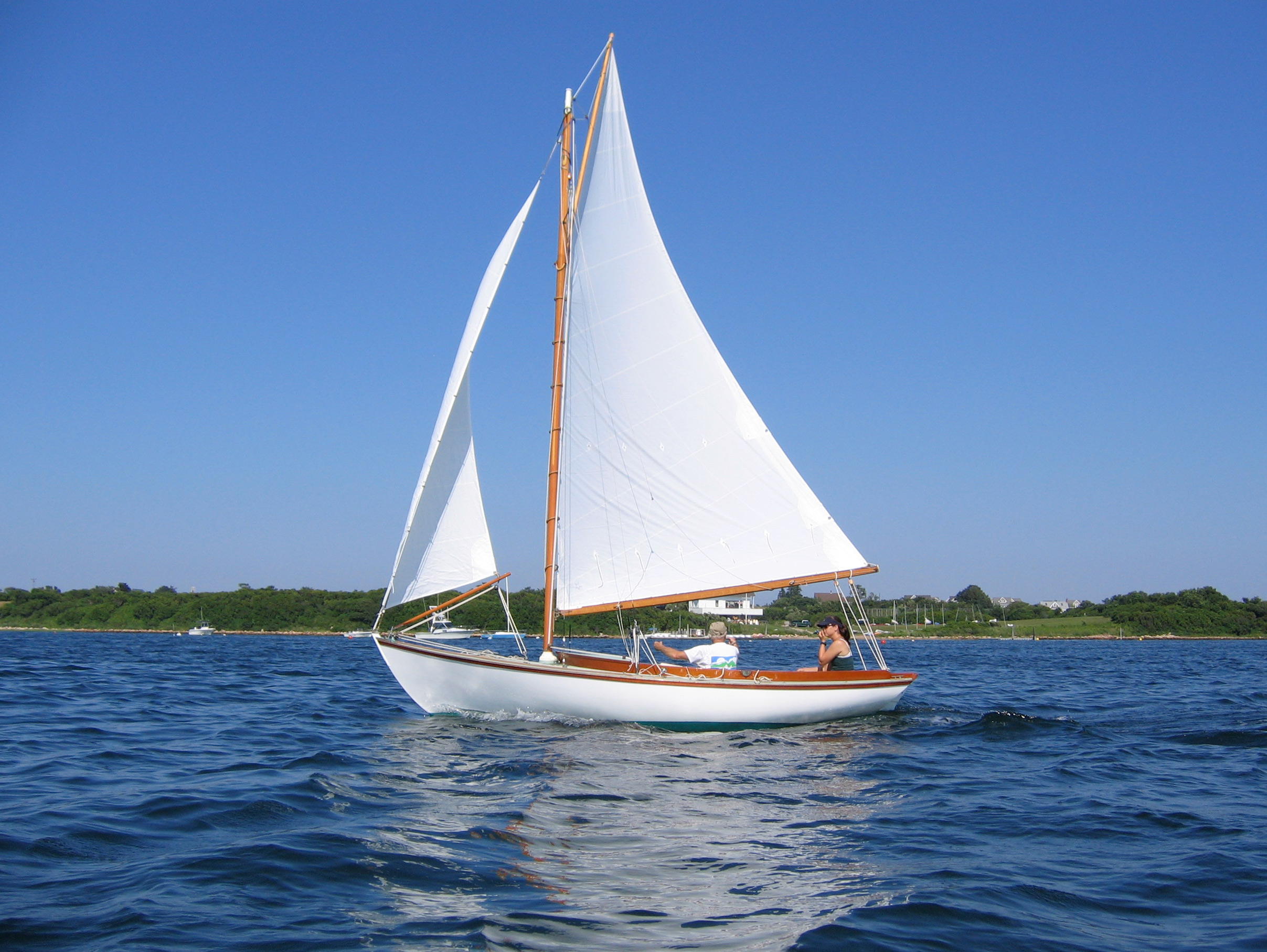 photographs courtesy of Carl Kaufmann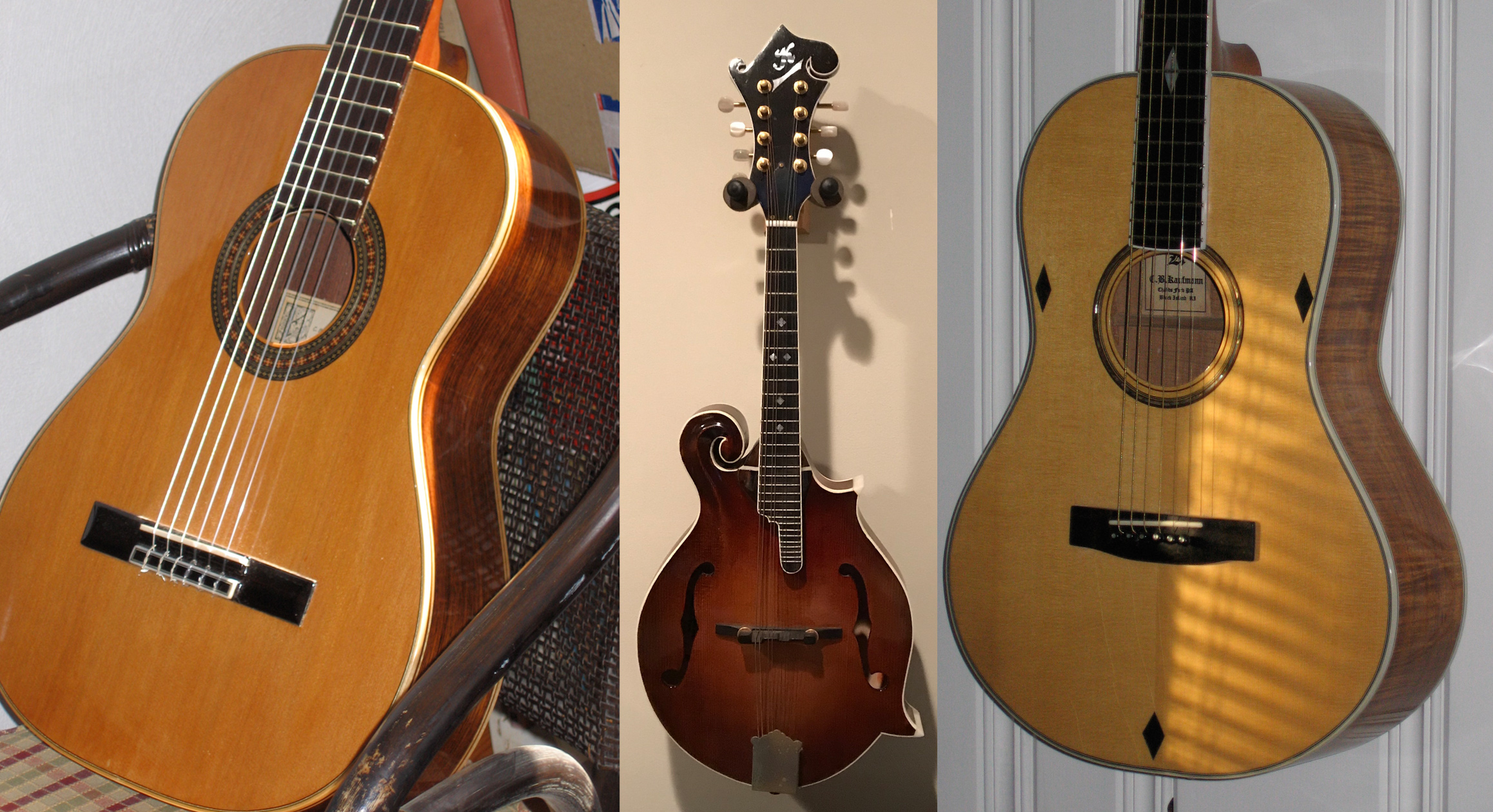
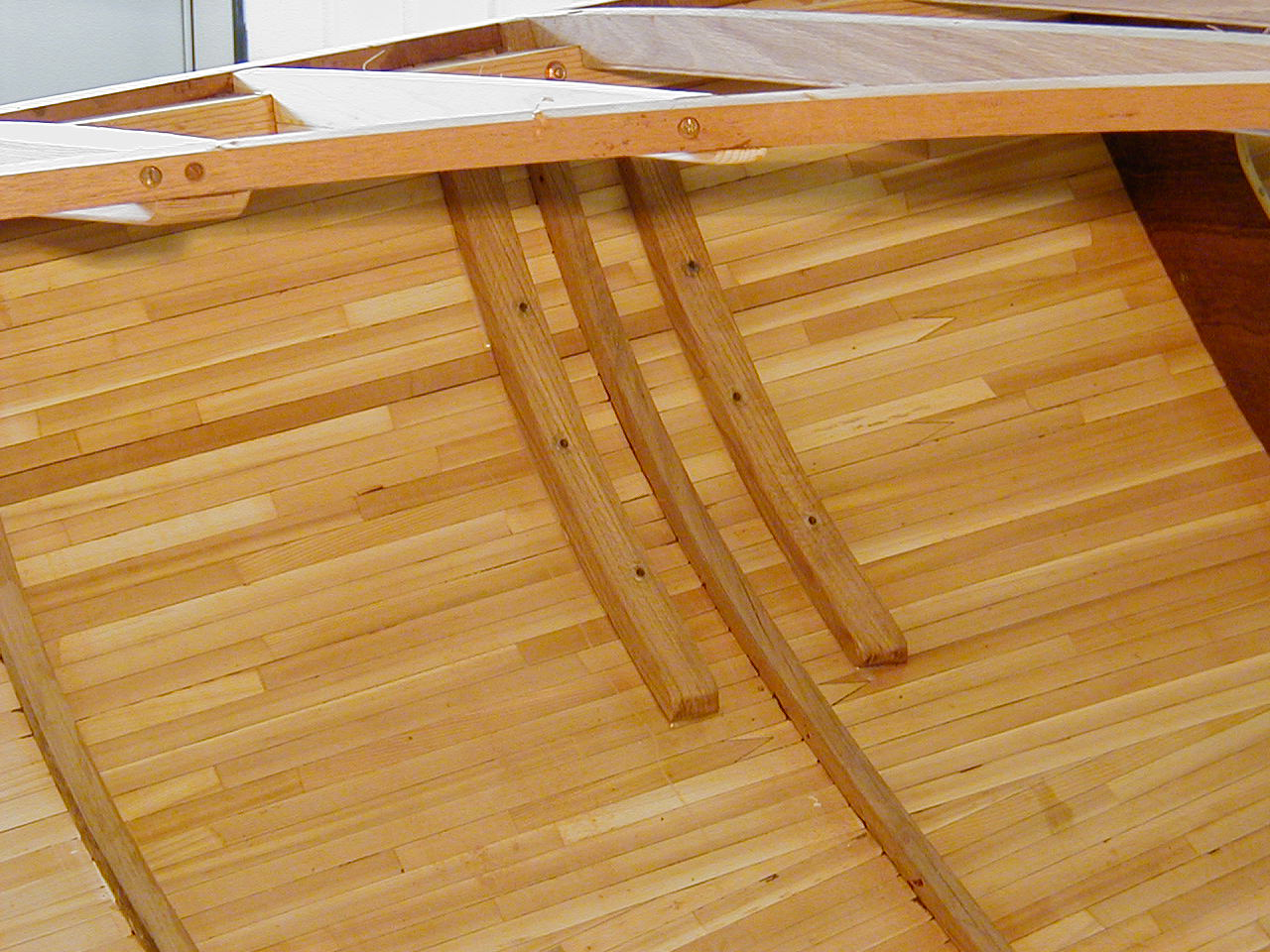
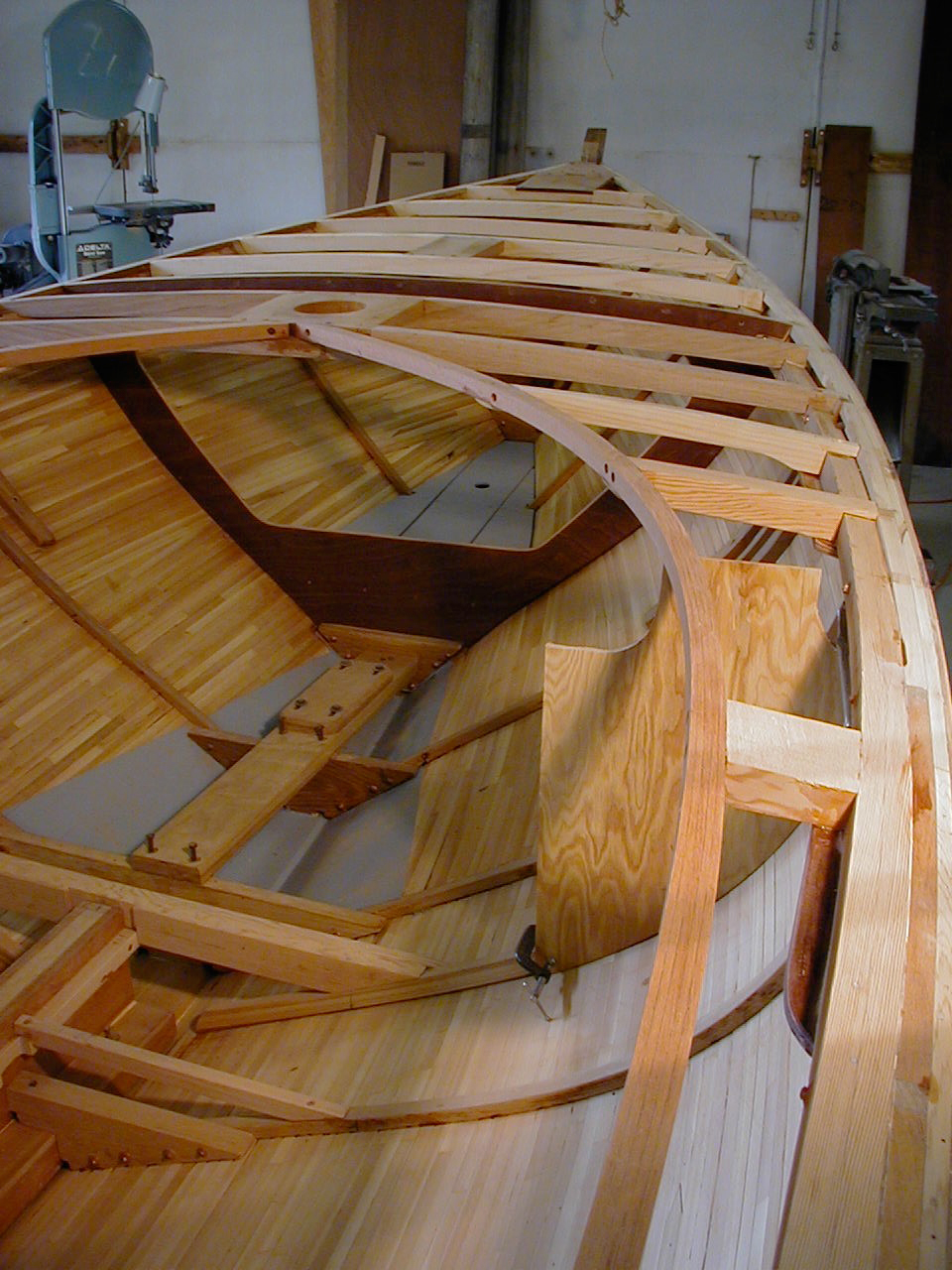
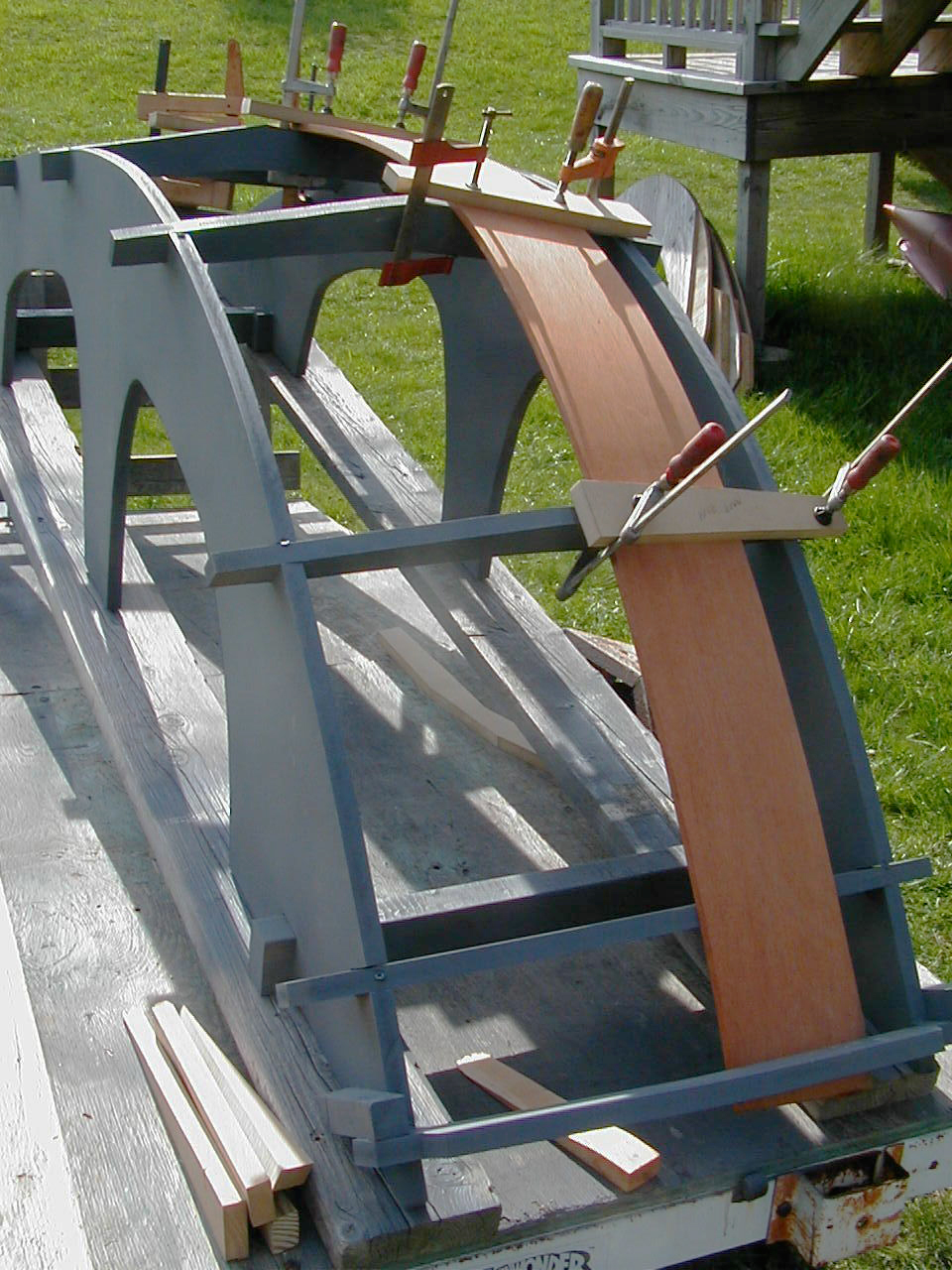
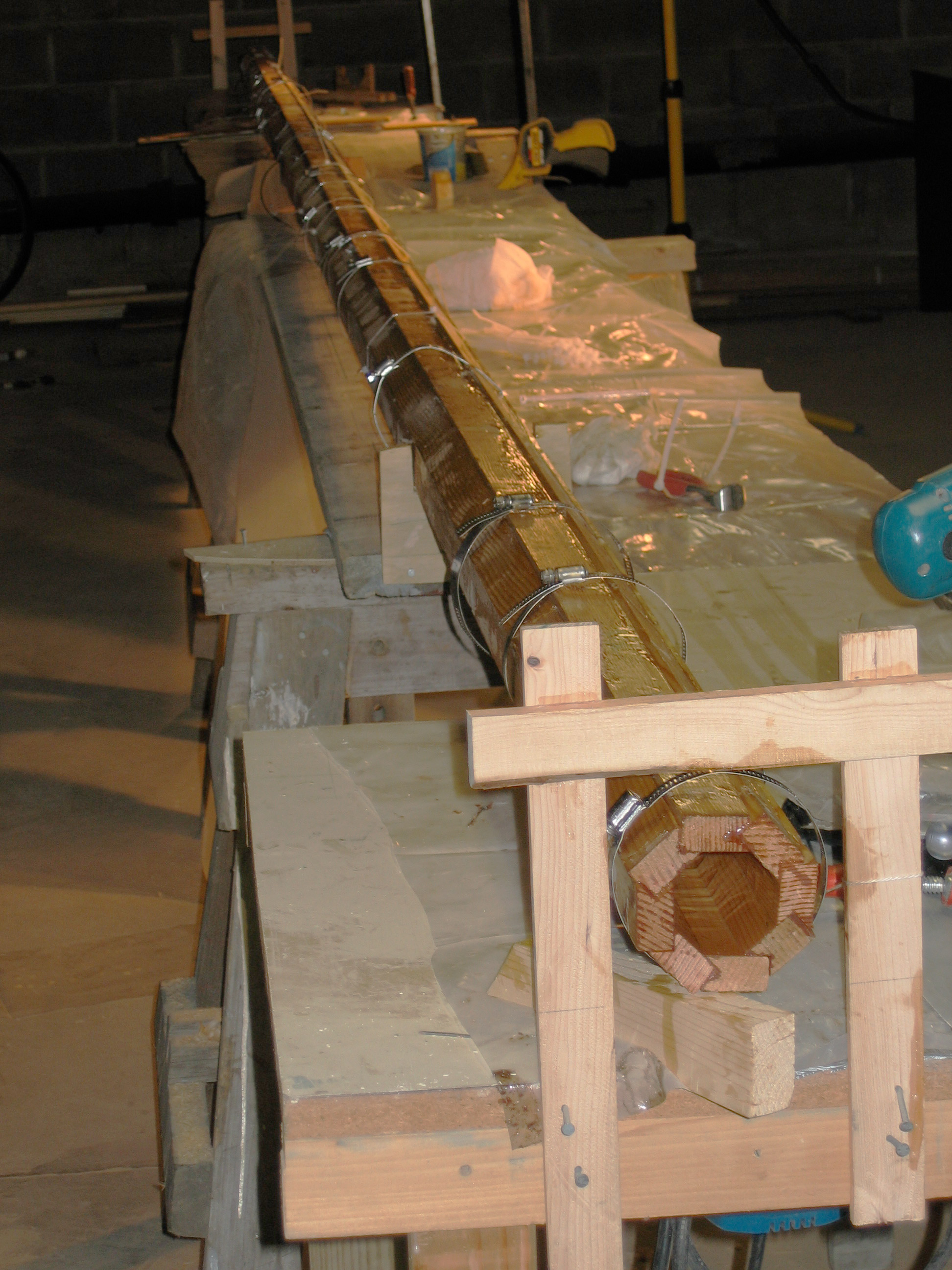
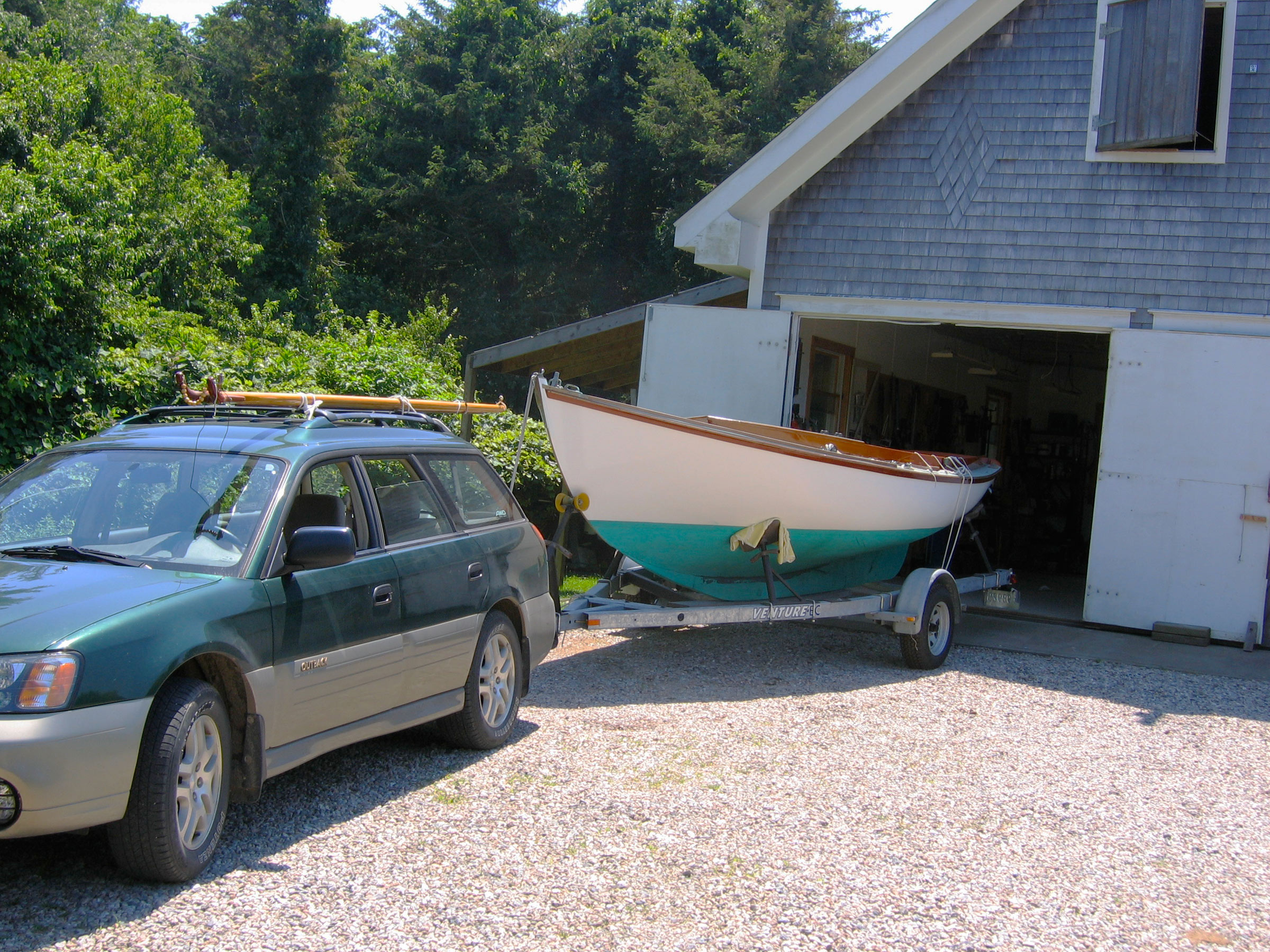


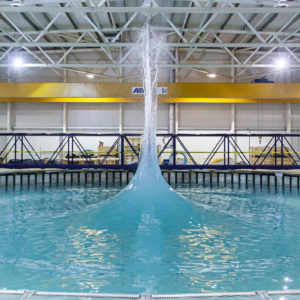

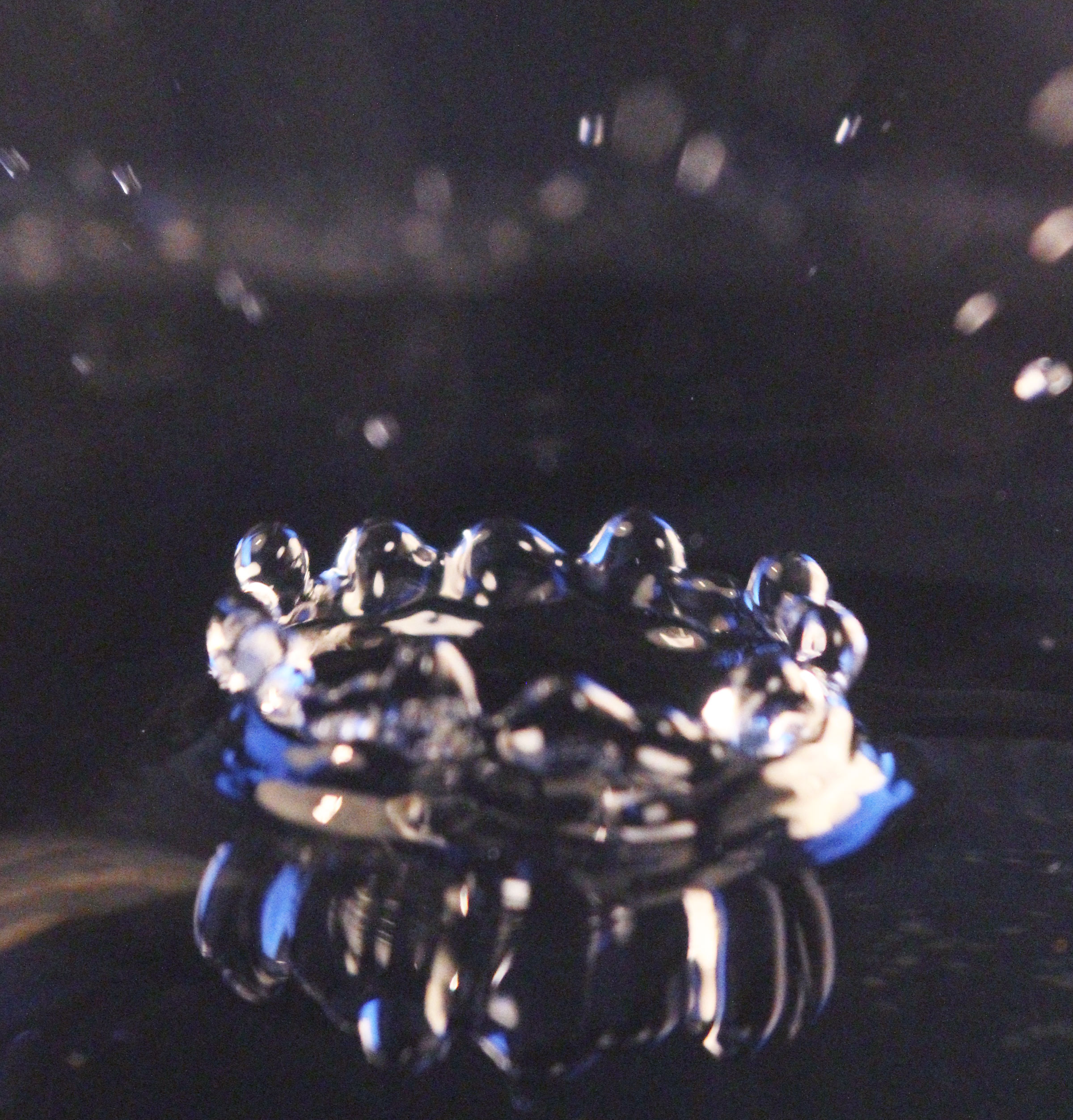

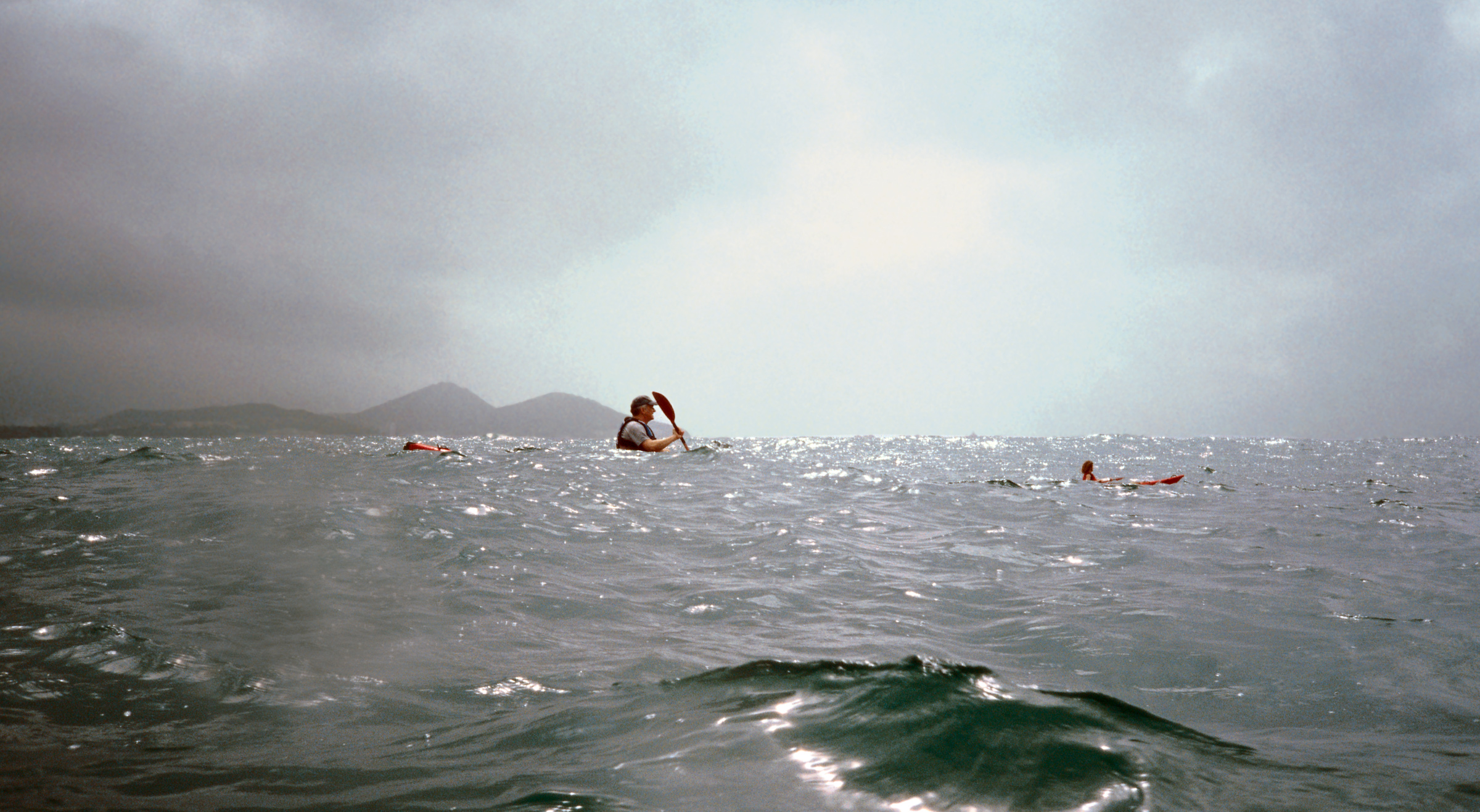
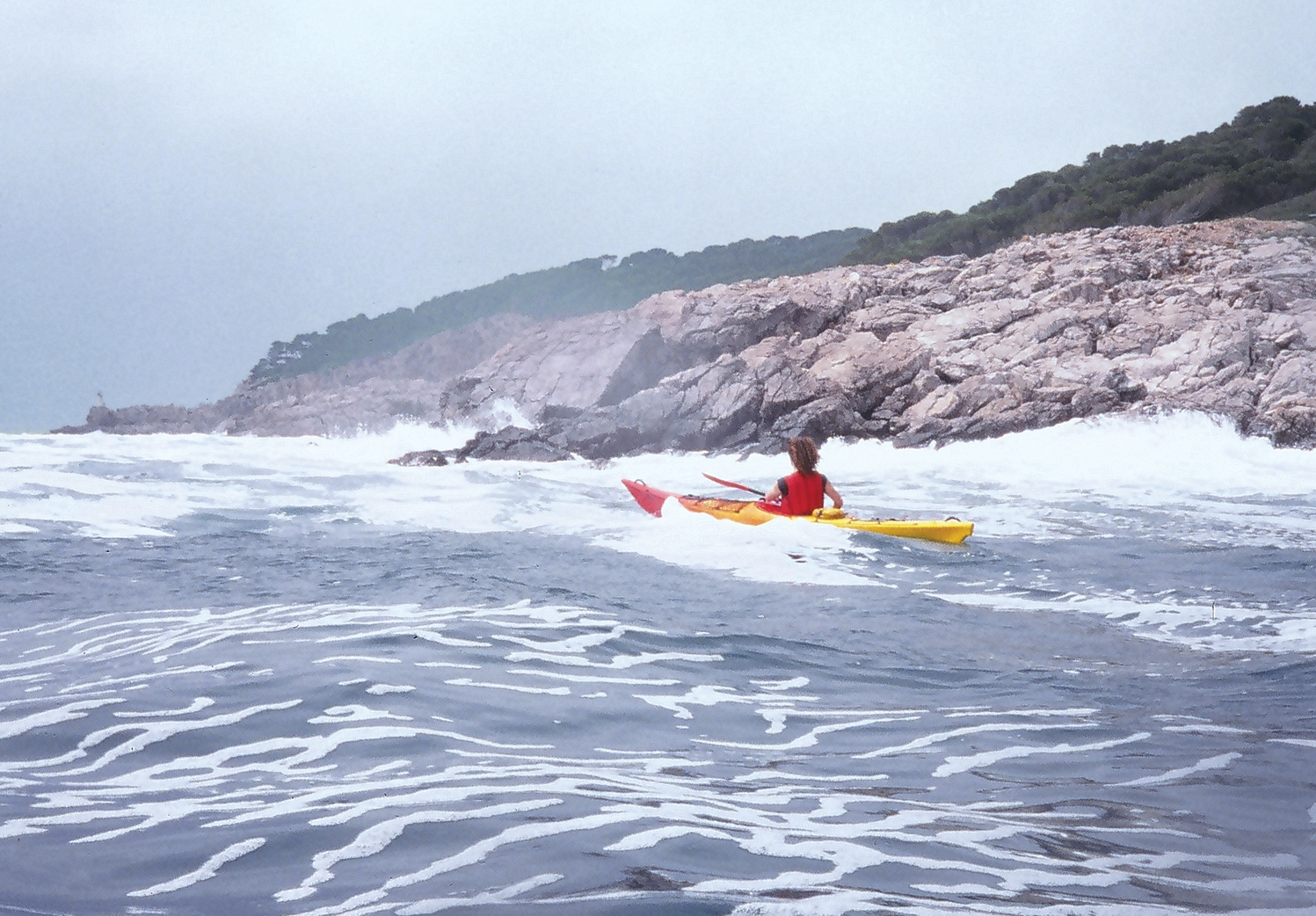
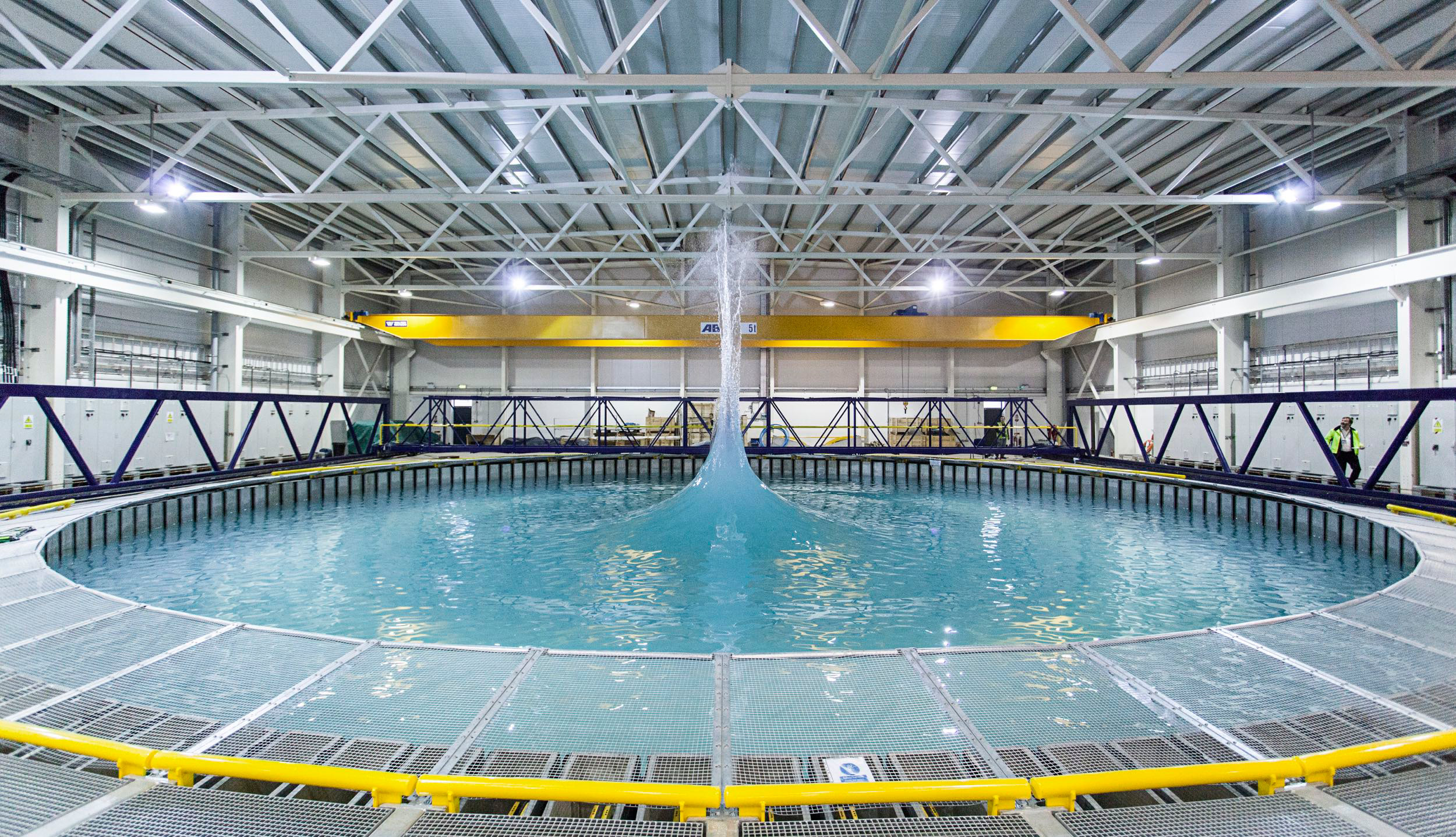


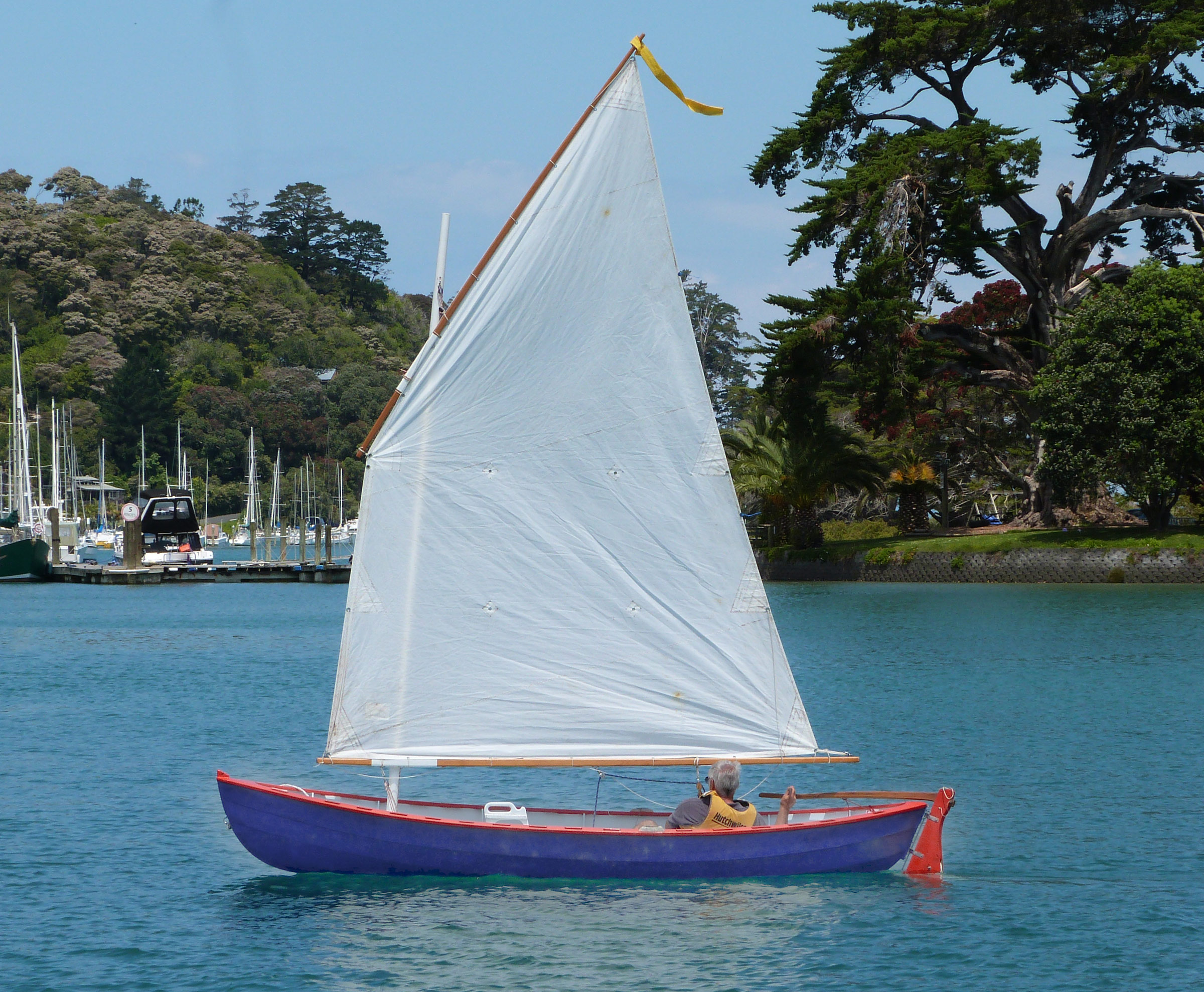
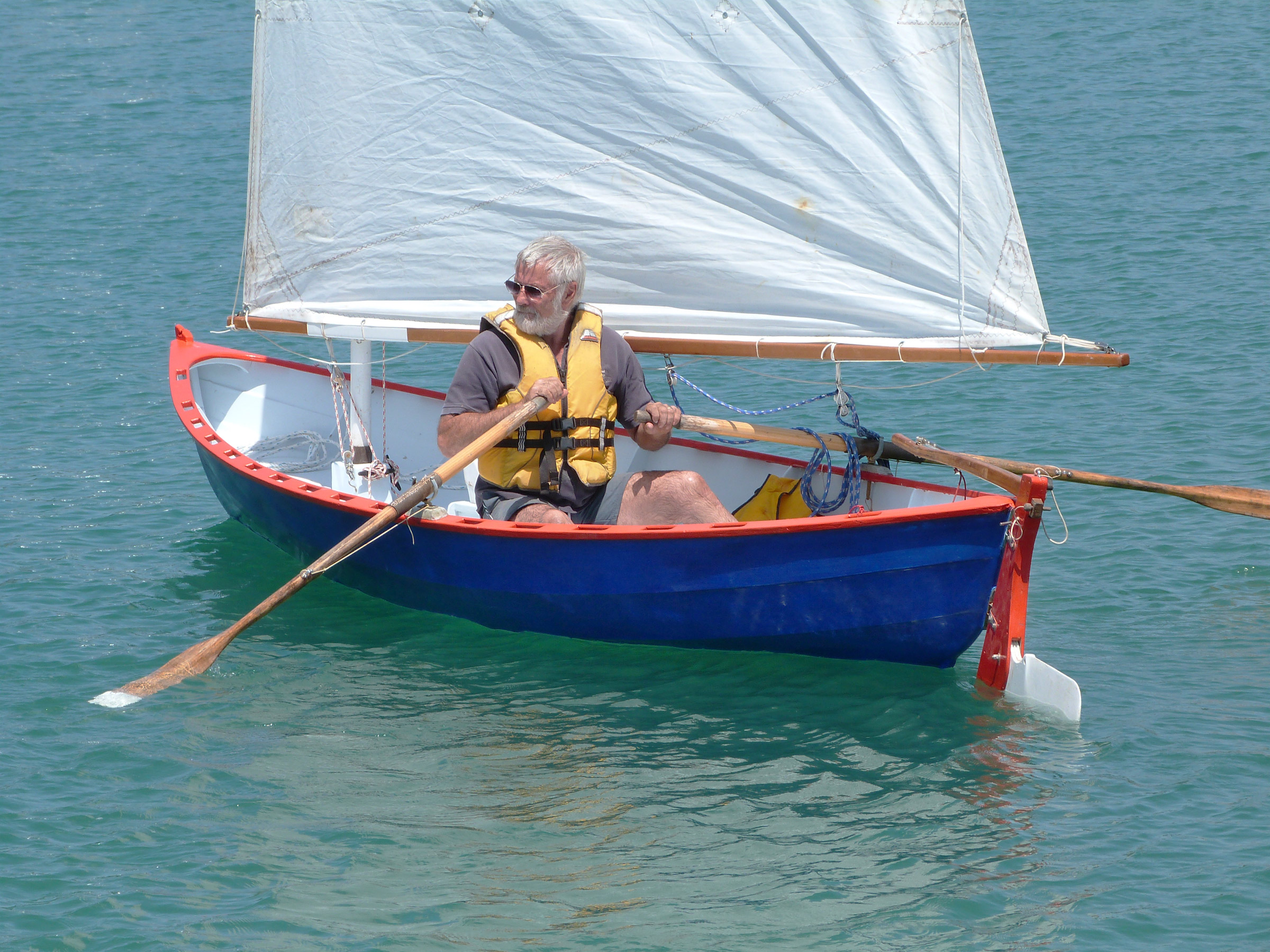
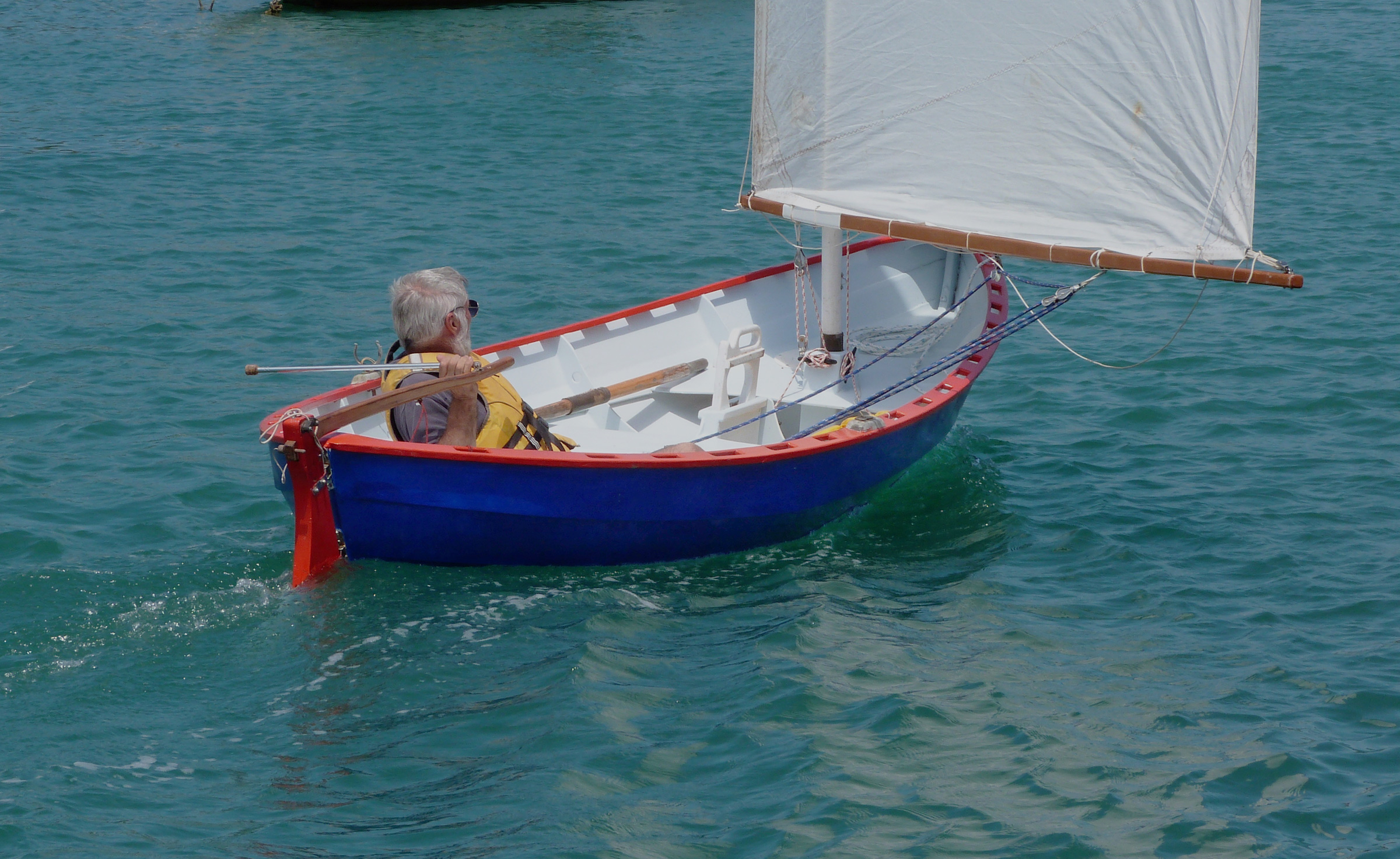
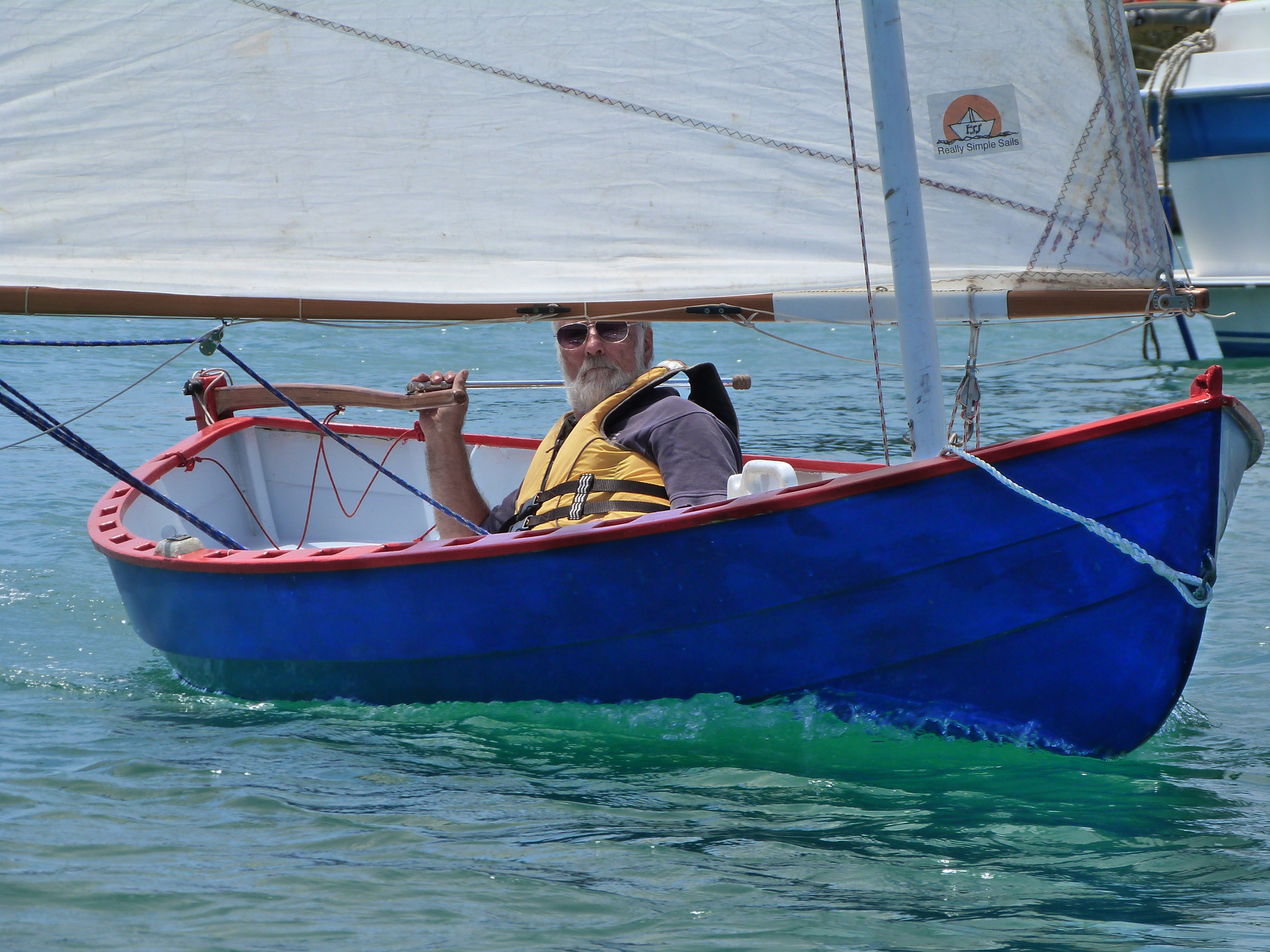
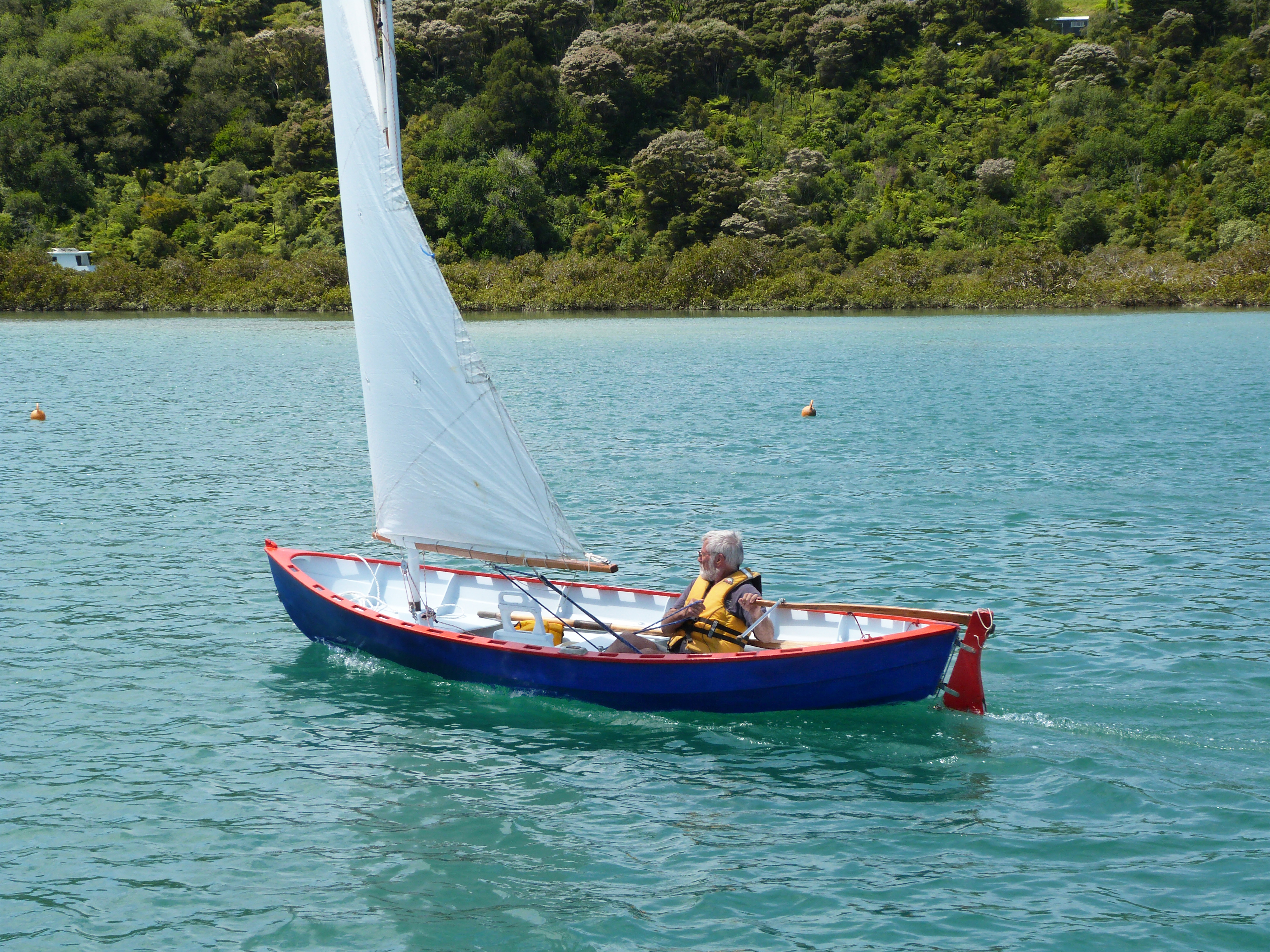
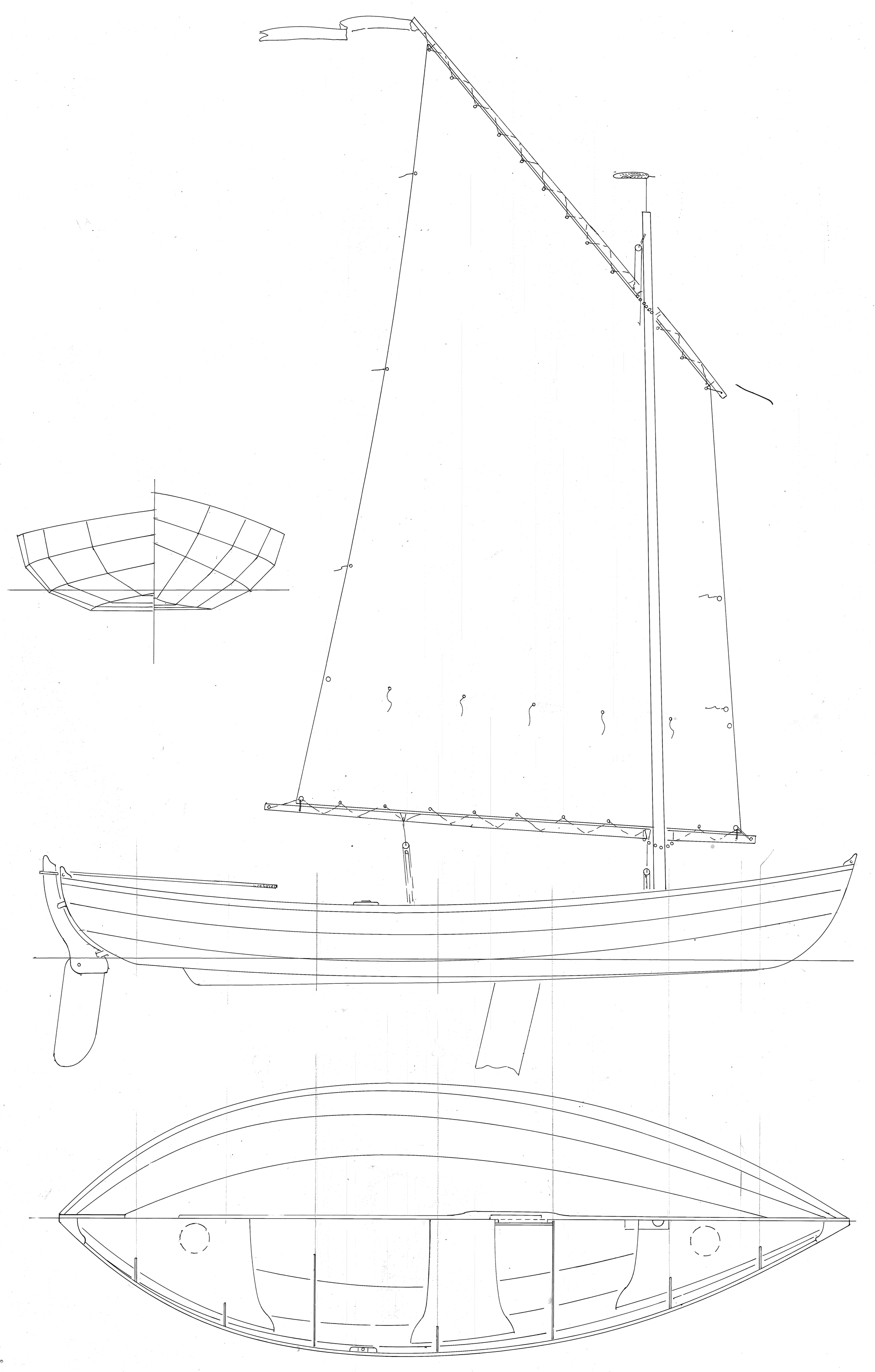
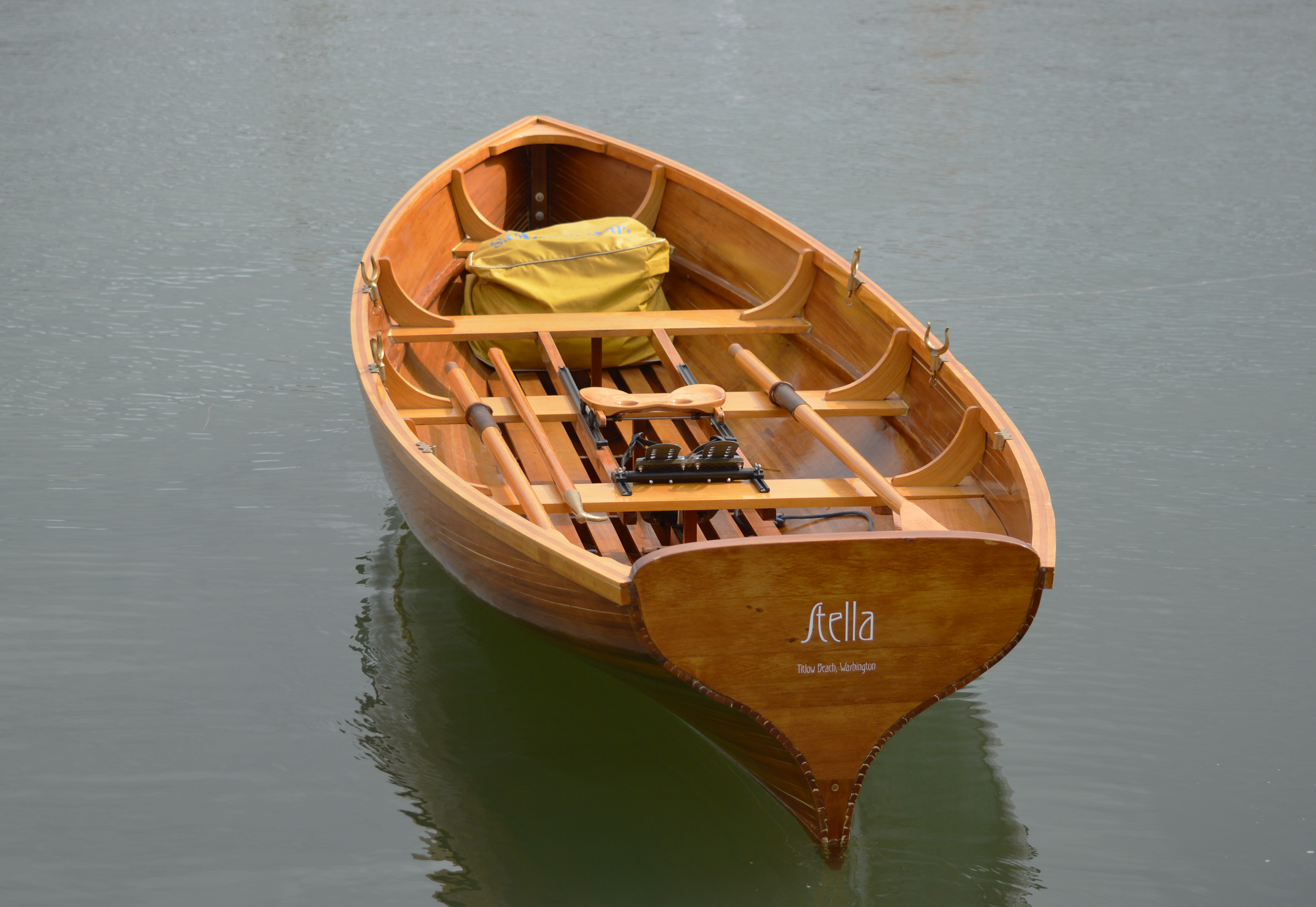
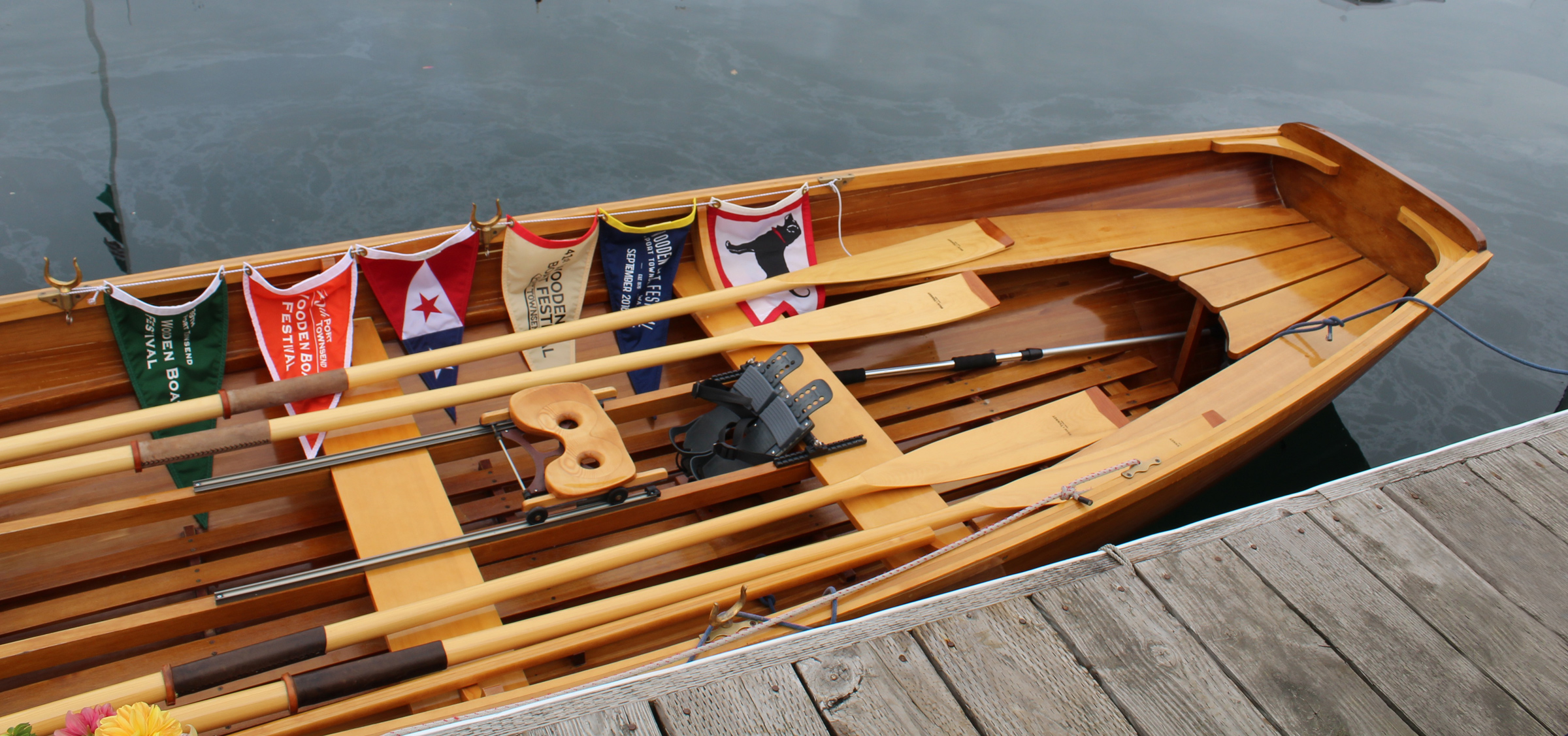
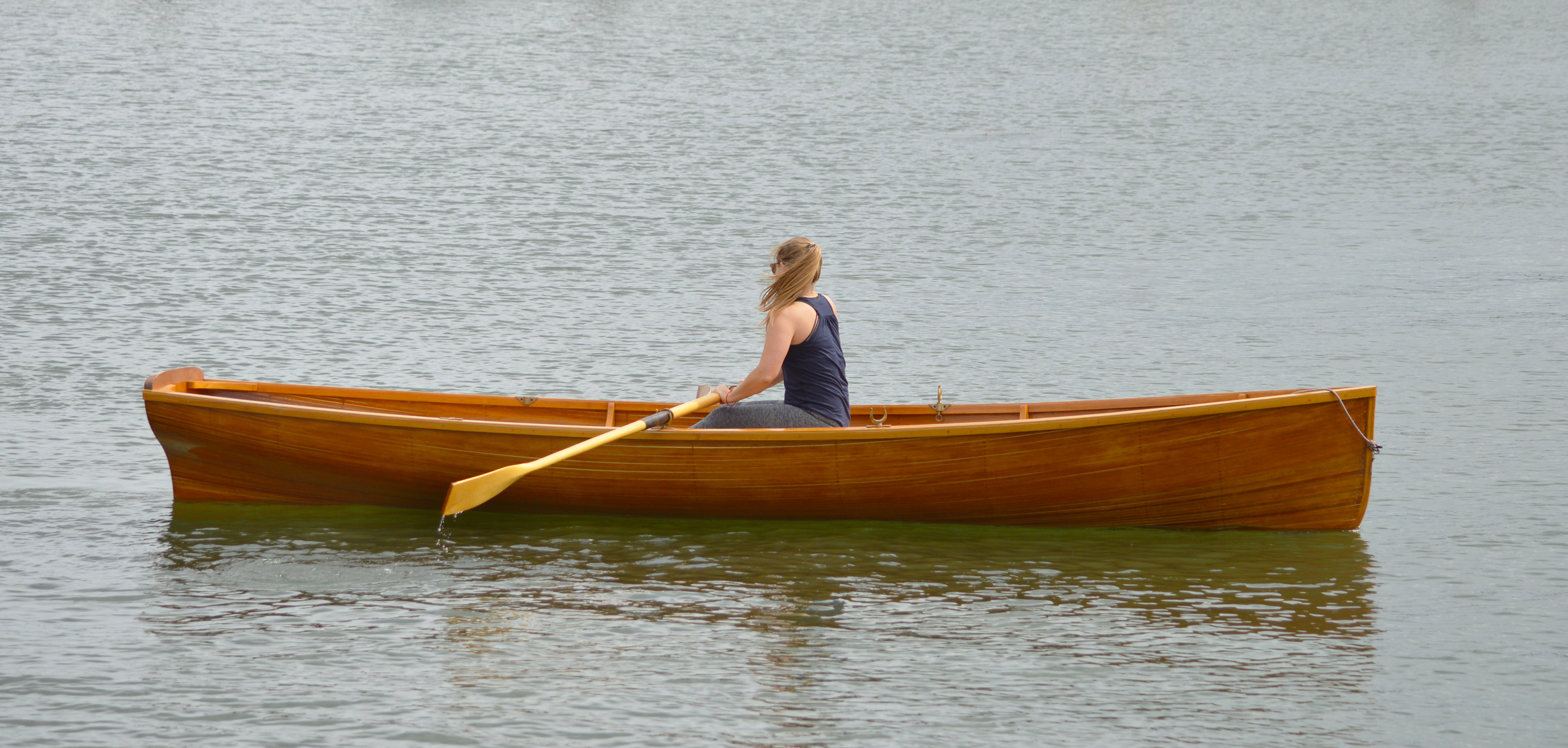
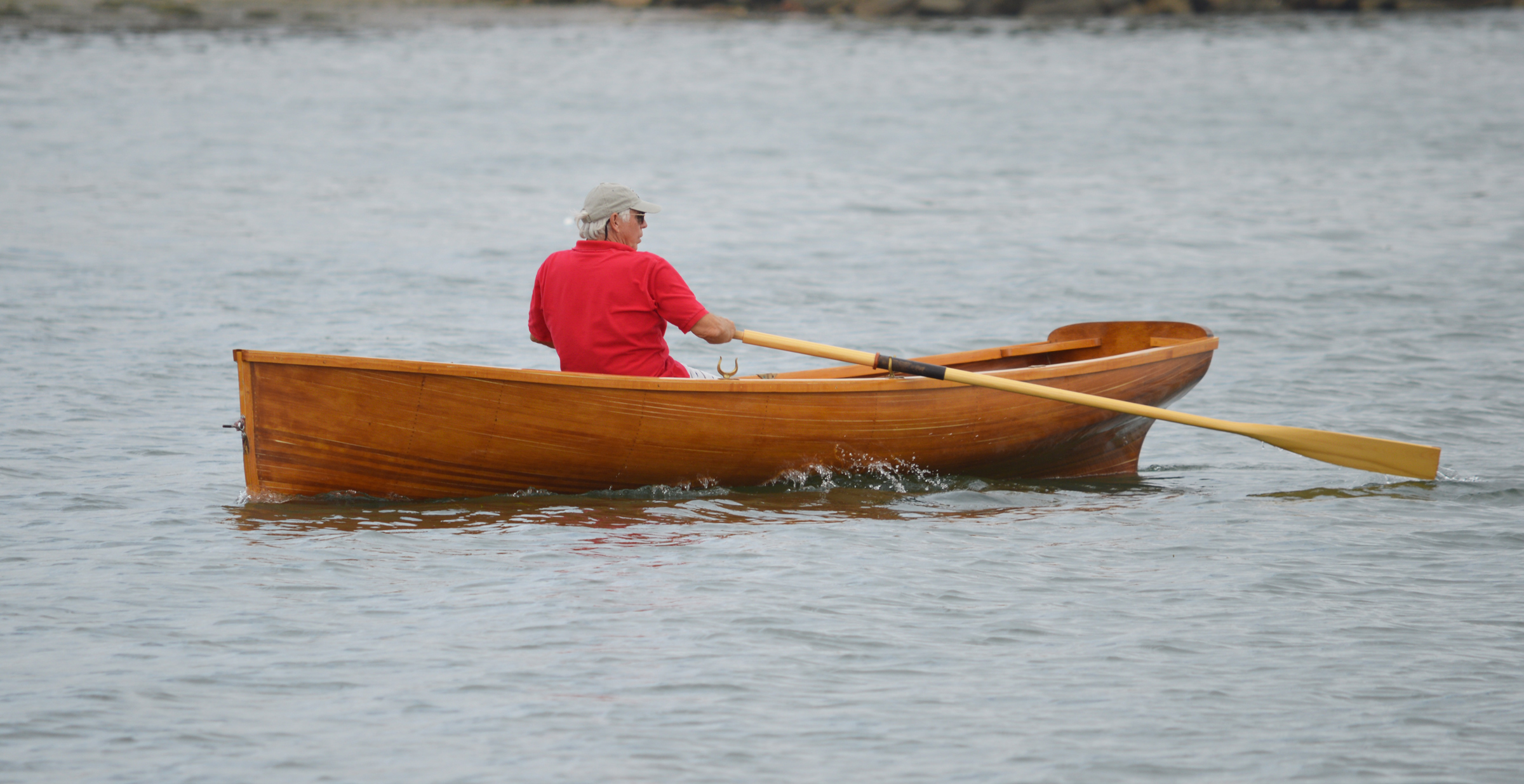
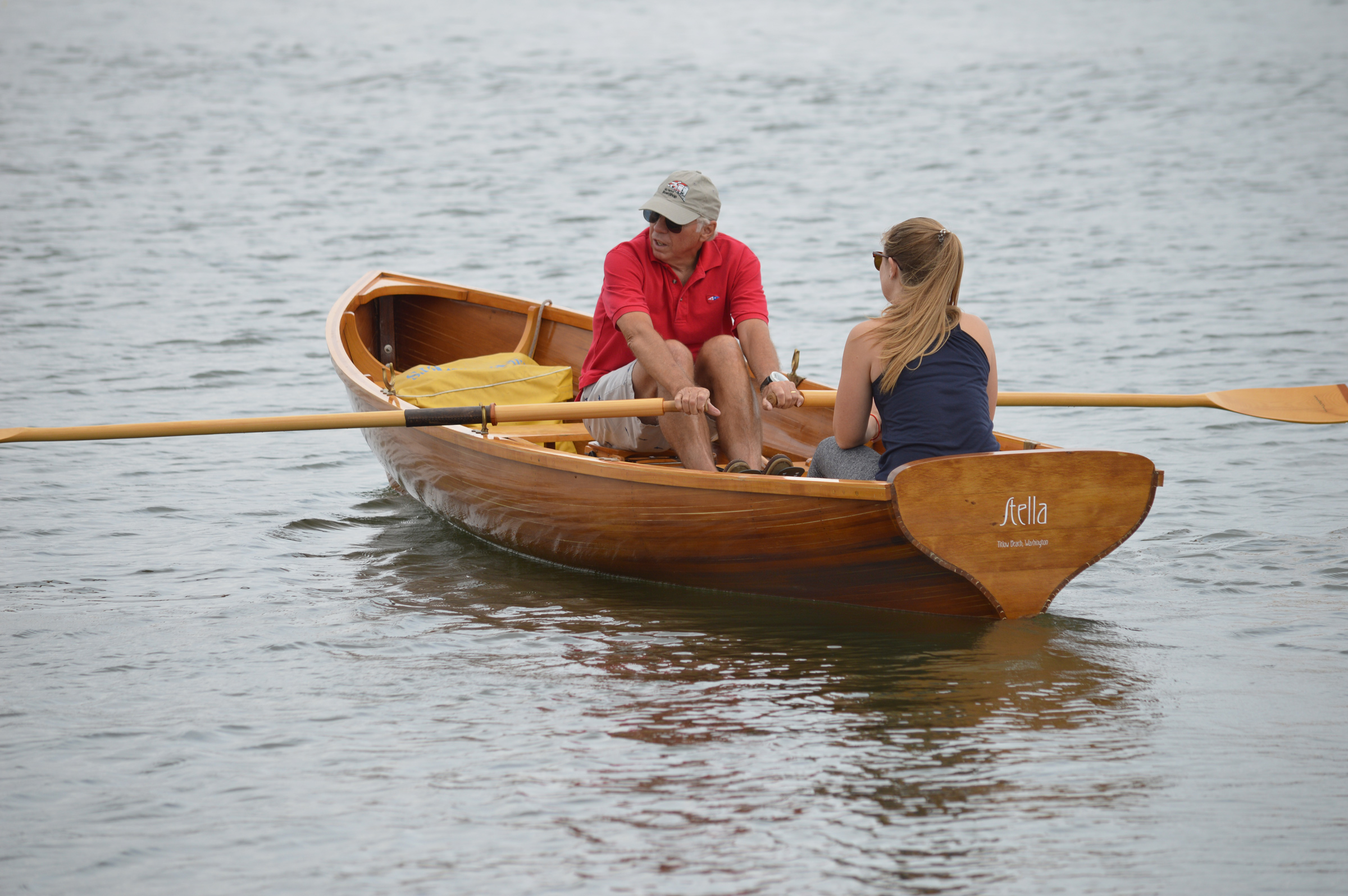
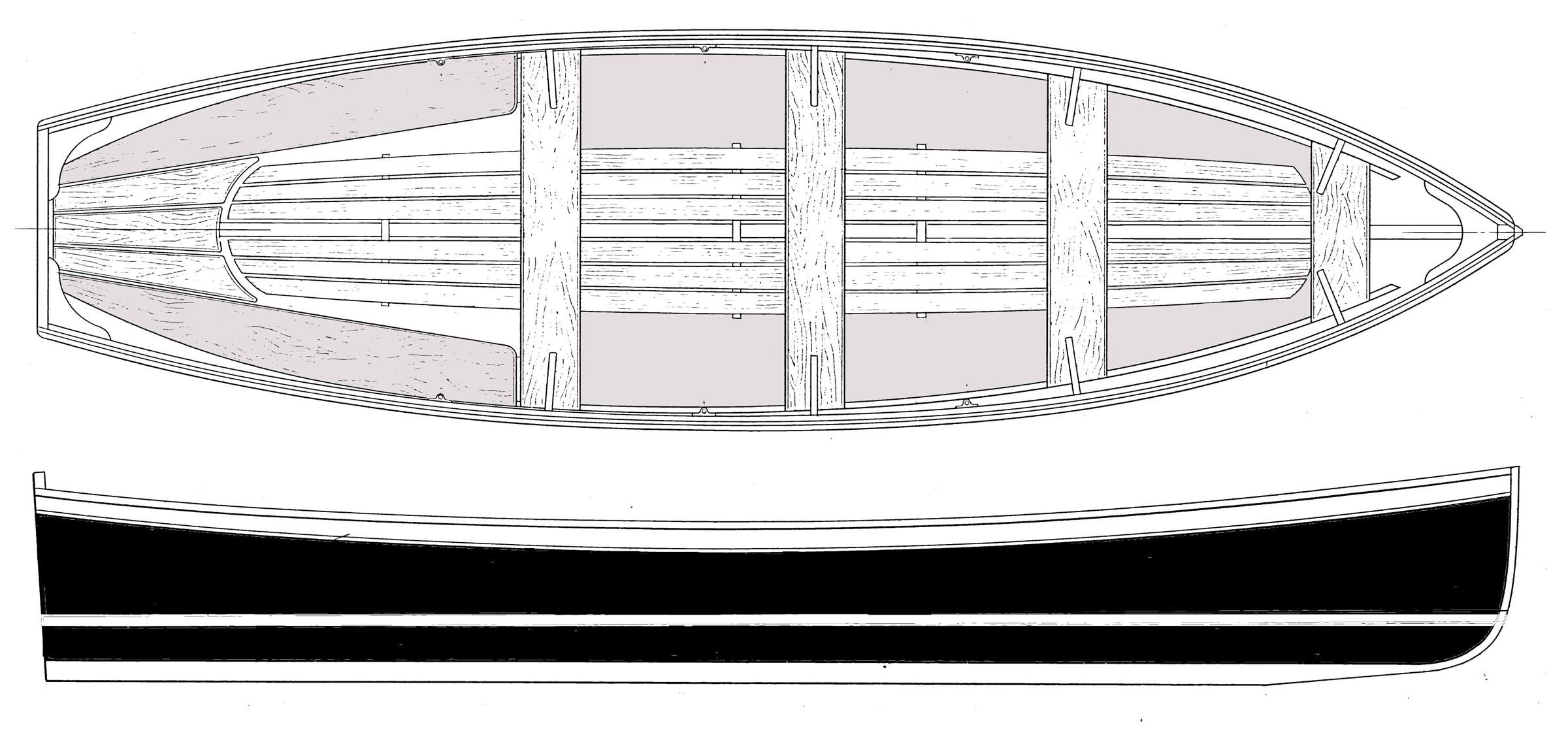
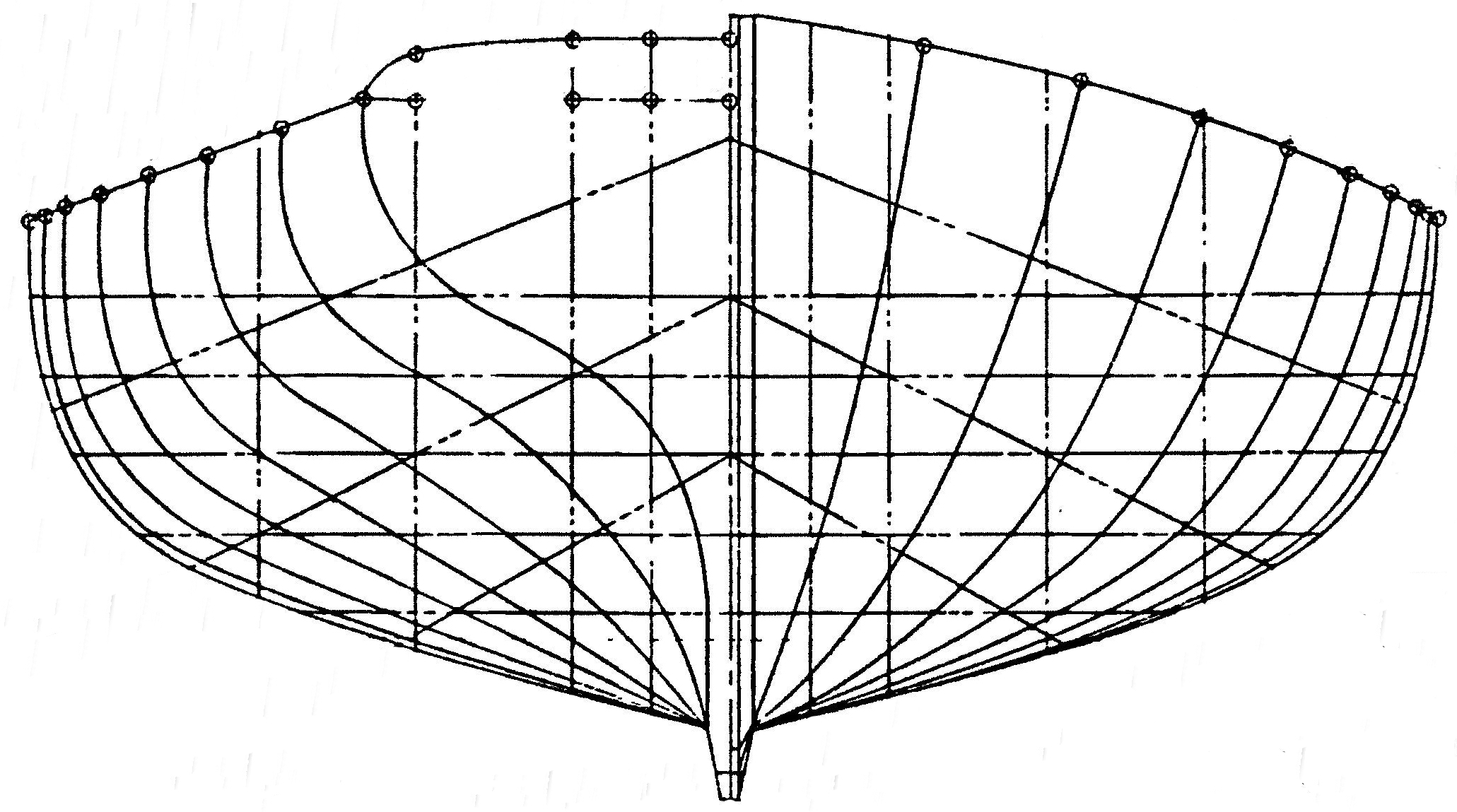
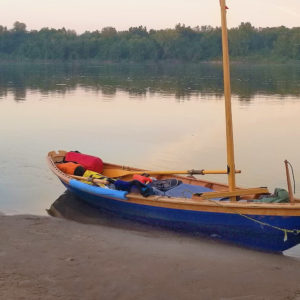

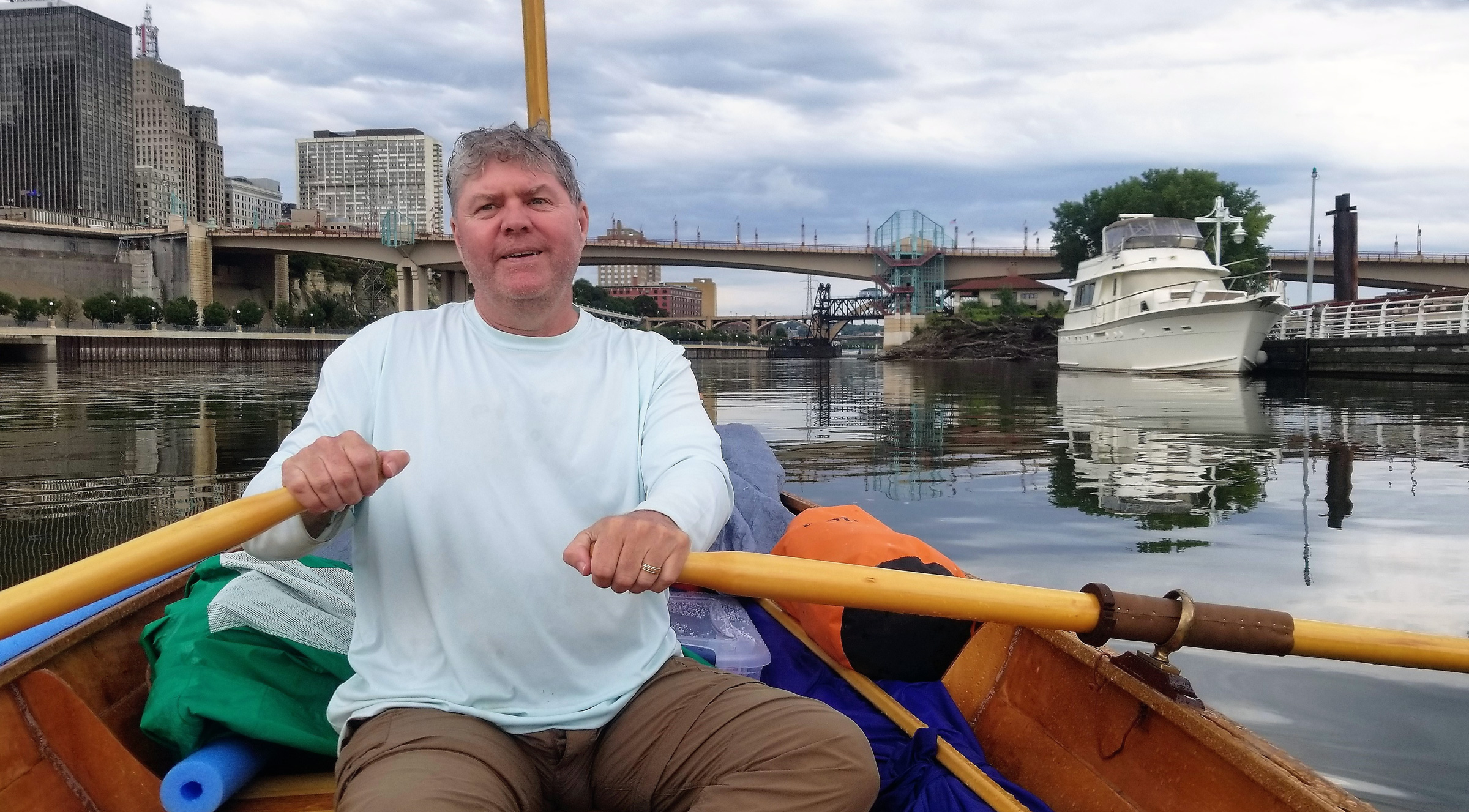
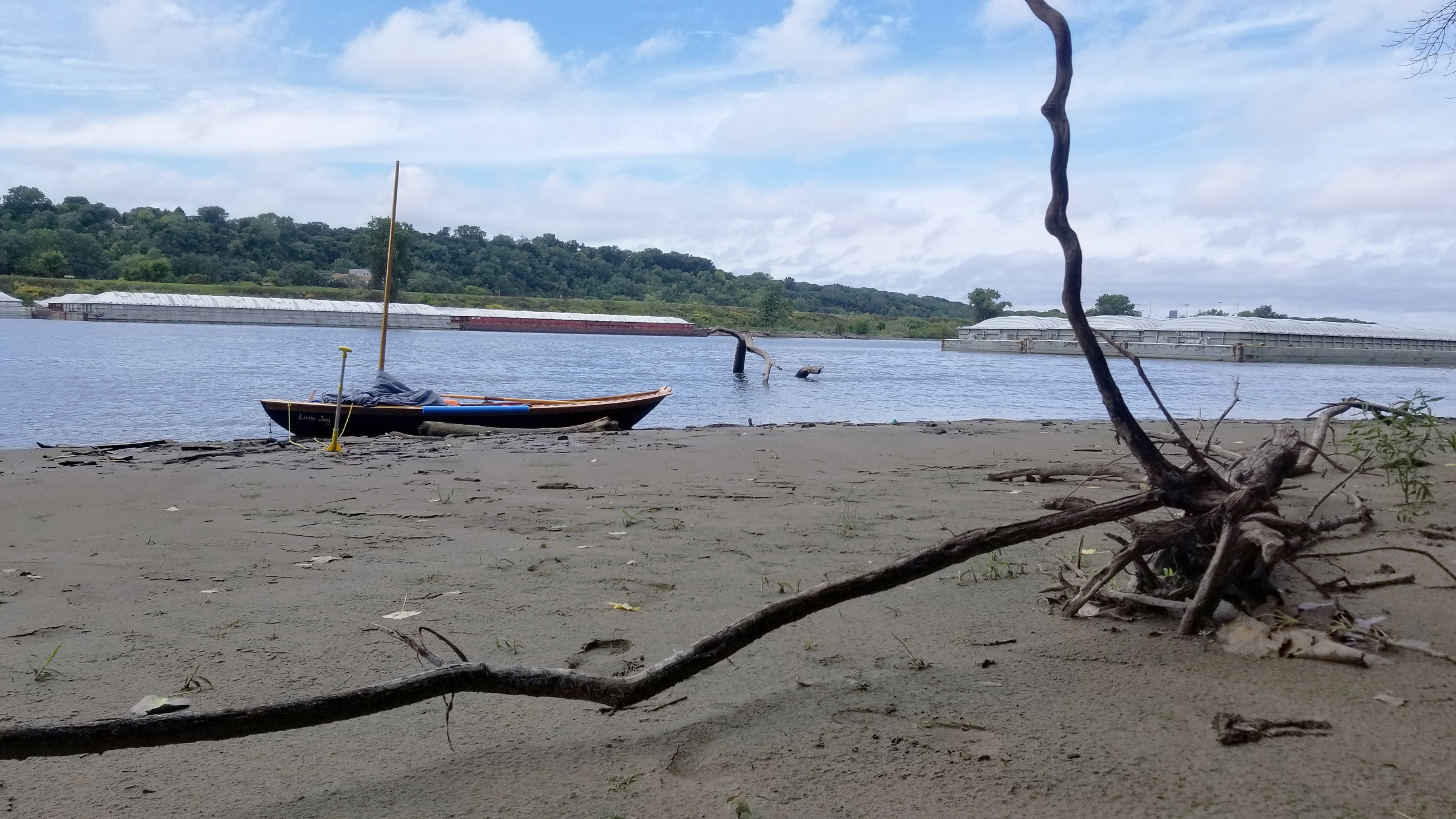
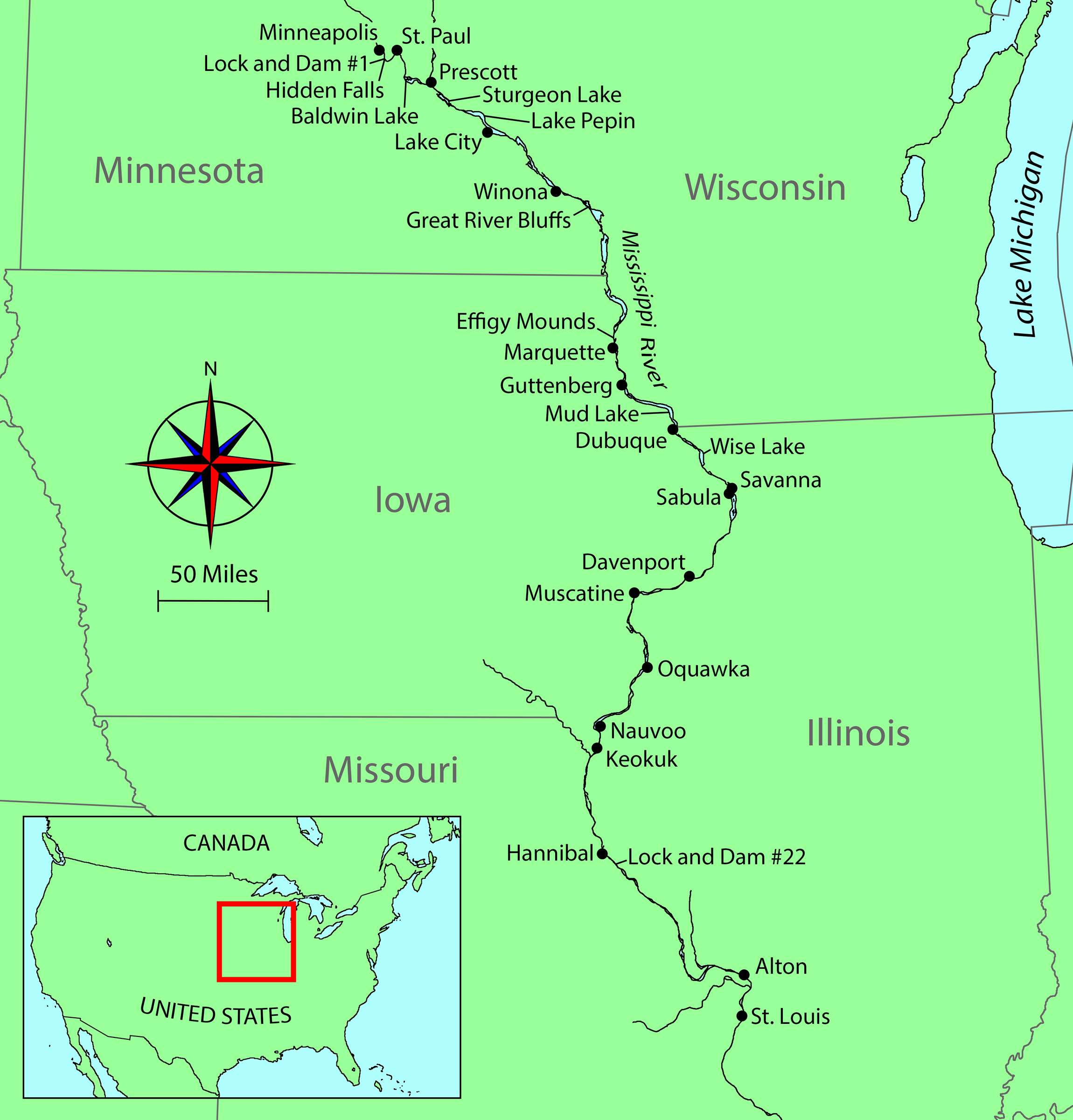
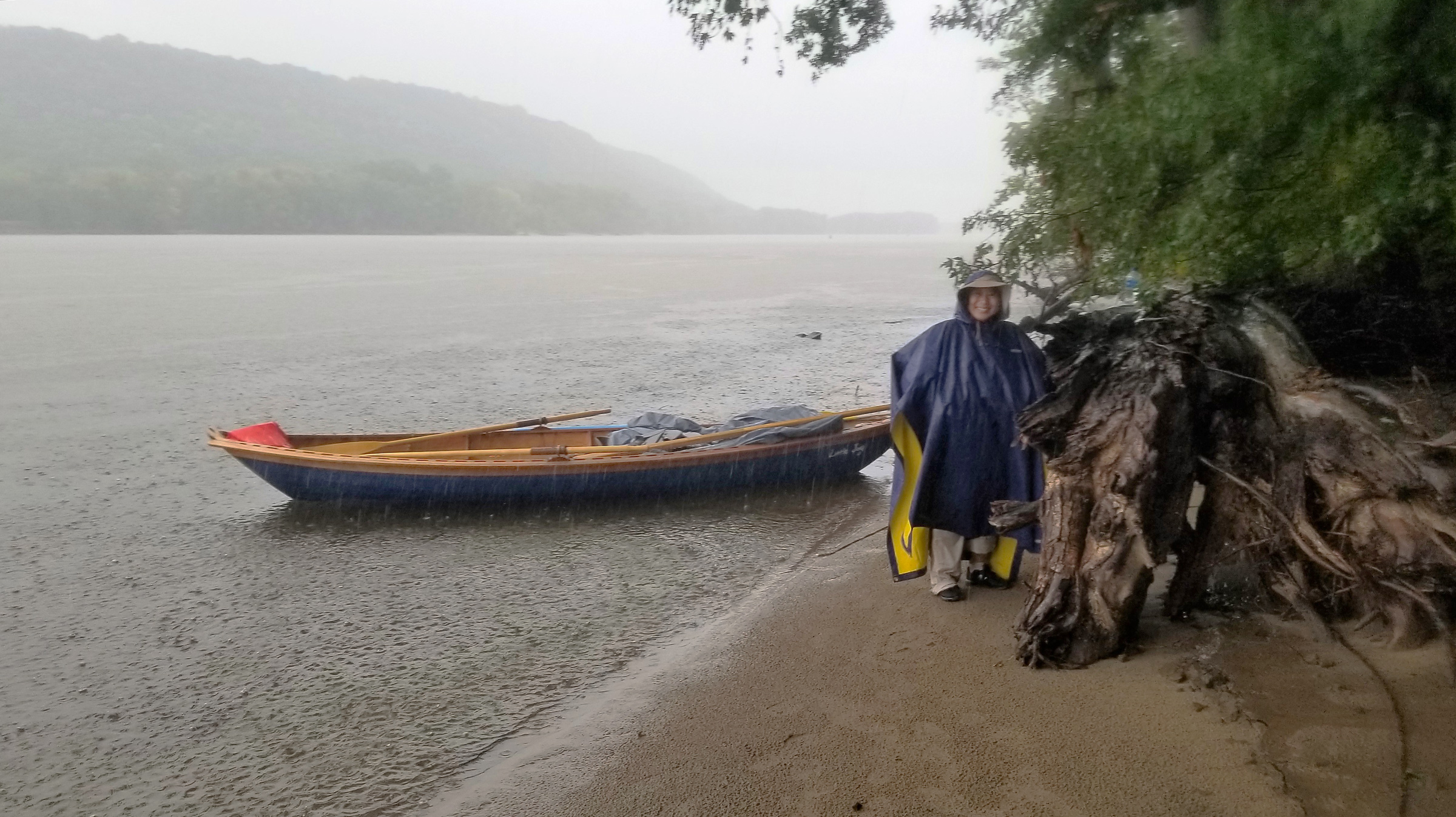
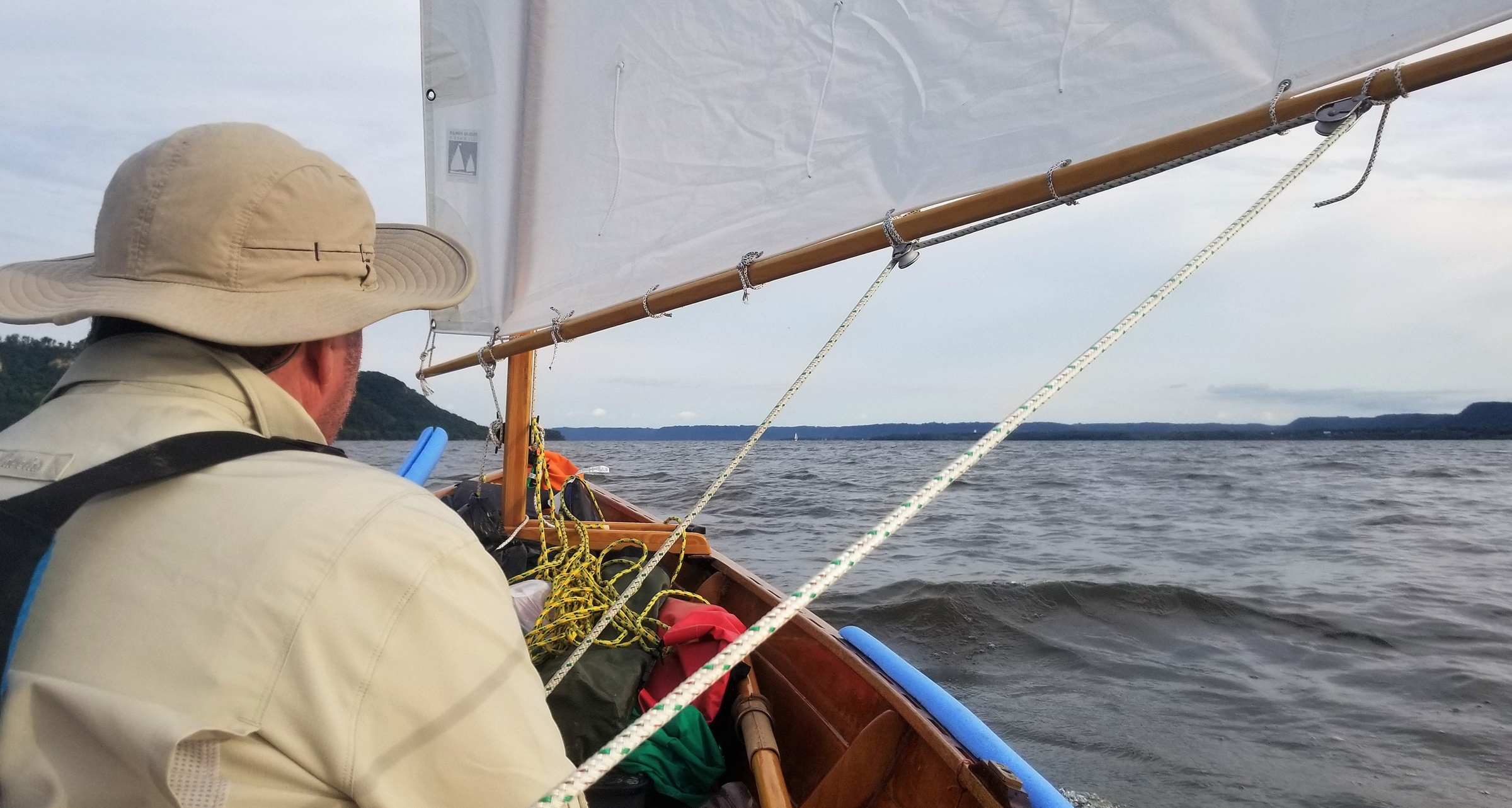
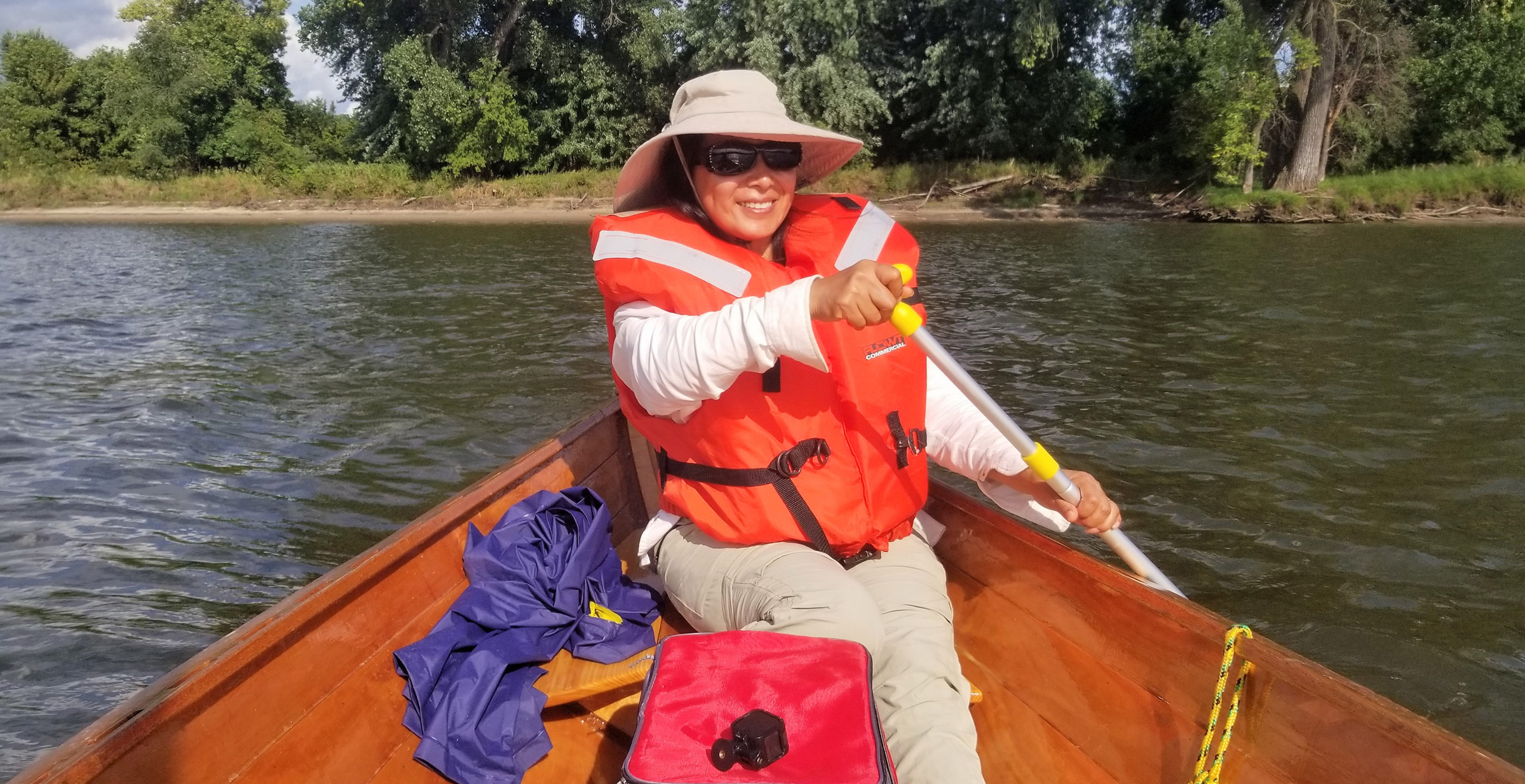
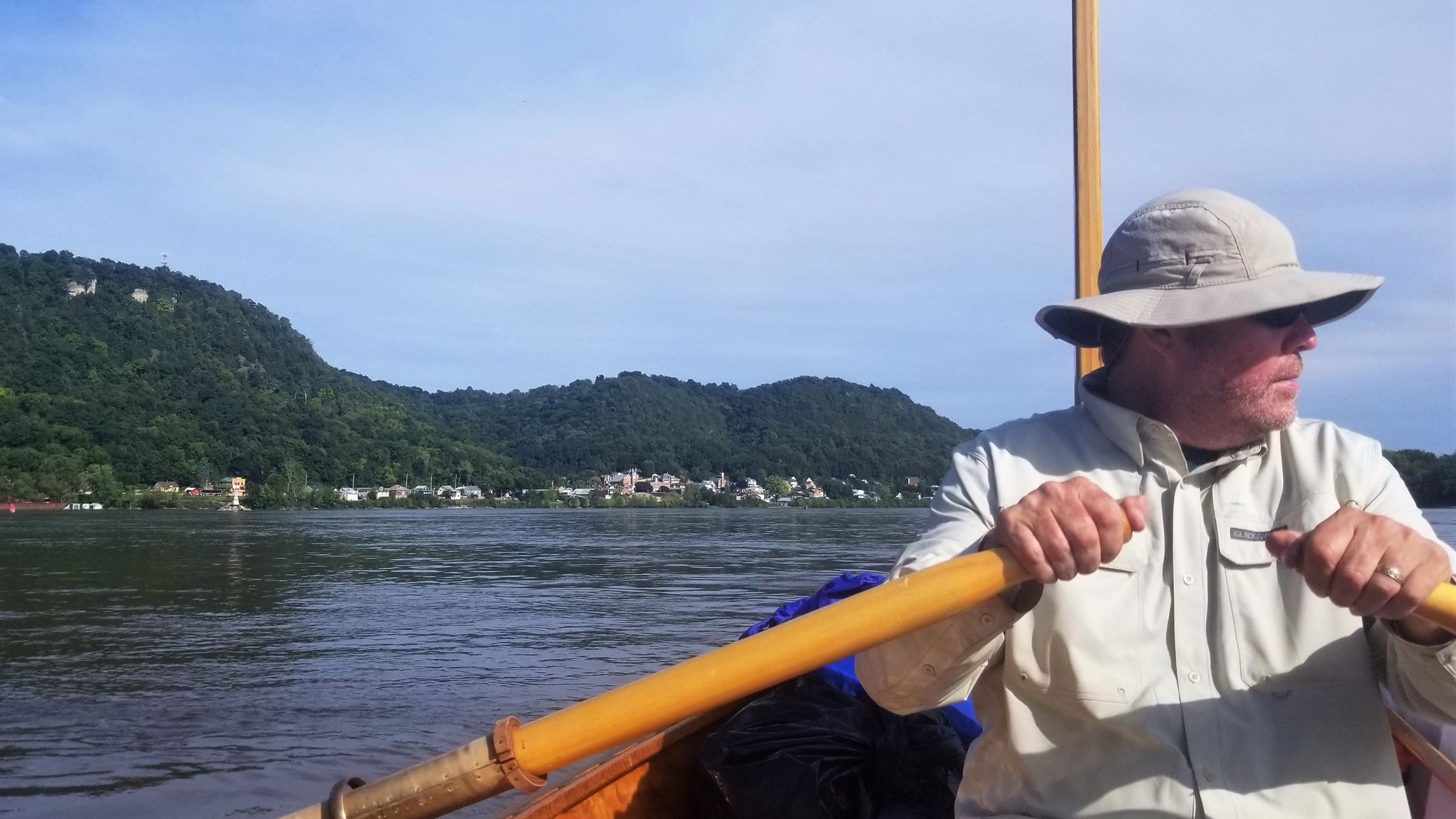

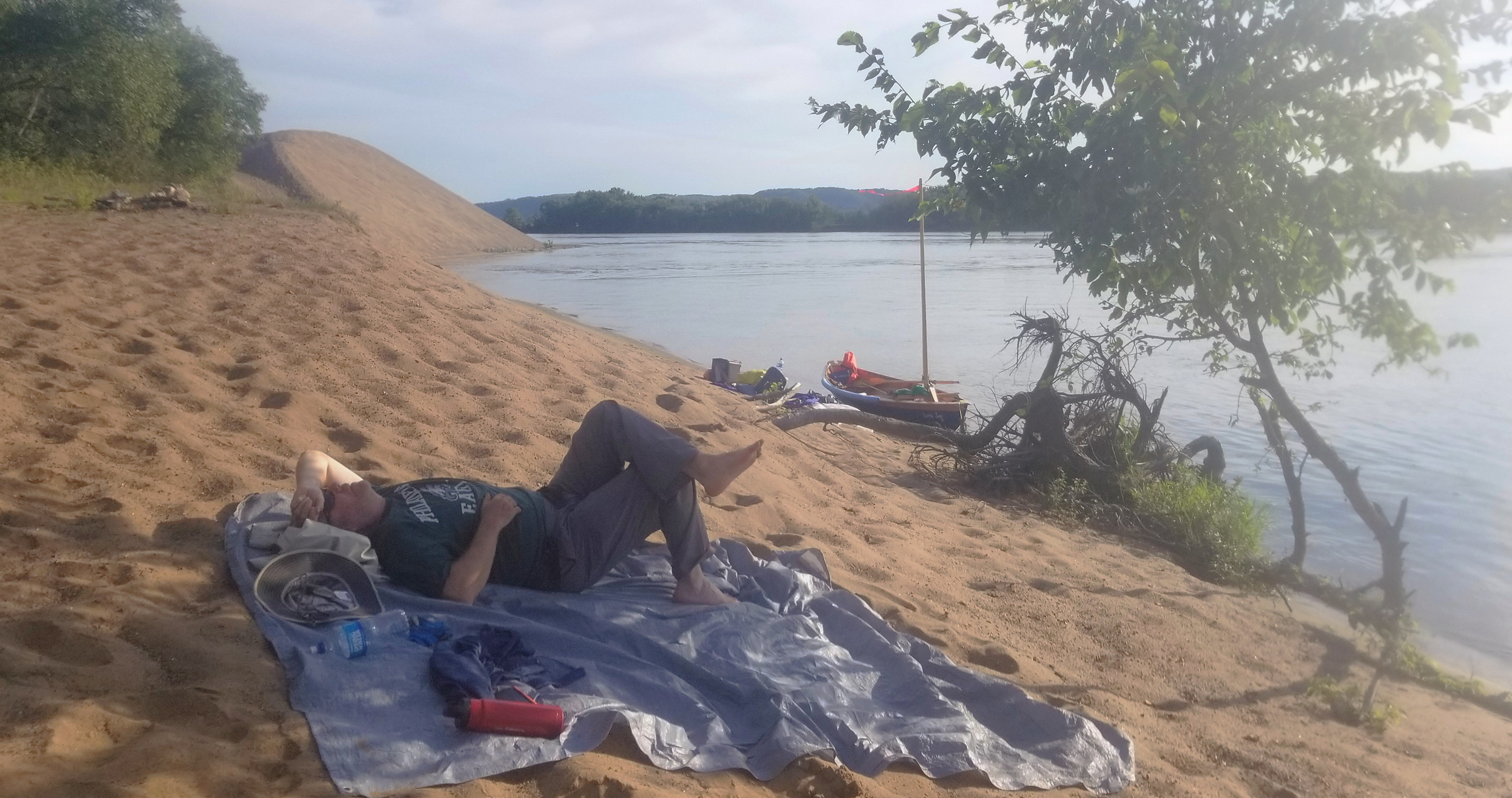
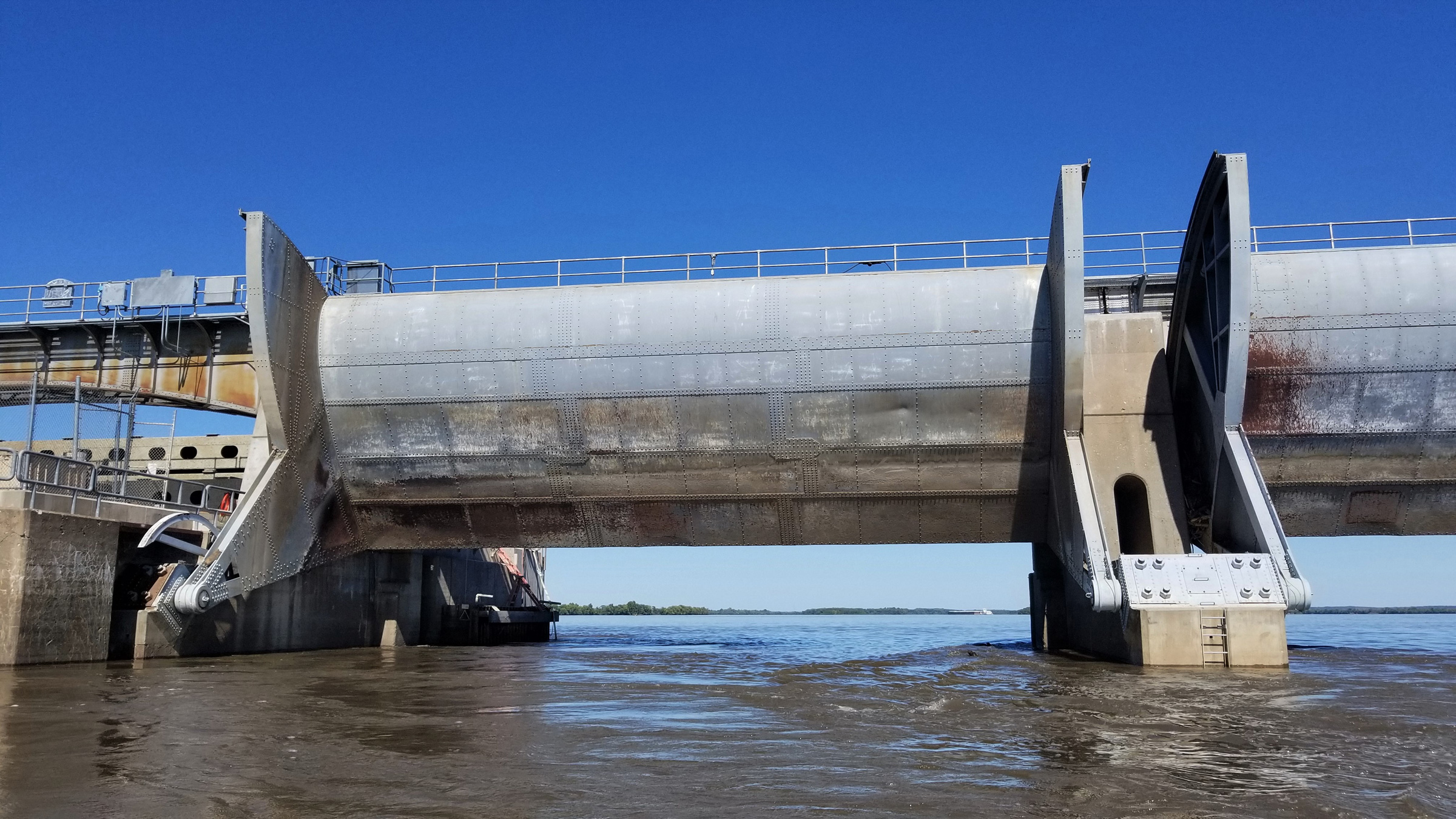
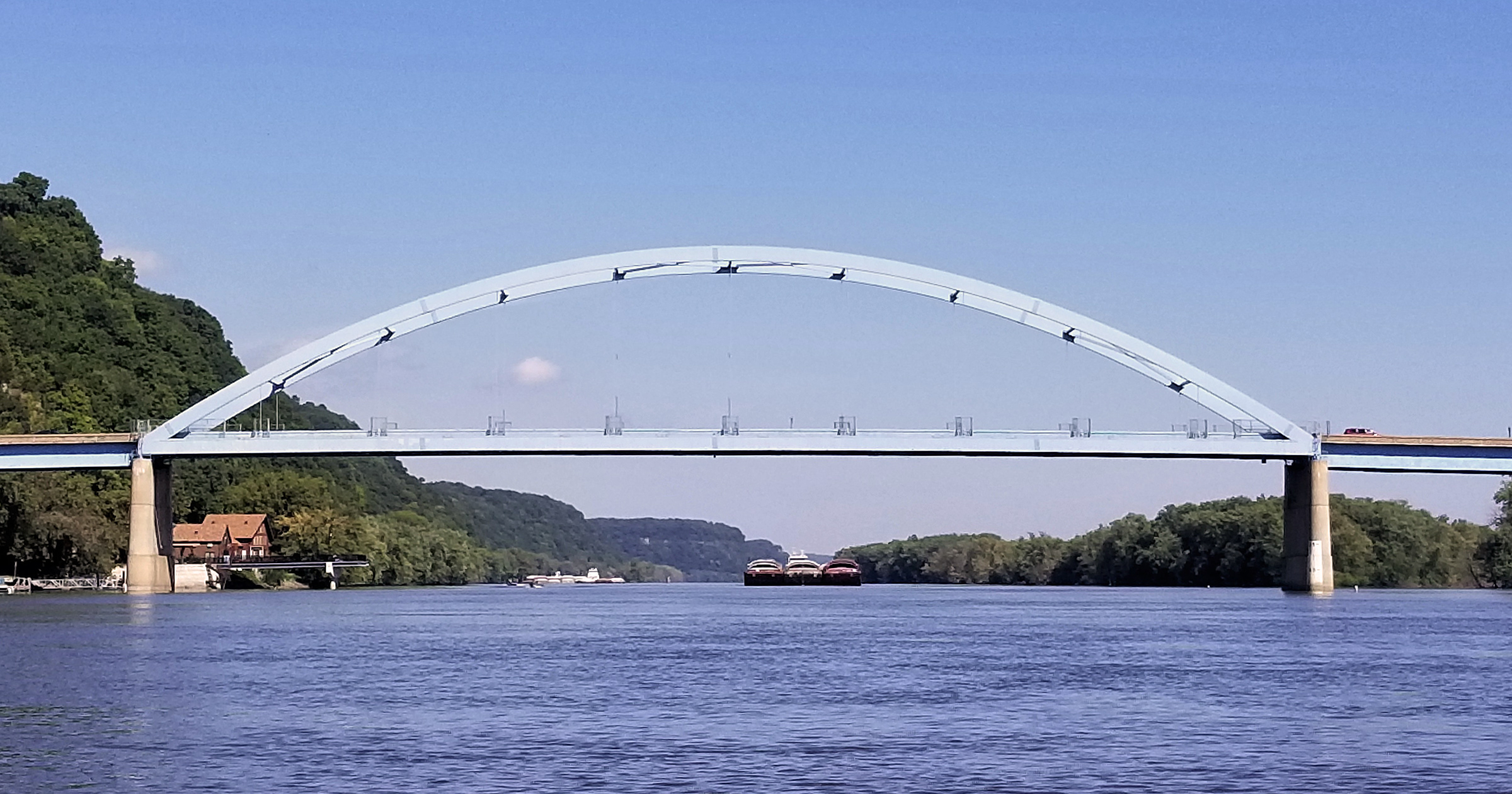
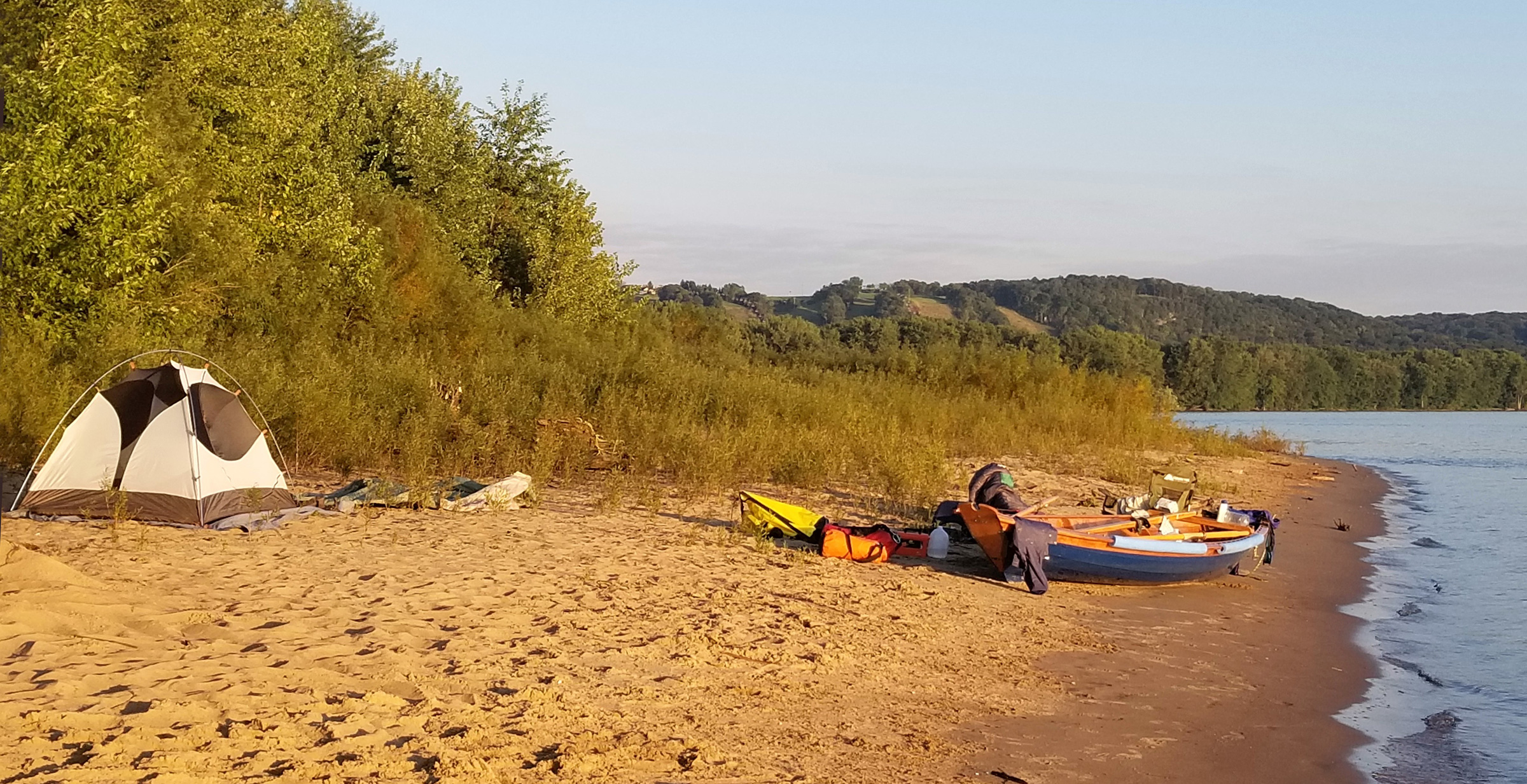
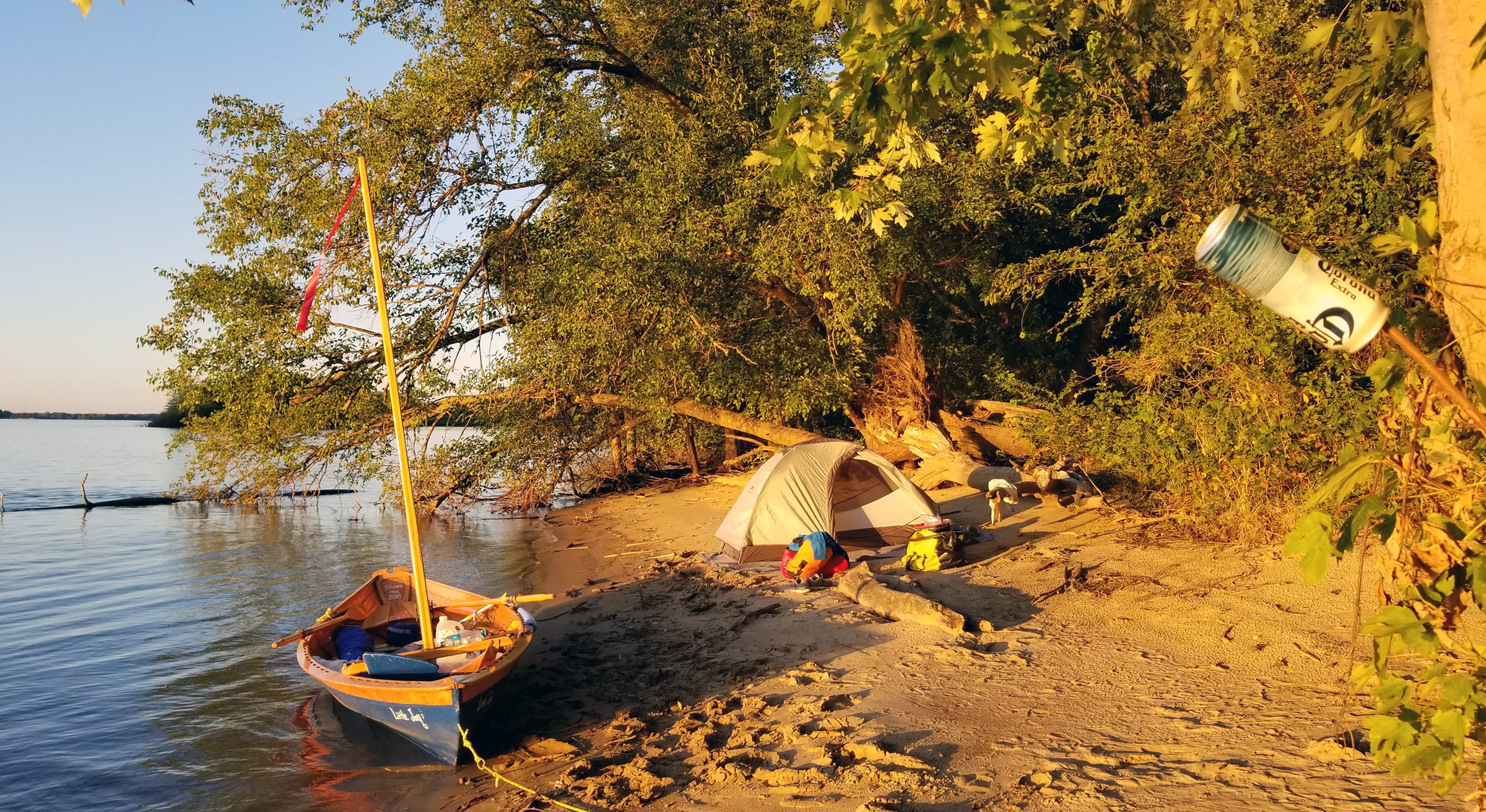
![The first night I spent on a sandbar, I was barely 2’ above the water line and hoped the river wouldn’t rise while I slept. Lock and Dam #20 is downstream in the distance. [between Keokuk and Hannibal]](https://smallboatsmonthly.com/wp-content/uploads/2019/02/MissRiver5957web.jpg)