Articles | Page 52 of 59 | Small Boats

Seaford Skiff

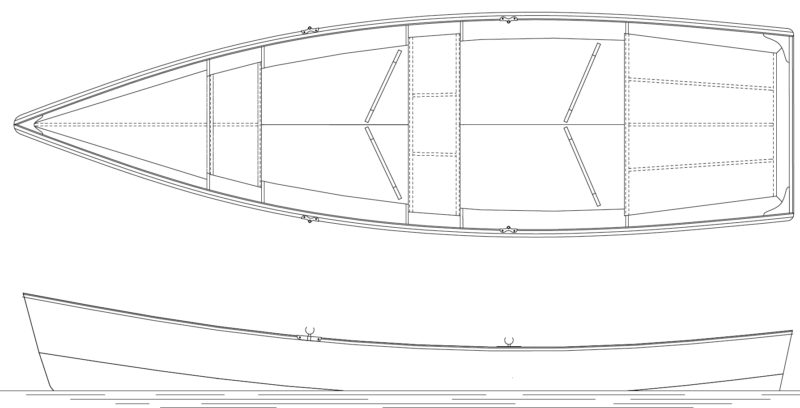
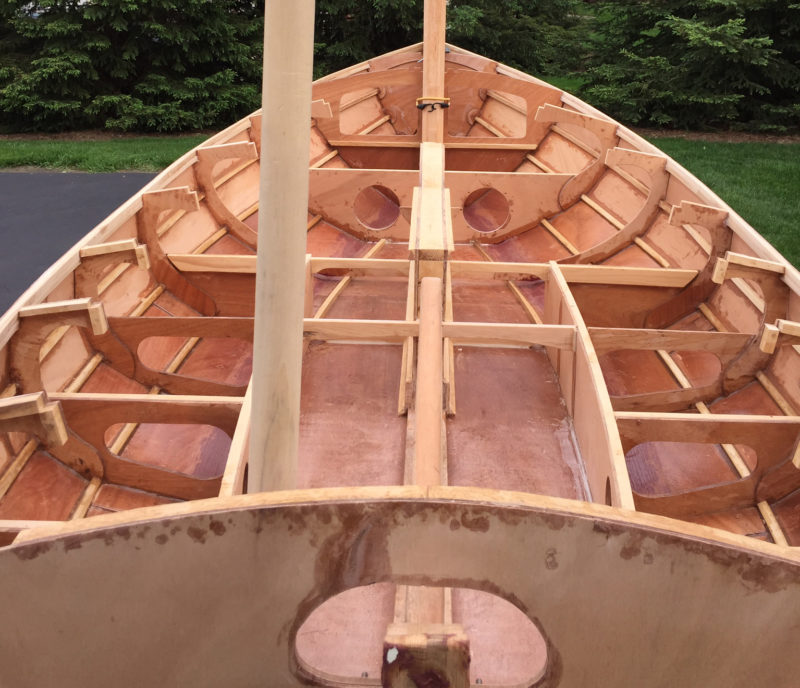
Seaford skiffs first appeared in the shallow marshes around the New York town of Seaford, Long Island, in the early 1870s. They are an evolutionary product of skiffs commonly used by local baymen for hunting waterfowl, digging clams, and fishing. Boatbuilder Samuel Gritman is credited as the primary originator of the Seaford type, but other builders such as Paul Ketcham of Amityville, and Charles  and  Sidney Verity of Seaford, built many and contributed their own modifications to the design from its inception through the 1950s.

The Seaford type very closely resembles the melonseed skiff, which was native to the marshes and estuaries of New Jersey. Both types were designed to work thin waters and sit upright on their bottoms when beached, but also be seaworthy enough to be safe in open water or in unforgiving winter conditions. The region around Seaford was a popular destination for recreational waterfowl hunters from New York City, and the cockpit of the Seaford skiff was designed to carry two people, most often a paying sport hunter and his local bayman guide. According to Barry Thomas’s article in the Log of Mystic Seaport from the summer of 1974, the skiffs were also very popular with the “market” hunters who were kept busy through the late 1800s “supplying hat manufacturers with birds’ breasts and wings to adorn ladies’ hats,” which, sadly, led to the extinction of several native species.
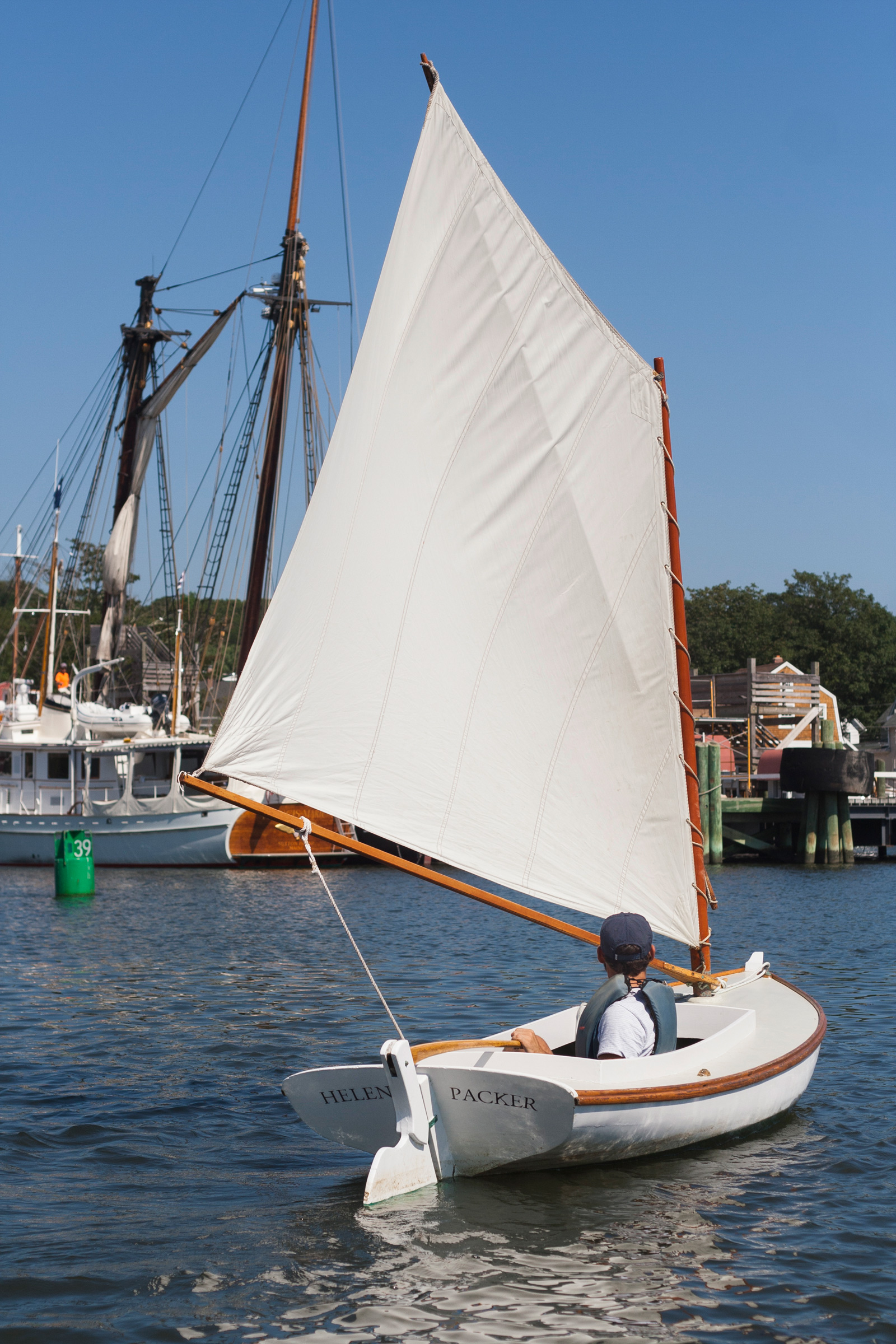
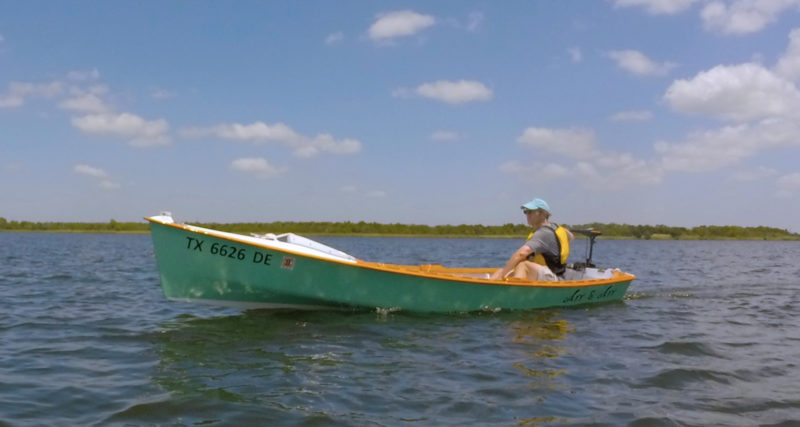
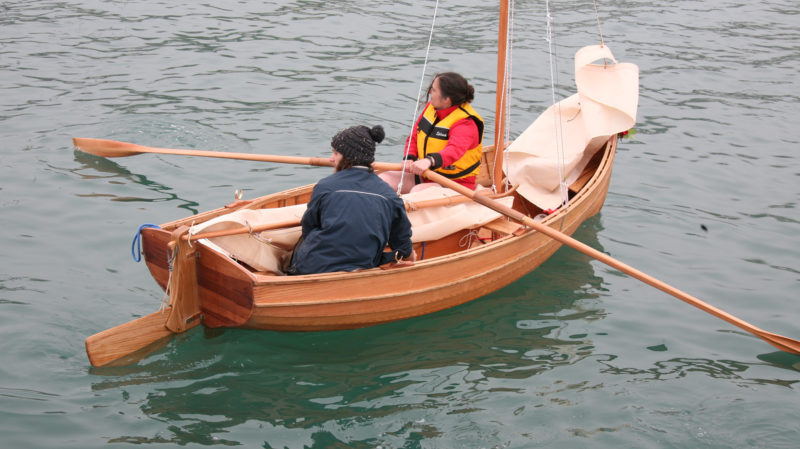
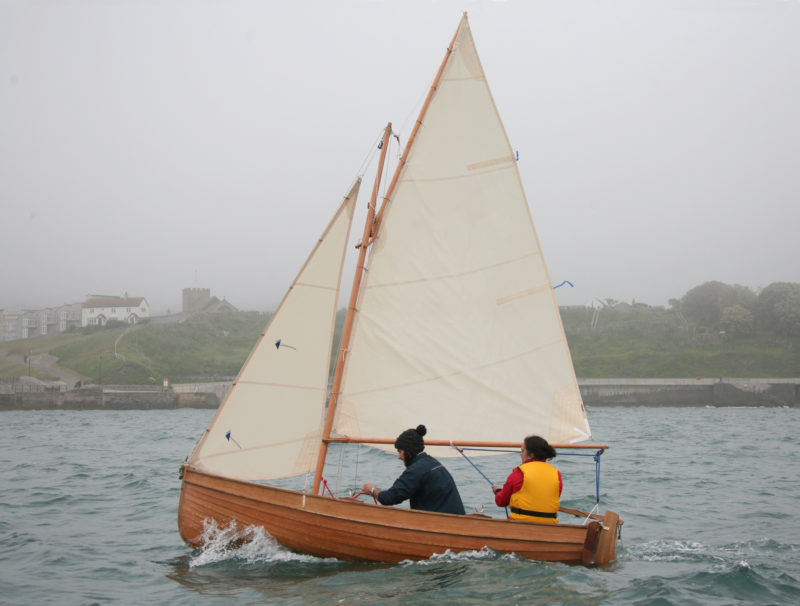
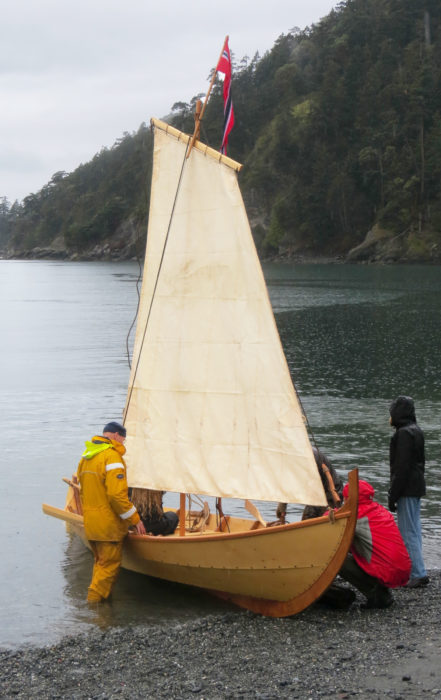
Seaford skiffs are handsome, classic little boats that will surely turn heads wherever they go. The rig and tiller are all easily stowed aboard and the light, shallow hulls are easily trailered. Launching or hauling on the beach requires little more than a pair of rollers and maybe an extra set of hands.Evelyn Ansel

Seaford skiffs are handsome, classic little boats that will surely turn heads wherever they go. The rig and tiller are all easily stowed aboard and the light, shallow hulls are easily trailered. Launching or hauling on the beach requires little more than a pair of rollers and maybe an extra set of hands.

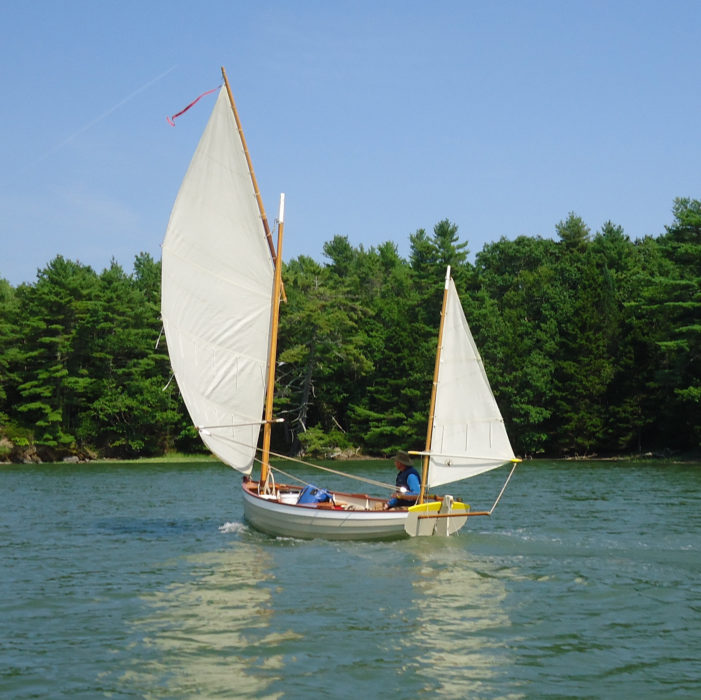
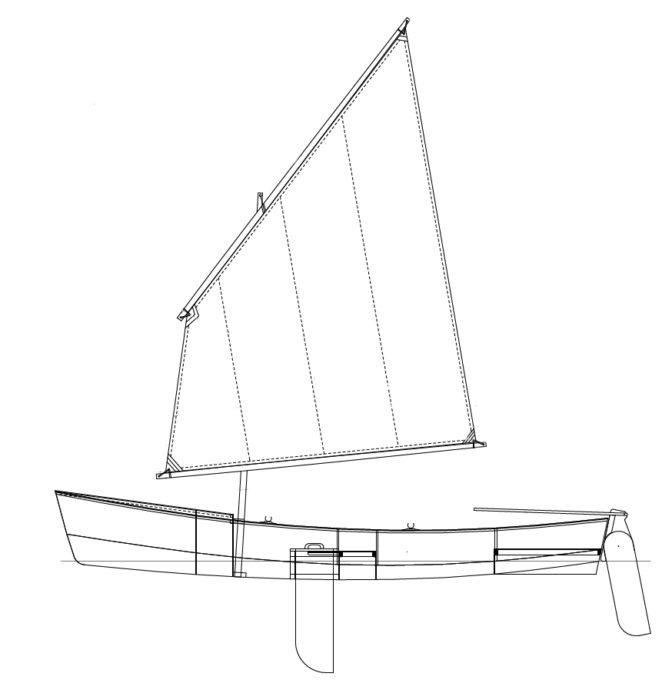
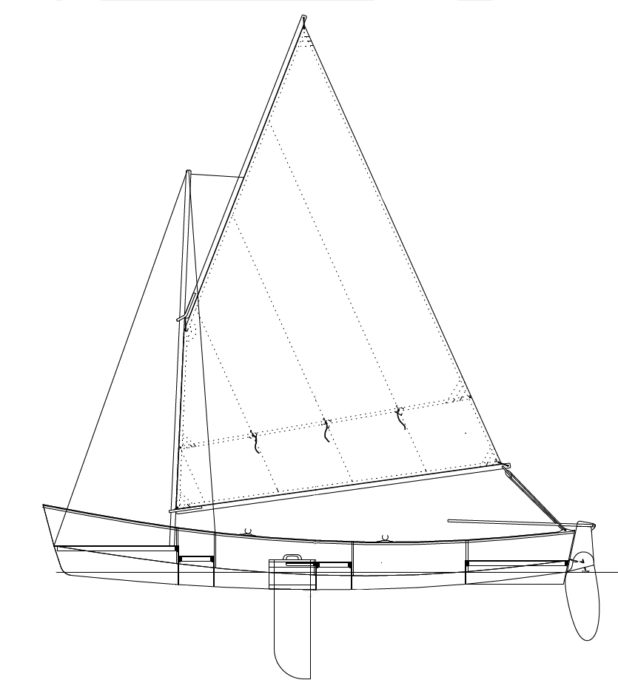
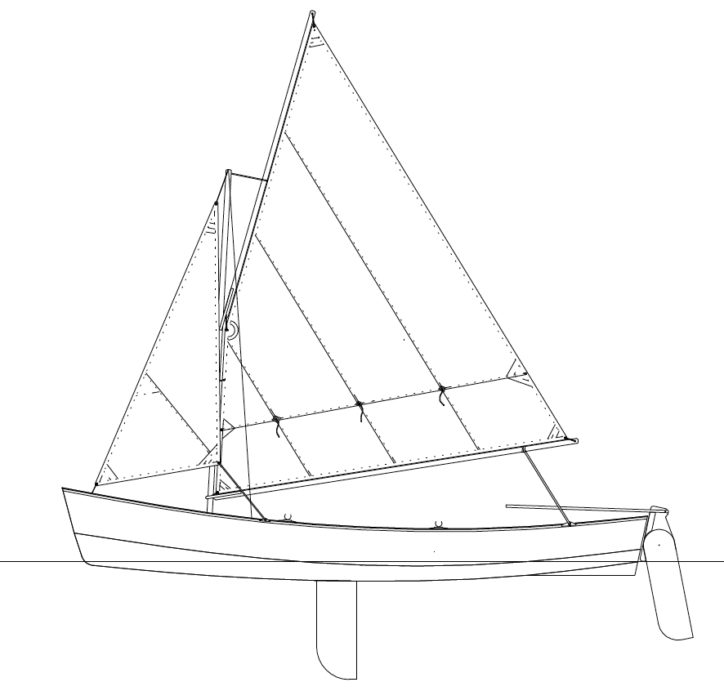
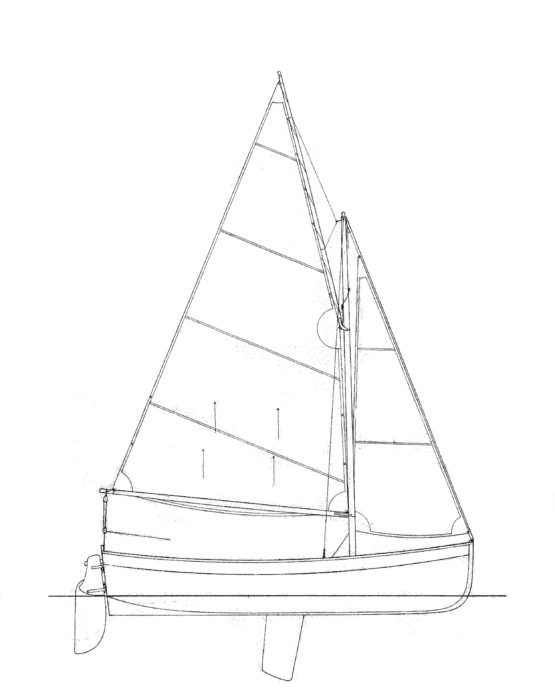
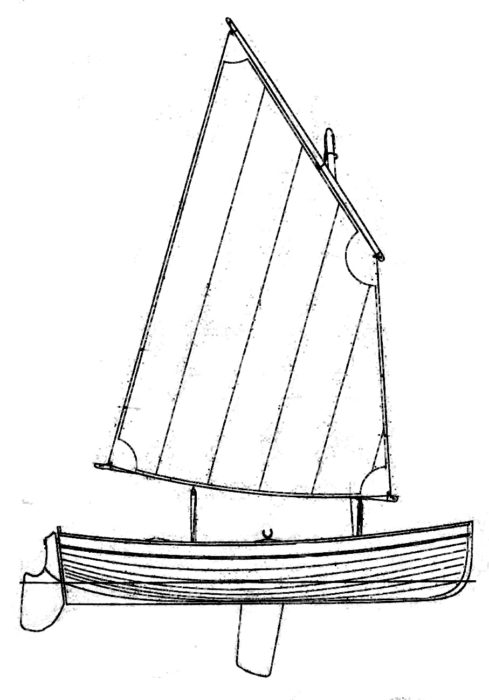
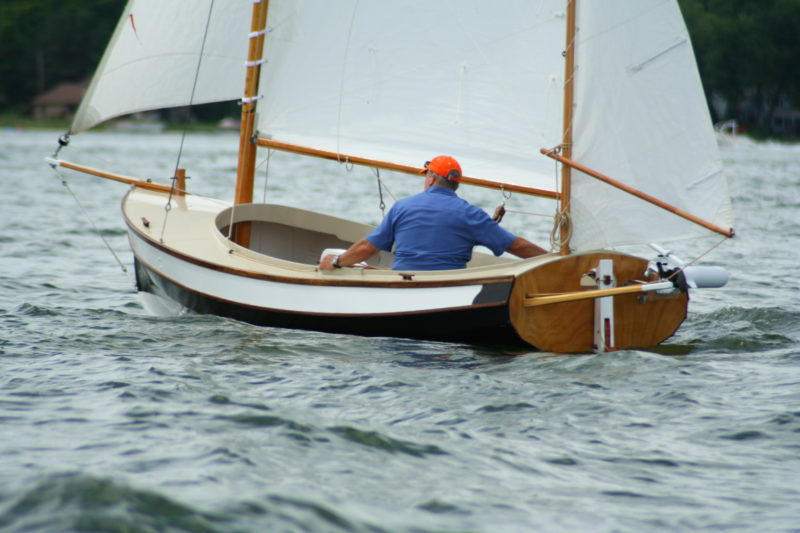
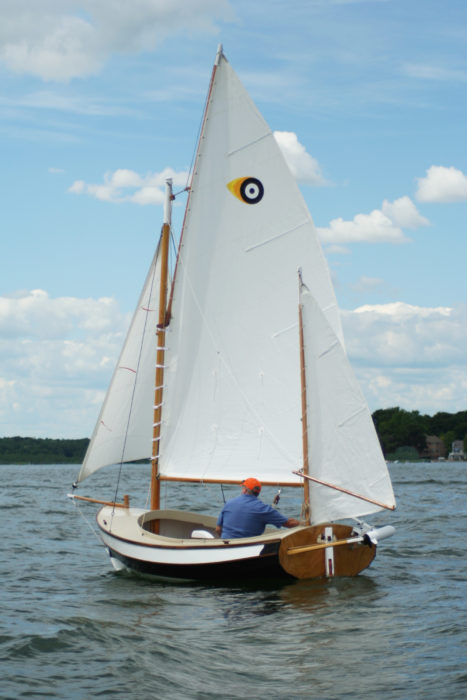
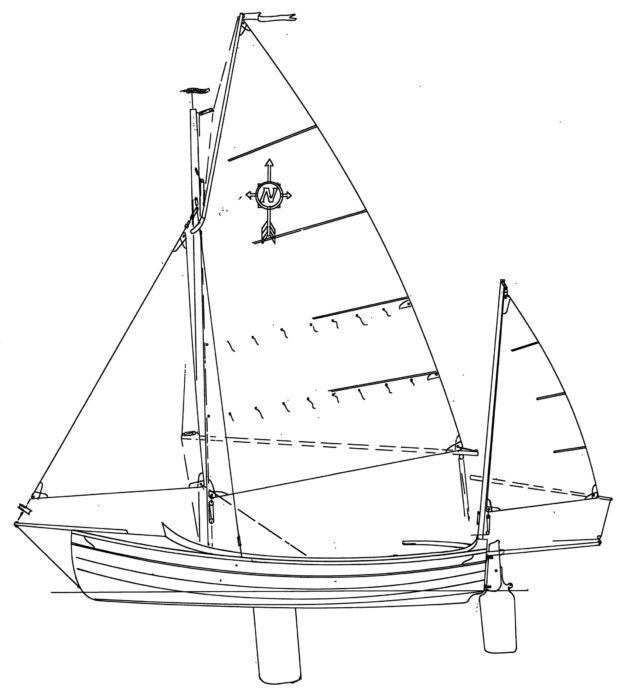
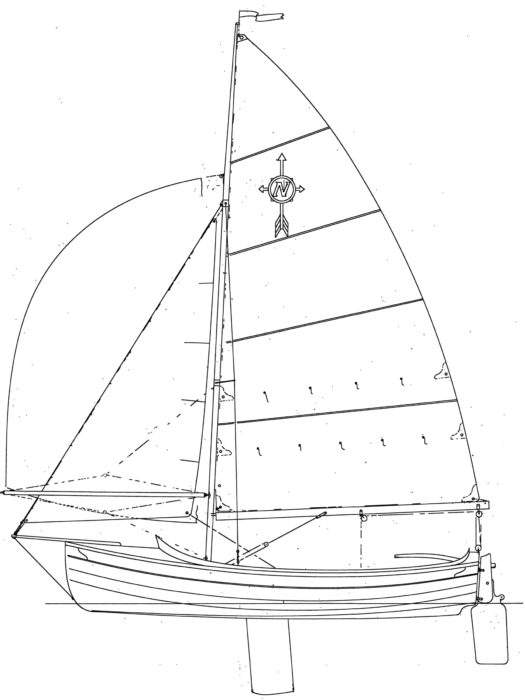
Seaford skiffs range in length from 12′ to about 15′6″ and carry a simple unstayed rig with a sprit and boom with roughly 66 sq ft of canvas. They traditionally carried a more conservative rig in winter, and a larger summer rig to catch the breeze on hot, still days. Today’s recreational sailors typically prefer the larger summer rig. Seaford skiffs are fine for their length with a beam seldom greater than 4′ 6″. This makes them easy to row or pole, and they track very well, almost to a fault. The hulls are very shallow and draw only about 8″ with the centerboard up.

They have a very low profile, purportedly for low visibility when hunting. A cambered, canvased deck provides a versatile platform that, in addition to keeping the cockpit occupants happily dry, could be used to secure the rig, oars, decoys, ducks, or marsh-grass camouflage. The cockpit is protected by a high coaming and is only partially divided by the centerboard trunk, leaving just enough room for two to sit shoulder-to-shoulder while sailing. A raked transom helps lift the stern in a following sea, making for a more comfortable ride downwind.

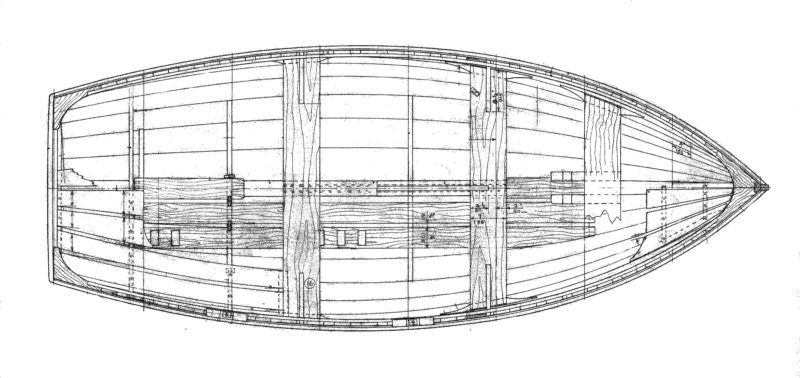
Both Seaford skiffs and melonseeds are far shapelier gunning boats than their cousin, the sneakbox. Like the sneakbox, Seaford skiffs are traditionally carvel planked to provide a smooth hull for stealth—guides believe that the sound of waves hitting the laps of a clinker-built hull might spook the intended prey. They are built from the plank-keel up, but can be built upside down if that’s preferred.

The plank keel, cut from a single board and as wide as 12″ to 14″ amidships, may be the most difficult piece of stock to source for traditional construction. It can be built up, in the fashion of a dory bottom, with two or three pieces of lumber. Laminating stock for the stem and substituting steambent oak frames for the traditional sawn frames, would also make acquisition of materials easier for the modern builder.
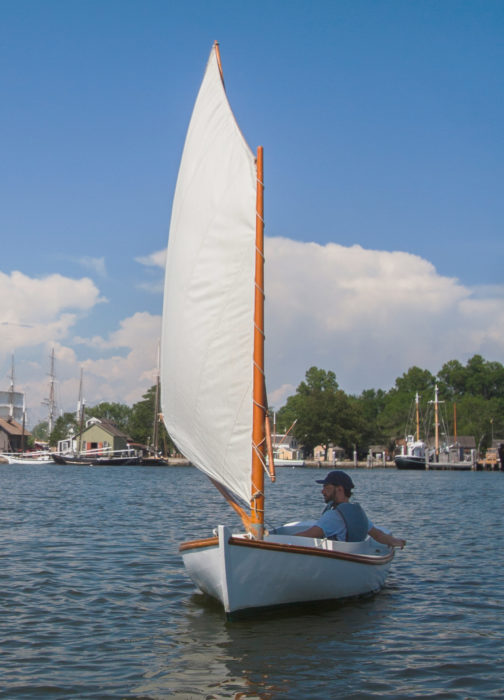
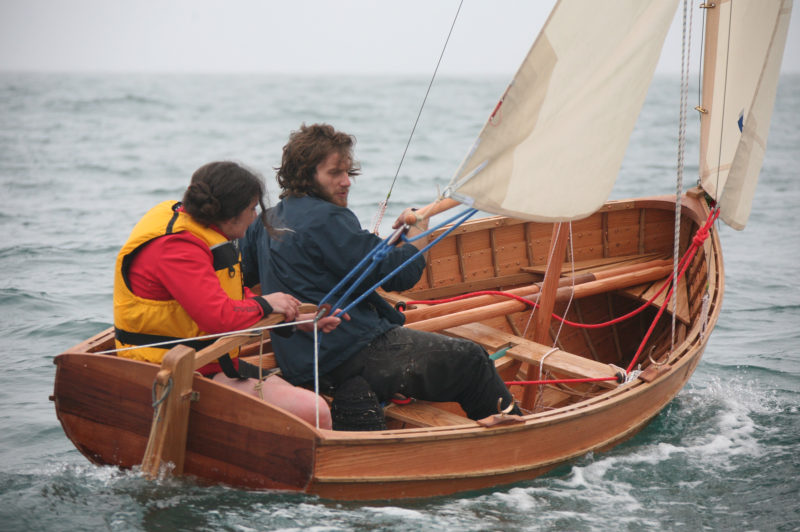
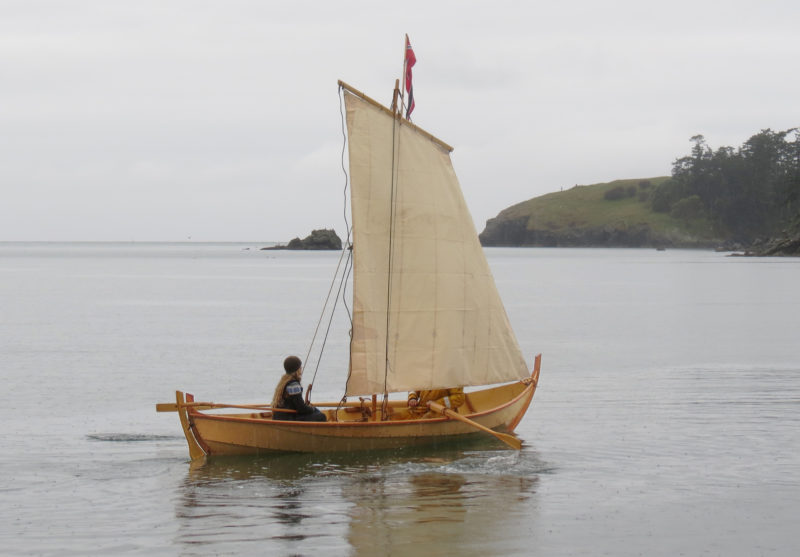
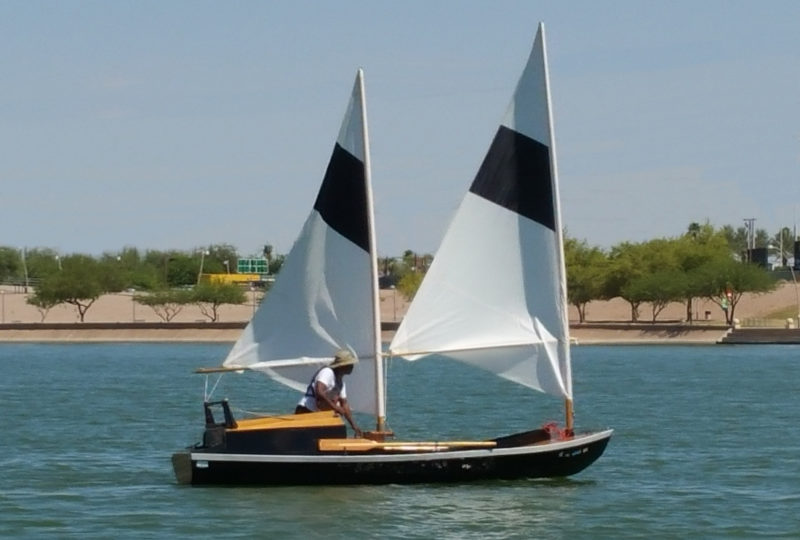
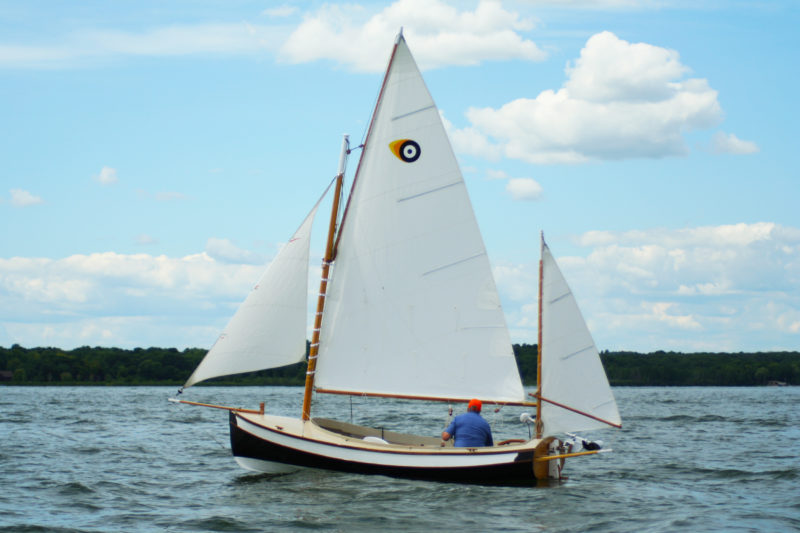
In light air, the Seaford skiff requires deft handling and precise timing when tacking to keep it moving briskly.Evelyn Ansel

In light air, the Seaford skiff requires deft handling and precise timing when tacking to keep it moving briskly.

The hollow forward and the tuck running up to the transom both require skill to execute the carvel planking. The garboard’s run up to the transom is complicated by the extreme angles between it and the plank keel on one edge and the first broadstrake on the other. The garboards create a hollow space aft of the cockpit along the centerline known as a box keel. The carvel planking and the complex shape may be a little advanced for a first-time builder, but adapting the plans for lapstrake, glued-lap plywood, or even strip-plank construction would simplify the project.


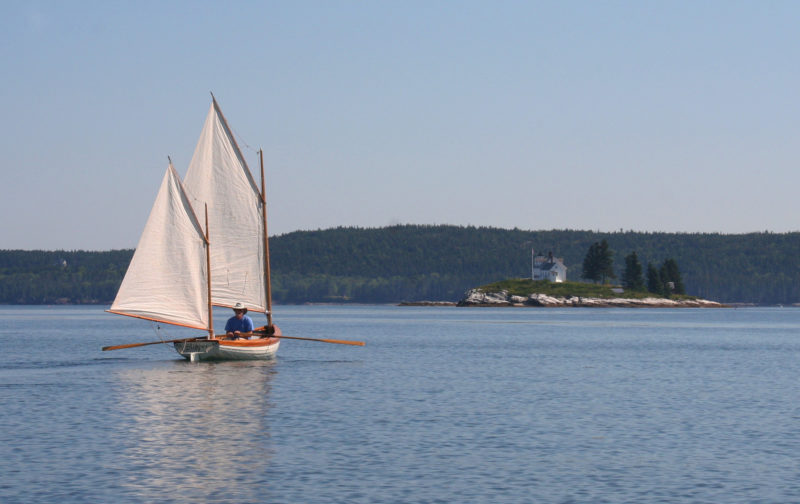
Seaford skiffs are a delight to sail. They are light and easily trailerable, and can be brought up the beach upright on rollers. Their stability and simple rig make them extremely accessible to novices, and they are great boats for introducing kids to the water. They are perfect for exploring shallow coastlines and all those little islands and inlets inaccessible on foot.

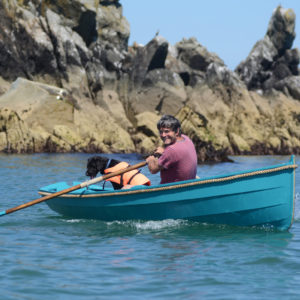
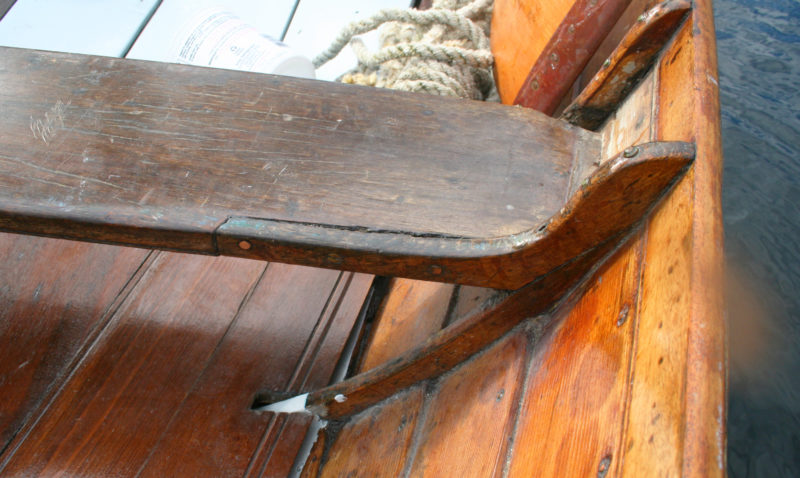
The skiffs were always outfitted for rowing. The low deck, as well as the coaming, required tall oarlocks that are not so common now as they were when the skiffs in the collection at Mystic were built. One could build up pads for the sockets to get the necessary height for standard oarlocks. Outfitted with a seat that can be removed to clear the cockpit for sailing, the skiffs make smart little rowboats that track very well. The skiffs were also sculled and poled.
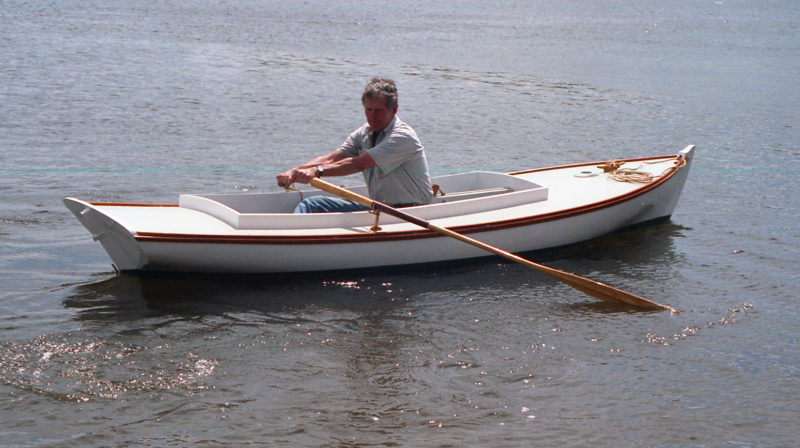
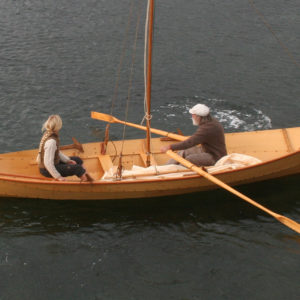
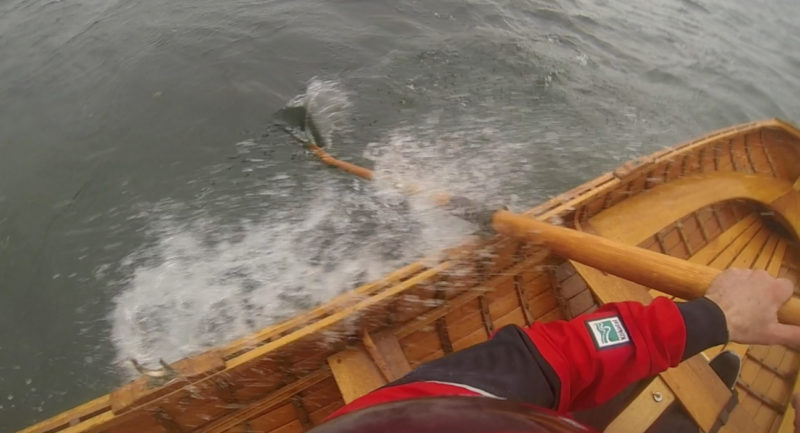
Barry Thomas, a Mystic Seaport boatbuilder who took part in building the Helen Packer, takes to the oars using a pair of tall oarlocks that keep the oars clear of the coaming. Boats similar to Seaford skiffs—sneakboxes and melonseed skiffs—were equipped with removable boxes that served as seats for rowing as well as for storage of small items. While none of the Seaford skiffs in the Mystic Seaport collection had such boxes present when the boats were acquired, the boxes were likely what were used for rowing.Sharon Brown

Barry Thomas, a Mystic Seaport boatbuilder who took part in building the Helen Packer, takes to the oars using a pair of tall oarlocks that keep the oars clear of the coaming. Boats similar to Seaford skiffs—sneakboxes and melonseed skiffs—were equipped with removable boxes that served as seats for rowing as well as for storage of small items. While none of the Seaford skiffs in the Mystic Seaport collection had such boxes present when the boats were acquired, the boxes were likely what were used for rowing.

The small cockpit is ideal for an adult and one child, or even two children if they’re small enough to tuck up next to the centerboard. Two adults will fit comfortably in cooler weather when being huddled together for warmth is welcome, but rubbing elbows can be miserably sticky in really muggy weather. On hot days a Seaford skiff is best enjoyed solo when the breeze can wrap around you, and you have your legs athwartships and your back against the coaming. Because the best place to sit when winds are light is the bottom of the boat, the floorboards are an important feature for keeping you out of the bilge.
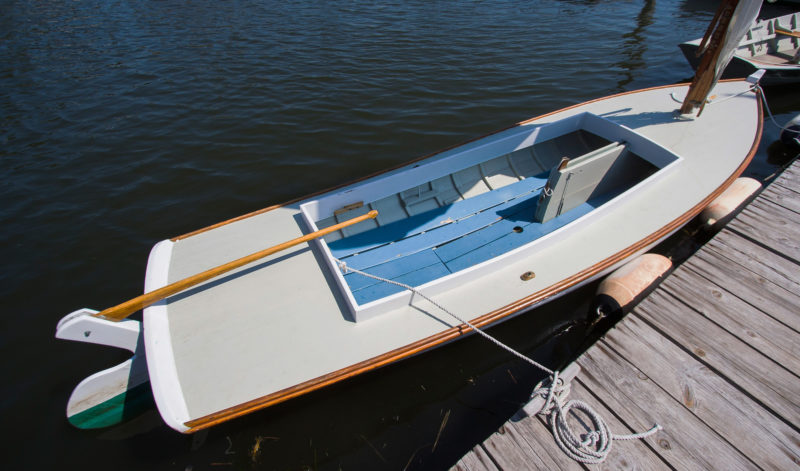
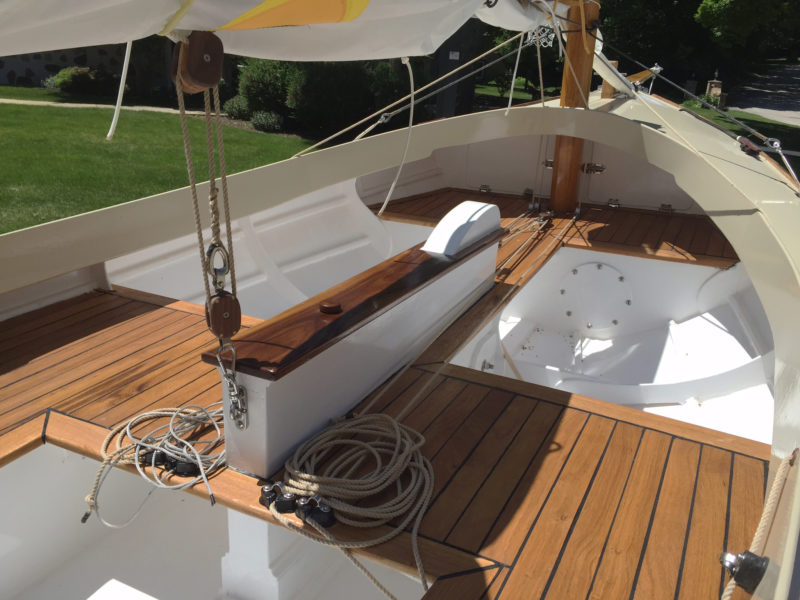
For sailing, the floorboards provide seating; a removable bench was used for rowing. This skiff's oarlock sockets are made from pipe and extent to a cleat spanning a pair of frames. The arrangement accommodates the strain imposed by the tall oarlocks. The decked over forward area makes for a great place to stow a cooler, a beach towel, a pair of binoculars, and a paddle.Evelyn Ansel

For sailing, the floorboards provide seating; a removable seat was used for rowing. This skiff’s oarlock sockets are made from pipe and extend down to a cleat spanning a pair of frames. The arrangement accommodates the strain imposed by the tall oarlocks. The decked-over forward area makes for a great place to stow a cooler, a beach towel, a pair of binoculars, and a paddle.

The skiffs like a good breeze, and require precise timing and weight shifts to tack smartly in light air. Imprecision here will reveal a tendency to wallow, though this is often operator error on the part of those more accustomed to sailing modern dinghies. As Sharon Brown, longtime head of Mystic Seaport’s boat livery and former assistant to John Gardner, neatly stated, traditional wooden boats sail best when given the “opportunity to breathe. Don’t head up too high and don’t sheet in too tight. Keep a way on.”

HELEN PACKER, the Seaford skiff in Mystic Seaport Museum’s livery, is one of the most popular boats in the fleet. She was built by Barry Thomas and volunteers at the John Gardner Small Boatshop at the Mystic museum in the mid-1990s. Thomas studied the Ketcham-built skiff in the museum’s collection as well as several extant Verity-built models. Thomas also consulted with builder Paul Ketcham Jr. and his wife Carol, who provided measurements and a pattern for the keel.

Launched in 1998, and sailing every season since, HELEN PACKER has afforded thousands of visitors the chance to explore Mystic, Connecticut, from the water. She was the first boat that I ever singlehanded as a late-blooming and cautious sailor at 14 years old. I couldn’t ask for a sweeter start. With the sail already bent on the mast, rigging the boat was a simple matter, and the only line to adjust was the snotter that tensioned the sprit. The mainsheet was daisy-chained around the furled sail, and the whole rig could be carried easily by any of the Seaport volunteers, who ranged in age from 13 to 83. All that was required to sail off the dock was to install the rudder and put the centerboard down. The entire rigging process takes under five minutes.
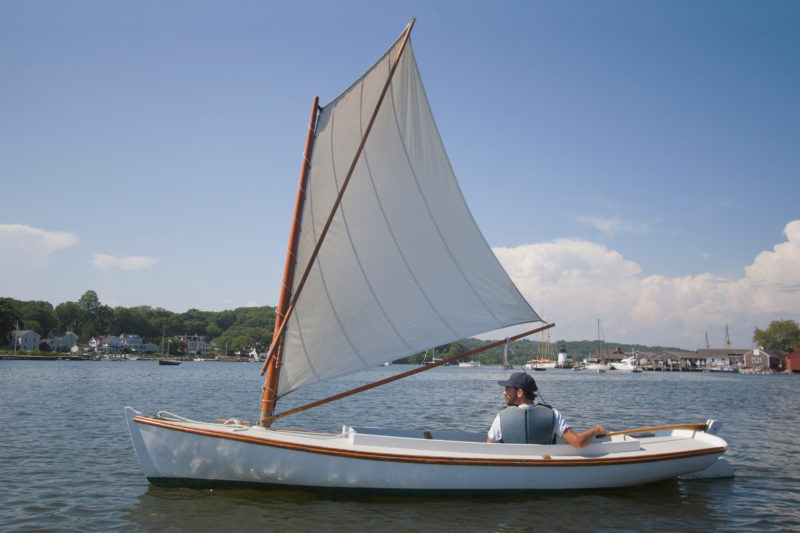
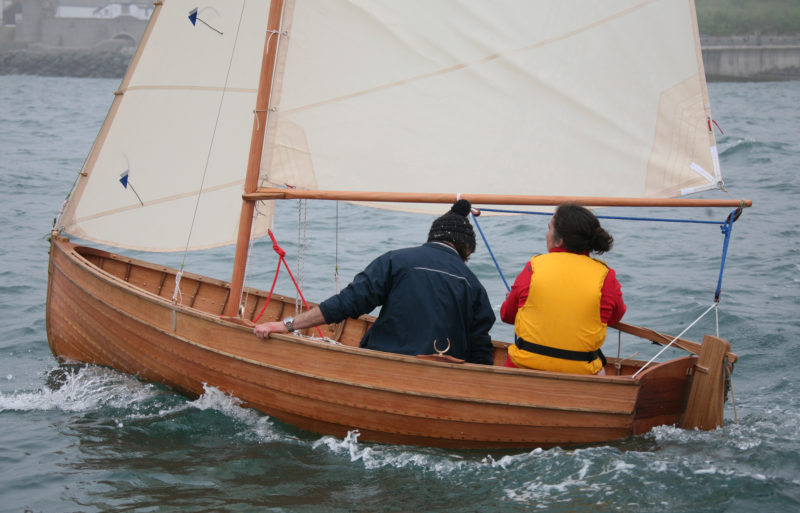
The rig is quite simple. The sheet is hitched and whipped to the boom and the notched ladder on the mast allows you to adjust the angle of the sprit.Evelyn Ansel

The rig is quite simple. The sheet is hitched and whipped to the boom and the notched ladder on the mast allows you to adjust the angle of the sprit.

With their long and narrow hulls, Seaford skiffs trim and handle best with the sailor’s weight forward as possible, so we were all taught to sit with our backs against the coaming to weather, one knee just brushing the after end of the centerboard trunk, and with feet propping us up on the downwind side. Because there are no thwarts, sailors must have a good range of motion in their knees, and be comfortable sitting on the floorboards. The boats are extremely stable, and in my five summers working at Mystic’s boat livery, I only rarely encountered a breeze fresh enough that I felt I needed to hike out to weather. I never saw HELEN PACKER capsize either, although visitors, volunteers, and staff eagerly took her out in all conditions. Despite her stability, she’s still lively and exciting to sail, and easy to handle even for a young teen in a gust with the sheet just tucked behind a purposefully placed cleat on the coaming.

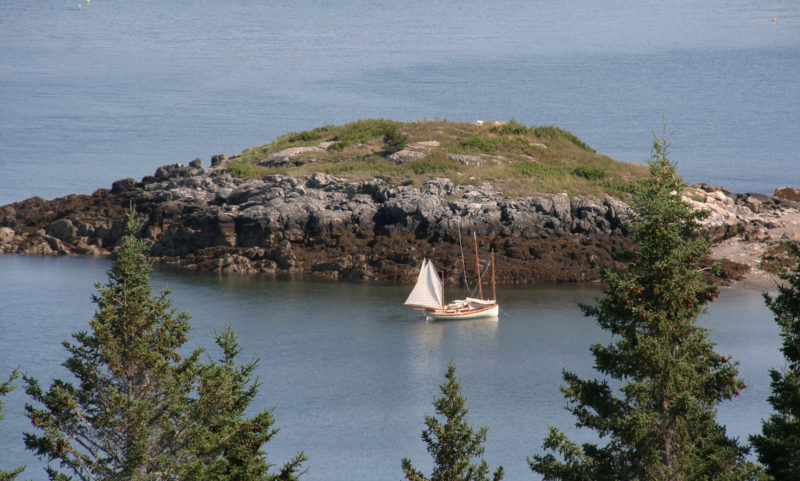
The design is ideally suited for inquisitive sailors young and old to explore those tempting spots that always seem just out of reach from land; this is a perfect cruiser for those among us who will always prefer to look closer rather than go far, from the miniature worlds of rocky tidepools to the rich ecosystems of marshes and intertidal zones.  

Evelyn Ansel is an archivist and documentation specialist based in Providence, Rhode Island. She grew up in a family of boatbuilders and librarians, and makes a living working at a little of both. She currently splits her time between the Hart Nautical Collection at the MIT Museum in Cambridge, Massachusetts, and the Herreshoff Museum of Bristol, RI. Her work in maritime heritage preservation has taken her across the world from the Gulf of Mexico to the Baltic. She serves on the board of the Apprenticeshop of Rockland, Maine, and is a frequent freelance contributor to WoodenBoat magazine.

She wishes to thank Sharon Brown, the champion of small craft at the Mystic Seaport Museum’s boat livery. During her decades-long tenure, tens of thousands of visitors, volunteers, and staff were introduced to the joys of traditional small craft on the Mystic River. Sharon deserves much credit for instilling a sense of pride and inspiring delight in our small-craft heritage in countless folks of all ages.

Verity-built Seaford Skiff Particulars

Length:   14′ 2 1⁄4″
Beam:   4′  3⁄4″
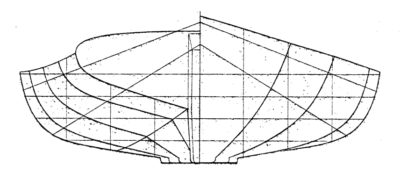
 

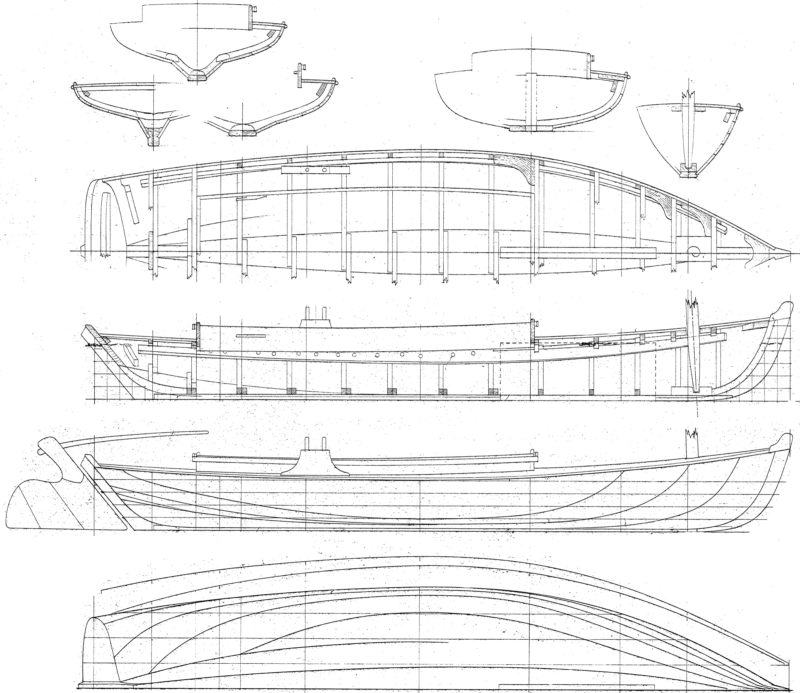
seafordsections

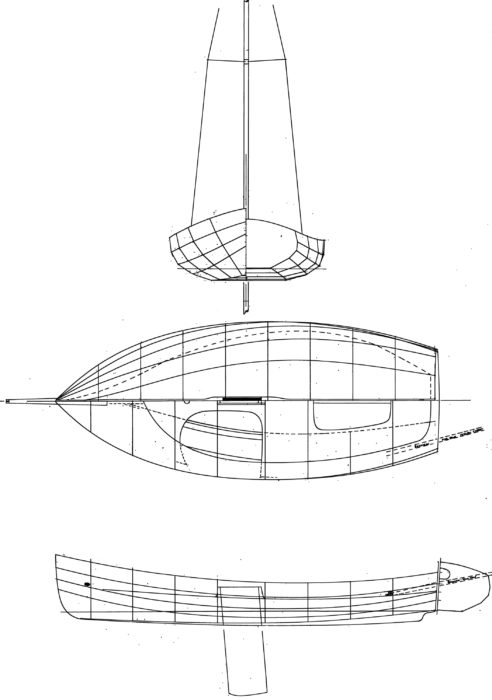
© Mystic Seaport, Daniel S. Gregory Ships Plans Library, #misc44-1© Mystic Seaport, Daniel S. Gregory Ships Plans Library, #misc44-1

Lines taken from a skiff built by Charles Verity in 1910.

Plans for the Charles Verity-built Seaford skiff replicated in HELEN PACKER are available from Mystic Seaport for $25.

Is there a boat you’d like to know more about? Have you built one that you think other Small Boats Monthly readers would enjoy? Please email us!
A Maine Island Idyll

It was a very gentle bump. I’d been sleeping comfortably at anchor after a long day on the water, but I was wide-awake in an instant. A few seconds later it came again—a firm nudge from below interrupting the soft, easy motion of my boat—and this time WAXWING stopped moving. I was aground. I checked my watch—3:30 in the morning, still an hour and a half to go before low tide.

I was quickly out of my sleeping bag and up at the bow, rolling back the boom tent to make room to work. There was no moon out, and in the pitch dark I tentatively stepped out of the boat, probing for the bottom with a bare foot. I slipped up to my thighs into the bracing, 60-degree water and found firm footing on a sandy bottom. With my weight out of WAXWING she floated again, her keel lifting just above the boulder beneath it. A gentle shove freed her and I hopped back aboard. Standing in the bow, I pulled the anchor rode and chain in as quietly as I could and stowed the anchor at my feet.

I reached under the boom tent, fished out one of my oars, and sculled WAXWING in a lazy half circle out to deeper water. The blade slicing through the water stirred up cascades of phosphorescence, which gleamed like fireworks across the inky black water. A dozen yards to starboard, a soft glow penetrated the murk; Rob slid back a corner of his boom tent, and the bright light of his LED lantern appeared. “Everything all right, John?” “No worries,” I called back cheerfully, “We’re just having a little adventure.” When I’m sleeping aboard my boat, being awakened by something that goes bump in the night is never just a good night’s sleep spoiled; it’s an experience.

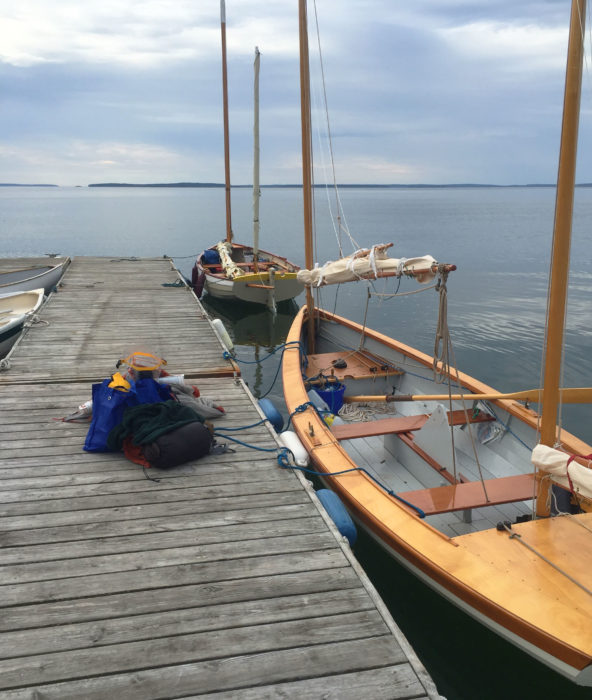
SLIPPER and WAXWING, loaded with gear prior to departure, wait at the dock in Herrick Bay, looking southeast toward the islands that separate Blue Hill Bay and Jericho Bay. Summer mornings are usually calm; winds develop as the day wears on and the sun warms the land enough to generate on onshore breeze.John Hartmann

WAXWING (top) and SLIPPER, loaded with gear prior to departure, wait at the dock in Herrick Bay, pointing southeast toward the islands that separate Blue Hill Bay and Jericho Bay. Summer mornings here are usually calm; winds develop as the day wears on and the sun warms the land enough to generate on onshore breeze.

Rob and I had started our adventure on the heels of the Small Reach Regatta, a gathering of mostly wooden, mostly owner-built small boats. The fleet had moored in Herrick Bay, a half-mile wide inlet between Flye Point and Naskeag Point near WoodenBoat’s campus in Brooklin, Maine. After the event, he and I had left our boats anchored there for a day of provisioning. Our plan was to circumnavigate Deer Isle under sail and oars.

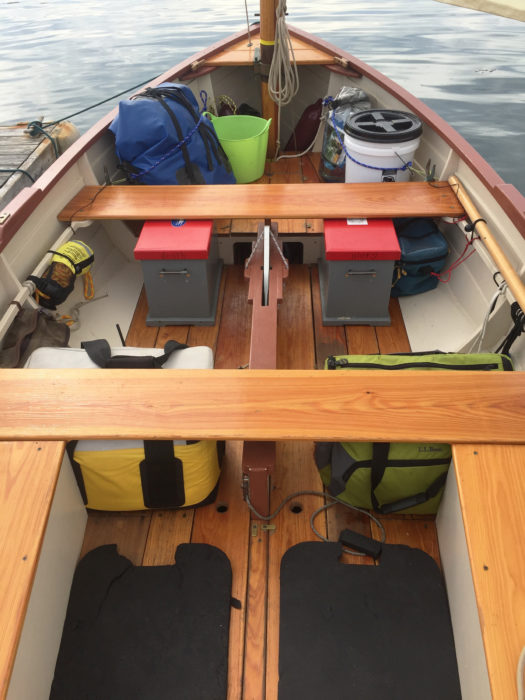
The Ilur has a voluminous cockpit with room enough to carry gear for a multi-day trip. The blue duffel holds bedroll, the green bucket is for bailing and collecting trash, a clear dry bag holds clothes, and the white bucket is the loo. Gray chests with red lids are kitchen and larder, the yellow soft cooler is ice chest for cold drinks and fresh foods, and the green cooler holds a five gallon container of drinking water.John Hartmann

The Ilur has a voluminous cockpit with room enough to carry gear for a multi-day trip. The blue duffel holds a bedroll, the green bucket is for bailing and collecting trash, a clear dry bag holds clothes, and the white bucket is the loo. The gray chests with red lids are kitchen and larder, the yellow soft cooler is ice chest for cold drinks and fresh foods, and the green cooler holds a five-gallon container of drinking water.

When we returned the next morning, Rob made preparations aboard SLIPPER, his 16′8″ Herreshoff Coquina, and I stowed a small mountain of gear in WAXWING, my 14′8″ yawl-rigged, François Vivier-designed Ilur. I made sure everything was secure and out of the way so I could freely move about in the cockpit, and we shoved off by mid-morning.

The tide would be in our favor until late afternoon; the wind, building out of the east, appeared as little cat’s-paws dancing on the water. The breeze swirled toward us across the bay, cooled our sun-warmed faces for a moment, then gamboled away. SLIPPER and WAXWING ghosted along side by side as the dark blue-green water slid lazily past. I got the rig set and shifted my weight to leeward to settle the boat over on its bilge to reduce the hull’s wetted surface and eke out a little more speed. Weaving among and around floating mats and broad bands of bronze-colored seaweed, we stayed well off Flye Point, where I could see, even now just past high tide, the telltale curdling of water washing over the barely submerged mile-long boulder field strewn between the point and Flye Island.

We were covering ground slowly—little more than 1 mph according to my GPS. At this speed, we would likely make it only as far as the east end of the Deer Isle Thorofare before the tides turned against us. Breaking out the oars, I began rowing gently while WAXWING’s big, fully battened, standing-lug mainsail took advantage of the bit of wind we had. With the tide coaxing us along, the combination of sailing and rowing nudged our speed up to almost 3 1/2 mph.

Off the Naskeag Point side of Herrick Bay, a broad-winged osprey vaulted from the top of a tall spruce, sailed out over the water, and pulled up momentarily to hover, eyeing the water before winging away. Rob and I row-sailed for a bit; the wind finally freshened and we shipped our oars.

As Rob passed the ISAAC H. EVANS in the Deer Isle Thorofare it was sailing against the tide, getting a motor assist from the yawl boat astern. The schooner was built in 1886 for harvesting oysters along the coast of New Jersey. She is berthed in Rockland, Maine, and sails the coast as part of the Maine Windjammer fleet.John Hartmann

As Rob passed the ISAAC H. EVANS in the Deer Isle Thorofare, the schooner was sailing against the tide and getting a motor assist from the yawl boat astern. Built in 1886 for harvesting oysters along the coast of New Jersey, she now works out of Rockland, Maine, and sails the coast as part of the Maine Windjammer fleet.

By noon, we’d crossed the southern end of the Eggemoggin Reach, and rounded Stinson Neck, the southeastern tip of Deer Isle. Our course turned from due south toward southwest as Deer Isle Thorofare opened ahead of us; tide and wind now swept us along as the miles unfolded. From this vantage point, the shoreline of Deer Isle at the eastern end of the Thorofare is corrugated with peninsulas and islets. A sprawling archipelago of small islands between Deer Isle and Isle au Haut studded the steely blue waters as far as we could see.

deer-isle2mask

The Thorofare is a very busy waterway along the southern coast of Deer Isle. As Rob and I sailed along, a group of five large schooners was heading up the passage together, working against the tide with sails set and yawlboats nudging them along. Toward the western end of the Thorofare, we ducked out of the main passage and headed south again, threading our way through numerous islets, nameless shoals, and sand bars on the way to George Head Island, an uninhabited islet scarcely a third of a mile long set in the heart of the archipelago.

The cove at George Head Island provides a well protected anchorage until the tide covers the sand spit leading off to the left to Little George Head Island. Merchant Island and Isle au Haut Bay lie to the south.John Hartmann

The cove at George Head Island provides a protected anchorage until the tide covers the sand spit leading off to the left to Little George Head Island. Merchant Island and Isle au Haut Bay lie in the distance to the south.

We slipped into the cove on the east end of George Head in late afternoon, a short while before the low tide. A large sandbar extends from the northeast corner of the island, and another curves out from the southeast corner to reach its smaller sibling, Little George Head Island. The bars form a well-protected cove at all but high tide. Now, nearing low slack, both islands were fringed with a broad band of exposed, weed-covered cobble and boulders. In the shelter of the cove, the scent of the exposed intertidal was pungent but pleasant.

We would be sleeping aboard our boats, and with overnight winds expected from the southwest, we decided to anchor on the Stonington side of the northernmost bar, to be in the lee of George Head’s densely wooded eastern shore. By the time Rob and I had set our anchors for the night, it was not long past low tide, so I let out enough extra rode to have adequate scope for the midnight high. As we slept the wind and tide nudged WAXWING over a large boulder in the small hours of the morning, and the rippled sea and ebbing tide soon had it bumping against her hull.

With the boom tent up and after thwart stowed, WAXWING is ready for the night. The boom tent is a minimalist affair, very wind- and rain-resistant, but open at its ends. If protection from insects is needed, a 4’ x 6’ foot piece of no-see-um netting draped over the sleeper’s head is put to use.John Hartmann

With the boom tent up and after thwart stowed, WAXWING is ready for the night. The boom tent is a minimalist affair, very wind- and rain-resistant, but open at its ends. If protection from insects is needed, a 4’ x 6’ foot piece of no-see-um netting draped over the sleeper’s head is put to use.

Once WAXWING was safely anchored in deeper water, I settled down to try to get another hour or two of sleep, but it was nearly 4 a.m., and the fleet of lobsterboats that operates out of Stonington hustled toward the 50-yard-wide channel between the George Head bar and St. Helena Island. I could hear the roar of the big diesel engines even as the boats powered out of Stonington Harbor, and the din reverberated through the cluster of small rocky islands around us. The fleet approached and funneled through the gap only a couple of hundred yards from us. After the first few thundered past, I gave up on the idea of any more shuteye, and stowed my bedroll just as day was beginning to break.

While SLIPPER and WAXWING were rafted up for breakfast, dawn uncovered the boulder garden on the north side of George Head Island. One of the boulders in the area knocked against WAXWING’s bottom in the middle of the night, requiring a bit of wading to get her over deep water.John Hartmann

While SLIPPER and WAXWING were rafted up for breakfast, the low tide uncovered the boulder garden on the north side of George Head Island. One of the boulders in the area knocked against WAXWING’s bottom in the middle of the night, requiring a bit of wading to get her over deep water.

Rob was up too, so I hauled anchor, sculled over to his boat, and rafted up for breakfast. I dug out my old brass Svea stove, an ancient and trustworthy traveling companion, along with my Bialetti espresso pot. The yellow flames from the fuel I’d dribbled into the primer hollow at the base of the stove flickered up and before long the little stove’s blue flame was making a roar of its own, Lilliputian compared to the big lobsterboats, but much more welcome. Breakfast was homemade granola, fresh Maine blueberries, and a piping-hot latte. Although Rob tends toward minimalist camping and frugal dining, no doubt habits fostered by years of sea kayaking, I sail a type of boat that was once meant to carry fishermen and a boat full of fish safely back to port every night. She is a weatherly little packhorse, and I happily take advantage of her capacity, routinely stuffing her with provisions enough to take care of three or four sailors on outings of as many days. Rob cheerfully tolerates my sybaritic tendencies, and made no objection to the foamed latte as I handed it across.

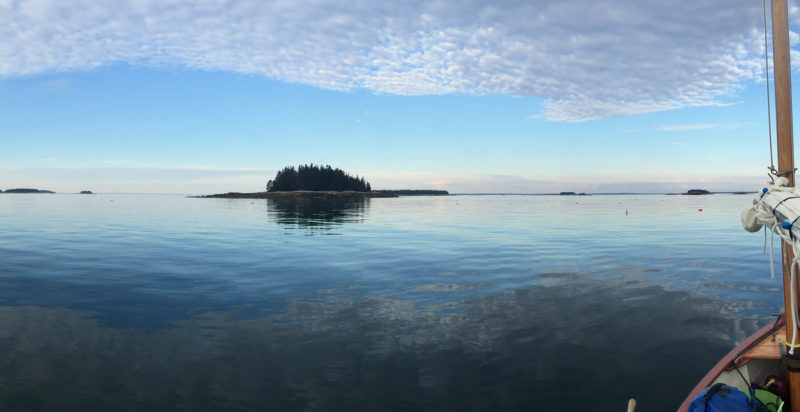
WAXWING and SLIPPER bobbed gently in the cove as the rising sun sent spears of gold up through breaks in the clouds. The water was glassy calm, and the dawn reflected in a great shimmering column of light. I was sleep-deprived and salt-crusted, but this was still heaven on earth. Arctic terns cried, wheeled, hovered, and dove along the bar. One hungry bird splashed down less than a dozen feet from us, then surfaced and wheeled away with a wriggling 3″ sand eel dangling from its orange beak.

Sipping our coffee, we listened to the weather forecast, looked over our charts, and considered the tides as we discussed the day ahead. We’d have light and variable morning winds, and afternoon winds to 10 mph. Low tide was fast approaching; our intended destination would be Butter Island, 11 miles up East Penobscot Bay. If we waited till midday, there would be wind for reaching, but we’d also lose a favorable tide, and progress would be iffy. We separated the boats, Rob weighed anchor, and we set out rowing north-northwest.

East Penobscot Bay was dead calm, disturbed only by the eddies swirling off the tips of our oars. Striking out into the wider waters between Deer Isle and North Haven Island, we made our course toward Eagle, Butter, and Great Spruce Head, a trio of mile-long islands in the middle of a cluster of smaller islands near the top of the bay. It was still early, and except for a few lobsterboats rumbling off in the distance, we had the eastern bay to ourselves.

After a bit of rowing, Rob and I were well offshore, but not entirely alone. A succession of seals followed us for about a minute at a time, staying 20 or 30 yards off our sterns, with their great, dark eyes fixed on us.

For the long row north to Eagle Island, Penobscot Bay was glassy calm.John Hartmann

For the long row north to Eagle Island, Penobscot Bay was glassy calm.

Rob and I took a break, put on sunscreen, and snacked on granola bars and fruit. The tide carried us up the Bay and past the tip of Eagle Island. The water was glassy smooth from Deer Isle 2-1/2 miles to the northeast, the same distance to North Haven in the southwest. Over WAXWING’s transom, the sky met the open Atlantic beyond Isle au Haut Bay. We took to the oars again, pulled for Butter Island, and by late morning came ashore on the broad crescent of Nubble Beach on its eastern shore just before high tide.

We had the whole afternoon ahead of us, so we put the boats at anchor to keep them afloat through the falling tide cycle, and set off to explore the island. It is a mile long and a half mile wide, its shoreline scalloped with beaches. We walked a trail through shaded woods to the 150′-high summit of Montserrat Hill, where we could see the upper end of Eggemoggin Reach 7 miles to the north, and the undulating ridgeline of the Camden Hills 15 miles to the west across West Penobscot Bay. There is a polished granite bench at the summit, a memorial to Thomas Cabot who bought Butter Island in the 1940s to preserve it for the people of Maine. Engraved on its thick curved edge is a line for Tennyson’s poem “Ulysses”: “Come, my friends, ‘tis not too late to seek a newer world.” From the bench we had a clear view down to the beach, where SLIPPER and WAXWING were riding quietly at their shared mooring, with plenty of water beneath them in the receding tide. A schooner worked its way up the East Penobscot Bay, and thunderheads piled up over the mainland.

The view from Montserrat Hill took in WAXAING and SLIPPER anchored next to The Nubble, a rock outcropping at the easternmost point of Butter Island. Tides are commonly 10-12 feet along this part of the Maine coast. The boats are on a modified Pythagorean mooring to keep them afloat and off the beach, but easily retrievable.John Hartmann

The view from Montserrat Hill took in WAXWING and SLIPPER anchored next to The Nubble, a rock outcropping at the easternmost point of Butter Island. Tides are commonly 10′ to 12′ along this part of the Maine coast. The boats are on a modified Pythagorean mooring to keep them afloat and off the beach, but easily retrievable.

We made our way back to the beach; it had been a full day, and we turned in after an early supper for a sound sleep anchored off Nubble Beach.

Following breakfast the next morning, we set out north-northwest, rowing in the calm until we were about halfway between Bradbury and Pickering islands. The waking winds, coming from the southeast, hinted of a useful breeze. Rob and I set our sails to catch whatever breezes might help us, and then got back to rowing to speed us on our way. Not far off, pods of harbor porpoises surfaced, swimming in ever-tightening circles as they corralled small fish for their morning meal. The sound of their quick breaths carried across the water to us in the stillness of the morning.

In a light breeze Rob row-sailed toward Pumpkin Island and the top of the Eggemogin Reach. Sail-assisted rowing made it possible to cover mileage more effectively when sail alone would have been too slow to keep the pair on schedule to make good use of the tidal currents around Penobscot Bay.John Hartmann

In a light breeze Rob row-sailed toward Pumpkin Island and the top of the Eggemoggin Reach. Sail-assisted rowing made it possible to cover mileage more effectively when sail alone would have been too slow to keep the pair on schedule to make good use of the tidal currents around Penobscot Bay.

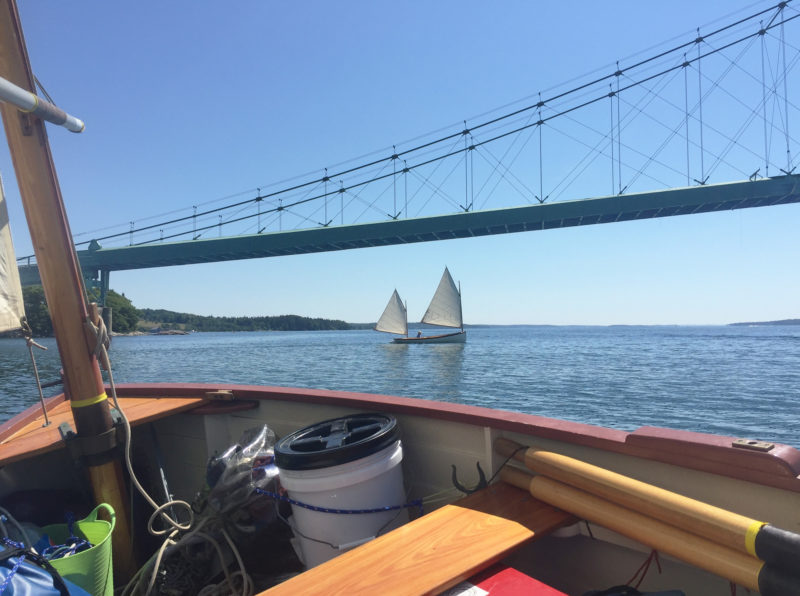
We rounded Pumpkin Island, a low islet scarcely large than a football field, skirted in bare granite with a squat cylindrical lighthouse attached to the keeper’s house at its center. At the head of Eggemoggin Reach, the winds steadied, so we stowed the oars and sailed southeast down the Reach toward the suspension bridge that links Little Deer Isle to the mainland. The breeze was now coming from the east-southeast, so we had to work to windward. The winds were still light, and the going was slow. I tacked back and forth below the bridge, looking up at the catenary curves of the main cables, the thick green girders beneath the roadway, and the delicate looking web of criss-crossed suspension cables between them. The tide had come to its high slack about the time I passed under the bridge, tacking back and forth between the Deer Isle causeway on one side, and a red nun on the other.

Rob was five or six hundred yards ahead of me in SLIPPER, and all of a sudden he was away like a rabbit, coursing down the Reach carried by an ebb tide flowing south to Jericho Bay. It dawned on me that where I was sailing the water was flowing north out of the Reach on an outgoing tide. I had not yet passed the tidal watershed! I was barely holding my own, tacking repeatedly from nun to causeway and back again and again. With the wind on my nose, and the strengthening ebb against me, I had no choice but to drop the rig and start rowing—with grim determination. After a half mile the rowing seemed easier, and I could see that the shoreline was slipping by a bit faster. I shipped the oars, hoisted sail, and with more than a little relief I was under way again, now keeping pace with Rob and SLIPPER.

The Deer Isle bridge, spanning 200’ at a height of 85 feet above the water, opened in 1939. It was built to a design similar to Washington’s Tacoma Narrows bridge, which famously collapsed in 1940 due to wind-induced oscillations. The Deer Isle Bridge was also damaged by oscillations in strong winds and extensively modified in 1943.John Hartmann

The Deer Isle bridge, spanning 200’ at a height of 85′ above the water, opened in 1939. It was built to a design similar to Washington’s Tacoma Narrows bridge, which famously collapsed in 1940 due to wind-induced oscillations. The Deer Isle bridge was also damaged by oscillations in strong winds and extensively modified in 1943.

The day was warming up, and the onshore breeze was coming alive; the winds continued to freshen as the afternoon grew hotter. Before long I had to sheet the mizzen in tight, heave to, and tie a reef in the main. Down through the southern end of the Reach, Rob and I had some pretty spirited sailing, and we were both up and down on the rail for the next three or four miles, our two boats punching forward on blue-gray water generously flecked with white caps.

Around the outside of Hog Island at the tip of Naskeag Point, we met the 65′ schooner ISAAC H. EVANS, returning from Mt. Desert Island. With a magnificent spread of canvas driving her, she fairly swept up the Reach, soaring past us with a hiss of water foaming along her sides, a picture of power and grace.

With three miles left to go, WAXWING stopped at a sheltered beach on Sellers Island.Gabrielle McDermit

With three miles left to go, WAXWING stopped at a sheltered beach on Sellers Island.

Soon we were rounding Devils Head at the end of Hog Island, and broad-reaching for Sellers Island, a wooded islet surrounded by boulders on all but its north side. I could see my wife Gabrielle on the beach, waving. She and our young friend Erika had been aboard WAXWING for the Small Reach Regatta earlier in the week, and today had sailed a small pram the half mile from Naskeag Harbor out to Sellers’s semicircle of white sand, hoping to meet up with us as we left the Reach. Seeing Gabrielle waiting for me on the island’s boulder-studded outer shore made me feel like a 19th-century ship captain returning safe from sea after a long voyage.

Rob and I landed on the beach, and after a break to stretch our legs, Gabrielle joined Rob in SLIPPER, Erika hopped aboard WAXWING, and we took the pram in tow. It was early evening, and the onshore breeze was dying away with the setting of the sun. Gabrielle rowed SLIPPER around the point and up Herrick Bay toward the takeout, but there was still enough wind for WAXWING’s large and powerful rig, so Erika and I hoisted sail, and she skippered WAXWING back to the mooring.

We left the boats anchored and would haul them out the next morning. Rob and I paused at the top of the dock looking back at SLIPPER and WAXWING, both riding quietly at anchor in the last light of the day. There was more to Tennyson’s poem than the line inscribed in the bench atop Montserrat Hill on Butter Island. In another passage he expressed the lure that draws me to explore the coast in a small boat and the touch of sadness I feel at the journey’s end:

I am a part of all I’ve met;

Yet all experience is an arch wherethrough

Gleams that untravelled world whose margin fades

For ever and for ever when I move.

How dull it is to pause, to make an end,

To rust unburnished, not to shine in use!


John Hartmann lives in central Vermont. He built his Ilur dinghy, WAXWING, to sail the 1000 Islands region of the St. Lawrence River, Lake Champlain, and along the coast of Maine. He details the Pythagorean mooring system he used at Nubble beach in the Technique article in this issue.

Pythagorean Mooring

I first read about the Pythagorean mooring technique in Roger Barnes’s delightful and informative book, The Dinghy Cruising Companion, when it was published in 2014. It is a simple and clever way to anchor a small boat without using a clothesline loop or outhaul setup. As described, a Pythagorean mooring, named after geometry’s theorem of right triangles, is most useful in settings where tidal range is modest and where there is fairly deep water close to a shoreline.

The basic technique, as illustrated in Barnes’s book, involves dropping an anchor in deep water with enough slack in the rode to let you paddle the boat straight to shore—one leg of the right triangle. After you step ashore, you pull the slack out of the rode and make it fast to the bow. A long warp is then tied to the bow and its other end walked along the shore—the other leg of the triangle—until the boat is offshore along the “hypotenuse” formed by the rode and warp. The warp is secured ashore and the boat is kept snug in deep water.

Over the past few boating seasons, I have experimented with variations on this conventional setup on shorelines that aren’t straight and in anchorages with fairly large tidal ranges. Maine’s Penobscot Bay has tides of 10′ to 12′, which can create challenges for boaters who wish to come ashore without getting stranded by a falling tide, or don’t want to deal with waves that would pound a boat on the beach during a rising tide. I use a modification of the Pythagorean system to make a convenient anchorage where a promontory projects from a long sweep of sandy beach.

Using the angle created by a beach and a promontory, the system can get the boats in water deeper than it is where the anchor is set.photographs by the author

Using the angle created by a beach and a promontory, the system can get the boats in water deeper than it is where the anchor is set.

I set the anchor beyond the point where underwater vegetation on the bottom indicates the low-water mark, then bring the boat into the beach near the base of the promontory. All I have to do to pull the boat into deep water is walk the warp out the point far enough to keep my boat, and often one rafted up with it, afloat despite the impressive amount of beach exposed by the low tides. With enough anchor line, I could just as easily set the anchor on dry ground above the high-water mark, letting the hypotenuse extend from the beach to the point.

When I find myself in an area where numerous small islands and a rocky shoreline offer a multitude of small pocket coves, no anchor is needed. I simply tie off one end of a warp to a tree or rock, scull into the cove to the approximate desired resting place for the boat, and secure the line to the stem. I then bring the boat back to shore, and walk the free end of the warp around to the other side of the cove, haul the boat into position, and then secure the warp on shore.

Lines spanning the mouth of a small cove can keep a boat safely away from the rocks.

Lines spanning the mouth of a small cove can keep a boat safely away from the rocks.

The Pythagorean technique offers a convenient, adaptable, and effective way to moor a boat offshore with minimal extra gear. In addition to my 200′ anchor rode of 3/8″ three-strand nylon, I have a 300′ warp of 5/16″ three-strand nylon. You should give some thought to whether tidal currents may change while the boat is set out, so that you can avoid having the boat swing in a way that it becomes entangled on the line it is tethered to.

John Hartmann lives in central Vermont. He built his Ilur dinghy, WAXWING, to sail the 1000 Islands region of the St. Lawrence River, Lake Champlain, and along the coast of Maine. His article, “Maine Island Idyll,” appears in this issue.

You can share your tricks of the trade with other Small Boats Monthly readers by sending us an email.

CrewStop Gloves

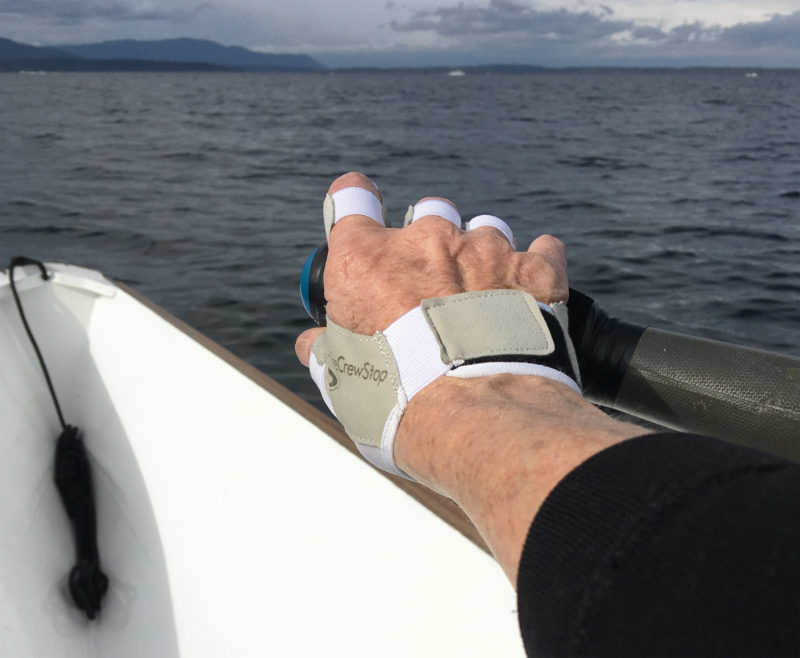
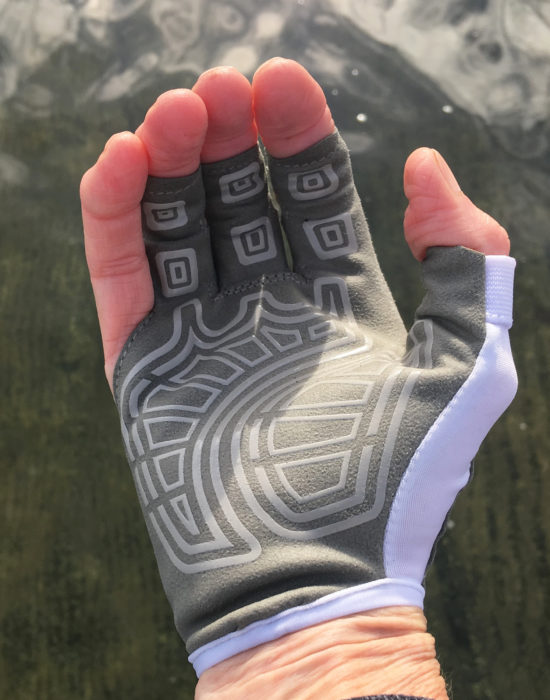
The backs of the gloves are open to keep them cool, light, and less restrictive.Dale McKinnon

The backs of the gloves are open to keep them cool, light, and less restrictive.

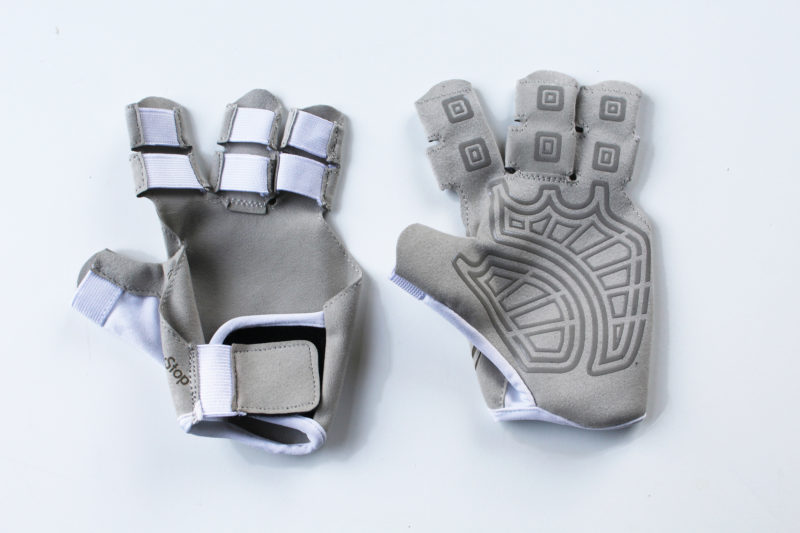
When I first saw the CrewStop rowing gloves, I thought they looked like well-made, orthopedic rehab devices. The backs of the gloves resemble athletic tape, and this is a good point: the CrewStop gloves are an effective alternative to taping. Each glove captures three fingers with two bands of elastic, providing an uninhibited range of motion while minimizing friction and heat at customary pressure points on the hands.

The silicone applied to the palm provides a good grip on the oar handle, even when it is wet.Dale McKinnon

The silicone applied to the palm provides a good grip on an oar handle, even if it is wet.

The gloves were designed by and for competitive rowers and scullers, so I wondered how they would stand up to the demands of expedition and open-water rowing. I row in a saltwater coastal environment where my gear has to hold up to sand, gravel, or crushed-shell beaches. On landings I often climb up on rocks or rusty ladders, but these gloves aren’t meant for that kind of rough work. They are very snug, and don’t lend themselves to quick removal, but I can quickly slip leather work gloves over them before I drive the bow of my boat onto a gravel beach and hop out with painter in hand to tug the boat ashore.

The pinky is subject to less pressure than the other fingers so it is left bare. SBM photo

The pinky is subject to less pressure than the other fingers so it is left bare.


My hands are often wet from rain or wind-driven spray while boating, so I dipped my hands in the water to soak the CrewStop gloves and went for a row. The palms have a pattern of silicone that gave me a sure grip on the oars even while wet. The leather-like palm material has a one-way stretch oriented across the hand so it doesn’t bunch up when wrapped around the oar handle. The material softened when wet, and even though I began to feel a hot spot near the fleshy skin between thumb and palm after rowing for 30 minutes, the gloves protected my hands everywhere else.

It makes good sense for rowers of any sort to take good care of their hands. These gloves are well designed and constructed to protect hands not yet toughened up for rowing. They can bring an end to the old-fashioned reliance on working through pain and possible infection from blisters to build calluses. The CrewStops are an intelligent solution for occasional rowers, rowers ramping up their training for a race, or rowers getting back on the water after taking time off. I’ll use them over the winter on my ergometer and in the spring on the boat to gradually develop the calluses I’ll need for my rowing season.

Dale McKinnon began rowing in 2002 at the age of 57 and in 2004 rowed solo from Ketchikan, Alaska, to her home town, Bellingham, Washington. In 2005 she rowed from Ketchikan to Juneau. Her previous articles for Small Boats Monthly include rowing the Columbia River and the Columbia River estuary, how to row rough water, and reviews of NewGrips rowing gloves, Exped sleeping pads, and the Devlin Duckling 17

The sculler’s version of the gloves (grip texture for both hands) shown here are available for $37.50 from The CrewStop.

Is there a product that might be useful for boatbuilding, cruising or shore-side camping that you’d like us to review? Please email your suggestions.

An Auto-Release Cleat

This summer I ran over a submerged object while I was out sailing my 18′ sail-and-oar boat. The centerboard, held down by a bungee, kicked up, dropped back down, and suffered no damage. The pivoting blade of my rudder was held in place by a downhaul in a jam cleat, not by a bungee, so when it kicked up, the stopper knot on the end of the downhaul pulled through its hole at the edge of the rudder blade. The blade stayed up and I no longer had rudder control. I had to stop, take the rudder apart, reinsert the downhaul, and add whipping to fatten the end to keep it from pulling though again. While I avoided major damage, it could have been worse if I’d had a more robust attachment for the downhaul.

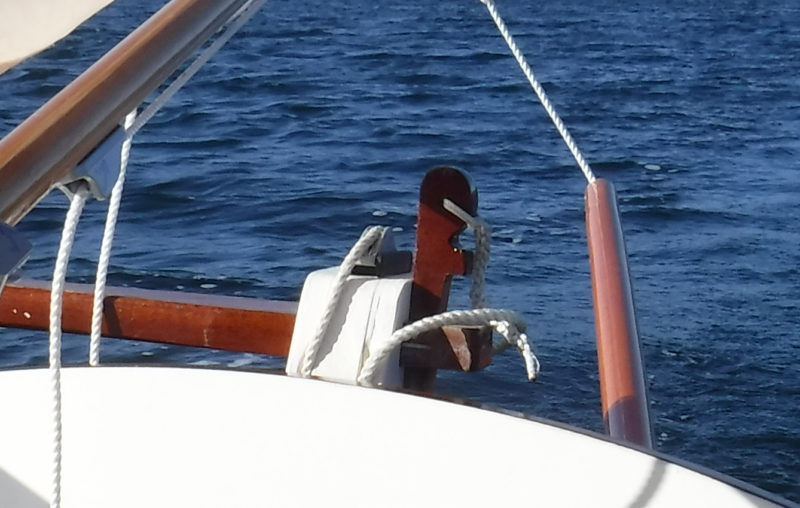
With the cleat mounted on a rudderhead, the downhaul line isn't at quite the right angle entering the cleat but the system still works.Alex Zimmerman

With the cleat mounted on a rudderhead, the downhaul line isn’t at quite the right angle entering the cleat but the system still works.


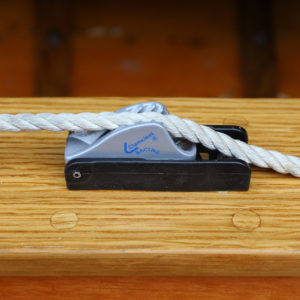
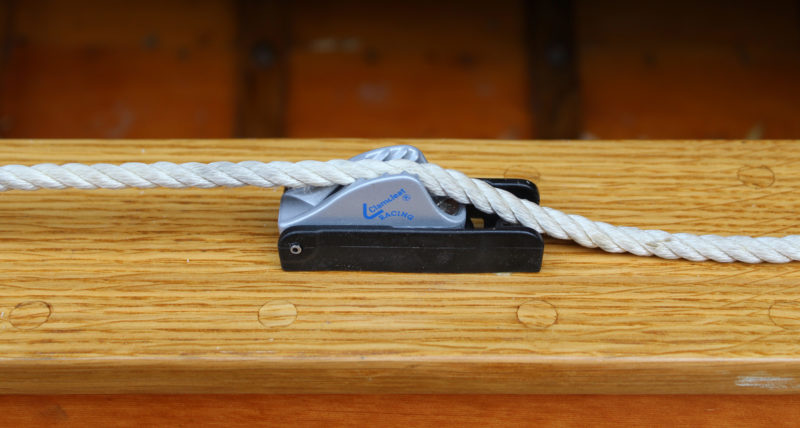
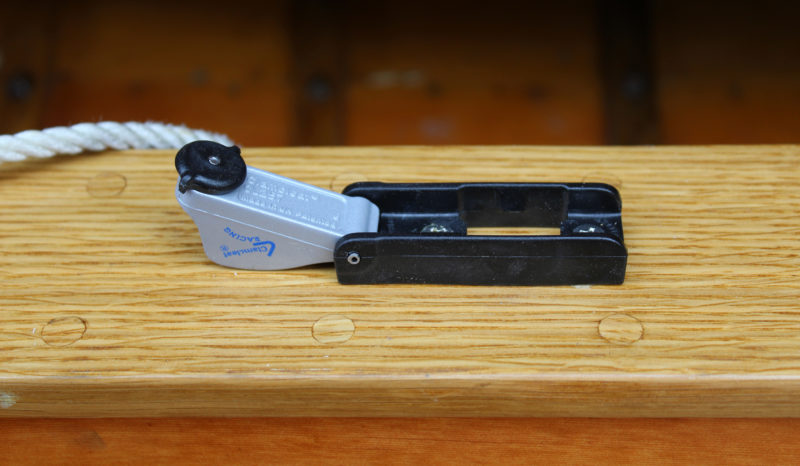
Clearly I’m not the first person to run into this problem, because the folks at Clamcleat in the U.K. have developed an auto-release jam cleat. The aluminum cleat accommodates lines from 3/16″ to 1/4″ in diameter and is mounted in an acetal thermoplastic base with a pivot pin. On the bottom of the cleat is a small double-sided cam that snaps underneath a couple of tabs inside a plastic base. When a tug on the line applies a sufficient upward force against the tabs, the cleat capsizes, releasing the line. The cam adjusts the force required for release and, according to Duckworks, a U.S. retailer for Clamcleats, can be set anywhere between 50 and 520 lbs.

The recommended installation would have the line pulling directly in line with the cleat, and mounting the cleat on a conventional tiller would achieve that. My boat has a push-pull tiller preventing that kind of installation, so I mounted the cleat on the rudder head. The downhaul enters the cleat at an angle of 16 degrees below horizontal, and while that’s not ideal—it increases the force needed to release the cleat—I thought it might work anyway.

For the cleat to work as designed, the line should enter the cleat parallel to the base.SBM

For the cleat to work as designed, the line should enter the cleat parallel to the base. This cleat is installed on the centerboard trunk of a Whitehall.


The tripped cleat shows the disk that engages tabs on the inside of the base.SBM

The tripped cleat shows the disk that engages tabs on the inside of the base. The tabs on the disk are stops to limit the range of its rotation.

There are two questions to be considered with this cleat: Will it keep the rudder in place while sailing in reasonable conditions? Will it release before a collision or grounding does significant damage to the rudder or boat?

To answer the first question, I took the boat out and sailed it in moderate conditions at up to 4 knots, and checked the force on the downhaul line by holding it. There was no more than 10 lbs of pull, well below the cleat’s release point.

To test the release without actually running aground, I clamped the rudder in the vise and set the downhaul in the auto-release cleat. With the cam at its lowest setting, I gave the rudder blade a good sharp tug with a force I estimated at about 75-100 lbs, and the cleat popped up and released the downhaul.

It seems to me the ideal setting for the auto-release would be the least amount of force needed to pop the cleat when an inadvertent force is applied (such as grounding your rudder blade) but enough to hold the rudder blade down against the forces pushing it back while you are underway. For my boat, I think this setting will work just fine. I suspect the lowest setting will also work fine with most small boats, but the adjustment is there and a little experimentation will tell you what works for your boat.

This clever piece of gear works as advertised. Though I am using it for a rudder, it would work equally well for a centerboard or a leeboard. It’s a keeper, and I will have a little more peace of mind next time I am out sailing.


Alex Zimmerman is a semi-retired mechanical technologist and former executive. His first boat was an abandoned Chestnut canoe that he fixed up as a teenager and paddled on the waterways of eastern Manitoba and northwestern Ontario. He started his professional career as a maritime engineer in the Canadian Navy, and that triggered his interest in sailing. He didn’t get back into boatbuilding until he moved back to Vancouver Island in the ’90s, where he built a number of sea kayaks that he used to explore the coast. In the early 2000s, he built his first sail-and-oar boat and he completed his latest in June of this year. He says he can stop building boats any time.

The Clamcleat’s CL257 Auto-Release Racing Mini in manufactured in England and available in the US for $21 from Duckworks.

Is there a product that might be useful for boatbuilding, cruising or shore-side camping that you’d like us to review? Please email your suggestions.

All in the Family

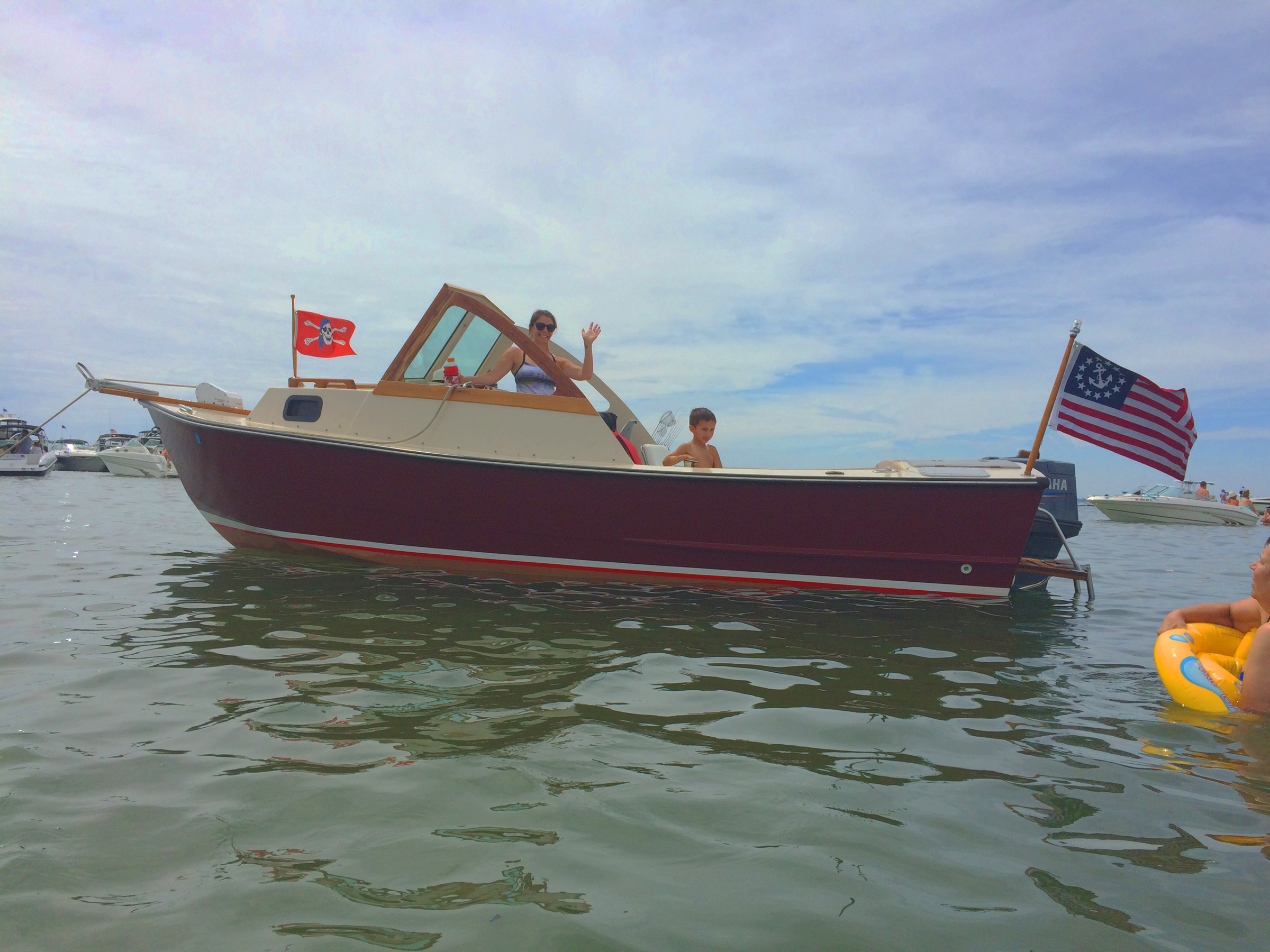
The Pilot 19 is designed with a pilothouse, but after Haynes bumped his head a few times on the frame that supported the roof, he decided to keep the cockpit open. The result has worked well for family outings.photographs by Joe Haynes

The Pilot 19 is designed with a pilothouse, and Haynes started building his boat that way, but after he bumped his head a few times on the frame that supported the roof, he decided to keep the cockpit open. The result has worked well for family outings.

Joe Haynes grew up in Detroit with three brothers and two sisters. Their father, once a tight end for the University of Michigan football team and later an Army sergeant who stormed beaches in the Pacific during World War II, was a very athletic man, but in spite of his best efforts to get his kids involved in sports, none of them showed any interest.

The family moved to Algonac, Michigan, a small town tucked in a bend of the St. Clair River, which flows from Lake Huron to Lake Erie and separates the state of Michigan from the province of Ontario. Surrounded by water, the kids gravitated to boats. The first boat in the family was a derelict wooden boat Joe and his twin brother fished out of the river near their home. They patched the leaks with tar and used the boat to explore the river upstream and down.

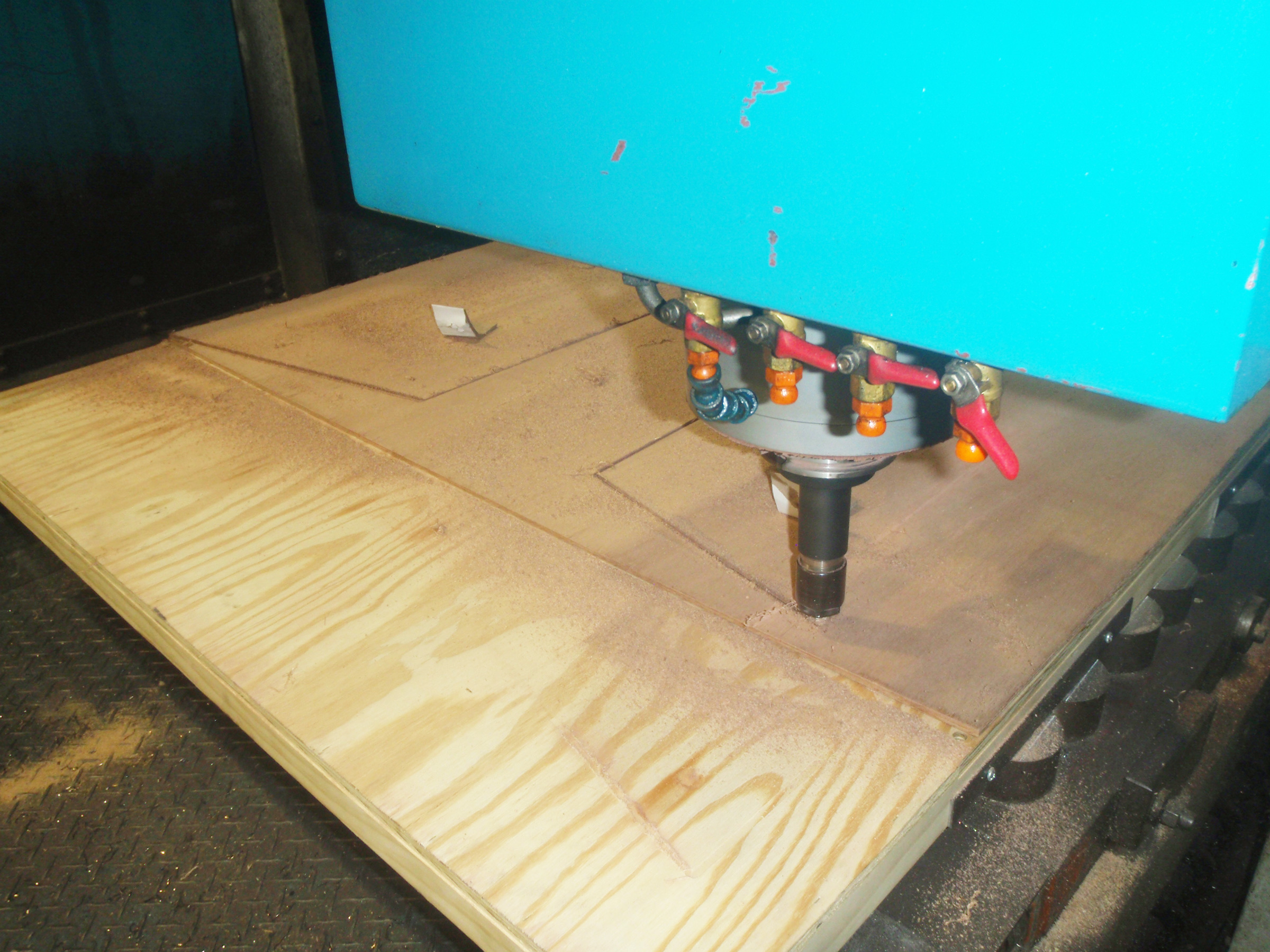
Haynes, a CAD designer, had the plywood panels cut on a CNC machine.

Haynes, a CAD designer, had the plywood panels cut on a CNC machine.

Joe’s dad was quick to pick up on his kids’ interest and bought a used outboard skiff for them to use. He also started to build a boat in the garage but never finished it. Years later, he told Joe he gave up because the kids kept taking his tools and losing them

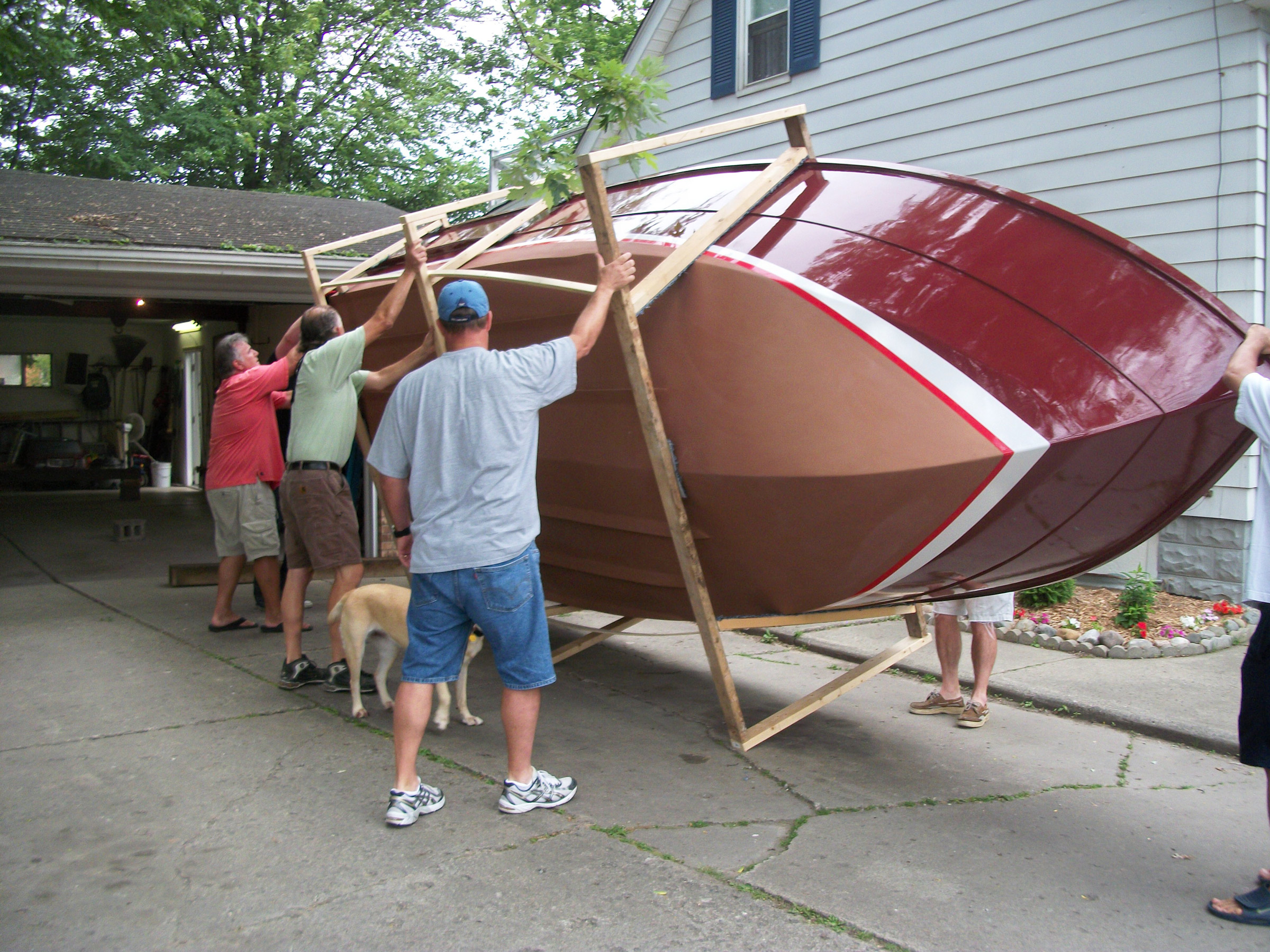
Haynes called in some extra hands for the rollover.

Haynes called in some extra hands for the rollover.

Joe grew up, married Janet Maria Mayea, and with her raised three children in Algonac. He was steeped in the tradition of wooden boats: Algonac is the home of Chris-Craft, Joe’s brothers owned Chris-Craft cruisers built in the 1940s, and his father-in-law, Herbert Mayea, was a second-generation owner of Mayea Boat Works, maker of Mays-Craft boats. Over the years Joe restored a 1959 Century Resorter ski boat, an old 12′ row boat, a 14′ skiff, and he built a 16′ outboard-powered dory.

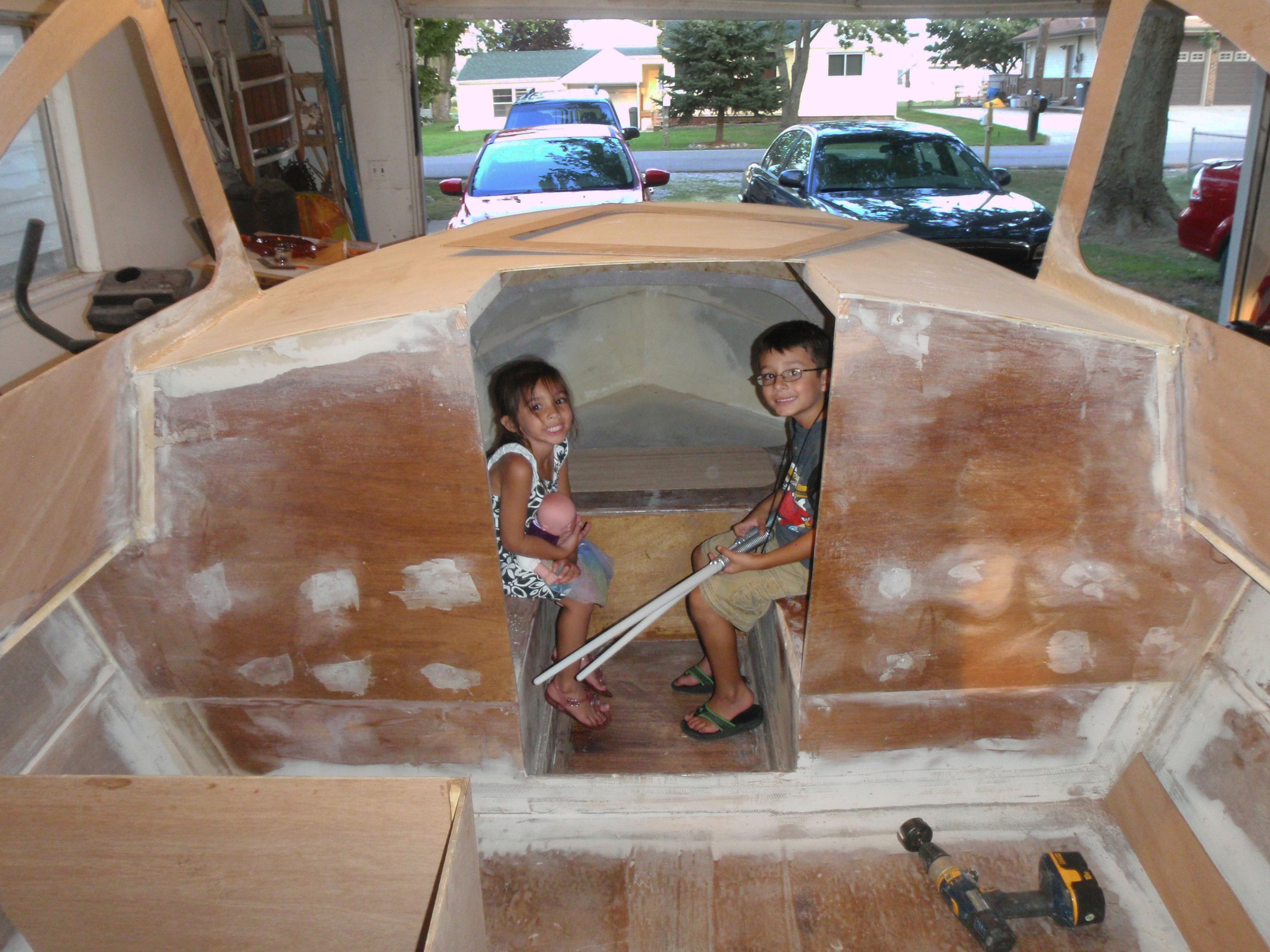
The grandkids wasted no time in occupying the cabin, bringing their dolls and light sabers with them.

The grandkids wasted no time in occupying the cabin, bringing their dolls and light sabers with them.

Joe’s kids grew up on the water, and there was always a boat in the family. They’d go out fishing or swimming and would often cruise the islands on the St. Clair River flats on the edge of Lake St. Clair. When Joe’s six grandkids came into the picture, he wanted to give them the same experience he’d had and had given his kids, so he decided to build a boat from scratch.

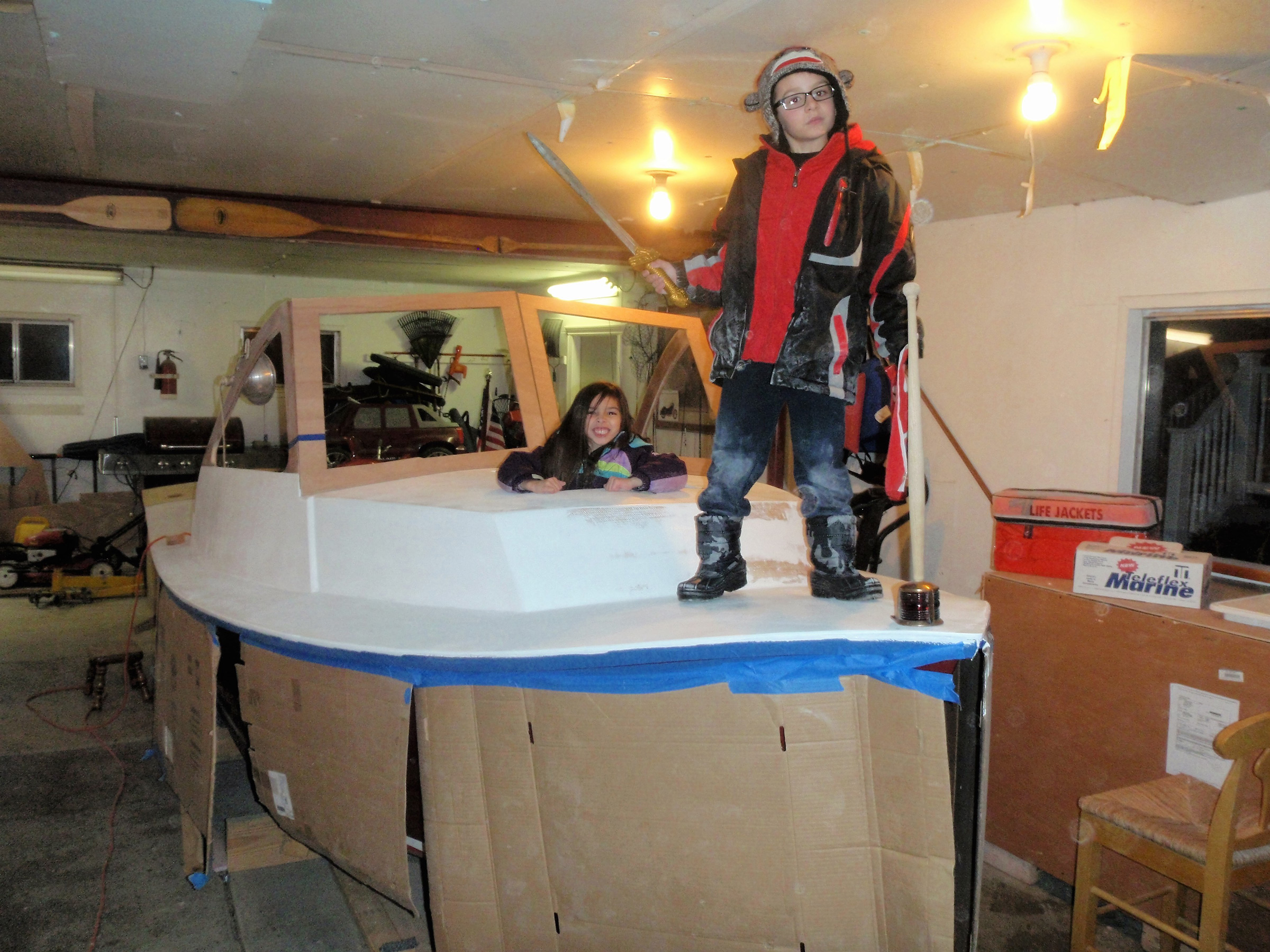
Armed with a sword and wearing a sock-monkey hat as a helmet, a grandson stands ready to defend the fort

Armed with a sword and wearing a sock-monkey hat as a helmet, a grandson stands ready to defend the fort.

Joe ordered plans for Jacques Mertens’s Pilot 19 from Bateau.com. A CAD designer, he did a digital build before starting work on the 18′ 11″ x 7′ 8″ boat. He made a few changes, most notably foregoing the pilothouse the boat was designed with. He preferred a more open cockpit and built the boat with just a windshield. With the design modified to suit, Joe turned from his computer, keyboard, and mouse to plywood, fiberglass, and epoxy. Some of his father’s tools that he and his siblings hadn’t lost were part of the project.

The construction is stitch-and-glue with an egg-crate system of interlocking bulkheads and stringers reinforcing the hull. The plans are designed to make for a quick build, but Joe took his time, calling on Mertens and the Bateau forum to help him through any rough patches. Even while the boat was under construction in his garage, it was already serving one of Joe’s purposes: luring the grandkids to visit. They made the boat their fort.

After launching JANET MARIA it was't lnog before Haynes was back in his garage workshop. He's now building a Mertens-designed 10' pram.

Not long after launching JANET MARIA, Haynes was back in his garage workshop. He’s now building a Mertens-designed 10′ pram.

It took Joe five years to finish the boat; even before it was launched it was already a fixture in the family. JANET MARIA, named after Joe’s wife, is now afloat and frequents the St. Clair River, Lake St. Clair, and the Detroit River. The boat will stay on a plane at just 12 mph, and with two people aboard, the 90-hp outboard will take them up to 35 mph.

Three generations of the Haynes family enjoy fishing, cruising, swimming, tubing, and getting together with friends aboard the boat. Moored on a canal just behind the house, she still serves as the grandkids’ fort.

Have you recently launched a boat? Please email us. We’d like to hear about it and share your story with other Small Boats Monthly readers.

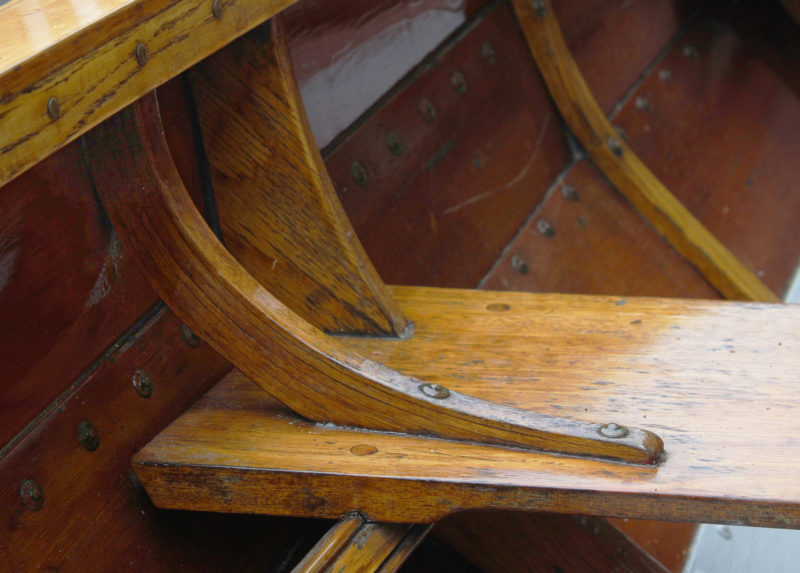
Blind-splined mitered knees

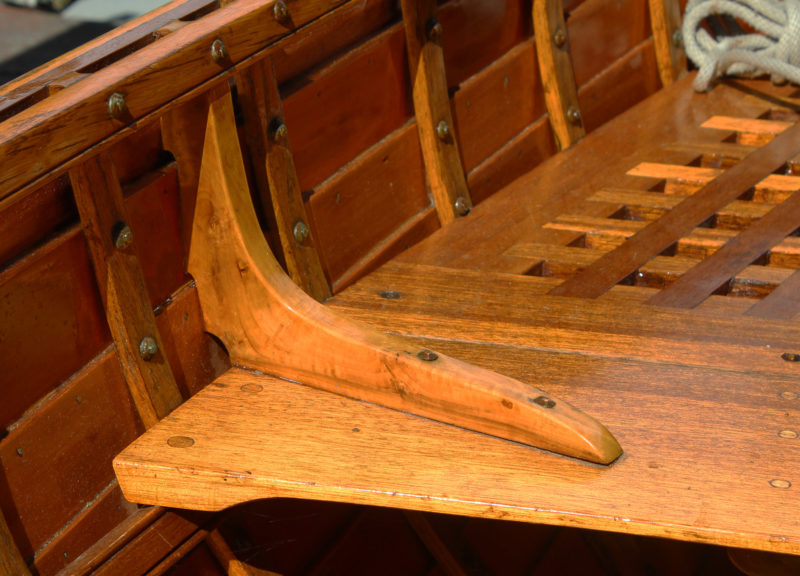
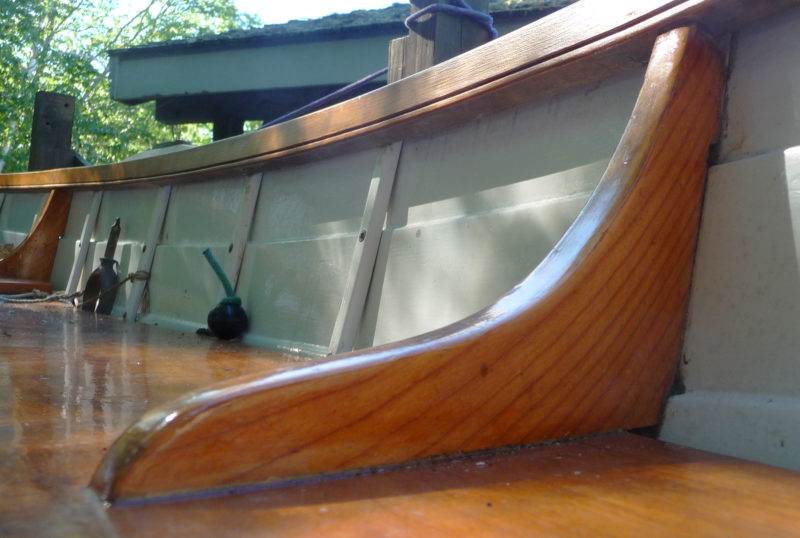
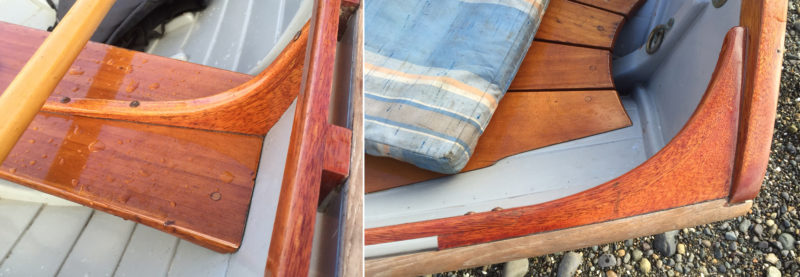
I started building boats in 1978, and only once was I able to collect enough crooks for a boat, a New York Whitehall. Its breasthook is apple, the six thwart knees and the bookmatched pair of quarter knees are cherry, and the transom knee is Alaskan yellow cedar. I think they’re easy on the eyes, and even though the boat is now 32 years old, the knees are as good as new. Crooks of sufficient size were hard to find, difficult to season without checks, and awkward to saw into workable stock. In other boats I’ve made straight-grained, laminated, and steam-bent knees, but none took a nice shape as well as the ones I made from crooks.

Back in February, Ben Fuller and I were corresponding about a variety of ideas for articles, and he wrote, as an aside to a comment on boom jaws: “And don’t get me started about clunky, short-toed fat knees.” When I was looking at knees in the small boats at the Wooden Boat Festival in Port Townsend this past September, I saw a lot of short-toed knees and thought it was time to get Ben “started” and have him write an article. While most of the knees at the festival were one-piece, straight-grained knees, one boat had some very nicely shaped half-lapped knees, but the joints that showed—vertical on one face, horizontal on the other—didn’t look right. I had a boatbuilder friend take a look at them, and he agreed that the shapes were good but the glue lines spoiled the effect.

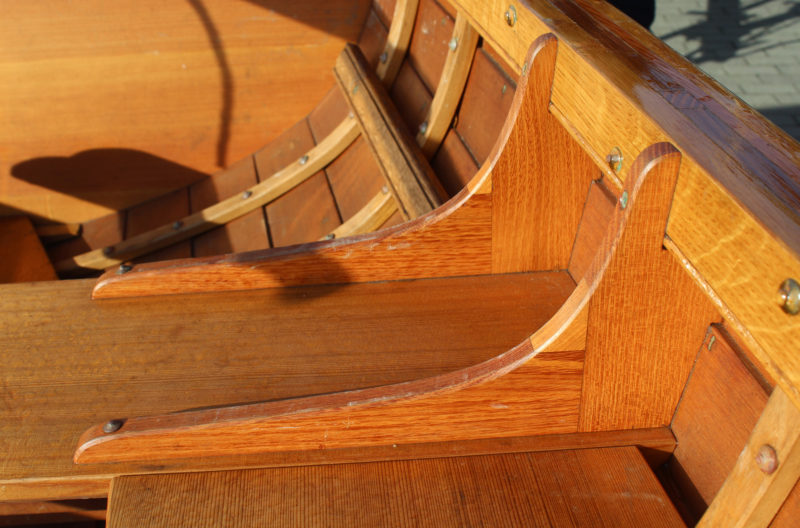
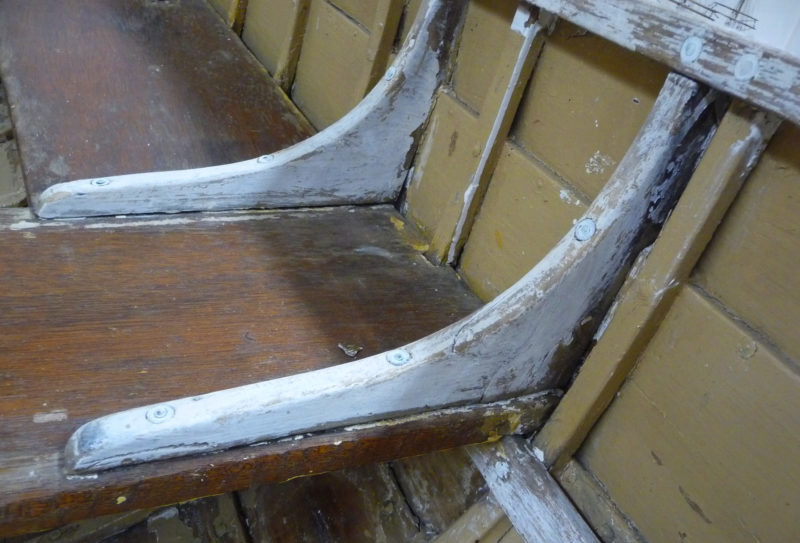
These knees are very nicely shaped, but the curves can't compete with the rectilinear filler blocks and seams.

These knees are very nicely shaped, but the curves can’t compete with the rectilinear filler blocks and seams.

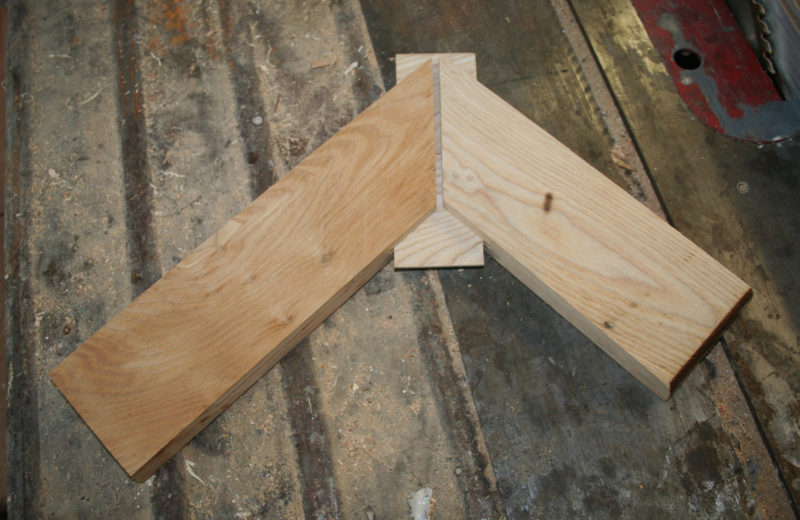
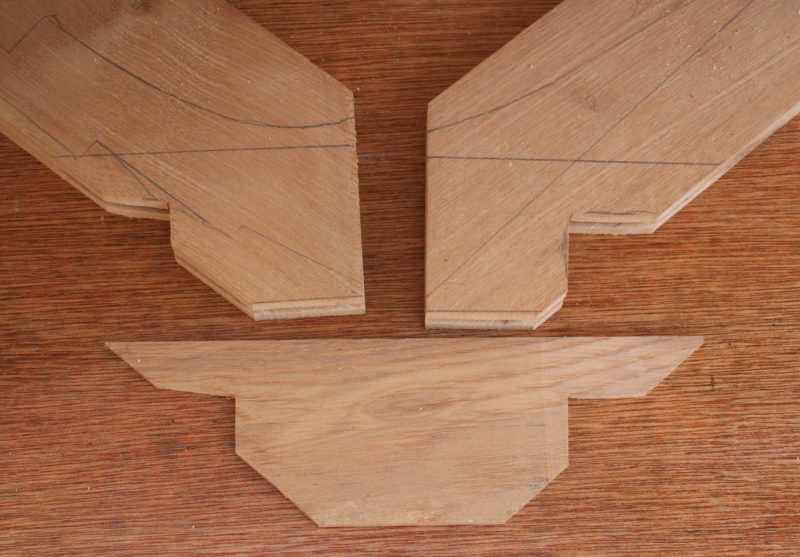
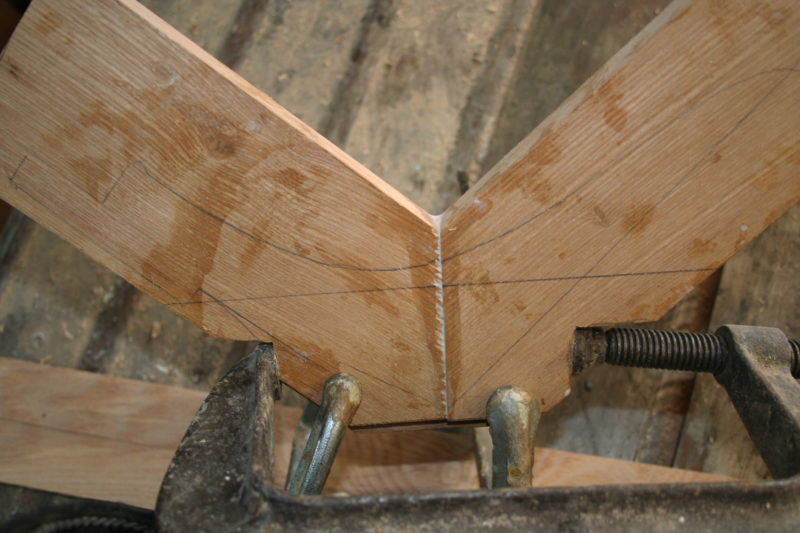
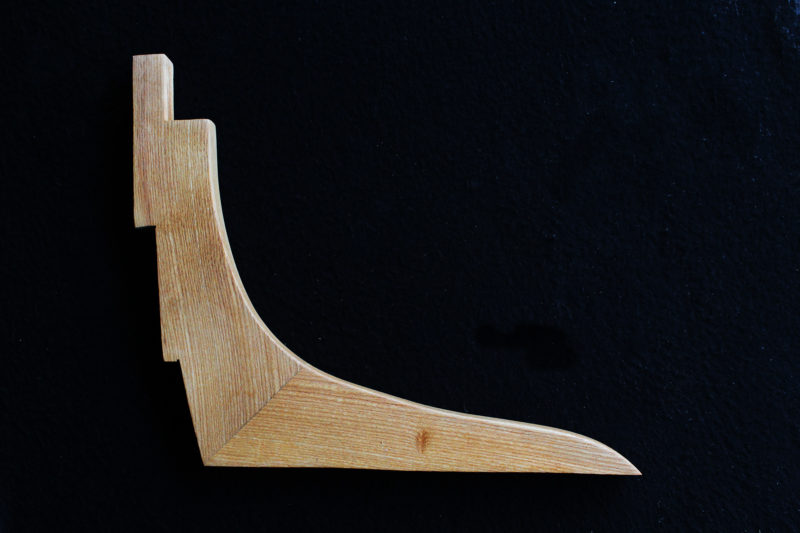
I made some sketches of other ways to make knees using straight-grained lumber, and thought that an angled joint would look much better. The easiest way to join two pieces in a mitered corner would be with a spline. I had made two-piece breasthooks with splined joints, and they’ve held up well over the years. The method should work just as well on knees.

I don’t have a boat in the works, so I made up some knees that could fit boats that I’ve already built, but they would be objets d’art at best. I made one in breasthook fashion with table-sawn kerfs running parallel to the angled miter edges. That worked, but left the spline exposed.

I then cut kerfs perpendicular to the miter edges, cutting about 1/2″ shy of what would become the curved edge of the knee. That was the way to go. The first mitered-and-splined test pieces were joined at a right angle, and when I cut the knee to shape to fit the slightly obtuse angle of the boat, the miter wound up well above where the knee would meet the thwart. I changed the angle of the miter to a 98-degree angle to match the flare of the side at the thwart, and then, by using slightly oversized stock, I would be able to arrange the template for the knee to put the miter angle where I wanted it as well as fine-tune the run of the grain in the ends of the knee.

The kerfs cut at a right angle to the miter joint are quite deep. That increases the gluing area, which I think will make the joint quite stable. When I need knees for the next boat I build, I’ll make them this way, mitered and blind-splined.


Kerfs cut parallel to the miter joint will leave the spline visible after the knee is shaped.

Kerfs cut parallel to the miter joint will leave the spline visible after the knee is shaped.


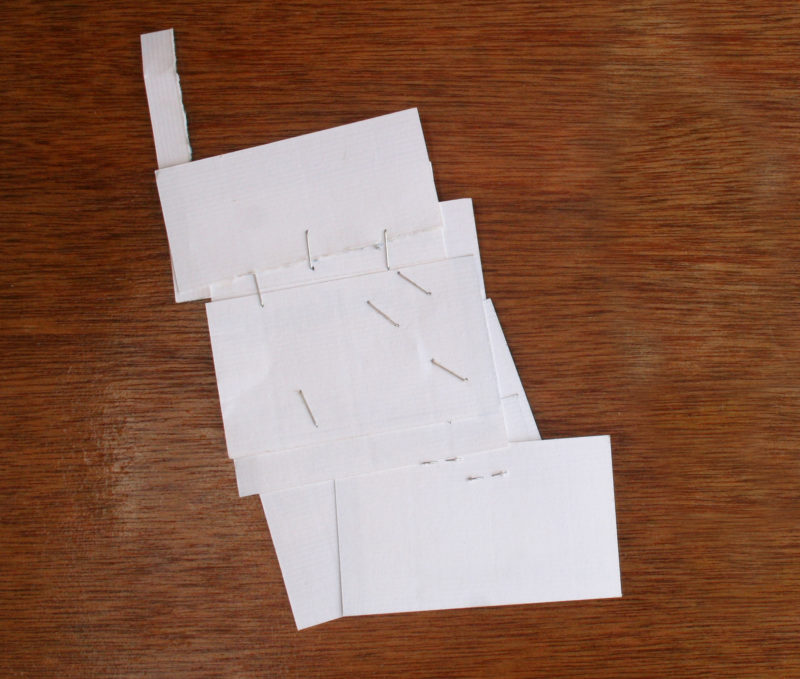
I initially made a business-card template for just the upright leg, not a pattern for the whole knee. The left edge and the bottom fit the contours of the lapstrake planks and the thwart.

I initially made a business-card template for just the upright leg, not a pattern for the whole knee. The left edge and the bottom fit the contours of the lapstrake planks and the thwart.


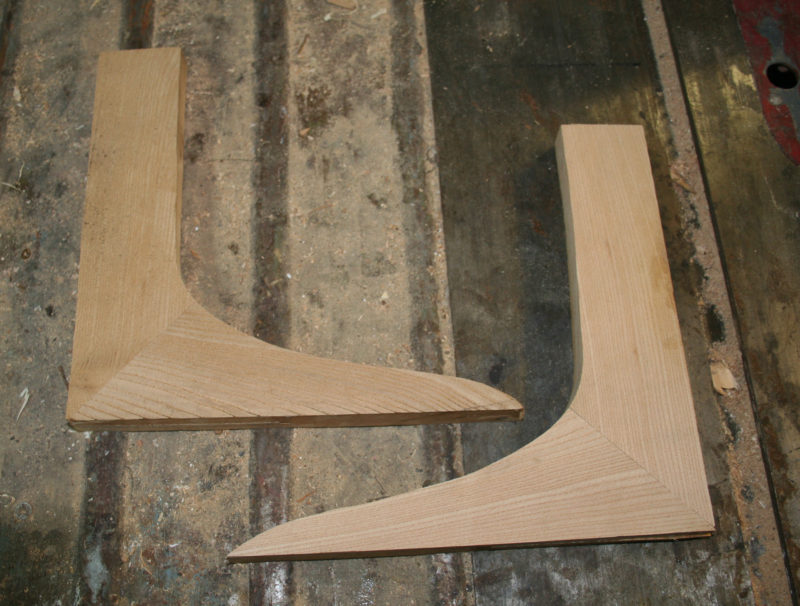
I started by making right-angled blanks for knees and cutting the toes before tracing the planking contours from the template on the upright. That approach didn't give me the best run of grain on the upright nor control over the location of the miter joint.

I started by making right-angled blanks for knees and cutting the toes before tracing the planking contours from the template on the upright. That approach didn’t give me the best run of grain on the upright nor control over the location of the miter joint.


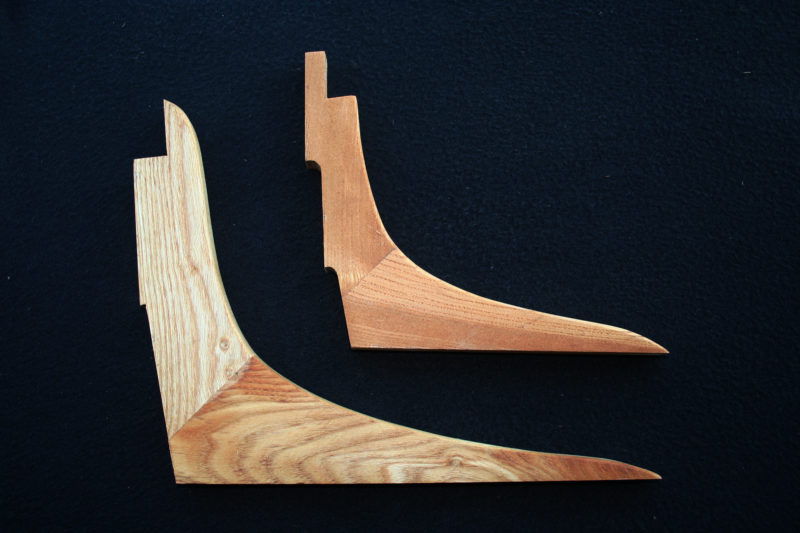
Two early versions of splined knees had the miter joint higher than I had wanted and had poor color matches despite having each knees sections cut from the same piece of wood.

Two early versions of splined knees had the miter joint higher than I had wanted and had poor color matches despite having each knees sections cut from the same piece of wood.


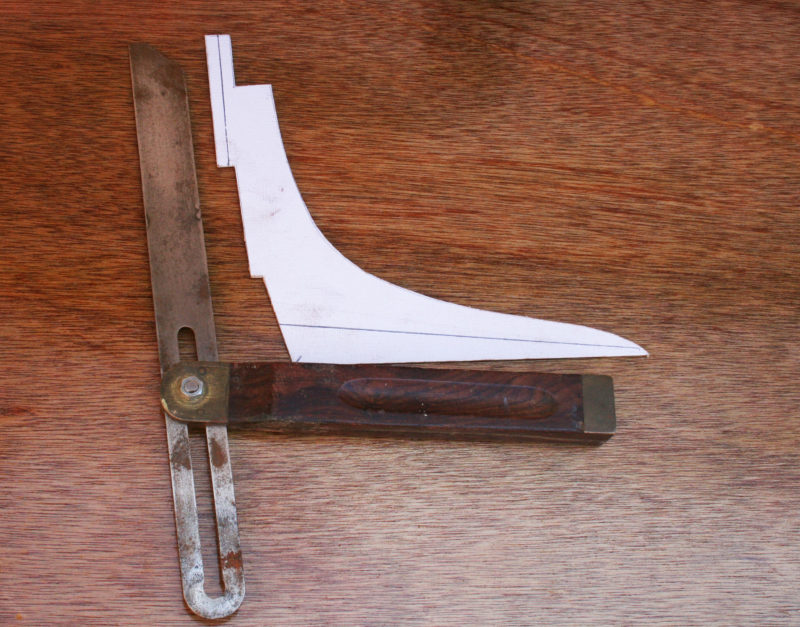
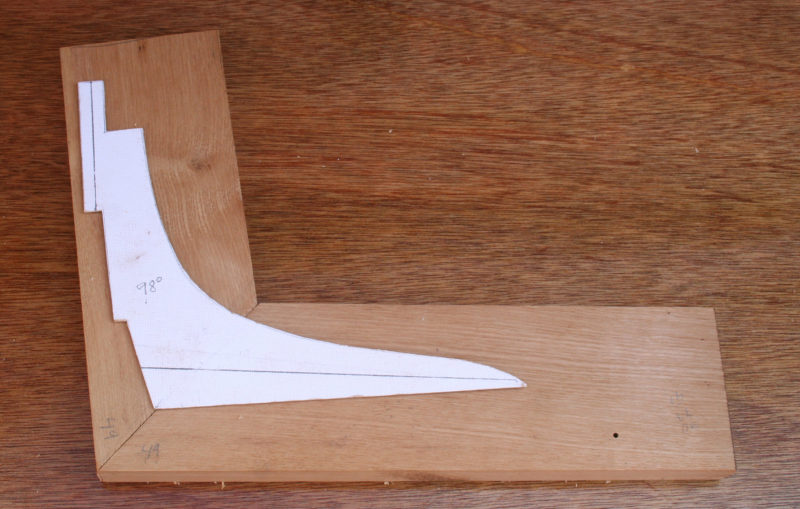
For my next trails I  used the business-card template to make a full pattern for the knee. The pencil lines show the direction I want the grain to run in the finished knee. I set the bevel gauge to record the angle between the line, in this case 98 degrees.

For my next trails I  used the business-card template to make a full pattern for the knee. The pencil lines show the direction I want the grain to run in the finished knee. I set the bevel gauge to record the angle between the line, in this case 98 degrees.


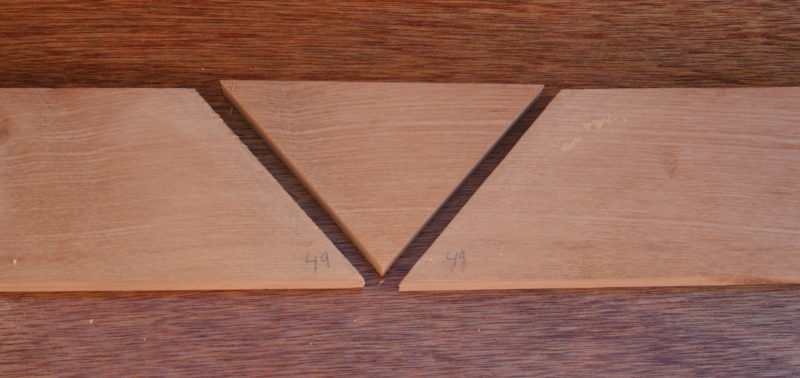
By making two cuts and "wasting" the triangle, I can get a better match of grain and color. When I made a singe cut and flipped on piece to get the angle, the color should have looked the same, but the angle the grain takes at the surface catches the light in different ways. Flipping one piece gave the wood a different look that was quite evident at the joint.

By making two cuts and “wasting” the triangle, I can get a better match of grain and color. When I made a singe cut and flipped on piece to get the angle, the color should have looked the same, but the angle the grain takes at the surface catches the light in different ways. Flipping one piece gave the wood a different look that was quite evident at the joint.


With oversized stock I could adjust the pattern to get choose the best run of the grain and the location of the miter joint that looked best.

With oversized stock I could adjust the pattern to get choose the best run of the grain and the location of the miter joint that looked best.


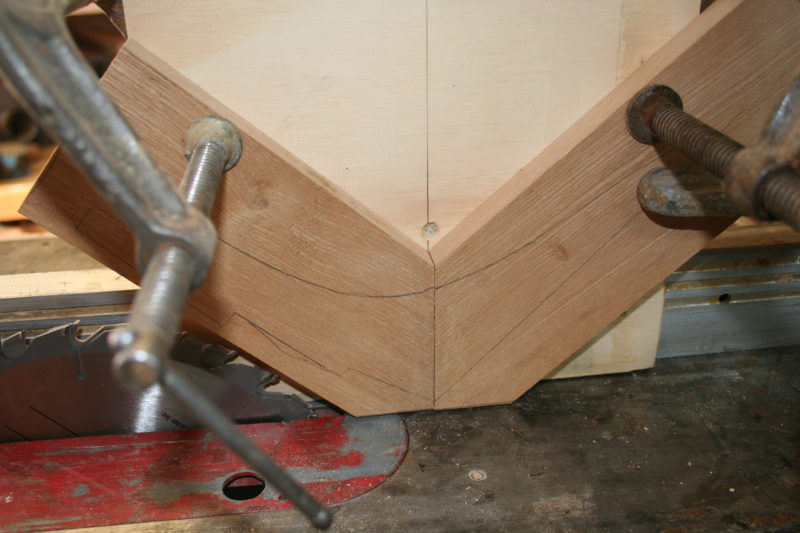
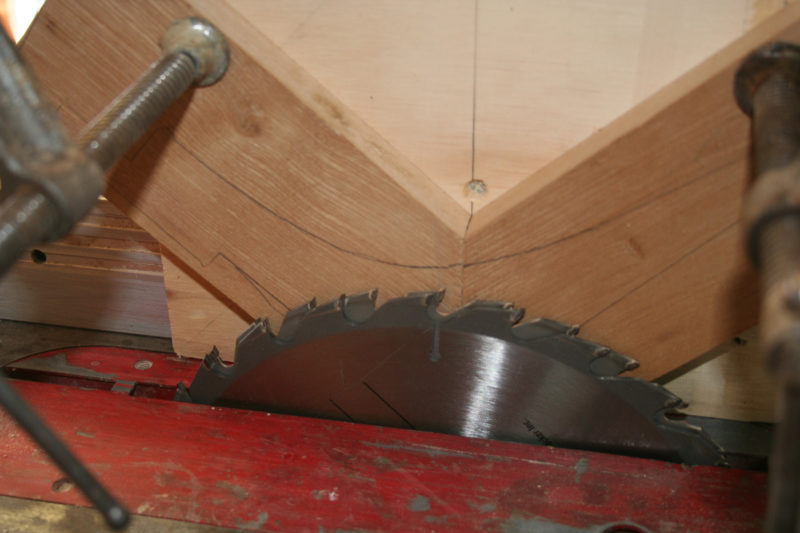
I used a shop-made tenon-cutting jig to cut the kerfs for the splines. It straddles and slides along the rip fence. Cutting off the corners of the two pieces being sawn gets rid of wood that doesn't need to be run through the saw. I have two blades stacked on the saw arbor to cut a 1/4" kerf.

I used a shop-made tenon-cutting jig to cut the kerfs for the splines. It straddles and slides along the rip fence. Cutting off the corners of the two pieces being sawn removes wood that doesn’t need to be run through the saw. I have two blades stacked on the saw arbor to cut a 1/4″ kerf.


I set the depth of cut to fall short of what would eventually be the inside face of the knee.

I set the depth of cut to fall short of what would eventually be the inside face of the knee.


Oversize blanks provide extra wood for notches for a clamp to squeeze directly across the joint without slipping. The spline as a little more wood sawn off so the clamp won't bear against it, prevent the clamp from squeezing the joint closed tight.

Oversize blanks provide extra wood to make notches for a clamp to squeeze directly across the joint without slipping. The spline has a little more wood sawn off so the clamp won’t bear against it, preventing the clamp from squeezing the joint closed tight.


A large clamp squeezes the miter joint tight and two small clamps squeeze the wood tight tight against the spline.

A large clamp squeezes the miter joint tight and two small clamps squeeze the wood  tight against the spline.


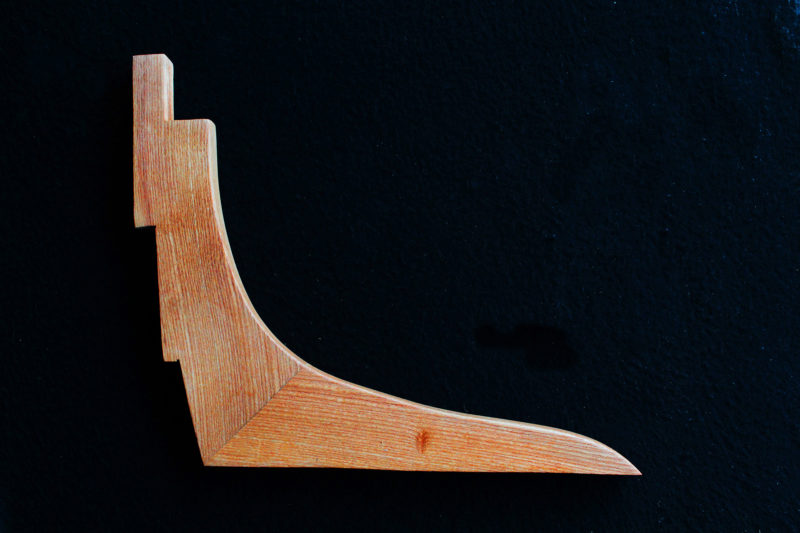
The finished knee has a good angle for the two legs of the knee, a close match of grain, and a good place for the miter joint.

The finished knee has a close match of grain and a good placement of the miter joint.

Little Miss Sally

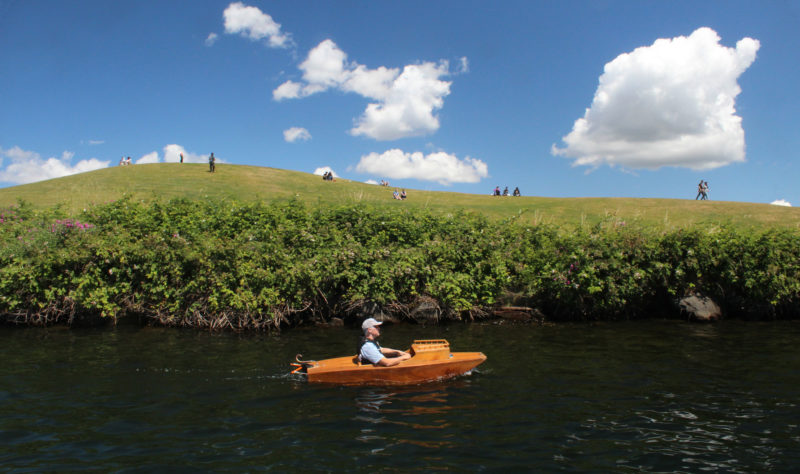
If you tend to take yourself too seriously, here’s a boat that can fix that. Paul Elkins’s Little Miss Sally is an electric micro-boat for which whimsy is as essential to its operation as its 12-volt battery. I first saw the boat on a YouTube video. In it, Paul slides her out of the back of his pick-up truck. A man with a horseshoe moustache, sunglasses, and a camo cowboy hat says: “That’s baaad. You gonna ride that thing? Sweeet!” The video has over a million views. That was my first hint that the boat might have a broad appeal.

Paul has invented and designed lots of things: several boats, bicycle camper trailers, micro shelters, and odd things such as paint-can stilts. He describes himself as a “conceptual artist”; he’s more interested in exploring ideas and creating things than capitalizing on them. Most of Paul’s creations get little more than a photo on his website or a video on YouTube, and then he’s off to the next idea. Little Miss Sally is one of 10 creations for which he has drawn plans.

The boat is roughly 8′ long, 30″ wide, and 14″ deep. While the 42-page instruction manual gives detailed dimensions for all of the pieces, the exact overall dimensions aren’t listed. They’re not really necessary, and the focus of much of Paul’s work is just on getting things done. His full list of materials and tools, measured drawings, and step-by-step instructions and photographs will make it easy for a novice to put the boat together. If you have even a modest background in woodworking, you might be able to get the boat assembled in a weekend and be ready for wiring and paint or varnish.

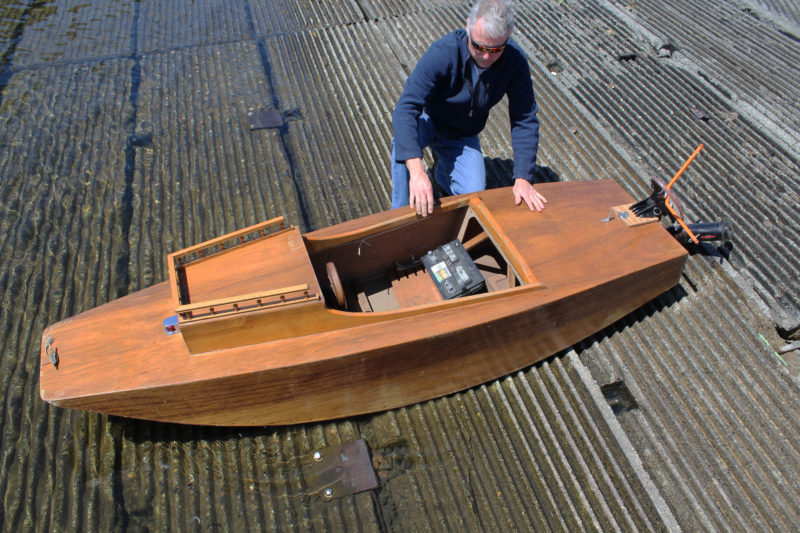
At the launch ramp, Elkins sets the 12-volt deep-cycle battery behind the angled panel that serves as a backrest. The trolling motor's shaft has been shortened and its controls moved to the dash panel forward of the wheel.photographs and video by the author

At the launch ramp, Elkins sets the 12-volt deep-cycle battery behind the angled panel that serves as a backrest. The trolling motor’s shaft has been shortened and its controls moved to the dash panel forward of the wheel.

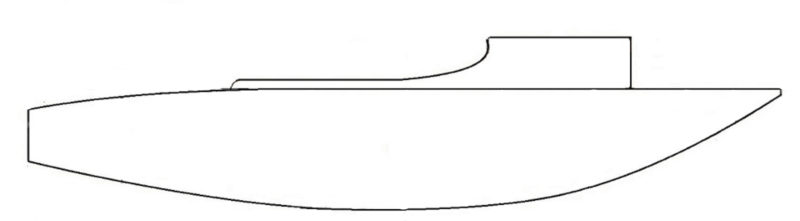
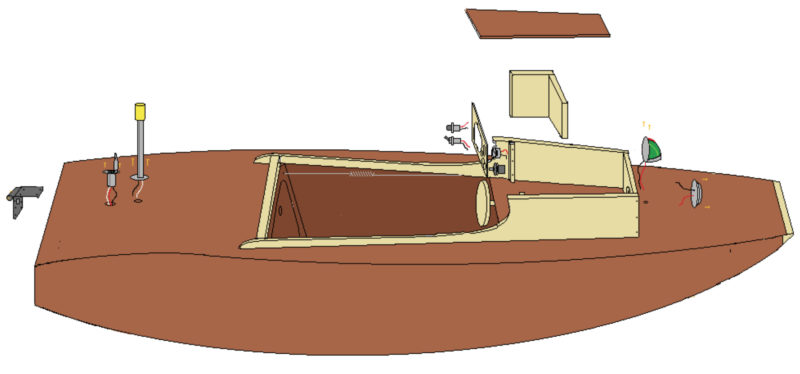
Little Miss Sally has a scow-like hull of 1/4″ mahogany marine plywood. The vertical side panels are sprung around the transom, the bulkheads that define the cockpit, and a horizontal wedge-shaped bow piece. Intermediate framing reinforces the sides and decks. The bottom panel is wrapped in a continuous sweeping curve from the bottom of the transom to the forward end of the sheerline. The one-piece plywood deck, the bottom, and the sides are all nailed to 3/4″-square longitudinals.

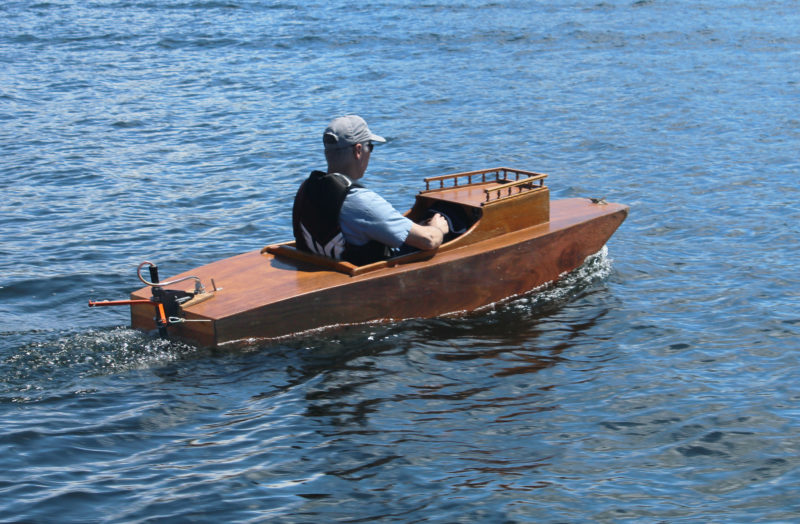
The hull's deep rocker and the weight of the 12-v battery give the boat good stability.

The hull’s deep rocker and the weight of the 12-v battery give the boat good stability.

The plans include an optional profile in which the bottom runs straight aft from the lowest point of the hull to a deeper transom. Paul’s suggestion is that the alternate hull “might go a little faster and carry a little more weight.” A few of the Little Miss Sally builders who have pictures of their boats on Paul’s site appear to have chosen this deeper stern, but without any additional weight aft, the extra displacement merely lifts the stern, pitching the bow down. The boat may still perform satisfactorily, but it looks out of trim and the otherwise jaunty sheerline suffers. It’s an 8′ boat. It’s not going to go fast or carry a lot of cargo, so you’ll be better off sticking with the original design.

The cockpit was a comfortable fit for the reviewer's 6' frame and his size-13 shoes.

The cockpit was a comfortable fit for the reviewer’s 6′ frame and his size-13 shoes.

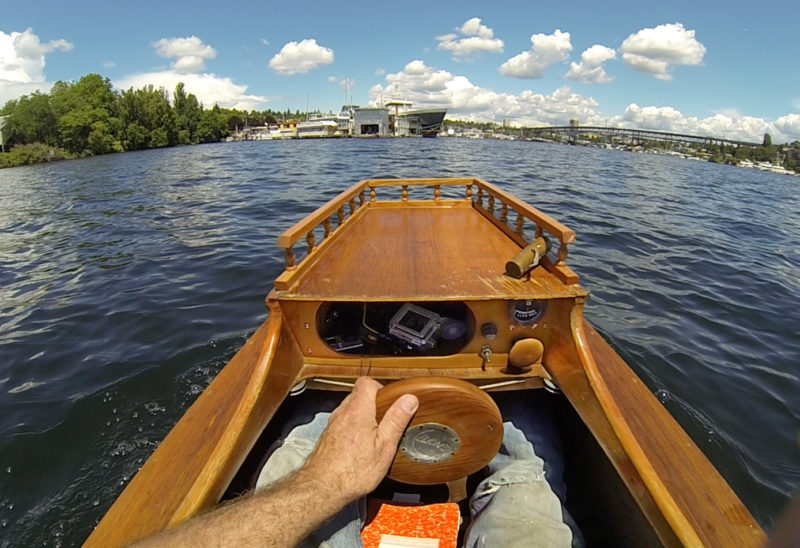
The pine cockpit coaming sweeps up to form the superstructure; its roof is surrounded by a fiddle rail to keep lunch and sunglasses from slipping overboard. The instrument panel has an amp-meter, a switch for running lights, a horn, and a dial control for the electric motor. The adjacent compartment has room for day-trip sundries. The wooden wheel turns on a length of steel tubing with the steering lines wrapped around it.

Little Miss Sally’s outboard motor is a modified 32-lb-thrust trolling motor. The shaft is shortened and the controls, with a bit of extra wire, are moved to the instrument panel. A steering bar, its ends angled back about 45 degrees, is secured to the motor shaft with stainless-steel hose clamps. A deep-cycle 12-volt battery occupies the space under the aft deck, just behind the cockpit.

While the plans call only for a block of foam for flotation in the bow, the stern compartment should also be fitted with foam, leaving only space for the battery, to support the stern in the event of a swamping.

The exterior gets a layer of fiberglass and epoxy before the skids that protect the bottom are fastened in place and the finish is applied.


The weight of the boat without the battery and motor aboard is about 65 lbs, so it’s not too heavy to cartop if you’re strong enough to make the lift or have a way to raise to it one end at a time. Readying the boat for launch takes just a few minutes. These are the steps to getting underway: the motor must be pinned to its mount and plugged in; the rudder lines must be clipped to the yoke; and the battery must be put in place through a hinged panel in the aft bulkhead. The plans don’t specify a line to tilt the motor up for launching and landing, but it would be easy enough to rig one.

Getting aboard Little Miss Sally is a bit like getting into a kayak, except the weight of the 12-volt battery gives the boat a lot more stability. I had no trouble climbing aboard or exiting at a high dock, a task that isn’t easy with a kayak. Once I planted myself in the cockpit, the boat felt rock-solid; the deep rocker of the bottom put my weight down low. With my 215 lbs aboard, Little Miss Sally had more than 6″ of freeboard, but the boat doesn’t have Coast Guard rating for a safe load, and should be used with caution, and only on calm, protected waters

You’ll need a two-piece kayak paddle for backup propulsion; there’s room in the cockpit for it. Slats kept me off the bottom, so the seat of my pants would have stayed dry if any water had splashed aboard. The aft bulkhead, angled at 75 degrees, makes a comfortable backrest, and in spite of the boat’s small size the accommodations didn’t feel at all cramped. With my elbows resting on the low coaming, I felt as if I were driving a convertible sports car with the windows and the top down for a sunny day.

The hull is made of two sheets of 1/4" plywood and about 25 board feet of lumber.

The hull is made of two sheets of 1/4″ plywood and about 25 board feet of lumber.

At full throttle I made a GPS-measured 3 knots. Paul thought he may have made a mistake when he rewired the boat for our outing, and the motor wasn’t getting up to full power. Judging by the sound of the motor, I’d be inclined to agree with him. I have a similar trolling motor, and it has more oomph and makes more of a whine when running wide open. Paul estimated the top speed somewhere between 4 and 5 knots. I was quite content with making 3 knots. Being so close to the water on all sides exaggerates the sensation of speed.

The water on the lake was scuffed only by a light breeze, so I had a pretty smooth ride. Little Miss Sally just bobbed over the boat wakes I encountered. A boat as short as this one tends to follow the contours of waves, rather than plow through them as a longer boat would, and even if a wave did spill over the bow, the superstructure would keep the water from getting to the cockpit.

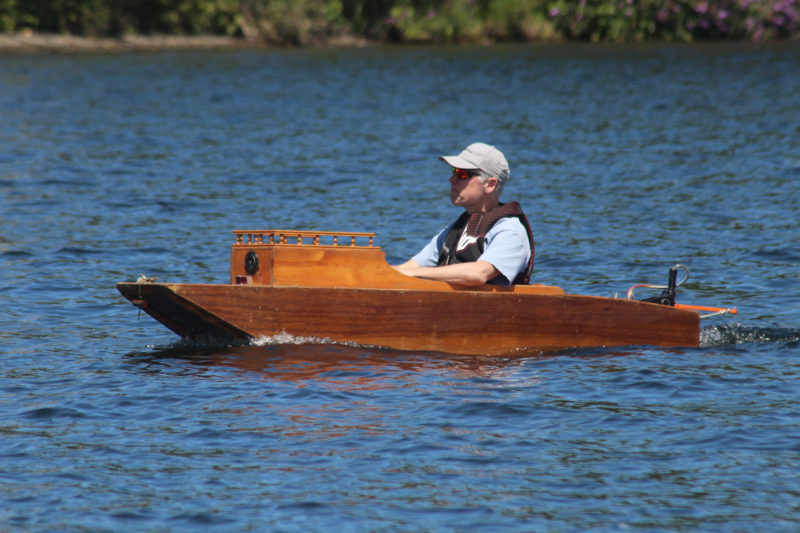
Elkins' micro-boat provides a comfortable seat for watching the panorama of protected waterways unfold.

Elkins’s micro-boat provides a comfortable seat for watching the panorama of protected waterways unfold.

The little steering wheel does its job well. My hand dwarfed it, and along with the push-button electric horn it made me feel as if I were riding one of those coin-operated kiddie rides at the entrances to department stores (but without even a hint of embarrassment).

I didn’t have a chance to run the boat long enough to work through the battery’s charge, but Paul reports taking leisurely outings of 6 to 7 miles aboard Little Miss Sally and spending a whole afternoon, up to 6 hours, with frequent stops to enjoy the sights on Lake Union and other sheltered waters in Western Washington.

After I returned Little Miss Sally to the launch ramp, Paul took her back out to enjoy the rest of the afternoon. A man working with a utility crew, dressed in a Day-Glo orange vest and a hard hat, approached me at the top of the launch ramp and asked about the boat. He said he was planning on getting his first boat and needed something that wouldn’t take up a lot of room at home. He thought Little Miss Sally would be just the thing for lake fishing, and would offer an economical way for him to get out on the water without a whole lot of fuss. There’s nothing silly about that.

Little Miss Sally Particulars

[table]

Length/8′

Beam/30″

Weight (without battery)/65 lbs

[/table] lmslines

lmsdrawing

Plans for the Little Miss Sally are available from Paul Elkins. The 42-page downloadable PDF manual with dimensioned drawings costs $20.00.

Is there a boat you’d like to know more about? Have you built one that you think other Small Boats Monthly readers would enjoy? Please email us!
Flint

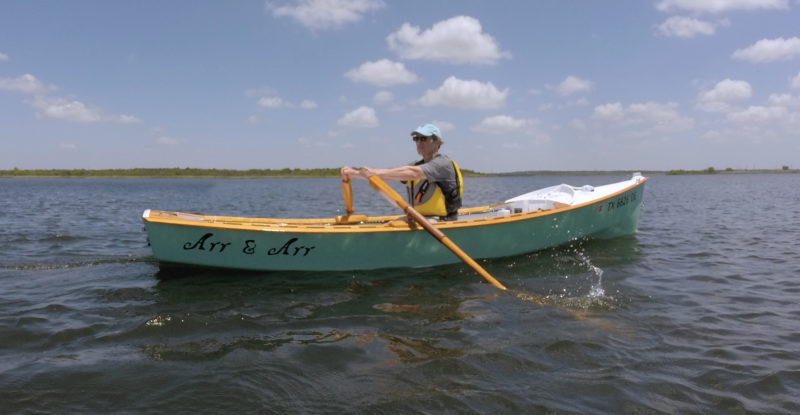
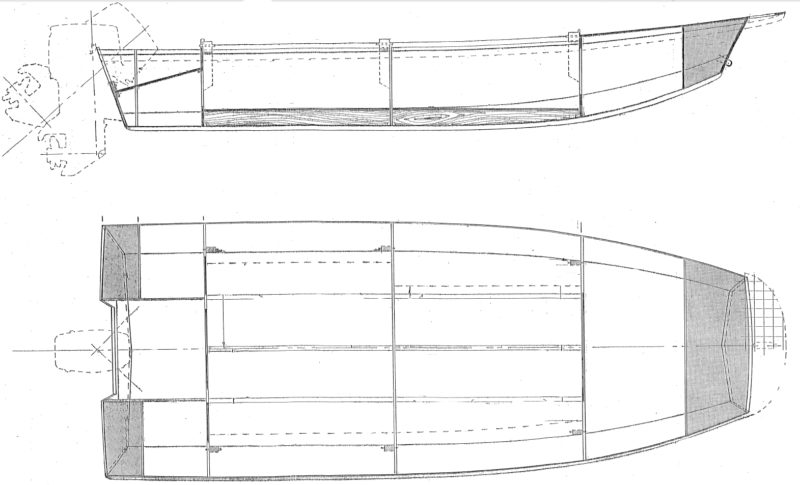
Flint is a 14′ 10″  open boat Ross Lillistone originally designed for Eddie Guy, who lived on an island in Moreton Bay, Australia, and traveled between the island and the mainland by rowboat. Eddie was disappointed with the boat he had been using and asked Ross to design one better suited to the task. The Flint is designed primarily as a rowboat, and moves quickly and easily under oars. It’s designed to track well even in a crosswind, to handle chop without pounding, and to handle longer voyages under the power of a small outboard. It has ample freeboard forward and a sharp, flared-V forefoot with more curvature than seems possible from plywood. The bottom fills out to a shallow V amidships and rises just enough aft to give the waterline the clean exit of a double-ender.

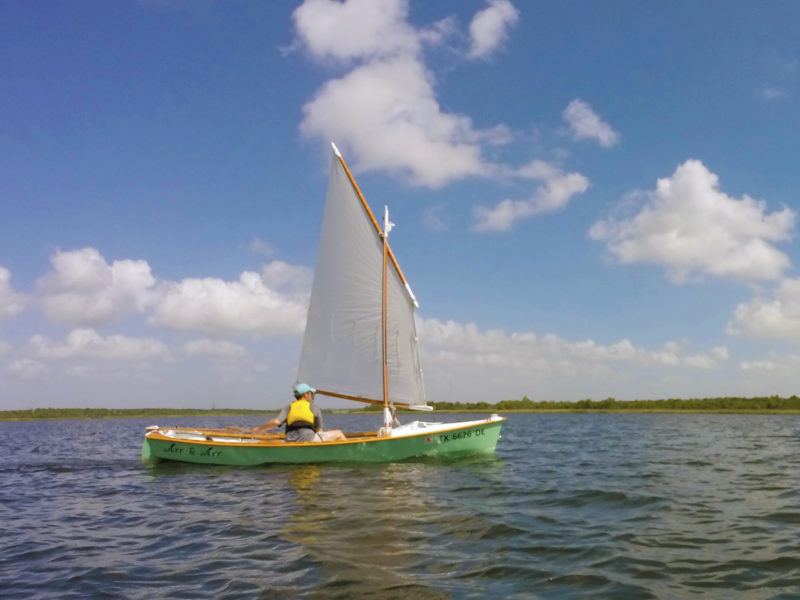
Flint was designed to reach displacement speed with ease, and it takes very little indeed to move it well: one pair of oars, the tiniest of outboards, or a small sail. Although it can exceed theoretical hull speed by at least a knot, it’s not designed to plane. Any outboard much more powerful than 2 hp would be overkill and would, in fact, throw the trim off and distort the waterline that normally makes it so effortless to drive. (After Lillistone received a number of requests for a boat along the lines of Flint but which could take advantage of more horsepower, he designed Fleet, similar to Flint in most respects, but with a fuller stern that can support a heavier outboard and readily rise to a plane.)

Some of Flint’s earlier builders experimented with a variety of sails, and the boat handled them so well that Ross returned to the drawing board and ultimately offered three sail rigs with the plans. The rigs include a 55.7-sq-ft balance lug, a 64.5-sq-ft gaff cat, and a gaff knockabout sloop with a 54-sq-ft main and a 10.5-sq-ft jib.

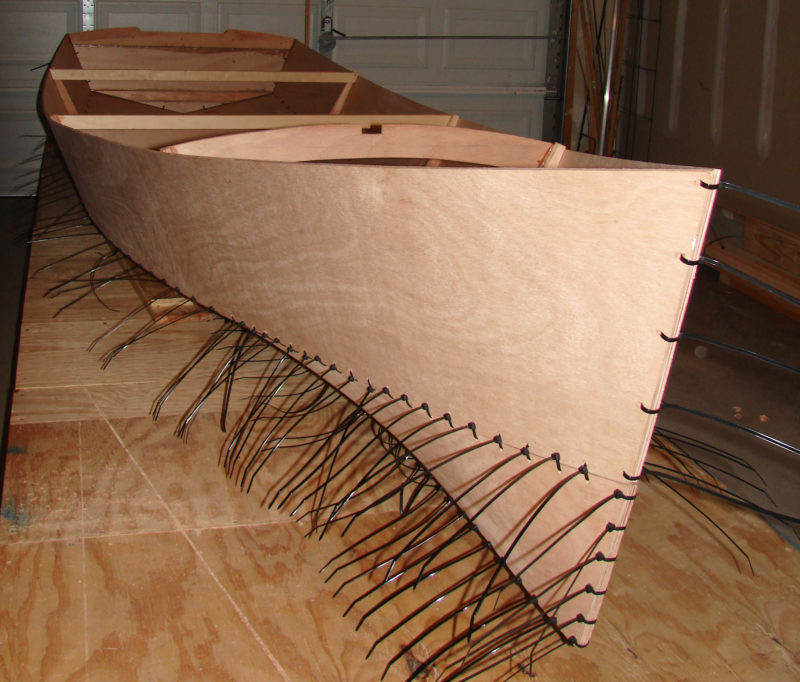
The bottom panels have quite a bit of twist in them, but good marine plywood will take the strain and provide fair and symmetrical curves. Cable ties rather than copper wire held the panels together until epoxy bonded the joints.photographs and video by the author

The bottom panels have quite a bit of twist in them, but good marine plywood will take the strain and provide fair and symmetrical curves. Cable ties rather than copper wire held the panels together until epoxy bonded the joints.

It was Flint’s versatility that attracted me. Like many boaters, I wanted an “everything” boat that I could row, motor, or sail. I wanted to snorkel from the boat, explore the shallowest of inlets, and take camping trips with my wife and enough provisions for several days of crisscrossing the waterways between beaches. I also wanted to try my hand at fishing and so had that in mind when looking at plans. All that had to be in a safe boat that I could build myself, and would fit in my garage. Out of all the designs I looked at, Flint seemed most able to fit the bill.

Flint’s plans are available in either metric or imperial units and include all the drawings and specifications necessary to build the boat with or without the sailing option. The plans included dimensions for spars and sails for all three rigs, and plans for both 7′ and 7.5′ oars. The instructions are thorough and clear enough for a first-time builder like me. If a builder has questions, Lillistone is generally accessible via his website, his blog, or a Facebook group discussion page.

The boat is capable of carrying up to four people can be built as a rowing boat to weigh less than 100 lbs, light enough to cartop on midsize to larger vehicles.

The balance lug rig, carrying 55.7 sq ft of sail, is the most modest of the Flint sail plans. The gaff cat and the gaff sloop rigs both carry 64.5 sq ft.

The balance lug rig, carrying 55.7 sq ft of sail, is the most modest of the Flint sail plans. The gaff cat and the gaff sloop rigs both carry 64.5 sq ft.

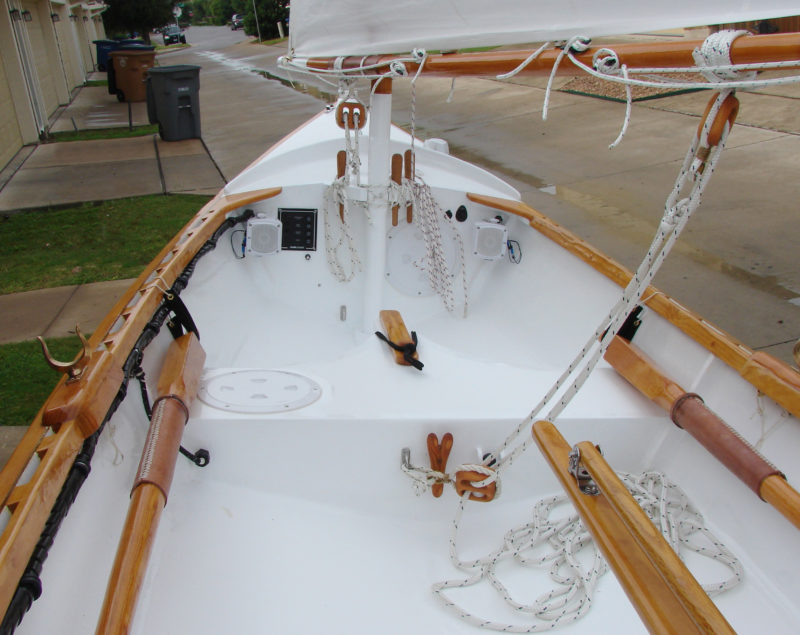
I chose to build the balanced-lug version, which uses only one sail and an unstayed mast that can be stepped or unstepped in moments. This balanced-lug rig’s mast partner is designed as part of a foredeck and a bulkhead. This configuration eliminates the forward rowing station but the enclosed compartment increases the built-in flotation by another couple of hundred pounds. The configuration for the gaff rig has a forward rowing station and a lower buoyancy compartment.

Flint can be built without the sailing option using just four sheets of 1⁄4″ plywood and about 20 bd ft of dimensional lumber. Adding the sailing option requires a fifth sheet of plywood and another 15 bd ft of lumber for the spars. The construction method is stitch-and-glue and does not require a strongback. To get the correct curvature into the twist at the forefoot, the plywood should be marine-grade and high quality. For dimensional lumber I used Douglas fir.

Pairs of the plywood sheets are scarfed together before drawing and cutting the side and bottom panels. Flint’s hull panels, main bulkheads, and transom went together more smoothly than I thought they would. I was concerned about that twist going into the plywood at the forefoot as planned, so much so that I waited until after that step to announce to family and friends that I was building a boat. But I followed Ross’s guidelines and instructions, and everything came together exactly as the instructions said it should. The pieces didn’t go together quickly, mind you. They required snugging down the cables ties a bit here, a bit over there, then a bit here again, methodically drawing the bulkheads down into the bottom panels to pry them apart and twist and creak that forefoot into shape. Stitching the boat together took hours with only me at the task, but it was a smooth and pleasing process. Seeing the boat rise out of two dimensions into three in a single day was extraordinarily satisfying.


Although I spent about 18 months of weekends building my Flint, other builders report having completed theirs in as little as two months. I used primarily hand tools; made my own oars, spars, belaying pins, rope-stropped blocks, and a jam cleat; and sewed up the sail from a Sailrite kit, all of which contributed significantly to my construction time.

Flint’s stability is about what I’d expected for a hard-chined lightweight boat with a displacement-type hull. If I’m the only significant weight on board, she’ll dip to whichever side I move to, gaining some stability once that side fully engages with the water. I’m familiar with this sort of motion, so it’s not disconcerting. When I put my 175 lbs fully onto a gunwale, the boat will ship water over that side, but it’s easy to move around in the boat as long as I keep a hand planted somewhere for balance.

The configuration for the balance lug rig, seen here, has one rowing station. The gaff rig configuration has a second forward rowing station forward and a low flotation tank instead of a foredeck.

The configuration for the balance lug rig, seen here, has one rowing station. The gaff rig configuration has a second forward rowing station forward and a low flotation tank instead of a foredeck.

The Flint has three watertight buoyancy compartments that, by my rough calculations, add somewhere around 400 lbs of positive flotation. In capsize drills with the sail in place, the Flint does not want to turn completely turtle. My Flint rides low enough on its side that the spars lie flat instead of driving tip-first beneath the water and allowing the boat to capsize further. During my capsize test, after I had the spars and sail flat on the water, I put my weight on the tip of the mainmast, and although that did push the yard and most of the mast beneath the water’s surface, the Flint still didn’t turn turtle.

It takes little effort to reenter after a capsize by rolling in sideways over the gunwale, and the cockpit does ship quite a bit of water with that reentry, but if you’ve gone overboard in a capsize, there will already be some water aboard. With only me aboard, I can swamp the Flint only so much and any water higher than the daggerboard trunk will flow out through the slot, leaving only about 3 cu ft to bail out. It can be completely swamped and still move under oars.

The Flint's sharp entry keeps it moving smoothly through a chop and its skeg helps it hold a course in a crosswind.

The Flint’s sharp entry keeps it moving smoothly through a chop and its skeg helps it hold a course in a crosswind.

Under oars I can do just under 3 knots at a sustained pace and almost 4 knots at peak effort. An experienced oarsman should easily be able to add another knot to each of those figures. I sometimes use a 30-lb-thrust trolling motor for auxiliary power, which pushes her at just over 3 knots. Ross reports a 2-hp outboard gets to 3 1⁄2 knots on idle and more than 6 knots using at about half-throttle with four people aboard.

The Flint can manage more power than the 32-lb thrust trolling motor shown here, and while a 2-hp outboard will push a loaded Flint around to 6 knots, the boat doesn't have a broad transom and flat run meant for planing.

The Flint can manage more power than the 32-lb thrust trolling motor shown here, and while a 2-hp outboard will push a loaded Flint around to 6 knots, the boat doesn’t have a flat run meant for planing.

The balanced lug rig is simple to sail and provides plenty of power. It’ll push the Flint at 4 or 5 knots easily, and I’ve had it surge up to 7 knots on a run single-reefed in 20-knot gusts. The boat points to within 50 degrees of the wind and sails well on all points, even when reefed. The helm stays almost perfectly balanced. When sailing close to the wind in stronger wind and chop, whoever’s on the main thwart will catch some spray, but she is otherwise a dry sailer.

I transport my Flint on a trailer, and launching and retrieval are easy, even when I’m by myself. When I’m setting it up for sailing it takes less than half an hour to rig the boat. It typically takes longer because the boat draws admirers wherever we go, and I get to chatting about her.

I’m extremely pleased with my Flint. It comes as close to an “everything” boat as I can imagine. Although it’s usually true that a jack-of-all-trades is the master of none, Flint seems to me to be an exception. It’s master of a couple and a praiseworthy jack of the rest.

Roger Siebert is an editor in Austin, Texas. He rows and sails his Flint on local lakes, and recently trailered it to a few of his favorite places on the Florida coast. This was his first time building a boat.

Flint Particulars

Length:   14′ 10″
Beam:  4′ 3 1⁄4″
Draft, board up:   6″
Draft, board down:   35ʺ
Weight, rowing version:   100 lbs, minimum
Weight, sailing version:   150 lbs, minimum

flintballug

Balance lug

flintgaffcat

Gaff cat

flintsloop

Gaff sloop

flintlines

Rowing version

Plans for the Flint are available from Ross Lillistone and Duckworks.

Is there a boat you’d like to know more about? Have you built one that you think other Small Boats Monthly readers would enjoy? Please email us!
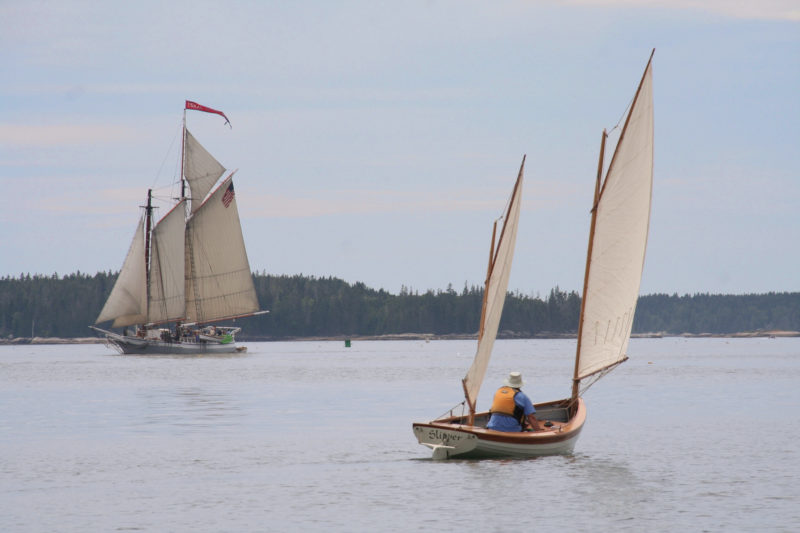
A Man’s Best Friend

The mid-1990s were a mixed time for me. I had a fine house, a great job, a beautiful wife, and two lovely children—but I was boatless. My wife and I had sold our 32′ double-ender after our first child was born and we hadn’t found anything within our price range to take its place. So when yacht designer Nigel Irens was looking for guinea pigs to build a kit boat he and Ed Burnett had created, I jumped at the chance. It might not have been the oceangoing vessel I dreamed of owning, but it would at least get me back on the water. It would also mark a small personal milestone since, despite working as a journeyman shipwright for several years, I had never built a boat from scratch.

June, 1997. Midway through building the skiff at the Lewes Rowing Club shed, just outside Brighton. That's my oldest son Sam, then 5 years old (now 24, and quite a bit bigger than me), who helped with the build.Salty Dog Media

June, 1997. Midway through building the skiff at the Lewes Rowing Club shed, just outside Brighton. That’s my oldest son Sam, then 5 years old (now 24, and quite a bit bigger than me), who helped with the build.

The Western Skiff, as Nigel called his new design, was a slender 14′ dinghy intended for rowing; it had a small lug rig to use as auxiliary power and an elegantly raked transom to discourage the use of an outboard. The kit—seven sheets of plywood for the boat and two sheets of MDF for the jig, all precut and ready to assemble, along with several gallons of epoxy and various interesting-looking powders—arrived in Cornwall where we were on holiday. My children—Zennor, 8, and Sam, 5—and I had great fun assembling the jig, using wedges to lock tenons in place. Getting the planks fair proved a bit trickier, but I managed to get the basic structure assembled in time to put it on a trailer and drive the 300 miles back to our home just outside Brighton, in East Sussex.

September, 1997. We launched the skiff at Seaford Beach in East Sussex. It was an exhilarating first sail. I sat in the bottom of the boat, as the designer had recommended, to keep my weight low. The first outing couldn't have been better—apart from nearly breaking a friend's leg when a big wave dumped the skiff in his lap.Salty Dog Media

September, 1997. We launched the skiff at Seaford Beach in East Sussex. It was an exhilarating first sail. I sat in the bottom of the boat, as the designer had recommended, to keep my weight low. The first outing couldn’t have been better—apart from nearly breaking a friend’s leg when a big wave dumped the skiff in his lap.

It took all my spare time plus two weeks’ holiday spread over four months to complete the skiff, but finally in July 1997 we launched her in the azure waters off Seaford beach. There was a brisk onshore breeze blowing, which created a small surf, and within minutes the boat was flung into the lap of a friend who had come to help launch her. The boat still bears a scar from that incident, as no doubt does he. But that breeze also showed me how fast the skiff could go under sail; I had an exhilarating couple of hours tacking up and down the 2-mile-long beach. As you might expect of a dinghy primarily designed for rowing, she was extremely tender under sail, and even with her modest 61-sq-ft balanced lugsail, she would capsize in a thrice if you didn’t ease the sheet in time. But that was all part of the excitement, and I immediately felt very comfortable with the boat, as if we had struck a personal rapport.

September, 2009. My wife-to-be Anna and I took a rare foray off Brighton beach with our daughter Betty, who was about 4 weeks old when this picture was taken. We had repainted the skiff black and varnished the thwarts, which had previously had been just oiled, for a slightly ironic piratical look. The trouble was that no-one got the joke.Nic Compton

September, 2009. My wife-to-be Anna and I took a rare foray off Brighton beach with our daughter Betty, who was about 4 weeks old when this picture was taken. We had repainted the skiff black and varnished the thwarts, which had previously had been just oiled, for a slightly ironic piratical look. The trouble was that no one got the joke.

After the initial sail off Seaford, I kept her on a trailer at a rowing club on the river Ouse, in Sussex, with occasional trips rowing upriver to Hamsey or sailing downriver to Newhaven. My kids loved those forays upstream, and their evident pride as they steered the boat past familiar landmarks made me glad I could pass on a tiny piece of my boating life to them. On the downstream trips, I learned to “shoot” the bridges by lowering the mast on the approach and raising it on the other side. The one time I forgot, the almighty crash of wooden spar against stone wall made sure I never forgot again. Miraculously there was no damage.

Despite being only 14′ long, the skiff could be a sociable boat, and the 90-minute trip to Newhaven was an opportunity to cement friendships. On one occasion a friend astonished me by pulling a flask and china cups out of his rucksack and proceeding to pour us both a cup of tea. It doesn’t get much more English than that.


Over the years, I tried giving the skiff a proper name. First she was HARA, Greek for joy and the name of a favorite haunt when I was child growing up in Greece. Then I decided to go ultra-traditional and named her SALLY, after my mother. But somehow neither name stuck, and I’ve always simply referred to her as “the skiff.” It’s taken me nearly 20 years to realize that I don’t need to force a name onto her and that “the skiff” is perfectly good, full of romantic connotations and richly evocative in its own right.

July 2015. Two days after we moved to Devon we rowed to the Maltsters Pub, once the haunt of UK celebrity chef Keith Floyd. My son Sol was just 5 days shy of his 4th birthday.Nic Compton

July 2015. Two days after we moved to Devon we rowed to the Maltsters Pub, once the haunt of UK celebrity chef Keith Floyd. My son Sol was just 5 days shy of his 4th birthday.

Three years after the skiff was launched, I was divorced and living alone on an old 12-ton cutter in nearby Newhaven. Between the heaps of scrap metal and the depressing housing estates, I had a small oasis in the muddy creek where I moored my yacht. Here, the skiff was moored alongside and when I came home from work, if the tide was up, I went for long rows, lit up by the lights of the ferry terminal. In the summer, friends visited and we would sail upstream and bathe in the river. After sitting in front of a computer all week, the skiff provided true solace.

July 2015. As we were heading down the exquisite Bow Creek on the River Dart, just a mile or so away from our new home, I started teaching Sol to row. The skiff has been a perfect way for me to pass on my love of boating to my kids.Anna Compton

July 2015. As we were heading down the exquisite Bow Creek on the River Dart, just a mile or so away from our new home, I started teaching Sol to row. The skiff has been a perfect way for me to pass on my love of boating to my kids.

After eight years living on my own up a muddy creek, I decided to sell my cutter and buy a flat in trendy Brighton. For a while, I kept the skiff on the beach, with a plywood cover to keep intruders out, and launched her for the occasional row or sail. But Brighton is a better place for partying than boating, and I have to admit the skiff entered into a period of neglect as I made the most of being a bachelor again. When I discovered part of the plywood lid had been ripped off and used for a beach fire, I decided to put her back on her trailer and keep her, for want of anywhere better, in a friend’s garden. Over the next few years, I parked her wherever I could and, as the cover I’d put over the boat deteriorated, the neglect deepened and so did my guilt.

October, 2015. It rained solidly for a month after we moved and, as our house hadn't been lived in for more than a year, it was extremely cold. Sol and I made weekly trips with the skiff to collect firewood.Nic Compton

October, 2015. It rained solidly for a month after we moved and, as our house hadn’t been lived in for more than a year, it was extremely cold. Sol and I made weekly trips with the skiff to collect firewood.


Then I met my Anna and two years later we had a lovely daughter—Betty, now aged 7—and then a lovely son—Sol, now 5—and the skiff fell further down my list of priorities. Soon after meeting Anna, in the first flush of optimism, we made one half-hearted attempt at cutting out some of the rot and repainting her, but sailing from Brighton was just too little return for so much effort. As the bills piled up, I thought about selling the skiff, but I always had a feeling that our circumstances might change, and that somehow she might become the ideal boat once again. Or, to put it another way, I always knew that if the skiff didn’t have a place in my life, that probably meant I was probably not leading the right life, and when the balance was redressed she would regain her rightful place.

October, 2015. The wood we gathered was mostly the local oak which had “seasoned” while floating in the river. Once it had dried out it burnt to perfection.Nic Compton

October, 2015. The firewood we gathered was mostly the local oak which had “seasoned” while floating in the river. Once it had dried out it burned perfectly.

Not everyone shared my despair. Our neighbors told us that far from finding the sodden hulk parked opposite their front door a nuisance, they enjoyed having her there and thought she added character to the neighborhood. Another friend expressed the same sentiment when I parked the skiff in her front drive where it became an object of curiosity for visitors, who could always be sure of finding “the house with the boat outside” in a row of nearly identical modern houses. Even in her deteriorated state, it seemed, the skiff could still bring pleasure, and I couldn’t help feeling a glimmer of pride.


Eventually Anna and I could take city life no more, and in July 2015 we upped sticks and moved to a beautiful village on the River Dart, in Devon. Straightaway, we launched the skiff in the tidal estuary that flowed within sight of our bedroom. She proved an ideal boat for exploring our new environment, and for the first six months we went out almost every week, either rowing to nearby pubs or collecting driftwood off the nearby beaches to chop up into firewood. The only limitation was that, while most of the other families we met had boats with outboards and could happily nip up and down the river at almost any state of the tide, we were limited by how far we could row, which, with two adults, two children, and (eventually) a dog on board, wasn’t all that far.

We left the skiff on the jetty that autumn, and by winter’s end she looked in a very sorry state. The rot at the ends of the thwarts had spread because the drainage channels there had a tendency to get blocked up. And when I turned her over I found gribbles had wormed their way into the keel.

The skiff, to my eyes, was still the exciting lightweight rowing dinghy, the legendary Nigel Irens design that I had built with my own hands all those years before. She had stood by me in good times and bad, and still gave me a thrill riding the little wave that built up on the stern quarter when the wind clashed with the outgoing tide. But to most other people she must have just looked like a sad old wreck.

March, 2016. My poor neglected skiff. Nearly 19 years after being launched, the fore and aft thwarts were rotted away where the drains at either end got blocked. The damage spread into neighboring bits of plywood.Nic Compton

March, 2016. My poor neglected skiff. Nearly 19 years after being launched, the fore and aft thwarts were rotted away where the drains at either end got blocked. The damage spread into neighboring bits of plywood.

I decided to take her out for a major overhaul, and began to think the unthinkable. What if we fitted an outboard on her, in spite of the transom meant to prevent that? The very idea had always been an anathema to me, but I began to see that if we put a well through the aft buoyancy tank, it needn’t be intrusive or detract from her performance under sail and oar. I consulted with Nigel and, to my surprise, he was very relaxed about the idea. He agreed that a well was the way to go, and even suggested the outboard could be positioned on the centerline if I were to cut out the aft end of the keel.

The refurbishment, as often happens, turned out to be more extensive than I had expected. I replaced both the forward and the aft thwarts, and cut out and patched new sections of planking and bulkheads where the moisture had spread into the plywood. I repainted inside and out and made a couple of important upgrades for her new life on the river: a rope fender around the bulwarks to protect her when coming alongside docks and brass strips on the keel and bilges to take the brunt of being dragged up and down beaches. The overall effect was pretty dramatic and made me look at her with renewed affection—like when the one you love dresses up for a party and you see her as if for the first time again.

April, 2016. I fitted a new thwart made from some locally sourced Douglas fir. I made the drains much bigger this time and sealed the end grain with epoxy. I added a plywood outboard well to the side of the centerline.Nic Compton

April, 2016. I fitted a new thwart made from some locally sourced Douglas fir. I made the drains much bigger this time and sealed the thwart’s end grain with epoxy. I built the plywood outboard well to the side of the centerline.

As for the outboard well, I couldn’t bring myself to cut the keel and instead made the smallest well possible directly next to it on the starboard side. The well itself was made out of 12mm marine ply, with three layers on the forward side, lapped over the new stern thwart to spread the load of the outboard. I shaped the hole through the hull to the dimensions of the propeller and skeg, and used the cutout to make a lid to close the hole while under oar or sail.

June, 2016. We were constantly dragged the boat up and down shingle beaches, so fitting a brass keel band during the recent restoration was an absolute necessity and one of the best things I've done for the boat's longevity. The outboard well’s aperture is shaped for the motor’s lower unit and propeller. I kept the cut-out to make a lid which fits into the hole from the inside; it reduces the drag and noise while I'm rowing.Zennor Compton

June, 2016. We were constantly dragged the boat up and down shingle beaches, so fitting a brass keel band was an absolute necessity and one of the best things I’ve done for the boat’s longevity. The outboard well’s aperture is shaped for the motor’s lower unit and propeller. I kept the cut-out to make a lid which fits into the hole from the inside; it reduces the drag and noise while I’m rowing.

We relaunched the skiff at the beginning of June of this year, and the effects were immediate and dramatic: “A life-changer,” as my neighbor put it. The outboard conversion was a great success, performing far better than I had expected. Even laden down with the whole family, including dog and picnic, she nipped along at quarter-throttle under her new 3.5-hp engine.

June, 2016. During the trials with the new engine, it was obvious that the tilt was wrong and pushed the bow up. I had made the outboard well parallel with the aft bulkhead, but it clearly not vertical. I've since added a couple of wooden shims to adjust the angle. I've also borrowed an outboard extension so I can sit on the middle thwart and put my weight farther forward. The 3.5-hp outboard was bigger than we needed; a smaller, lighter 2.5 hp would have provided plenty of power.Zennor Compton

June, 2016. During the trials with the new engine, it was obvious that the tilt was wrong and pushed the bow up. I had made the outboard well parallel with the aft bulkhead, but it clearly not vertical. I’ve since added a couple of wooden shims to adjust the angle. I’ve also borrowed an outboard extension so I can sit on the middle thwart and put my weight farther forward. The 3.5-hp outboard was bigger than we needed; a smaller, lighter 2.5 hp would have provided plenty of power.

The river suddenly opened up to us. Before, we had been confined to rowing only a mile or two upstream or downstream; we now had the run of the whole river, and beyond. Using the tide to our advantage we sped 4 miles upriver to Totnes in half an hour and 5 miles downriver to Dartmouth in 40 minutes. For the first time since coming to the village, we headed out to the open sea to explore the spectacular Mew Rock, now just an hour away. Even more importantly, perhaps, the skiff has embedded us in the local community, allowing us to join social events on the river that would have been out of reach before.

June, 2016. Sol got dressed up for our first trip with the reborn skiff after restoration. We launched from a shingle beach just around the corner from our home.Zennor Compton

June, 2016. Sol got dressed up for our first trip with the reborn skiff after restoration. We launched from a shingle beach just around the corner from our home.

The skiff is still a joy to row, and the outboard, quite unexpectedly, has made her even more so. Because the skiff is so light, Nigel always used to recommend carrying a couple of jerry cans of water as ballast to give the boat more momentum when I was rowing alone. Now, the outboard does that job. When not in use, it fits snugly next to the centerboard case and provides the ideal extra weight in just the right place.

July, 2016. The skiff is ideal for outings with Sol, Betty and our dog, Winnie. Any more than that, the ride gets a bit wet.Zennor Compton

July, 2016. The skiff is ideal for outings with Sol, Betty and our dog, Winnie. Any more than that, the ride gets a bit wet.

In due course, I intend to rerig the skiff to teach my kids to sail, so she still has potential waiting to be unlocked. But, in the meantime, there’s no doubt that the outboard has breathed new life into old bones and brought the skiff back into our lives as a much-loved member of the family. And it’s not just in my head this time, as friends and strangers now tell me how good she looks, and one person even asked to buy her. Although few had noticed what an amazing boat she was all along—after all, what’s a coat of paint?—I can’t help but feel immensely proud of her.

July, 2016. With a lid covering the outboard hole and the outboard itself providing ballast forward, the skiff rows better than ever. Just outside Dartmouth we usually see ten or twelve seals whenever we go to the Mew Stone.Zennor Compton

July, 2016. With a lid covering the outboard hole and the outboard itself providing ballast forward, the skiff rows better than ever. Just outside Dartmouth we usually see ten or twelve seals whenever we go to the Mew Stone.

Since I built the skiff, I’ve owned three yachts, ranging from 25′ to 36′. But while the bigger boats have come and gone, the skiff has remained constant, and my appreciation of her has deepened. And, in unexpected ways, she has acted as a kind of compass, pointing me to the kind of life I want to lead.

Nic Compton is a freelance writer/photographer who grew up sailing dinghies in Greece. He has written about boats and the sea for more than 20 years and has published 12 nautical books, including a biography of the designer Iain Oughtred. He currently lives on the River Dart in Devon, U.K., and owns two boats designed by Nigel Irens.

If you have an interesting story to tell about your adventures with a small wooden boat, please email us a brief outline and a few photos.

Knees and Breasthooks

Boats have several places where two surfaces come together at an angle, and special pieces—breasthooks and knees—are used join them together and add strength. Breasthooks are V-shaped blocks at the acute angle at the bow and, on double-enders, at the stern as well. Knees are supports closer to a right angle, and on open boats they’re most often quarter knees joining gunwales to a transom or seat knees supporting the topsides at the thwarts.

Short, blunt-toed knees, like this one in a Davis boat, are quite common. Devoting a little more time and thought to knees will give them a lighter, more elegant appearance.Christopher Cunningham

Short, blunt-toed knees, like this one in a Davis boat, are quite common. Devoting a little more time and thought to knees will give them a lighter, more elegant appearance.

Knees and breasthooks made of solid blocks of straight-grained wood can be serviceable, but if the toes (the knee’s extremities) are fattened up too much to make up for the weakness of the cross-grain there, they don’t do much for a boat’s appearance. Pieces made from grown crooks are stronger because the grain runs with the loads, and much handsomer because they didn’t need to be bulky. Indeed, when carefully shaped they elevate the boat’s structure from “good enough” to art.

This apple-crook breasthook is in a New York Whitehall built in 1983. Well cured before it was installed, it hasn't checked or separated from the surrounding structure.Christopher Cunningham

This apple-crook breasthook is in a New York Whitehall built in 1983. Well cured before it was installed, it hasn’t checked or separated from the surrounding structure.


The grain in these bookmatched fruitwood quarter knees not only follows the angle between the transom and the sheerstrake, it curves into the transom at the ends of the toes.Christopher Cunningham

The grain in the Whitehall’s bookmatched fruitwood quarter knees not only follows the angle between the transom and the sheerstrake, it curves into the transom at the ends of the toes.

In former days when open boats commonly went alongside larger boats, seat knees were essential to the boat’s structure and were sometimes massive, keeping the sides from being stove in. Tenders and ship’s boats typically had two seat knees at each end of a thwart. With today’s light, glued-lapstrake construction they can be equally important in reinforcing the structure.

This fruitwood crook in the New York Whitehall braces a thwart that serves as mast partner.Christopher Cunningham

This fruitwood crook in the New York Whitehall braces a thwart that serves as mast partner. The toe is slender enough for rivets to be used to make the attachment.

The traditional thwart knee was a marvel of simple joinery. The part that supports the sheer plank was often carefully locked into the gunwale structure. Some were set on top of the thwart, either parallel to its edge or at an angle to it. Their toes might have decorative points cut at their ends. Others were fastened to the vertical edge of a thwart and carefully shaped in a show of lightness and elegance.L-shaped grown crooks were prized pieces of wood, but as they became scarce, many boatbuilders who built substantial numbers of boats went to metal knees. Today it is hard for most boatbuilders to find grown stock needed for traditional knees. Aside from requiring the trees to harvest, the crooks have to be cured without developing splits and sawn into flat pieces prior to shaping.

The cross grain shows up clearly on this knee in the author's Antonio Dias-designed Harrier. The knees are screwed from underneath the thwarts, but they were out of big enough pieces so that the shape came out nicely.Ben Fuller

The cross grain shows up clearly in this knee but it was made out of stock wide enough to give it a nice shape.  The knees in the author’s Antonio Dias-designed Harrier are screwed to the seats from underneath.

In knees sawn from straight-grained stock, the toes are often blunt and thick, their length limited by the width of the stock used and their height, making up for weak cross-grain, requiring screw-fastening from underneath the thwart. It doesn’t have to be that way. With laminations and reliable glued joints, it isn’t hard to recapture the look and strength of natural knees. Steam-bent knees can provide a sweeping curve and slender toes, but they require blocking to provide the support of a solid knee. Stock can be created by laminating thin strips of wood; knees can be built with half-lapped or splined pieces much the way that today’s builders emulate the natural crooks once used on dory frames.


A steam-bent knee backed by a block of matching wood makes a knee every bit as functional and attractive as a knee made from a grown crook.Ben Fuller

Steam-bent knees backed by a block of matching wood are every bit as functional and attractive as those made from a grown crook.


This mitered knee for a lapstrake boat has a broad spline running across the angled jolt. For detail on making this type of knee, click on the From the Editor tab.Christopher Cunningham

This mitered knee for a lapstrake boat has a broad spline running across the angled jolt. For details on making this type of knee, see this month’s  From the Editor column.

Looking at these details on boats from an earlier time will train your eye. Spend the same kind of time on these details that you do on the rest of the boat; they’re what you’ll see every day. When master boatbuilder Joe Liener used to encourage novice boatbuilders to make parts like knees and breasthooks a little lighter, he wasn’t talking about trimming a few ounces of wood. It was his way of encouraging boatbuilders to consider grace and beauty in the work they do.

Ben Fuller, curator of the Penobscot Marine Museum in Searsport, Maine, has been messing about in small boats for a very long time. He is owned by a dozen or more boats ranging from an International Canoe to a faering.

A Gallery of Breasthooks and Knees
This wherry built by Cooper and Sons in Shrewsbury, England, in the late 1800s has a breasthook made of a single piece of straight-grained wood. The inner edge is scribed with a decorative groove.Christopher Cunningham

This wherry built by Cooper and Sons in Shrewsbury, England, in the late 1800s has a breasthook made of a single piece of straight-grained wood. The inner edge is scribed with a decorative groove.


The quarter knees in the Shrewsbury wherry have exceptionally long toes.Christopher Cunningham

The quarter knees in the Shrewsbury wherry have exceptionally long toes.


The passenger seat on the wherry has knees with long, elegant knees.Christopher Cunningham

The wherry’s passenger seat has slender knees with long, elegant toes.


Thwart knees are occasionally built into the edge of the thwart they support. This knee, cut from a crook, takes the place of a frame head in the wherry.Christopher Cunningham

Thwart knees are occasionally built into the edge of the thwart they support. This knee in the wherry is  cut from a crook and becomes a frame head.


This laminated mahogany knee, part of a Chamberlain gunning dory, is wide enough to provide strength without a a filler block.Christopher Cunningham

This laminated mahogany knee in a Chamberlain gunning dory is wide enough to provide strength without a filler block backing it.


The breasthook in this Hvalsoe 13 is curved along its forward edge and set apart from the stem. This makes fitting easier, avoids an area that tends to weather poorly, and offers a convenient place to anchor a painter. The two halves of the breasthook are held together by epoxy alone, AN while the joint has held up well for over 20 years, keeping the varnish in good shape will assure the joint doesn't fail. Christopher Cunningham

This breasthook in a Hvalsoe 13 is curved along its forward edge and set apart from the stem. This makes fitting easier, avoids an area that tends to weather poorly, and offers a convenient place to anchor a painter. The two halves of the breasthook are held together by epoxy alone, and while the joint has held up well for over 20 years, keeping the varnish in good shape will assure the bond doesn’t fail.


The grain of the crook used for this breasthook is clearly visible.Christopher Cunningham

The grain of the crook used for this 1982 Whitehall’s breasthook is clearly visible.


These double knees are from a tender of the built in the mid-coast area of Maine in the 1930s. The boat is as nice as anything turned by the more highly regarded boatbuilders of Massachusetts or Rhode Island.Ben Fuller/Penobscot Maritime Museum collection

These double knees are from a tender built in the mid-coast area of Maine in the 1930s. The boat is as nice as anything turned out by the more highly regarded boatbuilders of Massachusetts or Rhode Island.


Pointed toes a distinctive touch to LITTLE ELVA, a 16' captain's gig built in 1881 by a carpenter aboard the Downeaster sailing ship CORA. The gig was built along the lines of a workboat, but intended for pleasure outings and given some fancy woodwork.Ben Fuller/Penobscot Maritime Museum collection

Pointed toes add a distinctive touch to LITTLE ELVA, a 16′ captain’s gig built in 1881 by a carpenter aboard the Downeaster sailing ship CORA. The gig was built along the lines of a workboat, but intended for pleasure outings and given some fancy woodwork.


LITTLE ELVA's dainty quarter knees were let into the inwales and a cleat across the transom.Ben Fuller/Penobscot Maritime Museum collection

LITTLE ELVA’s dainty quarter knees were let into the inwales and a cleat across the transom.


The LITTLE ELVA breasthook was also let into the inwales.Ben Fuller/Penobscot Maritime Museum collection

The LITTLE ELVA breasthook was also let into the inwales.


The quarter knees and breasthook in this Lawley-built tender are bronze.Ben Fuller/Penobscot Maritime Museum collection

The quarter knees and breasthook in this Lawley-built tender are bronze and well suited for a boat built in great numbers.


When Lawley switched to metal breasthooks and quarterknees, the tenders still had nicely shaped wooden thwart knees. Eventually these too were done in bronze.Ben Fuller/Penobscot Maritime Museum collection

When Lawley switched to metal breasthooks and quarterknees, the tenders still had nicely shaped wooden thwart knees. Eventually these too were done in bronze.


This thwart knee on one of the small rowboats built in Vinalhaven, Maine, is a bit of fine work that was just another day in the shop for the boatbuilder.Ben Fuller/Penobscot Maritime Museum collection

This thwart knee on one of the small rowboats built in Vinalhaven, Maine, is a good example the of fine work that was just another day in the shop for the boatbuilder.


The ordinary Maine rowboats were built with an eye toward lightness and interesting curves.Ben Fuller/Penobscot Maritime Museum collection

The ordinary Vinalhaven rowboats were built with an eye toward lightness and interesting curves.


Elegance was once the norm even on working peapods. The builders didn't think about it, they just did it.Ben Fuller/Penobscot Maritime Museum collection

Elegance was once the norm even on working peapods. The builders didn’t think about it, they just did it.

You can share your tricks of the trade with other Small Boats Monthly readers by sending us an email.

Scrubba

At the bottom of the Scrubba, the exterior surface of the washboard area is textured to keep the bag from slipping and to prevent wear.Anne Bryant

Liquid detergents go to work faster than powdered varieties. Bodywash and shampoo will  also work. If you still see suds through the window after 30 seconds of washing, you can use less detergent for subsequent washings.

The Scrubba wash bag first came to my attention through an online cruising forum that has occasional posts about laundry gadgets, and it struck me as an innovative solution to a backcountry traveling problem: dirty clothes.

The Scrubba is essentially a dry bag, but instead of keeping water out, it keeps water, detergent, and dirty laundry in. It has a clear panel for seeing what’s going on, a flexible textured washboard panel inside, and a valve to let air out. It’s well made. All of the seams are consistently and cleanly done, the stitching is top-notch, the buckle is sturdy, and the whole thing weighs just 5 ounces. Folded, it’s quite compact— smaller than a sandwich—which is particularly valuable for camp-cruising in small boats where space is limited. The Scrubba can serve as a dry bag when it’s not being used for laundry.

If you turn the Scrubba inside out, as you would to dry it after use, you can see the interior washboard surface.SBM

If you turn the Scrubba inside out, as you would to dry it after use, you can see the interior washboard surface.

The instructions are printed on the bag as simple drawings, and two fill lines with illustrations showing the size of awash load: a small load is one shirt, one pair of unmentionables, and a pair of socks; a large load is double that. Put clothing and a gallon or more of water to the appropriate fill line, add a small amount of detergent, close the bag by folding the top down and buckling it, and then release most of the air through the valve. Then work the bag by hand, rubbing the clothes across the interior washboard as if you were kneading bread dough. Washing for 3 minutes is recommended for a “machine-quality wash” and 30 seconds is for a “quick traveler wash.” After washing, pour the dirty water out, and repeat of the wash process without soap for the rinse cycle. Following the rinse  wring out the water and line-dry.

The "washboard" surface is made up of small hemispheres.SBM

The washboard surface is made up of small molded urethane knobs.

I washed some galley towels as a good first test. They were a little greasy and had a bit of salt water in them, so they weren’t drying. The wash cycle created some very satisfyingly dingy wash water. For the next batch I washed my mostly cotton leggings with a skirt attached (kind of bulky), my really sweaty technical T-shirt I had been wearing while gardening, and a few cleaning rags. For this larger load that filled the Scrubba to the upper fill line. I kept an eye on things through the window to make they all came in contact with the washboard.

Everything came out nice and fresh, and I came away with a really positive feeling about the Scrubba. The process was easy, and I wasn’t put off by its small capacity compared to a washing machine—camp-cruising demands smaller loads done more frequently. I would recommend the Scrubba to any traveler who needs to do laundry. It goes beyond being a nifty piece of gear, as getting salt water and bacteria out of clothing can make for a healthier, happier excursion.

Anne Bryant, WoodenBoat’s associate editor, lives aboard MIMI ROSE, a 32′ wooden cutter.

The Scrubba is available from selected retailers as well as direct from the manufacturer for $55. It can be purchased as a Wash and Dry Kit for $99.95, which includes a microfiber drying towel, a clothesline, inflatable hangers, and a carrying case.

Is there a product that might be useful for boatbuilding, cruising or shore-side camping that you’d like us to review? Please email your suggestions.

Gaco Oarlocks

The Gaco oarlocks apply the mechanics of racing oarlocks to recreational rowing. photos and video by the author

Gaco oarlocks apply the mechanics of racing oarlocks to recreational rowing.

I had been curious about Gaco oarlocks for a long time, and finally decided to buy a pair to see how well they work. Instead of rotating in the socket like a normal oarlock, the Gaco’s molded copolymer cradle for the oar rotates around the pin. That’s how locks on racing shells work, and it eliminates the kind of wear that leads to a sloppy fit for conventional oarlocks. I rowed my sneakbox from Pittsburgh to Cedar Key, Florida, using conventional bronze oarlocks, and after two-and-a-half months of rowing the pins and sockets had worn considerably, even though I greased them every day, often more than once a day. As a consequence, the locks developed a lot of play, my catch wasn’t as crisp as it should have been, and the rowing was noisy.

Whatever wear there is in a Gaco lock is likely to occur much more slowly. The pin of a standard lock acts as a lever against the sides of the socket, and the pressure at the top of the socket and pin can be more than double the pressure applied by the loom against the horn; the place where the pressure is highest is also where friction occurs. The Gaco lock separates the pressure and the friction: The bottom of the pin still pries in the socket, but the friction occurs at the top of the pin directly forward of the oar and is spread over a much broader area.

I’ve never been a fan of circular oarlocks that are fixed to the oars. When the oars are shipped, the locks have to come with them, so I needed to change the way I handled the oars. Instead of taking hold of the looms to set them in the locks as I’ve been accustomed to, I grab the locks instead and the oars come along as I set the pins in the sockets. My other complaint about round oarlocks is the damage they do when they slide down the loom and hit the roots of the blade. On my spoon-bladed oars that’s a particularly difficult area to carve, and it looks good only if dings left by the oarlock aren’t spoiling the lines. The Gaco locks, at 6 oz each, are a bit lighter metal equivalents, and the plastic isn’t as apt to leave a mark.

The 3/8” stainless-steel pin has an adapter sleeve to keep it stationary in a standard socket, so

The locks open to be installed on oars. Sleeves installed over the pins adapt them to fit standard oarlock sockets.

The Gaco oarlocks fit oars up to 2 1/4″ in diameter (leathers included). You open the top of the lock by inserting a screwdriver in a slot to release the gate, making it possible to put the locks on oars with collars in addition to leathers. The Gacos are kinder to oar leathers than standard locks are. The bearing surface of a #1 bronze oarlock is about 1/2″ wide and has a radius of 7/16″, so the pressure on the leather is quite concentrated. The Gaco’s bearing surface is 1 3/4″ wide and almost flat. That should keep leathers from getting compressed and make them last longer. The vertical axis of the Gaco’s oval shape allows for the movement of the oar as the blade moves up and down during the stroke, and the horizontal axis is short to eliminate the slop of looms sliding back and forth.

In my rowing trials the Gacos worked well. They were quiet and smooth. A short lanyard and hitch-pin clip was included with each lock. The clip is can be inserted in the hole at the bottom of the pin to keep the lock in the socket, but the boat I used for testing had too much depth in the oarlock pad and the inwale to allow me to do that. I doubt I’d use it anyway. If a wave hits an oar blade hard enough to pop the lock out of the socket, I’d rather have that happen than have the handle driven down hard against my leg.

I quickly warmed up to the Gaco locks. They’re inexpensive and do their job well. While I was rowing I wasn’t aware of them at all, and that’s the best compliment I can offer any oarlock.

Christopher Cunningham is the editor of Small Boats Monthly.

Gaco oarlocks are made in Australia and available direct from the manufacturer: $25 for the plain version, or $29 for the version reviewed here with the lanyard and clip.

Is there a product that might be useful for boatbuilding, cruising or shore-side camping that you’d like us to review? Please email your suggestions.

Bevin’s Skiffs

Richard and two students roll MISSY D alongside ANDREA McCOY. The pink and blue boat at the right is GLOBAL EXPLORER, a Bevin's skiff built previously by students of New Bedford's Global Learning Charter Public School.all photos courtesy of the Community Boat Center

Richard and two students roll MISSY D alongside ANDREA McCOY (center) and GLOBAL EXPLORER (right).

On a hot summer day in 1995, JoAnn Tschaen, a social worker, visited a family with seven children, down on their luck and living in a run-down tenement in the north end of New Bedford, a Massachusetts coastal town 10 miles east of the Rhode Island border. For these kids, the cooling breezes of Buzzards Bay were a world away; Tschaen set out to change that and find a way to get these kids and others like them involved in boating. Three years later, the Community Boating Center (CBC) was established. The Center is now situated on the shore of Clarks Cove on New Bedford’s south end. It has its own pier, floating docks, and a fleet of about 100 boats, ranging from a 7′9″ Optimist dinghy to a 23′ Sonar, a one-design keelboat.

Richard Feeny looks on as two young student fasted a side plank to the transom.

Richard Feeny looks on as two young students fasten a side plank to the transom.


The young builders all enjoyed painting and came up with some brilliant color schemes.

The young builders enjoyed painting and came up with some brilliant color schemes.

Education, whether in teaching life values or STEM disciplines (science, technology, engineering, and mathematics), has always been at the center of the Center’s mission. Sailing was initially the means of engaging kids, but boatbuilding soon followed. The CBC is using the Building to Teach program created by Joe Youcha, a former director at the Alexandria Seaport Foundation and a contributor of many articles published in WoodenBoat magazine. Joe was also part of the team that created the Bevin’s Skiff, the boat used in the Building to Teach program.

The boat launch party was a celebration of youth and determination.

The boat launch party was a celebration of youth and determination.


GLOBAL EXPLORER was built previously by students of New Bedford's Global Learning Charter Public School.

GLOBAL EXPLORER was built by students from New Bedford’s Global Learning Charter Public School.

The kids at the CBC took part in that program and built three Bevin’s Skiffs, christened MISSY D, ANDREA McCOY and GLOBAL EXPLORER. As a warm-up to the full-sized project, many of the kids built scale models of the skiffs. “They love the measuring, drawing and cutting, and problem-solving. They are captivated by it,” says Richard Feeny, CBC’s Education Coordinator. Under his direction, the students began building three of the 12’ skiffs. They picked up tools, some for the first time in their lives, and went to work with marine plywood, fir, white oak, bronze boat nails, caulk, and paint. They used a few screws, but, according to Richard, “it’s a lot more fun to swing a hammer than turn a screwdriver.” Driving bronze boat nails also provides more opportunities for problem-solving. One swing of the hammer can bend a nail. Was the pilot hole too small? Can the nail be straightened and driven home? Does it need to be pulled and replaced?

MISSY DENNISON, MISSY D for short, was built by students of the Dennison Memorial Youth Center.

MISSY DENNISON, MISSY D for short, was built by students from the Dennison Memorial Youth Center.

The goal for the kids is to aim for better than 1/8″ accuracy. The relatively relaxed standard allows the kids to keep the project moving and prevents frustration from getting in the way. Polysulfide caulk makes up for any gaps and makes the boats serviceable.

Students from the Andrea McCoy Recreation Center constructed the aptly named ANDREA McCOY. McCoy. a New Bedford resident, was among the talented young USA boxers killed in a 1980 plane crash in Poland.

Students from the Andrea McCoy Recreation Center built ANDREA McCOY. McCoy. a New Bedford resident, was among the talented young amateur boxers killed in a 1980 plane crash in Poland. This skiff is equipped with a daggerboard trunk and a mast step and will eventually be sailed.

MISSY D, GLOBAL EXPLORER, and ANDREA McCOY were carried to the CBC dock and launched on an unseasonably cold and windy day. The excursions the kids took were short but represented the culmination of months of work. For Richard the launching was “magic. They built these things from scratch, and now they’re cruising around the harbor. They get in a boat and look back at the city, and there’s a perspective shift—and you don’t know where it will take them.’’

Have you recently launched a boat? Please email us. We’d like to hear about it and share your story with other Small Boats Monthly readers.

Gimme Shelter


I made the cabin strong enough for me to crawl over it. But while I could get to the foredeck for anchoring, tending to the mainsail was awkward. The cabin was better suited to motoring.

I made the cabin strong enough for me to crawl over it. But while I could get to the foredeck for anchoring, tending to the mainsail was awkward. The cabin was better suited to motoring.

In 2004, my kids, then 14 and 11, and I decided a Caledonia yawl was the boat we needed for cruising. While I was building the hull I revised the plans to make the interior as comfortable as possible for them.

When I was about their age, my father took me and my older sister backpacking every summer. He liked to keep things simple, and the only camping shelter we ever had was a big piece of Visqueen, 4mm black plastic sheeting. On a sunny day it provided shade, but radiated its own sweltering heat; on a stormy day it let the wind and rain fly through. I thought I could do better by my kids, so I made a removable plywood cabin for the yawl.

When the boat was finished, we did one island-hopping cruise with the cabin in place, and that convinced me to replace the cabin with a collapsible dodger that wouldn’t block my way to the mainmast and foredeck like the cabin did. The cabin sat in the side yard for a decade getting mossy.

The forward compartment is compact but cozy and well sheltered from wind and rain.

The forward compartment is compact but cozy and well sheltered from wind and rain.

I’d never slept under the cabin, and this year I wanted to give that a try and to see how it fared as a pilothouse while underway. I cleaned it up and drilled a few holes in the back wall for a steering line and a kill-switch cord. I made a two-armed rudder yoke to replace the one-armed Norwegian tiller arrangement, but that had a rather ungainly look to it. I realized that I could use the one-armed tiller by putting the boomkin in place and running the steering line through the pulley normally used for the mizzen sheet. That arrangement worked well for steering in the cabin, and I could keep the tiller pole in place to steering in the usual manner in the cockpit.

With the sun peeking through the morning clouds, the ALISON is ready for motoring east across Puget Sound.

With the sun peeking through the morning clouds, ALISON is ready for motoring east across Puget Sound.

On  a cool, overcast Saturday afternoon in August I launched on the west side of Puget Sound, just north of downtown Seattle and motored the 6 miles across the sound to Bainbridge Island. The cabin was a cozy place for motoring—out of the wind and somewhat isolated from the noise of the outboard. The boat required little help holding a course, so all I had to do was sit back and keep any eye out for vessel traffic.

I spent a quiet night anchored at Port Madison, a mile-long dog-legged inlet at the north end of Bainbridge. The forecast was for showers overnight, and although they didn’t materialize, I would have enjoyed listening to the rain on the cabin roof. It’s a pleasant sound when you’re under something more substantial than a flapping plastic tarp. I woke at dawn and rowed out of the inlet to make a quiet exit, then started the motor and retreated to the cabin for the crossing back home.

The cabin is back in the yard again, and while I don’t know when I might use it again, I can’t see parting with it. There may be a time when I can go out with it, listen to the rain, and fall asleep warm and dry.

Compass Skiff

Clint Chase designed the Compass Skiff for the Compass Project, a Biddeford, Maine, nonprofit that works with kids. “We needed a really small, easy-to-build boat for a weekend boatbuilding festival we do every summer,” he said. “I came up with this little outboard skiff that would be easy and quick to build, stable and safe for kids on the water. It will get on plane with a 6-hp outboard; it’s a lot of fun.”

Powered by a 3.5- to 6-hp outboard, the Compass Skiffs is well suited to rivers, lakes, and other protected waters. It could also serve as a tender or lightweight excursion boat. For such a small boat, it has a high bow and a lot of freeboard and can handle the chop in an exposed anchorage. With a draft of just 3″ (with the motor up), you could do some serious gunkholing with this little vessel. A slot in the aft bulkhead provides a place to keep a paddle handy for maneuvering in close quarters, and a pair of 7.5′ oars can serve for quiet exploration or as a backup in case the motor dies. There is no skeg to help the skiff track well for rowing, but Chase notes “the boat is very light so using oars will be no problem.”

The simple interior arrangements keep the skiff light and quick to build. Floorboards would be an easy addition to make to keep gear dry.photographs by the author except as noted

The simple interior arrangements keep the skiff light and quick to build. Floorboards would be an easy addition to make to keep gear dry.

At 9′6″ long and with a beam 4′1″, it would seem the diminutive skiff would have trouble carrying the 6′4″ designer, yet the Compass Skiff has plenty of room for someone as tall as Clint, along with gear and even two small passengers. Weighing just 100 lbs, it can be easily transported with a light trailer or, with sound roof racks, by cartop. The Compass Skiff is available as plans and in a variety of kit options for do-it-yourself boatbuilders. A complete kit can be put together over a weekend and then be ready for paint and varnish.

At full speed the skiff made tight turns with ease.

At full speed the skiff made tight turns with ease.

The complete kit includes hardwood keel members, spruce chinelogs and stem, white pine thwarts, and easy-to-bend ash rubrails. The false stem is supplied in either ash or mahogany. The panels for the sides, bottom, and transom are computer-cut from 9-mm okoume marine plywood. The finger-jointed sides come together with a bit of epoxy in about 30 minutes. When they glue has cured the sides are assembled around two short ring frames, one in each end, and a ’midship frame using a tab-and-lock system of assembly that eliminates the need for a strongback. Tabs on the sides of the frames fit snugly in slots routed in the side panels, and after they are inserted, wedges slipped through holes in the tabs bring the sides up tight against the bulkheads. The sides of the forward frame are cut with a slight arc to accommodate the subtle compound curve the plywood sides take approaching the stem. The middle frame is squeezed by the side panels and doesn’t require the holes and wedges, though there are tabs and slots for accurate placement. The tabs are sawn off after the hull has been glued together.

The bulkhead tabs are inserted in the side panels (left), and locked in place with wedges on the outside (center). Note the finger joints used to join plywood panels. The tabs are sawn flush after the epoxy has cured (right). The tabs at right are for the center bulkhead and don't require the slots and wedges.courtesy of Chase Small Craft

Bulkhead tabs are inserted in mortices in the side panels (left), and those with tabs with slots are locked in place with wedges (center). Note the finger joints used to join plywood panels. The tabs are sawn flush after the epoxy has cured (right). The tabs at right are for the center bulkhead and don’t require the slots and wedges.

The forward ends of the side panels are screwed and glued to the beveled spruce stem, and the aft ends to a 3/4″-thick transom laminated with two layers of plywood. After the chine logs are installed and planed flat with a block plane, the bottom is screwed and glued in place. The epoxy-and-fiberglass kit includes fiberglass tape to protect the outside of the chine. After the assembly of the hull, the breasthook, stern quarter knees, short seat risers, seats, and oarlocks are installed.

With the bow heavily loaded the Compass skiff curled up an impressive wake, but kept the occupants dry.

With the bow heavily loaded the Compass skiff curled up an impressive wake, but kept the occupants dry.

When I saw the Compass Skiff arrive on a trailer at the town landing in Saco, Maine, just across the Saco River from Clint’s shop in Biddeford, the boat seemed dwarfed by the trailer, Clint’s small car, and even his two kids. The words that slipped out of my mouth were, “Cute boat,” but he seemed to agree. “It is cute,” he said.

On the afternoon we tested the Compass Skiff, the wind on the river was blowing steadily at 12 to 15 knots. We were on a body of water that is normally protected, but the wind was coming straight down the river valley and kicking up a 6–10″ chop. I envisioned a wet test ride.

We used a 1950s-vintage 7.5-hp Johnson outboard for our trials. Clint did a quick solo test. The borrowed engine was heavier and had more horsepower than he intended for the boat, and its weight, combined with Clint’s weight and that of the fuel tank, meant the stern sank heavily and the bow stood high in the air.

I took a turn at the helm, also solo, and had the same problem. We needed to get the helmsman’s weight farther forward. Clint ducked into a waterside thicket of trees and grabbed a fallen branch of about four feet long. He tied the stick to the throttle as an improvised tiller extension. Now, riding from the middle seat, Clint was able to keep the bow down and get on plane. Clint recommends using an outboard with no more than 6 hp and with the lighter weight of today’s motors, and with the ability to adjust their angle to the transom, it should be easier to achieve the ideal trim. A proper tiller extension will make it easier to keep a tight grip if you have to shift your weight forward.

With Clint and his kids aboard, there's still room and enough freeboard for one more. You can see here that the tilt of the outboard contributed to making the bow riding high during the sea trials.

With Clint and his kids aboard, there’s still room and enough freeboard for one more. You can see here that the tilt of the outboard contributed to making the bow riding high during the sea trials.

When Clint’s two kids got in the boat, they sat forward and he returned to the stern seat and removed the improvised tiller extension. Now, with weight balanced nicely, the boat skittered effortlessly across the chop. They did lap after lap around a broad basin in the Saco River, then Clint gave each of the kids a turn at the helm and the boat appeared to handle nicely in young hands, even on a blustery day.

Clint brought the kids back to the dock, and I got aboard. With Clint in the stern and me in the bow the payload was at least 375 lbs. I was anticipating getting hit with a bit of spray, but even as he gunned the outboard we stayed dry. The high bow and ample freeboard were doing their job. Clint navigated through the wind chop and then, in an added test of seakeeping ability, did tight circles and crossed through our own wake as well. The little skiff performed admirably, and no one got wet.

At the end of the day, after pulling the boat back aboard the trailer, I was pleased by how easy it was to manage the skiff. When the boat got cock-eyed on the trailer, we just lifted it up and centered it.

For someone who is crunched for storage space in the garage or needs a nimble tender, the Compass Skiff could be a good solution. And, as Clint proved with the Compass Project and his own children, it could also be a good boatbuilding project to do with kids and an ideal vessel to get them off to a good start learning how to handle a small powerboat.

Peter Van Allen is a fanatic for small craft that keep him close to the water, whether it’s a surf ski, a sea kayak, a paddleboard, or a single-fin surfboard. He is based in Yarmouth, Maine. 

Compass Skiff Particulars

[table]

Length/9′6″

Beam/4′1″

Draft/3″

Depth amidships/17.6″

Recommended power/3.5- to 6-hp outboard

[/table]

CompassSkiffdDrawingPSweb


Clint Chase does business as Chase Small Craft. The Compass Skiff is available as plans and plywood ($1,117.50), and a complete kit ($1,725.77).

Is there a boat you’d like to know more about? Have you built one that you think other Small Boats Monthly readers would enjoy? Please email us!
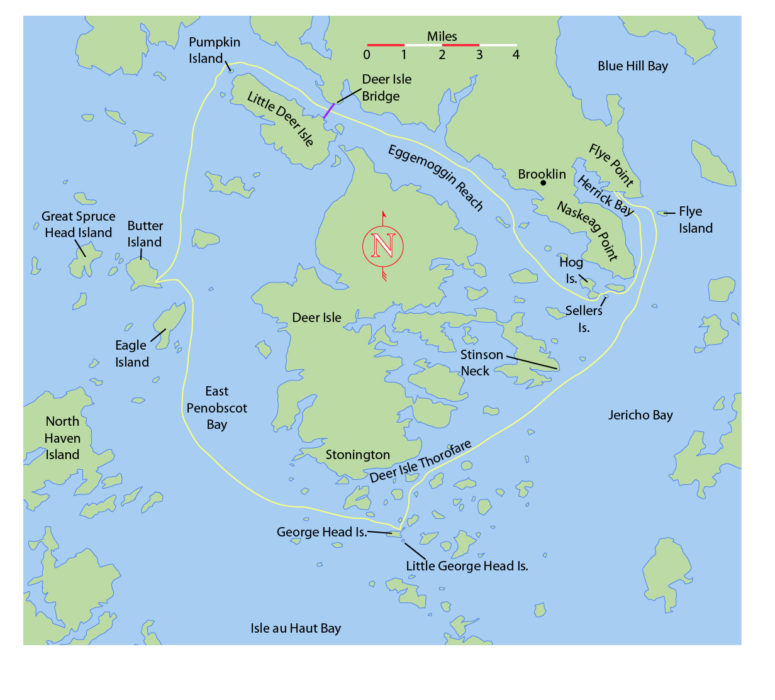
Guillemot

Iain Oughtred’s Guillemot is a multipurpose boat intended for rowing and for sailing with either a gunter or lug rig. He designed the boat 25 years ago and based it on the lines of a 19th-century ship’s boat or large yacht’s tender. It is intended to accommodate three adults comfortably, but could take as many as five over short distances in benign conditions.

Oughtred is best known for applying contemporary glued-lap plywood construction to traditional hull forms, and the Guillemot was primarily intended for that method. Glued-lap plywood has several advantages: it is easier to source the materials, easier to build, and results in a lighter boat. The Guillemot can also be cold-molded, strip-planked, or built in traditional lapstrake.

Regina Frei, a student at England’s Lyme Regis Boatbuilding Academy, opted for traditional lapstrake construction. Of the 319 sets of plans for the Guillemot sold to date, Oughtred believes that about 10 percent of the boats built have been traditional lapstrake, but suspects that percentage has increased in recent years. A glued-lap plywood hull is normally around 125 lbs; a traditional lapstrake one would be about 25–40 lbs heavier.

The plans include full-sized patterns for the stem, transom, floors, and temporary molds, and no lofting is required, but the Academy requires that students begin their projects with lofting, so Regina drew the lines from the offsets included with the plans, faired them, and created her own patterns. Oughtred’s drawings provide guidance for traditional construction, including scantlings for planking and steam-bent frames, frame spacing, and a recommendation for nine or ten strakes instead of the eight on the glued-plywood boats.

Building the Guillemot in a traditional manner provides lots of interesting and appealing details that are often absent in the glued-lap ply construction commonly used for Oughtred designed boats.photographs by the author

Building the Guillemot in a traditional manner provides lots of interesting and appealing details that are often absent in the glued-lap ply construction commonly used for Oughtred designed boats.

Aside from the applewood from her Swiss homeland that Regina used for the transom, she purchased sustainable materials and locally sourced timber as much as possible. The Douglas-fir for the spars came from the Stourhead estate less than 50 miles away from Lyme Regis, and the larch planking stock came from Scotland. (British boatbuilders generally agree that the farther north larch is grown, the better it is.) The ribs, thwarts, and stem were made of English chestnut, and the rest of the centerline structure, along with the inwales, outwales, and sheerstrake rubbing strips, were of Forest Stewardship Council (FSC) certified oak. When an adhesive was required, she used a bio-based epoxy.

Oughtred’s plans for glued-ply construction specify that the hull should be built upside down, but he agrees with Regina’s decision to build her boat right-side up to allow easier access inside the hull for clenching nails or, as Regina chose to do, peening rivets. The assembled centerline was set up on a base structure, and seven temporary molds were then fitted on the keel hog and braced with supports going up to the workshop ceiling. Regina initially lined the hull for eight strakes, but this convinced her that she would be wise to follow Oughtred’s advice and fit a ninth strake. She then re-spiled accordingly, to more easily get the planks to follow the shape of the boat.

The Guillemot has two rowing stations, spaced about 3' apart—close, but not impossible quarters, for rowing tandem. Two stations come in handy for single rower managing wind and passengers.

The Guillemot has two rowing stations, spaced about 3′ apart—close, but not impossible quarters, for rowing in tandem. Two stations come in handy for a single rower managing wind and passengers.

Regina had to steam the forward ends of the bottom three strakes and the aft ends of the top three so the 5/16″ larch planking could take the twist required by the shape in those areas. With planking complete, she removed the molds, fitted the centerboard case, and then steamed in the 1/2″ x 5/8″ English chestnut ribs and riveted them in place. The two thwarts followed, and instead of using the sawn knees indicated in the plans, she fitted a single steamed chestnut knee at each thwart end. Oughtred felt that single steam-bent knee might not be strong enough: “I would suggest that two each side should be adequate. Very neat, in fact; a lot more comfortable if sitting on the thwart, leaning against the gunwale, which you can’t really do, with the usual single knee.” Installing the seats in the bow and stern came next, followed by the oak outwales, inwales, and rubbing strips.

The whole boat was coated, inside and out, with a “boat soup” of tung oil, linseed oil, turpentine, and Stockholm tar, the last coat of which also had some Japan drier in it.

The sloop rig here carries 72 sq ft of sail. The plans include options for single sails: a balanced lug rig, with boom, carrying 64 sq ft of sail; and a standing lug, loose footed, carrying 55 sq ft.

The sloop rig here carries 72 sq ft of sail. The plans include options for single sails: a balanced lug rig, with boom, carrying 64 sq ft of sail; and a standing lug, loose footed, carrying 55 sq ft.

Regina opted for the gunter rig with 72 sq ft of sail (the lug rig has 62 sq ft), “because it looks nicer and it will be more interesting to sail with a jib as well as a mainsail.” The mast is stepped on the keel hog immediately forward of the forward rowing thwart with no deck-level support. It has two shrouds anchored at the gunwale and a forestay connected to a bronze stemhead fitting that also takes the jib tack. The lug rig has an unstayed mast with partners spanning the gunwales at sheer height. Oughtred is considering adding something similar, perhaps at thwart height, to the plans for the gunter rig to allow easier stepping for the singlehander, although shrouds would still be required to brace the mast and provide support for the jib.

As soon as Regina’s Guillemot, christened LEAF, was launched, she rowed her out of the Lyme Regis harbor while her crew—Dan Adam-Azikri—prepared the rig. She rowed from the forward of the two rowing thwarts, and this would have been perfectly satisfactory but for the fact that the yard, boom, and sail were on the centerline ready to be hoisted, requiring Regina to row from an offset position. The centerboard and rudder blade were lowered, the sails that Regina made during a weeklong sailmaking course at the Academy were hoisted, and LEAF was underway. There was quite a chop in Lyme Bay for such a small boat, and only one other boat dared venture out of the harbor to sail. LEAF appeared to handle the conditions nicely, and I soon got the chance to see this up close after Regina and Dan rowed back into the harbor to fetch me.

The generous freeboard and firm bilges give the keep the Guillemot dry and steady in gusting winds.

The generous freeboard and firm bilges give the keep the Guillemot dry and steady in gusting winds.

Although there was some initial concern that the boat might be a little crowded with three of us aboard, the larger crew did give us an advantage in rowing and hoisting sails: Regina and Dan took an oar each in the aft rowing position and kept us head-to-wind while I sat comfortably in the bow seat and hoisted the sails from forward side of the mast. Dan and I then sat on the sternsheets benches either side of the tiller and took turns steering while Regina sat on the forward thwart and moved from side to side as we tacked to keep the boat level. We quickly got used to this arrangement agreed that it didn’t feel at all crowded. Had it been windier, we would have needed to get more of our weight to windward, but there would have been adequate space for us to do so.

The Guillemot’s performance was impressive. The gunter rig was easily managed, and we never seemed in danger of getting caught in irons when tacking. It was surprisingly easy to steer through the waves both upwind and downwind. The freeboard was just enough to give us a reasonably dry ride. While the wind was fairly constant, in the gusts that we did have, we didn’t have to react quickly to spill the wind from the mainsail or move our weight to the weather rail to keep the boat under us. It was clear that Oughtred had put an emphasis on safe, steady sailing so “you don’t have to hang out to keep her upright.” Still, the Guillemot was enjoyably lively. Oughtred later told me that he himself had been quite surprised at how lively the Guillemot was when he first sailed one.

The mast for the gunter sloop rig is supported by shrouds and a forestay, not a mast partner.

The mast for the gunter sloop rig is supported by shrouds and a forestay, not a mast partner.

Regina–an experienced rower–later had a chance to row LEAF properly without having the mainsail and its spars in the way. She was by herself in the boat rowing from the forward thwart and was really pleased with the performance. Oughtred later told me that although that is the favorable position for a singlehander as the boat is currently configured, it would be better still to have single ’midships thwart aft of the opening in the top of the centerboard case where the rower’s weight would put the Guillemot in better fore-and-aft trim. He is thinking of adding this to the plans as an alternative to the two thwarts that LEAF has.

The Guillemot is a really nice and functional all-round sailing and rowing boat and it will take a small outboard, too. The boat is eminently suitable for two or three adults, or perhaps better still, a family of four with young children. It is especially pretty when built in the traditional manner.

Nigel Sharp is a lifelong sailor and a freelance marine writer and photographer. He spent 35 years in managerial roles in the boat building and repair industry and has logged thousands of miles in boats big and small, from dinghies to schooners.

Guillemot Particulars

Length:  11′ 5″
Beam:  4′ 5″
Weight:  143 lbs
Sail area:
–lug: 62 sq ft
–gunter sloop: 72 sq ft

GuillemotprofilePSweb

GuillemotConstructonPlanPSwebGuillemotLugSailPlanPS

Plans for the Guillemot are available through the WoodenBoat Store and Oughtred Boats.

Is there a boat you’d like to know more about? Have you built one that you think other Small Boats Monthly readers would enjoy? Please email us!
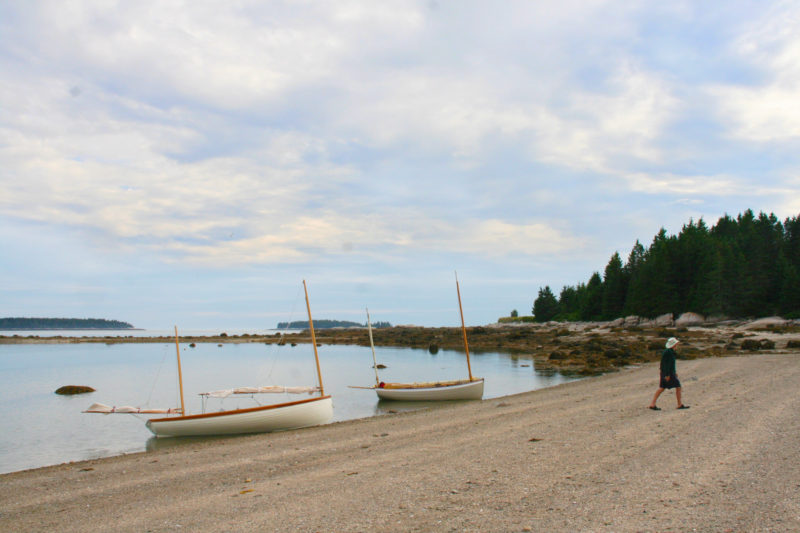
Building on Tradition

The year 1971 was a turbulent time on college campuses all across America. Newscasts were full of antiwar protests, civil-rights marches, and sit-ins with loudspeakers blaring the words of Bob Dylan’s eclectic poetry and the songs of screamin’, whiskey-voiced Janis Joplin. As a student at a small college in South Dakota, I desperately needed a challenge—a major change, something radical and outlandish. I longed to upset the whole program, question authority, move to a foreign country, and exchange this reality for a new set of faces, a new location, a new language.

With more daring than common sense, I began the search for an adventure. Amsterdam or Copenhagen? Kathmandu or Timbuktu? Oslo? Oslo. For this disgruntled college student, the fjords and mountains of Norway seemed irresistible. I had Norwegian ancestors and knew a handful of words and some basic phrases. The countryside rivaled the Swiss Alps and university was tuition-free. An excellent choice!

With a backpack, an overstuffed duffle bag, and soaring expectations, I began a year of university life at 60° north. Autumn brought cold mountain winds and winter brought on darkness. The Norwegian language became an obsession. I spent hours walking the cobblestone streets of Oslo, immersed in the living language and culture. On many a winter day I found inspiration in the wooden ships in the harbor, their decks blanketed with snow, their rigging whistling in the darkness.

A serene and idyllic setting, Ulset Båtbyggeri lies below Vettafjell along the shore of Kari Havet on the island of Aspøya in western Norway.Susan Wood

A serene and idyllic setting, Ulset Båtbyggeri lies below Vettafjell along the shore of Kari Havet on the island of Aspøya in western Norway.

Norway is a land of forests—a valuable natural resource for millennia. The oak, beech, and Scots pine were valuable trade goods on the European continent and the British Isles. Norway furnished planking for East Indian spice traders, masts for the British navy, and even ready–to-assemble boat kits for the treeless Hebrides islanders. In Norway, the forests provided the raw material for talented craftsmen. From their ornately carved medieval log farmhouses and barns, to their brilliantly engineered and decorated stave churches, Norwegians were masters of woodworking even before the time of the Vikings. Of all the rich history and long traditions in this land, the wooden boats and ships have long stood alone as masterworks of function and beauty.

Over the course of that winter I returned again and again to the Viking Ship Museum to see the elegant 9th-century longships: Oseberg and Gokstad. These are two of the finest examples of their type that have ever been unearthed, and the artistry of those shipwrights from 1,200 years ago would profoundly influence my life’s vocation in the years to come.

At the close of one academic year at the University of Oslo, I traveled north and west into the fjord country and the home of my ancestors, and there found a vibrant, ongoing tradition of woodcarving, folk music, and boatbuilding. This “homecoming” led to many rich relationships that have grown into deep and lasting friendships. The Norwegian Viking ships and stave churches had fostered my insatiable desire to build by hand, and even after I had earned a bachelor of arts degree in Philosophy and English back in South Dakota, I longed to create tangible, functional objects with wood.

My chance came when a close friend in Upstate New York invited me to join him in building a log cabin with 88 white oak trees, axes, drawknives, augers, and a team of mules. Over the course of this work, I became a woodworker drawn to simple tools and the  efficient use of materials. I was ready to get back to the elegant small boats of the fjords in Norway.

My third cousin, Martinus Kleivset, was a Norwegian boatbuilder who could offer assistance in finding a master in need of an apprentice. Building on his father’s knowledge and reputation and many builders before him, he had developed a respectable shipyard on Skålvikfjord. Just up the hill from the fjord and shipyard lay the farmhouse where my great-great-grandfather’s portrait still hangs in the parlor.

Martinus was a man of dry wit but not one to be trifled with. He put me to work scraping and painting his house (a test of endurance, I’m sure) and after several weeks, he announced that we would cross the Halsa fjord to the island of Aspøya to visit Nils Ulset at Ulset Båtbyggeri.

Nils O. Ulset reminisces over building the first geitbåt with Jay Smith at Aspøya in those early years.Susan Wood

Nils O. Ulset reminisces over building the first geitbåt with Jay Smith at Aspøya in those early years.

As a young foreigner with only an urban introduction to the Norwegian language, I had little idea what was being discussed when I was introduced to Nils. His dialect is one I am still working on mastering. However, it was agreed I could begin work, with the understanding that there was no English spoken in this shop. So in August of 1977, I began building traditional lapstrake boats at Ulset Båtbyggeri on Aspøya. My feet were planted on the path I had hoped to find.

The boatworks at Aspøya is just off the narrow road that circles the island. Built on pilings at the edge of the fjord, it is nestled at the base the island’s highest peak and overlooks an inlet flanked by farms and steep hayfields. Walking the lane that meanders its way down to the boatworks, I could easily imagine the setting several hundred years earlier when small lapstrake faerings were the only transport and a necessity for survival in these coastal communities. Thousands of faerings were built each year by scores of builders, often in one- or two-man shops that dotted the coast from Oslo to the Lofoten Islands. Here I stepped into just such a shop, entering by a loading ramp to the second floor, and that unmistakable smell of Scots-pine pitch filled the air. Wood shavings covered every inch of the floor; sawdust covered every other surface except the polished handrail leading down a steep set of stairs to the floor below. There, an old faering rested with oars alongside.

Another newly completed geitbåt, with bright finish and pine tarred rails awaits delivery at the boatworks on Aspøya in the district of Nordmøre.Susan Wood

Another newly completed geitbåt, with bright finish and pine-tarred rails, awaits delivery at the boatworks on Aspøya in the district of Nordmøre.

The stock designs in this shop were 24′, 26′, and 28′ lapstrake double-enders with inboard diesels. There were two on the main floor, planked and framed, and there was another on the railways. Among the six of us—four boatbuilders, a joiner, and the master—there was very little discussion about the work and even less chatter regarding other matters. I was introduced to each of the workers on the first day and worked many weeks alongside them before actually having a conversation. They came to work, put in a hard day, and went home to their families.

Eventually, Nils and his sons became my close friends. Nils, one of the kindest men I have known, grew comfortable building in wood as a boy and assisted in his father’s cabinet and furniture shop, but he had always been drawn to boatbuilding. In his early teens he had built a few prams in the local Nordmøre style, but after World War II he set up a workshop and designed the larger powerboats that were quickly gaining in popularity. Ulset Boats became widely known for their fair lines, fine proportions, brightly finished planking, and mahogany cabins.

Nils Ulset and Jay Smith review details on another of the many geitbåts built at Ulset Båtbyggeri.

Nils Ulset and Jay review details on another of the many geitbåts built at Ulset Båtbyggeri.

At the start of my apprenticeship I helped fasten planking, cleaned up scrap and rippings at the bandsaw, swept floors, and, at the end of each day, dumped barrels of shavings into the fjord. After several months I was given a small work area, a bench with hand tools, and began taking direction from Nils directly in building small boats. We began with a 12′ pram (ferge) working the gains and lap bevels, and I got a good introduction to making sawn frames and riveting. We progressed quickly to a 15′ transom faering (tværskotting) with scarfs and hood ends to master. Another pram and a 15′ runabout with foredeck, mahogany-framed windshield and stern sheets took us into the summer. These were certainly valuable exercises in lapstrake construction, joinery, and the importance of a fair line, but none of these boats had the striking elegance of the older, wide-planked faerings in the boathouses (nausts) and small-boat museums.

By this time I had become comfortable enough in the local dialect to chat a bit—when appropriate—and I mentioned my curiosity about the local workboats common in the 19th century, and broached the idea of building one. Nils thought it a good challenge and arranged to borrow a fine, wide-planked 21′ double-ender, a true geitbåt built in 1902, and we began building the first replica. It would be christened DEN FØRSTEFØDTE—the firstborn.

The geitbåt has been the stock workboat in the district of Nordmøre for over 500 years. Its origins lie in the small faerings of the Vikings and though some evolution in plank lines has occurred, many of the structural elements remain the same after 1,200 years. The last of the builders of these traditional faerings was Ola “Saksa” Reitan, from Halsa, who received an award from the King of Norway in 1933 as one of Norway’s finest boatbuilders. When asked how many boats he had built he replied, “Ja, I built 10 boats a year and have been building for 60 years.”

Geitbåts ranged in size from 17′ to 30′ and were essential transportation for farmers and fishermen who lived along the fjords. The name, meaning “goat boat,” refers to their ability to climb a wave with the ease of a goat climbing atop a rocky precipice. Those who have sailed them will certainly attest to this.

In Jay's shop in Anacortes, Washington, beginning the carved garboards for the geitbåt was a daunting task for members of the Friday Guild.Leah Kefgen

In Jay’s shop in Anacortes, Washington, beginning the carved garboards for the geitbåt was a daunting task for the crew building the boat.

What makes this boat so exceptional isn’t the stem or the stern, the sheerline, or the freeboard. It is the keel and the garboards that harken back to a time before sawmills when keels and planks were riven from raw logs, and boats were essentially carved with axes, drawknives, smoothing planes, and sheath knives. These boats were built quickly, but with exacting dexterity. Each stroke of the axe had purpose; every pass of the plane was intentional. It was not unusual for two men to complete a 21′ geitbåt in two six-day work weeks.

The keel is taken from a 6″ × 10″ timber and carved to a T-shaped cross section, creating a shallow bilge and a narrow keel. The shape allows the garboards to be riveted to the keel, as opposed to being spiked into a rabbet. This eliminates the issues of the garboards leaking over time. This positive fastening of the garboards gives the boat a foundation for longevity where other construction methods often fail.

Jay, Leah, and Torolf carefully bend the broad strake's aft planks into place.Susan Wood

Jay, Leah, and Torolf carefully bend the broad strake’s aft planks into place as the geitbåt takes shape in Anacortes.

The garboards are made from short cants 2 1/2″ to 3″ thick, 16″ wide, and carved concave and with a bit of a twist, with a final thickness of around 1/2”. Each garboard is done in sections: one plank section forward, one aft, connected by the flat middle (midtstykke) plank. The forward ends of the broadstrake planks are also carved from cants, giving a concave entry and even more lift and stability in the bow. The carved planks not only give the boat its character and its stability, they also are quite sculptural. This carved, concave bottom, when viewed early on in construction, resembles the form of a bird in flight.

With Jay looking over his shoulder, Vern Lauridsen prepares a pattern for the third strake's forward plank sections.Bob Jepperson

With Jay looking over his shoulder, Vern Lauridsen prepares a pattern for the third strake’s forward plank sections.


Every plank, every thwart, station, and “room” (the space between frames) in a geitbåt has a name, often with profound meaning. The wide forward planks at waterline, for example, are the fram kjempe or “those who do battle.” The garboard is the hals, meaning “throat.” Once the garboards and forward broad planks have been fastened, planking becomes rather straightforward.

The natural grown oak oarlocks treenail fastened through the sheer plank are witness to the boatbuilding traditions little changed since the Viking era.Christopher Cunningham

The natural grown oak oarlocks, treenail-fastened through the sheer plank, are witness to the boatbuilding traditions little changed since the Viking era.

Sawn floor timbers are fitted and installed at this stage; they’re fastened with trunnels (treenails) fastened with their button heads outboard and slots and wedges inboard. Trunnels are typically centered in the plank width and doubled in very wide planks. With garboards and broad planks in place and floor timbers fastened, the planking can continue. Planks are 16″ to 18″ in width, which allows a 20′ geitbåt to be planked with four strakes, with the sheerstrake tapering up to the sheerline and running out there, just forward of the aft stem.

All hands are ready to assist as the new boat is taken off her blocks and freed from her overhead shoring beam.Susan Wood

All hands are ready to assist as the new boat is taken off her blocks and freed from her overhead shoring beam.

The hull form is much like a codfish: full in its forward section, slender aft. The sheer rises to the bow and is a bit lower at the sternpost. The sternpost is laid back a bit whereas the stem rises nearly to plumb, but not beyond. The planking is completed when the sheer planks are fitted and fastened; they’re installed with plenty of extra width, allowing for the striking of the sheer with an axe, a momentous occasion that requires a keen eye and a refined sense for balance and symmetry.

All of the interior framing is of grown crooks with minimal scantlings and trunnel fastenings. The end-most frames, shaped like wishbones, are canted inward. Thwarts are fitted on crossbeams and held in place by the upper frames, but are not fastened, which allows for freedom of movement and comfort when rowing long distances for extended periods of time. The traditional oarlock (kjæppa) is taken from the trunk and a branch of a birch tree, with the trunk section fastened along the sheer; the oar rests in the crotch of the branch. This part of the tree is inherently strong and durable. A 9″-diameter grommet, made of withe from a willow or birch sapling, is reeved through the oarlock to keep the oar on the return stroke. Withes are extremely tough and readily available. (Our English word, withe, comes from Old Norse vi ð r, meaning willow). The gudgeons and pintles are an ingeniously simple work of Norse wizardry, as is the steering system with its athwartships rudder arm and infinitely versatile push-pull tiller.

The geitbåt carries a single mast with a large, asymmetrical mainsail that functions as a main and a jib together. A sheet, a tack up forward along the rail, a halyard and vang from the yard aloft, and a series of reefpoints make for a simple, efficient sailing rig.

On launch day the Friday Guild and compatriots raised the TJÆLD off its trailer and carried her to the shoreline.Susan Wood

On launch day the Anacortes Friday Guild and compatriots raised the TJÆLD off the trailer and carried her to the Puget Sound shoreline. Note the aft ends of the sheer planks ending at the sheer, a few feet forward of the sternpost.


To build a replica of a classic wooden boat under the direction of a highly accomplished master builder is a truly exhilarating experience. A true master of the trade is able to visualize at once the three-dimensional, T-shaped keel or the hollowed and twisted garboard plank, commit it to memory, and reproduce the piece at his bench with extraordinary ease and accuracy. The apprentice should not expect a verbal analysis of the work but must learn through observation and practice. The reward for good work may be as inconsequential as a simple nod or a smile; inferior work is merely set aside for some other use and a second attempt is begun. At the close of each work day, stepping back to eye the fluid lines, the dynamic physical form, and the minimal scantlings—all so neatly seated in a bed of shavings and woodchips—the boatbuilders would scarcely gave a thought to the day’s wages as part of the equation.

On launch day, the TJÆLD was christened by rowing in a circle three times with the sun, an old Norse ritual.Susan Wood

On launch day, the TJÆLD was christened by rowing in a circle three times with the sun, an old Norse ritual.

Within days of blocking and plumbing the backbone, we fastened floor timbers and upper frames, installed trunnels. We notched and beveled the thwarts and dropped them into place, each capturing a frame head port and starboard. Rubrails and oarlocks, rudder and tiller all came in rapid succession and early one Thursday afternoon we threw open the double doors to the north and launched DEN FØRSTEFØDTE.

Leah and Jay take the TJÆLD for an early morning rowing tour at the Wooden Boat Festival in Port Townsend, WA.Christopher Cunningham

Leah and Jay take the TJÆLD for an early morning rowing tour at the Wooden Boat Festival in Port Townsend, WA.


After my extended period of living abroad, my homecoming to America, was a thrilling, joyous occasion, but also left me with  sadness over the loss and separation. Seventeen years passed before Nils and I, once master and apprentice, would again plank a geitbåt together. I had returned to the States, settled in Anacortes, raised a family, built faerings, planked fishing boats, repaired classic yachts, and redesigned yacht interiors.

In Norway, Nils carried on the tradition of lapstrake boats of the fjords of western Norway. Ulset Båtbyggeri became a one-man shop again as it had been in the ’60s and ’70s, with Nils as the boatbuilder. Nils never stopped building, even in retirement. For another 23 years repairs came steadily into the shop, along with commissions for new geitbåts. He was asked: “So Nils, how many geitbåts have you built over the last 20 years?” “Oh, I’d have to say three geitbåts a year, maybe four, and a handful of repairs, you know.” He gained a reputation as the builder of historic replicas, and literally carved out a second career for himself. He built his last boat in 2014 at the age of 89, always bright, cheerful, and up to the task with a bandsaw, a planer, and nine simple hand tools.

TJÆLD is prepared for sea trials on a blustery Northwest winter’s day.Susan Wood

TJÆLD is prepared for sea trials on a blustery Northwest winter’s day.

On each of my return trips to Norway, Nils would ask, “Have you built a geitbåt in America, now?” and I would promise that I would soon. For many years I had been setting aside “geitbåt planks,” grown crooks, and the finest locust, oak, and Alaska yellow cedar, hoping someday to take the time to build a geitbåt on my own, but it was a group of close friends who take the credit for making it happen. On Fridays at my shop I welcome volunteers, usually three or four locals, and they eventually came to be known as The Friday Guild. After completing several small lapstrake projects together, they agreed to attempt a 20′ geitbåt with carved garboards, natural crooks and trunnel fastenings—quite a challenge for a handful of apprentices. Fridays quickly became the high point of the week with everyone poring over the next plank scarf or inserting more rivets and roves. I took the role of teacher, allowing them to accomplish the task themselves. We emphasized trusting our eyes and hands, believing that if it looks right, it is good. Plumb bobs and spokeshaves were always at hand. After many months of Fridays, the last of the planking was fastened and the guild had only the rudder, spars, and oars left to make.

Leah is at the helm for TJÆLD’s maiden voyage at Bowman Bay on Fidalgo Island.Susan Wood

Leah is at the helm for TJÆLD’s maiden voyage at Bowman Bay on Fidalgo Island.

On a blustery winter’s day in 2014, the Friday Guild, with family and friends gathered on the beach for the launching (sjøsetting) of TJÆLD (Oystercatcher), the first geitbåt on Puget Sound. I mailed photos to Nils proving that I did finally build a geitbåt in the USA. And what did Nils say? His response was a simple, “Ikkje så værst, gutt.” Not so bad, my boy.

Jay Smith does business as Aspøya Boats in Anacortes, Washington. He now has a 38′ Viking ship replica is now under way at and the Friday Guild is assembling the backbone for a new 18′ Nordfjord færing.

If you have an interesting story to tell about your adventures with a small wooden boat, please email us a brief outline and a few photos.

Tacking for Rowing

Lowering the centerboard and "tacking" can make rowing to weather easier than fighting the wind head on.Christopher Cunningham

Lowering the centerboard and “tacking” can make rowing to weather easier than fighting the wind head on.


When comparing rowing and sailing strategies for an oar-and-sail boat, it is easy to assume that rowing a direct leg upwind might prevail over a sailing a zigzag course to weather. Fighting for the short, straight line with oars makes sense. But does it always?

When I want to go rowing, wind is not usually a deterrent. A good stiff row is sometimes just what the doctor ordered. I have dealt with strong headwinds, and while feathering the oars helps to a point, and adrenaline does wonders, a couple of years back I got stopped dead in my tracks. Mind you, this was merely a day outing with plenty of residences and docks lining the lakeshore, nothing terrifying or life-threatening, but the wind piped up on the nose with an unexpectedly strong punch and brought my 16’ sail-and-oar boat to a standstill.

After a determined effort got me nowhere, I tried something different, something I had read about and dismissed: I lowered the centerboard and began tacking upwind while rowing.

As soon as I bore off, the motion of the boat eased. With the influence of the centerboard, the boat settled on its own heading and everything became easier. The oars were not laboring directly against a headwind. The boat heeled a little bit from the force of the wind, but this was not a hindrance. I made steady progress to windward with a relatively relaxed stroke. It took a few hard pulls to bring the bow across while I was “short-tacking,” but that was nothing compared to beating my brains out directly against the wall of the wind. I could have carried on like this for some time.

On another occasion I was rowing upwind with the centerboard down and matched tacks, with a close-hauled 25′ sailboat, and we reached our common destination at about the same time. I don’t think the other skipper was greatly experienced and could have made better speed, but the wind that day was quite strong and my unwitting competitor did, by and large, keep his sails filled. On another day out in the wind I traded a couple of tacks with a fast-looking 30′ sloop. He was pushed over hard a couple of times and was probably making 6 knots against my 2, so there was no pretense of keeping up, but what struck me was that we seemed to take very similar headings on our respective tacks.

In more moderate conditions I will row straight away to windward without the added drag of the centerboard, making perhaps a couple of knots. I can take a break and bear off, at which time employing the board will dramatically reduce leeway. I don’t make much more speed and eat up far more ground, but rowing is relaxed. The reduction in leeway seems worth the additional wetted surface and drag of the board.

This business of tacking with the centerboard employed while rowing seems to work best with a whole lot of wind. This could be useful if you’re trying to get to weather under sail and are overwhelmed. When my 16-footer is reduced to three reefs, the ability to work to windward is greatly hampered if not eliminated, and skating on the edge of a knockdown is not fun. When I bear a few degrees off rowing into a strong headwind, the boat pounds less as the waves are quartered rather then met head-on. But without a centerboard or a daggerboard, most boats will make a lot of leeway. Lowering the board will eliminate leeway, dampen the roll, and bring the boat up closer to the eye of the wind rather than beam-to or worse.

Carrying on with the oars, the sensation is similar to that of being under sail. Some of the forces at work under sail seem to be at work here. In my experience, eliminating leeway is not a dramatic enough description for what is occurring when tacking under oars into a strong wind. There may be more at work than greater directional stability with the board down. I suspect lift is being generated. Rowing straight into the wind, the board will have no angle of attack and so would generate no lift, but bearing off, the hull slips sideways to some degree; coupled with forward motion, the centerboard would have a positive angle of attack and create lift.

Exactly how and when a centerboard becomes of benefit to the rower will vary with every boat and skipper. But there is no question in my mind that when the wind pipes up, the centerboard represents another tool in the rower’s quiver. Rather than turning away and retreating, forward progress might still be possible.

Eric Hvalsoe of Hvalsoe Boats builds and restores boats in Shoreline, Washington, and cruises the waters of  the Salish Sea. He wishes to thank to Ian McColgin for “this crazy idea.”

You can share your tricks of the trade with other Small Boats Monthly readers by sending us an email.

IceMule Cooler

The IceMule cooler is a dry bag within a dry bag with insulation in between the two.SBM photographs

The IceMule cooler is a dry bag within a dry bag with insulation in between the two.


Meat and cold drinks are two commodities I consider essential for a weekend on the water. To keep the former at a safe temperature and the latter chilled, a bulky rigid cooler is the usual solution. But why would you crowd a small boat with an item that takes up a lot of space, performs only one function, and is useless once its contents are gone?

Enter the IceMule cooler: it looks like an ordinary dry bag, but it incorporates an insulation system designed to keep iced food and drinks cold for up to 24 hours. Once the food is consumed, you can roll the IceMule up into a compact, easily stowed package, or use it as a dry bag.

IceMule makes several different models but the cooling system for all of them is the same: an exterior of coated material and inner waterproof liner sandwiching a layer of insulation. A valve is used to inflate the enclosed pocket of air to provide additional insulation or increase the amount of padding the cooler can provide if it’s being used as a dry bag to protect fragile equipment. Once contents are loaded into the bag, the top is folded down and clasped with snap buckles.

A shoulder strap frees up your hands to carry other things. The valve near the top of the bag allows you to add air to the interior layer of insulation to help trap cold and deflate the bag to roll it up for storage.

A shoulder strap frees up your hands to carry other things. The valve near the top of the bag allows you to add air to the interior layer of insulation to help trap cold and deflate the bag to roll it up for storage.

I tried the 15-liter Classic Cooler on a couple of 80-degree days. Its exterior and interior materials were similar to urethane-coated nylon and felt tough and durable. Fully loaded and with the top rolled and secured, the Classic Cooler is approximately 10″ in diameter and 18″ from bottom to top. When empty the cooler was easily rolled up and secured in a mesh storage bag measuring 4″ in diameter and 15″ long. Its soft exterior and single padded shoulder strap made carrying a full cooler comfortable, even on a half-mile walk. The IceMule Pro coolers are made more like backpacks and have two shoulder straps and a waist belt.

Using a frozen bottle of water (here with the orange cap) saves the melt water for drinking but doesn't keep the contents of the IceMule as cold as loose ice does.

Using a frozen bottle of water (here with the orange cap) saves the melt water for drinking but doesn’t keep the contents of the IceMule as cold as loose ice does.

I packed the IceMule with a variety of provisions and found that it easily held a gallon of milk or eight 12-ounce beverage cans. Even without adding ice, previously chilled items remained cool for a few hours, long enough for an afternoon outing. I like to take plastic bottles of frozen water on a trip; they serve as ice packs and as they melt they provide cold water for drinking. However, when used in the IceMule they kept chilled only the items they were in contact with. Packing the cooler with loose ice cubes or chunks of block ice produced the best results. After about 16 hours there was still plenty of ice in the IceMule; after 20 hours there was still a small amount of ice remaining, and after 26 hours the drinks, sitting in now-cool water, were still cold enough to enjoy. As with any cooler, the downside to using loose ice is the resulting water is wasted and fresh products like meat and vegetables must be kept in waterproof containers.

For weekend outings and for traveling between ports where ice and fresh supplies are available, the IceMule Classic is a sturdy and effective cooler. As the weather cools with the coming of fall, the cooler can be used to carry a hot meal with a heated gel pack. Good food and cold drinks make happy sailors.

Bruce Bateau sails and rows traditional boats with a modern twist in Portland, Oregon. His stories and adventures can be found at his web site, Terrapin Tales.

IceMule coolers are available online from the manufacturer and at numerous outdoors retailers. The medium Classic  reviewed here retails for $59.95.

Is there a product that might be useful for boatbuilding, cruising or shore-side camping that you’d like us to review? Please email your suggestions.

Mantus Dinghy Anchor

The Mantus anchor has a sharp tip to cut through seaweed.photographs and video by the author

The Mantus anchor has a sharp tip to cut through seaweed.


I’ve been using the same anchor for about 45 years, and I had never given much thought to more recent models until I saw the Mantus dinghy anchor. Its shank and fluke can be separated to make it a more compact bundle for storing, and it has a point so sharp that it needs a guard to keep it from getting into mischief.

Four studs hold the stock to keyholes in the fluke. The small hole accepts a spring-laded locking pin.

Four studs hold the stock to keyholes in the fluke. The small hole accepts a spring-loaded locking pin.

Mantus came on the scene in 2012, and the company web site notes this smallest version of their anchors is “designed to be used as a kayak anchor or a dinghy anchor. This anchor weighs only 2 lbs and is recommended for boats to 16′.” Mantus has a sizing chart for their anchors and there the dinghy anchor is designated as suitable as a lunch hook for boats up to 16′ and 1,000 lbs. Their lunch-hook category is defined as use in “expected winds under 25 knots.” In a well-protected anchorage, the dinghy anchor should be able to keep you secure for overnight stays.

I tested the 2.5 lb Mantus, a 4-lb Danforth and a 4-lb Bruce with a 4' length of chain and a 36' rode.

I tested the 2.5 lb Mantus, a 4-lb Danforth, and a 4-lb Bruce with a 4′ length of chain and a 36′ rode.

I pitted the Mantus against two heavier anchors: a 4-lb Bruce and my old 4-1/2 lb Danforth. While the Mantus is listed as a 2-lb anchor, my scale had it at 2 1/2 lbs. I measured the area of the Mantus fluke at 21.25 square inches, significantly smaller than the Danforth’s flukes at 35.5 square inches.

The Mantus could bury itself in just twice its own length.

The Mantus could bury itself in just twice its own length.

In the wet sand uncovered by a low tide, the Bruce anchor behaved more like a plow than an anchor; it clawed a furrow for as long as I pulled it. The Danforth’s points dug in quickly and it buried itself, as much by heaping sand up over itself as by digging deep. The Mantus dove into the sand and buried itself by going deep under the surface. Both the Mantus and the Danforth travelled about 5′ when they stopped cold. (Tested underwater, the anchors traveled farther in sand before stopping. In a measurement I made at home a 20.8-oz beach rock weighed only 14.3 ounces when suspended in water. The weight of sand underwater must be similarly reduced by the amount of water the sand displaces, perhaps by 30%, and would offer less resistance to and anchor.)

None of the anchors could get a purchase on a rocky stretch of the intertidal. The Bruce skipped merrily over everything. The Danforth and the Mantus would occasionally catch hold, but neither could get deep enough in rocks averaging 2″ to 3″ in diameter to stay put. The Mantus had a slight edge over the Danforth: It never flipped, caught more often, and offered more resistance when it did. To be fair, this area of rocks would be poor holding ground for any anchor a small boat might carry. I returned to the beach with my old fisherman’s anchor. It is 34″ long, spans 20″ between the tips of the flukes, and weighs 19 1/2 lbs. It was harder to drag across the same rocky area, but drag it did. It couldn’t bury its fluke more than about 3″. (Its performance on wet sand was erratic; more often that not it dragged a fluke rather than bury it.)

I didn’t have a bed of slippery seaweed for trials so I used four layers of 4-mil plastic sheeting, secured at one end to keep them from sliding. The blunt-tipped Bruce and Danforth, as I expected, skated right across, but the Mantus, with its sharp point, poked right through, tore a hole, and dug into the ground. I suspect it could dispatch kelp with equal ease.

KitPSweb

The bag and tip guard, included in the kit, keep the anchor and rode isolated from other gear.

Mantus has a one-piece version of the dinghy anchor in galvanized steel with the shank and fluke welded together. Both versions come as a kit with a 50′ length of 5/16″ double-braid line that has a stainless-steel thimble spliced in one end, and a heavy-duty, roll-top bag. The bag is built like a dry bag but it has five grommets to let the water collected by the rode drain out.

I was impressed by how well the Mantus measured up, especially in comparison to my larger and heavier Danforth and even my big fisherman. The dinghy anchor’s sharp point and effective geometry give it a very big bite for its size.

Christopher Cunningham is the editor of Small Boats Monthly.

Mantus Anchors offers the two-piece stainless steel Dinghy anchor kit for $197 online and through worldwide retailers. The kit with one-piece galvanized steel version is priced at $75.

Is there a product that might be useful for boatbuilding, cruising or shore-side camping that you’d like us to review? Please email your suggestions.

BOB

Nate was used to sailing a sloop and found that the trimming of the sails on the schooner had more impact on steering than speed.Dilsie V. Morrison

Nate was used to sailing a sloop and found that the trimming of the sails on the schooner had more impact on steering than speed.


Nate Morrison wanted a small, easily managed boat that he could use for fishing and sailing during the day and sleep aboard at night. He spent months looking for an affordable used boat that would fit the bill, but came up empty-handed.

Undeterred, he expanded his search to include plans for a boat he could build for himself. It took him several more months to find plans for a boat that would meet his requirement and not exceed his skills. “I was not a woodworker, or any kind of craftsman, for that matter, so building a boat would be a big deal.” His search came to an end when he found the Schooner 18, designed by Fred Shell of Shell Boats.

The Schooner 18 is designed with sturdy skeg and a pair of bilge keels to give the boat a level stance when pulled up to a beach. The zebrawood transom makes a handsome accent to the painted hull.Nate Morrison

The Schooner 18 is designed with sturdy skeg and a pair of bilge keels to give the boat a level stance when pulled up to a beach. The zebrawood transom makes a handsome accent to the painted hull.

Shell describes the 18′ boat as “a luxurious daysailer for two to four, with pretenses of being a basic cruiser for one or two.” The hull has a skeg and a pair of bilge keels, so it sits upright and sails without having to deploy a centerboard or daggerboard. The unstayed masts slip into sleeves in the leg-o’-mutton sails, and the sprit booms are quick to rig and self-vanging. Removing the sprits and rotating the masts to roll up the sails is all it takes to strike them. The Schooner has just three lines to tend to: a single sheet for the foresail and a double sheet for the main. These features met Nate’s requirements for a simple rig. The cabin has a 6’6” sleeping platform that Nate says “works well for one person, but you have to be willing to spoon if there are two of you.”

During long lulls in the wind, Nate wraps the sails around the rotating masts. The crutch forward and the gallows aft support the rig when it's taken down.Dilsie V. Morrison

During long lulls in the wind, Nate wraps the sails around the rotating masts. The crutch forward and the gallows aft support the rig when it’s taken down.

When Nate taped the plans on the garage wall, he already had a name for the boat he was about to build: BOB, for Boat On a Budget. He was afraid he’d make costly mistakes as he figured out the building process, so he built a trial hull with cheap plywood. He worked out the bugs on a full-sized model when he got everything to fit together properly, he disassembled the trial hull and used the pieces as templates.With his confidence bolstered, he began the glued-lap construction with good plywood.

Nate rigged an umbrella for protection from the merciless Arizona sun. This square one with straps on the corners is designed for use on boats.Nate Morrison

Nate rigged an umbrella for protection from the merciless Arizona sun. This square one with straps on the corners is designed for use on boats.

Nate went shopping for some mahogany for the transom, but at the lumberyard he found a beautiful piece of zebrawood that he “could not live without.” He also prettied up the plywood deck with some vertical-grain Douglas-fir from the deck of a derelict keelboat and trailer he’d been given to salvage.

Nate went the extra mile with his boat’s electrical system. Tucked under the cockpit bench and accessible from the cabin, he has a stereo and amplifier, a solar charge controller, a fuse block, and wiring and controls for a bevy of comforts. Nate’s able to enjoy a stereo and amplifier, LED running lights, speakers that include a subwoofer, a reading light, a cooling fan, and some lighting strips recessed under the deck to give the cockpit a blue glow at night. He modified the rudder to take an electric trolling motor.

When there isn't enough wind for sailing, Nate can leave the sails ashore and head out under power. BOB's rudder has an electric trolling motor built in.Bill Onley

When there isn’t enough wind for sailing, Nate can leave the sails ashore and head out under power. BOB’s rudder has an electric trolling motor built in.

BOB was a year in the making. Nate had to stop working for two months following open-heart surgery, and during the time he spent recovering he daydreamed about his boat. “It gave me a reason to get well,” he says.

The winds on the Arizona reservoirs are often light; the boat needs breezes of about 10 mph to respond well to the helm.Dilsie V. Morrison

The winds on the Arizona reservoirs are often light; the boat needs breezes of about 10 mph for the helm to respond well.

He now sails BOB on Arizona’s inland waters, including lakes Pleasant, Powell, Roosevelt, and Patagonia. His little schooner is a fishing boat, a rowboat, and a family picnic boat, and, as Nate puts it, the result of “limited skills, limited tools, and unlimited dreams.”

Have you recently launched a boat? Please email us. We’d like to hear about it and share your story with other Small Boats Monthly readers.

A Little Big Horn

As I was working on our review of sound signaling devices in our August 2016 issue, I took a look on the web for homemade foghorns. I found quite a number of websites and videos that showed how to make foghorns and train horns out of common plastic pipe and fittings. A trip to the hardware store for some 1/2″ PVC pipe and fittings, and 30 or 40 minutes of puttering in the shop was all it took to come up with a few configurations that made a sound that I liked.

The parts are common plastic pipe and fittings. Only the two reducers need modifying: The one at the back of the horn (left) is shortened and the one at the front reamed out to let the pipe slip through.

The parts are common plastic pipe and fittings. Only the two reducers need modifying: The one at the back of the horn (left) is shortened and the one at the front reamed out to let the pipe slip through.

The core of the horn is a 1″ x 1″ x 1/2″ T fitting and two 1″ to 1/2″ reducers. One reducer gets shortened up with a hacksaw. (Don’t try using a bandsaw—cylinders like plastic pipe do dangerous things in one.) The cut then gets sanded flat. The other reducer needs to have the stop inside removed so that 1/2″ pipe will slip through. The short reducer is inserted into one end of the T with a piece of freezer bag. The other reducer goes into the other end of the T, and a piece of 1/2″ pipe slips through until it comes in contact with the freezer-bag membrane. You blow through the small hole in the side of the T and adjust the 1/2″ pipe to get a tone. You can change the mouthpiece angle with pipe and angled joints. The length of the pipe slipped through the reducer will determine the horn’s pitch. You can use a long pipe or a short length of pipe—about 6″ so you can still get a grip on it to adjust it—and, if you like, connect a funnel to the pipe. The sound I liked best came from a 24″ length of pipe. It had a deep, resonant, rattling tone.

If I were on the water and heard the deep sound of that 24″ horn coming through the fog, I’d start making tracks fast, thinking I was about to get run down by a freighter. And there’s the problem. You can’t give other mariners the impression that you’re something you’re not. The USCG Colregs specify the frequencies that vessels can use: 70–200 Hz for a vessel 200 meters or more in length, 130–350 Hz for a vessel 75 meters but less than 200 meters in length, and 250–700 Hz for a vessel less than 75 meters in length. (If you’d like to hear what those ranges sound like, check out this online tone generator.)

It looks like a horn and has an authoritative voice but this version with the long funnel has a low tone that only a ship can rightfully use.

It looks like a horn and has an authoritative voice but this version with the long funnel has a low tone that only a ship can rightfully use.

I sometimes have trouble distinguishing octaves coming from different instruments and couldn’t compare the sound of the tone generator and the horn with any certainty, so I loaded a free tuning app (Pano Tuner for Android) on my phone and found my 24″ pipe was 130 Hz, two octaves below middle C on the piano. If I were to use that horn aboard the biggest of my boats in the fog, I’d be masquerading as a vessel between 250′ and 650′ long. Too bad, I rather like the sound. The lowest tone I can use is 250 HZ, or just a bit below middle C. That’s a 12″ pipe.

While the funnel my have the look of a horn, a straight pipe has a sharper more distinct sound.

While the funnel my have the look of a horn, a straight pipe has a sharper more distinct sound.

This homemade horn may look like it belongs under the galley sink but it is loud and measured up well against all of the lung-powered horns we reviewed. It is practically indestructible and the parts cost less than $5.

I found it easy to get carried away with making horns. I thought a dual horn might be worth investing a couple of dollars more, and indeed a two-tone horn has a sound that’s hard to ignore.

It's easy to join two horns with a T fitting. This dual horn sounds like a big-rig truck.

It’s easy to join two horns with a T fitting. This dual horn sounds like a big-rig truck.


Honker

Pete Markantes and his son Jason built DAWN PATROL for hunting, crabbing, and fishing in the waters of the Pacific Northwest. Their Honker is one of Sam Devlin’s suite of small, hunting-oriented outboard-motor boats. Its broad cockpit and stable garvey-style hull make for a workhorse of a boat, and its straightforward construction allows novice boatbuilders to create a functional, adaptable craft that can accommodate a group of fishers or hunters.

When I asked Pete, “Why not just get an aluminum jet sled, like everyone else?”, he smiled. “It’s the customization.” A home-built boat is not at all like a factory-made model, where buyer is stuck with features decided upon by the manufacturer. Even as they were building the boat, Jason put a lot of thought into outfitting it. “I just stared at it in the garage. What if we put a second depthfinder over there, and a rod holder there…?”

The customizations to this Honker keep fishing gear readily accessible and out from underfoot. Just visible to the helmsman's right is an additional cutaway in the aft deck to accommodate a trolling motor.video and photographs by the author

The customizations to this Honker keep fishing gear readily accessible and out from underfoot. Just visible to the helmsman’s right is an additional cutaway in the aft deck to accommodate a trolling motor.

The Honker plans call for an 18′3″ hull, with a beam of 7′ and a capacity of 1,580 lbs. The drawings are detailed enough to enable assembling a seaworthy boat and yet leave plenty of flexibility for options to suit the builder’s needs. Pete opted to stretch the hull to 20′, which provided an extra 2′ of cockpit length over the stock design, allowing DAWN PATROL to carry two small layout boats, each capable of carrying and concealing single duck hunter. The chines and sheer run straight and parallel from about amidships aft, so for builders wishing to lengthen the Honker, Devlin notes that “the hull lines on the panels are very easy to extend, and we have had fully half of the boats built as the longer version, by simply adding onto the aft ends of the side and bottom panels.” He also recommends cold-molding an additional 1/4″ layer of plywood onto the bottom of the boat to make it stiffer and stronger for heavy-duty use.

The open cockpit easily seats four adults and their gear. The 14″-wide side decks make a useful spot to perch while under way, fishing, or hauling in a crab trap. The width of the decks and straightforward plywood construction supporting them provided the structure for the Markantes to add small shelves and trays for hunting and fishing gear.

The Honker was designed to take a 60-hp outboard and make 30 knots.

The Honker was designed to take a 60-hp outboard and make 30 knots.


The plans call for Devlin’s stitch-and-glue method, which consists of temporarily joining plywood pieces together with wire, then bonding them together permanently with epoxy and fiberglass. All exposed wood is coated with epoxy to protect it from the elements. The hull, deck, and cockpit sole are made of 1/2″ okoume marine plywood. The plans don’t recommend a specific paint treatment, but Pete found that two coats of Kirby’s flat marine alkyd enamel has proved durable. Pete had previously built two other boats, so he had the skills and the tools to build the Honker in about 350 hours, which is close to the designer’s estimate of 320 hours.

Pete initially powered the Honker with a Yamaha F115 four-stroke outboard, which can readily switch between prop and pump propulsion by changing the lower unit, but at 377 lbs it proved too heavy, resulting in poor trim and uneven performance at speed. He replaced it with a Yamaha F60 four-stroke outboard at 249 lbs, which gave the Honker better balance and as much power as it can comfortably take. Devlin recommends a 70-hp motor, but 10 years ago, when DAWN PATROL was constructed, the F60 was the best choice—its weight was the equivalent of today’s 70-hp outboards. An electric-start, power-tilt Yamaha T8 is used for trolling and alternate power. Pete’s Honker cruises at about 22 to 25 mph even when it is fully loaded with gear and four adults.

The fuel economy is excellent, Pete reports, noting that only about 4 to 6 gallons of fuel are consumed “after a full day of fishing, which consists of 2 hours of running on plane with the F60 and 4 to 6 hours of trolling with the T8.” The fuel tank location is not specified in the plans, but based on previous experience Pete chose a custom-made 21-gallon fuel tank, which he installed permanently under the fore deck. The location of the tank and weight of the fuel help to balance the boat for improved performance, compared with storing gas in portable tanks in the rear. The fuel lines are run under the side decks, instead of the bilge, making it easy to check for leaks and to conduct maintenance.

The V in the forward sections of the hull smooth the ride when running in a chop.

The V in the forward sections of the hull smooth the ride when running in a chop.

Some Honkers have been constructed with side-console steering, but the boat is intended to be steered by the outboard’s tiller. The helmsman can stand or sit on the aft bulkhead or a folding chair set in the cockpit. Standing provides the best field of view. Pete is 5′8″, and when he’s seated in a folding chair the view over the bow is acceptable at modest speeds, and slightly better when he’s seated on the aft deck. I’m 6′1″, and I found sitting on the deck and standing to be equally good since the bow didn’t rise much into my field of view ahead.

DAWN PATROL is used extensively on the Lower Columbia River, where the influence of tide, river current, and wind can cause challenging conditions. Spray sometimes comes over the bow, but Markantes finds the boat capable of handling wind and waves comfortably. Devlin is confident in the Honker’s seaworthiness close to shore and on open-water and I found that DAWN PATROL was steady and smooth in mild chop and when crossing the wake of other motor boats; no matter how the four passengers were arranged, the trim felt even. The boat goes from a standstill to plane in about five seconds.

Devlin writes that “duckboats are overloaded most of their lives, are used in inclement weather most of the time, are run in waters too shallow most of the time, and encounter sea conditions that would turn a normal boats hair white. They also have to maneuver well in tight conditions and have passengers constantly boarding and exiting the boat with lots of weight and gear.”

Devlin writes that “duckboats are overloaded most of their lives, are used in inclement weather most of the time, are run in waters too shallow most of the time, and encounter sea conditions that would turn a normal boat’s hair white. They also have to maneuver well in tight conditions and have passengers constantly boarding and exiting the boat with lots of weight and gear.”

Pete customized the boat with an electric system based on a 12V absorbed-glass-mat (AGM) battery. He installed tachometers and digital run-time counters for each motor, as well as running lights, power outlets, GPS, depthfinders for both the skipper and guests, LED lighting under the gunwales, and a removable LED spotlight on the foredeck.

In accordance with Coast Guard guidelines, DAWN PATROL was equipped with flotation. Markantes diverged from Devlin’s recommendation—solid foam with air space around it to prevent rot—choosing instead a combination of solid and two-part foam poured into three separate, enclosed compartments, one located at the bow, and two on either end of the stern.

Devlin offers a removable plywood pilothouse option for the Honker. It provides standing head room aft, from which one could steer with a side-console setup, as well as a lower area forward that covers approximately half of the cockpit. The structure would keep the crew dry in rough water or rain, and could serve as a humble cabin for an overnighter. To avoid taking up valuable cockpit space, Pete decided against the cabin and created instead a custom-made blind covered with artificial grass that allows the boat to transform from fishing vessel to camouflaged hunting craft in about half an hour. “With all this cockpit space, we can have three or four people hunting at once,” he told me.

DAWN PATROL illustrates just one variation that can be created using the Honker form as foundation. The plans are detailed enough to produce a solid boat that is highly customizable to suit intended use. Based on a classic and simple form, the Honker is a really practical boat, capable of adventuring in big water, yet with a shallow enough draft to ply backwaters, or even land on a beach. For its size, the Honker has a lot to offer.

Bruce Bateau sails and rows traditional boats with a modern twist in Portland, Oregon. His stories and adventures can be found at his web site, Terrapin Tales.

Honker Particulars

[table]

Length/18′ 3″ (standard)

Beam/7′

Draft/8.5″

Displacement/475 lbs

Power/70-hp outboard

Maximum load/1,580 lbs

[/table]

1-Honker-Profile-&-Plan-ViewPSweb

HONKERconstPS


Removable cabin option

Removable cabin option

Plans for the Honker are available from Devlin Designing Boat Builders.

Is there a boat you’d like to know more about? Have you built one that you think other Small Boats Monthly readers would enjoy? Please email us!
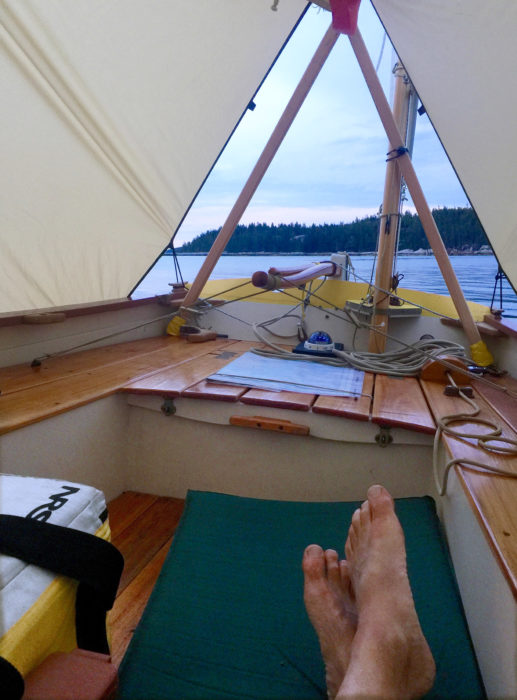
Navigator

John Welsford’s Navigator is a 14 1/2′ centerboard beach cruiser and daysailer built in glued-lapstrake plywood. Welsford offers several rigs for this pretty little boat: Bermuda racing sloop, a lug yawl, and a gaff yawl. Being attracted more to traditional boat types and rigs, I chose to build the gaff yawl. The combination of the Navigator’s jaunty sheerline and yawl sail plan gives her character, and indeed, she can be built with as much character and tradition as the builder would like without appearing quaint. The choice of rig, sails, materials, and paint and finish schemes can place her comfortably in the 19th or 21st centuries or anywhere in between.

If the Navigator reviewed here is not large enough to meet your needs, Welsford offers plans for a larger version called the Pathfinder. It is 19" longer and 7" wider than the Navigator.Scott Koss

If the Navigator reviewed here is not large enough to meet your needs, Welsford offers plans for a larger version called the Pathfinder. It is 19″ longer and 7″ wider than the Navigator.

Welsford’s plans show an option to mount a small, low-powered outboard on the boomkin, but most builders have opted to mount outboards up to 5 hp on a bracket fixed to the transom. I use a 24-volt, 1-hp electric outboard to help move her along to and from the dock and to get me home when the fickle Midwest winds die. The instructions note placing oarlocks 350 mm (13 3/4″) aft of an optional seat installed for rowing, and many builders equip their boats for rowing. I did too and found that the Navigator is not well-suited to long-distance rowing because of its 5′10″ beam and challenge of placing rowlocks either on the cockpit coamings or gunwales. I mounted locks on the coaming, which leaves about 9″ between the lock and the gunwale, causing the oars to rub on the gunwale. The Davis pattern fold-down oarlocks I used brought the lock inside the coaming. Side-mount or angled-mount rowlocks mounted outside of the coaming would provide more clearance for the oars over the gunwales. My seat for rowing is on top of the centerboard case, which gets me by but is not ideal for any long stretch of pulling. Doing some experimenting with the rowing accommodations and geometry may improve upon the arrangement I currently have.

The Navigator has a near-vertical stem giving way to a sharply curved forefoot and a very fine entry, enabling the boat to slice through a stiff chop with a minimum of fuss. The forward sections have a nice flare above the waterline that helps to keep the bow from diving too deeply into waves. The hull’s flat bottom and firm bilges provide for excellent stability. The sheerstrake curves gently upward and inward to meet the slightly raked transom with a touch of tumblehome.

Welsford originally designed Navigator as a race trainer to serve the needs of a local sailing club near his New Zealand home, but the club opted for an existing class boat. He later modified the design for another client wanting a dinghy for extended open-boat cruising. The changes included a large locker forward of the mainmast as well as two side lockers under the cockpit seats to keep gear away from spray and from any water that might enter the boat. These also form airtight compartments to lend buoyancy in the event of swamping. These compartments, the openness of the cockpit, and the space under the side decks provide ample storage space for camp-cruising and still leave room for four to enjoy an afternoon’s sail.

Battens set in the frames and bulkheads simplify shaping and fastening the planks. The mizzen mast is set bit to port to keep from interfering with the tiller.John Florance

Battens set in the frames and bulkheads simplify shaping and fastening the planks. The mizzen mast is set to port to keep from interfering with the tiller.


Building a Navigator is a straightforward proposition. Welsford provides 11 detailed sheets of plans that include a comprehensive accounting of fastenings, materials, and hardware, as well as helpful suggestions for rigging. Welsford’s concise building instructions have just enough detail to point novice builders in the right direction for getting things done properly and efficiently, while allowing them to make decisions based on personal preferences. Being able to choose between aluminum or hollow bird’s-mouth spars, plywood-sheet or laid-teak decking, fancy do-it-yourself wooden blocks or hardware-store pulleys, and varnish or paint is much of the great fun in building a Navigator.

The project fits nicely in a single-car garage; perfect for the amateur builder who may not have access to a dedicated shop. Navigator is put together upright on a strongback. Bulkheads and frame stations are cut and assembled from marine-grade plywood and attached to the bottom panel along with the keelson, stem, and transom. Longitudinal stringers connect the bulkheads and frames and provide the builder with glue-and-screw landing places for the plywood plank edges. The amidships frames anchor the centerboard trunk, while the compartments in the bow and the cockpit seating provide flotation to both ends of the boat. Four strakes bring us up from the bottom to the sheerline. Once the hull is planked up, the boat is flipped upside down for fiberglassing up to the waterline, the addition of the keel, skeg, false stem, and outside finishing work.

At this stage, I reconfigured the strongback lumber to create a cradle on casters that would allow me to move the boat within the garage as well as roll the project outside or back in as necessary for decking, interior appointments, and rigging.

Welsford specifies either a box-laminated wooden mast, or an aluminum one. I opted to build a hollow mainmast of Sitka spruce using the bird’s-mouth method; dimensions are fully specified in the plans. The mast is just under 14′ long, and the gaff-yawl version of the boat allows all the spars to fit comfortably within the length of the hull for easy transport. The boom, gaff, bowsprit, mizzen, boomkin, and sprit boom are solid, laminated of spruce or pine.

The mast for the yawl rig I chose is stepped through the foredeck just ahead of the cockpit coaming; the mast of the sloop rig is stepped through partners just aft of the coaming. To make rigging easier, I chose to build-in a mast hinge, which saves me from having to step the mainmast by myself when solo sailing, and keeps my boat almost completely rigged as it sits on the trailer. The mast is designed with tensioning stays to keep the jib’s luff straight, and the standing rigging makes a hinged mast a reasonable modification. I made sails from a Sailrite kit cut to the dimensions specified in the plans; there are finished sail packages for this Navigator available online from several sailmakers.

The plans call for a motor mount on the boomkin, at nearly right angles to the normal orientation. Most builders use a conventional bracket fastened to the transom.Scott Koss

The plans call for a motor mount on the boomkin, roughly square to the normal orientation. Most builders use a conventional bracket fastened to the transom.


I launched my Navigator, PUFFIN, on June 5, 2016, after two-and-a-half years of working on the boat nights and weekends. Dedicated builders have completed it in a few short months; the build time is largely dependent on the builder’s choice of fit and finish, and, to a lesser degree, by one’s skills at the outset of the project. This being my first scratch build, my learning curve was steep, and much time was spent on the “pondering stool” and repairing mistakes that simply couldn’t be overlooked.

The Navigator is a good little boat. PUFFIN weighs in at just over 350 lbs, a bit heavier than the 309 lbs listed in the plans. She is easily trailered, and with a hinged mainmast (see WB No. 237, March/April 2014), I can rig her at the boat launch and get her in the water in 10 minutes or less. Joel Bergen, the man behind the informative Joel’s Navigator Site, has posted a video in which he rigs his Navigator, outfitted with a standard mast, in just under 30 minutes.

The control lines are lead aft along the centerboard trunk for easy access while solo sailing. The decking covering the plywood seating is a personal touch by the author. The spaces under the foredeck and seats provide ample room for stowing cruising and camping gear.John Florance

The control lines are lead aft along the centerboard trunk for easy access while solo sailing. The decking covering the plywood seating is a personal touch by the author. The spaces under the foredeck and seats provide ample room for stowing cruising and camping gear.

The Navigator’s initial stability is excellent for a boat of its size. I am a solid 200 lbs and have no difficulty standing in the boat while it’s afloat and moving through the cockpit for rig and trim adjustments. For a lightweight dinghy, Navigator handles open water gracefully and with an easy movement, and is faster than it looks. It sails wonderfully on a reach or a run; into the wind, it neither points as high nor runs as fast as I would like, but that may be typical of a gaff rig. If you’d like your Navigator to do better to weather, the alternate Bermuda rig with an aluminum foil-sectioned mast would be the better choice. In 15 knots of wind, my Navigator stays remarkably dry and upright and can do 8 knots on a broad reach, even while fully loaded. Without a cargo of four people aboard, she heels more and offers a more thrilling ride, and can certainly reach higher speeds. One advantage of the yawl rig is the ability to sheet the mizzen in hard and drop the main and jib. This allows her to heave-to with her head pointed nicely into the wind while the crew enjoy a break or take in a reef or two on the mainsail.

The gaff yawl rig has a 28-sq-ft jib. an 88-sq-ft main, and 21-sq-ft mizen. The insignia on the main is the author's personal mark for his Navigator, PUFFIN.Scott Koss

The gaff yawl rig has a 28-sq-ft jib, an 88-sq-ft main, and 21-sq-ft mizzen. The insignia on the main is the author’s personal mark for his Navigator, PUFFIN.

My plans for PUFFIN include daysailing around the Milwaukee harbors and marinas, inland-lake sailing, camp-cruising the Apostle Islands, and possibly even an attempt at racing in the Everglades Challenge. Welsford’s Navigator is good-looking, well-founded, and perfectly suited to those adventures, either singlehanded or crewed. For boatbuilders aspiring or expert, she represents a doable, enjoyable challenge that will provide years of admiring glances no matter where she sails.

John Florance was raised in Mexico, and as a child learned to sail Hobie Cats on the Bay of Acapulco. He has sailed extensively on Lake Michigan, in Mexico, and the Caribbean. He and his family often vacation in the Caribbean and sail -chartered monohulls among the islands. PUFFIN is his first scratch-built boat. He has posted a video of PUFFIN under sail on his YouTube channel.

Navigator Particulars

[table]

Length/14′ 9″

Beam/5′ 10″

Weight/309 lbs

Sail Area/136 sq ft

[/table]


WelsfordNavigatorSailPlanPSweb

WelsfordNavigatorLinesPSweb

WelsfordNavigatorSpinakkerPSweb

Bermuda rig

Plans for the Navigator are available from John Welsford and from Duckworks.

Is there a boat you’d like to know more about? Have you built one that you think other Small Boats Monthly readers would enjoy? Please email us!
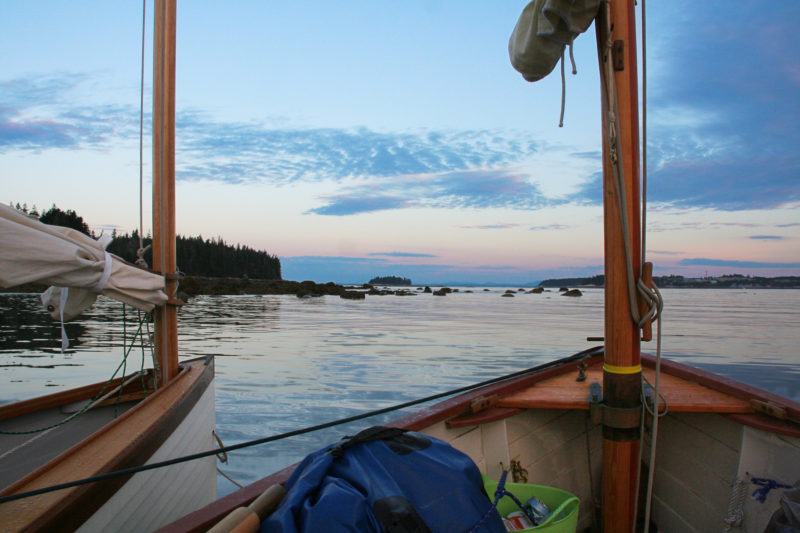
Continue Reading - Enter your email to log in or subscribe

New to Small Boats? Create a free account to get our weekly emails and two free articles each month.

Yes! I would like to access this article and the Small Boats newsletter.