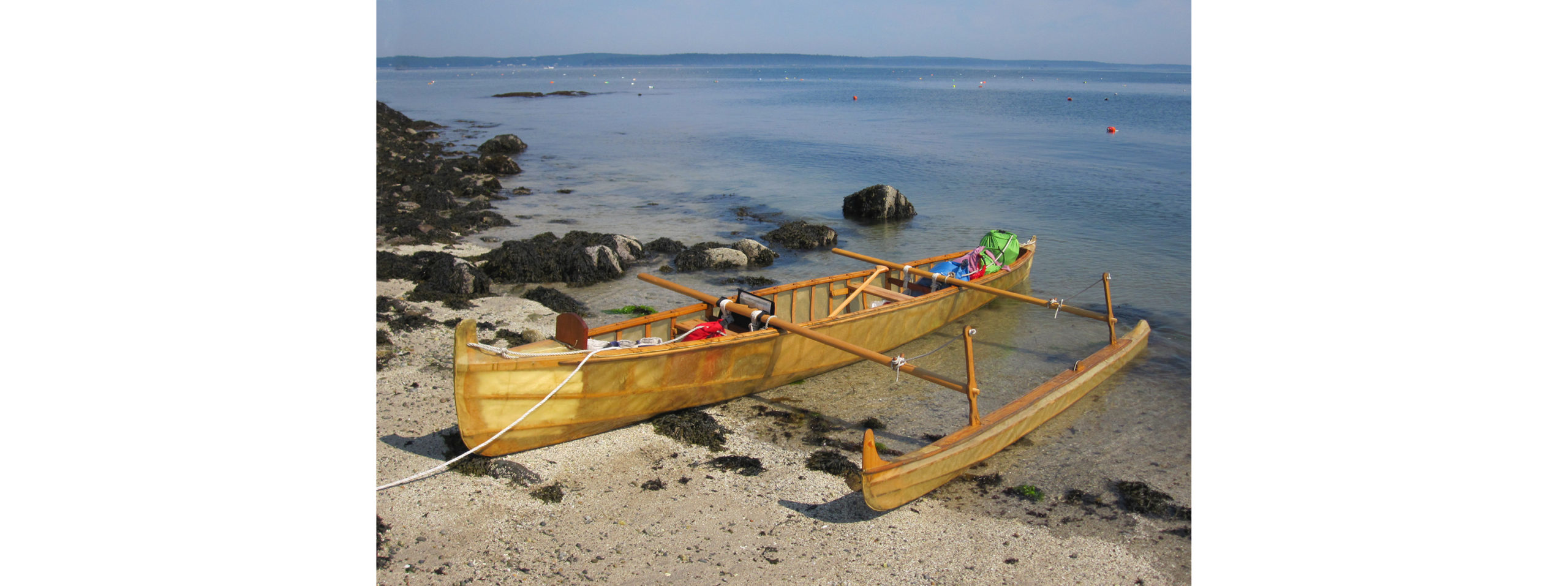
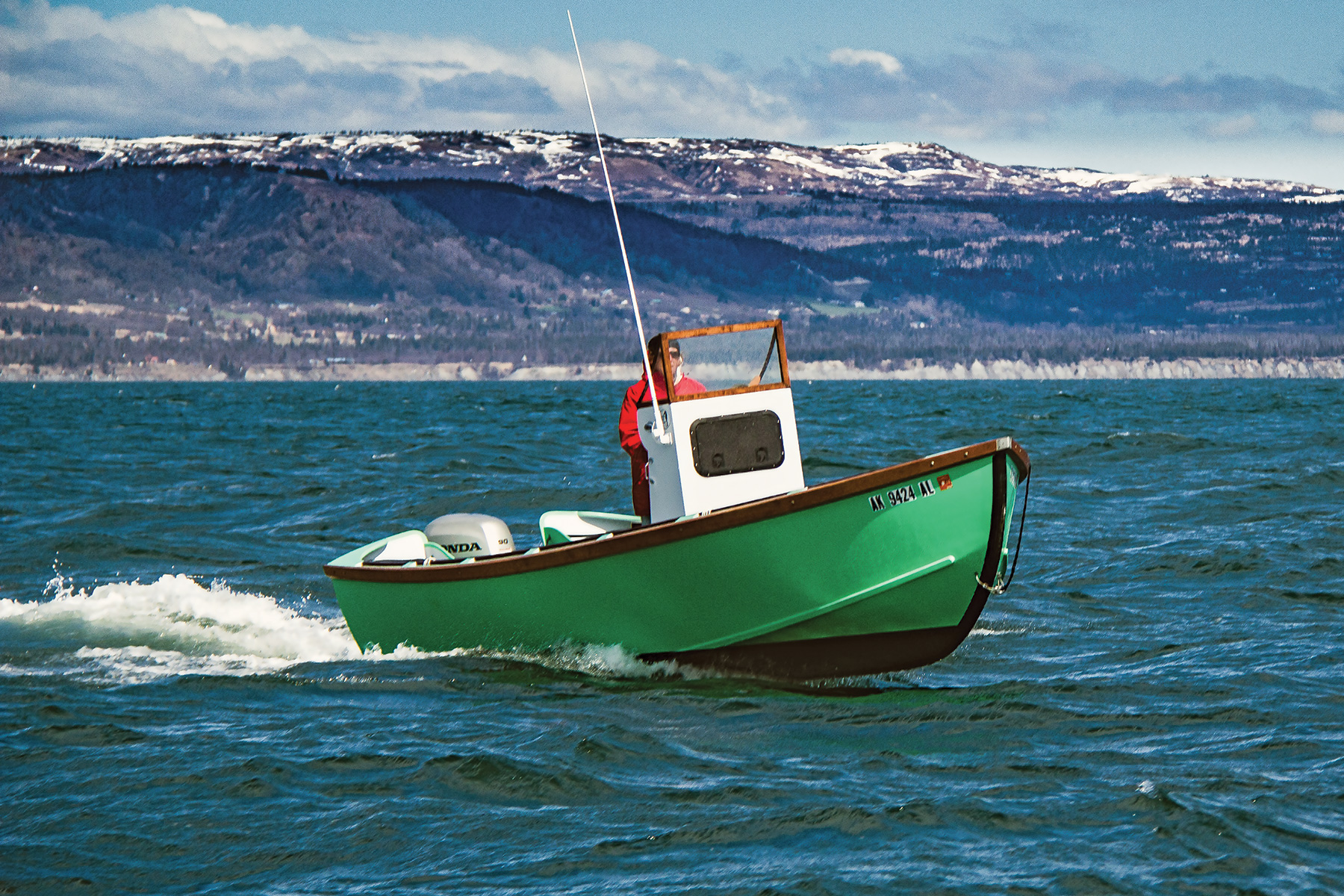
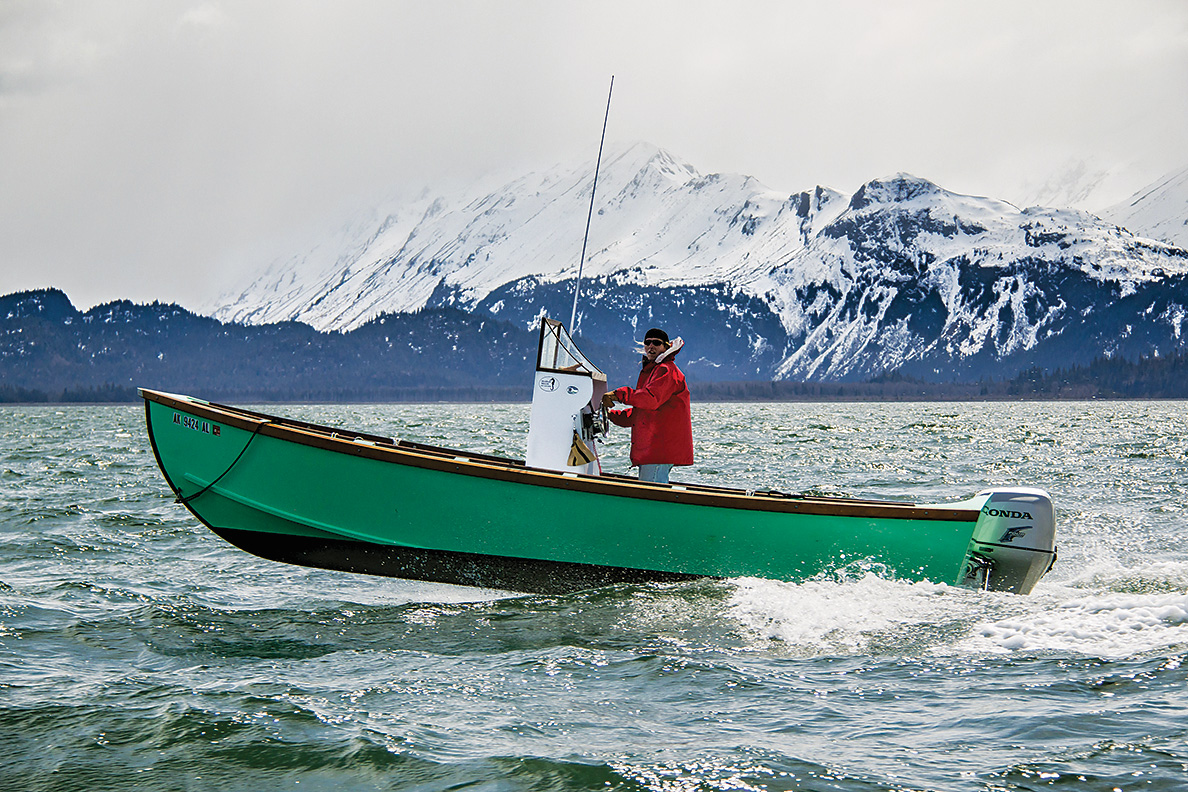
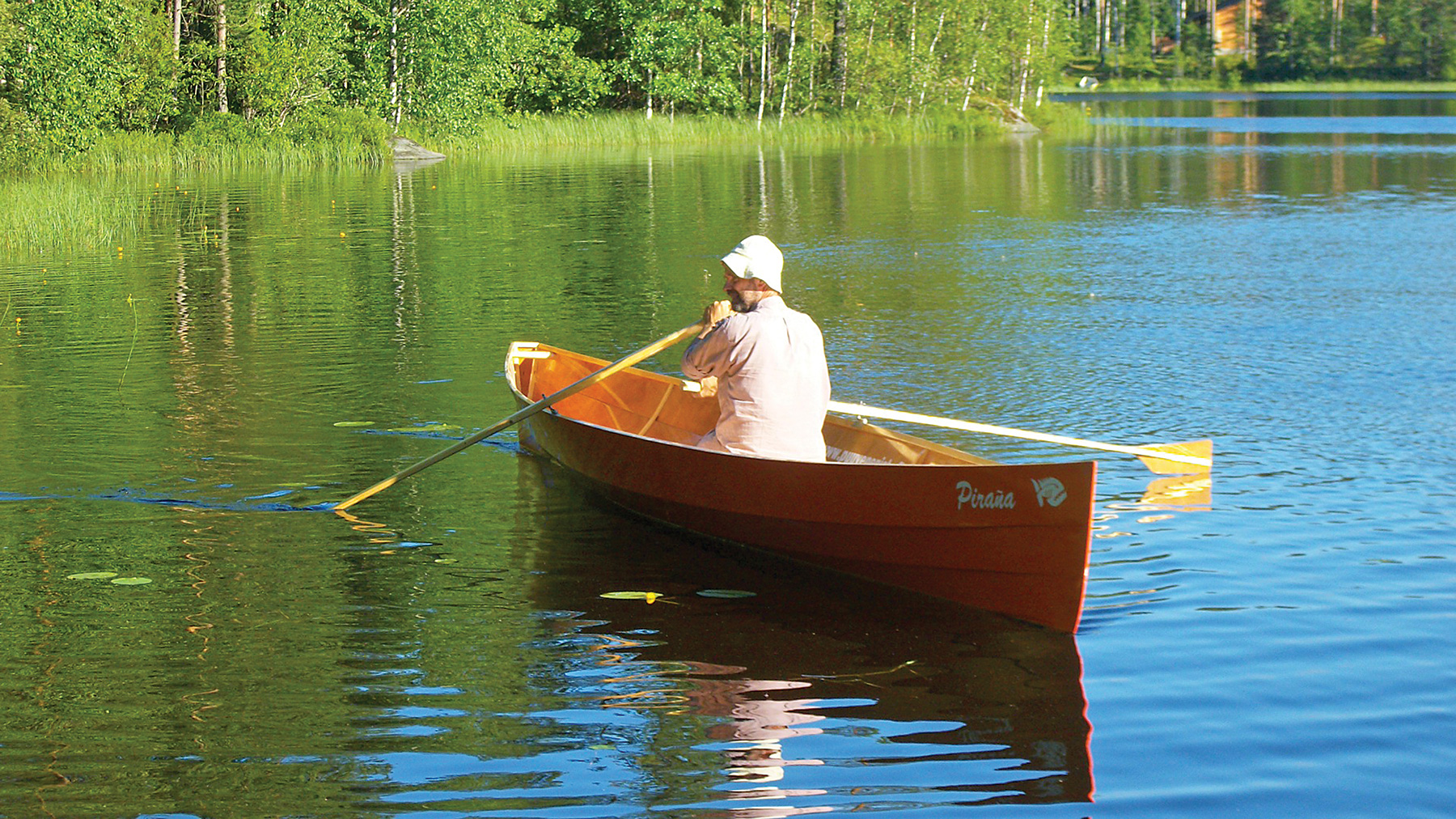
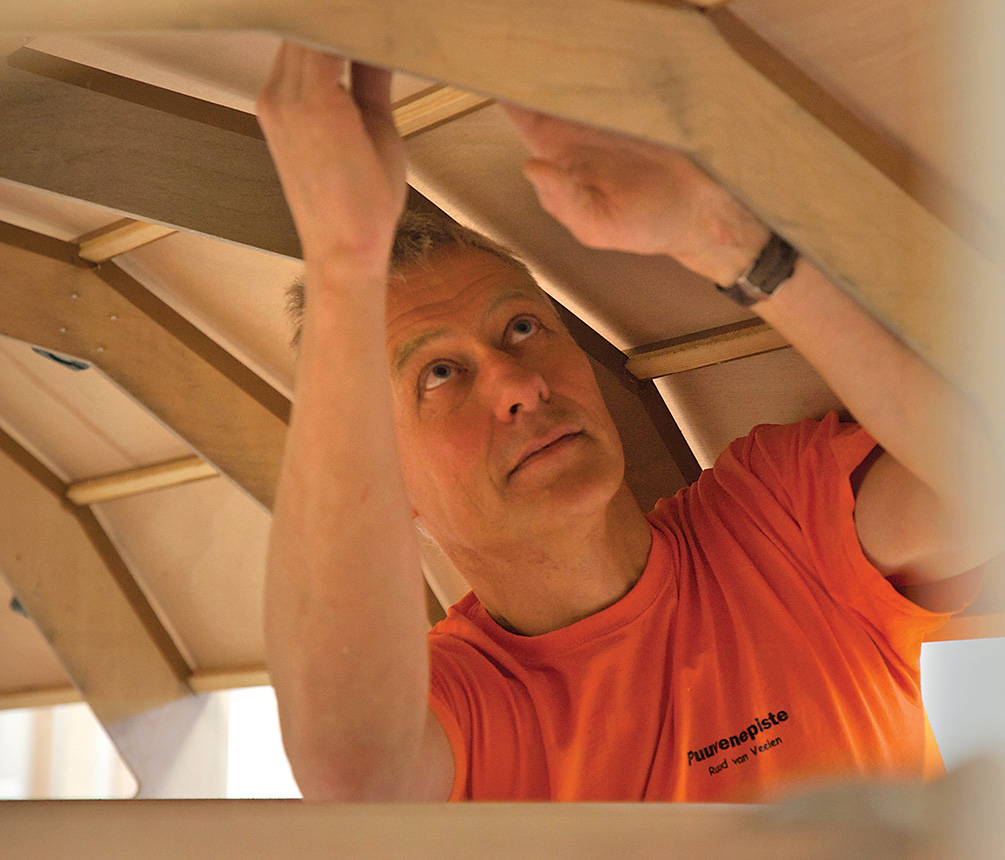
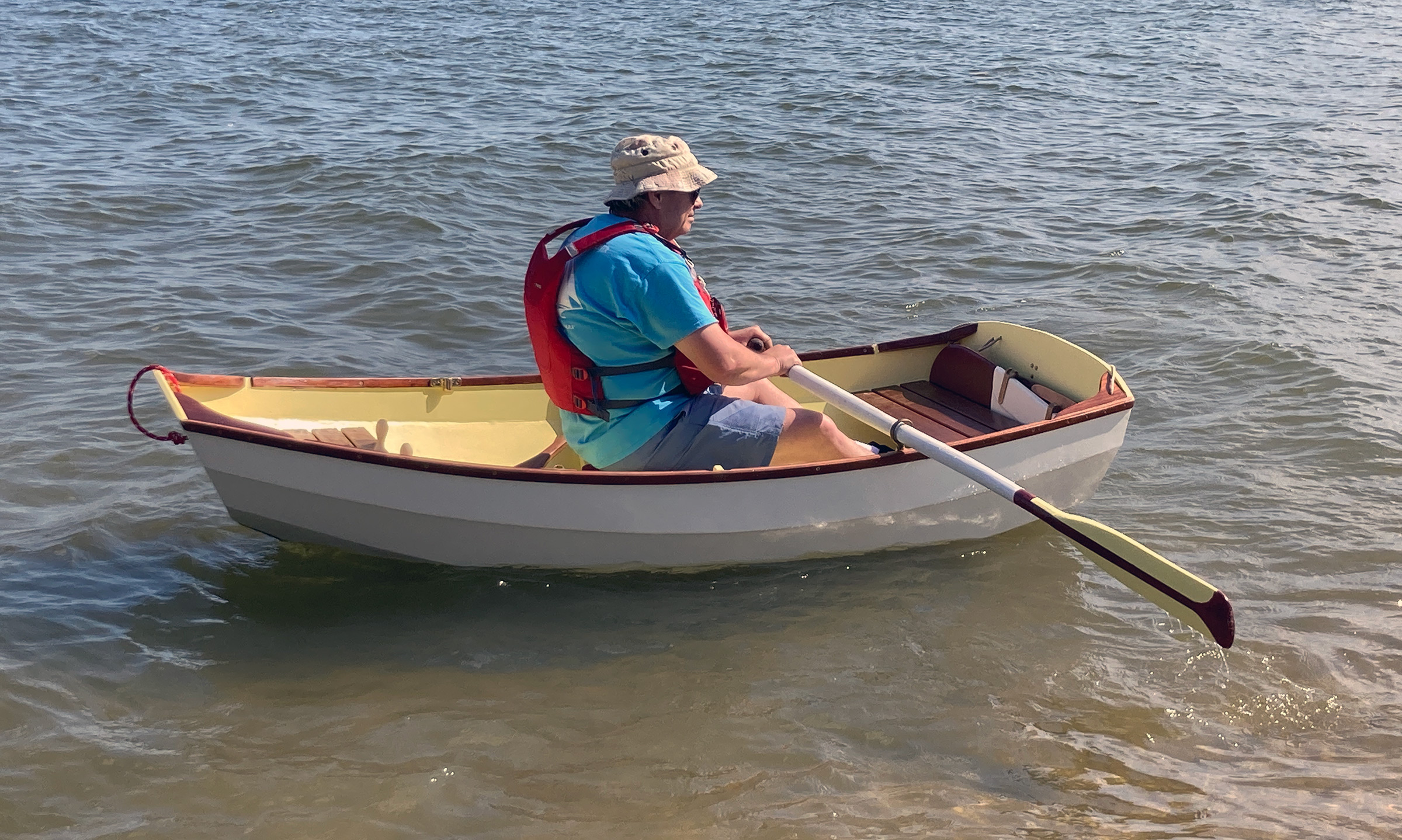
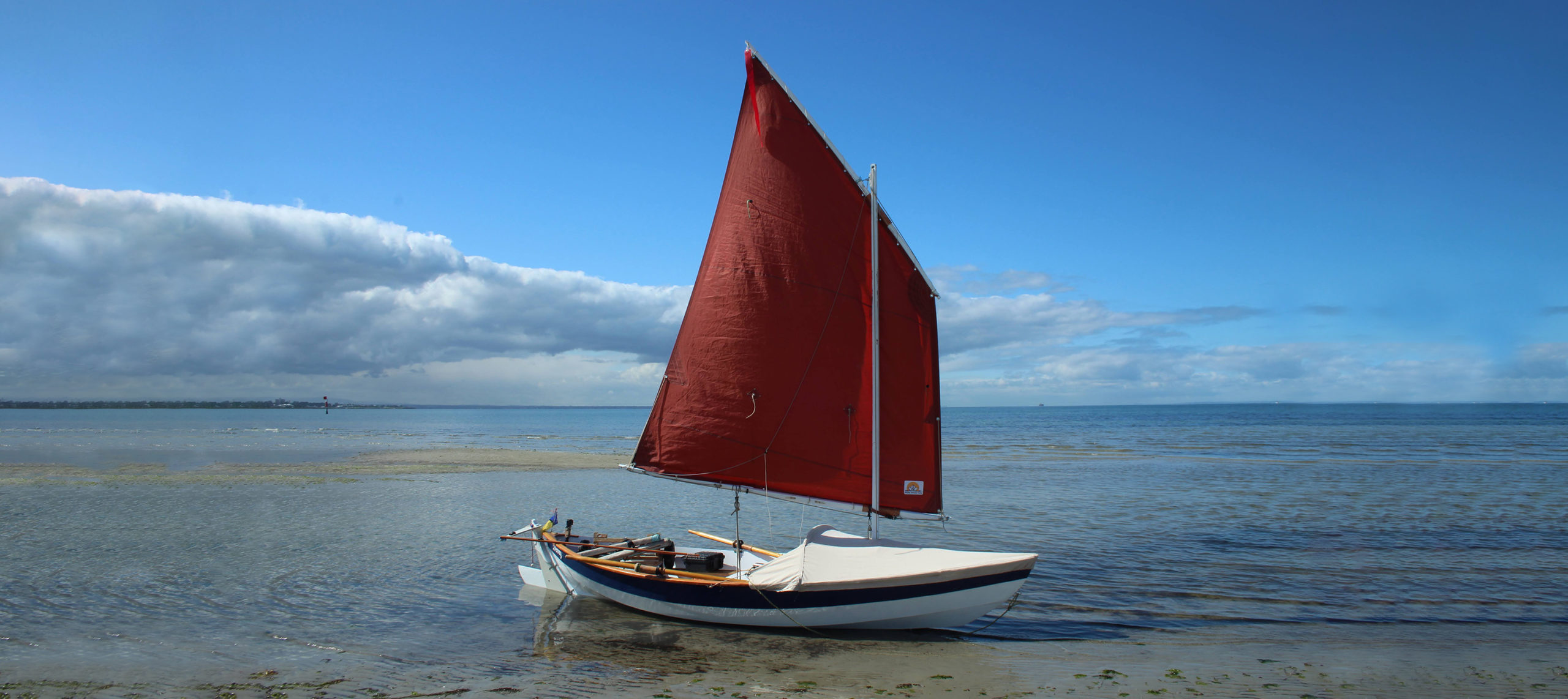
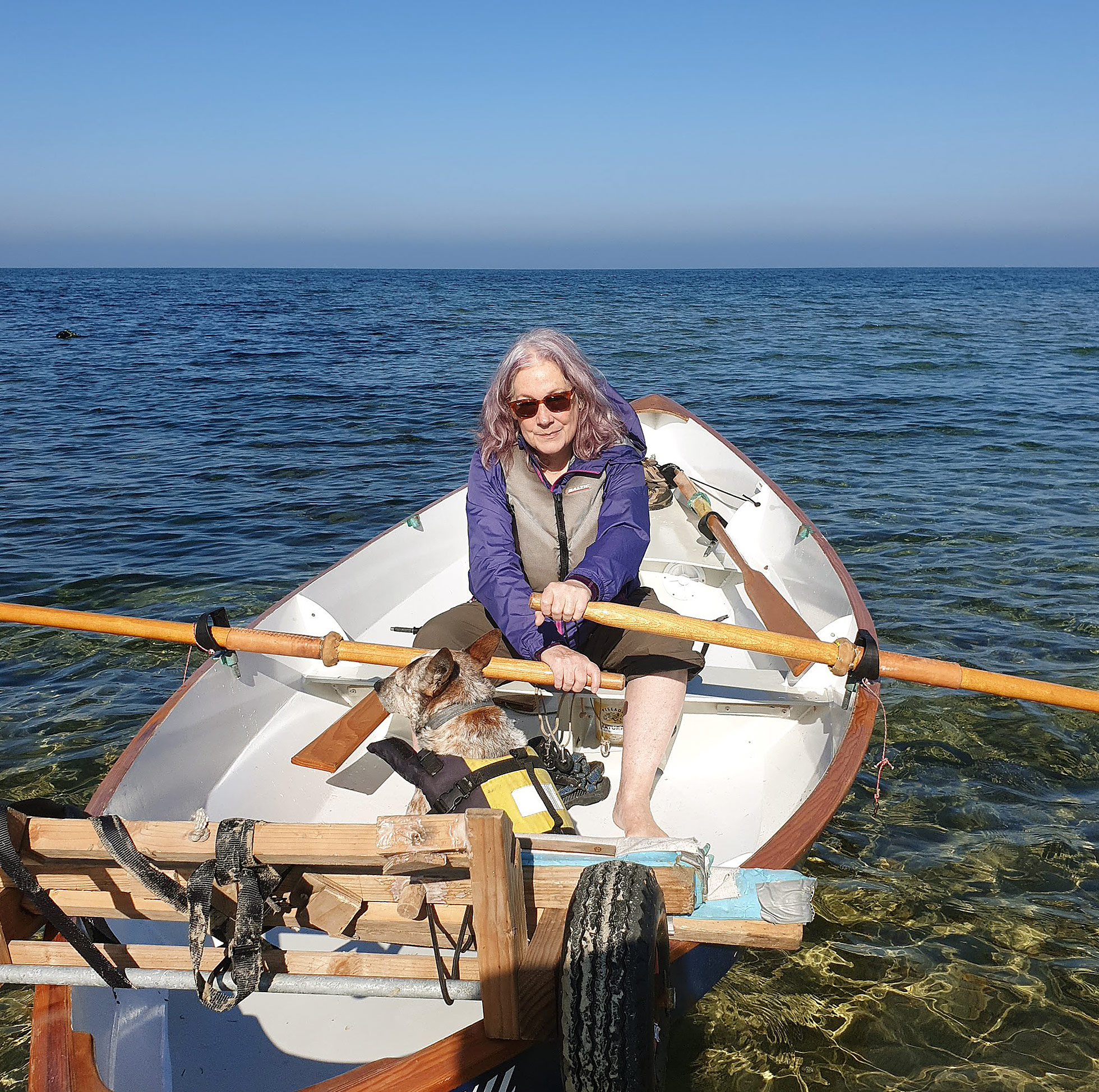
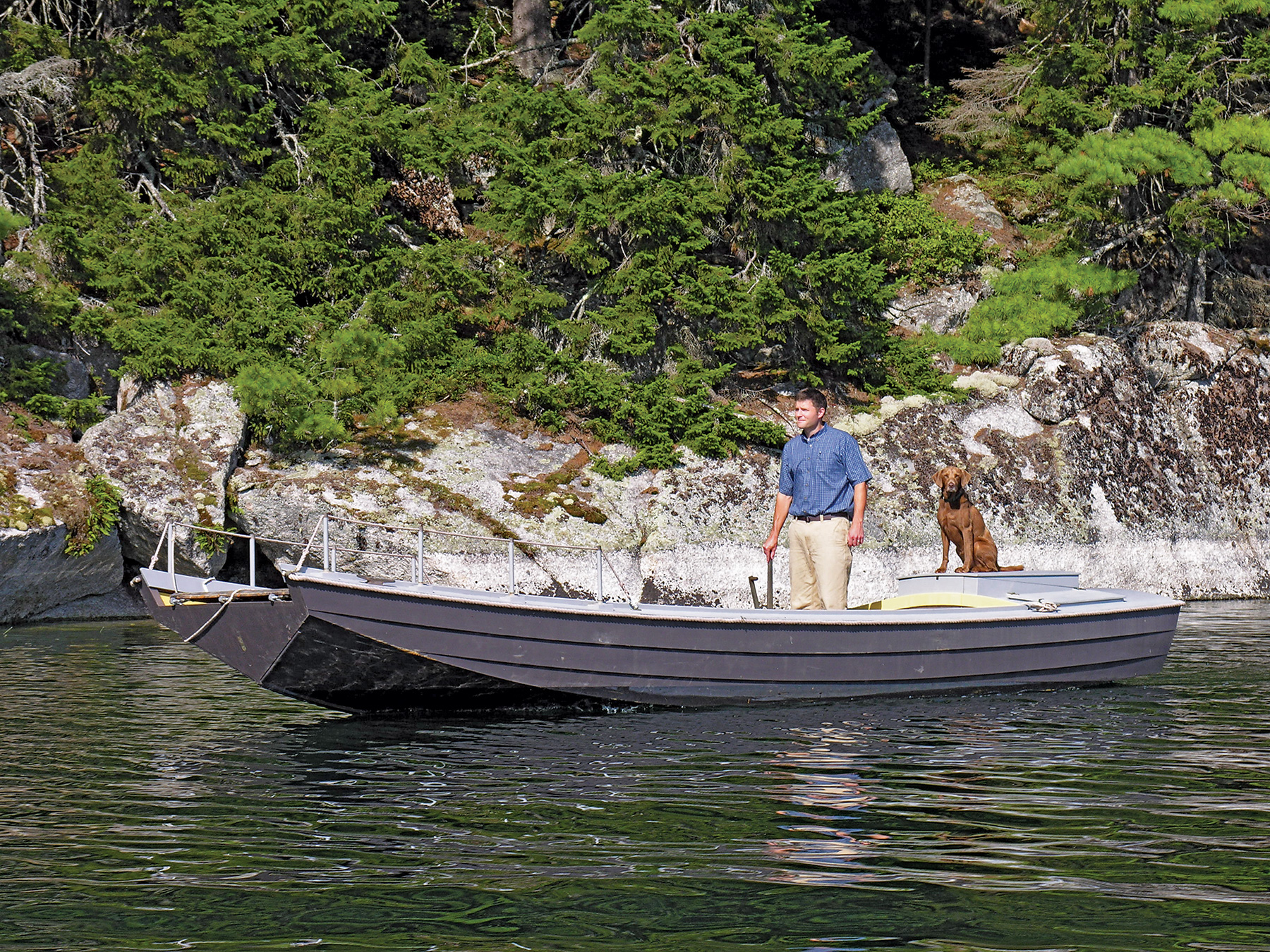
The story of the ELSON PERRY dates back to the late 19th century when Elson Perry, a lighthouse keeper, boatbuilder, and fisherman living in the coastal community of Port Medway, Nova Scotia, built a boat—a 20′ workboat carrying a handful of spars. It is believed that he built this boat for his own use and kept it for the rest of his life. It appears that a descendant kept the boat until 1929, when it was hauled up out of the water one last time and stored in a fish shack. There it rested until the 1960s when the house and land that included the fish shack were sold to the writer Calvin Trillin. Trillin donated that old boat to the Maritime Museum of the Atlantic in Halifax, where it has been preserved to this day (See WB No. 163).
When the museum decided to build a boat to celebrate the millennium, they chose to build a new version of that old Port Medway boat. This new boat is the ELSON PERRY. She’s proven to be a very shapely and able craft built by the museum’s resident boatbuilder, Eamonn Doorly, and launched on Canada Day—July 1, 2000.
In the 19th-century Nova Scotia in which Perry lived, a fellow did any number of things to piece together a living, and in many ways Perry’s life and his Port Medway boat are reflective of that diversity. One of the unique mysteries of the boat is that there are three mast partners, one on each of the forward three thwarts, suggesting that she could be rigged in a variety of ways, perhaps for different uses. Sometimes the boat was used for hand-lining, other times for scallop raking, and with a boat so pretty I would hope that she sailed for the pure pleasure of it as well.
There are signs of influences from other boats in her design and construction, but the overriding truth is that she is unique and very much the product of one builder in one place and one time in history. Although Doorly was building a new boat, he was tethered to the history of that old Port Medway boat. The replica is proof that, although there have been many advances in design and construction in the past century, a simple well-thought-out and built boat is still a great pleasure to observe and use—and is every bit as capable today as it was when it was first built perhaps 140 years ago.
To state that Doorly was the builder is a little misleading; more accurately, one should say he was the lead builder, with every single employee of the museum contributing some of his or her time. The hours in the shop are now looked back on fondly, and with the boat in the water each summer in front of the museum, she is a source of pride for the staff.
Michael Higgins
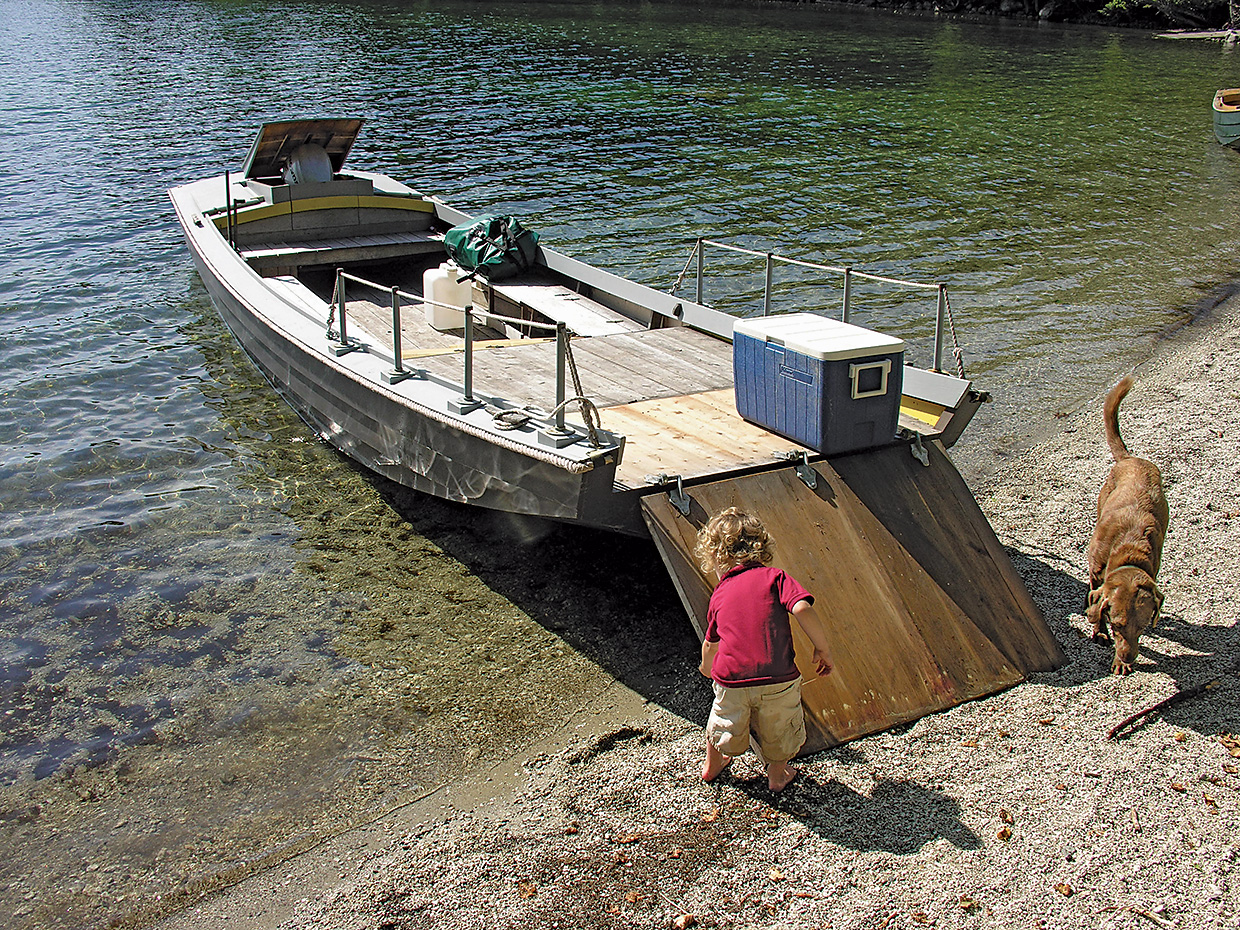
The ELSON PERRY has mast partners at each of her three forward thwarts. The storage compartments under the thwart were not in the original boat.
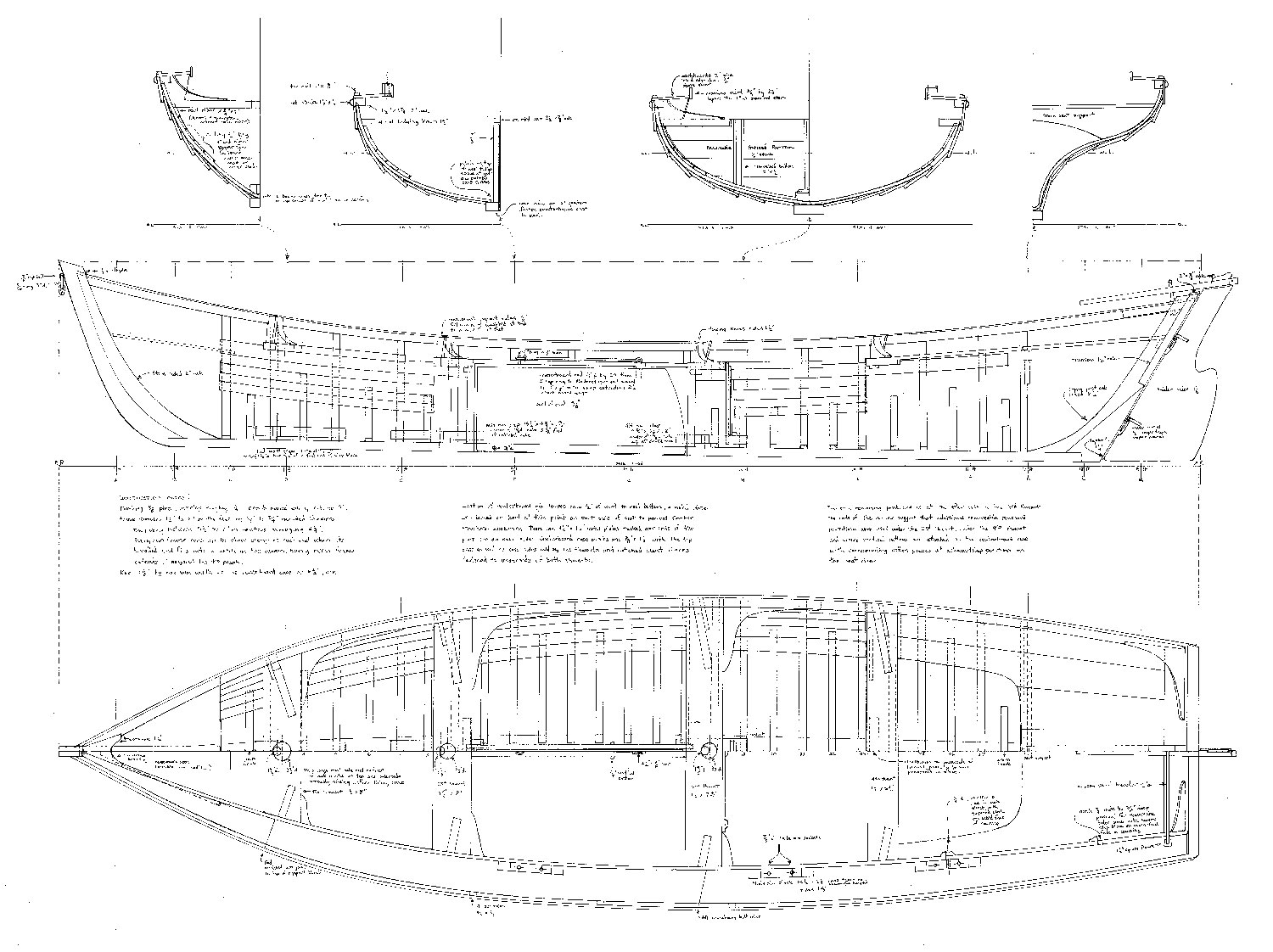
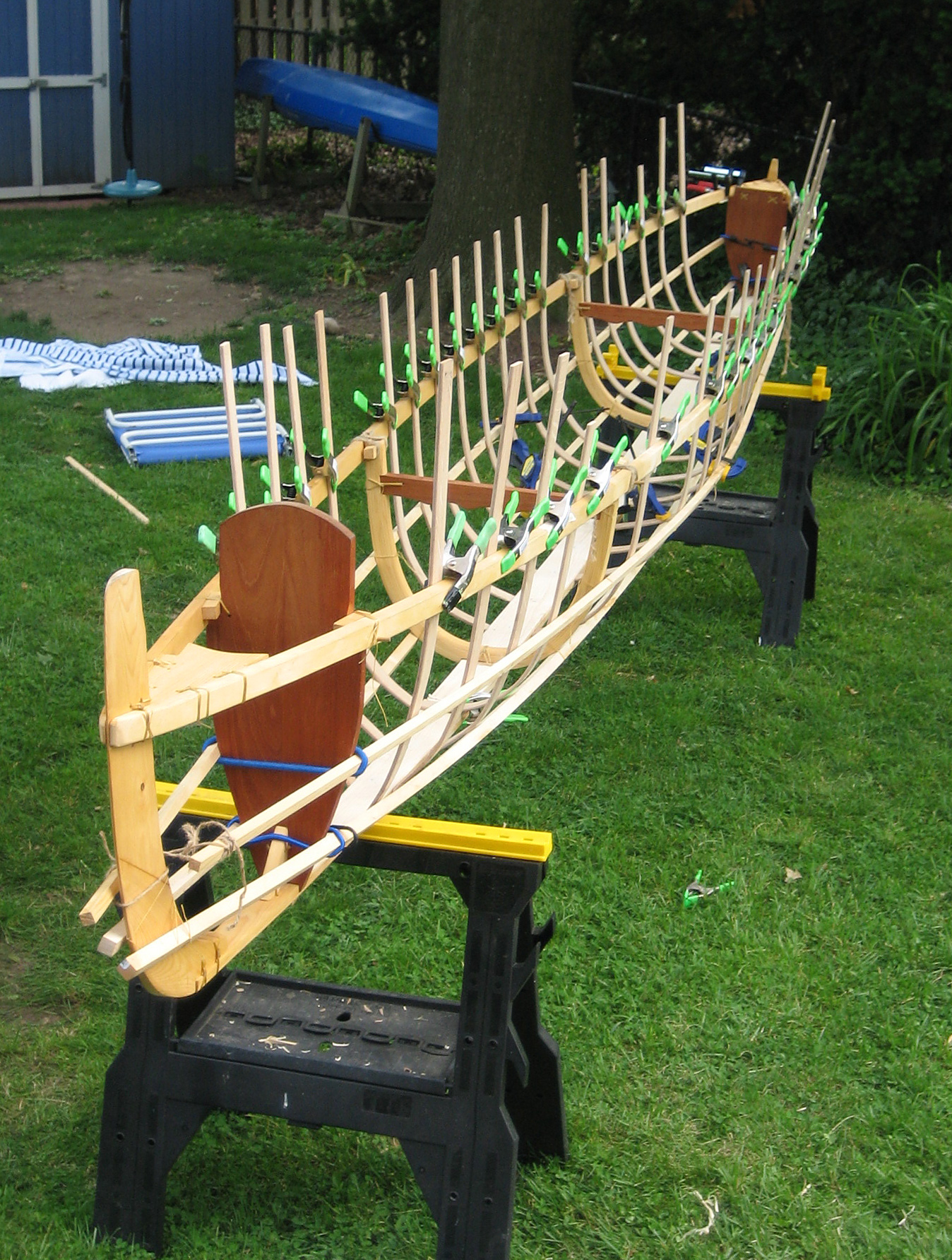
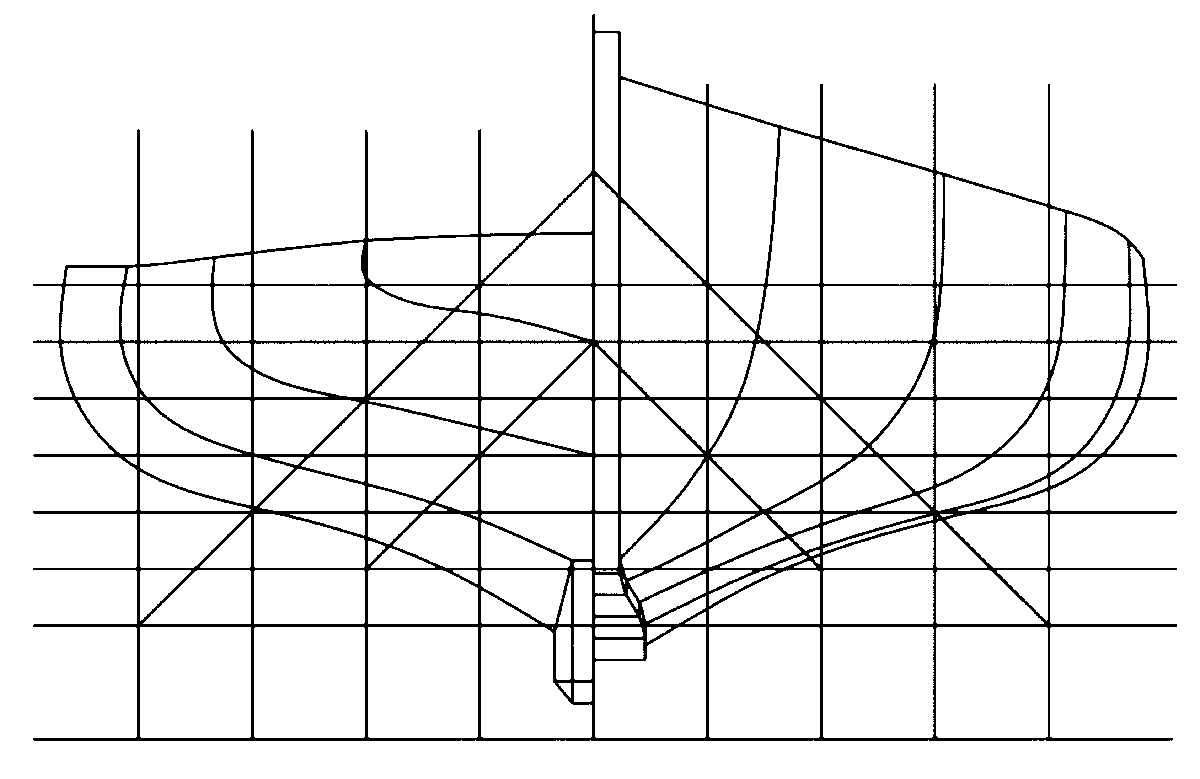
The boat was lofted from lines recorded from the original Port Medway boat by Ed Porter. This provided patterns for the stem, keel, and transom as well as for the building molds. These molds still exist and are in storage at the museum. All of these components were assembled right-side up and faired before the boat was planked. Like most lapstrake boats, she was planked—seven strakes a side—before frames were bent into the boat. There is a lot of shape in this hull, particularly aft. As a result, much care should be taken in lining-off the planking to ensure that one does not try to force too much shape into a single plank.
The stem and keel assembly is made of oak, as are the frames, and the planking is pine. No doubt another builder of this boat might choose other suitable woods available locally to them. Perry simply did what all good boatbuilders of that time did: He used woods readily available to him. Doorly did the same but was able to stray a little from his historical predecessor by using mahogany for the sheerstrake, which has added to the resilience and stiffness of this boat. The boat’s narrow side decks and long coaming also add greatly to her stiffness and aid considerably in keeping the ocean out. She has four thwarts supported by plenty of grown knees, and above the sole boards there is a partial ceiling—all adding up to a strong little ship.
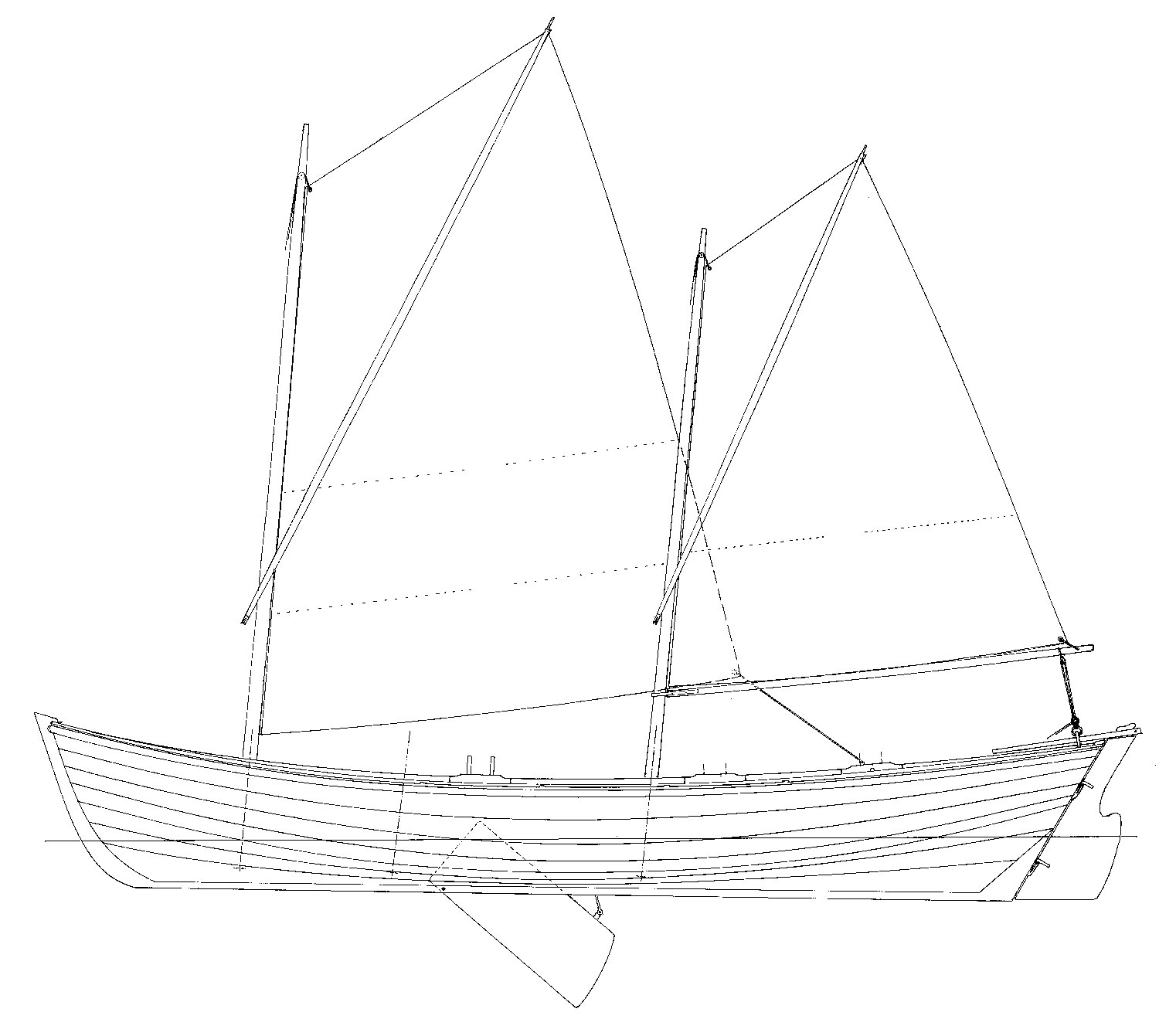
The rig is full of traditional details, such as boom jaws and table. Much pleasure and pride will be found in splicing the standing and running rigging. No one piece of the ELSON PERRY is too big; this is a fully realized boat, but on a manageable size. There are ample opportunities to stitch leather on chafe points, and to fabricate your own vintage ironwork. The six spars would provide a chance for experimenting with different construction methods. A few could be solid, others laminated hollow with “bird’s-mouth joints” or tapered staves. For a builder with sailmaking skills or a desire to learn them, a suit of handmade sails would be just the thing to complete the project.
Michael Higgins
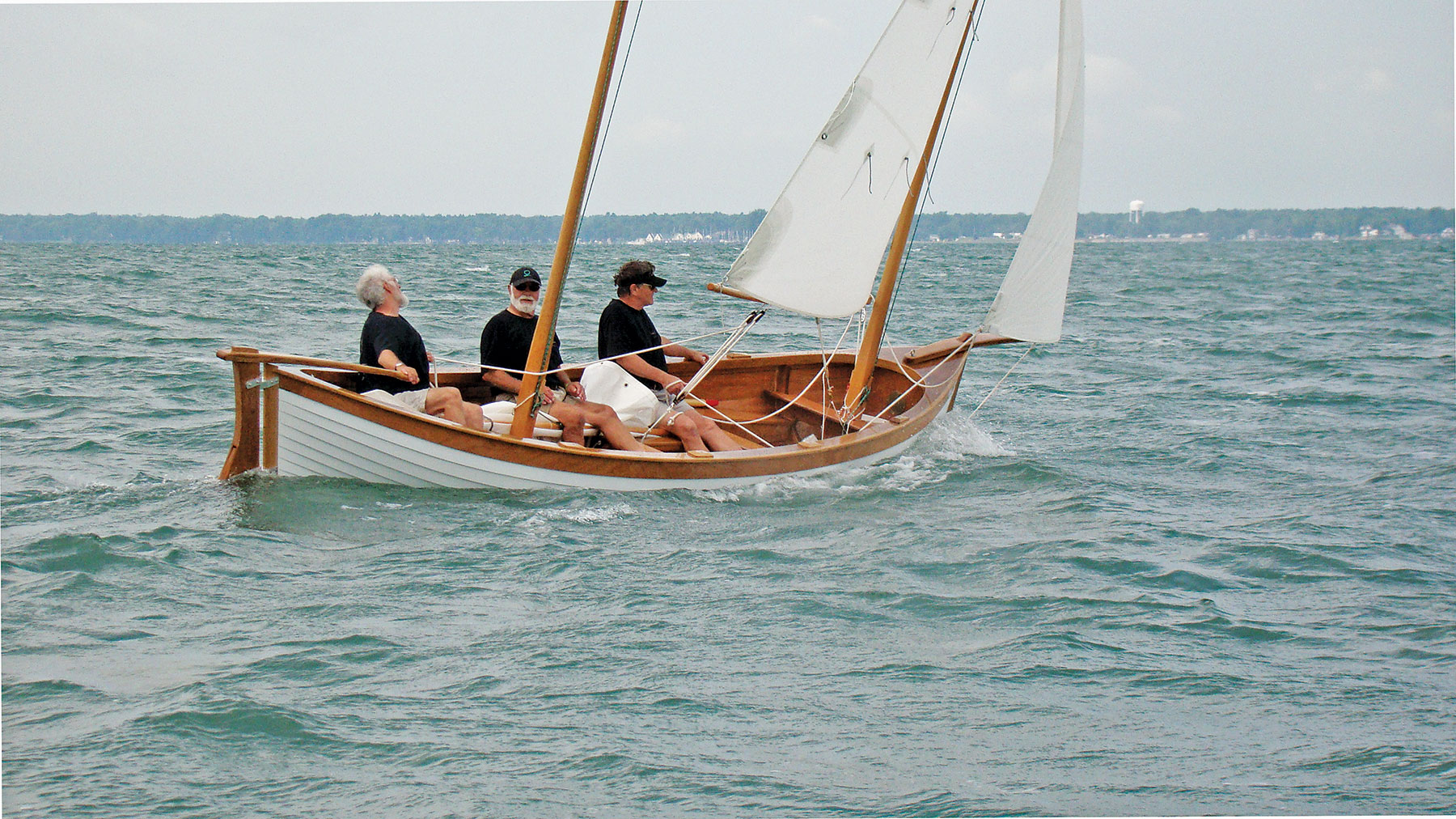
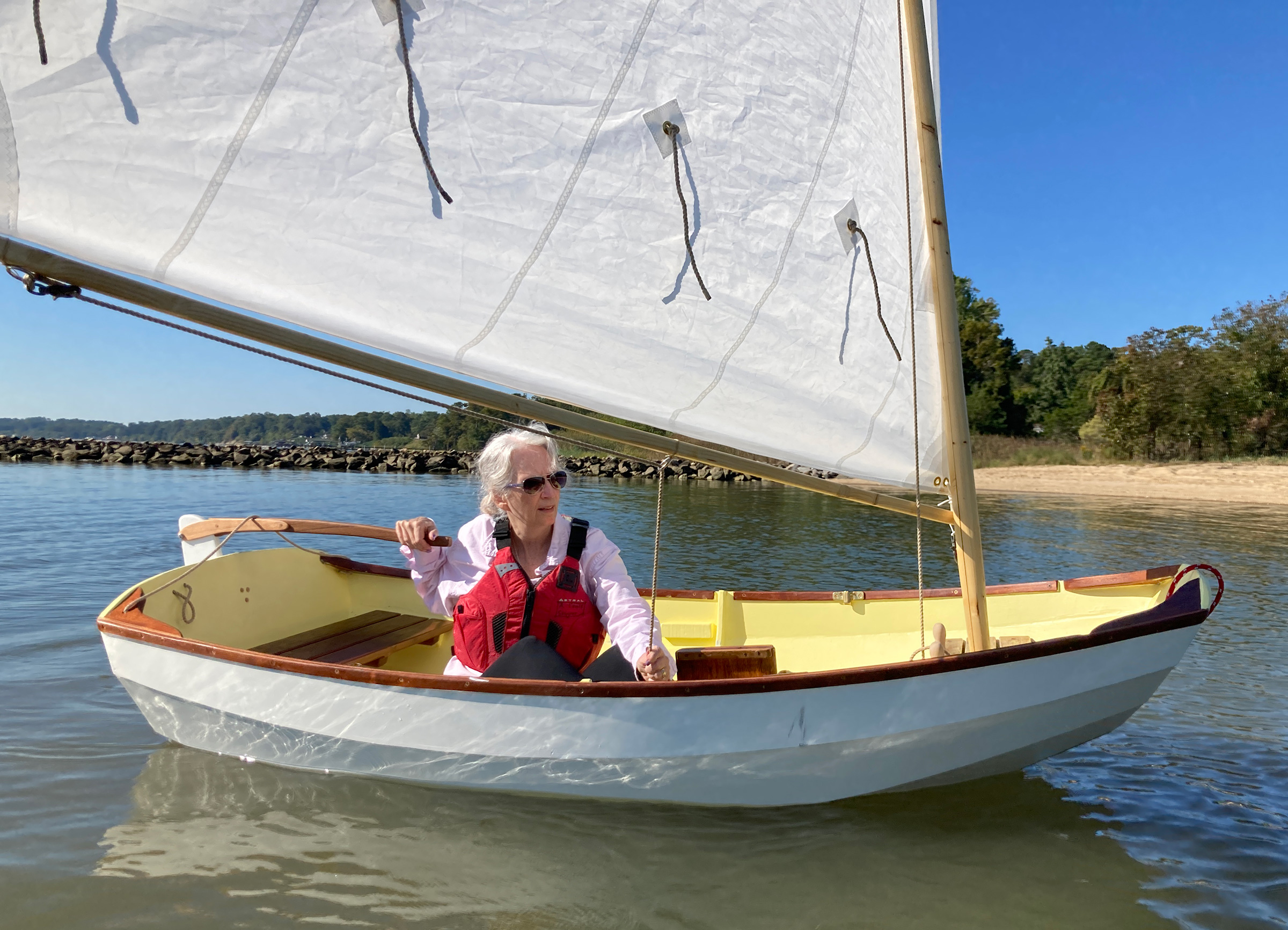
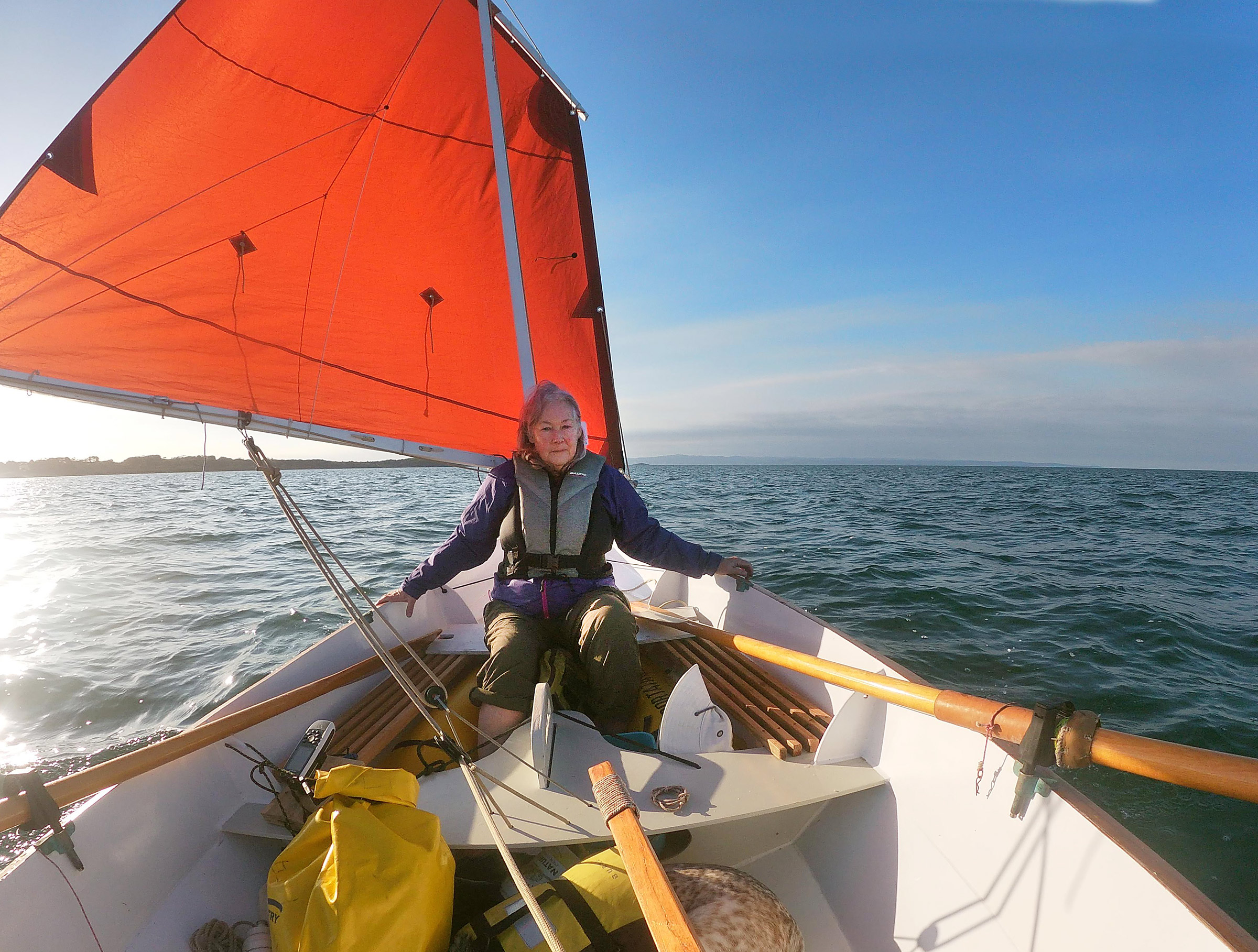
There are enough lines aboard to keep three people busy sailing the ELSON PERRY; four is better in windy weather.
This is not an instant boat; she will not be built in a few weekends over a winter, and she will require a depth of commitment. Few things are as disheartening as having an incomplete boat hanging around for years. On the other hand, if you have a suitable space, some basic tools, and perhaps 800 or 1,000 hours with which to work—not to mention several thousand dollars—you could build a boat that will turn heads and hearts wherever you may sail.
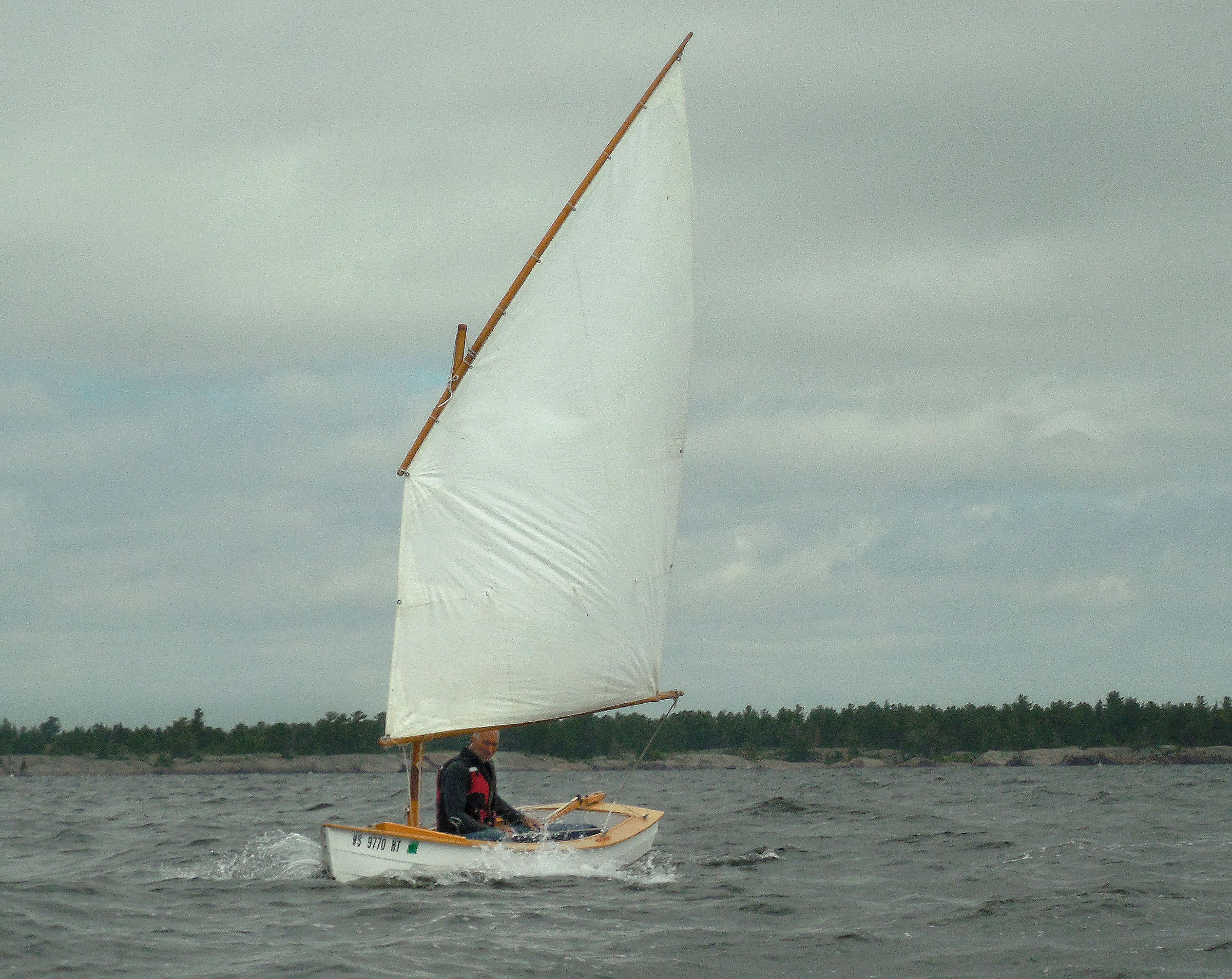
Now, I suspect that none of us is going to build an ELSON PERRY today for the inshore fishery or scalloping, so we need to think a little about what sort of sailing we are apt to do, and what sort of sailing the PERRY is up to. Port Medway is a sheltered body of water, and this being an unballasted, open boat, we would want to use her in coastal waters with an eye on the weather. But, that being said, she is an able and responsive boat, capable of impressive speed, particularly given the age of her design.
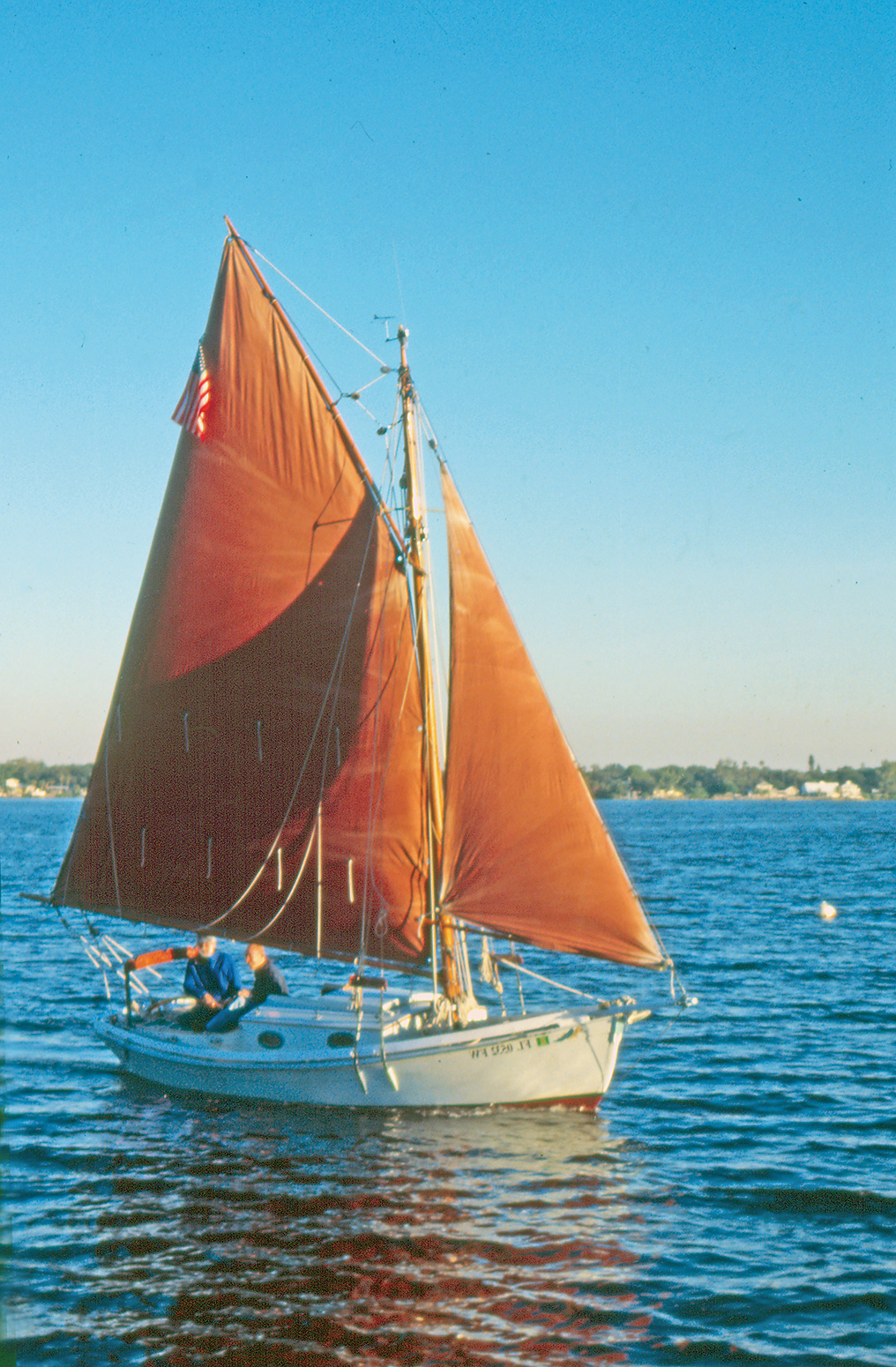
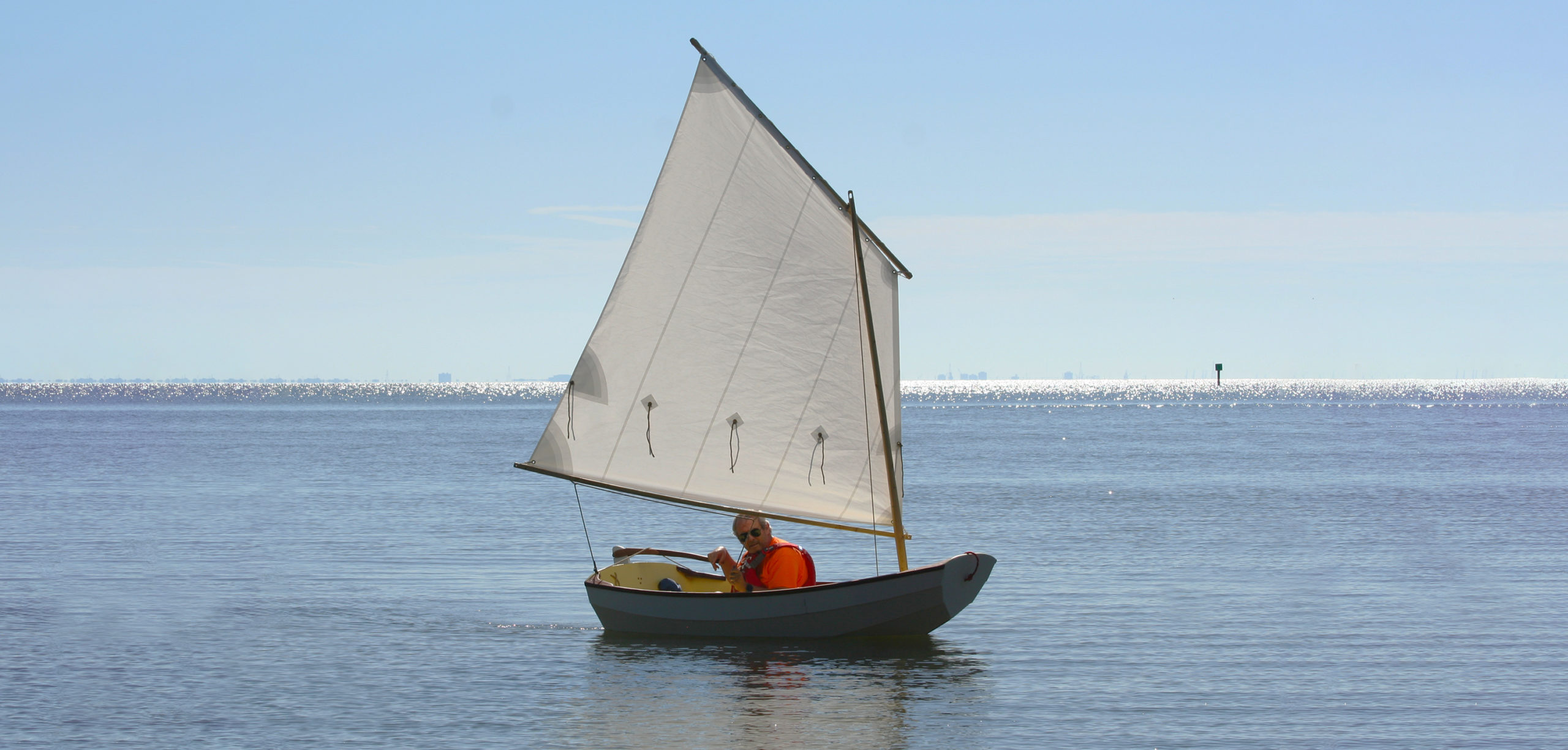
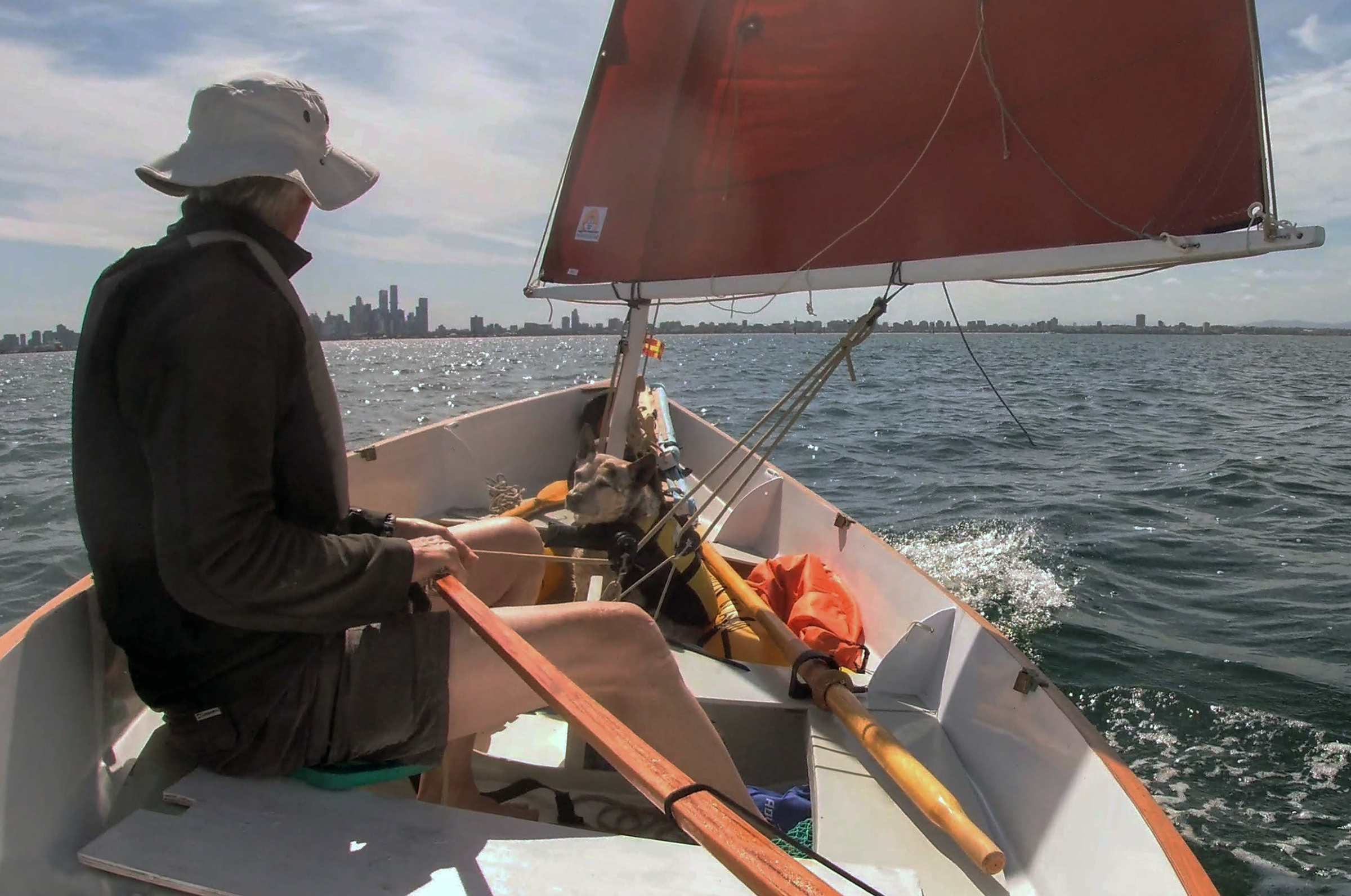
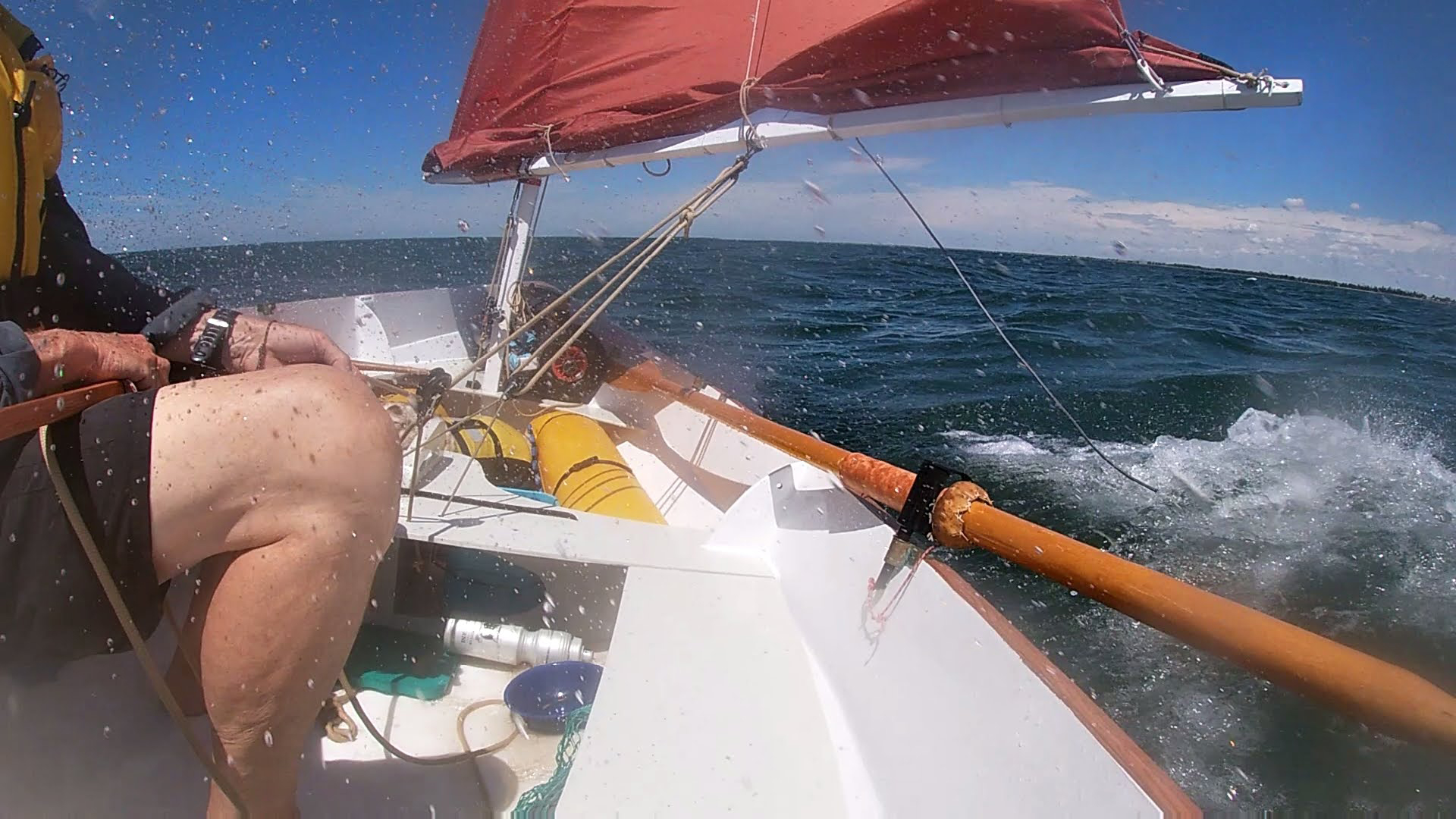
On a breezy day, the ELSON PERRY would sail best with a crew of four or so, not just because there are a lot of fun pieces of rope to pull on, but she could also use the weight to help keep her upright. She has plenty of power, and on a gusty and blustery day one needs to be agile to keep her leeward rail out of the drink. The reward is a very enjoyable ride indeed. Doorly reports, “Sailing the ELSON PERRY as a ketch is the most fun way to sail; she is very responsive, fast, and requires at least three people to sail, four in windier weather. Her purpose at the museum is to familiarize staff with the basics of sailing, so keeping staff busy and engaged while sailing is very important. I’ve tried other rigs on her, but she seems to come into her own when sailed as a ketch.”
Michael Higgins
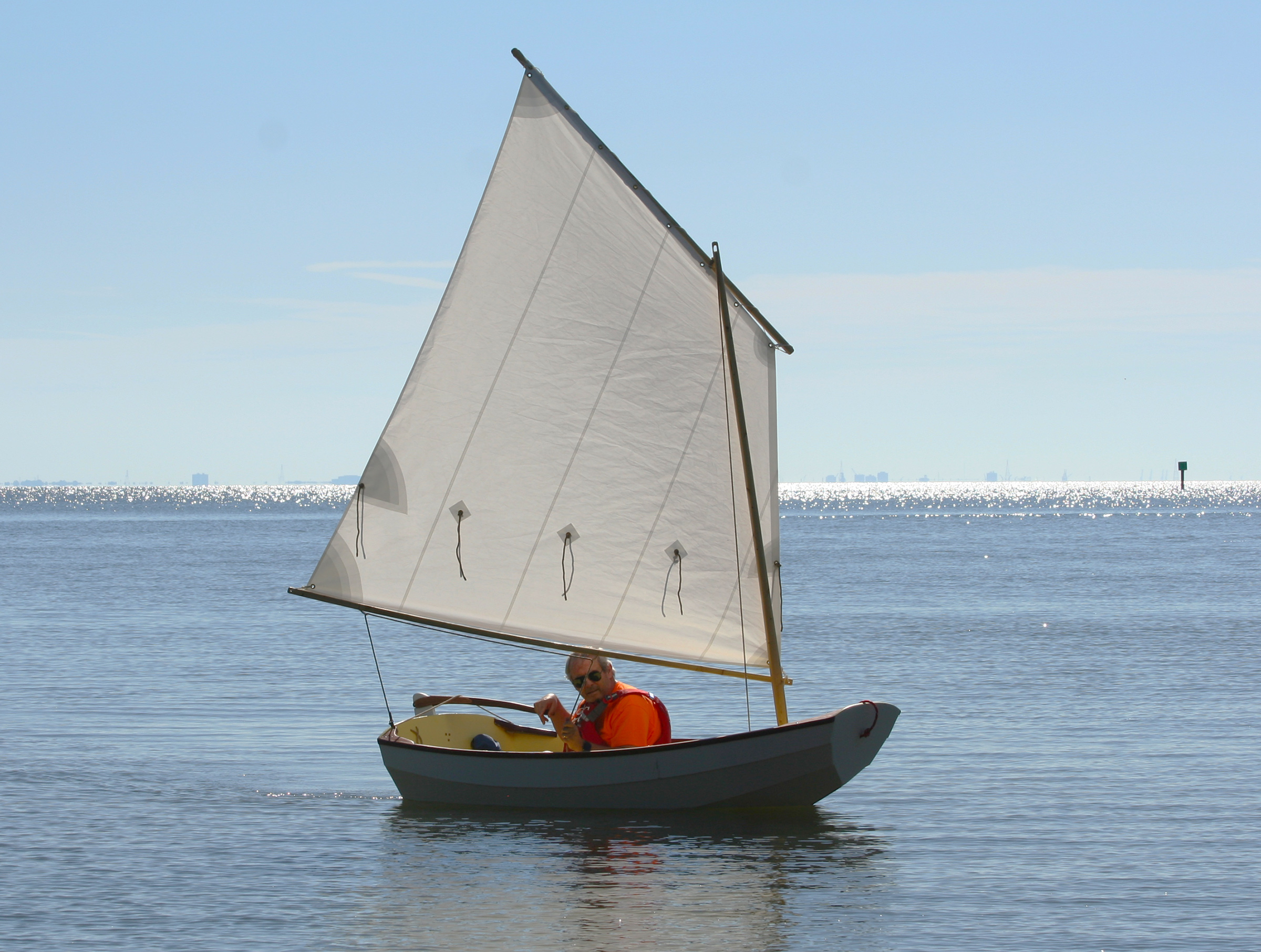
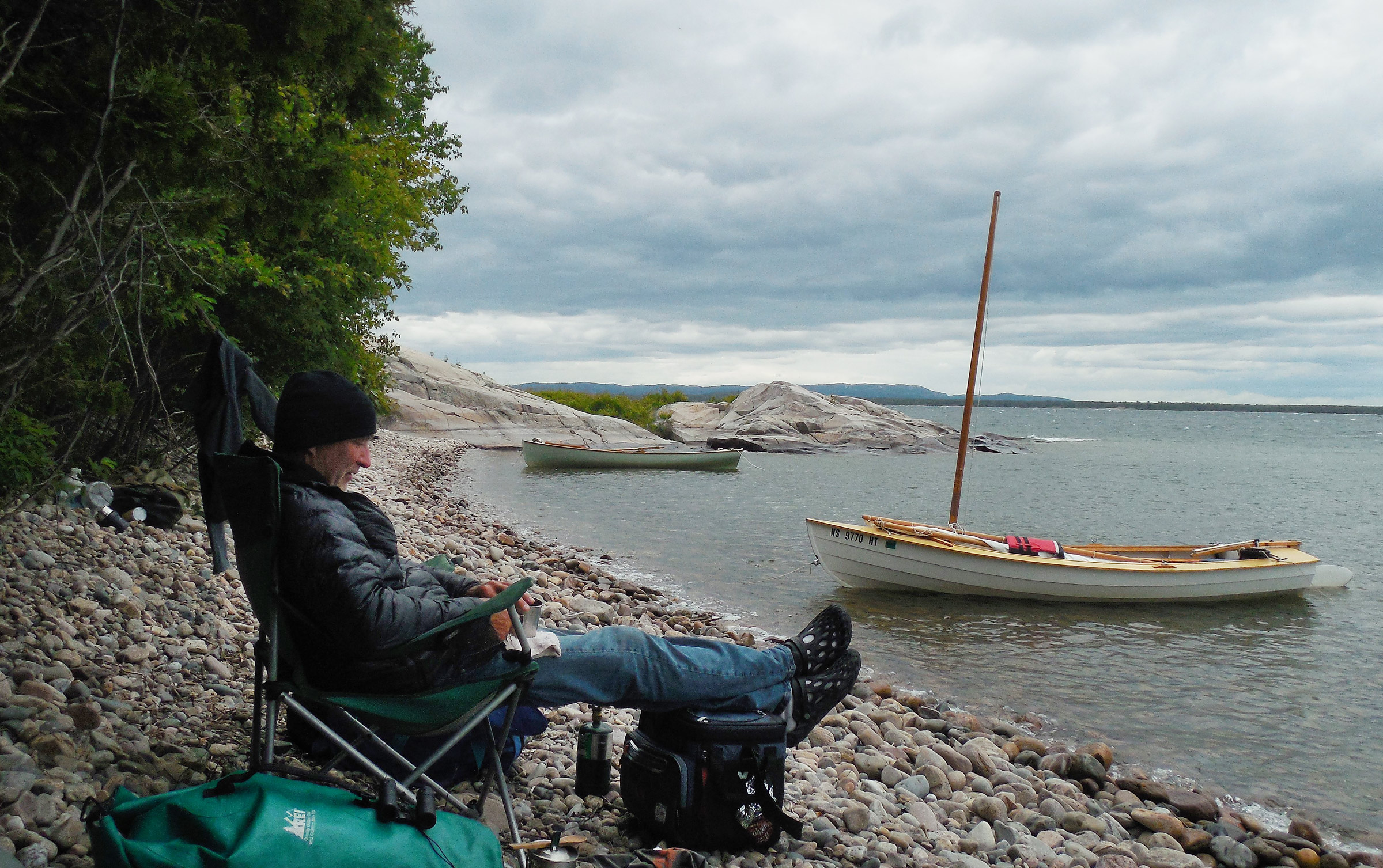
At 20’ long, the ELSON PERRY is plenty big enough for camp-cruising, but also fast and lively enough for daysailing.
I can see us now deciding if we are going to be the Swallows or the Amazons. The ELSON PERRY is exactly the sort of boat that would appeal to Arthur Ransome. (Please, if you have not read Swallows and Amazons, do yourself a favor and find a nice old copy in a used bookstore, or get it new at The WoodenBoat Store, and settle in for a tale that will inspire you to build a boat and sail about your neck of the world with a renewed sense of wonderment and imagination.) If you would ike to explore a tidal estuary full of islands or inland lakes such as the Norfolk Broads in timeless style and grace, then the ELSON PERRY is a boat for you.
Endless days could be spent in pursuit of privateers, or on the run from custom agents with a contraband cargo of cheese, crackers, and cold lemonade. For fun, or to disguise your boat, you might leave the mizzen ashore, move the mainmast back a thwart to the next maststep, and rig her as a sloop. The mystery of the extra maststep will probably never be solved, but it would be very interesting to see how many different ways you could rig her. She is big enough at 20′ LOA and 5′ 5″ beam to carry the gear required for a weekend on the island, but small enough to trailer to another destination next week.
This is a timeless boat, and as such she is limited only by your imagination. She is at home along with her sister, the original Port Medway boat, at the Maritime Museum of the Atlantic but would also fit right in at any gathering of wooden boats today. The ELSON PERRY is the boat in which we wish our grandparents had taught us to sail and row, and the boat in which we might teach our own children to sail and row.
The Maritime Museum of the Atlantic no longer offers plans for the ELSON PERRY. The review appears here as archival material.
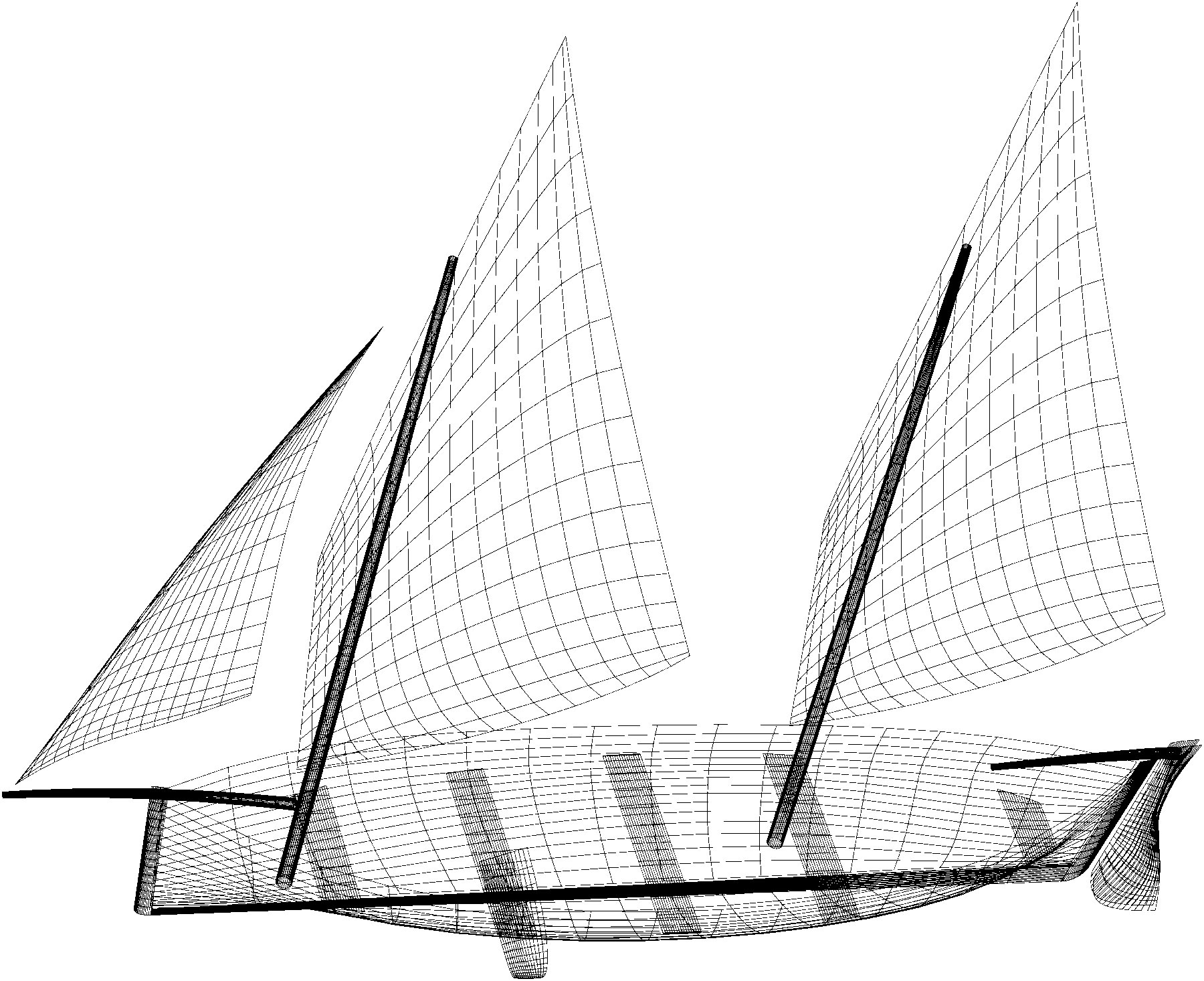
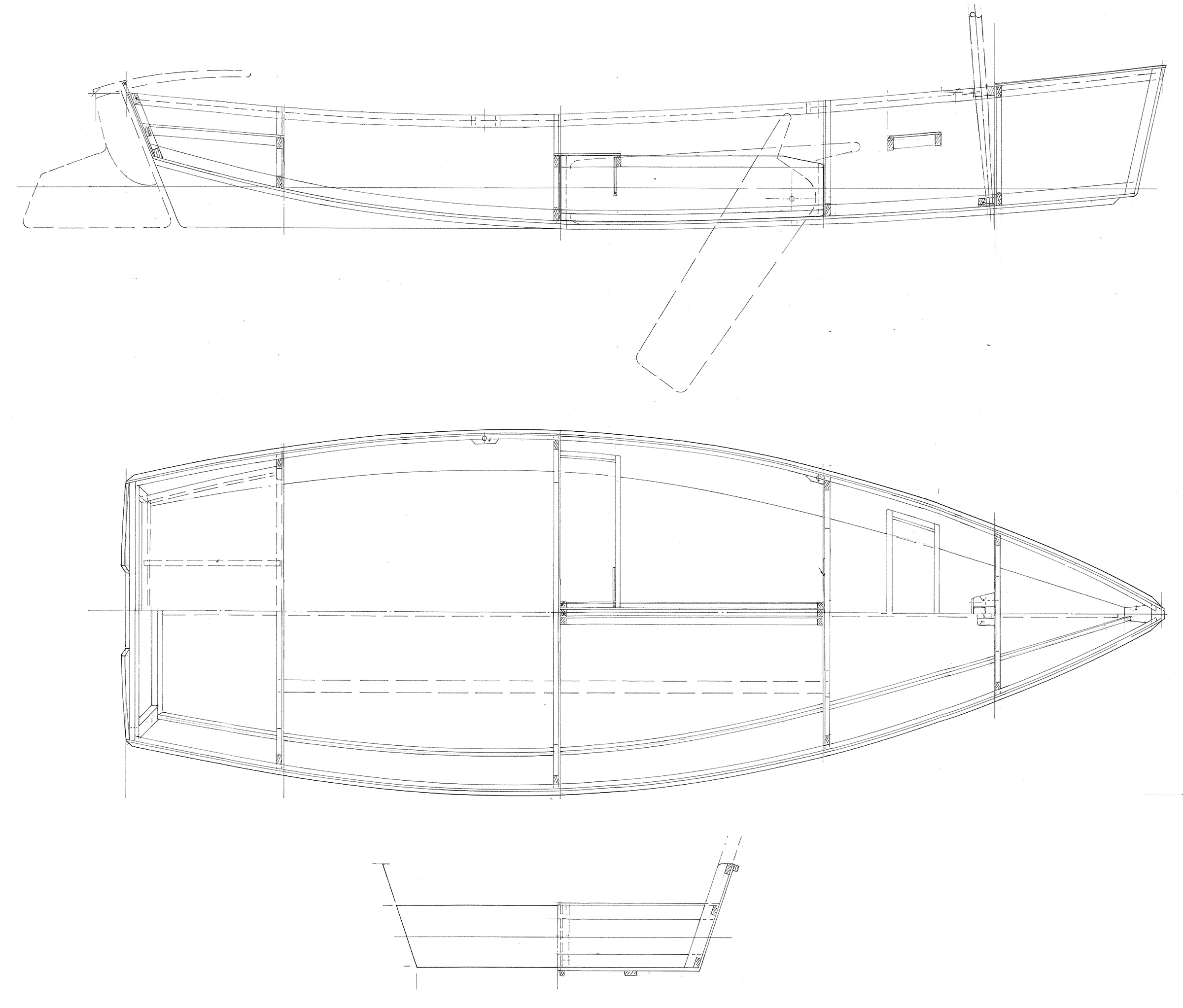
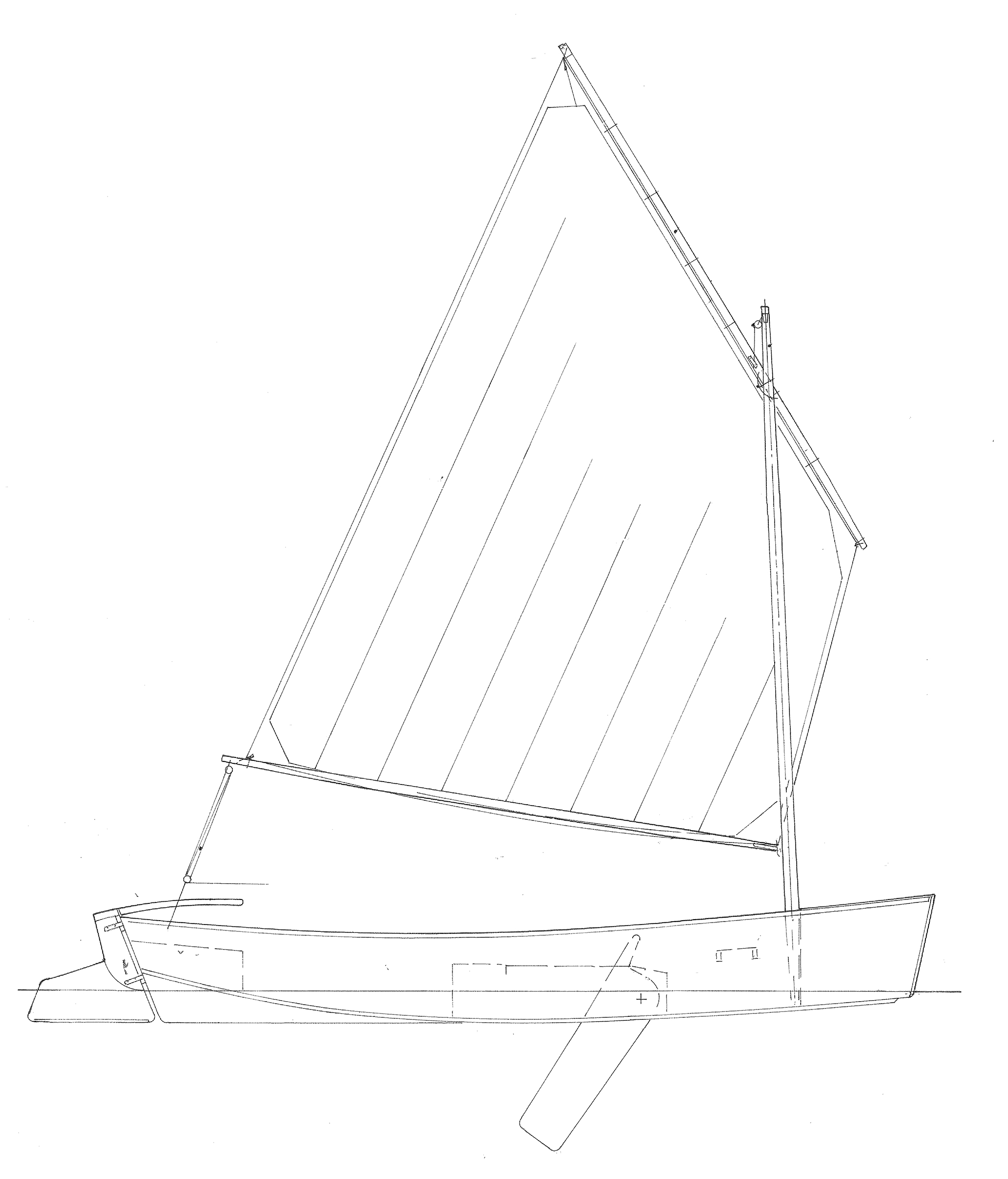
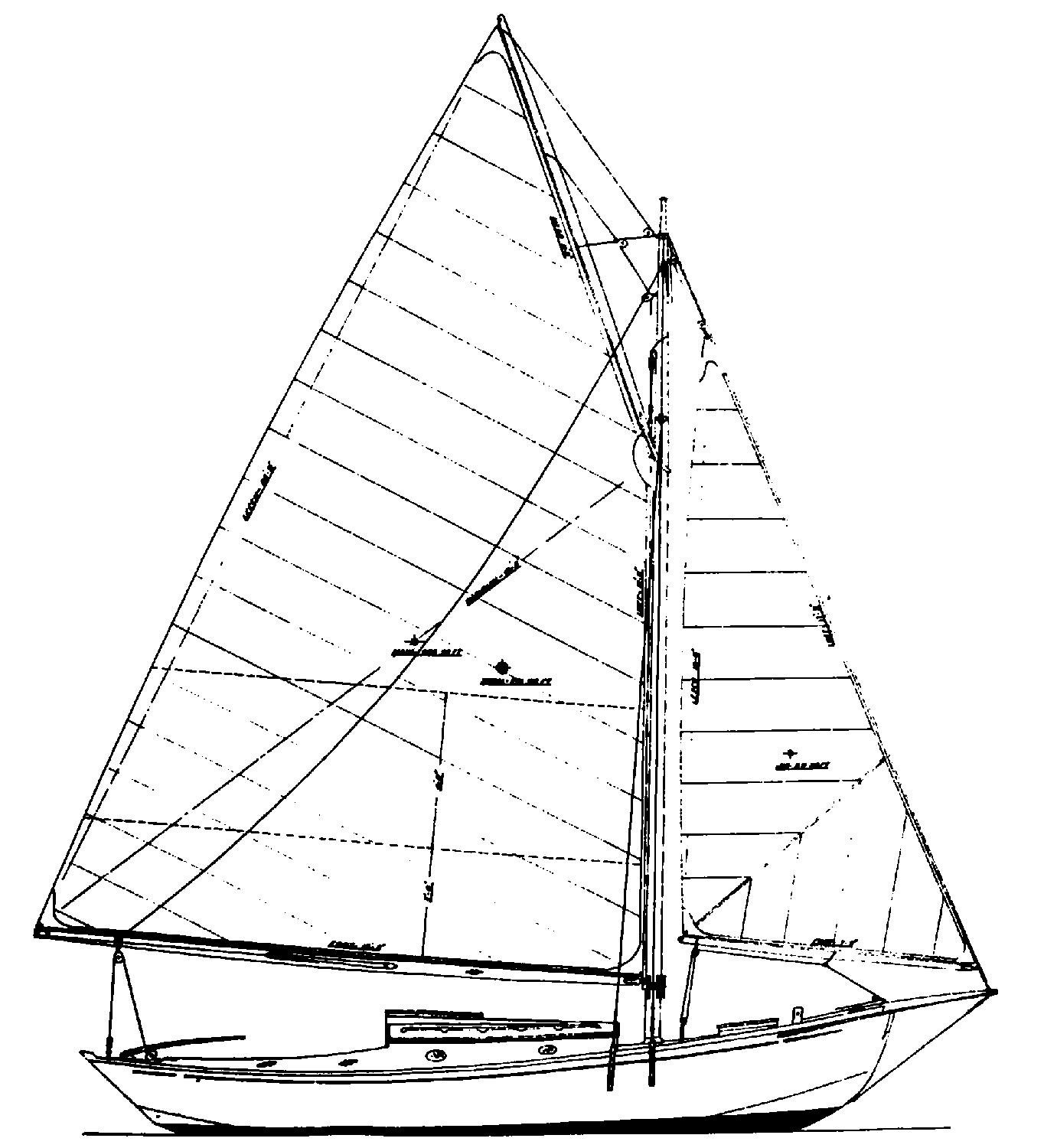
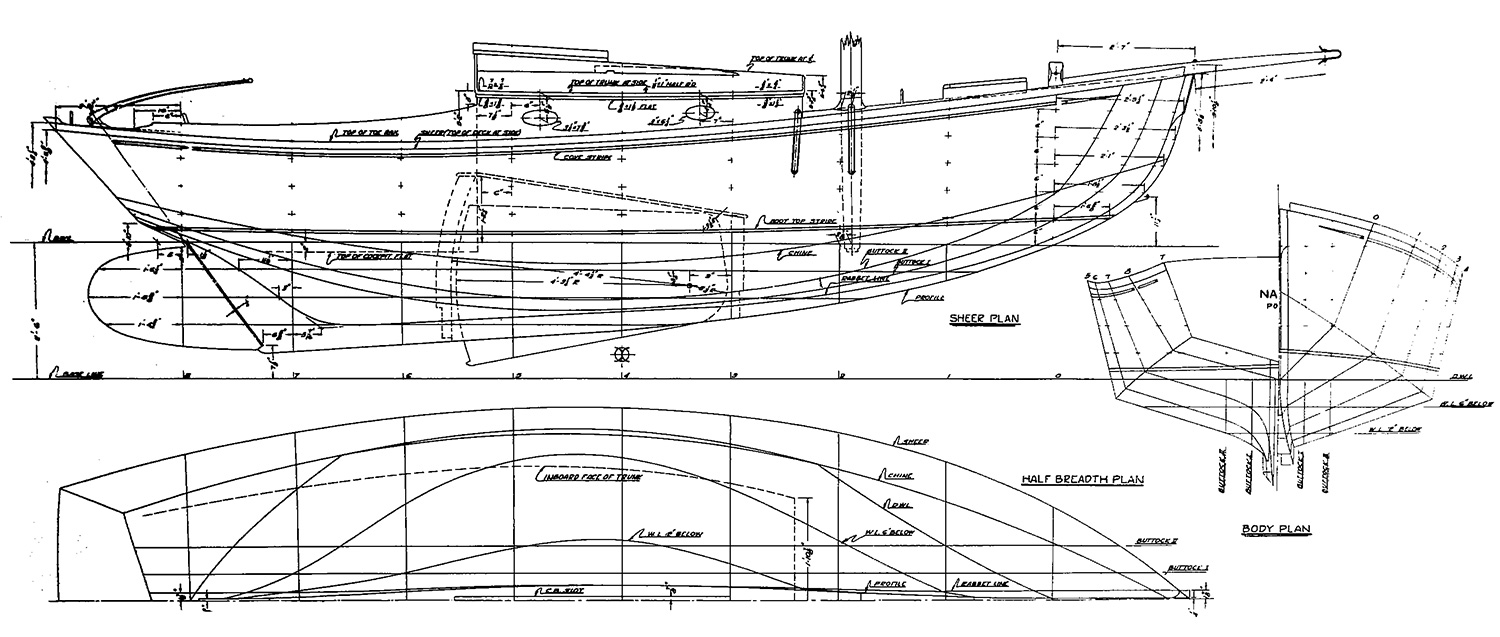
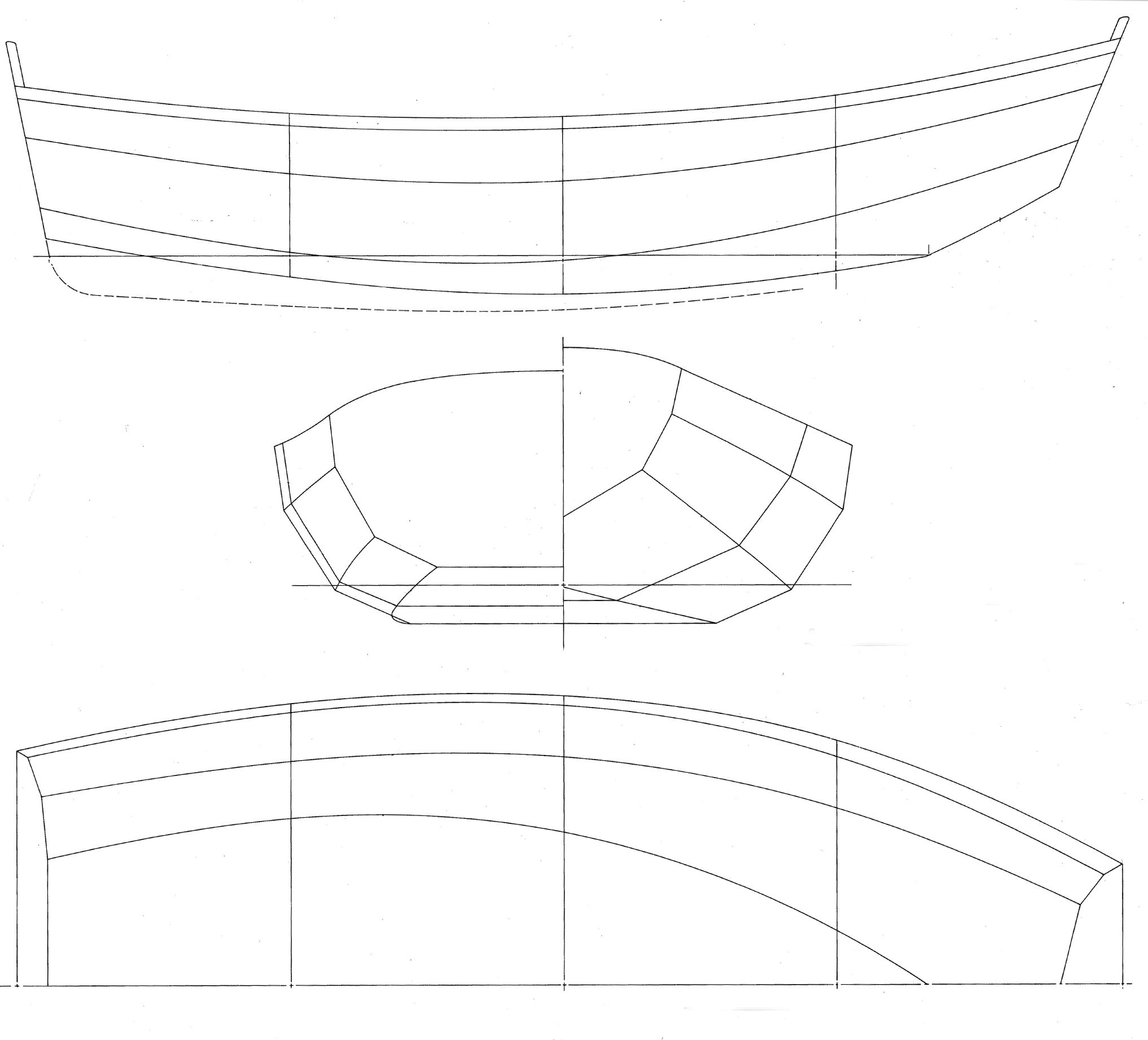
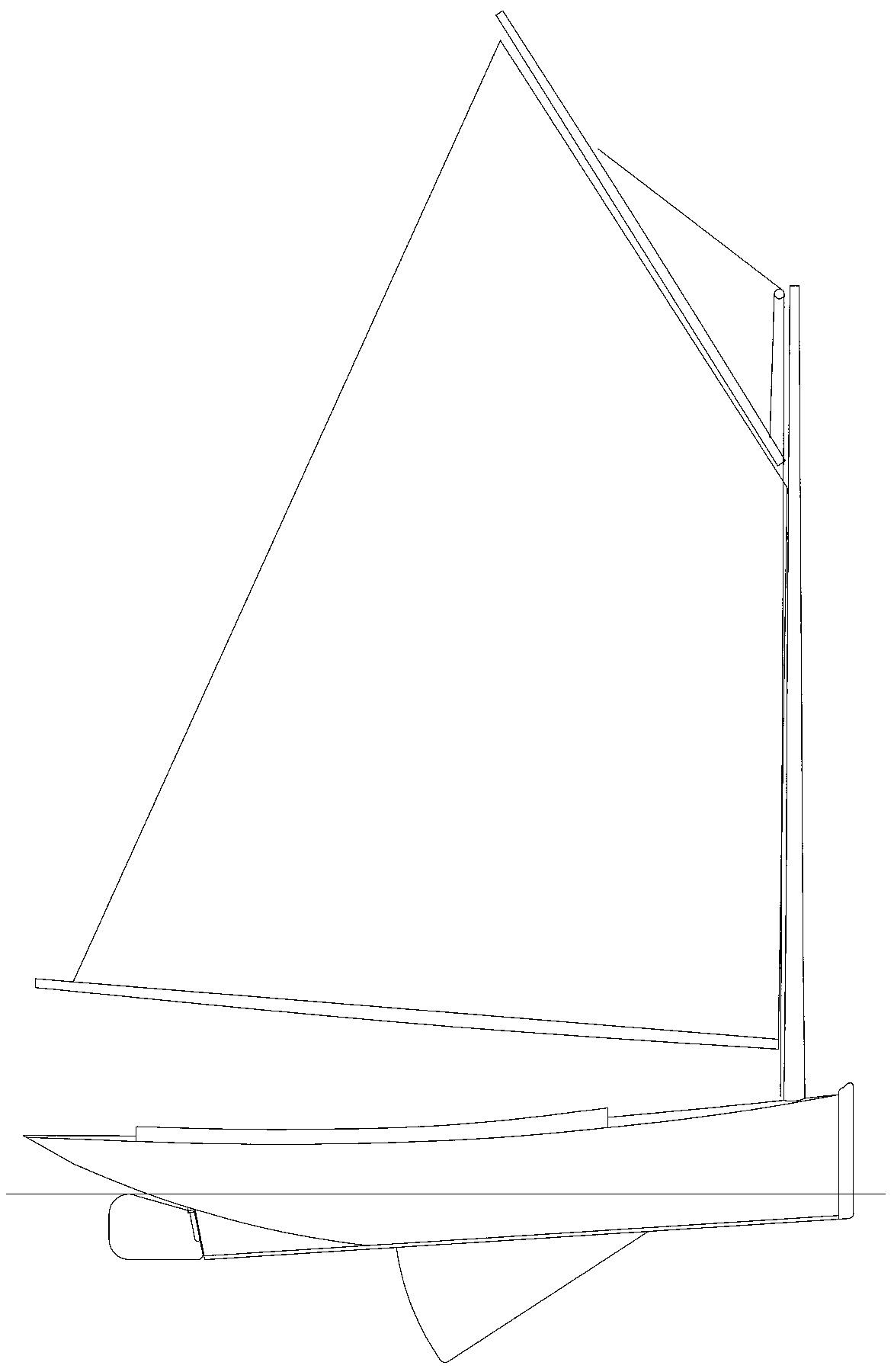
The ELSON PERRY carries six spars, making possible a variety of rigs. Ketch, cat ketch, sloop, and cutter rigs are all possible. These plans were drawn by Ed Porter and taken from the original boat owned by Elson Perry. The museum’s new version has a few modifications not shown here.
ELSON PERRY Particulars: LOA 20′, LWL 18’1″, Beam 5’5″, Draft 1’2″ board up 3’6″ board down, Sail area 210 sq ft
Under oars or sail, the Heritage 23 is a bewitching sight. The ketch-rigged double-ender, 23′ LOA, is English designer Richard Pierce’s contemporary interpretation of a classic Great Lakes Mackinaw boat, with a sweeping sheer, plumb stem, and raked sternpost. She is the prototype for a comely new one-design class intended to promote rowing and sailing along Michigan’s Sunrise Coast, bordering Lake Huron.
The idea for the Heritage 23 was conceived at East Tawas, Michigan, in 2011. A small cadre led by David Wentworth founded Heritage Coast Rowing and Sailing, Inc., a nonprofit organization. The group’s mission, inspired by the success of the St. Ayles skiff program in Scotland (see Small Boats 2012), is to encourage community boatbuilding, preserve classic regional boat designs, and encourage rowing and sailing. The group commissioned Pierce to adapt a traditional 19th-century Great Lakes boat design to a kit-buildable craft, using marine plywood and epoxy resins. Several boats were considered—among them the Collingwood, Huron, Tawas Bay One-Design, and Bateau—but in the end, the Mackinaw was selected.
Mackinaw boats originated on the Upper Great Lakes sometime in the 1800s, but exactly when has been in dispute for decades. The American Fur Company used Mackinaws on Lake Superior as early as the 1830s. Fishermen on Isle Royale near the lake’s North Shore worked aboard 20′ to 30′ versions of the boat from the 1850s to early 1900s. These Mackinaws were robustly built and heavily ballasted for operating in open waters. Early models, which primarily featured pointed bows and sterns, varied greatly in style, depending on the builder.
Once commissioned by the Heritage group, Pierce studied various plans, including Nelson Zimmer’s 20th-century version of the Mackinaw boat, in preparation for completing his design. Although based on historical Mackinaw lines, the Heritage 23 is designed to be constructed with lightweight modern materials. It weighs just 350 lbs and carries no ballast. With four rowing stations, each for an oarsman handling a single oar, and a coxswain seat, the boat is ideal for competitive coastal racing under oars. As a sailboat, she is best suited for protected waters. Overall, she performs like a large dinghy, rather than a deepwater workboat.
George D. Jepson
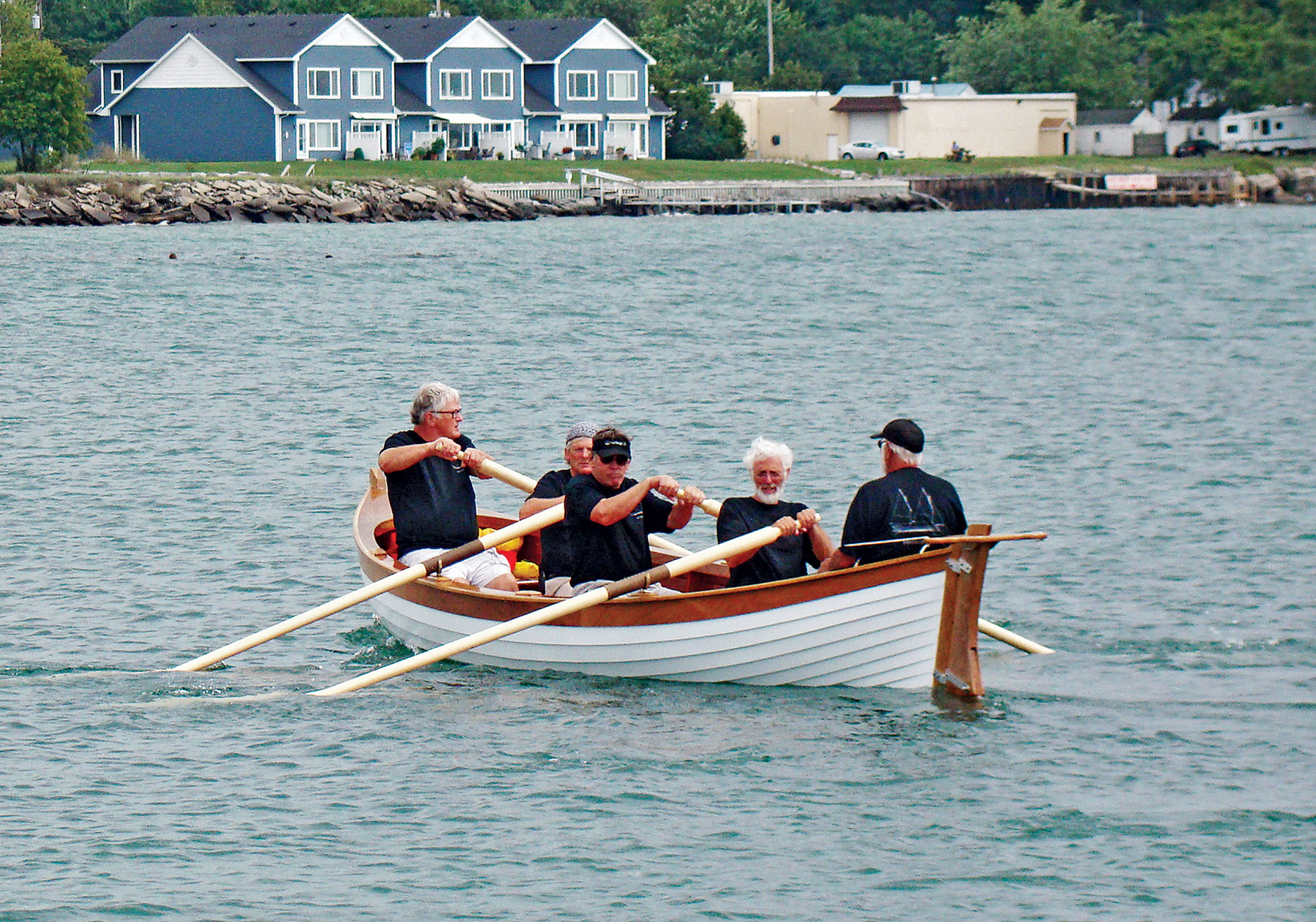
Rowing is a particular emphasis of Heritage Coast Rowing and Sailing, and the teamwork involved in having four oars and a coxswain will serve the goal of building community interest in boats and boatbuilding.
After the Heritage 23 plans were drawn, Pierce turned to Alec Jordan at Jordan Boats in Fife, Scotland, to design the prototype kit, as well as the boat’s interior layout, which favors the rowing configuration. Jordan already had a longstanding relationship with Hewes and Company in Blue Hill, Maine, to produce boat kits in North America, and the Heritage 23 has been added to the lineup.
Last April, six amateur boatwrights, regulars who would see the project through to completion, gathered with Jordan in a small building near the East Tawas waterfront. They constructed the Heritage 23 mold, glued garboards to the keel, and the modern Mackinaw began to take shape. During the course of the project, at least two dozen volunteers contributed to the building effort. Four experienced wooden boat builders dropped by almost daily to offer guidance.
As a warmer-than-usual spring hinted at the coming summer, the shop buzzed with activity. The team worked steadily to hang 9-mm okoume marine plywood planks, 12 to a side, gluing the laps with epoxy. “To have consistently hung two pairs of planks a day with a team who mostly had not been involved in building boats is a fantastic achievement,” Jordan said. When the sheer-strake—the “whiskey plank”—was fitted and glued, Jordan and the boatwrights celebrated with “a wee dram” of single-malt Scotch. Although there was much work ahead, it was a major milestone for the boatwrights and their mentor.
In addition to planking, bulkheads, thwarts, and flotation tanks were fashioned from CNC-machine-cut okoume. White oak was used for the keel, keelson, stem, sternpost, inwale, gunwale, tiller, rudder, steering yoke used when rowing, and bowsprit. The centerboard trunk was constructed with a white oak frame, an okoume body, and a sassafras cap. Spars, which included masts, yards, and booms for the standing-lug fore and main sails, were shaped from Douglas fir. The centerboard was cut from 3/4″ aluminum. The boat-builders cut cleats from a white-oak-and-carbon-fiber sandwich that they had laminated.
The Heritage 23 has a traditional-looking finish. The topsides are coated with white epoxy paint. The sheerstrake, thwarts, centerboard trunk, foredeck, spars, yoke, tiller, and rudder are finished bright. The boat is fitted out with off-the-shelf stainless-steel hardware, except for the pintles and gudgeons, which were custom-made locally from aircraft aluminum. Doyle Sails of St. Clair Shores, Michigan, cut Heritage 23’s white Dacron sails.
Raising the Heritage 23’s standing-lug rig is a rather simple matter, and even a novice can do it in about 20 minutes. The two identical unstayed masts (fore and main), with halyards attached, can be seated in their maststeps by one person. Preparing the yards to be sent aloft, the halyard is attached with a rolling hitch. The jib snaps quickly to the bowsprit and the halyard. Connecting the two downhauls, one forward and one just aft of the foremast, and threading the sheets through blocks completes the setup. Breaking down the rig takes even less time. The boat is easily towed or stored on its custom trailer, which Pierce also designed.
George D. Jepson
When the Heritage 23 is under oars, the tiller is removed and a rudderhead yoke with steering lines is installed to permit the coxswain to sit amidships all the way aft.
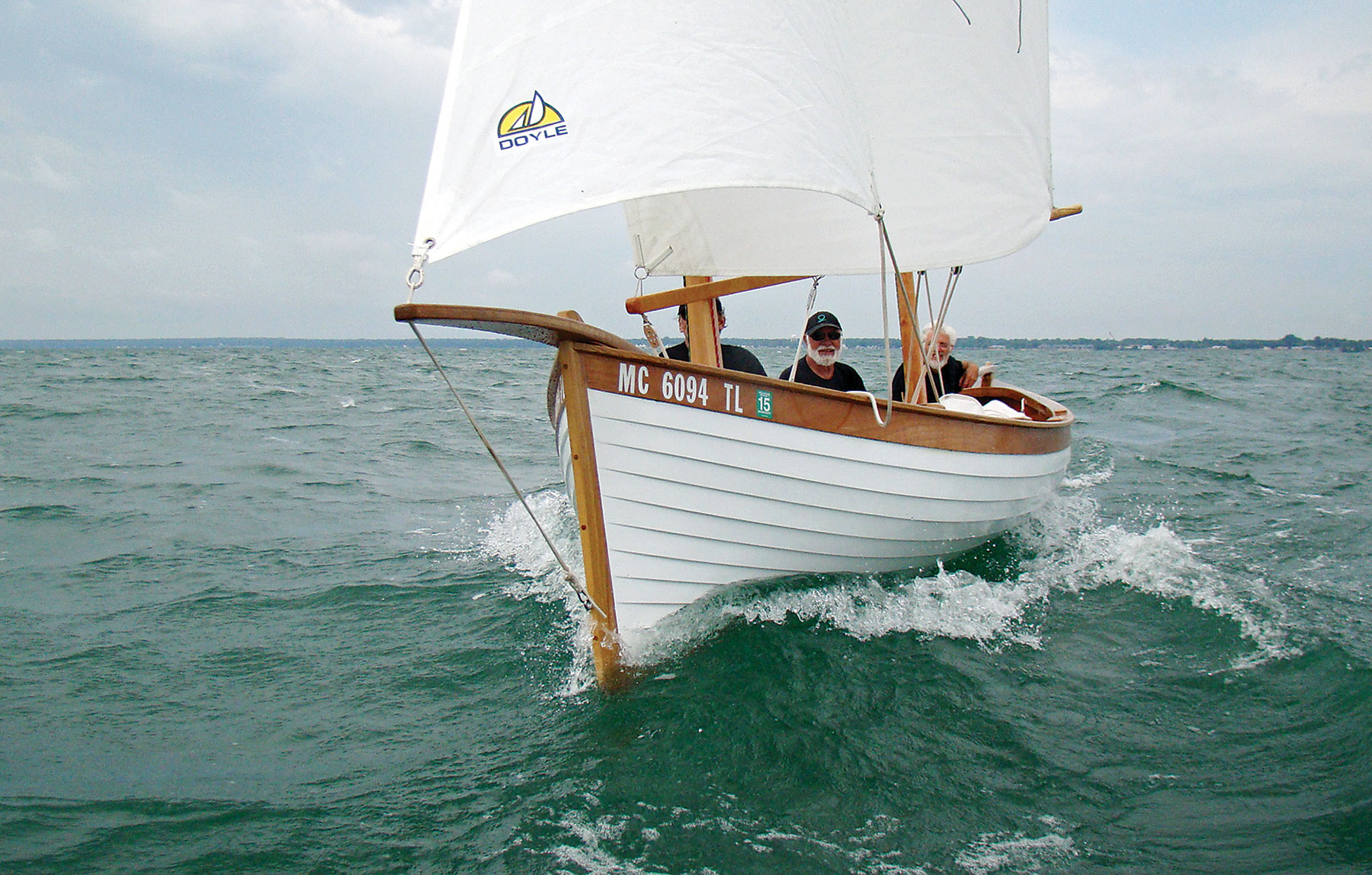
By late July, the Heritage 23 was ready to launch Pierce arrived in East Tawas from his home on an island off the coast of Scotland six weeks earlier to shepherd the project through its final steps; Alec Jordan returned to his business in Scotland. On an early August morning, a leaden sky darkened Tawas Bay, while a stiff 15-mph southeasterly breeze whipped the seas into a lively chop. The Heritage 23, with Pierce at the helm and three crew aboard, sliced across the bay under full sail. Emerging from the gloom, she was an apparition from somewhere in time. Turning into the wind, the crew lowered the mizzen, a precaution against potential damage. Even under reduced sail, the boat charged across the cresting waves, heeling to the wind but keeping her lee rail out of the water.
Returning to the harbor behind the protective breakwater, the Heritage 23 glided into her slip. There was water in the bilge and the crew was damp from the spray of the choppy seas. A bit of bailing set things right, while the sailing rig was stowed. Pierce suggested adding a canvas bucket to the regular gear list.
At high noon, the Mackinaw was rigged for rowing, with a steering yoke fixed atop the rudder in place of the tiller. A five-man crew was aboard, including a coxswain. The rowers each grasped a stout 12′ oar. With a word from the coxswain, the pulling began, while he steered by pulling ropes attached to either end of the yoke. Clearly, the pulling crew will need training to achieve a competitive edge, but for the moment they were pleased—along with Pierce—that the hull slid smoothly through the water.
George D. Jepson
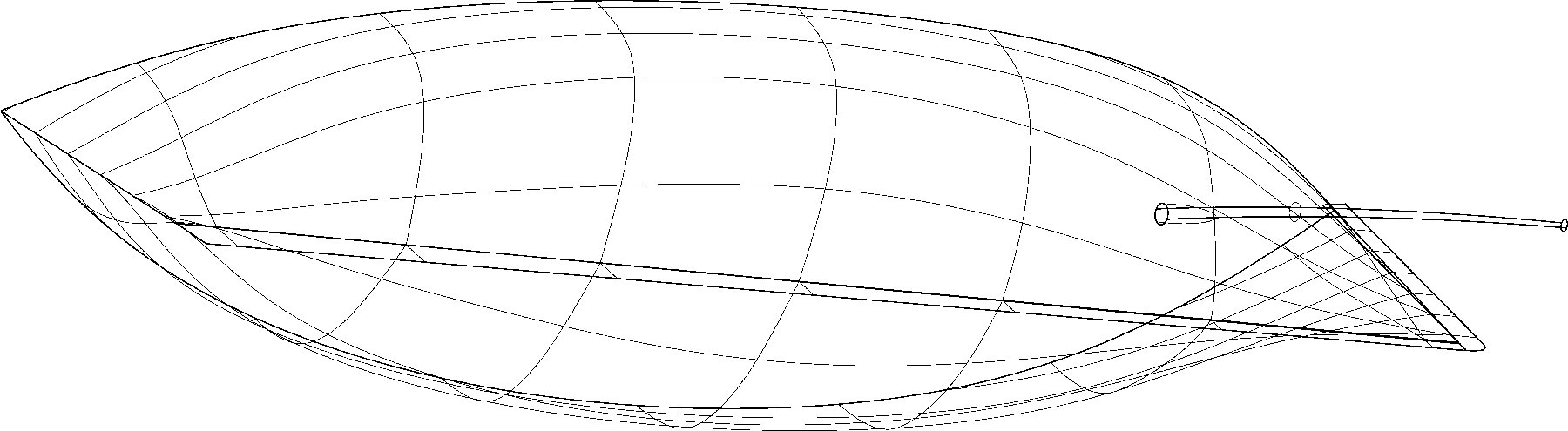
The Heritage 23 draws on the famous Mackinaw boat of the Great Lakes, with its straight and plump stem, its shapely lapstrake hull, and its two-masted rig with plank bowsprit. The design requirement for glued-plywood kit construction, however, necessitated developing new plans from the bottom up.
By early afternoon, the wind moderated. Once again, Pierce rigged the Heritage 23 with just the jib and foresail, in yet another test of the boat’s capabilities, this time in a light breeze. Clearing the pierhead, we set off on a starboard reach. Tawas Point Lighthouse was visible off the port bow. The designer, still at the helm, was delighted with the boat’s response. In these conditions, a two-person crew could easily handle the Mackinaw for a leisurely daysail. In a heavier blow, with three sails aloft, at least one more hand, if not two, would be preferable.
Taking the tiller from Pierce, I found the helm responsive to my touch. In the light air, there was no weather helm. Pierce remarked that this was also his experience in heavy winds earlier in the day. Coming about, the boat is sluggish due to the long, straight keel that helps her track well under oars. Gaining speed once again, we sailed through the wind and headed off on a port tack. Pierce suggested that I let go of the tiller. Surprisingly, we continued sailing in a straight line, a display of the craft’s tracking ability.
Under sail, the helmsman must sit aft on either the port or starboard bench, just forward of the coxswain’s seat. In this boat, these side seats narrow significantly near the stern, leaving the helmsman with precious little room to comfortably perch. The layout is understandable for rowing purposes, but perhaps a removable thwart would answer.
Heritage Coast plans to build a second Mackinaw this winter, offering an opportunity for a new group of amateur builders to become involved. Along the Sunrise Coast, at least four other community groups are interested in building Heritage 23s.
As more Mackinaws are christened, windows will open to the past—a poignant reminder of the sailors and fishermen who plied these inland seas in small boats a century and more ago.
The Heritage 23 is an international effort: English yacht designer Richard Pierce paid homage to the Mackinaw boat heritage, but worked in modern elements such as an easy-to-handle standing lug rig, then worked with the Scottish kit-boat developer Jordan Boats to work up specifications for parts cut by Hewes and Company in Maine for a sailing and rowing association based in Michigan.
Heritage 23 Particulars: LOA 23′, Beam 5’6″, Draft (db/cb up) 1’2″, (db/cb down) 3′, Weight 350 lbs, Sail area 233 sq ft
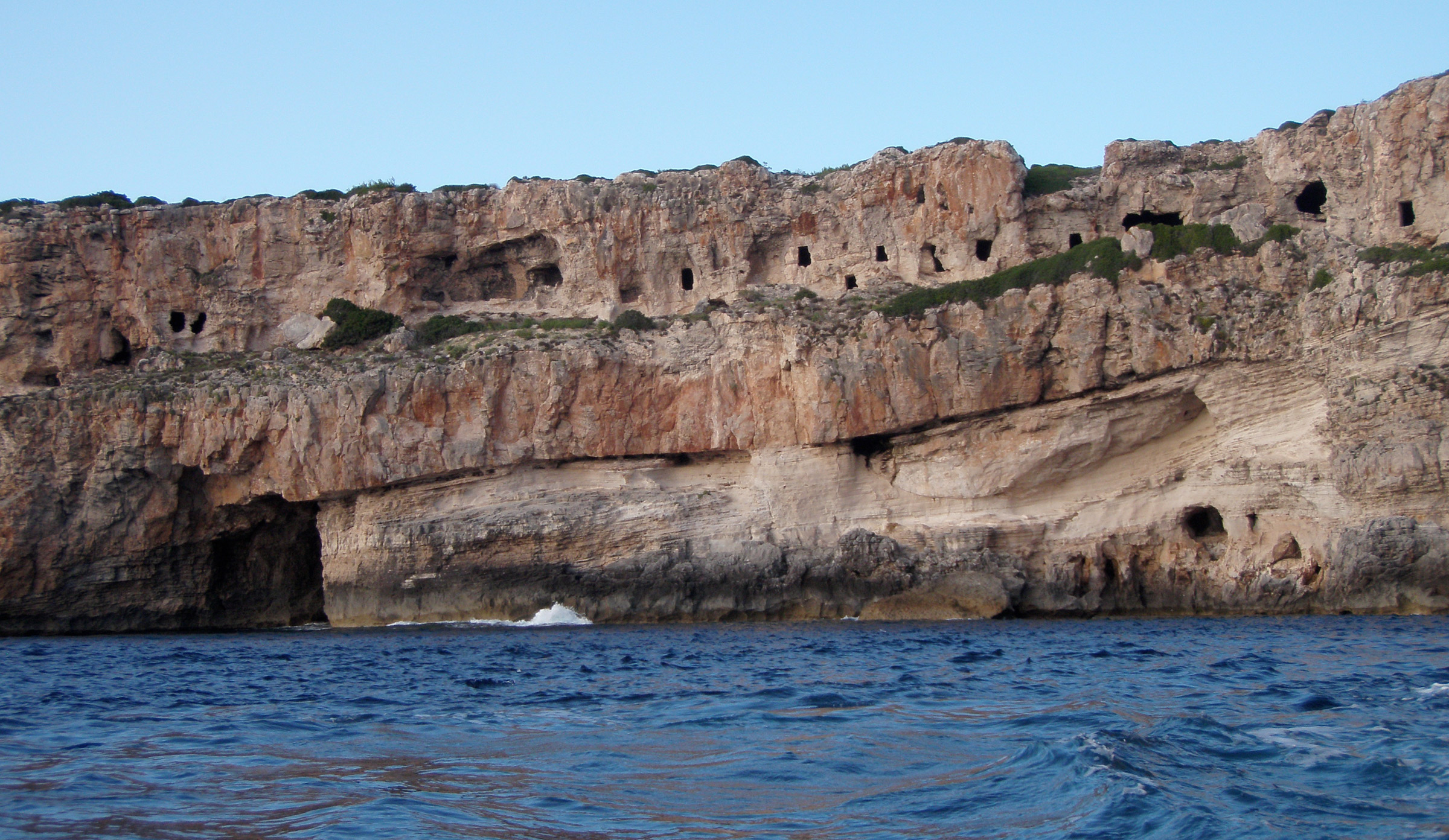
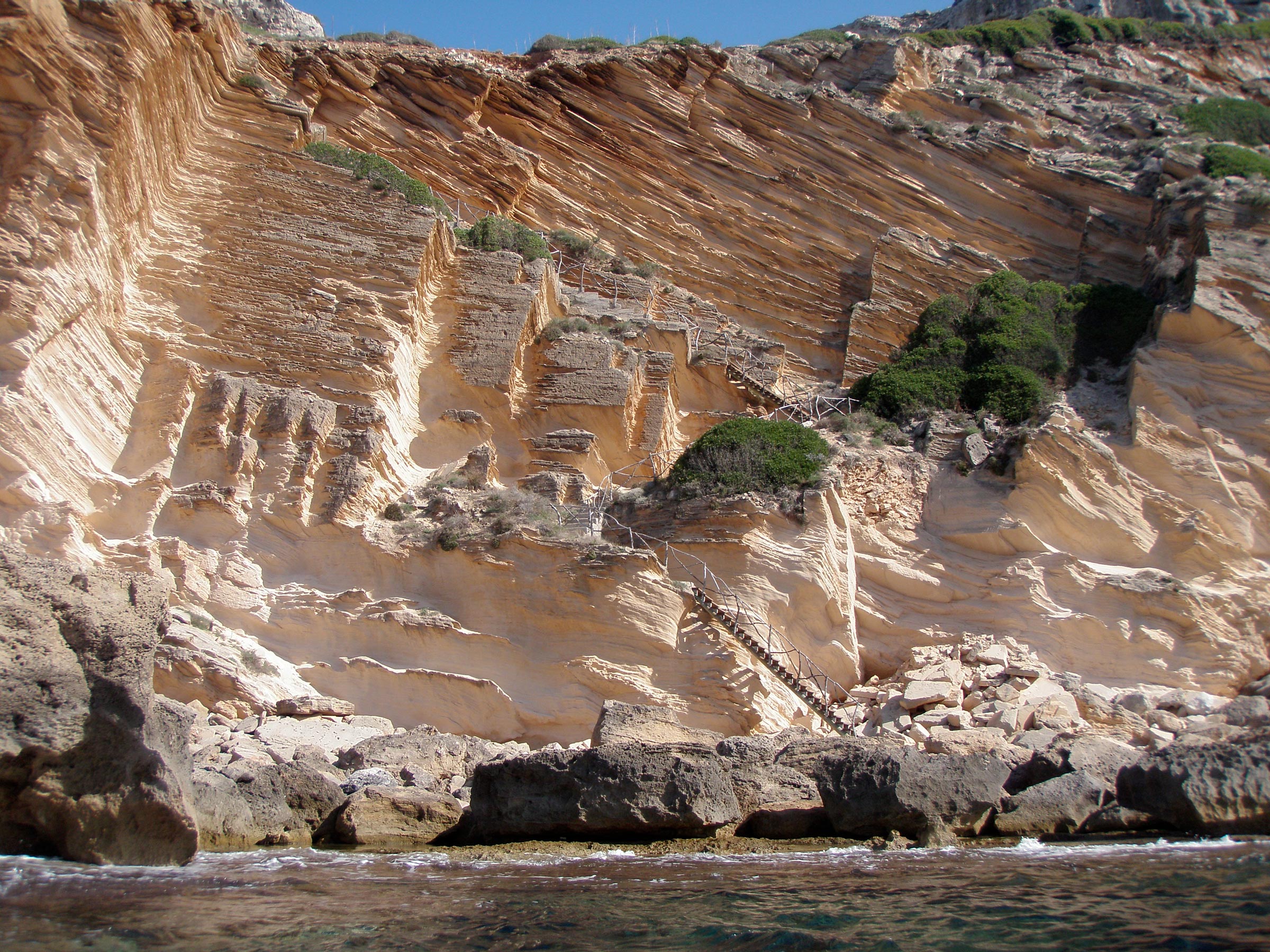
In 2009, I kayaked the 25-mile-long south coast of Menorca, the northernmost of Spain’s Balearic Islands. I had intended to circumnavigate the island but there was a strong northwest wind, called the Tramontana, crashing waves up to 15′ into the north coast and raking across the west and east coasts. I spent three days waiting for the Tramontana to weaken. With my time running out, my hosts, Maria Teresa and Carlos of Menorca en Kayak, turned me loose at Biniancolla, a coastal town on the southeast corner of the island. Trading the circumnavigation for an unhurried cruise in the sheltered south coast was the best thing that could have happened. That coast is entirely composed of eggshell-white marés limestone, a much more malleable stone than the dark gray and red crags that fortify much of the north coast. The shoreline I’d be paddling is riddled with caves carved either by the Mediterranean Sea or by hand as far back as the Bronze Age.
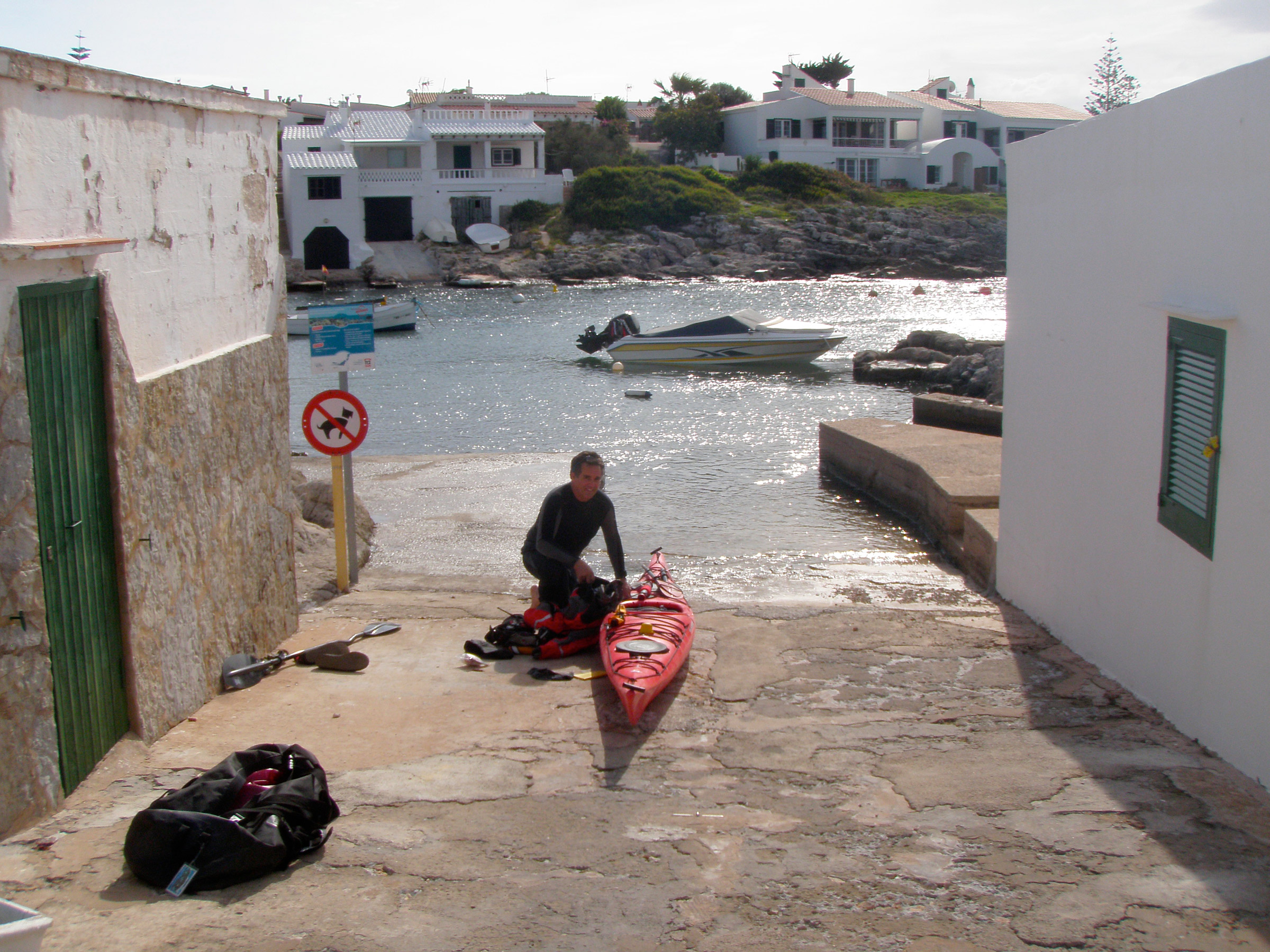
The launch ramp in Biniancolla was at the north end of a narrow, well protected cove but the Tramontana sweeping over the low landscape on the east end of the island swirled around the buildings and buffeted the water. When I left the cove and paddled west along the coast, I kept close to shore in a band of still water only a dozen yards wide.
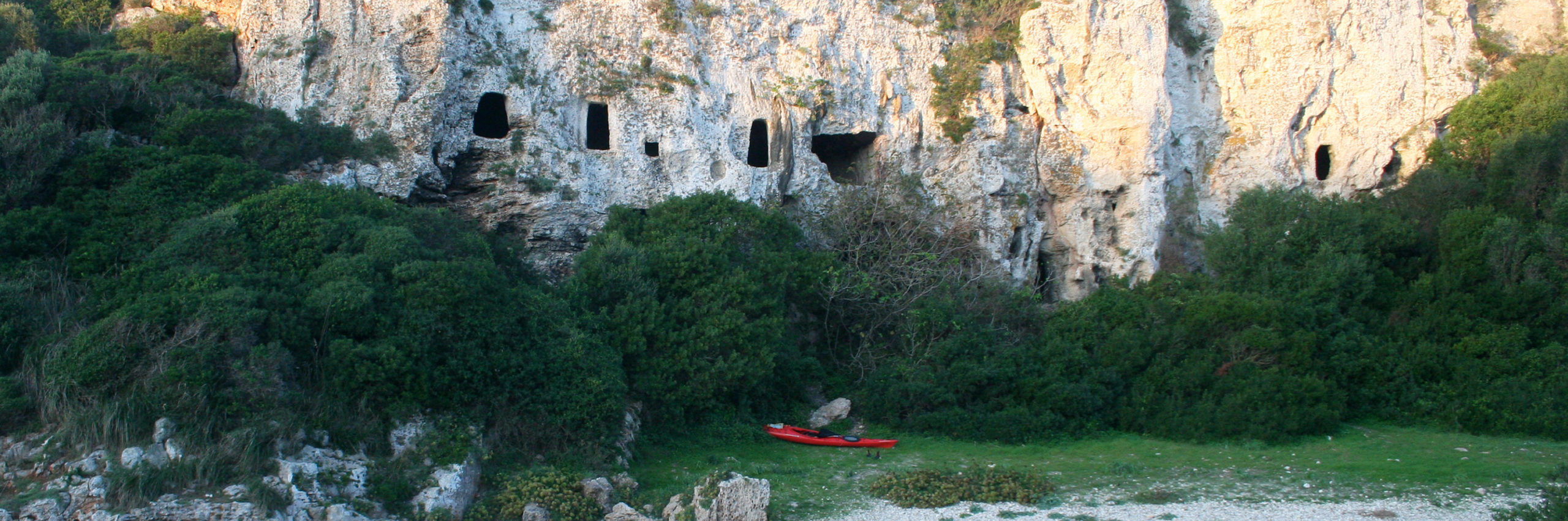
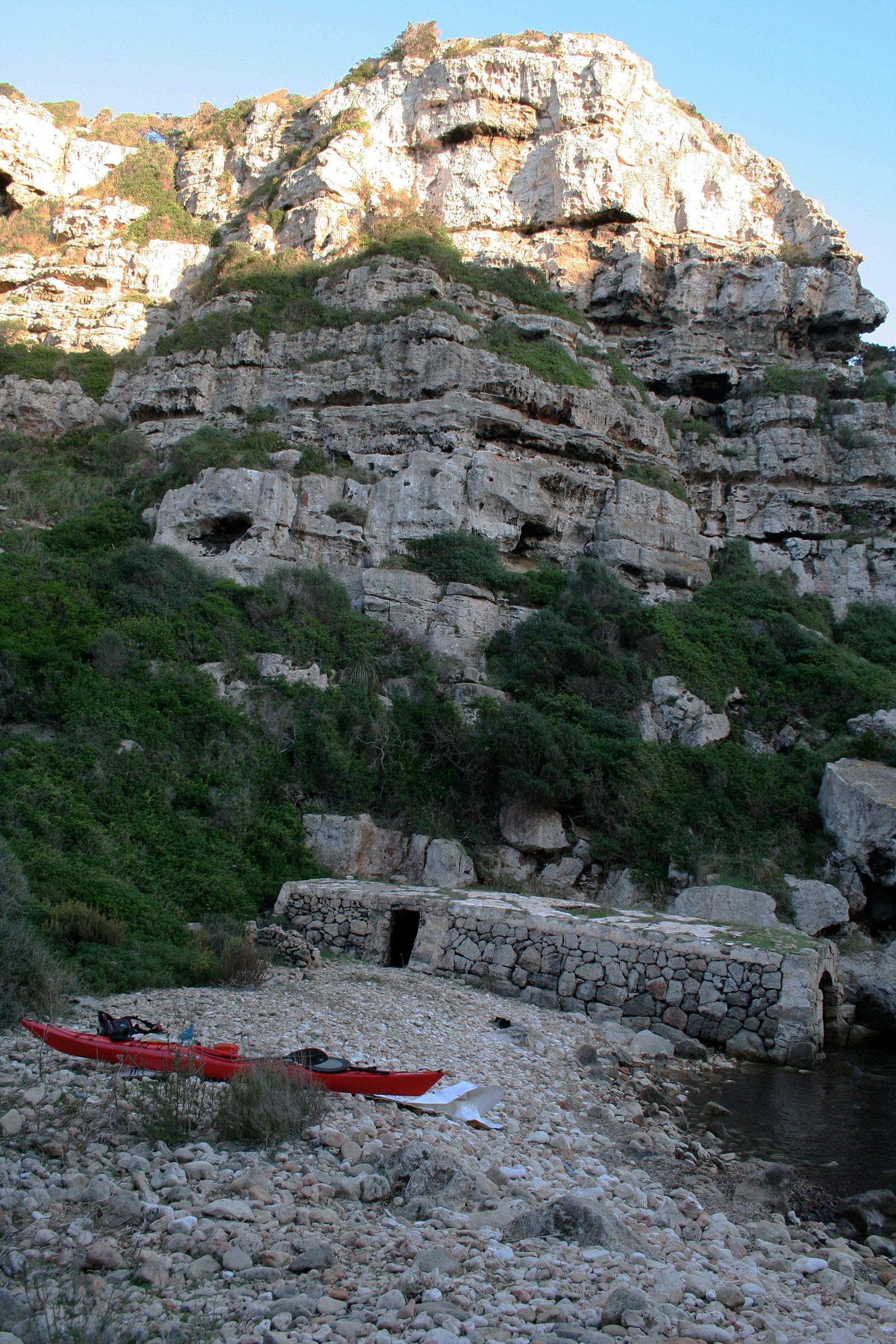
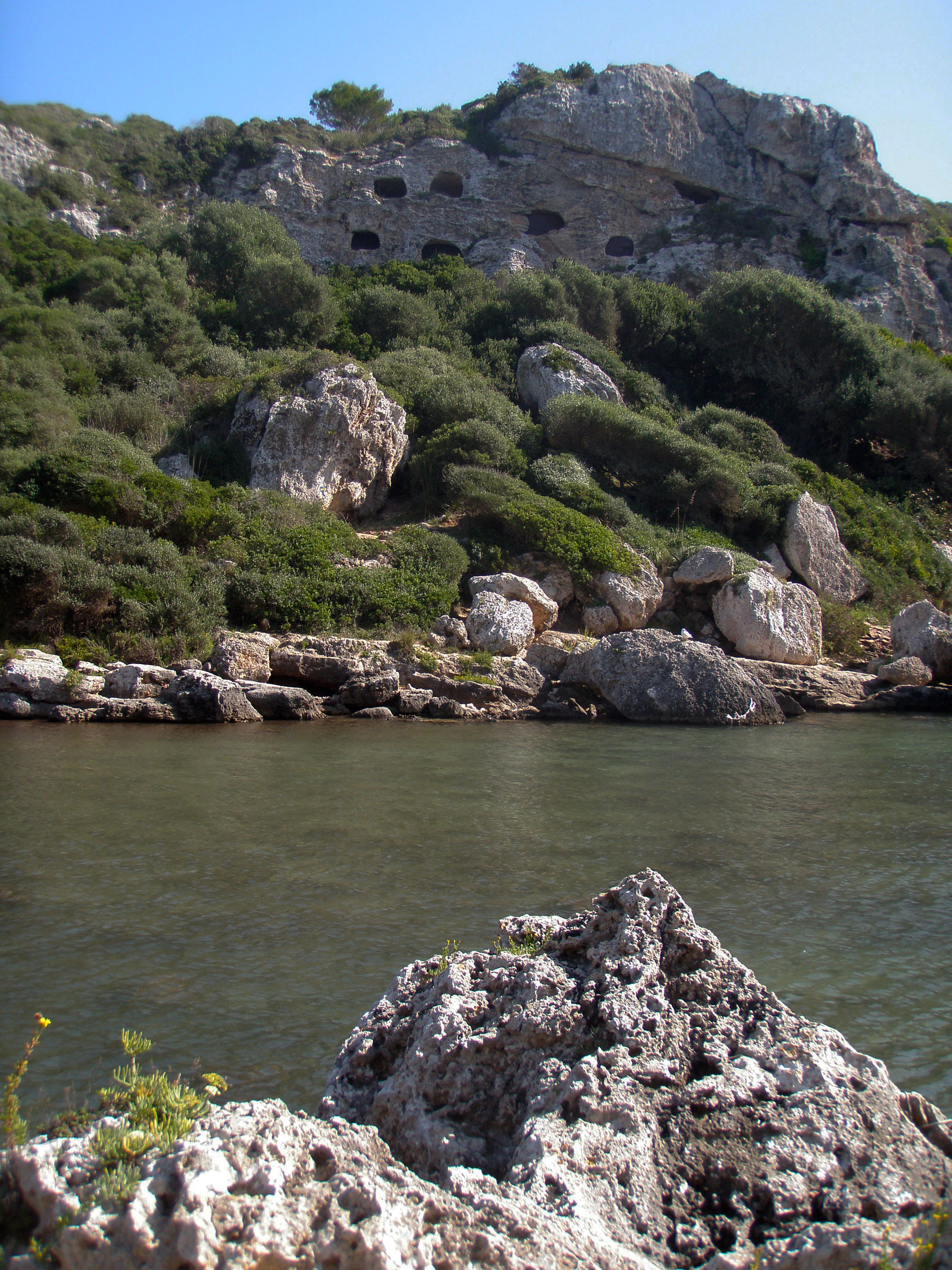
Four miles from the launch, I found a cove with an entrance no more than 100 yards wide and its end concealed by a dogleg bend to the west. A quarter mile in, I pulled ashore here at Cala de Biniparratx, a beach nestled in a valley at the foot of a 50′-tall limestone cliff. I walked to the base of the cliff and below the largest opening here, left of center, I found steps cut into the stone that led to a cave hidden by the trees. There was a rope hanging from the largest opening that I could climb to get into that cave. There was plenty of light left for the day and I went back to the kayak and paddled 1/2 mile west to the next cove. It wasn’t nearly as interesting, so I returned to Biniparratx.
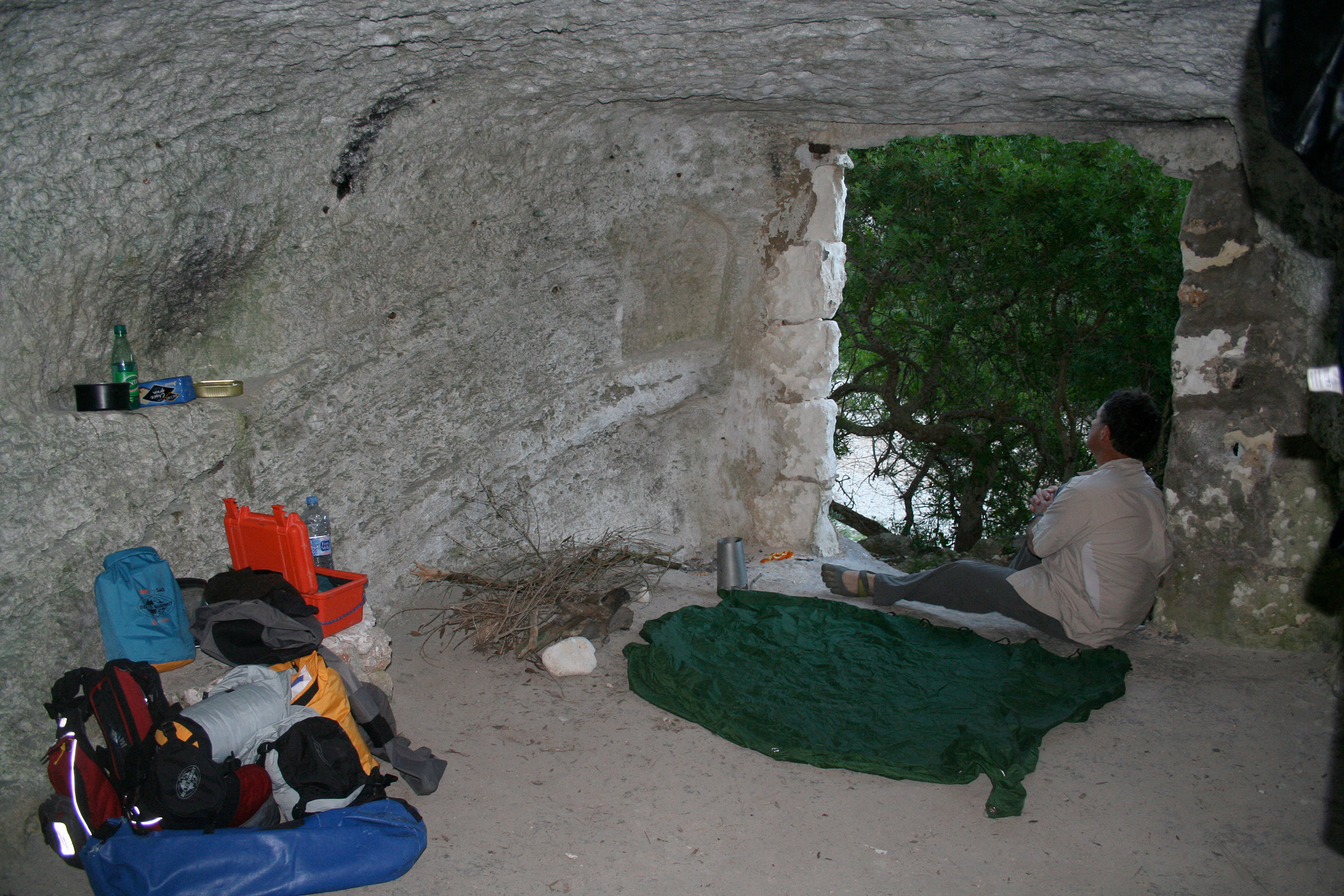
These carved steps led to the cave where I made camp. In my right hand is the rope I used to climb to the large cave higher up on the cliff face.
The cave had plenty of room and a flat floor, making it a good place to sleep, though I didn’t know at the time that the cave and those above it were burial chambers carved out of solid rock in 1st Century B.C.
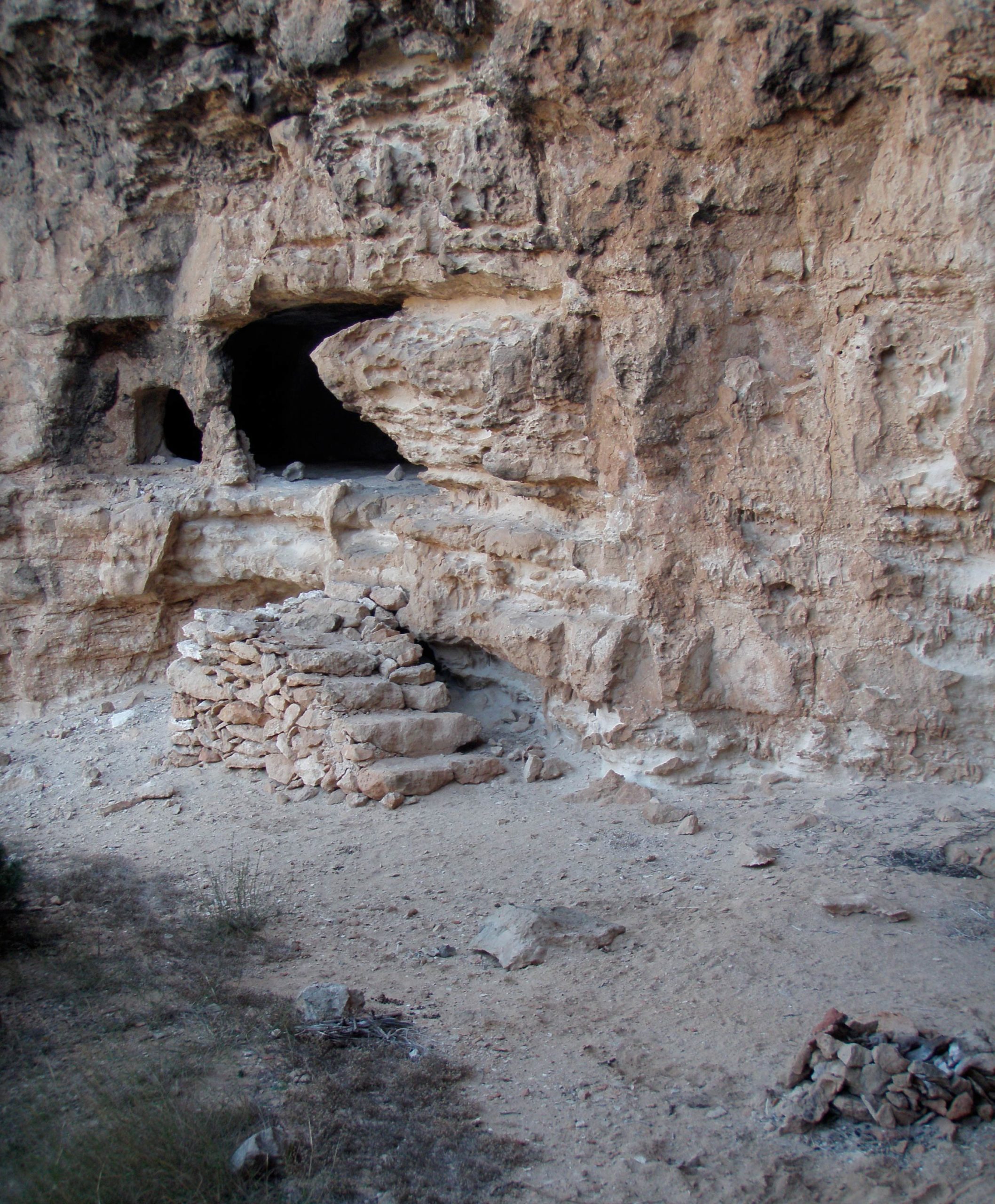
There were many other ancient caves carved from the cliffs looking out over the Mediterranean. Some of them, like these, were accessible only from the high ground beyond the tops of the cliffs.
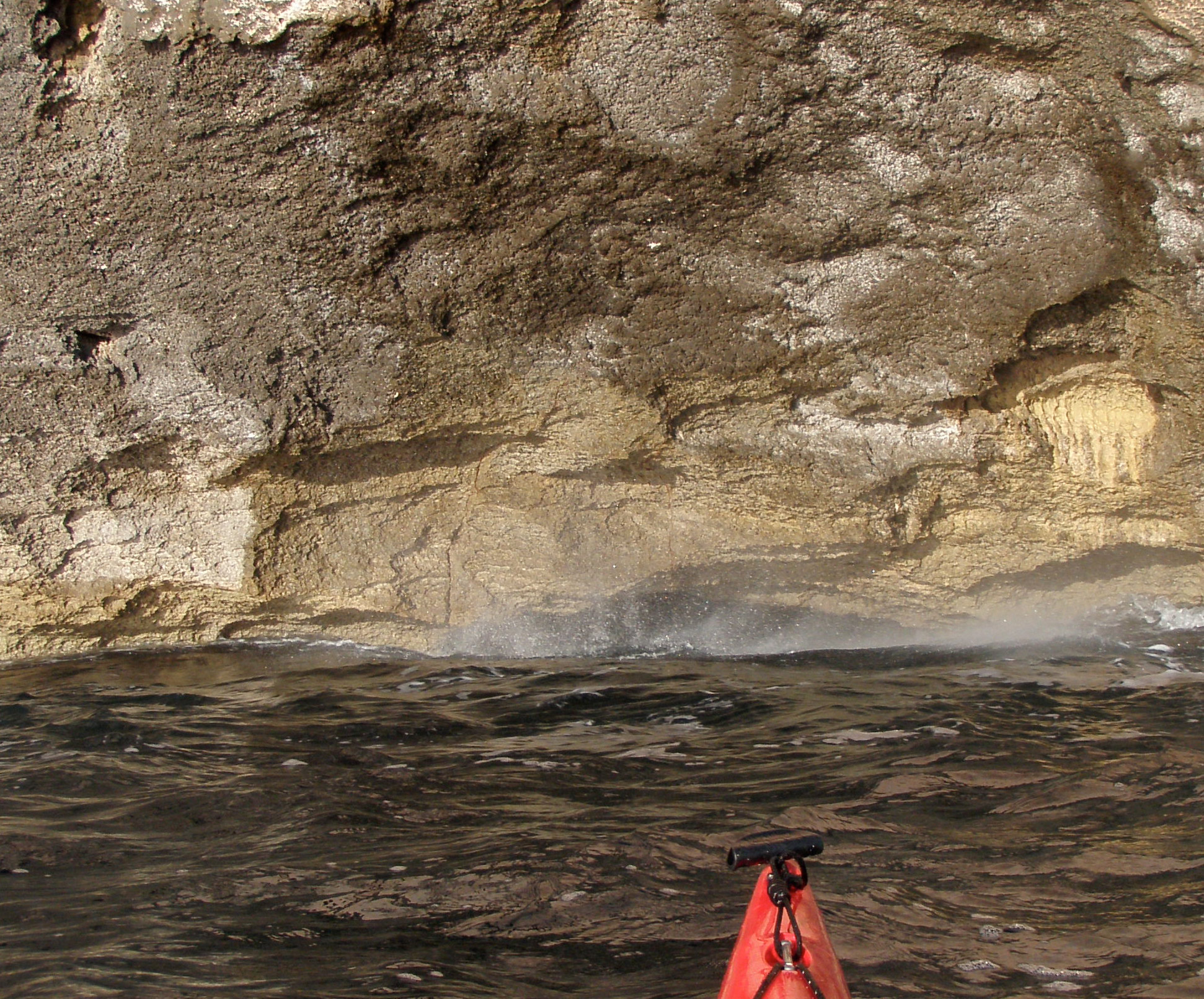
Some caves, like the one pictured here—barely visible just above the bow; also seen in the next photo— were just below sea level and repeatedly filled with water pushed in by the low swell rolling in from the south. Air trapped inside would get compressed…
…and explode outward in a plume of spray. Other semi-submerged caves had wider openings and the air pushed out sounded like a deep sigh. Two of them led to long chambers that echoed the sound of waves rolling in, which created an unnerving sound as if someone trapped inside was moaning.
I made my second camp at Cala Sant Lorenç, a cove with sides so high and steep that my SPOT satellite messenger couldn’t get a signal out. There was an abandoned stone-walled boathouse at one end of the beach. It was filled with rubble and was rank with animal droppings, so I made my camp several yards away with my hammock stretched between two head-high rocks. Partway up the flanks of the hill to the south, I spotted two goats silhouetted at the edge of the woods; there appeared to be another cave right behind them.
In the morning I climbed the slope to where the goats had been grazing and found this cave. Inside there was a mattress, some cooking supplies, and a handle-less broom made of twigs lashed together.
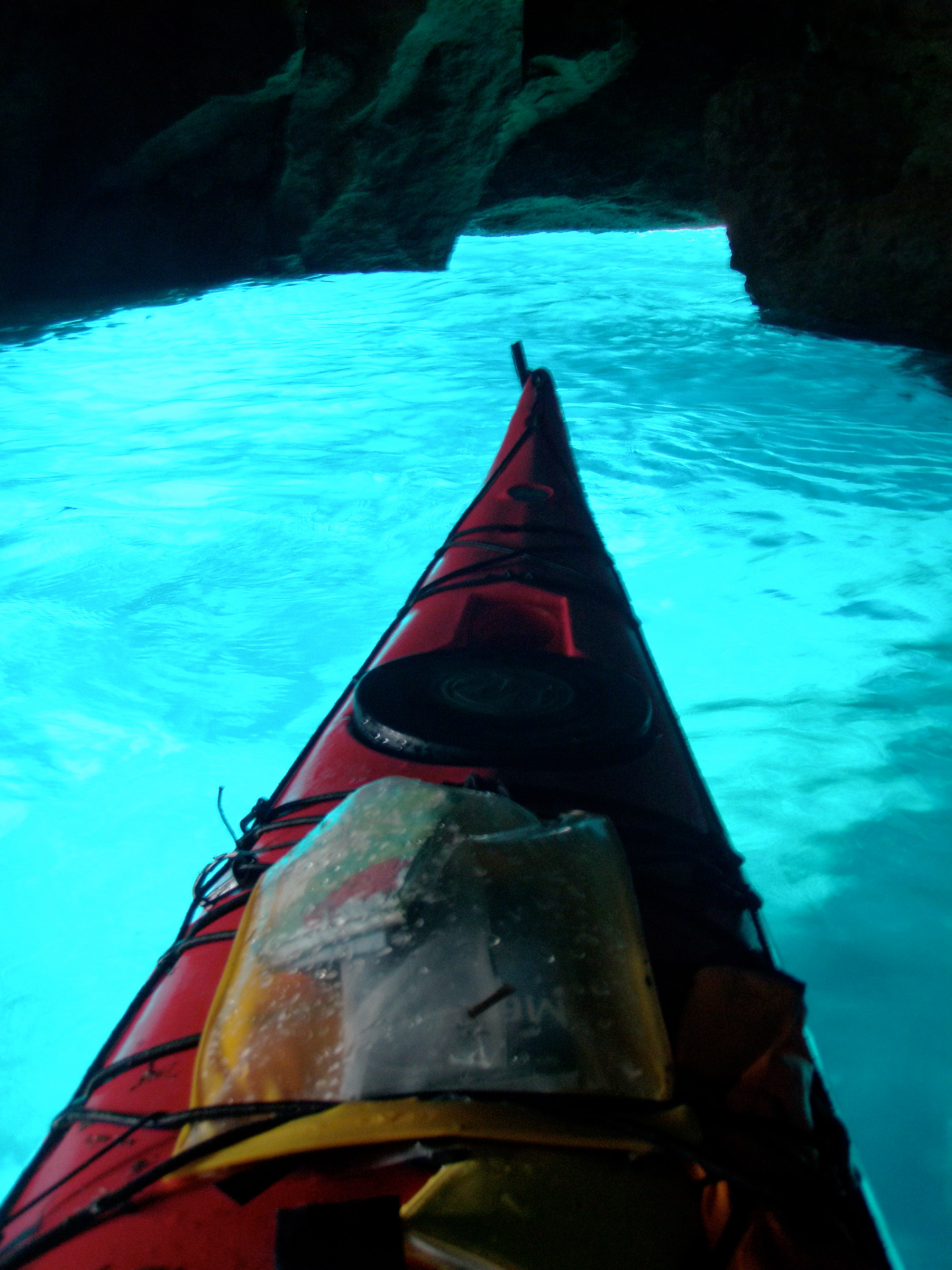
I paddled into just about every sea-level cave that was safe to enter, mindful that if there were unusually high swells that I’d need plenty of headroom to ride them out while I was in the cave. I found grottoes like this that were lit from above by gaps in the cliff and from below by light striking a white-sand bottom.
There were some caves that wove intricate paths under the cliffs and I found places where the only light came from sunlight angling under the cave walls, illuminating the white limestone sand below. I had never seen color like this before anywhere in the natural world; the only other place I’ve seen anything remotely like it is in the beads of light-blue flame that form around each hole in a butane camp-stove burner head. To be floating in that light was mesmerizing.
The stairway built on the side of this cliff had 186 steps and railings of olive wood polished smooth and shiny by countless hands. After I climbed to the top, I descended and crept through the pile of boulders at the base of the stairs with a grapefruit-size rock in hand. Large blocks of Menorca limestone ring like bells when struck. The pitch of the tone coming from a boulder wasn’t related to its size, but each had a note so clear that the slope of boulders could be set up as a musical instrument.
At Calas Coves there were scores of caves, some prehistoric, some with inscriptions carved into the stone in Latin. Many of the caves were for burials; Calas Coves is Menorca’s largest necropolis. I found a few caves on the east side of the inlet that were clearly living quarters with separate carved chambers for sleeping and cooking.
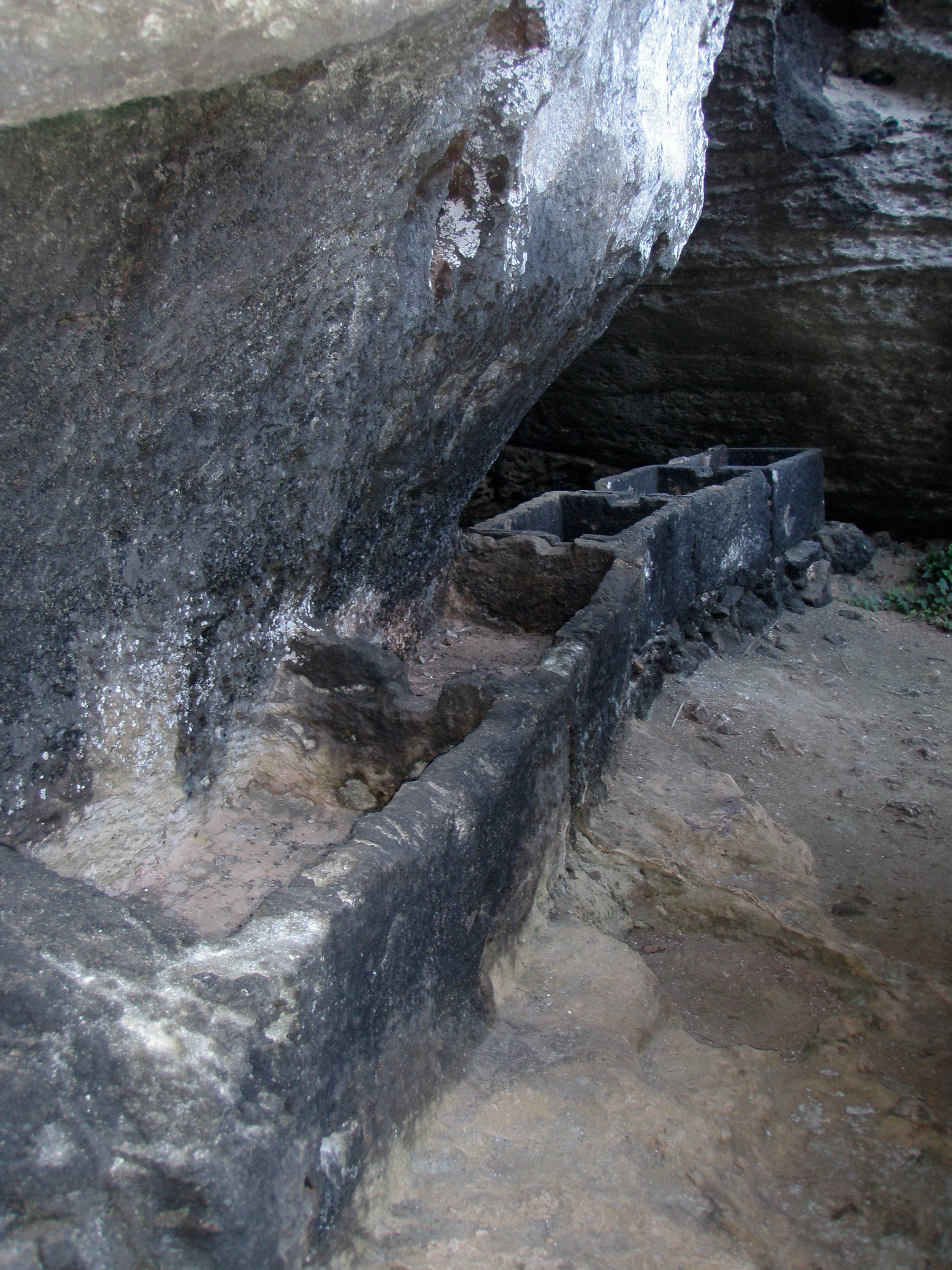
I landed on the west side of Calas Coves and hiked to the top of the cliffs. On my way up, I saw this series of carved-stone troughs, each with a recess in the top edges of the walls between them. I believe it was built to treat water. If a heavy rain picks up dirt and litter as it flows downhill, each of the troughs would let sediment settle before the water flowed into the next trough. At the end of the line, the water would be clear and the process would be faster than accumulating all the water in one container and waiting for it to become still enough for the sediment to gather at the bottom.
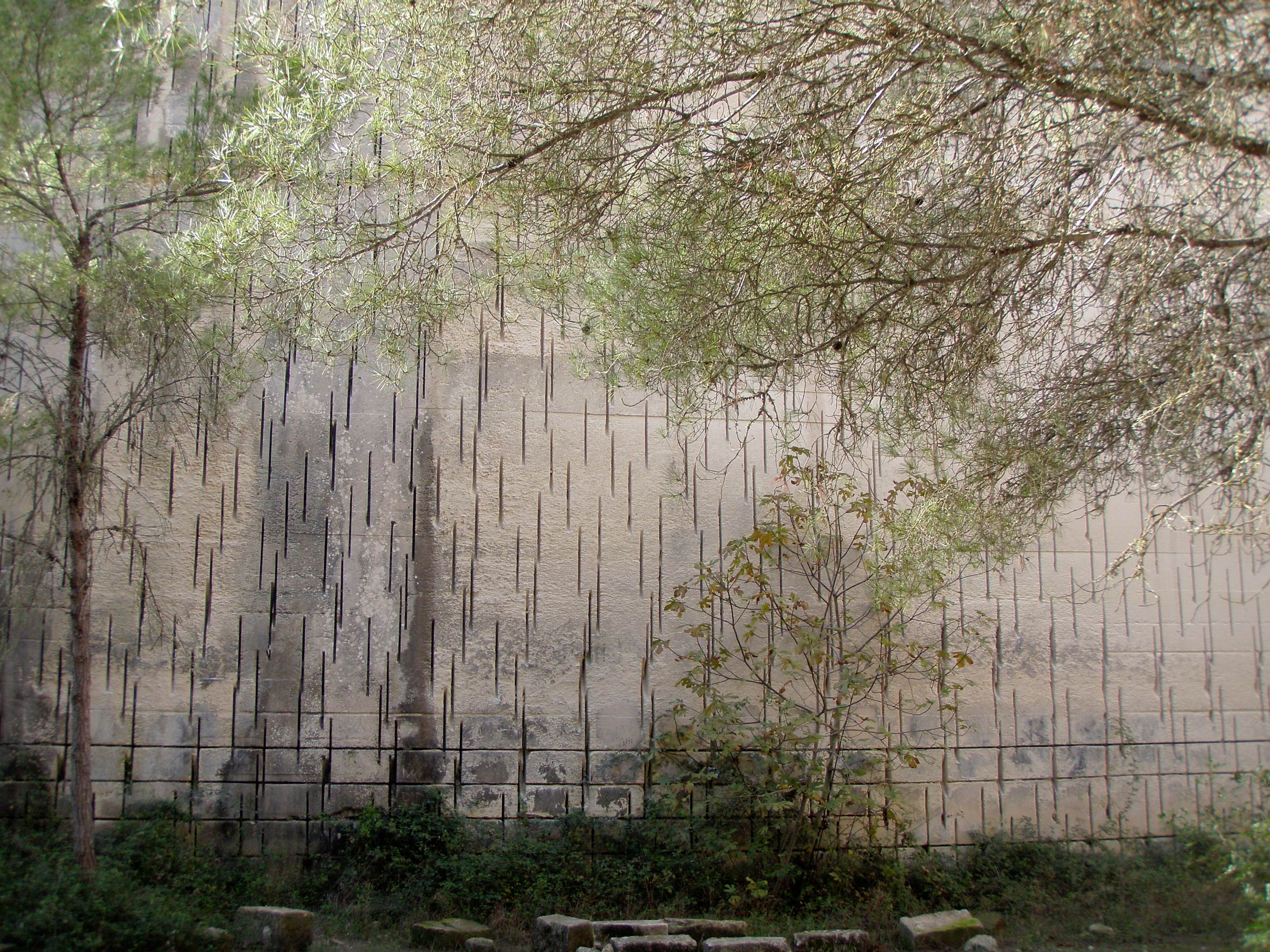
There was an old quarry a short walk from one of the beaches I visited. Limestone had been cut by hand for building material on Menorca since Neolithic times, but using machinery to do the job lasted only from 1960 to 1994. This quarry had three flat 35′-high vertical walls that showed marks where the cables had made precise straight cuts in the stone.
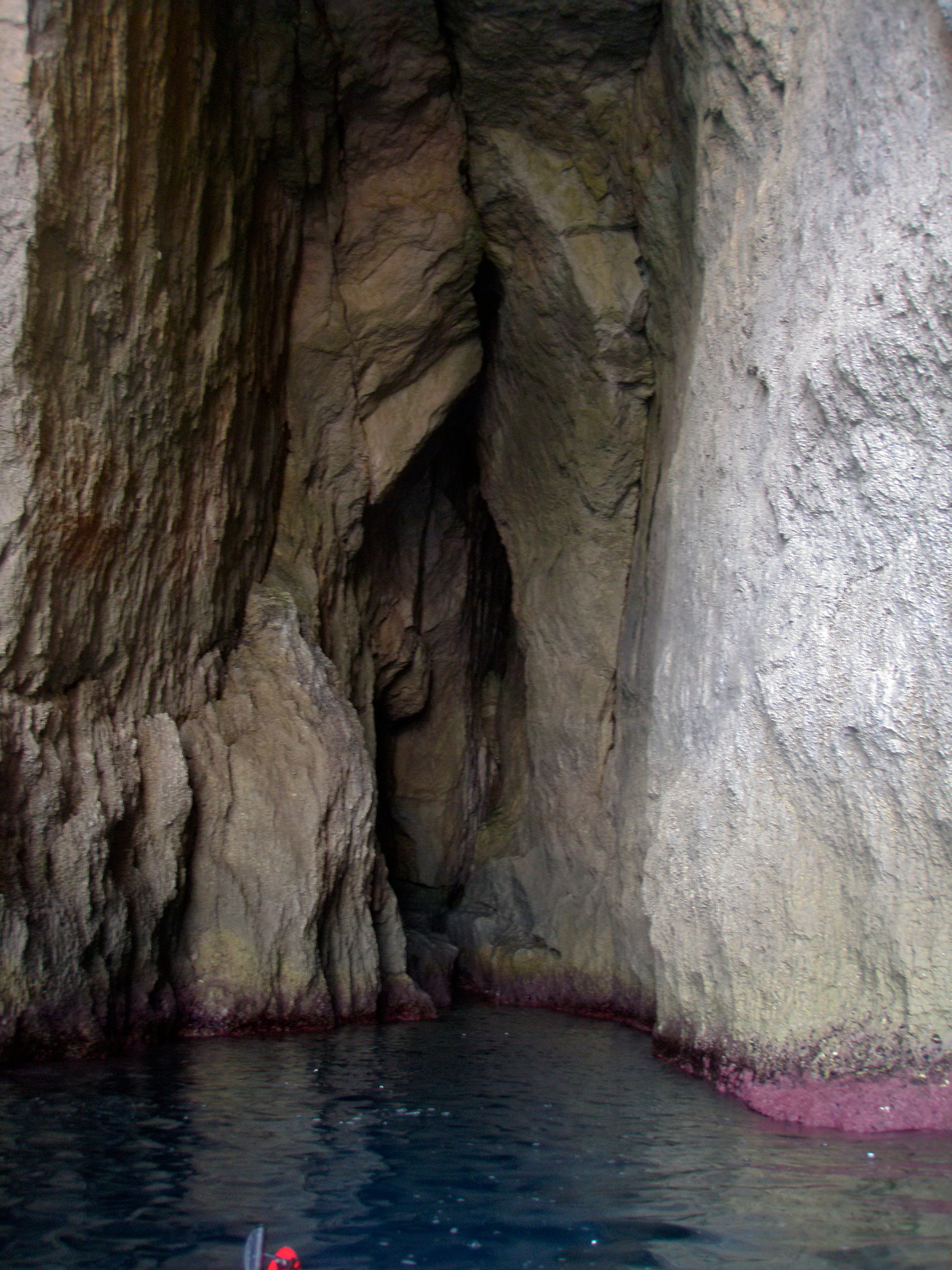
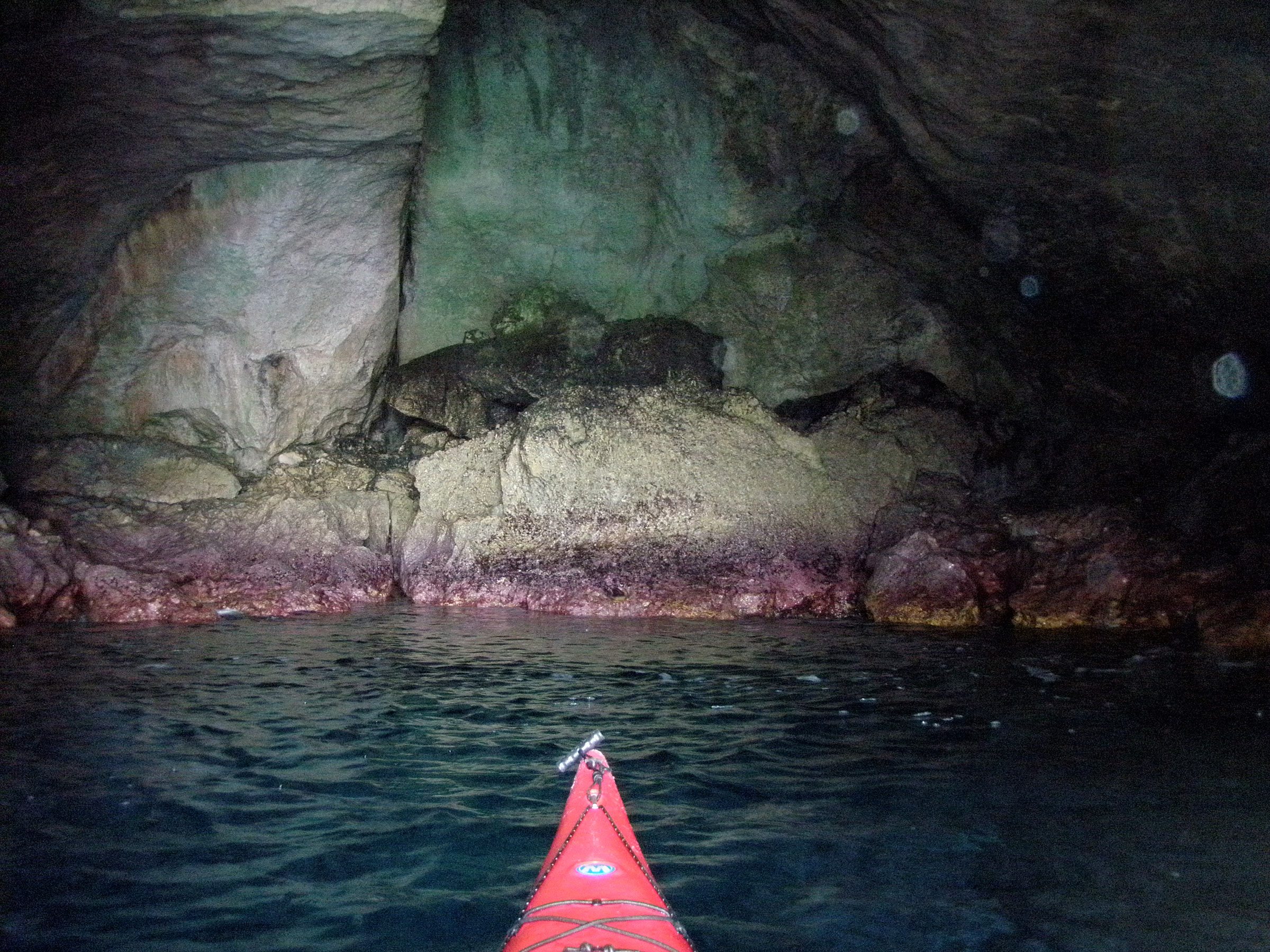
I hadn’t paddled far into this towering cave before I realized I’d need a better flashlight before continuing. I backed out and paddled west to the town of Cala Galdana to get one. With better light I paddled deeper into the cave, well past the bend in the passageway that blocked all light from the entrance.
I estimated that I had paddled about 100 yards before I came to the end of the cave. The ceiling had lowered but was still high enough, a bit over 10′, to be safe if a swell pushed in. The limestone took on beautiful colors from dusty pink and purple just above the waterline to pale verdigris green overhead. The final chamber was about 25′ in diameter, large enough for me to get the kayak turned around, and when I turned the flashlight off and let the darkness envelop me, the echoes made the space sound like an empty gymnasium.
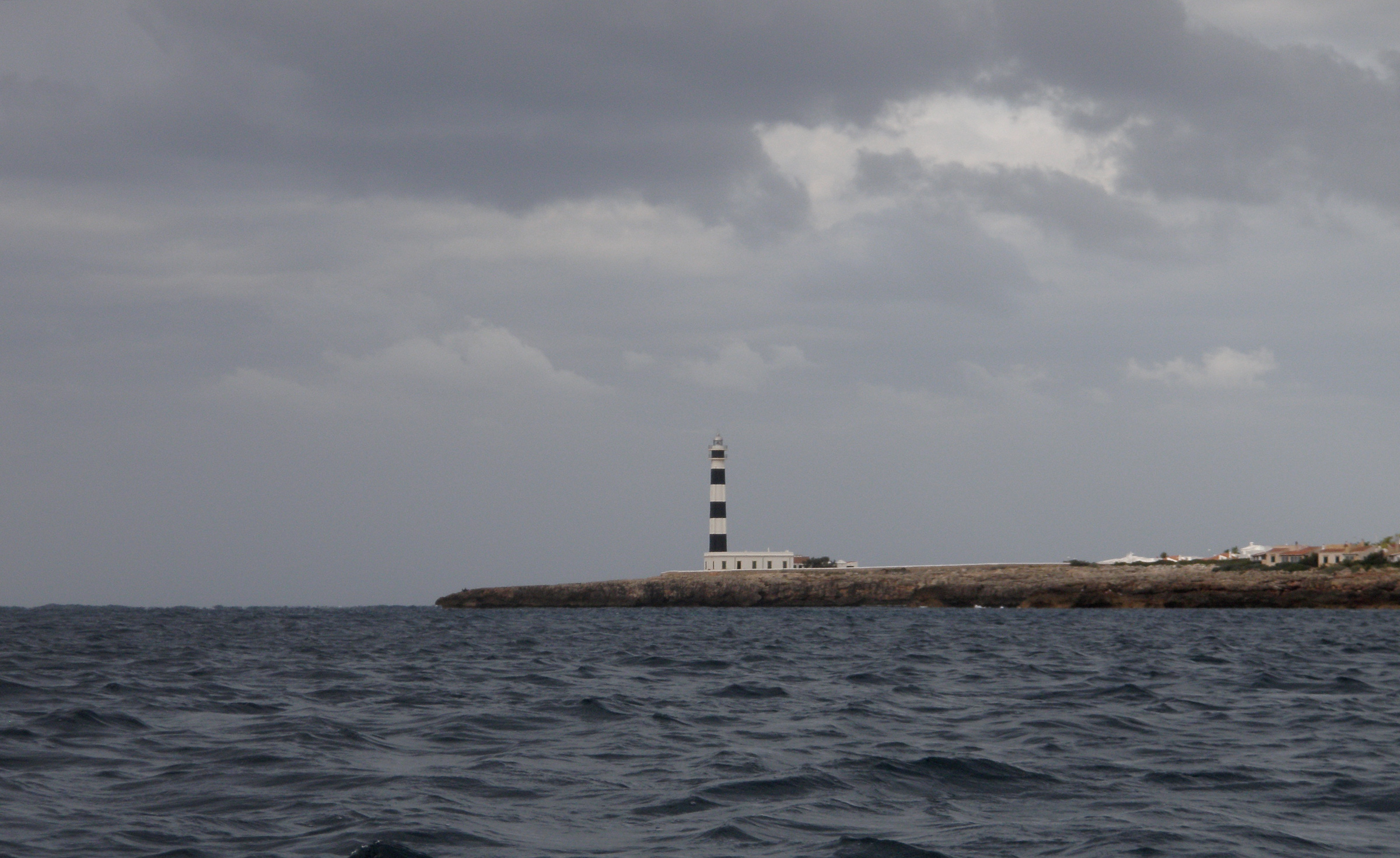
When I reached the west end of Menorca’s south coast, the Tramontana was still blowing hard and large waves were racing past the lighthouse at Cap d’Artrutx. I paddled into the harbor in the town of Cale en Bosc to wait for Carlos to pick me up. In the five days I’d had to paddle Menorca, I’d seen much more than I had ever hoped to see even if I had kayaked around the entire island.
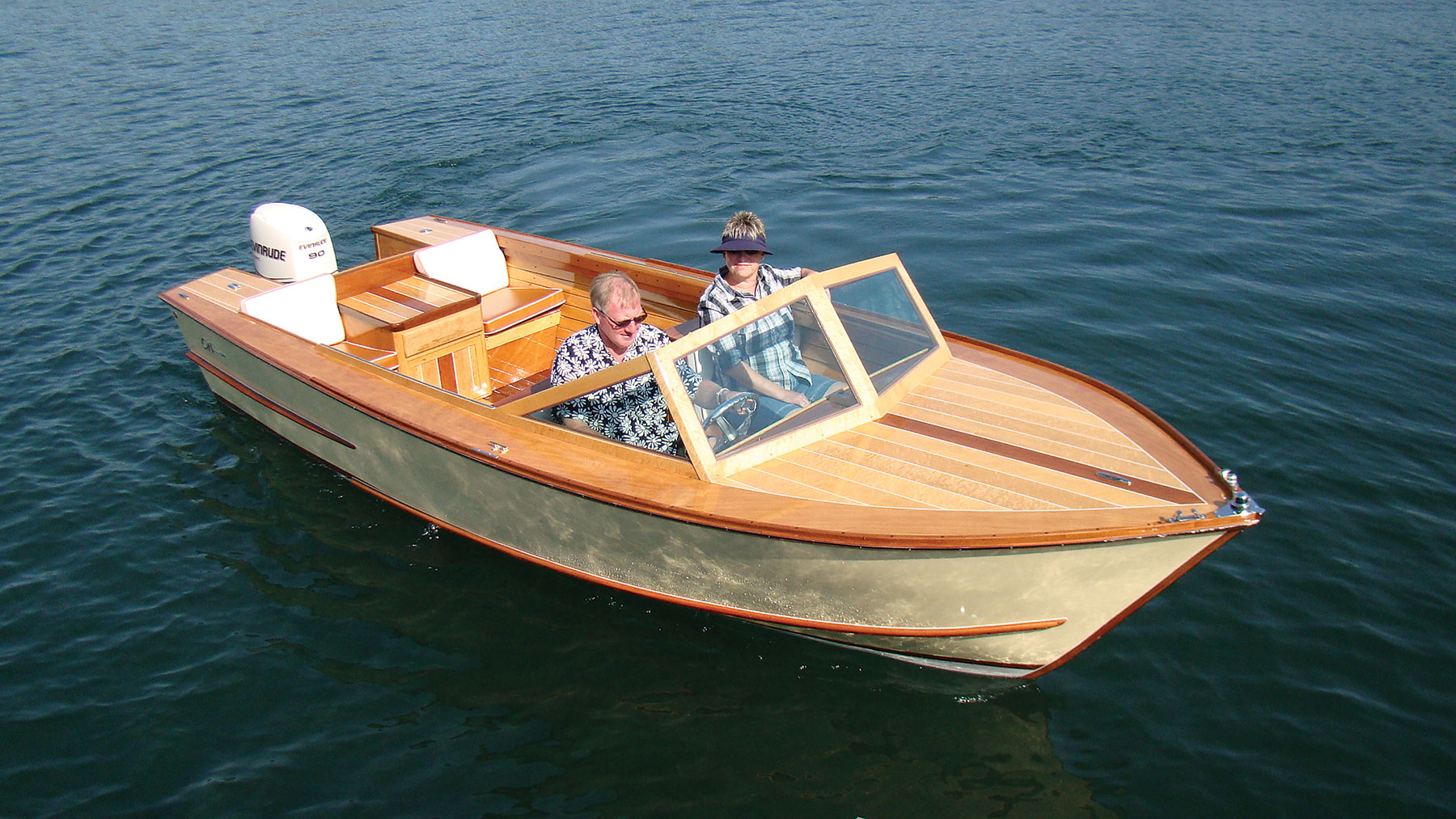
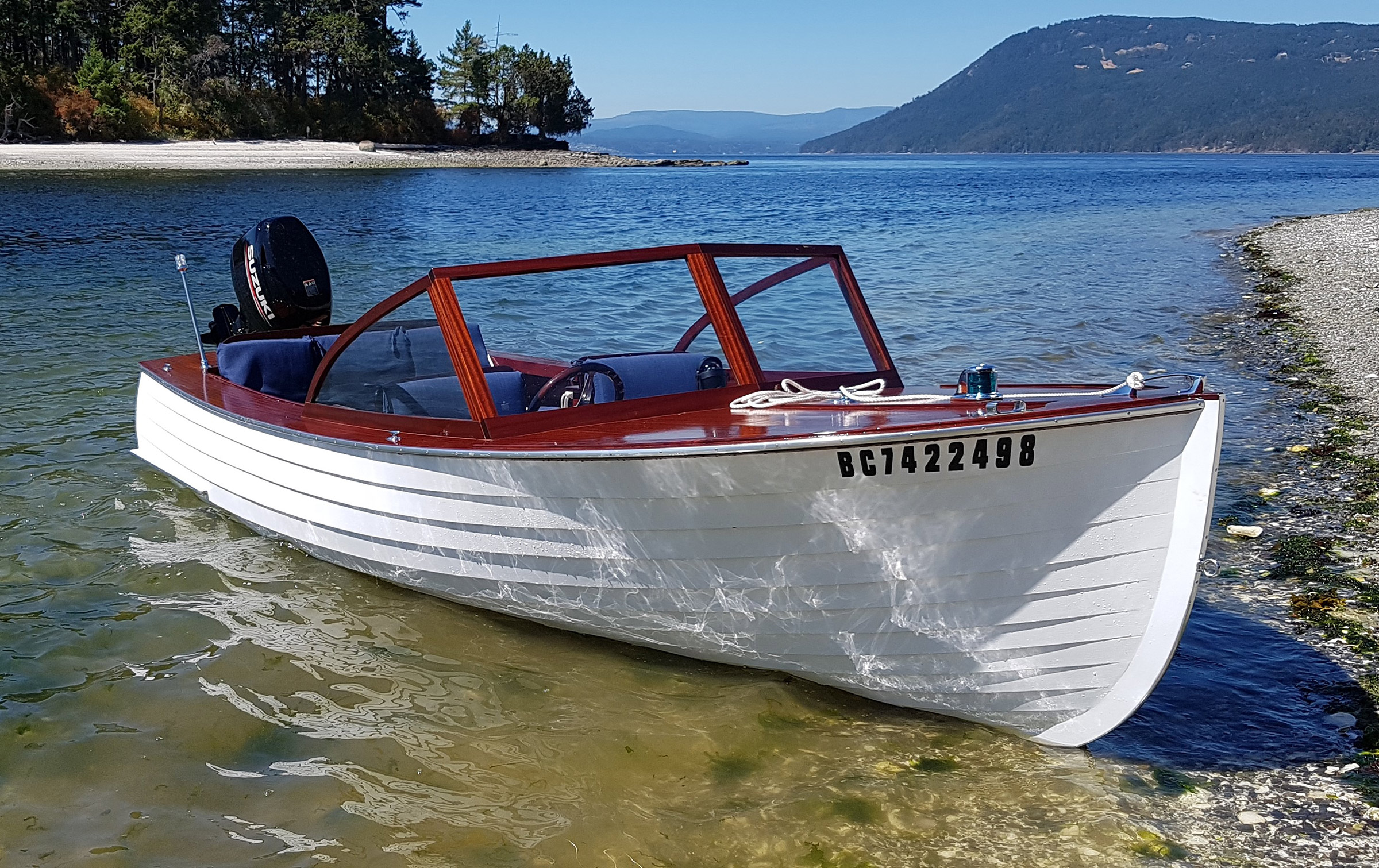
Skimming across Copper Harbor, the Manitou 18 summons memories of lazy summer days in the 1950s on waterfronts across America. Built for coastal running on the Great Lakes and the region’s large inland waters, the eye-catching runabout—18′ LOA, with a 6′ 7″ beam—features a deep-V hull, substantial deadrise, and a sweeping sheer. Based on the Downeaster 18 by Charles W. Wittholz, the boat is a contemporary rendition by Copper Harbor Boat Works, a small shop on the tip of Michigan’s Keweenaw Peninsula, which juts into Lake Superior.
After building two small runabouts, the Boat Works sought a design that was better suited for the often choppy waters along the Lake Superior shoreline. Research led the shop’s founder, Ray Chamberlain, to the Wittholz runabout. In 1986, WoodenBoat Publications commissioned Graham Ero to build a Downeaster 18 (see WB Nos. 73, 74, and 75). Contacting Ero in Still Pond, Maryland, Copper Harbor boatwright Jeff Coltas inquired about the boat’s performance and solicited suggestions regarding its construction. Satisfied with the design and Ero’s feedback, Chamberlain decided to move ahead with the Manitou 18 project.
On a blustery midwinter day, with snow swirling in the north woods near the Lake Superior shore, the three-man crew commenced lofting the Manitou 18 in the shop’s snug confines, a small barn warmed by a fire crackling in the wood-burning stove. Lofting proved to be the most difficult step in the process, according to Chamberlain. The plans contained a table of offsets, but no patterns, requiring full-sized plywood templates to be fully developed for each part. While working straight from offsets may seem daunting to some, a builder with intermediate skills or an amateur who is very dedicated can build this boat. Of course, familiarity with lofting is also a good idea.
George D. Jepson
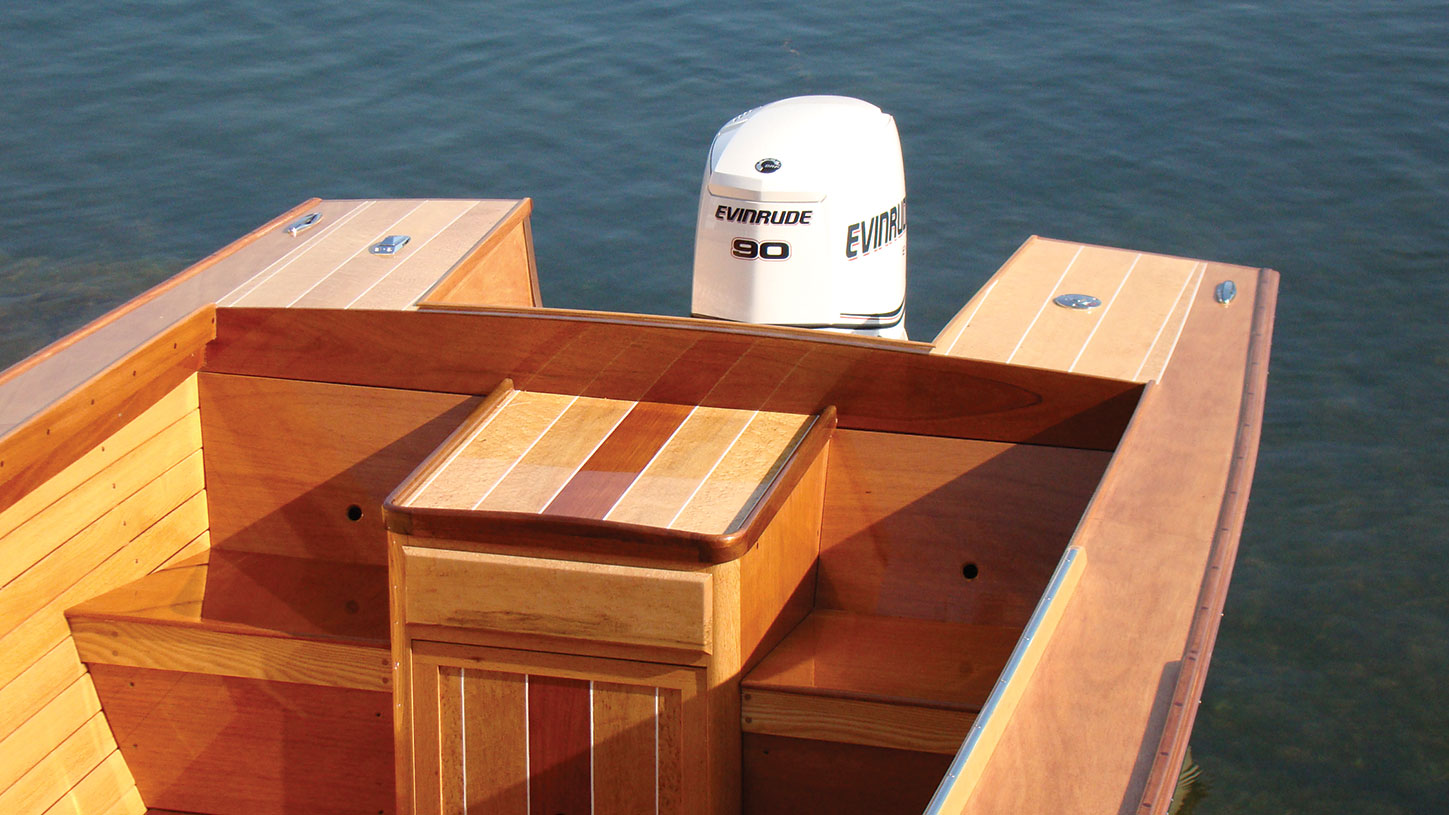
A storage compartment separates the two stern seats providing space for the fuel tank.
With Wittholz’s plans to guide them, the team began the hull’s plank-on-frame construction. Frames sawn from 3⁄4″ marine plywood and secured to the strongback hinted at the hull’s eventual shape. The frames were paired with pieces of red oak, providing a better surface on which to fasten the planks. The builders cut the 13⁄8″ keel and the keelson from mahogany, the stem from ash, and the sternpost from red oak. While white oak is generally accepted as a better boatbuilding wood than red oak, because of red oak’s known porousness, Chamberlain reasoned that encapsulating the wood in epoxy should provide sufficient protection against decay. Some builders will feel safer using white oak instead. They laminated two layers of 3⁄4″ mahogany plywood to form the transom.
Coltas reported that the Downeaster 18’s hull had a tendency to flex with the 9mm plywood planks specified in the plans. To strengthen the hull, the crew added one more frame and hung thicker, 12mm okoume side and bottom planks. Two additional Sitka-spruce stringers—six in total—further stiffened the bottom. Turning the hull upright, they noticed that the bow was a little high, but Coltas and crew liked the look, so rather than cutting it back they simply put a little more sweep in the sheer than was called for in the plans.
George D. Jepson
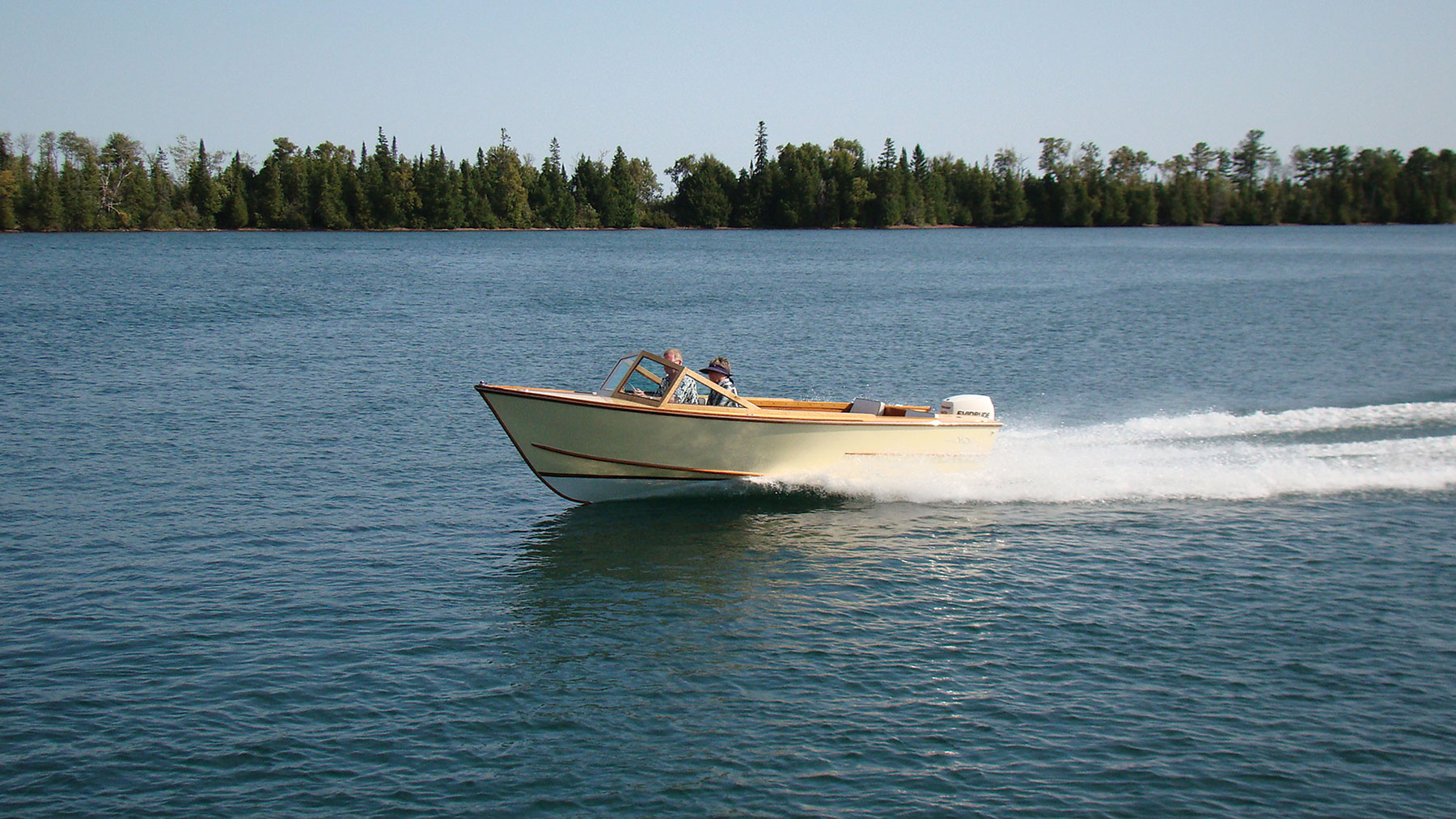
The runabout handles Lake Superior nicely, providing a dry, comfortable ride.
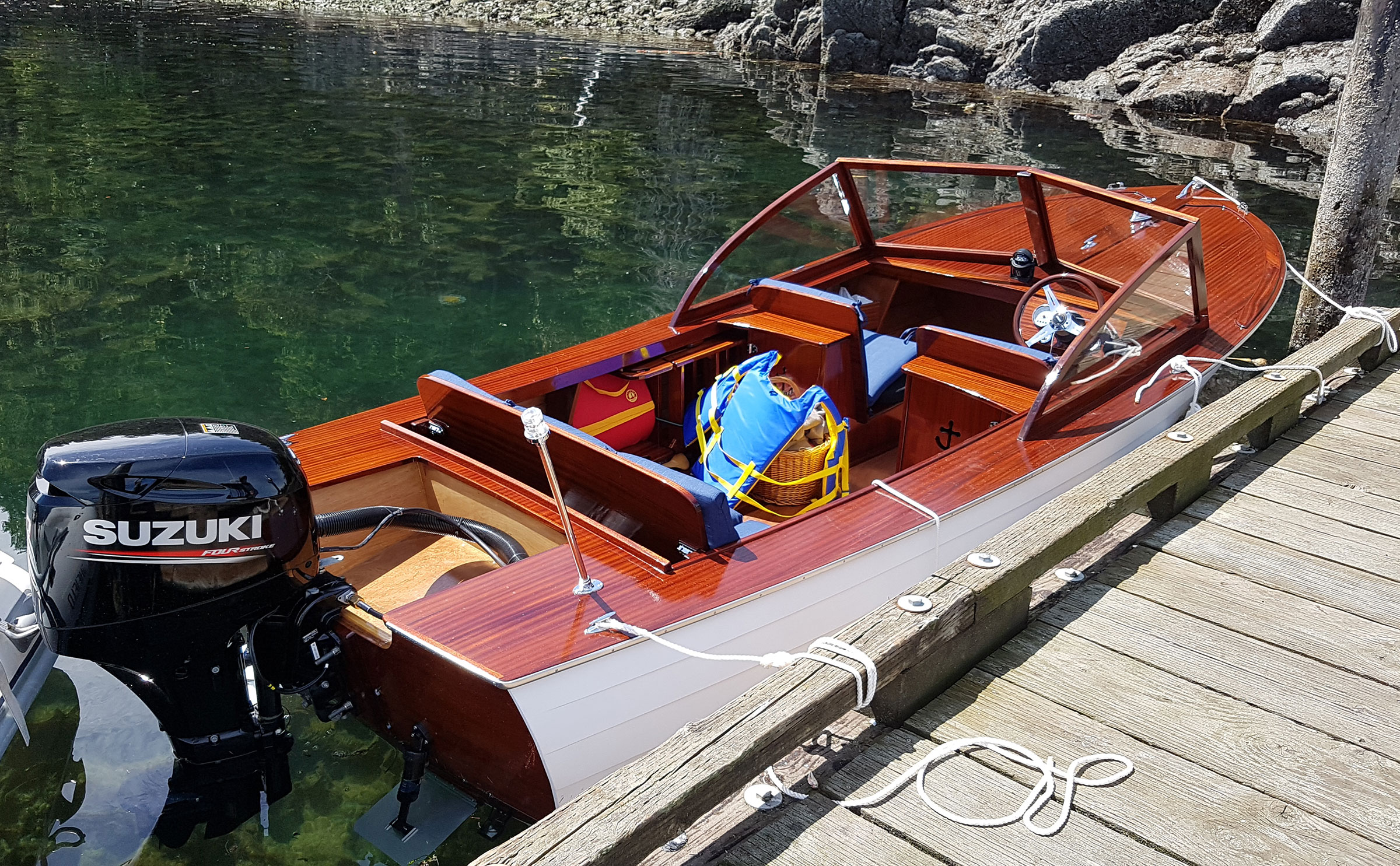
Once work began on the interior, the builders adjusted the seating plan. Moving the forward bench aft a few inches provided greater legroom and comfort for the helmsman and a passenger. Two stern seats, separated by a storage cabinet, completed the arrangement. Outboard fuel tanks are stored under the seats, which were fabricated from mahogany plywood. Most internal parts, including the seats, are fastened with stainless-steel screws, making them easy to remove. The sole is attached with bronze screws. This simple helm-forward plan provides ample space and storage for one to six on a daylong cruise.
The Manitou 18’s elegant interior and decking are among its most stunning features. Pinstriped fore and aft decks, built with 1⁄4″ bird’s-eye maple over 6mm okoume, add to the boat’s charm. The builders made the ceiling from quartersawn red oak and the sole from black walnut and red oak, and framed the windshield in maple.
The Boat Works sealed everything in epoxy before finishing, and paid careful attention to details when they applied the finish. They gave the entire boat—inside and out—two to three coats of clear epoxy, then painted the topsides with four coats of pale yellow, two-part polyurethane. Below the waterline, they applied four coats of white Teflon bottom paint. Interior surfaces and the decks were finished bright, with at least five coats of varnish. The team expended over 700 hours on this project.
In addition to the helm-forward layout, the boat is also available with a center-console configuration. The versa tile design accommodates multiple power options. This particular boat is driven by a 90-hp Evinrude E-Tec outboard, but was designed for 40- to 100-hp outboard motors. Other alternatives include an inboard/outboard or jet drive, as well as an inboard engine. Instrumentation includes a speedometer, tachometer, fuel gauge, and ammeter.
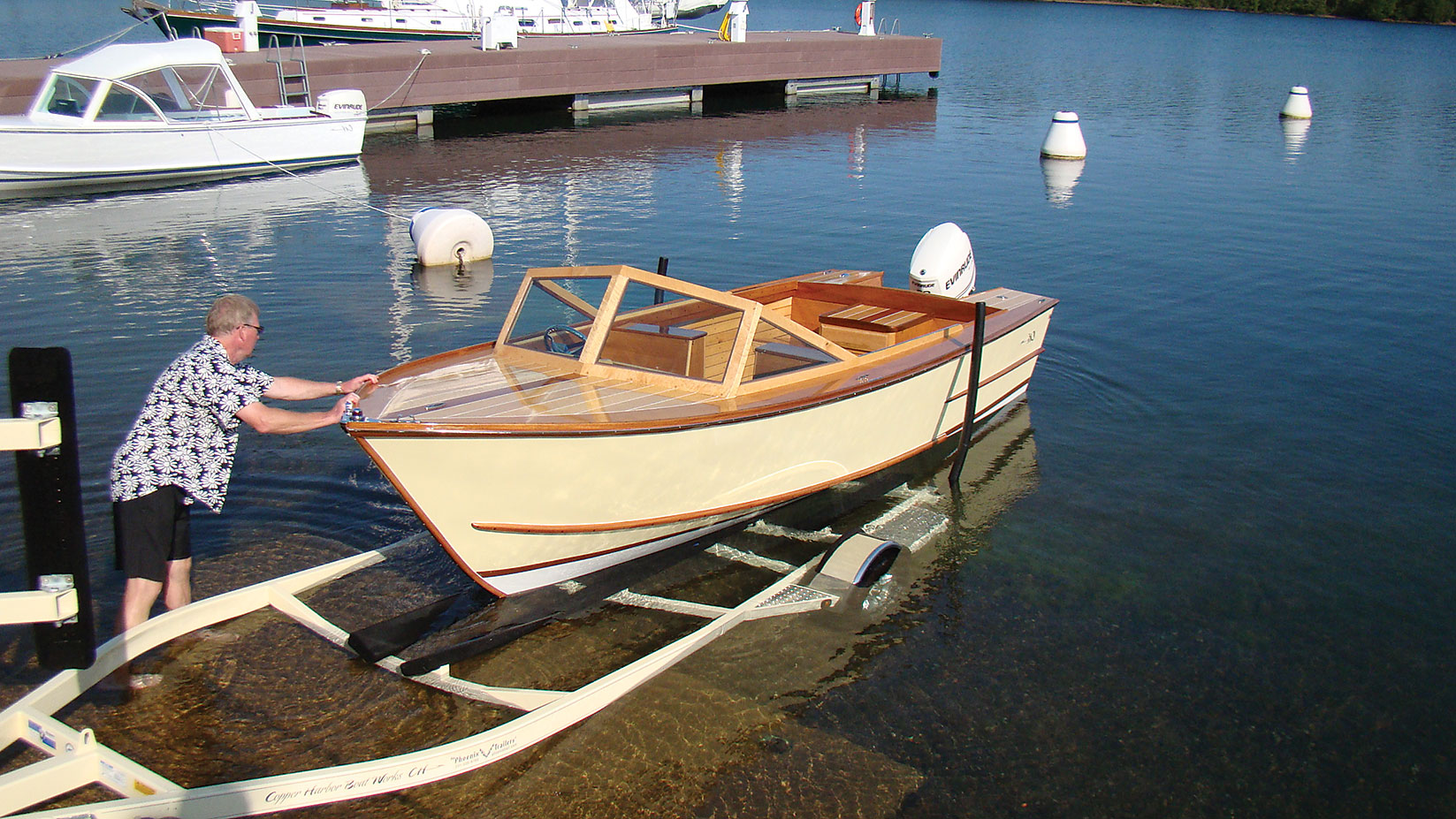
The seating and propulsion options will meet a variety of boating needs, from coastal cruising to pulling water skiers to picking up groceries at the local marina market. Easily trailered and simple to launch at public ramps, the Manitou 18 can be kept dry and under cover on its custom trailer—a good idea for any fine boat—or moored in front of the family cottage.
George D. Jepson
The Manitou’s attractive lines should earn some second looks at the launching ramp.
On a late-summer morning, I drove northeast on U.S. 41 toward Copper Harbor, a small, picturesque town. Under a brilliant clear-blue sky trees already displayed splashes of color, a sure sign that the boating season on Superior—called the “Big Lake” by those living near its shores—was nearing an end. At Copper Harbor Boat Works, the Manitou 18 sat on her trailer near the boat ramp. Less than five minutes after I saw her, she slid into the crystal water, reflecting her lustrous natural woods under the northern sun.
This is a charming little showboat, displaying impeccable workmanship from stem to stern. Chamberlain chose to trim the Manitou 18 with these special woods and the bright finish, but, in my opinion, she would also look comely with less brightwork and a painted finish. The latter option would hold up better against heavy use, too.
As we stepped aboard the runabout at the Boat Works dock, a light zephyr rippled across the water’s surface. Otherwise, all was still in the vast harbor, which stretches for nearly 3 miles and opens into Lake Superior. The Manitou 18’s chrome wheel and steering knob are throwbacks to the days of rock-and-roll and hot wheels, from customized roadsters to the early muscle cars, and reflect Chamberlain’s passions for speed and music with a classic ’50s beat.
As I edged the throttle forward, the boat literally flew over the water, streaming a clean wake. Momentarily, my mind drifted back to the late ’50s and early ’60s. Strains of Doo Wop tunes played in my subconscious, recalling endless summers on the water, pulling skiers or cruising along the beach. I was at the wheel of our old family runabout again, with the wind in my hair and Superior’s blue water spread before me.
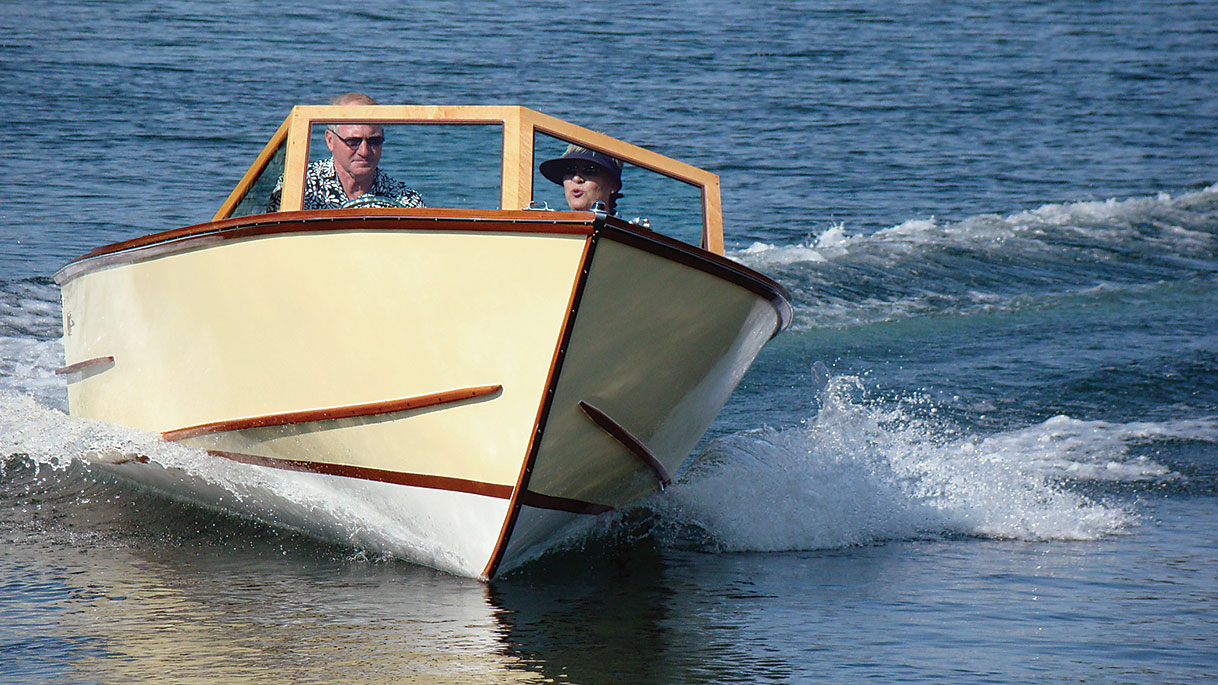
The ride was smooth, even as we approached 40 mph. The boat and motor were relatively quiet. Powering into turns, the Manitou 18 responded with ease. As we accelerated on the straightaway, the stern barely squatted and the boat once again rose up on plane. It sliced through a building chop with minimal buffeting. At cruising speeds, the Manitou 18 is level and balanced. Chamberlain plans to add trim tabs to further balance the relatively light boat when there is just one person aboard.
Conditions were nearly perfect on this day, hardly challenging the Manitou’s capabilities. During earlier sea trials, the boat proved her mettle, powering through 2′ to 3′ seas in Lake Superior with her V-bow. The boat’s narrow entry makes her a bit tender side-to-side, but that’s the trade off we make for speed. The runabout is well suited for coastal waterways, whether fresh or salty. She handles Lake Superior nicely, providing a dry, comfortable ride.
George D. Jepson
The Manitou is rated for 40- to 100-hp outboard motors. With a 90-hp Evinrude E-Tec outboard, she flew across the water, giving a smooth ride at speeds up to 40 mph.
Overall, the Manitou 18 is simple to operate and is roomy enough to fit two additional seats just aft of the forward bench seats. Custom-made seat and back cushions give added creature comfort to the helmsman and passengers. Storage cabinets behind the forward seats are handy and suitable for towels or extra gear, such as binoculars. The boat is an extremely versatile modern classic, offering years of enjoyment with minimal maintenance.
Whether viewing the Manitou 18 moored dockside or sweeping through a sharp turn, boaters with a touch of gray will recall the time a half century ago when vintage wooden runabouts turned heads on waterfronts from coast to coast.
Plans for the Downeaster 18 can be ordered from The WoodenBoat Store. Copper Harbor Boat Works is no longer in business.
These plans by Charles Wittholz appeared in WoodenBoat No. 73 as the first part of a three-part article by Graham Ero called “Building the Downeaster 18.” Copper Harbor’s modifications included raising the sheerline at the bow, using 12mm planking, and installing two additional stringers and one more frame. Particulars: LOA 18′, Beam 6′ 7″, Draft 1′ 1 1⁄2″, Displacement 1765 lbs (dry), Power 40–100 hp.
When I was in Sea Scouts in high school, I got to sail a Lightning, and it became the standard by which I have since measured all small sailboats. I have always wanted a small sailboat of my own but, as awesome as a Lightning is, it is too big and heavy for me to manage on my own. I had grown to hate dealing with trailers and stayed masts, and wanted something I could transport on top of the car. For many years, I searched for the perfect boat, keeping a growing file of likely designs.
I found some promising candidates in Reuel Parker’s The Sharpie Book and Howard Chapelle’s American Small Sailing Craft, but I discovered the boat of my dreams when I saw the lovely Drake 13 Sharpie from Selway Fisher.
There are three Drake sharpies: an 11-footer, an 18-footer, and (for my needs) the “just right” 13′ boat. I ordered plans and they arrived from England, folded in a packet. While the four pages of drawings and eight pages of instructions are clear and well-detailed, it proved very helpful for me to have built a few boats: a Bolger Cartopper rowboat and a 13′ Pete Culler Butternut double-paddle canoe.
I studied the Drake 13 plans carefully and decided on a few changes. I would want to sit on the bottom of the boat, which meant changing the centerboard shown in the drawings to a daggerboard for its shorter trunk. I also preferred a balance lugsail to the standing lug in the plans because the balance lug is so tunable and maybe more importantly, I think it looks cooler. The sail plan I drew has about 7 sq ft more sail area, an increase of about 10 percent. Douglas Fowler made the sail to the drawings I provided.
Photographs by Buddy Levy
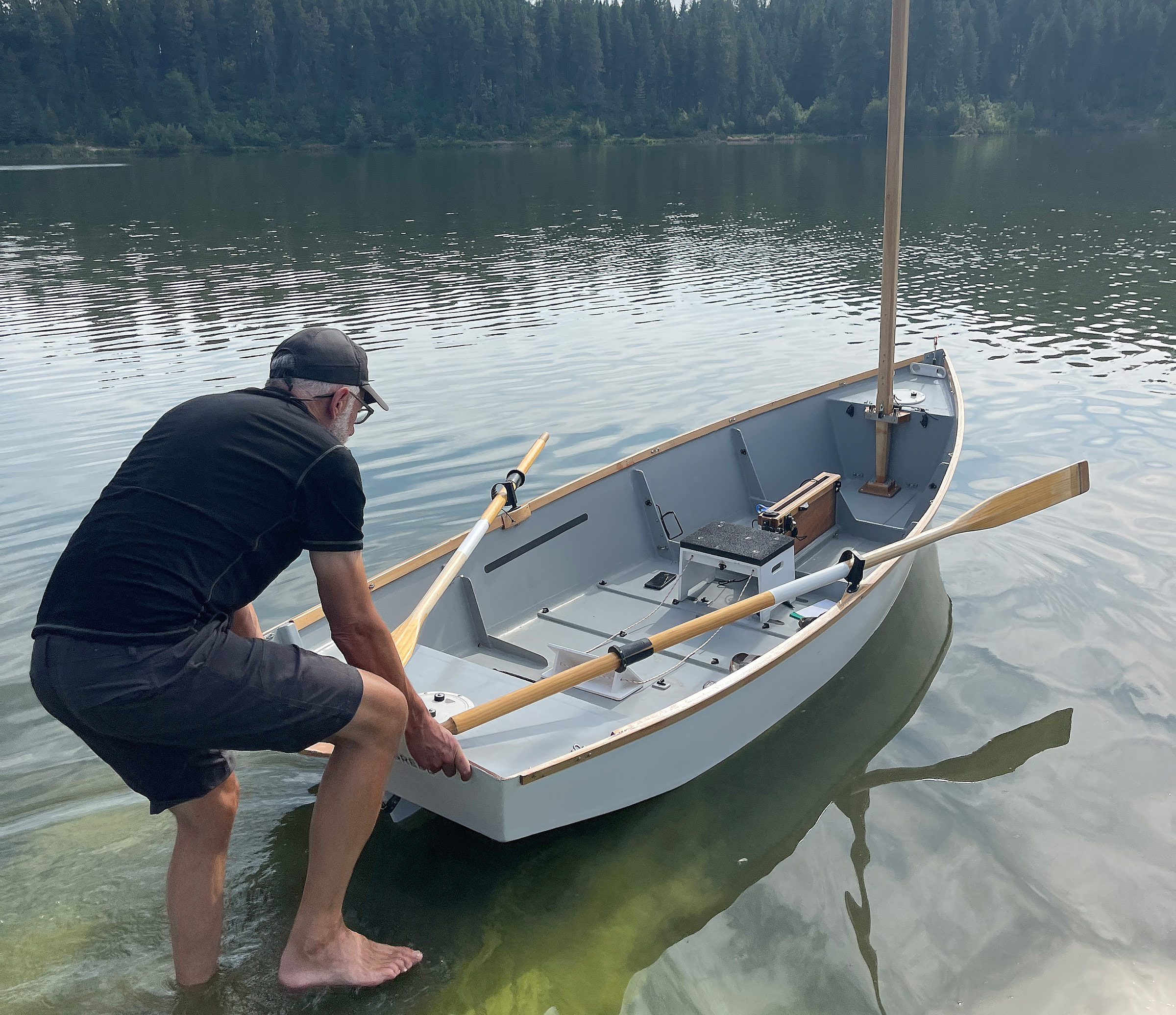
The plans offer options for building plywood-on-frame or stitch-and-glue. While the original design calls for two thwarts and a centerboard, this boat has a stool for rowing and a daggerboard for sailing. Sealed compartments in the ends provide flotation.
Paul Fisher, the designer, assured me that the modifications I had sketched would work but, just in case, I made the daggerboard slot longer than necessary so that I could adjust the center of lateral resistance if I got the sailing balance of the boat wrong. That, and the adjustability of the balance lugsail position, would also give me the ability to fine-tune the balance. I shaped a piece of closed-cell foam that fits in the daggerboard slot vertically to hold the daggerboard in place and then fits into the trunk horizontally to fill the slot when rowing.
The plans offer two construction methods: plywood planking over frames and stringers or stitch-and-glue. I opted for stitch-and-glue because I know the system well and it creates a very strong hull that’s light in weight and provides a clean, smooth interior that’s easily maintained.
The instructions provided with the drawings note that plywood can be either marine or exterior grade, but I didn’t want to use fir exterior plywood as it checks badly unless covered with fiberglass. I ordered five sheets of Joubert okoume plywood.
I butt-jointed the plywood pieces with ’glass on both sides instead of using butt straps or cutting scarf joints, as shown in the drawings. On the lengthened sheets, I laid out the panel shapes with a series of penciled tick marks according to the measured drawings. I connected those points into fair curves using a flexible batten and then cut out the panels. Stitching the four panels together—bottom, two sides, and transom—rapidly turned them into something resembling a beautiful little boat.
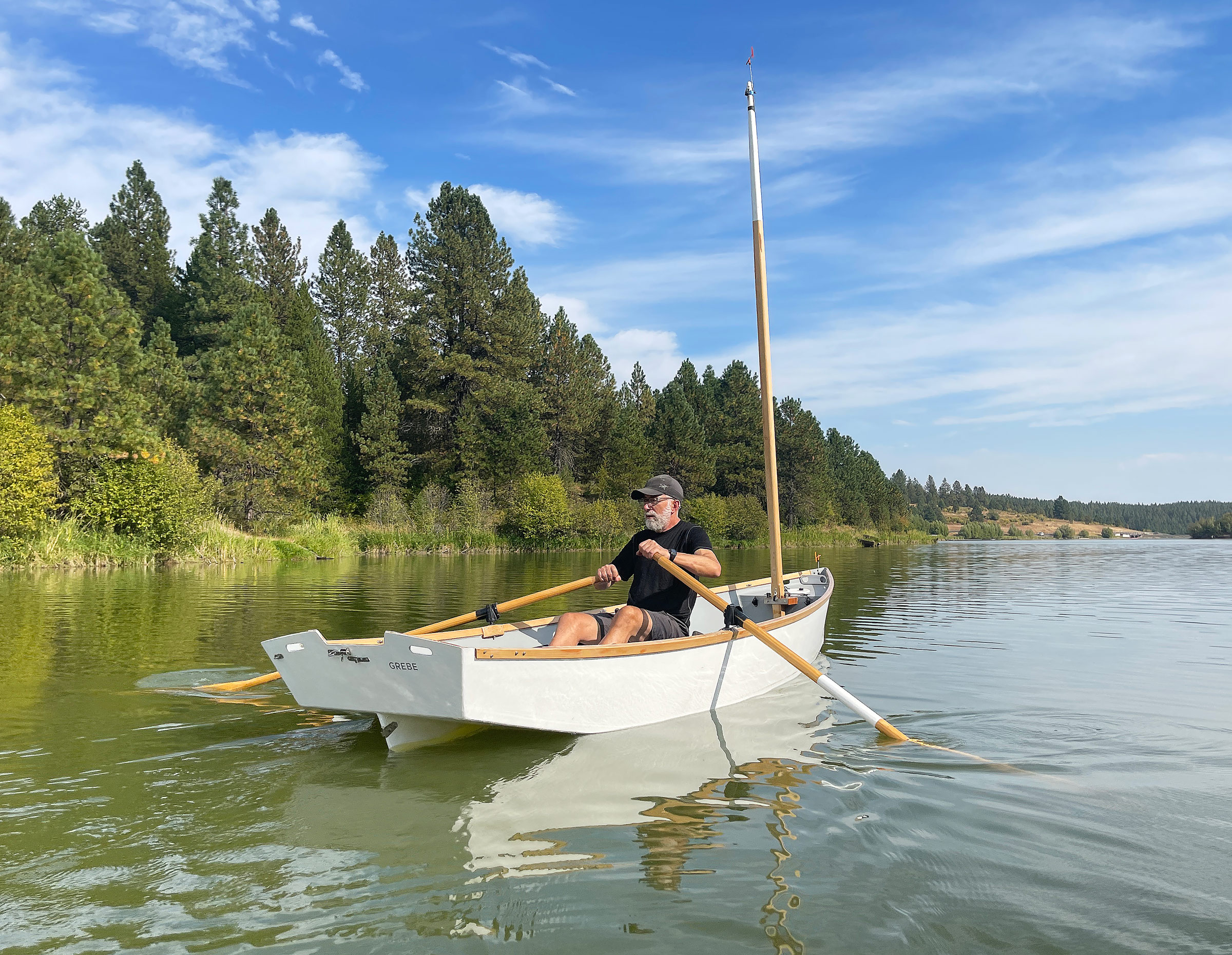
The 4′ 6″ beam provides a good oarlock span for 8′ oars.
The hull’s side and bottom panels are 6mm (1/4″) plywood; the transom, rudder, and daggerboard trunk are 9mm (3/8″). I designed and added some 9mm frames and I also added some 3″-wide chine-to-chine transverse strips flat on the bottom to stiffen it up a little bit and provide some depth for screws to mount my foam-pad tiedowns. The daggerboard is doubled 9mm plywood with carbon-fiber inserts to stiffen it.
I applied fiberglass tape to the joints but did not cover the entire surface of the interior or the exterior with ’glass cloth. This has worked well, and the plywood is still in good shape after three seasons of use. I think I saved about 8 to 10 lbs of weight this way as well as a lot of labor.
Spruce spars are specified in the instructions, but I used fir from the lumberyard. I picked through the pieces carefully and then hung them from the ceiling of my shop for a few months to let them air dry. I tested the spars by shaping them and then jumping on them with 6″ blocks holding up each end. I managed to break one of them. Better to fail in the shop than while out sailing!
I spent about three months, full-time, building the Drake 13 and launched it on a cool spring afternoon. At 105 lbs (stripped of oars, spars, and rigging), it’s fairly easy to get it on top of the car and to drag it across a sandy beach to the water. I use two 3′ x 8′ pieces of carpet to protect the bottom from abrasion while dragging the boat over the ground.
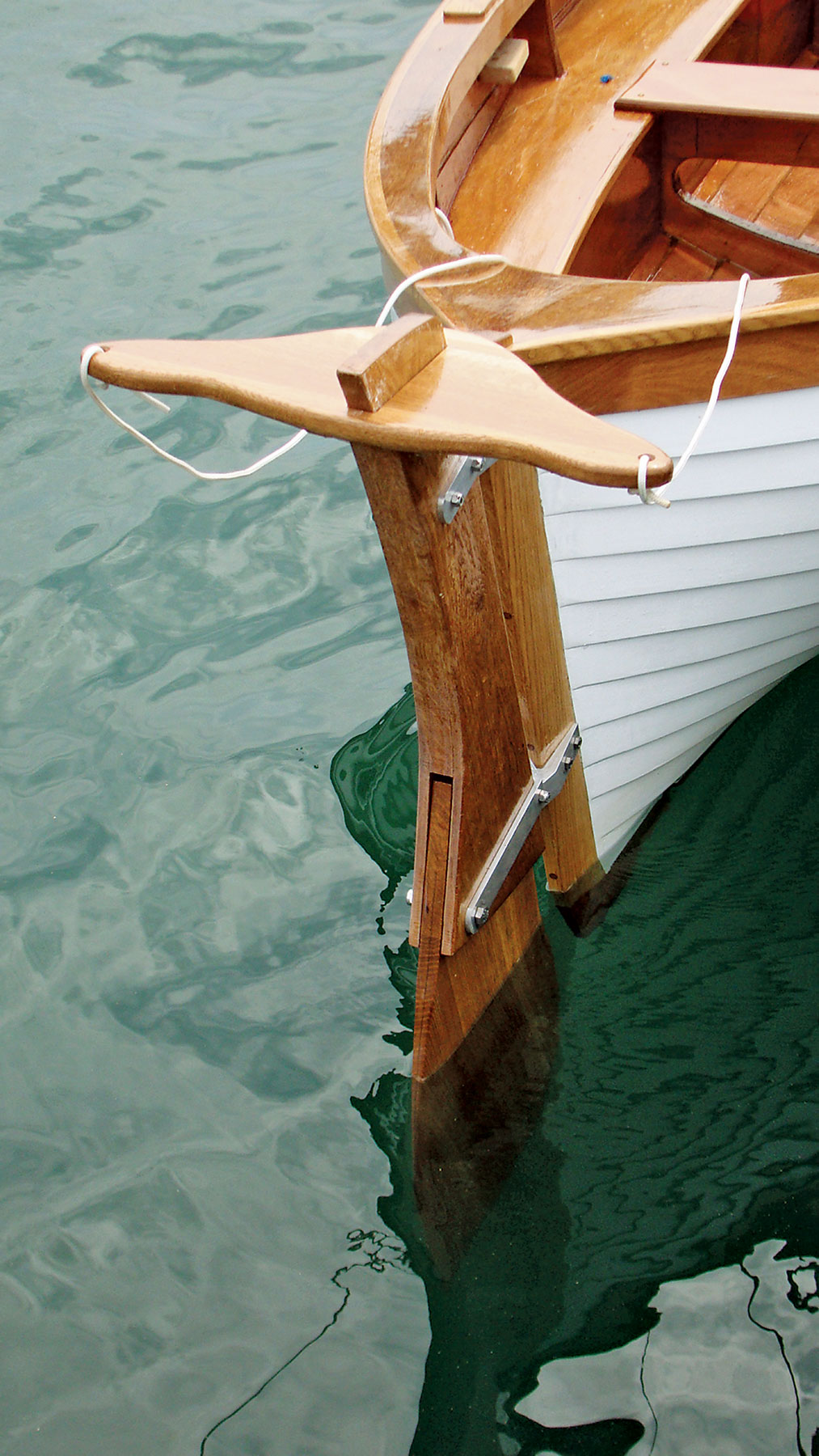
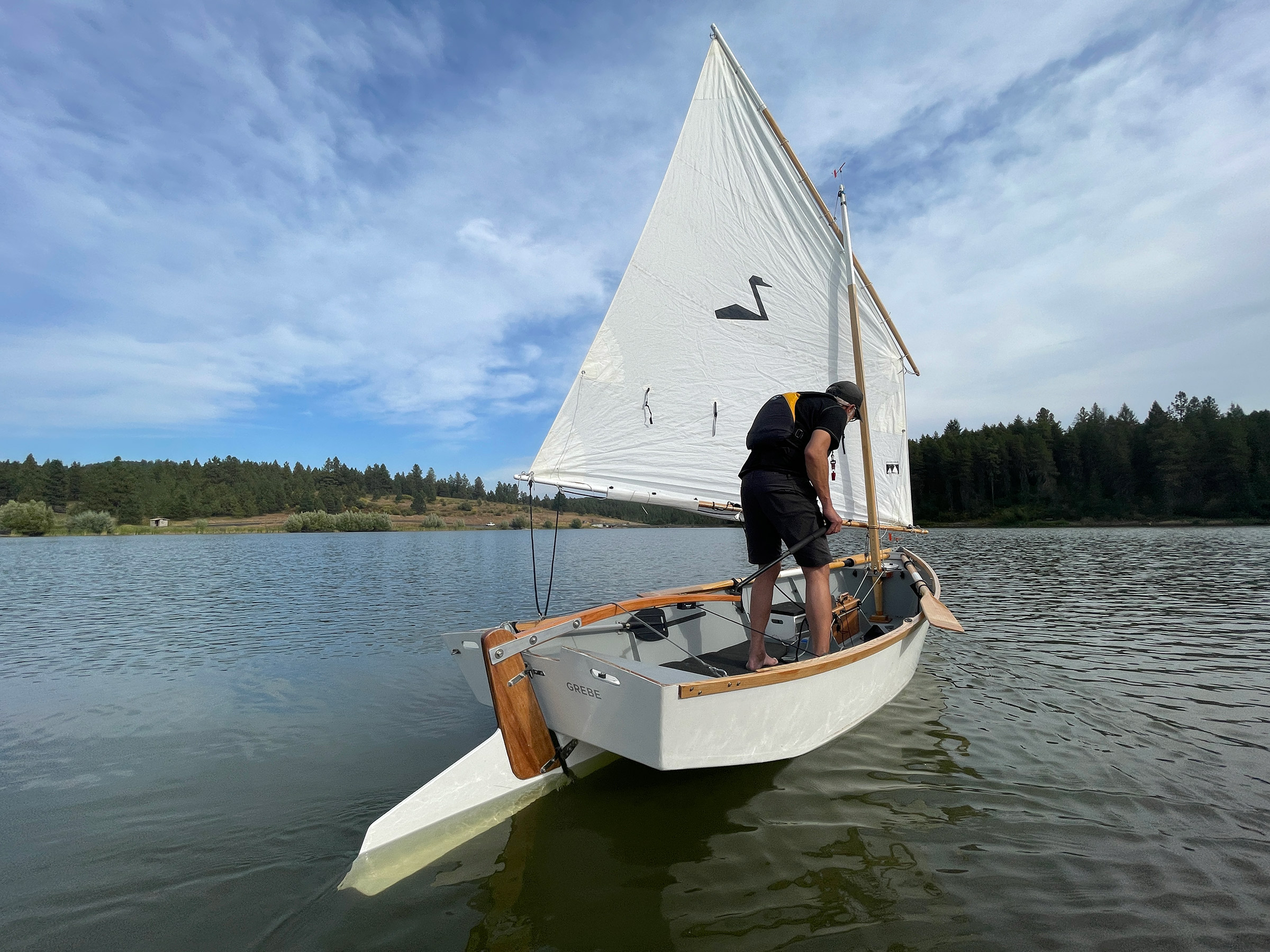
The rudder has a fixed blade with a horizontal bottom edge aligned with that of the skeg. For a better purchase on the water, the plans provide an option for adding a drop-down blade and the author added the horizontal wings seen here.
It takes about 30 to 40 minutes from cartop to sailing. That may seem somewhat slow, but that’s a result of being cartopped: the hull is transported bare, and everything needed on the boat must be packed in the car. Trailering would significantly shorten the preparation time at the ramp.
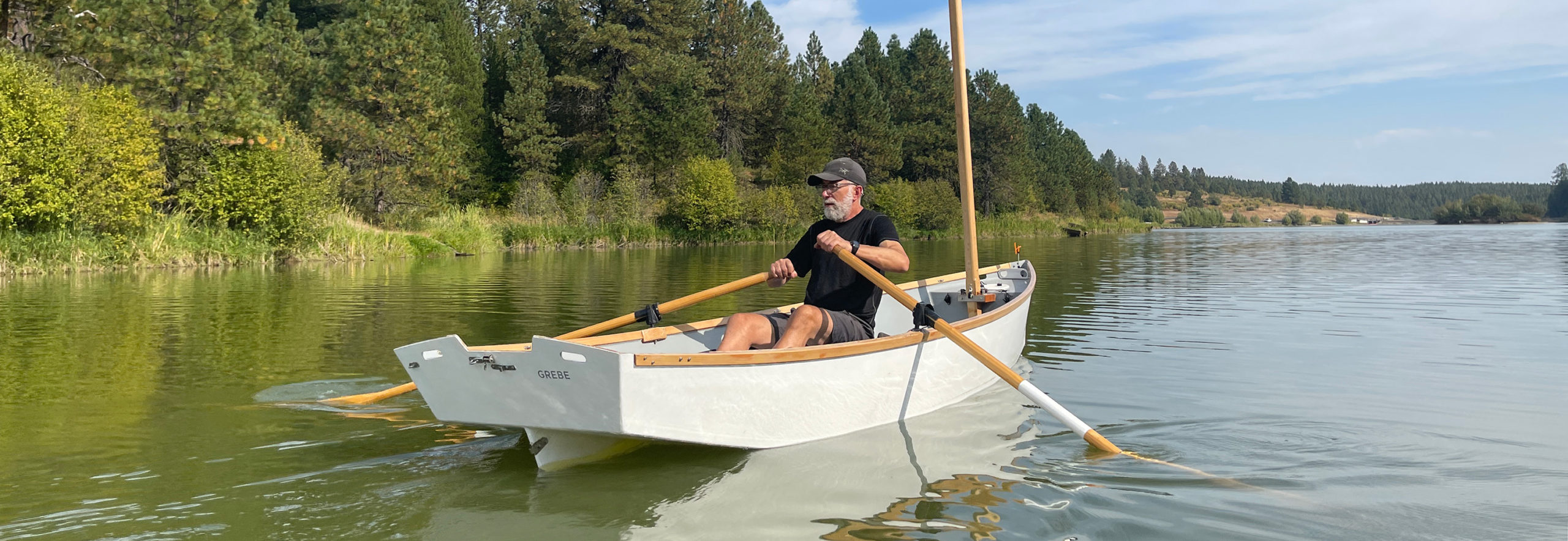
The oar length for the Drake is not specified in the plans. Mine are 8’ long and I use Gaco oarlocks, which are strong and smooth working. With moderate aerobic effort, I can row the Drake at about a 2-1/2-knot reading on the GPS. Ramping up to 80 percent effort increases speed to about 3 knots, and an all-out sprint might see 3-1/2 or a bit more.
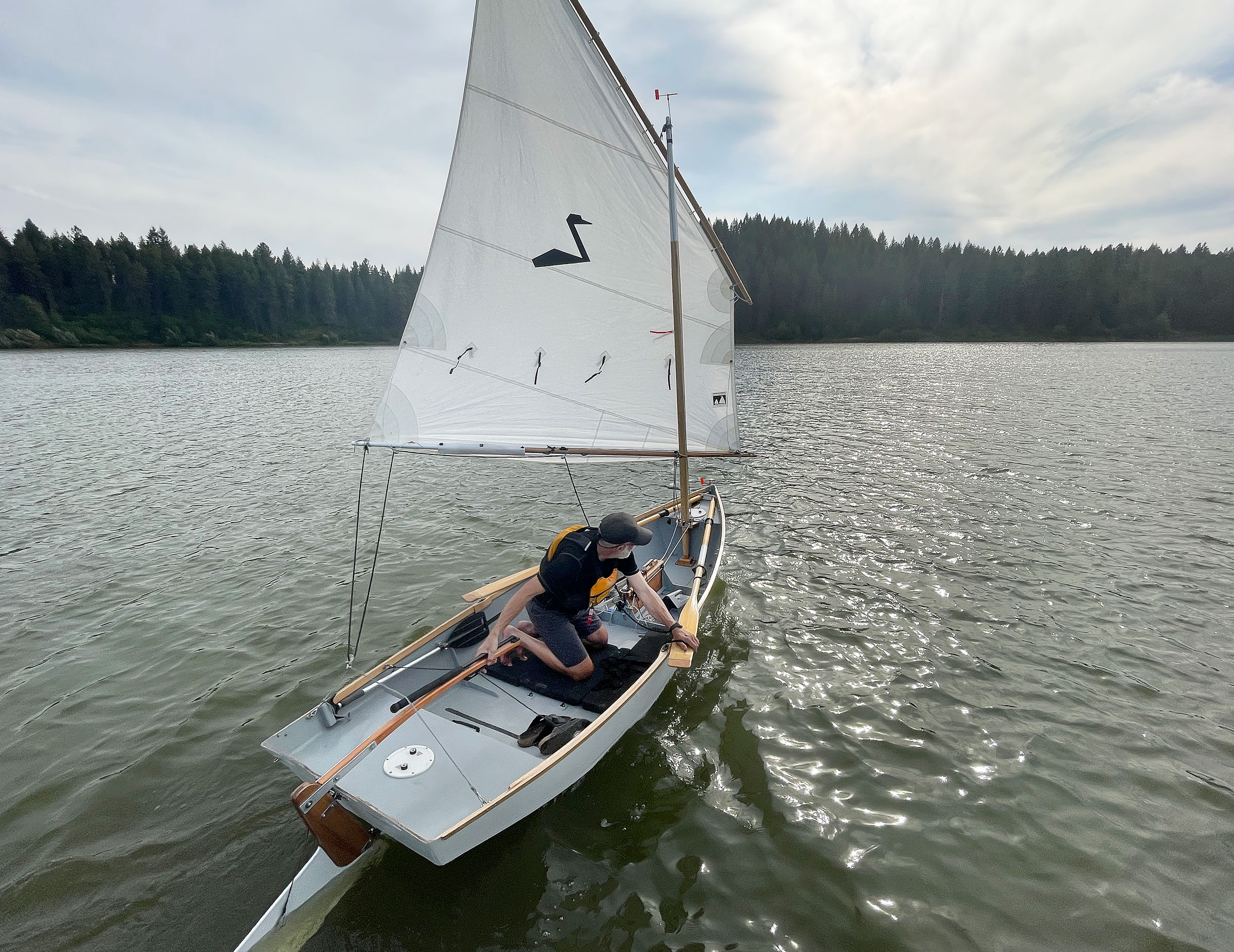
On my first outing with the Drake, christened GREBE after the diving birds I see where I do most of my sailing, there was a sprightly wind. Once I got out on the water and all the various lines were adjusted, I sheeted in on a beam reach and the Drake leapt forward, soon sending spray over the gunwales and making that go-fast hum sailors love. The overall sensation was one of lightness, nimbleness, and speed. The Drake is quick and fun under sail, and I’ve seen a top speed of about 6 knots sail-surfing down a motorboat wake. Windward performance is satisfactory—the Drake tacks through 80 to 90 degrees. Cranking on the downhaul helps shape the sail well for windward work.
When sailing, kneeling on the bottom makes it easier to look forward while having a hand on the tiller.
During my first season of sailing GREBE, I found coming about difficult and often stalled halfway through a tack. To address the tacking performance, I added an endplate to the rudder to make it more effective without anything extending below the level of the skeg. (The instructions include details for a steel or aluminum drop-plate rudder blade that would give the rudder a deeper grip.) The endplate helped a lot. Falling off a little before the turn to build a little momentum and backwinding the sail are also very helpful in getting through a tack.
That flat bottom pays off when the boat is beached and sits nice and flat on the shore, but it can pound in waves. While sailing, I can shift my weight to settle one of the hard chines down into the water and lessen the impact with waves. Sailing on a run is a joy and jibing is made considerably more pleasant by the natural cushioning effect of the yard and boom squeezing together, allowing the boom to come across without a bang. In light air, I can center the tiller, lock it, and steer the boat by shifting my weight gently from side to side—pretty cool!
The plans call for a 65-sq-ft standing lug rig with the tack set to the mast. The author opted for a balance lug where the tack sets forward.
On one blustery day I had an opportunity to practice a capsize recovery. An unintentional jibe put the boat over with the mast and sail resting on the water’s surface. The boat righted easily—a little pull on the end of the daggerboard was enough. The aft flotation compartment supported me while I crawled back in over the transom. The sail should have come down to lessen the chances of the boat capsizing again. Although the stern and bow flotation compartments kept the gunwales above the water’s surface, the daggerboard trunk needed the board and the foam filler in place to prevent the ingress of water while bailing. About 15 minutes of adrenaline-fueled work with a large bailer removed enough water from the cockpit to ready the boat for rowing to shore. The longer centerboard trunk in the plans would need some similar way to seal its opening.
Selway-Fisher’s 13′ sharpie is a big boat in a small package and accommodates all the gear I need for overnight camping trips; I could probably pack enough in GREBE for a weeklong trip. Building a Drake 13 would be a straightforward project for an experienced builder and a suitable first boat for those with some woodworking experience. This little sharpie is easy to store and move, even by cartop. I have had so much fun daysailing and camp-cruising this pretty sail-and-oar boat.
John Larkin recently retired from a career designing bicycle helmets and returned to his first loves: painting, drawing, building boats, and sailing. He lives in Moscow, Idaho, and sails primarily on Cascade Lake, a reservoir in central Idaho.
I have owned several sailboats and loved the romance of sailing, but as I’ve aged it was requiring more work and scampering about than I enjoyed. When my friend George took my wife Donna and me on a short motor cruise of the western end of New York State’s Erie Canal, I found it to be a relaxing and beautiful experience, quite different from sailing on the turbulent waters of Lake Erie. I decided to build a boat for cruising the canal.
Donna Harris
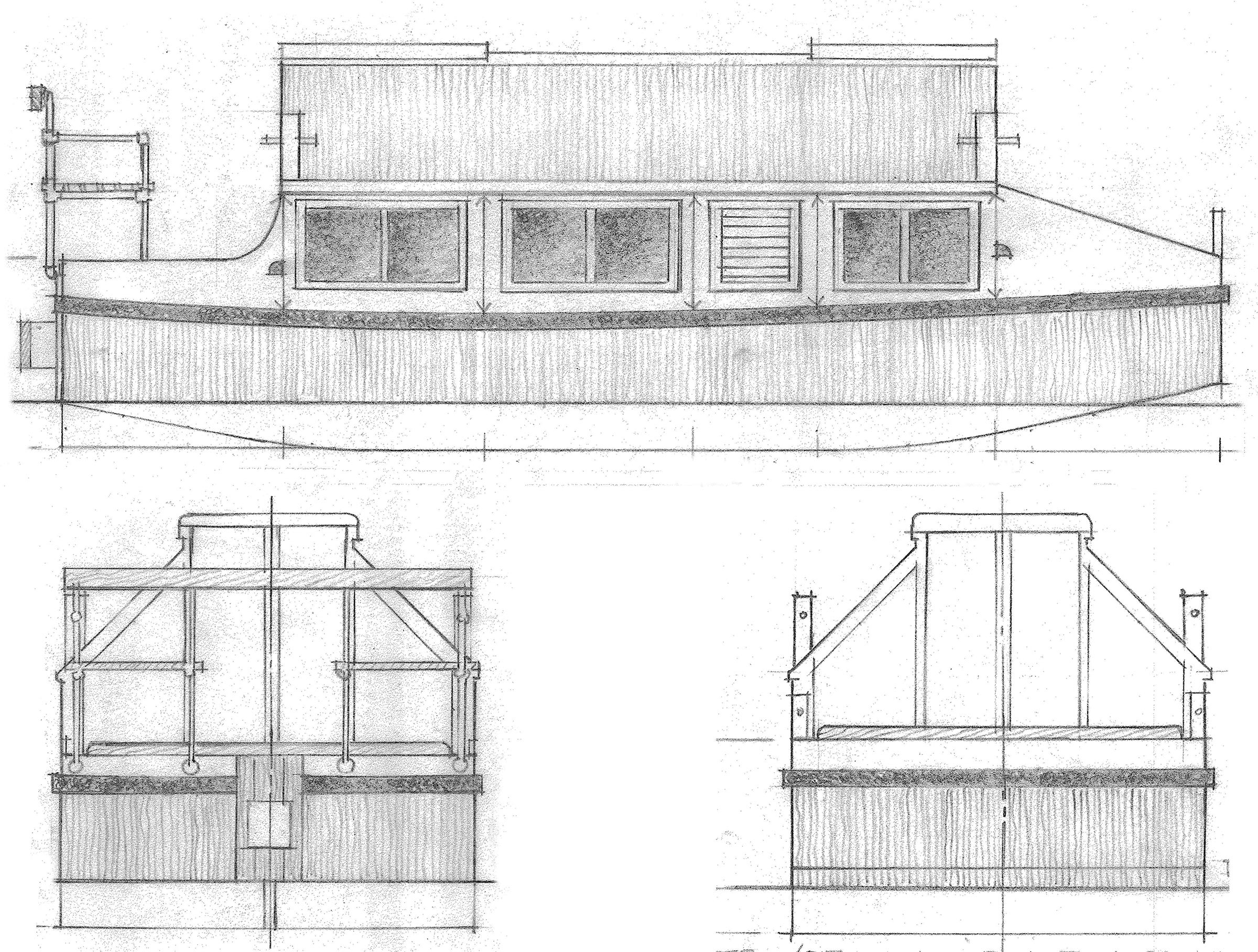
The L’Ark is built upside down with the posts on the transom and bulkhead sides extended to a common baseline. The extra length gets cut off after the hull is rolled over.
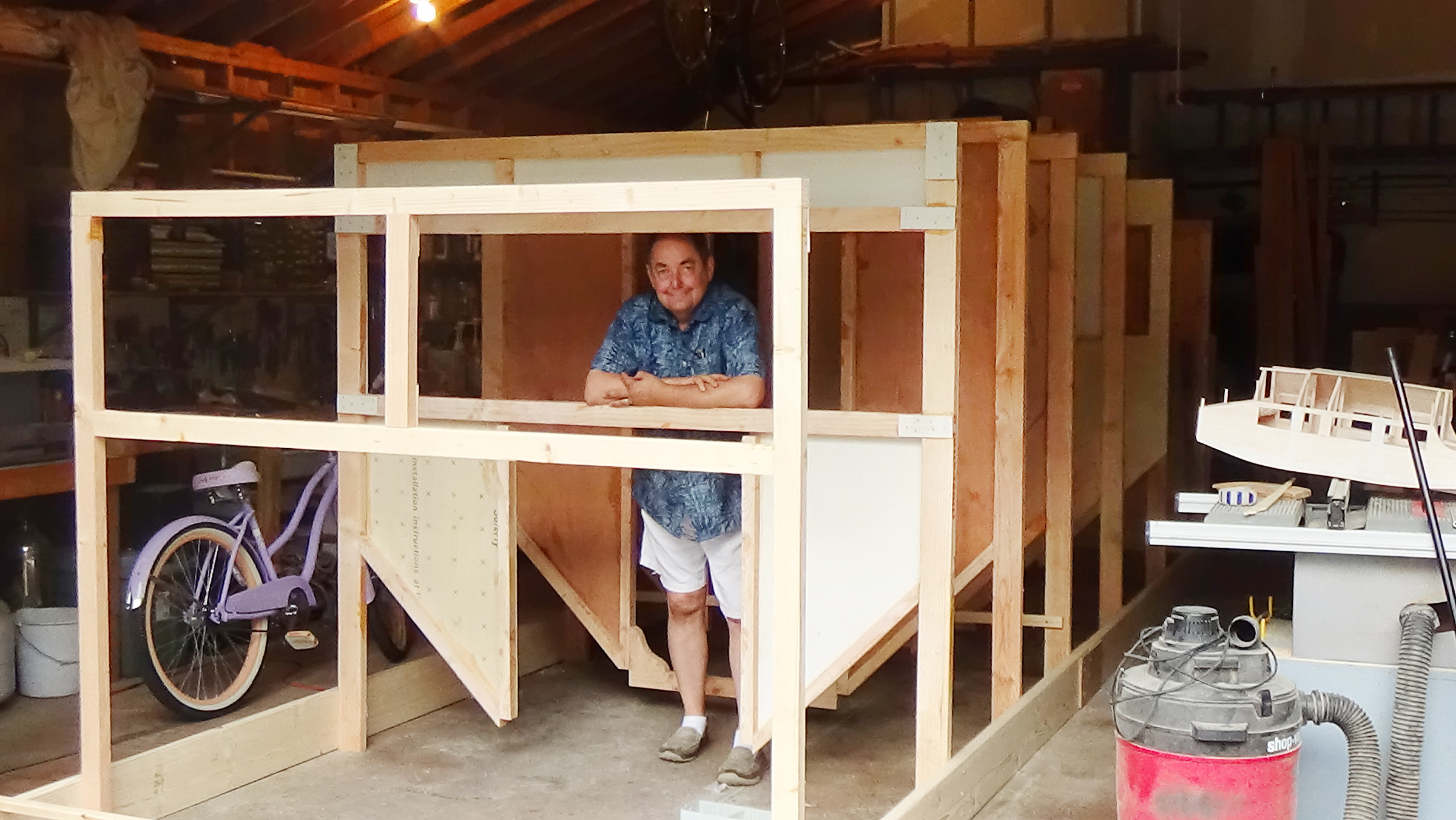
We wanted a relatively small trailerable boat that was suitable for overnight travel. It had to have a galley, a head, and berths for at least two. I also wanted a boat that had a traditional appearance and used readily available materials, not exotic and costly tropical hardwood. And, it had to be possible to build it in my double garage with the tools that I had on hand and with my limited boatbuilding skills. When I came across Philip Thiel’s Escargot, it seemed to fit the bill except for its lack of standing headroom. I noticed that the Escargot plans include four pages of supplemental drawings for a modified version, L’Ark, with the same 18′ 6″ length. This four-berth plywood canal cruiser has 6’ standing headroom, a 6″ greater beam than the Escargot’s 6′, and steeply sloped cabintop sides. It looked perfect. I ordered the plans and built a scale model to give me a clear understanding of how the hull was constructed (it is a lot less expensive to make a mistake in balsa than in marine plywood).
Roger Allen
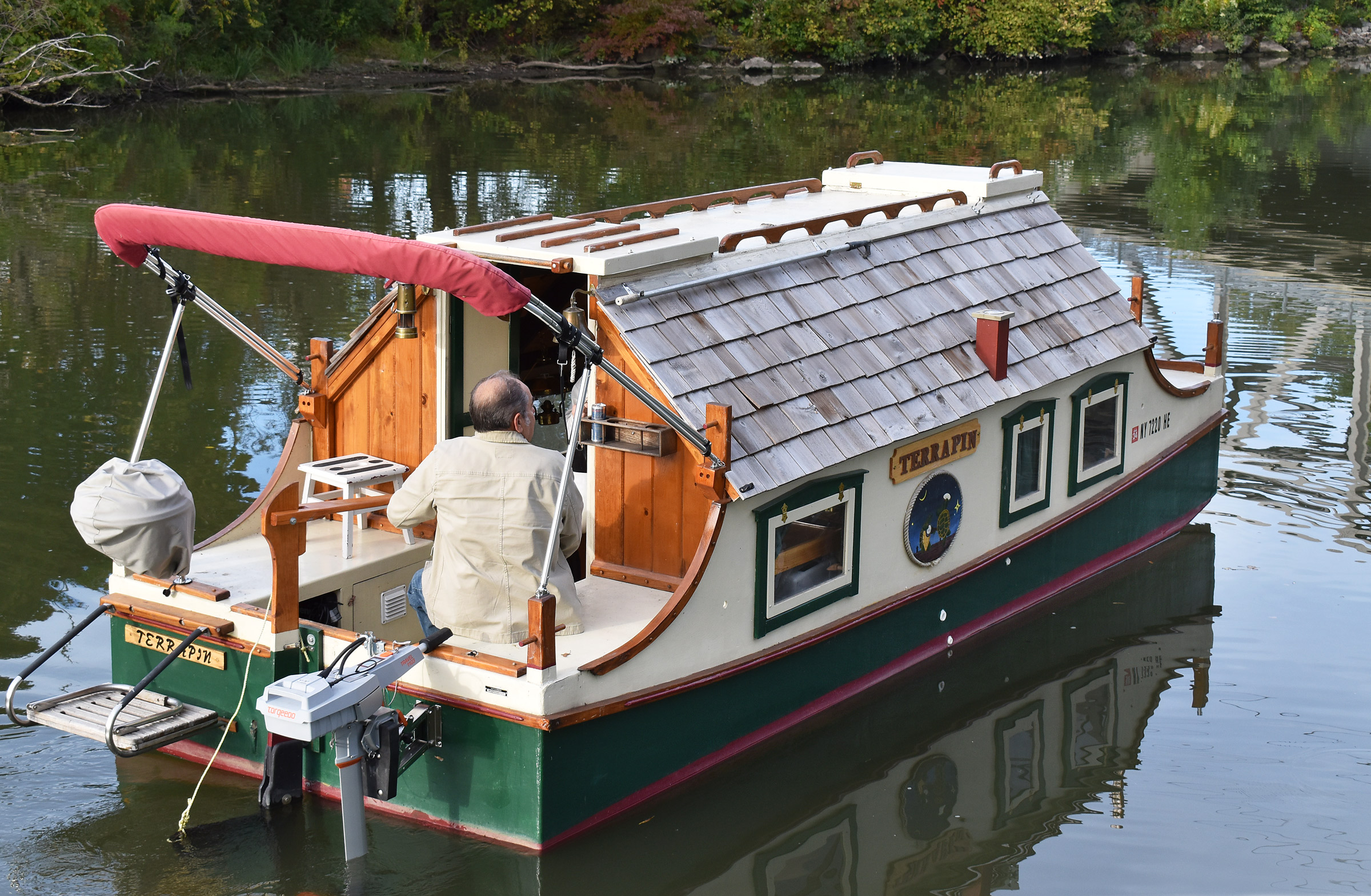
The L’Ark is drawn with a centered motor mount for an outboard to provide power and steering. The offset mount and centered rudder were borrowed from the Escargot plans but the arrangement proved more difficult to operate than the outboard-only setup.
I started construction of our L’Ark on the Fourth of July, 2016. I laid out and put together the seven frames on an 8′ x 8′ level plywood platform. To keep the frame pieces from shifting during construction, I added some cleats to make sure everything lined up and stayed put. I used good quality 1/2″ Douglas-fir marine-grade plywood. The plans call for 3/8″ plywood transoms and sides, but I found the 1/2″ to be less expensive and locally available. For the timbers, I was fortunate enough to have a lumberyard that would allow me to sort through the common 2x12s, which I ripped down into clear pieces. I used silicon-bronze fastenings as recommended in the plans; stainless and galvanized fastenings are listed among the options.
Roger Allen
Ordinarily the L’Ark would have an uninterrupted aft deck instead of a footwell. To compensate for the loss of height the author stands on a box to get a better view over the cabintop.
The seven completed frames were set up, upside down and squared to a leveled strongback. The plywood sides, previously made up of three sections and joined by plywood butt straps, were then glued and fastened to the frames, followed by the bottom panels, made up of five sections, also butt-strapped. I covered the bottom below the waterline with fiberglass cloth and sealed everything inside and out with two applications of epoxy. After two coats of antifouling paint, the boat was ready to turn right-side up.
David Harris
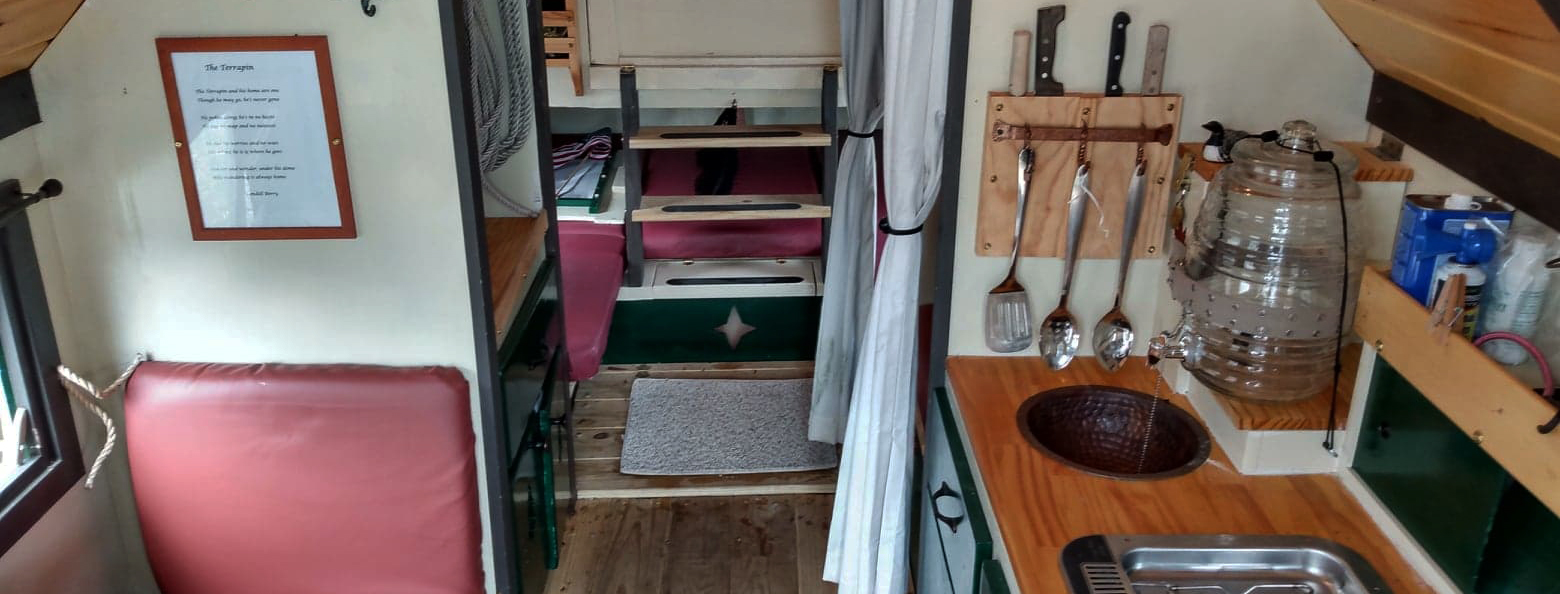
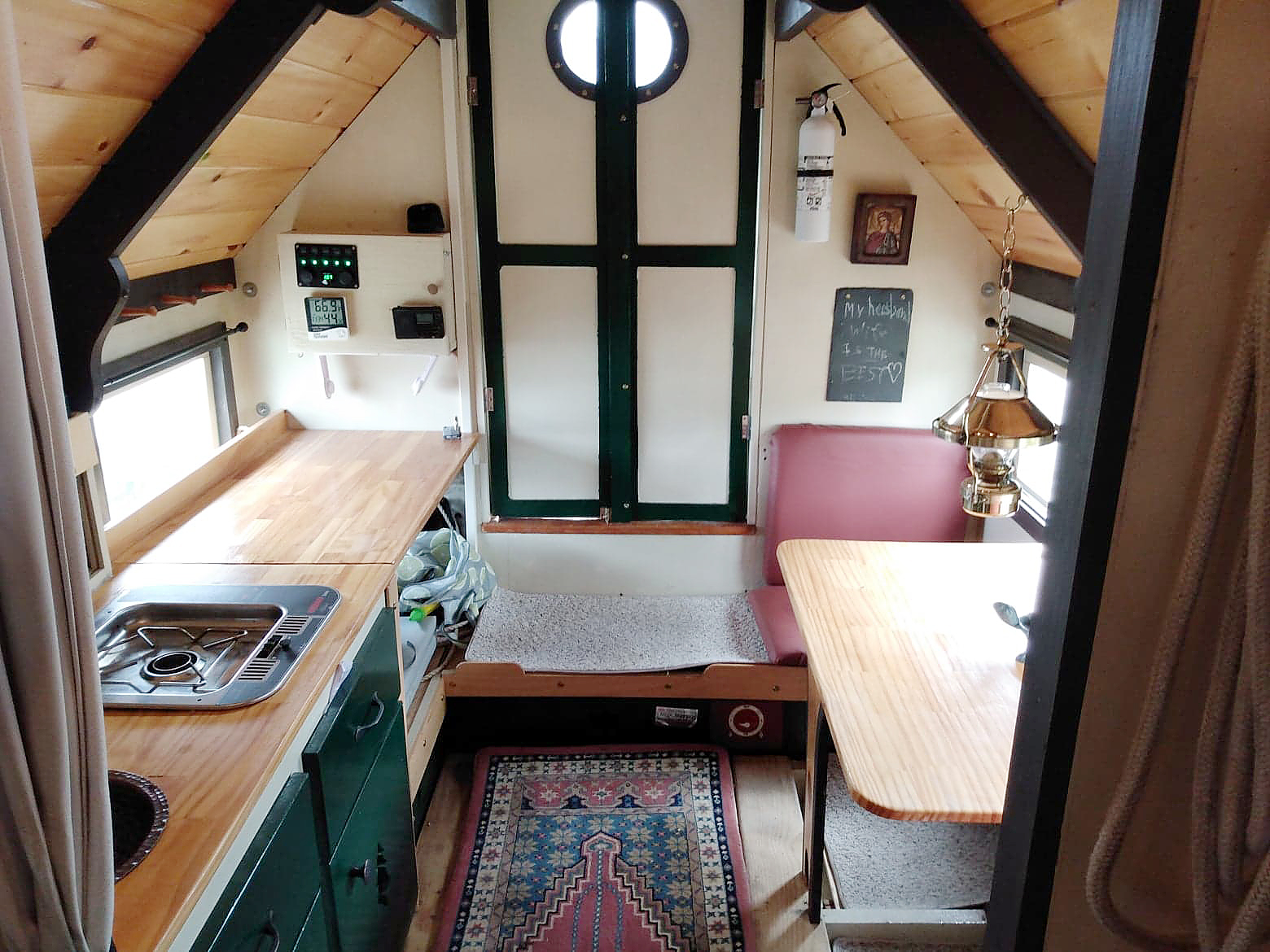
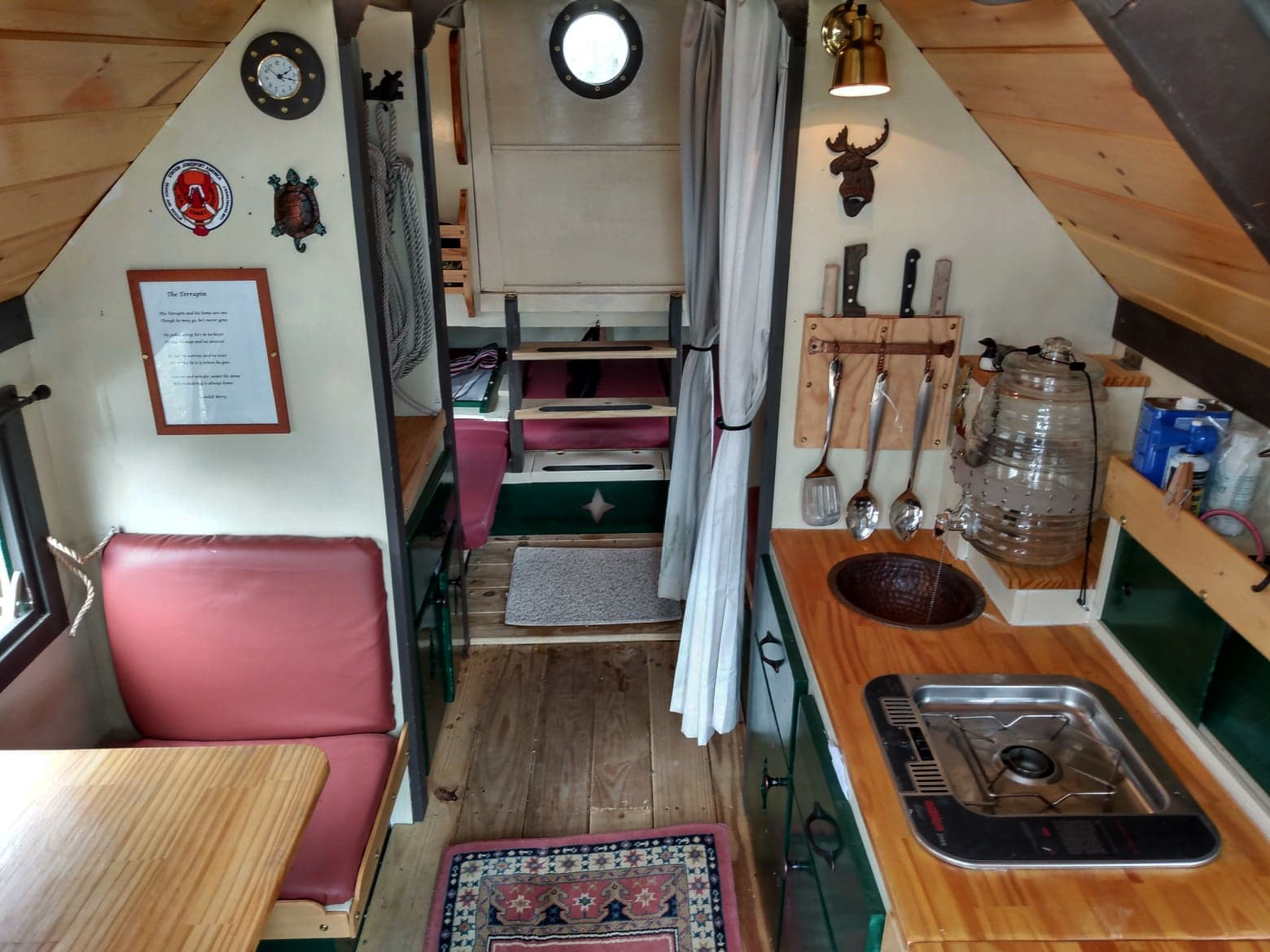
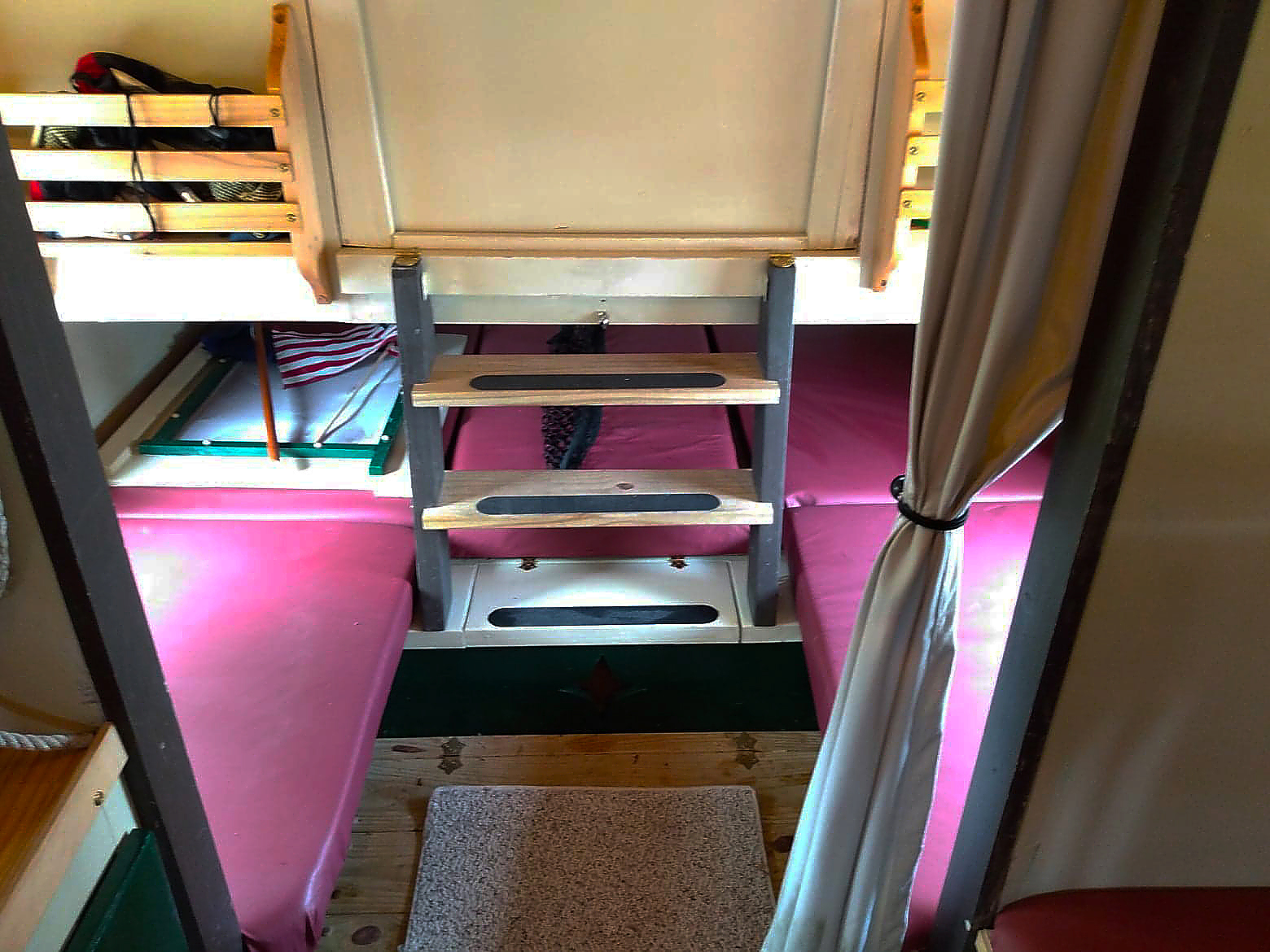
Standing headroom makes it much easier to prepare meals in the galley. As designed, the bottom of the door leading to the cockpit would be about level with the countertop and a three-step ladder would be fitted in the cabin.
The hull at this time weighed about 700 to 800 lbs and was ready to flip right-side up. The instructions recommend having 10 people, five on each side, to roll the 500-lb Escargot. I sent out an open invitation to a boat-flipping party and almost 30 people showed up. All went well and, with the hull right-side up and set on appliance dollies, I was able to move the boat around in my garage if I wanted to make room for a car or to make it easier to work on all sides.
David Harris
The author added floorboards that are not included in the plans. Setting the boards across the tops of the frames reduced headroom by a few inches but eliminated potential trip hazards while moving around the cabin. The ladder between the two forward berths leads to the foredeck.
Before putting the cabintop on, I built and installed cabinets for the head and galley. I wanted the boat to have a traditional look inside and out, so I opted for 3/4″ tongue-and-groove knotty pine for the ceiling instead of the 1/4″ plywood called for. The pine added significant strength, stiffness, and aesthetic appeal.
David Harris
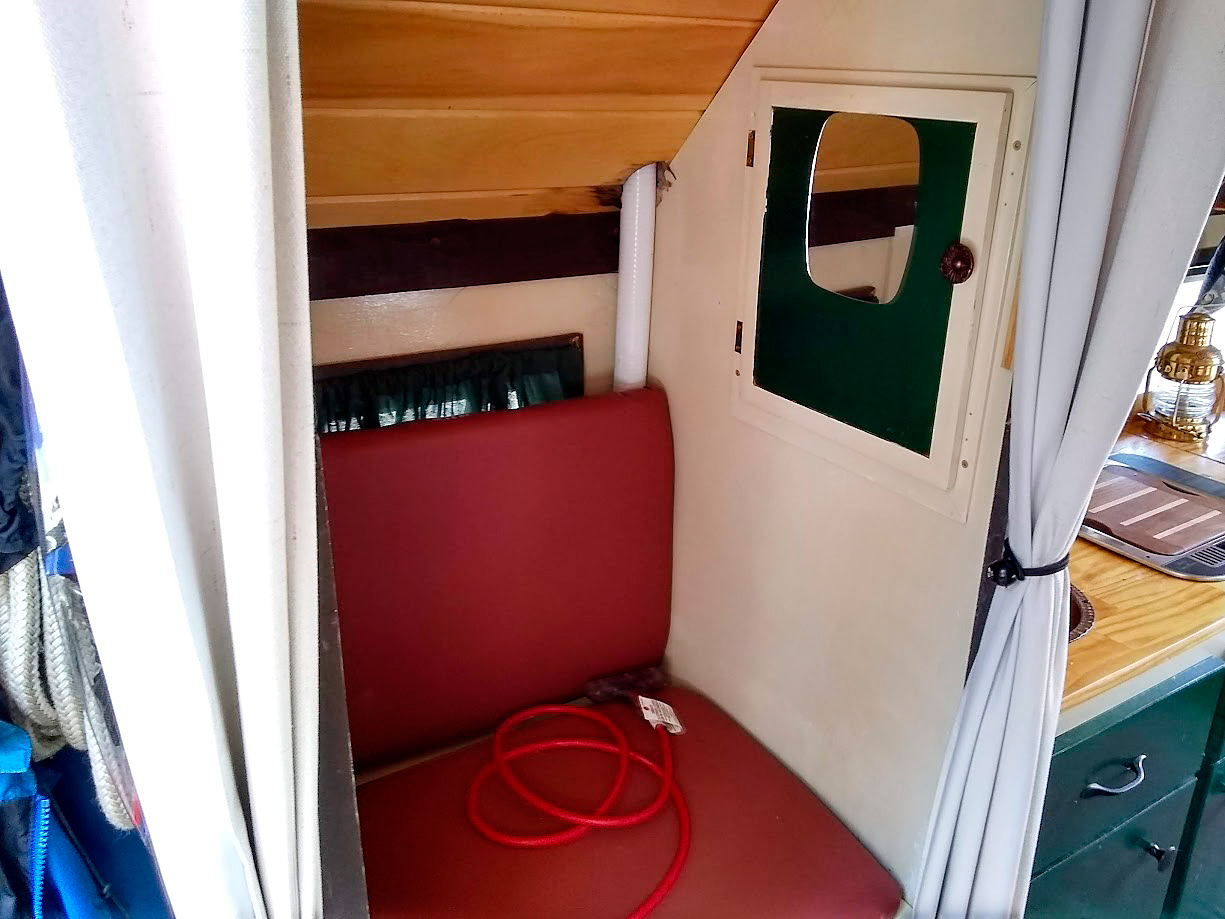
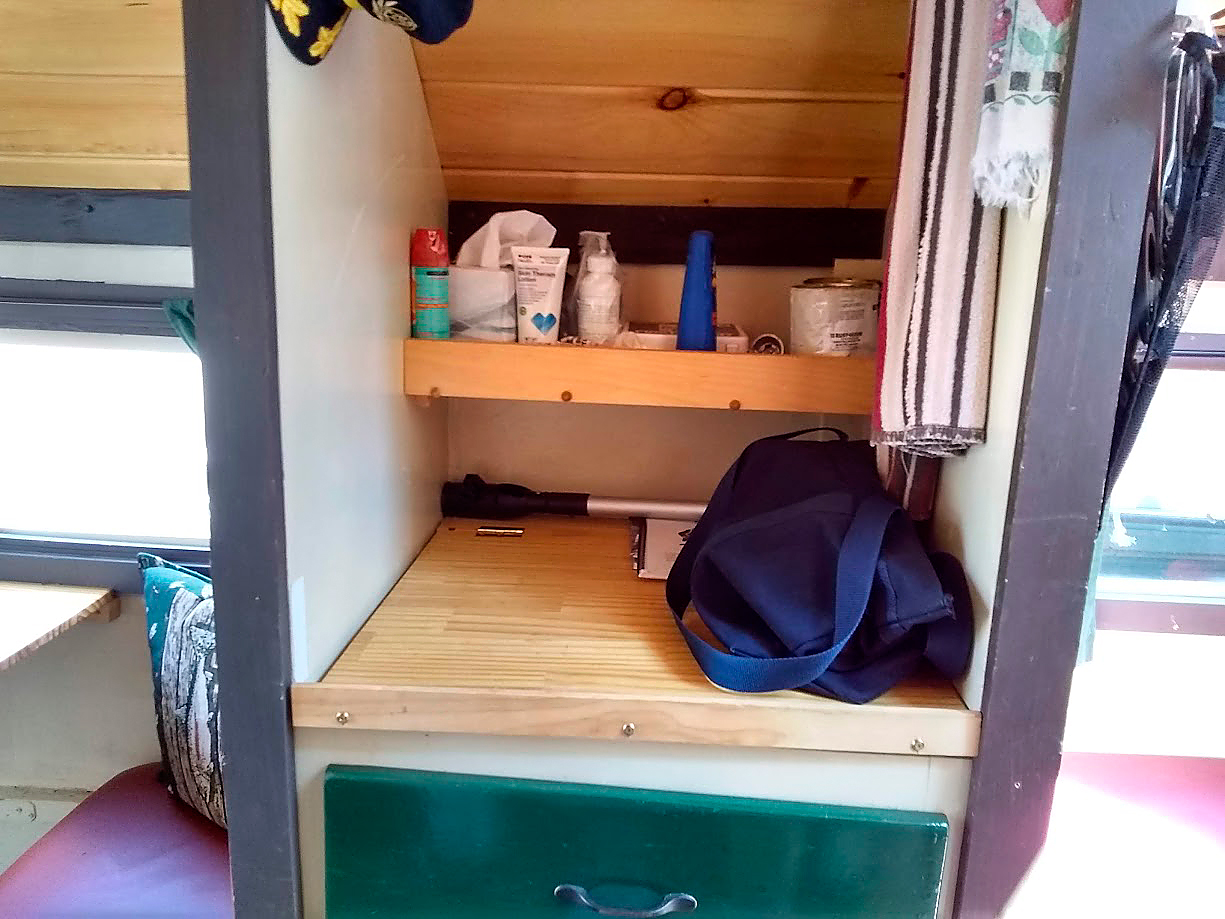
There are two 24″-wide compartments between the saloon and the forward berths. The plans indicate one is for a head. The curtains here provide a measure of privacy.
During the long cold winter, a small space heater in the cabin made it possible for me to work on the boat’s interior in comfort but I kept tripping over the frames, so I installed 5/4 pressure-treated yellow pine floorboards over them. This reduced the headroom to 5′ 10″ (fortunately, still an inch taller than my height). The pine also added the more traditional appearance that I was looking for and would keep things dry, even if a little water found its way into the bilge.
David Harris
The compartment opposite the head is for storage.
The plans called for sliding windows and hatches. This looked complicated to build and only half of each window opens, so I built simpler hinged awning windows. This has worked out well. I also made hinged hatches instead of sliding hatches to free up the flat area of the cabintop for seating and storage. The companionway hatches also act as air scoops and provide plentiful airflow while underway and at the dock.
Roger Allen
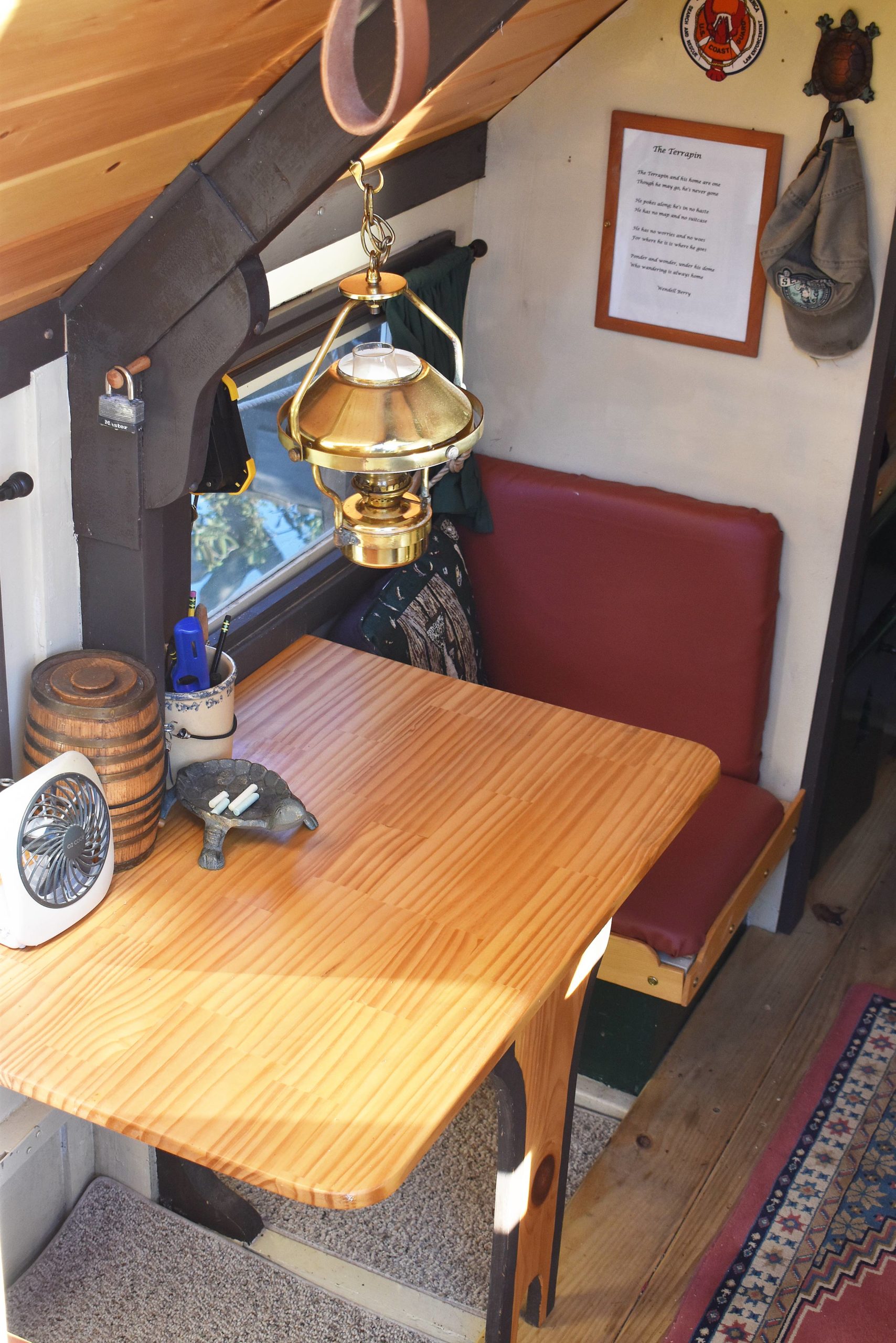
While the plans call for a fixed table in L’Ark, Escargot’s table can be lowered to create a berth or bench. On L’Ark, the aft berths (not shown here) are accommodated on the aft seats and flats that extend beneath the aft deck.
L’Ark, as designed, has a flat deck at either end, each built over the foot ends of a pair of berths. A bench made of 1/2″ galvanized pipe is meant to be installed in the stern, but I didn’t like the way it looked and instead made the rear deck like the cockpit of a sailboat with a bench on either side and a self-draining footwell in the middle. Under one side bench is a ventilated compartment for batteries and an open area for gas tanks. Enclosed under the other bench is one of the remaining berths, which extends into the cabin. My cockpit footwell also allowed for a taller entry into the cabin. For the forward companionway, I opted to make it like a sailboat’s with a pair of removable plywood hatchboards. This proved to be a mistake, because they were awkward to remove and took up valuable space to store when not in place; I plan to install a split, hinged door.
David Harris
Beneath the forward berths there is lots of storage space accessed via removable plywood panels under the cushions. The ladder is easily removed and, with the addition of another plywood panel and cushion, a king-sized berth is created.
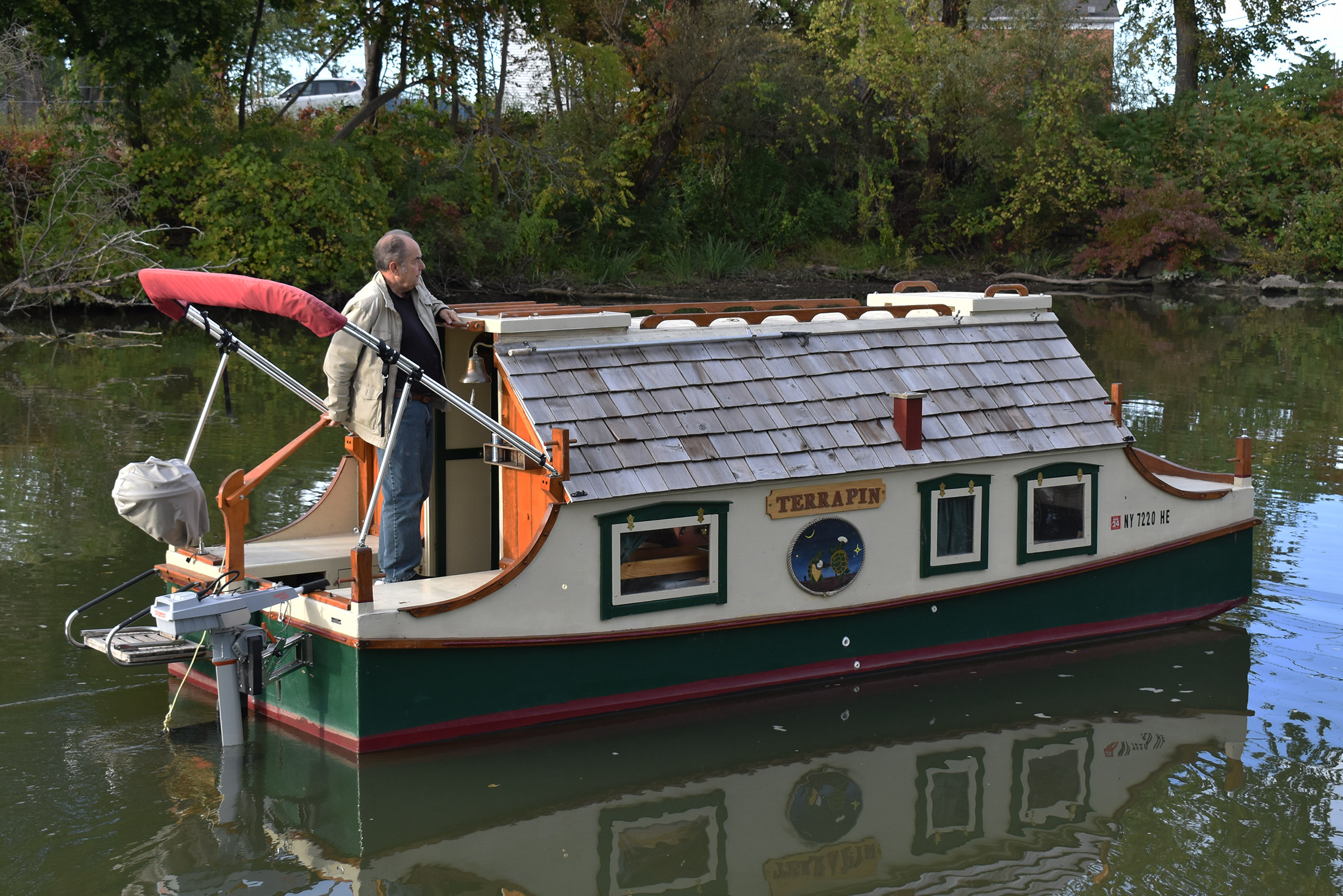
I covered the tongue-and-groove pine ceiling with 1/4″ plywood, taped the seams with fiberglass, and coated the whole thing with epoxy followed by paint. This was certainly leakproof, but it looked merely okay; I considered corrugated metal for a finished roof but decided on red-cedar shakes, which added a lot of character to the boat.
The plans for the L’Ark indicate a centered outboard bracket; the outboard motor would be used for steering. I built and installed the rudder and tiller and installed a motor to one side, as shown for the Escargot. While the tiller/rudder added a traditional look, the tiller took up too much space in the cockpit, and handling the tiller and motor at the same time proved awkward when docking. I decided to eliminate the rudder and mounted the motor in the center as per L’Ark’s plans. I found a 6-hp sailboat outboard with an extra-long shaft that fit perfectly on the transom without the need for a bracket. It also had a modified prop that was designed not for speed but to move a heavy boat.
Roger Allen
The foredeck has space for two folding chairs; passengers can escape the noise of the outboard and enjoy the view in comfort.
In 2021, after five years of work, my dreamboat was ready to launch. I was concerned that it might sit low in the water because I’d built the boat significantly heavier than designed, but it floated level and the waterline was perfect.
The designer’s statement recommends an outboard of between 2 and 5 hp “for a sensible 4-mph cruising speed.” With the 6-hp outboard, our L’Ark handles nicely. Even with a headwind, we can easily cruise at 6 to 7 knots, which is just right for the Erie Canal. Considering the high profile and shallow draft—about 12″—our L’Ark tracks and handles better than I expected. Docking can be a little challenging if there is a strong wind and current, but it’s a small boat so there is little chance of damage.
For an 18-1/2′ by 6-1/2′ boat, the L’Ark is surprisingly roomy inside. The forward berth is almost as large as a queen-size bed and is as comfortable to sleep on as in any boat that I’ve been on. There are two smaller berths, as well: one converts when the table is dropped down and the other is a small quarter berth half tucked under the rear cockpit bench. These are both just 24″ wide so they are best for children (or a guest that you don’t want to stay too long). In the galley, I installed a single-burner alcohol stove, a small copper sink, and a large glass water barrel with its spigot over the sink. In between the forward berths and galley there is a water closet with a pump-out toilet to starboard and a cabinet with drawers and a medicine cabinet to port. The three separate “rooms” have curtains to provide some privacy. There is plenty of storage under the seats and berth. The awning windows work well, don’t leak, and provide plenty of ventilation while keeping rain out. I daydream about someday sitting at the galley table and fishing out the window. The modified rear cockpit has worked out well, although to get a good view forward I have to stand to steer or sit on a small folding stool. The forward deck is large enough for two folding deck chairs and far enough from the motor for quiet conversation.
Roger Allen
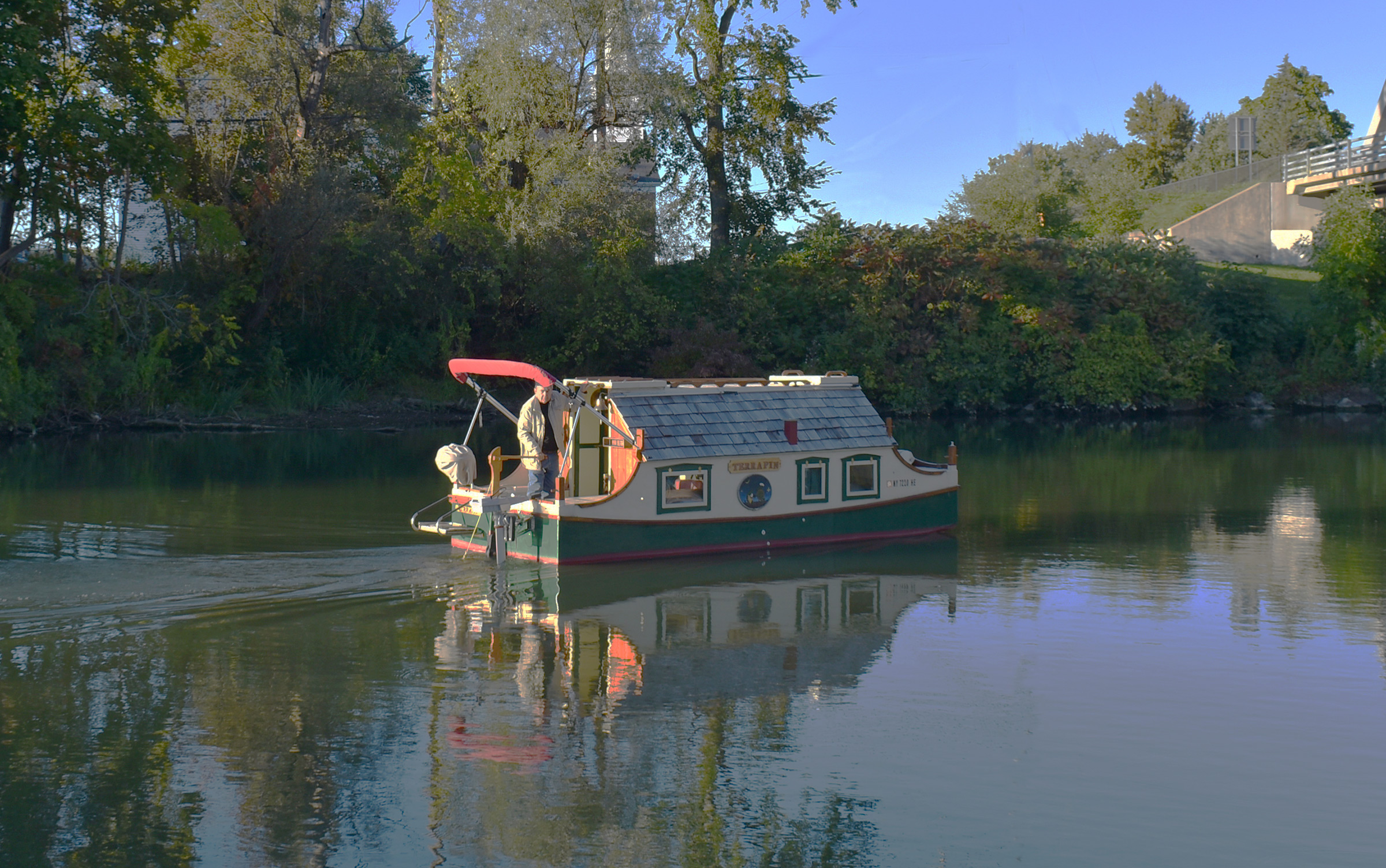
With a 6-hp outboard, the author’s L’Ark can cruise at 6 to 7 knots.
My wife and I have enjoyed several cruises with our L’Ark, TERRAPIN, on the Erie Canal, staying at the marinas that almost every small canal town has. While tied up, our boat attracts plenty of attention. For day trips it can comfortably carry four to six people, and if the weather turns bad, there is plenty of room in the cabin; on one trip we saw an Escargot, the L’Ark’s little sister, and I suspect its crew was envious of our standing headroom. The boat is simple to construct and easy to modify to suit individual needs. It can be very simple as designed or dressed up (as I did with our L’Ark). I’m quite happy with the design and would recommend it to anyone who wants to build a tiny houseboat.
David Harris grew up in Tonawanda, New York, where the Erie Canal meets the Niagara River and halfway between lakes Erie and Ontario. At 21, he enlisted in the Coast Guard and served in Jonesport, Maine, first at a small boat station and later on an 82′ cutter. While serving Down East in the 1970s he got to know local lobstermen who were still building and using wooden boats. While in his 40s, he and his father built Bolger’s June Bug, a small sailing skiff. Several years later, David restored a run-down Catalina 30 and earned his captain’s papers to run sightseeing tours on it. He went back to college to study fine arts and design and enrolled in a class in boatbuilding at the Buffalo Maritime Center; he built a small skiff and learned how to work with fiberglass. He has owned several sailboats as well as a classic Chris-Craft cabin cruiser. After sailing for years on the turbulent waters of Lake Erie and wanting something traditional and more easily handled, he sold his last sailboat and went to work on his L’Ark canal boat, TERRAPIN.
L’Ark Particulars
[table]
Length/18′ 6″
Beam/6′ 6.75″
Height/6′ 5″
[/table]
Plans for the Escargot and the L’Ark consist of 12 pages for Escargot plus 4 pages of L’Ark modifications for the hull and cabin. The full set is available from The WoodenBoat Store for $75, print or digital format.
Is there a boat you’d like to know more about? Have you built one that you think other Small Boats Magazine readers would enjoy? Please email us!
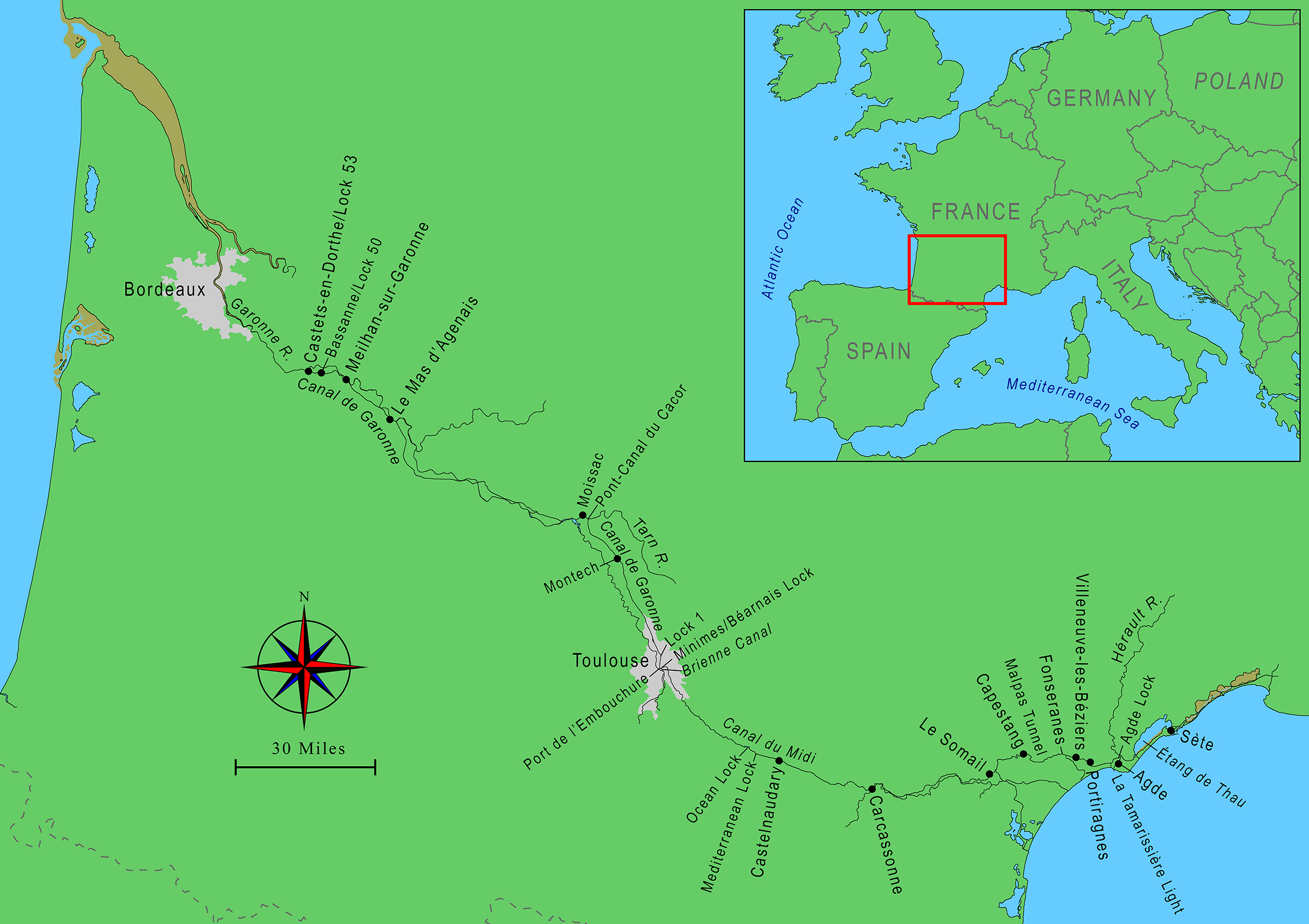
With TRAMP, our 16′ double-ended pulling boat, on top of the Volvo station wagon, Ben and I had driven for days through vineyard-draped landscapes dotted with chateaux to reach Castets-en-Dorthe, a one-post-office, one-pharmacy village about 80 miles inland from where the tides of the Atlantic meet France’s Gironde estuary and flow past Bordeaux and into the river Garonne. We stopped near the first of the 53 locks of the Canal de Garonne to look for a slip to launch from and spotted a lockkeeper in a cobalt-blue T-shirt bearing the emblem of Voies Navigables de France (VNF), the authority managing the inland waterways. When we told him our plan to row along the Two Seas Canal to Sète and the Mediterranean Sea, he told us that we couldn’t use the locks in a non-motorized boat. Not once in our nearly two years of research in French and English had we found this rule, though we had heard from a rower who had secured official permission and had still been denied entry to the locks. After some discussion, the lockkeeper admitted that he really wasn’t sure and suggested we come back the next day when he could check with his boss.
In the morning, on our drive from our campground, we crossed the single-lane road-bridge over the 100-yard-wide river Garonne. Just upstream the dark stone walls of the first lock’s twin corridors on the river’s left bank rose above the water. Set between the walls two sets of dark metal gates in parallel V-shapes at either end of the chamber pointed toward the canal. Beyond the locks, in the shade of the regularly spaced trees flanking the canal, the bottle-glass-green canal water lay still barely a foot below the flat grassy banks. We found the same lockkeeper standing next to his white VNF van just beyond lock 52. He phoned his boss and after a brief exchange, still holding his phone to his ear, gave us a thumbs-up.
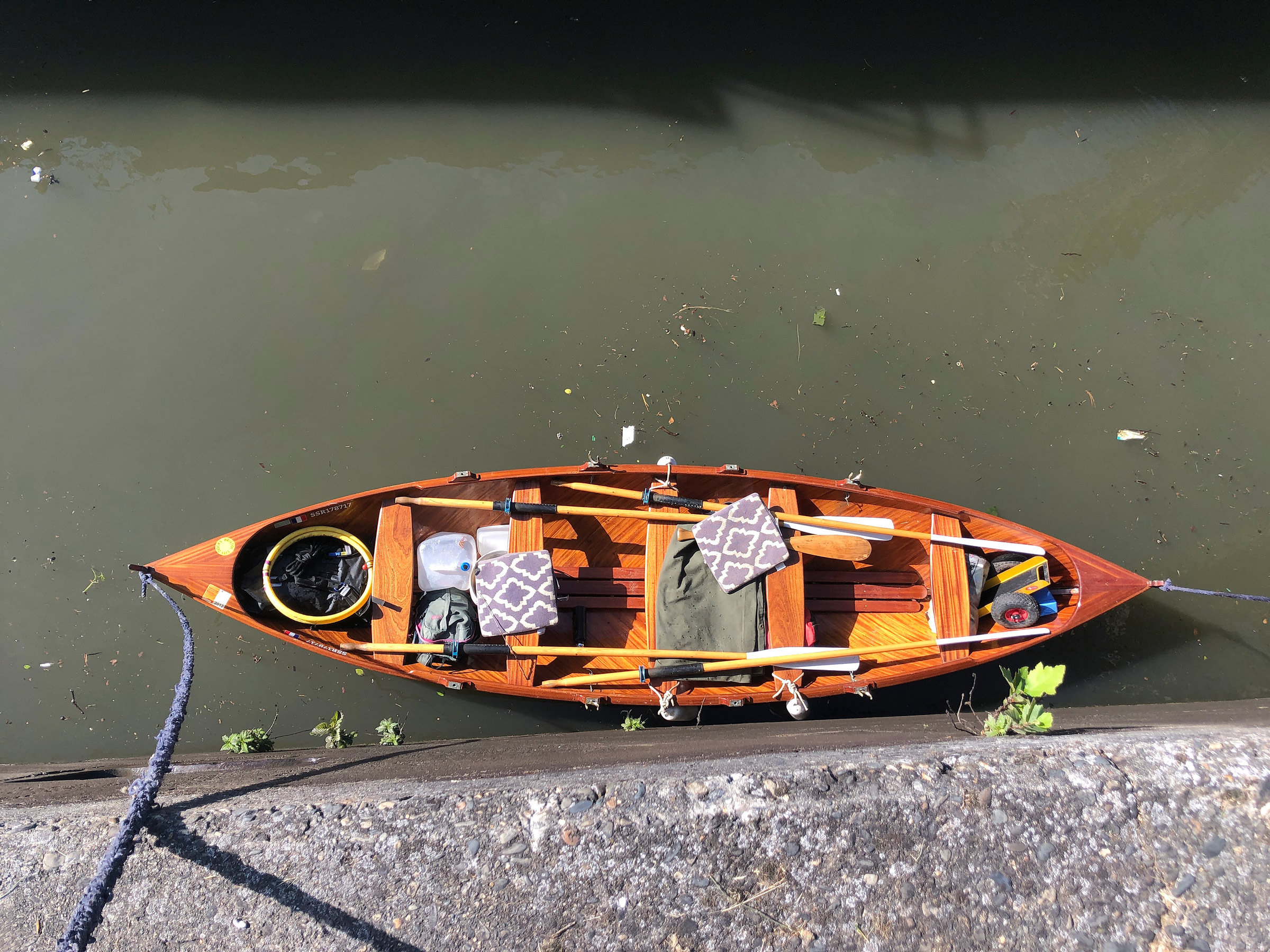
Before putting the boat in the water, we squeezed dry bags and duffels, a cart, and a four-gallon water container under and in between the thwarts. With cushions set on the thwarts, I settled aboard as Ben cast us off from the slip and jumped in. The first 600 yards we rowed was not enough for us to find a rhythm but it wouldn’t take long to synchronize our strokes effortlessly.
Photographs by and courtesy of the author
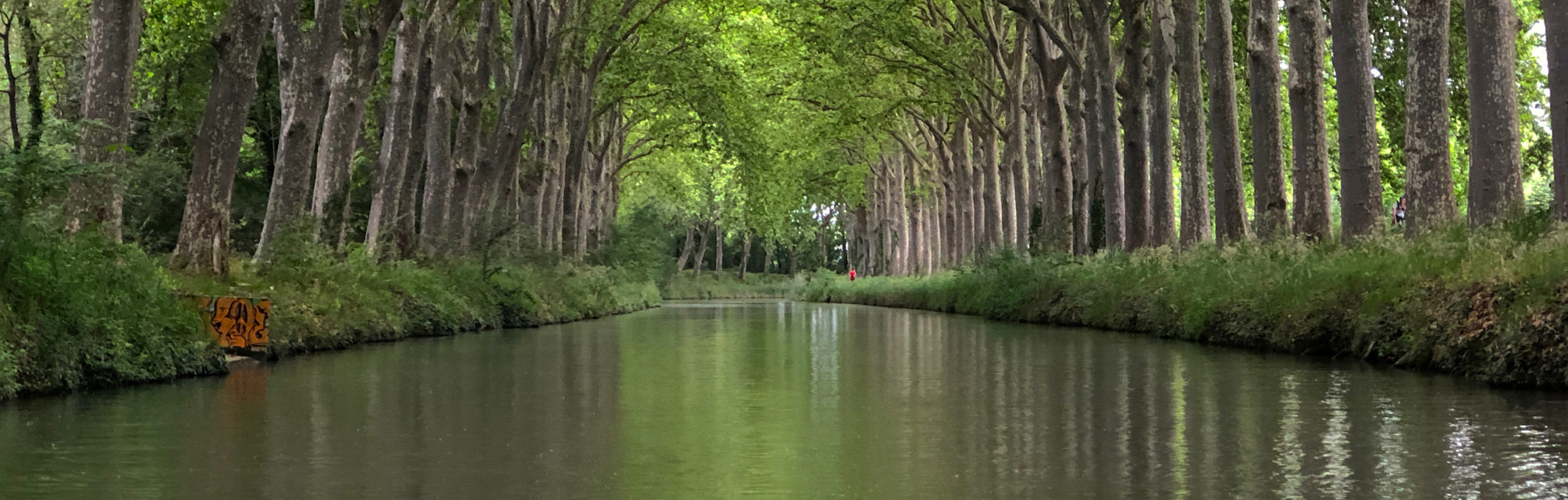
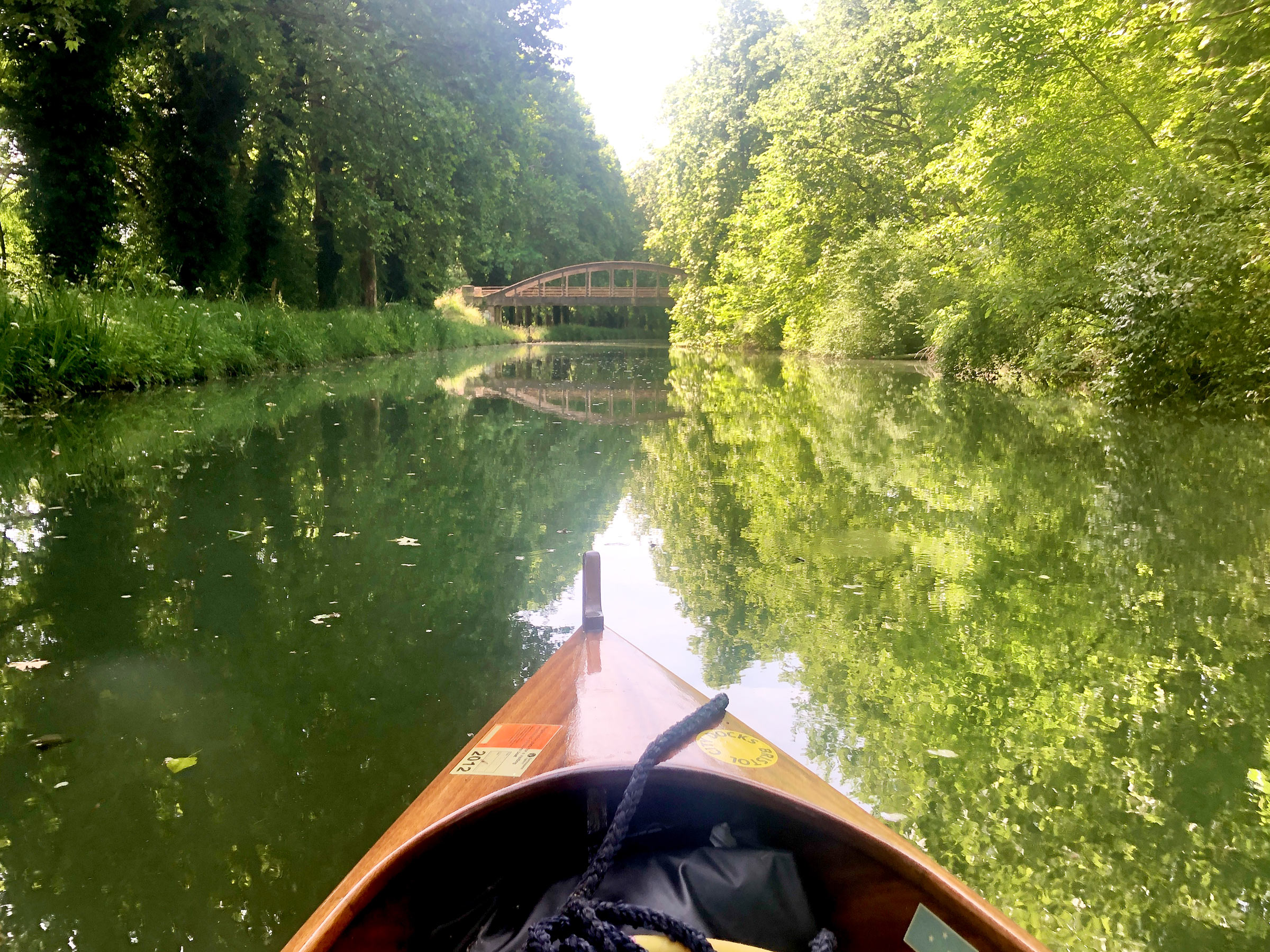
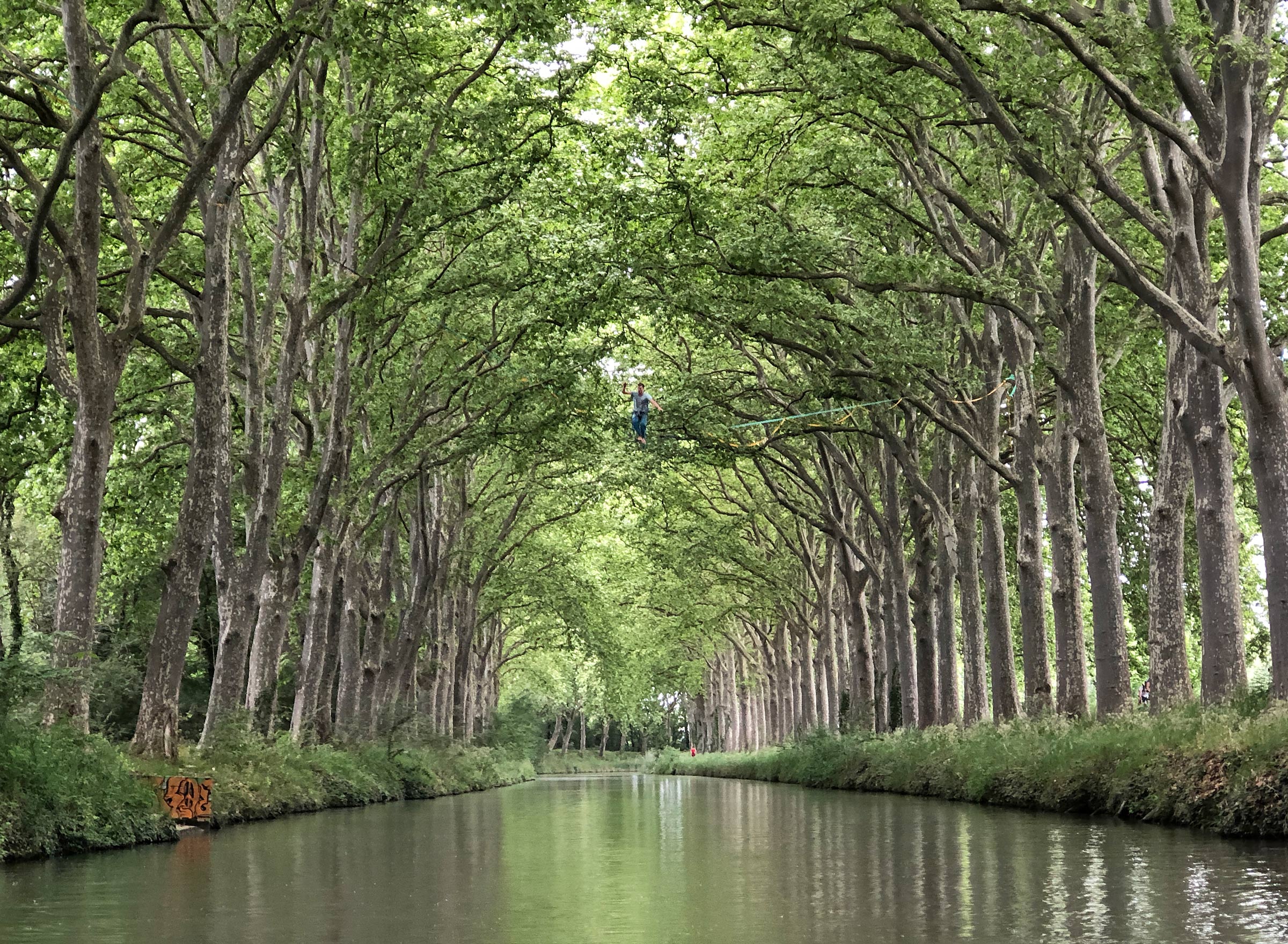
The Canal de Garonne offered abundant shade and peace; in our first week of rowing, we encountered just two or three other boats a day.
I twisted to peer over the bow and saw the waterway blocked about 100 yards ahead by two solid metal lock gates, flanked either side by steep slopes of dark stone 10′ from the water, the red light of a triangular set of traffic lights just above the right-hand slope. I stowed my oars, stood up, and turned to face forward. Balancing in the moving boat I stretched my arm up fully to reach the rubbery pole dangling from a wire 15′ above the water and yanked it hard to signal the automated lock system of our arrival. The pole bounced up, down and around, but nothing else happened. I sat down to Google “hanging stick French locks” as Ben backed TRAMP. I tried again and twisted the pole one half turn. It clicked and the green light illuminated as the lock prepared itself for us. Moments later, a beeping alarm sounded as the lock gates opened inward. Once they’d each clunked into position alongside the edges of the chamber, the red light went out, the green one stayed on, and we could enter.
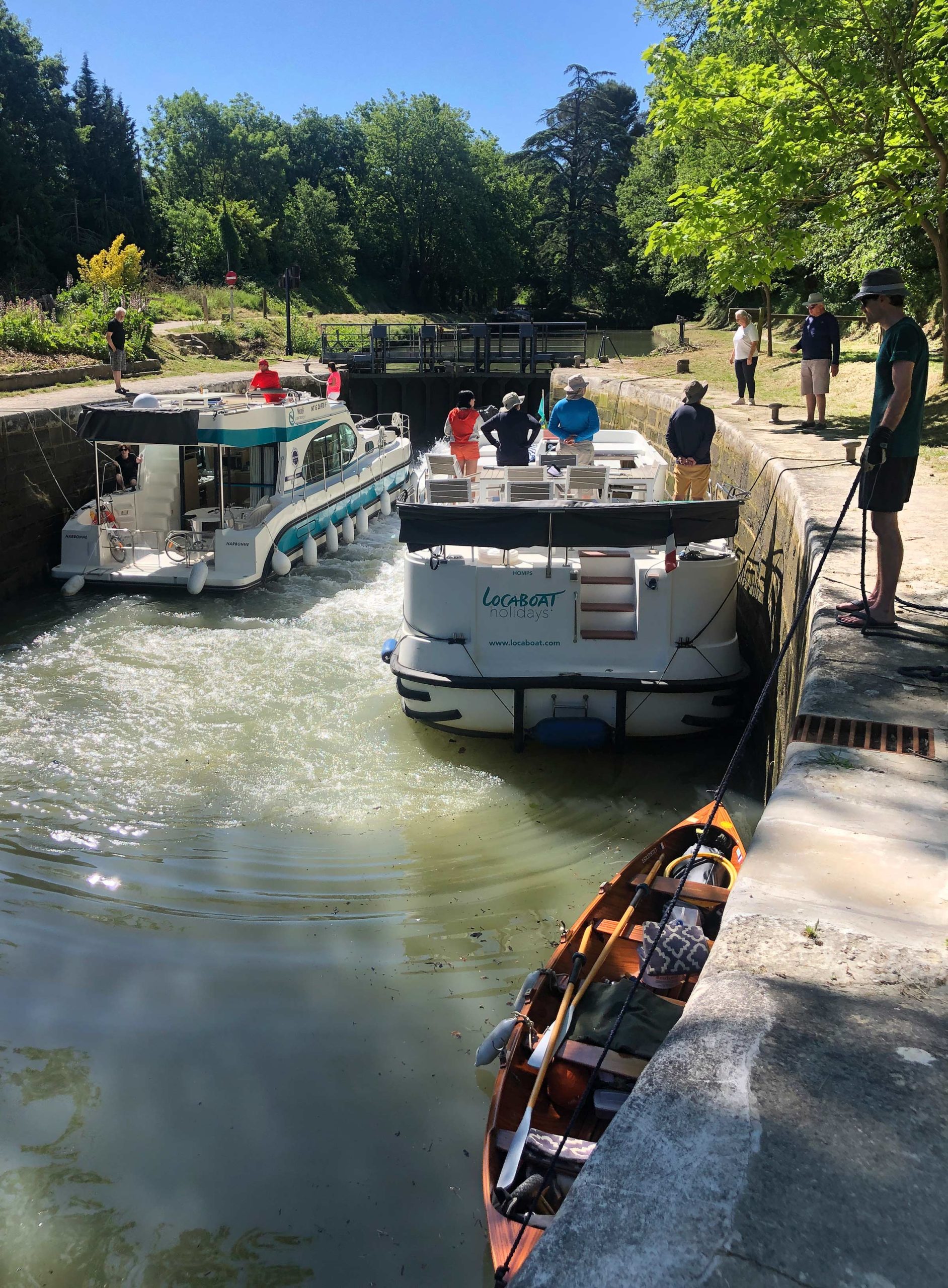
The locks were not wide enough to comfortably accommodate the span of our oars, so Ben maneuvered us with the paddle through the entrance to the lock. I looked for one of the light sensors, which detect boats as they pass by and indicate to the automated lock system that a boat has entered or exited the lock. The sensor was set in a cobwebbed circular recess in the stone about 3′ above water level, too high to register TRAMP slipping by beneath it. I held a folded map over the sensor to get it to notice us and activate the system. We stopped TRAMP so I could get out and climb the concrete stairs before Ben paddled past the lock gates and into the chamber.
At the side of lock, the amply windowed olive-drab keeper’s booth was unoccupied. On the wall facing the lock, next to an orange life ring was a white switch box with two push buttons, one green and the other red. After Ben climbed from TRAMP onto the ladder up the lock side holding the bow and stern painters, I pushed the green button. A low humming resonated in the lock chamber followed by beeping as the lock gates we’d just entered jolted from their recesses in the lock walls and 20 seconds later slammed closed with a boom. The humming continued as the sound of trickling water grew louder. Water gushed into the lock, a torrent of white froth curling at the front gates. The water calmed as it flowed farther into the lock, where Ben held the rocking TRAMP 20 yards back, closer to the rear lock gates, coiling the painters in his hand as the boat rose.
Roger Siebert
.
I wandered up a path to look closer at the light-yellow lockkeeper’s house, a plain two-story building with a terracotta tile roof. A faded blue sign above the front door told us we were at Lock 51, Ecluse de Mazerac. An arrow pointing right said it was 692 meters to the lock we’d just come from and an arrow pointing left said 4,449 meters to Lock 50, Bassanne. We would be counting down the locks from here to Lock 1 at Toulouse.
We rowed 11 miles to the hilltop village of Meilhan-sur-Garonne and pulled into a space between cruising boats, where wooden pontoons ran parallel to the bank along the canal. We cooled down and celebrated our successful first day with a sparkling Perrier water for pregnant me and a beer for Ben. We made a few trips back and forth carrying gear from TRAMP to the campground that was to be home for the night. Our orange pup tent was the only tent on site among campervans and caravans from France, Britain, and the Netherlands.
We got a late start the next day and that afternoon we rowed a stretch of over 6 miles with no locks. Rows of 200-year-old plane trees rose like green vaults of an endless cathedral and protected the canal from winds, its banks from erosion, and us from the sun. The trunks of these trees were surely the inspiration to the French artists during the First World War who developed military camouflage: a patchy collage of swamp green, tea brown, and sandy beige. A steady rhythm formed as our four blades plopped into the water together, followed by the collars clicking against the brass rowlocks, twisting them with a grumble before we lifted the oars out and drips trickled off leaving an arc of overlapping rings on the water. A golden oriole sang soprano in a chorus of the twittering birds around us.
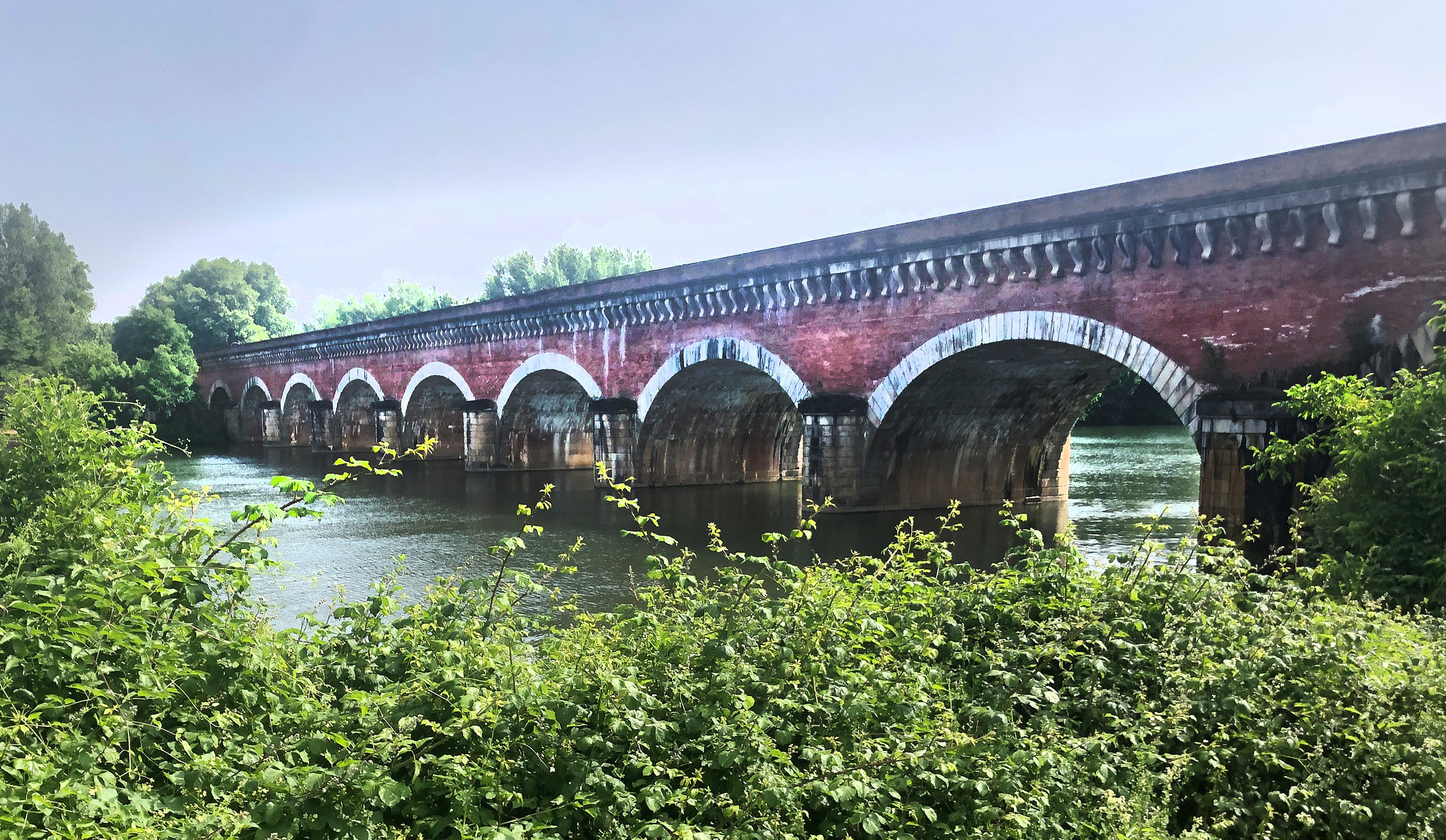
We stopped for a rest day at Moissac and took a walk to look at the Pont-Canal du Cacor, a nearly 1/4-mile-long navigable aqueduct. Built in 1844 of the same pink bricks common in Toulouse, it carries the Canal de Garonne across the river Tarn; the following day we’d row TRAMP along this canal-bridge. Christian pilgrims on the route to Santiago de Compostela in Spain stop by the town of Moissac, which is situated near the confluence of the Tarn and Garonne rivers and famous for its abbey.
Rowing out of the shade of the plane trees, we saw a triangle of canal traffic lights on the right of the stone arch bridge where hire boats would have to lower their canopies to squeeze under. Beyond the nearly 20 gelcoat-white rental cabin cruisers with their bows pointing into the canal, we found a space just long enough to moor TRAMP. Ben and I stepped ashore to look for the campsite I’d read about online. Two-story houses in different widths and heights all built one against the other rose beyond the grassy bank, their red tiled roofs forming a staircase upward to the village of Le Mas d’Agenais. Quickly sweaty and out of breath, we trudged up between red-brick and flaking-stucco buildings to find a wall-less timber-framed building with a barn’s gambrel roof. Knocks from centuries of market vendors marked its thick mottled hand-hewn oak beams, each planted on a knee-high stone plinth. Neatly brick-paved streets led past a white and gray stone Romanesque church to the campground, where a handwritten cardboard sign dangling on a rope across the entrance read, “Fermé.” We would have to find somewhere else to stay the night.
We returned to TRAMP and within an hour we rowed to the next canal-side campsite, 2 miles farther on. We found an empty car park with a vacant building, a trash-bin enclosure with no bins, and a bone-dry sink with spiderwebs full of dead flies in its corners. A signpost poking out of a waist-height hedge read, “Reserved for Campervans.” By now the canal’s locks were closed for the night, so we dragged ourselves over the canal bridge and along the road to the only other place marked on Google Maps, a bed-and-breakfast less than a half mile away. It had no website or phone number. Beyond a field of knee-high cornstalks with dark green arching leaves, we cautiously wandered through the pillared entrance between 6′ walls into a dusty courtyard. Five doors painted the color of claret were evenly spaced along the front of a one-story building, the windows between them almost hidden behind thick, lush layers of ivy. Perpendicular to it was a sandstone building with cracks that could accommodate small birds reaching up to the beveled clay-tile roof. A wooden beam, almost black with age, spanned the top of a metal garage door.
“Bonsoir?” I called. A man stepped out from the back of a van, wisps of gray hair flowing from the sides of a faded flat cap that shielded his crinkled face from the last of the day’s sun. “The minimum stay is three nights,” he said, “but back at the crossroads, the first house on your left, is someone who sometimes helps travelers like you.” We walked to the house and, finding no way in, gently tinkled a bell hanging on a chain outside. A gentleman appeared and opened his metal back gates. Smiling, he introduced himself as Jérôme and invited us to follow him. We wound through his tangle of rooms, each crammed full with paintings—a still life of three apples next to a stack of crumpled papers under a violin, ladies languishing with half-fallen white robes, an intricately embellished gilt frame wider than the faded square portrait it surrounded, a wooden framed pen-and-ink illustration of a battle sitting on the floor behind the end of a wrought-iron bed frame sculpted with the silhouette of an oak tree. He led us to a bedroom, flung the shutters open, looked under the bed linen to check it was clean, and exclaimed, “Perfect, the room is ready.” We returned to TRAMP to cook up a camp-stove dinner of couscous, tomatoes, and lentils with dried onions, olives, and artichoke hearts. Taking only the wash kit, we headed to Jérôme’s for a dip in the pool before bed. After two consecutive days of rowing at least 12 miles each day, we rested deeply.
Jérôme sat us at a breakfast table where tapestries hung on the wall and an intricate ammonite fossil 12″ in diameter on a metal stand vied for space with six busts on a glass-top table with intricate legs decorated with golden metal leaves. Ben cut a slice of dark crusty bread for me and spread it with a thick layer of butter. I sank my teeth in and was surprised by how sweet it was; it was actually an unfrosted chocolate loaf cake. Jérôme filled the table with a sliced baguette in a woven basket, a jar with a handwritten label abricot, a jug of strong coffee, and a bowl of strawberries from his garden.
Excited to learn that we’d arrived in a wooden boat Ben had built, Jérôme, a metalworker, shared his passion for working with his hands. Around the garden there were large sheets of metal he had sculpted in sensuous forms; his open workshop was adorned with mirror frames decorated with gold-leaf finish, one going to Versailles, one to Italy. Part of his bonsai collection was growing in rocks, with others in pots next to a yew tree he had been pruning into the shape of a flying bird. Neat garden rows stretched out with zucchini, strawberries, tomatoes, peppers, and artichokes. He accompanied us back to TRAMP to admire Ben’s work where I learnt the French word for mahogany, acajou. Before parting ways, Jérôme wished us that all would go well with our growing baby and that only wonderful things would happen in our journey and lives.
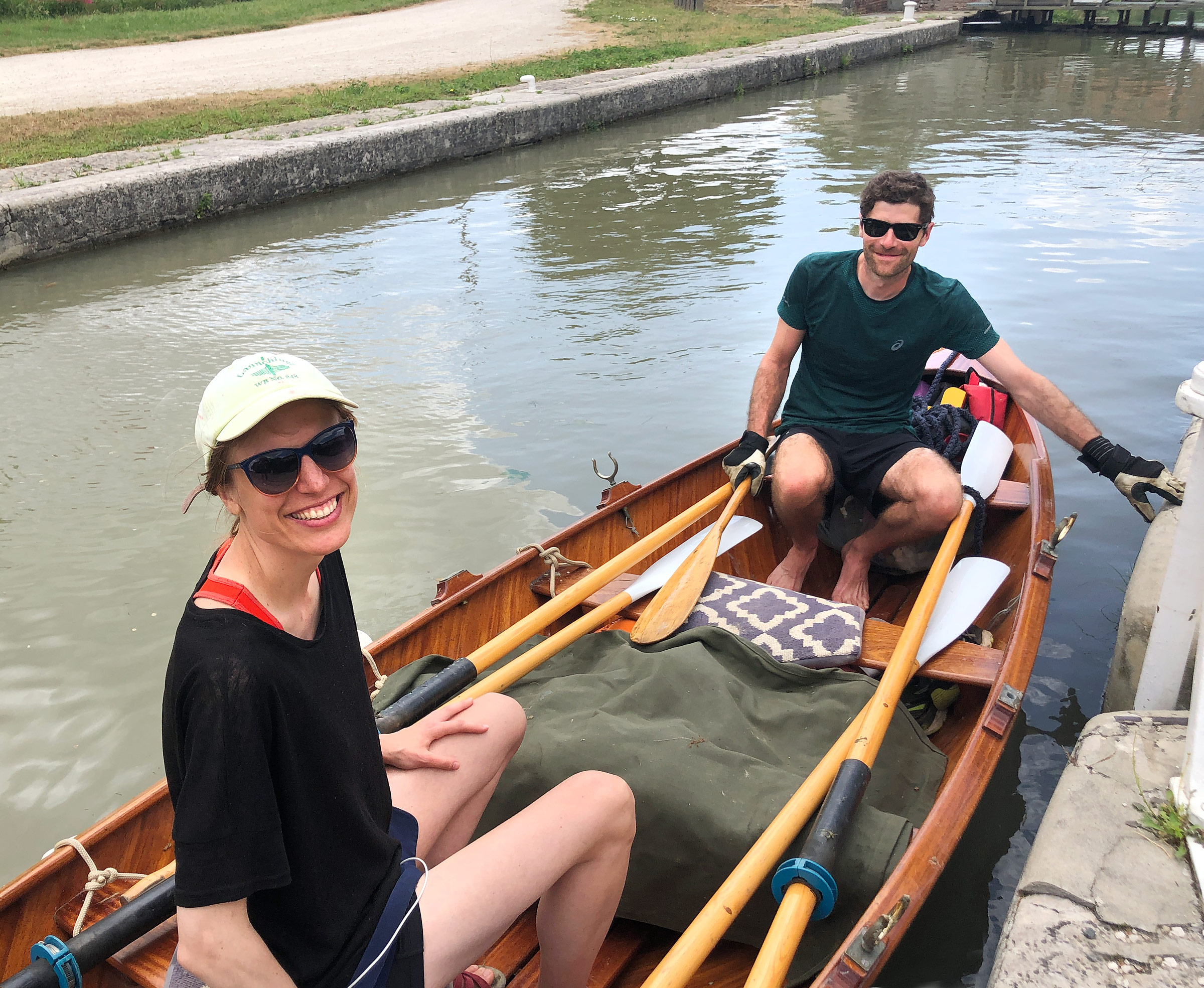
Numerous cyclists enjoy the towpaths between Toulouse and Bordeaux. Curious to see the locks in action with a wooden rowing boat, some stopped to chat and kindly took a rare photo of Ben and me aboard TRAMP.
We settled into days of counting down each Canal de Garonne lock we passed through, long straight rowing stretches, and locating bakeries, campsites, or B&Bs to stay each night less than a 20-minute walk from the canal. On our tenth day, we passed Lock 3 after lunch and Lock 2 less than a mile after. We barely noticed another mile and a half before gliding into Lock 1 at the northern edge of Toulouse. Inside the lock, Ben and I stood holding the bow and stern lines as the two metal gates boomed together, closing the chamber behind us. A man in the now-familiar VNF blue T-shirt stopped trimming the grass on the far side of the lock, walked over the closed lock gates to us, and asked gently, “How far are you going?”
“Toulouse today and Sète after,” I responded. He phoned his colleague at the locks ahead to let her know we were coming and as I heard him use the word aviron, I tensed. Aviron is associated more with oars for racing shells, whereas rame would have been a better word for our oars. The water in the lock slowly rose as the lockkeeper talked with his colleague. The lock was half full when he made another call, three-quarters full when he made the third. I’d lost count which call he was on when the second set of lock gates opened out on the last stretch of the canal.
“I’m sorry,” he said, “you cannot pass Toulouse.” Our second leg, the Canal du Midi, was supposed to begin in the city center with three locks managed by one central lockkeeper using closed-circuit TV. The Toulouse lockkeeper said she couldn’t take responsibility for a boat without a motor going through. “You’ll have to take the boat out.” After another phone call, he said his team leader would come shortly. A cloud of dust billowed from the stony path as the boss pulled up in a white VNF van and came to an abrupt stop. Out strode a large-bellied man with furry furrowed eyebrows who took one look at TRAMP and barked, “Non! Not possible! You do not have authorization.” He stood squarely with his arms crossed, his face slowly getting redder, continuing without taking a breath, “You need documents to pass, it’s a public holiday tomorrow and the managers will take Friday off, too, so you can’t speak to anyone until Monday. You cannot pass the locks.” He returned to his van and roared off.
Dejectedly, we rowed the last 2-1/2 miles of the Canal de Garonne and moored TRAMP at the Port de l’Embouchure, a basin for the three-way junction of the Garonne, Brienne, and Midi canals. Later that warm evening, we strolled through the streets of Toulouse, La Ville Rose—the Pink City—where many buildings have for centuries been built with distinctively pink bricks. We passed duck foie gras specialist shops, Lebanese restaurants, bars, brasseries, and patisseries. About 1-1/2 miles from the Port, we arrived at Toulouse’s Pont Neuf—“New Bridge” (in spite of it having opened in 1612). It spanned the Garonne River on seven stone arches of varied sizes. People filled the streets lining the riverbank, drinking wine from plastic cups and snacking on baguettes and saucisson while a police van parked nearby waited for the hordes of revelers expected before Ascension Day, a national public holiday.
Muscles all over my body ached and my mind, tired of speaking French, raced through “what next?” scenarios. Could we haul TRAMP and all our gear on her two-wheel trolley through the traffic-filled streets and find a place to relaunch after the locks? Might we slip into the locks unnoticed behind a bigger boat? Was our adventure already over?
After a restless night in a €75 apartment-hotel, we went to check that TRAMP was still safe. Stuck to the stern thwart with brown parcel tape was a neatly handwritten note in a plastic pouch, “I have more information on your request, please call this number.” I phoned and five minutes later, a man approached in tan slacks and a pale blue jacket. Without the cobalt blue VNF T-shirt I didn’t recognize him immediately, but it was Franc, the lockkeeper who’d made numerous phone calls at the last lock the day before. He’d spoken to the VNF directors, and they would give us authorization to continue—on two conditions: that at least one of our docklines measured no less than 10 meters and that neither of us stayed in the boat while the lock was in operation. Ben unwound the rope from the mooring, and I lined it up on the brick while Franc pushed out meters of his yellow metal tape measure: 12m60. We repeated the process with the bow line, identical in length. We told him we’d like to leave the next day at 9 a.m., and he said the lockkeeper would be waiting for us—we had permission from the VNF territorial management to row all the way to Sète on the Mediterranean coast.
With a verbal go-ahead from the regional management of VNF, we were relieved and excited to be let through the three locks at Toulouse and on to the second leg of our adventure.
In the morning, after stopping at a bakery we set off through the middle of the three arched bridges at the Port de l’Embouchure to the constant noise of traffic and honking car and moped horns. As we rowed, we passed dog-walkers and joggers, some on the towpath a few feet above water level, others a bit higher on the pavement beyond, with shop fronts and apartment blocks lining the half-mile stretch to Béarnais lock, the first of 64 on the Canal du Midi. As we approached a wooden waiting pontoon about double the length of TRAMP, the lock’s bottom traffic light turned to green. We stopped to let me climb out and I walked up the bank side onto the road and used the pedestrian crossing over four lanes of traffic as Ben paddled us underneath and into the lock. Not finding a gate in the metal barrier separating the sidewalk from the concrete area surrounding the lock, I hopped over it and entered an office where a lady sat surrounded by screens showing different angles of the city’s locks, milliseconds ticking by in green numbers in the top right corner of each. I presented her with a croissant and pain au chocolat I’d just bought, so fresh the paper bag they were in did not yet have any translucent butter marks showing. She thanked me and apologized for the difficulties we’d initially faced, assuring us that our safety was their main concern and that she’d slow the water speed flowing into the lock to avoid a torrent disturbing our small boat.
I returned to Ben, who had climbed the lock-side ladder and was holding TRAMP’s lines on the opposite side. We peered around to spot the CCTV cameras, sitting atop posts at either end of the lock, to which we gave a thumbs-up. We grinned to each other as the 50′-long brick-lined lock chamber slowly filled. With many merci beaucoups and smiles, I waved goodbye to the lockmaster as Ben paddled us out of the lock and we resumed our rowing positions for less than five minutes before repeating the whole process at Lock Minimes.
The loud whoosh of cars speeding by next to us bounced off the gray concrete bridge as we rowed under its shade for about the length of a bowling alley, the width ample for our outstretched oars with no need for careful steering. We continued undisturbed along a 1-mile stretch of serenity in the shade of the evenly spaced plane trees, the only constant on the canals since the start of our adventure. Pedestrian and road bridges traversed the canal about every 500 yards with occasional concrete steps leading from the towpath up to at least two lanes of traffic either side. As the CCTV lockkeeper had advised, we stopped a good 100 yards or more clear of Lock Bayard, which borders the Matabiau train station, and waited more than five minutes as the red and green traffic lights shone and the lock chamber emptied itself through the sluices.
Few people noticed us below them as they hurried to and from Toulouse station. Once the red light went out, Ben paddled us into the darkness of 80 yards of concrete-capped canal under the spacious pedestrian plaza area. The smooth concrete sides of the lock rising yards above us were green with grime to the maximum height of the waterline, where the concrete became a clean pale gray about a foot below the lock edge. Like some specialized high-diving facility, a swimming-pool ladder came out of the canal before the lock gates, leading to concrete steps up and beyond our line of sight. Above the cold-black lock gates at the lock’s far end gleamed the bright green leaves of a tree in the sunshine beyond. We both got out of TRAMP using the ladder, then each released more and more slack so we could hoick our ropes over the various handrails lining the steps and lock gates as we climbed up to the lock-side.
At street level we re-entered city civilization in front of the train station, a building adorned with colorful coats of arms between the 26 double windows stretching between the north and south concourse, each topped with a flat-topped dome-shaped black slate roof. The clock in the middle at the top of the building showed 10:30. The sill at the top end of the lock was more than 3′ above the water, trickles spouting continuously over the closed gates above it before we gave our thumbs-up to the CCTV and the sluices opened to let the water rush in. Ben and I stood at the vertiginous lock edge occasionally tugging a line to keep TRAMP steady. Our sharp-edged shadows fell against the opposite side of the lock. Behind us, a toddler stood with his face peering through the orange metal fencing separating the lock from pedestrians as TRAMP’s gunwale finally came into view by our feet. Between us and the Mediterranean lay 150 more miles of canal.
After clearing the drama and hubbub of Toulouse, we were glad to return to the shade of the plane trees where a slackliner, visible here surrounded by the tree canopy, practiced above us.
Two days, 33 meandering miles, and 12 locks later we were 633′ above sea level at Lock Ocean, the canal-system’s aptly named summit. Its oval shape was characteristic of the locks on the Canal du Midi and could accommodate the increasing number of hire-boats and hotel barges we now shared the water with. After another 3 miles of rowing, we were at Lock Mediterranean where, for the first time, the V-shape of the front and rear lock-gates now pointed toward us as we entered. The lock was full of water when we entered so we could easily step out of TRAMP onto the lock-side. The water emptied from the lock without turbulence and we each gradually paid out the painters as TRAMP descended in the chamber. Once the downstream gates opened, Ben climbed down the lock-side ladder and paddled out to the waiting pontoon to meet me.
After we’d finally mastered the light sensor system on the locks of the Canal de Garonne, we discovered that the oval locks of the Canal du Midi use a different system—radar—to monitor boats as they enter and leave.
Six miles and a series of singles, double, and treble locks later, we found ourselves at a closed lock. Like most people in France, lockkeepers took a lunch break at noon and by 1 p.m., a line of for-hire boats had formed on either side of the lock, waiting to pass through. The entire waiting pontoon was occupied by other boats, so we rowed to the opposite bank, held reeds to stay in place there, and watched green and blue finger-length dragonflies dancing together. When the lock-gate ahead opened, three hire boats maneuvered into the lock. We moved into the space on the back left side of the lock to prepare to lock down, but we heard a beeping sound and saw the lock-gates start closing behind us as the boat in front started drifting back toward us. “Red button! Red button!” I shouted in English, trying to tell what I thought was the Belgian crew standing near the control booth to press the emergency stop button. Moments later the lock-gates stopped moving and a flustered lockkeeper appeared on the far side of lock; she had a shoebox-sized box with buttons to control the lock’s operation hanging in front of her from a strap around her neck. “You gave me the fright of my life,” she said in French. “I thought someone had fallen in. This will be your last lock.” Once the boat ahead of us was safely secured, we moored behind it and climbed out. Ben held TRAMP’s lines as I went to speak with the lockkeeper and recount the story of our journey including permission from Toulouse management. As we talked, she kept her eyes on the water level, occasionally pressing a button on the box to operate the double lock. She slowly began to chat more freely. We cleared the two locks and by the time we said goodbye, she was smiling and wished us well on our voyage.
Lock Ocean is at the summit of the Canal du Midi. It was the last of the locks to take us upstream; the downstream locks beyond Lock Ocean would lower us without the turbulence created for upstream traffic. We nearly got crushed three times in one day and were constantly vigilant for the inattentiveness of hire-boat crew with whom we were sharing locks.
While the locks on the Canal de Garonne were self-operated using the dangling pole and the automated system of light sensors, almost all locks on the Canal du Midi were staffed, perhaps because of much higher traffic traveling between tourist hotspots like Castelnaudary, the self-proclaimed world capital of cassoulet, and the fortified hilltop medieval citadel of Carcassonne. On one day we passed through 15 locks, a new record for us, and met lockkeepers of all shapes, sizes, ages, and countenances. One smiling lockkeeper gestured us through without question; when his services weren’t needed, he carved out time to set up a shop selling sun hats, gloves, cold drinks, and cherries picked from a nearby tree and still warm from sunlight. Another lockkeeper sat in the shade of the lockkeeper’s house with the control box on his lap while his sheepdog herded the hire boats through. Yet another lock had colorful ramshackle sculptures for sale: an elephant; a face with moving eyes; male figures with crude markings; a cartoonish big-bosomed, short-skirted lady with flowers growing as her hair. Some lockkeepers phoned their colleagues ahead to let them know a small wooden rowing boat was on its way.
As we neared the Mediterranean, there were more and more boats and fewer and fewer trees. Where the bank drew almost level with the water in the canal, I stood up in TRAMP and in the distance to the south saw the snow-capped table-top mountains of the Pyrenees. A few miles farther along the Canal du Midi, pink rock lined the left side of the canal.
Camping along the canal outside of the established campgrounds is not permitted, but when we reached the locks here on the Canal du Midi after 7 p.m. they were closed, and we were miles from the nearest campsite or village. Most of that afternoon we’d shared locks with the barge LA BELLE VIE, and the couple who lived on it presented Ben with an ice-cold beer and let pregnant me use their bathroom.
We weren’t expecting to see waves on the canals, but for three days after Carcassonne, their rhythm had been constantly battling against ours in the rocking boat. The resistance I felt pulling the oars through the water now doubled as I felt the blades flutter when I pushed them through the air blowing up to 12 miles per hour against them. Both of us taking a break would mean getting pushed backward, but Ben reminded me to take one whenever I wanted. I stowed my oars and laid my head down onto the forward thwart to rest my lower back and gaze up at the cloudless sky. A clubtail dragonfly landed on my starboard oar. A yellow stripe ran from the tip of its 2″-long tail to its bulging head and between the shining domes of its pastel-blue eyes.
The next day seemed never-ending, rowing 15 miles of lock-free meanders between Le Somail and the bridge at Capestang, an arch of mortared irregular stones over a passage only 16′ wide and 7′ 9″ high at each side. After resting at a guesthouse on the banks of the canal, I ate three boiled eggs, half a baguette, a bowl of fruit salad, and a pot of yogurt for breakfast. Finally, the winds blew in our direction. A blue and white barge with tourists squeezed on its upper and lower decks emerged from the black Malpas tunnel ahead of us. I switched on the navigation light and held it upon my head with both hands, elbows jutting out, hoping to cut a noticeable figure for any boats about to enter from the other end. As I stood facing forward, Ben paddled us gently into the approaching darkness. Once under the Ensérune hill, we could see daylight glaring 165 yards ahead, highlighting a towpath and railings to our left and the lumps, bumps, and voids in the tufa rock tunnel walls from 300 years of humidity and erosion. I sang out at the top of my voice. The tunnel remained clear, and Ben rowed until we popped out of the cool shade through the tidy brickwork at the tunnel exit into the glare of the day.
From the tunnel we rowed 4-1/2 miles along more meandering canal to a seven-lock flight at Fonseranes, which would lower us 71′ over the next 980′. We could only see the first of the 100′-long locks; beyond its downstream gate, the flight dropped out of sight and down to the next step. Three bulky white hire boats had crews of varying attentiveness managing the ropes from the walks above the wall. Fortunately, the limited lock space prevented the boats from drifting backward or letting their sterns shift sideways. We kept TRAMP tucked as far back in the lock as possible without reaching the sill, with Ben holding the stern line up the stairs, and me with the bowline on the lower lock-side ahead of him. After the lock gates closed behind us, water drained away through the front gates into the next chamber for nearly 10 minutes. I turned away from the sun to shade my burning red feet with my legs and drank frequently from the now-warm water in my flask. Once each lock emptied, we waited for the three boats to bumble into the next lock before walking TRAMP along. With only one fender positioned amidships, a rowlock occasionally scraped the stone lock edge, until we reached the flight exit at the end of the seventh chamber.
Carcassonne is a medieval city that surrounds a Gallo-Roman citadel dating back to the 4th century. A good way to explore most French towns is to look for a vegetarian restaurant without the help of Google and without paying attention to their opening hours before you get there. You are likely to walk for miles, not find anything, not spend a cent, and see most of the town you are visiting.
After spending a night at a canal-side campground in Villeneuve-les-Béziers, it was already 80°F by 9 a.m. the next morning. Ben and I each set a now faded, flattened, and folded cushion on a thwart to start our 22nd day of rowing. Three miles later, I clambered out of TRAMP onto the grass and walked along a gravelly cycle path to speak with the lockkeeper. I found him resting his elbows on the railing of the single-lane road bridge overlooking lock Portiragnes. “Are you expecting to use the lock in that?” he quizzed me. I barely had enough time to answer before he declared, “Non.” Asking if I could explain, he interrupted, “Let me explain, boats without motors cannot use the locks. I can show you the rulebook that says canoes can’t go through,” nodding with his head toward the lockkeeper’s house where the document we’d been hearing about for weeks was apparently kept. “We’re not a canoe. We’ve rowed over 260 miles on two canals and been through over 100 locks,” I pleaded, “and we’ve only one more lock to go after this.” “I don’t care,” he puffed. “Pull the boat out.”
I looked back at Ben sitting in TRAMP alongside the waiting pontoon wondering what I could do or say next. A 90′ barge was cruising toward the lock, its clean black hull reflecting the sun’s rays off the water, the prow impeccably painted burgundy red. Rows of potted plants and flowers neatly lined the perimeter of the barge that surrounded the four guests being served drinks around a wooden table. The young captain stood at the stern behind a wooden steering wheel twice his width, wearing a navy-blue baseball cap and sunglasses, his white polo shirt tucked into navy-blue shorts. Another man in matching uniform stood looking ahead from the bow, where just below him ALOUETTE was painted in white next to a hefty white anchor. “How did you get through the flight of locks at Fonseranes yesterday?” the lockkeeper suddenly asked me. “We held TRAMP from the lock-side and walked her through with our ropes when possible. Ben used the ladder to get back aboard and paddle through to the next lock when the bridge was in the way.”
“If I let you through,” he said, “you will be walking through, not in the boat.” He told me he would phone his colleagues at Fonseranes and left me standing on the road-way bridge as he headed toward the lockkeeper’s house.
I walked back to TRAMP hoping that we might be able to share the lock behind ALOUETTE. The lock gates opened and ALOUETTE glided in. Ben and I waited, Ben in TRAMP, me standing at the canal side. Finally, the lockkeeper re-emerged from the house and with a wave, he signaled Ben to paddle forward into the rear portside of the lock. As the lock gates closed, the lockkeeper took a closer look at TRAMP. From the opposite side, I walked ahead, past the lock and over the bridge to join him and Ben. After not getting a response speaking French to Ben, the lockkeeper turned to me. “You’re not the first kind of this boat to come through the lock,” he said. “All the others manage to pull their boats out.” He used the plural masculine pronoun ils to refer to ‘the others’ so I switched to feminine elles and asked him, “Were they pregnant, too?” Shocked, he looked down at my belly. “Well, it doesn’t show,” he said, “maybe a little bit.”
Once the lock had emptied, the gates opened and ALOUETTE motored forward. I thanked the lockkeeper as Ben and I walked TRAMP along and out onto what could be our last 8-mile stretch of the Canal du Midi.
Le Somail would be just another sleepy hamlet along the Canal du Midi but for its bookshop, Le Trouve Tout De Livre (Find It All by Book), located near the circular tower at left. The store is a labyrinth of more than 50,000 books, comics, tomes, and antique invoices, and has developed into a popular tourist stop complete with canal cruises and restaurants (including the only vegetarian menu in the region). The bridge here, with the semicircular vault that spans the canal, dates to the 17th century.
The lock at Agde connects the Canal du Midi from the east and west with a junction south to the river Hérault, each lock-gate with different water levels beyond. Our reference book said that the Hérault had suffered from silting in recent years, so we were unsure whether that could be a possible route for us out onto the Mediterranean. To turn boats that are not taking the straight east–west passage, the chamber is shaped like two joined semicircles, the southern one half the diameter of the northern.
We arrived from the west followed by a hire boat; I helped loop its lines around the mooring so they didn’t need to get off the boat. A young smiling lockkeeper said we’d be fine on the river Hérault, though we’d have to wait our turn. Using the control box hanging on a strap around his neck, he first filled the lock to its maximum level, an unusual canal ascent on the otherwise downward route. He opened the east gates, and the hire boat left toward the final lock of the Canal du Midi and the Étang de Thau, a lagoon stretching 13 miles to the northeast roughly parallel the Mediterranean coastline to Sète. Another hire boat with a couple onboard cruised in and a teenage boy appeared on the lock-side as their crew. They took some time to decide on the best place to moor their 35′ boat against the lock’s curved walls, finally choosing the starboard side of the west lock-gate, diagonally opposite us. The lockkeeper released water to the level it was when we’d entered, allowing that boat to continue west.
After the lock-gates had closed behind them it was our turn. Though the water only descended another 3′, it took nearly 10 minutes to drain the voluminous round lock. A darker waterline was revealed on the lock-side suggesting how rarely the south lock-gate was being used. As the lockkeeper opened the gates of our final lock, he seemed to read my mind, “No one will bother you now. When you get to the sea, the nicest beach is on the right.” Ben climbed down a ladder and stepped aboard TRAMP and used a paddle to cross and exit the lock. I rejoined him from a waiting pontoon to row the slender 1/3-mile-long canal to the Hérault.
Exhausted after weeks of rowing and days of headwinds, at least we could enjoy slipping under narrow low bridges without the concerns that bigger boats face. We had a cart in case we needed to portage TRAMP, but fortunately we needed to use it only once to avoid a long wait for a broken lock to be fixed.
After three weeks of rowing canals that were mostly well-protected from the wind, we suddenly faced a salty onshore breeze blowing against us on the 100-yard-wide river. The experience of our regular rowing trips back home in England’s Suffolk county on the tidal River Orwell served us well, and we put our backs into the strokes. Scattered along the riverbanks for about a mile were two-story houses and three-story apartment blocks painted either white, dusky pink, or crème brûlée, but all had terracotta-tile roofs. We rowed past palm trees, fishing vessels bristling with cranes and winches, and moored in front of the corrugated iron warehouse of the Grau d’Agde fish auction. Fishing rods of sport anglers poked up and out in all directions from a pair of parallel basalt stone breakwaters that flanked the Hérault for 1/5 mile beyond the shore into the Mediterranean. Each was capped with a concrete promenade and ended in a squat, white light tower with the top of the one on the west breakwater painted red and, 130 yards to the east across the river mouth, the top of the other painted green.
The light tower of La Tamarissière marked our arrival at the Mediterranean Sea. We stopped in the shallows and Ben gave TRAMP a sponge bath to get the worst of the green canal grime off the hull.
TRAMP lurched up and down quickly as the flow of the Hérault pushed into the azure Mediterranean Sea, which stretched out to meet the cloudless sky. I struggled to get the oars in and out of the water, let alone in time with Ben’s, as we cleared the light tower with the red top and turned west toward a sandy beach dotted with people and parasols of every color. Moments later Ben climbed over the side and dropped into waist-high shallows. I jumped in and ducked underwater, re-surfacing quickly to catch my breath from the shock of the chilly seawater. A few deep breaths later, I lay back in the sea, weightless, and felt the sun’s warmth on my face. With the Canal of Two Seas behind us, I wondered which country’s canals we will be crossing next, where our adventures as new parents will take us, and where in TRAMP the baby will go.
Caroline Kocel and Ben Jackson are based in Suffolk, on the east coast of England. Ben, a classic wooden boat enthusiast, worked at Spirit Yachts for eight years before setting up his own workshop as Jackson Yachts. He met Caroline during the 2020 lockdown after her return from life in Micronesia, and together they have rowed across Scotland, England, and France. They spend as much time as possible on the River Orwell estuary and have their sights set upon sailing a 30′ classic to the Caroline Islands in the Pacific.
If you have an interesting story to tell about your adventures with a small boat, please email us a brief outline and a few photos.
One of the nicest and easiest bits of marlinespike seamanship that we have found on a boat is French whipping for a tiller handle. It is both decorative and functional: its spiral of half hitches is attractive and provides a grip that is more secure than is a simple wrap without hitches.
This photograph and opener, Small Boats Magazine
The French whipping on this Whitehall’s tiller uses a soft 3/16″ solid-braid synthetic cord.
While any braided or laid cord can be used, synthetic or natural, we prefer laid cotton. It’s traditional, kind to the fingers when working it, easily pushed together to close any gaps in the wraps, and takes sealers well.
Although French whippings often have Turk’s heads covering the ends, these decorative elements aren’t necessary and we’re happy to forgo torturing ourselves with them. Fully functional French whippings can be applied with tidy and secure ends.
We whip about 5″ of a tiller, which is enough to provide a good hand grip. The amount of cord needed will depend on the circumference of the tiller (the tiller end here has a circumference of 4″) and we used about 25′ to wrap this one. It is nice to have a few extra feet of cord so we can choose where to end the hitches—usually on the underside of the handle. We do a test wrap of 1″ or so, undo it to see how much cord was used, and estimate the total length of cord needed. From there we can confidently cut the required amount and avoid pulling an unnecessarily long length of cord through each hitch. Another trick is to wind the cord like a yarn ball, which makes it easier to keep track of the working end of the cord and to avoid having to pull a long length of cord through each hitch.
We start the whip about 3″ from the end of the tiller, leaving room for a tiller-extension fitting should we decide to add one later. The first half hitch is put at the center on top, for appearance’s sake, leaving a short end of cord as an anchor that we capture under the first few wraps. Cotton cord flattens well and the tail end of the cord underneath the whipping won’t be noticeable. After the first few half hitches, we can slip the whip around the tiller to center the starting tag end on top. Then we continue the half hitches and stop every five or so hitches to slide the cords together as needed to provide a pleasing look to the finished whip.
The half hitches are continued, each hitch snugged to create a nice spiral. A tighter or looser hitch can be tied to adjust the alignment. Once we are within five hitches of finishing the whipping on the underside of the tiller, we set a loop of waxed twine past the end of the existing whipping and wrap each successive hitch over the twine. At the end of the whipping, the loop will pull the tail end of the cord back under those last 5 hitches. Then it is time to closely trim the ends of the line. If using cotton cord, we can dip the tiller in hot water to further tighten the whipping as the cord dries.
Photographs by the authors
The whipping starts with a simple half hitch tied around the tiller. The starting end will be covered by the wraps as the lashing proceeds. A piece of transparent tape or masking tape could be placed over it to hold it temporarily in place. Viewed from the right-hand side, the cord will make counterclockwise turns around the tiller.
The second wrap, like the first, passes under itself to make a hitch before being drawn tight. The cord emerging from the hitch can be pulled tight in the direction of the wind, then in the opposite direction against the wind to get the hitch tight, compact, and aligned with the previous knot to make a spiral ridge.
Before the tail end is completely covered, it can be pulled tight with a pair of pliers to make sure the first wrap is snug.
The wraps and hitches continue, forming the spiral.
A half-dozen wraps before the end of the whipping, a loop of thin line gets covered by the wraps.
At the finish, the tail end gets pulled through the loop.
The loop pulls the tail end under the wraps.
The remaining cord is carefully cut with a sharp knife. Once it is removed the gap between wraps can be closed-up by adjusting the cord.
The finished wrap can be coated with varnish or waterproof glue to keep the whipping tight and prevent it from slipping.
After the cord has dried, we seal the whipping with varnish or a waterproof glue such as Titebond III, and in just 15 minutes we have a good-looking non-slip grip on a slick, varnished tiller.
Audrey, aka Skipper, and Kent Lewis mess about on the shoal waters of Virginia’s Hampton Roads, and have traveled coast to coast with a menagerie of small boats. Their tiller adventures are logged at their blog, Small Boat Restoration.
You can share your tips and tricks of the trade with other Small Boats Magazine readers by sending us an email.
Recently, when we needed to make the mast for our Nutshell Pram, I was excited to use a spar gauge to mark the spruce for tapering and rounding. While the mast is small, I was not excited about hand-planing the larger sections during the tapering process. To make this job less onerous, I enlisted the help of DeWalt’s 20V MAX XR Brushless Cordless Planer, which transformed the tapering from a chore into a fun day.
My first impression was that the tool’s weight and size would allow me to make the precise cuts on the mast in an efficient, controlled manner. The mast was marked for tapers on two opposing sides, and the planer made short work of removing material. I started out on the lowest depth adjustment, 1/256″ (0.01mm), which is one step up from a zero cut. I could barely notice the cut at this setting (which would be good for final finishing on broad surfaces like thwarts), so I deepened the cut to 1/64″, which is a setting I like on my table-top thickness planer. At this depth, a satisfying amount of material was removed with each pass and I was able to work multiple short cuts on the more tapered end of the mast, gradually blending the short cuts into longer cuts that flowed along the entire 5′ taper. At first, I planed close to the line and finished the final taper with a hand plane, but after a few minutes of using the DCP580, I was comfortable with planing to the line. After I cut the mast’s four tapers with the planer there was still enough battery power to finish the eight-siding and cleaning off the high corners between the eight faces.
Photographs by the authors
The milled aluminum sole has a groove for chamfering and a kickstand so the tool can be set down with the blades elevated. The kickstand pivots out of the way when the planer is pushed forward; it can also be locked in the up position.
The belt-driven, twin-blade cutter head spins at 30,000 rpm, with a minimum speed of 15,000 rpm. DeWalt’s 20V brushless technology increases torque to the motor to keep rpm constant as the load on the blades varies. At the smallest diameter of the mast, 1-3/8″, the planer was easy to control while making fine cuts on narrow faces. As an experiment, I tried deep cuts on a scrap of mahogany and the motor only slowed down if I pushed especially hard to make a fast cut. The brushless motor extends battery life, too, and most times we find that we’re ready for break time even as the planer is still going strong. Weighing just 7.4 lbs, the tool did not significantly contribute to our fatigue.
The blades are 3-1/4″ wide, with an option for high-speed steel blades or reversible dual-edge carbide blades. There is a useful storage compartment in the handle for spare blades and the wrench needed to change them.
The planer’s brushless motor maximizes battery life and adjusts to keep the cutter head running at a constant speed.
This small planer’s overall length is 13.7″, the height is 8.9″, width 8″, and the shoe is 3-1/4″ wide and 11-1/2″ long, making it a good fit for small workpieces. I like the smaller size and precision depth adjustments because if I do make a mistake (when I make a mistake) it will be a small one. The precision-machined shoe has a 4.5- to 8mm-wide chamfering groove down the middle, which is handy for easing sharp corners—something we always do on a small boat—and this groove can be used to begin eight-siding a small spar more accurately. The dust extraction port is on the right side and can be connected to a dust bag or a dust-extraction system with a DeWalt adapter. The chip chute is large enough that it rarely jams. For those needing it, there is a fence included that can be used for rebate cuts up to 23/64″; the fence can be used on either the left or right side. A small kickstand behind the aft end of the shoe keeps planer blades off the bench or workpiece when the motor is off.
The DeWalt cordless planer proved to be the right tool for our mast-making project. Its small size and precision cuts are my favorite features of this planer, and we see much more use to come as we plane more boat lumber.
Audrey and Kent Lewis mess about with boat lumber in the Hampton Roads area of Virginia. Their small boat adventures are logged at their blog, Small Boat Restoration.
The DeWalt cordless planer is available for around $219 at many hardware and home-improvement stores as well as from online retailers.
Is there a product that might be useful for boatbuilding, cruising, or shore-side camping that you’d like us to review? Please email your suggestions.
I take a lot of gear when I go cruising, and while most of it is essential for my safety and comfort, only two things are irreplaceable: my photographs and my notes. Decades after a cruise, those images and words are often all that remains after I’ve sold the boat I’d used and updated all my gear. Although I have a sturdy watertight, crush-proof case for my camera gear, a drybag is all I’ve had to protect my journals and notebooks, pens, and pencils. That’s fine for writing at day’s end when I’m in camp or at anchor, but it’s awkward during the day when I want to make notes while I’m underway.
Photographs by the author
The Clampdesk measures 14″ x 11″ and weighs just 24 ounces when empty.
The Clampdesk from Rite in the Rain consolidates writing material in a weatherproof case that also serves a lap desk. Its shell is made of EVA (ethylene vinyl acetate), a tough, UV-resistant thermoplastic. Flat panels on both front and back provide smooth, stiff writing surfaces. The front has a strong spring clip that can hold a single sheet of paper or a 1/4″-thick notebook, and an elastic-fabric band at the bottom to keep letter-sized sheets of paper from blowing around. A weatherproof zipper with dual sliders keeps rain and spray out of the Clampdesk when it is closed and a yellow elastic loop on the spine keeps a writing implement handy without having to open the case.
Photographs by the author
The front of the Clampdesk has a stiff, flat writing surface with a clamp at the top and a band of elastic-fabric at the bottom to keep a standard sheet of paper in place. A handy loop on the spine holds a pen or pencil.
Inside, there are two mesh pockets on the left side, the upper one zippered and the lower one open-topped to hold long items. The mesh allows a good view of what’s inside and both pockets provide well-protected places to keep reading glasses. On the right, there is a single pocket made of stretch materials that can accommodate letter-sized notebooks and loose sheets of paper. Five elastic loops sewn on the pocket hold pens and pencils.
Inside the Clampdesk, there are two mesh pockets on the left side and a single pocket on the right with elastic loops for writing implements.
The Clampdesk is roughly 1-1/8″ thick and encloses an airspace that keeps it afloat if dropped overboard. The zipper has rubber flaps that close tightly against each other for most of their length to keep water out, but there are gaps around the sliders where water could get in. Because the Clampdesk floats, very little water gets in, if any.
The waterproof zipper protects the contents of the Clampdesk from rain and spray. The only gaps in the zipper’s seal are next to the sliders.
I bought a Rite in the Rain “All-Weather Legal Pad” which has 35 sheets of letter-size 8-1/2″ x 11″ recyclable paper. The pad is a good fit for the Clampdesk, inside and out. I’ve used several of the company’s “All-Weather Notebooks” in the past and the paper is certainly more water-resistant than common writing/printer paper. Immersed, it does turn gray as it absorbs water, but while ordinary paper when saturated comes apart at a light touch, Rite in the Rain paper retains some of its strength. It will tear with about half the effort required to tear it when dry, so although it’ll survive a dunking or a rain shower and still take pen and pencil marks, it’s best to take some care to keep it dry and to dry it out gently if it gets soaked. (WetNotes note pads from Ritchie Navigation have fully waterproof plastic pages that are better suited for downpours, rough water, and even snorkeling but are expensive and not recyclable.)
The Clampdesk provides a way to keep paperwork—home-printed charts, navigation notes, and writing materials—in one safe and readily accessed place. It will make it easier for me to capture experiences in writing, preserving them far longer and more clearly than I can in fleeting memories.
Christopher Cunningham is the editor of Small Boats Magazine. He has been taking notes while cruising since 1980.
Tim Shaw grew up in Manchester, Massachusetts, and summered on Cuttyhunk Island, the end of a chain of small islands west of Martha’s Vineyard, so his childhood was steeped in traditional wooden boats. In his tween years he got his first taste of boatbuilding when a friend on Cuttyhunk built a sailing pram and, soon afterward, he looked on as his father built a pram for the family. As a teen, Tim sketched small boats inspired by traditional forms. During the summer after his freshman year at high school, his parents gave him the okay to build a Gloucester Light Dory in the space that had been his playroom when he was younger. When he went off to college, he thought he’d become a yacht designer, but an unpleasant math class in the first semester brought that ambition to an end. For the next decade, Tim turned his attention elsewhere.
When Tim married, he and his bride, Lisa, went to Hawaii for their honeymoon and during a walk on a beach on the coast of Kauai they saw an outrigger canoe. “I was instantly transfixed by the blend of modern and traditional,” he recalled, “and, despite no experience with such a craft, I decided this was the sort of boat I needed to have.”
The couple moved to Alexandria, Virginia, and there Tim was able to begin gathering boatbuilding skills at the Alexandria Seaport Foundation during Tuesday open-shop evenings and at the Apprentice for a Day program at the Chesapeake Bay Maritime Museum in St. Michaels, Maryland. He also spent a week at WoodenBoat School taking a class in boat design, reconnecting with the vision he had once held for his future.
In 2006, Tim came upon plans for the Peace Canoe, designed by John Harris, in a “Getting Started in Boats” insert in WoodenBoat magazine. He didn’t have a shop, so he built the canoe in his side yard, often working by headlamp after his young children, Helena and Aidan, had gone to bed. The canoe was a success, but it didn’t fulfill his dream of building an outrigger canoe. He began sketching variations of the ocean canoe and departed from the decked OC1 (single outrigger canoe) he’d seen in Hawaii toward a more traditional open canoe.
At first, he had strip-built construction in mind, but after reading Robert Morris’s book, Building Skin-on-Frame Boats, Tim was drawn to the materials and construction of a lashed framework. With that as his goal, he spent months drawing the lines and construction details.
Photographs courtesy of the Shaw family
Tim approached the design of his outrigger canoe with neatly drawn, detailed sketches.
In 2009, he began the construction project by building the outrigger, or ama. Tim carefully selected dimensional lumber from a big-box home improvement store and resawed it to produce the ama’s longitudinals—the keel, chines, gunwales, and deck. They were given their shape by a stem piece, three bulkheads, and a small transom.
The steam-bent ribs all went into the main hull in a single day of steaming in the back yard.
Artificial sinew served as the main fastener and some dowels used as trunnels reinforced critical joints. The finished ama was covered with a nylon skin made watertight with a two-part urethane coating. The main hull, called a kino, was of similar construction, but with steam-bent white oak for most of the frames. Two stout laminated frames provided the attachment points for each crossbeam, or ’iako.
Tim launched the canoe in the fall of 2010 and christened it AL DEMANY CHIMAN to acknowledge the design’s influences: Al is “the” in Arabic, demany is “sail” in Malagasy, and chiman is “canoe” in Algonquin.
On one occasion, the Shaws took the canoe to Cuttyhunk Island, where Tim had spent many summers while growing up. From bow to stern: Lisa, Helena, Aidan, and Tim.
AL DEMANY CHIMAN did not yet have her sailing rig, but paddling served well for family outings on Chesapeake Bay. During a five-day solo cruise on Muscongus Bay, Maine, Tim observed that she “handled the more open water well and proved light enough to carry ashore on the rugged islands. It was a voyage I had dreamed about in the boat I had made reality.”
The first version of the ama was skinned and plagued with a persistent leak. Here, in 2011, Lisa paddles at the bow while Helena scans the Chesapeake Bay waters off Queenstown, Maryland.
Helena and Aidan took a liking to the canoe. On an outing in the fall of 2011, Helena came up with the idea of hanging from one of the outriggers while her father paddled. Aidan wasted no time in joining the fun and slipped overboard to hang on an outrigger, too.
Helena came up with the idea of hanging from one of the ’iako. It made for slow paddling but making good speed was never the point of the family outings. Here, she cools off in the Patuxent River.
Aidan wasn’t about to miss out on the ’iako hanging. He’s trailing a turbulent wake.
Not everything with AL DEMANY CHIMAN went as expected. The ama took on water no matter how much caulk Tim applied to potential leaks. For safety’s sake, Tim removed the skin, carved pieces of foam to fill the space inside the frame and put on a new skin.
Stymied in his efforts to find and stop the leaks in the ama, Tim changed tactics and filled it with carved blocks of foam.
Tim put a lot of effort into the sailing rig, but AL DEMANY CHIMAN didn’t take kindly to it and her main hull twisted with the torque imposed by the mast.
He also discovered that the sail applied enough torque to the frame to twist it alarmingly out of shape, so he chose not to press his luck and used the canoe without it. “AL DEMANY CHIMAN has thus been almost exclusively a paddled canoe,” Tim notes, “but I have been very happy with her in this capacity.”
In the autumn of 2014, Tim and Helena went for a father-daughter paddle on the upper-tidal Patuxent River in Maryland. Helena, who is on the autism spectrum, was engaged in the outing and settled in the stern seat, enjoying the river’s marshes. Unfortunately, as Tim recalls, “it would prove to be the last paddle of its kind.”
Early the next year, Helena went swimming at the local rec center and suffered a seizure while underwater. The pool lifeguards quickly pulled her out of the pool after which she coughed up a lot of water and then seemed well enough to go home. There, her breathing became labored, and Tim and Lisa made calls for an ambulance. At the hospital, Helena suffered heart failure, a result of a dry drowning—her lungs had been damaged by the water she had aspirated. Helena survived, but the lack of oxygen had injured her brain. She remained in the hospital for 15 weeks, but has not fully recovered her mobility or language.
“After adjusting to the new normal, I turned my attention to ways to get Helena more active.” Tim wrote. He built her a wheelchair that could negotiate trails in the woods during the summer and a kicksled for winter outings.
“What I really wanted, though, was to get back on the water more, and I wanted to bring Helena.” Paddling AL DEMANY CHIMAN was something they could do together, largely unhampered by the new disabilities. In 2019, Tim added a second ama to give the canoe stability on both sides and built a seat that would give Helena the support she needed.
In 2021, Tim gave AL DEMANY CHIMAN a new skin.
AL DEMANY CHIMAN was showing her age. Some parts had significant rot, others were broken. In 2019, Tim rebuilt the ama, and over the winter of 2020, he completely rebuilt the main hull and gave it a new skin.
Twelve years after she was first launched, AL DEMANY CHIMAN takes to the water again as good as new and with a new smaller outrigger to starboard. From the stern, Tim, Helena, and Aidan.
AL DEMANY CHIMAN was relaunched in July 2021 and on the day following the launch Tim, Helena, and Aidan went paddling at Mason Neck State Park, situated in a backwater of the Potomac River about 17 miles downstream from Alexandria. The renovated canoe worked well and the three enjoyed the outing. They’ve been on many more since then. “AL DEMANY CHIMAN has given me not only the experience I had hoped for,” wrote Tim, “but also many lessons. She has proved to be a vehicle—and metaphor—for perseverance and renewal.”
Do you have a boat with an interesting story? Please email us. We’d like to hear about it and share it with other Small Boats Magazine readers.
FAIREHOPE is a 21′ gaff-rigged sloop designed by Nelson Zimmer. In my correspondence with him during the time FAIREHOPE was being built, he wrote, “I designed the little shallop in 1946 for a man in Auckland, New Zealand, as a stout coastwise cruiser.” The design was featured in The Rudder, National Fisherman, and, finally, in the design section of WoodenBoat No. 58, with a commentary by Joel White, which is where I first saw her.
Being boatless at the time and eager to have another boat, as well as the experience of building one, I was immediately taken with her straightforward and strong look, which harked back to less complicated and saner times. The very favorable comments of Joel White completed the process of convincing me. Accordingly, I purchased a set of plans from The WoodenBoat Store and began my quarter-century relationship with FAIREHOPE.
I cannot say that the construction was without significant effort, but it was relatively simple work. The hard-chined sections and sawn frames eliminated the necessity of a steambox. After two-and-a-half years of mostly weekend work, with paid help from an experienced boatbuilder friend and six months of paid weekly assistance from another friend, she was launched in June 1985.
In keeping with her designer’s intent, she is stoutly built with locally sourced live oak for the keel and backbone, and natural live oak crooks for the quarter knees and breasthook. Her design also includes a full set of lodging and hanging knees, which I laminated from mahogany. FAIREHOPE is planked with 7⁄8″-thick juniper, with a 1-3⁄8″-thick mahogany sheerstrake for additional strength. Her topsides construction is batten-seam, using mahogany battens that cover the inside of the planking seams, and copper rivets for fastenings. We also installed 1⁄4″-thick pine ceiling planking, leaving 1⁄4″ between the strakes for ventilation. Instead of caulking the topsides, we epoxied juniper splines between the planks, creating a smooth and stable surface for painting. Below the chine, she is fastened with silicon-bronze screws and caulked traditionally. The decking is plywood covered with Dynel set in epoxy, with a teak overlay for a traditional look.
With Zimmer’s blessing, we changed the design by replacing the deep cockpit with a bridge deck and a self-draining footwell. In addition to improving seaworthiness in the event of taking a wave over the stern, this configuration allowed us to tuck a two-cylinder diesel engine under the deck. The Beta 14 engine, which is offset to port so as not to weaken the keel and dead-wood, has functioned quite well. I am presently using a two-bladed folding prop to reduce drag. Maximum speed under power is 61⁄2 knots with an easy cruising speed of 51⁄2 knots. Another change was the construction of a small bulwark to replace the toerail, raising the sheer height enough to allow us to clandestinely raise the cabin height to allow greater sitting headroom below while respecting the pleasing as-drawn profile.
In addition to the engine weight to port, which is offset by placing her two batteries to starboard, we added about 600 lbs of cast-lead ingots as inside ballast. Although she performed well and was relatively stiff with this ballasting, I eventually removed about 500 lbs of the inside ballast and instead gave the keel a 4″-thick, cast-lead shoe, which was bolted through the floor timbers and centerboard trunk bed logs. This placed most of the ballast as low as possible, but I retained 100 lbs of ingots for use as trim ballast. By blind luck, FAIREHOPE retained her wonderful motion and became noticeably stiffer.
D. Turner Matthews
Thin ceiling planking, spaced for hull ventilation, gives FAIREHOPE a simple, spare appearance down below, and her accommodations permit one or two people to cruise comfortably enough.
Although FAIREHOPE is only 21′ on deck, with a 2′ bowsprit and waterline length of 16′, she sails and feels like a much larger boat. Her motion is steady and solid, with no whip-like reactions in gusts, or bouncy motion such as you might experience in some 20′ fiberglass or plywood counterparts. Rather, FAIREHOPE, in gusts, just buries her shoulder a little more and increases her forward motion proportionate to the increase in wind velocity, continuing to rise and fall to the waves with a steady and predictable motion, easing her rail slowly upward when the gust ceases.
I frequently liken her to the 1955 Buick Super we had when I was a youth. As with the Buick, which gave a smooth, solid, and secure ride, you need to pay attention to the helm, particularly in windy conditions. Also, as with the Buick, FAIREHOPE has none of the stability safety features with which modern cars are fitted to keep incompetent drivers out of trouble—rather, you must rely upon your own skills. Unlike modern fin-keel boats, for example, she will not round up if overpowered by a gust. She depends upon her helmsman to point her in a safe direction and ease her mainsheet in stiff winds, and if you do not direct her otherwise, she will continue to bury her shoulder ever deeper and hold her course to the end.
That having been said, in general, her sailing qualities are impeccable. She will heave-to if necessary; seldom, if ever, misses stays; and is relatively fast given her 16′ waterline length. Being gaff-rigged, she is not particularly close-winded, but if properly trimmed will sail herself to windward, allowing me to leave the helm unattended for brief periods if necessary.
D. Turner Matthews
A great advantage to the 21-footer’s design is that it can be hauled out by trailer, which not only makes maintenance by the owner practical but also allows her to be taken easily to find new and even far-off cruising grounds to explore.
I originally had one moderate and one very deep reef in the main. A friend and I once took her out in storm conditions (gusting to more than 40 mph) to see what she would do. With the second reef in the main and the working jib, we managed to stay in control for the time we were out. On another occasion on the Gulf Coast Intracoastal Waterway between Venice and Boca Grande, Florida, I averaged 4 knots solely under the working jib. On that occasion, I was comforted by the running backstays, as it was a very broad reach in about 30 knots of wind.
I now have a set of Dabbler sails, with both reefs much shallower, making their use more practical in reasonably normal conditions. In a significant test, before a Mid-Atlantic Small Craft Festival in St. Michaels, Maryland, a friend and I did a double-reefed, 8-mile beat into 20 knots of wind, with higher gusts, down the Miles River to reach the pre-festival camp-out on the Wye River (see page 18). Although it was a very wet ride, we had sufficient sail area to maintain our momentum through the very steep chop, whereas with the other sails I would either have been overpowered with one reef, or too underpowered with the second reef to keep way on into the waves.
D. Turner Matthews
Nelson Zimmer designed his 21’ gaff-headed sloop to be comparatively simple and inexpensive to build.
For the most part, I have used FAIREHOPE for the role for which she was designed. Her simple but adequate accommodations allow for one or two people to camp-cruise in comfort. I have made numerous cruises along the Gulf Coast of Florida both alone and with various friends. I also do a lot of daysailing in the Manatee River and lower Tampa Bay.
FAIREHOPE is at her best in 10 to 15 knots of wind without any reefs, or in 15 to 20 knots with one or two reefs. I usually sail with the full main and working jib, which is club-footed and therefore self-tending. Tacking, then, is effortless, requiring me only to put the helm down and move to the high side. In light winds of 5 to 10 knots, I use a 120-percent genoa, which I had made several years ago, and with this, she maintains a reasonable speed. It does, of course, require retrimming with each tack, and with changing wind directions. With no winches aboard, however, handling the genoa requires significant effort when the wind gets much above 10 knots. As for the main, I rigged it with a classic double-ended mainsheet. With all this leverage, trimming the mainsail has never been a problem.
One of the great advantages of a deadrise centerboard boat, depending on her size, is the ability to launch and retrieve it from a trailer. During the summer hurricane season, I now pull FAIREHOPE out of the water onto her trailer, and using our local yacht club hoist, pull the mast, which stores easily aboard the boat. This also has allowed me to trailer her to faraway places, not only to St. Michaels, Maryland, but as far away as Southwest Harbor, Maine, for the 1994 WoodenBoat Show. The sailing out to the Atlantic through all the wonderful boats in Southwest Harbor remains one of the highlights of my time with FAIREHOPE.
When you sum up all of the good qualities I have mentioned, which have been learned and refined over a 27-year period, you are left with what I consider a timeless classic, regardless of when it was or will be built. I can truly say that for someone seeking a traditional, shoal-draft, small coastal cruiser to build or own, I can think of none better.
Designed in 1946, the Zimmer 21’ sloop’s shallow draft—only 2’ with the centerboard up—promises easy access to shoal waters for island exploration and camp-cruising. Her accommodations are somewhat spartan, but adequate for the purpose, and her ample cockpit makes cruising under sail a pleasure.
Zimmer 21′ Gaff Sloop Particulars: LOA 21’1 1/2″, LWL 16′, Beam 7’2″, Draft (board up) 2′, (board down) 4’3″, Displacement 3110 lbs, Sail area 261 sq ft
If you are born with the name “Seaman,” your career path is almost preordained. Somewhere in the past, by definition, there are wooden boats in the bloodline. Dave Seaman may have come by the inclination to build boats naturally, but the lines and construction of his latest boat, ZEEK, are the product of study and experience. ZEEK is a 21′ LOA Alaska Sea skiff specifically designed and built for the short chop and steep gravel beaches of Alaska’s Kachemak Bay.
The south side of Kachemak Bay is a roadless area of snow-covered peaks where the only transportation is by boat. It has some of the largest tides in the world, and the rips and currents are a challenge. The early settlers there used dory-like rowing boats, with lots of rocker and flare—boats designed to survive in tough conditions. As engines replaced oars, transoms got wider and planing boats became the norm, but many of the design characteristics remained the same.
During the first years of his boatbuilding career, some 30 years ago, Seaman was part of a small group of self-reliant men and women who lived in those same remote coves and harbors. Builders like Seaman, Dick Dunn, Jim Landis, and George Hamm built the boats that people needed to travel year-round in the Bay’s sometimes harsh weather. They collaborated on designs, learning from each other’s boats and figuring out the details that make boats fit a particular combination of sea and shore. Materials often came from the Sitka spruce that covers the slopes or the cedar logs that would wash up on the beaches, flotsam from Japan-bound log barges. Logs were cooperatively cut on a one-man mill and sorted into two piles—construction lumber and boat boards.
South Bay celebrations sometimes had a dozen elegant home-built boats pulled up on the beach or rafted out on a running line. Like New England and Puget Sound, Kachemak Bay became a focal point for wooden boats. That heritage survives in the annual Kachemak Bay Wooden Boat Festival, which takes place in the small town of Homer each September.
Will Rice
ZEEK’s V-hull cuts through the chop, while her flaring bow and ample freeboard make her a dry boat.
One of Seaman’s earliest boats was built from a set of Pete Culler plans, and Culler’s influence has continued throughout Seaman’s career. Culler summarized his own design philosophy by saying, “To be successful at sea, we must keep things simple.” Capt. Culler’s philosophy shows in the clean lines and uncluttered structure of ZEEK.
Seaman’s construction details have been developed by years of fixing boats that he had built, restoration jobs on old boats built by old-timers, and keeping up a traditionally built, wooden, commercial fish boat. Fishing is a business where you learn the hard way about what breaks and what works. Fishing boats are built to take a beating, and Seaman incorporated the best of those design strengths into his own boats.
The addition of stitch-and-glue construction into the toolbox, along with customers who have believed in the process, has allowed Seaman to experiment, and usually that ends up back at simple. The hull shape, light weight, lack of appendages, below-decks engineering, and ease in cleanup make for user-friendly service for the long term. This design makes highly efficient use of wood fiber, still recognized as the most resilient of boatbuilding materials.
Kachemak Bay opens onto Cook Inlet, not the hard waters of the North Pacific. Consequently, it rarely produces big seas during the summer season, but the afternoon day breeze means that a 3′ chop is a standard operating condition. Given the temperature of the water, a wet boat is a serious design flaw. Seaman, who now lives in Homer, understands the importance of bad-weather handling. Twice a week, year round, he uses his 24′ boat to deliver the mail to places on the other side of the bay. It gives new meaning to the phrase “through rain and sleet….”
Seaman has built 25 boats, all of them designed for Kachemak Bay. ZEEK is a product of that evolution. Seaman collaborated with the boat’s owner, Kirk Vasey, in the design and construction of boat. Intended as a recreational runabout, she would also be suitable for various other operations, such as a water taxi for carrying up to six passengers.
Once he had the design parameters in mind, Seaman drew the lines on grid paper and generated a table of offsets. He then lofted and corrected the offsets. Patterns and molds were made from the lofting. Six molds were used, plus a stem pattern and a transom pattern. ZEEK is built with a low deadrise—13 degrees from ’midships aft and 25 degrees from the bow for about a quarter of the boat’s length. With a hard chine, a lot of freeboard, and significant flare in the sides, she is a dry boat. There are no skegs or other projections to interfere with the flow of water under the hull, so she is fuel-efficient.
Will Rice
The Alaska Sea Skiff can be built with a center console or a deckhouse.
ZEEK gets her strength from a monocoque design, in which the structural load is carried by the outer skin, much like a modern jetliner. The floor and bottom form a rigid triangle, the most stable geometric shape. She has no cross bulkheads, but instead relies on three longitudinal stringers under the floor. Two stringers run about halfway between the keel and each chine. The third runs down the center and provides direct support for the keel. The stringer configuration helps equalize the stresses and stiffens the hull with additional triangular shapes. The floor sits above the design waterline and, with a pair of 4″ scuppers, it is self-bailing.
The stringers, the hull, and the floor are tied together with double layers of ’glass cloth, providing rigidity fore-and-aft. The construction provides enough torsional give to dissipate the energy that a planing boat absorbs when it is pounding in rough water. The design avoids the popped bulkhead seams that are one of the most common repair problems in the Bay. Seaman says the concept is similar to the natural knees used for framing on the old wooden fishing boats. The roots used for those knees were flexible and resulted in a boat that could take years of heavy use with only minimal repair issues.
Construction is stitch-and-glue, with 1/2″ and 3⁄8″ marine fir plywood. Three sheets of plywood were scarfed together and steam-bent into shape. Every plywood surface inside and out is covered with a layer of 6- or 10-oz ’glass cloth and epoxy. The inwales are open and constructed from single pieces of wood, without scarfs. The rails are an integral design element in an open boat without obstructions for walking about. The inside rail is ironbark—a heavy, dense eucalyptus. The outside rail is fir. The open design means that cleats are not necessary, and the single-strip construction adds strength and rigidity to the hull.
With the huge tides that are the norm in Kachemak Bay, few places have docks (boats are typically kept on a mooring or a running line). Landings at the remote cabins that dot the bay are typically on a gravel beach. During the winter, ice is an issue. Needless to say, the bottoms of boats here take a beating. To protect ZEEK’s hull and provide the necessary strength, everything under the floor, and the bottom of the hull, inside and out, is covered with a double layer of cloth and epoxy. The center stringer provides strength to the keel. A strip of “Keelguard,” a polymer, self-adhering composite, provides additional protection. A bow deck facilitates loading and unloading onto a beach.
The boat carries two 20-gallon fuel tanks, which provide plenty of range. These in-seat tanks have waterproof covers. Wires and hoses are located under the deck in waterproof chases. GPS, VHS, and depth-sounder have waterproof switches and breaker panel. Kobelt hydraulic steering controls the Honda 90-hp four-stroke outboard. ZEEK has a stand-up console, but a sister boat with identical lines is fitted with a house. Seaman said, “All boat designs are a compromise, but there was no compromise on the materials or systems.”
With a displacement of only 1,200 lbs—1,700 with a 90-hp Honda outboard—she can be a bit tender, but fast and comfortable in the typical chop. However, she is also quick and maneuverable, and Kirk Vasey, the owner, reports that in 10′ rollers the combination of light weight and lots of power means that she is easy to steer through the troughs. And in flat conditions, she will jump up on plane and do 30 knots. Her light weight means that she can be towed on a single-axle trailer.
Seaman has built three boats from the design and molds. The construction took Seaman and Kirk about 15 months.
Seaman said that his goal was to build a boat that was faster, prettier, stronger, and lighter than the competition. ZEEK appears to meet those standards.
Will Rice is a widely published Alaska writer and the author of Fly Fishing Secrets of Alaska’s Best Guides, and co-author of Fly Fisher’s Guide to Alaska.
For Zeek plans and information about other designs from Dave Seaman, email him at [email protected].
Alaska Sea Skiff Particulars: LOA 21′, Beam 8′, Displacement 1700 lbs, Power 90 hp, Maximum speed 30 knots
In the year when Finland celebrates its position as design capital of Europe, the issue of how to preserve tradition in the face of ever-challenging technology is as topical as ever. In a country once economically dependent on processing its “green gold,” woodcraft comes with mother’s milk. At the annual gathering of “traditional wooden rowing boats” in the eastern province of Savo every summer, the Sulkava rowing event attracts between 6,000 and 7,000 rowers, with three main categories of small boats, comprising several hundred craft.
Along with Finnish naval architect Terho Halme, a former Dutch marine engineer, Ruud van Veelen, is doing his level best to infuse modern design and construction techniques into these categories while still adhering to the less-than-precise rules of the competition. While basic dimensions such as the height of the sheer at the stem and stern are specified, builders also are obliged to maintain “traditional features,” such as raking the stem slightly and fitting oarlocks so that their pins do not extend over the gunwales.
The adoption of plywood in traditional boatbuilding predated the establishment of the Sulkava races, although originally even the 40′, multiple-oared “church boats” that have a long history in the region and were usually built from hand-sawn pine. The use of multilayered veneers for light weight has improved performance, and today finding any sawn-timber boat at a rowing gathering is rare indeed. Van Veelen has introduced non-local plywoods, such as okoume, which particularly challenged the race committee tasked with guarding “traditional style.” More particularly, he has pushed for the use of ultra-light construction, using epoxy resins and glued joints instead of tar, glue, and copper rivets.
Anthony Shaw
Ruud van Veelen, a marine engineer from Holland now living in Finland, was inspired by the popularity of rowing to develop epoxy-plywood boats of light weight and high performance.
Hence the birth of the ultralight and fairly easily reproduced craft featured here, the Savo 650S rower. Living so near the venue of the Sulkava race, van Veelen had the demands of the local environment in mind: 60 kilometers of mainly sheltered inland waters where shallow draft and a long waterline are obvious advantages. His original design was a 21-footer that can be rigged for either single or double rowing, with the extra displacement adding only fractions of an inch to the depth of the load waterline. The Savo 650 is broader than his other design, the idiosyncratic “shift-rower,” in which one of the crew sits aft, wielding a long-handled paddle, and the two exchange places regularly to bring fresh energy to the sculls.
Apart from their sweeping chines, these two designs also share innovative hardware. Under the racing rules, the oarlock pin for the non-feathering oars cannot extend outside the line of the gunwale, but van Veelen developed a hinged pin that can be conveniently folded away during transportation. The sliding seat is of equally radical appearance when compared with traditional wheel-and-groove systems used on all other craft at the Sulkava gathering. Wheels are still required under the seat, but they have a pulley-like concave shape and run on top of two 7⁄8″-diameter stainless-steel tube rails running full length between beams attached to the two centermost frames. As well as looking very trim, the system is easy to adjust, since the footrests slide along the rails and are fixed in position by set-screws.
Anthony Shaw
A simple sliding seat runs on stainless-steel tubes; the footrests are adjustable with set-screws.
Apart from the strictures of the race handbook, the Savo 650S is also very adaptable for non-competitive rowers. The longest major rowing event in Finland is actually the 200-km (124.3-mile) Karelia Marathon Row, held annually in the same lake as Sulkava at its northern extremity and finishing near the town of Joensuu. This also attracts a wide variety of craft and includes five overnight lakeside stops. Two of van Veelen’s customers use this design not only for the five-day event, but also for the 350-km (217.5-mile) round-trip there and back to Imatra, their home just 35 km (21.7 miles) from the Russian border. Although van Veelen is quick to insist that this design is not a cottage “runabout,” he points out that any rowing trip is easier when the craft has better hydrodynamic and steerage features, giving greater reward for energy expended.
My short outing in the four-strake version of the Savo 650S underscored these features. Given that most recreational rowing takes place under reasonably fair weather conditions, the disadvantages of light construction are somewhat relative. One keenly competitive customer even found that removing the 1.5-cm (0.6″) external “keel,” which runs along the whole length of the hull, did not radically affect the craft’s tracking characteristics, but reduced the wetted surface by 5 percent and saved an extra 1 kg, or about 2.2 lbs. Weighing less than 40 kg (88 lbs), the boat that I rowed got up to cruising speed very quickly, and even in a steady side wind held her course surprisingly well. She is less responsive to radical course changes, but with such low displacement can be maneuvered quite easily. My only surprise was the considerable overlap of the oar grips when in the resting position, about 30 cm (10″). This rowing overlap takes some getting used to, but this is actually a feature of all Sulkava racers, all of which are slender craft that do not use outriggers.
Anthony Shaw
In Finland, competitive rowing events are taken seriously. At Savo, the namesake of Ruud van Veelen’s design, races draw as many as 8,000 competitors, in a wide variety of pulling boats.
Construction of this model has so far been a professional task. “This is not a multiple-piece jigsaw puzzle to assemble, but it does require accurate initial cutting,” says van Veelen, who is so far the sole builder. He uses CNC, cutting from two-meter plywood sheets (6.6′) to precisely shape pieces that are then scarf-jointed to their full length after the initial cutting. Van Veelen also recommends the use of jigs for precise alignment, especially along the centerline. This enables creation of the simplest of lines without any chine battens and even without stitching, relying instead solely on epoxy gluing, using clamps every 10 cm, or about 4″. “Most home builders probably won’t have 120 clamps at their disposal, but there are ways around that, like temporary screwing and then filling,” he says.
Inspired by a comparatively small and light female customer, van Veelen has developed a slightly shorter version of his basic design. At 19′, this Savo 575 has proved quite maneuverable both on and off the water, yet it has retained good directional stability. She has proved that, like her forerunner, good handling qualities and minimum weight can be achieved by shrewd design and a construction technique that is simple but secure—and without using any fiberglass at all!
Contact Puuvenepiste in Finland for more information on the Savo 650. Old Wharf Dory in Wellfleet, MA, is an authorized builder of Puuvenepiste boats.
The Savo 650S is a lean and efficient machine designed for competitive rowing. Its construction is all modern, using lightweight plywood-epoxy techniques. However, its inspiration goes back to the Scandinavian “church boats,” so named because they were used for Sunday racing to and from church. In fact, one of designer Ruud van Veelen’s boats, similarly built, accommodates 14 oarsmen and a coxswain. Particulars: LOA 21’4″, Beam 4’2″, Draft 3″ (at a combined boat and crew weight of 265 lbs)
There is no such thing as a short conversation with Tom Wylie. A ten-minute conversation with the yacht designer will last an hour and a half and will range from sail airflow to carbon-fiber mast construction. Along the way, the conversation will drift past the economics of small boats, touch upon the maximum curvature of the bilge that is consistent with laminated frames, and linger on his passion for ocean conservation.
On this day in September 2010, Wylie is describing the design considerations behind the Spaulding 16, a boat originally sketched by Myron Spaulding in 1923 but reinterpreted by Wylie in collaboration with naval architect Doug Frolich. The new design is not only a tribute to Spaulding, one of the San Francisco Bay Area’s premier yachtsmen, boatbuilders, and sailors, but also the signature craft of the youth boatbuilding program at the Spaulding Wooden Boat Center in Sausalito, California.
The design brief called for a boat that would be moderately challenging to build, fun to sail for both experienced and less-experienced sailors, and a good boat to introduce neophytes to the sport. It would introduce 10- to 18-year-olds to Spaulding’s boats and the history of wooden boat building in Sausalito.
Craig Southard/Spaulding Wooden Boat Center
In keeping with the mission of the Spaulding Wooden Boat Center, the Spaulding 16 was built with traditional lapstrake planking of Alaska yellow cedar, fastened over laminated frames of the same species.
As the first Spaulding 16, AVATAR, hangs from a crane in anticipation of its official launching, Wylie tells me about turning a simple drawing into a boat. “We aren’t really sure what Myron intended, so I had to improvise. There is no way that sheer is Myron’s sheer, but I think I have captured the spirit of the boat that Myron was sketching.”
As we are speaking, Andrea Rey, the Associate Director of the Spaulding Center, starts the official launching ceremony for AVATAR, built by 25 teenaged apprentices over the course of 12 months. This was not the first boat built in the youth boatbuilding program, but it is by far the most complicated. The round-bilged, lapstrake-planked hull provided the challenges of shaping the curved stem and carving the rabbet, spiling planks, cutting “gains” at the ends so that the planks meet flush at the stem, and fitting deckbeams and carlins to support the deck.
I study the sheer as the boat is lowered into the water. I do not know much about Spaulding’s work, but it looks like a Wylie boat to me. The boat floats high in the water, and it looks fast with its carbon-fiber mast and the square-headed mainsail. Wylie is known throughout the West Coast and the world for designing high-performance sailboats that are fast and handle well, and AVATAR is no exception. Wylie started his long career in boatbuilding and design as an apprentice under Spaulding himself, and to this day he has the same restless inquisitiveness and willingness to try new things that Spaulding was known for. Some of his designs, most notably RAGE, which was built by Steve Rander in Portland, Oregon, and set records for California-to-Hawaii Transpac races in the 1990s, are cold-molded. However, he has enthusiastically pursued composites in his yacht construction, so the Spaulding 16 represents a nod to his roots at Myron Spaulding’s boatyard.
Craig Southard/Spaulding Wooden Boat Center
Students in the Spaulding Center’s youth boatbuilding program built the prototype Spaulding 16, which they christened AVATAR. The boat was launched in 2012.
Seeming larger than her 16′, the Spaulding 16 has seating on the side decks or on the floorboards. A single thwart straddles the daggerboard trunk. Because of its beam and high freeboard, its single rowing station will require long oars and tall oarlocks. A single scull mounted on the aft deck might be a reasonable alternative.
The boat weighs about 350 lbs and was designed to float on its lines with 450 lbs of crew weight and gear. The relatively slack bilges make the hull initially tender, although it stiffens up as it heels. Sailed light, she will reward experienced sailors with a fast and exciting ride. But to make her more forgiving for education and training, which are central to the Spaulding Center’s mission, ballast may be necessary. Wylie is examining water bags or a weighted daggerboard to add ballast without permanently altering the boat’s sports-car-like performance.
AVATAR was built of 7⁄16-inch-thick Alaska yellow cedar planking screwed to laminated frames. The plank laps are fastened with copper rivets backed up with a bead of poly-sulfide caulking. Plywood was used for the transom and decks to simplify construction and prevent leaks. The daggerboard and the rudder were traditionally fashioned from solid wood, edge-glued and drift-bolted.
Two decisions made early in the building process came back to haunt the builders. The first was to cut out full-sized paper templates rather than lofting the boat, and the other was to use eight strakes per side instead of ten. Jim Labidoa, a cabinetmaker and adult volunteer, said the apprentices had to engage in a full-scale wrestling match to get the paper half-templates to lie flat and true while their outlines were traced onto plywood mold stock. Making them symmetrical proved nearly impossible. I had to laugh as Jim was waving his arms and describing the unruly templates, because I have had the same experience myself, which is why I now loft every boat I build.
Reducing the number of strakes made each of them less flexible than the narrower ones would have been, and as a result the planks would not lie flush to the mold at station No. 1 forward. Craig Southerd, the Youth Program Director, noted that the crew broke several planks trying to fit them to the slender bow. Lofting could have exposed this problem earlier. As it is, the boat is a little fuller in the bow than the plans call for, but nevertheless the plank lines are fair and the shape of the bow blends in beautifully with the rest of the boat.
Traditional materials and techniques fit the Spaulding Center’s mission. But if I were to build this boat, I would likely strip-plank or cold-mold the hull and sheathe it in fiberglass so it would be light and perpetually tight. A few broken strips during construction would not be a financial burden.
The carbon-fiber mast and the square-headed rig, though not traditional, are in keeping with Wylie’s thinking about rigs. The sail is controlled by a single sheet and is easily reefed. These are important elements for a sail-training boat that will also take some Spaulding Center visitors daysailing. The slender, unstayed mast is designed to bend off to leeward in puffs, spilling wind to keep the boat on its feet. The square-headed rig carries quite a bit of sail, 111 sq ft, with a single halyard on a relatively short mast. Reefed, the sail is 80 sq ft. The mast is made of the top of a windsurfer mast joined to a custom-made carbon tube. A wooden mast would work, but at the cost of additional weight aloft. At the foot of the sail, where weight is not as critical, wood is used for the boom.
Craig Southard/Spaulding Wooden Boat Center
AVATAR is a handsome addition to the Sausalito waterfront, bringing Myron Spaulding’s youthful vision into life and providing an exciting sailing option for the Spaulding Wooden Boat Center.
Rides were hard to come by on launching day, so I had to content myself with secondhand performance reports. Craig Southerd, smiling broadly, said that on the first sail, the boat planed out of the harbor with two people aboard and a reef in the main in 15 knots of wind. The sailors were Gordie Nash, a Bay Area boatbuilder and one of the best racing sailors on the Bay, and Frolich, the architect and an accomplished sailor in his own right. “It’s typical of a Tom Wylie boat: lively, easily balanced with a light helm, quick to tack, and responsive in fluky winds that ranged from 10 to 25 knots,” Frolich said. Even with two aboard, he would not have added ballast. “This boat is really fun to sail. Extra weight would just slow it down. I wouldn’t hesitate to take my wife and two young children out on day sail around Angel Island right now. That would be a great ride!”
The Spaulding 16 would be a challenge to build but would reward the careful builder with an exciting boat that will be a delight to sail. Although building times are highly variable, I estimate that 1,100 hours would be required to build a cold-molded version, which is a substantial investment of time and effort. But very few of Wylie’s designs are suitable for an amateur builder, and the Spaulding 16 might very well be the quickest and least-cost way to get into a Wylie-designed boat. Also, the Spaulding Center can build completed boats for paying clients in traditional, cold-molded, or strip-construction.
As I watch AVATAR sail out of the harbor with the first group of young apprentices aboard, I am impressed by the way the boat slides through the water, even with five people aboard. I hear nervous laughter from a couple of students who helped build the boat but have never been sailing. AVATAR is a tangible tribute to Myron Spaulding, the realization of a project begun in 1923. But an even greater tribute is the way this little craft has united four generations of Bay Area boatbuilders. It is an impressive piece of work, and the students are justifiably proud. John McCormack, the lead instructor on the project, summed it up best: “The kids did a really fine job.”
The Spaulding Wooden Boat Center no longer offers plans or finished boats for the Spaulding 16. The review is presented here as archival material.
The Spaulding 16 design builds on a sketch that Myron Spaulding drew, and her traditional plank-on-frame construction pays homage to the legendary Sausalito designer’s aesthetics. At the same time, especially with its square-headed, unstayed rig, designer Tom Wylie brought a modern sensibility to the design, something that Spaulding himself may well have appreciated in a boat by—and for—youthful sailors.
I built this cabin on a slope above the South Fork of the Sauk River in 1980. Most of the materials I used were salvaged from demolition jobs I did or purchased at junk yards. The aluminum sheets I used for roofing were offset lithography plates for a book about the Umpqua National Forest. It made for interesting reading while I nailed them on the roof. The main floor was devoted to shop space; I slept in the attic above and cooked on the workbench.
Building my sneakbox, LUNA, in the winter of 1984 in a shop without electricity wasn’t as hard as it might seem. While I was living on an old mine claim in Monte Cristo in the heart of Washington’s Cascade Mountains, I used a Tote Goat trail motorcycle to power a makeshift tablesaw and a gas lawnmower engine for my bandsaw.
The view from the shop was filled with a mountain range that rises steeply about 3,000′ above the riverbed. During the winter, the county stopped plowing the road 14 miles away and I had to ski out to get supplies and ski back uphill with a heavy backpack. It was brutal work in fresh snow when I had to break trail. If I would have had an emergency during the winter, I’d have to get myself out or hope for a weekend snowmobiler to help me. There were no cell phones back then.
Once I had all the red cedar ripped into planks for cold-molding, hand tools were all I needed and what I preferred to use even if I’d had power to run electric tools. I didn’t work long hours after dark, and battery-powered lanterns and candles provided enough light.
For my sneakbox, I used a traditionally built design from Chapelle’s American Small Sailing Craft and adapted it for cold-molding to make the boat lighter and suitable for the short lengths of red cedar I had salvaged. I cut the molds from the particle-board side panels of video arcade machines. I’m seated at the far end of the shop.
I milled the 1/8″ planks from a red-cedar driftwood log I hauled off the beach near my home in Edmonds, Washington. Here, the first of the hull’s three diagonal layers has been applied to the port side with the staples driven through salvaged packing straps to ease the removal of the staples. In the back left is the plywood-faced Gilliom bandsaw I built from a kit and powered with a Briggs & Stratton lawnmower engine.
Heat for curing the epoxy was provided by a woodstove, which worked very well even in the dead of winter when the shop roof was thickly frosted with snow. I’d fire it up for a gluing session and have the shop heated up into the 90s before I epoxied and stapled a set of planks in place. The fire would die down and the shop would cool overnight, but it never dropped below 50 degrees, even when it was freezing outside.
After I finished cold-molding the hull, I suspended it from the ceiling and went to work on the deck. Here, the first of two layers has been stapled to the building-form stringers with scraps of planking to make them easier to remove. I saved the best of the planking for the final layer of the deck. I had kept the planks stacked in the order I’d sawn them so I could bookmatch pairs for a symmetrical pattern on the top layer of the deck.
After I had laminated the hull and deck, I joined them together with a sheer clamp. There was no other framing in the hull, so I set out to fiberglass the deck and hull to the clamp on the inside to strengthen the union. That task was easy enough in the cockpit, where I could just reach through the foot-locker-sized opening and apply the ’glass and epoxy, and not so bad in the stern where the transom provided enough space for me to move around and get the ’glass-taping job done. The bow was another matter. The space between the deck and hull tapered from about 14″ at the cockpit to the 1-1/2″ sheer clamp. There was just barely enough room for me to work.
A votive candle in a tuna-fish can provided the light I needed to work on the interior of the assembled hull. (I took this photo in the bow of the finished boat.)
I put on a pair of gloves, cut fiberglass tape to length, and mixed up a batch of epoxy. To illuminate the space in the bow, I lit a votive candle, set it in an empty tuna-fish can, and pushed it ahead of me as I crawled in. I loaded a disposable brush with epoxy and went to work prodding the ’glass tape into place on the port side. It was a tight squeeze, and I could only reach the tip of the bow (a distant 5′ 6″ away from the cockpit opening) by holding the very end of the brush handle. I backed up, rolled over, and went to work on the starboard side. The daggerboard trunk, set on the starboard side of the cockpit coaming, gave me less room to work and pinned my left arm against my side. I managed to get all but the last few inches saturated with epoxy and pressed in place against the sheer clamp. To get the reach I needed to finish the job, I squeezed myself forward a few more inches. As I dipped the brush into the dish of epoxy, I smelled something burning, slightly acrid like bread smoking in a toaster. I didn’t feel or hear anything unusual, but it was easy enough to tell that I had lunged into the votive candle and set my hair on fire.
I couldn’t do anything with my left hand. It was pinned tight. The glove on my right hand was dripping with epoxy and the brush was stuck to it. For a moment, I feared that liquid epoxy might be flammable, but I had to take the chance that it wouldn’t catch fire and set the whole boat ablaze. I flicked off the brush and patted my head as I writhed out of the bow. That put the fire out, but my hair was coated with epoxy.
I had warmed the shop to cure the taping job, but I certainly didn’t want to hasten the cure of the epoxy on my head, leaving an unsightly and permanent coiffure. I closed up the shop and walked through the snow to my cabin, a dozen yards away. Brushing the epoxy out would only have spread it. I squirted the best part of a bottle of shampoo on top of my head and worked it in, trying to get every strand of hair separated. When I could run my fingers through it, I put a plastic produce bag over my hair and left it there for a couple of hours while I tended to dinner, dishes, and getting ready for bed. When I took the bag off, I was able to run a comb through my hair and pull out the gummy shampoo-and-epoxy gunk.
After the hull was sealed enough to endure a little weather, I put in on a sled made from skis and towed it by snowmobile to the plowed road. I took advantage of an opportunity to move to a log cabin on Lopez Island in Washington’s San Juan archipelago. Moving below the snow line made getting groceries a whole lot easier.
In November of 1985, I drove the sneakbox to Pittsburgh and embarked on a winter cruise aimed at Florida. Here I’m in the first mile of the Ohio River, looking over the stern at downtown Pittsburgh with the Allegheny River flowing under the bridge at left, and the Monongahela under the bridge at the right.
The following winter, I launched the sneakbox on the Allegheny River on the outskirts of Pittsburgh. Over the following two-and-a-half months and 2,400 miles I rowed downriver to New Orleans and then sailed and rowed the Intracoastal Waterway to Florida. I had some miserable times and some frightening moments, but the cruising was certainly less dangerous and more romantic than boatbuilding by candlelight.
This issue goes out with special thanks to Delaney Brown, who was instrumental in producing the past two years of Small Boats Magazine.
Paul Gartside’s design #221 for a 17′ outboard runabout came about in 2016 when he had an inquiry from a resident of Victoria, British Columbia. The brief was for a 1950s/1960s-style boat with a pair of seats behind a protective windscreen, with room for gear or extra passengers aft, and to use in the Gulf Islands, an archipelago in the inland sea between Vancouver Island and the British Columbia mainland. Paul says that this style of boat “has been standard since the first boom in outboard power in the 1920s, perhaps even earlier, and it’s still hard to beat. It’s fun, comfortable, and sociable—a lot like driving a car.” Knowing that the Gulf Islands area has “some of the most benign boating conditions salt water has to offer” but with “strong tides and wind chops from time to time,” Paul gave the boat’s planing surface a few degrees of deadrise to counter pounding. “In a small boat with the crew’s center of gravity at times high, we can’t give it much, but every little bit helps at speed,” he said. The original brief was for glued-plywood clinker (lapstrake) construction, but Paul also advocates clenched clinker, cold-molding or strip-planking, the latter being, he thinks, “probably the most practical option for most home builders.”
When Tim Odling enrolled in the 40-week Boat Building, Maintenance and Support course at the Boat Building Academy at Lyme Regis, UK, in October 2021, he would have liked to have built a sailing boat with a fixed keel, but the academy’s workshop was unable to accommodate such a boat. So, he decided to build Paul Gartside’s #221 with strip-planked construction, not least because clenched clinker, plywood/cold-molding, and glued-carvel construction were being used for the other three boats the students were building, and it is BBA policy to expose the students to a variety of methods.
All photos by Nigel Sharp
The windshield included in the drawings hadn’t been built in time for the launching. The drawings also show a folding dodger that offers occupants of the two forward seats additional protection from spray and rain.
After the lines were lofted, the eight temporary molds were set upside down on a base frame. The iroko keelson (“hog” here in the U.K.) and inner stem (or apron) were both then let into recesses in the molds. The keelson was in one piece—4-1/2″ wide × 3/4″ maximum thickness—and the inner stem was laminated from 22 pieces of 3/32″-thick veneer with a maximum width of 2-1/2″. Also let into recesses in the molds were the iroko deck shelves around the sheer, each of them 3″ × 3/4″ and set up at the correct angle to establish the deck camber. The transom frame, laminated from three layers of 1/4″ plywood, was then set up with the apron and deck shelves notched into it.
The plans call for the transom frame to just go round the transom perimeter, but it was decided to include additional components on the centerline and across the top for extra strength. The radiused transom was laminated from three layers of 3/8″ plywood. Although it wasn’t specified by Paul, it was decided to vacuum-bag these laminations to maximize gluing pressure. The transom was then fixed to the transom frame after the apron and deck shelves had been trimmed to length, so their ends were sealed by the transom itself. A 1-1/4″ iroko knee was fitted between the transom and keelson.
The outboard well has drains to keep water that might wash aboard from accumulating. The aft end of the deck hints at the curved transom beneath it.
The planking selected for the hull was 5/8″-thick × 1-7/16″ yellow cedar with convex and concave edge profiles. The students followed Paul’s recommended starting point for the first plank, from about halfway up the topsides at the transom to then intersect the sheer at the forward-most mold. However, as they continued the planking process—edge-gluing the planks with polyurethane glue and temporarily screwing each one to each mold—they found that they had to shape the forward 3′ or so of about half a dozen planks to avoid excessive edge-bending. None of the planks had to be steamed. The temporary screws were then removed, their holes filled with epoxy filler, and the outside of the hull was faired.
The smooth hull of this runabout was achieved with strip-built construction. The drawings also show an option for a glued-plywood lapstrake hull.
The plans call for 6-oz ’glass cloth on the inside and outside of the hull, but this was doubled up on the outside for extra robustness, in conjunction with Gurit Ampreg epoxy. After the hull was faired with Nautix Blue epoxy filler, the keel, made up of six laminations of 1″ iroko and then tapered and profile-shaped according to the plans, and the outer stem, 22 layers of 3/32″ thick iroko, were then glued and screwed to the centerline. The topsides were painted with Nautix HPE high-build primer, Hempel’s light primer, and then Epifanes two-part Polyurethane Steel Blue topcoat. Coppercoat was applied to the bottom.
The hull was then turned the right way up while removing and partly dismantling the molds at the same time. The interior of the hull was sheathed with 6-oz ’glass and epoxy.
With the runabout at full speed, its turning radius is about three boat lengths.
The original design of this boat called for a 20- to 30-hp outboard motor. Tim ordered a 30-hp Tohatsu in plenty of time, or so he thought, but partway through the construction process he discovered that his engine had been held up and was going to be delivered too late for the launching of the boat. Some urgent research revealed that local company Rob Perry Marine had a Honda 50-hp four-stroke engine in stock. Tim got in touch with Paul Gartside for advice, and Paul said that it would be acceptable to use this bigger engine provided the forward end of the cockpit and the two forward seats were moved forward so that the weight of the driver (and another crew member, when there was one aboard) would counteract the additional weight of the engine. Tim moved these elements forward 8″. Paul also suggested that the transom should be made up of three layers of ply rather than the two specified on the plans.
The runabout was designed to be powered by a 25- to 30-hp outboard, but this version of it accommodated a larger and heavier 50-hp outboard by moving the two seats farther forward to help achieve proper trim.
The shift to accommodate the larger engine involved a slight modification to the floors. Eight of these, set throughout the cockpit area, are made from 1-1/2″-thick solid timber. The plans specify fir; Tim used iroko. These eight floors serve as bearers for the 3/4″ iroko cockpit sole boards. Under the foredeck there are three more floors; the aft two are laminated and the forward one is solid with a half-lapped joint. The aft laminated floor was moved forward from the designed position to maintain the required legroom for the driver and passenger. It has a fillet of timber on its aft face to support the ends of the sole’s three middle boards.
In the foredeck area, the thickness of the deck shelf was doubled up on the underside to allow notching-in of the six 1-3/4″ × 3/4″ full-width deckbeams. Tim again used iroko in lieu of the fir specified. Around the side decks, the deck shelf was extended inboard and was supported by two knees each side. A layer of 1/4″ plywood was then laid over the deck shelf and deckbeams, and on top of that were laid sapele for the covering boards and kingplank and 1/4″ iroko for fore-and-aft iroko deck planks.
A 1-1/4″ × 3/4″ iroko rubrail was fitted around the sheer and a 6″ × 3/4″ iroko cockpit coaming was set to rise slightly higher above the deck forward than aft. The helm console fascia was made from sapele, as were the two forward seats and the seating around the aft part of the cockpit.
There was a bit of a swell running in Lyme Bay on the Boat Building Academy Launch Day. Despite that, the boat managed 21 knots with three of us on board. While accelerating, the trim is a little too bow-up, reducing visibility from the helm, but at full speed the runabout almost leveled up. Tim is contemplating fitting a fuel tank under the foredeck to help to address this issue. There was a bit of spray at slow speeds but at 10 knots or more this was hardly noticeable despite the absence of the windscreen, which was to be fitted later. The turning circle was about three boat-lengths at full speed, while at 5 knots the boat turned in its own length. At tick-over rpm in the calmness of Lyme Harbour, it did about 2 knots.
Even though Tim wanted to build a sailing boat, he is looking forward to using his runabout “with the convenience of just being able to turn the engine on and without the hassle of all the rigging.” He plans to use the boat for fishing, swimming, “and just lying at anchor with friends on a bright sunny day. It is a fun boat that I can use for more than just going full throttle because I would get bored of that. I want to be able to do different things.”
And he is delighted with the result of his and his fellow students’ labors. “Before we built it, I don’t think we really realized how beautiful it would be,” he said. “But now I can see it has beautiful lines—the way the bow really flares up and the tumblehome at the stern. It just has this wonderful shape. I fell in love with this boat as soon as we built the hull.”
Nigel Sharp is a lifelong sailor and a freelance marine writer and photographer. He spent 35 years working in the UK boat building and repair industry and has logged thousands of miles in boats big and small, from dinghies to schooners.
Mike Webb, the Victoria, B.C., resident for whom Paul Gartside drew Design #221, sent photographs of his lapstrake version of the runabout, HAVEN. He made the windshield a bit higher to improve visibility forward, the better to avoid the logs that drift in his cruising grounds.
Mike Webb photographs
.
Is there a boat you’d like to know more about? Have you built one that you think other Small Boats Magazine readers would enjoy? Please email us!
We have 15 small boats and certainly didn’t need another one, but in talking with Maynard Bray, WoodenBoat’s Technical Editor, about the best options for small boats that families could build together as well as for introducing our granddaughter to boats, he said, “You should build her a Nutshell Pram.” That planted the idea in our heads, and we bought the plans, to look them over. When we got bored this past winter, we decided to build the little Nutshell. We’re very happy that we did.
The Nutshell was designed in 1983 by naval architect Joel White. “This little packet,” he wrote, “grew out of a discussion with Jon Wilson and Maynard Bray over the winter about why so many designs for plywood boats are complicated, unattractive, and unsuccessful.” He emerged from the conversation with Maynard and Jon, WoodenBoat’s founder, to design a good-looking pram that would be easy to build with 8′ plywood sheets, consisting of only 27 parts for the rowboat version. Joel built the first of the prams, and almost four decades later Maynard still has the prototype and Jon’s family still has the first production model.
Although kits are available, we chose to build our Nutshell from scratch using the plans and Maynard’s 1987 book, Building the Nutshell Pram, as our guide. Its 32 pages guide the builder through the steps of putting the pram together as well as rigging information for the sailboat model and sailing tips. The Nutshell’s glued lapstrake construction offers tremendous strength to the hull and ease of construction, and the traditional pram shape brings out the attribute of workboat utility.
The pram is 7′ 7″ long and 4′ wide, making it small and portable. It was designed as a tender, one that would row, tow, scull, and sail. And at 90 lbs it is light enough to haul up on a mothership’s deck where it would take up very little space.
Photo by Audrey and Kent Lewis
The belaying pins on the forward thwart serve to belay the halyard. While they may seem more sentimental than practical, when properly used they can be pulled in an instant to drop the sail. And unlike cleats screwed in place, they can be removed to clear the thwart for rowing. For builders who don’t have a lathe, they’re available for purchase. The function of the long pintle on the transom is explained in the text.
Photo by Audrey and Kent Lewis
For rowing, the daggerboard, rudder, and tiller fit neatly behind the aft thwart. The lug sail can be rolled up around the spars and laid in the boat; the 8′ 3″ mast will extend past the transom.
The 28″-wide flat bottom and hard chine provide reassuring stability when stepping into and out of the Nutshell. A pair of 6′ oars are a good fit at both rowing stations, with no overlap of the handles. I’m 5′ 8″ and have plenty of knee clearance on both the ’midship and forward seat. The oars tuck off to the side inside the hull when sailing. The oars can also be stowed over the gunwales port and starboard, each pair in oarlocks at the two rowing stations. Rowing the pram is a pleasure; it responds immediately to the slightest flick of an oar and easily spins in its own length, handy when maneuvering around docks and moorings. The hull draws just 5″, useful for getting into puddles of water where no other boats dare to go. The keel, with its integral skeg, keeps the pram tracking straight, and with minimal effort it will carry a boat length or two for each stroke. The Nutshell handles a steep chop well, and the high sides keep it dry. When rowed into a fresh breeze, the boat’s short length and light weight require minimal effort to control.
Photo by Audrey and Kent Lewis
With a single occupant aboard, the Nutshell sits with the bow transom clear of the water without a lot of overhang shortening the hull’s waterline.
A sculling notch is placed top center of the transom. We are not experienced scullers, but for 40 years Maynard has used his Nutshell to get to and from his boat in a crowded mooring and sculls it almost exclusively.
Sailing the Nutshell is delightful! The daggerboard trunk is offset to starboard; this preserves the uninterrupted length of the keel, which makes it easier to pull the Nutshell onto a dock or a deck. The 37-sq-ft balanced lugsail is set on the lightest mast you’ll ever step, laced to the yard, and set loose-footed on a tiny boom. It is exceptionally easy to rig: one sheet and one halyard, with the halyard secured to a cute belaying pin. The boat draws 1′ 9″ with the daggerboard down and points about as high as you’d expect a balanced lug to point, which is not especially high, but sails well through all other points of sail. Jibes are easy to control, and the tiny boom isn’t likely to do too much damage to the noggin of a skipper who fails to duck. The Nutshell is well suited for junior sailors, yet it has room for two adults to sail comfortably. The pram can be sailed from the aft or middle seat, or the bilge, and when sitting in the bilge the sides of the boat provide comfortable backrests—almost too comfortable if one wants to stay awake. The plans include a way to make the middle thwart removable to free up space for the solo sailor to move closer to the daggerboard trunk to balance the boat fore and aft, although we found it fun to sit a bit aft to raise the bow and spin the pram around in pirouettes on its stern.
Photo by Audrey and Kent Lewis
The Nutshell comes with an option for a removable center thwart. Here is has been removed from its position aft of the daggerboard trunk to give the sailor more room. Sitting on the bottom of the boat puts the boat in proper trim and gives the tiller its full range of motion.
Joel gave the Nutshell a shape that rides well under tow; the angled bow transom and the V sections of the garboards below it ride over waves easily, and the full-length keel keeps it towing straight. The painter is led through a hole in the bow transom and secured to the laminated fore keel. For towing the sailboat version of the pram, the daggerboard trunk must be plugged to prevent water from spouting through it and swamping the pram. Maynard’s book shows a short board to fill the trunk and a gasketed cap to seal the opening; a pin keeps it in place with the gasket pressed tight.
The rudder hardware has a single long pintle supported by two flanges. The gudgeon set low on the rudderstock is split to engage the long middle section of the pintle when the rudder is held horizontally, then capture it when the rudder is rotated upright. When the rudder slides down on the pintle, the top gudgeon can slip over the short top extension of the pintle. This arrangement allows the rudder to be easily installed while reaching over the stern of a bobbing boat. If the bottom of the rudder hits an obstacle or bottoms out during beaching, the rudder can rise along the pintle and, if the top gudgeon comes free, a tether will ensure that the rudder is not lost overboard. When the sailing rig is dropped for rowing, the daggerboard, rudder, and tiller stow nicely in the gap between the transom and the aft thwart.
Photo by Audrey and Kent Lewis
This Nutshell’s sail has a row of reef points, described in Maynard Bray’s book as “a prudent step.” He also advises “Hold the sheet; don’t belay it. Being able to instantly let it go in a puff will avoid a capsize.”
The uncluttered interior simplifies cleaning, varnishing, and painting. There are not a lot of nooks and crannies to conceal dirt and water. However, the space under the mast partner needs to be peeked at and kept clean and dry when in storage.
The Nutshell takes up little storage space and it is extremely portable. We keep ours on a dolly and use our utility trailer to haul it to beaches with ramps so we can access skinny water. Cartopping is also a practical option that offers up additional launch sites that can’t accommodate trailers. The 7′ 7″ × 4′ footprint will fit in the bed of a standard pickup truck, even one with the short bed popular today.
The Nutshell Pram has classic looks, is small, simple, and affordable, provides refreshing relief from the complexity of larger boats, and does the job for which it was designed exceedingly well. We join Maynard in believing that the Nutshell Pram is Mr. White’s best design. Thousands of Nutshells were built during the first decade of the design being offered. “Can’t beat ’em,” Maynard says.
Kent and Audrey Lewis named their Nutshell EXCUSE ME; the pram will seek prizes in the waters of Hampton Roads. Its build log and adventures are found at Small Boat Restoration. They wish to thank to Maynard Bray and Eric Dow for sharing their extensive knowledge of the history, care, and feeding of the Nutshell Pram.
It was evening before my brother Lance and I set out from our campsite on Hawk Island at the northern end of Ontario’s Georgian Bay. We had been windbound all day, our boats anchored just off the cobblestone beach on the island’s north side. Finally, in a moment of dubious optimism based on nothing more than a brief lull and a purely theoretical expectation of a favorable wind shift, we shoved off to give it a try.
It was a poor choice. As we passed the rocky point sheltering our anchorage, the wind revealed its full brutality, with frequent gusts that must have been nearing 30 knots. Even double-reefed, FOGG, my Don Kurylko–designed Alaska, was pushed rail-down again and again. Each time it happened, a few liters of cold water poured in before I could ease the sheet enough to bring us upright. Lance had come about onto a starboard tack in his Ross Lillistone–designed Phoenix III and was somewhere behind me, headed offshore—I was too busy to keep track of him more closely than that.
I was reasonably confident that I could reach the mainland 2 miles north, even in these conditions, but I had no desire to try it. I had foolishly neglected to don my foulweather bibs and rain jacket and being cold and wet was doing nothing to increase my enthusiasm. When yet another gust came close to knocking us down, I headed up into the wind and dropped the rig in a fluttering tangle of sailcloth and spars, hoping that Lance wouldn’t think I had capsized. Then, immediate crisis averted, I carefully un-stepped the mast, laid it across the thwarts, and started rowing back toward the beach I had left just a few minutes ago. Lance, I saw, was already safely ashore, with the Phoenix III back at anchor—he must have turned back almost immediately.
Roger Siebert
.
It had been a long time since we had managed a two-boat trip together, so with nine free days on the calendar, we had decided to head for Georgian Bay’s Thirty Thousand Islands region, a small-boat Neverland of granite, pines, and infinite possibilities. Two days of driving for seven days of sailing seemed a reasonable exchange.
I approached my planning with the usual rigor. The day before our departure, I loaded my gear in the car, tucked my passport into the glove box, and conducted a hasty search of the kitchen cupboards for food. Later that evening, I accompanied my brother to a local supermarket, where I added apple cider drink mix, noodle packets, a carton of Golden Oreos, and a suitcase-sized bag of popcorn that would, if nothing else, provide a significant volume of flotation.
After a 12-hour drive and a rainy night in a Killarney motel, we launched the boats, loaded our gear, and parked our trailers in the back lot at the Church of St. Bonaventure just down the street, leaving an envelope of cash in the drop box at the gate to cover the cost.
St. Bonaventure: Good luck. It seemed like a promising start. But was it meant as a blessing, or a warning? One way or another, we’d soon find out.
We rowed out of the tiny marina in the early morning and let a quiet breeze push us east down the empty channel through town, toward Georgian Bay. With no other boat traffic, we drifted along undisturbed, using the time to organize our gear and ready our sails. When we reached the Killarney East Light on its low red-rock headland, we hoisted sail and set off up the coast.
After a mile and a half of paralleling the shoreline northeast of Killarney, past the cliffs and jumbled-rock shoals of Tarvat Bay, we turned offshore at the Rannie Rocks, heading east toward the Fox Islands. Lance had never been to Georgian Bay, but I could have left my charts in the car; every rock and inlet seemed familiar.
Photographs by the author except as noted
The lighthouse at the east end of the Killarney Channel marks the gateway to Georgian Bay. An hour after launching our boats at the town ramp, we were ghosting along at the foot of the lighthouse cliff waiting for the wind to fill in.
We made our first landfall at West Fox Island, 8 miles east of town. I anchored off a rocky beach on the island’s west side and waded ashore while Lance continued around the island to land on the leeward side. We met on the summit, a flat-topped sweep of bedrock that offered a panoramic view. A jagged skyline of massive white pines surrounded the summit slab, arms lifted to the sky. Far out on the water, sunlight glinted and sparked on the wavetops. Every cleft and crack in the bedrock around us sprouted unruly tangles of raspberry bushes, but our decision to come in early June was already imposing harsh penalties—all thorns, and no berries.
Landing on the rocky slabs of West Fox Island’s east side is manageable when the wind is westerly and the waves are small, but it’s not a good place to leave a boat unattended for long. Depending on the wind, the cobblestone beach on the west side of the island and the narrow inlet on the southeast end provide better landing spots.
From the summit, we chose our next objective: Fox Island, less than half a mile to the northeast. I had noticed a gravel beach on the north side of the island on a previous trip but hadn’t taken time to land. With the wind holding southeasterly, I thought we might manage a landing and a climb to the island’s steep summit.
We opted to row the short crossing rather than take time to rig the sails—a reasonable choice in boats that row as well as ours—but the beach proved too exposed for an easy landing, with enough boulders scattered around to make anchoring in the shallows difficult. Neither of us had a VHF along, so we held a quick boat-to-boat discussion just off the beach, an oar’s length apart. With the wind picking up, I suggested we make the 2-mile crossing southeast to Hawk Island, one of my favorite summits in all of Georgian Bay. Lance agreed to the plan, and we hoisted our sails and set out.
It was a beautiful passage, with both boats moving easily on a broad reach under blue skies. We stayed about 2 miles offshore, with open water to the south, and the long ridge of the La Cloche Mountains on the northern horizon. From this distance, the foreshore was nothing but a low-lying stretch of dark pines with a thin band of pale stone at the water’s edge. Ahead, Hawk Island rose in seemingly gentle curves of pine and granite, its true nature concealed by distance.
We passed south of the island a few boat-lengths off the rocky shore—it was obvious now how rugged the topography was, with vertical cliffs dropping directly into the water—heading for a small cove where I had once anchored for the night. But water levels were much higher now, and the cobbled beach at the head of the inlet had become a boulder-strewn shoal. Lance managed to land there, but we couldn’t leave the boats unattended. We continued around the island under oars, and landed on the north side, where there was a sweep of stony beach, perfectly protected from the wind and waves.
I tied FOGG to shore in knee-deep water with an anchor off the stern while Lance did the same with his Phoenix III. We spent the next few hours exploring, climbing from the stony beach to the summit slabs, then scrambling down and up and down and up again along a series of granite cliffs and ledges to reach the island’s far western tip. There was still plenty of daylight left when we got back to the boats.
After considering our options, we decided to continue east for another 6 or 7 miles, skirting the southern edge of The Chickens—a 2-mile stretch of rocky islets and shoals just east of the entrance to Beaverstone Bay—to camp at Hen Island at the eastern end of the shoals. I had stopped there on a previous trip and knew exactly what we’d find: a few acres of low granite slabs, scrub brush, and white pines laid out in the shape of a roasted chicken, with a flat sandy beach tucked up at the head of a narrow bay, right between the drumsticks.
The narrow bay between Hen Island’s “drumsticks” offers the only sand beach I’ve found in all of the Thirty Thousand Islands of Georgian Bay’s eastern shore. Since it’s difficult to cross the wide belt of rocks and shoals that guards the mainland, an offshore campsite with a sandy beach provides a welcome refuge at the end of a long day’s sail.
Hen Island was a perfect campsite, with a wide expanse of gently sloping granite for tenting along the island’s west side. The moon—full, or nearly full—rose above Georgian Bay to cast a shining path over the water. It was late in the night before Lance and I retreated to our tents.
The next day brought blue skies and a boisterous southwest breeze. I suggested we sail east until we rounded Point Grondine—2 miles more or less—before turning northeast, into the westernmost branch of the French River Delta, the centerpiece of Ontario’s French River Provincial Park. Here we’d find the Voyageur Channel, a broad bay filled with dozens of parallel channels between long fingers of pine-topped granite, all running southwest-to-northeast, where the earth had been raked with monstrous claws of glacial ice and drift that scored deep furrows all throughout the Canadian Shield, mile after mile. For small-boat sailors, these parallel grooves offer easy and spectacular traveling when the wind is right: cliff-lined waterways often less than 10 or 20 yards wide.
I wanted to sail these glacial tracks all the way up the Voyageur Channel, skirt the northern side of Green Island, and return to Georgian Bay via the Fort Channel of the French River, just a few miles east. My first attempt on an earlier solo trip had failed when I hit a dead-end far up the Voyageur Channel, the result of pilot error. If we managed to find our way through now, it would be a redemption of sorts.
By the time we rounded Point Grondine and headed in toward Voyageur Channel, the wind had picked up considerably—an edgy proposition when approaching a lee shore lined with rocks and shoals. FOGG was well in the lead as we approached the entrance, but Lance passed me when I rounded up to tie in a double reef—with the channel narrowing dramatically, it was well past time for reducing sail. I caught up half a mile farther on, where he had pulled into a sheltered inlet to wait.
Although we could sail up the Voyageur Channel when the wind is right, there’s not much room for maneuvering, and no guarantees that we wouldn’t hit rocks. Although we managed to make it through without any collisions, we made sure to leave our rudder downhauls uncleated, just in case.
We set out again, but even double-reefed, FOGG was moving too fast, with little room to maneuver in a rocky channel barely 30 yards wide. And besides, this was Neverland, and we were rushing through it. I headed up into the wind, dropped the sail—there was barely room to make the turn at this speed—and rowed to one of the channel’s many narrow islands, a long finger of rock that formed a low ridge between parallel channels. Lance pulled in not far away. We wanted some shore leave: a break from the wind, some lunch, and an aimless ramble along the ridge.
When we shoved off again, we left our sails down. It was a pleasant change of pace to drift along quietly side by side, rowing a few lazy strokes now and then, or simply steering with the tiller as the wind carried us along. Gnarled pines hung from the shore like grasping hands while the dark water mirrored the ragged skyline of the islands all around us. At times the channels were so narrow we had to stand up and use an oar to paddle through, moving from sail-and-oar to SUP. Just above the treetops a heron flew by, wingbeat after slow wingbeat, a reminder that speed was no virtue here.
Lance Pamperin
For much of our time in the French River Delta, I rowed from FOGG’s aft thwart so I could face forward and avoid obstacles in the narrow rocky channels. Lance borrowed one of the filler planks from my sleeping platform for a temporary rowing thwart across the Phoenix III cockpit, which allowed him to do the same.
Now and then we pulled into a side channel or back bay to explore, gliding through reeds and lily pads that parted around our hulls with a shushing hiss, or landing to scramble up bald slabs of granite, balancing along weathered ridges at the water’s edge to follow hidden canyons that cut deep into the woods. At the end of the day, we tied up to a steep-sided rock the size of a railroad car, tucked into a quiet backwater on the east side of Green Island, our traverse of the Delta a success. It didn’t matter that there was barely room to set up our tents—or that Lance arrived first and took the only flat spot. But I made a mental note not to lag so far behind next time.
Along the north side of Green Island, more than 2 miles up the French River Delta, the channel widened considerably, making for easy progress with a tailwind blowing. We had plenty of time to stop along the way to explore the rocky canyons and slabs of Canadian Shield country.
The next few days brought brooding clouds and thunderstorms, gray skies, and too much wind. We didn’t care. The poor sailing conditions gave us all the excuse we needed to stay inshore, weaving through an intricate tangle of narrow passages where a sailing rig would only have been an impediment. We had discovered a strange liminal zone between dry land and open water—dark pine forests, bare bedrock, and swampy lowlands to the north, a broad belt of bare slabs and shoals to the south. Caught between boreal forest and inland sea, we followed a series of haphazardly intersecting faults in the bedrock that formed a complex network of canals—narrow boating at its finest, with the tips of our oars almost scraping the cliffsides. But all too soon it was time to head back to Killarney.
When the third day of our trip began with a series of violent thunderstorms followed by heavy wind, we abandoned our vague plan to sail out to the Bustard Islands 2-1/2 miles offshore. Instead, we rowed up this narrow seam in the bedrock to a dead end in a rock-lined pool filled with lily pads, then continued east to the Bad River Channel to find our next campsite.
Our journey up the Bad River Channel ended at Devils Door Rapid, where fast-flowing current and a 3’ drop kept us from getting farther upstream. We briefly considered trying to line our boats through but decided that rowing up to the foot of the rapid and enjoying a quick ride back through the ripples and eddies was the wiser choice.
At our final campsite in the French River Delta, we pitched our tents on a rise of bare granite overlooking the cove where we had landed. We woke to an unexpected sight: the water level had risen significantly overnight, and the boulder I had tied FOGG’s painter to (lower right corner of the photo) had become an island in a shallow puddle of water.
At our fourth campsite, a slabby cove tucked into a dead end of a 4-mile seam in the bedrock of the Delta, we packed up and launched the boats with the sun still below the treetops. We rowed west down the bedrock seam to where it intersected the Bad River Channel, then turned south. It was 3 miles to open water from here, along a meandering course that wound its way through clusters of weathered rocks that rose from the water like the backs of whales. The southwesterly breeze was a stiff headwind for us here, but if it held, we’d be able to make good progress offshore, sailing a zig-zag course of asymmetrical tacks westward.
Thick gray clouds swept in while we rowed, and the wind grew stronger. At times the Phoenix III was completely hidden in the troughs of the waves, with only a splash of white spray to reveal its position. But as we rounded the Temple Rocks and hoisted our sails, the clouds faded to blue skies and sun, with just enough wind for good speed under full sail. We covered more than 8 miles by early afternoon, crossing tacks again and again far offshore, trading the lead back and forth—despite the difference in waterline lengths, my Alaska and Lance’s Phoenix III have proven to be perfectly compatible for this kind of sailing.
After a few hours aboard, I was ready for a break, and Hen Island was just ahead, not even half a mile off the direct route to Killarney. I steered toward it, and far behind me, Lance followed suit. I had barely made it to shore before he was rounding the island’s north end, the Phoenix III’s balanced lug rig closing the gap with surprising speed once headed a bit off the wind. We beached our boats between the drumsticks and headed inland for some shade; it was much warmer now that we were out of the wind.
Ten minutes later a wall of fog swept in off the lake, enveloping Hen Island in soggy gray mist that settled in so quietly that we didn’t notice it until we returned to the beach—the island’s interior remained completely fog-free, while the mainland, just a quarter mile to the north, was lost completely in the mist. We might have been a hundred miles offshore. A thousand.
And now we were faced with a tough choice. It was 25 miles to Killarney—a full day of sailing, assuming at least partially favorable winds—and Lance was up against a deadline to get back to work. It made sense to make another 10 or 15 miles today if we could. But could we?
We dawdled around the island watching the fog thicken and fade and shift from one direction to another. It had come so quickly that we knew it could easily catch us again if we guessed wrong. Blue skies to the west, a wall of fog to the east. Blue skies east, fog west. Fog everywhere, thick like wet cotton, fading to smoky wisps. And finally blue skies settled in all around, with the fog only a distant band of white across the open water to the south.
We agreed to give it a try, though I wasn’t particularly enthusiastic. The next leg of our route would take us along the southern edge of The Chickens again, and I didn’t want to get fogged in there. Still, it seemed like the best option—if I ignored the nagging thought that I’ve long considered an open schedule and complete avoidance of hard deadlines to be my primary safety measures for small boat cruising.
But it wasn’t the fog that almost got us; it was the huge swells sweeping in from the southwest, swells that must have been building all the while we had been on Hen Island, sheltered from the wind and oblivious to the developing conditions. As we rowed out into steepening waves, working for enough sea room to raise our sails, I was slow to recognize how bad conditions were getting. I told myself that the waves were only building so drastically here because of the underwater shelf at the edge of the shoals—a little farther offshore, they would calm down.
Twenty yards behind me I heard Lance call: “Are we about to do something stupid here?”
Yes, I thought. We are. But for me, it was already too late—I had hoisted the sail, tugged the downhaul tight, and sheeted in. Just as I heard Lance call, FOGG surged forward on a starboard tack, heading for a wall of a wave that seemed 10′ high. Behind it, row on row upon row of big waves swept in from the southwest, bigger waves than I had ever sailed in before.
There was no question of fear—it was too late for that. I immediately rejected the idea of jibing back toward Hen Island, or even lunging forward to drop the sail. I had tied a reef in before hoisting the sail, at least—that would help—but careful steering and constant attention to tiller and mainsheet would be my only hope of avoiding a rollover that could only end in the ugliest way, with FOGG washed up onto the rocks of The Chickens and pounded by breaking waves. Behind me the Phoenix III’s sail suddenly took shape and filled with wind. A moment later Lance and his entire boat, mast and sail included, disappeared into a trough. He was committed now, too.
I was surprised to find that I was able to manage without too much fuss, angling carefully up the faces of the waves, and easing the sheet as needed. After what I guessed might be 10 minutes—half a mile at this speed, maybe—I took my chance to come about onto a westerly course, hoping I had timed it well enough to avoid an unexpectedly big wave that might easily capsize us. And then we were headed west, the waves rolling in on FOGG’s port side now. All my attention was on the sheet and tiller.
I could just see Hawk Island, off in the distance, a low lump of green on the horizon. Six miles, maybe. All I had to do was hold this course for two or three hours, and I’d be able to sail into the lee of the island, back to the stony beach on its northern side where we had landed on the first day of the trip. I was sure that Lance had reached the same conclusion—it seemed like the only reasonable course of action. It would be nothing but stupid to try to land on a lee shore in these waves.
It was still blustery and cold when we hoisted sail at the mouth of the Bad River Channel for the westward passage to Hen Island. The Phoenix III, with its greater stability and smaller 76 sq ft balanced lug rig, was able to manage easily under full sail. I tied a single reef in FOGG’s 85-sq-ft standing lug, which was just about right for the conditions.
It was a harrowing ride for the first few miles. I was unable to let go of the tiller or sheet to bail, and the cold water sloshing around my feet was getting deeper. Every so often an outsized wave would rise up unexpectedly, its crest breaking over the port gunwale with a sudden splash. After a while the rudder kicked partway up, noticeably increasing the strain on the tiller. I tried to steer gently—a broken tiller would have been disastrous—but there was nothing else I could do.
Once past The Chickens and into deeper water, conditions slowly dropped from nerve-wracking to exciting to merely interesting. I managed to lower the rudder, and even bailed a few scoops of water. The waves kept dropping off, and eventually Lance and I were able to regroup. I sponged the boat dry as we sailed along side by side. After a few more miles, a sudden calm had us drifting aimlessly a mile out from Hawk Island, rocking gently while our sails flopped lifelessly overhead.
Lance dropped his rig and started rowing. I was about to follow his lead when a sudden strong westerly swept in, preceded by a ripple of dark catspaws on the water that gave me just enough time to be ready. When the wind hit, I sheeted in and was off on a port tack. It would be a dead beat to Hawk Island—half a dozen tacks, maybe—but after what we’d just come through, a dead beat would be nothing.
An hour later I sailed up to Hawk Island’s cobbled beach, cold, wet, and ready to be done with the wind. Lance was already anchored just offshore, proof that rowing directly to windward is faster than a long beat. I didn’t care. We were both safely ashore again, with The Chickens and their huge swells behind us.
We spent much of our second day on Hawk Island huddled on the sheltered beach, hoping the wind would die down. Instead, it kept getting worse. Shortly after this photo was taken, we set off on our ill-advised attempt to make some more miles to windward, only to return to Hawk Island an hour later—tired, wet, and cold.
Our first campsite on Hawk Island was located on a broad ledge just below the summit dome, one of the only flat spots we found. The spectacular setting was worth the effort to make the long climb from the beach with our camping gear.
We spent our sixth day on Hawk Island, kept ashore by strong westerly winds. It wasn’t until evening that we made our attempt to leave the island to cover a few more miles back toward Killarney—the attempt that had landed us both back on the beach.
The wind veered to the north and the cobblestone beach where we had anchored would soon be exposed to breaking waves. Though we were cold and wet from our ill-advised attempt, we couldn’t leave the boats here overnight—the nearest campsite was high above the beach, far too distant to tend to the boats if conditions continued to worsen.
With few options remaining, we rowed to a marginally sheltered bay on the island’s south side, moving slowly in waves stirred up by two days of heavy winds. I rigged my 12-pound Northill off FOGG’s stern and buried a smaller Northill under a huge pile of boulders ashore for the bow. We were able to lift Lance’s boat onto a smooth slab of rock above the water. We spent the night on a narrow shelf of rock at the base of a cliff that overlooked the bay.
The next morning, we took a chance on an early departure under blustery gray skies, tacking westward against a double-reefing headwind. By the time we completed the 2-mile crossing to the Fox Islands, though, conditions had moderated to easy sailing. Another 8 miles of blue skies and bright sun brought us back to the ramp at Killarney. We left our boats in the marina and walked back to the Church of St. Bonaventure for the cars and trailers.
I wasn’t eager to begin the long drive home, knowing it would be at least another year before I’d be able to return. I hoped Lance would be able to join me again when I came back; I suspected that Georgian Bay was as much in his blood now as it was mine. But as for this summer, my sailing was pretty much done. I’d be moving to Europe for a new teaching job in just a few weeks.
I spent my last few Canadian dollars on a basket of fried fish at the Herbert Fisheries dockside restaurant, trying to delay my departure for as long as possible, then took a minute to make sure—one more time—that FOGG was on the trailer, strapped down and ready to go. Despite the challenges Lance and I had faced, I’d argue we’d had good luck. But I still didn’t know whether St. Bonaventure had offered us a blessing or a warning. Maybe both, I decided.
Tom Pamperin is a teacher, writer, and small-boat sailor with a long history of cruising the Great Lakes and smaller inland waters. He is currently based in Wrocław, Poland.
Tom has provided many more photographs from this cruise in a Google map.
If you have an interesting story to tell about your adventures with a small boat, please email us a brief outline and a few photos.
Audrey, aka Skipper, is a sailor and a seamstress, and has worked with fabric for more than five decades and knows a thing or two (or three) about sailcloth care. At the age of nine, she helped her dad, Cap’n Jack, build a 16′ daysailer, and she still remembers that the biggest expense by far for the boat was the purchase of the jib and mainsail. At the end of every sailing season, those sails were removed, cleaned, dried, and then stored under Cap’n Jack’s bed. On her mother’s side of the family, there’s a sailor’s history dating back to the 18th century, when Skipper’s fourth great-grandfather, Capt. Pierre Surget, stored the sails for his snow-brig, ST. JACQUES, at his home. Those bits of cloth were his livelihood: no sails, no ship.
Dacron sailcloth, the most commonly used material for cruising sails since the 1950s, is very durable and coated to protect its fibers from ultraviolet (UV) light, stabilize the cloth, and fill the weave to make it less porous. While Dacron sails are stronger and longer-lasting than their cotton ancestors, they still require care to give them a long and useful life.
SBM photograph
This small, light nylon sail is a standard fixture on the editor’s kayak. Exposure to sunlight has faded the color, a very bright yellow-green that’s still evident alongside the spars but almost entirely gone in the areas of sail that were wrapped around them. The fabric is not yet falling apart, but it has markedly aged.
Since the late 1960s, Skipper has stood by tried-and-true sail-care practices that are very simple and take little time. At the top of her list is to avoid damage to the sail in the first place. We find UV damage frequently in our sailboat restoration hobby—folks leave sails on a spar year-round, which allows the sun to burn a stripe of weakened cloth on the exposed area. In the worst cases, the UV makes the cloth so brittle that we can poke a finger through it. Our friend Hunter Riddle, who owns Schurr Sails in Pensacola, Florida, tells us that most of the damage to sails he sees is caused by prolonged exposure to sunlight’s UV rays. If a sail must live rigged or outside, a sail cover is a good investment; a $200 cover can extend the life of a sail for many years.
Skipper’s second tip is not to let the sails flog in the wind when underway, moored, or beached. The sails don’t like flogging any more than we do, and the repeated stress put on the cloth, stitching, and hardware dramatically reduces sail life. Sails lose their shape, stitches break, grommets tear out, and cloth rips.
Dry the sails after use. If they’re put away wet, they can get stained by mildew. Sails that have been splashed with salt water, which damages the cloth and any metal fittings sewn to the sail, need to be rinsed with fresh water after the outing and then dried before being put away. Salt crystals that form when seawater dries abrade fabric fibers and coatings as well as absorb moisture from the air, leading to mildew. A well-maintained lawn, where the grass keeps the sail free from dirt, is a good place to dry sails. Raising a sail will dry it quickly, but if the wind is blowing, the flapping—flogging—will weaken it.
Sails should be cleaned at least once a season, more often in saltwater environments. We take the Hippocratic “do-no-harm” approach and stick to fresh water for rinsing and Dawn dishwashing liquid to clean small, soiled areas. Applying harsh cleaning chemicals to Dacron fabric and coating can quickly prove detrimental to the sailcloth. The sail may look cleaner, but the protective coating has been stripped away. If a cleaning product is not safe to put on a duck, we avoid it. If the stains and damage are outside the skill set of the average sailor, there are businesses and sailmakers that repair and recondition sails.
Kent Lewis
After a cleaning or being subjected to saltwater spray, a fresh-water rinse is followed by the sail being spread out to dry. A dry lawn is better for the sail than hanging it up and subjecting it to fluttering in the breeze. To keep from staining the fabric green, avoid freshly mowed grass and stepping on the sail.
Kent Lewis
Rolling the sail up to lie parallel to its attached spars can prepare the sail for being stored without the damage caused by folding.
It is best to repair damage as soon as it is noted, as a few loose stitches can become a large tear and a large repair bill. Use marine-grade adhesive sailcloth for small patches and UV-resistant thread for sewn repairs.
At the end of the season, small sails should be fully dry before being put away in a cool, dry place. We store ours in our garage or inside the house in the sail closet—there are too many to put under the bed. Sails left outdoors in the backyard attract rodents and insects that may create a nest full of all sorts of nasty stuff that would make a Hazmat professional wither. Larger sails that are left on the rigging should have protective covers. Small sails left on spars should have the outhauls loosened. We roll sails up around themselves rather than around spars that are lumpy with hardware that can press into the fabric and weaken it. We prefer rolling to folding because it doesn’t bend the cloth sharply and damage the coating. If a sail needs to be folded, it’s best to fold loosely as few times as possible and to avoid putting the folds in the same places every time the sail is folded. Stuffing the sail into a sail bag isn’t recommended as it results in a lot of sharp creases that damage the sailcloth fibers.
SBM photograph
Most of the editor’s sails are loosely rolled around spars and tied with strips of cotton cloth. None of the spars have metal hardware or protruding wooden fittings that might distort the sailcloth. All of the spars are varnished and won’t leave stains.
SBM photograph
Small loose sails like jibs can be rolled around foam pool noodles or pipe insulation.
As our sailmaker, Hunter, told us, we could skip the sail care and he’d be happy to sell us new sails every year. But sails are expensive to replace, and recently there have been sailcloth shortages and the cost is not likely to go down. Proper sail care can easily stretch a sail’s life to 40 years or more.
Kent and Audrey (Skipper) Lewis have cared for hundreds of sails over the decades. Their sailing adventures are logged at Small Boat Restoration.
You can share your tips and tricks of the trade with other Small Boats Magazine readers by sending us an email.
When my Caledonia yawl was not yet a year old, I took my son and my father out sailing from the marina in Edmonds, Washington. Once we cleared the breakwater, the breeze filled the big lug main and we took off, leaving a fizzing white wake astern. As usual, I started out beating to weather so our homeward leg would be an easy downwind run. The wind picked up on our way south and was soon more than I could handle. I sheeted the mizzen in tight to heave to so I could lower the main and tie a reef in. The big sail was rather unruly and in my struggle to get it lowered I barked three knuckles on my right hand. With each handful of sail that I grabbed, I left splotches of bright red blood.
I remember the outing well because I see those stains every time I set sail in the yawl. They’ve been there for about 15 years despite the countless times I’ve hosed the main with fresh water to wash salt spray away.
Parts of that sail and some of my other sails are speckled black with mildew, probably from keeping them for years in an unheated garage made humid by a leak in the roof. I’ve read that mildew doesn’t damage the Dacron fibers that my sails are woven from, but it looks terrible. Bleach is a common household remedy for mildew and mold, but while Dacron can tolerate it, nylon can’t, and to be on the safe side with the materials used in thread, boltropes, and whatever else is part of a sail, it’s best to avoid bleach. To see if I could get my sails looking better, I tried Shurhold’s Moldaway, a “powdered oxygenated cleaner” that does not contain bleach or chlorine—right on the label—lists sails among the items it can clean.
Photographs by the author
The Moldaway powder is dissolved in a measured amount of warm water and then brushed, sponged, or sprayed on the fabric to be cleaned. The fabric can also be soaked in the solution.
For spot-cleaning jobs I followed the instructions and mixed 2 tablespoons of powder to a quart of warm water and stirred until the powder was all in solution. It can be applied with a brush or a sponge or sprayed on, then sponged or brushed lightly. I opted to put a couple of quarts of solution in a plastic tub and one by one immersed stained parts of a few sails. If Moldaway would do all the work without my having to lift a finger, I’d be all for it.
I treated one of the blood stains on the yawl’s mainsail and areas of mildew in that sail and others. When in contact with the sailcloth, the Moldaway solution effervesces with very small bubbles, the sort that Fizzies flavored-drink tablets of my childhood did. I let the “scrubbing bubbles” scrub for 10 or 15 minutes. When I pulled each section of sailcloth out of the solution and rinsed it with fresh water, I was pleased to see the mildew and blood stains gone. What really surprised me was how clean the sail’s zigzag stitching was: it had gone from an ashy gray to sugar white. And all of the cleaning had happened without the wear and tear that scrubbing could have imposed on the sail.
The now-brown blood stains have been on this sail for years and remained after the many times the sail had been rinsed with fresh water. (Safety pins mark the spot to be cleaned. The gray splotches are just spots wet with fresh water.)
The blood stains disappeared after soaking in Moldaway without any scrubbing.
This Dacron sail has been speckled with mildew.
Moldaway proved effective in removing mildew.
I don’t know what caused this rust stain, but tested Moldaway on it even though the product is meant to remove only stains made by organic matter. I stitched thread around the area to mark it.
Moldaway did make good progress with the rust stain (with some scrubbing). What impressed me most about this test was how clean the stitching at right turned out.
The stain on my cotton family flag has bothered me for years. It may have been caused by pine tar. I tried to remove it with Moldaway, but without success. The Moldaway did not cause the sewn-on black and dark-blue fabrics to fade or bleed.
Eager to see what else Moldaway could do, I dipped my kayak’s nylon-fabric-covered foam seat in the solution and the treated section came out with all the grey and speckles gone. The smallest sail I have, a nylon sail for my kayak, went for a soak in Moldaway, and although it has faded a lot by exposure to sunlight, it came out gleaming with the remaining color restored to brilliance.
My Caledonia sail is already looking much better with the worst of its stains gone, but I’ll miss the marks my knuckles left, not only for the memory of sailing with my son and father, but also for the reminder to reef early.
Christopher Cunningham is the editor of Small Boats Magazine.
Moldaway is available from Shurhold. A 12-oz jar costs $16.48. It is available at many retail outlets.
Is there a product that might be useful for boatbuilding, cruising, or shore-side camping that you’d like us to review? Please email your suggestions.
We are fans of old-school tools for boatbuilding, and one of our favorites is the folding ruler. Our 2′ folding ruler has performed admirably on many restorations and new builds, but recently we purchased a 3′ folding ruler made by Sybren of Holland, and it has jumped to the top of our folding-ruler class.
The first thing that caught my eye about the 3′ folding ruler was how the light-colored hardwood provides a sharp contrast to the black measuring marks and large numbers, making it easy to take measurements from plans or the dark corners of a workpiece. The markings are incised in the wood, making them much longer lasting than markings screen-printed on a flat surface. One side of the rule is marked in feet, inches, and eighths and the other is marked in feet, inches, and sixteenths. Completely folded, it is a 9″ ruler with eighth-inch markings showing; to get to the sixteenths, the ruler must be unfolded to its 18″ length. The numbers on both sides of the ruler read from left to right, and the increment markings are on the near side of the stick when it’s laid flat. Surprisingly, that is not the case with all folding rulers, the old Stanley rulers among them, which require looking over the far edge to measure or mark a workpiece.
All photos by Kent Lewis
Folded, the ruler is short enough to fit in a pants pocket without being completely buried and difficult to retrieve.
The Sybren ruler can be set on edge, which puts the increment marks in contact with the workpiece, offering more precise measuring and marking than is possible with a measuring tape, with its curved metal blade, which curls away from the work, or a zigzag folding ruler with joints that won’t let it lie flat. And, the Sybren hasn’t snapped back or pinched me yet.
This ruler’s major attribute is the versatility of having four rulers in one: 9″, 18″, 27″, and a full yardstick. I was pleased to find that the folded ruler was a more convenient fit in my pants pockets, with enough of the ruler poking out to make it easy to grab, even when wearing work gloves. My elusive 2′ folding ruler of a similar design, which is only 6″ long when folded, buries itself in pockets.
The ruler has two kinds of hinges. The two closest to the ends are almost completely concealed on the front side of the ruler and have a small barrel protruding from the back. The middle hinge extends only from the top edge.
The ruler is a standard four-fold style with sturdy brass hinges, which are stiff enough to create a rigid yardstick that provides more accurate measurements than a floppy metal tape. Measurements can be taken overhead or one-handed. The unmarked edge of the rule is useful to draw straight lines, and it is thick enough to stand on edge for the most precise measuring and marking. The center hinge is tight enough to provide friction to turn the ruler into a handy bevel gauge that fits into the same space as most other bevel gauges.
The hinges are tight enough to hold the position of the ruler when it’s partially folded, which can come in handy if you need a stand-in for a bevel gauge.
We used the ruler during construction of our Nutshell Pram and the 1/8″markings were a good fit with the 3″:1′ scale of the plans. Originally invented in 1851, the folding ruler has stood the test of time in boatshops for more than 170 years, and the Sybren should span a few generations in our family.
Audrey (Skipper) and Kent Lewis recently completed a new build of Joel White’s 7′ 7″ Nutshell Pram, now the smallest in their armada of 16 boats. Their mess-about adventures are logged at their blog, Small Boat Restoration.
During the COVID pandemic, Melbourne, Australia’s second largest city, was second to none when it came to lockdowns. From March 2020 to October 2021, the city endured six lockdowns for a total of 262 days, more days by far than any other city on Earth. In the midst of the pandemic, Gary Hardy realized the looming threat of another long spell of being homebound could be put to good use as a compelling argument to build another boat.
Photographs courtesy of Gary and Anne Hardy
There wasn’t much room in the shed for building the 15′-long Skerry. When the weather permitted, the hull could be rolled out on a dolly and set on sawhorses, where there is fresh air and a lot more elbow room.
He had been retired for a few years and could do with his time pretty much as he wished, and what he wished to do was build another boat. That required a negotiation with his wife, Anne. The 17′ plywood kayak he had built before retiring had taken over their home’s lounge room, and when Gary finished the project he had to take out a window to move the kayak out of the house. Anne was reluctant to have another boat built on a diagonal across a room meant for relaxing, and the two agreed on something much smaller: a cradle boat. Gary bought the plans for Chesapeake Light Craft’s 7′ 9″ Eastport pram and scaled it down to bunk a grandchild. Christened SEA PUP, it has remained unused as no grandchildren are yet in the works.
Working outdoors in the Australian sunshine often provided good lighting for work on the Skerry. Gary has a cordless drill, but sometimes a vintage hand-cranked drill is the right tool for the job.
When Gary foresaw another lockdown coming, he once again entered negotiations with Anne about building yet another boat. This time it was Chesapeake Light Craft’s Skerry, a 15′ double-ender for oar and sail. “I argued that building a boat was an important mental health measure.” To up the ante even further he put the Skerry kit on his pointedly specific Christmas and December birthday wish lists. He also placed the order.
DERRY was launched after SEA PUP, an Eastport pram scaled down and equipped with rockers to serve as a cradle boat for an as-yet nonexistent grandchild. The Hardy’s cat, Maggie, is a rescue like their dog Ozzie, but that shared background doesn’t make them good friends. Maggie bosses him mercilessly.
Gary didn’t get to build the Skerry in the lounge. The project was relegated to the shed, and he had to sell his Mirror dinghy to make room. It was a tight fit. “Somehow, either my shed was smaller or the Skerry bigger than I anticipated, but I managed.” The lockdown he had seen coming did indeed happen, and Melburnians once again spent most of their time at home. For Gary, “building during lockdown was a blessing and kept me sane and happy.” Building a boat in cramped quarters required some gymnastics, adding to the mental health measures some physical benefits: “Squeezing round the edges to build that boat was extremely good for stretching and flexibility.” After the hull was finished, he put the Skerry on a dolly so he could move it out of the shed during fair weather and work on it in the garden.
Getting away from Maggie may be one of the pleasures Ozzie takes in boating. Flat water and a light breeze are to his liking.
Gary christened the finished boat DERRY, his mother’s maiden name. It was what his father called his mother since their courtship, when he gave her a book he had inscribed “for Derry is my darling.”
Ozzie took in the scene while Anne, Gary’s wife, took to the oars. The cart used to get DERRY to the water rests on the stern.
Gary has been pleased with the Skerry’s performance: “a real delight to sail and row.” And Anne “loves it, much more than any of the boats I have owned in the past.” Gary added side benches in the bow to provide a comfortable spot for Anne to be while sailing. With the boat’s two rowing stations they can also row together; “a nice companionable activity.”
Anne has also taken to sailing DERRY. Ozzie, taking a snooze in his yellow PFD (bottom center), seemed a bit indifferent to it.
Ozzie, the couple’s two-year-old Australian Cattle Dog, is Gary’s other sailing companion. “A key characteristic of this breed is an extraordinary level of loyalty. Ozzie is profoundly miserable if I go out sailing without him. Australian Cattle Dogs are also extremely good at communicating how they are feeling. He has an unerring way of letting me know he will go with whatever we are doing because he is a good, loyal dog, but he may be very, very unhappy about it.” While getting doused with spray while DERRY was beating to windward, Ozzie glared at Gary through eyes narrowed with reproach.
With DERRY beginning to heel, Ozzie wasn’t in the mood for napping.
Gary then devised a dodger to shelter Ozzie. After making a prototype from a poly tarp, he sewed up a canvas version to be supported by a curved PVC pipe anchored in the forward oarlock sockets. “Ozzie certainly approves of the enhancement, and I have found it is very cozy to snug down behind it for a morning coffee. If I can persuade Ozzie to move over.”
As the breeze freshens and the spray began to fly, Ozzie hunkers down. His PFD is just below the mast and his glaring eye is visible by Gary’s kneecap.
The dodger Gary made for Ozzie’s comfort got a good looking over by Maggie.
Gary has entered DERRY for next February’s Tawe Nunnagah 2023, a raid that runs over nine days and 140 nautical miles up the east coast of Tasmania—what he describes as “a fantastic but wild stretch of water.” If all goes well, he’ll finish in Hobart in time for the Hobart Wooden Boat Festival.
The dodger keeps Ozzie out of the wind and spray and makes sailing a bit more tolerable.
While DERRY is getting put to use frequently and has a busy post-pandemic future lined up, the cradle boat SEA PUP gathers dust. “My children have so far studiously avoided taking the hint of the cradle boat, and SEA PUP is still waiting for her crew. But Anne and I live in hope.”
Do you have a boat with an interesting story? Please email us. We’d like to hear about it and share it with other Small Boats Magazine readers.
Gil Smith designed and built around 400 boats for the shallow waters of New York’s Great South Bay between the 1860s and 1936. In his early years he mostly built working craft, such as oyster-fishing boats. Speed was an advantage for these craft, as beating competitors to the market might ensure a higher price. These working craft typically had a generous beam to provide form stability, plenty of room for the catch, and low freeboard aft for ease of landing that catch.
Smith transferred these basic characteristics to the pleasure boats he later designed and built, when the decline of the oyster fishery coincided with a boom in local tourism. These boats have seen a resurgence in popularity in recent years, thanks largely to the efforts of Donn Constanzo of Greenport, New York, whose company, Wooden Boatworks, recently built a replica of Smith’s 36′ 9″ sloop KID—an evolution of the signature Gil Smith hull shape. Costanzo has described Smith as “the finest designer of shoal draft yachts ever.”
Smith produced his 21′ 6″ catboat LUCILE in 1891, when he was at the height of his popularity. This boat’s raked elliptical transom, plumb stem, and generous beam were typical of his designs of that time. The boat under consideration here is a scaled-down interpretation of that boat—a 14-footer built by a student at the U.K.’s Lyme Regis Boatbuilding Academy.
Nigel Sharp
Tyler built his new boat in strip planked cedar, sheathing it inside and out in biaxial fiberglass cloth. The backbone is of laminated sapele.
When Michael Tyler, a former art student and bank manager, began his boatbuilding studies in March 2011, he knew he wanted to build something “a bit different.” While casually thumbing through one of the boating magazines at the academy, he saw a very small photograph of a replica of LUCILE. He knew he’d found what he was looking for.
Tyler talked to his instructors about LUCILE, it soon became apparent that to build so large a boat would not be practical, both in terms of budget and shop space. “I might have been depriving someone else of the opportunity to build a boat,” he said of the prospect. A smaller version was considered, but as scaling a boat down while keeping the original proportions simply doesn’t work, this would not be as straightforward as Tyler had first hoped. However, the solution came from instructor Mike Broome, who offered to carry out the necessary design work, in his spare time, for a 14′ interpretation.
Broome’s priority was to ensure the boat would be “visually in keeping with the original,” with the sail plan being one of the main considerations. Smith’s boats were already considered to be overcanvased, and if LUCILE’s mainsail were simply scaled down it would have measured 163 sq ft. Broome realized this would be absurd with the reduced weight and beam of the hull; he initially considered reducing it to 153 sq ft, and ultimately settled on 120. On the other hand, the new boat’s freeboard was barely scaled down at all. “I was trying to recreate the same kind of useful performance without restricting the boat to light winds only,” Broome said. “I hoped the result would be majestic but usable.”
Athough LUCILE was of traditional carvel construction, Tyler didn’t want to follow that path, as he expected that the new boat would spend long periods out of the water; if carvel planked, she would have to swell tight every time she was launched. So it was decided that the hull would be strip-planked with 3⁄8″-thick western red cedar, and sheathed inside and out with a biaxial cloth and epoxy. After the lines were lofted, the backbone was laminated in sapele, the building jig was assembled, and it was time to start planking.
The planking provided a challenging lesson for Tyler. In carvel construction, planks are tapered to accommodate the varying girth of a boat at various sections along its length. On the other hand, strip planking normally uses parallel planks with pre-machined concave and convex edges to provide an easy and effective gluing surface. Tyler was attracted by the potential speed advantage of this technique, but he was disappointed to find that the marked twist in the stern sections of the hull meant that he had to individually taper a number of planks over about 5′ of their lengths, reducing the width from 7⁄8″ in some cases to as little as 1⁄2″. This fussy fitting slowed the work considerably.
Before the planked hull was turned right-side up, it was sheathed and then faired with an epoxy compound—a process that took Tyler and fellow student John Bicknell more than a week. It was then painted with a two-pack polyurethane paint. The deck is built of 6mm ply over sapele and Douglas-fir deckbeams. Tyler intended to lay swept western red-cedar planks over the plywood, but he ran out of time. The mast and gaff are hollow, and are built of eight Sitka-spruce staves joined along their edges with so-called “bird’s-mouth” joints. The boom is of Douglas-fir.
Nigel Sharp
LUCIE has a generous sail plan, and feels tender initially. But once her angle of heel reaches about 15 degrees, she leans on her leeward bilge and firms up considerably.
Launch Day is a fixed date on the calendar at Lyme Regis for all the students. “If you couldn’t launch on Launch Day,” Tyler said, “that would be a travesty, so you have to push yourself just to cross the finish line.” Although he often worked until nine or ten at night throughout the course, as Launch Day approached he increasingly found himself still at work at 2 a.m..
Although there were still some finishing touches such as sole boards and deck varnish to complete, Tyler’s new boat, now named LUCIE, was ready to sail on Launch Day. With her rig in place, she took her turn among the other seven student-built boats, and was launched into Lyme Regis Harbour to great cheers from the assembled crowd. It was a cold December day with a squally offshore wind, and so Tyler wore “two wetsuits and a raincoat.” LUCIE’s sail, made by Elvstrom’s Jerry White, was hoisted with a reef in it. Bicknell, by Tyler’s own admission a much more experienced dinghy sailor, took the helm initially.
“I was a little concerned about the conditions,” he said, “and so I pushed for a reef to give us more of a chance of staying upright should something jam or should the boat turn out to be difficult to handle. But as it turned out it was fine, and if we hadn’t been enjoying it so much we would have come back in and taken out the reef.”
The conditions were considerably more pleasant when I took LUCIE out for her second sail four months later on a small lake adjacent to the River Thames at Pangbourne, where Tyler has taken a job as curator of a new maritime museum. It was a beautiful spring day with a light breeze occasionally rising to about a Force 3 (7–10 knots). However, just before we launched LUCIE, it was clear that I would have no choice other than to sail away from the slipway on a broad reach and immediately jibe. This was not an ideal prospect in a boat of unknown performance.
But I needn’t have worried. The maneuver went without a hitch, and I was then able to enjoy the delights of this lively little boat on all points of sailing. She felt very stable thanks to the stability afforded by her generous hull sections and her 812 lbs displacement. She accelerated nicely and tracked well, and didn’t need much steering thanks to the large galvanized steel rudder swinging from the trailing edge of her long keel. However, she did heel more than I expected in the gusts, albeit not suddenly, and initially it occurred to me that perhaps Broome should have taken his sail reduction a little farther. However, as I got used to the boat, it became apparent that, as she heeled to about 15 degrees and the leeward bilge dug in and the leverage of the centerboard, ballasted with 58 lbs of lead, took effect, it would take a lot for her to go any farther. I later discovered that Bicknell had come to the same conclusion on LUCIE’s first sail.
There were some inevitable teething problems. The peak halyard needs the addition of a purchase to eliminate the crease between the throat and the clew, and the halyard falls must be relocated to avoid the boom jaws pressing against them when off the wind. But Tyler now has the time and opportunity to attend to these matters and will then be able to get a lot of enjoyment out of this great little boat. He’ll also turn his attention to the possibility of building other versions.
This article appears as archival material. There is no known source for plans.
LUCIE, with her wide beam, wineglass transom, plumb bow, and firm sections is unmistakably inspired by Gil Smith. Mike Broome, who drew these lines, set out to retain the aesthetic qualities of the 21’ Smith original, while creating a safe and seaworthy 14’ interpretation of that design.
TROUT is a 23′ outboard-motor-powered garvey designed by Harry Bryan. She was commissioned by a client whose access to a new family fishing camp was to be principally by water. The design mandate was for a boat that could carry not only 12–14 people, but also propane tanks, aviation fuel for a sea-plane, an all-terrain vehicle, and a wheelchair-bound passenger. The boat would not be fast, necessarily, and it had to fit a particular “distressed” aesthetic. Specifically, it had to look like it was a century old.
The camp would be designed to appear as if it sprung from the surrounding landscape. The boat was to have no garish features that would destroy its harmony with this backdrop. The 20-hp motor was to be hidden away in a covered well, and its controls carefully concealed but accessible. “I had to argue with the clients,” said Bryan, “to put some oil on the cedar deck.”
Eventual road access to the camp diminished the necessity of TROUT’s original mission, and soon after she was completed Bryan was asked to find a good home for her, which he did. Today, the boat serves a family compound on a remote Maine lake. Although we didn’t see her in her intended home, she indeed appears to have grown from this adopted landscape of spruce-fringed granite outcroppings.
The boat has stick steering, like a yacht club launch. This system involves a vertical tiller swinging fore-and-aft about amidships on the boat’s starboard side. Push the tiller forward, and the boat turns to port; pull it aft, and she turns to starboard. Bryan chose this arrangement both to avoid having a visible contemporary steering wheel, and to free up cargo space in the center of the boat. (One of his earlier garveys, built for a similar purpose but meant to carry less of a load, has a center console.)
Matthew P. Murphy
TROUT’s flip-down ramp is meant to mate with a dock, though with some modification it would function well for beach landings, too. It also makes a good slide.
Matthew P. Murphy
A pair of adjustable ramps allow heavy, wheeled objects to be rolled from the raised foredeck down to the boat’s sole.
The raised foredeck platform is bounded by short, painted, black-iron pipe stanchions capped with oak plugs on top and threaded into flanges at the bottom; the flanges serve as bolted-on bases. The oak plugs are drilled for rope lifelines. A pair of removable ramps stows underneath this foredeck; they can be slid out and mounted in position, their distance from each other adjustable, to allow heavy gear on the foredeck to be rolled onto the lower main deck. A short hinged ramps folds back onto the raised deck when the boat is underway. This ramp was designed to mate with a floating dock: Nose the boat into the float, flip down the ramp, and you have an effortless connection to the shore for loading or unloading of all that gear.
I’ve come to think of this boat as an outboard-powered pier. Imagine a situation in which a larger, deeper-draft boat were moored off of a sandy or fine-gravel beach with no pier facilities. This garvey, with a longer bow ramp than the boat I tested, could be brought into that beach, and the ramp flipped down to the beach. Passengers could be easily loaded, the boat poled into safe water, and the motor started.
This garvey is built upside-down over oak or locust frames whose heads, for building purposes, extend all the way to the building baseline. They’re trimmed to their proper heights once the hull is inverted. A keel batten and two chines are sprung along the frames, and the outboard motor’s transom is fitted and fastened into place. The keel batten is beveled to receive the bottom planking, and it comes to a point along the centerline.
Two layers of 5 ⁄8″ cedar planking, laid on opposing diagonals, make up the bottom. Thickened epoxy joins these layers, and they’re clamped the old-fashioned way, with temporary drywall screws. Not only is this bottom strong and watertight, but it also makes good use of short stock. “The secret to such a bottom,” says Harry Bryan, “is to remember that epoxy is cheap compared to the price of a repair.” In other words, don’t starve the joint between the plank layers of glue. When this planking is completed, a flat is planed into it along the center-line to receive an oak shoe. The topsides are planked in conventional lapstrake cedar, copper-riveted along the laps and screw-fastened to the frames.
There’s no denying the benefits of contemporary out-board motors: They are quiet, efficient, and lightweight. But when you’re designing and building a boat of a certain timeless aesthetic, they do present their challenges. Aside from the blaring graphics, even the simplest motor has a throttle, a shift, a kill switch, and a key. All of these features are studiously hidden away in TROUT. In fact, when I stepped aboard to test the boat recently, I was stymied for several minutes in trying to start the engine. I’d pumped the fuel bulb and priming lever, then turned the key, which is mounted on the console. The engine just cranked without a hint of firing. “Kill switch…,” I thought. “Where’s the kill switch?” After some searching, I discovered the button artfully hidden away in a locker to star-board of the engine. A nondescript-looking lanyard led through a hole in a bulkhead, allowing the switch to still function.
Matthew P. Murphy
Two simple oak sticks control the boat’s direction and speed. The inner stick is the gearshift lever.
I‘ve been aware of Bryan’s camp utility garveys for years, and have been eager for all of that time to try one of these boats. I finally got the chance last August. On my outing, I was joined by a friend of TROUT’s owner, who followed next to me in another boat. “I can’t even hear that boat running,” the friend said when I finally did get the engine started. There are two oak sticks handy to the driver’s right hand: one controls both the shift and throttle, and the other is the tiller. TROUT backed easily away from the dock, and was quite steerable in both directions, thanks to the directional reverse thrust of the outboard motor. Drivers of inboard-motor-powered boats steered by rudders will appreciate this quality, as their boats often turn in only one direction when backing up, and require special handling skills.
Once clear of the dock, I throttled up. The bow rose a few degrees as the hull settled onto its after sections, just as it’s meant to do. This is a planing hull with a displacement heart; while a bigger motor could push it onto plane, that’s not what the owners or the designer had in mind. Bryan’s earlier garvey, mentioned above, was meant to plane and attain some speed. But this one is for carrying a load. In fact, Bryan made some shop-floor changes to his drawings, to enhance the load carrying even more: He added 6″ to the boat’s beam during lofting.
I didn’t test the boat’s load-carrying ability, but I think I would have been hard-pressed that day to gather together enough stuff—or enough people—to test it to its limit. But that’s of no consequence, because the boat’s abilities are transparent. I have no doubt that the specified party of 12–14 people would remain comfortable, safe, and dry in modest lake conditions—or that the drum of aviation fuel would arrive intact at its camp-side destination.
Matthew P. Murphy
With her subdued paint scheme and lack of graphics, TROUT is meant to blend in with a lakeside landscape.
We took TROUT to a beach not far from the camp, and folded down the bow ramp. This ramp, recall, is meant for a dock, so it’s shorter and thus steeper than it might be for a beach landing. But it still proved handy, and was great for my two-year-old son, who found its pitch perfect for sliding onto the beach.
The boat beached easily, with the electric trim drawing the propeller clear of the bottom as she glided to a gentle grounding. It was easy to imagine a load of camping gear piled into the boat—or a large barbecue grill and several coolers. TROUT really opens up some otherwise-off-limits terrain, while leaving a very small footprint and making little noise.
The return to the camp’s dock from the beach was meditative. Upon arrival, though, I found that the launch-driving skills I’d honed over several summers more than two decades ago had atrophied: Coming alongside with stick steering is easy once it’s mastered, but the movement of the tiller—remember, forward for a turn to port, and aft for a turn to starboard—must become second nature. You can’t think about it too hard. Practice makes perfect; despite my initial awkwardness, I wouldn’t trade this simple and elegant option for a wheel on this boat.
After the owner’s friend and I secured the boats, we made our way up the gangway smiling at the sheer ingenuity and level of thought in this able and easy little barge. He summed up the experience perfectly: “This is a very relaxing boat,” he said.
TROUT’s hull form is that of a traditional V-bottomed garvey—a small scow-shaped boat meant for any of a variety of tasks. TROUT’s principal job is to haul a load of gear at modest speed—and to remain stable while doing so.
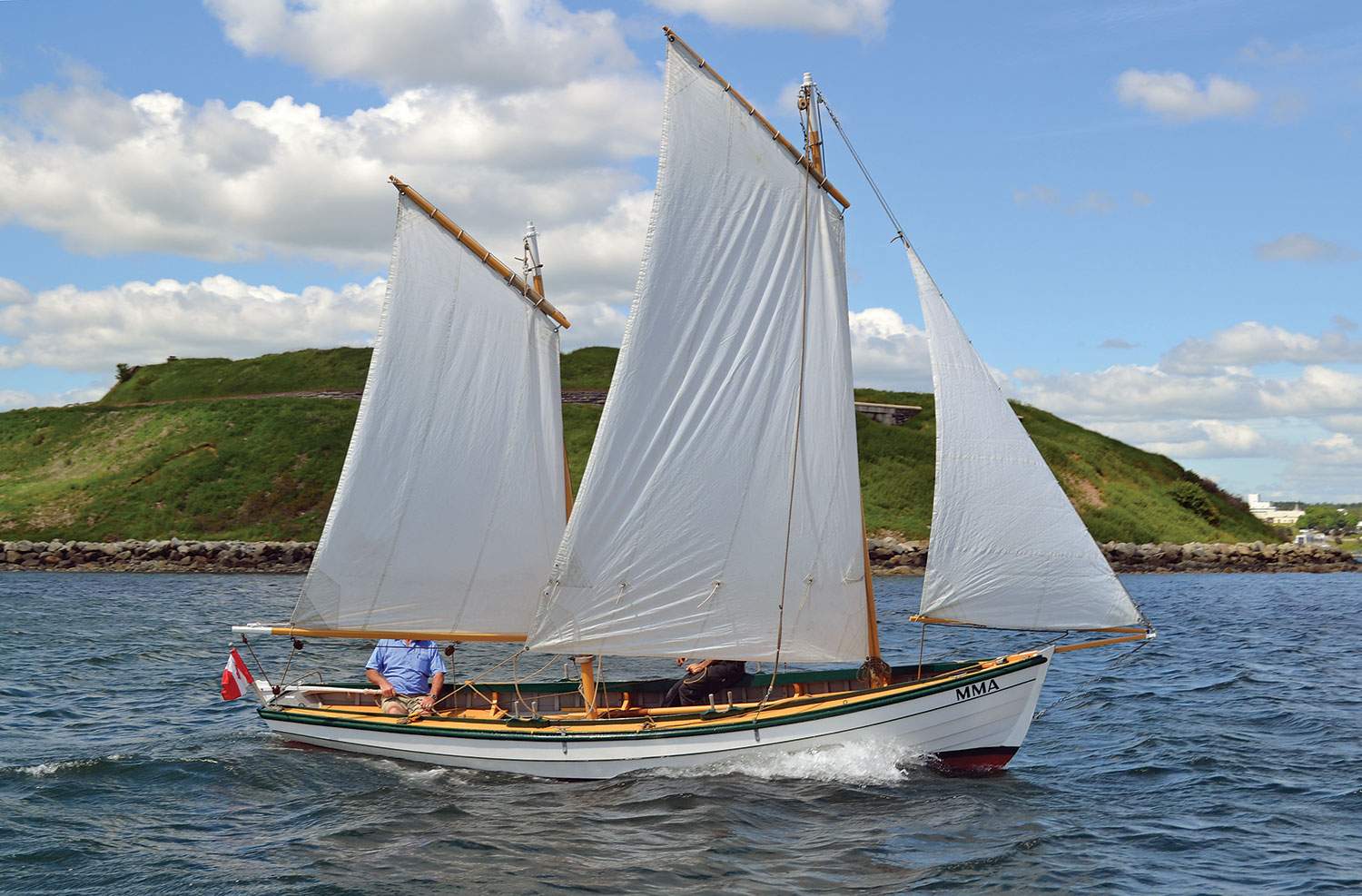
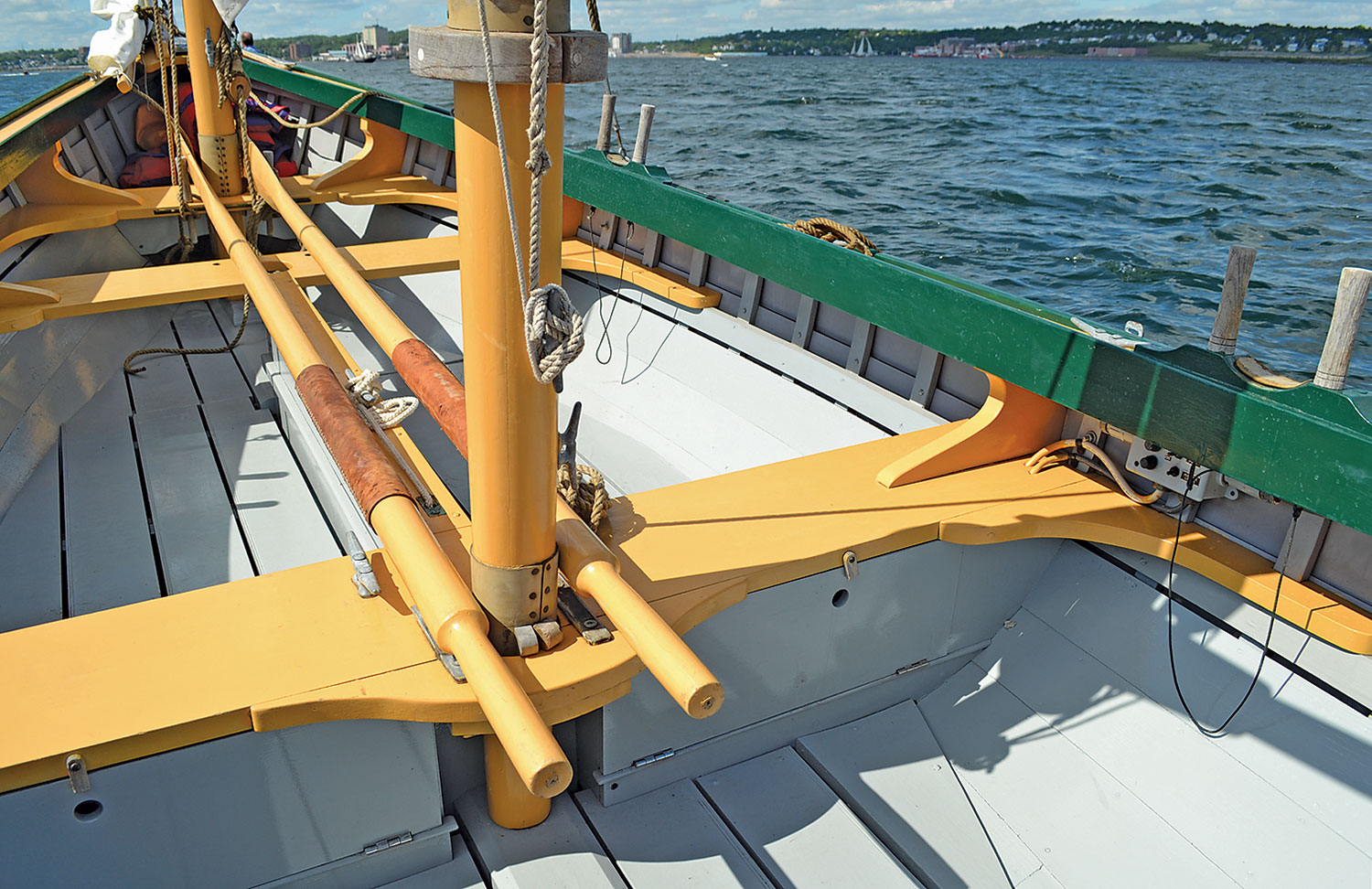 Michael Higgins
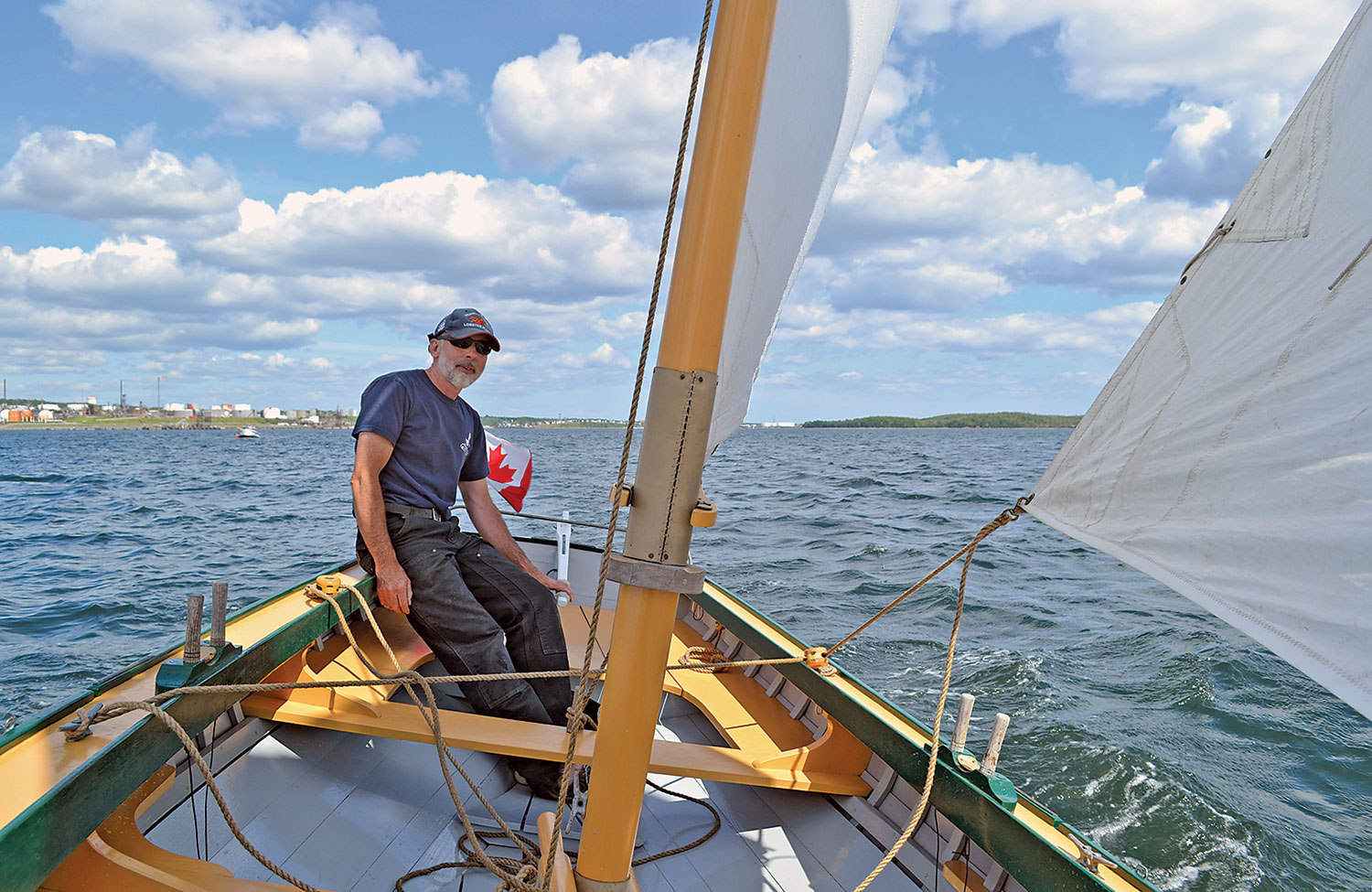 Michael Higgins
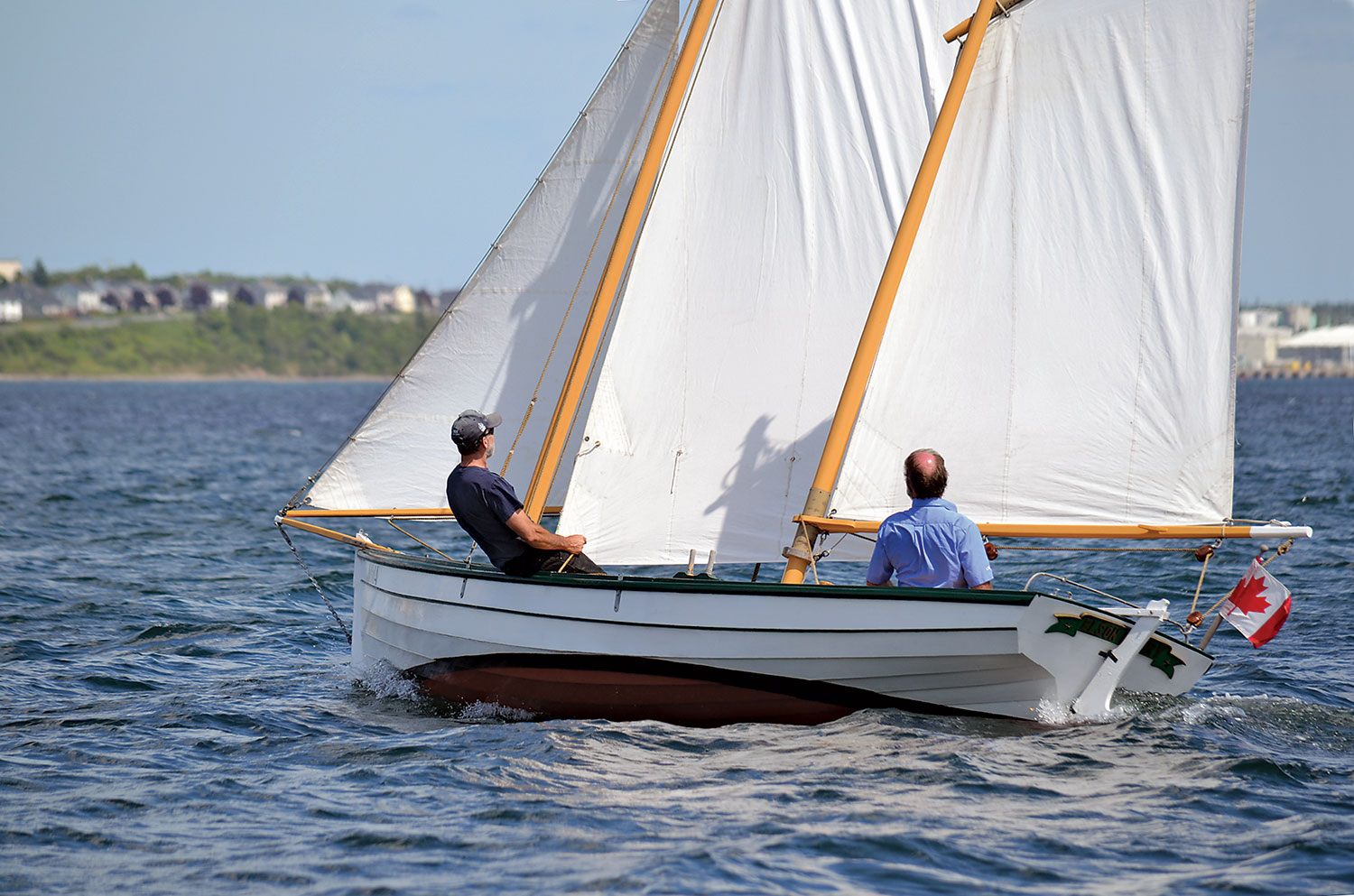 Michael Higgins