Selway Fisher’s 15′ 8″ strip-planked Prospector canoe takes its name from a model built by the Canadian Chestnut Canoe Company beginning in 1905. Its roots lie in Native American birchbark canoes, whose construction evolved into production-built canvas-covered models like the Chestnut Prospector. The early Prospector was developed to carry a load of gear, to cope with choppy waters, and to be maneuverable.
 Nigel Sharp
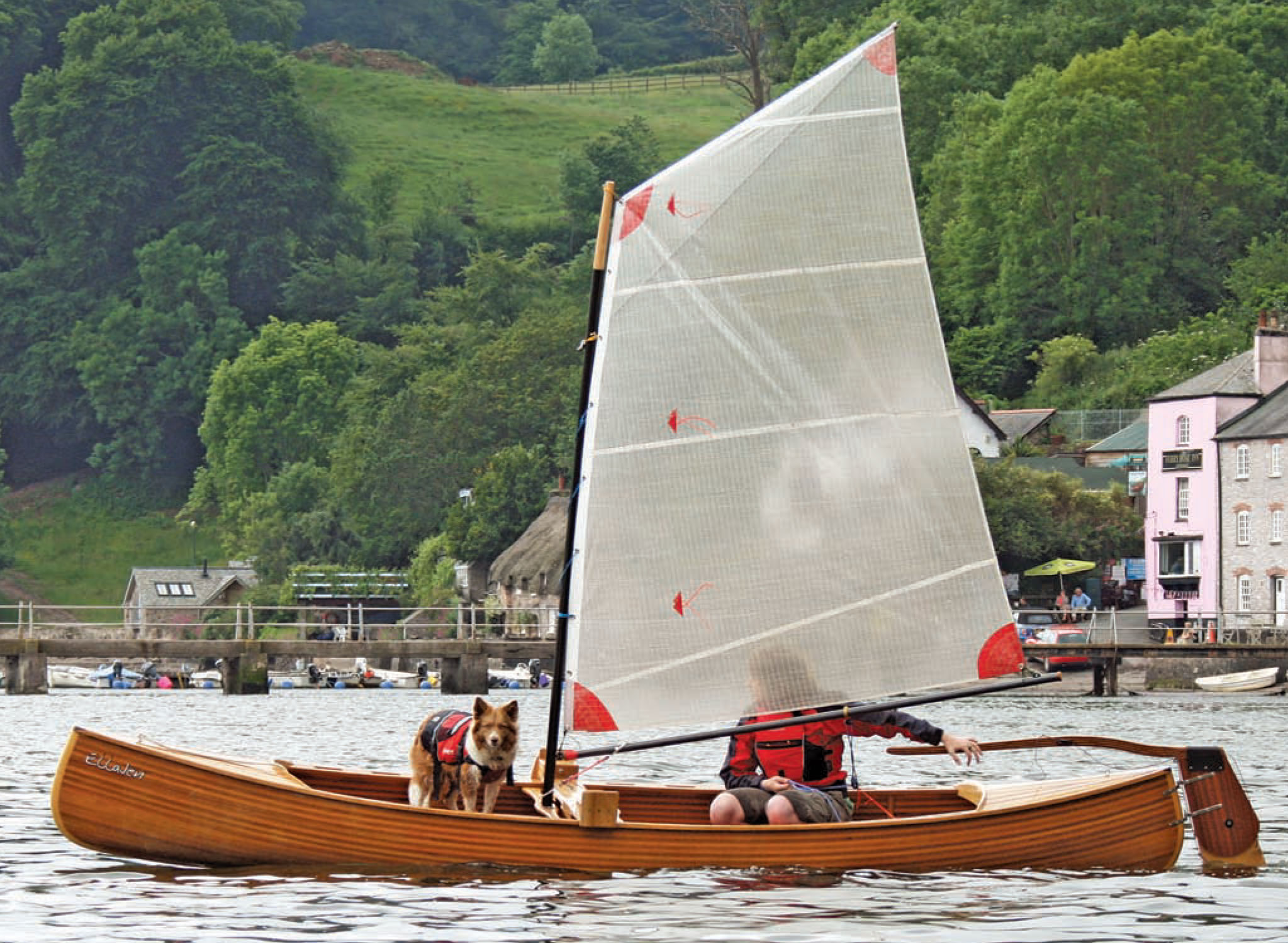
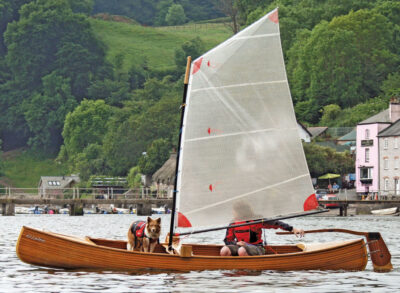
ELLAJEN is a 15′ 8″ strip-planked Prospector Canoe from the U.K.–based company Selway Fisher. The boat is based on a century-old model from the Canadian Chestnut Canoe Company.
Selway Fisher introduced a design for the stitch-and-glue Prospector about 20 years ago, basing it on the iconic Chestnut boat but giving it a modest gunter rig and rudder. Subsequently, they modified the hull for strip-planked construction. It has become the most popular of the company’s canoe range. Its generous rocker, flat bottom, round bilges, tumblehome, full bow and stern sections, and good freeboard amidships give it attributes similar to its namesake’s.
Building the ELLAJEN Prospector Canoe
Before Chris Smith began the nine-month Boatbuilding, Maintenance, and Support course at the Lyme Regis Boatbuilding Academy in September 2010, he went on a canoeing holiday with his girlfriend, Colleen, and their dog, Callie, on the River Tamar in southwest England. They enjoyed it so much that, knowing there might be an opportunity to build a boat for himself during the course, Chris decided he would like his own canoe. The criteria for his boat were: It would have room for two people, a dog, and some camping gear; and it would have a sailing rig to take some of the effort out of longer trips. After a great deal of research, he chose the Selway Fisher Prospector.
Chris planked his hull in 1⁄4″ × 7⁄8″ western red cedar strips, as specified by Selway Fisher’s design. However, whereas the plans called for the planks to be wired together and then epoxied to each other at the ends of the boat, instructor Justin Adkin suggested that a stem and “sternpost” should be fitted, and the result is much tidier. The builder had some difficulty in ensuring that the port and starboard planks met neatly, and he thinks this was due to the cumulative effect of very small variations in the widths of planks, or in slight differences in how tightly the planks were fastened to each other. Chris was greatly encouraged by Justin to make sure it looked right, and it does, although there was a certain amount of “cheating” involved with small filler pieces of wood being let in.
 Chris Smith
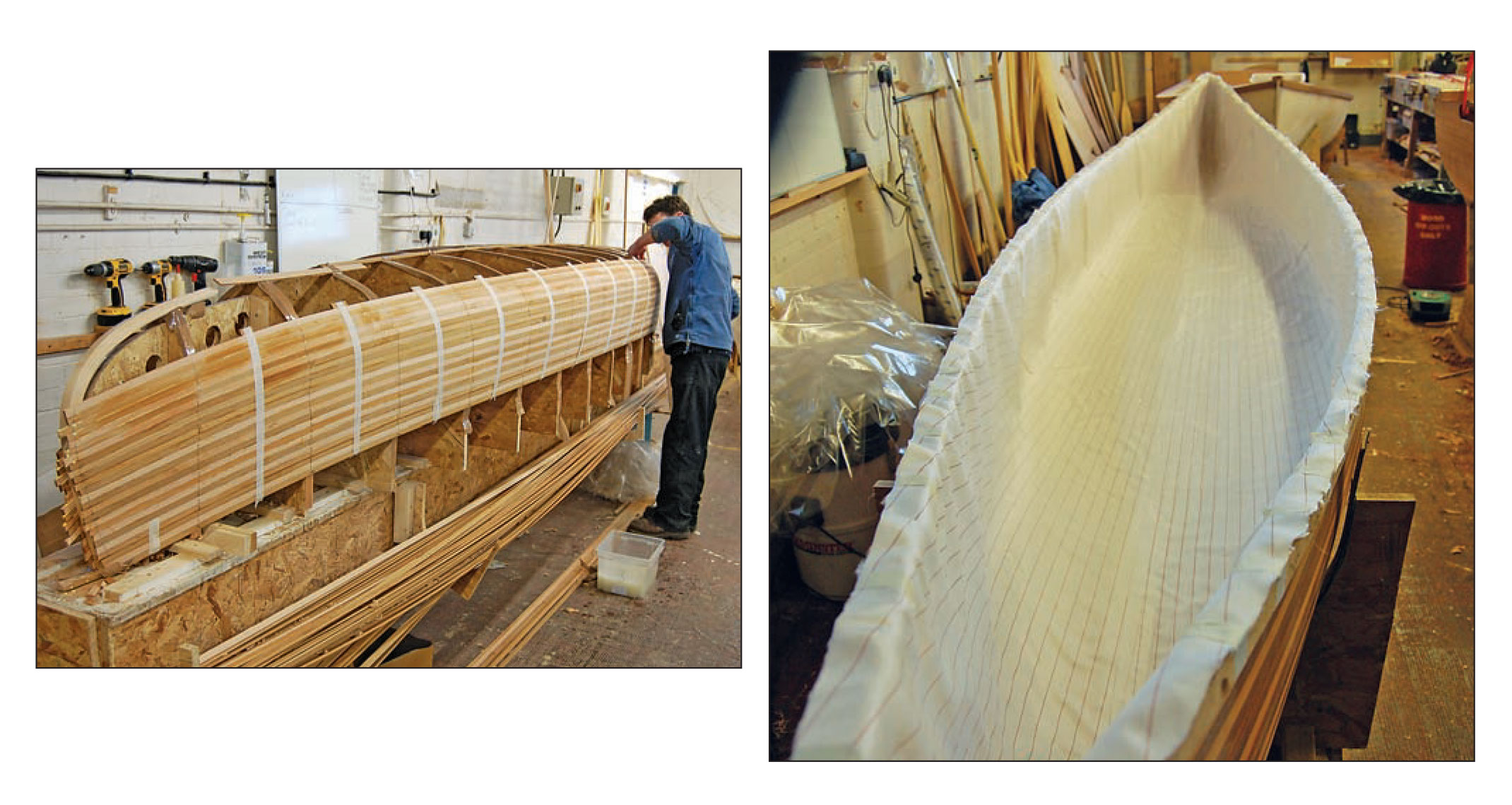
ELLAJEN’s strip-planked construction employs bead-and-cove strips glued together over a building jig. The planked hull is sheathed in fiberglass inside and out and clear-coated in epoxy. It is then varnished, for UV-resistance.
The hull was sheathed inside and out with woven ’glass cloth set in epoxy. Chris is happy with the finish on the inside, which was resin-infused. But on the outside, which was laid up by hand, nobody noticed that two bits of ’glass had been accidentally pulled apart until the epoxy had cured, and the result is a disappointing “horrible cloudy strip.” The long-term solution may be to paint the outside.
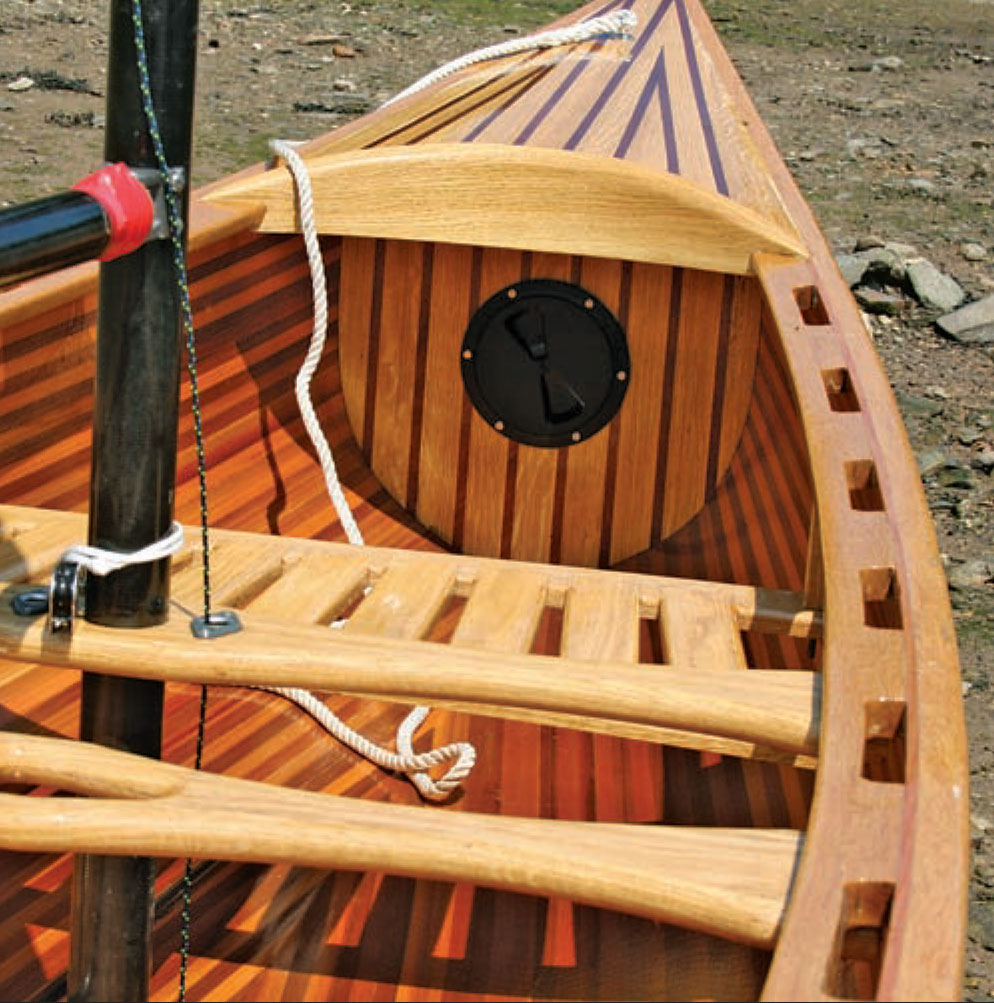
The gunwales, inwales, seats, and mast partners were all constructed from white oak, as were the forward and after decks (below which there are small buoyancy compartments), which also had sapele inlaid seams. Selway Fisher’s design shows the pivot bolts for the leeboards going through the hull sides, but as Chris was keen for the boat to look just like a simple paddling canoe when she wasn’t sailing, he came up with another solution: a removable leeboard support structure that clamps to the inwales.
The foils are all of Douglas fir and are ’glassed over, and their bottom edges have a solid epoxy strip to reduce damage if coming ashore carelessly. The lifting rudder blade is set in a plywood stock with a conventional dinghy-type tiller in laminated white oak and sapele, but sailing trials would later show that this needs to be modified.
The Prospector’s standard rig consists of a gunter mainsail and a jib on a stayed mast. Other types of rig are available in the Selway Fisher range, and they are, effectively, interchangeable. For the sake of simplicity, Chris devised his own unstayed mast with a spritsail, giving it the same sail area and center of effort as Selway Fisher’s sail plan. The three spars are made from carbon-fiber tube. When it became apparent just before Launch Day that the section for the mast was, for some undetermined reason, too short, it had to be lengthened with a piece of Sitka spruce. While that was a disappointment at first, Chris has grown to like its quirkiness. He made the sail himself while doing a short sailmaking course—an optional extra in the Academy’s curriculum. The sail is a very light Kevlar scrim, a cloth normally used for spinnakers; it has a strength equivalent to Dacron’s, while being a tenth of the weight.
In common with many of the other students, Chris had to work increasingly long hours toward the end to be ready for Launch Day. This included a period when he and another student worked a shift system to ensure they got enough varnish on the boat. Chris recalls sleeping on a sofa at the college and getting up at 2 a.m. when it was time to apply another coat.
 Nigel Sharp
A strip-planked canoe may be fitted out simply with a minimum of detail, or its joinery and personalization may be taken to a high level, as we see here.
Getting ELLAJEN on the water
Chris’s canoe was launched on June 7, 2011, along with 11 other boats built by his fellow students (see LUCIE). She was named ELLAJEN in memory of Chris and Colleen’s grandmothers, both of whom had died during the previous month. The conditions on Launch Day were quite blustery, and so Chris and Colleen, with Callie on board too, initially only paddled ELLAJEN inside the sheltered harbor. However, when some of the other boats started to sail, they were encouraged to hoist their spritsail and venture out into Lyme Bay.
“The performance of the boat exceeded expectations on Launch Day,” said Chris. “The instructors were really surprised too and kept commenting on how well she was sailing.”
I got the chance to try ELLAJEN a year later, when we arranged to meet at the picturesque and sheltered village of Dittisham on the River Dart in Devon. During the time since he’d launched the boat, Chris’s further studies had prevented all but very limited use of his canoe. We were lucky enough to enjoy some gentle and unthreatening conditions on the Dart, where ELLAJEN slipped though the water effortlessly under sail. However, both Chris and I thought the tiller and mainsheet arrangement was awkward: It was difficult to know how to sit in the boat, or how to move while tacking, when it was particularly difficult to reach out and hold the tiller hard over. We discussed possible solutions, probably the best of which would be to have either a fore-and-aft push-pull tiller, or a simple continuous steering line, connected to an athwartships yoke on the rudder stock. This would also allow the mainsheet to be modified by having its 2:1 tackle at the very aft end of the boom and taking it along the boom to a block near the gooseneck. The helmsman would then be able to sit inside the canoe facing forward at all times.
ELLAJEN’s generous rocker allows her to be very maneuverable, but when Chris and I tried paddling her we found that she would occasionally veer off one way or the other and would be reluctant to return to a straight course. We thought this may have been partly due to our inexperience of paddling canoes, but designer Paul Fisher later told me that one answer would be to heel the boat over on one side so a bilge dug into the water. He also said that the Prospector has better directional stability when more laden—which ELLAJEN will be on future camping trips.
 Nigel Sharp
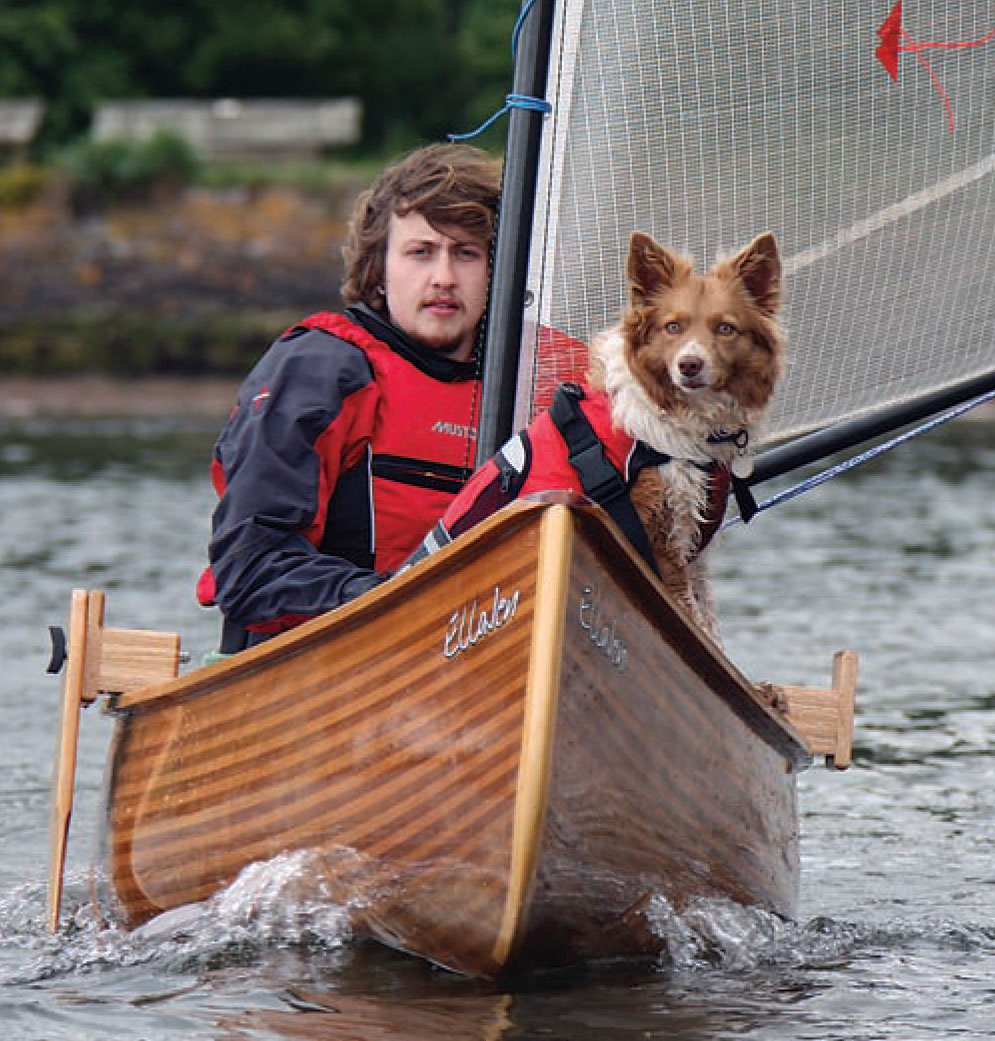
One of builder Chris Smith’s requirements for his new boat was that it be able to carry his dog. It seems to meet that demand handily.
Some sailing Prospectors are built with crossarms and floats in order to improve their sailing stability. In fact, one boat so-equipped sails regularly in the notoriously rough Bristol Channel. As Chris’s intention was to stick to sheltered estuaries, he decided not to have them. But in one of his initial outings, he did have one capsize as a result of which he is now contemplating fitting the floats. He’s also encountered an unusual challenge that adds to the boat’s inherent instability: “Callie is obsessed with water,” Chris told me. “She fixates on waves and will suddenly start jumping from side to side in an unpredictable way.” Perhaps it is time to fit those floats. 
Plans are available from Selway Fisher Design, 15 King St., Melksham, Wiltshire SN12 6HB, U.K.; +44 (0)1225 705074.
Prospector Canoe Particulars
LOA: 15′ 7″
LWL: 32′ 6″
Beam: 12′ 6″
Draft: Not much
Weight: 60 lbs
Capacity: 700 lbs
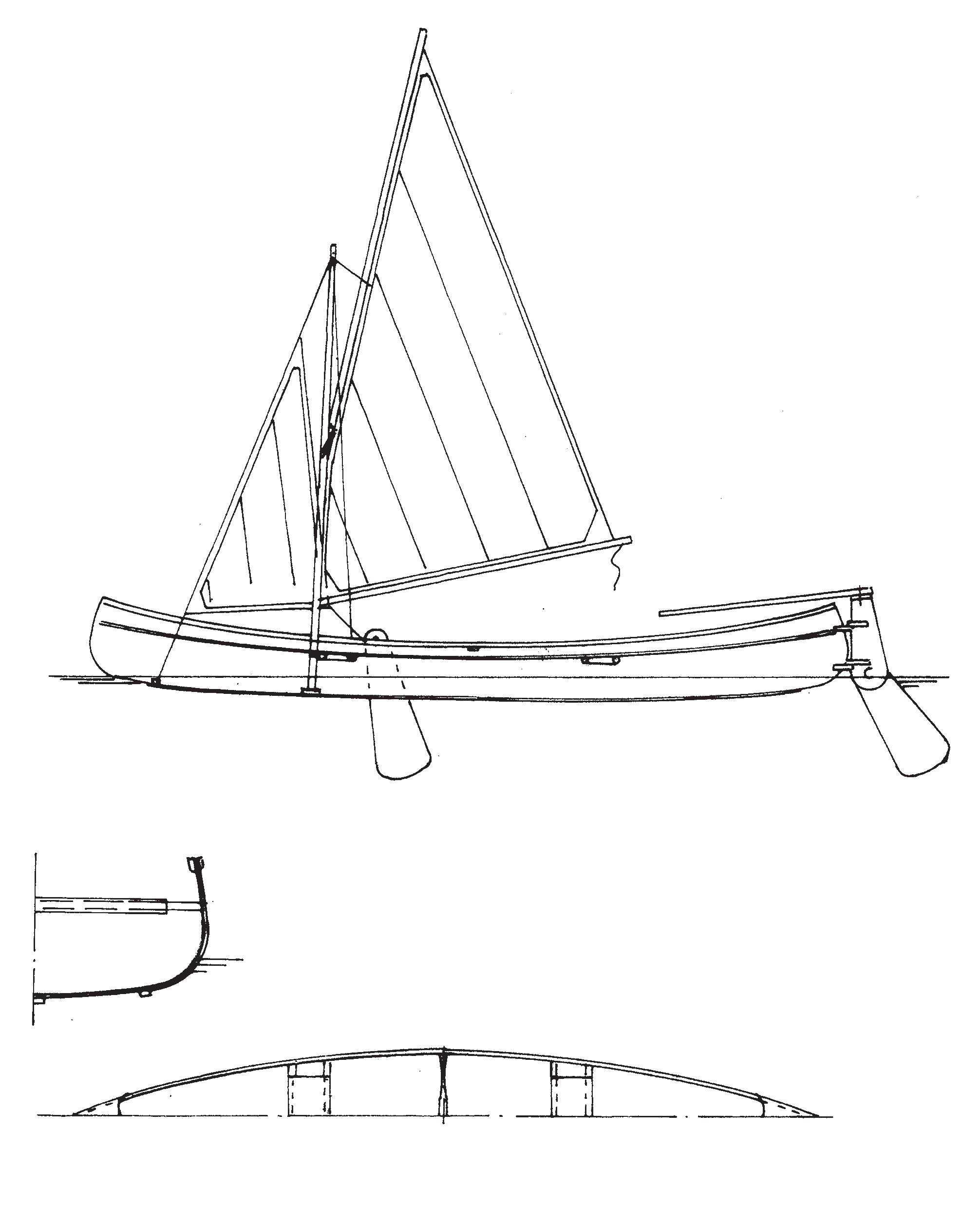
Ample keel rocker makes the Selway Fisher Prospector a maneuverable boat, while firm bilges make it stable. The gunter sail plan shown here was drawn for the boat; Chris Smith, builder of ELLAJEN, chose a gaff-headed rig from the Selway Fisher catalog.
More Designs from Selway Fisher
Selway-Fisher Heron 15, a pocket cruiser for two
Ptarmigan 17, a glued-ply pocket cruiser
Drake 13, a Selway Fisher Sharpie
Lillie, a classic design updated to modern construction
Is there a boat you’d like to know more about? Have you built one that you think other Small Boats readers would enjoy? Please email us your suggestions.

Join The Conversation
We welcome your comments about this article. To include a photo with your remarks, click Choose File below the Comment box.