 Jenny Mayher
In seeking a tender for his cruising ketch, Maine-based author Bill Mayher sought a boat that would tow, sail, and row well, and carry a larger-than-average person in the stern sheets. A web search turned up the Drifter design from Harwood Watercraft in western Ontario.
Defining the Ideal Dinghy
ZANCUDO is a glued-lapstrake plywood sailing dinghy that I hoped would serve many purposes in my family for generations to come. Sometime in the middle of May she arrived at my house in Maine, upside down on a flatbed utility trailer, all the way from Canada.
The business of acquiring her had gotten underway in February of the previous year, when I started dreaming about a new tender. In the dead of winter, after all, with the snow knee high and trees rattling and cracking in the woods under the force of ferocious gales, thoughts of boats come through most clearly as dreams. But then as the miracle of gathering light spread ever stronger across the southern sky and sap flowed at last in both man and tree, those dreams morphed into thoughts and then thoughts into specific notions.
This dinghy would be shorter than 11′. It would be light enough for my wife and me to lug up the beach above the high-water mark, so that when we set off on island rambles we wouldn’t be worrying about it as the tide came in. Because we often cruise in the early spring and then again well into the fall, and regularly end up anchoring in deserted spots along the wild edges of the Maine coast, it is important to have a real boat under us as a tender. Especially when the wind blows through rolling anchorages. A low-freeboard dinghy, no matter how speedy under oar or sail, will not do.
On our cruises, we enjoy calling it quits early if only because this gives us a chance to set off on exploratory dinghy sails among the nooks and crannies of favorite destinations. Accordingly, the craft emerging in my imagination needed to be a proper sailing dinghy with rudder and daggerboard. As a sailing dinghy it must go to windward and tack smartly in a stiff breeze. It needed to be safe as a sail trainer for our grandchildren, and it needed to be sufficiently buoyant to comfortably float a person of larger-than-average size in the sternsheets. But this boat would have to row well, too— so well that my grandchildren would find the sweet groove of rowing a great little boat early on in their lives, and therefore enjoy that pleasure for a lifetime, just as I have.
Why Glued-Lapstrake Plywood
To fulfill these requirements, it seemed clear that I should be looking into something built with glued-lapstrake plywood planking, which is both light and strong. The maintenance of such a boat would be minimal, because high-grade marine plywood is stable and holds paint well, and thus doesn’t call for annual painting to achieve the good-enough level of finish that I find acceptable these days. Also, plywood laps don’t call for steam-bent frames, which become such a time-and effort nuisance when sanding and painting is called for. Another advantage is that a plywood boat will not suffer the stresses that drying-out puts a small boat through if she is not launched every season. Although a glued-lap boat is not quite as righteous-looking as a traditionally framed dinghy, these advantages I’ve just detailed were crucial in the equation that was working itself out in my mind: Light, strong, a smart sailer that would tow well in a seaway, easily sponged out, and tough enough to endure the naval warfare grandchildren often subject small boats to down in the cove. A glued-lap dinghy it would be.
 Jenny Mayher
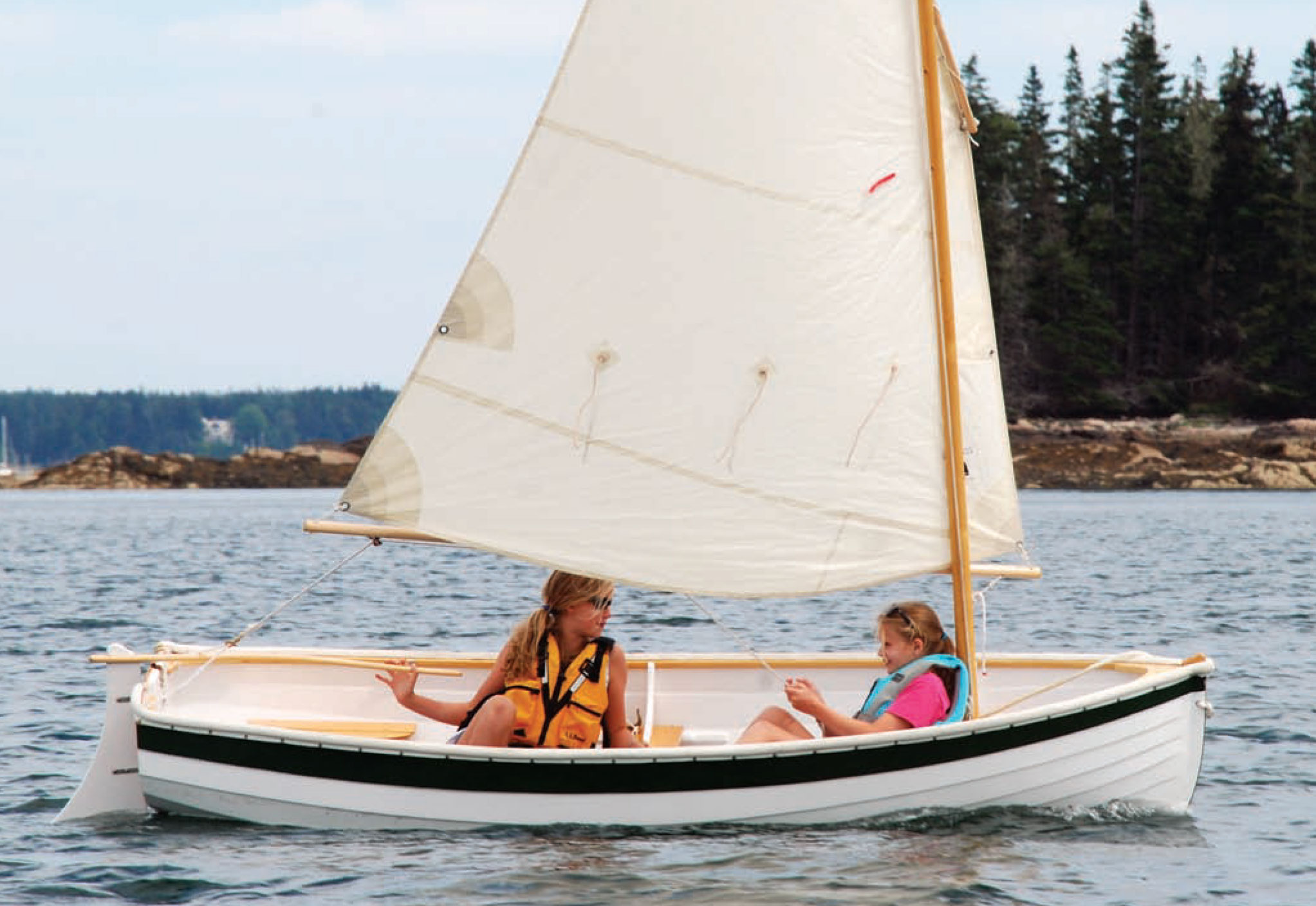
Mayher’s Drifter is named ZANCUDO. Her simple lug rig is ideal for a tender, as the spars all stow within the length of the boat when she’s being towed.
Discovering the Drifter
With mind made up and without further ado, I checked the Internet to see what was out there all built and available. It was on the web that I happened upon Mark and Karen Harwood of Harwood Watercraft, a vest-pocket enterprise deep in the backwoods hell-and-gone of western Ontario, somewhere east of Georgian Bay. Too far for me to go for a boat, for sure, but why not make the call anyway?
Talking to Mark on the phone was great. He is smart, funny, down home, and filled with the humility of a talented and original jack-of-all trades who had stumbled into boatbuilding and liked it and was good at it. On the web the boats he was building looked good to my eye, especially his Drifter model, a 10′ 6″ sailing dinghy that he described as an Iain Oughtred Acorn derivative whose design he had beefed up in the aft sections, perfect for a 6′ 2″-plus person of healthy proportions.
Studying the boat on the Harwood Watercraft website, I could picture myself in the sternsheets, or even scrunching in passable comfort, forward of the daggerboard trunk, with a grandchild at the tiller. I could picture kids rowing this boat out of the cove and could see them hoisting sail when the breeze served. Crucially, as far as the kids were concerned, the standing-lug rig with its relatively short spars seemed especially manageable on those occasions when the afternoon southwest breeze sprung up in earnest. These pictures bloomed and multiplied into a pleasant slide show of watery delights. I couldn’t get this boat out of my mind, and this was a problem.
As we all know, awakening the “I’ve-gotta-have-this boat” Princess from her winter-long slumber can be an expensive proposition. But when Mark mentioned he had a used Drifter that he would be able to let go at a discounted figure, the Princess and I sat down for a talk. After this discussion, the Princess seemed pleased, as she usually does when things go her way.
And so on to the plan: “How’d you like to drive the boat over to Maine for a trial?” I offered. “I’ll help with gas money and you can spend a week in our guest cabin. Maybe I could send you some pictures of the place? Comfy digs, Victorian parlor stove, boats to see, wooden-boat people to meet at the yards around town and at the magazine…. I’m betting the ice is barely out in Canada, anyway…. A pre-season vacation with a payoff at the end if everything goes according to plan. Whaddyathink?”
 Jenny Mayher
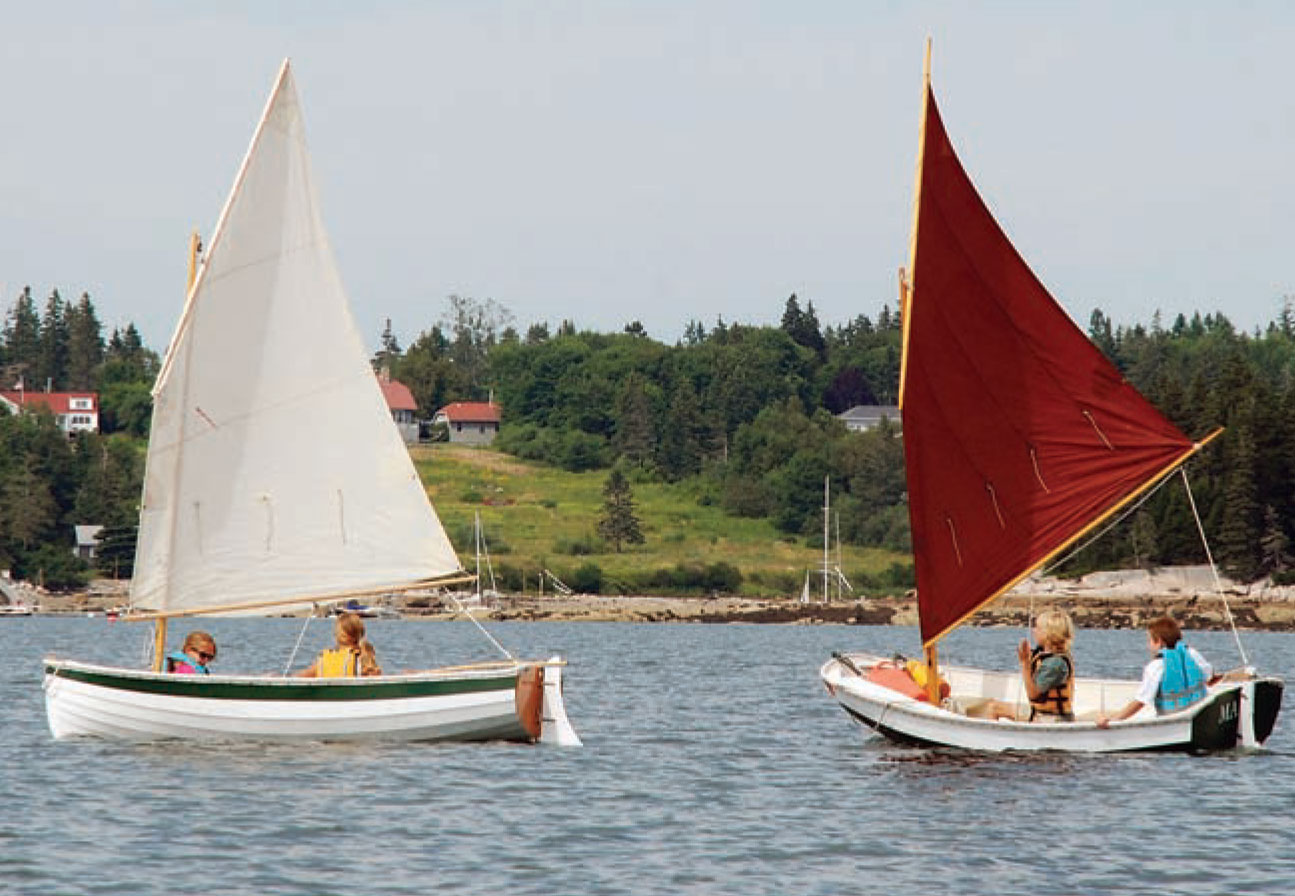
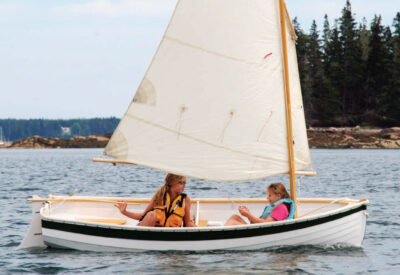
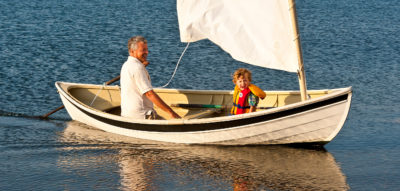
In addition to its utility, the lug rig has proven to be a great training rig for grandchildren and friends. Here, ZANCUDO sails in company with a Nutshell pram.
From these tentative beginnings I could tell Mark was interested—and his wife, Karen, even more so. Among other things, she does fancy ropework. Floor mats, monkey-fist door stoppers, that sort of thing. Back in Canada in the summers they fill their pickup truck with her work and load a rowboat onto the little trailer and go around to farmers’ markets and the like peddling their wares. A trip over to Maine seemed like just one more adventure to them.
Needless to say, if things hadn’t worked out so splendidly, I wouldn’t be writing this piece. But splendid hardly describes the pleasures of last summer. As a tender she tows easily behind VITAL SPARK. She is just right for short sails around Center Harbor or out to the islands when there are interesting boats to see or the chance to picnic with friends. My wife and I had some memorable dinghy sails farther afield during summer cruises whenever we needed to get to a town or to a trailhead on an island or just for a change of scene. But the best thing is how my granddaughter Essie, aged 11, took to her.
Living with ZANCUDO
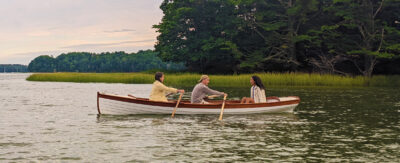
Everything I had hoped for in terms of ease of handling and seaworthiness was evident immediately, and soon enough I’d spy Essie and a friend taking the new dinghy out into Eggemoggin Reach, often to sail in company with her brother and his buddy in the family’s Nutshell pram. The Nutshell, built for the children’s mother 30 years earlier, was perfect for that moment in time so many years ago. Now the Drifter, named ZANCUDO (Spanish for mosquito) by Essie, is perfect for this later moment. She is easy to carry up the beach, simple to rig and get underway from alongside VITAL SPARK , she tows straight and true in the ocean, she rows beautifully, and can carry four people ashore. Her sailing performance exceeds even my rosiest hopes. And, finally, with varnished ash gunwales, breasthook, and quarter knees in combination with varnished pine thwarts and stern sheets, she is elegant enough for my purposes—yet at the same time easy to care for.
But the best thing is what she means to Essie. Last summer, ZANCUDO became Her Boat. At the threshold of seventh grade with its social terrors and fearsome cliques in the offing, Essie had a boat to focus her energy and her dreams upon. It centered her in a set of challenges and accomplishments throughout the summer, and when it came time to return to school in the fall, it was reported that she slung her backpack over one shoulder, smiled broadly, and marched into the maelstrom.
 Jenny Mayher
The author’s granddaughter at the helm. “At the threshold of seventh grade…she had a boat to focus her energy and dreams upon.”
 Mark Harwood
Designer-builder Mark Harwood developed his Drifter design as an able yacht tender.
 Mark Harwood
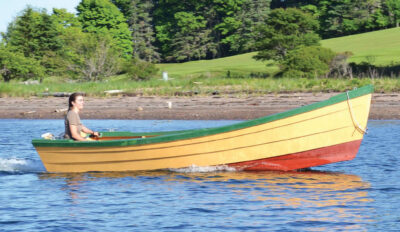
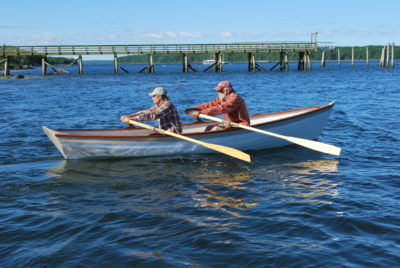
She has wider after sections than a fine rowboat would: This feature favors buoyancy and stability over pure rowing—a worthy tradeoff in a tender.
Plans for the Drifter designed by Harwood Water Craft in Muskoka, Ontario are not currently for sale, but you can email them with questions at: [email protected]
More boat profiles with glued-lap ply lug rigs
- Guillemot – An Iain Oughtred sail-and-oar skiff
- Morbic 12 – A versatile lapstrake dinghy
- Coot – A proper little boat
Is there a boat you’d like to know more about? Have you built one that you think other Small Boats readers would enjoy? Please email us your suggestions.

Such a lovely boat and equally charming story. So sorry to see that Harwood Watercraft is permanently closed.
Beautiful boat and excellent writing skills. Thanks for the entertaining story.