 Donnie Mullen
Developed in the late-19th century for Maine lake fishing camps, the Rangeley type has long been admired as a capable small craft with excellent rowing characteristics.
In 1977, Bruce Malone began working on a Rangeley boat in his living room, moving the furniture out and bringing in a strongback, molds, and a planking bench. The engineer-turned-boatbuilder had been working at the Newbert & Wallace Shipyard in Thomaston, Maine, when he read about Rangeley boats in a reprint of a National Fisherman article by John Gardner, who also included the type in his book, Building Classic Small Craft. Gardner praised the boat’s “handsome shape and superior performance” and noted its “fairly simple” construction. Malone, who grew up rowing a beamy 14′ skiff on Lake Winnipesaukee in Wolfeboro, New Hampshire, was immediately drawn to the Rangeley’s graceful lines, lapstrake hull, and reputation as a dream for rowing and fishing.
“I had enjoyed rowing in boats that didn’t row well, so I thought, ‘What would it be like to row a real rowboat?’” Malone recently reflected. Except for a hydroplane he built in his youth, the 17′ Rangeley, planked with cedar over steam-bent white oak frames, was the first boat Malone had built for himself. He put over 500 hours into its construction, including driving 2,886 rivets. His girlfriend, Barbara, bucked the back of each rivet as he peened them over. “Despite that, she did eventually become my wife,” he chuckled.
Malone lofted the boat—which is 17′ LOA with a 4′ beam and a depth of 15″, measured from the bottom of the keel to the top of the lowest point of the sheerline—following the plans from Gardner’s article. The wineglass- shaped transom would allow the boat to carry a small outboard without compromising its fine rowing characteristics. Malone constructed the hull right-side up, installing the keel, inner stem, transom, and transom knee first, then setting up seven hull station molds. The stem and keel both had outer and inner pieces, which made the sometimes-complicated task of cutting keel and stem rabbets unnecessary.
Starting with the garboards, he installed 11 planks per side, each 5⁄16″ thick. Where necessary, strakes were made of shorter pieces scarf-jointed together and glued with epoxy, and Malone used polysulfide bedding compound in the plank laps. He riveted the laps as the planking was installed, leaving space for the frames to be bent into position and riveted after the boat was planked up. The frames, 3⁄4″ wide, 3⁄8″ thick, and spaced 2 11⁄16″ apart, were steam-bent.
 Barbara A. Malone (left), Donnie Mullen (right)
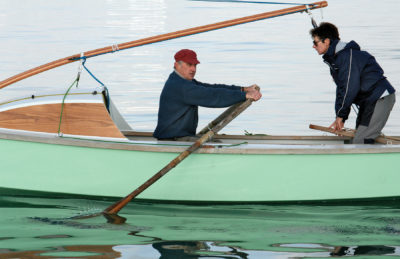
Left—In the late 1970s, Bruce Malone visited Herb Ellis (at right), whose transom-sterned—“square-sterned” in lake parlance—boat was documented by small-craft historian John Gardner. Right—Malone’s first boat used bench thwarts. He followed the light, closely spaced framing of the original boats, though in his later hulls he favored wider frames more widely spaced.
Characteristically, Rangeley boats had round, stoollike seats mounted atop recessed thwarts, a style unique to these boats, which were originally used by fishing guides to take paying clients out on the Rangeley Lakes of western Maine (see WB No. 225). For his boat, Malone decided instead to use common bench-style thwarts.
Next came the gunwales, breasthook, and the outer stem, all of white oak. Rangeley boats had unique trunnion-mounted oarlocks, which are rare today, so Malone used bronze round-socket rowlocks as the closest approximation he could find.
Legacy of the Rangeley
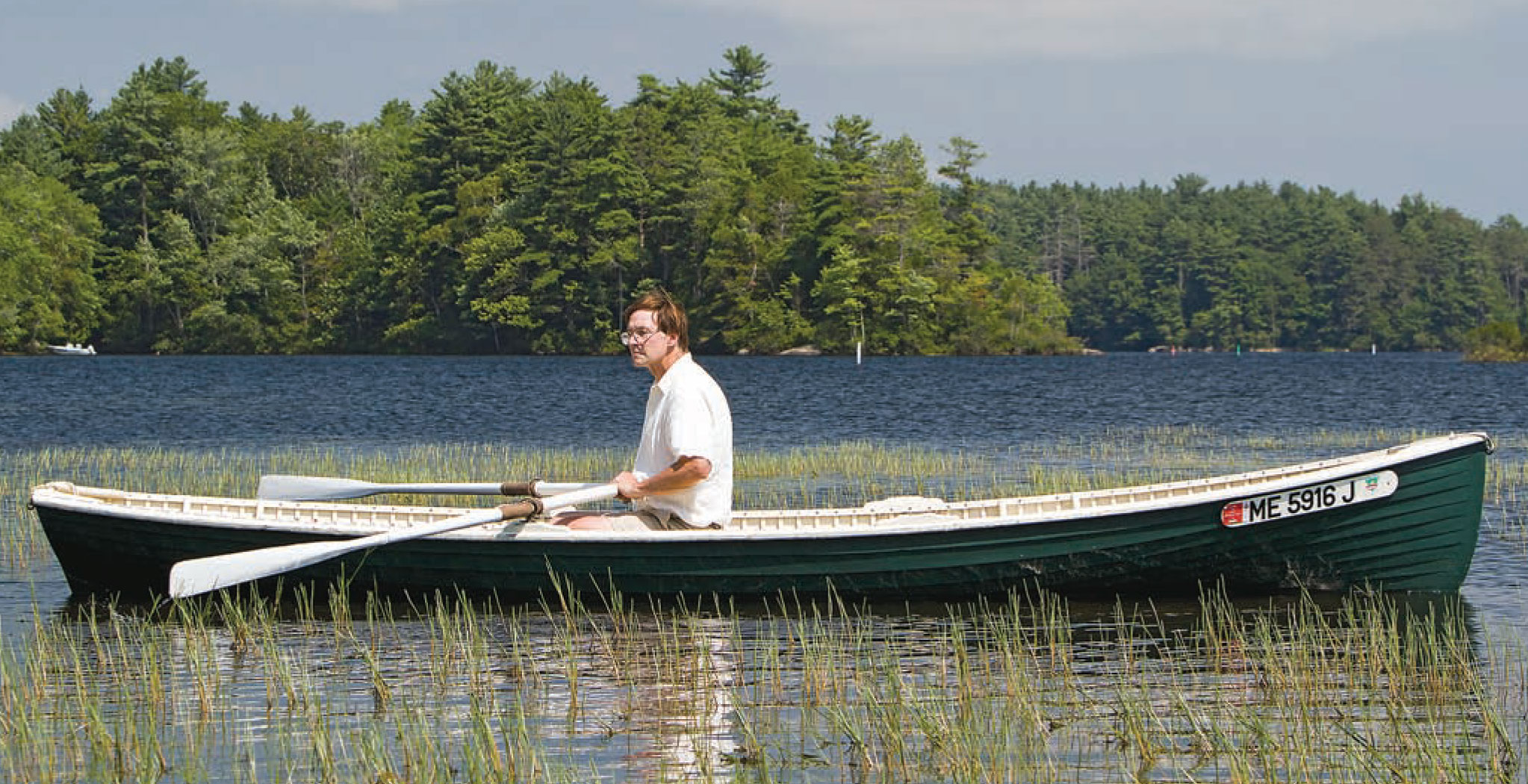
When Malone launched his Rangeley, he found his dream realized. He had never rowed anything like it. He still has—and still uses—the boat. Over the years, the Rangeley has taken him on camping and fishing expeditions across interior and coastal Maine, easily carrying Malone and his wife, and eventually their daughter, with all their gear. Malone found that it rowed well with one or two people aboard, tracked well, and was fast. When fishing, standing up to cast was no trouble, and the boat handled rough water with ease.
Since founding Malone Boatbuilding in 1980, he has built some 20 Rangeleys for customers. With experience, he began making modifications and simplifications. By his second boat, he determined that rivets were too much work to install and were stronger than necessary, so he switched to using copper clench nails, similar to the iron clench nails used in the original boats. He increased the width of the frames to 1″ and spaced them farther apart, to 4″ on center. Before long, he had cut his original construction time in half. He developed a 1 3⁄4″-wide, single-piece keel and a 1 1⁄4″ wide, single-piece stem, learning to cut the rabbets by eye. He found that building the boat upside-down was easier. Instead of an oak breasthook, he started installing a short cedar foredeck, and he used cast bronze thwart braces instead of white-oak thwart knees.
“Building Rangeleys was really a labor of love,” Malone said. Most of his work these days involves larger boats, but he is still drawn to the graceful lines of a lapstrake Rangeley hull.
Rangeley Performance on the Water
On a recent summer day, I joined Malone for a row. The Rangeley’s 17′ length, which easily accommodates two, was the result of year of refinement on the lakes of western Maine, where a variety of innovative builders made their own contributions to the type. This evolution of design played out before my eyes as Malone slid his 35-year-old boat into the water. With his succinct oar strokes, the Rangeley smoothly picked up speed, tracking like an arrow in protected cove and choppy bay alike, a virtue of the boat’s long, straight keel. In fact, the Rangeley was designed to cut through large waves that were characteristic of some of Maine’s largest lakes while keeping the passenger comfortable and dry. On a brief stint ashore, I marveled at the boat’s arcing sheer against the backdrop of nearby Mount Megunticook.
 Donnie Mullen
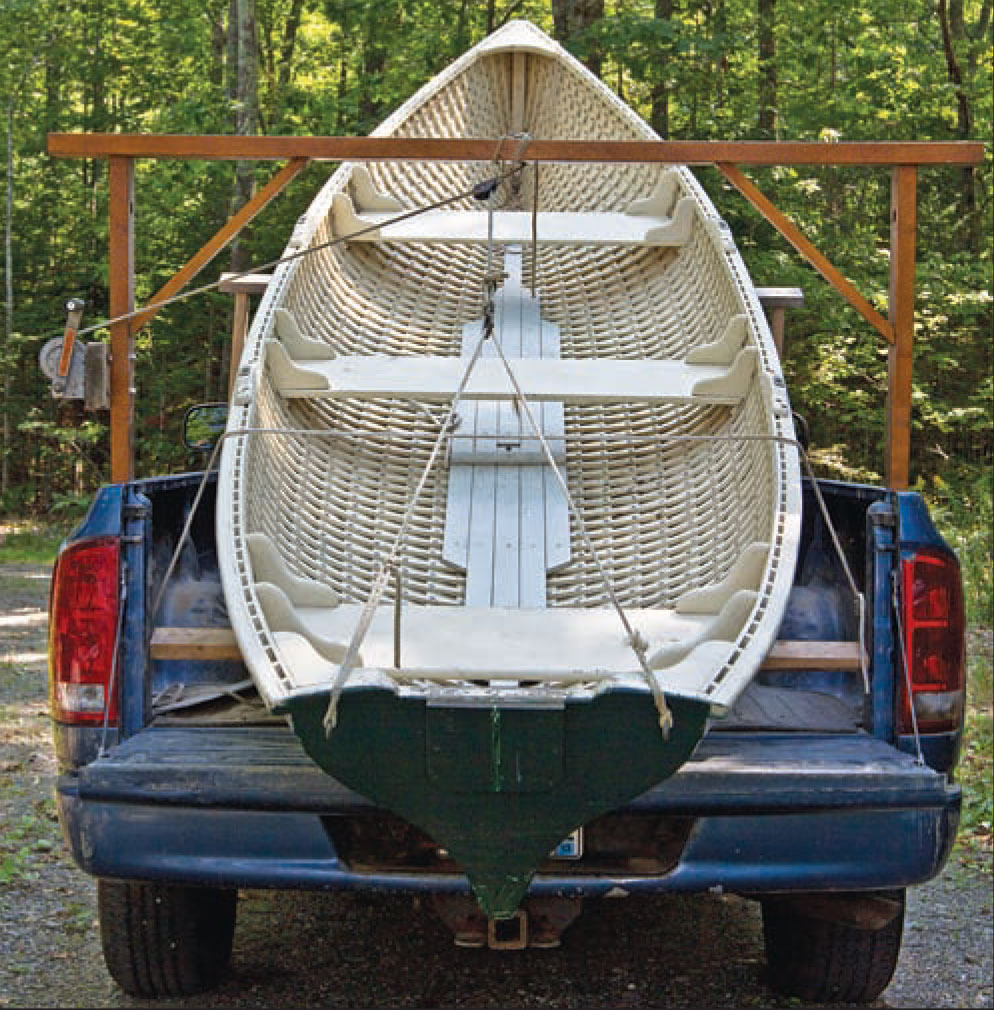
With a block-and-tackle rigged to a gallows frame and the keel sliding on an inclined beam, Malone can haul his 17’ Rangeley boat in the back of his pickup truck.
When I took a turn at the oars, I was immediately struck by the boat’s swiftness and remarkable stability. The hull required some patience to turn—a flip side to that long, straight keel’s advantage in tracking. But it was such a pleasure to row, I hardly felt inconvenienced. At one point, I stopped rowing long enough to dip my hand in the water. I was surprised to find the boat only grew more stable as my weight shifted toward the gunwale. While muscling back to shore against a headwind, I felt like I was working a lot harder than Malone had under similar conditions. I had to make regular corrections, as the bow was a tad proud. Malone later explained that shifting to the boat’s forward rowing station could help balance the hull in such wind. He added that shifting the weight of the passenger, a second rower, or gear can also keep the boat in proper trim fore-and-aft.
Malone loaded the Rangeley into his pickup unassisted, thanks to a shop-made carrying rack. He uses a trailer winch to haul the 200-lb boat along a keel-support beam rising diagonally from the tailgate toward the roof of the cab. As we parted ways, I thought about asking Malone if he would help me build a Rangeley, but then quickly decided I was getting ahead of myself. Instead, I savored the simple joy of a few hours spent on the water. As though on cue, Malone concurred.
“A morning like this reminds me of why I got into the boat business,” he said, before he started his truck and headed back to his shop. 
Plans for the Rangeley boat shown here were published in John Gardner’s Building Classic Small Craft, Volume 1 (International Marine, first published in 1977), which is available from The WoodenBoat Store.
Rangeley Boat Particulars
LOA: 17′
Beam: 4′
Depth amidships: 15″
Weight: 200 lbs
 Mystic Seaport Museum
In the 1970s, John Gardner included the Herb Ellis transom-sterned Rangeley boat in his Building Classic Small Craft. Ellis built the boat in the 1930s, and Gardner took the lines in the late 1960s. Before the outboard-motor era, Rangeley boats were built double-ended.
Is there a boat you’d like to know more about? Have you built one that you think other Small Boats readers would enjoy? Please email us your suggestions.
More Designs from Building Classic Small Craft
Building Classic Small Craft by John Gardner combines two out-of-print books: Building Classic Small Craft and More Building Classic Small Craft. The current edition includes plans and instructions for building 47 small boats. Here are a few others from the book that Small Boats has profiled.
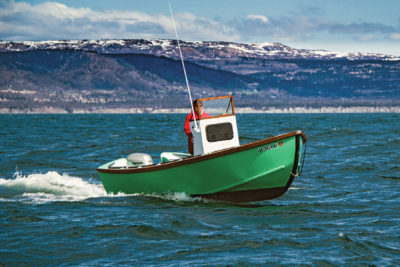
Down East Workboat, a Gardner-designed powerboat that blends seakeeping ability with speed
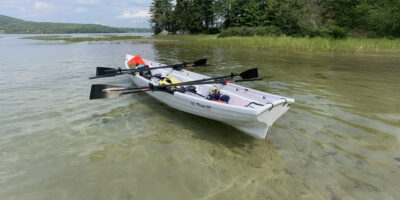
Lawton Tender, a classic tender for strip-plank construction by Newfound Woodworks
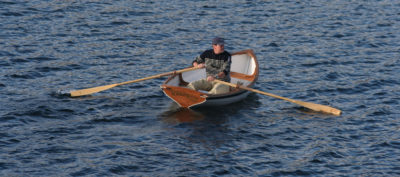
Herreshoff/Gardner 17, a lightweight, fixed-seat rowboat for one or two people


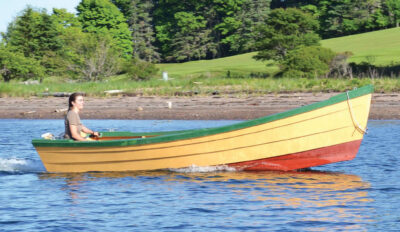
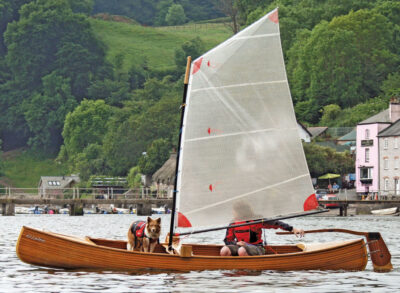
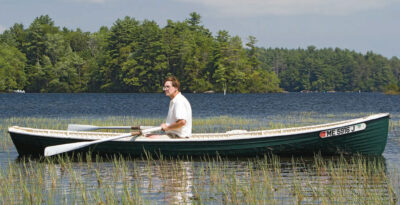
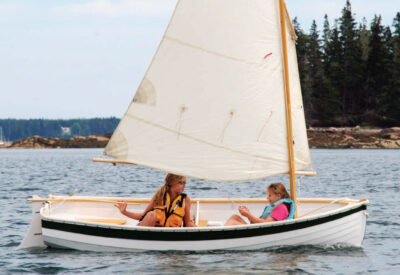
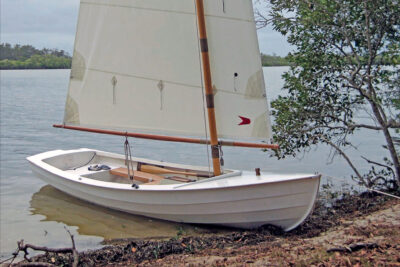
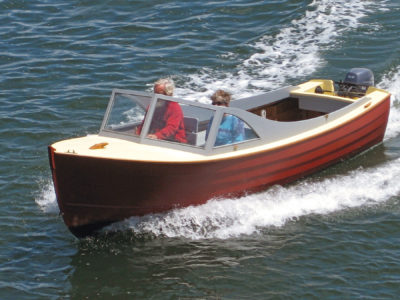

The 17′ Rangeley was a guide’s boat, typically used by one guide with two sports. A small one, 14′, was built by Barrett and is in the Mystic Seaport Museum collection. Barry Thomas in the Small Boat Shop at Mystic built a couple of runs of 10 as part of researching how traditional boatbuilders specialized in a type and built multiple copies. Barrett built the 14′ for a client who wanted to fish without a guide, and it’s a great boat for solo rowing.
Wow, that’s a lot of steam bent frames!
Lovely looking boat, but that’s one hell of a commitment to build with so many strakes and frames! Is it time to give up the clench nails for epoxy?