Conventional wisdom insists that every boat is a compromise, a balancing act between competing priorities, and that’s true enough. But Australian designer Ross Lillistone’s Phoenix III won’t feel like a compromise to anyone looking for a good solo or two-person sail-and-oar beach cruiser. That’s not to say Lillistone’s design wouldn’t make a fine small daysailer, or that it must remain a strictly sail-and-oar boat (the plans show an optional outboard well). But the Phoenix III is so well suited for engineless cruising that it would be a shame to build one without a few sail-and-oar adventures in mind: the Maine Island Trail, the Inside Passage, the Sea of Cortez, who knows where. Fortunately for me, my brother built a Phoenix III a couple of years ago, and since then I’ve logged almost as much time aboard as he has.
At 15′ 1 1⁄2″ long, with a beam of 4′ 9″ and a 6″ draft, the Phoenix III is sized to fit the designer’s idea (and mine) of the perfect solo beach cruiser. Extra length and displacement offer certain advantages, but these days anything much bigger has begun to feel like more boat than I need. The layout is simple: a large foredeck, a single mast at the forward bulkhead, a rowing thwart across the centerboard trunk, and a wide stern seat. Removable side benches can be arranged, and will slide together for a one-person sleeping platform. (A solo cruiser could sleep on the sole instead, although fitting under the thwart is a bit of a squeeze.)
Designing the Phoenix III
Inspired by a slightly larger, heavier boat created by his father, Lillistone pondered the Phoenix III design for years until a customer finally talked him into drawing the plans. The result is a boat that feels as though it was designed by someone who practices what he preaches.
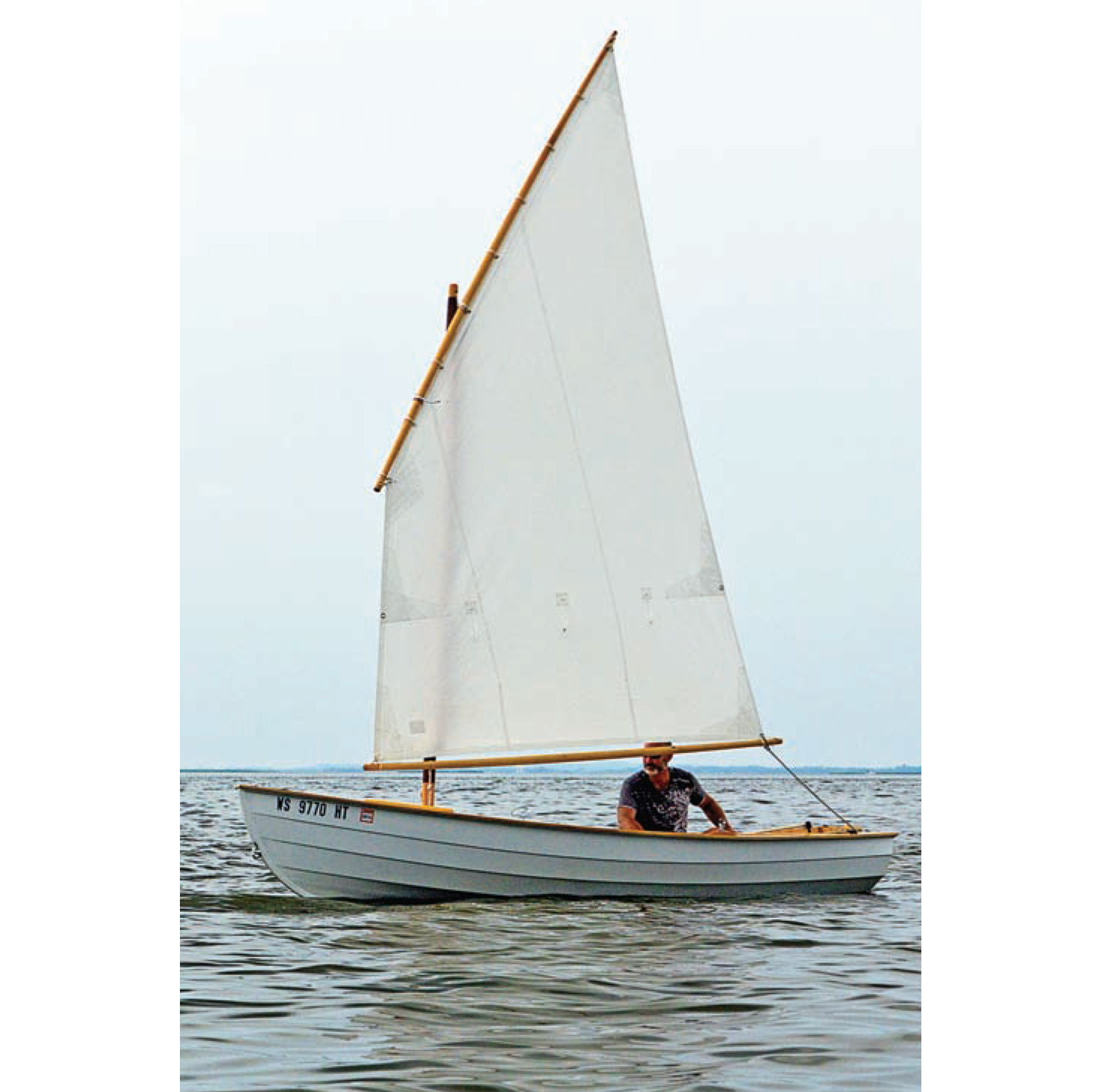 Sherry Pamperin
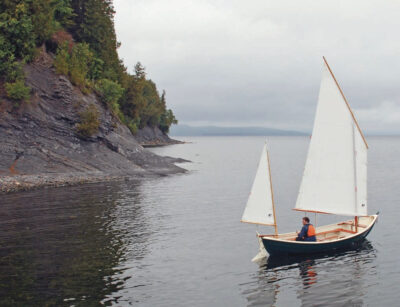
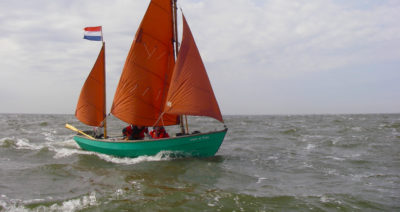
Phoenix III is meant to be rowed, sailed, or powered by a small outboard. Ross Lillistone designed the boat as the ideal solo beach cruiser.
“Having spent most of my life sailing in a short, steep chop, I was determined to reduce pounding and spray to a minimum,” Lillistone says. “With that in mind, I made Phoenix III very fine in her forward sections, and her entrance half-angle is only 13 degrees. This fineness has a lot to do with her being an easily driven hull—the theorists will talk a lot about optimum prismatic coefficients and so forth, but in a very small, light boat, the simple process of cutting through a chop is a very important issue.”
In addition to a fine entry, the hull has ample rocker but a fairly flat run aft, which should help the boat plane or surf well beyond displacement speeds. A low wetted-surface-to-displacement ratio also helps performance, and the Phoenix III is narrow enough to make rowing a pleasure rather than an act of desperation; plans for 7′ 6″ oars are included. As for the rig, there are three options: a spritsail sloop of 104 sq ft, a balance lug of 76 sq ft (both of these rigs use an unstayed mast just over 12′ 6″ long), or an 89-sq-ft Bermuda sloop for those who insist on the added hassle of an 18′ stayed mast.
Designed for glued-lapstrake construction, the Phoenix III achieves a nice balance between aesthetics and practicality with five planks per side. The hull is built upside-down over four permanent bulkheads and several temporary molds, and interior framing is minimal; the plank laps, bulkheads, and rowing thwart provide strength and rigidity while keeping weight down—my brother’s boat weighs well under 200 lbs. The lack of framing also makes it easy to keep the interior clean and dry. Large buoyancy chambers fore and aft provide plenty of flotation and some dry stowage if needed.
Although glued lapstrake can be intimidating to new builders, the Phoenix III’s plans (available in either metric or Imperial) include a 42-page instruction manual with photos and simple explanations of creating and using plank patterns, cutting bevels and gains, and more. There’s no lofting or lining-off required, either—the faceted molds and bulkheads define the plank shapes, keeping things relatively foolproof. The plans themselves consist of 30 pages of detailed drawings. Unlike traditional plans, with multiple drawings on several large rolled-up sheets, the Phoenix III package is a comb-bound 11″ × 17″ booklet with one component per page. Even better, the booklet lies flat on a table or workbench with no need to hunt around the workbench to find something to hold the edges down while you puzzle out the next step.
Sailing rig options
I haven’t seen what a Phoenix III can do with the 104-sq-ft spritsail sloop rig, which spreads a lot of s ail and keeps it very low; the spritsail rig will also balance well without the jib. Looks fun, but I’d stick with the 76-sq-ft balance lug rig for its simplicity, ease of reefing, and docile behavior. If you’re overpowered or need a break, simply let the sheet fly and the sail weathercocks freely, bringing instant calm. The sail is essentially self-vanging, jibing is gentle and utterly predictable, and if you need to douse the rig in a hurry, uncleating the halyard will bring the sail down—now. You’ll need non-stretch line for the halyard and downhaul, but very few expensive fittings. One caveat: The boom is rather low. Specs for a slightly longer mast are available in a later plan amendment, which should help. It’s not a big problem when singlehanding, or when your crew knows what to expect, but the boomless spritsail would be friendlier to passengers unfamiliar with sailing.
Solid or hollow, the mast for the lug or spritsail can be stepped or unstepped with one hand; just set the heel in place and push the mast into the partner. Stowed in the cockpit for rowing, the mast overhangs the transom, but that’s no problem. For trailering, the spars (except for the Bermuda rig) lie flat inside the boat as long as the hatch in the forward bulkhead is opened.
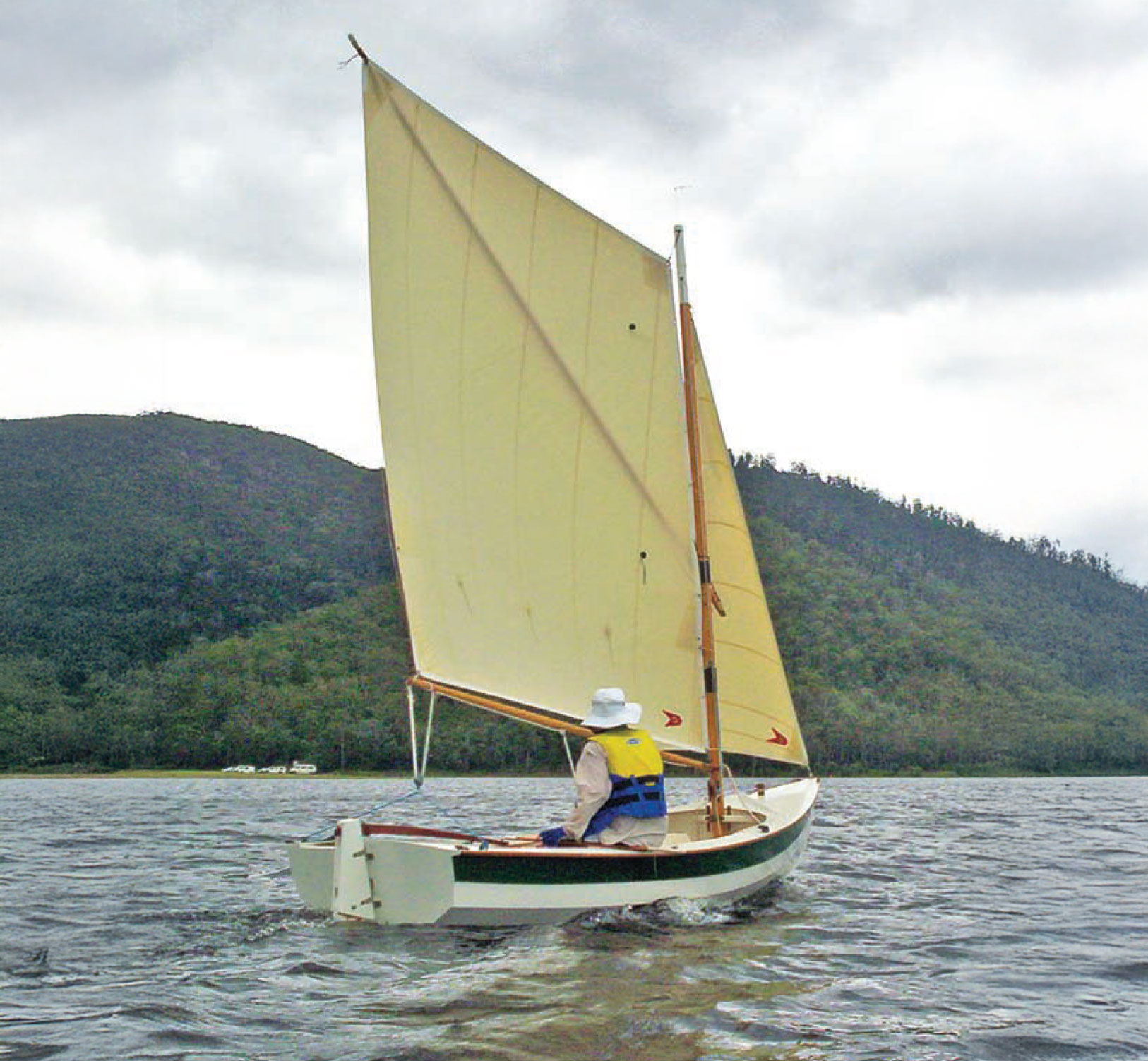 Courtesy of Ross Lillistone
The very first Phoenix III, built by Australian Paul Hernes with a boomed sprit rig. This boat has since been repainted and rerigged with the balance lug option.
Although the Phoenix III won’t haul a boatload of passengers, it’s comfortable for two adults and a couple weeks’ worth of camping gear. With a passenger lounging on the thwart (or tucked alongside the centerboard trunk atop some cushions, a cozy spot for long passages), the helmsman can use the wide aft seat or side benches. But I often remove the side benches and sit directly on the sole, with a cushion beneath me and another propped against the side deck for a back rest, which keeps my weight low (and farther forward) and permits better visibility and boom clearance.
The steering is light and responsive, with just a touch of weather helm. Even in 15–20 knots of wind I can hold the tiller between my thumb and forefinger. Sheeting loads are minimal, too. I run a single-part sheet directly from the boom to my hand. Hooking the line under a horn cleat on the leeward quarter takes the strain off, and the lack of blocks makes for a much shorter sheet—less clutter underfoot, and no frantically reeling in line after each tack. A rope traveler over the tiller is another option. With the boom, the sheeting angle isn’t critical.
I’m a sail-and-oar cruiser with no racing background, and I spend most of my time sailing alone, with no other boats in sight for comparison. My usual method of gauging a boat’s speed is to dangle a few fingers in the water. When I do that, the Phoenix III feels awfully fast, especially considering its minimal wake and smooth motion. In light airs I often find myself bemoaning our slow progress. Then I dip a hand overboard and feel the water rushing past and have to smile. Sailing to windward, reaching, running, the heading doesn’t seem to matter; the Phoenix III slips easily through the water.
For such a narrow hull, though, the Phoenix III is surprisingly stable. To find out exactly how stable, my brother and I set out to capsize it. Sailing unreefed in a gusty 15–20 knots, it took a concerted effort (i.e., a couple of 200-pounders leaning on the leeward gunwale) to dip the rail and scoop up water. It took a sustained effort to complete the process and roll the boat over—the Phoenix III simply does not want to capsize, and gives the crew plenty of time to react. Sailed sensibly, this boat is unlikely to ever suffer an accidental capsize, a comforting thought for serious cruisers.
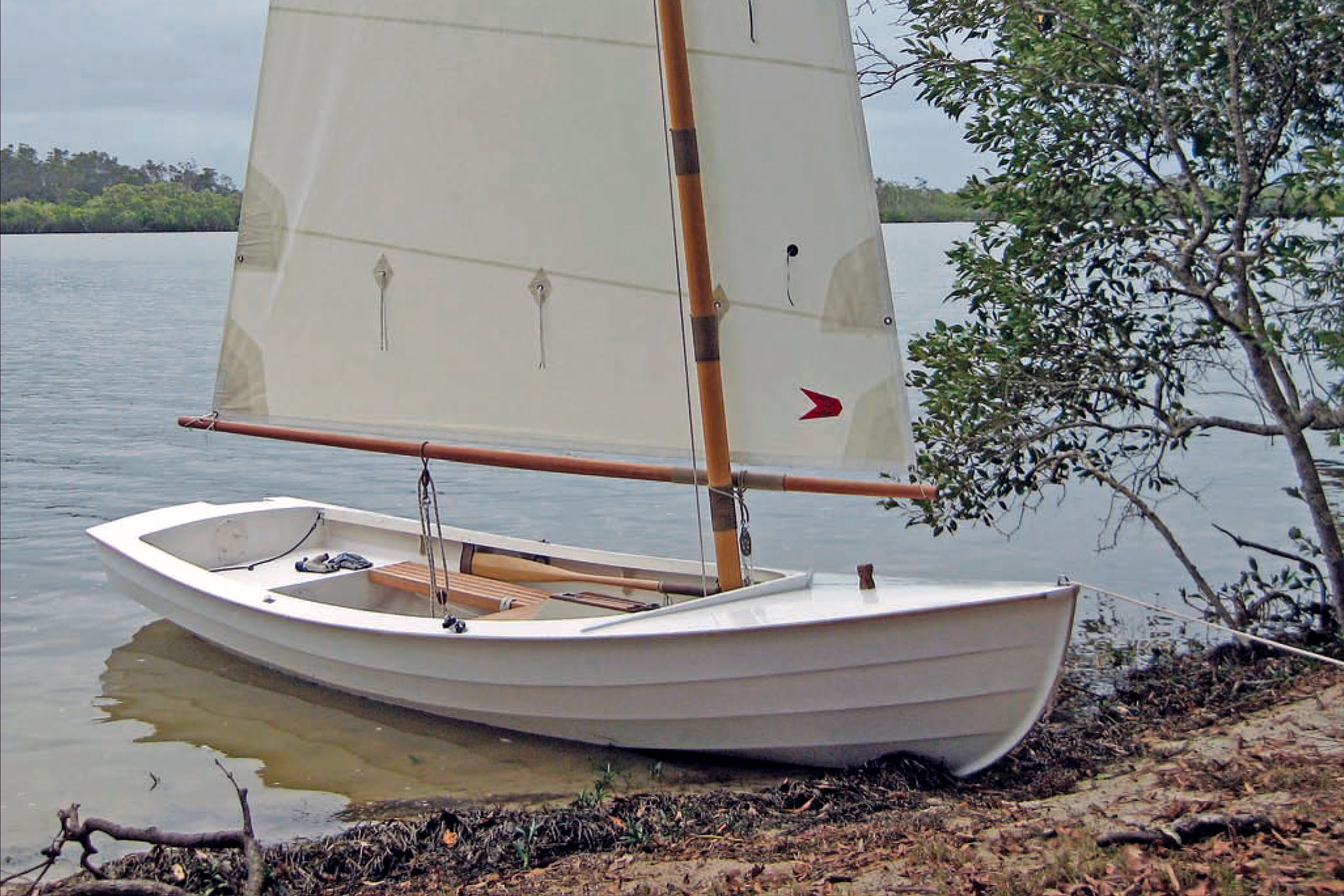 Courtesy of Ross Lillistone
Phoenix III is meant to be rowed, sailed, or powered by a small outboard—self righting after a capsize, and stable even when swamped, the boat is the ideal solo beach cruiser.
When the boat finally did go over, the wooden yard and mast kept it from turtling, and a simple pull on the centerboard turned the boat upright, sail and all. You can also remove the sail from the mast and wrap it around the yard while the boat is still down. When we tried that, the Phoenix III slowly rolled back upright without any help whatsoever. I was able to swim aboard and let the boat scoop me up as it went, handy indeed for an exhausted or injured sailor. Once righted, the swamped boat was stable, with the water level just below the rowing thwart, far beneath the top of the centerboard trunk (a benefit of the trunk’s unusual shape—the forward end of the board is quite a bit wider than the part that runs under the thwart). One hundred scoops with a three-gallon bucket and it was time to sponge out the rest and sail away.
So is the Phoenix III a perfect boat? That’s probably not even theoretically possible. But for singlehanded or two-up cruising, I can’t see much that would improve it. It’s light (one person can easily roll it up a beach with a couple of inflatable fenders under the keel), fast, handy, and capable. It’s good-looking, too. While it may not be perfect—what boat is?—you can’t go wrong with this design. It’s perfect enough. 
Information and plans are available from Ross Lillistone.
Phoenix III Particulars
LOA: 15′ 1 1⁄2″
Beam: 4′ 9″
Draft (board up): 6″
Sail area: 104 sq ft
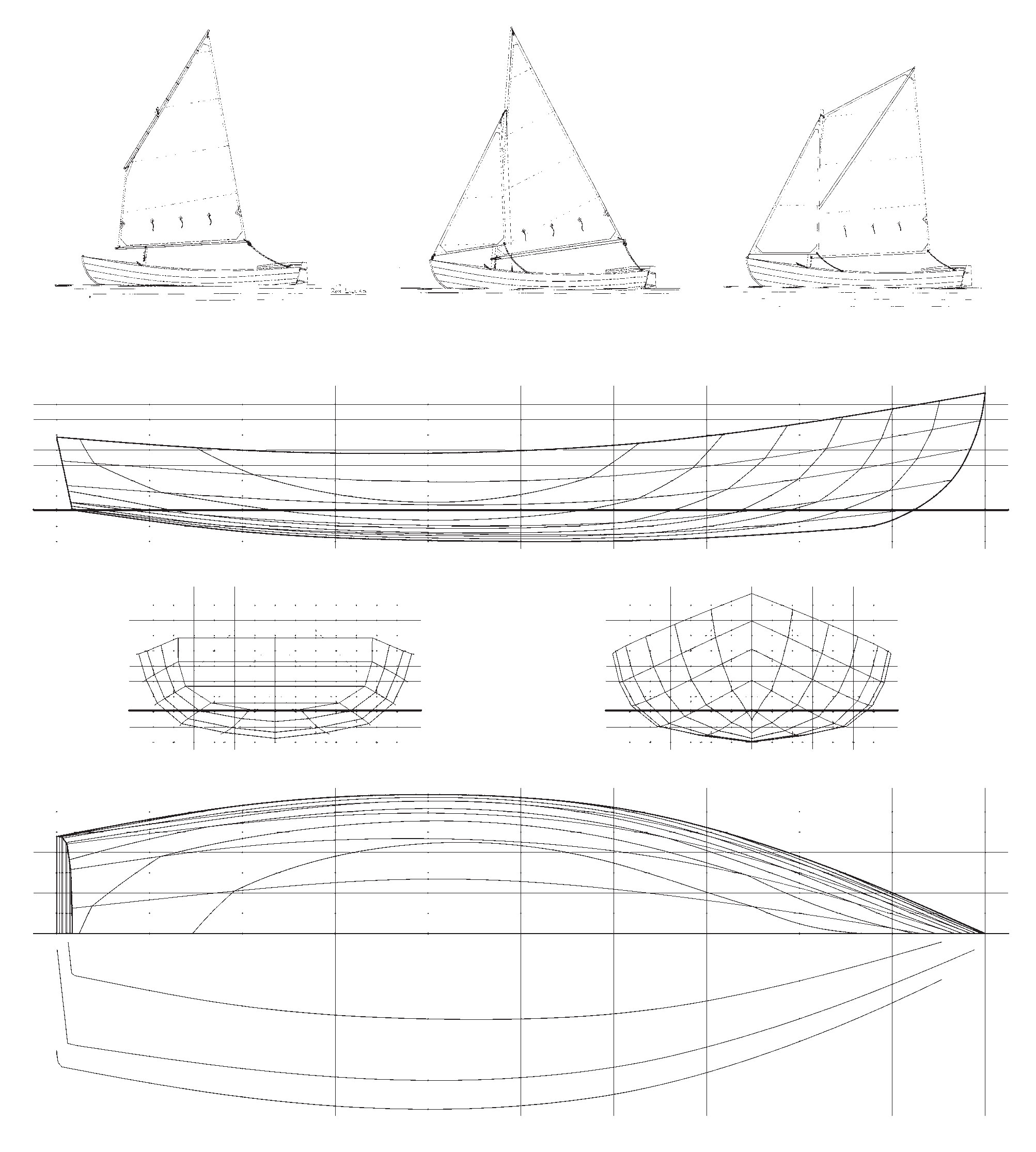 Ross Lillistone
Phoenix III’s lines show a fine entry, ample rocker, and flat after sections. She’ll plane and surf well above her displacement hull speed. Flotation chambers forward and aft add a margin of safety on expeditions and heavy-weather outings. The three rig options give plenty of opportunity to indulge personal preferences.
More boats from Ross Lillistone
Want to explore more small-boat designs by Ross Lillistone? We have you covered! Check out a few that we’ve reviewed, including a pair of cruisers.
First Mate: A Lillistone beach cruiser for sail, oars, and outboard
Periwinkle: A camp-cruiser for oar, sail, and outboard
Flint: A versatile Ross Lillistone skiff




Join The Conversation
We welcome your comments about this article. To include a photo with your remarks, click Choose File below the Comment box.