 Benjamin Mendlowitz
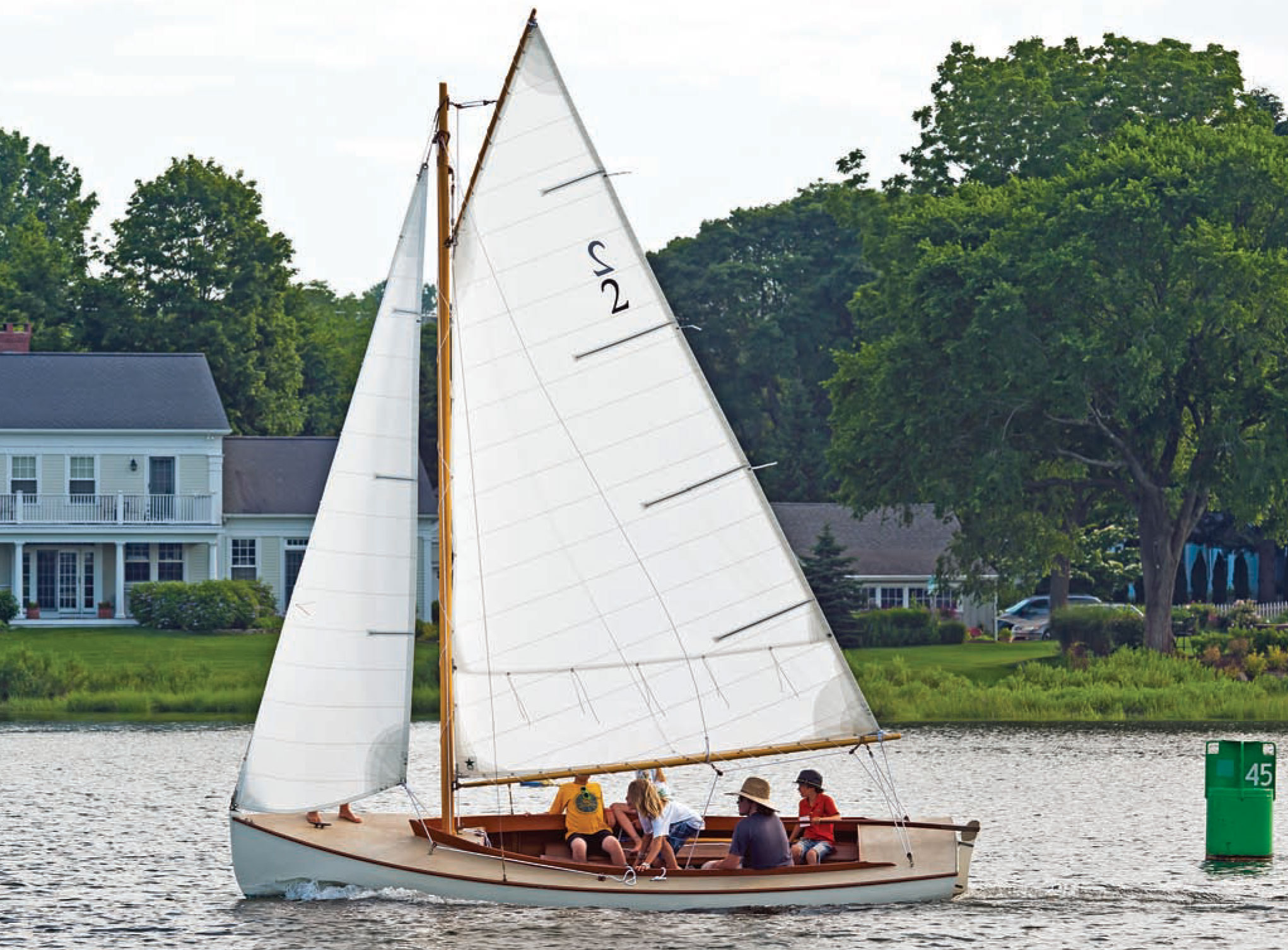
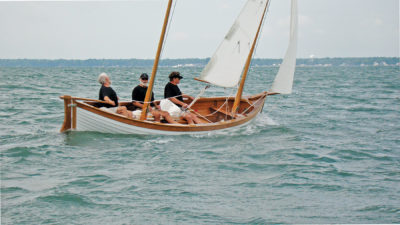
The Hazel 18 is an elegant plank-on-frame daysailer from Gannon & Benjamin of Martha’s Vineyard, Massachusetts. With plenty of room for a party of adults or a gaggle of kids, she fills the niche between small daysailer and small pocket cruiser.
The Hazel 18 is an elegant plank-on-frame daysailer. Her designer, Nat Benjamin, is co-proprietor of the Vineyard Haven, Massachusetts-based boatyard Gannon & Benjamin Marine Railway, which built her. This yard has a well-earned reputation as one of the finest builders of plank-on-frame hulls in the United States; they’ve built boats ranging from small dinghies to a 65′ oceangoing schooner—most of them to Benjamin’s designs. Included in that output is a series of fine daysailers. The new boat is meant to fill a vacant niche in the daysailer line—something between G & B’s 14′ Quista (an enlargement of the well-known Beetle Cat) and their 21′ Bella-class sloop.
“I call it an intergenerational boat,” says Benjamin of Hazel. “It’s something that adults and kids can sail separately or together.”
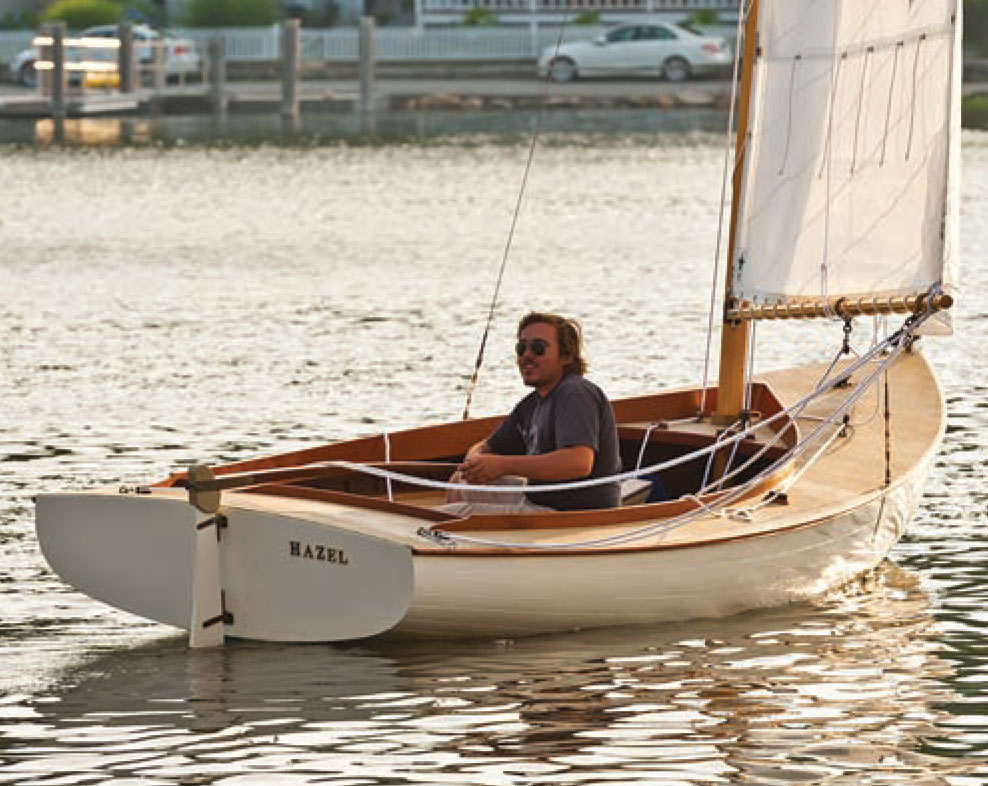
Hazel is Benjamin’s design No. 78, and hull No. 63 for the yard. The intent behind the boat was a simply rigged, simply maintained, and simply sailed day boat—something along the lines of a Rhodes 19. Its only varnish is on the spars; the interior is oiled, and everything else painted. It was also meant to be easy to set up and rig.
“Just pick up the mast and stick it in,” says Benjamin. “I was after simplicity. You don’t need a whole lot of stuff to go sailing, and in fact it’s more enjoyable if you don’t have too much.”
This boat first caught my eye when I saw its sail plan in one of Gannon & Benjamin’s advertisements in WoodenBoat magazine. It was hanging on the wall of our production department, and I was immediately struck by the boat’s size, rig, and style. It seems that this sort of boat—a decked, plank-on-frame daysailer of this size with classical good looks—was absent not only from G & B’s line of offerings, but also from most contemporary ones. I made a mental note to seize any opportunity to inspect the boat in the coming season, and that chance arrived in late June.
“Do you think you’ve hit the mark?” I asked when I met the designer for a long-anticipated outing at The WoodenBoat Show at Mystic Seaport. “I do,” he said. “It’s very well balanced. A young person or an old person could sail it.” That assertion would be proved handily when we went sailing a few hours later.
 Benjamin Mendlowitz
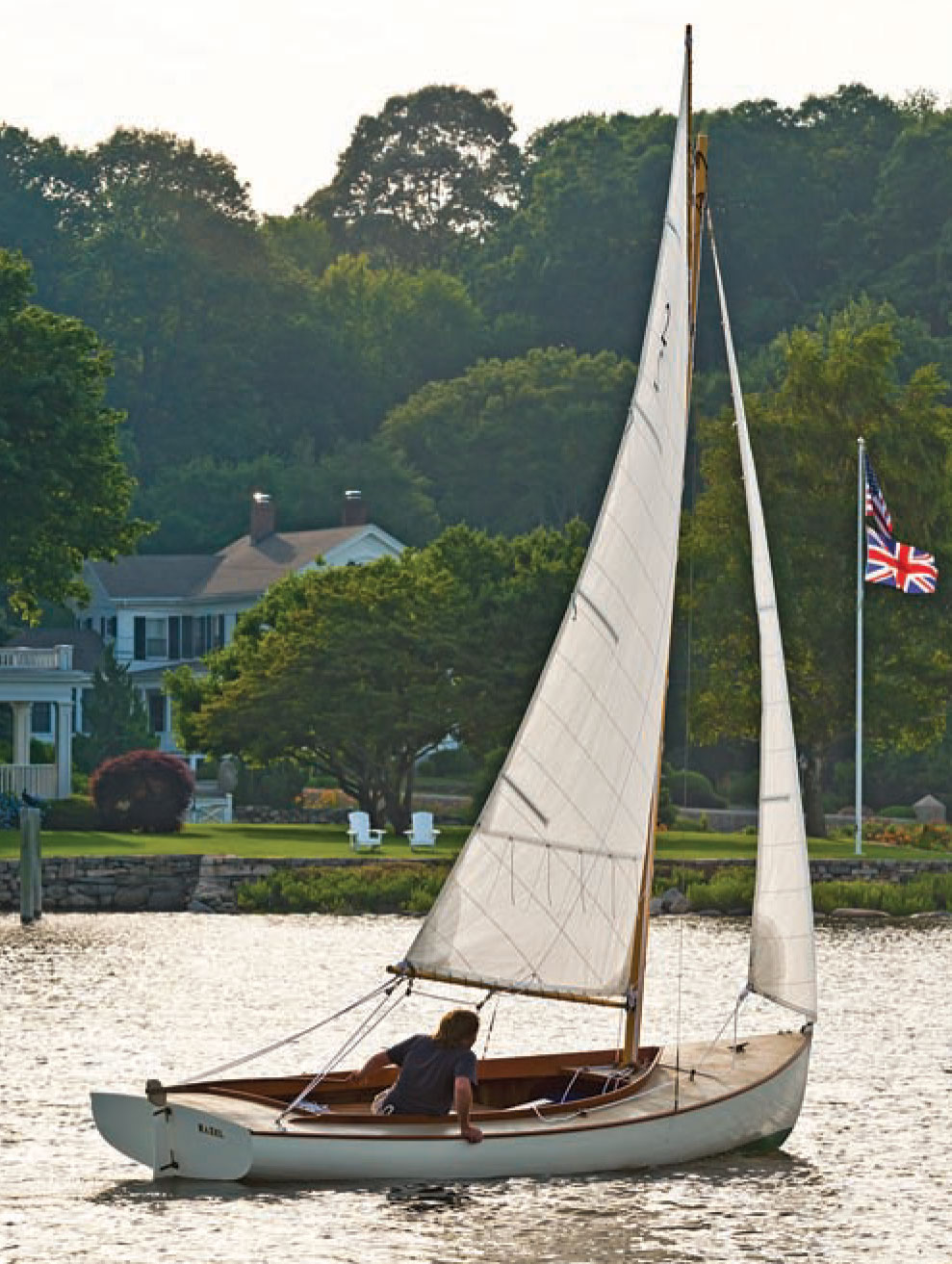
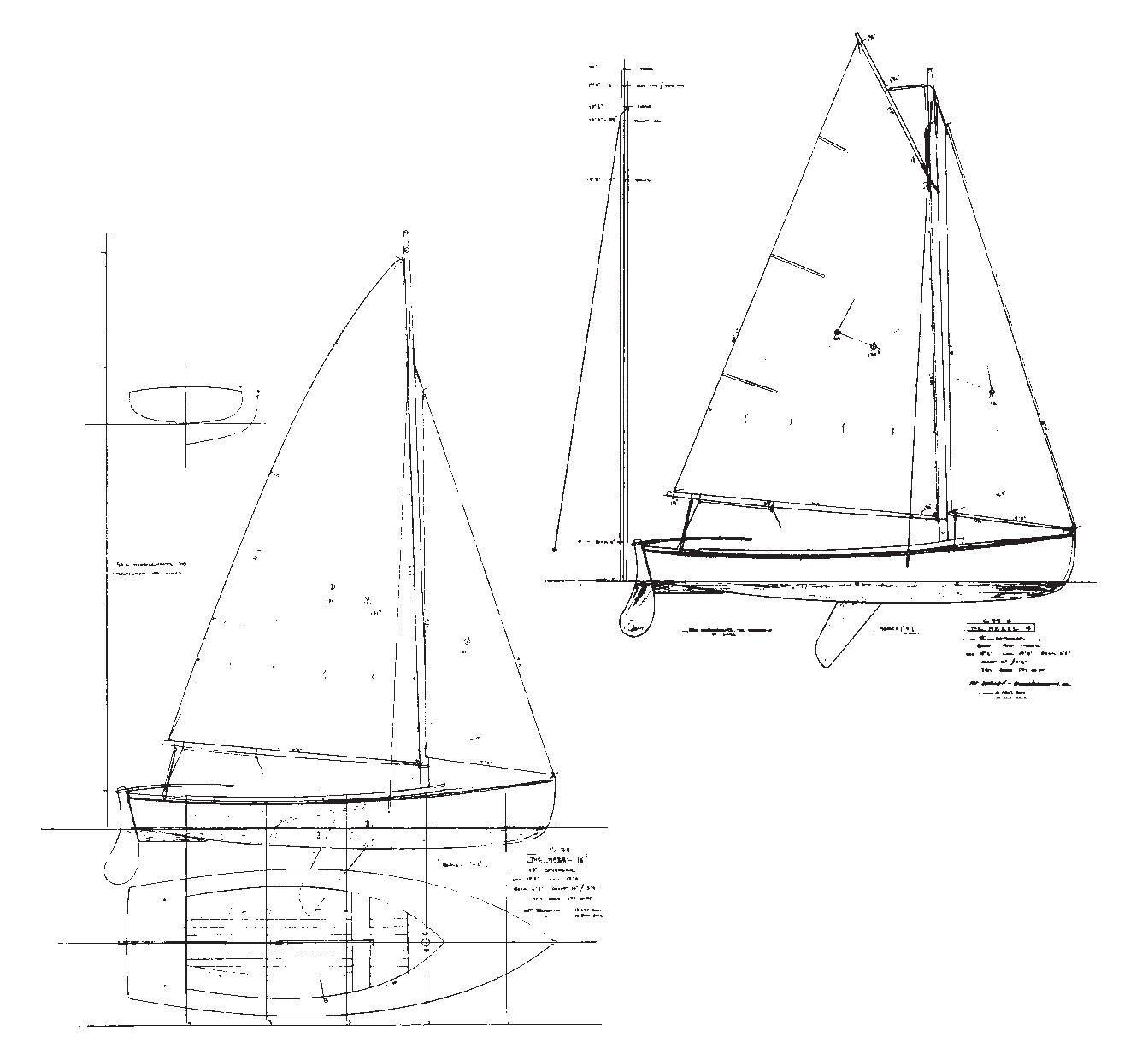
Designer Nat Benjamin drew two sail plans for the Hazel 18: a gaff rig, and a Bermudan one. At the time of this writing, the gaff option had just been launched, and the Bermudan was being rigged.
Designing and building the Hazel 18
The Hazel 18 is planked in 5⁄8″ cedar on steambent oak frames. The sheerstrakes, broadstrakes, and garboards are of wana—a South American species that’s nearly as dense as teak, and which provides extra strength and screw-holding where required. The decks have the usual deckbeams, and are covered in plywood sheathed in canvas. The canvas is coated in a magical goop called Vulkem, a formulation meant for parking lots and football stadiums. Some years ago, Gannon & Benjamin discovered that this stuff seals canvas completely, and its color looks good, to boot.
“We’d given up on canvas until 15 years ago,” says Benjamin of the Vulkem epiphany. “I don’t think that deck will have to be painted for 10 years.”
The spars are of spruce, and the mast is hollow. The sails, built by Roy Downs of Danvers, Massachusetts, continue with the “simple” philosophy. The jib was set up like that of a Herreshoff 12 1/2, which is to say that it rides on a jibboom, and is self-tending. Set it and go. The mainsail is laced to the mast. Benjamin designed the boat with a marconi rig, but Steve Corkery, a boat broker and mentor to many on traditional boat details, suggested a gaff-rig option. Benjamin obliged, and drew that rig, too.
G & B built the first two boats on speculation, one gaff-rigged, and one marconi. They’re for sale for $65,000. Skilled would-be builders with more time than money should take heart: At the time of this writing, Benjamin said he’d be willing to sell plans for the boat, though at that point he did not have a detailed construction drawing. At present, the lines, sail plan, and scantling sheet are the extent of the package.
The boat carries 171 sq ft of sail, and weighs 1,900 lbs. The blades—centerboard and rudder—are built of plywood, and the centerboard has 25 lbs of lead cast into it; this weight keeps the board where it belongs when it’s lowered, but allows it to rise in the event of a grounding. The hardware is simple, too: A bronze Reineck swivel cam cleat belays the mainsheet, and all other blocks are of Tufnol and were purchased from R&W Rope Warehouse.
While Gannon & Benjamin are specialists in plank-on-frame construction, many home-based builders would likely be interested in other construction techniques— methods that require less skill than plank-on-frame, or whose materials are more available and workable in the average home-based shop than live-edge cedar and bending-quality white oak. Benjamin said he would not be opposed to developing the construction for glued-lap—the technique whereby lapstrake planks are cut from sheet plywood rather than from solid wood, and glued together with epoxy rather than riveted. It’s a tantalizing option. But after sailing the boat, I can’t help but think that something would be lost in this translation, as there’s a warmth and timelessness to the cedar-planked prototype. And it smells good, too.
 Benjamin Mendlowitz
Nat Benjamin calls the Hazel 18 an “intergenerational boat.” She’ll be fun and interesting for sailors young, old, and in-between.
Taking the Hazel 18 for a spin
My outing in the Hazel 18 began with an awkward departure dictated by a narrow boat-show slip with the wind blowing right into it. We handed the boat out past our neighbors; once we had searoom, we bore away and she immediately settled into the groove, with just two fingers on the tiller. Benjamin had said before we departed that the boat was “nice to sail… responsive and well balanced.” I couldn’t have agreed more when I took the helm. She proved to be quick in stays as we shorttacked down the Mystic River, and she was well mannered as we reached back to the show—smoothly jibing twice.
I was delighted with the finely proportioned tiller, too. While this may seem a rather mundane observation, consider that the tiller completes the human connection to the boat. It’s a very important detail, I think, and one that’s often overlooked. I find it incredibly disappointing to grasp a heavy, clunky chunk of a tiller on an otherwise fine sailing boat.
The boat’s easy ergonomics struck me next. Simple bench seats run down either side of the boat, and the deep coamings are properly angled for good and comfortable back support. I recall hearing many years ago that a certain fast-food chain designed its seats to be uncomfortable after about 15 minutes, in order to promote turnover. Whether that’s true or not, it seems that many boats are similarly designed to promote short outings. Not so the Hazel 18. She’s no McDaysailer; I could have sailed her all day.
 Benjamin Mendlowitz
Simplicity is a hallmark of the new daysailer. The boat’s only varnish is on the spars; all other surfaces are oiled or painted. Lacing attaches the sails to the spars, and the hardware is minimal.
But I didn’t sail her all day, because schedule dictated our return to shore. Nat Benjamin and Ross Gannon were to be celebrated that night at a dinner honoring their 32 years of boatbuildling accomplishments. So we headed toward the party’s venue, where we’d turn the boat over to a youthful crew of Gannon & Benjamin family members and friends who hollered to us from shore as we approached. As we neared our landing area, Steve Corkery, the boat broker, stood on the deck of Nat Benjamin’s schooner, CHARLOTTE. Knowing that Steve is a gimlet-eyed observer of details, Nat and Ross looked at each other, chuckled, and acknowledged quietly that Hazel’s gaff peak needed to be raised. Corkery, they said, was going to say something. They’d barely got those words out when we heard Corkery’s voice roll across the water, aimed at no one as if he were thinking out loud: “peak up that gaff.” Someone jumped to the halyard.
Ross noticed an open granite wall near the party venue and suggested I bring the boat in there. Hmmmm… granite meets cedar, I thought as I approached the wall. We’d left the fenders back at the boat’s show slip. How much way would she carry into the wind, I wondered? How tight a circle would she carve? I made a nice wide turn, keeping a little bit of wind angle in the bank, in case she needed a little goose at the end. I needn’t have worried. With that long waterline and four grown men aboard, she carried plenty of way. In fact, I came in just a little hot, but Ross was able to effortlessly arrest the extra speed with his hands. The adults all piled out of the boat, and a crew of six or seven kids piled in and were off.
Later that night, as the party celebrating Gannon & Benjamin got underway, the boat continued to sail, well past sunset, with that gaggle of kids aboard, and crews coming and going. The sight was a beautiful visual tribute to a fine partnership that continues to turn out timeless classics. An intergenerational boat, indeed. 
Finished boats and plans are available from Gannon & Benjamin Marine Railway, Box 1095, Beach Rd., Vineyard Haven, MA 02568; 508–693–4658.
Hazel 18 particulars
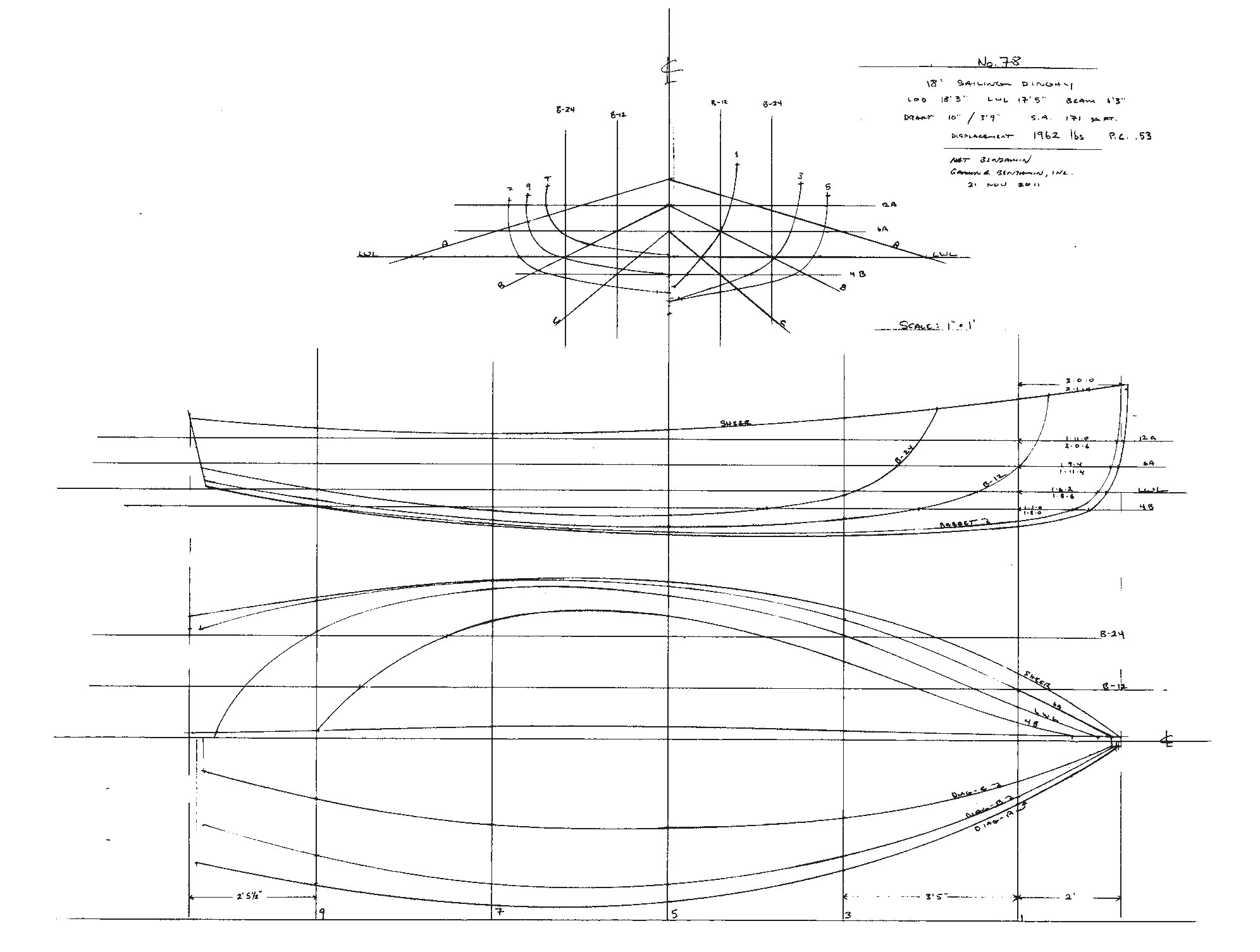
LOA: 18′ 3″
LWL: 17′ 5″
Beam: 6′ 3″
Draft: 10″ / 3′ 9″
Sail area: 171 sq ft
Displacement: 1,900 lbs
 Nat Benjamin
Firm bilges, shallow draft, and modest beam make Hazel both stable and fast. The marconi and gaff sail plans each have a combined area of 171 sq ft.
 Nat Benjamin
Nat Benjamin designed the Hazel 18 as a wholesome daysailer that fits in the same niche as the popular Rhodes 19. The profile shows the influence of classic New England boats.
Taking inspiration from New England boat designs
Classic boat designs that originated in New England inspired many modern boatbuilders. Here are a few other boats rooted in New England tradition.
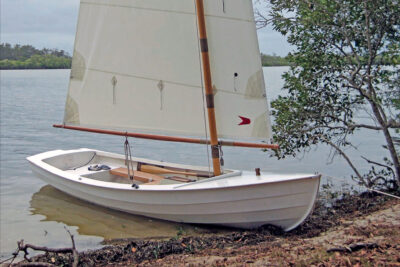
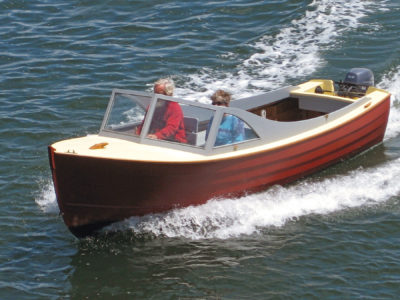
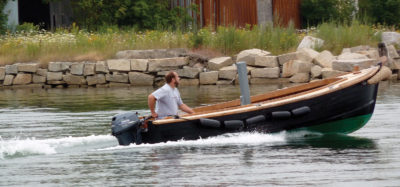
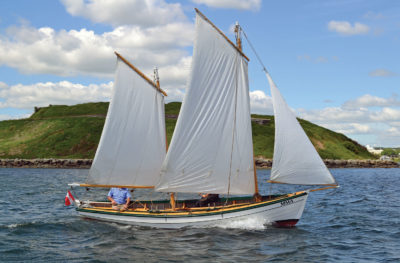
Brockway Skiff, a budget-friendly skiff for professional and recreational watermen designed and built by Earl Brockway of Old Saybrook, Connecticut
Haven 12 1⁄2, a trailerable daysailer designed by Joel White of Brooklin, Maine, in 1985, but based on N.G. Herreshoff’s original Herreshoff 12 1⁄2 designed in Bristol, Rhode Island in 1914-
Hampton Sloop, a family boat based on a century-old original developed for fishing in and around Hampton, New Hampshire
Is there a boat you’d like to know more about? Have you built one that you think other Small Boats Magazine readers would enjoy? Please email us!









Join The Conversation
We welcome your comments about this article. To include a photo with your remarks, click Choose File below the Comment box.