 Ben Summers
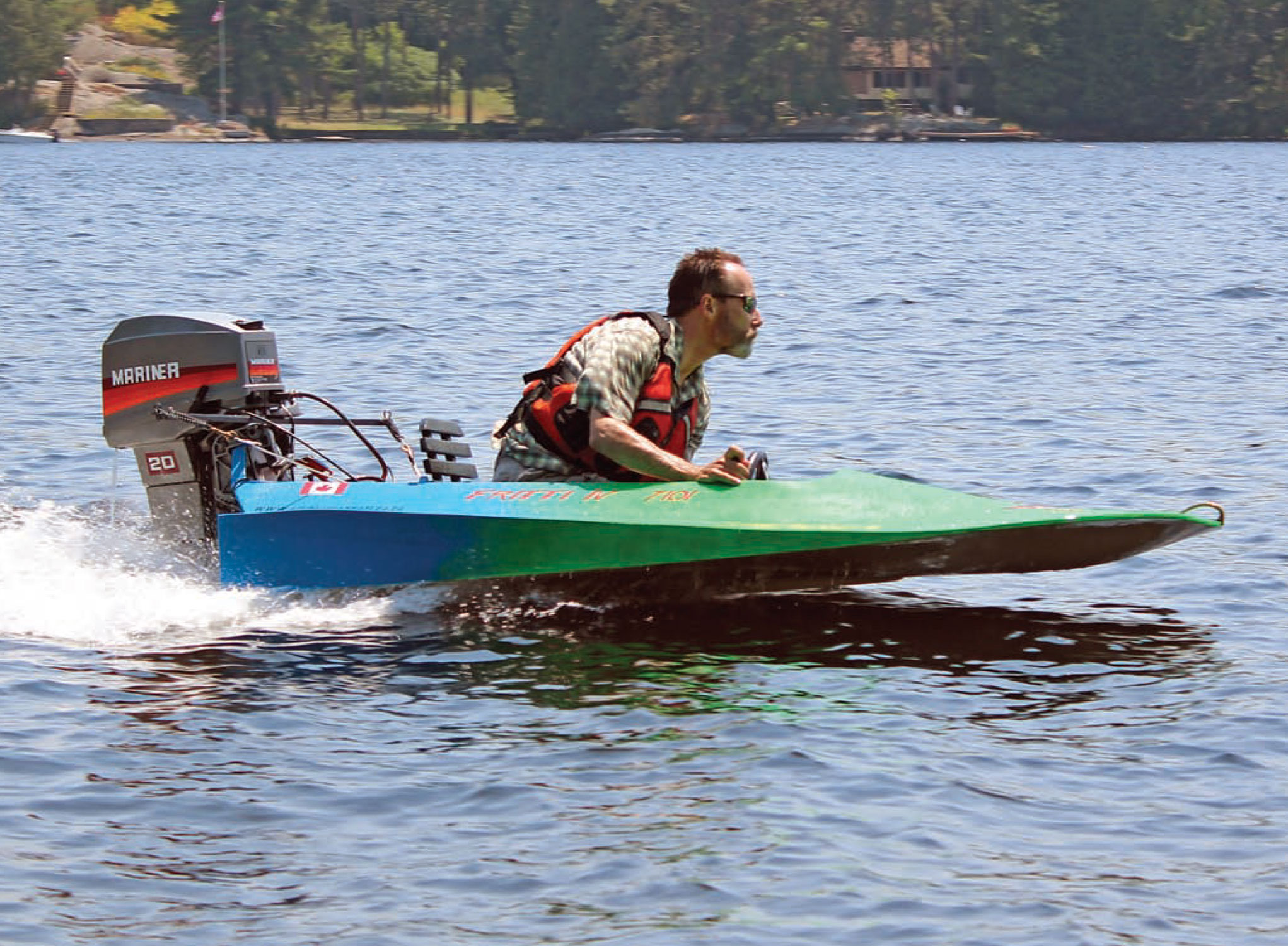
What it’s all about: a Minimax Sea Flea at speed with one hand on the wheel and the other on the throttle.
It couldn’t get much simpler, really: two sheets of plywood, a bit of lumber, some nails and screws, a little glue and paint, and an outboard motor. If you put these together in the right order, you end up with a Sea Flea–type outboard hydroplane, your ticket to a thrilling ride. Along with the Boston Whaler, the Laser, and the Sunfish, the Sea Flea is among the boats that have gotten the greatest number of people out on the water.
The urge to go fast on the water in an outboard-powered boat likely dates to shortly after the first practical outboard motors were built in the early years of the 20th century. It got a lot easier to satisfy that urge in the early 1960s when naval architect William D. Jackson drew the Minimax and Minimost, possibly the most frequently built of the Sea Flea–type designs. Originally published in Science and Mechanics in 1962, the plans for the Minimax and Minimost have been circulating from hand to hand via dog-eared and yellowed copies of the magazines, photocopies, and Internet downloads ever since. Magazines such as Popular Mechanics, Modern Mechanix and Inventions, The Mechanical Package Magazine, and the Sports Afield Boatbuilding Annual fed the boating dreams of thousands as they offered plans, instructions, and encouragement for building anything from a tiny dinghy to a substantial power cruiser or inboard sailboat, and often included designs for small, fast, outboard boats. There’s no telling how many of these little hydroplanes have been constructed, but their appeal is as fresh now as it was 50 years ago, and they continue to inspire builders.
There isn’t actually one particular design called a Sea Flea. That term was coined by Toronto athlete and sportsman Lou Marsh (1879–1936), who began racing small outboard hydroplanes in the 1920s in Toronto, Ontario, and it has come to be generally applied to this type of boat. Along with the Minimax and Minimost, some of the evocatively named designs considered Sea Fleas include the Hasty Hydro, Hydro Kart, Spitfire, Flying Saucer, Pewee, Dragonfly, Mini Hydro, Yellow Jacket, and Skeeter. The Sea Flea spirit is also alive and well in the Cocktail Class Skuas (see WB No. 213), which is also available in kits from Chesapeake Light Craft.
 John Summers
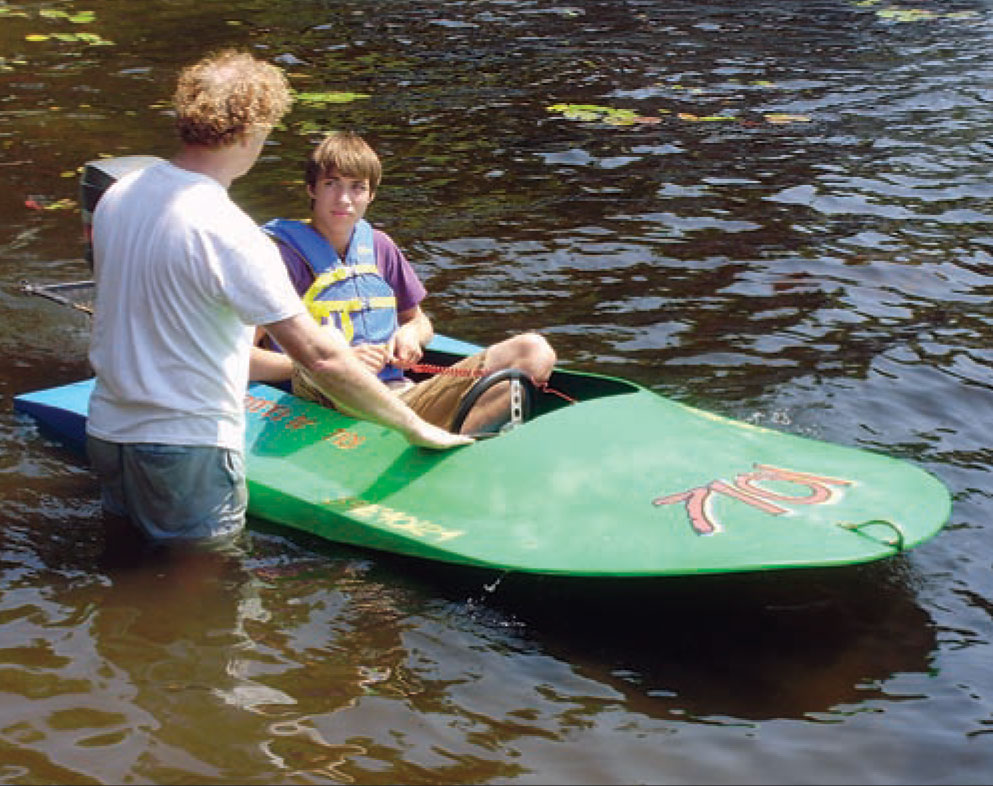
A young driver gets some tips before his first ride.
Building the Sea Flea
The Sea Fleas are all constructed in the same manner. According to the original article, “Most boat for the least money is this happy little hot rod racing dish. One weekend of work, or even one day if you’re experienced, will have you ready for the water for under $20. Clamp on a small outboard and go….” If my own boatbuilding projects are anything to go by, the promise of “one weekend of work” is probably a little optimistic, and I’d be very surprised if you could still build one for “under $20.” These details aside, however, a Sea Flea is still a simple, easy, and relatively inexpensive boat to build. The boats can be put together anywhere you can fit a sheet of plywood, and they have been built in basements, garages, living rooms, and carports. Their construction requires only the most basic tools and materials, and they would make an ideal first boatbuilding project. They are also a perennial favorite project for a parent and child to share, both to build and enjoy afterwards.
 John Summers
A family gathering of Sea Flea designs. From front to rear, the designs are a Glen-L Tiny Titan and four Minimax hulls, the oldest of which, at the rear, was constructed in 1962 and is still in regular use.
The construction of the Minimax is typical of the Sea Flea type. The basis of the hull is two sheets of ¼″ plywood, reinforced with stringers cut from standard dimensional lumber such as 1×8 and 2×4 hemlock, pine, or spruce. Fastenings are flathead wood screws, ring nails, and epoxy, and the materials list is rounded out by fiberglass tape and cloth, filler, and paint. There’s no reason why boats can’t be built with A/C fir, or even underlayment, but better plywood will probably produce a longer-lasting boat for the same amount of effort, especially if a bright-finished deck is desired. One piece of plywood gets a half circle at one end with a gore in the middle that will later be used to introduce some deadrise at the bow. No extra lumber is required for a building form, as the framing is erected right on the bottom sheet. The deck is cut to the same semicircle at the bow as the hull, and the cockpit opening is also cut and marked. The gore in the bottom is closed up by a band clamp or Spanish windlass and secured with a metal strap. Clearcoating all surfaces with epoxy, especially those that will later be part of enclosed compartments, will greatly extend the boat’s life.
The main longitudinals are the hull sides and cockpit sides, the latter also extending to the transom to support the motor board. A web strut under the foredeck and a bulkhead at the front of the cockpit round out the framing members. These pieces are all built from scraps of plywood left over from the deck and hull with nailing strips added on top and bottom. Although the original plans show “lightening holes” of graduated size in the cockpit sides, many builders omit these and make the side deck spaces watertight for use as buoyancy. If they are enclosed, the plans promise that the resulting buoyancy will support 900 lbs if the boat is swamped. Similarly, the original plans call for fiberglass tape only on the hull seams, but a layer of cloth on the hull, and even on the deck, would increase abrasion resistance for boats that are often hauled up on the beach. Paint schemes are as individual as the builders and owners, but from my brief examination of Sea Flea pictures, hot rod flames do seem to be a recurring (and entirely appropriate) motif.
 John Summers
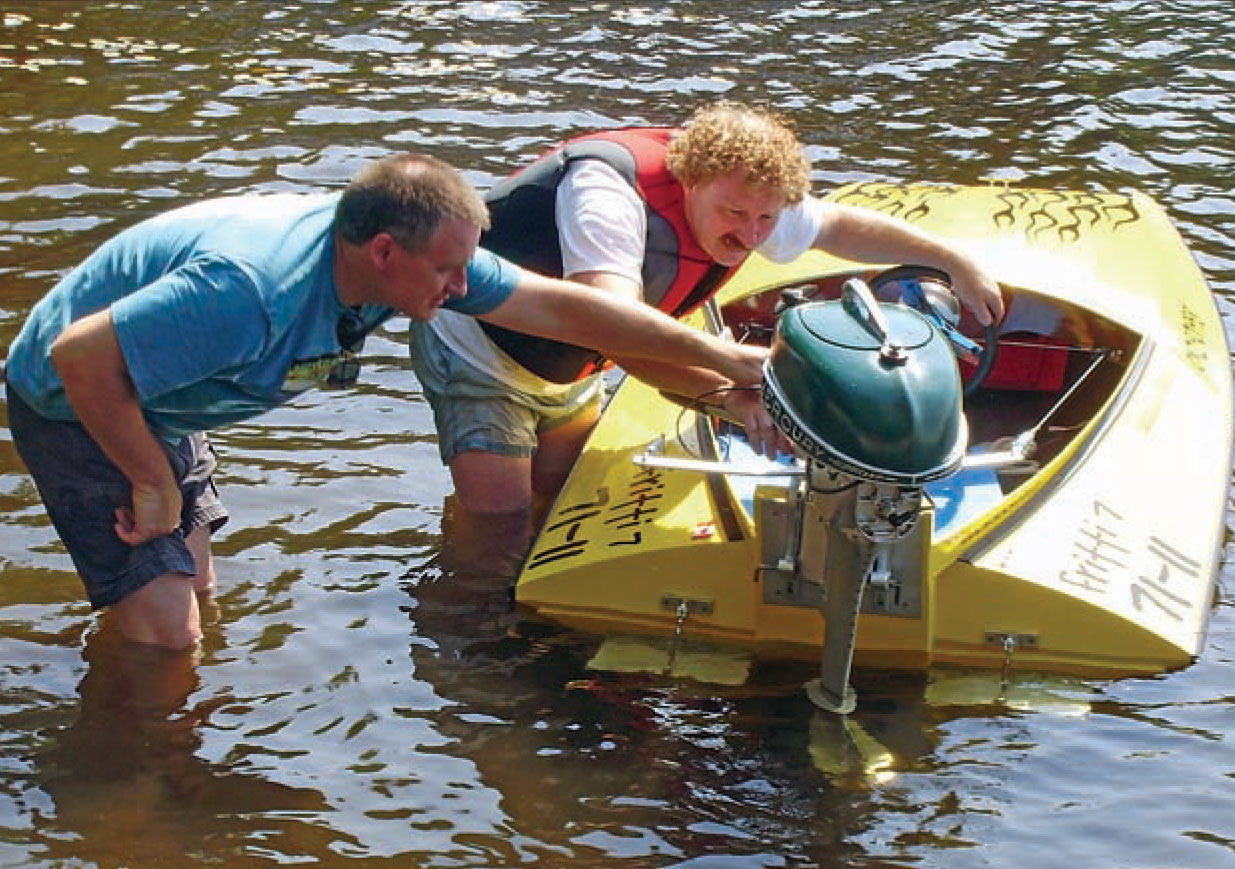
Part of the fun is tinkering with the boats and motors, especially when running an antique power plant such as this 1951 7.5-hp Mercury KG4.
Finished boats weigh in the neighborhood of 65–85 lbs without a motor, and are easily cartopped or carried in the back of a pickup. Ideal crew weight is one average-sized adult or one adult and a small child, and motors from 3 to 20 hp can be used depending on the age, weight, and skill level of the driver.
Performance
To run a Sea Flea, you sit or kneel in the tiny cockpit. Once the motor is running, and assuming that you’re not using an antique clutchless “start-and-go” motor like the 1950s Mercury shown in the photo above, your right hand goes on the throttle and your left hand on the wheel, though there’s nothing to say you couldn’t rig the boat with the throttle on the left if you wished. Getting up on plane takes a bit of practice—as you throttle up, you also move toward the bow, leaning over the foredeck. As the hull begins to climb out of the water, you lean back and ease the throttle a little, and soon the boat pops up on plane and takes off.
For those of us accustomed to the feeling of security offered by strong sheerlines and seaworthy bows rising up in front of us, it is a little disconcerting to be driving a boat at what feels like high speed with a bow that seems to go down like a scoop just waiting to pick up water. And scoop it will, especially through chop and wakes; but if it does, all you will get is a little wet. This is definitely a boat for summertime and warm water. Slowing down also requires a bit of care lest you get pooped and swamped by your own stern wave.
 Ben Summers
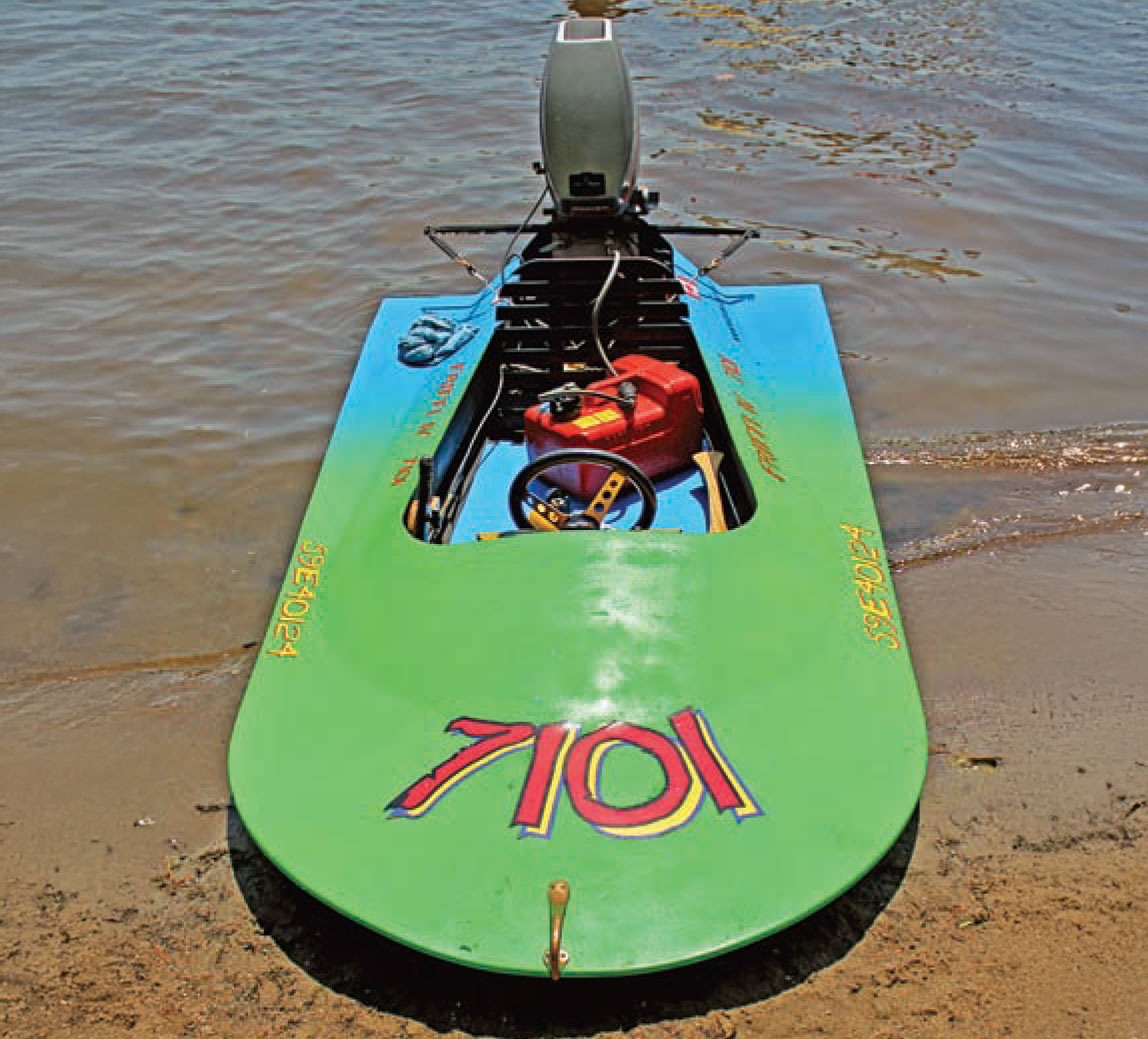
The Minimax is the essence of powerboating: Just enough hull to float you, a power plant, a gas tank, the wheel, and a throttle, all in 8′ of boat.
And how fast do they go? The Minimax I drove had a 20-hp motor on it, approaching the upper end of reasonable power for an 8′-long boat. Heading downwind, according to the speedometer on the dash I was running over 30 mph, and occasionally hit 33 or 34. That is almost immaterial, however, as it felt like I was going about 100, and that was a large part of the fun. The yammering of the outboard, the occasional jolts to the knees as I went through chop, and the haze of water droplets shimmering just ahead and to either side of that downward-pointing bow were mesmerizing, and even meditative in a kind of noisy, twostroke way.
Turning takes some planning, as there’s really nothing in the water other than the lower unit of the outboard. It’s really more of a controlled drift, but by leaning, easing the throttle into the turn, and throttling up going straight again, you soon figure it out. Essential safety equipment includes either a kill-switch lanyard and/or a deadman’s springloaded throttle and a PFD; and essential courtesy includes being mindful of local boating regulations about how fast you can go at what distance from shore.
Sea Flea hulls aren’t competitive in contemporary outboard racing, but building and driving one would be a good stepping stone into more formal American Power Boat Association competition if you were really bitten by the racing bug. This is really a summer vacation boat, perfect for high-speed excursions on sheltered water and perhaps the occasional brief fantasy that turns your 8′ plywood Sea Flea into a thundering unlimited hydro, at least until you have to head back to the beach and return the boat to the 12-year-old from whom you borrowed it. 
 Science and Mechanics magazine
The designs for the Minimax and Minimost were originally published in Science and Mechanics magazine in 1962.
Copies of the original building plans for a variety of Sea Flea–style designs, including the Minimax and Minimost, can be downloaded from www.muskokaseaflea.ca, where you will also find photos of other Sea Fleas, building sequences and instructions, videos of the boats underway, safety and operating tips, and a whole lot of enthusiasm for these little boats, as well as information about the annual FleaFest rendezvous in the Muskoka region north of Toronto, Ontario.
Sea Flea Particulars
LOA: 8′ to 10′
Beam: 48″ to 59″
Draft Propeller: depth
Power: 3–20 hp
Take a look at a few other tiny racer boat profiles
Midget Flyer, A smart little runabout from 1938 designed by Bruce N. Crandall
RETRO-ROCKET, Glen-L’s Super Spartan makes a splash
Squirt, A Glen-L runabout


Join The Conversation
We welcome your comments about this article. To include a photo with your remarks, click Choose File below the Comment box.