 Michael Higgins
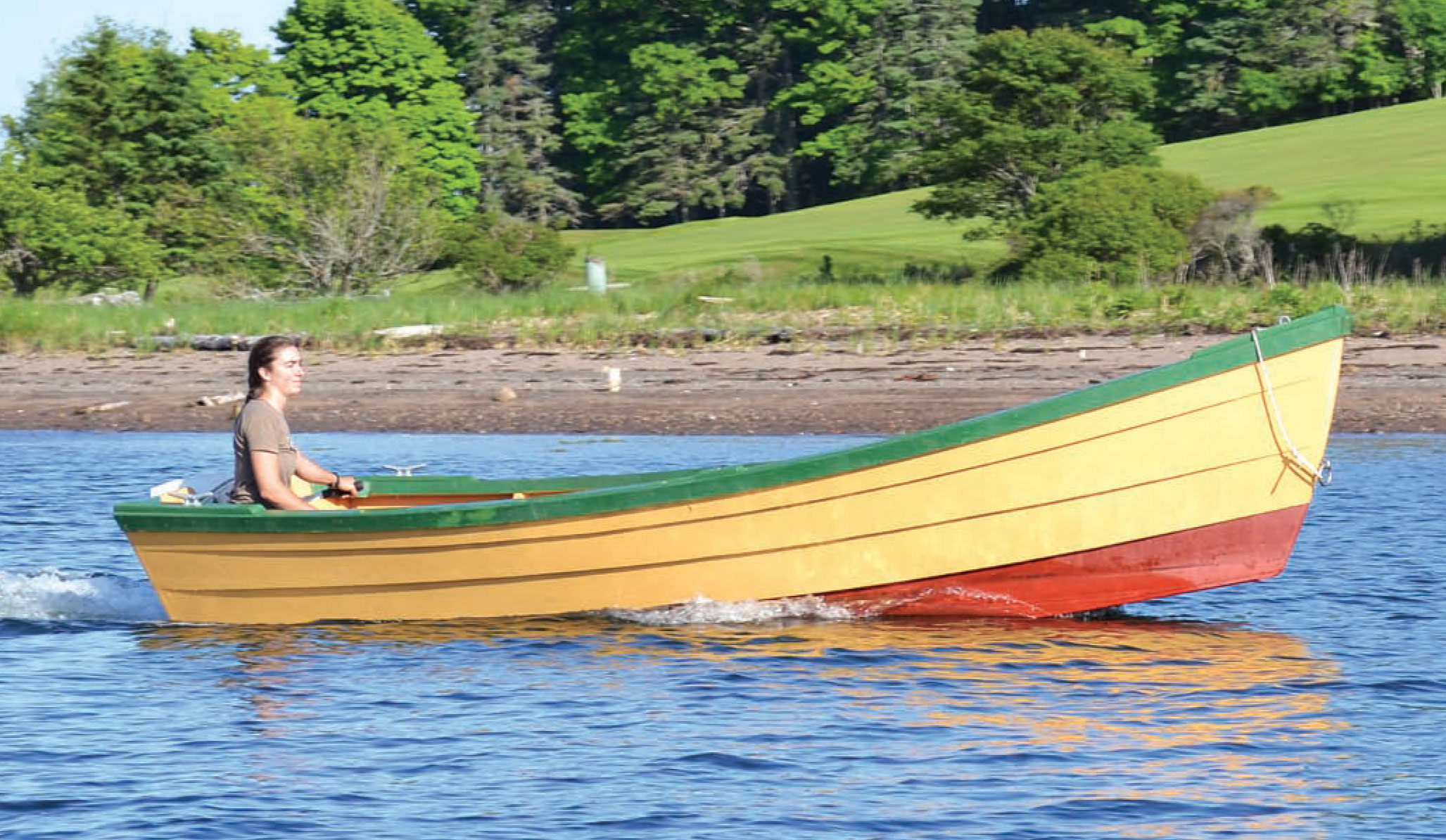
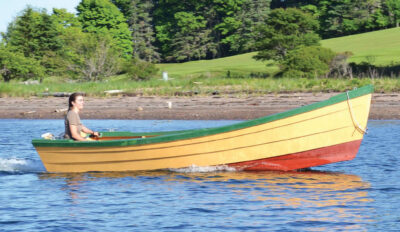
Form follows function: the Cross Island Skiff is built to carry cargo. With one person aboard, the bow rides high, but add a few friends and their gear, and it comes into trim.
The Cross Island skiff is a sturdy, reliable, and rugged boat built for the often boisterous waters of the open Atlantic coast of Nova Scotia. The boat is named for an island that lies at the mouth of Lunenburg Bay; indeed, the expressions “inside” or “outside of Cross” are local navigational references. To the south of Cross the next reasonable landfall is Bermuda, some 720 nautical miles away; just to the north of Cross is Hounds Ledges. The water between Cross and its neighboring island of East Point shoals up dramatically and on many a day can produce some rather startling sea states. For all but a few short weeks late in the summer, the water temperature here is somewhere between freezing and cold. If you are looking for a capable boat under 20′ that is easily beachable, I can hardly think of a better choice than the Cross Island skiff. It’s a true native of Lunenburg Bay.
The Cross Island skiff is an evolutionary step or two from the legendary Lunenburg Banks dory; it’s really an outboard motorboat, and not a rowboat—though it can be rowed. A Banks dory with a sailing rig or under oars would have been a common sight among these islands for most of the last century. But as outboards became more reliable, some clever dory builder decided to widen the old tombstone transom and change the sheer, and came up with the Cross Island skiff. The construction is unmistakably “dory” with its flat bottom, lapstrake construction, and utilitarian straight sides, but with it’s strong sheerline it’s still a fine-looking boat. Unfortunately, the historical details of this boat’s first builder have been lost in the fog bank lingering just off the coast.
Historically, most of Nova Scotia’s coastal islands were inhabited at some point by small communities working the local inshore fishing grounds, or in the case of Cross Island, maintaining the lighthouse. There are many local boats unique to their home waters and their builders all along this coast. The one common boat, though, is the dory. Men and boys would regularly make trips to the Banks aboard the great fishing schooners, and from those schooners “Banks dories” were launched and from those boats the real fishing was done. Thus the dory became a well-known and trusted boat, the logical and comfortable choice for a boat when back home among the coastal islands. Today many of these islands only have summer camps and seasonal visitors, but the surrounding waters remain unchanged—as does the need to dependably and safely travel back and forth from the mainland with friends and supplies. Thus the Cross Island skiff still has a place today.
A few years back, a very aged version of this skiff found its way to the Lunenburg Dory Shop, a venerable yet vibrant boatbuilding business located on the Lunenburg waterfront and in continual operation building wooden boats since 1917. That old skiff was too far gone to warrant anything other than palliative care, but the boat so struck lead builder Jay Langford that he took the lines off her before euthanizing the old gal. A few of these boats have now been built, and the results have, not so surprisingly, been wonderful. The one we see in the accompanying photographs is the outcome of a collaboration between students attending last fall’s Bosun School (a part of the educational work of the Lunenburg-based barque PICTON CASTLE) and Jay. The students of the Bosun School had no previous boatbuilding experience and little woodworking experience—all of which, I think, helps illustrate just how buildable such a boat is. With a little guidance from Jay or from The Dory Book by John Gardner, you could find yourself the proud builder of a very versatile and easily maintained boat. If building a boat is not on your “to do” list, I would imagine that Jay and the Dory Shop would be glad to build one for you.
 Susan Corkum-Greek
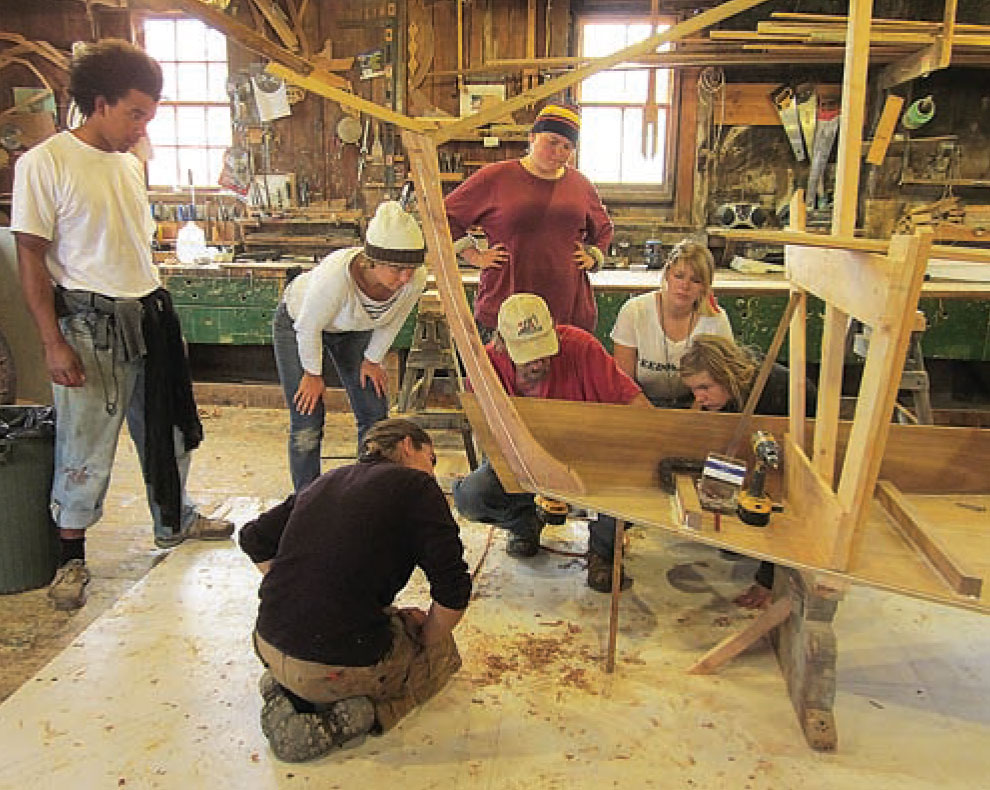
Under the tutelage of Jay Langford, seven students from Picton Castle Bosun School built this Cross Island Skiff at the Lunenburg Dory Shop in October 2011, launching her after just two and a half weeks.
Building the Cross Island Skiff
The construction of the Cross Island skiff is much like that of other types of dories. The Dory Shop generally planks their boats with pine, but with this one silverballi left over from another project was used for the planking. The bottom is flat but for a little rocker, and planked fore-and-aft with oak cleats running athwartships holding all together. Once the bottom is built and carefully beveled to receive the garboard planks, it is pushed down onto preset blocking to get its curved rocker just right. An inner stem, building molds, and the transom are all set up on the bottom before planking begins. There are four strakes per side, each lapped to the previous strake, particularly at the ends of the boat where they are let in flush in the last 6″ or so. This enables the planking to lie flat against the stem and transom even at the laps. Once the sheerstrake is in place, five pairs of bent-knee frames are fit carefully over the plank laps. Gunwales, a breasthook, quarter knees, and a seat riser all but complete the boat.
The beauty of a dory lies partially in its simplicity, exemplified by the generous use of grown knees. In pairs, they form frames and as hanging knees they support the thwarts. There are also knees used to support the transom and gunwales. A builder could laminate these knees, but a dory is not that kind of a boat. The effort in tracking down some grown knees would be well worth it. These are straightforward traditional boats that are accustomed to working in less than idyllic conditions and with less than museum-like care. Most dories are painted, a few are soaked inside in pine tar and linseed oil—this is no place for varnish.
To me, the appeal of a dory lies in its accessibility. A builder can use locally available woods; a trip to your neighborhood sawmill would probably provide you with just what you’ll need. Keep it simple and traditional; a dory does not need to be built out of exotic woods (this one just happens to be) or fastened with expensive bronze screws. These are not the sort of boats where you would feel the need to remove your shoes before stepping aboard. And that is a big part of the appeal of such a boat: You are not going to spend a lot of time fussing with them; what you are going to do is spend a lot of time enjoying them. For exploring backwaters and uncharted beaches and islands, if there is an “all-terrain vehicle” of the marine world, this boat might well be it.
 Michael Higgins
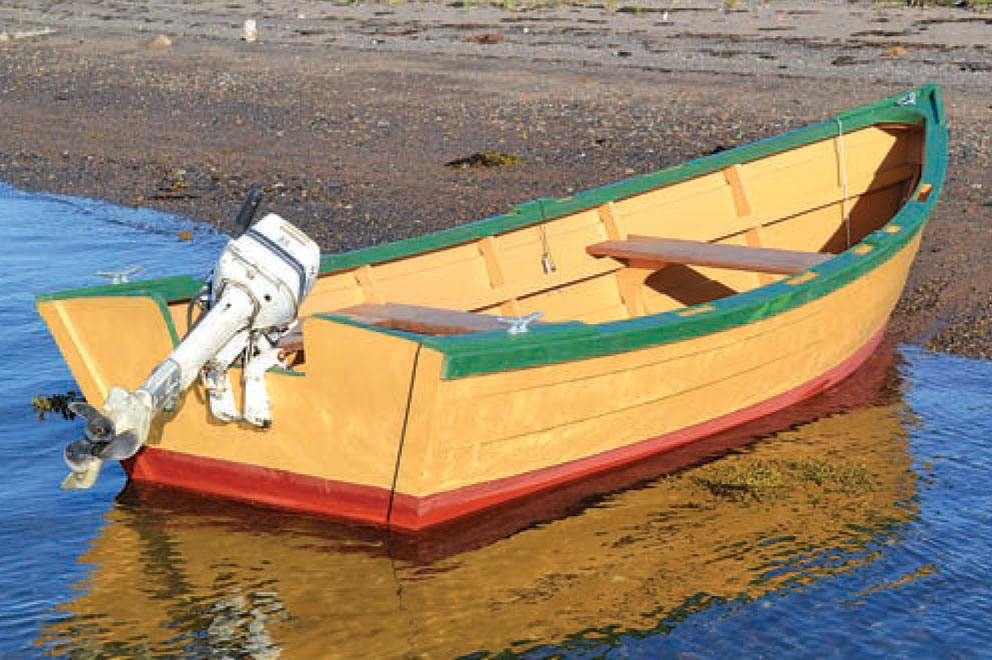
Dories are traditional working craft with a tough, painted finish. This means you can spend more time enjoying them and less time fussing with them.
The Cross Island skiff is not intended to row too much, and this one built out of silverballi is a little heavier than the standard pine edition. That being said, rowing is possible for short stretches or in a pinch, but that is not where a boat like this shines. Where a Cross Island skiff excels is in its ability to carry cargo, and lots of it. Like many dories, they are a little tender when empty, but fill them up with a load of gear and supplies, or cod and flounder, and the ride only gets better and better. Scooting around Lunenburg Harbor with only one person in the boat seated all the way aft to operate the outboard, the bow has a tendency to ride up, preventing the boat from getting up on a plane. If you were to run empty a lot of the time, a few hefty flat beach stones would make great company right up forward. When you get to your destination to load the boat with your friends and gear, the beach stones will be right at home when you leave them at their new beach.
With a modest, by today’s standards, 15-hp outboard motor, the Cross Island skiff will move right along, and if you are really looking to haul a cargo of cement or gravel out to the construction site on the island, the skiff would be able to handle a little more horsepower as long as when she was empty you had a way to keep the bow down. At some point, though, additional horsepower would only lead to a bigger rooster tail and increased fuel consumption.
One of the more charming anomalies with dories is that they are identified by the length of their bottoms, not their length overall. So to be true to that tradition, the Cross Island skiff is a 14′ dory, although overall she is 16′. Her beam is 6′ 1″, and her draft is the better part of not much. Most people speculate that this version weighs close to 400 lbs, but built out of pine she would weigh much closer to 300 lbs. This boat will reward the owner with years of loyal service while demanding very little in return. If you can keep the rainwater out of her for the most part during the summer and the snow off her for the winter, and give her a little pine tar and or paint from time to time, you will have a very happy dory. 
Plans and completed boats available from The Dory Shop.
Cross Island Skiff Particulars
LOA: 16′
Beam: 6′ 1″
Draft: not much
Displacement: 300–400 lbs
Power: 15 hp
 Jay Langford
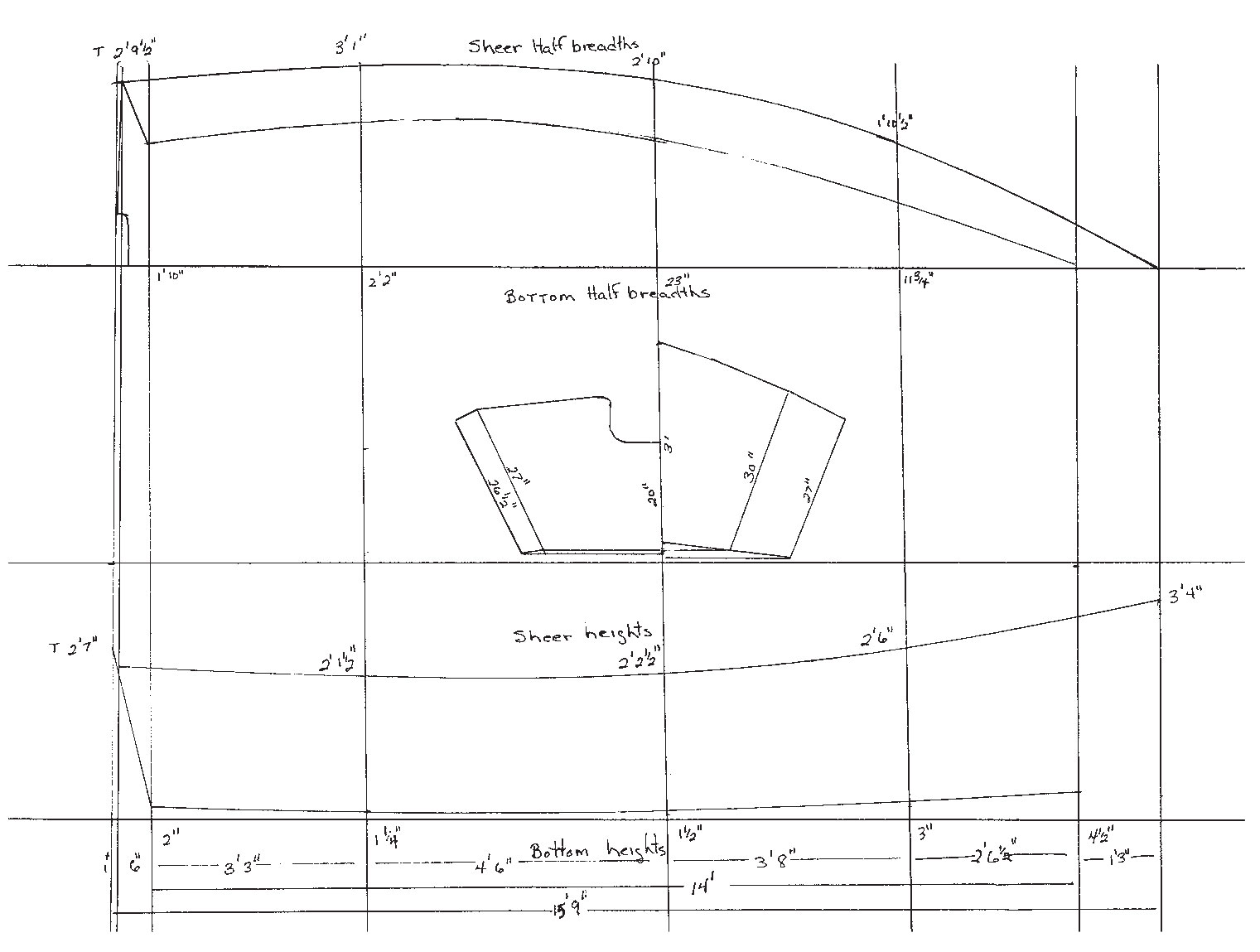
Dories are identified by the length of their bottoms, not their length overall. With her bottom 14′ long, the Cross Island Skiff is a 14′ dory skiff, though her total length is 16′.
Is there a boat you’d like to know more about? Have you built one that you think other Small Boats readers would enjoy? Please email us your suggestions.
More student-built boats
It’s great seeing the product of hard work put in by people taking to the craft of boatbuilding. Read these other stories about boats built by students.
A MacIntosh Canvas Boat, built by 4th and 5th graders.
Rescue Minor, from military rescue vessel to family electric launch
The Kingfisher Elective, a class in boatbuilding

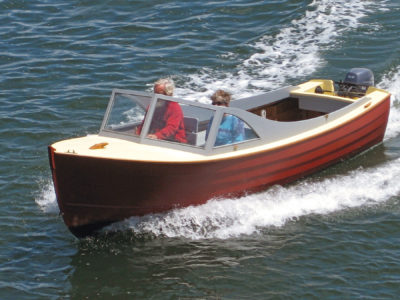
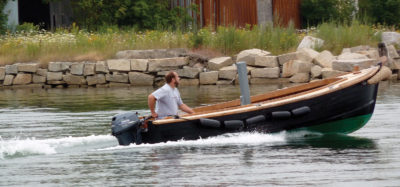
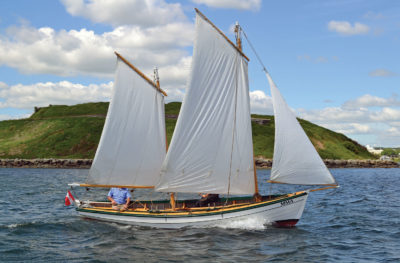
The Cross Island Skiff is the type of boat that as a child in Ortley Beach, New Jersey (USA) were plentiful. I would love a 18′ + couple inches to handle a 25 HP or so motor. Is that possible by your school or attending your class a good way to do that?