As Ezra Pound wrote, “Winter is icumen in, Lhude sing Goddamm.” For those of us in the north, winter is indeed coming in. We need to think about putting away our boats. Managing a small fleet is challenging but there are steps to take and ways to work methodically that will make life easier and promote the longevity of your boats. Here are some of the lessons I’ve learned (some the hard way): clean, de-salt, and dry your boat and gear; remove as much gear as you can (from the boat); store as much as possible indoors.
There are four principal goals when putting a boat away:
- Keep out the weather
- Keep out the critters
- Keep your gear safe and together
- Keep your trailer in good condition.
 Photographs by the author
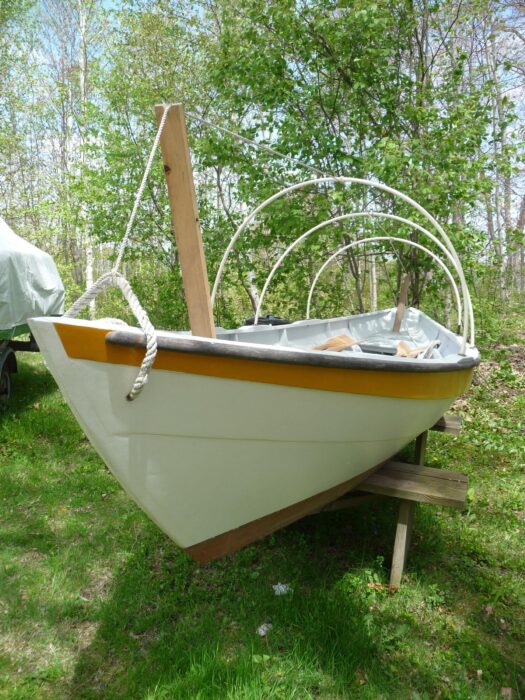
It’s handy if you are able to make use of a boat’s own hardware to create support for a winter cover. Here, for the cover on my dory, I bend 1⁄2″ PVC-pipe hoops and mount them, with dowels, in the boat’s oarlock sockets. The hoops are stabilized by a 1⁄4″ line stretched bow to stern along the boat and hitched to each of the hoops.

Keeping out the weather
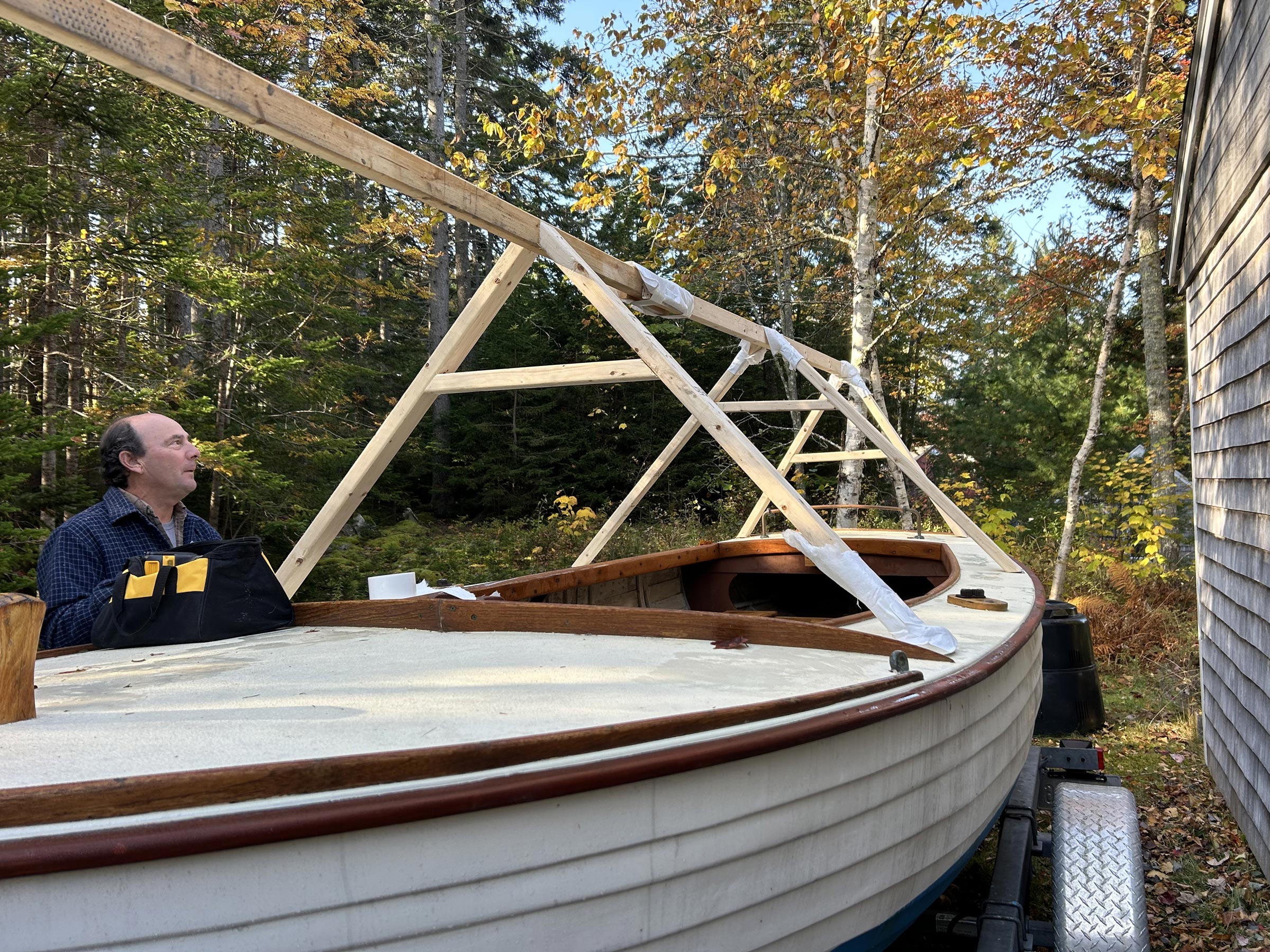
Protecting your boat from the winter weather—especially rain and snow—is vital. Unless you are lucky enough to have a solid roof to store it under, you will need some kind of tarp or tent. There are many ways to support a cover, depending on the size and type of your boat. I have a fitted cover for my Harrier, RAN TAN, but it isn’t peaked-up enough for snow and ice, so I add a second cover with two A-frames bolted into the four posts that I have attached to my trailer (see “Modifying Trailers”) and a solid 2×4 ridgepole. I use a white poly tarp (1,000-denier), which can last multiple seasons. The tarp is tied down to the trailer or, where that is not feasible, I weight it down by hanging partially filled gallon water jugs on the lines. If you do not have suitable posts on your trailer, you can also build A-frames that make use of the boat’s own structure.
For rowing craft, I use 1⁄2″ PVC tubes to create arches. To locate these, I insert 1⁄2″ dowels into the oarlock sockets, over which the tubes can be placed. It is good to use dowels that are slightly smaller in diameter than the sockets, as they will swell over the winter. I connect the arches to one another, fore and aft, with a length of 1⁄4″ line tightly stretched from bow to stern, clove-hitched to each of the arches. This stabilizes the arches and creates a ridgeline for the cover. Again, I use the same 1,000-denier white poly tarp.
When I set up a tarp as a cover for the first time, I mark the bow and stern: it takes the guesswork out of the job when unfolding it for reuse the following year.
 Jenny Bennett
A simple wooden A-frame support for a tarp can be built to stand on a sailboat deck, making use of deck hardware where possible to hold the frame in place. When the support structure is not in use, the central beam can be unscrewed from each of the A-frames so they can be stored flat, and even hung on a wall. If summer storage space is not an issue, the frame can be lifted off in one piece.
Once covered, if possible I park the covered boat in the shade.
Keeping out the creatures
Covered boats are prime real estate for wintering mice. To minimize snug nest sites, I open up all the non-watertight compartments and pull up the floorboards. I remove anything that could be chewed and made into a nest.
In the past I’ve had trouble with critters gnawing trailer wiring where it runs—out of sight—inside the framing. Now, no wiring is led inside the trailer, instead I tape it all along the outside of the center frame.
If you have any wiring on board—perhaps to a center console—consider protecting it either with tape or tubing.
Mice love to nest in stowed sails, so I always remove them from the boat. To keep rodents away, there are commercial repellants available, and many people place mothballs in sail bags or within the folds of spar-wrapped sails. Indeed, some people also put mothballs in boats, although I have never needed to. Sails that come off spars can be cleaned, checked for damage, dried, bagged, and stored in an attic or basement, anywhere a bag can be hung. Sails that stay laced to spars can be hung in the garage, but if you are leaving them wrapped up for the winter, remember to rinse off any salt and make sure they are dry before putting them away.
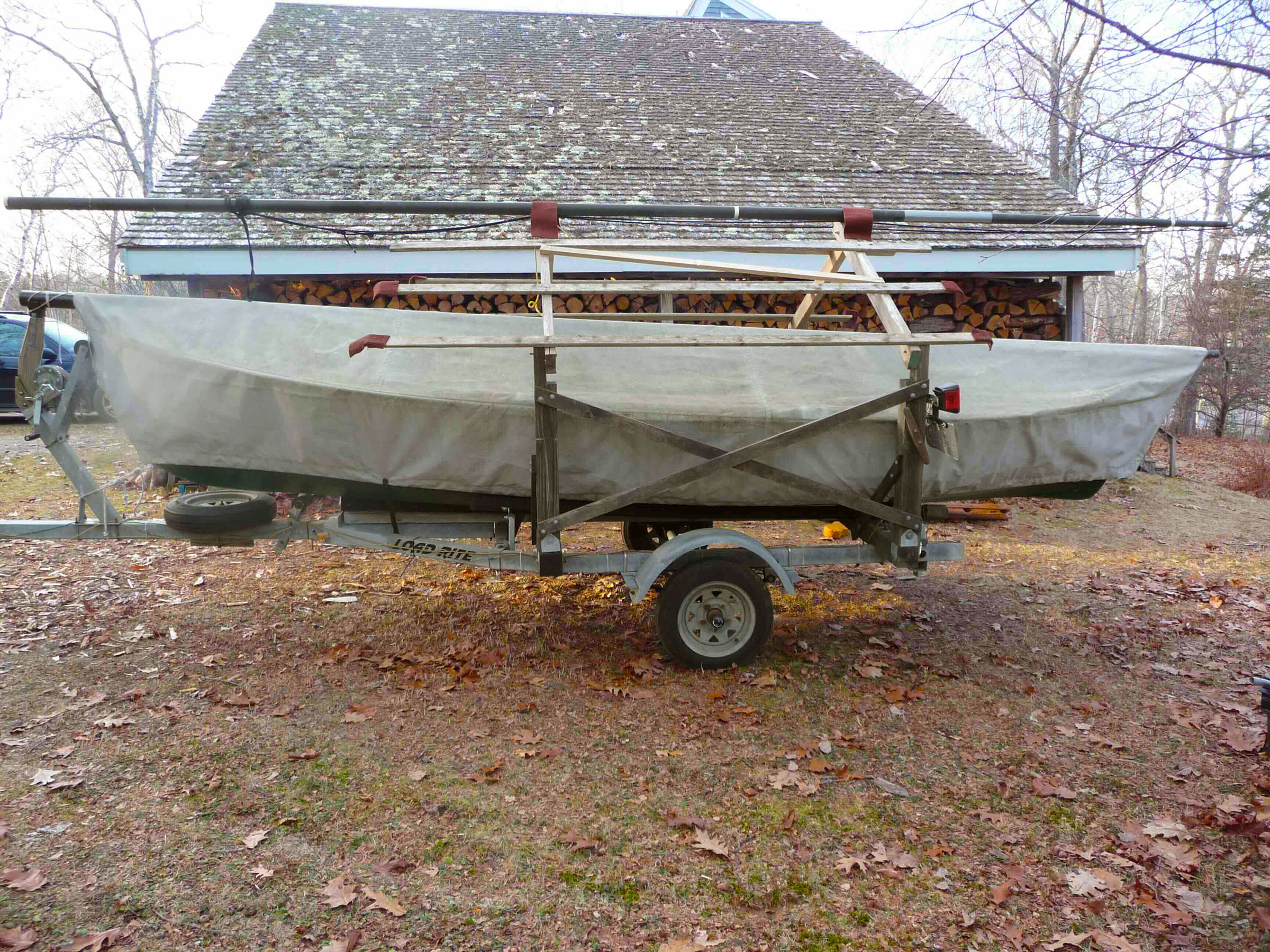
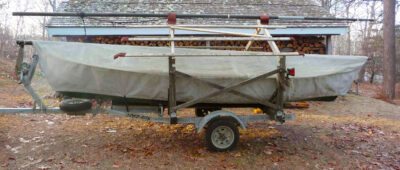
My Harrier, RAN TAN, has a fitted cover, but its slope is not enough to shed snow in the winter. I create a second frame—using the trailer as a platform and a mast as a ridgepole—over which I drape a heavy-duty tarpaulin.
Keeping your gear organized
Boats need gear, some specific to a boat and some that can move from boat to boat. Any gear that is specific and will not be in danger from animals or damp—such as a rudder or oars—can be stored beneath the cover. For gear that is coming off the boat I use different storage for different items:
For running rigging, I use lidded bins, and I label the rigging if it’s at all complex.
Items like anchors and rodes can be stored together. Before putting them away, rinse the rodes with fresh water and hang them to dry thoroughly. Mice find buckets and bags of anchor line nice places to nest, so the best defense is to store them in lidded bins.
While I store navigation and emergency gear, tools, and repair kits in individual dry bags—the nav dry bag, the flare dry bag, etc.—I combine them in mesh bags, such as are used by scuba divers. During the boating season these mesh bags and their contents can simply be brought on board a boat and they are easily transferred from boat to boat.
Before putting flashlights and electronic gear away, remove their batteries. There is no such thing as a leak-proof battery.

Mesh bags are useful for storing smaller items like emergency kits and flares both during the boating season and over the winter when the bags and their contents can be hung up for storage.
Mark the expiration dates on all your flares with a big marker so they are easy to read.
Check your first-aid kit—if it has been on the boat for a sustained period, it may well have been affected by damp—bandage packaging is not proof against dampness.
PFDs and foulweather gear should be thoroughly rinsed, especially if they have been in a saltwater environment, and dried before being put away; and they should, preferably, be hung up for storage.
Mark all your bins on the outside and tag hanging bags.
Taking care of your trailer
In his article “Winterizing Trailer Tires” in the January 2025 issue of Small Boats, Christopher Cunningham wrote comprehensively about protecting tires and bearings while your trailer is laid up for the winter. I confess, I’m not that thorough but I do make sure that if a trailer is used in salt water, I douse it with fresh water as soon as possible after use, and I lubricate the trailer’s hitch before laying it up for the winter. I also jack up the trailer and use blocks or jackstands to take the weight off the tires.
The benefit of making lists
Making lists is always helpful. There is the “putting away” list, which itemizes all the tasks that need to be done as you put your boat away. It’s a good way to keep track—especially if you are joined by a helper. It’s also a good place to note where gear is stored—many of us have so many options of “great places to keep things” that we often forget where they are and waste time tracking down “lost items” each spring.

Sail and gear bags don’t have to be fancy or expensive to be suitable for winter storage. The important thing is that the contents are put away dry, the bags are hung rather than piled on the floor, and they are labeled for easy identification.
Then there are the “to do” lists that you can make as you go: there is no better time than at season’s end to list the stuff that you need to do before next season, the little things that get missed in commissioning but can be dealt with off season. And I often make a list of “improvements” that may not be essential, but that I would like to do.
The more organized and thorough you are when decommissioning a boat, the easier it will be when it comes to getting afloat in spring. And the more care you take when putting everything away, the less time you might have to spend on unexpected maintenance and repair come spring.
Ben Fuller, curator emeritus of the Penobscot Marine Museum in Searsport, Maine, has been messing about in small boats for a very long time. He is owned by a dozen or more boats: kayaks, canoes, a skiff, a ducker, and a sail-and-oar boat.
You can share your tips and tricks of the trade with other Small Boats readers by sending us an email.
Using a mast or spar as a ridgepole is a bad idea leading to probable permanent warping or bending.
Not an issue with a carbon mast.
I turn my tender, a 10 ft Norwegian Pram, over my dinghy and spread the cover over this “turtle” ensuring that fresh air can enter from the stern, as poor ventilation under a tarpaulin can be damageable.
Great tips. One thing to consider is where the boat gets parked, making sure that a snow load sliding off of a roof doesn’t crush the boat. It is also important to make sure that no rain collects inside the hull, as the extra weight can damage the boat and trailer, and freezing weather will cause water to expand and damage the hull.
Leaving the drain plug out helps.
Is it better to keep a small rowing boat upright with a cover? I flip both of mine (8′ fiberglass dinghy and 16′ skerry) over onto sawhorses, assuming wet side up is a better bet for shedding weather, and add a tarp to that to keep off sun and excess weather.