Back in the 1970s I bought my first International Canoe (I named it HARM’S WAY because it was meant to be sailed fast). To move it around, I needed a long, narrow trailer and found one made by the R.J. Cox Company of Ohio that, with a little modification, would suit my needs well. Using dimensional lumber, I fitted it up with crossbars to which I could lash the spars and seat, and even double-stack it with the canoe below and a kayak or two above. HARM’S WAY has passed into other hands, but I still have the Cox trailer. I’ve renewed its double decking and, by adding 2×6 boards, turned it into a platform trailer that can handle anything: a skiff, a dory, a ducker, a faering, even an iceboat. The raised crossbar system can support whatever I can lift up onto it.
Making a trailer suitable for multiple boats
 Photographs by the author
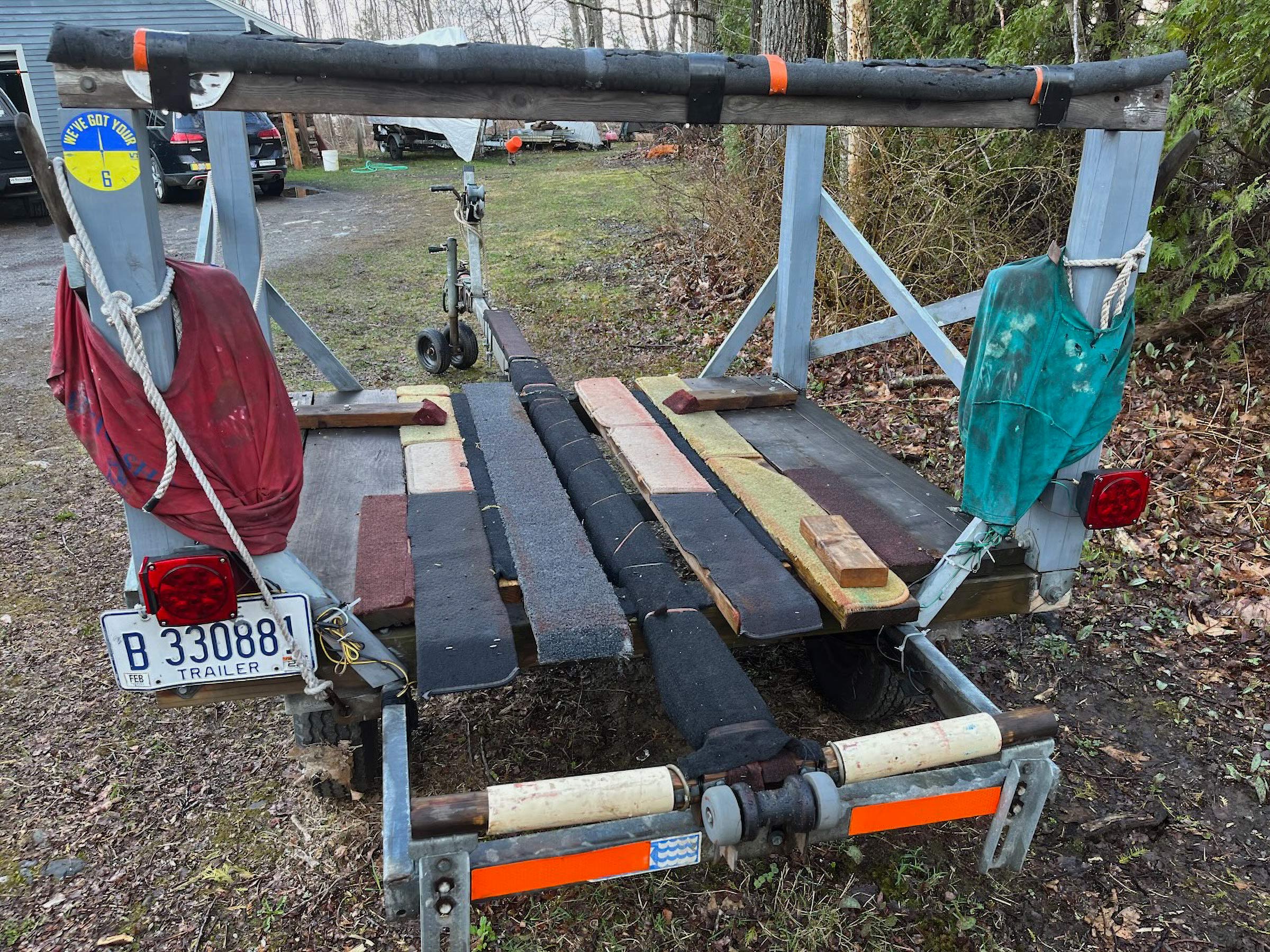
The overall look of my trailer may not be pretty, but the modifications are inexpensive and practical. The carpeted walkways allow boats to slide across the boards and make for safer walking when the trailer is wet. Note the two wood blocks near the front of the boards; these are beveled to catch the chines of my dory and skiff so that they are more easily centered on the trailer; the blocks are bolted to the boards and easily removed. The T-shirt-covered fenders on the back posts help to guide and center a boat as it is pulled up onto the trailer, while also protecting it from being damaged against the posts. The T-shirts prevent the fenders from rubbing against and potentially scuffing the boat’s paint.
My modifications to the trailer are sturdy enough that shallow-keel boats, such as my faering (which measures 18″ from the bottom of the keel to the turn of the bilge), can self-guide with gunwale-to-post contact, and be supported by the posts without the need of bunks. It’s a setup that can be built using readily available timber and galvanized decking hardware. The key is two 4×4 crosspieces U-bolted to the trailer frame, front and back. Shallow notches lock them to the frame of the trailer. At the ends of these crosspieces, vertical 4×4 posts are held in place, at the bottom, with BC post caps through-bolted in place. On each side of the trailer, each post is braced with 1×2s led diagonally between the posts, lag-bolted into place, top to bottom. Each of the four posts is further braced with a short 1×2 diagonal lag-bolted about 2′ from the bottom and about 2’ in from the end of the crosspiece. The top of the vertical posts are half-lapped to receive a 2×4 crosspiece bolted into place whenever a second tier is needed, for spars perhaps, or a second boat (these crosspieces can be easily set up and removed depending on need).

The top of each post is half-lapped to accept a 2×4 crosspiece bolted into place whenever a second tier is needed.
The posts can support an upper tier, serve as guides when retrieving a boat from the water, provide raised locations for lights, and offer steadying holds if you need to stand up on the trailer.
Making a walkway platform
Over the years I have also modified the bed of the trailer so that it can be used as a flatbed on which to move a snowblower, and so I can walk out onto the trailer when launching or retrieving a boat when I don’t want to immerse the wheels and their bearings. The sturdy, wide platform makes it easy to walk out along the trailer in order to lift and push the boat into the water.

I have left a gap between the boards on either side of the bunks so that I can raise them if I’m transporting a round- or V-bottomed boat that needs more support. Here the bunks are angled upward to make them more visible. When in use, they are set parallel with the boards and raised just enough to make contact with the hull.
The 4×4 crosspieces that were previously bolted to the trailer to support the vertical posts are notched in the center to take a carpeted 2×4. This does the job once done by the central rollers that came with the trailer, but which were poorly suited to supporting a lightly built boat. The roller brackets were, however, ideally placed to support a 2×4 laid flat on top of them. Once the 2×4 was bolted in place, I extended the platform on either side of it with lengths of 2×6 that I had left over from another project. These boards are screwed with #9 GRK 2 1⁄2″ framing screws to the 4×4 crosspieces front and back. I laid them so that between the boards placed on either side of the trailer’s bunks there is a 3″ gap—large enough for the bunks to be raised if needed, say, to support the bilges of a round- or V-bottomed boat. Raising the bunks does mean spending some time on my back beneath the trailer. Near the front end of the platform, I have removable lag-bolted blocks that catch the chine of my dory or skiff, allowing them to center themselves when pulled up. The whole affair is carpeted with indoor-outdoor carpet remnants and boat-bunk carpet. Finally, the back-end posts are protected with T-shirt-covered fenders, which don’t improve the overall look but do help to center a boat and guide it into place—the T-shirts prevent paint from being rubbed off by the fenders.

With the upper 2×4 crosspieces installed the trailer can be used to transport multiple items and boats. Here a peapod is carried on the upper beams above a Penobscot Salmon Wherry, which is resting on the flatbed bottom. Modifying a trailer with wooden additions makes it easy to add extras, such as the wooden cleat seen here.
With a little imagination and rudimentary skills, boat trailers can be modified to be more versatile and user-friendly. Sturdy posts let you carry more gear while also raising the taillights to keep them out of the water at the ramp and make them more visible to following traffic on the road. Walkways and platforms allow you to walk around dry-shod and with improved stability. Just because a stock trailer wasn’t designed to be a workhorse for all of your boats and gear, doesn’t mean that it can’t become one.
Ben Fuller, curator emeritus of the Penobscot Marine Museum in Searsport, Maine, has been messing about in small boats for a very long time. He is owned by a dozen or more boats: kayaks, canoes, a skiff, a ducker, and a sail-and-oar boat.
For more trailer tips from Ben Fuller see “Living with Little Boats,” and “A Walkway for a Trailex Trailer.” For more tips on using trailers see “Winterizing Trailer Tires” by Chris Cunningham, and “Boat Trailering Tips” by Audrey and Kent Lewis.
You can share your tips and tricks of the trade with other Small Boats readers by sending us an email.







An excellent way to maximize use of a trailer. I trust the added weight of the decking/second level support is accounted for in the maximum load capacity of the trailer, i.e. it subtracts and reduces the available capacity for whatever boats/gear is carried.
Hi Ben- great article on modifying trailers to be more useful! I now have several ideas for further fixing mine up. I’ve always added 2×6 walkways the length of all my boat trailers (4 now) so I don’t have to try to balance down the narrow trailer frame when the water is deep. In the attached photo, I also added 2×6 cross pieces to some of my trailers so I can easily climb into my boat for setting up at the ramp. Thanks again for sharing your great ideas with us!