I am an occasional painter, not a professional, and my level of competence with a paintbrush is not bad but nor is it remarkable. I achieve a decent finish, and for the most part my efforts seem to hold up well. As a child I was given the job of painting the bottom of the family boat and gained experience in not overloading my brush, not permitting the edge to dry out, watching for runs and “holidays.” Over time my technique improved, and as it did so, I was allowed to paint some of the more visible parts of the boat. By the time I was good enough to paint a deck I had, of course, developed a social life and lost interest. But those skills—such as they are—have stayed with me, and to this day, I enjoy painting. I have acquired my favorites: my favorite paint, my favorite sanding block, my favorite scraper. But, until recently, I had not homed in on a favorite brush.
 Photographs by the author
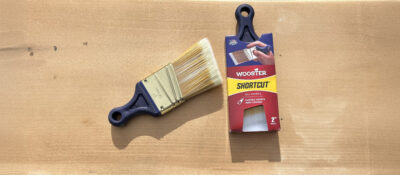
The 2″ Shortcut brush is the perfect size for dipping into a standard quart-sized paint can.
For painting in the house with latex and other water-based finishes, I have tended to buy inexpensive brushes that do the job adequately, but when it comes to boats and the application of oil-based paints and varnish, I have leaned toward high-end brushes. Long ago I was told the only brush for marine finishes was a natural-bristle brush, because it holds the paint or varnish well and synthetic bristles can be weakened by oil-based finishes, so that is what I’ve always bought. And, because even with my amateur skills I can tell the difference between an uneven-tipped brush that liberally deposits bristles with every stroke, and a brush that hangs on to its bristles and leaves a clean edge, I have typically bought the more expensive ones. But, if I have one fault when it comes to painting, it is caring for (or rather, not caring for) my brushes. I always intend to clean them out properly, but ever anticipating one more coat or one more boat to be painted, I often leave them standing in a jar of thinner. And every year, I throw away at least one, if not two brushes that have stood too long and are beyond saving. It is an expensive failing.
A couple of years ago, when buying paint at a big-box DIY store, I spied some short-handled brushes in a box next to the cashier. Intrigued, I picked one up. The brush’s bristles and ferrule were standard lengths, but the handle was short, really short. Not only that, it was flexible. The packaging blurb said the Wooster Shortcut brush was suitable for all paints, and as the price was around $5, I bought one.

The Shortcut comes in a protective card holder—although it does not open fully for storing the brush, as some holders for other brushes do, and so is not easily reused. The brush at left has been used multiple times over the past year and has stood in a cup of thinners for more than a couple of months but shows no sign of degradation.
The Wooster Brush Company has been making paintbrushes since 1851 when Adam Foss and his brother went door to door in Wooster, Ohio, selling hog-bristle brushes. Since then, the company has been responsible for more than one paintbrush innovation: in 1926 they created a new cement to hold the bristles of their brushes; in 1937 they invented the angled brush—now said to be the most popular style in the U.S.; in 1941, when World War II stopped trade with China and thus cut off the supply of natural bristles, Wooster worked with DuPont to develop synthetic-filament bristles and supplied the U.S. military with nylon brushes; in 1999 they introduced the innovative Shortcut.
The Shortcut is a surprising little brush. Its handle—made of a soft, flexible, rubber-like material called Shergrip—feels good in the hand, and it gives me as much control as a conventional long-handled alternative, especially when cutting in. Because the handle is short, the brush is particularly useful in tight spaces—if you’ve ever painted the inside of a boat locker, you know all about fighting that long wooden brush handle as you try to reach the innermost corner. The brush is 2″ wide, so it’s suitable for most applications in my boats, and the sharp, angled edge of its tip creates a line smoothly and easily. The bristles are a synthetic blend and, while solvents can break down synthetic bristles, I have not yet found this happening with the Shortcut. Indeed, I have left a Shortcut standing in a jar of thinner for close to four months with no apparent degradation to either bristles or ferrule, although the shape did flare out some.

The short flexible handle is comfortable to hold and easily controlled, especially when used in tight spaces. Its only drawback is that it is too short and soft to insert into a brush spinner for cleaning.
With a Shortcut I can produce as fine a finish with varnish as with paint, and it holds onto its bristles—no more picking out those errant hairs left behind in an otherwise perfect application. The brush has worked well for both oil- and water-based finishes; I use separate brushes for each to avoid cross-contamination. It’s easy to have a dedicated Shortcut for each type of finish because the price is unbeatable: at under $6 it’s certainly more expensive than a disposable chip or foam brush, but its performance is vastly superior, and with proper care, it will last multiple seasons. Yes, I still have my first Shortcut brush, bought on a whim, but subsequently used and cleaned and used again.
Jenny Bennett is editor of Small Boats.
Wooster Shortcut brushes are available at most marine, hardware, and big-box DIY stores. Prices vary, but are typically under $6.
Is there a product that might be useful for boatbuilding, cruising, or shore-side camping that you’d like us to review? Please email your suggestions.





I was taught to drill a hole just above the ferrule in a brush then use a bit of wire run through it to hang the brush in solvent. I find quart yogurt containers about right, letting the brush hang without hitting the bottom. I use a spinner to remove the solvent and if I’m careful might rinse the brush again in clean solvent.
Thanks Ben…good tips.
Excellent. I saw those at a big box store a few weeks ago. The concept seemed ingenious, and the handle felt really good in the hand. But it was cheap and synthetic and ‘do-everything,’ and I figured it probably wouldn’t.
Good to know. Thanks for the review Jenny.
That type brush is our favorite, a short handled sash brush, angled tip. Great for cutting in edges and getting into small corners, and the light weight reduces hand fatigue. We use them a lot for tipping during a roll and tip paint job.
We find a lot of ours at Lowes, and they are available for enamel or acrylic use.