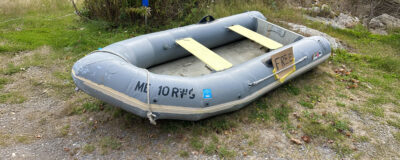
A week ago, I walked past a neighbor’s house and saw they had parked an inflatable dinghy in the front yard with “Free” written on a piece of cardboard taped to one of the sponsons. The boat, complete with foot pump, was clearly well-used and of some considerable age, but nevertheless I snapped a picture and sent it along to some friends. Back in August they had expressed interest in purchasing one of a couple of inflatable boats that were coming up in the town’s Fireman’s Auction. They would be away for the auction but asked me to bid on their behalf.
“No more than a couple of hundred,” they had instructed as they left town.
Both boats sold for well in excess of $500. At the time, my friends’ interest had seemed more spur-of-the-moment whim than serious plan, but now, in light of that “Free” sign I got to wondering.
“Do you still want an inflatable?” I asked when I texted them the picture.
“Sure,” came back the swift reply. “Is it OK?”
“Well,” I said, “it’s certainly not beautiful, but it’s inflated and looks serviceable.”
“Can you grab it and throw it in our barn?”
I could. With the help of the obliging neighbor and his truck, we delivered it the same day. As I told the neighbor of my friends’ gratitude for the unexpected gift, his face lit up. “It makes me happy that it’s going to another good home,” he said. “We rescued it from the dump 17 years ago.”
 Christopher Cunningham
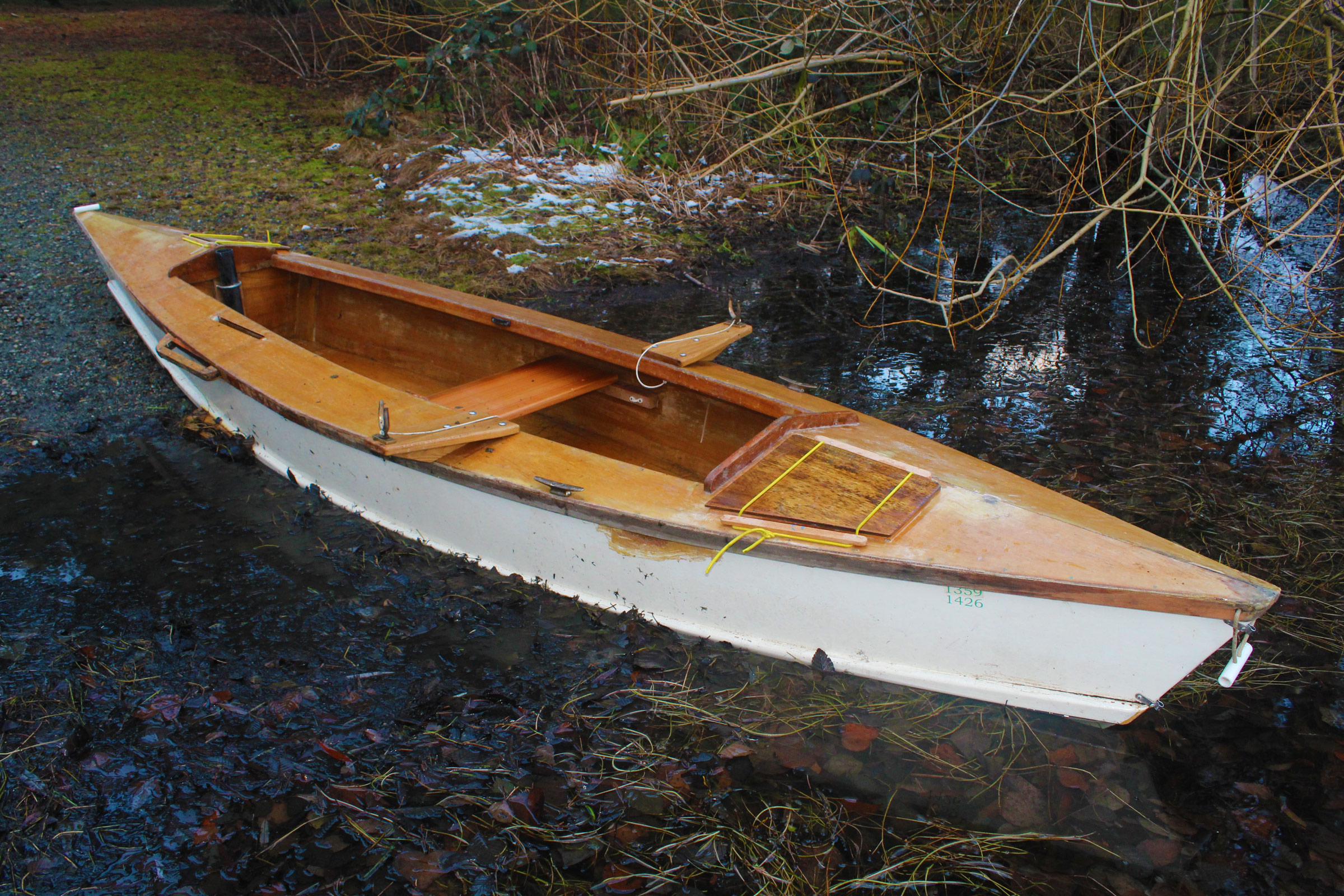
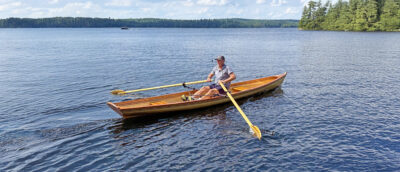
This Bolger pirogue was rescued by Christopher Cunningham. As built in 1995, it had been equipped only to sail. His modifications included installing risers to support a removable thwart for rowing and paddling, and converting the leeboard, with its awkward outboard brackets, to a daggerboard with an inboard trunk.
There’s something about boats, and the feelings people have for them, that just keeps them going and going. Small boats, in particular, seem to outlive their expected years, time and time again. There comes a point in a boat’s life when, in financial terms, it probably no longer has much value, but if it still floats (and sometimes even if it doesn’t) we’re reluctant to just throw it away. If it’s a small boat, one that can be stored in a barn, fixed up for short money, or simply used as is, then there’ll always be someone happy to take ownership.
For my friends, this worn but still intact inflatable dinghy was exactly what they were looking for: a boat to leave at the town landing so they could get out to their sailboat in the harbor. Indeed, the inflatable’s very appearance of dilapidation was appealing: “Can’t see anyone choosing that one to steal,” was their salient observation.
 Christopher Cunningham
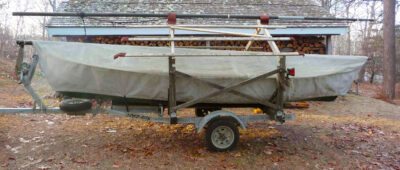
The Piccolo canoe—another Cunningham rescue—had spent years unused, resting on a rack in a back yard, literally gathering moss. It was just a bare hull, without floorboards, seat, or backrest.
Of course, not all free boats are sought. Sometimes the availability of a boat comes along, and you just can’t refuse. Our editor-at-large, Christopher Cunningham, has taken in four boats that were destined for the curb or landfill: a 12′ outboard skiff made of textured exterior siding, a 14′ battered aluminum johnboat, a scuffed and mossy 12′ Piccolo canoe, and a 16′ Bolger pirogue that had idled for years in an asphalt parking lot. I, myself, have a 9′ skiff that had once been mine, but which had been sold along with a bigger boat more than a decade ago. Then, late last year, it unexpectedly came back to me from the then-owner. “We’re not using it and thought you might like to have it…it only needs a lick of paint. We can drop it off.” I didn’t need another boat, but my daughter insisted I say yes; LITTLE MADGE is the first boat she truly remembers.
 Jenny Bennett
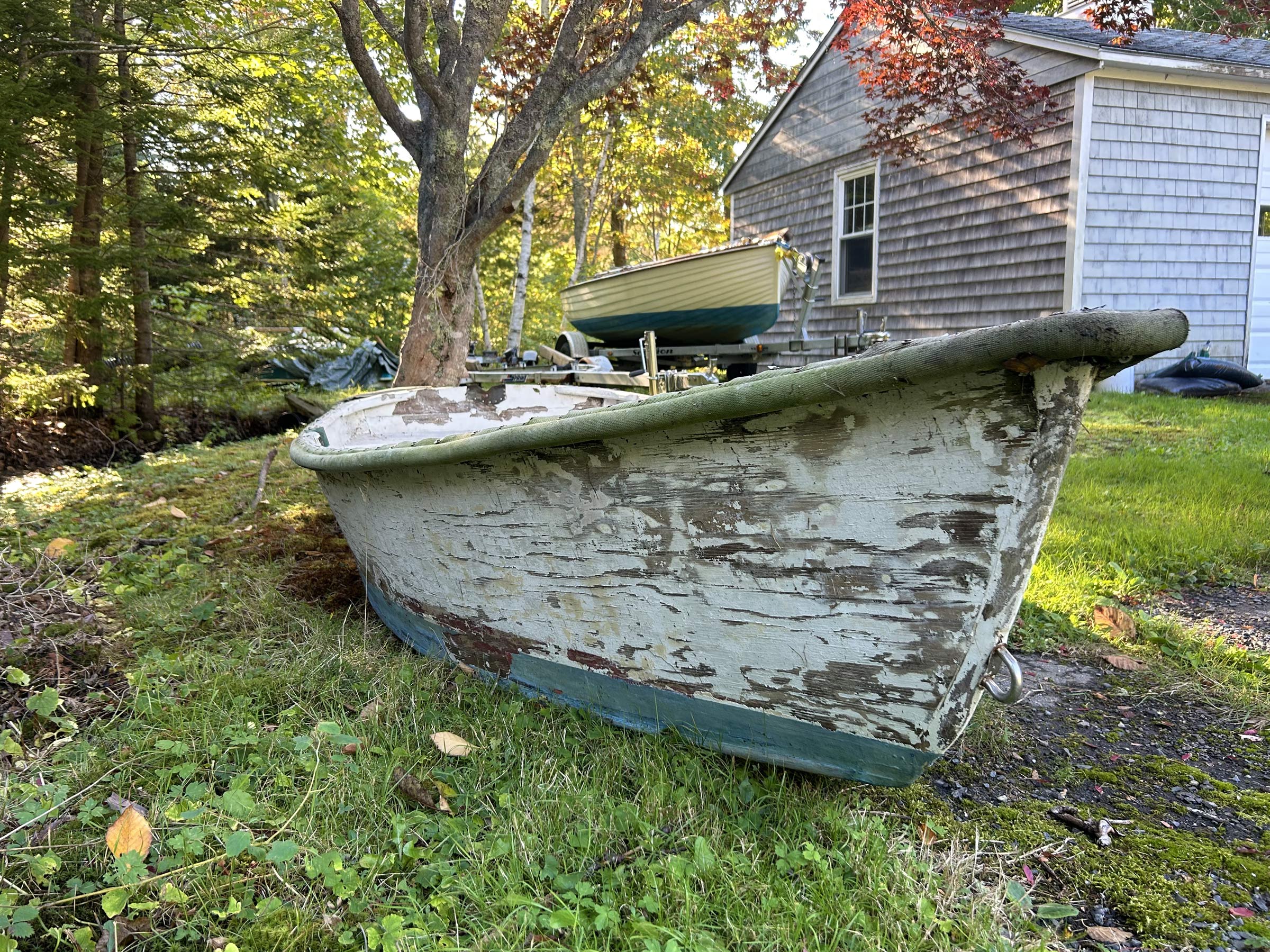
“It just needs a lick of paint…” Sometimes “free” translates to “no money up front but a definite labor of love required.” When LITTLE MADGE, our old skiff, came home, we were somewhat daunted by the amount of scraping and filling and fixing of rot that would be required to get her back into commission.
Sometimes the offer of a free boat will not only extend the life of that boat, but will also transform the life of the recipient. Take the Heron dinghy that was given to Alex Latham (featured in our Adventures article this month). When he accepted the gift, Alex couldn’t sail and wasn’t looking for a boat, and yet, there it was, a small boat looking for a home. Within two years, Alex had learned to sail and had set off on a challenging multi-day solo dinghy cruise. The Heron, the catalyst that had changed Alex’s life, has since been handed on, as has the Enterprise dinghy that replaced it.
I find it hard to come up with other things that get passed freely along, often to strangers, even when they are long past their “use by” date. What is it about small boats that makes them special in this regard? Is it that, regardless of their condition, they convey a sense of potential that speaks to the imagination of those who yearn to be afloat? Or is it simply that people do offer them for free and no one likes to look a gift horse in the mouth? I suspect there’s some truth in both answers, but I further suspect that the overriding reason is that we hold an almost sentimental affection for a small boat that just won’t let us condemn it to the dump. After all, none of us wants to be that person.



You wouldn’t have a small boat, if what it looked like was lots more important than what it does. And then you cherish it for what it is.
Most big boats are just used as a way to keep the riffraff from coming around.
Wonderful timing. I’m in the process of passing along a 1939 Snipe that I was given for free and restored on a limited budget in the early 2000’s. The boat taught me a lot and introduced me to many great people and experiences (Snipe sailors are a wonderful bunch), but it’s time for it to have another fresh start. I’m at least the second owner to pass it along for free. This time its going to a friend that’s a new sailor but appreciates nice old boats. Hopefully she and her kids will have a wonderful time with it, and I’ll be around for maintenance tips and maybe even an occasional sail.
Jim, this is such happy news, thanks for sharing. Here’s hoping the Snipe will continue to bring joy to many.
Our latest free boat is a 1930s Bahamas Dinghy, a little 10 footer. We could see through the seams but a little swelling and a tiny bit of caulk will take care of that. A new sail…repair the mast…some Kirby custom colors…