In 2010, while visiting The WoodenBoat Show at Mystic Seaport, my wife and I turned a corner in the “I Built It Myself” section, and discovered a delightful, whimsical mini tug named TOOT-TOOT. We admired its charm, and, after a while, my wife suggested that perhaps I could build one. Inspired by TOOT-TOOT’s builder, Mike Magnant—whom I now regard as a friend while continuing to value him as an extraordinary mentor—I did some research, and purchased the plans for a Candu E-Z Mini Tugboat from the Berkeley Engineering Company. It took me 12 years to gather the confidence, but in August 2022, I began building my own Candu E-Z, which I proudly launched on April 28, 2025.
The Candu E-Z was Berkeley Eastman’s debut design. He conceived the idea in 1986 and began with a scale model before committing to a full-sized build. It would be the first in a series of Eastman’s tugboat and houseboat plans. The plans were eventually translated into CAD drawings by David Cronk, whose close collaboration with Eastman ensured the plans remained both comprehensive and easy to follow. From what I understand, until his passing, Mr. Eastman was always generous with his time, readily offering guidance to those undertaking a build of one of his designs.
 Adam Riso
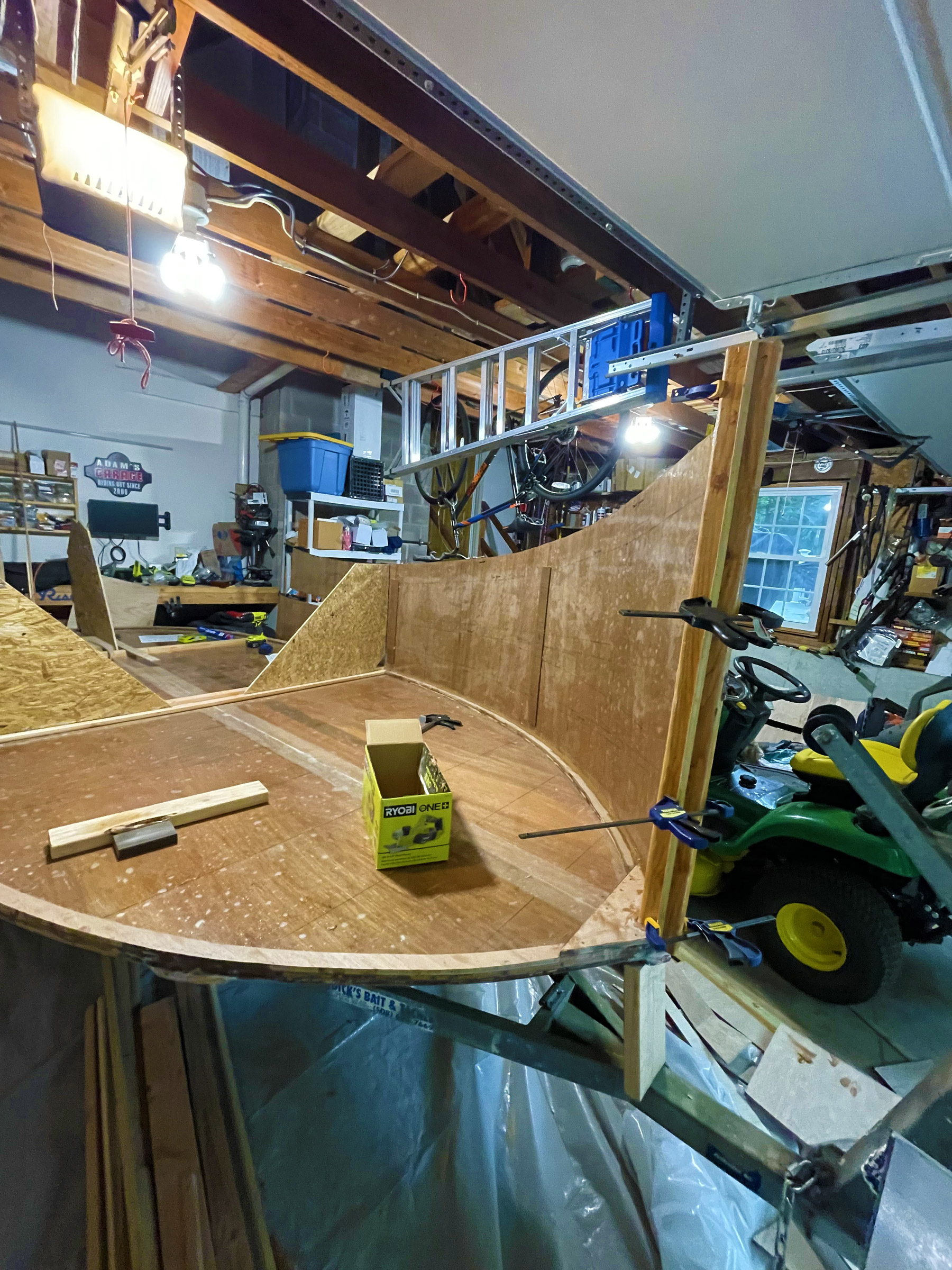
The bottom panel comprises four sheets of plywood butted together, the joints glued with epoxy and reinforced with fiberglass tape. Once it was finished, I moved on to the 1⁄4″-thick plywood topside panels, which I ’glassed on the interior faces prior to installation. The building platform was on a modified trailer so I could easily move the hull outside when I needed more space.
The Candu E-Z measures a compact 14′ 3″ in length with a beam of 5′. Some builders opt to extend the length or increase the cabin height to suit their needs. The boat draws approximately 17″.
The sale of plans is still fulfilled by Eastman’s family through Berkeley Engineering. When I purchased mine in 2010, the 65 pages included the lines, photos of build stages, and a step-by-step guide that comprised a general inventory of materials, a summarized sequence of building instructions, and dimensional drawings for every component of the boat that needed to be cut out presented in a clear, sequential order, so that even an amateur could build the boat. With only common tools—those found in most homes or easily obtained—each component can be cut out and built with confidence. Every piece of the boat is precisely dimensioned, with reference points to ensure correct orientation during assembly. Transferring those measurements from paper to plywood demands care and precision. Each page of the plans reveals not only the dimensions, but also the location of the piece within the whole boat, making it easier to visualize the final form as it takes shape.
Building the Candu E-Z
For construction, the plans call for ACX-grade plywood in both 1⁄4″ and 1⁄2″ thicknesses, but instead I chose meranti marine plywood in equivalent sizes. While I wouldn’t call my build a “Covid project,” it did begin during the pandemic, and at the time, marine plywood was locally scarce and expensive, so I sourced some from a Midwest lumberyard, which shipped me everything I required. Despite the shipping costs, it was a cost-effective solution.
 Adam Riso
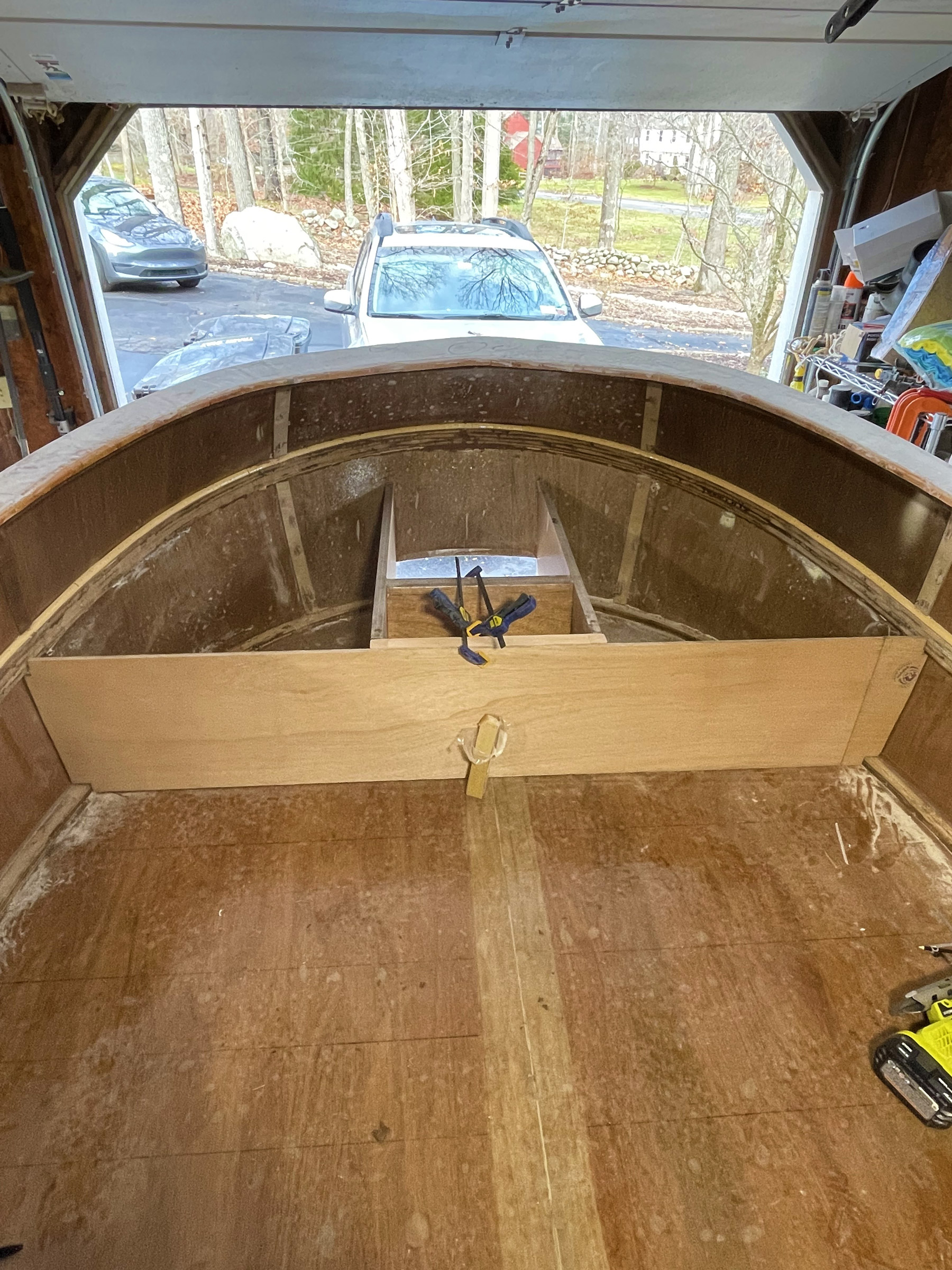
The original plans for the mini tug call for an inboard electric motor. Instead, I decided to install a 20-hp outboard for which I constructed a box with an opening cut into the stern and hull bottom for the lower unit.
I built a wheeled platform to serve as the foundation for building the hull, and construction of my Candu E-Z began with the hull’s bottom and keel. Since I was working in the garage, this platform allowed me to easily move the project outdoors whenever I needed more space to work on it. The bottom panel is cut out of four sheets of 1⁄2″ plywood, butted together and glued with thickened epoxy, reinforced with fiberglass tape embedded in a routed-out channel to accommodate the single layer of tape without adding to the thickness of the joint. The bottom was then sheathed on its interior surface with two layers of fiberglass cloth. The chine logs and bulkhead supports were also attached at this time using thickened epoxy. Before fastening the keel, I sheathed the bottom with 6-oz fiberglass cloth followed by multiple layers of epoxy. The keel is hollow, framed in fir and faced with 1⁄2″ plywood, to give it a wide and strong connection to the hull. It is approximately 10′ 6″ long, to provide the short hull with directional stability. The original design was drawn to be powered by an inboard electric motor, with a driveshaft passing cleanly through the keel, but like many builders, I opted instead for an outboard motor. This allowed me to forgo the shaft opening, and I filled the keel with expanding foam. In lieu of fillets of epoxy thickened with wood flour, a 2×4 sawn in half on the diagonal adds strength to the connection of the keel to the bottom. It was coated inside and out with fiberglass cloth and epoxy in addition to being fastened to the bottom of the boat with stainless-steel screws. I further strengthened the bottom assembly with three coatings of truck-bed liner for additional durability. The finished bottom is turned over and the rest of the hull is built onto it.
The boat took shape in quick succession: the topsides and cabin rose, the helm station followed, then the roof, and finally, the seating area in the cockpit. The topside panels were cut from 1⁄4″ plywood and were fiberglassed on their interior surfaces prior to installation. Once all the topside panels had been fitted, the hull’s exterior was sheathed in fiberglass and epoxy. Each component of the boat was cut out following the exact dimensions outlined in the plans. The interior structure was built entirely from 1⁄2″ plywood. Before assembly, every piece was sheathed in fiberglass and sealed with epoxy to ensure durability and strength. Installation was then achieved using stainless-steel screws, fiberglass tape, and thickened epoxy. In the course of the build, I used roughly 15 gallons of epoxy resin and hardener.
 Taylor Riso
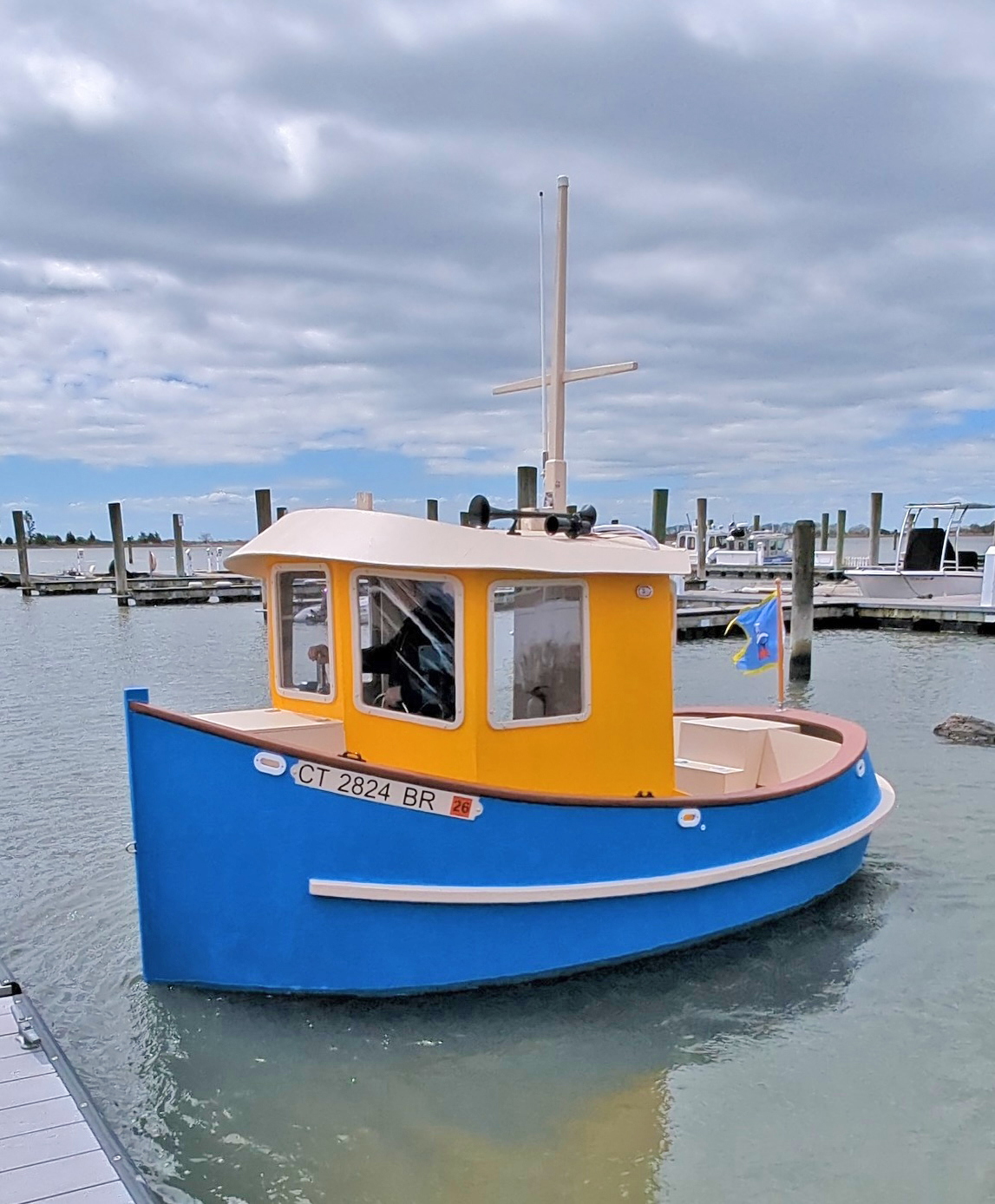
On the water, the Candu E-Z is every inch a mini tug from the substantial rubrail and large-windowed jaunty cabin to the sheer that sweeps from a high bow to a low stern.
One modification I made concerned the folding mast. The original plans called for a mast that runs from the cockpit sole to a hinge at cabintop level, but to raise and lower it would require balancing on one of the narrow side decks. Instead, I put the break in the mast below the cabintop at about my shoulder height, and mounted the hinge on a block just above the cabintop to create a lever between break and hinge that can be easily reached to raise and lower the mast from the cockpit.
When it came to choosing a motor for my mini tug, I followed the advice of fellow builders and installed a short-shaft 20-hp Tohatsu outboard without power tilt. I constructed a motor box in the stern, with an opening cut into the stern and hull bottom to accommodate the engine’s lower unit. The change from the inboard motor specified in the plans to an outboard offers several advantages: it eliminates the need for a drive shaft passing through the keel, maximizes interior space, and simplifies ongoing maintenance. I installed two batteries, one starting and one deep-cycle, which are in an enclosed storage area behind the after bench.
The Candu E-Z on the water
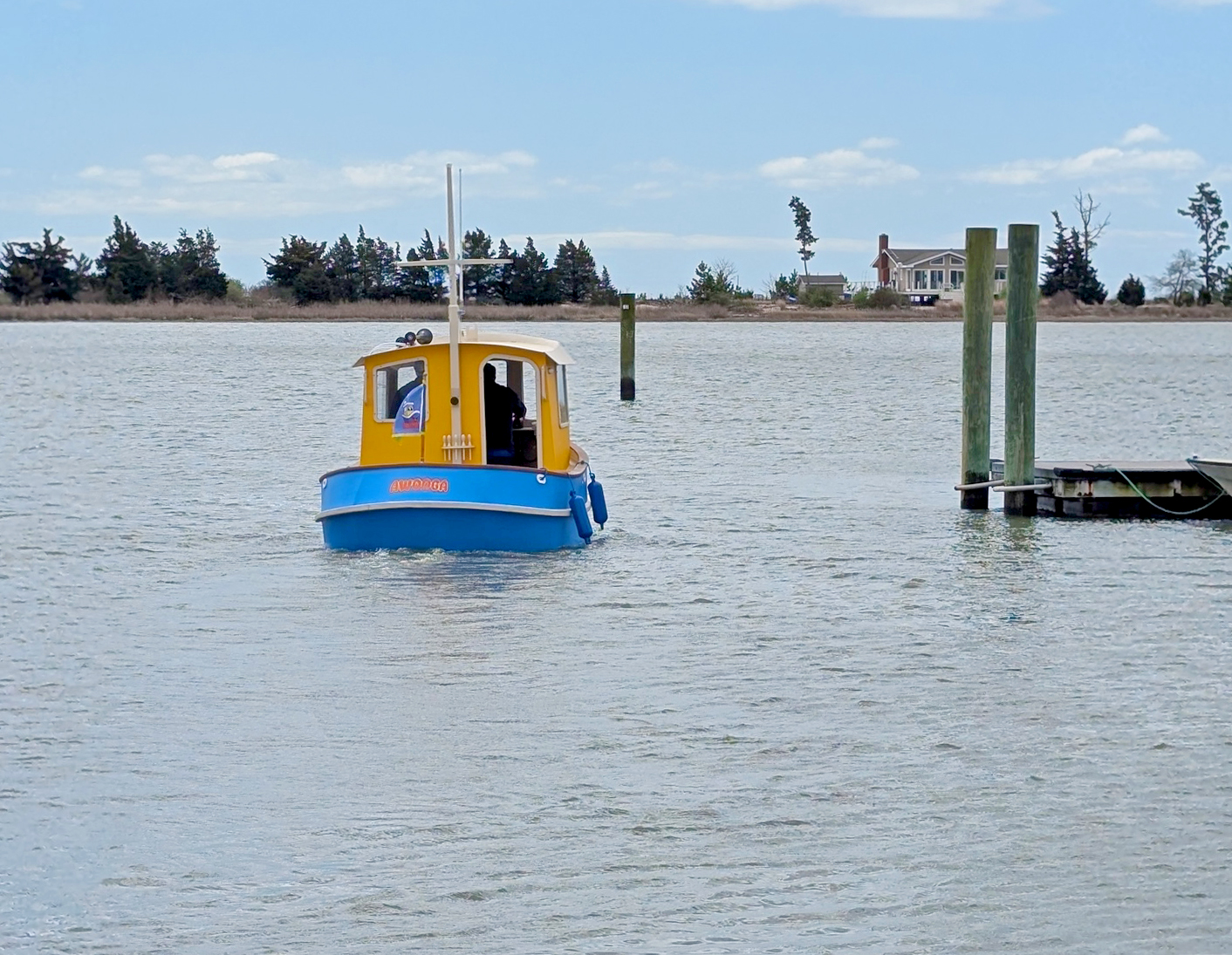
Inside the cabin, the steering wheel and controls are arranged in a center console. Forward visibility is excellent, thanks to the multiple cabin windows. However, reversing can be somewhat challenging, as the only view is through the cabin door and an aft-bulkhead window. The boat pushes along with ease, even with six adults on board. I don’t yet know what its top speed is as I have been using the boat quite conservatively, staying within the harbor channel and close to shore.
 Taylor Riso
The Candu E-Z creates very little wake at any speed. On windy days the high sides and cabin can cause the tug to be knocked off course but with practice it’s not a hard boat to steer.
Boarding the boat is effortless. With its generous beam offering excellent stability, and bench seating that doubles as a step in the cockpit, climbing aboard is easy. People moving around the boat can, of course, affect trim and balance, which in turn mildly influences steerage, but with ample seating, adjustments are easily managed. With its flat bottom the boat doesn’t always track perfectly, even with its keel, and because of the high cabin sides, it can be knocked off course by a strong breeze. But thanks to the high freeboard, the Candu E-Z offers a remarkably dry ride, and with practice and attention, it is easy to hold a steady course. I often steer with one hand—if you’re in a mini tug you need one hand almost permanently free so you can wave at admiring passers-by.
The Candu E-Z is designed to comfortably accommodate three to five, and even up to seven adults. Most builders configure the cockpit with athwartships seating for two in the stern, and side storage lockers double as side benches. In the cabin there is room for one or two more seats, but we have left this space empty of furniture; it is large enough for a queen-sized air mattress (with one end tucked under the foredeck) making it well-suited for an overnight on board. There is a storage area in the bow, beneath the foredeck, which is commonly used to house an anchor or porta-potti. This space can be accessed from within the cabin and a hatch in the foredeck provides access from above. However, the hatch is relatively small, so it doesn’t provide easy access to the foredeck from below. Instead, we have found the best way to reach the bow is by walking along the narrow side decks.
 Adam Riso
AWOOGAH and TOOT-TOOT were together at the 2025 WoodenBoat Show at Mystic Seaport. To fit on a standard 8′ 6″-wide trailer, the Candu E-Z—with a beam of 7′ 4″— must be elevated above the fenders.
The Candu E-Z is a delightful little vessel—straightforward to build yet rewarding in its challenges. Ours, outfitted with playful touches such as resounding horns, bright lights, and fluttering flags, is as much a conversation piece as it is a boat. Graceful on the water and cheerful to experience, it never fails to bring a smile to those who see it. It is not designed for speed or flashy maneuvers. Yet these mini tugs possess a unique power of their own—the ability to bring joy, wonder, and smiles to those who encounter them.
Adam Riso works in healthcare and is looking forward to spending more time in his Candu E-Z, AWOOGA, with his family. He kept a photographic record of the building of AWOOGA at www.awoogatug.com.
Candu E-Z Mini Tugboat Particulars
LOA: 14′ 3″
Beam: 5′
Draft: 17″
Plans for the Candu E-Z Mini Tug are available from Berkeley Engineering Co., price $110.
Is there a boat you’d like to know more about? Have you built one that you think other Small Boats readers would enjoy? Please email us your suggestions.

Although I have not (yet) been bitten by the tug-bug; I have been looking at Berkeley Engineering’s Aqua Casa 16 – an intriguing shantyboat from the same designer. Will be reading this story a few times…
I spent 2 and a half years building mine as described on their website. Sadly I lost my job in 2009 and the tug sat in a friend’s field for 10 years unfinished. In 2019 I brought it home only to find it insect ridden and not salvageable. Finally in 2023 I chopped it up to take to the dump. Took me 8 hours to undo what had taken me so long to build. I still have the engine box covers and the rudder.
Cost???
My costs from 2007 listed here:
http://www.berkeley-engineering.com/buildinganez.html
I had a similar issue with seeing astern in my 25′ CDory. West Marine has a suction cup mirror for $26 that suctions onto the top of the forward helm windows and allow you to see aft without turning around. It worked so well that I also added one to my aluminum skiff.
Hi Folks, new subscriber from New Zealand.
I bought plans for a Candu, but a boat builder did not like the flat bottom on her.
He suggested a bit of rocker on the base, but I was a little dubious about altering the hull design. I am no naval architect, and thought this living dangerously, altering the hull shape.
I ended up building a Selway Fisher, ” Rufus” about 17 feet long, very beamy, lovely roundy stern, bluff bow , a 1920’s look about her. Trawler design liveaboard for a week or so.
I lay in a bilge keel bottom for sitting on the mud, all estuaries here where we live.
Not finished her yet, but looks delightful thus far. Cheers, Bruce Hamlin
I am currently redoing mu Grandfather’s Candu Mini-tug built outside of Mystic back in 1993 (Frolic). I have just finished replacing the whole bottom and I am currently working on the sides and seat. I plan to raise the roof as well. I am updating it to modern COOSA board for all the rotten parts. Great to see people are still building them.
I now own an original min-tug. My father was in contact with Eastman. He had the mini-tug specially made in Noank for his enjoyment. Now, since he has passed, I own the Frolic. The Frolic was launched on June 16, 1994, in Noank, CT. During the following years WTIC produced a video report on the Frolic, and other press related articles were written about her. The Frolic now resides at Alexander’s Lake in Dayville, CT. Currently she is being refurbished by our son in MS. All wooden boats, especially those 30 years old, need care. I am anxious to meet other mini-tug owners!! I am hoping for a response and contact information from this article. Thank you!
I would love to collaborate, I am in Clinton, CT. There will be AWOOGA and TooT TooT at the Wooden Boat Show this year (2026) for inspiration!