In 2021, Michel Sailhan was, like so many millions of people around the world, stuck at home confined by a Covid lockdown. He lives in Arès, a small town on the northern shores of Arcachon Bay in southwest France. The large bay is edged by sand dunes and pine trees and opens to the Atlantic Ocean via a narrow channel to the south beset by strong tidal currents. Michel is a retired journalist, not a boatbuilder or designer, and, he says, he has a poor grasp of mathematics. Yet, with time on his hands, he began to think about designing a boat that he could sail after the pandemic restrictions were lifted and he was again allowed to explore his local waters (in Arcachon the lockdown restrictions extended to coastal waters as well as land). He decided that for the bay, where the water is shallow and there are numerous sand and mud shoals, a shallow-draft, flat-bottomed boat would be best. Beyond that, he would like his boat to be “user-friendly—suitable for people like me who are starting to show their age.” It would be easily launched and recovered, and simple to rig. Influenced by the traditional rig of local fishing and oyster-farming boats, he decided that a single lugsail on an unstayed mast would be ideal. His dreaming eventually evolved into a lug-rigged, stitch-and-glue plywood scow of between 5 and 5.5 meters (17–18′), weighing 300kg (660 lbs) all up.
 Photographs courtesy of Michel Sailhan
Thanks to a generous donation, Michel and his crew of volunteers were able to pay to have every part of the hull’s structure and its six female molds CNC-cut before they began the build.
Designing through models
Recognizing his complete lack of experience in naval architecture, Michel decided that he would begin not with pen and paper or computer programs but with a model. With lockdown restrictions still in place, he was unable to travel to nearby Bordeaux where there were modeling shops selling suitable materials. Instead, he visited the local supermarket and picked up three wooden crates used for transporting vegetables. The rough, light wood was perfect for creating thin strips of modeling wood that he could bend and glue together. He built first one model then a second. When Model 2 was complete, he visited the local boatyard and showed it to the owner. “He didn’t laugh at me,” recalls Michel, but rather, “he gave me some invaluable advice on how I might improve the design.”

About 20 volunteers were involved in building the boat. They all took part in a two-day training session in the basics of stitch-and-glue construction, and subsequently, everyone did a bit of everything.
By 2022, the number of Covid cases in France had dramatically declined and the lockdown was lifted. Michel contacted his friend, Xavier Guilbaud, a naval architect with the innovative yacht-design firm, VPLP Design in Vannes, Brittany. Guilbaud invited Michel to come visit and together they spent three hours developing Michel’s design. Before proceeding further, Guilbaud suggested putting the data of the current model into a computer program to calculate the weight distribution, and thus find the center of gravity and center of buoyancy. While he told Michel “doing that will be good,” Guilbaud cautioned him to “bear in mind that on a boat like this, the most important factor will be the position of the crew in the boat.” Nevertheless, like the boatyard owner before him, Guilbaud had not laughed at Michel.
Michel built two more models and then decided the time had come to convert his ideas to a CAD program. Another friend, Allel Behidj, a designer at Sardine Boats, a yard near Nantes, helped him to input all his information into the design program DELFTship, and to create CAD drawings for every piece of the boat. Michel at last had a named design: he was creating the Voilier Nord Bassin (the North Bay Sailboat). All he needed now was some funding and a few helping hands and he could build his boat.
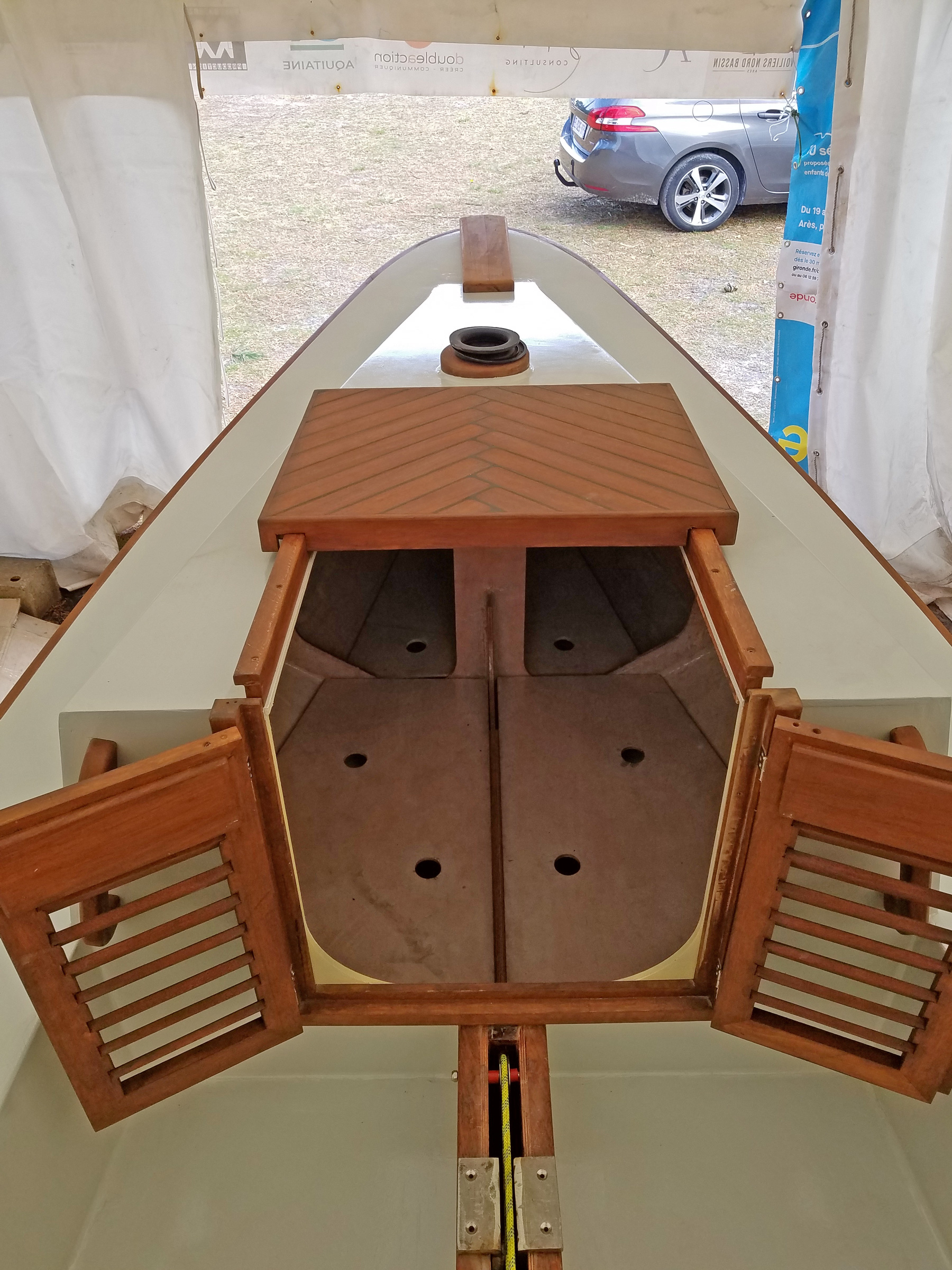
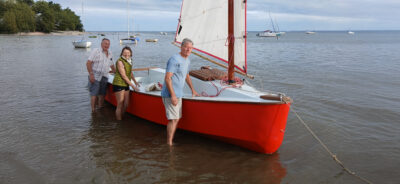
The hull and deck were spray-painted to a very high quality. The hull was painted bright red, but in the cockpit and on deck the more subtle off-white was complemented by the oiled mahogany trim and accent pieces. One of the trickiest parts of the build was lifting the 154-lb stainless-steel centerboard into its trunk, seen here aft of the companionway.
Michel does not do things by half. Not for him was the idea of plugging away on his own in his garage. Instead, his next step was to set up and register a community volunteer group and start looking for sponsors. A year later, he had been joined by an enthusiastic band of about 30 volunteers who were meeting every month to discuss ways to raise funds, find a building space, and set up the yard. The town of Arès loaned them a garage, complete with running water and electricity, and allotted them some municipal funding. Then the Paris-based firm of Serpentaire, a legal consultancy for doctors and surgeons where Michel’s son works, came forward with a generous donation that allowed the group to pay for all 38 CNC-cut pieces needed to build the hull and the six female molds, and to pay for each volunteer to attend a two-day training session in the basics of stitch-and-glue construction.
Building the Voilier Nord Bassin
Ultimately, the boat was built by a team of about 20 volunteers, men and women from different backgrounds, mostly retired, working two days a week. They began by setting up the backbone and six molds, into which they laid up the two bottom panels. Next came six ’glassed and epoxied MDF frames and the topside panels. In total, the build used 12 sheets of 250cm × 122cm (8′ × 4′) 9mm marine plywood. Scarf joints were needed for the bottom and sides, and the entire construction was stitched with copper wire and glued with thickened epoxy. Everybody, says Michel, took part in everything: assembling, scarfing, stitching, gluing, laminating, fiberglassing, sanding, more sanding, and painting. After the isolation of the COVID lockdown, it was good to be among people again.

The Voilier Nord Bassin has proven fast and stable even in a stiff breeze. The yard and boom were fashioned from donated windsurfer masts.
Among the many donations that went into the build were an old Flying Dutchman rudder, which fit the boat well, a supply of mahogany sold at a discounted price—enough to build the gunwale, beam shelf, cabin doors, and other trim—two fiberglass windsurfer masts that were used for the yard and boom, and an old pinasse (the local traditional working boat) sail that was recut to the correct dimensions. The final touch, says Michel, was the choice of “Ferrari red” for the hull color.
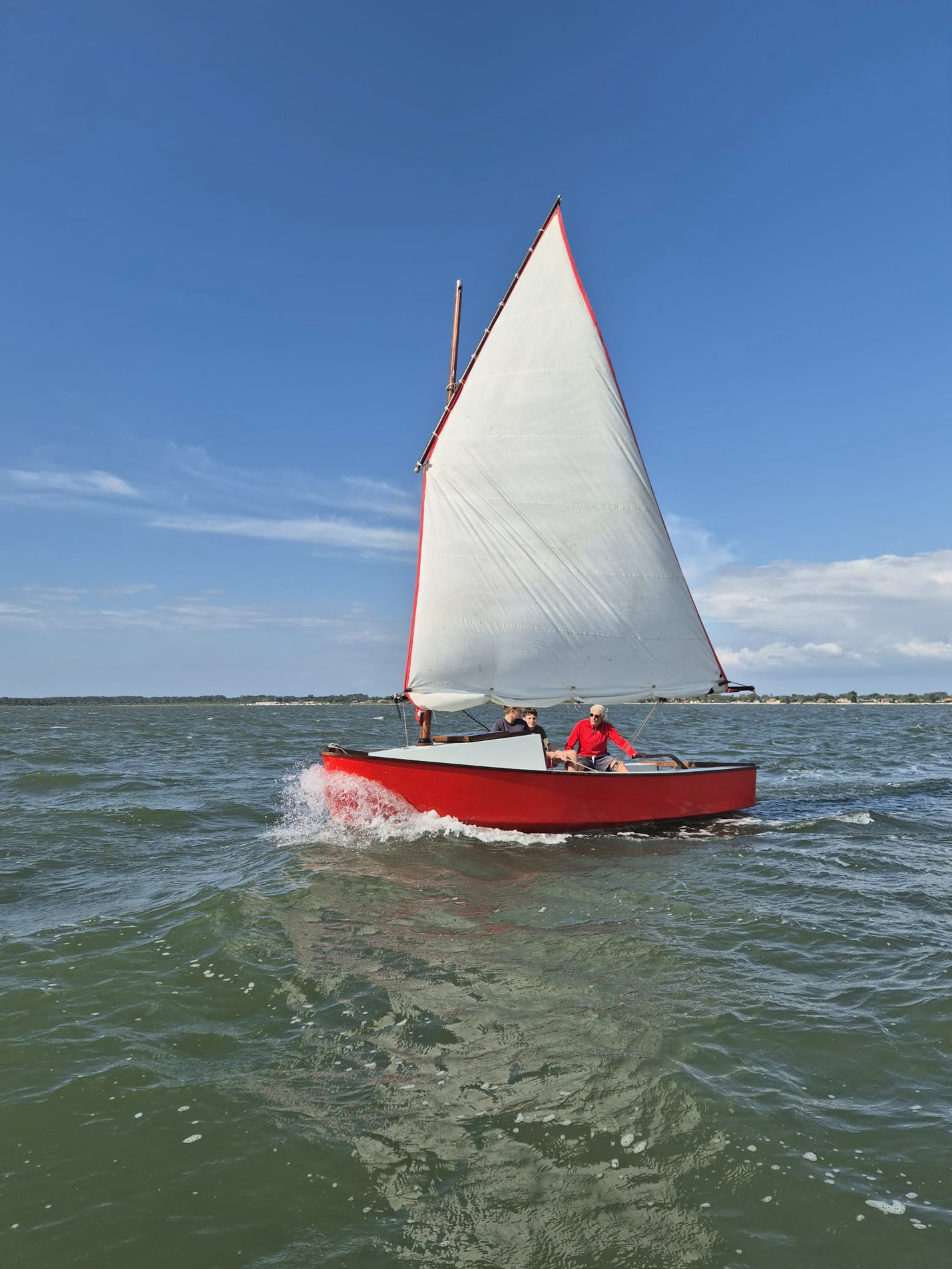
Michel designed the Voilier Nord Bassin with a single large lugsail but found that the boat was difficult to turn into the wind, and indeed, was not at its best when closehauled.
Sailing the Voilier Nord Bassin
They launched at the beginning of the summer, 2025, in Arcachon Bay. With a crew of four, the builders were delighted to find the boat stable, even in a strong wind. On a beam or broad reach and when going downwind the performance was excellent, but when they turned onto the wind, they found it difficult to flatten the lugsail and were forced to sail more free than they would have liked; in light airs it was hard to bring her into the wind to tack. After the first trials, they came up with a plan to move the center of effort aft: they would add a mizzen. As with so many aspects of the Voilier Nord Bassin story, the crew experimented with what was readily available and by August had determined that a donated Optimist rig best solved the problem. Now, the boat performs well on all points of sail and has achieved a top speed of 8 knots.

The introduction of a mizzen—a recycled Optimist rig—has made all the difference to the Voilier Nord Bassin’s upwind performance and she now handles well on all points of sail.
The Voilier Nord Bassin is now owned, and will continue to be owned, by the association that Michel set up for the build. She is available for all members—families and friends—to sail and will be used for teaching new sailors. As for Michel, his mission complete, he has no future plans to extend his new-found knowledge of naval architecture but, as they say in France—with a shrug of course—on ne sait jamais.
Jenny Bennett is editor of Small Boats
Do you have a boat with an interesting story? Please email us. We’d like to hear about it and share it with other Small Boats readers.


I’m wondering if the added mizzen is mounted off-center? If so, by how much?