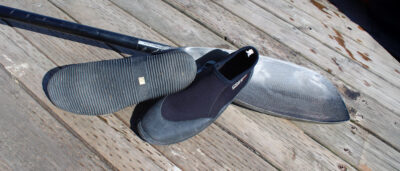
There are many options for boating footwear, and I’ve tried just about everything from sandals to mukluks, but what I now wear most often are Cressi’s Minorca Shorty Boots. More shoe than boot, they have 3mm neoprene uppers with seams that are both glued and sewn. On either side are pairs of 1⁄16″ holes, down low and just in front of the heel. The insoles are also 3mm neoprene and are glued to the uppers along their perimeters. All of the neoprene is faced with a tightly knit, scuff-resistant stretch fabric. Both the toebox and heel are reinforced and protected by a layer of textured sheet rubber about 1⁄16″ thick. The sole is roughly 1⁄4″ thick and textured with slightly wavy ridges for traction. It is secured with thick black rubbery glue that overlays the seams with a lightly brushed fillet which prevents snagging and separation. Each of my boots—U.S. size 13 (EUR 47/48)—weighs 8.9 oz.
 Photographs by the author
If I’m launching from a dock and keeping my feet dry, I wear the Minorca Shorty Boots with socks, as I am on my right foot in this picture. But if I’m wading out on a beach launch, I wear waterproof socks, as can be seen here on my left foot. With or without socks the booties are comfortable.
Thanks to the Minorcas’ low cut and stretchy neoprene the booties are easy to put on. In a pinch, I can even put them on with one hand—there’s no fussing with laces or pulling the collar over ankles. Taking them off can be done hands-free by first stepping on the back of the bootie to release the heel of the foot, and then stepping on the toe so the foot can pull out backward. The only time I’ve had a Minorca come off accidentally is when I’ve worn them over my drysuit’s built-in waterproof socks while doing sea-kayak wet-exit and reboarding drills—there simply wasn’t enough friction between the innermost socks and the rather slack drysuit socks. Fortunately, the booties float so I haven’t lost one.
The Minorcas are comfortable worn over bare feet and have enough stretch to be equally comfortable over waterproof socks with insulating socks underneath. The close fit, in either case, limits the amount of water that can get in. There is no sloshing after stepping out of the water and walking on dry land.
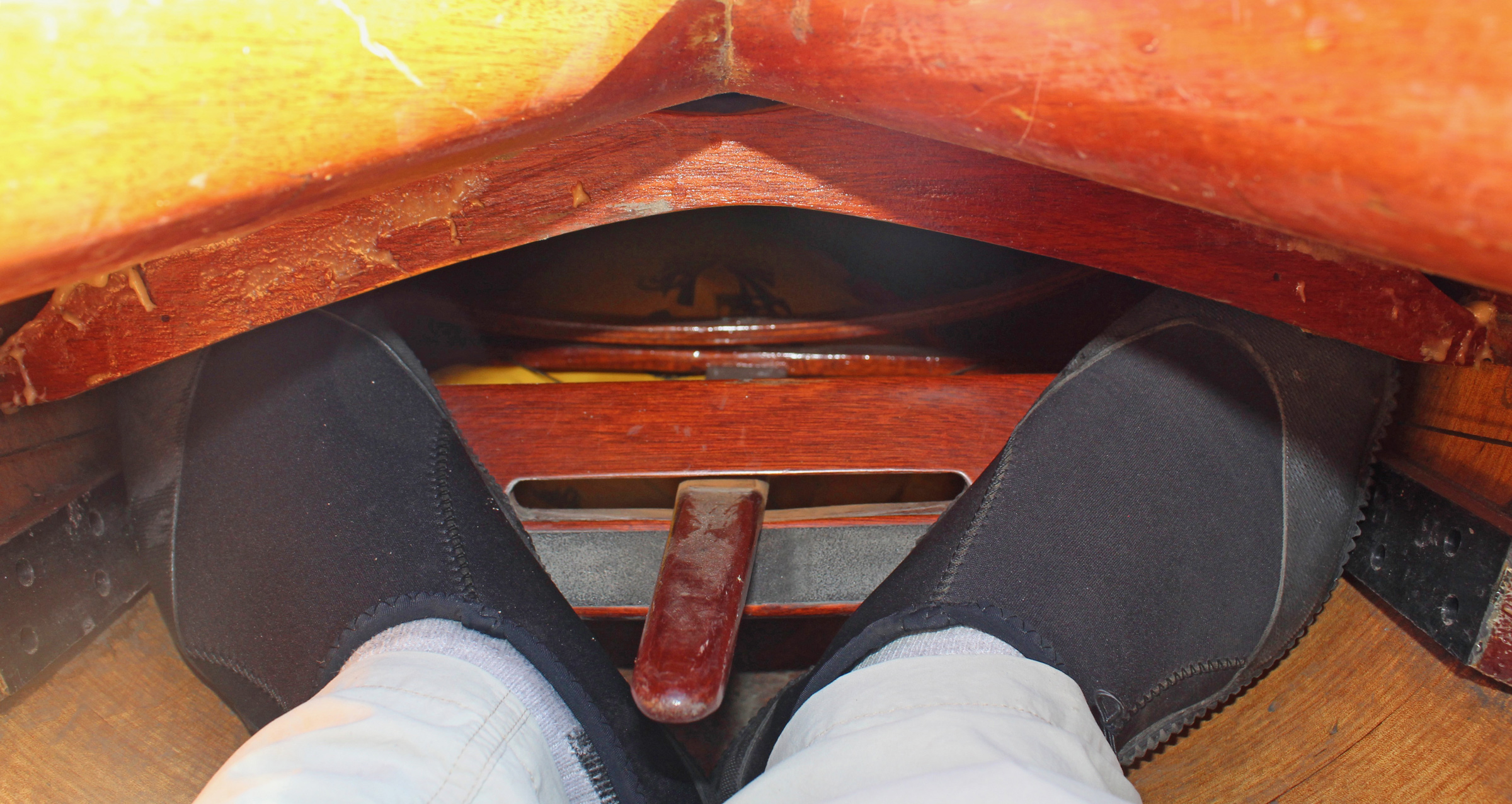
In the restricted space of a kayak cockpit, the compact size of the booties is especially important for my size-13 feet. The reinforcement on the heels protects the neoprene from wear while kayaking.
The tread on the soles provides good traction on many slippery surfaces, yet the shallow contours don’t get clogged with mud that could get tracked aboard; nor do the soles have the siping—thin slits cut in a rubber sole—common in deck shoes, which can trap sand. While thick enough to provide protection from sharp objects, the soles are not so thick that they make it difficult to feel what’s underfoot.
When the weather is warm, I’m often barefoot while boating, but after once goring my big toe on a broken drinking glass hidden in mud, I make it a habit to step ashore with something on my feet. The Minorcas are easy to have at the ready and can be put on in seconds during the approach to landing.
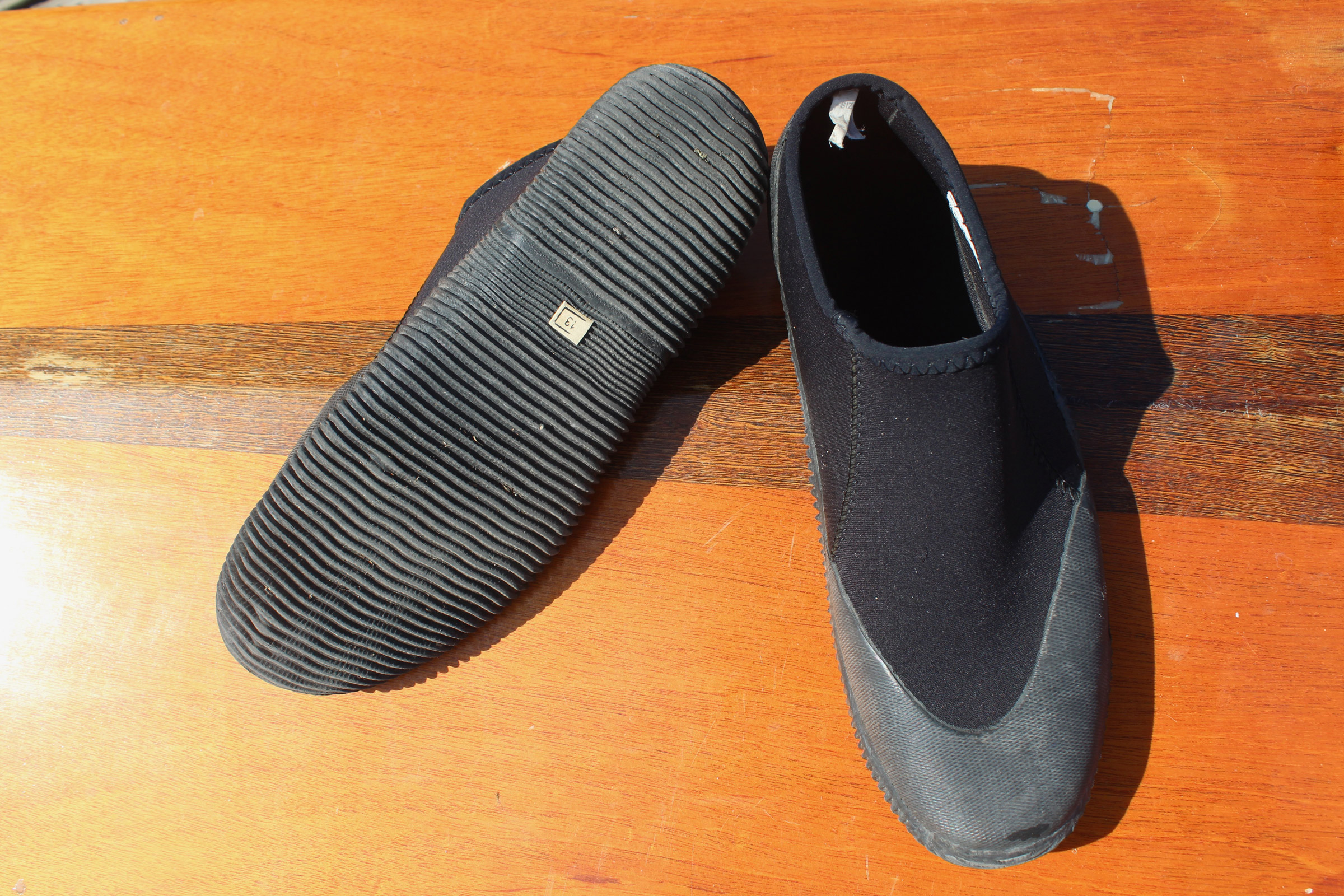
The simple, ridged tread on the sole provides traction while accumulating very little, if any, sand or mud.
When I’m not boating, I keep the Minorcas at hand to slip onto bare or stockinged feet when I’m taking out the trash or tending to boat tarps when the weather gets lively.
I’m on my second pair of Minorcas. I wore through one heel on my first pair after four or five years of regular use. Years from now, when I’ve worn through my current Shorty Boots, I’ll buy another pair.
Christopher Cunningham is editor at large of Small Boats.
The Minorca Shorty Boots by Cressi are available through a worldwide network of retailers and online sources. The pair seen here were purchased in October 2024 for $36.
Is there a product that might be useful for boatbuilding, cruising, or shore-side camping that you’d like us to review? Please email your suggestions.
Sorry to hear about cutting your foot on broken glass, Chris. Yes after five years of going barefoot everywhere anytime it wasn’t so cold I needed gloves, I’ve found TN rivers and lakes are the only place the broken glass everyone is so scared of actually exists. I got a pair of Xero AquaX Sports, as close to growing treaded feet I think exists. If sand under sandle straps bothers you it will w AquaXs too: I got bike socks. But I always feel unstable and slidey in sandles while these shoes do nothing besides make a barefooter feel safer. They might last 5yrs: after logging 40 trips where I do a lot of in and out and shallow shoal slogging they’re not much more than starting to get a few wrinkles. I got another pair for the shop, to protect the socks I wear to protect my ankles from mosquitoes, and another pair a size up for thicker socks this winter. Because there’s zero stretch in these. They stick to mud or dry rocks like mtn bike tires (imo the only thing that works on slimy rocks is what God gave us) but the elastic laces are a bit fiddly and the tongue has to be placed just so.
If you wear booties like these or any other wet suit booty bare footed, rinse them well when you get home and dry them. They can get lethally smelly.
It has been alleged that felt soles are best on slippery rocks, but I have not tried those.
The booties I use look like yours, probably the same. As I’m getting pretty stiff in my old age, my next ones will probably be some calf-high, soft neoprene upper boots; I hope they will be easier to get on and off.