Alex Latham was 31 when he learned to sail. He had been thinking about it for years but never quite got around to it. He was just too busy with other things: mountaineering, foraging, paragliding, mountain unicycling, and generally having a good time while living on a boat with his partner, Heather, in the ultimate party town of Brighton, on the southeast coast of England. He was young, he was a free spirit, and he loved outdoor adventures.
The couple moved west, back to south Devon, where they both grew up, in 2017. Alex launched a business teaching foraging and outdoor survival skills in his family’s 10-acre woodland near Chagford on Dartmoor. Then Covid happened and, like everyone else, he found himself with a lot of time on his hands. Someone offered him an old 11′ Heron dinghy, and Alex jumped at it. It wasn’t in the best shape, but he patched it up and took it down to Stoke Gabriel on the River Dart where, over the next few months, he learned to sail.
Learning to sail
When Alex decides to do something, he throws himself into it absolutely; he’s an all-or-nothing guy. In a logbook of his first 100 sails, he recorded his first lesson with instructor Will Howitt from the Stoke Gabriel Boating Association on November 9, 2020. By the following November he’d been out sailing on a variety of boats (many loaned by the association) 48 times—almost once a week, including through the winter. It took him just over two years to clock up his first 100 sails.
 Photographs by Alex Latham
HECATE was Alex’s entry into the world of sailing. An older Heron dinghy, given to him by a friend, she served him well as a starter boat, but was soon replaced by a larger Enterprise dinghy.
The logbook is full of accidents and mishaps, as you’d expect from a complete beginner, as well as sublime sailing moments and nature observations (seals are commonplace on the river). He and his friends were repeatedly getting stuck in the mud or tangled up in the trees, which grew on the bank, or running out of fuel; and various bits of various boats broke (boom jaws, tiller extension, halyards, a forestay). After a month he had his first capsize, followed a week later by his first singlehanded sail. By March 2021, he’d learned to reef the sail, and the following month he took his own boat to sea for the first time.
By this time, he’d bought another boat, a 13′ 3″ Enterprise dinghy. He based it at Hope Cove, a picturesque village on the south coast of Devon, which has a sandy beach popular with local boaters and tourists alike. On a clear day, to the west, you can see the coast of Cornwall stretching around from Plymouth as far as the Lizard peninsula—50 miles away.
An early voyage
In April 2021, Alex and Heather headed out of Hope Cove in their heavily laden Enterprise in the company of a few friends in kayaks and canoes and on paddleboards. The flotilla followed the coast north for 3 miles to Burgh Island (setting of Agatha Christie’s novel, And Then There Were None), where they had chips at the Pilchard Inn, before continuing another mile to Aymer Cove, where they all set up camp. Alex went snorkeling and caught a dogfish with his speargun, which he cooked on an open fire and served with foraged sorrel and sea beet. The next day, they sailed back to Hope Cove; they had completed their first overnight dinghy cruise.
 Nic Compton
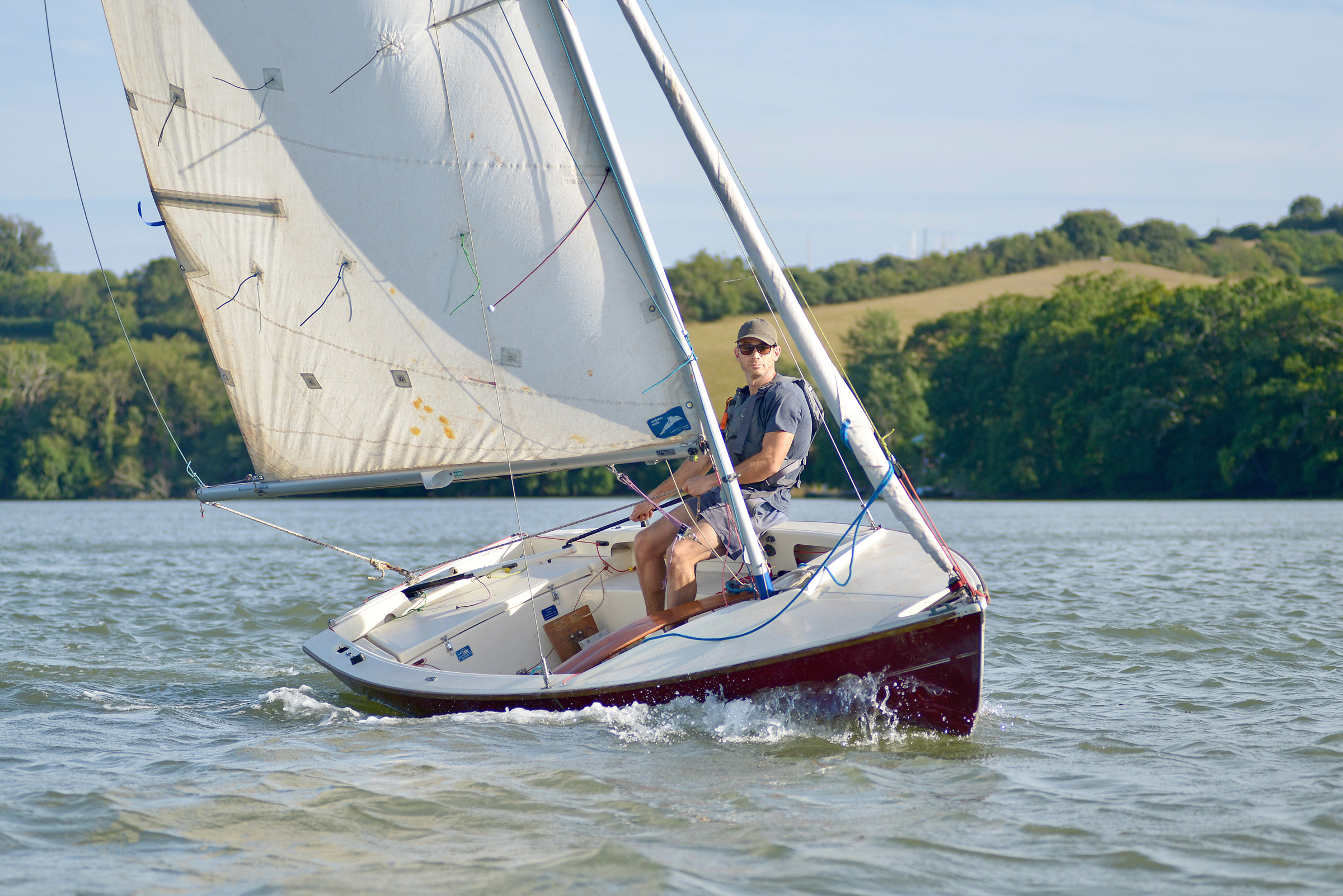
The layout in the Wanderer (made famous by Margaret Dye for whom it was designed) lends itself to cruising, with generous storage space in the stern locker and beneath the foredeck. For smaller gear needed during the day, the open-face storage bins beneath the side decks give ready access.
“That was my first experience of not only sailing and camping overnight, but also catching the food that we ate!” Alex later recalls. “Seeing the potential for adventure that you can get from a small boat which sails, compared to, say, a kayak or something like that, was really amazing. It’s the amount of equipment you can carry, but it still felt like it was super simple to camp on that beach.”
In truth, dinghy cruising had always been Alex’s ultimate goal. He had read about intrepid small-boat sailors such as Frank Dye, who sailed a Wayfarer from the U.K. to Iceland and Norway and later cruised extensively with his wife Margaret; Jonathan Dunnett, who windsurfed solo around the British Isles; and Yvan Bourgnon, who sailed around the world in a 21′ homemade cabinless catamaran. Such challenges appealed to him. “I am drawn to sailing in small boats because it’s a way you can bring a good sense of adventure close to home, affordably,” he says. “That really appeals to me: affordability in both financial and environmental terms: adventure that doesn’t cost the earth. Boats are often seen as quite wasteful, but dinghy sailing has no more impact than camping in a tent in the hills, and it’s unusual and adventurous in a way that hiking isn’t. For me, it was a way to take another step of adventure that really felt challenging, but which I could achieve out of the back door.”
First, however, he had to find the right boat. After nearly a year of sailing the Enterprise, it was tired. Toward the end of 2021 a shroud pulled out of the deck, and on closer inspection, Alex discovered it had been attached with just a few small screws and no backing plates. “It was a break waiting to happen,” he wrote. He realized he needed a more seaworthy vessel if he was to venture farther afield. Three months later, he bought his third boat, a 14′ fiberglass Wanderer. The price tags for his three boats had gone from Free (the Heron) to £300 (the Enterprise) to £1,300 for the Wanderer with a 2.3-hp outboard.
Fixing up the Wanderer
Older and wiser after 15 months of sailing, Alex wasn’t taking anything for granted. “I knew this was going to be my more expedition-worthy boat,” he says. “I felt ready and wanted to make sure that the boat was ready, too. I thought if I really went over the whole boat, every single bolt, then I would feel confident. Because, ultimately, I’m still pretty new to it. I just wanted to really understand the boat.”
 Nic Compton
MEANDER sails well under mainsail alone. Alex frequently roller furls the jib and then, if he’s still over-pressed, ties a reef in the main.
Alex spent three weeks inspecting every last inch of the new boat. MEANDER (as she was called) had been set up for racing, so he stripped back and simplified the rig. He changed the standing rigging so he could lower the mast on his own at sea, in case of emergency. He made canvas holders for the oarlocks and halyards, and for general stowage. He stripped and varnished every piece of wood. He even sewed an extra line of reef nettles into the mainsail, which he hasn’t yet needed to use. And he went over the engine, teaching himself the basics.
“It was so cheap to do up—just a few hundred pounds,” Alex says. “And, honestly, I have done just a few hours a year since then, maintaining the boat. It is amazing how putting in that time at the beginning, all the maintenance woes seem to disappear. I’ve been surprised at how little I’ve needed to do since. And she just keeps sailing beautifully.”
Early cruising
Despite the prep work, it’s fair to say that Alex’s first cruise on MEANDER—also his first solo overnighter—was not a great success. Tempted by that tantalizing view to the west, he decided to cross Plymouth Sound—an open body of water 3 miles wide at its entrance that can get quite rough—and venture past Rame Head, about 20 miles away, into neighboring Cornwall. He had a fast crossing in a fresh easterly breeze, but once he landed in Cornwall, he found that the beach he’d chosen was on a lee shore and struggled to get the boat back in the water because of the waves. “It was a lesson in how hard it is to singlehandedly launch something like a Wanderer, which isn’t even all that heavy.” Reluctantly, he started up the outboard and headed east back across Plymouth Sound to a beach at the mouth of the River Yealm where he anchored off. There Alex spent an uncomfortable night in the bottom of the boat—he had made no provision for sleeping on board—before motoring home early the next morning. “A wet and miserable passage!” he wrote in his logbook.

Crossing Plymouth Sound in a small boat is always daunting. The combination of open, often rough, water on all sides and commercial traffic coming and going from Plymouth’s busy port requires an attentive skipper. For Alex, on his first overnight solo outing, it was a stressful time in a stiff breeze.
The experience didn’t put him off, however, and a few weeks later he started planning his longest trip to date: 120 miles from Hope Cove, Devon, to Falmouth, Cornwall, and back. It was an audacious voyage for someone with relatively little experience (he had been sailing less than two years). The Cornish coast is famously rocky and inhospitable—not for nothing is the area known as “the graveyard of ships”—and negotiating its many offshore rocks is a fair challenge for an experienced sailor on a well-found yacht, never mind a novice in a 14′ dinghy. Yet Alex wasn’t fazed by the undertaking.
“I’m lucky to have spent a lot of time in pretty rough weather, in the mountains, with my outdoor pursuits,” he says. “So, even though I was new to sailing, I already had a certain level of experience in terms of management of gear and self-management, and a sense of self-reliance in an inhospitable environment that gave me the confidence to do it. Whether or not that was sensible is up to other people’s interpretation, but it certainly seemed sensible to me.”
 Roger Siebert
.
MEANDER was, by now, well-prepared for the voyage; it was just a matter of packing personal gear, such as a tent, a bivouac, and some food. Again, he didn’t plan to sleep on board, partly because the curved thwarts were uncomfortable and partly because he wanted to get off the boat each day. As a longtime hiker he’s well equipped for camping ashore but, he acknowledges, there were times on the trip when sleeping on board might have been useful.
Alex planned to make the voyage in two parts. First he would sail west to Falmouth, where he would leave the boat and travel overland back to Chagford to teach a foraging class at his woodcraft center. Then, a week later he would return to Falmouth to sail home.
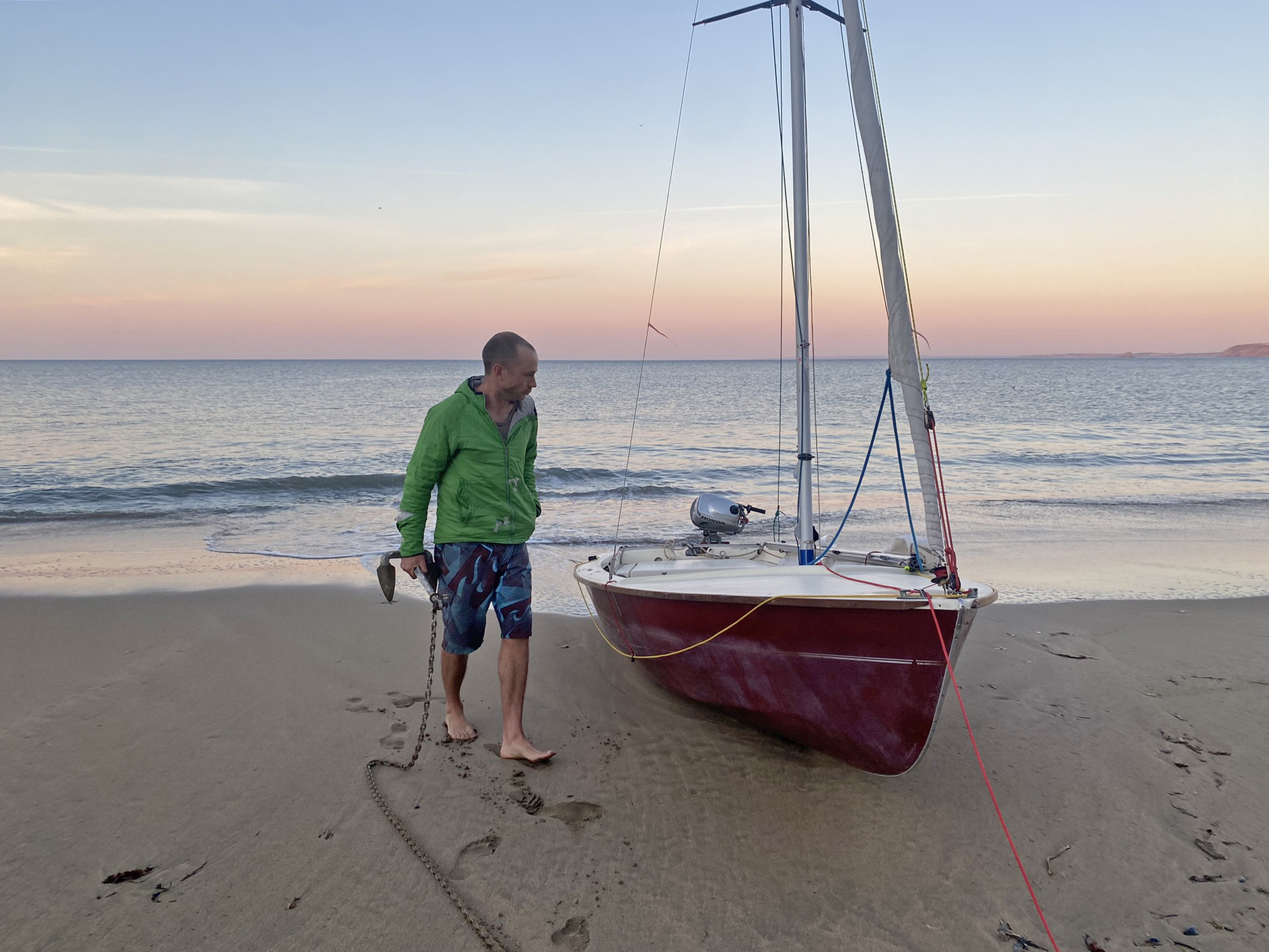
Alex typically anchors the boat offshore and camps ashore, but the sandy bottom at Hemming Beach made for a soft overnight landing.
He packed enough food for a week. His pantry included all the usual long-life foods such as pasta, rice, bread wraps, pouches of ready-cooked lentils, and some canned fish. He also took a lot of fresh vegetables, because “I find it very mindful just sitting there and cutting vegetables really inefficiently with a small penknife.” He scoffed at the idea of energy bars; he prefers a slice of whole wheat bread and peanut butter to boost his energy. Liquid refreshments included home-brew beer and some elderflower champagne.
Practicing what he teaches, Alex is a keen forager and supplements his onboard supplies with samphire from the seashore and various seaweeds, particularly spaghetti seaweed, which can be lightly boiled and added to a stir fry. His foraging includes fishing, either by line or with a speargun (his preferred method). Spear fishing, he argues, is the least impactful way of catching fish because you can select exactly the species, size, and even the sex of the fish you are shooting. There is no bycatch and little chance of the fish escaping with an injury (as often happens when using a fishing line) because he rarely misses his mark.
The big trip
Alex arrived in Hope Cove the night before his planned departure and, after enjoying a drink with friends on their yacht anchored in the bay, headed up to Bolt Tail—the headland that forms the southern arm of the bay—to camp for the night. The forecast for the coming week was for easterlies, which in theory, would push him down the coast towards Falmouth. By the time he got going the next morning, however, the offshore northerly breeze had kicked in and flattened the promised easterly; MEANDER drifted gently past now-familiar sights. This is one of the loveliest and most unspoiled stretches of Devon’s extensive coastline, with high rocky headlands topped by arable and grazing land, and sheltering secluded beaches, each prettier than the last: Hope Cove, South Milton, Thurlestone, Bantham, Bigbury, and Mothecombe.

Leaving an anchorage in the early morning often required dealing with beach surf, a light onshore breeze, and an incoming tidal current. Despite having an outboard motor, however, Alex prefers to use the paddle whenever possible.
But it is not without its perils. Between the beaches, the cliffs are stark and unforgiving, and between the Devon coast to the east and the Cornish coast to the west is Plymouth Sound. Alex remembered his first trip down this way and decided not to tackle the Sound late on his first day but, instead, tucked into the River Yealm. There were people on the small beach enjoying a fire, so he anchored off and cooked a meal on board MEANDER, before setting up camp ashore once they had gone.
He had decided that it was usually better to anchor off, rather than try to beach and risk getting stuck or damaging the boat. The tidal range in these parts averages between 11’ and 16’ and if you get your calculations wrong things can quickly go awry. But getting ashore from anchor provides its own challenges. Alex does have a pack raft, which he made from a kit, using heat-sealable fabric, but not wanting to use it every day and risk it being damaged—he thinks of it as his emergency raft—he decided to swim ashore. He stuffed his overnight gear into a dry bag (also homemade, from an old truck tarp) and swam into the beach where he made camp.
Alex set off the next morning and crossed Plymouth Sound, past Rame Head—where he had got into trouble on the previous voyage—and on toward the historic fishing harbor of Looe, some 17 miles away. When he arrived, he decided he wasn’t interested in engaging with human society, and instead, in a dying wind, motored past Looe Island to a small beach on Talland Bay.

Rame Head, to the west of Plymouth Sound, is a landmark headland that tells sailors they are leaving Devon and entering Cornwall. On the summit of the headland is the ruin of St. Michael’s Chapel, built in the 14th century.
The next day, the winds were light again, but he made fair progress westward, sailing 19 miles before the wind faded once more and he had to motor around the 375′-high cliffs of Dodman Point into Varyan Bay. Once again he camped on the beach, and once again he got up late to find the early morning breeze had faded to nothing. He set off, slowly drifting along the coast, and was joined by a large pod of dolphins some 20 or 30 strong, frolicking around the boat. Eventually, Alex drifted back a mile to end up at Hemmick Beach and found himself joining a group of people engaged in a dance-movement class on the beach.
“I landed on the beach in the golden evening light, and there was a large circle of people doing really strange movements around a campfire,” he says. “So, I sat with them for a while and had a really cool evening, watching the full moon rise and drinking whisky from a hip flask. It could have been anywhere in the world, but was just a few hours from home.”
His time was running out, however, so the next morning Alex got up early and set sail for Falmouth, still 11 miles to the west. At last, the wind cooperated and by lunchtime he had picked up Heather from the front in Falmouth and together they sailed up the Helford River—a few miles to the west—and moored MEANDER up a narrow sheltered creek, which was safe, quiet, and remote.
The return journey
A week later he was back, and after freeing MEANDER from the mud, he set sail for Hemmick Beach once again. The wind had shifted to the southwest, as he’d hoped, and he had a fast, exciting run along the coast under spinnaker. There were no dancers or dolphins in Varyan Bay, and the idyllic Hemmick Beach had become a lee shore. Nevertheless, he anchored off and went ashore for the night.
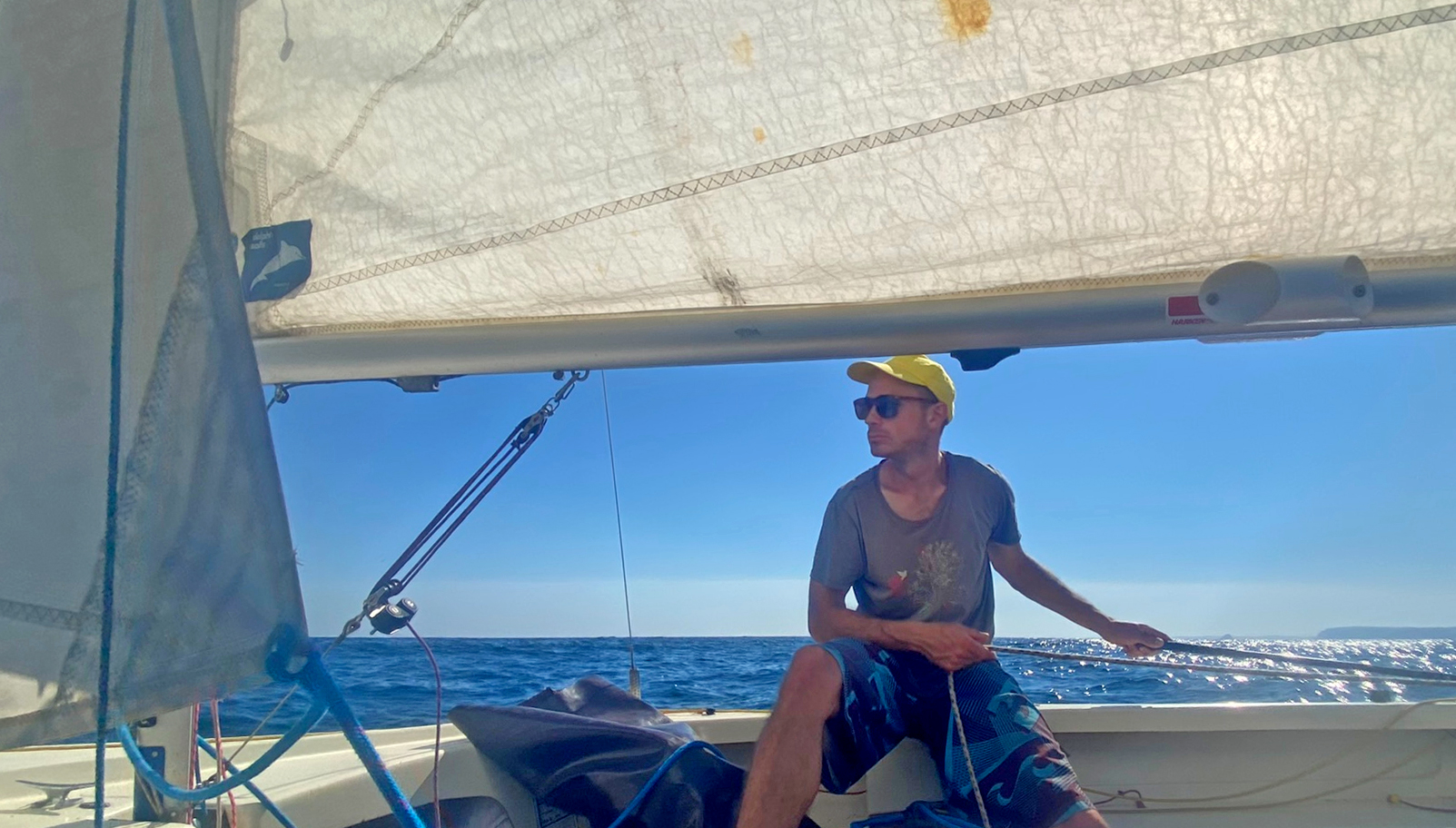
On his voyage from Hope Cove to Falmouth and back, Alex saw a variety of weather from flat calms to strong winds, bright sunshine and fair breezes.
“Perhaps I let familiarity get the better of me,” Alex says. “I just thought, ‘It’s late, this is where I need to go.’ I wasn’t thinking with the same critical eye as I had on the way down, when every beach was new.”
As the wind picked up the next morning, he realized he needed to make a quick getaway. The tide was going out, so he quickly waded MEANDER out into deeper water, clambered aboard, and tried to start the engine. Nothing. He tried again. Nothing. On the last day of the outward voyage, he had lost the gas-tank cap over the side. He had bought a new one, but it hadn’t fit quite right and, he reasoned, water must have made its way into the tank. He raised the sails and for nearly an hour tacked into the onshore breeze as he struggled to round Dodman Point. It was a classic lee-shore scenario, one that has been played out countless times by much bigger ships along this coast and has all too often ended in shipwreck and terrible loss of life.
But, says Alex, “It was never perilous. It was just: ‘I’m not going anywhere, but I’m also not going the wrong way, either.’ Something like that makes you appreciate how much security engines add to your setup. The thing is, people make mistakes, and it’s good to have an engine for when that happens.”
Soon after MEANDER eventually cleared Dodman Point, the wind died, and Alex managed just 10 miles that day, reaching Polridmouth Bay, just south of Fowey. The next morning, he rowed into Fowey, where a friendly mechanic took the outboard away to be fixed. It was the only time during the trip that MEANDER was moored overnight in a harbor. But, not having a boat tent, Alex grabbed his bivouac and camped on a deserted beach on the other side of town.
The following morning, the mechanic showed up with the outboard, fixed and with a correctly-fitting gas cap. Alex headed out to sea again. A Force 6 offshore wind was blowing as he headed out of Fowey and sailed along the coast under reefed main and no jib. When he arrived in Plymouth Sound, there was a nasty chop—the conditions were challenging, but exhilarating.

The view from Cellars Beach at the mouth of the River Yealm became a familiar sight for Alex, who stayed here on both his solo trips. Here, looking west to Rame Head in the distance, the headland to the right was, for the second half of the 20th century, home to a Royal Navy gunnery school. The land is now owned by the National Trust and has been returned to its natural state. At left, Great Mewstone (known locally as, simply, The Mewstone), half a mile off the coast, is one of the largest islands off the South Devon coast. Once in the firing line of the gunnery school, it is once more an important nesting site for seabirds.
He covered 20 miles that day, finishing up at his now-familiar beach at the mouth of the River Yealm. But it was the following day, as he was sailing under mainsail and spinnaker, trailing a line over the stern to catch some fish, that he had his epiphany.
“After nine days of sailing singlehanded, I was hiked out slightly, with the spinnaker flying and the fishing line streaming behind me; that’s when I started to feel like I was getting it. That was the high point of the trip.”
So content was Alex that, rather than head straight home to Hope Cove, he turned back and sailed for another hour, before reluctantly heading in to land. And, for the first time on the trip he caught some fish: four fine mackerel to share with Heather for dinner. A video he made of the trip captures the moment he came into Hope Cove and patted the boat, saying, “Well done, MEANDER. Well done.” It was the end of the voyage, but there would surely be many more.

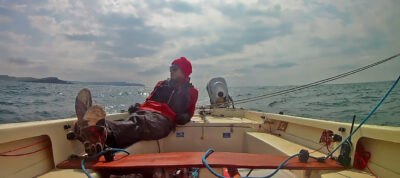
Alex has rigged a line to hold the tiller, allowing him to relax and enjoy the view. MEANDER is set up so that everything—from running lines to VHF radio—is within easy reach for singlehanded sailing.
“It was probably the most empowering adventure I’ve had up to now, because it was the combination of so many things that I’ve aspired to learn over the years, from foraging to fishing to sailing to being psychologically independent. All those things came together on this trip, and I felt like I was thriving,” Alex says.
“When you’re singlehanded sailing at sea, there’s a lot going on, and it fills the mind with the immediacy of the moment and what you need to do. People achieve that mindfulness in different ways, through meditation or yoga for example. For me, it’s a very special thing that I can achieve sailing a small boat at sea by myself, not so far from home.”
Nic Compton is a freelance writer and photographer based in Devon, England. He has written about boats and the sea for more than 30 years and has published 16 nautical books, including a biography of the designer Iain Oughtred. He currently sails a 14′ Nigel Irens skiff and a 33′ Freedom cat-ketch. For more adventure articles by Nic, see “Wolf Rock Light,” “The Betty Effect,” and “A Man’s Best Friend.”
If you have an interesting story to tell about your adventures with a small boat, please email us a brief outline and a few photos.


Good stuff, thanks!