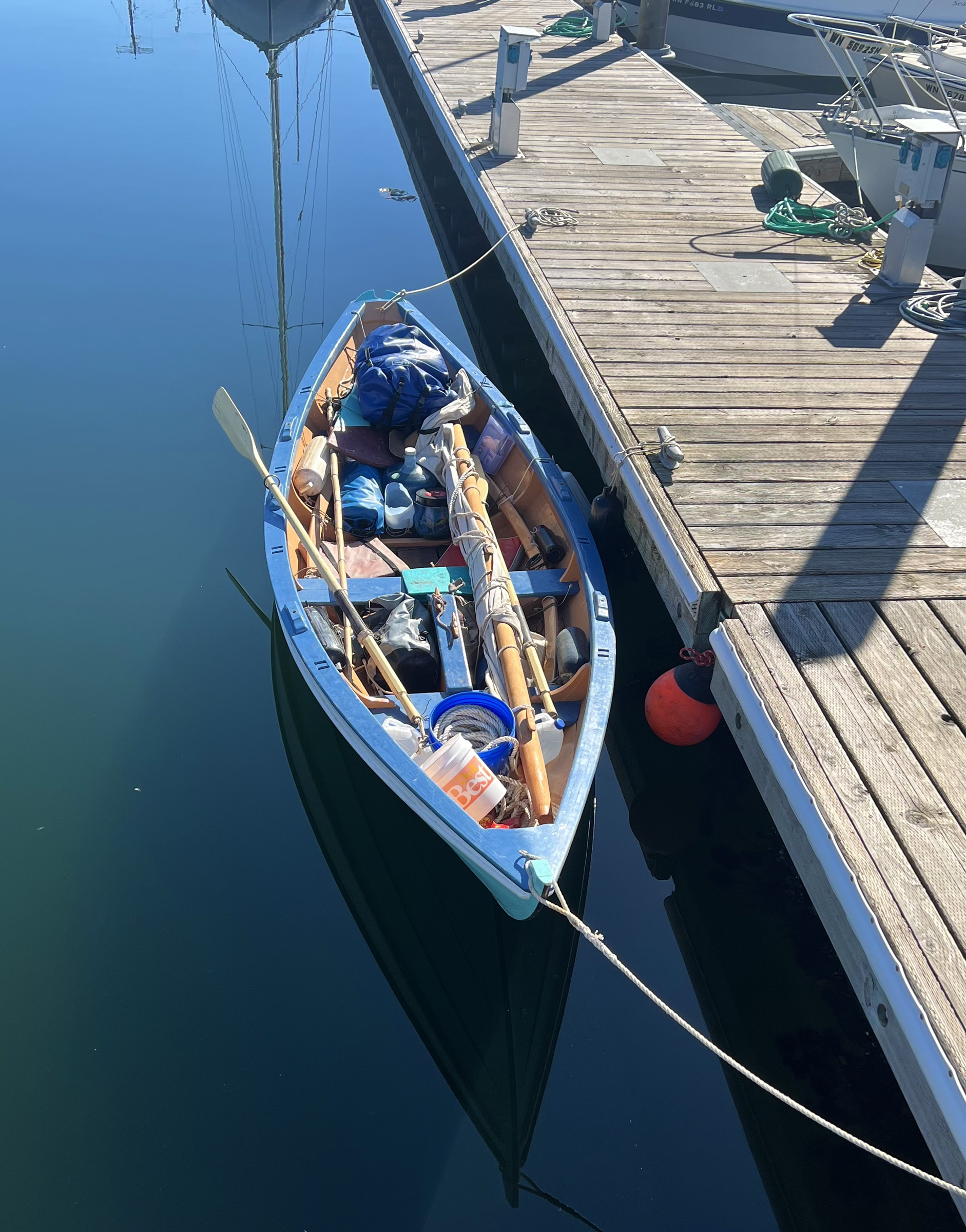
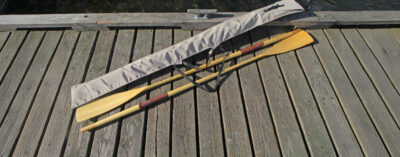
It was one of those rare and perfect July mornings on Port Townsend Bay, Washington, when the waters are so calm you can almost see them ripple when the clocktower strikes its bell. The sun was cresting over the Cascades and glinting golden on the inlet, which was just waking up to the distant sound of moaning outboards, a faint smell of gasoline on the breeze. I had stumbled down to the dock with tired eyes, having stayed up all night packing essentials into drybags, which I now stuffed into every available nook in SOLSTICE, my 17′ Swampscott Dory. She was low in the water when I topped it all off with the bundled sail and mast, and climbed aboard to sit on the thwart and slip the oarlocks into the sockets. The clack of brass on brass brought the gulls to attention; they eyed me sharply and gossiped as I passed them by.
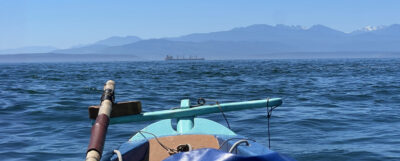
The oars felt good in my hands as I rowed out of the mouth of Boat Haven Marina, the brick buildings of Port Townsend glowing warmly in the early light. I was momentarily mesmerized by the peace, but a glance over my shoulder reminded me of what lay ahead—the channel of the Admiralty Inlet with its busy shipping lanes. To the commercial freighters my little dory wouldn’t be so much as a flea—to the watchful eyes on the bridge decks she might appear like a grain of rice in a big pot of blue soup.
 Photographs by the author
On the morning of my departure, SOLSTICE was all packed up for the month-long journey. By the time I had everything on board, there wasn’t much room left for me. It was the first time I had loaded the boat for a trip and the clutter was distressing.
This was the first fearsome hurdle in a month-long journey I had planned, to go as far north as I could through the San Juan Islands, onward to the Gulf Islands of British Columbia, and all the way back in a big loop.
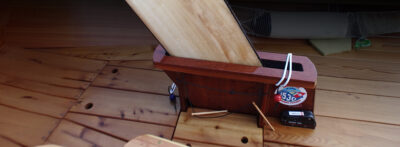
Rowing off the eastern edge of town, beyond Point Hudson I spied a dark line of growing breeze approaching the red bell buoy. By the time I reached it there was enough wind to sail, so I shipped the oars and went about turning SOLSTICE into a sailboat. I hefted the unwieldy rudder aft and hung it from the stern. The sea state jostled it about as I struggled to line up the pintles and gudgeons with water up to my elbows, until at last, they slotted in with a satisfying thunk! Now it was time to raise the 12′ mast, with its sail and sprit, and slide it through the 3″ hole in the forward thwart. It was an awkward maneuver—holding the heavy mast above my head as the sea toyed with the boat. I swayed uneasily while trying to aim for the hole until finally the foot slid through and into the step, squeaking on the leather as it went. I moved quickly to cast off the brail line and tighten up on the snotter to peak the sprit. The sheet whipped from the clew of the unruly sail; I leaped back and grabbed it to run it through the block on the traveler and make it off to the belaying pin, then spun around to drop the centerboard and quickly take hold of the sheet and tiller. We came alive all at once as the bow pulsed a cadence through the waves.

Looking over my shoulder shortly after leaving Port Townsend, I was thrilled to see the 1907 schooner MARTHA motoring out from Point Hudson. For a while she was near enough for my friend Emma, then MARTHA’s skipper, and me to yell greetings to each other across the water, but it wasn’t long before they had passed me by and soon disappeared from sight.
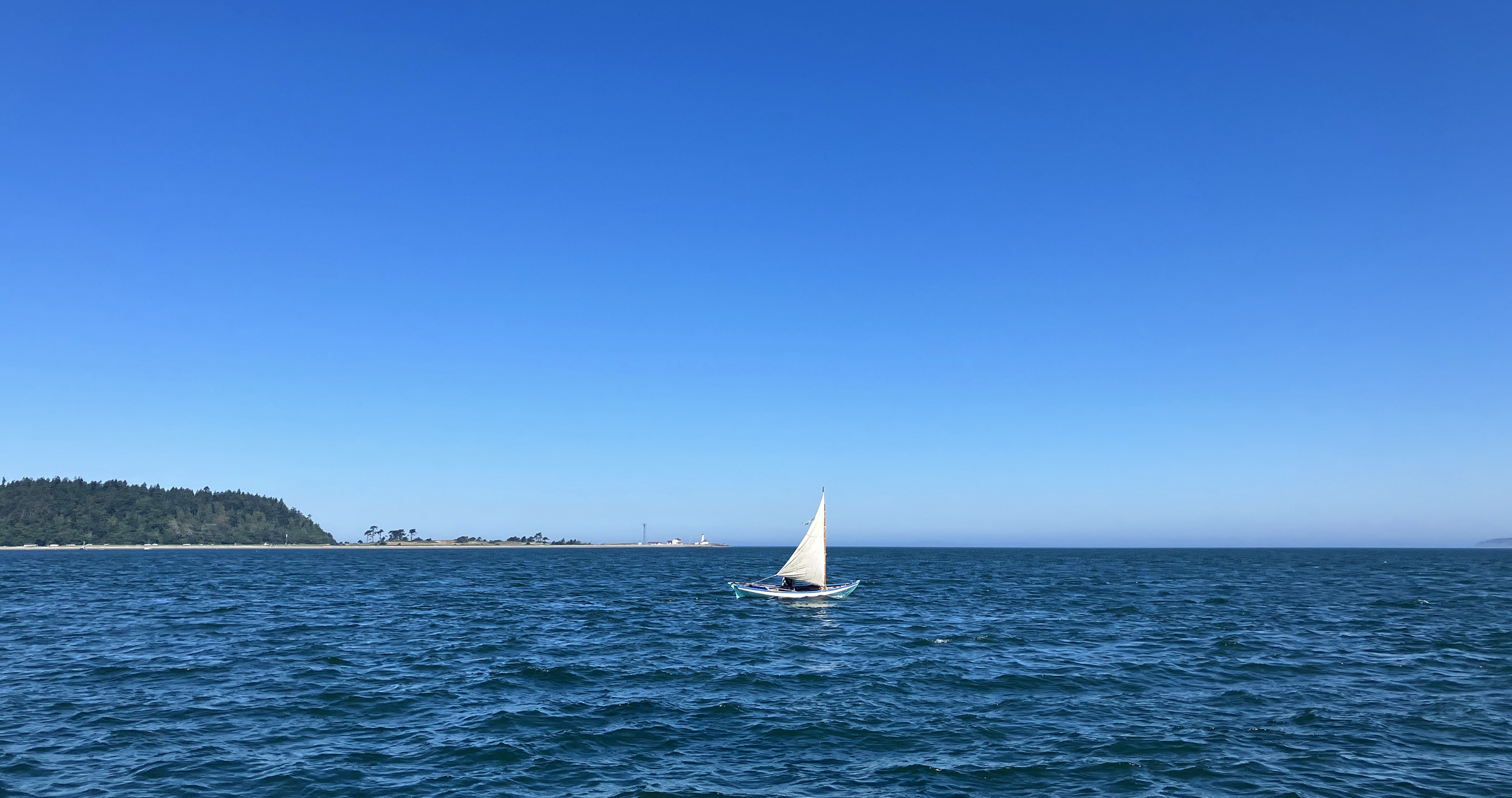
I looked back toward town and saw the classic wooden schooner, MARTHA, emerging under power from the mouth of Point Hudson, my friend Emma at the helm. Soon, they were abeam of me, and we shouted greetings across the water, our words totally swallowed by the gusting wind. They passed me swiftly and hoisted the sails before vanishing from sight around Point Partridge.
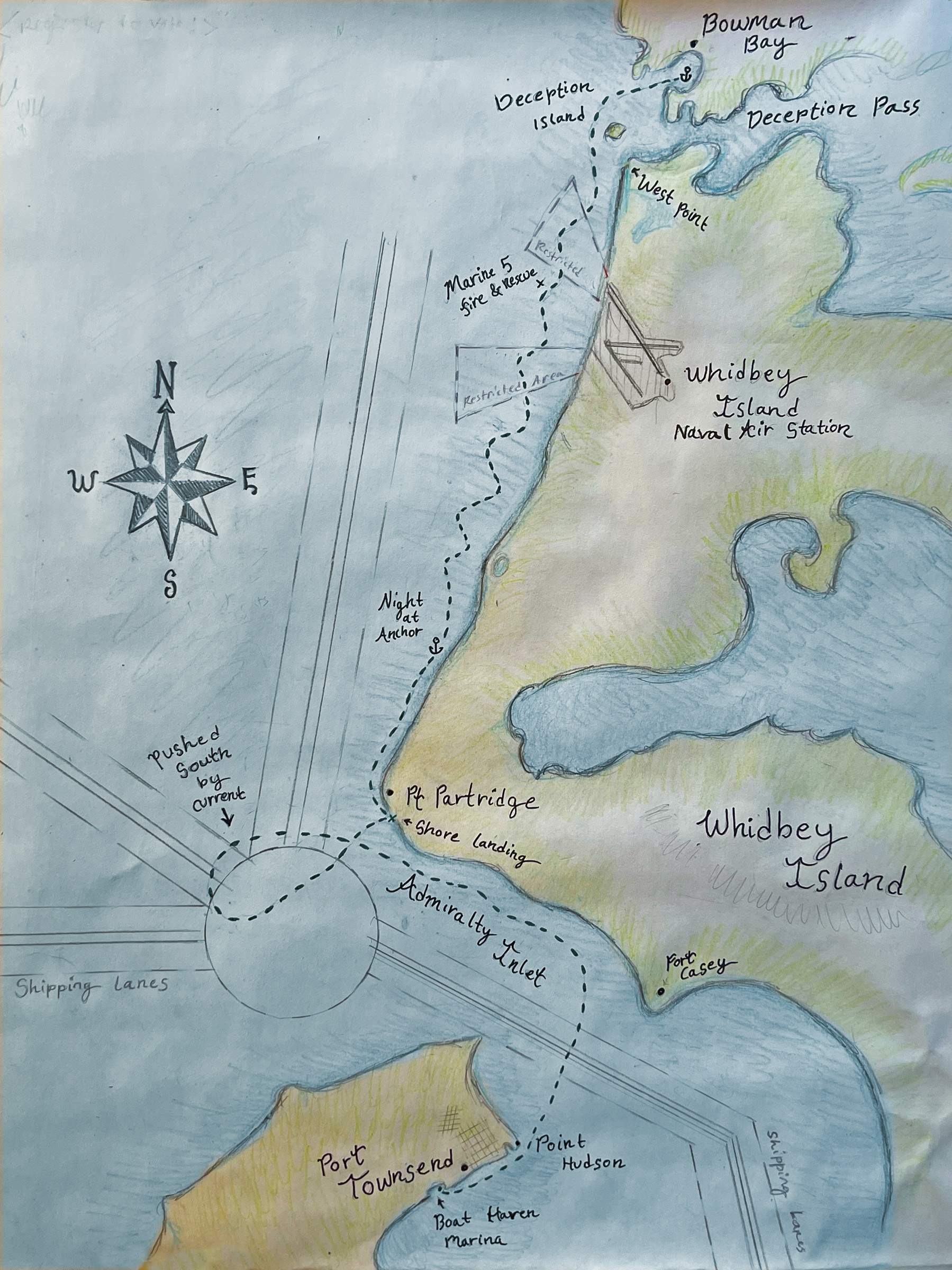
I crossed the inlet in good time and felt that I could cruise forever in the gentle 7-knot westerly, but just as I was getting comfortable, the wind died to nothing and left me bobbing off the coast of Fort Ebey. It was time to lower the mast and take up the oars. I laid the rig over the thwarts from stem to stern, just beneath the sweep of my knuckles. Pulling along in the heat of the sun I could make out some disturbance on the water west of Point Partridge and rowed toward it, hopeful of finding a breeze and being able to sail again. I arrived at the patch of riffling water and raised sail, only to discover that despite appearances, there was not a breath of wind. I was confused for a moment until it hit me: this disturbance wasn’t caused by wind but by the current. Once more, I lowered the rig and picked up the oars. We were in the still heat of midday, a haze blanketing the languid waters. I was already tired, but I had to make way to Bowman Bay, at the mouth of Deception Pass, if I was to find shelter for the night. This stretch along the west coast of Whidbey Island from Point Partridge to Deception Pass is about 13 nautical miles of blanched-white sandy cliffs with a narrow band of beach and rock at their base. When the wind picks up in the Strait of Juan de Fuca there is nowhere to hide, and the sea state can turn ugly in an instant.
 Emma Gunn
As MARTHA pulled away, Emma took a picture of me and SOLSTICE. In the distance to the northwest, the Point Wilson Lighthouse marks the entrance to Port Townsend Bay. My humble dory appears dwarfed by her surroundings, and it brings to mind the old Breton fisherman’s prayer that begins “Oh God, thy sea is so great, and my boat is so small…”
I rowed furiously, checking my progress against Mount Pilchuck in the distance and the clifftop houses in the foreground. There was no time for rest; for every inch I gained rowing, I lost two if I paused for even a moment. I was going nowhere and was baffled, I had planned to ride a narrow band of north-flowing current that cropped up after the transition from ebb to flood tide, but I was being pushed aggressively south; what was going on? I checked my chart and realized with terrifying clarity that I had totally missed the mark and was trapped south of Partridge Bank in a powerful back-eddy. The gathering strength of the flood tide would easily push me into the shipping lanes and back into the hungry mouth of the Admiralty Inlet.
By now, my rowing muscles were almost spent, my energy was failing, and I was in the thick of a situation that was fast turning dire. My only choice was to cut straight back to Point Partridge on Whidbey Island in a last-ditch effort to beach the boat and get some rest. The flood tide had gathered strength and was pulling me sideways toward the rips that were snarling up into breakers off the point. I mustered what dregs of energy I still had and rowed like a madman toward the beach. At last, in a daze, I heard the bow of the boat grind into gravel, and hopped out to drag the dory up out of the surf as much as I could. Fully loaded with all the gear and heavily built of solid wood, the boat weighed about 550 lbs, but I managed to get half the hull out of the water. I started pulling gear out, thinking that I could perhaps set up camp and stay for the night, but even as I did so, SOLSTICE turned beam-on to the waves and was pushed and rocked sideways, all the while being pummeled into the stones. Staying would not work. I threw my belongings back on board and shoved off, pulling hard to escape the breakers.
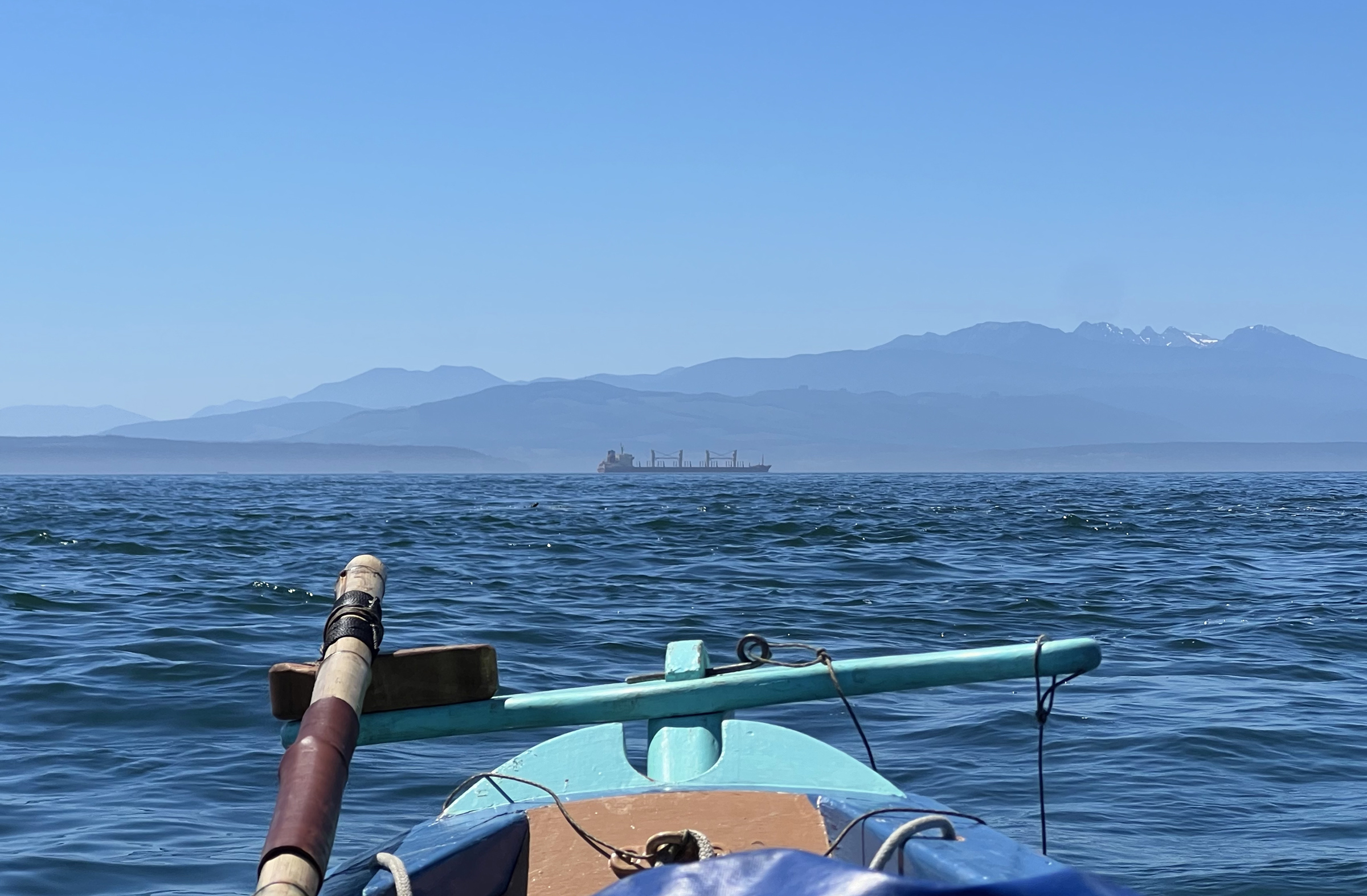
I was glad to have made it through the busy shipping lanes of the Admiralty Inlet but, before I knew it, I was stuck in a powerful current pushing me back toward the passage plied by commercial freighters.
About 20 yards from shore, I dropped the anchor and slumped down into the bottom of the boat to weigh my options. The sun was low; I had maybe an hour and a half before it would set behind Vancouver Island. I wanted to run home, but looking down the shore back toward Fort Casey, I saw that the ferry emerging from behind Admiralty Head was the size of a box of matches—it was much too far to row before nightfall. Instead, I pinned my hopes on the stretch of coast to the north: the Cascadia Marine Trail provides a few camps along the Whidbey shore, offering refuge to paddlers. But I was worried about making a landing in my relatively heavy boat—a kayak can be carried by one person, or even dragged across fist-sized stones, but not a Swampscott Dory. I had to try to find a decent landing, though, so I hauled in the anchor and took up the oars again, rowing northward.
As the sun sank low and touched the hills of Vancouver Island, it lit the pale cliffs to leeward with a fiery orange light. The large swells from the west rolled uncomfortably onto our beam, lifting us up and letting us down before crashing ashore, and still there was no landing in sight. I hoped for a miracle. I knew there was a marine camp just a little farther along. I rowed without pause, reaching the camp in the dusk, but my hopes of refuge were dashed; the shore was stony and awash with waves.
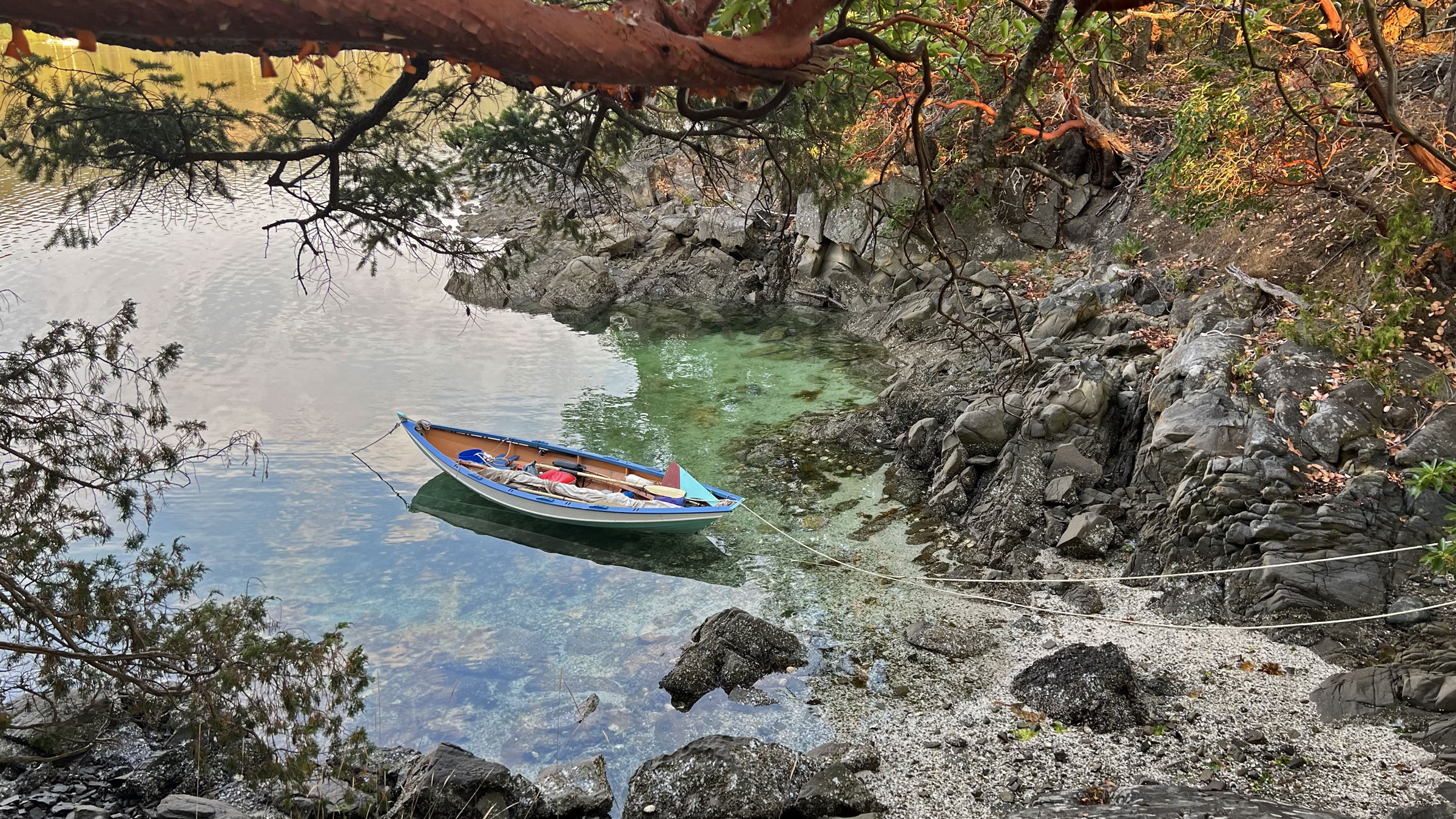
My plan for the month-long adventure was to cruise through the serene and beautiful coves of the San Juan and Canadian Gulf islands (here SOLSTICE is anchored at Saltspring Island). But to reach that cruising ground I had to cross the Strait of Juan de Fuca. Little did I realize just how challenging that crossing would be.
There was nothing for it but to pull on into the thickening night. To the north, just beyond a jutting promontory, I could see the lights of a town and prayed that the good citizens had built a sheltered boat ramp. I rowed for what seemed like hours toward the lights. At last I arrived, but with dismay found what I had dreaded: there was no way to go ashore. The “town” was simply a cluster of houses clinging to the hillside with boulders at its base. I had no choice but to spend the night aboard, fully exposed with no protection from the growing wind and swell from the west. I anchored 100 yards from shore, dumping my red 15-lb anchor and all 30 fathoms of line off the bow, and dropped the stern anchor as well to keep me from swinging any closer to the boulders that jutted out from town.
Night had fallen and all I could see were the running lights of distant ships, lonely beacons blinking on the headlands, and waves crashing on the rocks, white as teeth. My anchors seemed to be holding steady, so I put on all my clothes, pulled myself into the sleeping bag that was wet with spray, and allowed the voices scratching over the VHF to lull me into a few hours of fitful rest. I woke to the screeching sound of the VHF dying. I grabbed a pack of new AAA batteries, exchanged them for the radio’s dead ones, and lay awake in the pitch black of night as the wind gathered strength. The boat pitched up and down; spray burst over the bow and soaked me with saltwater.
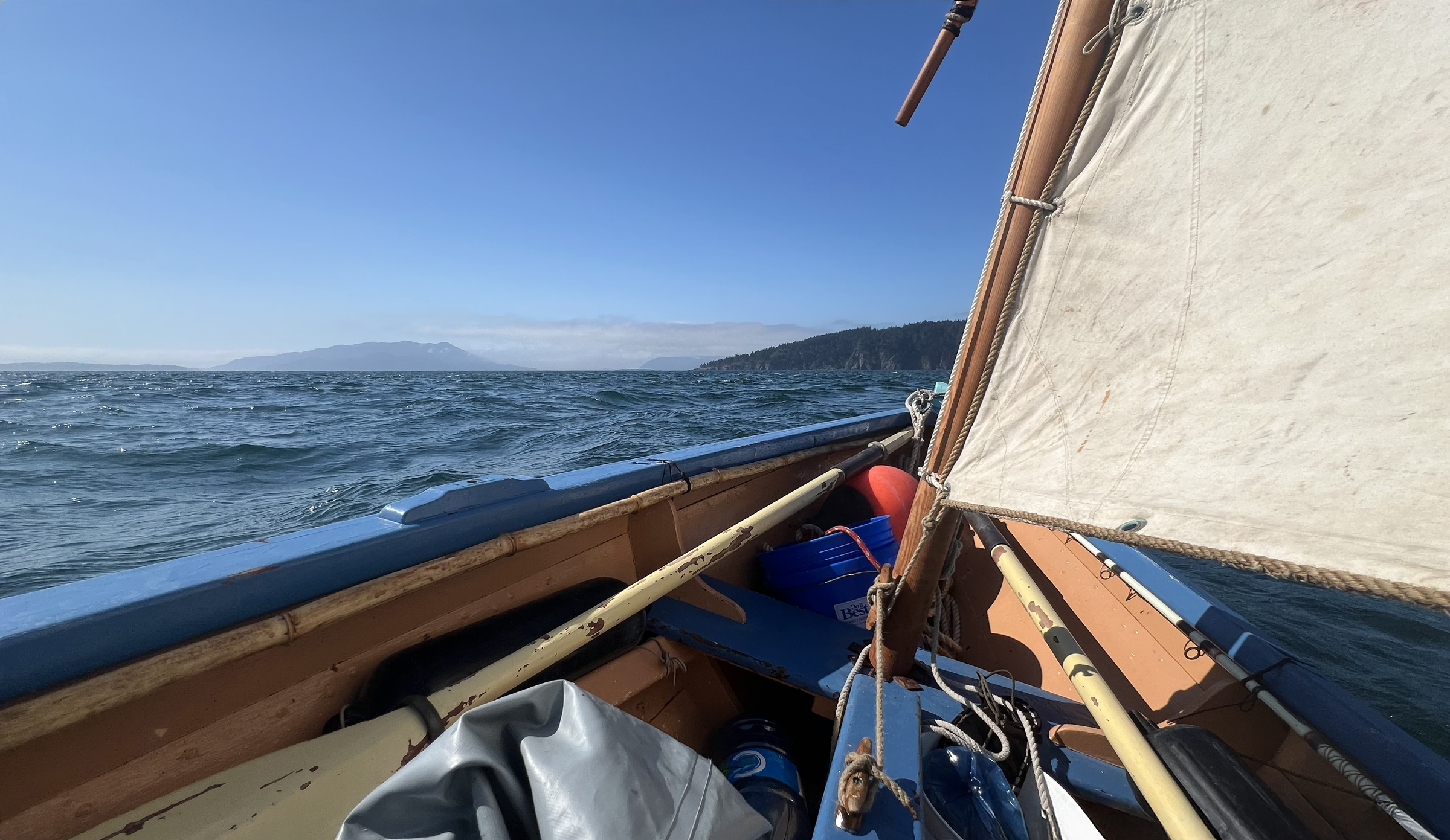
SOLSTICE sails best when loaded with gear and heeled slightly in winds of 7 to 12 knots. However, during my scramble to reach Bowman Bay in the building winds, I wished I had added reef points to the sail.
The color of gladness is the faint light of dawn when you’ve had a troubled night, as the blackness behind the stars gathers shades of silvery blue. There were about 9 miles between me and Bowman Bay, at the mouth of Deception Pass, where I knew for sure I could find shelter. I had no time to waste. For now, the currents would be in my favor, but in a few hours the tide would turn, and if I hadn’t reached Bowman before that, the ebb would run against the wind and whip up steep and deadly breakers.
I was frightened by the strength of the wind and considered rowing—I hadn’t yet tested my homemade rig in winds this strong. But as I mulled over the chart, and calculated the distances, I realized that if I rowed in those waves, my progress would be too slow, and I’d never make it in time. Sailing would be perilous, but unless I braved it, I would be at the mercy of the currents and the building snarl of weather.
 Colin Schehl
.
In the dim light of dawn, I stepped the mast and hauled in the stern anchor. As she came free SOLSTICE swung madly in the confused seas. I was distressingly close to shore, some 30 yards off, with an onshore wind. I knew that I had only minutes to run the lines, lower the centerboard, raise the anchor, and grab the tiller before SOLSTICE was dashed against the rocks. I staggered forward, fell, broke the fishing pole, regained my footing, grabbed the rode, and started hauling. I felt for the markings as they passed through my hands—30 fathoms, 15, 10—and as I hauled, I piled the line into a bucket. Fathom by fathom I heaved us forward, SOLSTICE leaping and falling in the building swells, her bow, like a gaping pelican’s beak, taking great gulps of seawater. At last, I felt the anchor break free and hauled as fast as I could, bringing it in over the bow. As I moved back aft, I struck the brail line, and ducked as the sail billowed open and flogged violently. I fell again; this time my knee broke through the large plastic drinking-water jug. I hurried on to grab the sheet, ran it through the block, and belayed it to the pin. We were rolling ever closer to the shore, the menacing roar of breaking waves mere feet away. I had no time to feel afraid, I just had to grab the tiller. SOLSTICE bore away, held fast, and leaped on a cresting swell. In an instant we had left behind the desperate scramblings of an unhinged creature and become a great seabird surfing the swells. Like a crazed cowboy, I howled into the wind, “Yeehaw!” I didn’t know SOLSTICE could go so fast.
We were heading downwind with following seas, and surfing the steep faces of the rolling swells making one terrifying jibe after the next. It took all the strength I had to keep us from broaching and capsizing into the gurgling troughs. One hand on the tiller—I hope it holds!—the other on the sheet, my muscles shaking, I kept watch behind me to time the swells. A dark 5-footer loomed high overhead, its white top bearing down before it lifted us up toward the sky and broke with a resounding crash over the stern. The cockpit was flooded above the gratings, I was soaked from head to toe. I kept to my post, holding on for dear life, fighting the impending broach, turning the stern into the white-capped crests and then swerving, serpent-like, to surf down the face of the swell at an angle.

Much of the coastline in the archipelagos of the Salish Sea is rocky. In sheltered areas (such as this marine-trail camp at Point Doughty, Orcas Island) this poses little threat, but in strong winds on the exposed coast of Whidbey Island, a dory could be dashed to pieces.
We kept up this perilous dance in the moody predawn until, at last, a dazzling light broke over the ridgeline to the east. Brilliant in the morning haze, the sun was like a guardian angel with a crown of rays coming through the treetops, glinting off the metal hangers of the Whidbey Island Naval Air Station, turning the swells into piles of sparkling treasure that lit my eyes as a smile stretched across my lips.
I took a moment to study the soaked waterproof chart book and realized I was entering a restricted area just off the naval base where they frequently fire live ammunition, but with the weather worsening I didn’t dare head farther out into the strait. I carried on. The sun had now fully risen, illuminating the haze of a building fog and the spray of whitecapped swells with a luminous luster.
And still the wind was strengthening, as though the sun was inhaling a great morning breath. Then, off my port bow, I saw a vessel approaching. Rising out of the mist, it was headed right for me. I could make out an orange, semi-rigid, inflatable hull with an aluminum pilothouse: Marine 5 Whidbey Fire and Rescue. Right on cue my VHF once more squealed its low-battery warning and died. With two large outboards, the rescue boat came up to me in no time. They slowed some 10 yards off in my lee. There were three crew: the captain and two others. One of the crew came out of the pilothouse to yell across to me.

As the wind gathered strength, sailing SOLSTICE became very exciting. I was surprised by how well my makeshift creations held up to some of the more extreme weather of the voyage. The push-pull tiller is a piece of bamboo salvaged from the side of the road. It is attached to the rudder with seine twine. The old canvas sail was found at a marine thrift store, and the spars were made from planking offcuts destined for the burn pile.
“Are you OK? Do you need help?”
I yelled in response, “I’m fine!”
He turned back to the captain, exchanging a glance, and then back to me, “Are you sure?”
“Yeah, I think I’m good!”
It was a real challenge to hear each other over the wind and the roaring sea.
“OK, well, we are going to tag along for a little bit anyway.” I gave them a thumbs-up and went to work to change the batteries in my VHF. Rifling through my dry bag to retrieve the batteries while using my teeth to unlock the battery cover on the Standard Horizon, the radio’s battery pack sprang loose, and fell into the bilgewater where it sloshed around at my feet, “Damn it, man!”
The rescue boat was matching my speed, motoring just astern of me to starboard, witnessing my indelicate ballet; somehow I kept the boat under control.
Once more they pulled up alongside.
“One more question: the Coast Guard wants to know what your intentions are!”
It was a good question.
“I’m heading to Deception Pass to get some shelter!” I yelled back.
Nodding the affirmative, they dropped back again.
I blew the seawater out of the battery pack, crammed it into the crook of my hip, and fed in the batteries. The rescue boat came alongside again.
“Sorry to keep bothering you!” This time it was the captain, leaning out of the cabin window.
“What’s your name and phone number?”
“Colin Sch…”
“Tom?”
“No! Colin Schehl! Like seashell!”
He nodded.
“My number is: Eight-Zero…”
“OK!” he yelled back, and jamming the throttle forward he turned the boat toward Deception Pass.

The relief I felt when I tied up at the dock in Bowman Bay was immense. I was enveloped by calm and yet, just minutes before, I had thought that SOLSTICE and I would both be swallowed up by the sea.
Deception Island, a tree-covered hump of stone the size of a modest hilltop, was half a mile dead ahead, and beyond it was the mouth of Bowman Bay where I hoped to find some protection. I wanted to take the more direct route between Deception Island and West Point, which shouldered out toward the island, making a narrow passage, but the shallows kicked up the swells into breakers; I would have to go around the long way, to the windward side of the island. I clawed my way past, holding my breath; the tide was shifting from flood to ebb, and things were about to get very ugly in Deception Pass. The swells were already steep, and I could feel them getting steeper. The VHF crackled to life; it was the captain of the rescue vessel radioing my information to the Coast Guard.
“We’ve got a Colin Schehl heading east through Deception Pass in a small, open boat.”
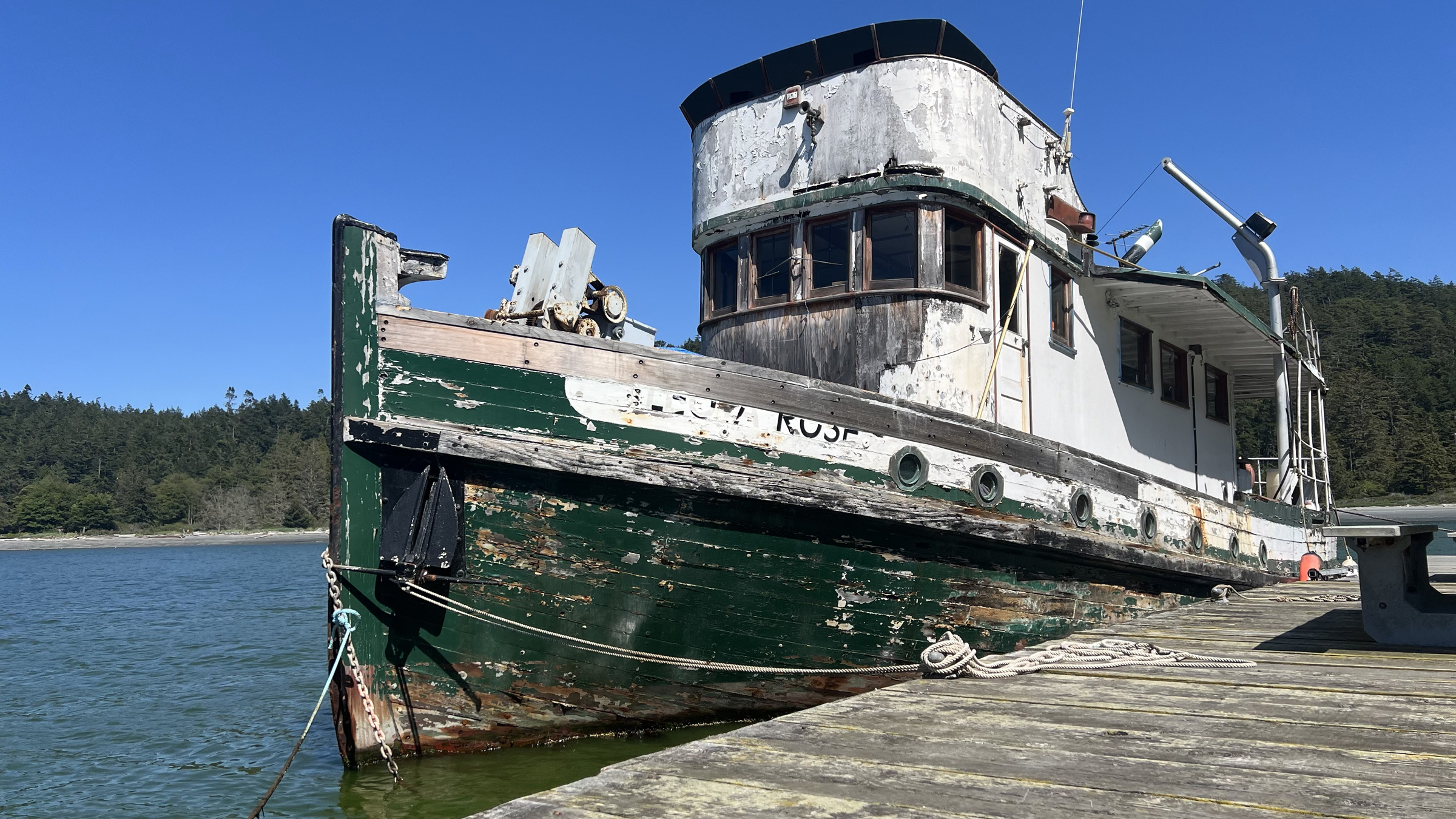
The decrepit wooden trawler with which SOLSTICE shared the dock had been a liveaboard for many years before being abandoned in Bowman Bay.
The static took over, and I laid the radio down. I was nearly around the island now and could see the mouth of Bowman Bay opening up before me like the gates of heaven. There would be one more perilous jibe to bring SOLSTICE dead downwind toward the mouth of the bay, careening down the steep faces of the whipped-up swells. The tide was on the turn, and the sea was growing mean. I was so close, but this was perhaps the most precarious moment of all. I held onto the tiller for dear life and prayed that nothing would break as we flew into the bay and, at last, calm.
In the lee of the bay’s southern headland was a floating dock with a decrepit fishing vessel tied to it, its lines thick with moss, looking thoroughly abandoned. Leaving the mast stepped I brailed in the sail, took up the oars, and rowed up to the dock, tying off on the other side from the ghost ship. Out in Deception Pass a heavy fog bank was rolling in. Had I been out there for half an hour more, I would have been swallowed up in the thick gray cloak. I began laying out my sodden possessions, dripping and briny in the bright morning sun. Then, with everything spread out to dry, the exhaustion came over me like a lead blanket. I reached into my first-aid kit, found a tiny bottle of whiskey, raised it in salute toward the mouth of the bay, and brought it to my lips. Tipping it up, I took a fiery gulp, felt the fuzz spread over me, and laid down to rest in the warmth of the sun. Immediately, I fell into a dreamless slumber.

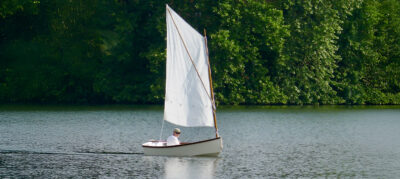
While battling the elements and fighting for survival, I had sworn that I would sell SOLSTICE as soon as I reached shelter. But the resolution quickly faded once we were safe in Bowman Bay, and together we went on to cruise the San Juan and southern Gulf islands in British Columbia for a good month. The dory is well-suited to inshore cruising: with its shallow draft it can navigate very shoal waters—as here, moored at Wallace Island—and the boomless sprit rig can be swiftly doused thanks to the brail line.
I woke an hour or so later. A group of kayak tourists were floating a few feet off, gawking. They must have been wondering if I were dead or alive. As I lifted my head they quickly shifted their gaze, the guide resumed his spiel, and they paddled away. I sat up and took stock: my gear was strewn about me, caked in salt, and my trusty dory was quietly moored beside me. A few hours earlier, when I’d been out in the thick of it all, blown around by the winds and tossed over dark swells, full of exhilaration and dread, I had sworn that the minute I got to safety I would end the trip and sell the boat. But, somehow, a nip of whiskey and an hour of sleep had changed everything, or maybe it was the beauty of the bay around me, its teal water glistening brilliantly below the mossy conifers on the cliffs. Or was it the rig, which I had built from scrap lumber and thrift-store canvas, and which had weathered the winds so well? Or perhaps the trusty dory herself, that had surfed the swells and carried me to safety? Whatever it was, I now felt purged of fear and misgiving, I was ready to go farther into the maze of channels and feel the pulse of the ever-changing wind and tides.
Colin Schehl is an artist and craftsman who lives on the Olympic Peninsula in Washington State. He and his partner can often be found plying the waters of the Strait of Juan de Fuca in a small wooden dory, fishing and sailing, when they aren’t growing flowers and food or chasing swarms of honeybees through the forest.
For more adventuring in the Strait of Juan de Fuca, see “The Heart of a Cruiser,” “Seventy48,” “Rowing the Seventy48.”
If you have an interesting story to tell about your adventures with a small boat, please email us a brief outline and a few photos.


Thanks for this article!
I’ve got a small Swampscott that’s used on the sound also. But we’ve taken her nowhere near this level of adventure.
It’s also nice to hear someone enjoying their backyard and using the materials at hand. Specifically, the bamboo tiller and thrifted sail.
Great article! And some of the accompanying images are really superb – particularly the one of SOLSTICE anchored at Saltspring Island. Thanks
Wow, that was an exciting read. Would love to hear more about the rest of the trip.
I agree! I want more.
“It’s a damned tough life, full of toil and strife, we sailor men undergo,
and we won’t give a damn when the gale is done, how hard the wind did blow….”
I was inspired by your tale of toil and strife and intestinal fortitude to carry on.
Fair winds and calm seas.
Your account of this event was beautifully-told, and vividly brought me back to my recent experience in the WA360, alone in my little trimaran dinghy. Tidal currents can be such a formidable thing when your top speed rowing is only 3 knots and your “metabolic gas tank” hits “empty”. Ahh, and that anxious dread to be caught out in dangerous conditions with no safe harbor in reach as the setting sun plunges the wind-whipped seas into darkness. Been there, done that. And finally, those “deals” you make with yourself and your deity that if you just make it through this ordeal, you’ll never, ever, EVER do ANYTHING like this again–at least not until the morning, after a hearty breakfast and mug of coffee.
Your article brought that all back! Thanks!
That’s a hairy stretch of shoreline along the west shore of Whidbey Island. I’ve contemplated trying it but haven’t worked up the courage. I want to circumnavigate Whidbey Island in my 12 ft. SF Pelican starting from Port Townsend, and if I do, that section of shoreline has to be done (unless I chicken out and trailer up to Bowman Bay).
Reading this account put me on edge, thinking of my own adventures in an open boat. I find the banner photo symbolic of a risky approach to coastal sailing – a wire pin holds the tiller bar on the rudder. It looks like it is secured mostly by friction, and maybe a bit of a hook at the end. Going into an offshore environment like the Strait, I would want to reduce such vulnerabilities as much as possible. The article describes beautifully in honest detail how quickly things can go wrong.