When I built my 17′ 6″ Antonio Dias–designed Harrier, FALCONE DE PALÙ, the plans included the option to build it with a centerboard or a daggerboard. The Harrier has a plank keel and 6” draft with board and rudder raised, which is perfect for my boating in the “thin water” of Italy’s Venice Lagoon with all its sandbanks and mussel-covered shoals. At first glance, a pivoting centerboard seemed to be the best choice for the area, but I wanted to use the boat for camp-cruising and thought the designed centerboard trunk would take up too much room in the cockpit. The floorboards, resting 8″ above the plank keel, make a suitable sleeping platform and the cockpit is spacious, with only side benches and a removable rowing thwart. But that space would be compromised by a long centerboard trunk in the middle of the boat. A centerboard trunk can also become blocked up by sand and grit when beached, sometimes rendering the board immobile. Perhaps a daggerboard would be a better answer—it would take up less space and wouldn’t jam so easily. But in areas where you all too often hit bottom, a daggerboard that can only go straight up and down is unforgiving and liable to break. I was not keen on that option either.
 Photographs by the author
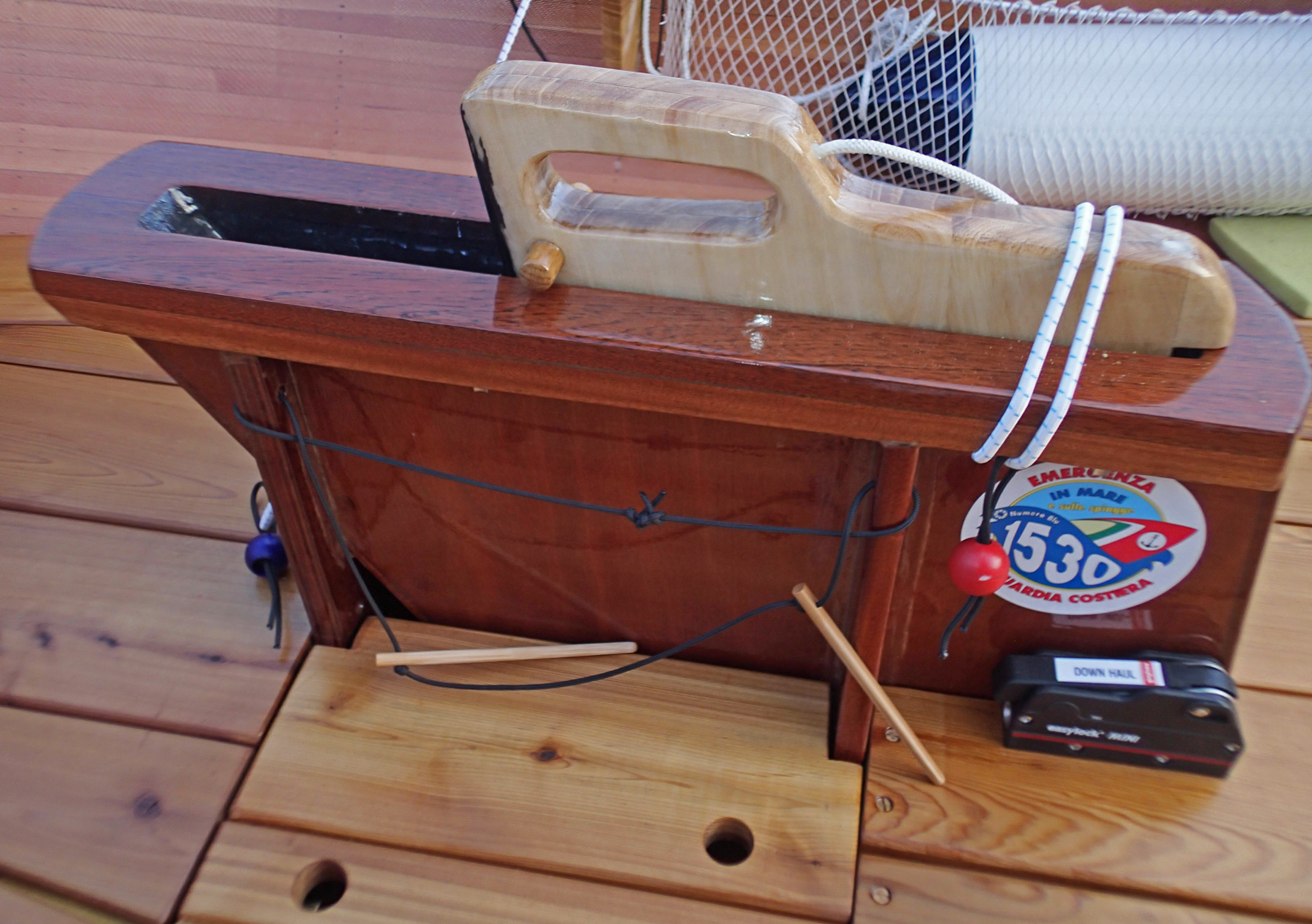
When all the way down, the board is vertical in the trunk and held in position by the bungees. Preventer buttons on either side, below the handle cutout, keep the board from being pushed too far down into the slot. To avoid scuffing the varnish on top of the trunk, the buttons were later covered with short offcuts of garden hose.
Coming up with a solution was a lengthy undertaking, but I was inspired by two articles in WoodenBoat No. 164. One was by Robb White, the other by Lang Warren, and both described pivoting daggerboards. Dias, in his drawings for the Harrier, did show an angled daggerboard case that would allow the board, like White’s, to be pivoted back for broad-reaching. I wanted a daggerboard that could not only swing back if it hit a submerged obstacle, like Warren’s, but also would pop up when struck. Many centerboards and daggerboards are weighted so that they go down through the trunk by themselves. Others are somewhat buoyant and are held down by a bungee stretched across the top of the board. I set out to design a daggerboard that, upon striking bottom, would free itself from the restraining bungee and have enough buoyancy to then raise itself high in its trunk and clear the obstruction. It would call for using a very light wood and a good amount of volume.
Designing the pivoting daggerboard and its trunk
 From a drawing by the author
.
To construct the board, I used two pieces of 3⁄4″ paulownia, a lightweight, easily worked, straight-grained wood. After laminating the two pieces to give an overall thickness of 1 1⁄2″, I planed and sanded it to an airfoil profile. I applied epoxy to seal the board’s surface and, to reduce friction, applied several coats of an epoxy-graphite composite to the edges of the board.
Next, I built the daggerboard trunk, shaping it to allow the board to pivot. The after edge of the trunk is vertical and perpendicular to the keel plank; its bottom corner is rounded to avoid damaging the trailing edge of the daggerboard when it swings back. The opening at the base of the trunk is 13 1⁄4″ long—14″ with the rounded aft corner. The forward post is sloped at an angle of 45°. The top opening is 19 1⁄2″ long—the maximum width of the daggerboard is 11 7⁄8″. The interior width of the trunk is 3⁄16″ greater than the thickness of the board and all interior surfaces are coated in the friction-reducing epoxy-graphite mix.
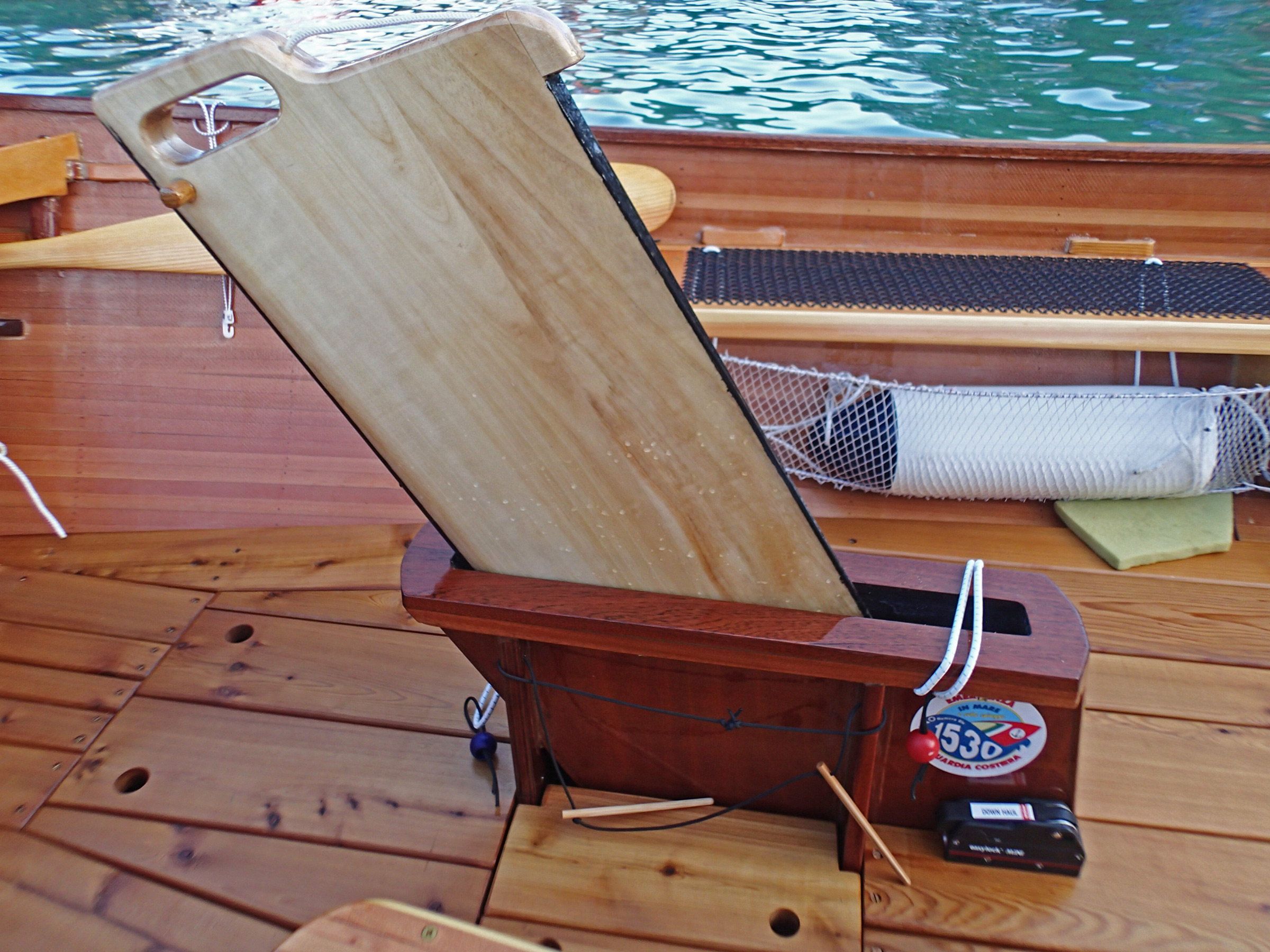
The lightweight construction and high volume of the daggerboard give it positive buoyancy so that it will float high in the trunk. To deploy the board for sailing it must be manually pushed down and held by bungees, seen here crossing the slot behind it. Both the leading and trailing edges of the board are protected by a layer of a low-friction mix of epoxy and graphite.
The lightweight, buoyant daggerboard is prevented from being pushed through the trunk by a wooden button on both sides at the top of the board near its leading edge. The board is held down in the vertical position by bungee cords stretched taut across its top from side to side at the after end of the trunk. If the daggerboard hits a submerged object, its leading edge is forced back. As the board pivots, its top is forced out from under the bungee cords and the board continues to pivot forward and up approximately 18″ along the sloped forward post of the trunk. From there it can be manually raised as much as necessary. The automatically pivoted 45°/18″ position is also ideal for sailing on a broad reach or run, and the desired draft can be further adjusted and held by a second pair of bungee cords, attached to the side of the trunk. When the board is raised and forward these cords are stretched behind the trailing edge and provide enough friction to keep the board in place.
The pivoting self-raising daggerboard has proven to be an efficient and elegant solution, and I am more than content with the results.
Detlef Arthur Dücker grew up on a small lake in Carinthia, Austria, surrounded by boats. He built his first sailboat when he was 20. A former American Canoe Association Open Canoe Instructor for solo and tandem canoes, he took several canoe trips on the Allagash Wilderness Waterway in northern Maine and paddled with the Cree and a Maine Guide on the Temiscamie river in Northern Québec. After three years of building, he launched his Harrier—the 17’ Dias-designed Expedition Wherry—in 2017. He has sailed it in many regattas for traditional wooden boats in the northern Adriatic Sea. This summer he acquired a well-maintained 50-year-old catboat.
You can share your tips and tricks of the trade with other Small Boats readers by sending us an email.






This is the system I use although my DB isn’t light enough to float up and it does get dinged when it hits a rock. I have a simpler not as pretty handle made of rope. I also have a filler block that I use when rowing. I found my DB works well as a removable thwart when I row double and need to use an after rowing station. A combination of the curve of the foiled shape daggerboard and the slight upward pitch of the quarter seats provides plenty of friction so the DB doesn’t shift when weigted. ( point loading )Tony Dias and I worked out this DB trunk from what I’d been using in my International Canoe.
Watching the DB pivot and pop out of the trunk was most impressive!
Very clever. I like your system. Probably easier to do than pouring lead like we did for the centreboard.