Some things I was able to imagine: I imagined that training for the race would be a bonding opportunity for me and my 38-year-old son Ben; I imagined a fine-lined rowboat slicing through lumpy seas and skimming over flat water; I imagined a test of physical and mental endurance; I imagined that, at the age of 69, rowing 70 miles would be unpleasant and painful.
What I was not able to imagine was the fire in my palms, the thickness in my thighs, the blaring in my back. Nor did I foresee the anticipated relief of the final approach to the finish turning into the most grueling leg of the race.
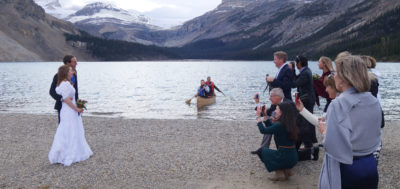
In the hours before the race, Ben and I had focused on rigging each piece of gear. Nineteen family members and friends had gathered on a pebbly beach, bubbling with laughter, their faces lit with excitement. Surrounding us, nearly 100 human-powered boats were organizing for the starting horn that would announce the 48-hour period in which they had to complete the 70-mile course. We had made it; we were part of the 2025 SEVENTY48.
The long road to Tacoma
I had first thought of taking part in the SEVENTY48 when my father and I attended the Port Townsend Wooden Boat Festival in 2019. He and I were building a wooden gaff cutter at the time, but when I heard about the second annual SEVENTY48—a time-limited race from Tacoma, Washington, to Port Townsend, Washington; 70 miles within 48 hours—I was captivated. There were only two barriers between me and the start line: I didn’t know how to row, and I had no boat in which to learn. But I was hooked.
 Janine Herbertson
 This model, at a scale of 1:4, was the last in a series of development models that enabled me to visualize the design and refine the lines. Thin wooden battens helped to produce fair curves, and the station molds generated patterns for the full-sized molds. My father, Gary (left), was interested in the process and always happy to discuss the pros and cons.
In my mind I ran rowing simulations of quartering into the waves, or feeling them rolling in off the beam, or surfing down their faces. I saw ripples, rollers, breakers. I imagined the worst conditions in which a boat could possibly be rowed, and how a rockered hull with full bilges would bob over the waves. I envisioned a long boat rowing through glassy conditions, and how the water would split open at the bow, gurgle along the sides, then heal together as the stern passed by. A boat design slowly came together in my mind, and I looked for it among the many plans offered online. Established boats did include some of the features I had visualized, but none of them had everything. I would have to design and build my own.
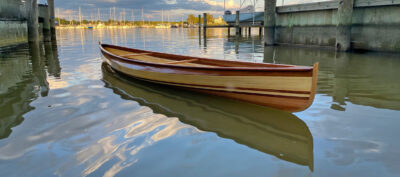
I fantasized for four years and then, eventually, spent several months drawing lines and building increasingly large models until, at last, I had what I considered the perfect boat for the occasion: a 22′ rowing wherry strip-planked in 1⁄4″ poplar, and sheathed with 6-oz fiberglass cloth set in epoxy both inside and out. It had high fore and stern decks, a plywood coaming, accessible flotation compartments fore and aft, and a breakaway skeg. It was built for two rowers, but could be used for solo rowing during training. I installed Piantedosi RowWing rigs, which have seats that remain fixed while the outriggers and stretchers slide—they promised a powerful rowing stroke without causing the boat to pitch out of trim.
 Samantha Stettler
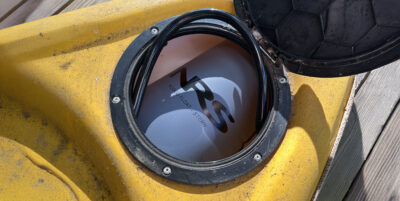
Ben, left, and I coated the 1⁄8″ plywood decks in 6-oz fiberglass cloth set in WEST Systems epoxy. The hull’s fiberglass-wrapped monocoque skin distributes loads without the need of frames other than four bulkheads—two in the bow, two in the stern. These enclose airtight flotation compartments in both ends, accessible by waterproof deck hatches. During the race, we used these compartments to store tools and spare parts.
We launched OTTER in Lake Mendocino, the closest body of water to my home in Ukiah in Northern California. Ben and I were exuberant as we climbed aboard. But instead of rowing, our oars clashed as if in some aquatic sword fight. We couldn’t even row away from shore. We each tried to row on our own, only to prove that neither of us could manage the 9′ 6″ oars in their sliding riggers. We had had no idea that rowing would be so challenging.
We persevered. After six practice sessions I thought, “I will eventually learn how to do this.” After 15 sessions I realized, “I’m starting to get this.” Then came Ben’s unexpected heart surgery, a devastating setback, but eventually we would be grateful for another year of training.
At last, we were in Tacoma and felt ready. Ben and I stowed all of our gear for hydration, navigation, safety, and foul weather. Then six of us lifted OTTER off her stands and into the cold water. Ben and I stepped aboard.
Ben, rowing stroke, gave the command, and we nosed our way toward the race fleet. It felt like the end of a long migration, finally settling in with the gaggle of boats to which we belonged. A canoe slid by with more than a dozen young women singing as they paddled; near us was a decked catamaran with four people seated on an elongated bike frame ready to peddle their way to Port Townsend. Racers with backpacks stood casually on paddleboards. Kayak paddles flashed like dragonfly wings. Rowboats held position in the gentle current.
The shouts and cheers of onlookers grew louder, climaxing with the final countdown to the 7 p.m. starting horn. We were off. The waterway burst into a frenzy of paddling, pedaling, and pulling as the motley flotilla surged toward the open water of Tacoma’s Commencement Bay.
The 2025 race
Ben and I leaned into our oars. Each pull accompanied one complete exhalation, each recovery stroke a full inhalation. Despite the cool of the evening, my skin prickled with sweat. We found our rhythm quickly, and pulled with more vigor than on most of our training rows. We planned to spend the first hour in Zone 3 cardio (70–80% of MHR—maximum heart rate), and in our excitement we easily locked into that level of effort. We used chest-strap heart-rate monitors that displayed on our separate smartphones, Ben’s mounted in the navigation console, mine attached to my rowing rig.
 Mark Cole
The 2025 SEVENTY48 race hosted a strong field of 99 teams, of which 72 finished. The weather was calmer than it has been some years, but it was also hot. The winning boat, a Carbonology Triple Surfski paddled by Rich Long, Rob Pelkey, and Dave Jensen (seen here at center bottom), finished the 70-mile race in 10 hours, 9 minutes. The last finisher was Taylor Harper rowing a Northeaster Dory, who came home in 44 hours and 33 minutes.
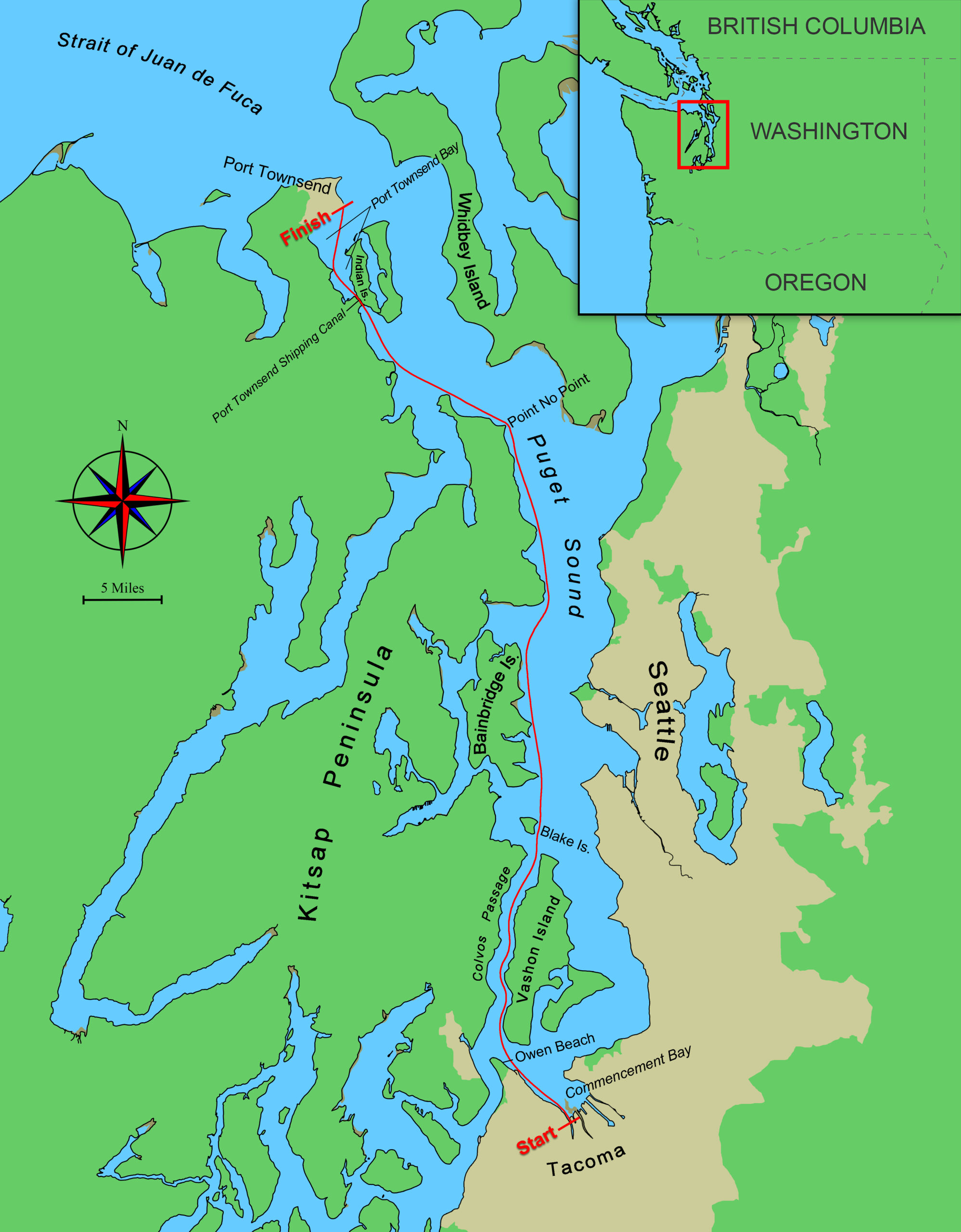
An hour brought us near Owen Beach, the first checkpoint where all boats were required to pass between an anchored powerboat and the close shore. Supporters rang cowbells and cheered us on. We rounded the checkpoint and headed into the broad waters beyond. The sun disappeared into wooded hills. Only a handful of boats were visible ahead or behind. Ben and I dropped into Zone 2 cardio (60–70% MHR) and settled in for the long haul.
Dusk and the rising moon accompanied us into Colvos Passage. In the moonlight we could easily see both the shores of Vashon Island to our starboard and the Kitsap Peninsula a little less than a mile away to port. In the 14-mile-long, 1-mile-wide passage there was an eerie quiet. Reflections of the lights on shore stretched across the water in bright parallel lines. Our narrow wake murmured quietly away. Behind us in the shiny water we dragged a long, narrow V dotted with two pairs of widening rings created by our oars, a beaded necklace that stretched out in the moonlight as far as we could see.
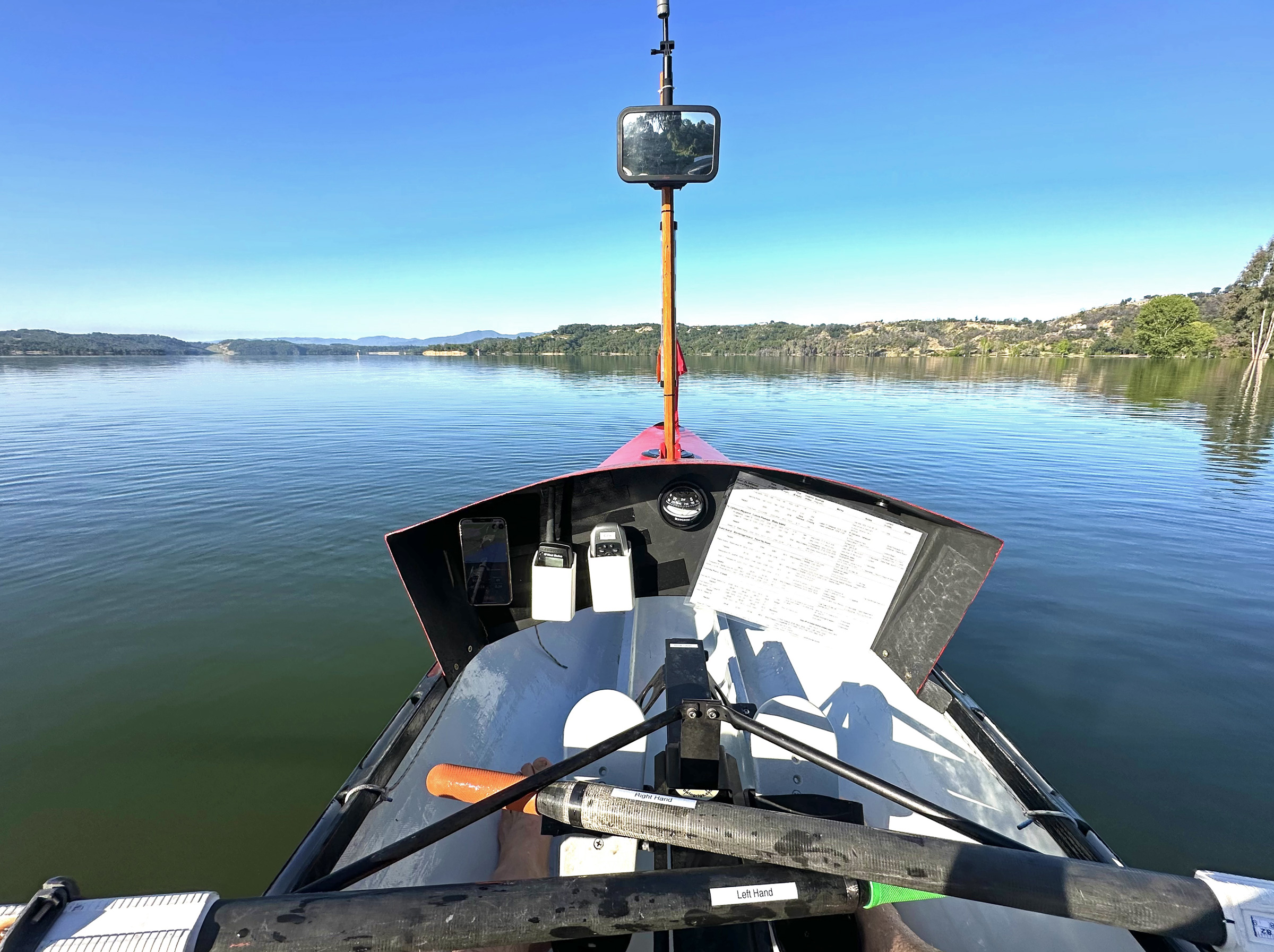
From his aft position, Ben consulted the route-plan spreadsheet mounted on OTTER’s navigation console. Illuminated with red lights, the plan detailed the buoys we would encounter, the bearing to each one, the color and timing of their flashing lights, and our anticipated time of arrival at these waypoints at three different boat speeds. The console also held our VHF radio, compass, binoculars, and the phone that displayed both our GPS location and Ben’s heart rate. Ben frequently twisted around in his seat to look forward and make decisions about our course. Then he could use our forward-view mirror to maintain that course. Navigation in the unfamiliar waters challenged us throughout the night.
 Roger Siebert
.
As we left the confines of Colvos Passage and pulled out into the 6-mile-wide expanse of Puget Sound, a brightly lit ferry bore down upon us. Our course put us directly in its path, so we backed up and waited. We believed our radar reflector would light us up as a vessel to be avoided, but we were not about to test the theory. That encounter was the first of six ferry routes that brought confusing dangers through the night.
We passed Blake Island to port at 11:55 p.m. We had rowed without ceasing for almost five hours. To maintain the rhythm of rowing, we had established a protocol that would give us each a specified time in which to attend to our personal needs. On each hour and half hour Ben would call out the time, and I would ship my oars. I could drink 4 oz of water mixed with maltodextrin and electrolytes, sip some more water or coffee, pee, pull on a warm layer of clothing…do whatever I needed in three to five minutes. Then I rejoined Ben for a few strokes, before he shipped his oars to do what he needed. Thus, we kept the boat moving without interruption all night.
Beyond Blake Island
On our next break, Ben asked me to check the tracker app. Each SEVENTY48 crew rents a tracker from the race organizers, Northwest Maritime, which shows every boat’s position on an app or web browser. Our supporters on shore could follow us in real time and we could keep track of our competitors. I duly checked the app and discovered that only 13 boats had rounded Blake Island before us. Our route plan showed that our pace to Blake Island had been 5 knots.
We headed into more open water, crossing to the southern tip of Bainbridge Island, the one-third waypoint for the course.
 Basin Herbertson
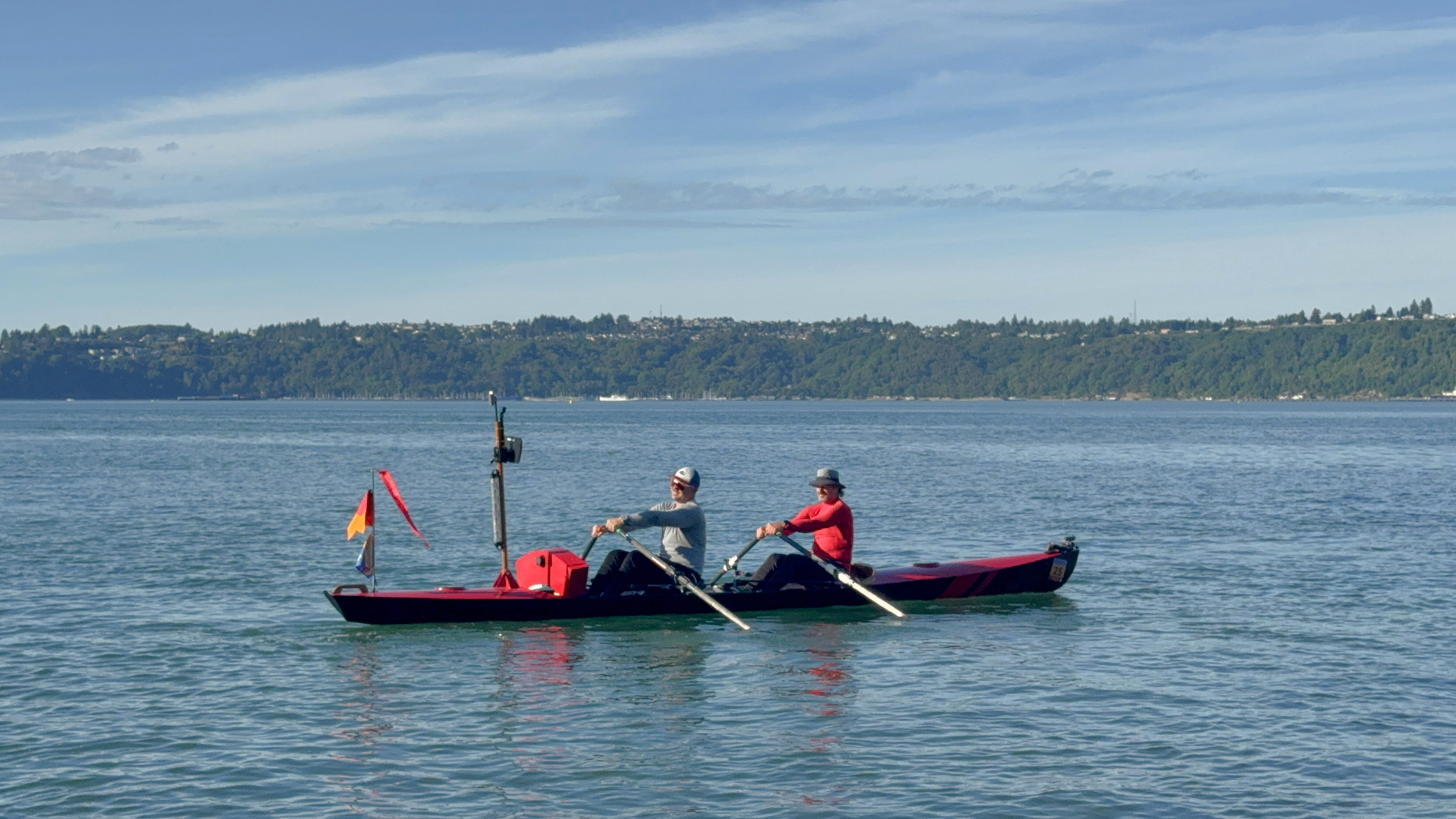
OTTER can be rigged for single or double rowing, whether training or racing. Here she is rigged as a single for competition, complete with navigation console. On the mast are a front-view mirror, nighttime running lights, a radar reflector, and a video-camera mount.
From my bow seat, I looked east to the lights of Seattle. Towering buildings, covered in shiny gold scales, were topped by bands of colored lights: red, blue, purple. I watched as the crown of one of the buildings waxed and waned from red to blue to red. The 605′-tall Space Needle stood majestically alone, its slender tower and flying-saucer-like top sparkling in the darkness. The dense play of light in the surrounding blackness captivated me. Then, as I watched, the lights of Seattle began to turn off. Skyscraper after skyscraper shut down, blackness relentlessly devoured the cityscape. Was I witnessing the apocalypse? Incredulous, I watched the entire city fall into utter blackness. Perhaps I was hallucinating from sleep deprivation and fatigue. Then the southernmost skyscraper winked back on, then another, and another. As the city lit up once more, I realized there had been no apocalypse: a dark cargo ship had passed between our little boat and the far shore.
Relieved, I looked to the west. The moon was dropping into the hills of Kitsap Peninsula. The tops of pine trees, silhouetted by the bright disk, looked like the teeth of a sawblade cutting toward the south, chewing the bottom of the moon smaller and smaller. From the shore to our boat the last direct light of the moon slithered like a snake across the black water. Impulsively I gushed out loud, “I am so in love with life right now!” Through all the planning and construction, the hours of training and practicing technique, I had never imagined such inky beauty.
As we came up on Bainbridge Island, our next milestone was the course’s halfway point. Yet we seemed to be making little progress. Half-hour blocks ticked by like a metronome. We could see the shores of Bainbridge going by, so we knew we were moving, but reaching the midpoint of the row became defined by physical discomfort and emotional discouragement. By the time we reached the 35-mile mark just after 4 a.m., our average speed had dropped to 4.4 knots. We were tired, but the hardest miles were yet to come.
 Leece Hillegas
 For the most part I trained solo on Lake Mendocino in California. After repeated speed trials at various stroke rates and cardio zones, I learned that, as a single, OTTER’s sweet spot is 4.5 knots as the fastest speed for the most easily sustained effort. Rowing harder and harder increases the speed by less and less. This was a crucial realization in understanding endurance racing. When rowed as a double the sweet spot is almost 1 knot faster.
After each half-hour break, my palms were hot as I regripped the oar handles. Every muscle in my back chain—traps, lats, glutes, hamstrings, calves—complained about the demands being inflicted on them. My lower back, pivoting back and forth upon the pelvis, became rusty. Where the sit bones of my pelvis pushed into my seat, skin chafed from a pendulum of abrasion. Ben and I had anticipated that physical pain and mental strain would be our companions in the boat, but I was unprepared for the actual sensations.
Each stroke became an irritation. Twenty-two times per minute, our muscles were stretched then contracted. Thirteen hundred times an hour, we inhaled deep breaths to oxygenate the blood coursing through our lungs.
My attention turned inward. A symphony of sensations accompanied each part of the stroke, playing an endlessly repeating chorus. Feathering the oar blades tightened the forearms. Dipping them into the water tensed the upper arms. Loading the blades with the weight of the boat inflamed the back. Pushing off the footplates felt like performing a standing broad jump with stiff and swollen legs. Vague discomfort coalesced into a constellation of local pains.
 Basin Herbertson
The navigation console is lined with hook-and-loop fasteners so that most of the instruments can be rearranged for easy use. Shown here are, from left to right: phone for heart-rate readouts, handheld GPS, VHF radio, compass, and the route-plan spreadsheet. The wrap-around roof protects the equipment from spray, rain, and glare. Not clearly visible here are the red LED lights that illuminate the console, as well as red lights in the cockpit for nighttime gear management. When I designed the console I concentrated on reducing windage as much as possible.
My world collapsed into a small bubble that contained the rhythmic sound of oars slipping into water, then back out, dripping. The splashes bracketed the shush-shush of the riggers rolling back and forth in their tracks. My field of vision narrowed, filled by Ben’s back.
Rowing 70 miles is obviously a physical feat; it is at least as much an emotional challenge. The mind cannot actually understand what it means to row for so long, so one’s emotions swirl into confusion and dismay. Blocking time into half-hour chunks helped to stem the bedlam of thoughts and feelings while allowing us to keep the boat moving.
Our simple strategy was captured by our motto, “Stay in the boat and keep rowing.” For the first half of the race, that plan had clearly worked: miles ticked by; landmarks were sighted, made, and left behind. But in the second half, our minds and hearts became less able to perceive such progress. Stroke after interminable stroke, pull after unrelenting pull, breath after endless breath, the two-thirds location near Point No Point receded ahead of us like a mirage. No matter how many repetitions we put in, it seemed to grow no closer. Our effort and pain seemed pointless, and the name of the landmark took on a grim irony.
 Samantha Stettler
 Before launching OTTER for the race, we sat her in folding boat stands and got her ready to go. Ben stepped the mast in its tabernacle while I attached the SEVENTY48 burgee to the stern-mounted staff. Someone asked me if the flags had a function crucial to the race, to which I replied, “Of course! They’re festive! If you’re going to be looking at the back of the boat for hours on end, it helps to have something delightful to look at.”
Daylight over the Sound
It began as a hint of gray in the black sky. Then, in the east, sheets of low clouds gradually took on hues of salmon, dusty rose, and peach. The colors dropped into the waters below, until sky and water gleamed. I joked to Ben, “I’ve pulled all-nighters before, but I’ve never before pulled all night.” The lifting of the dark inspired a sense of optimism. We kept rowing.
Finally, Point No Point was abeam. I expected a surge of relief. Instead, anticlimactically, we simply rounded the point and headed into the largest body of most exposed water yet. We had been rowing hard without stopping for more than 11 hours, averaging almost 4.8 miles per hour over 47 miles. I could not imagine rowing half as far again.
Our next destination was the Port Townsend Shipping Canal, an engineered channel between the mainland and Indian Island. If we arrived early enough, we would be carried by a 4-knot current through the length of the cut and out into the bay that held the finish line.
As daylight gained in strength, we could see the two-person rowboat that the tracker app identified as our companion through the night. Since leaving Tacoma, they had been just ahead of us. During each half hour we nearly caught up to them. But during our adjustment periods, with only one of us rowing, they would pull ahead again. Their taunting presence provided incentive to keep our adjustment breaks as short as possible.
 Samantha Stettler
 Family and friends helped to splash OTTER minutes before the race started. During training I would launch OTTER on my own from her trailer, or Ben and I would carry her to the water. But, when the boat was fully burdened with race gear, we needed a small group of willing helpers to get her into the water—entering into the spirit of the day, they all wore headbands crocheted by my spouse, Leece, in the HerbertSons team colors.
The morning was fresh, wind conditions light, the water easy to row. Ben’s competitive nature kicked in. With enthusiasm in his voice, he proposed that we use the next couple of hours to lean in hard and overtake our competition. He suggested that we both skip our next adjustment period, and pull harder through the full hour; I leaned in. My heart rate climbed, and I began to sweat in the cool morning. Working harder was somehow a welcome distraction to the pulsing pain. Our world collapsed even tighter; no more sightseeing; my universe consisted of a single stroke, the one I was in.
After an hour, it became clear that our move had inspired our competitors to pull harder as well, but to our surprise and delight, we judged we were on a more efficient course. We were cutting more sharply toward Indian Island, and the current was gradually slotting us into the right approach. Instead, they had aimed for the canal, and the current had taken them farther off course. We were rowing faster and straighter. Ben implored us to “empty our tanks” since the ride home after the cut would be a breeze. We pressed into our oars. Facing backwards, the rowers in the other boat could see every stroke of our surge, encouraging them to even greater effort. Both boats peaked at their maximum speeds, and held it. What Ben and I had begun in Tacoma as a survival event, became a race.
Despite our strenuous efforts, we entered the canal behind them. To our confusion and astonishment, the current was streaming against us…fiercely. We had arrived later than I had projected, and the current in the channel boiled. We hugged the shore to port, our blades nearly hitting dry land. To make progress, we had to ramp up to even more effort than the race pace of the past couple of hours. The banks of the cut slowly crept by. We were barely making way.
 Samantha Stettler
 Ben and I took our first strokes toward the fleet of human-powered boats gathering at the start line. Six years of dreaming and two years of building and training had led us to this spot at this moment—the blast of the starting air horn and the waving of a green flag were about to change the imagining into reality.
A canoe with a dozen paddlers entered the canal near the other bank, singing as they passed us by. When a jumble of large rocks forced us into the current, we struck out for that other shore as well. The waters spiraled and snaked as we crossed. My mind was as jumbled as the water. Where was the free ride I’d expected? Why was the current flowing against us? Why did we have to keep fighting so hard when we were so tired?
The situation on the other shore was no better. My hands burned, and I knew that blisters were erupting on my palms and fingers. My legs were thick, heavy, and hot. My back begged me to stop, but as we passed beneath the bridge and the canal finally opened to the bay, there was no respite. The current remained strong against us. Our fight increased as we encountered the first strong winds of the trip, also against us. Building across the fetch of Port Townsend Bay, waves smashed into our hull, splashed up, and sprayed onto my back.
A wave on one side of the boat would swallow an oar blade and hold it down. I would punch down on that oar handle to free the blade from the water’s grip. As I struggled with that oar, the other might angle down and down into a trough, unable to find water at all. The next stroke could be the opposite…or not. The rhythm of rowing vanished. Each stroke was unpredictable.
 Janine Herbertson
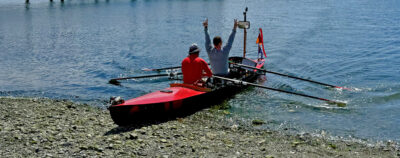
 As OTTER’s bow ground onto the pebble beach at the race finish, Ben threw his arms exuberantly into the air. I barely had enough energy to ship the oars, and was unable to stand upright as I struggled to get out of the boat.
Whenever we aimed for the finish line, the waves came from abeam and washed over the gunwale. Water sloshed in the bottom of the boat, adding to our load. Our only option was to head away from the finish line, quartering into the wind. Heading up was drier, but took us farther off course. We kept easing back toward our destination until we took on water, then headed away to reduce the influx. After 45 minutes, I looked back at the shore we had been trying to leave and said to Ben, “I don’t think we’re making any progress.”
He replied, “We are…but it’s so slow.”
“Do you have any ideas of what we can do differently?”
He paused for a long moment, then replied, “Nope. Keep rowing.”
Perhaps delirium tempered the pain. Perhaps not. It actually no longer mattered. We could see the final shore…miles away. Our only respite would come when we touched the bow to the land. We pushed with our legs. We pivoted back on our seats. We pulled with our arms. We fought the oars out of the confused seas. We gasped for air.
At last, we could see a crowd on shore. We heard cheers and cowbells. We straightened our course for the beach. A loudspeaker called our name: Team HerbertSons. Another loud cheer. OTTER’s nose ground noisily into the gravel. Ben raised his hands in the air. I shipped my oars. I lifted a leg out of the boat and struggled to raise the other leg over the gunwale. I moved to stand, but couldn’t. I tried to straighten my back, but couldn’t. Ben grabbed me as I staggered.
 Samantha Stettler
In the weeks before the race, Leece wisely observed, “Regardless of what happens, you will be talking about this race for the rest of your lives.” We finished 16th overall, and fifth out of the 45 rowboats. Our goal had always been to finish, and our team motto had been: “Stay in the boat, and keep rowing.” In the end we kept OTTER underway, nonstop, for 16 1⁄2 hours.
Someone thrust a signboard in our hands: 16th place overall; 16 1⁄2 hours. Volunteers in yellow vests swarmed about us. I tried to walk out of the water to ring the finish bell on shore, but my legs wouldn’t move. A friend carried the bell to me to ring. My wife waded in. I leaned on her, dragged my heavy legs, and shuffled onto land.
The medic asked me if I was dizzy. No. The medic asked if I was hydrated. Yes. She pinched the skin on the back of my hand. She pressed her fingers into my wrist to feel my pulse. Strong. She asked if I was dizzy. No.
Dry gravel. I sat down and cried on my wife’s shoulder. My entire body began to tremble uncontrollably. The shaking wouldn’t stop. The medic asked if I was dizzy. No. She took my pulse. Strong.
Ben sat down next to me. I cried on his shoulder. We’d done it. We had rowed some 13,800 strokes without stopping. We had completed the SEVENTY48. Some things I had imagined. But this? This had been unimaginable.
Basin Herbertson is a wellness and vitality coach at CoachBasin.com, helping people get past somewhere they feel stuck. He documented the design and build of OTTER in “OTTER: An open-water endurance rowboat.” After the ordeal of the SEVENTY48, it would take him a week to think clearly again, three weeks to heal the blisters on his palms, and a month before he recovered his physical energy. While he is gratified and satisfied to have met the challenge, he keeps shaking his head, and saying, “Seventy miles is too long to row.” Ben says that if he does the race again, he wants to be facing forward. Basin and his father finished building their Cape Cutter 19 in 2020, sailing it in the San Francisco Bay, Tomales Bay, Lake Tahoe, and Puget Sound.
For more SEVENTY48 adventures see “SEVENTY48” and “TAMO.”
If you have an interesting story to tell about your adventures with a small boat, please email us a brief outline and a few photos.

Basin I could feel your pain reading along. I’m mulling a solo attempt pedaling with a Hobie Mirage drive. Would you have undertaken this adventure knowing what you now know? What would you have done differently in hindsight? Impressive work Basin. Hats off to you!
I endorse competing with a pedal drive. This race has demonstrated that pedaling is an effective way to generate thrust from human labor. Pedal boats finished 3rd & 4th this year. I think having at least one crew member facing forward significantly reduces the overall cognitive cost of navigation, so you are good there, too. I talked to one of the pedal boaters and he said that the ability to un-foul the propeller when sea grass or something wraps around it is a crucial consideration. Would I do it knowing what I know now? Yes, because I feel such satisfaction at having surmounted a “big hairy” challenge. Would I do it in the same boat again? No, I’d have at least one person with kayak paddles facing forward. And…if I were designing a boat to win rather than finish, I’d likely play with pedal-driven designs.
Great write up Basin ! I was in the boat ahead of you guys at Point no Point -Team Rhythm & Resilience in a Savo 650D -It was an amazing experience all around – we definitely learned a lot about what we don’t know ! Especially coastal navigation and currents ! Your references to HR zones and your sons heart issues rang a bell – my boat is called “ Triple By-Pass” for a reason and I believe I’m the only competitor so far to have completed the event with a fitted defibrillator ! Onwards … what’s next ?
https://nwmaritime.org/all/seventy48-2025-triple-by-pass-and-the-row-to-remember/
Congrats on overcoming the heart issue. Finishing the race is a testament to your perseverance, and well being! Thanks for outing yourself in the comments, too. I didn’t want to call you out by name in the article, but you were a significant part of our race.
I love this story. I’m inspired — and in awe — of what you chose to endure to have this experience.
Thanks for reading and appreciating, Jill!
OMG! Your description took me with you on an adventure of a lifetime…without getting the blisters. Your skills to create such a fine boat and your mastery of mind over body are extraordinary. Stroke after stroke you worked in cooperation and rivalry with Nature. What a powerful shared experience to bond with your son Ben. The two of you are champions!
Thank you for your compassion and celebration, Lyndie!