Back in 1984, when I was curator of Mystic Seaport, John Gardner and his Small Craft program were part of my department. Each year we selected a winter project that could become the focus of the following June’s “Small Craft Workshop.” That year John wanted to focus on peapods, Maine’s signature small workboat. There were several examples in the Seaport collection, both working and recreational. Richard Rathburn, writing in the 1880 Fish Commission survey of American working watercraft, stated that the “double-ender or peapod” had been introduced only recently to Penobscot Bay when the demand for lobsters to supply Maine’s 23 canneries, as well as for live lobsters for local consumption, made inshore fishing profitable. The Fox Islands in Penobscot Bay are a complex of inlets, ledges, and small islands, an area well suited to lobstering by hand, and as a working type, the peapods grew quickly in popularity. After the introduction of powered boats and the discovery of Penobscot Bay by “rusticators,” builders modified the peapods for recreation. Typically smaller, at under 14′ in length, recreational peapods tended to have more seats, more rocker in the keel, and more curve in the sheer. They were of lighter construction and sometimes had a centerboard for sailing.
John Gardner had designed several peapods, writing about them as boats well suited for amateur construction, and now he proposed donating the one that he owned to the museum for measuring, creating plans, and building a reproduction. He had bought his peapod around 1966 for about $100 from Captain Allison Ames of Camden, Maine, who had, in turn, bought the ’pod from a local fisherman. She had been built in about 1929 by Alton Whitmore, originally of North Haven, the northernmost of the Fox Islands, after he’d moved his shop from there to Rockport, Maine. Ames told John that one of the peapod’s earlier owners had “claimed she didn’t blow around and held steadier in a wind than any boat he’d ever used.” But by the mid-1960s, the boat was in rough shape. John fixed her up and took her with him when he went to work for Mystic Seaport Museum in 1969.
 Photographs by David Cockey
The Apprenticeshop peapod was built using Whitmore’s construction technique. First the backbone was set up, next the sheerstrakes were fitted and spread by cross spalls, and then the frames, which had already been bent to shape, were installed. At that point, the structure was ready for the inwales and thwarts to be fitted. The planking would come after.
In a National Fisherman article, subsequently republished in his 1993 book, Classic Small Craft You Can Build, John wrote of the carvel-planked 14′ 3″ boat that it had “a low flat sheer and a heavy, slightly rockered plank keel. Her wide, rather flat floors amidships give her marked initial stability, enough so that you can actually walk around in her without causing excessive heel. This feature was important for hauling pots over the side and makes for comfort in a rowboat used for fishing, transportation, and as a large tender. Capable of carrying a big load, this pod rows easily even when heavily weighed down. As an all-purpose rowboat for the open, windswept coast, a pod of this sort can hardly be excelled.”
John’s offer to donate his boat to the museum was typically generous, and there was no question that a reproduction would be an excellent addition to the Seaport’s on-water fleet. So, we went ahead with the project and, together with his assistant, Bill Mills, John built the reproduction.
Construction of the Whitmore peapod
John and Bill’s 1984 reproduction of the Whitmore peapod was built over molds as they endeavored to accurately reproduce the original’s shape. But in 2024, when David Cockey—a board member at The Apprenticeshop of Rockland, Maine—and I suggested that a Whitmore peapod would make an interesting construction project for the shop, students and staff researched and decided to follow the much simpler approach that Whitmore himself had used. In his article for National Fisherman John described Whitmore’s building process thus: Once the backbone is set up, sheerstrakes are fitted with cross spalls to hold them apart. Pre-bent ribs are then installed, followed by the interior structure: the inwales and thwarts. With the ribs and interior in place, the boat is stable enough to be turned upside down to be planked. When The Apprenticeshop builders constructed their peapod using this method, Wade Smith—John’s successor as director of the John Gardner Boat Shop at Mystic Seaport Museum—figured the finished boat to be 1⁄4″ off the lofted shape, a discrepancy that would be undetectable in use.

After the interior structure was complete, the peapod’s framework was carefully turned over and then planked up.
Scantlings of the Whitmore peapod are pretty standard, although as a 14-footer the boat is at the smaller end of the typical working-peapod range. The keel is a heavy oak plank steamed and sprung for some rocker. The planking is 1⁄2″ cedar. The oak frames are flat (5⁄8″ × 1 1⁄8″), butted at the keel, and spaced 9″. Between the full frames, 2 1⁄2″-wide half-timbers tie the boat together.
Rowing the peapod
Despite John Gardner’s Whitmore peapod reproduction being on the Mystic Seaport waterfront for some years, I never made the time to row it. So, I wanted to try out the new boat built at The Apprenticeshop. I had a brief chance to do so before it was delivered to its new owner’s summer house on Fox Islands Thorofare.
The most significant visual difference between traditional working peapods and later recreational versions is in the positioning of the thwarts. A recreational peapod will typically have its thwarts spaced for passengers or to be suitable for double rowing, but a working peapod had its thwarts spaced so that lobster traps could be carried between them, with the rowing thwart well forward of amidships and its associated oarlock pads set just ahead of amidships. This is how the Whitmore peapod is laid out. Thanks to this placement there is a good deal of open space aft, but when rowing light the boat trims bow down.

The traditional working peapod carried its rowing thwart forward of amidships to leave plenty of room to accommodate several lobster traps.
For the trial, I filled a 5-gallon water jug, which weighs more than 40 lbs, and set it in the stern to level-out the boat. A passenger or some soaked traps would have the same effect, as does standing abaft the thwart and rowing while facing forward.
Stepping into the Whitmore, I felt the support and inherent stability offered by the hard bilge. Kneeling on the rail left several inches of freeboard, and as John Gardner observed, I could walk around easily. Indeed, the working thwart spacing made moving around a pleasure. However, there are no floorboards, so rowing barefoot or in light sneakers could be uncomfortable.
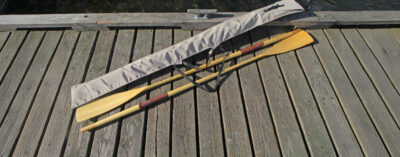
Once I was settled on board, I tried rowing in the usual style—seated facing aft. I tried two different lengths of oars: 8- and 9-footers. The nines were too long, and while the eights worked fine, another 6″ in length would have been better. I began rowing with the ballast amidships. The boat was predictably high in the stern, and in a fairly light breeze, I had to work to keep her on a straight line unless the wind was dead ahead. I then moved the ballast. As soon as I weighted the stern she ran straight, while the rocker in the keel allowed me to spin with just a few strokes.

Built in the traditional manner, the replica Whitmore peapod has no floorboards. The half-timbers between the full frames go across the keel plank and tie the hull together.
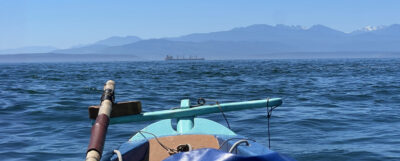
I was favorably surprised when I stood up and tried facing forward to push-row. I used oarlocks lifted on 6″ extensions made of rod and pipe. The thwart spacing allowed me to stand abaft the main thwart but with one leg forward and one aft, and to then push on the oars using my full body weight. When I was seated, I could row at a sustained speed of around 3 1⁄2 knots; pushing I could easily do 3 knots. When I was pushing, the 8′ oars were workable, but shorter ones might have been better. Nevertheless, it was easy to see that I might comfortably cover lengthy distances when pushing, working through passages between rocks and ledges—ideal for a working lobsterman approaching his traps in shallowing water.
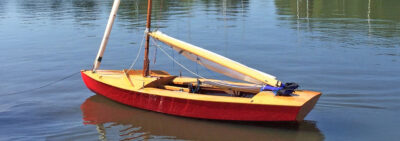
The new owner will use the Apprenticeshop’s Whitmore peapod for some recreational rowing and ferrying in Fox Islands Thorofare, between the islands of North Haven and Vinalhaven, waters that were once extensively lobstered by hand and under oar. As befits a boat of traditional construction, it will be kept in the water. If a prospective builder wanted to optimize the boat for seated rowing, the rowing thwart could be shifted to amidships; but if the extra space in the stern of the boat is appealing, utilizing shifting ballast, as I did, works well. With the plank keel, it would be easy to add a centerboard trunk and a sailing rig; one could also leave it without a centerboard and limit one’s sailing to reaches and runs while steering with an oar.

The combination of the peapod’s inherent stability and the positioning of the oarlock sockets makes the boat ideal for rowing while standing up and facing forward. Indeed, I’ve not been in any boat in the U.S. that has performed better when I’ve used that technique. The method, which utilizes oarlock extensions, would have been particularly useful when working traps in narrow rocky passages.
In comparison to the Whitmore peapod, there is no doubt that many modern peapod designs for cold-molding, strip-planking, or glued-plywood lapstrake are lighter, simpler to build, and easier to handle on and off trailers, but they are not significantly faster, nor do they offer the steadiness to accommodate forward-facing rowing, so useful when pushing up narrow creeks and between rocky ledges. Traditional carvel construction of the Whitmore peapod does require some previous experience, but it should be within the reach of a competent amateur boatbuilder, and its size is such that it could be built in a decent-sized garage or small barn. And, if you are looking for a peapod with charm, practicality, and history, then Whitmore’s would be the one to choose.
Ben Fuller, curator emeritus of the Penobscot Marine Museum in Searsport, Maine, has been messing about in small boats for a very long time. He is owned by a dozen or more boats: kayaks, canoes, a skiff, a ducker, and a sail-and-oar boat.
Whitmore Peapod Particulars
LOA: 14′ 3″
Beam: 4′ 2″
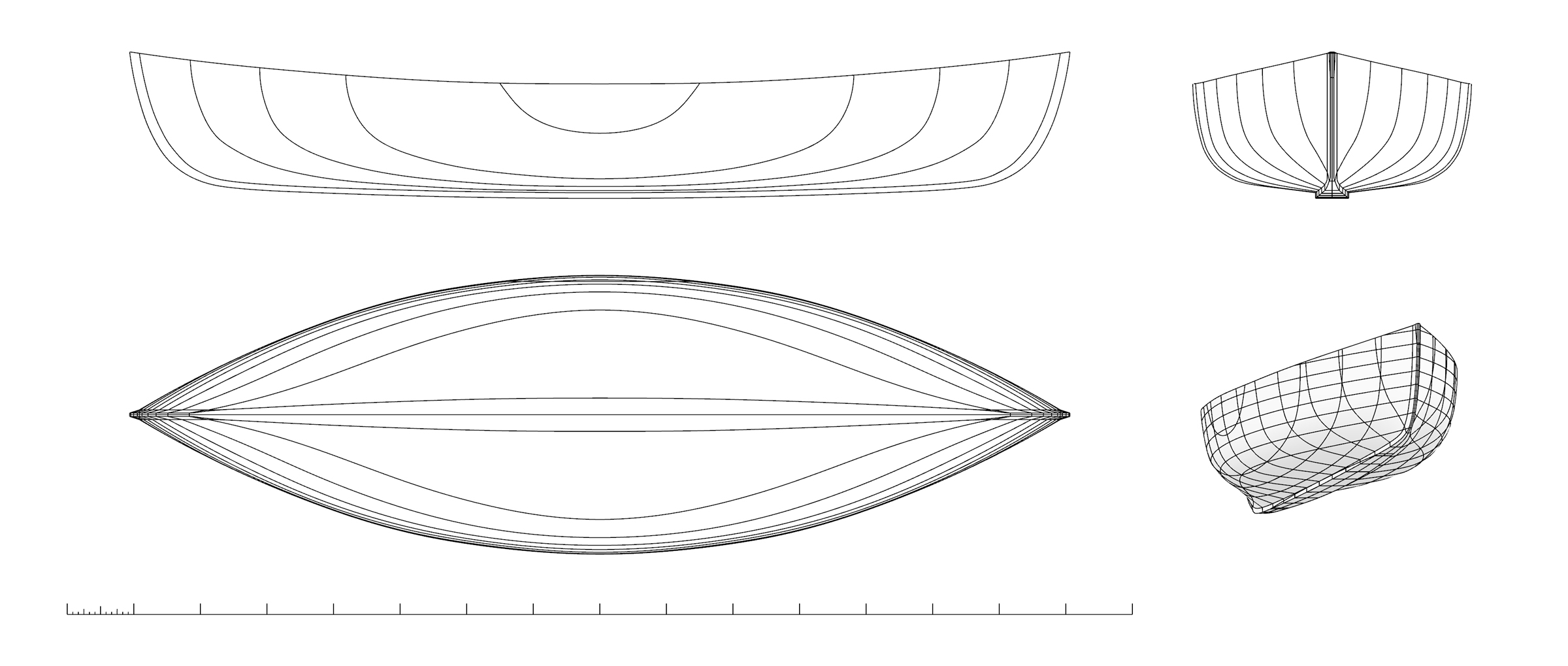 Plans for the Whitmore Peapod are available from Mystic Seaport Museum, price $75 plus shipping. They can also be found in John Gardner’s Classic Small Craft You Can Build, now out of print, but used copies are available from online vendors and secondhand booksellers.
New Whitmore peapods can be commissioned from The Apprenticeshop, and there is a possibility of CNC molds for strip-planked, cold-molded, or glued-plywood lapstrake from Chase Small Craft; (207) 602-9587.
For more tips on ballasting small boats, see Ben’s article, “Trim and Ballast.” For tips on forward-facing rowing and oarlock extensions, see his article, “Oarlock Extensions.” And for more on peapods see “The Lighthouse Tender Peapod,” and “The Maine Coast Peapod.”
For a detailed record of the building process of the Whitmore peapod as followed by The Apprenticeshop, see “Boatbuilding Without Molds” by Wade Smith in WoodenBoat No. 293.
Is there a boat you’d like to know more about? Have you built one that you think other Small Boats readers would enjoy? Please email us your suggestions.



Join The Conversation
We welcome your comments about this article. To include a photo with your remarks, click Choose File below the Comment box.