When he was 13, Stanislaw Klupś, from Poznań, a city in west central Poland, received an unexpected Christmas present from his parents: plans for the Piranha V, a 10′-long sail-and-oar boat designed for amateur builders. At first Stan thought the plans were for a toy model, but when his parents led him outside to the garage and showed him some sheets of plywood stacked up against the wall, he realized he was looking at “the beginning of a great adventure.”
 Photographs courtesy of the Klupś family
Stan built his boat in the family garage, which is also used for storing garden tools, bicycles, a lawnmower, and more. Space was tight and the lighting was poor, so Stan did as much work as he could outside.
Stan has always enjoyed working with wood. Before the boat, he’d made toys, like building blocks, figurines, and cars; a real boat was something new, something that gave him the possibility of fulfilling a dream. In 2017, when Stan was 10, his parents had bought a small cabin boat in which they, Stan, and Stan’s baby sister sailed on a lake near the village of Boszkowo, an hour’s drive from their home. Stan loved his time on the water and while the boat was “perfect for family sailing and the occasional overnight on the lake,” he dreamed of having his own boat. It turned out Stan’s parents had been paying attention.
The plans for the Piranha V were drawn by Polish yacht designer Janusz Maderski. One of a range of his small stitch-and-glue boats, the Piranha is 10′ long with a beam of 4′ 10″, and to Stan seemed ideal for a first-time build.
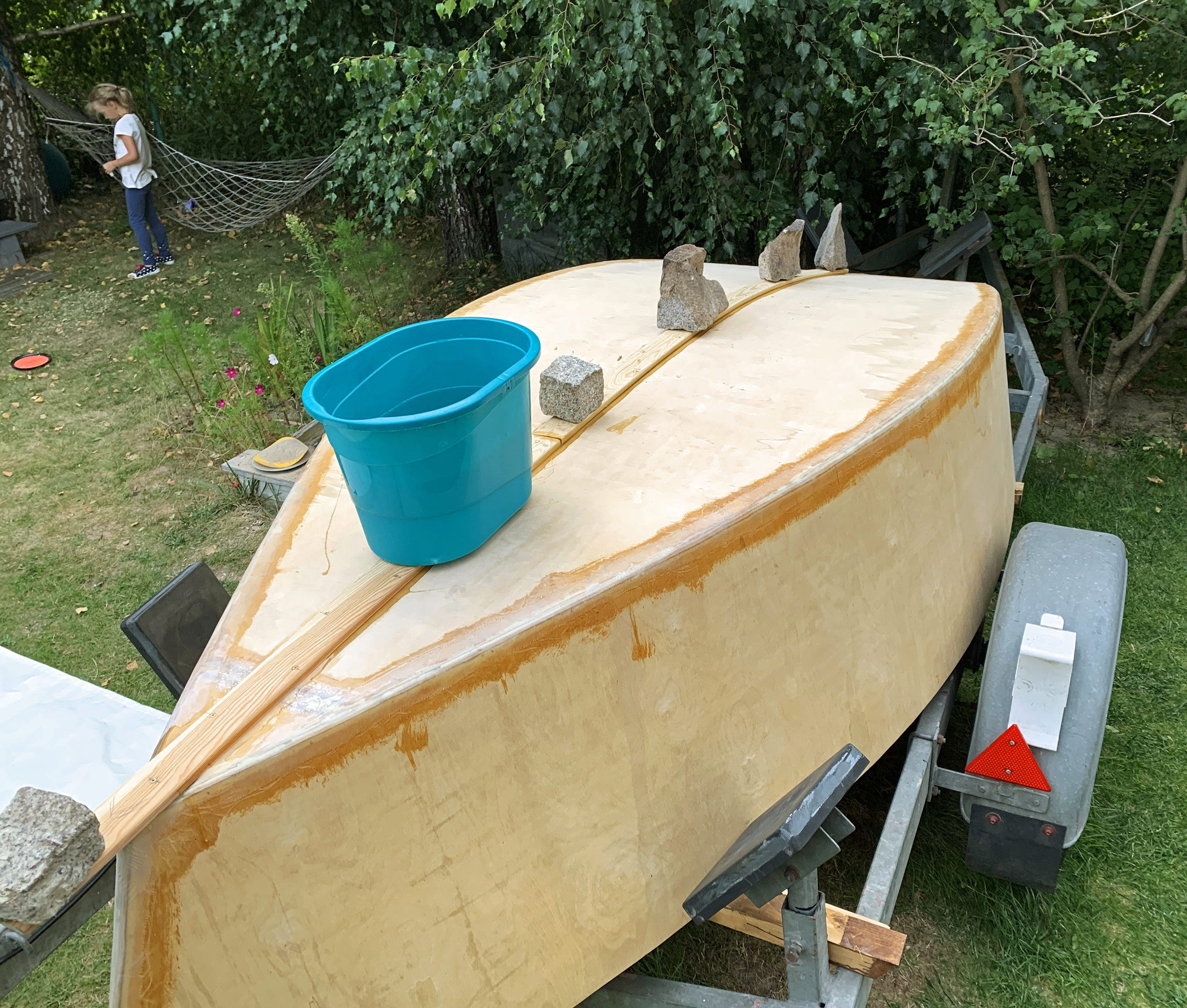
The pine keel strip—made up of two pieces butted together just forward of amidships—took the curve of the Piranha’s bottom without steaming.
The family decided Stan would work in a metal garage behind the house. Normally it was used to store the lawn mower and other garden tools. “There was enough room,” says Stan, “and it was good to be inside when the weather was bad, but the lighting wasn’t great, and it could be a bit damp.” He would start the following summer, when his work wouldn’t interrupt his school commitments and the weather would be warmer. His father helped to get him set up, and together they cleared some space.
To measure out the plywood panels Stan worked on the floor, but for the most part he built the boat on temporary tables and stands, moving the project out of the way whenever the garage was needed for something else. The project, says Stan, was “quite challenging because of my lack of experience. There were some pages of instruction, but mostly the plans consisted of drawings, with dimensions, for every part of the boat—it was a lot to digest.”

After completing the bottom and side panels Stan was excited to turn the hull over and see that it already looked like a boat. But, like so many builders before him, he quickly learned there was a long way to go.
The early stages were the hardest; Stan was unfamiliar with the work, and the large plywood panels were awkward. “It was difficult handling those big pieces; my dad’s help was crucial.” He was able to get the bottom panel out of a single piece of 8mm plywood, but the longer side panels had to be cut from two pieces to get to the required length. “Figuring out the best way to do that slowed me down, but it worked in the end. I butted the two pieces together and glued them with fiberglass and epoxy.” After he stitched together the bottom, sides, and transom, he could see the boat’s shape emerge. “It was one of the really big highs of the project.”
Along the way, Stan gained experience in reading plans, using power tools, and taking his time. “I think my worst mistake was when I cut out one of the side benches. I didn’t realize I’d done it wrong until I came to install it. I took it to the boat only to discover it was about 18″ too short! It was a bit of a shock. Fortunately, I had enough spare wood to make another one and, once my initial embarrassment had worn off, it was pretty funny. Mostly, though, everything went very smoothly. It just took longer than I’d expected. But I loved working with the wood, listening to music as I worked, seeing it all slowly come together.”
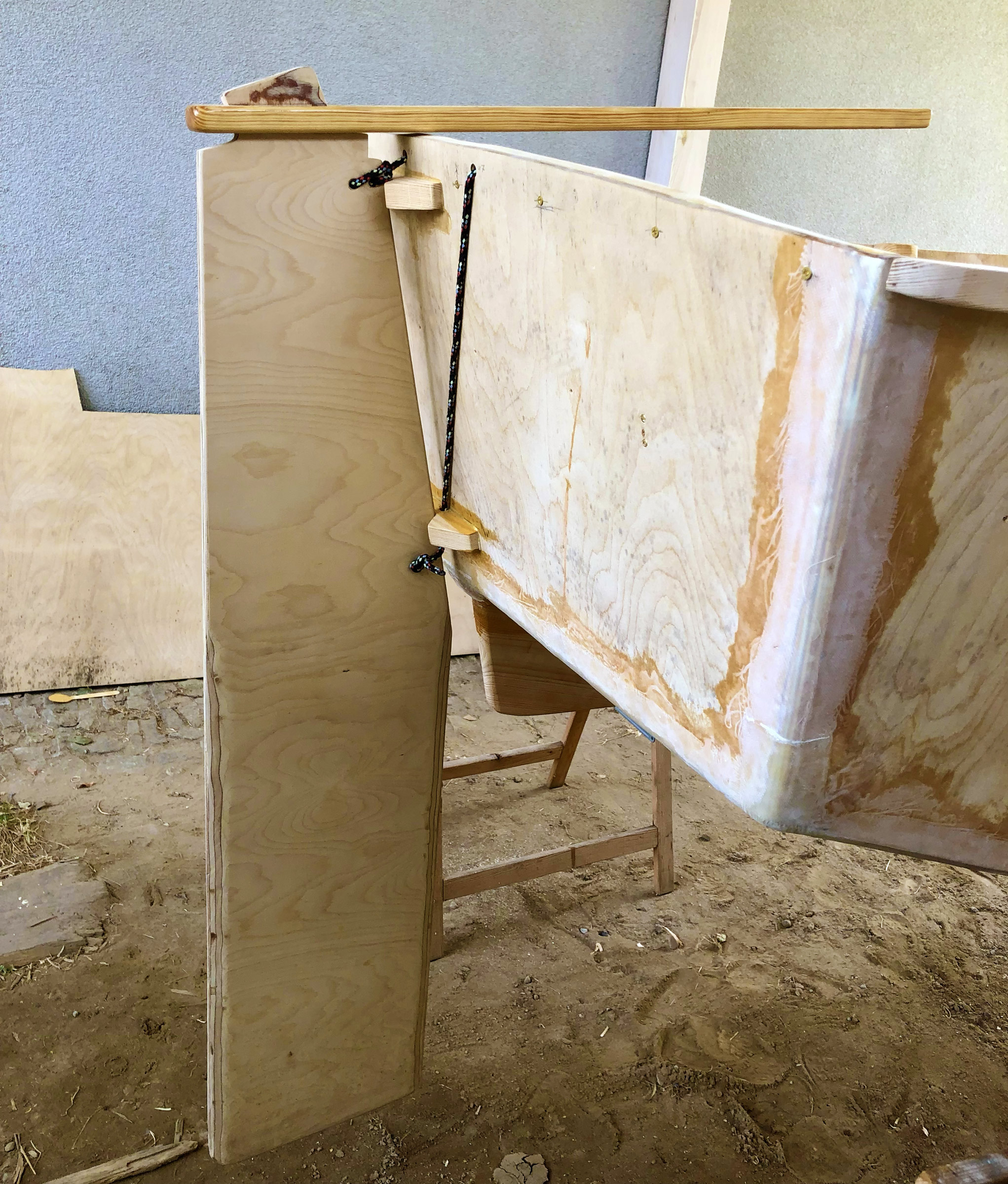
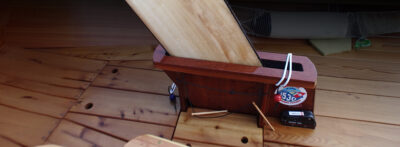
Following Maderski’s design, the rudder is set up without expensive hardware. The two lines hold the rudder snug in the transom-mounted chocks, but for launching and landing in shallow water, the lower line can be released to allow the rudder to float up. Drawing that line tight prepares the rudder for steering.
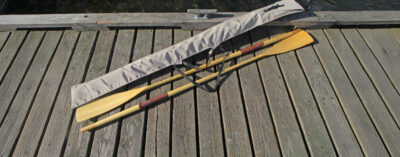
For the most part Stan’s boat is all plywood; only the deckbeams, rubrails, keel band, spars, oars, and tiller are of solid pine. He bought all the materials locally. Indeed, the construction calls for nothing fancy, and even though Stan lives in an area where the nearest water for boating is about an hour away, he had no difficulty finding what he needed. But, he says, he raised a few eyebrows when he went into the local hardware store to buy 50 clamps.
With the exception of the standing lugsail, he made everything himself, but kept things affordable and simple: the spars have square cross-sections, the oars are lashed to single tholepins. There is little hardware on the boat—even the rudder is attached without pintles and gudgeons. Instead, as designed by Maderski, it is located on the transom by two centered blocks, and held snug against them with two lanyards—one is attached to the rudder just above the bottom of the transom from where it is led up and through the top of the transom to be cleated off in the cockpit; the other is attached to the top of the rudder and, again, cleated inside the boat. When the rudder needs to be raised in shoal water, the lower lanyard is released, and the blade floats up.

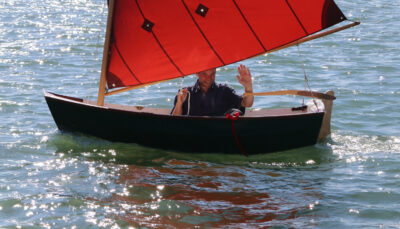
Much of the time, Stan sails ZJAWA on his own, but he is often joined at the lake by his sister Lucy, whom he has taught to sail.
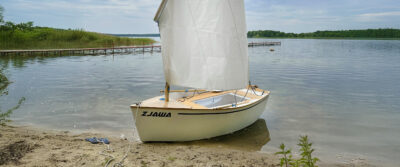
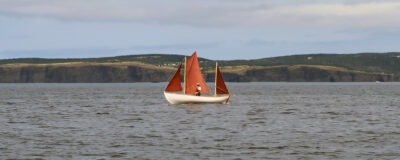
After two summers of building, Stan launched ZJAWA (Polish for “Phantom”) in 2023 on the lake at Boszkowo. He sailed her for the first time. “She’s very maneuverable and sails in the lightest of breezes. She’s big enough for two people, plus my guitar, and I’ve taught my sister, Lucy, who’s now 10, to sail her. But I love sailing alone and listening to music. When I’m alone in the middle of the lake, just me and my thoughts, nothing else matters.”

Stan had ZJAWA’s sail professionally made, but otherwise, the build and finish are all his own work.
As for what’s next, Stan, now 18, dreams of building a small boat with a cabin. “Nothing big, just enough to sleep on board but inside. Even in summer the nights in Poland can be quite cold. But for now, I’m concentrating on smaller things: I’m currently studying violin-making and have just started building my first stringed instruments. But ZJAWA… the whole project was really great. And to sail a boat you built yourself? You can’t beat that.”
Jenny Bennett is editor of Small Boats.
Do you have a boat with an interesting story? Please email us. We’d like to hear about it and share it with other Small Boats readers.



Great story! And well done, Stan! Your boat looks very good.
I wish, I had the posibility to build a boat that age. I had to wait until I was 55. 🙂
That’s a great project to complete. Welcome to the “club” of people who build their own boats and be advised, you will probably want to build another boat, as that happens to many of us.
Best regards!
Nice job Stan. I built my first boat at your age and I have been doing it on and off since. Building boats and in your case violins, puts you near the top of woodworking craftsmanship. If you want to build a boat with a small cabin check out dinghy cruising on you tube. You can overnight on a dinghy using a boom tent. All the best. Keep doing what your doing.
Now that you’ve built your first boat, you should design the second one yourself. A simple boat with a small cabin, of course. You’ll see: putting your own design in the water, feeling how it floats and then how it sails, is something else entirely.
But you have created a beautiful boat. Don’t sell it lightly when you are older. Many people regret doing so when they are older. And you can still sail a small boat like this even if you weigh 70 kg. And it fits anywhere.
When you sail it in your old age, memories will come flooding back that you had long forgotten. Believe me 🙂
De casualidad encontré este artículo hoy revisando la publicación del mes de Noviembre 2025. Me llamó mucho la atención porque tengo un hijo de casi 13 años, mi abuelo había nacido en la ciudad de Poznan, mi padre lo trajeron a Uruguay desde Polonia con tan solo un año de vida en 1930 y además soy carpintero y trabajo en la docencia con cursos que enseñamos a construir embarcaciones de pequeño porte. Felicitaciones por el proyecto y que bueno sería que tantos adolescentes tuvieran esas mismas experiencias. Hermoso artículo.
Saludos. Juan Carlos Augustyniak.
I stumbled across this article today while reviewing the November 2025 issue. It caught my attention because I have a son who is almost 13 years old, my grandfather was born in the city of Poznan, my father was brought to Uruguay from Poland when he was just one year old in 1930, and I’m also a carpenter and teach courses in building small boats. Congratulations on the project, and how wonderful it would be if so many teenagers could have these same experiences. A beautiful article.
Regards, Juan Carlos Augustyniak.
Great story of boy building sailboat. How heavy was it after completion?
Scooter
Świetny artykuł promujący nie tylko młodzieńcze pasje.
POZNAŃ to również moje rodzinne miasto gdzie w wieku 15 – 16 lat też na ogródku działkowym zbudowałem żaglówkę ” myszka ” konstrukcji Mieczysława Plucińskiego i pasja żeglarska trzyma mnie do tej chwili.
Do następnej budowy polecałbym ” PocketShip 4,5 metrowy jachcik z możliwością młodzieżowego noclegu.
W razie zainteresowania mogę przekazać kompletną dokumentację do samodzielnej budowy.
Gratulacje dla Stanisława za fachowe wykonanie łodzi i najważniejsze , że na niej pływa.
Z żeglarskimi pozdrowieniami
Andrzej Maciejewski
A wonderful article—one that promotes not only youthful passions.
Poznań is also my hometown; it was there, at the age of 15 or 16, that I built a sailboat–a “Myszka” (Little Mouse) designed by Mieczysław Pluciński–in a garden allotment, and my passion for sailing has stayed with me ever since.
For a future project, I would recommend the “PocketShip”—a 4.5-meter yachtlet capable of accommodating a young sailor overnight.
If you are interested, I would be happy to provide the complete documentation for building it yourself.
Congratulations to Stanisław on the expert craftsmanship of the boat, and, most importantly, on actually getting it out on the water!
With sailing regards,
Andrzej Maciejewski