A lot of work goes into making a good pair of oars, and whether you’ve shaped them yourself or paid a pretty penny for them, they deserve to be cared for. A few scuffs are to be expected when they’re in use, but dings and scrapes while they’re being transported and stored can be prevented by carrying and keeping them in an oar bag. To keep oars in good shape, Chesapeake Light Craft offers the Canvas Oar Bag, made in three sizes by The Nautical Tailor in Annapolis, Maryland.
 Photographs by the author
The bag rolls into a compact package that’s easily stowed when not in use.
The bag for 7′ to 7′ 6″ oars is 7′ 7 1⁄2″ long by 8 3⁄4″ wide, and has an exterior of tough 9-oz marine-grade UV-resistant polyester fabric with a durable water-repellent finish. The interior of the bag has, at its ends, a soft layer of breathable non-woven polypropylene-polyethylene-polyester material commonly used for car covers. The middle of the bag is unlined. One-inch webbing is used for the buckled closure at the opening of the bag, the adjustable shoulder strap, and the gusset-reinforced handy-carry strap. The bag is more than wide enough for my straight-bladed dory oars that have 4″-wide blades, and there’s plenty of room for my 6 1⁄2″-wide spoon-blade oars. Inserting the oars is easy, and can be done with one hand on the bag and one hand on the oar without it coming into contact with the ground.
To keep the oars from rubbing against each other and scuffing their varnish, the bag has a full-length divider—polyester on one side, soft non-woven material on the other. A 10″-long flap over the bag’s opening is equipped with a strap and buckle to keep the oars from slipping out.
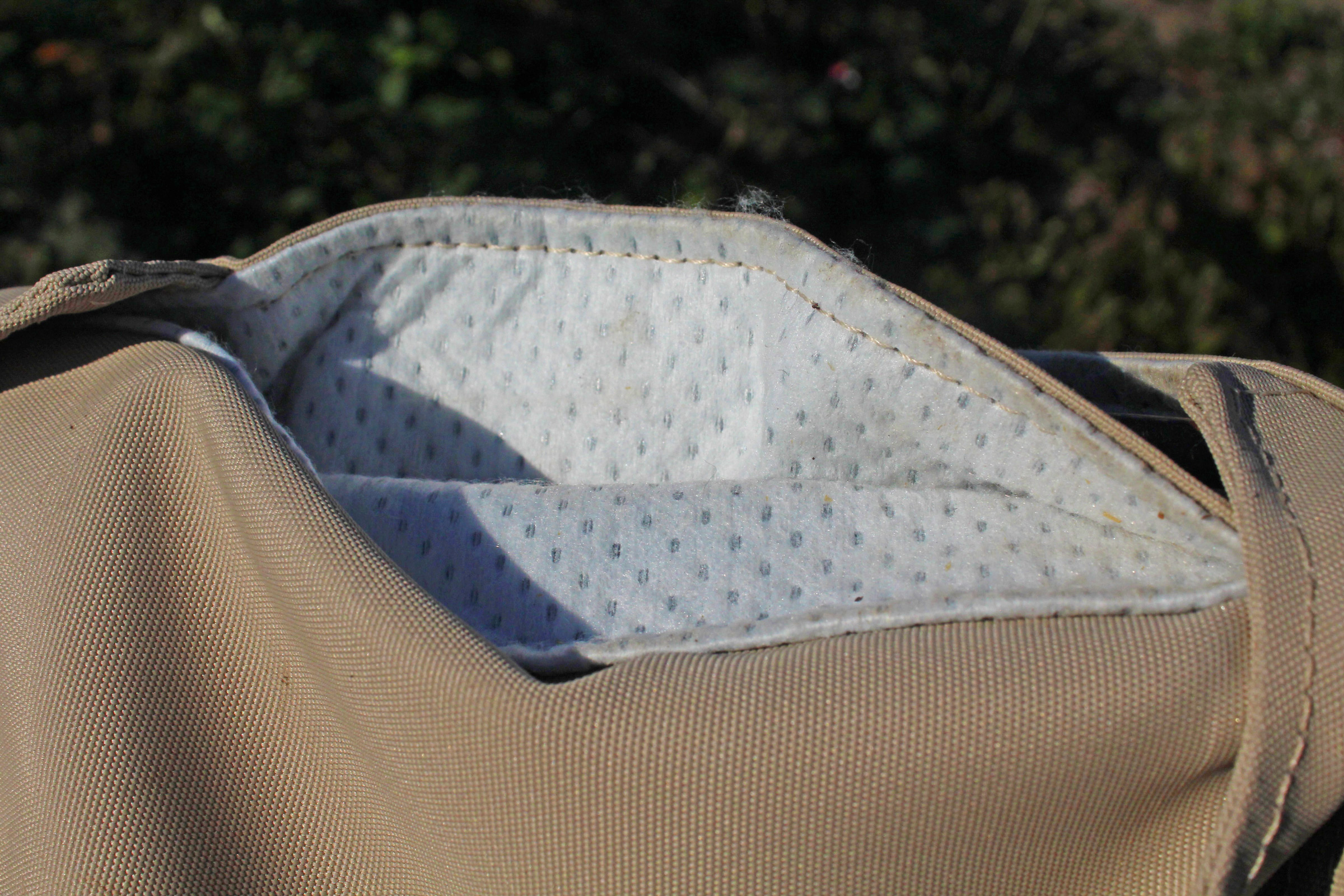
A soft non-woven fabric lines the ends of the bag and protects the oar blades where the varnish is the most vulnerable.
Without a bag, I can carry a pair of oars in one hand, but they inevitably shift from parallel to each other to an awkward, unbalanced X. In contrast, the bag keeps them together, which makes one-handed carrying straightforward. And, with the oars protected by the bag, I don’t have to be as careful about where I lay them down. At a launching ramp, for example, I can set the bag down on pavement or on an unpaved parking lot, without worrying about the effect on the varnish.
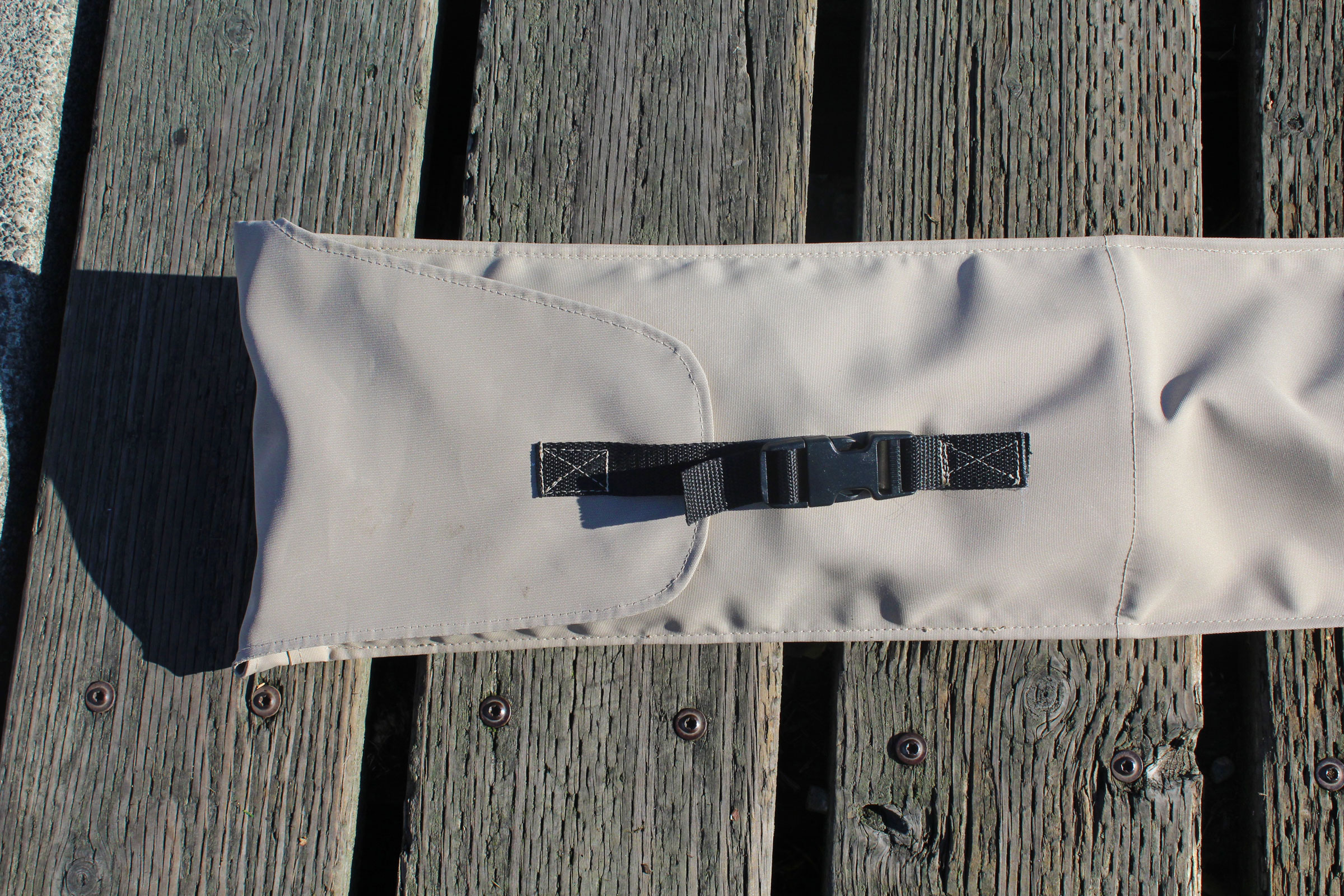
The flap over the bag opening is secured with 1″ webbing straps and a buckle.
Oars can be inserted blade or handle first, and while they can both be stowed the same way, I find it best to put one in blade first and the other handle first; getting the second oar in is just as easy. Oars are not equally weighted either side of their midpoints, but are heavier toward the handle ends; stowing them in opposition within the bag balances them when lifted by either of the centered straps. With the longer strap pulled over my head and resting on my far-side shoulder, I can easily carry the bagged oars hands-free.
While neither of the fabrics used in the bag’s construction is fully waterproof, they are both highly water resistant. I made a depression in a portion of the bag, pooled water in it, and let it sit for 90 minutes. The outer surface of the bag darkened and felt cool to the touch, indicating water had been absorbed by the fabric’s fibers, but the inner fabric remained dry and warm. If oars are put away wet, the breathability of the two fabrics will allow the bag to dry.

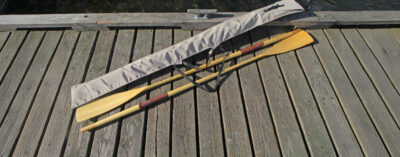
The oars are best arranged in the bag blade-to-handle to evenly distribute the weight and ensure that the bag remains parallel to the ground when it is lifted by either the handle or the shoulder strap.
The Canvas Oar Bag has me thinking of refinishing some of the spoon-bladed oars I worked so hard on decades ago, but which are now much the worse for wear. A bit of sanding, some scars filled, and a few coats of varnish will have them looking like new, and the bag will help keep them that way.
Christopher Cuningham is editor at large for Small Boats.
The Canvas Oar Bag, made by The Nautical Tailor, is available from Chesapeake Light Craft for $160. It comes in Small for oars 6′ to 6′ 6”; Medium for oars 7′ 6″; and Large for oars 8′ to 8′ 6″.
For more reviews from Christopher Cunningham, see “Skwoosh Seat Pads,” “Oars with Elbows,” and “Carbon-Fiber Ferrules for Oars.”
Is there a product that might be useful for boatbuilding, cruising, or shore-side camping that you’d like us to review? Please email your suggestions.






I sometimes carry two pair of 10′ 6″ oars for my oar and sail boat Ran Tan in the same bag in which the yard and sail, and mizzen mast with its rolled up sail live. I’ve used an old ski bag for shorter oars. This is nicer.
My partner carries her oars inside her little Chevy Bolt, just enough space for her nice spoon 8’6″ oars to lay on her dash. (If you do this a good Idea to have a plywood plate between the end of the oars and the windshield.)
To protect the blades she has repurposed some woolen leg warmers. They were just the thing to protect them when I had them sticking out of my pickup cap the other night.
I just bought my wife an early Christmas present. Two sets of oar bags to transport our oars for our 17’ Whitehall. I opened the box yesterday and I was extremely impressed with the quality of this product from The Nautical Tailor. Not only will our oars be protected but the teak seats and sole will also appreciate the added buffer when we trailer the boat to the launch ramp. Selfishly, I love giving a gift where I also get to reap a benefit.
Nice piece of gear, it will be easier to strap a bag to a trailer or rooftop carrier when desired, vs loose oars, that is how we carry sails and spars to protect them when they won’t fit in the boat.