When I wrote in this space last month about “The Joy of a Free Boat” I had not anticipated hearing from several readers with similar tales of good fortune. Some anecdotes, in particular, stood out:
Regular contributors Kent and Audrey Lewis of Smithfield, Virginia, emailed saying their “latest free boat is a 1930s Bahamas Dinghy, a little 10-footer.” I asked them about that word, “latest.”
Kent wrote back: “We currently have several ‘free’ boats. It started in 1994 when Audrey’s dad began slowly unloading three fiberglass Sunfishes, an O’Day Day Sailer II, a Grumman 17, and a Drascombe Lugger. Then, in 2013, we were offered another Sunfish—the 13th of the wooden versions—which was in New York. There was a condition—we had to pick it up. So, I drove from Navarre, Florida, to Grand Island, New York, to get it.
 Kent Lewis
Audrey takes time out to sit in the Bahamas Dinghy that was given to her and Kent for restoration. In the 1950s the dinghy had been sheathed with fiberglass cloth. Far from damaging the hull, Kent believes it may have protected it while it was in storage for 40 years.
“Another Sunfish came our way, from Nashville, North Carolina. It was in an antiques shop, and the owners were trying to sell it for $50 as a bar. When they heard we could find all the rigging, a sail, rudder and daggerboard, and get the boat sailing again, they gave it to us. We fixed it up and passed it on to a friend in Port Townsend, Washington. That little boat is well traveled—from Connecticut to North Carolina to Florida to Washington.”
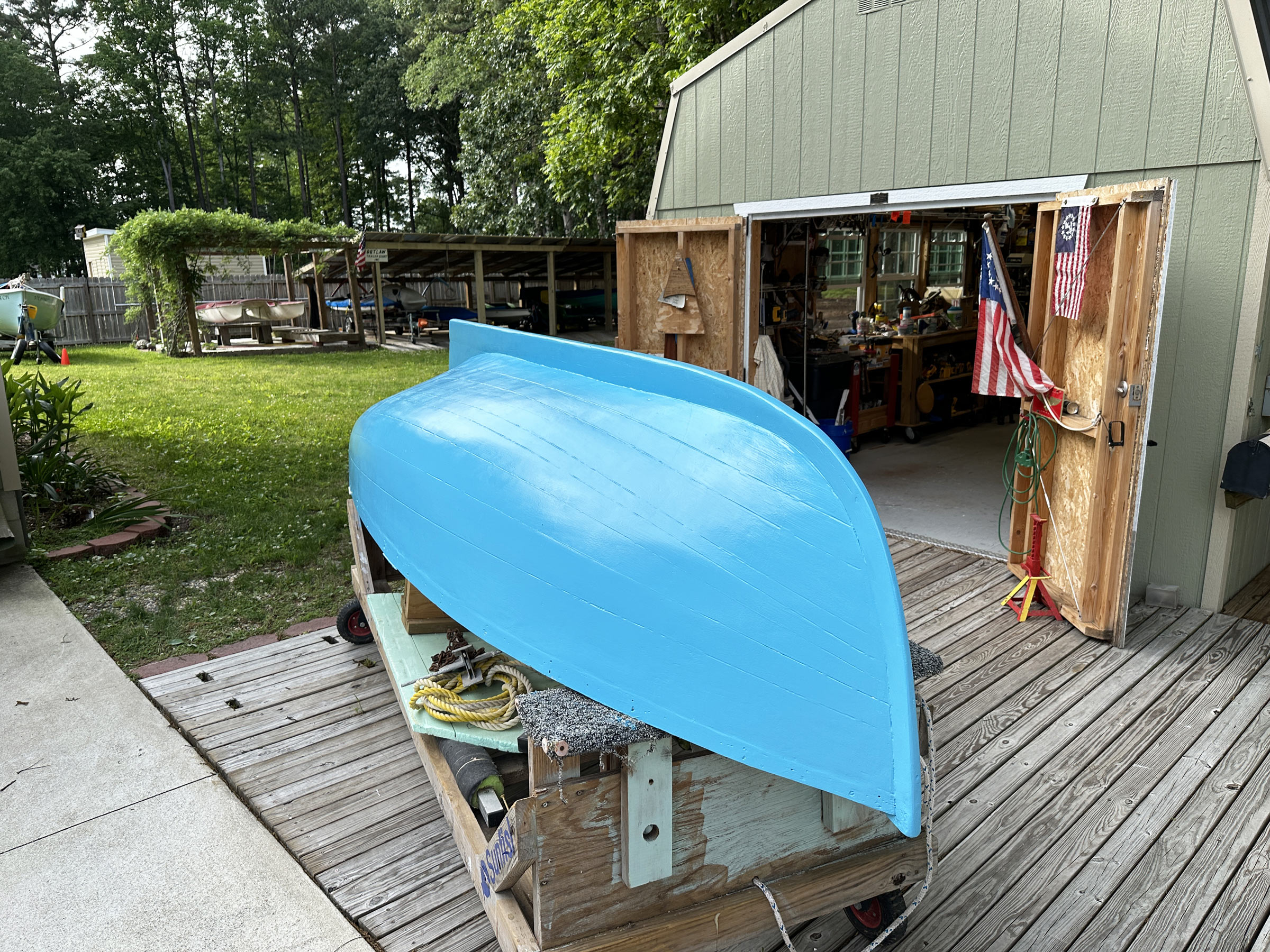
There have been other boats along the way, said Kent, of which the Bahamas Dinghy is, indeed, the latest. “When we were offered it, it had been in storage for more than 40 years. We’ve been slowly restoring it since November 2023. It was beautifully built of fine Caribbean woods with copper rivets. The planks were a little dry and needed caulking, but she should get her keel wet again this year, and then we’ll continue working on the rig.”
 Kent Lewis
The newly-painted Bahamas Dinghy should be ready for relaunching before the end of the year.
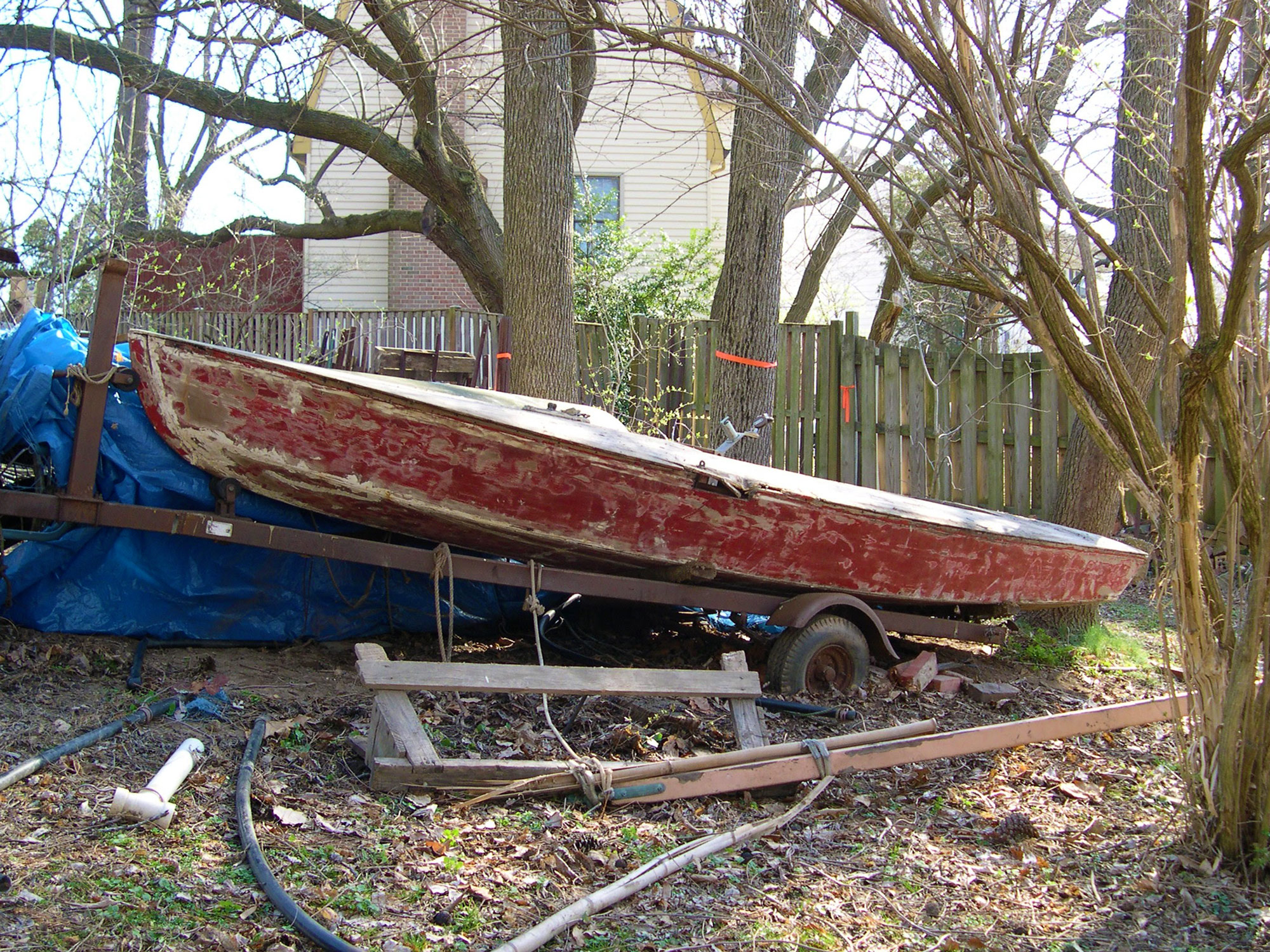
Shortly after I heard from Kent and Audrey, Jim Black wrote from Mechanicsville, Virginia, to tell me about the Snipe that was given to him in the early 2000s by the father of a neighbor. “He was moving out of his house in northern Virginia,” Jim wrote, “and the boat was going to the dump if no one took it. My neighbor knew I was a sailor and a woodworker, so he asked if I wanted it. I’m always a sucker for a project, and for some reason the pictures didn’t scare me off.”
Built in 1939 in Long Beach, California, by a group of Douglas Aircraft employees in their office hours, the Snipe was owned and raced in Galveston, Texas, in the late 1940s. In the late 1960s until the early 1980s, it had one owner who took it with him when he relocated first from Texas to Chicago, then to Washington State, and finally to Washington, D.C.
 C.F.E. Roper
When Jim Black saw this and other pictures of the Snipe, he could see that it was in poor condition, but he wasn’t put off. Instead, he borrowed a roadworthy trailer and brought the boat home.
Even before Jim got the boat home and was able to take a close look at it, he knew it needed a lot of work. “The deck was too far gone to save, although I did retain two original deckbeams. The hull had kept its shape, but all the 300-plus screws were rusted out to varying degrees and there was a lot of iron sickness around each one. I filled each hole with 1⁄4″ fiberglass rod, drilled out to 3⁄8″ to get to good wood; rebuilt and refastened each frame; reamed out the original caulking and filled the grooves with epoxy; ’glassed the exterior and sealed the interior with epoxy…” The restoration took Jim about four years of intermittent work. And the cost? He’s not sure, but he managed it, he said, “on a limited budget.”
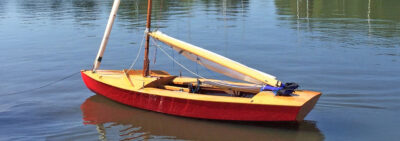
Now, in 2025, with the boat just three years shy of its 90th anniversary, Jim has decided the time has come to pass it along. “This time, it’s going to a friend who’s a new sailor but who appreciates nice old boats. I’m hoping she and her kids will have a wonderful time with it, and I’ll be around for maintenance tips and maybe even an occasional sail.”
 Jim Black
After years of hard work, the Snipe was as new. Subsequently, Jim sailed her for over 20 years, but this year passed her along to a new owner.
Two things struck me in these tales: first, free boats continue to be passed on, for free, from owner to owner. And second, it seems to me that recipients know what they’re getting into: they appreciate that they are getting something for free, but they also know that ultimately, there will be a cost—time, money, blood, sweat, and tears.
Which, indeed, is what appealed to me about the final anecdote that landed in my inbox this past month.
From the mountains of Western Virginia, Doug wrote, “I live in a secluded cabin in Western Viriginia, and my property is fairly steep. On a friend’s suggestion, I bought a used ride-on mower. All went well until I tried to ride the mower across the slope. It wanted to tip over, and the tires came off the rims. I dragged it back to the top of the hill and started repairing the flat tires. A neighbor drove by. He offered to buy the mower, and threw in a vintage 3-hp Johnson outboard. I accepted.
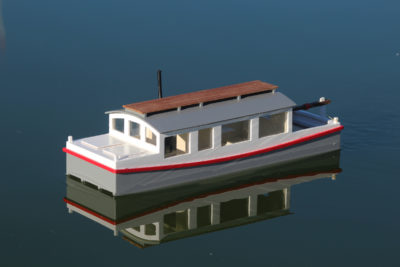
“I have several wooden canoes, but the motor wasn’t going to work on any of those. So, I bought a 1949 Penn Yan Trailboat on Facebook Marketplace. It was only 300 miles away. Now I had a boat for my motor. In time, though, I realized the motor wasn’t quite big enough, so I searched for and found a larger, vintage Johnson outboard. Then I needed to build a garage to store the boat and the trailer. And, of course, in the mountains of Western Virginia there’s no place nearby to launch the boat, so now… Now, I’m looking for an affordable cabin on a lake, where I can launch my vintage boat with its vintage motor.”
As another reader put it: “You wouldn’t get into it if you knew where it was going to lead.” But I believe we’d rather not know; that maybe the not-knowing is some of the appeal, and that certainly the journey that leads from a free boat (or outboard) to a beauty on the water is almost as important as the boat itself.




Doug made us laugh 🙂 We have been known to get part of a boat and gather the rest of the bits, which is good fun.
And then there is the matter of the British Seagull motor in the garage, with tune up parts…Skipper has many a Seagull story and the salty sailor words to go with it, learned from Cap’n Jack.
Jenny, I’ve taken on a few projects like this. You just have to remind yourself: “It’s about the journey, not the destination.”
To those who love small wooden boats: How many of us have taken on a project that was bigger than we had imagined? In a boat too small, on a sea too big, we create adventures that the were bigger than we ever planned. When our life is almost over, we are the ones who have truly lived.