History of local competitive rowing in the U.K.
Until the 1960s, community rowing and sailing groups were popular in the United Kingdom, with regular rowing and sailing regattas using locally designed craft. With the advent of fiberglass production boats, this practice gradually ceased, as regattas came to be events between production boats, and the demand for local construction declined.
Over the past couple of decades, some parts of the United Kingdom are seeing a revival of competitive rowing in local wooden boats. In southwest England, pilot gig racing is popular, sometimes drawing dozens of boats and thousands of spectators. In Shetland and West Wales, interest in rowing is also increasing. In these areas, the boats are generally built by professional boatbuilders, creating a steep initial cost for anyone who wants to get into rowing.
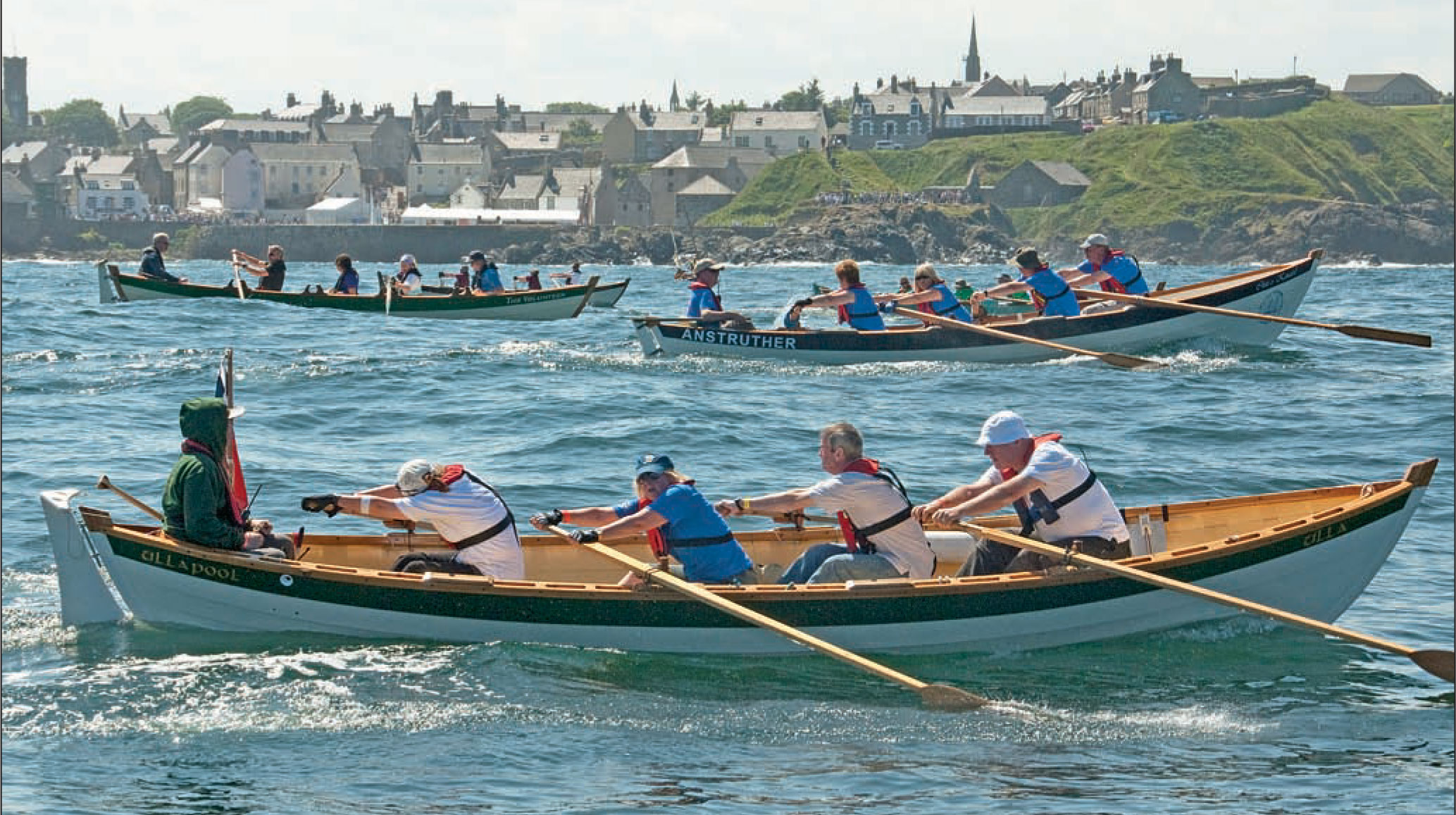 Kathy Mansfield
Iain Oughtred designed the St. Ayles Skiff as a competition rowboat that could be built and then campaigned by Scottish communities under the umbrella of the Scottish Coastal Rowing Project.
The Scottish Fisheries Museum of Anstruther, Scotland, started the Scottish Coastal Rowing Project in an effort to provide a way for people to get involved in rowing through the use of inexpensive community-built and community-owned boats. They envisioned a one-design kit boat to be built by small groups of people who could race against other community groups.
The museum commissioned Iain Oughtred to develop a design that would be reasonably inexpensive (about £3,000, or US$3,900). The boat would be fast, safe, of simple construction, and able to be powered by a small crew. The St. Ayles Skiff is the result of that commission. Drawing on the Fair Isle Skiff as inspiration for his design, Oughtred chose the name St. Ayles, from the name of the chapel in which the Scottish Fisheries Museum is now located.
The Scottish Coastal Rowing Project was formed in 2010 to oversee the racing of these community boats. According to their website, the St. Ayles Skiff “provides a desired mix of tradition, seaworthiness, speed, and ease of build. These boats take a crew of five—four rowing, and a coxswain to steer and coach the crew during racing and training.” The group asked Alec Jordan of Jordan Boats in Fife, Scotland, to develop a reasonably priced plywood kit from Oughtred’s plans.
This new community rowing initiative has caught fire faster than a burning Christmas tree. As of summer 2011, when this article was written, 18 boats had been launched, with 20 more in mid-build, and more than a dozen other communities are getting started in the process, including groups from Ireland and The Netherlands. Construction also started on five of these boats at Maine high schools over the 2010–11 school year; they are part of a parallel U.S. program, founded by WoodenBoat Publications, called the Boatbuilding and Rowing Challenge, or BARC.
The SCRP website has extensive building instructions, measurement rules, tips on rowing, and fundraising ideas. It also offers links to many other community builds, with blogs and photographs of their experiences—an inspiring resource for any group interested in taking on a St. Ayles Skiff. In the United States, the BARC website provides a similar service. And a quick search of Scottish coastal rowing on YouTube will bring up dozens of launching videos of the St. Ayles Skiffs.
Designing the St. Ayles Skiff
With a length of 22′ and a beam under 6′, the St. Ayles Skiff is long, lean, and fast. Like nearly all of Iain Oughtred’s designs, the curve of the stem and sweep of the sheer draw and hold your eye. This double-ender is sleek, with a finer bow than stern, and both ends flowing to flatter floors as one moves toward amidships. The four fixed thwarts are spaced evenly along the hull, with stretchers for each rower’s feet lying under the next seat. A displacement of only 330 lbs makes it possible for a crew of five to carry the skiff from trailer to water and back again, though a couple of extra hands in this chore will be very welcome.
The coxswain sits high in the stern, as far aft as possible. The tiller would impale him were it aligned with the centerline, so Oughtred’s plans call for it to be offset to starboard, such that when the rudder is amidships, the tiller is parallel to and just above the starboard gunwale. He also suggests a yoke and lines as an alternative steering method. Some boats choose a push-pull tiller as a third option.
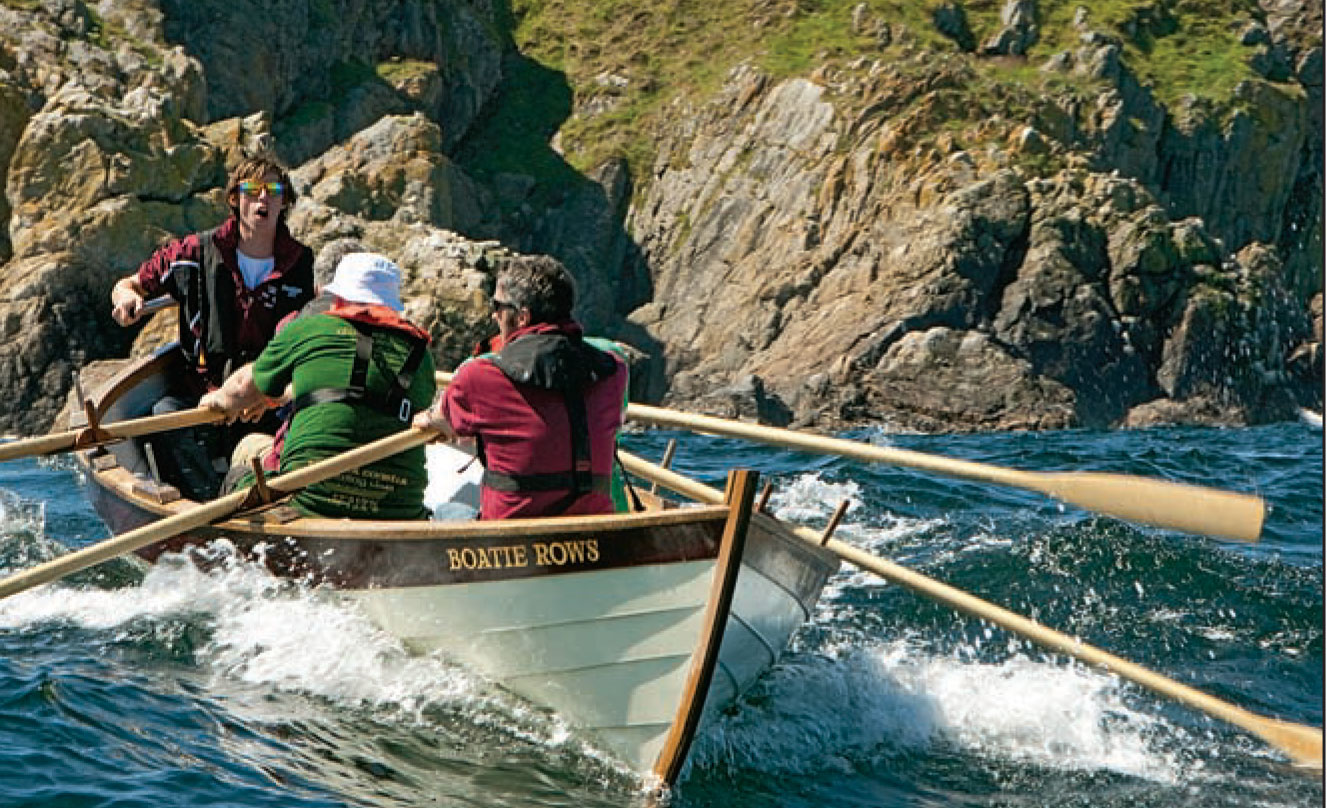 Kathy Mansfield
WoodenBoat Publications took inspiration from the Scottish Coastal Rowing Project, establishing a sister program, the Boatbuilding and Rowing Challenge, in the United States. Five boats have been built or are nearing completion at this writing. Eighteen have been launched in Europe, with 20 more in mid-build. Here, a boat competes at Portsoy, Scotland, in 2010.
Like all of his plans, Oughtred’s construction drawing for the skiff is clear, complete, and an artwork in itself. He captured all of the necessary information on a single sheet, providing dimensions in both inches and millimeters, and all inscribed in his beautiful calligraphy.
The kit pieces are cut from five sheets of plywood, one sheet of 3⁄48″ for the stems and frames, and four sheets of 3⁄8″ for the planking. The kit also contains five sheets of MDF cut into pieces for the strongback and molds. A perusal of the existing boats will show much variation in stemheads. While the design calls for them to be finished flat a few inches above the sheerline, many groups have left them longer to accentuate the profile curve of the bow and stern, and some have sculpted them.
Each of the four rowers holds one oar. The plans call for 12′ oars, made of fir or soft pine, with the loom to be squared off where the leather would go. A piece of 1⁄2″ larch is added to two sides of this squared-off area to provide additional protection. The oars rest on the gunwale between a tholepin and a wooden kabe—a hardwood peg that bears the thrust. Organizers felt that prohibiting the use of metal oarlocks would help keep the costs of the boats down. The SCRP website, under the “Oars” tab, mentions that oars can vary in length from 11′ to 15′. Several groups have had difficulty with oars hitting the backs of the rowers immediately astern. Varying the oar lengths, or staggering the rowers from side to side, helps rectify this situation.
While the kits are very popular and groups seem to be successful in finding both the funding and volunteers to build them, there are some who would like to build from the plans alone. As of this writing, I understand lines plans and a construction manual is in the works.
Rowing a student-built skiff
I had the opportunity to row a skiff built by students at Sumner High School in Sullivan, Maine. They had built this boat under the instruction of John Wells and Steve Belyea as part of the BARC program. We rowed the skiff, named TIGER PRIDE, in Rockland Harbor during last summer’s Maine Boats, Homes, and Harbors Show.
The skiff was very easy to launch, with a dozen people carrying it to the water. The boat offered plenty of room and stability for our crew to move about and get situated before setting out. It takes a bit of thought to maneuver the 12′ oars from their resting positions on the thwarts to their working positions in the tholepins without hitting any crew members.
 Kathy Mansfield
The St. Ayles Skiff carries a standard crew of four rowers—each working a single oar—and a coxswain. The design name is from the former chapel that now forms the entrance to the Scottish Fisheries Museum, which is headquarters to the Scottish Coastal Rowing Project.
The building crew strayed from Oughtred’s plans both in their tiller and their oarlocks. They made a tiller that was bent to starboard rather than just a straight tiller with a starboard cant. Instead of wooden kabes, the builders made tholepins out of long carriage bolts, covering them with bushings and bolting them through the rails.
With four of us rowing, new to each other and some new to the boat, our coxswain got us into rowing cadence within a few dozen strokes. Once we worked in rhythm, the boat flew through the water, cutting barely a wake, covering ground quickly. We exerted very little effort to maintain speed. I was surprised at how easy it was to jump into this boat and just go.
The coxswain led us through stopping and turning the boat several times. The latter was difficult at first, but our performance improved with practice. If one side just stopped rowing for a stroke or two while the other side kept on, the boat turned in a smooth circle. With one side rowing back, and the other rowing forward, we could spin the boat nearly in its own length.
Unlike a rowing shell, which demands precision movements and hours of practice toward perfection, this boat welcomed the novice, with patience to shake off the mistakes of the learner. When we got it right, we were immediately rewarded with speed. Even when we were out of rhythm, the boat still responded well. It was easy to imagine how well this boat would go with a practiced crew.
In Scotland, dozens of community groups including people of all ages are building and racing these skiffs. WoodenBoat has inspired a few local high schools to start their own racing season here. I hope these boats catch on and spread; they are an easy and elegant way for just about anyone to get out on the water and row for fun. 
St. Ayles Skiff Particulars
LOA: 22′
Beam: 5′ 8″
Disp: 330 lbs
For Kit details in the U.S., contact Hewes and Co. Marine Division; in the U.K. contact Jordan Boats.
Check out these other Oughtred-designed skiffs
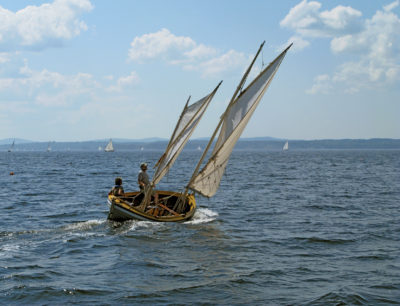
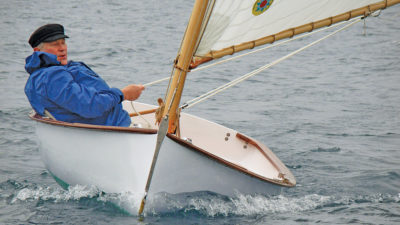
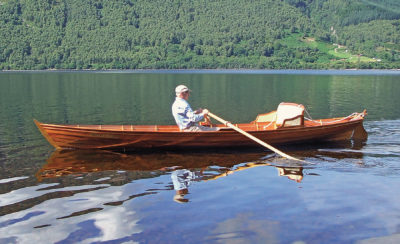
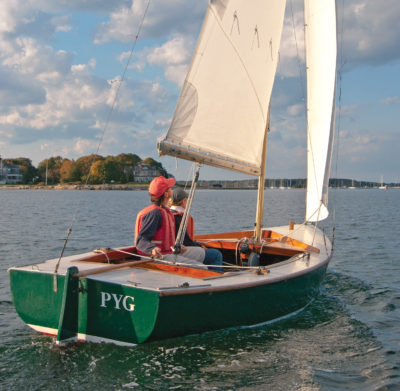
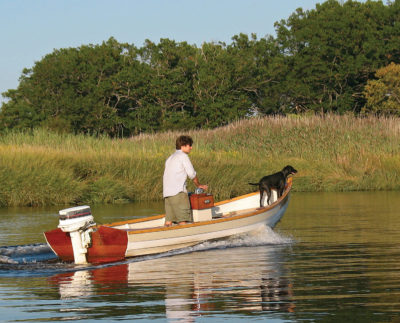
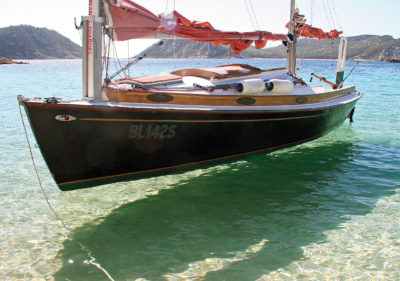
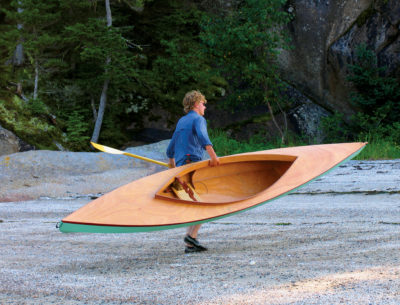
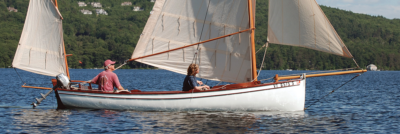
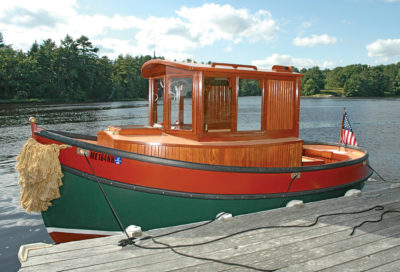
A skiff is a small, lightweight boat that can be rowed, sailed, or powered with an outboard motor. They are great for fishing or recreational cruising along shallow waters. Small Boats has featured several skiffs designed by Iain Oughtred. Here are a few we think you will enjoy.
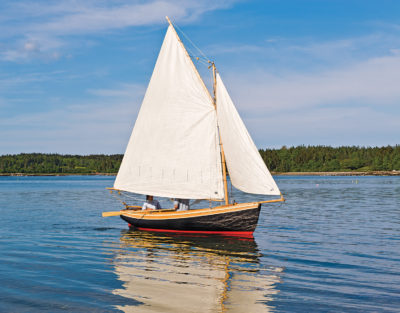
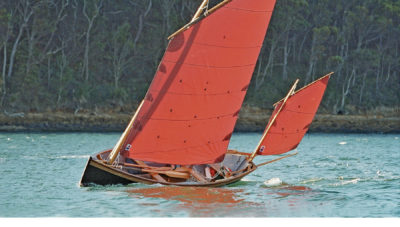
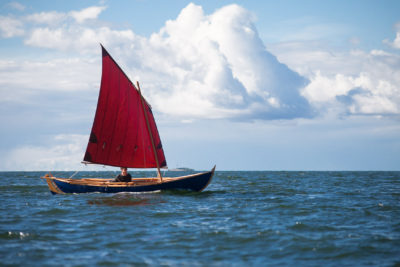
Guillemot: An Iain Oughtred sail-and-oar skiff.
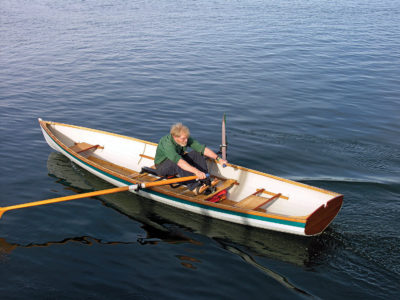
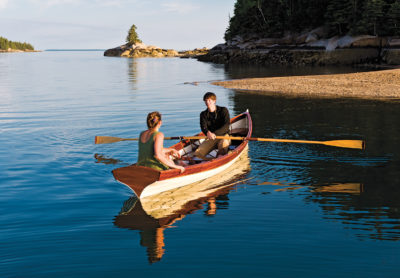
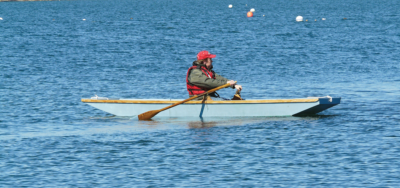
12′ 3″ Spike Skiff: A classic flat-bottomed skiff updated for modern trouble-free materials.
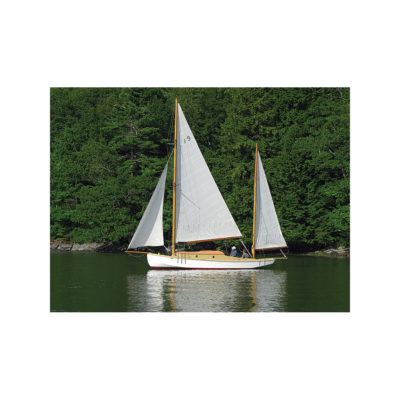
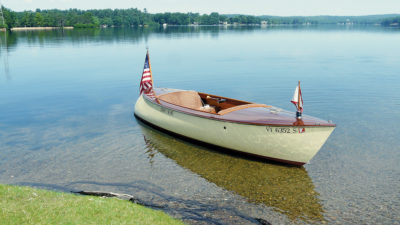
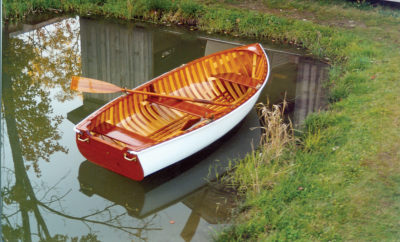
KINGFISHER: An almost-traditional Thames skiff based on Oughtred’s Badger design.

Join The Conversation
We welcome your comments about this article. To include a photo with your remarks, click Choose File below the Comment box.