 Robert Knight
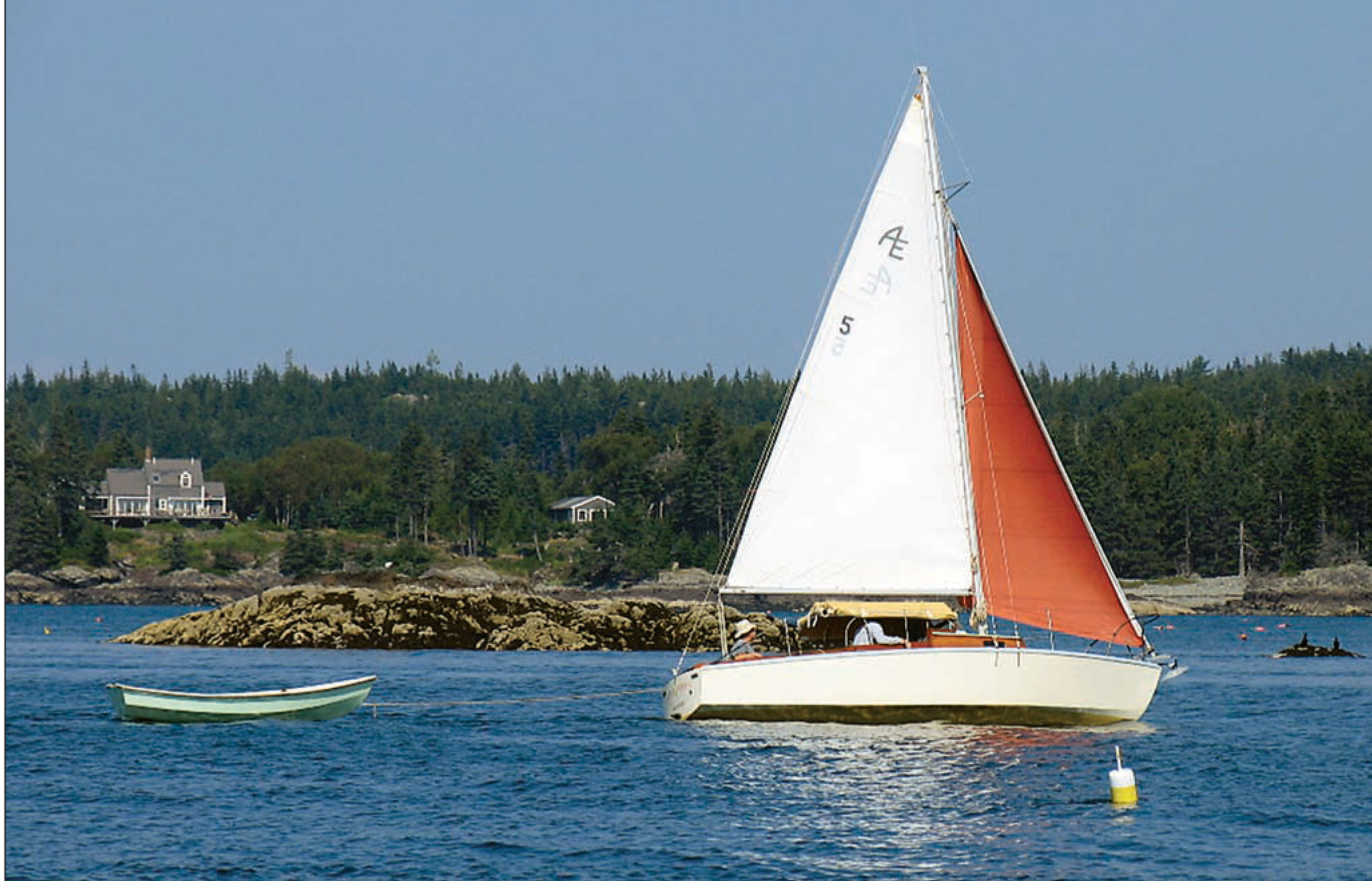
The 24′ Amphibi-ette was among the first trailerable cruising sailboats. At only 2,300 lbs, she can be towed by a modest-sized vehicle to distant cruising grounds.
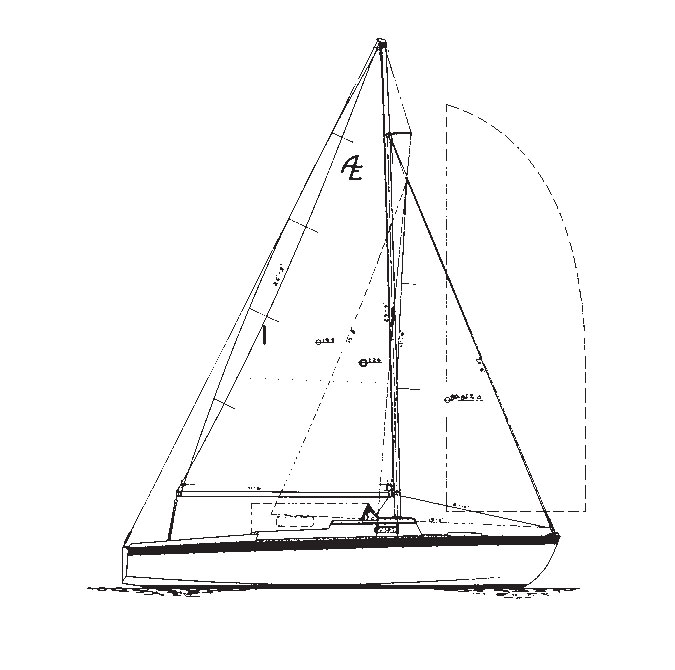
The Amphibi-ette (A/E) has been called the Volkswagen camper bus of sailboats. One of the first cruising sailboats to be specifically designed for trailering, she is still considered one of the best of the breed by those who know her. Conceived in the mid-1950s by designer Cyrus Hamlin and boatbuilder Farnham Butler, the A/E is the smallest of a line of sailboats called “Controversys” because, at the time of their debut, many of their features were radical departures from tradition. These features included light displacement, reverse sheer, glued strip-plank and plywood construction, and unusually open deck and interior layouts. The A/E and her cousins give us a good idea of where mainstream wooden boat building was headed just before the start of the fiberglass era.
The design’s name, which to our ear is endearingly 1950s retro, came about because in many ways she is a smaller version of the Amphibi-Con, which got its name from “Amphibious Controversy,” a reference to its trailerability.
The Amphibi-ette is aimed squarely at young families for whom absolute practicality is more important than traditional aesthetics, and she really hits the mark. At 2,300 lbs designed displacement she is light for a 24-footer even by today’s standards, meaning she can be trailered behind almost any vehicle with a V-6 motor. While it was a new idea in the ’50s, today everyone is aware of the advantages of trailerability, in the potential elimination of boatyard and transport bills and the convenience of performing maintenance in one’s own backyard. The trailer also enables the boat to be transported quickly and economically to distant cruising grounds, which might not be attainable by a non-trailerable boat and only reachable by an offshore-capable boat whose crew had the time to make a long voyage.
 Greg Pugh
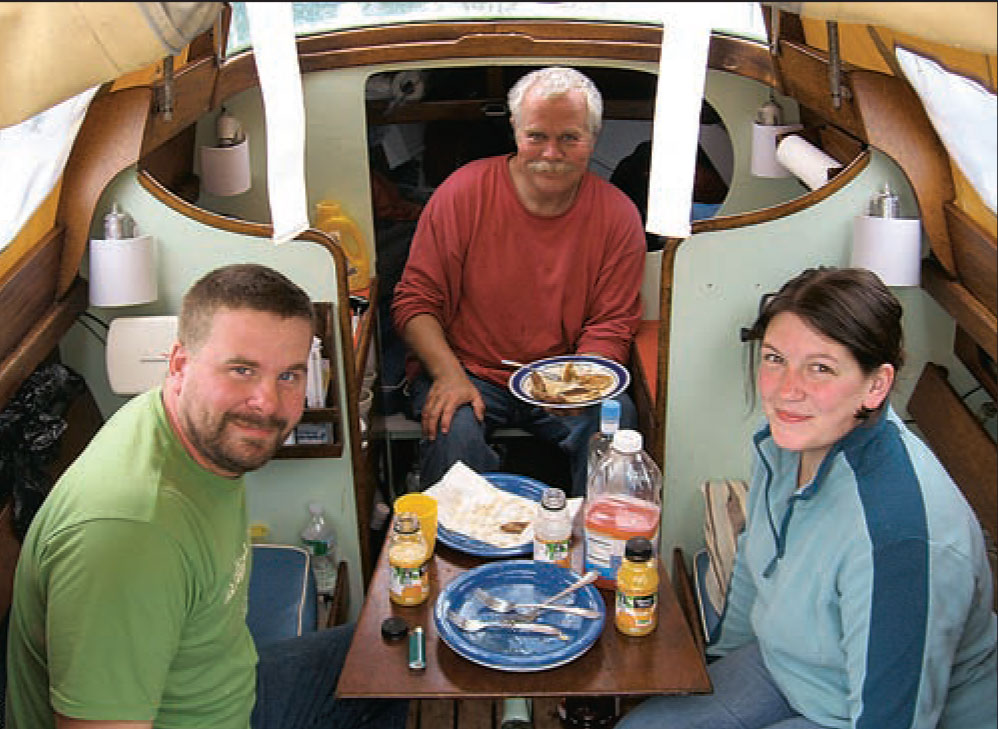
The Amphibi-ette’s cozy cabin will accommodate a small family for short cruises.
Amphibi-ette Features
Amphibi-ette’s shallow 2′ 4″ draft is one of the features owners like most, because it makes available the most sheltered anchorages in a given locality, and because of the security it provides—running aground in water that shallow is unlikely to be a surprise and is quite a lot less scary than doing it with deep draft. The draft she does have puts the ballast low enough to make her self-righting from a knockdown and, almost as important, it enabled the designers to position the centerboard entirely in the long, shallow fin keel. This greatly simplifies construction of the centerboard trunk and keeps it out of the cabin. The centerboard cable comes straight up through a tube to a point above the waterline, where it is adjusted with a small reel winch. The tube terminates in a small “coffee table,” which serves as a mount for a larger dining table and, often, as a convenient seat.
The designers understood that for comfort small boats need to be designed around the dimensions of the human body, the goal being enough space for comfort but no more. The whole Controversy series is a masterpiece of what we now call ergonomics, and the A/E, as the smallest of the line, benefits from this the most. Her interior is her biggest claim to fame. Depending on the layout she will sleep three or four full-sized people—I’ve cruised successfully with three adults and two kids aboard. The four-berth version will seat six people in the cabin (one on the seat in the galley, one on the end of the V-berth, and two on each quarter berth at the table) and the three-berth boat will seat five. She has standing headroom in the galley and main cabin, under the canvas top. The galley has a high countertop on the port side that is good for a two-burner stove, with lots of storage underneath. On the starboard side is a low countertop over the icebox, doubling as a seat, with a storage bin or hanging locker outboard. This galley seat is in many ways the best in the boat. When seated here one has the small windshield at the forward end of the galley at eye level, providing a 180° view forward—almost unknown in sailboats. The windshield is also helpful to forward visibility from the cockpit, when the canvas top is in place, and I often steer my boat under power from down below, when it is hot or rainy.
 Dan MacNaughton
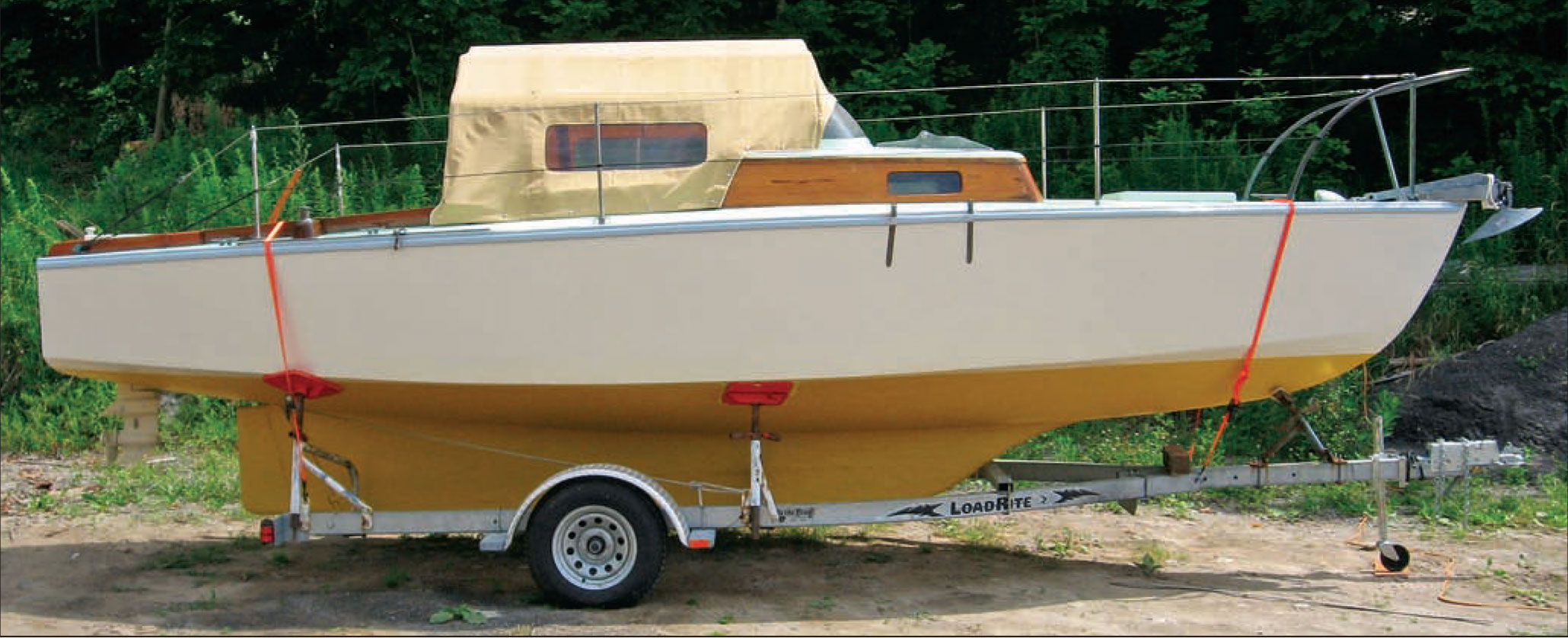
The design’s removable canvas shelter is one of its most popular attributes.
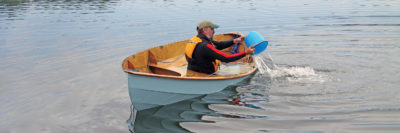
In the three-berth version the forward cabin has a berth on the starboard side and a toilet to port, creating an encloseable head. In my four-berth boat there is a V-berth in the forward cabin. A toilet could go under the head of the berth, but we are fans of the portable, low-tech bucket, which can be used in the cockpit under favorable conditions. A curtain can be rigged at the aft end of the galley when it is desirable.
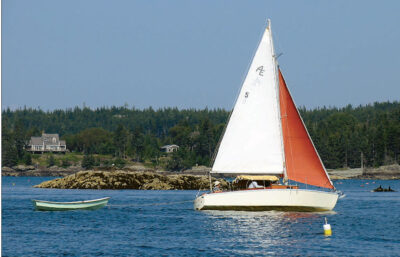
All who have used the boat agree the canvas top is one of her best features. It is essentially a large dodger mounted on permanent hoops. The sides roll up and down and can be secured partway up. When the top is rolled all the way down, the cabin is snug, tent-like, and well protected from the weather. When the top is rolled partway up the interior is shaded and open to the breeze, with all-around visibility. When the top is removed (about a one-minute operation) the galley and main cabin are wide open and part of the cockpit. It’s like a sailing living room—about the ultimate in daysailing comfort.
 Dan MacNaughton
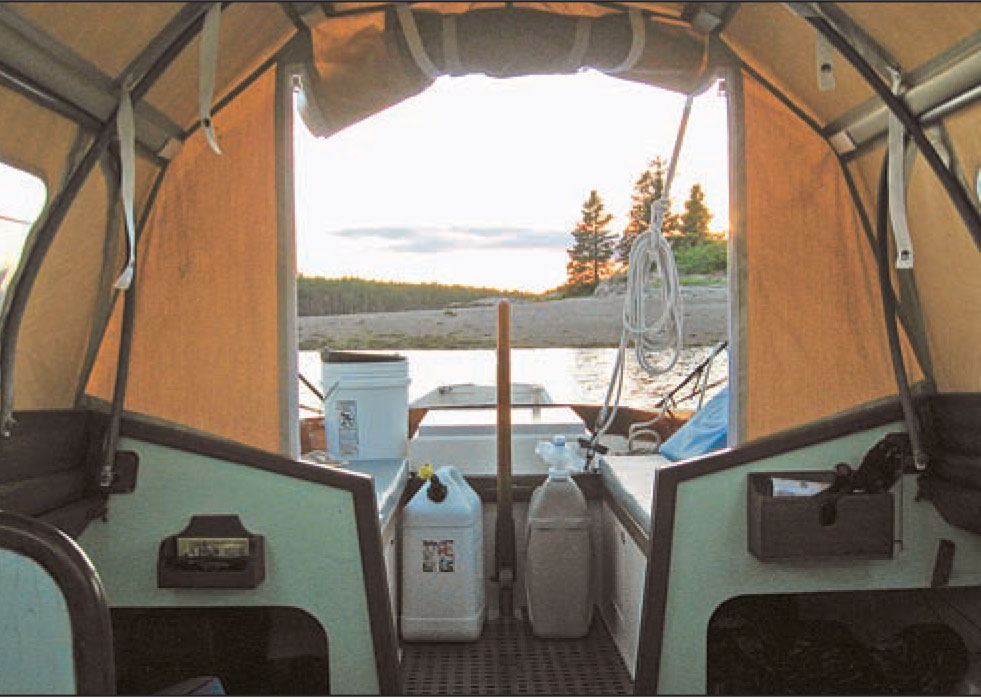
With only a 10″ difference in height between the cabin and cockpit soles, the two spaces flow together easily.
There is no bridge deck, and there is only a 10″ height difference between the cabin sole and that of the self-bailing cockpit. Taken together with the canvas cabin enclosure, this blurs the distinction between cockpit and cabin, and the ease of movement from one to the other is one of the most pleasant things about the boat, especially when sailing singlehanded, when everything in the cabin is just two steps away from the helm. When seated in the cabin the effect is like sitting under the dodger of a 60-footer: one’s eye is well above deck level and one’s surroundings are in full view, over the aft end of the boat.
The remarkable interior is made possible partly by the boat’s unusual hull shape, which incorporates plywood topsides and a strip-planked bottom shaped like an inverted bell in cross section. The shape provides good width at berth level and remarkable width at the cabin sole, while the boat floats on what is basically a very shallow and narrow hull, under the chines. The A/E sails fast and well under all conditions except very light air when, like most light boats with long waterlines, she has a less-than-optimum sail area-to-wetted-surface ratio. She is particularly fast downwind, and she loves a breeze. Like any really light boat her motion in rough water is quick, but she doesn’t pound—this quick motion is a factor when on the anchor, so sheltered anchorages will be much preferred. Fortunately, her shoal draft allows her to find them most of the time.
 Julie Noyes Johnson
The Amphibi-ette’s 2′ 4″ draft allows her into anchorages off-limits to most cruisers; rigged with a pair of beaching legs, she can easily take the ground on a falling tide.
Amphibi-ette Performance
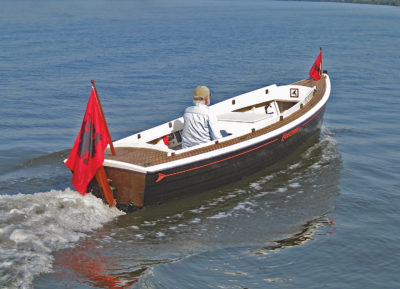
The Amphibi-ette is remarkably fast under power. A 9.9-hp Johnson two-stroke pushes the boat well over 6 knots, a big beneft to the family cruiser who wants to get in before dark, or home in time for work. At 4.5 knots this outboard consumes about one-half gallon of gas per hour. A four-stroke motor might cut this consumption nearly in half. Smaller outboards will work fine. I’ve run the prototype of this design with a 2-hp Seagull and found it perfectly practical. A motor larger than 9.9 hp will be too large and heavy. The outboard is mounted in a well aft of the cockpit, behind a watertight bulkhead. There is no motor out on the transom looking ugly, snagging lines, and inviting theft; there is no leaning over the transom to work the motor. The motor is protected from collision or submersion, and the installation can be very, very quiet.
The Amphibi-ette’s construction was radical for its day, taking elements from aircraft structures and wartime plywood applications, as well as from traditional wooden boat building. It was one of the frst boats to utilize glue in virtually every joint. There are no large timbers in the boat, but the structure as a whole is tremendously rigid, which has contributed greatly to the longevity typical of this relatively economical construction. With today’s epoxies the A/E’s construction can be just that much better and easier, and she is well within the abilities of a dedicated amateur. While she is far from an “instant boat,” the structure is designed for economical materials and rapid construction. There may be other ways to speed, improve, or simplify the construction by modernizing it slightly, but the original structure, glued with epoxy and fastened with bronze, would seem to be good for a very long life span just as it was. 
Plans for Amphibi-ette are available from The WoodenBoat Store, P.O. Box 78, Brooklin, ME 04616; 800–273–7447.
Amphibi-ette Particulars
LOA: 24′
LWL: 20′ 1″
Beam: 7′ 9″
Draft (centerboard up): 2′ 4″
(centerboard down): 4′
Displacement: 2, 300 lbs
Sail Area: 224 sq ft
The Amphibi-ette’s construction was groundbreaking when introduced in the 1950s; it was one of the first glued-together plywood boats.
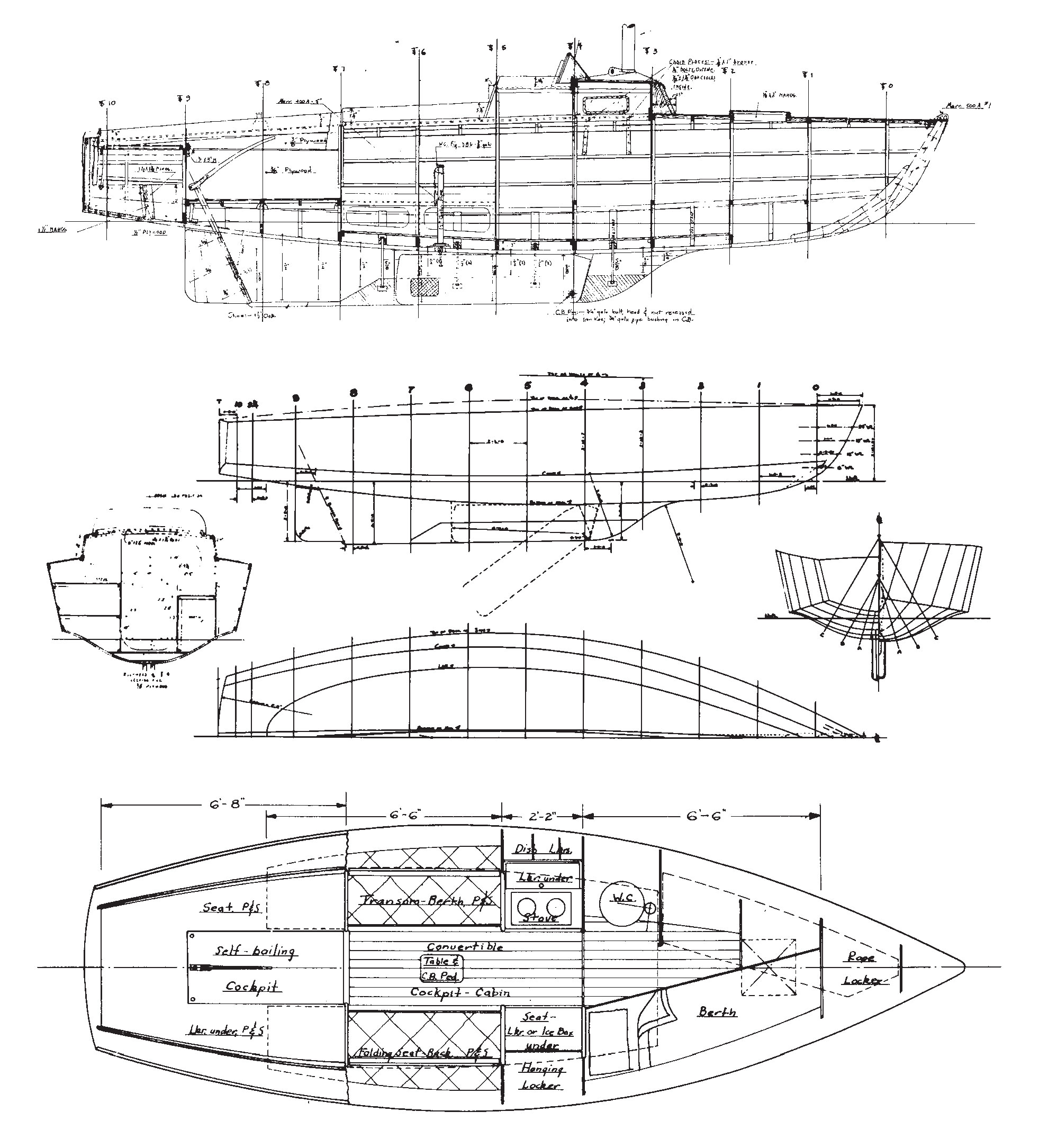
Here we see the three-berth layout; there is also a four-berth option.
More Trailerable Sailboats
With a trailerable sailboat like Amphibi-ette, if your car can drive there, your boat can sail there. For some other trailerable small cruising boats see:
Meaban, a trailerable Vivier sloop
Cape Henry 21, an expedition sailboat for adventurers
Eun Mara, a trailerable coastal cruiser from Iain Oughtred


A very practical boat–but aesthetically a turn-off for me. I can’t abide the reverse sheer, even though it adds a lot of usable space amid-ship. And the only thing worse than the vertical transom is a forward sloping transom so ubiquitous nowadays. But since I’m not likely to own a cruising boat of that size in the foreseeable future, it’s all hypothetical anyhow.
Responding to my own recent post: the other three boats that follow this article show the design aesthetics I prefer. But so many pocket cruisers share one failing: they try to cram in (or “sleep,” as promotional hype likes to express it) too many people. As you wedge in more crew,, pretty soon it becomes impossible to move around, shift position, cook at the “galley,” or use the head without tripping over or stepping on or falling over all those people the skipper wants to impress or entertain. Leave them ashore or get a bigger boat. The only advantage (if you want to call it that) is that the experience will put off lubbers from venturing near the water ever again.