As a sail-training boat, the Turnabout/N-10 has not had the success of, say, the Optimist. The 9′ 8″ cat-rigged dinghy was once a staple of junior programs in yacht clubs along the New England coast and on lakes of the Northeast, but there are, today, just a handful of clubs that still support a fleet. Yet, at those clubs, the Turnabout/N-10 is loved and cherished for what it is: a safe training boat that offers a good grounding in techniques and an excellent means of fostering the joys of social sailing. About 10 years ago, when chatting with John Hanson, the founder of Maine Boats Homes and Harbors magazine, I mentioned that my new-to-sailing daughter was embarking on her first full season in a Turnabout. He sighed with an obvious longing for simpler days. “You know,” he reminisced, “I met one of my best friends sailing Turnabouts as a kid. We shared what seemed like endless summer days laughing at crude jokes and armpit farts, and somewhere along the way, without realizing it was happening, we learned to sail.” As praise for a kid’s boat, that’s hard to beat.
 Photographs by the author
With a newer, well-trimmed sail, the N-10 is quite close-winded, although it never pays to over-sheet the mainsail; keeping the boom just over the inside of the stern quarter is optimal.
The Origins of the Turnabout
The Turnabout was designed, and originally built, in about 1950 by Harold Turner of Parker River, Massachusetts, and was adopted as a class by the Ipswich Bay Yacht Club whose members were seeking a new training boat that could cope with strong tidal currents and often choppy seas. Turner’s cat-rigged boat was constructed of plywood, fastened with nails and glue. The class suited Ipswich Bay well and before long it had spread to other clubs and programs along the east coast. By the mid-1960s, Turner’s boatyard had built more than 2,000 of the dinghies, some of which are still in commission.
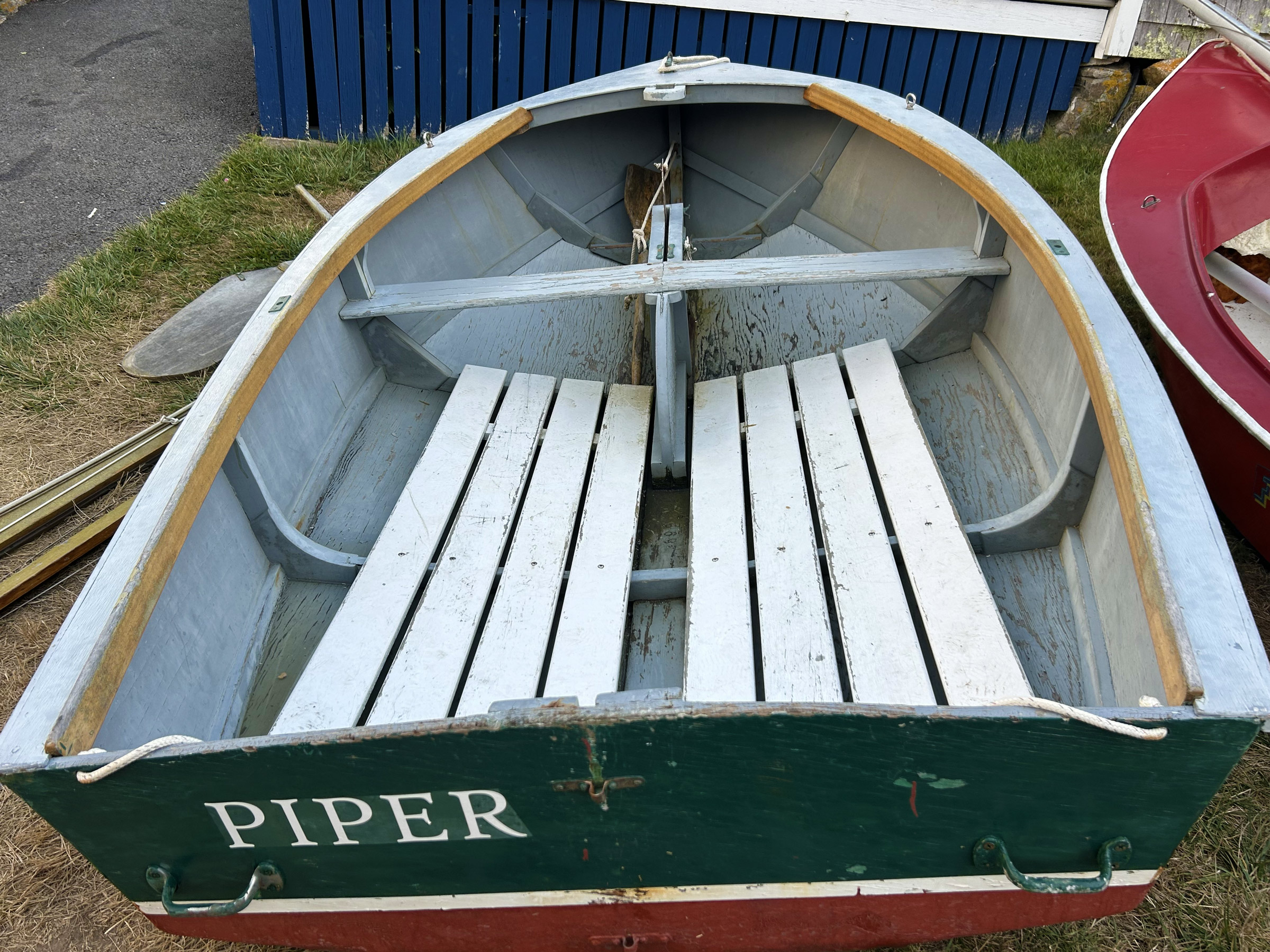
PIPER is an original plywood Turnabout, hull number 1568. The floorboards are typical and help to keep skipper and crew dry when seated in the bottom of the boat. Note her oarlock sockets; the red fiberglass N-10, just visible to the right, has none.
Toward the end of the ’60s Turner’s yard began producing Turnabouts in fiberglass but they were not a success. More expensive than the wooden versions and thought by many to be slower, production was limited. Then, in 1972, Joe Duplin, one-time Star-class champion, took a mold off a fast wooden Turnabout, produced a new fiberglass hull with a balsa core, and rigged it with aluminum spars. But Turner would not give up the name and so the new boats, built by Duplin Marine, were dubbed National 10s (N-10s). For the ensuing 50 years the two boats have coexisted in sail-training fleets across the Northeast. In 1990, production was taken up by Steve Winkler formerly of Duplin Marine, in Winthrop, Massachusetts, and in 2002 by Jack Gannon of J.G. Marine in Burlington, Massachusetts. A few years ago, Jack ceased building new boats (the combined Turnabout/N-10 class is currently up to hull number 4256), but he still sells parts and would like to sell the molds so that production of new hulls could resume.
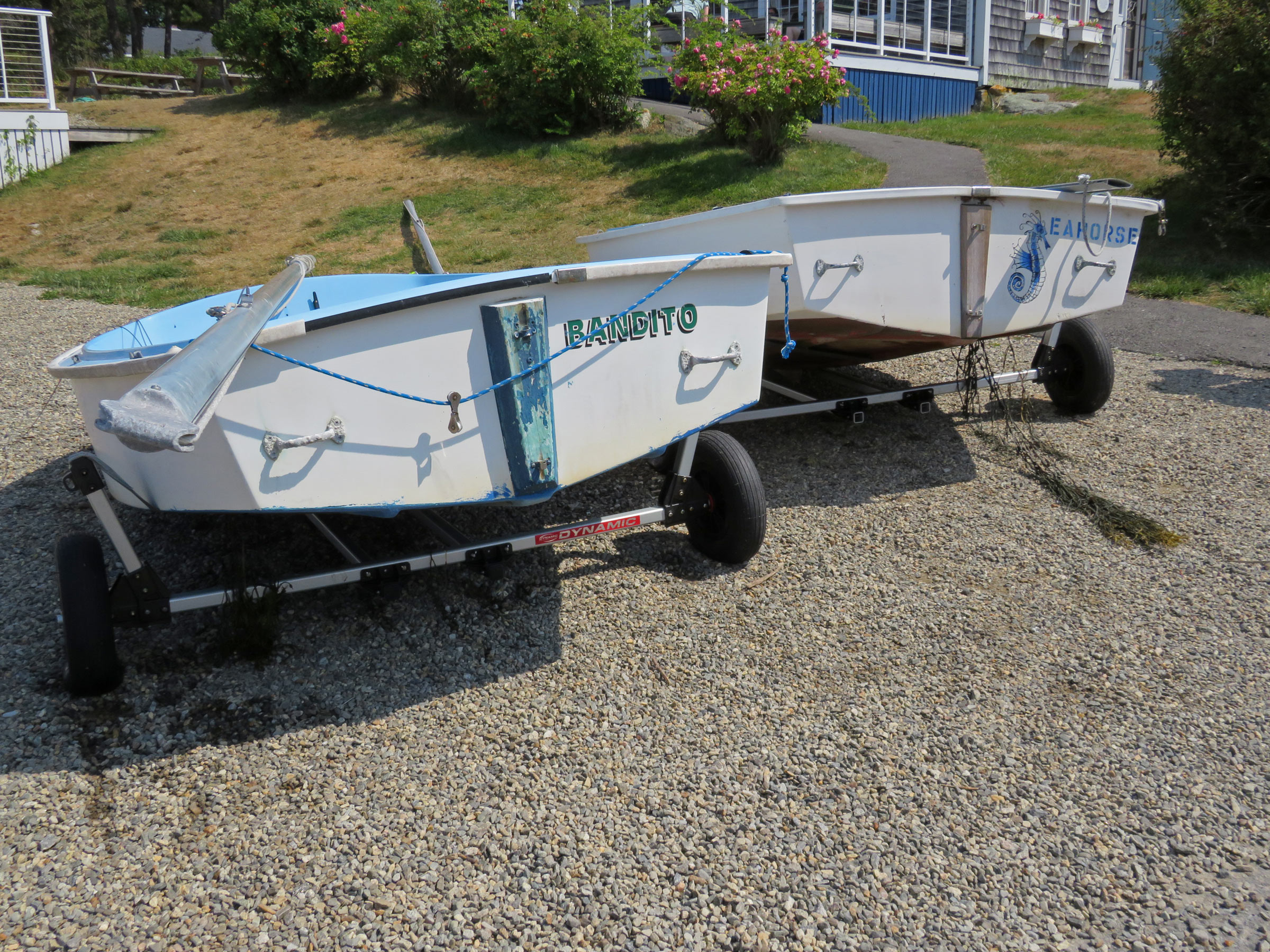
Among the older N-10s an area of weakness has been beneath the rudder fittings on the transom; owners often introduce more strength by through-bolting a solid-wood pad on the transom under the gudgeons.
At 9′ 8″ LOA and 5′ 3″ in the beam, the Turnabout/N-10 boasts a well-raked stem, vertical transom, and a shallow-V underwater shape that quickly broadens out to its maximum beam. The hull has a hard chine with, in the Turnabout, an interior chine log. While the Turnabout has three plywood structural frames, the N-10 has none and the cockpit is unobstructed save for the centerboard trunk and a thwart that is part of the deck molding. The rig consists of a single Bermudan sail set on a mast stepped through the foredeck and supported by two shrouds and a forestay. Its sheet leads from the end of the boom down to a running block on a rope traveler atop the transom, back along the boom and down to a cleat typically mounted on the thwart. There is a pivoting metal centerboard and a fixed-blade rudder. The only unusual feature is a spinnaker, which on a boat so small and low-key seems incongruous but has, I suspect, done much to keep the class alive, as it introduces new challenges as sailors become comfortable on the water.
The Turnabout/N-10 Today
Over the past two decades, many clubs have moved away from Turnabouts in favor of the International Optimist, but there are still fleets in New Jersey, Rhode Island, Massachusetts, and Maine. At Monmouth Boat Club in Red Bank, New Jersey, and Newport Yacht Club in Newport, Rhode Island, N-10s are enthusiastically sailed by adults in a Frostbite season. In Southport, Maine, the yacht club has been a proponent of the boat since the junior sailing program was established there in the 1960s. The founding director of the program favored the Turnabout for its easy reassuring performance for new sailors, and for its contribution to “social sailing.” As my daughter said when she was eight years old and it was suggested by an instructor that she might like to move into the Optimist fleet: “Why? I don’t want to sail on my own. What’s the fun in that?”
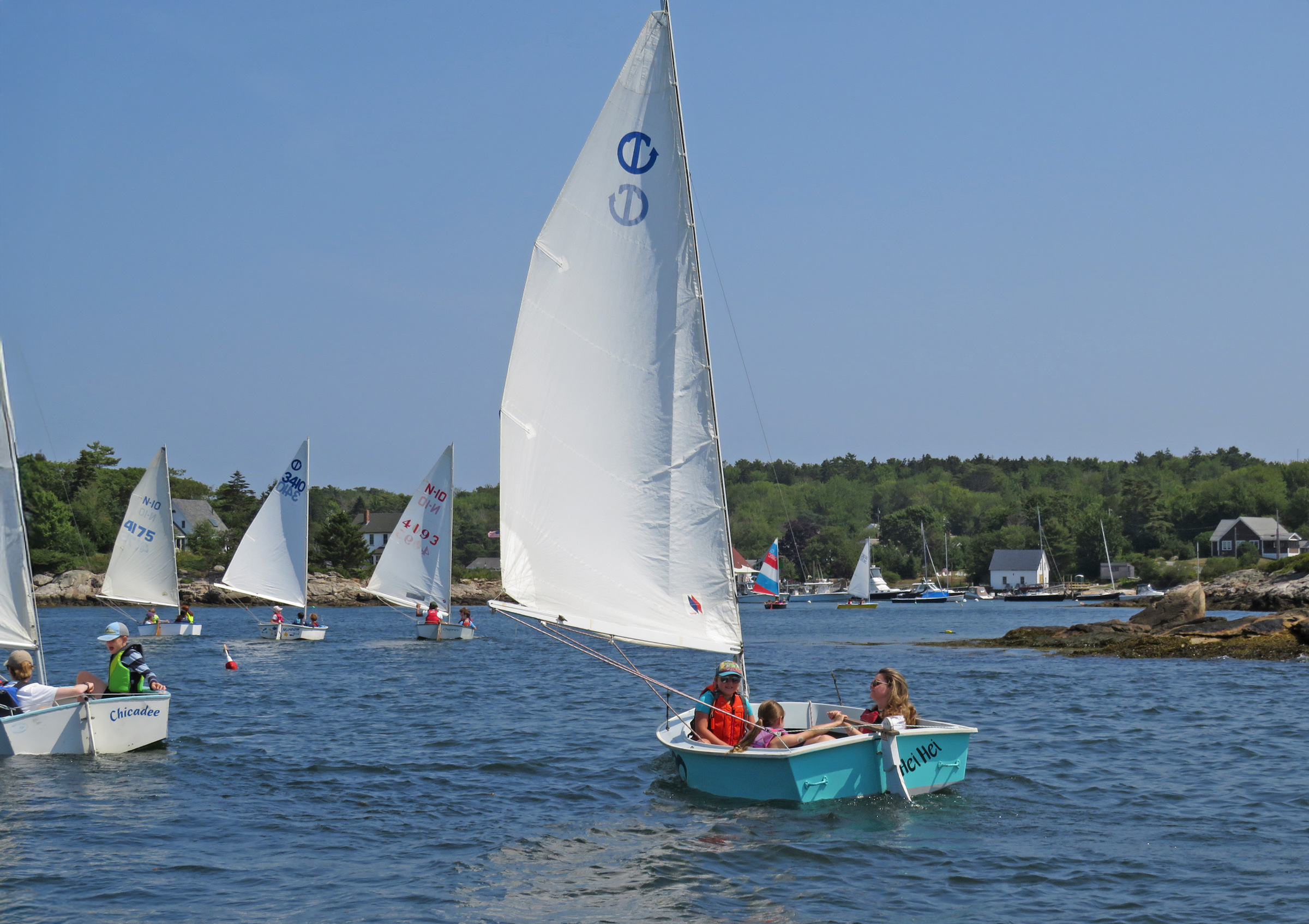
So similar are the N-10s and the Turnabouts that their sails are interchangeable. While the hulls here are all N-10s, two of the nearer sails bear the Turnabout insignia.
The Turnabout/N-10 has a versatility that other small training boats lack. They are neither fast nor elegant, but they are hard to beat as a sailboat for the very young that can also be sailed and enjoyed by adults. They are robust, safe, have few moving parts, and can sail in virtually no wind up to 20 knots, they can also be rowed (although some of the later N-10s do not have oarlock sockets). They perform better with weight carried forward, but in high winds have a tendency to bury the bow, and at such times, crews can be seen quickly shifting aft in an attempt to keep water out of the boat. Their volume—which has gained them the nickname of “Turnatubby”—can comfortably accommodate as many as four children (often three new students and an instructor) or two adults. Fully laden or sailed singlehanded they are, quite simply, unsophisticated and fun.

N-10s often have a towing eye low down on the stem, but typically a deck-mounted cleat or handle and cleat are used when making fast the mooring line.
The year my daughter eschewed the idea of moving out of Turnabouts and into Optimists was the year we bought our own N-10. We named her MOUSE, and she quickly became a favorite in the fleet. Our plan had been to keep her for the three or four years until my daughter moved into the 420 fleet but somehow, 10 years later, MOUSE is still part of the family, and has continued to be used in the yacht club’s sailing program every summer. Her sails are not as pristine as they were, and her tiller (not her original) has been through a few iterations, but she is still much loved. My daughter doesn’t sail her so much anymore, but I take her out from time to time either alone or with a friend.
Sailing the Turnabout/N-10
From stepping aboard to leaving the mooring takes well under 10 minutes. When derigged, we use the main halyard as a topping lift, stabilizing it with the rope traveler and sheet. I tend to leave it that way while I lower the centerboard and install the rudder. Once those two steps are taken, it’s time to raise the sail. The halyard is detached from the boom and reattached to the head of the sail. The foot is loose, tacked down with a simple pin at the gooseneck, and clewed out to a track-mounted block at the after end of the boom, cleated off a couple of feet forward. The luff has slugs that slide in a groove, but it’s easy to feed them in and hoist the sail singlehanded. Once the sail is raised, its luff snugged down tight with a single-line downhaul led through a jam cleat, all that remains to be done is to cast off and set sail. Our mooring field is tight, but the Turnabout/N-10 picks up speed fast, is surprisingly close-winded, and if necessary, sails backward well, making maneuvering in close quarters easy.
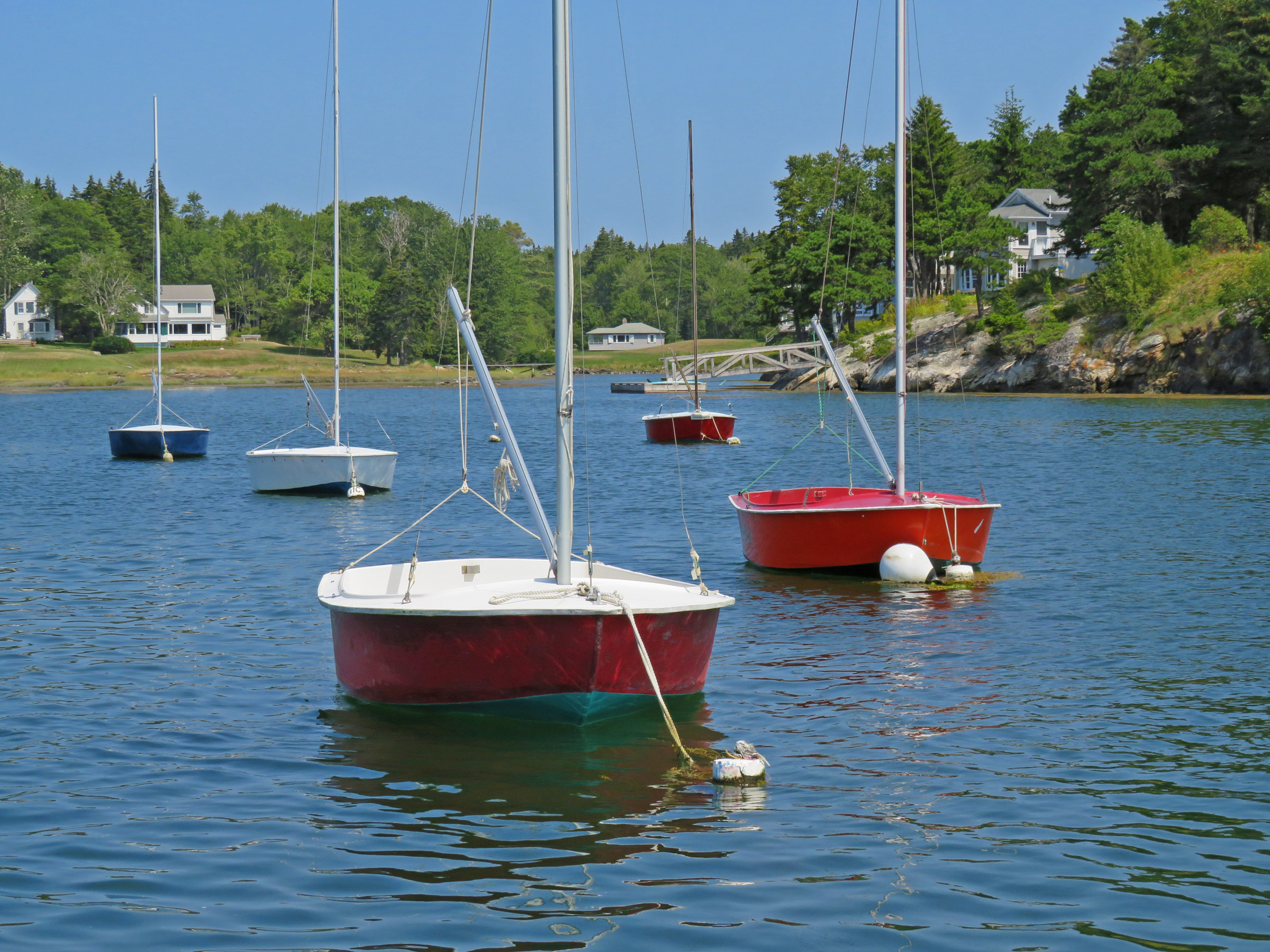
Main halyards are used as topping lifts to raise the booms out of the boats when on the mooring.
Despite the speckled texture set into the interior gelcoat of some boats, the inside of an N-10 can get slippery when wet. Various approaches have been used to combat this in different boats—from nonskid tape to wooden slatted floorboards—but we’ve had the best success with nonskid paint applied in two strips on either side of the centerline. There are few other hazards when sailing. If singlehanding, the skipper will change sides with each tack or jibe, sitting to windward on a breezy day or to leeward on a calm day. Two children will usually change sides together each tack, but when sailing with two adults on anything but the windiest of days, the easiest method is to stay put, one on either side; if you don’t have to move to trim the boat, there is ample room for two adults aft of the thwart, but it can get congested if you start moving around. Smaller (and more agile) sailors can sit forward of the thwart and the smallest of all can sit on top of the thwart, but for the most part, sailing a Turnabout/N-10 is done seated on the bottom of the boat or, on a breezy day, up on the windward rail.
There is no built-in buoyancy in either the Turnabout or the N-10. Some owners fill the space beneath the small foredeck with Styrofoam blocks, buoyancy bags, or airtight plastic bottles. On MOUSE we have laced in closed-cell Styrofoam boards—as sold for home insulation projects—along both sides of the cockpit; not only does it add a modicum of flotation, but it also makes for a comfortable backrest when sitting on the floor leaning back on the hull side.

While four teenagers are making the most of a fair breeze to fly the spinnaker on MOUSE, with so much weight forward and the spinnaker pulling well, the boat is unquestionably down by the bow.
Like everything else on the Turnabout/N-10, the setup for the spinnaker is unsophisticated. There are two sheets and a halyard: no pole, no uphaul or downhaul. It’s not a big sail, but newer sailors still struggle to master raising and lowering it, setting it, and keeping it filled. The jury is out as to how much value it brings in terms of speed, but in terms of training it’s unquestionably worthwhile. As one of the 420 coaches in the Southport sailing program commented last summer, “You can always tell which sailors grew up in the Opti fleet rather than the Turnabouts—the Opti kids have no clue when it comes to the spinnaker; the Turnabout kids are all over it.”

In a Turnabout or N-10 there is ample room for three younger children and an older teen. Here the teen, amidships, and skipper are both seated on the cockpit floor, while the two other children are sitting up on the thwart, either side of the centerboard.
On any given summer weekday, the Southport sailing program can have up to 15 Turnabouts out sailing. They will be crewed by two to three new sailors, some of whom are the second or third generations of kids learning to sail in a Turnabout, sometimes the same Turnabout. They will be laughing and squealing, singing and telling jokes, and somewhere along the way, without even knowing it, they’ll be learning to sail. Because it’s cool, the more experienced among them will make fun of their fat little boats and declare them to be slow and ugly, but one day, when they’re older, and they’re racing their Turnabout with an adult friend on a Saturday afternoon, they’ll realize: this simple little boat has earned a place in their hearts, and with good reason.
Jenny Bennett is editor of Small Boats.
Turnabout/N-10 Particulars
LOA: 9′ 8″
Beam: 5′ 3″
Sail area: 61 sq ft (spinnaker approx. 28 sq ft where luff is 9′ and half girth is 3′ 6″)
Displacement: 255 lbs

The most recent builder of the N-10, J.G. Marine, continues to sell parts for N-10s and Turnabouts and is hoping to sell the molds so construction of the hulls can resume: contact Jack Gannon at [email protected].
For insights into other sail-training boats, see “The International Optimist Dinghy,” “The Blue Jay–Class Sloop,” and “Oz Goose.”
Is there a boat you’d like to know more about? Have you built one that you think other Small Boats readers would enjoy? Please email us your suggestions.

Thanks for the article on The Turnabouts. It brought back very fond memories of learning to sail, as a 9 or 10 year old, on Farm Pond in Sherborn, MA. My father and 7 of his friends all bought Turnabouts and probably started what is the Sherborn Yacht Club today. My father bought his built but unpainted. Others bought a kit and built them and others bought theirs ready to sail.
Thanks for the memories,
Steve Petty
Hi Steve
So glad you enjoyed it, whenever I meet anyone who grew up around Turnabouts I’m always met with happy stories.
Jenny
In the summer of 1961 I was the 16-year-old bo’son of the three-masted schooner Victory Chimes, a member of the Maine windjammer fleet. One pleasant evening, with a light, dying SW breeze, we were anchored in Christmas Cove while the kids in the local Turnabout fleet were engaged in a spirited sort of scavenger hunt. The contestants raced back and forth across the cove, going in sequence from one float or wharf to another. Little finesse was in evidence when making the landings, with some boats all but sailing directly into the target. Meanwhile, one of the passengers on the Chimes was flying a kite which was nearly out of sight, with the string hung over the cove at what turned out to be exactly the height the Turnabout truck. First, the leaders came to a halt, as their bewildered skippers madly pumped away at their tillers, and then the followers caught up, one after the other. Soon the six or eight contestants were lined up, all in a row. And then the string broke, and the fleet was off again, with an even re-start.
Love this story! Thanks for sharing it.
Well, of course, the Victory Chimes visit to Christmas Cove always drew attention not only because of the size of the ship, but also the general boredom of the teen population. In 1968 I was the waterfront director of the small salt water pool (swimming lessons, lifeguards etc.)
The teens (mostly my contemporaries) decided they had had enough, and dragged some of us into a conspiracy to raid the Victory Chimes shortly after dark. I was NOT the leader, but we did need to procure some cannons (to match our perceived armament on the Victory Chimes) The Improvement Association’s black powder 10 gage starting cannon was easy to access — with plenty of rounds. We knew there was another similar heavy gun privately owned in the community, and when we approached the owner early in the evening, he was initially confused why we would need his cannon after dark. When we told him that we wanted to “start something” he enthusiastically produced his cannon — and more rounds.
The raiding flotilla was all small craft with outboards, and enthusiastically (to the point of overloading) the teen population of the cove. What happened next was really unforgettable for anyone who has read naval history — (Trafalgar comes to mind) The early evening air was very cool, dank, with no wind. As we circled the Victory Chimes (built 1900), and fired our black power cannons in her direction, it reminded me of that famous naval engagement just 95 years before the launch of the Victory Chimes.
In the still, cool air, the Victory Chimes was engulfed in black powder smoke, just as Lord Nelson had been in 1805.
What we didn’t really expect was resistance from the Victory Chimes. Yet, it did rain down on us in the form of flatware from the galley. It hurt. (in some cases) but overall, we considered it a success. (although in my case, as an instructor, I did have to face the music the next day).
I loved seeing this article on Turnabouts! Thank you for this feature! I have such incredible memories of sailing these at the Biddeford Pool Yacht Club. They had a wonderful fleet, all the original wooden Turnabouts of course. Each boat had such personality. Some were reportedly faster than others, some leaked like a sieve. The colors and names of the boats are still vivid in my memories. Thank you for keeping the interest and memories alive!
Hi John
I’m so glad you enjoyed it…for such humble boats they surely inspire fond memories for many many people.
So happy I found this article! We still have hull no. 1647 from the Turner yard in our family. I agree she goes well with two adults on board, having just sailed “Tipsy II” in Stage Harbor, Chatham, MA over the Thanksgiving week with one of my sons. Such a fun boat!!