When I arrived in Maine 30 years ago, I realized one is never far from water: dozens of rivers, thousands of ponds and lakes, and more than 3,000 miles of coastline beckon the small boater. After sampling kayaking, canoeing, and sailing, I finally settled on sailboats as my primary form of waterborne conveyance, challenge, and fun. But over the years, as my bones and joints (particularly my knees) became creakier, I realized that land-based fitness options were fading, and I should look for an on-water alternative. It was time to try rowing.
There are many production rowboats available, so I had plenty of choices. My most important criteria were seaworthiness and durability: I wanted to take the boat out on the ocean and be able to handle some swell and chop, but I also wanted to land on rocky shores without worrying about banging up gelcoat or epoxy. The boat needed to be big enough to handle sufficient gear for a week of not-too-rugged camping, and a sliding seat would be great both for a full-body workout and because the power generated would allow me to travel lengthy distances despite having a heavier boat. After a good deal of research, the Whitehall Spirit Tango 17 seemed like the perfect boat for me, and I purchased one in 2020.
 Photographs by the author
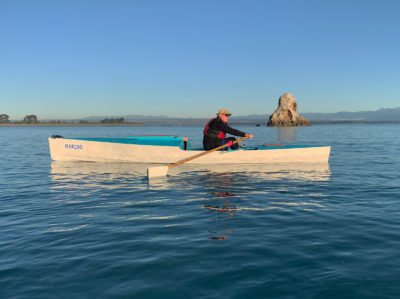
The Tango 17’s lines—narrow beam, fine entry, deep skeg—help to give it excellent performance under oar, and despite such slenderness I’ve also found that there’s more than enough space on board for me and all my gear when I’m camp-cruising.
Modern construction with traditional heritage
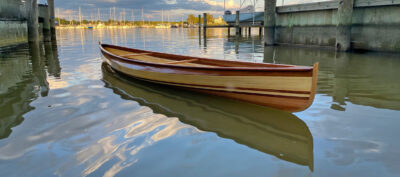
The lines of the Tango 17 reflect the traditional Whitehall boats that inspired it. Beginning in the 1820s, Whitehalls were the water taxis of New York City where both speed and seaworthiness were valued. Like its classic forebears, the Tango 17 features a fine entry, a steep stem, and a shallow full-length keel that ends in a slightly raked wineglass transom. The thermoformed copolymer hull is molded to mimic traditional lapstrake construction and the overall result is an easily driven, seaworthy boat that is also beautiful. My Tango 17 almost always draws curious onlookers and compliments at a dock or boat ramp.
Manufactured by Whitehall Rowing & Sail in Victoria, British Columbia, the Tango 17 comes in at an even 17′ overall with a waterline length of 16′ 5″, and a beam of 3′ 10″. It has an overall height of 26″, hull depth of 18″, draft of 6″, and displaces 200 lbs when empty. Whitehall Rowing & Sail makes a 14′ version called the Solo 14, with a single rowing station, but I wanted to be able to row with another person and to carry more gear when camping solo (the published carrying capacity of 800 lbs allows for more than enough food and equipment).

With two people rowing, we managed to settle into an easy stroke that propelled the boat at a comfortable 4.65 knots. In a sprint, we reached 5.09 knots—even with our modicum of rowing skill.
The hull’s copolymer plastic, an almost maintenance-free material, requires no painting, waxing, or other treatment. The manufacturer describes it as being very tough—my boat has banged up against enough things to verify that this is, indeed, the case—and an optional reinforced keel with stainless-steel keel strip is also offered. The trade-off for such tough material is weight: the Tango 17’s 200 lbs is hefty compared to some other similarly sized fiberglass or wooden boats. However, with only 46″ of beam and the traditional full keel, it can still cut through the water at a decent speed. The boat’s weight means that it is far from cartoppable, and it takes two fit adults to lift it from the ground onto a trailer, but it is easily launched and recovered using, for example, a Trailex SUT-350 trailer. I use a small truck to tow my boat and trailer, but the combination could easily be pulled by a considerably smaller vehicle.
The biggest contributor to speed and distance covered is the Tango 17’s sliding-seat gear. Plastic, ergonomically shaped seats mount on rails affixed to molded supports; the plastic stretchers can be adjusted to accommodate the height, fitness, and shoe-size of the rower; hook-and-loop straps hold the rower’s feet to the stretchers. The gated oarlocks are outrigger mounted, with a pin-to-pin width of 63″. Carbon-fiber sculling oars are highly recommended for the Tango 17, and I opted for the 9′ 6″ oars with hatchet-style blades. The first time I used them, I was amazed at the power they can generate with so little weight—each oar weighs only 1.43 lbs.
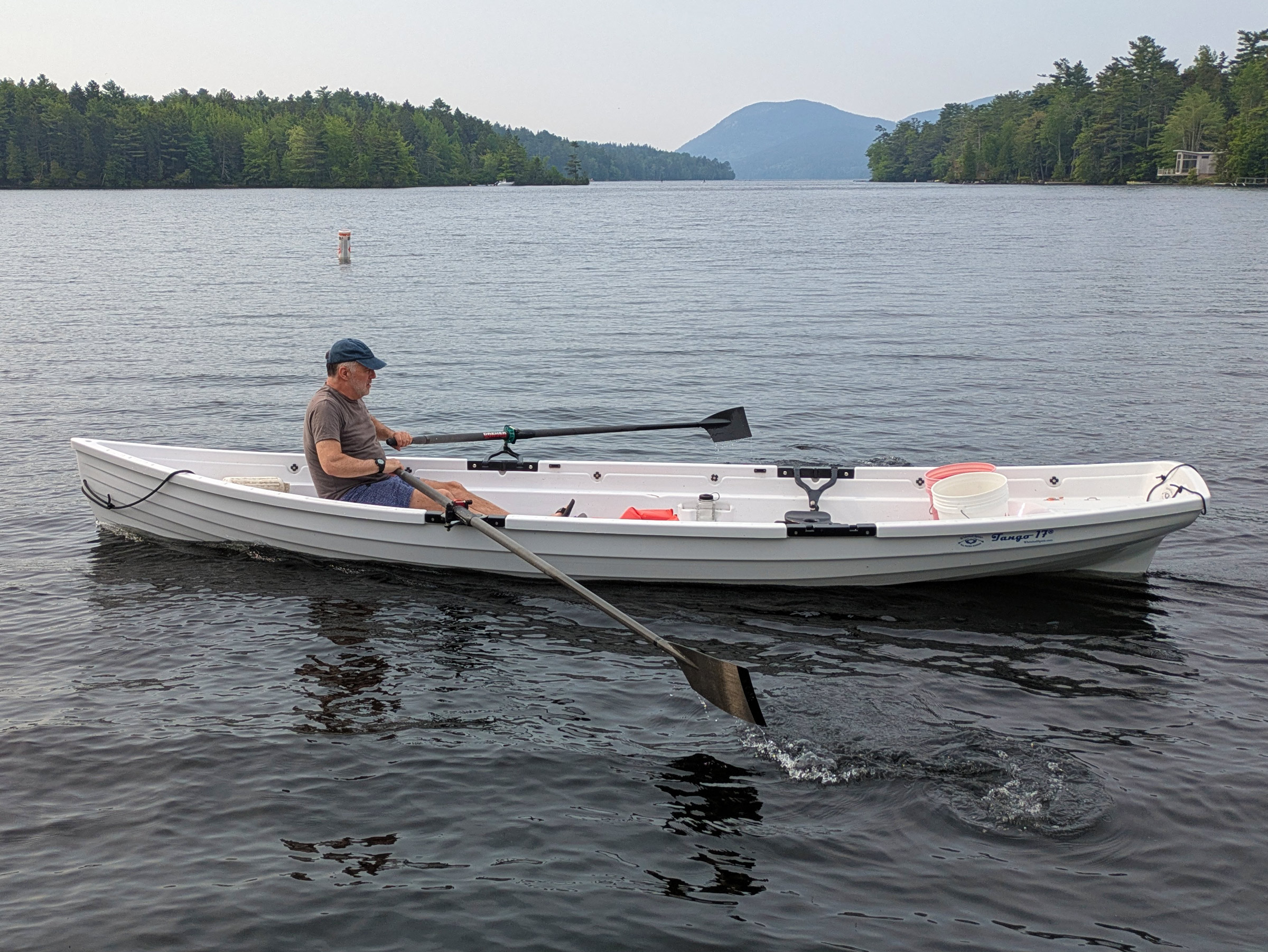
When rowing solo and with no gear on board, I like to use the forward rowing position and balance the boat’s fore-and-aft trim with two or three 5-gallon buckets of water.
The boat includes many well-conceived details: the sliding seats can be removed and replaced by two fixed seats that snap into place on two molded risers; when not in use the seats stow flush to the floor beneath the sliding seats. The cockpit floor, decks, and fixed seats have generous nonskid patches. Small brackets—four on each side—are screwed to the interior face of the hull to hold the plastic battens that support the (optional) boat cover. There are recessed mooring eyes in both bow and stern. An easily accessed plugged drain hole in the center of the boat facilitates cleaning and ensures that water does not collect in the boat if left upright and uncovered. Numerous small mushroom cleats and tie-downs—suitable for up to 3⁄8″ line—are placed inside the boat beneath the gunwales and on the small bow and stern decks; I would prefer these to be slightly bigger to accept thicker lines, but Whitehall Rowing & Sailing does offer suitably sized fenders and dock lines as optional extras. Finally, there is an optional transom motor mount for an outboard motor of up to 25 lbs in weight.
The only significant modification that I’ve made to my Tango 17 is to build a stowable sleeping deck. The mounts for the sliding seats obstruct the usable floor space and would seem to preclude sleeping on the Tango 17, but about 3″ beneath the inwale is a 2″-wide lip, wide enough and strong enough to support a sleeping platform made of 1×6 tongue-and-groove pine boards held together by shock cord. With the sleeping deck so high in the boat, I was concerned that stability would be an issue, but it is not so. The boat’s initial stability is certainly a little low (though it’s not nearly as tippy as a canoe, kayak, or racing shell), but it firms up nicely after 10° or 15°, and stability has never been a problem for me while sleeping on board. The 6′ platform sits flush with the 2′-deep stern deck, creating an 8′-long sleeping space. I use a one-person backpacking tent and have a single board several feet forward of the sleeping deck to serve as a table. While I have rowed with the deck in place, it raises the center of gravity and noticeably decreases stability while under way, so I don’t make it a practice; it folds and stows easily.
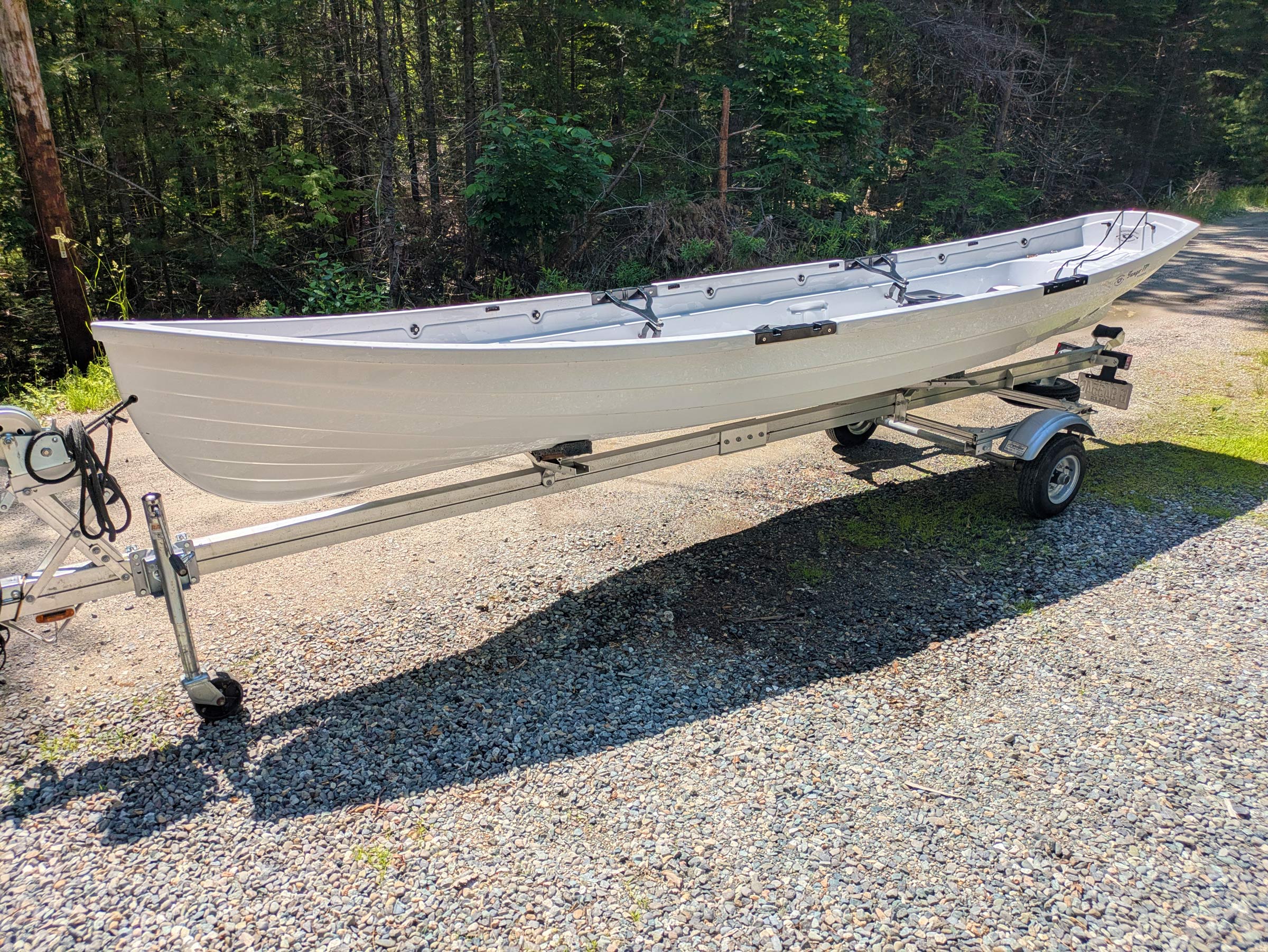
The Tango 17 fits the Trailex SUT-250 trailer well, and although the boat is not light—to load it onto the trailer on land requires two fit adults—retrieving and launching on my own is straightforward.
The Tango 17 performance
The Tango 17 performs well. Last summer I found myself in a heavy chop combined with a 3’ swell: the boat handled it well, rising and falling gracefully with the waves and, with more than enough freeboard to weather the chop from any direction, did not take on any water. The hull tracks beautifully in flat or choppy water. The boat’s double-hull construction gives it positive flotation when swamped or capsized and, while I’ve not swamped it—unintentionally or otherwise—I have re-entered from the water by climbing over the side when the boat has been both fully laden and almost empty.
To measure speed, a friend and I conducted time trials on a local pond. Heading into a wind of about 12 knots with a very slight chop, the two of us (reasonably fit but with only a modicum of rowing skill) sprinted for 200 yards at 5.09 knots, close to the manufacturer’s claimed top speed of 5.5 knots, while a stretch of comfortable rowing at an all-day pace only dropped us down to 4.65 knots. For one person with gear, we measured the sprint at 4.21 knots, and the comfortable rowing at 3.78 knots. With no wind, I’ve been able to solo row a 4-mile passage at 4.17 knots. When I row by myself and without significant gear, I balance the boat fore-and-aft by using the forward rowing position and placing two or three 5-gallon buckets of water in the stern.

The Tango 17 checked a lot of my boxes: sliding seats for a full-body workout; two rowing stations so I can row solo or with a companion; built-in flotation for safety; rugged hull materials for beach landing; plenty of room for all my gear when camp-cruising; and the sweet lines of the classic Whitehalls that inspired its design.
With its long-straight keel, maneuverability is not a forte of the Tango 17, and the 9′ 6″ oars are not immediately graceful for the novice rower, but I have found that with practice, I can effectively work the oars to turn the boat in not much more than its own length. Furthermore, on a trip in 2024 along Maine’s Bagaduce River, well-laden with gear and quite often rowing against wind and tide, I was happy with the boat’s pace—the speed and confidence generated by the Tango 17 make it a joy to row in a wide variety of conditions.
I will never forget my first outing in the Tango 17. After an hour of rowing, I hopped out into the shallows of a local pond, fully expecting the usual soreness that comes with middle age and decades of pushing my body hard. I was amazed: no pain, no aches, just the satisfying sense of having accomplished a great workout. Since then, I’ve had many beautiful days and nights on the water, happy in the knowledge that I’m in my Tango 17, a safe, fun, and capable boat.
Davis Taylor lives in Bar Harbor, Maine, where he has sailed and rowed for the past 30 years. He enjoys being on any kind of boat, but has definitely found that the smaller the boat, the more it gets used and enjoyed. You can read about his adventures camp-cruising in his Tango 17, AURELIUS, in “The Bagaduce River by Rowboat.”
Tango 17 Particulars
LOA: 17′
LWL: 16′ 5″
Beam: 3′ 10″
Pin-to-pin width: 63″
Height (including outriggers): 26″
Depth: 18″
Draft: 6″
Weight (including outriggers, seats, tracks, foot stretchers): 200 lbs
Track travel: 36″
Carrying capacity: 800 lbs
Person capacity: 1–5

The Tango 17 is available from Whitehall Rowing & Sail of Victoria, British Columbia; price before options $18,193 CAD/$12,995 USD.
Is there a boat you’d like to know more about? Have you built one that you think other Small Boats readers would enjoy? Please email us your suggestions.


Thank you for this article. I feel the same physical constraints as the author and have been looking for a similar (but smaller) rowing boat that is not wooden (due to maintenance concerns). I’m going to check out the Solo 14. More articles like this please.
I bought a previously loved tango spirit 17 three years ago. I love it. I usually row it solo from the stern position. I use a collapsible 5 gallon container tied to the bow platform to balance it out. I will try the bow position if i get a dog in the future to sit in the stern. Though my partner sitting in the stern also works well.
I am happy with the low maintenance of the co-polymer material. Love the long oars. I keep my boat, Adiamo on a floating dock in a salt water marina in California. Chop and swells are no problem. It is a ‘swell’ boat!