For the world of small boats, the past two months have seen both highs and lows. To begin with a high: During last month’s WoodenBoat Show, I got talking to Pieter Roos, curator of the Wells Boat Hall at Mystic Seaport Museum. Founded in 1929 as the Marine Historical Association, Mystic Seaport Museum has long been a leader in maritime history and preservation. Yet for the first two years of its existence, it had not one boat in its collection. That changed in 1931 with the arrival of ANNIE, an 1881 sandbagger whose 28′ hull supported a sail plan that stretched 68′ from the tip of its bowsprit to the end of its boom. From ANNIE, the museum’s boat collection has grown ceaselessly. It now holds more than 450 small American watercraft ranging from working boats to speedboats, from one-design sailboats to indigenous kayaks. Probably the oldest is an 1824 dugout canoe, the newest a Mini-Transat racer. For decades a few of the boats have been visible in the museum and shipyard and even on the waterfront where some can be sailed by visitors, but most of the collection has been kept in storage, most recently in the 19th-century Rossie Velvet Mill building across the street from the museum’s principal campus. Visitors could see the boats by appointment, but the museum had no way of displaying them. That is about to change.
 Photographs by the author
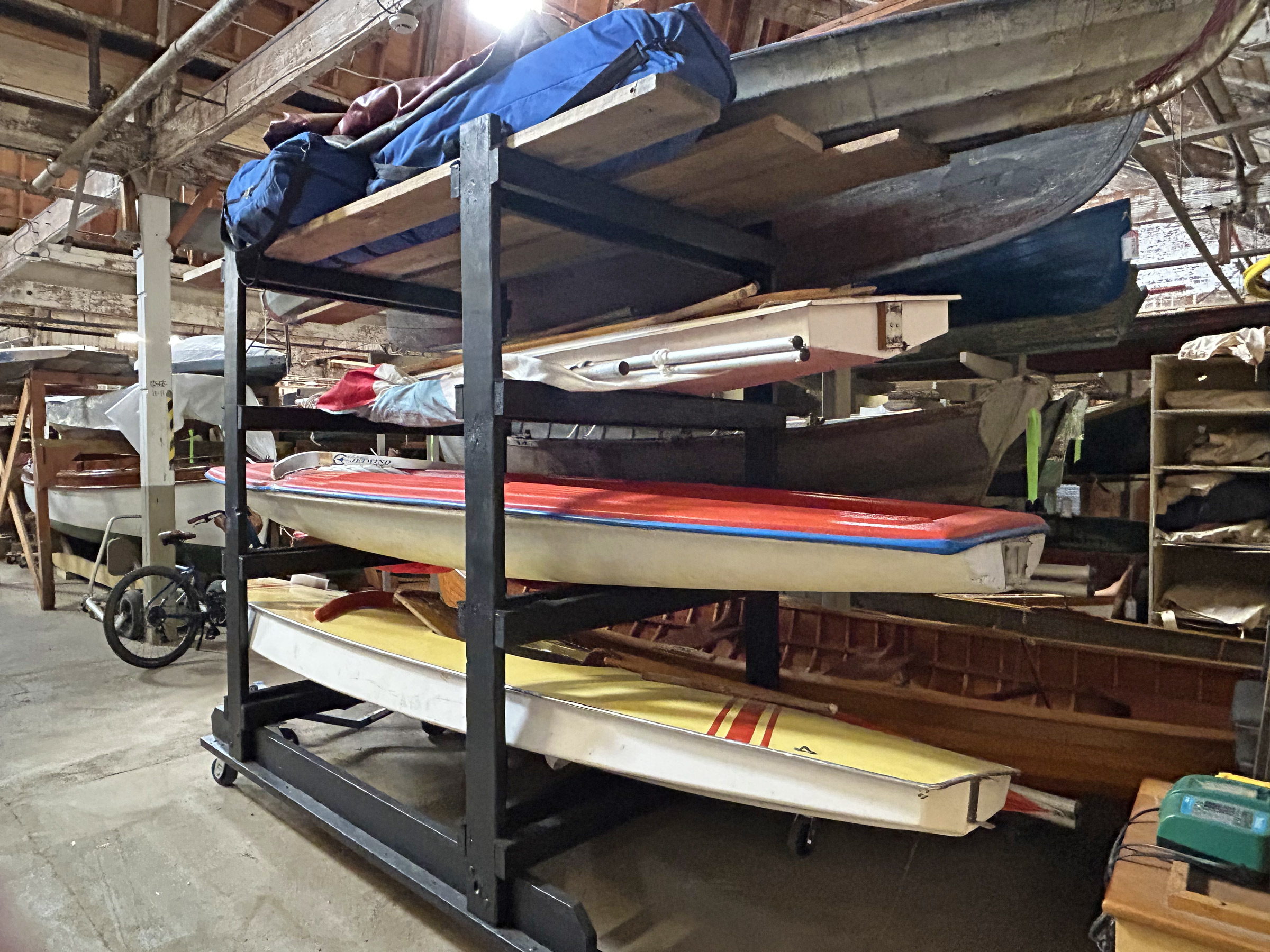
Not all the boats in Mystic Seaport’s collection are traditionally built, but they all tell a story, such as the development of leisure and one-design sailing in the U.S. as revealed through sailboats such as the Sunfish and Jetwind dinghies seen here in the Rossie Mill building.
Since 2024, work has been on-going to convert 34,000 sq ft of the Rossie Mill into the Wells Boat Hall, which will house a permanent exhibit of some 170 of the museum’s small boats along with many of its 450 engines. Pieter has his work cut out for him. Not least of his challenges has been selecting the boats that will be included in the exhibit, “Even 34,000 sq ft gets gobbled up pretty quickly when your smallest artifact is a 6′ pram,” he says. “The treasure is so extensive, so wide, and so deep that you have to figure out how to present it. From the start, the concept has been to break it down into manageable ‘neighborhoods,’ each of which will be its own exhibit. So, for example, we’ll have ‘Sailing for Pleasure and Speed,’ ‘Evolution of Design,’ and a whole area devoted to engines. And we’ll be making use of technology so visitors can dig deeper if they want to. All the labels will have between 50 and 100 words, but for about 70% of the exhibits there’ll also be a QR code, which visitors will be able to scan to see history, photographs, drawings, even video.”
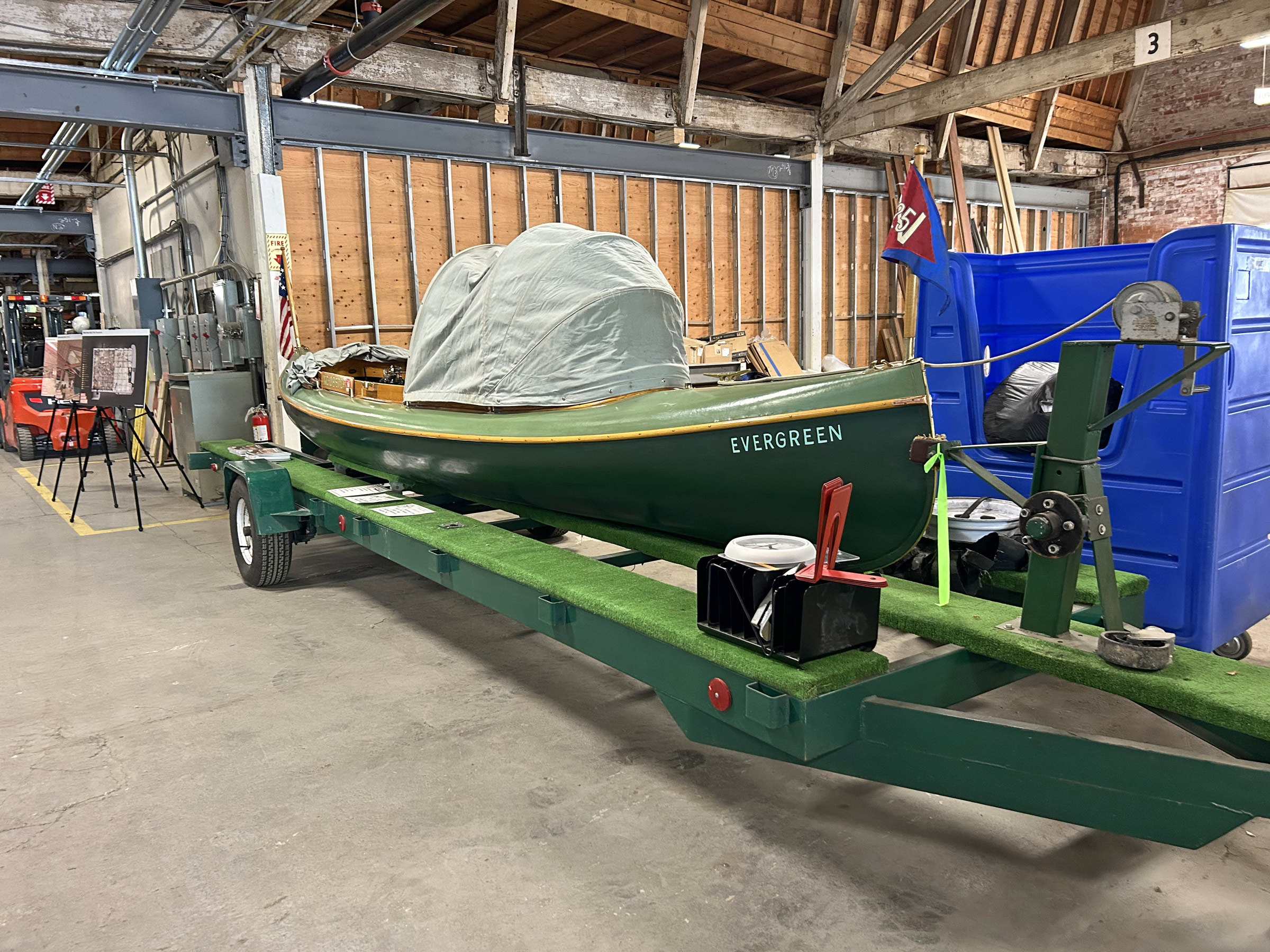
One of the more recent acquisitions, EVERGREEN, is a 20’-long 1910 E.M. White motorized canoe. Her 6-hp, two-cylinder inboard Eagle engine is original.
When I spoke to Pieter in June, he was excited to report that the hall’s renovation is nearly finished, and the plan is to open the Wells Boat Hall to the public as soon as fundraising can be completed. It will give Mystic Seaport Museum an interactive year-round offering and, says Pieter, will “allow us to tell stories that, thus far, we’ve not been able to share. For example, in the 19th and early 20th centuries the maritime world was a male domain, but there were a lot of women participating and we want to tell their stories. One of my favorites is about the first one-design sailboat race. A race for North Haven Dinghies held in North Haven, Maine, in 1887, it was called the Grand Dinghy Race. It was sponsored, advertised, there was a judge…pretty much all the things we’d recognize in a modern regatta. But there were only three contestants: two guys (both very experienced racers) and Ellen Hayward, who was an experienced sailor but didn’t have much racing experience. As soon as the race started, the guys got into a tacking and covering duel and totally missed the fact that Miss Ellen was about to eat their lunch…the first one-design race anywhere in the world was won by a woman.” It’s just one of the many small-boat stories that Pieter and Mystic Seaport Museum look forward to sharing with visitors.
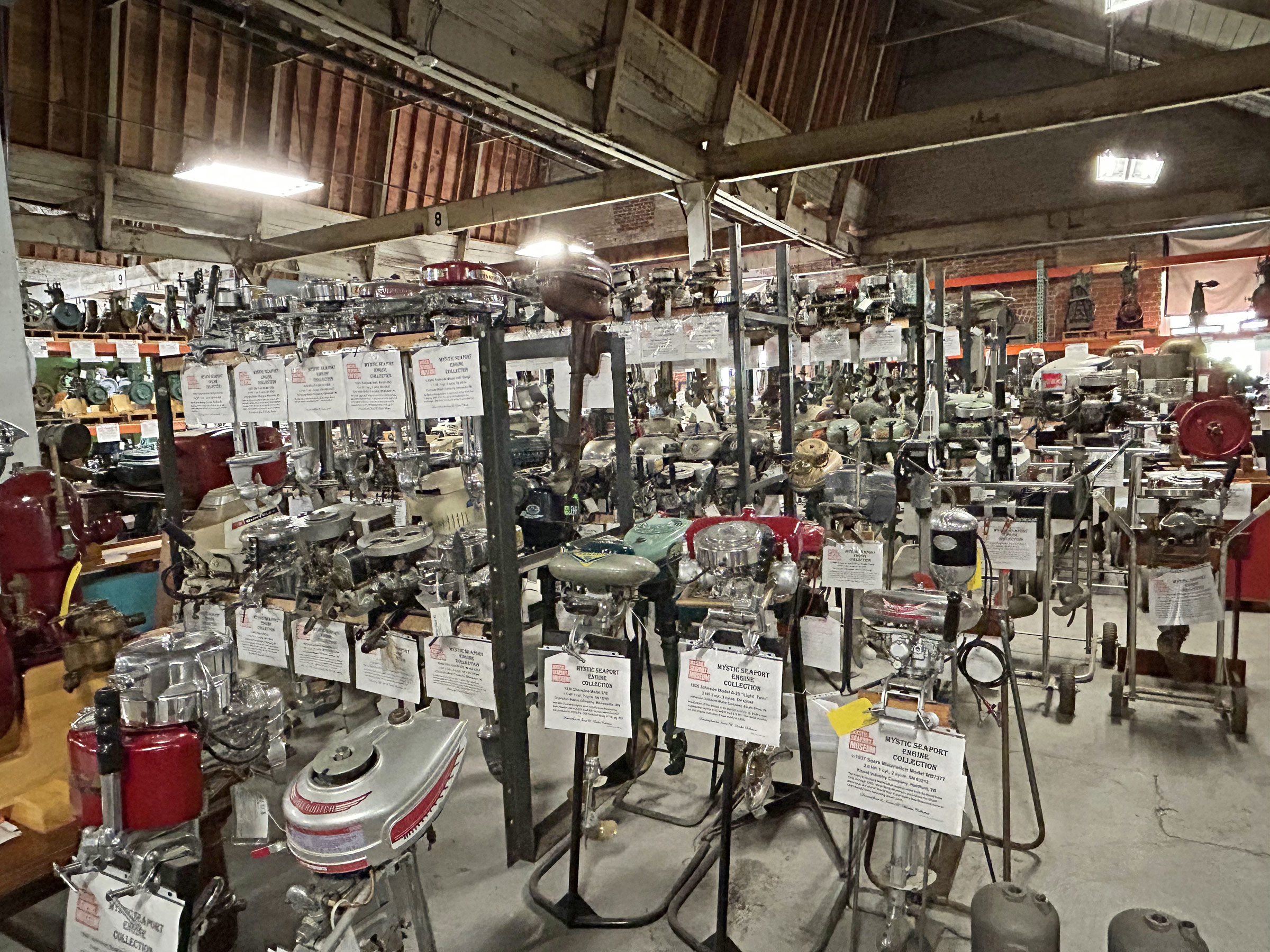
The museum has 450 engines in its collection, many of them outboards. While there are a few foreign classics (I spotted at least one mid-20th-century British Seagull), most of the engines are American made. The Wells Boat Hall will have an exhibit devoted entirely to engines, which will include video and interactive displays.
On a less happy note, in early July came word that after 25 years, Duckworks Boat Builders Supply was closing its doors. The current management wrote, “This decision has not come easily. Rising costs, increased tariffs, slimmer margins, and increasingly complex shipping logistics have made it unsustainable to continue operating the business at break-even levels.” Sommer Ueda of Duckworks’ sister company, Gig Harbor Boat Works, added, “Duckworks has always been about more than just plans and supplies—it’s been a hub for creativity, craftsmanship, and community.” As designer John Welsford shared on the WoodenBoat Forum, “since way back…it’s been the go-to place for small-craft plans, fittings, and materials.”
As the Duckworks announcement filtered through the small-boat community around the world, many expressed sadness that there would no longer be an easily accessed and reliable source for plans. But, in the last week or so, there has emerged better news: Chuck Leinweber, who founded Duckworks back in 1999, has purchased the website’s domain name and will be reopening to sell plans and sails. When Chuck and his wife, Sandra, started Duckworks it was as an online magazine (a free-access archive can be found at duckworksmagazine.com). But four years in, he says, “we were making no money with it so started selling sailcloth, boat plans, and hardware. It was a great success, and on the advice of John Welsford, we soon separated the store from the magazine.”
 Courtesy of Chuck Leinweber
Chuck and Sandra Leinweber started constructing their home in the Texas Hill Country in 1980 and, says Chuck, they’re still working on it. Part of the blue addition, seen here to the right, became the original Duckworks warehouse. Within a year of first selling parts, plans, and sails, Chuck and Sandra had moved the business to a 2,500-sq-ft building.
Chuck sold the business eight years ago but continued to help out part-time, mostly in customer support. When the decision was made to close he was, he says, “caught off guard. Almost all the designers whose plans we sold were friends of mine, people I’ve known for 20 years.” But it looks like the loss—at least of plans and sails—will be short-lived. Chuck hopes that the website, duckworks.com, will be live by September 1, 2025, but until then is happy to take orders for plans via email; contact him at [email protected]. “We’ll be offering both custom and ready-made sails,” he says, “and the biggest collection of boat plans in the universe.” A happier ending and the promise of a bright future for Duckworks customers everywhere.




Sad, as Duckworks and Dave Gray of Polysail fame were key forces in bringing me into the world of small boats and boat building. I’ve completed three, and am working on a fourth, and designing a fifth boat. Wonderful that Chuck is taking the plans and sails business. So, where are folks getting the parts and supplies that they need for their projects now?
So wonderful to hear Mystic gets to expand. Some of my most cherished childhood memories are of the exhibits in that museum.
So sad to hear another case of big biz thinking it needs the survival wages of enthusiasts as well, yay to Leinweber keeping Duckworks alive. I am building David Gentry’s Shenandoah Whitehall, reviewed in the July 2019 edition of this magazine, plans purchased (and purchasable!) thru Duckworks.. Progress on my attempt can be seen at CanoeTrippers dot Net, under Wasioto Whitehall. Added 2nd coat of CPES to frames this morning.