In my 40-plus years of working in boatyards in Florida, radical changes have occurred in the tools and materials used. When I started out, most painting was done with a brush, red lead was the primer of choice, the cordless screwdriver was a brace fitted with a screwdriver bit, and most of the fastenings were slotted silicon-bronze screws. However, some things have remained constant, and not least among them is the countersink made by the W.L. Fuller Company of Warwick, Rhode Island.
 Photographs by the author
During my more than four decades of boatbuilding I have purchased myriad countersinks and drill bits from W.L. Fuller, not because they break or wear out and need to be replaced, but because I have needed many different sizes. From the oldest to the newest, the quality of the tools has been of consistently high quality.
In 1930, Warren Fuller Sr. set up a boatbuilding shop in his car dealership. When he encountered wood that split as he applied wood screws, he created a tool to save time and heartache. “He took to the grinding wheel,” says granddaughter Debbie Fuller, “and invented the four-fluted countersink.” Fifteen years later, Warren was joined by his son, Warren Jr., who established W.L. Fuller, Inc. and introduced the company’s first catalog. Today the company makes more than 450 tools including a dizzying array of specialized tools for drilling holes. But its most famous tools are still tapered drill bits with the adjustable countersinks that made its name. These effective tools have been developed and improved over the years and are now offered in a wide range of sizes and sets, but they continue to be of the same high quality that Warren Fuller Sr. would recognize. The company buys U.S.-made steel drill bits and reshapes them for different purposes, perfects them to work in wood, plastic, and metal, and makes the carbon-steel countersinks to go with them.
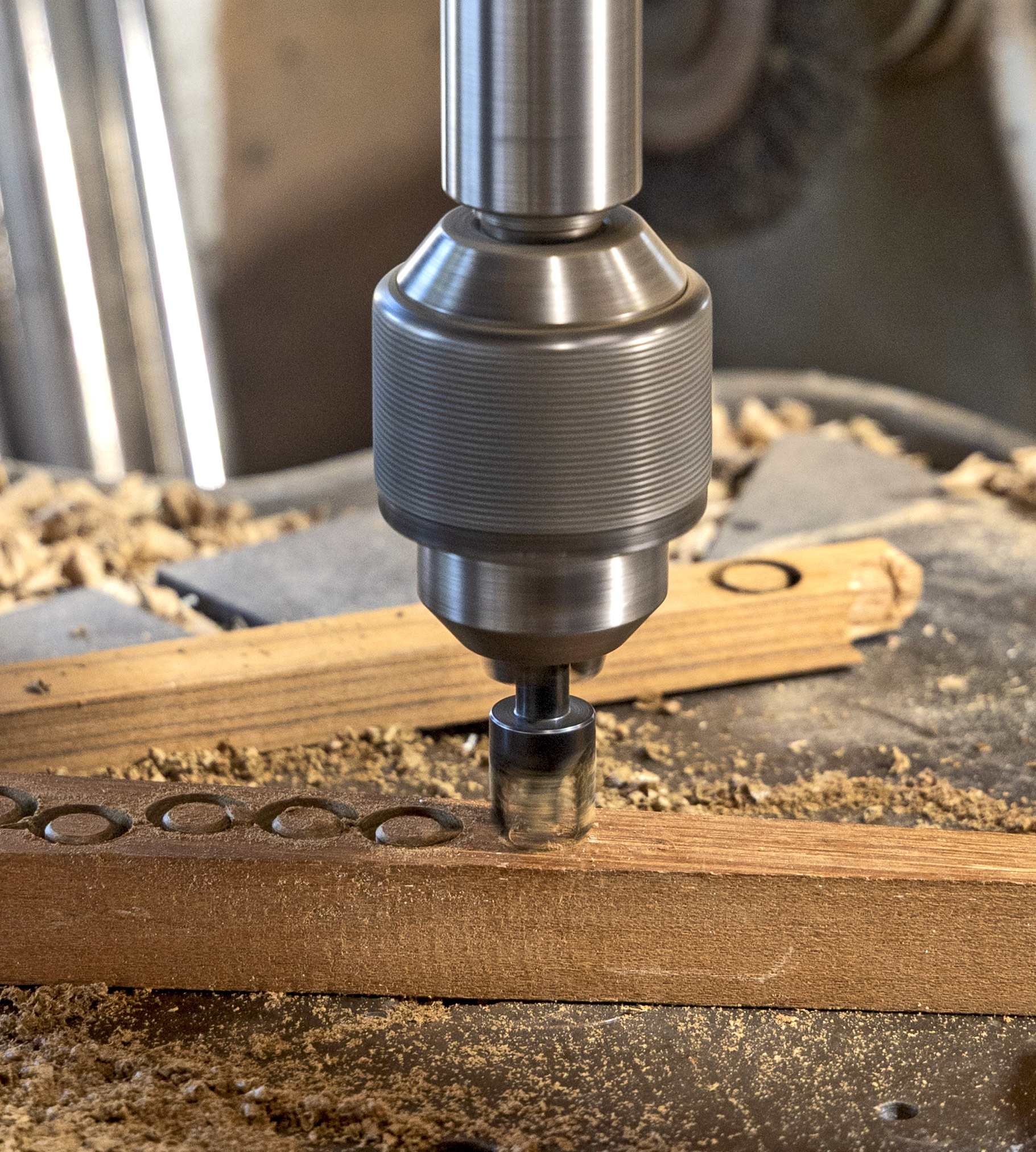
The plug cutters in any W.L. Fuller set are as high quality as the countersinks and will, in my experience, get almost as much use. If you let the tines cut to their full depth, the cutter will round over the ends of the plugs, as seen here, making it easier to insert them into the countersink holes.
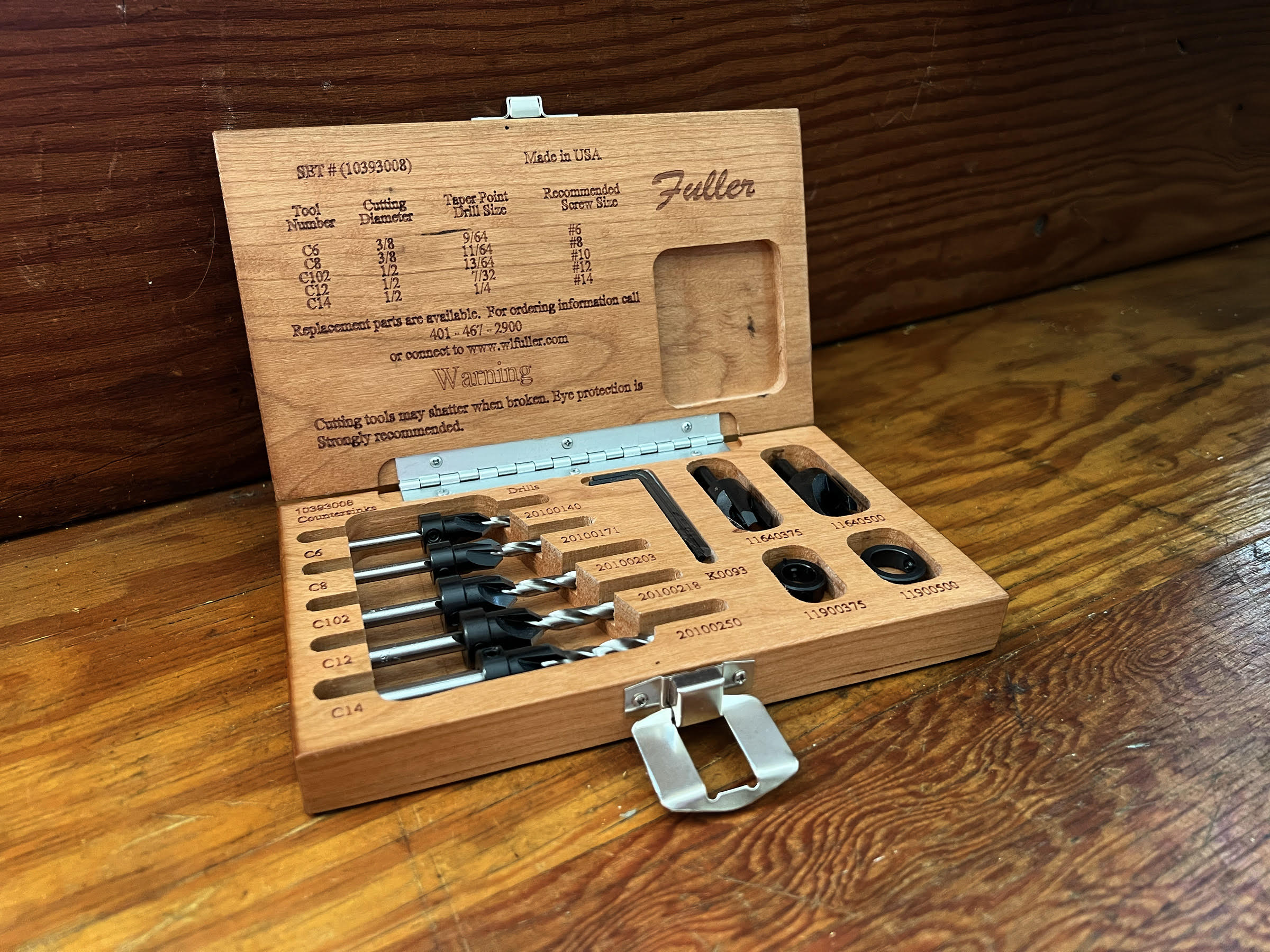
While bits and countersinks can be purchased individually, more typically they are sold in sets such as the No. 6, for use with wood screw sizes #5 through #9; or the No. 8, which will fulfill the needs of most small-boat projects. It includes five tapered drill bits and matching countersinks for screw sizes #6, #8, #10, #12, and #14, as well as two plug cutters (sizes 3⁄8″ and 1⁄2″), matching stop collars to control depth, and a 3⁄32″ hex key all packaged in a sturdy Fuller-made cherry box to protect your investment. The quality is unbeatable and, as fourth-generation family employee Lisa Fuller says, “The only issue we have is, you buy one of our sets, you don’t have to buy it again.” The tools do, indeed, last a lifetime—I have had many of my Fuller countersinks and plug cutters for 40 years. They can be resharpened, and Fuller offers a resharpening service for all their tools. The only items that don’t stay around forever are the hex keys…they can and do vanish into thin air.

When drilling with a countersink it’s important to match the right bit and countersink with the screw. Here the pilot holes for a #8 bronze wood screw are drilled out with a C8 countersink and the 11⁄64″ bit that fits into it.
The countersink usually match the screw size: a #8 screw, for example, uses the 11⁄64″ drill bit with the C8 countersink. When drilling/countersinking for a traditional wood screw the tapered drill bit works well, giving the proper clearance hole and the correct pilot hole for the fastening. However, among today’s common fastenings is the stainless-steel self-tapping screw, which has neither solid shank nor taper in the solid shaft; indeed, even some bronze wood screws have no taper. While this does not necessarily mean that a tapered drill bit will not work—in many cases it will work perfectly—it’s important to do a few tests to find what works best. For example, you might use the C8 countersink with its 11⁄64″ tapered drill bit, but if fastening a bronze wood screw into a spruce frame, I would set the drill bit depth 1⁄8″ short to ensure the threads fully engage; in an oak frame I would set the depth a little long to avoid over-stressing the screw, or step up to a C9 countersink with its 3⁄16″ drill bit…in the shop, it is a matter of trial and error.
As well as the tapered drill bits with countersinks, the No. 8 set also includes two stop collars and two plug cutters, each in 3⁄8″ and 1⁄2″. The stop collars may be the least used items, but there will be times when you will be glad they are available whether setting screw heads flush at the wood surface, or countersinking them to be plugged. Conversely, the plug cutters (or bung cutters) will be used a good deal, but do require a drill press. These four-pronged cutters allow you to make straight-sided plugs out of scraps from your workpiece so that they match the grain and color of your work.
 Isaac Robbins/WoodenBoat Publications
W.L. Fuller’s No. 8 countersink set will suit many small-boat building projects. Matching the quality of the tools are the American-made cherry boxes in which the sets are sold.
After 95 years in the marketplace, W.L. Fuller remains a family-owned and -operated business. As if to emphasize the consistency of its history, the company’s trademark color remains the distinctive orange established by Warren Fuller Sr. during the Second World War—in an effort to save money, Warren found a good deal on orange paint for his small V-bottomed plywood boats. When visiting the Fuller booth at The WoodenBoat Show, at Mystic Seaport, Connecticut, I was greeted by Debbie Fuller. Her pride in the family company and the quality of their products is infectious. Today, W.L. Fuller, Inc. has a 50-page catalog featuring the company’s own tools and other quality brands, all made in the U.S. And, if you call to purchase a set or seek advice, chances are you’ll be talking to a member of the family.
A lifelong resident of Florida’s Gulf Coast, Michael Jones spent his career as a boat carpenter working on the full spectrum of yachts from traditional to high-end luxury cruisers to sportfishing boats. Past president of the Traditional Small Craft Association, he is a collector of small craft and is, he says, “still boat crazy after all these years.”
For more by Michael Jones see “Mounting an Electric Outboard on Rudder Fittings.”
For prices and to see the entire range of drills and countersinks, go to the W.L. Fuller website. The No. 8 set is also available from The WoodenBoat Store for $169.
Is there a product that might be useful for boatbuilding, cruising, or shore-side camping that you’d like us to review? Please email your suggestions.






I have used the fuller tapered drills for years, and like them very much. I have encountered the opinion that a stepped drill is better for maximum screw grip, but I have not found that to be true. A screw driven into the right size Fuller pilot hole is a totally reliable fastening.
I have had a few break, though not through usage. I surmise that during times of high humidity (e.g. my unheated shop during the winter), a bit of rust forms where metal meets metal (the drill against the countersink) and expands enough to break the bit. Or, maybe not. Other manufacturers have come out with competing products, but I haven’t found any of them to be superior to the Fullers.
I use mostly 1/2″ plugs so use a 1/2″ forstner bit to drill the plug hole then redrill with the appropriate drill for the screw. A two-step process for sure but not onerous.
I’d consider Fuller bits thereby saving time, but not money.