Not all small boats have built-in flotation, and its absence can lead to trouble in the event of a swamping. Even in a boat that does have sealed compartments there is the possibility of a leak or an ill-fitting access hatch. But if there is additional flotation in place it will limit the amount of water coming in, improve buoyancy, increase the chance of self-rescue, and reduce the amount of bailing.
 Photographs by the authors
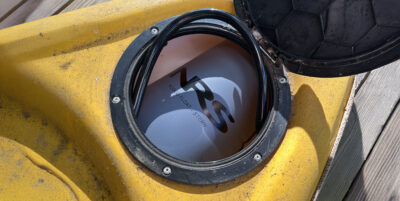
Two NRS Rodeo Split Stern Float Bags laid side by side fit the stern compartment of our Penobscot 14 very well. Wherever you stow the bags, it is important that they are firmly secured; if not, during a swamping they will float away. Here, the bags will be held down by a removable seat panel, which will be tied down with the cord seen here and a second cord anchored to the cleat mounted on the bulkhead.
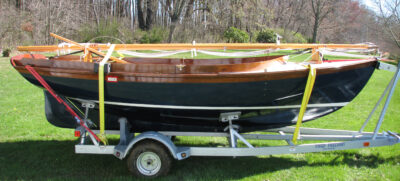
When we built our Penobscot 14 we decided we wanted some extra flotation that could be easily installed and just as easily removed, and decided to try some Northwest River Supplies (NRS) float bags.
NRS was founded by Bill Parks in 1972, and in 2014 was sold to its employees. Today, the company continues to be employee owned and offers excellent customer service while furthering Bill’s mission to help “people pursue passions on the water.” Among the many products NRS offers is a range of float bags designed primarily for kayaks and canoes. Some are built of 10-gauge urethane, which NRS says will neither leak nor delaminate, while others are 70-denier urethane-coated nylon, which offers resistance to abrasion and UV rays. All have a lifetime warranty.
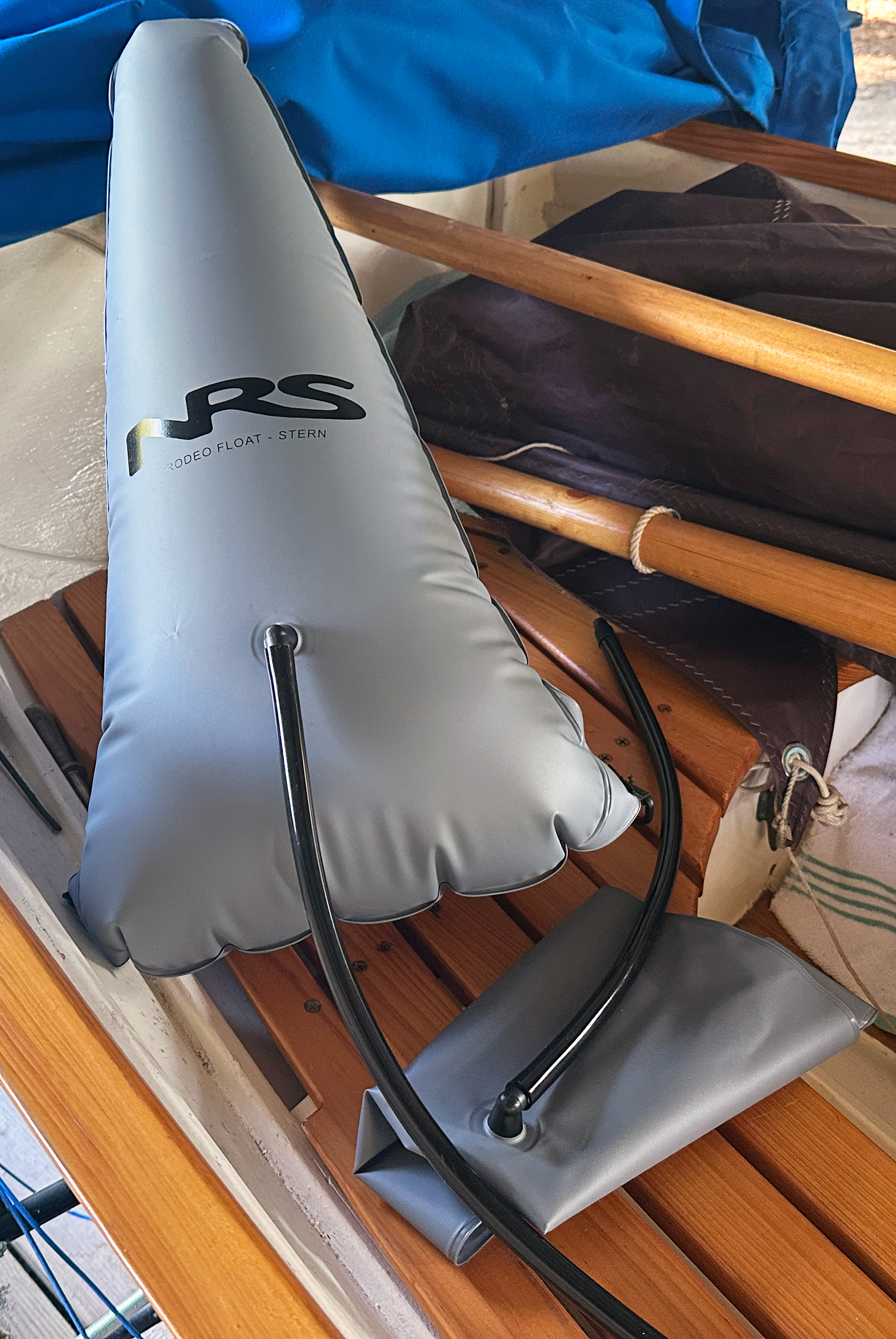
The NRS Rodeo Split Stern Float Bags are made of 10-gauge urethane with welded seams. Each corner has a D-ring attached by a loop of webbing sewn into the bag’s flanges.
For our Penobscot we chose a pair of Rodeo Split Stern Float Bags. These are 10-gauge urethane wedge-shaped bags designed to fit on either side of support pillars typical in short freestyle kayaks. Fully inflated, each bag measures 28″ L × 9″ D × 13″ W, and 3″ W at tip. When deflated the bag is small enough to fit through a 5″ deck plate opening. The inflation/deflation tube is 20″ long, so the bag can be placed into its compartment and then inflated. The inflation air valve closes securely. The ease with which the bag can be inflated and deflated makes installing and removing them from tight spaces relatively easy.
We keep our Penobscot 14 on a trailer and always remove the bags after outings to allow free movement of air in the boat’s compartments, and so we can check the bags for proper inflation—testing that they stay inflated for at least 24 hours. Each bag has, on its three corners, D-rings attached by UV-resistant nylon webbing straps so that it can be secured inside a compartment or under a thwart.

Thanks to the 20″-long inflation tube, a Float Bag can be installed in a tight place before being inflated from without. If we have gear to carry in the compartment, we put it in first and then inflate the float bag over it. This keeps the gear’s weight where it belongs—down low and centered.
So impressed have we been with the float bags that we are now measuring our other boats to see what sizes they can accommodate. Our Drascombe Lugger, for example, could have a bag strapped to either side of the centerboard trunk and, while the bags can be shared from boat to boat, we plan to purchase dedicated bags for each one.
Audrey and Kent Lewis sail, row, paddle, and motor the Tidewater Region of southeast Virginia. Their adventures are logged at smallboatrestoration.blogspot.com.
NRS Float bags are available in multiple sizes, singly or in sets. Find the range, along with accessories, on their website. A pair of Rodeo Split Stern Float Bags is $79.95 (price includes shipping).
For more great gear reviews from Audrey and Kent Lewis, try “Odyssey PFD,” “Paddle Pump,” or “Dynamic Dollies.”
Is there a product that might be useful for boatbuilding, cruising, or shore-side camping that you’d like us to review? Please email your suggestions.


I’ve used these for a long time. I sometimes use the rings to shorten a bag a little to fit into the place I want it. I do keep a patch kit in my gear bag as these and other light weight bags can snag on rough spots under a deck or in a compartment in a boat and get a little hole.
I read this article with interest and, at the end of it, was pleasantly surprised to see you reference another article that I’ve read which you’ve written on the Drascombe Lugger, and that you are just across the bay from where I and my lugger are in Onancock.. It’s a great place for these little boats and I’ve been thinking of ways to add additional flotation to mine.