In the 1970s boatbuilders used polyester resins to build fast racing canoes and very light recreational ones—it was not unusual for a modern canoe to weigh about half of the then-common wood-and-canvas canoes and the ubiquitous Grumman aluminum canoes. As the decade unfolded, boatbuilding materials and techniques developed fast, nowhere more so than in the art of cedar-strip building. In 1975 came David Hazen’s newsprint booklet and plan set, The Stripper’s Guide to Canoe-Building, and a year later Gil Gilpatrick’s Building a Strip Canoe was published. But it was the Gougeon brothers’ development of user-friendly, wood-compatible epoxy, along with their seminal book, The Gougeon Brothers on Boat Construction, also published in 1979, that propelled strip building into the mainstream of amateur boatbuilding. Small companies providing strip-planked boats, strip-building manuals, canoe plans, and kits began to appear.
In 1983, Ted Moores of Bear Mountain Boats produced a canoe kit for home builders and published Canoecraft—a comprehensive guide to building fine strip-planked canoes. A year later in Bristol, New Hampshire, Michael Vermouth founded Newfound Woodworks. To begin with, Vermouth’s focus was on the manufacture of custom doors, windows, cabinets, and furniture. But, when he came upon Ted Moores’s book and built two canoes from accompanying plans, he moved out of furniture making and into boatbuilding. As interest in strip building grew, Vermouth began milling cedar strips for amateur builders and for other suppliers like Bear Mountain Boats. Then he started selling epoxy, fiberglass, ash for gunwales, before ultimately deciding to supply full boatbuilding kits to people who “wanted to build their own boat but didn’t have all the millwork equipment necessary to produce quality strips, gunwales, decks, stems, etc.”
 Photographs by Jenny Bennett
Even at 79 years old, I can comfortably carry, launch, and recover the Otter by myself.
Forty years later, Newfound Woodworks—now owned and run by Rose Woodyard and Alan Mann—continues to sell quality milled cedar strips, epoxy, fiberglass, building tools, plans, instructional books and CDs, and complete kits for nine canoes, sixteen kayaks, and nine rowboats. Among the canoes, the second smallest is the 11′ 9″ Otter designed by Hans Friedel of Sweden, who has also designed four of Newfound Woodworks’ kayaks.
The Otter’s design
For several years, I have admired the Newfound Woodworks booth at the annual WoodenBoat Show in Mystic, Connecticut. Rose and Alan always have several of their completed boats on display, and I have been struck by the quality of their workmanship; indeed, they have received the award for Best in Show, Professionally Built Manually Powered Boat for the past six years in a row. So, when I was invited to try out the Otter at the 2025 show, I jumped at the chance.

Thanks to the Otter’s generous beam, boarding from a floating dock is relatively easy—even for a less nimble paddler. From here, I picked up one of the paddles to use as a stabilizing bridge to the dock, and turned through 90° to sit on the canoe’s seat.
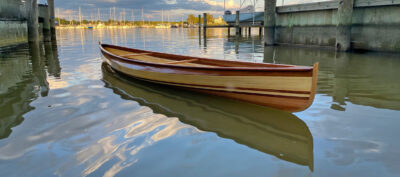
The Otter is a solo canoe measuring 11′ 9″ × 32 1⁄2″ and weighing just 35 lbs. It has a load capacity of 340 lbs, so is well-suited for larger paddlers. The ’midship depth is a little more than 11 1⁄3″ and the boat’s sheer rises at both ends to a height of 17 1⁄8″—high enough to give a pleasing appearance, but not so high that a paddler will be badly affected by wind. With 1″ of rocker on the hull’s modest length, the Otter spins easily.
The canoe is available as a complete kit, which includes plans, construction notes, mold forms, construction pictures, coved-and-beaded 6′–10′ northern white cedar strips, full-length western red cedar strips, aspen strips for accents, ash outwales and inwales, ash thwart, cane-and-ash seat, seat cleats and hardware, ash stem, cedar deck material, fiberglass, epoxy, epoxy-application tools, and varnish. You can also buy just the plans, or the plans and the strips and complete your own outfitting.

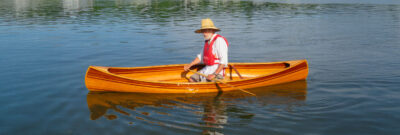
The seat is hung from the gunwale in traditional canoe style, and I was able to kneel in front of it, resting my sit bones on its forward edge and tucking my feet beneath.
The morning of my trial paddle was calm. Alan and I walked the canoe from the booth to the float via a narrow walkway. Although the two of us worked together, the boat is so small and light that one person could easily carry it slung on a shoulder. Together we lowered the boat into the water. We were mindful that it was a display boat and didn’t want to risk damaging it, but, again, I could have easily put it in by myself, picking it up by one of the gunwales amidships.
The Otter’s relatively generous beam lends a stability that allows a less nimble paddler (at almost 80, I am one of these) to board easily while bridging a paddle to a float or to the land. A paddler could also straddle the canoe in the stern and then drop into place on the caned seat.

While I was paddling from the seat, a single-blade paddle gave me good control of the boat. I did notice a difference in performance when using either the big-bladed or the smaller paddle—the latter required less correction when running straight. Nevertheless, the canoe was responsive and maneuverable with either paddle.
The seat is hung from the gunwales in traditional canoe fashion, which allows for paddling while seated or while kneeling with sit bones braced against the forward edge of the seat. Other small solo canoes, including the two Wee Lassies in the Newfound lineup, have no space for kneeling because their low seats are fixed to the bottom of the hull; in such boats only double-bladed paddles are used for propulsion.
Otter has quite a flat bottom and felt pretty steady when I got in. When I leaned, her firm bilge came into play, making it difficult to put the gunwale into the water. I was happier kneeling because I felt more attached to the canoe and could control heel easily.

Sitting high on the seat, I tried the Otter with my Greenland-style double-bladed paddle. Its performance was impressive for a canoe so small—with only a modicum of effort I was able to hit 4 knots and could turn it almost 90° with just a single stroke.
Kneeling and seated paddling
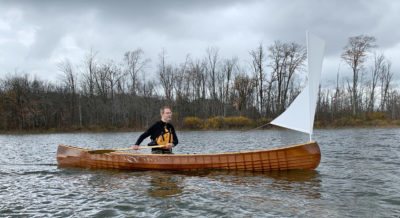
I had with me a couple of single-bladed paddles: a 63″-long Wabanaki-style paddle with a 29″ × 6 3⁄4″ Beavertail blade; a 58″-long small Beavertail with a 26″ × 5″ blade; and a double-bladed take-apart Greenland-style paddle measuring 113″ with 35″ × 3 1⁄2″ blades. I first tried the boat from a kneeling position, leaning back against the forward edge of the seat and paddling with a single blade. Rose and Alan suggest that the canoe might require a small external keel to improve tracking with lighter loads, so I was surprised by how easy it was to keep it running straight with a modest J stroke. The breeze was quite light so I was unable to judge the effect of wind on the canoe, but I could easily push it along at about 3 knots. The real fun, however, was in taking advantage of its maneuverability. As the old saying goes: the Otter would turn on a dime and give you change. Otter is a dancer; if I had good freestyle technique, I’m sure I could have done some fancy turns with the gunwale just above water. Kneeling did let me easily heel the boat to help in the turns, although unlike when solo-paddling larger canoes—either solo or tandem—I didn’t need to heel the canoe to get in a decent stroke when going either straight or turning.
Next, I sat up on the seat and continued to single-blade. I’m not a big fan of using canoe seats other than in a traditional wood-and-canvas canoe where there are some ribs on which to brace my heels. In a smooth-finished boat such as the strip-built Otter and molded composite canoes, there are no such ribs, and I missed having even those small edges against which to brace. Were I to build an Otter, I might build-in a little heel brace. Nevertheless, I single-paddled from the seat for a while and found the Otter as responsive as before.

The open gunwale makes it easy to drain any accumulated water.
I could easily paddle with either blade, but I found the longer, big-bladed Wabanaki paddle overpowered the canoe a little, needing a bigger correction J to run straight. The smaller paddle was much more satisfactory whether doing a J or various underwater recovery strokes.
Double-blade versus single-blade performance
I then put together my double blade. Single-blade techniques require a steering element that shortens the time through which propulsion can be applied, so I wasn’t surprised that I could now keep the canoe running somewhere above 3 knots. What did surprise me, however, was that I was able to hit 4 knots by leaning into the stroke a little. Such speed shouldn’t be possible in a boat this short, but there is enough volume in the ends to keep it from squatting. When it came to maneuvering, I was gratified to find that, with the long double-bladed paddle, I was able to turn almost 90° with a single stroke.
Returning to the dock to meet up with Alan, I noticed that despite my best efforts there was some water in the boat; it had no doubt dripped from the paddle. What little there was I could have sponged out, but with the open-gunwale construction, it would be easily drained once the boat was on land. As we lifted the canoe out, I realized that had I wished to leave it in the water, there was nowhere to attach a bow or stern line. Were the boat mine, I would drill small holes into the decks to take painters—a minor addition to a sweet boat.

The Otter is light enough for a solo carry, roomy enough for one person and their gear or even a small passenger, and sweet enough for easy overnight trips on isolated ponds or quiet creeks.
The Otter would be an ideal little canoe for poking up creeks, marshes, and estuaries; dropping a fishing line on a calm lakeside evening or morning; or for carrying into a remote pond like the pack canoes of a century or more ago. I greatly appreciated being able to choose between sitting or kneeling and with the generous carrying capacity, the Otter could easily handle a light overnight pack or a calm dog or child.
Ben Fuller, curator emeritus of the Penobscot Marine Museum in Searsport, Maine, has been messing about in small boats for a very long time. He is owned by a dozen or more boats: kayaks, canoes, a skiff, a ducker, and a sail-and-oar boat.
Otter Particulars
Length: 11′ 9″
Beam: 32.5″
Weight: 35 lbs
Displacement (capacity): 340 lbs
Draft (at capacity): 4.69″
Center Depth: 11.34″
Depth at Bow: 17.17″
Rocker: 1″

The Otter solo canoe is available as a complete kit from Newfound Woodworks, $2,250. Plans with full-sized multiple drawing sheets that can be contact-cemented to 1⁄2″ MDF and then cut to size are also available, $110.
For more boat profiles by Ben Fuller see “Hatch Cove Kayak,” “The Delaware Ducker,” or “The North Shore Dory.”
Is there a boat you’d like to know more about? Have you built one that you think other Small Boats readers would enjoy? Please email us your suggestions.

I use a single-bladed paddle in a sit-on-floor canoe! So does Dan of Northstar Canoes!
Maybe I am overly contrary, I apologize Mr Fuller. I do believe general rule statements are fair, I consider arguing with them to be television culture. I hope you and SMB don’t mind if I present my technique.
I use a 48“ paddle with 17“ blade. Unless utilizing a sweep, my upper hand is usually half way up the shaft. Short strokes permit a vertical catch and drive (a necessity since from midships in a solo canoe a J that isn’t a rudder is muscularly inefficient), and I am not lifting or submerging my boat at the far ends of the stroke. My upper elbow remains about chin level. Both my hands stay loose, and I control blade face angle by pinching the shaft’s elliptical cross section above the blade between thumb and foreknuckle, or sometimes by draping fingers over the blade.
I’ve never measured speed. But I go upriver. More importantly I can go up river all day.
I think this is maybe how Native Americans paddled canoes. ??? Though the details are my own, I learned the general concept from McPhee’s The Survival of the Bark Canoe, then harmonized it to the feel of ‘high RPM, low effort’ pedal strokes in bicycle racing.
Thanks! Love your style Mr Fuller! Got me a Khimara on your review.
The capacity of 340 lb. leads me to ask, at 150 lb., with gear, what size craft would be functional on small and sheltered rivers? Holding the beam, what length? The aim being convenience of transport.