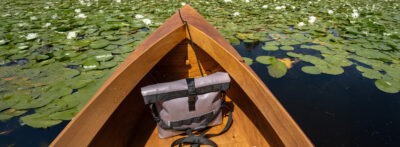
For several years, I’ve been on the hunt for the ideal camera bag, one I can use safely in small open boats. I often carry my Fuji XE 3—a midsize DSL mirrorless camera—and three zoom lenses, none of which is overly large, but neither are they small. I also like to carry an ND filter with adapters, a cable release, a few spare batteries, and a basic cleaning kit. Lots of bags can handle a setup like this, but I was looking for one that was as small as possible, well-padded, and easily accessed. And I needed it to be completely waterproof—this last requirement was what stalled the search.
 Photographs by the author
The Camera Block is designed to fit snuggly inside the Waterproof Field Bag. The Block comes with dividers, although the yellow ones seen here are my personal dividers. Like the originals, they are attached by hook-and-loop fabric and can be moved or removed. The Block’s lid has a handle and a zippered closure, which I don’t use if the Block is inside the Field Bag and I want easier access to my camera gear.
Eventually, I came upon the solution: a messenger-style bag with a removable inner padded bag from Expedition/Units, a Bali-based company that offers several styles of packs and bags as well as associated accessories. I’d never heard of the company before I stumbled onto its website, but the Project M23 Waterproof Field Bag seemed like it might work for me. Actually, they pretty much had me at “waterproof.” I ordered one, and while I was at it, I also ordered the Project C40 Camera Block, a padded insert for the Field Bag. Both arrived in a little over a week. From ordering to delivery, communication was good.
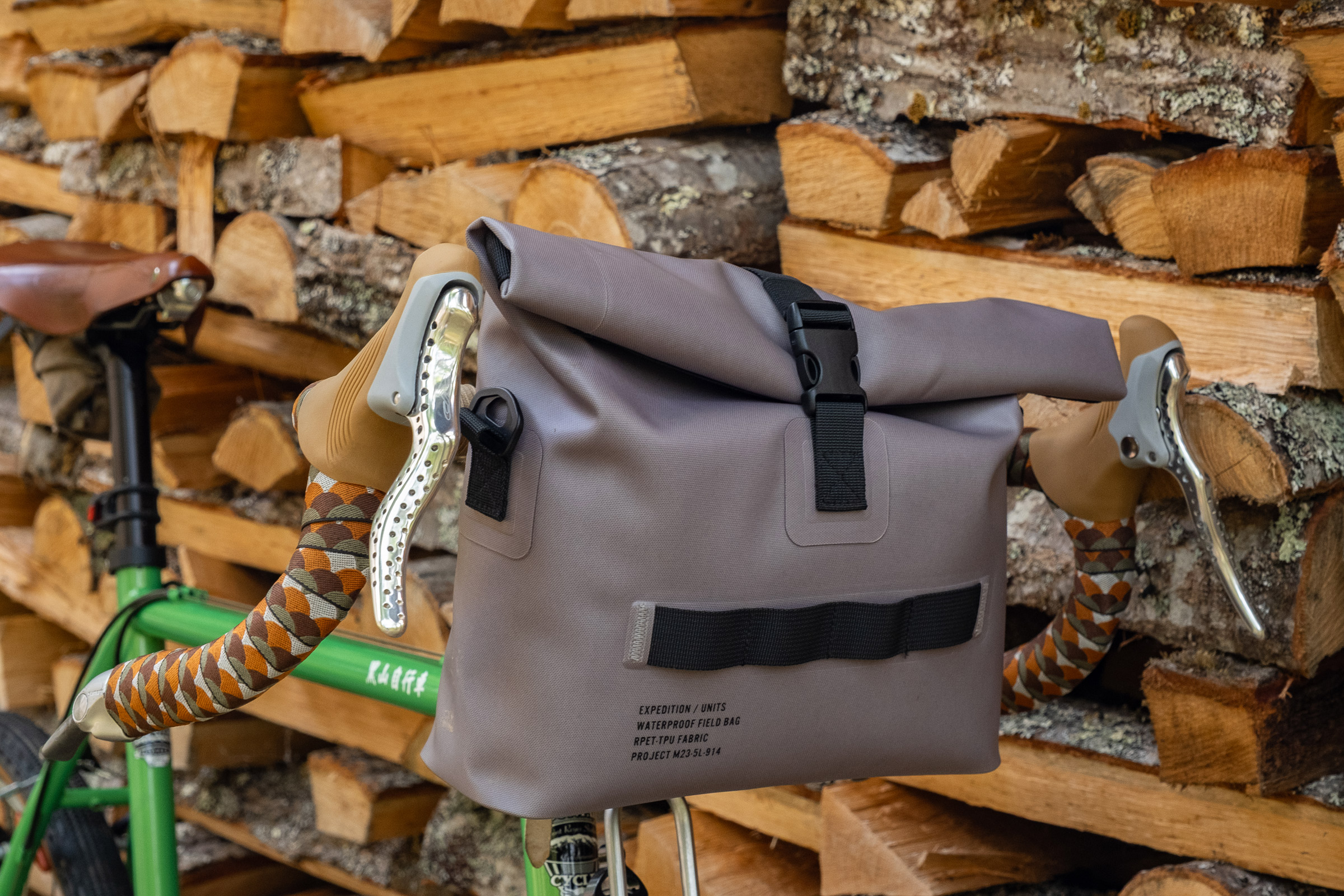
Detachable straps on the back of the Field Bag transform it from a messenger bag to a bicycle handlebar bag; it can be opened and its contents accessed without removing the bag from the bike. There is a daisy-chain strap on the back as well as the front of the bag.
The construction of the Field Bag seems robust. The bag is made of waterproof AWPE 600 Ecofabric—a rugged material developed by Expedition/Units from recycled plastics—with welded seams. Wherever fittings are permanently fixed to the bag, such as the nylon-web straps, they are bonded as well as sewn. There is an interior pocket with an open pouch and a zippered section, which can still be accessed when the Camera Block is in place. For my intended use the size of the bag is near perfect: 11″ wide, 9.8″ tall when rolled down, and 3 1⁄2″ deep. The bag uses a roll-top closure. Here, the manufacturer has improved on this most simple of designs by attaching nylon webbing along the top edges, beneath which are two sets of magnets that help to line up the edges and crisply snap them together. For casual use I fold the top one time and use the single strap and plastic buckle to secure the opening. For a more secure and completely waterproof seal, I add a couple more rolls and cinch up on the adjustable strap.
The bag has a detachable 1″ nylon-webbing shoulder strap, which can be clipped to D-rings on either side of the bag. There are daisy chains on both the front and back of the bag and detachable straps on the back that allow the bag to be hung on the handlebar of a bicycle. The empty bag weighs 8.8 oz and is available in four colors—black, gray, sand, and olive green.
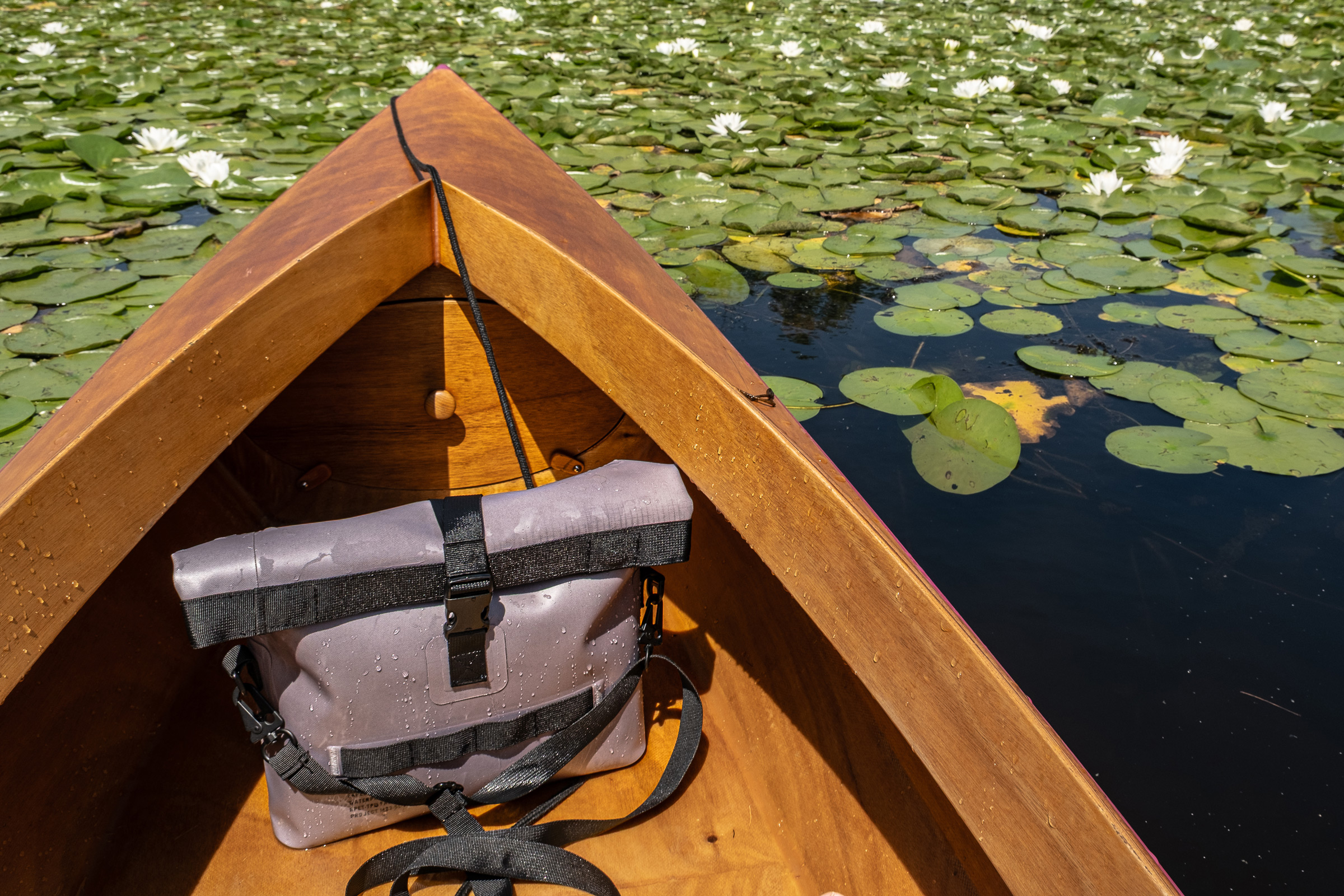
With the top simply turned over for quicker access to the contents, the Field Bag is very water resistant. If I’m worried about it being exposed to persistent rain or spray, however, I will put in at least two rolls and cinch down on the closing strap, then it is completely waterproof, whether standing upright or not.
The lightly padded Camera Block is made of recycled PET plastic that is flexible, lightweight, and water-resistant. It can be used independently and has a carrying handle on the top, but it is probably most useful when combined with the Field Bag. It fits snugly inside the bag, so it is best to insert it before loading it with gear. It has a zippered top, but I tend to leave it unzipped as the process of sealing the roll top of the outer bag snugs the lid down securely. The Camera Block is lined with a soft, padded, synthetic fabric and has three dividers secured by hook-and-loop, which can be moved around or removed entirely.
The combination and versatility of this two-bag system has worked well for me. I don’t always take my full camera kit on trips, but when I do I can’t think of a better way to keep it close at hand, safe, and dry.
Bill Thomas has been a custom woodworker, designer, boatbuilder, and teacher for more than 40 years. He’s also a Maine Guide and has taught sea kayaking in Maine and other locations. While on the water he takes many photographs to document his travels, illustrate his online posts, and provide images for his annually produced desktop calendar.
The Project M23 Waterproof Field Bag, $99, and Project C40 Camera Block, $49, are available from Expedition/Units. Shipping is free on orders of more than $125; return shipping is not free.
For more gear reviews by Bill Thomas see “Kayalite Kayak Light,” and “Jorgensen’s 60-1⁄2 Block Plane.”
Is there a product that might be useful for boatbuilding, cruising, or shore-side camping that you’d like us to review? Please email your suggestions.

Join The Conversation
We welcome your comments about this article. To include a photo with your remarks, click Choose File below the Comment box.