CRAACK! And then nothing. Well, not nothing. I was in 15 to 18 knots of wind in the shallow waters of Tampa Bay. The sun was high in the sky, but the occasional spray of salt water over the bow was keeping me cool. The boat was doing some considerable bucking and jiving up and down and side to side in steep 1′ to 2′ waves, even though the rudder felt steady and I was holding my course as close to the wind as I could. I wasn’t totally sure what I’d heard or where the noise had come from. I looked around the boat. Both masts were standing firm, even though they were working hard. The starboard ama was spending most of the time out of the water and appeared to be in good shape; the port one was mostly submerged but looked the same. The akas also showed no visible changes.
I looked down into the water just off the starboard beam. Ah, I had heard a crack: the bottom half of the centerboard was sticking out at a right angle to the boat and was waving at me just beneath the water, swinging back and forth in the opposing forces of boat and waves. It must have been hanging on by threads of fiberglass cloth and epoxy. What the heck! I’d worked hard on that centerboard—I wasn’t about to let it float away. I reached down, grabbed its forward edge, and pulled back. I stuck it under the rowing wing across the two seats of the cockpit. What now?
 Roger Siebert
.
I was out on the shakedown cruise of my new boat—an Angus RowCruiser that I had built over 18 months of part-time construction. During the six months prior to the build I had studied many designs, searching for a boat I could sleep on, that would sail and row efficiently, looked good, and wasn’t so complex that I’d spend the rest of my retirement years building it. So far, I had been pleased with my choice. The boat had gone together well and the support from the designer, Colin Angus, had been outstanding. But my dreams don’t always coincide with reality, and the principal objective of this first cruise was to see how my image, perception, and understanding of the boat dovetailed with actual experience. I was also excited to explore Tampa Bay by water and to get away from the “urban jungle” of too many cars, people, and noise.
Now here I was with a broken centerboard. I had left Davis Islands, in the southeast of Tampa, just a mile and 20 minutes ago. I could sail back to the launching ramp, and call it a wasted day. But I was reluctant. Maybe I didn’t have the centerboard, I reasoned, but I had everything else. There was no real emergency. Neither the boat nor I were in any danger. I was well outside the shipping lane. I should be able to tuck in to and sail along the spoil island just ahead, which should break up the wave action and allow me to get farther out into the bay. Besides, if I couldn’t get anywhere because of the headwind, I could always turn around and get home fast with the wind behind me. I went for it.
 Photographs by the author
When I awoke on my first morning afloat, conditions were calm. I sat and drank my coffee and watched the rising sun’s light illuminate the clouds.
Sailing but no headway
The spoil island, maybe a mile in length, was upwind, but too far away for me to take advantage of its lee. I could see its scrubby undergrowth with a narrow beach along the shoreline. The boat struggled to make headway against the wind: without the centerboard, we were being blown sideways even though my boat speed remained fast. I tracked the sideways progress against the wreck of a 40′ cruiser sitting in the mud and sand 1⁄4 mile off the shore: I was making little headway and major leeward slip. I tried to tack, but without the centerboard things quickly became tricky. I tried to build speed before putting the helm hard alee. No deal. I bore away, picked up speed and tried again, only this time I rowed like hell with the leeward oar to push the boat around. I finally made it, but I’d lost a lot of ground in the process. Next time, I wore around, pulling the tiller hard to windward and jibing. It worked but, again, I lost a lot of ground.
An hour passed—the wreck was still there. I had gone nowhere. It was getting late, I was tired, and I needed to figure out where to anchor for the night. The wind was starting to ease as I headed west to the spoil island. If I could anchor close to shore, I reasoned, I would be out of the worst of the wind and waves. I struggled on and, as time passed, the wind died. At last, I let go the sheets, slid the oars out of their stowed position, and set to rowing. It felt good to make way in the direction I wanted to go.

Docking at Apollo Beach to have lunch at Finn’s Dockside Bar and Grill was challenging. The finger docks and slips were not designed with a trimaran in mind. Eventually, I set a stern anchor and tied the bow to one of the very few ladders. During lunch, I was able to keep an eye on the boat and the weather.
As I rowed, the wind and waves continued to calm. Out of the corner of my eye, maybe 50’ away, a fish soared out of the water. It flew, briefly, fully clear of the now 6″ waves, looking like a tiny Concorde jet and, in an instant, dove back down with a perfect 10.0 landing. A manta ray—the first I’d ever seen. I rowed on, my heart rate slowly returning to normal. As I neared the island, I was guided by sight as well as the raucous sound of birds. The shoreline was alive with terns and gulls, skimmers, and oystercatchers. I might be serenaded a little too loudly for good sleeping.
I pulled into shoal water and dropped the anchor. I had made it. For the first time since the centerboard broke, I breathed easily, and realized I was both hungry and thirsty. I dug around in the food bags and found a cold dinner of crackers, dried pineapple, and nuts, chased down with some lukewarm water. Not a three-star dinner, but it’d been a long day, and I was beat.
As I get older, I’m amazed—sometimes confounded—by the things I don’t plan for. No more than a couple of weeks earlier, I had realized that it might be a challenge to rig and de-rig the Angus RowCruiser once afloat. Each fully battened sail has a sail sleeve in the luff into which the sectional mast is inserted. The mast is then brought upright, lifted into the boat, and stepped into its keel-mounted maststep. The boom is then attached to the mast, and the sail is tacked down with a deck-mounted downhaul, and clewed out on the boom. Finally, the sheet is clipped to the end of the boom, and the boom vang is attached. It is a straightforward procedure. However, to de-rig the sails, one must do all this in reverse and, if anchoring off, one must do it while afloat, with little room to move in the narrow cockpit. I began to think it might not be so easy. I could not wrap the sails because of their battens. The only way to de-rig was to take everything down. I wondered if the mast sections would float if I messed up.

The cockpit was the perfect length for me. I could sit facing aft with my back against the cabin and my feet up against the after bulkhead. For sailing, I reversed this position. On the horizon over the stern are the high-rise buildings of Tampa. The previous day I had rowed from there against short steep waves and into a 17-knot headwind.
I was tired, very tired. I was anchored in the lee of the island. The wind had died to almost nothing. The water was calm. I decided to leave the sails up. I let go the sheets, took off my still-wet spray-drenched shirt and shorts, and slid awkwardly into the little cabin to sleep.
Most small-boat mariners have been kept awake by water slapping against a hull: my boat had three hulls. It was downright loud; there was just enough wind and tiny waves to slap, jingle, and jabble against all three hulls. Adding to the cacophony were the sails slatting back and forth, and the mainsheet dragging across the cabin roof above my head. The birds, at least, were silent, they must have gone to sleep. Not me, but I was too tired and lazy to do anything to help myself. I lay awake, glad that it wasn’t too hot and that the tiny breeze was keeping the mosquitoes away. Sometime in the middle of the night, the natural forces quieted, and so, at last, did I.
From the Spoiler Island to Finn’s Dockside
The day I’d left for my cruise, my friend Pete had texted, “Hey… Let’s meet for lunch at Finn’s. They have a dock.” Why not? Finn’s Dockside Bar & Grill in Apollo Beach was only 5 miles to the south; even without the centerboard it should be no problem. After finding the stove, the coffee, and a granola bar, I sat in the cockpit and enjoyed the early morning. The sun was just coming up, lighting the clouds in subtle shades of pink. The temperature was pleasant, the air still, the water flat calm. It was hard to believe I was barely 5 miles from the city. An occasional seabird squawked or cried. I heard the screech-chirp of an osprey, and spotted it flying high, hunting over the water. It looked like it would be a great day for rowing.

Typically, I love being out of cell-service range when I’m adventuring. But when I came upon these horseshoe crabs, having a signal allowed me to access the internet and learn about the mating habits of horseshoe crabs on Tampa Bay beaches.
And it was. The sails were still raised but with the rudder set amidships, the boat moved along easily at 2 1⁄2 to 3 knots. Once I got up to speed, the repetitions of the sliding seat and the oars moving through the water felt good. Pelicans flew by. From time to time, they would tuck their wings and plummet to the water at seemingly breakneck speed. Almost immediately, they bobbed back to the surface, like giant corks. Sometimes, the water still dripping from their heads, they tipped their bills high into the air and gulped down their unfortunate prey. Other times, with barely a pause, as if embarrassed that failure might be witnessed, their wings immediately flapped, and they were off.
Occasionally, sportfishing boats flashed by with fishing rods glinting in the sun. As I approached the point off Apollo Beach, I saw a splash in the water. I stopped rowing. Two bottlenose dolphins were zooming back and forth, up and down, back and forth, close to the surface of the water, occasionally breaking the surface with a dorsal fin or tail. I saw there was a third, smaller dolphin, in the mix. Then I saw some action on the water—the surface was crinkly and shimmering with the baitfish just below. One of the larger dolphins immediately peeled off, the other stayed with the young one. Whoosh! The big one screamed through the baitfish, water spraying from its side. Then the other two followed, side by side. I sat and watched the fun. Days later, I told a fisherman friend what I’d seen, and he said that it was likely parents teaching a young one how to hunt and feed.
By the time I’d rowed to Finn’s, my hands were starting to feel some rub spots—in spite of my repurposed bicycle gloves. The long timber dock had multiple raised finger pontoons with open slips, but none was wide enough to accommodate my boat, nor did there appear to be any ladders to climb up to the pontoons. I was perplexed. How was I to moor, let alone disembark? Eventually, I spotted a ladder, and figured it out: I set a stern anchor, tied a bow line to the ladder, and stepped off the bow. I was reasonably sure that the bow wouldn’t bump against the ladder or pilings, but planned to sit where I could keep watch just in case.

My centerboard broke barely 20 minutes out from Davis Island, so I couldn’t sail westward and downwind as that would have meant an upwind return involving a lot of rowing. I proceeded instead along the eastern side of Tampa Bay, which offered spectacular sunsets over the city of St. Petersburg.
I wandered up to the restaurant to find Pete. Through a lunch of fish tacos, I glanced repeatedly down to the boat and harbor. The wind was starting to build. Without the centerboard I didn’t want to attempt to sail in the close confines of the harbor; it was time to be gone. I shook Pete’s hand, thanked him for lunch, and made my way back to the boat. A crowd of restaurant patrons watched as I cast off and pulled out on the anchor; I managed to complete the maneuver without embarrassing myself.
I had been right about the wind: it was building but there was still no significant wave action in the harbor. I rowed the 3⁄4 mile to the entrance and as I neared the open water both wind and waves built and became challenging. Nevertheless, I planned to row southwest for 4 miles, away from the built-up shoreline, tuck in behind a point, and anchor for the night. The sails were still up and slatted in the 15-knot headwind, the steep chop impeded progress, and the day was heating up to more than 90°; the sun was merciless. When I stopped to rest or drink some water, I was blown back, undoing the progress of the previous 15 or 20 minutes of rowing. It was a battle of sore hands and shoulders, weary body, and stubbornness; soon it was sore hands, exhausted body, and sheer stubbornness.
During my slow progress from the harbor, I followed a line of signs that said, “MANATEE PROTECTION AREA! SLOW SPEED! MINIMUM WAKE!” All had been quiet within the zone but then, not far inshore of the line, a speedboat zipped through at close to 30 mph. Almost simultaneously, about 50′ from me, a manatee snout came out of the water for a breath. It was swimming toward the shore, on a path across the boat’s wake. The University of South Florida reports that between 100 and 130 manatees are killed by motorboats every year.

I have plenty of storage space under the stern deck, accessed through two circular deck hatches. However, my smallest cooler is too large to fit through either of them, so it spent the trip resting atop the cabin roof and leaning against the solar-panel platform. I was pleased with the solar panel; it produced enough power to run lights, a fan, and the autopilot, and to charge my cellphone.
In the wind and short, steep waves, it was challenging to row my fully laden boat with sails raised and amas on either side. Sometimes the amas but not the hull were affected by waves; sometimes one ama but not the other was; sometimes all three were. I would get knocked off course when the edge of one of the sails caught the wind. Then, with a wave slapping into the windward ama, I would struggle to keep the boat moving and back on course. And there was no way I could take a break.
Despite it all, after three hours of hard work in which I covered just 4 miles, I reached my goal. It wasn’t pretty. My hands were blistered, my shoulders ached, and my brain was mush. In normal circumstances, with no sails up, I might have rowed there in half the time. I anchored as far as possible from the mangroves, in hopes that I would not be pestered all night by mosquitoes, and took stock. It was a pretty little cove. The thick leaves and twisted trunks of mangrove extended into the water. I pulled out the stove and heated water for a ramen bowl, stirred in a can of chicken, and settled down to eat, topping off dinner with some cookies and a cup of box wine. I watched the pinks and reds of the sunset climb into the western sky across the bay.
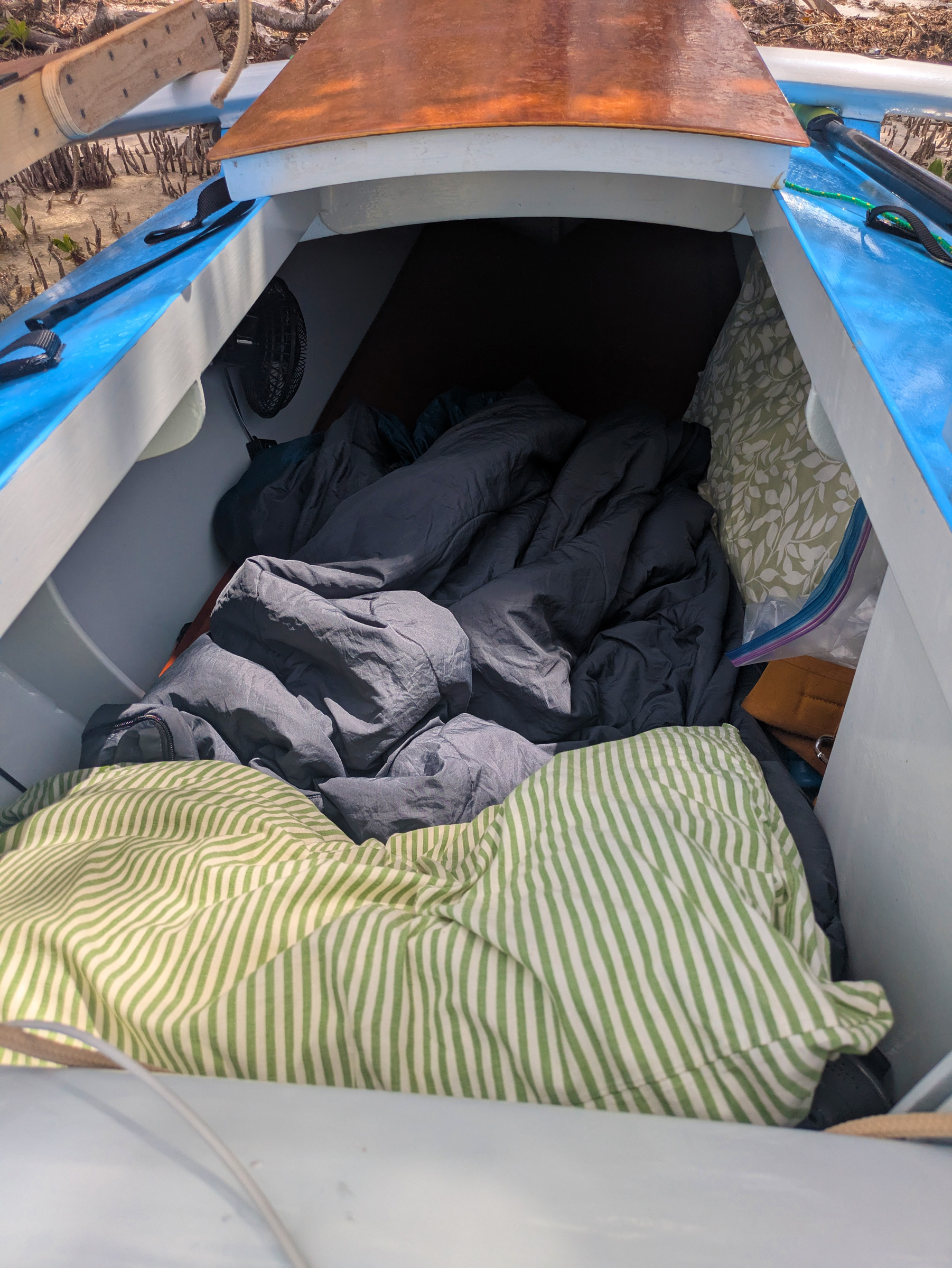
The cabin is far from luxurious, but it accommodates my 6′ 4″ frame and is surprisingly comfortable. However, at 70 years old, I do find getting in and out of the close quarters somewhat awkward.
Somewhere above me came the familiar call of an osprey. I scanned the sky until at last, I saw it, flying low, laboring to carry a fish half as big as itself up to its nest in a tree standing tall above the mangrove. There were few other sounds during the evening, save the occasional slap of a mullet’s tail as it flicked a sharp turn through the surface of the water. After the previous night’s terrible sleep and the tough row of the afternoon, I was bone-tired and called it a day. I arranged the mosquito netting over the open hatch cover and, as the wind died and the water leveled to a flat calm, listened to the rising monotone of mosquitoes above me. It mattered not; I slept like the dead.
The lure of a campground
Once again the day dawned sunny. I didn’t need to look at the forecast on my phone to know it was going to be hot, but I did anyway. Today’s forecast high, 95°. After coffee and oatmeal, I carefully clambered forward to weigh anchor. It was another task I had underestimated when thinking about the boat. Although the boat as a whole is very stable with the outriggers, the narrow hull is difficult to move around. On all fours, keeping my knees and hands spread to the sides of the central hatch cover, I carefully climbed over the forward aka where the hull narrows still more, and the boom and rigging blocks of the foresail are an extra hazard. The deck was also slippery—I had, perhaps, worked a little too hard on the paint finish. Fortunately, there was only 12′ of rode to pull up, but it was far from ideal.

I spotted this small beach among the mangroves and stopped for a rest and to stretch my limbs. When I landed, there was almost no wind, but when the breeze filled in from the west, it pinned the boat and entangled it in the mangroves—it made for an ungainly departure.
Anchor raised, I looked at the blisters on my hands and was relieved I wouldn’t need to row. A light easterly was settling in and, with just a gentle pull on the sheets, the boat was moving off downwind along the east–west shore. I relaxed into the easy motion until, just 30 minutes later, I saw some small beaches among the mangroves. They were perfect to pull into, and it was too tempting, so I beached the boat and checked it out. Flush toilets! A picnic area with shade! While the air temperature was still under 90°, I put on my walking shoes and strolled around.
I had landed at the E.G. Simmons campground within the conservation park of the same name. There was a protected swimming area marked by a line of buoys, a boat launch (in rough shape after Hurricane Helene), and two camping sites next to the water. Other than the occasional sportsfisherman casting from a beach, I saw few people. I walked a couple of miles, mostly along the park roads, to get my blood going. Then I returned to lay out my camp chair, a book, some snacks, and a bottle of water in the shade under the picnic roof. There was a light breeze blowing onshore—a warm breeze, for sure, but at least it was some air movement. I spent the day reading and writing while keeping cool with a wet bandanna, and used the hose spigot to wash the salt out of yesterday’s clothes.
Late in the afternoon, I went back to the boat. Next to it a cluster of horseshoe crabs was half buried in the sand, half submerged in the water. There was one large one and a number of smaller ones scrabbling over each other. It was, evidently, mating season.

At Pine Key I was happy to find some shade in which to sit and read a book for a while. The 90° temperatures and cloudless skies were relentless.
With time on my hands and space on the flat sandy beach, I finally de-rigged before anchoring out for the night. For once there would be no slapping sails and, again, I slept well.
The next morning, I had coffee on the boat and then rowed into the beach to eat breakfast at a picnic table. The wind was a steady 12 knots out of the east, and I raised the sails and set off to the southwest. For two and a half hours, with the wind picking up to 15 to 18 knots on the beam, it was downright fun. With each gust, the boat dug in the leeward ama and leaped forward. I was aiming for Bishop Harbor, about 10 miles south, and I almost made it—the GPS recorded that we covered 11.3 miles in 2 hours and 40 minutes with an average speed of 4 1⁄4 knots and a top speed of 8 1⁄2 knots. But as the afternoon wore on, the wind veered more and more to the south, forcing me onto an ever-closer reach. Bishop Harbor could wait; I’d done enough fighting on this trip.

In 2024 Pine Key was hit hard by Hurricane Milton’s 100-mph winds. Many of the trees in the shoreside woods were downed or tangled up with one another, and the beach was strewn with debris.
I turned around and spied a perfect 30′-long beach tucked into the mangroves where some shade promised a modicum of respite from the heat. I sailed in but, just before making land, the wind shifted, and I was on a lee shore. Without the centerboard the boat refused to turn, and in a very short time the bow was nudged into a forest of mangrove branches hanging over the water. There was no room to use the oars; the forward mast was nestled between a couple of branches. For a few minutes, I thought we might be tangled in the mangrove forever. But, at last, using an oar as a pole I managed to push back out of the branches and turn around. I rowed away and, 20 minutes later, rounded a small headland and tucked in behind an island. I was just happy there had been no witnesses to such an inept sideshow.
With no wind, the sun was merciless. I headed back to Simmons Park, where I knew there would be shade and breeze. The wind was still blowing 15 to 20 knots out in the bay, and 90 minutes later I reached the park; it was time to call it a night. I watched a glorious sunset directly over the city of St. Petersburg on the far side of Tampa Bay, and swatted way too many mosquitoes off my legs.

These pilings at Pine Key, stripped bare by the hurricane, have become a popular resting place for terns and pelicans. At the left, in the near distance beyond the pilings, is a navigational light marking the shipping channel, while in the far distance is the city of Tampa.
A fast sail home
The next day, in the same 15 to 20 knots of wind, I sailed for “Beer Can Island,” officially Pine Key. One of the more famous (or infamous) islands in the bay, it is known for being a haunt of fancy boats, bronzed bodies, and lots of alcohol. The wind had piped up and with it now blowing 18 knots from the southeast, we arrived in what seemed like no time at all. I beached the boat to check it out. Pine Key was severely impacted by Hurricanes Helene and Milton, and there are now few trees to provide shelter from the sun. With the island pretty much blown away, there were no other boats. I stretched my legs with a walk around the perimeter, coming across remnants of makeshift drinking bars and downed trees. Back on the boat, in two hours and 20 minutes and with an average speed of of almost 5 knots, I turned the corner into the Davis Island Yacht Club basin, where I had started just five days ago.

The run home to the Davis Island Yacht Club basin was the best sailing of the trip. The autopilot steered, the boat surfed at up to 9 knots, and no water came over the rail. It was a fun ending to the adventure.
It had been an eventful five days. I had learned a good deal about the boat, had proved that she was a lot of fun, rowed well, and sailed like a rocket. Above all, I had learned that I wasn’t getting any younger: clambering around on a narrow boat, and climbing in and out of her small cabin, was not as easy as it might have been 10 years ago. I had a new list of things to do and/or figure out how to do. I needed to build a new centerboard; figure out a way to anchor from the cockpit; design a mechanism to raise and lower the rudder without having to lean over the stern; adjust the distance between the autopilot and tiller; and find a way to shorten or lower the sail while on board. As shakedown cruises go, it was possibly more exciting than it should have been, but the valuable lessons were second to none and the fun I’d had for those five days in a boat that I built myself—well, that was unbeatable.
Bill Hutton likes to build, sail, row, paddle, and drive small boats. Over the years, he also worked with mostly Native Alaskan students in Alaska schools, fished commercially for halibut and salmon, walked the mountains, ran rivers, bicycled multi-day routes, and enjoyed adventures with his wife and family. He now lives in Florida for most of the year.
For more Florida adventuring with Bill Hutton see “Thwarted.”
If you have an interesting story to tell about your adventures with a small boat, please email us a brief outline and a few photos.

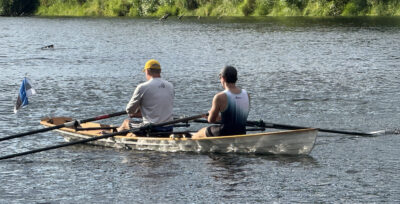
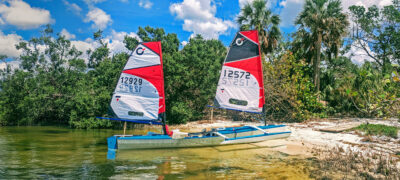
The Angus Rowcruiser has a daggerboard, not a centerboard. Daggerboards go up and down, centerboards swivel.
Good point! Thanks.
Great story. And a set-up I am considering as well (currently 66!).
Isn’t there a simple 2 line solution to raising and removing the sails? Open the top of the sleeve, strengthen the top of the sail, lead a halyard through the hollow mast, with some kind of guidance in the top (plastic or wooden plug with a rounded form), and a second line as a downhaul… Two blocks at the point where the mast enters the deck, and a hole in the mast to exit the halyard, probably also with something to guide/reduce chafing.
Great idea/concept. I’ll have to check it out with the gear in more detail. I think it would work. Thanks!!
Might look at ‘fiberglassing’ your new board with a few layers of carbon and or inlaying some pultruded carbon rods to keep it functioning. I have a sailing canoe that has limited space for the board thickness. And it has to be strong enough for me to stand on it to right the boat when I flip (which is often! unfortunately).
Had some success with these tricks.
As typical, I “wish.” I wish I would have gotten your input before I finished the new board. Hah! One of my errors was being cheap by using some marine ply that I had hanging around. The designer, Colin Angus, even writes in the directions that plywood probably isn’t the best option. I used clear fir this time. But I wish I would have at least used carbon fiber rather than regular cloth. Now I know what to do!
I’d be interested in what sailing canoe you have.
Cheers, bill
Re anchoring: The attached photo shows a method for anchoring from the cockpit which works well providing you’ve led the painter aft beforehand.
As to reefing the sails. It may be too late in the day now but have you taken a look at how Hobie go about this on their Mirage Trimaran? The sail battening is such that the sail will roll around the mast and reefing can be done whilst sitting in the cockpit.
I have looked at other sails and rigs. I admit that I was too cheap to implement the Hobie sails/rig(!) They were quite a bit more in dollars (and time). But, in hindsight, I might have chosen differently.
I like the anchoring strategy. Thanks!
bill
I was idolizing the Angus row cruiser for camping until I read this. There may be some ‘simple’ improvements to help with reefing and dousing sail, managing the rudder blade and docking/anchoring. I think a set of self-tending sunfish-style lateen sails with bipod masts with halliards and releasable forestays to the cockpit would be my choice of rig. Efficient, without battens. Bipod masts could be stubby and hinge down for reduced windage rowing.
I still think it is worth idolizing!! As the previous comment says, an option is the Hobie Mirage sails and gear (among others). The fact is, that those sails and gear are quite a bit more expensive and I wasn’t willing at the time to spend the dollars. There are also methods for managing the rudder blade and anchoring. I must admit that those strategies – for me – take quite a bit of time and energy. I just wanted to get sailing/rowing!!
Team Hornblower, on the R2AK race, rigged a standard sail on his rowcruiser. You can take a look at his boat at https://r2ak.com/2024-teams/
Good luck no matter what!
bill
Thanks for an interesting article! Sailing and cruising a new boat always involves challenges, it’s part of the fun.