I spent the last week of August in Washington, D.C., visiting colleges with my daughter, a senior in high school. Coming, as we do, from a very small coastal town in Maine, a big-city visit is always a treat. But as the days progressed, the weather endlessly warm and dry, we found our footsteps mysteriously taking us ever nearer the Potomac River. We never quite made it to the edge, but occasional glimpses of water at the bottom of a dead-end street or beneath a bridge were refreshing to our spirits.
We flew back to Maine on that Friday, and as we exited the Portland airport terminal I fancied I could smell the ocean, perhaps even taste the salt in the air. I breathed deep. We arrived home in the dark and rain but when the next day dawned cloudless and calm, I made my way down to the harbor. It was still only late summer, but probably a third of the moored boats had been hauled out for the winter during the week we’d been away, and of the boats that did remain, only two—apart from the working lobsterboats—were over 20′ in length.
 Jenny Bennett
I occasionally find a home-built boat at the dinghy dock (such as the Shellback Dinghy seen here, five boats from the bottom of the picture) although, of course, many of their owners may prefer to keep their beloved projects away from the crowd.
Conversely, the dinghy dock was as full as ever, and as I sat in my rowboat and bailed the previous night’s rainfall, I mused on the differences of small and large boats and, in particular, the planning and forethought required by big-boat ownership when one is dependent on yard schedules and commercial storage spaces. Even the weekend residents pull out their big boats as soon as the long family vacation is at an end; after all, who wants to leave thousands of dollars of boat and systems unattended on a swinging mooring? Better, surely, to have them safely stored ashore.
But the small boats on the dock tell a different story. A Maine winter can be cold and stormy, but on the dock, dinghies can be kept afloat well into the fall to be used on weekends or holidays or whenever the summer folk have time to return. And even if they don’t make it back more than once or twice, the mere knowledge that the boat is there, ready to be used, is perhaps enough to sustain their owners as they head inexorably into a landlocked winter.
I thought, too, of all the ways one can get into small-boat ownership these days. As ever, you can buy new or secondhand, and for the latter there are many online markets that even 20 years ago were few and far between. But the greatest changes have, surely, been in the opportunities for home boatbuilding.
 Christopher Cunningham
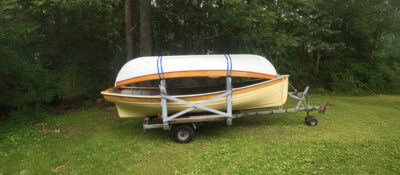
This traditional faering was under construction at the Aspoya Boats shop in Anacortes, Washington, in 2020. Such a project may be out of reach for many potential builders but thanks to the innovative work of designers like Iain Oughtred and producers like Chesapeake Light Craft, today’s amateur builder can find many boats based on traditional designs and re-conceived for modern, more easily achieved, building techniques.
For a century, someone wanting to build their own boat has been able to buy plans, but for much of that century to actually complete the construction of anything more than the simplest hull design required specialist knowledge, the skills to loft lines, steam planks; and the time and money to invest in traditional materials. As technology has raced ahead, however, those requirements have diminished. First came new materials: plywood, glues, fiberglass, fast-curing and forgiving finishes. Then came sophisticated hand-held power tools and computer software. Today, with CAD programs and CNC routers, the ability to build a boat is within most anyone’s reach.
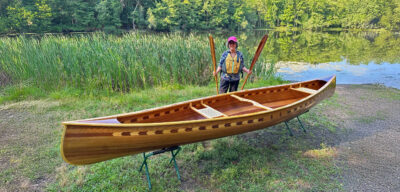
Of course, for those wanting to rise to the challenge of doing it the hard way, opportunities still abound. But for others looking for the satisfaction of building their own boat with little or no previous experience, there is a vast range of attainable alternatives. Take, for example, two projects featured in this month’s Small Boats. At one end of the lineup is NELI, an Annapolis Wherry Tandem from Chesapeake Light Craft built and reviewed by John Carey. At the other is LARK, a strip-planked 15′ canoe built by John and Justine Diamond. What makes these two projects disparate are not the boats themselves (although they are significantly different) but the approaches taken by their builders. Both John Carey and the Diamonds were first-time builders. But where the Diamonds sought the challenge of doing everything themselves, from selecting the cedar boards to building the strongback, seats, and paddles, John Carey chose to “assemble” his first boat from a highly-sophisticated kit of pre-cut plywood pieces, that came with everything except epoxy, finishes, and the required basic power tools. Yet, despite their obvious dissimilarities, these two approaches share commonalities: both projects were made possible by modern materials and technologies (even building from scratch, the Diamonds benefited from CAD files for the molds, which they cut out with a CNC router); both projects were greatly assisted by first-class support from the respective companies; and both projects, like many other thousands, ultimately resulted in small-boat ownership at affordable prices.
 Jenny Bennett
Designed by Joel White in 1989, the Shellback Dinghy is a modern design with traditional appeal. Before the advent of good-quality plywood and effective waterproof glues, such a build would have been beyond the means of most home builders. Today, the Shellback is available in an all-inclusive kit.
Homebuilt boats may yet be in the minority at a dinghy dock or launching ramp, but thanks to the myriad products from plans to all-inclusive kits and everything in between, they are a growing breed.










Well written. I can identify with the homebuilt folks, since we have launched our PDRacer. My grandchildren, their dad, and I built it from lumberyard materials.
Small Boats Rule!
Agree!
Having, just this weekend, finally launched and sailed my Doug Hylan designed Oonah this article is particularly on point for me this month. My Oonagh, named Thistle was purchased as a kit, in this instance meaning all pre-cut plywood pieces and the strong back. All other parts and pieces had to be sourced by me based on what I deduced from the plan. This approach was very much a combination of the two methods mentioned. After too many (enjoyable) years building the boat (entirely my fault) I have just spent 3 days sailing her and know that I have many amazing years in the future sailing Thistle. Wooden Boat (and Small Boat Magazine) has been the main impetus for building my own boat. Thanks.
Congratulations James, what an achievement and what an exciting weekend.
For me, the advantage of small boat are that you can take them anywhere to sail or row. It is such an adventure exploring new rivers, lakes, harbors, etc.