Paul Gartside’s 5.0 Meter Motor Launch, Design #261, is a 16′ 5″ stretched version of an earlier 13′ double-ender, LOOPEN, designed as a tender for a Dutch barge conversion. Early on, Gartside refined the 13-footer, moving the rudder from outboard to inboard “to move the helmsman weight farther forward, which is desirable in these double-ended hulls”—and ultimately it would become his Design #178, which, he says, “proved enduringly popular.” When Gartside was contacted by a customer asking for a similar boat to use on the Swiss lakes, the designer thought a larger and more substantial craft would be needed to cope with possible williwaws blowing down the steep surrounding hills. The customer’s workshop limited the length to just over 16′, and so Gartside returned Design #178 to the drawing board and created Design #261.
Like #178, the new design was a double-ender with plumb stem, sweet sheer with considerable rise to the bow, open cockpit, foredeck, and tucked canoe stern. For power, Gartside suggested a Yanmar 1GM diesel, and for construction, two layers of glued fore-and-aft western red cedar planking, with the inner layer “12mm, lined out for appearance, edge glued, with bronze screws into frames” and the outer layer “3mm, allowed to run off at sheer, glued and stapled.” The hull’s interior should be sheathed in 1,800gsm fiberglass with epoxy resin, and the decks double-skinned in western red cedar, with the inner layer laid diagonal and the outer fore and aft, giving a total thickness of 12mm. Beams should be of Douglas fir or pine, while he suggested European oak for the frames and floors, and unspecified hardwood for the horn timber, hog, keel, and stem.
 Photographs by the author
The lines and general arrangement of the open launch, recently finished at the Boat Building Academy in Lyme Regis, U.K., are as designed by Paul Gartside. The method of hull construction—double-diagonal veneer over strip plank—and electric motor are, however, significantly different. Nevertheless, the overall appearance, feel, and weight of the double-ended launch have been maintained.
Building Design #261
When Ben Sims enrolled in the 40-week course at the Boat Building Academy in Lyme Regis, U.K., his father agreed to sponsor the building of a boat, and they both agreed that Design #261 would be suitable for use on the River Thames near their home at Wallingford in South Oxfordshire. Rather than follow the designer’s recommendation for double fore-and-aft planked construction, Ben opted to strip-plank the hull and finish it with an outer sheathing of two opposed diagonal cold-molded layers. Course tutors Mike Broome and Joe Blathwayt were on hand to help determine the various scantlings and other details for this method of construction.
After the lines were lofted and a ladder frame built, the nine molds were set up vertically, upside down. The inner parts of the sapele centerline components—the laminated stem and horn timber and the solid-wood hog—were then let into notches in the molds. Also let into the molds around the sheer was the 5⁄8″ Douglas-fir harpin—essentially a combination of a beam shelf and a base for the covering board. The inclusion of the harpin meant that the molds had to be collapsible to allow later removal.
Then it was time to start the planking. Yellow cedar was machined into 13⁄16″ × 7⁄16″ strips with bead-and-cove edges and scarfed together to give the required lengths. A batten was laid around the molds in the area of the waterline to find a position where it would lie naturally and thus determine where the planking should start. Once the first plank was fitted, the process continued upward toward the keel and downward toward the sheer. The planks were glued to each other with polyurethane adhesive, and to the centerline components and harpin—to which they were also temporarily screwed—with epoxy. All of the planks were allowed to over-run the stems before being trimmed to length. Most were easily bent into place, but the three strips nearest the sheer needed a damp rag applied to their after ends to help bring them into place.

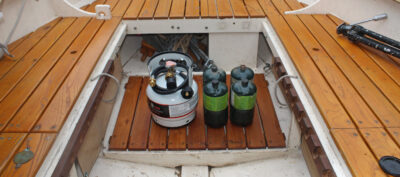
The engine box, designed for a Yanmar 1GM diesel, provided plenty of room for an electric motor with room to spare for the batteries to power it.
Once all the strips were in place, the outside of the hull was long-boarded fair before the two layers of 7⁄64″ sapele veneers were applied. These were glued with epoxy, and initially held in place with plastic staples. Once the second veneer was faired, the outer parts of the centerline components were fitted, thereby sealing the ends of the now-trimmed planking layers: a laminated section at the stern, a solid keel, and a solid outer stem in three parts. The hole for the 1″-diameter shaft was bored through a sapele shaftlog that connects the horn timber and aft end of the hog. Copper-based antifouling paint was applied to the underwater areas, and the topsides were given a couple of coats of primer.
About half of the molds were removed while the hull was still upside down. It was not until the boat was right-side up, and the builders were sure the harpin would hold the shape during fit-out, that the remaining molds were removed. Then the inside of the hull was faired and ’glassed with two layers of 300gsm biaxial glass cloth and epoxy. Ten floors of 2″-thick sapele, three 5⁄8″-plywood frames, and two 5⁄8″-plywood bulkheads—the forward one being full height, the after one seat height—were all then fitted. While the plans for the rudder indicate a blade made of layers of vertical-grain Douglas fir over a 20mm bronze rod, Ben made his of two layers of 1″ plywood that sandwich a 7⁄8″-diameter stainless-steel rudderstock set in a fiberglass tube.

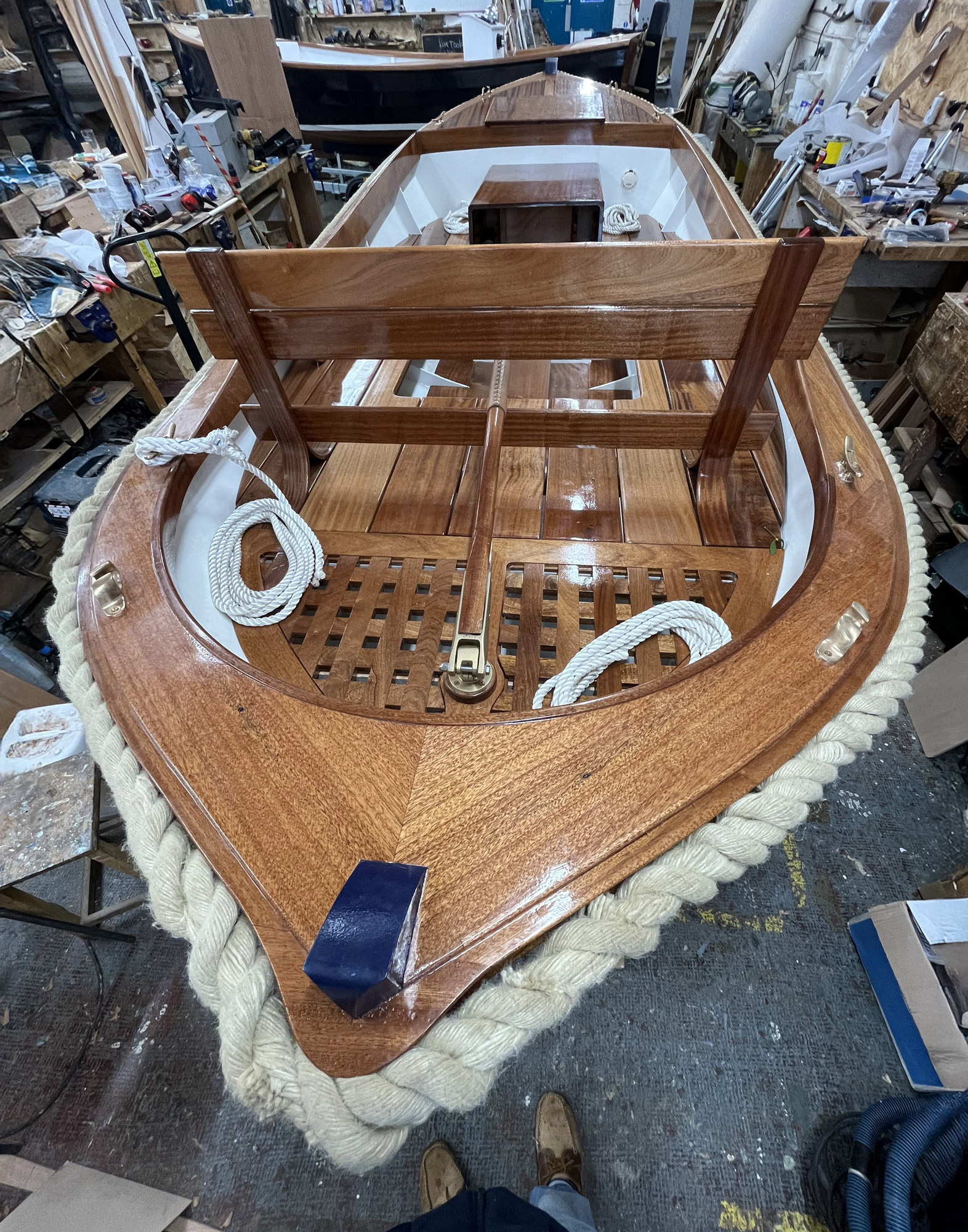
The boat can be trailered behind an average family-sized car. The 1 1⁄2″ rope fender adds an aesthetic touch of tradition.
The solid Douglas-fir foredeck beams establish the deck’s camber and are notched on their outer ends to be fastened to the underside of the harpin. Instead of the 12mm double-skin red cedar called for in the plans, a 1⁄4″-thick plywood subdeck was fitted to Ben’s boat and 3⁄8″ sapele covering boards were laid all around the sheer on top of the harpins; then 3″ × 1⁄4″ khaya deck planks were laid on the foredeck. Storage space beneath the foredeck is accessed via an amply sized hatch with hinged cover.
The 1 3⁄4″ × 7⁄8″ gunwales were fitted all around the sheer and then hollowed out to allow later fitting of the 1 1⁄2″-diameter three-strand rope fendering. The 4″-wide by 1⁄2″-thick coamings were installed around the cockpit; for most of their length they rise 2 1⁄2″ above the deck level, but in line with the after thwart, they are trimmed down to 2″, and ultimately continue, steam-bent, around the curve in the stern and flush with the covering board.
All of the interior fit-out is in sapele. There are two fixed 7⁄8″-thick sole boards either side of the centerline, with the outer ones divided into sections between frames and glued in, and the inner ones screwed in place to allow occasional access to the bilge. Seating is provided by an after thwart with high backrest, and benches that line both sides of the cockpit and end at the forward bulkhead. The combined engine and battery box is forward and incorporates wine stowage—designed by Ben—with space for four bottles in its after end.
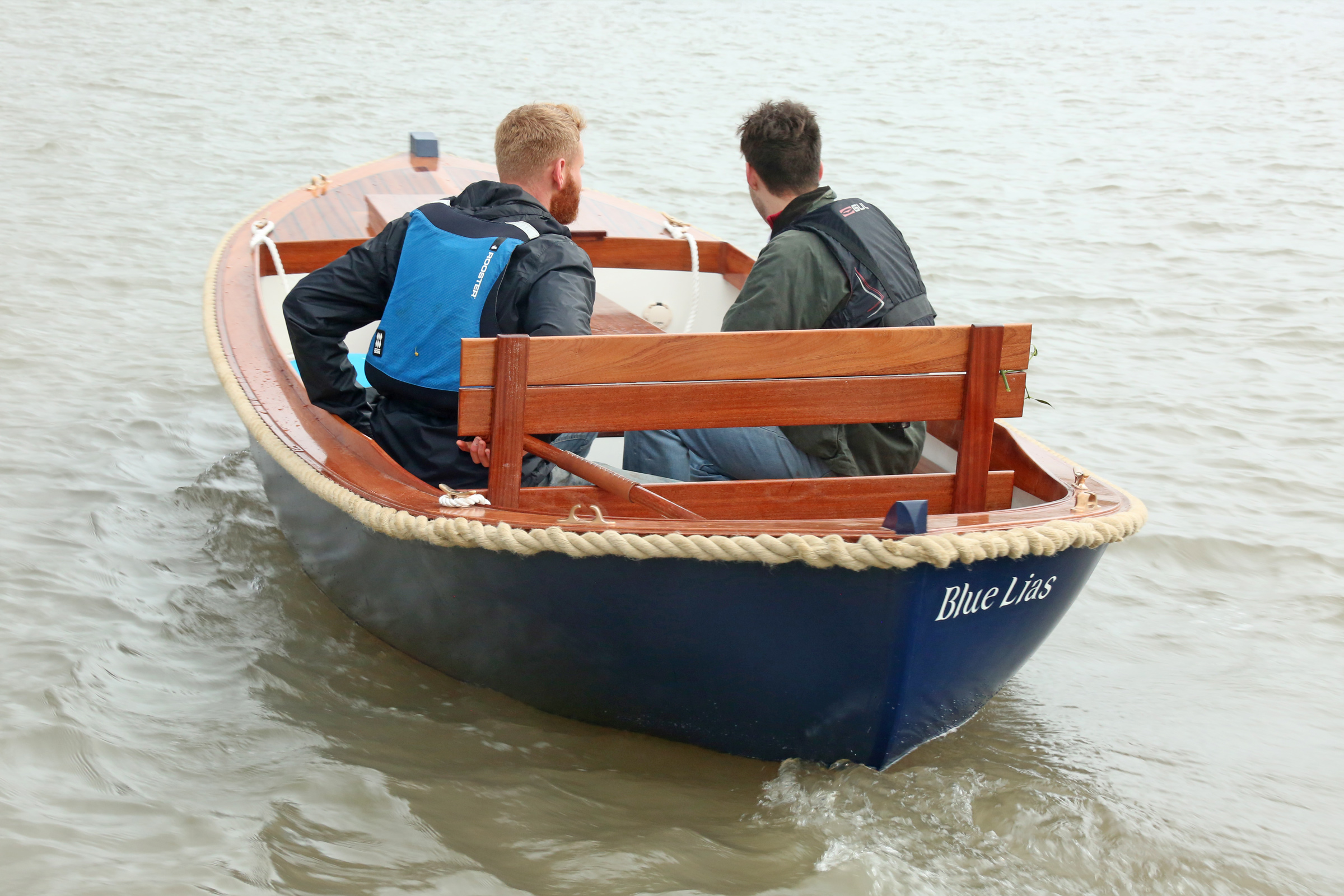
With the rudder hung inboard, the classic lines of the canoe stern are uninterrupted. The tiller extends between the seat-back slats and has a leather sleeve to protect the varnish. The helmsperson can relax against the angled backrest, moving forward only if the full swing of the tiller is needed to make a tight turn.
Design #261 underway
Paul Gartside’s original concept was for the launch to have an electric motor, but he says, “considerations of cost and the limited range quickly blunted that enthusiasm,” and he now recommends the 9-hp Yanmar 1GM diesel engine. Nevertheless, Ben will be using his boat on the Upper Thames where, he decided, there are sufficient charging points to make an electric motor entirely practical. He has installed a Water World 4 kW motor, which is powered by two 3.4 kW/hr lithium-ion-phosphate batteries driving a three-bladed 10″-diameter propeller. During our brief trials on Launch Day at the Boat Building Academy, we found that with four adults on board, we were able to get up to approximately 5.5 knots while using 4 kW, 4.3 knots at 1.2 kW, and 1.5 knots at 250 watts. Further trials will, no doubt, reveal more accurate figures, but Water World’s expectation is that at a constant speed of 3.2 knots, the engine will run for about seven hours, allowing the boat to travel just over 22 nautical miles. By contrast, at the maximum power output of 4 kW, the motor would only run for about 90 minutes, giving a distance traveled of perhaps 8 miles. It is possible that further trials will reveal advantages if the pitch and/or diameter of the propeller are altered. Battery recharging time with the current 35-amp charger (installed under the forehatch) takes about four-and-a-half hours.

The comfortable open cockpit is spacious enough for four people to ride in style. The cover for the engine box has the height designed for the diesel, but the extra space wasn’t needed for the electric motor and, instead, was used to hold a rack for wine bottles.
With an all-up weight of just over half a ton, the boat is easily trailerable, and on launching day two people were able to float it off and haul it back on to the immersed trailer without difficulty. The boat is easily driven and, when going forward, turns 360° in about twice its length. As is to be expected of a boat with inboard motor and rudder, it is less easy to steer astern at slow speeds, but when speed picks up maintaining a course is straightforward. The cockpit is spacious and there is ample room for four adults to sit together, with space to squeeze in a couple more. It is particularly delightful to sit on the after thwart, leaning against the backrest—set at 11° for maximum ergonomic comfort—and steer the boat with the tiller, which extends between the slats of the backrest. When you need to swing the tiller through its maximum arc, you do have to momentarily shuffle forward, but this happens rarely. And, of course, the relative silence afforded by the electric motor will be a joy for leisurely travel and wildlife spotting on the Thames.
However this boat is built and powered, its eye-catching lines, sweeping sheer, and canoe stern are sure to turn heads, and give owners and their friends relaxed enjoyment on sheltered waters anywhere.
Nigel Sharp spent 35 years working in the boatbuilding industry before starting to write about nautical matters in 2010. Since then he has had numerous articles and eight books published.
Gartside Design #261 Particulars
LWL: 14′ 8 1⁄2″ (4.47m)
Beam: 5′ 7 1⁄4″ (1.7m)
Draft: 1′ 3″ (0.38m)
Displacement: 1,275 lbs (580kg)
Power: 4.5 kW 6–10hp
Building time: 1,200 hours
Skill level: High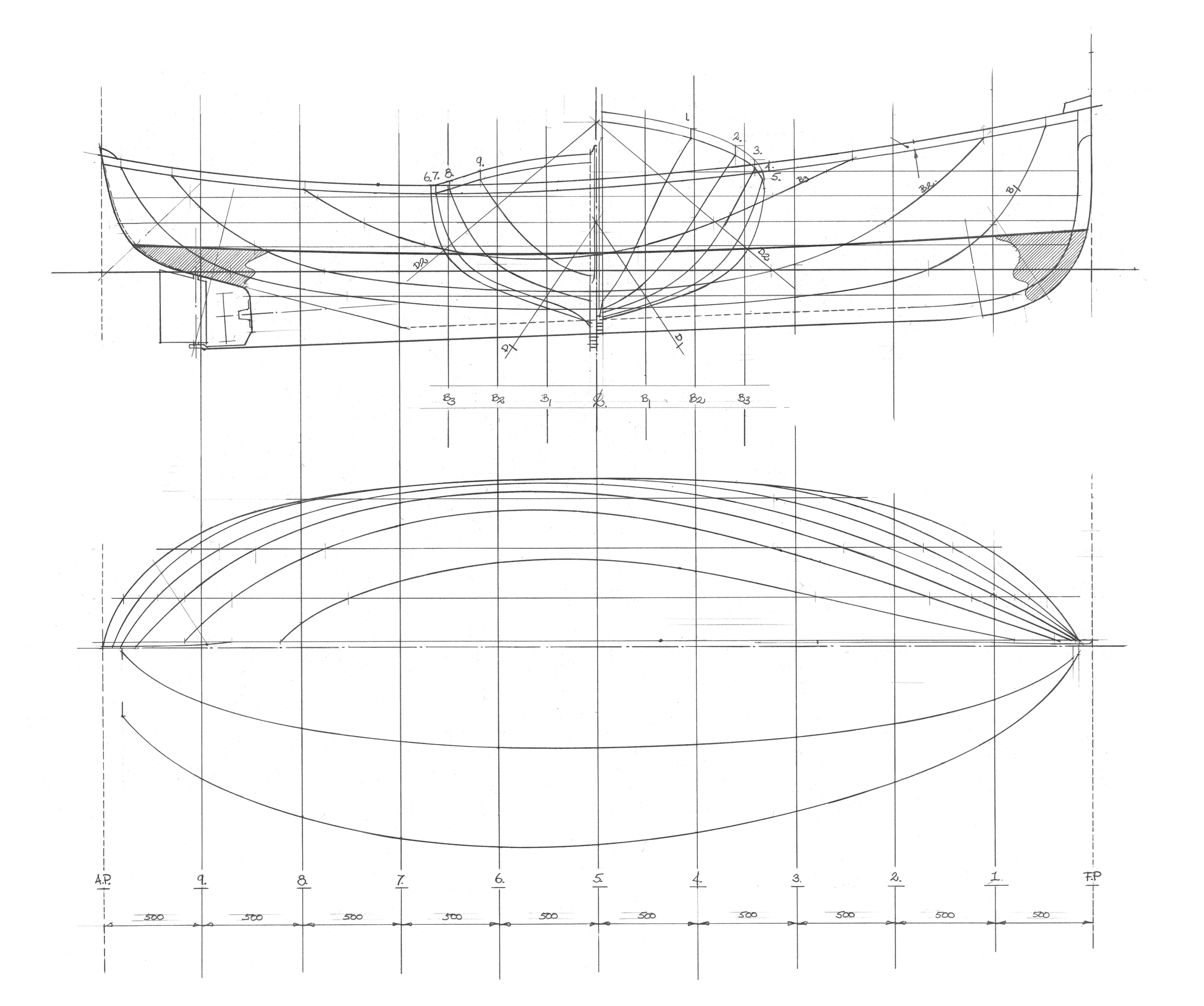

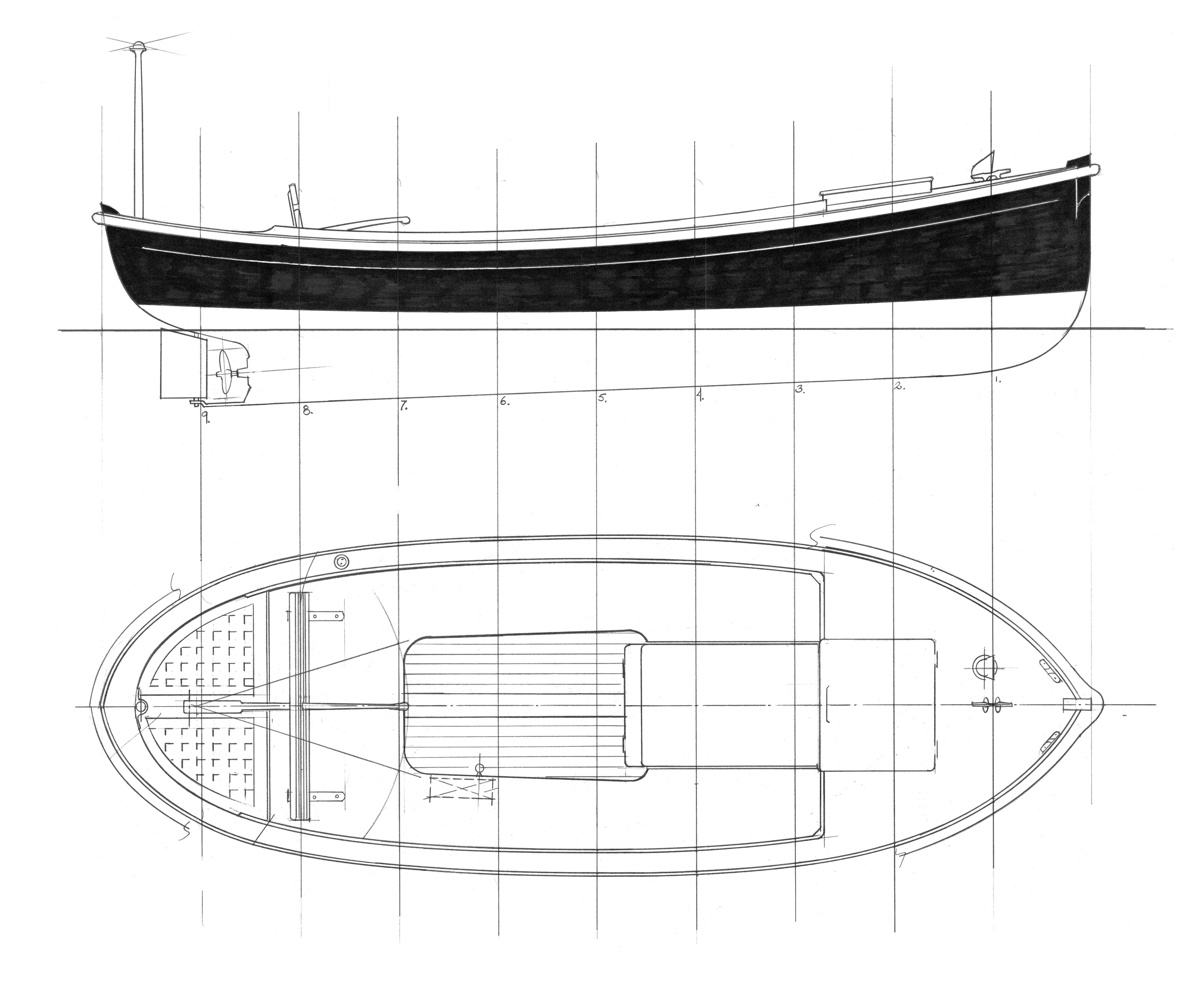
Plans for Paul Gartside’s Design #261 are available from the designer. Study plans are $20, while the full set of six sheets are $150 for electronic delivery, $220 for printed (shipping and taxes not included).
Is there a boat you’d like to know more about? Have you built one that you think other Small Boats readers would enjoy? Please email us your suggestions.
More designs by Paul Gartside
WAYWARD, an efficient canal and river cruiser, reviewed by Harry Bryan.
A 17′ Outboard Runabout, a sleek 1950s-styled motorboat for inshore waters, reviewed by Nigel Sharpe.
Centerboard Lugger, an fine-lined beach-cruiser for sail, oar, and power, reviewed by Scott Sadil.

Paul’s father Robert was a highly regarded Chairman of the UK Ship and Boatbuilders National Federation (SBBNF) South West Region before he, too, followed paul to Vancouver Island.
Beautiful, but I have to ask–why a double ender in this length? You get the trailering hassles and less maneuverability of a 16 foot boat, but only the usable space of a 12-14 foot boat.