Many of the stoves I use for camp-cruising are fueled by pressurized canisters of either butane, propane, or a propane/isobutane mix. Compared to the white-gas-fueled camp stoves that were popular when I started camping in the 1960s, canisters are much easier to use, but their convenience comes at a cost. The canisters themselves are expensive—about 80% of the purchase price is for the canister, not the fuel—and when the fuel is used up it is difficult to dispose of the canister responsibly.
When I prepare for a cruise, I usually pack a full canister and return home with it partially full. At my latest count I’ve accumulated nine 8-oz canisters of butane and fourteen 1-lb canisters of propane, most containing an unknown quantity of fuel. I can’t dispose of them until they’re empty, and even then, canisters must be taken to a hazardous-materials disposal site or a store that collects them for recycling. Unfortunately, in the U.S., many of the 40 to 60 million 1-lb propane canisters sold annually wind up in landfills.
 Photographs by the author
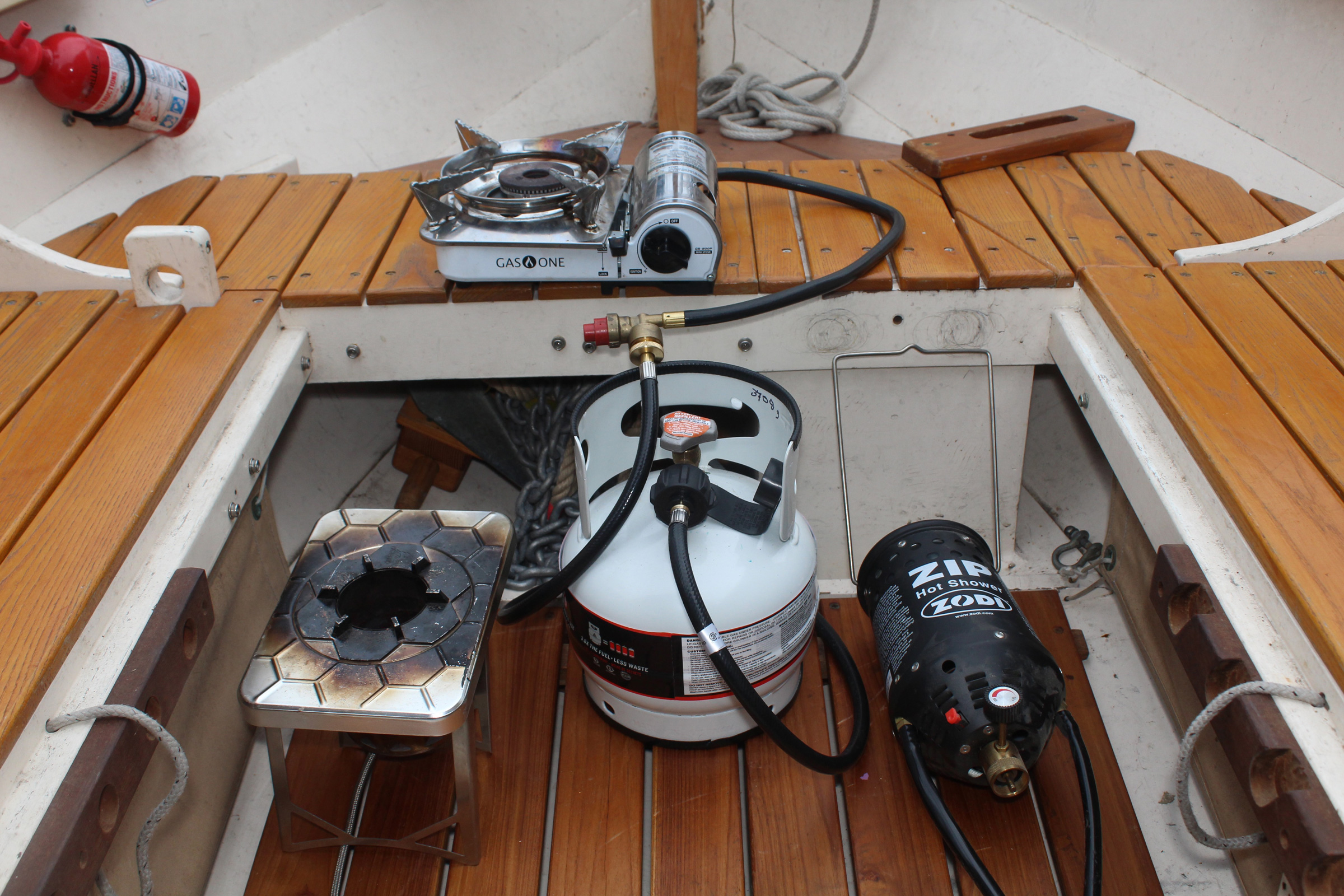
I can use the Growler to fuel my nCamp multi-fuel stove, Gas One Mini, and Zodi Hot Shower.
It’s worth noting that although there are many online videos demonstrating how to refill common 1-lb propane canisters, they are not intended for that purpose. While federal law does not prohibit the practice, 1-lb canisters carry a warning: “Federal Law prohibits transportation if refilled. Penalty of up to $500,000 fine and 5-year imprisonment.” You can buy refillable versions of the 14.1-oz and 1-lb canisters, but to fill them you also need a large propane tank, a stand on which to hold it inverted, and an attachment to connect it to a canister.

The Growler works with the dual-fuel Gas One Mini because the Mini’s adapter hose (its end seen here) can be connected to the Growler’s hose. For stoves that accept only bayonet-type canisters, there is an adapter compatible with the Growler hose; I haven’t yet purchased or tested it.
To avoid the cost, disposal problems, and waste of the single-use canisters, I recently bought a refillable Gas Growler 3.8, the smallest of the propane tanks made by Ignik, a company headquartered in Washington State. The tank is 10 1⁄4″ tall, 8 1⁄4″ in diameter, and weighs 8.2 lbs empty and 11.4 lbs full. It holds 3.8 lbs (0.9 gallon) of propane, and like larger propane tanks, is refillable at many gas stations and hardware stores. When I first filled the Growler, the gas-station attendant stopped at 0.68 gallon—a judgment call, I believe, based on what the Growler valve was venting. I was charged the 1-gallon minimum of $4.99, but that was still a significant saving when compared to the purchase of a new 1-lb canister, which holds just 0.236 gallons and sells for $6 to $7.
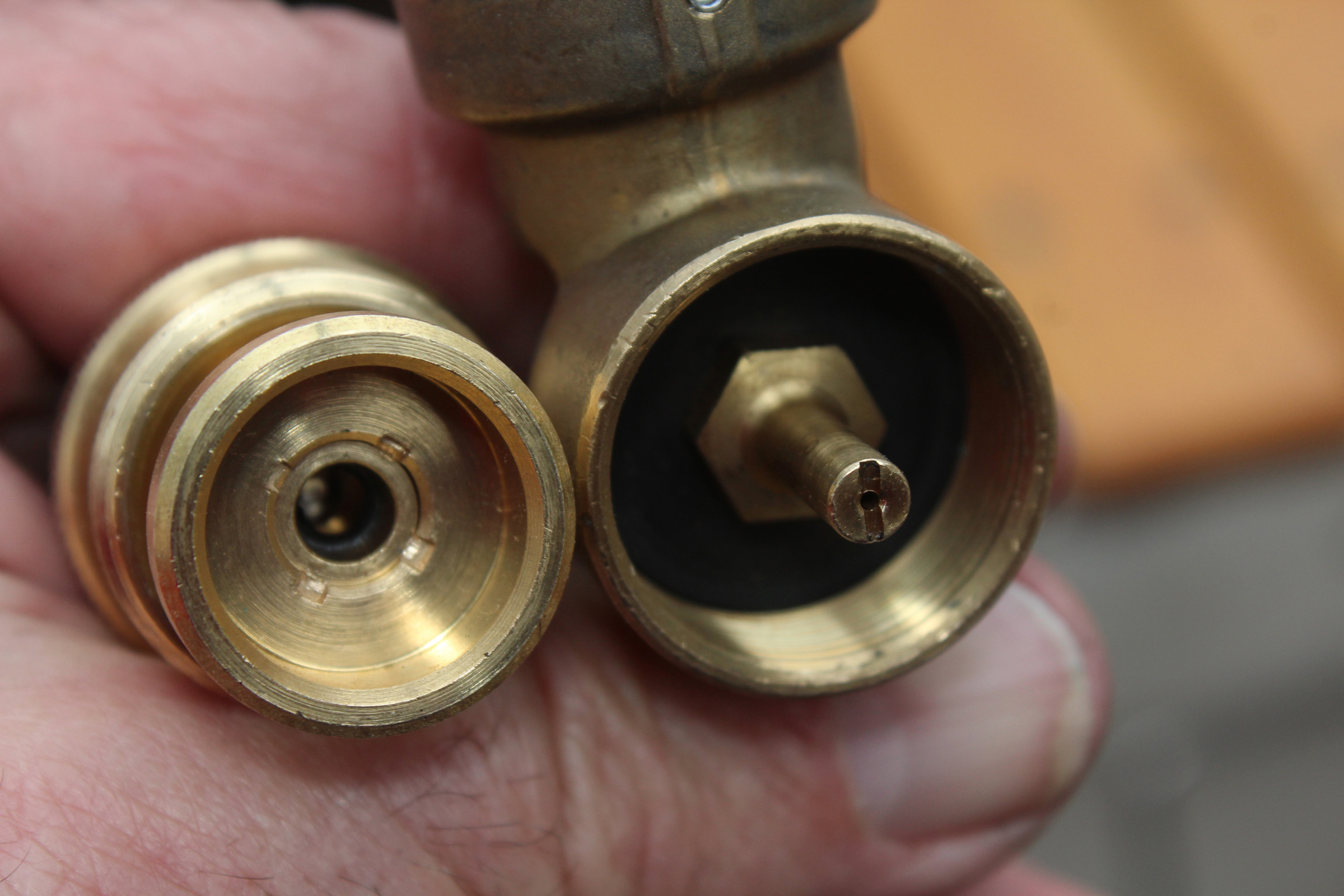
The end of the Ignik hose (left) accepts fittings (right) that connect with typical propane cannisters, but the pins in the center of those fittings are not all the same. This one is chamfered and others may be unchamfered or rounded. All will fit the Ignik hose, but some, especially the unchamfered, require much more force to make the connection.
The Growler comes with a 4′ hose that connects to a valve on top of the tank. The tank-to-hose connector has an excess-flow protecting valve that stops the flow of gas if a device is disconnected while the tank valve is open. On the other end of the hose is a brass connector that is compatible with devices fueled by 1-lb canisters or the taller 14.1-oz canisters typically used with propane torches. The Growler’s hose can also be connected to other devices by means of an adapter. Both my dual-fuel Gas One Mini Stove and my Camp Multi-Fuel Stove have hoses with fittings that will connect to the Growler, allowing me to switch from butane to propane and from propane/isobutane to propane respectively. Many of the propane-fueled Coleman camp stoves also have fittings compatible with the Growler hose. If the connector that comes with the Growler is not compatible with a particular device, there are many adapters on the market. For example, I found an adapter that would allow my oldest butane-fueled portable gas ranges to be converted to propane. This type of stove uses butane canisters with bayonet or magnetic fittings, and the adapter is said to work with both, but I haven’t tried it because I will be retiring the stoves.

It is easy to connect the hose for the nCamp stove to the Ignik hose using the adapter—propane canister to Lindal EN417—seen here at right. It costs around $10.
While the Ignik hose does have the excess-flow protecting valve, it does not have a regulator. There are similar hoses from other sources that have them, but Ignik notes that regulators are not required for the Growlers. Like most camping propane canisters, the Growler 3.8 has an operating pressure of between 100 and 200 psi, the same as that of propane tanks. When fueled by the Growler and its hose, all of my torches—a simple brass one, and two BernzOmatic torches with built-in igniters—operated as they do when connected to a tall 14.1-oz torch canister or a 1-lb camping canister. With the valves on both tank and torch fully opened, there is no sign of the pressure exceeding that produced by canisters. The same was true of my stoves. Their flames were nearly identical whether fed by canisters or the Growler.
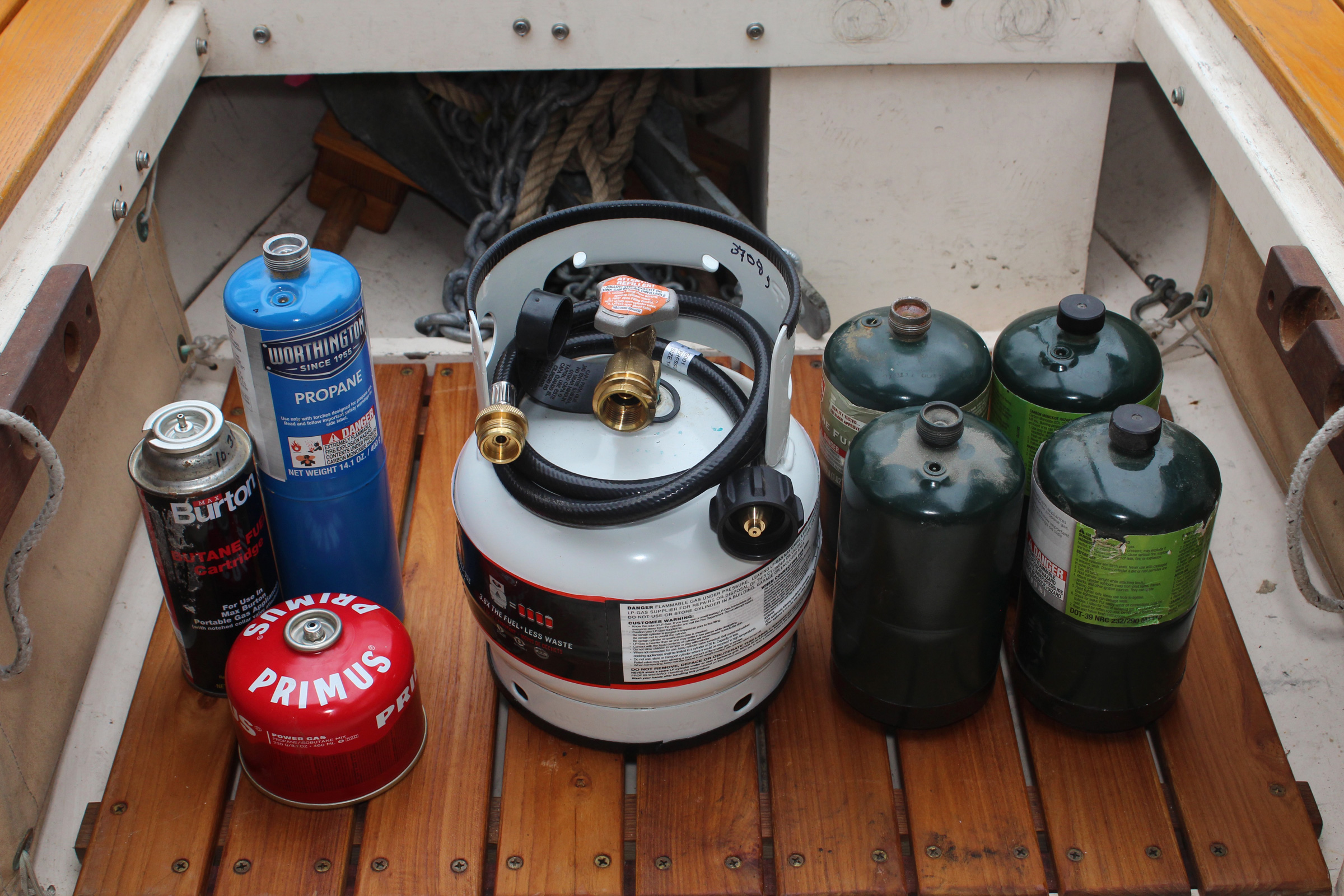
While the size of the Ignik Growler might be a deterrent where space and weight are of concern, with the right adapters it can be used in lieu of a variety of non-refillable fuel canisters including those for propane/isobutane, butane, and propane. I weighed the Ignik tank when empty and recorded the weight on the inside of the shield (3,708 g—Ignik lists 3,628 g). Now, by weighing the tank when filled and after use, I can determine how much propane is in it.
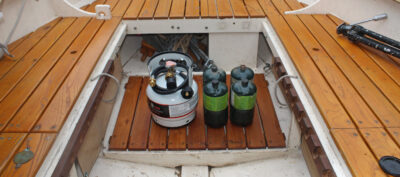
The Growler is bigger and heavier than the canisters it’s replacing, but the three boats I use for cruising have plenty of room to accommodate its use and storage. It will encourage me to indulge in both baking and preparing dishes that require longer cooking times. When fueling torches for metalwork, especially fillet brazing thick brass or bronze, the Growler can easily handle jobs that require long heating times, and having the torch connected to a flexible hose will make it easier to hold and angle to the work.
I will continue to work through my old fuel canisters and may occasionally buy a new one if I intend to prepare a hot meal on a day trip aboard one of my smaller boats, but when it comes to cooking aboard my cruising boats and metalwork in my shop, I will be relying more on Ignik’s Gas Growler 3.8.
Christopher Cunningham is editor at large of Small Boats.
The Gas Growler 3.8 is available for $79.95 from Ignik.
Is there a product that might be useful for boatbuilding, cruising, or shore-side camping that you’d like us to review? Please email your suggestions.
More ways to cook away from home
Thermos Cooking, hot meals cooked while you’re under way, by Tom Pamperin
A Convenient Camping Grill, a duel-fuel camp grill from Gas One, reviewed by Christopher Cunningham
Back-Country Baking, let them eat cake, by Andrew Breckenridge


Happy New Year.
I have an Ignik for beach camping each summer and was very happy to give up the non-refillable green 1 pound bottles. I have been using a propane camping stove on my 39 foot sloop as my onboard propane stove needs a complete reworking. Recently, I was alerted by a friend that if you have a fire caused by an onboard camping propane stove, your insurance policy would not cover the loss.
Digging deeper I found this:
For Boats (ABYC Standards)
Propane Locker: Dedicated, secured above the waterline with a bottom drain plumbed overboard, vented to the outside, with vent hose sloped down and out.
Connections: Vapor-tight connections, ideally only at the appliance; use swaged fittings, not gear clamps.
Solenoid Valve: An electrically operated valve to shut off gas flow, often controlled near the appliance.
Detectors: Carbon monoxide (CO) and propane vapor detectors are crucial.
Hose: Use crush-proof, kink-resistant hose, like wire-reinforced exhaust hose.
Gimbaled Stoves: Require flexible hose connections.
I only use the stove in my cockpit, which would drain any escaping propane gas out through the scuppers. This coming season I believe I will take the time and effort to get my galley stove working as I certainly would not want to compromise my insurance.
Food for thought.
Cheers,
Rob
I found a 5 lb. Flame King tank at Home Depot. It currently lists for under $60.
The white version of the 3.8lb Growler is currently sold out at Ignik.com, but REI.com has them on clearance right now. Don’t forget to add the 4ft hose to your order, as it’s not included. You can still get the blue/black version from Ignik.com.
Still trying to wrap my head around that “many of the 40 to 60 million 1-lb propane canisters sold annually wind up in landfills” stat.