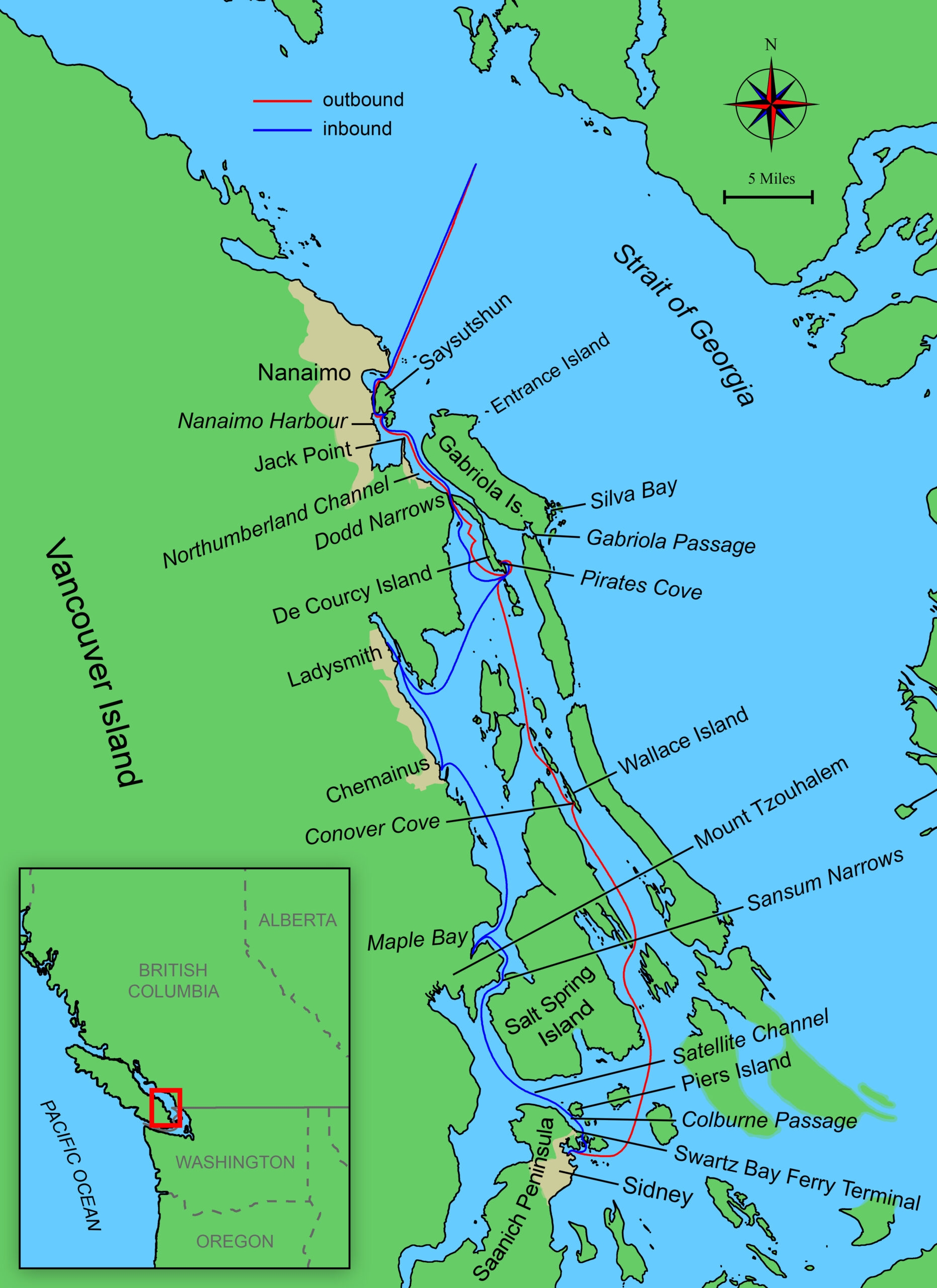
Early one morning in late May, under a cool overcast sky, I pulled in the docklines on CAMAS MOON, my 18′ gaff yawl, and motored quietly out of the marina in Sidney, near the south end of Vancouver Island. I was embarking on a planned month-long cruise, and was happy to be underway.
As I made it safely past the busy ferry routes feeding the Swartz Bay terminal—about 5 miles and two hours from the launch ramp—I could feel my whole body loosen, like a long exhalation after a deep subconsciously held breath. The clouds began to thin, and the slopes of the Salt Spring Island hills were still a verdant spring green. Few boats were out that weekday morning, and I felt like I had the whole area to myself.
 Photographs by the author
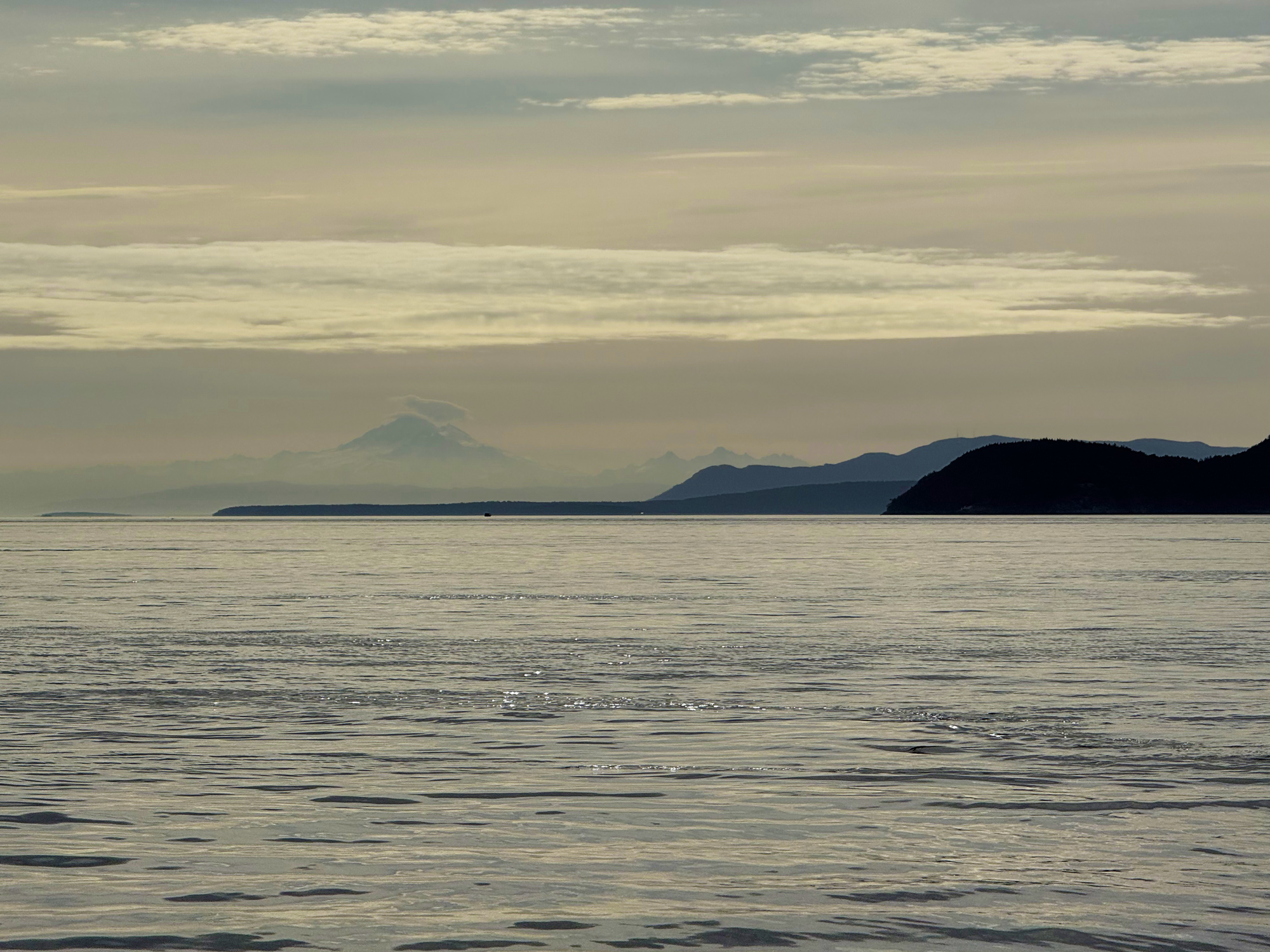
Looking east across Haro Strait to Mount Baker in the early morning of the first day, I was encouraged by the calm conditions.
My planned 50-nautical-mile route led north through the idyllic cruising grounds of the Gulf Islands with their many sheltered coves, sand spits, anchorages, passages, parks, and small towns. From there, a 20-mile crossing of the Strait of Georgia, which separates south-central Vancouver Island from the British Columbia mainland, would—wind and tides permitting— position me for a 35-mile side trip up Jervis Inlet: a fjord that winds its way deep into the high mainland mountains to the smaller Princess Louisa Inlet, a land of high tumbling waterfalls and forest-clad mountains. Finally, I hoped to cruise the Discovery Islands of Desolation Sound at the north end of the Strait of Georgia. Everything would have to go right for this ambitious plan to succeed.
The weather in the Gulf Islands at the end of May can range from summer-like settled to late-winter boisterous. On that first morning, the winds were light and the waters calm, disturbed only by swirls of current and rafts of floating seabirds. For hours the steady drone of the outboard motor lulled me to a drowse…until suddenly the motor hesitated, spluttered, and quit. I checked the usual suspects—fuel line not blocked, tank’s air vent open; all seemed OK, and when I tried it again, the motor started right away, and continued to run steadily. I was perplexed, and the momentary failure was worrisome—the motor was practically new, with under a dozen hours of use.
From Sidney through Dodd Narrows
Seven hours of uninterrupted motoring later, I arrived in Conover Cove on Wallace Island, a marine park, where I stopped for the night. This tiny, rock-encircled cove was once a former resort, and with its tree-shaded trails on shore, it remains very popular in summer, but the near-empty park dock in May was a welcoming spot in which to spend a quiet night.
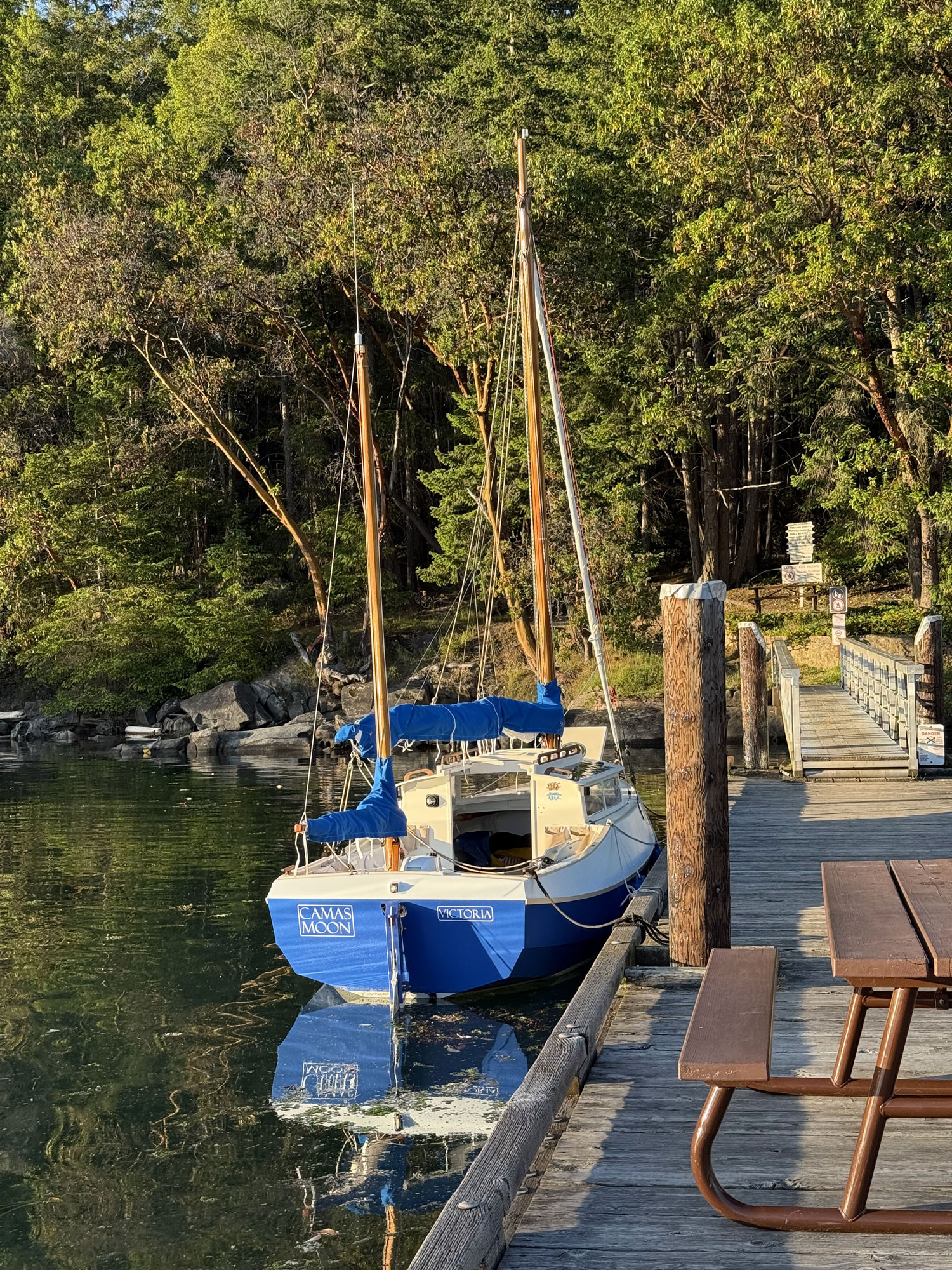
The evening of the first day was as tranquil as the early morning had been, and CAMAS MOON lay peacefully alongside the dock in Conover Cove.
Following a second day of uneventful motoring, I was another 14 miles to the northwest and anchored in De Courcy Island’s Pirates Cove, a handy staging spot for my planned transit of the tidal pass of Dodd Narrows at slack the following day. The more-protected north part of the cove is private land, with docks for the boats of the island residents, while the rest of the cove is a park anchorage, but not a spacious one. The useful anchorage area is about 440 yards long by about 120 yards at its widest. At the height of summer, boats generally tie up to the shore stern-to to make more room, but off-season, there is usually room enough to swing at anchor, and such was the case that day.
There was a light breeze when I weighed anchor the next morning. I motored out of Pirates Cove, rounded the southern tip of De Courcy, and turned north to run downwind to the narrows. Dodd Narrows appears deceptively benign to the inexperienced; bordered by low, tree-covered rocky points, it is only 200 yards long and, at its narrowest, 80 yards wide. However, a lot of water moves through it, and the last mile of the southern approach funnels from a half-mile width to that 80-yard constriction, accelerating the current to a turbulent 9 knots on big flood tides. Almost everyone transits Dodd at slack tide.
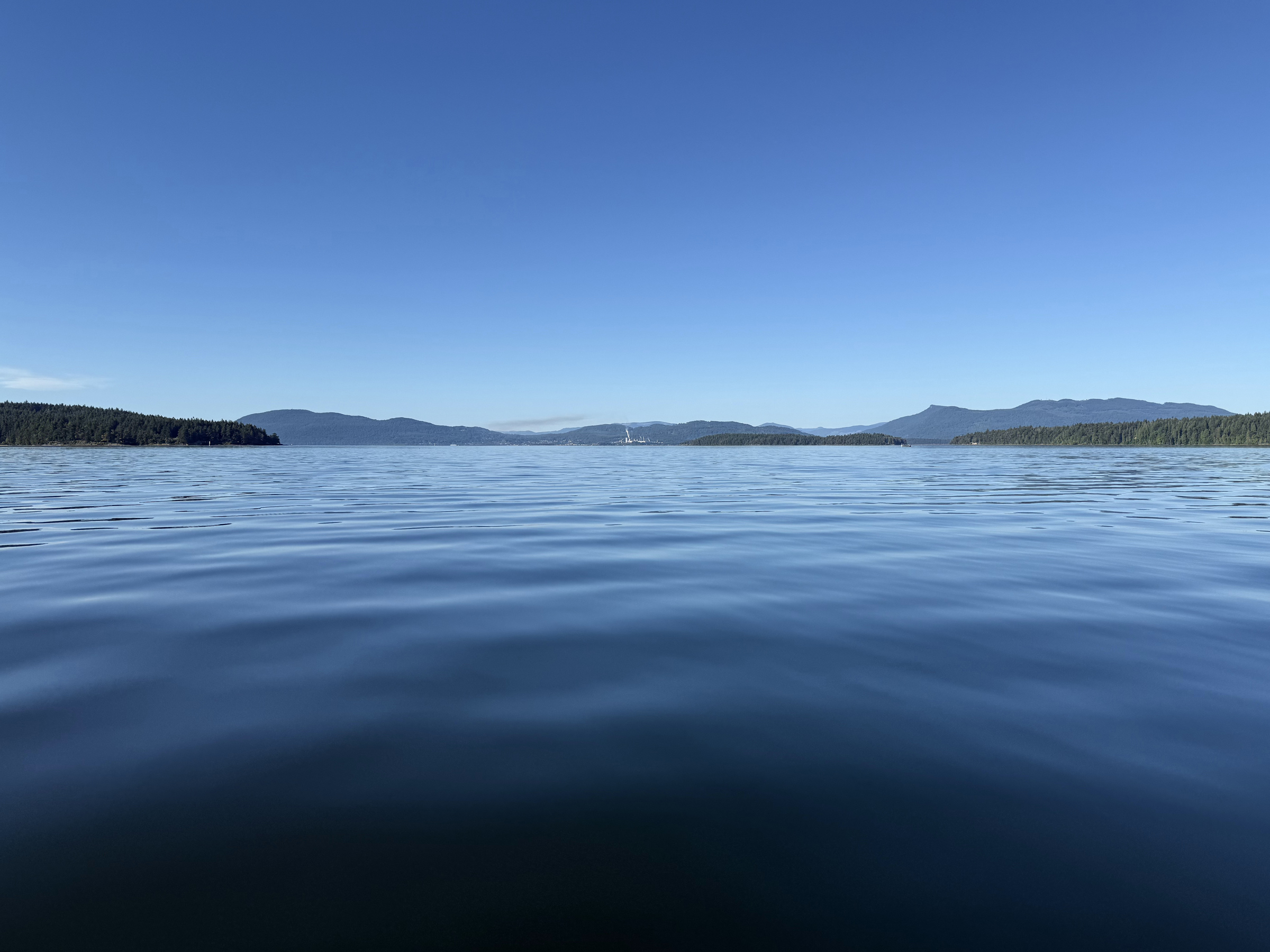
The second morning dawned as calm as the first and, taking advantage of the conditions, I motored through Houston Channel north of Salt Spring Island.
I approached at least a dozen other boats, slowly converging on the pass for the forthcoming midday slack. The wind fell away, so I dropped the sails and joined the procession to motor through. Sometimes, when going through the narrows, faster powerboats get impatient and pass slower boats, but that day everyone was well behaved, lining up in north- and south-bound files to navigate through the pinch point. Local residents viewed the parade of boats from lawn chairs set up on the east point. I motored through at a steady 4 knots, and at the far end, relaxed and ate some lunch as I continued motoring north up the Northumberland Channel between Gabriola Island and Vancouver Island. The air was still, the water mirror-calm.
Suddenly, just as I was stowing the lunch fixings, the wind gusted up from dead ahead, rising from 0 to 20 knots in under three minutes. There was nowhere close to take shelter, and it was too late to transit back through the narrows against the flood. I increased the revs and pushed CAMAS MOON into the waves, which built almost as quickly as the wind. I left the sails stowed—with her gaff rig, relatively lightweight hull, and slab-sided bows, CAMAS MOON isn’t at her best when going to windward in larger waves and I wasn’t sure what headway I could make, slamming upwind under sail. But, in these far from idyllic conditions I was also still not completely confident the motor wouldn’t act up again.
We carried on slowly. The pounding was uncomfortable, but we were at least making some headway. The wind stayed steady at about 20 knots, and the waves stopped building at around 2′ or 3′. Spray from the plunging bow sparkled as it flew over the cabintop toward me, often directly in my face. I did a lot of ducking. I was astonished when CAMAS MOON dove deeply into one bigger wave, which broke clean over the high bow, sending green water up against the cabin windows. I was glad I had built the forward hatch with a double coaming. I hunched lower behind the cabin and tightened my grip on the tiller.
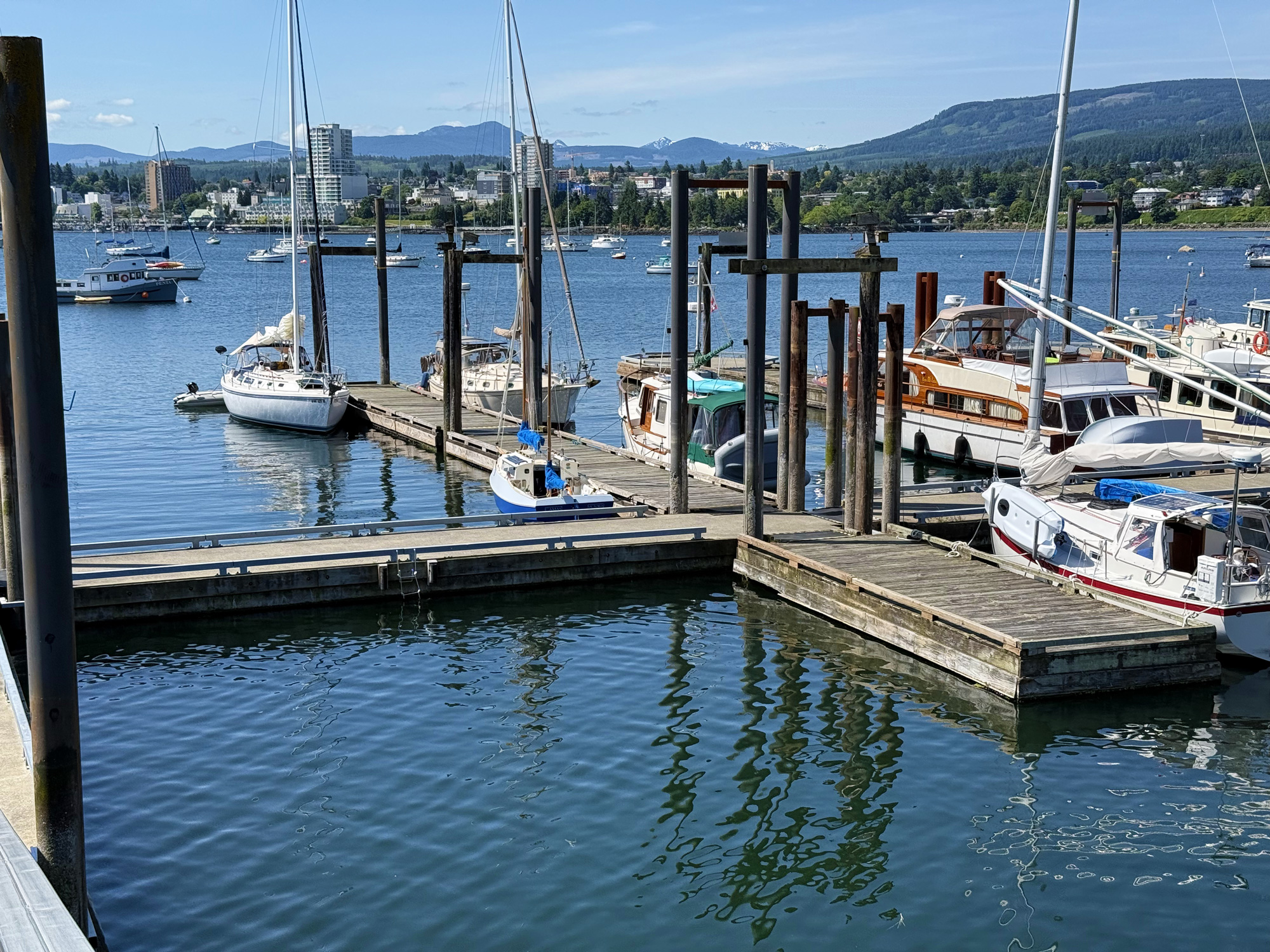
The docks at Saysutshun were by no means full, but we had company during our stay. With everything safely stowed and her bow pointed outward from her berth, CAMAS MOON was ready for an easy departure.
Jack Point, where I could turn across the wind and waves toward Nanaimo Harbour, was now only 3 1⁄2 miles away. I continued on, CAMAS MOON falling and rising, pounding and spraying. The other boats that had come through the pass were all bigger and making much better time—I watched them haul away with some envy. An hour later, when I finally pulled into the flatter waters of Nanaimo Harbour, the wind was still gusty and strong, but as I motored through the moored boats and up to the docks of Sayshutsun (Newcastle Island) Marine Park, I at last found shelter. I would wait there, safe alongside the dock, tucked in among other waiting boats, both power and sail, until the wind died down enough for CAMAS MOON to cross the Strait of Georgia.
An extended stay on Saysutshun
Saysutshun is a roughly trapezoidal 900-acre island about 1 3⁄4 miles long, separated from the small city of Nanaimo by a channel, 1 1⁄4 miles long by 300 yards, its western shore crowded by marinas. For millennia, the island was the site of a winter village for the local First Nations people. When European settlers arrived they sank shafts to mine the underground coal seams, extracted sandstone from shoreside quarries, operated herring salteries, and built shipyards that utilized the island’s timber. Little remains of this industrial past, and in the 1930s Saysutshun became a park owned by a steamship company. Today, the island is mostly covered by second-growth forest, and with its walking trails, wildlife, and park camping amenities, it is a surprisingly tranquil refuge that also has access to downtown Nanaimo via a passenger ferry. If I needed supplies or fancied a restaurant meal, it would be an easy hop across. I was happy to be there.
Five days later, I was less happy to be there. For all of that time, the northwesterly wind persisted, day and night, never dropping below 20 knots at nearby Entrance Island lighthouse in the Strait of Georgia, a half-mile from Gabriola. It was too much for CAMAS MOON—she may have an enclosed cabin, but she is still a small boat. And so, I waited.
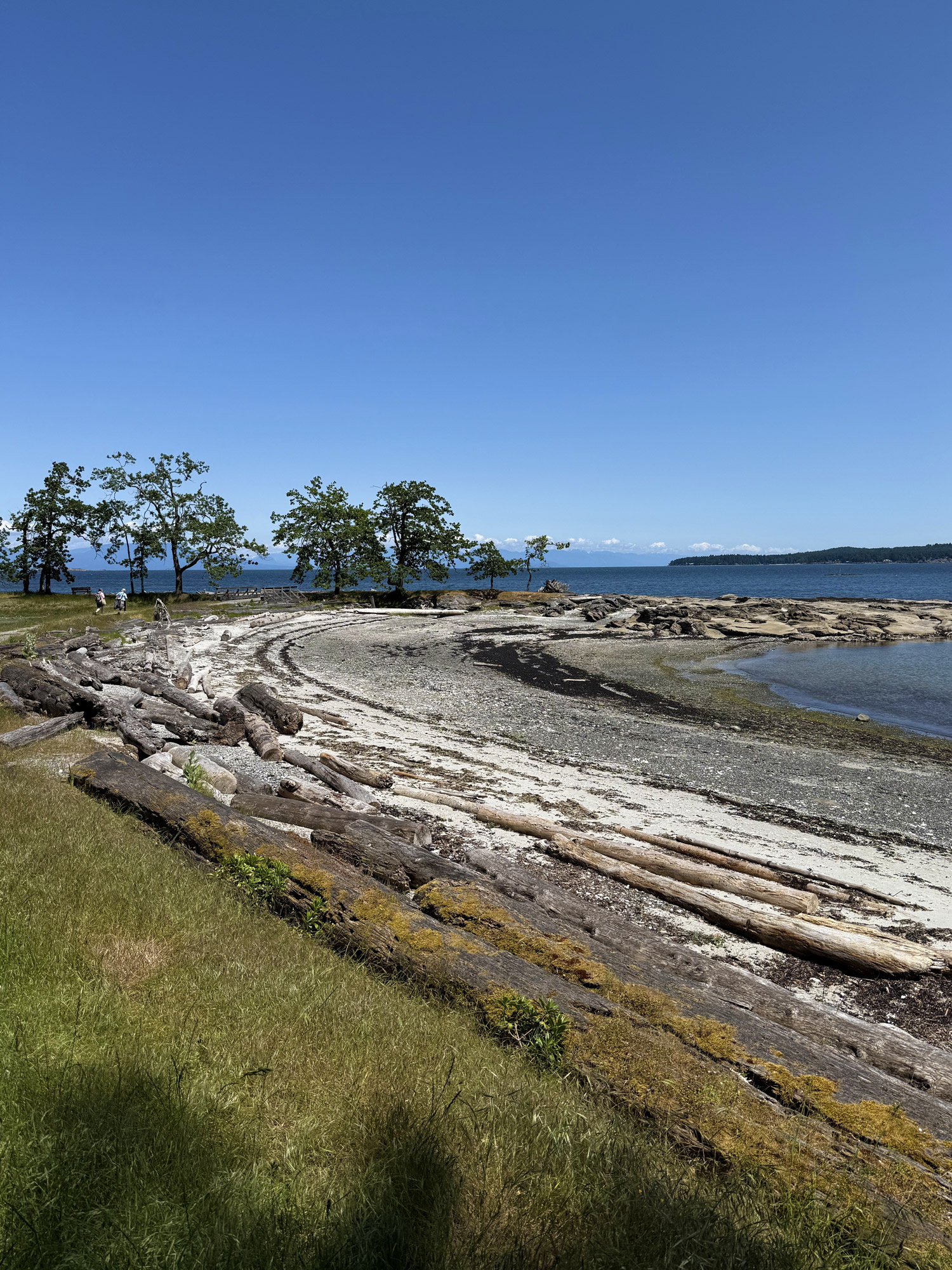
On the east side of Saysutshun Island, the beach at Brownie Bay is gravelly. Above the tideline are driftwood logs, which are so common in this area. Beyond the sheltering arm of the cove is the Strait of Georgia.
I filled the time by walking the trails and enjoying the spring sounds of coastal birds. Unexpectedly, I spotted a “blonde” raccoon among a troupe of normal gray and black ones, all digging for clams. Such leucistic variants are more common on the island than elsewhere, but even so, they are rarely seen. On one walk by the 200-yard-wide lake in the island’s interior, I was surprised to find dozens of broad patches of yellow flag iris growing in the shallows. Contrasting with the many hues and shades of green typical of British Columbia’s coastal forest, the bright yellow blooms made a vibrant display, nodding and swaying in the wind that filtered through the trees. All day, every day, a colony of purple martins loudly defended their individual territories among the many nest boxes mounted on the marina’s pilings. And so, I explored, read books, sketched, practiced on my guitar, and talked to other boaters who came and went, or like me, stayed on to wait for gentler winds. Twice I took the ferry across to town, sampled the restaurants, did some laundry, and checked out the shops.
The forecast for the sixth day promised a narrow window of low winds, which just might allow me to cross the Strait. I got up early, motored around Saysutshun, and started the crossing by 7 a.m. I raised the sails and set off on a close reach. At first, CAMAS MOON moved well in the low waves that hit forward of the beam, but conditions soon began to change. The wind slowly increased, the chop turned into 2′ to 4′ waves, and the reach turned into a beat. The cloud cover built, and what little warmth had come from the morning sun, which had occasionally peeked through the gathering clouds, was gone. I added another insulating layer under my jacket. The boat felt pressed, so I lowered the main and carried on under jib and mizzen; the motion eased. A short time later, I started the outboard so I could motorsail and maintain speed.
 Roger Siebert
.
Two hours into the crossing, when I checked my anemometer, the wind had risen to a steady 14 knots with higher gusts—it had increased by 2 knots every half hour. The sea state was also deteriorating, and ranks of whitecaps were now marching steadily towards me. I was still making headway, but my speed had dropped, and it was harder to hold the course with every wave knocking the bow off. Sailing was becoming uncomfortable, and spray was coming across the cockpit about every third wave. The boat was pounding heavily, and I was beginning to tire. I was not quite halfway across. I faced a choice: Should I carry on, at reduced speed, exposing myself to potentially higher winds for longer? Or should I be cautious, and turn back before conditions grew even worse? CAMAS MOON might be able to take the weather, but I was no longer having fun. I turned around to a reciprocal course, which was now a broad reach, nearly a run. The motion was easier and I was able to shut off the outboard. Even without it, my speed doubled and I was back at the Saysutshun dock before lunchtime.
The updated forecast called for strong northwest winds for the foreseeable future. I had had enough of waiting and decided to head home. The next day, I had a strong tailwind on my way to catch the afternoon slack at Dodd Narrows, and once through, I sailed into a different world. The wind dropped to under 8 knots, and I passed a leisurely afternoon jibing south, downwind in the sunshine. I returned to Pirates Cove, intending to go through Gabriola Passage to Silva Bay the next day to visit with Tad Roberts, who had designed CAMAS MOON.
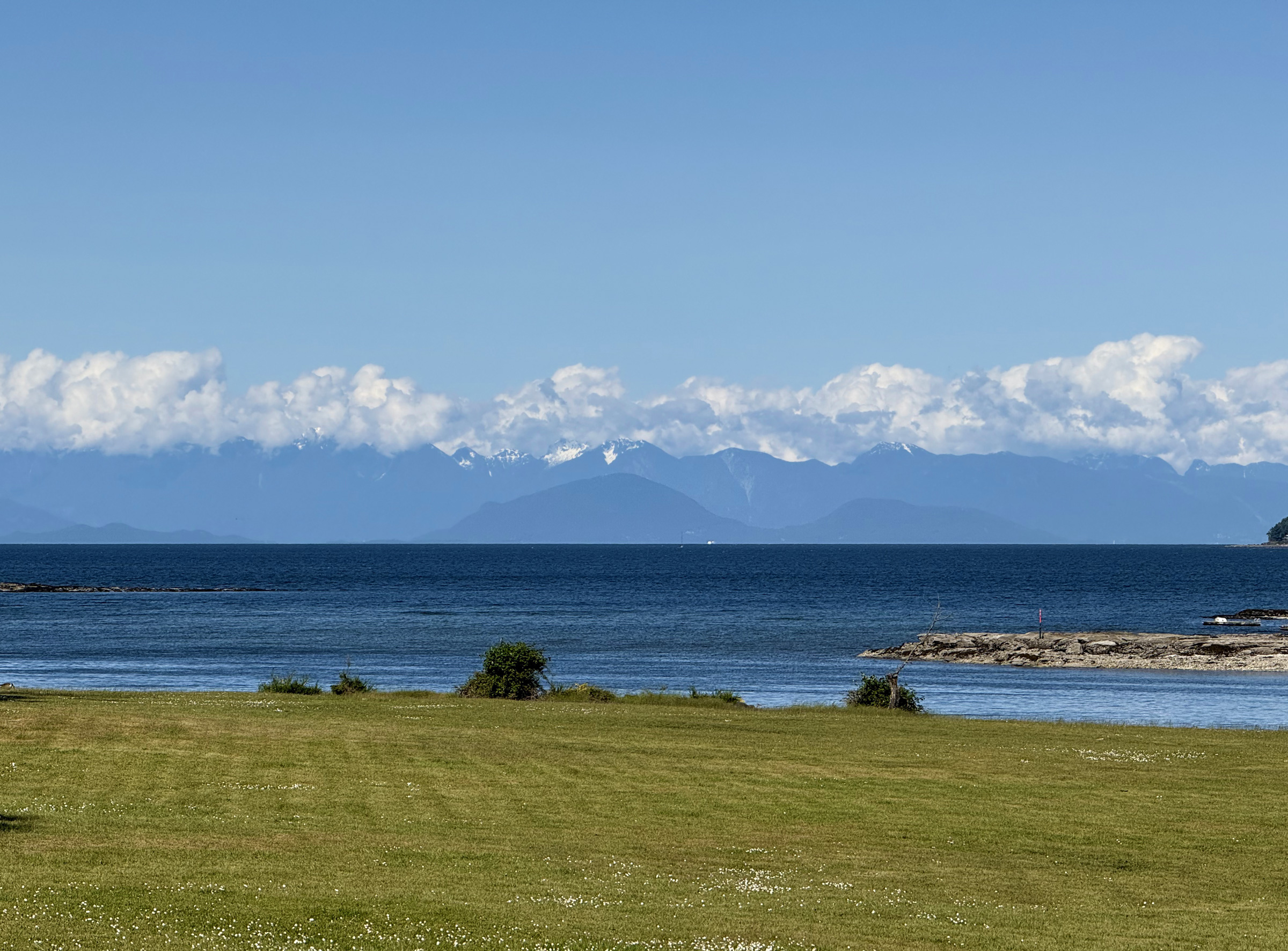
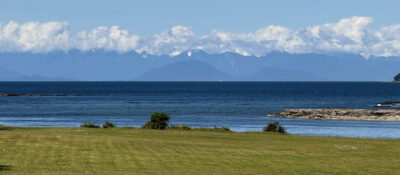
Standing on the east side of Saysutshun and looking across the Strait of Georgia toward the mainland mountains north of Howe Sound, I could tell it was still too windy for me and CAMAS MOON to make a crossing—no matter what this picture might suggest.
The wind dropped away to a gentle breeze outside the cove. I lowered the sails and slowly motored in through the narrow entrance formed by a small island, which protects the private dock on the west side, and a long rock reef exposed at low tide on the east side. Like my visit the week before, only half a dozen boats were at anchor, and we all had plenty of space to swing.
From calm to restless night in Pirates Cove
As soon as I was safe at anchor the north wind died completely. The mirror-still water doubled the power of the afternoon sun, heating the air in the cove and wafting the distinctive dry-leaf-dusty smell out from the adjacent mixed Douglas-fir and arbutus forest. After supper, the wind began to pick up once more from the northwest. It was just a light breeze but enough to set all the boats sheering slowly back and forth on their anchor rodes. The forecast was unchanged, but the same strong northerly wind that had been reported farther north all day had produced only light winds in this sheltered anchorage. I anticipated a quiet night. As night fell, the wind picked up a little more, but not enough to concern me. High tide would be at 1:40 a.m., about 3 1⁄2 hours later. Before I turned in, I switched on the chartplotter to check the depth sensor, and let out a little more rode as a precaution.

Pirates Cove was calm the afternoon I arrived and anchored up; little suggested the windy, disturbed night ahead, except, perhaps, the high mares’ tails gathering in the sky above.
A violent motion and a heavy thumping sound jarred me awake at about 1:20 a.m. In my half-asleep state, I couldn’t make out what the noise was. I sat up in my bunk and listened. There it was again, and again. Eventually I worked it out: it was the centerboard, which has enough play around the pivot pin that it clunks back and forth when not fully raised. I must have forgotten to bring it all the way up. In the few hours that I had been asleep, the wind had strengthened considerably and there was now significant wave action in the anchorage. I threw on a jacket and went out into the cockpit. The sky was clear, the stars sharp points of light above me, and the moon was only five days from full. The scene was so well lit I didn’t need my headlamp.
This close to high tide, the reef at the entrance to the cove was fully submerged, and short steep waves were rolling straight into the anchorage. The wind had also backed a little to blow directly through the entrance. Around me all the anchored boats were yawing, bouncing, and tugging at their anchor lines. My anchor hadn’t dragged but I worried that it might, so I let out more scope. I winched up the centerboard the last few inches and the clunking immediately stopped. I got out the anemometer—the wind in the cove had risen to 20–22 knots.

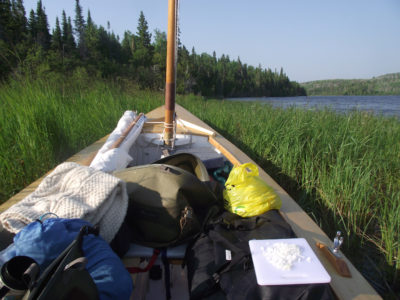
When I did sail, I experimented with CAMAS MOON’s sail plan and found that sailing downwind under jib and mizzen was quiet, lazy, and comfortable.
I had not previously dealt with winds this strong at anchor in CAMAS MOON and was worried that the anchor might drag, or some piece of gear might fail. Did I have the right anchor? Had I sized it, the chain, and the line properly? Had I made the splice and thimble correctly? Were my homemade hardwood mooring cleats and fairlead big enough? None had been tested like this before.
I watched for a while; the boat seemed safe, despite the severe motion, but I also fretted that other boats, upwind of me, might drag their anchors and drift down onto me. I briefly considered raising the anchor and moving around to the south side of the cove, but reckoned the risks involved in doing that in the poor light would be worse than staying put, at least while the anchor held. I went below to my bunk, fully dressed, in case I had to get up again. The motion was such that I was afraid I might become seasick. I dug out the anti-nausea pills, took one, and lay back down, worrying, unable to sleep. The night seemed interminable.

During my longer-than-anticipated stays in harbor I was happy to have my folding bicycle. It greatly extended the possibilities and range of my on-land cruising.
I must have dozed off, as I started fully awake at 3 a.m. to another new noise. The wind was coming from astern, and the waves were slamming into the transom. What was going on? Again, I jumped out into the cockpit. The moon was surrounded by a thin haze, diffusing its light and making the scene even brighter. The wind had risen even more and strong gusts were whistling through what little rigging CAMAS MOON has. I immediately saw what had happened. I had built CAMAS MOON with the anchor locker in the starboard quarter. When I anchor, I initially do so by the stern, then I run a tag line from the bow aft, and tie it to the anchor rode with a rolling hitch. I then let out the anchor rode so that the boat streams aft from the bow by the tag line. Now, on this rough night, my tag line’s rolling hitch had come adrift, and the boat had swung around to lie stern-to the wind. I could have left things as they were—the anchor still seemed to be holding—but the motion was very uncomfortable.
I went forward, pulled in the tag line, led it aft, retrieved a loop of anchor line with difficulty, and retied the rolling hitch, doubling it this time. But when I let everything out again, the boat didn’t swing around bow to the wind. Instead, she stopped, broadside on. Maybe the wind and current were holding the boat in that position. I got out the oars and tried to help it around; nothing doing. Then I raised the mizzen, hoping to use it to help the boat swing. Still nothing happened. CAMAS MOON was stuck beam-on to the wind. I was perplexed. Looking around in confusion, I at last saw the problem: the tag line was snagged on a gunwale cleat, effectively forming a bridle that was centered amidships. As soon as I freed it, CAMAS MOON obediently swung around to point her bow into the wind. Immediately the motion eased, but now thoroughly anxious, I let out even more anchor line, so that the scope was nearly 8:1.
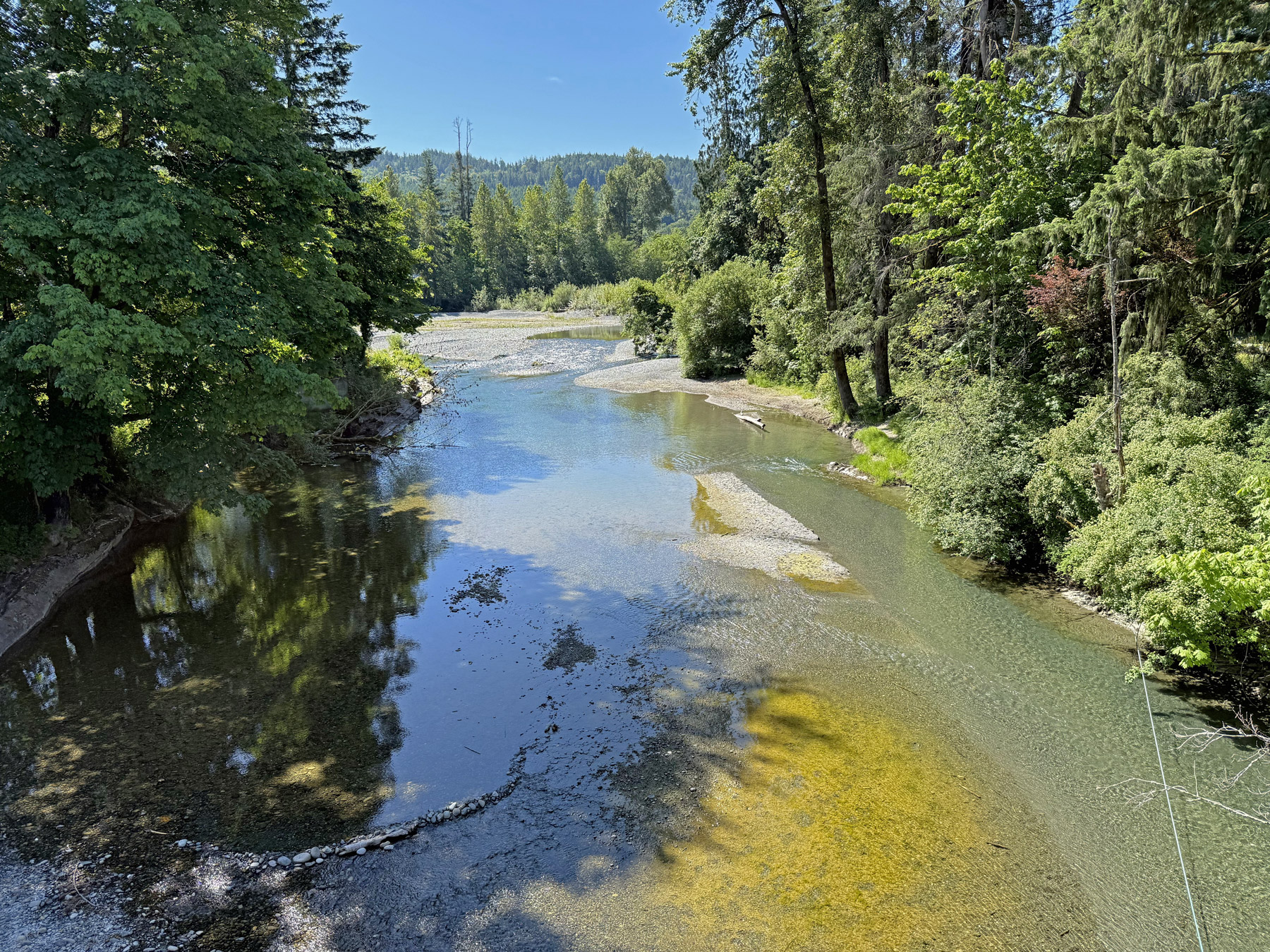
In Chemainus, I went ashore to explore the area inland, enjoying the quiet backroads and the ability to stretch my legs on the bike.
Sorting the anchor had taken half an hour. I went below, pleased that at least it was not raining, which would have made my maneuvers downright miserable. I went to sleep and woke again at 6 a.m. The motion had subsided, the wind was still blowing 20 knots, but the falling tide had exposed the reef so that it was now blocking the waves. I considered my options: if I stayed, and the wind remained strong, once the tide rose again I would have a second night of uncomfortable motion and fretful sleep. I decided to leave.
I had to think carefully about what steps I would take in order to stay in control between weighing anchor and getting underway. I started the motor and left it in neutral with the helm centered while I began to recover the anchor. It was hard, slow work. When I got to the end of the nylon rode and brought the first few feet of chain into the boat, the anchor was still holding. I was amazed—the scope was very nearly 1:1. I put the motor in gear at idle and finally broke loose the anchor, hauling it up as quickly as I could while I steered in a tight circle. As the anchor approached the surface, I could make out the shank but nothing else—it was one big ball of mud. The Rocna anchor had lived up to its reputation and had buried itself ever deeper the longer the pull lasted.
As I motored out of the cove I trailed the anchor below the boat to clean off the worst of the mud. Then, when we were out in clear water, I hove to and cleaned everything before stowing it back in the anchor locker. The wind had now dropped to about 15 knots, but according to a text message from Tad, it was much stronger in Silva Bay. I abandoned any thought of going there, raised the mizzen, rolled out the jib, and set off downwind.

In the spring shoulder season, the municipal marina at Chemainus, where I stopped on the way south, had ample room for CAMAS MOON.
As I sailed, grateful to have come through the night unscathed, I thought of two things I should have remembered before deciding to stay the night in Pirates Cove: I had once spent a night in the south cove of the marine park in my first sail-and-oar boat, HORNPIPE, a Kurylko-designed Alaska. The cove had been sheltered from a strong overnight north wind and remained quiet, but I later met a powerboater who had been in the north cove at the time. He described a night like the one I had just experienced, when some larger boats dragged their anchors. My second recollection was reading a single line in a guidebook that had described how exposed the north cove can be in a certain northerly wind, especially at high tide. My many experiences of more benign conditions there had lulled me into complacency, and I had ignored the warnings. Had I been more wary, I would not have chosen that anchorage in those conditions. It was a salutary reminder always to remain vigilant, even in familiar settings.
Meandering home to Sidney
Now, with neither distant destination nor self-imposed schedule, I had all the time in the world to return home. I decided to make the best of it and revisit places on the east coast of Vancouver Island along the way.
For a week, I alternated lazy sailing days with days ashore. I ate gelato in the shade on a hot day in Ladysmith. I pulled out the folding bike from under the starboard berth and went for a ride on quiet back roads behind Chemainus. I hiked up a trail to a lookout point on Mount Tzouhalem behind Maple Bay. I sampled local brews in the restaurants…I enjoyed myself.

On the last day, I sailed south through Sansum Narrows, a 4 1⁄2-mile-long meandering passage between Vancouver and Salt Spring islands.
Finally, on the last day, I left the marina in Maple Bay to sail south through Sansum Narrows—a 4-mile-long zigzag passage between Vancouver and Salt Spring islands—and around the 3-1⁄2-mile-long curve of Satellite Channel to the west of Vancouver Island’s Saanich Peninsula. I kept a sharp focus in Colburne Passage, the half-mile gap separating Piers Island from the north end of the Saanich Peninsula, to avoid the ferries in front of the Swartz Bay terminal. The final navigational challenge was contending with the flooding tide while threading the tricky passage through the islands north of Tsehum Harbour, but I arrived safely at my assigned slip at the marina. With CAMAS MOON securely tied to the dock, my shortened cruise was at an end. It wasn’t what I had planned, but what did that matter? Learning a little more about the boat and myself always makes for a rich and rewarding experience.
Alex Zimmerman is a retired executive and engineering consultant who became enamored with the sea and sailing after he learned basic seamanship in the Royal Canadian Navy. From his home in Victoria, he has put in several thousand miles along the coast of British Columbia in various small boats he has built for himself. His book, Becoming Coastal, chronicles many of those journeys. He continues to write about wooden boats and the people who build and sail them.
If you have an interesting story to tell about your adventures with a small boat, please email us a brief outline and a few photos.
More articles by Alex Zimmerman
The Heart of a Cruiser, one man’s journey from long-distance rowing to shorter motor-sailing cruises
Anchor-Rode Markings, how to mark your anchor rode for water depth and scope
Jetboil Flash, cooking aboard, quicker and safer
Thanks Alex, always happy to read about your adventures on Camas Moon, regardless of how far away from home you go. Love the boat and hearing about what works, and doesn’t.
Was it too warm to fire up the wood stove?
Hi Kyle. Apologies for the late reply. Generally it was much warmer than I thought it would be. There was only one day at Saysutshun, when it was kinda cool-ish because it rained all day, that I considered firing up the stove, but I took the ferry across to town, wandered the shops and had lunch at a restaurant instead.
Nice cruise and great article!
Thoroughly enjoyed your article Alex! A nice read, and vicarious sail! Margaret
Thank you Alex. I thoroughly enjoyed reading this trip report. The prudence you demonstrated is exemplary. Many would have soldiered on despite the discomfort and risk. It takes experience and self control to stay safe and positive. Yours is a wake I’d gladly follow.
When I go aboard my boats my goal is to have a good time. If I get to call it fun, then I know I did something right. You did good!
Thanks Jeff. In retrospect, nothing substantial broke on the boat either – a significant accomplishment!
We got caught in Pirates Cove on a high tide windy night, and it was horrible. There should be a notice somewhere that says the breakwater is submerged on high tides (which seems ridiculous).