Back in 2006, I was invited to join a panel of judges for the annual Classic Boat Design Competition. That year’s challenge was to design a boat suitable for the increasing number of Raids then proliferating in Europe and North America. One of the entries was CRAIC, a 21′ 10″ slippery half-decker with a ketch rig, water ballast, and space enough for four crew to sail and row. She was designed by Matt Newland who had recently joined Swallow Boats, his father’s business in Wales, making kit boats. CRAIC was placed second in the contest, and Matt went on to repurpose the design with more beam and slightly less sail area, as the basis for Swallow Boats’ first production boat: the BayRaider 20, launched the following year. The boat was an immediate success, and two years later the company launched a cabin version, with higher freeboard and more draft. Matt admits that the BayCruiser 20 was slightly “dumpy,” so when a client asked him to build the same boat but 3′ longer, he jumped at the opportunity. Thus, the BayCruiser 23 was born.
Since the first BayCruiser 23 was launched in 2013, the design has proven remarkably popular, with nearly 100 boats built to date, about half of which have gone to the U.K. and the rest as far afield as North America, Germany, and The Netherlands. Apart from three plywood boats—the first two U.K. boats and one built under license by Denman Marine in Tasmania—all the BayCruiser 23s have fiberglass hulls with molded deck and cabintop and wood trim.
 Photographs by the author
The plumb stem and simulated wide-strake fiberglass hull with wood trim give the BayCruiser 23 traditional appeal, while the versatile water-ballast system, fully-battened mainsail, and carbon-fiber mast combine to give a fast and agile performance akin to a dinghy.
Versatility from water ballast
According to Matt, the key to the design’s success—and indeed to the whole Swallow Yachts (as the company is now called) product line—is the water ballast held in two tanks beneath the V-berth and cockpit floor.
“We like to say that with the BayCruiser 23, you get two boats for the price of one,” says Matt. “You’ve got this fast boat that will do 7–8 knots off the wind when it’s unballasted, so if you have mates who are prepared to move around—who are basically dinghy sailors—then you’re going to have some great fun in it. But you’ve also got a safe, cruising mode when the water-ballast tanks are full. And even with the tanks full, you probably won’t notice it. On a calm day, you might sail a quarter of a knot slower and be less quick to accelerate, but as soon as a gust hits, you’ll be grateful for the extra stability.”
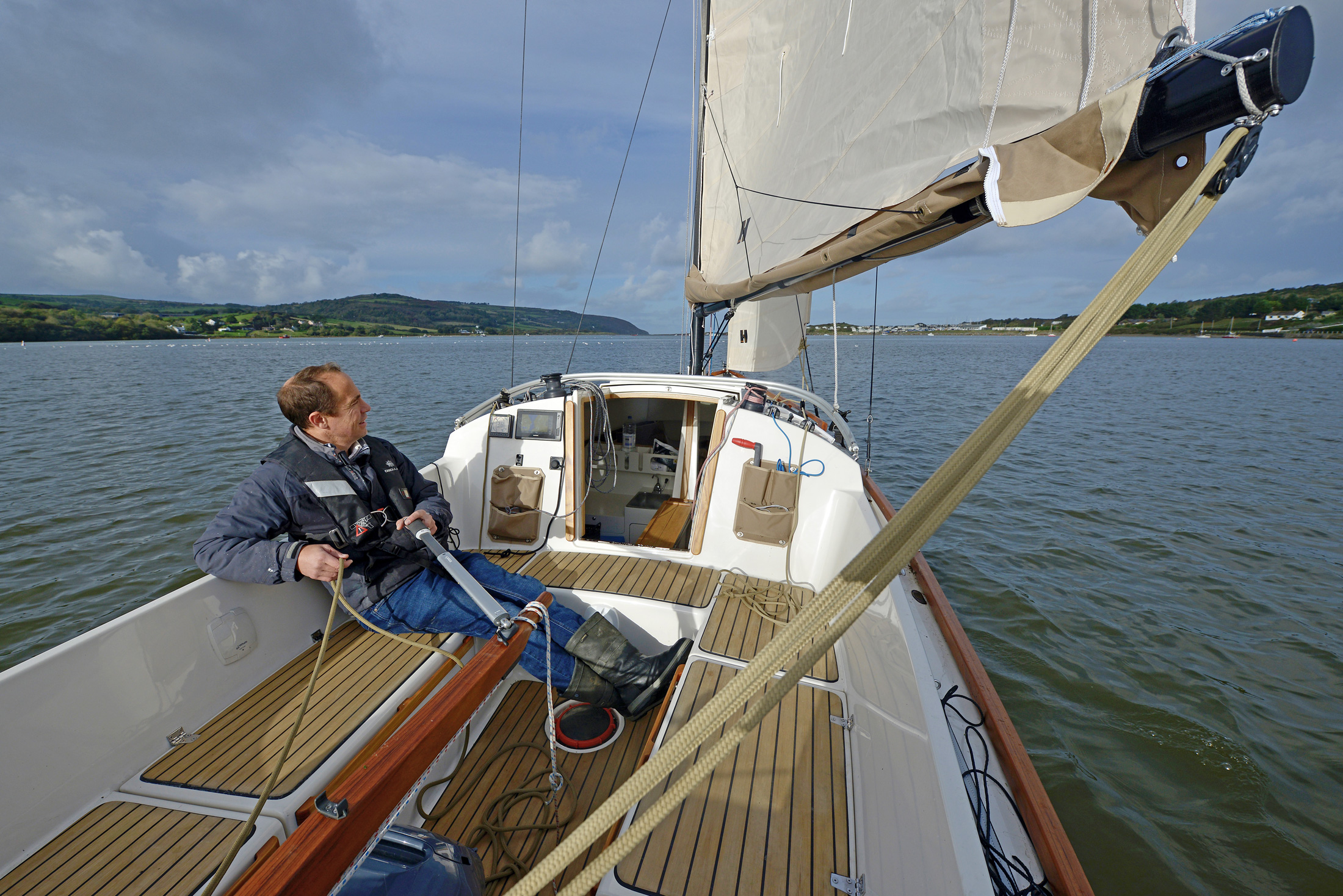
The cockpit is spacious and comfortable. The angled sides provide ergonomic backrests, while the hinged, wide seat tops cover generous storage lockers with room enough for fenders, docklines, and more.
The other great advantage of the water ballast is that you can get rid of it when you no longer need it, such as when trailering the boat. When the tanks are full, the water adds 1,102 lbs (500kg) low in the hull, producing a healthy 35 percent ballast ratio. But, when empty, the hull and rig combine to a relatively lightweight 1,870 lbs (850kg) which, coupled with a trailer (total weight approximately 1.4 tons), can be towed by a standard-sized family car. This lightness, combined with a carbon-fiber rig—half the weight of a conventional one—means that the BayCruiser 23 can not only be sailed singlehanded, but also rigged, launched, and recovered by a single person. According to Swallow Yachts, the boat can be fully rigged in about 30 minutes.
Sailing the BayCruiser 23
After admiring the BayCruiser 23 for years, I finally got to sail one at the end of a long, dreamy summer, just as everyone else was packing up for the winter. The weather was kind, and in mellow autumn sunshine I drove to the Swallow Yachts workshop overlooking the Teifi estuary in Wales, where the test boat was awaiting me.
As I stepped aboard Hull #72, built in 2020, my first impressions were how steady it felt and what a spacious cockpit it had—it turned out the two things were not unrelated. In common with many modern boats, the BayCruiser 23 has a wide transom and beam taken far aft. The result is a large cockpit and an increase in form stability when compared to a more traditional hull shape. As Matt pointed out, that initial stability is reassuring to both experienced and inexperienced sailors alike.
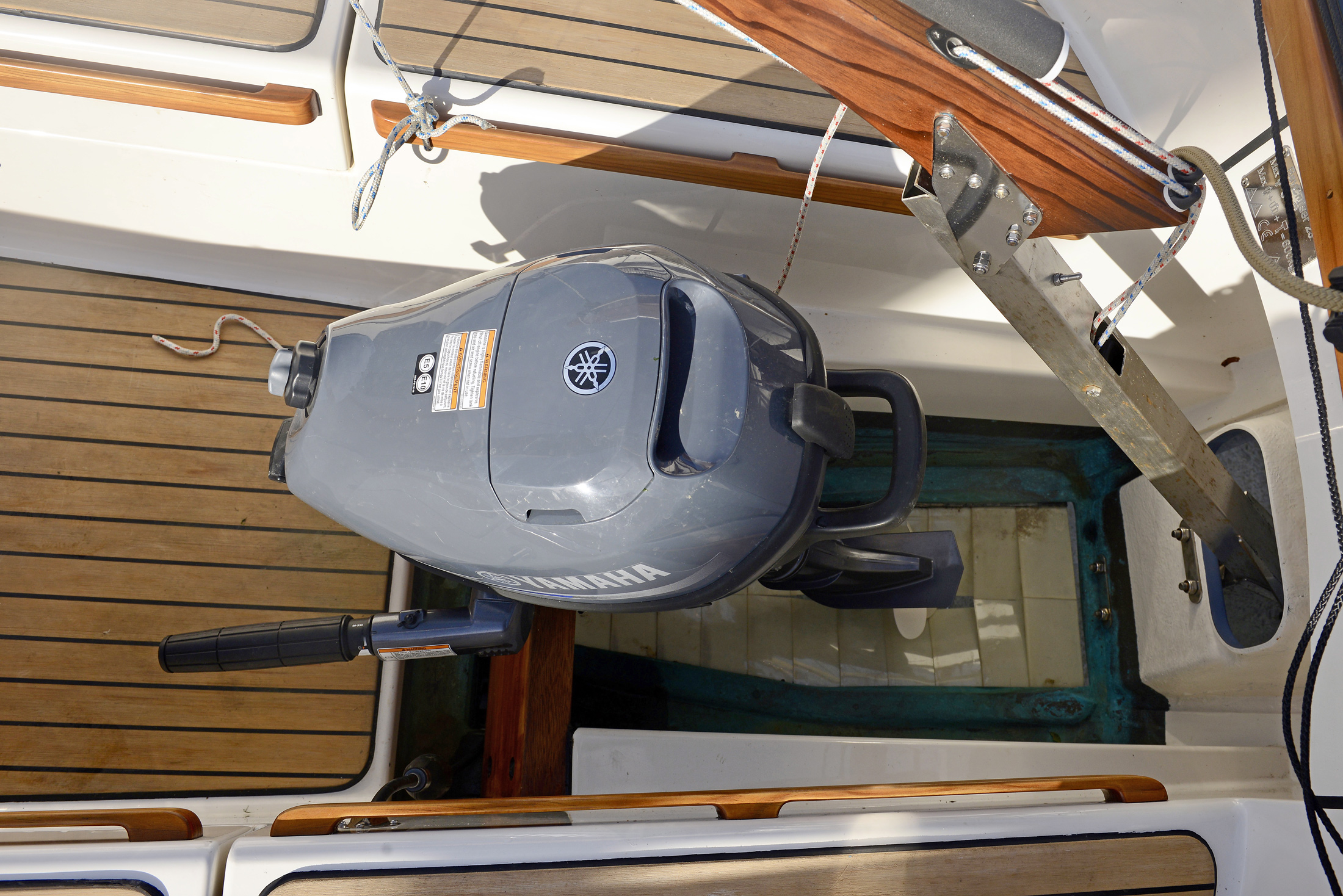
The outboard engine sits beneath the tiller and, thanks to a large aperture, can be tilted all the way up to bring its propeller out of the water. The hole is closed (but not watertight) with Mylar flaps to reduce drag.
With only a light breeze blowing, we set off with empty ballast tanks, and the BayCruiser 23 really did feel like an overgrown dinghy: responsive and light to the touch. The fully-battened mainsail is set on a deck-stepped carbon-fiber mast, and there is a fractional headsail; all the running lines lead back to the cockpit. As the sun lit up the waters of the Teifi, the boat did everything it was supposed to do. It sailed well close to the wind and flew along as soon as we eased the sheets to go on a reach, quickly clocking up 5.8 knots in about 10 knots of breeze. It’s no exaggeration to say the boat was completely vice-free in the gentle conditions.
As with a dinghy, however, you do have to watch the wind and keep the mainsheet uncleated, ready to be released if you are hit by a sudden gust. The centerboard has 154 lbs (70kg) of lead on its bottom edge, so when lowered it does provide some stabilizing weight. But with the ballast tanks empty, there is the possibility of capsize, even if the boat feels relatively stiff—something that may come as a surprise to anyone used to sailing traditional long-keeled boats.
Later, we filled the ballast tanks by simply opening a seacock and allowing the water to flow in. From start to finish—empty to full—the operation takes about 12 minutes. To prevent the water from sloshing around, the tanks must be filled completely. While the boat slowed down a little after filling, it was immediately more docile in the gusts. It was, indeed, like having two boats to play with. The only catch I could see was the possibility of being caught out with empty tanks and having to reballast in a squall; heaving-to in such conditions would require a calm skipper and good boat-handling skills. The tanks can be emptied when underway by activating the bilge pump, or when hauling out by opening the seacock and allowing the water to drain.

Down below, the off-white paneling and ceiling with light-colored wood trim and bright-blue cushions give a feeling of light and space. The folding table tops the centerboard trunk.
One of the most noticeable features of the BayCruiser 23 (which does take a bit of getting used to) is the large outboard well in the back of the cockpit beneath the tiller. It is designed to allow the outboard to be tilted up clear of the water, but doing so opens a large hole in the back of the boat. While Mylar flaps cover the slot beneath the raised outboard and reduce drag, Matt told me that some owners have retrofitted hinged plywood flaps to fully close the aperture when it’s not in use. If the hole is left open, it’s disconcerting to see water sloshing around in the aperture, though as one BayCruiser 23 owner told me, it does mean that the boat has one of the best-drained cockpits of any boat of its size. In practice, when the boat heels, a small amount of water does creep into the cockpit from the outboard well, but it immediately drains as soon as the BayCruiser 23 rights itself.
A comfortable cabin
Below decks, the cabin is divided along the centerline by the table-topped centerboard trunk and maststep post; despite this, the interior feels remarkably spacious for a 23′ boat. This is partly due to the light, modern decor—all-white panels set off by wood trim and vibrant blue cushions—and also thanks to some clever use of space. The open-plan cabin has sitting headroom only but is comfortable for a couple cruising or even, in a pinch, four people for short periods. On either side of the centerboard trunk there is a settee berth with storage beneath. A galley unit—complete with stainless-steel sink and pumped water, and space for a stove—is built into the forward end of the port berth, while to starboard is an easily accessed storage unit. These areas separate the main cabin from the fo’c’s’le where there is a V-berth with more storage beneath. Although this double berth is full length, for taller crew members the footroom forward looks pretty tight.

With the mainsheet traveler mounted aft, the cockpit is kept as uncluttered as possible. Lazyjacks for the mainsail and roller furling for the jib make it easy to lower the sails without fuss. The raised bulwarks—especially forward of the coach roof—make for a safer working environment when going forward to handle lines or the anchor. A samson post on the foredeck adds a functional touch of the traditional.
There are some nice design options, such as in Hull #72, a solid oak table atop the centerboard trunk. The tabletop is hinged on both sides of a center piece, folding up into an elegant, narrow table with a carved lip about 1⁄2″ high. At the forward end of the table—accessible whether it is open or closed—is a small hollowed-out cup to hold keys, coins, and other odds and ends. The biggest drawback below is the lack of an enclosed head, but at 23′ LOA and with a draft of just 1′ (centerboard up) you can’t expect miracles.
The BayCruiser 23 is a great option for sailors looking for a light, trailerable boat that will provide gratifying performance and comfort but will also look after them and their families when the going gets tough.
A regular contributor to Small Boats, Nic Compton is a freelance writer and photographer based in Devon, England. He has written about boats and the sea for more than 30 years and has published 16 nautical books, including a biography of the designer Iain Oughtred. He currently sails a 14′ Nigel Irens skiff and a 33′ Freedom cat-ketch.
BayCruiser 23 Particulars
LOA: 22′ 11″ (6.98m)
Beam: 8′ (2.36m)
Draft:
Centerboard up: 1′ (0.3m)
Centerboard down: 4′ 11″ (1.5m)
Weight: 1,870 lbs (850kg)
Sail area: 260 sq ft (24.2 sq m)
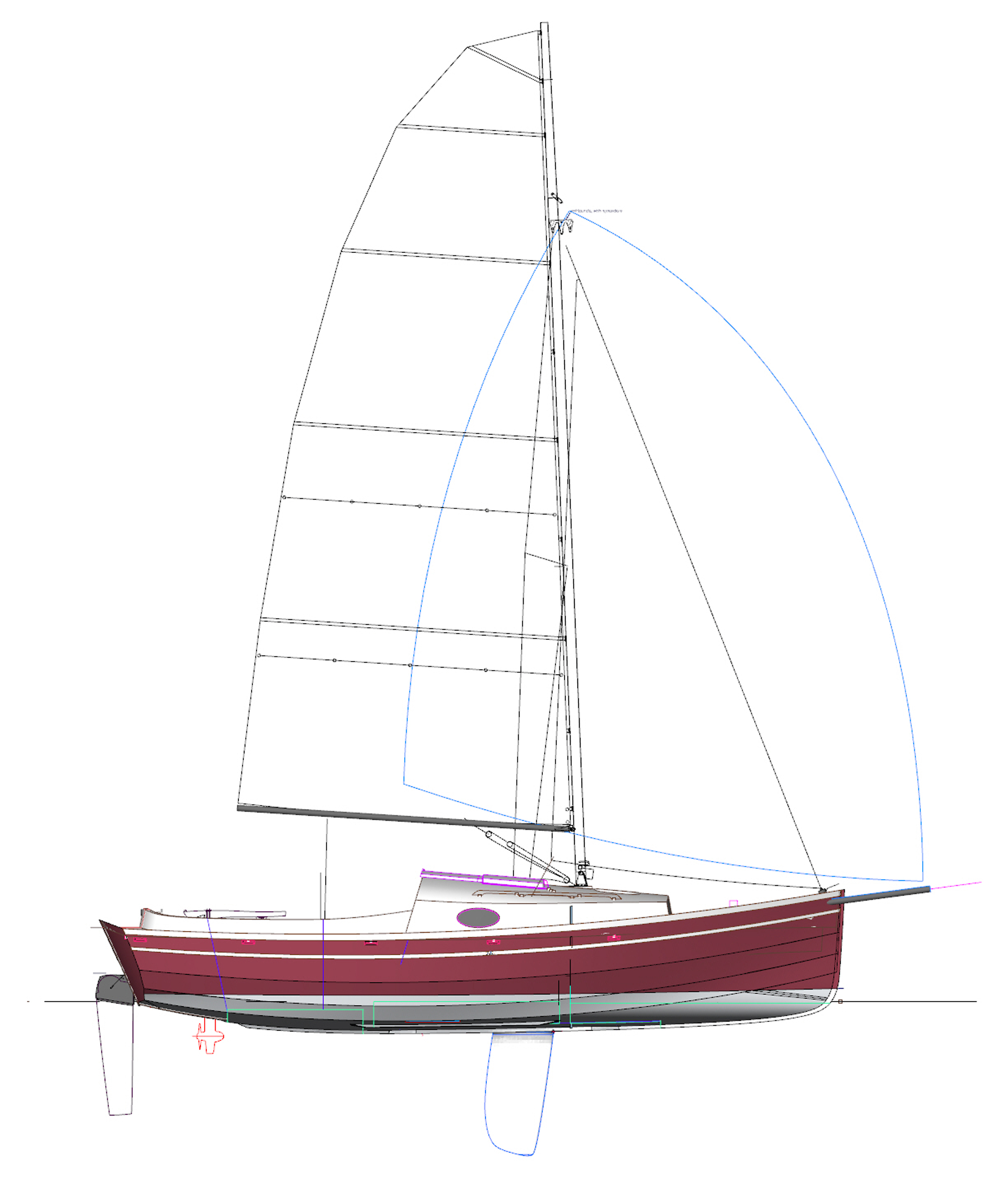
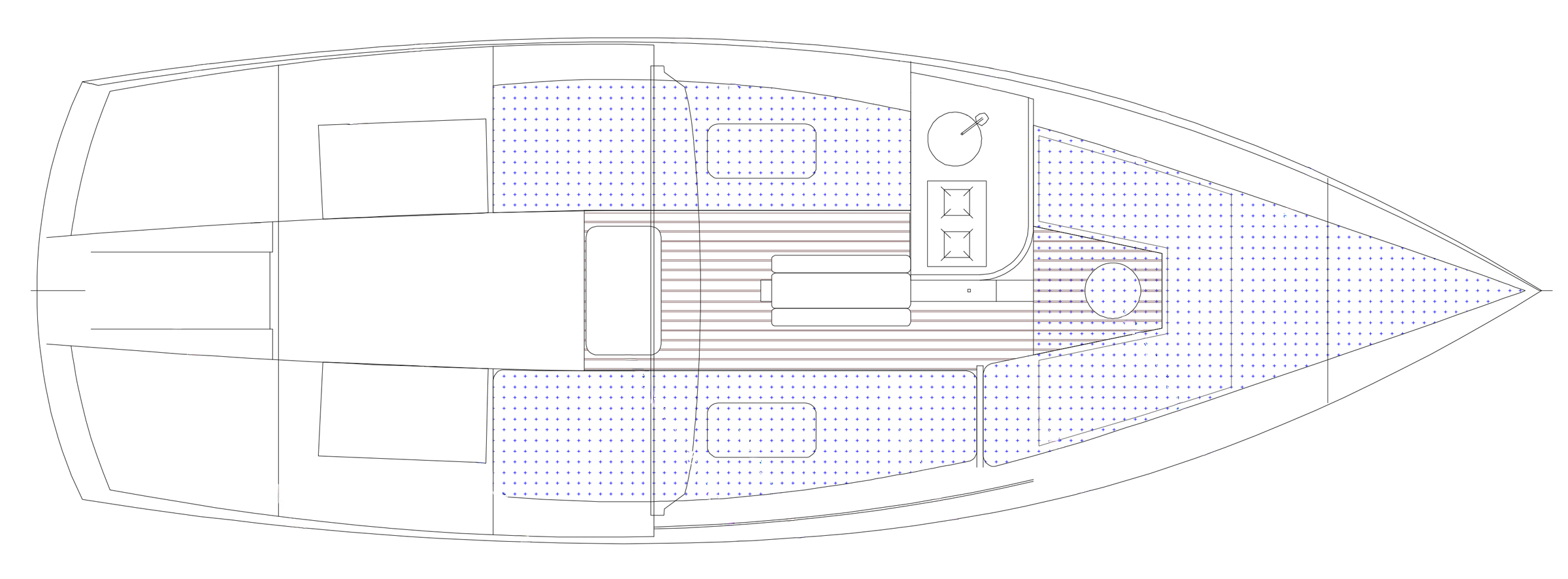
The BayCruiser 23 is available from Swallow Yachts. Starting price is £55,000 plus tax (around $73,500), while optional extras include an asymmetric spinnaker with carbon bowsprit, a fridge installed beneath the companionway, a porta-potti, and more. Swallow Yachts has exported dozens of boats to the United States and says the process is “generally hassle-free.”
Is there a boat you’d like to know more about? Have you built one that you think other Small Boats readers would enjoy? Please email us your suggestions.
More small cabin-boat profiles
Selway-Fisher Heron 15, a hard-chined stitch-and-glue sloop, reviewed by Ram Sudama
Eun Mara, a trailerable coastal cruiser designed by Iain Oughtred, reviewed by Steve Borgstrom
Banjo 20, a compact outboard cruiser designed by Sam Devlin, reviewed by Christopher Cunningham


Nice ! Though i had to look up “Raid” in this context.
Fair point!