Some weeks ago, faced with a boring household chore, I went in search of a podcast that would keep me company and distract me from the mundanity of my task. I stumbled upon “A Short History of… Shackleton,” from the Noiser Network. I tuned in. While it didn’t help me with the task in hand—barely 10 minutes in I had, instead, settled into a comfortable chair with a cup of tea—it did remind me of the extraordinary challenges that Sir Ernest Shackleton and his crew had faced and survived more than 100 years ago. Once the podcast was over, I went to my bookshelf to find Shackleton’s Boat Journey, Frank Worsley’s account of how Shackleton and five of his crew—Captain Frank Worsley, Ship’s Carpenter H. McNeish, Second Officer Tom Crean, and Able-Bodied Seamen J. Vincent and Timothy Macarty—sailed one of the ship’s lifeboats across nearly 800 miles of Southern Ocean from Elephant Island to South Georgia.
The story of Shackleton’s Imperial Trans-Antarctic Expedition, of which the “boat journey” is just a part, is well known and, despite being one of arguable failure, is one of the most heroic maritime survival stories of the 20th century. Shackleton and crew had left England on the barkentine ENDURANCE in August 1914. The expedition’s goal was to cross the Antarctic continent from the Weddell Sea to the Ross Sea via the South Pole. But by January 1915, ENDURANCE had become trapped in the pack ice at the southern extreme of the Weddell Sea, and by late October, the crew of 28 men—seamen and scientists—had to abandon ship. Less than four weeks later, ENDURANCE succumbed to the crushing ice and sank.
 Photographs by Frank Hurley, as published in Shackleton’s Boat Journey by F. A. Worsley
After dragging the three ship’s boats across the ice and then rowing and sailing them for 60 miles, the ENDURANCE crew made landfall on Elephant Island on April 15, 1916.
For a month, the men dragged their equipment, supplies, and three boats across the ice until they established Patience Camp in late December. There they would live for three and a half months until, in April 1916, with the floe breaking apart beneath their feet, they launched the three boats—the JAMES CAIRD and DUDLEY DOCKER, both 22′ 6″ long with a 6′ beam, and the STANCOMB WILLS, 20′ 8″ by 5′ 6″—and set sail for Elephant Island, 60 miles to the northwest. Six days later, having weathered massive seas, strong and often adverse winds, and ice that closed up and broke apart around them, they made landfall.
It was inevitable that Shackleton, as leader of the expedition, would be remembered through the century since ENDURANCE foundered and, while some have pointed out that it was his own recklessness that brought his crew to their life-threatening predicament, none has argued that his leadership qualities were anything but exemplary. But to remember only Shackleton is to do considerable disservice to the memories of some truly remarkable men; first among them the captain of ENDURANCE, Frank Worsley, author of Shackleton’s Boat Journey.

The JAMES CAIRD was made as seaworthy as possible for the 780-mile voyage from Elephant Island to South Georgia. Harry McNeish, the ship’s carpenter—who would be part of the JAMES CAIRD’s six-man crew—covered the space between the decks with sled runners, lids of boxes, and old canvas. A mast from one of the other boats was bolted along the keelson to prevent the CAIRD’s back being broken in heavy seas; and the mast and sail from the STANCOMB WILLS were cut down to make a mizzenmast and its lug sail. Frank Worsley, inset top right, was the captain of ENDURANCE and navigator of the JAMES CAIRD.
Worsley’s skills as a navigator were truly extraordinary. Shortly before ENDURANCE sank, he had worked out the courses and distances from and to the various nearest landfalls: South Georgia, the Falklands, Cape Horn, Elephant Island. It was a foresight that stood him and the other men in good stead, and as they reached the edge of the ice floe, Shackleton trusted Worsley to get them to Elephant Island. But courses and distances, when you can see the sun and stars and know the speed and directions of currents, are one thing; when you have none, or at best, only a few of those aids to hand, navigating a small boat across storm-tossed ocean waters to land on a 30-mile-long island 60 miles away is no small feat. On the relatively short voyage from the ice pack to Elephant Island, Worsley wrote, “I can never forget my acute anxiety for the next two days. If there was a mistake in my sights, which were taken under very difficult conditions, twenty-eight men would have sailed out to death. Fortunately the sights proved correct.” Thanks to Worsley, all the men made it to Elephant Island, and 10 days later, six of them set sail again on the JAMES CAIRD, this time bound for the island of South Georgia, 780 miles away.
Worsley’s firsthand account of that voyage from Elephant Island, written from memory and his own log records, is both humble and humbling. Most readers (myself among them) cannot possibly fathom the discomfort of being soaked to the bone for 15 days in sub-zero temperatures, while crammed into a storm-tossed boat with waves that frequently rise to more than 30′ and at least once to more than 50′. Worsley, while not making light of their predicament or discomfort, nevertheless has such a pared-down matter-of-fact style that you are left in no doubt that what you are reading is true; there is no hyperbole to make you doubt the author, no moments of self-congratulation that question his authenticity. Page after page, his power of description—always exact and occasionally poetic—puts you right there in the thick of it, even as you hunker down in your warm, dry, comfortable armchair.

While Elephant Island was, indeed, solid land, its beach was narrow and bleak, and landing or launching through the surf was not easy.
On the third day out from Elephant Island, Worsley writes that the wind “blew a hard west-southwest gale with snow squalls. Great torn cumulus and nimbus raced overhead. Heavy westerly seas rushing up on our port quarter swept constantly over the boat, pouring into the ‘cockpit’ and coming through the canvas in little torrents, soaking everything… I took observations of the sun for position, but the boat pitched, rolled, and jerked so heavily that I could take them only by kneeling on the after-thwart, with Macarty and Vincent clinging to me on either side, to prevent me pitching overboard, sextant and all… Stormy, snowy weather. Rolling, pitching, and tumbling we laboured before the roaring grey-green seas that towered over us, topped with hissing white combers that alas! Always caught us. Bruised and soaked, with never a long enough interval for our bodies to warm our streaming clothes, in zero weather we now fully gauged the misery and discomfort of our adventure.”
Five days later, conditions were even worse: “The boat leaped and kicked like a mad mule; she was covered fifteen inches deep in a casing of ice like a turtleback, with slush all over where the last sea was freezing. First you chopped a handhold, then a kneehold, and then chopped off ice hastily but carefully, with an occasional sea washing over you. After four or five minutes—‘fed up’ or frostbitten—you slid back into shelter and the next man took up the work… This fierce, cold gale had lasted at its height for forty-eight hours.”

Twenty of the twenty-two men left behind on Elephant Island after the JAMES CAIRD and its crew of six departed on April 24, 1916. Not pictured are the steward, A. Blackborrow, and Frank Hurley, the man responsible for the extraordinary photographic record of the ill-fated Imperial Trans-Antarctic Expedition. Behind the men can be seen the canvas-covered up-turned hulls of the DUDLEY DOCKER and STANCOMB WILLS. These would be bedroom, smoke room, dining room, operating theater, and hospital for the men for more than four months. All the men would be rescued on August 30, 1916.
Throughout, Worsley navigated. South Georgia, just 90 miles from end to end, was but a pin-prick; if they missed it, they would sail on into the Southern Atlantic where there would be no hope for them or for the 22 men left behind on Elephant Island. His books and log, Worsley writes, “were in a pitiable state—soaked through, stuck together, illegible, and almost impossible to write in. They were not paper pulp, but something like it, and it took me all my time to open them without completely destroying all chance of navigating to land.” But, against all odds, after 15 days at sea, having managed to get a sun sight just four times in the first 13 days, “two of these being mere snaps or guesses through slight rifts in the clouds,” Worsley brought the boat and its six-man crew to the west coast of South Georgia.
Still their trials were not over. As they lurched along the lee shore, desperately searching for a place to land, they were hit by the worst wind they had encountered thus far. “For nine hours,” writes Worsley, “we had fought at its height a hurricane so fierce that, as we heard later, a 500-ton steamer from Buenos Aires to South Georgia had foundered in it with all hands, while we, by the grace of God, had pulled through in a twenty-two-foot boat.” Despite the ferocity of the weather over the final 24 hours, Worsley’s account continues with his trademark precision and lack of sentimentality. Just once does he touch on what must have been utter fear and desperation when he writes: “The thoughts of the others I did not know—mine were regret for having brought my diary and annoyance that no one would ever know we had got so far.”
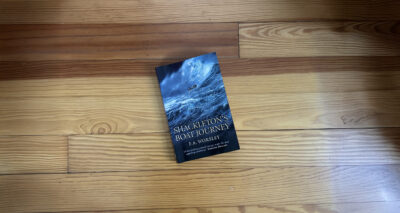
Worsley’s account is not long. My paperback edition, published by Birlinn Ltd, in 2007, runs to just 143 pages, and covers the story from ENDURANCE becoming trapped to the escape to Elephant Island, the “boat journey,” and the subsequent climb made by Shackleton, Worsley, and Crean across mountainous South Georgia to get help. It is a story that captivates from the first page to the last; knowing the author survives takes away none of the suspense.
Jenny Bennett is editor of Small Boats.
Shackleton’s Boat Journey by F.A. Worsley, published by W.W. Norton, is currently available through most book outlets, price $20.
Is there a product that might be useful for boatbuilding, cruising, or shore-side camping that you’d like us to review? Please email your suggestions.
More reviews by Jenny Bennett
A Universal Marine Compass, a steering compass that also serves for hand-held bearings
Victorinox Paring Knives, stainless-steel knives for boat and home
Hooway 7×50 Marine Binoculars, affordable binoculars that float





I reviewed this book some years ago for Messing About In Boats. What a great read. Thanks for bringing it to everyone’s attention. My wife bought for her middle school classroom library several of the Shackleton biographies and Endurance expedition books that have come out over the years. This is the best one in my opinion.
Thanks John. Yes, a great read and I agree with you, the best one. I have a few Shackleton books on the shelf but that’s one I re-read from cover to cover every few years.
Thank you for the excellent review.. I bought a copy of Frank Worsley’s book while visiting a small museum in his birthplace in New Zealand..
Everyone knows of Shackleton, but to me Worsley was the real hero of the entire saga..
Without his leadership, skill and courage, all lives would have been lost and the entire expedition, a disaster.
He deserves equal if not greater recognition than Shackleton.
I also agree that his writing style is clear and concise and the voice of a humble yet wonderfully capable sailor..
A fabulous read for any lover of the sea.
A few years ago a group of men made a replica of the boat that was used for the passage. They took it to Elephant Island and began a repeat journey which was filmed. The film is terrific. Long and short of it was that a number of them could not endure the crossing. They became frost bitten and had to be taken off when they reached the mainland. Others did get over the mountain. These men were not tough enough to make the journey. Why were all of Shackleton’s men able to arrive on the mainland in good shape and the modern men were not able to?
Remember, today when someone refers to “The Boss” it is Bruce Springsteen; then it was Shackleton!
Shackleton:: you can trust him with your life but not your money or your wife!