Like many amateur builders, Steve Wenger came to boatbuilding gradually. But having arrived at his first project in 2014, he was well and truly caught by the bug. To date, he has built five boats ranging in size from 12′ to 15′. Steve’s love of boats stems from childhood when, in the 1960s, his father was working as a park ranger at Lake Mohave in Arizona and the family had access to a cabin cruiser with an inboard diesel engine. Decades later on a trip to Canada, Steve met a boatbuilder who had a plywood sailboat, and the concept of building his own boat was sparked in his mind. He had, he says, already designed and built two campers—one for a small pickup truck, the other a conversion of an early Toyota Four-Runner—and had been canoeing for several years; building a wooden boat seemed a natural progression. And yet, Steve still didn’t take the plunge. Six years later, he did buy plans for the Tracy O’Brien-designed Headwater 14, a Rogue River drift boat…but still he didn’t build.
 Photographs courtesy of Steve Wenger
Steve’s first Tracy O’Brien build was the Headwater 14, a Rogue River drift boat. He chose it for its suitability on local Colorado rivers and because he “loved looking at that wild sheer.”
“Those plans sat around for a couple of years,” Steve says. “Partly because getting marine plywood to Colorado seemed insurmountable, but mostly because of the inertia of life in general.” Nevertheless, not only did the dream not go away, it became ever more persistent. “I became obsessed with the idea of building a boat I could sleep on, and purchased two more plan sets for larger boats from O’Brien.”
For Steve, Tracy O’Brien’s plans were the perfect antidote and fodder for his dream: “It was easy to build scale models from Tracy’s offsets,” he says. Using artist’s mat board and Scotch tape, Steve built hulls scaled to 1 1⁄2″ to the foot. “I’m sure I could have built a whole full-sized boat in the time I spent daydreaming about those designs and others.” Finally, however, Steve’s modelmaking and testing led him to decide that if he were to build a full-sized boat, it should be something smaller, a boat he could use on local Colorado rivers. His dreaming came full circle when his musings brought him back to the very first plans he’d bought: the Headwater 14 drift boat.

Space was tight in Steve’s garage workshop, but after his first two successful builds he moved on to a stretched version of O’Brien’s Transport 9.9.
In 2014, the time to build had come at last. As it turned out, Steve decided to build two boats: the Headwater and Harry Bryan’s Fiddlehead. He would build them simultaneously, side-by-side. He reasoned that if one construction had to pause—when glue was curing, for example, or if waiting for materials—he could work on the other. Furthermore, he could reduce the cost of shipping quality marine plywood to Colorado by ordering enough material for three builds at once. It was an ambitious move, but one he does not regret.
Neither of those two building projects caused Steve much angst. The Fiddlehead was finished in November 2015 without problems, and the larger Headwater was launched in September 2016. Of the latter, he says, he appreciated the “straightforward building sequence and O’Brien’s key to the plans with parts numbered and illustrated.” And there were details in O’Brien’s design that appealed. “I particularly liked his use of ‘riblets’—short ribs that help to stiffen the upper topsides and, on the Headwater, tuck in between the gunwales and inwales to give the appearance of a scuppered rail.” And then there was the sweeping sheer. “I loved looking at that wild sheer; there was so much shape in that boat.”

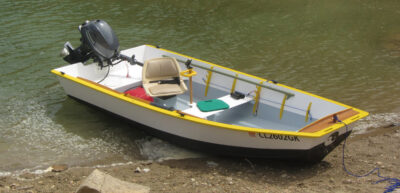
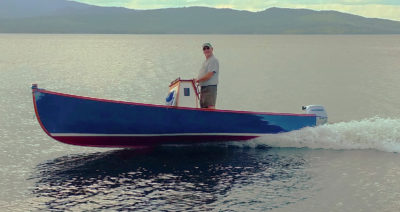
SWIFT, Steve’s stretched Transport 9.9, benefited from some personal touches including the rod-and-oar racks and pedestal seat. Steve also extended the spray-deflecting outwales around the bow to provide two carrying handles.
With two successful builds under his belt and that extra plywood on hand, Steve was soon moving on to a third construction boatbuilding project. He had long decided that a cabin cruiser would be impractical for western Colorado, and besides, his garage shop couldn’t accommodate anything big. “And,” he adds, “my wife is a landlubber at heart, so I looked for an outboard boat that could carry two adults, a dog, and our camping gear.” He considered O’Brien’s Transport 9.9, a cartopped pram dinghy, but worried that it was too small at just 9′ 10″. Nevertheless, he kept returning to the Transport, and after studying other designs and building yet more models, decided to stretch the design. “I feel bad that I didn’t run the changes by O’Brien. His 9.9′ V-bottomed Garvey became 13′ 7″ × 5′—I enlarged it overall by 25 percent and added 15″ to the straight run aft to even out the proportions. It’s a high-volume boat, but I find that volume comforting; it performs like a larger boat.” Steve powered the boat with a 25-hp Yamaha four-stroke outboard, which he says might be more than it would need at sea level, but it serves him well in western Colorado where elevations of 6,000–8,000′ starve engines of air.

The modified Transport 9.9 was a hit with the family: Steve’s wife, who is “essentially a landlubber,” enjoys camp-cruising in it, and the dog was always happy to be on board.
“Besides enlarging the design,” Steve says, “I added many custom features until I was almost embarrassed by my indulgence. I built a seat pedestal so I could use a tiller extension on the outboard; some oar and fishing-pole racks; a ‘chicken-post’ handhold that can be height adjusted; and I extended the spray rail around the bow transom to provide two handles.” Together with his wife and their dog, Steve has used the boat to beach-camp in Colorado, Arizona, and British Columbia. “The dog was always eager to hop in—and even more eager to hop ashore.”

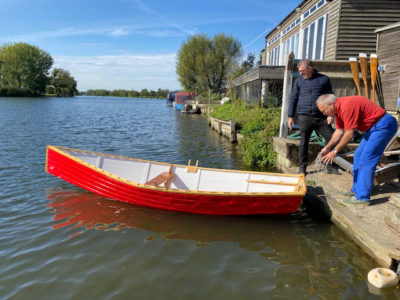
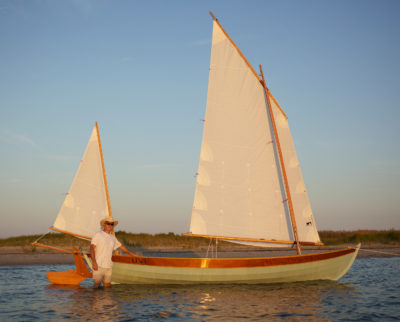
Steve’s most recent O’Brien build is a sailboat. The Nemah, a 14′ flat-bottomed sharpie, equipped with a daggerboard and a maststep and partner, appealed to Steve because it can be rowed and motored as well as sailed.
For his most recent build—his fifth (he has also made a skin-on-frame canoe for his wife)—Steve turned to another O’Brien design. The Nemah is a sailboat, a 14′ flat-bottomed sharpie. Once more, Steve considered other designs but ultimately chose the Nemah because of his prior experience building O’Brien’s designs which, he says, combine ease of construction with more than a touch of elegance. He had originally bought the Nemah plans for their own sake, because he “liked the look. But then the idea grew on me. I had no sailing experience, so I liked that the boat could also be rowed or powered with a small motor; and I already had an electric trolling motor.”

RUBY—the 14′ sharpie seen here with a wishbone-spritsail rig—has the truncated frames (“riblets”) that O’Brien favors for giving strength and stiffness to the plywood topsides while maintaining an uncluttered cockpit.
Construction, he says, was typical “straightforward O’Brien stitch-and-glue. Laminating and shaping the mast was interesting, as was sanding the daggerboard and rudder blade to their foil shapes.” But despite the apparent simplicity of the build, the hull was not without its challenges. “The stitch-and-glue construction,” Steve says, “requires a lot of sanding and fairing, which tested my ability to let go of my perfectionism. I developed a mantra: ‘It’s a boat, not a work of art.’” But all that sanding also indulged one of Steve’s favorite aspects of wooden boat building. “I love the tactile experience. I faired by hand mostly, because of my poorly lit, off-grid shop. If I could feel a blemish, then there was more work to do. All that touching of the boat, milling and sanding all the parts, feeling for smoothness, running my hand along the rail as I walked away…it has all connected me to my boats in a way that few other creating projects have. I build myself into the boat.”
Steve’s love for his boats has caused something of a problem. “It’s hard to let go of a boat you’ve built. We still have all five. I’ve given up the idea of a ‘sleep-aboard,’ but I do think there might be another boat in me.” In part, however, any future projects will depend on Steve’s wife: “She’s given me an ultimatum: no more new builds until I sell one or two.”
Jenny Bennett is editor of Small Boats.
Do you have a boat with an interesting story? Please email us. We’d like to hear about it and share it with other Small Boats readers.
More reader-built boats for oar and power
YEAH BUOY, a plywood skiff built for drift-fishing and family boating
LADY LOUISE, a Candlefish 13
GENERATIONS, a family-built Bevins skiff

Are Tracy O’Brien plans still available? I could not find his website.
Tracy O’Brien’s website is currently non-operational. However, plans are available for sale and Mr. O’Brien can be reached via email at
[email protected]
Those are nice boats. Having sailed small sharpies and canoes I’ll make a suggestion to employ a push-pull tiller – you can pretty much pick where you want to be in the boat with one. It changes the whole experience.