One day in early summer a friend invited me to join him and a group of like-minded boat nuts for a birthday cruise. He was proposing a mini-adventure: a 3-mile voyage under sail and oar down the River Avon to Bantham, a small village with a large sandy beach on the south coast of Devon, U.K. It was the kind of excursion I love, and it so happened that I had just borrowed a 7′ 10″ Lighter, the mid-size boat in a range of three folding dinghies built by the British company Seahopper. The birthday cruise would be the ideal opportunity to try out the boat in a real-life situation that was probably at the limit of what it was designed for. I accepted the invitation.
Fifty years of folding boats
Seahopper was established in 1974 and over the years has developed a solid reputation for building high-quality collapsible boats, starting with the 6′ 8″ Scamp and the 7′ 10″ Lighter (aka the Nifty Fifty) and then, from 1997 onwards, the 10′ Kondor (ex-Kontender). According to the company’s records, more than 7,600 boats have been sold since its inception, making it one of the best-selling wooden-boat builders in the U.K. What’s more, nearly a quarter (22 percent) of recent sales have gone to the U.S.
 Anna Kisby Compton
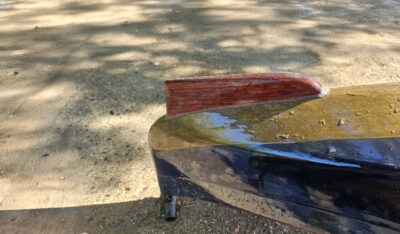
The Seahopper Lighter makes a compact package when folded, and the wheel built into the skeg makes it easier to manage its 75-lb weight.
In 2024, the company’s 50th-anniversary year, Seahopper was bought by Alec Bates and Vera de Ruiter, who live on a narrowboat near Rugby in Warwickshire. Despite living about as far from the sea as you can in the U.K., Alec and Vera were working as professional SCUBA diving instructors when they decided to go into boatbuilding.
“We were looking for a lifestyle change,” says Alec. “I’ve been sailing since I was a kid, and working with wood. We looked at several possibilities in Devon and Cornwall, but when we saw the Seahopper we fell in love with it right away.”
Design and production had been fine-tuned by the company’s previous owner, so there was little to do other than continue where he had left off and move the workshop from Devon to Rugby. Alec and Vera’s main innovation so far has been to offer the transom vinyls in different colors. Their own display boat, a Kondor, has pink transoms and pink sails—the perfect present for the princess in your life.
Assembling and sailing the Seahopper Lighter
The day of the birthday cruise arrived. We gathered in Aveton Gifford, a village at the top of the navigable reaches of the Avon estuary. As soon as we arrived in the parking lot we could see that we had misjudged the tide, and that there was barely 6″ of water in places. No matter: in the true spirit of adventure, we decided to carry on regardless. So, while the others pumped up two inflatables and rigged a small aluminum dinghy, I assembled the Lighter for the first time.
 Nic Compton
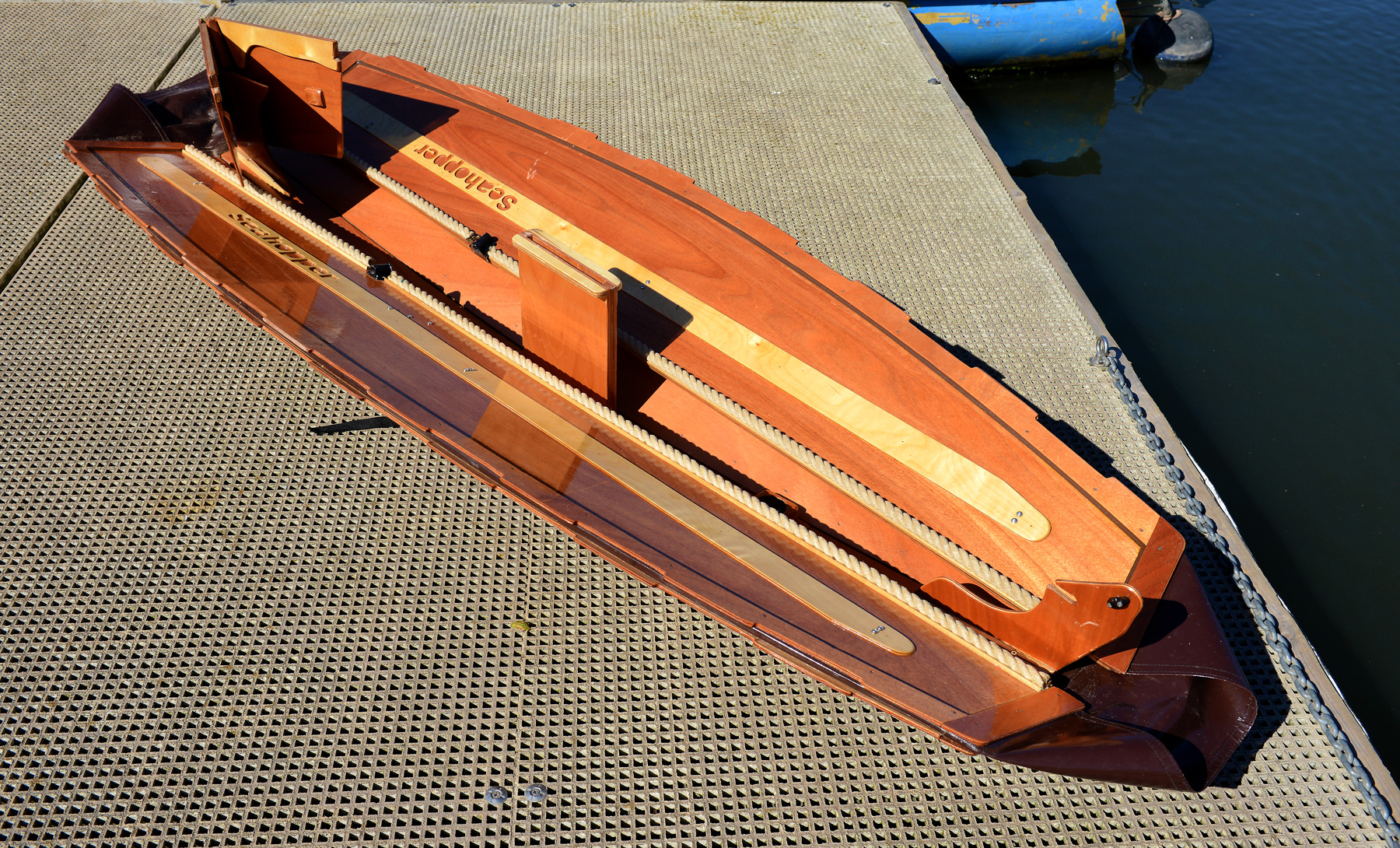
The Seahopper Lighter’s assembly design is ingenious: as the hull is unfolded, the boat’s form is automatically established. Here the first unfold has occurred, opening up the bottom of the boat to reveal the upright stem, daggerboard trunk, and folded stern transom panel. Next, the two side panels will be unfolded, which will, in turn, spread the two vinyl transoms. Athwartships tension will then be introduced by the center thwart.
The boat’s design is nothing if not ingenious and shows the benefits of 50 years’ development. The central keel—about 4″ wide—is made of three layers of 6mm plywood, giving a rigid 18mm-thick centerline on which everything else is hinged. Either side of the centerline are two longitudinal 5mm plywood panels—making up the hull’s bottom and sides—hinged together with durable fabric, their joints strengthened by a series of wide, interlocking teeth cut into the plywood. The two transom ends are made of vinyl, stiffened internally with plywood panels.
Packed away, the longitudinal panels, daggerboard trunk, and fabric transoms fold into themselves along the centerline. To assemble the boat, you unfold the bottom boards, and then the side panels. The aft transom’s inner plywood panel is built onto the keel and simply unfolds along its ’midships centerline. As it does so, it pushes the side panels out. The main lateral stiffener is the center thwart, which is hinged in the middle. To open the boat fully, the ends of the thwart are placed into locating brackets on the inside of the side panels, and the seat is then pushed down firmly on its hinge until flat; it is then locked in place in the brackets with spring-loaded latch clamps. The fit of the thwart is snug, and its placement effectively holds the sides of the boat open while they, in turn, keep the thwart in place. Next the bow transom plywood panel is slid into position, and the forward and after thwarts are clicked into place. And with that, you have a boat.
The world record for assembling a Seahopper is held by one of the company’s previous owners, Steve Rea, and stands at 1 minute, 45 seconds. With the help of my wife and kids, I managed to assemble the hull in about 10 to 15 minutes; with practice I eventually got it down to less than 5 minutes—plus another 10 minutes or so for the rig.
Once the boat was assembled, we headed from the parking lot to the launching area using the boat’s sturdy launching wheel that is permanently fitted to the after end of the skeg. This simple addition means that one person can easily move the boat around, both folded and fully assembled.
 Anna Kisby Compton
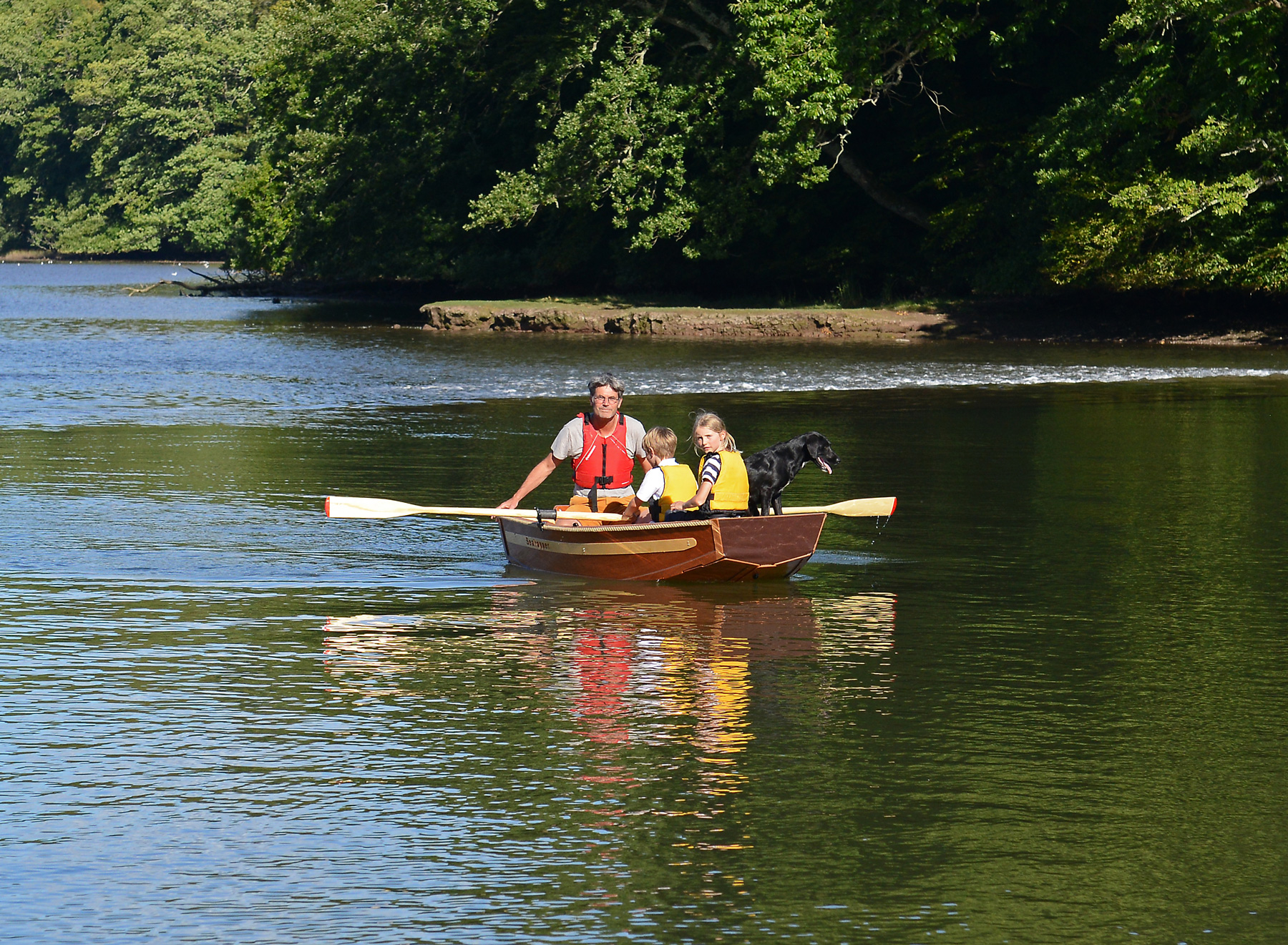
Despite being only 7′ 10″ long, the Seahopper Lighter has remarkable load-carrying capacity and yet is small enough to be handled by younger crewmembers.
For our Avon cruise, there were five of us hoping to catch a ride on the Lighter: myself, my wife, our two children, and our dog, Winnie. And then there was all the gear, including a generous picnic and plenty of liquid refreshments.
With the tide rapidly ebbing, there was no way we could all fit on the boat without dragging the keel on the riverbed, so we took turns sitting on board while the rest of the family waded in the river, pulling the boat along by the painter; Winnie, meanwhile, busied herself hunting for fish.
In the shallows, the inflatables had the advantage as they sat higher on the water. But as soon as we reached deeper water, we all climbed on board; here the Lighter’s better rowing qualities began to show, and we pulled slowly ahead. Even loaded with the whole family, there was still plenty of freeboard and the boat never felt tippy. Once down at the estuary’s mouth, we experimented with the simple lug rig provided but struggled to make any headway against the stiffening onshore breeze and incoming tide.
We had a better time on the way back when, fully laden once again, the Lighter romped back up the river, well ahead of the other three boats. It was a trip of mixed fortunes, but the Lighter had shown its surprisingly good load-carrying abilities and its sailing potential, at least with a following breeze. More importantly, perhaps, at no point did I feel like it couldn’t cope with the demands we were putting on it, and I was most impressed by the boat’s steady manner under way and the surprising rigidity of the hull.
Our second test sail with the borrowed Lighter proved much more successful than our first. The boat came together more quickly, and we had exchanged the basic lugsail for the more effective gunter rig—an option from Seahopper. I also swapped the 5′ 6″ oars that had come as standard (and which fit neatly under the thwarts) for a 6′ 6″ pair, and the transformation was complete. (The Seahopper Lighter is now supplied with 6′ oars as standard.) The Lighter maintained way under sail, even in the fading breeze, and was fun to row, and even when I pulled hard there was no sense of the hull flexing beneath me. When I relinquished the boat to my seven-year-old son, he was soon speeding along, and performing spectacular U-turns.
 Anna Kisby Compton
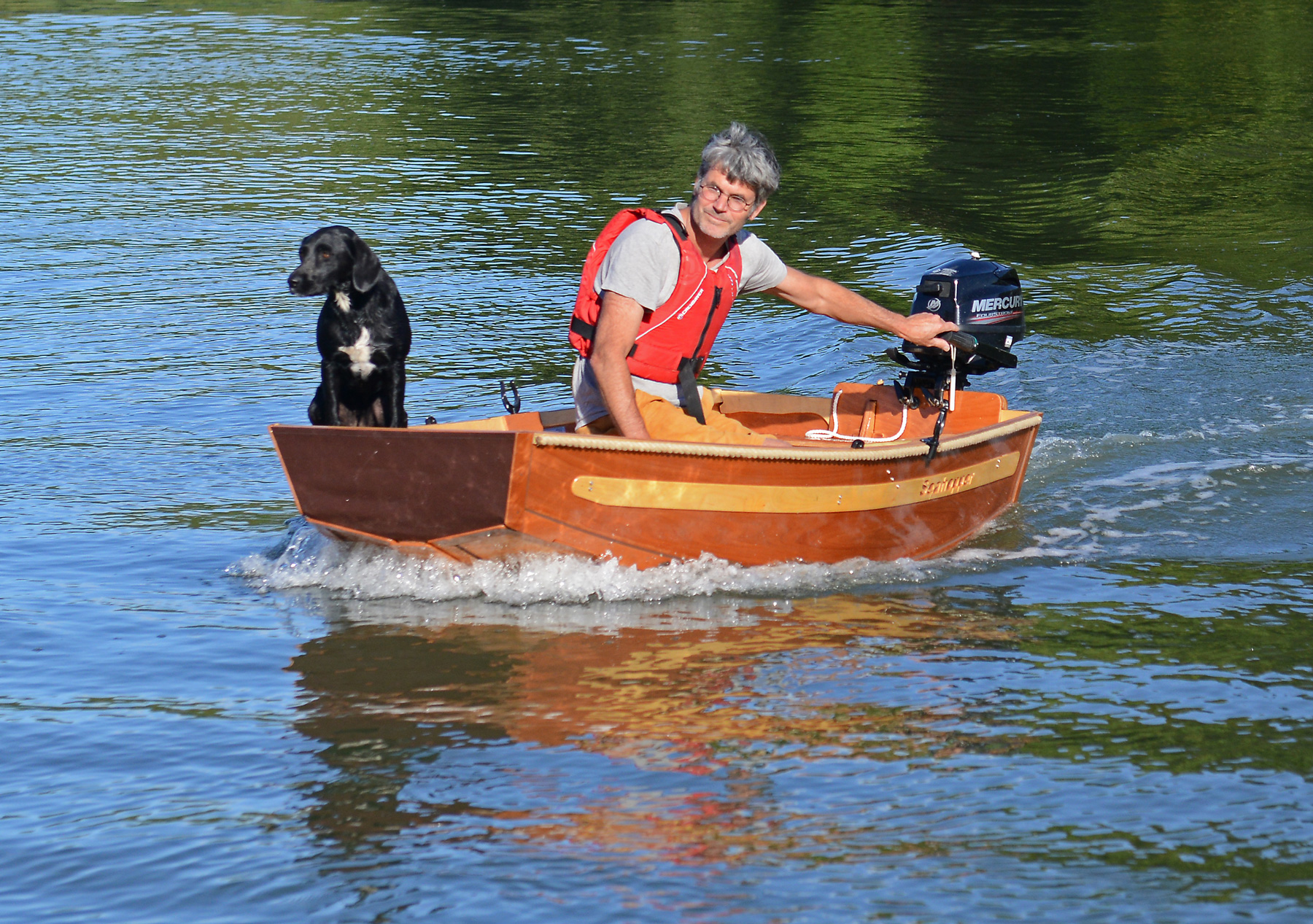
The Seahopper Lighter performs well under sail, or powered by an outboard motor hung on the optional stern bracket. I used a 6-hp outboard, which was larger than the recommended 2-hp. While the boat performed well, the oversized motor caused the stern transom to flex somewhat under the weight.
From family to singlehanded sailing
My third outing—with just me and a friend—was even better. With a brisk 15-knot breeze blowing, the Lighter skimmed across the river and never felt over-pressed or in danger of capsizing—which was just as well, as I hadn’t installed the buoyancy bags that were supplied with the pack. It was a fun sail and the gunter rig performed well, even though James and I later discovered that we had put the maststep in the wrong position. When sailing singlehanded, I found the boat light and nimble. The boom is quite low, so I did have to be careful to duck my head when tacking or jibing, but in a such a small boat that is to be expected. It is also sensitive to weight placement, and it paid to keep the boat well balanced and trimmed.
However, despite all the positives, it should be stated that, since you can’t tune the rig as you might on a more rigid boat, the Seahopper does not offer performance sailing like an Optimist or Mirror dinghy does. Also, being short, beamy, and light, it does not carry its way under oar as might be expected in a conventional tender of similar length. But it will certainly row and sail considerably better than any inflatable dinghy on the market, and with the low position of the painter eye contributing to directional stability, owners have reported that it tows well. Under power—an optional plywood outboard bracket can be fitted to the transom, bracketing over the top and bolting onto the skeg below—the 6-hp outboard I used was probably overpowered and over-heavy, causing the transom to flex somewhat under the weight (Alec recommends 2 hp or thereabouts), but it did push the boat along at a fair clip.
Pricewise, the Lighter is inexpensive for a wooden boat, but costs more than a generic inflatable dinghy. However, its design is very carefully thought through, and the component parts are well made and a pleasure to use. What’s more, with its woody finish, it’s unexpectedly pretty and drew admiring glances from several passersby.
 Nic Compton
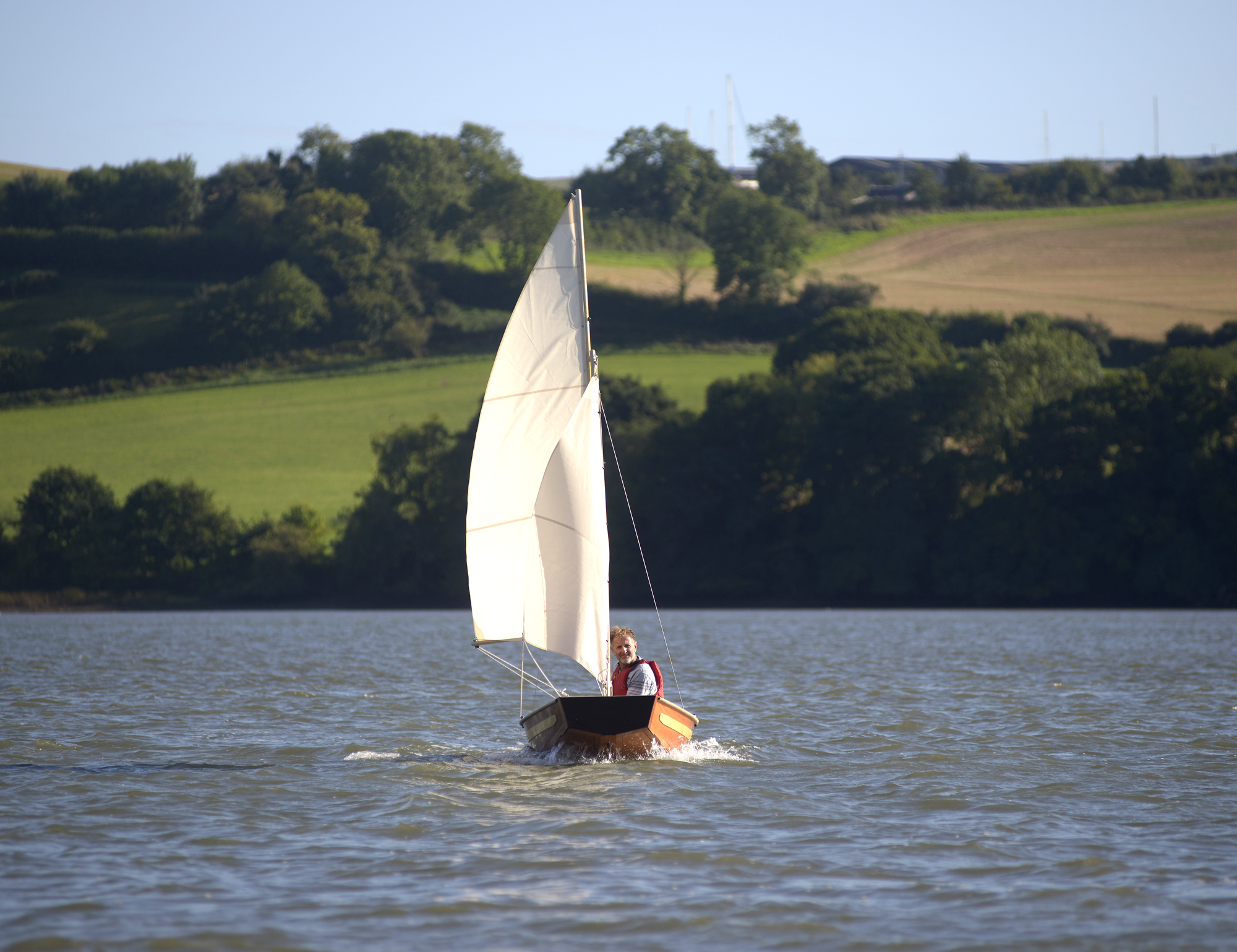
The Seahopper Lighter has two rig options: a simple lug rig on an unstayed mast and a gunter sloop rig (seen here) with shrouds and a forestay. Performance was definitely better with the sloop rig, but it was a lengthier process to get the boat ready to sail.
When folded the boat is 8′ 4″ long by 20″ wide and about 5″ thick—the version I tested was fitted with a rope fender, which looks great and will protect a mother ship’s topsides, but adds another 2″ to the folded thickness. Finding deck space to assemble it on board a small boat could prove an issue, and I had thought the Lighter would be too big for a 26-footer, but have since heard of people using it on much smaller boats and loving it. With a hull weight of just 53 lbs, it’s ideal for carrying on a car roof rack.
The Lighter would be a great boat to keep in an apartment or house with limited storage, or to carry atop a camper to give water access while traveling. And, providing you can find a safe place to stow it onboard, it would provide a lot of fun as a tender too. Just avoid trying to row down a shallow river on a falling tide!
A regular contributor to Small Boats, Nic Compton is a freelance writer and photographer based in Devon, England. He has written about boats and the sea for more than 30 years and has published 16 nautical books, including a biography of the designer Iain Oughtred. He currently sails a 14′ Nigel Irens skiff and a 33′ Freedom cat-ketch.
Seahopper Lighter Particulars
LOA: 7′ 10″
Folded width: 20″
Beam: 4′ 2″
Weight (hull only): 53 lbs
Sail area: 40 sq ft
Carrying capacity: 716 lbs
The Lighter is available from Seahopper; prices start at £3,375 for a rowing version, plus tax and shipping; Seahopper is offering 50 percent off transportation costs through February 2026.
Is there a boat you’d like to know more about? Have you built one that you think other Small Boats readers would enjoy? Please email us your suggestions.
For more folding boats see…
The Fliptail 7, a mostly vinyl sailing dinghy from Wooden Widget reviewed by Matthew McGregor-Mento
The AdvancedFrame Sport Kayak, an inflatable kayak for sol paddlers, reviewed by Jane Crosen
A Civilized Adventure, Jeff Bolster recalls a 1980s adventure exploring the Burgundy waterways in a folding kayak
I own a couple of Seahoppers, the 8′ Lighter and 10′ Kondor. They’re great little boats. I found the 8′ on Craigslist, they were previously marketed in the US by Britannia Boats. The 10′ I ordered from the builders to use as a cruising tender for my 39′ ketch. After towing or carrying a 10′ Dory Tender thousands of miles with few uses, I decided I wanted a folding dinghy. The Kondor lays flat on the cabin top, assembles on deck and launches easily. As noted in your article, these boats carry a lot for their length. Neither of mine came with a sail rig, but I adapted a 50 sq ft sprit sail to the Lighter. Between the bigger rig and my 230# weight, the hull does flex a bit, but not alarmingly. When not in use they store easily in the garage without taking much space. When moving them I put the loose parts in a duffel or golf bag. When rolling the boats on a beach or rough ramp, I use a dinghy dolly. The small skeg wheel is not up to those challenges. Overall I’m very happy with them
Thanks for the interesting ‘real-world’ feedback, which I’ve passed on to the builders. I’m sure they’ll be delighted to have such a satisfied customer!