In the dead of winter, with snow lying 2′ deep, and the mercury struggling to climb into the double digits, it’s hard to imagine deriving any pleasure from boats and boating; to conjure up the feeling of a warm breeze on your face or the tug of a mainsheet in your hand. And, yet, in the clutches of one of the coldest Januarys in years, a quick visit to a small local boatyard was enough to stir the fancy and remind me of the fun and enjoyment that even brief encounters with boats can bring.
Two days after the first major storm of the new year, my phone lit up with an incoming message. It was a friend, Austin, who summers nearby but spends his winters farther south. “You around tomorrow?” the text read. “Coming up to do boat stuff.” And there it was… that siren of summer, the promise of “boat stuff.” I replied, “Whatever it is, I’m in.”
 Photographs by the author
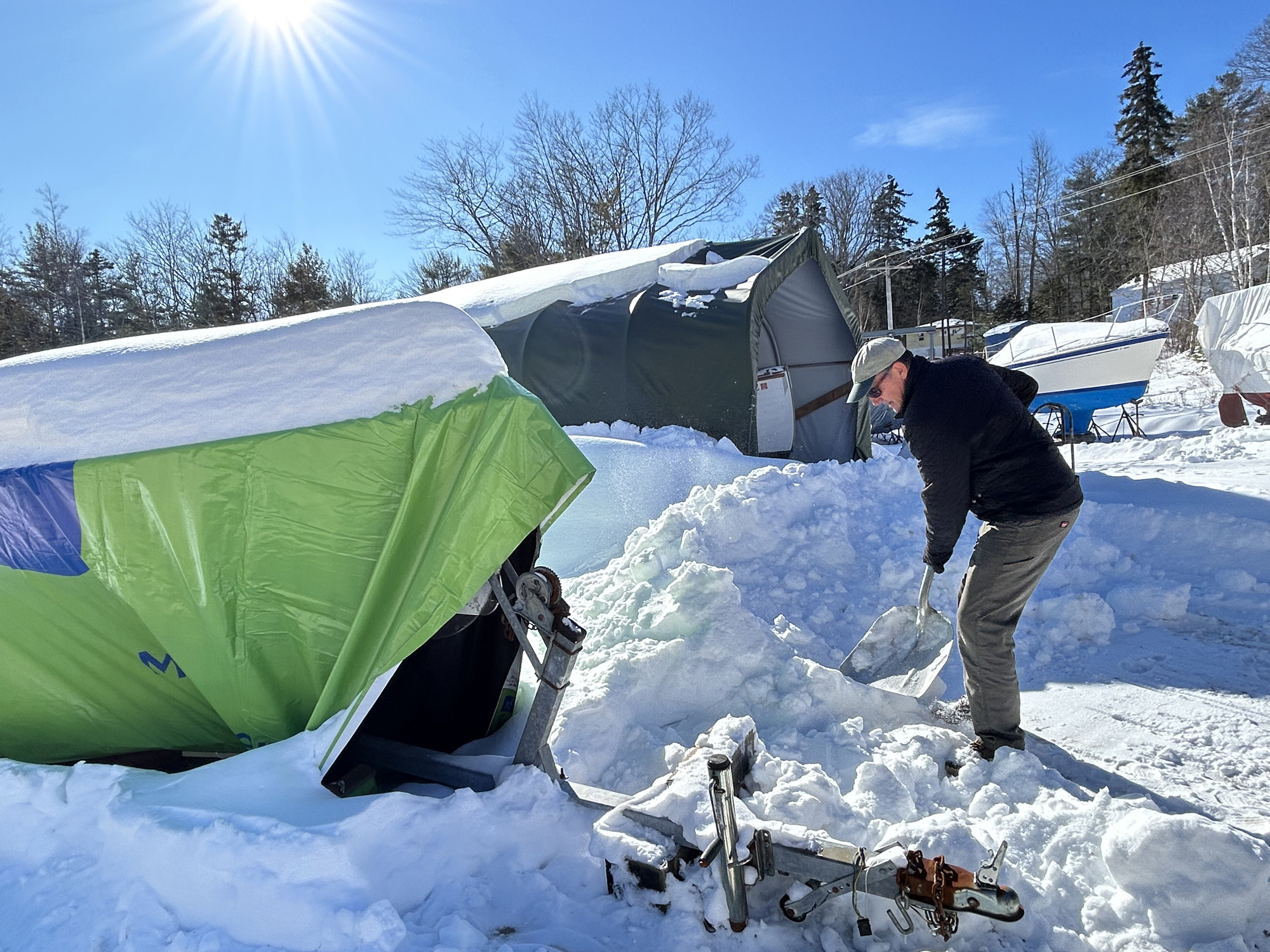
Before he could move his tarp-covered Rhodes 18, Austin first had to dig out its trailer.
The boat stuff in question was nothing much. It involved moving Austin’s Rhodes 18 from one spot to another, barely 50′ away. The small yard in which the boat is overwintering was once a commercial business, but is now privately owned by a retired boatbuilder who uses it for winter storage and the occasional piecework. Rustic and somewhat disheveled in appearance, the yard nestles in a clearing in the woods, a patch of rough ground on which stand haphazardly arranged snow-covered boats and a scattered group of three or four buildings. The largest of the structures is a timber-clad, two-story, weathered barn with double doors and a smaller service door in its gable end, and a row of dust-shrouded first-floor windows in the side wall, shaded beneath the over-hanging peaked roof. Austin opened the service door and I followed him in. The freshly painted dark-green hull of a 30′ motorboat loomed above me. Balanced here and there around the shop, the boat’s slatted benches gleamed with freshly applied gloss varnish, a finish miraculously free of dust in the chaotic surroundings. Every surface seemed to be piled high with tools, pots of paint and glue, varnish and grease, discarded fastenings and scraps of wood.
“Hello?” Austin called. No one answered.

Protected from the worst of the weather under a tent building, GRAYLING, a Crosby catboat built in 1898, had had some recent work done on her frames, as evidenced by the exposed fastenings in her starboard topside planking.
We went back out and looked around. There were signs of life—parked cars, smoke rising from the chimney of the one-story home the far side of the yard—but no movement. Austin glanced at his boat, its trailer buried deep in snow, and went off in search of a shovel. The sun was bright, reflecting with blinding sharpness off the snow that clung to every building, every inch of unplowed ground, every tarp-covered boat. The only boat not shrouded stood in an open-ended tent building. A catboat, some 20′ or more in length, her topsides showed evidence of recent structural work—the replacement of some frames, judging by the exposed fastenings in the planking. The powdery snow had blown in and covered some boat stands that lay on the ground beside the boat’s bow, but otherwise she was dry and protected. I walked through the tent to the boat’s stern. The wide varnished transom declared her to be GRAYLING, built in 1898; her barndoor rudder was supported by a wooden block, and two boat stands held the weight of her stern on either side.

GRAYLING has the unmistakable wide transom, firm bilge, and shallow underbody of a traditional catboat.
Hearing voices I walked out to the yard and waded back through the snow toward the truck. Austin had returned and was shoveling snow away from his sailboat. He’d been joined by an older wiry man whom I recognized as John, master craftsman, boatbuilder, finisher… one of a dying breed that was once the staple of every East Coast boatyard. The two men were discussing how to lift the boat’s trailer tongue onto the hitch. “That wheel jack looks like it’s not going to help much,” John commented. With a grin, Austin swung a sledgehammer at the wheel, promptly severing both it and its axle from the stand. “Nope,” he agreed, “it’s not,” and returned to his shoveling.

The wind-blown snow had all but covered the unused boat stands piled just inside the entry to the catboat’s tent building.
As Austin moved the snow, the two men discussed the problem of how to raise the trailer tongue enough to get it onto the hitch. Misquoting Archimedes, they quickly settled on the need for a lever and fulcrum. Once more, Austin disappeared around the back of the barn. He returned barely a minute later with a 12′ length of staging board. John found and placed a wooden block beside the tongue of the trailer and Austin lowered the board onto it, sliding the end beneath the tongue. John moved to the high end, applied a modicum of pressure, and nodded. I stood by to watch the wordless performance unfolding before me. Leaving John holding the end of the board—now doing duty as a lever—Austin climbed into the truck and reversed it back to the trailer. When the two men were satisfied with the positioning, Austin jumped out, John bore down on his lever, the trailer tongue lifted, and Austin guided the hitch onto the ball. It was all over in seconds and, with a smile of self-satisfaction in a job well done, Austin exclaimed, “Who needs a wheel jack when you’ve got a lever?”

As John bore down on the upper end of the lever, the tongue of the trailer rose up off the ground and Austin was able to guide the coupler onto the ball.
John and I stood together watching Austin maneuver the truck and trailer to the boat’s new location. I asked John about the catboat. Yes, he said, 22′, built in 1898 by one of the Crosbys—Wilton Crosby, he thought, though he wasn’t entirely sure. Then he nodded toward a tarp-covered lapstrake double-ender. “That’s my boat,” he said, “VANDY II. She’s an old rescue surfboat—26′, eight oars—from down Hampton [New Hampshire] way. She came out of service and was auctioned off in 1954; the buyer paid $102 for her. He did some work to her, installed an engine, fitted some decks, and added an extra sheerstrake to give her more depth. He had her for about 30 years. My family bought her in the ’80s. I keep meaning to research her history, but you know how it is.”

VANDY II, a 1930s rescue surfboat from New Hampshire, has been in the Van Dyke family since the 1980s.
While we were talking, Austin had reversed the Rhodes into her new slot alongside the surfboat. I went to get the staging-board lever. John set it up on another block fulcrum and levered the hitch off the ball, lowering the trailer tongue back down into the snow. Mission accomplished. We bid our farewells and Austin and I climbed back into the truck as John ambled off toward the barn.
“Wasn’t much of an outing,” said Austin as we drove away. I smiled. “No, but it was a good lot of boat stuff.” And it was… the sort of boat stuff that breathes hope into a frigid winter day and fuels dreams of warmer waterborne days ahead.

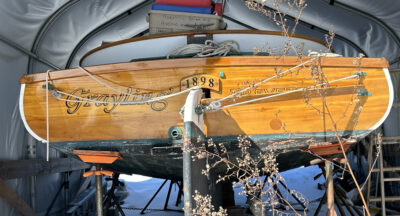

That indeed is my 1898 Wilton Crosby Catboat. I’m so glad you had a chance to see her. Local master boatbuilder David Stimson and I spent three or four weeks in October November of last year bending in frames and sister frames off some that had failed. The final cosmetic work on this project will occur in the spring time, as well as reassembling removed joiner work inside the boat.
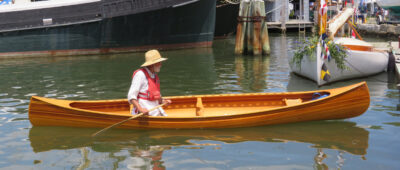
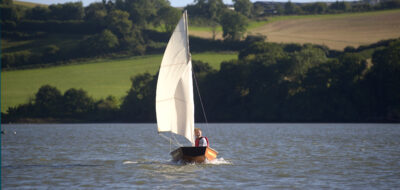
Thanks for this nice little article about my property. As you say, it’s not really commercial, but by myself and a few friends store and work on our boat boats there, and John does some work for pay when it comes in. You may have noticed that there are two Hurricane Island Outward Bound Pulling boats in the yard! One of them belongs to me. These were retired from the school’s fleet some years ago, and I enjoy sailing mine when I have the bandwidth to get it launched!
Keep up the good work Jenny, I look forward to seeing you around the island this summer.
Doug Goldhirsch
Thanks Doug, it was a fun mid-winter visit. I missed the Outward Bound boats—maybe they were buried under all the snow!
Thanks for the simple, feel-good, story, Jenny. It reminds me that even a quick run down to the harbor to check on Scherzo’s cover after a winter windstorm can bring a great deal of satisfaction.
Thanks Murray, and fingers crossed, spring is right around the corner.