Matt Morris lives in Waterloo, Ontario, part of the landlocked twin city of Kitchener-Waterloo, a metropolis of some 700,000 people about 60 miles west of Toronto. Lakes Ontario, Erie, and Huron are all less than 75 miles away, but for Matt, the much smaller, 5 1⁄2-acre lake in Victoria Park is his go-to place for boating adventures. Park and lake are within an easy bike ride from Matt’s house, and in 2021, when he stumbled upon a municipal sign that suggested the small body of water could be used for boating, he set about designing and building a three-section skin-on-frame nesting rowboat that he could trailer behind his bike. Christened UB1000, it was the first of Matt’s “Urban Boats” and weighed 36 lbs.
 Photographs courtesy of Matt Morris
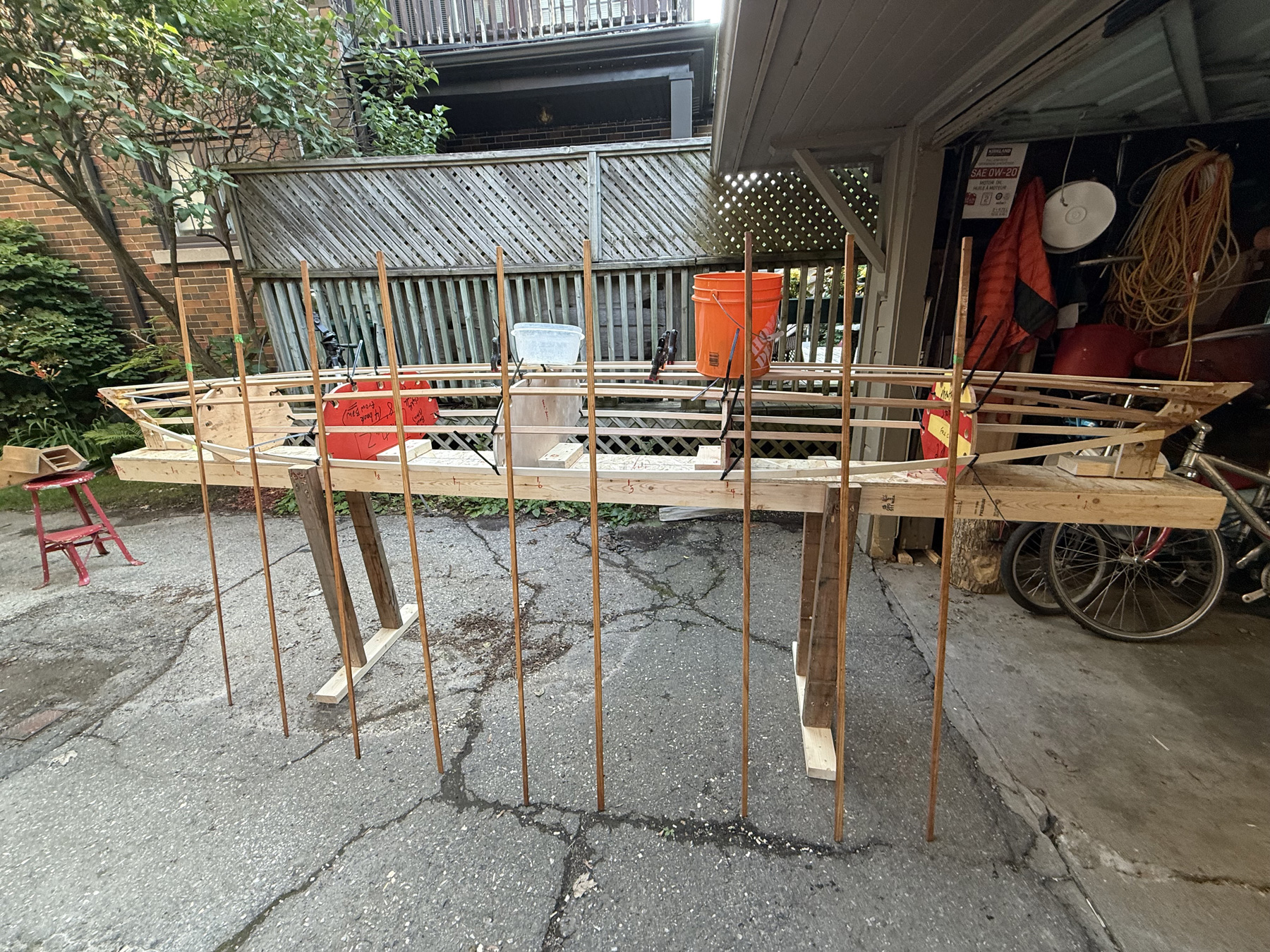
Matt built PHEATHER 2 on five stations. Before installing the ash frames (seen here leaning against the port gunwale), he had fitted the four full-length and two half-length western red cedar stringers as well as the ash keel and gunwales. The nine frames—previously soaked and steamed—would be installed in two hours.
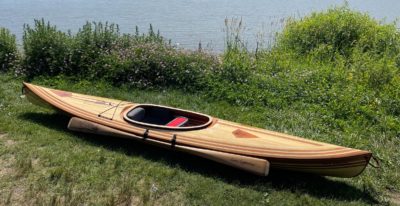
Eighteen months later Matt was back at the drawing board. UB1000 had served him well—especially after he had designed and built a custom trailer to pull it behind his bike—but he had decided he preferred to look forward when he was on the water, and he wanted something lighter for easier towing. He set out to create a 12′ canoe that would weigh less than 20 lbs. After many hours of research and design—both on paper and in model form—in September 2023, in just four days, Matt built his UB2000, PHEATHER, a skin-on-frame canoe of ash frames, gunwales, and keel, maple stems, and western red cedar stringers, all skinned with 9-oz Dacron. She was 11′ 11″ long, with a beam of 31″ and a depth of 13 1⁄4″. On the waterline, she was 27 1⁄4″ long, and her dry-weight draft was just 2″. She had no sheer and little rocker, but, said Matt, she did have “an enthusiastic tumblehome to make solo paddling comfortable.” PHEATHER weighed 20.6 lbs.
A year later, Matt was at it again. This time he wanted to build a canoe that was not only lighter but also see-through. Writing on his blog, Matt said, “I envisioned sliding effortlessly over the water while watching fish swim beneath me! And the lighter weight would make it even easier to tow behind my bicycle.”
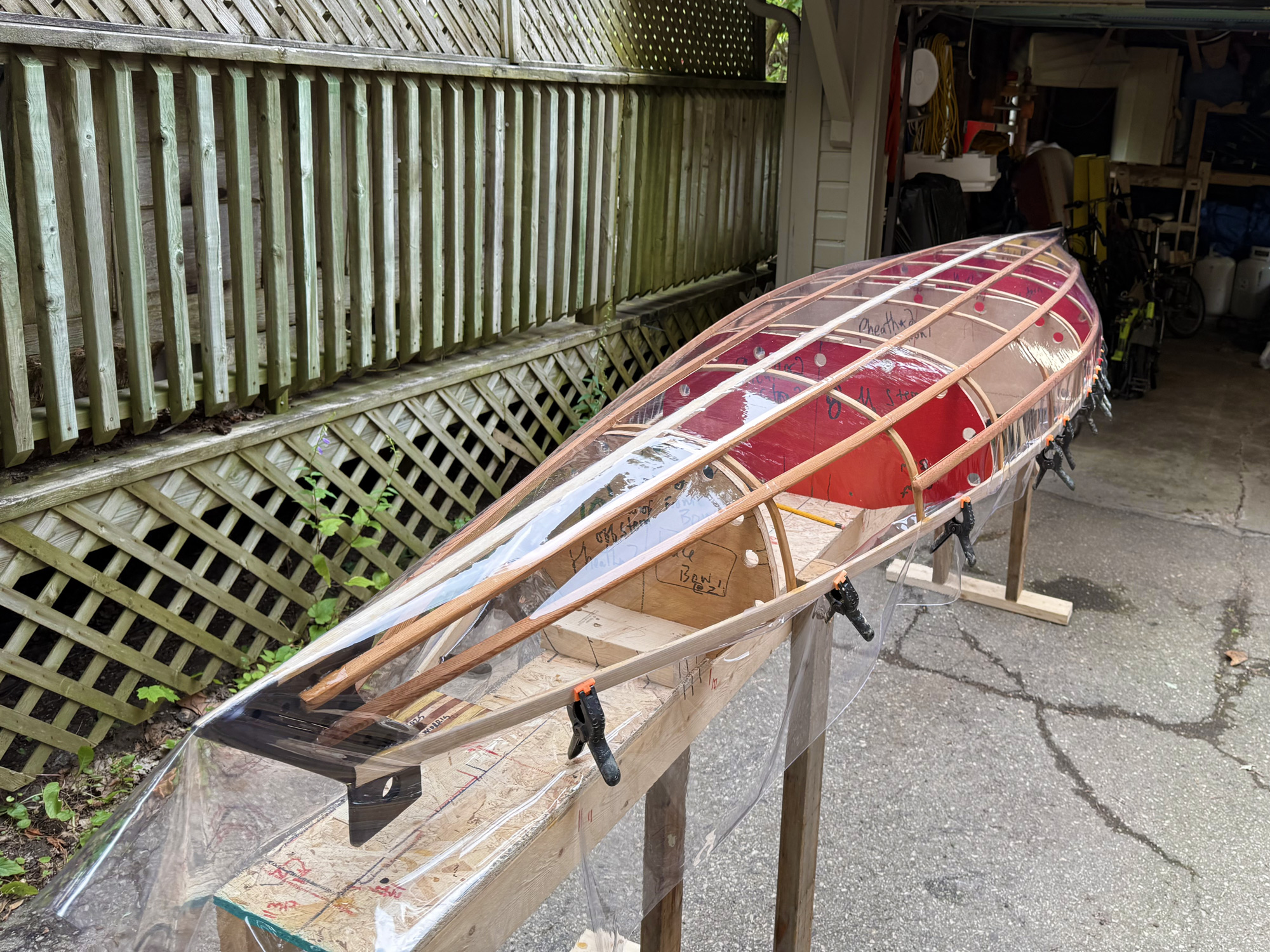
Once the hull’s frame was finished, it was time to apply the clear vinyl skin. Matt applied HH-66 adhesive to both the keel and the vinyl, allowing it to become tacky before placing the vinyl in position. He tensioned the vinyl by stretching it down to the gunwales and holding it taut with spring clamps.
Using his UB2000 as the design foundation, and acknowledging that his new canoe would be strictly for use in calm waters, Matt drew up a list of “wants”: less freeboard; clear skin; fewer frames and stringers; no Kevlar rovings; reverse-raked stems; thinner gunwales and keel; 1″ negative sheer; and just under 2″ of rocker. To make it towable he’d use the UB1000’s towing system: two longboard wheels mounted on a narrow board fixed to the aft stem of the canoe, with a swivel-mount receptacle beneath the saddle of his bike where the forward stem connects.
Matt was focused on reducing weight. His early rough calculations estimated the canoe would weigh around 15 lbs. One way to make it lighter was to remove structural elements: fewer stringers and frames would mean less weight. He started with the stringers, working first on paper and then using the original PHEATHER to visualize possible placements. “The new hull shape would be very similar to my original boat, but lower. I decided to grab some painter’s tape and experiment with different stringer positions on my original boat. It was very quickly apparent what would work and what wouldn’t.” While he was intent on reducing weight, Matt didn’t want to sacrifice stiffness in the new canoe. As he worked, he saw that he had plenty of strength in the ends, but needed more structure in the middle. “I came up with the idea of a half (70″-long) stringer that would be placed amidships between the uppermost full-length stringer and the inwale.”
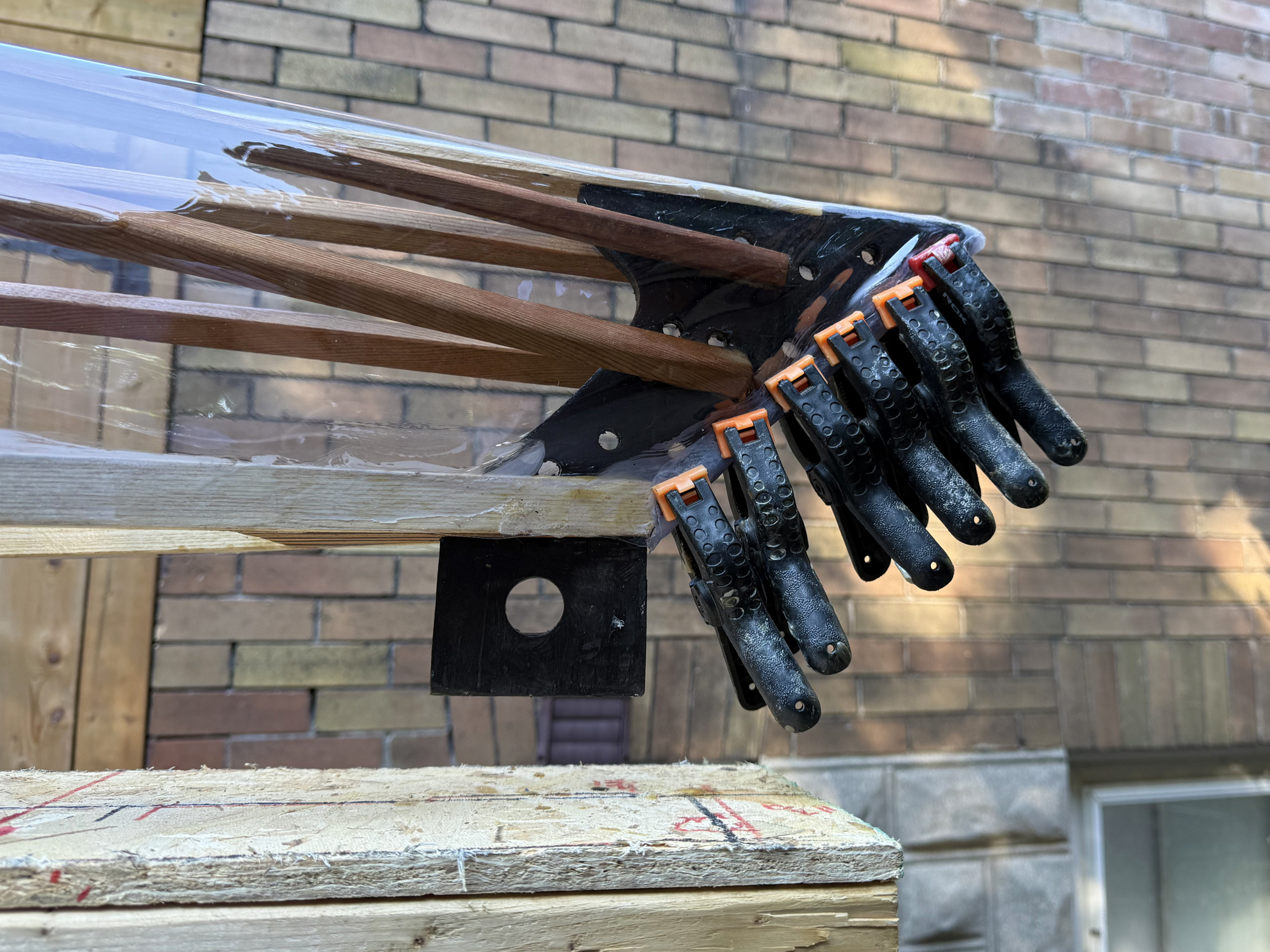
To fix the skin at the stems, Matt applied adhesive to both stem and vinyl and then pulled tension into the vinyl manually, wrapping it around the stem from both sides and holding it taut with as many clamps as he could fit. The meranti marine plywood stem was designed for lightness and strength. Protruding beyond the gunwale is the stem bracket that will join with the trailer hitch on Matt’s bike.
The biggest shape difference between PHEATHER and PHEATHER 2 was in the sheer. On PHEATHER the sheer was flat but, says Matt, “I decided to introduce some negative sheer. If you heel a canoe it always floods first at the center—the bow and stern are never the first to go. For a canoe working in big waves it makes sense to have high ends, but this boat is for calm waters only. That realization motivated me to lower the ends, save weight, maintain function, and maybe even look cool.”
Freeboard was next to go. Studying videos and photographs of PHEATHER underway, he was confident that he could reduce the freeboard of the new canoe from 13″ to 9″ but still keep the water out. He also flattened the athwartship curve of the bottom to provide more stability.
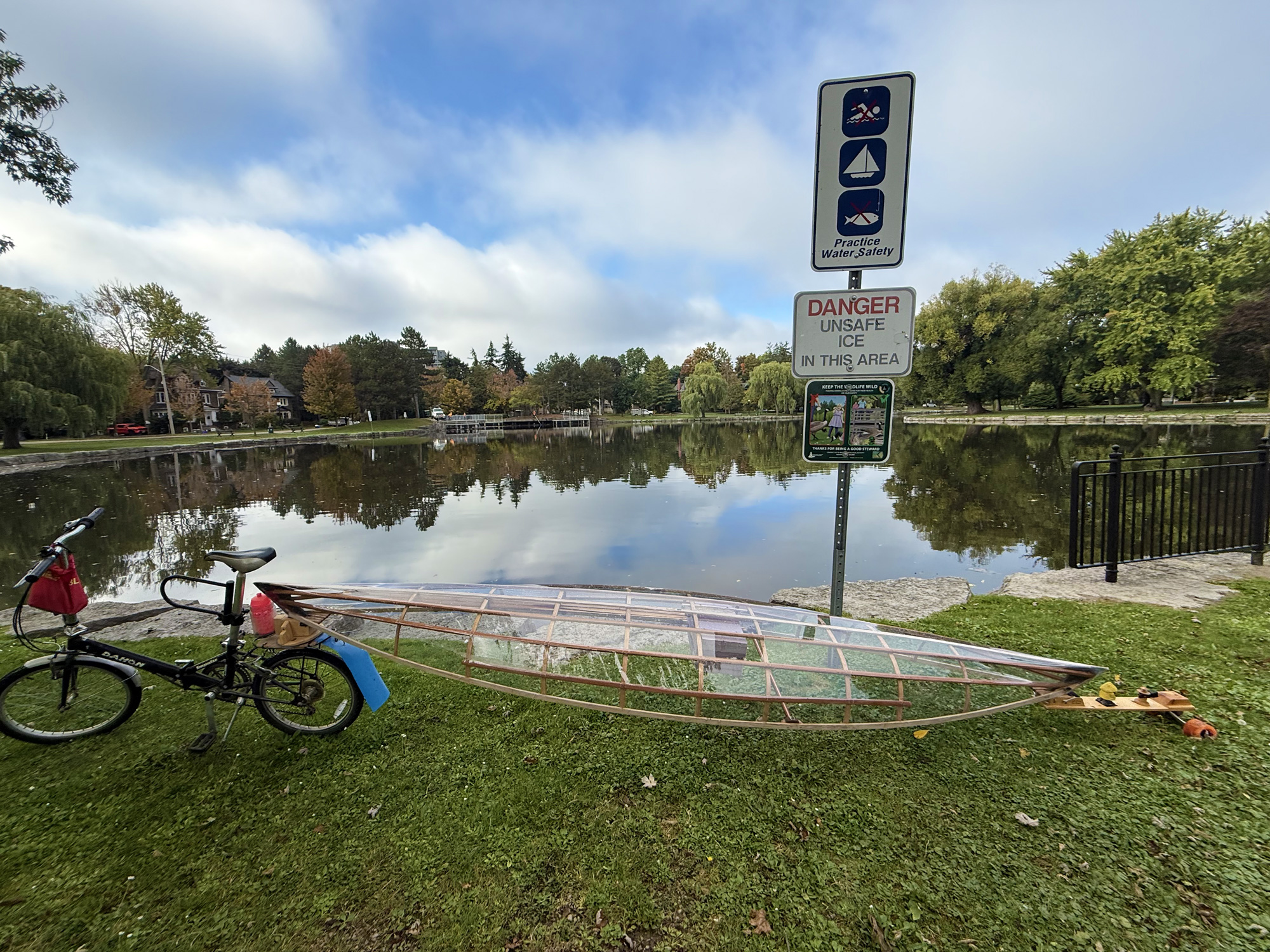
On launching day Matt towed PHEATHER 2 to the lake at Victoria Park and stood his bike beside the sign that first inspired his urban boating journey back in 2021.
For the build Matt made five stations: one central and two on either side, identified from bow to stern as 3-2-1-2-3. In PHEATHER the forward and aft versions of stations 2 and 3 were identical, but in PHEATHER 2 he made some changes: “I wanted to play a little with making the boat somewhat asymmetrical. The idea was ‘sleek on the front end’ to cut through the water and ‘slightly bulbous behind the seat’ for more buoyancy.” He built the stations out of plywood and drilled 1″ holes into each to receive releasable zip-ties that would hold the stringers, keel, and gunwales in place until the frames were glued in. For stringers he used 12′ lengths of western red cedar left over from the original PHEATHER project, four to each side. He made the stems out of 1⁄2″ plywood, designing them to rake into the boat in order to maintain the waterline length, and saving some weight by shortening the chines and gunwales. While the resulting shape is reminiscent of the sturgeon-nosed canoes of the First Nation peoples of the Northwest, Matt’s interpretation is less exaggerated and includes solid stems to which the stringers are glued.
The keel and gunwales were of scarfed lengths of ash, and once Matt was sure he had the shapes of his stems right, he zip-tied everything together—stations, keel, gunwales, stringers—in preparation for installing the frames. There would be nine 3⁄4″ × 3⁄16″ ash frames. Matt had soaked the stock in his cistern for several days and on the day of installation steamed each frame for 16 minutes. As he bent them in place, he first clamped them and then zip-tied them to the stations, stringers, and keel—all nine frames were installed in two hours. The following day, Matt glued the frames in place. Later, after one of the epoxied ash-to-cedar joins broke, he would also apply waxed polyester lashings throughout.
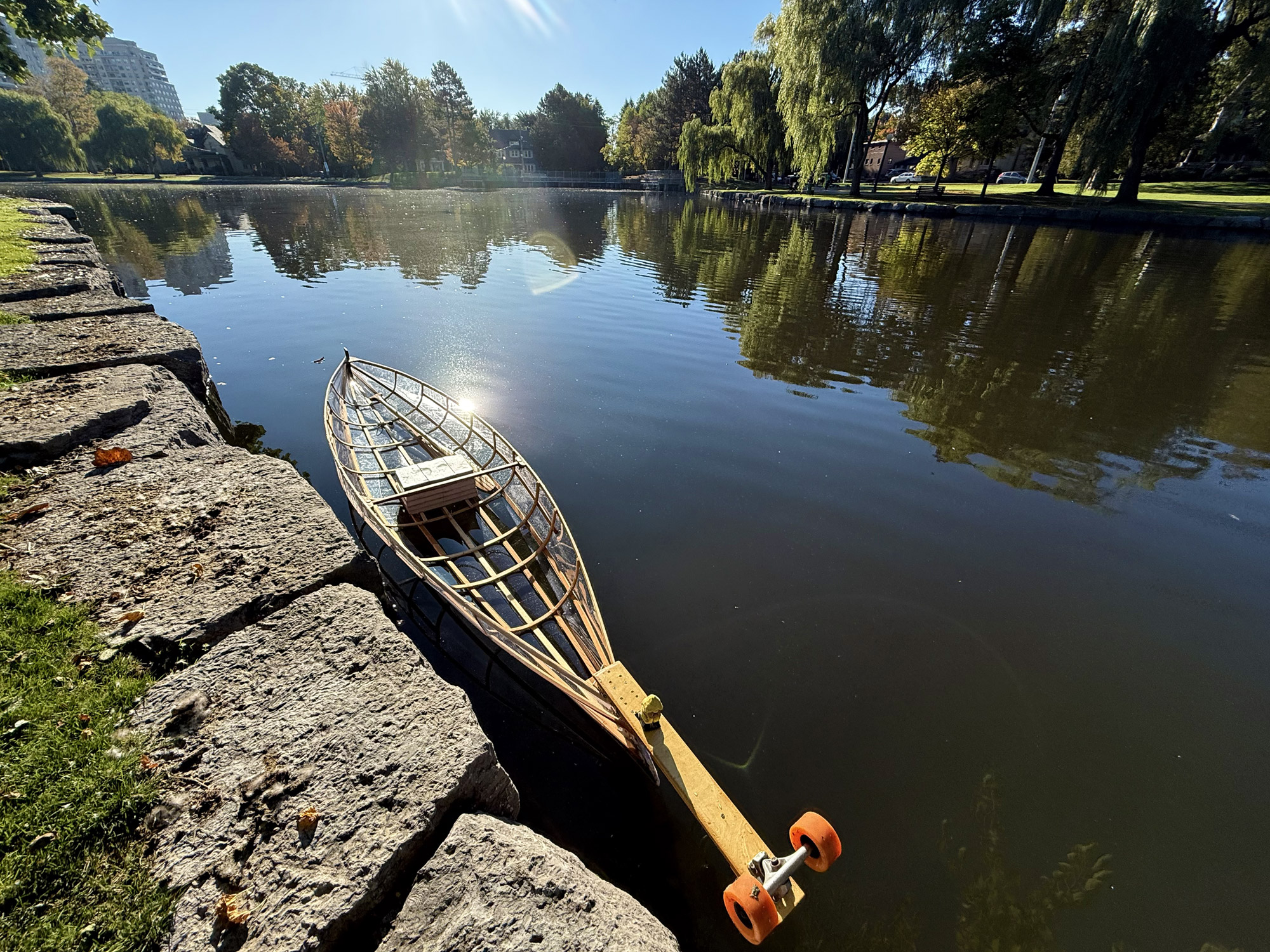
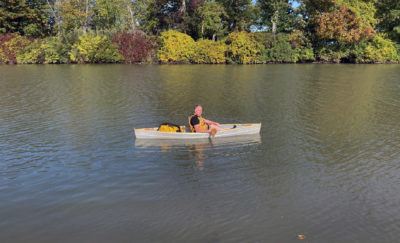
After Matt lowered PHEATHER 2 into the water at Victoria Park, he was delighted to see her floating with no sign of any leaks.
After installing small decks in either end—“for strength and looks”—it was finally time to apply the transparent skin. Matt had been experimenting with different materials—20-gauge vinyl and 4-oz Dacron—and application techniques, testing the adherence of vinyl to wood, and trying different methods of waterproofing and heat-shrinking Dacron. In the end he decided to use 20-gauge clear vinyl—12.9 oz per square yard—with HH-66 adhesive to secure it to the frame.
Wishing to avoid inhaling too many of the adhesive’s solvent vapors, he moved the project out of the shop and into the driveway and began by rolling out and centering the 5 yards of vinyl over the bottom of the inverted canoe, still supported by the five stations. When he was confident that the vinyl was centered, he applied painter’s tape to the fabric where it rested on the keel. This allowed him to remove the vinyl but still see the centerline so that he could apply glue to both the keel and the vinyl. After curing the glue for several minutes he carefully lifted the vinyl back into place and pressed it down onto the keel. He then left it to fully cure for 24 hours before moving onto the attachment at the gunwales. To stretch the vinyl across the frame of the canoe and around the stems, Matt decided against using heat. Instead he simply pulled the vinyl into place, each time marking the spot with painter’s tape, releasing the vinyl, applying the glue to both parts and, when the glue was tacky, bringing the vinyl back into place and holding it taut with many spring clamps. It was a time-consuming process but not one that Matt wanted to rush—after all, if the vinyl didn’t hold or was too loose, all his hard work would have been in vain.
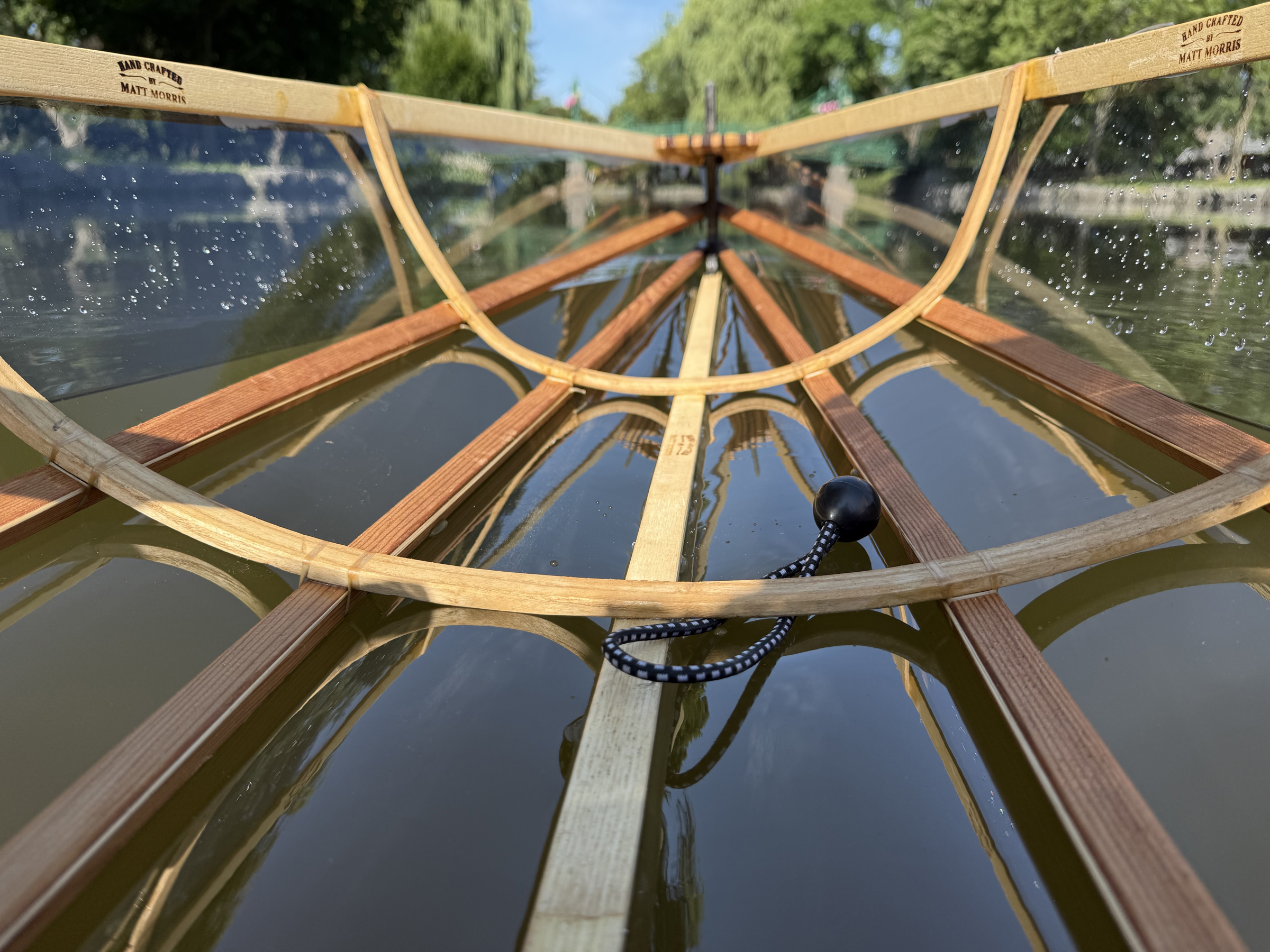
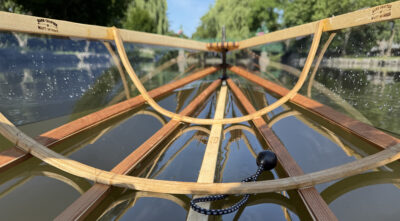
As he paddles PHEATHER 2 around Victoria Lake, Matt can now enjoy the view above and below the water.
Matt launched PHEATHER 2 on July 19, 2025. He had awoken early and made a list of all that he still had to do: take off the clamps, install the seat, and put on the longboard wheels, along with a number of other minor items. And before he headed for the park, he had one last thing to do, weigh her. The scale settled at 11.6 lbs, with the seat installed. With PHEATHER 2 in tow, he set off on his bike. At the park, he carefully set the canoe into the water and climbed on board. “It initially felt weird, but I’d almost expected that,” he says. “Had I designed it tippy or was it that I wasn’t used to its characteristics? It quickly proved to be the latter, and I set off for two loops of the lake. What a blast! It worked! It didn’t sink! It didn’t tip me out and it didn’t leak!”
Since last July, Matt and PHEATHER 2 have returned to the lake on multiple occasions. “The mood of the park changes,” he says, from “quiet misty mornings to loud crowds.” He’s connected with friends old and new beside the lake, “the same senior woman pushing her walker down the trail, the same people sitting on the same bench, kids feeding fish from the bridge… The wildlife has also gotten used to me. I have a working relationship with the resident swans, Otis and Ophelia; mid-July to mid-August schools of fish gather under a mulberry tree that overhangs the water…” And all the while, Matt paddles silently by, taking delight in seeing the water break around the bow from within the canoe; pausing to watch a downy feather float past his knees; gazing at a fish as it swims by beneath his feet. “She wouldn’t last a minute in big waves or a fast-flowing river,” he says of his creation, “but as a source of exercise and a little serenity in a bustling city, she’s hard to beat.”
Jenny Bennett is editor of Small Boats.
Do you have a boat with an interesting story? Please email us. We’d like to hear about it and share it with other Small Boats readers.
Interested in space-saving or lightweight boats? See…
A Nesting Dinghy, a stylish 11′ sailboat that divides in two to fit in the back of a small pickup truck.
A Twin Cities Boat, Matt Morris’s first Urban Boat project—a boat that could fit in the trunk of his car or be trailered behind his bike.
Kokopelli Platte-Plus, an inflatable kayak for tandem or solo paddling.
where can one purchase the vinyl (and adhesive used with it)? A beautiful boat. Any idea how long the vinyl might last? Does it need to be stored out of the sun?
I watched the videos, wow, I think I’d feel about the same in that as I would naked, strapped to the grill of a semi down the highway. It would take me a long time to not feel like I was about to die. But then I might feel as free as flight, unencumbered by even a body.
That is a fantastic design Matt. They say get a boat for your local waters? You’ve applied the hyper minimalist mindset to it. They say best way to learn rivers is not to paddle 50 of them but to paddle one of them 50 times? You will be able to learn lakes with the least amount of overall joules expended in any way earthly possible.
I love the reverse sheer. Mucho mucho props for your belief in ability to understand beyond 1000s of years of accepted wisdom. Tickled by the phrase ‘enthusiastic tumblehome,’ what with the reverse stems that shape must needs be seen with stereo eyesight to appreciate.
Excellent job. Thank you.