For an open canoe, 16′ is the most versatile and popular length. When paddled by two people, a 16-footer offers enough space to carry gear for a week of camping, or even a third person. Depending on the design and fabrication, it can be optimized for straight-line flatwater paddling or have sufficient rocker to enable it to be twisted down a rocky stream. Sixteen-footers can also be paddled solo, which is hard in longer canoes. Furthermore, longer canoes are harder to load on cars or portage solo. Old Town Canoe of Maine, the most prolific of all North American canoe manufacturers, records that 32 percent of their entire canoe production from 1905 to 1978 consisted of 16-footers.
Newfound Woodworks of Bristol, New Hampshire, offers the sporty Chestnut Kruger, a 16-footer based on one of the classic wood-and-canvas Cruiser models designed and originally built by the Chestnut Canoe Company. Located in Fredericton, New Brunswick, Chestnut started business in 1904 and closed in 1978; during those 70 years, it was Canada’s largest canoe company. The Kruger was one of Chestnut’s first models, and I was intrigued by the unlikely-sounding name. Some quick research revealed that, in the early 1900s, to ensure accuracy in telegraphed orders, canoe companies assigned code names to their models, choosing titles that evoked a specific quality. The Kruger was named for Paul Kruger, State President during the South African War (1899–1902), in which his underdog Boer forces earned considerable respect from British and colonial forces—among them soldiers from Canada.
 Photographs by Jenny Bennett
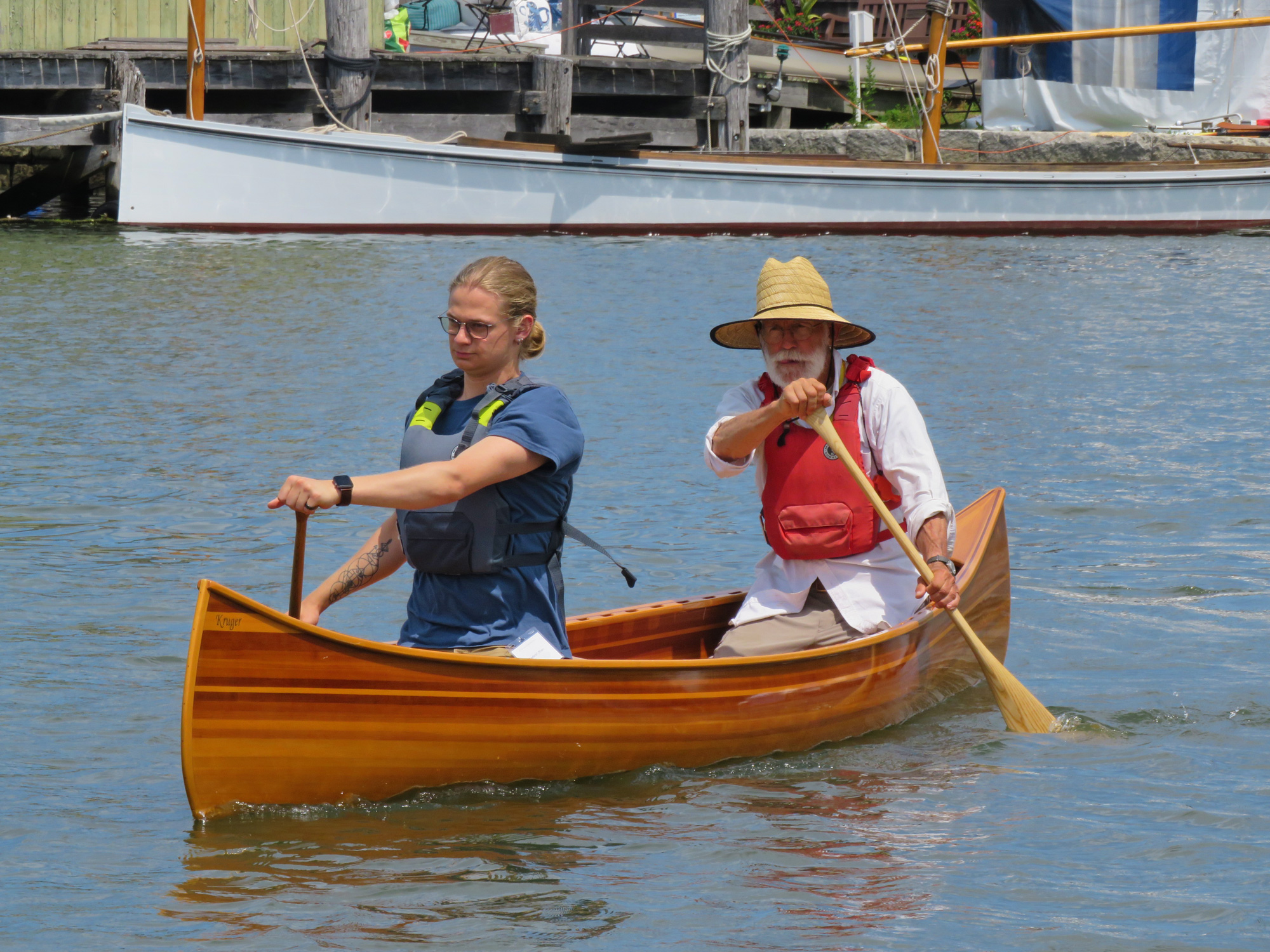
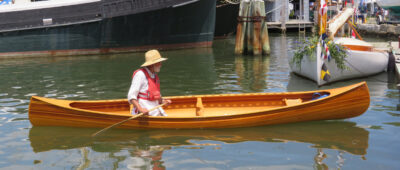
The Chestnut Kruger is a responsive canoe and, with a rated capacity of 450 lbs, can easily carry two paddlers and their camping gear.
From Chestnut Canoe to Newfound Woodworks
In the 1908 Chestnut catalog there is a description of the Cruiser line of canoes, of which the Kruger was the smallest: “Whenever heavy rapids and swift running rivers have to be navigated, we can easily carry off the palm with this model. We claim that it is the best canoe ever draughted for rapid water and general river work, and a trial will convince the most skeptical. It is not straight on the bottom, but rises a little towards the ends, and consequentially can be turned quickly. This is of utmost importance in running rapids. It is rounder on the bottom than the Pleasure model consequently slightly faster and consequently not quite so steady. It is an easy paddler and the best poling canoe known.”
Seventy years later, the company’s final catalog described the Cruisers: “designed for whitewater and stock model racing… sharper bow and stern, narrower beam and more rounded bottom than the pleasure models, making them extremely quick to the paddle… Alertness to paddle and lively forward motion are features that the racing enthusiast desires making this design the number one choice in Canada for stock model canoe racing.”
The Newfound Woodworks kits for the Chestnut Kruger include western red cedar strips for the planking along with northern white cedar and aspen strips to be used as accent pieces.
The late Chestnut Canoe historian, Roger MacGregor, took the lines from an original Kruger and sent them to illustrator Sam Manning. Sam created lines plans of the Kruger and several other canoes for Roger’s history of the Chestnut Company, When the Chestnut was in Flower, published in 1999. Working with Sam’s drawings, Rose Woodward and Alan Mann of Newfound Woodworks built their own version of the Kruger—strip-planked and 10 lbs lighter than the original wood-and-canvas canoe—and launched it in May 2003. It was, indeed, a performance boat.
Since building that first Kruger, Rose and Alan have developed a strip-planked kit, named the Chestnut Kruger. As with all Newfound kits, the Chestnut Kruger can be customized according to the order, but if a complete kit is purchased it will contain everything one needs to build the canoe: plans, notes on the method of strip-building a boat, CNC-cut forms (including clamping grooves so the canoe can be built without staples), and a selection of photographs showing canoes at various stages of construction. The strips—all milled to order from air-dried western red cedar at the Newfound facility—are coved and beaded, with at least 30 percent being full length. Also in the kit are some 6′ to 10′ lengths of northern white cedar strips for color contrast, and four aspen strips for accents. Finally included are the ash outwales, scuppered inwales, stem laminations, and thwart, the cane-and-ash seats, cedar seat cleats, fiberglass, epoxy, epoxy-application tools, and varnish—in short, a canoe in a box.

While the canoe’s narrow beam does make it initially somewhat tippy, with weight kept low, it quickly steadies as it gets underway.
The Chestnut Kruger’s Performance
When I paddled Newfound Woodworks’ newly built Kruger at the WoodenBoat Show last June, I knew nothing of the design’s prestigious history but was familiar with the quality of Rose and Alan’s productions, having visited their stand at the show for many years, and having solo-paddled their smaller Otter earlier in the day. True to form, the Kruger build was flawless: Rose and Alan’s attention to detail is second to none, and the materials included in their kits are all high quality. A visit to their website confirms their exemplary customer service and their willingness to help the less experienced builders among their customers.
I was joined for my test paddle by Gabriel, a young man working at The WoodenBoat Store for the season. He had paddled a good deal in his childhood, but had done little recently.

Though designed for two paddlers, the Chestnut Kruger’s 16′ length can be handled easily by a solo paddler with some experience. However, with just myself on board the bow had a tendency to ride high, so I added two filled water jugs in the forward end, and the issue was resolved.
The Kruger has a narrow, 29″, waterline beam and arced bottom and, as anticipated, we found the canoe to be somewhat tippy when boarding, but it steadied as soon as we got underway. Since Gabriel and I hadn’t paddled together, it took a little time for us to find a rhythm. We decided not to do any heeled turns or braces, but even when flat, the Kruger’s 1 1⁄2″ of rocker allowed the canoe to spin fast with both of us doing draw strokes. After some practice we did some crossbow turns, with equally satisfactory results, and working together we easily hit 4 knots when paddling straight. For inexperienced paddlers, the Kruger is a canoe that asks for time and practice, but its potential performance will definitely reward such efforts.
Gabriel’s duties called him back to the WoodenBoat booth, so I took the canoe out for a solo paddle. The Kruger’s bow seat is positioned to be the perfect placement for a solo paddler, and the canoe can be efficiently paddled stern-first. Initially, my weight, aft of amidships, caused the bow to ride high, but after placing a couple of full water jugs in the bow, it leveled out well. Sitting on the seat, I was able to hold the canoe on a straight line with a J- or, indeed, any underwater recovery strokes. I had brought a selection of paddles with me—with blades ranging from 5″ to 6 3⁄4″ wide—and found that my Northwoods paddle with its 29″ × 6 3⁄4″ blade was the best fit for the boat.
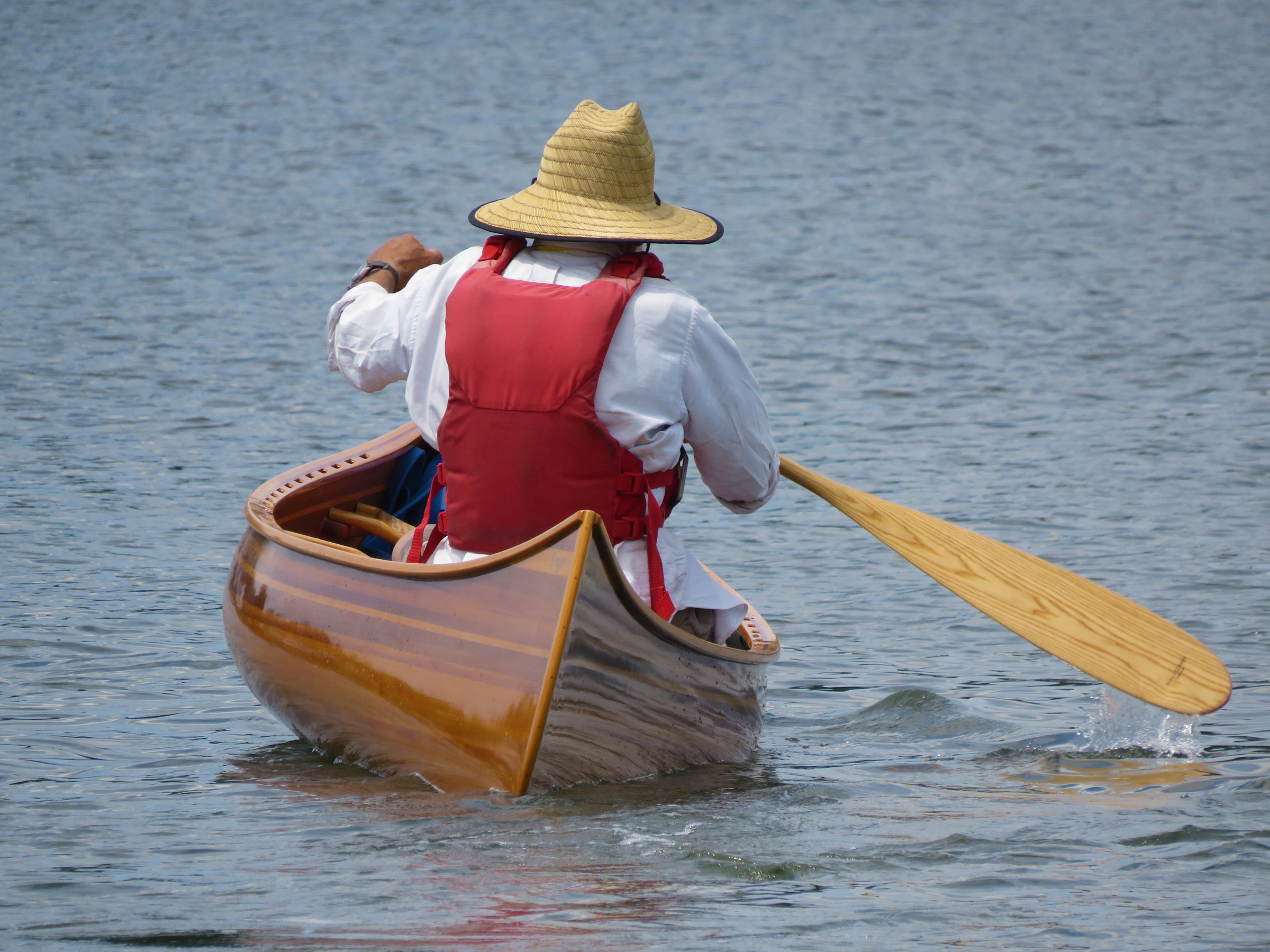
While paddling solo, I heeled the canoe and found that it was easy to spin it through a tight circle but I could also maintain a straight course with little effort.
After paddling solo from the seat, I tried kneeling and heeling the canoe, and found that with my weight lowered the canoe became delightfully rock solid. When heeled it was even easier to run the canoe in a straight line or spin it through a tight circle.
As the old Chestnut catalogs promised, this is a canoe for experienced paddlers or for those who want a canoe that will reward them as they polish their skills. Indeed, twisting it down a Class II rapid would be a delight. I had anticipated a canoe that would be fun and rewarding for two paddlers, and was not disappointed; what surprised me was just how much fun it was to paddle it solo.
Ben Fuller, curator emeritus of the Penobscot Marine Museum in Searsport, Maine, has been messing about in small boats for a very long time. He is owned by a dozen or more boats: kayaks, canoes, a skiff, a ducker, and a sail-and-oar boat.
Chestnut Kruger Particulars
LOA: 16′
Beam: 33 1⁄2″
Beam at waterline: 29″
Weight: 55 lbs
Displacement/capacity: 450 lbs
Draft at capacity: 3 1⁄8″
Center depth: 12 5⁄8″
Rocker: 1 1⁄2″
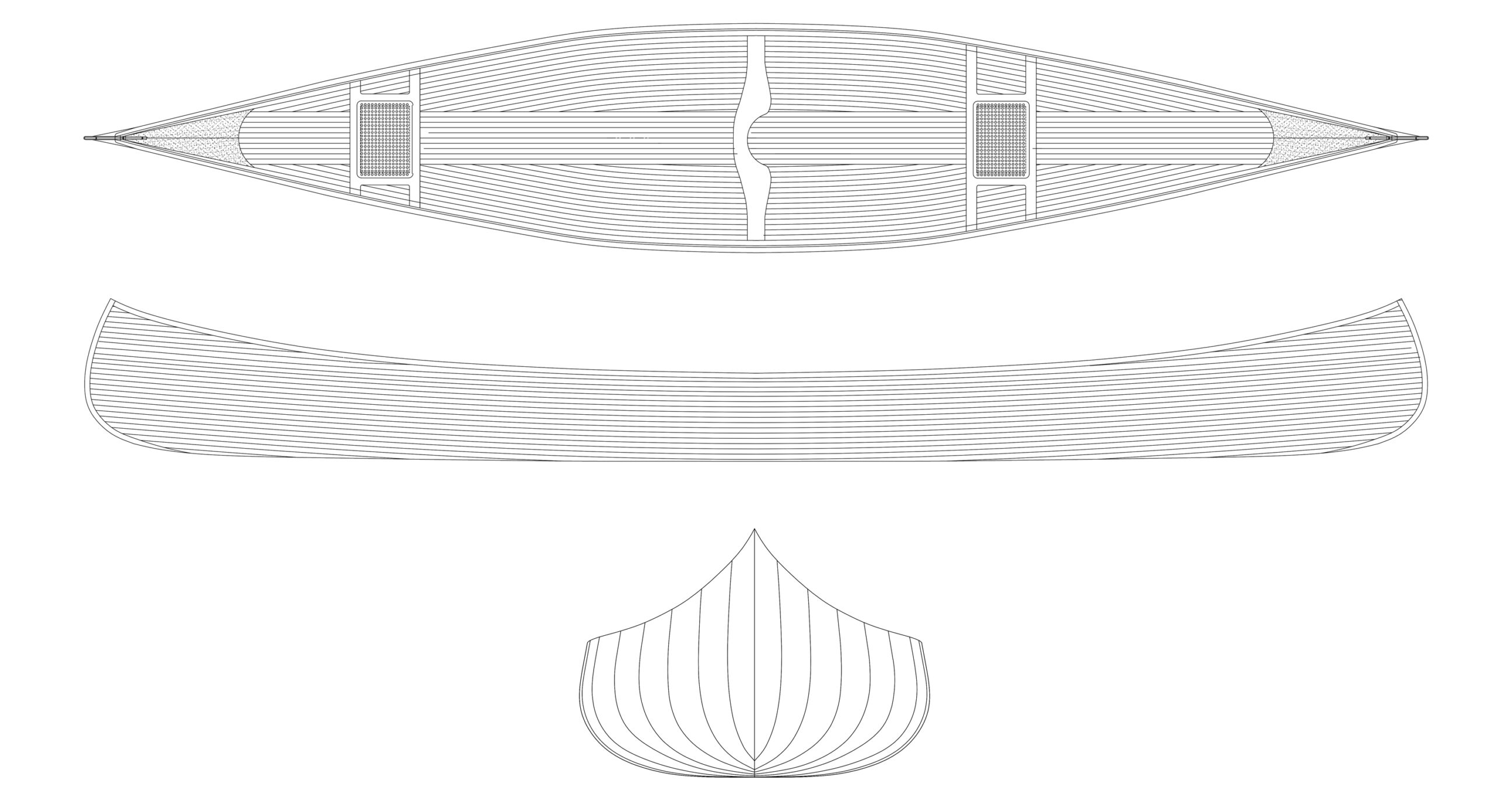
The Chestnut Kruger is available from Newfound Woodworks. Kits can be customized, but a full kit as described here is $3,275 plus shipping.
Is there a boat you’d like to know more about? Have you built one that you think other Small Boats readers would enjoy? Please email us your suggestions.
For more boat profiles by Ben Fuller see…
Hatch Cove Kayak, a single-person kayak designed by David Wyman and available from Chase Small Craft.
The Delaware Ducker, a working boat evolved for duck-hunting, the ducker lends itself to solo camping and two-person daysailing; Ben Fuller has owned his ducker for more than 30 years.
Newfound Woodwork’s Otter, a strip-planked canoe that can be paddled with a single- or double-bladed paddle.


For information and instruction on paddling technique that this canoe will reward, nothing is better than Bill Mason’s Path of the Paddle. His daughter Becky continues his legacy with outstanding instructional videos. https://www.redcanoes.ca/paddling-videos.